Marketing Mix
Concept
4 P’s of Marketing
Objective of the
session
 To Understand ;
1) The four P’s,
2) History of the marketing mix concept and
terminology,
3) Purpose of the marketing mix,
4) Key features of the marketing mix,
5) Developing a marketing mix,
6) Key challenges, and
7) Marketing mix case study – Nivea.
Marketing Mix
 Marketing is simplistically defined as ‘putting
the right product in the right place, at the
right price, at the right time.’
 The use of a marketing mix is an excellent
way to help ensure that ‘putting the right
product in the right place,…’ will happen.
 The marketing mix is a crucial tool to help
understand what the product or service can
offer and how to plan for a successful
product offering.
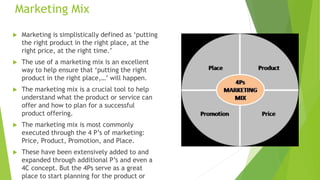
 The marketing mix is most commonly
executed through the 4 P’s of marketing:
Price, Product, Promotion, and Place.
 These have been extensively added to and
expanded through additional P’s and even a
4C concept. But the 4Ps serve as a great
place to start planning for the product or
THE FOUR P’S
Product
 The product is either a tangible good or an intangible service that is seem to
meet a specific customer need or demand.
 All products follow a logical product life cycle and it is vital for marketers to
understand and plan for the various stages and their unique challenges.
 It is key to understand those problems that the product is attempting to
solve.
 The benefits offered by the product and all its features need to be
understood and the unique selling proposition of the product need to be
studied.
 In addition, the potential buyers of the product need to be identified and
understood.
Price
 Price covers the actual amount the end user is expected to pay for a product.
How a product is priced will directly affect how it sells.
 This is linked to what the perceived value of the product is to the customer
rather than an objective costing of the product on offer.
 If a product is priced higher or lower than its perceived value, then it will not
sell. This is why it is imperative to understand how a customer sees what you
are selling.
 If there is a positive customer value, then a product may be successfully
priced higher than its objective monetary value.
 Conversely, if a product has little value in the eyes of the consumer, then it
may need to be underpriced to sell. Price may also be affected by distribution
plans, value chain costs and markups and how competitors price a rival
product.
Promotion
 The marketing communication strategies and techniques all fall under the
promotion heading.
 These may include advertising, sales promotions, special offers and public
relations.
 Whatever the channel used, it is necessary for it to be suitable for the
product, the price and the end user it is being marketed to.
 It is important to differentiate between marketing and promotion.
 Promotion is just the communication aspect of the entire marketing function.
Place
 Place or placement has to do with how the product will be provided to the
customer.
 Distribution is a key element of placement.
 The placement strategy will help assess what channel is the most suited to a
product.
 How a product is accessed by the end user also needs to compliment the rest
of the product strategy
History of the Marketing Mix Concept
 The marketing mix concept gained popularity following an article titled “The
Concept of the Marketing Mix” by Neil Borden published in 1964. Borden
explained how he started using the term inspired by James Culliton who in
the 1940s described the marketing manager as a ‘mixer of ingredients.’
 Borden’s article detailed these ingredients as product, planning, price,
branding, distribution, display, packaging, advertising, promotions, personal
selling among many others.
 Eventually E. Jerome McCarthy clustered these multiple items into four high
level categories that we now know as the 4 P’s of marketing. “Its elements
are the basic, tactical components of a marketing plan”. Together, elements
in these four categories help develop marketing strategies and tactics.
Purpose of marketing mix
 The 4P’s were formalized and developed over the years by experts to ensure
the creation and execution of a successful marketing strategy.
 Through the use of this tool, the attempt is to satisfy both the customer and
the seller.
 When properly understood and utilized, this mix has proven to a key factor in
a product’s success.
DEVELOPING A MARKETING MIX
To ensure a marketing mix that is based in research and combines facts with
innovation, a manager should go through the following systematic process:
 Define USP.
 Understand needs, wants of customers
 Understand the competition.
 Evaluate the placement options
 Develop communication/promotion strategy
 Cross check the mix
Challenges
 Lack of Focus on Services: The conventional marketing mix tends to be applicable to
tangible goods i.e. the traditional definition of products. Services or intangible goods
are also a vital customer offering and can be planned for in much the same way as
physical products. To cater to the unique challenges of services, the 4P model has been
supplemented with 3 additional categories which are:
 Physical Evidence is proof and a reassurance that a service was performed
 People are the employees who deliver the service
 Processes are the methods through which a service is executed and delivered to the
customer
 Lack of True Customer Focus: Though a total focus on the customer and what they
desire is a vital element of the 4P model, this truth is often in danger of being
overlooked by enthusiastic marketing teams. To counter this, Robert F. Lauterborn put
forward his customer centric four Cs classification in 1990. This model converts the
four P’s into more customer oriented four C’s:
 Product to Customer Solution
Case study-Nivea Visage Young
 NIVEA is a well-known company that is in the high-quality skin and beauty
care product market.
 NIVEA is one the brands manufactured and sold by Beiersdorf, which was
established in 1882.
 In UK, the company has always focused on ensuring availability of their
products to as many people as possible.
 In addition, the company has always strived to understand the varied needs of
its vast consumer base and bring as many specific products to market as
possible.
Marketing mix for new product line
 Market research revealed an opportunity in the market for a younger
customer base. This led to the launch of Nivea Visage Young in 2005. This
product was developed for girls in the 13 to 19 years age range.
 For the eventual launch of the product, the company needed to develop a
balanced and relevant marketing mix to appeal to its young audience.
 Through its initial launch in 2005 to a subsequent re launch in 2007, the
company focused closely on the marketing mix balance to help ensure that all
elements of the product appeal to the target audience to achieve success.
Product
 The company put significant importance in ongoing research to understand the
constantly evolving market and consumer dynamics.
 This knowledge has helped the company develop more innovative new products
that fulfill consumer needs.
 Through this research, it became clear that younger consumers wished for a more
specific product that addressed the skin needs of their age category. The need was
for a product that offered a beautifying regime for daily use rather than a
medicated product that targeted specific skin problems. The latter were
abundantly being offered by competition. The product was subsequently
redesigned to meet these specialized requirements.
 From the company’s perspective, some of the changes helped meet its
commitment to the environment which included more efficient packaging to
reduce waste, the use of more natural products and the use of recyclable plastic.
Price
 An effective pricing strategy takes into account the product’s perceived and
actual values.
 The final price should be based on both these in order to make the product
attractive to both buyer and seller.
 After its relaunch, Nivea Visage Young was priced a little higher than before
to account for the new formula, better packaging and extended range of
products.
 Since the product as being bought by mothers for their daughters, it remained
low enough to remain good value for money.
 Effective pricing means that sales from this product account for nearly 7
percent of all Nivea Visage sales.
Place
 As mentioned, Nivea aims to have a wide reach for its products to ensure that it
is easily available wherever needed by the extensive target market.
 The primary channels used are retail stores. High Street stores such as Boots
and Superdrug account for nearly 65 percent of all sales. Another portion
comes from grocery chain stores such as ASDA or Tesco.
 This covers young people making their own purchases (mostly high street), as
well as their mothers buying for them (mostly grocery stores).
 These stores ensure a cost -effective distribution channel that has a wide
reach. The company manages its own cost by selling to wholesalers rather than
directly to smaller stores. It also does not sell online directly, but the product is
sold through stockiest’s.
Promotion
 Nivea has always tried to base its promotions on the actual lifestyle of its
target market.
 The company does not find above the line promotions to be very effective as
these are one-way communications through TV for example.
 Instead, the promotion is more consumer led through different below the line
solutions. Sample sales are a key activity that allows consumers to try out the
actual product. There is also an interactive online magazine FYI (fun, young,
independent) to increase product visibility and association.
 The company has also maintained a strong social media presence on popular
social media networks. This used of new media has ensured a better brand
awareness and association among target audience.
Conclusion
 Through its successful use of a balanced marketing mix, Nivea Visage Young
has managed to create a clear position in the market. It addresses a need felt
by a specific niche segment. Traditional distribution methods are balanced by
a unique product and updated promotional strategies. This ensures that the
brand message reaches the right people at the right time in the right way.
 As we see from the Nivea example, it is vital for any company to focus equally
on all elements of the marketing mix while planning for a product. Eventually,
there may be a need to divert more resources towards one variable such as
strong distribution channels over promotional activities. But this needs to
come after a clear plan and strategy has been decided upon. An effective
marketing mix can mean the difference between a flash in the pan product or
one that is bound to become a well-loved classic

3.3. Module 1_ Session 4_ Marketing mIx.pptx

  • 1.
  • 2.
    Objective of the session To Understand ; 1) The four P’s, 2) History of the marketing mix concept and terminology, 3) Purpose of the marketing mix, 4) Key features of the marketing mix, 5) Developing a marketing mix, 6) Key challenges, and 7) Marketing mix case study – Nivea.
  • 3.
    Marketing Mix  Marketingis simplistically defined as ‘putting the right product in the right place, at the right price, at the right time.’  The use of a marketing mix is an excellent way to help ensure that ‘putting the right product in the right place,…’ will happen.  The marketing mix is a crucial tool to help understand what the product or service can offer and how to plan for a successful product offering.  The marketing mix is most commonly executed through the 4 P’s of marketing: Price, Product, Promotion, and Place.  These have been extensively added to and expanded through additional P’s and even a 4C concept. But the 4Ps serve as a great place to start planning for the product or
  • 4.
    THE FOUR P’S Product The product is either a tangible good or an intangible service that is seem to meet a specific customer need or demand.  All products follow a logical product life cycle and it is vital for marketers to understand and plan for the various stages and their unique challenges.  It is key to understand those problems that the product is attempting to solve.  The benefits offered by the product and all its features need to be understood and the unique selling proposition of the product need to be studied.  In addition, the potential buyers of the product need to be identified and understood.
  • 5.
    Price  Price coversthe actual amount the end user is expected to pay for a product. How a product is priced will directly affect how it sells.  This is linked to what the perceived value of the product is to the customer rather than an objective costing of the product on offer.  If a product is priced higher or lower than its perceived value, then it will not sell. This is why it is imperative to understand how a customer sees what you are selling.  If there is a positive customer value, then a product may be successfully priced higher than its objective monetary value.  Conversely, if a product has little value in the eyes of the consumer, then it may need to be underpriced to sell. Price may also be affected by distribution plans, value chain costs and markups and how competitors price a rival product.
  • 6.
    Promotion  The marketingcommunication strategies and techniques all fall under the promotion heading.  These may include advertising, sales promotions, special offers and public relations.  Whatever the channel used, it is necessary for it to be suitable for the product, the price and the end user it is being marketed to.  It is important to differentiate between marketing and promotion.  Promotion is just the communication aspect of the entire marketing function.
  • 7.
    Place  Place orplacement has to do with how the product will be provided to the customer.  Distribution is a key element of placement.  The placement strategy will help assess what channel is the most suited to a product.  How a product is accessed by the end user also needs to compliment the rest of the product strategy
  • 8.
    History of theMarketing Mix Concept  The marketing mix concept gained popularity following an article titled “The Concept of the Marketing Mix” by Neil Borden published in 1964. Borden explained how he started using the term inspired by James Culliton who in the 1940s described the marketing manager as a ‘mixer of ingredients.’  Borden’s article detailed these ingredients as product, planning, price, branding, distribution, display, packaging, advertising, promotions, personal selling among many others.  Eventually E. Jerome McCarthy clustered these multiple items into four high level categories that we now know as the 4 P’s of marketing. “Its elements are the basic, tactical components of a marketing plan”. Together, elements in these four categories help develop marketing strategies and tactics.
  • 9.
    Purpose of marketingmix  The 4P’s were formalized and developed over the years by experts to ensure the creation and execution of a successful marketing strategy.  Through the use of this tool, the attempt is to satisfy both the customer and the seller.  When properly understood and utilized, this mix has proven to a key factor in a product’s success.
  • 10.
    DEVELOPING A MARKETINGMIX To ensure a marketing mix that is based in research and combines facts with innovation, a manager should go through the following systematic process:  Define USP.  Understand needs, wants of customers  Understand the competition.  Evaluate the placement options  Develop communication/promotion strategy  Cross check the mix
  • 11.
    Challenges  Lack ofFocus on Services: The conventional marketing mix tends to be applicable to tangible goods i.e. the traditional definition of products. Services or intangible goods are also a vital customer offering and can be planned for in much the same way as physical products. To cater to the unique challenges of services, the 4P model has been supplemented with 3 additional categories which are:  Physical Evidence is proof and a reassurance that a service was performed  People are the employees who deliver the service  Processes are the methods through which a service is executed and delivered to the customer  Lack of True Customer Focus: Though a total focus on the customer and what they desire is a vital element of the 4P model, this truth is often in danger of being overlooked by enthusiastic marketing teams. To counter this, Robert F. Lauterborn put forward his customer centric four Cs classification in 1990. This model converts the four P’s into more customer oriented four C’s:  Product to Customer Solution
  • 12.
    Case study-Nivea VisageYoung  NIVEA is a well-known company that is in the high-quality skin and beauty care product market.  NIVEA is one the brands manufactured and sold by Beiersdorf, which was established in 1882.  In UK, the company has always focused on ensuring availability of their products to as many people as possible.  In addition, the company has always strived to understand the varied needs of its vast consumer base and bring as many specific products to market as possible.
  • 13.
    Marketing mix fornew product line  Market research revealed an opportunity in the market for a younger customer base. This led to the launch of Nivea Visage Young in 2005. This product was developed for girls in the 13 to 19 years age range.  For the eventual launch of the product, the company needed to develop a balanced and relevant marketing mix to appeal to its young audience.  Through its initial launch in 2005 to a subsequent re launch in 2007, the company focused closely on the marketing mix balance to help ensure that all elements of the product appeal to the target audience to achieve success.
  • 14.
    Product  The companyput significant importance in ongoing research to understand the constantly evolving market and consumer dynamics.  This knowledge has helped the company develop more innovative new products that fulfill consumer needs.  Through this research, it became clear that younger consumers wished for a more specific product that addressed the skin needs of their age category. The need was for a product that offered a beautifying regime for daily use rather than a medicated product that targeted specific skin problems. The latter were abundantly being offered by competition. The product was subsequently redesigned to meet these specialized requirements.  From the company’s perspective, some of the changes helped meet its commitment to the environment which included more efficient packaging to reduce waste, the use of more natural products and the use of recyclable plastic.
  • 15.
    Price  An effectivepricing strategy takes into account the product’s perceived and actual values.  The final price should be based on both these in order to make the product attractive to both buyer and seller.  After its relaunch, Nivea Visage Young was priced a little higher than before to account for the new formula, better packaging and extended range of products.  Since the product as being bought by mothers for their daughters, it remained low enough to remain good value for money.  Effective pricing means that sales from this product account for nearly 7 percent of all Nivea Visage sales.
  • 16.
    Place  As mentioned,Nivea aims to have a wide reach for its products to ensure that it is easily available wherever needed by the extensive target market.  The primary channels used are retail stores. High Street stores such as Boots and Superdrug account for nearly 65 percent of all sales. Another portion comes from grocery chain stores such as ASDA or Tesco.  This covers young people making their own purchases (mostly high street), as well as their mothers buying for them (mostly grocery stores).  These stores ensure a cost -effective distribution channel that has a wide reach. The company manages its own cost by selling to wholesalers rather than directly to smaller stores. It also does not sell online directly, but the product is sold through stockiest’s.
  • 17.
    Promotion  Nivea hasalways tried to base its promotions on the actual lifestyle of its target market.  The company does not find above the line promotions to be very effective as these are one-way communications through TV for example.  Instead, the promotion is more consumer led through different below the line solutions. Sample sales are a key activity that allows consumers to try out the actual product. There is also an interactive online magazine FYI (fun, young, independent) to increase product visibility and association.  The company has also maintained a strong social media presence on popular social media networks. This used of new media has ensured a better brand awareness and association among target audience.
  • 18.
    Conclusion  Through itssuccessful use of a balanced marketing mix, Nivea Visage Young has managed to create a clear position in the market. It addresses a need felt by a specific niche segment. Traditional distribution methods are balanced by a unique product and updated promotional strategies. This ensures that the brand message reaches the right people at the right time in the right way.  As we see from the Nivea example, it is vital for any company to focus equally on all elements of the marketing mix while planning for a product. Eventually, there may be a need to divert more resources towards one variable such as strong distribution channels over promotional activities. But this needs to come after a clear plan and strategy has been decided upon. An effective marketing mix can mean the difference between a flash in the pan product or one that is bound to become a well-loved classic