International Refereed Journal of Engineering and Science (IRJES)
ISSN (Online) XXXX-XXXX, (Print) XXXX-XXXX
Volume X, Issue X (XXXXX 2014), PP.
On the Viability Analysis of HVDC Light for Electrification of
Mafia Island by National Grid
bakari_mwinyiwiwa@yahoo.com
Sospeter Gabriel1
, Bakari M. M. Mwinyiwiwa2
, Mighanda J. Manyahi2
1(
Department of Electrical Engineering, Mbeya University of Science and Technology, Tanzania)
2(
Department of Electrical Engineering, College of Engineering and Technology, University of Dar es Salaam
Tanzania)
Abstract - HVDC Light systems range from 3MW to about 1000MW transmission technology
combining power converters and DC cables. The power converters are based on Voltage Source
Converters (VSC) and Pulse Width Modulation (PWM) control. The use of series connection of
power semiconductors such as IGBTs is fundamental to the development of the HVDC Light
technology. HVDC Light is excellent for underground and under water power transmission. By
use of HVDC Light power converters and cables, it is possible to overcome the technical
difficulties to connect small loads and small scale generating units to the AC grid and to make
the connection economical and environmentally friendly. This paper presents viability analysis
of using HVDC Light technology for electrification of Mafia Ireland (Tanzania) from the
national grid. In the paper the load demand forecast has been performed to estimate the load
for the next 25 years at Mafia Island. HVDC Light model has been developed and simulated
using MATLAB/Simulink software. The simulation results show that HVDC Light system
performance is capable of delivering reliable and quality power when the Mafia Island is
supplied by national grid using HVDC Light system. The benefits include more reliable power
supply reduced environmental effects.
Keywords - VSC HVDC, HVDC Light, Sinusoidal PWM, IGBTs, DC Cable, load forecasting.
I. INTRODUCTION
Majority of the population in developing countries, such as Tanzania, are living in rural and sub-urban
areas where there are no possibilities for grid extension. This does not mean that those population do not need
electricity instead they are using different sources of energy such as wood and fossil fuel which are not suitable
due environmental reasons and therefore electricity is preferable. Human beings need electricity for sustainable
development and poverty reduction. Electricity affects practically all aspects of social and economical
development, including livelihoods, water, agriculture, population, health, education, job creation and
environment concerns.
Many Islands distanced from the mainland use expensive electrical power generation using small
uneconomical fossil fuel driven power generation plants which are also environmentally unfriendly. High
voltage direct current based on Voltage Source Converter (VSC) namely HVDC Light can replace polluting,
inefficient and expensive local generation power stations with power from main grid networks.
This paper presents viability analysis for electrification of Mafia Island (Tanzania) by national grid
using HVDC Light technology. The study involves a long forecasting of load demand and simulation of a
developed HVDC model. The power rating of the simulated HVDC Light system model is 18MW, 20MVA.
Pulse Width Modulation and d-q control technique has been employed for the VSC employing IGBTs as
switching devices. The AC National Grid is very soon expected to reach the mainland onshore village of
Nyamisati. The proposed HVDC Light link is from Nyamisati village (Rufiji district) to Kilindoni town which is
the headquarter of Mafia Island district. The estimated length of the proposed HVDC Light link is about 45km
for connection of the AC National Grid at Nyamisati Village in Rufiji District.
Mafia Island is rich in tourism sites and activities including a long stretch of corals, sport fishing and
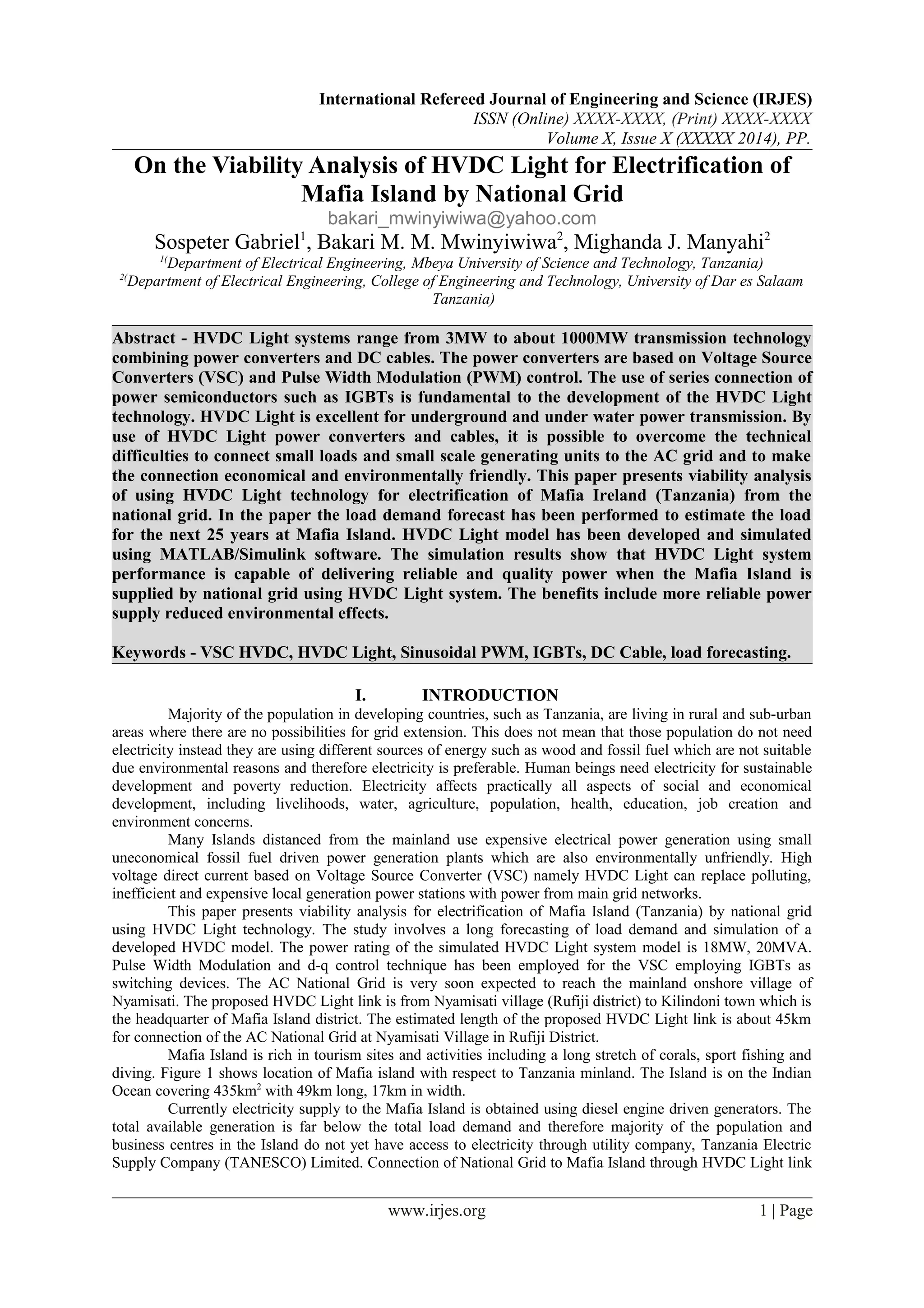
diving. Figure 1 shows location of Mafia island with respect to Tanzania minland. The Island is on the Indian
Ocean covering 435km2
with 49km long, 17km in width.
Currently electricity supply to the Mafia Island is obtained using diesel engine driven generators. The
total available generation is far below the total load demand and therefore majority of the population and
business centres in the Island do not yet have access to electricity through utility company, Tanzania Electric
Supply Company (TANESCO) Limited. Connection of National Grid to Mafia Island through HVDC Light link
www.irjes.org 1 | Page
International Refereed Journal of Engineering and Science (IRJES)
ISSN (Online) XXXX-XXXX, (Print) XXXX-XXXX
Volume X, Issue X (XXXXX 2014), PP.
is anticipated to enhance power supply reliability, expansion of the supply and environmentally friendly as
compared to diesel driven generators.
Fig. 1. The study area - Mafia Island on Indian Ocean – Tanzania
II. HVDC LIGHT TECHNOLOGY
HVDC Light is a new type of power transmission and distribution that is based on Voltage Source
Converter (VSC) with Pulse Width Modulation (PWM). With HVDC Light, it is economically feasible to
connect small-scale plants and renewable power generation plants to the main AC grid. Using the HVDC Light
technology, remote locations such as Islands, mining districts and drilling platforms can be supplied with power
from the main grid, thereby eliminating the need for inefficient, polluting local generation such as diesel units.
HVDC Light technology is also suitable for power transmission using underwater cables which can replace
overhead transmission lines at almost no cost penalty.
2.1 Voltage Source Converter
The basic Voltage Source Converter (VSC) HVDC topology is simply a power converter at each end
and a pair of extruded DC transmission cables. VSC is a forced commutated converter that converts AC voltage
into DC voltage or vice versa. The VSC has the ability to let bidirectional power flow and can change the power
direction almost instantaneously. VSC one of the most important building block in high power applications
including HVDC Light systems.
2.2 Pulse Width Modulation
Pulse Width Modulation (PWM) is the most widely VSC switching technique used to create a desired
signal and in this case sinusoidal waveforms with determined amplitude and frequency. The method employs, in
its basic waveforms to generate the driving signals of the converter valves. The first is the reference wave which
has the fundamental frequency of the voltage to be generated, and the second is the carrier wave which has a
higher frequency that is typically range between 1kHz and 2kHz as shown in figure 2.
Fig. 2 Reference and Carrier Waveforms Compared to form PWM Switching Pattern
www.irjes.org 2 | Page
International Refereed Journal of Engineering and Science (IRJES)
ISSN (Online) XXXX-XXXX, (Print) XXXX-XXXX
Volume X, Issue X (XXXXX 2014), PP.
There are various modulation methods but they all have two objectives. The first objective is to
calculate the on time for switches and the desired fundamental output voltage is obtained. The second objective
is to arrange the switching process in order to minimize the harmonic distortion, switching losses and/or other
specified criterion. The pulse pattern is generated by the pulse width modulation (PWM) where the reference
signal is compared with the triangular carrier waveform signal. This fast control makes it possible to create any
phase angle or amplitude which can be done almost instantaneously providing independent control of both
active and reactive power.
The converters are using a set of six valves, two each phase equipped with high power transistors,
IGBT (Insulated Gate Bipolar Transistor). The IGBTs switch can be switched on or off at will, therefore the
output voltages and currents on the AC side can be controlled precisely. IGBTs are connected in series in order
to be able to handle higher voltage than the rated voltage of one IGBT. All IGBTs must turn on and off at the
same moment to achieve an evenly distributed voltage across the valve.
2.3 HVDC Light Cable
The cable used in HVDC Light applications are a new developed type, where the insulation is made of
an extruded polymer material that is particularly resistant to DC voltage [1], [2] and they are very strong and
robust. HVDC Light cables are buried underground or underwater so there is no visual impact from the power
cables and contain no oil. They do not emit fluctuating electric and magnetic fields (EMFs) so there are no
human health related issues. The cables are operated in bipolar mode, one cable with positive polarity and
another with negative polarity. The cables are installed close in bipolar pairs with anti-parallel currents and thus
eliminating the magnetic fields [2] as illustrated in figure 3. These cables are constructed both for submarine
(copper) and land (aluminium) applications.
Fig. 3. Diagram of a bipolar DC cable system
2.4 Operating Principle of Voltage Source Converter
The converter can be brought as an equivalent of AC voltage source where amplitude, phase and
frequency can be controlled independently. Thus the VSC Bridge can be regarded as fast controllable
synchronous machine whose instantaneous phase voltage û is described by;
harmonicstmSinUu edc ++= )(
2
1
ˆ δω (1)
Where m is the modulation index which is defined as the ratio of peak value of the modulation signal and the
peak value of the carrier signal, ωe is the fundamental frequency and δ is the phase shift of the output voltage.
Variables m and δ can be adjusted independently to obtain any combination of voltage amplitude and phase shift
in relation to the fundamental frequency voltage of the AC system. The voltage drop Δv across the phase reactor
X can be varied to control active and reactive power flows. The active power flow between the converter and the
AC system can be controlled by controlling the phase angle between the fundamental frequency voltage
generated by the converter and the voltage across the AC-filter.
Taking the voltage at filter bus as a reference and assuming lossless reactor, the power transfer from
the converter to the AC system will be
)(
||||
δSin
X
Uv
P = (2)
The reactive power flow is determined by the relative difference in magnitude between the converter
and filter voltages. The reactive power flow is calculated as
)(
|)||(|||
δSin
X
Uvv
Q
−
= (3)
www.irjes.org 3 | Page
International Refereed Journal of Engineering and Science (IRJES)
ISSN (Online) XXXX-XXXX, (Print) XXXX-XXXX
Volume X, Issue X (XXXXX 2014), PP.
Figure 4 shows the details of the HVDC Light system in a simplified way which indicates the arrangement
of all the basic system components from AC side to DC and then to AC system again. Figure 5 elaborates some
more details of the converter station as one of the major component in HVDC Light which is formed by the
IGBT valves using StakPak module with a number of chips depending on the level of power.
III. ELECTRIC LOAD FORECASTING
Forecasting means predicting what is going to happen in the future, next day, month, year, decade, etc.
In general, the load forecasting is performed by studying the past events so as to be able to predict what the
future electricity demand will be. Accurate forecasting requires high quality data, application of the appropriate
forecasting technique and knowledge of data interpretation. According to [5], [6] the load forecasting is
distinguished on the basis of forecasting periods as short term, medium term and long-term load forecasting.
Short Term Load Forecasting (STLF): Short term load forecasting (STLF) starts from few hours to weeks
used for scheduling generating capacity and day to day operation and is commonly referred as to hourly load
forecast.
Medium Term Load Forecasting (MTLF): Medium term load forecasting (MTLF) starts from few months to
few years ahead and is used for the purpose of scheduling maintenance and fuel supply.
Long Term Load Forecasting (LTLF): Long term load forecasting (LTLF) starts from five (5) to twenty five
(25) years is used for system capacity planning and is usually called annual load demand and energy forecast.
III.1 Load Forecasting Variables
Load forecasting variables represent the numerous factors that influence growth of electric load
demand. In this case the load variables are electrical energy distributed by the supply authority, TANESCO
Limited (Mafia Branch), to consumers in kWh, new customer connections trends which indicate the number of
new customers connected to the power systems on monthly basis and the maximum apparent power demand in
kVA for five years i.e. 2008-2012.
III.2 Load forecasting methods
Load forecasting methods are mainly classified into two categories, Statistical or Classical methods and
Artificial Neural Network (ANN) based methods or Artificial Intelligence methods. In statistical methods a
mathematical equation can be obtained showing the relationship between load and its relative factors after
training the historical data, while ANN methods try to imitate human beings way of thinking and reasoning to
get knowledge from the past experience and forecast the future load. In this research, statistical methods for load
forecasting using historical load data collected is applied. The load forecasting using statistical method is mainly
divided into three categories which are trend analysis, end use analysis and econometric analysis. In this paper
the trend analysis model is applied using previous collected load data to forecast the future electricity demand
for the next twenty five (25) years. The trend analysis focuses on past changes or movements in electricity
demand and uses them to predict future changes in electricity demand.
www.irjes.org 4 | Page
Fig. 4. Simplified circuit diagram for 2-level VSC-
HVDC showing the major components of the system [3] Fig. 5. HVDC Light IGBT arrangements [4].
International Refereed Journal of Engineering and Science (IRJES)
ISSN (Online) XXXX-XXXX, (Print) XXXX-XXXX
Volume X, Issue X (XXXXX 2014), PP.
IV. ANALYSIS AND DISCUSSION OF TRENDS RESULTS
4.1 Customer Connection Trends for Mafia Island
The customer connection trends as shown in table 1 in appendices for five years from 2008 to 2012 as
outsourced from TANESCO Mafia Island indicates the increase in number of costumers in different rates. In the
year 2008 the new consumers connected by TANESCO was 20 costumers where 29 customers were connected
in the year 2009, this was the growth increase of 45%. In the year 2010, the growth increase was 97% from that
of 2009, while in the year 2011, growth increase was 19% from that of 2010. In the year 2012, growth increase
was 103% from that of 2011. Generally this indicates that there has been an increase rate of new customer
connection at the average of 66% in the years under this study.
This trend gives a good indicator to show that there is a high demand of electrical power at Mafia
Island and this is regardless of insufficient and poor power distribution network system. It is the assumption of
this research paper that if there were a reliable power source and good power distribution network at Mafia
Island, then the number of new customer connection would have been more than these indicates here.
4.2 Power Distribution Trends for Mafia Island.
According to [7] report, the electric power distributed to consumers was approximated 1500MWh per
year in 2005. Three year later in the year 2008 the electric power consumed was more than 2060MWh; this was
an increase of 37%. In the year 2012 five years from 2008 the electric power consumed was 4039MWh; this
was an increase of 96% for that period under study. The trend line analysis has been applied to indentify the
existing trends for electric power supplied to consumer for five years as indicated in figure 6. The mathematical
formula presented is used to derive an estimate of electric load for the next twenty five (25) years.
4.3 Fuel Consumption Trends at Mafia
Island TANESCO Power Plant
Electric power generation at Mafia Island is performed using two diesel generators rated at 525kVA
each. Fuel consumption has been increasing from one year to another regardless of the difficulties in its
transportation to Mafia Island which leads for sometimes shutdown of the power plant. In the year 2008, fuel
consumption was 680,992 litres and in five year later in 2012, the fuel consumption was 1,255,132 litres, which
is 84.3% increase.
4.4 Lubricants Consumption Trends at Mafia Island TANESCO Power Plant
Lubricants are one among the major components which contributes to the electricity generation cost. They are
used to maintain smooth running of the mechanical parts of the electric generator systems. In the year 2008 the
lubricants consumption was 9,050 litres while in 2012 the lubricant consumption was 11,080 litres, this was an
increase of 22.4% for the years under study.
4.5 Maximum Demand Trends at Mafia Island
The maximum demand is the greatest demand of load on the power station during a given period. Maximum
demand is generally less than the connected load because all consumers do not switch on their connected load to
the system simultaneously. In the year 2008 the average maximum demand was 518.33kVA, while in 2012 the
average maximum demand was 839.17kVA, this was an increase of about 62%. The trend line analysis has been
applied to indentify the existing trends for maximum power demand for five years as indicated in figure 7. The
mathematical formula presented is used to derive an estimate of electric load for the next twenty five (25) years.
www.irjes.org 5 | Page
Fig.6 Trend Analysis for the Electric Energy
Distributed to Consumers.
International Refereed Journal of Engineering and Science (IRJES)
ISSN (Online) XXXX-XXXX, (Print) XXXX-XXXX
Volume X, Issue X (XXXXX 2014), PP.
4.6 Load Forecasting at Mafia Island
The full extended demand forecast is presented in figure 8 for electric energy to be supplied to consumers and
figure 9 for maximum demand forecast as extended from equations indicated in figure 6 and 7 respectively. The
load forecasting distributed and their respective percentage increase for both maximum power demand and
electric power to be twenty five (25) years is as shown in table 2 in the appendices.
Fig. 7. Trend Analysis for the Average Annual
Electric Power Demand.
Fig. 8. Electric Energy forecast to be distributed
to consumers in GWh at Mafia Island for the next
25 years.
The load demand forecasting
shown in figure 9 does not include those
customers which get their electric power
independent of TANESCO. As it was
pointed out in MIRREA report of 2005 [7]
that, there was an installed capacity of
electric power of about 2.5MW
independent of TANESCO, this means that
for proper load demand forecasting this
power need also to be incorporated because
on the availability of reliable and cheap
electric power source from the Utility
Company (TANESCO) all these consumers
will need to be connected. From that
reality, the electric power independent from
TANESCO was assumed to increase at 8%
i.e. 0.2MW, i.e. from 2.5MW to 2.7MW.
Since the Maximum Power demand are always less than the installed capacity of the power plant for a
proper operation, the maximum demand of about 60% was assumed in this research i.e. 1.62MW and also a load
factor of 40% was assumed to be used.
Units generated from this independent power source is calculated using (4). Energy generated per
annum is given by
))()(( max HLFPEan = (4)
Where Pmax is maximum power demand, LF is Load Factor and H is number of hours per annum. Therefore
energy units generated per annum is given by
Ean= 1.62*0.4*8760=5676.48MWh 5.68GWh. This implies that the total energy to be transmitted to Mafia
Island is 56.312GWh + 5.68GWh, which is equal to 61.992GWh ≈ 62 GWh in year 2037. For the case of
maximum power demand in MVA, the power factor (pf) of 0.9 was assumed in this research. Therefore the
maximum apparent power demand, Smax, is calculated as given in (5).
www.irjes.org 6 | Page
Fig. 9.Load Forecast for Maximum Power Demand in MVA
at Mafia Island for the next 25 years.
International Refereed Journal of Engineering and Science (IRJES)
ISSN (Online) XXXX-XXXX, (Print) XXXX-XXXX
Volume X, Issue X (XXXXX 2014), PP.
MVA
pf
P
S 8.1
9.0
62.1max
max === (5)
Where Pmax is maximum power demand in MW and pf is power factor.
This implies that the load forecast maximum demand power up to 2037 is expected to be 14.333MVA +
1.8MVA, which is equal to 16.133MVA.
Normally a power station is so designed that it has some reserve capacity for meeting the increased
load demand in the future. Therefore, the installed capacity of the plant is always somewhat greater than the
maximum demand on the plant. From that concept the installed power plant capacity in this research is assumed
to be at least 25% more than the load forecast maximum demand power which gives the proposed installed
power plant capacity of approximately 20MVA, i.e. 16.133*1.25=20.16625MVA, where for the power factor of
0.9, this is equivalent to 18MW. This implies that the installed capacity for Mafia Island for the next 25 years
will be expected to be about 18MW.
V. SIMULATION RESULTS AND DISCUSSIONS
The simulations were performed in three different criteria which are under steady state condition, when
the system is under single phase to earth fault and finally when the system is under three phase fault condition.
(i) steady state condition: Figure 10 shows three phase voltage and current waveforms of the proposed
HVDC Light system under steady state operating conditions.
(ii) Single Line to Ground Fault
(SLGF): In this case, the behavior of
the HVDC-Light system during
unbalanced faults due to single phase to
ground faults was investigated. Figure
11 shows simulation results on both
converters which are resulted from a
single phase to ground at inverter side
(VSC 2) of the HVDC Light system.
Active power, Reactive power, Voltage
and Current signal of both converter
sides are shown where the fault takes
place at t=1.0s with a duration of five
(5) cycles i.e. 100ms. From the
simulation results, it can be noted that
before the fault the active power flow of
0.4pu was transmitted from station 1 to
station 2, and slightly during the fault
the active power reduced to about
0.3pu. Voltage and Current at both
stations contain small oscillations during the fault on the HVDC Light system.
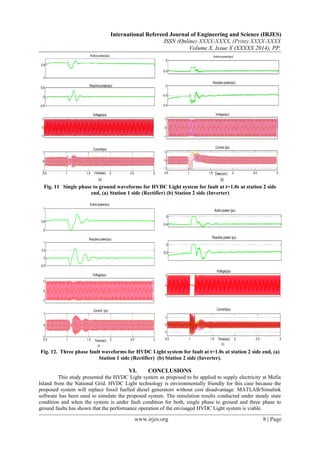
(iii) Three Phase fault to ground: Three phase faults in the grid system are likely the most severe
disturbances for the HVDC Light system. A three-phase fault is analyzed to investigate the performance of
HVDC Light system during such faults.
Figure 12 shows simulation results on both converters which are resulted from a three phase fault to
ground at inverter side (VSC 2) of the HVDC Light system. Active power, Reactive power, Voltage and Current
signal of both converter sides are shown where the fault take place at t=1.0s. For a three phase to ground fault,
AC voltage at Station 2 (VSC 2) is decreased to 0.1pu during the fault and recovers within 100ms to steady state
after clearing the fault. The transmitted power flow is also reduced to very low value during the fault and then
recovers to steady state. On the side the phase currents at station 2 reached to their maximum transient value of
about 1.5pu during the fault, but the phase currents at Station 1 side reduced to about 0.1pu to reduce the power
flow, and thus maintaining power balance.
www.irjes.org 7 | Page
Fig. 10 Simulation results of the voltage and current when the
HVDC Light system is under steady state operation condition.
International Refereed Journal of Engineering and Science (IRJES)
ISSN (Online) XXXX-XXXX, (Print) XXXX-XXXX
Volume X, Issue X (XXXXX 2014), PP.
Fig. 11 Single phase to ground waveforms for HVDC Light system for fault at t=1.0s at station 2 side
end, (a) Station 1 side (Rectifier) (b) Station 2 side (Inverter)
Fig. 12. Three phase fault waveforms for HVDC Light system for fault at t=1.0s at station 2 side end, (a)
Station 1 side (Rectifier) (b) Station 2 side (Inverter).
VI. CONCLUSIONS
This study presented the HVDC Light system as proposed to be applied to supply electricity at Mafia
Island from the National Grid. HVDC Light technology is environmentally friendly for this case because the
proposed system will replace fossil fuelled diesel generators without cost disadvantage. MATLAB/Simulink
software has been used to simulate the proposed system. The simulation results conducted under steady state
condition and when the system is under fault condition for both, single phase to ground and three phase to
ground faults has shown that the performance operation of the envisaged HVDC Light system is viable.
www.irjes.org 8 | Page
International Refereed Journal of Engineering and Science (IRJES)
ISSN (Online) XXXX-XXXX, (Print) XXXX-XXXX
Volume X, Issue X (XXXXX 2014), PP.
VII. ACKNOWLEDGEMENT
The authors are grateful for financial support provided by Sida from Sweden. Mr. Sospeter Gabriel is
grateful to Mbeya University of Science and Technology, Tanzania, for the study leave granted to him during
his postgraduate studies at the University of Dar es Salaam.
REFERENCES
[1] Gunnar Asplund., “Application of HVDC Light to power system enhancement” ABB Power systems, ABB, IEEE
Winter Meeting, Singapore, 2000.
[2] R. Grünbaum, B. Halvarsson and A. Wilk-Wilczynski, “Facts and HVDC Light for power system interconnectins,”
ABB Power systems AB, Sweden. Presented at PowerDelivery Conference, Madrid, Spain, 1999.
[3] B. Jacobson, Y. Jiang-Häfner, P. Rey G. Asplund, M. Jeroense, A. Gustafsson, M. Bergkvist, “HVDC with Voltage
Source Converters and Extruded Cables for up to ±300 Kv and 1000 MW,” Proceedings of CIGRE 2006, Paris, paper No.
B4-105, 2006.
[4] Michael Bahman, “HVDC Transmission : An Economical Complement to AC Transmissio,” WECC transmission
Planning Seminar, February 2-3, 2009.
[5] Al-Alawi. S.M and Islam, S.M, “Principles of Electricity demand Forecasting I Methodologies,” Power Engineering
Journal, Vol 10, No 3, pp 139-143, 1996.
[6] CH Jeevan Kumar and M, Veerakumar, “Load Forecasting of Andhra Pradesh Grid using PSO, DE Algorithms,”
International Journal of Advanced Research in Computer Engineering and Technology, Vol 1, Issue 9, November, 2012.
[7] Mitigating Risk and strengthening capacity for Rural Electricity Investment in Africa (MIRREIA), “List of key
Investors and Potential Projects”, Kenya, Tanzania and Uganda, 2005.
APPENDICES
Table 1. Customer connection trend for Mafia island
S/No. Months
Years
2008 2009 2010 2011 2012
1 January 1 1 5 5 10
2 February 1 4 1 9 10
3 March 0 2 6 6 29
4 April 0 0 2 4 16
5 May 1 2 3 3 9
6 June 6 1 6 2 9
7 July 1 5 2 6 8
8 August 0 3 5 8 2
9 September 0 0 15 6 6
10 October 1 5 5 3 15
11 November 5 4 3 9 23
12 December 4 2 4 7 1
Total 20 29 57 68 138
www.irjes.org 9 | Page
International Refereed Journal of Engineering and Science (IRJES)
ISSN (Online) XXXX-XXXX, (Print) XXXX-XXXX
Volume X, Issue X (XXXXX 2014), PP.
Table 2. Extended forecast load demand power
S/No. Years
Electrical Power
Distributed in
(GWh)
Growth Rates (%)
Maximum
Demand in MVA
Growth Rates (%)
1 2008 2.06 0.518
2 2009 2.56 24.3 0.587 13.32
3 2010 2.66 3.9 0.593 1.02
4 2011 3.57 34.2 0.714 20.40
5 2012 4.04 13.2 0.839 17.51
6 2013 4.832 19.6 0.989 17.88
7 2014 5.712 18.2 1.177 19.01
8 2015 6.702 17.3 1.397 18.69
9 2016 7.802 16.4 1.649 18.04
10 2017 9.012 15.5 1.933 17.22
11 2018 10.332 14.6 2.249 16.35
12 2019 11.762 13.8 2.597 15.47
13 2020 13.302 13.1 2.977 14.63
14 2021 14.952 12.4 3.389 13.84
15 2022 16.712 11.8 3.833 13.10
16 2023 18.582 11.2 4.309 12.42
17 2024 20.562 10.7 4.817 11.79
18 2025 22.652 10.2 5.357 11.21
19 2026 24.852 9.7 5.929 10.68
20 2027 27.162 9.3 6.533 10.19
21 2028 29.582 8.9 7.169 9.74
22 2029 32.112 8.6 7.837 9.32
23 2030 34.752 8.2 8.537 8.93
24 2031 37.502 7.9 9.269 8.57
25 2032 40.362 7.6 10.033 8.24
26 2033 43.332 7.4 10.829 7.93
27 3034 46.412 7.1 11.657 7.65
28 2035 49.602 6.9 12.517 7.38
29 2036 52.902 6.7 13.409 7.13
30 2037 56.312 6.4 14.333 6.89
www.irjes.org 10 | Page

On the Viability Analysis of HVDC Light for Electrification of Mafia Island by National Grid

  • 1.
    International Refereed Journalof Engineering and Science (IRJES) ISSN (Online) XXXX-XXXX, (Print) XXXX-XXXX Volume X, Issue X (XXXXX 2014), PP. On the Viability Analysis of HVDC Light for Electrification of Mafia Island by National Grid bakari_mwinyiwiwa@yahoo.com Sospeter Gabriel1 , Bakari M. M. Mwinyiwiwa2 , Mighanda J. Manyahi2 1( Department of Electrical Engineering, Mbeya University of Science and Technology, Tanzania) 2( Department of Electrical Engineering, College of Engineering and Technology, University of Dar es Salaam Tanzania) Abstract - HVDC Light systems range from 3MW to about 1000MW transmission technology combining power converters and DC cables. The power converters are based on Voltage Source Converters (VSC) and Pulse Width Modulation (PWM) control. The use of series connection of power semiconductors such as IGBTs is fundamental to the development of the HVDC Light technology. HVDC Light is excellent for underground and under water power transmission. By use of HVDC Light power converters and cables, it is possible to overcome the technical difficulties to connect small loads and small scale generating units to the AC grid and to make the connection economical and environmentally friendly. This paper presents viability analysis of using HVDC Light technology for electrification of Mafia Ireland (Tanzania) from the national grid. In the paper the load demand forecast has been performed to estimate the load for the next 25 years at Mafia Island. HVDC Light model has been developed and simulated using MATLAB/Simulink software. The simulation results show that HVDC Light system performance is capable of delivering reliable and quality power when the Mafia Island is supplied by national grid using HVDC Light system. The benefits include more reliable power supply reduced environmental effects. Keywords - VSC HVDC, HVDC Light, Sinusoidal PWM, IGBTs, DC Cable, load forecasting. I. INTRODUCTION Majority of the population in developing countries, such as Tanzania, are living in rural and sub-urban areas where there are no possibilities for grid extension. This does not mean that those population do not need electricity instead they are using different sources of energy such as wood and fossil fuel which are not suitable due environmental reasons and therefore electricity is preferable. Human beings need electricity for sustainable development and poverty reduction. Electricity affects practically all aspects of social and economical development, including livelihoods, water, agriculture, population, health, education, job creation and environment concerns. Many Islands distanced from the mainland use expensive electrical power generation using small uneconomical fossil fuel driven power generation plants which are also environmentally unfriendly. High voltage direct current based on Voltage Source Converter (VSC) namely HVDC Light can replace polluting, inefficient and expensive local generation power stations with power from main grid networks. This paper presents viability analysis for electrification of Mafia Island (Tanzania) by national grid using HVDC Light technology. The study involves a long forecasting of load demand and simulation of a developed HVDC model. The power rating of the simulated HVDC Light system model is 18MW, 20MVA. Pulse Width Modulation and d-q control technique has been employed for the VSC employing IGBTs as switching devices. The AC National Grid is very soon expected to reach the mainland onshore village of Nyamisati. The proposed HVDC Light link is from Nyamisati village (Rufiji district) to Kilindoni town which is the headquarter of Mafia Island district. The estimated length of the proposed HVDC Light link is about 45km for connection of the AC National Grid at Nyamisati Village in Rufiji District. Mafia Island is rich in tourism sites and activities including a long stretch of corals, sport fishing and diving. Figure 1 shows location of Mafia island with respect to Tanzania minland. The Island is on the Indian Ocean covering 435km2 with 49km long, 17km in width. Currently electricity supply to the Mafia Island is obtained using diesel engine driven generators. The total available generation is far below the total load demand and therefore majority of the population and business centres in the Island do not yet have access to electricity through utility company, Tanzania Electric Supply Company (TANESCO) Limited. Connection of National Grid to Mafia Island through HVDC Light link www.irjes.org 1 | Page
  • 2.
    International Refereed Journalof Engineering and Science (IRJES) ISSN (Online) XXXX-XXXX, (Print) XXXX-XXXX Volume X, Issue X (XXXXX 2014), PP. is anticipated to enhance power supply reliability, expansion of the supply and environmentally friendly as compared to diesel driven generators. Fig. 1. The study area - Mafia Island on Indian Ocean – Tanzania II. HVDC LIGHT TECHNOLOGY HVDC Light is a new type of power transmission and distribution that is based on Voltage Source Converter (VSC) with Pulse Width Modulation (PWM). With HVDC Light, it is economically feasible to connect small-scale plants and renewable power generation plants to the main AC grid. Using the HVDC Light technology, remote locations such as Islands, mining districts and drilling platforms can be supplied with power from the main grid, thereby eliminating the need for inefficient, polluting local generation such as diesel units. HVDC Light technology is also suitable for power transmission using underwater cables which can replace overhead transmission lines at almost no cost penalty. 2.1 Voltage Source Converter The basic Voltage Source Converter (VSC) HVDC topology is simply a power converter at each end and a pair of extruded DC transmission cables. VSC is a forced commutated converter that converts AC voltage into DC voltage or vice versa. The VSC has the ability to let bidirectional power flow and can change the power direction almost instantaneously. VSC one of the most important building block in high power applications including HVDC Light systems. 2.2 Pulse Width Modulation Pulse Width Modulation (PWM) is the most widely VSC switching technique used to create a desired signal and in this case sinusoidal waveforms with determined amplitude and frequency. The method employs, in its basic waveforms to generate the driving signals of the converter valves. The first is the reference wave which has the fundamental frequency of the voltage to be generated, and the second is the carrier wave which has a higher frequency that is typically range between 1kHz and 2kHz as shown in figure 2. Fig. 2 Reference and Carrier Waveforms Compared to form PWM Switching Pattern www.irjes.org 2 | Page
  • 3.
    International Refereed Journalof Engineering and Science (IRJES) ISSN (Online) XXXX-XXXX, (Print) XXXX-XXXX Volume X, Issue X (XXXXX 2014), PP. There are various modulation methods but they all have two objectives. The first objective is to calculate the on time for switches and the desired fundamental output voltage is obtained. The second objective is to arrange the switching process in order to minimize the harmonic distortion, switching losses and/or other specified criterion. The pulse pattern is generated by the pulse width modulation (PWM) where the reference signal is compared with the triangular carrier waveform signal. This fast control makes it possible to create any phase angle or amplitude which can be done almost instantaneously providing independent control of both active and reactive power. The converters are using a set of six valves, two each phase equipped with high power transistors, IGBT (Insulated Gate Bipolar Transistor). The IGBTs switch can be switched on or off at will, therefore the output voltages and currents on the AC side can be controlled precisely. IGBTs are connected in series in order to be able to handle higher voltage than the rated voltage of one IGBT. All IGBTs must turn on and off at the same moment to achieve an evenly distributed voltage across the valve. 2.3 HVDC Light Cable The cable used in HVDC Light applications are a new developed type, where the insulation is made of an extruded polymer material that is particularly resistant to DC voltage [1], [2] and they are very strong and robust. HVDC Light cables are buried underground or underwater so there is no visual impact from the power cables and contain no oil. They do not emit fluctuating electric and magnetic fields (EMFs) so there are no human health related issues. The cables are operated in bipolar mode, one cable with positive polarity and another with negative polarity. The cables are installed close in bipolar pairs with anti-parallel currents and thus eliminating the magnetic fields [2] as illustrated in figure 3. These cables are constructed both for submarine (copper) and land (aluminium) applications. Fig. 3. Diagram of a bipolar DC cable system 2.4 Operating Principle of Voltage Source Converter The converter can be brought as an equivalent of AC voltage source where amplitude, phase and frequency can be controlled independently. Thus the VSC Bridge can be regarded as fast controllable synchronous machine whose instantaneous phase voltage û is described by; harmonicstmSinUu edc ++= )( 2 1 ˆ δω (1) Where m is the modulation index which is defined as the ratio of peak value of the modulation signal and the peak value of the carrier signal, ωe is the fundamental frequency and δ is the phase shift of the output voltage. Variables m and δ can be adjusted independently to obtain any combination of voltage amplitude and phase shift in relation to the fundamental frequency voltage of the AC system. The voltage drop Δv across the phase reactor X can be varied to control active and reactive power flows. The active power flow between the converter and the AC system can be controlled by controlling the phase angle between the fundamental frequency voltage generated by the converter and the voltage across the AC-filter. Taking the voltage at filter bus as a reference and assuming lossless reactor, the power transfer from the converter to the AC system will be )( |||| δSin X Uv P = (2) The reactive power flow is determined by the relative difference in magnitude between the converter and filter voltages. The reactive power flow is calculated as )( |)||(||| δSin X Uvv Q − = (3) www.irjes.org 3 | Page
  • 4.
    International Refereed Journalof Engineering and Science (IRJES) ISSN (Online) XXXX-XXXX, (Print) XXXX-XXXX Volume X, Issue X (XXXXX 2014), PP. Figure 4 shows the details of the HVDC Light system in a simplified way which indicates the arrangement of all the basic system components from AC side to DC and then to AC system again. Figure 5 elaborates some more details of the converter station as one of the major component in HVDC Light which is formed by the IGBT valves using StakPak module with a number of chips depending on the level of power. III. ELECTRIC LOAD FORECASTING Forecasting means predicting what is going to happen in the future, next day, month, year, decade, etc. In general, the load forecasting is performed by studying the past events so as to be able to predict what the future electricity demand will be. Accurate forecasting requires high quality data, application of the appropriate forecasting technique and knowledge of data interpretation. According to [5], [6] the load forecasting is distinguished on the basis of forecasting periods as short term, medium term and long-term load forecasting. Short Term Load Forecasting (STLF): Short term load forecasting (STLF) starts from few hours to weeks used for scheduling generating capacity and day to day operation and is commonly referred as to hourly load forecast. Medium Term Load Forecasting (MTLF): Medium term load forecasting (MTLF) starts from few months to few years ahead and is used for the purpose of scheduling maintenance and fuel supply. Long Term Load Forecasting (LTLF): Long term load forecasting (LTLF) starts from five (5) to twenty five (25) years is used for system capacity planning and is usually called annual load demand and energy forecast. III.1 Load Forecasting Variables Load forecasting variables represent the numerous factors that influence growth of electric load demand. In this case the load variables are electrical energy distributed by the supply authority, TANESCO Limited (Mafia Branch), to consumers in kWh, new customer connections trends which indicate the number of new customers connected to the power systems on monthly basis and the maximum apparent power demand in kVA for five years i.e. 2008-2012. III.2 Load forecasting methods Load forecasting methods are mainly classified into two categories, Statistical or Classical methods and Artificial Neural Network (ANN) based methods or Artificial Intelligence methods. In statistical methods a mathematical equation can be obtained showing the relationship between load and its relative factors after training the historical data, while ANN methods try to imitate human beings way of thinking and reasoning to get knowledge from the past experience and forecast the future load. In this research, statistical methods for load forecasting using historical load data collected is applied. The load forecasting using statistical method is mainly divided into three categories which are trend analysis, end use analysis and econometric analysis. In this paper the trend analysis model is applied using previous collected load data to forecast the future electricity demand for the next twenty five (25) years. The trend analysis focuses on past changes or movements in electricity demand and uses them to predict future changes in electricity demand. www.irjes.org 4 | Page Fig. 4. Simplified circuit diagram for 2-level VSC- HVDC showing the major components of the system [3] Fig. 5. HVDC Light IGBT arrangements [4].
  • 5.
    International Refereed Journalof Engineering and Science (IRJES) ISSN (Online) XXXX-XXXX, (Print) XXXX-XXXX Volume X, Issue X (XXXXX 2014), PP. IV. ANALYSIS AND DISCUSSION OF TRENDS RESULTS 4.1 Customer Connection Trends for Mafia Island The customer connection trends as shown in table 1 in appendices for five years from 2008 to 2012 as outsourced from TANESCO Mafia Island indicates the increase in number of costumers in different rates. In the year 2008 the new consumers connected by TANESCO was 20 costumers where 29 customers were connected in the year 2009, this was the growth increase of 45%. In the year 2010, the growth increase was 97% from that of 2009, while in the year 2011, growth increase was 19% from that of 2010. In the year 2012, growth increase was 103% from that of 2011. Generally this indicates that there has been an increase rate of new customer connection at the average of 66% in the years under this study. This trend gives a good indicator to show that there is a high demand of electrical power at Mafia Island and this is regardless of insufficient and poor power distribution network system. It is the assumption of this research paper that if there were a reliable power source and good power distribution network at Mafia Island, then the number of new customer connection would have been more than these indicates here. 4.2 Power Distribution Trends for Mafia Island. According to [7] report, the electric power distributed to consumers was approximated 1500MWh per year in 2005. Three year later in the year 2008 the electric power consumed was more than 2060MWh; this was an increase of 37%. In the year 2012 five years from 2008 the electric power consumed was 4039MWh; this was an increase of 96% for that period under study. The trend line analysis has been applied to indentify the existing trends for electric power supplied to consumer for five years as indicated in figure 6. The mathematical formula presented is used to derive an estimate of electric load for the next twenty five (25) years. 4.3 Fuel Consumption Trends at Mafia Island TANESCO Power Plant Electric power generation at Mafia Island is performed using two diesel generators rated at 525kVA each. Fuel consumption has been increasing from one year to another regardless of the difficulties in its transportation to Mafia Island which leads for sometimes shutdown of the power plant. In the year 2008, fuel consumption was 680,992 litres and in five year later in 2012, the fuel consumption was 1,255,132 litres, which is 84.3% increase. 4.4 Lubricants Consumption Trends at Mafia Island TANESCO Power Plant Lubricants are one among the major components which contributes to the electricity generation cost. They are used to maintain smooth running of the mechanical parts of the electric generator systems. In the year 2008 the lubricants consumption was 9,050 litres while in 2012 the lubricant consumption was 11,080 litres, this was an increase of 22.4% for the years under study. 4.5 Maximum Demand Trends at Mafia Island The maximum demand is the greatest demand of load on the power station during a given period. Maximum demand is generally less than the connected load because all consumers do not switch on their connected load to the system simultaneously. In the year 2008 the average maximum demand was 518.33kVA, while in 2012 the average maximum demand was 839.17kVA, this was an increase of about 62%. The trend line analysis has been applied to indentify the existing trends for maximum power demand for five years as indicated in figure 7. The mathematical formula presented is used to derive an estimate of electric load for the next twenty five (25) years. www.irjes.org 5 | Page Fig.6 Trend Analysis for the Electric Energy Distributed to Consumers.
  • 6.
    International Refereed Journalof Engineering and Science (IRJES) ISSN (Online) XXXX-XXXX, (Print) XXXX-XXXX Volume X, Issue X (XXXXX 2014), PP. 4.6 Load Forecasting at Mafia Island The full extended demand forecast is presented in figure 8 for electric energy to be supplied to consumers and figure 9 for maximum demand forecast as extended from equations indicated in figure 6 and 7 respectively. The load forecasting distributed and their respective percentage increase for both maximum power demand and electric power to be twenty five (25) years is as shown in table 2 in the appendices. Fig. 7. Trend Analysis for the Average Annual Electric Power Demand. Fig. 8. Electric Energy forecast to be distributed to consumers in GWh at Mafia Island for the next 25 years. The load demand forecasting shown in figure 9 does not include those customers which get their electric power independent of TANESCO. As it was pointed out in MIRREA report of 2005 [7] that, there was an installed capacity of electric power of about 2.5MW independent of TANESCO, this means that for proper load demand forecasting this power need also to be incorporated because on the availability of reliable and cheap electric power source from the Utility Company (TANESCO) all these consumers will need to be connected. From that reality, the electric power independent from TANESCO was assumed to increase at 8% i.e. 0.2MW, i.e. from 2.5MW to 2.7MW. Since the Maximum Power demand are always less than the installed capacity of the power plant for a proper operation, the maximum demand of about 60% was assumed in this research i.e. 1.62MW and also a load factor of 40% was assumed to be used. Units generated from this independent power source is calculated using (4). Energy generated per annum is given by ))()(( max HLFPEan = (4) Where Pmax is maximum power demand, LF is Load Factor and H is number of hours per annum. Therefore energy units generated per annum is given by Ean= 1.62*0.4*8760=5676.48MWh 5.68GWh. This implies that the total energy to be transmitted to Mafia Island is 56.312GWh + 5.68GWh, which is equal to 61.992GWh ≈ 62 GWh in year 2037. For the case of maximum power demand in MVA, the power factor (pf) of 0.9 was assumed in this research. Therefore the maximum apparent power demand, Smax, is calculated as given in (5). www.irjes.org 6 | Page Fig. 9.Load Forecast for Maximum Power Demand in MVA at Mafia Island for the next 25 years.
  • 7.
    International Refereed Journalof Engineering and Science (IRJES) ISSN (Online) XXXX-XXXX, (Print) XXXX-XXXX Volume X, Issue X (XXXXX 2014), PP. MVA pf P S 8.1 9.0 62.1max max === (5) Where Pmax is maximum power demand in MW and pf is power factor. This implies that the load forecast maximum demand power up to 2037 is expected to be 14.333MVA + 1.8MVA, which is equal to 16.133MVA. Normally a power station is so designed that it has some reserve capacity for meeting the increased load demand in the future. Therefore, the installed capacity of the plant is always somewhat greater than the maximum demand on the plant. From that concept the installed power plant capacity in this research is assumed to be at least 25% more than the load forecast maximum demand power which gives the proposed installed power plant capacity of approximately 20MVA, i.e. 16.133*1.25=20.16625MVA, where for the power factor of 0.9, this is equivalent to 18MW. This implies that the installed capacity for Mafia Island for the next 25 years will be expected to be about 18MW. V. SIMULATION RESULTS AND DISCUSSIONS The simulations were performed in three different criteria which are under steady state condition, when the system is under single phase to earth fault and finally when the system is under three phase fault condition. (i) steady state condition: Figure 10 shows three phase voltage and current waveforms of the proposed HVDC Light system under steady state operating conditions. (ii) Single Line to Ground Fault (SLGF): In this case, the behavior of the HVDC-Light system during unbalanced faults due to single phase to ground faults was investigated. Figure 11 shows simulation results on both converters which are resulted from a single phase to ground at inverter side (VSC 2) of the HVDC Light system. Active power, Reactive power, Voltage and Current signal of both converter sides are shown where the fault takes place at t=1.0s with a duration of five (5) cycles i.e. 100ms. From the simulation results, it can be noted that before the fault the active power flow of 0.4pu was transmitted from station 1 to station 2, and slightly during the fault the active power reduced to about 0.3pu. Voltage and Current at both stations contain small oscillations during the fault on the HVDC Light system. (iii) Three Phase fault to ground: Three phase faults in the grid system are likely the most severe disturbances for the HVDC Light system. A three-phase fault is analyzed to investigate the performance of HVDC Light system during such faults. Figure 12 shows simulation results on both converters which are resulted from a three phase fault to ground at inverter side (VSC 2) of the HVDC Light system. Active power, Reactive power, Voltage and Current signal of both converter sides are shown where the fault take place at t=1.0s. For a three phase to ground fault, AC voltage at Station 2 (VSC 2) is decreased to 0.1pu during the fault and recovers within 100ms to steady state after clearing the fault. The transmitted power flow is also reduced to very low value during the fault and then recovers to steady state. On the side the phase currents at station 2 reached to their maximum transient value of about 1.5pu during the fault, but the phase currents at Station 1 side reduced to about 0.1pu to reduce the power flow, and thus maintaining power balance. www.irjes.org 7 | Page Fig. 10 Simulation results of the voltage and current when the HVDC Light system is under steady state operation condition.
  • 8.
    International Refereed Journalof Engineering and Science (IRJES) ISSN (Online) XXXX-XXXX, (Print) XXXX-XXXX Volume X, Issue X (XXXXX 2014), PP. Fig. 11 Single phase to ground waveforms for HVDC Light system for fault at t=1.0s at station 2 side end, (a) Station 1 side (Rectifier) (b) Station 2 side (Inverter) Fig. 12. Three phase fault waveforms for HVDC Light system for fault at t=1.0s at station 2 side end, (a) Station 1 side (Rectifier) (b) Station 2 side (Inverter). VI. CONCLUSIONS This study presented the HVDC Light system as proposed to be applied to supply electricity at Mafia Island from the National Grid. HVDC Light technology is environmentally friendly for this case because the proposed system will replace fossil fuelled diesel generators without cost disadvantage. MATLAB/Simulink software has been used to simulate the proposed system. The simulation results conducted under steady state condition and when the system is under fault condition for both, single phase to ground and three phase to ground faults has shown that the performance operation of the envisaged HVDC Light system is viable. www.irjes.org 8 | Page
  • 9.
    International Refereed Journalof Engineering and Science (IRJES) ISSN (Online) XXXX-XXXX, (Print) XXXX-XXXX Volume X, Issue X (XXXXX 2014), PP. VII. ACKNOWLEDGEMENT The authors are grateful for financial support provided by Sida from Sweden. Mr. Sospeter Gabriel is grateful to Mbeya University of Science and Technology, Tanzania, for the study leave granted to him during his postgraduate studies at the University of Dar es Salaam. REFERENCES [1] Gunnar Asplund., “Application of HVDC Light to power system enhancement” ABB Power systems, ABB, IEEE Winter Meeting, Singapore, 2000. [2] R. Grünbaum, B. Halvarsson and A. Wilk-Wilczynski, “Facts and HVDC Light for power system interconnectins,” ABB Power systems AB, Sweden. Presented at PowerDelivery Conference, Madrid, Spain, 1999. [3] B. Jacobson, Y. Jiang-Häfner, P. Rey G. Asplund, M. Jeroense, A. Gustafsson, M. Bergkvist, “HVDC with Voltage Source Converters and Extruded Cables for up to ±300 Kv and 1000 MW,” Proceedings of CIGRE 2006, Paris, paper No. B4-105, 2006. [4] Michael Bahman, “HVDC Transmission : An Economical Complement to AC Transmissio,” WECC transmission Planning Seminar, February 2-3, 2009. [5] Al-Alawi. S.M and Islam, S.M, “Principles of Electricity demand Forecasting I Methodologies,” Power Engineering Journal, Vol 10, No 3, pp 139-143, 1996. [6] CH Jeevan Kumar and M, Veerakumar, “Load Forecasting of Andhra Pradesh Grid using PSO, DE Algorithms,” International Journal of Advanced Research in Computer Engineering and Technology, Vol 1, Issue 9, November, 2012. [7] Mitigating Risk and strengthening capacity for Rural Electricity Investment in Africa (MIRREIA), “List of key Investors and Potential Projects”, Kenya, Tanzania and Uganda, 2005. APPENDICES Table 1. Customer connection trend for Mafia island S/No. Months Years 2008 2009 2010 2011 2012 1 January 1 1 5 5 10 2 February 1 4 1 9 10 3 March 0 2 6 6 29 4 April 0 0 2 4 16 5 May 1 2 3 3 9 6 June 6 1 6 2 9 7 July 1 5 2 6 8 8 August 0 3 5 8 2 9 September 0 0 15 6 6 10 October 1 5 5 3 15 11 November 5 4 3 9 23 12 December 4 2 4 7 1 Total 20 29 57 68 138 www.irjes.org 9 | Page
  • 10.
    International Refereed Journalof Engineering and Science (IRJES) ISSN (Online) XXXX-XXXX, (Print) XXXX-XXXX Volume X, Issue X (XXXXX 2014), PP. Table 2. Extended forecast load demand power S/No. Years Electrical Power Distributed in (GWh) Growth Rates (%) Maximum Demand in MVA Growth Rates (%) 1 2008 2.06 0.518 2 2009 2.56 24.3 0.587 13.32 3 2010 2.66 3.9 0.593 1.02 4 2011 3.57 34.2 0.714 20.40 5 2012 4.04 13.2 0.839 17.51 6 2013 4.832 19.6 0.989 17.88 7 2014 5.712 18.2 1.177 19.01 8 2015 6.702 17.3 1.397 18.69 9 2016 7.802 16.4 1.649 18.04 10 2017 9.012 15.5 1.933 17.22 11 2018 10.332 14.6 2.249 16.35 12 2019 11.762 13.8 2.597 15.47 13 2020 13.302 13.1 2.977 14.63 14 2021 14.952 12.4 3.389 13.84 15 2022 16.712 11.8 3.833 13.10 16 2023 18.582 11.2 4.309 12.42 17 2024 20.562 10.7 4.817 11.79 18 2025 22.652 10.2 5.357 11.21 19 2026 24.852 9.7 5.929 10.68 20 2027 27.162 9.3 6.533 10.19 21 2028 29.582 8.9 7.169 9.74 22 2029 32.112 8.6 7.837 9.32 23 2030 34.752 8.2 8.537 8.93 24 2031 37.502 7.9 9.269 8.57 25 2032 40.362 7.6 10.033 8.24 26 2033 43.332 7.4 10.829 7.93 27 3034 46.412 7.1 11.657 7.65 28 2035 49.602 6.9 12.517 7.38 29 2036 52.902 6.7 13.409 7.13 30 2037 56.312 6.4 14.333 6.89 www.irjes.org 10 | Page