Management Control Systems
Chapter 6:
Designing and Evaluating MCS
Merchant and Van der Stede: Management Control Systems © Pearson Education Limited 2003
Merchant and Van der Stede: Management Control Systems © Pearson Education Limited 2003 - 2 -
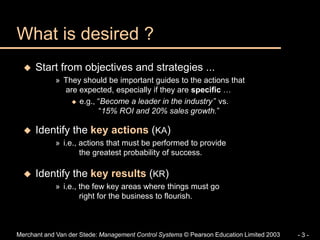
Designing control systems ...
 Two basic questions:
» What is desired ?
» What is likely to happen ?
 If what is likely is different from what is desired, then
two basic MCS-design questions must be addressed:
» What controls should be used ?
» How tightly should each be applied ?
Merchant and Van der Stede: Management Control Systems © Pearson Education Limited 2003 - 3 -
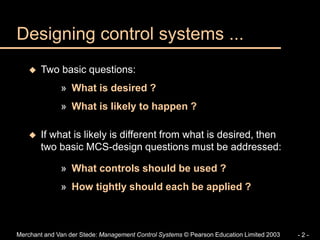
What is desired ?
 Start from objectives and strategies ...
» They should be important guides to the actions that
are expected, especially if they are specific …
 e.g., “Become a leader in the industry ” vs.
“15% ROI and 20% sales growth.”
 Identify the key actions (KA)
» i.e., actions that must be performed to provide
the greatest probability of success.
 Identify the key results (KR)
» i.e., the few key areas where things must go
right for the business to flourish.
Merchant and Van der Stede: Management Control Systems © Pearson Education Limited 2003 - 4 -
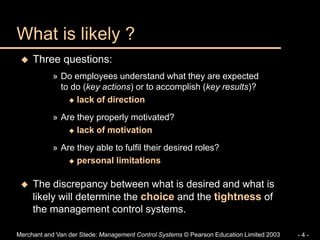
 Three questions:
» Do employees understand what they are expected
to do (key actions) or to accomplish (key results)?
 lack of direction
» Are they properly motivated?
 lack of motivation
» Are they able to fulfil their desired roles?
 personal limitations
 The discrepancy between what is desired and what is
likely will determine the choice and the tightness of
the management control systems.
What is likely ?
Merchant and Van der Stede: Management Control Systems © Pearson Education Limited 2003 - 5 -
Choice of controls ...
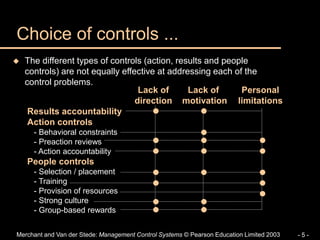
 The different types of controls (action, results and people
controls) are not equally effective at addressing each of the
control problems.
Lack of
direction
Personal
limitations
Lack of
motivation
Results accountability
Action controls
- Behavioral constraints
- Preaction reviews
- Action accountability
People controls
- Selection / placement
- Training
- Provision of resources
- Strong culture
- Group-based rewards

 

 


  
 
 
 


Merchant and Van der Stede: Management Control Systems © Pearson Education Limited 2003 - 6 -
Start with people controls ...
 People controls …
» Must always be relied on to a certain extent;
» Have relatively few harmful side-effects;
» Involve relatively low out-of-pocket costs.
 However, it is rare that people controls will be sufficient.
In most cases, it is necessary to supplement them with …
» action controls;
» results controls.
 Maybe, you just shouldn’t put all your trust in people !?
Merchant and Van der Stede: Management Control Systems © Pearson Education Limited 2003 - 7 -
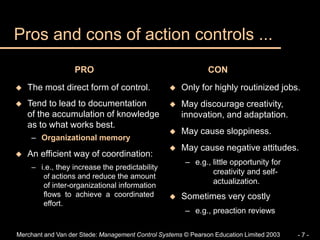
 The most direct form of control.
 Tend to lead to documentation
of the accumulation of knowledge
as to what works best.
– Organizational memory
 An efficient way of coordination:
– i.e., they increase the predictability
of actions and reduce the amount
of inter-organizational information
flows to achieve a coordinated
effort.
 Only for highly routinized jobs.
 May discourage creativity,
innovation, and adaptation.
 May cause sloppiness.
 May cause negative attitudes.
– e.g., little opportunity for
creativity and self-
actualization.
 Sometimes very costly
– e.g., preaction reviews
Pros and cons of action controls ...
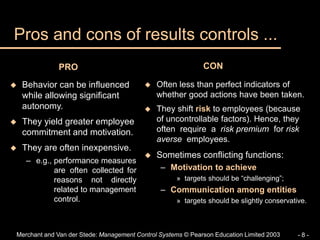
PRO CON
Merchant and Van der Stede: Management Control Systems © Pearson Education Limited 2003 - 8 -
 Behavior can be influenced
while allowing significant
autonomy.
 They yield greater employee
commitment and motivation.
 They are often inexpensive.
– e.g., performance measures
are often collected for
reasons not directly
related to management
control.
 Often less than perfect indicators of
whether good actions have been taken.
 They shift risk to employees (because
of uncontrollable factors). Hence, they
often require a risk premium for risk
averse employees.
 Sometimes conflicting functions:
– Motivation to achieve
» targets should be “challenging”;
– Communication among entities
» targets should be slightly conservative.
Pros and cons of results controls ...
PRO CON
Merchant and Van der Stede: Management Control Systems © Pearson Education Limited 2003 - 9 -
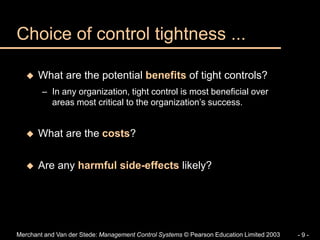
Choice of control tightness ...
 What are the potential benefits of tight controls?
– In any organization, tight control is most beneficial over
areas most critical to the organization’s success.
 What are the costs?
 Are any harmful side-effects likely?
Merchant and Van der Stede: Management Control Systems © Pearson Education Limited 2003 - 10 -
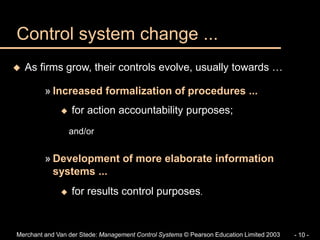
Control system change ...
 As firms grow, their controls evolve, usually towards …
» Increased formalization of procedures ...
 for action accountability purposes;
and/or
» Development of more elaborate information
systems ...
 for results control purposes.
Merchant and Van der Stede: Management Control Systems © Pearson Education Limited 2003 - 11 -
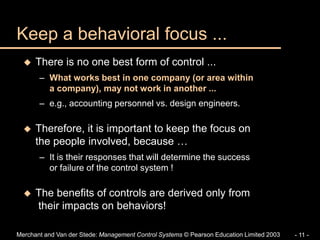
Keep a behavioral focus ...
 There is no one best form of control ...
– What works best in one company (or area within
a company), may not work in another ...
– e.g., accounting personnel vs. design engineers.
 Therefore, it is important to keep the focus on
the people involved, because …
– It is their responses that will determine the success
or failure of the control system !
 The benefits of controls are derived only from
their impacts on behaviors!
Merchant and Van der Stede: Management Control Systems © Pearson Education Limited 2003 - 12 -
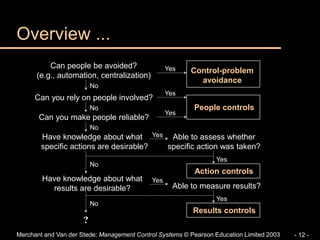
Overview ...
Can people be avoided?
(e.g., automation, centralization)
Control-problem
avoidance
Can you rely on people involved?
Can you make people reliable?
Have knowledge about what
specific actions are desirable?
Able to assess whether
specific action was taken?
Have knowledge about what
results are desirable? Able to measure results?
Yes
No
Yes
No
No
Action controls
People controls
Results controls
Yes
Yes
Yes
No
Yes
No
?
Yes
Merchant and Van der Stede: Management Control Systems © Pearson Education Limited 2003 - 13 -
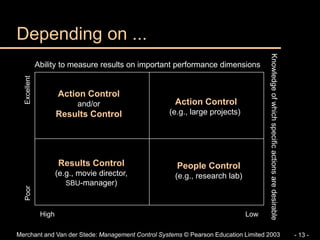
Depending on ...
Ability to measure results on important performance dimensions
Knowledge
of
which
specific
actions
are
desirable
High Low
Excellent
Poor
Action Control
and/or
Results Control
Action Control
(e.g., large projects)
Results Control
(e.g., movie director,
SBU-manager)
People Control
(e.g., research lab)
Merchant and Van der Stede: Management Control Systems © Pearson Education Limited 2003 - 14 -
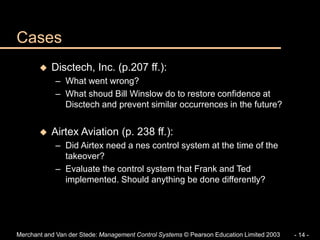
Cases
 Disctech, Inc. (p.207 ff.):
– What went wrong?
– What shoud Bill Winslow do to restore confidence at
Disctech and prevent similar occurrences in the future?
 Airtex Aviation (p. 238 ff.):
– Did Airtex need a nes control system at the time of the
takeover?
– Evaluate the control system that Frank and Ted
implemented. Should anything be done differently?

3098488.ppt

  • 1.
    Management Control Systems Chapter6: Designing and Evaluating MCS Merchant and Van der Stede: Management Control Systems © Pearson Education Limited 2003
  • 2.
    Merchant and Vander Stede: Management Control Systems © Pearson Education Limited 2003 - 2 - Designing control systems ...  Two basic questions: » What is desired ? » What is likely to happen ?  If what is likely is different from what is desired, then two basic MCS-design questions must be addressed: » What controls should be used ? » How tightly should each be applied ?
  • 3.
    Merchant and Vander Stede: Management Control Systems © Pearson Education Limited 2003 - 3 - What is desired ?  Start from objectives and strategies ... » They should be important guides to the actions that are expected, especially if they are specific …  e.g., “Become a leader in the industry ” vs. “15% ROI and 20% sales growth.”  Identify the key actions (KA) » i.e., actions that must be performed to provide the greatest probability of success.  Identify the key results (KR) » i.e., the few key areas where things must go right for the business to flourish.
  • 4.
    Merchant and Vander Stede: Management Control Systems © Pearson Education Limited 2003 - 4 -  Three questions: » Do employees understand what they are expected to do (key actions) or to accomplish (key results)?  lack of direction » Are they properly motivated?  lack of motivation » Are they able to fulfil their desired roles?  personal limitations  The discrepancy between what is desired and what is likely will determine the choice and the tightness of the management control systems. What is likely ?
  • 5.
    Merchant and Vander Stede: Management Control Systems © Pearson Education Limited 2003 - 5 - Choice of controls ...  The different types of controls (action, results and people controls) are not equally effective at addressing each of the control problems. Lack of direction Personal limitations Lack of motivation Results accountability Action controls - Behavioral constraints - Preaction reviews - Action accountability People controls - Selection / placement - Training - Provision of resources - Strong culture - Group-based rewards                   
  • 6.
    Merchant and Vander Stede: Management Control Systems © Pearson Education Limited 2003 - 6 - Start with people controls ...  People controls … » Must always be relied on to a certain extent; » Have relatively few harmful side-effects; » Involve relatively low out-of-pocket costs.  However, it is rare that people controls will be sufficient. In most cases, it is necessary to supplement them with … » action controls; » results controls.  Maybe, you just shouldn’t put all your trust in people !?
  • 7.
    Merchant and Vander Stede: Management Control Systems © Pearson Education Limited 2003 - 7 -  The most direct form of control.  Tend to lead to documentation of the accumulation of knowledge as to what works best. – Organizational memory  An efficient way of coordination: – i.e., they increase the predictability of actions and reduce the amount of inter-organizational information flows to achieve a coordinated effort.  Only for highly routinized jobs.  May discourage creativity, innovation, and adaptation.  May cause sloppiness.  May cause negative attitudes. – e.g., little opportunity for creativity and self- actualization.  Sometimes very costly – e.g., preaction reviews Pros and cons of action controls ... PRO CON
  • 8.
    Merchant and Vander Stede: Management Control Systems © Pearson Education Limited 2003 - 8 -  Behavior can be influenced while allowing significant autonomy.  They yield greater employee commitment and motivation.  They are often inexpensive. – e.g., performance measures are often collected for reasons not directly related to management control.  Often less than perfect indicators of whether good actions have been taken.  They shift risk to employees (because of uncontrollable factors). Hence, they often require a risk premium for risk averse employees.  Sometimes conflicting functions: – Motivation to achieve » targets should be “challenging”; – Communication among entities » targets should be slightly conservative. Pros and cons of results controls ... PRO CON
  • 9.
    Merchant and Vander Stede: Management Control Systems © Pearson Education Limited 2003 - 9 - Choice of control tightness ...  What are the potential benefits of tight controls? – In any organization, tight control is most beneficial over areas most critical to the organization’s success.  What are the costs?  Are any harmful side-effects likely?
  • 10.
    Merchant and Vander Stede: Management Control Systems © Pearson Education Limited 2003 - 10 - Control system change ...  As firms grow, their controls evolve, usually towards … » Increased formalization of procedures ...  for action accountability purposes; and/or » Development of more elaborate information systems ...  for results control purposes.
  • 11.
    Merchant and Vander Stede: Management Control Systems © Pearson Education Limited 2003 - 11 - Keep a behavioral focus ...  There is no one best form of control ... – What works best in one company (or area within a company), may not work in another ... – e.g., accounting personnel vs. design engineers.  Therefore, it is important to keep the focus on the people involved, because … – It is their responses that will determine the success or failure of the control system !  The benefits of controls are derived only from their impacts on behaviors!
  • 12.
    Merchant and Vander Stede: Management Control Systems © Pearson Education Limited 2003 - 12 - Overview ... Can people be avoided? (e.g., automation, centralization) Control-problem avoidance Can you rely on people involved? Can you make people reliable? Have knowledge about what specific actions are desirable? Able to assess whether specific action was taken? Have knowledge about what results are desirable? Able to measure results? Yes No Yes No No Action controls People controls Results controls Yes Yes Yes No Yes No ? Yes
  • 13.
    Merchant and Vander Stede: Management Control Systems © Pearson Education Limited 2003 - 13 - Depending on ... Ability to measure results on important performance dimensions Knowledge of which specific actions are desirable High Low Excellent Poor Action Control and/or Results Control Action Control (e.g., large projects) Results Control (e.g., movie director, SBU-manager) People Control (e.g., research lab)
  • 14.
    Merchant and Vander Stede: Management Control Systems © Pearson Education Limited 2003 - 14 - Cases  Disctech, Inc. (p.207 ff.): – What went wrong? – What shoud Bill Winslow do to restore confidence at Disctech and prevent similar occurrences in the future?  Airtex Aviation (p. 238 ff.): – Did Airtex need a nes control system at the time of the takeover? – Evaluate the control system that Frank and Ted implemented. Should anything be done differently?