1
The Nature of Management
Control Systems
2
Basic Concepts
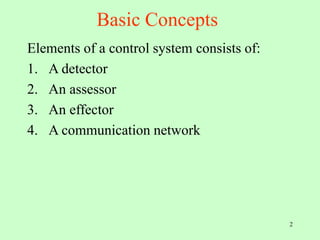
Elements of a control system consists of:
1. A detector
2. An assessor
3. An effector
4. A communication network
3
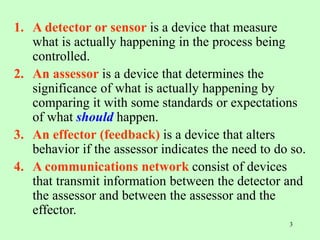
1. A detector or sensor is a device that measure
what is actually happening in the process being
controlled.
2. An assessor is a device that determines the
significance of what is actually happening by
comparing it with some standards or expectations
of what should happen.
3. An effector (feedback) is a device that alters
behavior if the assessor indicates the need to do so.
4. A communications network consist of devices
that transmit information between the detector and
the assessor and between the assessor and the
effector.
4
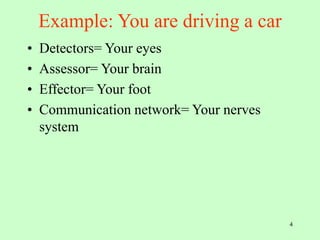
Example: You are driving a car
• Detectors= Your eyes
• Assessor= Your brain
• Effector= Your foot
• Communication network= Your nerves
system
5
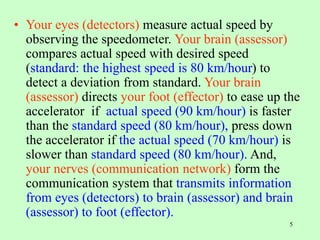
• Your eyes (detectors) measure actual speed by
observing the speedometer. Your brain (assessor)
compares actual speed with desired speed
(standard: the highest speed is 80 km/hour) to
detect a deviation from standard. Your brain
(assessor) directs your foot (effector) to ease up the
accelerator if actual speed (90 km/hour) is faster
than the standard speed (80 km/hour), press down
the accelerator if the actual speed (70 km/hour) is
slower than standard speed (80 km/hour). And,
your nerves (communication network) form the
communication system that transmits information
from eyes (detectors) to brain (assessor) and brain
(assessor) to foot (effector).
6
Boundaries of Management Control
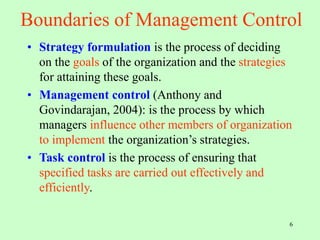
• Strategy formulation is the process of deciding
on the goals of the organization and the strategies
for attaining these goals.
• Management control (Anthony and
Govindarajan, 2004): is the process by which
managers influence other members of organization
to implement the organization’s strategies.
• Task control is the process of ensuring that
specified tasks are carried out effectively and
efficiently.
7
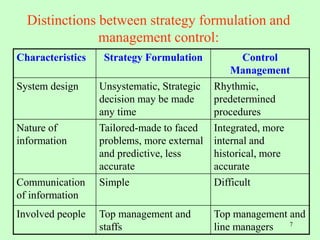
Distinctions between strategy formulation and
management control:
Characteristics Strategy Formulation Control
Management
System design Unsystematic, Strategic
decision may be made
any time
Rhythmic,
predetermined
procedures
Nature of
information
Tailored-made to faced
problems, more external
and predictive, less
accurate
Integrated, more
internal and
historical, more
accurate
Communication
of information
Simple Difficult
Involved people Top management and
staffs
Top management and
line managers
8
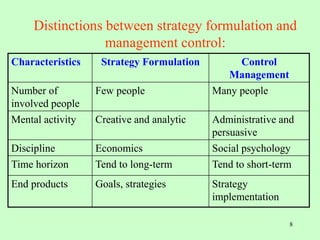
Distinctions between strategy formulation and
management control:
Characteristics Strategy Formulation Control
Management
Number of
involved people
Few people Many people
Mental activity Creative and analytic Administrative and
persuasive
Discipline Economics Social psychology
Time horizon Tend to long-term Tend to short-term
End products Goals, strategies Strategy
implementation
9
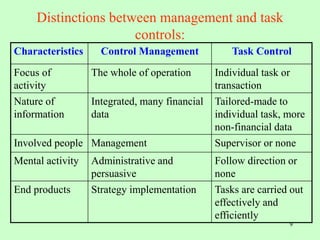
Distinctions between management and task
controls:
Characteristics Control Management Task Control
Focus of
activity
The whole of operation Individual task or
transaction
Nature of
information
Integrated, many financial
data
Tailored-made to
individual task, more
non-financial data
Involved people Management Supervisor or none
Mental activity Administrative and
persuasive
Follow direction or
none
End products Strategy implementation Tasks are carried out
effectively and
efficiently
10
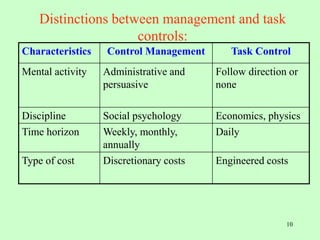
Distinctions between management and task
controls:
Characteristics Control Management Task Control
Mental activity Administrative and
persuasive
Follow direction or
none
Discipline Social psychology Economics, physics
Time horizon Weekly, monthly,
annually
Daily
Type of cost Discretionary costs Engineered costs
11
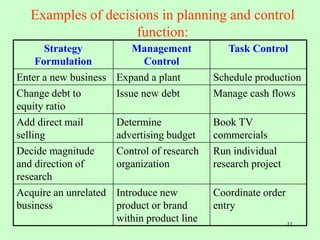
Examples of decisions in planning and control
function:
Strategy
Formulation
Management
Control
Task Control
Enter a new business Expand a plant Schedule production
Change debt to
equity ratio
Issue new debt Manage cash flows
Add direct mail
selling
Determine
advertising budget
Book TV
commercials
Decide magnitude
and direction of
research
Control of research
organization
Run individual
research project
Acquire an unrelated
business
Introduce new
product or brand
within product line
Coordinate order
entry
12

chap-1_the-nature-of-management-control-systems.ppt

  • 1.
    1 The Nature ofManagement Control Systems
  • 2.
    2 Basic Concepts Elements ofa control system consists of: 1. A detector 2. An assessor 3. An effector 4. A communication network
  • 3.
    3 1. A detectoror sensor is a device that measure what is actually happening in the process being controlled. 2. An assessor is a device that determines the significance of what is actually happening by comparing it with some standards or expectations of what should happen. 3. An effector (feedback) is a device that alters behavior if the assessor indicates the need to do so. 4. A communications network consist of devices that transmit information between the detector and the assessor and between the assessor and the effector.
  • 4.
    4 Example: You aredriving a car • Detectors= Your eyes • Assessor= Your brain • Effector= Your foot • Communication network= Your nerves system
  • 5.
    5 • Your eyes(detectors) measure actual speed by observing the speedometer. Your brain (assessor) compares actual speed with desired speed (standard: the highest speed is 80 km/hour) to detect a deviation from standard. Your brain (assessor) directs your foot (effector) to ease up the accelerator if actual speed (90 km/hour) is faster than the standard speed (80 km/hour), press down the accelerator if the actual speed (70 km/hour) is slower than standard speed (80 km/hour). And, your nerves (communication network) form the communication system that transmits information from eyes (detectors) to brain (assessor) and brain (assessor) to foot (effector).
  • 6.
    6 Boundaries of ManagementControl • Strategy formulation is the process of deciding on the goals of the organization and the strategies for attaining these goals. • Management control (Anthony and Govindarajan, 2004): is the process by which managers influence other members of organization to implement the organization’s strategies. • Task control is the process of ensuring that specified tasks are carried out effectively and efficiently.
  • 7.
    7 Distinctions between strategyformulation and management control: Characteristics Strategy Formulation Control Management System design Unsystematic, Strategic decision may be made any time Rhythmic, predetermined procedures Nature of information Tailored-made to faced problems, more external and predictive, less accurate Integrated, more internal and historical, more accurate Communication of information Simple Difficult Involved people Top management and staffs Top management and line managers
  • 8.
    8 Distinctions between strategyformulation and management control: Characteristics Strategy Formulation Control Management Number of involved people Few people Many people Mental activity Creative and analytic Administrative and persuasive Discipline Economics Social psychology Time horizon Tend to long-term Tend to short-term End products Goals, strategies Strategy implementation
  • 9.
    9 Distinctions between managementand task controls: Characteristics Control Management Task Control Focus of activity The whole of operation Individual task or transaction Nature of information Integrated, many financial data Tailored-made to individual task, more non-financial data Involved people Management Supervisor or none Mental activity Administrative and persuasive Follow direction or none End products Strategy implementation Tasks are carried out effectively and efficiently
  • 10.
    10 Distinctions between managementand task controls: Characteristics Control Management Task Control Mental activity Administrative and persuasive Follow direction or none Discipline Social psychology Economics, physics Time horizon Weekly, monthly, annually Daily Type of cost Discretionary costs Engineered costs
  • 11.
    11 Examples of decisionsin planning and control function: Strategy Formulation Management Control Task Control Enter a new business Expand a plant Schedule production Change debt to equity ratio Issue new debt Manage cash flows Add direct mail selling Determine advertising budget Book TV commercials Decide magnitude and direction of research Control of research organization Run individual research project Acquire an unrelated business Introduce new product or brand within product line Coordinate order entry
  • 12.