UNIT 2
INVENTORY CONTROL
SYSTEM
NAME-VISHWAS VILAS OHOL
ROLL NO-57
MBA II
DIV A
Meaning and definition
The Inventory control system is maintained by every firm to manage
its inventories efficiently. Inventory is the stock of products that a
company manufactures for sale and the components or raw materials
that make up the product. Hence, an inventory comprises of the buffer
of raw material, work-in-process inventories and finished goods.
Classification of inventory control
1. Continuous Review System(Q-System)
2. Periodic Review System (P-System)
What is Continuous review System(Q-
System)
• This system is also known as Automatic Inventory System and
Perpetual Inventory System. This method records inventory balance
after each receipt and issue. This makes the system more accurate. For
ensuring proper detection of discrepancies, recorded balance should be
matched with actual stock taking. Steps should be taken if the two
balance do not match.
• This method facilitates regular checking as it record the balance after
every receipt and disbursal. This help in preventing the need for close
down purpose of stock taking. A bin cards is use for making entries
and balances adjusted.
• In case of any error, Both bin card and the store ledger and adjusted.
Process of continuous review system
• In this continuous review system, the inventory level is reviewed
continuously.
• If the inventory decrease to the pre determined level then the record
point in the order is placed for the fix amount to replenish the stock.
The fix amount is termed as the EOQ, who's magnitude is set at a level
that minimizes total inventory carrying, ordering and shortage cost.
Periodic Review System(P-System)
• Periodic inventory system is the method of recording inventory at the
end of the accounting year after making a physical verification of the
Quantity in hand. Generally, the physical counting of the goods is done
at the end of the year. Inventory is valued through following methods:
1. All the items of the inventory are individually measured, counted or
weighed.
2. All the item are listed, valued and added together for determining
total value of the inventory
Process of Periodic Review System
• The inventory on hand is counted at specific time intervals and an
order placed the brings inventory up to a specific level. Inventory is
not monitored between count; therefore, the system is less costly to
track and keep account of inventory. The system results in less direct
control of the management and thus generally higher levels of
inventory to guard against stock-out.
• A new order quantity each time an order is placed.it is used in small
retail stores ,grocery stores and offices.
ABC Classification system
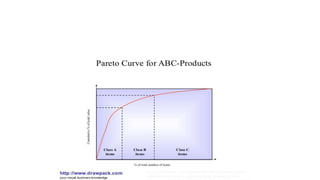
ABC classification is a ranking system for identifying and grouping items in terms of how useful
they are for achieving business goals. The system requires grouping things into three categories:
A - extremely important
B - moderately important
C - relatively unimportant
ABC classification is closely associated with the 80/20 rule, a business metric that proposes 80% of
the outcomes are determined by 20% of the inputs. The goal of ABC classification is to provide a
way for a business to identify that valuable 20% so that segment can be controlled most closely.
Once the A’s, B’s and C’s have been identified, each category can be handled in a different way, with
more attention being devoted to category A, less to B, and even less to C.
ABC classification is most often associated with inventory control, but the system can also be used to
rank things such as which customers are most important, which business segments cause the most
financial risk, which employees are most valuable or which parts of a process are most likely to cause
a bottleneck.
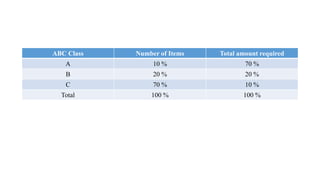
ABC Class Number of Items Total amount required
A 10 % 70 %
B 20 % 20 %
C 70 % 10 %
Total 100 % 100 %
THANK YOU

305 PPT on inventory control.pptx

  • 1.
    UNIT 2 INVENTORY CONTROL SYSTEM NAME-VISHWASVILAS OHOL ROLL NO-57 MBA II DIV A
  • 2.
    Meaning and definition TheInventory control system is maintained by every firm to manage its inventories efficiently. Inventory is the stock of products that a company manufactures for sale and the components or raw materials that make up the product. Hence, an inventory comprises of the buffer of raw material, work-in-process inventories and finished goods.
  • 3.
    Classification of inventorycontrol 1. Continuous Review System(Q-System) 2. Periodic Review System (P-System)
  • 4.
    What is Continuousreview System(Q- System) • This system is also known as Automatic Inventory System and Perpetual Inventory System. This method records inventory balance after each receipt and issue. This makes the system more accurate. For ensuring proper detection of discrepancies, recorded balance should be matched with actual stock taking. Steps should be taken if the two balance do not match. • This method facilitates regular checking as it record the balance after every receipt and disbursal. This help in preventing the need for close down purpose of stock taking. A bin cards is use for making entries and balances adjusted. • In case of any error, Both bin card and the store ledger and adjusted.
  • 5.
    Process of continuousreview system • In this continuous review system, the inventory level is reviewed continuously. • If the inventory decrease to the pre determined level then the record point in the order is placed for the fix amount to replenish the stock. The fix amount is termed as the EOQ, who's magnitude is set at a level that minimizes total inventory carrying, ordering and shortage cost.
  • 6.
    Periodic Review System(P-System) •Periodic inventory system is the method of recording inventory at the end of the accounting year after making a physical verification of the Quantity in hand. Generally, the physical counting of the goods is done at the end of the year. Inventory is valued through following methods: 1. All the items of the inventory are individually measured, counted or weighed. 2. All the item are listed, valued and added together for determining total value of the inventory
  • 7.
    Process of PeriodicReview System • The inventory on hand is counted at specific time intervals and an order placed the brings inventory up to a specific level. Inventory is not monitored between count; therefore, the system is less costly to track and keep account of inventory. The system results in less direct control of the management and thus generally higher levels of inventory to guard against stock-out. • A new order quantity each time an order is placed.it is used in small retail stores ,grocery stores and offices.
  • 8.
    ABC Classification system ABCclassification is a ranking system for identifying and grouping items in terms of how useful they are for achieving business goals. The system requires grouping things into three categories: A - extremely important B - moderately important C - relatively unimportant ABC classification is closely associated with the 80/20 rule, a business metric that proposes 80% of the outcomes are determined by 20% of the inputs. The goal of ABC classification is to provide a way for a business to identify that valuable 20% so that segment can be controlled most closely. Once the A’s, B’s and C’s have been identified, each category can be handled in a different way, with more attention being devoted to category A, less to B, and even less to C. ABC classification is most often associated with inventory control, but the system can also be used to rank things such as which customers are most important, which business segments cause the most financial risk, which employees are most valuable or which parts of a process are most likely to cause a bottleneck.
  • 10.
    ABC Class Numberof Items Total amount required A 10 % 70 % B 20 % 20 % C 70 % 10 % Total 100 % 100 %
  • 11.