GPS in Sport.
      Tom Fitzgerald.
GPS.
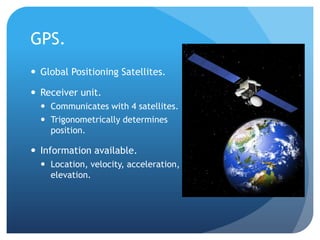
 Global Positioning Satellites.

 Receiver unit.
   Communicates with 4 satellites.
   Trigonometrically determines
    position.

 Information available.
   Location, velocity, acceleration,
    elevation.
Use in Sport.
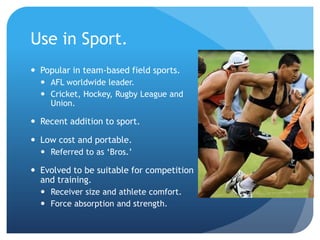
 Popular in team-based field sports.
   AFL worldwide leader.
   Cricket, Hockey, Rugby League and
    Union.

 Recent addition to sport.

 Low cost and portable.
   Referred to as ‘Bros.’

 Evolved to be suitable for competition
  and training.
   Receiver size and athlete comfort.
   Force absorption and strength.
Current Research.
 Research is currently in infancy
  stages.
   Lacks quantity.
   Differing analysis methods.
   Willingness to share data.

 Yet to fully unlock the
  information.
   Data interpretation.
   Application to training and
    competition.

 GPS is the future of sports
  coaching and exercise science.
Accuracy.
 Inconsistent findings in literature.
   Research methods and techniques.

 Positive findings.
   Accurate for maximal velocity*.
   Accuracy improves with duration and distance.

 Negative findings.
   Circular paths and non-linear movement cause
    underestimation.
   Accuracy decreases with increasing velocity*.

 Challenging to draw conclusions.

                                                    *different studies
AFL
 Average distance covered in match 12km for all players.

 Midfield players have additional requirements.
   3.4% greater distance travelled.
   4.8% lower playing time.
   17% greater exertion index.

 Decline in exertion index of 11% from 1st to 4th quarter.

 Individualized training.


                        Wisbey B, et al. Quantifying movement demands of AFL football using
                       GPS tracking. J Sci Med Sport (2009), doi:10.1016/j.jsams.2009.09.002
Rugby Union
 Average distance covered per match is 6.9km.
   2.8km (37%) – Standing and Walking.
   1.9km (27%) – Jogging.
   0.4km (6%) – Sprinting.

 Backs do more high intensity work, greater recovery.
   Forwards contact not included.

 Forwards have higher total movement.
 Greater distance covered in 2nd half.
   Specifically third quarter of match.
   Fatigue relevance.
                              CUNNIFFE, B., PROCTOR, W., BAKER, J. S. & DAVIES, B. 2009. An
                      evaluation of the physiological demands of elite rugby union using global
                               positioning system tracking software. The Journal of Strength &
                                                         Conditioning Research, 23, 1195-1203.
Practical Applications.
 Training specificity.
   Sport.
   Positional.
   Tactical.

 Performance analysis.
   KPI’s
   Work rate.
   Data and evaluation.
Data Analysis Considerations.
 Competition and training specificity.
   Speed zones and distances.

 Data analysis methods.

 Decision-making and conclusions.
   Further evidence and other information sources.
Further Research.
 Accuracy and validity of GPS units.
   Technical evolution.

 Sport-specific data analysis.
   Factors: equipment, environment, gender.

 Defining relationship between data and performance.
   Correlation and causation.
Conclusion
 GPS data is a valuable coaching tool.
   Yet to realise full potential.

 Further research required.

 Consistency within data analysis important.

 Important role for GPS in the sports coaching future.
Discussion.
 What is the future of GPS technology?

 Is modern-day sport too data-orientated?

 As a coach, how would you use GPS?

 Please continue the discussion with me online.
   Twitter: @fitzcity or use the hashtags #sportGPSfuture
    #SpCP13
   http://fitzcity.wordpress.com/
Literature References.
   AUGHEY, R. J. 2011. Applications of GPS technologies to field sports. Int J Sports Physiol Perform, 6,
    295-310.

   BARBERO-ÁLVAREZ, J. C., COUTTS, A., GRANDA, J., BARBERO-ÁLVAREZ, V. & CASTAGNA, C. 2010. The
    validity and reliability of a global positioning satellite system device to assess speed and repeated
    sprint ability (RSA) in athletes. Journal of Science and Medicine in Sport, 13, 232-235.

   CUNNIFFE, B., PROCTOR, W., BAKER, J. S. & DAVIES, B. 2009. An evaluation of the physiological
    demands of elite rugby union using global positioning system tracking software. The Journal of
    Strength & Conditioning Research, 23, 1195-1203.

   DUFFIELD, R., REID, M., BAKER, J. & SPRATFORD, W. 2010. Accuracy and reliability of GPS devices for
    measurement of movement patterns in confined spaces for court-based sports. Journal of Science and
    Medicine in Sport, 13, 523-525.

   DWYER, D. B. & GABBETT, T. J. 2012. Global positioning system data analysis: Velocity ranges and a new
    definition of sprinting for field sport athletes. The Journal of Strength & Conditioning Research, 26,
    818-824.

   GABBETT, T. J., JENKINS, D. G. & ABERNETHY, B. 2012. Physical demands of professional rugby league
    training and competition using microtechnology. Journal of Science and Medicine in Sport, 15, 80-86.
Literature References.
 LACHAPELLE, G., MORRISON, A. & ONG, R. Ultra-precise
  positioning for sport applications. proceedings of 13th IAIN
  world congress, Stockholm, 2009. 27-30.

 LARSSON, P. 2003. Global positioning system and sport-specific
  testing. Sports Medicine, 33, 1093-1101.

 VENTER, R. E., OPPERMAN, E. & OPPERMAN, S. 2011. The use of
  global positioning system (GPS) tracking devices to assess
  movement demands and impacts in under-19 rugby union match
  play. African Journal for Physical, Health Education, Recreation
  and Dance, 17, 1-8.

 WISBEY, B., MONTGOMERY, P. G., PYNE, D. B. & RATTRAY, B.
  2010. Quantifying movement demands of AFL football using GPS
  tracking. Journal of Science and Medicine in Sport, 13, 531-536.
Photo References
 Satellite - http://upload.wikimedia.org/wikipedia/ms/3/34/MEASAT-
  3_Boeing_601.jpg

 Code –
  http://image.shutterstock.com/display_pic_with_logo/476578/476578,1
  314026326,12/stock-photo-code-numbers-computer-data-coding-
  83236099.jpg

 Targethttps://upload.wikimedia.org/wikipedia/commons/9/98/Archery_
  target.jpg

 Team running -
  http://resources1.news.com.au/images/2012/02/01/1226258/983521-
  israel-folau.jpg

 Carlton FC-
  http://media.sbs.com.au/news/thm/articlemain/aap_3323_9Nov_Carlto
  n_800x600.jpg

GPS Use in Sport - Tom Fitzgerald

  • 1.
    GPS in Sport. Tom Fitzgerald.
  • 2.
    GPS.  Global PositioningSatellites.  Receiver unit.  Communicates with 4 satellites.  Trigonometrically determines position.  Information available.  Location, velocity, acceleration, elevation.
  • 3.
    Use in Sport. Popular in team-based field sports.  AFL worldwide leader.  Cricket, Hockey, Rugby League and Union.  Recent addition to sport.  Low cost and portable.  Referred to as ‘Bros.’  Evolved to be suitable for competition and training.  Receiver size and athlete comfort.  Force absorption and strength.
  • 4.
    Current Research.  Researchis currently in infancy stages.  Lacks quantity.  Differing analysis methods.  Willingness to share data.  Yet to fully unlock the information.  Data interpretation.  Application to training and competition.  GPS is the future of sports coaching and exercise science.
  • 5.
    Accuracy.  Inconsistent findingsin literature.  Research methods and techniques.  Positive findings.  Accurate for maximal velocity*.  Accuracy improves with duration and distance.  Negative findings.  Circular paths and non-linear movement cause underestimation.  Accuracy decreases with increasing velocity*.  Challenging to draw conclusions. *different studies
  • 6.
    AFL  Average distancecovered in match 12km for all players.  Midfield players have additional requirements.  3.4% greater distance travelled.  4.8% lower playing time.  17% greater exertion index.  Decline in exertion index of 11% from 1st to 4th quarter.  Individualized training. Wisbey B, et al. Quantifying movement demands of AFL football using GPS tracking. J Sci Med Sport (2009), doi:10.1016/j.jsams.2009.09.002
  • 7.
    Rugby Union  Averagedistance covered per match is 6.9km.  2.8km (37%) – Standing and Walking.  1.9km (27%) – Jogging.  0.4km (6%) – Sprinting.  Backs do more high intensity work, greater recovery.  Forwards contact not included.  Forwards have higher total movement.  Greater distance covered in 2nd half.  Specifically third quarter of match.  Fatigue relevance. CUNNIFFE, B., PROCTOR, W., BAKER, J. S. & DAVIES, B. 2009. An evaluation of the physiological demands of elite rugby union using global positioning system tracking software. The Journal of Strength & Conditioning Research, 23, 1195-1203.
  • 8.
    Practical Applications.  Trainingspecificity.  Sport.  Positional.  Tactical.  Performance analysis.  KPI’s  Work rate.  Data and evaluation.
  • 9.
    Data Analysis Considerations. Competition and training specificity.  Speed zones and distances.  Data analysis methods.  Decision-making and conclusions.  Further evidence and other information sources.
  • 10.
    Further Research.  Accuracyand validity of GPS units.  Technical evolution.  Sport-specific data analysis.  Factors: equipment, environment, gender.  Defining relationship between data and performance.  Correlation and causation.
  • 11.
    Conclusion  GPS datais a valuable coaching tool.  Yet to realise full potential.  Further research required.  Consistency within data analysis important.  Important role for GPS in the sports coaching future.
  • 12.
    Discussion.  What isthe future of GPS technology?  Is modern-day sport too data-orientated?  As a coach, how would you use GPS?  Please continue the discussion with me online.  Twitter: @fitzcity or use the hashtags #sportGPSfuture #SpCP13  http://fitzcity.wordpress.com/
  • 13.
    Literature References.  AUGHEY, R. J. 2011. Applications of GPS technologies to field sports. Int J Sports Physiol Perform, 6, 295-310.  BARBERO-ÁLVAREZ, J. C., COUTTS, A., GRANDA, J., BARBERO-ÁLVAREZ, V. & CASTAGNA, C. 2010. The validity and reliability of a global positioning satellite system device to assess speed and repeated sprint ability (RSA) in athletes. Journal of Science and Medicine in Sport, 13, 232-235.  CUNNIFFE, B., PROCTOR, W., BAKER, J. S. & DAVIES, B. 2009. An evaluation of the physiological demands of elite rugby union using global positioning system tracking software. The Journal of Strength & Conditioning Research, 23, 1195-1203.  DUFFIELD, R., REID, M., BAKER, J. & SPRATFORD, W. 2010. Accuracy and reliability of GPS devices for measurement of movement patterns in confined spaces for court-based sports. Journal of Science and Medicine in Sport, 13, 523-525.  DWYER, D. B. & GABBETT, T. J. 2012. Global positioning system data analysis: Velocity ranges and a new definition of sprinting for field sport athletes. The Journal of Strength & Conditioning Research, 26, 818-824.  GABBETT, T. J., JENKINS, D. G. & ABERNETHY, B. 2012. Physical demands of professional rugby league training and competition using microtechnology. Journal of Science and Medicine in Sport, 15, 80-86.
  • 14.
    Literature References.  LACHAPELLE,G., MORRISON, A. & ONG, R. Ultra-precise positioning for sport applications. proceedings of 13th IAIN world congress, Stockholm, 2009. 27-30.  LARSSON, P. 2003. Global positioning system and sport-specific testing. Sports Medicine, 33, 1093-1101.  VENTER, R. E., OPPERMAN, E. & OPPERMAN, S. 2011. The use of global positioning system (GPS) tracking devices to assess movement demands and impacts in under-19 rugby union match play. African Journal for Physical, Health Education, Recreation and Dance, 17, 1-8.  WISBEY, B., MONTGOMERY, P. G., PYNE, D. B. & RATTRAY, B. 2010. Quantifying movement demands of AFL football using GPS tracking. Journal of Science and Medicine in Sport, 13, 531-536.
  • 15.
    Photo References  Satellite- http://upload.wikimedia.org/wikipedia/ms/3/34/MEASAT- 3_Boeing_601.jpg  Code – http://image.shutterstock.com/display_pic_with_logo/476578/476578,1 314026326,12/stock-photo-code-numbers-computer-data-coding- 83236099.jpg  Targethttps://upload.wikimedia.org/wikipedia/commons/9/98/Archery_ target.jpg  Team running - http://resources1.news.com.au/images/2012/02/01/1226258/983521- israel-folau.jpg  Carlton FC- http://media.sbs.com.au/news/thm/articlemain/aap_3323_9Nov_Carlto n_800x600.jpg