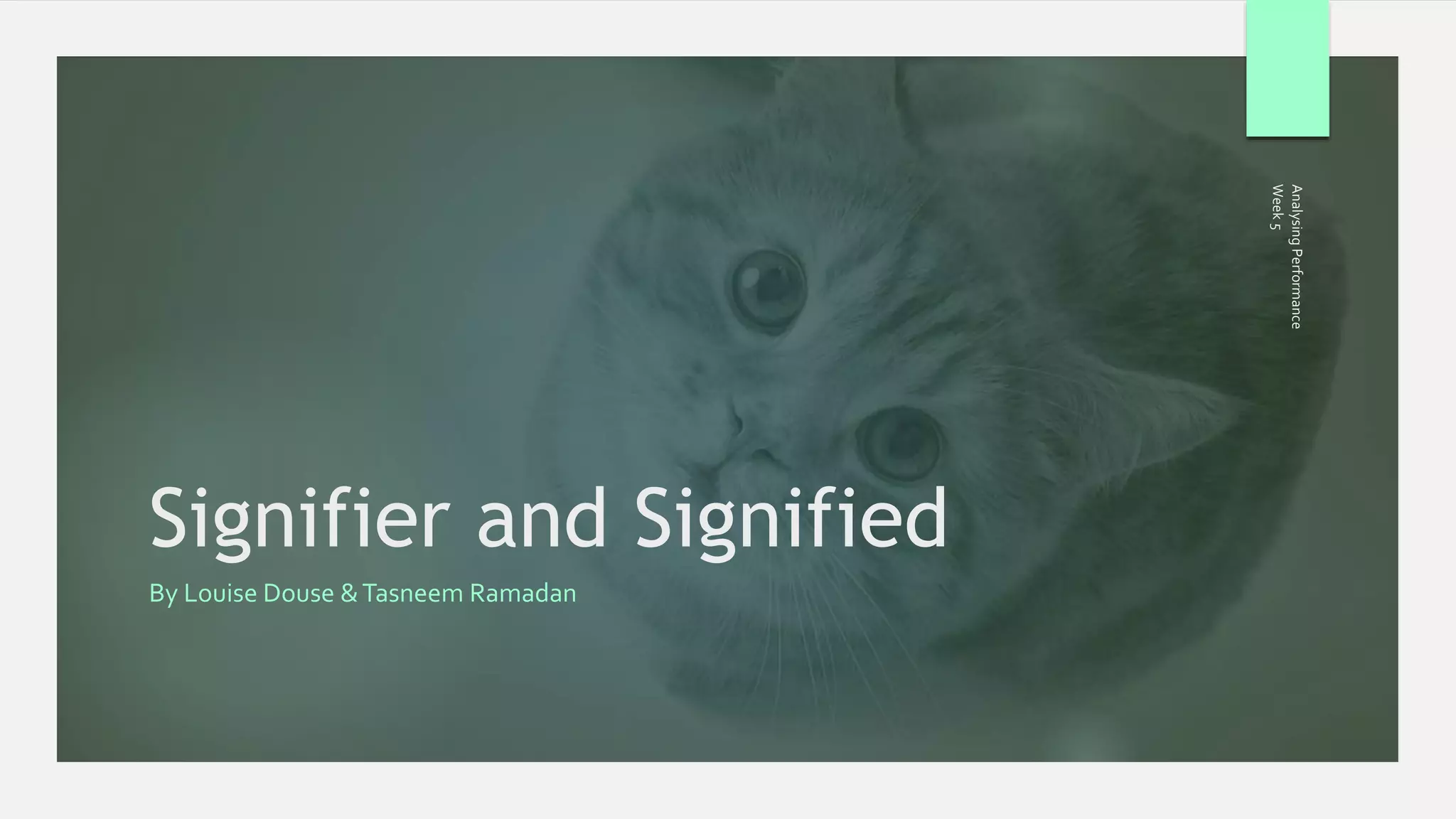
Signifier and Signified
By Louise Douse &Tasneem Ramadan
Week
5
Analysing
Performance
Quick Task
You have 15 seconds to
describe this…
Week 5
Analysing Performance
…conclusions
What do we notice or
understand from that
experiment?
Week 5
Analysing Performance
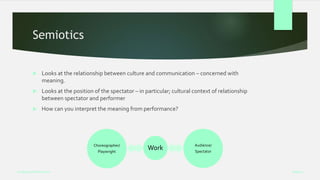
Semiotics
 Looks at the relationship between culture and communication – concerned with
meaning.
 Looks at the position of the spectator – in particular; cultural context of relationship
between spectator and performer
 How can you interpret the meaning from performance?
Week 5
Analysing Performance
Work
Choreographer/
Playwright
Audience/
Spectator
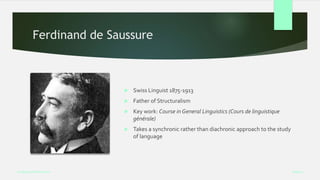
Ferdinand de Saussure
 Swiss Linguist 1875-1913
 Father of Structuralism
 Key work: Course in General Linguistics (Cours de linguistique
générale)
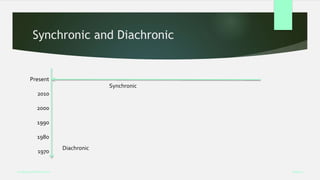
 Takes a synchronic rather than diachronic approach to the study
of language
Week 5
Analysing Performance
Synchronic and Diachronic
Week 5
Analysing Performance
Present
2010
2000
1990
1980
1970
Diachronic
Synchronic
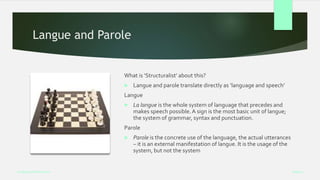
Langue and Parole
What is ‘Structuralist’ about this?
 Langue and parole translate directly as ‘language and speech’
Langue
 La langue is the whole system of language that precedes and
makes speech possible.A sign is the most basic unit of langue;
the system of grammar, syntax and punctuation.
Parole
 Parole is the concrete use of the language, the actual utterances
– it is an external manifestation of langue. It is the usage of the
system, but not the system
Week 5
Analysing Performance
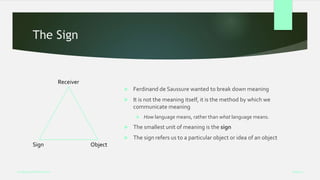
The Sign
 Ferdinand de Saussure wanted to break down meaning
 It is not the meaning itself, it is the method by which we
communicate meaning
 How language means, rather than what language means.
 The smallest unit of meaning is the sign
 The sign refers us to a particular object or idea of an object
Week 5
Analysing Performance
Receiver
Sign Object
The Sign
 The sign and the object are culturally agreed.
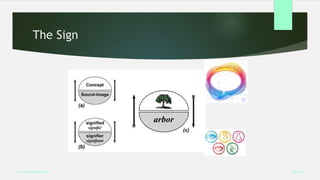
 The sign has two aspects:
 The signifier – this is a sensory perception (a spoken word has an aspect we can
hear, a written word has an aspect we can see).
 The signified – a concept or meaning associated with that sensory perception.
 A sign to be a sign, needs both aspects, something we sense and something
we think, a relationship.
Week 5
Analysing Performance
The Sign
Week 5
Analysing Performance
Week 5
Analysing Performance
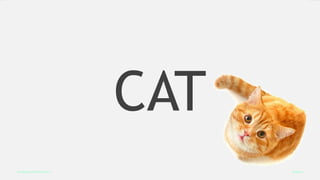
CAT
The Sign
 Therefore the sign depends on three elements:
 An aspect of it is perceivable to our senses.
 It refers to something other than itself.
 It depends on a recognition by its users that it is a sign
 Something to be learnt – culturally agreed.
 Meaning occurs in the relationship between the ideas of a sign – there has
to be rules, order, sentence structure etc.
 Meaning is NOT inherent, essential and/or present within any part of the
sign
Week 5
Analysing Performance
Structuralism
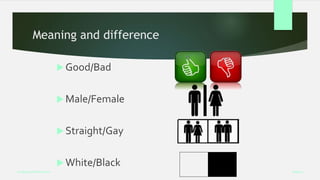
Meaning is the result of relationship
and difference
Week 5
Analysing Performance
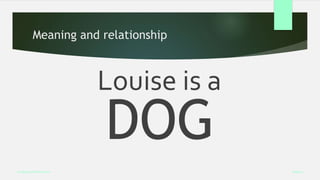
Meaning and relationship
Week 5
Analysing Performance
DOG
Louise is a
Meaning and difference
Good/Bad
Male/Female
Straight/Gay
White/Black
Week 5
Analysing Performance
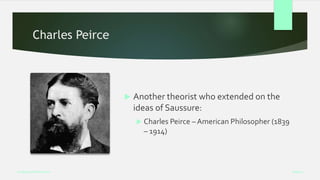
Charles Peirce
 Another theorist who extended on the
ideas of Saussure:
 Charles Peirce – American Philosopher (1839
– 1914)
Week 5
Analysing Performance
Charles Peirce
 Expanded on the definition of a sign – three different and
distinct relationships between the signifier and signified.
 ICONIC SIGN: Signifier represents or resembles the signified
 INDEXICAL SIGN: Signifier has a causal relationship to the signified
 SYMBOLIC SIGN: Signifier has a conventional/arbitrary relationship
to the signified
Week 5
Analysing Performance
Iconic Sign
 Signifier represents or
resembles the signified
Week 5
Analysing Performance
Indexical Sign
 Signifier has a causal
relationship to the
signified
 Signifier has an existential
relationship to the
signifier.The signifier
cannot exist without the
presence of the signified.
Week 5
Analysing Performance
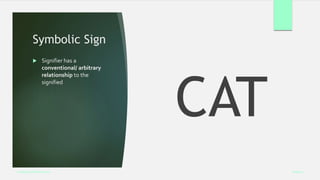
Symbolic Sign
 Signifier has a
conventional/ arbitrary
relationship to the
signified
Week 5
Analysing Performance
CAT
So…
the type of relationship between the
signifier and signified (that constitute the sign)
 can change
 can be multiple
Week 5
Analysing Performance
So how do we apply this to
reading performance?
Week
5
Analysing
Performance
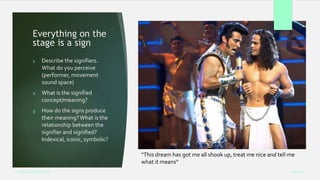
Everything on the
stage is a sign
1. Describe the signifiers.
What do you perceive
(performer, movement
sound space)
2. What is the signified
concept/meaning?
3. How do the signs produce
their meaning?What is the
relationship between the
signifier and signified?
Indexical, iconic, symbolic?
Week 5
Analysing Performance
“This dream has got me all shook up, treat me nice and tell me
what it means”

28.02.22 Analysing Performance - Signifier and Signified

  • 1.
    Signifier and Signified ByLouise Douse &Tasneem Ramadan Week 5 Analysing Performance
  • 2.
    Quick Task You have15 seconds to describe this… Week 5 Analysing Performance
  • 3.
    …conclusions What do wenotice or understand from that experiment? Week 5 Analysing Performance
  • 4.
    Semiotics  Looks atthe relationship between culture and communication – concerned with meaning.  Looks at the position of the spectator – in particular; cultural context of relationship between spectator and performer  How can you interpret the meaning from performance? Week 5 Analysing Performance Work Choreographer/ Playwright Audience/ Spectator
  • 5.
    Ferdinand de Saussure Swiss Linguist 1875-1913  Father of Structuralism  Key work: Course in General Linguistics (Cours de linguistique générale)  Takes a synchronic rather than diachronic approach to the study of language Week 5 Analysing Performance
  • 6.
    Synchronic and Diachronic Week5 Analysing Performance Present 2010 2000 1990 1980 1970 Diachronic Synchronic
  • 7.
    Langue and Parole Whatis ‘Structuralist’ about this?  Langue and parole translate directly as ‘language and speech’ Langue  La langue is the whole system of language that precedes and makes speech possible.A sign is the most basic unit of langue; the system of grammar, syntax and punctuation. Parole  Parole is the concrete use of the language, the actual utterances – it is an external manifestation of langue. It is the usage of the system, but not the system Week 5 Analysing Performance
  • 8.
    The Sign  Ferdinandde Saussure wanted to break down meaning  It is not the meaning itself, it is the method by which we communicate meaning  How language means, rather than what language means.  The smallest unit of meaning is the sign  The sign refers us to a particular object or idea of an object Week 5 Analysing Performance Receiver Sign Object
  • 9.
    The Sign  Thesign and the object are culturally agreed.  The sign has two aspects:  The signifier – this is a sensory perception (a spoken word has an aspect we can hear, a written word has an aspect we can see).  The signified – a concept or meaning associated with that sensory perception.  A sign to be a sign, needs both aspects, something we sense and something we think, a relationship. Week 5 Analysing Performance
  • 10.
  • 11.
  • 12.
    The Sign  Thereforethe sign depends on three elements:  An aspect of it is perceivable to our senses.  It refers to something other than itself.  It depends on a recognition by its users that it is a sign  Something to be learnt – culturally agreed.  Meaning occurs in the relationship between the ideas of a sign – there has to be rules, order, sentence structure etc.  Meaning is NOT inherent, essential and/or present within any part of the sign Week 5 Analysing Performance
  • 13.
    Structuralism Meaning is theresult of relationship and difference Week 5 Analysing Performance
  • 14.
    Meaning and relationship Week5 Analysing Performance DOG Louise is a
  • 15.
  • 16.
    Charles Peirce  Anothertheorist who extended on the ideas of Saussure:  Charles Peirce – American Philosopher (1839 – 1914) Week 5 Analysing Performance
  • 17.
    Charles Peirce  Expandedon the definition of a sign – three different and distinct relationships between the signifier and signified.  ICONIC SIGN: Signifier represents or resembles the signified  INDEXICAL SIGN: Signifier has a causal relationship to the signified  SYMBOLIC SIGN: Signifier has a conventional/arbitrary relationship to the signified Week 5 Analysing Performance
  • 18.
    Iconic Sign  Signifierrepresents or resembles the signified Week 5 Analysing Performance
  • 19.
    Indexical Sign  Signifierhas a causal relationship to the signified  Signifier has an existential relationship to the signifier.The signifier cannot exist without the presence of the signified. Week 5 Analysing Performance
  • 20.
    Symbolic Sign  Signifierhas a conventional/ arbitrary relationship to the signified Week 5 Analysing Performance CAT
  • 21.
    So… the type ofrelationship between the signifier and signified (that constitute the sign)  can change  can be multiple Week 5 Analysing Performance
  • 22.
    So how dowe apply this to reading performance? Week 5 Analysing Performance
  • 23.
    Everything on the stageis a sign 1. Describe the signifiers. What do you perceive (performer, movement sound space) 2. What is the signified concept/meaning? 3. How do the signs produce their meaning?What is the relationship between the signifier and signified? Indexical, iconic, symbolic? Week 5 Analysing Performance “This dream has got me all shook up, treat me nice and tell me what it means”