TISSUE
ANATOMY AND PHYSIOLOGY
MABM 0114
SEM 1 /YEAR 1
PN NOR AINI
LEARNING OBJECTIVE
At the end of the course, the student will be able to:
 List the body's four major tissue types and describe their roles.
 State the types and functions of epithelial cells.
 Expalin the structures and functions of the various types of
connective tissues.
 State how epithelial and connective tissues combine to form four
types of membranes and specify the functions of each.
 State the three types of muscle tissue and the special structural
features of each.
Introduction
Tissue is a group of cells that have
similar structure and that function
together as a unit.
 There are 4 main type of tissue
 Epithelial tissue
 Connective tissue
 Muscular tissue
 Nervous tissue
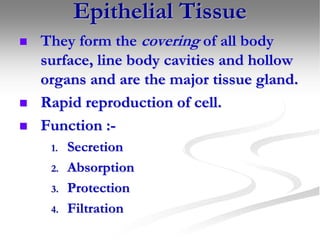
Epithelial Tissue
 They form the covering of all body
surface, line body cavities and hollow
organs and are the major tissue gland.
 Rapid reproduction of cell.
 Function :-
1. Secretion
2. Absorption
3. Protection
4. Filtration
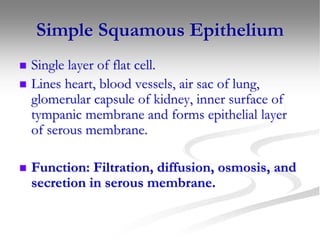
Simple Squamous Epithelium
 Single layer of flat cell.
 Lines heart, blood vessels, air sac of lung,
glomerular capsule of kidney, inner surface of
tympanic membrane and forms epithelial layer
of serous membrane.
 Function: Filtration, diffusion, osmosis, and
secretion in serous membrane.
Simple Cuboidal Epithelium
 Single layer of cube-
shape cells.
 Found in glandular
tissue and kidney
tubule.
 Function :
Secretion and
absorption.
Simple Columnar Epithelium
 Ciliated and nonciliated
 Ciliated
 Layer of ciliated column like, contain goblet
cell in some locations.
 Found in upper respiratory tract, uterine tube
 Function : Moves mucus and other
substances by ciliary action.
Simple Columnar Epithelium (cont.)
 Nonciliated
 Layer of nonciliated column like cell.
 Found GIT, ducts of many gland.
 Function : secretion and absorption.
Ciliated Columnar Epithelium
Consist of Cilia
Function
Cilia sweap the dust out
.to prevent the dust go
into the lung
- Helps in movement
of : Ovam , sperm in
fallpian tube
Transitional Epithelium
 Appearance is
variable, shape of
cell from squamous
to cuboidal.
 Location : Urinary
bladder, portion of
ureters and urethra.
 Function : Permits
distension.
Connective Tissue : Structure:
Connective Tissue (cont.)
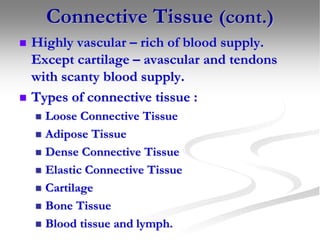
 Highly vascular – rich of blood supply.
Except cartilage – avascular and tendons
with scanty blood supply.
 Types of connective tissue :
 Loose Connective Tissue
 Adipose Tissue
 Dense Connective Tissue
 Elastic Connective Tissue
 Cartilage
 Bone Tissue
 Blood tissue and lymph.
Connective Tissue
 Areolar C T Adipose Fibrous
Connective Tissue : Function
 Connective tissue bind organs together.
 Form a framework and support for organs
and the body as whole.
 Store fat.
 Transport substance.
 Protect against disease.
 Help repair tissue damage.
Muscular Tissue
Structure :
 Consist of elongated cells called muscle
fibers that can use ATP to generate force.
 Usually arrange in bundle and layers that
surrounded by connective tissue.
 The tissue is highly cellular and well
supply with blood vessel.
Type of Muscle Tissue
Skeletal muscle
tissue
 Attached to the bones
of the skeleton.
 Cylindrical,
multinucleated,
striated and under
voluntary control.
Type of Muscle Tissue
Cardiac muscle tissue
 Most of the wall of the
heart.
 Branched striated
fibers, one or two
nucleus.
 Involuntary.
 Function: Pump blood
to all parts of the
body.
Type of Muscle Tissue
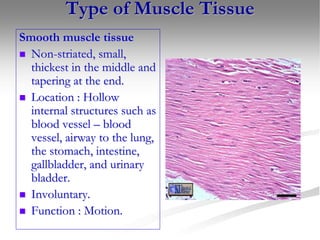
Smooth muscle tissue
 Non-striated, small,
thickest in the middle and
tapering at the end.
 Location : Hollow
internal structures such as
blood vessel – blood
vessel, airway to the lung,
the stomach, intestine,
gallbladder, and urinary
bladder.
 Involuntary.
 Function : Motion.
Muscular Tissue :Function
 Produces body movement.
 Maintain posture.
 Generate heat.
 Protection.
Nervous Tissue
 Consist of neuron (nerve cell) and
neuroglia.
 Location: Brain, spinal cord and
nerves.
 (Nervous system)
 Function :
1. Sensitivity to various types of stimuli.
2. Responsible coordinating and
controlling many body activities.
Nerve cells
 Generate and
conduct impulses.
 Nerve cells have 3
part :-
1. Dendrite
2. The cell body
3. One axon
Nerve cells
3. LECTURE 3 Tissue.ppt

3. LECTURE 3 Tissue.ppt

  • 1.
    TISSUE ANATOMY AND PHYSIOLOGY MABM0114 SEM 1 /YEAR 1 PN NOR AINI
  • 2.
    LEARNING OBJECTIVE At theend of the course, the student will be able to:  List the body's four major tissue types and describe their roles.  State the types and functions of epithelial cells.  Expalin the structures and functions of the various types of connective tissues.  State how epithelial and connective tissues combine to form four types of membranes and specify the functions of each.  State the three types of muscle tissue and the special structural features of each.
  • 3.
    Introduction Tissue is agroup of cells that have similar structure and that function together as a unit.  There are 4 main type of tissue  Epithelial tissue  Connective tissue  Muscular tissue  Nervous tissue
  • 5.
    Epithelial Tissue  Theyform the covering of all body surface, line body cavities and hollow organs and are the major tissue gland.  Rapid reproduction of cell.  Function :- 1. Secretion 2. Absorption 3. Protection 4. Filtration
  • 7.
    Simple Squamous Epithelium Single layer of flat cell.  Lines heart, blood vessels, air sac of lung, glomerular capsule of kidney, inner surface of tympanic membrane and forms epithelial layer of serous membrane.  Function: Filtration, diffusion, osmosis, and secretion in serous membrane.
  • 9.
    Simple Cuboidal Epithelium Single layer of cube- shape cells.  Found in glandular tissue and kidney tubule.  Function : Secretion and absorption.
  • 10.
    Simple Columnar Epithelium Ciliated and nonciliated  Ciliated  Layer of ciliated column like, contain goblet cell in some locations.  Found in upper respiratory tract, uterine tube  Function : Moves mucus and other substances by ciliary action.
  • 12.
    Simple Columnar Epithelium(cont.)  Nonciliated  Layer of nonciliated column like cell.  Found GIT, ducts of many gland.  Function : secretion and absorption.
  • 13.
    Ciliated Columnar Epithelium Consistof Cilia Function Cilia sweap the dust out .to prevent the dust go into the lung - Helps in movement of : Ovam , sperm in fallpian tube
  • 14.
    Transitional Epithelium  Appearanceis variable, shape of cell from squamous to cuboidal.  Location : Urinary bladder, portion of ureters and urethra.  Function : Permits distension.
  • 15.
  • 16.
    Connective Tissue (cont.) Highly vascular – rich of blood supply. Except cartilage – avascular and tendons with scanty blood supply.  Types of connective tissue :  Loose Connective Tissue  Adipose Tissue  Dense Connective Tissue  Elastic Connective Tissue  Cartilage  Bone Tissue  Blood tissue and lymph.
  • 17.
    Connective Tissue  AreolarC T Adipose Fibrous
  • 18.
    Connective Tissue :Function  Connective tissue bind organs together.  Form a framework and support for organs and the body as whole.  Store fat.  Transport substance.  Protect against disease.  Help repair tissue damage.
  • 19.
    Muscular Tissue Structure : Consist of elongated cells called muscle fibers that can use ATP to generate force.  Usually arrange in bundle and layers that surrounded by connective tissue.  The tissue is highly cellular and well supply with blood vessel.
  • 20.
    Type of MuscleTissue Skeletal muscle tissue  Attached to the bones of the skeleton.  Cylindrical, multinucleated, striated and under voluntary control.
  • 22.
    Type of MuscleTissue Cardiac muscle tissue  Most of the wall of the heart.  Branched striated fibers, one or two nucleus.  Involuntary.  Function: Pump blood to all parts of the body.
  • 23.
    Type of MuscleTissue Smooth muscle tissue  Non-striated, small, thickest in the middle and tapering at the end.  Location : Hollow internal structures such as blood vessel – blood vessel, airway to the lung, the stomach, intestine, gallbladder, and urinary bladder.  Involuntary.  Function : Motion.
  • 25.
    Muscular Tissue :Function Produces body movement.  Maintain posture.  Generate heat.  Protection.
  • 26.
    Nervous Tissue  Consistof neuron (nerve cell) and neuroglia.  Location: Brain, spinal cord and nerves.  (Nervous system)  Function : 1. Sensitivity to various types of stimuli. 2. Responsible coordinating and controlling many body activities.
  • 27.
    Nerve cells  Generateand conduct impulses.  Nerve cells have 3 part :- 1. Dendrite 2. The cell body 3. One axon
  • 29.