Beehive-: poem 2 –
WIND -Subrahmania Bharati
ABOUT THE POET-SUBRAMANIA BHARATI
(born December 11, 1882, Ettaiyapuram, Madras Presidency, India—died SMadras
(now Chennai)), outstanding Indian writer of the nationalist period who is regarded as
the father of the modern Tamil styleeptember 12, 1921. The son of a
learned Brahman, Bharati became a Tamil scholar at an early age. He received little
formal education, however, and in 1904 he moved to Madras (now Chennai). There
he translated English into Tamil for several magazines and later joined the Tamil daily
newspaper Swadesamitran. This exposure to political affairs led to his involvement in
the extremist wing of the Indian National Congress party, and, as a result, he was
forced to flee to Pondicherry (now Puducherry), a French colony, where he lived in
exile from 1910 to 1919. During this time Bharati’s nationalistic poems and essays
were popular successes. Upon his return to India in 1919 he was briefly imprisoned
and later rejoined Swadesamitran. He was killed by a temple elephant in Madras.
ABOUT THE POEM
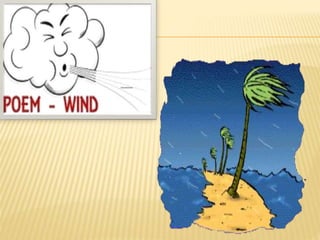
The poem is about “Wind”, as its name
suggests. The poet has described the power
of the wind and says that it causes a lot of
destruction. But in the end, the poet has
suggested the ways in which we can become
friends with the wind. The poet represented
the destructive nature of the wind with the
difficulties of life.
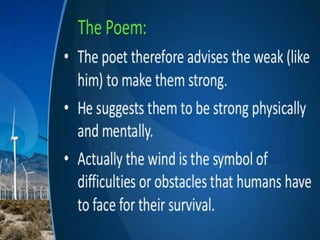
It conveys a powerful message that when
difficulties come in our life, the brave people
face them with courage and overcome all the
challenges. On the contrary, weak people get
afraid and break down easily. So, it’s
HOW DOES WIND FORM?
DESTRUCTIVE WIND
POKING FUN: MAKING FUN OF
SOMETHING
WEAKLINGS: A PERSON WHO IS WEAK
 SCATTER=
SEPARATE
 FRAIL= FRAGILE
CRUMBLING: FALLING OR TO CAUSE
SOMETHING TO BREAK
RAFTER: SLOPING BEAM WHICH
SUPPORT THE ROOF OF THE
BUILDING
WINNOWS: TO BROKE GRAIN FREE OF
CHAFF, SEPARATE GRAIN FROM
HUSK BY BLOWING ON IT
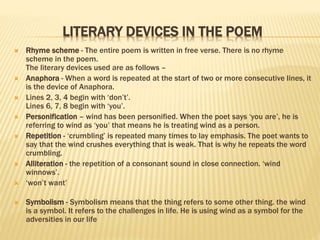
LITERARY DEVICES IN THE POEM
 Rhyme scheme - The entire poem is written in free verse. There is no rhyme
scheme in the poem.
The literary devices used are as follows –
 Anaphora - When a word is repeated at the start of two or more consecutive lines, it
is the device of Anaphora.
 Lines 2, 3, 4 begin with ‘don’t’.
Lines 6, 7, 8 begin with ‘you’.
 Personification – wind has been personified. When the poet says ‘you are’, he is
referring to wind as ‘you’ that means he is treating wind as a person.
 Repetition - ‘crumbling’ is repeated many times to lay emphasis. The poet wants to
say that the wind crushes everything that is weak. That is why he repeats the word
crumbling.
 Alliteration - the repetition of a consonant sound in close connection. ‘wind
winnows’.
 ‘won’t want’
 Symbolism - Symbolism means that the thing refers to some other thing. the wind
is a symbol. It refers to the challenges in life. He is using wind as a symbol for the
adversities in our life
VIDEO EXPLANATION
Thank you
Have a nice day

2.wind saneesh m.s

  • 1.
    Beehive-: poem 2– WIND -Subrahmania Bharati
  • 3.
    ABOUT THE POET-SUBRAMANIABHARATI (born December 11, 1882, Ettaiyapuram, Madras Presidency, India—died SMadras (now Chennai)), outstanding Indian writer of the nationalist period who is regarded as the father of the modern Tamil styleeptember 12, 1921. The son of a learned Brahman, Bharati became a Tamil scholar at an early age. He received little formal education, however, and in 1904 he moved to Madras (now Chennai). There he translated English into Tamil for several magazines and later joined the Tamil daily newspaper Swadesamitran. This exposure to political affairs led to his involvement in the extremist wing of the Indian National Congress party, and, as a result, he was forced to flee to Pondicherry (now Puducherry), a French colony, where he lived in exile from 1910 to 1919. During this time Bharati’s nationalistic poems and essays were popular successes. Upon his return to India in 1919 he was briefly imprisoned and later rejoined Swadesamitran. He was killed by a temple elephant in Madras.
  • 4.
    ABOUT THE POEM Thepoem is about “Wind”, as its name suggests. The poet has described the power of the wind and says that it causes a lot of destruction. But in the end, the poet has suggested the ways in which we can become friends with the wind. The poet represented the destructive nature of the wind with the difficulties of life. It conveys a powerful message that when difficulties come in our life, the brave people face them with courage and overcome all the challenges. On the contrary, weak people get afraid and break down easily. So, it’s
  • 5.
  • 10.
  • 13.
    POKING FUN: MAKINGFUN OF SOMETHING WEAKLINGS: A PERSON WHO IS WEAK
  • 14.
  • 16.
    CRUMBLING: FALLING ORTO CAUSE SOMETHING TO BREAK RAFTER: SLOPING BEAM WHICH SUPPORT THE ROOF OF THE BUILDING
  • 17.
    WINNOWS: TO BROKEGRAIN FREE OF CHAFF, SEPARATE GRAIN FROM HUSK BY BLOWING ON IT
  • 19.
    LITERARY DEVICES INTHE POEM  Rhyme scheme - The entire poem is written in free verse. There is no rhyme scheme in the poem. The literary devices used are as follows –  Anaphora - When a word is repeated at the start of two or more consecutive lines, it is the device of Anaphora.  Lines 2, 3, 4 begin with ‘don’t’. Lines 6, 7, 8 begin with ‘you’.  Personification – wind has been personified. When the poet says ‘you are’, he is referring to wind as ‘you’ that means he is treating wind as a person.  Repetition - ‘crumbling’ is repeated many times to lay emphasis. The poet wants to say that the wind crushes everything that is weak. That is why he repeats the word crumbling.  Alliteration - the repetition of a consonant sound in close connection. ‘wind winnows’.  ‘won’t want’  Symbolism - Symbolism means that the thing refers to some other thing. the wind is a symbol. It refers to the challenges in life. He is using wind as a symbol for the adversities in our life
  • 20.
  • 21.