by SUBRAMANIA BHARATI
[Translated from Tamil by A.K.
Ramanujan]
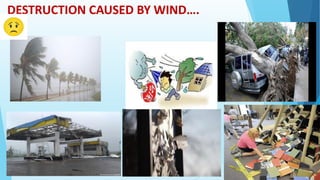
DESTRUCTION CAUSED BY WIND….
Theme : Wind as a potential destroyer and a creator. The weak
and fragile cannot withstand the fury of wind, but the strong ones can use it to
their advantage.
Sub-Theme : Overcoming the hardships of life
Narrator : The poet himself
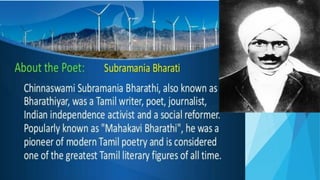
Subramania Bharati
1882-1921
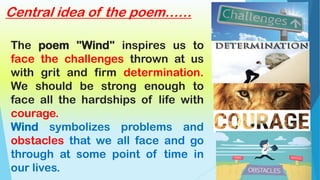
The poem "Wind" inspires us to
face the challenges thrown at us
with grit and firm determination.
We should be strong enough to
face all the hardships of life with
courage.
Wind symbolizes problems and
obstacles that we all face and go
through at some point of time in
our lives.
Central idea of the poem……
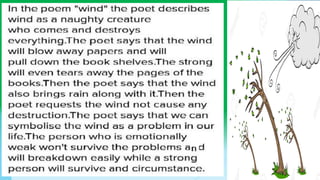
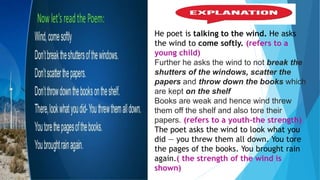
He poet is talking to the wind. He asks
the wind to come softly. (refers to a
young child)
Further he asks the wind to not break the
shutters of the windows, scatter the
papers and throw down the books which
are kept on the shelf
Books are weak and hence wind threw
them off the shelf and also tore their
papers. (refers to a youth-the strength)
The poet asks the wind to look what you
did — you threw them all down. You tore
the pages of the books. You brought rain
again.( the strength of the wind is
shown)
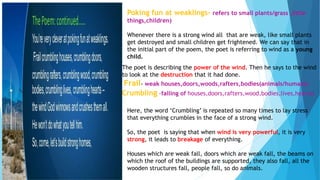
The poet is describing the power of the wind. Then he says to the wind
to look at the destruction that it had done.
Frail- weak houses,doors,woods,rafters,bodies(animals/humans)
Crumbling –falling of houses,doors,rafters,wood,bodies,lives,hearts)
Poking fun at weaklings- refers to small plants/grass ,little
things,children)
Whenever there is a strong wind all that are weak, like small plants
get destroyed and small children get frightened. We can say that in
the initial part of the poem, the poet is referring to wind as a young
child.
Here, the word ‘Crumbling’ is repeated so many times to lay stress
that everything crumbles in the face of a strong wind.
So, the poet is saying that when wind is very powerful, it is very
strong, it leads to breakage of everything.
Houses which are weak fall, doors which are weak fall, the beams on
which the roof of the buildings are supported, they also fall, all the
wooden structures fall, people fall, so do animals.
 Wind brings havoc in the lives of the people. So, he is saying that everything
crumbles. Everything that is weak reacts by falling down and breaking in the
face of adversity (difficult/unpleasant situation).
 Therefore the poet is saying that whenever a weak person faces any
adversity or challenge in life he breaks down and falls.
The wind god winnows and crushes them all-
 The poet is addressing wind as ‘wind god’ , and he is saying that
the powerful god of wind winnows, that means he tests the people and
those people who are weak-fall down and get crushed.
 So here, a comparison is made between wheat and people. Just like we
winnow the wheat to separate the grain from chaff.
 The wind separates the strong people from the weak people. When there is
a strong wind, all the things that are weak fall and get crushed .Wind god
winnows and crushes them all.
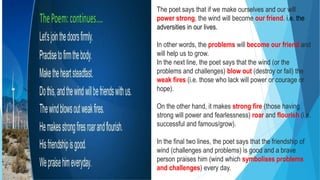
The poet says that if we make ourselves and our will
power strong, the wind will become our friend. i.e. the
adversities in our lives.
In other words, the problems will become our friend and
will help us to grow.
In the next line, the poet says that the wind (or the
problems and challenges) blow out (destroy or fail) the
weak fires (i.e. those who lack will power or courage or
hope).
On the other hand, it makes strong fire (those having
strong will power and fearlessness) roar and flourish (i.e.
successful and famous/grow).
In the final two lines, the poet says that the friendship of
wind (challenges and problems) is good and a brave
person praises him (wind which symbolises problems
and challenges) every day.
 Once we are strong enough all the challenges will be like friends.
 We will not feel that they are troublesome.
 The poet has kept the wind on a pedestal. He is comparing the wind to god. He
says that wind is god and we praise wind every day.
 He adds that everything that is weak gets finished off in the face of the strong
wind. And all the things that are strong, flourish and grow to become stronger.
 The poet says that we should not get frightened by adversities in life ,on the
contrary should face them.
 He also adds that once we are strong enough, we will overcome the challenges, we will
become friends with them and then we will be happy that we had these challenges in
our life because they help us become stronger and better.
QUICK SUMMARY
The message conveyed through the poem Wind is that-
The problems and challenges in our lives are like wind i.e. mighty, everlasting and
trouble-making.
We cannot stop them. Hence, we should make ourselves strong and bold.
 We should never give up when there are obstacles and hardships in life.
 We should face those obstacles with strong will power like poet befriends the wind so
that it could not harm the poet in any way
We should have courage enough to face them.
Those who lack courage and will power fail in their lives badly while those who face
these problems with firm determination, succeed and become prosperous.
THE MESSAGE THE POEM IMPARTS……
Rhyme scheme
The entire poem is written in free verse. There is no rhyme scheme in the
poem.
The literary devices used are as follows –
1.Anaphora - When a word is repeated at the start of two or more consecutive lines, it is the device of
Anaphora.
Lines 2, 3, 4 begin with ‘don’t’.
Lines 6, 7, 8 begin with ‘you’.
2.Personification – wind has been personified. When the poet says ‘you are’, he is referring to wind
as ‘you’ that means he is treating wind as a person.
3.Repetition - ‘crumbling’ is repeated many times to lay emphasis. The poet
wants to say that the wind crushes everything that is weak. That is why he
repeats the word crumbling.
4.Alliteration - the repetition of a consonant sound in close connection. ‘wind
winnows’.
‘won’t want’
Symbolism - Symbolism means that the thing refers to some
other thing.
The wind is a symbol. It refers to the challenges in life. He is using
wind as a symbol for the adversities in our life.
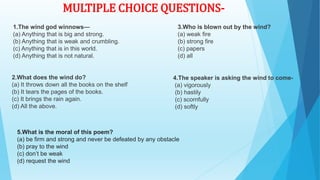
1.The wind god winnows—
(a) Anything that is big and strong.
(b) Anything that is weak and crumbling.
(c) Anything that is in this world.
(d) Anything that is not natural.
2.What does the wind do?
(a) It throws down all the books on the shelf
(b) It tears the pages of the books.
(c) It brings the rain again.
(d) All the above.
3.Who is blown out by the wind?
(a) weak fire
(b) strong fire
(c) papers
(d) all
4.The speaker is asking the wind to come-
(a) vigorously
(b) hastily
(c) scornfully
(d) softly
MULTIPLE CHOICE QUESTIONS-
5.What is the moral of this poem?
(a) be firm and strong and never be defeated by any obstacle
(b) pray to the wind
(c) don’t be weak
(d) request the wind
ANSWERS-
1. (b) Anything that is weak and crumbling.
2. d) All the above.
3. (a) weak fire
4. (d) softly
5. (a) be firm and strong and never be defeated by any obstacle
Reference to Context
He won’t do what you tell him.
So,come, let’s build strong homes
Let’s joint the doors firmly
Practice to firm the body
Make the heart steadfast.
i. Who is referred to as ‘He’ in the above lines?
The wind is referred to as 'He' in the above lines.
ii.What does the poet imply when he says, ‘He won’t do what you tell
him’?
The poet implies that difficulties and troubles do not listen to
entreaties; they have to be faced boldly.
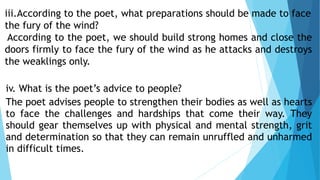
iii.According to the poet, what preparations should be made to face
the fury of the wind?
According to the poet, we should build strong homes and close the
doors firmly to face the fury of the wind as he attacks and destroys
the weaklings only.
iv. What is the poet’s advice to people?
The poet advises people to strengthen their bodies as well as hearts
to face the challenges and hardships that come their way. They
should gear themselves up with physical and mental strength, grit
and determination so that they can remain unruffled and unharmed
in difficult times.
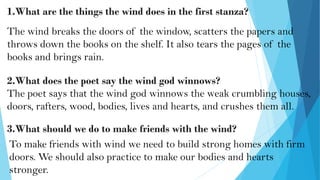
1.What are the things the wind does in the first stanza?
The wind breaks the doors of the window, scatters the papers and
throws down the books on the shelf. It also tears the pages of the
books and brings rain.
2.What does the poet say the wind god winnows?
The poet says that the wind god winnows the weak crumbling houses,
doors, rafters, wood, bodies, lives and hearts, and crushes them all.
3.What should we do to make friends with the wind?
To make friends with wind we need to build strong homes with firm
doors. We should also practice to make our bodies and hearts
stronger.
4.What do the last four lines of the poem mean to you?
Do this, and the wind…………………..we praise him everyday.
In the last four lines, the poet inspires us to be determined and
face all the hardships or obstacles coming in life courageously.
He tells us that the wind can only extinguish the weak fires but
intensifies the stronger ones. In the same way, people who do
not fight against the challenges coming in their lives, they have
to face the failure. On the other hand, those who stay
determined and make sincere efforts to meet their goals, come
out to be successful.
WIND (BEEHIVE).pdf

WIND (BEEHIVE).pdf

  • 1.
    by SUBRAMANIA BHARATI [Translatedfrom Tamil by A.K. Ramanujan]
  • 2.
  • 4.
    Theme : Windas a potential destroyer and a creator. The weak and fragile cannot withstand the fury of wind, but the strong ones can use it to their advantage. Sub-Theme : Overcoming the hardships of life Narrator : The poet himself Subramania Bharati 1882-1921
  • 7.
    The poem "Wind"inspires us to face the challenges thrown at us with grit and firm determination. We should be strong enough to face all the hardships of life with courage. Wind symbolizes problems and obstacles that we all face and go through at some point of time in our lives. Central idea of the poem……
  • 8.
    He poet istalking to the wind. He asks the wind to come softly. (refers to a young child) Further he asks the wind to not break the shutters of the windows, scatter the papers and throw down the books which are kept on the shelf Books are weak and hence wind threw them off the shelf and also tore their papers. (refers to a youth-the strength) The poet asks the wind to look what you did — you threw them all down. You tore the pages of the books. You brought rain again.( the strength of the wind is shown)
  • 9.
    The poet isdescribing the power of the wind. Then he says to the wind to look at the destruction that it had done. Frail- weak houses,doors,woods,rafters,bodies(animals/humans) Crumbling –falling of houses,doors,rafters,wood,bodies,lives,hearts) Poking fun at weaklings- refers to small plants/grass ,little things,children) Whenever there is a strong wind all that are weak, like small plants get destroyed and small children get frightened. We can say that in the initial part of the poem, the poet is referring to wind as a young child. Here, the word ‘Crumbling’ is repeated so many times to lay stress that everything crumbles in the face of a strong wind. So, the poet is saying that when wind is very powerful, it is very strong, it leads to breakage of everything. Houses which are weak fall, doors which are weak fall, the beams on which the roof of the buildings are supported, they also fall, all the wooden structures fall, people fall, so do animals.
  • 10.
     Wind bringshavoc in the lives of the people. So, he is saying that everything crumbles. Everything that is weak reacts by falling down and breaking in the face of adversity (difficult/unpleasant situation).  Therefore the poet is saying that whenever a weak person faces any adversity or challenge in life he breaks down and falls. The wind god winnows and crushes them all-  The poet is addressing wind as ‘wind god’ , and he is saying that the powerful god of wind winnows, that means he tests the people and those people who are weak-fall down and get crushed.  So here, a comparison is made between wheat and people. Just like we winnow the wheat to separate the grain from chaff.  The wind separates the strong people from the weak people. When there is a strong wind, all the things that are weak fall and get crushed .Wind god winnows and crushes them all.
  • 11.
    The poet saysthat if we make ourselves and our will power strong, the wind will become our friend. i.e. the adversities in our lives. In other words, the problems will become our friend and will help us to grow. In the next line, the poet says that the wind (or the problems and challenges) blow out (destroy or fail) the weak fires (i.e. those who lack will power or courage or hope). On the other hand, it makes strong fire (those having strong will power and fearlessness) roar and flourish (i.e. successful and famous/grow). In the final two lines, the poet says that the friendship of wind (challenges and problems) is good and a brave person praises him (wind which symbolises problems and challenges) every day.
  • 12.
     Once weare strong enough all the challenges will be like friends.  We will not feel that they are troublesome.  The poet has kept the wind on a pedestal. He is comparing the wind to god. He says that wind is god and we praise wind every day.  He adds that everything that is weak gets finished off in the face of the strong wind. And all the things that are strong, flourish and grow to become stronger.  The poet says that we should not get frightened by adversities in life ,on the contrary should face them.  He also adds that once we are strong enough, we will overcome the challenges, we will become friends with them and then we will be happy that we had these challenges in our life because they help us become stronger and better.
  • 13.
  • 16.
    The message conveyedthrough the poem Wind is that- The problems and challenges in our lives are like wind i.e. mighty, everlasting and trouble-making. We cannot stop them. Hence, we should make ourselves strong and bold.  We should never give up when there are obstacles and hardships in life.  We should face those obstacles with strong will power like poet befriends the wind so that it could not harm the poet in any way We should have courage enough to face them. Those who lack courage and will power fail in their lives badly while those who face these problems with firm determination, succeed and become prosperous. THE MESSAGE THE POEM IMPARTS……
  • 18.
    Rhyme scheme The entirepoem is written in free verse. There is no rhyme scheme in the poem. The literary devices used are as follows – 1.Anaphora - When a word is repeated at the start of two or more consecutive lines, it is the device of Anaphora. Lines 2, 3, 4 begin with ‘don’t’. Lines 6, 7, 8 begin with ‘you’. 2.Personification – wind has been personified. When the poet says ‘you are’, he is referring to wind as ‘you’ that means he is treating wind as a person.
  • 19.
    3.Repetition - ‘crumbling’is repeated many times to lay emphasis. The poet wants to say that the wind crushes everything that is weak. That is why he repeats the word crumbling. 4.Alliteration - the repetition of a consonant sound in close connection. ‘wind winnows’. ‘won’t want’ Symbolism - Symbolism means that the thing refers to some other thing. The wind is a symbol. It refers to the challenges in life. He is using wind as a symbol for the adversities in our life.
  • 20.
    1.The wind godwinnows— (a) Anything that is big and strong. (b) Anything that is weak and crumbling. (c) Anything that is in this world. (d) Anything that is not natural. 2.What does the wind do? (a) It throws down all the books on the shelf (b) It tears the pages of the books. (c) It brings the rain again. (d) All the above. 3.Who is blown out by the wind? (a) weak fire (b) strong fire (c) papers (d) all 4.The speaker is asking the wind to come- (a) vigorously (b) hastily (c) scornfully (d) softly MULTIPLE CHOICE QUESTIONS- 5.What is the moral of this poem? (a) be firm and strong and never be defeated by any obstacle (b) pray to the wind (c) don’t be weak (d) request the wind
  • 21.
    ANSWERS- 1. (b) Anythingthat is weak and crumbling. 2. d) All the above. 3. (a) weak fire 4. (d) softly 5. (a) be firm and strong and never be defeated by any obstacle
  • 22.
    Reference to Context Hewon’t do what you tell him. So,come, let’s build strong homes Let’s joint the doors firmly Practice to firm the body Make the heart steadfast. i. Who is referred to as ‘He’ in the above lines? The wind is referred to as 'He' in the above lines. ii.What does the poet imply when he says, ‘He won’t do what you tell him’? The poet implies that difficulties and troubles do not listen to entreaties; they have to be faced boldly.
  • 23.
    iii.According to thepoet, what preparations should be made to face the fury of the wind? According to the poet, we should build strong homes and close the doors firmly to face the fury of the wind as he attacks and destroys the weaklings only. iv. What is the poet’s advice to people? The poet advises people to strengthen their bodies as well as hearts to face the challenges and hardships that come their way. They should gear themselves up with physical and mental strength, grit and determination so that they can remain unruffled and unharmed in difficult times.
  • 24.
    1.What are thethings the wind does in the first stanza? The wind breaks the doors of the window, scatters the papers and throws down the books on the shelf. It also tears the pages of the books and brings rain. 2.What does the poet say the wind god winnows? The poet says that the wind god winnows the weak crumbling houses, doors, rafters, wood, bodies, lives and hearts, and crushes them all. 3.What should we do to make friends with the wind? To make friends with wind we need to build strong homes with firm doors. We should also practice to make our bodies and hearts stronger.
  • 25.
    4.What do thelast four lines of the poem mean to you? Do this, and the wind…………………..we praise him everyday. In the last four lines, the poet inspires us to be determined and face all the hardships or obstacles coming in life courageously. He tells us that the wind can only extinguish the weak fires but intensifies the stronger ones. In the same way, people who do not fight against the challenges coming in their lives, they have to face the failure. On the other hand, those who stay determined and make sincere efforts to meet their goals, come out to be successful.