INVITATION:
SECOND INTERNATIONAL SYMPOSIUM: ICF EDUCATION
Cape Town, South Africa
30 June 2017
THE AIM
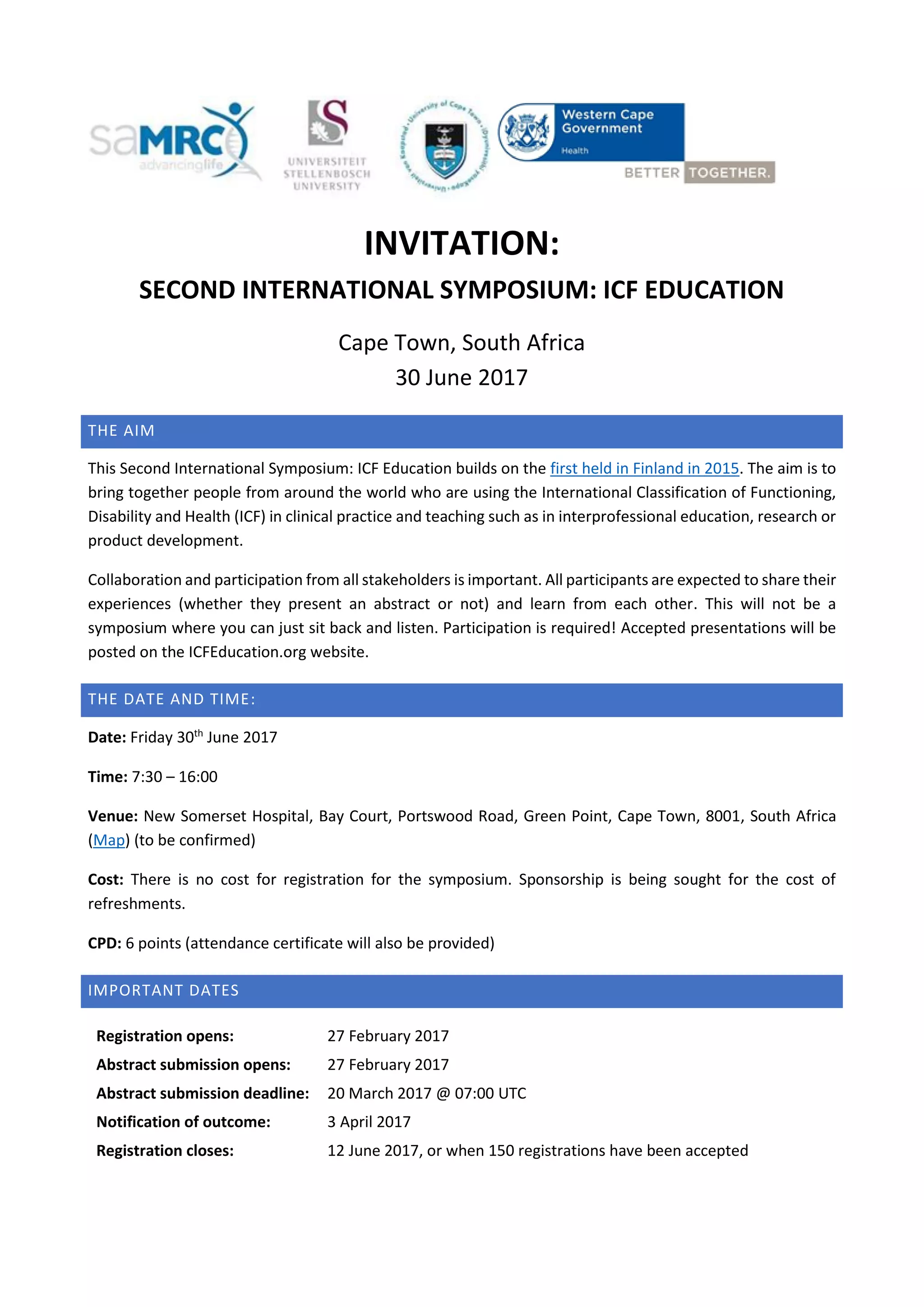
This Second International Symposium: ICF Education builds on the first held in Finland in 2015. The aim is to
bring together people from around the world who are using the International Classification of Functioning,
Disability and Health (ICF) in clinical practice and teaching such as in interprofessional education, research or
product development.
Collaboration and participation from all stakeholders is important. All participants are expected to share their
experiences (whether they present an abstract or not) and learn from each other. This will not be a
symposium where you can just sit back and listen. Participation is required! Accepted presentations will be
posted on the ICFEducation.org website.
THE DATE AND TIME:
Date: Friday 30th
June 2017
Time: 7:30 – 16:00
Venue: New Somerset Hospital, Bay Court, Portswood Road, Green Point, Cape Town, 8001, South Africa
(Map) (to be confirmed)
Cost: There is no cost for registration for the symposium. Sponsorship is being sought for the cost of
refreshments.
CPD: 6 points (attendance certificate will also be provided)
IMPORTANT DATES
Registration opens: 27 February 2017
Abstract submission opens: 27 February 2017
Abstract submission deadline: 20 March 2017 @ 07:00 UTC
Notification of outcome: 3 April 2017
Registration closes: 12 June 2017, or when 150 registrations have been accepted
CONTACT THE SYMPOSIUM ORGANISING COMMITTEE:
HOSTED BY
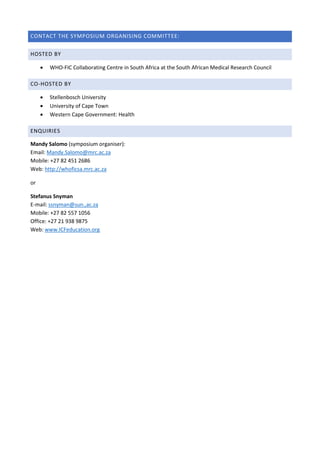
 WHO-FIC Collaborating Centre in South Africa at the South African Medical Research Council
CO-HOSTED BY
 Stellenbosch University
 University of Cape Town
 Western Cape Government: Health
ENQUIRIES
Mandy Salomo (symposium organiser):
Email: Mandy.Salomo@mrc.ac.za
Mobile: +27 82 451 2686
Web: http://whoficsa.mrc.ac.za
or
Stefanus Snyman
E-mail: ssnyman@sun.,ac.za
Mobile: +27 82 557 1056
Office: +27 21 938 9875
Web: www.ICFeducation.org
DRAFT PROGRAMME
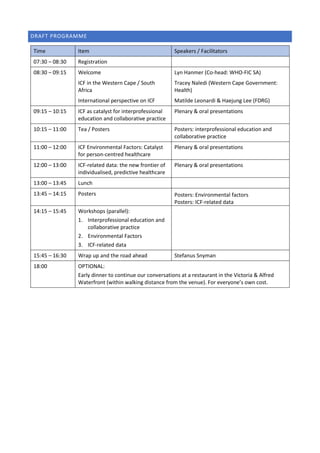
Time Item Speakers / Facilitators
07:30 – 08:30 Registration
08:30 – 09:15 Welcome Lyn Hanmer (Co-head: WHO-FIC SA)
ICF in the Western Cape / South
Africa
Tracey Naledi (Western Cape Government:
Health)
International perspective on ICF Matilde Leonardi & Haejung Lee (FDRG)
09:15 – 10:15 ICF as catalyst for interprofessional
education and collaborative practice
Plenary & oral presentations
10:15 – 11:00 Tea / Posters Posters: interprofessional education and
collaborative practice
11:00 – 12:00 ICF Environmental Factors: Catalyst
for person-centred healthcare
Plenary & oral presentations
12:00 – 13:00 ICF-related data: the new frontier of
individualised, predictive healthcare
Plenary & oral presentations
13:00 – 13:45 Lunch
13:45 – 14:15 Posters Posters: Environmental factors
Posters: ICF-related data
14:15 – 15:45 Workshops (parallel):
1. Interprofessional education and
collaborative practice
2. Environmental Factors
3. ICF-related data
15:45 – 16:30 Wrap up and the road ahead Stefanus Snyman
18:00 OPTIONAL:
Early dinner to continue our conversations at a restaurant in the Victoria & Alfred
Waterfront (within walking distance from the venue). For everyone’s own cost.
CALL FOR ABSTRACTS:
SECOND INTERNATIONAL SYMPOSIUM: ICF EDUCATION
Cape Town, South Africa
30 June 2017
ABSTRACT SUBMISSION DEADLINE 20 MARCH 2017 @07:00 UTC
IMPORTANT DATES
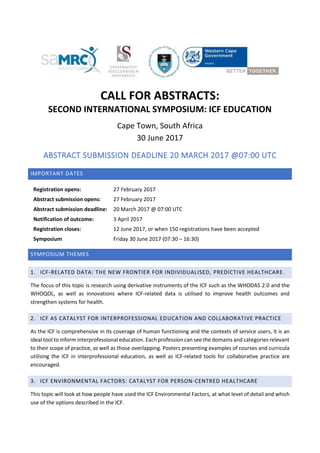
Registration opens: 27 February 2017
Abstract submission opens: 27 February 2017
Abstract submission deadline: 20 March 2017 @ 07:00 UTC
Notification of outcome: 3 April 2017
Registration closes: 12 June 2017, or when 150 registrations have been accepted
Symposium Friday 30 June 2017 (07:30 – 16:30)
SYMPOSIUM THEMES
1. ICF-RELATED DATA: THE NEW FRONTIER FOR INDIVIDUALISED, PREDICTIVE HEALTHCARE.
The focus of this topic is research using derivative instruments of the ICF such as the WHODAS 2.0 and the
WHOQOL, as well as innovations where ICF-related data is utilised to improve health outcomes and
strengthen systems for health.
2. ICF AS CATALYST FOR INTERPROFESSIONAL EDUCATION AND COLLABORATIVE PRACTICE
As the ICF is comprehensive in its coverage of human functioning and the contexts of service users, it is an
ideal tool to inform interprofessional education. Each profession can see the domains and categories relevant
to their scope of practice, as well as those overlapping. Posters presenting examples of courses and curricula
utilising the ICF in interprofessional education, as well as ICF-related tools for collaborative practice are
encouraged.
3. ICF ENVIRONMENTAL FACTORS: CATALYST FOR PERSON-CENTRED HEALTHCARE
This topic will look at how people have used the ICF Environmental Factors, at what level of detail and which
use of the options described in the ICF.
SELECTION CRITERIA
Abstracts will be reviewed by the Symposium Organising Committee. The following principles will be used in
selecting the abstracts for presentation.
 The abstract addresses at least one of the topics of the symposium
 The content of the abstract is clear and logical
 Clear take home messages are included.
SUBMISSION GUIDELINES
Abstract submission must be made electronically at http://whoficsa.mrc.ac.za. All correspondence will be
with the person who submits the abstract online. The form will have limited space for data entry. The
available word count is indicated below.
SUBMISSIONS SHOULD INCLUDE THE FOLLOWING:
Heading Notes
Title:
[20 words]
Clearly describes the abstract.
Author(s): Name of presenter and co-authors; organisation/institution,
city, country, e-mail, telephone/WhatsApp, Skype name.
Abstract
[350 words] Background: The context for the work.
Purpose: The major reason for undertaking the work and any
secondary objectives.
Methods: Principles, methods/approaches were involved.
Results: Summary of the main findings.
Conclusion(s): What can be concluded from your work? What are the
suggestions for future work?
Implications: The implications of your work and how will the results be
translated into practice / management / education / policy.
Keywords: Use up to three keywords to describe your work.
Funding
acknowledgements:
[20 words]
Please acknowledge all funding sources that supported your work. If the work
was unfunded, please state this.
Ethics approval:
[20 words]
Please name the ethics committee that approved your work, where appropriate.
If ethics approval was not required, or you do not have an ethics system in your
country, please state this.
Preference for oral or
poster presentation
Oral/poster
PRESENTATION FORMATS
The Scientific Committee may accept the abstract for presentation, in English, in one of the following formats:
ORAL PRESENTATIONS
The topic is delivered verbally, generally accompanied by visual information in the form of PowerPoint slides.
The talks are 10 minutes in length followed by 2 minutes for questions. After five presentations there will be
a further period for discussion.
POSTER PRESENTATIONS
The topic is delivered using brief written statements and graphic materials, such as charts, figures and
photographs displayed on a poster board. Presenters have the opportunity to discuss their work with
symposium participants during designated times in the programme. The dimensions of the poster should be
A0 paper size (portrait orientation) (841 x 1189 mm / 33.1 x 46.8 in).
Abstract authors may specify their preferred format. It should be noted that there is very limited time
during the symposium for oral presentations. Abstracts not selected for platform presentation will be
offered the opportunity to present their work as a poster.
GENERAL INFORMATION
1. The symposium language is English and all abstracts and presentations must be made in English.
Translation will not be provided.
2. An abstract must be submitted online for each proposed presentation.
3. The abstract will be reproduced in a poster booklet and made available on the www.ICFeduction.org
website as submitted by the author. It is the author’s responsibility to submit a correct abstract.
4. Authors are requested to make their slide presentations available for publication on
www.ICFeducation.org.
5. All abstracts submitted should reflect at least one of the symposium topics.
6. All correspondence will be with the person who submits the abstract online, including notification of
the outcome. This person is responsible for informing all authors of the status of the abstract.
7. Abstract authors are responsible for providing all copyright permissions for material included in their
abstracts and presentations.
8. The scheduling of all presentations will be determined by the Symposium Organising Committee to
ensure best fit with the overall programme. Any requests for specific times will not be considered.
Similar abstracts in related topic areas will be grouped together for presentation.
9. PowerPoint presentation will be the only resource available for platform presentations.
10. The presentation should include the same content and follow the same outline as that described in
the abstract.
11. There is no cost for registration for the symposium. Sponsorship is being sought for the cost of
refreshments.
12. All decisions of the Symposium Organising Committee are final.
CONSENT, PERMISSIONS AND COPYRIGHT
In submitting an abstract you must confirm that:
 you accept responsibility for the accuracy of the submitted abstract and understand that the content
cannot be modified or corrected after the submission deadline and that it will be published exactly
as submitted
 all co-authors are aware of and agree to the content of the abstract and support the data presented
 you accept responsibility as the contact person for all correspondence about the abstract and to
share information with all authors about its status
 you have secured any copyright/permissions clearance required relating to any previous
presentations, equipment or other material for inclusion in the symposium and symposium
publications
 for all studies involving human participants or animal subjects, permission has been obtained from
the relevant regulatory authority and properly informed consent given where appropriate
 the work is original, except for extracts from copyrighted works used with permission from the
copyright holders, and that it does not infringe upon any copyright, proprietary, or personal right of
any third party
 you have identified any potential conflicts of interest
When completing the online submission process the submitter will be asked to confirm that the presenting
author has read and understood the general information and the requirements they are expected to fulfil.
SUBMIT ABSTRACT
Click here to submit abstract (http://whoficsa.mrc.ac.za)
ENQUIRIES
Mandy Salomo symposium organiser):
Email: Mandy.Salomo@mrc.ac.za
Mobile: +27 82 451 2686
Web: http://whoficsa.mrc.ac.za/
or
Stefanus Snyman
E-mail: ssnyman@sun.,ac.za
Mobile: +27 82 557 1056
Office: +27 21 938 9875
Web: www.ICFeducation.org

2nd International Symposium: ICF Education

  • 1.
    INVITATION: SECOND INTERNATIONAL SYMPOSIUM:ICF EDUCATION Cape Town, South Africa 30 June 2017 THE AIM This Second International Symposium: ICF Education builds on the first held in Finland in 2015. The aim is to bring together people from around the world who are using the International Classification of Functioning, Disability and Health (ICF) in clinical practice and teaching such as in interprofessional education, research or product development. Collaboration and participation from all stakeholders is important. All participants are expected to share their experiences (whether they present an abstract or not) and learn from each other. This will not be a symposium where you can just sit back and listen. Participation is required! Accepted presentations will be posted on the ICFEducation.org website. THE DATE AND TIME: Date: Friday 30th June 2017 Time: 7:30 – 16:00 Venue: New Somerset Hospital, Bay Court, Portswood Road, Green Point, Cape Town, 8001, South Africa (Map) (to be confirmed) Cost: There is no cost for registration for the symposium. Sponsorship is being sought for the cost of refreshments. CPD: 6 points (attendance certificate will also be provided) IMPORTANT DATES Registration opens: 27 February 2017 Abstract submission opens: 27 February 2017 Abstract submission deadline: 20 March 2017 @ 07:00 UTC Notification of outcome: 3 April 2017 Registration closes: 12 June 2017, or when 150 registrations have been accepted
  • 2.
    CONTACT THE SYMPOSIUMORGANISING COMMITTEE: HOSTED BY  WHO-FIC Collaborating Centre in South Africa at the South African Medical Research Council CO-HOSTED BY  Stellenbosch University  University of Cape Town  Western Cape Government: Health ENQUIRIES Mandy Salomo (symposium organiser): Email: Mandy.Salomo@mrc.ac.za Mobile: +27 82 451 2686 Web: http://whoficsa.mrc.ac.za or Stefanus Snyman E-mail: ssnyman@sun.,ac.za Mobile: +27 82 557 1056 Office: +27 21 938 9875 Web: www.ICFeducation.org
  • 3.
    DRAFT PROGRAMME Time ItemSpeakers / Facilitators 07:30 – 08:30 Registration 08:30 – 09:15 Welcome Lyn Hanmer (Co-head: WHO-FIC SA) ICF in the Western Cape / South Africa Tracey Naledi (Western Cape Government: Health) International perspective on ICF Matilde Leonardi & Haejung Lee (FDRG) 09:15 – 10:15 ICF as catalyst for interprofessional education and collaborative practice Plenary & oral presentations 10:15 – 11:00 Tea / Posters Posters: interprofessional education and collaborative practice 11:00 – 12:00 ICF Environmental Factors: Catalyst for person-centred healthcare Plenary & oral presentations 12:00 – 13:00 ICF-related data: the new frontier of individualised, predictive healthcare Plenary & oral presentations 13:00 – 13:45 Lunch 13:45 – 14:15 Posters Posters: Environmental factors Posters: ICF-related data 14:15 – 15:45 Workshops (parallel): 1. Interprofessional education and collaborative practice 2. Environmental Factors 3. ICF-related data 15:45 – 16:30 Wrap up and the road ahead Stefanus Snyman 18:00 OPTIONAL: Early dinner to continue our conversations at a restaurant in the Victoria & Alfred Waterfront (within walking distance from the venue). For everyone’s own cost.
  • 4.
    CALL FOR ABSTRACTS: SECONDINTERNATIONAL SYMPOSIUM: ICF EDUCATION Cape Town, South Africa 30 June 2017 ABSTRACT SUBMISSION DEADLINE 20 MARCH 2017 @07:00 UTC IMPORTANT DATES Registration opens: 27 February 2017 Abstract submission opens: 27 February 2017 Abstract submission deadline: 20 March 2017 @ 07:00 UTC Notification of outcome: 3 April 2017 Registration closes: 12 June 2017, or when 150 registrations have been accepted Symposium Friday 30 June 2017 (07:30 – 16:30) SYMPOSIUM THEMES 1. ICF-RELATED DATA: THE NEW FRONTIER FOR INDIVIDUALISED, PREDICTIVE HEALTHCARE. The focus of this topic is research using derivative instruments of the ICF such as the WHODAS 2.0 and the WHOQOL, as well as innovations where ICF-related data is utilised to improve health outcomes and strengthen systems for health. 2. ICF AS CATALYST FOR INTERPROFESSIONAL EDUCATION AND COLLABORATIVE PRACTICE As the ICF is comprehensive in its coverage of human functioning and the contexts of service users, it is an ideal tool to inform interprofessional education. Each profession can see the domains and categories relevant to their scope of practice, as well as those overlapping. Posters presenting examples of courses and curricula utilising the ICF in interprofessional education, as well as ICF-related tools for collaborative practice are encouraged. 3. ICF ENVIRONMENTAL FACTORS: CATALYST FOR PERSON-CENTRED HEALTHCARE This topic will look at how people have used the ICF Environmental Factors, at what level of detail and which use of the options described in the ICF.
  • 5.
    SELECTION CRITERIA Abstracts willbe reviewed by the Symposium Organising Committee. The following principles will be used in selecting the abstracts for presentation.  The abstract addresses at least one of the topics of the symposium  The content of the abstract is clear and logical  Clear take home messages are included. SUBMISSION GUIDELINES Abstract submission must be made electronically at http://whoficsa.mrc.ac.za. All correspondence will be with the person who submits the abstract online. The form will have limited space for data entry. The available word count is indicated below. SUBMISSIONS SHOULD INCLUDE THE FOLLOWING: Heading Notes Title: [20 words] Clearly describes the abstract. Author(s): Name of presenter and co-authors; organisation/institution, city, country, e-mail, telephone/WhatsApp, Skype name. Abstract [350 words] Background: The context for the work. Purpose: The major reason for undertaking the work and any secondary objectives. Methods: Principles, methods/approaches were involved. Results: Summary of the main findings. Conclusion(s): What can be concluded from your work? What are the suggestions for future work? Implications: The implications of your work and how will the results be translated into practice / management / education / policy. Keywords: Use up to three keywords to describe your work. Funding acknowledgements: [20 words] Please acknowledge all funding sources that supported your work. If the work was unfunded, please state this. Ethics approval: [20 words] Please name the ethics committee that approved your work, where appropriate. If ethics approval was not required, or you do not have an ethics system in your country, please state this. Preference for oral or poster presentation Oral/poster
  • 6.
    PRESENTATION FORMATS The ScientificCommittee may accept the abstract for presentation, in English, in one of the following formats: ORAL PRESENTATIONS The topic is delivered verbally, generally accompanied by visual information in the form of PowerPoint slides. The talks are 10 minutes in length followed by 2 minutes for questions. After five presentations there will be a further period for discussion. POSTER PRESENTATIONS The topic is delivered using brief written statements and graphic materials, such as charts, figures and photographs displayed on a poster board. Presenters have the opportunity to discuss their work with symposium participants during designated times in the programme. The dimensions of the poster should be A0 paper size (portrait orientation) (841 x 1189 mm / 33.1 x 46.8 in). Abstract authors may specify their preferred format. It should be noted that there is very limited time during the symposium for oral presentations. Abstracts not selected for platform presentation will be offered the opportunity to present their work as a poster. GENERAL INFORMATION 1. The symposium language is English and all abstracts and presentations must be made in English. Translation will not be provided. 2. An abstract must be submitted online for each proposed presentation. 3. The abstract will be reproduced in a poster booklet and made available on the www.ICFeduction.org website as submitted by the author. It is the author’s responsibility to submit a correct abstract. 4. Authors are requested to make their slide presentations available for publication on www.ICFeducation.org. 5. All abstracts submitted should reflect at least one of the symposium topics. 6. All correspondence will be with the person who submits the abstract online, including notification of the outcome. This person is responsible for informing all authors of the status of the abstract. 7. Abstract authors are responsible for providing all copyright permissions for material included in their abstracts and presentations. 8. The scheduling of all presentations will be determined by the Symposium Organising Committee to ensure best fit with the overall programme. Any requests for specific times will not be considered. Similar abstracts in related topic areas will be grouped together for presentation. 9. PowerPoint presentation will be the only resource available for platform presentations. 10. The presentation should include the same content and follow the same outline as that described in the abstract. 11. There is no cost for registration for the symposium. Sponsorship is being sought for the cost of refreshments. 12. All decisions of the Symposium Organising Committee are final.
  • 7.
    CONSENT, PERMISSIONS ANDCOPYRIGHT In submitting an abstract you must confirm that:  you accept responsibility for the accuracy of the submitted abstract and understand that the content cannot be modified or corrected after the submission deadline and that it will be published exactly as submitted  all co-authors are aware of and agree to the content of the abstract and support the data presented  you accept responsibility as the contact person for all correspondence about the abstract and to share information with all authors about its status  you have secured any copyright/permissions clearance required relating to any previous presentations, equipment or other material for inclusion in the symposium and symposium publications  for all studies involving human participants or animal subjects, permission has been obtained from the relevant regulatory authority and properly informed consent given where appropriate  the work is original, except for extracts from copyrighted works used with permission from the copyright holders, and that it does not infringe upon any copyright, proprietary, or personal right of any third party  you have identified any potential conflicts of interest When completing the online submission process the submitter will be asked to confirm that the presenting author has read and understood the general information and the requirements they are expected to fulfil. SUBMIT ABSTRACT Click here to submit abstract (http://whoficsa.mrc.ac.za) ENQUIRIES Mandy Salomo symposium organiser): Email: Mandy.Salomo@mrc.ac.za Mobile: +27 82 451 2686 Web: http://whoficsa.mrc.ac.za/ or Stefanus Snyman E-mail: ssnyman@sun.,ac.za Mobile: +27 82 557 1056 Office: +27 21 938 9875 Web: www.ICFeducation.org