



CHEMICAL LOGISTICS BENZENE Members:  Jane Tan (s10049162D) Poon Yoke Chee ( s10046916F) Tan Lee Min ( s10047130J) Yeo Cai Hua ( s10049307C)
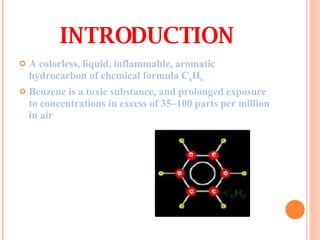
INTRODUCTION A colorless, liquid, inflammable, aromatic hydrocarbon of chemical formula C 6 H 6   Benzene is a toxic substance, and prolonged exposure to concentrations in excess of 35–100 parts per million in air
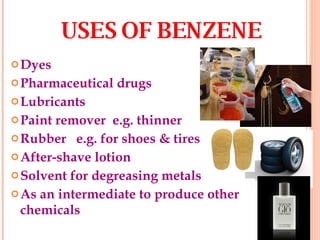
Dyes Pharmaceutical drugs Lubricants Paint remover  e.g. thinner Rubber  e.g. for shoes & tires After-shave lotion Solvent for degreasing metals As an intermediate to produce other chemicals USES OF BENZENE
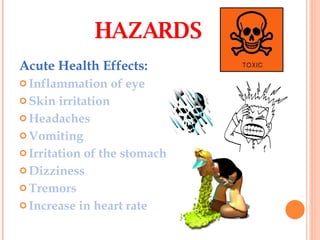
Acute Health Effects: Inflammation of eye Skin irritation Headaches Vomiting  Irritation of the stomach Dizziness Tremors Increase in heart rate HAZARDS
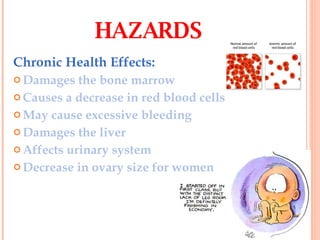
Chronic Health Effects: Damages the bone marrow Causes a decrease in red blood cells May cause excessive bleeding Damages the liver Affects urinary system Decrease in ovary size for women HAZARDS
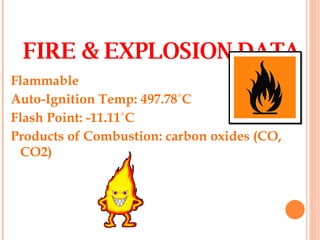
Flammable Auto-Ignition Temp: 497.78˚C Flash Point: -11.11˚C Products of Combustion: carbon oxides (CO, CO2) FIRE & EXPLOSION DATA
Fire Hazards in Presence of Substances: Open flames & sparks  Highly Flammable Oxidizing materials   Slightly Flammable Sodium Peroxide Dioxygenyl Tetrafluoroborate Powdered Chromic Anhydride  FIRE & EXPLOSION DATA causes ignition
Explosion Hazards in Presence of Substances: Oxidizing materials of acids Chlorine Nitric acid Liquid oxygen Diborane  Fire Fighting Instructions: Small Fire  Use DRY chemical powder Large Fire  Use alcohol foam, water spray/fog FIRE & EXPLOSION DATA BOOOM!!
Eye Contact: Flush eyes with plenty of  warm  water for at least 15 mins. Get medical attention immediately. Skin Contact: Flush skin with plenty of water. Cover the irritated skin. Remove contaminated clothing. Wash clothes thoroughly before reuse. Get medical attention. FIRST AID MEASURES
Serious Skin Contact: Wash with disinfectant soap & cover contaminated skin with anti-bacterial cream. Seek immediate medical attention. Inhalation: Move to a place with lots of fresh air. Give artificial respiration if the person is not breathing.  FIRST AID MEASURES
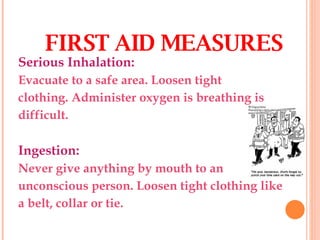
Serious Inhalation: Evacuate to a safe area. Loosen tight clothing. Administer oxygen is breathing is difficult. Ingestion: Never give anything by mouth to an unconscious person. Loosen tight clothing like a belt, collar or tie. FIRST AID MEASURES
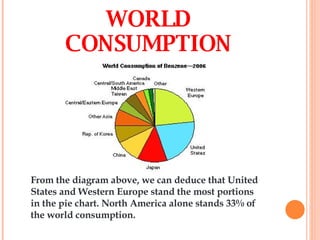
WORLD CONSUMPTION From the diagram above, we can deduce that United States and Western Europe stand the most portions in the pie chart. North America alone stands 33% of the world consumption.
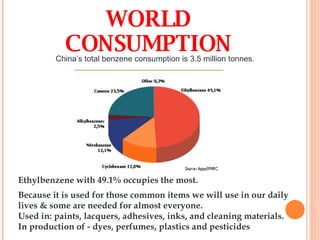
WORLD CONSUMPTION China’s total benzene consumption is 3.5 million tonnes. Ethylbenzene with 49.1% occupies the most. Because it is used for those common items we will use in our daily lives & some are needed for almost everyone. Used in: paints, lacquers, adhesives, inks, and cleaning materials.  In production of - dyes, perfumes, plastics and pesticides
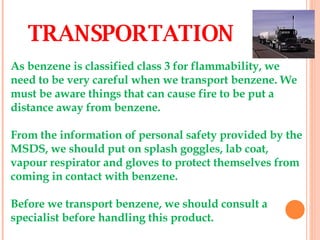
TRANSPORTATION As benzene is classified class 3 for flammability, we need to be very careful when we transport benzene. We must be aware things that can cause fire to be put a distance away from benzene.  From the information of personal safety provided by the MSDS, we should put on  splash goggles, lab coat, vapour respirator and gloves to protect themselves from coming in contact with benzene. Before we transport benzene, we should consult a specialist before handling this product.
Pollution Accidents
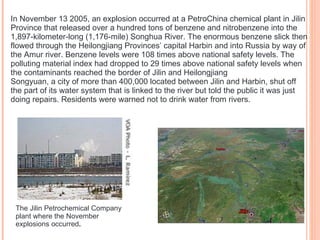
In November 13 2005, an explosion occurred at a PetroChina chemical plant in Jilin Province that released over a hundred tons of benzene and nitrobenzene into the 1,897-kilometer-long (1,176-mile) Songhua River. The enormous benzene slick then flowed through the Heilongjiang Provinces’ capital Harbin and into Russia by way of the Amur river. Benzene levels were 108 times above national safety levels. The polluting material index had dropped to 29 times above national safety levels when the contaminants reached the border of Jilin and Heilongjiang Songyuan, a city of more than 400,000 located between Jilin and Harbin, shut off the part of its water system that is linked to the river but told the public it was just doing repairs. Residents were warned not to drink water from rivers. The Jilin Petrochemical Company plant where the November explosions occurred .
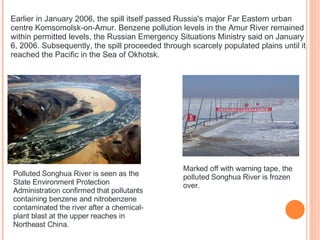
Earlier in January 2006, the spill itself passed Russia's major Far Eastern urban centre Komsomolsk-on-Amur. Benzene pollution levels in the Amur River remained within permitted levels, the Russian Emergency Situations Ministry said on January 6, 2006. Subsequently, the spill proceeded through scarcely populated plains until it reached the Pacific in the Sea of Okhotsk. Polluted Songhua River is seen as the State Environment Protection Administration confirmed that pollutants containing benzene and nitrobenzene contaminated the river after a chemical-plant blast at the upper reaches in Northeast China. Marked off with warning tape, the polluted Songhua River is frozen over.
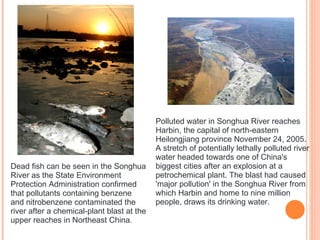
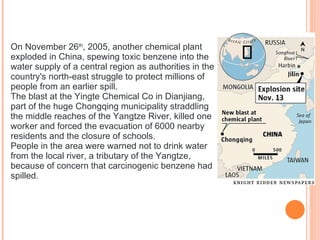
Dead fish can be seen in the Songhua River as the State Environment Protection Administration confirmed that pollutants containing benzene and nitrobenzene contaminated the river after a chemical-plant blast at the upper reaches in Northeast China. Polluted water in Songhua River reaches Harbin, the capital of north-eastern Heilongjiang province November 24, 2005. A stretch of potentially lethally polluted river water headed towards one of China's biggest cities after an explosion at a petrochemical plant. The blast had caused 'major pollution' in the Songhua River from which Harbin and home to nine million people, draws its drinking water.
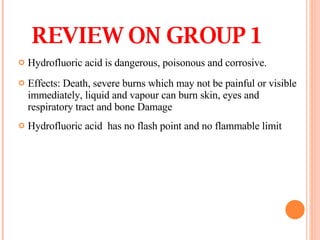
On November 26 th , 2005, another chemical plant exploded in China, spewing toxic benzene into the water supply of a central region as authorities in the country's north-east struggle to protect millions of people from an earlier spill. The blast at the Yingte Chemical Co in Dianjiang, part of the huge Chongqing municipality straddling the middle reaches of the Yangtze River, killed one worker and forced the evacuation of 6000 nearby residents and the closure of schools. People in the area were warned not to drink water from the local river, a tributary of the Yangtze, because of concern that carcinogenic benzene had spilled.
REVIEW ON GROUP 1 Hydrofluoric acid is dangerous, poisonous and corrosive. Effects: Death,  severe burns which may not be painful or visible immediately, liquid and vapour can burn skin, eyes and respiratory tract and bone Damage Hydrofluoric acid  has no flash point and no flammable limit
Fire fighters should wear breathing apparatus and full protective clothing when handling with this chemical It reacts with metals  Uses: Propellants, insecticide, stain removal, leather industry – tanning, wielding and stainless steel pickling, Drugs and dye production. REVIEW ON GROUP 1
COMMENTS ON GROUP 1 Their slides are professional. Easy to understand (Point form)
http://www.sriconsulting.com/CEH/Public/Reports/452.0000/ http://www.jamestown.org/edm/article.php?article_id=2370696 http://www.voanews.com/english/archive/2006-05/2006-05-08-voa23.cfm http://www.chem.yorku.ca/hall_of_fame/essays97/benzene/benzene.htm
The End

2L06 Group 5 Benzene (Version 3)

  • 1.
    CHEMICAL LOGISTICS BENZENEMembers: Jane Tan (s10049162D) Poon Yoke Chee ( s10046916F) Tan Lee Min ( s10047130J) Yeo Cai Hua ( s10049307C)
  • 2.
    INTRODUCTION A colorless,liquid, inflammable, aromatic hydrocarbon of chemical formula C 6 H 6 Benzene is a toxic substance, and prolonged exposure to concentrations in excess of 35–100 parts per million in air
  • 3.
    Dyes Pharmaceutical drugsLubricants Paint remover e.g. thinner Rubber e.g. for shoes & tires After-shave lotion Solvent for degreasing metals As an intermediate to produce other chemicals USES OF BENZENE
  • 4.
    Acute Health Effects:Inflammation of eye Skin irritation Headaches Vomiting Irritation of the stomach Dizziness Tremors Increase in heart rate HAZARDS
  • 5.
    Chronic Health Effects:Damages the bone marrow Causes a decrease in red blood cells May cause excessive bleeding Damages the liver Affects urinary system Decrease in ovary size for women HAZARDS
  • 6.
    Flammable Auto-Ignition Temp:497.78˚C Flash Point: -11.11˚C Products of Combustion: carbon oxides (CO, CO2) FIRE & EXPLOSION DATA
  • 7.
    Fire Hazards inPresence of Substances: Open flames & sparks Highly Flammable Oxidizing materials Slightly Flammable Sodium Peroxide Dioxygenyl Tetrafluoroborate Powdered Chromic Anhydride FIRE & EXPLOSION DATA causes ignition
  • 8.
    Explosion Hazards inPresence of Substances: Oxidizing materials of acids Chlorine Nitric acid Liquid oxygen Diborane Fire Fighting Instructions: Small Fire Use DRY chemical powder Large Fire Use alcohol foam, water spray/fog FIRE & EXPLOSION DATA BOOOM!!
  • 9.
    Eye Contact: Flusheyes with plenty of warm water for at least 15 mins. Get medical attention immediately. Skin Contact: Flush skin with plenty of water. Cover the irritated skin. Remove contaminated clothing. Wash clothes thoroughly before reuse. Get medical attention. FIRST AID MEASURES
  • 10.
    Serious Skin Contact:Wash with disinfectant soap & cover contaminated skin with anti-bacterial cream. Seek immediate medical attention. Inhalation: Move to a place with lots of fresh air. Give artificial respiration if the person is not breathing. FIRST AID MEASURES
  • 11.
    Serious Inhalation: Evacuateto a safe area. Loosen tight clothing. Administer oxygen is breathing is difficult. Ingestion: Never give anything by mouth to an unconscious person. Loosen tight clothing like a belt, collar or tie. FIRST AID MEASURES
  • 12.
    WORLD CONSUMPTION Fromthe diagram above, we can deduce that United States and Western Europe stand the most portions in the pie chart. North America alone stands 33% of the world consumption.
  • 13.
    WORLD CONSUMPTION China’stotal benzene consumption is 3.5 million tonnes. Ethylbenzene with 49.1% occupies the most. Because it is used for those common items we will use in our daily lives & some are needed for almost everyone. Used in: paints, lacquers, adhesives, inks, and cleaning materials. In production of - dyes, perfumes, plastics and pesticides
  • 14.
    TRANSPORTATION As benzeneis classified class 3 for flammability, we need to be very careful when we transport benzene. We must be aware things that can cause fire to be put a distance away from benzene. From the information of personal safety provided by the MSDS, we should put on splash goggles, lab coat, vapour respirator and gloves to protect themselves from coming in contact with benzene. Before we transport benzene, we should consult a specialist before handling this product.
  • 15.
  • 16.
    In November 132005, an explosion occurred at a PetroChina chemical plant in Jilin Province that released over a hundred tons of benzene and nitrobenzene into the 1,897-kilometer-long (1,176-mile) Songhua River. The enormous benzene slick then flowed through the Heilongjiang Provinces’ capital Harbin and into Russia by way of the Amur river. Benzene levels were 108 times above national safety levels. The polluting material index had dropped to 29 times above national safety levels when the contaminants reached the border of Jilin and Heilongjiang Songyuan, a city of more than 400,000 located between Jilin and Harbin, shut off the part of its water system that is linked to the river but told the public it was just doing repairs. Residents were warned not to drink water from rivers. The Jilin Petrochemical Company plant where the November explosions occurred .
  • 17.
    Earlier in January2006, the spill itself passed Russia's major Far Eastern urban centre Komsomolsk-on-Amur. Benzene pollution levels in the Amur River remained within permitted levels, the Russian Emergency Situations Ministry said on January 6, 2006. Subsequently, the spill proceeded through scarcely populated plains until it reached the Pacific in the Sea of Okhotsk. Polluted Songhua River is seen as the State Environment Protection Administration confirmed that pollutants containing benzene and nitrobenzene contaminated the river after a chemical-plant blast at the upper reaches in Northeast China. Marked off with warning tape, the polluted Songhua River is frozen over.
  • 18.
    Dead fish canbe seen in the Songhua River as the State Environment Protection Administration confirmed that pollutants containing benzene and nitrobenzene contaminated the river after a chemical-plant blast at the upper reaches in Northeast China. Polluted water in Songhua River reaches Harbin, the capital of north-eastern Heilongjiang province November 24, 2005. A stretch of potentially lethally polluted river water headed towards one of China's biggest cities after an explosion at a petrochemical plant. The blast had caused 'major pollution' in the Songhua River from which Harbin and home to nine million people, draws its drinking water.
  • 19.
    On November 26th , 2005, another chemical plant exploded in China, spewing toxic benzene into the water supply of a central region as authorities in the country's north-east struggle to protect millions of people from an earlier spill. The blast at the Yingte Chemical Co in Dianjiang, part of the huge Chongqing municipality straddling the middle reaches of the Yangtze River, killed one worker and forced the evacuation of 6000 nearby residents and the closure of schools. People in the area were warned not to drink water from the local river, a tributary of the Yangtze, because of concern that carcinogenic benzene had spilled.
  • 20.
    REVIEW ON GROUP1 Hydrofluoric acid is dangerous, poisonous and corrosive. Effects: Death, severe burns which may not be painful or visible immediately, liquid and vapour can burn skin, eyes and respiratory tract and bone Damage Hydrofluoric acid has no flash point and no flammable limit
  • 21.
    Fire fighters shouldwear breathing apparatus and full protective clothing when handling with this chemical It reacts with metals Uses: Propellants, insecticide, stain removal, leather industry – tanning, wielding and stainless steel pickling, Drugs and dye production. REVIEW ON GROUP 1
  • 22.
    COMMENTS ON GROUP1 Their slides are professional. Easy to understand (Point form)
  • 23.
  • 24.