The Role and Design of
a CO2 Standard for
New Aircraft


Dan Rutherford, Ph.D.
Senior Researcher

NGO Observer to ICAO Emissions and Technology
Environmental Working Group

2degreesnetwork webinar
14 April 2010
Overview
  Overview of the climate challenge
  Introduction to an aircraft CO2 standard
  –  Recent policy developments
  –  Why an aircraft standard?
  –  Key design criteria
  What can’t a standard do?
  Conclusions
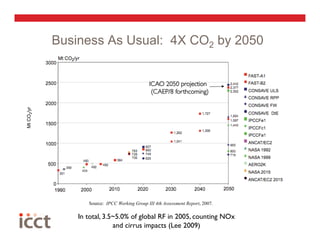
Business As Usual: 4X CO2 by 2050


                                               ICAO 2050 projection
                                                (CAEP/8 forthcoming)
Mt CO2/yr


                   Source: IPCC Working Group III 4th Assessment Report, 2007.

                In total, 3.5~5.0% of global RF in 2005, counting NOx
                             and cirrus impacts (Lee 2009)
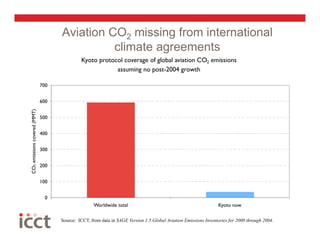
Aviation CO2 missing from international
                                              climate agreements
                                             Kyoto protocol coverage of global aviation CO2 emissions
                                                         assuming no post-2004 growth

                              700


                              600
CO2 emissions covered (MMT)


                              500


                              400


                              300


                              200


                              100


                                0
                                                   Worldwide total                                               Kyoto now

                                    Source: ICCT, from data in SAGE Version 1.5 Global Aviation Emissions Inventories for 2000 through 2004.
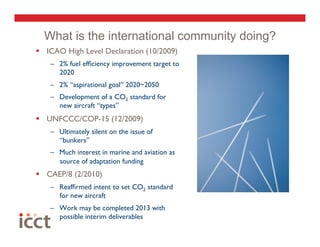
What is the international community doing?
  ICAO High Level Declaration (10/2009)
    –  2% fuel efficiency improvement target to
       2020
    –  2% “aspirational goal” 2020~2050
    –  Development of a CO2 standard for
       new aircraft “types”
  UNFCCC/COP-15 (12/2009)
    –  Ultimately silent on the issue of
       “bunkers”
    –  Much interest in marine and aviation as
       source of adaptation funding
  CAEP/8 (2/2010)
    –  Reaffirmed intent to set CO2 standard
       for new aircraft
    –  Work may be completed 2013 with
       possible interim deliverables
Why an aircraft CO2 standard?
  Traditional industry position: Aviation is fuel price sensitive
   --> sufficient driver for efficiency already
  Evidence suggests room for improvement:
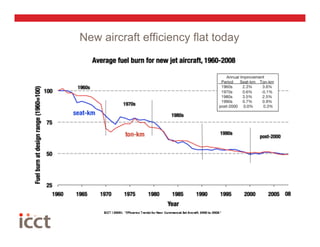
   –  Efficiency gains from new equipment declined markedly after 1990,
      approximately flat since 2000
   –  Large jet manufacturers slow to develop new single-aisle aircraft
   –  Race for speed and range impose efficiency penalty
   –  Under-optimization of aircraft to allow for general use (stage length,
      belly freight capacity)
  An aircraft CO2 standard, properly designed, can:
   –  Provide an incentive to deploy new technologies
   –  Minimize emissions vs. performance tradeoffs 
   –  Promote increased optimization of aircraft to mission
   –  “Force” technology???
New aircraft efficiency flat today
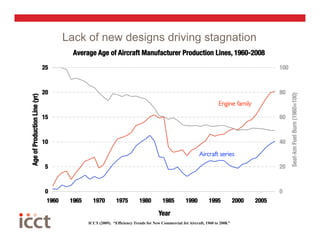
Lack of new designs driving stagnation
                                        Average Age of Aircraft Manufacturer Production Lines, 1960-2008
                              25                                                                                                              100


                              20                                                                                                              80


                                                                                                                                                    Seat-km Fuel Burn (1960=100)
Age of Production Line (yr)


                                                                                                                      Engine family

                              15                                                                                                              60


                              10                                                                                                              40

                                                                                                           Aircraft series
                              5                                                                                                               20


                              0                                                                                                               0
                               1960    1965     1970         1975         1980         1985         1990         1995           2000   2005

                                                                                     Year
                                              ICCT (2009). “Efficiency Trends for New Commercial Jet Aircraft, 1960 to 2008.”
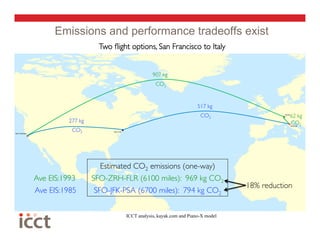
Emissions and performance tradeoffs exist
                     Two flight options, San Francisco to Italy


                                          907 kg
                                               
                                           CO2


                                                               517 kg
                                                                    
                                                                CO2
                    62 kg 
          277 kg
               
                                                                        CO2
           CO2


                      Estimated CO2 emissions (one-way)
                                                      
Ave EIS:1993
           
       SFO-ZRH-FLR (6100 miles): 969 kg CO2   
                                                                           18% reduction
Ave EIS:1985
       SFO-JFK-PSA (6700 miles): 794 kg CO2


                              ICCT analysis, kayak.com and Piano-X model
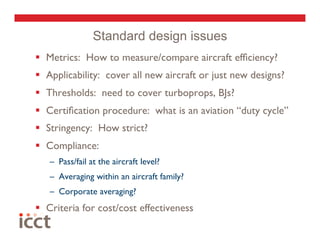
Standard design issues
  Metrics: How to measure/compare aircraft efficiency?
  Applicability: cover all new aircraft or just new designs?
  Thresholds: need to cover turboprops, BJs? 
  Certification procedure: what is an aviation “duty cycle”
  Stringency: How strict?
  Compliance: 
   –  Pass/fail at the aircraft level? 
   –  Averaging within an aircraft family? 
   –  Corporate averaging? 
  Criteria for cost/cost effectiveness
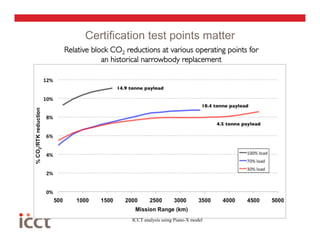
Certification test points matter
Relative block CO2 reductions at various operating points for 
            an historical narrowbody replacement


                     ICCT analysis using Piano-X model
Alternative compliance mechanisms important
           for an aircraft CO2 standard
  Efficiency standards enforced on a “pass/fail” basis tend not to raise
   fleetwide efficiency
    –  “Pass/fail” used to regulate vehicle emissions, but rarely efficiency, and
       only in developing markets with large gap between best and worst
    –  Sets up high stakes game where viability of particular models and even
       manufacturers is on the line
    –  Favors “bottom scraper” rather than “top runner” standards
  Need to think flexibly about alternatives to traditional certification
    –  Averaging within an aircraft family (commonality issue)
    –  Corporate average: set a single target for a manufacturer --> let
       comply through means of their choice
    –  “Soft” (e.g. financial, etc.) penalties for non-compliance?
    –  Labeling
    –  Other ideas?
What can’t an aircraft CO2 standard do?

  A standard cannot:
   –  Put a general price on aviation carbon
   –  Improve the efficiency of in-service aircraft
   –  Promote operational improvements in fuel burn (ATM,
      CDAs, etc.)
   –  Address NOx, AIC impacts
  Aircraft standard is only one part of a comprehensive
   climate strategy for aviation
   –  Market-based measures
   –  Incentives for operational improvements
   –  Measures to address non-CO2 impacts of aviation
   –  Others?
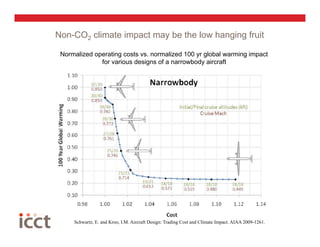
Non-CO2 climate impact may be the low hanging fruit

 Normalized operating costs vs. normalized 100 yr global warming impact
              for various designs of a narrowbody aircraft


     Schwartz, E. and Kroo, I.M. Aircraft Design: Trading Cost and Climate Impact. AIAA 2009-1261.
Conclusions
  Aviation climate challenge is a massive one that
   requires new thinking
  ICAO work on aircraft CO2 standard underway
  Potentially, standards can:
   –  Speed technology deployment
   –  Manage emissions vs. performance tradeoffs
   –  Promote better optimization of aircraft to mission
  Standard one part of a comprehensive strategy
   –  MBMs to price carbon
   –  Measures to improve operational efficiency
   –  Action on non-CO2 climate effects
Acknowledgements

  ClimateWorks and Hewlett Foundations 
  Mazyar Zeinali, Fanta Kamakate, and
   Drew Kodjak (ICCT)
  CAEP WG3 colleagues

CO2 standard for new aircraft

  • 1.
    The Role andDesign of a CO2 Standard for New Aircraft Dan Rutherford, Ph.D. Senior Researcher NGO Observer to ICAO Emissions and Technology Environmental Working Group 2degreesnetwork webinar 14 April 2010
  • 2.
    Overview   Overview ofthe climate challenge   Introduction to an aircraft CO2 standard –  Recent policy developments –  Why an aircraft standard? –  Key design criteria   What can’t a standard do?   Conclusions
  • 3.
    Business As Usual:4X CO2 by 2050 ICAO 2050 projection (CAEP/8 forthcoming) Mt CO2/yr Source: IPCC Working Group III 4th Assessment Report, 2007. In total, 3.5~5.0% of global RF in 2005, counting NOx and cirrus impacts (Lee 2009)
  • 4.
    Aviation CO2 missingfrom international climate agreements Kyoto protocol coverage of global aviation CO2 emissions assuming no post-2004 growth 700 600 CO2 emissions covered (MMT) 500 400 300 200 100 0 Worldwide total Kyoto now Source: ICCT, from data in SAGE Version 1.5 Global Aviation Emissions Inventories for 2000 through 2004.
  • 5.
    What is theinternational community doing?   ICAO High Level Declaration (10/2009) –  2% fuel efficiency improvement target to 2020 –  2% “aspirational goal” 2020~2050 –  Development of a CO2 standard for new aircraft “types”   UNFCCC/COP-15 (12/2009) –  Ultimately silent on the issue of “bunkers” –  Much interest in marine and aviation as source of adaptation funding   CAEP/8 (2/2010) –  Reaffirmed intent to set CO2 standard for new aircraft –  Work may be completed 2013 with possible interim deliverables
  • 6.
    Why an aircraftCO2 standard?   Traditional industry position: Aviation is fuel price sensitive --> sufficient driver for efficiency already   Evidence suggests room for improvement: –  Efficiency gains from new equipment declined markedly after 1990, approximately flat since 2000 –  Large jet manufacturers slow to develop new single-aisle aircraft –  Race for speed and range impose efficiency penalty –  Under-optimization of aircraft to allow for general use (stage length, belly freight capacity)   An aircraft CO2 standard, properly designed, can: –  Provide an incentive to deploy new technologies –  Minimize emissions vs. performance tradeoffs –  Promote increased optimization of aircraft to mission –  “Force” technology???
  • 7.
  • 8.
    Lack of newdesigns driving stagnation Average Age of Aircraft Manufacturer Production Lines, 1960-2008 25 100 20 80 Seat-km Fuel Burn (1960=100) Age of Production Line (yr) Engine family 15 60 10 40 Aircraft series 5 20 0 0 1960 1965 1970 1975 1980 1985 1990 1995 2000 2005 Year ICCT (2009). “Efficiency Trends for New Commercial Jet Aircraft, 1960 to 2008.”
  • 9.
    Emissions and performancetradeoffs exist Two flight options, San Francisco to Italy 907 kg CO2 517 kg CO2 62 kg 277 kg CO2 CO2 Estimated CO2 emissions (one-way) Ave EIS:1993 SFO-ZRH-FLR (6100 miles): 969 kg CO2 18% reduction Ave EIS:1985 SFO-JFK-PSA (6700 miles): 794 kg CO2 ICCT analysis, kayak.com and Piano-X model
  • 10.
    Standard design issues  Metrics: How to measure/compare aircraft efficiency?   Applicability: cover all new aircraft or just new designs?   Thresholds: need to cover turboprops, BJs?   Certification procedure: what is an aviation “duty cycle”   Stringency: How strict?   Compliance: –  Pass/fail at the aircraft level? –  Averaging within an aircraft family? –  Corporate averaging?   Criteria for cost/cost effectiveness
  • 11.
    Certification test pointsmatter Relative block CO2 reductions at various operating points for an historical narrowbody replacement ICCT analysis using Piano-X model
  • 12.
    Alternative compliance mechanismsimportant for an aircraft CO2 standard   Efficiency standards enforced on a “pass/fail” basis tend not to raise fleetwide efficiency –  “Pass/fail” used to regulate vehicle emissions, but rarely efficiency, and only in developing markets with large gap between best and worst –  Sets up high stakes game where viability of particular models and even manufacturers is on the line –  Favors “bottom scraper” rather than “top runner” standards   Need to think flexibly about alternatives to traditional certification –  Averaging within an aircraft family (commonality issue) –  Corporate average: set a single target for a manufacturer --> let comply through means of their choice –  “Soft” (e.g. financial, etc.) penalties for non-compliance? –  Labeling –  Other ideas?
  • 13.
    What can’t anaircraft CO2 standard do?   A standard cannot: –  Put a general price on aviation carbon –  Improve the efficiency of in-service aircraft –  Promote operational improvements in fuel burn (ATM, CDAs, etc.) –  Address NOx, AIC impacts   Aircraft standard is only one part of a comprehensive climate strategy for aviation –  Market-based measures –  Incentives for operational improvements –  Measures to address non-CO2 impacts of aviation –  Others?
  • 14.
    Non-CO2 climate impactmay be the low hanging fruit Normalized operating costs vs. normalized 100 yr global warming impact for various designs of a narrowbody aircraft Schwartz, E. and Kroo, I.M. Aircraft Design: Trading Cost and Climate Impact. AIAA 2009-1261.
  • 15.
    Conclusions   Aviation climatechallenge is a massive one that requires new thinking   ICAO work on aircraft CO2 standard underway   Potentially, standards can: –  Speed technology deployment –  Manage emissions vs. performance tradeoffs –  Promote better optimization of aircraft to mission   Standard one part of a comprehensive strategy –  MBMs to price carbon –  Measures to improve operational efficiency –  Action on non-CO2 climate effects
  • 16.
    Acknowledgements   ClimateWorks andHewlett Foundations   Mazyar Zeinali, Fanta Kamakate, and Drew Kodjak (ICCT)   CAEP WG3 colleagues