Control Theory and Informatics                                                                     www.iiste.org
ISSN 2224-5774 (print) ISSN 2225-0492 (online)
Vol 1, No.1, 2011


              On Demand Web Services with Quality of Service
                                                BRAJESH KOKKONDA
      Department of Computer Science & Engineering, Vivekananda Institute of Technology and Sciences,
                                         Karimnagar, Andhra Pradesh, India
                             Tel: +91-7416322567 E-mail: brajesh.email@gmail.com


                                                  P.PRADEEP KUMAR
      Department of Computer Science & Engineering, Vivekananda Institute of Technology and Sciences,
                                         Karimnagar, Andhra Pradesh, India
                               Tel: +91-9885364555 E-mail: pkpuram@gmail.com


                                                        G.RAJESH
         Department of Information & Technology, Vivekananda Institute of Technology and Sciences,
                                         Karimnagar, Andhra Pradesh, India
                            Tel: +91-9848540851 E-mail: gunupudirajesh@gmail.com
Abstract
The increasing usage of smart embedded devices in business blurs the line between the virtual and real worlds.
This creates new opportunities to build applications that better integrate real-time state of the physical world,
and hence, provides enterprise services that are highly dynamic, more diverse, and efficient. Service-Oriented
Architecture (SOA) approaches traditionally used to couple functionality of heavyweight corporate IT systems,
are becoming applicable to embedded real-world devices, i.e., objects of the physical world that feature
embedded processing and communication.

Keywords: - Time synchronization, sensor networks

1. Introduction
The process described in this project has been developed and implemented as part of the Integrated Architecture
(SIA). The role of IA is to enable the ubiquitous integration of real world services running on embedded devices
with enterprise services. WS web service standards constitute the de facto communication method used by the
components of enterprise-level applications, and for this reason IA is fully based on them. In this manner,
business applications can access near real-time data from a wide range of networked devices through a high-
level, abstract interface based on web services. Furthermore, the IA also supports RESTful services in order to
be able to communicate with many emerging Web 2.0 services. This enables any networked device that is
connected to the SIA to directly participate in business processes while neither requiring the process modeler,
nor the process execution engine to know about the exact details of the underlying hardware.

1.1 Previous Work
In recent years, the use of services to compose new applications from existing modules has gained momentum.
Web services are autonomous units of code, independently developed and evolved. The Web Service
Description Language (WSDL) is used as the defacto standard for service providers to describe the interface of
the Web services, i.e., their operations and input and output parameters. Therefore, Web services lack
homogeneous structure beyond that of their interface. Heterogeneity stems from different ways to name
parameters, define parameters, and describe internal processing. This heterogeneity encumbers straightforward
integration between Web services. Web service registries such as Universal Description, Discovery, and
Integration (UDDI) were created to encourage interoperability and adoption of Web services. However, UDDI
registries have some major flaws. UDDI registries either are made publicly available and contain many obsolete
entries or require registration. In either case, a registry stores only a limited description of the available services.
Semantic Web services were proposed to overcome interface heterogeneity. Using languages such as Ontology
Web Language for Services (OWL-S) and WSDL Semantics (WSDL-S), Web services are extended with an
unambiguous description by relating properties such as input and output parameters to common concepts and by


6|Page
www.iiste.org
Control Theory and Informatics                                                                 www.iiste.org
ISSN 2224-5774 (print) ISSN 2225-0492 (online)
Vol 1, No.1, 2011

defining the execution characteristics of the service.

The concepts are defined in Web ontologies, which serve as the key mechanism to globally define and reference
concepts. Formal languages enable service composition, in which a developer uses automatic or semiautomatic
tools to create a integrated business process from a set of independent Web services. Service composition in a
heterogeneous environment immediately raises issues of evaluating the accuracy of the mapping. As an
example, consider three real-world Web services, as illustrated in Fig. 1. The three services distance between zip
codes (A), store IT contracts (B), and translation into any language (C) share some common concepts, such as
the code concept. However, these three services originate from very different domains. Service A is concerned
with distance calculation and uses the zip codes as input, service B defines CurrencyCode as part of the IT
contract information to be stored, and service C uses a Client Code as an access key for users. It is unlikely that
any of the services will be combined into a meaningful composition. This example illustrates that methods based
solely on the concepts mapped to the service’s parameters may yield inaccurate results. We aim at analyzing
different methods for automatically identifying possible semantic composition. We explore two sources for
service analysis: WSDL description files and free textual descriptors, which are commonly used in service
repositories. We investigate two methods for Web service classification for each type of descriptor: Term
Frequency/ Inverse Document Frequency (TF/IDF) and context based analysis, and a baseline method. We
define contexts as a model of a domain for a given term, which is automatically extracted from a fragment of
text. In this work, contexts are created by finding-related terms from the Web. Unlike ontologies, which are
considered shared models of a domain, we define contexts as local views of [1]

2. System Architecture


3. Results
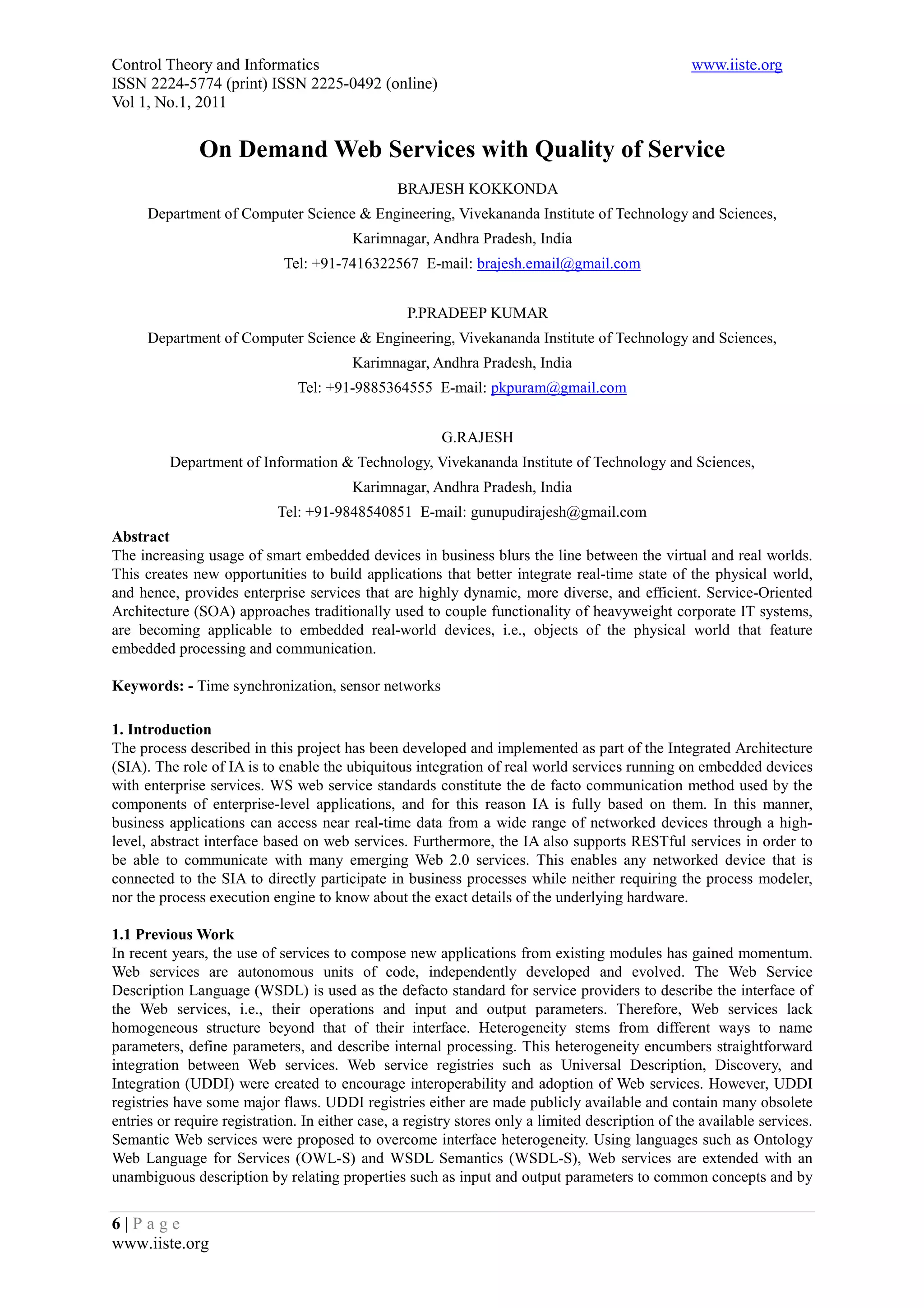
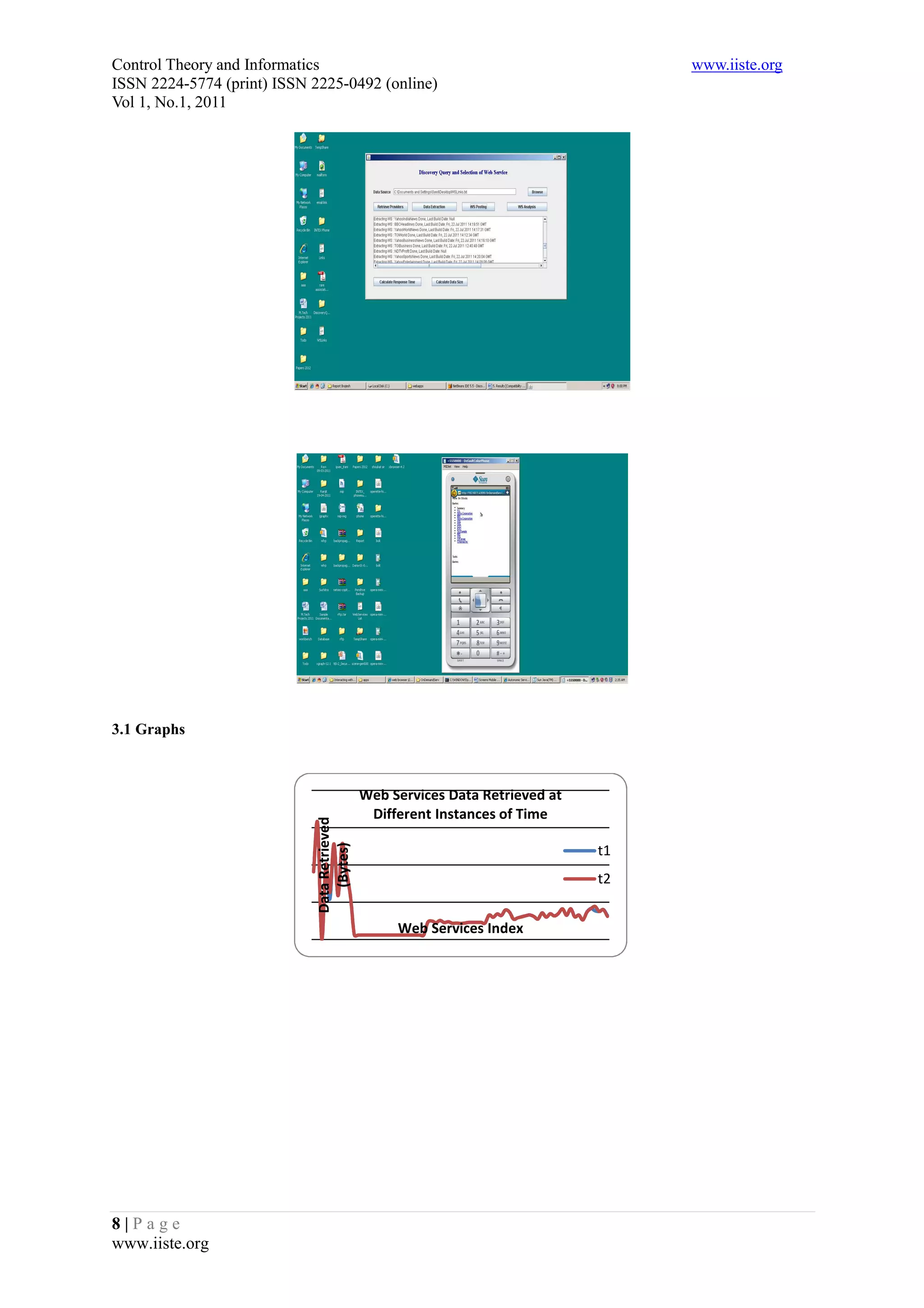
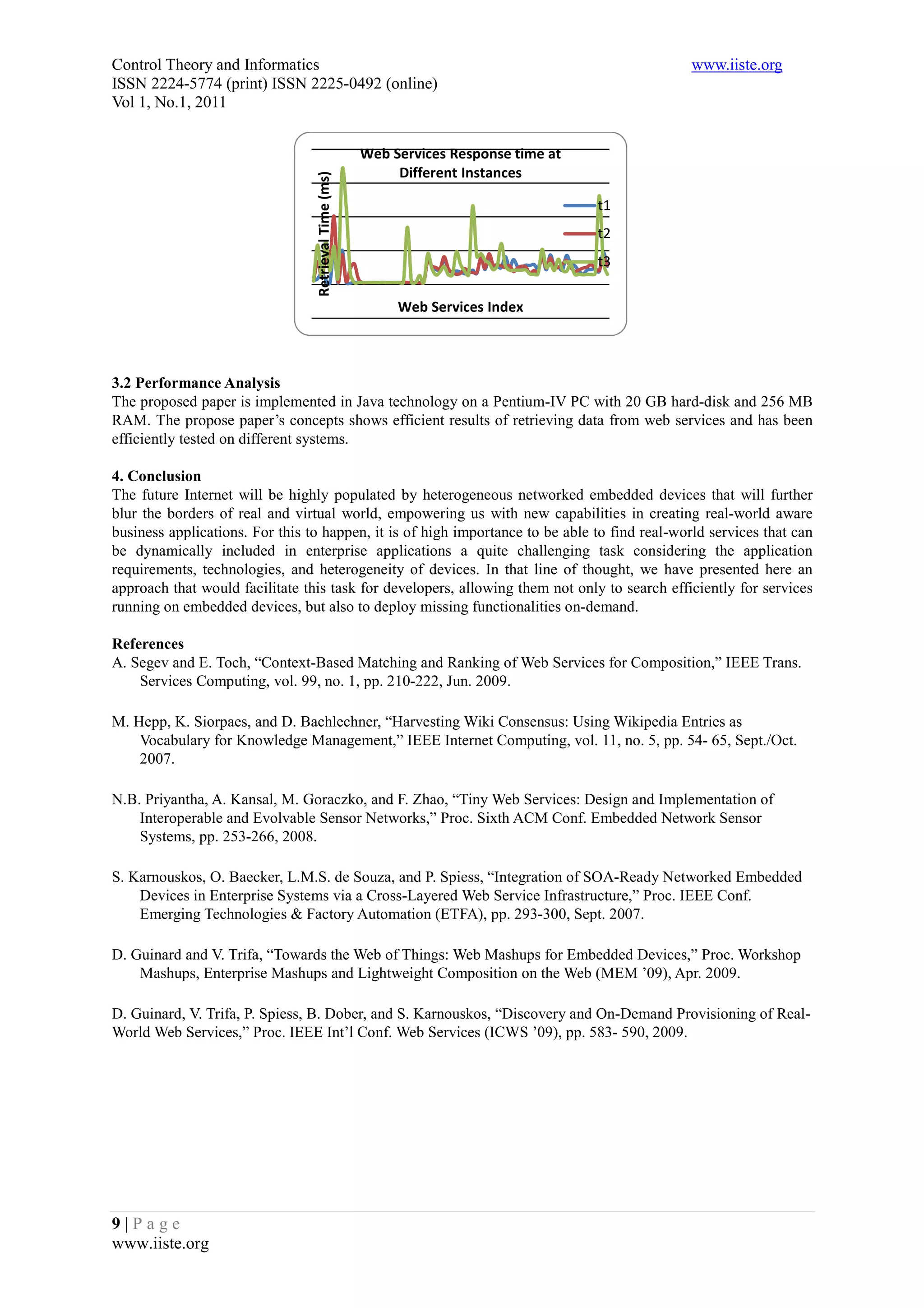
The concept of this paper is implemented and different results are shown below


7|Page
www.iiste.org
Control Theory and Informatics                                                      www.iiste.org
ISSN 2224-5774 (print) ISSN 2225-0492 (online)
Vol 1, No.1, 2011


3.1 Graphs


                                              Web Services Data Retrieved at
                                               Different Instances of Time
                             Data Retrieved
                                (Bytes)


                                                                               t1
                                                                               t2


                                                   Web Services Index


8|Page
www.iiste.org
Control Theory and Informatics                                                                 www.iiste.org
ISSN 2224-5774 (print) ISSN 2225-0492 (online)
Vol 1, No.1, 2011


                                                       Web Services Response time at
                                                            Different Instances


                                 Retrieval Time (ms)
                                                                                       t1
                                                                                       t2
                                                                                       t3

                                                            Web Services Index


3.2 Performance Analysis
The proposed paper is implemented in Java technology on a Pentium-IV PC with 20 GB hard-disk and 256 MB
RAM. The propose paper’s concepts shows efficient results of retrieving data from web services and has been
efficiently tested on different systems.

4. Conclusion
The future Internet will be highly populated by heterogeneous networked embedded devices that will further
blur the borders of real and virtual world, empowering us with new capabilities in creating real-world aware
business applications. For this to happen, it is of high importance to be able to find real-world services that can
be dynamically included in enterprise applications a quite challenging task considering the application
requirements, technologies, and heterogeneity of devices. In that line of thought, we have presented here an
approach that would facilitate this task for developers, allowing them not only to search efficiently for services
running on embedded devices, but also to deploy missing functionalities on-demand.

References
A. Segev and E. Toch, “Context-Based Matching and Ranking of Web Services for Composition,” IEEE Trans.
    Services Computing, vol. 99, no. 1, pp. 210-222, Jun. 2009.

M. Hepp, K. Siorpaes, and D. Bachlechner, “Harvesting Wiki Consensus: Using Wikipedia Entries as
    Vocabulary for Knowledge Management,” IEEE Internet Computing, vol. 11, no. 5, pp. 54- 65, Sept./Oct.
    2007.

N.B. Priyantha, A. Kansal, M. Goraczko, and F. Zhao, “Tiny Web Services: Design and Implementation of
    Interoperable and Evolvable Sensor Networks,” Proc. Sixth ACM Conf. Embedded Network Sensor
    Systems, pp. 253-266, 2008.

S. Karnouskos, O. Baecker, L.M.S. de Souza, and P. Spiess, “Integration of SOA-Ready Networked Embedded
    Devices in Enterprise Systems via a Cross-Layered Web Service Infrastructure,” Proc. IEEE Conf.
    Emerging Technologies & Factory Automation (ETFA), pp. 293-300, Sept. 2007.

D. Guinard and V. Trifa, “Towards the Web of Things: Web Mashups for Embedded Devices,” Proc. Workshop
    Mashups, Enterprise Mashups and Lightweight Composition on the Web (MEM ’09), Apr. 2009.

D. Guinard, V. Trifa, P. Spiess, B. Dober, and S. Karnouskos, “Discovery and On-Demand Provisioning of Real-
World Web Services,” Proc. IEEE Int’l Conf. Web Services (ICWS ’09), pp. 583- 590, 2009.


9|Page
www.iiste.org

2.[6 9]on demand web services with quality of service

  • 1.
    Control Theory andInformatics www.iiste.org ISSN 2224-5774 (print) ISSN 2225-0492 (online) Vol 1, No.1, 2011 On Demand Web Services with Quality of Service BRAJESH KOKKONDA Department of Computer Science & Engineering, Vivekananda Institute of Technology and Sciences, Karimnagar, Andhra Pradesh, India Tel: +91-7416322567 E-mail: brajesh.email@gmail.com P.PRADEEP KUMAR Department of Computer Science & Engineering, Vivekananda Institute of Technology and Sciences, Karimnagar, Andhra Pradesh, India Tel: +91-9885364555 E-mail: pkpuram@gmail.com G.RAJESH Department of Information & Technology, Vivekananda Institute of Technology and Sciences, Karimnagar, Andhra Pradesh, India Tel: +91-9848540851 E-mail: gunupudirajesh@gmail.com Abstract The increasing usage of smart embedded devices in business blurs the line between the virtual and real worlds. This creates new opportunities to build applications that better integrate real-time state of the physical world, and hence, provides enterprise services that are highly dynamic, more diverse, and efficient. Service-Oriented Architecture (SOA) approaches traditionally used to couple functionality of heavyweight corporate IT systems, are becoming applicable to embedded real-world devices, i.e., objects of the physical world that feature embedded processing and communication. Keywords: - Time synchronization, sensor networks 1. Introduction The process described in this project has been developed and implemented as part of the Integrated Architecture (SIA). The role of IA is to enable the ubiquitous integration of real world services running on embedded devices with enterprise services. WS web service standards constitute the de facto communication method used by the components of enterprise-level applications, and for this reason IA is fully based on them. In this manner, business applications can access near real-time data from a wide range of networked devices through a high- level, abstract interface based on web services. Furthermore, the IA also supports RESTful services in order to be able to communicate with many emerging Web 2.0 services. This enables any networked device that is connected to the SIA to directly participate in business processes while neither requiring the process modeler, nor the process execution engine to know about the exact details of the underlying hardware. 1.1 Previous Work In recent years, the use of services to compose new applications from existing modules has gained momentum. Web services are autonomous units of code, independently developed and evolved. The Web Service Description Language (WSDL) is used as the defacto standard for service providers to describe the interface of the Web services, i.e., their operations and input and output parameters. Therefore, Web services lack homogeneous structure beyond that of their interface. Heterogeneity stems from different ways to name parameters, define parameters, and describe internal processing. This heterogeneity encumbers straightforward integration between Web services. Web service registries such as Universal Description, Discovery, and Integration (UDDI) were created to encourage interoperability and adoption of Web services. However, UDDI registries have some major flaws. UDDI registries either are made publicly available and contain many obsolete entries or require registration. In either case, a registry stores only a limited description of the available services. Semantic Web services were proposed to overcome interface heterogeneity. Using languages such as Ontology Web Language for Services (OWL-S) and WSDL Semantics (WSDL-S), Web services are extended with an unambiguous description by relating properties such as input and output parameters to common concepts and by 6|Page www.iiste.org
  • 2.
    Control Theory andInformatics www.iiste.org ISSN 2224-5774 (print) ISSN 2225-0492 (online) Vol 1, No.1, 2011 defining the execution characteristics of the service. The concepts are defined in Web ontologies, which serve as the key mechanism to globally define and reference concepts. Formal languages enable service composition, in which a developer uses automatic or semiautomatic tools to create a integrated business process from a set of independent Web services. Service composition in a heterogeneous environment immediately raises issues of evaluating the accuracy of the mapping. As an example, consider three real-world Web services, as illustrated in Fig. 1. The three services distance between zip codes (A), store IT contracts (B), and translation into any language (C) share some common concepts, such as the code concept. However, these three services originate from very different domains. Service A is concerned with distance calculation and uses the zip codes as input, service B defines CurrencyCode as part of the IT contract information to be stored, and service C uses a Client Code as an access key for users. It is unlikely that any of the services will be combined into a meaningful composition. This example illustrates that methods based solely on the concepts mapped to the service’s parameters may yield inaccurate results. We aim at analyzing different methods for automatically identifying possible semantic composition. We explore two sources for service analysis: WSDL description files and free textual descriptors, which are commonly used in service repositories. We investigate two methods for Web service classification for each type of descriptor: Term Frequency/ Inverse Document Frequency (TF/IDF) and context based analysis, and a baseline method. We define contexts as a model of a domain for a given term, which is automatically extracted from a fragment of text. In this work, contexts are created by finding-related terms from the Web. Unlike ontologies, which are considered shared models of a domain, we define contexts as local views of [1] 2. System Architecture 3. Results The concept of this paper is implemented and different results are shown below 7|Page www.iiste.org
  • 3.
    Control Theory andInformatics www.iiste.org ISSN 2224-5774 (print) ISSN 2225-0492 (online) Vol 1, No.1, 2011 3.1 Graphs Web Services Data Retrieved at Different Instances of Time Data Retrieved (Bytes) t1 t2 Web Services Index 8|Page www.iiste.org
  • 4.
    Control Theory andInformatics www.iiste.org ISSN 2224-5774 (print) ISSN 2225-0492 (online) Vol 1, No.1, 2011 Web Services Response time at Different Instances Retrieval Time (ms) t1 t2 t3 Web Services Index 3.2 Performance Analysis The proposed paper is implemented in Java technology on a Pentium-IV PC with 20 GB hard-disk and 256 MB RAM. The propose paper’s concepts shows efficient results of retrieving data from web services and has been efficiently tested on different systems. 4. Conclusion The future Internet will be highly populated by heterogeneous networked embedded devices that will further blur the borders of real and virtual world, empowering us with new capabilities in creating real-world aware business applications. For this to happen, it is of high importance to be able to find real-world services that can be dynamically included in enterprise applications a quite challenging task considering the application requirements, technologies, and heterogeneity of devices. In that line of thought, we have presented here an approach that would facilitate this task for developers, allowing them not only to search efficiently for services running on embedded devices, but also to deploy missing functionalities on-demand. References A. Segev and E. Toch, “Context-Based Matching and Ranking of Web Services for Composition,” IEEE Trans. Services Computing, vol. 99, no. 1, pp. 210-222, Jun. 2009. M. Hepp, K. Siorpaes, and D. Bachlechner, “Harvesting Wiki Consensus: Using Wikipedia Entries as Vocabulary for Knowledge Management,” IEEE Internet Computing, vol. 11, no. 5, pp. 54- 65, Sept./Oct. 2007. N.B. Priyantha, A. Kansal, M. Goraczko, and F. Zhao, “Tiny Web Services: Design and Implementation of Interoperable and Evolvable Sensor Networks,” Proc. Sixth ACM Conf. Embedded Network Sensor Systems, pp. 253-266, 2008. S. Karnouskos, O. Baecker, L.M.S. de Souza, and P. Spiess, “Integration of SOA-Ready Networked Embedded Devices in Enterprise Systems via a Cross-Layered Web Service Infrastructure,” Proc. IEEE Conf. Emerging Technologies & Factory Automation (ETFA), pp. 293-300, Sept. 2007. D. Guinard and V. Trifa, “Towards the Web of Things: Web Mashups for Embedded Devices,” Proc. Workshop Mashups, Enterprise Mashups and Lightweight Composition on the Web (MEM ’09), Apr. 2009. D. Guinard, V. Trifa, P. Spiess, B. Dober, and S. Karnouskos, “Discovery and On-Demand Provisioning of Real- World Web Services,” Proc. IEEE Int’l Conf. Web Services (ICWS ’09), pp. 583- 590, 2009. 9|Page www.iiste.org