254.102 Writing Workshop
Essentials of Professional Writing
CTL Services
Assignment Quiz
Assignment Structure
This presentation can be viewed online at:
http://tinyurl.com/254102workshop12016
Evaluation of writing
CENTRE FOR TEACHING
AND LEARNING SERVICES
http://owll.massey.ac.nz Online Writing and Learning Link
http://tinyurl.com/studyup2016 Online Workshops
Book on 09 441-8143 or slc-alb@massey.ac.nz
OR in person at the library (LEVEL 3)
ONE-TO-ONE OR SMALL GROUP CONSULTATIONS
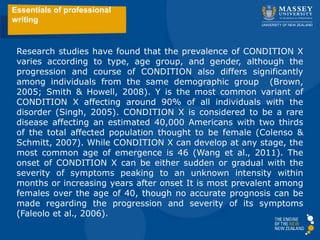
Research studies have found that the prevalence of CONDITION X
varies according to type, age group, and gender, although the
progression and course of CONDITION also differs significantly
among individuals from the same demographic group (Brown,
2005; Smith & Howell, 2008). Y is the most common variant of
CONDITION X affecting around 90% of all individuals with the
disorder (Singh, 2005). CONDITION X is considered to be a rare
disease affecting an estimated 40,000 Americans with two thirds
of the total affected population thought to be female (Colenso &
Schmitt, 2007). While CONDITION X can develop at any stage, the
most common age of emergence is 46 (Wang et al., 2011). The
onset of CONDITION X can be either sudden or gradual with the
severity of symptoms peaking to an unknown intensity within
months or increasing years after onset It is most prevalent among
females over the age of 40, though no accurate prognosis can be
made regarding the progression and severity of its symptoms
(Faleolo et al., 2006).
Essentials of professional
writing
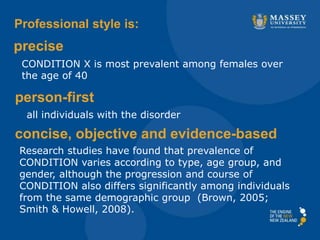
precise
concise, objective and evidence-based
Professional style is:
CONDITION X is most prevalent among females over
the age of 40
Research studies have found that prevalence of
CONDITION varies according to type, age group, and
gender, although the progression and course of
CONDITION also differs significantly among individuals
from the same demographic group (Brown, 2005;
Smith & Howell, 2008).
all individuals with the disorder
person-first
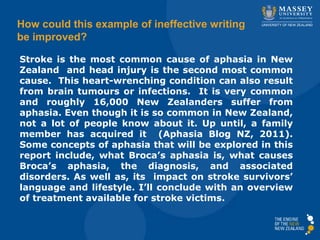
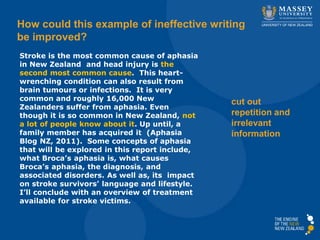
Stroke is the most common cause of aphasia in New
Zealand and head injury is the second most common
cause. This heart-wrenching condition can also result
from brain tumours or infections. It is very common
and roughly 16,000 New Zealanders suffer from
aphasia. Even though it is so common in New Zealand,
not a lot of people know about it. Up until, a family
member has acquired it (Aphasia Blog NZ, 2011).
Some concepts of aphasia that will be explored in this
report include, what Broca’s aphasia is, what causes
Broca’s aphasia, the diagnosis, and associated
disorders. As well as, its impact on stroke survivors’
language and lifestyle. I’ll conclude with an overview
of treatment available for stroke victims.
How could this example of ineffective writing
be improved?
Stroke is the most common cause of aphasia
in New Zealand and head injury is the
second most common cause. This heart-
wrenching condition can also result from
brain tumours or infections. It is very
common and roughly 16,000 New
Zealanders suffer from aphasia. Even
though it is so common in New Zealand, not
a lot of people know about it. Up until, a
family member has acquired it (Aphasia
Blog NZ, 2011). Some concepts of aphasia
that will be explored in this report include,
what Broca’s aphasia is, what causes
Broca’s aphasia, the diagnosis, and
associated disorders. As well as, its impact
on stroke survivors’ language and lifestyle.
I’ll conclude with an overview of treatment
available for stroke victims.
How could this example of ineffective writing
be improved?
cut out
repetition and
irrelevant
information
Stroke is the most common cause of aphasia
in New Zealand and head injury is the
second most common cause. This heart-
wrenching condition can also result from
brain tumours or infections. It is very
common and roughly 16,000 New
Zealanders suffer from aphasia. Even
though it is so common in New Zealand, not
a lot of people know about it. Up until, a
family member has acquired it (Aphasia
Blog NZ, 2011). Some concepts of aphasia
that will be explored in this report include,
what Broca’s aphasia is, what causes
Broca’s aphasia, the diagnosis, and
associated disorders. As well as, its impact
on stroke survivors’ language and lifestyle.
I’ll conclude with an overview of treatment
available for stroke victims.
How could this example of ineffective writing
be improved?
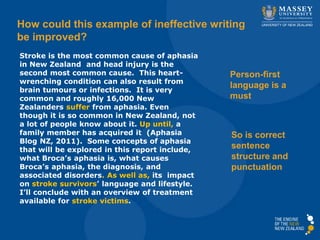
Person-first
language is a
must
So is correct
sentence
structure and
punctuation
Stroke is the most common cause of aphasia
in New Zealand and head injury is the
second most common cause. This heart-
wrenching condition can also result from
brain tumours or infections. It is very
common and roughly 16,000 New
Zealanders suffer from aphasia. Even
though it is so common in New Zealand, not
a lot of people know about it. Up until, a
family member has acquired it (Aphasia
Blog NZ, 2011). Some concepts of aphasia
that will be explored in this report include,
what Broca’s aphasia is, what causes
Broca’s aphasia, the diagnosis, and
associated disorders. As well as, its impact
on stroke survivors’ language and lifestyle.
I’ll conclude with an overview of treatment
available for stroke victims.
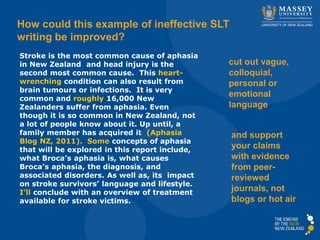
How could this example of ineffective SLT
writing be improved?
cut out vague,
colloquial,
personal or
emotional
language
and support
your claims
with evidence
from peer-
reviewed
journals, not
blogs or hot air
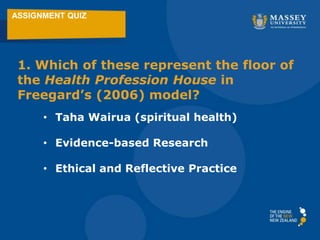
ASSIGNMENT QUIZ
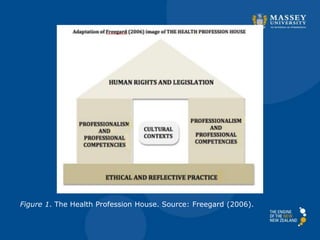
1. Which of these represent the floor of
the Health Profession House in
Freegard’s (2006) model?
• Taha Wairua (spiritual health)
• Evidence-based Research
• Ethical and Reflective Practice
Figure 1. The Health Profession House. Source: Freegard (2006).
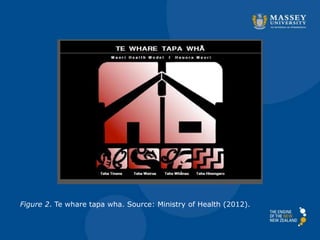
Figure 2. Te whare tapa wha. Source: Ministry of Health (2012).
ASSIGNMENT QUIZ
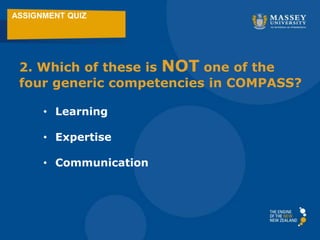
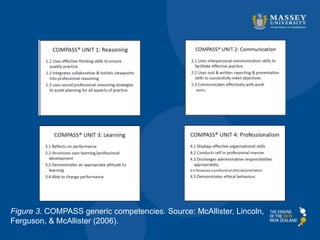
2. Which of these is NOT one of the
four generic competencies in COMPASS?
• Learning
• Expertise
• Communication
Figure 3. COMPASS generic competencies. Source: McAllister, Lincoln,
Ferguson, & McAllister (2006).
ASSIGNMENT QUIZ
3. What is the name of the video
scenario which assignment 1 is based
on?
• Uniform Issues
• All or nothing
• Rules and Exceptions
Figure 4. Uniform Issues. Source: New Zealand Teachers Council. (2004b).
ASSIGNMENT QUIZ
4. Which of these frameworks might be
used in part 2 of Assignment 1?
• COMPASS
• the Ethical Response Cycle
• Ethics of Care
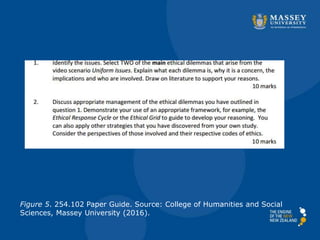
Figure 5. 254.102 Paper Guide. Source: College of Humanities and Social
Sciences, Massey University (2016).
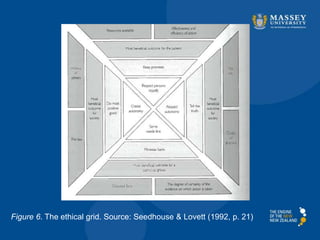
Figure 6. The ethical grid. Source: Seedhouse & Lovett (1992, p. 21)
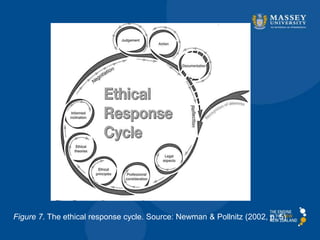
Figure 7. The ethical response cycle. Source: Newman & Pollnitz (2002, p. 5)
ASSIGNMENT QUIZ
5. Which phase of the Ethical Response
Cycle might involve consideration of the
NZTC Code of Ethics?
• Legal Aspects
• Professional Consideration
• Ethical Principles
Figure 8: The ethical response cycle [detail]. Newman & Pollnitz (2002, p. 6).
ASSIGNMENT QUIZ
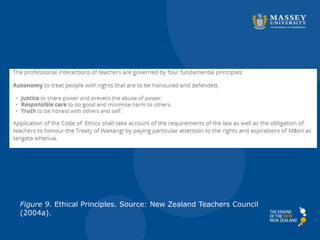
6. Which of these is NOT one of the
four principles of the NZTC Code of
Ethics?
Autonomy (to treat people with rights that are to
be honoured and defended)
Justice (to share power and prevent the abuse
of power)
Sustainability (to use resources responsibly
without impinging on their use by future
generations)
Truth (to be honest with others and self)
Figure 9. Ethical Principles. Source: New Zealand Teachers Council
(2004a).
ASSIGNMENT QUIZ
7. Which of these is stated as a
commitment for teachers in the NZTC
Code of Ethics?
• to one’s personal learning
• to implementation of MoE policy
• to a child-centred integrated curriculum
• to the profession
Figure 10. Ethical commitment 4. Source: New Zealand Teachers Council
(2004a).
ASSIGNMENT QUIZ
8. What proportion of the marks for
Assignment 1 are for writing issues?
• 10 %
• 25 %
• 33 %
• 40 %
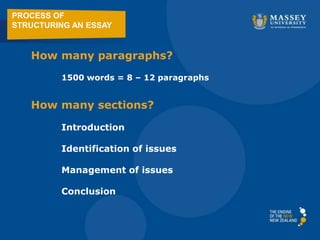
PROCESS OF
STRUCTURING AN ESSAY
How many paragraphs?
1500 words = 8 – 12 paragraphs
How many sections?
Introduction
Identification of issues
Management of issues
Conclusion
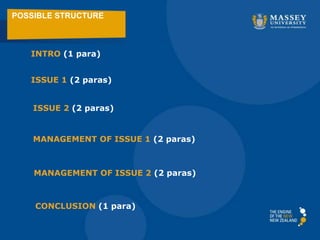
POSSIBLE STRUCTURE
INTRO (1 para)
ISSUE 1 (2 paras)
ISSUE 2 (2 paras)
MANAGEMENT OF ISSUE 1 (2 paras)
MANAGEMENT OF ISSUE 2 (2 paras)
CONCLUSION (1 para)
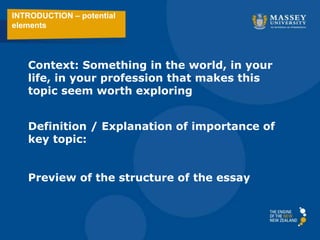
INTRODUCTION – potential
elements
Context: Something in the world, in your
life, in your profession that makes this
topic seem worth exploring
Definition / Explanation of importance of
key topic:
Preview of the structure of the essay
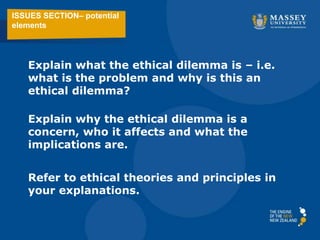
ISSUES SECTION– potential
elements
Explain what the ethical dilemma is – i.e.
what is the problem and why is this an
ethical dilemma?
Explain why the ethical dilemma is a
concern, who it affects and what the
implications are.
Refer to ethical theories and principles in
your explanations.
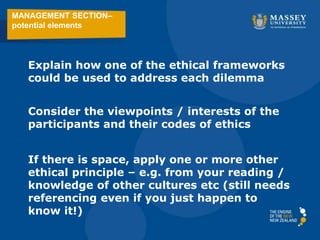
MANAGEMENT SECTION–
potential elements
Explain how one of the ethical frameworks
could be used to address each dilemma
Consider the viewpoints / interests of the
participants and their codes of ethics
If there is space, apply one or more other
ethical principle – e.g. from your reading /
knowledge of other cultures etc (still needs
referencing even if you just happen to
know it!)
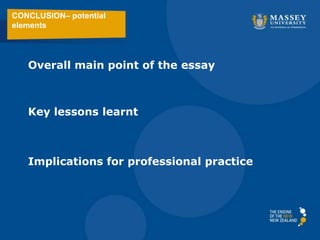
CONCLUSION– potential
elements
Overall main point of the essay
Key lessons learnt
Implications for professional practice
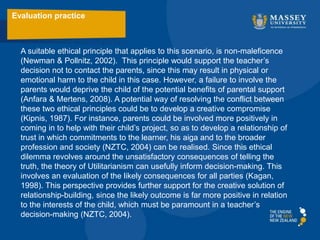
A suitable ethical principle that applies to this scenario, is non-maleficence
(Newman & Pollnitz, 2002). This principle would support the teacher’s
decision not to contact the parents, since this may result in physical or
emotional harm to the child in this case. However, a failure to involve the
parents would deprive the child of the potential benefits of parental support
(Anfara & Mertens, 2008). A potential way of resolving the conflict between
these two ethical principles could be to develop a creative compromise
(Kipnis, 1987). For instance, parents could be involved more positively in
coming in to help with their child’s project, so as to develop a relationship of
trust in which commitments to the learner, his aiga and to the broader
profession and society (NZTC, 2004) can be realised. Since this ethical
dilemma revolves around the unsatisfactory consequences of telling the
truth, the theory of Utilitarianism can usefully inform decision-making. This
involves an evaluation of the likely consequences for all parties (Kagan,
1998). This perspective provides further support for the creative solution of
relationship-building, since the likely outcome is far more positive in relation
to the interests of the child, which must be paramount in a teacher’s
decision-making (NZTC, 2004).
Evaluation practice
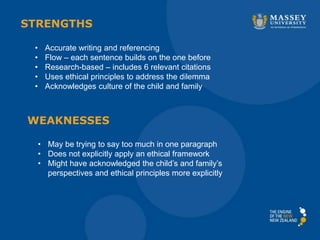
• Accurate writing and referencing
• Flow – each sentence builds on the one before
• Research-based – includes 6 relevant citations
• Uses ethical principles to address the dilemma
• Acknowledges culture of the child and family
STRENGTHS
WEAKNESSES
• May be trying to say too much in one paragraph
• Does not explicitly apply an ethical framework
• Might have acknowledged the child’s and family’s
perspectives and ethical principles more explicitly
References
College of Humanities and Social Sciences, Massey University. (2013). 254.102
Professional and ethical practice [Paper Guide]. Albany, New Zealand:
Author
Freegard, H. (Ed.). (2006). Ethical practice for health professionals. Melbourne,
Vic: Thomson Learning.
McAllister, S., Lincoln, M., Ferguson, A., & McAllister, L. (2006). COMPASS:
Competency assessment in speech pathology. Melbourne, Vic: Speech
Pathology Association of Australia.
Ministry of Health. (2012). Maori health models: Te whare tapa wha.
Retrieved from: http://www.health.govt.nz/our work/populations/maori-
health/maori-health-models/maori-health-models-te-whare
-tapa-wha
Newman, L. & Pollnitz, L. (2002). Professional, ethical and legal issues in early
childhood. Frenchs Forest, NSW: Pearson Education Australia.
New Zealand Teachers Council. (2004a). Code of ethics for registered teachers.
Wellington, New Zealand: Author.
New Zealand Teachers Council. (2004b). Uniform issues [Video File]. Retrieved
from http://www.youtube.com/watch?v=WgyEZm98ewc
Seedhouse, D., & Lovett, L. (1992). Practical medical ethics. Chichester, England:
John Wiley & Sons.
© 2016
This PowerPoint Presentation and the accompanying
handouts are copyrighted by Centre for Teaching and
Learning, Massey University and may not be used,
except for personal study, without written permission
from the copyright owner. Please note that examples
are provided for illustration of writing principles only and
no reliance should be placed on any of the ideas
referred to in the texts.
Martin McMorrow, Centre for Teaching and Learning
09 441 8143 slt-alb@massey.ac.nz
This presentation can be viewed online at:
http://tinyurl.com/254102workshop12016

254102 workshop 1 2016

  • 1.
    254.102 Writing Workshop Essentialsof Professional Writing CTL Services Assignment Quiz Assignment Structure This presentation can be viewed online at: http://tinyurl.com/254102workshop12016 Evaluation of writing
  • 2.
    CENTRE FOR TEACHING ANDLEARNING SERVICES http://owll.massey.ac.nz Online Writing and Learning Link http://tinyurl.com/studyup2016 Online Workshops Book on 09 441-8143 or slc-alb@massey.ac.nz OR in person at the library (LEVEL 3) ONE-TO-ONE OR SMALL GROUP CONSULTATIONS
  • 3.
    Research studies havefound that the prevalence of CONDITION X varies according to type, age group, and gender, although the progression and course of CONDITION also differs significantly among individuals from the same demographic group (Brown, 2005; Smith & Howell, 2008). Y is the most common variant of CONDITION X affecting around 90% of all individuals with the disorder (Singh, 2005). CONDITION X is considered to be a rare disease affecting an estimated 40,000 Americans with two thirds of the total affected population thought to be female (Colenso & Schmitt, 2007). While CONDITION X can develop at any stage, the most common age of emergence is 46 (Wang et al., 2011). The onset of CONDITION X can be either sudden or gradual with the severity of symptoms peaking to an unknown intensity within months or increasing years after onset It is most prevalent among females over the age of 40, though no accurate prognosis can be made regarding the progression and severity of its symptoms (Faleolo et al., 2006). Essentials of professional writing
  • 4.
    precise concise, objective andevidence-based Professional style is: CONDITION X is most prevalent among females over the age of 40 Research studies have found that prevalence of CONDITION varies according to type, age group, and gender, although the progression and course of CONDITION also differs significantly among individuals from the same demographic group (Brown, 2005; Smith & Howell, 2008). all individuals with the disorder person-first
  • 5.
    Stroke is themost common cause of aphasia in New Zealand and head injury is the second most common cause. This heart-wrenching condition can also result from brain tumours or infections. It is very common and roughly 16,000 New Zealanders suffer from aphasia. Even though it is so common in New Zealand, not a lot of people know about it. Up until, a family member has acquired it (Aphasia Blog NZ, 2011). Some concepts of aphasia that will be explored in this report include, what Broca’s aphasia is, what causes Broca’s aphasia, the diagnosis, and associated disorders. As well as, its impact on stroke survivors’ language and lifestyle. I’ll conclude with an overview of treatment available for stroke victims. How could this example of ineffective writing be improved?
  • 6.
    Stroke is themost common cause of aphasia in New Zealand and head injury is the second most common cause. This heart- wrenching condition can also result from brain tumours or infections. It is very common and roughly 16,000 New Zealanders suffer from aphasia. Even though it is so common in New Zealand, not a lot of people know about it. Up until, a family member has acquired it (Aphasia Blog NZ, 2011). Some concepts of aphasia that will be explored in this report include, what Broca’s aphasia is, what causes Broca’s aphasia, the diagnosis, and associated disorders. As well as, its impact on stroke survivors’ language and lifestyle. I’ll conclude with an overview of treatment available for stroke victims. How could this example of ineffective writing be improved? cut out repetition and irrelevant information
  • 7.
    Stroke is themost common cause of aphasia in New Zealand and head injury is the second most common cause. This heart- wrenching condition can also result from brain tumours or infections. It is very common and roughly 16,000 New Zealanders suffer from aphasia. Even though it is so common in New Zealand, not a lot of people know about it. Up until, a family member has acquired it (Aphasia Blog NZ, 2011). Some concepts of aphasia that will be explored in this report include, what Broca’s aphasia is, what causes Broca’s aphasia, the diagnosis, and associated disorders. As well as, its impact on stroke survivors’ language and lifestyle. I’ll conclude with an overview of treatment available for stroke victims. How could this example of ineffective writing be improved? Person-first language is a must So is correct sentence structure and punctuation
  • 8.
    Stroke is themost common cause of aphasia in New Zealand and head injury is the second most common cause. This heart- wrenching condition can also result from brain tumours or infections. It is very common and roughly 16,000 New Zealanders suffer from aphasia. Even though it is so common in New Zealand, not a lot of people know about it. Up until, a family member has acquired it (Aphasia Blog NZ, 2011). Some concepts of aphasia that will be explored in this report include, what Broca’s aphasia is, what causes Broca’s aphasia, the diagnosis, and associated disorders. As well as, its impact on stroke survivors’ language and lifestyle. I’ll conclude with an overview of treatment available for stroke victims. How could this example of ineffective SLT writing be improved? cut out vague, colloquial, personal or emotional language and support your claims with evidence from peer- reviewed journals, not blogs or hot air
  • 9.
    ASSIGNMENT QUIZ 1. Whichof these represent the floor of the Health Profession House in Freegard’s (2006) model? • Taha Wairua (spiritual health) • Evidence-based Research • Ethical and Reflective Practice
  • 10.
    Figure 1. TheHealth Profession House. Source: Freegard (2006).
  • 11.
    Figure 2. Tewhare tapa wha. Source: Ministry of Health (2012).
  • 12.
    ASSIGNMENT QUIZ 2. Whichof these is NOT one of the four generic competencies in COMPASS? • Learning • Expertise • Communication
  • 13.
    Figure 3. COMPASSgeneric competencies. Source: McAllister, Lincoln, Ferguson, & McAllister (2006).
  • 14.
    ASSIGNMENT QUIZ 3. Whatis the name of the video scenario which assignment 1 is based on? • Uniform Issues • All or nothing • Rules and Exceptions
  • 15.
    Figure 4. UniformIssues. Source: New Zealand Teachers Council. (2004b).
  • 16.
    ASSIGNMENT QUIZ 4. Whichof these frameworks might be used in part 2 of Assignment 1? • COMPASS • the Ethical Response Cycle • Ethics of Care
  • 17.
    Figure 5. 254.102Paper Guide. Source: College of Humanities and Social Sciences, Massey University (2016).
  • 18.
    Figure 6. Theethical grid. Source: Seedhouse & Lovett (1992, p. 21)
  • 19.
    Figure 7. Theethical response cycle. Source: Newman & Pollnitz (2002, p. 5)
  • 20.
    ASSIGNMENT QUIZ 5. Whichphase of the Ethical Response Cycle might involve consideration of the NZTC Code of Ethics? • Legal Aspects • Professional Consideration • Ethical Principles
  • 21.
    Figure 8: Theethical response cycle [detail]. Newman & Pollnitz (2002, p. 6).
  • 22.
    ASSIGNMENT QUIZ 6. Whichof these is NOT one of the four principles of the NZTC Code of Ethics? Autonomy (to treat people with rights that are to be honoured and defended) Justice (to share power and prevent the abuse of power) Sustainability (to use resources responsibly without impinging on their use by future generations) Truth (to be honest with others and self)
  • 23.
    Figure 9. EthicalPrinciples. Source: New Zealand Teachers Council (2004a).
  • 24.
    ASSIGNMENT QUIZ 7. Whichof these is stated as a commitment for teachers in the NZTC Code of Ethics? • to one’s personal learning • to implementation of MoE policy • to a child-centred integrated curriculum • to the profession
  • 25.
    Figure 10. Ethicalcommitment 4. Source: New Zealand Teachers Council (2004a).
  • 26.
    ASSIGNMENT QUIZ 8. Whatproportion of the marks for Assignment 1 are for writing issues? • 10 % • 25 % • 33 % • 40 %
  • 27.
    PROCESS OF STRUCTURING ANESSAY How many paragraphs? 1500 words = 8 – 12 paragraphs How many sections? Introduction Identification of issues Management of issues Conclusion
  • 28.
    POSSIBLE STRUCTURE INTRO (1para) ISSUE 1 (2 paras) ISSUE 2 (2 paras) MANAGEMENT OF ISSUE 1 (2 paras) MANAGEMENT OF ISSUE 2 (2 paras) CONCLUSION (1 para)
  • 29.
    INTRODUCTION – potential elements Context:Something in the world, in your life, in your profession that makes this topic seem worth exploring Definition / Explanation of importance of key topic: Preview of the structure of the essay
  • 30.
    ISSUES SECTION– potential elements Explainwhat the ethical dilemma is – i.e. what is the problem and why is this an ethical dilemma? Explain why the ethical dilemma is a concern, who it affects and what the implications are. Refer to ethical theories and principles in your explanations.
  • 31.
    MANAGEMENT SECTION– potential elements Explainhow one of the ethical frameworks could be used to address each dilemma Consider the viewpoints / interests of the participants and their codes of ethics If there is space, apply one or more other ethical principle – e.g. from your reading / knowledge of other cultures etc (still needs referencing even if you just happen to know it!)
  • 32.
    CONCLUSION– potential elements Overall mainpoint of the essay Key lessons learnt Implications for professional practice
  • 33.
    A suitable ethicalprinciple that applies to this scenario, is non-maleficence (Newman & Pollnitz, 2002). This principle would support the teacher’s decision not to contact the parents, since this may result in physical or emotional harm to the child in this case. However, a failure to involve the parents would deprive the child of the potential benefits of parental support (Anfara & Mertens, 2008). A potential way of resolving the conflict between these two ethical principles could be to develop a creative compromise (Kipnis, 1987). For instance, parents could be involved more positively in coming in to help with their child’s project, so as to develop a relationship of trust in which commitments to the learner, his aiga and to the broader profession and society (NZTC, 2004) can be realised. Since this ethical dilemma revolves around the unsatisfactory consequences of telling the truth, the theory of Utilitarianism can usefully inform decision-making. This involves an evaluation of the likely consequences for all parties (Kagan, 1998). This perspective provides further support for the creative solution of relationship-building, since the likely outcome is far more positive in relation to the interests of the child, which must be paramount in a teacher’s decision-making (NZTC, 2004). Evaluation practice
  • 34.
    • Accurate writingand referencing • Flow – each sentence builds on the one before • Research-based – includes 6 relevant citations • Uses ethical principles to address the dilemma • Acknowledges culture of the child and family STRENGTHS WEAKNESSES • May be trying to say too much in one paragraph • Does not explicitly apply an ethical framework • Might have acknowledged the child’s and family’s perspectives and ethical principles more explicitly
  • 35.
    References College of Humanitiesand Social Sciences, Massey University. (2013). 254.102 Professional and ethical practice [Paper Guide]. Albany, New Zealand: Author Freegard, H. (Ed.). (2006). Ethical practice for health professionals. Melbourne, Vic: Thomson Learning. McAllister, S., Lincoln, M., Ferguson, A., & McAllister, L. (2006). COMPASS: Competency assessment in speech pathology. Melbourne, Vic: Speech Pathology Association of Australia. Ministry of Health. (2012). Maori health models: Te whare tapa wha. Retrieved from: http://www.health.govt.nz/our work/populations/maori- health/maori-health-models/maori-health-models-te-whare -tapa-wha Newman, L. & Pollnitz, L. (2002). Professional, ethical and legal issues in early childhood. Frenchs Forest, NSW: Pearson Education Australia. New Zealand Teachers Council. (2004a). Code of ethics for registered teachers. Wellington, New Zealand: Author. New Zealand Teachers Council. (2004b). Uniform issues [Video File]. Retrieved from http://www.youtube.com/watch?v=WgyEZm98ewc Seedhouse, D., & Lovett, L. (1992). Practical medical ethics. Chichester, England: John Wiley & Sons.
  • 36.
    © 2016 This PowerPointPresentation and the accompanying handouts are copyrighted by Centre for Teaching and Learning, Massey University and may not be used, except for personal study, without written permission from the copyright owner. Please note that examples are provided for illustration of writing principles only and no reliance should be placed on any of the ideas referred to in the texts. Martin McMorrow, Centre for Teaching and Learning 09 441 8143 slt-alb@massey.ac.nz This presentation can be viewed online at: http://tinyurl.com/254102workshop12016