AVOIDING PLAGIARISM
SUMMARISING EFFECTIVELY
INTRODUCTION TO APA STYLE
CENTRE FOR TEACHING AND LEARNING LIBRARY 3RD FLOOR
09 441-8143 slc-alb@massey.ac.nz
The slides can be seen at:
http://tinyurl.com/218150workshop2016
218.150: Writing Essentials
• What is plagiarism?
• When is it ok to copy something directly word for
word instead of summarising it in your own words?
• What are the five steps to follow when you
summarise facts or ideas from a book, article or
website?
• How do you present information correctly in a table
or chart?
• How would you reference your text book for this
course?
• What is the name of Massey’s APA referencing tool?
DISCUSSION QUESTIONS
AVOIDING PLAGIARISM
PART 1
Submitting work that’s been researched or written
by someone else.
Submitting work that you’ve submitted before (e.g.
for another course).
Submitting work that relies too greatly on model
answers or sample solutions provided in the course
material.
Copying text without including quotation marks, a
page number and a citation.
Using ideas from books, articles or websites without
including a citation.
What is plagiarism?
Massey University, 2010 (See: http://tinyurl.com/masseyacademicintegrity)
Harris, 2001, p. 96.
Even if you have
permission to use the
material (e.g. it’s on an
open source website),
it is still plagiarism.
Plagiarism ≠ copyright
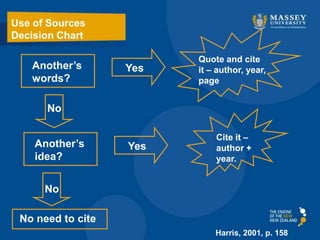
Another’s
words?
Another’s
idea?
No
No
No need to cite
Yes
Quote and cite
it – author, year,
page
Cite it –
author +
year.
Yes
Harris, 2001, p. 158
Use of Sources
Decision Chart
SUMMARISING
EFFECTIVELY
PART 2
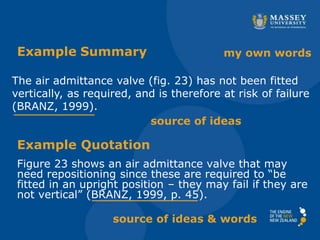
Figure 23 shows an air admittance valve that may
need repositioning since these are required to “be
fitted in an upright position – they may fail if they are
not vertical” (BRANZ, 1999, p. 45).
The air admittance valve (fig. 23) has not been fitted
vertically, as required, and is therefore at risk of failure
(BRANZ, 1999).
Example Quotation
Example Summary my own words
source of ideas
source of ideas & words
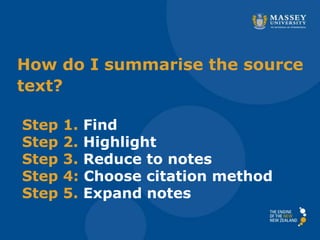
How do I summarise the source
text?
Step 1. Find
Step 2. Highlight
Step 3. Reduce to notes
Step 4: Choose citation method
Step 5. Expand notes
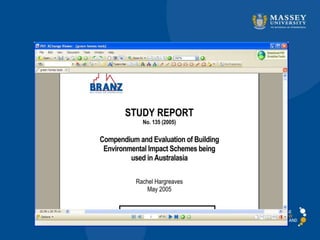
Step 1: Find a relevant text
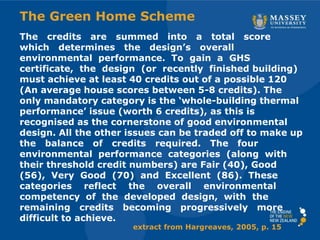
The credits are summed into a total score
which determines the design’s overall
environmental performance. To gain a GHS
certificate, the design (or recently finished building)
must achieve at least 40 credits out of a possible 120
(An average house scores between 5-8 credits). The
only mandatory category is the ‘whole-building thermal
performance’ issue (worth 6 credits), as this is
recognised as the cornerstone of good environmental
design. All the other issues can be traded off to make up
the balance of credits required. The four
environmental performance categories (along with
their threshold credit numbers) are Fair (40), Good
(56), Very Good (70) and Excellent (86). These
categories reflect the overall environmental
competency of the developed design, with the
remaining credits becoming progressively more
difficult to achieve.
The Green Home Scheme
extract from Hargreaves, 2005, p. 15
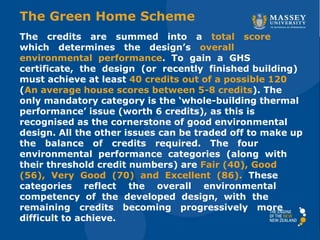
Step 2: Highlight the key
points
The credits are summed into a total score
which determines the design’s overall
environmental performance. To gain a GHS
certificate, the design (or recently finished building)
must achieve at least 40 credits out of a possible 120
(An average house scores between 5-8 credits). The
only mandatory category is the ‘whole-building thermal
performance’ issue (worth 6 credits), as this is
recognised as the cornerstone of good environmental
design. All the other issues can be traded off to make up
the balance of credits required. The four
environmental performance categories (along with
their threshold credit numbers) are Fair (40), Good
(56), Very Good (70) and Excellent (86). These
categories reflect the overall environmental
competency of the developed design, with the
remaining credits becoming progressively more
difficult to achieve.
The Green Home Scheme
Step 3: Reduce to note form –
and put away the original
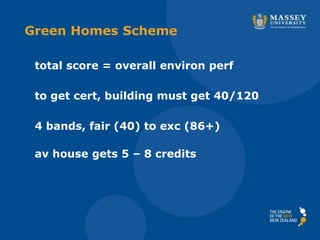
Green Homes Scheme
total score = overall environ perf
to get cert, building must get 40/120
av house gets 5 – 8 credits
4 bands, fair (40) to exc (86+)
Step 4: Choose your citation method
• brackets (author, year)
• According to + author (year)…
• Author (year)+ verb …
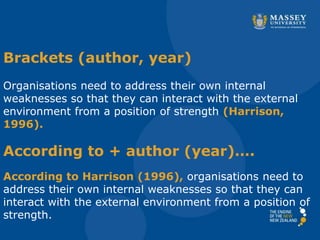
According to Harrison (1996), organisations need to
address their own internal weaknesses so that they can
interact with the external environment from a position of
strength.
Organisations need to address their own internal
weaknesses so that they can interact with the external
environment from a position of strength (Harrison,
1996).
According to + author (year)….
Brackets (author, year)
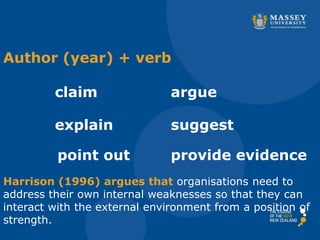
Author (year) + verb
claim argue
explain
point out provide evidence
suggest
Harrison (1996) argues that organisations need to
address their own internal weaknesses so that they can
interact with the external environment from a position of
strength.
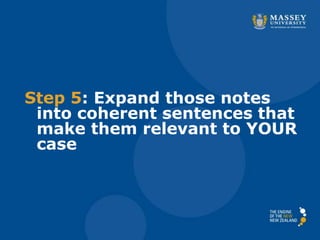
Step 5: Expand those notes
into coherent sentences that
make them relevant to YOUR
case
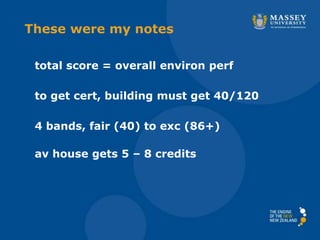
These were my notes
total score = overall environ perf
to get cert, building must get 40/120
av house gets 5 – 8 credits
4 bands, fair (40) to exc (86+)
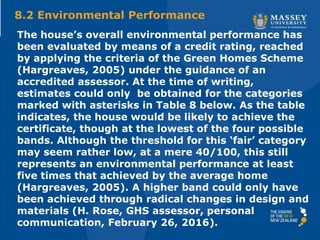
The house’s overall environmental performance has
been evaluated by means of a credit rating, reached
by applying the criteria of the Green Homes Scheme
(Hargreaves, 2005) under the guidance of an
accredited assessor. At the time of writing,
estimates could only be obtained for the categories
marked with asterisks in Table 8 below. As the table
indicates, the house would be likely to achieve the
certificate, though at the lowest of the four possible
bands. Although the threshold for this ‘fair’ category
may seem rather low, at a mere 40/100, this still
represents an environmental performance at least
five times that achieved by the average home
(Hargreaves, 2005). A higher band could only have
been achieved through radical changes in design and
materials (H. Rose, GHS assessor, personal
communication, February 26, 2016).
8.2 Environmental Performance
INTRODUCTION TO
APA STYLE
PART 3
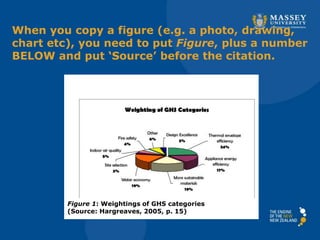
When you copy a figure (e.g. a photo, drawing,
chart etc), you need to put Figure, plus a number
BELOW and put ‘Source’ before the citation.
Figure 1: Weightings of GHS categories
(Source: Hargreaves, 2005, p. 15)
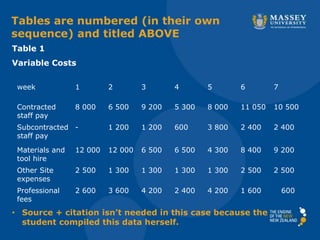
Tables are numbered (in their own
sequence) and titled ABOVE
week 1 2 3 4 5 6 7
Contracted
staff pay
8 000 6 500 9 200 5 300 8 000 11 050 10 500
Subcontracted
staff pay
- 1 200 1 200 600 3 800 2 400 2 400
Materials and
tool hire
12 000 12 000 6 500 6 500 4 300 8 400 9 200
Other Site
expenses
2 500 1 300 1 300 1 300 1 300 2 500 2 500
Professional
fees
2 600 3 600 4 200 2 400 4 200 1 600 600
Table 1
Variable Costs
• Source + citation isn’t needed in this case because the
student compiled this data herself.
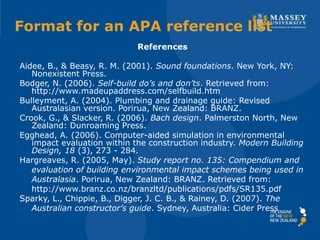
References
Aidee, B., & Beasy, R. M. (2001). Sound foundations. New York, NY:
Nonexistent Press.
Bodger, N. (2006). Self-build do’s and don’ts. Retrieved from:
http://www.madeupaddress.com/selfbuild.htm
Bulleyment, A. (2004). Plumbing and drainage guide: Revised
Australasian version. Porirua, New Zealand: BRANZ.
Crook, G., & Slacker, R. (2006). Bach design. Palmerston North, New
Zealand: Dunroaming Press.
Egghead, A. (2006). Computer-aided simulation in environmental
impact evaluation within the construction industry. Modern Building
Design, 18 (3), 273 - 284.
Hargreaves, R. (2005, May). Study report no. 135: Compendium and
evaluation of building environmental impact schemes being used in
Australasia. Porirua, New Zealand: BRANZ. Retrieved from:
http://www.branz.co.nz/branzltd/publications/pdfs/SR135.pdf
Sparky, L., Chippie, B., Digger, J. C. B., & Rainey, D. (2007). The
Australian constructor’s guide. Sydney, Australia: Cider Press
Format for an APA reference list
APA Interactive & Video
http://owll.massey.ac.nz
APA RESOURCES
Study Up (Online presentations)
http://tinyurl.com/studyup2016
Handy Guide to APA referencing
Download from Stream or pick up at
the CTL
Standard Method of Measurement of Building Works
Author: Standards New Zealand
Edition: 1995
Publisher: Wellington [N.Z.]; Standards New Zealand,
1995
Notes: Series New Zealand standard; NZS 4202:1995
Referencing example
Standards New Zealand. (1995). Standard method of
measurement of building works. Wellington, New
Zealand: Author.
The blah, blah method is only recommended for
structures weighing up to 200 kg (Standards New
Zealand, 1995).
CITATION
END-OF-TEXT REFERENCE
• What is plagiarism?
• When is it ok to copy something directly word for
word instead of summarising it in your own words?
• What are the five steps to follow when you
summarise facts or ideas from a book, article or
website?
• How do you present information correctly in a table
or chart?
• How would you reference your text book for this
course?
• What is the name of Massey’s APA referencing tool?
DISCUSSION QUESTIONS

218150 writing essentials

  • 1.
    AVOIDING PLAGIARISM SUMMARISING EFFECTIVELY INTRODUCTIONTO APA STYLE CENTRE FOR TEACHING AND LEARNING LIBRARY 3RD FLOOR 09 441-8143 slc-alb@massey.ac.nz The slides can be seen at: http://tinyurl.com/218150workshop2016 218.150: Writing Essentials
  • 2.
    • What isplagiarism? • When is it ok to copy something directly word for word instead of summarising it in your own words? • What are the five steps to follow when you summarise facts or ideas from a book, article or website? • How do you present information correctly in a table or chart? • How would you reference your text book for this course? • What is the name of Massey’s APA referencing tool? DISCUSSION QUESTIONS
  • 3.
  • 4.
    Submitting work that’sbeen researched or written by someone else. Submitting work that you’ve submitted before (e.g. for another course). Submitting work that relies too greatly on model answers or sample solutions provided in the course material. Copying text without including quotation marks, a page number and a citation. Using ideas from books, articles or websites without including a citation. What is plagiarism? Massey University, 2010 (See: http://tinyurl.com/masseyacademicintegrity)
  • 5.
    Harris, 2001, p.96. Even if you have permission to use the material (e.g. it’s on an open source website), it is still plagiarism. Plagiarism ≠ copyright
  • 6.
    Another’s words? Another’s idea? No No No need tocite Yes Quote and cite it – author, year, page Cite it – author + year. Yes Harris, 2001, p. 158 Use of Sources Decision Chart
  • 7.
  • 8.
    Figure 23 showsan air admittance valve that may need repositioning since these are required to “be fitted in an upright position – they may fail if they are not vertical” (BRANZ, 1999, p. 45). The air admittance valve (fig. 23) has not been fitted vertically, as required, and is therefore at risk of failure (BRANZ, 1999). Example Quotation Example Summary my own words source of ideas source of ideas & words
  • 9.
    How do Isummarise the source text? Step 1. Find Step 2. Highlight Step 3. Reduce to notes Step 4: Choose citation method Step 5. Expand notes
  • 10.
    Step 1: Finda relevant text
  • 12.
    The credits aresummed into a total score which determines the design’s overall environmental performance. To gain a GHS certificate, the design (or recently finished building) must achieve at least 40 credits out of a possible 120 (An average house scores between 5-8 credits). The only mandatory category is the ‘whole-building thermal performance’ issue (worth 6 credits), as this is recognised as the cornerstone of good environmental design. All the other issues can be traded off to make up the balance of credits required. The four environmental performance categories (along with their threshold credit numbers) are Fair (40), Good (56), Very Good (70) and Excellent (86). These categories reflect the overall environmental competency of the developed design, with the remaining credits becoming progressively more difficult to achieve. The Green Home Scheme extract from Hargreaves, 2005, p. 15
  • 13.
    Step 2: Highlightthe key points
  • 14.
    The credits aresummed into a total score which determines the design’s overall environmental performance. To gain a GHS certificate, the design (or recently finished building) must achieve at least 40 credits out of a possible 120 (An average house scores between 5-8 credits). The only mandatory category is the ‘whole-building thermal performance’ issue (worth 6 credits), as this is recognised as the cornerstone of good environmental design. All the other issues can be traded off to make up the balance of credits required. The four environmental performance categories (along with their threshold credit numbers) are Fair (40), Good (56), Very Good (70) and Excellent (86). These categories reflect the overall environmental competency of the developed design, with the remaining credits becoming progressively more difficult to achieve. The Green Home Scheme
  • 15.
    Step 3: Reduceto note form – and put away the original
  • 16.
    Green Homes Scheme totalscore = overall environ perf to get cert, building must get 40/120 av house gets 5 – 8 credits 4 bands, fair (40) to exc (86+)
  • 17.
    Step 4: Chooseyour citation method • brackets (author, year) • According to + author (year)… • Author (year)+ verb …
  • 18.
    According to Harrison(1996), organisations need to address their own internal weaknesses so that they can interact with the external environment from a position of strength. Organisations need to address their own internal weaknesses so that they can interact with the external environment from a position of strength (Harrison, 1996). According to + author (year)…. Brackets (author, year)
  • 19.
    Author (year) +verb claim argue explain point out provide evidence suggest Harrison (1996) argues that organisations need to address their own internal weaknesses so that they can interact with the external environment from a position of strength.
  • 20.
    Step 5: Expandthose notes into coherent sentences that make them relevant to YOUR case
  • 21.
    These were mynotes total score = overall environ perf to get cert, building must get 40/120 av house gets 5 – 8 credits 4 bands, fair (40) to exc (86+)
  • 22.
    The house’s overallenvironmental performance has been evaluated by means of a credit rating, reached by applying the criteria of the Green Homes Scheme (Hargreaves, 2005) under the guidance of an accredited assessor. At the time of writing, estimates could only be obtained for the categories marked with asterisks in Table 8 below. As the table indicates, the house would be likely to achieve the certificate, though at the lowest of the four possible bands. Although the threshold for this ‘fair’ category may seem rather low, at a mere 40/100, this still represents an environmental performance at least five times that achieved by the average home (Hargreaves, 2005). A higher band could only have been achieved through radical changes in design and materials (H. Rose, GHS assessor, personal communication, February 26, 2016). 8.2 Environmental Performance
  • 23.
  • 24.
    When you copya figure (e.g. a photo, drawing, chart etc), you need to put Figure, plus a number BELOW and put ‘Source’ before the citation. Figure 1: Weightings of GHS categories (Source: Hargreaves, 2005, p. 15)
  • 25.
    Tables are numbered(in their own sequence) and titled ABOVE week 1 2 3 4 5 6 7 Contracted staff pay 8 000 6 500 9 200 5 300 8 000 11 050 10 500 Subcontracted staff pay - 1 200 1 200 600 3 800 2 400 2 400 Materials and tool hire 12 000 12 000 6 500 6 500 4 300 8 400 9 200 Other Site expenses 2 500 1 300 1 300 1 300 1 300 2 500 2 500 Professional fees 2 600 3 600 4 200 2 400 4 200 1 600 600 Table 1 Variable Costs • Source + citation isn’t needed in this case because the student compiled this data herself.
  • 26.
    References Aidee, B., &Beasy, R. M. (2001). Sound foundations. New York, NY: Nonexistent Press. Bodger, N. (2006). Self-build do’s and don’ts. Retrieved from: http://www.madeupaddress.com/selfbuild.htm Bulleyment, A. (2004). Plumbing and drainage guide: Revised Australasian version. Porirua, New Zealand: BRANZ. Crook, G., & Slacker, R. (2006). Bach design. Palmerston North, New Zealand: Dunroaming Press. Egghead, A. (2006). Computer-aided simulation in environmental impact evaluation within the construction industry. Modern Building Design, 18 (3), 273 - 284. Hargreaves, R. (2005, May). Study report no. 135: Compendium and evaluation of building environmental impact schemes being used in Australasia. Porirua, New Zealand: BRANZ. Retrieved from: http://www.branz.co.nz/branzltd/publications/pdfs/SR135.pdf Sparky, L., Chippie, B., Digger, J. C. B., & Rainey, D. (2007). The Australian constructor’s guide. Sydney, Australia: Cider Press Format for an APA reference list
  • 27.
    APA Interactive &Video http://owll.massey.ac.nz APA RESOURCES Study Up (Online presentations) http://tinyurl.com/studyup2016 Handy Guide to APA referencing Download from Stream or pick up at the CTL
  • 28.
    Standard Method ofMeasurement of Building Works Author: Standards New Zealand Edition: 1995 Publisher: Wellington [N.Z.]; Standards New Zealand, 1995 Notes: Series New Zealand standard; NZS 4202:1995 Referencing example Standards New Zealand. (1995). Standard method of measurement of building works. Wellington, New Zealand: Author. The blah, blah method is only recommended for structures weighing up to 200 kg (Standards New Zealand, 1995). CITATION END-OF-TEXT REFERENCE
  • 29.
    • What isplagiarism? • When is it ok to copy something directly word for word instead of summarising it in your own words? • What are the five steps to follow when you summarise facts or ideas from a book, article or website? • How do you present information correctly in a table or chart? • How would you reference your text book for this course? • What is the name of Massey’s APA referencing tool? DISCUSSION QUESTIONS