1
Altitude Corrections
Junior Navigation
Chapter 4
2
Learning Objectives
 Understand how the following factors affect
altitude observations:
 Dip
 Refraction
 Parallax
 Semidiameter
 Apply altitude corrections from the Nautical
Almanac to observations of the sun
 Celestial Tools
3
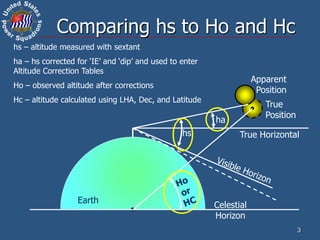
Comparing hs to Ho and Hc
Earth
Celestial
Horizon
True Horizontal
Apparent
Position
True
Position
hs – altitude measured with sextant
ha – hs corrected for ‘IE’ and ‘dip’ and used to enter
Altitude Correction Tables
Ho – observed altitude after corrections
Hc – altitude calculated using LHA, Dec, and Latitude
ha
hs
4
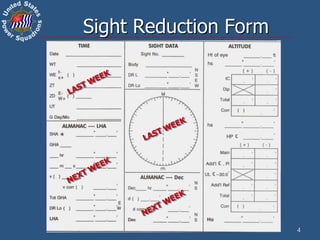
Sight Reduction Form
5
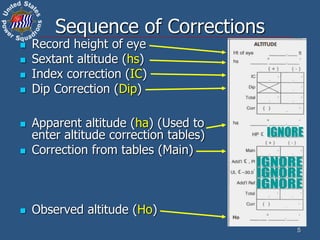
Sequence of Corrections
 Record height of eye
 Sextant altitude (hs)
 Index correction (IC)
 Dip Correction (Dip)
 Apparent altitude (ha) (Used to
enter altitude correction tables)
 Correction from tables (Main)
 Observed altitude (Ho)
6
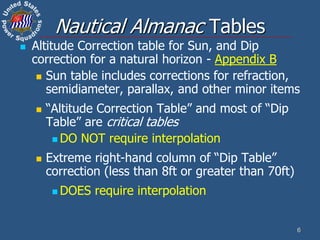
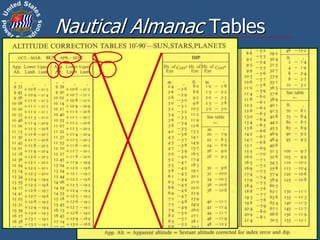
Nautical Almanac Tables
 Altitude Correction table for Sun, and Dip
correction for a natural horizon - Appendix B
 Sun table includes corrections for refraction,
semidiameter, parallax, and other minor items
 “Altitude Correction Table” and most of “Dip
Table” are critical tables
 DO NOT require interpolation
 Extreme right-hand column of “Dip Table”
correction (less than 8ft or greater than 70ft)
 DOES require interpolation
7
Nautical Almanac Tables
8
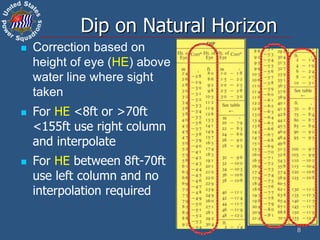
Dip on Natural Horizon
 Correction based on
height of eye (HE) above
water line where sight
taken
 For HE <8ft or >70ft
<155ft use right column
and interpolate
 For HE between 8ft-70ft
use left column and no
interpolation required
9
Dip on Natural Horizon
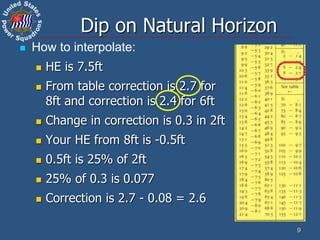
 How to interpolate:
 HE is 7.5ft
 From table correction is 2.7 for
8ft and correction is 2.4 for 6ft
 Change in correction is 0.3 in 2ft
 Your HE from 8ft is -0.5ft
 0.5ft is 25% of 2ft
 25% of 0.3 is 0.077
 Correction is 2.7 - 0.08 = 2.6
10
Dip on Natural Horizon
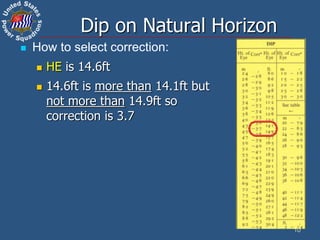
 How to select correction:
 HE is 14.6ft
 14.6ft is more than 14.1ft but
not more than 14.9ft so
correction is 3.7
Sight taken with HE of 10.6 ft,
across a distance of 670 yards.
(Dip to NH would be -3.2’)
Use Almanac tables if:
Height
of Eye
Distance to Horizon
at least
Feet nm sm yds
3 2.0 2.3 4103
5 2.6 3.0 5296
7 3.1 3.6 6267
9 3.5 4.0 7106
10 3.7 4.3 7490
15 4.5 5.2 9174
20 5.2 6.0 10593
Distance to
shore in
Height of
Eye in
Dip Short (Ds) Formula
d = distance & h = height of eye
Yards Feet Ds = (0.0002052 x d) + [1146 x (h/d)]
Meters Meters Ds = (0.0002244 x d) + [3438 x (h/d)]
Nautical miles Feet Ds = (0.4156 x d) + [0.5658 x (h/d)]
Statute miles Feet Ds = (0.3611 x d) + [0.6511 x (h/d)]
11
Dip Short (Appendix A)
Ds = (0.0002052 x d) + [1146 x (h/d)]
Ds = (0.0002052 x 670) + [1146 x (10.6 / 670)]
Ds = 0.137484 + (1146 x 0.015820896)
Ds = 18.268’, rounded to 18.3’
Dip correction is -18.3’
12
Find Ho
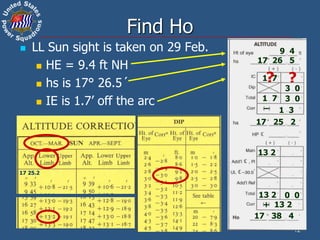
 LL Sun sight is taken on 29 Feb.
 HE = 9.4 ft NH
 hs is 17° 26.5´
 IE is 1.7’ off the arc
9 4
17 26 5
1 7
3 0
17 25 2
1 7 3 0
1 3
–
13 2
13 2
+ 13 2
0 0
17 38 4
?
17 25.2
?
13
Find Ho
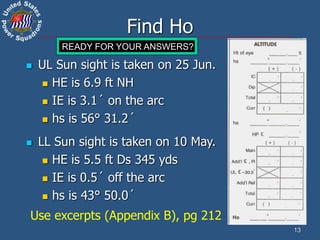
 UL Sun sight is taken on 25 Jun.
 HE is 6.9 ft NH
 IE is 3.1´ on the arc
 hs is 56° 31.2´
Use excerpts (Appendix B), pg 212
 LL Sun sight is taken on 10 May.
 HE is 5.5 ft Ds 345 yds
 IE is 0.5´ off the arc
 hs is 43° 50.0´
15 13 11 9 7 5 4 3 2 1
READY FOR YOUR ANSWERS?
14
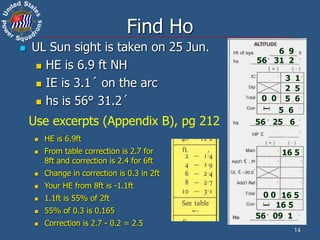
Find Ho
 UL Sun sight is taken on 25 Jun.
 HE is 6.9 ft NH
 IE is 3.1´ on the arc
 hs is 56° 31.2´
6 9
56 31 2
3 1
2 5
56 25 6
0 0 5 6
5 6
–
16 5
0 0
– 16 5
16 5
56 09 1
 HE is 6.9ft
 From table correction is 2.7 for
8ft and correction is 2.4 for 6ft
 Change in correction is 0.3 in 2ft
 Your HE from 8ft is -1.1ft
 1.1ft is 55% of 2ft
 55% of 0.3 is 0.165
 Correction is 2.7 - 0.2 = 2.5
Use excerpts (Appendix B), pg 212
15
 LL Sun sight is taken on 10 May.
 HE is 5.5 ft Ds 345 yds
 IE is 0.5´ off the arc
 hs is 43° 50.0´
Find Ho
5 5
43 50 0
0 5
18 3
43 32 2
0 5 18 3
17 8
-
15 0
15 0
+ 15 0
0 0
43 47 2
Use excerpts (Appendix B), pg 212
Ds = (0.0002052 x d) + [1146 x (h/d)]
Ds = (0.0002052 x 345) + [1146 x (5.5 / 345)]
Ds = 0.070794 + (1146 x 0.015942029)
Ds = 18.34036’, rounded to 18.3’
Dip correction is -18.3’
16
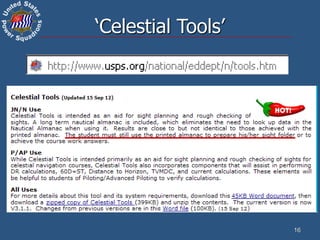
‘Celestial Tools’
Sight Planner – calculate the twilight times for a selected date and location and
find the azimuth, altitude, and magnitude of the visible navigational bodies at a
selected time, as a list or a star chart. It will also find the times of moonrise and
moonset, the phase of the Moon, and the availability of acceptable Sun-Moon
fixes.
Sight Averaging – analyze a run of sights and calculate the average watch
time and sextant altitude.
CTS/SOA – calculate the “Course to Steer” and “Speed of Advance” for a
course and speed affected by current.
Arc <=> Time – convert an angular value to its equivalent time and vice versa.
Distances – a distance to the natural horizon calculator, a geographical range of
visibility of an object calculator, and three distance by vertical angle calculators.
Interpolation – will do single or double interpolation, and includes
a sexagesimal-to-decimal converter.
60D=ST – calculate speed, time, or distance when two of the values are known.
Yellow Pages – will produce the values of the Nautical Almanac Increments
and Corrections table.
Dist. by 2 Brngs – calculate the distance to a fixed object (and related
quantities) by taking two bearings on the object from a moving vessel.
17
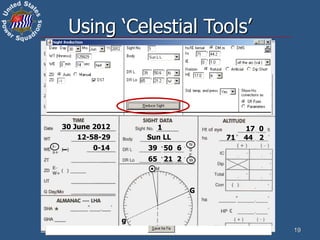
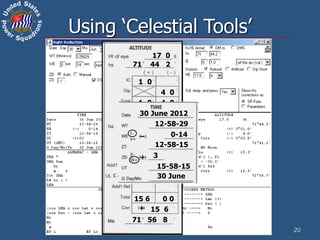
Using ‘Celestial Tools’
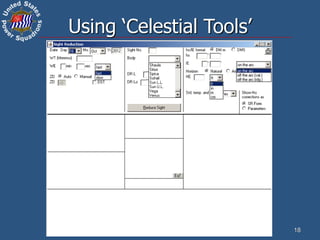
Sight Reduction and Fix – completely reduce a sight to intercept and azimuth
by the Law of Cosines method, allowing students to check the quality of their
sights while still “at the beach”. After a minimum of two sights are reduced and
saved, you have the option of establishing a fix using sights selected from the
list of up to ten.
Noon Sight – calculate the time of Local Apparent Noon (LAN) for a selected
date and longitude, and then calculates latitude from a noon sight. It will also
calculate longitude from the observed zone time for LAN.
LoC/NASR and Fix – allows the user to enter data from the upper part of
a sight reduction form (derived from data extracted from the Nautical
Almanac) and reduce the sight using the Law of Cosines and Nautical
Almanac Sight Reduction methods, giving the same intermediate and final
values as would be obtained with a manual reduction.
The Sailings – calculate, using mid-latitude or Mercator sailing, or the method
used in VPP2, course and distance from initial and final positions, final position
from initial position, course, and distance, and set and drift from DR position,
fix position, and elapsed time. It will also calculate, using great circle sailing,
initial course and distance or final position, plus maximum latitude, final course,
and points on the great circle route.
TVMDC – will update the values of the compass variables (True, Variation,
Magnetic, Deviation, and Compass) when any one is changed. It will also
calculate the value of variation for a selected year based on the data provided
on a chart.
MoBoard – perform several calculations typically done on a maneuvering
board, e.g. Closest Point of Approach between two moving vessels (or
between a moving vessel and a stationary object), course and speed of
contact vessel, true wind from apparent wind.
Favorite Places – save the latitudes, longitudes, range of useful azimuths,
type of horizon, and dip short distance for locations that will be reused for
sight-taking sessions. Automatically loads this date into the Sight Planner.
Length of Degree – calculate the length of a degree of latitude and
longitude in various linear units for both a spherical earth for a specified
latitude, north or south. The WGS84 spheroid output duplicates Bowditch
2002 Table 7.
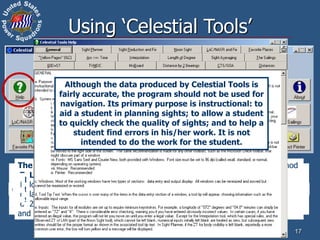
Although the data produced by Celestial Tools is
fairly accurate, the program should not be used for
navigation. Its primary purpose is instructional: to
aid a student in planning sights; to allow a student
to quickly check the quality of sights; and to help a
student find errors in his/her work. It is not
intended to do the work for the student.
18
Using ‘Celestial Tools’
30 June 2012
12-58-29
12-58-15
0-14
1
Sun LL
39 50 6
65 21 2
3
15-58-15
30 June
71 44 2
17 0
1 0
4 0
4 0
1 0
3 0
–
71 41 2
15 6
15 6 0 0
15 6
71 56 8
+
+
–
G
g
o
19
Using ‘Celestial Tools’
30 June 2012
12-58-29
0-14
1
Sun LL
39 50 6
65 21 2
71 44 2
17 0
–
G
g
20
Using ‘Celestial Tools’
o
71 44 2
17 0
1 0
4 0
4 0
1 0
3 0
–
71 41 2
15 6
15 6 0 0
15 6
71 56 8
+
30 June 2012
12-58-29
12-58-15
0-14
3
15-58-15
30 June
+
–
21
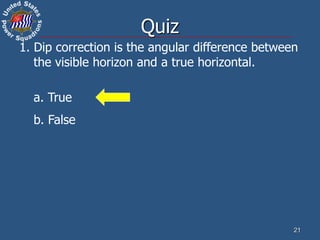
1. Dip correction is the angular difference between
the visible horizon and a true horizontal.
a. True
b. False
Quiz
22
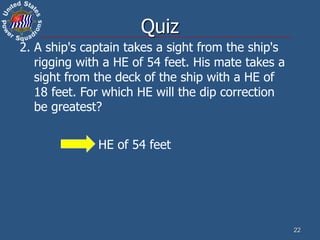
2. A ship's captain takes a sight from the ship's
rigging with a HE of 54 feet. His mate takes a
sight from the deck of the ship with a HE of
18 feet. For which HE will the dip correction
be greatest?
HE of 54 feet
Quiz
23
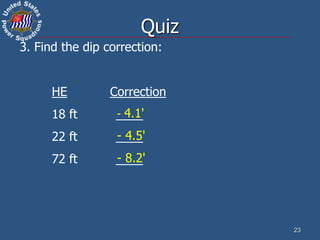
3. Find the dip correction:
HE Correction
18 ft ____
22 ft ____
72 ft ____
- 4.1'
- 4.5'
- 8.2'
Quiz
24
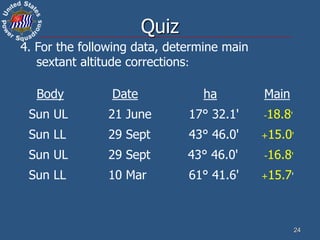
4. For the following data, determine main
sextant altitude corrections:
Body Date ha
Sun UL 21 June 17° 32.1'
Sun LL 29 Sept 43° 46.0'
Sun UL 29 Sept 43° 46.0'
Sun LL 10 Mar 61° 41.6'
Main
-18.8'
+15.0'
-16.8'
+15.7'
Quiz
25
BRING INFORMATION
ON ANY SIGHTS YOU
HAVE TAKEN.
Next class
26
Altitude Corrections
End of
Junior Navigation
Chapter 4

2520633.ppt

  • 1.
  • 2.
    2 Learning Objectives  Understandhow the following factors affect altitude observations:  Dip  Refraction  Parallax  Semidiameter  Apply altitude corrections from the Nautical Almanac to observations of the sun  Celestial Tools
  • 3.
    3 Comparing hs toHo and Hc Earth Celestial Horizon True Horizontal Apparent Position True Position hs – altitude measured with sextant ha – hs corrected for ‘IE’ and ‘dip’ and used to enter Altitude Correction Tables Ho – observed altitude after corrections Hc – altitude calculated using LHA, Dec, and Latitude ha hs
  • 4.
  • 5.
    5 Sequence of Corrections Record height of eye  Sextant altitude (hs)  Index correction (IC)  Dip Correction (Dip)  Apparent altitude (ha) (Used to enter altitude correction tables)  Correction from tables (Main)  Observed altitude (Ho)
  • 6.
    6 Nautical Almanac Tables Altitude Correction table for Sun, and Dip correction for a natural horizon - Appendix B  Sun table includes corrections for refraction, semidiameter, parallax, and other minor items  “Altitude Correction Table” and most of “Dip Table” are critical tables  DO NOT require interpolation  Extreme right-hand column of “Dip Table” correction (less than 8ft or greater than 70ft)  DOES require interpolation
  • 7.
  • 8.
    8 Dip on NaturalHorizon  Correction based on height of eye (HE) above water line where sight taken  For HE <8ft or >70ft <155ft use right column and interpolate  For HE between 8ft-70ft use left column and no interpolation required
  • 9.
    9 Dip on NaturalHorizon  How to interpolate:  HE is 7.5ft  From table correction is 2.7 for 8ft and correction is 2.4 for 6ft  Change in correction is 0.3 in 2ft  Your HE from 8ft is -0.5ft  0.5ft is 25% of 2ft  25% of 0.3 is 0.077  Correction is 2.7 - 0.08 = 2.6
  • 10.
    10 Dip on NaturalHorizon  How to select correction:  HE is 14.6ft  14.6ft is more than 14.1ft but not more than 14.9ft so correction is 3.7
  • 11.
    Sight taken withHE of 10.6 ft, across a distance of 670 yards. (Dip to NH would be -3.2’) Use Almanac tables if: Height of Eye Distance to Horizon at least Feet nm sm yds 3 2.0 2.3 4103 5 2.6 3.0 5296 7 3.1 3.6 6267 9 3.5 4.0 7106 10 3.7 4.3 7490 15 4.5 5.2 9174 20 5.2 6.0 10593 Distance to shore in Height of Eye in Dip Short (Ds) Formula d = distance & h = height of eye Yards Feet Ds = (0.0002052 x d) + [1146 x (h/d)] Meters Meters Ds = (0.0002244 x d) + [3438 x (h/d)] Nautical miles Feet Ds = (0.4156 x d) + [0.5658 x (h/d)] Statute miles Feet Ds = (0.3611 x d) + [0.6511 x (h/d)] 11 Dip Short (Appendix A) Ds = (0.0002052 x d) + [1146 x (h/d)] Ds = (0.0002052 x 670) + [1146 x (10.6 / 670)] Ds = 0.137484 + (1146 x 0.015820896) Ds = 18.268’, rounded to 18.3’ Dip correction is -18.3’
  • 12.
    12 Find Ho  LLSun sight is taken on 29 Feb.  HE = 9.4 ft NH  hs is 17° 26.5´  IE is 1.7’ off the arc 9 4 17 26 5 1 7 3 0 17 25 2 1 7 3 0 1 3 – 13 2 13 2 + 13 2 0 0 17 38 4 ? 17 25.2 ?
  • 13.
    13 Find Ho  ULSun sight is taken on 25 Jun.  HE is 6.9 ft NH  IE is 3.1´ on the arc  hs is 56° 31.2´ Use excerpts (Appendix B), pg 212  LL Sun sight is taken on 10 May.  HE is 5.5 ft Ds 345 yds  IE is 0.5´ off the arc  hs is 43° 50.0´ 15 13 11 9 7 5 4 3 2 1 READY FOR YOUR ANSWERS?
  • 14.
    14 Find Ho  ULSun sight is taken on 25 Jun.  HE is 6.9 ft NH  IE is 3.1´ on the arc  hs is 56° 31.2´ 6 9 56 31 2 3 1 2 5 56 25 6 0 0 5 6 5 6 – 16 5 0 0 – 16 5 16 5 56 09 1  HE is 6.9ft  From table correction is 2.7 for 8ft and correction is 2.4 for 6ft  Change in correction is 0.3 in 2ft  Your HE from 8ft is -1.1ft  1.1ft is 55% of 2ft  55% of 0.3 is 0.165  Correction is 2.7 - 0.2 = 2.5 Use excerpts (Appendix B), pg 212
  • 15.
    15  LL Sunsight is taken on 10 May.  HE is 5.5 ft Ds 345 yds  IE is 0.5´ off the arc  hs is 43° 50.0´ Find Ho 5 5 43 50 0 0 5 18 3 43 32 2 0 5 18 3 17 8 - 15 0 15 0 + 15 0 0 0 43 47 2 Use excerpts (Appendix B), pg 212 Ds = (0.0002052 x d) + [1146 x (h/d)] Ds = (0.0002052 x 345) + [1146 x (5.5 / 345)] Ds = 0.070794 + (1146 x 0.015942029) Ds = 18.34036’, rounded to 18.3’ Dip correction is -18.3’
  • 16.
  • 17.
    Sight Planner –calculate the twilight times for a selected date and location and find the azimuth, altitude, and magnitude of the visible navigational bodies at a selected time, as a list or a star chart. It will also find the times of moonrise and moonset, the phase of the Moon, and the availability of acceptable Sun-Moon fixes. Sight Averaging – analyze a run of sights and calculate the average watch time and sextant altitude. CTS/SOA – calculate the “Course to Steer” and “Speed of Advance” for a course and speed affected by current. Arc <=> Time – convert an angular value to its equivalent time and vice versa. Distances – a distance to the natural horizon calculator, a geographical range of visibility of an object calculator, and three distance by vertical angle calculators. Interpolation – will do single or double interpolation, and includes a sexagesimal-to-decimal converter. 60D=ST – calculate speed, time, or distance when two of the values are known. Yellow Pages – will produce the values of the Nautical Almanac Increments and Corrections table. Dist. by 2 Brngs – calculate the distance to a fixed object (and related quantities) by taking two bearings on the object from a moving vessel. 17 Using ‘Celestial Tools’ Sight Reduction and Fix – completely reduce a sight to intercept and azimuth by the Law of Cosines method, allowing students to check the quality of their sights while still “at the beach”. After a minimum of two sights are reduced and saved, you have the option of establishing a fix using sights selected from the list of up to ten. Noon Sight – calculate the time of Local Apparent Noon (LAN) for a selected date and longitude, and then calculates latitude from a noon sight. It will also calculate longitude from the observed zone time for LAN. LoC/NASR and Fix – allows the user to enter data from the upper part of a sight reduction form (derived from data extracted from the Nautical Almanac) and reduce the sight using the Law of Cosines and Nautical Almanac Sight Reduction methods, giving the same intermediate and final values as would be obtained with a manual reduction. The Sailings – calculate, using mid-latitude or Mercator sailing, or the method used in VPP2, course and distance from initial and final positions, final position from initial position, course, and distance, and set and drift from DR position, fix position, and elapsed time. It will also calculate, using great circle sailing, initial course and distance or final position, plus maximum latitude, final course, and points on the great circle route. TVMDC – will update the values of the compass variables (True, Variation, Magnetic, Deviation, and Compass) when any one is changed. It will also calculate the value of variation for a selected year based on the data provided on a chart. MoBoard – perform several calculations typically done on a maneuvering board, e.g. Closest Point of Approach between two moving vessels (or between a moving vessel and a stationary object), course and speed of contact vessel, true wind from apparent wind. Favorite Places – save the latitudes, longitudes, range of useful azimuths, type of horizon, and dip short distance for locations that will be reused for sight-taking sessions. Automatically loads this date into the Sight Planner. Length of Degree – calculate the length of a degree of latitude and longitude in various linear units for both a spherical earth for a specified latitude, north or south. The WGS84 spheroid output duplicates Bowditch 2002 Table 7. Although the data produced by Celestial Tools is fairly accurate, the program should not be used for navigation. Its primary purpose is instructional: to aid a student in planning sights; to allow a student to quickly check the quality of sights; and to help a student find errors in his/her work. It is not intended to do the work for the student.
  • 18.
  • 19.
    30 June 2012 12-58-29 12-58-15 0-14 1 SunLL 39 50 6 65 21 2 3 15-58-15 30 June 71 44 2 17 0 1 0 4 0 4 0 1 0 3 0 – 71 41 2 15 6 15 6 0 0 15 6 71 56 8 + + – G g o 19 Using ‘Celestial Tools’ 30 June 2012 12-58-29 0-14 1 Sun LL 39 50 6 65 21 2 71 44 2 17 0 – G g
  • 20.
    20 Using ‘Celestial Tools’ o 7144 2 17 0 1 0 4 0 4 0 1 0 3 0 – 71 41 2 15 6 15 6 0 0 15 6 71 56 8 + 30 June 2012 12-58-29 12-58-15 0-14 3 15-58-15 30 June + –
  • 21.
    21 1. Dip correctionis the angular difference between the visible horizon and a true horizontal. a. True b. False Quiz
  • 22.
    22 2. A ship'scaptain takes a sight from the ship's rigging with a HE of 54 feet. His mate takes a sight from the deck of the ship with a HE of 18 feet. For which HE will the dip correction be greatest? HE of 54 feet Quiz
  • 23.
    23 3. Find thedip correction: HE Correction 18 ft ____ 22 ft ____ 72 ft ____ - 4.1' - 4.5' - 8.2' Quiz
  • 24.
    24 4. For thefollowing data, determine main sextant altitude corrections: Body Date ha Sun UL 21 June 17° 32.1' Sun LL 29 Sept 43° 46.0' Sun UL 29 Sept 43° 46.0' Sun LL 10 Mar 61° 41.6' Main -18.8' +15.0' -16.8' +15.7' Quiz
  • 25.
    25 BRING INFORMATION ON ANYSIGHTS YOU HAVE TAKEN. Next class
  • 26.