2013 Congressional Black Caucus Foundation, Inc.
43rd Annual Legislative Conference”
INSPIRING LEADERS/BUILDING GENERATIONS
New Washington Convention Center, Washington, DC
September 20, 2013

RON E. ARMSTEAD, MCP, LSW
EXECUTIVE DIRECTOR
CONGRESSIONAL BLACK CAUCUS
VETERANS BRAINTRUST
“ 2 5 TH S I L V E R A N N I V E R S A R Y O F T H E
VETERANS BRAINTRUST”
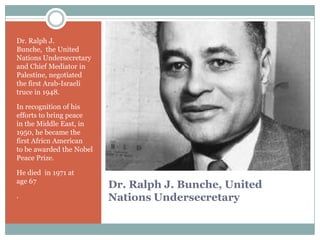
Dr. Ralph J.
Bunche, the United
Nations Undersecretary
and Chief Mediator in
Palestine, negotiated
the first Arab-Israeli
truce in 1948.
In recognition of his
efforts to bring peace
in the Middle East, in
1950, he became the
first Africn American
to be awarded the Nobel
Peace Prize.
He died in 1971 at
age 67
.

Dr. Ralph J. Bunche, United
Nations Undersecretary
The World Veterans Federation (WVF)
World Veterans Federation Credo

“None can speak more eloquently for peace
than those who have fought in war. The voices of war veterans
are a reflection of the longing for peace of people the world over,
who within a generation have twice suffered the unspeakable
catastrophe of world war. Humanity has earned the right to peace.
Without it, there can be no hope for the future.
And without hope, man is lost.
The voice of the people must be heeded they aspire to a richer life
in freedom, equality and dignity, as in things material; they pray
for peace. Their will for peace and a better life can be, must be,
crystalized into an irresistible force against war, aggression and
degradation. The people have had to work and sacrifice for wars.
They will work more willingly for peace.
Let there be a dedicated effort, a greater crusade than history
has ever known, for a world of peace, freedom and equality.”
Ralph Bunche
Nobel Peace Prize, 1950
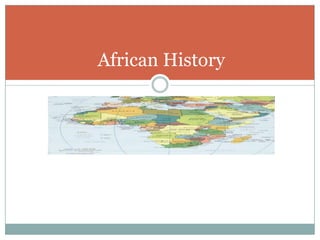
African History
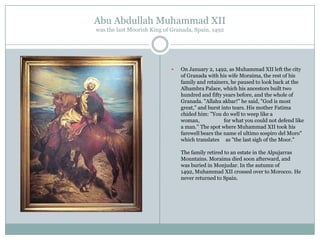
Abu Abdullah Muhammad XII
was the last Moorish King of Granada, Spain, 1492



On January 2, 1492, as Muhammad XII left the city
of Granada with his wife Moraima, the rest of his
family and retainers, he paused to look back at the
Alhambra Palace, which his ancestors built two
hundred and fifty years before, and the whole of
Granada. "Allahu akbar!" he said, "God is most
great," and burst into tears. His mother Fatima
chided him: "You do well to weep like a
woman,
for what you could not defend like
a man." The spot where Muhammad XII took his
farewell bears the name el ultimo sospiro del Moro"
which translates as "the last sigh of the Moor."
The family retired to an estate in the Alpujarras
Mountains. Moraima died soon afterward, and
was buried in Monjudar. In the autumn of
1492, Muhammad XII crossed over to Morocco. He
never returned to Spain.
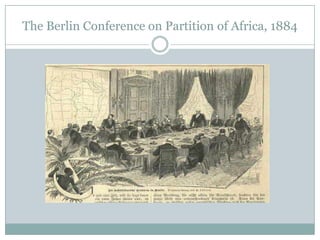
The Berlin Conference on Partition of Africa, 1884
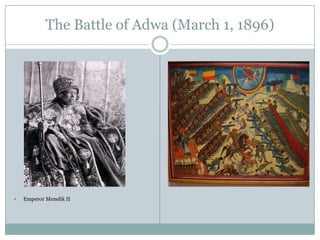
The Battle of Adwa (March 1, 1896)



Emperor Menelik II
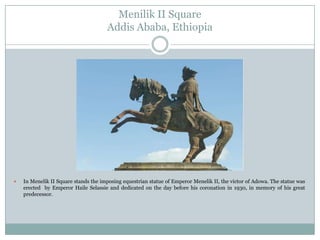
Menilik II Square
Addis Ababa, Ethiopia



In Menelik II Square stands the imposing equestrian statue of Emperor Menelik II, the victor of Adowa. The statue was
erected by Emperor Haile Selassie and dedicated on the day before his coronation in 1930, in memory of his great
predecessor.
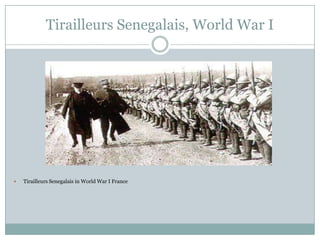
Tirailleurs Senegalais, World War I



Tirailleurs Senegalais in World War I France
Senegalese Tirailleurs
Source: Wikipedia, the free encyclopedia



The Senegalese Tirailleurs were a corps of colonial infantry in the French Army recruited from Senegal, French West
Africa and throughout west, central, and east Africa, the main province of the French colonial empire.



The first Senegalese Tirailleurs were formed in 1857, and served France in a number of wars, including World War I
(providing approximately 200,000 troops, more than 135,000 of whom fought in Europe, and 30,000 of whom were
killed), and World War II.



Other tirailleur regiments were raised in French North Africa from the Arab and Berber populations of Algeria, Tunisia
and Morocco, they were called Tirailleurs algeriens or Turcos. Tirailleur regiments were also raised in Indochina, they
were called Vietnamese, Tonkinese or Annamites Tirailleurs.
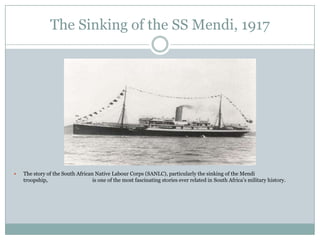
The Sinking of the SS Mendi, 1917



The story of the South African Native Labour Corps (SANLC), particularly the sinking of the Mendi
troopship,
is one of the most fascinating stories ever related in South Africa‟s military history.
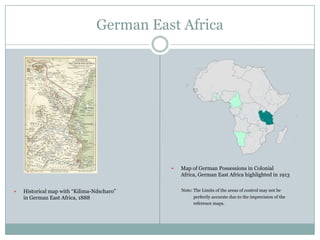
German East Africa





Historical map with “Kilima-Ndscharo”
in German East Africa, 1888

Map of German Possessions in Colonial
Africa, German East Africa highlighted in 1913
Note: The Limits of the areas of control may not be
perfectly accurate due to the imprecision of the
reference maps.
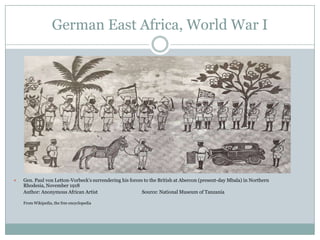
German East Africa, World War I



Gen. Paul von Letton-Vorbeck‟s surrendering his forces to the British at Abercon (present-day Mbala) in Northern
Rhodesia, November 1918
Author: Anonymous African Artist
Source: National Museum of Tanzania
From Wikipedia, the free encyclopedia
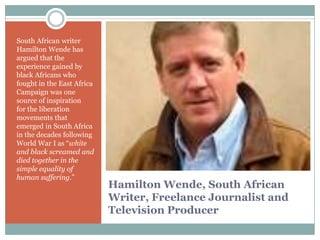
South African writer
Hamilton Wende has
argued that the
experience gained by
black Africans who
fought in the East Africa
Campaign was one
source of inspiration
for the liberation
movements that
emerged in South Africa
in the decades following
World War I as “white
and black screamed and
died together in the
simple equality of
human suffering.”

Hamilton Wende, South African
Writer, Freelance Journalist and
Television Producer
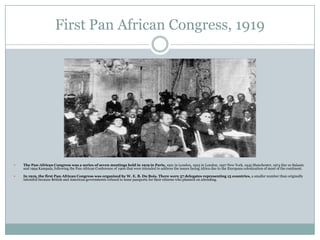
First Pan African Congress, 1919



The Pan-African Congress was a series of seven meetings held in 1919 in Paris, 1921 in London, 1923 in London, 1927 New York, 1945 Manchester, 1974 Dar es Salaam
and 1994 Kampala, following the Pan-African Conference of 1900 that were intended to address the issues facing Africa due to the European colonization of most of the continent.



In 1919, the first Pan-African Congress was organized by W. E. B. Du Bois. There were 57 delegates representing 15 countries, a smaller number than originally
intended because British and American governments refused to issue passports for their citizens who planned on attending.
Emperor Haile Selassie of Ethiopia


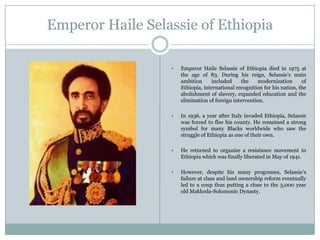
Emperor Haile Selassie of Ethiopia died in 1975 at
the age of 83. During his reign, Selassie‟s main
ambition
included
the
modernization
of
Ethiopia, international recognition for his nation, the
abolishment of slavery, expanded education and the
elimination of foreign intervention.



In 1936, a year after Italy invaded Ethiopia, Selassie
was forced to flee his county. He remained a strong
symbol for many Blacks worldwide who saw the
struggle of Ethiopia as one of their own.



He returned to organize a resistance movement in
Ethiopia which was finally liberated in May of 1941.



However, despite his many progresses, Selassie‟s
failure at class and land ownership reform eventually
led to a coup thus putting a close to the 3,000 year
old Makkeda-Solomonic Dynasty.
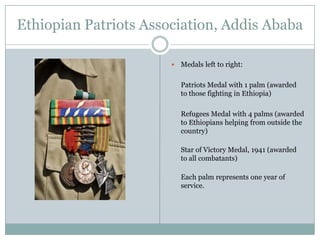
Ethiopian Patriots Association, Addis Ababa


Medals left to right:

Patriots Medal with 1 palm (awarded
to those fighting in Ethiopia)
Refugees Medal with 4 palms (awarded
to Ethiopians helping from outside the
country)
Star of Victory Medal, 1941 (awarded
to all combatants)
Each palm represents one year of
service.
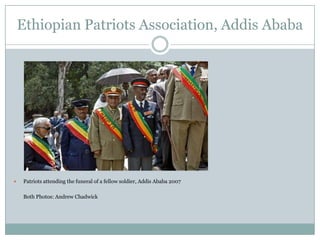
Ethiopian Patriots Association, Addis Ababa



Patriots attending the funeral of a fellow soldier, Addis Ababa 2007
Both Photos: Andrew Chadwick
The Lion of Judah, La‟gare Square & Yekatit 12 Square
Addis Ababa, Ethiopia



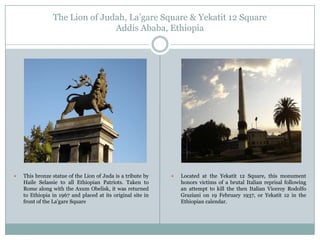
This bronze statue of the Lion of Juda is a tribute by
Haile Selassie to all Ethiopian Patriots. Taken to
Rome along with the Axum Obelisk, it was returned
to Ethiopia in 1967 and placed at its original site in
front of the La'gare Square



Located at the Yekatit 12 Square, this monument
honors victims of a brutal Italian reprisal following
an attempt to kill the then Italian Viceroy Rodolfo
Graziani on 19 February 1937, or Yekatit 12 in the
Ethiopian calendar.
The Black Eagle of Harlem & The Brown Condor



Colonel Hubert Fauntleroy Julian with his Packard
Bellanca, "The Abyssinia" in 1931. Julian was at the time the
holder of the World's Non-Refueling Endurance Record for a
flight lasting 84 HRS. and 33 MINS.
Colonel Hubert Fauntleroy Julian, the Black Eagle of
Harlem is another little known figure in Ethiopian and
American history. Hubert Fauntleroy Julian died in the
borough of the Bronx, New York City, in February 1983. His
passing went largely unnoticed.



Col. John C. Robinson, later known as the Brown Condor
returning home in 1936



Colonel John Robinson (the Black Condor [sometimes
called the Brown Condor]), helped in establishing the
nascent Ethiopian air force. Colonel Robinson commanded The
Ethiopian Air Force and actively participated in reconnaissance
mission for the Ethiopian Army during the Italian invasion in
1935.
Casablanca Conference 1943, Morocco



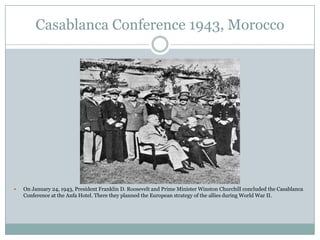
On January 24, 1943, President Franklin D. Roosevelt and Prime Minister Winston Churchill concluded the Casablanca
Conference at the Anfa Hotel. There they planned the European strategy of the allies during World War II.
Allied Landing in Southern France on August
15, 1944,
also known as the „Forgotten D-Day‟



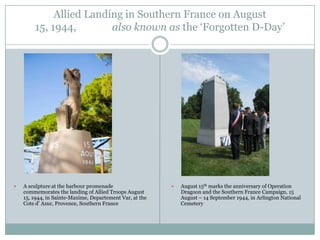
A sculpture at the harbour promenade
commemorates the landing of Allied Troops August
15, 1944, in Sainte-Maxime, Departement Var, at the
Cote d‟ Azur, Provence, Southern France



August 15th marks the anniversary of Operation
Dragoon and the Southern France Campaign, 15
August – 14 September 1944, in Arlington National
Cemetery
World War I Exhibit examines role of Asian, African Troops
”Man, Culture and War,” an exhibit at Brussells‟ BELvue Museum, seeks to set the record straight about the contribution
of colonial troops during the 1914-1918 conflict that became known as the Great War














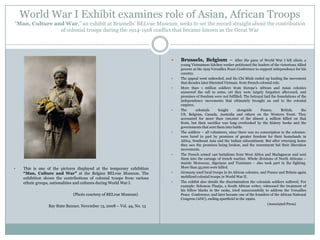
This is one of the pictures displayed at the temporary exhibition
“Man, Culture and War” at the Belgian BELvue Museum. The
exhibition shows the contributions of colonial troops from various
ethnic groups, nationalities and cultures during World War I.
(Photo courtesy of BELvue Museum)
Bay State Banner, November 13, 2008 – Vol. 44, No. 13




Brussels, Belgium –

After the guns of World War I fell silent, a
young Vietnamese kitchen worker petitioned the leaders of the victorious Allied
powers at the 1919 Versailles Peace Conference to support independence for his
country.
The appeal went unheeded, and Ho Chi Minh ended up leading the movement
that decades later liberated Vietnam from French colonial rule.
More than 1 million soldiers from Europe‟s African and Asian colonies
answered the call to arms, yet they were largely forgotten afterward, and
promises of freedom were not fulfilled. The betrayal laid the foundations of the
independence movements that ultimately brought an end to the colonial
empires.
The
colonials
fought
alongside
France,
British,
the
US, Belgium, Canada, Australia and others on the Western Front. They
accounted for more than 100,000 of the almost 4 million killed on that
front, but their sacrifice was long overlooked by the history books and the
governments that sent them into battle.
The soldiers – all volunteers, since there was no conscription in the colonieswere lured in part by promises of greater freedom for their homelands in
Africa, Southeast Asia and the Indian subcontinent. But after returning home
they saw the promises being broken, and the resentment fed their liberation
movements.
The French armed 140 battalions from West Africa and Madagascar and sent
them into the carnage of trench warfare. Whole divisions of North Africans –
mainly Moroccan, Algerians and Tunisians – also took part in the fighting.
More than 35,000 were killed.
Germany used local troops in its African colonies, and France and Britain again
mobilized colonial troops in World War II.
The exhibit also details the discrimination the colonials soldiers suffered. For
example: Solomon Plaatje, a South African writer, witnessed the treatment of
his fellow blacks in the ranks, tried unsuccessfully to address the Versailles
Peace Conference, and later became one of the founders of the African National
Congress (ANC), ending apartheid in the 1990s.
(Associated Press)
POST WORLD WAR I
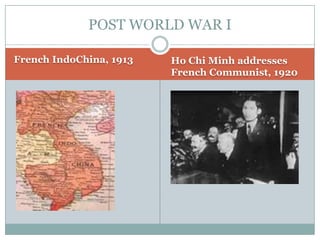
French IndoChina, 1913

Ho Chi Minh addresses
French Communist, 1920
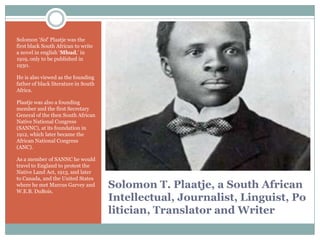
Solomon „Sol‟ Plaatje was the
first black South African to write
a novel in english „Mhud,‟ in
1919, only to be published in
1930.
He is also viewed as the founding
father of black literature in South
Africa.
Plaatje was also a founding
member and the first Secretary
General of the then South African
Native National Congress
(SANNC), at its foundation in
1912, which later became the
African National Congress
(ANC).
As a member of SANNC he would
travel to England to protest the
Native Land Act, 1913, and later
to Canada, and the United States
where he met Marcus Garvey and
W.E.B. DuBois.

Solomon T. Plaatje, a South African
Intellectual, Journalist, Linguist, Po
litician, Translator and Writer
In Pictures: Africa‟s World
War II Veterans
UNTOLD STORY
The African soldiers who fought
for the British Empire in World
War II are remembered in an
exhibition at the Imperial War
Museum North in
Manchester, UK .
“This is the untold story of the
forgotten heroes of the
Commonwealth,” says
Zimbabwean artist Raphael
Chikukwa, the curator of the
exhibition.
Chikukwa was prompted to put
on the exhibition after seeing an
earlier exhibition on the
war, which he found lacking
“Africans were not being
represented for their
contribution to the mother
empire,” he says.
(BBC NEWS)

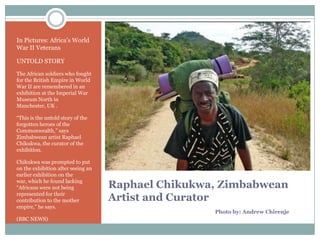
Raphael Chikukwa, Zimbabwean
Artist and Curator
Photo by: Andrew Chirenje
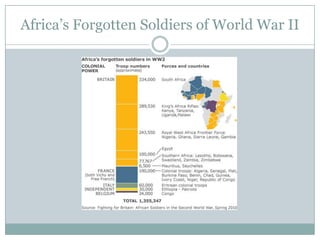
Africa‟s Forgotten Soldiers of World War II
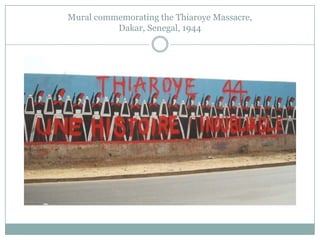
Mural commemorating the Thiaroye Massacre,
Dakar, Senegal, 1944
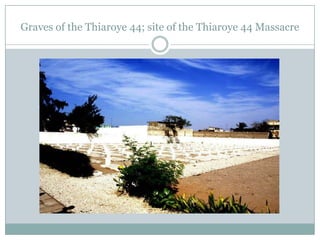
Graves of the Thiaroye 44; site of the Thiaroye 44 Massacre
Thiaroye Massacre, 1944
ISS World History Forum: 10th Grade: Student Blog



Thiaroye is a name of a historical town in Senegal. It is found in the suburbs of Dakar, on the southeast coast of the Cap Vert peninsula between
Pikine and Rufisque. The village of Thiaroye was founded around 1800, and as the city of Dakar, which was a city created by the
french, expanded in territory during the 20th century, Thiaroye was slowly merged into the larger city. Thiaroye is most known for the Thiaroye
Massacre, a massacre which happened in 1944. The Thiaroye Massacre was a mass killing of French West African troops - Tirailleurs
Senegalasi- by French forces around December 1944.



The Tirailleurs Senegalais were a West African Colonial Army troop who fought for the French during World War I, World War II and in other
smaller battles and operations. Even though these troops were named after “The Tirailleurs Senegalais” the soldiers were not only recruited, or
forced in Senegal but also through out the French part of West Africa. In 1857 The Tirailleurs Senegalais were the permanent unit of black
African soldiers under the French rule. Throughout 1857-1905 the French used the Tirailleurs Senegalais for fighting resistance forces and
defending the French territories in Africa. With the start of World War I in the summer of 1914 many Tirailleurs Senegalais soldiers were
brought to France and helped the French in some important battles. There was 170,891 Tirailleurs Senegalais soldiers fighting during World
War I and by 1918 once the war had ended 30,000 of them had been killed.



During World War II ,which started in 1939, France once again decided to use the Tirailleurs Senegalais troops. By the 1940‟s 9 % of the French
army was made up of African Troops. This time they used 200,000 Tirailleurs Senegalais soldiers and by 1945 (end of World War II) 25,000 of
them had been killed while in battle. Many of these African men had been taken into German labor camps and some which had been taken as
prisoners during the war were murdered by the Wehrmacht in 1940. In World War I the Tirailleurs Senegalais soldiers were not really
integrated into the French military units but during World War II with changes made they suddenly were, but then when Charles de Gaulle, the
French president at that time, saw that France was very close to victory, he ordered a “whitening” of the troops by replacing 20,000 Africans
which were at battle at the front with white French soldiers. This event caused hatred and dislike between the white and the blacks at war.
Once the French had gained there liberation, the Tirailleurs Senegalais troops were grouped in French centers waiting to go back home. While
at the centers these African soldiers faced discriminatory treatment. They barely got food and resources they needed and basically did not have
any kind of shelter. In December 1944, humiliated and without having been given what they were promised, the soldiers protested for the back
pay that they were entitled to. The protest was seen as a defiance against the French military and the general in charge with the help of the
gendarme (Military Police) ordered the "white" French military to open fire, which resulted in 35 Africans killed, hundreds wounded and many
sent to jail.
The French government has decided to forget this part of history and in no school books or history lessons is there the mention of the
Tirailleurs Senegalais, who where very much part of the French liberation. There is neither a festive day to commemorate these heroes or any
monument to remotely remember them in the French capital. It is like they never existed but in reality they where as much present as any other
French solider and suffered as much if not even more. This part of French racism has been forgotten and it is about time that we show are
respect and appreciation towards these fallen heroes.
Pacome Schembri Sant, Graduate
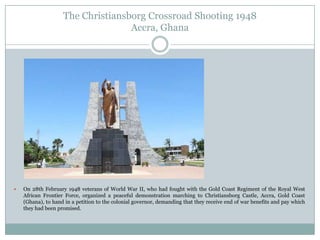
The Christiansborg Crossroad Shooting 1948
Accra, Ghana



On 28th February 1948 veterans of World War II, who had fought with the Gold Coast Regiment of the Royal West
African Frontier Force, organized a peaceful demonstration marching to Christiansborg Castle, Accra, Gold Coast
(Ghana), to hand in a petition to the colonial governor, demanding that they receive end of war benefits and pay which
they had been promised.
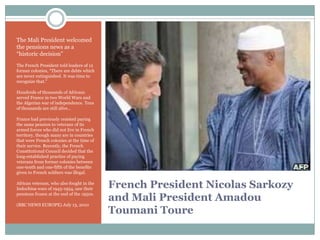
The Mali President welcomed
the pensions news as a
“historic decision”
The French President told leaders of 12
former colonies, “There are debts which
are never extinguished. It was time to
recognize that.”
Hundreds of thousands of Africans
served France in two World Wars and
the Algerian war of independence. Tens
of thousands are still alive…
France had previously resisted paying
the same pension to veterans of its
armed forces who did not live in French
territory, though many are in countries
that were French colonies at the time of
their service. Recently, the French
Constitutional Council decided that the
long-established practice of paying
veterans from former colonies between
one-tenth and one-fifth of the benefits
given to French soldiers was illegal.
African veterans, who also fought in the
Indochina wars of 1945-1954, saw their
pensions frozen at the end of the 1950s.
(BBC NEWS EUROPE) July 13, 2010

French President Nicolas Sarkozy
and Mali President Amadou
Toumani Toure
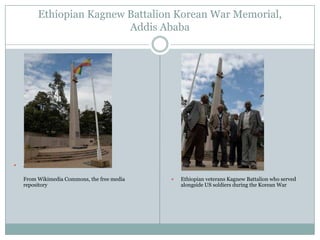
Ethiopian Kagnew Battalion Korean War Memorial,
Addis Ababa



Author: US Army Africa
From Wikimedia Commons, the free media
repository



Ethiopian veterans Kagnew Battalion who served
alongside US soldiers during the Korean War
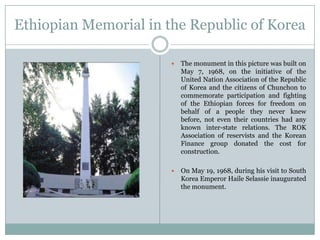
Ethiopian Memorial in the Republic of Korea


The monument in this picture was built on
May 7, 1968, on the initiative of the
United Nation Association of the Republic
of Korea and the citizens of Chunchon to
commemorate participation and fighting
of the Ethiopian forces for freedom on
behalf of a people they never knew
before, not even their countries had any
known inter-state relations. The ROK
Association of reservists and the Korean
Finance group donated the cost for
construction.



On May 19, 1968, during his visit to South
Korea Emperor Haile Selassie inaugurated
the monument.
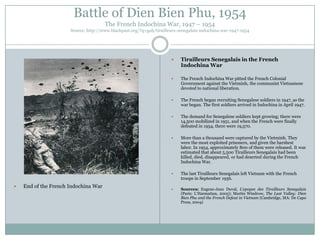
Battle of Dien Bien Phu, 1954
The French Indochina War, 1947 – 1954
Source: http://www.blackpast.org/?q=gah/tirailleurs-senegalais-indochina-war-1947-1954





The French began recruiting Senegalese soldiers in 1947, as the
war began. The first soldiers arrived in Indochina in April 1947.



The demand for Senegalese soldiers kept growing; there were
14,500 mobilized in 1951, and when the French were finally
defeated in 1954, there were 19,570.



More than a thousand were captured by the Vietminh. They
were the most exploited prisoners, and given the harshest
labor. In 1954, approximately 800 of them were released. It was
estimated that about 5,500 Tirailleurs Senegalais had been
killed, died, disappeared, or had deserted during the French
Indochina War.



End of the French Indochina War

The French Indochina War pitted the French Colonial
Government against the Vietminh, the communist Vietnamese
devoted to national liberation.





Tirailleurs Senegalais in the French
Indochina War

The last Tirailleurs Senegalais left Vietnam with the French
troops in September 1956.



Sources: Eugene-Jean Duval, L’epopee des Tirailleurs Senegalais
(Paris: L‟Harmattan, 2005); Martin Windrow, The Last Valley: Dien
Bien Phu and the French Defeat in Vietnam (Cambridge, MA: De Capo
Press, 2004)
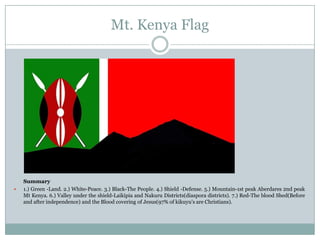
Mt. Kenya Flag



Summary
1.) Green -Land. 2.) White-Peace. 3.) Black-The People. 4.) Shield -Defense. 5.) Mountain-1st peak Aberdares 2nd peak
Mt Kenya. 6.) Valley under the shield-Laikipia and Nakuru Districts(diaspora districts). 7.) Red-The blood Shed(Before
and after independence) and the Blood covering of Jesus(97% of kikuyu's are Christians).
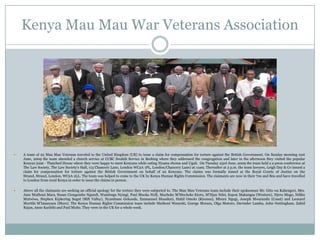
Kenya Mau Mau War Veterans Association



A team of 22 Mau Mau Veterans traveled to the United Kingdom (UK) to issue a claim for compensation for torture against the British Government. On Sunday morning 21st
June, 2009 the team attended a church service at CCBC Swahili Service in Barking where they addressed the congregation and later in the afternoon they visited the popular
Kenyan joint - Thatched House where they were happy to meet Kenyans while eating Nyama choma and Ugali. On Tuesday 23rd June, 2009 the team held a a press conference at
The Law Society, The Law Society's Hall, 113 Chancery Lane, London WC2A 1PL, London/Chancery Lane) at 11am. Thereafter at 2 p.m. the team lawyers, Leigh Day & Co issued a
claim for compensation for torture against the British Government on behalf of 22 Kenyans. The claims was formally issued at the Royal Courts of Justice on the
Strand, Strand, London, WC2A 2LL. The team was helped to come to the UK by Kenya Human Rights Commission. The claimants are now in their 70s and 80s and have travelled
to London from rural Kenya in order to issue the claims in person.



Above all the claimants are seeking an official apology for the torture they were subjected to. The Mau Mau Veterans team include their spokesman Mr. Gitu wa Kahengeri, Mrs.
Jane Muthoni Mara, Susan Ciongombe Ngondi, Wambugu Nyingi, Paul Muoka Nzili, Mucheke M'Mucheke Kioru, M'Njau Ndei, Espon Makangaa (Western), Njeru Mugo, Ndiku
Mutwiwa, Stephen Kipkering Sugut (Rift Valley), Nyambane Gekonde, Emmanuel Musakari, Habil Omolo (Kisumu), Mburu Ngugi, Joseph Mwarandu (Coast) and Leonard
Murithi M'Imanyara (Meru). The Kenya Human Rights Commission team include Muthoni Wanyeki, Goerge Morara, Olga Mutoro, Davinder Lamba, John Nottingham, Zahid
Rajan, Anne Kariithi and Paul Muite. They were in the UK for a whole week.
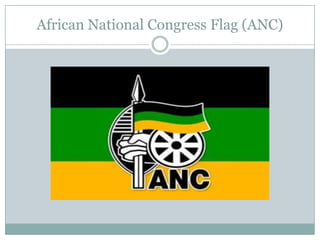
African National Congress Flag (ANC)
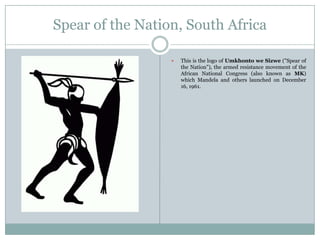
Spear of the Nation, South Africa


This is the logo of Umkhonto we Sizwe ("Spear of
the Nation"), the armed resistance movement of the
African National Congress (also known as MK)
which Mandela and others launched on December
16, 1961.
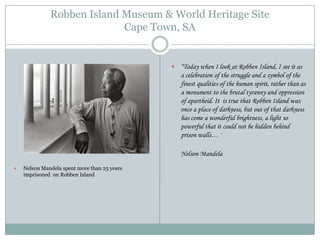
Robben Island Museum & World Heritage Site
Cape Town, SA



“Today when I look at Robben Island, I see it as
a celebration of the struggle and a symbol of the
finest qualities of the human spirit, rather than as
a monument to the brutal tyranny and oppression
of apartheid. It is true that Robben Island was
once a place of darkness, but out of that darkness
has come a wonderful brightness, a light so
powerful that it could not be hidden behind
prison walls… '
Nelson Mandela



Nelson Mandela spent more than 25 years
imprisoned on Robben Island
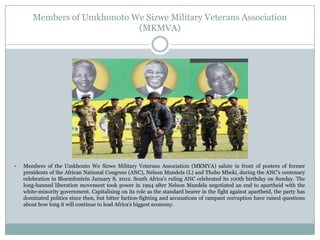
Members of Umkhonoto We Sizwe Military Veterans Association
(MKMVA)



Members of the Umkhonto We Sizwe Military Veterans Association (MKMVA) salute in front of posters of former
presidents of the African National Congress (ANC), Nelson Mandela (L) and Thabo Mbeki, during the ANC's centenary
celebration in Bloemfontein January 8, 2012. South Africa's ruling ANC celebrated its 100th birthday on Sunday. The
long-banned liberation movement took power in 1994 after Nelson Mandela negotiated an end to apartheid with the
white-minority government. Capitalising on its role as the standard bearer in the fight against apartheid, the party has
dominated politics since then, but bitter faction-fighting and accusations of rampant corruption have raised questions
about how long it will continue to lead Africa's biggest economy.
Sharpeville Massacre, March 21, 1960


The Sharpeville massacre of March 21, 1960 was a
decisive turning point in South Africa‟s history. It
marked the climax of a decade mounting, nonviolent resistance to apartheid centered among black
majority of the country‟s inhabitants. Six-nine antipass demonstrators were killed on that day, mainly
shot in the back, and 186 were injured.



It also signaled the opening of a much more brutal
and intensive phase of state repression – the state
introduced a battery of draconian measures: The
African National Congress (ANC) and Pan African
Congress (PAC) were banned, a national state of
emergency was declared, security laws and
institutions were extended and reinforced.



The ANC and PAC at first called for mass action, later
they went underground, and finally launched armed
wings (Umkhonto we Sizwe, or MK, and POQO) or
various forms of armed resistance.
The Soweto Uprising, June 16, 1976






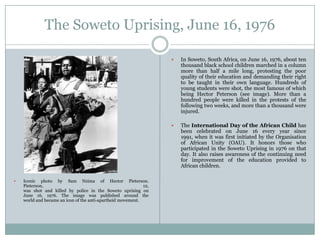
Iconic photo by Sam Nzima of Hector Pieterson.
Pieterson,
12,
was shot and killed by police in the Soweto uprising on
June 16, 1976. The image was published around the
world and became an icon of the anti-apartheid movement.

In Soweto, South Africa, on June 16, 1976, about ten
thousand black school children marched in a column
more than half a mile long, protesting the poor
quality of their education and demanding their right
to be taught in their own language. Hundreds of
young students were shot, the most famous of which
being Hector Peterson (see image). More than a
hundred people were killed in the protests of the
following two weeks, and more than a thousand were
injured.
The International Day of the African Child has
been celebrated on June 16 every year since
1991, when it was first initiated by the Organisation
of African Unity (OAU). It honors those who
participated in the Soweto Uprising in 1976 on that
day. It also raises awareness of the continuing need
for improvement of the education provided to
African children.
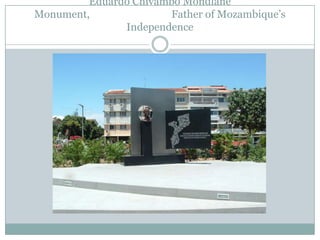
Eduardo Chivambo Mondlane
Monument,
Father of Mozambique‟s
Independence
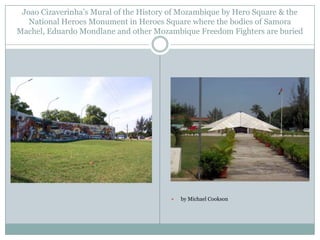
Joao Cizaverinha‟s Mural of the History of Mozambique by Hero Square & the
National Heroes Monument in Heroes Square where the bodies of Samora
Machel, Eduardo Mondlane and other Mozambique Freedom Fighters are buried



by Michael Cookson
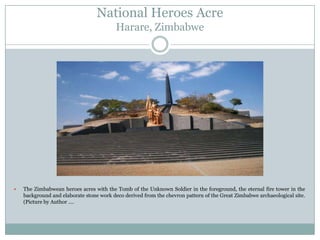
National Heroes Acre
Harare, Zimbabwe



The Zimbabwean heroes acres with the Tomb of the Unknown Soldier in the foreground, the eternal fire tower in the
background and elaborate stone work deco derived from the chevron pattern of the Great Zimbabwe archaeological site.
(Picture by Author ….
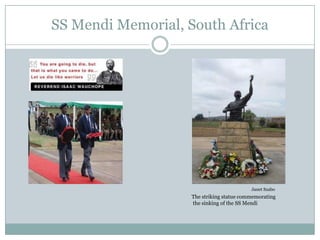
SS Mendi Memorial, South Africa

Janet Szabo

The striking statue commemorating
the sinking of the SS Mendi
World Veterans Federation
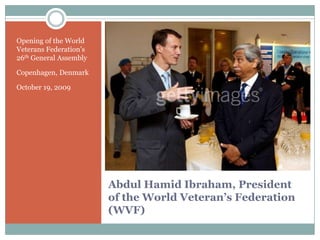
Opening of the World
Veterans Federation‟s
26th General Assembly
Copenhagen, Denmark
October 19, 2009

Abdul Hamid Ibraham, President
of the World Veteran’s Federation
(WVF)
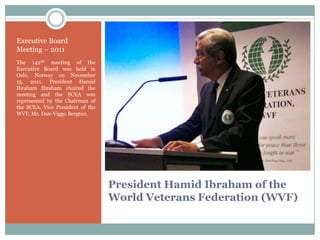
Executive Board
Meeting – 2011
The 142nd meeting of the
Executive Board was held in
Oslo, Norway on November
15, 2011. President Hamid
Ibraham Ibraham chaired the
meeting and the SCEA was
represented by the Chairman of
the SCEA, Vice President of the
WVF, Mr. Dan-Viggo Bergtun.

President Hamid Ibraham of the
World Veterans Federation (WVF)
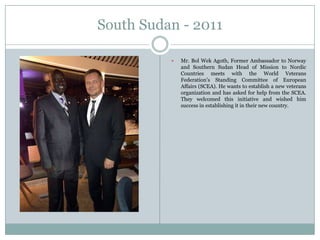
South Sudan - 2011


Mr. Bol Wek Agoth, Former Ambassador to Norway
and Southern Sudan Head of Mission to Nordic
Countries meets with the World Veterans
Federation‟s Standing Committee of European
Affairs (SCEA). He wants to establish a new veterans
organization and has asked for help from the SCEA.
They welcomed this initiative and wished him
success in establishing it in their new country.
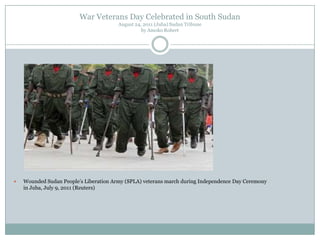
War Veterans Day Celebrated in South Sudan
August 24, 2011 (Juba) Sudan Tribune
by Amoko Robert



Wounded Sudan People‟s Liberation Army (SPLA) veterans march during Independence Day Ceremony
in Juba, July 9, 2011 (Reuters)
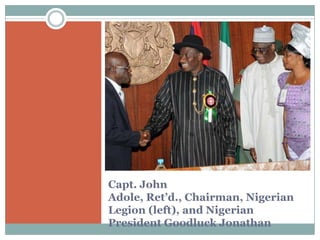
Capt. John
Adole, Ret’d., Chairman, Nigerian
Legion (left), and Nigerian
President Goodluck Jonathan
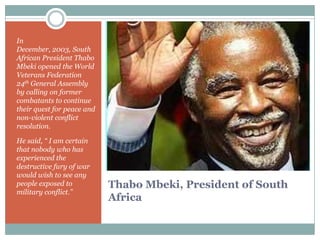
In
December, 2003, South
African President Thabo
Mbeki opened the World
Veterans Federation
24th General Assembly
by calling on former
combatants to continue
their quest for peace and
non-violent conflict
resolution.
He said, “ I am certain
that nobody who has
experienced the
destructive fury of war
would wish to see any
people exposed to
military conflict.”

Thabo Mbeki, President of South
Africa
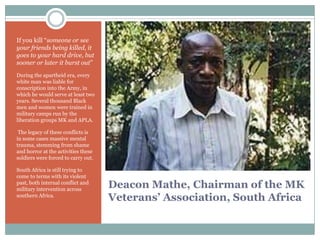
If you kill “someone or see
your friends being killed, it
goes to your hard drive, but
sooner or later it burst out”
During the apartheid era, every
white man was liable for
conscription into the Army, in
which he would serve at least two
years. Several thousand Black
men and women were trained in
military camps run by the
liberation groups MK and APLA.
The legacy of these conflicts is
in some cases massive mental
trauma, stemming from shame
and horror at the activities these
soldiers were forced to carry out.
South Africa is still trying to
come to terms with its violent
past, both internal conflict and
military intervention across
southern Africa.

Deacon Mathe, Chairman of the MK
Veterans’ Association, South Africa
Solomon “Solly”
Rataemane, MD, South Africa
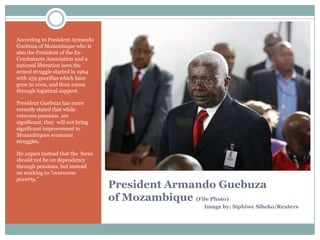
According to President Armando
Guebuza of Mozambique who is
also the President of the ExCombatants Association and a
national liberation hero the
armed struggle started in 1964
with 259 guerillas which later
grew to 100s, and then 1000s
through logistical support.
President Guebuza has more
recently stated that while
veterans pensions are
significant, they will not bring
significant improvement to
Mozambiques economic
struggles.
He argues instead that the focus
should not be on dependency
through pensions, but instead
on working to “overcome
poverty.”

President Armando Guebuza
of Mozambique (File Photo)
Image by: Siphiwe Sibeko/Reuters
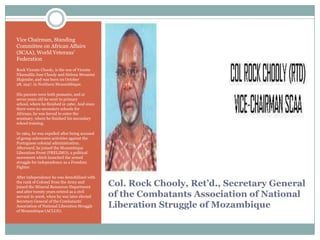
Vice Chairman, Standing
Committee on African Affairs
(SCAA), World Veterans‟
Federation
Rock Vicente Chooly, is the son of Vicente
Nkamalila Jose Chooly and Helena Mwanini
Majembe, and was born on October
28, 1947, in Northern Mozambbique.
His parents were both peasants, and at
seven years old he went to primary
school, where he finished in 1960. And since
there were no secondary schools for
Africans, he was forced to enter the
seminary, where he finished his secondary
school training.
In 1964, he was expelled after being accused
of group subversive activities against the
Portuguese colonial administration.
Afterward, he joined the Mozambique
Liberation Front (FRELIMO), a political
movement which launched the armed
struggle for independence as a Freedom
Fighter.
After independence he was demobilized with
the rank of Colonel from the Army and
joined the Mineral Resources Department
and after twenty years retired as a civil
servant in 2006, when he was later elected
Secretary General of the Combatants‟
Association of National Liberation Struggle
of Mozambique (ACLLN).

Col. Rock Chooly, Ret’d., Secretary General
of the Combatants Association of National
Liberation Struggle of Mozambique
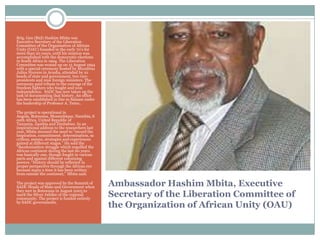
Brig. Gen (Rtd) Hashim Mbita was
Executive Secretary of the Liberation
Committee of the Organisation of African
Unity (OAU) founded in the early 70‟s for
more than 20 years, until his mission was
accomplished with the democratic elections
in South Africa in 1994. The Liberation
Committee was wound up on 15 August 1994
with a special ceremony hosted by Mwalimu
Julius Nyerere in Arusha, attended by 10
heads of state and government, two vicepresidents and nine foreign ministers. The
ceremony paid tribute to the courage of the
freedom fighters who fought and won
independence. SADC has now taken up the
task of documenting that history. An office
has been established in Dar es Salaam under
the leadership of Professor A. Temu..
The project is operational in
Angola, Botswana, Mozambique, Namibia, S
outh Africa, United Republic of
Tanzania, Zambia and Zimbabwe. In an
inspirational address to the researchers last
year, Mbita stressed the need to “record the
inspiration, commitment, determination, sa
crifices, means, strategies and experiences
gained at different stages.” He said the
“decolonisation struggle which engulfed the
African continent during the last 60 years
was basically one, though fought in various
parts and against different colonizing
powers. “History should be reflected in
proper perspective through the African eye
because many a time it has been written
from outside the continent,” Mbita said.
The project was approved by the Summit of
SADC Heads of State and Government when
they met in Botswana in August 2005 to
mark the Silver Jubilee of the regional
community. The project is funded entirely
by SADC governments.

Ambassador Hashim Mbita, Executive
Secretary of the Liberation Committee of
the Organization of African Unity (OAU)
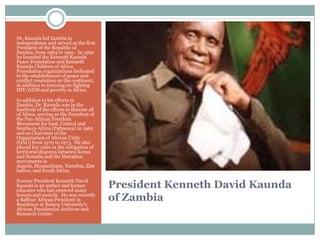
Dr. Kaunda led Zambia to
independence and served as the first
President of the Republic of
Zambia, from 1964 to 1991. In 1992
he founded the Kenneth Kaunda
Peace Foundation and Kenneth
Kaunda Children of Africa
Foundation organizations dedicated
to the establishment of peace and
conflict resolution on the continent;
in addition to focusing on fighting
HIV/AIDS and poverty in Africa.
In addition to his efforts in
Zambia, Dr. Kaunda was in the
forefront of the efforts to liberate all
of Africa, serving as the President of
the Pan-African Freedom
Movement for East, Central and
Southern Africa (Pafmesca) in 1962
and as Chairman of the
Organization of African Unity
(OAU) from 1970 to 1973. He also
played key roles in the mitigation of
territorial disputes between Kenya
and Somalia and the liberation
movements in
Angola, Mozambique, Namibia, Zim
babwe, and South Africa.
Former President Kenneth David
Kaunda is an author and former
educator who has received many
honors and awards. He was recently
a Balfour African President in
Residence at Boston University's
African Presidential Archives and
Research Center.

President Kenneth David Kaunda
of Zambia
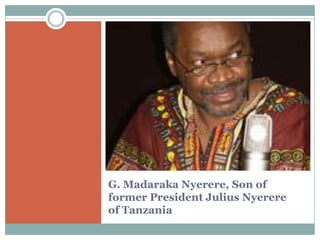
G. Madaraka Nyerere, Son of
former President Julius Nyerere
of Tanzania
Mount Kilimanjaro





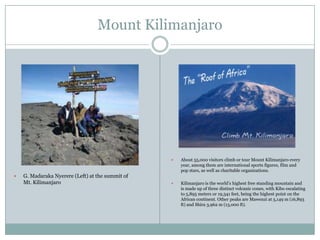
G. Madaraka Nyerere (Left) at the summit of
Mt. Kilimanjaro

About 55,000 visitors climb or tour Mount Kilimanjaro every
year, among them are international sports figures, film and
pop stars, as well as charitable organizations.



Kilimanjaro is the world‟s highest free standing mountain and
is made up of three distinct volcanic cones, with Kibo escalating
to 5,895 meters or 19,341 feet, being the highest point on the
African continent. Other peaks are Mawenzi at 5,149 m (16,893
ft) and Shira 3,962 m (13,000 ft).
Amputee veterans stand up to Mt. Kilimanjaro
The Washington Post, Wednesday, August 11, 2010



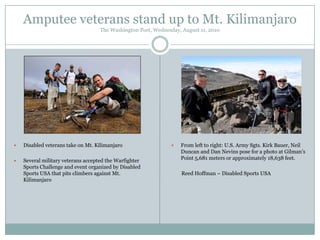
Disabled veterans take on Mt. Kilimanjaro



Several military veterans accepted the Warfighter
Sports Challenge and event organized by Disabled
Sports USA that pits climbers against Mt.
Kilimanjaro



From left to right: U.S. Army Sgts. Kirk Bauer, Neil
Duncan and Dan Nevins pose for a photo at Gilman‟s
Point 5,681 meters or approximately 18,638 feet.
Reed Hoffman – Disabled Sports USA
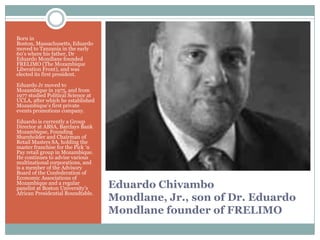
Born in
Boston, Massachusetts, Eduardo
moved to Tanzania in the early
60‟s where his father, Dr
Eduardo Mondlane founded
FRELIMO (The Mozambique
Liberation Front), and was
elected its first president.
Eduardo Jr moved to
Mozambique in 1975, and from
1977 studied Political Science at
UCLA, after which he established
Mozambique‟s first private
events promotions company.
Eduardo is currently a Group
Director at ABSA, Barclays Bank
Mozambique, Founding
Shareholder and Chairman of
Retail Masters SA, holding the
master franchise for the Pick „n
Pay retail group in Mozambique.
He continues to advise various
multinational corporations, and
is a member of the Advisory
Board of the Confederation of
Economic Associations of
Mozambique and a regular
panelist at Boston University‟s
African Presidential Roundtable.

Eduardo Chivambo
Mondlane, Jr., son of Dr. Eduardo
Mondlane founder of FRELIMO
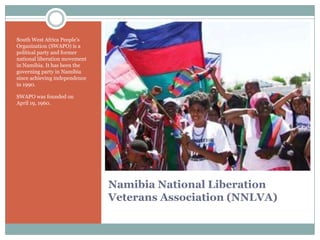
South West Africa People‟s
Organization (SWAPO) is a
political party and former
national liberation movement
in Namibia. It has been the
governing party in Namibia
since achieving independence
in 1990.
SWAPO was founded on
April 19, 1960.

Namibia National Liberation
Veterans Association (NNLVA)
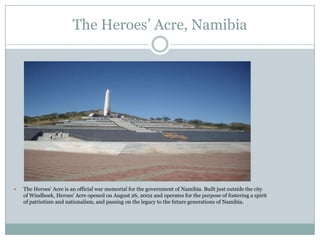
The Heroes‟ Acre, Namibia



The Heroes‟ Acre is an official war memorial for the government of Namibia. Built just outside the city
of Windhoek, Heroes‟ Acre opened on August 26, 2002 and operates for the purpose of fostering a spirit
of patriotism and nationalism, and passing on the legacy to the future generations of Namibia.
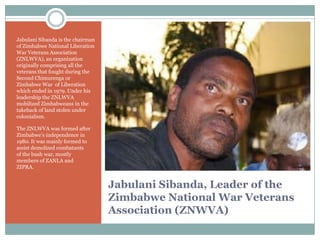
Jabulani Sibanda is the chairman
of Zimbabwe National Liberation
War Veterans Association
(ZNLWVA), an organization
originally comprising all the
veterans that fought during the
Second Chimurenga or
Zimbabwe War of Liberation
which ended in 1979. Under his
leadership the ZNLWVA
mobilized Zimbabweans in the
takeback of land stolen under
colonialism.
The ZNLWVA was formed after
Zimbabwe‟s independence in
1980. It was mainly formed to
assist demolized combatants
of the bush war, mostly
members of ZANLA and
ZIPRA.

Jabulani Sibanda, Leader of the
Zimbabwe National War Veterans
Association (ZNWVA)
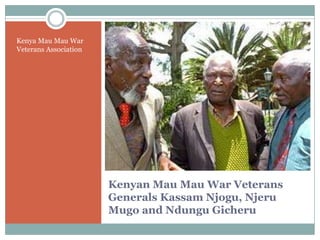
Kenya Mau Mau War
Veterans Association

Kenyan Mau Mau War Veterans
Generals Kassam Njogu, Njeru
Mugo and Ndungu Gicheru
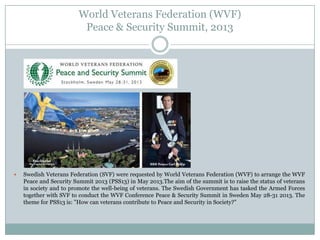
World Veterans Federation (WVF)
Peace & Security Summit, 2013



Swedish Veterans Federation (SVF) were requested by World Veterans Federation (WVF) to arrange the WVF
Peace and Security Summit 2013 (PSS13) in May 2013.The aim of the summit is to raise the status of veterans
in society and to promote the well-being of veterans. The Swedish Government has tasked the Armed Forces
together with SVF to conduct the WVF Conference Peace & Security Summit in Sweden May 28-31 2013. The
theme for PSS13 is: "How can veterans contribute to Peace and Security in Society?"
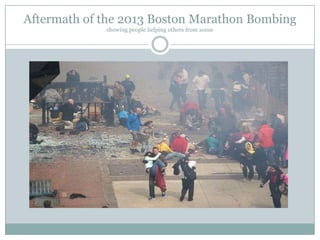
Aftermath of the 2013 Boston Marathon Bombing
showing people helping others from scene
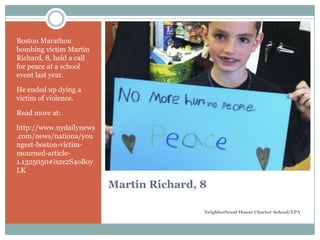
Boston Marathon
bombing victim Martin
Richard, 8, held a call
for peace at a school
event last year.
He ended up dying a
victim of violence.
Read more at:
http://www.nydailynews
.com/news/nationa/you
ngest-boston-victimmourned-article1.1325050#ixzz2S4oBoy
LK

Martin Richard, 8
Neighborhood House Charter School/EPA
World Veterans Federation
Peace & Security Summit
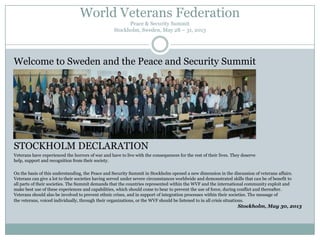
Stockholm, Sweden, May 28 – 31, 2013

Welcome to Sweden and the Peace and Security Summit

STOCKHOLM DECLARATION
Veterans have experienced the horrors of war and have to live with the consequences for the rest of their lives. They deserve
help, support and recognition from their society.
On the basis of this understanding, the Peace and Security Summit in Stockholm opened a new dimension in the discussion of veterans affairs.
Veterans can give a lot to their societies having served under severe circumstances worldwide and demonstrated skills that can be of benefit to
all parts of their societies. The Summit demands that the countries represented within the WVF and the international community exploit and
make best use of these experiences and capabilities, which should come to bear to prevent the use of force, during conflict and thereafter.
Veterans should also be involved to prevent ethnic crises, and in support of integration processes within their societies. The message of
the veterans, voiced individually, through their organizations, or the WVF should be listened to in all crisis situations.

Stockholm, May 30, 2013
U.S. Army Africa Command
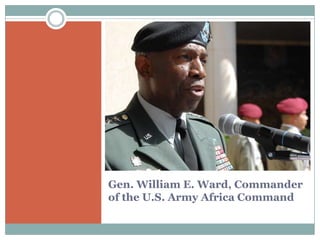
Gen. William E. Ward, Commander
of the U.S. Army Africa Command
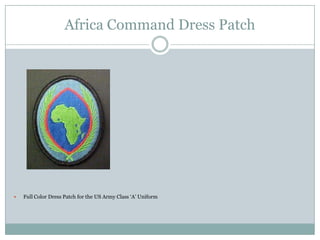
Africa Command Dress Patch



Full Color Dress Patch for the US Army Class „A‟ Uniform
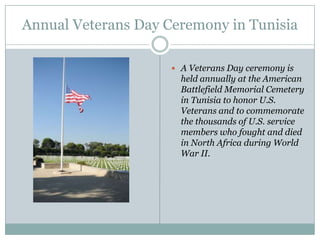
Annual Veterans Day Ceremony in Tunisia
 A Veterans Day ceremony is

held annually at the American
Battlefield Memorial Cemetery
in Tunisia to honor U.S.
Veterans and to commemorate
the thousands of U.S. service
members who fought and died
in North Africa during World
War II.
Congressional Black Caucus Veterans Braintrust
(Hons. Corrine Brown, D-FL, Sanford Bishop, Jr., D-GA & Charles Rangel, D-NY, Chairs )

Thank You
 Ron E. Armstead, MCP, LSW, Executive Director

617-331-3583 / ronearmstead@gmail.com

 Website: http://veteransbraintrustonline.snappages.com

24th anniversary cbcvbalciv global

  • 1.
    2013 Congressional BlackCaucus Foundation, Inc. 43rd Annual Legislative Conference” INSPIRING LEADERS/BUILDING GENERATIONS New Washington Convention Center, Washington, DC September 20, 2013 RON E. ARMSTEAD, MCP, LSW EXECUTIVE DIRECTOR CONGRESSIONAL BLACK CAUCUS VETERANS BRAINTRUST “ 2 5 TH S I L V E R A N N I V E R S A R Y O F T H E VETERANS BRAINTRUST”
  • 2.
    Dr. Ralph J. Bunche,the United Nations Undersecretary and Chief Mediator in Palestine, negotiated the first Arab-Israeli truce in 1948. In recognition of his efforts to bring peace in the Middle East, in 1950, he became the first Africn American to be awarded the Nobel Peace Prize. He died in 1971 at age 67 . Dr. Ralph J. Bunche, United Nations Undersecretary
  • 3.
    The World VeteransFederation (WVF)
  • 4.
    The World VeteransFederation (WVF) World Veterans Federation Credo “None can speak more eloquently for peace than those who have fought in war. The voices of war veterans are a reflection of the longing for peace of people the world over, who within a generation have twice suffered the unspeakable catastrophe of world war. Humanity has earned the right to peace. Without it, there can be no hope for the future. And without hope, man is lost. The voice of the people must be heeded they aspire to a richer life in freedom, equality and dignity, as in things material; they pray for peace. Their will for peace and a better life can be, must be, crystalized into an irresistible force against war, aggression and degradation. The people have had to work and sacrifice for wars. They will work more willingly for peace. Let there be a dedicated effort, a greater crusade than history has ever known, for a world of peace, freedom and equality.” Ralph Bunche Nobel Peace Prize, 1950
  • 5.
  • 6.
    Abu Abdullah MuhammadXII was the last Moorish King of Granada, Spain, 1492  On January 2, 1492, as Muhammad XII left the city of Granada with his wife Moraima, the rest of his family and retainers, he paused to look back at the Alhambra Palace, which his ancestors built two hundred and fifty years before, and the whole of Granada. "Allahu akbar!" he said, "God is most great," and burst into tears. His mother Fatima chided him: "You do well to weep like a woman, for what you could not defend like a man." The spot where Muhammad XII took his farewell bears the name el ultimo sospiro del Moro" which translates as "the last sigh of the Moor." The family retired to an estate in the Alpujarras Mountains. Moraima died soon afterward, and was buried in Monjudar. In the autumn of 1492, Muhammad XII crossed over to Morocco. He never returned to Spain.
  • 7.
    The Berlin Conferenceon Partition of Africa, 1884
  • 8.
    The Battle ofAdwa (March 1, 1896)  Emperor Menelik II
  • 9.
    Menilik II Square AddisAbaba, Ethiopia  In Menelik II Square stands the imposing equestrian statue of Emperor Menelik II, the victor of Adowa. The statue was erected by Emperor Haile Selassie and dedicated on the day before his coronation in 1930, in memory of his great predecessor.
  • 10.
    Tirailleurs Senegalais, WorldWar I  Tirailleurs Senegalais in World War I France
  • 11.
    Senegalese Tirailleurs Source: Wikipedia,the free encyclopedia  The Senegalese Tirailleurs were a corps of colonial infantry in the French Army recruited from Senegal, French West Africa and throughout west, central, and east Africa, the main province of the French colonial empire.  The first Senegalese Tirailleurs were formed in 1857, and served France in a number of wars, including World War I (providing approximately 200,000 troops, more than 135,000 of whom fought in Europe, and 30,000 of whom were killed), and World War II.  Other tirailleur regiments were raised in French North Africa from the Arab and Berber populations of Algeria, Tunisia and Morocco, they were called Tirailleurs algeriens or Turcos. Tirailleur regiments were also raised in Indochina, they were called Vietnamese, Tonkinese or Annamites Tirailleurs.
  • 12.
    The Sinking ofthe SS Mendi, 1917  The story of the South African Native Labour Corps (SANLC), particularly the sinking of the Mendi troopship, is one of the most fascinating stories ever related in South Africa‟s military history.
  • 13.
    German East Africa   Historicalmap with “Kilima-Ndscharo” in German East Africa, 1888 Map of German Possessions in Colonial Africa, German East Africa highlighted in 1913 Note: The Limits of the areas of control may not be perfectly accurate due to the imprecision of the reference maps.
  • 14.
    German East Africa,World War I  Gen. Paul von Letton-Vorbeck‟s surrendering his forces to the British at Abercon (present-day Mbala) in Northern Rhodesia, November 1918 Author: Anonymous African Artist Source: National Museum of Tanzania From Wikipedia, the free encyclopedia
  • 15.
    South African writer HamiltonWende has argued that the experience gained by black Africans who fought in the East Africa Campaign was one source of inspiration for the liberation movements that emerged in South Africa in the decades following World War I as “white and black screamed and died together in the simple equality of human suffering.” Hamilton Wende, South African Writer, Freelance Journalist and Television Producer
  • 16.
    First Pan AfricanCongress, 1919  The Pan-African Congress was a series of seven meetings held in 1919 in Paris, 1921 in London, 1923 in London, 1927 New York, 1945 Manchester, 1974 Dar es Salaam and 1994 Kampala, following the Pan-African Conference of 1900 that were intended to address the issues facing Africa due to the European colonization of most of the continent.  In 1919, the first Pan-African Congress was organized by W. E. B. Du Bois. There were 57 delegates representing 15 countries, a smaller number than originally intended because British and American governments refused to issue passports for their citizens who planned on attending.
  • 17.
    Emperor Haile Selassieof Ethiopia  Emperor Haile Selassie of Ethiopia died in 1975 at the age of 83. During his reign, Selassie‟s main ambition included the modernization of Ethiopia, international recognition for his nation, the abolishment of slavery, expanded education and the elimination of foreign intervention.  In 1936, a year after Italy invaded Ethiopia, Selassie was forced to flee his county. He remained a strong symbol for many Blacks worldwide who saw the struggle of Ethiopia as one of their own.  He returned to organize a resistance movement in Ethiopia which was finally liberated in May of 1941.  However, despite his many progresses, Selassie‟s failure at class and land ownership reform eventually led to a coup thus putting a close to the 3,000 year old Makkeda-Solomonic Dynasty.
  • 18.
    Ethiopian Patriots Association,Addis Ababa  Medals left to right: Patriots Medal with 1 palm (awarded to those fighting in Ethiopia) Refugees Medal with 4 palms (awarded to Ethiopians helping from outside the country) Star of Victory Medal, 1941 (awarded to all combatants) Each palm represents one year of service.
  • 19.
    Ethiopian Patriots Association,Addis Ababa  Patriots attending the funeral of a fellow soldier, Addis Ababa 2007 Both Photos: Andrew Chadwick
  • 20.
    The Lion ofJudah, La‟gare Square & Yekatit 12 Square Addis Ababa, Ethiopia  This bronze statue of the Lion of Juda is a tribute by Haile Selassie to all Ethiopian Patriots. Taken to Rome along with the Axum Obelisk, it was returned to Ethiopia in 1967 and placed at its original site in front of the La'gare Square  Located at the Yekatit 12 Square, this monument honors victims of a brutal Italian reprisal following an attempt to kill the then Italian Viceroy Rodolfo Graziani on 19 February 1937, or Yekatit 12 in the Ethiopian calendar.
  • 21.
    The Black Eagleof Harlem & The Brown Condor  Colonel Hubert Fauntleroy Julian with his Packard Bellanca, "The Abyssinia" in 1931. Julian was at the time the holder of the World's Non-Refueling Endurance Record for a flight lasting 84 HRS. and 33 MINS. Colonel Hubert Fauntleroy Julian, the Black Eagle of Harlem is another little known figure in Ethiopian and American history. Hubert Fauntleroy Julian died in the borough of the Bronx, New York City, in February 1983. His passing went largely unnoticed.  Col. John C. Robinson, later known as the Brown Condor returning home in 1936  Colonel John Robinson (the Black Condor [sometimes called the Brown Condor]), helped in establishing the nascent Ethiopian air force. Colonel Robinson commanded The Ethiopian Air Force and actively participated in reconnaissance mission for the Ethiopian Army during the Italian invasion in 1935.
  • 22.
    Casablanca Conference 1943,Morocco  On January 24, 1943, President Franklin D. Roosevelt and Prime Minister Winston Churchill concluded the Casablanca Conference at the Anfa Hotel. There they planned the European strategy of the allies during World War II.
  • 23.
    Allied Landing inSouthern France on August 15, 1944, also known as the „Forgotten D-Day‟  A sculpture at the harbour promenade commemorates the landing of Allied Troops August 15, 1944, in Sainte-Maxime, Departement Var, at the Cote d‟ Azur, Provence, Southern France  August 15th marks the anniversary of Operation Dragoon and the Southern France Campaign, 15 August – 14 September 1944, in Arlington National Cemetery
  • 24.
    World War IExhibit examines role of Asian, African Troops ”Man, Culture and War,” an exhibit at Brussells‟ BELvue Museum, seeks to set the record straight about the contribution of colonial troops during the 1914-1918 conflict that became known as the Great War        This is one of the pictures displayed at the temporary exhibition “Man, Culture and War” at the Belgian BELvue Museum. The exhibition shows the contributions of colonial troops from various ethnic groups, nationalities and cultures during World War I. (Photo courtesy of BELvue Museum) Bay State Banner, November 13, 2008 – Vol. 44, No. 13   Brussels, Belgium – After the guns of World War I fell silent, a young Vietnamese kitchen worker petitioned the leaders of the victorious Allied powers at the 1919 Versailles Peace Conference to support independence for his country. The appeal went unheeded, and Ho Chi Minh ended up leading the movement that decades later liberated Vietnam from French colonial rule. More than 1 million soldiers from Europe‟s African and Asian colonies answered the call to arms, yet they were largely forgotten afterward, and promises of freedom were not fulfilled. The betrayal laid the foundations of the independence movements that ultimately brought an end to the colonial empires. The colonials fought alongside France, British, the US, Belgium, Canada, Australia and others on the Western Front. They accounted for more than 100,000 of the almost 4 million killed on that front, but their sacrifice was long overlooked by the history books and the governments that sent them into battle. The soldiers – all volunteers, since there was no conscription in the colonieswere lured in part by promises of greater freedom for their homelands in Africa, Southeast Asia and the Indian subcontinent. But after returning home they saw the promises being broken, and the resentment fed their liberation movements. The French armed 140 battalions from West Africa and Madagascar and sent them into the carnage of trench warfare. Whole divisions of North Africans – mainly Moroccan, Algerians and Tunisians – also took part in the fighting. More than 35,000 were killed. Germany used local troops in its African colonies, and France and Britain again mobilized colonial troops in World War II. The exhibit also details the discrimination the colonials soldiers suffered. For example: Solomon Plaatje, a South African writer, witnessed the treatment of his fellow blacks in the ranks, tried unsuccessfully to address the Versailles Peace Conference, and later became one of the founders of the African National Congress (ANC), ending apartheid in the 1990s. (Associated Press)
  • 25.
    POST WORLD WARI French IndoChina, 1913 Ho Chi Minh addresses French Communist, 1920
  • 26.
    Solomon „Sol‟ Plaatjewas the first black South African to write a novel in english „Mhud,‟ in 1919, only to be published in 1930. He is also viewed as the founding father of black literature in South Africa. Plaatje was also a founding member and the first Secretary General of the then South African Native National Congress (SANNC), at its foundation in 1912, which later became the African National Congress (ANC). As a member of SANNC he would travel to England to protest the Native Land Act, 1913, and later to Canada, and the United States where he met Marcus Garvey and W.E.B. DuBois. Solomon T. Plaatje, a South African Intellectual, Journalist, Linguist, Po litician, Translator and Writer
  • 27.
    In Pictures: Africa‟sWorld War II Veterans UNTOLD STORY The African soldiers who fought for the British Empire in World War II are remembered in an exhibition at the Imperial War Museum North in Manchester, UK . “This is the untold story of the forgotten heroes of the Commonwealth,” says Zimbabwean artist Raphael Chikukwa, the curator of the exhibition. Chikukwa was prompted to put on the exhibition after seeing an earlier exhibition on the war, which he found lacking “Africans were not being represented for their contribution to the mother empire,” he says. (BBC NEWS) Raphael Chikukwa, Zimbabwean Artist and Curator Photo by: Andrew Chirenje
  • 28.
  • 29.
    Mural commemorating theThiaroye Massacre, Dakar, Senegal, 1944
  • 30.
    Graves of theThiaroye 44; site of the Thiaroye 44 Massacre
  • 31.
    Thiaroye Massacre, 1944 ISSWorld History Forum: 10th Grade: Student Blog  Thiaroye is a name of a historical town in Senegal. It is found in the suburbs of Dakar, on the southeast coast of the Cap Vert peninsula between Pikine and Rufisque. The village of Thiaroye was founded around 1800, and as the city of Dakar, which was a city created by the french, expanded in territory during the 20th century, Thiaroye was slowly merged into the larger city. Thiaroye is most known for the Thiaroye Massacre, a massacre which happened in 1944. The Thiaroye Massacre was a mass killing of French West African troops - Tirailleurs Senegalasi- by French forces around December 1944.  The Tirailleurs Senegalais were a West African Colonial Army troop who fought for the French during World War I, World War II and in other smaller battles and operations. Even though these troops were named after “The Tirailleurs Senegalais” the soldiers were not only recruited, or forced in Senegal but also through out the French part of West Africa. In 1857 The Tirailleurs Senegalais were the permanent unit of black African soldiers under the French rule. Throughout 1857-1905 the French used the Tirailleurs Senegalais for fighting resistance forces and defending the French territories in Africa. With the start of World War I in the summer of 1914 many Tirailleurs Senegalais soldiers were brought to France and helped the French in some important battles. There was 170,891 Tirailleurs Senegalais soldiers fighting during World War I and by 1918 once the war had ended 30,000 of them had been killed.  During World War II ,which started in 1939, France once again decided to use the Tirailleurs Senegalais troops. By the 1940‟s 9 % of the French army was made up of African Troops. This time they used 200,000 Tirailleurs Senegalais soldiers and by 1945 (end of World War II) 25,000 of them had been killed while in battle. Many of these African men had been taken into German labor camps and some which had been taken as prisoners during the war were murdered by the Wehrmacht in 1940. In World War I the Tirailleurs Senegalais soldiers were not really integrated into the French military units but during World War II with changes made they suddenly were, but then when Charles de Gaulle, the French president at that time, saw that France was very close to victory, he ordered a “whitening” of the troops by replacing 20,000 Africans which were at battle at the front with white French soldiers. This event caused hatred and dislike between the white and the blacks at war. Once the French had gained there liberation, the Tirailleurs Senegalais troops were grouped in French centers waiting to go back home. While at the centers these African soldiers faced discriminatory treatment. They barely got food and resources they needed and basically did not have any kind of shelter. In December 1944, humiliated and without having been given what they were promised, the soldiers protested for the back pay that they were entitled to. The protest was seen as a defiance against the French military and the general in charge with the help of the gendarme (Military Police) ordered the "white" French military to open fire, which resulted in 35 Africans killed, hundreds wounded and many sent to jail. The French government has decided to forget this part of history and in no school books or history lessons is there the mention of the Tirailleurs Senegalais, who where very much part of the French liberation. There is neither a festive day to commemorate these heroes or any monument to remotely remember them in the French capital. It is like they never existed but in reality they where as much present as any other French solider and suffered as much if not even more. This part of French racism has been forgotten and it is about time that we show are respect and appreciation towards these fallen heroes. Pacome Schembri Sant, Graduate
  • 32.
    The Christiansborg CrossroadShooting 1948 Accra, Ghana  On 28th February 1948 veterans of World War II, who had fought with the Gold Coast Regiment of the Royal West African Frontier Force, organized a peaceful demonstration marching to Christiansborg Castle, Accra, Gold Coast (Ghana), to hand in a petition to the colonial governor, demanding that they receive end of war benefits and pay which they had been promised.
  • 33.
    The Mali Presidentwelcomed the pensions news as a “historic decision” The French President told leaders of 12 former colonies, “There are debts which are never extinguished. It was time to recognize that.” Hundreds of thousands of Africans served France in two World Wars and the Algerian war of independence. Tens of thousands are still alive… France had previously resisted paying the same pension to veterans of its armed forces who did not live in French territory, though many are in countries that were French colonies at the time of their service. Recently, the French Constitutional Council decided that the long-established practice of paying veterans from former colonies between one-tenth and one-fifth of the benefits given to French soldiers was illegal. African veterans, who also fought in the Indochina wars of 1945-1954, saw their pensions frozen at the end of the 1950s. (BBC NEWS EUROPE) July 13, 2010 French President Nicolas Sarkozy and Mali President Amadou Toumani Toure
  • 34.
    Ethiopian Kagnew BattalionKorean War Memorial, Addis Ababa  Author: US Army Africa From Wikimedia Commons, the free media repository  Ethiopian veterans Kagnew Battalion who served alongside US soldiers during the Korean War
  • 35.
    Ethiopian Memorial inthe Republic of Korea  The monument in this picture was built on May 7, 1968, on the initiative of the United Nation Association of the Republic of Korea and the citizens of Chunchon to commemorate participation and fighting of the Ethiopian forces for freedom on behalf of a people they never knew before, not even their countries had any known inter-state relations. The ROK Association of reservists and the Korean Finance group donated the cost for construction.  On May 19, 1968, during his visit to South Korea Emperor Haile Selassie inaugurated the monument.
  • 36.
    Battle of DienBien Phu, 1954 The French Indochina War, 1947 – 1954 Source: http://www.blackpast.org/?q=gah/tirailleurs-senegalais-indochina-war-1947-1954   The French began recruiting Senegalese soldiers in 1947, as the war began. The first soldiers arrived in Indochina in April 1947.  The demand for Senegalese soldiers kept growing; there were 14,500 mobilized in 1951, and when the French were finally defeated in 1954, there were 19,570.  More than a thousand were captured by the Vietminh. They were the most exploited prisoners, and given the harshest labor. In 1954, approximately 800 of them were released. It was estimated that about 5,500 Tirailleurs Senegalais had been killed, died, disappeared, or had deserted during the French Indochina War.  End of the French Indochina War The French Indochina War pitted the French Colonial Government against the Vietminh, the communist Vietnamese devoted to national liberation.   Tirailleurs Senegalais in the French Indochina War The last Tirailleurs Senegalais left Vietnam with the French troops in September 1956.  Sources: Eugene-Jean Duval, L’epopee des Tirailleurs Senegalais (Paris: L‟Harmattan, 2005); Martin Windrow, The Last Valley: Dien Bien Phu and the French Defeat in Vietnam (Cambridge, MA: De Capo Press, 2004)
  • 37.
    Mt. Kenya Flag  Summary 1.)Green -Land. 2.) White-Peace. 3.) Black-The People. 4.) Shield -Defense. 5.) Mountain-1st peak Aberdares 2nd peak Mt Kenya. 6.) Valley under the shield-Laikipia and Nakuru Districts(diaspora districts). 7.) Red-The blood Shed(Before and after independence) and the Blood covering of Jesus(97% of kikuyu's are Christians).
  • 38.
    Kenya Mau MauWar Veterans Association  A team of 22 Mau Mau Veterans traveled to the United Kingdom (UK) to issue a claim for compensation for torture against the British Government. On Sunday morning 21st June, 2009 the team attended a church service at CCBC Swahili Service in Barking where they addressed the congregation and later in the afternoon they visited the popular Kenyan joint - Thatched House where they were happy to meet Kenyans while eating Nyama choma and Ugali. On Tuesday 23rd June, 2009 the team held a a press conference at The Law Society, The Law Society's Hall, 113 Chancery Lane, London WC2A 1PL, London/Chancery Lane) at 11am. Thereafter at 2 p.m. the team lawyers, Leigh Day & Co issued a claim for compensation for torture against the British Government on behalf of 22 Kenyans. The claims was formally issued at the Royal Courts of Justice on the Strand, Strand, London, WC2A 2LL. The team was helped to come to the UK by Kenya Human Rights Commission. The claimants are now in their 70s and 80s and have travelled to London from rural Kenya in order to issue the claims in person.  Above all the claimants are seeking an official apology for the torture they were subjected to. The Mau Mau Veterans team include their spokesman Mr. Gitu wa Kahengeri, Mrs. Jane Muthoni Mara, Susan Ciongombe Ngondi, Wambugu Nyingi, Paul Muoka Nzili, Mucheke M'Mucheke Kioru, M'Njau Ndei, Espon Makangaa (Western), Njeru Mugo, Ndiku Mutwiwa, Stephen Kipkering Sugut (Rift Valley), Nyambane Gekonde, Emmanuel Musakari, Habil Omolo (Kisumu), Mburu Ngugi, Joseph Mwarandu (Coast) and Leonard Murithi M'Imanyara (Meru). The Kenya Human Rights Commission team include Muthoni Wanyeki, Goerge Morara, Olga Mutoro, Davinder Lamba, John Nottingham, Zahid Rajan, Anne Kariithi and Paul Muite. They were in the UK for a whole week.
  • 39.
  • 40.
    Spear of theNation, South Africa  This is the logo of Umkhonto we Sizwe ("Spear of the Nation"), the armed resistance movement of the African National Congress (also known as MK) which Mandela and others launched on December 16, 1961.
  • 41.
    Robben Island Museum& World Heritage Site Cape Town, SA  “Today when I look at Robben Island, I see it as a celebration of the struggle and a symbol of the finest qualities of the human spirit, rather than as a monument to the brutal tyranny and oppression of apartheid. It is true that Robben Island was once a place of darkness, but out of that darkness has come a wonderful brightness, a light so powerful that it could not be hidden behind prison walls… ' Nelson Mandela  Nelson Mandela spent more than 25 years imprisoned on Robben Island
  • 42.
    Members of UmkhonotoWe Sizwe Military Veterans Association (MKMVA)  Members of the Umkhonto We Sizwe Military Veterans Association (MKMVA) salute in front of posters of former presidents of the African National Congress (ANC), Nelson Mandela (L) and Thabo Mbeki, during the ANC's centenary celebration in Bloemfontein January 8, 2012. South Africa's ruling ANC celebrated its 100th birthday on Sunday. The long-banned liberation movement took power in 1994 after Nelson Mandela negotiated an end to apartheid with the white-minority government. Capitalising on its role as the standard bearer in the fight against apartheid, the party has dominated politics since then, but bitter faction-fighting and accusations of rampant corruption have raised questions about how long it will continue to lead Africa's biggest economy.
  • 43.
    Sharpeville Massacre, March21, 1960  The Sharpeville massacre of March 21, 1960 was a decisive turning point in South Africa‟s history. It marked the climax of a decade mounting, nonviolent resistance to apartheid centered among black majority of the country‟s inhabitants. Six-nine antipass demonstrators were killed on that day, mainly shot in the back, and 186 were injured.  It also signaled the opening of a much more brutal and intensive phase of state repression – the state introduced a battery of draconian measures: The African National Congress (ANC) and Pan African Congress (PAC) were banned, a national state of emergency was declared, security laws and institutions were extended and reinforced.  The ANC and PAC at first called for mass action, later they went underground, and finally launched armed wings (Umkhonto we Sizwe, or MK, and POQO) or various forms of armed resistance.
  • 44.
    The Soweto Uprising,June 16, 1976    Iconic photo by Sam Nzima of Hector Pieterson. Pieterson, 12, was shot and killed by police in the Soweto uprising on June 16, 1976. The image was published around the world and became an icon of the anti-apartheid movement. In Soweto, South Africa, on June 16, 1976, about ten thousand black school children marched in a column more than half a mile long, protesting the poor quality of their education and demanding their right to be taught in their own language. Hundreds of young students were shot, the most famous of which being Hector Peterson (see image). More than a hundred people were killed in the protests of the following two weeks, and more than a thousand were injured. The International Day of the African Child has been celebrated on June 16 every year since 1991, when it was first initiated by the Organisation of African Unity (OAU). It honors those who participated in the Soweto Uprising in 1976 on that day. It also raises awareness of the continuing need for improvement of the education provided to African children.
  • 45.
    Eduardo Chivambo Mondlane Monument, Fatherof Mozambique‟s Independence
  • 46.
    Joao Cizaverinha‟s Muralof the History of Mozambique by Hero Square & the National Heroes Monument in Heroes Square where the bodies of Samora Machel, Eduardo Mondlane and other Mozambique Freedom Fighters are buried  by Michael Cookson
  • 47.
    National Heroes Acre Harare,Zimbabwe  The Zimbabwean heroes acres with the Tomb of the Unknown Soldier in the foreground, the eternal fire tower in the background and elaborate stone work deco derived from the chevron pattern of the Great Zimbabwe archaeological site. (Picture by Author ….
  • 48.
    SS Mendi Memorial,South Africa Janet Szabo The striking statue commemorating the sinking of the SS Mendi
  • 49.
  • 50.
    Opening of theWorld Veterans Federation‟s 26th General Assembly Copenhagen, Denmark October 19, 2009 Abdul Hamid Ibraham, President of the World Veteran’s Federation (WVF)
  • 51.
    Executive Board Meeting –2011 The 142nd meeting of the Executive Board was held in Oslo, Norway on November 15, 2011. President Hamid Ibraham Ibraham chaired the meeting and the SCEA was represented by the Chairman of the SCEA, Vice President of the WVF, Mr. Dan-Viggo Bergtun. President Hamid Ibraham of the World Veterans Federation (WVF)
  • 52.
    South Sudan -2011  Mr. Bol Wek Agoth, Former Ambassador to Norway and Southern Sudan Head of Mission to Nordic Countries meets with the World Veterans Federation‟s Standing Committee of European Affairs (SCEA). He wants to establish a new veterans organization and has asked for help from the SCEA. They welcomed this initiative and wished him success in establishing it in their new country.
  • 53.
    War Veterans DayCelebrated in South Sudan August 24, 2011 (Juba) Sudan Tribune by Amoko Robert  Wounded Sudan People‟s Liberation Army (SPLA) veterans march during Independence Day Ceremony in Juba, July 9, 2011 (Reuters)
  • 54.
    Capt. John Adole, Ret’d.,Chairman, Nigerian Legion (left), and Nigerian President Goodluck Jonathan
  • 55.
    In December, 2003, South AfricanPresident Thabo Mbeki opened the World Veterans Federation 24th General Assembly by calling on former combatants to continue their quest for peace and non-violent conflict resolution. He said, “ I am certain that nobody who has experienced the destructive fury of war would wish to see any people exposed to military conflict.” Thabo Mbeki, President of South Africa
  • 56.
    If you kill“someone or see your friends being killed, it goes to your hard drive, but sooner or later it burst out” During the apartheid era, every white man was liable for conscription into the Army, in which he would serve at least two years. Several thousand Black men and women were trained in military camps run by the liberation groups MK and APLA. The legacy of these conflicts is in some cases massive mental trauma, stemming from shame and horror at the activities these soldiers were forced to carry out. South Africa is still trying to come to terms with its violent past, both internal conflict and military intervention across southern Africa. Deacon Mathe, Chairman of the MK Veterans’ Association, South Africa
  • 57.
  • 58.
    According to PresidentArmando Guebuza of Mozambique who is also the President of the ExCombatants Association and a national liberation hero the armed struggle started in 1964 with 259 guerillas which later grew to 100s, and then 1000s through logistical support. President Guebuza has more recently stated that while veterans pensions are significant, they will not bring significant improvement to Mozambiques economic struggles. He argues instead that the focus should not be on dependency through pensions, but instead on working to “overcome poverty.” President Armando Guebuza of Mozambique (File Photo) Image by: Siphiwe Sibeko/Reuters
  • 59.
    Vice Chairman, Standing Committeeon African Affairs (SCAA), World Veterans‟ Federation Rock Vicente Chooly, is the son of Vicente Nkamalila Jose Chooly and Helena Mwanini Majembe, and was born on October 28, 1947, in Northern Mozambbique. His parents were both peasants, and at seven years old he went to primary school, where he finished in 1960. And since there were no secondary schools for Africans, he was forced to enter the seminary, where he finished his secondary school training. In 1964, he was expelled after being accused of group subversive activities against the Portuguese colonial administration. Afterward, he joined the Mozambique Liberation Front (FRELIMO), a political movement which launched the armed struggle for independence as a Freedom Fighter. After independence he was demobilized with the rank of Colonel from the Army and joined the Mineral Resources Department and after twenty years retired as a civil servant in 2006, when he was later elected Secretary General of the Combatants‟ Association of National Liberation Struggle of Mozambique (ACLLN). Col. Rock Chooly, Ret’d., Secretary General of the Combatants Association of National Liberation Struggle of Mozambique
  • 60.
    Brig. Gen (Rtd)Hashim Mbita was Executive Secretary of the Liberation Committee of the Organisation of African Unity (OAU) founded in the early 70‟s for more than 20 years, until his mission was accomplished with the democratic elections in South Africa in 1994. The Liberation Committee was wound up on 15 August 1994 with a special ceremony hosted by Mwalimu Julius Nyerere in Arusha, attended by 10 heads of state and government, two vicepresidents and nine foreign ministers. The ceremony paid tribute to the courage of the freedom fighters who fought and won independence. SADC has now taken up the task of documenting that history. An office has been established in Dar es Salaam under the leadership of Professor A. Temu.. The project is operational in Angola, Botswana, Mozambique, Namibia, S outh Africa, United Republic of Tanzania, Zambia and Zimbabwe. In an inspirational address to the researchers last year, Mbita stressed the need to “record the inspiration, commitment, determination, sa crifices, means, strategies and experiences gained at different stages.” He said the “decolonisation struggle which engulfed the African continent during the last 60 years was basically one, though fought in various parts and against different colonizing powers. “History should be reflected in proper perspective through the African eye because many a time it has been written from outside the continent,” Mbita said. The project was approved by the Summit of SADC Heads of State and Government when they met in Botswana in August 2005 to mark the Silver Jubilee of the regional community. The project is funded entirely by SADC governments. Ambassador Hashim Mbita, Executive Secretary of the Liberation Committee of the Organization of African Unity (OAU)
  • 61.
    Dr. Kaunda ledZambia to independence and served as the first President of the Republic of Zambia, from 1964 to 1991. In 1992 he founded the Kenneth Kaunda Peace Foundation and Kenneth Kaunda Children of Africa Foundation organizations dedicated to the establishment of peace and conflict resolution on the continent; in addition to focusing on fighting HIV/AIDS and poverty in Africa. In addition to his efforts in Zambia, Dr. Kaunda was in the forefront of the efforts to liberate all of Africa, serving as the President of the Pan-African Freedom Movement for East, Central and Southern Africa (Pafmesca) in 1962 and as Chairman of the Organization of African Unity (OAU) from 1970 to 1973. He also played key roles in the mitigation of territorial disputes between Kenya and Somalia and the liberation movements in Angola, Mozambique, Namibia, Zim babwe, and South Africa. Former President Kenneth David Kaunda is an author and former educator who has received many honors and awards. He was recently a Balfour African President in Residence at Boston University's African Presidential Archives and Research Center. President Kenneth David Kaunda of Zambia
  • 62.
    G. Madaraka Nyerere,Son of former President Julius Nyerere of Tanzania
  • 63.
    Mount Kilimanjaro   G. MadarakaNyerere (Left) at the summit of Mt. Kilimanjaro About 55,000 visitors climb or tour Mount Kilimanjaro every year, among them are international sports figures, film and pop stars, as well as charitable organizations.  Kilimanjaro is the world‟s highest free standing mountain and is made up of three distinct volcanic cones, with Kibo escalating to 5,895 meters or 19,341 feet, being the highest point on the African continent. Other peaks are Mawenzi at 5,149 m (16,893 ft) and Shira 3,962 m (13,000 ft).
  • 64.
    Amputee veterans standup to Mt. Kilimanjaro The Washington Post, Wednesday, August 11, 2010  Disabled veterans take on Mt. Kilimanjaro  Several military veterans accepted the Warfighter Sports Challenge and event organized by Disabled Sports USA that pits climbers against Mt. Kilimanjaro  From left to right: U.S. Army Sgts. Kirk Bauer, Neil Duncan and Dan Nevins pose for a photo at Gilman‟s Point 5,681 meters or approximately 18,638 feet. Reed Hoffman – Disabled Sports USA
  • 65.
    Born in Boston, Massachusetts,Eduardo moved to Tanzania in the early 60‟s where his father, Dr Eduardo Mondlane founded FRELIMO (The Mozambique Liberation Front), and was elected its first president. Eduardo Jr moved to Mozambique in 1975, and from 1977 studied Political Science at UCLA, after which he established Mozambique‟s first private events promotions company. Eduardo is currently a Group Director at ABSA, Barclays Bank Mozambique, Founding Shareholder and Chairman of Retail Masters SA, holding the master franchise for the Pick „n Pay retail group in Mozambique. He continues to advise various multinational corporations, and is a member of the Advisory Board of the Confederation of Economic Associations of Mozambique and a regular panelist at Boston University‟s African Presidential Roundtable. Eduardo Chivambo Mondlane, Jr., son of Dr. Eduardo Mondlane founder of FRELIMO
  • 66.
    South West AfricaPeople‟s Organization (SWAPO) is a political party and former national liberation movement in Namibia. It has been the governing party in Namibia since achieving independence in 1990. SWAPO was founded on April 19, 1960. Namibia National Liberation Veterans Association (NNLVA)
  • 67.
    The Heroes‟ Acre,Namibia  The Heroes‟ Acre is an official war memorial for the government of Namibia. Built just outside the city of Windhoek, Heroes‟ Acre opened on August 26, 2002 and operates for the purpose of fostering a spirit of patriotism and nationalism, and passing on the legacy to the future generations of Namibia.
  • 68.
    Jabulani Sibanda isthe chairman of Zimbabwe National Liberation War Veterans Association (ZNLWVA), an organization originally comprising all the veterans that fought during the Second Chimurenga or Zimbabwe War of Liberation which ended in 1979. Under his leadership the ZNLWVA mobilized Zimbabweans in the takeback of land stolen under colonialism. The ZNLWVA was formed after Zimbabwe‟s independence in 1980. It was mainly formed to assist demolized combatants of the bush war, mostly members of ZANLA and ZIPRA. Jabulani Sibanda, Leader of the Zimbabwe National War Veterans Association (ZNWVA)
  • 69.
    Kenya Mau MauWar Veterans Association Kenyan Mau Mau War Veterans Generals Kassam Njogu, Njeru Mugo and Ndungu Gicheru
  • 70.
    World Veterans Federation(WVF) Peace & Security Summit, 2013  Swedish Veterans Federation (SVF) were requested by World Veterans Federation (WVF) to arrange the WVF Peace and Security Summit 2013 (PSS13) in May 2013.The aim of the summit is to raise the status of veterans in society and to promote the well-being of veterans. The Swedish Government has tasked the Armed Forces together with SVF to conduct the WVF Conference Peace & Security Summit in Sweden May 28-31 2013. The theme for PSS13 is: "How can veterans contribute to Peace and Security in Society?"
  • 71.
    Aftermath of the2013 Boston Marathon Bombing showing people helping others from scene
  • 72.
    Boston Marathon bombing victimMartin Richard, 8, held a call for peace at a school event last year. He ended up dying a victim of violence. Read more at: http://www.nydailynews .com/news/nationa/you ngest-boston-victimmourned-article1.1325050#ixzz2S4oBoy LK Martin Richard, 8 Neighborhood House Charter School/EPA
  • 73.
    World Veterans Federation Peace& Security Summit Stockholm, Sweden, May 28 – 31, 2013 Welcome to Sweden and the Peace and Security Summit STOCKHOLM DECLARATION Veterans have experienced the horrors of war and have to live with the consequences for the rest of their lives. They deserve help, support and recognition from their society. On the basis of this understanding, the Peace and Security Summit in Stockholm opened a new dimension in the discussion of veterans affairs. Veterans can give a lot to their societies having served under severe circumstances worldwide and demonstrated skills that can be of benefit to all parts of their societies. The Summit demands that the countries represented within the WVF and the international community exploit and make best use of these experiences and capabilities, which should come to bear to prevent the use of force, during conflict and thereafter. Veterans should also be involved to prevent ethnic crises, and in support of integration processes within their societies. The message of the veterans, voiced individually, through their organizations, or the WVF should be listened to in all crisis situations. Stockholm, May 30, 2013
  • 74.
  • 75.
    Gen. William E.Ward, Commander of the U.S. Army Africa Command
  • 76.
    Africa Command DressPatch  Full Color Dress Patch for the US Army Class „A‟ Uniform
  • 77.
    Annual Veterans DayCeremony in Tunisia  A Veterans Day ceremony is held annually at the American Battlefield Memorial Cemetery in Tunisia to honor U.S. Veterans and to commemorate the thousands of U.S. service members who fought and died in North Africa during World War II.
  • 78.
    Congressional Black CaucusVeterans Braintrust (Hons. Corrine Brown, D-FL, Sanford Bishop, Jr., D-GA & Charles Rangel, D-NY, Chairs ) Thank You  Ron E. Armstead, MCP, LSW, Executive Director 617-331-3583 / ronearmstead@gmail.com  Website: http://veteransbraintrustonline.snappages.com