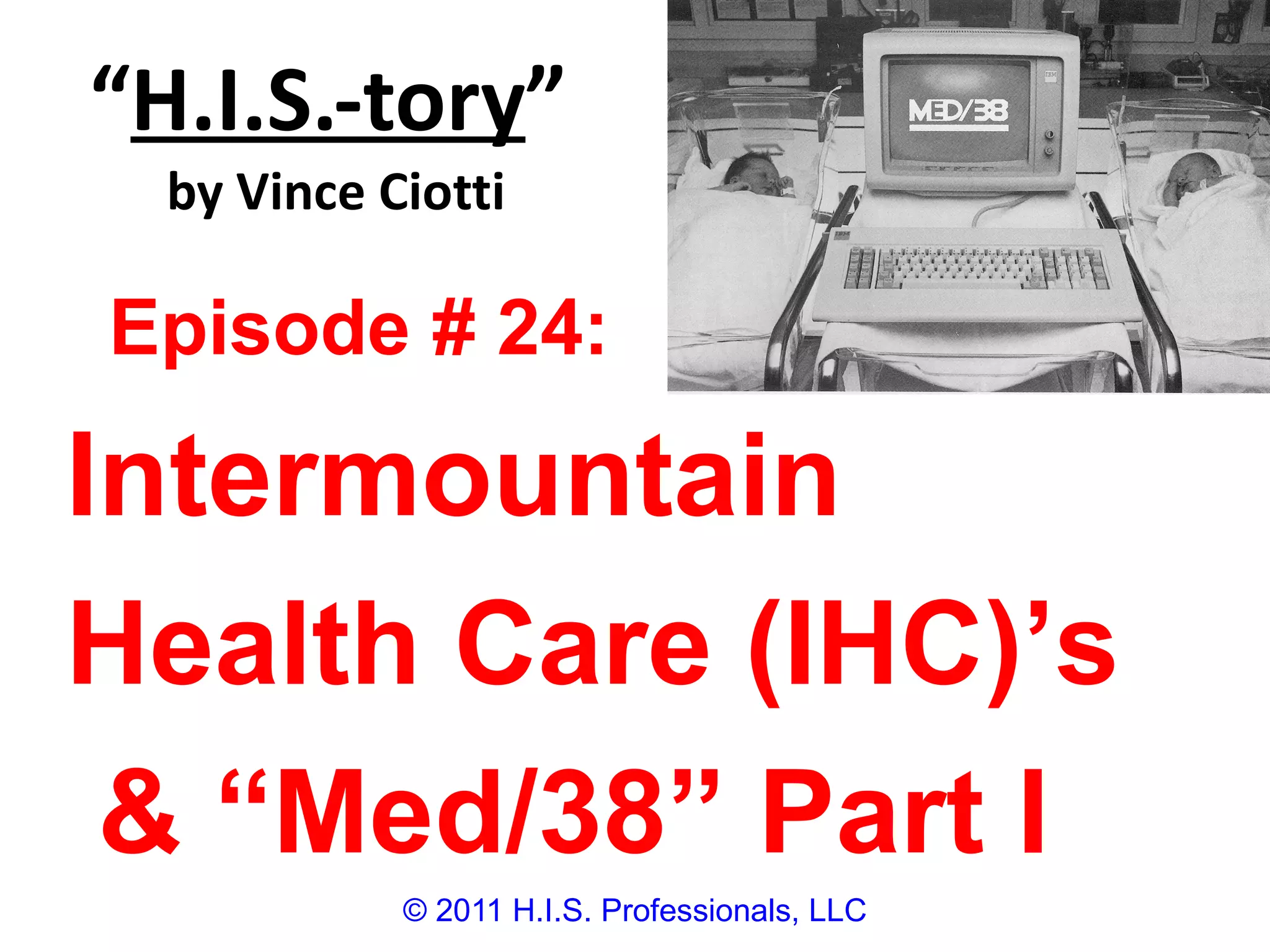
“ H.I.S.-tory ”   by Vince Ciotti © 2011 H.I.S. Professionals, LLC Episode # 24:  Intermountain Health Care (IHC)’s & “Med/38” Part I
Background IHC  was formed in 1975 when the Church of the Latter Day  Saints  (no HIS pun intended) divested itself of 15 hospitals in Utah, turning them over to this not-for-profit multi system. IHC  had a long history of computerization it inherited from the Mormon Church’s centralized service bureau known as  MDC  (Management System Corporation) in Salt Lake City.  MDC  offered primarily financial systems (like SMS & McAuto then), so 2 years after IHC was formed, circa 1977, it charged its DP department to build its own modern HIS system  with clinicals .  (we’ll see in a future HIS-tory episode how another hospital chain out west followed this same entrepreneurial path: American Medical International {AMI} and their PHS division)  IHC
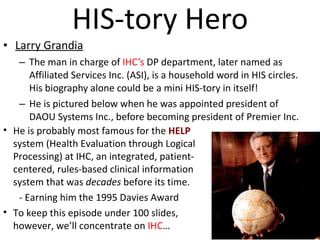
Larry Grandia The man in charge of  IHC’s  DP department, later named as Affiliated Services Inc. (ASI), is a household word in HIS circles. His biography alone could be a mini HIS-tory in itself! He is pictured below when he was appointed president of DAOU Systems Inc., before becoming president of Premier Inc.  HIS-tory Hero He is probably most famous for the  HELP  system (Health Evaluation through Logical Processing) at IHC, an integrated, patient-centered, rules-based clinical information system that was  decades  before its time. - Earning him the 1995 Davies Award To keep this episode under 100 slides, however, we’ll concentrate on  IHC …
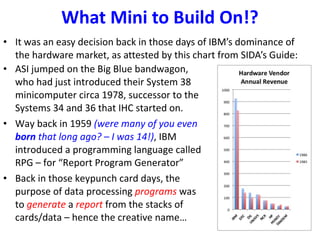
What Mini to Build On!? It was an easy decision back in those days of IBM’s dominance of the hardware market, as attested by this chart from SIDA’s Guide: ASI jumped on the Big Blue bandwagon, who had just introduced their System 38 minicomputer circa 1978, successor to the Systems 34 and 36 that IHC started on. Way back in 1959  (were many of you even  born  that long ago? – I was 14!) , IBM introduced a programming language called RPG – for “Report Program Generator” Back in those keypunch card days, the purpose of data processing  programs  was to  generate  a  report  from the stacks of cards/data – hence the creative name…
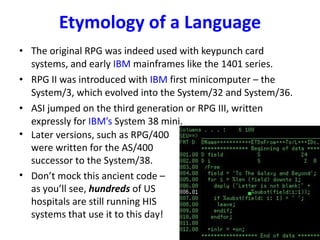
Etymology of a Language The original RPG was indeed used with keypunch card systems, and early  IBM  mainframes like the 1401 series. RPG II was introduced with  IBM  first minicomputer – the System/3, which evolved into the System/32 and System/36. ASI jumped on the third generation or RPG III, written expressly for  IBM’s  System 38 mini. Later versions, such as RPG/400 were written for the AS/400 successor to the System/38. Don’t mock this ancient code – as you’ll see,  hundreds   of US hospitals are still running HIS systems that use it to this day!
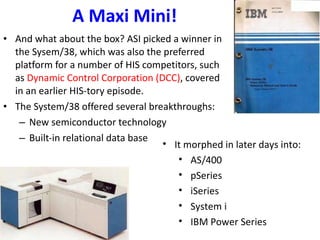
A Maxi Mini! And what about the box? ASI picked a winner in the Sysem/38, which was also the preferred platform for a number of HIS competitors, such as  Dynamic Control Corporation (DCC) , covered in an earlier HIS-tory episode. The System/38 offered several breakthroughs: New semiconductor technology Built-in relational data base It morphed in later days into: AS/400 pSeries iSeries System i IBM Power Series
Birth of “Med/38” So under Grandia’s guidance, ASI built its own HIS using RPG code and running on System/38s, called creatively  Med/38. ASI re-wrote financial apps first, completing the design and implementation in an amazingly short time: By 1981,  17  IHC hospitals had been converted  AR days  declined  by 3 days, a rarity in HIS circles! Costs were  reduced  from the old service bureau New apps were added: Inventory and Fixed Assets Next came clinicals, which in those days were primarily Orders & Results, although ASI pushed the envelope with: Pharmacy Information System (what acronym can one  safely  use for RX?) Medical Records – including MPI, abstracting & chart completion Case Mix and even Nurse Staffing –  very  daring apps for the early 1980s!
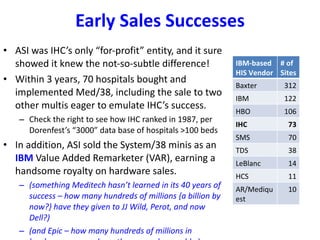
Early Sales Successes ASI was IHC’s only “for-profit” entity, and it sure showed it knew the not-so-subtle difference! Within 3 years, 70 hospitals bought and implemented Med/38, including the sale to two other multis eager to emulate IHC’s success. Check the right to see how IHC ranked in 1987, per Dorenfest’s “3000” data base of hospitals >100 beds In addition, ASI sold the System/38 minis as an  IBM  Value Added Remarketer (VAR), earning a handsome royalty on hardware sales. (something Meditech hasn’t learned in its 40 years of success – how many hundreds of millions {a billion by now?} have they given to JJ Wild, Perot, and now Dell?)  (and Epic – how many hundreds of millions in hardware revenue have they passed up - odd…) IBM-based HIS Vendor # of Sites Baxter 312 IBM 122 HBO 106 IHC 73 SMS 70 TDS 38 LeBlanc 14 HCS 11 AR/Mediquest 10
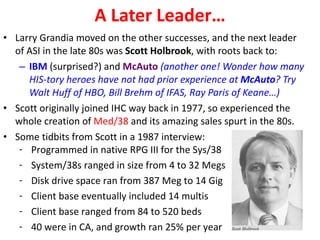
A Later Leader… Larry Grandia moved on the other successes, and the next leader of ASI in the late 80s was  Scott Holbrook , with roots back to: IBM  (surprised?) and  McAuto  (another one! Wonder how many HIS-tory heroes have not had prior experience at  McAuto ? Try Walt Huff of HBO, Bill Brehm of IFAS, Ray Paris of Keane…) Scott originally joined IHC way back in 1977, so experienced the whole creation of  Med/38  and its amazing sales spurt in the 80s. Some tidbits from Scott in a 1987 interview: Programmed in native RPG III for the Sys/38 System/38s ranged in size from 4 to 32 Megs Disk drive space ran from 387 Meg to 14 Gig Client base eventually included 14 multis Client base ranged from 84 to 520 beds 40 were in CA, and growth ran 25% per year
Sound Familiar? Scott Holbrook ’s name should ring a bell, as his career is almost as amazing as Larry Grandia’s: VP of Sales & Marketing for  Sunquest , one of the earliest and most successful mini-based LIS firms EVP at  Park City Solutions , specializing in laboratory orders & results to physician offices EVP and Co-founder of  KLAS  – KLAS? I swear I’ve heard that name before, wonder what they do… Board member of  HIMSS  – ever heard of them? EVP at  Medicity , a leading HIE that bought Park City And it all started with a BS in  Zoology  from Brigham Young University  (a propos for HIS…)
What’s Next? In Part II of IHC and Med/38, we’ll trace a series of acquisitions that lead through several giant companies, ending up with an amazingly large client base  today. Meanwhile, I’m wrapping up with the last few mini stories before starting microcomputers, so anybody got some poop on: AR Mediquest   – an IBM Sys/36 system that Paul McVicker ( [email_address] ) shared some fascinating tidbits on from his experiences at Ozarks Medical Center. JS Data   – small hospital system that Steve Kilgus ( [email_address] ) and Tom Aikens ( [email_address] ) have commented with.  Anyone other major minis we’re missing?? Please send any contributions to:  [email_address]

24. minis ihc part i

  • 1.
    “ H.I.S.-tory ” by Vince Ciotti © 2011 H.I.S. Professionals, LLC Episode # 24: Intermountain Health Care (IHC)’s & “Med/38” Part I
  • 2.
    Background IHC was formed in 1975 when the Church of the Latter Day Saints (no HIS pun intended) divested itself of 15 hospitals in Utah, turning them over to this not-for-profit multi system. IHC had a long history of computerization it inherited from the Mormon Church’s centralized service bureau known as MDC (Management System Corporation) in Salt Lake City. MDC offered primarily financial systems (like SMS & McAuto then), so 2 years after IHC was formed, circa 1977, it charged its DP department to build its own modern HIS system with clinicals . (we’ll see in a future HIS-tory episode how another hospital chain out west followed this same entrepreneurial path: American Medical International {AMI} and their PHS division) IHC
  • 3.
    Larry Grandia Theman in charge of IHC’s DP department, later named as Affiliated Services Inc. (ASI), is a household word in HIS circles. His biography alone could be a mini HIS-tory in itself! He is pictured below when he was appointed president of DAOU Systems Inc., before becoming president of Premier Inc. HIS-tory Hero He is probably most famous for the HELP system (Health Evaluation through Logical Processing) at IHC, an integrated, patient-centered, rules-based clinical information system that was decades before its time. - Earning him the 1995 Davies Award To keep this episode under 100 slides, however, we’ll concentrate on IHC …
  • 4.
    What Mini toBuild On!? It was an easy decision back in those days of IBM’s dominance of the hardware market, as attested by this chart from SIDA’s Guide: ASI jumped on the Big Blue bandwagon, who had just introduced their System 38 minicomputer circa 1978, successor to the Systems 34 and 36 that IHC started on. Way back in 1959 (were many of you even born that long ago? – I was 14!) , IBM introduced a programming language called RPG – for “Report Program Generator” Back in those keypunch card days, the purpose of data processing programs was to generate a report from the stacks of cards/data – hence the creative name…
  • 5.
    Etymology of aLanguage The original RPG was indeed used with keypunch card systems, and early IBM mainframes like the 1401 series. RPG II was introduced with IBM first minicomputer – the System/3, which evolved into the System/32 and System/36. ASI jumped on the third generation or RPG III, written expressly for IBM’s System 38 mini. Later versions, such as RPG/400 were written for the AS/400 successor to the System/38. Don’t mock this ancient code – as you’ll see, hundreds of US hospitals are still running HIS systems that use it to this day!
  • 6.
    A Maxi Mini!And what about the box? ASI picked a winner in the Sysem/38, which was also the preferred platform for a number of HIS competitors, such as Dynamic Control Corporation (DCC) , covered in an earlier HIS-tory episode. The System/38 offered several breakthroughs: New semiconductor technology Built-in relational data base It morphed in later days into: AS/400 pSeries iSeries System i IBM Power Series
  • 7.
    Birth of “Med/38”So under Grandia’s guidance, ASI built its own HIS using RPG code and running on System/38s, called creatively Med/38. ASI re-wrote financial apps first, completing the design and implementation in an amazingly short time: By 1981, 17 IHC hospitals had been converted AR days declined by 3 days, a rarity in HIS circles! Costs were reduced from the old service bureau New apps were added: Inventory and Fixed Assets Next came clinicals, which in those days were primarily Orders & Results, although ASI pushed the envelope with: Pharmacy Information System (what acronym can one safely use for RX?) Medical Records – including MPI, abstracting & chart completion Case Mix and even Nurse Staffing – very daring apps for the early 1980s!
  • 8.
    Early Sales SuccessesASI was IHC’s only “for-profit” entity, and it sure showed it knew the not-so-subtle difference! Within 3 years, 70 hospitals bought and implemented Med/38, including the sale to two other multis eager to emulate IHC’s success. Check the right to see how IHC ranked in 1987, per Dorenfest’s “3000” data base of hospitals >100 beds In addition, ASI sold the System/38 minis as an IBM Value Added Remarketer (VAR), earning a handsome royalty on hardware sales. (something Meditech hasn’t learned in its 40 years of success – how many hundreds of millions {a billion by now?} have they given to JJ Wild, Perot, and now Dell?) (and Epic – how many hundreds of millions in hardware revenue have they passed up - odd…) IBM-based HIS Vendor # of Sites Baxter 312 IBM 122 HBO 106 IHC 73 SMS 70 TDS 38 LeBlanc 14 HCS 11 AR/Mediquest 10
  • 9.
    A Later Leader…Larry Grandia moved on the other successes, and the next leader of ASI in the late 80s was Scott Holbrook , with roots back to: IBM (surprised?) and McAuto (another one! Wonder how many HIS-tory heroes have not had prior experience at McAuto ? Try Walt Huff of HBO, Bill Brehm of IFAS, Ray Paris of Keane…) Scott originally joined IHC way back in 1977, so experienced the whole creation of Med/38 and its amazing sales spurt in the 80s. Some tidbits from Scott in a 1987 interview: Programmed in native RPG III for the Sys/38 System/38s ranged in size from 4 to 32 Megs Disk drive space ran from 387 Meg to 14 Gig Client base eventually included 14 multis Client base ranged from 84 to 520 beds 40 were in CA, and growth ran 25% per year
  • 10.
    Sound Familiar? ScottHolbrook ’s name should ring a bell, as his career is almost as amazing as Larry Grandia’s: VP of Sales & Marketing for Sunquest , one of the earliest and most successful mini-based LIS firms EVP at Park City Solutions , specializing in laboratory orders & results to physician offices EVP and Co-founder of KLAS – KLAS? I swear I’ve heard that name before, wonder what they do… Board member of HIMSS – ever heard of them? EVP at Medicity , a leading HIE that bought Park City And it all started with a BS in Zoology from Brigham Young University (a propos for HIS…)
  • 11.
    What’s Next? InPart II of IHC and Med/38, we’ll trace a series of acquisitions that lead through several giant companies, ending up with an amazingly large client base today. Meanwhile, I’m wrapping up with the last few mini stories before starting microcomputers, so anybody got some poop on: AR Mediquest – an IBM Sys/36 system that Paul McVicker ( [email_address] ) shared some fascinating tidbits on from his experiences at Ozarks Medical Center. JS Data – small hospital system that Steve Kilgus ( [email_address] ) and Tom Aikens ( [email_address] ) have commented with. Anyone other major minis we’re missing?? Please send any contributions to: [email_address]