“H.I.S.-tory”
by Vince Ciotti
© 2011 H.I.S. Professionals, LLC, all rights reserved
Episode # 24a:
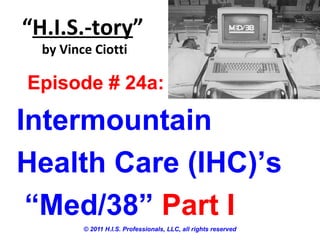
Intermountain
Health Care (IHC)’s
“Med/38” Part I
• Background
– IHC was formed in 1975 when the Church of the Latter Day
Saints (no HIS pun intended) divested itself of 15 hospitals in
Utah, turning them over to this not-for-profit multi system.
– IHC had a long history of computerization it inherited from the
Mormon Church’s centralized service bureau known as MDC
(Management System Corporation) in Salt Lake City. MDC
offered primarily financial systems (like SMS & McAuto then), so
2 years after IHC was formed, circa 1977, it charged its DP
department to build its own modern HIS system with clinicals.
– (we’ll see in a future HIS-tory episode how another hospital
chain out west followed this same entrepreneurial path:
American Medical International {AMI} and their PHS division)
IHC
• Larry Grandia
– The man in charge of IHC’s DP department, later named as
Affiliated Services Inc. (ASI), is a household word in HIS circles.
His biography alone could be a mini HIS-tory in itself!
– He is pictured below when he was appointed president of
DAOU Systems Inc., before becoming president of Premier Inc.
HIS-tory Hero
• He is probably most famous for the HELP
system (Health Evaluation through Logical
Processing) at IHC, an integrated, patient-
centered, rules-based clinical information
system that was decades before its time.
- Earning him the 1995 Davies Award
• To keep this episode under 100 slides,
however, we’ll concentrate on IHC…
What Mini to Build On!?
• It was an easy decision back in those days of IBM’s dominance of
the hardware market, as attested by this chart from SIDA’s Guide:
• ASI jumped on the Big Blue bandwagon,
who had just introduced their System 38
minicomputer circa 1978, successor to the
Systems 34 and 36 that IHC started on.
• Way back in 1959 (were many of you even
born that long ago? – I was 14!), IBM
introduced a programming language called
RPG – for “Report Program Generator”
• Back in those keypunch card days, the
purpose of data processing programs was
to generate a report from the stacks of
cards/data – hence the creative name…
Etymology of a Language
• The original RPG was indeed used with keypunch card
systems, and early IBM mainframes like the 1401 series.
• RPG II was introduced with IBM first minicomputer – the
System/3, which evolved into the System/32 and System/36.
• ASI jumped on the third generation or RPG III, written
expressly for IBM’s System 38 mini.
• Later versions, such as RPG/400
were written for the AS/400
successor to the System/38.
• Don’t mock this ancient code –
as you’ll see, hundreds of US
hospitals are still running HIS
systems that use it to this day!
A Maxi Mini!
• And what about the box? ASI picked a winner in
the Sysem/38, which was also the preferred
platform for a number of HIS competitors, such
as Dynamic Control Corporation (DCC), covered
in an earlier HIS-tory episode.
• The System/38 offered several breakthroughs:
– New semiconductor technology
– Built-in relational data base
• It morphed in later days into:
• AS/400
• pSeries
• iSeries
• System i
• IBM Power Series
Birth of “Med/38”
• So under Grandia’s guidance, ASI built its own HIS using RPG code
and running on System/38s, called creatively Med/38.
• ASI re-wrote financial apps first, completing the design and
implementation in an amazingly short time:
– By 1981, 17 IHC hospitals had been converted
– AR days declined by 3 days, a rarity in HIS circles!
– Costs were reduced from the old service bureau
– New apps were added: Inventory and Fixed Assets
• Next came clinicals, which in those days were primarily Orders &
Results, although ASI pushed the envelope with:
– Pharmacy Information System (what acronym can one safely use for RX?)
– Medical Records – including MPI, abstracting & chart completion
– Case Mix and even Nurse Staffing – very daring apps for the early 1980s!
Early Sales Successes
• ASI was IHC’s only “for-profit” entity, and it sure
showed it knew the not-so-subtle difference!
• Within 3 years, 70 hospitals bought and
implemented Med/38, including the sale to two
other multis eager to emulate IHC’s success.
– Check the right to see how IHC ranked in 1987, per
Dorenfest’s “3000” data base of hospitals >100 beds
• In addition, ASI sold the System/38 minis as an
IBM Value Added Remarketer (VAR), earning a
handsome royalty on hardware sales.
– (something Meditech hasn’t learned in its 40 years of
success – how many hundreds of millions {a billion by
now?} have they given to JJ Wild, Perot, and now
Dell?)
– (and Epic – how many hundreds of millions in
IBM-based
HIS Vendor
# of
Sites
Baxter 312
IBM 122
HBO 106
IHC 73
SMS 70
TDS 38
LeBlanc 14
HCS 11
AR/Mediqu
est
10
A Later Leader…
• Larry Grandia moved on the other successes, and the next leader
of ASI in the late 80s was Scott Holbrook, with roots back to:
– IBM (surprised?) and McAuto (another one! Wonder how many
HIS-tory heroes have not had prior experience at McAuto? Try
Walt Huff of HBO, Bill Brehm of IFAS, Ray Paris of Keane…)
• Scott originally joined IHC way back in 1977, so experienced the
whole creation of Med/38 and its amazing sales spurt in the 80s.
• Some tidbits from Scott in a 1987 interview:
- Programmed in native RPG III for the Sys/38
- System/38s ranged in size from 4 to 32 Megs
- Disk drive space ran from 387 Meg to 14 Gig
- Client base eventually included 14 multis
- Client base ranged from 84 to 520 beds
- 40 were in CA, and growth ran 25% per year
Sound Familiar?
• Scott Holbrook’s name should ring a bell, as his
career is almost as amazing as Larry Grandia’s:
– VP of Sales & Marketing for Sunquest, one of the
earliest and most successful mini-based LIS firms
– EVP at Park City Solutions, specializing in laboratory
orders & results to physician offices
– EVP and Co-founder of KLAS – KLAS? I swear I’ve
heard that name before, wonder what they do…
– Board member of HIMSS – ever heard of them?
– EVP at Medicity, a leading HIE that bought Park City
• And it all started with a BS in Zoology from
Brigham Young University (a propos for HIS…)
What’s Next?
• In Part II of IHC and Med/38, we’ll trace a series of
acquisitions that lead through several giant companies,
ending up with an amazingly large client base today.
– Meanwhile, I’m wrapping up with the last few mini stories
before starting microcomputers, so anybody got some poop on:
• AR Mediquest – an IBM Sys/36 system that Paul McVicker (
paul.mcvicker@hrhonline.org) shared some fascinating
tidbits on from his experiences at Ozarks Medical Center.
• JS Data – small hospital system that Steve Kilgus (
SKilguss@emdeon.com) and Tom Aikens (
tom.aikens@maxithc.com) have commented with.
– Anyone other major minis we’re missing??
• Please send any contributions to: vciott@hispros.com

24 a. ihc_part_i

  • 1.
    “H.I.S.-tory” by Vince Ciotti ©2011 H.I.S. Professionals, LLC, all rights reserved Episode # 24a: Intermountain Health Care (IHC)’s “Med/38” Part I
  • 2.
    • Background – IHCwas formed in 1975 when the Church of the Latter Day Saints (no HIS pun intended) divested itself of 15 hospitals in Utah, turning them over to this not-for-profit multi system. – IHC had a long history of computerization it inherited from the Mormon Church’s centralized service bureau known as MDC (Management System Corporation) in Salt Lake City. MDC offered primarily financial systems (like SMS & McAuto then), so 2 years after IHC was formed, circa 1977, it charged its DP department to build its own modern HIS system with clinicals. – (we’ll see in a future HIS-tory episode how another hospital chain out west followed this same entrepreneurial path: American Medical International {AMI} and their PHS division) IHC
  • 3.
    • Larry Grandia –The man in charge of IHC’s DP department, later named as Affiliated Services Inc. (ASI), is a household word in HIS circles. His biography alone could be a mini HIS-tory in itself! – He is pictured below when he was appointed president of DAOU Systems Inc., before becoming president of Premier Inc. HIS-tory Hero • He is probably most famous for the HELP system (Health Evaluation through Logical Processing) at IHC, an integrated, patient- centered, rules-based clinical information system that was decades before its time. - Earning him the 1995 Davies Award • To keep this episode under 100 slides, however, we’ll concentrate on IHC…
  • 4.
    What Mini toBuild On!? • It was an easy decision back in those days of IBM’s dominance of the hardware market, as attested by this chart from SIDA’s Guide: • ASI jumped on the Big Blue bandwagon, who had just introduced their System 38 minicomputer circa 1978, successor to the Systems 34 and 36 that IHC started on. • Way back in 1959 (were many of you even born that long ago? – I was 14!), IBM introduced a programming language called RPG – for “Report Program Generator” • Back in those keypunch card days, the purpose of data processing programs was to generate a report from the stacks of cards/data – hence the creative name…
  • 5.
    Etymology of aLanguage • The original RPG was indeed used with keypunch card systems, and early IBM mainframes like the 1401 series. • RPG II was introduced with IBM first minicomputer – the System/3, which evolved into the System/32 and System/36. • ASI jumped on the third generation or RPG III, written expressly for IBM’s System 38 mini. • Later versions, such as RPG/400 were written for the AS/400 successor to the System/38. • Don’t mock this ancient code – as you’ll see, hundreds of US hospitals are still running HIS systems that use it to this day!
  • 6.
    A Maxi Mini! •And what about the box? ASI picked a winner in the Sysem/38, which was also the preferred platform for a number of HIS competitors, such as Dynamic Control Corporation (DCC), covered in an earlier HIS-tory episode. • The System/38 offered several breakthroughs: – New semiconductor technology – Built-in relational data base • It morphed in later days into: • AS/400 • pSeries • iSeries • System i • IBM Power Series
  • 7.
    Birth of “Med/38” •So under Grandia’s guidance, ASI built its own HIS using RPG code and running on System/38s, called creatively Med/38. • ASI re-wrote financial apps first, completing the design and implementation in an amazingly short time: – By 1981, 17 IHC hospitals had been converted – AR days declined by 3 days, a rarity in HIS circles! – Costs were reduced from the old service bureau – New apps were added: Inventory and Fixed Assets • Next came clinicals, which in those days were primarily Orders & Results, although ASI pushed the envelope with: – Pharmacy Information System (what acronym can one safely use for RX?) – Medical Records – including MPI, abstracting & chart completion – Case Mix and even Nurse Staffing – very daring apps for the early 1980s!
  • 8.
    Early Sales Successes •ASI was IHC’s only “for-profit” entity, and it sure showed it knew the not-so-subtle difference! • Within 3 years, 70 hospitals bought and implemented Med/38, including the sale to two other multis eager to emulate IHC’s success. – Check the right to see how IHC ranked in 1987, per Dorenfest’s “3000” data base of hospitals >100 beds • In addition, ASI sold the System/38 minis as an IBM Value Added Remarketer (VAR), earning a handsome royalty on hardware sales. – (something Meditech hasn’t learned in its 40 years of success – how many hundreds of millions {a billion by now?} have they given to JJ Wild, Perot, and now Dell?) – (and Epic – how many hundreds of millions in IBM-based HIS Vendor # of Sites Baxter 312 IBM 122 HBO 106 IHC 73 SMS 70 TDS 38 LeBlanc 14 HCS 11 AR/Mediqu est 10
  • 9.
    A Later Leader… •Larry Grandia moved on the other successes, and the next leader of ASI in the late 80s was Scott Holbrook, with roots back to: – IBM (surprised?) and McAuto (another one! Wonder how many HIS-tory heroes have not had prior experience at McAuto? Try Walt Huff of HBO, Bill Brehm of IFAS, Ray Paris of Keane…) • Scott originally joined IHC way back in 1977, so experienced the whole creation of Med/38 and its amazing sales spurt in the 80s. • Some tidbits from Scott in a 1987 interview: - Programmed in native RPG III for the Sys/38 - System/38s ranged in size from 4 to 32 Megs - Disk drive space ran from 387 Meg to 14 Gig - Client base eventually included 14 multis - Client base ranged from 84 to 520 beds - 40 were in CA, and growth ran 25% per year
  • 10.
    Sound Familiar? • ScottHolbrook’s name should ring a bell, as his career is almost as amazing as Larry Grandia’s: – VP of Sales & Marketing for Sunquest, one of the earliest and most successful mini-based LIS firms – EVP at Park City Solutions, specializing in laboratory orders & results to physician offices – EVP and Co-founder of KLAS – KLAS? I swear I’ve heard that name before, wonder what they do… – Board member of HIMSS – ever heard of them? – EVP at Medicity, a leading HIE that bought Park City • And it all started with a BS in Zoology from Brigham Young University (a propos for HIS…)
  • 11.
    What’s Next? • InPart II of IHC and Med/38, we’ll trace a series of acquisitions that lead through several giant companies, ending up with an amazingly large client base today. – Meanwhile, I’m wrapping up with the last few mini stories before starting microcomputers, so anybody got some poop on: • AR Mediquest – an IBM Sys/36 system that Paul McVicker ( paul.mcvicker@hrhonline.org) shared some fascinating tidbits on from his experiences at Ozarks Medical Center. • JS Data – small hospital system that Steve Kilgus ( SKilguss@emdeon.com) and Tom Aikens ( tom.aikens@maxithc.com) have commented with. – Anyone other major minis we’re missing?? • Please send any contributions to: vciott@hispros.com