Turnkey Mini Pioneers
Yes, Virginia, that early!
“H.I.S.-tory”
by Vince Ciotti
Episode 16:
© 2011 H.I.S. Professionals, LLC, All Rights Reserved
Earliest Mini Vendors
• If you’ve been following our HIS-tory, you’ll remember
how shared systems dated from the swinging 60s:
– IBM’s “SHAS” – written in the mid-60’s to share 360 mainframes,
– McAuto’s HFC – also from the mid-60s, right after Medicare, and
– SDK – the oldest of them all, started by S. D. Kaufman in 1959.
• Amazingly, the earliest turnkey mini vendors date from the
1960s as well, only they took many, many years to mature
and grow anywhere as big as SMS or McAuto:
• There were basically two flavors:
- Departmental systems, vendors with
standalone clinicals that interfaced to
shared financials like HBO’s Med-Pro.
- “Total HIS” vendors, offering both
clinical and financial apps that
completely replaced shared systems.
Early “Departmental” Mini Vendor
• We’ll start with one of the earliest departmental system
vendors, that grew over time into a total HIS system.
• To appreciate its roots, we have to go back to one of the
earliest mini hardware/software development projects:
– Massachusetts General Hospital, where Octo Barnett’s Lab of
Computer Science (LCS) used the first DEC PDP minicomputers
to develop one of the very first time-sharing systems (ironic?)
• LCS’ software was called “MUMPS,” short for Massachusetts
General Hospital Utility Multi-Programming System.
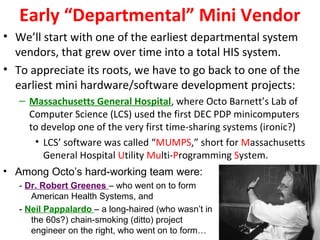
• Among Octo’s hard-working team were:
- Dr. Robert Greenes – who went on to form
American Health Systems, and
- Neil Pappalardo – a long-haired (who wasn’t in
the 60s?) chain-smoking (ditto) project
engineer on the right, who went on to form…
Medical Information Technology
• Odd name: was Neil thinking of his alma mater - MIT?
• Anyway, the firm’s nickname became not “MIT” but
“Meditech,” and it’s current mega-size makes it easy to
forget its very humble roots as a departmental system:
– At first, Meditech was a software programming shop, writing
MUMPS code to automate phone directories, Sheraton hotels,
and even the NYC prison system! First hospital client was:
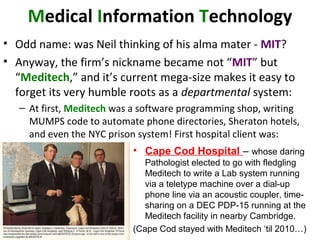
• Cape Cod Hospital – whose daring
Pathologist elected to go with fledgling
Meditech to write a Lab system running
via a teletype machine over a dial-up
phone line via an acoustic coupler, time-
sharing on a DEC PDP-15 running at the
Meditech facility in nearby Cambridge.
(Cape Cod stayed with Meditech ‘til 2010…)
Small World!
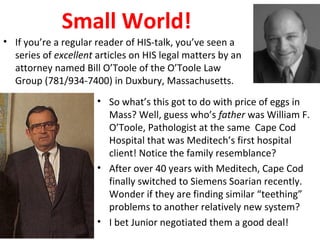
• If you’re a regular reader of HIS-talk, you’ve seen a
series of excellent articles on HIS legal matters by an
attorney named Bill O’Toole of the O’Toole Law
Group (781/934-7400) in Duxbury, Massachusetts.
• So what’s this got to do with price of eggs in
Mass? Well, guess who’s father was William F.
O’Toole, Pathologist at the same Cape Cod
Hospital that was Meditech’s first hospital
client! Notice the family resemblance?
• After over 40 years with Meditech, Cape Cod
finally switched to Siemens Soarian recently.
Wonder if they are finding similar “teething”
problems to another relatively new system?
• I bet Junior negotiated them a good deal!
Meditech Evolution
• Cape Cod’s saga outlines much of Meditech’s HIS-tory:
– 1971 = CCH converted to Meditech’s “MIIS,” their proprietary variant of
MUMPS, and added four Infoton “Vistar” CRTs and two slaved character
printers (UNIVAC DCT-500). It took a full minute to print a single patient
summary report (but far shorter than a clerk could ever {mis}type one!)
– 1979 = CCH converted to another generation of the LIS and Meditech’s
new MIIS (Standard) operating system which ran on a DG Eclipse C330
mini.
– 1984 = CCH replaced their shared financial system with Meditech’s
complete MAGIC “HCIS” system running on five DG MV6000
minicomputers, with 300 devices and five gigabytes of storage. Plans were
to move to DG’s new RISC machines in the future (MV10000 series).• I first encountered Meditech in the early ‘80s when a NYC
mainframe vendor I was working with partnered with
Meditech to propose their clinicals (by then, an LIS, RX, RIS,
and Orders & Results) with our financials. Luckily, the hospital
didn’t buy this “odd couple,” but I noticed how quickly
Meditech added their own financials a few years later…
Other “Medi-techies”
• Like the troika of Jim, Harvey & Clyde at SMS, and Walt, Bruce, &
David at HBO, there were 3 notables who made Meditech magic:
– Neil Pappalardo – still deserves the most credit, personally guiding their
technical evolution through MIIS, $T, NPR, C/S and now Focus/Release 6.
– Larry Polimeno – one of the first employees (remember Jim Pesce’s GE
Medinet story?), who eventually rose to become Vice-Chairman.
– Howard Messing - who has risen today to the position of president and
chief executive officer.
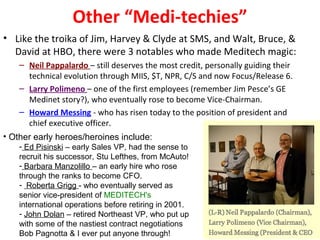
• Other early heroes/heroines include:
- Ed Pisinski – early Sales VP, had the sense to
recruit his successor, Stu Lefthes, from McAuto!
- Barbara Manzolillo – an early hire who rose
through the ranks to become CFO.
- Roberta Grigg - who eventually served as
senior vice-president of MEDITECH's
international operations before retiring in 2001.
- John Dolan – retired Northeast VP, who put up
with some of the nastiest contract negotiations
Bob Pagnotta & I ever put anyone through!
More Meditech Mausoleum Myths
• Meditech started several trends copied by later
vendors:
– Corporate Office Only – everyone is based in Boston, Mass. –
there are no regional offices for sales or implementation.
• Well, actually, in the early ‘70s there were 2 field offices in the West
and one in the Midwest – but they were closed as a cost-cutting
measure after a bad year. Imagine the (your?) air bills to California!
• (a model since followed by such notable vendors as CPSI and Epic…)– Software Only – buy your hardware from
someone else: JJ Wild, Perot, Dell…
• In the early days, MIIS required modifications
to the firmware in early DEC and DG minis’
CRTs, so gear had to be configured in
Westwood.
– (anyone know the origins of JJ Wild’s early
hardware monopoly? Please email me…)
• Imagine how large Meditech’s (and Epic’s)
Meditech‘s Amazing Growth
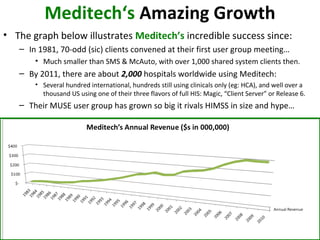
• The graph below illustrates Meditech’s incredible success since:
– In 1981, 70-odd (sic) clients convened at their first user group meeting…
• Much smaller than SMS & McAuto, with over 1,000 shared system clients then.
– By 2011, there are about 2,000 hospitals worldwide using Meditech:
• Several hundred international, hundreds still using clinicals only (eg: HCA), and well over a
thousand US using one of their three flavors of full HIS: Magic, “Client Server” or Release 6.
– Their MUSE user group has grown so big it rivals HIMSS in size and hype…
Meditech‘s Amazing Growth
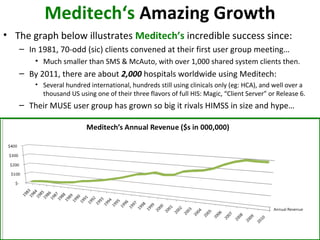
• The graph below illustrates Meditech’s incredible success since:
– In 1981, 70-odd (sic) clients convened at their first user group meeting…
• Much smaller than SMS & McAuto, with over 1,000 shared system clients then.
– By 2011, there are about 2,000 hospitals worldwide using Meditech:
• Several hundred international, hundreds still using clinicals only (eg: HCA), and well over a
thousand US using one of their three flavors of full HIS: Magic, “Client Server” or Release 6.
– Their MUSE user group has grown so big it rivals HIMSS in size and hype…

16. mini meditech

  • 1.
    Turnkey Mini Pioneers Yes,Virginia, that early! “H.I.S.-tory” by Vince Ciotti Episode 16: © 2011 H.I.S. Professionals, LLC, All Rights Reserved
  • 2.
    Earliest Mini Vendors •If you’ve been following our HIS-tory, you’ll remember how shared systems dated from the swinging 60s: – IBM’s “SHAS” – written in the mid-60’s to share 360 mainframes, – McAuto’s HFC – also from the mid-60s, right after Medicare, and – SDK – the oldest of them all, started by S. D. Kaufman in 1959. • Amazingly, the earliest turnkey mini vendors date from the 1960s as well, only they took many, many years to mature and grow anywhere as big as SMS or McAuto: • There were basically two flavors: - Departmental systems, vendors with standalone clinicals that interfaced to shared financials like HBO’s Med-Pro. - “Total HIS” vendors, offering both clinical and financial apps that completely replaced shared systems.
  • 3.
    Early “Departmental” MiniVendor • We’ll start with one of the earliest departmental system vendors, that grew over time into a total HIS system. • To appreciate its roots, we have to go back to one of the earliest mini hardware/software development projects: – Massachusetts General Hospital, where Octo Barnett’s Lab of Computer Science (LCS) used the first DEC PDP minicomputers to develop one of the very first time-sharing systems (ironic?) • LCS’ software was called “MUMPS,” short for Massachusetts General Hospital Utility Multi-Programming System. • Among Octo’s hard-working team were: - Dr. Robert Greenes – who went on to form American Health Systems, and - Neil Pappalardo – a long-haired (who wasn’t in the 60s?) chain-smoking (ditto) project engineer on the right, who went on to form…
  • 4.
    Medical Information Technology •Odd name: was Neil thinking of his alma mater - MIT? • Anyway, the firm’s nickname became not “MIT” but “Meditech,” and it’s current mega-size makes it easy to forget its very humble roots as a departmental system: – At first, Meditech was a software programming shop, writing MUMPS code to automate phone directories, Sheraton hotels, and even the NYC prison system! First hospital client was: • Cape Cod Hospital – whose daring Pathologist elected to go with fledgling Meditech to write a Lab system running via a teletype machine over a dial-up phone line via an acoustic coupler, time- sharing on a DEC PDP-15 running at the Meditech facility in nearby Cambridge. (Cape Cod stayed with Meditech ‘til 2010…)
  • 5.
    Small World! • Ifyou’re a regular reader of HIS-talk, you’ve seen a series of excellent articles on HIS legal matters by an attorney named Bill O’Toole of the O’Toole Law Group (781/934-7400) in Duxbury, Massachusetts. • So what’s this got to do with price of eggs in Mass? Well, guess who’s father was William F. O’Toole, Pathologist at the same Cape Cod Hospital that was Meditech’s first hospital client! Notice the family resemblance? • After over 40 years with Meditech, Cape Cod finally switched to Siemens Soarian recently. Wonder if they are finding similar “teething” problems to another relatively new system? • I bet Junior negotiated them a good deal!
  • 6.
    Meditech Evolution • CapeCod’s saga outlines much of Meditech’s HIS-tory: – 1971 = CCH converted to Meditech’s “MIIS,” their proprietary variant of MUMPS, and added four Infoton “Vistar” CRTs and two slaved character printers (UNIVAC DCT-500). It took a full minute to print a single patient summary report (but far shorter than a clerk could ever {mis}type one!) – 1979 = CCH converted to another generation of the LIS and Meditech’s new MIIS (Standard) operating system which ran on a DG Eclipse C330 mini. – 1984 = CCH replaced their shared financial system with Meditech’s complete MAGIC “HCIS” system running on five DG MV6000 minicomputers, with 300 devices and five gigabytes of storage. Plans were to move to DG’s new RISC machines in the future (MV10000 series).• I first encountered Meditech in the early ‘80s when a NYC mainframe vendor I was working with partnered with Meditech to propose their clinicals (by then, an LIS, RX, RIS, and Orders & Results) with our financials. Luckily, the hospital didn’t buy this “odd couple,” but I noticed how quickly Meditech added their own financials a few years later…
  • 7.
    Other “Medi-techies” • Likethe troika of Jim, Harvey & Clyde at SMS, and Walt, Bruce, & David at HBO, there were 3 notables who made Meditech magic: – Neil Pappalardo – still deserves the most credit, personally guiding their technical evolution through MIIS, $T, NPR, C/S and now Focus/Release 6. – Larry Polimeno – one of the first employees (remember Jim Pesce’s GE Medinet story?), who eventually rose to become Vice-Chairman. – Howard Messing - who has risen today to the position of president and chief executive officer. • Other early heroes/heroines include: - Ed Pisinski – early Sales VP, had the sense to recruit his successor, Stu Lefthes, from McAuto! - Barbara Manzolillo – an early hire who rose through the ranks to become CFO. - Roberta Grigg - who eventually served as senior vice-president of MEDITECH's international operations before retiring in 2001. - John Dolan – retired Northeast VP, who put up with some of the nastiest contract negotiations Bob Pagnotta & I ever put anyone through!
  • 8.
    More Meditech MausoleumMyths • Meditech started several trends copied by later vendors: – Corporate Office Only – everyone is based in Boston, Mass. – there are no regional offices for sales or implementation. • Well, actually, in the early ‘70s there were 2 field offices in the West and one in the Midwest – but they were closed as a cost-cutting measure after a bad year. Imagine the (your?) air bills to California! • (a model since followed by such notable vendors as CPSI and Epic…)– Software Only – buy your hardware from someone else: JJ Wild, Perot, Dell… • In the early days, MIIS required modifications to the firmware in early DEC and DG minis’ CRTs, so gear had to be configured in Westwood. – (anyone know the origins of JJ Wild’s early hardware monopoly? Please email me…) • Imagine how large Meditech’s (and Epic’s)
  • 9.
    Meditech‘s Amazing Growth •The graph below illustrates Meditech’s incredible success since: – In 1981, 70-odd (sic) clients convened at their first user group meeting… • Much smaller than SMS & McAuto, with over 1,000 shared system clients then. – By 2011, there are about 2,000 hospitals worldwide using Meditech: • Several hundred international, hundreds still using clinicals only (eg: HCA), and well over a thousand US using one of their three flavors of full HIS: Magic, “Client Server” or Release 6. – Their MUSE user group has grown so big it rivals HIMSS in size and hype…
  • 10.
    Meditech‘s Amazing Growth •The graph below illustrates Meditech’s incredible success since: – In 1981, 70-odd (sic) clients convened at their first user group meeting… • Much smaller than SMS & McAuto, with over 1,000 shared system clients then. – By 2011, there are about 2,000 hospitals worldwide using Meditech: • Several hundred international, hundreds still using clinicals only (eg: HCA), and well over a thousand US using one of their three flavors of full HIS: Magic, “Client Server” or Release 6. – Their MUSE user group has grown so big it rivals HIMSS in size and hype…