1
Civil Society and Key Populations and the
Country Dialogue Process
Guidance Note: Navigating the New Funding Model
April 2014
Overview
In early 2013, The Global Fund to Fight AIDS, Tuberculosis and Malaria (the Global Fund), the largest
multi-lateral funder of programs to fight the three diseases, launched its New Funding Model. The
changes in the New Funding Model (NFM) are intended to support enhanced flexibility, predictability,
and simplicity in the application process, and to promote greater engagement of a diversity of
stakeholders in all Global Fund activities, as well as improved impact and management of grants. Full
roll-out of the NFM is beginning this year.1
One key feature of the NFM is the country dialogue. Documentation of an inclusive country dialogue is
required before any grant awards will be made in the NFM. However, the Global Fund has been
deliberately vague with regard to what a country dialogue should look like. The rationale is that country
dialogues should be country-specific processes which inform and reflect upon the entirety of a country’s
response to its epidemics, and not something specific to the Global Fund.
This guidance document, the second in the series Navigating the New Funding Model2
, is intended to be
a tool for civil society organizations which are engaged in, leading, or monitoring country dialogues. An
explanation of the key features and expected outcomes of the country dialogue process is followed by a
discussion of country dialogues in practice over the past year. A review of existing analyses and
interviews with civil society participants in country dialogues inform a discussion of the principles of
effective country dialogues. For the purposes of this document, “effective” country dialogues are those
which include significant and meaningful civil society and key population3
participation and inform a
concept note which reflects the true nature of a country’s epidemics and an inclusive strategy for
combating them.
1
Global Fund Website: http://www.theglobalfund.org/en/fundingmodel/process/.
2
http://www.icaso.org/files/civil-society-global-fund-application-preparedness-guide
3
Key affected populations include men who have sex with men, sex workers, transgender persons, people who use
drugs, migrant and displaced persons, and young people. People living with or at elevated risk for HIV, TB, and
malaria are also considered key effected populations.
2
What is a Country Dialogue?
As per the Global Fund vision, country dialogue should:
 Be an ongoing process, which consists of a variety of reviews, meetings, and decisions.
 Be led by the CCM, but involves a range of stakeholders.
 Inform the concept note, through the identification and prioritization of needs and a critical
review of the National Disease Strategies (NSPs).
 Lead to “Strengthened multi-stakeholder involvement in the development of national disease
strategies…improved coordination, relevance, and effectiveness of the disease program
response.”4
Country dialogue should not:
 Be a single meeting of the CCM.
 Be a Global Fund-specific process, but rather an ongoing process of identifying national needs,
developing strategies to fight the diseases, and prioritizing funding requests.
 Conclude with the submission of the concept note.4
Country dialogues must:
 Include a review of the NSPs, and development or enhancement where and NSP does not exist
or is weak or outdated.
 Include documented and meaningful participation of the civil society and key populations, as
well as representatives of people living with the diseases.
 Be conducted, with broad participation prior to the development and submission of a concept
note.4
4
Global Fund, Resource Book for Applicants: http://www.theglobalfund.org/en/fundingmodel/support/.
“…Country dialogue is a process that is country-owned and led, which forms part of and builds
upon existing coordination mechanisms in health and development that are already taking
place in many countries between governments, donors, technical partners, civil society, and
key affected and most-at-risk populations. Work on national strategies and resource
mobilization should be ongoing and form the basis of this country dialogue to identify a
country’s prioritized needs and ultimately prepare the submission of concept notes to the
Global Fund.”1
3
Civil Society in the country dialogue
Because the language of “country dialogue,” and the requirements associated with concept note
submission have been advanced by the Global Fund, CCMs and other stakeholders may see it as a Global
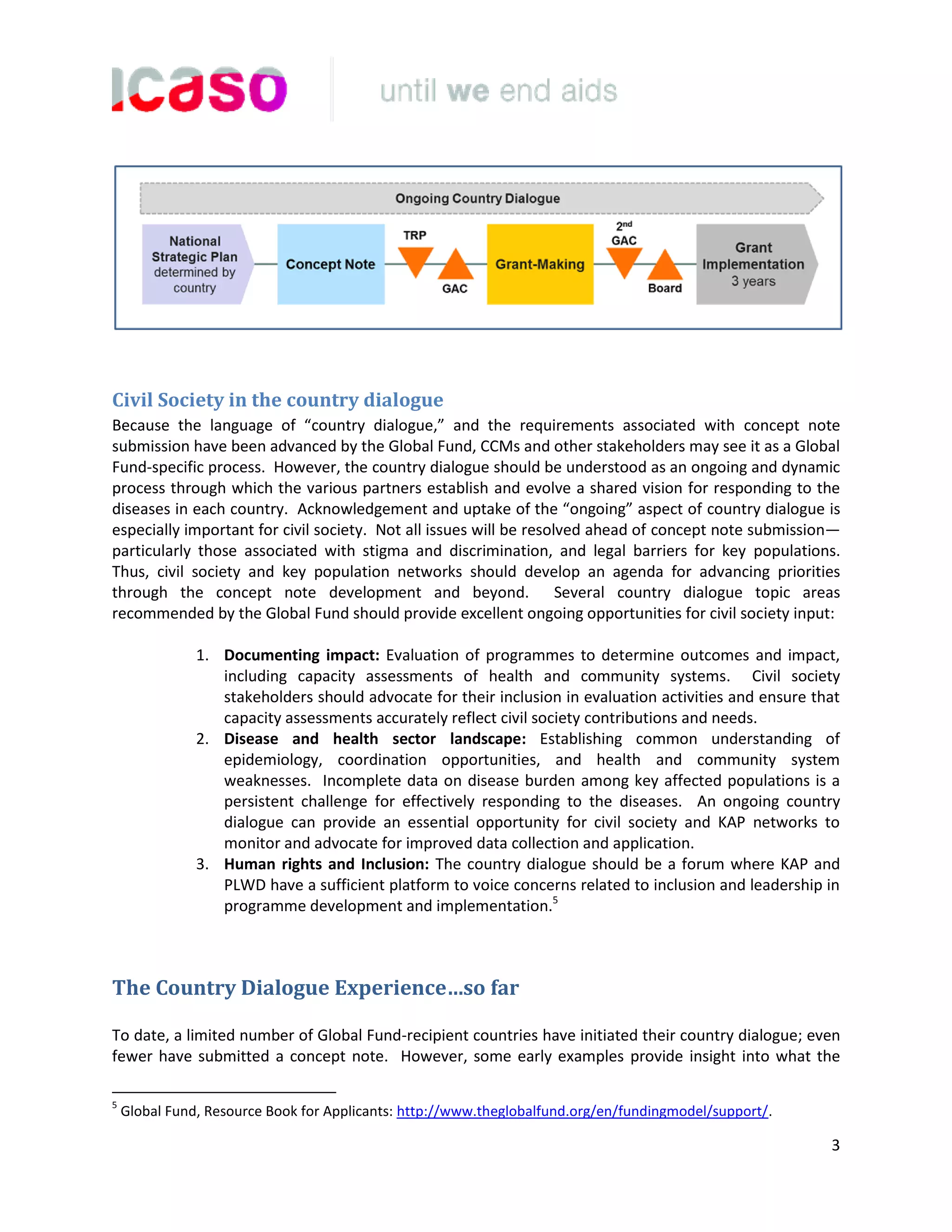
Fund-specific process. However, the country dialogue should be understood as an ongoing and dynamic
process through which the various partners establish and evolve a shared vision for responding to the
diseases in each country. Acknowledgement and uptake of the “ongoing” aspect of country dialogue is
especially important for civil society. Not all issues will be resolved ahead of concept note submission—
particularly those associated with stigma and discrimination, and legal barriers for key populations.
Thus, civil society and key population networks should develop an agenda for advancing priorities
through the concept note development and beyond. Several country dialogue topic areas
recommended by the Global Fund should provide excellent ongoing opportunities for civil society input:
1. Documenting impact: Evaluation of programmes to determine outcomes and impact,
including capacity assessments of health and community systems. Civil society
stakeholders should advocate for their inclusion in evaluation activities and ensure that
capacity assessments accurately reflect civil society contributions and needs.
2. Disease and health sector landscape: Establishing common understanding of
epidemiology, coordination opportunities, and health and community system
weaknesses. Incomplete data on disease burden among key affected populations is a
persistent challenge for effectively responding to the diseases. An ongoing country
dialogue can provide an essential opportunity for civil society and KAP networks to
monitor and advocate for improved data collection and application.
3. Human rights and Inclusion: The country dialogue should be a forum where KAP and
PLWD have a sufficient platform to voice concerns related to inclusion and leadership in
programme development and implementation.5
The Country Dialogue Experience…so far
To date, a limited number of Global Fund-recipient countries have initiated their country dialogue; even
fewer have submitted a concept note. However, some early examples provide insight into what the
5
Global Fund, Resource Book for Applicants: http://www.theglobalfund.org/en/fundingmodel/support/.
4
experience may entail, and what some of the key opportunities and pitfalls may be. Below are some
brief reflections on specific country dialogues that have initiated over the past year.
Zimbabwe
As an early applicant, Zimbabwe conducted an expedited country dialogue process to inform its concept
note in the second quarter of 2013. Despite an extremely tight timeline (about one month), the
Zimbabwe country dialogue has been described as successful, mostly due to a broad inclusion of
stakeholders. The country dialogue was coordinated by the CCM, which proactively sought the input of
civil society and KAP representatives. However, the most significant challenge pointed to by the CCM
was the financial and logistical burden associated with transporting civil society and KAP representatives
to Harare, the capital, for consultations and concept note writing sessions. In Zimbabwe, development
partners were able to take on most of the financial burden for this, but that may not be the case for
many other countries.6,7
Myanmar
Myanmar was also an early applicant. However, the concept note development process began prior to
the transition to the New Funding Model. Because of this, much of the concept notes (one for each
disease) were initially drafted before a country dialogue took place. Observers and participants noted
that the use of pre-existing drafts limited the ability of the country dialogue to shape the concept note.
Despite this limitation on the impact of the country dialogue, direct intervention by the Global Fund
Secretariat to enhance civil society engagement and human rights considerations contributed to
significant civil society, KAP, and human rights-related programming materializing in the concept note,
and consequent grant.6
Democratic Republic of the Congo (DRC)
While not an early applicant, DRC was among one of the first countries to submit a concept note under
the NFM, which it did in January 2014. One area of praise for the DRC country dialogue was that despite
DRC’s massive territory, representatives of all 11 provinces were present to approve the concept note—
two representatives per province, in fact. Similar to Zimbabwe, the financial and logistical reality of
transporting civil society and KAP representatives from remote locations proved to be a significant,
though not insurmountable, challenge for the CCM. Ultimately it was the CCM secretariat which
provided the funds for civil society representatives from the provinces to participate in proceedings.
The DRC country dialogue began eight months before the concept note was submitted, and was
managed entirely by the CCM. As an “interim applicant,” some DRC CCM members were invited to
Geneva for a workshop on the NFM (conducted by the Global Fund), including one civil society member.
Following the Geneva workshop, the civil society participant hosted a local workshop for other civil
6
Open Society Foundations, “Rapid Assessment of Local Civil Society Participation in the Global Fund to Fight AIDS,
TB, and Malaria’s New Funding Model,” June 2013.
7
AIDSpan, “Country dialogue: lessons from Zimbabwe,” February 2014:
http://www.aidspan.org/gfo_article/country-dialogue-lessons-zimbabwe
5
society stakeholders, to enhance their understanding of the NFM. This local process allowed civil society
to discuss their priorities within the framework of the NFM and the six intervention areas of the HIV
programme. The coordinated process resulted in solid key affected population considerations in all
relevant proposed programmes.
Moldova
Moldova was invited to be an “interim applicant,” with a November 2013 application due date.
However, the CCM decided to only use the interim application to sustain essential services for 2014,
while they focused their energy on standard applications, which are to be submitted in May and August
2014 for HIV and TB respectively, for expanded programmes.
Prior to engaging with the full CCM and other stakeholders, civil society and key affected population
representatives in Moldova are engaging with each other in order to develop a cohesive strategy for
advancing their priorities through the country dialogue and the drafting of the concept note. According
to participants, this “pre-country dialogue” process will allow Moldovan civil society representatives to
discuss some historical challenges, establish a strategic platform, and more effectively represent their
various constituencies. This process is set to begin in March 2014, and will include a range of civil
society stakeholders within and beyond the CCM.
Recommendations for Effective Country Dialogues
To date, there is limited experience with the country dialogue, even more limited experience with
concept note development, and virtually no experience with the impact of country dialogue on
outcomes, as that will take several years to properly assess. However, participants and observers of
country dialogues over the past year have offered some insights on how civil society can best approach
the country dialogue process, and what elements should be present to encourage an “effective” country
dialogue. The following is a presentation of the principles of effective country dialogues, informed by
discussions with participants in select countries and published reflections on early country dialogue
experiences.
For Civil Society and Key Population Representatives
1. Develop a cohesive strategy ahead of the country dialogue. Participants and observers almost
unanimously asserted the benefit of civil society stakeholders organizing pre-country dialogue
activities to facilitate the identification of strategic priorities among civil society and key
population representatives. Through an independent process, conducted with a view to the
country dialogue and concept note, civil society has been able to sort out some differences
among networks and individuals, set funding priorities, request (and receive) technical
assistance, and nominate representatives.
6
o In Moldova the CCM KAP Engagement Pilot8
is being leveraged to support the
development of a key population strategy ahead of the country dialogue. Through the
pilot, an outside consultant will work with the KAP networks to develop an engagement
strategy for the country dialogue and concept note, and beyond.
o In some cases, a specific coalition of civil society actors may be organized for this
purpose. If so, the coalition should inform the CCM of its composition and intentions.
The coalition should make an assessment of what technical support and funding
opportunities are available to support their activities. Is their country participating in
the CCM KAP Engagement Pilot? Does the CCM Secretariat have allocated funds for civil
society engagement? Are there technical partners who can support their activities?
8
The CCM KAP Engagement Pilot is a special initiative to provide direct support to key affected population
networks to enhance their engagement with their CCM and their constituents. The programme combines
earmarked funding for the KAP CCM members and direct technical support. Announced in summer 2013, the
programme is currently being piloted in Cote d’Ivoire, Democratic Republic of the Congo, Guyana, Moldova,
Nigeria, the Philippines, Sri Lanka, Swaziland, Thailand, and Uganda.
The Civil Society Priorities Charter: An example of good practice for
country dialogue
In Southern Africa, AIDS Accountability International (AAI) has been supporting
countries to produce Civil Society Priorities Charters for the Global Fund New Funding
Model. The Charters are short, 2-page, country-specific brochures which contain civil
society’s top 12 priorities for HIV/TB that they want to see included in the country
concept note. The aim of the Charters is to promote collaboration among civil society,
helping organizations to speak with a more unified voice that is based on a set of
previously agreed-upon priorities. Each Charter has a list of all partner organizations
who participated in the priorities setting, to help ensure a more cohesive approach.
The Charters get taken to the CCM where civil society presents the Charter to the
other members as civil society’s collective position for the NFM.
In Swaziland, civil society CCM members submitted their Charter with a letter to the
CCM Chair, formally requesting the acknowledgement of the Charter as an official
reference document to be used during concept note writing. In Zambia and
Zimbabwe, national networks are facilitating validation meetings of their Charter in
provincial level meetings, gathering even more collaborative input. In Malawi, other
partner organizations such as the Southern African AIDS Trust are making use of the
Charter to promote further civil society engagement in the New Funding Model.
To view the Charters, please click here.
7
2. Provide workshops on the New Funding model for civil society stakeholders. It is important
for all stakeholders to be informed about all aspects of the NFM: CCM eligibility requirements,
concept note design, programme review activities, timelines, and other components. These
activities should include a broad spectrum of civil society stakeholders beyond the CCM
members. These workshops can allow civil society actors to develop ownership of the process
and be well-informed participants.
o In DRC several preliminary meetings were organized by and for civil society on the NFM,
with the support of the CCM.
3. Engage with the National Strategic Plan development and review processes. All country
dialogues are to include a review and/or establishment of a National Strategic Plan (NSP) for the
diseases. The NSP should inform the concept note and priority interventions.
o It is especially critical to assess the quality of KAP population data and epidemiology
here. Where data is inadequate, enhanced collection may be an important component
of the concept note.
4. Establish mechanisms to solicit input from key population and communicate information
about the country dialogue and concept note writing process. This has been accomplished
through Facebook pages and email listserves in some countries. These mechanisms can
enhance communication with constituents and improve transparency among civil society
representatives.
o In Moldova these platforms are being used collectively by the civil society CCM
representatives to inform their priority-setting process. The public has been invited to
participate in thematic discussions, so as to organize ideas and generate interest. The
benefits of this engagement are expected to go beyond the concept note development
process.
o In DRC, thematic discussion groups were organized among civil society based the HIV
programme review areas. This organization enabled civil society to articulate priorities
in alignment with the NSP and HIV concept note framework.
5. Document all proceedings and invite non-civil society CCM members to observe meetings as
appropriate. Important decisions and discussions happen when informed and energized
stakeholders come together. Substantive documentation, such as meeting minutes and
resolutions, provide an important record of the thinking, priorities, and participation of civil
society. Not only can such documentation improve the efficiency of ongoing processes, but it
can also strengthen civil society’s voice within the CCM and concept note writing team. The
invitation to non-civil society CCM members to observe meetings (whether it is accepted or not)
can enhance the credibility of such proceedings and their outcomes, in terms of CCM decision-
making processes.
Overall Country Dialogue Management
1. Local language translation. All documents and meetings should be available in the predominant
local language and in regional languages and dialects where appropriate. Specifically, technical
8
partners and the Global Fund should ensure local language inclusion on all communications
regarding the concept note. Civil society and key populations will likely benefit the most from
these accommodations, enhancing their overall participation.6
2. Remote and rural community inclusion. The impact of the three diseases extends beyond
capital cities, as do funded programmes. As such, substantial inclusion of representatives from
remote and rural communities is critical. In larger countries, participation in meetings and
activities can be the single greatest challenge for civil society representatives. The CCM, Global
Fund, and technical partners should coordinate resources to support travel for civil society
representatives to participate in all country dialogue processes.6
3. Position the country dialogue as more than a meeting or series of meetings, which terminates
with the submission of a concept note. As per Global Fund guidelines the country dialogue
should be an ongoing process that goes beyond the Global Fund grants. The country dialogue
should provide ongoing opportunities for civil society—be they CCM-represented or not—to
express demand for services, advocate for improved data collection, and review the national
strategic plan and all health sector programming.
Acknowledgements
This document was prepared by Charlie Baran for ICASO. ICASO thanks Marie Nyombo Zaina of Réseau
National des ONG pour le Développement de la Femme en RDC, Alexandr Curasov of Initiativa Pozitiva in
Moldova, Gemma Oberth of AIDS Accountability International and Peter van Rooijen of International
Civil Society Support for their generous and insightful contributions to this document. For comments or
questions contact Kataisee Richardson, program manager kataiseer@icaso.org
About ICASO
Our mission is to mobilize and support diverse communities for effective response to end the AIDS
pandemic. ICASO facilitates the inclusion and leadership of communities in the effort to bring about an
end to the pandemic, recognizing the importance of promoting health and human rights as part of this
undertaking.
65 Wellesley St. E., Suite 403
Toronto, ON Canada M4Y 1G7
TEL +1 416 921 0018
FAX +1 416 921 9979
www.icaso.org

23953 guidance notecountrydialogueapril2014final

  • 1.
    1 Civil Society andKey Populations and the Country Dialogue Process Guidance Note: Navigating the New Funding Model April 2014 Overview In early 2013, The Global Fund to Fight AIDS, Tuberculosis and Malaria (the Global Fund), the largest multi-lateral funder of programs to fight the three diseases, launched its New Funding Model. The changes in the New Funding Model (NFM) are intended to support enhanced flexibility, predictability, and simplicity in the application process, and to promote greater engagement of a diversity of stakeholders in all Global Fund activities, as well as improved impact and management of grants. Full roll-out of the NFM is beginning this year.1 One key feature of the NFM is the country dialogue. Documentation of an inclusive country dialogue is required before any grant awards will be made in the NFM. However, the Global Fund has been deliberately vague with regard to what a country dialogue should look like. The rationale is that country dialogues should be country-specific processes which inform and reflect upon the entirety of a country’s response to its epidemics, and not something specific to the Global Fund. This guidance document, the second in the series Navigating the New Funding Model2 , is intended to be a tool for civil society organizations which are engaged in, leading, or monitoring country dialogues. An explanation of the key features and expected outcomes of the country dialogue process is followed by a discussion of country dialogues in practice over the past year. A review of existing analyses and interviews with civil society participants in country dialogues inform a discussion of the principles of effective country dialogues. For the purposes of this document, “effective” country dialogues are those which include significant and meaningful civil society and key population3 participation and inform a concept note which reflects the true nature of a country’s epidemics and an inclusive strategy for combating them. 1 Global Fund Website: http://www.theglobalfund.org/en/fundingmodel/process/. 2 http://www.icaso.org/files/civil-society-global-fund-application-preparedness-guide 3 Key affected populations include men who have sex with men, sex workers, transgender persons, people who use drugs, migrant and displaced persons, and young people. People living with or at elevated risk for HIV, TB, and malaria are also considered key effected populations.
  • 2.
    2 What is aCountry Dialogue? As per the Global Fund vision, country dialogue should:  Be an ongoing process, which consists of a variety of reviews, meetings, and decisions.  Be led by the CCM, but involves a range of stakeholders.  Inform the concept note, through the identification and prioritization of needs and a critical review of the National Disease Strategies (NSPs).  Lead to “Strengthened multi-stakeholder involvement in the development of national disease strategies…improved coordination, relevance, and effectiveness of the disease program response.”4 Country dialogue should not:  Be a single meeting of the CCM.  Be a Global Fund-specific process, but rather an ongoing process of identifying national needs, developing strategies to fight the diseases, and prioritizing funding requests.  Conclude with the submission of the concept note.4 Country dialogues must:  Include a review of the NSPs, and development or enhancement where and NSP does not exist or is weak or outdated.  Include documented and meaningful participation of the civil society and key populations, as well as representatives of people living with the diseases.  Be conducted, with broad participation prior to the development and submission of a concept note.4 4 Global Fund, Resource Book for Applicants: http://www.theglobalfund.org/en/fundingmodel/support/. “…Country dialogue is a process that is country-owned and led, which forms part of and builds upon existing coordination mechanisms in health and development that are already taking place in many countries between governments, donors, technical partners, civil society, and key affected and most-at-risk populations. Work on national strategies and resource mobilization should be ongoing and form the basis of this country dialogue to identify a country’s prioritized needs and ultimately prepare the submission of concept notes to the Global Fund.”1
  • 3.
    3 Civil Society inthe country dialogue Because the language of “country dialogue,” and the requirements associated with concept note submission have been advanced by the Global Fund, CCMs and other stakeholders may see it as a Global Fund-specific process. However, the country dialogue should be understood as an ongoing and dynamic process through which the various partners establish and evolve a shared vision for responding to the diseases in each country. Acknowledgement and uptake of the “ongoing” aspect of country dialogue is especially important for civil society. Not all issues will be resolved ahead of concept note submission— particularly those associated with stigma and discrimination, and legal barriers for key populations. Thus, civil society and key population networks should develop an agenda for advancing priorities through the concept note development and beyond. Several country dialogue topic areas recommended by the Global Fund should provide excellent ongoing opportunities for civil society input: 1. Documenting impact: Evaluation of programmes to determine outcomes and impact, including capacity assessments of health and community systems. Civil society stakeholders should advocate for their inclusion in evaluation activities and ensure that capacity assessments accurately reflect civil society contributions and needs. 2. Disease and health sector landscape: Establishing common understanding of epidemiology, coordination opportunities, and health and community system weaknesses. Incomplete data on disease burden among key affected populations is a persistent challenge for effectively responding to the diseases. An ongoing country dialogue can provide an essential opportunity for civil society and KAP networks to monitor and advocate for improved data collection and application. 3. Human rights and Inclusion: The country dialogue should be a forum where KAP and PLWD have a sufficient platform to voice concerns related to inclusion and leadership in programme development and implementation.5 The Country Dialogue Experience…so far To date, a limited number of Global Fund-recipient countries have initiated their country dialogue; even fewer have submitted a concept note. However, some early examples provide insight into what the 5 Global Fund, Resource Book for Applicants: http://www.theglobalfund.org/en/fundingmodel/support/.
  • 4.
    4 experience may entail,and what some of the key opportunities and pitfalls may be. Below are some brief reflections on specific country dialogues that have initiated over the past year. Zimbabwe As an early applicant, Zimbabwe conducted an expedited country dialogue process to inform its concept note in the second quarter of 2013. Despite an extremely tight timeline (about one month), the Zimbabwe country dialogue has been described as successful, mostly due to a broad inclusion of stakeholders. The country dialogue was coordinated by the CCM, which proactively sought the input of civil society and KAP representatives. However, the most significant challenge pointed to by the CCM was the financial and logistical burden associated with transporting civil society and KAP representatives to Harare, the capital, for consultations and concept note writing sessions. In Zimbabwe, development partners were able to take on most of the financial burden for this, but that may not be the case for many other countries.6,7 Myanmar Myanmar was also an early applicant. However, the concept note development process began prior to the transition to the New Funding Model. Because of this, much of the concept notes (one for each disease) were initially drafted before a country dialogue took place. Observers and participants noted that the use of pre-existing drafts limited the ability of the country dialogue to shape the concept note. Despite this limitation on the impact of the country dialogue, direct intervention by the Global Fund Secretariat to enhance civil society engagement and human rights considerations contributed to significant civil society, KAP, and human rights-related programming materializing in the concept note, and consequent grant.6 Democratic Republic of the Congo (DRC) While not an early applicant, DRC was among one of the first countries to submit a concept note under the NFM, which it did in January 2014. One area of praise for the DRC country dialogue was that despite DRC’s massive territory, representatives of all 11 provinces were present to approve the concept note— two representatives per province, in fact. Similar to Zimbabwe, the financial and logistical reality of transporting civil society and KAP representatives from remote locations proved to be a significant, though not insurmountable, challenge for the CCM. Ultimately it was the CCM secretariat which provided the funds for civil society representatives from the provinces to participate in proceedings. The DRC country dialogue began eight months before the concept note was submitted, and was managed entirely by the CCM. As an “interim applicant,” some DRC CCM members were invited to Geneva for a workshop on the NFM (conducted by the Global Fund), including one civil society member. Following the Geneva workshop, the civil society participant hosted a local workshop for other civil 6 Open Society Foundations, “Rapid Assessment of Local Civil Society Participation in the Global Fund to Fight AIDS, TB, and Malaria’s New Funding Model,” June 2013. 7 AIDSpan, “Country dialogue: lessons from Zimbabwe,” February 2014: http://www.aidspan.org/gfo_article/country-dialogue-lessons-zimbabwe
  • 5.
    5 society stakeholders, toenhance their understanding of the NFM. This local process allowed civil society to discuss their priorities within the framework of the NFM and the six intervention areas of the HIV programme. The coordinated process resulted in solid key affected population considerations in all relevant proposed programmes. Moldova Moldova was invited to be an “interim applicant,” with a November 2013 application due date. However, the CCM decided to only use the interim application to sustain essential services for 2014, while they focused their energy on standard applications, which are to be submitted in May and August 2014 for HIV and TB respectively, for expanded programmes. Prior to engaging with the full CCM and other stakeholders, civil society and key affected population representatives in Moldova are engaging with each other in order to develop a cohesive strategy for advancing their priorities through the country dialogue and the drafting of the concept note. According to participants, this “pre-country dialogue” process will allow Moldovan civil society representatives to discuss some historical challenges, establish a strategic platform, and more effectively represent their various constituencies. This process is set to begin in March 2014, and will include a range of civil society stakeholders within and beyond the CCM. Recommendations for Effective Country Dialogues To date, there is limited experience with the country dialogue, even more limited experience with concept note development, and virtually no experience with the impact of country dialogue on outcomes, as that will take several years to properly assess. However, participants and observers of country dialogues over the past year have offered some insights on how civil society can best approach the country dialogue process, and what elements should be present to encourage an “effective” country dialogue. The following is a presentation of the principles of effective country dialogues, informed by discussions with participants in select countries and published reflections on early country dialogue experiences. For Civil Society and Key Population Representatives 1. Develop a cohesive strategy ahead of the country dialogue. Participants and observers almost unanimously asserted the benefit of civil society stakeholders organizing pre-country dialogue activities to facilitate the identification of strategic priorities among civil society and key population representatives. Through an independent process, conducted with a view to the country dialogue and concept note, civil society has been able to sort out some differences among networks and individuals, set funding priorities, request (and receive) technical assistance, and nominate representatives.
  • 6.
    6 o In Moldovathe CCM KAP Engagement Pilot8 is being leveraged to support the development of a key population strategy ahead of the country dialogue. Through the pilot, an outside consultant will work with the KAP networks to develop an engagement strategy for the country dialogue and concept note, and beyond. o In some cases, a specific coalition of civil society actors may be organized for this purpose. If so, the coalition should inform the CCM of its composition and intentions. The coalition should make an assessment of what technical support and funding opportunities are available to support their activities. Is their country participating in the CCM KAP Engagement Pilot? Does the CCM Secretariat have allocated funds for civil society engagement? Are there technical partners who can support their activities? 8 The CCM KAP Engagement Pilot is a special initiative to provide direct support to key affected population networks to enhance their engagement with their CCM and their constituents. The programme combines earmarked funding for the KAP CCM members and direct technical support. Announced in summer 2013, the programme is currently being piloted in Cote d’Ivoire, Democratic Republic of the Congo, Guyana, Moldova, Nigeria, the Philippines, Sri Lanka, Swaziland, Thailand, and Uganda. The Civil Society Priorities Charter: An example of good practice for country dialogue In Southern Africa, AIDS Accountability International (AAI) has been supporting countries to produce Civil Society Priorities Charters for the Global Fund New Funding Model. The Charters are short, 2-page, country-specific brochures which contain civil society’s top 12 priorities for HIV/TB that they want to see included in the country concept note. The aim of the Charters is to promote collaboration among civil society, helping organizations to speak with a more unified voice that is based on a set of previously agreed-upon priorities. Each Charter has a list of all partner organizations who participated in the priorities setting, to help ensure a more cohesive approach. The Charters get taken to the CCM where civil society presents the Charter to the other members as civil society’s collective position for the NFM. In Swaziland, civil society CCM members submitted their Charter with a letter to the CCM Chair, formally requesting the acknowledgement of the Charter as an official reference document to be used during concept note writing. In Zambia and Zimbabwe, national networks are facilitating validation meetings of their Charter in provincial level meetings, gathering even more collaborative input. In Malawi, other partner organizations such as the Southern African AIDS Trust are making use of the Charter to promote further civil society engagement in the New Funding Model. To view the Charters, please click here.
  • 7.
    7 2. Provide workshopson the New Funding model for civil society stakeholders. It is important for all stakeholders to be informed about all aspects of the NFM: CCM eligibility requirements, concept note design, programme review activities, timelines, and other components. These activities should include a broad spectrum of civil society stakeholders beyond the CCM members. These workshops can allow civil society actors to develop ownership of the process and be well-informed participants. o In DRC several preliminary meetings were organized by and for civil society on the NFM, with the support of the CCM. 3. Engage with the National Strategic Plan development and review processes. All country dialogues are to include a review and/or establishment of a National Strategic Plan (NSP) for the diseases. The NSP should inform the concept note and priority interventions. o It is especially critical to assess the quality of KAP population data and epidemiology here. Where data is inadequate, enhanced collection may be an important component of the concept note. 4. Establish mechanisms to solicit input from key population and communicate information about the country dialogue and concept note writing process. This has been accomplished through Facebook pages and email listserves in some countries. These mechanisms can enhance communication with constituents and improve transparency among civil society representatives. o In Moldova these platforms are being used collectively by the civil society CCM representatives to inform their priority-setting process. The public has been invited to participate in thematic discussions, so as to organize ideas and generate interest. The benefits of this engagement are expected to go beyond the concept note development process. o In DRC, thematic discussion groups were organized among civil society based the HIV programme review areas. This organization enabled civil society to articulate priorities in alignment with the NSP and HIV concept note framework. 5. Document all proceedings and invite non-civil society CCM members to observe meetings as appropriate. Important decisions and discussions happen when informed and energized stakeholders come together. Substantive documentation, such as meeting minutes and resolutions, provide an important record of the thinking, priorities, and participation of civil society. Not only can such documentation improve the efficiency of ongoing processes, but it can also strengthen civil society’s voice within the CCM and concept note writing team. The invitation to non-civil society CCM members to observe meetings (whether it is accepted or not) can enhance the credibility of such proceedings and their outcomes, in terms of CCM decision- making processes. Overall Country Dialogue Management 1. Local language translation. All documents and meetings should be available in the predominant local language and in regional languages and dialects where appropriate. Specifically, technical
  • 8.
    8 partners and theGlobal Fund should ensure local language inclusion on all communications regarding the concept note. Civil society and key populations will likely benefit the most from these accommodations, enhancing their overall participation.6 2. Remote and rural community inclusion. The impact of the three diseases extends beyond capital cities, as do funded programmes. As such, substantial inclusion of representatives from remote and rural communities is critical. In larger countries, participation in meetings and activities can be the single greatest challenge for civil society representatives. The CCM, Global Fund, and technical partners should coordinate resources to support travel for civil society representatives to participate in all country dialogue processes.6 3. Position the country dialogue as more than a meeting or series of meetings, which terminates with the submission of a concept note. As per Global Fund guidelines the country dialogue should be an ongoing process that goes beyond the Global Fund grants. The country dialogue should provide ongoing opportunities for civil society—be they CCM-represented or not—to express demand for services, advocate for improved data collection, and review the national strategic plan and all health sector programming. Acknowledgements This document was prepared by Charlie Baran for ICASO. ICASO thanks Marie Nyombo Zaina of Réseau National des ONG pour le Développement de la Femme en RDC, Alexandr Curasov of Initiativa Pozitiva in Moldova, Gemma Oberth of AIDS Accountability International and Peter van Rooijen of International Civil Society Support for their generous and insightful contributions to this document. For comments or questions contact Kataisee Richardson, program manager kataiseer@icaso.org About ICASO Our mission is to mobilize and support diverse communities for effective response to end the AIDS pandemic. ICASO facilitates the inclusion and leadership of communities in the effort to bring about an end to the pandemic, recognizing the importance of promoting health and human rights as part of this undertaking. 65 Wellesley St. E., Suite 403 Toronto, ON Canada M4Y 1G7 TEL +1 416 921 0018 FAX +1 416 921 9979 www.icaso.org