Page 1 of 9 
UNDG Post-2015 Dialogues on “Partnerships with Civil Society” 
Global Meeting Report 
20-21 October 2014 
Siem Reap, Cambodia 
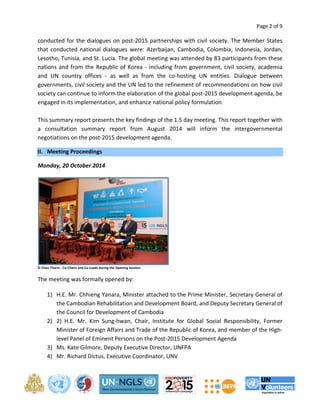
© Chan Tharin - Participants of the Global Meeting during the Opening Session 
I. Introduction 
On 20-21 October 2014, the Royal Government of Cambodia and the Government of the 
Republic of Korea, in partnership with the co-leading United Nations entities - UN Population 
Fund (UNFPA), the UN Volunteers (UNV) programme, UN Non-governmental Liaison Service 
(UN-NGLS), UN Millennium Campaign (UNMC), UN Post-2015 Secretariat, and the Cambodia UN 
Country Team (UNCT) - co-hosted a high-level global meeting in Siem Reap, Cambodia to 
conclude the UN Development Group (UNDG) post-2015 dialogues on “Partnerships with Civil 
Society.”1 The objective of this meeting was to discuss strategies for advancing the key 
recommendations that emerged from eight national consultations and an e-discussion 
1 The UNDG dialogues on "Partnerships with Civil Society" were one of six components of the UNDG Phase II 
Consultation, "Dialogues on the Implementation of the Post-2015 Development Agenda."
Page 2 of 9 
conducted for the dialogues on post-2015 partnerships with civil society. The Member States 
that conducted national dialogues were: Azerbaijan, Cambodia, Colombia, Indonesia, Jordan, 
Lesotho, Tunisia, and St. Lucia. The global meeting was attended by 83 participants from these 
nations and from the Republic of Korea - including from government, civil society, academia 
and UN country offices - as well as from the co-hosting UN entities. Dialogue between 
governments, civil society and the UN led to the refinement of recommendations on how civil 
society can continue to inform the elaboration of the global post-2015 development agenda, be 
engaged in its implementation, and enhance national policy formulation. 
This summary report presents the key findings of the 1.5 day meeting. This report together with 
a consultation summary report from August 2014 will inform the intergovernmental 
negotiations on the post-2015 development agenda. 
II. Meeting Proceedings 
Monday, 20 October 2014 
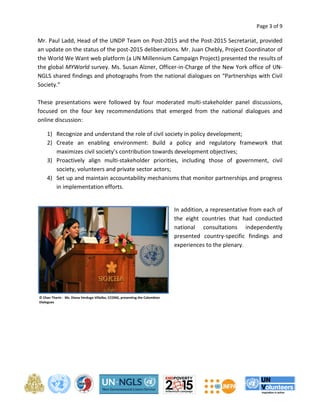
© Chan Tharin - Co-Chairs and Co-Leads during the Opening Session 
The meeting was formally opened by: 
1) H.E. Mr. Chhieng Yanara, Minister attached to the Prime Minister, Secretary General of 
the Cambodian Rehabilitation and Development Board, and Deputy Secretary General of 
the Council for Development of Cambodia 
2) 2) H.E. Mr. Kim Sung-hwan, Chair, Institute for Global Social Responsibility, Former 
Minister of Foreign Affairs and Trade of the Republic of Korea, and member of the High-level 
Panel of Eminent Persons on the Post-2015 Development Agenda 
3) Ms. Kate Gilmore, Deputy Executive Director, UNFPA 
4) Mr. Richard Dictus, Executive Coordinator, UNV
Page 3 of 9 
Mr. Paul Ladd, Head of the UNDP Team on Post-2015 and the Post-2015 Secretariat, provided 
an update on the status of the post-2015 deliberations. Mr. Juan Chebly, Project Coordinator of 
the World We Want web platform (a UN Millennium Campaign Project) presented the results of 
the global MYWorld survey. Ms. Susan Alzner, Officer-in-Charge of the New York office of UN-NGLS 
shared findings and photographs from the national dialogues on “Partnerships with Civil 
Society.” 
These presentations were followed by four moderated multi-stakeholder panel discussions, 
focused on the four key recommendations that emerged from the national dialogues and 
online discussion: 
1) Recognize and understand the role of civil society in policy development; 
2) Create an enabling environment: Build a policy and regulatory framework that 
maximizes civil society’s contribution towards development objectives; 
3) Proactively align multi-stakeholder priorities, including those of government, civil 
society, volunteers and private sector actors; 
4) Set up and maintain accountability mechanisms that monitor partnerships and progress 
in implementation efforts. 
In addition, a representative from each of 
the eight countries that had conducted 
national consultations independently 
presented country-specific findings and 
experiences to the plenary. 
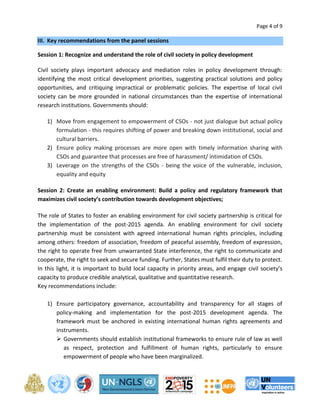
© Chan Tharin - Ms. Diana Verdugo Villalba, CCONG, presenting the Colombian 
Dialogues
Page 4 of 9 
III. Key recommendations from the panel sessions 
Session 1: Recognize and understand the role of civil society in policy development 
Civil society plays important advocacy and mediation roles in policy development through: 
identifying the most critical development priorities, suggesting practical solutions and policy 
opportunities, and critiquing impractical or problematic policies. The expertise of local civil 
society can be more grounded in national circumstances than the expertise of international 
research institutions. Governments should: 
1) Move from engagement to empowerment of CSOs - not just dialogue but actual policy 
formulation - this requires shifting of power and breaking down institutional, social and 
cultural barriers. 
2) Ensure policy making processes are more open with timely information sharing with 
CSOs and guarantee that processes are free of harassment/ intimidation of CSOs. 
3) Leverage on the strengths of the CSOs - being the voice of the vulnerable, inclusion, 
equality and equity 
Session 2: Create an enabling environment: Build a policy and regulatory framework that 
maximizes civil society’s contribution towards development objectives; 
The role of States to foster an enabling environment for civil society partnership is critical for 
the implementation of the post-2015 agenda. An enabling environment for civil society 
partnership must be consistent with agreed international human rights principles, including 
among others: freedom of association, freedom of peaceful assembly, freedom of expression, 
the right to operate free from unwarranted State interference, the right to communicate and 
cooperate, the right to seek and secure funding. Further, States must fulfil their duty to protect. 
In this light, it is important to build local capacity in priority areas, and engage civil society’s 
capacity to produce credible analytical, qualitative and quantitative research. 
Key recommendations include: 
1) Ensure participatory governance, accountability and transparency for all stages of 
policy-making and implementation for the post-2015 development agenda. The 
framework must be anchored in existing international human rights agreements and 
instruments. 
 Governments should establish institutional frameworks to ensure rule of law as well 
as respect, protection and fulfillment of human rights, particularly to ensure 
empowerment of people who have been marginalized.
Page 5 of 9 
2) Build viable cooperation 
 Strengthen existing dialogue mechanisms of civil society with governments, at both 
national and sub-national levels. Enhance local leadership. 
 Engage civil society’s capacity to produce credible analytical, qualitative and 
quantitative research. 
 Develop and improve coordination and knowledge-sharing mechanisms to avoid 
duplication, build alliances and strengthen capacity. 
 Ensure access to independent media and information; create public media platforms. 
3) Invest in building the capacity of civil society organizations 
 Expand civic education 
 Provide funding for civil society participation in government meetings 
 Support visa applications for international travel 
 Expand access to technology, including the Internet 
Session 3: Proactively align multi-stakeholder priorities, including those of government, civil 
society, volunteers and private sector actors; 
Multi-stakeholder partnerships should be based on the principles of inclusivity and 
complementarity, acknowledging that no single actor can address sustainable development 
challenges alone and each partner brings a particular added value into the dialogue as well as 
specific capacities for implementation. In order to best align priorities and identify 
opportunities for synergetic partnerships, neutral spaces for regular multi-stakeholder dialogue 
need to be created with clear connections to decision making processes and implementation 
measures. SDG implementation will require systematic community outreach and volunteer 
engagement. The United Nations System can play a facilitating role as convener of dialogues. 
Governments should ensure an enabling environment for multi-stakeholder dialogues at 
national level and systematically associate volunteer involving organizations as they design 
implementation strategies. Key recommendations include: 
1) With regards to decision making processes across different thematic areas, ensure 
integration of diverse perspectives and actors such as academia, the private sector 
and volunteer groups around areas of mutual interest and ensure the inclusion of 
those most marginalized. 
2) Ensure connection between consultation and implementation mechanisms, with
Page 6 of 9 
clear connections to decision making processes. Enlarge spaces for dialogue, 
connected to opportunities for action. 
3) Provide opportunities for capacity building of civil society actors who can in return 
act as multipliers and capacity builders of local communities, in order to increase 
accountability. 
4) Include concrete opportunities for dialogue and voluntary action at local level with 
regards to SDG implementation, ensuring outreach to marginalized people, 
leveraging the expressed desire for engagement and tapping into the wealth of local 
knowledge and experience. 
5) Recognize and integrate volunteerism as a key factor for the localization of SDG 
implementation as it provides new spaces of interaction between governments and 
people for concrete, scalable actions to address development challenges across all 
thematic areas. 
Session 4: Set up and maintain accountability mechanisms that monitor partnerships and 
progress in implementation efforts; 
Citizen engagement in monitoring and accountability can strengthen policy-making and social 
inclusion. Grassroots data collection on a mass scale can be accomplished through combining 
online and offline efforts and requires systematic multi-stake partnerships, including volunteer 
engagement. Accessibility of data is crucial to increase transparency and thus accountability. 
Thereafter, data visualization facilitates communication and dissemination of data for evidence-based 
advocacy. Furthermore, multi-stakeholder monitoring, which brings policy makers 
together civil society and other actors, is a way to contribute to monitoring SDG progress. 
Challenges 
1) Local, Regional, and National data needs to be standardized and then centralized in 
order to better inform global policy making. Stronger regional cooperation will be 
essential to achieving this. 
2) CSOs also need to be more coordinated and have a stronger and institutionalized role in 
policy making. 
3) Data has to be more open and transparent. Wide communication and dissemination of 
data is necessary to ensure access to data and foster evidence-based advocacy.
Page 7 of 9 
Proposed Solutions 
1) Data collection needs to be systematic, timely and inclusive. Alternative sources of data 
should be utilized, such as perception based data, or soft data. 
2) Data collection by citizens should be seen as a way for knowledge sharing, empowering 
ordinary people to engage in finding solutions for sustainable development; 
3) When citizens are art of the data-collection process there is more transparency, and 
transparency leads to better and more accountability. 
4) Information, including hard data statistics and soft data, needs to be accessible to all in 
order to allow participatory forms of monitoring, and evidence-based advocacy. 
5) Multi-stakeholder mechanisms to monitor progress on SDG implementation are needed 
such as JMIs and working groups 
6) Open source platforms for social engagement in monitoring and accountability, such as 
the Open Government Platform, are valuable and necessary for citizens to provide input 
to policy makers in real-time. 
7) Monitoring and accountability of the SDGs should draw best practices from the 
Universal Periodic Review framework of OHCHR 
8) The principles of social inclusion and participation should be seen as the bedrock of 
creating a virtuous cycle of people-centered sustainable development. 
© Chan Tharin - Ms. Ibtesam Atta-Allah, Alsho'aa Society, presenting key 
recommendations for Jordan
Page 8 of 9 
Tuesday, 21 October 2014 
Day 2 provided a platform to discuss 
meaningful and effective approaches to 
continued civil society engagement in the 
post-2015 development agenda. 
Representatives from each country 
delegation convened and discussed the 
way forward in terms of continuing multi-stakeholder 
interaction beyond the UNDG 
dialogues. They addressed ways to 
implement key recommendations at the 
national level in order to build and 
strengthen opportunities and spaces for 
sustained civil society engagement as the 
sustainable development agenda takes shape. 
H.E. Mr. Kim Sung-hwan, co-chair of the meeting, provided a pre-wrap up, followed by a series 
of presentations on the UN’s Way forward in the post-2015 deliberations. 
Co-leading UN entities presented their respective approaches and initiatives for 2015 and 
beyond. The presentations included opportunities for civil society engagement in the run-up 
and during the inter-governmental negotiation phase in 20152; the necessity to develop 
participatory accountability measures and new forms of data visualization during SDG 
implementation such as the data mining tool on the worldwewant website3; as well as the ten-year 
plan of action to integrate volunteering in peace and development in the first decade of 
SDG implementation and beyond4. 
Finally, closing remarks were delivered by Mr. Richard Dictus, Executive Coordinator of UNV, 
Ms. Kate Gilmore, Deputy Executive Director of UNFPA, and H.E. Mr. Chhieng Yanara, co-chair 
of the meeting. 
All speeches can be accessed here: [Link] 
2 http://sustainabledevelopment2015.org/index.php/timeline 
3 http://www.worldwewant2015.org/trends 
4 http://www.volunteeractioncounts.org/en/homepage/survey.html 
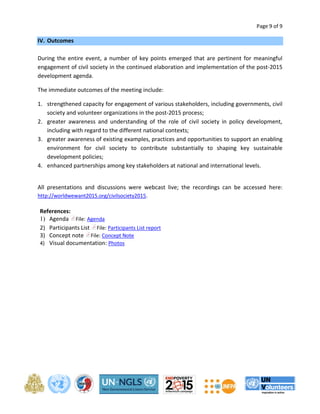
© Chan Tharin - Ms. Selloane Jone, LCN, Mr. Mojela Mafike, LIRAC and Ms. Karla 
Robin Hershey, UN Resident Coordinator (from left to right), discussing the way 
forward for post-2015 multi-stakeholder dialogue in Lesotho
Page 9 of 9 
IV. Outcomes 
During the entire event, a number of key points emerged that are pertinent for meaningful 
engagement of civil society in the continued elaboration and implementation of the post-2015 
development agenda. 
The immediate outcomes of the meeting include: 
1. strengthened capacity for engagement of various stakeholders, including governments, civil 
society and volunteer organizations in the post-2015 process; 
2. greater awareness and understanding of the role of civil society in policy development, 
including with regard to the different national contexts; 
3. greater awareness of existing examples, practices and opportunities to support an enabling 
environment for civil society to contribute substantially to shaping key sustainable 
development policies; 
4. enhanced partnerships among key stakeholders at national and international levels. 
All presentations and discussions were webcast live; the recordings can be accessed here: 
http://worldwewant2015.org/civilsociety2015. 
References: 
1) Agenda File: Agenda 
2) Participants List File: Participants List report 
3) Concept note File: Concept Note 
4) Visual documentation: Photos

Summary report global meeting post-2015_cambodia(1)

  • 1.
    Page 1 of9 UNDG Post-2015 Dialogues on “Partnerships with Civil Society” Global Meeting Report 20-21 October 2014 Siem Reap, Cambodia © Chan Tharin - Participants of the Global Meeting during the Opening Session I. Introduction On 20-21 October 2014, the Royal Government of Cambodia and the Government of the Republic of Korea, in partnership with the co-leading United Nations entities - UN Population Fund (UNFPA), the UN Volunteers (UNV) programme, UN Non-governmental Liaison Service (UN-NGLS), UN Millennium Campaign (UNMC), UN Post-2015 Secretariat, and the Cambodia UN Country Team (UNCT) - co-hosted a high-level global meeting in Siem Reap, Cambodia to conclude the UN Development Group (UNDG) post-2015 dialogues on “Partnerships with Civil Society.”1 The objective of this meeting was to discuss strategies for advancing the key recommendations that emerged from eight national consultations and an e-discussion 1 The UNDG dialogues on "Partnerships with Civil Society" were one of six components of the UNDG Phase II Consultation, "Dialogues on the Implementation of the Post-2015 Development Agenda."
  • 2.
    Page 2 of9 conducted for the dialogues on post-2015 partnerships with civil society. The Member States that conducted national dialogues were: Azerbaijan, Cambodia, Colombia, Indonesia, Jordan, Lesotho, Tunisia, and St. Lucia. The global meeting was attended by 83 participants from these nations and from the Republic of Korea - including from government, civil society, academia and UN country offices - as well as from the co-hosting UN entities. Dialogue between governments, civil society and the UN led to the refinement of recommendations on how civil society can continue to inform the elaboration of the global post-2015 development agenda, be engaged in its implementation, and enhance national policy formulation. This summary report presents the key findings of the 1.5 day meeting. This report together with a consultation summary report from August 2014 will inform the intergovernmental negotiations on the post-2015 development agenda. II. Meeting Proceedings Monday, 20 October 2014 © Chan Tharin - Co-Chairs and Co-Leads during the Opening Session The meeting was formally opened by: 1) H.E. Mr. Chhieng Yanara, Minister attached to the Prime Minister, Secretary General of the Cambodian Rehabilitation and Development Board, and Deputy Secretary General of the Council for Development of Cambodia 2) 2) H.E. Mr. Kim Sung-hwan, Chair, Institute for Global Social Responsibility, Former Minister of Foreign Affairs and Trade of the Republic of Korea, and member of the High-level Panel of Eminent Persons on the Post-2015 Development Agenda 3) Ms. Kate Gilmore, Deputy Executive Director, UNFPA 4) Mr. Richard Dictus, Executive Coordinator, UNV
  • 3.
    Page 3 of9 Mr. Paul Ladd, Head of the UNDP Team on Post-2015 and the Post-2015 Secretariat, provided an update on the status of the post-2015 deliberations. Mr. Juan Chebly, Project Coordinator of the World We Want web platform (a UN Millennium Campaign Project) presented the results of the global MYWorld survey. Ms. Susan Alzner, Officer-in-Charge of the New York office of UN-NGLS shared findings and photographs from the national dialogues on “Partnerships with Civil Society.” These presentations were followed by four moderated multi-stakeholder panel discussions, focused on the four key recommendations that emerged from the national dialogues and online discussion: 1) Recognize and understand the role of civil society in policy development; 2) Create an enabling environment: Build a policy and regulatory framework that maximizes civil society’s contribution towards development objectives; 3) Proactively align multi-stakeholder priorities, including those of government, civil society, volunteers and private sector actors; 4) Set up and maintain accountability mechanisms that monitor partnerships and progress in implementation efforts. In addition, a representative from each of the eight countries that had conducted national consultations independently presented country-specific findings and experiences to the plenary. © Chan Tharin - Ms. Diana Verdugo Villalba, CCONG, presenting the Colombian Dialogues
  • 4.
    Page 4 of9 III. Key recommendations from the panel sessions Session 1: Recognize and understand the role of civil society in policy development Civil society plays important advocacy and mediation roles in policy development through: identifying the most critical development priorities, suggesting practical solutions and policy opportunities, and critiquing impractical or problematic policies. The expertise of local civil society can be more grounded in national circumstances than the expertise of international research institutions. Governments should: 1) Move from engagement to empowerment of CSOs - not just dialogue but actual policy formulation - this requires shifting of power and breaking down institutional, social and cultural barriers. 2) Ensure policy making processes are more open with timely information sharing with CSOs and guarantee that processes are free of harassment/ intimidation of CSOs. 3) Leverage on the strengths of the CSOs - being the voice of the vulnerable, inclusion, equality and equity Session 2: Create an enabling environment: Build a policy and regulatory framework that maximizes civil society’s contribution towards development objectives; The role of States to foster an enabling environment for civil society partnership is critical for the implementation of the post-2015 agenda. An enabling environment for civil society partnership must be consistent with agreed international human rights principles, including among others: freedom of association, freedom of peaceful assembly, freedom of expression, the right to operate free from unwarranted State interference, the right to communicate and cooperate, the right to seek and secure funding. Further, States must fulfil their duty to protect. In this light, it is important to build local capacity in priority areas, and engage civil society’s capacity to produce credible analytical, qualitative and quantitative research. Key recommendations include: 1) Ensure participatory governance, accountability and transparency for all stages of policy-making and implementation for the post-2015 development agenda. The framework must be anchored in existing international human rights agreements and instruments.  Governments should establish institutional frameworks to ensure rule of law as well as respect, protection and fulfillment of human rights, particularly to ensure empowerment of people who have been marginalized.
  • 5.
    Page 5 of9 2) Build viable cooperation  Strengthen existing dialogue mechanisms of civil society with governments, at both national and sub-national levels. Enhance local leadership.  Engage civil society’s capacity to produce credible analytical, qualitative and quantitative research.  Develop and improve coordination and knowledge-sharing mechanisms to avoid duplication, build alliances and strengthen capacity.  Ensure access to independent media and information; create public media platforms. 3) Invest in building the capacity of civil society organizations  Expand civic education  Provide funding for civil society participation in government meetings  Support visa applications for international travel  Expand access to technology, including the Internet Session 3: Proactively align multi-stakeholder priorities, including those of government, civil society, volunteers and private sector actors; Multi-stakeholder partnerships should be based on the principles of inclusivity and complementarity, acknowledging that no single actor can address sustainable development challenges alone and each partner brings a particular added value into the dialogue as well as specific capacities for implementation. In order to best align priorities and identify opportunities for synergetic partnerships, neutral spaces for regular multi-stakeholder dialogue need to be created with clear connections to decision making processes and implementation measures. SDG implementation will require systematic community outreach and volunteer engagement. The United Nations System can play a facilitating role as convener of dialogues. Governments should ensure an enabling environment for multi-stakeholder dialogues at national level and systematically associate volunteer involving organizations as they design implementation strategies. Key recommendations include: 1) With regards to decision making processes across different thematic areas, ensure integration of diverse perspectives and actors such as academia, the private sector and volunteer groups around areas of mutual interest and ensure the inclusion of those most marginalized. 2) Ensure connection between consultation and implementation mechanisms, with
  • 6.
    Page 6 of9 clear connections to decision making processes. Enlarge spaces for dialogue, connected to opportunities for action. 3) Provide opportunities for capacity building of civil society actors who can in return act as multipliers and capacity builders of local communities, in order to increase accountability. 4) Include concrete opportunities for dialogue and voluntary action at local level with regards to SDG implementation, ensuring outreach to marginalized people, leveraging the expressed desire for engagement and tapping into the wealth of local knowledge and experience. 5) Recognize and integrate volunteerism as a key factor for the localization of SDG implementation as it provides new spaces of interaction between governments and people for concrete, scalable actions to address development challenges across all thematic areas. Session 4: Set up and maintain accountability mechanisms that monitor partnerships and progress in implementation efforts; Citizen engagement in monitoring and accountability can strengthen policy-making and social inclusion. Grassroots data collection on a mass scale can be accomplished through combining online and offline efforts and requires systematic multi-stake partnerships, including volunteer engagement. Accessibility of data is crucial to increase transparency and thus accountability. Thereafter, data visualization facilitates communication and dissemination of data for evidence-based advocacy. Furthermore, multi-stakeholder monitoring, which brings policy makers together civil society and other actors, is a way to contribute to monitoring SDG progress. Challenges 1) Local, Regional, and National data needs to be standardized and then centralized in order to better inform global policy making. Stronger regional cooperation will be essential to achieving this. 2) CSOs also need to be more coordinated and have a stronger and institutionalized role in policy making. 3) Data has to be more open and transparent. Wide communication and dissemination of data is necessary to ensure access to data and foster evidence-based advocacy.
  • 7.
    Page 7 of9 Proposed Solutions 1) Data collection needs to be systematic, timely and inclusive. Alternative sources of data should be utilized, such as perception based data, or soft data. 2) Data collection by citizens should be seen as a way for knowledge sharing, empowering ordinary people to engage in finding solutions for sustainable development; 3) When citizens are art of the data-collection process there is more transparency, and transparency leads to better and more accountability. 4) Information, including hard data statistics and soft data, needs to be accessible to all in order to allow participatory forms of monitoring, and evidence-based advocacy. 5) Multi-stakeholder mechanisms to monitor progress on SDG implementation are needed such as JMIs and working groups 6) Open source platforms for social engagement in monitoring and accountability, such as the Open Government Platform, are valuable and necessary for citizens to provide input to policy makers in real-time. 7) Monitoring and accountability of the SDGs should draw best practices from the Universal Periodic Review framework of OHCHR 8) The principles of social inclusion and participation should be seen as the bedrock of creating a virtuous cycle of people-centered sustainable development. © Chan Tharin - Ms. Ibtesam Atta-Allah, Alsho'aa Society, presenting key recommendations for Jordan
  • 8.
    Page 8 of9 Tuesday, 21 October 2014 Day 2 provided a platform to discuss meaningful and effective approaches to continued civil society engagement in the post-2015 development agenda. Representatives from each country delegation convened and discussed the way forward in terms of continuing multi-stakeholder interaction beyond the UNDG dialogues. They addressed ways to implement key recommendations at the national level in order to build and strengthen opportunities and spaces for sustained civil society engagement as the sustainable development agenda takes shape. H.E. Mr. Kim Sung-hwan, co-chair of the meeting, provided a pre-wrap up, followed by a series of presentations on the UN’s Way forward in the post-2015 deliberations. Co-leading UN entities presented their respective approaches and initiatives for 2015 and beyond. The presentations included opportunities for civil society engagement in the run-up and during the inter-governmental negotiation phase in 20152; the necessity to develop participatory accountability measures and new forms of data visualization during SDG implementation such as the data mining tool on the worldwewant website3; as well as the ten-year plan of action to integrate volunteering in peace and development in the first decade of SDG implementation and beyond4. Finally, closing remarks were delivered by Mr. Richard Dictus, Executive Coordinator of UNV, Ms. Kate Gilmore, Deputy Executive Director of UNFPA, and H.E. Mr. Chhieng Yanara, co-chair of the meeting. All speeches can be accessed here: [Link] 2 http://sustainabledevelopment2015.org/index.php/timeline 3 http://www.worldwewant2015.org/trends 4 http://www.volunteeractioncounts.org/en/homepage/survey.html © Chan Tharin - Ms. Selloane Jone, LCN, Mr. Mojela Mafike, LIRAC and Ms. Karla Robin Hershey, UN Resident Coordinator (from left to right), discussing the way forward for post-2015 multi-stakeholder dialogue in Lesotho
  • 9.
    Page 9 of9 IV. Outcomes During the entire event, a number of key points emerged that are pertinent for meaningful engagement of civil society in the continued elaboration and implementation of the post-2015 development agenda. The immediate outcomes of the meeting include: 1. strengthened capacity for engagement of various stakeholders, including governments, civil society and volunteer organizations in the post-2015 process; 2. greater awareness and understanding of the role of civil society in policy development, including with regard to the different national contexts; 3. greater awareness of existing examples, practices and opportunities to support an enabling environment for civil society to contribute substantially to shaping key sustainable development policies; 4. enhanced partnerships among key stakeholders at national and international levels. All presentations and discussions were webcast live; the recordings can be accessed here: http://worldwewant2015.org/civilsociety2015. References: 1) Agenda File: Agenda 2) Participants List File: Participants List report 3) Concept note File: Concept Note 4) Visual documentation: Photos