INVESTMENT in
 MUTUAL FUND
   Presented by:
    Ankit chhabra
     MBA/08/48
Where to invest ??


We always think ,
where should we
invest our money in
financial market ....
Concept of mutual fund
A mutual fund is a professionally-managed
firm of collective investments that pools
money from many investors and invest it in
stocks, bonds etc.

Mutual fund have a fund manager who
invests the money on behalf of the investors
by buying/selling stocks, bonds etc.
Why investor prefer Mutual
                      fund directly from market.
    They can buy their shares ?
   But this require spending time to find out the
    performance of the company whose share is
    being purchased, understanding the future
    business prospects of the company, finding out
    the track record of the promoters & the dividend,
    bonus issue, history of the company etc. It’s
    here to do research before investing.
   However investor prefer the mutual fund route.
   Besides this, in this LOW RISK & HIGH
    RETURN.
Who manages investor’s money?
 This is the role of asset management
  company (AMC), to manage investor’s
  money.
 AMC’s in return charges a fee for the
  services provided & this fee is borne by
  the investor as it is deducted from the
  money.
ORGANISATION OF MUTUAL
        FUND
Working of mutual fund
 Two methods-
     Lump sum or one time payment method
     Systematic investment plan (SIP)
SYSTEMATIC INVESTMENT
        PLAN
           Under this a fixed sum is
            invested each month on a
            fixed date of a month.
           Payment is made through
            post dated cheques or
            direct debit facilities.
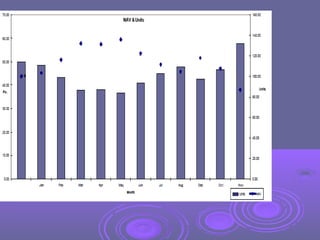
           The investor gets fewer
            units when the NAV is
            high and more units when
            the NAV is low.
           This is called as the
            benefit of Rupee Cost
            Averaging (RCA).
Load structure
 Two types of loads are there in:
     Entry load
     Exit load
TYPES OF MUTUAL FUND
    BY STRUCTURE
   Open–ended funds
   Close-ended funds           Return ??
                                Return ??
    BY INVESTMENT OBJECTIVE     Risk factor ??
   Growth Funds                Risk factor ??
   Income funds
   Balance Funds
   Money Market Funds
   Gilt Funds
   Index Funds

    ON THE BASIS OF LOAD
   Load Funds
   No Load Funds

    OTHER SCHEMES
   Tax Saving schemes
   Industry Specific schemes
   Sector schemes
Open-ended funds
 An open-end fund is one that is available
 for subscription all through the year.

 These do not have a fixed maturity.


 Investors can conveniently buy and sell
 units at Net Asset Value (NAV) related
 prices.
Closed-ended schemes
 A closed-end fund has a stipulated
 maturity period which generally ranging
 from 3 to 15 years.

 The fund is open for subscription only
 during a specified period.
RISK Vs.
RETURN
ADVANTAGES OF MUTUAL
          FUND
 Portfolio diversification
Professional Management
Liquidity
Affordability
Variety
Tax Benefits
Convenient & flexibility
DISADVANTAGES OF MUTUAL FUND

No Tailor-made-Portfolios
No control over costs
Managing a Portfolio of Funds
Major Mutual Fund Companies
          in India


 There are around 33 AMC’s in india…….

22471070 mutual-fund-ppt

  • 1.
    INVESTMENT in MUTUALFUND Presented by: Ankit chhabra MBA/08/48
  • 2.
    Where to invest?? We always think , where should we invest our money in financial market ....
  • 3.
    Concept of mutualfund A mutual fund is a professionally-managed firm of collective investments that pools money from many investors and invest it in stocks, bonds etc. Mutual fund have a fund manager who invests the money on behalf of the investors by buying/selling stocks, bonds etc.
  • 4.
    Why investor preferMutual fund directly from market. They can buy their shares ?  But this require spending time to find out the performance of the company whose share is being purchased, understanding the future business prospects of the company, finding out the track record of the promoters & the dividend, bonus issue, history of the company etc. It’s here to do research before investing.  However investor prefer the mutual fund route.  Besides this, in this LOW RISK & HIGH RETURN.
  • 5.
    Who manages investor’smoney?  This is the role of asset management company (AMC), to manage investor’s money.  AMC’s in return charges a fee for the services provided & this fee is borne by the investor as it is deducted from the money.
  • 7.
  • 8.
    Working of mutualfund  Two methods-  Lump sum or one time payment method  Systematic investment plan (SIP)
  • 9.
    SYSTEMATIC INVESTMENT PLAN  Under this a fixed sum is invested each month on a fixed date of a month.  Payment is made through post dated cheques or direct debit facilities.  The investor gets fewer units when the NAV is high and more units when the NAV is low.  This is called as the benefit of Rupee Cost Averaging (RCA).
  • 11.
    Load structure  Twotypes of loads are there in:  Entry load  Exit load
  • 12.
    TYPES OF MUTUALFUND BY STRUCTURE  Open–ended funds  Close-ended funds Return ?? Return ?? BY INVESTMENT OBJECTIVE Risk factor ??  Growth Funds Risk factor ??  Income funds  Balance Funds  Money Market Funds  Gilt Funds  Index Funds ON THE BASIS OF LOAD  Load Funds  No Load Funds OTHER SCHEMES  Tax Saving schemes  Industry Specific schemes  Sector schemes
  • 13.
    Open-ended funds  Anopen-end fund is one that is available for subscription all through the year.  These do not have a fixed maturity.  Investors can conveniently buy and sell units at Net Asset Value (NAV) related prices.
  • 14.
    Closed-ended schemes  Aclosed-end fund has a stipulated maturity period which generally ranging from 3 to 15 years.  The fund is open for subscription only during a specified period.
  • 15.
  • 16.
    ADVANTAGES OF MUTUAL FUND  Portfolio diversification Professional Management Liquidity Affordability Variety Tax Benefits Convenient & flexibility
  • 17.
    DISADVANTAGES OF MUTUALFUND No Tailor-made-Portfolios No control over costs Managing a Portfolio of Funds
  • 18.
    Major Mutual FundCompanies in India There are around 33 AMC’s in india…….