 Have an understanding of educational
policies, legislation and inclusive
practices in Greece
 Introduce the changes during the last
years in the Education for students with
SEN and in-training services for teachers
 Reflect upon social, political and
economical issues associated with
education and inclusion policies
 Students with disabilities and special
educational needs are
 Students manifesting significant learning
difficulties during the entire or a limited
period of their school life due to
 the majority of disabled children, perceived as
the social stigma of their families, were isolated
within asylums ran by various charitable
institutions mainly as inmates there or behind
the closed doors of their homes
 In 1906 “the house of the blind” and in 1923
“the school of the deaf” were founded, while
in 1937 “the model special school of Athens for
children with mental disabilities” became the
core of special education
 In 1981, it was the first time in the history of Greek
education that the Parliament had voted
 Was actually the first complete law for Special
Education in Greek history and was rightfully considered
as a great accomplishment, because for the first time
 the State undertook formally their duties on people with
SEN
 and recognized that they deserve “equal opportunities
in education, social integration and preparation for the
successful transfer from school to life”
 Criticism against the law 1143/81 finally led, in 1984, to
the publication of the law 1566/1985, which made
Special Education an integral part of general education
 In that way, the government tried to show their intention
to abolish any separating lines between “normal”
children and children with special educational needs,
and to include them all in general schools.
 By 1984, the Ministry of Education had abandoned the
practice of founding special schools and created
special classes
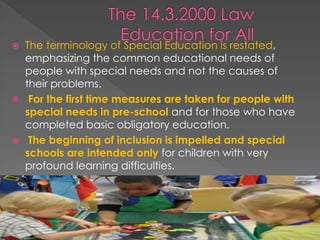
 The terminology of Special Education is restated,
emphasizing the common educational needs of
people with special needs and not the causes of
their problems.
 For the first time measures are taken for people with
special needs in pre-school and for those who have
completed basic obligatory education.
 The beginning of inclusion is impelled and special
schools are intended only for children with very
profound learning difficulties.
 Personalized programs of help and services
for every child with special needs are
institutionalized, as well as the function of a
Centre for Diagnosis, Assessment and Support
(ΚΔΑΥ), one in every province.
 New specialization areas for special
education personnel are created like
interpreters of sign language, instructors of
mobility for blind individuals etc.
 The provision of means for modern technology
teaching (multimedia, common systems of earphones,
dictionaries of sign language, etc.) is ensured for
people with special needs. Sign language is
recognized as the official language of the hearing
impaired.
 The department of special education is finally founded
in the pedagogic institute for the scientific research
such as the training of teachers of special education,
curricula, means of teaching, collaboration with
scientific institutions and organizations in Greece and
abroad
 sensory,
 mental,
 cognitive,
 developmental,
 psychological and
neuropsychological disorders
affecting school adaptation and
school learning process
 pupils with special learning difficulties such as
 dyslexia,
 dysgraphia,
 attention deficit disorder,
 pupils with complex cognitive,
 emotional and social difficulties,
 delinquent behavior due to abuse,
 parent neglect or abandonment or domestic
violence.
 pupils with one or more special mental
skills and talents
 Pupils with low school performance
associated with external factors, such
as linguistic or cultural particularities
do not fall under the category of
pupils with special educational needs
 Special education schools
 An ordinary mainstream school
 Separate classes in mainstream schools
 Parallel support in mainstream classes
 At home if there are particular health
reasons that prohibit a child from attending
school.
 was made in Public Hospitals and
Centers for Medical Health, with long
waiting lists for appointments, especially
for pupils at the secondary education
 In 2000 under the control of the Ministry of
Education the first Centers for Diagnosis,
Assessment and Support were established in
order to provide better services to school
children.
 referring students with disabilities to the
appropriate educational setting as
assessed in each case,
 to point out needs in technological aids,
 to ensure access to learning process
and school environment,
 to provide continuous counseling and
support to educational staff
 and to certify the need for alternative
format at exams.
 In November 2001, within the framework
of the “Classroom Practice” project, five
experts visited primary schools in Greece
with the mission to evaluate classroom
practices from the standpoint of pupils
with special educational needs.
 school buildings were tidy and well-lit
and the classrooms were of various sizes
 the number of pupils in the classes
ranged between 15 and 29.
 Almost all classrooms featured a
teacher-oriented spatial arrangement
with no specialist activity areas or special
place for the support of those who
faced learning difficulties.
 There were neither any special materials nor
literature that could be of use for instruction an
guidance relevant to pupils’ individual needs.
 There were no computers or library thus the
lessons were based on textbooks and
notebooks.
 Students with special needs were integrated in
the mainstream classroom following the regula
course of a lesson which is the same without an
support from any other professional or any kind
of helpful material
 https://www.youtube.com/watch?v=zV3
xDWIk6BA
 Difficulties in learning, due
 to sensory,
 intellectual,
 cognitive, developmental, mental
 and neuropsychiatric disorders
which are localized after a scientific and
pedagogical evaluation. These difficulties influence
the process of learning and school adjustment.
In addition,
 Pupils who have disabilities in motion,
vision and hearing, who suffer from
chronic diseases, disorders in speech,
attention deficit, and all pervasive
developmental disorders are
considered as having special
educational needs.
 It is based on the internationally recognised
characteristics of ‘a school for all’ and on the
European Union principles for inclusion and equal
opportunities
Mainstream classroom teachers are expected to
 Evaluate the need
 Seek assistance from the Services of the Ministry of
Education (Centers of Assessment, School Advisers,
teacher of special education),
 To organize the pupil’s Individual Teaching
Program me
 Education for all children with special needs
is mandatory
 It places emphasis upon the functionality
and capabilities of the child instead of the
child’s disability
 It clearly states that education must be
provided in mainstream schools for all
pupils with special needs
 It introduces, for the first time, an official
definition concerning students with special
abilities and talents as also needing
educational support
 Special schools and integrated classes are
included in the public school system and are
funded by the Greek State.
 The annual budget of the Ministry of Education
provides funds to the local education
authorities according to their needs.
 They cover the extra costs of the educational
demands of the schools in their area.
 Students are provided with government-
funded support services according to their
diagnosis, assessment and IEP
 https://www.youtube.com/watch?v=TZr_
Dtyi5DM
 BREAK……..
Interviewing teachers
(Lamprou-Votzaki, 2006; Bouskou, 2007; Athanasiades
& Spyropoulou, 2010)
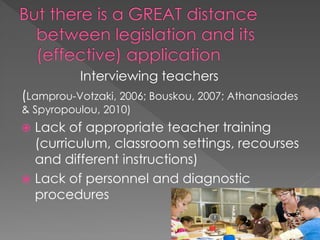
 Lack of appropriate teacher training
(curriculum, classroom settings, recourses
and different instructions)
 Lack of personnel and diagnostic
procedures
 Nevertheless, there is lack of adequate
material and human resources
 95% of the teachers who participated in
a research said they cannot effectively
teach dyslexics,
 99% noted there is no special educator
either for the support of the teachers or
the students,
 98% have not been educated on
learning difficulties
 “There is great distance between
legislation and its application. Teachers
are not to blame since nobody educated
them on special needs…how can there be
inclusion with building facilities and schools
operating in double shifts?
 “In my school there are 320 students from
which 50 are Albanians, 20 are dyslexics
and two other schools function under the
same roof. Legislation cannot thus be
applied”
 22.9% answered they did nothing special
to compensate for their special needs.
 32.1% referred to the children’s being
accepted by their peers,
 20.7% talked of the disabled children’s
adjustment and 15% lack of knowledge
and resources
 Finally, 89.1% said they do not possess
the qualities demanded
 The ways by which the educators organize their
classes, take decisions, define their relationship with
the students, adopt specific theoretical approaches
and practices are all factors that can support
inclusion or segregation.
 Therefore it is important teachers get proper
education on special needs, they will become more
sensitive towards students with such needs which
could in turn contribute greatly to a change of
thinking regarding not only these children’s
education but also negative societal beliefs.
Towards this direction and within
the Operational Plan “Education and Initial
Vocational Training” of the second European
Community Support Framework, primary
school teachers attend a two-year training
course on Special Education for the first time,
In addition, Ministry of Education and
Religious Affairs designed training programs
on Special Education for secondary
education teachers implemented by
universities
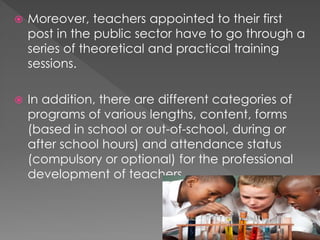
 Moreover, teachers appointed to their first
post in the public sector have to go through a
series of theoretical and practical training
sessions.
 In addition, there are different categories of
programs of various lengths, content, forms
(based in school or out-of-school, during or
after school hours) and attendance status
(compulsory or optional) for the professional
development of teachers.
 These concerns led to the latest
establishment of a new organization,
“The Organization of In-Service Training
of Teachers” (OEPEK), to coordinate and
upgrade in-service education
 This could be the solution to the lack of
basic knowledge of teachers on special
needs and how children with these
needs can be included in the
mainstream.
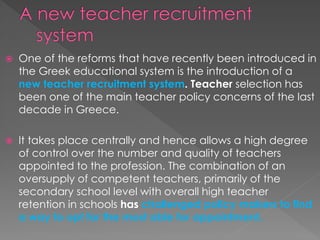
 One of the reforms that have recently been introduced in
the Greek educational system is the introduction of a
new teacher recruitment system. Teacher selection has
been one of the main teacher policy concerns of the last
decade in Greece.
 It takes place centrally and hence allows a high degree
of control over the number and quality of teachers
appointed to the profession. The combination of an
oversupply of competent teachers, primarily of the
secondary school level with overall high teacher
retention in schools has challenged policy makers to find
a way to opt for the most able for appointment.
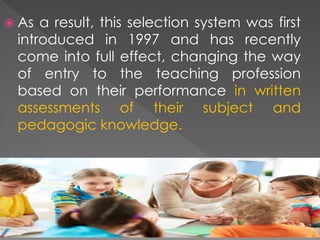
 As a result, this selection system was first
introduced in 1997 and has recently
come into full effect, changing the way
of entry to the teaching profession
based on their performance in written
assessments of their subject and
pedagogic knowledge.
 Questions?

223 session sen in greece ok

  • 2.
     Have anunderstanding of educational policies, legislation and inclusive practices in Greece  Introduce the changes during the last years in the Education for students with SEN and in-training services for teachers  Reflect upon social, political and economical issues associated with education and inclusion policies
  • 7.
     Students withdisabilities and special educational needs are  Students manifesting significant learning difficulties during the entire or a limited period of their school life due to
  • 15.
     the majorityof disabled children, perceived as the social stigma of their families, were isolated within asylums ran by various charitable institutions mainly as inmates there or behind the closed doors of their homes  In 1906 “the house of the blind” and in 1923 “the school of the deaf” were founded, while in 1937 “the model special school of Athens for children with mental disabilities” became the core of special education
  • 16.
     In 1981,it was the first time in the history of Greek education that the Parliament had voted  Was actually the first complete law for Special Education in Greek history and was rightfully considered as a great accomplishment, because for the first time  the State undertook formally their duties on people with SEN  and recognized that they deserve “equal opportunities in education, social integration and preparation for the successful transfer from school to life”
  • 17.
     Criticism againstthe law 1143/81 finally led, in 1984, to the publication of the law 1566/1985, which made Special Education an integral part of general education  In that way, the government tried to show their intention to abolish any separating lines between “normal” children and children with special educational needs, and to include them all in general schools.  By 1984, the Ministry of Education had abandoned the practice of founding special schools and created special classes
  • 18.
     The terminologyof Special Education is restated, emphasizing the common educational needs of people with special needs and not the causes of their problems.  For the first time measures are taken for people with special needs in pre-school and for those who have completed basic obligatory education.  The beginning of inclusion is impelled and special schools are intended only for children with very profound learning difficulties.
  • 19.
     Personalized programsof help and services for every child with special needs are institutionalized, as well as the function of a Centre for Diagnosis, Assessment and Support (ΚΔΑΥ), one in every province.  New specialization areas for special education personnel are created like interpreters of sign language, instructors of mobility for blind individuals etc.
  • 20.
     The provisionof means for modern technology teaching (multimedia, common systems of earphones, dictionaries of sign language, etc.) is ensured for people with special needs. Sign language is recognized as the official language of the hearing impaired.  The department of special education is finally founded in the pedagogic institute for the scientific research such as the training of teachers of special education, curricula, means of teaching, collaboration with scientific institutions and organizations in Greece and abroad
  • 21.
     sensory,  mental, cognitive,  developmental,  psychological and neuropsychological disorders affecting school adaptation and school learning process
  • 22.
     pupils withspecial learning difficulties such as  dyslexia,  dysgraphia,  attention deficit disorder,  pupils with complex cognitive,  emotional and social difficulties,  delinquent behavior due to abuse,  parent neglect or abandonment or domestic violence.
  • 23.
     pupils withone or more special mental skills and talents  Pupils with low school performance associated with external factors, such as linguistic or cultural particularities do not fall under the category of pupils with special educational needs
  • 24.
     Special educationschools  An ordinary mainstream school  Separate classes in mainstream schools  Parallel support in mainstream classes  At home if there are particular health reasons that prohibit a child from attending school.
  • 25.
     was madein Public Hospitals and Centers for Medical Health, with long waiting lists for appointments, especially for pupils at the secondary education
  • 26.
     In 2000under the control of the Ministry of Education the first Centers for Diagnosis, Assessment and Support were established in order to provide better services to school children.
  • 27.
     referring studentswith disabilities to the appropriate educational setting as assessed in each case,  to point out needs in technological aids,  to ensure access to learning process and school environment,  to provide continuous counseling and support to educational staff  and to certify the need for alternative format at exams.
  • 28.
     In November2001, within the framework of the “Classroom Practice” project, five experts visited primary schools in Greece with the mission to evaluate classroom practices from the standpoint of pupils with special educational needs.
  • 29.
     school buildingswere tidy and well-lit and the classrooms were of various sizes  the number of pupils in the classes ranged between 15 and 29.  Almost all classrooms featured a teacher-oriented spatial arrangement with no specialist activity areas or special place for the support of those who faced learning difficulties.
  • 30.
     There wereneither any special materials nor literature that could be of use for instruction an guidance relevant to pupils’ individual needs.  There were no computers or library thus the lessons were based on textbooks and notebooks.  Students with special needs were integrated in the mainstream classroom following the regula course of a lesson which is the same without an support from any other professional or any kind of helpful material
  • 31.
  • 32.
     Difficulties inlearning, due  to sensory,  intellectual,  cognitive, developmental, mental  and neuropsychiatric disorders which are localized after a scientific and pedagogical evaluation. These difficulties influence the process of learning and school adjustment.
  • 33.
    In addition,  Pupilswho have disabilities in motion, vision and hearing, who suffer from chronic diseases, disorders in speech, attention deficit, and all pervasive developmental disorders are considered as having special educational needs.
  • 34.
     It isbased on the internationally recognised characteristics of ‘a school for all’ and on the European Union principles for inclusion and equal opportunities Mainstream classroom teachers are expected to  Evaluate the need  Seek assistance from the Services of the Ministry of Education (Centers of Assessment, School Advisers, teacher of special education),  To organize the pupil’s Individual Teaching Program me
  • 35.
     Education forall children with special needs is mandatory  It places emphasis upon the functionality and capabilities of the child instead of the child’s disability  It clearly states that education must be provided in mainstream schools for all pupils with special needs  It introduces, for the first time, an official definition concerning students with special abilities and talents as also needing educational support
  • 36.
     Special schoolsand integrated classes are included in the public school system and are funded by the Greek State.  The annual budget of the Ministry of Education provides funds to the local education authorities according to their needs.  They cover the extra costs of the educational demands of the schools in their area.  Students are provided with government- funded support services according to their diagnosis, assessment and IEP
  • 37.
  • 38.
  • 39.
    Interviewing teachers (Lamprou-Votzaki, 2006;Bouskou, 2007; Athanasiades & Spyropoulou, 2010)  Lack of appropriate teacher training (curriculum, classroom settings, recourses and different instructions)  Lack of personnel and diagnostic procedures
  • 40.
     Nevertheless, thereis lack of adequate material and human resources  95% of the teachers who participated in a research said they cannot effectively teach dyslexics,  99% noted there is no special educator either for the support of the teachers or the students,  98% have not been educated on learning difficulties
  • 41.
     “There isgreat distance between legislation and its application. Teachers are not to blame since nobody educated them on special needs…how can there be inclusion with building facilities and schools operating in double shifts?  “In my school there are 320 students from which 50 are Albanians, 20 are dyslexics and two other schools function under the same roof. Legislation cannot thus be applied”
  • 42.
     22.9% answeredthey did nothing special to compensate for their special needs.  32.1% referred to the children’s being accepted by their peers,  20.7% talked of the disabled children’s adjustment and 15% lack of knowledge and resources  Finally, 89.1% said they do not possess the qualities demanded
  • 43.
     The waysby which the educators organize their classes, take decisions, define their relationship with the students, adopt specific theoretical approaches and practices are all factors that can support inclusion or segregation.  Therefore it is important teachers get proper education on special needs, they will become more sensitive towards students with such needs which could in turn contribute greatly to a change of thinking regarding not only these children’s education but also negative societal beliefs.
  • 44.
    Towards this directionand within the Operational Plan “Education and Initial Vocational Training” of the second European Community Support Framework, primary school teachers attend a two-year training course on Special Education for the first time, In addition, Ministry of Education and Religious Affairs designed training programs on Special Education for secondary education teachers implemented by universities
  • 45.
     Moreover, teachersappointed to their first post in the public sector have to go through a series of theoretical and practical training sessions.  In addition, there are different categories of programs of various lengths, content, forms (based in school or out-of-school, during or after school hours) and attendance status (compulsory or optional) for the professional development of teachers.
  • 46.
     These concernsled to the latest establishment of a new organization, “The Organization of In-Service Training of Teachers” (OEPEK), to coordinate and upgrade in-service education  This could be the solution to the lack of basic knowledge of teachers on special needs and how children with these needs can be included in the mainstream.
  • 47.
     One ofthe reforms that have recently been introduced in the Greek educational system is the introduction of a new teacher recruitment system. Teacher selection has been one of the main teacher policy concerns of the last decade in Greece.  It takes place centrally and hence allows a high degree of control over the number and quality of teachers appointed to the profession. The combination of an oversupply of competent teachers, primarily of the secondary school level with overall high teacher retention in schools has challenged policy makers to find a way to opt for the most able for appointment.
  • 48.
     As aresult, this selection system was first introduced in 1997 and has recently come into full effect, changing the way of entry to the teaching profession based on their performance in written assessments of their subject and pedagogic knowledge.
  • 49.