HICSS-55 Meeting:
Future of Human Work: Harnessing the Power of
Augmented Intelligence and Augmented Cognition
(Symposium)
Jim Spohrer
Retired IBM
Member Board of Directors, ISSIP.org
Questions: spohrer@gmail.com
Twitter: @JimSpohrer
LinkedIn: https://www.linkedin.com/in/spohrer/
Slack: https://slack.lfai.foundation
Presentations on line at: https://slideshare.net/spohrer
Thanks to Paul Souren and Lina Zhou for inviting me a panelist
for the HICSS-55 , January 3,.
Highly recommend:
Humankind: A Hopeful History
By Dutch Historian, Rutger Bregman
<- Thanks
To Ray Fisk
For suggesting
this book
2
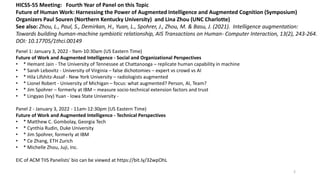
Panel 1: January 3, 2022 - 9am-10:30am (US Eastern Time)
Future of Work and Augmented Intelligence - Social and Organizational Perspectives
• * Hemant Jain - The University of Tennessee at Chattanooga – replicate human capability in machine
• * Sarah Lebovitz - University of Virginia – false dichotomies – expert vs crowd vs AI
• * Hila Lifshitz-Assaf - New York University – radiologists augmented
• * Lionel Robert - University of Michigan – focus: what augmented? Person, AI, Team?
• * Jim Spohrer – formerly at IBM – measure socio-technical extension factors and trust
• * Lingyao (Ivy) Yuan - Iowa State University -
Panel 2 - January 3, 2022 - 11am-12:30pm (US Eastern Time)
Future of Work and Augmented Intelligence - Technical Perspectives
• * Matthew C. Gombolay, Georgia Tech
• * Cynthia Rudin, Duke University
• * Jim Spohrer, formerly at IBM
• * Ce Zhang, ETH Zurich
• * Michelle Zhou, Juji, Inc.
EIC of ACM TIIS Panelists' bio can be viewed at https://bit.ly/32wpOhL
HICSS-55 Meeting: Fourth Year of Panel on this Topic
Future of Human Work: Harnessing the Power of Augmented Intelligence and Augmented Cognition (Symposium)
Organizers Paul Souren (Northern Kentucky University) and Lina Zhou (UNC Charlotte)
See also: Zhou, L., Paul, S., Demirkan, H., Yuan, L., Spohrer, J., Zhou, M. & Basu, J. (2021). Intelligence augmentation:
Towards building human-machine symbiotic relationship, AIS Transactions on Human- Computer Interaction, 13(2), 243-264.
DOI: 10.17705/1thci.00149
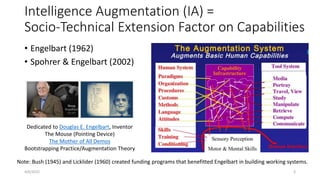
Intelligence Augmentation (IA) =
Socio-Technical Extension Factor on Capabilities
• Engelbart (1962)
• Spohrer & Engelbart (2002)
4/6/2022 3
Dedicated to Douglas E. Engelbart, Inventor
The Mouse (Pointing Device)
The Mother of All Demos
Bootstrapping Practice/Augmentation Theory
Note: Bush (1945) and Licklider (1960) created funding programs that benefitted Engelbart in building working systems.
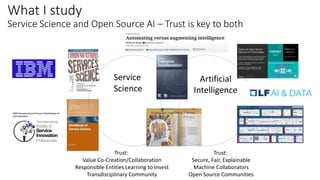
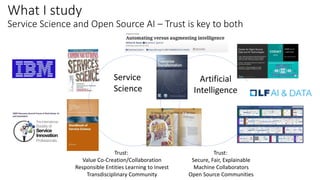
What I study
Service Science and Open Source AI – Trust is key to both
Service
Science
Artificial
Intelligence
Trust:
Value Co-Creation/Collaboration
Responsible Entities Learning to Invest
Transdisciplinary Community
Trust:
Secure, Fair, Explainable
Machine Collaborators
Open Source Communities
4/6/2022 5
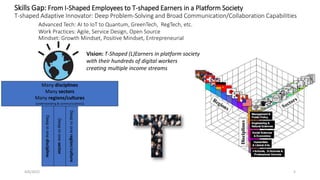
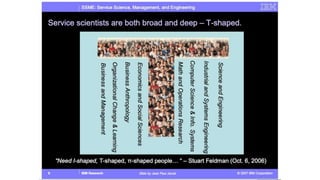
Skills Gap: From I-Shaped Employees to T-shaped Earners in a Platform Society
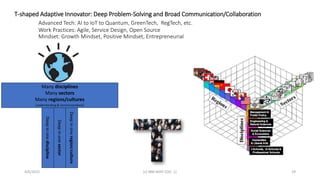
T-shaped Adaptive Innovator: Deep Problem-Solving and Broad Communication/Collaboration Capabilities
Advanced Tech: AI to IoT to Quantum, GreenTech, RegTech, etc.
Work Practices: Agile, Service Design, Open Source
Mindset: Growth Mindset, Positive Mindset, Entrepreneurial
Many disciplines
Many sectors
Many regions/cultures
(understanding & communications)
Deep
in
one
sector
Deep
in
one
region/culture
Deep
in
one
discipline
Vision: T-Shaped (L)Earners in platform society
with their hundreds of digital workers
creating multiple income streams
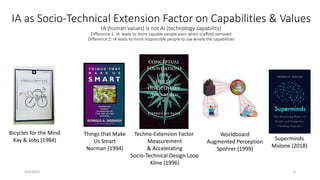
IA as Socio-Technical Extension Factor on Capabilities & Values
IA (human values) is not AI (technology capability)
Difference 1: IA leads to more capable people even when scaffold removed
Difference 2: IA leads to more responsible people to use wisely the capabilities
4/6/2022 6
Superminds
Malone (2018)
Things that Make
Us Smart
Norman (1994)
Worldboard
Augmented Perception
Spohrer (1999)
Bicycles for the Mind
Kay & Jobs (1984)
Techno-Extension Factor
Measurement
& Accelerating
Socio-Technical Design Loop
Kline (1996)
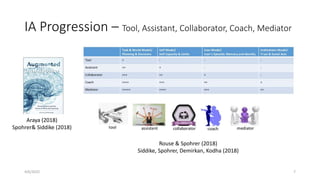
IA Progression – Tool, Assistant, Collaborator, Coach, Mediator
4/6/2022 7
Rouse & Spohrer (2018)
Siddike, Spohrer, Demirkan, Kodha (2018)
Araya (2018)
Spohrer& Siddike (2018)
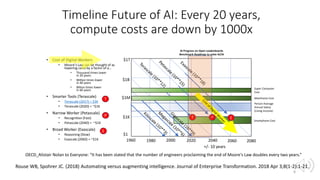
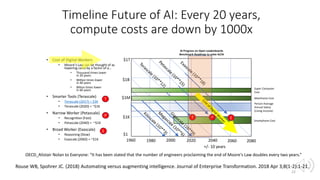
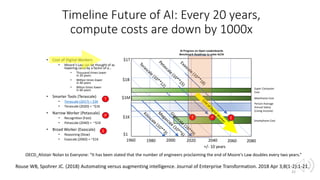
Timeline Future of AI: Every 20 years,
compute costs are down by 1000x
• Cost of Digital Workers
• Moore’s Law can be thought of as
lowering costs by a factor of a…
• Thousand times lower
in 20 years
• Million times lower
in 40 years
• Billion times lower
in 60 years
• Smarter Tools (Terascale)
• Terascale (2017) = $3K
• Terascale (2020) = ~$1K
• Narrow Worker (Petascale)
• Recognition (Fast)
• Petascale (2040) = ~$1K
• Broad Worker (Exascale)
• Reasoning (Slow)
• Exascale (2060) = ~$1K
8
2080
2040
2000
1960
$1K
$1M
$1B
$1T
2060
2020
1980
+/- 10 years
$1
Person Average
Annual Salary
(Living Income)
Super Computer
Cost
Mainframe Cost
Smartphone Cost
T
P
E
T P E
AI Progress on Open Leaderboards
Benchmark Roadmap to solve AI/IA
OECD_Alistair Nolan to Everyone: “It has been stated that the number of engineers proclaiming the end of Moore's Law doubles every two years.”
Rouse WB, Spohrer JC. (2018) Automating versus augmenting intelligence. Journal of Enterprise Transformation. 2018 Apr 3;8(1-2):1-21.
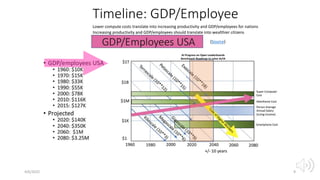
Timeline: GDP/Employee
4/6/2022 9
(Source)
Lower compute costs translate into increasing productivity and GDP/employees for nations
Increasing productivity and GDP/employees should translate into wealthier citizens
AI Progress on Open Leaderboards
Benchmark Roadmap to solve AI/IA
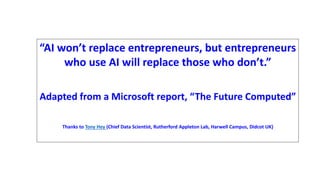
“AI won’t replace entrepreneurs, but entrepreneurs
who use AI will replace those who don’t.”
Adapted from a Microsoft report, “The Future Computed”
Thanks to Tony Hey (Chief Data Scientist, Rutherford Appleton Lab, Harwell Campus, Didcot UK)
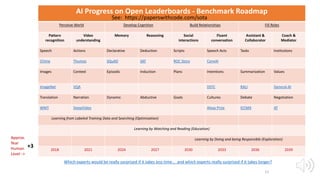
Timeline: Leaderboards Framework
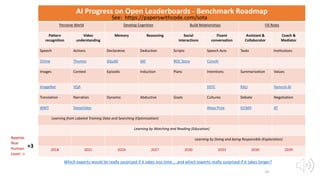
AI Progress on Open Leaderboards - Benchmark Roadmap
Perceive World Develop Cognition Build Relationships Fill Roles
Pattern
recognition
Video
understanding
Memory Reasoning Social
interactions
Fluent
conversation
Assistant &
Collaborator
Coach &
Mediator
Speech Actions Declarative Deduction Scripts Speech Acts Tasks Institutions
Chime Thumos SQuAD SAT ROC Story ConvAI
Images Context Episodic Induction Plans Intentions Summarization Values
ImageNet VQA DSTC RALI General-AI
Translation Narration Dynamic Abductive Goals Cultures Debate Negotiation
WMT DeepVideo Alexa Prize ICCMA AT
Learning from Labeled Training Data and Searching (Optimization)
Learning by Watching and Reading (Education)
Learning by Doing and being Responsible (Exploration)
2018 2021 2024 2027 2030 2033 2036 2039
11
Which experts would be really surprised if it takes less time… and which experts really surprised if it takes longer?
Approx.
Year
Human
Level ->
+3
See: https://paperswithcode.com/sota
Upskilling…
T-shaped
(l)earners
Gardner P, Maietta HN
(2020) Advancing Talent
Development: Steps
Toward a T-Model
Infused Undergraduate
Education.
Moghaddam Y, Demirkan
H, Spohrer J (2018) T-
Shaped Professionals:
Adaptive Innovators.
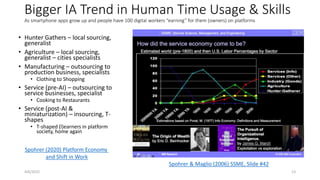
Bigger IA Trend in Human Time Usage & Skills
As smartphone apps grow up and people have 100 digital workers “earning” for them (owners) on platforms
• Hunter Gathers – local sourcing,
generalist
• Agriculture – local sourcing,
generalist – cities specialists
• Manufacturing – outsourcing to
production business, specialists
• Clothing to Shopping
• Service (pre-AI) – outsourcing to
service businesses, specialist
• Cooking to Restaurants
• Service (post-AI &
miniaturization) – insourcing, T-
shapes
• T-shaped (l)earners in platform
society, home again
4/6/2022 13
Spohrer & Maglio (2006) SSME, Slide #42
Spohrer (2020) Platform Economy
and Shift in Work
References
• Araya D (2018) Augmented Intelligence: Smart Systems and the Future of Work and Learning. Peter Lang International Academic Publishers; 2018 Sep 28.
• Bush V (1945) As we may think. The Atlantic Monthly. 1945 Jul 1;176(1):101-8.
• Engelbart D (1962) Augmenting human intellect. Summary report AFOSR-3223 under Contract AF. 1962 Oct;49(638):1024.
• Gardner P, Maietta HN (2020) Advancing Talent Development: Steps Toward a T-Model Infused Undergraduate Education. Business Expert Press. URL:
https://www.amazon.com/Advancing-Talent-Development-Undergraduate-Education/dp/1951527062
• Kay A, Jobs S (1984) Wheels for the Mind. Apple Computer.
• Kline SJ (1995) Conceptual foundations for multidisciplinary thinking. Stanford University Press; 1995.
• Licklider JC (1960) . Man-computer symbiosis. IRE transactions on human factors in electronics. 1960 Mar(1):4-11.
• Malone TW (2018) Superminds: The surprising power of people and computers thinking together. Little, Brown Spark; 2018 May 15.
• Norman D (1994) Things that make us smart: Defending human attributes in the age of the machine. Diversion Books; 2014 Dec 2.
• Rouse WB, Spohrer JC (2018) Automating versus augmenting intelligence. Journal of Enterprise Transformation. 2018 Feb 7:1-21.
• Siddike MA, Spohrer J, Demirkan H, Kohda Y (2018) A Framework of Enhanced Performance: People's Interactions With Cognitive Assistants. International Journal
of Systems and Service-Oriented Engineering (IJSSOE). 2018 Jul 1;8(3):1-7.
• Spohrer JC (1998) Information in places. IBM Systems Journal. 1999;38(4):602-28.
• Spohrer JC, Engelbart DC (2004) Converging technologies for enhancing human performance: Science and business perspectives. Annals of the New York Academy
of Sciences. 2004 May;1013(1):50-82.
• Spohrer J, Siddike (2018) The Future of Digital Cognitive Systems: Tool, Assistant, Collaborator, Coach, Mediator. In Ed. Araya D. Augmented Intelligence: Smart
Systems and the Future of Work and Learning. Peter Lang International Academic Publishers; 2018 Sep 28.
• Spohrer J (2020) Online Platform Economy and Gig Workers: A USA Perspective. Presentation.
• Spohrer J & Maglio PP (2006) Service Science Management and Engineering (SSME): An Emerging Discipline. IBM Presentation.
4/6/2022 14
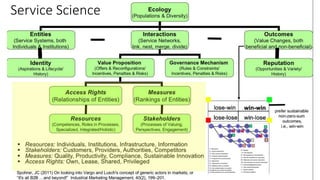
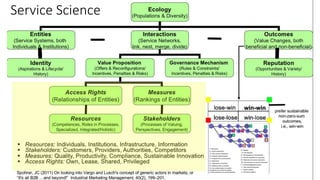
Service Science: Conceptual Framework
4/6/2022 (c) IBM MAP COG .| 15
Service Science
(c) IBM MAP COG .| 16
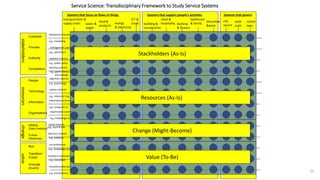
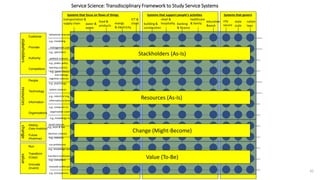
Service Science: Transdisciplinary Framework to Study Service Systems
Systems that focus on flows of things Systems that govern
Systems that support people’s activities
transportation &
supply chain water &
waste
food &
products
energy
& electricity
building &
construction
healthcare
& family
retail &
hospitality banking
& finance
ICT &
cloud
education
&work
city
secure
state
scale
nation
laws
social sciences
behavioral sciences
management sciences
political sciences
learning sciences
cognitive sciences
system sciences
information sciences
organization sciences
decision sciences
run professions
transform professions
innovate professions
e.g., econ & law
e.g., marketing
e.g., operations
e.g., public policy
e.g., game theory
and strategy
e.g., psychology
e.g., industrial eng.
e.g., computer sci
e.g., knowledge mgmt
e.g., statistics
e.g., knowledge worker
e.g., consultant
e.g., entrepreneur
stakeholders
Customer
Provider
Authority
Competitors
resources
People
Technology
Information
Organizations
change
History
(Data Analytics)
Future
(Roadmap)
value
Run
Transform
(Copy)
Innovate
(Invent)
Stackholders (As-Is)
Resources (As-Is)
Change (Might-Become)
Value (To-Be)
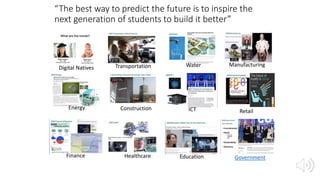
“The best way to predict the future is to inspire the
next generation of students to build it better”
Digital Natives Transportation Water Manufacturing
Energy Construction ICT Retail
Finance Healthcare Education Government
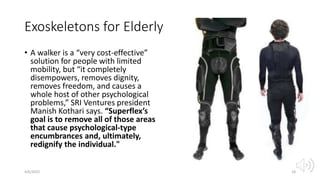
Exoskeletons for Elderly
• A walker is a “very cost-effective”
solution for people with limited
mobility, but “it completely
disempowers, removes dignity,
removes freedom, and causes a
whole host of other psychological
problems,” SRI Ventures president
Manish Kothari says. “Superflex’s
goal is to remove all of those areas
that cause psychological-type
encumbrances and, ultimately,
redignify the individual."
4/6/2022 18
4/6/2022 19
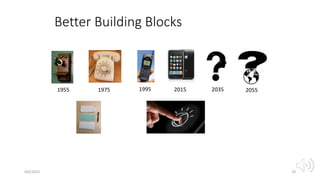
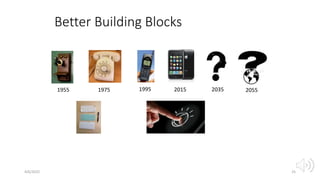
1955 1975 1995 2015 2035 2055
Better Building Blocks
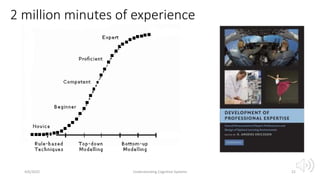
10 million minutes of experience
4/6/2022 Understanding Cognitive Systems 20
2 million minutes of experience
4/6/2022 Understanding Cognitive Systems 21
Timeline Future of AI: Every 20 years,
compute costs are down by 1000x
• Cost of Digital Workers
• Moore’s Law can be thought of as
lowering costs by a factor of a…
• Thousand times lower
in 20 years
• Million times lower
in 40 years
• Billion times lower
in 60 years
• Smarter Tools (Terascale)
• Terascale (2017) = $3K
• Terascale (2020) = ~$1K
• Narrow Worker (Petascale)
• Recognition (Fast)
• Petascale (2040) = ~$1K
• Broad Worker (Exascale)
• Reasoning (Slow)
• Exascale (2060) = ~$1K
22
2080
2040
2000
1960
$1K
$1M
$1B
$1T
2060
2020
1980
+/- 10 years
$1
Person Average
Annual Salary
(Living Income)
Super Computer
Cost
Mainframe Cost
Smartphone Cost
T
P
E
T P E
AI Progress on Open Leaderboards
Benchmark Roadmap to solve AI/IA
OECD_Alistair Nolan to Everyone: “It has been stated that the number of engineers proclaiming the end of Moore's Law doubles every two years.”
Rouse WB, Spohrer JC. (2018) Automating versus augmenting intelligence. Journal of Enterprise Transformation. 2018 Apr 3;8(1-2):1-21.
4/6/2022 23
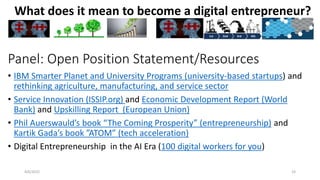
What does it mean to become a digital entrepreneur?
Panel: Open Position Statement/Resources
• IBM Smarter Planet and University Programs (university-based startups) and
rethinking agriculture, manufacturing, and service sector
• Service Innovation (ISSIP.org) and Economic Development Report (World
Bank) and Upskilling Report (European Union)
• Phil Auerswauld’s book “The Coming Prosperity” (entrepreneurship) and
Kartik Gada’s book ”ATOM” (tech acceleration)
• Digital Entrepreneurship in the AI Era (100 digital workers for you)
“The best way to predict the future is to inspire the
next generation of students to build it better”
Digital Natives Transportation Water Manufacturing
Energy Construction ICT Retail
Finance Healthcare Education Government
4/6/2022 25
1955 1975 1995 2015 2035 2055
Better Building Blocks
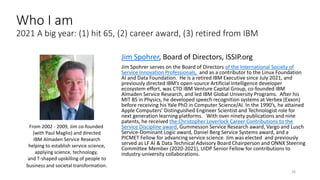
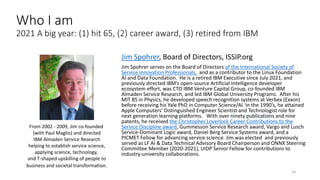
Jim Spohrer, Board of Directors, ISSIP.org
Jim Spohrer serves on the Board of Directors of the International Society of
Service Innovation Professionals, and as a contributor to the Linux Foundation
AI and Data Foundation. He is a retired IBM Executive since July 2021, and
previously directed IBM’s open-source Artificial Intelligence developer
ecosystem effort, was CTO IBM Venture Capital Group, co-founded IBM
Almaden Service Research, and led IBM Global University Programs. After his
MIT BS in Physics, he developed speech recognition systems at Verbex (Exxon)
before receiving his Yale PhD in Computer Science/AI. In the 1990’s, he attained
Apple Computers’ Distinguished Engineer Scientist and Technologist role for
next generation learning platforms. With over ninety publications and nine
patents, he received the Christopher Loverlock Career Contributions to the
Service Discipline award, Gummesson Service Research award, Vargo and Lusch
Service-Dominant Logic award, Daniel Berg Service Systems award, and a
PICMET Fellow for advancing service science. Jim was elected and previously
served as LF AI & Data Technical Advisory Board Chairperson and ONNX Steering
Committee Member (2020-2021), UIDP Senior Fellow for contributions to
industry-university collaborations.
26
From 2002 - 2009, Jim co-founded
(with Paul Maglio) and directed
IBM Almaden Service Research
helping to establish service science,
applying science, technology,
and T-shaped upskilling of people to
business and societal transformation.
Who I am
2021 A big year: (1) hit 65, (2) career award, (3) retired from IBM
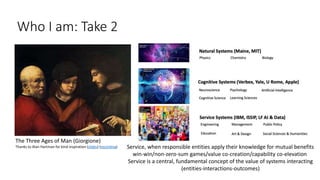
Who I am: Take 2
The Three Ages of Man (Giorgione)
Thanks to Alan Hartman for kind inspiration (slides) (recording) Service, when responsible entities apply their knowledge for mutual benefits
win-win/non-zero-sum games/value co-creation/capability co-elevation
Service is a central, fundamental concept of the value of systems interacting
(entities-interactions-outcomes)
What I study
Service Science and Open Source AI – Trust is key to both
Service
Science
Artificial
Intelligence
Trust:
Value Co-Creation/Collaboration
Responsible Entities Learning to Invest
Transdisciplinary Community
Trust:
Secure, Fair, Explainable
Machine Collaborators
Open Source Communities
4/6/2022 (c) IBM MAP COG .| 29
T-shaped Adaptive Innovator: Deep Problem-Solving and Broad Communication/Collaboration
Advanced Tech: AI to IoT to Quantum, GreenTech, RegTech, etc.
Work Practices: Agile, Service Design, Open Source
Mindset: Growth Mindset, Positive Mindset, Entrepreneurial
Many disciplines
Many sectors
Many regions/cultures
(understanding & communications)
Deep
in
one
sector
Deep
in
one
region/culture
Deep
in
one
discipline
Upskilling…
T-shaped
(l)earners
Gardner P, Maietta HN
(2020) Advancing Talent
Development: Steps
Toward a T-Model
Infused Undergraduate
Education.
Moghaddam Y, Demirkan
H, Spohrer J (2018) T-
Shaped Professionals:
Adaptive Innovators.
4/6/2022 (c) IBM MAP COG .| 31
Minute 8:13 – “The train is leaving the station … and suddenly fear shifted to greed (fomo).”
Timeline Future of AI: Every 20 years,
compute costs are down by 1000x
• Cost of Digital Workers
• Moore’s Law can be thought of as
lowering costs by a factor of a…
• Thousand times lower
in 20 years
• Million times lower
in 40 years
• Billion times lower
in 60 years
• Smarter Tools (Terascale)
• Terascale (2017) = $3K
• Terascale (2020) = ~$1K
• Narrow Worker (Petascale)
• Recognition (Fast)
• Petascale (2040) = ~$1K
• Broad Worker (Exascale)
• Reasoning (Slow)
• Exascale (2060) = ~$1K
32
2080
2040
2000
1960
$1K
$1M
$1B
$1T
2060
2020
1980
+/- 10 years
$1
Person Average
Annual Salary
(Living Income)
Super Computer
Cost
Mainframe Cost
Smartphone Cost
T
P
E
T P E
AI Progress on Open Leaderboards
Benchmark Roadmap to solve AI/IA
OECD_Alistair Nolan to Everyone: “It has been stated that the number of engineers proclaiming the end of Moore's Law doubles every two years.”
Rouse WB, Spohrer JC. (2018) Automating versus augmenting intelligence. Journal of Enterprise Transformation. 2018 Apr 3;8(1-2):1-21.
Timeline: Leaderboards Framework
AI Progress on Open Leaderboards - Benchmark Roadmap
Perceive World Develop Cognition Build Relationships Fill Roles
Pattern
recognition
Video
understanding
Memory Reasoning Social
interactions
Fluent
conversation
Assistant &
Collaborator
Coach &
Mediator
Speech Actions Declarative Deduction Scripts Speech Acts Tasks Institutions
Chime Thumos SQuAD SAT ROC Story ConvAI
Images Context Episodic Induction Plans Intentions Summarization Values
ImageNet VQA DSTC RALI General-AI
Translation Narration Dynamic Abductive Goals Cultures Debate Negotiation
WMT DeepVideo Alexa Prize ICCMA AT
Learning from Labeled Training Data and Searching (Optimization)
Learning by Watching and Reading (Education)
Learning by Doing and being Responsible (Exploration)
2018 2021 2024 2027 2030 2033 2036 2039
33
Which experts would be really surprised if it takes less time… and which experts really surprised if it takes longer?
Approx.
Year
Human
Level ->
+3
See: https://paperswithcode.com/sota
Jim Spohrer, Board of Directors, ISSIP.org
Jim Spohrer serves on the Board of Directors of the International Society of
Service Innovation Professionals, and as a contributor to the Linux Foundation
AI and Data Foundation. He is a retired IBM Executive since July 2021, and
previously directed IBM’s open-source Artificial Intelligence developer
ecosystem effort, was CTO IBM Venture Capital Group, co-founded IBM
Almaden Service Research, and led IBM Global University Programs. After his
MIT BS in Physics, he developed speech recognition systems at Verbex (Exxon)
before receiving his Yale PhD in Computer Science/AI. In the 1990’s, he attained
Apple Computers’ Distinguished Engineer Scientist and Technologist role for
next generation learning platforms. With over ninety publications and nine
patents, he received the Christopher Loverlock Career Contributions to the
Service Discipline award, Gummesson Service Research award, Vargo and Lusch
Service-Dominant Logic award, Daniel Berg Service Systems award, and a
PICMET Fellow for advancing service science. Jim was elected and previously
served as LF AI & Data Technical Advisory Board Chairperson and ONNX Steering
Committee Member (2020-2021), UIDP Senior Fellow for contributions to
industry-university collaborations.
34
From 2002 - 2009, Jim co-founded
(with Paul Maglio) and directed
IBM Almaden Service Research
helping to establish service science,
applying science, technology,
and T-shaped upskilling of people to
business and societal transformation.
Who I am
2021 A big year: (1) hit 65, (2) career award, (3) retired from IBM
Who I am: Take 2
The Three Ages of Man (Giorgione)
Thanks to Alan Hartman for kind inspiration (slides) (recording) Service, when responsible entities apply their knowledge for mutual benefits
win-win/non-zero-sum games/value co-creation/capability co-elevation
Service is a central, fundamental concept of the value of systems interacting
(entities-interactions-outcomes)
What I study
Service Science and Open Source AI – Trust is key to both
Service
Science
Artificial
Intelligence
Trust:
Value Co-Creation/Collaboration
Responsible Entities Learning to Invest
Transdisciplinary Community
Trust:
Secure, Fair, Explainable
Machine Collaborators
Open Source Communities
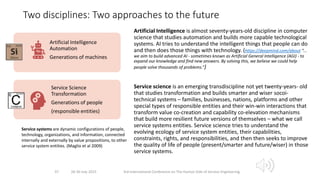
Two disciplines: Two approaches to the future
Artificial Intelligence is almost seventy-years-old discipline in computer
science that studies automation and builds more capable technological
systems. AI tries to understand the intelligent things that people can do
and then does those things with technology. (https://deepmind.com/about “...
we aim to build advanced AI - sometimes known as Artificial General Intelligence (AGI) - to
expand our knowledge and find new answers. By solving this, we believe we could help
people solve thousands of problems.”)
Service science is an emerging transdiscipline not yet twenty-years- old
that studies transformation and builds smarter and wiser socoi-
technical systems – families, businesses, nations, platforms and other
special types of responsible entities and their win-win interactions that
transform value co-creation and capability co-elevation mechanisms
that build more resilient future versions of themselves – what we call
service systems entities. Service science tries to understand the
evolving ecology of service system entities, their capabilities,
constraints, rights, and responsibilities, and then then seeks to improve
the quality of life of people (present/smarter and future/wiser) in those
service systems.
26-30 July 2015 3rd International Conference on The Human Side of Service Engineering
37
Artificial Intelligence
Automation
Generations of machines
Service Science
Transformation
Generations of people
(responsible entities)
Service systems are dynamic configurations of people,
technology, organizations, and information, connected
internally and externally by value propositions, to other
service system entities. (Maglio et al 2009)
40
How responsible entities (service systems) learn and change over time
History and future of Run-Transform-Innovate investment choices
See Spohrer J (2021) Service Innovation Roadmaps and Responsible Entities Learning. IESS 2.1
URL: https://www.itm-conferences.org/articles/itmconf/pdf/2021/03/itmconf_iess2021_01001.pdf
• Diverse Types
• Persons (Individuals)
• Families
• Regional Entities
• Universities
• Hospitals
• Cities
• States/Provinces
• Nations
• Other Enterprises
• Businesses
• Non-profits
• Learning & Change
• Run = use existing knowledge
or standard practices (use)
• Transform = adopt a new best
practice (copy)
• Innovate = create a new best
practice (invent) Innovate
Invest in each
type of change
Spohrer J, Golinelli GM, Piciocchi P, Bassano C (2010) An integrated SS-VSA analysis of changing job roles. Service Science. 2010 Jun;2(1-2):1-20.
March JG (1991) Exploration and exploitation in organizational learning. Organization science. 1991 Feb;2(1):71-87. URL:
exploit
explore
Service Science: Conceptual Framework
4/6/2022 (c) IBM MAP COG .| 41
Service Science
(c) IBM MAP COG .| 42
Service Science: Transdisciplinary Framework to Study Service Systems
Systems that focus on flows of things Systems that govern
Systems that support people’s activities
transportation &
supply chain water &
waste
food &
products
energy
& electricity
building &
construction
healthcare
& family
retail &
hospitality banking
& finance
ICT &
cloud
education
&work
city
secure
state
scale
nation
laws
social sciences
behavioral sciences
management sciences
political sciences
learning sciences
cognitive sciences
system sciences
information sciences
organization sciences
decision sciences
run professions
transform professions
innovate professions
e.g., econ & law
e.g., marketing
e.g., operations
e.g., public policy
e.g., game theory
and strategy
e.g., psychology
e.g., industrial eng.
e.g., computer sci
e.g., knowledge mgmt
e.g., statistics
e.g., knowledge worker
e.g., consultant
e.g., entrepreneur
stakeholders
Customer
Provider
Authority
Competitors
resources
People
Technology
Information
Organizations
change
History
(Data Analytics)
Future
(Roadmap)
value
Run
Transform
(Copy)
Innovate
(Invent)
Stackholders (As-Is)
Resources (As-Is)
Change (Might-Become)
Value (To-Be)
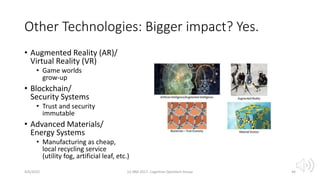
Other Technologies: Bigger impact? Yes.
• Augmented Reality (AR)/
Virtual Reality (VR)
• Game worlds
grow-up
• Blockchain/
Security Systems
• Trust and security
immutable
• Advanced Materials/
Energy Systems
• Manufacturing as cheap,
local recycling service
(utility fog, artificial leaf, etc.)
4/6/2022 (c) IBM 2017, Cognitive Opentech Group 44
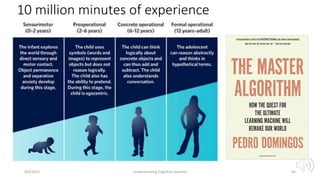
10 million minutes of experience
4/6/2022 Understanding Cognitive Systems 45
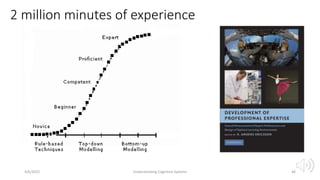
2 million minutes of experience
4/6/2022 Understanding Cognitive Systems 46
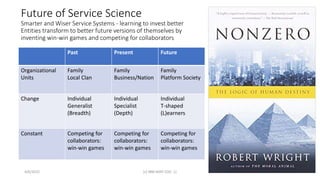
Future of Service Science
Smarter and Wiser Service Systems - learning to invest better
Entities transform to better future versions of themselves by
inventing win-win games and competing for collaborators
Past Present Future
Organizational
Units
Family
Local Clan
Family
Business/Nation
Family
Platform Society
Change Individual
Generalist
(Breadth)
Individual
Specialist
(Depth)
Individual
T-shaped
(L)earners
Constant Competing for
collaborators:
win-win games
Competing for
collaborators:
win-win games
Competing for
collaborators:
win-win games
4/6/2022 (c) IBM MAP COG .| 47
4/6/2022 (c) IBM MAP COG .| 48
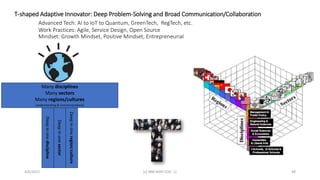
T-shaped Adaptive Innovator: Deep Problem-Solving and Broad Communication/Collaboration
Advanced Tech: AI to IoT to Quantum, GreenTech, RegTech, etc.
Work Practices: Agile, Service Design, Open Source
Mindset: Growth Mindset, Positive Mindset, Entrepreneurial
Many disciplines
Many sectors
Many regions/cultures
(understanding & communications)
Deep
in
one
sector
Deep
in
one
region/culture
Deep
in
one
discipline
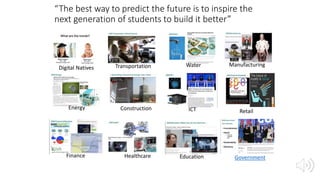
“The best way to predict the future is to inspire the
next generation of students to build it better”
Digital Natives Transportation Water Manufacturing
Energy Construction ICT Retail
Finance Healthcare Education Government
4/6/2022 50
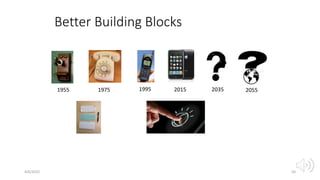
1955 1975 1995 2015 2035 2055
Better Building Blocks
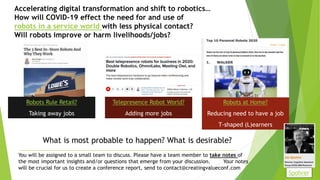
Accelerating digital transformation and shift to robotics…
How will COVID-19 effect the need for and use of
robots in a service world with less physical contact?
Will robots improve or harm livelihoods/jobs?
Robots Rule Retail?
Taking away jobs
Telepresence Robot World?
Adding more jobs
Robots at Home?
Reducing need to have a job
T-shaped (L)earners
You will be assigned to a small team to discuss. Please have a team member to take notes of
the most important insights and/or questions that emerge from your discussion. Your notes
will be crucial for us to create a conference report, send to contact@creatingvalueconf.com
What is most probable to happen? What is desirable?
Spohrer
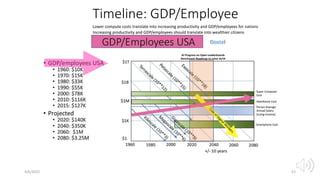
Timeline: GDP/Employee
4/6/2022 52
(Source)
Lower compute costs translate into increasing productivity and GDP/employees for nations
Increasing productivity and GDP/employees should translate into wealthier citizens
AI Progress on Open Leaderboards
Benchmark Roadmap to solve AI/IA
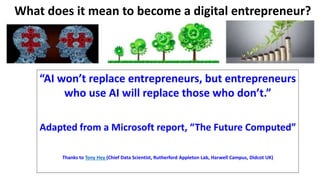
“AI won’t replace entrepreneurs, but entrepreneurs
who use AI will replace those who don’t.”
Adapted from a Microsoft report, “The Future Computed”
Thanks to Tony Hey (Chief Data Scientist, Rutherford Appleton Lab, Harwell Campus, Didcot UK)
What does it mean to become a digital entrepreneur?
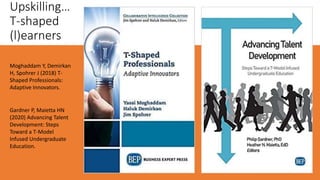
Upskilling…
T-shaped
(l)earners
Gardner P, Maietta HN
(2020) Advancing Talent
Development: Steps
Toward a T-Model
Infused Undergraduate
Education.
Moghaddam Y, Demirkan
H, Spohrer J (2018) T-
Shaped Professionals:
Adaptive Innovators.
Accelerating shift - from employees to earners in
platform society
Farrrel D, Grieg F (2014)
Online Platform
Economy.
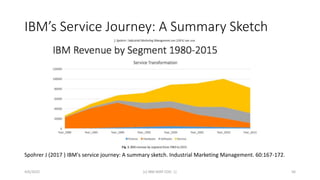
IBM’s Service Journey: A Summary Sketch
4/6/2022 (c) IBM MAP COG .| 56
Spohrer J (2017 ) IBM's service journey: A summary sketch. Industrial Marketing Management. 60:167-172.
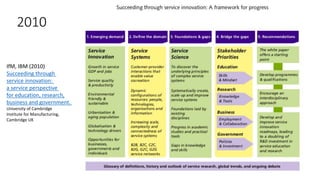
IfM, IBM (2010)
Succeeding through
service innovation:
a service perspective
for education, research,
business and government.
University of Cambridge
Institute for Manufacturing,
Cambridge UK
2010
20220103 jim spohrer hicss v9

20220103 jim spohrer hicss v9

  • 1.
    HICSS-55 Meeting: Future ofHuman Work: Harnessing the Power of Augmented Intelligence and Augmented Cognition (Symposium) Jim Spohrer Retired IBM Member Board of Directors, ISSIP.org Questions: spohrer@gmail.com Twitter: @JimSpohrer LinkedIn: https://www.linkedin.com/in/spohrer/ Slack: https://slack.lfai.foundation Presentations on line at: https://slideshare.net/spohrer Thanks to Paul Souren and Lina Zhou for inviting me a panelist for the HICSS-55 , January 3,. Highly recommend: Humankind: A Hopeful History By Dutch Historian, Rutger Bregman <- Thanks To Ray Fisk For suggesting this book
  • 2.
    2 Panel 1: January3, 2022 - 9am-10:30am (US Eastern Time) Future of Work and Augmented Intelligence - Social and Organizational Perspectives • * Hemant Jain - The University of Tennessee at Chattanooga – replicate human capability in machine • * Sarah Lebovitz - University of Virginia – false dichotomies – expert vs crowd vs AI • * Hila Lifshitz-Assaf - New York University – radiologists augmented • * Lionel Robert - University of Michigan – focus: what augmented? Person, AI, Team? • * Jim Spohrer – formerly at IBM – measure socio-technical extension factors and trust • * Lingyao (Ivy) Yuan - Iowa State University - Panel 2 - January 3, 2022 - 11am-12:30pm (US Eastern Time) Future of Work and Augmented Intelligence - Technical Perspectives • * Matthew C. Gombolay, Georgia Tech • * Cynthia Rudin, Duke University • * Jim Spohrer, formerly at IBM • * Ce Zhang, ETH Zurich • * Michelle Zhou, Juji, Inc. EIC of ACM TIIS Panelists' bio can be viewed at https://bit.ly/32wpOhL HICSS-55 Meeting: Fourth Year of Panel on this Topic Future of Human Work: Harnessing the Power of Augmented Intelligence and Augmented Cognition (Symposium) Organizers Paul Souren (Northern Kentucky University) and Lina Zhou (UNC Charlotte) See also: Zhou, L., Paul, S., Demirkan, H., Yuan, L., Spohrer, J., Zhou, M. & Basu, J. (2021). Intelligence augmentation: Towards building human-machine symbiotic relationship, AIS Transactions on Human- Computer Interaction, 13(2), 243-264. DOI: 10.17705/1thci.00149
  • 3.
    Intelligence Augmentation (IA)= Socio-Technical Extension Factor on Capabilities • Engelbart (1962) • Spohrer & Engelbart (2002) 4/6/2022 3 Dedicated to Douglas E. Engelbart, Inventor The Mouse (Pointing Device) The Mother of All Demos Bootstrapping Practice/Augmentation Theory Note: Bush (1945) and Licklider (1960) created funding programs that benefitted Engelbart in building working systems.
  • 4.
    What I study ServiceScience and Open Source AI – Trust is key to both Service Science Artificial Intelligence Trust: Value Co-Creation/Collaboration Responsible Entities Learning to Invest Transdisciplinary Community Trust: Secure, Fair, Explainable Machine Collaborators Open Source Communities
  • 5.
    4/6/2022 5 Skills Gap:From I-Shaped Employees to T-shaped Earners in a Platform Society T-shaped Adaptive Innovator: Deep Problem-Solving and Broad Communication/Collaboration Capabilities Advanced Tech: AI to IoT to Quantum, GreenTech, RegTech, etc. Work Practices: Agile, Service Design, Open Source Mindset: Growth Mindset, Positive Mindset, Entrepreneurial Many disciplines Many sectors Many regions/cultures (understanding & communications) Deep in one sector Deep in one region/culture Deep in one discipline Vision: T-Shaped (L)Earners in platform society with their hundreds of digital workers creating multiple income streams
  • 6.
    IA as Socio-TechnicalExtension Factor on Capabilities & Values IA (human values) is not AI (technology capability) Difference 1: IA leads to more capable people even when scaffold removed Difference 2: IA leads to more responsible people to use wisely the capabilities 4/6/2022 6 Superminds Malone (2018) Things that Make Us Smart Norman (1994) Worldboard Augmented Perception Spohrer (1999) Bicycles for the Mind Kay & Jobs (1984) Techno-Extension Factor Measurement & Accelerating Socio-Technical Design Loop Kline (1996)
  • 7.
    IA Progression –Tool, Assistant, Collaborator, Coach, Mediator 4/6/2022 7 Rouse & Spohrer (2018) Siddike, Spohrer, Demirkan, Kodha (2018) Araya (2018) Spohrer& Siddike (2018)
  • 8.
    Timeline Future ofAI: Every 20 years, compute costs are down by 1000x • Cost of Digital Workers • Moore’s Law can be thought of as lowering costs by a factor of a… • Thousand times lower in 20 years • Million times lower in 40 years • Billion times lower in 60 years • Smarter Tools (Terascale) • Terascale (2017) = $3K • Terascale (2020) = ~$1K • Narrow Worker (Petascale) • Recognition (Fast) • Petascale (2040) = ~$1K • Broad Worker (Exascale) • Reasoning (Slow) • Exascale (2060) = ~$1K 8 2080 2040 2000 1960 $1K $1M $1B $1T 2060 2020 1980 +/- 10 years $1 Person Average Annual Salary (Living Income) Super Computer Cost Mainframe Cost Smartphone Cost T P E T P E AI Progress on Open Leaderboards Benchmark Roadmap to solve AI/IA OECD_Alistair Nolan to Everyone: “It has been stated that the number of engineers proclaiming the end of Moore's Law doubles every two years.” Rouse WB, Spohrer JC. (2018) Automating versus augmenting intelligence. Journal of Enterprise Transformation. 2018 Apr 3;8(1-2):1-21.
  • 9.
    Timeline: GDP/Employee 4/6/2022 9 (Source) Lowercompute costs translate into increasing productivity and GDP/employees for nations Increasing productivity and GDP/employees should translate into wealthier citizens AI Progress on Open Leaderboards Benchmark Roadmap to solve AI/IA
  • 10.
    “AI won’t replaceentrepreneurs, but entrepreneurs who use AI will replace those who don’t.” Adapted from a Microsoft report, “The Future Computed” Thanks to Tony Hey (Chief Data Scientist, Rutherford Appleton Lab, Harwell Campus, Didcot UK)
  • 11.
    Timeline: Leaderboards Framework AIProgress on Open Leaderboards - Benchmark Roadmap Perceive World Develop Cognition Build Relationships Fill Roles Pattern recognition Video understanding Memory Reasoning Social interactions Fluent conversation Assistant & Collaborator Coach & Mediator Speech Actions Declarative Deduction Scripts Speech Acts Tasks Institutions Chime Thumos SQuAD SAT ROC Story ConvAI Images Context Episodic Induction Plans Intentions Summarization Values ImageNet VQA DSTC RALI General-AI Translation Narration Dynamic Abductive Goals Cultures Debate Negotiation WMT DeepVideo Alexa Prize ICCMA AT Learning from Labeled Training Data and Searching (Optimization) Learning by Watching and Reading (Education) Learning by Doing and being Responsible (Exploration) 2018 2021 2024 2027 2030 2033 2036 2039 11 Which experts would be really surprised if it takes less time… and which experts really surprised if it takes longer? Approx. Year Human Level -> +3 See: https://paperswithcode.com/sota
  • 12.
    Upskilling… T-shaped (l)earners Gardner P, MaiettaHN (2020) Advancing Talent Development: Steps Toward a T-Model Infused Undergraduate Education. Moghaddam Y, Demirkan H, Spohrer J (2018) T- Shaped Professionals: Adaptive Innovators.
  • 13.
    Bigger IA Trendin Human Time Usage & Skills As smartphone apps grow up and people have 100 digital workers “earning” for them (owners) on platforms • Hunter Gathers – local sourcing, generalist • Agriculture – local sourcing, generalist – cities specialists • Manufacturing – outsourcing to production business, specialists • Clothing to Shopping • Service (pre-AI) – outsourcing to service businesses, specialist • Cooking to Restaurants • Service (post-AI & miniaturization) – insourcing, T- shapes • T-shaped (l)earners in platform society, home again 4/6/2022 13 Spohrer & Maglio (2006) SSME, Slide #42 Spohrer (2020) Platform Economy and Shift in Work
  • 14.
    References • Araya D(2018) Augmented Intelligence: Smart Systems and the Future of Work and Learning. Peter Lang International Academic Publishers; 2018 Sep 28. • Bush V (1945) As we may think. The Atlantic Monthly. 1945 Jul 1;176(1):101-8. • Engelbart D (1962) Augmenting human intellect. Summary report AFOSR-3223 under Contract AF. 1962 Oct;49(638):1024. • Gardner P, Maietta HN (2020) Advancing Talent Development: Steps Toward a T-Model Infused Undergraduate Education. Business Expert Press. URL: https://www.amazon.com/Advancing-Talent-Development-Undergraduate-Education/dp/1951527062 • Kay A, Jobs S (1984) Wheels for the Mind. Apple Computer. • Kline SJ (1995) Conceptual foundations for multidisciplinary thinking. Stanford University Press; 1995. • Licklider JC (1960) . Man-computer symbiosis. IRE transactions on human factors in electronics. 1960 Mar(1):4-11. • Malone TW (2018) Superminds: The surprising power of people and computers thinking together. Little, Brown Spark; 2018 May 15. • Norman D (1994) Things that make us smart: Defending human attributes in the age of the machine. Diversion Books; 2014 Dec 2. • Rouse WB, Spohrer JC (2018) Automating versus augmenting intelligence. Journal of Enterprise Transformation. 2018 Feb 7:1-21. • Siddike MA, Spohrer J, Demirkan H, Kohda Y (2018) A Framework of Enhanced Performance: People's Interactions With Cognitive Assistants. International Journal of Systems and Service-Oriented Engineering (IJSSOE). 2018 Jul 1;8(3):1-7. • Spohrer JC (1998) Information in places. IBM Systems Journal. 1999;38(4):602-28. • Spohrer JC, Engelbart DC (2004) Converging technologies for enhancing human performance: Science and business perspectives. Annals of the New York Academy of Sciences. 2004 May;1013(1):50-82. • Spohrer J, Siddike (2018) The Future of Digital Cognitive Systems: Tool, Assistant, Collaborator, Coach, Mediator. In Ed. Araya D. Augmented Intelligence: Smart Systems and the Future of Work and Learning. Peter Lang International Academic Publishers; 2018 Sep 28. • Spohrer J (2020) Online Platform Economy and Gig Workers: A USA Perspective. Presentation. • Spohrer J & Maglio PP (2006) Service Science Management and Engineering (SSME): An Emerging Discipline. IBM Presentation. 4/6/2022 14
  • 15.
    Service Science: ConceptualFramework 4/6/2022 (c) IBM MAP COG .| 15 Service Science
  • 16.
    (c) IBM MAPCOG .| 16 Service Science: Transdisciplinary Framework to Study Service Systems Systems that focus on flows of things Systems that govern Systems that support people’s activities transportation & supply chain water & waste food & products energy & electricity building & construction healthcare & family retail & hospitality banking & finance ICT & cloud education &work city secure state scale nation laws social sciences behavioral sciences management sciences political sciences learning sciences cognitive sciences system sciences information sciences organization sciences decision sciences run professions transform professions innovate professions e.g., econ & law e.g., marketing e.g., operations e.g., public policy e.g., game theory and strategy e.g., psychology e.g., industrial eng. e.g., computer sci e.g., knowledge mgmt e.g., statistics e.g., knowledge worker e.g., consultant e.g., entrepreneur stakeholders Customer Provider Authority Competitors resources People Technology Information Organizations change History (Data Analytics) Future (Roadmap) value Run Transform (Copy) Innovate (Invent) Stackholders (As-Is) Resources (As-Is) Change (Might-Become) Value (To-Be)
  • 17.
    “The best wayto predict the future is to inspire the next generation of students to build it better” Digital Natives Transportation Water Manufacturing Energy Construction ICT Retail Finance Healthcare Education Government
  • 18.
    Exoskeletons for Elderly •A walker is a “very cost-effective” solution for people with limited mobility, but “it completely disempowers, removes dignity, removes freedom, and causes a whole host of other psychological problems,” SRI Ventures president Manish Kothari says. “Superflex’s goal is to remove all of those areas that cause psychological-type encumbrances and, ultimately, redignify the individual." 4/6/2022 18
  • 19.
    4/6/2022 19 1955 19751995 2015 2035 2055 Better Building Blocks
  • 20.
    10 million minutesof experience 4/6/2022 Understanding Cognitive Systems 20
  • 21.
    2 million minutesof experience 4/6/2022 Understanding Cognitive Systems 21
  • 22.
    Timeline Future ofAI: Every 20 years, compute costs are down by 1000x • Cost of Digital Workers • Moore’s Law can be thought of as lowering costs by a factor of a… • Thousand times lower in 20 years • Million times lower in 40 years • Billion times lower in 60 years • Smarter Tools (Terascale) • Terascale (2017) = $3K • Terascale (2020) = ~$1K • Narrow Worker (Petascale) • Recognition (Fast) • Petascale (2040) = ~$1K • Broad Worker (Exascale) • Reasoning (Slow) • Exascale (2060) = ~$1K 22 2080 2040 2000 1960 $1K $1M $1B $1T 2060 2020 1980 +/- 10 years $1 Person Average Annual Salary (Living Income) Super Computer Cost Mainframe Cost Smartphone Cost T P E T P E AI Progress on Open Leaderboards Benchmark Roadmap to solve AI/IA OECD_Alistair Nolan to Everyone: “It has been stated that the number of engineers proclaiming the end of Moore's Law doubles every two years.” Rouse WB, Spohrer JC. (2018) Automating versus augmenting intelligence. Journal of Enterprise Transformation. 2018 Apr 3;8(1-2):1-21.
  • 23.
    4/6/2022 23 What doesit mean to become a digital entrepreneur? Panel: Open Position Statement/Resources • IBM Smarter Planet and University Programs (university-based startups) and rethinking agriculture, manufacturing, and service sector • Service Innovation (ISSIP.org) and Economic Development Report (World Bank) and Upskilling Report (European Union) • Phil Auerswauld’s book “The Coming Prosperity” (entrepreneurship) and Kartik Gada’s book ”ATOM” (tech acceleration) • Digital Entrepreneurship in the AI Era (100 digital workers for you)
  • 24.
    “The best wayto predict the future is to inspire the next generation of students to build it better” Digital Natives Transportation Water Manufacturing Energy Construction ICT Retail Finance Healthcare Education Government
  • 25.
    4/6/2022 25 1955 19751995 2015 2035 2055 Better Building Blocks
  • 26.
    Jim Spohrer, Boardof Directors, ISSIP.org Jim Spohrer serves on the Board of Directors of the International Society of Service Innovation Professionals, and as a contributor to the Linux Foundation AI and Data Foundation. He is a retired IBM Executive since July 2021, and previously directed IBM’s open-source Artificial Intelligence developer ecosystem effort, was CTO IBM Venture Capital Group, co-founded IBM Almaden Service Research, and led IBM Global University Programs. After his MIT BS in Physics, he developed speech recognition systems at Verbex (Exxon) before receiving his Yale PhD in Computer Science/AI. In the 1990’s, he attained Apple Computers’ Distinguished Engineer Scientist and Technologist role for next generation learning platforms. With over ninety publications and nine patents, he received the Christopher Loverlock Career Contributions to the Service Discipline award, Gummesson Service Research award, Vargo and Lusch Service-Dominant Logic award, Daniel Berg Service Systems award, and a PICMET Fellow for advancing service science. Jim was elected and previously served as LF AI & Data Technical Advisory Board Chairperson and ONNX Steering Committee Member (2020-2021), UIDP Senior Fellow for contributions to industry-university collaborations. 26 From 2002 - 2009, Jim co-founded (with Paul Maglio) and directed IBM Almaden Service Research helping to establish service science, applying science, technology, and T-shaped upskilling of people to business and societal transformation. Who I am 2021 A big year: (1) hit 65, (2) career award, (3) retired from IBM
  • 27.
    Who I am:Take 2 The Three Ages of Man (Giorgione) Thanks to Alan Hartman for kind inspiration (slides) (recording) Service, when responsible entities apply their knowledge for mutual benefits win-win/non-zero-sum games/value co-creation/capability co-elevation Service is a central, fundamental concept of the value of systems interacting (entities-interactions-outcomes)
  • 28.
    What I study ServiceScience and Open Source AI – Trust is key to both Service Science Artificial Intelligence Trust: Value Co-Creation/Collaboration Responsible Entities Learning to Invest Transdisciplinary Community Trust: Secure, Fair, Explainable Machine Collaborators Open Source Communities
  • 29.
    4/6/2022 (c) IBMMAP COG .| 29 T-shaped Adaptive Innovator: Deep Problem-Solving and Broad Communication/Collaboration Advanced Tech: AI to IoT to Quantum, GreenTech, RegTech, etc. Work Practices: Agile, Service Design, Open Source Mindset: Growth Mindset, Positive Mindset, Entrepreneurial Many disciplines Many sectors Many regions/cultures (understanding & communications) Deep in one sector Deep in one region/culture Deep in one discipline
  • 30.
    Upskilling… T-shaped (l)earners Gardner P, MaiettaHN (2020) Advancing Talent Development: Steps Toward a T-Model Infused Undergraduate Education. Moghaddam Y, Demirkan H, Spohrer J (2018) T- Shaped Professionals: Adaptive Innovators.
  • 31.
    4/6/2022 (c) IBMMAP COG .| 31 Minute 8:13 – “The train is leaving the station … and suddenly fear shifted to greed (fomo).”
  • 32.
    Timeline Future ofAI: Every 20 years, compute costs are down by 1000x • Cost of Digital Workers • Moore’s Law can be thought of as lowering costs by a factor of a… • Thousand times lower in 20 years • Million times lower in 40 years • Billion times lower in 60 years • Smarter Tools (Terascale) • Terascale (2017) = $3K • Terascale (2020) = ~$1K • Narrow Worker (Petascale) • Recognition (Fast) • Petascale (2040) = ~$1K • Broad Worker (Exascale) • Reasoning (Slow) • Exascale (2060) = ~$1K 32 2080 2040 2000 1960 $1K $1M $1B $1T 2060 2020 1980 +/- 10 years $1 Person Average Annual Salary (Living Income) Super Computer Cost Mainframe Cost Smartphone Cost T P E T P E AI Progress on Open Leaderboards Benchmark Roadmap to solve AI/IA OECD_Alistair Nolan to Everyone: “It has been stated that the number of engineers proclaiming the end of Moore's Law doubles every two years.” Rouse WB, Spohrer JC. (2018) Automating versus augmenting intelligence. Journal of Enterprise Transformation. 2018 Apr 3;8(1-2):1-21.
  • 33.
    Timeline: Leaderboards Framework AIProgress on Open Leaderboards - Benchmark Roadmap Perceive World Develop Cognition Build Relationships Fill Roles Pattern recognition Video understanding Memory Reasoning Social interactions Fluent conversation Assistant & Collaborator Coach & Mediator Speech Actions Declarative Deduction Scripts Speech Acts Tasks Institutions Chime Thumos SQuAD SAT ROC Story ConvAI Images Context Episodic Induction Plans Intentions Summarization Values ImageNet VQA DSTC RALI General-AI Translation Narration Dynamic Abductive Goals Cultures Debate Negotiation WMT DeepVideo Alexa Prize ICCMA AT Learning from Labeled Training Data and Searching (Optimization) Learning by Watching and Reading (Education) Learning by Doing and being Responsible (Exploration) 2018 2021 2024 2027 2030 2033 2036 2039 33 Which experts would be really surprised if it takes less time… and which experts really surprised if it takes longer? Approx. Year Human Level -> +3 See: https://paperswithcode.com/sota
  • 34.
    Jim Spohrer, Boardof Directors, ISSIP.org Jim Spohrer serves on the Board of Directors of the International Society of Service Innovation Professionals, and as a contributor to the Linux Foundation AI and Data Foundation. He is a retired IBM Executive since July 2021, and previously directed IBM’s open-source Artificial Intelligence developer ecosystem effort, was CTO IBM Venture Capital Group, co-founded IBM Almaden Service Research, and led IBM Global University Programs. After his MIT BS in Physics, he developed speech recognition systems at Verbex (Exxon) before receiving his Yale PhD in Computer Science/AI. In the 1990’s, he attained Apple Computers’ Distinguished Engineer Scientist and Technologist role for next generation learning platforms. With over ninety publications and nine patents, he received the Christopher Loverlock Career Contributions to the Service Discipline award, Gummesson Service Research award, Vargo and Lusch Service-Dominant Logic award, Daniel Berg Service Systems award, and a PICMET Fellow for advancing service science. Jim was elected and previously served as LF AI & Data Technical Advisory Board Chairperson and ONNX Steering Committee Member (2020-2021), UIDP Senior Fellow for contributions to industry-university collaborations. 34 From 2002 - 2009, Jim co-founded (with Paul Maglio) and directed IBM Almaden Service Research helping to establish service science, applying science, technology, and T-shaped upskilling of people to business and societal transformation. Who I am 2021 A big year: (1) hit 65, (2) career award, (3) retired from IBM
  • 35.
    Who I am:Take 2 The Three Ages of Man (Giorgione) Thanks to Alan Hartman for kind inspiration (slides) (recording) Service, when responsible entities apply their knowledge for mutual benefits win-win/non-zero-sum games/value co-creation/capability co-elevation Service is a central, fundamental concept of the value of systems interacting (entities-interactions-outcomes)
  • 36.
    What I study ServiceScience and Open Source AI – Trust is key to both Service Science Artificial Intelligence Trust: Value Co-Creation/Collaboration Responsible Entities Learning to Invest Transdisciplinary Community Trust: Secure, Fair, Explainable Machine Collaborators Open Source Communities
  • 37.
    Two disciplines: Twoapproaches to the future Artificial Intelligence is almost seventy-years-old discipline in computer science that studies automation and builds more capable technological systems. AI tries to understand the intelligent things that people can do and then does those things with technology. (https://deepmind.com/about “... we aim to build advanced AI - sometimes known as Artificial General Intelligence (AGI) - to expand our knowledge and find new answers. By solving this, we believe we could help people solve thousands of problems.”) Service science is an emerging transdiscipline not yet twenty-years- old that studies transformation and builds smarter and wiser socoi- technical systems – families, businesses, nations, platforms and other special types of responsible entities and their win-win interactions that transform value co-creation and capability co-elevation mechanisms that build more resilient future versions of themselves – what we call service systems entities. Service science tries to understand the evolving ecology of service system entities, their capabilities, constraints, rights, and responsibilities, and then then seeks to improve the quality of life of people (present/smarter and future/wiser) in those service systems. 26-30 July 2015 3rd International Conference on The Human Side of Service Engineering 37 Artificial Intelligence Automation Generations of machines Service Science Transformation Generations of people (responsible entities) Service systems are dynamic configurations of people, technology, organizations, and information, connected internally and externally by value propositions, to other service system entities. (Maglio et al 2009)
  • 40.
    40 How responsible entities(service systems) learn and change over time History and future of Run-Transform-Innovate investment choices See Spohrer J (2021) Service Innovation Roadmaps and Responsible Entities Learning. IESS 2.1 URL: https://www.itm-conferences.org/articles/itmconf/pdf/2021/03/itmconf_iess2021_01001.pdf • Diverse Types • Persons (Individuals) • Families • Regional Entities • Universities • Hospitals • Cities • States/Provinces • Nations • Other Enterprises • Businesses • Non-profits • Learning & Change • Run = use existing knowledge or standard practices (use) • Transform = adopt a new best practice (copy) • Innovate = create a new best practice (invent) Innovate Invest in each type of change Spohrer J, Golinelli GM, Piciocchi P, Bassano C (2010) An integrated SS-VSA analysis of changing job roles. Service Science. 2010 Jun;2(1-2):1-20. March JG (1991) Exploration and exploitation in organizational learning. Organization science. 1991 Feb;2(1):71-87. URL: exploit explore
  • 41.
    Service Science: ConceptualFramework 4/6/2022 (c) IBM MAP COG .| 41 Service Science
  • 42.
    (c) IBM MAPCOG .| 42 Service Science: Transdisciplinary Framework to Study Service Systems Systems that focus on flows of things Systems that govern Systems that support people’s activities transportation & supply chain water & waste food & products energy & electricity building & construction healthcare & family retail & hospitality banking & finance ICT & cloud education &work city secure state scale nation laws social sciences behavioral sciences management sciences political sciences learning sciences cognitive sciences system sciences information sciences organization sciences decision sciences run professions transform professions innovate professions e.g., econ & law e.g., marketing e.g., operations e.g., public policy e.g., game theory and strategy e.g., psychology e.g., industrial eng. e.g., computer sci e.g., knowledge mgmt e.g., statistics e.g., knowledge worker e.g., consultant e.g., entrepreneur stakeholders Customer Provider Authority Competitors resources People Technology Information Organizations change History (Data Analytics) Future (Roadmap) value Run Transform (Copy) Innovate (Invent) Stackholders (As-Is) Resources (As-Is) Change (Might-Become) Value (To-Be)
  • 44.
    Other Technologies: Biggerimpact? Yes. • Augmented Reality (AR)/ Virtual Reality (VR) • Game worlds grow-up • Blockchain/ Security Systems • Trust and security immutable • Advanced Materials/ Energy Systems • Manufacturing as cheap, local recycling service (utility fog, artificial leaf, etc.) 4/6/2022 (c) IBM 2017, Cognitive Opentech Group 44
  • 45.
    10 million minutesof experience 4/6/2022 Understanding Cognitive Systems 45
  • 46.
    2 million minutesof experience 4/6/2022 Understanding Cognitive Systems 46
  • 47.
    Future of ServiceScience Smarter and Wiser Service Systems - learning to invest better Entities transform to better future versions of themselves by inventing win-win games and competing for collaborators Past Present Future Organizational Units Family Local Clan Family Business/Nation Family Platform Society Change Individual Generalist (Breadth) Individual Specialist (Depth) Individual T-shaped (L)earners Constant Competing for collaborators: win-win games Competing for collaborators: win-win games Competing for collaborators: win-win games 4/6/2022 (c) IBM MAP COG .| 47
  • 48.
    4/6/2022 (c) IBMMAP COG .| 48 T-shaped Adaptive Innovator: Deep Problem-Solving and Broad Communication/Collaboration Advanced Tech: AI to IoT to Quantum, GreenTech, RegTech, etc. Work Practices: Agile, Service Design, Open Source Mindset: Growth Mindset, Positive Mindset, Entrepreneurial Many disciplines Many sectors Many regions/cultures (understanding & communications) Deep in one sector Deep in one region/culture Deep in one discipline
  • 49.
    “The best wayto predict the future is to inspire the next generation of students to build it better” Digital Natives Transportation Water Manufacturing Energy Construction ICT Retail Finance Healthcare Education Government
  • 50.
    4/6/2022 50 1955 19751995 2015 2035 2055 Better Building Blocks
  • 51.
    Accelerating digital transformationand shift to robotics… How will COVID-19 effect the need for and use of robots in a service world with less physical contact? Will robots improve or harm livelihoods/jobs? Robots Rule Retail? Taking away jobs Telepresence Robot World? Adding more jobs Robots at Home? Reducing need to have a job T-shaped (L)earners You will be assigned to a small team to discuss. Please have a team member to take notes of the most important insights and/or questions that emerge from your discussion. Your notes will be crucial for us to create a conference report, send to contact@creatingvalueconf.com What is most probable to happen? What is desirable? Spohrer
  • 52.
    Timeline: GDP/Employee 4/6/2022 52 (Source) Lowercompute costs translate into increasing productivity and GDP/employees for nations Increasing productivity and GDP/employees should translate into wealthier citizens AI Progress on Open Leaderboards Benchmark Roadmap to solve AI/IA
  • 53.
    “AI won’t replaceentrepreneurs, but entrepreneurs who use AI will replace those who don’t.” Adapted from a Microsoft report, “The Future Computed” Thanks to Tony Hey (Chief Data Scientist, Rutherford Appleton Lab, Harwell Campus, Didcot UK) What does it mean to become a digital entrepreneur?
  • 54.
    Upskilling… T-shaped (l)earners Gardner P, MaiettaHN (2020) Advancing Talent Development: Steps Toward a T-Model Infused Undergraduate Education. Moghaddam Y, Demirkan H, Spohrer J (2018) T- Shaped Professionals: Adaptive Innovators.
  • 55.
    Accelerating shift -from employees to earners in platform society Farrrel D, Grieg F (2014) Online Platform Economy.
  • 56.
    IBM’s Service Journey:A Summary Sketch 4/6/2022 (c) IBM MAP COG .| 56 Spohrer J (2017 ) IBM's service journey: A summary sketch. Industrial Marketing Management. 60:167-172.
  • 59.
    IfM, IBM (2010) Succeedingthrough service innovation: a service perspective for education, research, business and government. University of Cambridge Institute for Manufacturing, Cambridge UK 2010