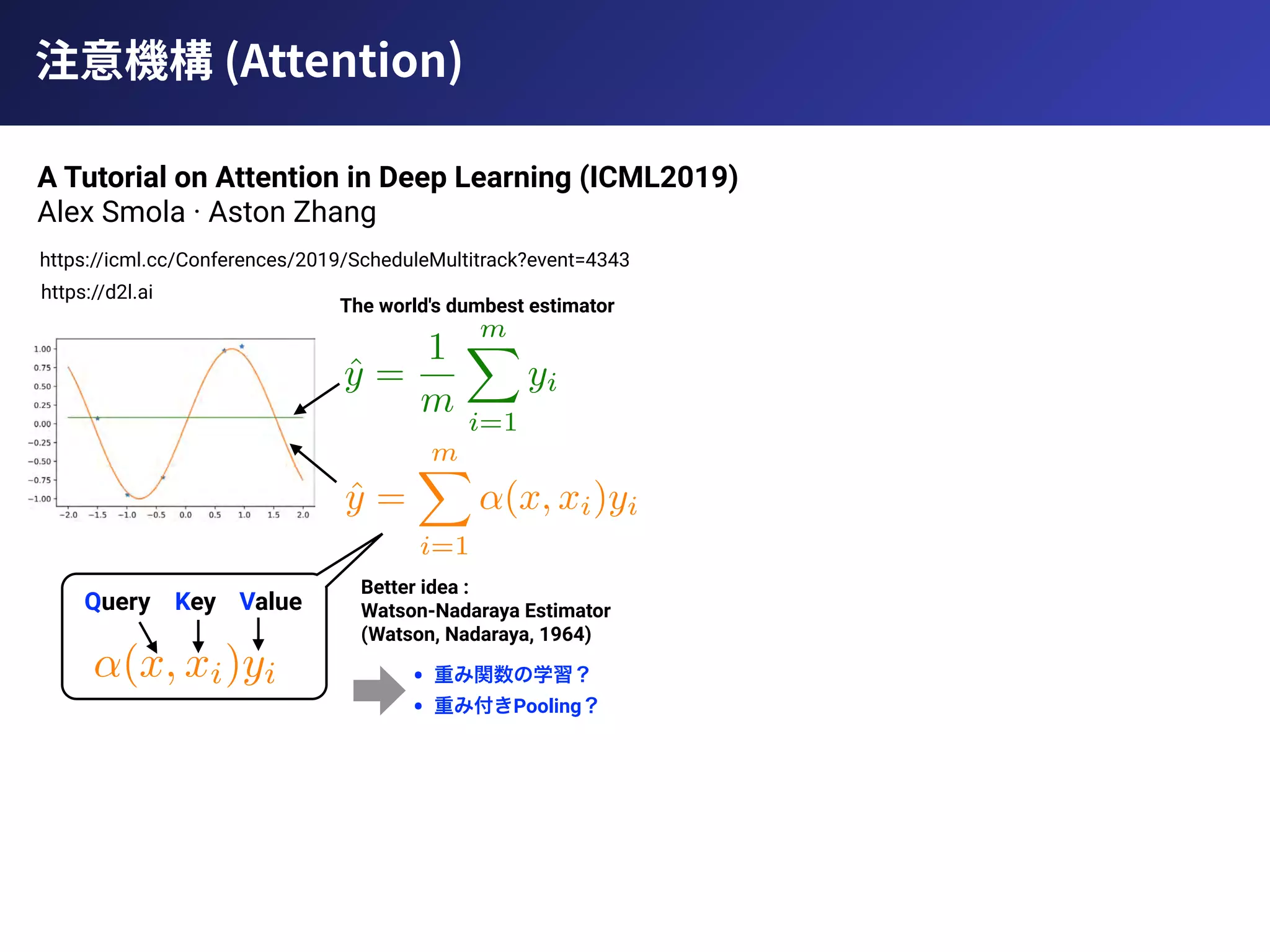
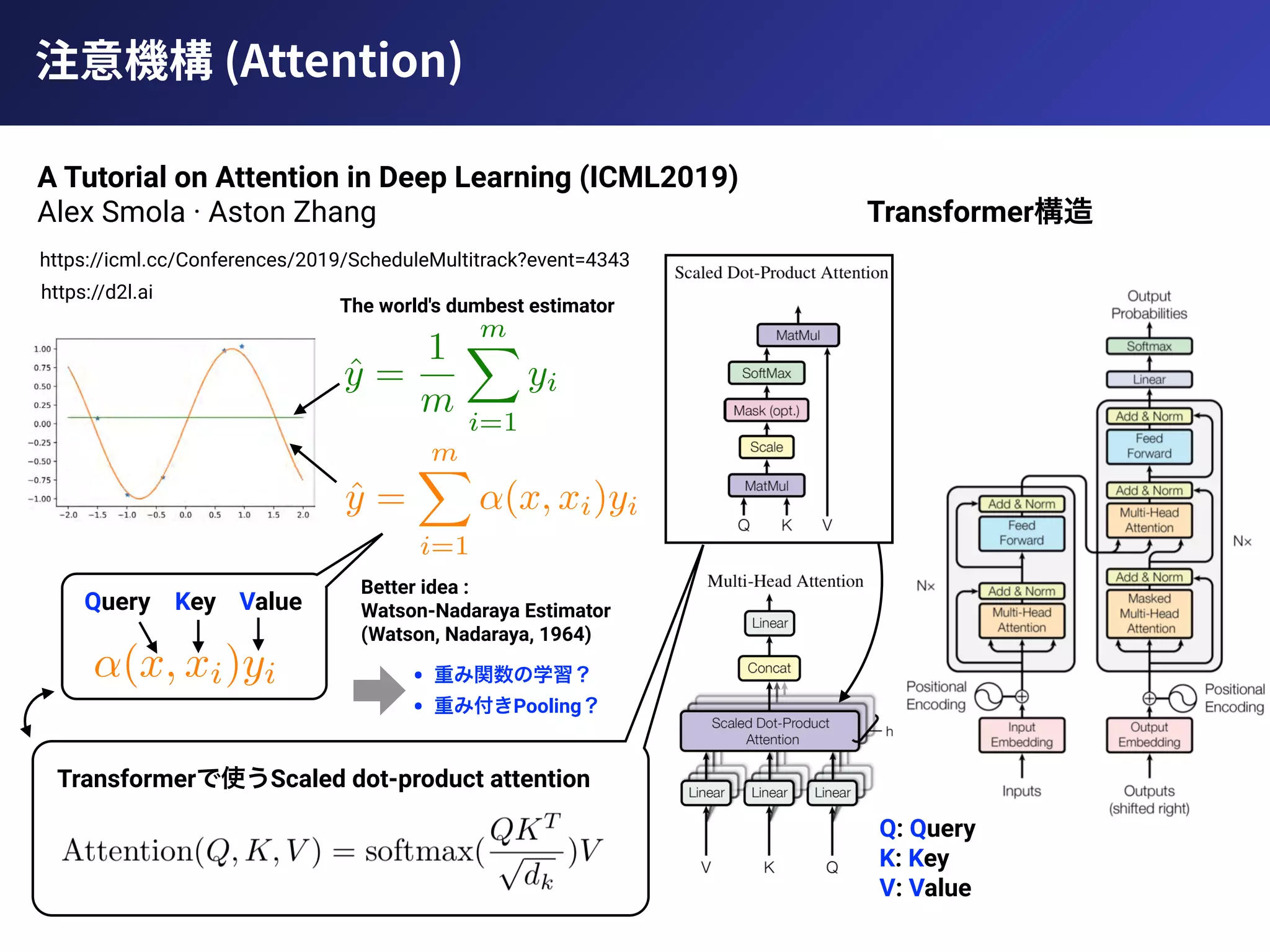
https://icml.cc/Conferences/2019/ScheduleMultitrack?event=4343
A Tutorial onAttention in Deep Learning (ICML2019)
Alex Smola · Aston Zhang
The world's dumbest estimator
Better idea :
Watson-Nadaraya Estimator
(Watson, Nadaraya, 1964)
KeyQuery Value
Q: Query
K: Key
V: Value
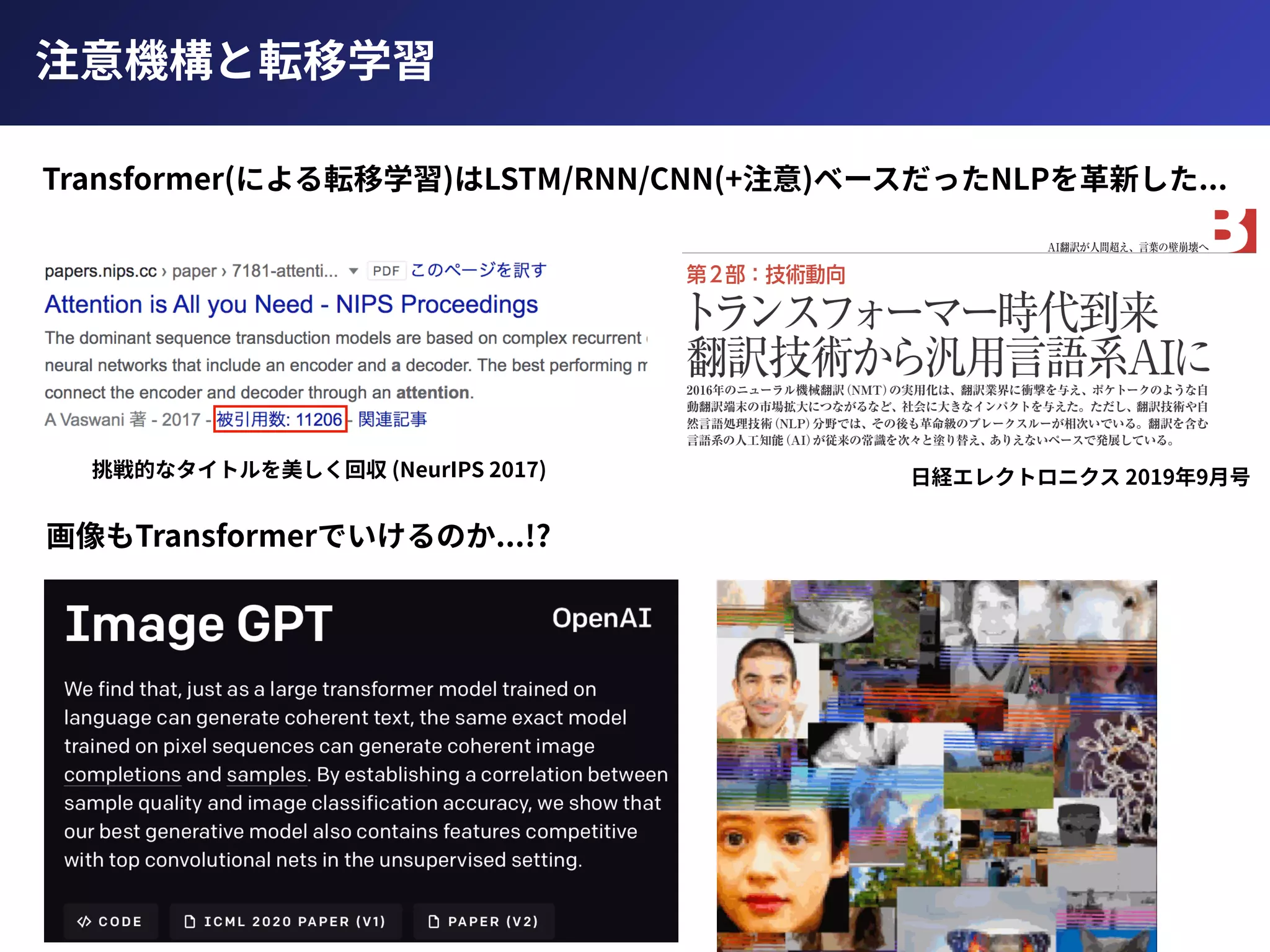
Transformer
Transformer Scaled dot-product attention
•
• Pooling
https://d2l.ai
注意機構 (Attention)
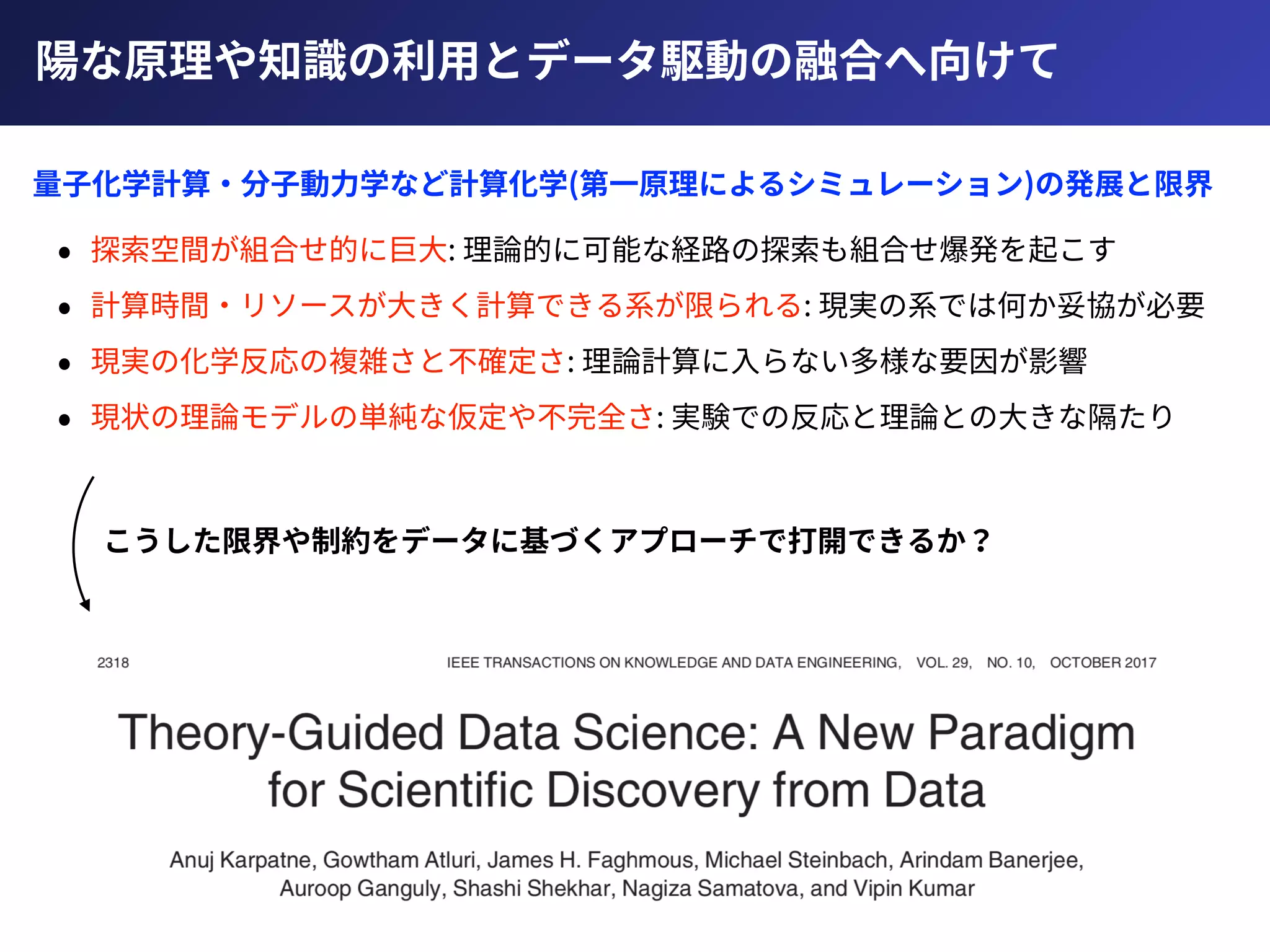
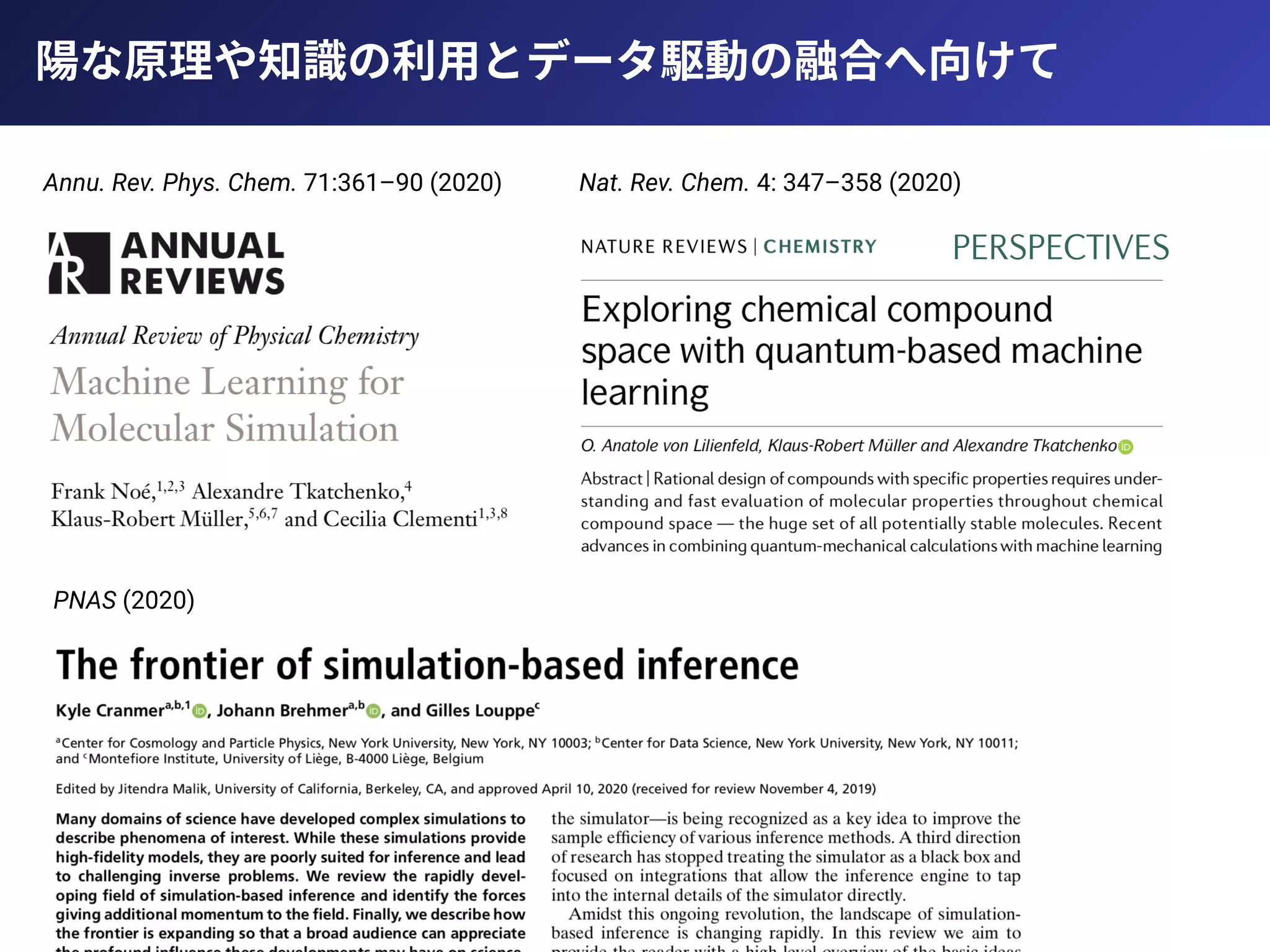
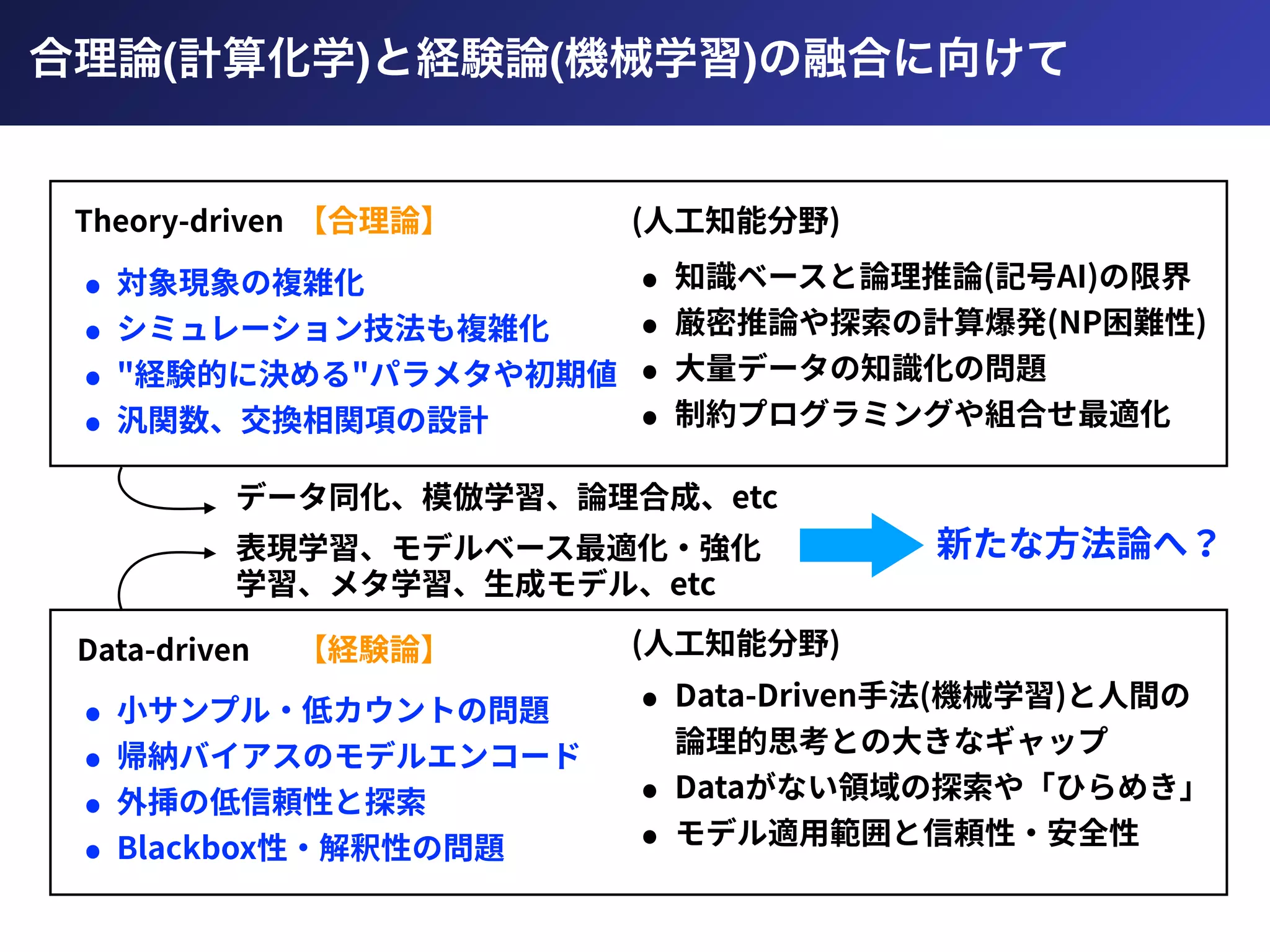
陽な原理や知識の利⽤とデータ駆動の融合へ向けて
https://uclnlp.github.io/nampi/
Machine intelligence capableof learning complex procedural
behavior, inducing (latent) programs, and reasoning with these
programs is a key to solving artificial intelligence. Recently,
there have been a lot of success stories in the deep learning
community related to learning neural networks capable of
using trainable memory abstractions.
Neural Abstract Machines & Program Induction • Differentiable Neural Computers /
Neural Turing Machines (Graves+ 2014)
• Memory Networks (Weston+ 2014)
• Pointer Networks (Vinyals+ 2015)
• Neural Stacks (Grefenstette+ 2015, Joulin+ 2015)
• Hierarchical Attentive Memory
(Andrychowicz+ 2016)
• Neural Program Interpreters (Reed+ 2016)
• Neural Programmer (Neelakantan+ 2016)
• DeepCoder (Balog+ 2016)
:
⼿続き的・記号的操作も学習できるプログラムとして扱えるようになってきた
58.
• Deep learningtechniques thus far have proven to be data hungry, shallow,
brittle, and limited in their ability to generalize (Marcus, 2018)
• Current machine learning techniques are data-hungry and brittle—they can
only make sense of patterns they've seen before. (Chollet, 2020)
• A growing body of evidence shows that state-of-the-art models learn to exploit
spurious statistical patterns in datasets... instead of learning meaning in the
flexible and generalizable way that humans do. (Nie et al., 2019)
• Current machine learning methods seem weak when they are required to
generalize beyond the training distribution, which is what is often needed in
practice. (Bengio et al., 2019)
ただし適切な⽬的へ応⽤すれば極めて有効な技術だと実証されてきた!
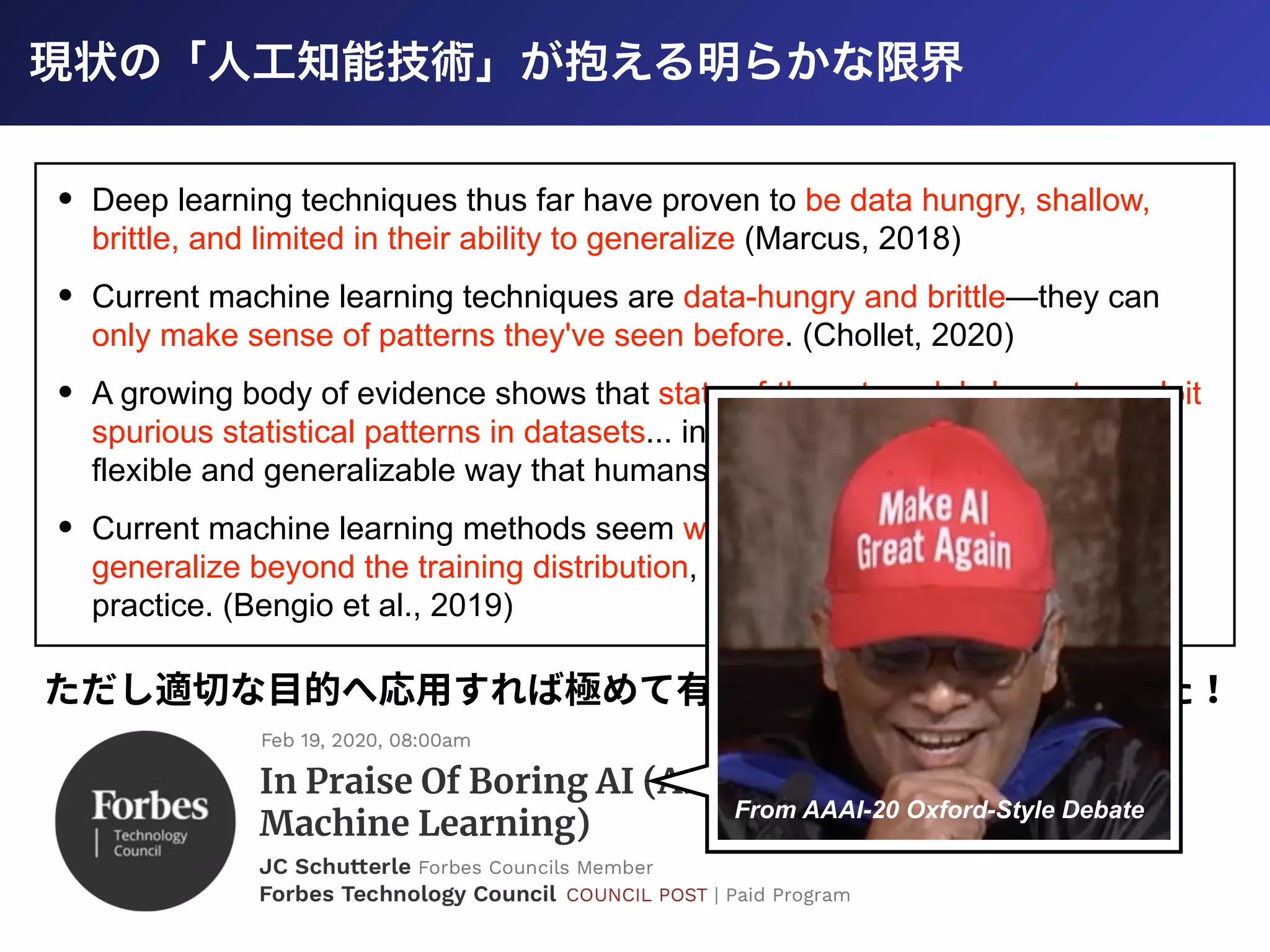
59.
• Deep learningtechniques thus far have proven to be data hungry, shallow,
brittle, and limited in their ability to generalize (Marcus, 2018)
• Current machine learning techniques are data-hungry and brittle—they can
only make sense of patterns they've seen before. (Chollet, 2020)
• A growing body of evidence shows that state-of-the-art models learn to exploit
spurious statistical patterns in datasets... instead of learning meaning in the
flexible and generalizable way that humans do. (Nie et al., 2019)
• Current machine learning methods seem weak when they are required to
generalize beyond the training distribution, which is what is often needed in
practice. (Bengio et al., 2019)
ただし適切な⽬的へ応⽤すれば極めて有効な技術だと実証されてきた!
From AAAI-20 Oxford-Style Debate





![チャレンジ① 表現学習
Brc1cncc(Br)c1 C[O-] CN(C)C=O Na+ COc1cncc(Br)c1SMILES
Structural Formla
Steric Structures
Electronic States
Reactants Reagents Products
パターン⾔語として (化学の教科書・データベースにある知識表現)
物理的対象として (量⼦化学に基づく電⼦状態計算)
⽂字列
グラフ
3D点集合
分布 or
Volume](https://image.slidesharecdn.com/jfssa2020-200910003316/75/2020-9-12-2048.jpg)


















![[DL輪読会] マルチエージェント強化学習と心の理論](https://cdn.slidesharecdn.com/ss_thumbnails/0917imai-211210044729-thumbnail.jpg?width=640&height=640&fit=bounds)


![[DL輪読会]Wasserstein GAN/Towards Principled Methods for Training Generative Adv...](https://cdn.slidesharecdn.com/ss_thumbnails/wgan-1-170224021826-thumbnail.jpg?width=640&height=640&fit=bounds)


![[DL輪読会]ドメイン転移と不変表現に関するサーベイ](https://cdn.slidesharecdn.com/ss_thumbnails/20190614iwasawa-190614005939-thumbnail.jpg?width=640&height=640&fit=bounds)


![[DL輪読会]Understanding Black-box Predictions via Influence Functions](https://cdn.slidesharecdn.com/ss_thumbnails/dlhacksinffunc-170822055634-thumbnail.jpg?width=640&height=640&fit=bounds)


![SSII2021 [SS1] Transformer x Computer Visionの 実活用可能性と展望 〜 TransformerのCompute...](https://cdn.slidesharecdn.com/ss_thumbnails/ss1-01-210607043349-thumbnail.jpg?width=640&height=640&fit=bounds)
![[DL輪読会]Graph Convolutional Policy Network for Goal-Directed Molecular Graph G...](https://cdn.slidesharecdn.com/ss_thumbnails/graphconvolutionalpolicynetworkforgoal-directedmoleculargraphgeneration-181102004011-thumbnail.jpg?width=640&height=640&fit=bounds)

![[DL輪読会]Pay Attention to MLPs (gMLP)](https://cdn.slidesharecdn.com/ss_thumbnails/kobayashi-210528032327-thumbnail.jpg?width=640&height=640&fit=bounds)
![[DL輪読会]ICLR2020の分布外検知速報](https://cdn.slidesharecdn.com/ss_thumbnails/iclr2020ood-190927011524-thumbnail.jpg?width=640&height=640&fit=bounds)


![[DL輪読会]Meta-Learning Probabilistic Inference for Prediction](https://cdn.slidesharecdn.com/ss_thumbnails/20181214dl-181218052422-thumbnail.jpg?width=640&height=640&fit=bounds)


