EPIDEMIOLOGYAND CURRENT OUTBREAK
STATUS OF 2019 NOVEL CORONAVIRUS
Dr. Nusrat Sultana
Assistant Professor
Department of Virology
Dhaka Medical College
Introduction
 Corona virus was first identified as a cause of the
common cold in 1960.
 Until 2002, the virus was considered a relatively simple,
nonfatal virus.
 An outbreak of severe acute respiratory syndrome
coronavirus (SARS-CoV) in 2002–2003 in Guangdong
province in China, caused an eventual 8,098 confirmed
cases, resulting in 774 deaths reported in 17 countries.
Introduction
 Since then scientists became deeply concerned
about the pathogenesis of coronaviruses.
 In 2012, again another novel coronavirus MERS-
CoV caused an outbreak in Saudi Arabia caused
1227 cases with fatality rate 37%.
Over the last three decades there have been
three attacks of three different coronaviruses,
SARS-CoV, MERS-CoV and the recent one 2019
novel coronavirus (2019-nCoV).
2019 Novel Coronavirus
(2019-nCoV)
 A new strain of coronavirus which differs
considerably in genetic structure from previously
recognized coronavirus.
 Other name : Wuhan Corona Virus, Wuhan seafood
market pneumonia virus.
2019 Novel Coronavirus
(2019-nCoV)
 The suspicion of emergence of new virus
arose when a cluster of people in a sea-food
market at Wuhan City, China developed
pneumonia without any clear cause.
 The virus isolated from the sample is in the
same family of viruses SARS-CoV and
MERS-CoV
 Genetic homology is about 75-80% with
SARS-CoV.
Reservoir
 Animals sold for food are suspected to be the
reservoir or the intermediary because many of the
first identified infected individuals were workers at
the Huanan Seafood Market, Hubei,Wuhan, China.
 A market selling live animals for food was also
blamed in the SARS epidemic in 2003
Researchers confirmed by genomic study,
2019-CoV have 96% homology with Bat corona
viruses
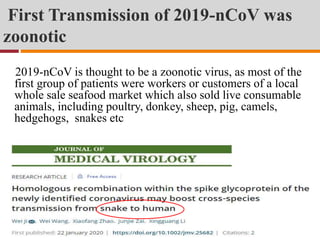
First Transmission of 2019-nCoV was
zoonotic
2019-nCoV is thought to be a zoonotic virus, as most of the
first group of patients were workers or customers of a local
whole sale seafood market which also sold live consumable
animals, including poultry, donkey, sheep, pig, camels,
hedgehogs, snakes etc
First Transmission of 2019-nCoV was
zoonotic
 2019-nCoV might have jumped from host
species bats to snakes and then to humans.
 Snake is the intermediate host between
human and bat.
 In the animal host viruses undergo repeated
mutations to get allowed to transmit to the
human
 After reaching the human, person to person
transmission is possible.
Mode of transmission
 Respiratory droplets (droplet spread) produced when an
infected person coughs or sneezes.
 Close person-to-person contact
 When a person touches a surface or object contaminated with
infectious droplets and then touches his or her mouth, nose, or
eye(s)
 Incubation period 02-14 days
 The basic reproduction number has been estimated to be
3.11, which means on average an infected person will infect
3 others.
Outbreak Status of 2019-nCoV
 An outbreak of 2019-nCoV was first detected
in Wuhan, China, in mid-December 2019.
 The virus subsequently spread to other
provinces of Mainland China and other
countries, including Thailand, Japan, Taiwan,
South Korea, Australia, France, and the United
States and more
 First confirmed death was on 9 January 2020.
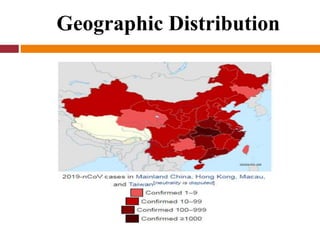
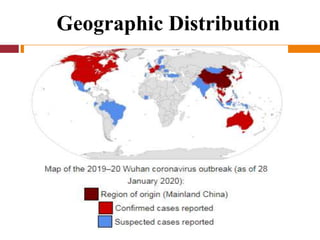
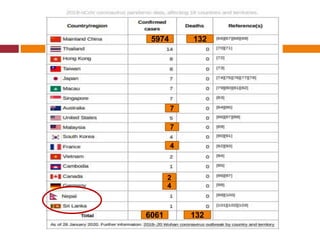
Geographic Distribution
1326061
5974 132
7
7
4
4
2
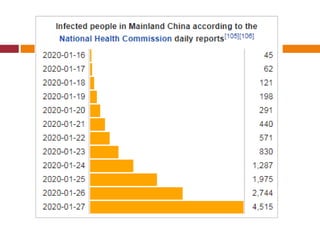
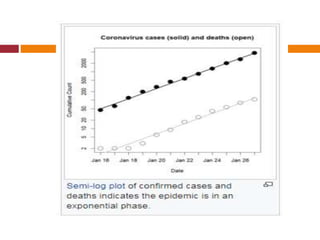
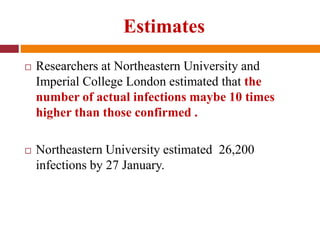
Estimates
 Researchers at Northeastern University and
Imperial College London estimated that the
number of actual infections maybe 10 times
higher than those confirmed .
 Northeastern University estimated 26,200
infections by 27 January.
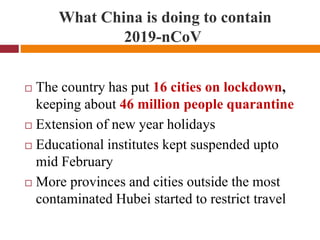
What China is doing to contain
2019-nCoV
 The country has put 16 cities on lockdown,
keeping about 46 million people quarantine
 Extension of new year holidays
 Educational institutes kept suspended upto
mid February
 More provinces and cities outside the most
contaminated Hubei started to restrict travel
What China is doing to contain
2019-nCoV
 Since 31 December 2019, some regions and
countries near China tightened their screening
of selected travellers.
 People with fevers are subsequently taken to
medical institutions after being registered and
given masks.
 Real time Reverse Transcription-Polymerase
Chain Reaction (rRT-PCR) test was used to
confirm new cases
Situation in Bangladesh
 No confirmed cases are found in Bangladesh.
 Still, we are in vulnerable situation
 Emergence of 2019-nCoV will cause an
ultimate massacre in our densely populated
country
 Hopeful that We Shall Overcome
Thank
You

2019-nCoV presentation

  • 1.
    EPIDEMIOLOGYAND CURRENT OUTBREAK STATUSOF 2019 NOVEL CORONAVIRUS Dr. Nusrat Sultana Assistant Professor Department of Virology Dhaka Medical College
  • 2.
    Introduction  Corona viruswas first identified as a cause of the common cold in 1960.  Until 2002, the virus was considered a relatively simple, nonfatal virus.  An outbreak of severe acute respiratory syndrome coronavirus (SARS-CoV) in 2002–2003 in Guangdong province in China, caused an eventual 8,098 confirmed cases, resulting in 774 deaths reported in 17 countries.
  • 3.
    Introduction  Since thenscientists became deeply concerned about the pathogenesis of coronaviruses.  In 2012, again another novel coronavirus MERS- CoV caused an outbreak in Saudi Arabia caused 1227 cases with fatality rate 37%. Over the last three decades there have been three attacks of three different coronaviruses, SARS-CoV, MERS-CoV and the recent one 2019 novel coronavirus (2019-nCoV).
  • 4.
    2019 Novel Coronavirus (2019-nCoV) A new strain of coronavirus which differs considerably in genetic structure from previously recognized coronavirus.  Other name : Wuhan Corona Virus, Wuhan seafood market pneumonia virus.
  • 5.
    2019 Novel Coronavirus (2019-nCoV) The suspicion of emergence of new virus arose when a cluster of people in a sea-food market at Wuhan City, China developed pneumonia without any clear cause.  The virus isolated from the sample is in the same family of viruses SARS-CoV and MERS-CoV  Genetic homology is about 75-80% with SARS-CoV.
  • 6.
    Reservoir  Animals soldfor food are suspected to be the reservoir or the intermediary because many of the first identified infected individuals were workers at the Huanan Seafood Market, Hubei,Wuhan, China.  A market selling live animals for food was also blamed in the SARS epidemic in 2003 Researchers confirmed by genomic study, 2019-CoV have 96% homology with Bat corona viruses
  • 7.
    First Transmission of2019-nCoV was zoonotic 2019-nCoV is thought to be a zoonotic virus, as most of the first group of patients were workers or customers of a local whole sale seafood market which also sold live consumable animals, including poultry, donkey, sheep, pig, camels, hedgehogs, snakes etc
  • 8.
    First Transmission of2019-nCoV was zoonotic  2019-nCoV might have jumped from host species bats to snakes and then to humans.  Snake is the intermediate host between human and bat.  In the animal host viruses undergo repeated mutations to get allowed to transmit to the human  After reaching the human, person to person transmission is possible.
  • 9.
    Mode of transmission Respiratory droplets (droplet spread) produced when an infected person coughs or sneezes.  Close person-to-person contact  When a person touches a surface or object contaminated with infectious droplets and then touches his or her mouth, nose, or eye(s)  Incubation period 02-14 days  The basic reproduction number has been estimated to be 3.11, which means on average an infected person will infect 3 others.
  • 10.
    Outbreak Status of2019-nCoV  An outbreak of 2019-nCoV was first detected in Wuhan, China, in mid-December 2019.  The virus subsequently spread to other provinces of Mainland China and other countries, including Thailand, Japan, Taiwan, South Korea, Australia, France, and the United States and more  First confirmed death was on 9 January 2020.
  • 11.
  • 12.
  • 13.
  • 16.
    Estimates  Researchers atNortheastern University and Imperial College London estimated that the number of actual infections maybe 10 times higher than those confirmed .  Northeastern University estimated 26,200 infections by 27 January.
  • 17.
    What China isdoing to contain 2019-nCoV  The country has put 16 cities on lockdown, keeping about 46 million people quarantine  Extension of new year holidays  Educational institutes kept suspended upto mid February  More provinces and cities outside the most contaminated Hubei started to restrict travel
  • 19.
    What China isdoing to contain 2019-nCoV  Since 31 December 2019, some regions and countries near China tightened their screening of selected travellers.  People with fevers are subsequently taken to medical institutions after being registered and given masks.  Real time Reverse Transcription-Polymerase Chain Reaction (rRT-PCR) test was used to confirm new cases
  • 20.
    Situation in Bangladesh No confirmed cases are found in Bangladesh.  Still, we are in vulnerable situation  Emergence of 2019-nCoV will cause an ultimate massacre in our densely populated country  Hopeful that We Shall Overcome
  • 23.