Peruvian Rural Sustainability

    Permaculture & Educational Travel
         Upper Amazon Basin
              San Martin
                 Perú


                                        Sept. 2012
Main Challenges:
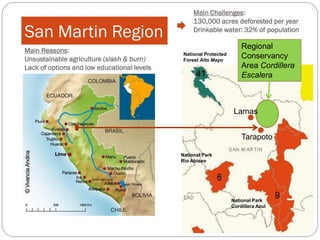
                                                  130,000 acres deforested per year
San Martin Region                                 Drinkable water: 32% of population

Main Reasons:
                                                                       Regional
                                              National Protected
Unsustainable agriculture (slash & burn)      Forest Alto Mayo
                                                                       Conservancy
Lack of options and low educational levels                             Area Cordillera
                                                                       Escalera


                                                                    Lamas


                                                                       Tarapoto

                                             National Park
                                             Rio Abiseo


                                                                   National Park
                                                                   Cordillera Azul
Social Entrepreneurship Goals
 Vision:
   To create life changing cross-cultural experiences for travelers that empower forest &
    headwaters conservation and rural sustainability in communities located in the
    sorroundings of Natural Protected Areas.
   To increase and provide experience to a critical mass of local, national & international
    youth and motivate them towards new approaches for sustainable development.
   To participate inter-actively with other movements and projects pointing towards a
    globe of friendly pluri-cultural self sufficient & sustainable ecovillages or ecocities.


 Mission:
   Our educational travels provide an academic framework, interaction with local
    community and ecotourism activities. We hire services from community based
    tourism ventures in an early stage and empower them.
   We support local grassroots organizations sustainable projects (organic coffee &
    cacao, ecotourism, natural medicine, arts & culture, edible gardening, among others).
   Our three main focus areas to empower in Amazonian rural villages are: forest
    conservancy (biodiversity and water), ecologycal agriculture and rural education.
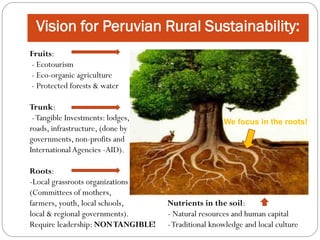
Vision for Peruvian Rural Sustainability:
Fruits:
- Ecotourism
- Eco-organic agriculture
- Protected forests & water

Trunk:
 - Tangible Investments: lodges,                     We focus in the roots!
roads, infrastructure, (done by
governments, non-profits and
International Agencies -AID).

Roots:
-Local grassroots organizations
(Committees of mothers,
farmers, youth, local schools,      Nutrients in the soil:
local & regional governments).      - Natural resources and human capital
Require leadership: NON TANGIBLE!   - Traditional knowledge and local culture
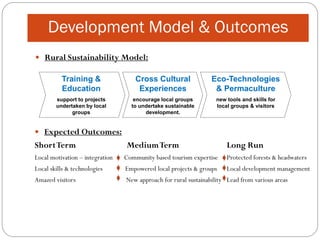
Development Model & Outcomes
 Rural Sustainability Model:

          Training &                 Cross Cultural              Eco-Technologies
          Education                   Experiences                 & Permaculture
        support to projects         encourage local groups         new tools and skills for
        undertaken by local        to undertake sustainable        local groups & visitors
              groups                    development.


 Expected Outcomes:
Short Term                       Medium Term                           Long Run
Local motivation – integration   Community based tourism expertise     Protected forests & headwaters
Local skills & technologies      Empowered local projects & groups     Local development management
Amazed visitors                  New approach for rural sustainability Lead from various areas
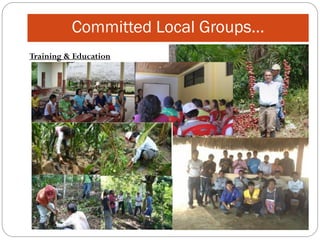
Committed Local Groups…
Training & Education
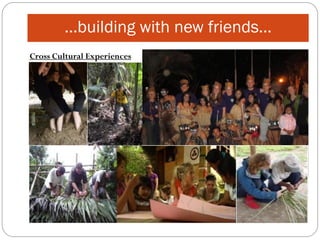
…building with new friends…
Cross Cultural Experiences
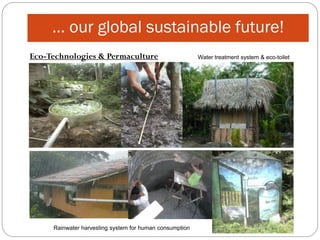
… our global sustainable future!
Eco-Technologies & Permaculture                          Water treatment system & eco-toilet


     Rainwater harvesting system for human consumption
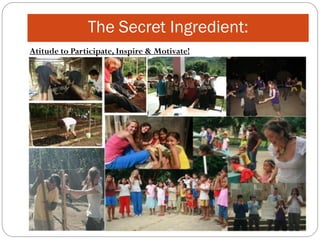
The Secret Ingredient:
Atitude to Participate, Inspire & Motivate!
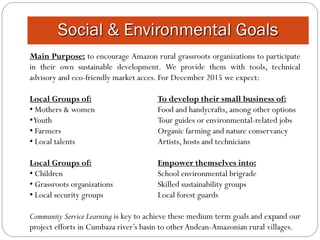
Social & Environmental Goals
Main Purpose: to encourage Amazon rural grassroots organizations to participate
in their own sustainable development. We provide them with tools, technical
advisory and eco-friendly market acces. For December 2015 we expect:

Local Groups of:                       To develop their small business of:
• Mothers & women                      Food and handycrafts, among other options
• Youth                                Tour guides or environmental-related jobs
• Farmers                              Organic farming and nature conservancy
• Local talents                        Artists, hosts and technicians

Local Groups of:                       Empower themselves into:
• Children                             School environmental brigrade
• Grassroots organizations             Skilled sustainability groups
• Local security groups                Local forest guards

Community Service Learning is key to achieve these medium term goals and expand our
project efforts in Cumbaza river’s basin to other Andean-Amazonian rural villages.
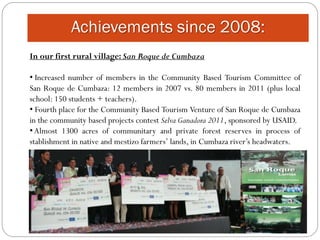
Achievements since 2008:
In our first rural village: San Roque de Cumbaza

• Increased number of members in the Community Based Tourism Committee of
San Roque de Cumbaza: 12 members in 2007 vs. 80 members in 2011 (plus local
school: 150 students + teachers).
• Fourth place for the Community Based Tourism Venture of San Roque de Cumbaza
in the community based projects contest Selva Ganadora 2011, sponsored by USAID.
• Almost 1300 acres of communitary and private forest reserves in process of
stablishment in native and mestizo farmers’ lands, in Cumbaza river’s headwaters.
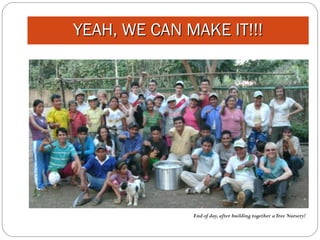
YEAH, WE CAN MAKE IT!!!


              End of day, after building together a Tree Nursery!
About Our Partners
Rural Grassroots Organizations (Service Providers & Projects’ Beneficiaries)
• Community Based Tourism Association of San Roque de Cumbaza:
           2 Committees of Local Mothers (Women)
           Local Youth Association “Los Triunfadores” (Youth)
           Food & Beverages Committee (Women)
           Environmental Awareness Committee (Male Farmers)
           Local School (children, youth and teachers)
           “Kechwa-Lamas” Native Community of Chirikyacu
           “Kechwa-Lamas” Native Community of Alto Shamboyacu
• Community Based Tourism Association of Chazuta Rural District - Forthcoming
• Ecotourism Development Association of Sauce Rural District – Forthcoming
• Ecotourism Development Association of Tingana Monkey Forests - Forthcoming

Government Agencies (We help public institutions to reach their development goals)
•Local Governments, Regional Government Environmental & Tourism Departments

Regional Universities, Institutes & Tour Guides Association (3 in total – we
need to provide new alternatives, lessons and onsite learning experiences to our youth)
2013 Volunteer & Travel Options
We are preparing the next activities:           Short Term Impact:

• Classes for local children, youth & school    Improved skills in English,
                                                mathematics, environmental
                                                sciences, art &culture.

• Community edible gardens                      Food security
  With local mothers                            Reduced cost of food
                                                Access to healthy food
                                                Future income generation
                                                Native & medicinal plants recovery

• Bio-Building & Sustainable Water Management Improved skills for rainwater
 With local youth, farmers & regional         harvesting, wastewater treatment
 institutes & universities                    and natural building designs.
                                              Access to clean water, clean rivers,
                                              low cost houses & irrigation.
*Spanish classes available!
Long Term Impact
Important:
• Cross Cultural & Community Learning Services Experiences have a strong impact
in motivating local groups towards their sustainable development.
• These experiences are complemented with participatory development of eco-
friendly products and services for local, regional & national markets.
• These processes take years as local educational levels hardly reach high-school as
well as IT & online media have being left aside in these areas.
• Through their experiences here we encourage visitors-students to insight new ways
that can enrich their career goals. Many of these challenges are also happening in
most the rural areas in the third world.
• Mainstream policies hardly achieve lasting impacts here without local participation.
This is a challenge for all of us and an opportunity to create innovative projects that
weave proper relationships between human beings and with nature.
The Social Entrepreneur
Rodrigo Ponce
• MSc Ecotourism & Bachelor degree in Economics
(Universidad Nacional Agraria La Molina & Universidad del Pacífico, both in Lima-Peru)
• Empiric & Certified Permaculture Designer
(Instituto Permacultura e Ecovilas do Cerrado – Ecocentro IPEC, Goiás – Brazil)
• Consultant for International Developmet Agencies & Non-Profits and background
as Business Executive in multinational banks in Lima, Peru.

• But mainly: last six years living onsite in Amazonian Rural Villages, participating in
communal work, assemblies, cleanups, workshops ran by different stakeholders,
researching sustainable alternatives, leading environmental activities, understanding
the local natural medicine & tales, gardening, reforesting and developing a learning by
doing mutual process with locals that now is able to share with you!

                                                      rodrigoponceotoya@gmail.com
Additional Project Info

Technical & Environmental Details
      Sites to Travel & Visit
             Pictures
About Our First Project in Cumbaza River
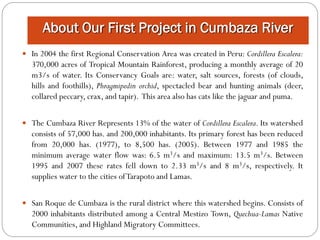
 In 2004 the first Regional Conservation Area was created in Peru: Cordillera Escalera:
  370,000 acres of Tropical Mountain Rainforest, producing a monthly average of 20
  m3/s of water. Its Conservancy Goals are: water, salt sources, forests (of clouds,
  hills and foothills), Phragmipedin orchid, spectacled bear and hunting animals (deer,
  collared peccary, crax, and tapir). This area also has cats like the jaguar and puma.

 The Cumbaza River Represents 13% of the water of Cordillera Escalera. Its watershed
  consists of 57,000 has. and 200,000 inhabitants. Its primary forest has been reduced
  from 20,000 has. (1977), to 8,500 has. (2005). Between 1977 and 1985 the
  minimum average water flow was: 6.5 m3/s and maximum: 13.5 m3/s. Between
  1995 and 2007 these rates fell down to 2.33 m3/s and 8 m3/s, respectively. It
  supplies water to the cities of Tarapoto and Lamas.

 San Roque de Cumbaza is the rural district where this watershed begins. Consists of
  2000 inhabitants distributed among a Central Mestizo Town, Quechua-Lamas Native
  Communities, and Highland Migratory Committees.
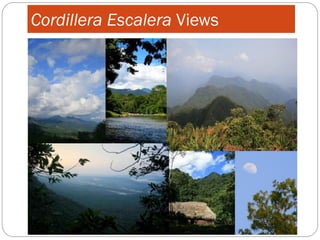
Cordillera Escalera Views
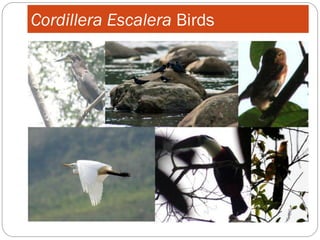
Cordillera Escalera Birds
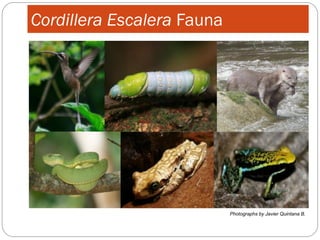
Cordillera Escalera Fauna


                            Photographs by Javier Quintana B.
Cumbaza River Watershed Project
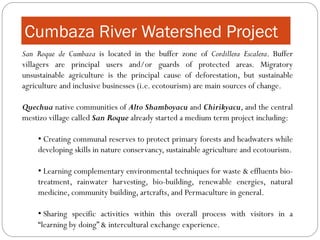
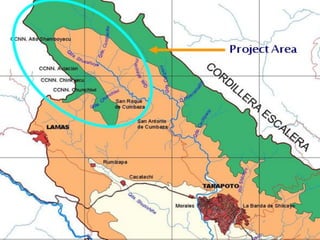
San Roque de Cumbaza is located in the buffer zone of Cordillera Escalera. Buffer
villagers are principal users and/or guards of protected areas. Migratory
unsustainable agriculture is the principal cause of deforestation, but sustainable
agriculture and inclusive businesses (i.e. ecotourism) are main sources of change.

Quechua native communities of Alto Shamboyacu and Chirikyacu, and the central
mestizo village called San Roque already started a medium term project including:

    • Creating communal reserves to protect primary forests and headwaters while
    developing skills in nature conservancy, sustainable agriculture and ecotourism.

    • Learning complementary environmental techniques for waste & effluents bio-
    treatment, rainwater harvesting, bio-building, renewable energies, natural
    medicine, community building, artcrafts, and Permaculture in general.

    • Sharing specific activities within this overall process with visitors in a
    “learning by doing” & intercultural exchange experience.
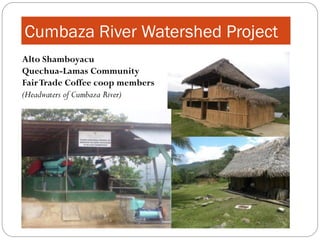
Cumbaza River Watershed Project
Alto Shamboyacu
Quechua-Lamas Community
Fair Trade Coffee coop members
(Headwaters of Cumbaza River)
Cumbaza River Watershed Project
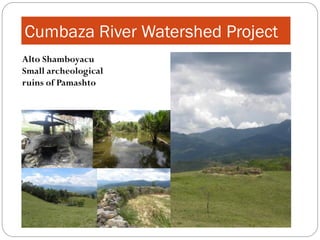
Alto Shamboyacu
Small archeological
ruins of Pamashto
Cumbaza River Watershed Project
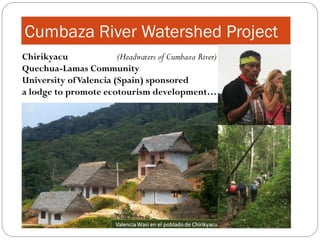
Chirikyacu              (Headwaters of Cumbaza River)
Quechua-Lamas Community
University of Valencia (Spain) sponsored
a lodge to promote ecotourism development…
Cumbaza River Watershed Project
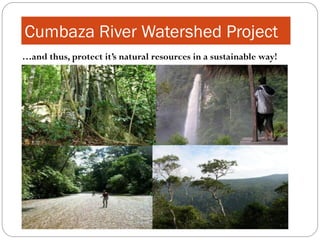
…and thus, protect it’s natural resources in a sustainable way!
Cumbaza River Watershed Project
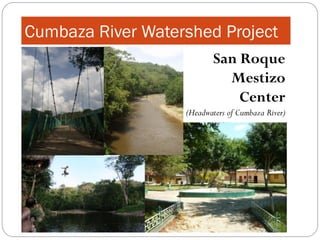
                          San Roque
                            Mestizo
                              Center
                   (Headwaters of Cumbaza River)
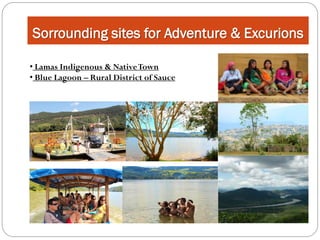
Sorrounding sites for Adventure & Excurions

• Lamas Indigenous & Native Town
• Blue Lagoon – Rural District of Sauce
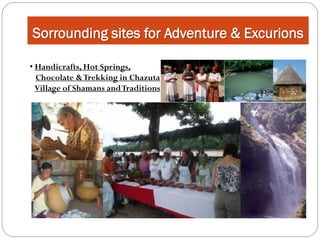
Sorrounding sites for Adventure & Excurions

• Handicrafts, Hot Springs,
  Chocolate & Trekking in Chazuta
  Village of Shamans and Traditions
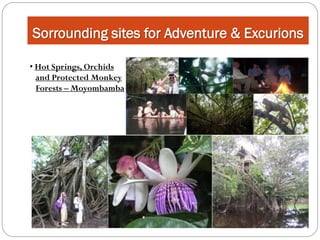
Sorrounding sites for Adventure & Excurions

• Hot Springs, Orchids
  and Protected Monkey
  Forests – Moyombamba
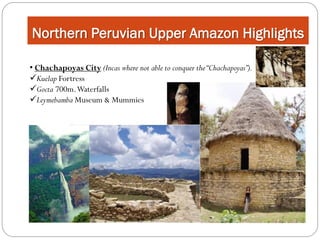
Northern Peruvian Upper Amazon Highlights

• Chachapoyas City (Incas where not able to conquer the “Chachapoyas”).
Kuelap Fortress
Gocta 700m. Waterfalls
Leymebamba Museum & Mummies
Northern Peruvian Coast: Ancient Cultures
                 Mochica & Chimú
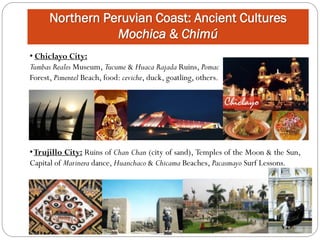
• Chiclayo City:
Tumbas Reales Museum, Tucume & Huaca Rajada Ruins, Pomac
Forest, Pimentel Beach, food: ceviche, duck, goatling, others.


• Trujillo City: Ruins of Chan Chan (city of sand), Temples of the Moon & the Sun,
Capital of Marinera dance, Huanchaco & Chicama Beaches, Pacasmayo Surf Lessons.
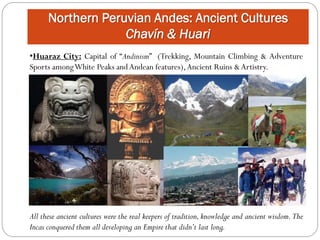
Northern Peruvian Andes: Ancient Cultures
                   Chavín & Huari
•Huaraz City: Capital of “Andinism” (Trekking, Mountain Climbing & Adventure
Sports among White Peaks and Andean features), Ancient Ruins & Artistry.


All these ancient cultures were the real keepers of tradition, knowledge and ancient wisdom. The
Incas conquered them all developing an Empire that didn’t last long.
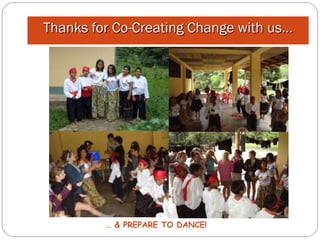
Thanks for Co-Creating Change with us…


         … & PREPARE TO DANCE!
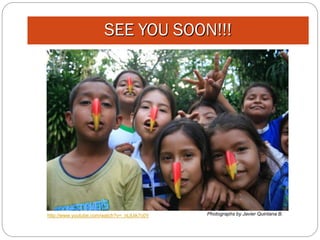
SEE YOU SOON!!!


http://www.youtube.com/watch?v=_nLlUik7c0Y   Photographs by Javier Quintana B.

Peru amazon ecovillages compressed

  • 1.
    Peruvian Rural Sustainability Permaculture & Educational Travel Upper Amazon Basin San Martin Perú Sept. 2012
  • 2.
    Main Challenges: 130,000 acres deforested per year San Martin Region Drinkable water: 32% of population Main Reasons: Regional National Protected Unsustainable agriculture (slash & burn) Forest Alto Mayo Conservancy Lack of options and low educational levels Area Cordillera Escalera Lamas Tarapoto National Park Rio Abiseo National Park Cordillera Azul
  • 3.
    Social Entrepreneurship Goals Vision:  To create life changing cross-cultural experiences for travelers that empower forest & headwaters conservation and rural sustainability in communities located in the sorroundings of Natural Protected Areas.  To increase and provide experience to a critical mass of local, national & international youth and motivate them towards new approaches for sustainable development.  To participate inter-actively with other movements and projects pointing towards a globe of friendly pluri-cultural self sufficient & sustainable ecovillages or ecocities.  Mission:  Our educational travels provide an academic framework, interaction with local community and ecotourism activities. We hire services from community based tourism ventures in an early stage and empower them.  We support local grassroots organizations sustainable projects (organic coffee & cacao, ecotourism, natural medicine, arts & culture, edible gardening, among others).  Our three main focus areas to empower in Amazonian rural villages are: forest conservancy (biodiversity and water), ecologycal agriculture and rural education.
  • 4.
    Vision for PeruvianRural Sustainability: Fruits: - Ecotourism - Eco-organic agriculture - Protected forests & water Trunk: - Tangible Investments: lodges, We focus in the roots! roads, infrastructure, (done by governments, non-profits and International Agencies -AID). Roots: -Local grassroots organizations (Committees of mothers, farmers, youth, local schools, Nutrients in the soil: local & regional governments). - Natural resources and human capital Require leadership: NON TANGIBLE! - Traditional knowledge and local culture
  • 5.
    Development Model &Outcomes  Rural Sustainability Model: Training & Cross Cultural Eco-Technologies Education Experiences & Permaculture support to projects encourage local groups new tools and skills for undertaken by local to undertake sustainable local groups & visitors groups development.  Expected Outcomes: Short Term Medium Term Long Run Local motivation – integration Community based tourism expertise Protected forests & headwaters Local skills & technologies Empowered local projects & groups Local development management Amazed visitors New approach for rural sustainability Lead from various areas
  • 6.
  • 7.
    …building with newfriends… Cross Cultural Experiences
  • 8.
    … our globalsustainable future! Eco-Technologies & Permaculture Water treatment system & eco-toilet Rainwater harvesting system for human consumption
  • 9.
    The Secret Ingredient: Atitudeto Participate, Inspire & Motivate!
  • 10.
    Social & EnvironmentalGoals Main Purpose: to encourage Amazon rural grassroots organizations to participate in their own sustainable development. We provide them with tools, technical advisory and eco-friendly market acces. For December 2015 we expect: Local Groups of: To develop their small business of: • Mothers & women Food and handycrafts, among other options • Youth Tour guides or environmental-related jobs • Farmers Organic farming and nature conservancy • Local talents Artists, hosts and technicians Local Groups of: Empower themselves into: • Children School environmental brigrade • Grassroots organizations Skilled sustainability groups • Local security groups Local forest guards Community Service Learning is key to achieve these medium term goals and expand our project efforts in Cumbaza river’s basin to other Andean-Amazonian rural villages.
  • 11.
    Achievements since 2008: Inour first rural village: San Roque de Cumbaza • Increased number of members in the Community Based Tourism Committee of San Roque de Cumbaza: 12 members in 2007 vs. 80 members in 2011 (plus local school: 150 students + teachers). • Fourth place for the Community Based Tourism Venture of San Roque de Cumbaza in the community based projects contest Selva Ganadora 2011, sponsored by USAID. • Almost 1300 acres of communitary and private forest reserves in process of stablishment in native and mestizo farmers’ lands, in Cumbaza river’s headwaters.
  • 12.
    YEAH, WE CANMAKE IT!!! End of day, after building together a Tree Nursery!
  • 13.
    About Our Partners RuralGrassroots Organizations (Service Providers & Projects’ Beneficiaries) • Community Based Tourism Association of San Roque de Cumbaza:  2 Committees of Local Mothers (Women)  Local Youth Association “Los Triunfadores” (Youth)  Food & Beverages Committee (Women)  Environmental Awareness Committee (Male Farmers)  Local School (children, youth and teachers)  “Kechwa-Lamas” Native Community of Chirikyacu  “Kechwa-Lamas” Native Community of Alto Shamboyacu • Community Based Tourism Association of Chazuta Rural District - Forthcoming • Ecotourism Development Association of Sauce Rural District – Forthcoming • Ecotourism Development Association of Tingana Monkey Forests - Forthcoming Government Agencies (We help public institutions to reach their development goals) •Local Governments, Regional Government Environmental & Tourism Departments Regional Universities, Institutes & Tour Guides Association (3 in total – we need to provide new alternatives, lessons and onsite learning experiences to our youth)
  • 14.
    2013 Volunteer &Travel Options We are preparing the next activities: Short Term Impact: • Classes for local children, youth & school Improved skills in English, mathematics, environmental sciences, art &culture. • Community edible gardens Food security With local mothers Reduced cost of food Access to healthy food Future income generation Native & medicinal plants recovery • Bio-Building & Sustainable Water Management Improved skills for rainwater With local youth, farmers & regional harvesting, wastewater treatment institutes & universities and natural building designs. Access to clean water, clean rivers, low cost houses & irrigation. *Spanish classes available!
  • 15.
    Long Term Impact Important: •Cross Cultural & Community Learning Services Experiences have a strong impact in motivating local groups towards their sustainable development. • These experiences are complemented with participatory development of eco- friendly products and services for local, regional & national markets. • These processes take years as local educational levels hardly reach high-school as well as IT & online media have being left aside in these areas. • Through their experiences here we encourage visitors-students to insight new ways that can enrich their career goals. Many of these challenges are also happening in most the rural areas in the third world. • Mainstream policies hardly achieve lasting impacts here without local participation. This is a challenge for all of us and an opportunity to create innovative projects that weave proper relationships between human beings and with nature.
  • 16.
    The Social Entrepreneur RodrigoPonce • MSc Ecotourism & Bachelor degree in Economics (Universidad Nacional Agraria La Molina & Universidad del Pacífico, both in Lima-Peru) • Empiric & Certified Permaculture Designer (Instituto Permacultura e Ecovilas do Cerrado – Ecocentro IPEC, Goiás – Brazil) • Consultant for International Developmet Agencies & Non-Profits and background as Business Executive in multinational banks in Lima, Peru. • But mainly: last six years living onsite in Amazonian Rural Villages, participating in communal work, assemblies, cleanups, workshops ran by different stakeholders, researching sustainable alternatives, leading environmental activities, understanding the local natural medicine & tales, gardening, reforesting and developing a learning by doing mutual process with locals that now is able to share with you! rodrigoponceotoya@gmail.com
  • 17.
    Additional Project Info Technical& Environmental Details Sites to Travel & Visit Pictures
  • 18.
    About Our FirstProject in Cumbaza River  In 2004 the first Regional Conservation Area was created in Peru: Cordillera Escalera: 370,000 acres of Tropical Mountain Rainforest, producing a monthly average of 20 m3/s of water. Its Conservancy Goals are: water, salt sources, forests (of clouds, hills and foothills), Phragmipedin orchid, spectacled bear and hunting animals (deer, collared peccary, crax, and tapir). This area also has cats like the jaguar and puma.  The Cumbaza River Represents 13% of the water of Cordillera Escalera. Its watershed consists of 57,000 has. and 200,000 inhabitants. Its primary forest has been reduced from 20,000 has. (1977), to 8,500 has. (2005). Between 1977 and 1985 the minimum average water flow was: 6.5 m3/s and maximum: 13.5 m3/s. Between 1995 and 2007 these rates fell down to 2.33 m3/s and 8 m3/s, respectively. It supplies water to the cities of Tarapoto and Lamas.  San Roque de Cumbaza is the rural district where this watershed begins. Consists of 2000 inhabitants distributed among a Central Mestizo Town, Quechua-Lamas Native Communities, and Highland Migratory Committees.
  • 19.
  • 20.
  • 21.
    Cordillera Escalera Fauna Photographs by Javier Quintana B.
  • 22.
    Cumbaza River WatershedProject San Roque de Cumbaza is located in the buffer zone of Cordillera Escalera. Buffer villagers are principal users and/or guards of protected areas. Migratory unsustainable agriculture is the principal cause of deforestation, but sustainable agriculture and inclusive businesses (i.e. ecotourism) are main sources of change. Quechua native communities of Alto Shamboyacu and Chirikyacu, and the central mestizo village called San Roque already started a medium term project including: • Creating communal reserves to protect primary forests and headwaters while developing skills in nature conservancy, sustainable agriculture and ecotourism. • Learning complementary environmental techniques for waste & effluents bio- treatment, rainwater harvesting, bio-building, renewable energies, natural medicine, community building, artcrafts, and Permaculture in general. • Sharing specific activities within this overall process with visitors in a “learning by doing” & intercultural exchange experience.
  • 24.
    Cumbaza River WatershedProject Alto Shamboyacu Quechua-Lamas Community Fair Trade Coffee coop members (Headwaters of Cumbaza River)
  • 25.
    Cumbaza River WatershedProject Alto Shamboyacu Small archeological ruins of Pamashto
  • 26.
    Cumbaza River WatershedProject Chirikyacu (Headwaters of Cumbaza River) Quechua-Lamas Community University of Valencia (Spain) sponsored a lodge to promote ecotourism development…
  • 27.
    Cumbaza River WatershedProject …and thus, protect it’s natural resources in a sustainable way!
  • 28.
    Cumbaza River WatershedProject San Roque Mestizo Center (Headwaters of Cumbaza River)
  • 29.
    Sorrounding sites forAdventure & Excurions • Lamas Indigenous & Native Town • Blue Lagoon – Rural District of Sauce
  • 30.
    Sorrounding sites forAdventure & Excurions • Handicrafts, Hot Springs, Chocolate & Trekking in Chazuta Village of Shamans and Traditions
  • 31.
    Sorrounding sites forAdventure & Excurions • Hot Springs, Orchids and Protected Monkey Forests – Moyombamba
  • 32.
    Northern Peruvian UpperAmazon Highlights • Chachapoyas City (Incas where not able to conquer the “Chachapoyas”). Kuelap Fortress Gocta 700m. Waterfalls Leymebamba Museum & Mummies
  • 33.
    Northern Peruvian Coast:Ancient Cultures Mochica & Chimú • Chiclayo City: Tumbas Reales Museum, Tucume & Huaca Rajada Ruins, Pomac Forest, Pimentel Beach, food: ceviche, duck, goatling, others. • Trujillo City: Ruins of Chan Chan (city of sand), Temples of the Moon & the Sun, Capital of Marinera dance, Huanchaco & Chicama Beaches, Pacasmayo Surf Lessons.
  • 34.
    Northern Peruvian Andes:Ancient Cultures Chavín & Huari •Huaraz City: Capital of “Andinism” (Trekking, Mountain Climbing & Adventure Sports among White Peaks and Andean features), Ancient Ruins & Artistry. All these ancient cultures were the real keepers of tradition, knowledge and ancient wisdom. The Incas conquered them all developing an Empire that didn’t last long.
  • 35.
    Thanks for Co-CreatingChange with us… … & PREPARE TO DANCE!
  • 36.