Soft Skills
For a Hard World
“Emotional intelligence,
more than any other asset,
more than IQ or technical
expertise, is the most
important overall success
factor in careers.”
(Late) Professor Warren Bennis, USC Business School
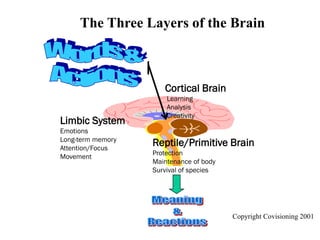
The Three Layers of the Brain
Limbic System
Emotions
Long-term memory
Attention/Focus
Movement
Cortical Brain
Learning
Analysis
Creativity
Reptile/Primitive Brain
Protection
Maintenance of body
Survival of species
Copyright Covisioning 2001
Multitasking
Fact or Fiction?
Disconnect
Popular Culture vs. Work Culture
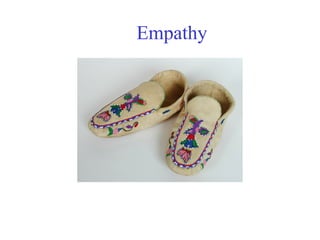
Empathy
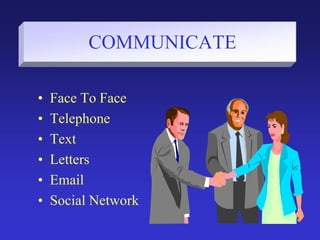
COMMUNICATE
• Face To Face
• Telephone
• Text
• Letters
• Email
• Social Network
PRINCIPLES OF
COMMUNICATION
1. What We Say May Not Be What Is
Heard.
a. Texting
b. Jargon
c. Questions
PRINCIPLES OF
COMMUNICATION
2. Messages Contain Thoughts And
Emotions.
a. Be careful of WHY
b. Be positive
PRINCIPLES OF
COMMUNICATION
3. How We Physically Respond Is A
Better Indicator Than What We Say.
a. Tone of Voice
b. Body Language
How Many Sentences?
I never said that.
How Many Sentences?
What do you think about it?
PRINCIPLES OF
COMMUNICATION
4. There is an appropriate time and an
appropriate place.
a. Attention and focus
b. The perception of others
SOME BARRIERS TO
COMMUNICATION
• Negotiation Style
• Bad Habits
• Perceptions of Fairness
• Personal Needs
• Outside Distractions
There is a difference
between understanding
another’s position and
condoning it.
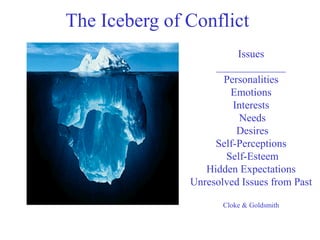
The Iceberg of Conflict
Issues
_____________
Personalities
Emotions
Interests
Needs
Desires
Self-Perceptions
Self-Esteem
Hidden Expectations
Unresolved Issues from Past
Cloke & Goldsmith
Options for Resolving Conflict
• Avoidance
• Collaboration
– Negotiate
– Mediate
• Higher Authority
– Chain of command
– Litigate
• Unilateral Power Play
Slaiku, WHEN PUSH COMES TO SHOVE
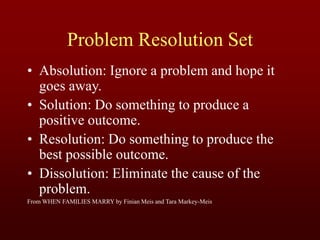
Problem Resolution Set
• Absolution: Ignore a problem and hope it
goes away.
• Solution: Do something to produce a
positive outcome.
• Resolution: Do something to produce the
best possible outcome.
• Dissolution: Eliminate the cause of the
problem.
From WHEN FAMILIES MARRY by Finian Meis and Tara Markey-Meis
There is no one right
answer for everything…
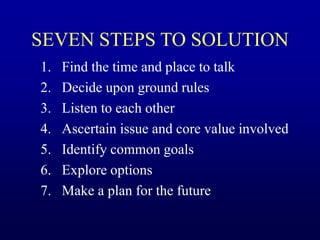
SEVEN STEPS TO SOLUTION
1. Find the time and place to talk
2. Decide upon ground rules
3. Listen to each other
4. Ascertain issue and core value involved
5. Identify common goals
6. Explore options
7. Make a plan for the future
SEVEN STEPS TO SOLUTION
1. Find the time and place to talk
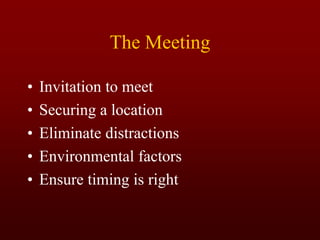
The Meeting
• Invitation to meet
• Securing a location
• Eliminate distractions
• Environmental factors
• Ensure timing is right
SEVEN STEPS TO SOLUTION
2. Decide upon ground rules
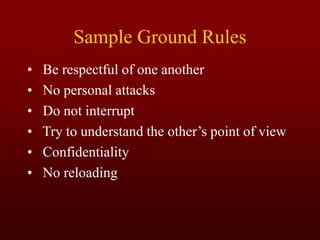
Sample Ground Rules
• Be respectful of one another
• No personal attacks
• Do not interrupt
• Try to understand the other’s point of view
• Confidentiality
• No reloading
SEVEN STEPS TO SOLUTION
3. Listen to each other
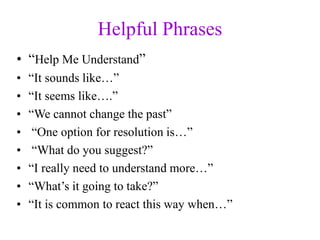
Helpful Phrases
• “Help Me Understand”
• “It sounds like…”
• “It seems like….”
• “We cannot change the past”
• “One option for resolution is…”
• “What do you suggest?”
• “I really need to understand more…”
• “What’s it going to take?”
• “It is common to react this way when…”
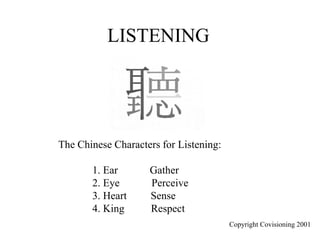
The Chinese Characters for Listening:
1. Ear Gather
2. Eye Perceive
3. Heart Sense
4. King Respect
LISTENING
Copyright Covisioning 2001
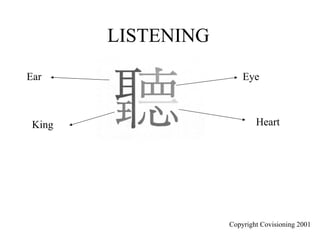
LISTENING
Copyright Covisioning 2001
EyeEar
King Heart
LISTENING BEHAVIORS
• Listen for the Facts
• Understand the Speaker (Empathic
Listening)
• Active Listening
• Paraphrase/Summarize to understand
SEVEN STEPS TO SOLUTION
4. Ascertain issue and core value involved
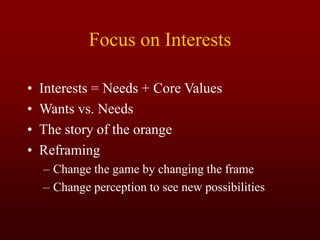
Focus on Interests
• Interests = Needs + Core Values
• Wants vs. Needs
• The story of the orange
• Reframing
– Change the game by changing the frame
– Change perception to see new possibilities
SEVEN STEPS TO SOLUTION
5. Identify common goals
SEVEN STEPS TO SOLUTION
6. Explore options
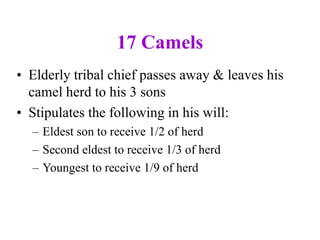
17 Camels
• Elderly tribal chief passes away & leaves his
camel herd to his 3 sons
• Stipulates the following in his will:
– Eldest son to receive 1/2 of herd
– Second eldest to receive 1/3 of herd
– Youngest to receive 1/9 of herd
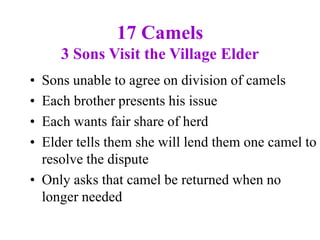
17 Camels
3 Sons Visit the Village Elder
• Sons unable to agree on division of camels
• Each brother presents his issue
• Each wants fair share of herd
• Elder tells them she will lend them one camel to
resolve the dispute
• Only asks that camel be returned when no
longer needed
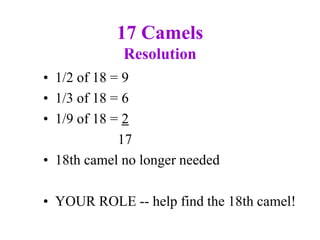
17 Camels
Resolution
• 1/2 of 18 = 9
• 1/3 of 18 = 6
• 1/9 of 18 = 2
17
• 18th camel no longer needed
• YOUR ROLE -- help find the 18th camel!
SEVEN STEPS TO SOLUTION
7. Make a plan for the future
People do not need
to agree on beliefs or
values but only as to
arrangements for the
future.
PRINCIPLES OF
AGREEMENTS
• The Past Can’t be Changed - Focus on Future
• Any Settlement is a Gamble - for All Parties.
Denise Blommel
Denise M. Blommel, PLLC
Attorney/Mediator
6945 E. Sahuaro
Suite 125
Scottsdale, AZ 85254
480-247-7477
denise@azlaborlaw.com
www.azlaborlaw.com
Donald R. Doerres, II
Scientific Software Engineer
Arizona State University Planetary Sciences
ddoerres@asu.edu
don@azlaborlaw.com

2018 tamid sshw

  • 1.
  • 2.
  • 3.
    “Emotional intelligence, more thanany other asset, more than IQ or technical expertise, is the most important overall success factor in careers.” (Late) Professor Warren Bennis, USC Business School
  • 4.
    The Three Layersof the Brain Limbic System Emotions Long-term memory Attention/Focus Movement Cortical Brain Learning Analysis Creativity Reptile/Primitive Brain Protection Maintenance of body Survival of species Copyright Covisioning 2001
  • 5.
  • 6.
  • 7.
  • 8.
    COMMUNICATE • Face ToFace • Telephone • Text • Letters • Email • Social Network
  • 9.
    PRINCIPLES OF COMMUNICATION 1. WhatWe Say May Not Be What Is Heard. a. Texting b. Jargon c. Questions
  • 10.
    PRINCIPLES OF COMMUNICATION 2. MessagesContain Thoughts And Emotions. a. Be careful of WHY b. Be positive
  • 11.
    PRINCIPLES OF COMMUNICATION 3. HowWe Physically Respond Is A Better Indicator Than What We Say. a. Tone of Voice b. Body Language
  • 12.
    How Many Sentences? Inever said that.
  • 13.
    How Many Sentences? Whatdo you think about it?
  • 14.
    PRINCIPLES OF COMMUNICATION 4. Thereis an appropriate time and an appropriate place. a. Attention and focus b. The perception of others
  • 15.
    SOME BARRIERS TO COMMUNICATION •Negotiation Style • Bad Habits • Perceptions of Fairness • Personal Needs • Outside Distractions
  • 16.
    There is adifference between understanding another’s position and condoning it.
  • 17.
    The Iceberg ofConflict Issues _____________ Personalities Emotions Interests Needs Desires Self-Perceptions Self-Esteem Hidden Expectations Unresolved Issues from Past Cloke & Goldsmith
  • 18.
    Options for ResolvingConflict • Avoidance • Collaboration – Negotiate – Mediate • Higher Authority – Chain of command – Litigate • Unilateral Power Play Slaiku, WHEN PUSH COMES TO SHOVE
  • 19.
    Problem Resolution Set •Absolution: Ignore a problem and hope it goes away. • Solution: Do something to produce a positive outcome. • Resolution: Do something to produce the best possible outcome. • Dissolution: Eliminate the cause of the problem. From WHEN FAMILIES MARRY by Finian Meis and Tara Markey-Meis
  • 20.
    There is noone right answer for everything…
  • 21.
    SEVEN STEPS TOSOLUTION 1. Find the time and place to talk 2. Decide upon ground rules 3. Listen to each other 4. Ascertain issue and core value involved 5. Identify common goals 6. Explore options 7. Make a plan for the future
  • 22.
    SEVEN STEPS TOSOLUTION 1. Find the time and place to talk
  • 23.
    The Meeting • Invitationto meet • Securing a location • Eliminate distractions • Environmental factors • Ensure timing is right
  • 24.
    SEVEN STEPS TOSOLUTION 2. Decide upon ground rules
  • 25.
    Sample Ground Rules •Be respectful of one another • No personal attacks • Do not interrupt • Try to understand the other’s point of view • Confidentiality • No reloading
  • 26.
    SEVEN STEPS TOSOLUTION 3. Listen to each other
  • 27.
    Helpful Phrases • “HelpMe Understand” • “It sounds like…” • “It seems like….” • “We cannot change the past” • “One option for resolution is…” • “What do you suggest?” • “I really need to understand more…” • “What’s it going to take?” • “It is common to react this way when…”
  • 28.
    The Chinese Charactersfor Listening: 1. Ear Gather 2. Eye Perceive 3. Heart Sense 4. King Respect LISTENING Copyright Covisioning 2001
  • 29.
  • 30.
    LISTENING BEHAVIORS • Listenfor the Facts • Understand the Speaker (Empathic Listening) • Active Listening • Paraphrase/Summarize to understand
  • 31.
    SEVEN STEPS TOSOLUTION 4. Ascertain issue and core value involved
  • 32.
    Focus on Interests •Interests = Needs + Core Values • Wants vs. Needs • The story of the orange • Reframing – Change the game by changing the frame – Change perception to see new possibilities
  • 33.
    SEVEN STEPS TOSOLUTION 5. Identify common goals
  • 34.
    SEVEN STEPS TOSOLUTION 6. Explore options
  • 36.
    17 Camels • Elderlytribal chief passes away & leaves his camel herd to his 3 sons • Stipulates the following in his will: – Eldest son to receive 1/2 of herd – Second eldest to receive 1/3 of herd – Youngest to receive 1/9 of herd
  • 37.
    17 Camels 3 SonsVisit the Village Elder • Sons unable to agree on division of camels • Each brother presents his issue • Each wants fair share of herd • Elder tells them she will lend them one camel to resolve the dispute • Only asks that camel be returned when no longer needed
  • 38.
    17 Camels Resolution • 1/2of 18 = 9 • 1/3 of 18 = 6 • 1/9 of 18 = 2 17 • 18th camel no longer needed • YOUR ROLE -- help find the 18th camel!
  • 39.
    SEVEN STEPS TOSOLUTION 7. Make a plan for the future
  • 40.
    People do notneed to agree on beliefs or values but only as to arrangements for the future.
  • 41.
    PRINCIPLES OF AGREEMENTS • ThePast Can’t be Changed - Focus on Future • Any Settlement is a Gamble - for All Parties.
  • 42.
    Denise Blommel Denise M.Blommel, PLLC Attorney/Mediator 6945 E. Sahuaro Suite 125 Scottsdale, AZ 85254 480-247-7477 denise@azlaborlaw.com www.azlaborlaw.com
  • 43.
    Donald R. Doerres,II Scientific Software Engineer Arizona State University Planetary Sciences ddoerres@asu.edu don@azlaborlaw.com