STM Mentoring Programme 2017
Mentor Presentation
Monday 10th April, 2017
Rachel Moriarty – Computer Science Editor at
Springer Nature
Jason Mitchell – Publishing Services Manager at
Elsevier
Mandeep Kundi – Learning and Development
Manager at BMJ
Introductions
1. Objectives of the STM Mentoring Program
2. What is mentoring?
3. Qualities of Good Mentors
4. How does it work?
5. How to establish a good mentoring relationship
6. Reverse Mentoring
7. Outcomes for successful mentoring partnerships
8. Next Steps
9. Support and Useful Links
10. Questions & Answers
Agenda
• To articulate the benefits of Mentoring to the wider Publishing Industry
• To facilitate the creation of successful relationships between Mentors
and Mentees
• To provide guidance and support that ensures Mentors and Mentees
benefit from the process
• To evaluate the effectiveness of the Scheme and identify refinement for
future delivery
Overall Objectives of the STM Mentoring Program
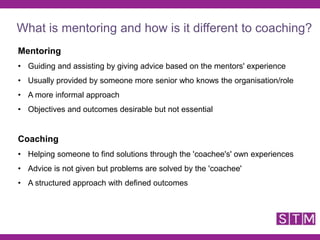
Mentoring
• Guiding and assisting by giving advice based on the mentors' experience
• Usually provided by someone more senior who knows the organisation/role
• A more informal approach
• Objectives and outcomes desirable but not essential
Coaching
• Helping someone to find solutions through the 'coachee's' own experiences
• Advice is not given but problems are solved by the 'coachee'
• A structured approach with defined outcomes
What is mentoring and how is it different to coaching?
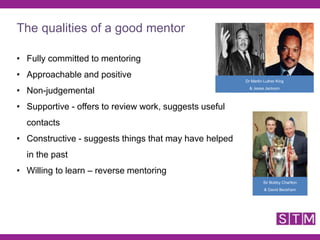
• Fully committed to mentoring
• Approachable and positive
• Non-judgemental
• Supportive - offers to review work, suggests useful
contacts
• Constructive - suggests things that may have helped
in the past
• Willing to learn – reverse mentoring
Sir Bobby Charlton
& David Beckham
Dr Martin Luther King
& Jesse Jackson
The qualities of a good mentor
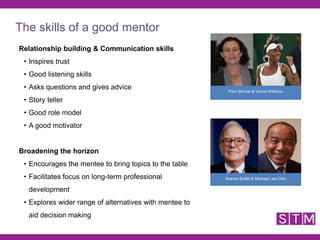
Relationship building & Communication skills
• Inspires trust
• Good listening skills
• Asks questions and gives advice
• Story teller
• Good role model
• A good motivator
Broadening the horizon
• Encourages the mentee to bring topics to the table
• Facilitates focus on long-term professional
development
• Explores wider range of alternatives with mentee to
aid decision making
Warren Buffet & Michael Lee-Chin
Pam Shriver & Venus Williams
The skills of a good mentor
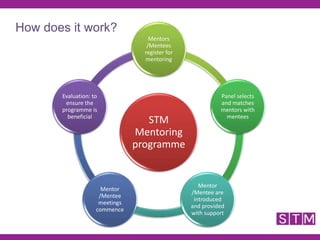
STM
Mentoring
programme
Mentors
/Mentees
register for
mentoring
Panel selects
and matches
mentors with
mentees
Mentor
/Mentee are
introduced
and provided
with support
Mentor
/Mentee
meetings
commence
Evaluation: to
ensure the
programme is
beneficial
How does it work?
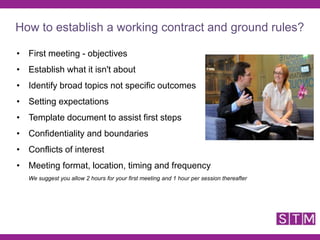
• First meeting - objectives
• Establish what it isn't about
• Identify broad topics not specific outcomes
• Setting expectations
• Template document to assist first steps
• Confidentiality and boundaries
• Conflicts of interest
• Meeting format, location, timing and frequency
We suggest you allow 2 hours for your first meeting and 1 hour per session thereafter
How to establish a working contract and ground rules?
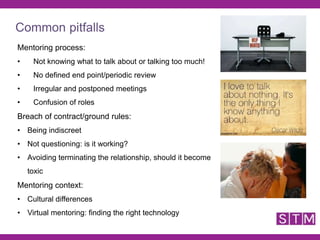
Mentoring process:
• Not knowing what to talk about or talking too much!
• No defined end point/periodic review
• Irregular and postponed meetings
• Confusion of roles
Breach of contract/ground rules:
• Being indiscreet
• Not questioning: is it working?
• Avoiding terminating the relationship, should it become
toxic
Mentoring context:
• Cultural differences
• Virtual mentoring: finding the right technology
Common pitfalls
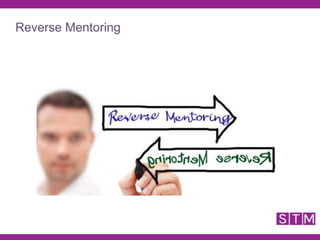
Reverse Mentoring
Outcomes for successful mentoring partnerships
For Mentors
• Gain insights from mentee’s background
• Gains satisfaction in sharing expertise with others
• Re-energizes their own career
• Learns more about other areas of the organisation and industry
Outcomes for successful mentoring partnerships
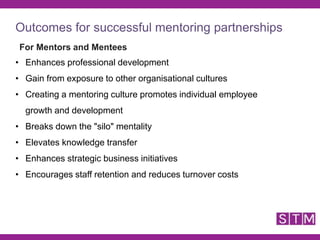
For Mentors and Mentees
• Enhances professional development
• Gain from exposure to other organisational cultures
• Creating a mentoring culture promotes individual employee
growth and development
• Breaks down the "silo" mentality
• Elevates knowledge transfer
• Enhances strategic business initiatives
• Encourages staff retention and reduces turnover costs
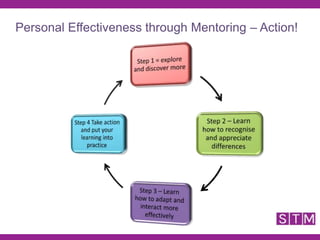
Personal Effectiveness through Mentoring – Action!
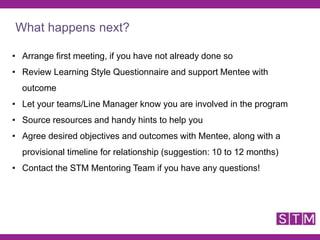
• Arrange first meeting, if you have not already done so
• Review Learning Style Questionnaire and support Mentee with
outcome
• Let your teams/Line Manager know you are involved in the program
• Source resources and handy hints to help you
• Agree desired objectives and outcomes with Mentee, along with a
provisional timeline for relationship (suggestion: 10 to 12 months)
• Contact the STM Mentoring Team if you have any questions!
What happens next?
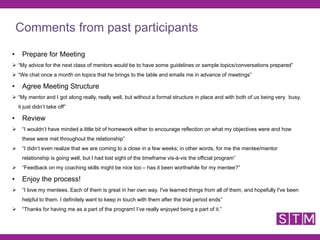
• Prepare for Meeting
 “My advice for the next class of mentors would be to have some guidelines or sample topics/conversations prepared”
 “We chat once a month on topics that he brings to the table and emails me in advance of meetings”
• Agree Meeting Structure
 “My mentor and I got along really, really well, but without a formal structure in place and with both of us being very busy,
it just didn’t take off”
• Review
 “I wouldn’t have minded a little bit of homework either to encourage reflection on what my objectives were and how
these were met throughout the relationship”
 “I didn’t even realize that we are coming to a close in a few weeks; in other words, for me the mentee/mentor
relationship is going well, but I had lost sight of the timeframe vis-à-vis the official program”
 “Feedback on my coaching skills might be nice too – has it been worthwhile for my mentee?”
• Enjoy the process!
 “I love my mentees. Each of them is great in her own way. I've learned things from all of them, and hopefully I've been
helpful to them. I definitely want to keep in touch with them after the trial period ends”
 “Thanks for having me as a part of the program! I’ve really enjoyed being a part of it.”
Comments from past participants
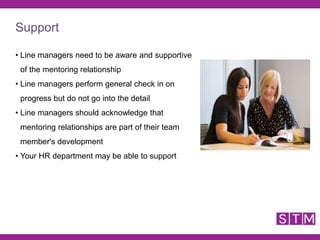
• Line managers need to be aware and supportive
of the mentoring relationship
• Line managers perform general check in on
progress but do not go into the detail
• Line managers should acknowledge that
mentoring relationships are part of their team
member's development
• Your HR department may be able to support
Support
• STM Mentoring Committee - contact
• Learning Styles Questionnaire - here
• Mentoring Guidance Document – here
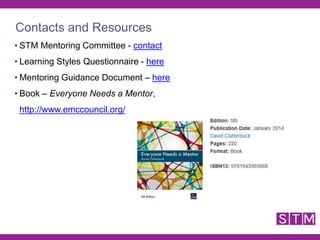
• Book – Everyone Needs a Mentor,
http://www.emccouncil.org/
Contacts and Resources
Useful links
https://twitter.com/stm_ecp
https://www.linkedin.com/groups/8184238
https://www.facebook.com/STMECPC/
Questions?

2017_05_05_mentoring_webinar_presentation_2017_Mentors (1).pptx

  • 1.
    STM Mentoring Programme2017 Mentor Presentation Monday 10th April, 2017
  • 2.
    Rachel Moriarty –Computer Science Editor at Springer Nature Jason Mitchell – Publishing Services Manager at Elsevier Mandeep Kundi – Learning and Development Manager at BMJ Introductions
  • 3.
    1. Objectives ofthe STM Mentoring Program 2. What is mentoring? 3. Qualities of Good Mentors 4. How does it work? 5. How to establish a good mentoring relationship 6. Reverse Mentoring 7. Outcomes for successful mentoring partnerships 8. Next Steps 9. Support and Useful Links 10. Questions & Answers Agenda
  • 4.
    • To articulatethe benefits of Mentoring to the wider Publishing Industry • To facilitate the creation of successful relationships between Mentors and Mentees • To provide guidance and support that ensures Mentors and Mentees benefit from the process • To evaluate the effectiveness of the Scheme and identify refinement for future delivery Overall Objectives of the STM Mentoring Program
  • 5.
    Mentoring • Guiding andassisting by giving advice based on the mentors' experience • Usually provided by someone more senior who knows the organisation/role • A more informal approach • Objectives and outcomes desirable but not essential Coaching • Helping someone to find solutions through the 'coachee's' own experiences • Advice is not given but problems are solved by the 'coachee' • A structured approach with defined outcomes What is mentoring and how is it different to coaching?
  • 6.
    • Fully committedto mentoring • Approachable and positive • Non-judgemental • Supportive - offers to review work, suggests useful contacts • Constructive - suggests things that may have helped in the past • Willing to learn – reverse mentoring Sir Bobby Charlton & David Beckham Dr Martin Luther King & Jesse Jackson The qualities of a good mentor
  • 7.
    Relationship building &Communication skills • Inspires trust • Good listening skills • Asks questions and gives advice • Story teller • Good role model • A good motivator Broadening the horizon • Encourages the mentee to bring topics to the table • Facilitates focus on long-term professional development • Explores wider range of alternatives with mentee to aid decision making Warren Buffet & Michael Lee-Chin Pam Shriver & Venus Williams The skills of a good mentor
  • 8.
    STM Mentoring programme Mentors /Mentees register for mentoring Panel selects andmatches mentors with mentees Mentor /Mentee are introduced and provided with support Mentor /Mentee meetings commence Evaluation: to ensure the programme is beneficial How does it work?
  • 9.
    • First meeting- objectives • Establish what it isn't about • Identify broad topics not specific outcomes • Setting expectations • Template document to assist first steps • Confidentiality and boundaries • Conflicts of interest • Meeting format, location, timing and frequency We suggest you allow 2 hours for your first meeting and 1 hour per session thereafter How to establish a working contract and ground rules?
  • 10.
    Mentoring process: • Notknowing what to talk about or talking too much! • No defined end point/periodic review • Irregular and postponed meetings • Confusion of roles Breach of contract/ground rules: • Being indiscreet • Not questioning: is it working? • Avoiding terminating the relationship, should it become toxic Mentoring context: • Cultural differences • Virtual mentoring: finding the right technology Common pitfalls
  • 11.
  • 12.
    Outcomes for successfulmentoring partnerships For Mentors • Gain insights from mentee’s background • Gains satisfaction in sharing expertise with others • Re-energizes their own career • Learns more about other areas of the organisation and industry
  • 13.
    Outcomes for successfulmentoring partnerships For Mentors and Mentees • Enhances professional development • Gain from exposure to other organisational cultures • Creating a mentoring culture promotes individual employee growth and development • Breaks down the "silo" mentality • Elevates knowledge transfer • Enhances strategic business initiatives • Encourages staff retention and reduces turnover costs
  • 14.
    Personal Effectiveness throughMentoring – Action!
  • 15.
    • Arrange firstmeeting, if you have not already done so • Review Learning Style Questionnaire and support Mentee with outcome • Let your teams/Line Manager know you are involved in the program • Source resources and handy hints to help you • Agree desired objectives and outcomes with Mentee, along with a provisional timeline for relationship (suggestion: 10 to 12 months) • Contact the STM Mentoring Team if you have any questions! What happens next?
  • 16.
    • Prepare forMeeting  “My advice for the next class of mentors would be to have some guidelines or sample topics/conversations prepared”  “We chat once a month on topics that he brings to the table and emails me in advance of meetings” • Agree Meeting Structure  “My mentor and I got along really, really well, but without a formal structure in place and with both of us being very busy, it just didn’t take off” • Review  “I wouldn’t have minded a little bit of homework either to encourage reflection on what my objectives were and how these were met throughout the relationship”  “I didn’t even realize that we are coming to a close in a few weeks; in other words, for me the mentee/mentor relationship is going well, but I had lost sight of the timeframe vis-à-vis the official program”  “Feedback on my coaching skills might be nice too – has it been worthwhile for my mentee?” • Enjoy the process!  “I love my mentees. Each of them is great in her own way. I've learned things from all of them, and hopefully I've been helpful to them. I definitely want to keep in touch with them after the trial period ends”  “Thanks for having me as a part of the program! I’ve really enjoyed being a part of it.” Comments from past participants
  • 17.
    • Line managersneed to be aware and supportive of the mentoring relationship • Line managers perform general check in on progress but do not go into the detail • Line managers should acknowledge that mentoring relationships are part of their team member's development • Your HR department may be able to support Support
  • 18.
    • STM MentoringCommittee - contact • Learning Styles Questionnaire - here • Mentoring Guidance Document – here • Book – Everyone Needs a Mentor, http://www.emccouncil.org/ Contacts and Resources
  • 19.
  • 20.

Editor's Notes

  • #2 RM
  • #3 RM My name is Jason Mitchell, and I am PSM at Elsevier Content Reference and I have been involved with STM since 2014.
  • #4 RM
  • #5 MK
  • #6 MK
  • #7 MK
  • #8 MK
  • #9 MK/JM So how does the STM mentoring scheme work? To start with, the committee prepared the ground for mentors and mentees to register their interest to take part. We had an excellent level of interest in the mentoring scheme, following on from the 2016 pilot scheme, with an even higher number of mentor and mentee applicants. The committee then met on at least 3 occasions to look through the background, current roles, skillsets and mentoring goals from each registered application and carefully matched the mentees to that of the mentors. I think it’s fair to say that this is the most detailed part of the process, with the committee taking the most care and attention to it in terms of doing our utmost to get the matching right, so that not only do they complement each other as much as possible there is also the possibility of the mentor being the right person to confidently communicate and potentially stretch their mentee.
  • #10 JM Establishing the ground rules for your mentoring relationship is really important and we would recommend that this forms the basis of your first meeting or call with the mentee. It’s best to have the Mentee go over the basics at this point. What are their objectives and why? What do they want to achieve and by the end of it, what knowledge or skillset do they want to have accomplished? It would be good to get the mentee to talk through their stated goals and ask questions around that. Establlsh what this isn’t about. So you as Mentors are not expected to be on call 24/7 over the next 6 months. Neither are you expected to solve all of their problems. The mentoring relationship is instead about regular, perhaps monthly pre-arranged meetings to guide the mentee on the path towards achieving their own goals through their own efforts. The onus is on them. It would be good to talk about broad topics at this point, so touch upon key themes or topics but at this stage not in any great detail. That will happen as you go along and develop more contact and understanding of each other. Setting expectations: So, as mentioned, this first meeting will confirm the mentee’s initial development objectives and immediate goal(s), agree mutual expectations and help clarify both parties’ roles from the outset; covering issues of confidentiality, boundaries, style of mentoring, and how/when you decide to contact each other outside of arranged meetings. Confidentiality is of course a prerequisite on both sides. You may become privy to activities going on within other STM organisations, they may be your competitor, but we ask that you retain that information only for the purposes of aiding your mentee. Trust is a vital component of the mentoring relationship.
  • #11 JM It is rare but mentoring relationships do not always work out as intended. It’s worth recognising that not every mentorship will work out, for all of these reasons, and it may well be fairer to recognise that it is going awry, and why that is, and if necessary bringing it to an end. Of course we hope this does not happen, and we on the STM committee would like to be informed and make efforts to rectify the situation, but will of course respect the feelings of both parties if this arises.
  • #12 MK
  • #13 JM Increased satisfaction and motivation from ‘giving back’ to the industry and helping others to achieve their professional goals. Development of leadership, management, coaching and listening skills. Learning from the insights, ideas and different perspectives provided by mentees. Feeling valued from being able to share knowledge and experience. Increased recognition at both personal and corporate levels within the STM publishing industry.
  • #14 JM
  • #15 MK
  • #16 RM
  • #17 JM
  • #18 RM
  • #19 RM
  • #20 RM/All
  • #21 ALL