AHSS at UL: the PhD Experience
Overview of
presentation
• What is a PhD?
• Is a PhD right for you?
• How do I apply?
• How do I find a supervisor?
• What about funding?
• What supports are in place?
• What can I do with a PhD?
What is a PhD?
The degree of Doctor of Philosophy (PhD) is the highest academic qualification awarded by the
University and is awarded to successful candidates on the strength of a body of original work of
scholarship prepared and presented in accordance with internationally accepted academic
standards and in the form of a doctoral thesis. The most common models of PhD submission in
AHSS are listed below:
• Traditional model (preparation of a thesis exploring a research question, max. 100,000 words)
• Structured PhD (students undertake a number of modules as part of the programme). Structured
PhD programmes usually involve the production of a written thesis as well as the completion of
specified modules.
• Article-based PhD (Also known as ‘PhD by publication’. This involves the publication of a series of
academic articles or other appropriate academic outputs, combined with the development of a
framing written document.
• These PhD models are outlined in the UL Academic Regulations (pg. 59 and Appendix 2):
https://ulsites.ul.ie/saa/sites/default/files/saa_student_academic_handbook_procedures_and_reg
ulations.pdf (accessed 24 Jan 2020)
What model should I choose?
• These PhD models offer different opportunities and supports to
students.
• You should discuss the best PhD model for you with your potential
supervisor as part of your initial discussions.
• All PhD submissions are subject to examination by viva.
Is a PhD right
for you?
Are you passionate about your field?
Do you feel that you have something particular to add
to the way things are thought about/ practiced?
Have you identified a question or a particular area that
you want to look into in more detail?
Have you enjoyed the research process in the past (i.e.
a final year project as part of a BA or MA degree?)
Do you think that a research degree would help you to
develop a specific career path? Would it enhance/
develop an existing or a future career path?
Useful tip…
• Look at some of the people who have
done PhDs in your field of study –
what have they gone on to do?
• Look at the list of PhD thesis titles
within your school/ department –
these can be a great way to begin
thinking about potential areas for
research.
• Have you identified an emerging field
of research/ policy/ practice/
research opportunity that will require
specialized knowledge in future?
What does a PhD involve?
Key stages
• Deciding on a research question. You should involve your PhD
supervisor in this process as early as possible. Be aware that
your question will develop as you progress through your
research.
• Literature review/ deciding on your methodologies –
positioning your work in the broader field
• Carrying out your research (fieldwork/ close reading/ creative
research/ archival work)
• Writing and analyzing your research, exploring the insights
that it brings and how it adds to the existing field of
knowledge, drawing conclusions
• Progression panels (annual updates to your school/
department)
• Preparation, submission and viva!
How do I get
started?
There are a few ways to begin
the PhD application process.
• Begin by discussing potential research
questions and topics with a member
of faculty who you think may be
interested in supervising your project;
• If you are unsure who the most
suitable members of faculty might be,
contact the Head of School/
Department and outline your ideas to
them.
How do I get
started?
How do I find a PhD supervisor?
• Visit the Department webpage within the School/ Department that interests you (i.e.
Sociology/ Law/ History etc.).
• Look at the different faculty members and their research interests. You will be able to
access a list of their recent publications, giving you some insight into their current research
interests and activities.
• Faculty email addresses are available on these web pages. You can email faculty members
directly, outlining your research interests, and inquiring as to whether they are interested
in supervising you.
• TIP: Students who contact supervisors directly are more likely to develop a successful
proposal than students who use an expression of interest form only.
• Potential PhD applicants should be open to discussing their proposed PhD topic/ idea with
a potential supervisor, as they will be able to provide some guidance and advice.
• Unfortunately, it is not always possible to find appropriate supervisor within the Faculty for
each application. However, following the steps above can help to increase your chance of a
successful application.
Some useful websites:
• AHSS Research Booklet:
• this document provides valuable information on current PhD projects, as well as faculty
research interests.
https://www.ul.ie/artsoc/sites/default/files/fileuploads/research_information_booklet_2
018-19.pdf
• Department of Sociology faculty: https://ulsites.ul.ie/sociology/members-department-0
• Department of Politics and Public Administration faculty: https://www.ul.ie/ppa/staff/
• School of Law faculty: https://ulsites.ul.ie/law/faculty
• Department of History faculty: https://www.ul.ie/ULH/people
• Irish World Academy of Music and Dance faculty:
https://www.irishworldacademy.ie/contacts/
• Modern Languages and Applied Linguistics faculty: https://ulsites.ul.ie/mlal/mlal-staff
• School of English, Irish and Communication faculty: https://ulsites.ul.ie/cc/
How do I get
started?
• You can also submit an Expression of
Interest form to Dr Niamh Lenahan
outlining your ideas – this will get
circulated to the relevant schools and
department. The EOI form is available at
this website:
https://www.ul.ie/gps/about/how-apply
• It is recommended to deal directly with a
supervisor – this is a more efficient and
effective way of developing your PhD
application forms and proposals than
submitting the EOI form.
Developing your
PhD proposal
A good PhD proposal title will be
specific and focused:
“Towards intercultural competence: integrating
Irish culture into materials for teaching English
for Speakers of Other Languages in Ireland”
“Civil society organisations in Kenya and
Zimbabwe and their role in the consolidation of
democratisation since 1997”
“Representations of Home in Irish
Women’s Writing, 1920-1950”
Developing your
PhD Proposal
You will need to outline the proposed methods that
you will use to gather data/ develop insights into
your research question
You should develop a research calendar over 4
years – what will need to be done, and when? Build
in any research travel/ periods of fieldwork that will
be required.
You will need to demonstrate familiarity with the
field of research – include references to existing
scholarship that your work will build on. This will
take some time, but your proposed supervisor can
help.
YourPhD
Application
Form
• In order to apply for a PhD programme
at UL, you will need to complete a PhD
application form.
• You should include your project
proposal as an appendix.
• You will need to include a range of
supporting documents with your
application, such as your academic
transcripts, letters of reference, and
English language certificates (if
required).
• You can find more information on this
application process here:
• https://www.ul.ie/gps/about/how-
apply
What about
funding?
The AHSS Faculty offers a series of fee awards to PhD
students in early Spring.
Individual schools/ departments also offer PhD
scholarship/ fellowships and fee awards to PhD students
in early Spring.
There are national funding bodies supporting PhD
research. The Irish funding agencies are the Irish
Research Council and SUSI.
International students are eligible to apply for funding
via the Irish Research Council, and via the Government
of Ireland International Scholarships.
International Students should engage with the funding
agencies in their home countries, as these often provide
support for international PhD research.
What about
funding –
Irish Research
Council
The Irish Research Council is one of the major
sources of funding for PhD students in Ireland.
Competitive funding process – advertised annually
a stipend of €16,000 per annum
a contribution to fees, including non-EU fees, up to a
maximum of €5,750 per annum
eligible direct research expenses of €2,250 per
annum
www.research.ie
Annual IRC
Preparation
supports at
UL
September – introductory workshops
Heading from successful students and supervisors about their
experiences
Internal peer-reading scheme – feedback from someone outside
your immediate field of research
One-to-one writing workshops to develop your proposal and
integrate all feedback
Your working process with your supervisor is key to developing
your PhD proposal
All awards/ indicators of excellence are valuable here – worth
participating in any Undergraduate/ MA Conferences in order to
build this section.
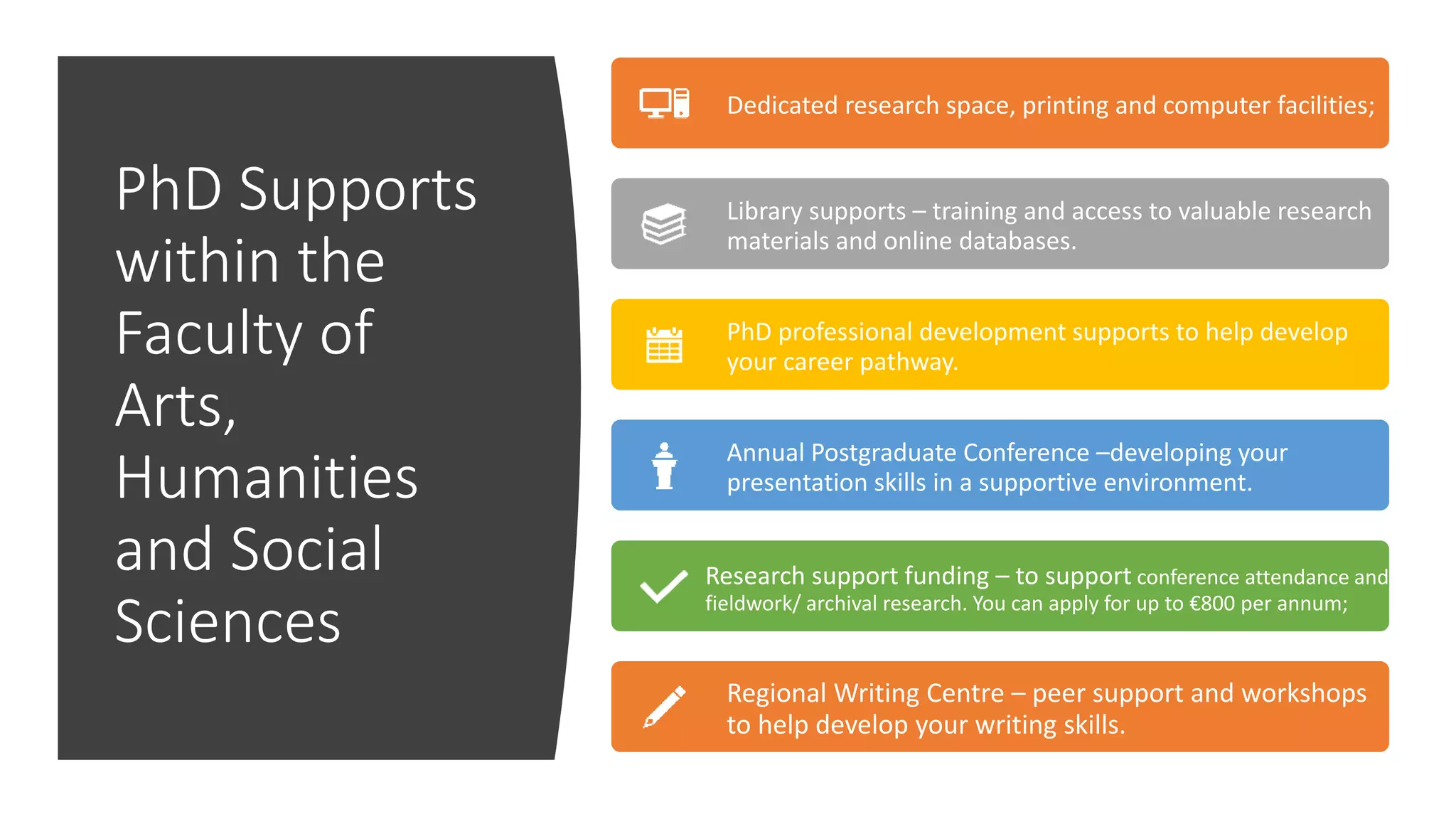
PhD Supports
within the
Faculty of
Arts,
Humanities
and Social
Sciences
Dedicated research space, printing and computer facilities;
Library supports – training and access to valuable research
materials and online databases.
PhD professional development supports to help develop
your career pathway.
Annual Postgraduate Conference –developing your
presentation skills in a supportive environment.
Research support funding – to support conference attendance and
fieldwork/ archival research. You can apply for up to €800 per annum;
Regional Writing Centre – peer support and workshops
to help develop your writing skills.
Annual PhD Professional Development
workshops
• PhD students can attend a range of PhD professional development
workshops run by the Faculty office, through the individual schools,
and through university offices such as the Library, HR, and Graduate
and Professional Studies.
• These workshops help students to identify and develop transferable
skills, articulate and plan for research impact, and to access
information on issues such as academic publications, making
excellent presentations, preparing for your viva, and writing your
academic CV.
• These events are run on an annual basis and are free and open to PhD
students.
What can I do
with a PhD?
• UL has an active and supportive Careers
Service which supports students at all
levels.
• More information can be found here:
https://careersconnect.ul.ie/home.html
• AHSS PhD graduates use their skills and
knowledge in a broad range of career
pathways – including public policy,
industry, academia, and across the private
and public sectors.
• Close engagement with the research
communications opportunities at UL, HR
and the Careers Planning Service will be
very helpful in career planning.
Thank you for
considering UL as the
next step on your
educational journey.
Niamh.nicghabhann@ul.ie
niamh.lenahan@ul.ie

AHSS at UL: the PhD experience

  • 1.
    AHSS at UL:the PhD Experience
  • 2.
    Overview of presentation • Whatis a PhD? • Is a PhD right for you? • How do I apply? • How do I find a supervisor? • What about funding? • What supports are in place? • What can I do with a PhD?
  • 3.
    What is aPhD? The degree of Doctor of Philosophy (PhD) is the highest academic qualification awarded by the University and is awarded to successful candidates on the strength of a body of original work of scholarship prepared and presented in accordance with internationally accepted academic standards and in the form of a doctoral thesis. The most common models of PhD submission in AHSS are listed below: • Traditional model (preparation of a thesis exploring a research question, max. 100,000 words) • Structured PhD (students undertake a number of modules as part of the programme). Structured PhD programmes usually involve the production of a written thesis as well as the completion of specified modules. • Article-based PhD (Also known as ‘PhD by publication’. This involves the publication of a series of academic articles or other appropriate academic outputs, combined with the development of a framing written document. • These PhD models are outlined in the UL Academic Regulations (pg. 59 and Appendix 2): https://ulsites.ul.ie/saa/sites/default/files/saa_student_academic_handbook_procedures_and_reg ulations.pdf (accessed 24 Jan 2020)
  • 4.
    What model shouldI choose? • These PhD models offer different opportunities and supports to students. • You should discuss the best PhD model for you with your potential supervisor as part of your initial discussions. • All PhD submissions are subject to examination by viva.
  • 5.
    Is a PhDright for you? Are you passionate about your field? Do you feel that you have something particular to add to the way things are thought about/ practiced? Have you identified a question or a particular area that you want to look into in more detail? Have you enjoyed the research process in the past (i.e. a final year project as part of a BA or MA degree?) Do you think that a research degree would help you to develop a specific career path? Would it enhance/ develop an existing or a future career path?
  • 6.
    Useful tip… • Lookat some of the people who have done PhDs in your field of study – what have they gone on to do? • Look at the list of PhD thesis titles within your school/ department – these can be a great way to begin thinking about potential areas for research. • Have you identified an emerging field of research/ policy/ practice/ research opportunity that will require specialized knowledge in future?
  • 7.
    What does aPhD involve? Key stages • Deciding on a research question. You should involve your PhD supervisor in this process as early as possible. Be aware that your question will develop as you progress through your research. • Literature review/ deciding on your methodologies – positioning your work in the broader field • Carrying out your research (fieldwork/ close reading/ creative research/ archival work) • Writing and analyzing your research, exploring the insights that it brings and how it adds to the existing field of knowledge, drawing conclusions • Progression panels (annual updates to your school/ department) • Preparation, submission and viva!
  • 8.
    How do Iget started? There are a few ways to begin the PhD application process. • Begin by discussing potential research questions and topics with a member of faculty who you think may be interested in supervising your project; • If you are unsure who the most suitable members of faculty might be, contact the Head of School/ Department and outline your ideas to them.
  • 9.
    How do Iget started? How do I find a PhD supervisor? • Visit the Department webpage within the School/ Department that interests you (i.e. Sociology/ Law/ History etc.). • Look at the different faculty members and their research interests. You will be able to access a list of their recent publications, giving you some insight into their current research interests and activities. • Faculty email addresses are available on these web pages. You can email faculty members directly, outlining your research interests, and inquiring as to whether they are interested in supervising you. • TIP: Students who contact supervisors directly are more likely to develop a successful proposal than students who use an expression of interest form only. • Potential PhD applicants should be open to discussing their proposed PhD topic/ idea with a potential supervisor, as they will be able to provide some guidance and advice. • Unfortunately, it is not always possible to find appropriate supervisor within the Faculty for each application. However, following the steps above can help to increase your chance of a successful application.
  • 10.
    Some useful websites: •AHSS Research Booklet: • this document provides valuable information on current PhD projects, as well as faculty research interests. https://www.ul.ie/artsoc/sites/default/files/fileuploads/research_information_booklet_2 018-19.pdf • Department of Sociology faculty: https://ulsites.ul.ie/sociology/members-department-0 • Department of Politics and Public Administration faculty: https://www.ul.ie/ppa/staff/ • School of Law faculty: https://ulsites.ul.ie/law/faculty • Department of History faculty: https://www.ul.ie/ULH/people • Irish World Academy of Music and Dance faculty: https://www.irishworldacademy.ie/contacts/ • Modern Languages and Applied Linguistics faculty: https://ulsites.ul.ie/mlal/mlal-staff • School of English, Irish and Communication faculty: https://ulsites.ul.ie/cc/
  • 11.
    How do Iget started? • You can also submit an Expression of Interest form to Dr Niamh Lenahan outlining your ideas – this will get circulated to the relevant schools and department. The EOI form is available at this website: https://www.ul.ie/gps/about/how-apply • It is recommended to deal directly with a supervisor – this is a more efficient and effective way of developing your PhD application forms and proposals than submitting the EOI form.
  • 12.
    Developing your PhD proposal Agood PhD proposal title will be specific and focused: “Towards intercultural competence: integrating Irish culture into materials for teaching English for Speakers of Other Languages in Ireland” “Civil society organisations in Kenya and Zimbabwe and their role in the consolidation of democratisation since 1997” “Representations of Home in Irish Women’s Writing, 1920-1950”
  • 13.
    Developing your PhD Proposal Youwill need to outline the proposed methods that you will use to gather data/ develop insights into your research question You should develop a research calendar over 4 years – what will need to be done, and when? Build in any research travel/ periods of fieldwork that will be required. You will need to demonstrate familiarity with the field of research – include references to existing scholarship that your work will build on. This will take some time, but your proposed supervisor can help.
  • 14.
    YourPhD Application Form • In orderto apply for a PhD programme at UL, you will need to complete a PhD application form. • You should include your project proposal as an appendix. • You will need to include a range of supporting documents with your application, such as your academic transcripts, letters of reference, and English language certificates (if required). • You can find more information on this application process here: • https://www.ul.ie/gps/about/how- apply
  • 15.
    What about funding? The AHSSFaculty offers a series of fee awards to PhD students in early Spring. Individual schools/ departments also offer PhD scholarship/ fellowships and fee awards to PhD students in early Spring. There are national funding bodies supporting PhD research. The Irish funding agencies are the Irish Research Council and SUSI. International students are eligible to apply for funding via the Irish Research Council, and via the Government of Ireland International Scholarships. International Students should engage with the funding agencies in their home countries, as these often provide support for international PhD research.
  • 16.
    What about funding – IrishResearch Council The Irish Research Council is one of the major sources of funding for PhD students in Ireland. Competitive funding process – advertised annually a stipend of €16,000 per annum a contribution to fees, including non-EU fees, up to a maximum of €5,750 per annum eligible direct research expenses of €2,250 per annum www.research.ie
  • 17.
    Annual IRC Preparation supports at UL September– introductory workshops Heading from successful students and supervisors about their experiences Internal peer-reading scheme – feedback from someone outside your immediate field of research One-to-one writing workshops to develop your proposal and integrate all feedback Your working process with your supervisor is key to developing your PhD proposal All awards/ indicators of excellence are valuable here – worth participating in any Undergraduate/ MA Conferences in order to build this section.
  • 18.
    PhD Supports within the Facultyof Arts, Humanities and Social Sciences Dedicated research space, printing and computer facilities; Library supports – training and access to valuable research materials and online databases. PhD professional development supports to help develop your career pathway. Annual Postgraduate Conference –developing your presentation skills in a supportive environment. Research support funding – to support conference attendance and fieldwork/ archival research. You can apply for up to €800 per annum; Regional Writing Centre – peer support and workshops to help develop your writing skills.
  • 19.
    Annual PhD ProfessionalDevelopment workshops • PhD students can attend a range of PhD professional development workshops run by the Faculty office, through the individual schools, and through university offices such as the Library, HR, and Graduate and Professional Studies. • These workshops help students to identify and develop transferable skills, articulate and plan for research impact, and to access information on issues such as academic publications, making excellent presentations, preparing for your viva, and writing your academic CV. • These events are run on an annual basis and are free and open to PhD students.
  • 20.
    What can Ido with a PhD? • UL has an active and supportive Careers Service which supports students at all levels. • More information can be found here: https://careersconnect.ul.ie/home.html • AHSS PhD graduates use their skills and knowledge in a broad range of career pathways – including public policy, industry, academia, and across the private and public sectors. • Close engagement with the research communications opportunities at UL, HR and the Careers Planning Service will be very helpful in career planning.
  • 21.
    Thank you for consideringUL as the next step on your educational journey. Niamh.nicghabhann@ul.ie niamh.lenahan@ul.ie