10 Years of the AlbertaSelf-Advocacy Movement in the Making…1999-2009Report from the Self-Advocacy Summit Group
The self-advocacy movement‘We need to build bonds or connections between us.’-Self-advocate at Summit Planning Session in Calgary, February 7, 2002
Just a few outcomes of self-advocacy in Alberta…6,000 Calgarians living on a low income each month can afford to take the bus.
Citizens of Red Deer can cross a busy road safely.
People with low English literacy can read reports, rules and rights in plain language.
Thousands of dollars are raised each year for causes like breast cancer, disaster relief, food banks and Big Sisters & Brothers
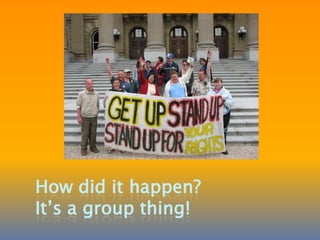
Disability Culture is more than bowling; it is art, film making, story telling and pride parades.How did it happen? It’s a group thing!
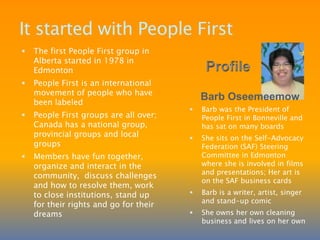
It started with People FirstThe first People First group in Alberta started in 1978 in EdmontonPeople First is an international movement of people who have been labeled People First groups are all over;  Canada has a national group, provincial groups and local groupsMembers have fun together, organize and interact in the community,  discuss challenges and how to resolve them, work to close institutions, stand up for their rights and go for their dreamsProfileBarb OseemeemowBarb was the President of People First in Bonneville and has sat on many boardsShe sits on the Self-Advocacy Federation (SAF) Steering Committee in Edmonton where she is involved in films and presentations; Her art is on the SAF business cardsBarb is a writer, artist, singer and stand-up comicShe owns her own cleaning business and lives on her own
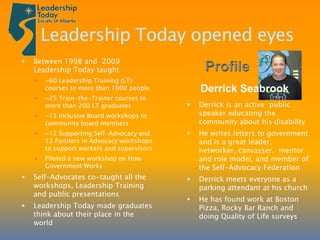
Leadership Today opened eyesBetween 1998 and  2009 Leadership Today taught ~60 Leadership Training (LT) courses to more than 1000 people~25 Train-the-Trainer courses to more than 200 LT graduates~15 Inclusive Board workshops to community board members~12 Supporting Self-Advocacy and 12 Partners in Advocacy workshops to support workers and supervisorsPiloted a new workshop on How Government WorksSelf-Advocates co-taught all the workshops, Leadership Training and public presentationsLeadership Today made graduates think about their place in the worldProfileDerrick SeabrookDerrick is an active  public speaker educating the community about his disability He writes letters to government and is a great leader, networker, canvasser,  mentor and role model, and member of the Self-Advocacy FederationDerrick meets everyone as a parking attendant at his churchHe has found work at Boston Pizza, Rocky Bar Ranch and doing Quality of Life surveys
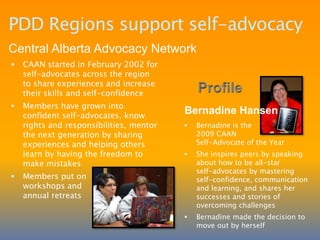
PDD Regions support self-advocacyCentral Alberta Advocacy NetworkCAAN started in February 2002 for self-advocates across the region to share experiences and increase their skills and self-confidenceMembers have grown into confident self-advocates, know rights and responsibilities, mentor the next generation by sharing experiences and helping others learn by having the freedom to make mistakesMembers put on workshops andannual retreatsProfileBernadineHansenBernadine is the2009 CAAN Self-Advocate of the Year
She inspires peers by speaking about how to be all-star self-advocates by mastering self-confidence, communication and learning, and shares her successes and stories of overcoming challenges
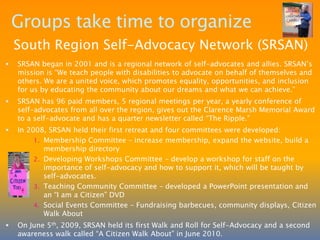
Bernadine made the decision to move out by herselfGroups take time to organizeSouth Region Self-Advocacy Network (SRSAN)SRSAN began in 2001 and is a regional network of self-advocates and allies. SRSAN’s mission is “We teach people with disabilities to advocate on behalf of themselves and others. We are a united voice, which promotes equality, opportunities, and inclusion for us by educating the community about our dreams and what we can achieve.”SRSAN has 96 paid members, 5 regional meetings per year, a yearly conference of self-advocates from all over the region, gives out the Clarence Marsh Memorial Award to a self-advocate and has a quarter newsletter called “The Ripple.”In 2008, SRSAN held their first retreat and four committees were developed:Membership Committee – increase membership, expand the website, build a membership directoryDeveloping Workshops Committee – develop a workshop for staff on the importance of self-advocacy and how to support it, which will be taught by self-advocates. Teaching Community Committee – developed a PowerPoint presentation and           an “I am a Citizen” DVDSocial Events Committee – Fundraising barbecues, community displays, Citizen Walk AboutOn June 5th, 2009, SRSAN held its first Walk and Roll for Self-Advocacy and a second awareness walk called “A Citizen Walk About” in June 2010.
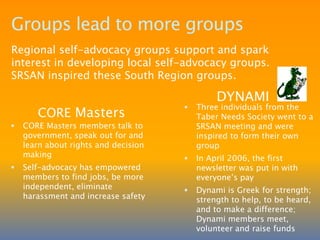
Groups lead to more groupsRegional self-advocacy groups support and spark interest in developing local self-advocacy groups. SRSAN inspired these South Region groups.DYNAMIThree individuals from the Taber Needs Society went to a SRSAN meeting and were inspired to form their own group
In April 2006, the first newsletter was put in with everyone’s pay
Dynami is Greek for strength; strength to help, to be heard, and to make a difference; Dynami members meet, volunteer and raise fundsCORE MastersCORE Masters members talk to government, speak out for and learn about rights and decision making
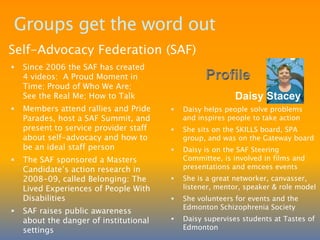
Self-advocacy has empowered members to find jobs, be more independent, eliminate harassment and increase safetyGroups get the word outSelf-Advocacy Federation (SAF)Since 2006 the SAF has created 4 videos:  A Proud Moment in Time; Proud of Who We Are; See the Real Me; How to TalkMembers attend rallies and Pride Parades, host a SAF Summit, and present to service provider staff about self-advocacy and how to be an ideal staff personThe SAF sponsored a Masters Candidate’s action research in 2008-09, called Belonging: The Lived Experiences of People With DisabilitiesSAF raises public awareness about the danger of institutional settingsProfileDaisy StaceyDaisy helps people solve problems and inspires people to take action
She sits on the SKILLS board, SPA group, and was on the Gateway board
Daisy is on the SAF Steering Committee, is involved in films and presentations and emcees events
She is a great networker, canvasser, listener, mentor, speaker & role model
She volunteers for events and the Edmonton Schizophrenia Society
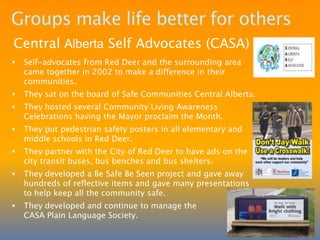
Daisy supervises students at Tastes of EdmontonGroups make life better for othersCentral Alberta Self Advocates (CASA)Self-advocates from Red Deer and the surrounding area      came together in 2002 to make a difference in their  communities.They sat on the board of Safe Communities Central Alberta.They hosted several Community Living Awareness Celebrations having the Mayor proclaim the Month.They put pedestrian safety posters in all elementary and middle schools in Red Deer.They partner with the City of Red Deer to have ads on the      city transit buses, bus benches and bus shelters.They developed a Be Safe Be Seen project and gave away      hundreds of reflective items and gave many presentations to help keep all the community safe.They developed and continue to manage the CASA Plain Language Society.
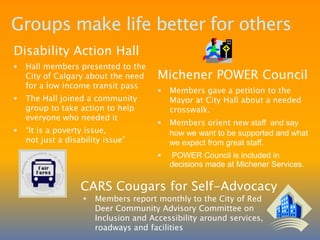
Groups make life better for othersDisability Action Hall Hall members presented to the City of Calgary about the need for a low income transit passThe Hall joined a community group to take action to help everyone who needed it“It is a poverty issue, not just a disability issue”Michener POWER CouncilMembers gave a petition to the Mayor at City Hall about a needed crosswalk.
Members orient newstaff  and say how we want to be supported and what we expect from great staff.
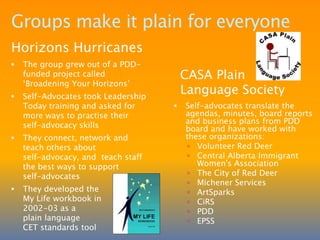
 POWER Council is included in decisions made at Michener Services.CARS Cougars for Self-AdvocacyMembers report monthly to the City of Red Deer Community Advisory Committee on Inclusion and Accessibility around services, roadways and facilities Groups make it plain for everyoneHorizons HurricanesThe group grew out of a PDD-funded project called ‘Broadening Your Horizons’Self-Advocates took Leadership Today training and asked for more ways to practise their self-advocacy skillsThey connect, network and teach others about self-advocacy, and  teach staff the best ways to support self-advocatesThey developed the My Life workbook in 2002-03 as a plain language CET standards tool    CASA Plain Language SocietySelf-advocates translate the agendas, minutes, board reports and business plans from PDD board and have worked with these organizations:

History oct28-2010

  • 1.
    10 Years ofthe AlbertaSelf-Advocacy Movement in the Making…1999-2009Report from the Self-Advocacy Summit Group
  • 2.
    The self-advocacy movement‘Weneed to build bonds or connections between us.’-Self-advocate at Summit Planning Session in Calgary, February 7, 2002
  • 3.
    Just a fewoutcomes of self-advocacy in Alberta…6,000 Calgarians living on a low income each month can afford to take the bus.
  • 4.
    Citizens of RedDeer can cross a busy road safely.
  • 5.
    People with lowEnglish literacy can read reports, rules and rights in plain language.
  • 6.
    Thousands of dollarsare raised each year for causes like breast cancer, disaster relief, food banks and Big Sisters & Brothers
  • 7.
    Disability Culture ismore than bowling; it is art, film making, story telling and pride parades.How did it happen? It’s a group thing!
  • 8.
    It started withPeople FirstThe first People First group in Alberta started in 1978 in EdmontonPeople First is an international movement of people who have been labeled People First groups are all over; Canada has a national group, provincial groups and local groupsMembers have fun together, organize and interact in the community, discuss challenges and how to resolve them, work to close institutions, stand up for their rights and go for their dreamsProfileBarb OseemeemowBarb was the President of People First in Bonneville and has sat on many boardsShe sits on the Self-Advocacy Federation (SAF) Steering Committee in Edmonton where she is involved in films and presentations; Her art is on the SAF business cardsBarb is a writer, artist, singer and stand-up comicShe owns her own cleaning business and lives on her own
  • 9.
    Leadership Today openedeyesBetween 1998 and 2009 Leadership Today taught ~60 Leadership Training (LT) courses to more than 1000 people~25 Train-the-Trainer courses to more than 200 LT graduates~15 Inclusive Board workshops to community board members~12 Supporting Self-Advocacy and 12 Partners in Advocacy workshops to support workers and supervisorsPiloted a new workshop on How Government WorksSelf-Advocates co-taught all the workshops, Leadership Training and public presentationsLeadership Today made graduates think about their place in the worldProfileDerrick SeabrookDerrick is an active public speaker educating the community about his disability He writes letters to government and is a great leader, networker, canvasser, mentor and role model, and member of the Self-Advocacy FederationDerrick meets everyone as a parking attendant at his churchHe has found work at Boston Pizza, Rocky Bar Ranch and doing Quality of Life surveys
  • 10.
    PDD Regions supportself-advocacyCentral Alberta Advocacy NetworkCAAN started in February 2002 for self-advocates across the region to share experiences and increase their skills and self-confidenceMembers have grown into confident self-advocates, know rights and responsibilities, mentor the next generation by sharing experiences and helping others learn by having the freedom to make mistakesMembers put on workshops andannual retreatsProfileBernadineHansenBernadine is the2009 CAAN Self-Advocate of the Year
  • 11.
    She inspires peersby speaking about how to be all-star self-advocates by mastering self-confidence, communication and learning, and shares her successes and stories of overcoming challenges
  • 12.
    Bernadine made thedecision to move out by herselfGroups take time to organizeSouth Region Self-Advocacy Network (SRSAN)SRSAN began in 2001 and is a regional network of self-advocates and allies. SRSAN’s mission is “We teach people with disabilities to advocate on behalf of themselves and others. We are a united voice, which promotes equality, opportunities, and inclusion for us by educating the community about our dreams and what we can achieve.”SRSAN has 96 paid members, 5 regional meetings per year, a yearly conference of self-advocates from all over the region, gives out the Clarence Marsh Memorial Award to a self-advocate and has a quarter newsletter called “The Ripple.”In 2008, SRSAN held their first retreat and four committees were developed:Membership Committee – increase membership, expand the website, build a membership directoryDeveloping Workshops Committee – develop a workshop for staff on the importance of self-advocacy and how to support it, which will be taught by self-advocates. Teaching Community Committee – developed a PowerPoint presentation and an “I am a Citizen” DVDSocial Events Committee – Fundraising barbecues, community displays, Citizen Walk AboutOn June 5th, 2009, SRSAN held its first Walk and Roll for Self-Advocacy and a second awareness walk called “A Citizen Walk About” in June 2010.
  • 13.
    Groups lead tomore groupsRegional self-advocacy groups support and spark interest in developing local self-advocacy groups. SRSAN inspired these South Region groups.DYNAMIThree individuals from the Taber Needs Society went to a SRSAN meeting and were inspired to form their own group
  • 14.
    In April 2006,the first newsletter was put in with everyone’s pay
  • 15.
    Dynami is Greekfor strength; strength to help, to be heard, and to make a difference; Dynami members meet, volunteer and raise fundsCORE MastersCORE Masters members talk to government, speak out for and learn about rights and decision making
  • 16.
    Self-advocacy has empoweredmembers to find jobs, be more independent, eliminate harassment and increase safetyGroups get the word outSelf-Advocacy Federation (SAF)Since 2006 the SAF has created 4 videos: A Proud Moment in Time; Proud of Who We Are; See the Real Me; How to TalkMembers attend rallies and Pride Parades, host a SAF Summit, and present to service provider staff about self-advocacy and how to be an ideal staff personThe SAF sponsored a Masters Candidate’s action research in 2008-09, called Belonging: The Lived Experiences of People With DisabilitiesSAF raises public awareness about the danger of institutional settingsProfileDaisy StaceyDaisy helps people solve problems and inspires people to take action
  • 17.
    She sits onthe SKILLS board, SPA group, and was on the Gateway board
  • 18.
    Daisy is onthe SAF Steering Committee, is involved in films and presentations and emcees events
  • 19.
    She is agreat networker, canvasser, listener, mentor, speaker & role model
  • 20.
    She volunteers forevents and the Edmonton Schizophrenia Society
  • 21.
    Daisy supervises studentsat Tastes of EdmontonGroups make life better for othersCentral Alberta Self Advocates (CASA)Self-advocates from Red Deer and the surrounding area came together in 2002 to make a difference in their communities.They sat on the board of Safe Communities Central Alberta.They hosted several Community Living Awareness Celebrations having the Mayor proclaim the Month.They put pedestrian safety posters in all elementary and middle schools in Red Deer.They partner with the City of Red Deer to have ads on the city transit buses, bus benches and bus shelters.They developed a Be Safe Be Seen project and gave away hundreds of reflective items and gave many presentations to help keep all the community safe.They developed and continue to manage the CASA Plain Language Society.
  • 22.
    Groups make lifebetter for othersDisability Action Hall Hall members presented to the City of Calgary about the need for a low income transit passThe Hall joined a community group to take action to help everyone who needed it“It is a poverty issue, not just a disability issue”Michener POWER CouncilMembers gave a petition to the Mayor at City Hall about a needed crosswalk.
  • 23.
    Members orient newstaff and say how we want to be supported and what we expect from great staff.
  • 24.
    POWER Councilis included in decisions made at Michener Services.CARS Cougars for Self-AdvocacyMembers report monthly to the City of Red Deer Community Advisory Committee on Inclusion and Accessibility around services, roadways and facilities Groups make it plain for everyoneHorizons HurricanesThe group grew out of a PDD-funded project called ‘Broadening Your Horizons’Self-Advocates took Leadership Today training and asked for more ways to practise their self-advocacy skillsThey connect, network and teach others about self-advocacy, and teach staff the best ways to support self-advocatesThey developed the My Life workbook in 2002-03 as a plain language CET standards tool CASA Plain Language SocietySelf-advocates translate the agendas, minutes, board reports and business plans from PDD board and have worked with these organizations:

Editor's Notes

  • #18 Explain why each is important.
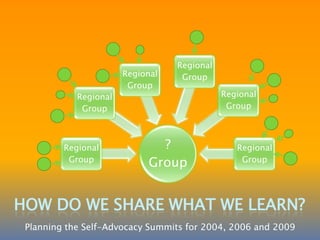
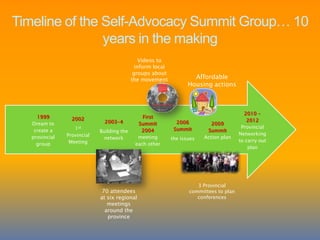
  • #19 A lot of the action and outcomes happen at the local group level.Regional groups were formed to help connect the local groups to share information and plan regional events (e.g., conferences, Community Living Awareness Month, IDDP). There was also a need to connect and share across regions as many issues are province-wide.
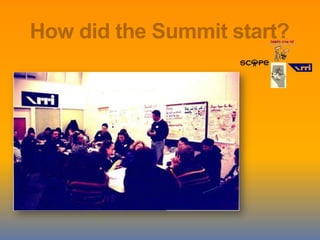
  • #20 In 2002 the first provincial meeting included the Disability Action Hall, Leadership Today graduates, Calgary SCOPE Society and the VRRI. Many of the self-advocates lived all over the province. Together we decided we needed to have a conference. Other people heard about the meetings and wanted to be part of them. We created a network through regional meetings had over 70 attendees at each meeting.
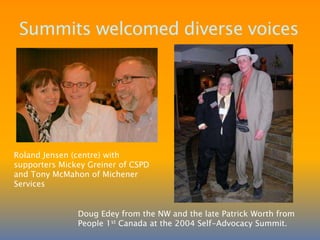
  • #23 Every Summit has included participants from People First and institution-based self-advocacy groups. Each has felt welcome, respected and heard.
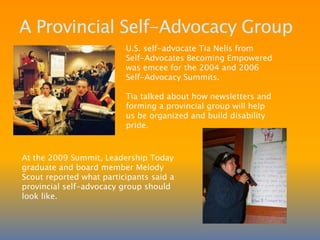
  • #24 Plans for a provincial group have been a long time in the making. In 2004 and 2006, Tia Nelis shared her insights into how SABE was created and resourced to become a functional national self-advocacy voice with representatives from diverse self-advocacy groups in every state.In 2009, Alberta self-advocates developed their idea of a provincial group based on Tia’s insights and their own.