B e s t
P r a ct i ces
FOR I N C L U D I N G PERSONS WITH
D I S A B I L I T I E S
IN ALL ASPEC TS OF D E V E LO PM E NT
EFFO R TS April 2011
BEST P R A C T I C E S
FOR I N C L U D I N G PERSONS WI T H
D I S A B I L I T I E S
I N ALL ASP EC TS OF DE V E LOPME NT
EFFO R TS April 2011
UnitedNations
2
DEPARTMENTOF ECONOMIC AND SOCIAL AFFAIRS
The Department of Economic and Social Affairs of the United Nations Secretariat is a vital interface between global
policies in the economic, social and environmental spheres and national action. The Department works in three main
interlinked areas: (i) it compiles, generates and analyses a wide range of economic, social and environmental data and
information on which Member States of the United Nations draw to review common problems and to take stock of policy
options; (ii) it facilitates the negotiations of Member States in many intergovernmental bodies on joint courses of action to
address ongoing or emerging global challenges; and (iii) it advises interested Governments on the ways and means of
translating policy frameworks developed in United Nations conferences and summits into programmes at the country level
and, through technical assistance, helps build national capacities.
NOTE
The designations employed and the presentation of the material in the present publication do not imply the expression of
any opinion whatsoever on the part of the Secretariat of the United Nations concerning the legal status of any country or
territory or of its authorities, or concerning the delimitations of its frontiers.
The term “country” as used in the text of this review also refers, as appropriate, to territories or areas. The designations of
country groups in the text and the tables are intended solely for statistical or analytical convenience and do not necessarily
express a judgement about the stage reached by a particular country or area in the development process.
Mention of the names of firms and commercial products does not imply the endorsement of the United Nations.
Symbols of United Nations documents are composed of capital letters combined with figures.
ACKNOWLEDGEMENTS
The present document was prepared by Dr Rachele Tardi Forgacs and is a collaborative effort by all the colleagues who
submitted case studies as well as the many dedicated individuals who provided information and material. These included
individuals from Governments, United Nations agencies, Disabled Persons Organizations (DPOs), local and international
non-governmental organizations (NGOs), and networks, disability advocates and experts from around the world.
PHOTOCREDITS
Cover “Tree House” by Debbie Allaire |WHO Photo Contest “Images of Health and Disability 2007”
Page 1, “Easy access” by Arthur Calasans |WHO Photo Contest “Images of Health and Disability 2005”
Page 4 “Looking ahead uncertain future” by Maria Cierna |WHO Photo Contest “Images of Health and Disability 2007”
Page 9, “Welded” to workby Serge Corrieras |WHO Photo Contest “Images of Health and Disability 2005”
ST/ESA/346
Copyright ©United Nations,2011
All rightsreserved
3
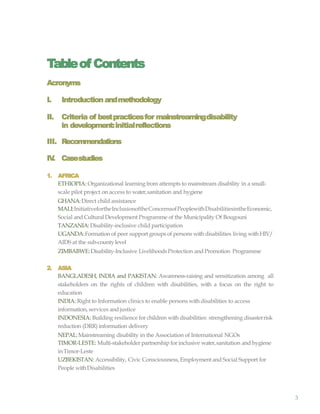
Tableof Contents
Acronyms
I. Introduction andmethodology
II. Criteria of bestpracticesfor mainstreamingdisability
in development:initialreflections
III. Recommendations
IV. Casestudies
1. AFRICA
ETHIOPIA: Organizational learning from attempts to mainstream disability in a small-
scale pilot project on access to water,sanitation and hygiene
GHANA:Direct child assistance
MALI:InitiativefortheInclusionoftheConcernsofPeoplewithDisabilitiesintheEconomic,
Social and Cultural Development Programme of the Municipality Of Bougouni
TANZANIA: Disability-inclusive child participation
UGANDA:Formation of peer support groups of persons with disabilities living withHIV/
AIDS at the sub-countylevel
ZIMBABWE:Disability-Inclusive LivelihoodsProtection and Promotion Programme
2. ASIA
BANGLADESH, INDIA and PAKISTAN: Awareness-raising and sensitization among all
stakeholders on the rights of children with disabilities, with a focus on the right to
education
INDIA: Right to Information clinics to enable persons with disabilities to access
information, services andjustice
INDONESIA: Building resilience for children with disabilities: strengthening disasterrisk
reduction (DRR) information delivery
NEPAL:Mainstreaming disability in the Association of International NGOs
TIMOR-LESTE: Multi-stakeholder partnership for inclusive water,sanitation and hygiene
inTimor-Leste
UZBEKISTAN: Accessibility, Civic Consciousness, Employment and Social Support for
People withDisabilities
4
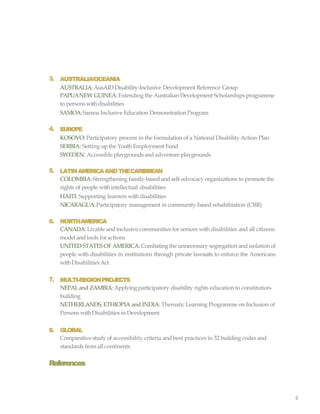
3. AUSTRALIA/OCEANIA
AUSTRALIA:AusAID Disability-Inclusive Development Reference Group
PAPUANEW GUINEA: Extending the Australian Development Scholarships programme
to persons withdisabilities
SAMOA:Samoa Inclusive Education DemonstrationProgram
4. EUROPE
KOSOVO: Participatory process in the formulation of a National Disability Action Plan
SERBIA: Setting upthe Youth Employment Fund
SWEDEN: Accessible playgroundsand adventure playgrounds
5. LATINAMERICAANDTHECARIBBEAN
COLOMBIA:Strengthening family-based and self-advocacy organizations to promote the
rights of people withintellectual disabilities
HAITI: Supporting learners with disabilities
NICARAGUA:Participatory management in community-based rehabilitation (CBR)
6. NORTHAMERICA
CANADA: Livable and inclusive communities for seniors with disabilities and all citizens:
model and tools foractions
UNITED STATES OF AMERICA: Combating the unnecessary segregation and isolation of
people with disabilities in institutions through private lawsuits to enforce the Americans
withDisabilitiesAct
7. MULTI-REGIONPROJECTS
NEPALand ZAMBIA: Applying participatory disability rights education to constitution-
building
NETHERLANDS, ETHIOPIA and INDIA: Thematic Learning Programme on Inclusion of
Persons withDisabilities in Development
8. GLOBAL
Comparativestudy of accessibility criteria and best practices in 32 building codes and
standards from all continents
References
5
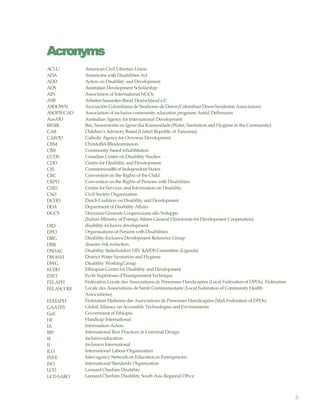
Acronyms
ACLU
ADA
ADD
ADS
AIN
ASB
ASDOWN
ASOPIECAD
AusAID
BESIK
CAB
CAFOD
CBM
CBR
CCDS
CDD
CIS
CRC
CRPD
CSID
CSO
DCDD
DDA
DGCS
DID
DPO
DRG
DRR
DSHAC
DWASH
DWG
ECDD
ESET
FELAPH
FELASCOM
FEMAPH
GAATES
GoE
HI
IA
IBP
IE
II
ILO
INEE
ISO
LCD
LCD-SARO
American Civil Liberties Union
Americans with Disabilities Act
Action on Disability and Development
Australian Development Scholarship
Association of International NGOs
Arbeiter-Samariter-Bund Deutschland e.V.
Asociación Colombiana de Síndrome de Down(Colombian DownSyndrome Association)
Association of inclusive community education programs Astrid Dellemann
Australian Agency for International Development
Bee, Saneamentu no Igene iha Komunidade(Water, Sanitation and Hygiene in the Community)
Children’s AdvisoryBoard (United Republic of Tanzania)
Catholic Agency for Overseas Development
Christoffel-Blindenmission
Community-based rehabilitation
Canadian Centre on Disability Studies
Centre for Disability and Development
Commonwealthof Independent States
Convention on the Rights of the Child
Convention on the Rights of Persons with Disabilities
Centre for Services and Information on Disability
Civil Society Organization
Dutch Coalition on Disability and Development
Department of Disability Affairs
DirezioneGenerale Cooperazione allo Sviluppo
(Italian Ministry of Foreign Affairs General Directorate for Development Cooperation)
disability inclusive development
Organisations of Persons with Disabilities
Disability-Inclusive Development Reference Group
disaster risk reduction
Disability Stakeholders HIV &AIDS Committee (Uganda)
District Water Sanitation and Hygiene
Disability WorkingGroup
Ethiopian Centre for Disability and Development
Ecole Supérieured’EnseignementTechnique
Fédération Locale des Associations de Personnes Handicapées (Local Federation of DPOs) Fédération
Locale des Associations de Santé Communautaire (Local Federation of Community Health
Associations)
Fédération Maliennedes Associations de Personnes Handicapées (Mali Federation of DPOs)
Global Alliance on Accessible Technologies andEnvironments
Government of Ethiopia
Handicap International
Information-Action
International Best Practices in Universal Design
inclusiveeducation
Inclusion International
International Labour Organization
Inter-agency Networkon Education in Emergencies
International Standards Organization
Leonard Cheshire Disability
Leonard Cheshire Disability South Asia Regional Oftce
6
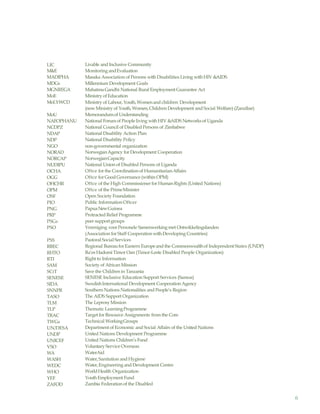
LIC
M&E
MADIPHA
MDGs
MGNREGA
MoE
MoLYWCD
MoU
NAFOPHANU
NCDPZ
NDAP
NDP
NGO
NORAD
NORCAP
NUDIPU
OCHA
OGG
OHCHR
OPM
OSF
PIO
PNG
PRP
PSGs
PSO
PSS
RBEC
RHTO
RTI
SAM
SCiT
SENESE
SIDA
SNNPR
TASO
TLM
TLP
TRAC
TWGs
UN/DESA
UNDP
UNICEF
VSO
WA
WASH
WEDC
WHO
YEF
ZAFOD
Livable and Inclusive Community
MonitoringandEvaluation
Masaka Association of Persons with Disabilities Living with HIV &AIDS
Millennium Development Goals
Mahatma Gandhi National Rural Employment Guarantee Act
Ministry ofEducation
Ministry of Labour, Youth, Womenand children Development
(nowMinistry of Youth, Women, Children Development and Social Welfare) (Zanzibar)
Memorandumof Understanding
National Forumof People living with HIV &AIDS Networksof Uganda
National Council of Disabled Persons of Zimbabwe
National Disability Action Plan
National Disability Policy
non-governmental organization
NorwegianAgency for Development Cooperation
NorwegianCapacity
National Union of Disabled Persons of Uganda
Oftce for the Coordination of HumanitarianAffairs
Oftce for Good Governance (within OPM)
Oftce of the High Commissioner for Human Rights (United Nations)
Oftce of the PrimeMinister
Open Society Foundation
Public Information Oftcer
PapuaNewGuinea
Protracted Relief Programme
peer supportgroups
Vereniging voorPersonele Samenwerking met Ontwikkelingslanden
(Association for Staff Cooperation with Developing Countries)
Pastoral Social Services
Regional Bureaufor Eastern Europeand the Commonwealthof Independent States (UNDP)
Ra’es HadomiTimor Oan (Timor-Leste Disabled People Organization)
Right to Information
Society of African Mission
Save the Children in Tanzania
SENESE Inclusive Education Support Services (Samoa)
SwedishInternational Development Cooperation Agency
Southern Nations Nationalities and People’s Region
The AIDS Support Organization
The LeprosyMission
Thematic LearningProgramme
Target for Resource Assignments from the Core
Technical WorkingGroups
Department of Economic and Social Affairs of the United Nations
United Nations Development Programme
United Nations Children’s Fund
Voluntary Service Overseas
WaterAid
Water,Sanitation andHygiene
Water,Engineering and Development Centre
WorldHealth Organization
Youth Employment Fund
Zambia Federation of the Disabled
I.
Introductionand
Methodology
2
I. IntroductionandMethodology
The present document has been prepared in response to the request in paragraph 15(b) of
General Assembly resolution 65/186, in which the Secretary-General was asked to “provide
information on best practices at international, regional, subregional and national levels for
including personswithdisabilities inallaspectsofdevelopmentefforts”.Its aimisthefollowing:
(a) To establish a set of initial common criteria based on the Convention on the Rights of
Persons with Disabilities (CRPD) for the identification of what constitutes best practices
in mainstreaming disability;
(b) To present a number of case studies that illustrate these criteria and/or the efforts to
implement them in inclusive development;
(c) To present recommendations that can be proposed for the discussion amongst different
stakeholders in development and in the disability community leading up to the envisaged
high-level meeting of the General Assembly on disability and developmentin 2013.
The case studies included in this document have been collected through key contacts and
networks.1 Given the level of detail sought, the production of each case study has required
extensive dialogue with the staff involved in the project. In collecting these case studies, the
intention has been to illustrate the efforts to achieve the initial criteria for best practices (see
section II) in different regions and thematic areas, with an emphasis on those emanating from
recent General Assembly resolutions ( A/63/150, A/64/154 and A/65/186), namely: capacity-
building, multi-stakeholder partnerships, collection of data on disability and statistics,
promotion of accessibility (built environment, information and communication technology,
institutional), social andeconomic rights of girls andwomenwithdisabilities, anddevelopment
cooperation.
Therefore, the case studies presented here are diverse, geographically, thematically and in
scope. They range from specific mainstreaming activities and initiatives to organizational and
national strategies that address the inclusion of persons with disabilities. They also cover,
with different degrees of detail, the criteria for best practices in mainstreaming disability and
come from a range of organizations, including Disabled Persons Organizations (DPOs), donor
organizations, disability-focused and mainstream non-governmental organizations (NGOs)
and United Nations agencies.
1. The template for the collection of case studies was adapted from a number of templates, including the “Collection and Documentation of Good
Practice” in http://www.makingitwork-crpd.org/technical-support/making-it-work-toolkit/ ; the questions used by World Bank/Leonard Cheshire
Disability in their database; the form drawn up by the Inter-Agency Network on Women and Gender Equality (IANGWE) Task Force on Indigenous
Women in Indigenous Women & the United Nations System: Good Practices and Lessons Learned, 2006; and http://www.un.org/womenwatch/
resources/goodpractices/guideline.html (accessed August 2011).
3
The selection of case studies does not aim in any way to be exhaustive; as stated above, it
simply aims to offer a set of illustrative examples.
The document is divided into four main sections. Following this brief introduction, section II
will focus on the initial criteria for the assessment of best practices. Section III presents a
number of recommendations, suggesting also howthe United Nations can facilitate the process
of mainstreaming disability and persons with disabilities in development and highlighting
the interlinkages between the mainstreaming of disability and achievement of the Millennium
Development Goals (MDGs); and section IV contains 26 case studies from across the globe.
II.
Criteria of bestpractices
for Mainstreaming
Disability inDevelopment:
InitialReflections
5
II. Criteria of bestpracticesfor
MainstreamingDisability in
Development:InitialReflections
The concept of mainstreaming disability in development is broadly defined as the inclusion of
persons with disabilities in all aspects of development efforts. The concept of inclusive
development is enshrined in article 32 of the CRPD—the first stand-alone provision on
international cooperation in a core human rights treaty. It can be described, according to the
report of the Secretary-General on the implementation of the outcome of the World Summit
for Social Development and of the twenty-fourth special session of the General Assembly
(A/63/133, para. 61), in the following way: “The Convention identifies disability as an issue to
be considered in all programming, rather than as a stand-alone thematic issue, and requires
all States parties to implement measures ensuring full and equal participation of persons with
disabilities in society. However, disability-specific actions and programming may also be
required, depending on national context.”The HumanRights Council reiterated the importance
of inclusive development in its resolution A/HRC/RES/16/15 calling on “States parties to the
Convention to ensure that all international cooperation measures in the disability field are
consistentwiththeirobligationsundertheConvention;suchmeasurescouldinclude,inaddition
to disability-specific initiatives, ensuring that international cooperation is inclusive of and
accessible to persons withdisabilities”. In the report of the Secretary-General on the realization
of the Millennium Development Goals and other internationally agreed development goals for
persons with disabilities (A/66/128), it is stated that “Investment in persons with disabilities
is necessary not only to promote compliance with the Convention on the Rights of Disabled
Persons and other relevant instruments, but also for the realization of the internationally
agreed development goals, including the Millennium Development Goals.” Mainstreaming is
at once a method, a policy and a tool for achieving social inclusion, which involves the
practical pursuit of non-discrimination and equality of opportunity: mainstreaming disability
is about recognizing persons with disabilities as rights-holding, equal members of society
who must be actively engaged in the development process irrespective of their impairment or
other status, such as race; colour; sex; sexual orientation; language; religion; political or other
opinion; national, ethnic, indigenous or social origin; property; birth or age. Mainstreaming is
also recognized as the most cost-effective and eftcient way to achieve equality for persons
with disabilities.2
United Nations General Assembly resolution 65/186 entitled “Realizing the
Millennium Development Goals for persons with disabilities towards 2015 and beyond”, urges
Member States to mainstream “disability issues and persons with disabilities in national plans
and tools designed for the full realization of the Millennium Development Goals”.3 In this
respect, it nowseems clear that none of the MDGs will be met unless persons with disabilities
2Note by the Secretariaton mainstreaming disabilityin the development agenda (A/CN.5/2008/6, p. 2), submittedto the forty-sixth session of the
Commission for Social Development, held from 6 to 15February 2008.
3United Nations General Assembly resolution 65/186 on realizing the Millennium Development Goals for persons with disabilities towards2015
and beyond (para.5).
6
are included in development plans. It is also recognized that persons with disabilities can be
included in mainstream programmes with minimal adaptation.4However, in order to achieve
the full inclusion and participation of persons with disabilities, “it is often necessary to provide
specific support …in parallel, to ensure that they are empowered to participate on an equal
basis with others. This combination of ‘disability inclusion’ with disability specific projects, or
components of projects, which aim to empower persons with disabilities in particular, is called
the ‘twin track approach’”.5Unfortunately, to date, there have been, overall, “a low amount of
people with disabilities who have experienced progress through development aid”.6Moreover,
existing examples are not collected systematically and are often not available in accessible
formats,with only a few exceptions.7
This section outlines a set of criteria for assessing best practices in mainstreaming disability.
Best practices are understood here as being well-documented initiatives that provide evidence
of success in contributing to the removal and/orreduction of barriers to the inclusion of persons
with disabilities in all aspects of life, and which can be considered for replication, scaling up and
furtherstudy.Thecriterialistedbelowaimatprovidingaframeworktoassistinitialassessmentsof
existing practices and to facilitate further discussion. They reflect an ideal situation, and the case
studies included here present experiences of working towards the best practices criteria without
necessarily meeting all of them. Also, depending on the topic and scope of the programme/
project orpolicyworkandonthe context,someofthesecriteria willbe morerelevant thanothers.
These initial criteria are based, above all, on the CRPD;on the abovementioned resolutions; on the
thematic study by the Oftce of the United Nations High Commissioner for Human Rights
(OHCHR)onthestructureandroleofnationalmechanismsfortheimplementationandmonitoring
of the Convention on the Rights of Persons withDisabilities; on the reports of the Expert Groupon
Mainstreaming Disability in MDG Policies, Processes and Mechanisms: Development for All; on
thefewexistingguidelines;andalsoonthegendermainstreamingexperience.8Someofthecriteria
4Nora Ellen Groce and Jean-François Trani, Millennium Development Goals and People with Disabilities, The Lancet, vol. 374, No. 9704, 28 No-
vember–4 December 2009, pp.1800-01.
5 See http://www.inclusive-development.org/cbmtools/part1/twin.htm (accessed August 2011).
6Norwegian Agency for Development Cooperation (NORAD), report on Mainstreaming Disability in Development Cooperation, Oslo, 27-29
March 2011, available from www.norad.no/_attachment/380926/binary/192749?download=true (accessed August 2011).
7Ibid. Amongst the exceptions is the thematic study by the Oftce of the United Nations High Commissioner for Human Rights on the structure and
role of national mechanisms for the implementation and monitoring of the Convention on the Rights of Persons withDisabilities (A/HRC/13/29).
8AusAID (Australian Agency for International Development), Development for All: Towards a disability-inclusive Australian aid program 2009-2014,
Canberra: AusAID, 2008, http://www.ausaid.gov.au/keyaid/disability.cfm (accessed August 2011); EDAMAT(European Disability Action for Mainstream-
ing Assessment Tool), A Practical Tool for Effective Disability Mainstreaming in Policy and Practice, Leonard Cheshire International, 2006; Human
Rights for People with Disabilities: Sida’s plan for work, Swedish International Development Cooperation Agency (SIDA), 2009; Janet Lord and others,
Disability and International Cooperation andDevelopment: AReviewof Policies andPractices, WorldBank, 2010; Mainstreaming Disabilityin MDGPoli-
cies, Processes andMechanisms: Development for All, report of the Expert Group Meeting, organized by the Secretariat for the CRPD, Division for Social
Policy and Development, DESA in collaboration with the World Health Organization (WHO), April 2009; NORAD, Evaluation of Norwegian support to
promote the rights of persons with disabilities, inception report, draft version, October 2011; Mark Priestley, Targeting and mainstreaming disability in
the 2008-2010 National Strategy Reports for Social Protection and Social Inclusion, University of Leeds, November 2009; United Nations Expert Group
Meeting on Accessibility: Innovative and cost-effective approaches for inclusive and accessible development, June 2010, http://www.un.org/disabilities/
default.asp?id=1516 ; UNNATI-Organisation for Development Education, Realising UNCRPD: Learning from Inclusive Practices: Case Studies in Educa-
tion and Employment,UNNATI,2011; AHandbook on MainstreamingDisability,VSO (Voluntary Service Overseas), 2006.
7
are closely linked to one another. For example, if participation is to be meaningful, it has to be
accessible and non-discriminatory. Moreover, some of the criteria may serve as a means to the end
of mainstreaming disability in a specific project/initiative but they may also represent an end in
themselves. Thus, participation can be a means to achieving a project/programme/policy outcome
butit can alsobe an endin itself in projects/programmesthathaveas theiraimthe improvementof
the participationof people withdisabilities.
The criteria for a best practice example are that it must:
• Adopt a rights-based approach: in other words each mainstreaming initiative should
contribute systematically to the implementation of the CRPD, which aims to promote,
protect and ensure the full and equal enjoyment of all human rights and fundamental
freedoms by all persons with disabilities, and to promote respect for their inherent dignity.
This means promoting barrier removal and inclusion in all sectors, including health,
rehabilitation, assistance and support, environments, education and employment. This, in
turn, means that the mainstreaming initiative must:
o Ensure equality and be non-discriminatory, allowing people to participate regardless
of their disability, level of education, age, social and life skills, religion or ethnicity; it
is especially important to ensure the inclusion of the most marginalized groups of
persons with disabilities, such as persons with psychosocial disabilities and persons
withintellectual disabilities
o Recognize the interaction between gender and disability; in this regard, data should
be disaggregated by sex and by type of disability
o Promote accessibility (built environment, information and communications
technology, institutional, economic, social) to people with all disabilities, i.e., physical,
mental, sensory,intellectual, developmental
o Be participatory, actively and meaningfully involving people with disability in all
matters concerning them in the process of forming policies and programmes; DPOs
are key players in this process and development agencies need to consider investing
in capacity-building and capacity developmentinitiatives for its promotion
o Be accountable to persons with disabilities, involving them actively in the decision-
making process in projects/programmes and policies and creating accountability
mechanisms for monitoring, complaint and feedback
8
• Increase awareness and understanding of disability at organizational, community and
institutional levels so as to promote positive attitudes towards disability, since
stigmatization is considered one of the major causes of exclusion
• Be results-based and produce a measurable change that contributes to the improvement of
the quality of life of people with disability. This will also imply having a robust monitoring
and evaluation system that includes the collection of data on people with disabilities
• Be appropriately resourced, financially and in terms of human resources; hence, the
importancefordonorstoemphasizedisability-inclusivemattersandforNGOstorecognize
it as an organizational priority
• Be sustainable, socially, culturally, economically (i.e., be affordable), politically and
environmentally
• Be replicable, able to show how the product and/or process can be reproduced or adapted
in other countries and contexts; replicability should be assessed taking into consideration
context-specificity, since it is important to recognize that some practices in one country or
contextarenotnecessarilyvalidortransferabletothecircumstancesofanother;theconcept
of “appropriateness” should therefore be introduced whentalking about replication
• Involve effective partnerships that show the commitment of organizations, including
government, academia, media, the United Nations, NGOs, etc.; inter-agency and inter-
organizational efforts should be emphasized with the full involvement of DPOs and local
governments to assure ownershipof the initiative
III.
Recommendations
10
III.Recommendations
In order to realize fully the rights of persons with disabilities in development, systematic
efforts and commitments need to be made, together with appropriate resource allocation. The
international communitymaywishto consider the following recommendations:
(a) Remove obstacles and constraints in international development so that persons with
disabilities are included in international development and that new barriers are not
created. A number of barriers limit or exclude the enjoyment of the rights of persons with
disabilities. These include policies and standards, attitudes, services, lack of accessibility
and of participation in decision-making, inadequate data and statistics.9In conformity with
the World Programme of Action Concerning Disabled Persons and the CRPD, which is a
human rights instrument and a development tool, andin the effective and inclusive pursuit
of the achievement of the MDGs, the international community should make systematic
efforts to remove or support the removal of these obstacles and barriers. In addition, the
international community should ensure that new barriers are not created by international
cooperation programmes in any of the above-mentioned areas. In order to maximize the
removal of barriers for persons with disabilities, the “twin-track” approach should be
strengthened: programmes and services should be designed accessibly and inclusively,
but at the same time some people with disabilities may require specific targeted services
and measures to make sure that they can participate equally with others in education,
employment,health, social protection and all other services;
(b) Ensure that disability-sensitive indicators or markers are applied for the MDGs and in other
development strategies and road maps. States Parties to the CRPD and the United Nations
system should make determined efforts to include disability-sensitive indicators related to
the accessibility and inclusion of persons with disabilities in the MDGs, all of which are
“interconnected and mutually reinforcing”10 and relevant to persons with disabilities.
AccessibilityandinclusionofpersonswithdisabilitiesintheMDGsshouldbeensuredinStates
Parties’actionplansandinothernational,regionalandinternationalroadmapsandstrategies.
General Assemblyresolution 65/186calls uponGovernmentsto ensure “planning,monitoring,
evaluation and implementation to be disability-sensitive”.11Participation of civil society and,
in particular, of DPOs in the creation and monitoring of disability-sensitive indicators is a
key component of the process and is crucial to ensuring accountability. General Assembly
resolution64/131callsuponGovernmentsandUnitedNationsbodies andagencies “toinclude
disability issues and persons with disabilities in reviewing progress towards achieving the
MillenniumDevelopmentGoalsandtostepupeffortstoincludeintheirassessmenttheextent
to whichpersons withdisabilitiesare able to benefitfromefforts toachieve the Goals”;12
9See WHO/World Bank, WorldReport on Disability, Geneva, 2011, p. 262.
10Draft outcome document of the High-level Plenary Meeting of the General Assembly on the Millennium Development Goals (General Assembly
resolution 64/299, operative para.15).
11General Assembly resolution 65/186 on realizing the Millennium Development Goals for persons with disabilities towards2015 and beyond
(operative paras. 8 and13).
12 General Assembly resolution 64/131 on realizing the Millennium Development Goals for persons with disabilities (operative para. 5).
11
(c) Promote, enable and facilitate the meaningful participation of persons with disabilities,
including children with disabilities.13 In conformity with the World Programme of Action
Concerning Disabled Persons and articles 3.c and 4.3 of the CRPD, and as reflected in
article 32.1, participation is crucial. The active and informed participation of persons with
disabilities at all levels—community, regional, national and international—is key in the
planning and discussions to meet the MDGs and in the post-2015 agenda. DPOs should
be involved in decision-making processes and in all stages of programming, and non-
discrimination of persons with disabilities should be ensured at all times. The right of
children withdisabilities to be heard in all matters concerning them andto havetheir views
given due weight is stated in article 7.3 of the CRPD, which, echoing the language of the
Convention on the Rights of the Child (CRC), states that “States Parties shall ensure that
children withdisabilities havethe right to express their viewsfreely on all matters affecting
them, their views being given due weight in accordance with their age and maturity, on
an equal basis with other children”. In addition, article 23 states that “the child’s active
participation in the community” must be facilitated. To enable meaningful and active
participation of different actors with disabilities, capacity-development measures need to
be planned andsupported;14
(d) Strengthen statistical capacity to produce reliable disaggregated data on persons with
disabilities. Article 31 of the CRPD represents a stand-alone provision on data and
statistics. Its paramount importance is also emphasized in operative paragraph 3 of
General Assembly resolution 65/186 and paragraph 23 (s) of the MDG outcome
document contained in General Assembly resolution 65/1. Resources should be allocated
to the collection and analysis of reliable and disaggregated data by sex and disability in
national statistical systems in order to support the design and the monitoring of better
programmes, policies and emergency responses and to promote the awareness of persons
withdisabilities as a heterogeneous and internally differentiated group;
(e) Ensure disability-inclusive responses in situations of risk and humanitarian emergencies.
The biosocial or biopsychosocial model adopted by the CRPD in its preamble, whereby
disability is an interaction between a physical condition and the social environment,
should be used in the design and implementation of emergency responses and in other
situations of risk, including armed conflict. Persons with disabilities, including children,
have an equal right to be included in emergency preparedness and to benefit from full
access to relief services (article 11). The exposure to vulnerability of all persons with
disabilities, especially children, women and girls, becomes more acute after an emergency
or in situations of risk;15
13In its resolution 65/197, the General Assembly requested the Secretary-General to submit at its sixty-sixth session a report on the status of the
Convention on the Rights of the Child, with a focus on implementing the rights of children withdisabilities.
14The right of children with disabilities to participate has been emphasized recently in the report of the Secretary-General on the status of the
Convention on the Rights of the Child, with a focus on implementing the rights of children with disabilities (A/66/230, paras. 22-24).
15 Ibid., para. 55, which states that “children, and particularly girls with disabilities, are vulnerable to violence, exploitation and sexual abuse”.
12
(f) Include a gender perspective in disability work. The right to equality is essential, as well
as being a means to achieving inclusive development. The empowerment of all women,
the full enjoyment of their human rights and the eradication of poverty are essential to
development efforts, including the achievement of the MDGs. Disparities in access
experienced by women with disabilities and their increased exposure to situations of
vulnerability were emphasized in the annual ministerial reviews of the Economic and
Social Council for 2010 and 2011. The establishment of the United Nations Entity for
Gender Equality and the Empowerment of Women (UN Women) can play a crucial role in
operationalizing the right of womenwith disabilities;
(g) Invest in capacity development of staff involved in international cooperation and
emergency response. Awareness-raising and capacity-building related to the rights of
persons with disabilities (CRPD, article 4.1.i) and an understanding of the biosocial model
of disability should be developed among the different actors and stakeholders working in
developmentcommunities and emergency situations;
(h) Adopt a national disability strategy or action plan. A national disability strategy or action
plan should provide the long-term vision for the implementation of the CRPD and the
fulfilment of the rights of persons with disabilities. Moreover, disability should be part of
all strategies for development and action plans (General Assembly resolution 65/186,
operative paragraph 5), which persons with disabilities need to monitor and participate
actively in (CRPD, article 33.3).
The UnitedNations system can contribute greatly to the implementation of the CRPD through
the above-mentioned actions, as wellas witha number of specific actions, including:
(a) Coordinating amongst United Nations agencies on the advancement of disability rights
at headquarters and at the country oftce level, and coordinating with the United Nations
Statistical Commission to ensure the systematic collection of data;
(b) Undertaking specific and targeted efforts to mainstream disability in internal documents,
strategies, workplans, including, for example, the 2012 Quadrennial Comprehensive Policy
Review (QCPR) of the General Assembly; disability-sensitive indicators in performance
reviewand job descriptions could be added;
(c) Holding regional meetings ahead of the high-level meeting of the General Assembly on
disabilityanddevelopmentinordertoensurewideparticipationofpersonswithdisabilities
from developing countries.
IV.
Casestudies
14
IV.Casestudies
1.Africa
ETHIOPIA
Organizational learning from attempts to mainstream disability in a small-scale pilot project
on access to water,sanitation and hygiene
Name of organization, address and website
Water Aid,47-49 DurhamStreet, London,SE115JD (www.wateraid.org)
Project/programme title
Including disabled people in access to safe sanitation: a case study from Ethiopia
Initiative selected as best practice example
Organizational learning process from attempts to mainstream disability in a small-scale
Pilot project on access to sanitation and hygiene
Thematic area/s of best practice example:
Access to sanitation andhygiene
Country and specific location
Ethiopia, Southern Nations Nationalities and People’sRegion (SNNPR), Butajira town
Durationof project
February–September 2009
Beneficiaries of best practice example
People with physical and hearing impairments and non-disabled community members
Impairment/s targeted
People with mobility and hearing impairments
Implementing agency/agencies
WaterAid, Progynist—women’sempowermentEthiopian NGO
(http://www.bds-ethiopia.net/progynist.html) and private sector contractors
Source offund
WaterAid
Relevant article/s of the CRPD
25,28
Backgroundtotheproject andtotheselected practice
The Governmentof Ethiopia (GoE) hasadopteda numberoflaws,policiesandstandardswitha
disability focus.InrelationtotheprovisionofbasicWASHservices, themostrelevant arearticle
41.5 of the Constitution of the Federal Democratic Republic of Ethiopia (1995), and the National
Programme of Action for Rehabilitation of Persons with Disabilities (1999). Ethiopia also aims
to implement the Action Plan established for the African Decade of Persons with Disabilities
(extended to December 2019). Despite the existence of these policies and frameworks, the GoE
standarddesigns for WASHfacilities in Ethiopia are not accessible to people with disabilities.
15
Overallobjectivesoftheproject/programme andoftheselectedpractice
In 2006, WaterAid (WA) in Ethiopia conducted research into the barriers people with
disabilities face when accessing safe WASH facilities. Informants were members of Fana, a
DPO with 62 members in Butajira town, SNNPR. A key research recommendation was to
incorporate accessible designs within the WASH sector. In 2009, WA in Ethiopia piloted
accessible sanitation and showers in a building administered by Fana as a small-scale pilot
project. Key objectives of the project were: (a) to meet the sanitation and hygiene needs of the
Fana members; (b) to raise the profile of disability issues within WASH in Ethiopia; (c) to learn
from the experience and encourage other actors (government, development agencies, private
sector) to mainstream inclusive WASH in WA Ethiopia—this is the component selected as best
practice; and (iv) to generate learning for WAglobally.
Process/strategyusedtoimplementtheselected practice
WA provided the funds and developed the pilot project in consultation with the Fana
management committee, Progynist and the local government. It also provided technical advice
and support throughout the project. Progynist liaised with Fana members, local government
oftcials and the private sector. The city Water and Sewerage Bureau assigned its employees to
install a watersupply to the Fana building, and the private sector constructed the twoaccessible
toilets and two accessible showers. The project has an income generation component, as a fee
is charged for using the showers for non-disabled community members. Two members of the
Fana management committee participated in the design and implementation of the project,
advising on construction, carrying out basic construction and managing the project once it
wascompleted.
Changesachieved
The pilot project achieved changes in the following areas:
Awareness-raising: Atthe communitylevel, attribution can be claimed for addressing
attitudinal barriers within the widercommunity,as the project raised awarenessof disability
issues. The Fana management committee is also providing a service (toilets and showers) for
non-disabled people and this showsthem that disabled people are capable of earning an
income. In addition,the Fana management committee, wholive in the Fana building, reported
significant benefits from being in close proximity to the facilities. Atthe national level, WA
raised the profile of disability within the WASHsector in Ethiopia by disseminating research
and publications nationally and internationally (see below) through networks and the media.
Research: WAin Ethiopia wasone of the first WAcountry programmes to pilot accessible
toiletswithinits work.The WAteaminEthiopia hasnowcommitted to mainstreaming inclusive
developmentwithin all areas of its programming, as is WA globally.
Policies: The learning from the pilot project informed the WAEquity and Inclusion Framework
that guides the implementation of the Equity and Inclusion Policy of WA. This includes
disability rather than having it as a stand-alone topic/policy. Of a total of 26, 15 WA country
programmes nowhave a specific focus on disability in their country strategies.
16
Howchangewasmonitoredand evaluated
Monitoring: WA invited a number of external organizations—Woreda government oftcials,
Handicap International (HI), Ethiopian Centre for Disability and Development (ECDD) and
staff from WAglobally—tovisit the project and to learn and critique the approach.
Evaluation: An extensive review of the relevant literature, including an assessment of four case
studies of World Vision’s inclusive projects (in Angola, Armenia, Senegal and Ethiopia); in-
depth, semi-structured interviews with Fana members and participant observation were carried
out as part of a formative evaluation of the project. Transect walks with two wheelchair users
were also conducted within the project area and around their homes in order to understand
environmental barriers. Spanning a two-week period, the formative evaluation applied the
social model of disability.
Howtheothercriteriafor bestpracticesweremetor effortsmadetomeetthem
Participation: The Fana management committee wasinvolved in the project design,
management and in the evaluation.Fana members outside the management committee and
non-disabled community members werealso involved in the evaluation, as described above.
Awareness-raising: WAhas an Equity and Inclusion Oftcer in Ethiopia whochampions issues
of equality and non-discrimination within the workof WAand with its partner organizations.
TheECDDhasprovidedawareness-raisingtraining forWAstaffinEthiopia.WAhasdeveloped
a technical training programme of writtenassignments, webinarsand workshopsfor country
programme and UKstaff.
Partnerships: WAin Ethiopia has developed partnerships with specialist organizations in order
to mainstream disability in its work, as well as to encourage other organizations to mainstream
inclusive WASHin their work.
Criterianotmetandwhy
The evaluation revealed a number of limitations in terms of design, access and participation.
Design and access: The majority of Fana members live outside Butajira town; these informants’
sanitary practices remain unchanged. Environmental barriers in relation to infrastructure in
the Fana building werenot addressed fully in spite of the design process.
Participation: WAdidnotfullyanalysethepowerdynamicswithintheDPOpriortointervention
and arguably gave the most powerful group the legitimacy to act on behalf of the target group
by engaging only the management committee. No informants outside the management
committee were aware of accessible toilet designs. All respondents stated that they would
have valued the opportunity to feed into the development intervention. WA concentrated on
disabled people’s impairments and therefore focused only on physical access to the sanitation
facilities. It did not aim to address the attitudinal or institutional barriers, which limit disabled
people from fully participating in society. This focus was in response to the priority placed on
addressing those aspects by the Fana informants during WA in Ethiopia’s initial research. The
WA project team in Ethiopia and the WA East Africa Regional Programme Oftcer decided on
thecriteria.
17
Waysin whichthebestpracticeexamplecouldhavebeen improved
The best practice example could have been improvedin the following ways:
• By undertaking mainstream inclusive development in all areas of work rather than
targeting disabled groups as a stand-alone activity. Intervention should be designed to
address environmental, social/attitudinaland institutional barriers
• By conducting a stakeholder analysis that incorporates an assessment of power, age,
gender and impairment during the project planning phase. Other aspects could be added,
as appropriate;these could include ethnicity, religion and caste
• By recognizing that full participation is unrealistic within resource constraints
• By making “empowerment” more specific, measurable and achievable. Using the
information gained from the stakeholder power analysis, activities could be developed to
improve specific powerrelations
Referencematerials
Gosling, L. (2009). Equity and Inclusion Framework, WaterAid. Available from www.wateraid.
org.
Wapling, L, N.Paxe and J. Parkinson (2008). Empowerment of Disabled People’s Organisations,
WorldVision, Angola.Availablefrom www.worldvision.org.
Wapling,L(2010). WorldVision Ethiopia Case Studies. Availablefrom www.worldvision.org.
WaterAid in Ethiopia (2010). Innovation in WASH: a key to bring positive change in the lives
of the marginalizedand excluded.
Wilbur, J., WaterAid (2011). What the Global Disability Report means for the WASH sector (for
an up-to-date picture of WaterAid’s work on disability). Available from http://www.wateraid.
org/documents/report what_the_global_report_on_disability_means_for_the_wash_sector.
pdf.
Wilbur, J. (2010). Principles and practices for the inclusion of disabled people in access to safe
sanitation: a case study from Ethiopia, WaterAid. Available from www.wateraid.org and http://
wedc.lboro.ac.uk/.
18
Contactdetailsfor furtherinformation
Jane Wilbur, Principles Oftcer, Equity, Inclusion and Rights, WaterAid.
E-mail: janewilbur@wateraid.org;tel: +4420 7793 4567.
MahiderTesfu, Senior Equity and Inclusion Oftcer, WaterAid in Ethiopia.
E-mail: mahidertesfu@WA.org; tel: +25111661680.
GHANA
Direct child assistance
Name of organization, address and website
Hope for Life Association, Bethany Project, P.O.Box GP 247,Accra, Ghana
Project/programme title
Pastoral Social Services (PSS)
Initiative selected as best practice example
Direct child assistance
Thematic area/s of best practice example:
health; rehabilitation; education; support services; employmentand awareness creation
Country and specific location
Ghana: Accra,Gbawe
Durationof project
13years (Direct Child Assistance withLiliane Fonds support), from 1998 to 2011
Beneficiaries of best practice example
Children and youngadults withdisabilities, their parents and guardians
Impairment/s targeted
Physical impairment,intellectual impairment,sensory impairments
Implementing agency/agencies
Hope for Life Association, Bethany Project
Source offunds
Hope for Life Association, Liliane Fonds
Relevant article/s of the CRPD
3.3, 3.4, 3.5, 3.6, 3.7, 3.8
Backgroundtotheproject andtotheselected practice
Ghana has an estimated population of 2.4 million persons living with all forms of disabilities
(WHO). The majority of them live in rural areas. It is also estimated that less than 5 per cent
have access to formal rehabilitation and educational services due to the lack of infrastructure,
19
ignorance and negative traditional beliefs and practices. The facilities for training and
support for professionals are inadequate, which makes intake of trainees very limited. Private
rehabilitation centres are located in urban centres. Community-based rehabilitation (CBR)
programmes are very few, run by NGOs and mainly funded by organizations in the North.
Hope for Life Association is an independent DPO set up by the Society of African Missions
(SMA) in 1986, to implement PSS for persons with disabilities.
Overallobjectivesoftheproject/programme andoftheselectedpractice
The overall objective of the PSS programme is to help mobilize persons with disabilities and
community members so as to contribute towards addressing their health, rehabilitation,
education and social inclusion needs within the mainstream society, as part of the CBR. The
practice documented here is direct child assistance, an approach within PSS that is tailor-made
for children and young adults with disabilities. The objective is to ensure the application of a
direct andholistic approach by promoting the rehabilitation, human rights and social inclusion
of these individuals to enable them to overcome physical, social and economic barriers that
confront them in theirlives.
Process/strategyusedtoimplementtheselected practice
The strategy for implementing the practice involves the use of field coordinators, who are
employees of Hope for Life and are referred to as “mediators”. A team of five people, made up
of three disabled members of the association and two community members, oversees the
implementation of the practice within defined project areas. The process, which is fully
participatory,involves the following steps:
• Awareness-creation within the communities
• House-to-house identification of children with disabilities, followed by social investigation
to establish the case history and developmentof the individual rehabilitation plan
• Referral for medical assessment, treatment and possible surgery by specialists within the
public health institutions; clinical rehabilitation and provision of assistive devices within
rehabilitation centres
• Referral of school-age children for formal education within the special or public education
systems, with provision of school fees and other necessary supplies, withfollow up
• Periodic counselling and training of parents and guardians on appropriate care for their
children with disabilities
• Referral of young adults for vocational/skills training in public training institutions and,
whereappropriate, apprenticeship with local tradesmen or women,withfollow up
• Counselling and support (financial and advisory) for young adults to assist them in
undertaking their own income-generating projects, with follow up; and support for very
poor parents to undertake income-generating projects as part of a microsocial protection
scheme
• Case closure or exit after multidisciplinary consultations
20
Changesachieved
Awareness-raising: More than 65 per cent of families and guardians have come to accept their
children withdisabilities and nowoffer assistance to them just as to their non-disabled children.
Statistics: Disaggregated data are collected by the mediators and also by programme
management andpartners.
Resource allocation: Resource allocation to the practice improvedover the period underreview
following partnership withthe main sponsor,the Liliane Fonds.
Processes and procedures: Processes and procedures have been enhanced through regular
fieldmonitoring and supervision by both the management and implementing teams.
Capacity-building: Regulartraining of all staffandreviewsof the programmehavecontributed
greatly to capacity-building within the organization.
Social and economic rights of girls and womenwith disabilities: All school-age girls are being
enrolled in schools, while40 per cent of womenare engaged in micro-enterprises.
Howchangewasmonitoredand evaluated
Monitoring is done through direct visits to the homes andactivity centres by the mediators, the
implementing and management teams. The “radar” (or “spider-web”) assessment tool is then
used to interpret and showchanges.
Howtheothercriteriafor bestpracticesweremetor effortsmadetomeetthem
All the criteria are either directly contained in the organization’s policy or are outlined in the
operating guidelines for implementation. Staff training programmes also address them.
Accountability: All stakeholders, including the beneficiaries, are involved in programme
planning, implementation, monitoringandevaluationtoensuretransparencyandaccountability.
Participation: Participatory practices ensure accountability and healthy partnerships.
Replicability:Lessonslearnedarefedintoprogrammeplanningcyclestoensurethatreplication
of the practice takes account of the best practices.
Criterianotmetandwhy
Advocacyeffort and research werenot major priorities.
Entity responsiblefor deciding whetherthecriteriawere/werenotmet
Management of the Hope for Life, the implementing team.
Factorsfacilitating/hindering thesuccessofthepractice
Facilitating: parental commitment, communityparticipation and policies that enhance access
to mainstream services.
Hindering: negative traditional beliefs, poverty and widespread ignorance.
Waysin whichthebestpracticeexamplecouldhavebeen improved
More parental and local government involvement/commitment.
21
Other lessonslearned
Combined efforts of persons withdisabilities and communities to promote non-discriminatory
practices areeffective.
Contactdetailsfor furtherinformation
Bernard Morvan,Team Beleid &Allianties. E-mail: bmorvan@lilianefonds.nl.
MALI
Initiative for the Inclusion of the Concerns of People withDisabilities in the Economic, Social
and Cultural Development Programme of the Municipality of Bougouni
Name of organization, address and website
HandicapInternational (www.handicap-international.org)
Project title
Droits en Actions (Rights in Action)
Initiative selected as best practice example
Initiative for the inclusion of the cConcerns of People withDisabilities in the Economic, Social
and Cultural Development Programme of the Municipality of Bougouni, Mali
Thematic area/s of best practice example:
Local inclusive governance and participation in local decision-making processes
Country and specific location
MALI, Bougouni (a municipality located 160 km from the capital, Bamako)
Durationof project
Rights in Action project 2009 topresent
Beneficiaries of best practice example
The population of Bougami and specifically people with disabilities
Impairment/s targeted
N/A
Implementing agency
FELAPH(Fédération Locale des Associations de Personnes Handicapées—Local Federation of
DPOs)
Source offunds
N/A
Relevant article/s of the CRPD
24, 25,29
Backgroundtotheproject andtotheselected practice
In West Africa, as in many other regions of the world, people with disabilities are largely
excluded from the process of development, with extremely limited opportunities to engage in
public consultations and decision-making. This exclusion serves only to reinforce the
22
marginalization, critical poverty and isolation experienced by people with disabilities in the
region. However, there is a growing political shift towards decentralization across West Africa,
with decision-making and resource allocation increasingly devolved to government authorities
at the local level. This shift now offers greater opportunities for people with disabilities and
their representative organizations to influence local development and decisions about the
provision of public goods and services. The number of DPOs is high in Mali. There is also a
DPO umbrella organization, FEMAPH (Fédération Malienne des Associations de Personnes
Handicapées), and each type of impairment group is represented by at least one national
association. Mali does not have specific laws dealing with disability issues. Nevertheless, Mali
signed the CRPD on 15 May 2007. It was ratified on 5 September 2007 and voted on by the
National Assembly on 8 November 2007.
Overallobjectivesoftheproject/programme andoftheselectedpractice
Rights in Action is a research and advocacy initiative using the Making it Work methodology.
The objective of Rights in Action is to document good practices on key disability issues, and to
use this evidence to advocate for social change. The good practice featured in this case study
refers to the actions of a local federation of DPOs, FELAPH, which nowplays a key role in local
decision-making processes for the municipality of Bougouni, Mali.
Process/strategyusedtoimplementtheselected practice
In June 2008, FELAPH, with support from an international NGO, conducted a participatory
local diagnosis of the situation of people with disabilities in the municipality with a view to
developing concrete proposals to address their main needs and concerns. The results of the
diagnosis were analysed and endorsed during a workshop involving key stakeholders in the
municipality. The main problems highlighted by the study were access to health, education
(more than 90 per cent of people with disabilities did not attend school) and employment. To
overcome these problems, the following actions have been proposed by the actors involved in
thediagnosis:
• Increase the level of education of people with disabilities
• Increase access to basic social services
• Facilitate professional integration through the development of income-generating
activities
• Promote the participation of people with disabilities in community life
• Educate and inform people about disability
• Educate all stakeholders at the municipality level so that they consider disability as an
across-the-board issue in theirwork
After the study, the FELAPH approached the municipal council of Bougouni to discuss the
results and make proposals for action. Consultations between the FELAPH, the municipality
of Bougouni, the Circle Council and local services then led to concrete actions to promote the
inclusion of disability issues in the Programmes for Economic and Cultural Development of
the municipality and also to improve access to health and vocational training.
23
Changesachieved
The practice achieved changes in the following areas:
Inclusion of disability in the economic, social and cultural development programmes:
Partnership agreements were signed between FELAPH, DPOs and the municipality of the
Circle of Bougouni (Bougouni, Koumantou, Zantiébougou, Faragaran Faradielé and Kelea).
These agreements aimed to encourage the involvement of DPOs in the development process,
and in the implementation, monitoring and evaluation of the economic, social and cultural
developmentprogramme in the various municipalities.
Access to health services: A multiparty agreement was signed by the Chairman of the Circle
Council, the president of the Local Federation of Community Health Associations (FELASCOM),
the head of the Social Development and Solidarity Economy Department in the prefecture, and
the President of the Federation of DPOs. This convention guarantees free consultations and
hospitalization in all health centres of the prefecture to any person with a disability who is a
memberof the Federation.This could be improvedto ensure that non-members can also benefit.
Access to vocational training: An agreement was signed between the private vocational school
Ecole Supérieure d’Enseignement Technique (ESET) and the local federation of DPOs of
Bougouni. Renewable every year, the agreement allows the bearing of 50 per cent of the school
fees by the institution and the remaining 50 per cent by the individual with a disability. Since
the signing of the agreement between the ESET and the Federation of DPOs, six people with
disabilities have accessed training courses.
Howchangewasmonitoredand evaluated
Rights in Action carried out field research during the period 2009–2011. This was a Making it
Work project. This means that a wide range of organizations (at national and regional levels)
have been involved in selecting good practice criteria, analysing and validating good practices,
developing recommendations and monitoring advocacy activities.
Howtheothercriteriafor bestpracticesweremetor effortsmadetomeetthem
A regional project committee comprising eight organizations (including DPOs, and women’s
rights, disability and governance specialists) developed general criteria based on the general
principles of the CRPD(article 3) andspecific criteria (based on article 29.b). This good practice
case study is not an instance of one organization submitting an example of its ownwork.Rather,
it is the product of a multi-stakeholder project, where different organizations (including DPOs)
have come together to analyse and think seriously about good practice and to try to use it to
influence change. This good practice could be replicated in other municipalities. The objective
of the Rights in Action project is nowto advocate for this.
Factorsfacilitating/hindering thesuccessofthepractice
Facilitating: The existence of a Federation and very dynamic and organized local DPOs; good
relations between the Federation and the partners; constructive dialoguewith the local council;
24
financial support provided for the conducting of the study. From the results of the diagnosis, the
Federation of DPOs has implemented a strategy of awareness-raising and advocacy on disability
rights,andhassubmittedproposalstothecounciltoimprovethesituationofpeoplewithdisabilities.
Other lessonslearned
Kanata Maïmouna Mariko, 1st Deputy Mayor of the municipality of Bougouni, stated that
“decision-making is the essential basis of managing a municipality and should involve all
segments of society, withoutanydiscrimination”.
Referencematerials
Making it Work,available from www.makingitwork-crpd.org.
Contactdetailsfor furtherinformation
Ousmane Diakité, President of FELAPH, Mali. Tel: +223 76216727.
UNITEDREPUBLICOFTANZANIA
Disability-inclusive child participation
Name of organization, address and website
Save the Children Tanzania—Zanzibarprogramme
Project title
Child Participation Initiative: Children’sAdvisoryBoard (CAB) in Zanzibar
Initiative selected as best practice example
Disability-inclusive child participation: the Children’sAdvisoryBoard in Zanzibar,the issues
raised by its members and the actions taken as a response
Thematic area/s of best practice example:
Participation of children with disabilities and multi-stakeholder partnership
Country and specific location
Zanzibar,United Republic of Tanzania
Durationof project
First phase:2008–2010
Second phase: 2011–2015
Beneficiaries of best practice example
All children, including children with disabilities, their families and their community
Impairment/s targeted
All
Implementing agency/agencies
Save theChildren
Source offunds
SwedishInternational Development Cooperation Agency (SIDA) and Oak Foundation
Relevant article/s of the CRPD
12,16,23
25
Backgroundtotheproject andtotheselected practice
The UnitedRepublic of Tanzania has signed andratifiedboth the CRC andthe CRPD.However,
there is no systematic data collection on persons with disabilities, and one recent study has
shown how the core concept of accountability is absent from Tanzania’s National Policy on
Disability (Aldersey, 2011). In 2009, the Save the Children in Tanzania—Zanzibar programme
made the decision to become more proactive in putting all children at the heart of its activities.
As a result, a journey was embarked upon to enable all children, including children with
disabilities, to have more say in the programme in Zanzibar and to become accountable to
them. The inclusive Children’s Advisory Board (CAB) was created as one of the results of these
efforts.
Overallobjectivesoftheproject/programme andoftheselectedpractice
The overall aim of the CAB is to promote the right to meaningful participation of all children
and, through this, the fulfilment of other rights (CRC, article 12, and CRPD, article 7). The
specific objectives of the CAB are to involve children in the planning processes of Save the
Children programmes, events, activities and initiatives, and also increase Save the Children
and government accountability to all children, including children with disabilities.
Theprocess/strategy usedtoimplementtheselected practice
The CAB was created in January 2010 and consists of eight girls and seven boys between the
ages of 12 and 17, elected from the shehia (the smallest administrative unit in Zanzibar)
Children’s Councils and from minority groups to ensure inclusive representation: one of these
children has a visual impairment and two children are albino (a highly discriminated against
group in the United Republic of Tanzania, albinism being considered by the majority as a
“disability”). The programme has been working with DPOs to gain access to more children
with disabilities for involvement in various consultations. This partnership has been key in
ensuring the success of the disability-inclusive dimension of the CAB activities. The initial
setting-up and running of the CAB included seven main elements to make sure that children’s
participation was meaningful. The main elements are: (a) staff training, both initial and
ongoing, (b) learning from the experience of others to set up mechanisms for child
participation and accountability, (c) the planning and design of the system involving children
at an early stage, (d) the election of children to the CAB and ensuring they are representative—
hence the importance of involving children with disabilities, (e) the ensuring of children’s safe
participation, (f) the working with partners, parents and communities to enable a conducive
environment for all children to be heard, and (g) government relations: signing an MoU around
the wider protection work. CAB members have regular meetings and consultations with Save
the Children andalso withministries. Children in the CAB drewattention to a number of issues
that had not been considered before either by Save the Children in Tanzania (SCiT) or by the
local government,including the issue of sexual violence against children with disabilities.
26
Changesachieved
Overall, the inclusion of children with disabilities in the CAB and in a number of participatory
consultations has led to increased awareness of their needs in local children’s councils, in Save
the Children and in the ministries. More specifically, the practice achieved changed in the
followingareas:
Policies: The disability-inclusive CAB led to the involvement of 10 children with disabilities in
the consultations to inform the Children’s Bill. The Children’s Bill contains clear provisions on
the rights of children with disabilities to be treated equally and to be entitled to special care
and protection, and to have effective access to education, training and healthcare services, as
wellas preparation for employment and recreation opportunities.
Research and awareness-raising: SCiT, as a result of the issues raised by the disability-
inclusive CAB, undertook a research study on the vulnerability of children with disabilities to
sexual violence in Zanzibar. The multi-stakeholder workshops, held between December 2010
and March 2011 to disseminate the findings of the research study, led to the development of a
Plan of Action in which all 45 stakeholders have a role.16The findings from the research have
inspired SCiT to undertake and/orsupport a number of initiatives to promote further the rights
of children with disabilities, for example: (a) funds from SIDA were obtained by SCiT to work
with the Department of Disability Affairs (DDA) in order to build the capacities of children
with disabilities and their families in Zanzibar and to improve their understanding of the legal
provisions for children with disabilities; (b) mobilization activities on the vulnerability of
children with disabilities to sexual violence were organized at different levels; (c) an advocacy
briefing was prepared by Save the Children UK Head Oftce in partnership with HI, which was
presented at various meetings in Geneva and Brussels in close collaboration with the
programme manager of the SC Zanzibar Programme; (d) police stations in Zanzibar improved
their database on reported cases of abuse to include disability in the information collected,
and oftcers from the Offenders Educational Centre in Zanzibar are also considering doing the
same. This will,in turn, increase the data on children with disabilities.
Strategies: The CAB has now been oftcially incorporated into government structures as the
National Child Consultation Group under the Ministry of Labour, Youth, Women and Children
Development(MoLYWCD).
Howchangewasmonitoredand evaluated
Close follow-up with government representatives on the issues raised during the meetings
with the CAB; also, a multi-stakeholder committee was set up to follow up on activities
suggested in the Action Plan. Feedback on the report on the research study was collected from
all stakeholders, including children with disabilities.
16 These include stakeholders such as Government ministries, local government authorities, district oftces, the police force, DPOs, NGOs work-
ing for children, lawyers associations, the High Court, magistrates, the Law Review Committee and the Commission for Human Rights and Good
Governance.
27
Howtheothercriteriafor bestpracticesweremetor effortsmadetomeetthem
Equality and non-discrimination and gender perspective: These have been ensured by the
representation of girls with and without disabilities in the CAB and in the other consultations
heldby SCiT. The children in the CAB wereelected through a fair process.
Participation and partnership: Participation and partnership with the meaningful involvement
of children with disabilities are at the core of this initiative. DPOs, parents and government
have also been involved in a number of activities, including training.
Sustainability: To ensure sustainability, the CAB has now been oftcially incorporated into
government.
Accountability: Accountability to all children is at the core of this initiative. Save the Children
put a lot of effort into building a shared understanding between staff, partners and the
government of the meaning of accountability and meaningful participation. The Project Oftcer
decided whetherthe criteria weremet/not met.
Factorsfacilitating/hindering thesuccessofthepractice
Facilitating: Political will and commitment of the Save the Children Tanzania-Zanzibar
programme and of the local government; context/size of Zanzibar; working within existing
structures; capacity-building withstaff and supportive donors.
Hindering: Variations in understanding children’s participation; limited feedback from the
children involved in the CAB to other children (in their own constituencies); high expectations
of children andadults.
Waysin whichthebestpracticeexamplecouldhavebeen improved
An extra “layer”between CAB and Children’s Councils at the local/village level to ensure better
sharing of information; more work with the media to increase awareness-raising; development
of a more specific monitoring and evaluation (M&E) system.
Referencematerials
Aldersey,H.M.(2011).The UnitedRepublic of Tanzania’sNational Policy on Disability: APolicy
Analysis. Available from http://dps.sagepub.com/content/early/2011/02/10/1044207310397877.
abstract?rss=1.
Save the Children UK (2005). Practice Standards for Child Participation. Available from http://
www.savethechildren.org.uk/en/54_3169.htm.
Save the Children and Handicap International (2011), Out of the Shadows. Available from
http://www.savethechildren.org.uk/en/54_out-from-the-shadows.htm.
28
Contactdetailsfor furtherinformation
Mubarak Maman,Zanzibar Representative, Save the Children. Skype: mubarak.maman;e-mail:
m.maman@savethechildren.or.tz;tel.: +25524 2234153; cell: +255 787357042.
UGANDA
Formation of peer support groupsof persons with disabilities living withHIV/AIDS at the sub-
countylevel
Name of organization, address and website
Action on Disability and Development (ADD)International, Plot 4A,Commercial Road—
Ntinda,P.O.Box 9658, Kampala,Uganda (www.add.org.uk)
Project title
Strengthening peer support groups of people with disabilities living withHIV &AIDS in
Masakato engage effectively withthe mainstream service providers
Initiative selected as best practice example
Formation of peer support groups (PSGs) of people with disabilities living with HIV/AIDS at
the sub-countylevel
Thematic area of best practice example:
HIV/AIDS
Country and location
Uganda, MasakaDistrict in South Central Region
Duration of the project
Three years(2011–2013)
Beneficiaries of the best practice example
Persons withdisabilities living with HIV and AIDS
Impairments targeted
All
Implementing agency/agencies
AddInternational Ugandathrough MasakaAssociation of Persons withDisabilities Living
withHIV/AIDS(MADIPHA)
Source offunds
DFID through the Programme PartnershipAgreement,withadditional fundsobtainedthrough
public fundraising in the United Kingdom
Relevant article/s of the CRPD
8, 9, 10, 21, 25
29
Backgroundtotheproject andtotheselected practice
Since the mid 1990s, Uganda had been credited with being at the forefront of the fight against
HIV/AIDS ravaging much of the young population in sub-Saharan Africa. Tremendous strides
were made in creating awareness through various fora of the causes, signs and symptoms of
HIV/AIDS and preventive measures. However, despite the rosy picture that was painted,
people with disabilities in Uganda had not been effectively mobilized and they remained
poorly informed on the magnitude of the epidemic. It is against this background that, in 2005,
the ADD International Uganda programme commissioned the study “Challenges faced by
People withDisabilities in Utilizing HIV/AIDSCommunication and Related Health Services in
Uganda”. The study brought out glaring gaps in Uganda’s health delivery system, particularly
with regard to HIV/AIDS among people with disabilities. One of the immediate outcomes of
the dissemination of the study’s findings was the formation of a Disability Stakeholders HIV &
AIDS Committee (DSHAC) composed of representatives of DPOs and agencies committed to
ensuring access by people with disabilities to HIV/AIDS services. ADD augmented the workof
the National Union of Disabled Persons of Uganda (NUDIPU) to extend project activities from
11 to another 19 districts. The best practice documented here focuses on the engagement with
MADIPHA, formed to advocate for the inclusion of people with disabilities in all HIV/AIDS
programmes in the Masakadistrict.
Overallobjectivesoftheproject/programme andoftheselectedpractice
The overall objective of the project is to support MADIPHA in strengthening its institutional
capacity and form PSGs to engage effectively with the mainstream service providers to include
their needs. The specific objectives of the selected good practice are to: (a) position people
with disabilities living with HIV/AIDS (rather than programme implementers) at the lead of
the struggle to mainstream the disability perspective; and (b) to network, collaborate and
build linkages with other organizations and government bodies in the district of operation,
nationally and internationally.
Process/strategyusedtoimplementtheselected practice
Engagement meetings have been conducted between ADDandMADIPHA to develop a shared
vision. Athree-year partnership between ADDand MADIPHAhas been initiated.
Changesachieved
The practice achieved changes in the following areas:
Strategies: MADIPHA was able to conduct a strategic planning process with participation of
key HIV/AIDS service providers leading to a Five-Year Strategic Plan.
Advocacy: There has been tremendous improvement in the levels of community awareness
with regard to HIV/AIDS and disability. Disabled people living with HIV/AIDS can now
actively participate in activities like the World AIDS Day celebrations and the International
Day of Persons with Disabilities, which are used as events for communicating disability and
HIV/AIDS issues across a broadspectrum.
30
Statistics: Through the PSGs, MADIPHA is able to capture and store information about their
members. This is incorporated into the work of other service providers like The AIDS Support
Organization (TASO).
Capacity-building: With the intervention of ADD, MADIPHA has established a well-defined
leadership, has clear governance, management systems and structures in place, has plans that
clearly show their vision, mission and objectives and has exhibited adherence to the principles
of accountability, transparency and integrity. This is manifest in the ability of disabled people
to engage relevant service providers in articulating their issues and concerns.
Howchangewasmonitoredand evaluated
ADD conducts periodic monitoring visits to assess the progress of work in light of planned
activities and to drawlessons. “Stories of Change”are collected from MADIPHA members.
Howtheothercriteriafor bestpracticesweremetor effortsmadetomeetthem
Partnership and participation: ADDuses a partnership-led strategy, workingwith DPOs and
withthe slogan “Working withDisabled People for Positive Change”.
Accessibility: Advocacy campaigns for accessible physical environment and information are
conducted.
Non-discrimination: The project targets all people with disabilities irrespective of their culture,
religion or disability; it is spearheadedby people withdisabilities themselves.
Gender: ADD policy stipulates that a 50 per cent level of male/female, disabled/non-disabled
staff should alwaysbe maintained.
Criterianotmetandwhy
Replicability and sustainability have not yet been met, partly because the project is still in its
first year of implementation. However, strategies are in place to ensure their progressive
achievement.
Factorsfacilitating/hindering thesuccessofthepractice
Facilitating: Building on existing structures of disabled people and scaling up existing
experience: the lessons and successes of some of the previous work of ADD with districts like
Katakwi and Kamuli in the area of HIV/AIDS did provide benchmarks; collaborating with
others stakeholders like NUDIPU; comprehensive support (financial and technical) from ADD;
building on the enormous advocacy successes realized by the disability movement in Uganda.
Hindering: The MADIPHA coverage area comprises only 5 sub-counties out of the 23 in the
district; the MADIPHASecretariat is manned by only one staff member.
Waysin whichthebestpracticeexamplecouldhavebeen improved
Exposure visits by members of MADIPHA to other peer support groups; support for the
emergence of more PSGs to lead to a national umbrella organization.
31
Other lessonslearnedfromtheprocess
As a local saying goes “The person wearing the shoe knows where the stone hurts.” This means
that it is key to support people with disabilities living with HIV/AIDS to take the lead in
bringing to light the issues affectingthem.
Referencematerials
Action on Development and Disability (2008). Challenges faced by People with Disabilities in
Utilising HIV&AIDS Communication and Accessing Health Services in Uganda. November.
Availableat the country oftce.
Action on Development and Disability. International AnnualReport 2010. Availablefrom
http://www.add.org.uk/downloads/ADD-annualReport-2010.pdf.
Contactdetailsfor furtherinformation
Baraza Deusdedit, Monitoring &EvaluationOftcer, ADDInternational, UgandaCountry
Programme.E-mail: baradeus@adduganda.org; tel.: +256414 531446.
ZIMBABWE
Disability-Inclusive LivelihoodsProtection and Promotion Programme
Name of organization, address and website
Catholic Agency for Overseas Development (CAFOD)
4 Duthie Avenue,Belgravia, Harare, Zimbabwe (www.cafod.org.uk)
Project title
LivelihoodsProtection and Promotion Programme
Initiatives selected as best practice examples
1.Disability advocacy/awareness in livelihoods programmes
2. Promotion of accessibility (built environment)
Thematic area/s of best practice example:
health; rehabilitation and income generation activities and agriculture recovery
Country/specific location
Zimbabwe (Binga District, BulawayoUrban and Mutare Urban)
Duration of the project
Three-year programme to June 2011
Beneficiaries of best practice example
Binga and BulawayoUrban Impairment/s
targeted
Physical disability
32
Implementing agencies
Caritas Hwangeand National Council of Disabled Persons of Zimbabwe (NCDPZ)
Source offunds
Protracted Relief Programme (PRP)
Relevant article/s of the CRPD
4,9
Backgroundtotheproject andtotheselected practice
Zimbabwe is the sixth poorest country in the world, ranking 58 out of 84 countries on the
Global Hunger Index and 169 out of 169 on the Human Development Index. Facing poverty,
food insecurity, and the threat of waterborne diseases, it is one of the five countries hardest hit
by HIV/AIDS. According to WHO estimates, about 1.3 million people have disabilities, about
10 per cent of Zimbabwe’s population. As elsewhere, persons with disabilities suffer from
widespread violation of their fundamental freedoms and rights. They are especially vulnerable
to poverty and to physical and sexual violence. Only 33 per cent of people with disabilities
have access to education, compared with over 90 per cent of the able-bodied. Stigma and
discrimination stem from the waysociety views disability.
Overallobjectivesoftheproject/programme andoftheselectedpractice
The main objective is to promote and protect the sustainable livelihoods of 15,600 chronically
poor and labour-endowed households in five districts, with special focus on vulnerable groups,
such as people withdisabilities. The specific objectives are:
• Increased foodproduction
• Diversified livelihoods and income sources
• Improved household income-earning capacity, to be achieved through unconditional cash
transfers, internal savings and lending schemes, and income generation
• Nutrition mainstreaming
• Increased access to safe water, sanitary facilities and hygiene
Process/strategyusedtoimplementtheselected practice
• Multi-stakeholder consultations: CAFOD and partners assessed the availability and
accessibility of services for people with disabilities in Bulawayo Urban and Binga districts.
This involved an in-depth examination of whois doing what,whereand how
• Establishing alliances: CAFOD and partners established good working relationships with
various other players (both government and civil society) working on disability. Through
engagement with stakeholders, CAFOD and partners cultivated a strong working
relationship withGovernment Rehabilitation Departments at various district hospitals
• Three types of key training: Basic training on disability issues and on disability
mainstreaming in livelihoods interventions, and training of trainers on disability
mainstreaming was undertaken targeting CAFOD and partner staff, district stakeholders,
Ward community leaders and community members. A total of 275 people were trained at
both partner and district levels on disability issues and more than 2,000 people were
reached with disability information during communityawarenessand leadership sessions
33
• Income-generating activities in the Mzilikazi District of the metropolitan province of
Bulawayoincluded: production of cleansing materials (liquid soap, etc.), bed- and mattress-
making, flea market sales (selling of second-hand clothes), bead-making, welding and
peanutbutter–making
CAFOD and its partners procured and distributed assistive devices, such as wheelchairs and
commodes, to a number of beneficiaries. Through engagement with stakeholders, CAFOD
and partners cultivated a strong working relationship with Government Rehabilitation
Departments at various district hospitals. The project used the CAFOD Vulnerability and
Inequality Analysis Tool which aims to ensure that the organization or programme (a) remains
relevant and effective and (b) does no harm in contexts also affected by disability/gender/
HIV issues. The analysis takes five stages into consideration: awareness, analysis, adjustment,
action and assessment of impact.
Changesachieved
The practice achieved changes in the following areas:
Strengthening of multisectoral response: In Binga, Caritas Hwange changed its ways of
working by offering transport to government rehabilitation services staff members as the team
travels from district oftce to wards of operation. This has seen rehabilitation services brought
to community doorsteps, whereas previously people with disabilities were not accessing
rehabilitation services due to distances involved and lack of bus fares to the district centre.
Awareness-raising and advocacy: There was an increased understanding of disability issues
and disability mainstreaming in Zimbabwe by CAFOD and partner staff members as well as
district and community leadership, leading to a reduction in negative attitudes towards people
with disabilities. This was quite evident in Bulawayo Urban where people with disabilities are
now members of the powerful ward community development committee and other community
associations and groups that spearheaddevelopmental activities in the operational area.
Opposition to all stigma or discrimination: There has been increased attendance and greater
participation of people with disabilities in development activities. For example, under home-
based care programmes, 29 per cent of the beneficiaries were people with disabilities and a
significant number of people with disabilities were also reached with small livestock (goats
andchickens).
Promotion of accessibility: CAFOD responded to water sanitation challenges being faced in
the five districts (Binga, Chivi, Bulilima, Mangwe and Nyanga) through the provision of clean
watersources and proper sanitation facilities. In order to promote the accessibility of sanitation
facilities by people with disabilities, CAFOD, in partnership with other critical stakeholders
from the Ministry of Health and Child Welfare, modified the latrines and added ramps to the
structure.
Howchangewasmonitoredand evaluated
Beneficiary self-evaluation; multi-stakeholder monitoring visits; internal and external
evaluation processes.
34
Howtheothercriteriafor bestpracticesweremetor effortsmadetomeetthem
Mainstreaming:TheCAFODmainstreamingmodelemphasizesthefollowingkeyprinciples:(a)
community-based,workingin partnership, (b) ownershipby local communities, (c) meaningful
involvementof people with disabilities, (d) gender-specific considerations informing all
programme responses, (e) opposition to all stigma or discrimination, (f) workingwithin a
multi-sectoral response and informedby good practice guidelines, (g) evidence-based criteria
and identified good practice, and (h) “knowyourdisability,knowyour response”. NCDPZ was
the technical partner for the CAFOD-ledLivelihoodsProtection and Promotion Consortium.
The NCPDZrole wasto enhance understanding and competencies on disability issues and in
particular disability mainstreaming in livelihoods interventions.
Sustainability: CAFODandpartnerorganizationsmanagedtotransferdisabilitymainstreaming
skills to community and district structures. These will be able to continue working on issues of
disability mainstreaming.
Participation: Participation of people with disabilities in livelihoods programmes ensured that
beneficiaries wereempowered to generate their ownincome withminimal external support.
Entity responsiblefor deciding whetherthecriteriawere/werenotmet
Beneficiaries’ feedback meetings, multi-stakeholder committees, regular project monitoring
teams, external and internal evaluation.
Factorsfacilitating/hindering thesuccessofthepractice
Facilitating: Community and district leadership commitment; multi-stakeholder approach in
addressing disability mainstreaming issues; working with DPOs; staff development on
disability issues; strong leadership and management support from local partners and CAFOD;
community commitment and dedication to eradicate stigma and discrimination; legal
framework that supports socioeconomic and cultural rights of people with disabilities.
Hindering: Limited resources: certain disability issues go beyond mainstreaming and demand
more resources, especially in areas that are very remote and marginalized.
Waysin whichthebestpracticeexamplecouldhavebeen improved
Existence of disability coordination forums at district levels; availability of information,
education and communication material suitable for people with disabilities at community and
district levels; strong networking and exchange visits between players and regions for cross-
learning.
Other lessonslearned
People with disabilities are committed and willing to transform their lives; community
reintegration and rehabilitation interventions are sustainable and produce greater impact;
interventions should be responsive to the different needs and aspirations of various social
groups such as the elderly, chronically sick, young people and people living with disability;
“knowyourdisability, knowyour response”.
35
Contactdetailsfor furtherinformation
TawandaGuvi, Programme Oftcer –HIV &AIDS and Social Protection. Skype: cafod_harare/
tawanda.guvi; e-mail: tguvi@cafod.org.zw; tel.: +2634 706 522; cell: +2637777 21112.
36
2.Asia
BANGLADESH,INDIA andPAKISTAN
Awareness-raising and sensitization among all stakeholders on the rights of children with
disabilities, with a focus on the right to education
Name of organization, address and website
LeonardCheshireDisability(LCD),InternationalDepartment,66 South Lambeth Road,London
SW8 1RL,United Kingdom
Project title
Promoting socio-economic empowermentof people withdisabilities in south asia and
mainstreaming disability within their communities
Initiative selected as best practice example
Awareness-raisingand sensitization among all stakeholders on the rights of children with
disabilities witha focus on the right to education
Thematic area/s of best practice example:
education
Country and specific location
India: Bhopal, Chennai, Coorg,Mumbai. Bangladesh: Barisal, Gaibandha,Sirajganj. Pakistan:
Faisalabad.
Durationof project
2006–2011
Beneficiaries of best practice example
Children withdisabilities and their families; adults withdisabilities. Secondary beneficiaries
include teachers in mainstream schools and district education oftcers.
Impairment/s targeted
All
Implementing agency/agencies
Cheshire services in India and Pakistan, CDD (Centre for Disability and Development) and
CSID (Centre for Services and Information on Disability) in Bangladesh
Source offunds
Big Lottery Fund(a UKGovernment programme)
Relevant article/s of the CRPD
24, 8, 9, 25,27: the focus waslargely on article 24, supportedby componentsof the other articles
Backgroundtotheproject andtotheselected practice
The vast majority of children with disabilities in India, Pakistan and Bangladesh have no
access to education. There are no clear guidelines relating to the implementation of inclusive
education (IE) in any of these three countries. Curriculum and assessment procedures are
generally centrally controlled and this makes it very diftcult to achieve the flexibility needed
for implementing IE in schools and classrooms. Also, there are systemic issues that make
quality education for children with disabilities diftcult to sustain.
37
Overallobjectivesoftheproject/programme andoftheselectedpractice
The overall purpose of this project was to promote socioeconomic empowerment, primary
education and access to basic rehabilitation services through the removal of attitudinal, social,
institutional, environmental, economic and legal barriers towards inclusion and sustainable
livelihood in the communities. This wasto be achieved through increased access to mainstream
pre-school and primary education and higher completion rates for children with disabilities in
targeted communities. Amajor focus of the project wasto sensitize stakeholders to the need for
the inclusion of disabled children in mainstream schools.
Process/strategyusedtoimplementtheselected practice
The process identified children with disabilities in the project areas and brought together
family members with development workers. Project staff ensured that schools, including
management committees, other children and teachers were sensitive to the needs of children
with disabilities, and 3,074 teachers were trained in how to accommodate them into their
classes. Preparatory classes for children with disabilities wereorganized prior to enrolment into
mainstream schools. An effective home-based education system was designed for areas where
the terrain makes it hard for children with high support needs to get to school. To complement
this holistic approach, the project worked closely with schools to make them accessible and
with government oftcials to ensure that children with disabilities received their government
entitlements. The project also undertook advocacy and policy work. The formation of inclusive
child-to-child clubs for children with disabilities along with their non-disabled peers was
adopted as a strategy to ensure meaningful inclusion.
Changesachieved
The practice achieved results in the areas of awareness-raising, access to school and other
services. The project hada significant impact on changing attitudes towardsdisabled children’s
rights to education—there are now more children with disabilities in local primary schools in
all three countries. Overall, the project identified 3,784 children with disabilities in the project
areas in the three countries through outreach and awareness-raising activities. Of those, 83
per cent went on to benefit from some level of educational provision. Over 2,700 children were
successfully enrolled in their local primary schools, some were given pre-school places and
around 1,000 were supported through homeschooling; 419 children with disabilities made the
transition from primary to secondary education. Services were offered including home-based
rehabilitation, surgery (where appropriate) and counselling. Improved school accessibility also
facilitated the enrolment and attendance of children with disabilities.
Howchangewas monitoredandevaluated
LCD has internal monitoring frameworks to record and analyse progress. An independent
consultant evaluated the project using qualitative methods (semi-structured interviews, focus
group discussions and home visits) to elicit the views of a range of stakeholders. There was a
detailed desk reviewduring the mid-term and final evaluation of the project.
38
Howtheothercriteriafor bestpracticesweremetor effortsmadetomeetthem
Sustainability: The project followed a comprehensive intervention methodology and ensured
that all strategies weresustainable.
Financial and human resources: The project was administered through the LCD Regional
Oftce in India and dedicated project staff in all the project locations.
Gender: The project recognized the interaction between gender and disability by noting that
more disabled girls than boys were out of school and, as a result, supported slightly more girls
thanboys.
Accountability: Representatives from different stakeholder groups had a role in the evaluation
process, providing feedback on what went well, what needed more work (such as increasing
teacher training and adapting more teaching and learning materials) and where there were
gaps.
Waysin whichthebestpracticeexamplecouldhavebeen improved
There are very few accessible schools or trained teachers in the region and little academic
support available for supporting the educational needs of disabled children. As a result, the
project was not able to access existing expertise to improve its impact on the quality of
education. In most cases, educational needs go well beyond the reduction in environmental
and attitudinal barriers this project focused on. Unless there are specific interventions targeted
at the policy level, projects like this cannot have an impact beyond localized adaptation.
Other lessonslearned
Monitoring of disability and collection of disaggregated information on service provision is
very important but is rarely available. Collaboration between different government ministries
is needed to deliver comprehensive services and bring about systemic changes. As inclusive
education is still an emerging concept, its definition varies across the region, and there are no
accepted guidelines. Investment in and availability of technical experts to support
implementation is critical to outcomes.
Referencematerials
Mid-term evaluation, available from http://www.lcint.org/?lid=5688. The final evaluation is
forthcoming.
Contactdetailsfor furtherinformation
Ms Sunanda Mavillapalli, Learning and Policy Team Manager, LCD. Skype: nandavicky; e-mail:
Sunanda.Mavillapalli@LCDisability.org; tel.: +44(0)203 242 0222.
39
INDIA
Right to Information clinics to enable persons withdisabilities to access information, services
andjustice
Name of organization, address and website
VSOIndia
Project title
To enhance the participation of persons with disabilities in the Balangir district of Orissa in
development processes through active citizenship wherebythey are able to exercise their rights
and access entitlements
Initiative selected as best practice example
Right to Information (RTI) clinics to enable persons with disabilities to access information,
services andjustice
Thematic area/s of the best practice example:
Accountability to people withdisabilities/Right to Information/awareness-raising
Country and specific location
India, Balangir district (Odisha state)
Duration of the project
Ongoing since april2009
Beneficiaries of the best practice example
Persons withdisabilities and other marginalizedpeople, including Dalits and tribals
Impairment/s targeted
All
Implementing agency/agencies
ADHAR(“ADream to Reality”, local NGO, VSO India partner)
Source offunds
Europeancommission
Relevant article/s of the CRPD
8,19
Backgroundtotheproject andtotheselected practice
The VSO India governance–active citizenship programme supports the capacity-building of
DPOs, seeks to raise the voices of persons with disabilities in policymaking and in increasing
access to services and national health and rural employment programmes implemented by
the Government of India. Over the past few years, VSO India has been working on active
citizenship and inclusion using a rights-based approach and through various initiatives on
inclusive community volunteering, youth volunteering and mass volunteering. Balangir
Panchayat is a remote district in the Odisha State, chosen forthe programme because it is prone
to drought and has higher levels of poverty than areas of sub-Saharan Africa. The district has
a total disabled population of 11,945, of which 8,259 have a physical disability. After the Right
to Information Act was introduced in 2005, the local organization ADHAR began to mobilize
local volunteers to manage RTI clinics (resource centres) in the Balangir district. Now there
40
are 4 RTI clinics in the Balangir district alone managed by the Balangir Disability Networkand
over 50 RTI clinics in the whole state facilitated by the RTI Coalition members (a network of
14civil society partner organizations of VSO India, including the Bolangir DisabilityNetwork).
Overallobjectivesoftheproject/programme andselectedpractice
The aim of the RTI mobile and fixed clinics is to disseminate information about the Right to
Information Act andto help all citizens, witha focus on persons withdisabilities andthose from
other marginalized groups, to access justice and services, and in doing so to advocate for their
rights. The overall aim of the initiative is to enhance the transparency and accountability of the
Governmenttoits citizens.Herearethemainprovisionslistedin theAct:anycitizen bya simple
application can question the Government for any information except that related to defence,
security and personal data; every government oftce needs to have a Public Information Oftcer
(PIO) designated to respond to applications and queries; once a citizen files an application, the
government department should respond within 30 days of receiving it; if the applicant is not
satisfied with the response, there is provision to go to the first appeal and to expect a response
within the next 30 days. Even if this fails, they can go to the second appeal, which is generally
the state information commission (everystate in India has a state information commission).
Process/strategyusedtoimplementtheselected practice
The Balangir Disability Network is the product of the partnership between ADHAR and VSO.
It consists of a group of 36 volunteers with disabilities from rural areas. The volunteers assist
individuals and/or communities to write up and submit applications under the RTI Act; they
keep a register of all requested files, the answers received and those pending. The Balangir
Disability Network is managed by a leadership consisting of a president, secretary and oftce
bearers. There are five elected representatives. In addition, there are lead volunteers identified
from the 14 blocks of the district. These 14 lead volunteers organize meetings at the block
level, which consists of representatives from the panchayat. At the panchayat level, there are
community peer volunteers who manage the day-to-day functioning of the network. They
organize community-level meetings on disability issues, form self-help advocacy groups of
disabled people, organize fortnightly meetings, and coordinate advocacy initiatives (enrolment
of children with disabilities in the primary school in the neighborhood) and visits to the block
medical oftce for medical certification. The volunteers in the Bolangir Disability Network
attended training events in collaboration with other local organizations and government
departmentoftcials onanumberoftopics,including RTI, rights andentitlements(foodsecurity,
social security, pensions, housing entitlements, education and health entitlements), advocacy,
the Persons with Disabilities Act 1995 and the Mahatma Gandhi National Rural Employment
Guarantee Act (MGNREGA). The facilitators of the training included representatives from the
disability sector.
Changesachievedasaresult ofselected practice
The practice achieved results in the areas of awareness-raising and advocacy: Balangir
community is aware of their rights and information on the provisions of the RTI Act; the
41
communityhas benefited at large as a waterhand-pumpwasrepaired in Parajatha village, which
had been one of the major problems as people had no access to drinking water; 200 disabled
people have received access to social security pensions, which they were not receiving before
filing the RTI application; 70 disabled people received their wages through the MGNREGA (a
programme of the Government which guarantees a minimum of 100 days of unskilled work in
a year); 10 disabled people have received their food entitlements through the government
Public DistributionSystem.
Howchangewasmonitoredand evaluated
The RTI coalition has its meetings once a quarter; progress is monitored andactivities planned.
VSO international volunteers placed with the RTI coalition have developed relevant templates
for monitoring the progress with each of the coalition members. ADHAR organizes frequent
field visits and reviewmeetings with the Balangir disability network. In addition, regular review
processes take place once a quarter andannually.
Howtheothercriteriaweremetor effortsmadetomeetthem
Accountability and participation: The whole practice is aimed at increasing the accountability
and participation of people withdisabilities and peer-to-peer volunteer support.
Sustainability and replicability: The practice is sustainable as it is based on the work of
volunteers, and the venue of the RTI clinics are schools or are allocated by the local authorities
for free. The practice is now replicated in the state of Jharkhand through the VSO partner,
Networkfor Enterprise Enhancement and Development Support (NEEDS).
Partnership: Active involvement of all stakeholders, including VSO International and national
volunteers, civil society partners and the state information commission (active involvement of
theCommissioner).
Accessibility and non-discrimination: The State Information Commission and the Orissa
Association of the Blind produces a Braille version and an audio version of the RTI Act.
Factorsfacilitating/ hindering thesuccessofthepractice
Facilitating: Partnership as described above; development and use of robust monitoring tools
at each of the RTI clinics and for the coalition as a whole; development of training modules and
communication tools; newsletters published by the RTI coalition.
Referencematerials
Right to Information gateway(English version). Availablefrom http://rti.gov.in/.
Fifteen-minute video with case examples of a few disabled people from rural Jharkhand and
Orissa who have successfully used RTI for accessing their entitlements. Available from http://
youtu.be/VQUHdSuyPHs.
42
Contactdetailsfor furtherinformation
PraveenKumarG,Programme Manager,National Volunteering and ActiveCitizenship.E-mail:
praveen.kumar@vsoint.org; tel.: +919910039339.
INDONESIA
Building resilience for children with disabilities: strengthening disaster risk reduction (DRR)
information delivery
Name of organization, address and website
Arbeiter-Samariter-Bund Deutschland e.V. (ASB)
Jln KaliurangKm.10, Sinduharjo, Ngaglik, Sleman, Yogyakarta 55581,Indonesia (www.asb.de)
Project title
Building resilience for children with disabilities: strengthening DRR information delivery
Initiative selected as best practice example
Whole project as namedabove
Thematic area/s of best practice example:
disaster risk reduction (DRR)
Country and specific location
Republic of Indonesia; Province of Yogyakarta; Districts of GunungKidul and Sleman
Durationof project
June 2010–October 2011 (17months)
Beneficiaries of best practice example
929 children with disabilities out of school; 3,716 family members (approx.); 3,716 Neighbours
of children with disabilities (approx.); 43 Members of dpos; 70 sub-district cadres, 690 village
cadres; 78 Government oftcials
Impairment/s targeted
All
Implementing agency/agencies
ASB in partnership withthe local governments of Sleman and Gunung Kidul districts,
Yogyakarta Province, Indonesia
Source offunds
ASBandEuropeanCommission Directorate-GeneralforHumanitarianAidandCivilProtection
(DIPECHO Action Plan 7)
Relevant article/s of the CRPD
11,21
43
Backgroundtotheproject andtotheselected practice
Initiatives to include people with disabilities in DRR remain fewand far between. References to
people with disabilities and DRRexist in the Hyogo Frameworkfor Action; the Bangkok Action
Agenda and Biwako Plus Five. Of children with disabilities in Indonesia, 95 per cent are out of
school according to the Directorate General for Special Needs and Special Services (2006).
Indonesia’s National Plan for Education 2010/15 includes the objective of increasing enrolment
of children withdisabilities to 30 per cent. Indonesia ratified the CRPD on 18October 2011.
Overallobjectivesoftheproject/programme andoftheselectedpractice
To provide practical DRR information and procedures to children with disabilities out of school
in 2 districts of Yogyakarta province; and to provide an adoptable model for the delivery of DRR
information to children with disabilities out of school to local government authorities.
Process/strategyusedtoimplementtheselected practice
Trainingof trainersutilizingexistinggovernmentstructuresforthedeliveryofDRRinformation.
Government cadres, and DPOs, at the sub-district level are trained. These cadres then train
cadres at the village level. Cadres at the village level then train children with disabilities, their
carers and neighbours. Training includes disability awareness, how to train, practical DRR, and
simple research and monitoring. Training at the community level includes safe-room settings
in homes and the carrying out of earthquake drills and evacuation simulations.
Changesachieved
The practice achieved changes in the following areas:
Legislation: Formal adoption of the established information delivery system (using the sub-
district and village cadres) by local government. This is now under way in both districts. The
district of GunungKidul is including the system in its disaster management action plan.
Strategy: It is the conviction of ASB that current approaches to working with people with
disabilities on DRR often promote the idea that such work is technical and expensive; the
project outlined aims to dispel such ideas. The ASB Information-Action (IA) model focuses on
two key questions: (a) Can persons with disabilities access DRR information? and (b) Can
persons with disabilities act on this information? The question is then whether people with
disabilities can act independently (preferred) or whether assistance is required in a disaster
context.
Capacity-building: The project builds the capacity of small DPOs: 32 (selected on merit) DPO
members and 70 sub-districts have delivered DRR information and procedures to village
cadres; 690 village cadres have delivered DRR information and procedures to children with
disabilities; 929 children with disabilities out of school, 3,716 family members (approx.) and
3,716 neighbours of children with disabilities (approx.) have conducted a safe-room setting in
their homes and have completed evacuation drills (95 per cent complete at the time of writing).
Advocacy and awareness: The project raised awareness of vulnerability and disability at the
district, sub-district and community levels.
44
Howchangewasmonitoredand evaluated
Monitoring of adoption was carried out through issuing oftcial documentation and authority
letters by government. Monitoring of training at the sub-district level and for village cadres
was conducted by ASB using pre-tests and post-tests, training evaluation forms and direct
observation. At the community level, monitoring was conducted by sub-district cadres, with
assistance provided to village-level trainers by DPOs and oversight by ASB. Standardized
evaluation forms were cross-checked against beneficiary evaluations. ASB conducted direct
observations and directly monitored all training to children with severe disabilities. Group
evaluations were done using focus group discussions and the most significant change
methodology from the beneficiary to sub-district level.
Howtheothercriteriafor bestpracticesweremetor effortsmadetomeetthem
Gender: The cadres selected werepredominantlyfemale (90 per cent).
Awareness-raising: Activities on the right to access education of children with disabilities were
carried out in all villages.
Participation: The linking of DPOs with sub-district cadres has promoted DPOs as active
developmentagents.
Replicability: The IA model developed has also been promoted to other DRR actors at
conferences in Germany,regionally (Thailand and Viet Nam) and within Indonesia.
Criterianotmetandwhy
To date, four children have not been trained because of their parents’ refusal. They did not want
attention drawnto their children because of their ownperception of a lack of social acceptance.
These cases are being followed up by ASB. It is not possible to ascertain whether all children
withdisabilities wereidentified during the course of the project.
Entity responsiblefor deciding whetherthecriteriawere/werenotmet
Government (national and district) and donor monitoring entities. Monitoring and evaluation
has been done primarily byASB.
Factorsfacilitating/hindering thesuccessofthepractice
Facilitating: The project has demonstrated that DRR information and procedures can be
delivered to children with disabilities on a large scale and economically: effective selection of
cadres, based on merit and motivation, is a critical consideration for success.
Hindering: Prejudicial perceptions of people with disabilities exist and there is a lowawareness
amongst oftcials of disability issues.
Waysin whichthebestpracticeexamplecouldhavebeen improved
More intense awareness-raising directly at the community level. Additional time would also
allowfor stronger establishment of linkages between DPOs and cadres and communities.
45
Other lessonslearned
The project assumed that the majority of excluded children with disabilities came from poor
households. In the main, this assumption holds. However, the majority of parents who refused
to allow their children to be trained were not poor in terms of prevailing criteria. These parents
included a local, lower-level government oftcial and a police oftcer. This is indicative of the
prevailing prejudice, and sense of shame, associated with having a child who is disabled. In
spite of this, the project has demonstrated that a project focusing on DRR for children with
disabilities can be highly effective and that it can have broader beneficial impacts (as indicated
above). Apoint of note is that, contrary to expectations, the majority of children withdisabilities
out of school identified in the project area were male. The reasons for this are currently unclear.
In the Indonesian context, the involvement of the local parliament from the early stages of the
project assisted in enabling local authorities to act witha viewto adoption.
Referencematerials
Bangkok Action Agenda.Availablefrom http://www.unescobkk.org/fileadmin/user_upload/
esd/PCPD/Bangkok_Action_Agenda.pdf.
Contactdetailsfor furtherinformation
Dr AlexRobinson, Country Director ASB Indonesia. Skype: alexjrobinson; e-mail: alex.
robinson@asbindonesia.org; tel.: +62813 9237 8440; fax: +62274453 2103.
NEPAL
Mainstreaming disability in the Association of International NGOs
Name of organization, address and website
Christoffel-Blindenmission (CBM), South Asia Regional Oftce (North), #140, “Commerce
Cube”,3rdFloor,5thMain,Puttannachetty Road,Chamarajpet,Bangalore—560018,Karnataka—
India (www.cbm.org)
Project title
Mainstreaming disability in the Association of International NGOs (AIN) in Nepal
Initiative selected as best practice example
Asabove
Thematic area/s of best practice example:
health, rehabilitation, education, support services, employmentand all other issues pertaining
to development
Country and specific location
Nepal, all regions
Duration of project
January 2010—ongoing
46
Beneficiaries of best practice example
INGOs, local partners of the INGOs, people with disabilities and their communities
Impairment/s targeted
All
Implementing agency/agencies
CBM, other INGOs in Nepal focusing on the rights of people with disabilities
Source offunds
CBM International
Relevant article/s of the CRPD
3, 19,24, 25, 27,28, 29, 30, 32
Backgroundtotheproject andtotheselected practice
CBM joined the Association of International NGOs (AIN) in Nepal in January 2010 and has
introduced disability rights initiatives. Some AIN members work exclusively in the area of
disability while others do so partially.17CBM, together with other members of AIN, has been
advocating for a Disability Working Group (DWG) as one of the thematic groups. Discussions
are ongoing witha viewto formalizing the group.
Overallobjectivesoftheproject/programme andoftheselectedpractice
The overall objectives are to: (a) conduct a mapping of the different organizations working in
the disability sector and mutual coordination among likeminded organizations; (b) liaise and
organize with all other working groups formed under the AIN to share best practices on
disability, and enter into dialogue on how the working groups can consider disability issues in
their action plans; (c) prepare and formulate a common position paper on disability to be
submitted to the national Government; (d) inform and facilitate AIN members’ participation
in specific events and consultations at national and local levels; (e) conduct research; organize
training, workshops and conferences in order to fill information gaps, update information, build
capacity and empowerAIN members on disability and development periodically.
Process/strategyusedtoimplementtheselected practice
Eachyear,theDWGwillprepareanannualplanofactionoutliningtheactivitiestobeimplemented
with a clear timeframe and key responsibilities in order to strengthen and invest in developing
the capacity of AIN member organizations on disability and inclusive development. This will be
supplemented by the following:(a) creation of an environment forcoordination andcollaboration
among members’ activities to establish synergies in disability work,thereby avoiding duplication
and overlap; (b) mainstreaming of disability within AIN members: dissemination of information
and good practice on disability to AIN members to promote the mainstreaming of disability in
their programmes andprojects; (c) suggesting and advocating for inclusion of disability in public
policies and strategies in line with the CRPD; (d) capacity-building of AIN plus other members:
sharing information with and updating members about new initiatives, policies and information
ondisability;and(e)coordinationandcollaboration:introducingdisabilityasacross-cuttingissue
17 For a full list of AIN members, see http://www.ain.org.np/member_ingos.php.
47
among existing members and other working groups so that they can integrate these issues into
theiractionplans.TheDWGengagesnationalGovernment,localpartnersandstakeholdersin the
following ways:(a) by lobbying andadvocacy for the formulation andeffective implementation of
the CRPDandthe Government’sdisability-relatedlaws,plans,policies, programmesandschemes,
as wellas the inclusion of the disability issue in all developmentsectors (health,education, etc);
(b) by supporting the national CBR policy, publication of CRPD tools, support in implementing
&advocating for the Government’s childhood disability prevention strategy; (c) by engaging the
ministries, including those responsible for health and population; women, children and social
welfare;local development;labour;physical planning andconstruction; andeducation, in orderto
ensure coordination and collaboration on disability-related issues; and (d) by holding dialogues
and interacting with bilateral and multilateral agencies, including United Nations agencies and
donors, in order to include disability as a mainstreamingissue whenthey fundprojects.
Changesachieved
The practice achievedchange in the areas ofadvocacyefforts; research; statistics, disaggregated
data; resource allocation; capacity-building; and promotion of accessibility. The thematic
groups of AIN are receptive to a disability-inclusive approach; the studies conducted by AIN
thematic groups include information on disability issues; the steering committee is in the
process of formalizing a DWG.
Howchangewasmonitoredand evaluated
Disability issues havecome intofocusin the discussions andstudies ofAIN;moreorganizations
working on the rights of people with disabilities have joined AIN and are trying to mainstream
disability within the network; the DWG already initiated advocacy efforts with the United
Nations oftce in Nepal and other INGOs; the action planning for 2102 invites mainstream
developmentagencies to be a part of the programme.
Howtheothercriteriafor bestpracticesweremetor effortsmadetomeetthem
Non-discrimination: The Workforce Diversity Survey Report conducted by the capacity-
building thematic group confirms that AIN members have only 0.3 per cent of people with
disabilities employed in the organizations. As a follow-up, the DWG will be supporting partner
organizations to develop policies of non-discrimination towards people with disabilities,
accessible environment and equal participation to promote equal opportunities.
Gender: The health working group has highlighted that certain impairments are caused by
poor reproductive and child health. CBM and other agencies will share best practices in terms
of prevention of disability through programmes on improved maternal and child health.
Awareness-raising: One of the tasks for the DWG is to advocate for creating awareness on
inclusive development among member organizations of AIN.
Sustainability: The member organizations of the DWG have submitted a proposal for basket
funding to support future programmes. This will be created to mainstream disability in the
developmentframework of Nepal.
48
Partnership: To advocate for the rights of people with disabilities, all member organizations of
the DWG will be involving other member organizations, Government representatives, INGOs
and other development actors in their routine activities in order to reach out to a wider audience.
CBM hasmotivatedDark andLight Foundation to join the AIN.This hasstrengthenedthe DWG.
Criterianotmetandwhy
The replicability and sustainability factors are yet to be tested. As this initiative is fairly new
for AIN as a group, it has yet to be seen how other mainstream development partners will take
up issues of people with disabilities and include them in their respective development
programmes.
Entity responsiblefor deciding whetherthecriteriawere/werenotmet
The criteria are yet to be discussed within the DWG,as this wasa loose networkuntil July 2011.
Factorsfacilitating/hindering thesuccessofthepractice
Facilitating: More agencies working on the rights of people with disabilities are joining AIN;
membersoftheDWGhaveformalizedthestructureandofferedsupportwiththemainstreaming
of disability in other thematic groups of AIN.
Hindering: There is resistance from mainstream agencies to taking up issues of disability for
tworeasons: mainstreaming is perceived to be resource-heavyand too technical.
Waysin whichthebestpracticeexamplecouldhavebeen improved
More mainstreaming agencies should have joined the DWG to strengthen the initiatives and
support initiatives for people with disabilities.
Other lessonslearned
Mainstream organizations take up disability rights agendas when they see good practices
presented; agencies working on different impairment groups should come together to
strengthen the disability movement.
Referencematerials
AIN website: www.ain.org.npand http://www.ain.org.np/cms.php?i=44.
Contactdetailsfor furtherinformation
Sarfaraz Syed, Chief Policy Advocacy Oftcer. Skype: ssahmad.saron; e-mail: ssahmad@
cbmsaron.org; cell: +9180 26673635.
water supply,water points and public toilets that weredeveloped as part of this project.
49
TIMOR-LESTE
Multi-stakeholder partnership for inclusive water,sanitation and hygiene in Timor-Leste
Name of organization, address and website
Timor’s Disabled People’s Organization (DPO) – Ra’es Hadomi Timor Oan (RHTO); The
Leprosy Mission (TLM); WaterAid(WA);Plan International; DWASH;BESIK (Bee, Saneamentu
no Igene iha Komunidade—Water, Sanitation and Hygiene in the Community)
Project title
Inclusive Water,Sanitation and Hygiene (WASH)in Timor-Leste
Initiative selected as best practice example
Use of multi-stakeholder partnerships to successfully include the needs of people with a
disability in WASHprojects
Thematic area/s of best practice example:
health and multi-stakeholder partnerships
Country and specific location
Timor-Leste
Durationof project
7January 2011–26 February2011 (a seven-weekproject that built on the past and influenced
thefuture)
Beneficiaries of best practice example
PeoplewithdisabilitiesinruralTimor-Leste;TheLeprosyMission;WaterAid;PlanInternational;
DWASH; BESIK; Timor’s Disabled People’s Organization (DPO) – Ra’es Hadomi Timor Oan
(RHTO)
Impairment/s targeted
Physical disability
Implementing agency/agencies
The Leprosy Mission; WaterAid; Plan International; DWASH;BESIK; RHTO
Source offunds
The Leprosy Mission, WaterAid, Plan International, DWASH, BESIK
Relevant article/s of the CRPD
5–10,17,19–25,27,28, 21–33
Backgroundtotheproject andtotheselected practice
In Timor-Leste, participatory projects which recognize and reconcile the needs of people with
disabilities in WASH are still in their infancy. The CRPD has been neither signed nor ratified
in Timor-Leste, but lobbying has occurred over the past few years to address this. There is
currently no common definition used to describe persons with disabilities. At the time of the
project, the National Disability Policy (NDP) of Timor-Leste was being drafted. In May 2011, it
was submitted to the Council of Ministers for review. It is currently being updated for
resubmission and it is hoped that it will be approved and accepted by the International Day of
Persons with Disabilities on 3 December 2011. The National Sanitation Policy was also being
drafted duringthe project. This policy integratesguidelineson inclusive requirements forrural
50
Overallobjectivesoftheproject/programme andoftheselectedpractice
To include the needs of people with disabilities successfully in mainstream WASHprojects.
To achieve this through multi-stakeholder (NGO and Government) partnerships.
Process/strategyusedtoimplementtheselected practice
The multi-stakeholder partnership began with discussions between TLM and BESIK on
disability access to WASHfacilities. The idea wasborn around a project involving a wheelchair-
using engineer to train the WASH agencies on disability access. The idea of a combined
project was raised and agreement reached, and the partnership commenced with all agencies
contributing financially to the project. The process involved the following steps:
• Work with the most vocal advocacy body for people with disabilities (in this case The
Leprosy Mission) to propose a project to all WASHagencies in Timor-Leste
• Gather data on challenges faced by people with disabilities
• Develop sustainable solutions and training workshops for stakeholders
• Implement training for stakeholders and develop prototypes of technical solutions
• Develop a report on recommendations for stakeholders to continue with WASH projects
• Follow up on the commitment of stakeholders to inclusive WASH in Timor-Leste.
Changesachieved
The practice achieved changes in the following areas:
Policy: Implementation of guidelines on inclusive standards for water points and public
toilets was launched in February 2011; these guidelines were integrated into the guidelines for
the National Sanitation Policy. All new water points are now built to meet the accessibility
standards developedas a part of this project.
Capacity-building: The delivery of a workshop with the local DPO led to its members now
being able to provide training workshops on disability inclusive development (DID) for other
stakeholders.
Advocacy and awareness: After the training, a member of the local DPO was involved in a
speaking tour of several Australian cities (Brisbane, Canberra, Melbourne, Townsville) to
promote awarenessof the challenges faced by people with disabilities in rural Timor-Leste.
Promotion of accessibility: The oftces at BESIK and the United Nations have been made more
accessible by the addition of ramps.
Howchangewasmonitoredand evaluated
Evaluationwilltake place in Timor-Leste in May2012. Monitoring has occurredthrough regular
contact with the agencies involved through the Head Oftces in Australia of PLAN, WA, TLM
and, in Timor-Leste, BESIK andDWASH.
Howtheothercriteriafor bestpracticesweremetor effortsmadetomeetthem
Equality and non-discrimination: The project proposal was open to all WASH agencies and to
the localDPO.
Gender issues: Gender experts wereactively involved in the project; the role of womenas carers
and helpers of people withdisabilities whenusing WASHfacilities wasalso emphasized.
51
Awareness-raising: The project was promoted through local Timorese radio stations and
through the international head oftces of all agencies involved.
Accessibility: Educational brochures of inclusive WASH were created. The training materials
were translated into the local dialects. Workshops were held in the most accessible venue
available and adequate accessible transportation was provided so that people with disabilities
could attend the training.
Participation: Village engagement wasthe primary focus of the project. During the sessions in
the villages, local people wereencouraged to share their WASHexperiences and challenges.
Sustainability: This wasensuredthrough training and through the adoption of technical
solutions using local available resources.
Replicability: A report from the project provides the process and resources necessary for
replication.
Accountability: Local people with disabilities and the local DPOs were engaged in the process
as much aspossible.
Partnerships: Multi-stakeholder partnerships—the DPO, government, WASH agencies and
international organizations—all workedtogether constructively.
Factorsfacilitating/hindering thesuccessofthepractice
Facilitating: The multi-stakeholder partnerships.
Hindering: The low level of education, especially in rural areas, which means that local people
have diftculty understanding the needs of people with disabilities in terms of human rights;
logistical problems, such as the challenging terrain of Timor-Leste and lack of adequate
accessible transport and assistive devices which can prevent people with disabilities from
travelling to the villages to be a part of the process.
Waysin whichthebestpracticeexamplecouldhavebeen improved
Alongertimeperiodfortheproject(atleasttwicethetime)wouldhaveprovidedtheopportunity
to ensure that the rights-based approach to the WASH needs of people with disabilities was
better understood by participants. In addition, the hindering factors listed above could have
beenaddressed.
Other lessonslearned
One ofthe biggest challenges is a cultural barrier: the Western idea of strivingforindependence
is often at odds with cultural ideas of protection in a culture which is very family-oriented. This
does not, however, necessarily prevent the inclusion of people with disabilities in mainstream
society. It is important to be aware of the cultural context that trainers bring with them when
on theseprojects.
Referencematerials
Disability and Rural Water, Sanitation and Hygiene in Timor-Leste, BESIK: Bee, Saneamentu
no Igene iha Komunidade,February2010.
52
Plan International (2008). Report on the First National Survey of Disability in Timor-Leste’s
PrimarySchools.
Ministry of Social Solidarity (2010). Timor-Leste National Strategy for Community Based
Rehabilitation.
United Nations Integrated Mission in Timor-Leste (2011). Report on the Rights of Persons
with Disabilitites in Timor-Leste. 29 August. Available from http://www.unhcr.org/refworld/
docid/4e7c575f2.html.
Contactdetailsfor furtherinformation
MrHuyNguyen, Humanitarian Engineer. Skype: mr_huy_nguyen; e-mail: huy@greatvenue.
info; tel.: +61(0) 402 207 775.
UZBEKISTAN
Accessibility, CivicConsciousness,EmploymentandSocialSupportforPeoplewithDisabilities
Name of organization, address and website
UNDPUzbekistan
Project title
ACCESS: Accessibility, Civic Consciousness, Employment and Social Support for People with
Disabilities
Initiative selected as best practice example:
Promoting accessibility for persons with physical impairments in Tashkent, Samarkandand
Shakhrisabz
Thematic area of the best practice example:
promotion ofaccessibility
Country and specific location
Uzbekistan, Samarkand, Shakhrizabzand Tashkent cities
Duration of the project
September 2008–April 2011
Beneficiaries of the best practice
People with disabilities, State Committee on Architecture and Construction, Ministry of Labor
and Social Security, local government authorities and DPOs
Impairment/s targeted
People with physical impairments, wheelchair users
Implementing agency/agencies
UNDPwithMinistry of Labor and Social Security
Source offunds
Target for Resource Assignments from the Core (TRAC)/UNDP,UNICEF Uzbekistan
Relevant article/s of the CRPD
9
53
Backgroundtotheproject andtotheselected practice
Among the Commonwealth of Independent States (CIS), Uzbekistan was one of the first to
focus on the problem of disability and the first to pass (on 18 November 1991) the Law “On
Social Protection of The Disabled”, which served as an example for the development of similar
laws in other CIS republics. In July 2008, the Government approved the new version of this
law, which includes a detailed description of mechanisms for ensuring the equal rights of
persons with disabilities and increases accountability for breaching the law. The new version
of the law conforms to the norms and principles of the CRPD, which was signed by Uzbekistan
on 27 February 2009. Moreover, in 2002, Uzbekistan developed State Rules and Standards on
Provision of Accessibility for people with disabilities. Despite this, because of physical barriers,
access to services and participation in sociopolitical life were often impossible for people with
physical disabilities.
Overallobjectivesoftheproject/programme andoftheselectedpractice
The overall goal of the project was to widen social inclusion of people with disabilities by
increasing public awareness and breaking stigma, improving mechanisms of implementation
of national legislation on disability issues, promoting accessibility and creating a system of
social support in the employment of people with disabilities. The specific objectives were to
develop by-laws for the enforcement of existing legislation, to enhance capacity of responsible
agencies and to establish effective monitoring of accessibility systems, as well as to raise
awarenessof accessibility norms among specialists and the general population.
Process/strategyusedtoimplementtheselected practice
The following activities were undertaken:
• A public awareness-raising campaign to promote a rights-based approach to accessibility;
this included the dissemination of posters in social agencies and educational institutions,
the placing of banners on streets, and the conducting of TV and radio talk shows, TV
broadcasts of social animated films and short documentaries
• Selection by local authorities of 30 pilot public buildings (schools, colleges, hospitals,
drugstores, employment services, etc.) in Tashkent, Samarkand andShakhrisabz to provide
full accessibility for people withphysical impairments
• A training programme, including disability equality training, for specialists from the State
Committee on Architecture and Construction and its regional branches (people with
disabilities were co-trainers)
• Monitoring of accessibility of public buildings (over 2,800 of them) with the participation
of wheelchairusers
• Support to the development of by-laws related to accessibility issues in the framework of
the enforcement of the lawon social protection of persons with disabilities in Uzbekistan
• Distribution of 3,000 toolkits on the provision of accessibility among responsible
specialists andDPOs
54
Changesachieved
The project has achieved results in the following areas:
Legislation and policies: the Resolution of the Cabinet of Ministers “On measures of imposing
fines to organizations for violation of the legislation on social protection of persons with
disabilities” was adopted on 5 January 2011. It establishes the mechanisms for monitoring
accessibility and gives authority to inspectors of the Ministry of Labor and Social Security to
impose fines for breaking accessibility standards.
Capacity-building: 143 specialists from the State Committee on Architecture and Construction
and its regional branches improved their knowledge and skills on the provision of accessibility.
Accessibility: As a result of monitoring, Accessibility City Guides to Tashkent and Samarkand
weredevelopedandpublishedin2011.Theyareintendedforpersonswithphysicalimpairments.
Also, 28 out of 30 pilot public buildings are nowfully accessible for wheelchair users; more than
70 per cent of newlyconstructed buildings in Samarkandand Shakhrisabz are also accessible.
Howchangewasmonitoredand evaluated
Monitoring of accessibility in pilot regions was conducted by an independent company and
DPOs participated. Specially designed monitoring tables were used to check standards, in
accordance with national legislation, on ramps, doorways, elevators, etc. More than 2,800
buildings were monitored. The quality of the publications and promotional materials was
evaluated by a peer review group and tested on focus groups with the participation of people
with disabilities and DPOs. There were a follow-up evaluations of the training programmes
after one month and six months. Overall evaluation of the project was undertaken by an
international consultant.
Howtheothercriteriafor bestpracticesweremetor effortsmadetomeetthem
Sustainability:This wasensuredby the Resolution of the Cabinet of Ministers on mechanisms
in providingaccessibility.
Participation of DPOs: All project activities were suggested by people with disabilities
themselves and implemented and evaluated withtheir participation.
Non-discrimination: The project promoted inclusive development for all citizens (pregnant
women,elderly people, etc.).
Gender: All DPO leaders who participated in the project were women and this enabled them
to realize their potential in full. When pilot buildings were selected, gender indicators were
considered as well.
Awareness-raising: This wasensuredthrough a campaign.
Partnership: The project contributed to strengthening partnerships between local authorities,
DPOs and national state agencies.
Factorsfacilitating/hindering thesuccessofselected practice
Facilitating: The most important reason for the project’s success was that both upstream and
downstream interventions for promoting accessibility were implemented. Another reason was the
fact that the project activities werein linewithnationallegislation.Asa result,the strongsupportof
government wasobtained. Anotherfacilitatingfactor wasthe direct involvementofDPOs.
55
Hindering: The absence of national standards on accessibility and of information on
accessibility in general for persons with different types of impairments, which narrowed the
focus of the interventions.
Waysin whichthepracticeexamplecouldhavebeen improved
It would have been useful to start developing national accessibility standards, based on
international experience, for persons with different types of impairments. Standards of
accessibility of information could have been introduced.
Other lessonslearned
The raising of awareness on disability issues of specialists working in government agencies
led to a sharp increase in the number of newly constructed accessible buildings. Presentations
made by persons with disabilities on the impact of physical barriers on their lives helped
change people’sunderstanding of the issue.
Referencematerials
Manual on providing accessibility according to the national standards (in Russian), available
fromhttp://www.undp.uz/en/publications/publication.php?id=269.
Public relations campaign (social cartoons and posters), available from http://www.undp.uz/
en/publications/publication.php?id=276.
Contactdetailsfor furtherinformation
Dr Yana Chicherina, “Inclusive Employment and Social Partnership” Project Manager. Skype:
yana_chicherina; e-mail: yana.chicherina@undpaftliates.org.
Mrs Aziza Umarova, Head of Good Governance Unit, UNDP Uzbekistan. E-mail: Aziza.
Umarova@undp.org;tel.: +998 71 1203459/64.
56
3.Australia/Oceania
AUSTRALIA
AusAID Disability-Inclusive Development Reference Group
Name of organization, address and website
Australian Agency for International Development (AusAID),255 London Circuit, Civic,
Canberra, ACT2600, Australia (www.ausaid.gov.au)
Project title
Disability-Inclusive Development Reference Group
Initiative selected as best practice example
Wholeproject
Thematic area/s of best practice example:
policy development
Country and specific location
Primarily Australia.Some meetings are heldin countries whereAustralia provides assistance
for disability-inclusive development.
Durationof project
2009 onwards
Beneficiaries of best practice example
Indirectly benefits persons withdisabilities in countries whereAustralia providesdevelopment
assistance
Impairment/s targeted
Nospecific impairments targeted
Implementing agency/agencies
Australian Agency for International Development (AusAID)
Source offunds
Australian Oftcial Development Assistance
Relevant article/s of the CRPD
29, 31,32
Backgroundtotheproject andtotheselected practice
Australiahas hadvariousformsof legislation in place to prevent discrimination against persons
with disabilities since the early 1990s. In this context, AusAID has been working to include
disability in its international development policies and programmes. The Development for All
strategy waslaunched by the Australian Government on 25 November2008. The purpose of the
strategy is to ensure that persons withdisabilities are includedin the planning,implementation,
monitoring and evaluation processes in a genuine manner, and that they share equally in the
benefits of Australia’s development assistance. The development of the strategy has been
recognized as a highly consultative approach.
57
The Disability-Inclusive Development Reference Group (DRG) ensures that the transparent,
consultative approach taken during the development of the strategy is continued, guiding the
implementation and forming part of the accountability mechanisms for the strategy.
Overallobjectivesoftheproject/programme andoftheselectedpractice
DRG is an honorary advisory group. Its role is to inform and provide advice on AusAID policy
and programme activities, not to make final decisions on policy and programming. Other key
objectives of the DRG are to:
• Engage with the AusAID Disability-Inclusive Development team, which is responsible for
guiding AusAIDefforts in disability-inclusive development
• Provide input and advice on performance management, monitoring and review of the
implementation of the AusAID Development for All strategy
• Facilitate and support AusAID engagement and consultation with persons with disabilities
as representatives of and leaders in the disability and development community
• Provide a mechanism for communication, exchange of ideas and lessons learned on good
practice and emerging issues in disability-inclusive development between AusAID and
external stakeholder groups
Process/strategyusedtoimplementtheselected practice
The DRG is a small group of up to six members and includes international and Australian
representatives with a cross-section of disability expertise: persons with disabilities, DPOs
and advocacy groups, as well as policy, international and academic experts. Membership is by
invitation from AusAID. Selection of members is on the basis of the individual’s standing in
the disability community, and their knowledge and practical experience in disability-inclusive
development, particularly in the Pacific and Asia regions in areas that are of highest priority
and most relevant for AusAID in implementing the strategy. Meetings are held twice yearly,
and participants include relevant Australian Government representatives, AusAID staff and
Executive, members of the Disability-Inclusive Development team and others, as appropriate.
The DRG undertakes concurrent appraisal and feedback to AusAID on implementation of
disability-inclusive development in the aid programme. The DRG also provides additional
selective inputs on the invitation of AusAID.
Changesachieved
While precise information on how the DRG has impacted disability-inclusive development
within AusAID is diftcult to collate, it is clear that the establishment of the DRG has given
disability-inclusive development an increased profile within AusAID and has provided a
unique opportunity for persons with disabilities to be involved more directly in development
policy and planning. For example, during the recent Canberra meeting, the members of the
DRG met with the Oftce of the Minister for Foreign Affairs, and the Parliamentary Secretary
for Pacific Island Affairs as well as other Australian parliamentarians interested in disability-
inclusive developmentanddiscussed challengesandopportunities forthe inclusionof persons
58
with disabilities in the aid programme. The DRG also met with the AusAID Executive and staff,
and provided input into policy development and programming in a range of areas including
education,researchandinfrastructure.Thishasresultedinagreaterfocusondisability-inclusive
development in these sectoral areas. In 2010, the DRG also visited Cambodia, where they were
able to meet with Australian Embassy staff, Cambodian Government counterparts, DPOs and
NGOs, contributing to greater awareness by AusAID post staff of disability as a development
issue. Having a group such as the DRG come to Cambodia emphasized the importance of
disability-inclusive development to AusAID and increased its profile as a serious and credible
donor to disability-inclusive developmentin Cambodia.
Howchangewasmonitoredand evaluated
The changes as a result of the establishment of the DRG itself are not easily quantifiable or
monitored. However, the impact of the DRG will be measured as a part of a mid-term review of
the implementation of the strategy, to be conducted in 2012.
Howtheothercriteriafor bestpracticesweremetor effortsmadetomeetthem
Genderbalance: This is met as the members of the DRGrepresent a balance ofmen andwomen.
Awareness-raising: The DRG is raising awareness of disability-inclusive development, not
only within AusAID, but also in the wider public arena through its advocacy work with
parliamentarians and partner governments. This will further the work Australia is undertaking
to foster awareness-raising under article 8 of the CRPD.
Accessibility: The meetings of the DRG are held in venues that are accessible, and the
information relating to the DRG is provided in accessible formats.
Participation: The mainprincipleoftheCRPDaddressedbytheDRGis participationofpersons
with disabilities in the policy and programming of a donor organization. The establishment of
the DRG means AusAID can drawon a cross-section of relevant perspectives and persons with
disabilities in influencing the delivery of development assistance. The increased participation
of persons with disabilities in the design and evaluation of AusAID development programmes
should, for example, improve the ability of those programmes to promote the equality and non-
discrimination principles of the CRPD. Partnerships: The DRG promotes close partnerships
between the Australian Government, persons with disability and DPOs, thereby promoting
the CRPD principle of international cooperation by including persons with disabilities in the
international development programmes.
Replicability: The DRG model is easily replicable by other organizations as a wayof improving
participation of persons with disabilities in the development of disability-inclusive policies
andprogrammes.
Sustainability: The DRG is sustainable in that it is working to change political, social and
cultural attitudes regarding disability in development. It is not costly and is adequately
resourced.
59
Accountability: The DRG directly involves persons with disabilities in planning, implementing
and evaluating international development programmes, making AusAID accountable to it and
allowingit to havean active role in the areas of monitoring,complaints andfeedback of AusAID
programmes. As members of the various organizations within the disability community, the
DRG members are also accountable to these stakeholders. The DRG is not a direct development
programme; rather, it is an initiative for the improvement of the internal processes of AusAID.
Equality and non-discrimination: While it does not directly address some of the best practice
criteria, the establishment of the DRG indirectly promotes each criterion, including the
principles of equality and non-discrimination.
Entity responsiblefor deciding whetherthecriteriawere/werenotmet
The Disability Inclusive Development Section of AusAID decided upon the criteria.
Factorsfacilitating/hindering thesuccessofthepractice
Facilitating: Strong engagement from the Australian Government, AusAID and the DRG has
underscored the group’s contribution to date. A lot of workhas been put into the establishment
of the Development for All strategy, and this public commitment helps the DRG have a real
impact because engagement on both sides is high.
Hindering: The advice of the DRGalone will not mean success;AusAIDmust continue to work
hardto incorporate and implement the advice of the DRG in its policy and programming.
Waysin whichthebestpracticeexamplecouldhavebeen improved
The DRG shouldbe given suftcient time to considerproperly the issuesraised in the meetings,
and members have indicated that they need more time during the meetings to this end.
Other lessonslearned
As wellas benefiting directly from the advice of the DRG, AusAID has benefited fromthe group
members also communicating back to the disability community about AusAID programmes
andpolicies.
Referencematerials
Relevant materials available from the following websites:
http://www.ausaid.gov.au/hottopics/topic.cfm?ID=4146_7481_277_9124_7754&From=HT;
http://www.ausaid.gov.au/publications/pubout.cfm?ID=8879_935_304_1644_2484&Type=PubKADA;
http://www.ausaid.gov.au/publications/pubout.cfm?ID=8879_935_304_1644_2484&Type=.
Contactdetailsfor furtherinformation
Rosemary McKay,Director of the AusAID Disability-Inclusive Development team. E-mail:
Rosemary.McKay@ausaid.gov.au; tel.: +61 2 6178 4497; fax: +6 126206 4877.
60
PAPUANEWGUINEA
Extending the Australian Development Scholarships program to persons with disabilities
Name of organization, address and website
Australian Agency for International Development (AusAID),255 London Circuit, Civic,
Canberra, ACT2600, Australia (www.ausaid.gov.au)
Project title
Australian Development Scholarships—PapuaNew Guinea
Initiative selected as best practice example
Extending the scholarship programme to persons with disabilities
Thematic area/s of best practice example:
education
Country and specific location
PapuaNewGuinea (PNG)
Durationof project
2010 onwards
Beneficiaries of the best practice example
All PNG citizens whomeet eligibility criteria
Impairment/s targeted
Open to all persons with disabilities whomeet eligibility criteria
Implementing agency/agencies
AusAID; Scholarships PNG Facility (Scholarships PNG)
Source offunds
Australian and NewZealand Oftcial Development Assistance
Relevant article/s of the CRPD
5, 8, 32, 24
Backgroundtotheproject andtotheselected practice
In 2011, the Government of PNG signed the CRPD, indicating its commitment to advancing
the rights of persons with disabilities. It is expected to ratify it in the near future. PNG has a
national disability policy and active national DPOs, NGOs and church groups providing
services for persons with disabilities. At its request, PNG became a focus country under the
AusAID Development for All strategy. Australia announced a support package of $A 3
million to assist in its efforts towards ratifying the CRPD, implementing the national disability
policy and supporting inclusive education. However, much work still remains to be done to
translate policy statements into outcomes. Persons with disabilities comprise 10-15 per cent of
the population, and they experience prejudice, discrimination and exclusion from social and
economic activities such as education, health and employment. Limitations on access to
education, health and livelihood opportunities in rural areas create a double disadvantage for
persons withdisabilities living in those communities.
61
Overallobjectivesoftheproject/programme andoftheselectedpractice
Within Australia’s Development Awards, Australian Development Scholarships provide
opportunities for people from developing countries to undertake full-time undergraduate or
postgraduate study at participating Australian universities and technical institutions. These
study and research opportunities develop the skills and knowledge of individuals to drive
change and contribute to the developmentoutcomes of their country.
Process/strategyusedtoimplementtheselected practice
The Scholarships Handbook, available in accessible formats on the AusAID website, states the
following:
• The Australian Government values the contribution and perspectives of all people,
including those most marginalized,such as persons with disabilities
• Barriers to participation of these groups will be taken into account in the selection process
to ensureequity
• Australia is committed to offering educational opportunities to persons with disabilities
eligible to apply for a scholarship
• Women and men with disabilities are encouraged to apply
Scholarships PNG is a facility jointly funded by Australia and New Zealand which manages
the promotion, selection, mobilization and on-award support associated with Australian
Development Scholarships. The following strategies were implemented to make the
scholarships moredisability-inclusive:
• Consultations with persons with disabilities to raise awareness about the ADS
• Promotional activities and information sheets inviting members of marginalized groups,
including persons with disabilities, to apply for scholarships
• Information sessions specifically arranged for members of marginalized groups and
organizations representing them, including members of the DPOs
• Participation by Mr Brown Kapi, the Chairman of the National Board for Disabled Persons
and a wheelchair user, on the scholarship selection panel and in the 2010 pre-departure
briefing, whenhe addressed the opening session to raise awareness of and advocate for the
rights of persons with disabilities
• Information sessions, meetings and interviews arranged in accessible locations
• Tracking of disability-disaggregated data
Changesachieved
The practice achieved changes in the areas of advocacy efforts; procedures and processes;
Advocacy and awareness: The 2011 Australian Development Scholarships’ promotional and
application process strategies generated greater interest from persons with disabilities in PNG
than in previous years. Atotal of 19 applicants identified themselves as having a disability and
62
satisfied the initial eligibility and compliance checks. Of these, four were selected for the 2012
intake, two female and two male, and will be studying in national development priority areas.
Seven additional awardees were nominated for courses in disability-related fields in education,
social science, law and health. Overall, of the total 150 awards announced in September 2011,
10 per cent of awardees met disability-inclusive development objectives (either persons with
disabilities or persons in disability-related fields).
Howchangewasmonitoredand evaluated
ScholarshipsPNGtracksthenumberofapplicationsfromandawardstopersonswithdisabilities
and people seeking to study in the field of disability. This information is disaggregated by
gender, impairment and province of employment.
Howtheothercriteriafor bestpracticesweremetor effortsmadetomeetthem
Equality and non-discrimination: Making Australian Development Scholarships more
accessible for persons withdisabilities is working towardsa more equal andnon-discriminatory
system, as contemplated by the CRPD.
Gender: Australian Development Scholarships are offered equally to males and females and
disaggregated data collected to provide information on gender issues and inform future efforts.
Awareness-raising: The programme has increased awareness and understanding of disability
among community groups and staff at Scholarships PNG. Small focus group interviews were
held for all applicants and included a spread of people from marginalized groups, including
applicants with disabilities.
Accessibility and participation: The programme is promoting the principles of accessibility
under the CRPD by providing: information sessions in accessible venues in all four PNG
regions; reasonable accommodation for persons with disabilities on a case-by-case basis; and
case managers for awardees whomaintain regular contact andoffer individual support. Persons
with disabilities were consulted prior to and during the application process and a person with
disability is a member of the selection panel, which increases participation. Under Australian
law, education institutions are obligated to provide an accessible learning experience through
the provision of reasonableadjustments.
Accountability: Accountabilitymechanismsinclude activelyinvolvingpersonswithdisabilities
in the decision-making and monitoring processes. Australian Development Scholarship
recipients with disabilities have access to complaint and feedback mechanisms.
Partnerships: Scholarships PNG works with a range of partners, including donors (Australia
and New Zealand), the PNG Government, civil society (such as DPOs and disability service
organizations) and the private sector.
Replicability: Scholarships PNG, through the monitoring and evaluation plan and stakeholder
forums hosted by AusAID, will report on and share their experiences to provide learning across
AusAID programmes witha viewto replicating the programme.
63
Criterianotmetandwhy
A key issue that affects sustainability of the programme more broadly is a scholar’s transition
into employment uponreturn. Indicators in the monitoring andevaluation plan willcontinue to
measure and inform the accessibility of Australian Development Scholarships and discussions
onsustainability.
Entity responsiblefor deciding whetherthecriteriawere/werenotmet
Ongoing governance monitoring is undertaken by a multi-stakeholder steering committee.
AusAID willundertake twoexternal quality assurance evaluations across the three years of the
current contract. AusAID undertakes annual quality at implementation assessments which
include analysis of disability issues.
Factorsfacilitating/hindering thesuccessofthepractice
Facilitating: Australian Government commitment to including persons with disabilities in its
programmes; good partnerships withScholarships PNG;commitment bythe PNG Government
to the National Disability Policy and to ratifying the CRPD, providing a mandate for Australian
Development Scholarships to have a focus on disability; an active DPO and disability services
community to provide guidance on ensuring inclusive Australian Development Scholarships
in PNG, disseminate information about Awards, identify persons with disabilities who meet
the eligibility criteria and participate in decision-making. Hindering: Children with disabilities
havelimited opportunitiesto attend andremainin school in PNG,whichmaylimit the numbers
of persons with disabilities who are eligible to apply for scholarships; limitations on health
insurance and visas may also constrain the measures that can be taken to support a scholar’s
study fully. AusAID is working to identify and resolve such issues by developing guidelines on
reasonableadjustments.
Waysin whichthebestpracticeexamplecouldhavebeen improved
Greater engagement with the DPOs would strengthen strategies used to increase the numbers
of applicants with disabilities and assist with advocacy across government to support
employment of scholars with disabilities and to include disability among the priority sectors of
study under the Australian Development Scholarships.
Other lessonslearned
Information on what is considered a disability may be helpful to ensure appropriate disclosure.
Greater awareness of the purpose of disclosure and implementation of appropriate disclosure
processes could make for better preparation and planning.
Referencematerials
Relevant materials available from the following websites:
http://www.ausaid.gov.au/keyaid/disability.cfm; http://www.scholarships.org.pg/;
64
http://www.ausaid.gov.au/scholar/publications.cfm;
http://www.ausaid.gov.au/publications/keyaidpubs.cfm?Type=PubKADA.
Contactdetailsfor furtherinformation
RosemaryMcKay,Director, AusAIDDisabilityInclusiveDevelopment Team.E-mail: Rosemary.
McKay@ausaid.gov.au; tel.: +61 2 6178 4497; fax: +61 2 6206 4877.
SAMOA
Samoa Inclusive Education DemonstrationProgram
Name of organization, address and website
Australian Agency for International Development (AusAID)255 London Circuit, Civic,
Canberra, ACT2600, Australia (www.ausaid.gov.au)
Project title
Samoa Inclusive Education Demonstration Program (hereinafter “Program”)
Initiative selected as best practice example
Entire programme
Thematic area/s of best practice example:
education
country and specific location
Samoa
Durationof project
2009–2015
Beneficiaries of the best practice example
Girls and boys with disabilities, their parents and families, teachers and the Ministry of
Education, Sports and Culture (hereinafter “Ministry”)
Impairment/s targeted
Hearing, vision, intellectual, physical and multiple impairments
Implementing agency/agencies
AusAID; SENESE Inclusive Education Support Services (SENESE); Loto Taumafai Society for
the Disabled (Loto Taumafai)
Source offunds
Australian Oftcial Development Assistance
Relevant article/s of the CRPD
5, 8, 32, 24
Backgroundtotheproject andtotheselected practice
Samoa has not yet signed the CRPD but it launched the National Policy for People with
Disabilities in January 2011 and set upa National Steering Committee to guide ratification of
65
the CRPD. Samoa has a range of policies and programmes to address disability and improve
educational opportunities, including the Education for All,National Plan 2006–2015.
In 2008, the Samoa-Australia Partnership for Development committed both Governments to
advancing disability-inclusive education in Samoa. Samoa, at its request, is a focus country in
the implementation of the AusAID Development for All strategy.
A Department of Education census in 2000 identified 1,188 children under 15 years of age with
disabilities in Samoa; however, current estimates suggest that the real number is more than
double this figure.
Overallobjectivesoftheproject/programme andoftheselectedpractice
The Program’s overall objective is to demonstrate a model of service provision for inclusive
education for girls and boys with disabilities, which can be sustained and supported by the
Government of Samoa in its future programme development.
Process/strategyusedtoimplementtheselected practice
The Program focuses on including children with disabilities in education, with a special focus
on children from remote and rural areas. In 2010 and 2011, the Program provided the following
activities:
• Support, resources and information for parents, families and communities
• Early intervention and supportservices
• Teacher support andupskilling
• Development of policy and institutional capacity for inclusive education in Samoa
• Ongoing programme management and learning
In addition to funds being provided through the Government of Samoa, initially, NGOs have
been funded to demonstrate the activities, with the aim that these activities will ultimately be
taken on by the Government of Samoa. TwoNGOs—SENESE and Loto Taumafai—are the main
service providers fundedby the Program.
Changesachieved
As at September 2011, the project achieved changes in the following areas:
Advocacy and awareness, capacity-building and promotion of accessibility: Improved
educational outcomes increase access, retention and progression for girls and boys with
disabilities in rural and urban areas. More specifically, 331 children with disabilities now have
access toeducation inSamoa(upfrom134in2009). SENESE supportsover160 ofthese students
and intense support (e.g., regular teacher aids, sign interpreters in class rooms, skills training)
is provided for 16 of these children under five through their early intervention programme; 64
children of primary age in regular rural and urban primary schools; 25 secondary aged students
in regular schools. Loto Taumafai supports the remaining 171 students in a special education
66
setting. 129 children with disabilities receive early intervention support. The SENESE outreach
visit programme includes 70 schools wherethere are children with disabilities.
Capacity-building: Urbanandruralteachers fromearlychildhoodthroughtosecondaryschools
are now equipped with skills to support and include students with disabilities, particularly
intellectual impairments and autism, vision impairments and hearing impairments.
Advocacy: Families and communities have increased advocacy and support for the right to
inclusion of girls and boys with disabilities in all aspects of society. Education and community
awareness-raising activities have led to increased referrals of children with disabilities and
parents have reported increased communityacceptance of their children.
Policy: There is a policy and practice environment which is committed to continuous
improvement and learning about inclusive education and which reflects strong Government
ownership.Anadvisorfor IEhasbeenappointedinthe Ministryandconsultationsonanew policy
for inclusive education have commenced. Working relationships with other key Government
ministries are strengthening, particularly those with the Ministry of Women, Community and
Social Development, which established a Disability Unit in 2011. The Ministry is represented
on the Disability Taskforce mandated to guide national disability policy implementation.
Howchangewasmonitoredand evaluated
Results are submitted quarterly by service providers for consideration and analysis by the
Program AdvisoryCommittee.
Howtheothercriteriafor bestpracticesweremetor effortsmadetomeetthem
Equality and non-discrimination and accessibility: In line with these principles under the
CRPD, the Program funds capacity development, resources and accommodations to facilitate
access to schools by boys and girls withdisabilities on an equal basis with others.
Gender: Gender issues are addressed by supporting parents, communities and teachers to
provide equal access to services and resources for both girls and boys. Programme monitoring
tracks the different experience of girls and boys and ensures that both experiences are reported.
Participation: Students with disabilities, their parents and families, and the national DPO
participated in the developmentof the Program.
Accountability: Their continued involvementin programme monitoring,implementation and
redevelopment,as wellas on the advisory committee, enhances the Program’s accountability.
Resources: There is willingness and commitment by all stakeholders to provide appropriate
resources for inclusive education in Samoa, and the Ministry is keen to make the Program
part of its core business. This transition will have a stronger focus from 2012 and will take a
sequenced and targeted approachin line withgovernment capacity and resources.
Sustainability and awareness-raising: These are achieved through the engagement of relevant
stakeholders, families and communities. Development of the capacity of the Ministry to take
responsibility for inclusive education has commenced, but requires further attention to ensure
programmesustainability.
Replicability: The Program is designed to demonstrate a model of good quality, inclusive
education practice whichis replicable.
67
Partnerhips: The Program has strengthened coordination and partnerships between
stakeholders. Further coordination between all relevant government ministries will be
important as the Programcontinues.
Entity responsiblefor deciding whetherthecriteriawere/werenotmet
All stakeholders involved in the Program.
Factorsfacilitating/hindering thesuccessofthepractice
Facilitating: The governments of Samoa and Australia have worked closely on disability-
inclusivedevelopmentand,particularly,inclusiveeducation since 2008. The Programcontinues
to build on the high quality service and commitment of existing NGOs, parents and teachers,
whoare the key drivers of inclusive education in Samoa. Capacity development and support in
schools, which includes parents and extended family members, ensures a transfer of skills
learned at school to the broader community. Partnerships with local and international partners
for assistance, resources and advice are driven by local service providers at their request.
Hindering: The Ministry is currently not able to fully manage the Program. The reporting
indicates good achievement of activities and outputs, but provides limited information about
outcomes.
Waysin whichthebestpracticeexamplecouldhavebeen improved
Specific and targeted technical assistance could have been given greater attention in the first
two years to support consistent reporting by all stakeholders and to make progress in
information-gathering and analysis regarding outcomes. A strategic approach to capacity
development could have been developed to support the Ministry in taking full responsibility
for inclusive education in Samoa.
Other lessonslearned
Without proper analysis and evaluation, the Program will not be able to demonstrate an
appropriate model of service provision which the Government of Samoa can sustain and
support.
Referencematerials
Relevant materials available from the following websites:
http://www.ausaid.gov.au/country/country.cfm?CountryID=18&Region=SouthPacific;
http://www.ausaid.gov.au/keyaid/disability.cfm;
http://www.seneseinclusive-edu.ws/;
http://www.mesc.gov.ws/index.php?option=com_content&view=article&id=94:fiafia-sports-
program&catid=69:fiafia-sports&Itemid=198;
http://www.youtube.com/watch?v=kFttwMLZzgE;
http://www.ausaid.gov.au/publications/pubout.cfm?ID=8879_935_304_1644_2484&Type=.
68
Contactdetailsfor furtherinformation
Rosemary McKay,Director AusAID Disability Inclusive Development.E-mail: Rosemary.
McKay@ausaid.gov.au; tel.: +6126178 4497, fax: +6126206 4877.
69
4.Europe
KOSOVO18
Participatory process in the formulation of a National Disability Action Plan
Name of organization, address and website
Italian Ministry of Foreign Affairs,General Directorate for Development Cooperation (DGCS),
Central Technical Unit (http://www.cooperazioneallosviluppo.esteri.it/pdgcs/)
Project title
Technical assistance for the elaboration and implementation of a Disability Action Plan in
Kosovo
Initiative selected as best practice example
Active participation among national institutions at the central and local level, DPOs andall key
international organizations active in Kosovo in the formulation of a National Disability Action
Plan(NDAP)
Thematic area/s of the best practice example:
national policies and legislation, awareness-raising
Location
Kosovo
Durationof project
2008-2009 and2010-2011
Beneficiaries of the best practice example
All persons with disability in Kosovo, DPOs, authorities in Kosovo
Impairment/s targeted
All
Implementing agency/agencies
Italian Ministry of Foreign Affairs—General Directorate for Development Cooperation; Oftce
of the Prime Minister for Good Governance, Human Rights, Equal Opportunities and Gender
Issues ofKosovo
Source offunds
Italian Ministry of Foreign Affairs—GeneralDirectorate for Development Cooperation
Relevant article/s of the CRPD
The Action Plan on Disability is based on the CRPD and on the Action Plan on Disability of
the Council ofEurope
Backgroundtotheproject andtotheselected practice
On 20 March 2008, as part of the strategy for the protection of the human rights of the most
vulnerable groups, the Oftce of the Prime Minister of Kosovo, by Decision No.10/20,delegated
the responsibility for drafting the National Disability Action Plan (NDAP) to the Oftce for
Good Governance, Human Rights, Equal Opportunities and Gender Issues (OGG/OPM), and
appointed a Steering Committee (SC) for its preparation and implementation.
18 References to Kosovo shall be understood to be in the context of UNSecurity Council resolution 1244 (1999)
70
Overallobjectivesoftheproject/programme andoftheselectedpractice
Participation of DPOs in drafting,monitoring and evaluating the Kosovo NDAP.
Process/strategyusedtoimplementtheselected practice
Six Technical Working Groups (TWGs) (on education, health, employment, social protection,
accessibility and statistical data) were established, chaired and coordinated by the director of
OGG/OPM. Each TWG, coordinated by a technical representative of the line ministry, was
composed of thematic experts from DGCS, representatives of the OGG/OPM, international
organizations and civil society, including NGOs and DPOs. The TWGs were in charge of
producing specific input for the NDAP in accordance with international and domestic
legislation on human rights. Key tasks for each TWG were: assessing the current situation;
collecting disability-relevant laws and regulations (approved or under discussion) and
available data (qualitative/quantitative); sharing relevant background material (reports, data,
etc.); identifying priorities and suitable operational tools; proposing realistic actions based on
available resources and newly allocated resources; identifying thematic performance
indicators and clear accountability mechanisms; sharing the conclusions reached; and
soliciting additional comments and input in public workshops in municipalities. Each TWG
drafted its own document based on the information collected during the working sessions.
These documents were then presented and discussed at the SC in order to inform them about
progress made, to harmonize the document and resolve problems and concerns. The thematic
documents were used to edit the first draft of the NDAP that was circulated to all working
groups for revision, comments and further input. At the same time, during a series of meetings,
the draft NDAP was presented and discussed with local authorities and local DPOs in order to
gather comments and inputs. These were taken into account and included in the second draft
that was distributed again to participants. The final version of the Plan was approved on 29
April 2009 (Decision No. 02/62) by the authorities in Kosovo and was presented to the public
during a launch conference on 23 May 2009, printed in the oftcial languages (Albanian,
English, Serbian) and issued in accessible formats for people with disabilities (in a DVD in sign
language, in Braille and in an audio version).
Changesachieved
The practice achieved changes in the following areas:
Policies: The Ministries wereengaged in disability issues and have taken on obligations
included in the NDAP;a specific monitoring system wasdevelopedfor the NDAP. Legislation:
Newlawsandlegislation are beingdevelopedandapproved (pensions,recognition of sign
language, employment,education) and institutional mechanisms are being established to
monitor the implementation of these legislations and policies.
Strategies: The Ministry of Education and the Ministry of Social Protection in particular have
developed specific strategies on inclusive education and social protection as part of their
ordinarypolicies.
Resource allocation: All ministries have allocated specific funds to implement the objectives
included in theNDAP.
71
Capacity-building: OGG, NGOs and ministries received support and training on the NDAP
and its M&Eframework.
Promotion of accessibility: The Ministry of Environment and Spatial Planning developed a
manual for the implementation of the legislation on removal of barriers.
Howchangewasmonitoredand evaluated
The implementation of the NDAPrequired the development of a system for the monitoring and
evaluation of the achieved results. In article 33, the CRPD foresees a three-level system, which
represents a paradigmatic framework for the Disability Action Plan, inspired by the principles
of transparency andparticipation.
The OGG was designated as the focal point in charge of monitoring and evaluating the
implementation of the plan. The OGG managed a coordination body composed of
stakeholders, human rights units at the central and local levels, and representatives of civil
society (associations, NGOs and DPOs). The coordination body had the following duties: to
monitor the implementation of the NDAP; to promote the elaboration of the monitoring results
in order to ensure an evaluation based on qualitative and quantitative indicators; to promote
the collection of systematic statistical data and information about the situation of persons with
disabilities in cooperation with the relevant institution in charge; to promote the compilation
of surveys and research which could contribute towards the identification of priority actions/
interventions; to promote the collection of systematic statistical data and information about
the situation of persons with disabilities in cooperation with the relevant institution in charge;
to disseminate in the proper format the information collected; to cooperate with and report to
the National Council of persons with disabilities for the implementation of the NDAP.
Finally, the Focal Point is responsible for monitoring, evaluating and reporting on the
implementation of NDAP in Kosovo. The OGG periodically reports (every six months) to the
authorities in Kosovo and directly monitors and evaluates annually the process of
implementation of the NDAP.
Howtheothercriteriafor bestpracticeweremetor effortsmadetomeetthem
The preparation of the Plan was inspired by the principles of the CRPD and was supported by
international cooperation, in compliance witharticle 32.
Participation: The NDAP is the result of a complex participatory process among national
institutions at the central and local levels, DPOs and key international organizations active in
Kosovo. With regard to the participation of DPOs, they were selected on the basis of a broad
representation of different kinds of disabilities (e.g., visual and hearing impairments, Down
syndrome, etc.), combining also the expertise of international DPOs (such as Handicap
International). DPOs actively participated in all areas of the NDAP, including the identification
of priorities, actions, deadlines, budget constraints, performance indicators and accountability.
Accessibility: All the communications, documents and discussions of the meetings have been
translated into the oftcial languages of Kosovo (Albanian, English and Serbian) and produced
in accessible format. During the meetings, sign language interpreters enabled deaf persons to
participate. The documentation produced on the project is available in all accessible formats,
72
including Braille, a DVD in sign language and an audio CD.
Replicability: In addition to the NDAP,a number of municipalities developedaction plans at
the local level. Sustainability of the NDAPwasensuredthrough the M&E system.
Gender: Gender is included as a crosscutting issue.
Awareness-raising: The wholeproject wasaimed at increasing awarenessat the societal and
institutionallevels.
Factorsfacilitating/hindering thesuccessofthepractice
Facilitating: The support of the government, competent participation of DPOs in each stage of
the project, involvement of experts with disability; development of an institutional mechanism
for the monitoring of NDAP, facilitating public discussions and consultations on the draft
NDAP.
Hindering: Fragmentation of coordination amongst NGOs; lack of data on disability; different
levels of awareness amongst the ministries involved; lack of financial resources from the
authorities.
Referencematerials
Technical assistance project for the National Disability Action Plan in Kosovo, final report.
Availablefromhttp://www.cooperazioneallosviluppo.esteri.it/pdgcs/disabilita3.htm.
Contactdetailsfor furtherinformation
Mina Lomuscio,Italian Ministry of Foreign Affairs,DGCS–Central Technical Unit. E-mail:
mina.lomuscio@esteri.it; tel.: +3906 36916321.
Giampiero Griffo, DGCS external consultant for disability programmes,member of the World
Executive Body,Disabled Peoples’ International-DPI. E-mail: giampeer@tin.it.
Dolores Mattossovich, DGCS external consultant for disability programmes,Project
Coordinator in Kosovo. E-mail: dmattossovich@gmail.com.
SERBIA
Setting upthe Youth Employment Fund
Name of organization, address and website
UNDPSerbia
Project title
Joint UnitedNations Programme on the Promotion of Youth Employment and Management
ofMigration
Initiative selected as best practice example
Youth EmploymentFund (YEF)
73
Thematic area/s of best practice example:
employment
Country and specific location
50 municipalities in Serbia (see http://rs.one.un.org/yem/where-we-work/)
Durationof project
May2009–May 2012
Beneficiaries of the best practice example
Youth with disabilities and lowlevels of education
Impairment/s targeted
All
Implementing agency/agencies
UNDPin cooperation with ILO
Source offunds
Spanish MDG Achievement Fund(http://www.mdgfund.org/;Government of Serbia
Relevant article/s of the CRPD
26, 27,8, 9
Backgroundtotheproject andtotheselected practice
Young people (15 to 30 years of age) in Serbia have been severely affected by the deteriorating
employment situation, and their entry into the labour market still remains a particular
challenge, as highlighted by the youth unemployment rate of 46.4 per cent (first quarter of
2010, according to the National Employment Service). The severity of this situation is also
emphasised by the fact that over a third of young people are neither employed nor in education
or training. Unemployed youth without qualifications on the National Employment Service
register make up as much as 19 per cent of the total number of unemployed youth. In 2009, the
Lawon Employment and Professional Rehabilitation of Persons with Disabilities introduced a
quota for the employment of people with disabilities. The Law states that 1 person with
disability must be hired if the company has 20 workers. Another person with disability must be
hired for every additional 50 workers. If the quota is not fulfilled, the company must pay a fine
into a fund especially established for this purpose. The fund is used to provide other types of
support for employment of people with disabilities. Thanks to this Law and also to the Youth
Employment Fund (YEF) described below, the number of people with disabilities (not only
young people) who found jobs in 2010 was 3,681, compared with 400-600 before the Law was
enacted. About 22,000 unemployed people with disabilities are registered with the National
EmploymentService.
Overallobjectivesoftheproject/programme andoftheselectedpractice
The overallobjectivewastoestablish andimplement a long-term nationalfinancial mechanism
to put into practice employment measures targeting disadvantaged youth.
Process/strategyusedtoimplementtheselected practice
The YEF wasestablished in cooperation with the National EmploymentService and Ministry
of Economy and Regional Development. Half of the funding comes from the Government
74
of Serbia and half from the Spanish MDG Achievement Fund (US$ 3.9 million in total).
Beneficiaries are identified through the branch oftces of the National Employment Service
covering 50 municipalities. The following measures are provided:
• Social enterprise–based training programmes, focused on providing young people with a
number of skills requiredby the employers
• Work training, employment subsidies and work trial programmes
• Self-employment programmes
The table belowshowshowmanyyoungpeople withdisabilities benefitedfromtheprogramme:
Number of young people with disabilities who benefited from the Youth Employment
Fund measures since it started operating in January 2010
Marginalizedgroup: Numberofyoungpeople:
Training in anenterprise 13
Businessstart-up 6
Employmentsubsidies 120
Total (and percentage) 139
In addition to these measures,twoadditional,complementary measures have been designed:
• Accessibility grants for employers interested in hiring a person with disability (to be used
for the company’s general facilities, i.e., a ramp at the entrance, as well as for the individual
worker’sworkstation,i.e., software programmes and other support measures)
• Childcare grants for single parents wishing to participate in vocational training that is not
available in theirmunicipality.
Changesachieved
The practice achieved results in the following areas:
Strategies: The recently adopted National Employment Strategy (2011–2020) refers to YEF as
a mechanism for supporting disadvantaged youth, including young people with disabilities, to
acquire employment skills. One of the Government’s goals is to continue to finance the YEF to
promote the active labour market measures implemented so far.
Statistics: This is the first UNDP project in Serbia that has tracked the participation of people
withdisabilities and established specific targets in this field.
Awareness-raising and capacity-building: 139 people with disabilities attended vocational
training; their employers were able to see that people with disabilities were good workers and
were satisfied with their performance, as communication with employers during field visits
revealed.
Accessibility: The accessibility grants traditionally provided by the National Employment
Service wereexpandedto include the accessibility not only offacilities but alsoof the individual
workstations.
75
Howchangewasmonitoredand evaluated
At the beginning of the Joint Programme, a comprehensive M&Eplan and an annual workplan
inclusive of targets and performance indicators pertinent to all beneficiaries, including the
number of people with disabilities were established.
Howtheothercriteriafor bestpracticesweremetor effortsmadetomeetthem
Accountability, participation and awareness-raising: Special presentations and discussions
wereorganized withDPOs to explain the purpose of the YEF, get feedback and promote
participation. Aspecial call for applications waspublishedfor people with disabilities,
explaining all the available measures of the YEF. Regular reports on the Fund’sresults are
published and it wasshowcased at numerous roundtables and seminars.
Sustainability: Sustainability is clear for this type of employment initiative in other countries,
especially in the UNDP Regional Bureau for Eastern Europe and the Commonwealth of
Independent States (RBEC).
Criterianotmetandwhy
Based on findings of the external evaluator andthe multi-stakeholder Programme Management
Committee it has been concluded that the YEF has not yet reached its end-of-programmetarget
of 10 per cent beneficiaries—young persons with disabilities. The programme ends in May 2012
and it is anticipated that the end target will be met.
Factorsfacilitating/hindering thesuccessofthepractice
Facilitating: The interest and qualifications of the potential beneficiaries.
Hindering: Prejudice of employers and discrimination (a 2010 UNDP survey found that
disability wasone of the top causes of discrimination, second only to Roma ethnicity).
Other lessonslearned
Social entrepreneurship currently receives great attention in Serbia and many NGOs are
actively facilitating the development of social enterprises as a means to provide employment
possibilities for vulnerable groups. Future United Nations assistance in this area could greatly
enhance the successful introduction of this measure.
Referencematerials
Joint United Nations Programme on Youth Employment and Migration, available from http://
rs.one.un.org/.
Joint United Nations Programme on Youth Employment and Migration, document available
from http://www.undp.org.rs/MDGYEM Final Programme Document.
Joint United Nations Programme on Youth Employment and Migration Mid-term Evaluation,
available from the contact listed below.
76
Contactdetailsfor furtherinformation
MilenaIsakovic,ProgrammeOftcerforSocialInclusionandSustainableDevelopment,UNDPSerbia.
Skype:m_isakovic;e-mail:Milena.Isakovic@undp.org;tel.:+381112040-400, cell: +38163458 544.
SWEDEN
Accessible playgroundsand adventure playgrounds
Name of organization, address and website
City of Stockholm, Stadshuset, 105 35 Stockholm, Sweden, (www.stockholm.se/tillganglig)
Project title
EasyAccess
Initiative selected as best practice example
Accessible playgroundsand adventureplaygrounds
Thematic area/s of best practice example:
accessibility
Country and location
Sweden,Stockholm
Duration of project
1999–2010
Beneficiaries of the best practice example
Accessible play areas and playgrounds
Impairment/s targeted
Various functional impairments, e.g.,vision, mobility (using wheelchair or wheelie-walker),
autism, perception problems
Implementing agency/agencies
City of Stockholm
Source offunds
City of Stockholm, 100 MSEK/year1999–2010. The budget for the accessible play areas and
playgrounds(duringthe wholeperiod of the project) totalled SKr 80,688 million
Relevant article/s of the CRPD
3, 4, 9, 19,30
Backgroundtotheproject andtotheselected practice
The United Nations Declaration of Human Rights (1948), the United Nations Standard Rules
on the Equalization of Opportunities for Persons with Disabilities (adopted by Sweden in 1993),
From Patient to Citizen: A National Action Plan for Disability Policy (2000), and the CRPD
(2009) represent the framework within which Sweden operates. The selected good practice
example involved cooperation between the City of Stockholm (in particular the Streets, Roads
and Real Estate Committee, placed in charge of the Easy Access project) and DPOs.
77
Overallobjectivesoftheproject/programme andoftheselectedpractice
In December 1998, the City of Stockholm resolved to inaugurate a programme of accessibility
promotion aimed, in principle, at implementing national and international legislation in the
field of accessibility/disability; at eliminating, by no later than 2010, all barriers to accessibility
in the outdoor environment and in City-owned properties; and at making Stockholm thereafter
the world’smostaccessible capital city.WorkonmakingStockholmmoreaccessible hasfocused
on eliminating “easily removable obstacles”. Work also began on City-owned properties and on
cultural and sporting facilities. One of the areas covered by the project has been the creation of
accessible playgroundsand adventure playgrounds.
Process/strategyusedtoimplementtheselected practice
Thefirsttaskfacingthe Easy Accessprojectwasthatofinventoryingtheimprovementsneededin
thecity,forexample,withregardtotheplaygrounds.Theinventorywasconductedinpartnership
with the City Districts and with the Disability Councils aftliated with them. Deficiencies have
since been tackled systematically and proposals, measures taken and measures planned have
been continuously documented in a database. Cooperation with the DPOs proceeded mainly
through the municipal Disability Councils. They have a watching brief on disability issues
within their local authorities and play an important part in the work of accessibility promotion.
The Disability Councils took part in the planning of activities and were oftcially consulted.
Cooperation with DPOs made it easier to adapt and improve the playgrounds for people with
disabilities. Training programmes for over 500 local government oftcials, local politicians and
consultants were carried out. Older play areas and adventure playgrounds have been made
accessible to children and parents with various functional impairments (e.g., by changing the
surfacing, such as sand and gravel, reducing variations in level and replacing certain types of
apparatus) and new, accessible facilities are being constructed. These can have, for example,
sitting supports in the sandpit, Wendy houses with ramps, animal sheds with ramps, obstacle
courses with handrails, an accessible paddling pool, outdoor furniture that everyone can use,
special swingsor tactile footpaths.
Changesachieved
The practice achieved changes in the following areas:
Implementation of national and international normative frameworks and accessibility: More
than 40 playgrounds have been improved or totally changed in order to adapt them to
children with disabilities. Many existing and new play areas and adventure playgrounds are
now accessible. The City of Stockholm website, www.stockholm.se, provides the particulars of
more than 200 play areas and adventure playgrounds under the heading “find and compare
amenities”.
Awareness-raising: The documentation of the project (see links below) has led to heightened
awareness, in particular among the politicians in the city, but also among journalists and
citizens.
Processes and resource allocation: The project has been carried out in cooperation with DPOs;
resource allocation and procedures and processes have consequently been influenced by
expertise within the DPOs.
78
Howchangewasmonitoredand evaluated
Proposals, measures taken and measures planned have been documented continuously in a
database.
Howtheothercriteriafor bestpracticesweremetor effortsmadetomeetthem
Each of the criteria has been met:
Participation and partnerships: The DPOs have playeda vital part in the wholeproject. This
partnership has been achieved mainly through the municipal Disability Councils.
Financing: Financially, the project has received substantial funding by the City of Stockholm.
Replicability: The project is replicable, thanks to the different resources mentioned above.
Awareness-raising:Awarenesswasraisedamongpoliticians andthegeneralpublicasdescribed
above.Briefingshavebeen given onthe workofthe project at conferencesandseminars, bothin
Swedenand abroad. Conferences have been arranged and the city has received a large number
of fieldtrippers from all over the world,especially from Japan, France and Norway.
Factorsfacilitating/hindering thesuccessofthepractice
Facilitating: The smooth cooperation with DPOs.
Referencematerials
Relevant materials are available from the following websites:
http://stockholm.se/Fristaende-;
webbplatser/Fackforvaltningssajter/Trafikkontoret/Tillganglihetsprojektet/Boken/
(click on the book in English if youwantto downloadit as a PDF file. The films about the
project are also available, but only in Swedish:click on “filmerna”to the left on the web page).
Contactdetailsfor furtherinformation
EwaSamuelsson, Assistant Vice-Mayor of Social Affairs,City of Stockholm. E-mail: Ewa.
samuelsson@stockholm.se.
Markus Nyman, Political Secretary, City of Stockholm. E-mail: Markus.nyman@stockholm.se;
tel.: +4676 1229 911.
79
5.LatinAmericaandtheCaribbean
COLOMBIA
Strengthening family-based and self-advocacy organizations to promote the rights of people
withintellectual disabilities
Name of organization, address and website
Inclusion International (II), KD.2.03; 4-6 University Way;Docklands Campus,London E16 2RD,
UK (http://www.inclusion-international.org/)
ASDOWN COLOMBIA,Asociación Colombiana de Síndrome de Down,Calle 11819-52Piso 6,
Bogotá, Colombia (http://asdown.org/)
Project title
Strengthening family-and self-advocate–based organizations to promote advocacy
Initiative selected as best practice example
Strengthening family-based and self-advocacy organizations to promote the rights of people
withintellectual disabilities
Thematic area/s of best practice example:
civil society organizations and advocacy
Country and specific location
Bogotá, Colombia
Duration of project
April 2010–March 2012
Beneficiaries of the best practice example
Families and people with intellectual disability
Impairment/s targeted
Intellectualdisability
Implementing agency/agencies
ASDOWN COLOMBIAwith technical support of Inclusion International
Source offunds
OpenSocietyFoundation(OSF),HandicapInternational,Abilis,FundaciónSaldarriaga Concha
Relevant article/s of the CRPD
Preamble,articles 24, 12,19
Backgroundtotheproject andtotheselected practice
Years of inequality, exclusion and marginalization have contributed to the current negative
situation for people with intellectual disabilities and their families in Colombia. People with
intellectual disabilities and their families are the most effective and appropriate advocates for
themselves as individuals and as a community, but they need support in order to become so.
Since the number of family-based organizations and their members are limited, their needs and
challenges are not known or heard by the main groups that are promoting the implementation
oftheCRPD.Familiesofpeople withintellectual disabilities faceanumberofchallenges: family
80
members are often isolated, they often have a loweducational level and there is therefore a lack
of professional parents as members of local associations and movements. ASDOWN is one of
the few groups of parents that do not provide services for people with intellectual disabilities;
rather, it is involved in advocacy efforts and the promotion of their rights.
Overallobjectivesoftheproject/programme andoftheselectedpractice
The overall aim of the practice is to strengthen the capacity of family-based organizations in
Colombia and to enable them to participate actively and contribute to the implementation and
monitoring of the CRPD in Colombia and have their voices heard. More specifically, the aim
of the practice is to develop the National Organization of People with Intellectual Disabilities
and their families in Colombia. The National Organization aims to ensure that persons with
intellectual disabilities and their families have the knowledge and resources to lobby the
Government to have their rights fulfilled and to be included in all Government programmes.
Process/strategyusedtoimplementtheselected practice
In order to achieve the above-mentioned objectives, ASDOWN COLOMBIA with Inclusion
International (II) organizedthe following activities:
• Training members of organizations of people with intellectual disabilities on the CRPD,
the role of families, inclusive education, living in the communityand legal capacity
• Establishing a national group of parents from local groups to exchange information and
ideas in an informalway. In 2011, newparents and organizations joined the network19
• Organizing 2 conferences for families, 2 for self-advocates and 3 workshops between
2010 and 2011, to improve knowledge and the capacity of the members of the network. In
addition, around 200 family members from different cities in Colombia have attended the
conferences. One more conference is planned for 2012
• Developing three proposals: one is to fund the National Organization and its yearly
conference; one to continue the work with the self-advocates; and one to strengthen and
empowerfamilies through workshopson the CRPD
Changesachieved
The practice achieved changes in the following areas:
Advocacy efforts: The National Organization of people with intellectual disabilities and their
families is scheduled to be legally constituted at the beginning of 2012. It will be an alliance of
18 family-based organizations of parents and people with intellectual disabilities. The National
Organization will be represented at the National Council for Disability and councils at the local
and regionallevels.
Capacity-building: This has been carried out amongst the different family and self advocacy
organizations through the activities listed above.
19 The initial groups of parents are from the following organizations: Familias Down de Cali; Nordown de Cúcuta; Fundación Raudal (Bogotá);
Liga Colombiana de Autismo; Fundación CREEMOS (Popayán); Humanos Down (Bucaramanga); Familias Líderes (Cartagena); Corporación Tran-
sición es Crecer; ASDOWN COLOMBIA (Bogotá); Inclusion International. The following organizations joined in 2011: RECA (Bogotá); Corpo-
ración Sindrome de Down (Bogotá); Fundación Auris (Bogotá); Fundación Poder y Exito; Independent parents (Santa Marta).
81
Howtheothercriteriafor bestpracticesweremetor effortsmadetomeetthem
The framework of the project is the CRPD and the identification of the needs of people with
intellectual disability and their families carried out by II and described in the Hear our Voices:
AGlobal Report: People withan Intellectual Disability andtheir Families Speak Out on Poverty
andExclusion.
Participation and capacity-building: These are key components of the project. Two groups
have been addressed:people withintellectual disability (self-advocates) and families.
Non-discrimination: There was no cost involved for participation at the conferences and
economicsupportwasgiventosometohireacarerfortheirchild,ifneeded,orfortransportation.
Independent families not belonging to organizations werealso invited.
Gender: Most participants are women—fathers or friends also participate but they are not easy
toreach.
Accessibility: Easy language is promoted in the conferences. Self-advocates are supported in
theirpresentations.
Accountability: Follow-up and monitoring was carried out and reports presented every six
months to thefunder.
Entity responsiblefor deciding whetherthecriteriawere/werenotmet
Families and participants are invited to evaluate the conferences and workshops. Participants
in the networkare workingtogether on the Global Report of II on article 19 of the CRPD.
Factorsfacilitating/hindering thesuccessofthepractice
Facilitating: Supportfrominternationalandnationaldonors;technicalsupportfromII andfrom
Programa de Acción por la Igualdad y la Inclusión Social (Faculty of Law PAIIS, Universidad
de los Andes); linking of the initiative to other proposals and work done by ASDOWN; strong
participation of stakeholders; funds to allow the participation of family members and self-
advocates in events outside Bogotá, including funds to hire carers and for transportation.
Hindering: Limited membership; time needed to build knowledge of existing members; family
members as volunteers are very good but there is a need for qualified extra participants and
qualifiedhumanresourcestoachievegovernmentinvolvementandto analysepolicy,legislation
and current practices.
Waysin whichthebestpracticeexamplecouldhavebeen improved
The organization needs to be strengthened to be able to create awareness amongst families that
are not members and among the poorest. Service providers participate in the conferences but
their language and practices are far from the principles contained in the CRPD. There is a need
to engage with other DPOs. Economic sustainability needs to be worked out. There needs to
be engagement with government oftcials to change the current legislation. Representation of
members in international conferences should increase; more workshops need to be organized
on the specific issues identified by people withintellectual disabilities and their families.
82
Referencematerials
CanadianAssociationforCommunityLiving(2004).AFamilyLens:AToolforFamilyAdvocacy.
Availablefrom http://www.cclscalgary.com/newsletters/January2005.pdf.
Davis, Rick, and Jess Dart (2005). The Most Significant Change (MSC) Technique: AGuide to
Its Use.Availablefrom http://www.mande.co.uk/docs/MSCGuide.pdf.
Inclusion International (2006). Hear our Voices: A Global Report: People with an Intellectual
Disability and their Families Speak Out on Poverty and Exclusion. Available from http://www.
inclusion-international.org/resources/better-education-for-all-when-we-are-included-too/.
London, Scott. Deliberative Dialogue as a Tool to Engage Citizen Participation. Thinking
together: The power of Deliberative Dialogue. Forthcoming. Available from http://www.
scottlondon.com/reports/dialogue.html.
Wilson-Grau, Ricardo, and Martha Nuñez (2006). Evaluating International Social Change
Networks: a conceptual framework for a participatory approach. Available from http://www.
mande.co.uk/docs/Evaluating%20International%20Social%20Change%20Networks,%20
Ricardo%20W.pdf.
Contactdetailsfor furtherinformation
Inés E. de Escallón, Inclusion International Consultant. Skype: ines.elvira.buraglia; e-mail:
escallon@rogers.com; tel.: +1(416) 489-8033.
HAITI
Supporting learners withdisabilities
Name of organization, address and website
Education Cluster Coordination Team (Save the Children and UNICEF)
Project title
Education Cluster response in post-earthquake Haiti
Initiative selected as best practice example:
Advocatingfor inclusive education and accessible schools
Thematic area of the best practice example:
inclusive education/accessibility of schools/accessibility of WASHin schools
Country and specific location
Haiti: Port auPrince, Leogane and Jacmel (andother affected areas)
Duration of the project
Ongoing since January 2010
83
Target group
Children
Beneficiaries of the best practice example
Learners with disabilities
Impairment/s targeted
All
Implementing agency/agencies
Members of the Education Cluster, including Save the Children and UNICEF
Source offunds
N/A
Relevant article/s of the CRPD
11,24
Backgroundtotheproject andtheselected practice
AccordingtoMinistryofEducation(MoE)assessments,atotalof4,992schools—almostaquarter
of all schools in Haiti—were affected by the earthquake of 12 January 2010, predominantly in
and around Port au Prince. Of these, 80 per cent were either destroyed or damaged. Prior to the
earthquake, some 90 per cent of schools in Haiti were managed by the non-public sector, and
50 per cent of children were out of school. After the earthquake, over 2.5 million primary school
children wereout of school in both affected and non-directly affected areas.
Overallobjectivesoftheproject/programme andoftheselectedpractice
The Education Cluster response strategy is based on the Inter-agency Network on Education
in Emergencies (INEE) Minimum Standards, which have been adapted to the Haiti context.
The main objectives consist of: clearing schools of debris to make room for temporary, semi-
permanent or permanent learning spaces; ensuring safe resumption of quality education for
children affected by the earthquake through teacher training, delivering teaching and learning
materials; providing psychosocial support at schools; and advocating for financial support for
schools to reopen and continue functioning, among other activities.
Process/strategytoimplementtheselected practice
Anumber of activities werecarried out by the Cluster to ensure the inclusion of learners with
disabilities,namely:
• Inclusion of disability-related questions in a school survey: Because of a lack of baseline
data, the cluster developed a questionnaire, with input from government and NGO Cluster
partners (including HI), for collecting data from about 3,700 schools in Port au Prince,
which included several questions on disability. HI publications were used to provide clear
definitions of different disabilities in the one-page guidelines for education inspectors on
the use of the survey tool. An expected constraint, however, is that many children with
disabilities today are not at school, especially as only 3.5 per cent of children with
disabilities wereaccessing school prior to the earthquake. Surveying out-of-school children
wouldhave requireda different approach,for whichthere wereno resources at that time
84
• Advocacy for inclusive education with Education Cluster partners (NGOs and MoE):
The inter-agency Disability Working Group, consisting mostly of national organizations
working with and for people with disabilities, invited the Education Cluster to give a
presentation on inclusive education. The Cluster chose to present the INEE pocket guide
to inclusive education
• Whenever given the opportunity, the Cluster shared possibilities for referral of children
withdisabilities with partners
• Accessibility of semi-permanent and permanent schools and accessibility of school WASH
facilities: Several activities were organized to support this action. By participating in
visits by the inter-agency “WASH in schools” working group to schools where toilets and
handwashing facilities were piloted, the Cluster had the opportunity to provide feedback
on the proposed design, which willbe copied in a large number of schools. The final design
includes at least one wheelchair-accessible toilet per block.
Changesachieved
The practice achieved results in the following areas:
Policies: After repeated comments from the Cluster that partner organizations’ pilot schools
shouldprovideaccess to people witha disability, theSchool Construction NormsandStandards
(MoE standards that have to be followed by all implementing partners) now contain several
references to accessibility for children witha disability (see link below).
Statistics: Unfortunately, the school survey was never used to collect data (an activity like this
had to be approved by the Ministry of Education at the national level before it could be
implemented by the inspectors at the local level, and that was often an issue in Haiti); however,
it is currently being used to develop standard data collection tools for a detailed sectoral
assessment in case of an emergency.
Accessibility of school WASH facilities: In addition to providing initial feedback, the Cluster
also made sure that HI was involved in the development of the design. HI shared its own
resources that showed how to develop disability-friendly facilities, and also shared pictures
from a relocation site wheretoilets accessible for people withdisabilities werealready in use.
Howchangewasmonitoredand evaluated
After giving feedback on designs for school WASH, the Cluster followed up by participating in
several visits to sites wherethese designs wouldbe implemented.
Howtheothercriteriafor bestpracticesweremetor effortsmadetomeetthem
Non-discrimination: This was the key word for all these initiatives, as the aim was to give all
children access to school.
Partnerships: All the activities mentioned were conducted in partnership with international
and national partners, including the MoE, both at the national and the sub-national levels.
Awareness-raising: Anawareness-raising aspect has alwaysbeen included.
Replicability: Whenproviding input forschool andschool WASHdesigns,replicability was key.
Gender: Gender wasmainstreamed in all the initiatives.
85
Factorsfacilitating/hindering thesuccessoftheinitiative
Facilitating: The presence of HI on the ground and the fact that they had a member of staff
among them dedicated to advocacy; visiting a site where facilities are being constructed has
proved to be much more effective than commenting on a design on paper.
Hindering: A key challenge when advocating for accessibility of schools in Haiti is the
counterargument that “there are no disabled children in this school, so why do we need to put
in a ramp?” By making the schools accessible, there is the hope that children who were in
school before the earthquake will be able to continue their education, as well as those who
now have a disability because of the earthquake, and that children with a disability who might
never have been able to access schools before due to inadequate physical access will be given
the chance. In addition to this, making WASH facilities accessible to all is clearly not a priority
for WASHNGOs.
Other lessonslearned
• Timing ofinterventions:
o Inclusive education should be advocated for immediately after an emergency
o If baseline data are not available, a school survey should be conducted as soon as
possible after schools have reopened,to collect the necessary data
o Local organizations working with people with disabilities should receive orientation
on inclusive education as soon as possible after the emergency, with regular follow-
up to assess their training needs. Training should focus on small steps and practical
examples
• The importance of asking the right questions:
o An initial meeting with a forum consisting of local organizations working with people
with disabilities would provide the Cluster with valuable information regarding the
situation before the emergency, and with their ideas about what the response should
include
o Through the Education Cluster and the Child Protection Sub-Cluster, partners should
be encouraged to ask children whoattend child-friendly spaces andschools (including
temporary learning spaces) whether they know of any children with disabilities in the
neighbourhood. If they do, where are they, why are they not attending, how can the
assistance needed for them to attend be organized, etc.?
o Camp managers should, on their own initiative, share disability-related information
withall partners involved
Referencematerials
Including Everyone: INEE Pocket Guide to Inclusive Education in Emergencies. Available
from http://www.ineesite.org/index.php/post/inclusive_ed_pocket_guide.
School Construction Norms and Standards (in French). Available from http://sheltercentre.
org/sites/default/files/081110-hronormes_de_constructions_scolaire_dgs_-_menfp.pdf.
86
Contactdetailsfor furtherinformation:
AnneliesOllieuz,NORCAPmember, Education Specialist. E-mail: anneliesollieuz@yahoo.com.
Charlotte Balfour-Poole,Emergency Education Advisor, Save the Children UK.
NICARAGUA
Participatory management in community-based rehabilitation (CBR)
Name of organization, address and website
ASOPIECAD (Association of inclusive communityeducation programs Astrid Dellemann),
Juigalpa, Nicaragua
Project title
Participation of people withdisabilities through the CBR strategy in Juigalpa Chontales
Initiative selected as best practice example
Alliance-building between DPOs, parents’ organizations, local NGOs and Government
Organizations through joint planning, monitoring and evaluation of the CBR strategy in order
to achieve mainstreaming of disability in local development planning
Thematic area/s of best practice example: participatory management:
planning,monitoring and evaluation/localcommunity developmentincluding impact on
education, employment,accessibility and empowerment
Country and specific location
Nicaragua, department of Chontales, urban and rural areas
Durationof project
2007–2012 (frominitial self-assessment to participatory evaluation and joint planning)
Beneficiaries of the best practice example
Persons withdisabilities, members of alliances in CBR commissions
Impairment/s targeted
People of all ages and types of impairment
Implementing agency/agencies
CBM international: Latin American Region (www.cbm.org)
Source offunds
CBM fundingand resources from local stakeholders (governmental and non-governmental
institutions and organizations)
Relevant article/s of the CRPD
26
Backgroundtotheproject andtotheselected practice
Nicaraguais thesecondpoorestcountryinLatinAmerica;it hasastronghistoryoforganization
at the communitylevel. ASOPIECAD is a networkof both governmental andnon-governmental
organizations. The network has developed its approach to CBR from a non-participatory and
medically orientated model to a comprehensive and human rights–based one. The project
covers the department of Chontales and four other departments in Nicaragua, with a general
population (project area) of 320,000 and 2,700 direct beneficiaries (2010).
87
Overallobjectivesoftheproject/programme andoftheselectedpractice
Overall, people with disabilities will participate at all levels in community development with
equal opportunities, based on legal definitions which establish their rights. Specifically,
mechanisms will be created and implemented that allow people with disabilities, family and
communitymembers to participate in planning,monitoring,and evaluation processes of CBR.
Process/strategyusedtoimplementtheselected practice
For ASOPIECAD, the entry point of a CBR programme is the self-assessment process in the
projected community, in collaboration with the potential future participants (people with
disabilities, family, community members, leaders and representatives from various
organizations). The mapping process (Mapeo) is divided into three levels: (a) individual
mapping (assessment in the family group in order to assess resources and needs, and to
develop an action plan); (b) family mapping (interviews and group processes to learn about
family resources and goals and to assess needs); and (c) community mapping (workshops on
the current status of the rights of people with disabilities in the community, what the needs of
the community are, how and with whom responses are to be developed). The three levels of
mapping are summarized in an inclusive community action plan, which is monitored by the
CBR committees (people with disabilities, families, community leaders, representatives from
various organizations) and evaluated each year. All these elements are consolidated and serve
as the structure for a joint three-year plan developed in a participatory way. Through this
process it has been possible to include the rights of people with disabilities in the work plans
of community organizations and governmental institutions. In 2009, an external evaluation
process was initiated, involving people with disabilities, parents, the programme workers,
programme line staff and programme managers. Its result were presented to the group of
“planners” (representatives of governmental and non-governmental organizations, DPOs,
community leaders and CBR committee members) in order to develop the foundation for the
programme for the following three years. In the new plan, not only were the activities of
ASOPIECAD reflected but also those of other organizations that now include people with
disabilities.
Changesachieved
The practice achieved changes in the following areas:
Accessibility: Peoplewithdisabilities arenowincludedin local healthcare,educationalservices,
livelihood and social activities, built environments of schools and health centres, teacher
training for inclusive education with courses in Braille and sign language, vocational training
activities and microfinance programmes at the community level. More than 2,000 people with
disabilities were visited through referral schemes outside Juigalpa; individual action plans are
shared with educational institutions (kindergarten, preschool, primary school, secondary
school, livelihood community initiatives, etc.) and enable the inclusion of 300 children and
adolescents with disabilities; local government in the department of Chontales has supported
247 people with disabilities and their families living in extreme poverty with food, housing and
clothing, and 36 people in the department of Boaco.
88
Capacity-building: People with disabilities are included in local vocational training courses
(there are 62 adolescents and adults with disabilities included in local vocational training
activities, 45 of whom are working); 21 family members were trained and equipped by a local
NGO to start upa home microenterprise.
Procedures and processes: Social security institutions have included people with disabilities
in their social protection system. DPOs are also included in local committees. Several local
institutions are supporting self-help groups of people with disabilities to become involved by
making their practices more accessible and inclusive. In addition, people with disabilities are
organizing themselves in both local and regional DPOs.
Howchangewasmonitoredand evaluated
Results of individual, family and community mapping (needs and resource assessments, local
stakeholders) are published and this information is used for planning development initiatives.
Monitoring by local CBR committees and fieldworkers (in municipalities) provides reports
about activities and yearly statistics (using formats provided by CBM). Participants from CBR
projects from other countries in Central America (peers) were invited to Nicaragua to carry out
an external evaluation of the three-year CBR strategy plan. ASOPIECAD chose this strategy
instead of contracting an “expert”consultant, as initially envisaged in the project plan.
Howtheothercriteriafor bestpracticesweremetor effortsmadetomeetthem
Equality, non-discrimination and gender issues: These form part of all planning processes
(1,242 women and girls included). Joint child protection campaigns, specifying the needs of
children withdisabilities, are realizedby the CBR committee members in Juigalpa.
Awareness-raising: Activities are carried out in local meetings, schools, health centres, service
organizations, political organizations, etc.
Accessibility, participation and partnerships: These are the key issues focused on in this
programme.
Financing: Resources have been accessed at the local level as a result of the awareness-building
and inclusion processes.
Human resources: Personnel are trained (permanent training of field workers and committee
members).
Participation: People with disabilities and family members are participating meaningfully in
theproject.
Replicability: There are alreadymunicipalities asking forCBR training whoare readyto assume
all the costs of the programme within their local budgets.
Criterianotmetandwhy
Mobility and accessibility are still diftcult issues for the inclusive process. Accessible
transportation is scarce, roads are not paved, wheelchairs often not adapted or available and
most persons have to walkin order to participate in activities. Persons with high support needs
are not allowed to leave their houses or cannot be accompanied to do so; families still have a
lack of knowledge,and awarenessand maynot be available to assist.
89
Entity responsiblefor deciding whetherthecriteriawere/werenotmet
CBR committees and staff of ASOPIECAD: administration, coordinators, facilitators, field
workers, advisers, with a central role played by people with disabilities.
Factorsfacilitating/hindering thesuccessofthepractice
Facilitating: The CRPD has created an opportunity for action at the Government level; the
external peer evaluation process; peer exchange at all levels.
Hindering: Bureaucratic diftculties hindered the sharing of good practice nationally. It is still
not possible to translate the networking and alliance-building in Chontales to the national
level; no history/culture of DPOs working together in a transparent and collaborative way(this
can be explained by gaps in education).
Waysin whichthebestpracticeexamplecouldhavebeen improved
In the future, national meetings (focusing on the CBR guidelines and inclusive development)
may improve the conditions for expanding the strategy to national and international
programmes. Working with international organizations to mainstream disability into their
programmes is an important activity for the future.
Contactdetailsfor furtherinformation
Katharina Pförtner, Senior CBR Adviser, CBM Latin America. Skype: katharinapf; E-mail:
katharina@turbonett.com.ni; tel.: +505 277134041.
90
6. NorthAmerica
CANADA
Livable andinclusive communities forseniors withdisabilities and all citizens:modelandtools
foractions
Name of organization, address and website
Canadian Centre on Disability Studies—56The Promenade, Winnipeg,Manitoba, Canada, R3B
3H9 (http://disabilitystudies.ca)
Project title
Livable and Inclusive Communities for Seniors withDisabilities and All Citizens: Model and
Tools forActions
Initiative selected as best practice example
Developing a concept model and frameworksfor planning and evaluating initiatives within a
communitywhichpromote livability and inclusion for all community members.
Thematic area of the best practice example:
communityinclusion
Country and specific location
Canada—British Columbia, Alberta, Manitoba, and Ontario
Duration of the project
January 2010–March 2012
Beneficiaries of the best practice example
All members of the communities involved in this project. For example, one working group is
working on a project to make their town more accessible for all community members. Other
working groups are working on specific issues which may impact only those people affected
by those issues. Because this project promotes initiatives that make communities more
inclusive overall, it is impossible to estimate the number and characteristics of people who
have benefited/willbenefit.
Impairment/s targeted
All
Implementing agency/agencies
Canadian Centre on Disability Studies
Source offunds
HumanResource and Skills Development Canada(Oftce for Disability Issues)
Relevant article/s of the CRPD
5, 6, 8, 9, 19,26, 28, 29, 30
Backgroundtotheproject andtotheselected practice
Since 2005, the Canadian Centre on Disability Studies (CCDS) has conducted a series of
projects focusing on ageing and disability. Statistics have shown that as people age, they often
age into disability, even if they did not identify as being someone with a disability when they
wereyounger.
91
Second, people with disabilities are living longer, and many now reach the age when they are
considered to be seniors. Despite some common interests between these two population
groups, current policies and programmes for them are often planned and implemented in an
isolated way, leading to the duplication of services and/or limiting benefits to a narrow range
of community members (“siloed” thinking and planning). To address these concerns, CCDS
has developed and continues to refine the Livable and Inclusive Community (LIC) Concept
Model and accompanying Planning and Evaluation Frameworks. The Model and Frameworks
have been designed to help policy developers, project/programme planners, and community
membersplannewinitiatives andevaluateexisting initiatives,withthe ultimategoal ofcreating
communities that are both livable and inclusive.
Overallobjectivesoftheproject/programme andoftheselectedpractice
Using the knowledge and experience of community participants, increase the knowledge of
policymakers, service providers and the community generally on how to create LICs; develop
Planning and Evaluation Frameworks, based on the LIC Concept Model that can be both
shared by the community and government, and used to ensure better activity coordination,
decision-making and distribution of resources for all community members, including people
with disabilities; and provide guidelines for planning/evaluating initiatives (policies, practices
and/orprogrammes) that lead to LICs.
Process/strategyusedtoimplementtheselected practice
• Workshops are conducted in each region to encourage community participants to identify
strategiesandbarrierstoplanninginitiativesthatcontributeto LICs. Workshopparticipants
are recruited by regional coordinators who have knowledge of their communities. They
are drawn from both the seniors’ community and the disability community, planners and
government representatives
• With the involvement of government and community participants across Canada, the LIC
Concept Model is being refined and the Planning and Evaluation Frameworks are being
developed
• Government and community participant groups select an initiative of their choice and use
the LIC Concept Model and Frameworks to plan for or evaluate that initiative
Changesachieved
This project is scheduled for completion in the spring of 2012. However, we do anticipate that
the work of each group will result in the increased capacity of government and community
participants to plan future initiatives that are inclusive (e.g., accessible housing, increasing
accessibility of community public and private space); and to evaluate existing initiatives to
determine how inclusive they actually are (e.g., affordable housing projects, zoning by-laws,
incomesupports).
92
Howchangewasmonitoredand evaluated
Changes are being monitored by analysing group progress and discussions on their own
initiative; and there is self-reported evaluation of an increase in capacity to understand LICs,
and to plan for and evaluate initiatives for inclusivity.
Howtheothercriteriafor bestpracticesweremetor effortsmadetomeetthem
Accountability: TheCCDSresearchteam is accountabletogroupsbyaccuratelyreflecting their
feedback and perspectives in developing/refining the LIC Concept Model and Frameworks.
Participation and partnership: This project could not succeed without the close working
relationship that has developed between CCDS and government and community participants,
whoare using the Frameworks in real planning/evaluation environments.
Replicability: CCDS envisions the LIC Concept Model and Frameworks as a tool that can be
used by governments, businesses, not-for-profit organizations and community members as
they plan and evaluate all initiatives. The piloting process allows for the testing of replicability
across Canadain different circumstances.
Sustainability: The LIC Concept Model and Frameworks will be sustained by dissemination
through the CCDS website, by participants using them in the ordinary course of their planning/
evaluation activities, and by participants informing other people in their networks who might
be interested.
Accessibility: CCDS made all project material available on the project website, which is itself
fully accessible, in multiple formats and in multiple languages.
Non-discrimination: The purpose of the LIC Concept Model and Frameworks is to lessen
discrimination against people with disabilities and other marginalized groups and increase
the accessibility of communities to all members.
Awareness-raising: CCDS encourages planners to use these Frameworks in conjunction with
their regular planning tools, to raise awareness of the importance of including all community
members in all initiatives.
Criterianotmetandwhy
Gender: Thiswasnotspecificallyincluded, althoughitwasaddressedindirectly. The LICConcept
Model specifically includes gender as a factor to consider in the context of marginalization. In
addition, one working group is specifically examining the issue of affordable housing for
womenwhoare ageing with and into disability.
Entity responsiblefor deciding whetherthecriteriawere/werenotmet
Through the workshops, interprovincial forums and data analysis thus far, the researchers and
the participants have a consensus that the criteria were met. Continued examination will take
place until the project drawsto a close.
Factorsfacilitating/ hindering thesuccessoftheprocess/activity:
Facilitating: Outstanding dedication and contributions fromall participants across the country
to this project and also to their communities more generally.
93
Hindering: The focus and scope of this project, which is specifically on people ageing with
and into disability. A wider scope would have meant that more participants could have been
involved in piloting the Concept Model and Frameworks, using initiatives that were broader;
the lack of involvement of more people in various levels of government, whoare responsible for
formal planning processes within communities.
Other lessonslearned
Given the significance of partnerships in this project, it is extremely important to foster good
workingrelationships and value the input of all project stakeholders.
Referencematerials
Project website,available from http://disabilitystudies.ca/licproject/.
Contactdetailsfor furtherinformation
Karen D.Schwartz,Ph.D.E-mail: research1@disabilitystudies.ca.
Youn-YoungPark, Ph.D.E-mail: research3@disabilitystudies.ca.
UNITEDSTATESOFAMERICA
Combating the unnecessarysegregation andisolation of people withdisabilities in institutions
through private lawsuits to enforce the Americans withDisabilities Act
Name of organization, address and website
Access Living of Metropolitan Chicago, 115 West Chicago Avenue, Chicago, Illinois 60654,
USA (www.accessliving.org); Equip for Equality, 20 North Michigan Ave., Chicago, IL 60602
(www.equipforequality.org); ACLU of Illinois, 180 N. Michigan Ave., Chicago, IL 60601 (www.
aclu-il.org).
Project title
From Institutional to Community Living: Litigation, Settlement and Implementation
Initiative selected as best practice example
Three lawsuits filed on behalf of thousands of low-income people with disabilities, forcing the
State of Illinois to end its longstanding practice of unnecessarily segregating people with
disabilities in institutions
Thematic area/s of best practice example:
social inclusion; freedomto make choices; personal independence and dignity
Country and specific location
State of Illinois,USA
Durationof project
2005 to approximately2018
94
Beneficiaries of the best practice example
Approximately 30,000 low-income people with disabilities living in institutions in Illinois or at
risk of living in institutions
Impairment/s targeted
Adults withphysical disabilities, developmental disabilities or serious mental illness
Implementing agency/agencies
Severalstate agencies willbe chargedwithensuringthatthestate endits practiceofsegregating
people with disabilities in institutions. Among the agencies are the Illinois Department of
Human Services, the Department of Healthcare and Family Services, the Department of Public
Health and the Department on Aging
Source offunds
State of Illinois general revenue funds; Medicaid funds (federal and state funds)
Relevant article/s of the CRPD
5, 14,17,19
Backgroundtotheproject andtotheselected practice
In the United States, there has been a major national movement to get people with disabilities
out of institutions where they have been wrongly segregated from their communities. While
the United States has signed but not ratified the CRPD, the Americans with Disabilities Act
(ADA), a broad national civil rights law passed in 1990 that prohibits discrimination against
people with disabilities, has gone a long way in fulfilling the obligations of the CRPD. The
ADA affords people with disabilities the right to file private lawsuits to enforce their rights in
court. One lawsuit resulted in a 1999 decision by the highest court of the United States (the
Olmstead Decision), which held that the unnecessary institutionalization of people with
disabilities violated the ADA. Some states then began the process of complying with their
ADA/Olmstead obligations to stop unnecessarily institutionalizing people with disabilities.
The State of Illinois resisted complying with its ADA/Olmstead obligations, and continued its
practice of requiring low-income people with disabilities to live in institutions, i.e., nursing
homes, in order to receive state services. Individuals in institutions lack the freedom to make
basic choices about how to live their lives and face obstacles to participating in their
communities. Institutions, by their very nature, strip people of their dignity and autonomy and
foster dependence. Segregating people with disabilities implies that such people are somehow
unworthy to participate in the larger society. Despite efforts to persuade Illinois to comply with
its obligations, it persisted in denying residents this basic human right—the freedom to live
independently and to be included in their communities. Three federal lawsuits were then filed
in order to force Illinois to comply withthe ADA.
Overallobjectivesoftheproject/programme andoftheselectedpractice
The lawsuits sought to promote the basic human rights of people with disabilities to live
independently in the community, eliminating the state’s practice of requiring people with
disabilities to live in institutions in order to receive services.
95
Process/strategyusedtoimplementtheselected practice
Following the Olmstead Decision, disability advocates in Illinois began talking with state
oftcials about reversing the state’s longstanding discriminatory practice of serving people with
disabilities in institutions. The advocates engaged in an effort to work with state oftcials on a
deinstitutionalization plan. When it became clear that the state was not making meaningful
progress towards this goal, the legal team sued the state. Three lawsuits were filed: one on
behalf of people with mental illness, one on behalf of people with developmental disabilities
and one on behalf of people with physical disabilities. More than 30,000 people are covered
by the lawsuits. Each lawsuit cited the devastating effects of institutional living. After years of
litigation, the parties agreed on the essential elements of a deinstitutionalization plan for each
lawsuit.
Changesachieved
The practice achieved results in the areas of equality and non discrimination, awareness-
raising, accessibility, participation, financial and human resources, replicability, sustainability,
accountability and partnerships: After years of litigation, the state agreed to settle the lawsuits
andtoprovidetheservicesandfundingneededforpeoplewithdisabilitiestoliveindependently
in the community. By the end of June 2012, the state is required to have moved 256 people
with mental illness into the community and to have created 256 units of supportive housing.
The state has committed funds for rental assistance and for modifying homes to make them
accessible. The state is beginning to change its system of evaluating people for admission
into institutions like nursing homes, which should decrease the state’s reliance upon these
institutions.
Howchangewasmonitoredand evaluated
The settlement agreements require the state, with input from the legal team, to prepare plans
containing measurable goals andtimelines. The state’s progress in complying witheach lawsuit
is being overseen by independent court-appointed Monitors. The Monitors work with the state
and advise the court on the state’s progress. Also, the legal team regularly meets with the state
to monitor the development of the plans and the state’s compliance with its obligations and
with people with disabilities and advocates to provide input to the state, the Monitors, and the
courts. The legal team has met with legislators and oftcials from other state agencies in order
to assure that the state complies with the settlement agreements. The legal team and the
Monitors will continue their workuntil the cases are concluded.
Howtheothercriteriafor bestpracticesweremetor effortsmadetomeetthem
Replicability: Thelawsuitsarebasedonastrongnationallaw,theADA.Sincefederallegislation
provides this right, this practice could be replicated elsewherein the United States.
Non-discrimination and participation: The lawsuits seek to eliminate the discriminatory
segregation and isolation of people with disabilities in institutions. People with disabilities
hada significant role in planning and pursuing the lawsuits.
96
Awareness-raising: Awareness of issues concerning the wrongful institutionalization of people
with disabilities was raised by the widespread media reports on the cases, both as they were
filed and as they were settled. Awareness was raised as people with disabilities moved into the
communityand began participating in all aspects of community life.
Partnership: The cases demonstrate the power of strong working partnerships between people
with disabilities, disability advocates and private law firms to bring about systemic change.
Now that the cases have been settled, the state has become a partner in carrying out the work
of moving people with disabilities from institutions into the community.
Resources: The state has committed enormous financial resources to ensure that the objectives
aremet.
Criterianotmetandwhy
Gender: Gender issues werenot specifically included or addressed in the lawsuits.
Entity responsiblefor deciding whetherthecriteriawere/werenotmet
The legal team, the Monitors and disability advocates carefully follow the implementation of
the settlements and alert the courts if the state fails to comply with its obligations under the
settlement agreements.
Factorsfacilitating/hindering thesuccessofthepractice
Facilitating: The ADA is a strong federal law; media reports of abuses occurring in institutions
in Illinois pressured the state to settle the lawsuits; there was partnership with disability
advocates and people with disabilities.
Hindering: Although the cases were settled, pursuing the lawsuits was lengthy and expensive.
Had there been a favourable decision after a trial, the state probably would have appealed the
decision, leading to further delays and expense. The state is facing significant budget cuts and
lacks an adequate stock of affordable/accessible housing.
Other lessonslearned
Inputfrompeoplewithdisabilitieswassoughtandwascriticallyimportantinguidingthelegalteam.
Referencematerials
Access Living video, available from
http://www.accessliving.org/index.php?tray=video_flv&tid=top0&cid=1&vid=alcfl298.
Links to settlement agreements (Consent Decrees) in three cases, available from:
http://www.accessliving.org/index.php?tray=content&tid=top683&cid=118ga8(Colbert);
http://www.accessliving.org/index.php?tray=content&tid=top850&cid=2al95(Williams);
http://www.accessliving.org/index.php?tray=content&tid=top683&cid=v94 (Ligas).
Contactdetailsfor furtherinformation
Lisa Bragança, Access Living.E-mail: lbraganca@accessliving.org; tel.: +1312 640 2175.
Patti Werner.E-mail: pwerner@acessliving.org; tel.: +1312 640 2148.
97
7.Multi-RegionProjects
NEPALandZAMBIA
Applying participatory disability rights education to constitution-building
Name of organization, address and website
BlueLaw International, LLP; 1800 Diagonal Road, Suite 600
Alexandria, VA22314 (www.bluelawinternational.com)
Project title
Enabling HumanRights for All
Initiative selected as best practice example
Applying Participatory Disability Rights Education to Constitution Building
Thematic area/s of best practice example:
legal advocacyin support of the CRPD
Country and specific location
Kathmandu,Nepal, and Lusaka, Zambia
Durationof project
3 years (2007–2010)
Beneficiaries of the best practice example
DPOs in Nepal and Zambia; people withdisabilities in Nepal and Zambia, decision makers in
the constitution-draftingprocess
Impairment/s targeted
Cross-disability
Implementing agency/agencies
BlueLaw International LLP; Kathmandu Center for Independent Living; Zambian Federation
of the Disabled (ZAFOD)
Source offunds
Private foundation:Shafallah Center for Children with Special Needs
Relevant article/s of the CRPD
5, 4.3,8
Backgroundtotheproject andtotheselected practice
Nepal is undergoing democratic transition, and a core component of that transition was the
drafting of an Interim Constitution, adopted in 2007. Disability organizations wanted to ensure
that the rights of people with disabilities were adequately reflected in the Interim Constitution
and that they were at the table during the constitution-drafting process. In Zambia, a new
constitution was being drafted and, similarly, DPOs, working in coalition as the Zambia
Federation of the Disabled (ZAFOD), wanted to ensure that their rights as reflected in the
CRPD wouldbe reflected fully in the new constitution.
Overallobjectivesoftheproject/programme andoftheselectedpractice
The overall objective of the project was to facilitate the empowermentand capacity-building
98
of DPOs to participate effectively in the constitution-building taking place in their respective
communities in Nepal and Zambia, and to support the inclusion of disability rights protection
in the constitutions. Additional objectives were to raise awareness of the CRPD, utilizing a
participatory methodology of disability rights education, and to provide materials to advance
further the utilization of participatory human rights education in disability rights advocacy.
Process/strategyusedtoimplementtheselected practice
• Participatory planning to design knowledge and skills-building workshops to foster
participation in the constitution-drafting processes. Two- and three-day workshops were
utilized in each country. In both cases, a diverse group of advocates from DPO coalitions
participated. In Nepal, an innovative team-building approach was used whereby local
development trainers, local DPO advocates with disabilities and two international
facilitators participated in the workshops in a facilitatory role. In Zambia, a mixed team of
international andlocal disability advocates wereused to facilitate workshops.In both cases,
international experts were utilized as “resource persons” serving as a support, rather than
as leaders. In each case, the curricula were tailored to meet the needs and interests of the
DPO coalition. Topics included coverage of the conceptual understandings of disability,
non-discrimination under the CPRD, monitoring, and advocacy strategies for constitution-
building. In Zambia, coverage also focused on HIV/AIDS and inclusive health care
• Implementation of participatory, active learning workshops around the CRPD. During
the course of the Zambia project, 15 government oftcials and some 75 DPO advocates
participated in workshops. In Nepal, approximately45 DPO advocates participated
• Legal analysis follow-up, which included the provision of international and comparative
lawand policy analysis withthe CRPD used as the primary benchmark
• Submission of inputs into the constitution-drafting process for consideration of decision
makers and follow-up with DPOs to track and evaluate impact. In each case, local DPOs
utilized CRPD workshopsto foster relationship-building withgovernment decision makers
and other actors participating in constitution-drafting (including international actors such
as the Oftce of the High Commissioner forHumanRights (OHCHR) in the case of Nepal)
Changesachieved
The practice achieved changes in the following areas:
Legislation: In both countries, the disability community succeeded in efforts to ensure that
the rights of people with disabilities were reflected in the new constitutions. In both Nepal and
Zambia, the texts specifically reference disability as a prohibited ground of discrimination and
in both instances, the rights of persons with disabilities are recognized more generally in the
human rights provisions of the constitutional instruments.
Capacity-building: Skills in using the CRPD in advocacy efforts were acquired by people with
disabilities.
Advocacy and awareness: In both countries, monitoring and evaluation disclosed enhanced
knowledge and awareness of the CRPD, utilizing qualitative survey tools, semi-structured
interviews during workshopdebriefs and follow-up tracking of advocacy efforts.
99
Howchangewasmonitoredand evaluated
A monitoring and evaluation expert developed evaluations for workshops held and collected
andanalysedevaluationsforthe project team.In addition,the legal impactofthe advocacyeffort
was monitored and evaluated through legal analysis of adopted texts and through comparative
analyses. Reporting by local DPOs provided a further basis for evaluating capacity-building
components.
Howtheothercriteriafor bestpracticesweremetor effortsmadetomeetthem
Equality and non-discrimination: Efforts were made to equip local DPOs to press for the
specific incorporation of disability equality and non-discrimination in the constitutional texts.
Gender inclusion: Efforts were made to ensure the participation of women-led DPOs in both
instances.
Replicability: While the project was tailored to meet the specific needs of the community, the
methodology can be readily adapted for any disability rights advocacy initiatives and is in that
respect replicable.
Sustainability: DPOs in both countries have continued to advance disability rights—in both
cases groups have been actively engaged in ratification and implementation efforts beyond
the life of theproject.
Who decidedif thecriteriaweremet/notmet?
The Project Oftcer responsible for the project assessed whether project criteria were met, and
this wasreviewed through reporting to the donor.
Factorsfacilitating/hindering thesuccessofthepractice
It is often diftcult to foster coalition work to engage DPOs, particularly in countries where the
disability community is under-resourced and not well coordinated. However,in these twocases,
there were young disability leaders, both of whom were very open to working collaboratively
with a variety of disability groups within their respective countries and disability communities.
Waysin whichthebestpracticeexamplecouldhavebeen improved
Had additional resources been available, the CRPD workshops could have been more
comprehensivelycarriedoutacross the country,engagingmembers ofthe disabilitycommunity
in both Nepal and Zambia. It also would have been ideal to bring these two communities
together to share experiences and lessons learned. In addition, it would have been useful to
document in very specific detail the process and advocacytools utilized.
Other lessonslearned
It is essential to engage local partners in all stages of the design of participatory workshops.
Encouraging local cost-sharing (a minimum 10 per cent cost share was required) tends to
promote innovation and help local organizations forge new partnerships, think creatively and
identify in-kind contributions.
100
Referencematerials
(Draft) Constitution of Zambia. Availablefrom http://www.zambia.co.zm/downloads/draft_
constitution.pdf.
Interim Constitution of Nepal. Available from http://www.nic.gov.np/download/interim-
constitution.pdf.
Janet E. Lord and others (2007). Human Rights. YES! Action and Advocacy on the Rights of
Persons with Disabilities (Human Rights Resource Center, University of Minnesota). Available
from www.humanrightsyes.org.
Contactdetailsfor furtherinformation
Janet E. Lord, Senior Partner and Director of Human Rights and Inclusive Development,
BlueLaw International; Adjunct Professor of Law, University of Maryland School of Law;
Research Associate, Harvard LawSchool Project on Disability; Skype: janetelord; e-mail: jlord@
bluelawinternational.com; tel.: 757-788-8441.
NETHERLANDS,ETHIOPIA andINDIA:
Thematic Learning Programme on Inclusion of Persons with Disabilities in Development
Name of organization, address and website
Dark and Light, PO Box 672, 3900AR Veenendaal,the Netherlands (www.darkandlight.org)
Project title
ThematicLearning Programme(TLP)onInclusionofPersonswithDisabilitiesinDevelopment
Initiative selected as best practice example
Asabove
Thematic area/s of best practice example:
disability mainstreaming at the organizational level
Country and specific location
Netherlands, Ethiopia, India
Duration of project
January 2011–December2012
Beneficiaries of the best practice example
12European donor organizations; 20 implementing organizations in Ethiopia and India.
Impairment/s targeted
All types of disability
Implementing agency/agencies
Dark and Light; Dutch Coalition on Disability in Development (DCDD); AthenaInstitute; VU
University
Source offunds
Vereniging voor Personele Samenwerkingmet Ontwikkelingslanden (PSO) (www.pso.nl/en)
and contribution from participating organizations
Relevant article/s of the CRPD
11,32
101
Backgroundtotheproject andtotheselected practice
The Dutch government signed the CRPD in 2007 but has not yet ratified it. The Dutch
government does not have any policy that promotes the inclusion of people with disabilities in
development cooperation or in emergency relief. This makes it diftcult to lobby for inclusion
of people with disabilities within the Dutch Development Cooperation. The majority of Dutch
NGOs are not usually awareof the need to include people with disabilities in their programmes
and even when they are, they often lack the skills and knowledge to do so. The Thematic
Learning Programme (TLP) on Inclusion of Persons with a Disability is designed to prepare
the Dutch Development Cooperation for ratification of the CRPD, and to gather best practices
and develop tools that can be used by mainstream organizations once the CRPD has been
ratified.
Overallobjectivesoftheproject/programme andoftheselectedpractice
The TLP has 13 participating donor NGOs: 6 Dutch mainstream NGOs, 3 Dutch disability-
specific NGOs and 4 mainstream NGOs from other European countries (Belgium, Denmark,
Germany and the United Kingdom).20 The aim of the programme is to learn and document the
organizational change processes necessary to promote the sustainable inclusion of people
with disabilities in development programmes. The long-term goals of the initiative are (a) that
the inclusion of people with disabilities becomes a cross-cutting issue for the donor and for the
implementing organizations and be supported by project staff and anchored in organizational
systems and structures; and (b) that the organizations involved move towards the inclusion of
people with disabilities in all of their programmes. The intermediate goals are: (a) that the
participating donor organizations in the North improve their skills, knowledge and attitude so
as to mainstream the needs and potential of people with disabilities in the project planning,
implementation and M&E of development programmes; and (b) that the donor organizations
implement improvedinclusion of people with disabilities in at least one pilot project.
Process/strategyusedtoimplementtheselected practice
The whole initiative started with four donor organizations (Tear Netherlands, Oikonomos,
Help a Child, and Edukans) and Dark and Light, who were already working together in a large
alliance that receives government support. The organizations expressed the need for the
capacity-building of their local partners to mainstream disability. This was implemented in
Ethiopia and India under the coordination of Dark and Light. The donor organizations realized
the need to look at their own organizations also with a view to ensuring a durable change in
their programming. Out of this need, the TLP was set up, and other organizations were invited
to join the programme, whichis coordinated in the following way:
• Participating organizations formulate their own learning questions and action plans
(participatory learning approach) to promote the sustainable inclusion of people with
disabilities in their programmes and organizations
20 Tear Netherlands, Edukans, Oikonomos, Help a Child, WarChild, ZOA,Dark and Light, Liliane Foundation, Netherlands Leprosy Relief, Tear-
fund UK, Kindernothilfe Germany,Mission East Belgium, IAS Denmark.
102
• Participants come together regularly to share and learn from each other’s experiences, and
guest speakers on relevant topics are also invited
The five initiating organizations (including Dark and Light) have undergone an intensive
“track approach”: they carried out an organizational assessment focusing on six areas:
governance, management practices, financial resources, human resources, external resources
and accessibility. Selected partners in India and Ethiopia are involved in a capacity-building
programme on inclusive development organized by Dark and Light and ECDD in Ethiopia and
LCD-SAROin India. Atwo-daytraining wasorganized in the Netherlands with the involvement
ofmembersfromtheorganizationsin EthiopiaandIndiaandpeoplewithdisabilities as trainers.
Action plans were developed and at least three learning sessions per year are now carried out
where experiences and learning are shared. In total, seven organizations signed up for a “light
track” programme. All are encouraged to develop their own action plans and perform an
assessment within their own organizations (for the seven, however, this is not compulsory).
The only prerequisite for joining the programme was for the organizations to have an interest
in starting work on inclusion and learning about the issue. A small contribution of €500 was
requested for the whole programme. The VU University Amsterdam is involved in the TLP to
support the documentation and facilitate the learning process. DCDD and other disability
experts are involved to support the development of the assessment tool and other possible
performance monitoring and evaluation (PME) tools for inclusive development.
Changesachieved
The practice achieved changes in the areas of processes and strategies, capacity-building,
advocacy and awareness: Changes in the attitude towards people with disabilities and in the
model used to approach the issue can clearly be seen among the participating organizations—
from a medical or charity perspective towards a rights-based one. The focal persons of the
participating organizations indicate that they are more knowledgeable and motivated to work
on the inclusion of people with disabilities in their organizations. Some organizations have
already made disability a cross-cutting issue and are in the process of implementing it in their
programmes. Others have included disability in their M&E system and project criteria; one
focal person has convinced his higher management to put the topic on the agenda, and another
organization has taken steps on inclusive human resources policies and accessibility. The local
partner organizations in India and Ethiopia have started to include people with disabilities in
theirprogrammes.
Howchangewasmonitoredand evaluated
Since this is a learning programme, M&E focuses on the learning process of the participants.
A dynamic learning agenda is used: this reflects the learning questions of the individual
organizations and keeps track of howthey change over time.
Howtheothercriteria for bestpracticesweremetor effortsmadetomeetthem
There was an attempt to cover all criteria during the TLP, either through learning sessions, in
assessments or in the action plans.
103
Replicability: Through proper documentation of the organizational change process there is a
strong will to make the project replicable.
Participation: Aparticipative evaluation wasdone at the endof the programme and external
experts will be invited to give their views on whethercriteria weremet or not.
Gender issues and accountability: More attention should be given to gender issues and
accountability.
Factorsfacilitating/ hindering thesuccessofthepractice
Facilitating: Donor organizations have joined the learning programme because they belong
to the same networks (it is diftcult to involve organizations outside the existing network);
there is involvement of people with disabilities as trainers; the diversity of organizations was
recognized and valued andthe programme allowedeach organization to design its ownchange
process; the flexible funding from PSO is contributing greatly to the success of the programme
as it funds TLP on different areas/topics, according to participants’ needs.
Other lessonslearned
• A positive attitude and awareness about the rights-based approach towards disability are
key! Once people are convinced of the need for inclusion, they become motivated to start
workingon it; the need for technical knowledge follows
• Each organization is different, so the process that organizations follow to include people
withdisabilities is also different. Lobbying for inclusion must take this into consideration
• A fair level of commitment and awareness before effective organizational assessments can
be done is key.Early assessments could be counterproductive
• Local partner organizations in India and Ethiopia picked up the idea of inclusion easily
and enthusiastically, and they are able to reach good results at low cost. It is much more
diftcult to convince donor organizations to workon inclusion
• Inclusive development can only be reached through cooperation with others. Mainstream
organizations need to build effective work relationships with governments, DPOs and
other service providers. Strong referral networks are essential
Referencematerials
TLP website,available from http://www.darkandlight.eu/Content/2/40/Thematic_Learning.
html.
Contactdetailsfor furtherinformation
Paulien Bruijn, Inclusive Development Coordinator.Skype: darkandlightpaulien,p.bruijn@
darkandlight.org; tel: +31318586355.
theConvention. 104
8.GLOBAL
Comparativestudyofaccessibilitycriteria andbestpracticesin32buildingcodesandstandards
from all continents
Name of organization, address and website
The Global Allianceon AccessibleTechnologies andEnvironments (GAATES),458 Melbourne
Ave.,Ottawa,Ont., Canada (www.gaates.org)
Project title
International best practices in universal design: a global review
Initiative selected as best practice example
Comparativestudyofaccessibilitycriteria andbestpracticesin32buildingcodesandstandards
from all continents.
Thematic area/s of best practice example:
accessibility
Country and specific location
International initiative
Durationof project
June 2004–present
Beneficiaries of the best practice example
Personswithdisabilities,buildingcodeoftcials,codes andstandardsdevelopers,Governments,
accessibilityprojects,architects, schoolsofarchitecture anddesign,humanrights commissions,
NGOs, schools, health facilities, universities, government oftces and the public realm
Impairment/s targeted
All
Implementing agency/agencies
The Global Alliance on Accessible Technologies and Environments
Source offunds
Canadian Human Rights Commission, National Disability Authority of Ireland, Global
Alliance on Accessible Technologies and Environments, Swedish Agency for Disability Policy
Coordination, Treasury Board of Canada, Rehabilitation International
Relevant article/s of the CRPD
9; the other articles are also implicitly included
Backgroundtotheproject andtotheselected practice
Accessibility codes and standards, where they exist, have been developed on a national basis.
The International Best Practices in Universal Design (IBP) was the first international
comparison and explanation of technical specifications for accessibility, with illustrated best
practices in universal design. The document was distributed to over 6,000 individuals and
organizations, including human rights commissions; standards and codes authorities;
Government departments; universities; colleges; regional, national and international NGOs;
Private architectural and design firms; and corporate entities. The document served as the
basis for the development of national codes and standards in order to meet commitments to
105
Overallobjectivesoftheproject/programme andoftheselectedpractice
The objective was to increase knowledge on accessibility and minimum requirements to
provide tools for the implementation of accessibility of the built environment. The objectives
were also to share knowledge, provide a technical guidance document for barrier removal
plans and develop the capacity of people with disabilities and their understanding of universal
design as wellas building codes and standards.
Process/strategyusedtoimplementtheselected practice
A database was compiled by a cross-disability team. It cited the technical specification for
architectural and design elements of the built environment. Building codes and standards in
selected countries (Australia, Bangladesh, Canada, Ireland, Lebanon, Malaysia, Mexico,
Philippines, United States, Uruguay, Singapore, South Africa, Spain, Sweden) were analysed
and summary chapters developed for the major architectural features, such as access routes,
fire safety, washrooms, etc.
Changesachieved
The project achieved results in the following areas:
Accessibility: The IBP was used by a number of countries and organizations to promote
accessibility, build capacity and, ultimately, begin to harmonize accessibility criteria
internationally.
Policies: Several code, standard and regulatory bodies have used the IBP either to update
standards or to develop a new accessibility standard that is compliant with the principles of
universal design. Perhaps one of the most significant impacts that the IBP has made was
during a policy change at the World Bank, which introduced the concept of universal design
as a funding criteria and needed a reference document. In addition, the ISO TC59/SC16
Accessibility and Usability of the Built Environment Standard Committee used the IBP in the
formation of the first international standard; the retrofitting of the Mexican Parliament
buildings and other buildings wereinformedby the IBP.
Howchangewasmonitoredand evaluated
Feedback was gathered from those who requested the document. Efforts are made to track
changes resulting from the research.
Howtheothercriteriafor bestpracticesweremetor effortsmadetomeetthem
Equality, accessibility and capacity-building: These criteria were the focus. The document has
been instrumental in the removal of barriers to access, thereby impacting the lives of persons
withdisabilities worldwide.
Replicability and sustainability: The best practices information was replicated by various
jurisdictions as mentioned above and ultimately impacted the allocation of appropriate
financial and human resources for accessibility.
Accessibility: The documents were available in English, French, Arabic, Spanish and Serbian
and the alternate DAISY (digital accessible information system) format.
106
Criterianotmetandwhy
The project wasinclusive of womenbut did not have a specific focus on gender.
Factorsfacilitating/hindering thesuccessofthepractice
Facilitating: The timing of the project, during negotiations for the CRPD, was key as countries
were searching for up-to-date, relevant research on accessibility practices; the accessibility of
the document (see above) and its being recognized with the UN Habitat–Dubai International
Awardfor Best Practices to improve the Living Environment.
Waysin whichthebestpracticeexamplecouldhavebeen improved
Asearchable electronic database wouldhave been helpful to end users, and will be introduced
in the nextproject.
Other lessonslearned
Despite limited funds,great support comes from volunteers, whohave translated the large
document into other languages.
Referencematerials
Information on the document is available from http://www.gaates.org/009BestPract.shtml.
Contactdetailsfor furtherinformation
Betty Dion, Past President, GAATES.Skype: gaates; e-mail: gaates.bettydion@gmail.com; tel.:
+1613 725 0566.
107
References
Australian Agency for International Development (AusAID) (2008). Development for All:
Towards a disability-inclusive Australian Aid program 2009-2014. Canberra: AusAID. Available
from http://www.ausaid.gov.au/keyaid/disability.cfm.
EDAMAT(2006). APractical Tool for Effective Disability Mainstreaming in Policy andPractice,
Leonard Cheshire International.
Groce, Nora Ellen and Jean-François Trani (2009). Millennium Development Goals and People
withDisabilities. The Lancet, vol. 374,No.9704 (28 November-4 December), pp.1800-01.
International Disability and Development Consortium (IDDC) (2011). Input for the Secretary-
General’s Report on Strengthening Efforts to Ensure Accessibility for and Inclusions of Persons
withDisabilities in All Aspects of Development Efforts.
Leonard Cheshire Disability. Disability and Development Database Project, available from
www.disabilitydatabase.org.
Lord, Janet, and others (2010). Disability and International Cooperation and Development: A
Reviewof Policies and Practices. SP Discussion PaperNo.1003. WorldBank: Washington, D.C.
Mitra, Sophie, Aleksandra Posarac and Brandon Vick (2011). Disability and Poverty in
Developing Countries: A Snapshot from the World Health Survey. SP Discussion Paper No.
1109.World Bank: Washington, D.C. April.
NorwegianAgencyforDevelopmentCooperation(2011).ReportonMainstreamingDisabilityin
Development Cooperation. Oslo. March. Available from www.norad.no/_attachment/380926/
binary/192749?download=true.
Norwegian Agency for Development Cooperation (2011). Evaluation of Norwegian support to
promote the rights of persons withdisabilities. Inception report, draft version. October.
Priestley, Mark (2009). Targeting and mainstreaming disability in the 2008-2009 National
Strategy Reports for Social Protection and Social Inclusion. Universityof Leeds. November.
Swedish International Development Cooperation (2009). Human Rights for People with
Disabilities: Sida’splan for work.Stockholm: SIDA.
The Sphere Project (2011). The Sphere Project: Humanitarian Charter and Minimum Standards
in Humanitarian Response. Practical Action Publishing: Rugby, United Kingdom.
108
United Nations (2008). Note by the Secretariat on mainstreaming disability in the development
agenda, submitted to the forty-sixth session of the Commission for Social Development, 6-15
February 2008 (E/CN.5/2008/6).
United Nations (2009). Mainstreaming Disability in MDG Policies, Processes and Mechanisms:
Development for All, report of the Expert Group Meeting, organized by the Secretariat for the
CRPD,Division for Social Policy and Development,DESA in collaboration withWHO (April).
United Nations (2010). Expert Group Meeting on Accessibility: Innovative and cost-effective
approaches for inclusive and accessible development. June. See http://www.un.org/disabilities/
default.asp?id=1516.
United Nations (2010). Draft outcome document of the High-Level Plenary Meeting of the
General Assembly on the Millennium Development Goals (A/RES/64/299).13 September.
United Nations (2011). Including the rights of persons with disabilities in United Nations
programming at country level: A Guidance Note for United Nations Country Teams and
Implementing Partners, prepared by the. United Nations Development Group/Inter-Agency
Support Groupfor the CRPD Task Team (UNDG/IASG/TT).
United Nations, Oftce of the High Commissioner for Human Rights (2009). Thematic Study
by the Oftce of the United Nations High Commissioner for Human Rights on the structure and
role of national mechanisms for the implementation and monitoring of the Convention on the
Rights of Persons with Disabilities (A/HRC/13/29).22 December.
UNNATI–Organisation for Development Education (2011). Realising UNCRPD: Learning from
InclusivePractices.
Voluntary Service Overseas (VSO) (2006). A Handbook on Mainstreaming Disability. VSO:
London.
WorldHealth Organization/World Bank (2011). Worldreport on disability. Geneva.
UNITEDNATIONS
Departmentof EconomicandSocial Affairs
http://social.un.org

best_practices_publication_2011

  • 1.
    B e st P r a ct i ces FOR I N C L U D I N G PERSONS WITH D I S A B I L I T I E S IN ALL ASPEC TS OF D E V E LO PM E NT EFFO R TS April 2011
  • 2.
    BEST P RA C T I C E S FOR I N C L U D I N G PERSONS WI T H D I S A B I L I T I E S I N ALL ASP EC TS OF DE V E LOPME NT EFFO R TS April 2011
  • 3.
  • 4.
    2 DEPARTMENTOF ECONOMIC ANDSOCIAL AFFAIRS The Department of Economic and Social Affairs of the United Nations Secretariat is a vital interface between global policies in the economic, social and environmental spheres and national action. The Department works in three main interlinked areas: (i) it compiles, generates and analyses a wide range of economic, social and environmental data and information on which Member States of the United Nations draw to review common problems and to take stock of policy options; (ii) it facilitates the negotiations of Member States in many intergovernmental bodies on joint courses of action to address ongoing or emerging global challenges; and (iii) it advises interested Governments on the ways and means of translating policy frameworks developed in United Nations conferences and summits into programmes at the country level and, through technical assistance, helps build national capacities. NOTE The designations employed and the presentation of the material in the present publication do not imply the expression of any opinion whatsoever on the part of the Secretariat of the United Nations concerning the legal status of any country or territory or of its authorities, or concerning the delimitations of its frontiers. The term “country” as used in the text of this review also refers, as appropriate, to territories or areas. The designations of country groups in the text and the tables are intended solely for statistical or analytical convenience and do not necessarily express a judgement about the stage reached by a particular country or area in the development process. Mention of the names of firms and commercial products does not imply the endorsement of the United Nations. Symbols of United Nations documents are composed of capital letters combined with figures. ACKNOWLEDGEMENTS The present document was prepared by Dr Rachele Tardi Forgacs and is a collaborative effort by all the colleagues who submitted case studies as well as the many dedicated individuals who provided information and material. These included individuals from Governments, United Nations agencies, Disabled Persons Organizations (DPOs), local and international non-governmental organizations (NGOs), and networks, disability advocates and experts from around the world. PHOTOCREDITS Cover “Tree House” by Debbie Allaire |WHO Photo Contest “Images of Health and Disability 2007” Page 1, “Easy access” by Arthur Calasans |WHO Photo Contest “Images of Health and Disability 2005” Page 4 “Looking ahead uncertain future” by Maria Cierna |WHO Photo Contest “Images of Health and Disability 2007” Page 9, “Welded” to workby Serge Corrieras |WHO Photo Contest “Images of Health and Disability 2005” ST/ESA/346 Copyright ©United Nations,2011 All rightsreserved
  • 5.
    3 Tableof Contents Acronyms I. Introductionandmethodology II. Criteria of bestpracticesfor mainstreamingdisability in development:initialreflections III. Recommendations IV. Casestudies 1. AFRICA ETHIOPIA: Organizational learning from attempts to mainstream disability in a small- scale pilot project on access to water,sanitation and hygiene GHANA:Direct child assistance MALI:InitiativefortheInclusionoftheConcernsofPeoplewithDisabilitiesintheEconomic, Social and Cultural Development Programme of the Municipality Of Bougouni TANZANIA: Disability-inclusive child participation UGANDA:Formation of peer support groups of persons with disabilities living withHIV/ AIDS at the sub-countylevel ZIMBABWE:Disability-Inclusive LivelihoodsProtection and Promotion Programme 2. ASIA BANGLADESH, INDIA and PAKISTAN: Awareness-raising and sensitization among all stakeholders on the rights of children with disabilities, with a focus on the right to education INDIA: Right to Information clinics to enable persons with disabilities to access information, services andjustice INDONESIA: Building resilience for children with disabilities: strengthening disasterrisk reduction (DRR) information delivery NEPAL:Mainstreaming disability in the Association of International NGOs TIMOR-LESTE: Multi-stakeholder partnership for inclusive water,sanitation and hygiene inTimor-Leste UZBEKISTAN: Accessibility, Civic Consciousness, Employment and Social Support for People withDisabilities
  • 6.
    4 3. AUSTRALIA/OCEANIA AUSTRALIA:AusAID Disability-InclusiveDevelopment Reference Group PAPUANEW GUINEA: Extending the Australian Development Scholarships programme to persons withdisabilities SAMOA:Samoa Inclusive Education DemonstrationProgram 4. EUROPE KOSOVO: Participatory process in the formulation of a National Disability Action Plan SERBIA: Setting upthe Youth Employment Fund SWEDEN: Accessible playgroundsand adventure playgrounds 5. LATINAMERICAANDTHECARIBBEAN COLOMBIA:Strengthening family-based and self-advocacy organizations to promote the rights of people withintellectual disabilities HAITI: Supporting learners with disabilities NICARAGUA:Participatory management in community-based rehabilitation (CBR) 6. NORTHAMERICA CANADA: Livable and inclusive communities for seniors with disabilities and all citizens: model and tools foractions UNITED STATES OF AMERICA: Combating the unnecessary segregation and isolation of people with disabilities in institutions through private lawsuits to enforce the Americans withDisabilitiesAct 7. MULTI-REGIONPROJECTS NEPALand ZAMBIA: Applying participatory disability rights education to constitution- building NETHERLANDS, ETHIOPIA and INDIA: Thematic Learning Programme on Inclusion of Persons withDisabilities in Development 8. GLOBAL Comparativestudy of accessibility criteria and best practices in 32 building codes and standards from all continents References
  • 7.
    5 Acronyms ACLU ADA ADD ADS AIN ASB ASDOWN ASOPIECAD AusAID BESIK CAB CAFOD CBM CBR CCDS CDD CIS CRC CRPD CSID CSO DCDD DDA DGCS DID DPO DRG DRR DSHAC DWASH DWG ECDD ESET FELAPH FELASCOM FEMAPH GAATES GoE HI IA IBP IE II ILO INEE ISO LCD LCD-SARO American Civil LibertiesUnion Americans with Disabilities Act Action on Disability and Development Australian Development Scholarship Association of International NGOs Arbeiter-Samariter-Bund Deutschland e.V. Asociación Colombiana de Síndrome de Down(Colombian DownSyndrome Association) Association of inclusive community education programs Astrid Dellemann Australian Agency for International Development Bee, Saneamentu no Igene iha Komunidade(Water, Sanitation and Hygiene in the Community) Children’s AdvisoryBoard (United Republic of Tanzania) Catholic Agency for Overseas Development Christoffel-Blindenmission Community-based rehabilitation Canadian Centre on Disability Studies Centre for Disability and Development Commonwealthof Independent States Convention on the Rights of the Child Convention on the Rights of Persons with Disabilities Centre for Services and Information on Disability Civil Society Organization Dutch Coalition on Disability and Development Department of Disability Affairs DirezioneGenerale Cooperazione allo Sviluppo (Italian Ministry of Foreign Affairs General Directorate for Development Cooperation) disability inclusive development Organisations of Persons with Disabilities Disability-Inclusive Development Reference Group disaster risk reduction Disability Stakeholders HIV &AIDS Committee (Uganda) District Water Sanitation and Hygiene Disability WorkingGroup Ethiopian Centre for Disability and Development Ecole Supérieured’EnseignementTechnique Fédération Locale des Associations de Personnes Handicapées (Local Federation of DPOs) Fédération Locale des Associations de Santé Communautaire (Local Federation of Community Health Associations) Fédération Maliennedes Associations de Personnes Handicapées (Mali Federation of DPOs) Global Alliance on Accessible Technologies andEnvironments Government of Ethiopia Handicap International Information-Action International Best Practices in Universal Design inclusiveeducation Inclusion International International Labour Organization Inter-agency Networkon Education in Emergencies International Standards Organization Leonard Cheshire Disability Leonard Cheshire Disability South Asia Regional Oftce
  • 8.
    6 LIC M&E MADIPHA MDGs MGNREGA MoE MoLYWCD MoU NAFOPHANU NCDPZ NDAP NDP NGO NORAD NORCAP NUDIPU OCHA OGG OHCHR OPM OSF PIO PNG PRP PSGs PSO PSS RBEC RHTO RTI SAM SCiT SENESE SIDA SNNPR TASO TLM TLP TRAC TWGs UN/DESA UNDP UNICEF VSO WA WASH WEDC WHO YEF ZAFOD Livable and InclusiveCommunity MonitoringandEvaluation Masaka Association of Persons with Disabilities Living with HIV &AIDS Millennium Development Goals Mahatma Gandhi National Rural Employment Guarantee Act Ministry ofEducation Ministry of Labour, Youth, Womenand children Development (nowMinistry of Youth, Women, Children Development and Social Welfare) (Zanzibar) Memorandumof Understanding National Forumof People living with HIV &AIDS Networksof Uganda National Council of Disabled Persons of Zimbabwe National Disability Action Plan National Disability Policy non-governmental organization NorwegianAgency for Development Cooperation NorwegianCapacity National Union of Disabled Persons of Uganda Oftce for the Coordination of HumanitarianAffairs Oftce for Good Governance (within OPM) Oftce of the High Commissioner for Human Rights (United Nations) Oftce of the PrimeMinister Open Society Foundation Public Information Oftcer PapuaNewGuinea Protracted Relief Programme peer supportgroups Vereniging voorPersonele Samenwerking met Ontwikkelingslanden (Association for Staff Cooperation with Developing Countries) Pastoral Social Services Regional Bureaufor Eastern Europeand the Commonwealthof Independent States (UNDP) Ra’es HadomiTimor Oan (Timor-Leste Disabled People Organization) Right to Information Society of African Mission Save the Children in Tanzania SENESE Inclusive Education Support Services (Samoa) SwedishInternational Development Cooperation Agency Southern Nations Nationalities and People’s Region The AIDS Support Organization The LeprosyMission Thematic LearningProgramme Target for Resource Assignments from the Core Technical WorkingGroups Department of Economic and Social Affairs of the United Nations United Nations Development Programme United Nations Children’s Fund Voluntary Service Overseas WaterAid Water,Sanitation andHygiene Water,Engineering and Development Centre WorldHealth Organization Youth Employment Fund Zambia Federation of the Disabled
  • 9.
  • 10.
    2 I. IntroductionandMethodology The presentdocument has been prepared in response to the request in paragraph 15(b) of General Assembly resolution 65/186, in which the Secretary-General was asked to “provide information on best practices at international, regional, subregional and national levels for including personswithdisabilities inallaspectsofdevelopmentefforts”.Its aimisthefollowing: (a) To establish a set of initial common criteria based on the Convention on the Rights of Persons with Disabilities (CRPD) for the identification of what constitutes best practices in mainstreaming disability; (b) To present a number of case studies that illustrate these criteria and/or the efforts to implement them in inclusive development; (c) To present recommendations that can be proposed for the discussion amongst different stakeholders in development and in the disability community leading up to the envisaged high-level meeting of the General Assembly on disability and developmentin 2013. The case studies included in this document have been collected through key contacts and networks.1 Given the level of detail sought, the production of each case study has required extensive dialogue with the staff involved in the project. In collecting these case studies, the intention has been to illustrate the efforts to achieve the initial criteria for best practices (see section II) in different regions and thematic areas, with an emphasis on those emanating from recent General Assembly resolutions ( A/63/150, A/64/154 and A/65/186), namely: capacity- building, multi-stakeholder partnerships, collection of data on disability and statistics, promotion of accessibility (built environment, information and communication technology, institutional), social andeconomic rights of girls andwomenwithdisabilities, anddevelopment cooperation. Therefore, the case studies presented here are diverse, geographically, thematically and in scope. They range from specific mainstreaming activities and initiatives to organizational and national strategies that address the inclusion of persons with disabilities. They also cover, with different degrees of detail, the criteria for best practices in mainstreaming disability and come from a range of organizations, including Disabled Persons Organizations (DPOs), donor organizations, disability-focused and mainstream non-governmental organizations (NGOs) and United Nations agencies. 1. The template for the collection of case studies was adapted from a number of templates, including the “Collection and Documentation of Good Practice” in http://www.makingitwork-crpd.org/technical-support/making-it-work-toolkit/ ; the questions used by World Bank/Leonard Cheshire Disability in their database; the form drawn up by the Inter-Agency Network on Women and Gender Equality (IANGWE) Task Force on Indigenous Women in Indigenous Women & the United Nations System: Good Practices and Lessons Learned, 2006; and http://www.un.org/womenwatch/ resources/goodpractices/guideline.html (accessed August 2011).
  • 11.
    3 The selection ofcase studies does not aim in any way to be exhaustive; as stated above, it simply aims to offer a set of illustrative examples. The document is divided into four main sections. Following this brief introduction, section II will focus on the initial criteria for the assessment of best practices. Section III presents a number of recommendations, suggesting also howthe United Nations can facilitate the process of mainstreaming disability and persons with disabilities in development and highlighting the interlinkages between the mainstreaming of disability and achievement of the Millennium Development Goals (MDGs); and section IV contains 26 case studies from across the globe.
  • 12.
    II. Criteria of bestpractices forMainstreaming Disability inDevelopment: InitialReflections
  • 13.
    5 II. Criteria ofbestpracticesfor MainstreamingDisability in Development:InitialReflections The concept of mainstreaming disability in development is broadly defined as the inclusion of persons with disabilities in all aspects of development efforts. The concept of inclusive development is enshrined in article 32 of the CRPD—the first stand-alone provision on international cooperation in a core human rights treaty. It can be described, according to the report of the Secretary-General on the implementation of the outcome of the World Summit for Social Development and of the twenty-fourth special session of the General Assembly (A/63/133, para. 61), in the following way: “The Convention identifies disability as an issue to be considered in all programming, rather than as a stand-alone thematic issue, and requires all States parties to implement measures ensuring full and equal participation of persons with disabilities in society. However, disability-specific actions and programming may also be required, depending on national context.”The HumanRights Council reiterated the importance of inclusive development in its resolution A/HRC/RES/16/15 calling on “States parties to the Convention to ensure that all international cooperation measures in the disability field are consistentwiththeirobligationsundertheConvention;suchmeasurescouldinclude,inaddition to disability-specific initiatives, ensuring that international cooperation is inclusive of and accessible to persons withdisabilities”. In the report of the Secretary-General on the realization of the Millennium Development Goals and other internationally agreed development goals for persons with disabilities (A/66/128), it is stated that “Investment in persons with disabilities is necessary not only to promote compliance with the Convention on the Rights of Disabled Persons and other relevant instruments, but also for the realization of the internationally agreed development goals, including the Millennium Development Goals.” Mainstreaming is at once a method, a policy and a tool for achieving social inclusion, which involves the practical pursuit of non-discrimination and equality of opportunity: mainstreaming disability is about recognizing persons with disabilities as rights-holding, equal members of society who must be actively engaged in the development process irrespective of their impairment or other status, such as race; colour; sex; sexual orientation; language; religion; political or other opinion; national, ethnic, indigenous or social origin; property; birth or age. Mainstreaming is also recognized as the most cost-effective and eftcient way to achieve equality for persons with disabilities.2 United Nations General Assembly resolution 65/186 entitled “Realizing the Millennium Development Goals for persons with disabilities towards 2015 and beyond”, urges Member States to mainstream “disability issues and persons with disabilities in national plans and tools designed for the full realization of the Millennium Development Goals”.3 In this respect, it nowseems clear that none of the MDGs will be met unless persons with disabilities 2Note by the Secretariaton mainstreaming disabilityin the development agenda (A/CN.5/2008/6, p. 2), submittedto the forty-sixth session of the Commission for Social Development, held from 6 to 15February 2008. 3United Nations General Assembly resolution 65/186 on realizing the Millennium Development Goals for persons with disabilities towards2015 and beyond (para.5).
  • 14.
    6 are included indevelopment plans. It is also recognized that persons with disabilities can be included in mainstream programmes with minimal adaptation.4However, in order to achieve the full inclusion and participation of persons with disabilities, “it is often necessary to provide specific support …in parallel, to ensure that they are empowered to participate on an equal basis with others. This combination of ‘disability inclusion’ with disability specific projects, or components of projects, which aim to empower persons with disabilities in particular, is called the ‘twin track approach’”.5Unfortunately, to date, there have been, overall, “a low amount of people with disabilities who have experienced progress through development aid”.6Moreover, existing examples are not collected systematically and are often not available in accessible formats,with only a few exceptions.7 This section outlines a set of criteria for assessing best practices in mainstreaming disability. Best practices are understood here as being well-documented initiatives that provide evidence of success in contributing to the removal and/orreduction of barriers to the inclusion of persons with disabilities in all aspects of life, and which can be considered for replication, scaling up and furtherstudy.Thecriterialistedbelowaimatprovidingaframeworktoassistinitialassessmentsof existing practices and to facilitate further discussion. They reflect an ideal situation, and the case studies included here present experiences of working towards the best practices criteria without necessarily meeting all of them. Also, depending on the topic and scope of the programme/ project orpolicyworkandonthe context,someofthesecriteria willbe morerelevant thanothers. These initial criteria are based, above all, on the CRPD;on the abovementioned resolutions; on the thematic study by the Oftce of the United Nations High Commissioner for Human Rights (OHCHR)onthestructureandroleofnationalmechanismsfortheimplementationandmonitoring of the Convention on the Rights of Persons withDisabilities; on the reports of the Expert Groupon Mainstreaming Disability in MDG Policies, Processes and Mechanisms: Development for All; on thefewexistingguidelines;andalsoonthegendermainstreamingexperience.8Someofthecriteria 4Nora Ellen Groce and Jean-François Trani, Millennium Development Goals and People with Disabilities, The Lancet, vol. 374, No. 9704, 28 No- vember–4 December 2009, pp.1800-01. 5 See http://www.inclusive-development.org/cbmtools/part1/twin.htm (accessed August 2011). 6Norwegian Agency for Development Cooperation (NORAD), report on Mainstreaming Disability in Development Cooperation, Oslo, 27-29 March 2011, available from www.norad.no/_attachment/380926/binary/192749?download=true (accessed August 2011). 7Ibid. Amongst the exceptions is the thematic study by the Oftce of the United Nations High Commissioner for Human Rights on the structure and role of national mechanisms for the implementation and monitoring of the Convention on the Rights of Persons withDisabilities (A/HRC/13/29). 8AusAID (Australian Agency for International Development), Development for All: Towards a disability-inclusive Australian aid program 2009-2014, Canberra: AusAID, 2008, http://www.ausaid.gov.au/keyaid/disability.cfm (accessed August 2011); EDAMAT(European Disability Action for Mainstream- ing Assessment Tool), A Practical Tool for Effective Disability Mainstreaming in Policy and Practice, Leonard Cheshire International, 2006; Human Rights for People with Disabilities: Sida’s plan for work, Swedish International Development Cooperation Agency (SIDA), 2009; Janet Lord and others, Disability and International Cooperation andDevelopment: AReviewof Policies andPractices, WorldBank, 2010; Mainstreaming Disabilityin MDGPoli- cies, Processes andMechanisms: Development for All, report of the Expert Group Meeting, organized by the Secretariat for the CRPD, Division for Social Policy and Development, DESA in collaboration with the World Health Organization (WHO), April 2009; NORAD, Evaluation of Norwegian support to promote the rights of persons with disabilities, inception report, draft version, October 2011; Mark Priestley, Targeting and mainstreaming disability in the 2008-2010 National Strategy Reports for Social Protection and Social Inclusion, University of Leeds, November 2009; United Nations Expert Group Meeting on Accessibility: Innovative and cost-effective approaches for inclusive and accessible development, June 2010, http://www.un.org/disabilities/ default.asp?id=1516 ; UNNATI-Organisation for Development Education, Realising UNCRPD: Learning from Inclusive Practices: Case Studies in Educa- tion and Employment,UNNATI,2011; AHandbook on MainstreamingDisability,VSO (Voluntary Service Overseas), 2006.
  • 15.
    7 are closely linkedto one another. For example, if participation is to be meaningful, it has to be accessible and non-discriminatory. Moreover, some of the criteria may serve as a means to the end of mainstreaming disability in a specific project/initiative but they may also represent an end in themselves. Thus, participation can be a means to achieving a project/programme/policy outcome butit can alsobe an endin itself in projects/programmesthathaveas theiraimthe improvementof the participationof people withdisabilities. The criteria for a best practice example are that it must: • Adopt a rights-based approach: in other words each mainstreaming initiative should contribute systematically to the implementation of the CRPD, which aims to promote, protect and ensure the full and equal enjoyment of all human rights and fundamental freedoms by all persons with disabilities, and to promote respect for their inherent dignity. This means promoting barrier removal and inclusion in all sectors, including health, rehabilitation, assistance and support, environments, education and employment. This, in turn, means that the mainstreaming initiative must: o Ensure equality and be non-discriminatory, allowing people to participate regardless of their disability, level of education, age, social and life skills, religion or ethnicity; it is especially important to ensure the inclusion of the most marginalized groups of persons with disabilities, such as persons with psychosocial disabilities and persons withintellectual disabilities o Recognize the interaction between gender and disability; in this regard, data should be disaggregated by sex and by type of disability o Promote accessibility (built environment, information and communications technology, institutional, economic, social) to people with all disabilities, i.e., physical, mental, sensory,intellectual, developmental o Be participatory, actively and meaningfully involving people with disability in all matters concerning them in the process of forming policies and programmes; DPOs are key players in this process and development agencies need to consider investing in capacity-building and capacity developmentinitiatives for its promotion o Be accountable to persons with disabilities, involving them actively in the decision- making process in projects/programmes and policies and creating accountability mechanisms for monitoring, complaint and feedback
  • 16.
    8 • Increase awarenessand understanding of disability at organizational, community and institutional levels so as to promote positive attitudes towards disability, since stigmatization is considered one of the major causes of exclusion • Be results-based and produce a measurable change that contributes to the improvement of the quality of life of people with disability. This will also imply having a robust monitoring and evaluation system that includes the collection of data on people with disabilities • Be appropriately resourced, financially and in terms of human resources; hence, the importancefordonorstoemphasizedisability-inclusivemattersandforNGOstorecognize it as an organizational priority • Be sustainable, socially, culturally, economically (i.e., be affordable), politically and environmentally • Be replicable, able to show how the product and/or process can be reproduced or adapted in other countries and contexts; replicability should be assessed taking into consideration context-specificity, since it is important to recognize that some practices in one country or contextarenotnecessarilyvalidortransferabletothecircumstancesofanother;theconcept of “appropriateness” should therefore be introduced whentalking about replication • Involve effective partnerships that show the commitment of organizations, including government, academia, media, the United Nations, NGOs, etc.; inter-agency and inter- organizational efforts should be emphasized with the full involvement of DPOs and local governments to assure ownershipof the initiative
  • 17.
  • 18.
    10 III.Recommendations In order torealize fully the rights of persons with disabilities in development, systematic efforts and commitments need to be made, together with appropriate resource allocation. The international communitymaywishto consider the following recommendations: (a) Remove obstacles and constraints in international development so that persons with disabilities are included in international development and that new barriers are not created. A number of barriers limit or exclude the enjoyment of the rights of persons with disabilities. These include policies and standards, attitudes, services, lack of accessibility and of participation in decision-making, inadequate data and statistics.9In conformity with the World Programme of Action Concerning Disabled Persons and the CRPD, which is a human rights instrument and a development tool, andin the effective and inclusive pursuit of the achievement of the MDGs, the international community should make systematic efforts to remove or support the removal of these obstacles and barriers. In addition, the international community should ensure that new barriers are not created by international cooperation programmes in any of the above-mentioned areas. In order to maximize the removal of barriers for persons with disabilities, the “twin-track” approach should be strengthened: programmes and services should be designed accessibly and inclusively, but at the same time some people with disabilities may require specific targeted services and measures to make sure that they can participate equally with others in education, employment,health, social protection and all other services; (b) Ensure that disability-sensitive indicators or markers are applied for the MDGs and in other development strategies and road maps. States Parties to the CRPD and the United Nations system should make determined efforts to include disability-sensitive indicators related to the accessibility and inclusion of persons with disabilities in the MDGs, all of which are “interconnected and mutually reinforcing”10 and relevant to persons with disabilities. AccessibilityandinclusionofpersonswithdisabilitiesintheMDGsshouldbeensuredinStates Parties’actionplansandinothernational,regionalandinternationalroadmapsandstrategies. General Assemblyresolution 65/186calls uponGovernmentsto ensure “planning,monitoring, evaluation and implementation to be disability-sensitive”.11Participation of civil society and, in particular, of DPOs in the creation and monitoring of disability-sensitive indicators is a key component of the process and is crucial to ensuring accountability. General Assembly resolution64/131callsuponGovernmentsandUnitedNationsbodies andagencies “toinclude disability issues and persons with disabilities in reviewing progress towards achieving the MillenniumDevelopmentGoalsandtostepupeffortstoincludeintheirassessmenttheextent to whichpersons withdisabilitiesare able to benefitfromefforts toachieve the Goals”;12 9See WHO/World Bank, WorldReport on Disability, Geneva, 2011, p. 262. 10Draft outcome document of the High-level Plenary Meeting of the General Assembly on the Millennium Development Goals (General Assembly resolution 64/299, operative para.15). 11General Assembly resolution 65/186 on realizing the Millennium Development Goals for persons with disabilities towards2015 and beyond (operative paras. 8 and13). 12 General Assembly resolution 64/131 on realizing the Millennium Development Goals for persons with disabilities (operative para. 5).
  • 19.
    11 (c) Promote, enableand facilitate the meaningful participation of persons with disabilities, including children with disabilities.13 In conformity with the World Programme of Action Concerning Disabled Persons and articles 3.c and 4.3 of the CRPD, and as reflected in article 32.1, participation is crucial. The active and informed participation of persons with disabilities at all levels—community, regional, national and international—is key in the planning and discussions to meet the MDGs and in the post-2015 agenda. DPOs should be involved in decision-making processes and in all stages of programming, and non- discrimination of persons with disabilities should be ensured at all times. The right of children withdisabilities to be heard in all matters concerning them andto havetheir views given due weight is stated in article 7.3 of the CRPD, which, echoing the language of the Convention on the Rights of the Child (CRC), states that “States Parties shall ensure that children withdisabilities havethe right to express their viewsfreely on all matters affecting them, their views being given due weight in accordance with their age and maturity, on an equal basis with other children”. In addition, article 23 states that “the child’s active participation in the community” must be facilitated. To enable meaningful and active participation of different actors with disabilities, capacity-development measures need to be planned andsupported;14 (d) Strengthen statistical capacity to produce reliable disaggregated data on persons with disabilities. Article 31 of the CRPD represents a stand-alone provision on data and statistics. Its paramount importance is also emphasized in operative paragraph 3 of General Assembly resolution 65/186 and paragraph 23 (s) of the MDG outcome document contained in General Assembly resolution 65/1. Resources should be allocated to the collection and analysis of reliable and disaggregated data by sex and disability in national statistical systems in order to support the design and the monitoring of better programmes, policies and emergency responses and to promote the awareness of persons withdisabilities as a heterogeneous and internally differentiated group; (e) Ensure disability-inclusive responses in situations of risk and humanitarian emergencies. The biosocial or biopsychosocial model adopted by the CRPD in its preamble, whereby disability is an interaction between a physical condition and the social environment, should be used in the design and implementation of emergency responses and in other situations of risk, including armed conflict. Persons with disabilities, including children, have an equal right to be included in emergency preparedness and to benefit from full access to relief services (article 11). The exposure to vulnerability of all persons with disabilities, especially children, women and girls, becomes more acute after an emergency or in situations of risk;15 13In its resolution 65/197, the General Assembly requested the Secretary-General to submit at its sixty-sixth session a report on the status of the Convention on the Rights of the Child, with a focus on implementing the rights of children withdisabilities. 14The right of children with disabilities to participate has been emphasized recently in the report of the Secretary-General on the status of the Convention on the Rights of the Child, with a focus on implementing the rights of children with disabilities (A/66/230, paras. 22-24). 15 Ibid., para. 55, which states that “children, and particularly girls with disabilities, are vulnerable to violence, exploitation and sexual abuse”.
  • 20.
    12 (f) Include agender perspective in disability work. The right to equality is essential, as well as being a means to achieving inclusive development. The empowerment of all women, the full enjoyment of their human rights and the eradication of poverty are essential to development efforts, including the achievement of the MDGs. Disparities in access experienced by women with disabilities and their increased exposure to situations of vulnerability were emphasized in the annual ministerial reviews of the Economic and Social Council for 2010 and 2011. The establishment of the United Nations Entity for Gender Equality and the Empowerment of Women (UN Women) can play a crucial role in operationalizing the right of womenwith disabilities; (g) Invest in capacity development of staff involved in international cooperation and emergency response. Awareness-raising and capacity-building related to the rights of persons with disabilities (CRPD, article 4.1.i) and an understanding of the biosocial model of disability should be developed among the different actors and stakeholders working in developmentcommunities and emergency situations; (h) Adopt a national disability strategy or action plan. A national disability strategy or action plan should provide the long-term vision for the implementation of the CRPD and the fulfilment of the rights of persons with disabilities. Moreover, disability should be part of all strategies for development and action plans (General Assembly resolution 65/186, operative paragraph 5), which persons with disabilities need to monitor and participate actively in (CRPD, article 33.3). The UnitedNations system can contribute greatly to the implementation of the CRPD through the above-mentioned actions, as wellas witha number of specific actions, including: (a) Coordinating amongst United Nations agencies on the advancement of disability rights at headquarters and at the country oftce level, and coordinating with the United Nations Statistical Commission to ensure the systematic collection of data; (b) Undertaking specific and targeted efforts to mainstream disability in internal documents, strategies, workplans, including, for example, the 2012 Quadrennial Comprehensive Policy Review (QCPR) of the General Assembly; disability-sensitive indicators in performance reviewand job descriptions could be added; (c) Holding regional meetings ahead of the high-level meeting of the General Assembly on disabilityanddevelopmentinordertoensurewideparticipationofpersonswithdisabilities from developing countries.
  • 21.
  • 22.
    14 IV.Casestudies 1.Africa ETHIOPIA Organizational learning fromattempts to mainstream disability in a small-scale pilot project on access to water,sanitation and hygiene Name of organization, address and website Water Aid,47-49 DurhamStreet, London,SE115JD (www.wateraid.org) Project/programme title Including disabled people in access to safe sanitation: a case study from Ethiopia Initiative selected as best practice example Organizational learning process from attempts to mainstream disability in a small-scale Pilot project on access to sanitation and hygiene Thematic area/s of best practice example: Access to sanitation andhygiene Country and specific location Ethiopia, Southern Nations Nationalities and People’sRegion (SNNPR), Butajira town Durationof project February–September 2009 Beneficiaries of best practice example People with physical and hearing impairments and non-disabled community members Impairment/s targeted People with mobility and hearing impairments Implementing agency/agencies WaterAid, Progynist—women’sempowermentEthiopian NGO (http://www.bds-ethiopia.net/progynist.html) and private sector contractors Source offund WaterAid Relevant article/s of the CRPD 25,28 Backgroundtotheproject andtotheselected practice The Governmentof Ethiopia (GoE) hasadopteda numberoflaws,policiesandstandardswitha disability focus.InrelationtotheprovisionofbasicWASHservices, themostrelevant arearticle 41.5 of the Constitution of the Federal Democratic Republic of Ethiopia (1995), and the National Programme of Action for Rehabilitation of Persons with Disabilities (1999). Ethiopia also aims to implement the Action Plan established for the African Decade of Persons with Disabilities (extended to December 2019). Despite the existence of these policies and frameworks, the GoE standarddesigns for WASHfacilities in Ethiopia are not accessible to people with disabilities.
  • 23.
    15 Overallobjectivesoftheproject/programme andoftheselectedpractice In 2006,WaterAid (WA) in Ethiopia conducted research into the barriers people with disabilities face when accessing safe WASH facilities. Informants were members of Fana, a DPO with 62 members in Butajira town, SNNPR. A key research recommendation was to incorporate accessible designs within the WASH sector. In 2009, WA in Ethiopia piloted accessible sanitation and showers in a building administered by Fana as a small-scale pilot project. Key objectives of the project were: (a) to meet the sanitation and hygiene needs of the Fana members; (b) to raise the profile of disability issues within WASH in Ethiopia; (c) to learn from the experience and encourage other actors (government, development agencies, private sector) to mainstream inclusive WASH in WA Ethiopia—this is the component selected as best practice; and (iv) to generate learning for WAglobally. Process/strategyusedtoimplementtheselected practice WA provided the funds and developed the pilot project in consultation with the Fana management committee, Progynist and the local government. It also provided technical advice and support throughout the project. Progynist liaised with Fana members, local government oftcials and the private sector. The city Water and Sewerage Bureau assigned its employees to install a watersupply to the Fana building, and the private sector constructed the twoaccessible toilets and two accessible showers. The project has an income generation component, as a fee is charged for using the showers for non-disabled community members. Two members of the Fana management committee participated in the design and implementation of the project, advising on construction, carrying out basic construction and managing the project once it wascompleted. Changesachieved The pilot project achieved changes in the following areas: Awareness-raising: Atthe communitylevel, attribution can be claimed for addressing attitudinal barriers within the widercommunity,as the project raised awarenessof disability issues. The Fana management committee is also providing a service (toilets and showers) for non-disabled people and this showsthem that disabled people are capable of earning an income. In addition,the Fana management committee, wholive in the Fana building, reported significant benefits from being in close proximity to the facilities. Atthe national level, WA raised the profile of disability within the WASHsector in Ethiopia by disseminating research and publications nationally and internationally (see below) through networks and the media. Research: WAin Ethiopia wasone of the first WAcountry programmes to pilot accessible toiletswithinits work.The WAteaminEthiopia hasnowcommitted to mainstreaming inclusive developmentwithin all areas of its programming, as is WA globally. Policies: The learning from the pilot project informed the WAEquity and Inclusion Framework that guides the implementation of the Equity and Inclusion Policy of WA. This includes disability rather than having it as a stand-alone topic/policy. Of a total of 26, 15 WA country programmes nowhave a specific focus on disability in their country strategies.
  • 24.
    16 Howchangewasmonitoredand evaluated Monitoring: WAinvited a number of external organizations—Woreda government oftcials, Handicap International (HI), Ethiopian Centre for Disability and Development (ECDD) and staff from WAglobally—tovisit the project and to learn and critique the approach. Evaluation: An extensive review of the relevant literature, including an assessment of four case studies of World Vision’s inclusive projects (in Angola, Armenia, Senegal and Ethiopia); in- depth, semi-structured interviews with Fana members and participant observation were carried out as part of a formative evaluation of the project. Transect walks with two wheelchair users were also conducted within the project area and around their homes in order to understand environmental barriers. Spanning a two-week period, the formative evaluation applied the social model of disability. Howtheothercriteriafor bestpracticesweremetor effortsmadetomeetthem Participation: The Fana management committee wasinvolved in the project design, management and in the evaluation.Fana members outside the management committee and non-disabled community members werealso involved in the evaluation, as described above. Awareness-raising: WAhas an Equity and Inclusion Oftcer in Ethiopia whochampions issues of equality and non-discrimination within the workof WAand with its partner organizations. TheECDDhasprovidedawareness-raisingtraining forWAstaffinEthiopia.WAhasdeveloped a technical training programme of writtenassignments, webinarsand workshopsfor country programme and UKstaff. Partnerships: WAin Ethiopia has developed partnerships with specialist organizations in order to mainstream disability in its work, as well as to encourage other organizations to mainstream inclusive WASHin their work. Criterianotmetandwhy The evaluation revealed a number of limitations in terms of design, access and participation. Design and access: The majority of Fana members live outside Butajira town; these informants’ sanitary practices remain unchanged. Environmental barriers in relation to infrastructure in the Fana building werenot addressed fully in spite of the design process. Participation: WAdidnotfullyanalysethepowerdynamicswithintheDPOpriortointervention and arguably gave the most powerful group the legitimacy to act on behalf of the target group by engaging only the management committee. No informants outside the management committee were aware of accessible toilet designs. All respondents stated that they would have valued the opportunity to feed into the development intervention. WA concentrated on disabled people’s impairments and therefore focused only on physical access to the sanitation facilities. It did not aim to address the attitudinal or institutional barriers, which limit disabled people from fully participating in society. This focus was in response to the priority placed on addressing those aspects by the Fana informants during WA in Ethiopia’s initial research. The WA project team in Ethiopia and the WA East Africa Regional Programme Oftcer decided on thecriteria.
  • 25.
    17 Waysin whichthebestpracticeexamplecouldhavebeen improved Thebest practice example could have been improvedin the following ways: • By undertaking mainstream inclusive development in all areas of work rather than targeting disabled groups as a stand-alone activity. Intervention should be designed to address environmental, social/attitudinaland institutional barriers • By conducting a stakeholder analysis that incorporates an assessment of power, age, gender and impairment during the project planning phase. Other aspects could be added, as appropriate;these could include ethnicity, religion and caste • By recognizing that full participation is unrealistic within resource constraints • By making “empowerment” more specific, measurable and achievable. Using the information gained from the stakeholder power analysis, activities could be developed to improve specific powerrelations Referencematerials Gosling, L. (2009). Equity and Inclusion Framework, WaterAid. Available from www.wateraid. org. Wapling, L, N.Paxe and J. Parkinson (2008). Empowerment of Disabled People’s Organisations, WorldVision, Angola.Availablefrom www.worldvision.org. Wapling,L(2010). WorldVision Ethiopia Case Studies. Availablefrom www.worldvision.org. WaterAid in Ethiopia (2010). Innovation in WASH: a key to bring positive change in the lives of the marginalizedand excluded. Wilbur, J., WaterAid (2011). What the Global Disability Report means for the WASH sector (for an up-to-date picture of WaterAid’s work on disability). Available from http://www.wateraid. org/documents/report what_the_global_report_on_disability_means_for_the_wash_sector. pdf. Wilbur, J. (2010). Principles and practices for the inclusion of disabled people in access to safe sanitation: a case study from Ethiopia, WaterAid. Available from www.wateraid.org and http:// wedc.lboro.ac.uk/.
  • 26.
    18 Contactdetailsfor furtherinformation Jane Wilbur,Principles Oftcer, Equity, Inclusion and Rights, WaterAid. E-mail: janewilbur@wateraid.org;tel: +4420 7793 4567. MahiderTesfu, Senior Equity and Inclusion Oftcer, WaterAid in Ethiopia. E-mail: mahidertesfu@WA.org; tel: +25111661680. GHANA Direct child assistance Name of organization, address and website Hope for Life Association, Bethany Project, P.O.Box GP 247,Accra, Ghana Project/programme title Pastoral Social Services (PSS) Initiative selected as best practice example Direct child assistance Thematic area/s of best practice example: health; rehabilitation; education; support services; employmentand awareness creation Country and specific location Ghana: Accra,Gbawe Durationof project 13years (Direct Child Assistance withLiliane Fonds support), from 1998 to 2011 Beneficiaries of best practice example Children and youngadults withdisabilities, their parents and guardians Impairment/s targeted Physical impairment,intellectual impairment,sensory impairments Implementing agency/agencies Hope for Life Association, Bethany Project Source offunds Hope for Life Association, Liliane Fonds Relevant article/s of the CRPD 3.3, 3.4, 3.5, 3.6, 3.7, 3.8 Backgroundtotheproject andtotheselected practice Ghana has an estimated population of 2.4 million persons living with all forms of disabilities (WHO). The majority of them live in rural areas. It is also estimated that less than 5 per cent have access to formal rehabilitation and educational services due to the lack of infrastructure,
  • 27.
    19 ignorance and negativetraditional beliefs and practices. The facilities for training and support for professionals are inadequate, which makes intake of trainees very limited. Private rehabilitation centres are located in urban centres. Community-based rehabilitation (CBR) programmes are very few, run by NGOs and mainly funded by organizations in the North. Hope for Life Association is an independent DPO set up by the Society of African Missions (SMA) in 1986, to implement PSS for persons with disabilities. Overallobjectivesoftheproject/programme andoftheselectedpractice The overall objective of the PSS programme is to help mobilize persons with disabilities and community members so as to contribute towards addressing their health, rehabilitation, education and social inclusion needs within the mainstream society, as part of the CBR. The practice documented here is direct child assistance, an approach within PSS that is tailor-made for children and young adults with disabilities. The objective is to ensure the application of a direct andholistic approach by promoting the rehabilitation, human rights and social inclusion of these individuals to enable them to overcome physical, social and economic barriers that confront them in theirlives. Process/strategyusedtoimplementtheselected practice The strategy for implementing the practice involves the use of field coordinators, who are employees of Hope for Life and are referred to as “mediators”. A team of five people, made up of three disabled members of the association and two community members, oversees the implementation of the practice within defined project areas. The process, which is fully participatory,involves the following steps: • Awareness-creation within the communities • House-to-house identification of children with disabilities, followed by social investigation to establish the case history and developmentof the individual rehabilitation plan • Referral for medical assessment, treatment and possible surgery by specialists within the public health institutions; clinical rehabilitation and provision of assistive devices within rehabilitation centres • Referral of school-age children for formal education within the special or public education systems, with provision of school fees and other necessary supplies, withfollow up • Periodic counselling and training of parents and guardians on appropriate care for their children with disabilities • Referral of young adults for vocational/skills training in public training institutions and, whereappropriate, apprenticeship with local tradesmen or women,withfollow up • Counselling and support (financial and advisory) for young adults to assist them in undertaking their own income-generating projects, with follow up; and support for very poor parents to undertake income-generating projects as part of a microsocial protection scheme • Case closure or exit after multidisciplinary consultations
  • 28.
    20 Changesachieved Awareness-raising: More than65 per cent of families and guardians have come to accept their children withdisabilities and nowoffer assistance to them just as to their non-disabled children. Statistics: Disaggregated data are collected by the mediators and also by programme management andpartners. Resource allocation: Resource allocation to the practice improvedover the period underreview following partnership withthe main sponsor,the Liliane Fonds. Processes and procedures: Processes and procedures have been enhanced through regular fieldmonitoring and supervision by both the management and implementing teams. Capacity-building: Regulartraining of all staffandreviewsof the programmehavecontributed greatly to capacity-building within the organization. Social and economic rights of girls and womenwith disabilities: All school-age girls are being enrolled in schools, while40 per cent of womenare engaged in micro-enterprises. Howchangewasmonitoredand evaluated Monitoring is done through direct visits to the homes andactivity centres by the mediators, the implementing and management teams. The “radar” (or “spider-web”) assessment tool is then used to interpret and showchanges. Howtheothercriteriafor bestpracticesweremetor effortsmadetomeetthem All the criteria are either directly contained in the organization’s policy or are outlined in the operating guidelines for implementation. Staff training programmes also address them. Accountability: All stakeholders, including the beneficiaries, are involved in programme planning, implementation, monitoringandevaluationtoensuretransparencyandaccountability. Participation: Participatory practices ensure accountability and healthy partnerships. Replicability:Lessonslearnedarefedintoprogrammeplanningcyclestoensurethatreplication of the practice takes account of the best practices. Criterianotmetandwhy Advocacyeffort and research werenot major priorities. Entity responsiblefor deciding whetherthecriteriawere/werenotmet Management of the Hope for Life, the implementing team. Factorsfacilitating/hindering thesuccessofthepractice Facilitating: parental commitment, communityparticipation and policies that enhance access to mainstream services. Hindering: negative traditional beliefs, poverty and widespread ignorance. Waysin whichthebestpracticeexamplecouldhavebeen improved More parental and local government involvement/commitment.
  • 29.
    21 Other lessonslearned Combined effortsof persons withdisabilities and communities to promote non-discriminatory practices areeffective. Contactdetailsfor furtherinformation Bernard Morvan,Team Beleid &Allianties. E-mail: bmorvan@lilianefonds.nl. MALI Initiative for the Inclusion of the Concerns of People withDisabilities in the Economic, Social and Cultural Development Programme of the Municipality of Bougouni Name of organization, address and website HandicapInternational (www.handicap-international.org) Project title Droits en Actions (Rights in Action) Initiative selected as best practice example Initiative for the inclusion of the cConcerns of People withDisabilities in the Economic, Social and Cultural Development Programme of the Municipality of Bougouni, Mali Thematic area/s of best practice example: Local inclusive governance and participation in local decision-making processes Country and specific location MALI, Bougouni (a municipality located 160 km from the capital, Bamako) Durationof project Rights in Action project 2009 topresent Beneficiaries of best practice example The population of Bougami and specifically people with disabilities Impairment/s targeted N/A Implementing agency FELAPH(Fédération Locale des Associations de Personnes Handicapées—Local Federation of DPOs) Source offunds N/A Relevant article/s of the CRPD 24, 25,29 Backgroundtotheproject andtotheselected practice In West Africa, as in many other regions of the world, people with disabilities are largely excluded from the process of development, with extremely limited opportunities to engage in public consultations and decision-making. This exclusion serves only to reinforce the
  • 30.
    22 marginalization, critical povertyand isolation experienced by people with disabilities in the region. However, there is a growing political shift towards decentralization across West Africa, with decision-making and resource allocation increasingly devolved to government authorities at the local level. This shift now offers greater opportunities for people with disabilities and their representative organizations to influence local development and decisions about the provision of public goods and services. The number of DPOs is high in Mali. There is also a DPO umbrella organization, FEMAPH (Fédération Malienne des Associations de Personnes Handicapées), and each type of impairment group is represented by at least one national association. Mali does not have specific laws dealing with disability issues. Nevertheless, Mali signed the CRPD on 15 May 2007. It was ratified on 5 September 2007 and voted on by the National Assembly on 8 November 2007. Overallobjectivesoftheproject/programme andoftheselectedpractice Rights in Action is a research and advocacy initiative using the Making it Work methodology. The objective of Rights in Action is to document good practices on key disability issues, and to use this evidence to advocate for social change. The good practice featured in this case study refers to the actions of a local federation of DPOs, FELAPH, which nowplays a key role in local decision-making processes for the municipality of Bougouni, Mali. Process/strategyusedtoimplementtheselected practice In June 2008, FELAPH, with support from an international NGO, conducted a participatory local diagnosis of the situation of people with disabilities in the municipality with a view to developing concrete proposals to address their main needs and concerns. The results of the diagnosis were analysed and endorsed during a workshop involving key stakeholders in the municipality. The main problems highlighted by the study were access to health, education (more than 90 per cent of people with disabilities did not attend school) and employment. To overcome these problems, the following actions have been proposed by the actors involved in thediagnosis: • Increase the level of education of people with disabilities • Increase access to basic social services • Facilitate professional integration through the development of income-generating activities • Promote the participation of people with disabilities in community life • Educate and inform people about disability • Educate all stakeholders at the municipality level so that they consider disability as an across-the-board issue in theirwork After the study, the FELAPH approached the municipal council of Bougouni to discuss the results and make proposals for action. Consultations between the FELAPH, the municipality of Bougouni, the Circle Council and local services then led to concrete actions to promote the inclusion of disability issues in the Programmes for Economic and Cultural Development of the municipality and also to improve access to health and vocational training.
  • 31.
    23 Changesachieved The practice achievedchanges in the following areas: Inclusion of disability in the economic, social and cultural development programmes: Partnership agreements were signed between FELAPH, DPOs and the municipality of the Circle of Bougouni (Bougouni, Koumantou, Zantiébougou, Faragaran Faradielé and Kelea). These agreements aimed to encourage the involvement of DPOs in the development process, and in the implementation, monitoring and evaluation of the economic, social and cultural developmentprogramme in the various municipalities. Access to health services: A multiparty agreement was signed by the Chairman of the Circle Council, the president of the Local Federation of Community Health Associations (FELASCOM), the head of the Social Development and Solidarity Economy Department in the prefecture, and the President of the Federation of DPOs. This convention guarantees free consultations and hospitalization in all health centres of the prefecture to any person with a disability who is a memberof the Federation.This could be improvedto ensure that non-members can also benefit. Access to vocational training: An agreement was signed between the private vocational school Ecole Supérieure d’Enseignement Technique (ESET) and the local federation of DPOs of Bougouni. Renewable every year, the agreement allows the bearing of 50 per cent of the school fees by the institution and the remaining 50 per cent by the individual with a disability. Since the signing of the agreement between the ESET and the Federation of DPOs, six people with disabilities have accessed training courses. Howchangewasmonitoredand evaluated Rights in Action carried out field research during the period 2009–2011. This was a Making it Work project. This means that a wide range of organizations (at national and regional levels) have been involved in selecting good practice criteria, analysing and validating good practices, developing recommendations and monitoring advocacy activities. Howtheothercriteriafor bestpracticesweremetor effortsmadetomeetthem A regional project committee comprising eight organizations (including DPOs, and women’s rights, disability and governance specialists) developed general criteria based on the general principles of the CRPD(article 3) andspecific criteria (based on article 29.b). This good practice case study is not an instance of one organization submitting an example of its ownwork.Rather, it is the product of a multi-stakeholder project, where different organizations (including DPOs) have come together to analyse and think seriously about good practice and to try to use it to influence change. This good practice could be replicated in other municipalities. The objective of the Rights in Action project is nowto advocate for this. Factorsfacilitating/hindering thesuccessofthepractice Facilitating: The existence of a Federation and very dynamic and organized local DPOs; good relations between the Federation and the partners; constructive dialoguewith the local council;
  • 32.
    24 financial support providedfor the conducting of the study. From the results of the diagnosis, the Federation of DPOs has implemented a strategy of awareness-raising and advocacy on disability rights,andhassubmittedproposalstothecounciltoimprovethesituationofpeoplewithdisabilities. Other lessonslearned Kanata Maïmouna Mariko, 1st Deputy Mayor of the municipality of Bougouni, stated that “decision-making is the essential basis of managing a municipality and should involve all segments of society, withoutanydiscrimination”. Referencematerials Making it Work,available from www.makingitwork-crpd.org. Contactdetailsfor furtherinformation Ousmane Diakité, President of FELAPH, Mali. Tel: +223 76216727. UNITEDREPUBLICOFTANZANIA Disability-inclusive child participation Name of organization, address and website Save the Children Tanzania—Zanzibarprogramme Project title Child Participation Initiative: Children’sAdvisoryBoard (CAB) in Zanzibar Initiative selected as best practice example Disability-inclusive child participation: the Children’sAdvisoryBoard in Zanzibar,the issues raised by its members and the actions taken as a response Thematic area/s of best practice example: Participation of children with disabilities and multi-stakeholder partnership Country and specific location Zanzibar,United Republic of Tanzania Durationof project First phase:2008–2010 Second phase: 2011–2015 Beneficiaries of best practice example All children, including children with disabilities, their families and their community Impairment/s targeted All Implementing agency/agencies Save theChildren Source offunds SwedishInternational Development Cooperation Agency (SIDA) and Oak Foundation Relevant article/s of the CRPD 12,16,23
  • 33.
    25 Backgroundtotheproject andtotheselected practice TheUnitedRepublic of Tanzania has signed andratifiedboth the CRC andthe CRPD.However, there is no systematic data collection on persons with disabilities, and one recent study has shown how the core concept of accountability is absent from Tanzania’s National Policy on Disability (Aldersey, 2011). In 2009, the Save the Children in Tanzania—Zanzibar programme made the decision to become more proactive in putting all children at the heart of its activities. As a result, a journey was embarked upon to enable all children, including children with disabilities, to have more say in the programme in Zanzibar and to become accountable to them. The inclusive Children’s Advisory Board (CAB) was created as one of the results of these efforts. Overallobjectivesoftheproject/programme andoftheselectedpractice The overall aim of the CAB is to promote the right to meaningful participation of all children and, through this, the fulfilment of other rights (CRC, article 12, and CRPD, article 7). The specific objectives of the CAB are to involve children in the planning processes of Save the Children programmes, events, activities and initiatives, and also increase Save the Children and government accountability to all children, including children with disabilities. Theprocess/strategy usedtoimplementtheselected practice The CAB was created in January 2010 and consists of eight girls and seven boys between the ages of 12 and 17, elected from the shehia (the smallest administrative unit in Zanzibar) Children’s Councils and from minority groups to ensure inclusive representation: one of these children has a visual impairment and two children are albino (a highly discriminated against group in the United Republic of Tanzania, albinism being considered by the majority as a “disability”). The programme has been working with DPOs to gain access to more children with disabilities for involvement in various consultations. This partnership has been key in ensuring the success of the disability-inclusive dimension of the CAB activities. The initial setting-up and running of the CAB included seven main elements to make sure that children’s participation was meaningful. The main elements are: (a) staff training, both initial and ongoing, (b) learning from the experience of others to set up mechanisms for child participation and accountability, (c) the planning and design of the system involving children at an early stage, (d) the election of children to the CAB and ensuring they are representative— hence the importance of involving children with disabilities, (e) the ensuring of children’s safe participation, (f) the working with partners, parents and communities to enable a conducive environment for all children to be heard, and (g) government relations: signing an MoU around the wider protection work. CAB members have regular meetings and consultations with Save the Children andalso withministries. Children in the CAB drewattention to a number of issues that had not been considered before either by Save the Children in Tanzania (SCiT) or by the local government,including the issue of sexual violence against children with disabilities.
  • 34.
    26 Changesachieved Overall, the inclusionof children with disabilities in the CAB and in a number of participatory consultations has led to increased awareness of their needs in local children’s councils, in Save the Children and in the ministries. More specifically, the practice achieved changed in the followingareas: Policies: The disability-inclusive CAB led to the involvement of 10 children with disabilities in the consultations to inform the Children’s Bill. The Children’s Bill contains clear provisions on the rights of children with disabilities to be treated equally and to be entitled to special care and protection, and to have effective access to education, training and healthcare services, as wellas preparation for employment and recreation opportunities. Research and awareness-raising: SCiT, as a result of the issues raised by the disability- inclusive CAB, undertook a research study on the vulnerability of children with disabilities to sexual violence in Zanzibar. The multi-stakeholder workshops, held between December 2010 and March 2011 to disseminate the findings of the research study, led to the development of a Plan of Action in which all 45 stakeholders have a role.16The findings from the research have inspired SCiT to undertake and/orsupport a number of initiatives to promote further the rights of children with disabilities, for example: (a) funds from SIDA were obtained by SCiT to work with the Department of Disability Affairs (DDA) in order to build the capacities of children with disabilities and their families in Zanzibar and to improve their understanding of the legal provisions for children with disabilities; (b) mobilization activities on the vulnerability of children with disabilities to sexual violence were organized at different levels; (c) an advocacy briefing was prepared by Save the Children UK Head Oftce in partnership with HI, which was presented at various meetings in Geneva and Brussels in close collaboration with the programme manager of the SC Zanzibar Programme; (d) police stations in Zanzibar improved their database on reported cases of abuse to include disability in the information collected, and oftcers from the Offenders Educational Centre in Zanzibar are also considering doing the same. This will,in turn, increase the data on children with disabilities. Strategies: The CAB has now been oftcially incorporated into government structures as the National Child Consultation Group under the Ministry of Labour, Youth, Women and Children Development(MoLYWCD). Howchangewasmonitoredand evaluated Close follow-up with government representatives on the issues raised during the meetings with the CAB; also, a multi-stakeholder committee was set up to follow up on activities suggested in the Action Plan. Feedback on the report on the research study was collected from all stakeholders, including children with disabilities. 16 These include stakeholders such as Government ministries, local government authorities, district oftces, the police force, DPOs, NGOs work- ing for children, lawyers associations, the High Court, magistrates, the Law Review Committee and the Commission for Human Rights and Good Governance.
  • 35.
    27 Howtheothercriteriafor bestpracticesweremetor effortsmadetomeetthem Equalityand non-discrimination and gender perspective: These have been ensured by the representation of girls with and without disabilities in the CAB and in the other consultations heldby SCiT. The children in the CAB wereelected through a fair process. Participation and partnership: Participation and partnership with the meaningful involvement of children with disabilities are at the core of this initiative. DPOs, parents and government have also been involved in a number of activities, including training. Sustainability: To ensure sustainability, the CAB has now been oftcially incorporated into government. Accountability: Accountability to all children is at the core of this initiative. Save the Children put a lot of effort into building a shared understanding between staff, partners and the government of the meaning of accountability and meaningful participation. The Project Oftcer decided whetherthe criteria weremet/not met. Factorsfacilitating/hindering thesuccessofthepractice Facilitating: Political will and commitment of the Save the Children Tanzania-Zanzibar programme and of the local government; context/size of Zanzibar; working within existing structures; capacity-building withstaff and supportive donors. Hindering: Variations in understanding children’s participation; limited feedback from the children involved in the CAB to other children (in their own constituencies); high expectations of children andadults. Waysin whichthebestpracticeexamplecouldhavebeen improved An extra “layer”between CAB and Children’s Councils at the local/village level to ensure better sharing of information; more work with the media to increase awareness-raising; development of a more specific monitoring and evaluation (M&E) system. Referencematerials Aldersey,H.M.(2011).The UnitedRepublic of Tanzania’sNational Policy on Disability: APolicy Analysis. Available from http://dps.sagepub.com/content/early/2011/02/10/1044207310397877. abstract?rss=1. Save the Children UK (2005). Practice Standards for Child Participation. Available from http:// www.savethechildren.org.uk/en/54_3169.htm. Save the Children and Handicap International (2011), Out of the Shadows. Available from http://www.savethechildren.org.uk/en/54_out-from-the-shadows.htm.
  • 36.
    28 Contactdetailsfor furtherinformation Mubarak Maman,ZanzibarRepresentative, Save the Children. Skype: mubarak.maman;e-mail: m.maman@savethechildren.or.tz;tel.: +25524 2234153; cell: +255 787357042. UGANDA Formation of peer support groupsof persons with disabilities living withHIV/AIDS at the sub- countylevel Name of organization, address and website Action on Disability and Development (ADD)International, Plot 4A,Commercial Road— Ntinda,P.O.Box 9658, Kampala,Uganda (www.add.org.uk) Project title Strengthening peer support groups of people with disabilities living withHIV &AIDS in Masakato engage effectively withthe mainstream service providers Initiative selected as best practice example Formation of peer support groups (PSGs) of people with disabilities living with HIV/AIDS at the sub-countylevel Thematic area of best practice example: HIV/AIDS Country and location Uganda, MasakaDistrict in South Central Region Duration of the project Three years(2011–2013) Beneficiaries of the best practice example Persons withdisabilities living with HIV and AIDS Impairments targeted All Implementing agency/agencies AddInternational Ugandathrough MasakaAssociation of Persons withDisabilities Living withHIV/AIDS(MADIPHA) Source offunds DFID through the Programme PartnershipAgreement,withadditional fundsobtainedthrough public fundraising in the United Kingdom Relevant article/s of the CRPD 8, 9, 10, 21, 25
  • 37.
    29 Backgroundtotheproject andtotheselected practice Sincethe mid 1990s, Uganda had been credited with being at the forefront of the fight against HIV/AIDS ravaging much of the young population in sub-Saharan Africa. Tremendous strides were made in creating awareness through various fora of the causes, signs and symptoms of HIV/AIDS and preventive measures. However, despite the rosy picture that was painted, people with disabilities in Uganda had not been effectively mobilized and they remained poorly informed on the magnitude of the epidemic. It is against this background that, in 2005, the ADD International Uganda programme commissioned the study “Challenges faced by People withDisabilities in Utilizing HIV/AIDSCommunication and Related Health Services in Uganda”. The study brought out glaring gaps in Uganda’s health delivery system, particularly with regard to HIV/AIDS among people with disabilities. One of the immediate outcomes of the dissemination of the study’s findings was the formation of a Disability Stakeholders HIV & AIDS Committee (DSHAC) composed of representatives of DPOs and agencies committed to ensuring access by people with disabilities to HIV/AIDS services. ADD augmented the workof the National Union of Disabled Persons of Uganda (NUDIPU) to extend project activities from 11 to another 19 districts. The best practice documented here focuses on the engagement with MADIPHA, formed to advocate for the inclusion of people with disabilities in all HIV/AIDS programmes in the Masakadistrict. Overallobjectivesoftheproject/programme andoftheselectedpractice The overall objective of the project is to support MADIPHA in strengthening its institutional capacity and form PSGs to engage effectively with the mainstream service providers to include their needs. The specific objectives of the selected good practice are to: (a) position people with disabilities living with HIV/AIDS (rather than programme implementers) at the lead of the struggle to mainstream the disability perspective; and (b) to network, collaborate and build linkages with other organizations and government bodies in the district of operation, nationally and internationally. Process/strategyusedtoimplementtheselected practice Engagement meetings have been conducted between ADDandMADIPHA to develop a shared vision. Athree-year partnership between ADDand MADIPHAhas been initiated. Changesachieved The practice achieved changes in the following areas: Strategies: MADIPHA was able to conduct a strategic planning process with participation of key HIV/AIDS service providers leading to a Five-Year Strategic Plan. Advocacy: There has been tremendous improvement in the levels of community awareness with regard to HIV/AIDS and disability. Disabled people living with HIV/AIDS can now actively participate in activities like the World AIDS Day celebrations and the International Day of Persons with Disabilities, which are used as events for communicating disability and HIV/AIDS issues across a broadspectrum.
  • 38.
    30 Statistics: Through thePSGs, MADIPHA is able to capture and store information about their members. This is incorporated into the work of other service providers like The AIDS Support Organization (TASO). Capacity-building: With the intervention of ADD, MADIPHA has established a well-defined leadership, has clear governance, management systems and structures in place, has plans that clearly show their vision, mission and objectives and has exhibited adherence to the principles of accountability, transparency and integrity. This is manifest in the ability of disabled people to engage relevant service providers in articulating their issues and concerns. Howchangewasmonitoredand evaluated ADD conducts periodic monitoring visits to assess the progress of work in light of planned activities and to drawlessons. “Stories of Change”are collected from MADIPHA members. Howtheothercriteriafor bestpracticesweremetor effortsmadetomeetthem Partnership and participation: ADDuses a partnership-led strategy, workingwith DPOs and withthe slogan “Working withDisabled People for Positive Change”. Accessibility: Advocacy campaigns for accessible physical environment and information are conducted. Non-discrimination: The project targets all people with disabilities irrespective of their culture, religion or disability; it is spearheadedby people withdisabilities themselves. Gender: ADD policy stipulates that a 50 per cent level of male/female, disabled/non-disabled staff should alwaysbe maintained. Criterianotmetandwhy Replicability and sustainability have not yet been met, partly because the project is still in its first year of implementation. However, strategies are in place to ensure their progressive achievement. Factorsfacilitating/hindering thesuccessofthepractice Facilitating: Building on existing structures of disabled people and scaling up existing experience: the lessons and successes of some of the previous work of ADD with districts like Katakwi and Kamuli in the area of HIV/AIDS did provide benchmarks; collaborating with others stakeholders like NUDIPU; comprehensive support (financial and technical) from ADD; building on the enormous advocacy successes realized by the disability movement in Uganda. Hindering: The MADIPHA coverage area comprises only 5 sub-counties out of the 23 in the district; the MADIPHASecretariat is manned by only one staff member. Waysin whichthebestpracticeexamplecouldhavebeen improved Exposure visits by members of MADIPHA to other peer support groups; support for the emergence of more PSGs to lead to a national umbrella organization.
  • 39.
    31 Other lessonslearnedfromtheprocess As alocal saying goes “The person wearing the shoe knows where the stone hurts.” This means that it is key to support people with disabilities living with HIV/AIDS to take the lead in bringing to light the issues affectingthem. Referencematerials Action on Development and Disability (2008). Challenges faced by People with Disabilities in Utilising HIV&AIDS Communication and Accessing Health Services in Uganda. November. Availableat the country oftce. Action on Development and Disability. International AnnualReport 2010. Availablefrom http://www.add.org.uk/downloads/ADD-annualReport-2010.pdf. Contactdetailsfor furtherinformation Baraza Deusdedit, Monitoring &EvaluationOftcer, ADDInternational, UgandaCountry Programme.E-mail: baradeus@adduganda.org; tel.: +256414 531446. ZIMBABWE Disability-Inclusive LivelihoodsProtection and Promotion Programme Name of organization, address and website Catholic Agency for Overseas Development (CAFOD) 4 Duthie Avenue,Belgravia, Harare, Zimbabwe (www.cafod.org.uk) Project title LivelihoodsProtection and Promotion Programme Initiatives selected as best practice examples 1.Disability advocacy/awareness in livelihoods programmes 2. Promotion of accessibility (built environment) Thematic area/s of best practice example: health; rehabilitation and income generation activities and agriculture recovery Country/specific location Zimbabwe (Binga District, BulawayoUrban and Mutare Urban) Duration of the project Three-year programme to June 2011 Beneficiaries of best practice example Binga and BulawayoUrban Impairment/s targeted Physical disability
  • 40.
    32 Implementing agencies Caritas HwangeandNational Council of Disabled Persons of Zimbabwe (NCDPZ) Source offunds Protracted Relief Programme (PRP) Relevant article/s of the CRPD 4,9 Backgroundtotheproject andtotheselected practice Zimbabwe is the sixth poorest country in the world, ranking 58 out of 84 countries on the Global Hunger Index and 169 out of 169 on the Human Development Index. Facing poverty, food insecurity, and the threat of waterborne diseases, it is one of the five countries hardest hit by HIV/AIDS. According to WHO estimates, about 1.3 million people have disabilities, about 10 per cent of Zimbabwe’s population. As elsewhere, persons with disabilities suffer from widespread violation of their fundamental freedoms and rights. They are especially vulnerable to poverty and to physical and sexual violence. Only 33 per cent of people with disabilities have access to education, compared with over 90 per cent of the able-bodied. Stigma and discrimination stem from the waysociety views disability. Overallobjectivesoftheproject/programme andoftheselectedpractice The main objective is to promote and protect the sustainable livelihoods of 15,600 chronically poor and labour-endowed households in five districts, with special focus on vulnerable groups, such as people withdisabilities. The specific objectives are: • Increased foodproduction • Diversified livelihoods and income sources • Improved household income-earning capacity, to be achieved through unconditional cash transfers, internal savings and lending schemes, and income generation • Nutrition mainstreaming • Increased access to safe water, sanitary facilities and hygiene Process/strategyusedtoimplementtheselected practice • Multi-stakeholder consultations: CAFOD and partners assessed the availability and accessibility of services for people with disabilities in Bulawayo Urban and Binga districts. This involved an in-depth examination of whois doing what,whereand how • Establishing alliances: CAFOD and partners established good working relationships with various other players (both government and civil society) working on disability. Through engagement with stakeholders, CAFOD and partners cultivated a strong working relationship withGovernment Rehabilitation Departments at various district hospitals • Three types of key training: Basic training on disability issues and on disability mainstreaming in livelihoods interventions, and training of trainers on disability mainstreaming was undertaken targeting CAFOD and partner staff, district stakeholders, Ward community leaders and community members. A total of 275 people were trained at both partner and district levels on disability issues and more than 2,000 people were reached with disability information during communityawarenessand leadership sessions
  • 41.
    33 • Income-generating activitiesin the Mzilikazi District of the metropolitan province of Bulawayoincluded: production of cleansing materials (liquid soap, etc.), bed- and mattress- making, flea market sales (selling of second-hand clothes), bead-making, welding and peanutbutter–making CAFOD and its partners procured and distributed assistive devices, such as wheelchairs and commodes, to a number of beneficiaries. Through engagement with stakeholders, CAFOD and partners cultivated a strong working relationship with Government Rehabilitation Departments at various district hospitals. The project used the CAFOD Vulnerability and Inequality Analysis Tool which aims to ensure that the organization or programme (a) remains relevant and effective and (b) does no harm in contexts also affected by disability/gender/ HIV issues. The analysis takes five stages into consideration: awareness, analysis, adjustment, action and assessment of impact. Changesachieved The practice achieved changes in the following areas: Strengthening of multisectoral response: In Binga, Caritas Hwange changed its ways of working by offering transport to government rehabilitation services staff members as the team travels from district oftce to wards of operation. This has seen rehabilitation services brought to community doorsteps, whereas previously people with disabilities were not accessing rehabilitation services due to distances involved and lack of bus fares to the district centre. Awareness-raising and advocacy: There was an increased understanding of disability issues and disability mainstreaming in Zimbabwe by CAFOD and partner staff members as well as district and community leadership, leading to a reduction in negative attitudes towards people with disabilities. This was quite evident in Bulawayo Urban where people with disabilities are now members of the powerful ward community development committee and other community associations and groups that spearheaddevelopmental activities in the operational area. Opposition to all stigma or discrimination: There has been increased attendance and greater participation of people with disabilities in development activities. For example, under home- based care programmes, 29 per cent of the beneficiaries were people with disabilities and a significant number of people with disabilities were also reached with small livestock (goats andchickens). Promotion of accessibility: CAFOD responded to water sanitation challenges being faced in the five districts (Binga, Chivi, Bulilima, Mangwe and Nyanga) through the provision of clean watersources and proper sanitation facilities. In order to promote the accessibility of sanitation facilities by people with disabilities, CAFOD, in partnership with other critical stakeholders from the Ministry of Health and Child Welfare, modified the latrines and added ramps to the structure. Howchangewasmonitoredand evaluated Beneficiary self-evaluation; multi-stakeholder monitoring visits; internal and external evaluation processes.
  • 42.
    34 Howtheothercriteriafor bestpracticesweremetor effortsmadetomeetthem Mainstreaming:TheCAFODmainstreamingmodelemphasizesthefollowingkeyprinciples:(a) community-based,workinginpartnership, (b) ownershipby local communities, (c) meaningful involvementof people with disabilities, (d) gender-specific considerations informing all programme responses, (e) opposition to all stigma or discrimination, (f) workingwithin a multi-sectoral response and informedby good practice guidelines, (g) evidence-based criteria and identified good practice, and (h) “knowyourdisability,knowyour response”. NCDPZ was the technical partner for the CAFOD-ledLivelihoodsProtection and Promotion Consortium. The NCPDZrole wasto enhance understanding and competencies on disability issues and in particular disability mainstreaming in livelihoods interventions. Sustainability: CAFODandpartnerorganizationsmanagedtotransferdisabilitymainstreaming skills to community and district structures. These will be able to continue working on issues of disability mainstreaming. Participation: Participation of people with disabilities in livelihoods programmes ensured that beneficiaries wereempowered to generate their ownincome withminimal external support. Entity responsiblefor deciding whetherthecriteriawere/werenotmet Beneficiaries’ feedback meetings, multi-stakeholder committees, regular project monitoring teams, external and internal evaluation. Factorsfacilitating/hindering thesuccessofthepractice Facilitating: Community and district leadership commitment; multi-stakeholder approach in addressing disability mainstreaming issues; working with DPOs; staff development on disability issues; strong leadership and management support from local partners and CAFOD; community commitment and dedication to eradicate stigma and discrimination; legal framework that supports socioeconomic and cultural rights of people with disabilities. Hindering: Limited resources: certain disability issues go beyond mainstreaming and demand more resources, especially in areas that are very remote and marginalized. Waysin whichthebestpracticeexamplecouldhavebeen improved Existence of disability coordination forums at district levels; availability of information, education and communication material suitable for people with disabilities at community and district levels; strong networking and exchange visits between players and regions for cross- learning. Other lessonslearned People with disabilities are committed and willing to transform their lives; community reintegration and rehabilitation interventions are sustainable and produce greater impact; interventions should be responsive to the different needs and aspirations of various social groups such as the elderly, chronically sick, young people and people living with disability; “knowyourdisability, knowyour response”.
  • 43.
    35 Contactdetailsfor furtherinformation TawandaGuvi, ProgrammeOftcer –HIV &AIDS and Social Protection. Skype: cafod_harare/ tawanda.guvi; e-mail: tguvi@cafod.org.zw; tel.: +2634 706 522; cell: +2637777 21112.
  • 44.
    36 2.Asia BANGLADESH,INDIA andPAKISTAN Awareness-raising andsensitization among all stakeholders on the rights of children with disabilities, with a focus on the right to education Name of organization, address and website LeonardCheshireDisability(LCD),InternationalDepartment,66 South Lambeth Road,London SW8 1RL,United Kingdom Project title Promoting socio-economic empowermentof people withdisabilities in south asia and mainstreaming disability within their communities Initiative selected as best practice example Awareness-raisingand sensitization among all stakeholders on the rights of children with disabilities witha focus on the right to education Thematic area/s of best practice example: education Country and specific location India: Bhopal, Chennai, Coorg,Mumbai. Bangladesh: Barisal, Gaibandha,Sirajganj. Pakistan: Faisalabad. Durationof project 2006–2011 Beneficiaries of best practice example Children withdisabilities and their families; adults withdisabilities. Secondary beneficiaries include teachers in mainstream schools and district education oftcers. Impairment/s targeted All Implementing agency/agencies Cheshire services in India and Pakistan, CDD (Centre for Disability and Development) and CSID (Centre for Services and Information on Disability) in Bangladesh Source offunds Big Lottery Fund(a UKGovernment programme) Relevant article/s of the CRPD 24, 8, 9, 25,27: the focus waslargely on article 24, supportedby componentsof the other articles Backgroundtotheproject andtotheselected practice The vast majority of children with disabilities in India, Pakistan and Bangladesh have no access to education. There are no clear guidelines relating to the implementation of inclusive education (IE) in any of these three countries. Curriculum and assessment procedures are generally centrally controlled and this makes it very diftcult to achieve the flexibility needed for implementing IE in schools and classrooms. Also, there are systemic issues that make quality education for children with disabilities diftcult to sustain.
  • 45.
    37 Overallobjectivesoftheproject/programme andoftheselectedpractice The overallpurpose of this project was to promote socioeconomic empowerment, primary education and access to basic rehabilitation services through the removal of attitudinal, social, institutional, environmental, economic and legal barriers towards inclusion and sustainable livelihood in the communities. This wasto be achieved through increased access to mainstream pre-school and primary education and higher completion rates for children with disabilities in targeted communities. Amajor focus of the project wasto sensitize stakeholders to the need for the inclusion of disabled children in mainstream schools. Process/strategyusedtoimplementtheselected practice The process identified children with disabilities in the project areas and brought together family members with development workers. Project staff ensured that schools, including management committees, other children and teachers were sensitive to the needs of children with disabilities, and 3,074 teachers were trained in how to accommodate them into their classes. Preparatory classes for children with disabilities wereorganized prior to enrolment into mainstream schools. An effective home-based education system was designed for areas where the terrain makes it hard for children with high support needs to get to school. To complement this holistic approach, the project worked closely with schools to make them accessible and with government oftcials to ensure that children with disabilities received their government entitlements. The project also undertook advocacy and policy work. The formation of inclusive child-to-child clubs for children with disabilities along with their non-disabled peers was adopted as a strategy to ensure meaningful inclusion. Changesachieved The practice achieved results in the areas of awareness-raising, access to school and other services. The project hada significant impact on changing attitudes towardsdisabled children’s rights to education—there are now more children with disabilities in local primary schools in all three countries. Overall, the project identified 3,784 children with disabilities in the project areas in the three countries through outreach and awareness-raising activities. Of those, 83 per cent went on to benefit from some level of educational provision. Over 2,700 children were successfully enrolled in their local primary schools, some were given pre-school places and around 1,000 were supported through homeschooling; 419 children with disabilities made the transition from primary to secondary education. Services were offered including home-based rehabilitation, surgery (where appropriate) and counselling. Improved school accessibility also facilitated the enrolment and attendance of children with disabilities. Howchangewas monitoredandevaluated LCD has internal monitoring frameworks to record and analyse progress. An independent consultant evaluated the project using qualitative methods (semi-structured interviews, focus group discussions and home visits) to elicit the views of a range of stakeholders. There was a detailed desk reviewduring the mid-term and final evaluation of the project.
  • 46.
    38 Howtheothercriteriafor bestpracticesweremetor effortsmadetomeetthem Sustainability:The project followed a comprehensive intervention methodology and ensured that all strategies weresustainable. Financial and human resources: The project was administered through the LCD Regional Oftce in India and dedicated project staff in all the project locations. Gender: The project recognized the interaction between gender and disability by noting that more disabled girls than boys were out of school and, as a result, supported slightly more girls thanboys. Accountability: Representatives from different stakeholder groups had a role in the evaluation process, providing feedback on what went well, what needed more work (such as increasing teacher training and adapting more teaching and learning materials) and where there were gaps. Waysin whichthebestpracticeexamplecouldhavebeen improved There are very few accessible schools or trained teachers in the region and little academic support available for supporting the educational needs of disabled children. As a result, the project was not able to access existing expertise to improve its impact on the quality of education. In most cases, educational needs go well beyond the reduction in environmental and attitudinal barriers this project focused on. Unless there are specific interventions targeted at the policy level, projects like this cannot have an impact beyond localized adaptation. Other lessonslearned Monitoring of disability and collection of disaggregated information on service provision is very important but is rarely available. Collaboration between different government ministries is needed to deliver comprehensive services and bring about systemic changes. As inclusive education is still an emerging concept, its definition varies across the region, and there are no accepted guidelines. Investment in and availability of technical experts to support implementation is critical to outcomes. Referencematerials Mid-term evaluation, available from http://www.lcint.org/?lid=5688. The final evaluation is forthcoming. Contactdetailsfor furtherinformation Ms Sunanda Mavillapalli, Learning and Policy Team Manager, LCD. Skype: nandavicky; e-mail: Sunanda.Mavillapalli@LCDisability.org; tel.: +44(0)203 242 0222.
  • 47.
    39 INDIA Right to Informationclinics to enable persons withdisabilities to access information, services andjustice Name of organization, address and website VSOIndia Project title To enhance the participation of persons with disabilities in the Balangir district of Orissa in development processes through active citizenship wherebythey are able to exercise their rights and access entitlements Initiative selected as best practice example Right to Information (RTI) clinics to enable persons with disabilities to access information, services andjustice Thematic area/s of the best practice example: Accountability to people withdisabilities/Right to Information/awareness-raising Country and specific location India, Balangir district (Odisha state) Duration of the project Ongoing since april2009 Beneficiaries of the best practice example Persons withdisabilities and other marginalizedpeople, including Dalits and tribals Impairment/s targeted All Implementing agency/agencies ADHAR(“ADream to Reality”, local NGO, VSO India partner) Source offunds Europeancommission Relevant article/s of the CRPD 8,19 Backgroundtotheproject andtotheselected practice The VSO India governance–active citizenship programme supports the capacity-building of DPOs, seeks to raise the voices of persons with disabilities in policymaking and in increasing access to services and national health and rural employment programmes implemented by the Government of India. Over the past few years, VSO India has been working on active citizenship and inclusion using a rights-based approach and through various initiatives on inclusive community volunteering, youth volunteering and mass volunteering. Balangir Panchayat is a remote district in the Odisha State, chosen forthe programme because it is prone to drought and has higher levels of poverty than areas of sub-Saharan Africa. The district has a total disabled population of 11,945, of which 8,259 have a physical disability. After the Right to Information Act was introduced in 2005, the local organization ADHAR began to mobilize local volunteers to manage RTI clinics (resource centres) in the Balangir district. Now there
  • 48.
    40 are 4 RTIclinics in the Balangir district alone managed by the Balangir Disability Networkand over 50 RTI clinics in the whole state facilitated by the RTI Coalition members (a network of 14civil society partner organizations of VSO India, including the Bolangir DisabilityNetwork). Overallobjectivesoftheproject/programme andselectedpractice The aim of the RTI mobile and fixed clinics is to disseminate information about the Right to Information Act andto help all citizens, witha focus on persons withdisabilities andthose from other marginalized groups, to access justice and services, and in doing so to advocate for their rights. The overall aim of the initiative is to enhance the transparency and accountability of the Governmenttoits citizens.Herearethemainprovisionslistedin theAct:anycitizen bya simple application can question the Government for any information except that related to defence, security and personal data; every government oftce needs to have a Public Information Oftcer (PIO) designated to respond to applications and queries; once a citizen files an application, the government department should respond within 30 days of receiving it; if the applicant is not satisfied with the response, there is provision to go to the first appeal and to expect a response within the next 30 days. Even if this fails, they can go to the second appeal, which is generally the state information commission (everystate in India has a state information commission). Process/strategyusedtoimplementtheselected practice The Balangir Disability Network is the product of the partnership between ADHAR and VSO. It consists of a group of 36 volunteers with disabilities from rural areas. The volunteers assist individuals and/or communities to write up and submit applications under the RTI Act; they keep a register of all requested files, the answers received and those pending. The Balangir Disability Network is managed by a leadership consisting of a president, secretary and oftce bearers. There are five elected representatives. In addition, there are lead volunteers identified from the 14 blocks of the district. These 14 lead volunteers organize meetings at the block level, which consists of representatives from the panchayat. At the panchayat level, there are community peer volunteers who manage the day-to-day functioning of the network. They organize community-level meetings on disability issues, form self-help advocacy groups of disabled people, organize fortnightly meetings, and coordinate advocacy initiatives (enrolment of children with disabilities in the primary school in the neighborhood) and visits to the block medical oftce for medical certification. The volunteers in the Bolangir Disability Network attended training events in collaboration with other local organizations and government departmentoftcials onanumberoftopics,including RTI, rights andentitlements(foodsecurity, social security, pensions, housing entitlements, education and health entitlements), advocacy, the Persons with Disabilities Act 1995 and the Mahatma Gandhi National Rural Employment Guarantee Act (MGNREGA). The facilitators of the training included representatives from the disability sector. Changesachievedasaresult ofselected practice The practice achieved results in the areas of awareness-raising and advocacy: Balangir community is aware of their rights and information on the provisions of the RTI Act; the
  • 49.
    41 communityhas benefited atlarge as a waterhand-pumpwasrepaired in Parajatha village, which had been one of the major problems as people had no access to drinking water; 200 disabled people have received access to social security pensions, which they were not receiving before filing the RTI application; 70 disabled people received their wages through the MGNREGA (a programme of the Government which guarantees a minimum of 100 days of unskilled work in a year); 10 disabled people have received their food entitlements through the government Public DistributionSystem. Howchangewasmonitoredand evaluated The RTI coalition has its meetings once a quarter; progress is monitored andactivities planned. VSO international volunteers placed with the RTI coalition have developed relevant templates for monitoring the progress with each of the coalition members. ADHAR organizes frequent field visits and reviewmeetings with the Balangir disability network. In addition, regular review processes take place once a quarter andannually. Howtheothercriteriaweremetor effortsmadetomeetthem Accountability and participation: The whole practice is aimed at increasing the accountability and participation of people withdisabilities and peer-to-peer volunteer support. Sustainability and replicability: The practice is sustainable as it is based on the work of volunteers, and the venue of the RTI clinics are schools or are allocated by the local authorities for free. The practice is now replicated in the state of Jharkhand through the VSO partner, Networkfor Enterprise Enhancement and Development Support (NEEDS). Partnership: Active involvement of all stakeholders, including VSO International and national volunteers, civil society partners and the state information commission (active involvement of theCommissioner). Accessibility and non-discrimination: The State Information Commission and the Orissa Association of the Blind produces a Braille version and an audio version of the RTI Act. Factorsfacilitating/ hindering thesuccessofthepractice Facilitating: Partnership as described above; development and use of robust monitoring tools at each of the RTI clinics and for the coalition as a whole; development of training modules and communication tools; newsletters published by the RTI coalition. Referencematerials Right to Information gateway(English version). Availablefrom http://rti.gov.in/. Fifteen-minute video with case examples of a few disabled people from rural Jharkhand and Orissa who have successfully used RTI for accessing their entitlements. Available from http:// youtu.be/VQUHdSuyPHs.
  • 50.
    42 Contactdetailsfor furtherinformation PraveenKumarG,Programme Manager,NationalVolunteering and ActiveCitizenship.E-mail: praveen.kumar@vsoint.org; tel.: +919910039339. INDONESIA Building resilience for children with disabilities: strengthening disaster risk reduction (DRR) information delivery Name of organization, address and website Arbeiter-Samariter-Bund Deutschland e.V. (ASB) Jln KaliurangKm.10, Sinduharjo, Ngaglik, Sleman, Yogyakarta 55581,Indonesia (www.asb.de) Project title Building resilience for children with disabilities: strengthening DRR information delivery Initiative selected as best practice example Whole project as namedabove Thematic area/s of best practice example: disaster risk reduction (DRR) Country and specific location Republic of Indonesia; Province of Yogyakarta; Districts of GunungKidul and Sleman Durationof project June 2010–October 2011 (17months) Beneficiaries of best practice example 929 children with disabilities out of school; 3,716 family members (approx.); 3,716 Neighbours of children with disabilities (approx.); 43 Members of dpos; 70 sub-district cadres, 690 village cadres; 78 Government oftcials Impairment/s targeted All Implementing agency/agencies ASB in partnership withthe local governments of Sleman and Gunung Kidul districts, Yogyakarta Province, Indonesia Source offunds ASBandEuropeanCommission Directorate-GeneralforHumanitarianAidandCivilProtection (DIPECHO Action Plan 7) Relevant article/s of the CRPD 11,21
  • 51.
    43 Backgroundtotheproject andtotheselected practice Initiativesto include people with disabilities in DRR remain fewand far between. References to people with disabilities and DRRexist in the Hyogo Frameworkfor Action; the Bangkok Action Agenda and Biwako Plus Five. Of children with disabilities in Indonesia, 95 per cent are out of school according to the Directorate General for Special Needs and Special Services (2006). Indonesia’s National Plan for Education 2010/15 includes the objective of increasing enrolment of children withdisabilities to 30 per cent. Indonesia ratified the CRPD on 18October 2011. Overallobjectivesoftheproject/programme andoftheselectedpractice To provide practical DRR information and procedures to children with disabilities out of school in 2 districts of Yogyakarta province; and to provide an adoptable model for the delivery of DRR information to children with disabilities out of school to local government authorities. Process/strategyusedtoimplementtheselected practice Trainingof trainersutilizingexistinggovernmentstructuresforthedeliveryofDRRinformation. Government cadres, and DPOs, at the sub-district level are trained. These cadres then train cadres at the village level. Cadres at the village level then train children with disabilities, their carers and neighbours. Training includes disability awareness, how to train, practical DRR, and simple research and monitoring. Training at the community level includes safe-room settings in homes and the carrying out of earthquake drills and evacuation simulations. Changesachieved The practice achieved changes in the following areas: Legislation: Formal adoption of the established information delivery system (using the sub- district and village cadres) by local government. This is now under way in both districts. The district of GunungKidul is including the system in its disaster management action plan. Strategy: It is the conviction of ASB that current approaches to working with people with disabilities on DRR often promote the idea that such work is technical and expensive; the project outlined aims to dispel such ideas. The ASB Information-Action (IA) model focuses on two key questions: (a) Can persons with disabilities access DRR information? and (b) Can persons with disabilities act on this information? The question is then whether people with disabilities can act independently (preferred) or whether assistance is required in a disaster context. Capacity-building: The project builds the capacity of small DPOs: 32 (selected on merit) DPO members and 70 sub-districts have delivered DRR information and procedures to village cadres; 690 village cadres have delivered DRR information and procedures to children with disabilities; 929 children with disabilities out of school, 3,716 family members (approx.) and 3,716 neighbours of children with disabilities (approx.) have conducted a safe-room setting in their homes and have completed evacuation drills (95 per cent complete at the time of writing). Advocacy and awareness: The project raised awareness of vulnerability and disability at the district, sub-district and community levels.
  • 52.
    44 Howchangewasmonitoredand evaluated Monitoring ofadoption was carried out through issuing oftcial documentation and authority letters by government. Monitoring of training at the sub-district level and for village cadres was conducted by ASB using pre-tests and post-tests, training evaluation forms and direct observation. At the community level, monitoring was conducted by sub-district cadres, with assistance provided to village-level trainers by DPOs and oversight by ASB. Standardized evaluation forms were cross-checked against beneficiary evaluations. ASB conducted direct observations and directly monitored all training to children with severe disabilities. Group evaluations were done using focus group discussions and the most significant change methodology from the beneficiary to sub-district level. Howtheothercriteriafor bestpracticesweremetor effortsmadetomeetthem Gender: The cadres selected werepredominantlyfemale (90 per cent). Awareness-raising: Activities on the right to access education of children with disabilities were carried out in all villages. Participation: The linking of DPOs with sub-district cadres has promoted DPOs as active developmentagents. Replicability: The IA model developed has also been promoted to other DRR actors at conferences in Germany,regionally (Thailand and Viet Nam) and within Indonesia. Criterianotmetandwhy To date, four children have not been trained because of their parents’ refusal. They did not want attention drawnto their children because of their ownperception of a lack of social acceptance. These cases are being followed up by ASB. It is not possible to ascertain whether all children withdisabilities wereidentified during the course of the project. Entity responsiblefor deciding whetherthecriteriawere/werenotmet Government (national and district) and donor monitoring entities. Monitoring and evaluation has been done primarily byASB. Factorsfacilitating/hindering thesuccessofthepractice Facilitating: The project has demonstrated that DRR information and procedures can be delivered to children with disabilities on a large scale and economically: effective selection of cadres, based on merit and motivation, is a critical consideration for success. Hindering: Prejudicial perceptions of people with disabilities exist and there is a lowawareness amongst oftcials of disability issues. Waysin whichthebestpracticeexamplecouldhavebeen improved More intense awareness-raising directly at the community level. Additional time would also allowfor stronger establishment of linkages between DPOs and cadres and communities.
  • 53.
    45 Other lessonslearned The projectassumed that the majority of excluded children with disabilities came from poor households. In the main, this assumption holds. However, the majority of parents who refused to allow their children to be trained were not poor in terms of prevailing criteria. These parents included a local, lower-level government oftcial and a police oftcer. This is indicative of the prevailing prejudice, and sense of shame, associated with having a child who is disabled. In spite of this, the project has demonstrated that a project focusing on DRR for children with disabilities can be highly effective and that it can have broader beneficial impacts (as indicated above). Apoint of note is that, contrary to expectations, the majority of children withdisabilities out of school identified in the project area were male. The reasons for this are currently unclear. In the Indonesian context, the involvement of the local parliament from the early stages of the project assisted in enabling local authorities to act witha viewto adoption. Referencematerials Bangkok Action Agenda.Availablefrom http://www.unescobkk.org/fileadmin/user_upload/ esd/PCPD/Bangkok_Action_Agenda.pdf. Contactdetailsfor furtherinformation Dr AlexRobinson, Country Director ASB Indonesia. Skype: alexjrobinson; e-mail: alex. robinson@asbindonesia.org; tel.: +62813 9237 8440; fax: +62274453 2103. NEPAL Mainstreaming disability in the Association of International NGOs Name of organization, address and website Christoffel-Blindenmission (CBM), South Asia Regional Oftce (North), #140, “Commerce Cube”,3rdFloor,5thMain,Puttannachetty Road,Chamarajpet,Bangalore—560018,Karnataka— India (www.cbm.org) Project title Mainstreaming disability in the Association of International NGOs (AIN) in Nepal Initiative selected as best practice example Asabove Thematic area/s of best practice example: health, rehabilitation, education, support services, employmentand all other issues pertaining to development Country and specific location Nepal, all regions Duration of project January 2010—ongoing
  • 54.
    46 Beneficiaries of bestpractice example INGOs, local partners of the INGOs, people with disabilities and their communities Impairment/s targeted All Implementing agency/agencies CBM, other INGOs in Nepal focusing on the rights of people with disabilities Source offunds CBM International Relevant article/s of the CRPD 3, 19,24, 25, 27,28, 29, 30, 32 Backgroundtotheproject andtotheselected practice CBM joined the Association of International NGOs (AIN) in Nepal in January 2010 and has introduced disability rights initiatives. Some AIN members work exclusively in the area of disability while others do so partially.17CBM, together with other members of AIN, has been advocating for a Disability Working Group (DWG) as one of the thematic groups. Discussions are ongoing witha viewto formalizing the group. Overallobjectivesoftheproject/programme andoftheselectedpractice The overall objectives are to: (a) conduct a mapping of the different organizations working in the disability sector and mutual coordination among likeminded organizations; (b) liaise and organize with all other working groups formed under the AIN to share best practices on disability, and enter into dialogue on how the working groups can consider disability issues in their action plans; (c) prepare and formulate a common position paper on disability to be submitted to the national Government; (d) inform and facilitate AIN members’ participation in specific events and consultations at national and local levels; (e) conduct research; organize training, workshops and conferences in order to fill information gaps, update information, build capacity and empowerAIN members on disability and development periodically. Process/strategyusedtoimplementtheselected practice Eachyear,theDWGwillprepareanannualplanofactionoutliningtheactivitiestobeimplemented with a clear timeframe and key responsibilities in order to strengthen and invest in developing the capacity of AIN member organizations on disability and inclusive development. This will be supplemented by the following:(a) creation of an environment forcoordination andcollaboration among members’ activities to establish synergies in disability work,thereby avoiding duplication and overlap; (b) mainstreaming of disability within AIN members: dissemination of information and good practice on disability to AIN members to promote the mainstreaming of disability in their programmes andprojects; (c) suggesting and advocating for inclusion of disability in public policies and strategies in line with the CRPD; (d) capacity-building of AIN plus other members: sharing information with and updating members about new initiatives, policies and information ondisability;and(e)coordinationandcollaboration:introducingdisabilityasacross-cuttingissue 17 For a full list of AIN members, see http://www.ain.org.np/member_ingos.php.
  • 55.
    47 among existing membersand other working groups so that they can integrate these issues into theiractionplans.TheDWGengagesnationalGovernment,localpartnersandstakeholdersin the following ways:(a) by lobbying andadvocacy for the formulation andeffective implementation of the CRPDandthe Government’sdisability-relatedlaws,plans,policies, programmesandschemes, as wellas the inclusion of the disability issue in all developmentsectors (health,education, etc); (b) by supporting the national CBR policy, publication of CRPD tools, support in implementing &advocating for the Government’s childhood disability prevention strategy; (c) by engaging the ministries, including those responsible for health and population; women, children and social welfare;local development;labour;physical planning andconstruction; andeducation, in orderto ensure coordination and collaboration on disability-related issues; and (d) by holding dialogues and interacting with bilateral and multilateral agencies, including United Nations agencies and donors, in order to include disability as a mainstreamingissue whenthey fundprojects. Changesachieved The practice achievedchange in the areas ofadvocacyefforts; research; statistics, disaggregated data; resource allocation; capacity-building; and promotion of accessibility. The thematic groups of AIN are receptive to a disability-inclusive approach; the studies conducted by AIN thematic groups include information on disability issues; the steering committee is in the process of formalizing a DWG. Howchangewasmonitoredand evaluated Disability issues havecome intofocusin the discussions andstudies ofAIN;moreorganizations working on the rights of people with disabilities have joined AIN and are trying to mainstream disability within the network; the DWG already initiated advocacy efforts with the United Nations oftce in Nepal and other INGOs; the action planning for 2102 invites mainstream developmentagencies to be a part of the programme. Howtheothercriteriafor bestpracticesweremetor effortsmadetomeetthem Non-discrimination: The Workforce Diversity Survey Report conducted by the capacity- building thematic group confirms that AIN members have only 0.3 per cent of people with disabilities employed in the organizations. As a follow-up, the DWG will be supporting partner organizations to develop policies of non-discrimination towards people with disabilities, accessible environment and equal participation to promote equal opportunities. Gender: The health working group has highlighted that certain impairments are caused by poor reproductive and child health. CBM and other agencies will share best practices in terms of prevention of disability through programmes on improved maternal and child health. Awareness-raising: One of the tasks for the DWG is to advocate for creating awareness on inclusive development among member organizations of AIN. Sustainability: The member organizations of the DWG have submitted a proposal for basket funding to support future programmes. This will be created to mainstream disability in the developmentframework of Nepal.
  • 56.
    48 Partnership: To advocatefor the rights of people with disabilities, all member organizations of the DWG will be involving other member organizations, Government representatives, INGOs and other development actors in their routine activities in order to reach out to a wider audience. CBM hasmotivatedDark andLight Foundation to join the AIN.This hasstrengthenedthe DWG. Criterianotmetandwhy The replicability and sustainability factors are yet to be tested. As this initiative is fairly new for AIN as a group, it has yet to be seen how other mainstream development partners will take up issues of people with disabilities and include them in their respective development programmes. Entity responsiblefor deciding whetherthecriteriawere/werenotmet The criteria are yet to be discussed within the DWG,as this wasa loose networkuntil July 2011. Factorsfacilitating/hindering thesuccessofthepractice Facilitating: More agencies working on the rights of people with disabilities are joining AIN; membersoftheDWGhaveformalizedthestructureandofferedsupportwiththemainstreaming of disability in other thematic groups of AIN. Hindering: There is resistance from mainstream agencies to taking up issues of disability for tworeasons: mainstreaming is perceived to be resource-heavyand too technical. Waysin whichthebestpracticeexamplecouldhavebeen improved More mainstreaming agencies should have joined the DWG to strengthen the initiatives and support initiatives for people with disabilities. Other lessonslearned Mainstream organizations take up disability rights agendas when they see good practices presented; agencies working on different impairment groups should come together to strengthen the disability movement. Referencematerials AIN website: www.ain.org.npand http://www.ain.org.np/cms.php?i=44. Contactdetailsfor furtherinformation Sarfaraz Syed, Chief Policy Advocacy Oftcer. Skype: ssahmad.saron; e-mail: ssahmad@ cbmsaron.org; cell: +9180 26673635.
  • 57.
    water supply,water pointsand public toilets that weredeveloped as part of this project. 49 TIMOR-LESTE Multi-stakeholder partnership for inclusive water,sanitation and hygiene in Timor-Leste Name of organization, address and website Timor’s Disabled People’s Organization (DPO) – Ra’es Hadomi Timor Oan (RHTO); The Leprosy Mission (TLM); WaterAid(WA);Plan International; DWASH;BESIK (Bee, Saneamentu no Igene iha Komunidade—Water, Sanitation and Hygiene in the Community) Project title Inclusive Water,Sanitation and Hygiene (WASH)in Timor-Leste Initiative selected as best practice example Use of multi-stakeholder partnerships to successfully include the needs of people with a disability in WASHprojects Thematic area/s of best practice example: health and multi-stakeholder partnerships Country and specific location Timor-Leste Durationof project 7January 2011–26 February2011 (a seven-weekproject that built on the past and influenced thefuture) Beneficiaries of best practice example PeoplewithdisabilitiesinruralTimor-Leste;TheLeprosyMission;WaterAid;PlanInternational; DWASH; BESIK; Timor’s Disabled People’s Organization (DPO) – Ra’es Hadomi Timor Oan (RHTO) Impairment/s targeted Physical disability Implementing agency/agencies The Leprosy Mission; WaterAid; Plan International; DWASH;BESIK; RHTO Source offunds The Leprosy Mission, WaterAid, Plan International, DWASH, BESIK Relevant article/s of the CRPD 5–10,17,19–25,27,28, 21–33 Backgroundtotheproject andtotheselected practice In Timor-Leste, participatory projects which recognize and reconcile the needs of people with disabilities in WASH are still in their infancy. The CRPD has been neither signed nor ratified in Timor-Leste, but lobbying has occurred over the past few years to address this. There is currently no common definition used to describe persons with disabilities. At the time of the project, the National Disability Policy (NDP) of Timor-Leste was being drafted. In May 2011, it was submitted to the Council of Ministers for review. It is currently being updated for resubmission and it is hoped that it will be approved and accepted by the International Day of Persons with Disabilities on 3 December 2011. The National Sanitation Policy was also being drafted duringthe project. This policy integratesguidelineson inclusive requirements forrural
  • 58.
    50 Overallobjectivesoftheproject/programme andoftheselectedpractice To includethe needs of people with disabilities successfully in mainstream WASHprojects. To achieve this through multi-stakeholder (NGO and Government) partnerships. Process/strategyusedtoimplementtheselected practice The multi-stakeholder partnership began with discussions between TLM and BESIK on disability access to WASHfacilities. The idea wasborn around a project involving a wheelchair- using engineer to train the WASH agencies on disability access. The idea of a combined project was raised and agreement reached, and the partnership commenced with all agencies contributing financially to the project. The process involved the following steps: • Work with the most vocal advocacy body for people with disabilities (in this case The Leprosy Mission) to propose a project to all WASHagencies in Timor-Leste • Gather data on challenges faced by people with disabilities • Develop sustainable solutions and training workshops for stakeholders • Implement training for stakeholders and develop prototypes of technical solutions • Develop a report on recommendations for stakeholders to continue with WASH projects • Follow up on the commitment of stakeholders to inclusive WASH in Timor-Leste. Changesachieved The practice achieved changes in the following areas: Policy: Implementation of guidelines on inclusive standards for water points and public toilets was launched in February 2011; these guidelines were integrated into the guidelines for the National Sanitation Policy. All new water points are now built to meet the accessibility standards developedas a part of this project. Capacity-building: The delivery of a workshop with the local DPO led to its members now being able to provide training workshops on disability inclusive development (DID) for other stakeholders. Advocacy and awareness: After the training, a member of the local DPO was involved in a speaking tour of several Australian cities (Brisbane, Canberra, Melbourne, Townsville) to promote awarenessof the challenges faced by people with disabilities in rural Timor-Leste. Promotion of accessibility: The oftces at BESIK and the United Nations have been made more accessible by the addition of ramps. Howchangewasmonitoredand evaluated Evaluationwilltake place in Timor-Leste in May2012. Monitoring has occurredthrough regular contact with the agencies involved through the Head Oftces in Australia of PLAN, WA, TLM and, in Timor-Leste, BESIK andDWASH. Howtheothercriteriafor bestpracticesweremetor effortsmadetomeetthem Equality and non-discrimination: The project proposal was open to all WASH agencies and to the localDPO. Gender issues: Gender experts wereactively involved in the project; the role of womenas carers and helpers of people withdisabilities whenusing WASHfacilities wasalso emphasized.
  • 59.
    51 Awareness-raising: The projectwas promoted through local Timorese radio stations and through the international head oftces of all agencies involved. Accessibility: Educational brochures of inclusive WASH were created. The training materials were translated into the local dialects. Workshops were held in the most accessible venue available and adequate accessible transportation was provided so that people with disabilities could attend the training. Participation: Village engagement wasthe primary focus of the project. During the sessions in the villages, local people wereencouraged to share their WASHexperiences and challenges. Sustainability: This wasensuredthrough training and through the adoption of technical solutions using local available resources. Replicability: A report from the project provides the process and resources necessary for replication. Accountability: Local people with disabilities and the local DPOs were engaged in the process as much aspossible. Partnerships: Multi-stakeholder partnerships—the DPO, government, WASH agencies and international organizations—all workedtogether constructively. Factorsfacilitating/hindering thesuccessofthepractice Facilitating: The multi-stakeholder partnerships. Hindering: The low level of education, especially in rural areas, which means that local people have diftculty understanding the needs of people with disabilities in terms of human rights; logistical problems, such as the challenging terrain of Timor-Leste and lack of adequate accessible transport and assistive devices which can prevent people with disabilities from travelling to the villages to be a part of the process. Waysin whichthebestpracticeexamplecouldhavebeen improved Alongertimeperiodfortheproject(atleasttwicethetime)wouldhaveprovidedtheopportunity to ensure that the rights-based approach to the WASH needs of people with disabilities was better understood by participants. In addition, the hindering factors listed above could have beenaddressed. Other lessonslearned One ofthe biggest challenges is a cultural barrier: the Western idea of strivingforindependence is often at odds with cultural ideas of protection in a culture which is very family-oriented. This does not, however, necessarily prevent the inclusion of people with disabilities in mainstream society. It is important to be aware of the cultural context that trainers bring with them when on theseprojects. Referencematerials Disability and Rural Water, Sanitation and Hygiene in Timor-Leste, BESIK: Bee, Saneamentu no Igene iha Komunidade,February2010.
  • 60.
    52 Plan International (2008).Report on the First National Survey of Disability in Timor-Leste’s PrimarySchools. Ministry of Social Solidarity (2010). Timor-Leste National Strategy for Community Based Rehabilitation. United Nations Integrated Mission in Timor-Leste (2011). Report on the Rights of Persons with Disabilitites in Timor-Leste. 29 August. Available from http://www.unhcr.org/refworld/ docid/4e7c575f2.html. Contactdetailsfor furtherinformation MrHuyNguyen, Humanitarian Engineer. Skype: mr_huy_nguyen; e-mail: huy@greatvenue. info; tel.: +61(0) 402 207 775. UZBEKISTAN Accessibility, CivicConsciousness,EmploymentandSocialSupportforPeoplewithDisabilities Name of organization, address and website UNDPUzbekistan Project title ACCESS: Accessibility, Civic Consciousness, Employment and Social Support for People with Disabilities Initiative selected as best practice example: Promoting accessibility for persons with physical impairments in Tashkent, Samarkandand Shakhrisabz Thematic area of the best practice example: promotion ofaccessibility Country and specific location Uzbekistan, Samarkand, Shakhrizabzand Tashkent cities Duration of the project September 2008–April 2011 Beneficiaries of the best practice People with disabilities, State Committee on Architecture and Construction, Ministry of Labor and Social Security, local government authorities and DPOs Impairment/s targeted People with physical impairments, wheelchair users Implementing agency/agencies UNDPwithMinistry of Labor and Social Security Source offunds Target for Resource Assignments from the Core (TRAC)/UNDP,UNICEF Uzbekistan Relevant article/s of the CRPD 9
  • 61.
    53 Backgroundtotheproject andtotheselected practice Amongthe Commonwealth of Independent States (CIS), Uzbekistan was one of the first to focus on the problem of disability and the first to pass (on 18 November 1991) the Law “On Social Protection of The Disabled”, which served as an example for the development of similar laws in other CIS republics. In July 2008, the Government approved the new version of this law, which includes a detailed description of mechanisms for ensuring the equal rights of persons with disabilities and increases accountability for breaching the law. The new version of the law conforms to the norms and principles of the CRPD, which was signed by Uzbekistan on 27 February 2009. Moreover, in 2002, Uzbekistan developed State Rules and Standards on Provision of Accessibility for people with disabilities. Despite this, because of physical barriers, access to services and participation in sociopolitical life were often impossible for people with physical disabilities. Overallobjectivesoftheproject/programme andoftheselectedpractice The overall goal of the project was to widen social inclusion of people with disabilities by increasing public awareness and breaking stigma, improving mechanisms of implementation of national legislation on disability issues, promoting accessibility and creating a system of social support in the employment of people with disabilities. The specific objectives were to develop by-laws for the enforcement of existing legislation, to enhance capacity of responsible agencies and to establish effective monitoring of accessibility systems, as well as to raise awarenessof accessibility norms among specialists and the general population. Process/strategyusedtoimplementtheselected practice The following activities were undertaken: • A public awareness-raising campaign to promote a rights-based approach to accessibility; this included the dissemination of posters in social agencies and educational institutions, the placing of banners on streets, and the conducting of TV and radio talk shows, TV broadcasts of social animated films and short documentaries • Selection by local authorities of 30 pilot public buildings (schools, colleges, hospitals, drugstores, employment services, etc.) in Tashkent, Samarkand andShakhrisabz to provide full accessibility for people withphysical impairments • A training programme, including disability equality training, for specialists from the State Committee on Architecture and Construction and its regional branches (people with disabilities were co-trainers) • Monitoring of accessibility of public buildings (over 2,800 of them) with the participation of wheelchairusers • Support to the development of by-laws related to accessibility issues in the framework of the enforcement of the lawon social protection of persons with disabilities in Uzbekistan • Distribution of 3,000 toolkits on the provision of accessibility among responsible specialists andDPOs
  • 62.
    54 Changesachieved The project hasachieved results in the following areas: Legislation and policies: the Resolution of the Cabinet of Ministers “On measures of imposing fines to organizations for violation of the legislation on social protection of persons with disabilities” was adopted on 5 January 2011. It establishes the mechanisms for monitoring accessibility and gives authority to inspectors of the Ministry of Labor and Social Security to impose fines for breaking accessibility standards. Capacity-building: 143 specialists from the State Committee on Architecture and Construction and its regional branches improved their knowledge and skills on the provision of accessibility. Accessibility: As a result of monitoring, Accessibility City Guides to Tashkent and Samarkand weredevelopedandpublishedin2011.Theyareintendedforpersonswithphysicalimpairments. Also, 28 out of 30 pilot public buildings are nowfully accessible for wheelchair users; more than 70 per cent of newlyconstructed buildings in Samarkandand Shakhrisabz are also accessible. Howchangewasmonitoredand evaluated Monitoring of accessibility in pilot regions was conducted by an independent company and DPOs participated. Specially designed monitoring tables were used to check standards, in accordance with national legislation, on ramps, doorways, elevators, etc. More than 2,800 buildings were monitored. The quality of the publications and promotional materials was evaluated by a peer review group and tested on focus groups with the participation of people with disabilities and DPOs. There were a follow-up evaluations of the training programmes after one month and six months. Overall evaluation of the project was undertaken by an international consultant. Howtheothercriteriafor bestpracticesweremetor effortsmadetomeetthem Sustainability:This wasensuredby the Resolution of the Cabinet of Ministers on mechanisms in providingaccessibility. Participation of DPOs: All project activities were suggested by people with disabilities themselves and implemented and evaluated withtheir participation. Non-discrimination: The project promoted inclusive development for all citizens (pregnant women,elderly people, etc.). Gender: All DPO leaders who participated in the project were women and this enabled them to realize their potential in full. When pilot buildings were selected, gender indicators were considered as well. Awareness-raising: This wasensuredthrough a campaign. Partnership: The project contributed to strengthening partnerships between local authorities, DPOs and national state agencies. Factorsfacilitating/hindering thesuccessofselected practice Facilitating: The most important reason for the project’s success was that both upstream and downstream interventions for promoting accessibility were implemented. Another reason was the fact that the project activities werein linewithnationallegislation.Asa result,the strongsupportof government wasobtained. Anotherfacilitatingfactor wasthe direct involvementofDPOs.
  • 63.
    55 Hindering: The absenceof national standards on accessibility and of information on accessibility in general for persons with different types of impairments, which narrowed the focus of the interventions. Waysin whichthepracticeexamplecouldhavebeen improved It would have been useful to start developing national accessibility standards, based on international experience, for persons with different types of impairments. Standards of accessibility of information could have been introduced. Other lessonslearned The raising of awareness on disability issues of specialists working in government agencies led to a sharp increase in the number of newly constructed accessible buildings. Presentations made by persons with disabilities on the impact of physical barriers on their lives helped change people’sunderstanding of the issue. Referencematerials Manual on providing accessibility according to the national standards (in Russian), available fromhttp://www.undp.uz/en/publications/publication.php?id=269. Public relations campaign (social cartoons and posters), available from http://www.undp.uz/ en/publications/publication.php?id=276. Contactdetailsfor furtherinformation Dr Yana Chicherina, “Inclusive Employment and Social Partnership” Project Manager. Skype: yana_chicherina; e-mail: yana.chicherina@undpaftliates.org. Mrs Aziza Umarova, Head of Good Governance Unit, UNDP Uzbekistan. E-mail: Aziza. Umarova@undp.org;tel.: +998 71 1203459/64.
  • 64.
    56 3.Australia/Oceania AUSTRALIA AusAID Disability-Inclusive DevelopmentReference Group Name of organization, address and website Australian Agency for International Development (AusAID),255 London Circuit, Civic, Canberra, ACT2600, Australia (www.ausaid.gov.au) Project title Disability-Inclusive Development Reference Group Initiative selected as best practice example Wholeproject Thematic area/s of best practice example: policy development Country and specific location Primarily Australia.Some meetings are heldin countries whereAustralia provides assistance for disability-inclusive development. Durationof project 2009 onwards Beneficiaries of best practice example Indirectly benefits persons withdisabilities in countries whereAustralia providesdevelopment assistance Impairment/s targeted Nospecific impairments targeted Implementing agency/agencies Australian Agency for International Development (AusAID) Source offunds Australian Oftcial Development Assistance Relevant article/s of the CRPD 29, 31,32 Backgroundtotheproject andtotheselected practice Australiahas hadvariousformsof legislation in place to prevent discrimination against persons with disabilities since the early 1990s. In this context, AusAID has been working to include disability in its international development policies and programmes. The Development for All strategy waslaunched by the Australian Government on 25 November2008. The purpose of the strategy is to ensure that persons withdisabilities are includedin the planning,implementation, monitoring and evaluation processes in a genuine manner, and that they share equally in the benefits of Australia’s development assistance. The development of the strategy has been recognized as a highly consultative approach.
  • 65.
    57 The Disability-Inclusive DevelopmentReference Group (DRG) ensures that the transparent, consultative approach taken during the development of the strategy is continued, guiding the implementation and forming part of the accountability mechanisms for the strategy. Overallobjectivesoftheproject/programme andoftheselectedpractice DRG is an honorary advisory group. Its role is to inform and provide advice on AusAID policy and programme activities, not to make final decisions on policy and programming. Other key objectives of the DRG are to: • Engage with the AusAID Disability-Inclusive Development team, which is responsible for guiding AusAIDefforts in disability-inclusive development • Provide input and advice on performance management, monitoring and review of the implementation of the AusAID Development for All strategy • Facilitate and support AusAID engagement and consultation with persons with disabilities as representatives of and leaders in the disability and development community • Provide a mechanism for communication, exchange of ideas and lessons learned on good practice and emerging issues in disability-inclusive development between AusAID and external stakeholder groups Process/strategyusedtoimplementtheselected practice The DRG is a small group of up to six members and includes international and Australian representatives with a cross-section of disability expertise: persons with disabilities, DPOs and advocacy groups, as well as policy, international and academic experts. Membership is by invitation from AusAID. Selection of members is on the basis of the individual’s standing in the disability community, and their knowledge and practical experience in disability-inclusive development, particularly in the Pacific and Asia regions in areas that are of highest priority and most relevant for AusAID in implementing the strategy. Meetings are held twice yearly, and participants include relevant Australian Government representatives, AusAID staff and Executive, members of the Disability-Inclusive Development team and others, as appropriate. The DRG undertakes concurrent appraisal and feedback to AusAID on implementation of disability-inclusive development in the aid programme. The DRG also provides additional selective inputs on the invitation of AusAID. Changesachieved While precise information on how the DRG has impacted disability-inclusive development within AusAID is diftcult to collate, it is clear that the establishment of the DRG has given disability-inclusive development an increased profile within AusAID and has provided a unique opportunity for persons with disabilities to be involved more directly in development policy and planning. For example, during the recent Canberra meeting, the members of the DRG met with the Oftce of the Minister for Foreign Affairs, and the Parliamentary Secretary for Pacific Island Affairs as well as other Australian parliamentarians interested in disability- inclusive developmentanddiscussed challengesandopportunities forthe inclusionof persons
  • 66.
    58 with disabilities inthe aid programme. The DRG also met with the AusAID Executive and staff, and provided input into policy development and programming in a range of areas including education,researchandinfrastructure.Thishasresultedinagreaterfocusondisability-inclusive development in these sectoral areas. In 2010, the DRG also visited Cambodia, where they were able to meet with Australian Embassy staff, Cambodian Government counterparts, DPOs and NGOs, contributing to greater awareness by AusAID post staff of disability as a development issue. Having a group such as the DRG come to Cambodia emphasized the importance of disability-inclusive development to AusAID and increased its profile as a serious and credible donor to disability-inclusive developmentin Cambodia. Howchangewasmonitoredand evaluated The changes as a result of the establishment of the DRG itself are not easily quantifiable or monitored. However, the impact of the DRG will be measured as a part of a mid-term review of the implementation of the strategy, to be conducted in 2012. Howtheothercriteriafor bestpracticesweremetor effortsmadetomeetthem Genderbalance: This is met as the members of the DRGrepresent a balance ofmen andwomen. Awareness-raising: The DRG is raising awareness of disability-inclusive development, not only within AusAID, but also in the wider public arena through its advocacy work with parliamentarians and partner governments. This will further the work Australia is undertaking to foster awareness-raising under article 8 of the CRPD. Accessibility: The meetings of the DRG are held in venues that are accessible, and the information relating to the DRG is provided in accessible formats. Participation: The mainprincipleoftheCRPDaddressedbytheDRGis participationofpersons with disabilities in the policy and programming of a donor organization. The establishment of the DRG means AusAID can drawon a cross-section of relevant perspectives and persons with disabilities in influencing the delivery of development assistance. The increased participation of persons with disabilities in the design and evaluation of AusAID development programmes should, for example, improve the ability of those programmes to promote the equality and non- discrimination principles of the CRPD. Partnerships: The DRG promotes close partnerships between the Australian Government, persons with disability and DPOs, thereby promoting the CRPD principle of international cooperation by including persons with disabilities in the international development programmes. Replicability: The DRG model is easily replicable by other organizations as a wayof improving participation of persons with disabilities in the development of disability-inclusive policies andprogrammes. Sustainability: The DRG is sustainable in that it is working to change political, social and cultural attitudes regarding disability in development. It is not costly and is adequately resourced.
  • 67.
    59 Accountability: The DRGdirectly involves persons with disabilities in planning, implementing and evaluating international development programmes, making AusAID accountable to it and allowingit to havean active role in the areas of monitoring,complaints andfeedback of AusAID programmes. As members of the various organizations within the disability community, the DRG members are also accountable to these stakeholders. The DRG is not a direct development programme; rather, it is an initiative for the improvement of the internal processes of AusAID. Equality and non-discrimination: While it does not directly address some of the best practice criteria, the establishment of the DRG indirectly promotes each criterion, including the principles of equality and non-discrimination. Entity responsiblefor deciding whetherthecriteriawere/werenotmet The Disability Inclusive Development Section of AusAID decided upon the criteria. Factorsfacilitating/hindering thesuccessofthepractice Facilitating: Strong engagement from the Australian Government, AusAID and the DRG has underscored the group’s contribution to date. A lot of workhas been put into the establishment of the Development for All strategy, and this public commitment helps the DRG have a real impact because engagement on both sides is high. Hindering: The advice of the DRGalone will not mean success;AusAIDmust continue to work hardto incorporate and implement the advice of the DRG in its policy and programming. Waysin whichthebestpracticeexamplecouldhavebeen improved The DRG shouldbe given suftcient time to considerproperly the issuesraised in the meetings, and members have indicated that they need more time during the meetings to this end. Other lessonslearned As wellas benefiting directly from the advice of the DRG, AusAID has benefited fromthe group members also communicating back to the disability community about AusAID programmes andpolicies. Referencematerials Relevant materials available from the following websites: http://www.ausaid.gov.au/hottopics/topic.cfm?ID=4146_7481_277_9124_7754&From=HT; http://www.ausaid.gov.au/publications/pubout.cfm?ID=8879_935_304_1644_2484&Type=PubKADA; http://www.ausaid.gov.au/publications/pubout.cfm?ID=8879_935_304_1644_2484&Type=. Contactdetailsfor furtherinformation Rosemary McKay,Director of the AusAID Disability-Inclusive Development team. E-mail: Rosemary.McKay@ausaid.gov.au; tel.: +61 2 6178 4497; fax: +6 126206 4877.
  • 68.
    60 PAPUANEWGUINEA Extending the AustralianDevelopment Scholarships program to persons with disabilities Name of organization, address and website Australian Agency for International Development (AusAID),255 London Circuit, Civic, Canberra, ACT2600, Australia (www.ausaid.gov.au) Project title Australian Development Scholarships—PapuaNew Guinea Initiative selected as best practice example Extending the scholarship programme to persons with disabilities Thematic area/s of best practice example: education Country and specific location PapuaNewGuinea (PNG) Durationof project 2010 onwards Beneficiaries of the best practice example All PNG citizens whomeet eligibility criteria Impairment/s targeted Open to all persons with disabilities whomeet eligibility criteria Implementing agency/agencies AusAID; Scholarships PNG Facility (Scholarships PNG) Source offunds Australian and NewZealand Oftcial Development Assistance Relevant article/s of the CRPD 5, 8, 32, 24 Backgroundtotheproject andtotheselected practice In 2011, the Government of PNG signed the CRPD, indicating its commitment to advancing the rights of persons with disabilities. It is expected to ratify it in the near future. PNG has a national disability policy and active national DPOs, NGOs and church groups providing services for persons with disabilities. At its request, PNG became a focus country under the AusAID Development for All strategy. Australia announced a support package of $A 3 million to assist in its efforts towards ratifying the CRPD, implementing the national disability policy and supporting inclusive education. However, much work still remains to be done to translate policy statements into outcomes. Persons with disabilities comprise 10-15 per cent of the population, and they experience prejudice, discrimination and exclusion from social and economic activities such as education, health and employment. Limitations on access to education, health and livelihood opportunities in rural areas create a double disadvantage for persons withdisabilities living in those communities.
  • 69.
    61 Overallobjectivesoftheproject/programme andoftheselectedpractice Within Australia’sDevelopment Awards, Australian Development Scholarships provide opportunities for people from developing countries to undertake full-time undergraduate or postgraduate study at participating Australian universities and technical institutions. These study and research opportunities develop the skills and knowledge of individuals to drive change and contribute to the developmentoutcomes of their country. Process/strategyusedtoimplementtheselected practice The Scholarships Handbook, available in accessible formats on the AusAID website, states the following: • The Australian Government values the contribution and perspectives of all people, including those most marginalized,such as persons with disabilities • Barriers to participation of these groups will be taken into account in the selection process to ensureequity • Australia is committed to offering educational opportunities to persons with disabilities eligible to apply for a scholarship • Women and men with disabilities are encouraged to apply Scholarships PNG is a facility jointly funded by Australia and New Zealand which manages the promotion, selection, mobilization and on-award support associated with Australian Development Scholarships. The following strategies were implemented to make the scholarships moredisability-inclusive: • Consultations with persons with disabilities to raise awareness about the ADS • Promotional activities and information sheets inviting members of marginalized groups, including persons with disabilities, to apply for scholarships • Information sessions specifically arranged for members of marginalized groups and organizations representing them, including members of the DPOs • Participation by Mr Brown Kapi, the Chairman of the National Board for Disabled Persons and a wheelchair user, on the scholarship selection panel and in the 2010 pre-departure briefing, whenhe addressed the opening session to raise awareness of and advocate for the rights of persons with disabilities • Information sessions, meetings and interviews arranged in accessible locations • Tracking of disability-disaggregated data Changesachieved The practice achieved changes in the areas of advocacy efforts; procedures and processes; Advocacy and awareness: The 2011 Australian Development Scholarships’ promotional and application process strategies generated greater interest from persons with disabilities in PNG than in previous years. Atotal of 19 applicants identified themselves as having a disability and
  • 70.
    62 satisfied the initialeligibility and compliance checks. Of these, four were selected for the 2012 intake, two female and two male, and will be studying in national development priority areas. Seven additional awardees were nominated for courses in disability-related fields in education, social science, law and health. Overall, of the total 150 awards announced in September 2011, 10 per cent of awardees met disability-inclusive development objectives (either persons with disabilities or persons in disability-related fields). Howchangewasmonitoredand evaluated ScholarshipsPNGtracksthenumberofapplicationsfromandawardstopersonswithdisabilities and people seeking to study in the field of disability. This information is disaggregated by gender, impairment and province of employment. Howtheothercriteriafor bestpracticesweremetor effortsmadetomeetthem Equality and non-discrimination: Making Australian Development Scholarships more accessible for persons withdisabilities is working towardsa more equal andnon-discriminatory system, as contemplated by the CRPD. Gender: Australian Development Scholarships are offered equally to males and females and disaggregated data collected to provide information on gender issues and inform future efforts. Awareness-raising: The programme has increased awareness and understanding of disability among community groups and staff at Scholarships PNG. Small focus group interviews were held for all applicants and included a spread of people from marginalized groups, including applicants with disabilities. Accessibility and participation: The programme is promoting the principles of accessibility under the CRPD by providing: information sessions in accessible venues in all four PNG regions; reasonable accommodation for persons with disabilities on a case-by-case basis; and case managers for awardees whomaintain regular contact andoffer individual support. Persons with disabilities were consulted prior to and during the application process and a person with disability is a member of the selection panel, which increases participation. Under Australian law, education institutions are obligated to provide an accessible learning experience through the provision of reasonableadjustments. Accountability: Accountabilitymechanismsinclude activelyinvolvingpersonswithdisabilities in the decision-making and monitoring processes. Australian Development Scholarship recipients with disabilities have access to complaint and feedback mechanisms. Partnerships: Scholarships PNG works with a range of partners, including donors (Australia and New Zealand), the PNG Government, civil society (such as DPOs and disability service organizations) and the private sector. Replicability: Scholarships PNG, through the monitoring and evaluation plan and stakeholder forums hosted by AusAID, will report on and share their experiences to provide learning across AusAID programmes witha viewto replicating the programme.
  • 71.
    63 Criterianotmetandwhy A key issuethat affects sustainability of the programme more broadly is a scholar’s transition into employment uponreturn. Indicators in the monitoring andevaluation plan willcontinue to measure and inform the accessibility of Australian Development Scholarships and discussions onsustainability. Entity responsiblefor deciding whetherthecriteriawere/werenotmet Ongoing governance monitoring is undertaken by a multi-stakeholder steering committee. AusAID willundertake twoexternal quality assurance evaluations across the three years of the current contract. AusAID undertakes annual quality at implementation assessments which include analysis of disability issues. Factorsfacilitating/hindering thesuccessofthepractice Facilitating: Australian Government commitment to including persons with disabilities in its programmes; good partnerships withScholarships PNG;commitment bythe PNG Government to the National Disability Policy and to ratifying the CRPD, providing a mandate for Australian Development Scholarships to have a focus on disability; an active DPO and disability services community to provide guidance on ensuring inclusive Australian Development Scholarships in PNG, disseminate information about Awards, identify persons with disabilities who meet the eligibility criteria and participate in decision-making. Hindering: Children with disabilities havelimited opportunitiesto attend andremainin school in PNG,whichmaylimit the numbers of persons with disabilities who are eligible to apply for scholarships; limitations on health insurance and visas may also constrain the measures that can be taken to support a scholar’s study fully. AusAID is working to identify and resolve such issues by developing guidelines on reasonableadjustments. Waysin whichthebestpracticeexamplecouldhavebeen improved Greater engagement with the DPOs would strengthen strategies used to increase the numbers of applicants with disabilities and assist with advocacy across government to support employment of scholars with disabilities and to include disability among the priority sectors of study under the Australian Development Scholarships. Other lessonslearned Information on what is considered a disability may be helpful to ensure appropriate disclosure. Greater awareness of the purpose of disclosure and implementation of appropriate disclosure processes could make for better preparation and planning. Referencematerials Relevant materials available from the following websites: http://www.ausaid.gov.au/keyaid/disability.cfm; http://www.scholarships.org.pg/;
  • 72.
    64 http://www.ausaid.gov.au/scholar/publications.cfm; http://www.ausaid.gov.au/publications/keyaidpubs.cfm?Type=PubKADA. Contactdetailsfor furtherinformation RosemaryMcKay,Director, AusAIDDisabilityInclusiveDevelopmentTeam.E-mail: Rosemary. McKay@ausaid.gov.au; tel.: +61 2 6178 4497; fax: +61 2 6206 4877. SAMOA Samoa Inclusive Education DemonstrationProgram Name of organization, address and website Australian Agency for International Development (AusAID)255 London Circuit, Civic, Canberra, ACT2600, Australia (www.ausaid.gov.au) Project title Samoa Inclusive Education Demonstration Program (hereinafter “Program”) Initiative selected as best practice example Entire programme Thematic area/s of best practice example: education country and specific location Samoa Durationof project 2009–2015 Beneficiaries of the best practice example Girls and boys with disabilities, their parents and families, teachers and the Ministry of Education, Sports and Culture (hereinafter “Ministry”) Impairment/s targeted Hearing, vision, intellectual, physical and multiple impairments Implementing agency/agencies AusAID; SENESE Inclusive Education Support Services (SENESE); Loto Taumafai Society for the Disabled (Loto Taumafai) Source offunds Australian Oftcial Development Assistance Relevant article/s of the CRPD 5, 8, 32, 24 Backgroundtotheproject andtotheselected practice Samoa has not yet signed the CRPD but it launched the National Policy for People with Disabilities in January 2011 and set upa National Steering Committee to guide ratification of
  • 73.
    65 the CRPD. Samoahas a range of policies and programmes to address disability and improve educational opportunities, including the Education for All,National Plan 2006–2015. In 2008, the Samoa-Australia Partnership for Development committed both Governments to advancing disability-inclusive education in Samoa. Samoa, at its request, is a focus country in the implementation of the AusAID Development for All strategy. A Department of Education census in 2000 identified 1,188 children under 15 years of age with disabilities in Samoa; however, current estimates suggest that the real number is more than double this figure. Overallobjectivesoftheproject/programme andoftheselectedpractice The Program’s overall objective is to demonstrate a model of service provision for inclusive education for girls and boys with disabilities, which can be sustained and supported by the Government of Samoa in its future programme development. Process/strategyusedtoimplementtheselected practice The Program focuses on including children with disabilities in education, with a special focus on children from remote and rural areas. In 2010 and 2011, the Program provided the following activities: • Support, resources and information for parents, families and communities • Early intervention and supportservices • Teacher support andupskilling • Development of policy and institutional capacity for inclusive education in Samoa • Ongoing programme management and learning In addition to funds being provided through the Government of Samoa, initially, NGOs have been funded to demonstrate the activities, with the aim that these activities will ultimately be taken on by the Government of Samoa. TwoNGOs—SENESE and Loto Taumafai—are the main service providers fundedby the Program. Changesachieved As at September 2011, the project achieved changes in the following areas: Advocacy and awareness, capacity-building and promotion of accessibility: Improved educational outcomes increase access, retention and progression for girls and boys with disabilities in rural and urban areas. More specifically, 331 children with disabilities now have access toeducation inSamoa(upfrom134in2009). SENESE supportsover160 ofthese students and intense support (e.g., regular teacher aids, sign interpreters in class rooms, skills training) is provided for 16 of these children under five through their early intervention programme; 64 children of primary age in regular rural and urban primary schools; 25 secondary aged students in regular schools. Loto Taumafai supports the remaining 171 students in a special education
  • 74.
    66 setting. 129 childrenwith disabilities receive early intervention support. The SENESE outreach visit programme includes 70 schools wherethere are children with disabilities. Capacity-building: Urbanandruralteachers fromearlychildhoodthroughtosecondaryschools are now equipped with skills to support and include students with disabilities, particularly intellectual impairments and autism, vision impairments and hearing impairments. Advocacy: Families and communities have increased advocacy and support for the right to inclusion of girls and boys with disabilities in all aspects of society. Education and community awareness-raising activities have led to increased referrals of children with disabilities and parents have reported increased communityacceptance of their children. Policy: There is a policy and practice environment which is committed to continuous improvement and learning about inclusive education and which reflects strong Government ownership.Anadvisorfor IEhasbeenappointedinthe Ministryandconsultationsonanew policy for inclusive education have commenced. Working relationships with other key Government ministries are strengthening, particularly those with the Ministry of Women, Community and Social Development, which established a Disability Unit in 2011. The Ministry is represented on the Disability Taskforce mandated to guide national disability policy implementation. Howchangewasmonitoredand evaluated Results are submitted quarterly by service providers for consideration and analysis by the Program AdvisoryCommittee. Howtheothercriteriafor bestpracticesweremetor effortsmadetomeetthem Equality and non-discrimination and accessibility: In line with these principles under the CRPD, the Program funds capacity development, resources and accommodations to facilitate access to schools by boys and girls withdisabilities on an equal basis with others. Gender: Gender issues are addressed by supporting parents, communities and teachers to provide equal access to services and resources for both girls and boys. Programme monitoring tracks the different experience of girls and boys and ensures that both experiences are reported. Participation: Students with disabilities, their parents and families, and the national DPO participated in the developmentof the Program. Accountability: Their continued involvementin programme monitoring,implementation and redevelopment,as wellas on the advisory committee, enhances the Program’s accountability. Resources: There is willingness and commitment by all stakeholders to provide appropriate resources for inclusive education in Samoa, and the Ministry is keen to make the Program part of its core business. This transition will have a stronger focus from 2012 and will take a sequenced and targeted approachin line withgovernment capacity and resources. Sustainability and awareness-raising: These are achieved through the engagement of relevant stakeholders, families and communities. Development of the capacity of the Ministry to take responsibility for inclusive education has commenced, but requires further attention to ensure programmesustainability. Replicability: The Program is designed to demonstrate a model of good quality, inclusive education practice whichis replicable.
  • 75.
    67 Partnerhips: The Programhas strengthened coordination and partnerships between stakeholders. Further coordination between all relevant government ministries will be important as the Programcontinues. Entity responsiblefor deciding whetherthecriteriawere/werenotmet All stakeholders involved in the Program. Factorsfacilitating/hindering thesuccessofthepractice Facilitating: The governments of Samoa and Australia have worked closely on disability- inclusivedevelopmentand,particularly,inclusiveeducation since 2008. The Programcontinues to build on the high quality service and commitment of existing NGOs, parents and teachers, whoare the key drivers of inclusive education in Samoa. Capacity development and support in schools, which includes parents and extended family members, ensures a transfer of skills learned at school to the broader community. Partnerships with local and international partners for assistance, resources and advice are driven by local service providers at their request. Hindering: The Ministry is currently not able to fully manage the Program. The reporting indicates good achievement of activities and outputs, but provides limited information about outcomes. Waysin whichthebestpracticeexamplecouldhavebeen improved Specific and targeted technical assistance could have been given greater attention in the first two years to support consistent reporting by all stakeholders and to make progress in information-gathering and analysis regarding outcomes. A strategic approach to capacity development could have been developed to support the Ministry in taking full responsibility for inclusive education in Samoa. Other lessonslearned Without proper analysis and evaluation, the Program will not be able to demonstrate an appropriate model of service provision which the Government of Samoa can sustain and support. Referencematerials Relevant materials available from the following websites: http://www.ausaid.gov.au/country/country.cfm?CountryID=18&Region=SouthPacific; http://www.ausaid.gov.au/keyaid/disability.cfm; http://www.seneseinclusive-edu.ws/; http://www.mesc.gov.ws/index.php?option=com_content&view=article&id=94:fiafia-sports- program&catid=69:fiafia-sports&Itemid=198; http://www.youtube.com/watch?v=kFttwMLZzgE; http://www.ausaid.gov.au/publications/pubout.cfm?ID=8879_935_304_1644_2484&Type=.
  • 76.
    68 Contactdetailsfor furtherinformation Rosemary McKay,DirectorAusAID Disability Inclusive Development.E-mail: Rosemary. McKay@ausaid.gov.au; tel.: +6126178 4497, fax: +6126206 4877.
  • 77.
    69 4.Europe KOSOVO18 Participatory process inthe formulation of a National Disability Action Plan Name of organization, address and website Italian Ministry of Foreign Affairs,General Directorate for Development Cooperation (DGCS), Central Technical Unit (http://www.cooperazioneallosviluppo.esteri.it/pdgcs/) Project title Technical assistance for the elaboration and implementation of a Disability Action Plan in Kosovo Initiative selected as best practice example Active participation among national institutions at the central and local level, DPOs andall key international organizations active in Kosovo in the formulation of a National Disability Action Plan(NDAP) Thematic area/s of the best practice example: national policies and legislation, awareness-raising Location Kosovo Durationof project 2008-2009 and2010-2011 Beneficiaries of the best practice example All persons with disability in Kosovo, DPOs, authorities in Kosovo Impairment/s targeted All Implementing agency/agencies Italian Ministry of Foreign Affairs—General Directorate for Development Cooperation; Oftce of the Prime Minister for Good Governance, Human Rights, Equal Opportunities and Gender Issues ofKosovo Source offunds Italian Ministry of Foreign Affairs—GeneralDirectorate for Development Cooperation Relevant article/s of the CRPD The Action Plan on Disability is based on the CRPD and on the Action Plan on Disability of the Council ofEurope Backgroundtotheproject andtotheselected practice On 20 March 2008, as part of the strategy for the protection of the human rights of the most vulnerable groups, the Oftce of the Prime Minister of Kosovo, by Decision No.10/20,delegated the responsibility for drafting the National Disability Action Plan (NDAP) to the Oftce for Good Governance, Human Rights, Equal Opportunities and Gender Issues (OGG/OPM), and appointed a Steering Committee (SC) for its preparation and implementation. 18 References to Kosovo shall be understood to be in the context of UNSecurity Council resolution 1244 (1999)
  • 78.
    70 Overallobjectivesoftheproject/programme andoftheselectedpractice Participation ofDPOs in drafting,monitoring and evaluating the Kosovo NDAP. Process/strategyusedtoimplementtheselected practice Six Technical Working Groups (TWGs) (on education, health, employment, social protection, accessibility and statistical data) were established, chaired and coordinated by the director of OGG/OPM. Each TWG, coordinated by a technical representative of the line ministry, was composed of thematic experts from DGCS, representatives of the OGG/OPM, international organizations and civil society, including NGOs and DPOs. The TWGs were in charge of producing specific input for the NDAP in accordance with international and domestic legislation on human rights. Key tasks for each TWG were: assessing the current situation; collecting disability-relevant laws and regulations (approved or under discussion) and available data (qualitative/quantitative); sharing relevant background material (reports, data, etc.); identifying priorities and suitable operational tools; proposing realistic actions based on available resources and newly allocated resources; identifying thematic performance indicators and clear accountability mechanisms; sharing the conclusions reached; and soliciting additional comments and input in public workshops in municipalities. Each TWG drafted its own document based on the information collected during the working sessions. These documents were then presented and discussed at the SC in order to inform them about progress made, to harmonize the document and resolve problems and concerns. The thematic documents were used to edit the first draft of the NDAP that was circulated to all working groups for revision, comments and further input. At the same time, during a series of meetings, the draft NDAP was presented and discussed with local authorities and local DPOs in order to gather comments and inputs. These were taken into account and included in the second draft that was distributed again to participants. The final version of the Plan was approved on 29 April 2009 (Decision No. 02/62) by the authorities in Kosovo and was presented to the public during a launch conference on 23 May 2009, printed in the oftcial languages (Albanian, English, Serbian) and issued in accessible formats for people with disabilities (in a DVD in sign language, in Braille and in an audio version). Changesachieved The practice achieved changes in the following areas: Policies: The Ministries wereengaged in disability issues and have taken on obligations included in the NDAP;a specific monitoring system wasdevelopedfor the NDAP. Legislation: Newlawsandlegislation are beingdevelopedandapproved (pensions,recognition of sign language, employment,education) and institutional mechanisms are being established to monitor the implementation of these legislations and policies. Strategies: The Ministry of Education and the Ministry of Social Protection in particular have developed specific strategies on inclusive education and social protection as part of their ordinarypolicies. Resource allocation: All ministries have allocated specific funds to implement the objectives included in theNDAP.
  • 79.
    71 Capacity-building: OGG, NGOsand ministries received support and training on the NDAP and its M&Eframework. Promotion of accessibility: The Ministry of Environment and Spatial Planning developed a manual for the implementation of the legislation on removal of barriers. Howchangewasmonitoredand evaluated The implementation of the NDAPrequired the development of a system for the monitoring and evaluation of the achieved results. In article 33, the CRPD foresees a three-level system, which represents a paradigmatic framework for the Disability Action Plan, inspired by the principles of transparency andparticipation. The OGG was designated as the focal point in charge of monitoring and evaluating the implementation of the plan. The OGG managed a coordination body composed of stakeholders, human rights units at the central and local levels, and representatives of civil society (associations, NGOs and DPOs). The coordination body had the following duties: to monitor the implementation of the NDAP; to promote the elaboration of the monitoring results in order to ensure an evaluation based on qualitative and quantitative indicators; to promote the collection of systematic statistical data and information about the situation of persons with disabilities in cooperation with the relevant institution in charge; to promote the compilation of surveys and research which could contribute towards the identification of priority actions/ interventions; to promote the collection of systematic statistical data and information about the situation of persons with disabilities in cooperation with the relevant institution in charge; to disseminate in the proper format the information collected; to cooperate with and report to the National Council of persons with disabilities for the implementation of the NDAP. Finally, the Focal Point is responsible for monitoring, evaluating and reporting on the implementation of NDAP in Kosovo. The OGG periodically reports (every six months) to the authorities in Kosovo and directly monitors and evaluates annually the process of implementation of the NDAP. Howtheothercriteriafor bestpracticeweremetor effortsmadetomeetthem The preparation of the Plan was inspired by the principles of the CRPD and was supported by international cooperation, in compliance witharticle 32. Participation: The NDAP is the result of a complex participatory process among national institutions at the central and local levels, DPOs and key international organizations active in Kosovo. With regard to the participation of DPOs, they were selected on the basis of a broad representation of different kinds of disabilities (e.g., visual and hearing impairments, Down syndrome, etc.), combining also the expertise of international DPOs (such as Handicap International). DPOs actively participated in all areas of the NDAP, including the identification of priorities, actions, deadlines, budget constraints, performance indicators and accountability. Accessibility: All the communications, documents and discussions of the meetings have been translated into the oftcial languages of Kosovo (Albanian, English and Serbian) and produced in accessible format. During the meetings, sign language interpreters enabled deaf persons to participate. The documentation produced on the project is available in all accessible formats,
  • 80.
    72 including Braille, aDVD in sign language and an audio CD. Replicability: In addition to the NDAP,a number of municipalities developedaction plans at the local level. Sustainability of the NDAPwasensuredthrough the M&E system. Gender: Gender is included as a crosscutting issue. Awareness-raising: The wholeproject wasaimed at increasing awarenessat the societal and institutionallevels. Factorsfacilitating/hindering thesuccessofthepractice Facilitating: The support of the government, competent participation of DPOs in each stage of the project, involvement of experts with disability; development of an institutional mechanism for the monitoring of NDAP, facilitating public discussions and consultations on the draft NDAP. Hindering: Fragmentation of coordination amongst NGOs; lack of data on disability; different levels of awareness amongst the ministries involved; lack of financial resources from the authorities. Referencematerials Technical assistance project for the National Disability Action Plan in Kosovo, final report. Availablefromhttp://www.cooperazioneallosviluppo.esteri.it/pdgcs/disabilita3.htm. Contactdetailsfor furtherinformation Mina Lomuscio,Italian Ministry of Foreign Affairs,DGCS–Central Technical Unit. E-mail: mina.lomuscio@esteri.it; tel.: +3906 36916321. Giampiero Griffo, DGCS external consultant for disability programmes,member of the World Executive Body,Disabled Peoples’ International-DPI. E-mail: giampeer@tin.it. Dolores Mattossovich, DGCS external consultant for disability programmes,Project Coordinator in Kosovo. E-mail: dmattossovich@gmail.com. SERBIA Setting upthe Youth Employment Fund Name of organization, address and website UNDPSerbia Project title Joint UnitedNations Programme on the Promotion of Youth Employment and Management ofMigration Initiative selected as best practice example Youth EmploymentFund (YEF)
  • 81.
    73 Thematic area/s ofbest practice example: employment Country and specific location 50 municipalities in Serbia (see http://rs.one.un.org/yem/where-we-work/) Durationof project May2009–May 2012 Beneficiaries of the best practice example Youth with disabilities and lowlevels of education Impairment/s targeted All Implementing agency/agencies UNDPin cooperation with ILO Source offunds Spanish MDG Achievement Fund(http://www.mdgfund.org/;Government of Serbia Relevant article/s of the CRPD 26, 27,8, 9 Backgroundtotheproject andtotheselected practice Young people (15 to 30 years of age) in Serbia have been severely affected by the deteriorating employment situation, and their entry into the labour market still remains a particular challenge, as highlighted by the youth unemployment rate of 46.4 per cent (first quarter of 2010, according to the National Employment Service). The severity of this situation is also emphasised by the fact that over a third of young people are neither employed nor in education or training. Unemployed youth without qualifications on the National Employment Service register make up as much as 19 per cent of the total number of unemployed youth. In 2009, the Lawon Employment and Professional Rehabilitation of Persons with Disabilities introduced a quota for the employment of people with disabilities. The Law states that 1 person with disability must be hired if the company has 20 workers. Another person with disability must be hired for every additional 50 workers. If the quota is not fulfilled, the company must pay a fine into a fund especially established for this purpose. The fund is used to provide other types of support for employment of people with disabilities. Thanks to this Law and also to the Youth Employment Fund (YEF) described below, the number of people with disabilities (not only young people) who found jobs in 2010 was 3,681, compared with 400-600 before the Law was enacted. About 22,000 unemployed people with disabilities are registered with the National EmploymentService. Overallobjectivesoftheproject/programme andoftheselectedpractice The overallobjectivewastoestablish andimplement a long-term nationalfinancial mechanism to put into practice employment measures targeting disadvantaged youth. Process/strategyusedtoimplementtheselected practice The YEF wasestablished in cooperation with the National EmploymentService and Ministry of Economy and Regional Development. Half of the funding comes from the Government
  • 82.
    74 of Serbia andhalf from the Spanish MDG Achievement Fund (US$ 3.9 million in total). Beneficiaries are identified through the branch oftces of the National Employment Service covering 50 municipalities. The following measures are provided: • Social enterprise–based training programmes, focused on providing young people with a number of skills requiredby the employers • Work training, employment subsidies and work trial programmes • Self-employment programmes The table belowshowshowmanyyoungpeople withdisabilities benefitedfromtheprogramme: Number of young people with disabilities who benefited from the Youth Employment Fund measures since it started operating in January 2010 Marginalizedgroup: Numberofyoungpeople: Training in anenterprise 13 Businessstart-up 6 Employmentsubsidies 120 Total (and percentage) 139 In addition to these measures,twoadditional,complementary measures have been designed: • Accessibility grants for employers interested in hiring a person with disability (to be used for the company’s general facilities, i.e., a ramp at the entrance, as well as for the individual worker’sworkstation,i.e., software programmes and other support measures) • Childcare grants for single parents wishing to participate in vocational training that is not available in theirmunicipality. Changesachieved The practice achieved results in the following areas: Strategies: The recently adopted National Employment Strategy (2011–2020) refers to YEF as a mechanism for supporting disadvantaged youth, including young people with disabilities, to acquire employment skills. One of the Government’s goals is to continue to finance the YEF to promote the active labour market measures implemented so far. Statistics: This is the first UNDP project in Serbia that has tracked the participation of people withdisabilities and established specific targets in this field. Awareness-raising and capacity-building: 139 people with disabilities attended vocational training; their employers were able to see that people with disabilities were good workers and were satisfied with their performance, as communication with employers during field visits revealed. Accessibility: The accessibility grants traditionally provided by the National Employment Service wereexpandedto include the accessibility not only offacilities but alsoof the individual workstations.
  • 83.
    75 Howchangewasmonitoredand evaluated At thebeginning of the Joint Programme, a comprehensive M&Eplan and an annual workplan inclusive of targets and performance indicators pertinent to all beneficiaries, including the number of people with disabilities were established. Howtheothercriteriafor bestpracticesweremetor effortsmadetomeetthem Accountability, participation and awareness-raising: Special presentations and discussions wereorganized withDPOs to explain the purpose of the YEF, get feedback and promote participation. Aspecial call for applications waspublishedfor people with disabilities, explaining all the available measures of the YEF. Regular reports on the Fund’sresults are published and it wasshowcased at numerous roundtables and seminars. Sustainability: Sustainability is clear for this type of employment initiative in other countries, especially in the UNDP Regional Bureau for Eastern Europe and the Commonwealth of Independent States (RBEC). Criterianotmetandwhy Based on findings of the external evaluator andthe multi-stakeholder Programme Management Committee it has been concluded that the YEF has not yet reached its end-of-programmetarget of 10 per cent beneficiaries—young persons with disabilities. The programme ends in May 2012 and it is anticipated that the end target will be met. Factorsfacilitating/hindering thesuccessofthepractice Facilitating: The interest and qualifications of the potential beneficiaries. Hindering: Prejudice of employers and discrimination (a 2010 UNDP survey found that disability wasone of the top causes of discrimination, second only to Roma ethnicity). Other lessonslearned Social entrepreneurship currently receives great attention in Serbia and many NGOs are actively facilitating the development of social enterprises as a means to provide employment possibilities for vulnerable groups. Future United Nations assistance in this area could greatly enhance the successful introduction of this measure. Referencematerials Joint United Nations Programme on Youth Employment and Migration, available from http:// rs.one.un.org/. Joint United Nations Programme on Youth Employment and Migration, document available from http://www.undp.org.rs/MDGYEM Final Programme Document. Joint United Nations Programme on Youth Employment and Migration Mid-term Evaluation, available from the contact listed below.
  • 84.
    76 Contactdetailsfor furtherinformation MilenaIsakovic,ProgrammeOftcerforSocialInclusionandSustainableDevelopment,UNDPSerbia. Skype:m_isakovic;e-mail:Milena.Isakovic@undp.org;tel.:+381112040-400, cell:+38163458 544. SWEDEN Accessible playgroundsand adventure playgrounds Name of organization, address and website City of Stockholm, Stadshuset, 105 35 Stockholm, Sweden, (www.stockholm.se/tillganglig) Project title EasyAccess Initiative selected as best practice example Accessible playgroundsand adventureplaygrounds Thematic area/s of best practice example: accessibility Country and location Sweden,Stockholm Duration of project 1999–2010 Beneficiaries of the best practice example Accessible play areas and playgrounds Impairment/s targeted Various functional impairments, e.g.,vision, mobility (using wheelchair or wheelie-walker), autism, perception problems Implementing agency/agencies City of Stockholm Source offunds City of Stockholm, 100 MSEK/year1999–2010. The budget for the accessible play areas and playgrounds(duringthe wholeperiod of the project) totalled SKr 80,688 million Relevant article/s of the CRPD 3, 4, 9, 19,30 Backgroundtotheproject andtotheselected practice The United Nations Declaration of Human Rights (1948), the United Nations Standard Rules on the Equalization of Opportunities for Persons with Disabilities (adopted by Sweden in 1993), From Patient to Citizen: A National Action Plan for Disability Policy (2000), and the CRPD (2009) represent the framework within which Sweden operates. The selected good practice example involved cooperation between the City of Stockholm (in particular the Streets, Roads and Real Estate Committee, placed in charge of the Easy Access project) and DPOs.
  • 85.
    77 Overallobjectivesoftheproject/programme andoftheselectedpractice In December1998, the City of Stockholm resolved to inaugurate a programme of accessibility promotion aimed, in principle, at implementing national and international legislation in the field of accessibility/disability; at eliminating, by no later than 2010, all barriers to accessibility in the outdoor environment and in City-owned properties; and at making Stockholm thereafter the world’smostaccessible capital city.WorkonmakingStockholmmoreaccessible hasfocused on eliminating “easily removable obstacles”. Work also began on City-owned properties and on cultural and sporting facilities. One of the areas covered by the project has been the creation of accessible playgroundsand adventure playgrounds. Process/strategyusedtoimplementtheselected practice Thefirsttaskfacingthe Easy Accessprojectwasthatofinventoryingtheimprovementsneededin thecity,forexample,withregardtotheplaygrounds.Theinventorywasconductedinpartnership with the City Districts and with the Disability Councils aftliated with them. Deficiencies have since been tackled systematically and proposals, measures taken and measures planned have been continuously documented in a database. Cooperation with the DPOs proceeded mainly through the municipal Disability Councils. They have a watching brief on disability issues within their local authorities and play an important part in the work of accessibility promotion. The Disability Councils took part in the planning of activities and were oftcially consulted. Cooperation with DPOs made it easier to adapt and improve the playgrounds for people with disabilities. Training programmes for over 500 local government oftcials, local politicians and consultants were carried out. Older play areas and adventure playgrounds have been made accessible to children and parents with various functional impairments (e.g., by changing the surfacing, such as sand and gravel, reducing variations in level and replacing certain types of apparatus) and new, accessible facilities are being constructed. These can have, for example, sitting supports in the sandpit, Wendy houses with ramps, animal sheds with ramps, obstacle courses with handrails, an accessible paddling pool, outdoor furniture that everyone can use, special swingsor tactile footpaths. Changesachieved The practice achieved changes in the following areas: Implementation of national and international normative frameworks and accessibility: More than 40 playgrounds have been improved or totally changed in order to adapt them to children with disabilities. Many existing and new play areas and adventure playgrounds are now accessible. The City of Stockholm website, www.stockholm.se, provides the particulars of more than 200 play areas and adventure playgrounds under the heading “find and compare amenities”. Awareness-raising: The documentation of the project (see links below) has led to heightened awareness, in particular among the politicians in the city, but also among journalists and citizens. Processes and resource allocation: The project has been carried out in cooperation with DPOs; resource allocation and procedures and processes have consequently been influenced by expertise within the DPOs.
  • 86.
    78 Howchangewasmonitoredand evaluated Proposals, measurestaken and measures planned have been documented continuously in a database. Howtheothercriteriafor bestpracticesweremetor effortsmadetomeetthem Each of the criteria has been met: Participation and partnerships: The DPOs have playeda vital part in the wholeproject. This partnership has been achieved mainly through the municipal Disability Councils. Financing: Financially, the project has received substantial funding by the City of Stockholm. Replicability: The project is replicable, thanks to the different resources mentioned above. Awareness-raising:Awarenesswasraisedamongpoliticians andthegeneralpublicasdescribed above.Briefingshavebeen given onthe workofthe project at conferencesandseminars, bothin Swedenand abroad. Conferences have been arranged and the city has received a large number of fieldtrippers from all over the world,especially from Japan, France and Norway. Factorsfacilitating/hindering thesuccessofthepractice Facilitating: The smooth cooperation with DPOs. Referencematerials Relevant materials are available from the following websites: http://stockholm.se/Fristaende-; webbplatser/Fackforvaltningssajter/Trafikkontoret/Tillganglihetsprojektet/Boken/ (click on the book in English if youwantto downloadit as a PDF file. The films about the project are also available, but only in Swedish:click on “filmerna”to the left on the web page). Contactdetailsfor furtherinformation EwaSamuelsson, Assistant Vice-Mayor of Social Affairs,City of Stockholm. E-mail: Ewa. samuelsson@stockholm.se. Markus Nyman, Political Secretary, City of Stockholm. E-mail: Markus.nyman@stockholm.se; tel.: +4676 1229 911.
  • 87.
    79 5.LatinAmericaandtheCaribbean COLOMBIA Strengthening family-based andself-advocacy organizations to promote the rights of people withintellectual disabilities Name of organization, address and website Inclusion International (II), KD.2.03; 4-6 University Way;Docklands Campus,London E16 2RD, UK (http://www.inclusion-international.org/) ASDOWN COLOMBIA,Asociación Colombiana de Síndrome de Down,Calle 11819-52Piso 6, Bogotá, Colombia (http://asdown.org/) Project title Strengthening family-and self-advocate–based organizations to promote advocacy Initiative selected as best practice example Strengthening family-based and self-advocacy organizations to promote the rights of people withintellectual disabilities Thematic area/s of best practice example: civil society organizations and advocacy Country and specific location Bogotá, Colombia Duration of project April 2010–March 2012 Beneficiaries of the best practice example Families and people with intellectual disability Impairment/s targeted Intellectualdisability Implementing agency/agencies ASDOWN COLOMBIAwith technical support of Inclusion International Source offunds OpenSocietyFoundation(OSF),HandicapInternational,Abilis,FundaciónSaldarriaga Concha Relevant article/s of the CRPD Preamble,articles 24, 12,19 Backgroundtotheproject andtotheselected practice Years of inequality, exclusion and marginalization have contributed to the current negative situation for people with intellectual disabilities and their families in Colombia. People with intellectual disabilities and their families are the most effective and appropriate advocates for themselves as individuals and as a community, but they need support in order to become so. Since the number of family-based organizations and their members are limited, their needs and challenges are not known or heard by the main groups that are promoting the implementation oftheCRPD.Familiesofpeople withintellectual disabilities faceanumberofchallenges: family
  • 88.
    80 members are oftenisolated, they often have a loweducational level and there is therefore a lack of professional parents as members of local associations and movements. ASDOWN is one of the few groups of parents that do not provide services for people with intellectual disabilities; rather, it is involved in advocacy efforts and the promotion of their rights. Overallobjectivesoftheproject/programme andoftheselectedpractice The overall aim of the practice is to strengthen the capacity of family-based organizations in Colombia and to enable them to participate actively and contribute to the implementation and monitoring of the CRPD in Colombia and have their voices heard. More specifically, the aim of the practice is to develop the National Organization of People with Intellectual Disabilities and their families in Colombia. The National Organization aims to ensure that persons with intellectual disabilities and their families have the knowledge and resources to lobby the Government to have their rights fulfilled and to be included in all Government programmes. Process/strategyusedtoimplementtheselected practice In order to achieve the above-mentioned objectives, ASDOWN COLOMBIA with Inclusion International (II) organizedthe following activities: • Training members of organizations of people with intellectual disabilities on the CRPD, the role of families, inclusive education, living in the communityand legal capacity • Establishing a national group of parents from local groups to exchange information and ideas in an informalway. In 2011, newparents and organizations joined the network19 • Organizing 2 conferences for families, 2 for self-advocates and 3 workshops between 2010 and 2011, to improve knowledge and the capacity of the members of the network. In addition, around 200 family members from different cities in Colombia have attended the conferences. One more conference is planned for 2012 • Developing three proposals: one is to fund the National Organization and its yearly conference; one to continue the work with the self-advocates; and one to strengthen and empowerfamilies through workshopson the CRPD Changesachieved The practice achieved changes in the following areas: Advocacy efforts: The National Organization of people with intellectual disabilities and their families is scheduled to be legally constituted at the beginning of 2012. It will be an alliance of 18 family-based organizations of parents and people with intellectual disabilities. The National Organization will be represented at the National Council for Disability and councils at the local and regionallevels. Capacity-building: This has been carried out amongst the different family and self advocacy organizations through the activities listed above. 19 The initial groups of parents are from the following organizations: Familias Down de Cali; Nordown de Cúcuta; Fundación Raudal (Bogotá); Liga Colombiana de Autismo; Fundación CREEMOS (Popayán); Humanos Down (Bucaramanga); Familias Líderes (Cartagena); Corporación Tran- sición es Crecer; ASDOWN COLOMBIA (Bogotá); Inclusion International. The following organizations joined in 2011: RECA (Bogotá); Corpo- ración Sindrome de Down (Bogotá); Fundación Auris (Bogotá); Fundación Poder y Exito; Independent parents (Santa Marta).
  • 89.
    81 Howtheothercriteriafor bestpracticesweremetor effortsmadetomeetthem Theframework of the project is the CRPD and the identification of the needs of people with intellectual disability and their families carried out by II and described in the Hear our Voices: AGlobal Report: People withan Intellectual Disability andtheir Families Speak Out on Poverty andExclusion. Participation and capacity-building: These are key components of the project. Two groups have been addressed:people withintellectual disability (self-advocates) and families. Non-discrimination: There was no cost involved for participation at the conferences and economicsupportwasgiventosometohireacarerfortheirchild,ifneeded,orfortransportation. Independent families not belonging to organizations werealso invited. Gender: Most participants are women—fathers or friends also participate but they are not easy toreach. Accessibility: Easy language is promoted in the conferences. Self-advocates are supported in theirpresentations. Accountability: Follow-up and monitoring was carried out and reports presented every six months to thefunder. Entity responsiblefor deciding whetherthecriteriawere/werenotmet Families and participants are invited to evaluate the conferences and workshops. Participants in the networkare workingtogether on the Global Report of II on article 19 of the CRPD. Factorsfacilitating/hindering thesuccessofthepractice Facilitating: Supportfrominternationalandnationaldonors;technicalsupportfromII andfrom Programa de Acción por la Igualdad y la Inclusión Social (Faculty of Law PAIIS, Universidad de los Andes); linking of the initiative to other proposals and work done by ASDOWN; strong participation of stakeholders; funds to allow the participation of family members and self- advocates in events outside Bogotá, including funds to hire carers and for transportation. Hindering: Limited membership; time needed to build knowledge of existing members; family members as volunteers are very good but there is a need for qualified extra participants and qualifiedhumanresourcestoachievegovernmentinvolvementandto analysepolicy,legislation and current practices. Waysin whichthebestpracticeexamplecouldhavebeen improved The organization needs to be strengthened to be able to create awareness amongst families that are not members and among the poorest. Service providers participate in the conferences but their language and practices are far from the principles contained in the CRPD. There is a need to engage with other DPOs. Economic sustainability needs to be worked out. There needs to be engagement with government oftcials to change the current legislation. Representation of members in international conferences should increase; more workshops need to be organized on the specific issues identified by people withintellectual disabilities and their families.
  • 90.
    82 Referencematerials CanadianAssociationforCommunityLiving(2004).AFamilyLens:AToolforFamilyAdvocacy. Availablefrom http://www.cclscalgary.com/newsletters/January2005.pdf. Davis, Rick,and Jess Dart (2005). The Most Significant Change (MSC) Technique: AGuide to Its Use.Availablefrom http://www.mande.co.uk/docs/MSCGuide.pdf. Inclusion International (2006). Hear our Voices: A Global Report: People with an Intellectual Disability and their Families Speak Out on Poverty and Exclusion. Available from http://www. inclusion-international.org/resources/better-education-for-all-when-we-are-included-too/. London, Scott. Deliberative Dialogue as a Tool to Engage Citizen Participation. Thinking together: The power of Deliberative Dialogue. Forthcoming. Available from http://www. scottlondon.com/reports/dialogue.html. Wilson-Grau, Ricardo, and Martha Nuñez (2006). Evaluating International Social Change Networks: a conceptual framework for a participatory approach. Available from http://www. mande.co.uk/docs/Evaluating%20International%20Social%20Change%20Networks,%20 Ricardo%20W.pdf. Contactdetailsfor furtherinformation Inés E. de Escallón, Inclusion International Consultant. Skype: ines.elvira.buraglia; e-mail: escallon@rogers.com; tel.: +1(416) 489-8033. HAITI Supporting learners withdisabilities Name of organization, address and website Education Cluster Coordination Team (Save the Children and UNICEF) Project title Education Cluster response in post-earthquake Haiti Initiative selected as best practice example: Advocatingfor inclusive education and accessible schools Thematic area of the best practice example: inclusive education/accessibility of schools/accessibility of WASHin schools Country and specific location Haiti: Port auPrince, Leogane and Jacmel (andother affected areas) Duration of the project Ongoing since January 2010
  • 91.
    83 Target group Children Beneficiaries ofthe best practice example Learners with disabilities Impairment/s targeted All Implementing agency/agencies Members of the Education Cluster, including Save the Children and UNICEF Source offunds N/A Relevant article/s of the CRPD 11,24 Backgroundtotheproject andtheselected practice AccordingtoMinistryofEducation(MoE)assessments,atotalof4,992schools—almostaquarter of all schools in Haiti—were affected by the earthquake of 12 January 2010, predominantly in and around Port au Prince. Of these, 80 per cent were either destroyed or damaged. Prior to the earthquake, some 90 per cent of schools in Haiti were managed by the non-public sector, and 50 per cent of children were out of school. After the earthquake, over 2.5 million primary school children wereout of school in both affected and non-directly affected areas. Overallobjectivesoftheproject/programme andoftheselectedpractice The Education Cluster response strategy is based on the Inter-agency Network on Education in Emergencies (INEE) Minimum Standards, which have been adapted to the Haiti context. The main objectives consist of: clearing schools of debris to make room for temporary, semi- permanent or permanent learning spaces; ensuring safe resumption of quality education for children affected by the earthquake through teacher training, delivering teaching and learning materials; providing psychosocial support at schools; and advocating for financial support for schools to reopen and continue functioning, among other activities. Process/strategytoimplementtheselected practice Anumber of activities werecarried out by the Cluster to ensure the inclusion of learners with disabilities,namely: • Inclusion of disability-related questions in a school survey: Because of a lack of baseline data, the cluster developed a questionnaire, with input from government and NGO Cluster partners (including HI), for collecting data from about 3,700 schools in Port au Prince, which included several questions on disability. HI publications were used to provide clear definitions of different disabilities in the one-page guidelines for education inspectors on the use of the survey tool. An expected constraint, however, is that many children with disabilities today are not at school, especially as only 3.5 per cent of children with disabilities wereaccessing school prior to the earthquake. Surveying out-of-school children wouldhave requireda different approach,for whichthere wereno resources at that time
  • 92.
    84 • Advocacy forinclusive education with Education Cluster partners (NGOs and MoE): The inter-agency Disability Working Group, consisting mostly of national organizations working with and for people with disabilities, invited the Education Cluster to give a presentation on inclusive education. The Cluster chose to present the INEE pocket guide to inclusive education • Whenever given the opportunity, the Cluster shared possibilities for referral of children withdisabilities with partners • Accessibility of semi-permanent and permanent schools and accessibility of school WASH facilities: Several activities were organized to support this action. By participating in visits by the inter-agency “WASH in schools” working group to schools where toilets and handwashing facilities were piloted, the Cluster had the opportunity to provide feedback on the proposed design, which willbe copied in a large number of schools. The final design includes at least one wheelchair-accessible toilet per block. Changesachieved The practice achieved results in the following areas: Policies: After repeated comments from the Cluster that partner organizations’ pilot schools shouldprovideaccess to people witha disability, theSchool Construction NormsandStandards (MoE standards that have to be followed by all implementing partners) now contain several references to accessibility for children witha disability (see link below). Statistics: Unfortunately, the school survey was never used to collect data (an activity like this had to be approved by the Ministry of Education at the national level before it could be implemented by the inspectors at the local level, and that was often an issue in Haiti); however, it is currently being used to develop standard data collection tools for a detailed sectoral assessment in case of an emergency. Accessibility of school WASH facilities: In addition to providing initial feedback, the Cluster also made sure that HI was involved in the development of the design. HI shared its own resources that showed how to develop disability-friendly facilities, and also shared pictures from a relocation site wheretoilets accessible for people withdisabilities werealready in use. Howchangewasmonitoredand evaluated After giving feedback on designs for school WASH, the Cluster followed up by participating in several visits to sites wherethese designs wouldbe implemented. Howtheothercriteriafor bestpracticesweremetor effortsmadetomeetthem Non-discrimination: This was the key word for all these initiatives, as the aim was to give all children access to school. Partnerships: All the activities mentioned were conducted in partnership with international and national partners, including the MoE, both at the national and the sub-national levels. Awareness-raising: Anawareness-raising aspect has alwaysbeen included. Replicability: Whenproviding input forschool andschool WASHdesigns,replicability was key. Gender: Gender wasmainstreamed in all the initiatives.
  • 93.
    85 Factorsfacilitating/hindering thesuccessoftheinitiative Facilitating: Thepresence of HI on the ground and the fact that they had a member of staff among them dedicated to advocacy; visiting a site where facilities are being constructed has proved to be much more effective than commenting on a design on paper. Hindering: A key challenge when advocating for accessibility of schools in Haiti is the counterargument that “there are no disabled children in this school, so why do we need to put in a ramp?” By making the schools accessible, there is the hope that children who were in school before the earthquake will be able to continue their education, as well as those who now have a disability because of the earthquake, and that children with a disability who might never have been able to access schools before due to inadequate physical access will be given the chance. In addition to this, making WASH facilities accessible to all is clearly not a priority for WASHNGOs. Other lessonslearned • Timing ofinterventions: o Inclusive education should be advocated for immediately after an emergency o If baseline data are not available, a school survey should be conducted as soon as possible after schools have reopened,to collect the necessary data o Local organizations working with people with disabilities should receive orientation on inclusive education as soon as possible after the emergency, with regular follow- up to assess their training needs. Training should focus on small steps and practical examples • The importance of asking the right questions: o An initial meeting with a forum consisting of local organizations working with people with disabilities would provide the Cluster with valuable information regarding the situation before the emergency, and with their ideas about what the response should include o Through the Education Cluster and the Child Protection Sub-Cluster, partners should be encouraged to ask children whoattend child-friendly spaces andschools (including temporary learning spaces) whether they know of any children with disabilities in the neighbourhood. If they do, where are they, why are they not attending, how can the assistance needed for them to attend be organized, etc.? o Camp managers should, on their own initiative, share disability-related information withall partners involved Referencematerials Including Everyone: INEE Pocket Guide to Inclusive Education in Emergencies. Available from http://www.ineesite.org/index.php/post/inclusive_ed_pocket_guide. School Construction Norms and Standards (in French). Available from http://sheltercentre. org/sites/default/files/081110-hronormes_de_constructions_scolaire_dgs_-_menfp.pdf.
  • 94.
    86 Contactdetailsfor furtherinformation: AnneliesOllieuz,NORCAPmember, EducationSpecialist. E-mail: anneliesollieuz@yahoo.com. Charlotte Balfour-Poole,Emergency Education Advisor, Save the Children UK. NICARAGUA Participatory management in community-based rehabilitation (CBR) Name of organization, address and website ASOPIECAD (Association of inclusive communityeducation programs Astrid Dellemann), Juigalpa, Nicaragua Project title Participation of people withdisabilities through the CBR strategy in Juigalpa Chontales Initiative selected as best practice example Alliance-building between DPOs, parents’ organizations, local NGOs and Government Organizations through joint planning, monitoring and evaluation of the CBR strategy in order to achieve mainstreaming of disability in local development planning Thematic area/s of best practice example: participatory management: planning,monitoring and evaluation/localcommunity developmentincluding impact on education, employment,accessibility and empowerment Country and specific location Nicaragua, department of Chontales, urban and rural areas Durationof project 2007–2012 (frominitial self-assessment to participatory evaluation and joint planning) Beneficiaries of the best practice example Persons withdisabilities, members of alliances in CBR commissions Impairment/s targeted People of all ages and types of impairment Implementing agency/agencies CBM international: Latin American Region (www.cbm.org) Source offunds CBM fundingand resources from local stakeholders (governmental and non-governmental institutions and organizations) Relevant article/s of the CRPD 26 Backgroundtotheproject andtotheselected practice Nicaraguais thesecondpoorestcountryinLatinAmerica;it hasastronghistoryoforganization at the communitylevel. ASOPIECAD is a networkof both governmental andnon-governmental organizations. The network has developed its approach to CBR from a non-participatory and medically orientated model to a comprehensive and human rights–based one. The project covers the department of Chontales and four other departments in Nicaragua, with a general population (project area) of 320,000 and 2,700 direct beneficiaries (2010).
  • 95.
    87 Overallobjectivesoftheproject/programme andoftheselectedpractice Overall, peoplewith disabilities will participate at all levels in community development with equal opportunities, based on legal definitions which establish their rights. Specifically, mechanisms will be created and implemented that allow people with disabilities, family and communitymembers to participate in planning,monitoring,and evaluation processes of CBR. Process/strategyusedtoimplementtheselected practice For ASOPIECAD, the entry point of a CBR programme is the self-assessment process in the projected community, in collaboration with the potential future participants (people with disabilities, family, community members, leaders and representatives from various organizations). The mapping process (Mapeo) is divided into three levels: (a) individual mapping (assessment in the family group in order to assess resources and needs, and to develop an action plan); (b) family mapping (interviews and group processes to learn about family resources and goals and to assess needs); and (c) community mapping (workshops on the current status of the rights of people with disabilities in the community, what the needs of the community are, how and with whom responses are to be developed). The three levels of mapping are summarized in an inclusive community action plan, which is monitored by the CBR committees (people with disabilities, families, community leaders, representatives from various organizations) and evaluated each year. All these elements are consolidated and serve as the structure for a joint three-year plan developed in a participatory way. Through this process it has been possible to include the rights of people with disabilities in the work plans of community organizations and governmental institutions. In 2009, an external evaluation process was initiated, involving people with disabilities, parents, the programme workers, programme line staff and programme managers. Its result were presented to the group of “planners” (representatives of governmental and non-governmental organizations, DPOs, community leaders and CBR committee members) in order to develop the foundation for the programme for the following three years. In the new plan, not only were the activities of ASOPIECAD reflected but also those of other organizations that now include people with disabilities. Changesachieved The practice achieved changes in the following areas: Accessibility: Peoplewithdisabilities arenowincludedin local healthcare,educationalservices, livelihood and social activities, built environments of schools and health centres, teacher training for inclusive education with courses in Braille and sign language, vocational training activities and microfinance programmes at the community level. More than 2,000 people with disabilities were visited through referral schemes outside Juigalpa; individual action plans are shared with educational institutions (kindergarten, preschool, primary school, secondary school, livelihood community initiatives, etc.) and enable the inclusion of 300 children and adolescents with disabilities; local government in the department of Chontales has supported 247 people with disabilities and their families living in extreme poverty with food, housing and clothing, and 36 people in the department of Boaco.
  • 96.
    88 Capacity-building: People withdisabilities are included in local vocational training courses (there are 62 adolescents and adults with disabilities included in local vocational training activities, 45 of whom are working); 21 family members were trained and equipped by a local NGO to start upa home microenterprise. Procedures and processes: Social security institutions have included people with disabilities in their social protection system. DPOs are also included in local committees. Several local institutions are supporting self-help groups of people with disabilities to become involved by making their practices more accessible and inclusive. In addition, people with disabilities are organizing themselves in both local and regional DPOs. Howchangewasmonitoredand evaluated Results of individual, family and community mapping (needs and resource assessments, local stakeholders) are published and this information is used for planning development initiatives. Monitoring by local CBR committees and fieldworkers (in municipalities) provides reports about activities and yearly statistics (using formats provided by CBM). Participants from CBR projects from other countries in Central America (peers) were invited to Nicaragua to carry out an external evaluation of the three-year CBR strategy plan. ASOPIECAD chose this strategy instead of contracting an “expert”consultant, as initially envisaged in the project plan. Howtheothercriteriafor bestpracticesweremetor effortsmadetomeetthem Equality, non-discrimination and gender issues: These form part of all planning processes (1,242 women and girls included). Joint child protection campaigns, specifying the needs of children withdisabilities, are realizedby the CBR committee members in Juigalpa. Awareness-raising: Activities are carried out in local meetings, schools, health centres, service organizations, political organizations, etc. Accessibility, participation and partnerships: These are the key issues focused on in this programme. Financing: Resources have been accessed at the local level as a result of the awareness-building and inclusion processes. Human resources: Personnel are trained (permanent training of field workers and committee members). Participation: People with disabilities and family members are participating meaningfully in theproject. Replicability: There are alreadymunicipalities asking forCBR training whoare readyto assume all the costs of the programme within their local budgets. Criterianotmetandwhy Mobility and accessibility are still diftcult issues for the inclusive process. Accessible transportation is scarce, roads are not paved, wheelchairs often not adapted or available and most persons have to walkin order to participate in activities. Persons with high support needs are not allowed to leave their houses or cannot be accompanied to do so; families still have a lack of knowledge,and awarenessand maynot be available to assist.
  • 97.
    89 Entity responsiblefor decidingwhetherthecriteriawere/werenotmet CBR committees and staff of ASOPIECAD: administration, coordinators, facilitators, field workers, advisers, with a central role played by people with disabilities. Factorsfacilitating/hindering thesuccessofthepractice Facilitating: The CRPD has created an opportunity for action at the Government level; the external peer evaluation process; peer exchange at all levels. Hindering: Bureaucratic diftculties hindered the sharing of good practice nationally. It is still not possible to translate the networking and alliance-building in Chontales to the national level; no history/culture of DPOs working together in a transparent and collaborative way(this can be explained by gaps in education). Waysin whichthebestpracticeexamplecouldhavebeen improved In the future, national meetings (focusing on the CBR guidelines and inclusive development) may improve the conditions for expanding the strategy to national and international programmes. Working with international organizations to mainstream disability into their programmes is an important activity for the future. Contactdetailsfor furtherinformation Katharina Pförtner, Senior CBR Adviser, CBM Latin America. Skype: katharinapf; E-mail: katharina@turbonett.com.ni; tel.: +505 277134041.
  • 98.
    90 6. NorthAmerica CANADA Livable andinclusivecommunities forseniors withdisabilities and all citizens:modelandtools foractions Name of organization, address and website Canadian Centre on Disability Studies—56The Promenade, Winnipeg,Manitoba, Canada, R3B 3H9 (http://disabilitystudies.ca) Project title Livable and Inclusive Communities for Seniors withDisabilities and All Citizens: Model and Tools forActions Initiative selected as best practice example Developing a concept model and frameworksfor planning and evaluating initiatives within a communitywhichpromote livability and inclusion for all community members. Thematic area of the best practice example: communityinclusion Country and specific location Canada—British Columbia, Alberta, Manitoba, and Ontario Duration of the project January 2010–March 2012 Beneficiaries of the best practice example All members of the communities involved in this project. For example, one working group is working on a project to make their town more accessible for all community members. Other working groups are working on specific issues which may impact only those people affected by those issues. Because this project promotes initiatives that make communities more inclusive overall, it is impossible to estimate the number and characteristics of people who have benefited/willbenefit. Impairment/s targeted All Implementing agency/agencies Canadian Centre on Disability Studies Source offunds HumanResource and Skills Development Canada(Oftce for Disability Issues) Relevant article/s of the CRPD 5, 6, 8, 9, 19,26, 28, 29, 30 Backgroundtotheproject andtotheselected practice Since 2005, the Canadian Centre on Disability Studies (CCDS) has conducted a series of projects focusing on ageing and disability. Statistics have shown that as people age, they often age into disability, even if they did not identify as being someone with a disability when they wereyounger.
  • 99.
    91 Second, people withdisabilities are living longer, and many now reach the age when they are considered to be seniors. Despite some common interests between these two population groups, current policies and programmes for them are often planned and implemented in an isolated way, leading to the duplication of services and/or limiting benefits to a narrow range of community members (“siloed” thinking and planning). To address these concerns, CCDS has developed and continues to refine the Livable and Inclusive Community (LIC) Concept Model and accompanying Planning and Evaluation Frameworks. The Model and Frameworks have been designed to help policy developers, project/programme planners, and community membersplannewinitiatives andevaluateexisting initiatives,withthe ultimategoal ofcreating communities that are both livable and inclusive. Overallobjectivesoftheproject/programme andoftheselectedpractice Using the knowledge and experience of community participants, increase the knowledge of policymakers, service providers and the community generally on how to create LICs; develop Planning and Evaluation Frameworks, based on the LIC Concept Model that can be both shared by the community and government, and used to ensure better activity coordination, decision-making and distribution of resources for all community members, including people with disabilities; and provide guidelines for planning/evaluating initiatives (policies, practices and/orprogrammes) that lead to LICs. Process/strategyusedtoimplementtheselected practice • Workshops are conducted in each region to encourage community participants to identify strategiesandbarrierstoplanninginitiativesthatcontributeto LICs. Workshopparticipants are recruited by regional coordinators who have knowledge of their communities. They are drawn from both the seniors’ community and the disability community, planners and government representatives • With the involvement of government and community participants across Canada, the LIC Concept Model is being refined and the Planning and Evaluation Frameworks are being developed • Government and community participant groups select an initiative of their choice and use the LIC Concept Model and Frameworks to plan for or evaluate that initiative Changesachieved This project is scheduled for completion in the spring of 2012. However, we do anticipate that the work of each group will result in the increased capacity of government and community participants to plan future initiatives that are inclusive (e.g., accessible housing, increasing accessibility of community public and private space); and to evaluate existing initiatives to determine how inclusive they actually are (e.g., affordable housing projects, zoning by-laws, incomesupports).
  • 100.
    92 Howchangewasmonitoredand evaluated Changes arebeing monitored by analysing group progress and discussions on their own initiative; and there is self-reported evaluation of an increase in capacity to understand LICs, and to plan for and evaluate initiatives for inclusivity. Howtheothercriteriafor bestpracticesweremetor effortsmadetomeetthem Accountability: TheCCDSresearchteam is accountabletogroupsbyaccuratelyreflecting their feedback and perspectives in developing/refining the LIC Concept Model and Frameworks. Participation and partnership: This project could not succeed without the close working relationship that has developed between CCDS and government and community participants, whoare using the Frameworks in real planning/evaluation environments. Replicability: CCDS envisions the LIC Concept Model and Frameworks as a tool that can be used by governments, businesses, not-for-profit organizations and community members as they plan and evaluate all initiatives. The piloting process allows for the testing of replicability across Canadain different circumstances. Sustainability: The LIC Concept Model and Frameworks will be sustained by dissemination through the CCDS website, by participants using them in the ordinary course of their planning/ evaluation activities, and by participants informing other people in their networks who might be interested. Accessibility: CCDS made all project material available on the project website, which is itself fully accessible, in multiple formats and in multiple languages. Non-discrimination: The purpose of the LIC Concept Model and Frameworks is to lessen discrimination against people with disabilities and other marginalized groups and increase the accessibility of communities to all members. Awareness-raising: CCDS encourages planners to use these Frameworks in conjunction with their regular planning tools, to raise awareness of the importance of including all community members in all initiatives. Criterianotmetandwhy Gender: Thiswasnotspecificallyincluded, althoughitwasaddressedindirectly. The LICConcept Model specifically includes gender as a factor to consider in the context of marginalization. In addition, one working group is specifically examining the issue of affordable housing for womenwhoare ageing with and into disability. Entity responsiblefor deciding whetherthecriteriawere/werenotmet Through the workshops, interprovincial forums and data analysis thus far, the researchers and the participants have a consensus that the criteria were met. Continued examination will take place until the project drawsto a close. Factorsfacilitating/ hindering thesuccessoftheprocess/activity: Facilitating: Outstanding dedication and contributions fromall participants across the country to this project and also to their communities more generally.
  • 101.
    93 Hindering: The focusand scope of this project, which is specifically on people ageing with and into disability. A wider scope would have meant that more participants could have been involved in piloting the Concept Model and Frameworks, using initiatives that were broader; the lack of involvement of more people in various levels of government, whoare responsible for formal planning processes within communities. Other lessonslearned Given the significance of partnerships in this project, it is extremely important to foster good workingrelationships and value the input of all project stakeholders. Referencematerials Project website,available from http://disabilitystudies.ca/licproject/. Contactdetailsfor furtherinformation Karen D.Schwartz,Ph.D.E-mail: research1@disabilitystudies.ca. Youn-YoungPark, Ph.D.E-mail: research3@disabilitystudies.ca. UNITEDSTATESOFAMERICA Combating the unnecessarysegregation andisolation of people withdisabilities in institutions through private lawsuits to enforce the Americans withDisabilities Act Name of organization, address and website Access Living of Metropolitan Chicago, 115 West Chicago Avenue, Chicago, Illinois 60654, USA (www.accessliving.org); Equip for Equality, 20 North Michigan Ave., Chicago, IL 60602 (www.equipforequality.org); ACLU of Illinois, 180 N. Michigan Ave., Chicago, IL 60601 (www. aclu-il.org). Project title From Institutional to Community Living: Litigation, Settlement and Implementation Initiative selected as best practice example Three lawsuits filed on behalf of thousands of low-income people with disabilities, forcing the State of Illinois to end its longstanding practice of unnecessarily segregating people with disabilities in institutions Thematic area/s of best practice example: social inclusion; freedomto make choices; personal independence and dignity Country and specific location State of Illinois,USA Durationof project 2005 to approximately2018
  • 102.
    94 Beneficiaries of thebest practice example Approximately 30,000 low-income people with disabilities living in institutions in Illinois or at risk of living in institutions Impairment/s targeted Adults withphysical disabilities, developmental disabilities or serious mental illness Implementing agency/agencies Severalstate agencies willbe chargedwithensuringthatthestate endits practiceofsegregating people with disabilities in institutions. Among the agencies are the Illinois Department of Human Services, the Department of Healthcare and Family Services, the Department of Public Health and the Department on Aging Source offunds State of Illinois general revenue funds; Medicaid funds (federal and state funds) Relevant article/s of the CRPD 5, 14,17,19 Backgroundtotheproject andtotheselected practice In the United States, there has been a major national movement to get people with disabilities out of institutions where they have been wrongly segregated from their communities. While the United States has signed but not ratified the CRPD, the Americans with Disabilities Act (ADA), a broad national civil rights law passed in 1990 that prohibits discrimination against people with disabilities, has gone a long way in fulfilling the obligations of the CRPD. The ADA affords people with disabilities the right to file private lawsuits to enforce their rights in court. One lawsuit resulted in a 1999 decision by the highest court of the United States (the Olmstead Decision), which held that the unnecessary institutionalization of people with disabilities violated the ADA. Some states then began the process of complying with their ADA/Olmstead obligations to stop unnecessarily institutionalizing people with disabilities. The State of Illinois resisted complying with its ADA/Olmstead obligations, and continued its practice of requiring low-income people with disabilities to live in institutions, i.e., nursing homes, in order to receive state services. Individuals in institutions lack the freedom to make basic choices about how to live their lives and face obstacles to participating in their communities. Institutions, by their very nature, strip people of their dignity and autonomy and foster dependence. Segregating people with disabilities implies that such people are somehow unworthy to participate in the larger society. Despite efforts to persuade Illinois to comply with its obligations, it persisted in denying residents this basic human right—the freedom to live independently and to be included in their communities. Three federal lawsuits were then filed in order to force Illinois to comply withthe ADA. Overallobjectivesoftheproject/programme andoftheselectedpractice The lawsuits sought to promote the basic human rights of people with disabilities to live independently in the community, eliminating the state’s practice of requiring people with disabilities to live in institutions in order to receive services.
  • 103.
    95 Process/strategyusedtoimplementtheselected practice Following theOlmstead Decision, disability advocates in Illinois began talking with state oftcials about reversing the state’s longstanding discriminatory practice of serving people with disabilities in institutions. The advocates engaged in an effort to work with state oftcials on a deinstitutionalization plan. When it became clear that the state was not making meaningful progress towards this goal, the legal team sued the state. Three lawsuits were filed: one on behalf of people with mental illness, one on behalf of people with developmental disabilities and one on behalf of people with physical disabilities. More than 30,000 people are covered by the lawsuits. Each lawsuit cited the devastating effects of institutional living. After years of litigation, the parties agreed on the essential elements of a deinstitutionalization plan for each lawsuit. Changesachieved The practice achieved results in the areas of equality and non discrimination, awareness- raising, accessibility, participation, financial and human resources, replicability, sustainability, accountability and partnerships: After years of litigation, the state agreed to settle the lawsuits andtoprovidetheservicesandfundingneededforpeoplewithdisabilitiestoliveindependently in the community. By the end of June 2012, the state is required to have moved 256 people with mental illness into the community and to have created 256 units of supportive housing. The state has committed funds for rental assistance and for modifying homes to make them accessible. The state is beginning to change its system of evaluating people for admission into institutions like nursing homes, which should decrease the state’s reliance upon these institutions. Howchangewasmonitoredand evaluated The settlement agreements require the state, with input from the legal team, to prepare plans containing measurable goals andtimelines. The state’s progress in complying witheach lawsuit is being overseen by independent court-appointed Monitors. The Monitors work with the state and advise the court on the state’s progress. Also, the legal team regularly meets with the state to monitor the development of the plans and the state’s compliance with its obligations and with people with disabilities and advocates to provide input to the state, the Monitors, and the courts. The legal team has met with legislators and oftcials from other state agencies in order to assure that the state complies with the settlement agreements. The legal team and the Monitors will continue their workuntil the cases are concluded. Howtheothercriteriafor bestpracticesweremetor effortsmadetomeetthem Replicability: Thelawsuitsarebasedonastrongnationallaw,theADA.Sincefederallegislation provides this right, this practice could be replicated elsewherein the United States. Non-discrimination and participation: The lawsuits seek to eliminate the discriminatory segregation and isolation of people with disabilities in institutions. People with disabilities hada significant role in planning and pursuing the lawsuits.
  • 104.
    96 Awareness-raising: Awareness ofissues concerning the wrongful institutionalization of people with disabilities was raised by the widespread media reports on the cases, both as they were filed and as they were settled. Awareness was raised as people with disabilities moved into the communityand began participating in all aspects of community life. Partnership: The cases demonstrate the power of strong working partnerships between people with disabilities, disability advocates and private law firms to bring about systemic change. Now that the cases have been settled, the state has become a partner in carrying out the work of moving people with disabilities from institutions into the community. Resources: The state has committed enormous financial resources to ensure that the objectives aremet. Criterianotmetandwhy Gender: Gender issues werenot specifically included or addressed in the lawsuits. Entity responsiblefor deciding whetherthecriteriawere/werenotmet The legal team, the Monitors and disability advocates carefully follow the implementation of the settlements and alert the courts if the state fails to comply with its obligations under the settlement agreements. Factorsfacilitating/hindering thesuccessofthepractice Facilitating: The ADA is a strong federal law; media reports of abuses occurring in institutions in Illinois pressured the state to settle the lawsuits; there was partnership with disability advocates and people with disabilities. Hindering: Although the cases were settled, pursuing the lawsuits was lengthy and expensive. Had there been a favourable decision after a trial, the state probably would have appealed the decision, leading to further delays and expense. The state is facing significant budget cuts and lacks an adequate stock of affordable/accessible housing. Other lessonslearned Inputfrompeoplewithdisabilitieswassoughtandwascriticallyimportantinguidingthelegalteam. Referencematerials Access Living video, available from http://www.accessliving.org/index.php?tray=video_flv&tid=top0&cid=1&vid=alcfl298. Links to settlement agreements (Consent Decrees) in three cases, available from: http://www.accessliving.org/index.php?tray=content&tid=top683&cid=118ga8(Colbert); http://www.accessliving.org/index.php?tray=content&tid=top850&cid=2al95(Williams); http://www.accessliving.org/index.php?tray=content&tid=top683&cid=v94 (Ligas). Contactdetailsfor furtherinformation Lisa Bragança, Access Living.E-mail: lbraganca@accessliving.org; tel.: +1312 640 2175. Patti Werner.E-mail: pwerner@acessliving.org; tel.: +1312 640 2148.
  • 105.
    97 7.Multi-RegionProjects NEPALandZAMBIA Applying participatory disabilityrights education to constitution-building Name of organization, address and website BlueLaw International, LLP; 1800 Diagonal Road, Suite 600 Alexandria, VA22314 (www.bluelawinternational.com) Project title Enabling HumanRights for All Initiative selected as best practice example Applying Participatory Disability Rights Education to Constitution Building Thematic area/s of best practice example: legal advocacyin support of the CRPD Country and specific location Kathmandu,Nepal, and Lusaka, Zambia Durationof project 3 years (2007–2010) Beneficiaries of the best practice example DPOs in Nepal and Zambia; people withdisabilities in Nepal and Zambia, decision makers in the constitution-draftingprocess Impairment/s targeted Cross-disability Implementing agency/agencies BlueLaw International LLP; Kathmandu Center for Independent Living; Zambian Federation of the Disabled (ZAFOD) Source offunds Private foundation:Shafallah Center for Children with Special Needs Relevant article/s of the CRPD 5, 4.3,8 Backgroundtotheproject andtotheselected practice Nepal is undergoing democratic transition, and a core component of that transition was the drafting of an Interim Constitution, adopted in 2007. Disability organizations wanted to ensure that the rights of people with disabilities were adequately reflected in the Interim Constitution and that they were at the table during the constitution-drafting process. In Zambia, a new constitution was being drafted and, similarly, DPOs, working in coalition as the Zambia Federation of the Disabled (ZAFOD), wanted to ensure that their rights as reflected in the CRPD wouldbe reflected fully in the new constitution. Overallobjectivesoftheproject/programme andoftheselectedpractice The overall objective of the project was to facilitate the empowermentand capacity-building
  • 106.
    98 of DPOs toparticipate effectively in the constitution-building taking place in their respective communities in Nepal and Zambia, and to support the inclusion of disability rights protection in the constitutions. Additional objectives were to raise awareness of the CRPD, utilizing a participatory methodology of disability rights education, and to provide materials to advance further the utilization of participatory human rights education in disability rights advocacy. Process/strategyusedtoimplementtheselected practice • Participatory planning to design knowledge and skills-building workshops to foster participation in the constitution-drafting processes. Two- and three-day workshops were utilized in each country. In both cases, a diverse group of advocates from DPO coalitions participated. In Nepal, an innovative team-building approach was used whereby local development trainers, local DPO advocates with disabilities and two international facilitators participated in the workshops in a facilitatory role. In Zambia, a mixed team of international andlocal disability advocates wereused to facilitate workshops.In both cases, international experts were utilized as “resource persons” serving as a support, rather than as leaders. In each case, the curricula were tailored to meet the needs and interests of the DPO coalition. Topics included coverage of the conceptual understandings of disability, non-discrimination under the CPRD, monitoring, and advocacy strategies for constitution- building. In Zambia, coverage also focused on HIV/AIDS and inclusive health care • Implementation of participatory, active learning workshops around the CRPD. During the course of the Zambia project, 15 government oftcials and some 75 DPO advocates participated in workshops. In Nepal, approximately45 DPO advocates participated • Legal analysis follow-up, which included the provision of international and comparative lawand policy analysis withthe CRPD used as the primary benchmark • Submission of inputs into the constitution-drafting process for consideration of decision makers and follow-up with DPOs to track and evaluate impact. In each case, local DPOs utilized CRPD workshopsto foster relationship-building withgovernment decision makers and other actors participating in constitution-drafting (including international actors such as the Oftce of the High Commissioner forHumanRights (OHCHR) in the case of Nepal) Changesachieved The practice achieved changes in the following areas: Legislation: In both countries, the disability community succeeded in efforts to ensure that the rights of people with disabilities were reflected in the new constitutions. In both Nepal and Zambia, the texts specifically reference disability as a prohibited ground of discrimination and in both instances, the rights of persons with disabilities are recognized more generally in the human rights provisions of the constitutional instruments. Capacity-building: Skills in using the CRPD in advocacy efforts were acquired by people with disabilities. Advocacy and awareness: In both countries, monitoring and evaluation disclosed enhanced knowledge and awareness of the CRPD, utilizing qualitative survey tools, semi-structured interviews during workshopdebriefs and follow-up tracking of advocacy efforts.
  • 107.
    99 Howchangewasmonitoredand evaluated A monitoringand evaluation expert developed evaluations for workshops held and collected andanalysedevaluationsforthe project team.In addition,the legal impactofthe advocacyeffort was monitored and evaluated through legal analysis of adopted texts and through comparative analyses. Reporting by local DPOs provided a further basis for evaluating capacity-building components. Howtheothercriteriafor bestpracticesweremetor effortsmadetomeetthem Equality and non-discrimination: Efforts were made to equip local DPOs to press for the specific incorporation of disability equality and non-discrimination in the constitutional texts. Gender inclusion: Efforts were made to ensure the participation of women-led DPOs in both instances. Replicability: While the project was tailored to meet the specific needs of the community, the methodology can be readily adapted for any disability rights advocacy initiatives and is in that respect replicable. Sustainability: DPOs in both countries have continued to advance disability rights—in both cases groups have been actively engaged in ratification and implementation efforts beyond the life of theproject. Who decidedif thecriteriaweremet/notmet? The Project Oftcer responsible for the project assessed whether project criteria were met, and this wasreviewed through reporting to the donor. Factorsfacilitating/hindering thesuccessofthepractice It is often diftcult to foster coalition work to engage DPOs, particularly in countries where the disability community is under-resourced and not well coordinated. However,in these twocases, there were young disability leaders, both of whom were very open to working collaboratively with a variety of disability groups within their respective countries and disability communities. Waysin whichthebestpracticeexamplecouldhavebeen improved Had additional resources been available, the CRPD workshops could have been more comprehensivelycarriedoutacross the country,engagingmembers ofthe disabilitycommunity in both Nepal and Zambia. It also would have been ideal to bring these two communities together to share experiences and lessons learned. In addition, it would have been useful to document in very specific detail the process and advocacytools utilized. Other lessonslearned It is essential to engage local partners in all stages of the design of participatory workshops. Encouraging local cost-sharing (a minimum 10 per cent cost share was required) tends to promote innovation and help local organizations forge new partnerships, think creatively and identify in-kind contributions.
  • 108.
    100 Referencematerials (Draft) Constitution ofZambia. Availablefrom http://www.zambia.co.zm/downloads/draft_ constitution.pdf. Interim Constitution of Nepal. Available from http://www.nic.gov.np/download/interim- constitution.pdf. Janet E. Lord and others (2007). Human Rights. YES! Action and Advocacy on the Rights of Persons with Disabilities (Human Rights Resource Center, University of Minnesota). Available from www.humanrightsyes.org. Contactdetailsfor furtherinformation Janet E. Lord, Senior Partner and Director of Human Rights and Inclusive Development, BlueLaw International; Adjunct Professor of Law, University of Maryland School of Law; Research Associate, Harvard LawSchool Project on Disability; Skype: janetelord; e-mail: jlord@ bluelawinternational.com; tel.: 757-788-8441. NETHERLANDS,ETHIOPIA andINDIA: Thematic Learning Programme on Inclusion of Persons with Disabilities in Development Name of organization, address and website Dark and Light, PO Box 672, 3900AR Veenendaal,the Netherlands (www.darkandlight.org) Project title ThematicLearning Programme(TLP)onInclusionofPersonswithDisabilitiesinDevelopment Initiative selected as best practice example Asabove Thematic area/s of best practice example: disability mainstreaming at the organizational level Country and specific location Netherlands, Ethiopia, India Duration of project January 2011–December2012 Beneficiaries of the best practice example 12European donor organizations; 20 implementing organizations in Ethiopia and India. Impairment/s targeted All types of disability Implementing agency/agencies Dark and Light; Dutch Coalition on Disability in Development (DCDD); AthenaInstitute; VU University Source offunds Vereniging voor Personele Samenwerkingmet Ontwikkelingslanden (PSO) (www.pso.nl/en) and contribution from participating organizations Relevant article/s of the CRPD 11,32
  • 109.
    101 Backgroundtotheproject andtotheselected practice TheDutch government signed the CRPD in 2007 but has not yet ratified it. The Dutch government does not have any policy that promotes the inclusion of people with disabilities in development cooperation or in emergency relief. This makes it diftcult to lobby for inclusion of people with disabilities within the Dutch Development Cooperation. The majority of Dutch NGOs are not usually awareof the need to include people with disabilities in their programmes and even when they are, they often lack the skills and knowledge to do so. The Thematic Learning Programme (TLP) on Inclusion of Persons with a Disability is designed to prepare the Dutch Development Cooperation for ratification of the CRPD, and to gather best practices and develop tools that can be used by mainstream organizations once the CRPD has been ratified. Overallobjectivesoftheproject/programme andoftheselectedpractice The TLP has 13 participating donor NGOs: 6 Dutch mainstream NGOs, 3 Dutch disability- specific NGOs and 4 mainstream NGOs from other European countries (Belgium, Denmark, Germany and the United Kingdom).20 The aim of the programme is to learn and document the organizational change processes necessary to promote the sustainable inclusion of people with disabilities in development programmes. The long-term goals of the initiative are (a) that the inclusion of people with disabilities becomes a cross-cutting issue for the donor and for the implementing organizations and be supported by project staff and anchored in organizational systems and structures; and (b) that the organizations involved move towards the inclusion of people with disabilities in all of their programmes. The intermediate goals are: (a) that the participating donor organizations in the North improve their skills, knowledge and attitude so as to mainstream the needs and potential of people with disabilities in the project planning, implementation and M&E of development programmes; and (b) that the donor organizations implement improvedinclusion of people with disabilities in at least one pilot project. Process/strategyusedtoimplementtheselected practice The whole initiative started with four donor organizations (Tear Netherlands, Oikonomos, Help a Child, and Edukans) and Dark and Light, who were already working together in a large alliance that receives government support. The organizations expressed the need for the capacity-building of their local partners to mainstream disability. This was implemented in Ethiopia and India under the coordination of Dark and Light. The donor organizations realized the need to look at their own organizations also with a view to ensuring a durable change in their programming. Out of this need, the TLP was set up, and other organizations were invited to join the programme, whichis coordinated in the following way: • Participating organizations formulate their own learning questions and action plans (participatory learning approach) to promote the sustainable inclusion of people with disabilities in their programmes and organizations 20 Tear Netherlands, Edukans, Oikonomos, Help a Child, WarChild, ZOA,Dark and Light, Liliane Foundation, Netherlands Leprosy Relief, Tear- fund UK, Kindernothilfe Germany,Mission East Belgium, IAS Denmark.
  • 110.
    102 • Participants cometogether regularly to share and learn from each other’s experiences, and guest speakers on relevant topics are also invited The five initiating organizations (including Dark and Light) have undergone an intensive “track approach”: they carried out an organizational assessment focusing on six areas: governance, management practices, financial resources, human resources, external resources and accessibility. Selected partners in India and Ethiopia are involved in a capacity-building programme on inclusive development organized by Dark and Light and ECDD in Ethiopia and LCD-SAROin India. Atwo-daytraining wasorganized in the Netherlands with the involvement ofmembersfromtheorganizationsin EthiopiaandIndiaandpeoplewithdisabilities as trainers. Action plans were developed and at least three learning sessions per year are now carried out where experiences and learning are shared. In total, seven organizations signed up for a “light track” programme. All are encouraged to develop their own action plans and perform an assessment within their own organizations (for the seven, however, this is not compulsory). The only prerequisite for joining the programme was for the organizations to have an interest in starting work on inclusion and learning about the issue. A small contribution of €500 was requested for the whole programme. The VU University Amsterdam is involved in the TLP to support the documentation and facilitate the learning process. DCDD and other disability experts are involved to support the development of the assessment tool and other possible performance monitoring and evaluation (PME) tools for inclusive development. Changesachieved The practice achieved changes in the areas of processes and strategies, capacity-building, advocacy and awareness: Changes in the attitude towards people with disabilities and in the model used to approach the issue can clearly be seen among the participating organizations— from a medical or charity perspective towards a rights-based one. The focal persons of the participating organizations indicate that they are more knowledgeable and motivated to work on the inclusion of people with disabilities in their organizations. Some organizations have already made disability a cross-cutting issue and are in the process of implementing it in their programmes. Others have included disability in their M&E system and project criteria; one focal person has convinced his higher management to put the topic on the agenda, and another organization has taken steps on inclusive human resources policies and accessibility. The local partner organizations in India and Ethiopia have started to include people with disabilities in theirprogrammes. Howchangewasmonitoredand evaluated Since this is a learning programme, M&E focuses on the learning process of the participants. A dynamic learning agenda is used: this reflects the learning questions of the individual organizations and keeps track of howthey change over time. Howtheothercriteria for bestpracticesweremetor effortsmadetomeetthem There was an attempt to cover all criteria during the TLP, either through learning sessions, in assessments or in the action plans.
  • 111.
    103 Replicability: Through properdocumentation of the organizational change process there is a strong will to make the project replicable. Participation: Aparticipative evaluation wasdone at the endof the programme and external experts will be invited to give their views on whethercriteria weremet or not. Gender issues and accountability: More attention should be given to gender issues and accountability. Factorsfacilitating/ hindering thesuccessofthepractice Facilitating: Donor organizations have joined the learning programme because they belong to the same networks (it is diftcult to involve organizations outside the existing network); there is involvement of people with disabilities as trainers; the diversity of organizations was recognized and valued andthe programme allowedeach organization to design its ownchange process; the flexible funding from PSO is contributing greatly to the success of the programme as it funds TLP on different areas/topics, according to participants’ needs. Other lessonslearned • A positive attitude and awareness about the rights-based approach towards disability are key! Once people are convinced of the need for inclusion, they become motivated to start workingon it; the need for technical knowledge follows • Each organization is different, so the process that organizations follow to include people withdisabilities is also different. Lobbying for inclusion must take this into consideration • A fair level of commitment and awareness before effective organizational assessments can be done is key.Early assessments could be counterproductive • Local partner organizations in India and Ethiopia picked up the idea of inclusion easily and enthusiastically, and they are able to reach good results at low cost. It is much more diftcult to convince donor organizations to workon inclusion • Inclusive development can only be reached through cooperation with others. Mainstream organizations need to build effective work relationships with governments, DPOs and other service providers. Strong referral networks are essential Referencematerials TLP website,available from http://www.darkandlight.eu/Content/2/40/Thematic_Learning. html. Contactdetailsfor furtherinformation Paulien Bruijn, Inclusive Development Coordinator.Skype: darkandlightpaulien,p.bruijn@ darkandlight.org; tel: +31318586355.
  • 112.
    theConvention. 104 8.GLOBAL Comparativestudyofaccessibilitycriteria andbestpracticesin32buildingcodesandstandards fromall continents Name of organization, address and website The Global Allianceon AccessibleTechnologies andEnvironments (GAATES),458 Melbourne Ave.,Ottawa,Ont., Canada (www.gaates.org) Project title International best practices in universal design: a global review Initiative selected as best practice example Comparativestudyofaccessibilitycriteria andbestpracticesin32buildingcodesandstandards from all continents. Thematic area/s of best practice example: accessibility Country and specific location International initiative Durationof project June 2004–present Beneficiaries of the best practice example Personswithdisabilities,buildingcodeoftcials,codes andstandardsdevelopers,Governments, accessibilityprojects,architects, schoolsofarchitecture anddesign,humanrights commissions, NGOs, schools, health facilities, universities, government oftces and the public realm Impairment/s targeted All Implementing agency/agencies The Global Alliance on Accessible Technologies and Environments Source offunds Canadian Human Rights Commission, National Disability Authority of Ireland, Global Alliance on Accessible Technologies and Environments, Swedish Agency for Disability Policy Coordination, Treasury Board of Canada, Rehabilitation International Relevant article/s of the CRPD 9; the other articles are also implicitly included Backgroundtotheproject andtotheselected practice Accessibility codes and standards, where they exist, have been developed on a national basis. The International Best Practices in Universal Design (IBP) was the first international comparison and explanation of technical specifications for accessibility, with illustrated best practices in universal design. The document was distributed to over 6,000 individuals and organizations, including human rights commissions; standards and codes authorities; Government departments; universities; colleges; regional, national and international NGOs; Private architectural and design firms; and corporate entities. The document served as the basis for the development of national codes and standards in order to meet commitments to
  • 113.
    105 Overallobjectivesoftheproject/programme andoftheselectedpractice The objectivewas to increase knowledge on accessibility and minimum requirements to provide tools for the implementation of accessibility of the built environment. The objectives were also to share knowledge, provide a technical guidance document for barrier removal plans and develop the capacity of people with disabilities and their understanding of universal design as wellas building codes and standards. Process/strategyusedtoimplementtheselected practice A database was compiled by a cross-disability team. It cited the technical specification for architectural and design elements of the built environment. Building codes and standards in selected countries (Australia, Bangladesh, Canada, Ireland, Lebanon, Malaysia, Mexico, Philippines, United States, Uruguay, Singapore, South Africa, Spain, Sweden) were analysed and summary chapters developed for the major architectural features, such as access routes, fire safety, washrooms, etc. Changesachieved The project achieved results in the following areas: Accessibility: The IBP was used by a number of countries and organizations to promote accessibility, build capacity and, ultimately, begin to harmonize accessibility criteria internationally. Policies: Several code, standard and regulatory bodies have used the IBP either to update standards or to develop a new accessibility standard that is compliant with the principles of universal design. Perhaps one of the most significant impacts that the IBP has made was during a policy change at the World Bank, which introduced the concept of universal design as a funding criteria and needed a reference document. In addition, the ISO TC59/SC16 Accessibility and Usability of the Built Environment Standard Committee used the IBP in the formation of the first international standard; the retrofitting of the Mexican Parliament buildings and other buildings wereinformedby the IBP. Howchangewasmonitoredand evaluated Feedback was gathered from those who requested the document. Efforts are made to track changes resulting from the research. Howtheothercriteriafor bestpracticesweremetor effortsmadetomeetthem Equality, accessibility and capacity-building: These criteria were the focus. The document has been instrumental in the removal of barriers to access, thereby impacting the lives of persons withdisabilities worldwide. Replicability and sustainability: The best practices information was replicated by various jurisdictions as mentioned above and ultimately impacted the allocation of appropriate financial and human resources for accessibility. Accessibility: The documents were available in English, French, Arabic, Spanish and Serbian and the alternate DAISY (digital accessible information system) format.
  • 114.
    106 Criterianotmetandwhy The project wasinclusiveof womenbut did not have a specific focus on gender. Factorsfacilitating/hindering thesuccessofthepractice Facilitating: The timing of the project, during negotiations for the CRPD, was key as countries were searching for up-to-date, relevant research on accessibility practices; the accessibility of the document (see above) and its being recognized with the UN Habitat–Dubai International Awardfor Best Practices to improve the Living Environment. Waysin whichthebestpracticeexamplecouldhavebeen improved Asearchable electronic database wouldhave been helpful to end users, and will be introduced in the nextproject. Other lessonslearned Despite limited funds,great support comes from volunteers, whohave translated the large document into other languages. Referencematerials Information on the document is available from http://www.gaates.org/009BestPract.shtml. Contactdetailsfor furtherinformation Betty Dion, Past President, GAATES.Skype: gaates; e-mail: gaates.bettydion@gmail.com; tel.: +1613 725 0566.
  • 115.
    107 References Australian Agency forInternational Development (AusAID) (2008). Development for All: Towards a disability-inclusive Australian Aid program 2009-2014. Canberra: AusAID. Available from http://www.ausaid.gov.au/keyaid/disability.cfm. EDAMAT(2006). APractical Tool for Effective Disability Mainstreaming in Policy andPractice, Leonard Cheshire International. Groce, Nora Ellen and Jean-François Trani (2009). Millennium Development Goals and People withDisabilities. The Lancet, vol. 374,No.9704 (28 November-4 December), pp.1800-01. International Disability and Development Consortium (IDDC) (2011). Input for the Secretary- General’s Report on Strengthening Efforts to Ensure Accessibility for and Inclusions of Persons withDisabilities in All Aspects of Development Efforts. Leonard Cheshire Disability. Disability and Development Database Project, available from www.disabilitydatabase.org. Lord, Janet, and others (2010). Disability and International Cooperation and Development: A Reviewof Policies and Practices. SP Discussion PaperNo.1003. WorldBank: Washington, D.C. Mitra, Sophie, Aleksandra Posarac and Brandon Vick (2011). Disability and Poverty in Developing Countries: A Snapshot from the World Health Survey. SP Discussion Paper No. 1109.World Bank: Washington, D.C. April. NorwegianAgencyforDevelopmentCooperation(2011).ReportonMainstreamingDisabilityin Development Cooperation. Oslo. March. Available from www.norad.no/_attachment/380926/ binary/192749?download=true. Norwegian Agency for Development Cooperation (2011). Evaluation of Norwegian support to promote the rights of persons withdisabilities. Inception report, draft version. October. Priestley, Mark (2009). Targeting and mainstreaming disability in the 2008-2009 National Strategy Reports for Social Protection and Social Inclusion. Universityof Leeds. November. Swedish International Development Cooperation (2009). Human Rights for People with Disabilities: Sida’splan for work.Stockholm: SIDA. The Sphere Project (2011). The Sphere Project: Humanitarian Charter and Minimum Standards in Humanitarian Response. Practical Action Publishing: Rugby, United Kingdom.
  • 116.
    108 United Nations (2008).Note by the Secretariat on mainstreaming disability in the development agenda, submitted to the forty-sixth session of the Commission for Social Development, 6-15 February 2008 (E/CN.5/2008/6). United Nations (2009). Mainstreaming Disability in MDG Policies, Processes and Mechanisms: Development for All, report of the Expert Group Meeting, organized by the Secretariat for the CRPD,Division for Social Policy and Development,DESA in collaboration withWHO (April). United Nations (2010). Expert Group Meeting on Accessibility: Innovative and cost-effective approaches for inclusive and accessible development. June. See http://www.un.org/disabilities/ default.asp?id=1516. United Nations (2010). Draft outcome document of the High-Level Plenary Meeting of the General Assembly on the Millennium Development Goals (A/RES/64/299).13 September. United Nations (2011). Including the rights of persons with disabilities in United Nations programming at country level: A Guidance Note for United Nations Country Teams and Implementing Partners, prepared by the. United Nations Development Group/Inter-Agency Support Groupfor the CRPD Task Team (UNDG/IASG/TT). United Nations, Oftce of the High Commissioner for Human Rights (2009). Thematic Study by the Oftce of the United Nations High Commissioner for Human Rights on the structure and role of national mechanisms for the implementation and monitoring of the Convention on the Rights of Persons with Disabilities (A/HRC/13/29).22 December. UNNATI–Organisation for Development Education (2011). Realising UNCRPD: Learning from InclusivePractices. Voluntary Service Overseas (VSO) (2006). A Handbook on Mainstreaming Disability. VSO: London. WorldHealth Organization/World Bank (2011). Worldreport on disability. Geneva.
  • 117.