Mineralogical and chemical
aspects of brannerite leaching
Rorie Gilligan, Aleksandar N. Nikoloski, Artur P. Deditius
AusIMM International Uranium Conference, Adelaide, 9-10 June 2015
Introduction
 Brannerite, UTi2O6 is a multiple oxide of uranium and
titanium
 Has a general formula of (U,Th,REE,Ca)(Ti,Fe3+)2O6
 Thorium and light rare earth elements substitute
uranium
 Associated with titanium minerals
 Requires aggressive conditions to leach
 Important U mineral in uranium/REE deposits
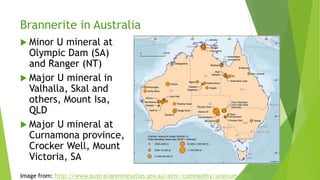
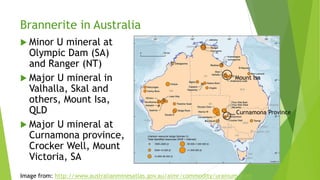
Brannerite in Australia
 Minor U mineral at
Olympic Dam (SA)
and Ranger (NT)
 Major U mineral in
Valhalla, Skal and
others, Mount Isa,
QLD
 Major U mineral at
Curnamona province,
Crocker Well, Mount
Victoria, SA
Image from: http://www.australianminesatlas.gov.au/aimr/commodity/uranium.html
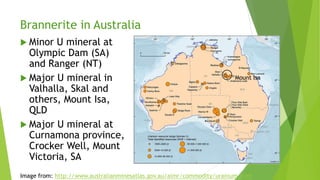
Brannerite in Australia
 Minor U mineral at
Olympic Dam (SA)
and Ranger (NT)
 Major U mineral in
Valhalla, Skal and
others, Mount Isa,
QLD
 Major U mineral at
Curnamona province,
Crocker Well, Mount
Victoria, SA
Image from: http://www.australianminesatlas.gov.au/aimr/commodity/uranium.html
Mount Isa
Brannerite in Australia
 Minor U mineral at
Olympic Dam (SA)
and Ranger (NT)
 Major U mineral in
Valhalla, Skal and
others, Mount Isa,
QLD
 Major U mineral at
Curnamona province,
Crocker Well, Mount
Victoria, SA
Image from: http://www.australianminesatlas.gov.au/aimr/commodity/uranium.html
Mount Isa
Curnamona Province
Leaching experiments
 Brannerite leached in ferric sulphate and
sulphuric acid
 2.8 g/L Fe3+
 10-200 g/L H2SO4
 25-96°C (four intermediate values)
 Uranium and titanium dissolution monitored
 Solids characterised by XRD, SEM and EDX
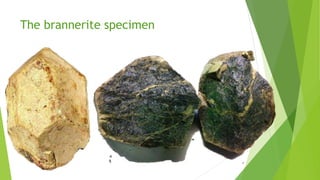
The brannerite specimen
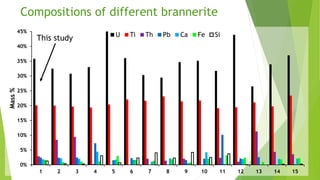
Compositions of different brannerite
0%
5%
10%
15%
20%
25%
30%
35%
40%
45%
1 2 3 4 5 6 7 8 9 10 11 12 13 14 15
Mass%
U Ti Th Pb Ca Fe Si
This study
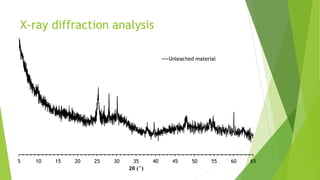
X-ray diffraction analysis
5 10 15 20 25 30 35 40 45 50 55 60 65
2θ (°)
Unleached material
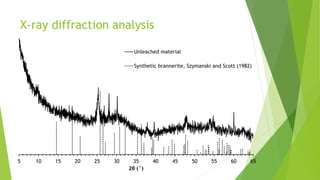
X-ray diffraction analysis
5 10 15 20 25 30 35 40 45 50 55 60 65
2θ (°)
Unleached material
Synthetic brannerite, Szymanski and Scott (1982)
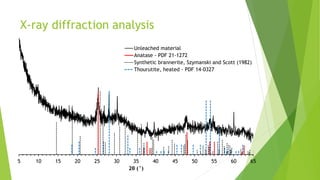
X-ray diffraction analysis
5 10 15 20 25 30 35 40 45 50 55 60 65
2θ (°)
Unleached material
Anatase - PDF 21-1272
Synthetic brannerite, Szymanski and Scott (1982)
Thourutite, heated - PDF 14-0327
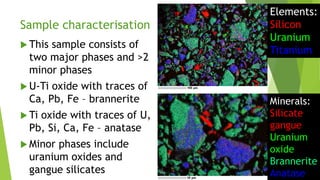
Sample characterisation
 This sample consists of
two major phases and >2
minor phases
 U-Ti oxide with traces of
Ca, Pb, Fe – brannerite
 Ti oxide with traces of U,
Pb, Si, Ca, Fe – anatase
 Minor phases include
uranium oxides and
gangue silicates
Elements:
Silicon
Uranium
Titanium
Minerals:
Silicate
gangue
Uranium
oxide
Brannerite
Anatase
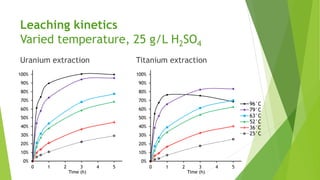
Leaching kinetics
Varied temperature, 25 g/L H2SO4
Uranium extraction Titanium extraction
0%
10%
20%
30%
40%
50%
60%
70%
80%
90%
100%
0 1 2 3 4 5
Time (h)
0%
10%
20%
30%
40%
50%
60%
70%
80%
90%
100%
0 1 2 3 4 5
Time (h)
96°C
79°C
63°C
52°C
36°C
25°C
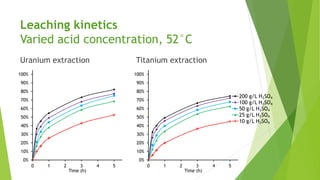
Leaching kinetics
Varied acid concentration, 52°C
Uranium extraction Titanium extraction
0%
10%
20%
30%
40%
50%
60%
70%
80%
90%
100%
0 1 2 3 4 5
Time (h)
0%
10%
20%
30%
40%
50%
60%
70%
80%
90%
100%
0 1 2 3 4 5
Time (h)
200 g/L H₂SO₄
100 g/L H₂SO₄
50 g/L H₂SO₄
25 g/L H₂SO₄
10 g/L H₂SO₄
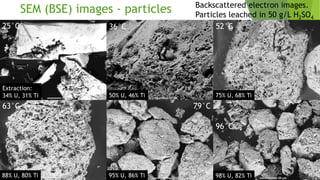
SEM (BSE) images - particles
25°C 36°C 52°C
63°C 79°C
96°C
Backscattered electron images.
Particles leached in 50 g/L H2SO4
Extraction:
34% U, 31% Ti 50% U, 46% Ti 75% U, 68% Ti
88% U, 80% Ti 95% U, 86% Ti 98% U, 82% Ti
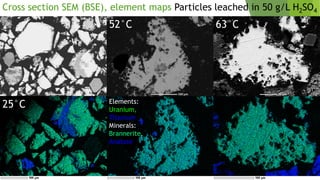
Cross section SEM (BSE), element maps Particles leached in 50 g/L H2SO4
Elements:
Uranium,
Titanium
Minerals:
Brannerite,
Anatase
52°C 63°C
25°C
Reaction mechanism
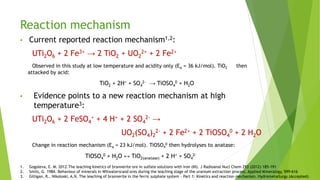
• Current reported reaction mechanism1,2:
UTi2O6 + 2 Fe3+ → 2 TiO2 + UO2
2+ + 2 Fe2+
Observed in this study at low temperature and acidity only (Ea = 36 kJ/mol). TiO2 then
attacked by acid:
TiO2 + 2H+ + SO4
2- → TiOSO4
0 + H2O
• Evidence points to a new reaction mechanism at high
temperature3:
UTi2O6 + 2 FeSO4
+ + 4 H+ + 2 SO4
2- →
UO2(SO4)2
2- + 2 Fe2+ + 2 TiOSO4
0 + 2 H2O
Change in reaction mechanism (Ea = 23 kJ/mol). TiOSO4
0 then hydrolyses to anatase:
TiOSO4
0 + H2O ↔ TiO2(anatase) + 2 H+ + SO4
2-
1. Gogoleva, E. M. 2012.The leaching kinetics of brannerite ore in sulfate solutions with iron (III). J Radioanal Nucl Chem 293 (2012) 185-191
2. Smits, G. 1984. Behaviour of minerals in Witwatersrand ores during the leaching stage of the uranium extraction process. Applied Mineralogy, 599-616
3. Gilligan, R., Nikoloski, A.N. The leaching of brannerite in the ferric sulphate system - Part 1: Kinetics and reaction mechanism. Hydrometallurgy (Accepted)
Conclusions
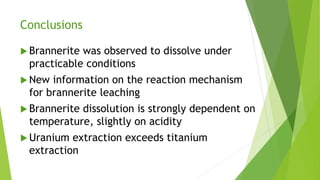
 Brannerite was observed to dissolve under
practicable conditions
 New information on the reaction mechanism
for brannerite leaching
 Brannerite dissolution is strongly dependent on
temperature, slightly on acidity
 Uranium extraction exceeds titanium
extraction
Further reading
dx.doi.org/10.1016/j.mineng.2014.10.007
Further reading
doi:10.1016/j.hydromet.2015.05.016
Questions?
Email us
r.gilligan@murdoch.edu.au
a.nikoloski@murdoch.edu.au
a.deditius@murdoch.edu.au

2015-06-05 AusIMM U conference presentation Final

  • 1.
    Mineralogical and chemical aspectsof brannerite leaching Rorie Gilligan, Aleksandar N. Nikoloski, Artur P. Deditius AusIMM International Uranium Conference, Adelaide, 9-10 June 2015
  • 2.
    Introduction  Brannerite, UTi2O6is a multiple oxide of uranium and titanium  Has a general formula of (U,Th,REE,Ca)(Ti,Fe3+)2O6  Thorium and light rare earth elements substitute uranium  Associated with titanium minerals  Requires aggressive conditions to leach  Important U mineral in uranium/REE deposits
  • 3.
    Brannerite in Australia Minor U mineral at Olympic Dam (SA) and Ranger (NT)  Major U mineral in Valhalla, Skal and others, Mount Isa, QLD  Major U mineral at Curnamona province, Crocker Well, Mount Victoria, SA Image from: http://www.australianminesatlas.gov.au/aimr/commodity/uranium.html
  • 4.
    Brannerite in Australia Minor U mineral at Olympic Dam (SA) and Ranger (NT)  Major U mineral in Valhalla, Skal and others, Mount Isa, QLD  Major U mineral at Curnamona province, Crocker Well, Mount Victoria, SA Image from: http://www.australianminesatlas.gov.au/aimr/commodity/uranium.html Mount Isa
  • 5.
    Brannerite in Australia Minor U mineral at Olympic Dam (SA) and Ranger (NT)  Major U mineral in Valhalla, Skal and others, Mount Isa, QLD  Major U mineral at Curnamona province, Crocker Well, Mount Victoria, SA Image from: http://www.australianminesatlas.gov.au/aimr/commodity/uranium.html Mount Isa Curnamona Province
  • 6.
    Leaching experiments  Branneriteleached in ferric sulphate and sulphuric acid  2.8 g/L Fe3+  10-200 g/L H2SO4  25-96°C (four intermediate values)  Uranium and titanium dissolution monitored  Solids characterised by XRD, SEM and EDX
  • 7.
  • 8.
    Compositions of differentbrannerite 0% 5% 10% 15% 20% 25% 30% 35% 40% 45% 1 2 3 4 5 6 7 8 9 10 11 12 13 14 15 Mass% U Ti Th Pb Ca Fe Si This study
  • 9.
    X-ray diffraction analysis 510 15 20 25 30 35 40 45 50 55 60 65 2θ (°) Unleached material
  • 10.
    X-ray diffraction analysis 510 15 20 25 30 35 40 45 50 55 60 65 2θ (°) Unleached material Synthetic brannerite, Szymanski and Scott (1982)
  • 11.
    X-ray diffraction analysis 510 15 20 25 30 35 40 45 50 55 60 65 2θ (°) Unleached material Anatase - PDF 21-1272 Synthetic brannerite, Szymanski and Scott (1982) Thourutite, heated - PDF 14-0327
  • 12.
    Sample characterisation  Thissample consists of two major phases and >2 minor phases  U-Ti oxide with traces of Ca, Pb, Fe – brannerite  Ti oxide with traces of U, Pb, Si, Ca, Fe – anatase  Minor phases include uranium oxides and gangue silicates Elements: Silicon Uranium Titanium Minerals: Silicate gangue Uranium oxide Brannerite Anatase
  • 13.
    Leaching kinetics Varied temperature,25 g/L H2SO4 Uranium extraction Titanium extraction 0% 10% 20% 30% 40% 50% 60% 70% 80% 90% 100% 0 1 2 3 4 5 Time (h) 0% 10% 20% 30% 40% 50% 60% 70% 80% 90% 100% 0 1 2 3 4 5 Time (h) 96°C 79°C 63°C 52°C 36°C 25°C
  • 14.
    Leaching kinetics Varied acidconcentration, 52°C Uranium extraction Titanium extraction 0% 10% 20% 30% 40% 50% 60% 70% 80% 90% 100% 0 1 2 3 4 5 Time (h) 0% 10% 20% 30% 40% 50% 60% 70% 80% 90% 100% 0 1 2 3 4 5 Time (h) 200 g/L H₂SO₄ 100 g/L H₂SO₄ 50 g/L H₂SO₄ 25 g/L H₂SO₄ 10 g/L H₂SO₄
  • 15.
    SEM (BSE) images- particles 25°C 36°C 52°C 63°C 79°C 96°C Backscattered electron images. Particles leached in 50 g/L H2SO4 Extraction: 34% U, 31% Ti 50% U, 46% Ti 75% U, 68% Ti 88% U, 80% Ti 95% U, 86% Ti 98% U, 82% Ti
  • 16.
    Cross section SEM(BSE), element maps Particles leached in 50 g/L H2SO4 Elements: Uranium, Titanium Minerals: Brannerite, Anatase 52°C 63°C 25°C
  • 17.
    Reaction mechanism • Currentreported reaction mechanism1,2: UTi2O6 + 2 Fe3+ → 2 TiO2 + UO2 2+ + 2 Fe2+ Observed in this study at low temperature and acidity only (Ea = 36 kJ/mol). TiO2 then attacked by acid: TiO2 + 2H+ + SO4 2- → TiOSO4 0 + H2O • Evidence points to a new reaction mechanism at high temperature3: UTi2O6 + 2 FeSO4 + + 4 H+ + 2 SO4 2- → UO2(SO4)2 2- + 2 Fe2+ + 2 TiOSO4 0 + 2 H2O Change in reaction mechanism (Ea = 23 kJ/mol). TiOSO4 0 then hydrolyses to anatase: TiOSO4 0 + H2O ↔ TiO2(anatase) + 2 H+ + SO4 2- 1. Gogoleva, E. M. 2012.The leaching kinetics of brannerite ore in sulfate solutions with iron (III). J Radioanal Nucl Chem 293 (2012) 185-191 2. Smits, G. 1984. Behaviour of minerals in Witwatersrand ores during the leaching stage of the uranium extraction process. Applied Mineralogy, 599-616 3. Gilligan, R., Nikoloski, A.N. The leaching of brannerite in the ferric sulphate system - Part 1: Kinetics and reaction mechanism. Hydrometallurgy (Accepted)
  • 18.
    Conclusions  Brannerite wasobserved to dissolve under practicable conditions  New information on the reaction mechanism for brannerite leaching  Brannerite dissolution is strongly dependent on temperature, slightly on acidity  Uranium extraction exceeds titanium extraction
  • 19.
  • 20.
  • 21.