Journalism
Agenda & Targets
Spring 2015
Slide
1
Class 1
Jan. 29, 2015
Agenda Targets
Class 1 • Jan. 29
• Stratt out ill (sorry folks)
• Intro The Compass Editors
– Mick & Emily
• What you need for class
• Newseum video
– “What’s News?”
– http://www.newseumdigitalclassroom.org/digital-
classroom/video/what-is-news/default.aspx
– Fill out
• Learn what to bring to class.
• Explore what news is.
• Understand why news is often
called the first draft of history.
• Learn how news is reported
and accessed.
• Develop better understanding
for how news is categorized.
Slide
3
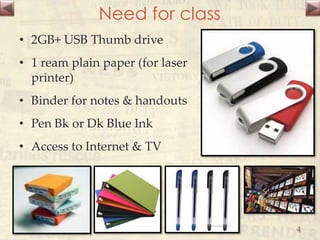
Need for class
• 2GB+ USB Thumb drive
• 1 ream plain paper (for laser
printer)
• Binder for notes & handouts
• Pen Bk or Dk Blue Ink
• Access to Internet & TV
4
What’s News Essential Questions
• What is news?
• How do we get news?
• What types of stories do we find in the news?
• How does the news affect our lives?
• What is the role of the press in our society?
• What is our role as news consumers?
Slide
5
What’s News Pre-video discussion
Questions
1. What is news?
2. What stories are in the news today?
Video features
– Historically key events & people
– Once considered “news”
– Uses primary sources
– All of the images and clips actual news
While you watch, look for the events and
people that you recognize from your lifetime.
Slide
6
What’s News Pre-video discussion
Video features
– Historically key events & people
– Once considered “news”
– Uses primary sources
– All of the images and clips actual news
While you watch, look for the events and
people that you recognize from your lifetime.
Slide
7
What’s News Pre-video discussion
As you watch the video, keep these questions
in mind:
1.What are some categories of events that can
be considered news?
2.What makes a story newsworthy?
3.While you are watching the movie, identify
four to five stories or people that you
recognize.
4.Why do you think these stories are considered
news?
5.What are some of the different ways in which
news can be delivered? Slide
8
What’s News Pre-video discussion
As you watch the video, listen for these quotations and
consider their importance:
• Philip Graham: “Journalism is the first rough draft of
history.” Note: this is my favorite journalism quote
• Winston Churchill: “A free press is the unsleeping
guardian of every other right that free men prize; it is the
most dangerous foe of tyranny.”
• Malcolm X: “You can’t separate peace from freedom
because no one can be at peace unless he has his freedom.”
• John F. Kennedy: “Even though we disapprove, there isn’t
any doubt. …We could not do the job at all without a very,
very active press.”
• Thomas Jefferson: “Our liberty depends on freedom of the
press and that cannot be limited without being lost.”
Slide
9
Watch Video
• Newseum’s “What’s News” (8:11)
• Link: http://www.newseumdigitalclassroom.org/digital-
classroom/video/what-is-news/default.aspx
• Get and answers the “After Viewing” questions.
Slide
10
What’s News Post Viewing Discussion
1. Are there events from this video that you
recognize? Are there events in this video that
you lived through?
2. How does the fact that they occurred during
your lifetime change the way you remember or
feel about these stories versus the historical
events depicted?
3. Many of the key events in this video were
represented by images.
a.Discuss how photographs and other images are used
in reporting the news.
b.How do they make a different impression than the
written word? Slide
11
What’s News Post Viewing Discussion
1. Think about all the different ways the key events were
presented in this video — news headlines, photographs,
video clips, sound bytes from speeches and news
broadcasts.
a. How has news changed over time?
b. Has the way we report the news affected what news is covered?
c. What is your favorite way to get the news, and why?
d.What do you think this says about you as a news consumer?
2. There were many types of news media that were seen in
this video. In recent years, we have seen new types of
media emerge that were not featured in this video.
a. What are those types of media?
b. How have they changed the face of the news and how it is
reported
c. Where do you get news?
d.What about your parents?
e. Where do you think you will get news in the future? Slide
12
Class 2
Feb. 2, 2015
Slide
13
Agenda Targets
Class 2 • Feb. 2, 2015
• Who am I
• Seating Chart
• Name Cards
– First name big
– Second name small
– Be creative!
• What is journalism
• Ice Breaker Interviews if
time
• Meet teacher
• Meet other students
• Find out about class
• Develop interviewing
techniques by talking to
new people.
Slide
14
Class 3
Feb. 4, 2015
Slide
15
Opener • Image A
Image B
Class ♯3 • 2/4/15
Take out a piece of paper and answer the
following questions.
1. What is often referred to as
a “rough draft of history?”
2. Give 3 examples of what
makes something
newsworthy to you.
3. What is a name of a local
newspaper?
4. Name two current event
(news) items.
Slide
16
Opener • Image A
Image B
Class ♯3 • 2/4/15
Take out a piece of paper and answer the
following questions.
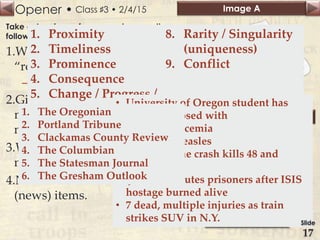
1.What is often referred to as a
“rough draft of history?”
– News
2.Give 3 examples of what
makes something
newsworthy to you.
3.What is a name of a local
newspaper?
4.Name two current event
(news) items.
1. Proximity
2. Timeliness
3. Prominence
4. Consequence
5. Change / Progress /
Action
6. Concreteness
7. Personality /
Human Interest
8. Rarity / Singularity
(uniqueness)
9. Conflict
• University of Oregon student has
been diagnosed with
meningococcemia
• Vaccines, measles
• Taiwan plane crash kills 48 and
injures 10
• Jordan executes prisoners after ISIS
hostage burned alive
• 7 dead, multiple injuries as train
strikes SUV in N.Y.
1. The Oregonian
2. Portland Tribune
3. Clackamas County Review
4. The Columbian
5. The Statesman Journal
6. The Gresham Outlook
Slide
17
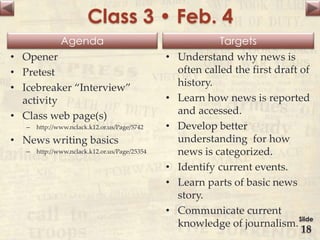
Agenda Targets
Class 3 • Feb. 4
• Opener
• Pretest
• Icebreaker “Interview”
activity
• Class web page(s)
– http://www.nclack.k12.or.us/Page/5742
• News writing basics
– http://www.nclack.k12.or.us/Page/25354
• Understand why news is
often called the first draft of
history.
• Learn how news is reported
and accessed.
• Develop better
understanding for how
news is categorized.
• Identify current events.
• Learn parts of basic news
story.
• Communicate current
knowledge of journalism.
Slide
18
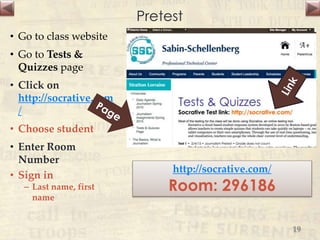
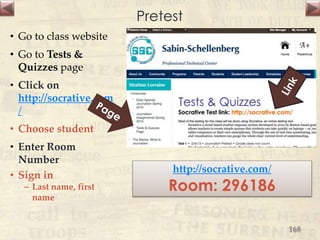
Pretest
• Go to class website
• Go to Tests &
Quizzes page
• Click on
http://socrative.com
/
• Choose student
• Enter Room
Number
• Sign in
– Last name, first
name
http://socrative.com/
Room: 296186
19
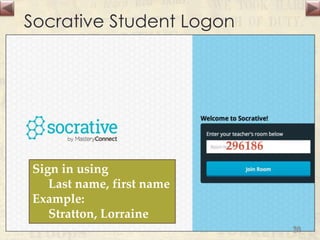
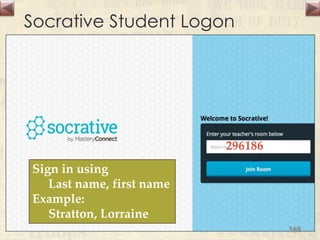
Socrative Student Logon
296186
Sign in using
Last name, first name
Example:
Stratton, Lorraine
20
Journalism Basics
• http://www.nclack.k12.or.us/Page/25354
1. Principles of Journalism
2. Basic reporting, news writing, journalistic style
A reporter's job
I. Interviews
II. Writing
A. Write in third person
B. Write without bias
C. The Story
1) Shape
2) Components & Order
3. Code of Ethics
21
Class 4
Feb. 6, 2015
Slide
22
Opener • Image A
Image B
Class ♯3 • 2/4/15
Take out a piece of paper and answer the
following questions.
1. Name two local news
outlets other than The
Oregonian.
2. What type of journalism
story interests you the
most?
3. Name two current event
items.
Slide
23
Agenda Targets
Class 4 • Feb. 6
• Opener
• Seating Chart
• Discuss
– News outlets
– Newsworthiness
• Class web page(s)
– http://www.nclack.k12.or.us/Page/5742
– Location, content
Homework
• News writing basics
– http://www.nclack.k12.or.us/Page/25354
– Finish reading
• Examining a News Story
• Understand why news is
often called the first draft of
history.
• Learn how news is reported
and accessed.
• Develop better
understanding for how
news is categorized.
• Identify current events.
• Learn parts of basic news
story.
• Communicate current
knowledge of journalism.
Slide
24
25
Class 5
Feb. 10, 2015
Slide
26
Opener •
Slide
27
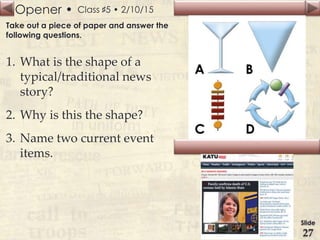
Class ♯5 • 2/10/15
Take out a piece of paper and answer the
following questions.
1. What is the shape of a
typical/traditional news
story?
2. Why is this the shape?
3. Name two current event
items.
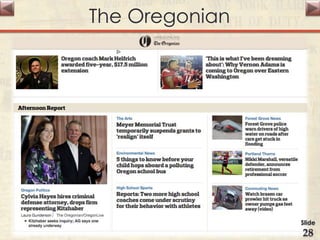
The Oregonian
Slide
28
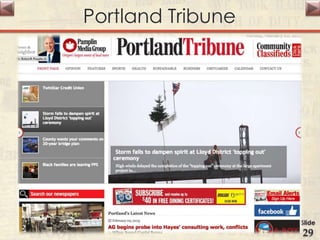
Portland Tribune
Slide
29
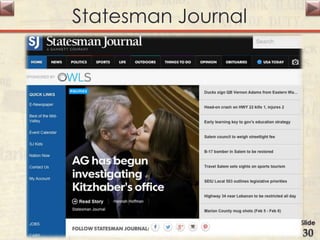
Statesman Journal
Slide
30
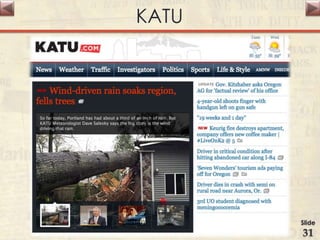
KATU
Slide
31
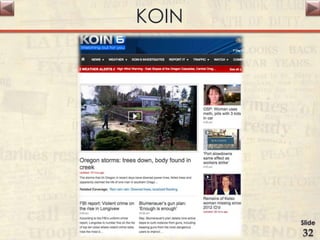
KOIN
Slide
32
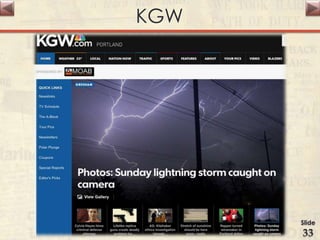
KGW
Slide
33
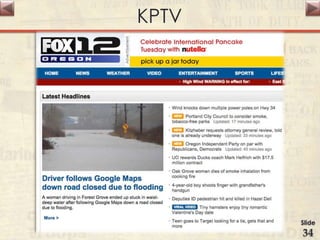
KPTV
Slide
34
Agenda Targets
Class 5 • Feb. 10
• Opener
• Pretest discussion
• Icebreaker “Interview”
activity
• News writing basics
– http://www.nclack.k12.or.us/Page/25
354
– Go over “Examining a
News Story”
• Understand why news is
often called the first draft of
history.
• Learn how news is reported
and accessed.
• Develop better
understanding for how
news is categorized.
• Identify current events.
• Learn parts of basic news
story.
• Communicate current
knowledge of journalism.
Slide
35
Class 6
Feb. 12, 2015
Slide
36
Opener •
Slide
37
Class ♯6 • 2/12/15
Take out a piece of paper and answer the
following questions.
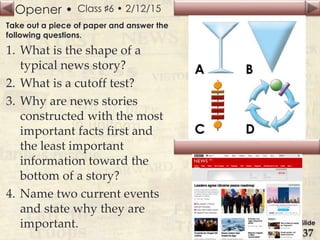
1. What is the shape of a
typical news story?
2. What is a cutoff test?
3. Why are news stories
constructed with the most
important facts first and
the least important
information toward the
bottom of a story?
4. Name two current events
and state why they are
important.
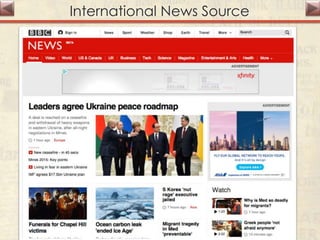
International News Source
Agenda Targets
Class 6 • Feb. 12
• Opener
– Composition book
• News writing basics
– http://www.nclack.k12.or.us/Page/25
354
• See next slide
• Understand why news is
often called the first draft of
history.
• Learn how news is reported
and accessed.
• Develop better
understanding for how
news is categorized.
• Identify current events.
• Learn parts of basic news
story.
• Communicate current
knowledge of journalism.
Slide
39
Journalism Basics
“Examining a News Story” Assignment
• Ledes
– Length (<30 words)
– What are they; who,
what
• Nut Graf
– Length (<50-75 words)
– What are they; 5W’s+H
not in lede
• Rest of 
– Length
• <75 words
• 100 words is a long ¶ in
journalism
• Journalistic writing
short & concise
40
Class 7
Feb. 17, 2015
Slide
41
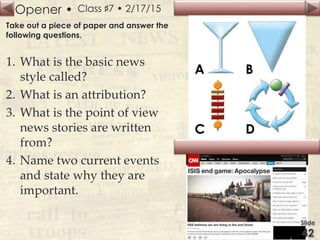
Opener • Class ♯7 • 2/17/15
Take out a piece of paper and answer the
following questions.
1. What is the basic news
style called?
2. What is an attribution?
3. What is the point of view
news stories are written
from?
4. Name two current events
and state why they are
important.
Agenda Targets
Class 7 • Feb. 17
• Opener
– Composition book for
openers
• News writing basics
– News Style
• Stylebook
– AP
– Ours
• Codes
• Attribution
• Understand why news is
often called the first draft of
history.
• Learn how news is reported
and accessed.
• Develop better
understanding for how
news is categorized.
• Identify current events.
• Learn parts of basic news
story.
• Communicate current
knowledge of journalism.
Slide
43
Journalism Basics
“Examining a News Story” Assignment
• Ledes
– Length (<30 words)
– What are they; who,
what
• Nut Graf
– Length (<50-75 words)
– What are they; 5W’s+H
not in lede
• Rest of 
– Length
• <75 words
• 100 words is a long ¶ in
journalism
• Journalistic writing
short & concise
44
Stylebooks
• Purpose: keep writing
consistent
• We use modified OJEA
Stylebook
• Codes
• Webpage
http://www.nclack.k12.or.us/Page/5755
• C10, C14, C24
• D1, D2, D4
• E10, E36
• F1, F2
• G1, G2, G3, G6
• Attribution Style
– “Quote,” First Last, Id, said.
45
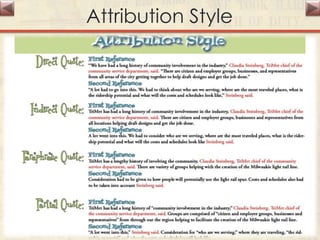
Attribution Style
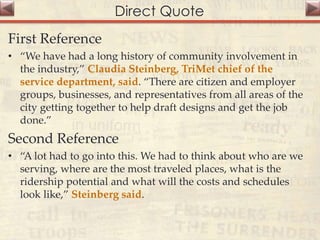
Direct Quote
First Reference
• “We have had a long history of community involvement in
the industry,” Claudia Steinberg, TriMet chief of the
service department, said. “There are citizen and employer
groups, businesses, and representatives from all areas of the
city getting together to help draft designs and get the job
done.”
Second Reference
• “A lot had to go into this. We had to think about who are we
serving, where are the most traveled places, what is the
ridership potential and what will the costs and schedules
look like,” Steinberg said.
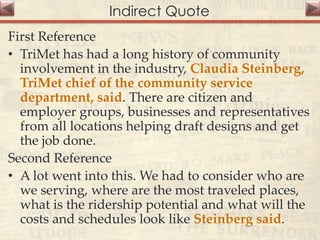
Indirect Quote
First Reference
• TriMet has had a long history of community
involvement in the industry, Claudia Steinberg,
TriMet chief of the community service
department, said. There are citizen and
employer groups, businesses and representatives
from all locations helping draft designs and get
the job done.
Second Reference
• A lot went into this. We had to consider who are
we serving, where are the most traveled places,
what is the ridership potential and what will the
costs and schedules look like Steinberg said.
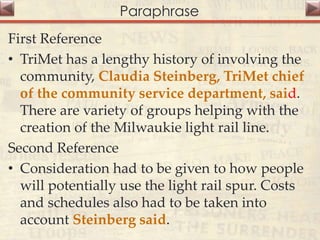
Paraphrase
First Reference
• TriMet has a lengthy history of involving the
community, Claudia Steinberg, TriMet chief
of the community service department, said.
There are variety of groups helping with the
creation of the Milwaukie light rail line.
Second Reference
• Consideration had to be given to how people
will potentially use the light rail spur. Costs
and schedules also had to be taken into
account Steinberg said.
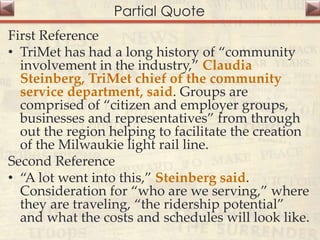
Partial Quote
First Reference
• TriMet has had a long history of “community
involvement in the industry,” Claudia
Steinberg, TriMet chief of the community
service department, said. Groups are
comprised of “citizen and employer groups,
businesses and representatives” from through
out the region helping to facilitate the creation
of the Milwaukie light rail line.
Second Reference
• “A lot went into this,” Steinberg said.
Consideration for “who are we serving,” where
they are traveling, “the ridership potential”
and what the costs and schedules will look like.
Class 8
Feb. 19, 2015
Slide
51
Opener • Class ♯8 • 2/19/15
Take out your composition book and
answer the following questions.
1. What is the purpose of a
stylebook?
2. What is an attribution?
3. Which word does a
journalists use when
giving attribution?
4. Which type of quote uses
the writer’s words & the
source’s words in
quotation marks?
5. Name two current events
and state why they are
important.
Agenda Targets
Class 8 • Feb. 19
• Opener
– Composition book for
openers
• News writing basics
– Ledes & Leads
• Short <30 words (35
is long)
• Contains
– Who & What
– May have other
5W’s
– $$$ usually
• Identify current events
• Understand importance of
ledes.
• Learn what is included in a
lede.
• Learn the steps in which
ledes are written.
• Begin to identify facts to
use in a lede.
Slide
53
Lede Rules
• Short paragraph, generally one sentence
• Less than 30 words (35 is too many)
• Should first verb should express the main "what" of the story
and should be placed among the lede's first seven words.
• The lede's first verb — the same one that expresses the main
"what" of the story — should be active voice, not passive
voice.
• If there's a "who" involved in the story, the lede should give
some indication of who the "who" is.
• The lede should summarize the "why" and "how" of the
story, but only if there's room.
• If what's in the lede needs to be attributed, place the
attribution at the end of the lede.
Slide
54
Writing a News Lede: Steps
1. Find the most important (key) thought
(fact).
2. Number the order of thoughts from most
important to least.
3. Include the what and who into the lede.
4. Include any significant amounts into
lede. Remember people want to know
about money.
5. Place the most important facts first while
writing.
55
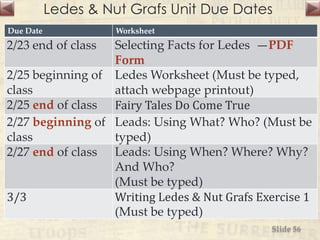
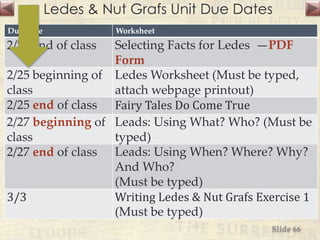
Ledes & Nut Grafs Unit Due Dates
Due Date Worksheet
2/23 end of class Selecting Facts for Ledes —PDF
Form
2/25 beginning of
class
Ledes Worksheet (Must be typed,
attach webpage printout)
2/25 end of class Fairy Tales Do Come True
2/27 beginning of
class
Leads: Using What? Who? (Must be
typed)
2/27 end of class Leads: Using When? Where? Why?
And Who?
(Must be typed)
3/3 Writing Ledes & Nut Grafs Exercise 1
(Must be typed)
Slide 56
Class 9
Feb. 23, 2015
Slide
57
Opener • Class ♯9 • 2/23/15
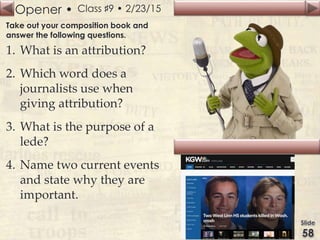
Take out your composition book and
answer the following questions.
1. What is an attribution?
2. Which word does a
journalists use when
giving attribution?
3. What is the purpose of a
lede?
4. Name two current events
and state why they are
important.
Agenda Targets
Class 9 • Feb. 23
• Opener
– Composition book for
openers
• Lede Writing
– Identifying key facts
for ledes
– Fairy Tales do Come
True Ledes
• Identify current events
• Understand importance of
ledes.
• Learn what is included in a
lede.
• Learn the steps in which
ledes are written.
• Identify facts and the order
in which to use them in a
lede.
• Learn how to use a PDF
form.
Slide
59
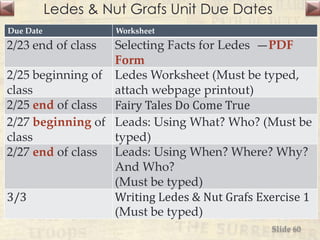
Ledes & Nut Grafs Unit Due Dates
Due Date Worksheet
2/23 end of class Selecting Facts for Ledes —PDF
Form
2/25 beginning of
class
Ledes Worksheet (Must be typed,
attach webpage printout)
2/25 end of class Fairy Tales Do Come True
2/27 beginning of
class
Leads: Using What? Who? (Must be
typed)
2/27 end of class Leads: Using When? Where? Why?
And Who?
(Must be typed)
3/3 Writing Ledes & Nut Grafs Exercise 1
(Must be typed)
Slide 60
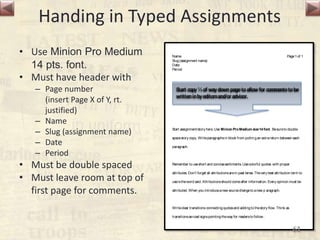
Handing in Typed Assignments
• Use Minion Pro Medium
14 pts. font.
• Must have header with
– Page number
(insert Page X of Y, rt.
justified)
– Name
– Slug (assignment name)
– Date
– Period
• Must be double spaced
• Must leave room at top of
first page for comments.
Name
Slug(assignment name)
Date
Period
Page1of 1
Start assignment/story here. Use Minion ProMedium size14 font. Besureto double
spacestory copy. Writeparagraphsin block from puttingan extrareturn between each
paragraph.
Remember to useshort and concisesentiments. Usecolorful quotes with proper
attributes. Don’t forget all attributionsarein past tense. Thevery best attribution term to
useistheword said. Attributionsshould comeafter information. Every opinion must be
attributed. When you introduceanew sourcechangeto anew p aragraph.
Writeclear transitions connectingquotesand addingto thestory flow. Think as
transitionsasroad signspointingtheway for readersto follow .
Start copy⅓of waydownpagetoallowfor commentstobe
writteninbyeditorsand/oradvisor.
61
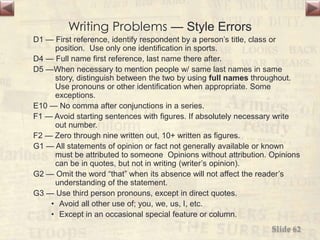
Writing Problems — Style Errors
D1 — First reference, identify respondent by a person’s title, class or
position. Use only one identification in sports.
D4 — Full name first reference, last name there after.
D5 —When necessary to mention people w/ same last names in same
story, distinguish between the two by using full names throughout.
Use pronouns or other identification when appropriate. Some
exceptions.
E10 — No comma after conjunctions in a series.
F1 — Avoid starting sentences with figures. If absolutely necessary write
out number.
F2 — Zero through nine written out, 10+ written as figures.
G1 — All statements of opinion or fact not generally available or known
must be attributed to someone Opinions without attribution. Opinions
can be in quotes, but not in writing (writer’s opinion).
G2 — Omit the word “that” when its absence will not affect the reader’s
understanding of the statement.
G3 — Use third person pronouns, except in direct quotes.
• Avoid all other use of; you, we, us, I, etc.
• Except in an occasional special feature or column.
Slide 62
Class 10
Feb. 25, 2015
Slide
63
Opener • Class ♯10 • 2/25/15
Take out your composition book and
answer the following questions.
1. Which of the 5Ws+H is
best to put in a lede?
2. What is the purpose of a
lede?
3. Name two current events
and state why they are
important.
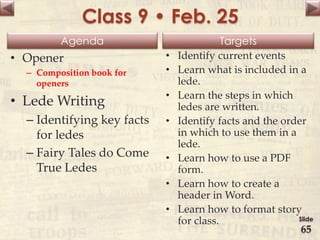
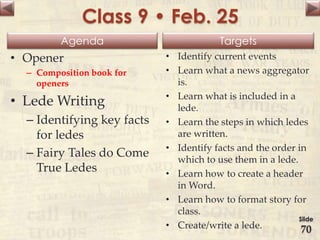
Agenda Targets
Class 9 • Feb. 25
• Opener
– Composition book for
openers
• Lede Writing
– Identifying key facts
for ledes
– Fairy Tales do Come
True Ledes
• Identify current events
• Learn what is included in a
lede.
• Learn the steps in which
ledes are written.
• Identify facts and the order
in which to use them in a
lede.
• Learn how to use a PDF
form.
• Learn how to create a
header in Word.
• Learn how to format story
for class. Slide
65
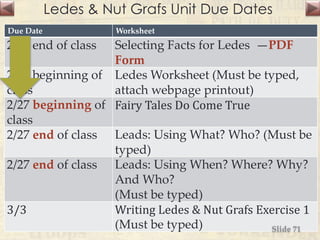
Ledes & Nut Grafs Unit Due Dates
Due Date Worksheet
2/23 end of class Selecting Facts for Ledes —PDF
Form
2/25 beginning of
class
Ledes Worksheet (Must be typed,
attach webpage printout)
2/25 end of class Fairy Tales Do Come True
2/27 beginning of
class
Leads: Using What? Who? (Must be
typed)
2/27 end of class Leads: Using When? Where? Why?
And Who?
(Must be typed)
3/3 Writing Ledes & Nut Grafs Exercise 1
(Must be typed)
Slide 66
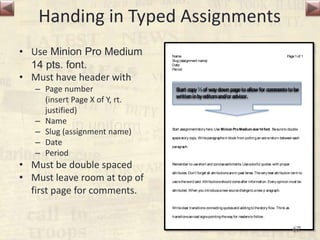
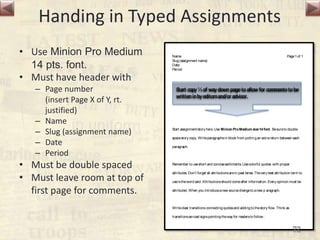
Handing in Typed Assignments
• Use Minion Pro Medium
14 pts. font.
• Must have header with
– Page number
(insert Page X of Y, rt.
justified)
– Name
– Slug (assignment name)
– Date
– Period
• Must be double spaced
• Must leave room at top of
first page for comments.
Name
Slug(assignment name)
Date
Period
Page1of 1
Start assignment/story here. Use Minion ProMedium size14 font. Besureto double
spacestory copy. Writeparagraphsin block from puttingan extrareturn between each
paragraph.
Remember to useshort and concisesentiments. Usecolorful quotes with proper
attributes. Don’t forget all attributionsarein past tense. Thevery best attribution term to
useistheword said. Attributionsshould comeafter information. Every opinion must be
attributed. When you introduceanew sourcechangeto anew p aragraph.
Writeclear transitions connectingquotesand addingto thestory flow. Think as
transitionsasroad signspointingtheway for readersto follow .
Start copy⅓of waydownpagetoallowfor commentstobe
writteninbyeditorsand/oradvisor.
67
Class 10
Feb. 25, 2015
Slide
68
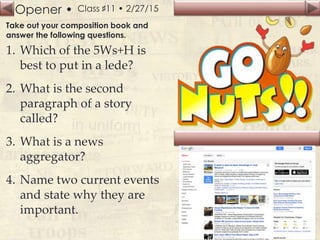
Opener • Class ♯11 • 2/27/15
Take out your composition book and
answer the following questions.
1. Which of the 5Ws+H is
best to put in a lede?
2. What is the second
paragraph of a story
called?
3. What is a news
aggregator?
4. Name two current events
and state why they are
important.
Agenda Targets
Class 9 • Feb. 25
• Opener
– Composition book for
openers
• Lede Writing
– Identifying key facts
for ledes
– Fairy Tales do Come
True Ledes
• Identify current events
• Learn what a news aggregator
is.
• Learn what is included in a
lede.
• Learn the steps in which ledes
are written.
• Identify facts and the order in
which to use them in a lede.
• Learn how to create a header
in Word.
• Learn how to format story for
class.
• Create/write a lede.
Slide
70
Ledes & Nut Grafs Unit Due Dates
Due Date Worksheet
2/23 end of class Selecting Facts for Ledes —PDF
Form
2/25 beginning of
class
Ledes Worksheet (Must be typed,
attach webpage printout)
2/27 beginning of
class
Fairy Tales Do Come True
2/27 end of class Leads: Using What? Who? (Must be
typed)
2/27 end of class Leads: Using When? Where? Why?
And Who?
(Must be typed)
3/3 Writing Ledes & Nut Grafs Exercise 1
(Must be typed) Slide 71
Handing in Typed Assignments
• Use Minion Pro Medium
14 pts. font.
• Must have header with
– Page number
(insert Page X of Y, rt.
justified)
– Name
– Slug (assignment name)
– Date
– Period
• Must be double spaced
• Must leave room at top of
first page for comments.
Name
Slug(assignment name)
Date
Period
Page1of 1
Start assignment/story here. Use Minion ProMedium size14 font. Besureto double
spacestory copy. Writeparagraphsin block from puttingan extrareturn between each
paragraph.
Remember to useshort and concisesentiments. Usecolorful quotes with proper
attributes. Don’t forget all attributionsarein past tense. Thevery best attribution term to
useistheword said. Attributionsshould comeafter information. Every opinion must be
attributed. When you introduceanew sourcechangeto anew p aragraph.
Writeclear transitions connectingquotesand addingto thestory flow. Think as
transitionsasroad signspointingtheway for readersto follow .
Start copy⅓of waydownpagetoallowfor commentstobe
writteninbyeditorsand/oradvisor.
72
Class 12
March 3, 2015
Slide
73
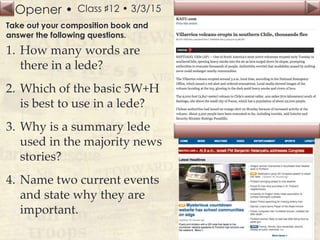
Opener • Class ♯12 • 3/3/15
Take out your composition book and
answer the following questions.
1. How many words are
there in a lede?
2. Which of the basic 5W+H
is best to use in a lede?
3. Why is a summary lede
used in the majority news
stories?
4. Name two current events
and state why they are
important.
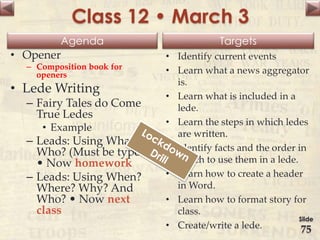
Agenda Targets
Class 12 • March 3
• Opener
– Composition book for
openers
• Lede Writing
– Fairy Tales do Come
True Ledes
• Example
– Leads: Using What?
Who? (Must be typed)
• Now homework
– Leads: Using When?
Where? Why? And
Who? • Now next
class
• Identify current events
• Learn what a news aggregator
is.
• Learn what is included in a
lede.
• Learn the steps in which ledes
are written.
• Identify facts and the order in
which to use them in a lede.
• Learn how to create a header
in Word.
• Learn how to format story for
class.
• Create/write a lede.
Slide
75
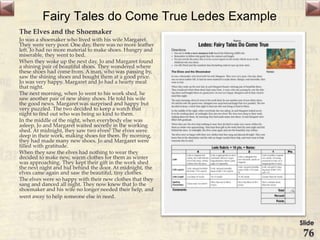
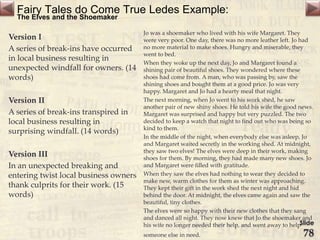
Fairy Tales do Come True Ledes Example
The Elves and the Shoemaker
Jo was a shoemaker who lived with his wife Margaret.
They were very poor. One day, there was no more leather
left. Jo had no more material to make shoes. Hungry and
miserable, they went to bed.
When they woke up the next day, Jo and Margaret found
a shining pair of beautiful shoes. They wondered where
these shoes had come from. A man, who was passing by,
saw the shining shoes and bought them at a good price.
Jo was very happy. Margaret and Jo had a hearty meal
that night.
The next morning, when Jo went to his work shed, he
saw another pair of new shiny shoes. He told his wife
the good news. Margaret was surprised and happy but
very puzzled. The two decided to keep a watch that
night to find out who was being so kind to them.
In the middle of the night, when everybody else was
asleep, Jo and Margaret waited secretly in the working
shed. At midnight, they saw two elves! The elves were
deep in their work, making shoes for them. By morning,
they had made many new shoes. Jo and Margaret were
filled with gratitude.
When they saw the elves had nothing to wear they
decided to make new, warm clothes for them as winter
was approaching. They kept their gift in the work shed
the next night and hid behind the door. At midnight, the
elves came again and saw the beautiful, tiny clothes.
The elves were so happy with their new clothes that they
sang and danced all night. They now knew that Jo the
shoemaker and his wife no longer needed their help, and
went away to help someone else in need.
Slide
76
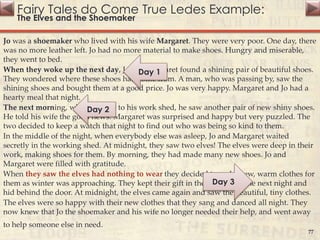
Fairy Tales do Come True Ledes Example:
The Elves and the Shoemaker
Jo was a shoemaker who lived with his wife Margaret. They were very poor. One day, there
was no more leather left. Jo had no more material to make shoes. Hungry and miserable,
they went to bed.
When they woke up the next day, Jo and Margaret found a shining pair of beautiful shoes.
They wondered where these shoes had come from. A man, who was passing by, saw the
shining shoes and bought them at a good price. Jo was very happy. Margaret and Jo had a
hearty meal that night.
The next morning, when Jo went to his work shed, he saw another pair of new shiny shoes.
He told his wife the good news. Margaret was surprised and happy but very puzzled. The
two decided to keep a watch that night to find out who was being so kind to them.
In the middle of the night, when everybody else was asleep, Jo and Margaret waited
secretly in the working shed. At midnight, they saw two elves! The elves were deep in their
work, making shoes for them. By morning, they had made many new shoes. Jo and
Margaret were filled with gratitude.
When they saw the elves had nothing to wear they decided to make new, warm clothes for
them as winter was approaching. They kept their gift in the work shed the next night and
hid behind the door. At midnight, the elves came again and saw the beautiful, tiny clothes.
The elves were so happy with their new clothes that they sang and danced all night. They
now knew that Jo the shoemaker and his wife no longer needed their help, and went away
to help someone else in need.
77
Day 1
Day 2
Day 3
Fairy Tales do Come True Ledes Example:
The Elves and the Shoemaker
Version I
A series of break-ins have occurred
in local business resulting in
unexpected windfall for owners. (14
words)
Version II
A series of break-ins transpired in
local business resulting in
surprising windfall. (14 words)
Version III
In an unexpected breaking and
entering twist local business owners
thank culprits for their work. (15
words)
Slide
78
Jo was a shoemaker who lived with his wife Margaret. They
were very poor. One day, there was no more leather left. Jo had
no more material to make shoes. Hungry and miserable, they
went to bed.
When they woke up the next day, Jo and Margaret found a
shining pair of beautiful shoes. They wondered where these
shoes had come from. A man, who was passing by, saw the
shining shoes and bought them at a good price. Jo was very
happy. Margaret and Jo had a hearty meal that night.
The next morning, when Jo went to his work shed, he saw
another pair of new shiny shoes. He told his wife the good news.
Margaret was surprised and happy but very puzzled. The two
decided to keep a watch that night to find out who was being so
kind to them.
In the middle of the night, when everybody else was asleep, Jo
and Margaret waited secretly in the working shed. At midnight,
they saw two elves! The elves were deep in their work, making
shoes for them. By morning, they had made many new shoes. Jo
and Margaret were filled with gratitude.
When they saw the elves had nothing to wear they decided to
make new, warm clothes for them as winter was approaching.
They kept their gift in the work shed the next night and hid
behind the door. At midnight, the elves came again and saw the
beautiful, tiny clothes.
The elves were so happy with their new clothes that they sang
and danced all night. They now knew that Jo the shoemaker and
his wife no longer needed their help, and went away to help
someone else in need.
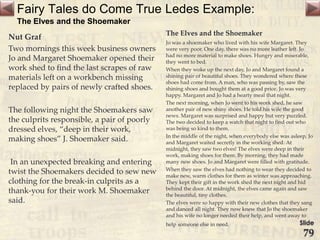
Fairy Tales do Come True Ledes Example:
The Elves and the Shoemaker
Nut Graf
Two mornings this week business owners
Jo and Margaret Shoemaker opened their
work shed to find the last scrapes of raw
materials left on a workbench missing
replaced by pairs of newly crafted shoes.
The following night the Shoemakers saw
the culprits responsible, a pair of poorly
dressed elves, “deep in their work,
making shoes” J. Shoemaker said.
In an unexpected breaking and entering
twist the Shoemakers decided to sew new
clothing for the break-in culprits as a
thank-you for their work M. Shoemaker
said.
Slide
79
The Elves and the Shoemaker
Jo was a shoemaker who lived with his wife Margaret. They
were very poor. One day, there was no more leather left. Jo
had no more material to make shoes. Hungry and miserable,
they went to bed.
When they woke up the next day, Jo and Margaret found a
shining pair of beautiful shoes. They wondered where these
shoes had come from. A man, who was passing by, saw the
shining shoes and bought them at a good price. Jo was very
happy. Margaret and Jo had a hearty meal that night.
The next morning, when Jo went to his work shed, he saw
another pair of new shiny shoes. He told his wife the good
news. Margaret was surprised and happy but very puzzled.
The two decided to keep a watch that night to find out who
was being so kind to them.
In the middle of the night, when everybody else was asleep, Jo
and Margaret waited secretly in the working shed. At
midnight, they saw two elves! The elves were deep in their
work, making shoes for them. By morning, they had made
many new shoes. Jo and Margaret were filled with gratitude.
When they saw the elves had nothing to wear they decided to
make new, warm clothes for them as winter was approaching.
They kept their gift in the work shed the next night and hid
behind the door. At midnight, the elves came again and saw
the beautiful, tiny clothes.
The elves were so happy with their new clothes that they sang
and danced all night. They now knew that Jo the shoemaker
and his wife no longer needed their help, and went away to
help someone else in need.
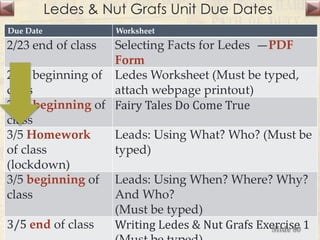
Ledes & Nut Grafs Unit Due Dates
Due Date Worksheet
2/23 end of class Selecting Facts for Ledes —PDF
Form
2/25 beginning of
class
Ledes Worksheet (Must be typed,
attach webpage printout)
2/27 beginning of
class
Fairy Tales Do Come True
3/5 Homework
of class
(lockdown)
Leads: Using What? Who? (Must be
typed)
3/5 beginning of
class
Leads: Using When? Where? Why?
And Who?
(Must be typed)
3/5 end of class Writing Ledes & Nut Grafs Exercise 1Slide 80
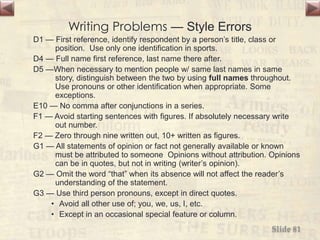
Writing Problems — Style Errors
D1 — First reference, identify respondent by a person’s title, class or
position. Use only one identification in sports.
D4 — Full name first reference, last name there after.
D5 —When necessary to mention people w/ same last names in same
story, distinguish between the two by using full names throughout.
Use pronouns or other identification when appropriate. Some
exceptions.
E10 — No comma after conjunctions in a series.
F1 — Avoid starting sentences with figures. If absolutely necessary write
out number.
F2 — Zero through nine written out, 10+ written as figures.
G1 — All statements of opinion or fact not generally available or known
must be attributed to someone Opinions without attribution. Opinions
can be in quotes, but not in writing (writer’s opinion).
G2 — Omit the word “that” when its absence will not affect the reader’s
understanding of the statement.
G3 — Use third person pronouns, except in direct quotes.
• Avoid all other use of; you, we, us, I, etc.
• Except in an occasional special feature or column.
Slide 81
Class 13
March 5, 2015
Slide
82
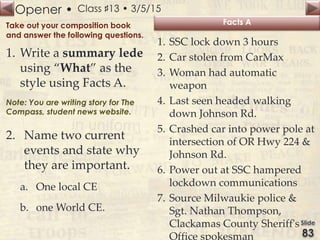
Opener • Class ♯13 • 3/5/15
Take out your composition book
and answer the following questions.
1. Write a summary lede
using “What” as the
style using Facts A.
Note: You are writing story for The
Compass, student news website.
2. Name two current
events and state why
they are important.
a. One local CE
b. one World CE.
Facts A
1. SSC lock down 3 hours
2. Car stolen from CarMax
3. Woman had automatic
weapon
4. Last seen headed walking
down Johnson Rd.
5. Crashed car into power pole at
intersection of OR Hwy 224 &
Johnson Rd.
6. Power out at SSC hampered
lockdown communications
7. Source Milwaukie police &
Sgt. Nathan Thompson,
Clackamas County Sheriff's
Office spokesman
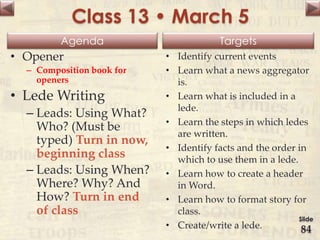
Agenda Targets
Class 13 • March 5
• Opener
– Composition book for
openers
• Lede Writing
– Leads: Using What?
Who? (Must be
typed) Turn in now,
beginning class
– Leads: Using When?
Where? Why? And
How? Turn in end
of class
• Identify current events
• Learn what a news aggregator
is.
• Learn what is included in a
lede.
• Learn the steps in which ledes
are written.
• Identify facts and the order in
which to use them in a lede.
• Learn how to create a header
in Word.
• Learn how to format story for
class.
• Create/write a lede.
Slide
84
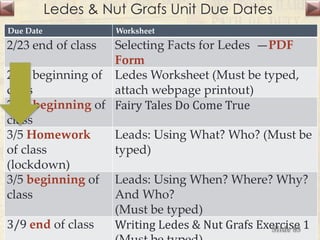
Ledes & Nut Grafs Unit Due Dates
Due Date Worksheet
2/23 end of class Selecting Facts for Ledes —PDF
Form
2/25 beginning of
class
Ledes Worksheet (Must be typed,
attach webpage printout)
2/27 beginning of
class
Fairy Tales Do Come True
3/5 Homework
of class
(lockdown)
Leads: Using What? Who? (Must be
typed)
3/5 beginning of
class
Leads: Using When? Where? Why?
And Who?
(Must be typed)
3/9 end of class Writing Ledes & Nut Grafs Exercise 1Slide 85
Class 14
March 9, 2015
Slide
86
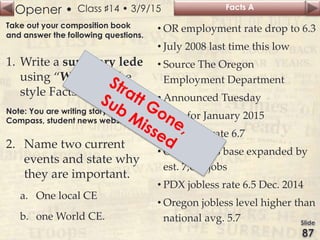
Opener • Class ♯14 • 3/9/15
Take out your composition book
and answer the following questions.
1. Write a summary lede
using “What” as the
style Facts A.
Note: You are writing story for The
Compass, student news website.
2. Name two current
events and state why
they are important.
a. One local CE
b. one World CE.
Facts A
• OR employment rate drop to 6.3
• July 2008 last time this low
• Source The Oregon
Employment Department
• Announced Tuesday
• Rate for January 2015
• Dec. 2014 rate 6.7
• Oregon jobs base expanded by
est. 7,600 jobs
• PDX jobless rate 6.5 Dec. 2014
• Oregon jobless level higher than
national avg. 5.7
Agenda Targets
Class 14 • March 9
• Opener
– Composition book for
openers
• Nut Graf Writing
– Writing Ledes & Nut
Grafs Exercise 1
(Must be typed)
• Identify current events
• Learn differences between
ledes & nut grafs.
• Identify facts and the order
in which to use them in a
lede & nut graf.
• Create/write a lede & nut
graf.
Slide
88
What Nut Grafs Do
• The nut graf tells the reader what the
writer is up to.
• It delivers a promise of the story’s content
and message.
• It’s called the nut graf because, like a nut,
it contains the “kernel,” or essential
theme, of the story.
— Chip Scanian, Poynter.org
—Leigh Ann Otte
Slide
89
What Nut Grafs Are
• It's the paragraph telling what the
story’s about, so people know why
to keep reading—and whether
they want to. It’s usually the
second paragraph.
• It can, however, be combined with
the lede, come a bit later or be
longer.
—Leigh Ann Otte
Slide
90
Nut Graf
• The nut graf is where the story’s angle is
developed.
• Every story is described from some kind of
view point.
• This viewpoint is called the angle.
Slide
91
Nut Graf Purposes
• The nut graf has several purposes:
• It justifies the story by telling readers why
they should care.
• It provides a transition from the lead and
explains the lead and its connection to the
rest of the story.
• It often tells readers why the story is timely.
• It often includes supporting material that
helps readers see why the story is
important.
—Poynter
Slide
92
Class 15
March 11, 2015
Slide
93
Opener • Class ♯15 • 3/11/15
Take out your composition book
and answer the following questions.
1. Write a summary lede
using “Who” as the
style for Facts A.
Note: You are writing story for The
Compass, student news website.
2. Name two current
events and state why
they are important.
a. One local CE
b. one World CE.
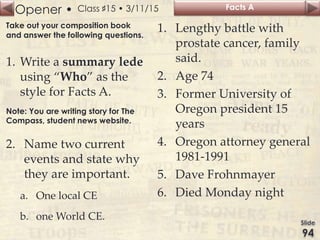
Facts A
1. Lengthy battle with
prostate cancer, family
said.
2. Age 74
3. Former University of
Oregon president 15
years
4. Oregon attorney general
1981-1991
5. Dave Frohnmayer
6. Died Monday night
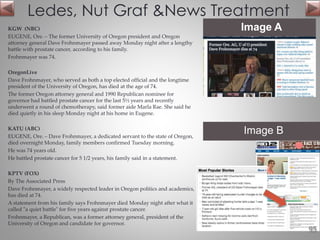
KGW (NBC)
EUGENE, Ore. – The former University of Oregon president and Oregon
attorney general Dave Frohnmayer passed away Monday night after a lengthy
battle with prostate cancer, according to his family.
Frohnmayer was 74.
OregonLive
Dave Frohnmayer, who served as both a top elected official and the longtime
president of the University of Oregon, has died at the age of 74.
The former Oregon attorney general and 1990 Republican nominee for
governor had battled prostate cancer for the last 5½ years and recently
underwent a round of chemotherapy, said former aide Marla Rae. She said he
died quietly in his sleep Monday night at his home in Eugene.
KATU (ABC)
EUGENE, Ore. – Dave Frohnmayer, a dedicated servant to the state of Oregon,
died overnight Monday, family members confirmed Tuesday morning.
He was 74 years old.
He battled prostate cancer for 5 1/2 years, his family said in a statement.
KPTV (FOX)
By The Associated Press
Dave Frohnmayer, a widely respected leader in Oregon politics and academics,
has died at 74.
A statement from his family says Frohnmayer died Monday night after what it
called "a quiet battle" for five years against prostate cancer.
Frohnmayer, a Republican, was a former attorney general, president of the
University of Oregon and candidate for governor.
Ledes, Nut Graf &News Treatment
Image A
95
Image B
Agenda Targets
Class 15 • March 11
• Opener
– Composition book for
openers
• Nut Graf Writing
– Collect Writing Ledes
& Nut Grafs Exercise
1
– Writing Ledes & Nut
Grafs Exercise 2
(Must be typed)
– Due next class
• Grades & rewrites
• Identify current events
• Learn differences between
ledes & nut grafs.
• Identify facts and the order
in which to use them in a
lede & nut graf.
• Create/write a lede & nut
graf.
Slide
96
Ledes & Nut Grafs Unit Due Dates
Due Date Worksheet
2/23 end of class Selecting Facts for Ledes —PDF Form
2/25 beginning of
class
Ledes Worksheet (Must be typed, attach
webpage printout)
2/27 start of class Fairy Tales Do Come True
3/5 Homework
of class (lockdown)
Leads: Using What? Who? (Must be
typed)
3/5 start of class Leads: Using When? Where? Why? And
Who? (Must be typed)
3/9 end of class Writing Ledes & Nut Grafs Exercise 1 (typed)
3/11 Collect: Lede & Nut Graf Exercise 1
Assign: Lede & Nut Graf Exercise 2
3/13 end of class Writing Ledes & Nut Grafs Exercise 2 (typed)
Slide 97
Class 16
March 13, 2015
Slide
98
Opener • Class ♯16 • 3/13/15
Take out your composition book
and answer the following questions.
1. Write a summary lede
using “What” as the
style Facts A.
Note: You are writing story for The
Compass, student news website.
2. Name two current
events and state why
they are important.
a. One local CE
b. one World CE.
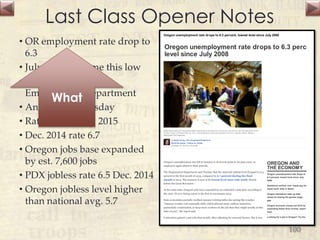
Facts A
1. OR employment rate drop to
6.3
2. July 2008 last time this low
3. Source The Oregon
Employment Department
4. Announced Tuesday
5. Rate for January 2015
6. Dec. 2014 rate 6.7
7. Oregon jobs base expanded
by est. 7,600 jobs
8. PDX jobless rate 6.5 Dec. 2014
9. Oregon jobless level higher
than national avg. 5.7
Last Class Opener Notes
• OR employment rate drop to
6.3
• July 2008 last time this low
• Source The Oregon
Employment Department
• Announced Tuesday
• Rate for January 2015
• Dec. 2014 rate 6.7
• Oregon jobs base expanded
by est. 7,600 jobs
• PDX jobless rate 6.5 Dec. 2014
• Oregon jobless level higher
than national avg. 5.7
OREGON AND
THE ECONOMY
Oregon unemployment rate drops to
6.3 percent, lowest level since July
2008
Questions surface over 'equal pay for
equal work' bills in Salem
Oregon lawmakers take up bills
aimed at closing the gender wage
gap
Oregon economy closes out 2014 by
expanding faster than normal, report
says
Looking for a job in Oregon? Try the
Stella Palmer talks with Timberline's Ralph Pesznecker at the Maximum Connection Job and Car eer Fair held at the World
Forestry Center in Portland Sept. 25, 2014. Palmer said she came back because of an impr oved job market. (Randy L.
Rasmussen/The Oregonian)
By Molly Young | The Oregonian/OregonLive
Email the author | Follow on Twitter
on March 03, 2015 at 10:00 AM
Oregon's unemployment rate fell in January to its lowest point in six-plus years, as
employers again added to their payrolls.
The Employment Department said Tuesday that the statewide jobless level dropped to 6.3
percent in the first month of 2015, compared to 6.7 percent during the final
month of 2014. The measure is now at its lowest level since July 2008, shortly
before the Great Recession.
At the same time, Oregon's jobs base expanded by an estimated 7,600 jobs, according to
the state. Its new hiring report is the first to encompass 2015.
State economists partially credited January's hiring influx the spring-like weather.
"January weather was unusually mild, which allowed many outdoor industries,
particularly construction, to keep more workers on the job than they might usually at this
time of year," the report said.
Contractors gained 1,400 jobs that month, after adjusting for seasonal factors. But it was
Oregon unemployment rate drops to 6.3 percent, lowest level since July 2008
Oregon unemployment rate drops to 6.3 percent,
level since July 2008
What
100
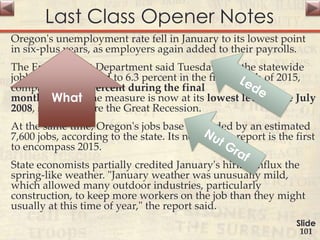
Last Class Opener Notes
Oregon's unemployment rate fell in January to its lowest point
in six-plus years, as employers again added to their payrolls.
The Employment Department said Tuesday that the statewide
jobless level dropped to 6.3 percent in the first month of 2015,
compared to 6.7 percent during the final
month of 2014. The measure is now at its lowest level since July
2008, shortly before the Great Recession.
At the same time, Oregon's jobs base expanded by an estimated
7,600 jobs, according to the state. Its new hiring report is the first
to encompass 2015.
State economists partially credited January's hiring influx the
spring-like weather. "January weather was unusually mild,
which allowed many outdoor industries, particularly
construction, to keep more workers on the job than they might
usually at this time of year," the report said.
Slide
101
What
Agenda Targets
Class 16 • March 13
• Opener
– Composition book for
openers
• Nut Graf Writing
– Collect end of
period
– Writing Ledes & Nut
Grafs Exercise 2
(Must be typed)
• Grades & rewrites
• Identify current events
• Learn differences between
ledes & nut grafs.
• Identify facts and the order
in which to use them in a
lede & nut graf.
• Create/write a lede & nut
graf.
Slide
102
Class 17
March 17, 2015
Slide
103
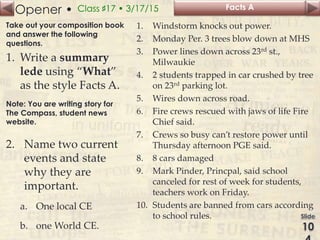
Opener • Class ♯17 • 3/17/15
Take out your composition book
and answer the following
questions.
1. Write a summary
lede using “What”
as the style Facts A.
Note: You are writing story for
The Compass, student news
website.
2. Name two current
events and state
why they are
important.
a. One local CE
b. one World CE.
Facts A
1. Windstorm knocks out power.
2. Monday Per. 3 trees blow down at MHS
3. Power lines down across 23rd st.,
Milwaukie
4. 2 students trapped in car crushed by tree
on 23rd parking lot.
5. Wires down across road.
6. Fire crews rescued with jaws of life Fire
Chief said.
7. Crews so busy can’t restore power until
Thursday afternoon PGE said.
8. 8 cars damaged
9. Mark Pinder, Princpal, said school
canceled for rest of week for students,
teachers work on Friday.
10. Students are banned from cars according
to school rules.
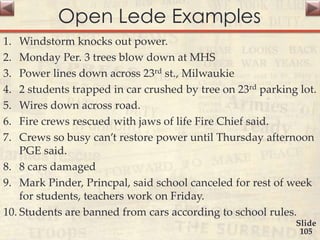
Open Lede Examples
1. Windstorm knocks out power.
2. Monday Per. 3 trees blow down at MHS
3. Power lines down across 23rd st., Milwaukie
4. 2 students trapped in car crushed by tree on 23rd parking lot.
5. Wires down across road.
6. Fire crews rescued with jaws of life Fire Chief said.
7. Crews so busy can’t restore power until Thursday afternoon
PGE said.
8. 8 cars damaged
9. Mark Pinder, Princpal, said school canceled for rest of week
for students, teachers work on Friday.
10. Students are banned from cars according to school rules.
Slide
105
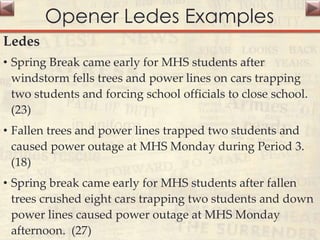
Opener Ledes Examples
Ledes
• Spring Break came early for MHS students after
windstorm fells trees and power lines on cars trapping
two students and forcing school officials to close school.
(23)
• Fallen trees and power lines trapped two students and
caused power outage at MHS Monday during Period 3.
(18)
• Spring break came early for MHS students after fallen
trees crushed eight cars trapping two students and down
power lines caused power outage at MHS Monday
afternoon. (27)
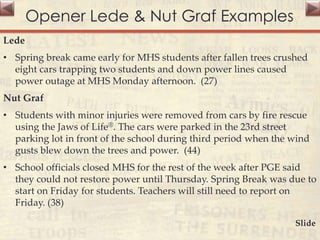
Opener Lede & Nut Graf Examples
Lede
• Spring break came early for MHS students after fallen trees crushed
eight cars trapping two students and down power lines caused
power outage at MHS Monday afternoon. (27)
Nut Graf
• Students with minor injuries were removed from cars by fire rescue
using the Jaws of Life®. The cars were parked in the 23rd street
parking lot in front of the school during third period when the wind
gusts blew down the trees and power. (44)
• School officials closed MHS for the rest of the week after PGE said
they could not restore power until Thursday. Spring Break was due to
start on Friday for students. Teachers will still need to report on
Friday. (38)
Slide
Agenda Targets
Class 17 • March 17
• Opener
– Composition book for
openers
• Nut Graf Writing
– Collect end of
period
– Writing Ledes & Nut
Grafs Exercise 2
(Must be typed)
• Grades & rewrites
• Identify current events
• Learn differences between
ledes & nut grafs.
• Identify facts and the order
in which to use them in a
lede & nut graf.
• Create/write a lede & nut
graf.
Slide
108
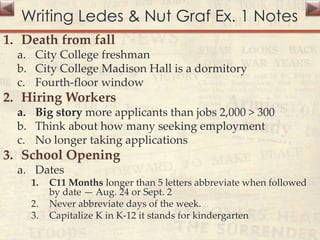
Writing Ledes & Nut Graf Ex. 1 Notes
1. Death from fall
a. City College freshman
b. City College Madison Hall is a dormitory
c. Fourth-floor window
2. Hiring Workers
a. Big story more applicants than jobs 2,000 > 300
b. Think about how many seeking employment
c. No longer taking applications
3. School Opening
a. Dates
1. C11 Months longer than 5 letters abbreviate when followed
by date — Aug. 24 or Sept. 2
2. Never abbreviate days of the week.
3. Capitalize K in K-12 it stands for kindergarten
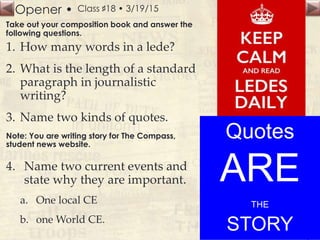
Class 18
March 19, 2015
Slide
110
Opener • Class ♯18 • 3/19/15
Take out your composition book and answer the
following questions.
1. How many words in a lede?
2. What is the length of a standard
paragraph in journalistic
writing?
3. Name two kinds of quotes.
Note: You are writing story for The Compass,
student news website.
4. Name two current events and
state why they are important.
a. One local CE
b. one World CE.
Quotes
ARE
THE
STORY
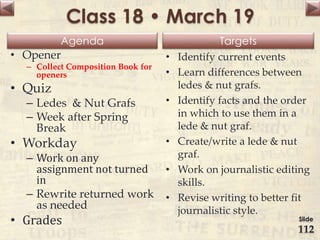
Agenda Targets
Class 18 • March 19
• Opener
– Collect Composition Book for
openers
• Quiz
– Ledes & Nut Grafs
– Week after Spring
Break
• Workday
– Work on any
assignment not turned
in
– Rewrite returned work
as needed
• Grades
• Identify current events
• Learn differences between
ledes & nut grafs.
• Identify facts and the order
in which to use them in a
lede & nut graf.
• Create/write a lede & nut
graf.
• Work on journalistic editing
skills.
• Revise writing to better fit
journalistic style.
Slide
112
Class 20
April 2, 2015
Slide
113
Opener • Class ♯20 • 4/02/15
Take out your composition book and answer the following
questions.
1. What is the correct attribution term
2. Name two elements of the 9 elements of
news.
Note: You are writing story for The Compass, student news
website.
4. Name two current events and state why
they are important.
a. One local CE
b. one World CE.
Agenda Targets
Class 20 • April 2
• Opener
– Collect Composition Book
for openers
• Quarter Test
– Ledes & Nut Grafs
– Journalism Basics
• Workday
• Identify current events
• Learn differences between
ledes & nut grafs.
• Identify facts and the order
in which to use them in a
lede & nut graf.
• Create/write a lede & nut
graf.
• Work on journalistic editing
skills.
• Revise writing to better fit
journalistic style.
Slide
115
Quarter Test
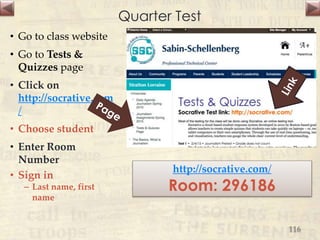
• Go to class website
• Go to Tests &
Quizzes page
• Click on
http://socrative.com
/
• Choose student
• Enter Room
Number
• Sign in
– Last name, first
name
http://socrative.com/
Room: 296186
116
Socrative Student Logon
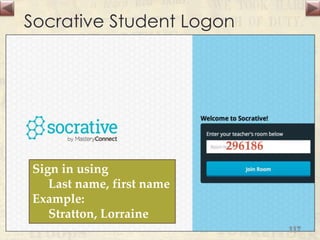
296186
Sign in using
Last name, first name
Example:
Stratton, Lorraine
117
Class 21
April 6, 2015
Slide
118
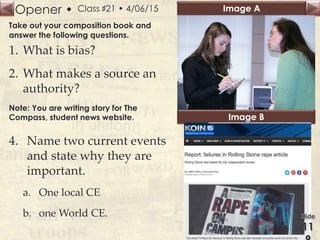
Opener • Image A
Image B
Class ♯21 • 4/06/15
Take out your composition book and
answer the following questions.
1. What is bias?
2. What makes a source an
authority?
Note: You are writing story for The
Compass, student news website.
4. Name two current events
and state why they are
important.
a. One local CE
b. one World CE.
Agenda Targets
Class 21 • March 19
• Opener
• Quarter Test
– Write Ledes & Nut
Grafs
• Workday
• Identify current events
• Learn differences between
ledes & nut grafs.
• Identify facts and the order
in which to use them in a
lede & nut graf.
• Create/write a lede & nut
graf.
• Work on journalistic editing
skills.
• Revise writing to better fit
journalistic style.
Slide
120
Class 22
April 8, 2015
Slide
121
Opener •
Slide
122
Class ♯22 • 4/08/15
Take out your composition book and answer
the following questions.
1. What is bias?
2. Define authority in
regards to journalism
sources.
4. Name two current events
and state why they are
important.
a. One local CE
b. one national CE.
Agenda Targets
Class 22 • April 8
• Opener
• Sources Worksheet
– Use class Sources Webpage
– Type answers
– Return directions to front
table when done
• Check Synergy
– Everything graded
turned in Monday
except Lede & Nut
Graf Test
• Identify current events
• Learn about sources
• Understand ethics
surrounding use of sources
• Understand journalism
ethics codes
• Know what constitutes an
authority when using a
source
Slide
123
Class 23
April 13, 2015
Slide
124
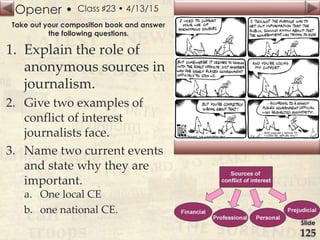
Opener •
Slide
125
Class ♯23 • 4/13/15
Take out your composition book and answer
the following questions.
1. Explain the role of
anonymous sources in
journalism.
2. Give two examples of
conflict of interest
journalists face.
3. Name two current events
and state why they are
important.
a. One local CE
b. one national CE.
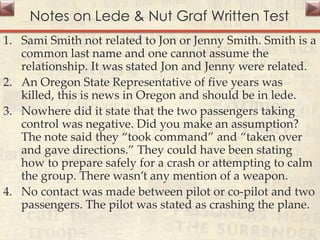
Notes on Lede & Nut Graf Written Test
1. Sami Smith not related to Jon or Jenny Smith. Smith is a
common last name and one cannot assume the
relationship. It was stated Jon and Jenny were related.
2. An Oregon State Representative of five years was
killed, this is news in Oregon and should be in lede.
3. Nowhere did it state that the two passengers taking
control was negative. Did you make an assumption?
The note said they “took command” and “taken over
and gave directions.” They could have been stating
how to prepare safely for a crash or attempting to calm
the group. There wasn’t any mention of a weapon.
4. No contact was made between pilot or co-pilot and two
passengers. The pilot was stated as crashing the plane.
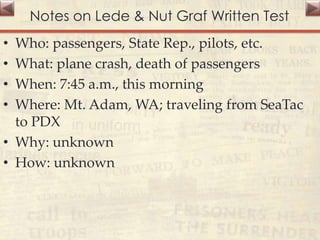
Notes on Lede & Nut Graf Written Test
• Who: passengers, State Rep., pilots, etc.
• What: plane crash, death of passengers
• When: 7:45 a.m., this morning
• Where: Mt. Adam, WA; traveling from SeaTac
to PDX
• Why: unknown
• How: unknown
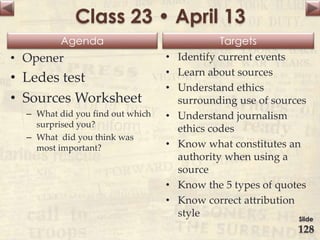
Agenda Targets
Class 23 • April 13
• Opener
• Ledes test
• Sources Worksheet
– What did you find out which
surprised you?
– What did you think was
most important?
• Identify current events
• Learn about sources
• Understand ethics
surrounding use of sources
• Understand journalism
ethics codes
• Know what constitutes an
authority when using a
source
• Know the 5 types of quotes
• Know correct attribution
style Slide
128
Class 24
April 15, 2015
Slide
129
Opener •
Slide
130
Class ♯24 • 4/15/15
Take out your composition book and answer the following questions.
1. What are the 5 types of quotations?
2. You over hear a group talking in the hall about a
teacher who was seen drinking with a couple of
students.
A.Do you publish what you heard and explain why or
why not.
B. Say you are going to publish, do you need to do
anything before you publish?
3. Name two current events and state why they are
important.
a. One local CE
b. one national CE.
Agenda Targets
Class 24 • April 15
• Opener, Current Events
Discussion
• Quotes & Attributions
Worksheet
– Online Form
• Quotations and Attribution
Notes Stratton 2015
FORM.pdf
– Save then fill out on
computer, save again
& then print.
– Due next class.
• Identify current events
• Understand ethics
surrounding use of sources
• Know what constitutes an
authority when using a
source
• Know the 5 types of quotes
• Know correct attribution
style
Slide
131
Class 25
April 17, 2015
Slide
132
Opener •
Slide
133
Class ♯25 • 4/17/15
Take out your composition book and answer the following questions.
1. According to the basic quotation rules stated in
the class PowerPoint, what is the #1 thing to
NEVER do when writing a quote?
2. What is the correct attribution term to use with
any quotation?
3. Which tense needs to be used with a quote?
4. Name two current events and state why they are
important.
a. One local CE
b. one national CE.
Agenda Targets
Class 25 • April 17
• Opener
• Quotes & Attributions
Worksheet
– Online Form
• Quotations and Attribution
Notes Stratton 2015
FORM.pdf
– Save then fill out on
computer, save again
& then print.
– Due next class.
• Identify current events
• Understand ethics
surrounding use of sources
• Know what constitutes an
authority when using a
source
• Know the 5 types of quotes
• Know correct attribution
style
Slide
134
Class 26
April 21, 2015
Slide
135
Opener •
Slide
136
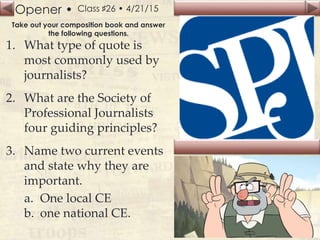
Class ♯26 • 4/21/15
Take out your composition book and answer
the following questions.
1. What type of quote is
most commonly used by
journalists?
2. What are the Society of
Professional Journalists
four guiding principles?
3. Name two current events
and state why they are
important.
a. One local CE
b. one national CE.
Agenda Targets
Class 26 • April 21
• Opener
• Due: Quotes &
Attributions Worksheet
• New: Practice with Quotes
and Paraphrases (Form)
– Due next class 4/23/15
– Practice with Direct
Quotes_Paraphrases 2015
FORM.pdf
– Save form then fill out
on computer, save
again & then print.
• Identify current events
• Apply ethics when using
sources
• Know what constitutes an
authority when using a
source
• Gather the 4 of the 5 types
of quotes
• Use correct attribution style
• Develop note taking skills
Slide
137
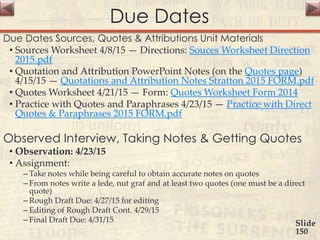
Due Dates
Due Dates Sources, Quotes & Attributions Unit Materials
• Sources Worksheet 4/8/15 — Directions: Souces Worksheet Direction
2015.pdf
• Quotation and Attribution PowerPoint Notes (on the Quotes page)
4/15/15 — Quotations and Attribution Notes Stratton 2015 FORM.pdf
• Quotes Worksheet 4/21/15 — Form: Quotes Worksheet Form 2014
• Practice with Quotes and Paraphrases 4/23/15 — Practice with Direct
Quotes & Paraphrases 2015 FORM.pdf
Observed Interview, Taking Notes & Getting Quotes
• Observation: 4/23/15
• Assignment:
• Take notes while being careful to obtain accurate notes on quotes
• From notes write a lede, nut graf and at least two quotes (one must be
a direct quote)
• Rough Draft Due: 4/27/15
• Final Draft Due: 4/29/15
Slide
138
Class 27
April 23, 2015
Slide
139
Opener •
Slide
140
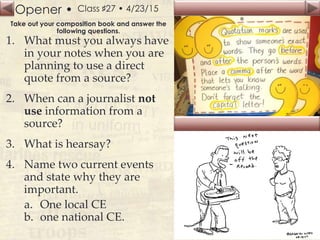
Class ♯27 • 4/23/15
Take out your composition book and answer the
following questions.
1. What must you always have
in your notes when you are
planning to use a direct
quote from a source?
2. When can a journalist not
use information from a
source?
3. What is hearsay?
4. Name two current events
and state why they are
important.
a. One local CE
b. one national CE.
Opener •
Slide
141
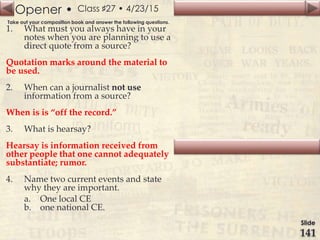
Class ♯27 • 4/23/15
Take out your composition book and answer the following questions.
1. What must you always have in your
notes when you are planning to use a
direct quote from a source?
Quotation marks around the material to
be used.
2. When can a journalist not use
information from a source?
When is is “off the record.”
3. What is hearsay?
Hearsay is information received from
other people that one cannot adequately
substantiate; rumor.
4. Name two current events and state
why they are important.
a. One local CE
b. one national CE.
Agenda Targets
Class 27 • April 23
• Opener
• Due: Practice with Quotes and
Paraphrases (Form)
• Observe interview of Mick
by advance students.
– Observe & take notes using
official journalist not pad
– Prepare to write mini story
• Lede
• Nut graf
• 2 quotes (1 direct)
• Use transitions to guide
reader through story from
nut graft to quote to quote
• Identify current events
• Apply ethics when using
sources
• Know what constitutes an
authority when using a
source
• Gather the 4 of the 5 types
of quotes
• Use correct attribution style
• Develop note taking skills
• Observe interview and take
notes Slide
142
Due Dates
Due Dates Sources, Quotes & Attributions Unit Materials
• Sources Worksheet 4/8/15 — Directions: Souces Worksheet Direction
2015.pdf
• Quotation and Attribution PowerPoint Notes (on the Quotes page)
4/15/15 — Quotations and Attribution Notes Stratton 2015 FORM.pdf
• Quotes Worksheet 4/21/15 — Form: Quotes Worksheet Form 2014
• Practice with Quotes and Paraphrases 4/23/15 — Practice with Direct
Quotes & Paraphrases 2015 FORM.pdf
Observed Interview, Taking Notes & Getting Quotes
• Observation: 4/23/15
• Assignment:
• Take notes while being careful to obtain accurate notes on quotes
• From notes write a lede, nut graf and at least two quotes (one must be
a direct quote)
• Rough Draft Due: 4/27/15
• Final Draft Due: 4/29/15
Slide
143
Class 28
April 27, 2015
Slide
144
Opener •
Slide
145
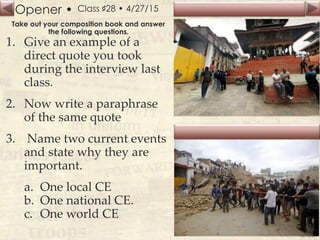
Class ♯28 • 4/27/15
Take out your composition book and answer
the following questions.
1. Give an example of a
direct quote you took
during the interview last
class.
2. Now write a paraphrase
of the same quote
3. Name two current events
and state why they are
important.
a. One local CE
b. One national CE.
c. One world CE
Current Events
• 19-year-old Joshua Edwards, is one of many
still missing after the massive, deadly
earthquake shook Nepal, a mountainous
country between Tibet and India on Saturday.
• Stock Market closing high
• The owner of a Portland martial arts studio
accused of sodomizing a child under 12
committed suicide in the Deschutes County
Jail.
Slide
146
Nepal Earthquake 7.8
Slide
147
• http://www.bbc.com/news/world-asia-
3247495Slide1
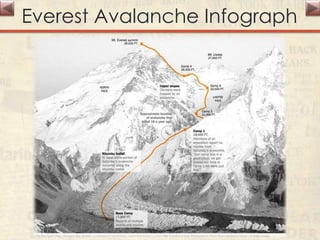
Everest Avalanche Infograph
Agenda Targets
Class 28 • April 27
• Opener
• Edit mini story w/peer &
editors
– Lede
– Nut graf
– 2 quotes (1 direct)
– Use transitions to guide
reader through story from
nut graft to quote to quote
• Identify current events
• Apply ethics when using
sources
• Know what constitutes an
authority when using a
source
• Gather the 4 of the 5 types
of quotes
• Use correct attribution style
• Develop note taking skills
• Observe interview and take
notes Slide
149
Due Dates
Due Dates Sources, Quotes & Attributions Unit Materials
• Sources Worksheet 4/8/15 — Directions: Souces Worksheet Direction
2015.pdf
• Quotation and Attribution PowerPoint Notes (on the Quotes page)
4/15/15 — Quotations and Attribution Notes Stratton 2015 FORM.pdf
• Quotes Worksheet 4/21/15 — Form: Quotes Worksheet Form 2014
• Practice with Quotes and Paraphrases 4/23/15 — Practice with Direct
Quotes & Paraphrases 2015 FORM.pdf
Observed Interview, Taking Notes & Getting Quotes
• Observation: 4/23/15
• Assignment:
– Take notes while being careful to obtain accurate notes on quotes
– From notes write a lede, nut graf and at least two quotes (one must be a direct
quote)
– Rough Draft Due: 4/27/15 for editing
– Editing of Rough Draft Cont. 4/29/15
– Final Draft Due: 4/31/15 Slide
150
Class 29
April 29, 2015
Slide
151
Opener •
Slide
152
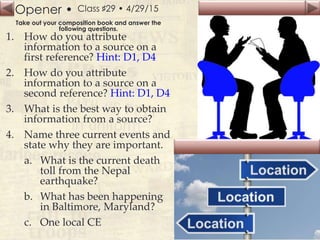
Class ♯29 • 4/29/15
Take out your composition book and answer the
following questions.
1. How do you attribute
information to a source on a
first reference? Hint: D1, D4
2. How do you attribute
information to a source on a
second reference? Hint: D1, D4
3. What is the best way to obtain
information from a source?
4. Name three current events and
state why they are important.
a. What is the current death
toll from the Nepal
earthquake?
b. What has been happening
in Baltimore, Maryland?
c. One local CE
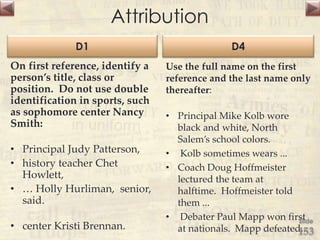
Attribution
D1
On first reference, identify a
person’s title, class or
position. Do not use double
identification in sports, such
as sophomore center Nancy
Smith:
• Principal Judy Patterson,
• history teacher Chet
Howlett,
• … Holly Hurliman, senior,
said.
• center Kristi Brennan.
D4
Use the full name on the first
reference and the last name only
thereafter:
• Principal Mike Kolb wore
black and white, North
Salem’s school colors.
• Kolb sometimes wears ...
• Coach Doug Hoffmeister
lectured the team at
halftime. Hoffmeister told
them ...
• Debater Paul Mapp won first
at nationals. Mapp defeated...
Slide
153
Agenda Targets
Class 29 • April 29
• Opener
• Edit mini story w/peer &
editors
– Lede
– Nut graf
– 2 quotes (1 direct)
– Use transitions to guide
reader through story from
nut graft to quote to quote
• Identify current events
• Apply ethics when using
sources
• Know what constitutes an
authority when using a
source
• Gather the 4 of the 5 types
of quotes
• Use correct attribution style
• Develop note taking skills
• Observe interview and take
notes Slide
154
Due Dates
Due Dates Sources, Quotes & Attributions Unit Materials
• Sources Worksheet 4/8/15 — Directions: Souces Worksheet Direction
2015.pdf
• Quotation and Attribution PowerPoint Notes (on the Quotes page)
4/15/15 — Quotations and Attribution Notes Stratton 2015 FORM.pdf
• Quotes Worksheet 4/21/15 — Form: Quotes Worksheet Form 2014
• Practice with Quotes and Paraphrases 4/23/15 — Practice with Direct
Quotes & Paraphrases 2015 FORM.pdf
Observed Interview, Taking Notes & Getting Quotes
• Observation: 4/23/15
• Assignment:
– Take notes while being careful to obtain accurate notes on quotes
– From notes write a lede, nut graf and at least two quotes (one must be a direct
quote)
– Rough Draft Due: 4/27/15 for editing
– Editing of Rough Draft Cont. 4/29/15
– Final Draft Due: 4/31/15 Slide
155
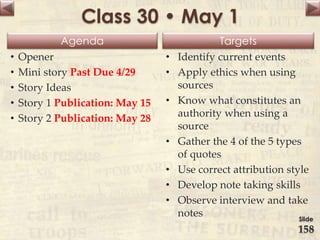
Class 30
May 1, 2015
Slide
156
Opener •
Slide
157
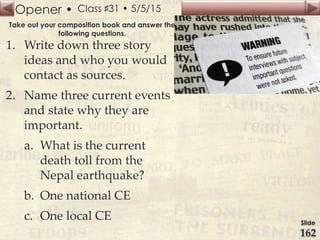
Class ♯31 • 5/5/15
Take out your composition book and answer the
following questions.
1. Write down two story ideas
and who you would contact
as sources.
2. What traditionally occurs on
May 1?
3. Name three current events
and state why they are
important.
a. What is the current death
toll from the Nepal
earthquake?
b. One national CE
c. One local CE
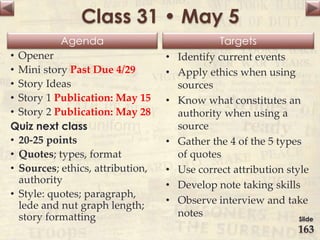
Agenda Targets
Class 30 • May 1
• Opener
• Mini story Past Due 4/29
• Story Ideas
• Story 1 Publication: May 15
• Story 2 Publication: May 28
• Identify current events
• Apply ethics when using
sources
• Know what constitutes an
authority when using a
source
• Gather the 4 of the 5 types
of quotes
• Use correct attribution style
• Develop note taking skills
• Observe interview and take
notes Slide
158
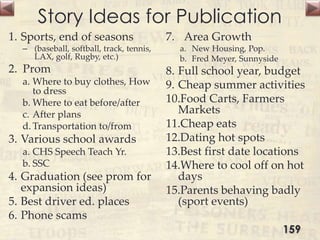
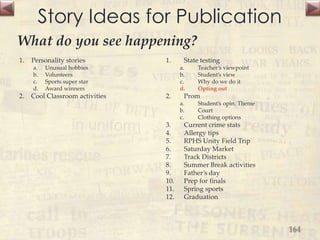
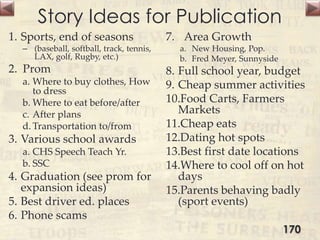
Story Ideas for Publication
1. Sports, end of seasons
– (baseball, softball, track, tennis,
LAX, golf, Rugby, etc.)
2. Prom
a. Where to buy clothes, How
to dress
b. Where to eat before/after
c. After plans
d. Transportation to/from
3. Various school awards
a. CHS Speech Teach Yr.
b. SSC
4. Graduation (see prom for
expansion ideas)
5. Best driver ed. places
6. Phone scams
7. Area Growth
a. New Housing, Pop.
b. Fred Meyer, Sunnyside
8. Full school year, budget
9. Cheap summer activities
10.Food Carts, Farmers
Markets
11.Cheap eats
12.Dating hot spots
13.Best first date locations
14.Where to cool off on hot
days
15.Parents behaving badly
(sport events)
159
Story Ideas for Publication
1. Area Growth
a. New Housing, Pop.
b. Fred Meyer, Sunnyside
2. Full school year, budget
3. Cheap summer activities
4. Food Carts, Farmers
Markets
5. Cheap eats
6. Dating hot spots
7. Best first date locations
8. Where to cool off on hot
days
9. Parents behaving badly
(sport events)
160
Class 31
May 5, 2015
Slide
161
Opener •
Slide
162
Class ♯31 • 5/5/15
Take out your composition book and answer the
following questions.
1. Write down three story
ideas and who you would
contact as sources.
2. Name three current events
and state why they are
important.
a. What is the current
death toll from the
Nepal earthquake?
b. One national CE
c. One local CE
Agenda Targets
Class 31 • May 5
• Opener
• Mini story Past Due 4/29
• Story Ideas
• Story 1 Publication: May 15
• Story 2 Publication: May 28
Quiz next class
• 20-25 points
• Quotes; types, format
• Sources; ethics, attribution,
authority
• Style: quotes; paragraph,
lede and nut graph length;
story formatting
• Identify current events
• Apply ethics when using
sources
• Know what constitutes an
authority when using a
source
• Gather the 4 of the 5 types
of quotes
• Use correct attribution style
• Develop note taking skills
• Observe interview and take
notes Slide
163
Story Ideas for Publication
1. Personality stories
a. Unusual hobbies
b. Volunteers
c. Sports super star
d. Award winners
2. Cool Classroom activities
1. State testing
a. Teacher’s viewpoint
b. Student’s view
c. Why do we do it
d. Opting out
2. Prom
a. Student’s opin. Theme
b. Court
c. Clothing options
3. Current crime stats
4. Allergy tips
5. RPHS Unity Field Trip
6. Saturday Market
7. Track Districts
8. Summer Break activities
9. Father’s day
10. Prep for finals
11. Spring sports
12. Graduation
164
What do you see happening?
Class 32
May 7, 2015
Slide
165
Opener •
Slide
166
Class ♯32 • 5/7/15
Take out your composition book and answer the
following questions.
1. Write down three story
ideas and who you would
contact as sources.
2. Name three current events
and state why they are
important.
a. What is the current
death toll from the
Nepal earthquake?
b. One national CE
c. One local CE
Agenda Targets
Class 32 • May 7
• Opener
• Mini story Past Due 4/29
• Story Ideas
• Story 1 Publication: May 15
• Story 2 Publication: May 28
Quiz 20 points
• Quotes; types, format
• Sources; ethics, attribution,
authority
• Style: quotes; paragraph,
lede and nut graph length;
story formatting
• Identify current events
• Apply ethics when using
sources
• Know what constitutes an
authority when using a
source
• Gather the 4 of the 5 types
of quotes
• Use correct attribution style
• Develop note taking skills
• Observe interview and take
notes Slide
167
Pretest
• Go to class website
• Go to Tests &
Quizzes page
• Click on
http://socrative.com
/
• Choose student
• Enter Room
Number
• Sign in
– Last name, first
name
http://socrative.com/
Room: 296186
168
Socrative Student Logon
296186
Sign in using
Last name, first name
Example:
Stratton, Lorraine
169
Story Ideas for Publication
1. Sports, end of seasons
– (baseball, softball, track, tennis,
LAX, golf, Rugby, etc.)
2. Prom
a. Where to buy clothes, How
to dress
b. Where to eat before/after
c. After plans
d. Transportation to/from
3. Various school awards
a. CHS Speech Teach Yr.
b. SSC
4. Graduation (see prom for
expansion ideas)
5. Best driver ed. places
6. Phone scams
7. Area Growth
a. New Housing, Pop.
b. Fred Meyer, Sunnyside
8. Full school year, budget
9. Cheap summer activities
10.Food Carts, Farmers
Markets
11.Cheap eats
12.Dating hot spots
13.Best first date locations
14.Where to cool off on hot
days
15.Parents behaving badly
(sport events)
170
Story Ideas for Publication
16. River, water safety
17. Nepal Earthquake
lessons for Oregon’s
next big one
18. Summer volunteer ops.
19. Good Aps for
a. Outdoor acuities
b. Social connections
c. Eats
20. Babysitting tips
21. What to do when bored
at home
22. Good summer reads
23. Great hikes
24. Day Trips
25. Best connection (carrier)
a. Cell Phone
b. Cable vs. Satellite
c. Internet
26.Best theater for movie
watching
27.Summer job tips
28.Area parks
29.How to count to 10 or
what to do when
younger/older siblings
are driving you crazy.
Practical tips (not
opinion)
30.Staying safe
171
Class 33
May 11, 2015
Slide
172
Opener •
Slide
173
Class ♯33 • 5/11/15
Take out your composition book and answer the
following questions.
1. Write down your story
assignment and who you
are going to interview.
2. What is the inverted
pyramid?
3. How long are regular story
paragraphs?
4. Name two current events
and state why they are
important.
a. One national CE
b. One local CE
Agenda Targets
Class 33 • May 11
• Opener
• Mini story final drafts Past
Due 4/29
• Story 1 Publication: May 15
• Story 2 Publication: May 28
Questioning & Interviewing
Techniques
1. Basic Questioning Strategies
2. Interviewing Order
• Identify current events.
• Apply ethics when using
sources.
• Know what constitutes an
authority when using a
source.
• Interview five people for story.
• Use correct attribution style.
• Develop note taking skills.
• Develop basic questioning
strategy for upcoming
interview.
• Understand the basic
interviewing order & prepare
to use. Slide
174
Questioning & Interviewing
Basic Questioning Strategy
1. Meet the respondent:
icebreaker conversation
2. Ask first serious question
3. Proceed to the heart of the
interview
4. Ask "bomb" question if
necessary
5. Recovery from bomb
question
6. Conclude interview
"Bomb" questions are those
that are potentially sensitive
or embarrassing.
Interviewing Strategy
Good reporters always do the
following before, during and
after an interview
I. Prepare
II. During the interview
III. Ending the interview
IV. After the interview
Slide
175
Interviewing Strategy
I. Prepare
1. Define a purpose of the
interview
2. Research story (person)
background
3. Internet, library, other
living sources (consult
family, friends, co-
workers)
4. Make a list of questions
(based on research) and
plan your strategy
5. Set up an interview with
appropriate person and to
their advantage
II. During the interview
1. Be on time & Be polite
2. Listen non-judgmentally
3. Ask open-ended questions
4. Take notes using their phrases and words
5. Help the person feel relaxed
6. Double check
a. Spelling of names, places, unusual items &
terms
b.Facts & figures
c. Titles
7. Rephrase questions to receive better answers
8. Use tape recorder for controversial items, but
do not become dependent on it. Verify
quotations if not using tape recorder.
9. Be careful with off-the-record comments. Try
to avoid them, but sometimes they can lead
to questions in another interview.
10. Listen to the responses. Your ability to ask
good follow-up questions will usually
determine how good your interview will be.Slide
176
Interviewing Strategy
III. Ending the interview
1. Ask if there is anything they would
like to add.
2. Look over your notes for any
additional questions & clarification.
3. Go over all quotes with the
respondent to check for accuracy
4. Obtain all the information you think
you will need before concluding the
interview, but be sure to ask if you
can contact your respondent again
if necessary.
5. Ask for phone number in case you
need further clarification, but do
not promise to let subject check
story.
6. Thank the respondent for his/her
IV. After the interview
1. Write story immediately after
interview (within hour)
2. Double check facts (call source if
needed)
Slide
177
Class 34
May 13, 2015
Slide
178
Opener •
Slide
179
Class ♯34• 5/13/15
Take out your composition book and answer
the following questions.
1. Who have you
interviewed?
2. Where did you interview?
3. What was the hardest
thing about doing your
interview?
4. Name 3 current events
and state why they are
important.
a. One national CE
b. One local CE
c. World
Agenda Targets
Class 34 • May 13
• Opener
• Story 1 Publication: May 15
• Story 2 Publication: May 28
Remember:
Questioning & Interviewing
Techniques
1. Basic Questioning Strategies
2. Interviewing Order
• Identify current events.
• Apply ethics when using
sources.
• Know what constitutes an
authority when using a
source.
• Interview five people for story.
• Use correct attribution style.
• Develop note taking skills.
• Develop basic questioning
strategy for upcoming
interview.
• Understand the basic
interviewing order & prepare
to use. Slide
180
Interviewing Strategy
I. Prepare
1. Define a purpose of the
interview
2. Research story (person)
background
3. Internet, library, other
living sources (consult
family, friends, co-
workers)
4. Make a list of questions
(based on research) and
plan your strategy
5. Set up an interview with
appropriate person and to
their advantage
II. During the interview
1. Be on time & Be polite
2. Listen non-judgmentally
3. Ask open-ended questions
4. Take notes using their phrases and words
5. Help the person feel relaxed
6. Double check
a. Spelling of names, places, unusual items &
terms
b.Facts & figures
c. Titles
7. Rephrase questions to receive better answers
8. Use tape recorder for controversial items, but
do not become dependent on it. Verify
quotations if not using tape recorder.
9. Be careful with off-the-record comments. Try
to avoid them, but sometimes they can lead
to questions in another interview.
10. Listen to the responses. Your ability to ask
good follow-up questions will usually
determine how good your interview will be.Slide
181
Interviewing Strategy
III. Ending the interview
1. Ask if there is anything they would
like to add.
2. Look over your notes for any
additional questions & clarification.
3. Go over all quotes with the
respondent to check for accuracy
4. Obtain all the information you think
you will need before concluding the
interview, but be sure to ask if you
can contact your respondent again
if necessary.
5. Ask for phone number in case you
need further clarification, but do
not promise to let subject check
story.
6. Thank the respondent for his/her
IV. After the interview
1. Write story immediately after
interview (within hour)
2. Double check facts (call source if
needed)
Slide
182
Questioning & Interviewing
Basic Questioning Strategy
1. Meet the respondent:
icebreaker conversation
2. Ask first serious question
3. Proceed to the heart of the
interview
4. Ask "bomb" question if
necessary
5. Recovery from bomb
question
6. Conclude interview
"Bomb" questions are those
that are potentially sensitive
or embarrassing.
Interviewing Strategy
Good reporters always do the
following before, during and
after an interview
I. Prepare
II. During the interview
III. Ending the interview
IV. After the interview
Slide
183
Class 35
May 15, 2015
Slide
184
Opener • Image A
Image B
Slide
185
Class ♯34• 5/13/15
Take out your composition book and answer the
following questions.
1. What was the hardest thing
about doing your interview?
2. What has been the largest
stumbling block to your
success in writing your
story so far?
3. Name 3 current events and
state why they are
important.
a. One national CE
b. One local CE
c. World
Agenda Targets
Class 34 • May 15
• Opener
• Story 1 Publication: May 15
Articles are now past due
• Story 2 Publication: May 28
Assignment:
Interviewing Reading
1. Go to “Interview Reading
Assignment”
2. Fill out PDF (on website)
3. Read 2 article
4. Due: May 21
• Identify current events.
• Apply ethics when using
sources.
• Know what constitutes an
authority when using a
source.
• Interview five people for story.
• Use correct attribution style.
• Develop note taking skills.
• Develop basic questioning
strategy for upcoming
interview.
• Understand the basic
interviewing order & prepare
to use. Slide
186

2015 Spring Journalism Agenda & Targets

  • 1.
  • 2.
  • 3.
    Agenda Targets Class 1• Jan. 29 • Stratt out ill (sorry folks) • Intro The Compass Editors – Mick & Emily • What you need for class • Newseum video – “What’s News?” – http://www.newseumdigitalclassroom.org/digital- classroom/video/what-is-news/default.aspx – Fill out • Learn what to bring to class. • Explore what news is. • Understand why news is often called the first draft of history. • Learn how news is reported and accessed. • Develop better understanding for how news is categorized. Slide 3
  • 4.
    Need for class •2GB+ USB Thumb drive • 1 ream plain paper (for laser printer) • Binder for notes & handouts • Pen Bk or Dk Blue Ink • Access to Internet & TV 4
  • 5.
    What’s News EssentialQuestions • What is news? • How do we get news? • What types of stories do we find in the news? • How does the news affect our lives? • What is the role of the press in our society? • What is our role as news consumers? Slide 5
  • 6.
    What’s News Pre-videodiscussion Questions 1. What is news? 2. What stories are in the news today? Video features – Historically key events & people – Once considered “news” – Uses primary sources – All of the images and clips actual news While you watch, look for the events and people that you recognize from your lifetime. Slide 6
  • 7.
    What’s News Pre-videodiscussion Video features – Historically key events & people – Once considered “news” – Uses primary sources – All of the images and clips actual news While you watch, look for the events and people that you recognize from your lifetime. Slide 7
  • 8.
    What’s News Pre-videodiscussion As you watch the video, keep these questions in mind: 1.What are some categories of events that can be considered news? 2.What makes a story newsworthy? 3.While you are watching the movie, identify four to five stories or people that you recognize. 4.Why do you think these stories are considered news? 5.What are some of the different ways in which news can be delivered? Slide 8
  • 9.
    What’s News Pre-videodiscussion As you watch the video, listen for these quotations and consider their importance: • Philip Graham: “Journalism is the first rough draft of history.” Note: this is my favorite journalism quote • Winston Churchill: “A free press is the unsleeping guardian of every other right that free men prize; it is the most dangerous foe of tyranny.” • Malcolm X: “You can’t separate peace from freedom because no one can be at peace unless he has his freedom.” • John F. Kennedy: “Even though we disapprove, there isn’t any doubt. …We could not do the job at all without a very, very active press.” • Thomas Jefferson: “Our liberty depends on freedom of the press and that cannot be limited without being lost.” Slide 9
  • 10.
    Watch Video • Newseum’s“What’s News” (8:11) • Link: http://www.newseumdigitalclassroom.org/digital- classroom/video/what-is-news/default.aspx • Get and answers the “After Viewing” questions. Slide 10
  • 11.
    What’s News PostViewing Discussion 1. Are there events from this video that you recognize? Are there events in this video that you lived through? 2. How does the fact that they occurred during your lifetime change the way you remember or feel about these stories versus the historical events depicted? 3. Many of the key events in this video were represented by images. a.Discuss how photographs and other images are used in reporting the news. b.How do they make a different impression than the written word? Slide 11
  • 12.
    What’s News PostViewing Discussion 1. Think about all the different ways the key events were presented in this video — news headlines, photographs, video clips, sound bytes from speeches and news broadcasts. a. How has news changed over time? b. Has the way we report the news affected what news is covered? c. What is your favorite way to get the news, and why? d.What do you think this says about you as a news consumer? 2. There were many types of news media that were seen in this video. In recent years, we have seen new types of media emerge that were not featured in this video. a. What are those types of media? b. How have they changed the face of the news and how it is reported c. Where do you get news? d.What about your parents? e. Where do you think you will get news in the future? Slide 12
  • 13.
    Class 2 Feb. 2,2015 Slide 13
  • 14.
    Agenda Targets Class 2• Feb. 2, 2015 • Who am I • Seating Chart • Name Cards – First name big – Second name small – Be creative! • What is journalism • Ice Breaker Interviews if time • Meet teacher • Meet other students • Find out about class • Develop interviewing techniques by talking to new people. Slide 14
  • 15.
    Class 3 Feb. 4,2015 Slide 15
  • 16.
    Opener • ImageA Image B Class ♯3 • 2/4/15 Take out a piece of paper and answer the following questions. 1. What is often referred to as a “rough draft of history?” 2. Give 3 examples of what makes something newsworthy to you. 3. What is a name of a local newspaper? 4. Name two current event (news) items. Slide 16
  • 17.
    Opener • ImageA Image B Class ♯3 • 2/4/15 Take out a piece of paper and answer the following questions. 1.What is often referred to as a “rough draft of history?” – News 2.Give 3 examples of what makes something newsworthy to you. 3.What is a name of a local newspaper? 4.Name two current event (news) items. 1. Proximity 2. Timeliness 3. Prominence 4. Consequence 5. Change / Progress / Action 6. Concreteness 7. Personality / Human Interest 8. Rarity / Singularity (uniqueness) 9. Conflict • University of Oregon student has been diagnosed with meningococcemia • Vaccines, measles • Taiwan plane crash kills 48 and injures 10 • Jordan executes prisoners after ISIS hostage burned alive • 7 dead, multiple injuries as train strikes SUV in N.Y. 1. The Oregonian 2. Portland Tribune 3. Clackamas County Review 4. The Columbian 5. The Statesman Journal 6. The Gresham Outlook Slide 17
  • 18.
    Agenda Targets Class 3• Feb. 4 • Opener • Pretest • Icebreaker “Interview” activity • Class web page(s) – http://www.nclack.k12.or.us/Page/5742 • News writing basics – http://www.nclack.k12.or.us/Page/25354 • Understand why news is often called the first draft of history. • Learn how news is reported and accessed. • Develop better understanding for how news is categorized. • Identify current events. • Learn parts of basic news story. • Communicate current knowledge of journalism. Slide 18
  • 19.
    Pretest • Go toclass website • Go to Tests & Quizzes page • Click on http://socrative.com / • Choose student • Enter Room Number • Sign in – Last name, first name http://socrative.com/ Room: 296186 19
  • 20.
    Socrative Student Logon 296186 Signin using Last name, first name Example: Stratton, Lorraine 20
  • 21.
    Journalism Basics • http://www.nclack.k12.or.us/Page/25354 1.Principles of Journalism 2. Basic reporting, news writing, journalistic style A reporter's job I. Interviews II. Writing A. Write in third person B. Write without bias C. The Story 1) Shape 2) Components & Order 3. Code of Ethics 21
  • 22.
    Class 4 Feb. 6,2015 Slide 22
  • 23.
    Opener • ImageA Image B Class ♯3 • 2/4/15 Take out a piece of paper and answer the following questions. 1. Name two local news outlets other than The Oregonian. 2. What type of journalism story interests you the most? 3. Name two current event items. Slide 23
  • 24.
    Agenda Targets Class 4• Feb. 6 • Opener • Seating Chart • Discuss – News outlets – Newsworthiness • Class web page(s) – http://www.nclack.k12.or.us/Page/5742 – Location, content Homework • News writing basics – http://www.nclack.k12.or.us/Page/25354 – Finish reading • Examining a News Story • Understand why news is often called the first draft of history. • Learn how news is reported and accessed. • Develop better understanding for how news is categorized. • Identify current events. • Learn parts of basic news story. • Communicate current knowledge of journalism. Slide 24
  • 25.
  • 26.
    Class 5 Feb. 10,2015 Slide 26
  • 27.
    Opener • Slide 27 Class ♯5• 2/10/15 Take out a piece of paper and answer the following questions. 1. What is the shape of a typical/traditional news story? 2. Why is this the shape? 3. Name two current event items.
  • 28.
  • 29.
  • 30.
  • 31.
  • 32.
  • 33.
  • 34.
  • 35.
    Agenda Targets Class 5• Feb. 10 • Opener • Pretest discussion • Icebreaker “Interview” activity • News writing basics – http://www.nclack.k12.or.us/Page/25 354 – Go over “Examining a News Story” • Understand why news is often called the first draft of history. • Learn how news is reported and accessed. • Develop better understanding for how news is categorized. • Identify current events. • Learn parts of basic news story. • Communicate current knowledge of journalism. Slide 35
  • 36.
    Class 6 Feb. 12,2015 Slide 36
  • 37.
    Opener • Slide 37 Class ♯6• 2/12/15 Take out a piece of paper and answer the following questions. 1. What is the shape of a typical news story? 2. What is a cutoff test? 3. Why are news stories constructed with the most important facts first and the least important information toward the bottom of a story? 4. Name two current events and state why they are important.
  • 38.
  • 39.
    Agenda Targets Class 6• Feb. 12 • Opener – Composition book • News writing basics – http://www.nclack.k12.or.us/Page/25 354 • See next slide • Understand why news is often called the first draft of history. • Learn how news is reported and accessed. • Develop better understanding for how news is categorized. • Identify current events. • Learn parts of basic news story. • Communicate current knowledge of journalism. Slide 39
  • 40.
    Journalism Basics “Examining aNews Story” Assignment • Ledes – Length (<30 words) – What are they; who, what • Nut Graf – Length (<50-75 words) – What are they; 5W’s+H not in lede • Rest of ¶ – Length • <75 words • 100 words is a long ¶ in journalism • Journalistic writing short & concise 40
  • 41.
    Class 7 Feb. 17,2015 Slide 41
  • 42.
    Opener • Class♯7 • 2/17/15 Take out a piece of paper and answer the following questions. 1. What is the basic news style called? 2. What is an attribution? 3. What is the point of view news stories are written from? 4. Name two current events and state why they are important.
  • 43.
    Agenda Targets Class 7• Feb. 17 • Opener – Composition book for openers • News writing basics – News Style • Stylebook – AP – Ours • Codes • Attribution • Understand why news is often called the first draft of history. • Learn how news is reported and accessed. • Develop better understanding for how news is categorized. • Identify current events. • Learn parts of basic news story. • Communicate current knowledge of journalism. Slide 43
  • 44.
    Journalism Basics “Examining aNews Story” Assignment • Ledes – Length (<30 words) – What are they; who, what • Nut Graf – Length (<50-75 words) – What are they; 5W’s+H not in lede • Rest of ¶ – Length • <75 words • 100 words is a long ¶ in journalism • Journalistic writing short & concise 44
  • 45.
    Stylebooks • Purpose: keepwriting consistent • We use modified OJEA Stylebook • Codes • Webpage http://www.nclack.k12.or.us/Page/5755 • C10, C14, C24 • D1, D2, D4 • E10, E36 • F1, F2 • G1, G2, G3, G6 • Attribution Style – “Quote,” First Last, Id, said. 45
  • 46.
  • 47.
    Direct Quote First Reference •“We have had a long history of community involvement in the industry,” Claudia Steinberg, TriMet chief of the service department, said. “There are citizen and employer groups, businesses, and representatives from all areas of the city getting together to help draft designs and get the job done.” Second Reference • “A lot had to go into this. We had to think about who are we serving, where are the most traveled places, what is the ridership potential and what will the costs and schedules look like,” Steinberg said.
  • 48.
    Indirect Quote First Reference •TriMet has had a long history of community involvement in the industry, Claudia Steinberg, TriMet chief of the community service department, said. There are citizen and employer groups, businesses and representatives from all locations helping draft designs and get the job done. Second Reference • A lot went into this. We had to consider who are we serving, where are the most traveled places, what is the ridership potential and what will the costs and schedules look like Steinberg said.
  • 49.
    Paraphrase First Reference • TriMethas a lengthy history of involving the community, Claudia Steinberg, TriMet chief of the community service department, said. There are variety of groups helping with the creation of the Milwaukie light rail line. Second Reference • Consideration had to be given to how people will potentially use the light rail spur. Costs and schedules also had to be taken into account Steinberg said.
  • 50.
    Partial Quote First Reference •TriMet has had a long history of “community involvement in the industry,” Claudia Steinberg, TriMet chief of the community service department, said. Groups are comprised of “citizen and employer groups, businesses and representatives” from through out the region helping to facilitate the creation of the Milwaukie light rail line. Second Reference • “A lot went into this,” Steinberg said. Consideration for “who are we serving,” where they are traveling, “the ridership potential” and what the costs and schedules will look like.
  • 51.
    Class 8 Feb. 19,2015 Slide 51
  • 52.
    Opener • Class♯8 • 2/19/15 Take out your composition book and answer the following questions. 1. What is the purpose of a stylebook? 2. What is an attribution? 3. Which word does a journalists use when giving attribution? 4. Which type of quote uses the writer’s words & the source’s words in quotation marks? 5. Name two current events and state why they are important.
  • 53.
    Agenda Targets Class 8• Feb. 19 • Opener – Composition book for openers • News writing basics – Ledes & Leads • Short <30 words (35 is long) • Contains – Who & What – May have other 5W’s – $$$ usually • Identify current events • Understand importance of ledes. • Learn what is included in a lede. • Learn the steps in which ledes are written. • Begin to identify facts to use in a lede. Slide 53
  • 54.
    Lede Rules • Shortparagraph, generally one sentence • Less than 30 words (35 is too many) • Should first verb should express the main "what" of the story and should be placed among the lede's first seven words. • The lede's first verb — the same one that expresses the main "what" of the story — should be active voice, not passive voice. • If there's a "who" involved in the story, the lede should give some indication of who the "who" is. • The lede should summarize the "why" and "how" of the story, but only if there's room. • If what's in the lede needs to be attributed, place the attribution at the end of the lede. Slide 54
  • 55.
    Writing a NewsLede: Steps 1. Find the most important (key) thought (fact). 2. Number the order of thoughts from most important to least. 3. Include the what and who into the lede. 4. Include any significant amounts into lede. Remember people want to know about money. 5. Place the most important facts first while writing. 55
  • 56.
    Ledes & NutGrafs Unit Due Dates Due Date Worksheet 2/23 end of class Selecting Facts for Ledes —PDF Form 2/25 beginning of class Ledes Worksheet (Must be typed, attach webpage printout) 2/25 end of class Fairy Tales Do Come True 2/27 beginning of class Leads: Using What? Who? (Must be typed) 2/27 end of class Leads: Using When? Where? Why? And Who? (Must be typed) 3/3 Writing Ledes & Nut Grafs Exercise 1 (Must be typed) Slide 56
  • 57.
    Class 9 Feb. 23,2015 Slide 57
  • 58.
    Opener • Class♯9 • 2/23/15 Take out your composition book and answer the following questions. 1. What is an attribution? 2. Which word does a journalists use when giving attribution? 3. What is the purpose of a lede? 4. Name two current events and state why they are important.
  • 59.
    Agenda Targets Class 9• Feb. 23 • Opener – Composition book for openers • Lede Writing – Identifying key facts for ledes – Fairy Tales do Come True Ledes • Identify current events • Understand importance of ledes. • Learn what is included in a lede. • Learn the steps in which ledes are written. • Identify facts and the order in which to use them in a lede. • Learn how to use a PDF form. Slide 59
  • 60.
    Ledes & NutGrafs Unit Due Dates Due Date Worksheet 2/23 end of class Selecting Facts for Ledes —PDF Form 2/25 beginning of class Ledes Worksheet (Must be typed, attach webpage printout) 2/25 end of class Fairy Tales Do Come True 2/27 beginning of class Leads: Using What? Who? (Must be typed) 2/27 end of class Leads: Using When? Where? Why? And Who? (Must be typed) 3/3 Writing Ledes & Nut Grafs Exercise 1 (Must be typed) Slide 60
  • 61.
    Handing in TypedAssignments • Use Minion Pro Medium 14 pts. font. • Must have header with – Page number (insert Page X of Y, rt. justified) – Name – Slug (assignment name) – Date – Period • Must be double spaced • Must leave room at top of first page for comments. Name Slug(assignment name) Date Period Page1of 1 Start assignment/story here. Use Minion ProMedium size14 font. Besureto double spacestory copy. Writeparagraphsin block from puttingan extrareturn between each paragraph. Remember to useshort and concisesentiments. Usecolorful quotes with proper attributes. Don’t forget all attributionsarein past tense. Thevery best attribution term to useistheword said. Attributionsshould comeafter information. Every opinion must be attributed. When you introduceanew sourcechangeto anew p aragraph. Writeclear transitions connectingquotesand addingto thestory flow. Think as transitionsasroad signspointingtheway for readersto follow . Start copy⅓of waydownpagetoallowfor commentstobe writteninbyeditorsand/oradvisor. 61
  • 62.
    Writing Problems —Style Errors D1 — First reference, identify respondent by a person’s title, class or position. Use only one identification in sports. D4 — Full name first reference, last name there after. D5 —When necessary to mention people w/ same last names in same story, distinguish between the two by using full names throughout. Use pronouns or other identification when appropriate. Some exceptions. E10 — No comma after conjunctions in a series. F1 — Avoid starting sentences with figures. If absolutely necessary write out number. F2 — Zero through nine written out, 10+ written as figures. G1 — All statements of opinion or fact not generally available or known must be attributed to someone Opinions without attribution. Opinions can be in quotes, but not in writing (writer’s opinion). G2 — Omit the word “that” when its absence will not affect the reader’s understanding of the statement. G3 — Use third person pronouns, except in direct quotes. • Avoid all other use of; you, we, us, I, etc. • Except in an occasional special feature or column. Slide 62
  • 63.
    Class 10 Feb. 25,2015 Slide 63
  • 64.
    Opener • Class♯10 • 2/25/15 Take out your composition book and answer the following questions. 1. Which of the 5Ws+H is best to put in a lede? 2. What is the purpose of a lede? 3. Name two current events and state why they are important.
  • 65.
    Agenda Targets Class 9• Feb. 25 • Opener – Composition book for openers • Lede Writing – Identifying key facts for ledes – Fairy Tales do Come True Ledes • Identify current events • Learn what is included in a lede. • Learn the steps in which ledes are written. • Identify facts and the order in which to use them in a lede. • Learn how to use a PDF form. • Learn how to create a header in Word. • Learn how to format story for class. Slide 65
  • 66.
    Ledes & NutGrafs Unit Due Dates Due Date Worksheet 2/23 end of class Selecting Facts for Ledes —PDF Form 2/25 beginning of class Ledes Worksheet (Must be typed, attach webpage printout) 2/25 end of class Fairy Tales Do Come True 2/27 beginning of class Leads: Using What? Who? (Must be typed) 2/27 end of class Leads: Using When? Where? Why? And Who? (Must be typed) 3/3 Writing Ledes & Nut Grafs Exercise 1 (Must be typed) Slide 66
  • 67.
    Handing in TypedAssignments • Use Minion Pro Medium 14 pts. font. • Must have header with – Page number (insert Page X of Y, rt. justified) – Name – Slug (assignment name) – Date – Period • Must be double spaced • Must leave room at top of first page for comments. Name Slug(assignment name) Date Period Page1of 1 Start assignment/story here. Use Minion ProMedium size14 font. Besureto double spacestory copy. Writeparagraphsin block from puttingan extrareturn between each paragraph. Remember to useshort and concisesentiments. Usecolorful quotes with proper attributes. Don’t forget all attributionsarein past tense. Thevery best attribution term to useistheword said. Attributionsshould comeafter information. Every opinion must be attributed. When you introduceanew sourcechangeto anew p aragraph. Writeclear transitions connectingquotesand addingto thestory flow. Think as transitionsasroad signspointingtheway for readersto follow . Start copy⅓of waydownpagetoallowfor commentstobe writteninbyeditorsand/oradvisor. 67
  • 68.
    Class 10 Feb. 25,2015 Slide 68
  • 69.
    Opener • Class♯11 • 2/27/15 Take out your composition book and answer the following questions. 1. Which of the 5Ws+H is best to put in a lede? 2. What is the second paragraph of a story called? 3. What is a news aggregator? 4. Name two current events and state why they are important.
  • 70.
    Agenda Targets Class 9• Feb. 25 • Opener – Composition book for openers • Lede Writing – Identifying key facts for ledes – Fairy Tales do Come True Ledes • Identify current events • Learn what a news aggregator is. • Learn what is included in a lede. • Learn the steps in which ledes are written. • Identify facts and the order in which to use them in a lede. • Learn how to create a header in Word. • Learn how to format story for class. • Create/write a lede. Slide 70
  • 71.
    Ledes & NutGrafs Unit Due Dates Due Date Worksheet 2/23 end of class Selecting Facts for Ledes —PDF Form 2/25 beginning of class Ledes Worksheet (Must be typed, attach webpage printout) 2/27 beginning of class Fairy Tales Do Come True 2/27 end of class Leads: Using What? Who? (Must be typed) 2/27 end of class Leads: Using When? Where? Why? And Who? (Must be typed) 3/3 Writing Ledes & Nut Grafs Exercise 1 (Must be typed) Slide 71
  • 72.
    Handing in TypedAssignments • Use Minion Pro Medium 14 pts. font. • Must have header with – Page number (insert Page X of Y, rt. justified) – Name – Slug (assignment name) – Date – Period • Must be double spaced • Must leave room at top of first page for comments. Name Slug(assignment name) Date Period Page1of 1 Start assignment/story here. Use Minion ProMedium size14 font. Besureto double spacestory copy. Writeparagraphsin block from puttingan extrareturn between each paragraph. Remember to useshort and concisesentiments. Usecolorful quotes with proper attributes. Don’t forget all attributionsarein past tense. Thevery best attribution term to useistheword said. Attributionsshould comeafter information. Every opinion must be attributed. When you introduceanew sourcechangeto anew p aragraph. Writeclear transitions connectingquotesand addingto thestory flow. Think as transitionsasroad signspointingtheway for readersto follow . Start copy⅓of waydownpagetoallowfor commentstobe writteninbyeditorsand/oradvisor. 72
  • 73.
    Class 12 March 3,2015 Slide 73
  • 74.
    Opener • Class♯12 • 3/3/15 Take out your composition book and answer the following questions. 1. How many words are there in a lede? 2. Which of the basic 5W+H is best to use in a lede? 3. Why is a summary lede used in the majority news stories? 4. Name two current events and state why they are important.
  • 75.
    Agenda Targets Class 12• March 3 • Opener – Composition book for openers • Lede Writing – Fairy Tales do Come True Ledes • Example – Leads: Using What? Who? (Must be typed) • Now homework – Leads: Using When? Where? Why? And Who? • Now next class • Identify current events • Learn what a news aggregator is. • Learn what is included in a lede. • Learn the steps in which ledes are written. • Identify facts and the order in which to use them in a lede. • Learn how to create a header in Word. • Learn how to format story for class. • Create/write a lede. Slide 75
  • 76.
    Fairy Tales doCome True Ledes Example The Elves and the Shoemaker Jo was a shoemaker who lived with his wife Margaret. They were very poor. One day, there was no more leather left. Jo had no more material to make shoes. Hungry and miserable, they went to bed. When they woke up the next day, Jo and Margaret found a shining pair of beautiful shoes. They wondered where these shoes had come from. A man, who was passing by, saw the shining shoes and bought them at a good price. Jo was very happy. Margaret and Jo had a hearty meal that night. The next morning, when Jo went to his work shed, he saw another pair of new shiny shoes. He told his wife the good news. Margaret was surprised and happy but very puzzled. The two decided to keep a watch that night to find out who was being so kind to them. In the middle of the night, when everybody else was asleep, Jo and Margaret waited secretly in the working shed. At midnight, they saw two elves! The elves were deep in their work, making shoes for them. By morning, they had made many new shoes. Jo and Margaret were filled with gratitude. When they saw the elves had nothing to wear they decided to make new, warm clothes for them as winter was approaching. They kept their gift in the work shed the next night and hid behind the door. At midnight, the elves came again and saw the beautiful, tiny clothes. The elves were so happy with their new clothes that they sang and danced all night. They now knew that Jo the shoemaker and his wife no longer needed their help, and went away to help someone else in need. Slide 76
  • 77.
    Fairy Tales doCome True Ledes Example: The Elves and the Shoemaker Jo was a shoemaker who lived with his wife Margaret. They were very poor. One day, there was no more leather left. Jo had no more material to make shoes. Hungry and miserable, they went to bed. When they woke up the next day, Jo and Margaret found a shining pair of beautiful shoes. They wondered where these shoes had come from. A man, who was passing by, saw the shining shoes and bought them at a good price. Jo was very happy. Margaret and Jo had a hearty meal that night. The next morning, when Jo went to his work shed, he saw another pair of new shiny shoes. He told his wife the good news. Margaret was surprised and happy but very puzzled. The two decided to keep a watch that night to find out who was being so kind to them. In the middle of the night, when everybody else was asleep, Jo and Margaret waited secretly in the working shed. At midnight, they saw two elves! The elves were deep in their work, making shoes for them. By morning, they had made many new shoes. Jo and Margaret were filled with gratitude. When they saw the elves had nothing to wear they decided to make new, warm clothes for them as winter was approaching. They kept their gift in the work shed the next night and hid behind the door. At midnight, the elves came again and saw the beautiful, tiny clothes. The elves were so happy with their new clothes that they sang and danced all night. They now knew that Jo the shoemaker and his wife no longer needed their help, and went away to help someone else in need. 77 Day 1 Day 2 Day 3
  • 78.
    Fairy Tales doCome True Ledes Example: The Elves and the Shoemaker Version I A series of break-ins have occurred in local business resulting in unexpected windfall for owners. (14 words) Version II A series of break-ins transpired in local business resulting in surprising windfall. (14 words) Version III In an unexpected breaking and entering twist local business owners thank culprits for their work. (15 words) Slide 78 Jo was a shoemaker who lived with his wife Margaret. They were very poor. One day, there was no more leather left. Jo had no more material to make shoes. Hungry and miserable, they went to bed. When they woke up the next day, Jo and Margaret found a shining pair of beautiful shoes. They wondered where these shoes had come from. A man, who was passing by, saw the shining shoes and bought them at a good price. Jo was very happy. Margaret and Jo had a hearty meal that night. The next morning, when Jo went to his work shed, he saw another pair of new shiny shoes. He told his wife the good news. Margaret was surprised and happy but very puzzled. The two decided to keep a watch that night to find out who was being so kind to them. In the middle of the night, when everybody else was asleep, Jo and Margaret waited secretly in the working shed. At midnight, they saw two elves! The elves were deep in their work, making shoes for them. By morning, they had made many new shoes. Jo and Margaret were filled with gratitude. When they saw the elves had nothing to wear they decided to make new, warm clothes for them as winter was approaching. They kept their gift in the work shed the next night and hid behind the door. At midnight, the elves came again and saw the beautiful, tiny clothes. The elves were so happy with their new clothes that they sang and danced all night. They now knew that Jo the shoemaker and his wife no longer needed their help, and went away to help someone else in need.
  • 79.
    Fairy Tales doCome True Ledes Example: The Elves and the Shoemaker Nut Graf Two mornings this week business owners Jo and Margaret Shoemaker opened their work shed to find the last scrapes of raw materials left on a workbench missing replaced by pairs of newly crafted shoes. The following night the Shoemakers saw the culprits responsible, a pair of poorly dressed elves, “deep in their work, making shoes” J. Shoemaker said. In an unexpected breaking and entering twist the Shoemakers decided to sew new clothing for the break-in culprits as a thank-you for their work M. Shoemaker said. Slide 79 The Elves and the Shoemaker Jo was a shoemaker who lived with his wife Margaret. They were very poor. One day, there was no more leather left. Jo had no more material to make shoes. Hungry and miserable, they went to bed. When they woke up the next day, Jo and Margaret found a shining pair of beautiful shoes. They wondered where these shoes had come from. A man, who was passing by, saw the shining shoes and bought them at a good price. Jo was very happy. Margaret and Jo had a hearty meal that night. The next morning, when Jo went to his work shed, he saw another pair of new shiny shoes. He told his wife the good news. Margaret was surprised and happy but very puzzled. The two decided to keep a watch that night to find out who was being so kind to them. In the middle of the night, when everybody else was asleep, Jo and Margaret waited secretly in the working shed. At midnight, they saw two elves! The elves were deep in their work, making shoes for them. By morning, they had made many new shoes. Jo and Margaret were filled with gratitude. When they saw the elves had nothing to wear they decided to make new, warm clothes for them as winter was approaching. They kept their gift in the work shed the next night and hid behind the door. At midnight, the elves came again and saw the beautiful, tiny clothes. The elves were so happy with their new clothes that they sang and danced all night. They now knew that Jo the shoemaker and his wife no longer needed their help, and went away to help someone else in need.
  • 80.
    Ledes & NutGrafs Unit Due Dates Due Date Worksheet 2/23 end of class Selecting Facts for Ledes —PDF Form 2/25 beginning of class Ledes Worksheet (Must be typed, attach webpage printout) 2/27 beginning of class Fairy Tales Do Come True 3/5 Homework of class (lockdown) Leads: Using What? Who? (Must be typed) 3/5 beginning of class Leads: Using When? Where? Why? And Who? (Must be typed) 3/5 end of class Writing Ledes & Nut Grafs Exercise 1Slide 80
  • 81.
    Writing Problems —Style Errors D1 — First reference, identify respondent by a person’s title, class or position. Use only one identification in sports. D4 — Full name first reference, last name there after. D5 —When necessary to mention people w/ same last names in same story, distinguish between the two by using full names throughout. Use pronouns or other identification when appropriate. Some exceptions. E10 — No comma after conjunctions in a series. F1 — Avoid starting sentences with figures. If absolutely necessary write out number. F2 — Zero through nine written out, 10+ written as figures. G1 — All statements of opinion or fact not generally available or known must be attributed to someone Opinions without attribution. Opinions can be in quotes, but not in writing (writer’s opinion). G2 — Omit the word “that” when its absence will not affect the reader’s understanding of the statement. G3 — Use third person pronouns, except in direct quotes. • Avoid all other use of; you, we, us, I, etc. • Except in an occasional special feature or column. Slide 81
  • 82.
    Class 13 March 5,2015 Slide 82
  • 83.
    Opener • Class♯13 • 3/5/15 Take out your composition book and answer the following questions. 1. Write a summary lede using “What” as the style using Facts A. Note: You are writing story for The Compass, student news website. 2. Name two current events and state why they are important. a. One local CE b. one World CE. Facts A 1. SSC lock down 3 hours 2. Car stolen from CarMax 3. Woman had automatic weapon 4. Last seen headed walking down Johnson Rd. 5. Crashed car into power pole at intersection of OR Hwy 224 & Johnson Rd. 6. Power out at SSC hampered lockdown communications 7. Source Milwaukie police & Sgt. Nathan Thompson, Clackamas County Sheriff's Office spokesman
  • 84.
    Agenda Targets Class 13• March 5 • Opener – Composition book for openers • Lede Writing – Leads: Using What? Who? (Must be typed) Turn in now, beginning class – Leads: Using When? Where? Why? And How? Turn in end of class • Identify current events • Learn what a news aggregator is. • Learn what is included in a lede. • Learn the steps in which ledes are written. • Identify facts and the order in which to use them in a lede. • Learn how to create a header in Word. • Learn how to format story for class. • Create/write a lede. Slide 84
  • 85.
    Ledes & NutGrafs Unit Due Dates Due Date Worksheet 2/23 end of class Selecting Facts for Ledes —PDF Form 2/25 beginning of class Ledes Worksheet (Must be typed, attach webpage printout) 2/27 beginning of class Fairy Tales Do Come True 3/5 Homework of class (lockdown) Leads: Using What? Who? (Must be typed) 3/5 beginning of class Leads: Using When? Where? Why? And Who? (Must be typed) 3/9 end of class Writing Ledes & Nut Grafs Exercise 1Slide 85
  • 86.
    Class 14 March 9,2015 Slide 86
  • 87.
    Opener • Class♯14 • 3/9/15 Take out your composition book and answer the following questions. 1. Write a summary lede using “What” as the style Facts A. Note: You are writing story for The Compass, student news website. 2. Name two current events and state why they are important. a. One local CE b. one World CE. Facts A • OR employment rate drop to 6.3 • July 2008 last time this low • Source The Oregon Employment Department • Announced Tuesday • Rate for January 2015 • Dec. 2014 rate 6.7 • Oregon jobs base expanded by est. 7,600 jobs • PDX jobless rate 6.5 Dec. 2014 • Oregon jobless level higher than national avg. 5.7
  • 88.
    Agenda Targets Class 14• March 9 • Opener – Composition book for openers • Nut Graf Writing – Writing Ledes & Nut Grafs Exercise 1 (Must be typed) • Identify current events • Learn differences between ledes & nut grafs. • Identify facts and the order in which to use them in a lede & nut graf. • Create/write a lede & nut graf. Slide 88
  • 89.
    What Nut GrafsDo • The nut graf tells the reader what the writer is up to. • It delivers a promise of the story’s content and message. • It’s called the nut graf because, like a nut, it contains the “kernel,” or essential theme, of the story. — Chip Scanian, Poynter.org —Leigh Ann Otte Slide 89
  • 90.
    What Nut GrafsAre • It's the paragraph telling what the story’s about, so people know why to keep reading—and whether they want to. It’s usually the second paragraph. • It can, however, be combined with the lede, come a bit later or be longer. —Leigh Ann Otte Slide 90
  • 91.
    Nut Graf • Thenut graf is where the story’s angle is developed. • Every story is described from some kind of view point. • This viewpoint is called the angle. Slide 91
  • 92.
    Nut Graf Purposes •The nut graf has several purposes: • It justifies the story by telling readers why they should care. • It provides a transition from the lead and explains the lead and its connection to the rest of the story. • It often tells readers why the story is timely. • It often includes supporting material that helps readers see why the story is important. —Poynter Slide 92
  • 93.
    Class 15 March 11,2015 Slide 93
  • 94.
    Opener • Class♯15 • 3/11/15 Take out your composition book and answer the following questions. 1. Write a summary lede using “Who” as the style for Facts A. Note: You are writing story for The Compass, student news website. 2. Name two current events and state why they are important. a. One local CE b. one World CE. Facts A 1. Lengthy battle with prostate cancer, family said. 2. Age 74 3. Former University of Oregon president 15 years 4. Oregon attorney general 1981-1991 5. Dave Frohnmayer 6. Died Monday night
  • 95.
    KGW (NBC) EUGENE, Ore.– The former University of Oregon president and Oregon attorney general Dave Frohnmayer passed away Monday night after a lengthy battle with prostate cancer, according to his family. Frohnmayer was 74. OregonLive Dave Frohnmayer, who served as both a top elected official and the longtime president of the University of Oregon, has died at the age of 74. The former Oregon attorney general and 1990 Republican nominee for governor had battled prostate cancer for the last 5½ years and recently underwent a round of chemotherapy, said former aide Marla Rae. She said he died quietly in his sleep Monday night at his home in Eugene. KATU (ABC) EUGENE, Ore. – Dave Frohnmayer, a dedicated servant to the state of Oregon, died overnight Monday, family members confirmed Tuesday morning. He was 74 years old. He battled prostate cancer for 5 1/2 years, his family said in a statement. KPTV (FOX) By The Associated Press Dave Frohnmayer, a widely respected leader in Oregon politics and academics, has died at 74. A statement from his family says Frohnmayer died Monday night after what it called "a quiet battle" for five years against prostate cancer. Frohnmayer, a Republican, was a former attorney general, president of the University of Oregon and candidate for governor. Ledes, Nut Graf &News Treatment Image A 95 Image B
  • 96.
    Agenda Targets Class 15• March 11 • Opener – Composition book for openers • Nut Graf Writing – Collect Writing Ledes & Nut Grafs Exercise 1 – Writing Ledes & Nut Grafs Exercise 2 (Must be typed) – Due next class • Grades & rewrites • Identify current events • Learn differences between ledes & nut grafs. • Identify facts and the order in which to use them in a lede & nut graf. • Create/write a lede & nut graf. Slide 96
  • 97.
    Ledes & NutGrafs Unit Due Dates Due Date Worksheet 2/23 end of class Selecting Facts for Ledes —PDF Form 2/25 beginning of class Ledes Worksheet (Must be typed, attach webpage printout) 2/27 start of class Fairy Tales Do Come True 3/5 Homework of class (lockdown) Leads: Using What? Who? (Must be typed) 3/5 start of class Leads: Using When? Where? Why? And Who? (Must be typed) 3/9 end of class Writing Ledes & Nut Grafs Exercise 1 (typed) 3/11 Collect: Lede & Nut Graf Exercise 1 Assign: Lede & Nut Graf Exercise 2 3/13 end of class Writing Ledes & Nut Grafs Exercise 2 (typed) Slide 97
  • 98.
    Class 16 March 13,2015 Slide 98
  • 99.
    Opener • Class♯16 • 3/13/15 Take out your composition book and answer the following questions. 1. Write a summary lede using “What” as the style Facts A. Note: You are writing story for The Compass, student news website. 2. Name two current events and state why they are important. a. One local CE b. one World CE. Facts A 1. OR employment rate drop to 6.3 2. July 2008 last time this low 3. Source The Oregon Employment Department 4. Announced Tuesday 5. Rate for January 2015 6. Dec. 2014 rate 6.7 7. Oregon jobs base expanded by est. 7,600 jobs 8. PDX jobless rate 6.5 Dec. 2014 9. Oregon jobless level higher than national avg. 5.7
  • 100.
    Last Class OpenerNotes • OR employment rate drop to 6.3 • July 2008 last time this low • Source The Oregon Employment Department • Announced Tuesday • Rate for January 2015 • Dec. 2014 rate 6.7 • Oregon jobs base expanded by est. 7,600 jobs • PDX jobless rate 6.5 Dec. 2014 • Oregon jobless level higher than national avg. 5.7 OREGON AND THE ECONOMY Oregon unemployment rate drops to 6.3 percent, lowest level since July 2008 Questions surface over 'equal pay for equal work' bills in Salem Oregon lawmakers take up bills aimed at closing the gender wage gap Oregon economy closes out 2014 by expanding faster than normal, report says Looking for a job in Oregon? Try the Stella Palmer talks with Timberline's Ralph Pesznecker at the Maximum Connection Job and Car eer Fair held at the World Forestry Center in Portland Sept. 25, 2014. Palmer said she came back because of an impr oved job market. (Randy L. Rasmussen/The Oregonian) By Molly Young | The Oregonian/OregonLive Email the author | Follow on Twitter on March 03, 2015 at 10:00 AM Oregon's unemployment rate fell in January to its lowest point in six-plus years, as employers again added to their payrolls. The Employment Department said Tuesday that the statewide jobless level dropped to 6.3 percent in the first month of 2015, compared to 6.7 percent during the final month of 2014. The measure is now at its lowest level since July 2008, shortly before the Great Recession. At the same time, Oregon's jobs base expanded by an estimated 7,600 jobs, according to the state. Its new hiring report is the first to encompass 2015. State economists partially credited January's hiring influx the spring-like weather. "January weather was unusually mild, which allowed many outdoor industries, particularly construction, to keep more workers on the job than they might usually at this time of year," the report said. Contractors gained 1,400 jobs that month, after adjusting for seasonal factors. But it was Oregon unemployment rate drops to 6.3 percent, lowest level since July 2008 Oregon unemployment rate drops to 6.3 percent, level since July 2008 What 100
  • 101.
    Last Class OpenerNotes Oregon's unemployment rate fell in January to its lowest point in six-plus years, as employers again added to their payrolls. The Employment Department said Tuesday that the statewide jobless level dropped to 6.3 percent in the first month of 2015, compared to 6.7 percent during the final month of 2014. The measure is now at its lowest level since July 2008, shortly before the Great Recession. At the same time, Oregon's jobs base expanded by an estimated 7,600 jobs, according to the state. Its new hiring report is the first to encompass 2015. State economists partially credited January's hiring influx the spring-like weather. "January weather was unusually mild, which allowed many outdoor industries, particularly construction, to keep more workers on the job than they might usually at this time of year," the report said. Slide 101 What
  • 102.
    Agenda Targets Class 16• March 13 • Opener – Composition book for openers • Nut Graf Writing – Collect end of period – Writing Ledes & Nut Grafs Exercise 2 (Must be typed) • Grades & rewrites • Identify current events • Learn differences between ledes & nut grafs. • Identify facts and the order in which to use them in a lede & nut graf. • Create/write a lede & nut graf. Slide 102
  • 103.
    Class 17 March 17,2015 Slide 103
  • 104.
    Opener • Class♯17 • 3/17/15 Take out your composition book and answer the following questions. 1. Write a summary lede using “What” as the style Facts A. Note: You are writing story for The Compass, student news website. 2. Name two current events and state why they are important. a. One local CE b. one World CE. Facts A 1. Windstorm knocks out power. 2. Monday Per. 3 trees blow down at MHS 3. Power lines down across 23rd st., Milwaukie 4. 2 students trapped in car crushed by tree on 23rd parking lot. 5. Wires down across road. 6. Fire crews rescued with jaws of life Fire Chief said. 7. Crews so busy can’t restore power until Thursday afternoon PGE said. 8. 8 cars damaged 9. Mark Pinder, Princpal, said school canceled for rest of week for students, teachers work on Friday. 10. Students are banned from cars according to school rules.
  • 105.
    Open Lede Examples 1.Windstorm knocks out power. 2. Monday Per. 3 trees blow down at MHS 3. Power lines down across 23rd st., Milwaukie 4. 2 students trapped in car crushed by tree on 23rd parking lot. 5. Wires down across road. 6. Fire crews rescued with jaws of life Fire Chief said. 7. Crews so busy can’t restore power until Thursday afternoon PGE said. 8. 8 cars damaged 9. Mark Pinder, Princpal, said school canceled for rest of week for students, teachers work on Friday. 10. Students are banned from cars according to school rules. Slide 105
  • 106.
    Opener Ledes Examples Ledes •Spring Break came early for MHS students after windstorm fells trees and power lines on cars trapping two students and forcing school officials to close school. (23) • Fallen trees and power lines trapped two students and caused power outage at MHS Monday during Period 3. (18) • Spring break came early for MHS students after fallen trees crushed eight cars trapping two students and down power lines caused power outage at MHS Monday afternoon. (27)
  • 107.
    Opener Lede &Nut Graf Examples Lede • Spring break came early for MHS students after fallen trees crushed eight cars trapping two students and down power lines caused power outage at MHS Monday afternoon. (27) Nut Graf • Students with minor injuries were removed from cars by fire rescue using the Jaws of Life®. The cars were parked in the 23rd street parking lot in front of the school during third period when the wind gusts blew down the trees and power. (44) • School officials closed MHS for the rest of the week after PGE said they could not restore power until Thursday. Spring Break was due to start on Friday for students. Teachers will still need to report on Friday. (38) Slide
  • 108.
    Agenda Targets Class 17• March 17 • Opener – Composition book for openers • Nut Graf Writing – Collect end of period – Writing Ledes & Nut Grafs Exercise 2 (Must be typed) • Grades & rewrites • Identify current events • Learn differences between ledes & nut grafs. • Identify facts and the order in which to use them in a lede & nut graf. • Create/write a lede & nut graf. Slide 108
  • 109.
    Writing Ledes &Nut Graf Ex. 1 Notes 1. Death from fall a. City College freshman b. City College Madison Hall is a dormitory c. Fourth-floor window 2. Hiring Workers a. Big story more applicants than jobs 2,000 > 300 b. Think about how many seeking employment c. No longer taking applications 3. School Opening a. Dates 1. C11 Months longer than 5 letters abbreviate when followed by date — Aug. 24 or Sept. 2 2. Never abbreviate days of the week. 3. Capitalize K in K-12 it stands for kindergarten
  • 110.
    Class 18 March 19,2015 Slide 110
  • 111.
    Opener • Class♯18 • 3/19/15 Take out your composition book and answer the following questions. 1. How many words in a lede? 2. What is the length of a standard paragraph in journalistic writing? 3. Name two kinds of quotes. Note: You are writing story for The Compass, student news website. 4. Name two current events and state why they are important. a. One local CE b. one World CE. Quotes ARE THE STORY
  • 112.
    Agenda Targets Class 18• March 19 • Opener – Collect Composition Book for openers • Quiz – Ledes & Nut Grafs – Week after Spring Break • Workday – Work on any assignment not turned in – Rewrite returned work as needed • Grades • Identify current events • Learn differences between ledes & nut grafs. • Identify facts and the order in which to use them in a lede & nut graf. • Create/write a lede & nut graf. • Work on journalistic editing skills. • Revise writing to better fit journalistic style. Slide 112
  • 113.
    Class 20 April 2,2015 Slide 113
  • 114.
    Opener • Class♯20 • 4/02/15 Take out your composition book and answer the following questions. 1. What is the correct attribution term 2. Name two elements of the 9 elements of news. Note: You are writing story for The Compass, student news website. 4. Name two current events and state why they are important. a. One local CE b. one World CE.
  • 115.
    Agenda Targets Class 20• April 2 • Opener – Collect Composition Book for openers • Quarter Test – Ledes & Nut Grafs – Journalism Basics • Workday • Identify current events • Learn differences between ledes & nut grafs. • Identify facts and the order in which to use them in a lede & nut graf. • Create/write a lede & nut graf. • Work on journalistic editing skills. • Revise writing to better fit journalistic style. Slide 115
  • 116.
    Quarter Test • Goto class website • Go to Tests & Quizzes page • Click on http://socrative.com / • Choose student • Enter Room Number • Sign in – Last name, first name http://socrative.com/ Room: 296186 116
  • 117.
    Socrative Student Logon 296186 Signin using Last name, first name Example: Stratton, Lorraine 117
  • 118.
    Class 21 April 6,2015 Slide 118
  • 119.
    Opener • ImageA Image B Class ♯21 • 4/06/15 Take out your composition book and answer the following questions. 1. What is bias? 2. What makes a source an authority? Note: You are writing story for The Compass, student news website. 4. Name two current events and state why they are important. a. One local CE b. one World CE.
  • 120.
    Agenda Targets Class 21• March 19 • Opener • Quarter Test – Write Ledes & Nut Grafs • Workday • Identify current events • Learn differences between ledes & nut grafs. • Identify facts and the order in which to use them in a lede & nut graf. • Create/write a lede & nut graf. • Work on journalistic editing skills. • Revise writing to better fit journalistic style. Slide 120
  • 121.
    Class 22 April 8,2015 Slide 121
  • 122.
    Opener • Slide 122 Class ♯22• 4/08/15 Take out your composition book and answer the following questions. 1. What is bias? 2. Define authority in regards to journalism sources. 4. Name two current events and state why they are important. a. One local CE b. one national CE.
  • 123.
    Agenda Targets Class 22• April 8 • Opener • Sources Worksheet – Use class Sources Webpage – Type answers – Return directions to front table when done • Check Synergy – Everything graded turned in Monday except Lede & Nut Graf Test • Identify current events • Learn about sources • Understand ethics surrounding use of sources • Understand journalism ethics codes • Know what constitutes an authority when using a source Slide 123
  • 124.
    Class 23 April 13,2015 Slide 124
  • 125.
    Opener • Slide 125 Class ♯23• 4/13/15 Take out your composition book and answer the following questions. 1. Explain the role of anonymous sources in journalism. 2. Give two examples of conflict of interest journalists face. 3. Name two current events and state why they are important. a. One local CE b. one national CE.
  • 126.
    Notes on Lede& Nut Graf Written Test 1. Sami Smith not related to Jon or Jenny Smith. Smith is a common last name and one cannot assume the relationship. It was stated Jon and Jenny were related. 2. An Oregon State Representative of five years was killed, this is news in Oregon and should be in lede. 3. Nowhere did it state that the two passengers taking control was negative. Did you make an assumption? The note said they “took command” and “taken over and gave directions.” They could have been stating how to prepare safely for a crash or attempting to calm the group. There wasn’t any mention of a weapon. 4. No contact was made between pilot or co-pilot and two passengers. The pilot was stated as crashing the plane.
  • 127.
    Notes on Lede& Nut Graf Written Test • Who: passengers, State Rep., pilots, etc. • What: plane crash, death of passengers • When: 7:45 a.m., this morning • Where: Mt. Adam, WA; traveling from SeaTac to PDX • Why: unknown • How: unknown
  • 128.
    Agenda Targets Class 23• April 13 • Opener • Ledes test • Sources Worksheet – What did you find out which surprised you? – What did you think was most important? • Identify current events • Learn about sources • Understand ethics surrounding use of sources • Understand journalism ethics codes • Know what constitutes an authority when using a source • Know the 5 types of quotes • Know correct attribution style Slide 128
  • 129.
    Class 24 April 15,2015 Slide 129
  • 130.
    Opener • Slide 130 Class ♯24• 4/15/15 Take out your composition book and answer the following questions. 1. What are the 5 types of quotations? 2. You over hear a group talking in the hall about a teacher who was seen drinking with a couple of students. A.Do you publish what you heard and explain why or why not. B. Say you are going to publish, do you need to do anything before you publish? 3. Name two current events and state why they are important. a. One local CE b. one national CE.
  • 131.
    Agenda Targets Class 24• April 15 • Opener, Current Events Discussion • Quotes & Attributions Worksheet – Online Form • Quotations and Attribution Notes Stratton 2015 FORM.pdf – Save then fill out on computer, save again & then print. – Due next class. • Identify current events • Understand ethics surrounding use of sources • Know what constitutes an authority when using a source • Know the 5 types of quotes • Know correct attribution style Slide 131
  • 132.
    Class 25 April 17,2015 Slide 132
  • 133.
    Opener • Slide 133 Class ♯25• 4/17/15 Take out your composition book and answer the following questions. 1. According to the basic quotation rules stated in the class PowerPoint, what is the #1 thing to NEVER do when writing a quote? 2. What is the correct attribution term to use with any quotation? 3. Which tense needs to be used with a quote? 4. Name two current events and state why they are important. a. One local CE b. one national CE.
  • 134.
    Agenda Targets Class 25• April 17 • Opener • Quotes & Attributions Worksheet – Online Form • Quotations and Attribution Notes Stratton 2015 FORM.pdf – Save then fill out on computer, save again & then print. – Due next class. • Identify current events • Understand ethics surrounding use of sources • Know what constitutes an authority when using a source • Know the 5 types of quotes • Know correct attribution style Slide 134
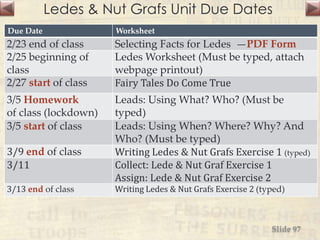
  • 135.
    Class 26 April 21,2015 Slide 135
  • 136.
    Opener • Slide 136 Class ♯26• 4/21/15 Take out your composition book and answer the following questions. 1. What type of quote is most commonly used by journalists? 2. What are the Society of Professional Journalists four guiding principles? 3. Name two current events and state why they are important. a. One local CE b. one national CE.
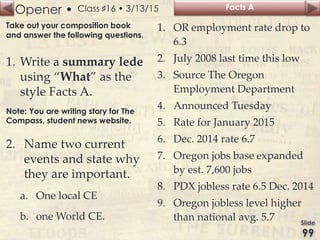
  • 137.
    Agenda Targets Class 26• April 21 • Opener • Due: Quotes & Attributions Worksheet • New: Practice with Quotes and Paraphrases (Form) – Due next class 4/23/15 – Practice with Direct Quotes_Paraphrases 2015 FORM.pdf – Save form then fill out on computer, save again & then print. • Identify current events • Apply ethics when using sources • Know what constitutes an authority when using a source • Gather the 4 of the 5 types of quotes • Use correct attribution style • Develop note taking skills Slide 137
  • 138.
    Due Dates Due DatesSources, Quotes & Attributions Unit Materials • Sources Worksheet 4/8/15 — Directions: Souces Worksheet Direction 2015.pdf • Quotation and Attribution PowerPoint Notes (on the Quotes page) 4/15/15 — Quotations and Attribution Notes Stratton 2015 FORM.pdf • Quotes Worksheet 4/21/15 — Form: Quotes Worksheet Form 2014 • Practice with Quotes and Paraphrases 4/23/15 — Practice with Direct Quotes & Paraphrases 2015 FORM.pdf Observed Interview, Taking Notes & Getting Quotes • Observation: 4/23/15 • Assignment: • Take notes while being careful to obtain accurate notes on quotes • From notes write a lede, nut graf and at least two quotes (one must be a direct quote) • Rough Draft Due: 4/27/15 • Final Draft Due: 4/29/15 Slide 138
  • 139.
    Class 27 April 23,2015 Slide 139
  • 140.
    Opener • Slide 140 Class ♯27• 4/23/15 Take out your composition book and answer the following questions. 1. What must you always have in your notes when you are planning to use a direct quote from a source? 2. When can a journalist not use information from a source? 3. What is hearsay? 4. Name two current events and state why they are important. a. One local CE b. one national CE.
  • 141.
    Opener • Slide 141 Class ♯27• 4/23/15 Take out your composition book and answer the following questions. 1. What must you always have in your notes when you are planning to use a direct quote from a source? Quotation marks around the material to be used. 2. When can a journalist not use information from a source? When is is “off the record.” 3. What is hearsay? Hearsay is information received from other people that one cannot adequately substantiate; rumor. 4. Name two current events and state why they are important. a. One local CE b. one national CE.
  • 142.
    Agenda Targets Class 27• April 23 • Opener • Due: Practice with Quotes and Paraphrases (Form) • Observe interview of Mick by advance students. – Observe & take notes using official journalist not pad – Prepare to write mini story • Lede • Nut graf • 2 quotes (1 direct) • Use transitions to guide reader through story from nut graft to quote to quote • Identify current events • Apply ethics when using sources • Know what constitutes an authority when using a source • Gather the 4 of the 5 types of quotes • Use correct attribution style • Develop note taking skills • Observe interview and take notes Slide 142
  • 143.
    Due Dates Due DatesSources, Quotes & Attributions Unit Materials • Sources Worksheet 4/8/15 — Directions: Souces Worksheet Direction 2015.pdf • Quotation and Attribution PowerPoint Notes (on the Quotes page) 4/15/15 — Quotations and Attribution Notes Stratton 2015 FORM.pdf • Quotes Worksheet 4/21/15 — Form: Quotes Worksheet Form 2014 • Practice with Quotes and Paraphrases 4/23/15 — Practice with Direct Quotes & Paraphrases 2015 FORM.pdf Observed Interview, Taking Notes & Getting Quotes • Observation: 4/23/15 • Assignment: • Take notes while being careful to obtain accurate notes on quotes • From notes write a lede, nut graf and at least two quotes (one must be a direct quote) • Rough Draft Due: 4/27/15 • Final Draft Due: 4/29/15 Slide 143
  • 144.
    Class 28 April 27,2015 Slide 144
  • 145.
    Opener • Slide 145 Class ♯28• 4/27/15 Take out your composition book and answer the following questions. 1. Give an example of a direct quote you took during the interview last class. 2. Now write a paraphrase of the same quote 3. Name two current events and state why they are important. a. One local CE b. One national CE. c. One world CE
  • 146.
    Current Events • 19-year-oldJoshua Edwards, is one of many still missing after the massive, deadly earthquake shook Nepal, a mountainous country between Tibet and India on Saturday. • Stock Market closing high • The owner of a Portland martial arts studio accused of sodomizing a child under 12 committed suicide in the Deschutes County Jail. Slide 146
  • 147.
    Nepal Earthquake 7.8 Slide 147 •http://www.bbc.com/news/world-asia- 3247495Slide1
  • 148.
  • 149.
    Agenda Targets Class 28• April 27 • Opener • Edit mini story w/peer & editors – Lede – Nut graf – 2 quotes (1 direct) – Use transitions to guide reader through story from nut graft to quote to quote • Identify current events • Apply ethics when using sources • Know what constitutes an authority when using a source • Gather the 4 of the 5 types of quotes • Use correct attribution style • Develop note taking skills • Observe interview and take notes Slide 149
  • 150.
    Due Dates Due DatesSources, Quotes & Attributions Unit Materials • Sources Worksheet 4/8/15 — Directions: Souces Worksheet Direction 2015.pdf • Quotation and Attribution PowerPoint Notes (on the Quotes page) 4/15/15 — Quotations and Attribution Notes Stratton 2015 FORM.pdf • Quotes Worksheet 4/21/15 — Form: Quotes Worksheet Form 2014 • Practice with Quotes and Paraphrases 4/23/15 — Practice with Direct Quotes & Paraphrases 2015 FORM.pdf Observed Interview, Taking Notes & Getting Quotes • Observation: 4/23/15 • Assignment: – Take notes while being careful to obtain accurate notes on quotes – From notes write a lede, nut graf and at least two quotes (one must be a direct quote) – Rough Draft Due: 4/27/15 for editing – Editing of Rough Draft Cont. 4/29/15 – Final Draft Due: 4/31/15 Slide 150
  • 151.
    Class 29 April 29,2015 Slide 151
  • 152.
    Opener • Slide 152 Class ♯29• 4/29/15 Take out your composition book and answer the following questions. 1. How do you attribute information to a source on a first reference? Hint: D1, D4 2. How do you attribute information to a source on a second reference? Hint: D1, D4 3. What is the best way to obtain information from a source? 4. Name three current events and state why they are important. a. What is the current death toll from the Nepal earthquake? b. What has been happening in Baltimore, Maryland? c. One local CE
  • 153.
    Attribution D1 On first reference,identify a person’s title, class or position. Do not use double identification in sports, such as sophomore center Nancy Smith: • Principal Judy Patterson, • history teacher Chet Howlett, • … Holly Hurliman, senior, said. • center Kristi Brennan. D4 Use the full name on the first reference and the last name only thereafter: • Principal Mike Kolb wore black and white, North Salem’s school colors. • Kolb sometimes wears ... • Coach Doug Hoffmeister lectured the team at halftime. Hoffmeister told them ... • Debater Paul Mapp won first at nationals. Mapp defeated... Slide 153
  • 154.
    Agenda Targets Class 29• April 29 • Opener • Edit mini story w/peer & editors – Lede – Nut graf – 2 quotes (1 direct) – Use transitions to guide reader through story from nut graft to quote to quote • Identify current events • Apply ethics when using sources • Know what constitutes an authority when using a source • Gather the 4 of the 5 types of quotes • Use correct attribution style • Develop note taking skills • Observe interview and take notes Slide 154
  • 155.
    Due Dates Due DatesSources, Quotes & Attributions Unit Materials • Sources Worksheet 4/8/15 — Directions: Souces Worksheet Direction 2015.pdf • Quotation and Attribution PowerPoint Notes (on the Quotes page) 4/15/15 — Quotations and Attribution Notes Stratton 2015 FORM.pdf • Quotes Worksheet 4/21/15 — Form: Quotes Worksheet Form 2014 • Practice with Quotes and Paraphrases 4/23/15 — Practice with Direct Quotes & Paraphrases 2015 FORM.pdf Observed Interview, Taking Notes & Getting Quotes • Observation: 4/23/15 • Assignment: – Take notes while being careful to obtain accurate notes on quotes – From notes write a lede, nut graf and at least two quotes (one must be a direct quote) – Rough Draft Due: 4/27/15 for editing – Editing of Rough Draft Cont. 4/29/15 – Final Draft Due: 4/31/15 Slide 155
  • 156.
    Class 30 May 1,2015 Slide 156
  • 157.
    Opener • Slide 157 Class ♯31• 5/5/15 Take out your composition book and answer the following questions. 1. Write down two story ideas and who you would contact as sources. 2. What traditionally occurs on May 1? 3. Name three current events and state why they are important. a. What is the current death toll from the Nepal earthquake? b. One national CE c. One local CE
  • 158.
    Agenda Targets Class 30• May 1 • Opener • Mini story Past Due 4/29 • Story Ideas • Story 1 Publication: May 15 • Story 2 Publication: May 28 • Identify current events • Apply ethics when using sources • Know what constitutes an authority when using a source • Gather the 4 of the 5 types of quotes • Use correct attribution style • Develop note taking skills • Observe interview and take notes Slide 158
  • 159.
    Story Ideas forPublication 1. Sports, end of seasons – (baseball, softball, track, tennis, LAX, golf, Rugby, etc.) 2. Prom a. Where to buy clothes, How to dress b. Where to eat before/after c. After plans d. Transportation to/from 3. Various school awards a. CHS Speech Teach Yr. b. SSC 4. Graduation (see prom for expansion ideas) 5. Best driver ed. places 6. Phone scams 7. Area Growth a. New Housing, Pop. b. Fred Meyer, Sunnyside 8. Full school year, budget 9. Cheap summer activities 10.Food Carts, Farmers Markets 11.Cheap eats 12.Dating hot spots 13.Best first date locations 14.Where to cool off on hot days 15.Parents behaving badly (sport events) 159
  • 160.
    Story Ideas forPublication 1. Area Growth a. New Housing, Pop. b. Fred Meyer, Sunnyside 2. Full school year, budget 3. Cheap summer activities 4. Food Carts, Farmers Markets 5. Cheap eats 6. Dating hot spots 7. Best first date locations 8. Where to cool off on hot days 9. Parents behaving badly (sport events) 160
  • 161.
    Class 31 May 5,2015 Slide 161
  • 162.
    Opener • Slide 162 Class ♯31• 5/5/15 Take out your composition book and answer the following questions. 1. Write down three story ideas and who you would contact as sources. 2. Name three current events and state why they are important. a. What is the current death toll from the Nepal earthquake? b. One national CE c. One local CE
  • 163.
    Agenda Targets Class 31• May 5 • Opener • Mini story Past Due 4/29 • Story Ideas • Story 1 Publication: May 15 • Story 2 Publication: May 28 Quiz next class • 20-25 points • Quotes; types, format • Sources; ethics, attribution, authority • Style: quotes; paragraph, lede and nut graph length; story formatting • Identify current events • Apply ethics when using sources • Know what constitutes an authority when using a source • Gather the 4 of the 5 types of quotes • Use correct attribution style • Develop note taking skills • Observe interview and take notes Slide 163
  • 164.
    Story Ideas forPublication 1. Personality stories a. Unusual hobbies b. Volunteers c. Sports super star d. Award winners 2. Cool Classroom activities 1. State testing a. Teacher’s viewpoint b. Student’s view c. Why do we do it d. Opting out 2. Prom a. Student’s opin. Theme b. Court c. Clothing options 3. Current crime stats 4. Allergy tips 5. RPHS Unity Field Trip 6. Saturday Market 7. Track Districts 8. Summer Break activities 9. Father’s day 10. Prep for finals 11. Spring sports 12. Graduation 164 What do you see happening?
  • 165.
    Class 32 May 7,2015 Slide 165
  • 166.
    Opener • Slide 166 Class ♯32• 5/7/15 Take out your composition book and answer the following questions. 1. Write down three story ideas and who you would contact as sources. 2. Name three current events and state why they are important. a. What is the current death toll from the Nepal earthquake? b. One national CE c. One local CE
  • 167.
    Agenda Targets Class 32• May 7 • Opener • Mini story Past Due 4/29 • Story Ideas • Story 1 Publication: May 15 • Story 2 Publication: May 28 Quiz 20 points • Quotes; types, format • Sources; ethics, attribution, authority • Style: quotes; paragraph, lede and nut graph length; story formatting • Identify current events • Apply ethics when using sources • Know what constitutes an authority when using a source • Gather the 4 of the 5 types of quotes • Use correct attribution style • Develop note taking skills • Observe interview and take notes Slide 167
  • 168.
    Pretest • Go toclass website • Go to Tests & Quizzes page • Click on http://socrative.com / • Choose student • Enter Room Number • Sign in – Last name, first name http://socrative.com/ Room: 296186 168
  • 169.
    Socrative Student Logon 296186 Signin using Last name, first name Example: Stratton, Lorraine 169
  • 170.
    Story Ideas forPublication 1. Sports, end of seasons – (baseball, softball, track, tennis, LAX, golf, Rugby, etc.) 2. Prom a. Where to buy clothes, How to dress b. Where to eat before/after c. After plans d. Transportation to/from 3. Various school awards a. CHS Speech Teach Yr. b. SSC 4. Graduation (see prom for expansion ideas) 5. Best driver ed. places 6. Phone scams 7. Area Growth a. New Housing, Pop. b. Fred Meyer, Sunnyside 8. Full school year, budget 9. Cheap summer activities 10.Food Carts, Farmers Markets 11.Cheap eats 12.Dating hot spots 13.Best first date locations 14.Where to cool off on hot days 15.Parents behaving badly (sport events) 170
  • 171.
    Story Ideas forPublication 16. River, water safety 17. Nepal Earthquake lessons for Oregon’s next big one 18. Summer volunteer ops. 19. Good Aps for a. Outdoor acuities b. Social connections c. Eats 20. Babysitting tips 21. What to do when bored at home 22. Good summer reads 23. Great hikes 24. Day Trips 25. Best connection (carrier) a. Cell Phone b. Cable vs. Satellite c. Internet 26.Best theater for movie watching 27.Summer job tips 28.Area parks 29.How to count to 10 or what to do when younger/older siblings are driving you crazy. Practical tips (not opinion) 30.Staying safe 171
  • 172.
    Class 33 May 11,2015 Slide 172
  • 173.
    Opener • Slide 173 Class ♯33• 5/11/15 Take out your composition book and answer the following questions. 1. Write down your story assignment and who you are going to interview. 2. What is the inverted pyramid? 3. How long are regular story paragraphs? 4. Name two current events and state why they are important. a. One national CE b. One local CE
  • 174.
    Agenda Targets Class 33• May 11 • Opener • Mini story final drafts Past Due 4/29 • Story 1 Publication: May 15 • Story 2 Publication: May 28 Questioning & Interviewing Techniques 1. Basic Questioning Strategies 2. Interviewing Order • Identify current events. • Apply ethics when using sources. • Know what constitutes an authority when using a source. • Interview five people for story. • Use correct attribution style. • Develop note taking skills. • Develop basic questioning strategy for upcoming interview. • Understand the basic interviewing order & prepare to use. Slide 174
  • 175.
    Questioning & Interviewing BasicQuestioning Strategy 1. Meet the respondent: icebreaker conversation 2. Ask first serious question 3. Proceed to the heart of the interview 4. Ask "bomb" question if necessary 5. Recovery from bomb question 6. Conclude interview "Bomb" questions are those that are potentially sensitive or embarrassing. Interviewing Strategy Good reporters always do the following before, during and after an interview I. Prepare II. During the interview III. Ending the interview IV. After the interview Slide 175
  • 176.
    Interviewing Strategy I. Prepare 1.Define a purpose of the interview 2. Research story (person) background 3. Internet, library, other living sources (consult family, friends, co- workers) 4. Make a list of questions (based on research) and plan your strategy 5. Set up an interview with appropriate person and to their advantage II. During the interview 1. Be on time & Be polite 2. Listen non-judgmentally 3. Ask open-ended questions 4. Take notes using their phrases and words 5. Help the person feel relaxed 6. Double check a. Spelling of names, places, unusual items & terms b.Facts & figures c. Titles 7. Rephrase questions to receive better answers 8. Use tape recorder for controversial items, but do not become dependent on it. Verify quotations if not using tape recorder. 9. Be careful with off-the-record comments. Try to avoid them, but sometimes they can lead to questions in another interview. 10. Listen to the responses. Your ability to ask good follow-up questions will usually determine how good your interview will be.Slide 176
  • 177.
    Interviewing Strategy III. Endingthe interview 1. Ask if there is anything they would like to add. 2. Look over your notes for any additional questions & clarification. 3. Go over all quotes with the respondent to check for accuracy 4. Obtain all the information you think you will need before concluding the interview, but be sure to ask if you can contact your respondent again if necessary. 5. Ask for phone number in case you need further clarification, but do not promise to let subject check story. 6. Thank the respondent for his/her IV. After the interview 1. Write story immediately after interview (within hour) 2. Double check facts (call source if needed) Slide 177
  • 178.
    Class 34 May 13,2015 Slide 178
  • 179.
    Opener • Slide 179 Class ♯34•5/13/15 Take out your composition book and answer the following questions. 1. Who have you interviewed? 2. Where did you interview? 3. What was the hardest thing about doing your interview? 4. Name 3 current events and state why they are important. a. One national CE b. One local CE c. World
  • 180.
    Agenda Targets Class 34• May 13 • Opener • Story 1 Publication: May 15 • Story 2 Publication: May 28 Remember: Questioning & Interviewing Techniques 1. Basic Questioning Strategies 2. Interviewing Order • Identify current events. • Apply ethics when using sources. • Know what constitutes an authority when using a source. • Interview five people for story. • Use correct attribution style. • Develop note taking skills. • Develop basic questioning strategy for upcoming interview. • Understand the basic interviewing order & prepare to use. Slide 180
  • 181.
    Interviewing Strategy I. Prepare 1.Define a purpose of the interview 2. Research story (person) background 3. Internet, library, other living sources (consult family, friends, co- workers) 4. Make a list of questions (based on research) and plan your strategy 5. Set up an interview with appropriate person and to their advantage II. During the interview 1. Be on time & Be polite 2. Listen non-judgmentally 3. Ask open-ended questions 4. Take notes using their phrases and words 5. Help the person feel relaxed 6. Double check a. Spelling of names, places, unusual items & terms b.Facts & figures c. Titles 7. Rephrase questions to receive better answers 8. Use tape recorder for controversial items, but do not become dependent on it. Verify quotations if not using tape recorder. 9. Be careful with off-the-record comments. Try to avoid them, but sometimes they can lead to questions in another interview. 10. Listen to the responses. Your ability to ask good follow-up questions will usually determine how good your interview will be.Slide 181
  • 182.
    Interviewing Strategy III. Endingthe interview 1. Ask if there is anything they would like to add. 2. Look over your notes for any additional questions & clarification. 3. Go over all quotes with the respondent to check for accuracy 4. Obtain all the information you think you will need before concluding the interview, but be sure to ask if you can contact your respondent again if necessary. 5. Ask for phone number in case you need further clarification, but do not promise to let subject check story. 6. Thank the respondent for his/her IV. After the interview 1. Write story immediately after interview (within hour) 2. Double check facts (call source if needed) Slide 182
  • 183.
    Questioning & Interviewing BasicQuestioning Strategy 1. Meet the respondent: icebreaker conversation 2. Ask first serious question 3. Proceed to the heart of the interview 4. Ask "bomb" question if necessary 5. Recovery from bomb question 6. Conclude interview "Bomb" questions are those that are potentially sensitive or embarrassing. Interviewing Strategy Good reporters always do the following before, during and after an interview I. Prepare II. During the interview III. Ending the interview IV. After the interview Slide 183
  • 184.
    Class 35 May 15,2015 Slide 184
  • 185.
    Opener • ImageA Image B Slide 185 Class ♯34• 5/13/15 Take out your composition book and answer the following questions. 1. What was the hardest thing about doing your interview? 2. What has been the largest stumbling block to your success in writing your story so far? 3. Name 3 current events and state why they are important. a. One national CE b. One local CE c. World
  • 186.
    Agenda Targets Class 34• May 15 • Opener • Story 1 Publication: May 15 Articles are now past due • Story 2 Publication: May 28 Assignment: Interviewing Reading 1. Go to “Interview Reading Assignment” 2. Fill out PDF (on website) 3. Read 2 article 4. Due: May 21 • Identify current events. • Apply ethics when using sources. • Know what constitutes an authority when using a source. • Interview five people for story. • Use correct attribution style. • Develop note taking skills. • Develop basic questioning strategy for upcoming interview. • Understand the basic interviewing order & prepare to use. Slide 186