Why Graduate School?
Juhann Waller, MS, PE
MATC Scholars Program
October 28 – 31, 2015
University of Nebraska-Lincoln
OUTLINE
• Introduction
• Learning Objectives
• Learning Outcomes
• Session Presentation
• Conclusion
LEARNING OBJECTIVES
• Reasons to Pursue an Advanced Degree
• Considerations to Begin the Application
Process
• Completing the Application Process
• Gaining Admission
LEARNING OUTCOMES
• Knowledgeable about why graduate school is
important
• Knowledgeable about preparing for graduate
school
• Informed about the benefits of attending
and investing in graduate studies, and
career paths as a graduate student
GRADUATE SCHOOL EXERCISE
Discovering Commonalities
In groups of (decide based on number of students in
session), generate a list of 20 things that you know
about graduate school. You will have a total of 10
minutes to complete this exercise. At the end of the
exercise, a student from each group will be selected
to present the group’s list.
WHAT IS GRADUATE SCHOOL?
• Provides specialized knowledge and training
in your chosen field of study
• Provides more depth to subjects taken in
your chosen field of study
• Engaging in research and other intellectual
activities to advance as well as contribute to
the scholarly work in your field
• Requires a personal commitment
WHY PURSUE AN ADVANCED DEGREE?
•Personal Growth
•Greater Employment Opportunities
•Greater Career Advancement Opportunities
•Sense of Accomplishment
•Greater Recognition and Credibility
•Field of Study Requirement
•Financial Reward
Reference: Martin, Don. “6 Reasons Why Graduate School Pays Off”. U.S. News & World Report Education June 29,2012. USnews. accessed on
October 09, 2015
TRENDS IN PURSUING ADVANCED DEGREES
• Trends in the economy shows that the US is
becoming extremely dependent on seeking a
highly educated and skilled workforce
• Between 2008 and 2018, approximately 2.5
million jobs will require a master’s, doctoral,
or advanced degree
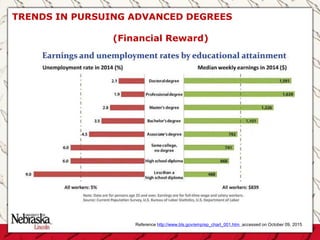
TRENDS IN PURSUING ADVANCED DEGREES
Reference http://www.bls.gov/emp/ep_chart_001.htm accessed on October 09, 2015
(Financial Reward)
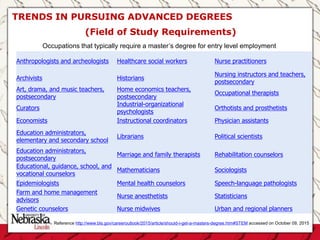
TRENDS IN PURSUING ADVANCED DEGREES
(Field of Study Requirements)
Anthropologists and archeologists Healthcare social workers Nurse practitioners
Archivists Historians
Nursing instructors and teachers,
postsecondary
Art, drama, and music teachers,
postsecondary
Home economics teachers,
postsecondary
Occupational therapists
Curators
Industrial-organizational
psychologists
Orthotists and prosthetists
Economists Instructional coordinators Physician assistants
Education administrators,
elementary and secondary school
Librarians Political scientists
Education administrators,
postsecondary
Marriage and family therapists Rehabilitation counselors
Educational, guidance, school, and
vocational counselors
Mathematicians Sociologists
Epidemiologists Mental health counselors Speech-language pathologists
Farm and home management
advisors
Nurse anesthetists Statisticians
Genetic counselors Nurse midwives Urban and regional planners
Occupations that typically require a master’s degree for entry level employment
Reference http://www.bls.gov/careeroutlook/2015/article/should-i-get-a-masters-degree.htm#STEM accessed on October 09, 2015
SOUL SEARCHING
SOUL SEARCHING EXERCISE: GRADUATE SCHOOL
Discovering Commonalities
In groups of (decide based on number of students in
session), generate a list of 5 reasons for attending
graduate school and 5 reasons for not attending
graduate school. You will have a total of 7 minutes to
complete this exercise. At the end of the exercise, a
student from each group will be selected to present
the group’s list.
SOUL SEARCHING
•Increase your earning potential
•Professional growth, development and
Advancement in your career
•Enjoy gaining knowledge about
chosen field of study
(Personal Reasons to Pursue Advanced Degrees)
WHAT’S NEXT?
GRADUATE SCHOOL PROCESS
• Research the ratings and reputation of the graduate
schools/programs
• What are the requirements for admission to the
university and the graduate program for your chosen
field of study?
• What type of research is being conducted by professors
in your chosen field of study?
• Student services available at the school in the respective
programs
• What kind of financial support can a student expect to
receive during the entire course of the program?
• How much educational debt the graduates leave with?
• How many students within the school/program complete
their program of study?
• How many years does it typically take a student to
complete their program of study?
• Location of University and the associated cost of living
• Where are graduates employed?
• University/Program expectation of students?
WHAT’S NEXT?
GRADUATE SCHOOL SELECTION PROCESS
WHAT’S NEXT?
GRADUATE SCHOOL SELECTION PROCESS
• Participate in graduate preparation conferences and campus
visits
• Become familiar with the deadline timetable for submitting
your application
• Purpose statement
• GRE scores (general and maybe subject)
• Transcript(s)
• Resume’/work experience requirements
• Letters of recommendation
• GPA requirements
WHAT’S NEXT?
GRAINING ADMISSION
• Fully understand the admission process
• Graduate admissions committee is
comprised mostly of professors
• Generate and submit a competitive
application
• Follow up and be proactive
CONCLUSIONS
• Attending graduate school offers tangible
and intangible opportunities
• Earning potential is higher than those with
just the bachelorette degrees
• Understanding factors that considered prior
to starting your application when greatly
enhance your chances of putting together a
competitive application
• Be proactive about the investment being
made to pursue graduate school
Slide design © 2009, Mid-America Transportation Center. All rights reserved.
Juhann Waller, MS, PE
Adjunct Assistant Professor
North Carolina A&T University
Civil, Architectural & Environmental Engineering Department
McNair Hall, Room #444
1601 East Market Street
Greensboro, North Carolina 27401
jw017827@ncat.edu
CREDITS

2015 MATC Scholars Program: Juhann Waller

  • 1.
    Why Graduate School? JuhannWaller, MS, PE MATC Scholars Program October 28 – 31, 2015 University of Nebraska-Lincoln
  • 2.
    OUTLINE • Introduction • LearningObjectives • Learning Outcomes • Session Presentation • Conclusion
  • 3.
    LEARNING OBJECTIVES • Reasonsto Pursue an Advanced Degree • Considerations to Begin the Application Process • Completing the Application Process • Gaining Admission
  • 4.
    LEARNING OUTCOMES • Knowledgeableabout why graduate school is important • Knowledgeable about preparing for graduate school • Informed about the benefits of attending and investing in graduate studies, and career paths as a graduate student
  • 5.
    GRADUATE SCHOOL EXERCISE DiscoveringCommonalities In groups of (decide based on number of students in session), generate a list of 20 things that you know about graduate school. You will have a total of 10 minutes to complete this exercise. At the end of the exercise, a student from each group will be selected to present the group’s list.
  • 6.
    WHAT IS GRADUATESCHOOL? • Provides specialized knowledge and training in your chosen field of study • Provides more depth to subjects taken in your chosen field of study • Engaging in research and other intellectual activities to advance as well as contribute to the scholarly work in your field • Requires a personal commitment
  • 7.
    WHY PURSUE ANADVANCED DEGREE? •Personal Growth •Greater Employment Opportunities •Greater Career Advancement Opportunities •Sense of Accomplishment •Greater Recognition and Credibility •Field of Study Requirement •Financial Reward Reference: Martin, Don. “6 Reasons Why Graduate School Pays Off”. U.S. News & World Report Education June 29,2012. USnews. accessed on October 09, 2015
  • 8.
    TRENDS IN PURSUINGADVANCED DEGREES • Trends in the economy shows that the US is becoming extremely dependent on seeking a highly educated and skilled workforce • Between 2008 and 2018, approximately 2.5 million jobs will require a master’s, doctoral, or advanced degree
  • 9.
    TRENDS IN PURSUINGADVANCED DEGREES Reference http://www.bls.gov/emp/ep_chart_001.htm accessed on October 09, 2015 (Financial Reward)
  • 10.
    TRENDS IN PURSUINGADVANCED DEGREES (Field of Study Requirements) Anthropologists and archeologists Healthcare social workers Nurse practitioners Archivists Historians Nursing instructors and teachers, postsecondary Art, drama, and music teachers, postsecondary Home economics teachers, postsecondary Occupational therapists Curators Industrial-organizational psychologists Orthotists and prosthetists Economists Instructional coordinators Physician assistants Education administrators, elementary and secondary school Librarians Political scientists Education administrators, postsecondary Marriage and family therapists Rehabilitation counselors Educational, guidance, school, and vocational counselors Mathematicians Sociologists Epidemiologists Mental health counselors Speech-language pathologists Farm and home management advisors Nurse anesthetists Statisticians Genetic counselors Nurse midwives Urban and regional planners Occupations that typically require a master’s degree for entry level employment Reference http://www.bls.gov/careeroutlook/2015/article/should-i-get-a-masters-degree.htm#STEM accessed on October 09, 2015
  • 11.
  • 12.
    SOUL SEARCHING EXERCISE:GRADUATE SCHOOL Discovering Commonalities In groups of (decide based on number of students in session), generate a list of 5 reasons for attending graduate school and 5 reasons for not attending graduate school. You will have a total of 7 minutes to complete this exercise. At the end of the exercise, a student from each group will be selected to present the group’s list.
  • 13.
    SOUL SEARCHING •Increase yourearning potential •Professional growth, development and Advancement in your career •Enjoy gaining knowledge about chosen field of study (Personal Reasons to Pursue Advanced Degrees)
  • 14.
    WHAT’S NEXT? GRADUATE SCHOOLPROCESS • Research the ratings and reputation of the graduate schools/programs • What are the requirements for admission to the university and the graduate program for your chosen field of study? • What type of research is being conducted by professors in your chosen field of study? • Student services available at the school in the respective programs • What kind of financial support can a student expect to receive during the entire course of the program?
  • 15.
    • How mucheducational debt the graduates leave with? • How many students within the school/program complete their program of study? • How many years does it typically take a student to complete their program of study? • Location of University and the associated cost of living • Where are graduates employed? • University/Program expectation of students? WHAT’S NEXT? GRADUATE SCHOOL SELECTION PROCESS
  • 16.
    WHAT’S NEXT? GRADUATE SCHOOLSELECTION PROCESS • Participate in graduate preparation conferences and campus visits • Become familiar with the deadline timetable for submitting your application • Purpose statement • GRE scores (general and maybe subject) • Transcript(s) • Resume’/work experience requirements • Letters of recommendation • GPA requirements
  • 17.
    WHAT’S NEXT? GRAINING ADMISSION •Fully understand the admission process • Graduate admissions committee is comprised mostly of professors • Generate and submit a competitive application • Follow up and be proactive
  • 18.
    CONCLUSIONS • Attending graduateschool offers tangible and intangible opportunities • Earning potential is higher than those with just the bachelorette degrees • Understanding factors that considered prior to starting your application when greatly enhance your chances of putting together a competitive application • Be proactive about the investment being made to pursue graduate school
  • 19.
    Slide design ©2009, Mid-America Transportation Center. All rights reserved. Juhann Waller, MS, PE Adjunct Assistant Professor North Carolina A&T University Civil, Architectural & Environmental Engineering Department McNair Hall, Room #444 1601 East Market Street Greensboro, North Carolina 27401 jw017827@ncat.edu CREDITS