Ed.D. Program in
Educational Leadership
Information Session
Doctorate of Education
Senate Bill 724 Section 1(b) states:
″The Doctor of Education degree…
shall be focused on preparing
administrative leaders for CA
public elementary and secondary
schools & community colleges….” (2005)
Program Mission
 Prepare informed and reflective educational
leaders
 Who ethically apply critical skills of
evaluation, analysis, synthesis, and action
 To ensure excellence and equity in
educational practices, and
 Serve as stewards to the education community
Agenda
 Program Description
 Admission
Requirements
 Questions
PROGRAM DESCRIPTION
Fast-Track Program
 Finish in 3-years
 60 units (2-3 courses per semester)
 Cohort approach offers peer support
 Year-round program- fall, spring & summer
terms
 Classes typically meet one night a week
Time to Degree
Courses Courses Dissertation
Qualifying
Exams
Dissertation
Proposal
Final
Dissertation
Defense
Typical Semester
Year 1First Fall
 Epistemology, History, and Structure of Education
 Collection and Analysis of Assessment Data OR Overview of Higher
EducationCommunity College: Systems, Organizational Development
and Structure, and Campus Cultures.
 Linking Research to Problems of Practice
First Spring
 Theory & Challenges for Leadership
 Qualitative Methods
 Connecting Research Questions to Scholarship in the Discipline
First Summer
 Leadership of Curricular & Instructional OR Leadership for Change and
Collaboration
 Quantitative Methods
 Preparing for Written Qualifying Examination
Summer 1: Qualifying Exam
 Administered after the first three terms of
the program.
– Early August or after first year
 Passing the exam advances the student to
candidacy
 Essay response to questions
Year 2 – More Specialization and Greater Focus
Second Fall
 Social Contexts of Ed. Politics, Policy, Governance OR Student
Learning and Development
 Quantitative OR Qualitative Methods
 Refining Research Questions
Second Spring
 Human Dimensions of Ed OR Resource Management and
Development
 Ethical & Legal Dimensions of Leadership
 Scholarly Defense of a Proposition
Second Summer
 Forecasting & Planning
 Transforming through Resource Optimization OR Professional
Seminars in Higher EducationCommunity College Studies and
Leadership Development
 IRB Approval and Proposal Defense
Summer 2:
Revise Dissertation Proposal
 Finalize Chapters 1 – 3
 Complete IRB first draft of IRB application
Year 3 – Dissertation Proposal and Defense
Fall
 Final revision of dissertation proposal
 Defend dissertation proposal
Spring
 Data collection and analysis
Summer
 Defend dissertation and revise
Type Course Areas
Leadership Foundations
Courses address the theory and practical
applications of scholarship in the various
leadership topics, such as:
 organizational theory
 history of education
 structure of modern education
 leadership theory
Specialization Courses
Courses focus on the particular needs of leaders
for PreK-12 schools or Community College.
Topics include:
 Assessment/evaluation
 Curricular and Instructional Practices
 Learning Development
 Human Dimensions of Change and Reform
 Resource Management & Development
Types Course Areas
Dissertation Support
Dissertation support is a unique feature of the
program
Research Support Seminars
Small groups
Individual dissertation topics
Individualized dissertation committee
One-to-one dissertation advising
Research Methodology
Courses address the processes for gathering, and
analyzing data, including learning:
quantitative, qualitative, and mixed methods
inquiry
 to evaluate and apply research to practice
 to carry out dissertation research
Research Support Seminars
Students are assigned to small groups (5-7 students)
based on their initial research plans
Embed the development of a research proposal for the
dissertation throughout the academic terms
The instructors meet with the same group of students
each semester, providing a stable advising relationship
• Individual meetings (2+ a semester)
• Group meetings every semester
Faculty
 Experts in educational leadership
 All earned Ed.D or Ph.D.
 Full-time tenure track faculty provide instruction for
nearly all courses
 All have been practitioners in K-12 or community
college/higher education settings
 All are researchers engaged in local education settings
Faculty
Our faculty have been former:
 principals
 superintendents
 teachers
 deans and college presidents
 students
 community services directors
Associate Professor
Dr. Natalie Tran
Professor Dr. Dawn
Person
Associate Professor Dr.
John Hoffman
Your Colleagues
1. Diverse working professionals
• Interested in change
• Invested in CA. Community Colleges or Pre K-12
1. Educational Leaders
• Vice Presidents, Deans, Assistant Principals, and Principals
• Faculty/Administrative Leaders and Counselors
1. Professionals who are committed to and value
diversity
2. Invested in the learning process and the cohort
concept
Support for Students
 Writing support and coaches
 Dissertation Editing
 Conference travel subsidies
 Transcribing help
 Analysis software support
 Titan Resources
 Support Services
 Fitness and Recreation
Center for Research on Educational Access
and Leadership (C-REAL)
 Research on local
educational problems
in PreK-12 and
Community Colleges
that is systemic and
solution focused
 Outcomes include
dissemination of
findings through
publications and
presentations.
 Support data
analysis phase of
dissertation
 Organize
dissemination
venues for your
research
ADMISSIONS REQUIREMENTS
ADMISSION DEADLINES
 February 1st
 Rolling admissions thereafter
 Application fee-$55
 Must apply to the University via
CSUmentor
Admission Requirements
1. B.A. and M.A./M.S. from accredited higher education
institutions
2. > 3.0 GPA
3. Preparation and experience pertinent to educational
leadership
4. Complete application to CSUmentor
5. Create a student account with CSUF
6. Graduate Record Examination (GRE) taken within the last
five years
7. Official Transcripts sent directly to CSUF- Admissions and
Records
California State University, Fullerton
Admissions and Records
P.O.Box 6900, Fullerton, CA 92834
7. Campus Interview
CSUmentor
CSU Grad Application (http://www.csumentor.edu/)
The following codes will be needed to complete your CSUmentor
application:
10a Program objective = PreK-12 Leadership 08271
= Community College 08273
10b Degree Objective = 8 (Doctoral)
11Credential Objective =
K-12 Professional Administrative Code = 502
Supplemental Application
Documents required by the Educational Leadership Department:
Copies of Unofficial Transcripts
Supplemental Coversheet Form
Statement of purpose
Professional Resume
Writing sample
 Three Recommendation Forms
 Employer/District Support Agreement
 GRE Score Report CSUF Code 4589 Department Code 3001
 Official Transcripts from all universities and community
colleges
MAIL TO
Department of Educational Leadership
PO Box 6868
Fullerton, CA 92834-6868
Campus Interview
• When possible, group interview
• 30 – 60 minutes
• In-person writing exercise
Really? The GRE?
• Required but not weighed heavily in
admissions decisions
Considerations in Admission Decisions
 Leadership potential
 Potential for significant professional contributions
 Analytical ability
 Writing skills
 Interest in research
 Commitment to academic success of students from all
backgrounds
 Commitment to support historically disenfranchised
community partnerships
 Desire to support change processes in educational
institutions
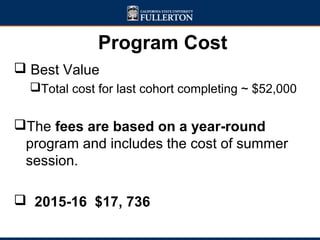
Program Cost
 Best Value
Total cost for last cohort completing ~ $52,000
The fees are based on a year-round
program and includes the cost of summer
session.
 2015-16 $17, 736
Student Aid
 The Financial Aid Office has a designated counselor for
doctoral students (http://www.fullerton.edu/financialaid/)
 Traditional student loans are available for Ed.D. students
through the Financial Aid Office
 $180,000 need-based aid granted to students each year
 Free Application for Federal Student Aid—FAFSA
 http://www.fafsa.ed.gov
 Must be renewed each year!!
Transfer Credit
Applicants can request transfer credit:
 Up to 12 units
 Doctoral level courses
 Taken in the last two years
 Has similar catalog description
 Appear on an official transcript from an
accredited institution of higher education
 Grade of B or better.
For more information
Visit
http://ed.fullerton.edu/edd/
Contact
Dr. Natalie Tran (P-12)| natran@fullerton.edu
Dr. Dawn Person (CC)| dperson@fullerton.edu
Join
https://www.facebook.com/CSUFEDD

Edd info session powerpoint 2016

  • 1.
    Ed.D. Program in EducationalLeadership Information Session
  • 2.
    Doctorate of Education SenateBill 724 Section 1(b) states: ″The Doctor of Education degree… shall be focused on preparing administrative leaders for CA public elementary and secondary schools & community colleges….” (2005)
  • 3.
    Program Mission  Prepareinformed and reflective educational leaders  Who ethically apply critical skills of evaluation, analysis, synthesis, and action  To ensure excellence and equity in educational practices, and  Serve as stewards to the education community
  • 4.
    Agenda  Program Description Admission Requirements  Questions
  • 5.
  • 6.
    Fast-Track Program  Finishin 3-years  60 units (2-3 courses per semester)  Cohort approach offers peer support  Year-round program- fall, spring & summer terms  Classes typically meet one night a week
  • 7.
    Time to Degree CoursesCourses Dissertation Qualifying Exams Dissertation Proposal Final Dissertation Defense
  • 8.
  • 9.
    Year 1First Fall Epistemology, History, and Structure of Education  Collection and Analysis of Assessment Data OR Overview of Higher EducationCommunity College: Systems, Organizational Development and Structure, and Campus Cultures.  Linking Research to Problems of Practice First Spring  Theory & Challenges for Leadership  Qualitative Methods  Connecting Research Questions to Scholarship in the Discipline First Summer  Leadership of Curricular & Instructional OR Leadership for Change and Collaboration  Quantitative Methods  Preparing for Written Qualifying Examination
  • 10.
    Summer 1: QualifyingExam  Administered after the first three terms of the program. – Early August or after first year  Passing the exam advances the student to candidacy  Essay response to questions
  • 11.
    Year 2 –More Specialization and Greater Focus Second Fall  Social Contexts of Ed. Politics, Policy, Governance OR Student Learning and Development  Quantitative OR Qualitative Methods  Refining Research Questions Second Spring  Human Dimensions of Ed OR Resource Management and Development  Ethical & Legal Dimensions of Leadership  Scholarly Defense of a Proposition Second Summer  Forecasting & Planning  Transforming through Resource Optimization OR Professional Seminars in Higher EducationCommunity College Studies and Leadership Development  IRB Approval and Proposal Defense
  • 12.
    Summer 2: Revise DissertationProposal  Finalize Chapters 1 – 3  Complete IRB first draft of IRB application
  • 13.
    Year 3 –Dissertation Proposal and Defense Fall  Final revision of dissertation proposal  Defend dissertation proposal Spring  Data collection and analysis Summer  Defend dissertation and revise
  • 14.
  • 15.
    Leadership Foundations Courses addressthe theory and practical applications of scholarship in the various leadership topics, such as:  organizational theory  history of education  structure of modern education  leadership theory
  • 16.
    Specialization Courses Courses focuson the particular needs of leaders for PreK-12 schools or Community College. Topics include:  Assessment/evaluation  Curricular and Instructional Practices  Learning Development  Human Dimensions of Change and Reform  Resource Management & Development
  • 17.
  • 18.
    Dissertation Support Dissertation supportis a unique feature of the program Research Support Seminars Small groups Individual dissertation topics Individualized dissertation committee One-to-one dissertation advising
  • 19.
    Research Methodology Courses addressthe processes for gathering, and analyzing data, including learning: quantitative, qualitative, and mixed methods inquiry  to evaluate and apply research to practice  to carry out dissertation research
  • 20.
    Research Support Seminars Studentsare assigned to small groups (5-7 students) based on their initial research plans Embed the development of a research proposal for the dissertation throughout the academic terms The instructors meet with the same group of students each semester, providing a stable advising relationship • Individual meetings (2+ a semester) • Group meetings every semester
  • 21.
    Faculty  Experts ineducational leadership  All earned Ed.D or Ph.D.  Full-time tenure track faculty provide instruction for nearly all courses  All have been practitioners in K-12 or community college/higher education settings  All are researchers engaged in local education settings
  • 22.
    Faculty Our faculty havebeen former:  principals  superintendents  teachers  deans and college presidents  students  community services directors Associate Professor Dr. Natalie Tran Professor Dr. Dawn Person Associate Professor Dr. John Hoffman
  • 23.
    Your Colleagues 1. Diverseworking professionals • Interested in change • Invested in CA. Community Colleges or Pre K-12 1. Educational Leaders • Vice Presidents, Deans, Assistant Principals, and Principals • Faculty/Administrative Leaders and Counselors 1. Professionals who are committed to and value diversity 2. Invested in the learning process and the cohort concept
  • 24.
    Support for Students Writing support and coaches  Dissertation Editing  Conference travel subsidies  Transcribing help  Analysis software support  Titan Resources  Support Services  Fitness and Recreation
  • 25.
    Center for Researchon Educational Access and Leadership (C-REAL)  Research on local educational problems in PreK-12 and Community Colleges that is systemic and solution focused  Outcomes include dissemination of findings through publications and presentations.  Support data analysis phase of dissertation  Organize dissemination venues for your research
  • 26.
  • 27.
    ADMISSION DEADLINES  February1st  Rolling admissions thereafter  Application fee-$55  Must apply to the University via CSUmentor
  • 28.
    Admission Requirements 1. B.A.and M.A./M.S. from accredited higher education institutions 2. > 3.0 GPA 3. Preparation and experience pertinent to educational leadership 4. Complete application to CSUmentor 5. Create a student account with CSUF 6. Graduate Record Examination (GRE) taken within the last five years 7. Official Transcripts sent directly to CSUF- Admissions and Records California State University, Fullerton Admissions and Records P.O.Box 6900, Fullerton, CA 92834 7. Campus Interview
  • 29.
    CSUmentor CSU Grad Application(http://www.csumentor.edu/) The following codes will be needed to complete your CSUmentor application: 10a Program objective = PreK-12 Leadership 08271 = Community College 08273 10b Degree Objective = 8 (Doctoral) 11Credential Objective = K-12 Professional Administrative Code = 502
  • 30.
    Supplemental Application Documents requiredby the Educational Leadership Department: Copies of Unofficial Transcripts Supplemental Coversheet Form Statement of purpose Professional Resume Writing sample  Three Recommendation Forms  Employer/District Support Agreement  GRE Score Report CSUF Code 4589 Department Code 3001  Official Transcripts from all universities and community colleges MAIL TO Department of Educational Leadership PO Box 6868 Fullerton, CA 92834-6868
  • 31.
    Campus Interview • Whenpossible, group interview • 30 – 60 minutes • In-person writing exercise
  • 32.
    Really? The GRE? •Required but not weighed heavily in admissions decisions
  • 33.
    Considerations in AdmissionDecisions  Leadership potential  Potential for significant professional contributions  Analytical ability  Writing skills  Interest in research  Commitment to academic success of students from all backgrounds  Commitment to support historically disenfranchised community partnerships  Desire to support change processes in educational institutions
  • 34.
    Program Cost  BestValue Total cost for last cohort completing ~ $52,000 The fees are based on a year-round program and includes the cost of summer session.  2015-16 $17, 736
  • 35.
    Student Aid  TheFinancial Aid Office has a designated counselor for doctoral students (http://www.fullerton.edu/financialaid/)  Traditional student loans are available for Ed.D. students through the Financial Aid Office  $180,000 need-based aid granted to students each year  Free Application for Federal Student Aid—FAFSA  http://www.fafsa.ed.gov  Must be renewed each year!!
  • 36.
    Transfer Credit Applicants canrequest transfer credit:  Up to 12 units  Doctoral level courses  Taken in the last two years  Has similar catalog description  Appear on an official transcript from an accredited institution of higher education  Grade of B or better.
  • 37.
    For more information Visit http://ed.fullerton.edu/edd/ Contact Dr.Natalie Tran (P-12)| natran@fullerton.edu Dr. Dawn Person (CC)| dperson@fullerton.edu Join https://www.facebook.com/CSUFEDD

Editor's Notes

  • #23 Add three small pictures of faculty
  • #27 Picture