


More Education, More Problems? Debunking the Myths of Graduate & Professional SchoolGO-MAP/ECC Graduate and Undergraduate Diversity Mixer February 10, 2011Kane Hall, Walker Ames RoomPresentation compiled and adapted by: Sabrina Bonaparte
Someone in your family told you to goYour best friend is goingNothing else to do at the momentDoctors get better seats in restaurantsYou aren’t ready to start working for a livingIt’s a good place to meet girls/guysWhy should you go to Graduate School (Poor Reasons)
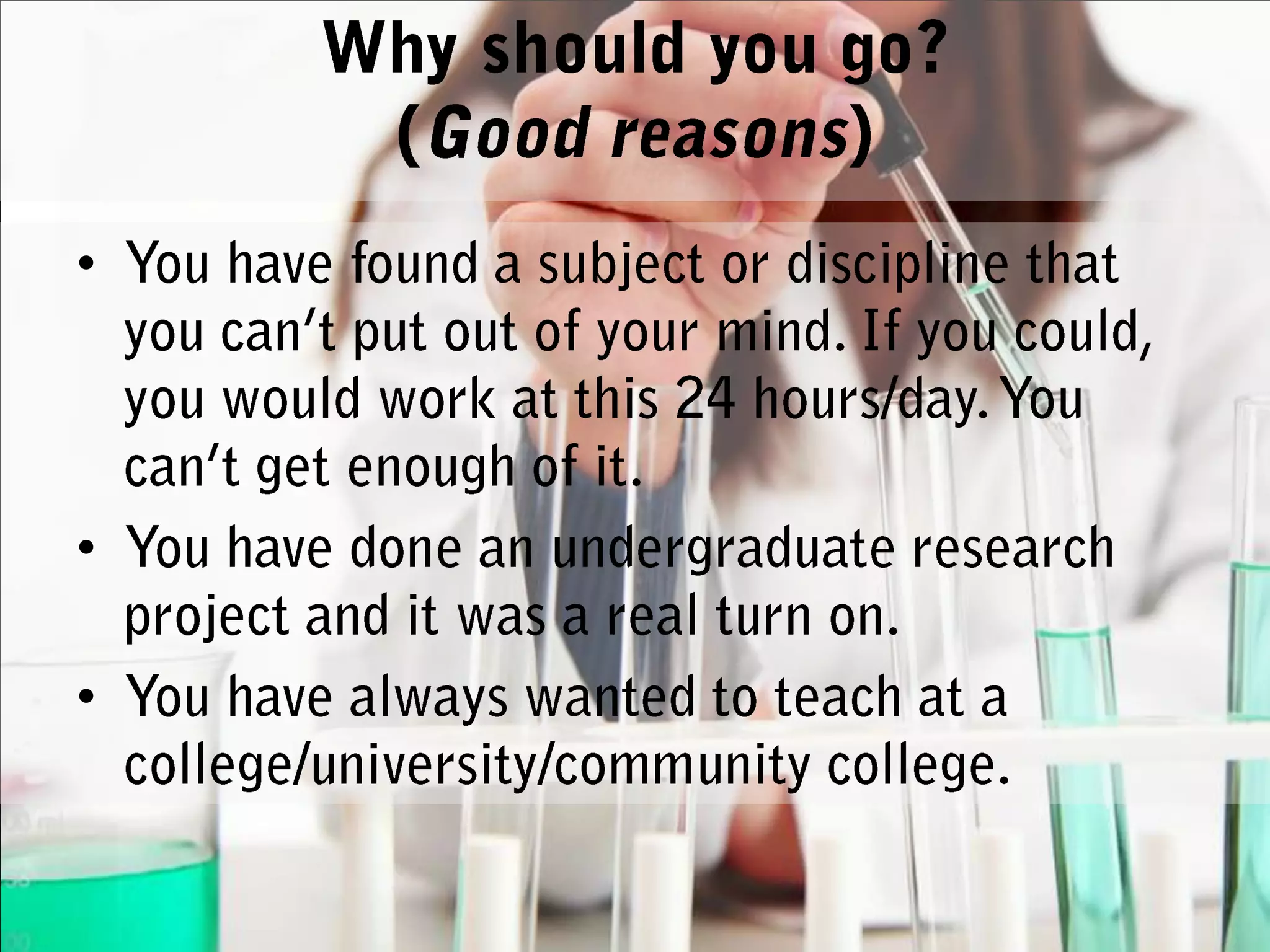
Why should you go? (Good reasons)You have found a subject or discipline that you can’t put out of your mind. If you could, you would work at this 24 hours/day. You can’t get enough of it.You have done an undergraduate research project and it was a real turn on.You have always wanted to teach at a college/university/community college.
More Reasons to GoWhen you encounter a problem, you think about it until you solve it, even if it takes days. You want to cure cancer or build the first controlled fusion reactorYou would prefer to have others working for you, rather than you working for others
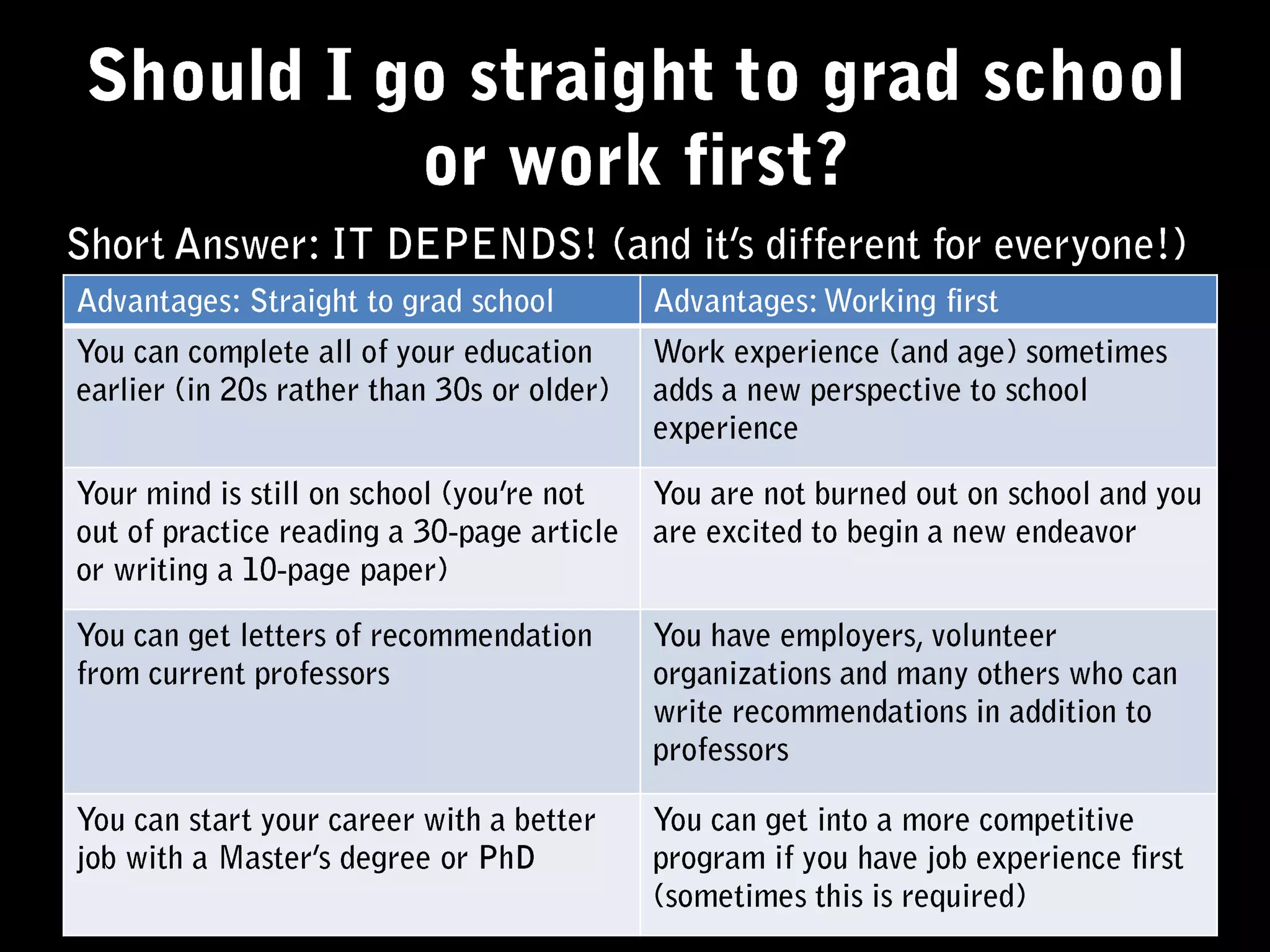
Should I go straight to grad school or work first?Short Answer: IT DEPENDS! (and it’s different for everyone!)
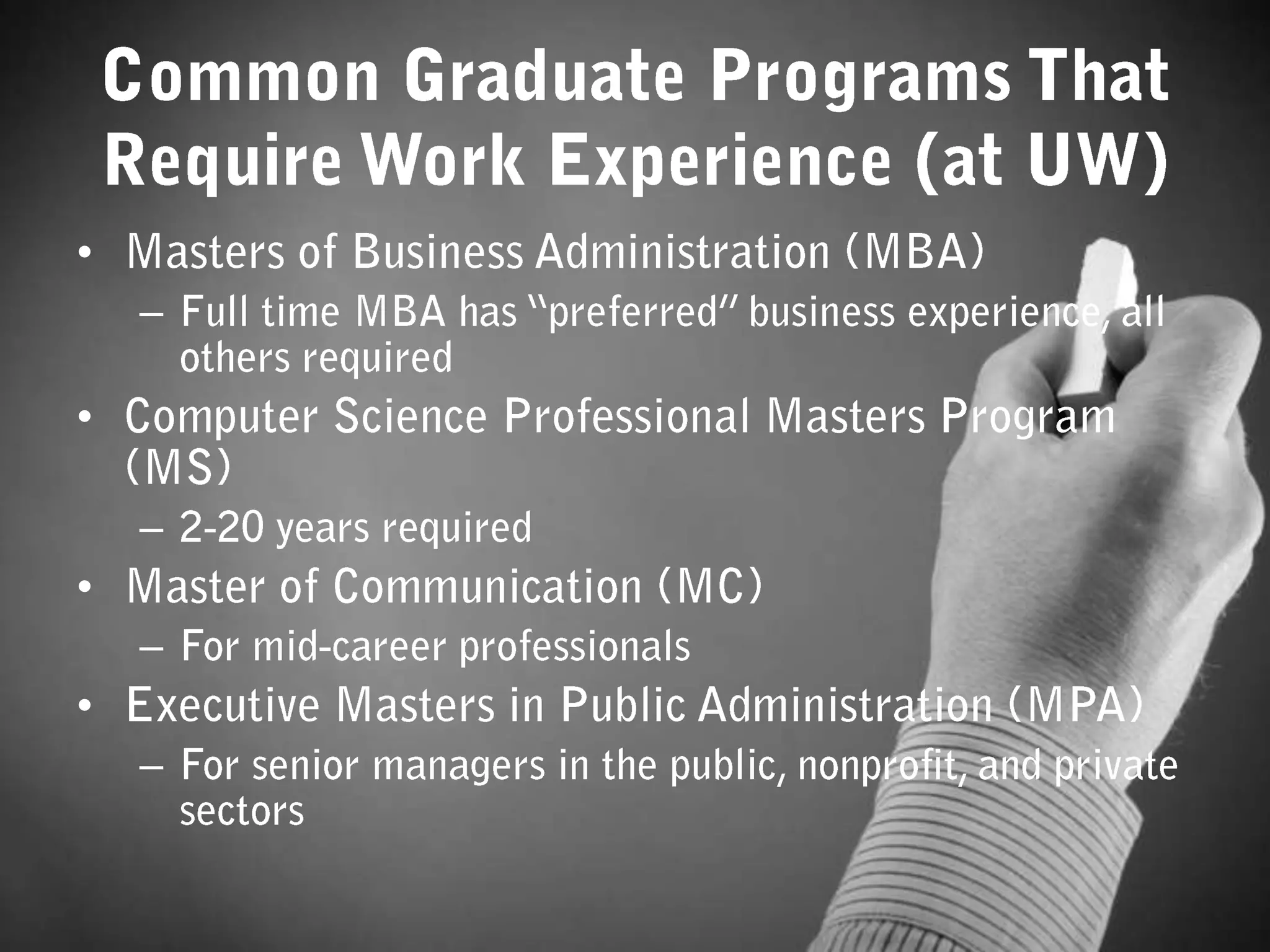
Common Graduate Programs That Require Work Experience (at UW)Masters of Business Administration (MBA)Full time MBA has “preferred” business experience, all others requiredComputer Science Professional Masters Program (MS)2-20 years requiredMaster of Communication (MC)For mid-career professionalsExecutive Masters in Public Administration (MPA)For senior managers in the public, nonprofit, and private sectors
Most PhD programs do not require work experience (except maybe business)What will set you apart is RESEARCH experienceWith a program (McNair, undergraduate research, summer research programs, etc)With a professor (paid, unpaid)With a graduate student  What about PhD programs?
The Graduate School Application
Parts of the Graduate School ApplicationGradesGRE/MCAT/LSAT (Standardized tests)Writing SampleLetters of RecommendationStatement of Purpose/Letter of IntentOptional Personal StatementPortfolio (for some fields)
Myth 1: I am the only person who is unfamiliar with the application processReality: MOST people are not familiar with the process. Only those who have friends/family who have been through the process recently or are involved in academia are familiar with it. So, don’t be afraid to ask for help! You’re not the only one!
Reality: Graduate school admissions is a holistic process, meaning you will get in based on your complete application. If your GRE scores are a little low, compensate by showing strong writing skills and good letters of recommendation, etc. Myth 2: If one part of my application is weak, I will not get in
Myth 3: If I have a perfect GRE and GPA I will be guaranteed admission to any graduate programReality: You will only get into programs where  the faculty think you will “fit”, meaning you have similar interests with faculty in the department. Moral of the story: tailor your personal statement to each school you apply to!
Graduate School Myths
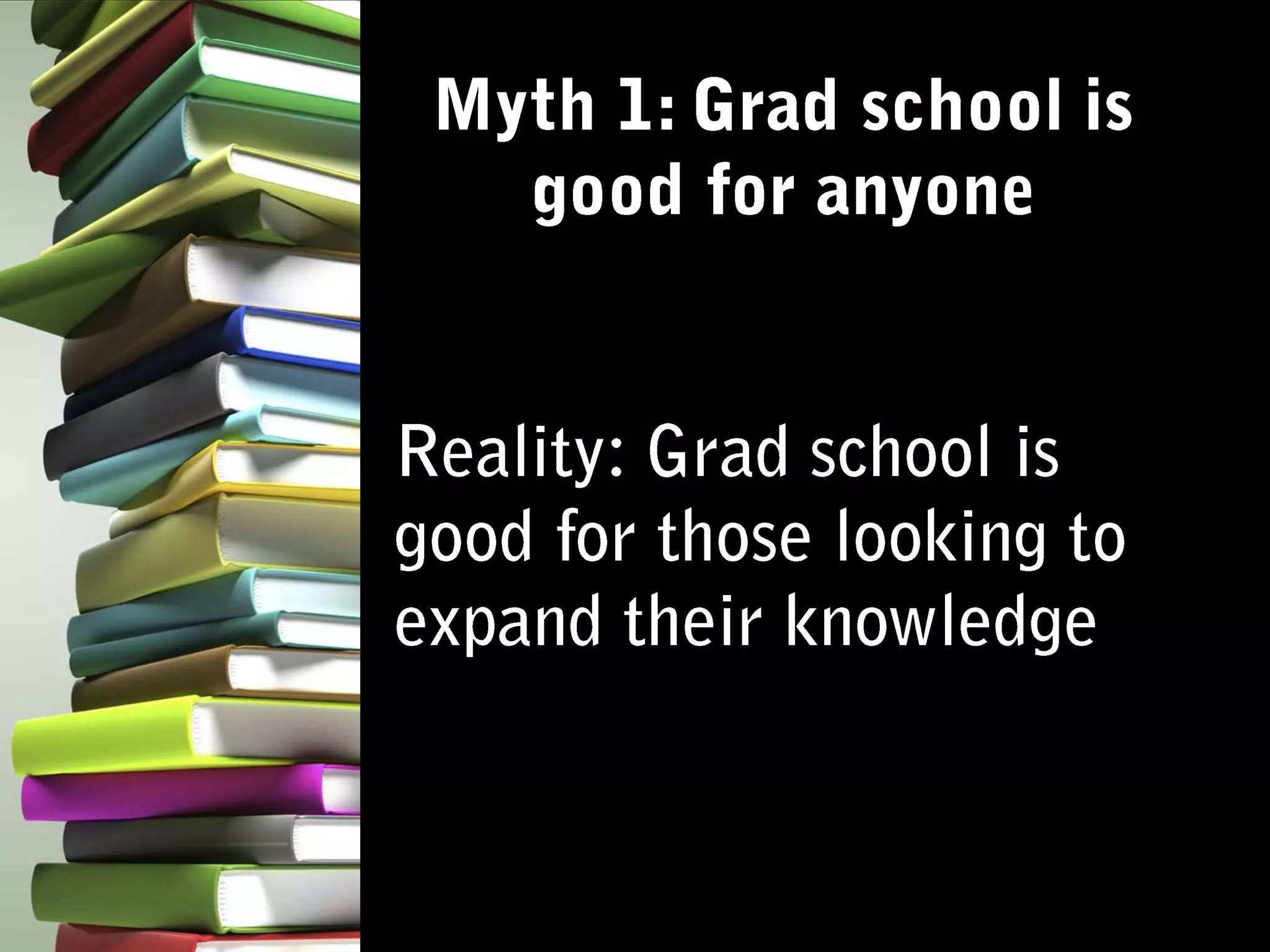
Myth 1: Grad school is good for anyoneReality: Grad school is good for those looking to expand their knowledge
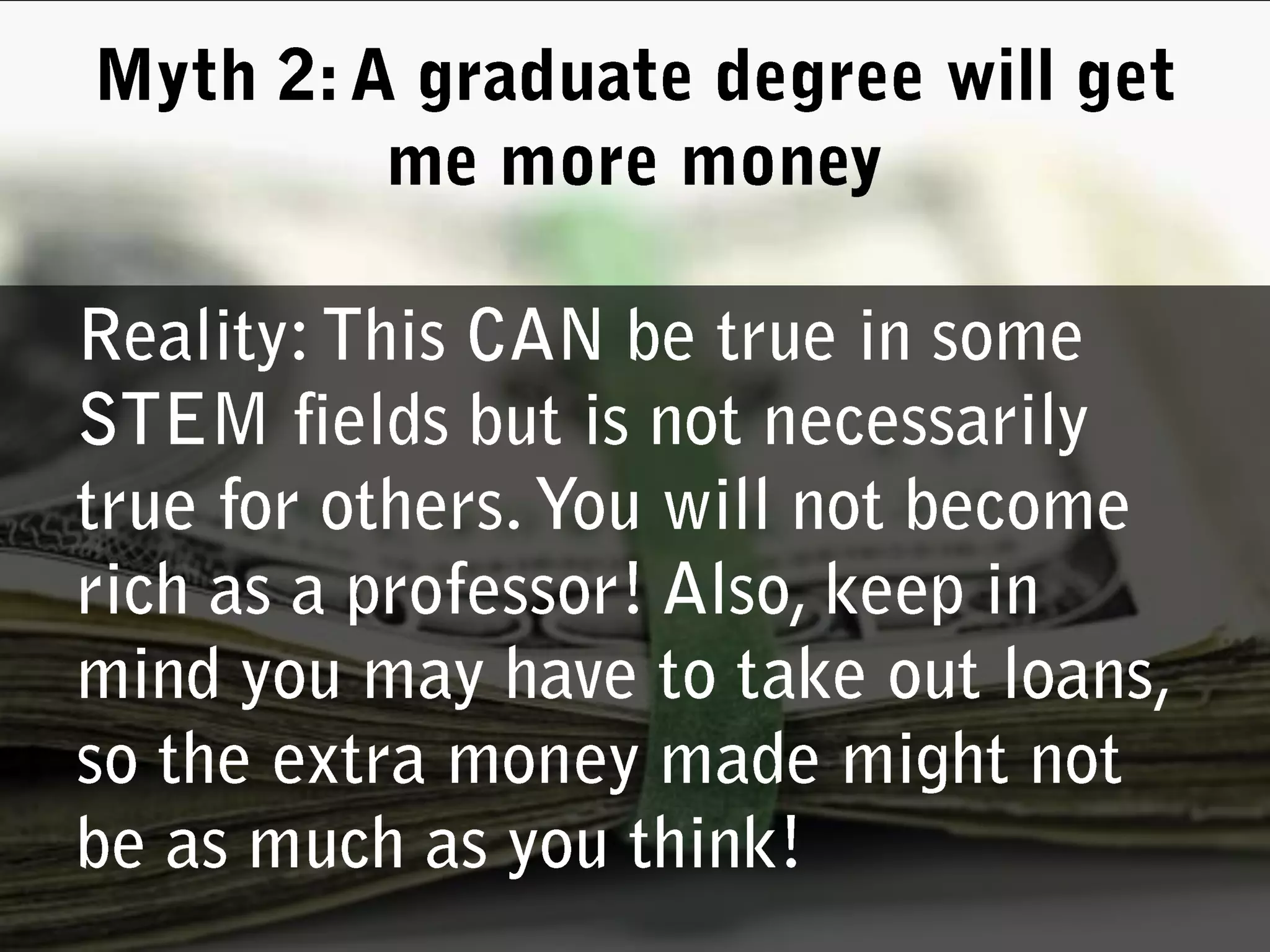
Reality: This CAN be true in some STEM fields but is not necessarily true for others. You will not become rich as a professor! Also, keep in mind you may have to take out loans, so the extra money made might not be as much as you think! Myth 2: A graduate degree will get me more money
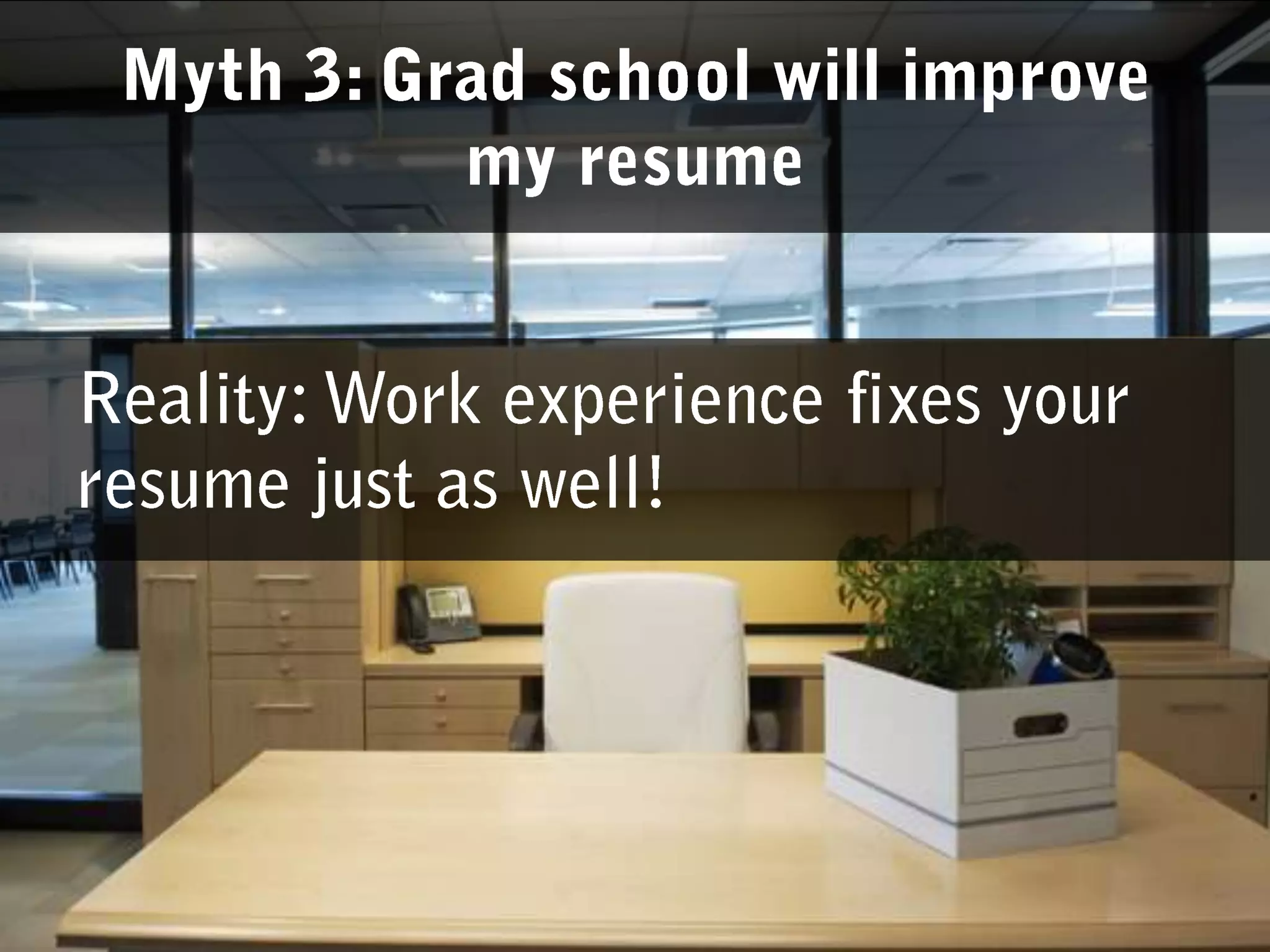
Reality: Work experience fixes your resume just as well! Myth 3: Grad school will improve my resume
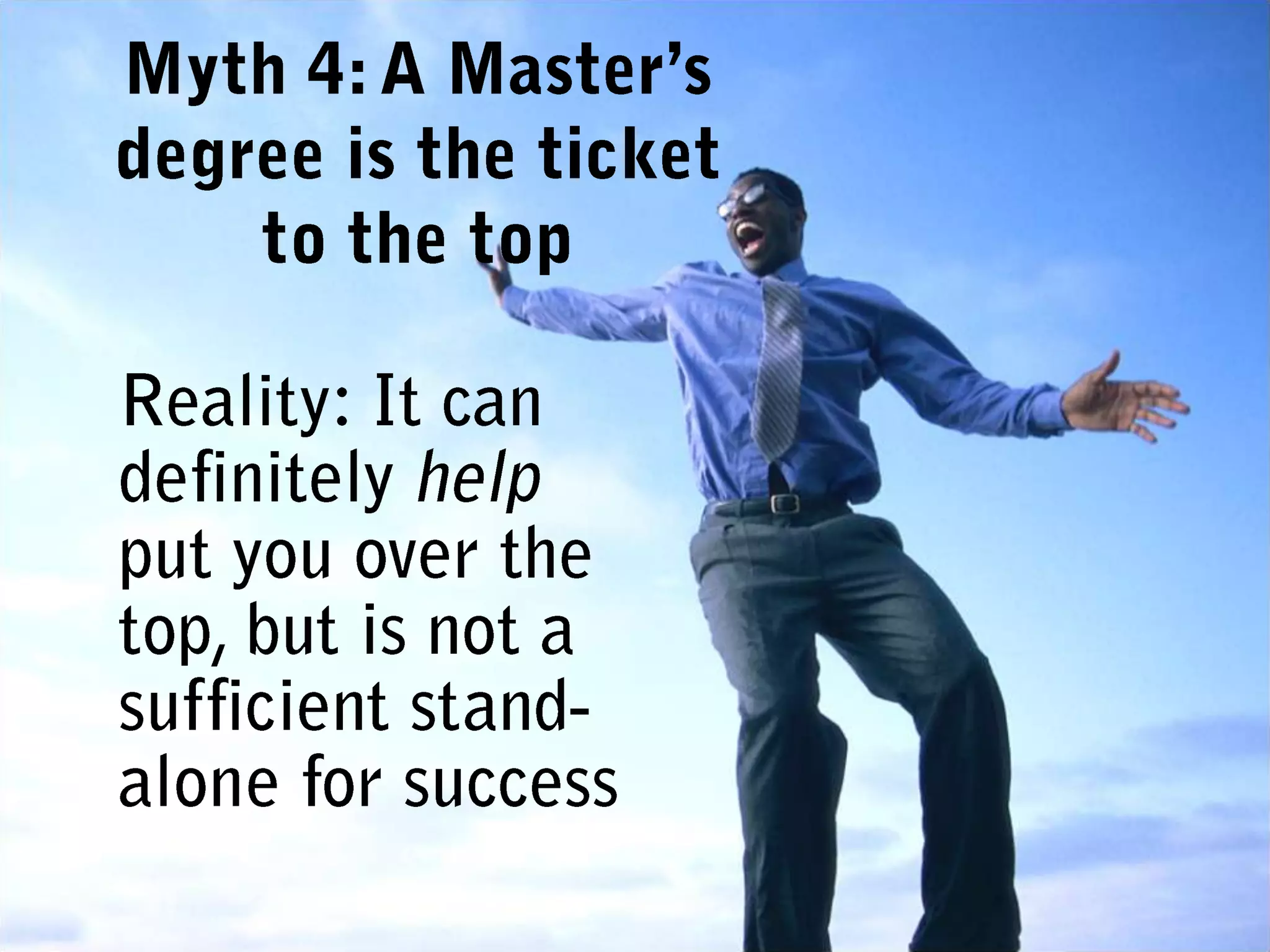
Myth 4: A Master’s degree is the ticket to the topReality: It can definitely help put you over the top, but is not a sufficient stand-alone for success
Myth 5: It’s all about the degreeReality: Even if a degree is a mandatory requirement for a job, you get what you put into your degree. If you don’t work hard and get good letters of recommendation, you just having the degree won’t be enough to get you a job
More Common Myths about Graduate SchoolOnly people with 4.0 averages get inOnly people with 1600 GRE scores get inGraduate classes are just like under-graduate classes only more intenseIf you have a bad grade in any class you will not be accepted
You need to be very good at what you doYou need a “fire in the belly” or passion for your chosen fieldGraduate classes are unlike undergraduate classes; a different skill set is required and must be developed for successDrive and motivation counts as much or more than native intelligence (having both is nice, of course)The Reality of Graduate School
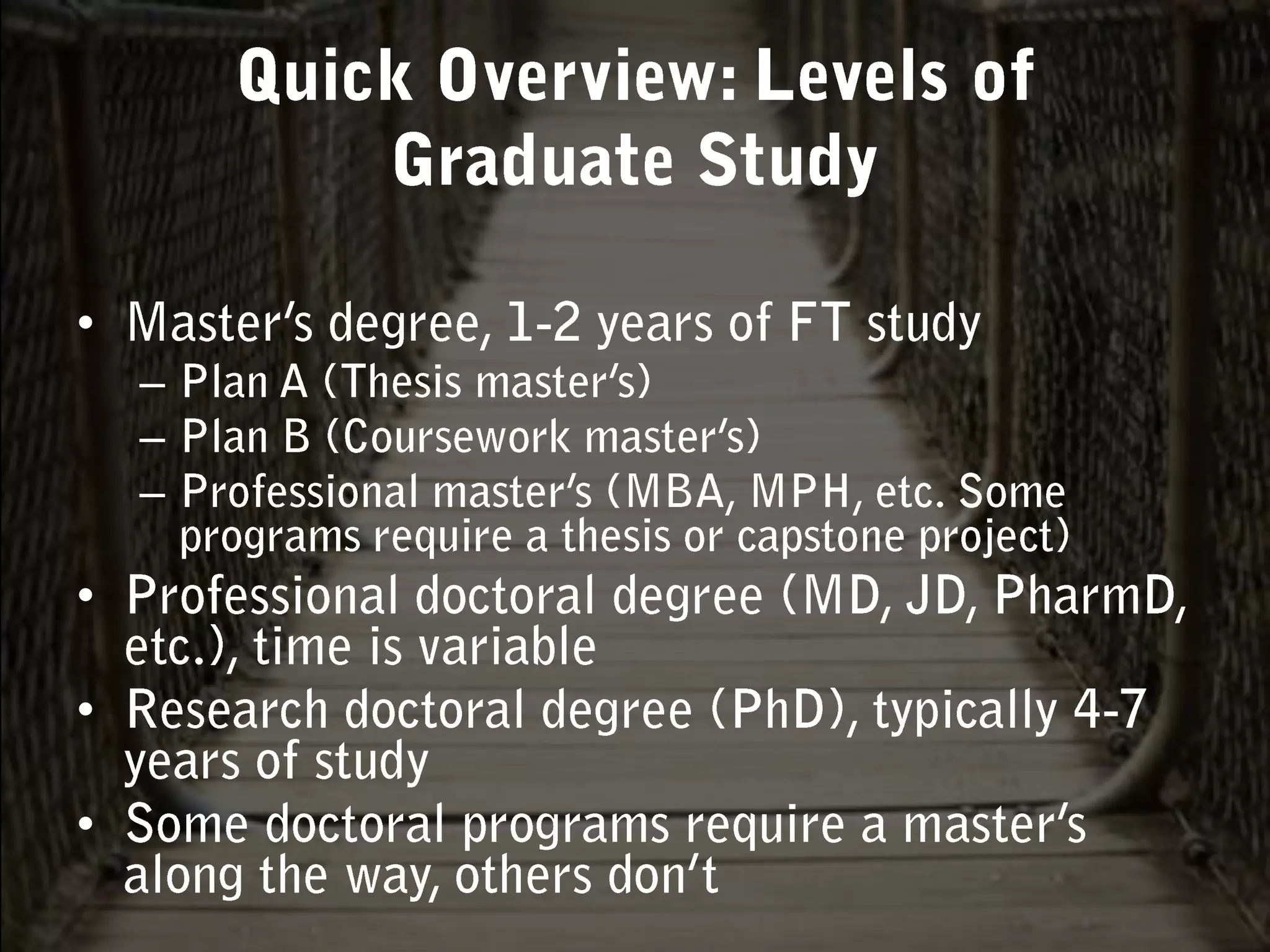
Master’s degree, 1-2 years of FT studyPlan A (Thesis master’s)Plan B (Coursework master’s)Professional master’s (MBA, MPH, etc. Some programs require a thesis or capstone project)Professional doctoral degree (MD, JD, PharmD, etc.), time is variableResearch doctoral degree (PhD), typically 4-7 years of studySome doctoral programs require a master’s along the way, others don’tQuick Overview: Levels of Graduate Study
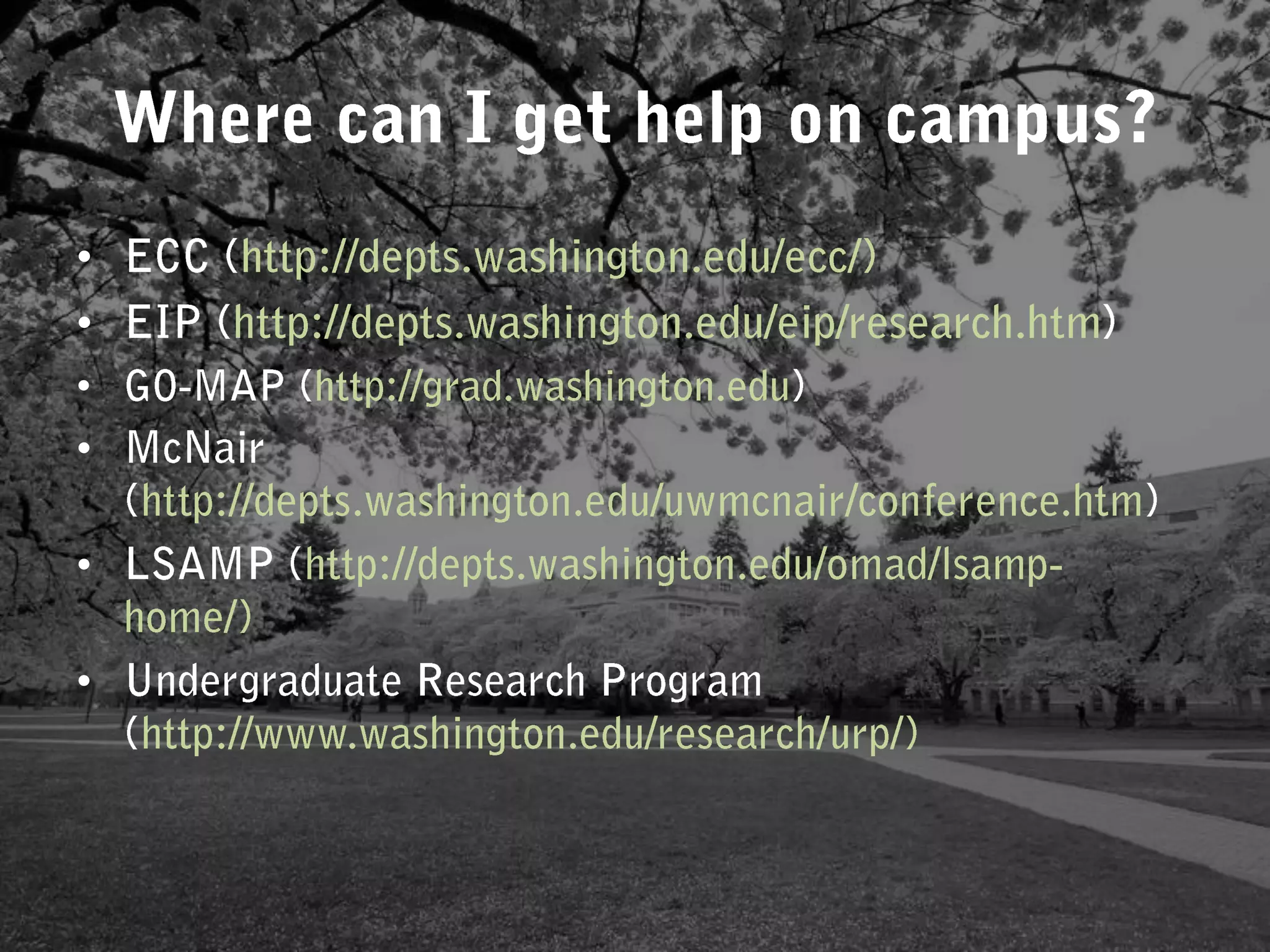
ECC (http://depts.washington.edu/ecc/) EIP (http://depts.washington.edu/eip/research.htm)GO-MAP (http://grad.washington.edu) McNair (http://depts.washington.edu/uwmcnair/conference.htm)LSAMP (http://depts.washington.edu/omad/lsamp-home/)Undergraduate Research Program (http://www.washington.edu/research/urp/)Where can I get help on campus?
Citations Much of this PowerPoint was adapted from Applying to Graduate School: Myths and Realities (ppt) by Dr. Jim Henkel and Dr. Harold Bibb http://www.instituteonteachingandmentoring.org/Institute/Handouts06/McNairSession-GraduateSchoolApplicationProcess.pptGrad School 101: The Truth About the Top Six Grad School Myths  by Tiffany Monhollonhttp://littleredsuit.com/2007/07/31/grad-school-101-the-truth-about-the-top-six-grad-school-myths/

Myths on Graduate School

  • 1.
    More Education, MoreProblems? Debunking the Myths of Graduate & Professional SchoolGO-MAP/ECC Graduate and Undergraduate Diversity Mixer February 10, 2011Kane Hall, Walker Ames RoomPresentation compiled and adapted by: Sabrina Bonaparte
  • 2.
    Someone in yourfamily told you to goYour best friend is goingNothing else to do at the momentDoctors get better seats in restaurantsYou aren’t ready to start working for a livingIt’s a good place to meet girls/guysWhy should you go to Graduate School (Poor Reasons)
  • 3.
    Why should yougo? (Good reasons)You have found a subject or discipline that you can’t put out of your mind. If you could, you would work at this 24 hours/day. You can’t get enough of it.You have done an undergraduate research project and it was a real turn on.You have always wanted to teach at a college/university/community college.
  • 4.
    More Reasons toGoWhen you encounter a problem, you think about it until you solve it, even if it takes days. You want to cure cancer or build the first controlled fusion reactorYou would prefer to have others working for you, rather than you working for others
  • 5.
    Should I gostraight to grad school or work first?Short Answer: IT DEPENDS! (and it’s different for everyone!)
  • 6.
    Common Graduate ProgramsThat Require Work Experience (at UW)Masters of Business Administration (MBA)Full time MBA has “preferred” business experience, all others requiredComputer Science Professional Masters Program (MS)2-20 years requiredMaster of Communication (MC)For mid-career professionalsExecutive Masters in Public Administration (MPA)For senior managers in the public, nonprofit, and private sectors
  • 7.
    Most PhD programsdo not require work experience (except maybe business)What will set you apart is RESEARCH experienceWith a program (McNair, undergraduate research, summer research programs, etc)With a professor (paid, unpaid)With a graduate student What about PhD programs?
  • 8.
  • 9.
    Parts of theGraduate School ApplicationGradesGRE/MCAT/LSAT (Standardized tests)Writing SampleLetters of RecommendationStatement of Purpose/Letter of IntentOptional Personal StatementPortfolio (for some fields)
  • 10.
    Myth 1: Iam the only person who is unfamiliar with the application processReality: MOST people are not familiar with the process. Only those who have friends/family who have been through the process recently or are involved in academia are familiar with it. So, don’t be afraid to ask for help! You’re not the only one!
  • 11.
    Reality: Graduate schooladmissions is a holistic process, meaning you will get in based on your complete application. If your GRE scores are a little low, compensate by showing strong writing skills and good letters of recommendation, etc. Myth 2: If one part of my application is weak, I will not get in
  • 12.
    Myth 3: IfI have a perfect GRE and GPA I will be guaranteed admission to any graduate programReality: You will only get into programs where the faculty think you will “fit”, meaning you have similar interests with faculty in the department. Moral of the story: tailor your personal statement to each school you apply to!
  • 13.
  • 14.
    Myth 1: Gradschool is good for anyoneReality: Grad school is good for those looking to expand their knowledge
  • 15.
    Reality: This CANbe true in some STEM fields but is not necessarily true for others. You will not become rich as a professor! Also, keep in mind you may have to take out loans, so the extra money made might not be as much as you think! Myth 2: A graduate degree will get me more money
  • 16.
    Reality: Work experiencefixes your resume just as well! Myth 3: Grad school will improve my resume
  • 17.
    Myth 4: AMaster’s degree is the ticket to the topReality: It can definitely help put you over the top, but is not a sufficient stand-alone for success
  • 18.
    Myth 5: It’sall about the degreeReality: Even if a degree is a mandatory requirement for a job, you get what you put into your degree. If you don’t work hard and get good letters of recommendation, you just having the degree won’t be enough to get you a job
  • 19.
    More Common Mythsabout Graduate SchoolOnly people with 4.0 averages get inOnly people with 1600 GRE scores get inGraduate classes are just like under-graduate classes only more intenseIf you have a bad grade in any class you will not be accepted
  • 20.
    You need tobe very good at what you doYou need a “fire in the belly” or passion for your chosen fieldGraduate classes are unlike undergraduate classes; a different skill set is required and must be developed for successDrive and motivation counts as much or more than native intelligence (having both is nice, of course)The Reality of Graduate School
  • 21.
    Master’s degree, 1-2years of FT studyPlan A (Thesis master’s)Plan B (Coursework master’s)Professional master’s (MBA, MPH, etc. Some programs require a thesis or capstone project)Professional doctoral degree (MD, JD, PharmD, etc.), time is variableResearch doctoral degree (PhD), typically 4-7 years of studySome doctoral programs require a master’s along the way, others don’tQuick Overview: Levels of Graduate Study
  • 22.
    ECC (http://depts.washington.edu/ecc/) EIP(http://depts.washington.edu/eip/research.htm)GO-MAP (http://grad.washington.edu) McNair (http://depts.washington.edu/uwmcnair/conference.htm)LSAMP (http://depts.washington.edu/omad/lsamp-home/)Undergraduate Research Program (http://www.washington.edu/research/urp/)Where can I get help on campus?
  • 23.
    Citations Much ofthis PowerPoint was adapted from Applying to Graduate School: Myths and Realities (ppt) by Dr. Jim Henkel and Dr. Harold Bibb http://www.instituteonteachingandmentoring.org/Institute/Handouts06/McNairSession-GraduateSchoolApplicationProcess.pptGrad School 101: The Truth About the Top Six Grad School Myths by Tiffany Monhollonhttp://littleredsuit.com/2007/07/31/grad-school-101-the-truth-about-the-top-six-grad-school-myths/