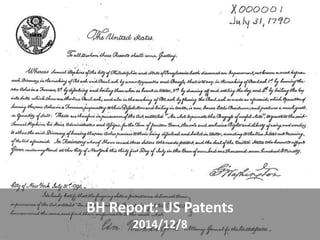
BH Report: US Patents 
2014/12/8
Context 
There is an urban legend that a commissioner of US Patent and Trademark Office (USPTO) in 1899 suggested to the president that he should shut down the office because "everything that could be invented has been invented." 
This story is basically proven to be apocryphal, but the joke is still funny because we most certainly encounter this kind of sentiment all the time – "Look at us. We have everything cool that people 20 years ago couldn't even dream of. People back then had it so easy, it is so much more difficult to innovate nowadays, because everything we are at the height of all innovations" 
In this report, I tried to explore the following by looking at statistics to US patents (acknowledging that this is imperfect approach as the "value" of one patent is never exactly the same as another patent) 
•Are we registering more patents? or less patents? 
•How has the trend changed? 
–US vs. foreign countries 
–Company 
–Area of technology 
1 
2 
3
The first US Patent law was set back in 1790 
•Patent Act of 1790 was the first "federal1" patent law enacted on April 10th, 1790 
–Defined US patent as “any useful art, manufacture, engine, machine, or device, or any improvement thereon not before known or used” 
–Granted the patent owner with "sole and exclusive right and liberty of making, constructing, using and vending to others to be used" of the invention 
•The timing more or less also coincides with the creation of modern French patent system in 1791 
•Back in the days, the fee for obtaining the patent was roughly ~4-5 dollars (which would be equivalent of ~100-130 dollars today) 
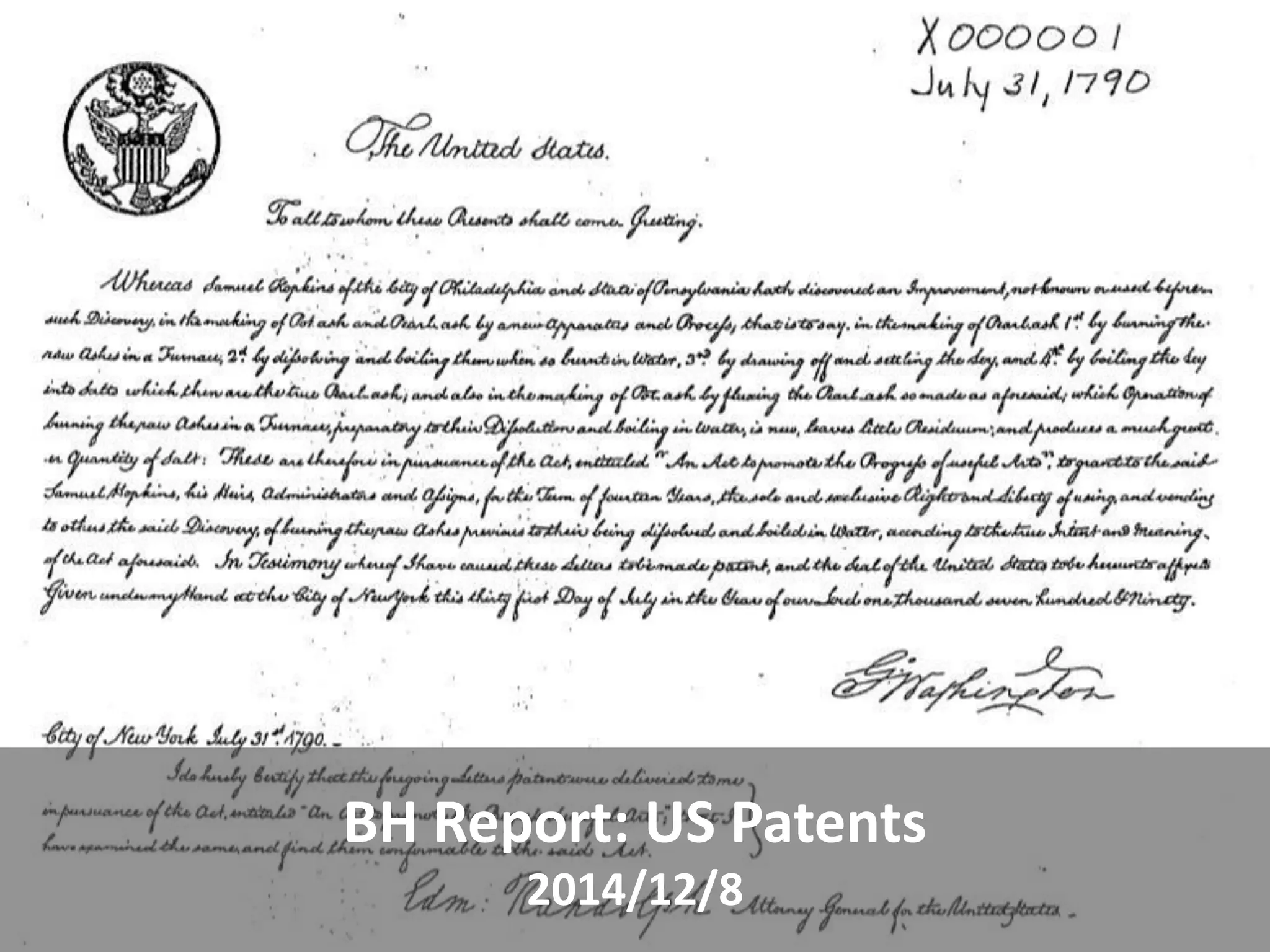
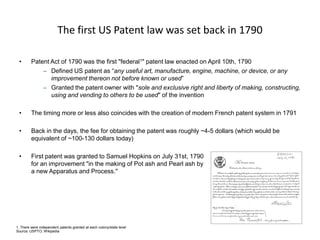
•First patent was granted to Samuel Hopkins on July 31st, 1790 for an improvement "in the making of Pot ash and Pearl ash by a new Apparatus and Process." 
1. There were independent patents granted at each colony/state level 
Source: USPTO; Wikipedia
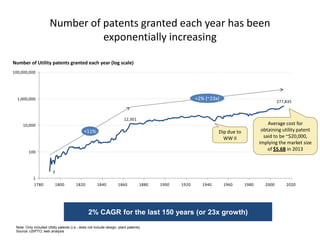
Number of patents granted each year has been 
exponentially increasing 
12,301 
3 
277,835 
1 
100 
10,000 
1,000,000 
100,000,000 
1780 1800 1820 1840 1860 1880 1900 1920 1940 1960 1980 2000 2020 
+2% (~23x) 
+11% 
Number of Utility patents granted each year (log scale) 
Dip due to 
WW II 
Note: Only included Utility patents (i.e., does not include design, plant patents) 
Source: USPTO; web analysis 
2% CAGR for the last 150 years (or 23x growth) 
Average cost for 
obtaining utility patent 
said to be ~$20,000, 
implying the market size 
of $5.6B in 2013
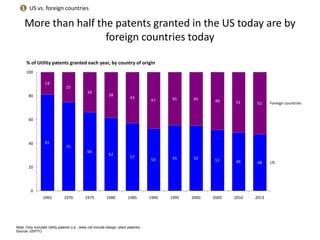
More than half the patents granted in the US today are by 
foreign countries today 
81 
75 
66 
62 
57 
53 55 55 51 49 48 
19 
25 
34 
38 
43 
47 45 45 49 51 52 
0 
80 
60 
40 
20 
100 
Foreign countries 
1990 1995 
% of Utility patents granted each year, by country of origin 
1965 1970 1975 1980 2000 2005 2010 2013 
US 
1985 
Note: Only included Utility patents (i.e., does not include design, plant patents) 
Source: USPTO 
1 US vs. foreign countries
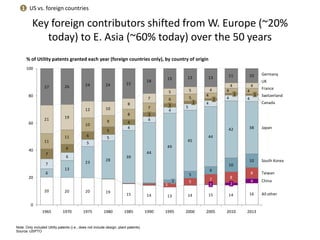
Key foreign contributors shifted from W. Europe (~20% 
today) to E. Asia (~60% today) over the 50 years 
20 20 20 19 
15 14 13 14 15 14 
7 8 
5 8 
6 
10 
10 
13 
23 
28 
39 
44 
49 
45 
44 
42 38 
7 
6 
5 
5 
4 
7 
6 
6 
5 
4 
11 
11 
10 
9 
8 
7 
6 
21 19 
12 10 
8 
7 
5 5 4 
27 26 24 24 22 4 4 
18 
15 13 13 11 10 
16 
5 4 
3 
6 
4 4 
4 
5 
4 
4 
4 4 
4 
5 
0 
80 
40 
20 
60 
100 
3 
2 
3 
China 
1995 2000 2005 2010 2013 
Germany 
% of Utility patents granted each year (foreign countries only), by country of origin 
2 
1 1 
All other 
UK 
1965 1970 1975 1980 1985 1990 
France 
Switzerland 
Canada 
Japan 
South Korea 
Taiwan 
2 
1 
2 
Note: Only included Utility patents (i.e., does not include design, plant patents) 
Source: USPTO 
1 US vs. foreign countries
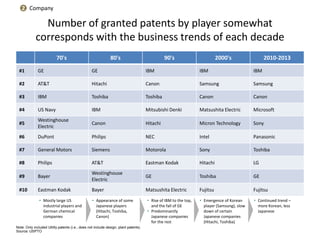
Number of granted patents by player somewhat corresponds with the business trends of each decade 
70's 
80's 
90's 
2000's 
2010-2013 
#1 
GE 
GE 
IBM 
IBM 
IBM 
#2 
AT&T 
Hitachi 
Canon 
Samsung 
Samsung 
#3 
IBM 
Toshiba 
Toshiba 
Canon 
Canon 
#4 
US Navy 
IBM 
Mitsubishi Denki 
Matsushita Electric 
Microsoft 
#5 
Westinghouse Electric 
Canon 
Hitachi 
Micron Technology 
Sony 
#6 
DuPont 
Philips 
NEC 
Intel 
Panasonic 
#7 
General Motors 
Siemens 
Motorola 
Sony 
Toshiba 
#8 
Philips 
AT&T 
Eastman Kodak 
Hitachi 
LG 
#9 
Bayer 
Westinghouse Electric 
GE 
Toshiba 
GE 
#10 
Eastman Kodak 
Bayer 
Matsushita Electric 
Fujitsu 
Fujitsu 
•Mostly large US industrial players and German chemical companies 
•Appearance of some Japanese players (Hitachi, Toshiba, Canon) 
•Rise of IBM to the top, and the fall of GE 
•Predominantly Japanese companies for the rest 
•Emergence of Korean player (Samsung), slow down of certain Japanese companies (Hitachi, Toshiba) 
•Continued trend – more Korean, less Japanese 
Note: Only included Utility patents (i.e., does not include design, plant patents) 
Source: USPTO 
2 
Company
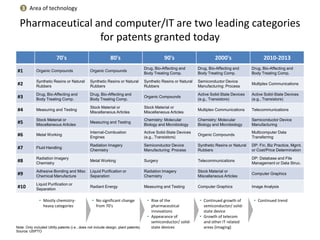
Pharmaceutical and computer/IT are two leading categories for patents granted today 
Note: Only included Utility patents (i.e., does not include design, plant patents) 
Source: USPTO 
3 
Area of technology 
70's 
80's 
90's 
2000's 
2010-2013 
#1 
Organic Compounds 
Organic Compounds 
Drug, Bio-Affecting and Body Treating Comp. 
#2 
Synthetic Resins or Natural Rubbers 
Semiconductor Device Manufacturing: Process 
Multiplex Communications 
#3 
Drug, Bio-Affecting and Body Treating Comp. 
Organic Compounds 
Active Solid-State Devices (e.g., Transistors) 
#4 
Measuring and Testing 
Stock Material or Miscellaneous Articles 
Multiplex Communications 
Telecommunications 
#5 
Stock Material or Miscellaneous Articles 
Measuring and Testing 
Chemistry: Molecular Biology and Microbiology 
Semiconductor Device Manufacturing 
#6 
Metal Working 
Internal-Combustion Engines 
Active Solid-State Devices (e.g., Transistors) 
Organic Compounds 
Multicomputer Data Transferring 
#7 
Fluid Handling 
Radiation Imagery Chemistry 
Semiconductor Device Manufacturing: Process 
Synthetic Resins or Natural Rubbers 
DP: Fin, Biz Practice, Mgmt. or Cost/Price Determination 
#8 
Radiation Imagery Chemistry 
Metal Working 
Surgery 
Telecommunications 
DP: Database and File Management or Data Struc. 
#9 
Adhesive Bonding and Misc Chemical Manufacture 
Liquid Purification or Separation 
Radiation Imagery Chemistry 
Stock Material or Miscellaneous Articles 
Computer Graphics 
#10 
Liquid Purification or Separation 
Radiant Energy 
Measuring and Testing 
Computer Graphics 
Image Analysis 
•Mostly chemistry- heavy categories 
•No significant change from 70's 
•Rise of the pharmaceutical innovations 
•Appearance of semiconductor/ solid- state devices 
•Continued growth of semiconductor/ solid- state device 
•Growth of telecom and other IT related areas (imaging) 
•Continued trend
Disclaimer 
This document is provided for general information only and nothing contained in the material constitutes a recommendation for the purchase or sale of any security. Although the statements of fact in this report are obtained from sources that I consider reliable, I do not guarantee their accuracy and any such information may be incomplete or condensed. Views are subject to change on the basis of additional or new research, new facts or developments.

20141208 BH Report: US Patents

  • 1.
    BH Report: USPatents 2014/12/8
  • 2.
    Context There isan urban legend that a commissioner of US Patent and Trademark Office (USPTO) in 1899 suggested to the president that he should shut down the office because "everything that could be invented has been invented." This story is basically proven to be apocryphal, but the joke is still funny because we most certainly encounter this kind of sentiment all the time – "Look at us. We have everything cool that people 20 years ago couldn't even dream of. People back then had it so easy, it is so much more difficult to innovate nowadays, because everything we are at the height of all innovations" In this report, I tried to explore the following by looking at statistics to US patents (acknowledging that this is imperfect approach as the "value" of one patent is never exactly the same as another patent) •Are we registering more patents? or less patents? •How has the trend changed? –US vs. foreign countries –Company –Area of technology 1 2 3
  • 3.
    The first USPatent law was set back in 1790 •Patent Act of 1790 was the first "federal1" patent law enacted on April 10th, 1790 –Defined US patent as “any useful art, manufacture, engine, machine, or device, or any improvement thereon not before known or used” –Granted the patent owner with "sole and exclusive right and liberty of making, constructing, using and vending to others to be used" of the invention •The timing more or less also coincides with the creation of modern French patent system in 1791 •Back in the days, the fee for obtaining the patent was roughly ~4-5 dollars (which would be equivalent of ~100-130 dollars today) •First patent was granted to Samuel Hopkins on July 31st, 1790 for an improvement "in the making of Pot ash and Pearl ash by a new Apparatus and Process." 1. There were independent patents granted at each colony/state level Source: USPTO; Wikipedia
  • 4.
    Number of patentsgranted each year has been exponentially increasing 12,301 3 277,835 1 100 10,000 1,000,000 100,000,000 1780 1800 1820 1840 1860 1880 1900 1920 1940 1960 1980 2000 2020 +2% (~23x) +11% Number of Utility patents granted each year (log scale) Dip due to WW II Note: Only included Utility patents (i.e., does not include design, plant patents) Source: USPTO; web analysis 2% CAGR for the last 150 years (or 23x growth) Average cost for obtaining utility patent said to be ~$20,000, implying the market size of $5.6B in 2013
  • 5.
    More than halfthe patents granted in the US today are by foreign countries today 81 75 66 62 57 53 55 55 51 49 48 19 25 34 38 43 47 45 45 49 51 52 0 80 60 40 20 100 Foreign countries 1990 1995 % of Utility patents granted each year, by country of origin 1965 1970 1975 1980 2000 2005 2010 2013 US 1985 Note: Only included Utility patents (i.e., does not include design, plant patents) Source: USPTO 1 US vs. foreign countries
  • 6.
    Key foreign contributorsshifted from W. Europe (~20% today) to E. Asia (~60% today) over the 50 years 20 20 20 19 15 14 13 14 15 14 7 8 5 8 6 10 10 13 23 28 39 44 49 45 44 42 38 7 6 5 5 4 7 6 6 5 4 11 11 10 9 8 7 6 21 19 12 10 8 7 5 5 4 27 26 24 24 22 4 4 18 15 13 13 11 10 16 5 4 3 6 4 4 4 5 4 4 4 4 4 5 0 80 40 20 60 100 3 2 3 China 1995 2000 2005 2010 2013 Germany % of Utility patents granted each year (foreign countries only), by country of origin 2 1 1 All other UK 1965 1970 1975 1980 1985 1990 France Switzerland Canada Japan South Korea Taiwan 2 1 2 Note: Only included Utility patents (i.e., does not include design, plant patents) Source: USPTO 1 US vs. foreign countries
  • 7.
    Number of grantedpatents by player somewhat corresponds with the business trends of each decade 70's 80's 90's 2000's 2010-2013 #1 GE GE IBM IBM IBM #2 AT&T Hitachi Canon Samsung Samsung #3 IBM Toshiba Toshiba Canon Canon #4 US Navy IBM Mitsubishi Denki Matsushita Electric Microsoft #5 Westinghouse Electric Canon Hitachi Micron Technology Sony #6 DuPont Philips NEC Intel Panasonic #7 General Motors Siemens Motorola Sony Toshiba #8 Philips AT&T Eastman Kodak Hitachi LG #9 Bayer Westinghouse Electric GE Toshiba GE #10 Eastman Kodak Bayer Matsushita Electric Fujitsu Fujitsu •Mostly large US industrial players and German chemical companies •Appearance of some Japanese players (Hitachi, Toshiba, Canon) •Rise of IBM to the top, and the fall of GE •Predominantly Japanese companies for the rest •Emergence of Korean player (Samsung), slow down of certain Japanese companies (Hitachi, Toshiba) •Continued trend – more Korean, less Japanese Note: Only included Utility patents (i.e., does not include design, plant patents) Source: USPTO 2 Company
  • 8.
    Pharmaceutical and computer/ITare two leading categories for patents granted today Note: Only included Utility patents (i.e., does not include design, plant patents) Source: USPTO 3 Area of technology 70's 80's 90's 2000's 2010-2013 #1 Organic Compounds Organic Compounds Drug, Bio-Affecting and Body Treating Comp. Drug, Bio-Affecting and Body Treating Comp. Drug, Bio-Affecting and Body Treating Comp. #2 Synthetic Resins or Natural Rubbers Synthetic Resins or Natural Rubbers Synthetic Resins or Natural Rubbers Semiconductor Device Manufacturing: Process Multiplex Communications #3 Drug, Bio-Affecting and Body Treating Comp. Drug, Bio-Affecting and Body Treating Comp. Organic Compounds Active Solid-State Devices (e.g., Transistors) Active Solid-State Devices (e.g., Transistors) #4 Measuring and Testing Stock Material or Miscellaneous Articles Stock Material or Miscellaneous Articles Multiplex Communications Telecommunications #5 Stock Material or Miscellaneous Articles Measuring and Testing Chemistry: Molecular Biology and Microbiology Chemistry: Molecular Biology and Microbiology Semiconductor Device Manufacturing #6 Metal Working Internal-Combustion Engines Active Solid-State Devices (e.g., Transistors) Organic Compounds Multicomputer Data Transferring #7 Fluid Handling Radiation Imagery Chemistry Semiconductor Device Manufacturing: Process Synthetic Resins or Natural Rubbers DP: Fin, Biz Practice, Mgmt. or Cost/Price Determination #8 Radiation Imagery Chemistry Metal Working Surgery Telecommunications DP: Database and File Management or Data Struc. #9 Adhesive Bonding and Misc Chemical Manufacture Liquid Purification or Separation Radiation Imagery Chemistry Stock Material or Miscellaneous Articles Computer Graphics #10 Liquid Purification or Separation Radiant Energy Measuring and Testing Computer Graphics Image Analysis •Mostly chemistry- heavy categories •No significant change from 70's •Rise of the pharmaceutical innovations •Appearance of semiconductor/ solid- state devices •Continued growth of semiconductor/ solid- state device •Growth of telecom and other IT related areas (imaging) •Continued trend
  • 9.
    Disclaimer This documentis provided for general information only and nothing contained in the material constitutes a recommendation for the purchase or sale of any security. Although the statements of fact in this report are obtained from sources that I consider reliable, I do not guarantee their accuracy and any such information may be incomplete or condensed. Views are subject to change on the basis of additional or new research, new facts or developments.