Optimize Your EMR for Orthopedics
Essential Strategies that Drive Patient Engagement,
Financial Success and Physician Happiness

S
Joe Greene
University of Wisconsin Hospital and Clinics
Department of Orthopedics and Rehabilitation
Program Manager, Outreach and Development

OrthoVise, LLC
CEO and Owner

S
Objectives

S Appreciate the current EMR landscape
S Philosophically discuss the EMR and orthopedics

S Appreciate the continuum of EMR adoption
S Learn specific operational and IT optimization strategies
S Understand opportunities to leverage your EMR and

your Healthcare Information Technology investment
The EMR Landscape

S
Today
S The implementation environment is stabilizing
S At least in the United States!

S Incentives will diminish
S 19.2 billion disbursed by CMS to 440,998 registered providers

S Attrition and consolidation of vendors
S Shift to enhanced support and service

S Shift to an international focus
S At least with large vendors
“We are at about 50% EHR adoption and
about 5% workflow adjustment.”
Farzad Mostashari MD
Former National Coordinator, Health Information Technology
U.S. Department of Health and Human Services

S
"The systems on the front line have to be
usable so that doctors actually want to
interact with the electronic health record, or
[so that] nurses or others can access critical
information that will eventually not just save
money or improve the quality of care but
save lives,"
Karen Desalvo MD
National Coordinator, Health Information Technology
U.S. Department of Health and Human Services

S
US Hospital Implementations
2012 and 2013
Leveraging your Investment
S Clinical and Business Analytics
S Reporting
S Quality and Safety
S Outcomes
S Population Health
S Interoperability
"Simply implementing computer systems won't
dramatically improve quality overnight. Very careful
system design and configuration, along with a lot of
thoughtful human process improvement, are
necessary in order to make the technology truly
helpful”

S
The EMR and
Orthopedics

S
Sound Familiar?

“The system is great for a family practice doc – it just isn’t
set up for an orthopedic surgeon. We have very different
needs.”

“I’m spending an extra 3 hours every clinic day completing
my documentation and orders”
“I’m an orthopedic surgeon, I want to be in the operating
room, not spending all of my time documenting in the
system”
Sound Familiar?

“My staff can’t do what they used to be able to do for me
once we moved to this EMR”
“I’m seeing 25% less patients than I used to be able to”
“I’m not happy, and my life outside of work is being
affected.”
“I’ve just decided not to see as many patients as I used to”
Orthopedics is Different
S High Volume
S High Margin
S Highly Competitive and Driven Physicians
S Increasingly Specialized

“Specialty clinics have many unique workflows – these
require specialized tools. Like all specialties, orthopedics
must be treated uniquely”
“There are three key elements of success.
The first is opportunity
The second is recognizing it
and the third is the effort to make it happen.”

S
The EMR: A Necessary Sense
of Urgency?

S We view the EMR as an opportunity
S For driving service delivery changes that may have

been indicated for a long time
S Staffing, Workflow, Access, Triage, Quality, etc.
“An EMR implementation magnifies the need for
changes that are indicated to meet the future needs
of healthcare service delivery.”

S
The Continuum of
EMR Adoption

S
Stages of EMR Utilization
Implementation

Stabilization
Implementation and
Stabilization
S Implementation and Stabilization

Focus is on addressing key issues and establishing a
baseline of user productivity and happiness. During this
phase, solutions tend to be technical in nature and
operations are dependent on the implementation team for
guidance.
Operationalization

S Operationalization

Shift in governance and accountability to operational
groups. Clinical operations begin to reduce their reliance
on the implementation team for guidance and focus turns
to using the system to support operations and operational
goals.
Optimization

S Optimization

Longer-term efforts to extract business value from your
system, increasing alignment between system and
organizational objectives. System enhancements are
driven by operational priorities and clinicians and the IT
team moves into a supporting role.
Operationally Driven Project
Why Shift?

S Patient Centered
S Changes are Physician and Clinician Driven
S Local Ownership of Issues
S Facilitate Business and Operational Processes
S To Utilize Available IT Resources More Efficiently
Stages of EMR Utilization
Implementation

Stabilization

Operationalization

Optimization
Specific Optimization
Strategies

S
Specific Strategies
S EMR Specific Enhancements
S Staffing and Workflow Enhancements
S Orthopedic Service Delivery Innovation
EMR Specific Enhancements
S Security assignments
S Documentation strategy
S Optimization team formation
S Order Handling

S Reporting and Analytics
S Content Build
Staffing and Workflow
Enhancements
S Workflow Philosophy
S Eliminate all physician non-value added activity
S Optimally this means the physician:
S Maximizes face time with patients
S Sees patients that they convert to surgeries
S Performs essential orders and documentation only
2012 AMSSM Poster
The Impact of Athletic Trainers in a Sports Medicine
Practice Improving Efficiency and Productivity
To Scribe or Not to Scribe?

S Joint Commission and CMS recognition
S High volume surgeons
S Technologically challenged surgeons
S Orthopedics : Ideally you have someone who can

document for every 20-22 patients daily
S Formal Scribe vs. Fully Enabled Allied Health Provider
The Impact of Scribing

S Improved patient satisfaction
S Improved provider satisfaction
S Documentation is enhanced from a content and billing

standpoint
S Don’t stop at just scribing!
A Note on HPI Documentation
S A 1997 CMS Rule (Pre EMR) that defines HPI (History of

Present Illness) documentation as the responsibility of the
provider.
S Check with your Medicare Carrier (Novidien, WPS, etc.)

on their interpretation of this rule.
S Scribing is allowed if the scribe is in the room and records

the information in the presence of the provider.
S Even with conservative interpretation, don’t lose sight of

the overall value.
Step One

S Chief Complaint
S Pain Scale Rating

S Vitals
S Past Medical History
S Medication Reconciliation
S Allergy Review
S Education Preferences
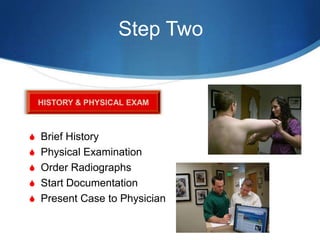
Step Two

S Brief History
S Physical Examination
S Order Radiographs
S Start Documentation
S Present Case to Physician
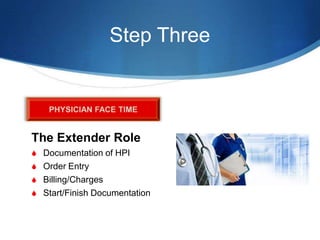
Step Three
Step Three

The Extender Role
S Documentation of HPI
S Order Entry
S Billing/Charges

S Start/Finish Documentation
Step Four

S Patient Education
S Exercise Prescription
S Letters
S DME Fitting
S Billing/Charges
S Follow Up Instructions
S AVS Preparation
Surgical Conversion Rate
The most important ambulatory metric?

S The percentage of available new appointments that are

converted to surgery within a given time frame.
S Exceptional global overall measure of:
S Scheduling and registration
S Access programming
S Triage and patient placement
S Ancillary staff utilization

S Physician utilization
Canadian Study: PLOS ONE
July, 2013

S Surgery or Consultation : A Population-Based Cohort

Study of Use of Orthopaedic Surgeon Services
S October 2004 – September, 2005

S 477,945 patients visited an orthopedic surgeon in

Ontario, Canada
S 79.3% of patients did not receive surgery after 18

months
S 20% surgical conversion rate
Cost Containment or
Revenue Generation

A Balancing Act
Staffing and Workflow
Enhancements: Takeaways
S Fully enable your extenders
S Maximize surgical conversion rate
S De-centralize build
S Create an “Optimization Team”
S Integrate your IT Analyst : Teach them about what you

do and what you need. Don’t assume they know.
Orthopedic Service Delivery
Innovation is critical!

S Smart Staffing and Workflows
S Access, Triage, and Patient Placement
S Immediate Care Clinics
S Post Surgical Care
S Bundling and Analytic Utilization
S Care Management
Leveraging Your
Investment

S
“I am becoming increasingly convinced that
what is truly important in healthcare is
inversely related to what is easily
measurable.“
Vernon Weckerth PhD
Professor Emeritus
University of Minnesota
Masters of Public Health
ISP Executive Study Program

S
Leveraging Your Investment
S Registry Reporting
S Functional Outcomes Reporting
S Quality and Safety Reporting
S Business and Clinical Analytics Reporting
The AJRR Registry
S Sponsored by the

AAOS and Industry
S Knee and Hip

Arthroplasty
S 235+ Institutions and

Growing Quickly
Own the Bone Registry
S Sponsored by the AOA
S Fragility fracture prevention
S Reporting and Education

Components
S Requires cloud data entry

by clinicians
S EMR should facilitate
NASS Spine Registry
S NASS Sponsored
S In development
Patient Reported Outcomes
S Getting Data In and Data Out
S Very Challenging IT and Operational

Workflows
S Tablet vs. Kiosk vs. Portal
S Real Time Access to Outcomes Data
S Copyright and Cost Implications
Quality and Safety Reporting
S Surgical Site Infections
S AHRQ Patient Safety Indicators
S SCIP Measures
S Readmit Rates
S Hospital Acquired Conditions
Business Analytics
S Volume and Access Measures
S Surgical Conversion Rate
S Revenue by Procedure Code
S Volume by Zip Code
S Referring Provider Volume
S Key Indicators: ie. Charges, Payments, Days in A/R,

Adjustments
“Having what you want is a function of letting
go of what you have”
Anonymous

S
“Problems cannot be solved with the same
level of awareness that created them.”
Albert Einstein

S
Thank You

Time for Questions

S
The Patient Journey
The Guided CarePath helps create a single streamlined patient experience
through the entire journey of a total joint replacement.
Guided CarePath

Smart
Checklists for
Patients

Delivered online
and available 24/7
from home

Optimize your EMR for Orthopedics: Essential Strategies that Drive Physician Happiness

  • 1.
    Optimize Your EMRfor Orthopedics Essential Strategies that Drive Patient Engagement, Financial Success and Physician Happiness S
  • 2.
    Joe Greene University ofWisconsin Hospital and Clinics Department of Orthopedics and Rehabilitation Program Manager, Outreach and Development OrthoVise, LLC CEO and Owner S
  • 3.
    Objectives S Appreciate thecurrent EMR landscape S Philosophically discuss the EMR and orthopedics S Appreciate the continuum of EMR adoption S Learn specific operational and IT optimization strategies S Understand opportunities to leverage your EMR and your Healthcare Information Technology investment
  • 4.
  • 5.
    Today S The implementationenvironment is stabilizing S At least in the United States! S Incentives will diminish S 19.2 billion disbursed by CMS to 440,998 registered providers S Attrition and consolidation of vendors S Shift to enhanced support and service S Shift to an international focus S At least with large vendors
  • 6.
    “We are atabout 50% EHR adoption and about 5% workflow adjustment.” Farzad Mostashari MD Former National Coordinator, Health Information Technology U.S. Department of Health and Human Services S
  • 7.
    "The systems onthe front line have to be usable so that doctors actually want to interact with the electronic health record, or [so that] nurses or others can access critical information that will eventually not just save money or improve the quality of care but save lives," Karen Desalvo MD National Coordinator, Health Information Technology U.S. Department of Health and Human Services S
  • 8.
  • 9.
    Leveraging your Investment SClinical and Business Analytics S Reporting S Quality and Safety S Outcomes S Population Health S Interoperability
  • 10.
    "Simply implementing computersystems won't dramatically improve quality overnight. Very careful system design and configuration, along with a lot of thoughtful human process improvement, are necessary in order to make the technology truly helpful” S
  • 11.
  • 12.
    Sound Familiar? “The systemis great for a family practice doc – it just isn’t set up for an orthopedic surgeon. We have very different needs.” “I’m spending an extra 3 hours every clinic day completing my documentation and orders” “I’m an orthopedic surgeon, I want to be in the operating room, not spending all of my time documenting in the system”
  • 13.
    Sound Familiar? “My staffcan’t do what they used to be able to do for me once we moved to this EMR” “I’m seeing 25% less patients than I used to be able to” “I’m not happy, and my life outside of work is being affected.” “I’ve just decided not to see as many patients as I used to”
  • 14.
    Orthopedics is Different SHigh Volume S High Margin S Highly Competitive and Driven Physicians S Increasingly Specialized “Specialty clinics have many unique workflows – these require specialized tools. Like all specialties, orthopedics must be treated uniquely”
  • 15.
    “There are threekey elements of success. The first is opportunity The second is recognizing it and the third is the effort to make it happen.” S
  • 16.
    The EMR: ANecessary Sense of Urgency? S We view the EMR as an opportunity S For driving service delivery changes that may have been indicated for a long time S Staffing, Workflow, Access, Triage, Quality, etc.
  • 17.
    “An EMR implementationmagnifies the need for changes that are indicated to meet the future needs of healthcare service delivery.” S
  • 18.
  • 19.
    Stages of EMRUtilization Implementation Stabilization
  • 20.
    Implementation and Stabilization S Implementationand Stabilization Focus is on addressing key issues and establishing a baseline of user productivity and happiness. During this phase, solutions tend to be technical in nature and operations are dependent on the implementation team for guidance.
  • 21.
    Operationalization S Operationalization Shift ingovernance and accountability to operational groups. Clinical operations begin to reduce their reliance on the implementation team for guidance and focus turns to using the system to support operations and operational goals.
  • 22.
    Optimization S Optimization Longer-term effortsto extract business value from your system, increasing alignment between system and organizational objectives. System enhancements are driven by operational priorities and clinicians and the IT team moves into a supporting role.
  • 23.
    Operationally Driven Project WhyShift? S Patient Centered S Changes are Physician and Clinician Driven S Local Ownership of Issues S Facilitate Business and Operational Processes S To Utilize Available IT Resources More Efficiently
  • 24.
    Stages of EMRUtilization Implementation Stabilization Operationalization Optimization
  • 25.
  • 26.
    Specific Strategies S EMRSpecific Enhancements S Staffing and Workflow Enhancements S Orthopedic Service Delivery Innovation
  • 27.
    EMR Specific Enhancements SSecurity assignments S Documentation strategy S Optimization team formation S Order Handling S Reporting and Analytics S Content Build
  • 28.
    Staffing and Workflow Enhancements SWorkflow Philosophy S Eliminate all physician non-value added activity S Optimally this means the physician: S Maximizes face time with patients S Sees patients that they convert to surgeries S Performs essential orders and documentation only
  • 29.
    2012 AMSSM Poster TheImpact of Athletic Trainers in a Sports Medicine Practice Improving Efficiency and Productivity
  • 30.
    To Scribe orNot to Scribe? S Joint Commission and CMS recognition S High volume surgeons S Technologically challenged surgeons S Orthopedics : Ideally you have someone who can document for every 20-22 patients daily S Formal Scribe vs. Fully Enabled Allied Health Provider
  • 31.
    The Impact ofScribing S Improved patient satisfaction S Improved provider satisfaction S Documentation is enhanced from a content and billing standpoint S Don’t stop at just scribing!
  • 32.
    A Note onHPI Documentation S A 1997 CMS Rule (Pre EMR) that defines HPI (History of Present Illness) documentation as the responsibility of the provider. S Check with your Medicare Carrier (Novidien, WPS, etc.) on their interpretation of this rule. S Scribing is allowed if the scribe is in the room and records the information in the presence of the provider. S Even with conservative interpretation, don’t lose sight of the overall value.
  • 33.
    Step One S ChiefComplaint S Pain Scale Rating S Vitals S Past Medical History S Medication Reconciliation S Allergy Review S Education Preferences
  • 34.
    Step Two S BriefHistory S Physical Examination S Order Radiographs S Start Documentation S Present Case to Physician
  • 35.
  • 36.
    Step Three The ExtenderRole S Documentation of HPI S Order Entry S Billing/Charges S Start/Finish Documentation
  • 37.
    Step Four S PatientEducation S Exercise Prescription S Letters S DME Fitting S Billing/Charges S Follow Up Instructions S AVS Preparation
  • 38.
    Surgical Conversion Rate Themost important ambulatory metric? S The percentage of available new appointments that are converted to surgery within a given time frame. S Exceptional global overall measure of: S Scheduling and registration S Access programming S Triage and patient placement S Ancillary staff utilization S Physician utilization
  • 39.
    Canadian Study: PLOSONE July, 2013 S Surgery or Consultation : A Population-Based Cohort Study of Use of Orthopaedic Surgeon Services S October 2004 – September, 2005 S 477,945 patients visited an orthopedic surgeon in Ontario, Canada S 79.3% of patients did not receive surgery after 18 months S 20% surgical conversion rate
  • 40.
    Cost Containment or RevenueGeneration A Balancing Act
  • 41.
    Staffing and Workflow Enhancements:Takeaways S Fully enable your extenders S Maximize surgical conversion rate S De-centralize build S Create an “Optimization Team” S Integrate your IT Analyst : Teach them about what you do and what you need. Don’t assume they know.
  • 42.
    Orthopedic Service Delivery Innovationis critical! S Smart Staffing and Workflows S Access, Triage, and Patient Placement S Immediate Care Clinics S Post Surgical Care S Bundling and Analytic Utilization S Care Management
  • 43.
  • 44.
    “I am becomingincreasingly convinced that what is truly important in healthcare is inversely related to what is easily measurable.“ Vernon Weckerth PhD Professor Emeritus University of Minnesota Masters of Public Health ISP Executive Study Program S
  • 45.
    Leveraging Your Investment SRegistry Reporting S Functional Outcomes Reporting S Quality and Safety Reporting S Business and Clinical Analytics Reporting
  • 46.
    The AJRR Registry SSponsored by the AAOS and Industry S Knee and Hip Arthroplasty S 235+ Institutions and Growing Quickly
  • 47.
    Own the BoneRegistry S Sponsored by the AOA S Fragility fracture prevention S Reporting and Education Components S Requires cloud data entry by clinicians S EMR should facilitate
  • 48.
    NASS Spine Registry SNASS Sponsored S In development
  • 49.
    Patient Reported Outcomes SGetting Data In and Data Out S Very Challenging IT and Operational Workflows S Tablet vs. Kiosk vs. Portal S Real Time Access to Outcomes Data S Copyright and Cost Implications
  • 50.
    Quality and SafetyReporting S Surgical Site Infections S AHRQ Patient Safety Indicators S SCIP Measures S Readmit Rates S Hospital Acquired Conditions
  • 51.
    Business Analytics S Volumeand Access Measures S Surgical Conversion Rate S Revenue by Procedure Code S Volume by Zip Code S Referring Provider Volume S Key Indicators: ie. Charges, Payments, Days in A/R, Adjustments
  • 52.
    “Having what youwant is a function of letting go of what you have” Anonymous S
  • 53.
    “Problems cannot besolved with the same level of awareness that created them.” Albert Einstein S
  • 54.
    Thank You Time forQuestions S
  • 55.
    The Patient Journey TheGuided CarePath helps create a single streamlined patient experience through the entire journey of a total joint replacement.
  • 56.

Editor's Notes

  • #3 Introduction
  • #6 MU: Vendors want to slow down
  • #15 I believe that EMR transitions have forced the need to make substantial changes in orthopedic service delivery.
  • #56 The Guided CarePathhelps create a single streamlined patient experience through the entire journey of a total joint replacement.It creates a continuum of connection between patients, their families, and their providers.
  • #57 Smart checklists and reminders are delivered just in time as patients progress through their care plans. The information is always there for reference when needed in case preparation or follow-up instructions are forgotten. This helps reduce patient anxiety and improve outcomes.