Registry Participation 101:
A Simple Step-by-Step Guide to Understanding What You Really Need
to Know from AJRR
Joe Greene
University of Wisconsin—Department of Orthopedics and Rehabilitation
AJRR Staff:
Phil Dwyer, Program Coordinator
Caryn Etkin, PhD, MPH, Director of Analytics
September Cahue, MPH, Senior Registry Analyst
Topics and Agenda
Agenda:
• Introduction to clinical data registries Phil Dwyer
• University of Wisconsin experience Joe Greene
• Patient-Reported Outcome Measures September Cahue
• Quality programs Caryn Etkin
Topics:
• What is a clinical data registry
• Who is using registry information and why
• Value of registry data
• Additional information, resources
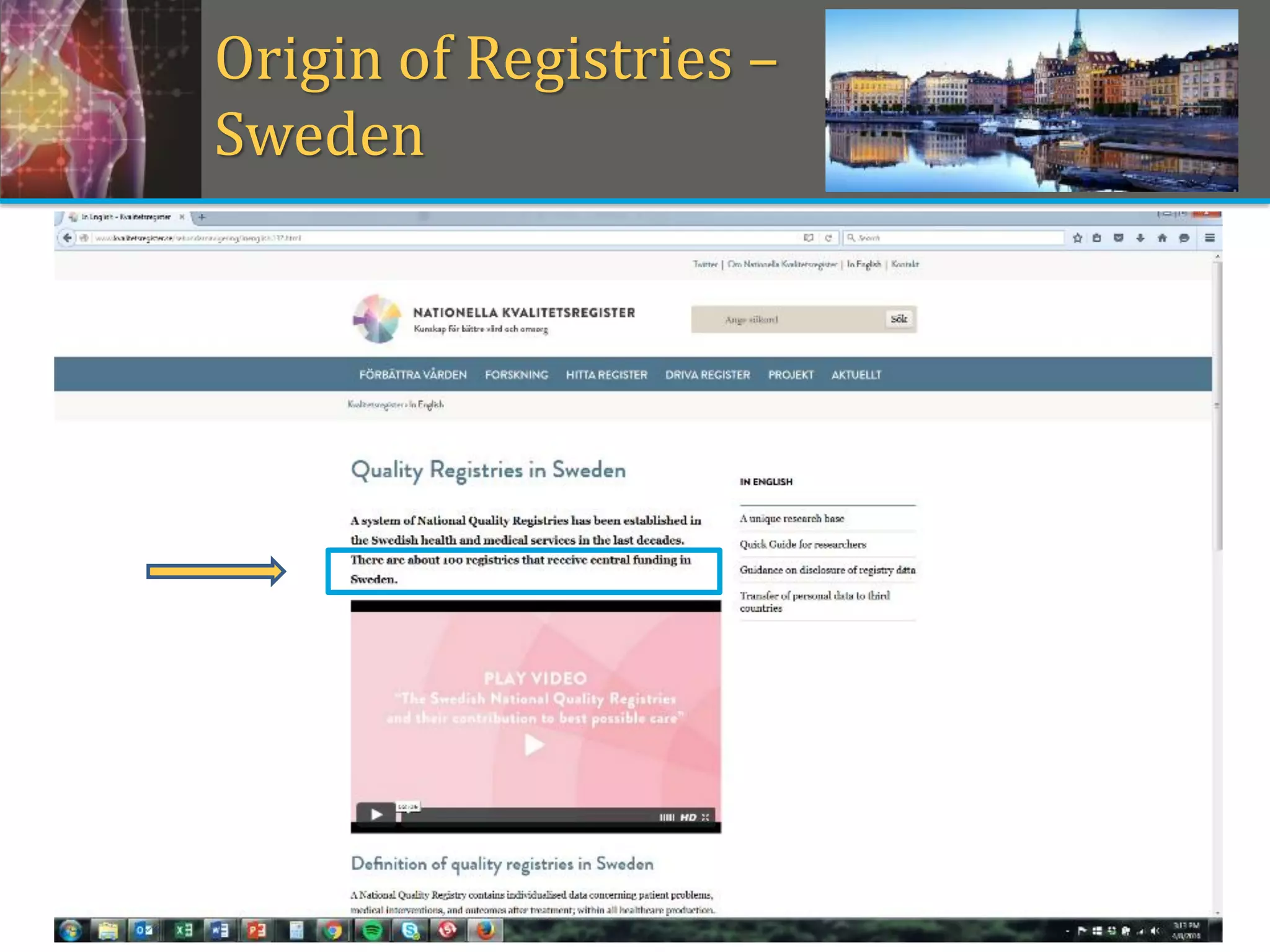
Origin of Registries –
Sweden
What is a Registry?
• A clinical data registry records information about the
health status of patients and the health care they receive
over varying periods of time
• Designed to capture clinical data of importance to health
care practitioners, providers, and patient. Generally,
registries focus on clinical data for specific populations
based on:
– A disease/condition (e.g. cystic fibrosis, spina bifida)
– Procedure (e.g. coronary artery bypass graft)
– Device or drug (e.g. total joint replacement)
• More frequently are able to capture data from multiple
EHRs
• Designed for quality improvement efforts, payment,
research, etc.
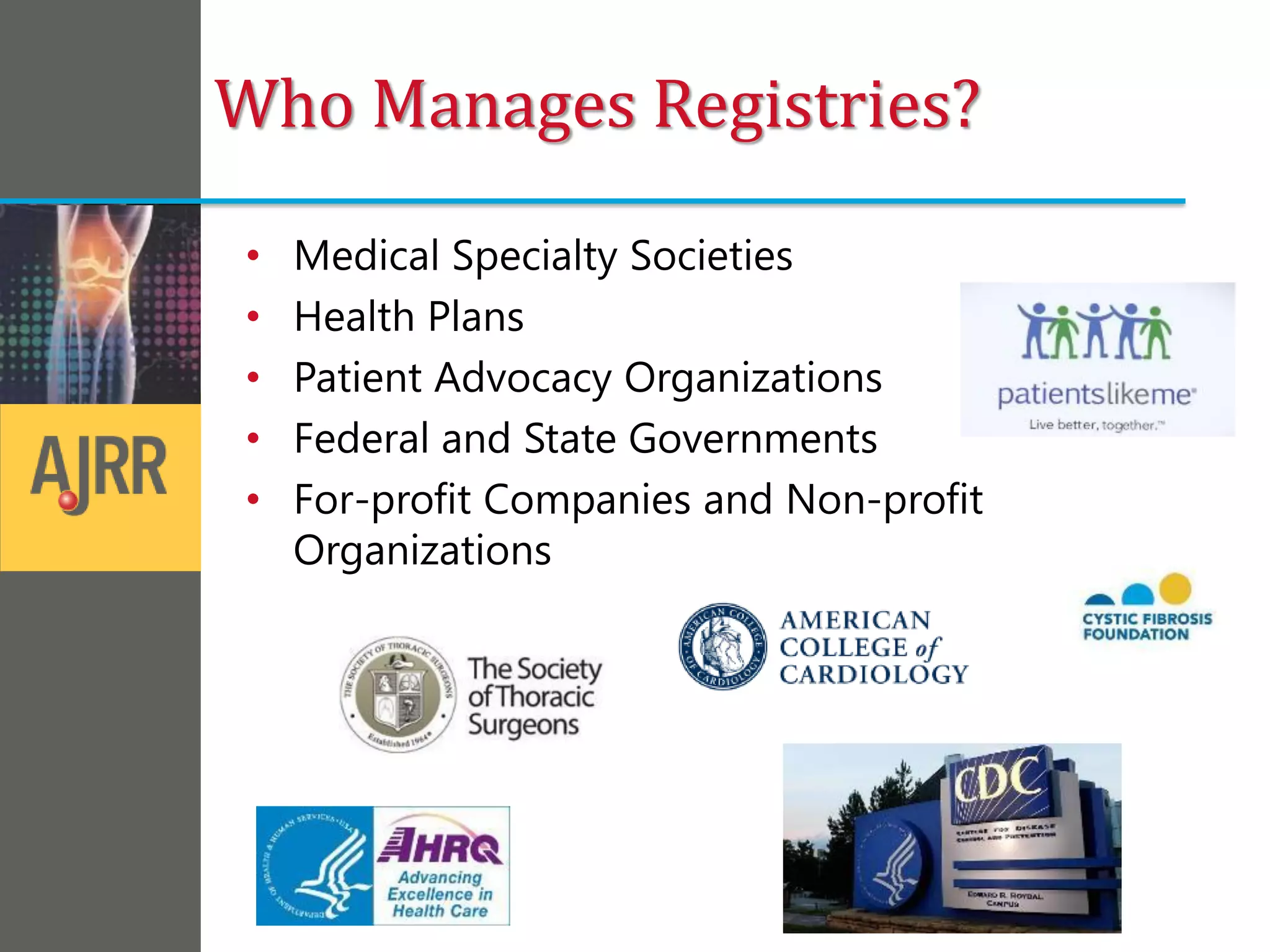
Who Manages Registries?
• Medical Specialty Societies
• Health Plans
• Patient Advocacy Organizations
• Federal and State Governments
• For-profit Companies and Non-profit
Organizations
Who is Interested in Registries?
• Hospitals, health systems
• Private practice groups
• Health plans and other payers
• Researchers
• Patient and consumer organizations
• Federal, state, and local government
Look at Some of the National
Options!
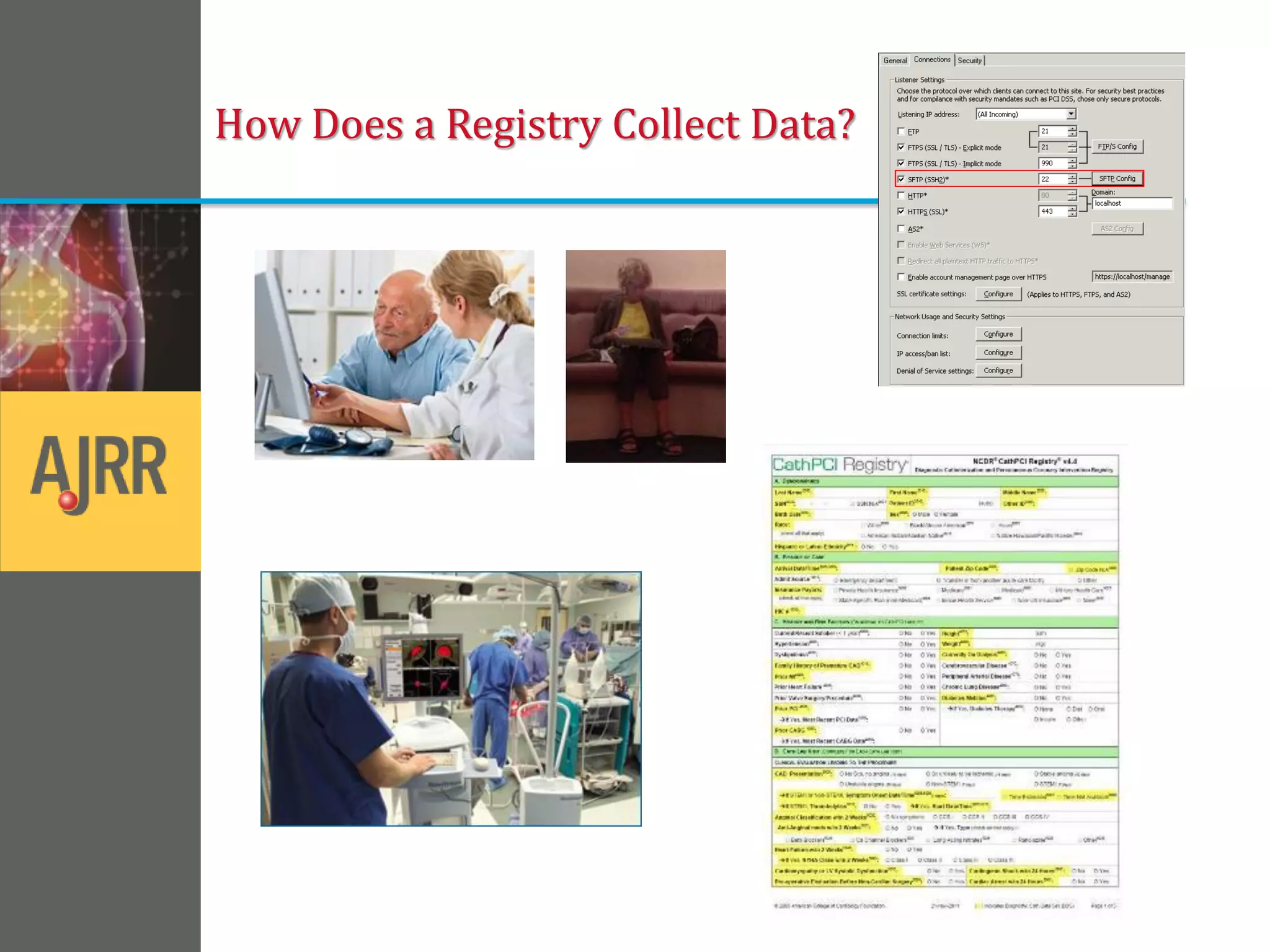
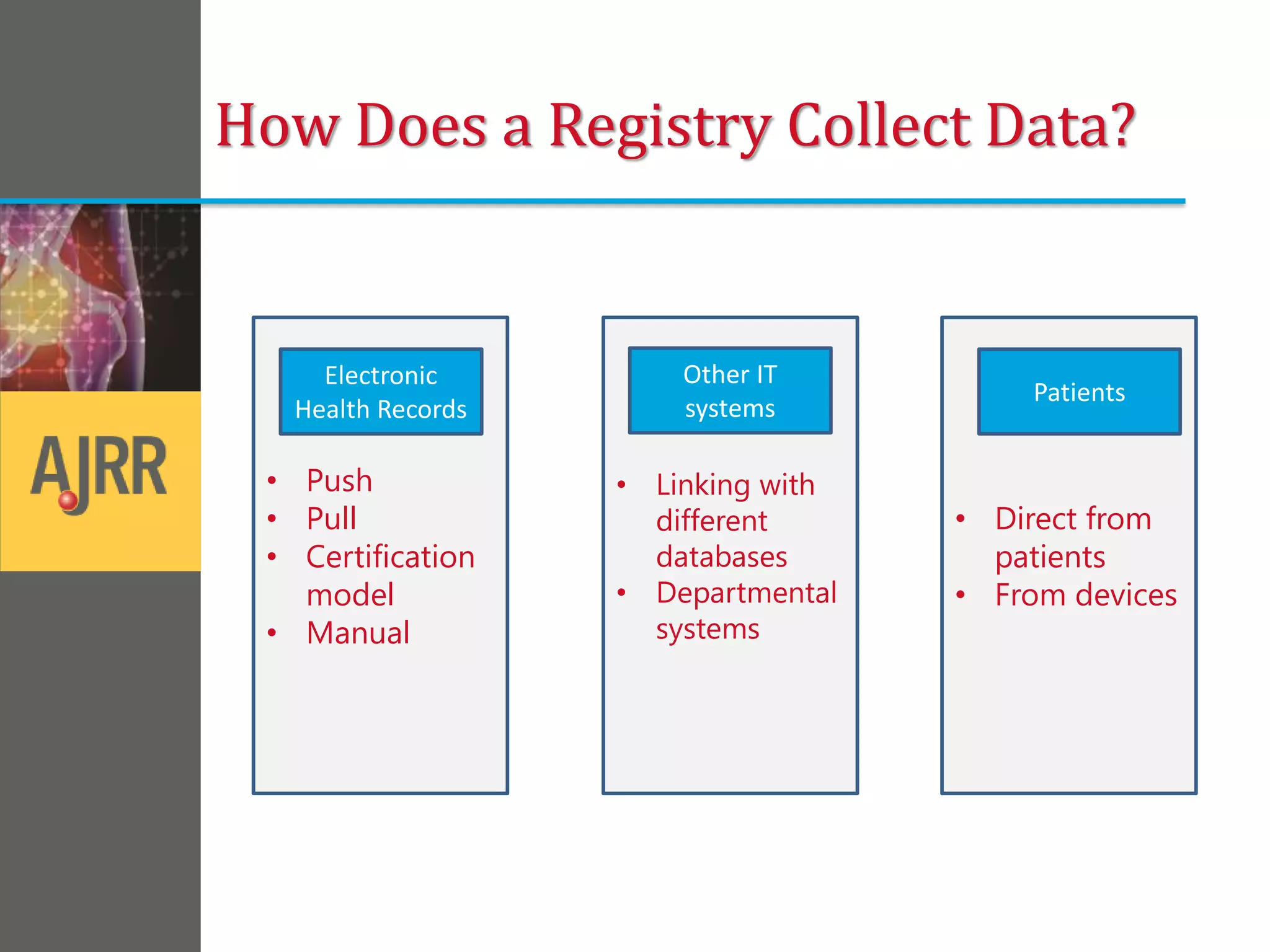
How Does a Registry Collect Data?
• Push
• Pull
• Certification
model
• Manual
• Linking with
different
databases
• Departmental
systems
• Direct from
patients
• From devices
Electronic
Health Records
Other IT
systems
Patients
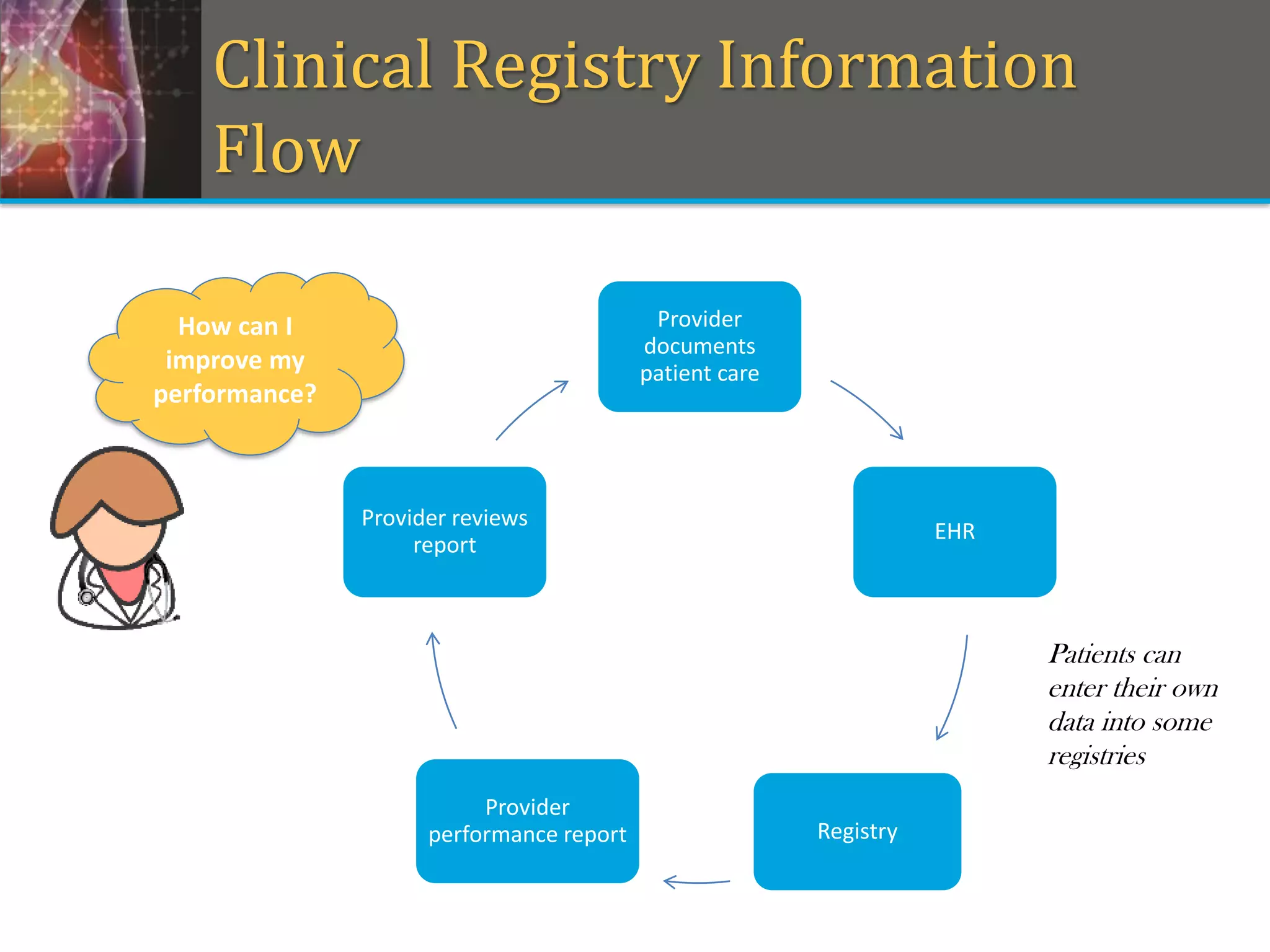
Clinical Registry Information
Flow
Provider
documents
patient care
EHR
Registry
Provider
performance report
Provider reviews
report
Patients can
enter their own
data into some
registries
How can I
improve my
performance?
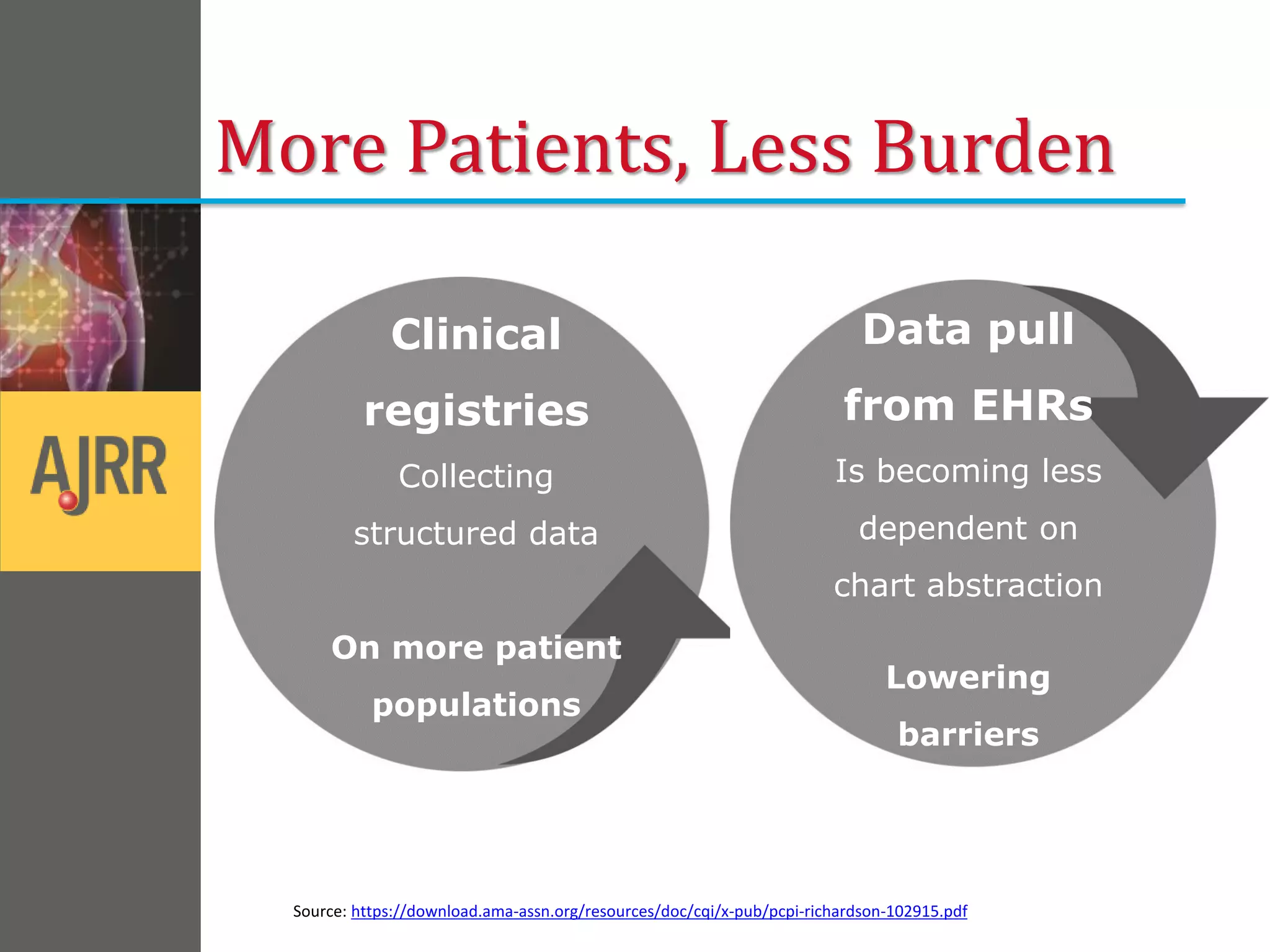
More Patients, Less Burden
Clinical
registries
Collecting
structured data
On more patient
populations
Data pull
from EHRs
Is becoming less
dependent on
chart abstraction
Lowering
barriers
Source: https://download.ama-assn.org/resources/doc/cqi/x-pub/pcpi-richardson-102915.pdf
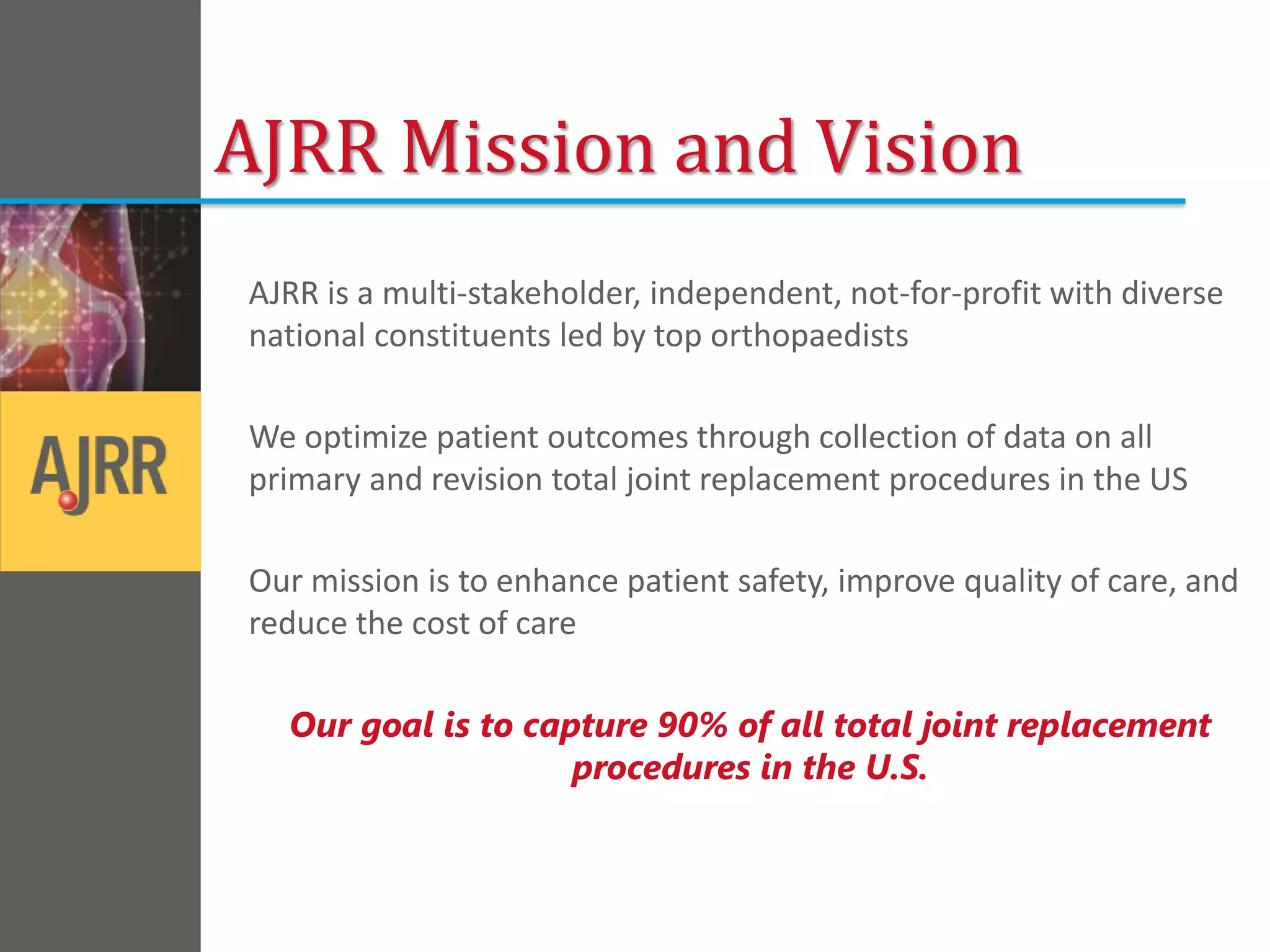
AJRR is a multi-stakeholder, independent, not-for-profit with diverse
national constituents led by top orthopaedists
We optimize patient outcomes through collection of data on all
primary and revision total joint replacement procedures in the US
Our mission is to enhance patient safety, improve quality of care, and
reduce the cost of care
Our goal is to capture 90% of all total joint replacement
procedures in the U.S.
AJRR Mission and Vision
AJRR is supported by hospitals, health insurers, and
the following groups:
Supporters
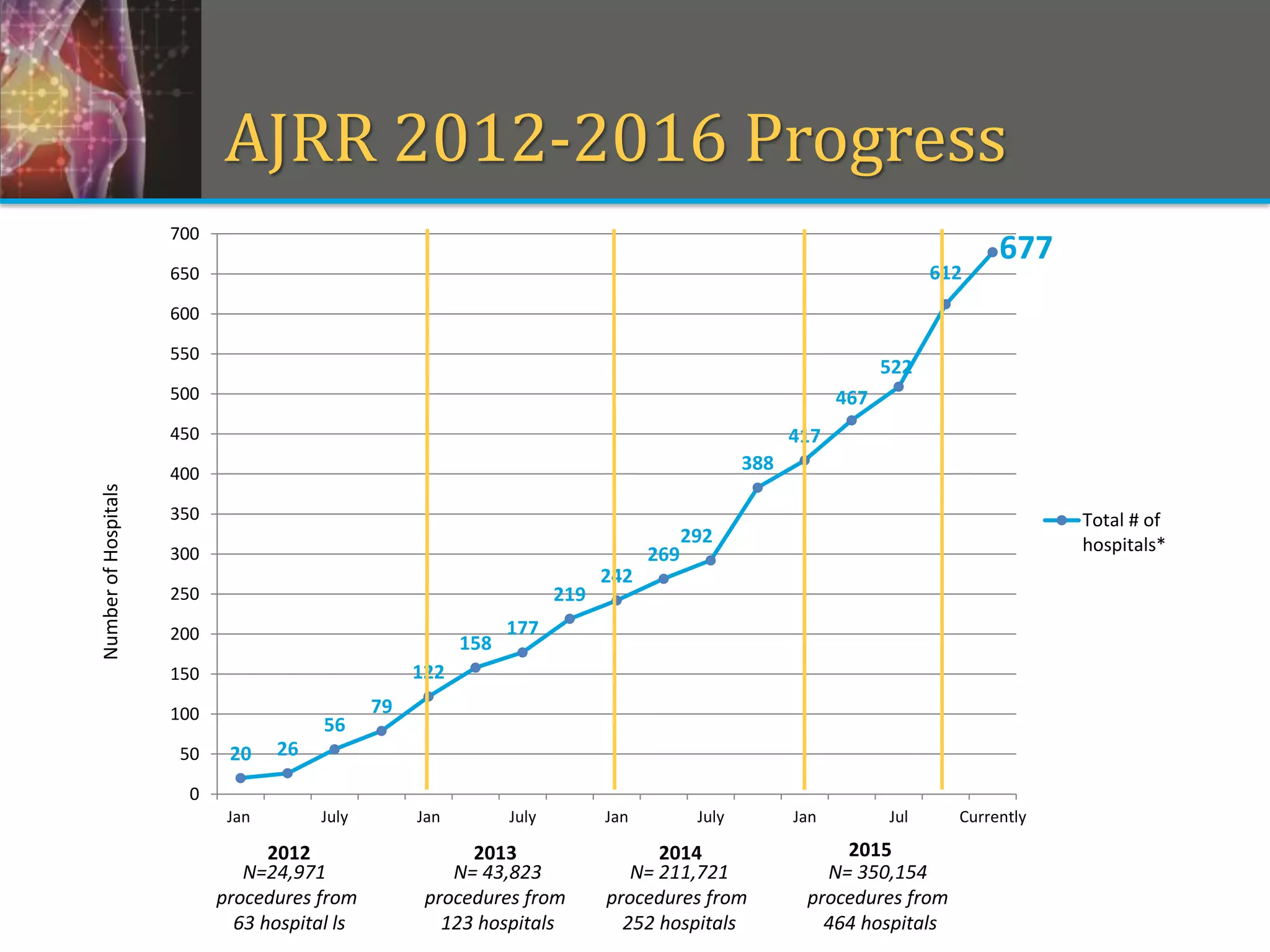
20 26
56
79
122
158
177
219
242
269
292
388
417
467
522
612
677
0
50
100
150
200
250
300
350
400
450
500
550
600
650
700
Jan July Jan July Jan July Jan Jul Currently
Total # of
hospitals*
20152012 2013
NumberofHospitals
2014
N=24,971
procedures from
63 hospital ls
N= 43,823
procedures from
123 hospitals
AJRR 2012-2016 Progress
N= 211,721
procedures from
252 hospitals
N= 350,154
procedures from
464 hospitals
Where Are We Now?
September 2014
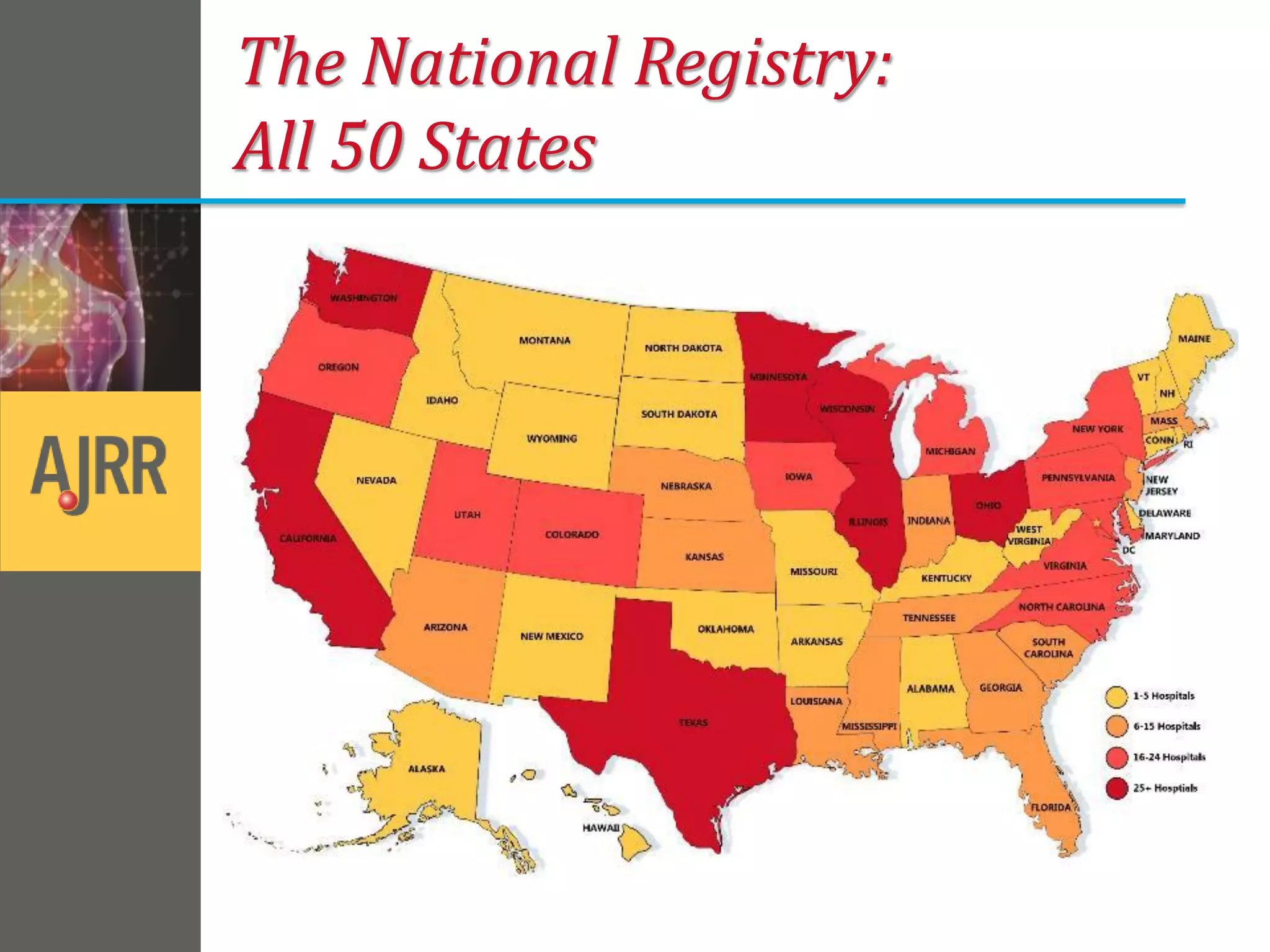
The National Registry:
All 50 States
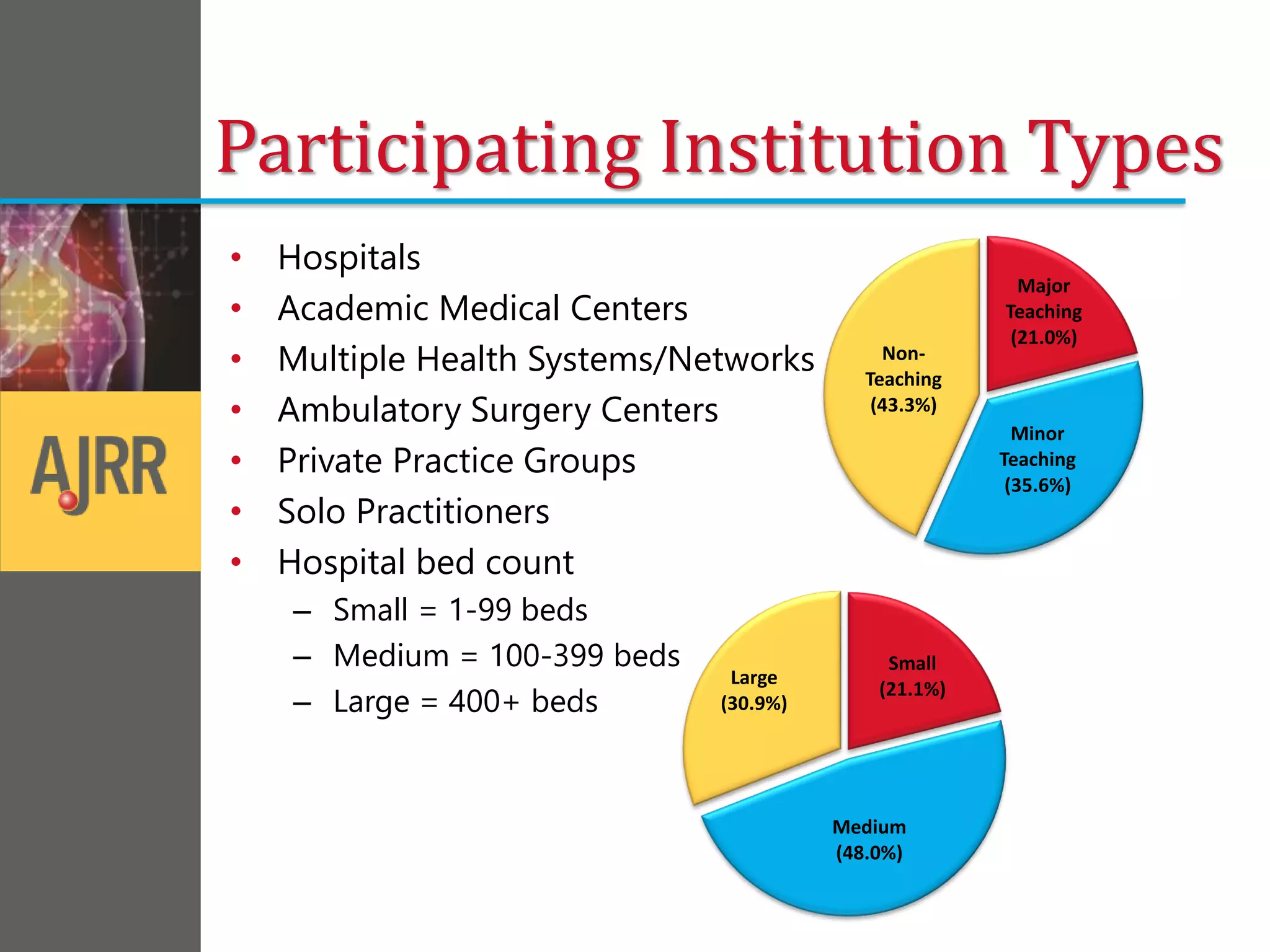
Participating Institution Types
• Hospitals
• Academic Medical Centers
• Multiple Health Systems/Networks
• Ambulatory Surgery Centers
• Private Practice Groups
• Solo Practitioners
• Hospital bed count
– Small = 1-99 beds
– Medium = 100-399 beds
– Large = 400+ beds
Teaching
25%
Rural
9%
Univ/
Research
11% Major
Teaching
(21.0%)
Minor
Teaching
(35.6%)
Non-
Teaching
(43.3%)
Small
(21.1%)
Medium
(48.0%)
Large
(30.9%)
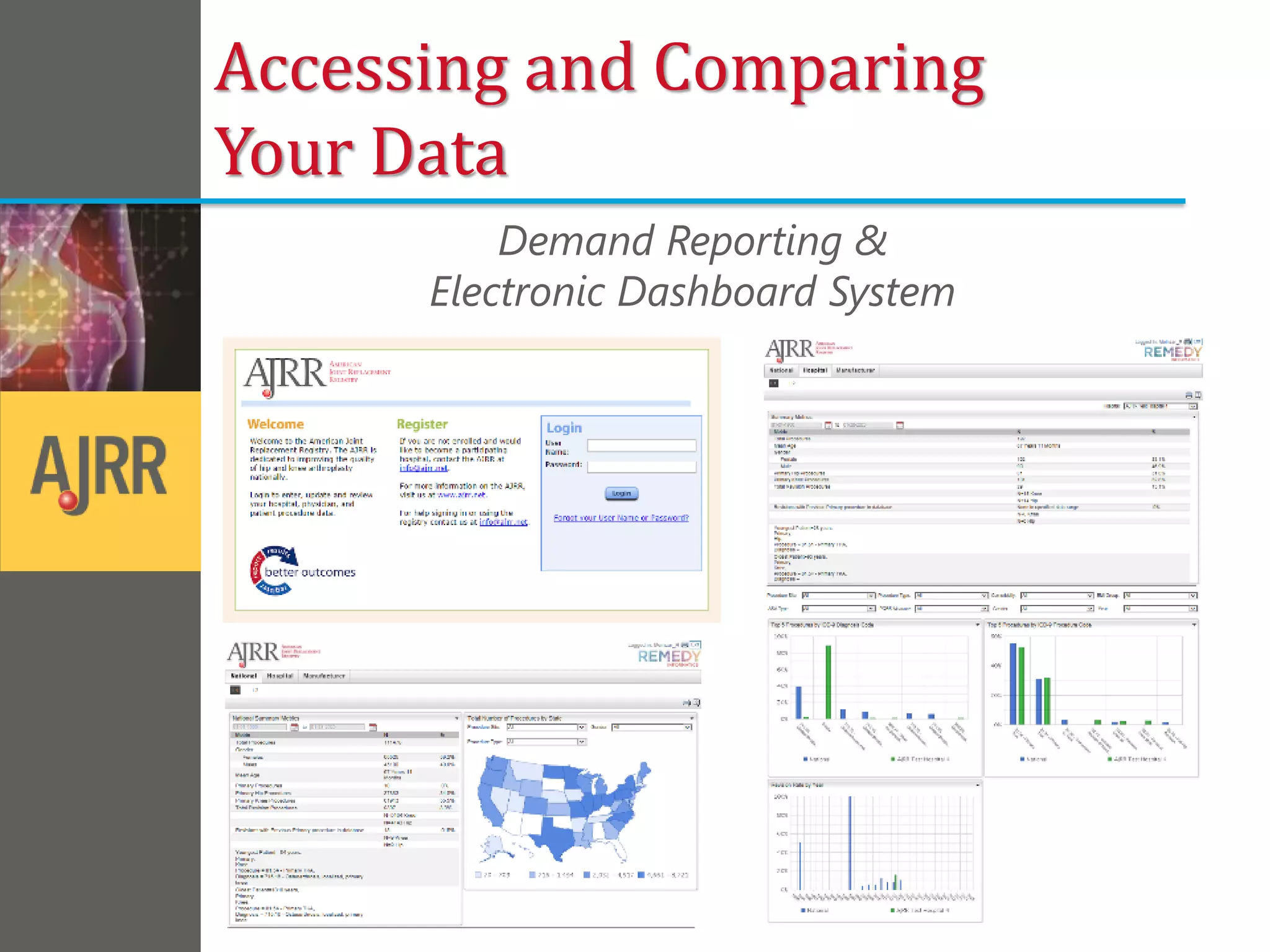
Demand Reporting &
Electronic Dashboard System
TrainingAccessing and Comparing
Your Data
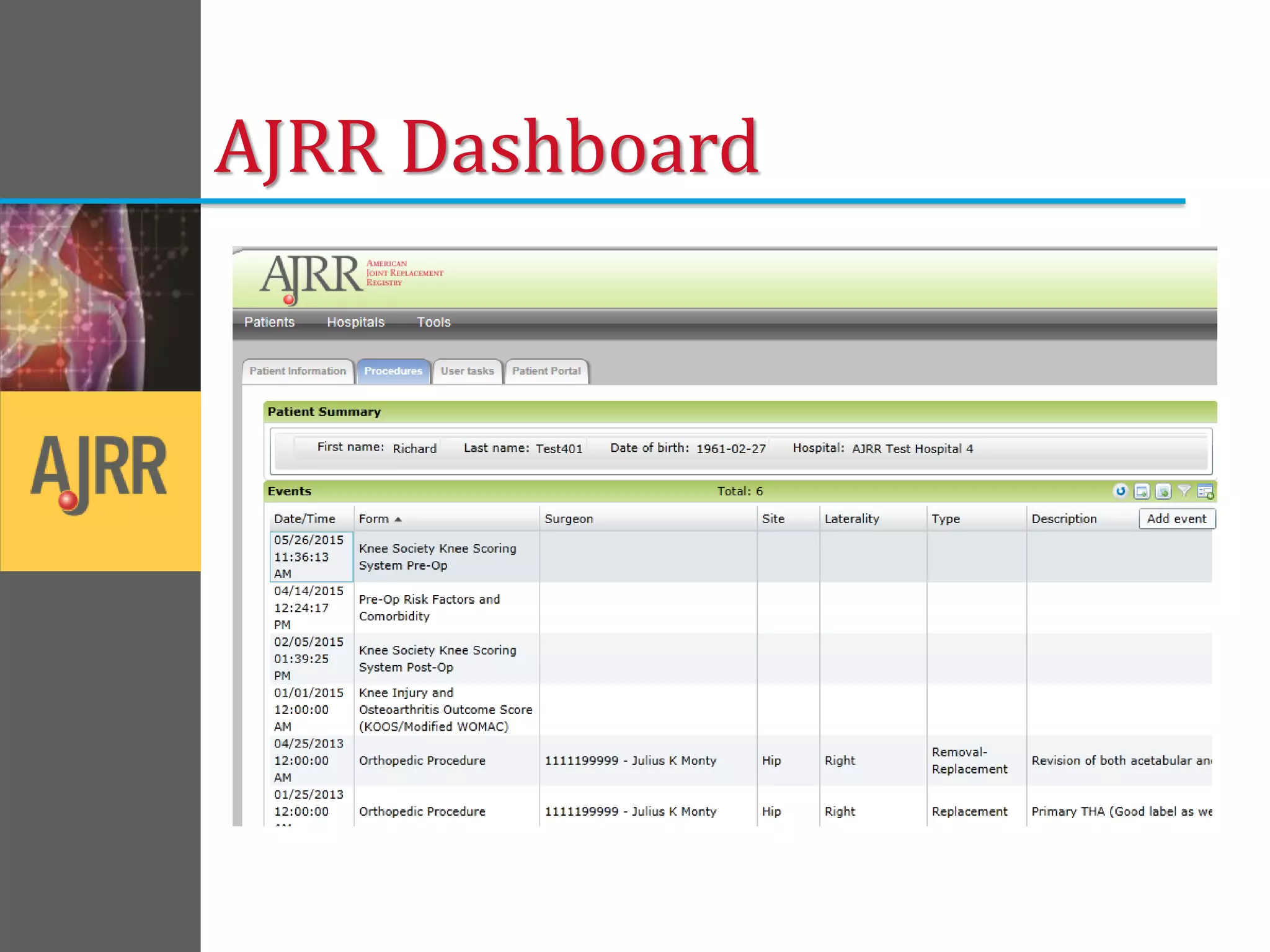
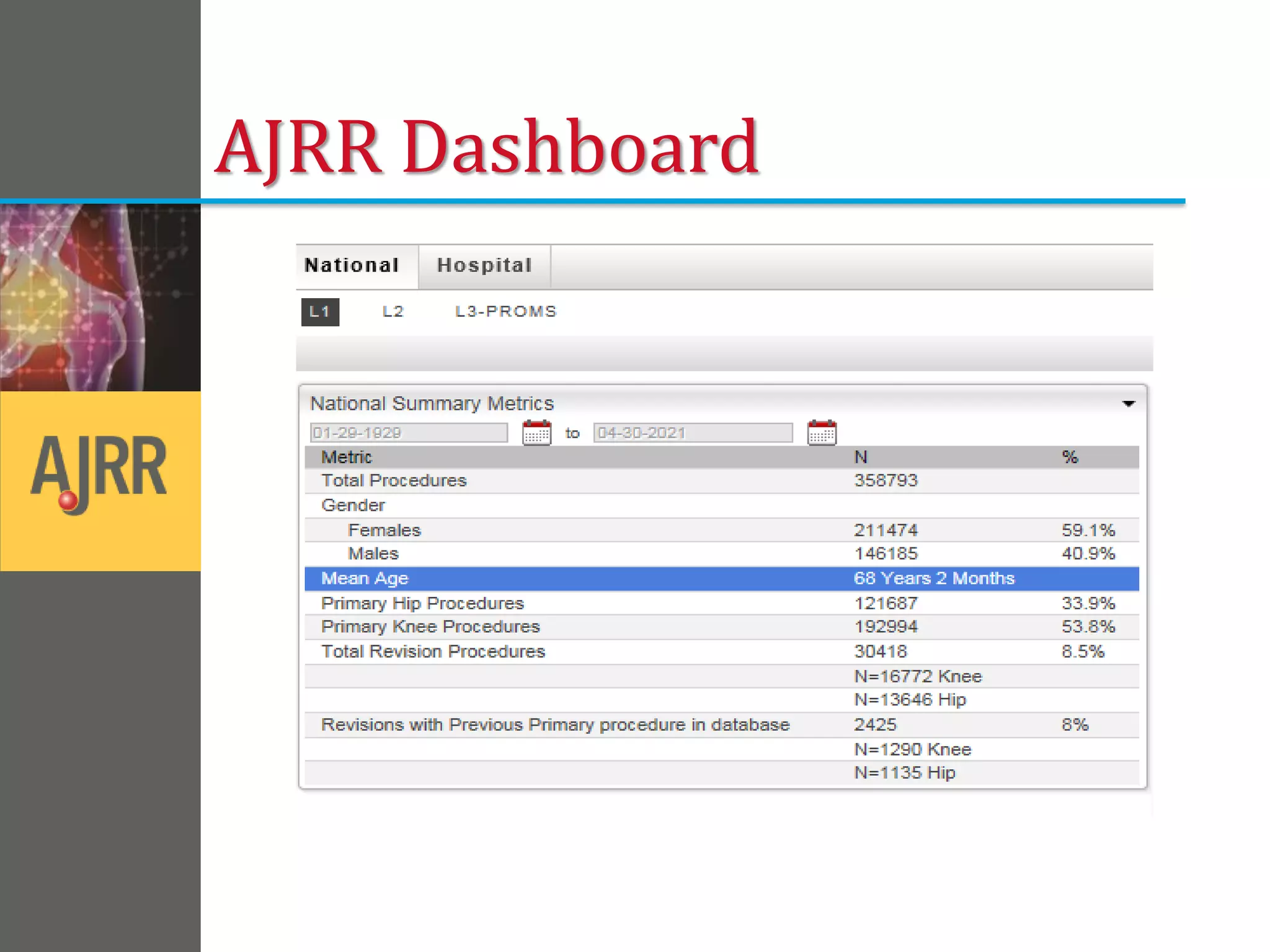
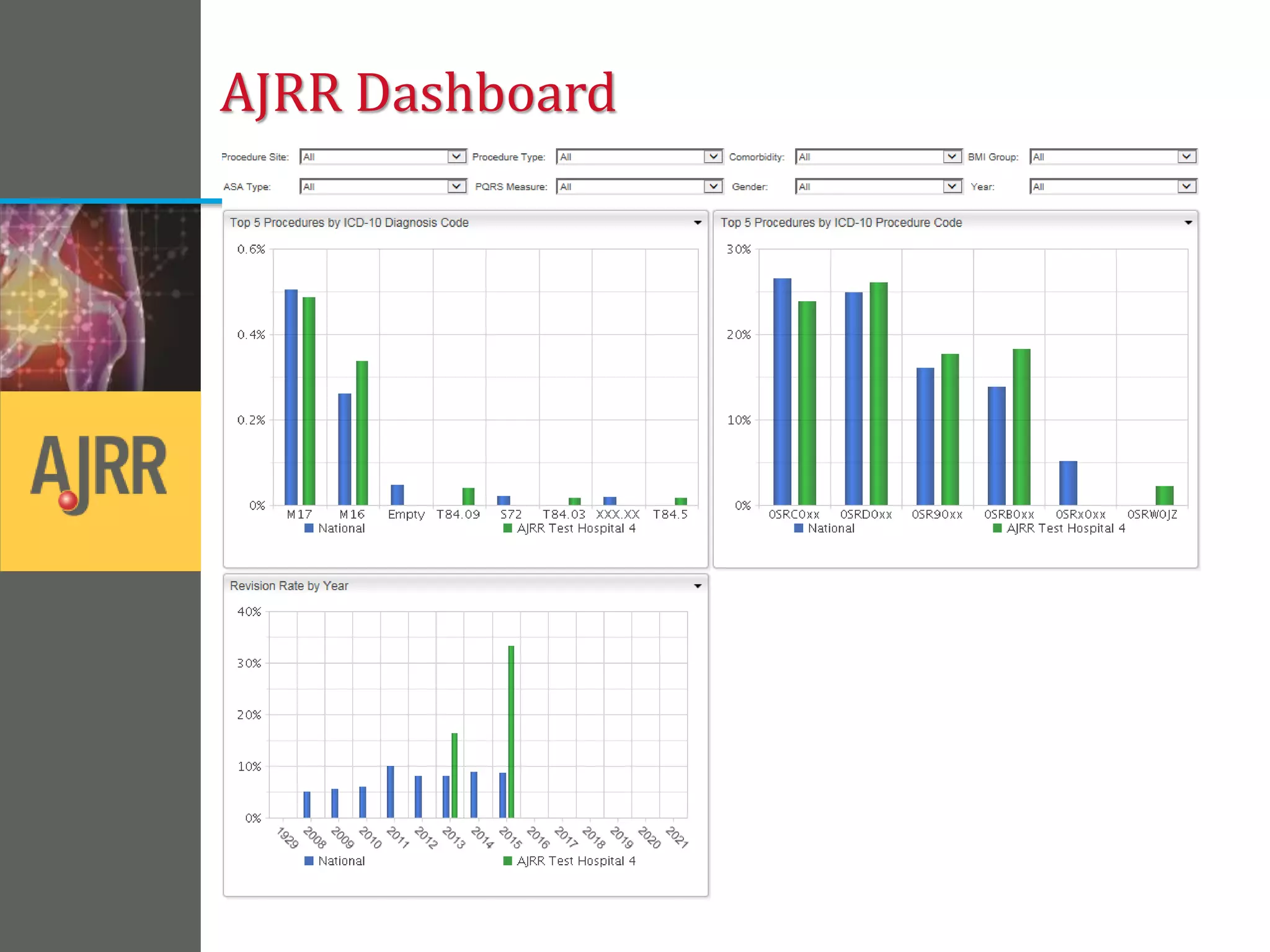
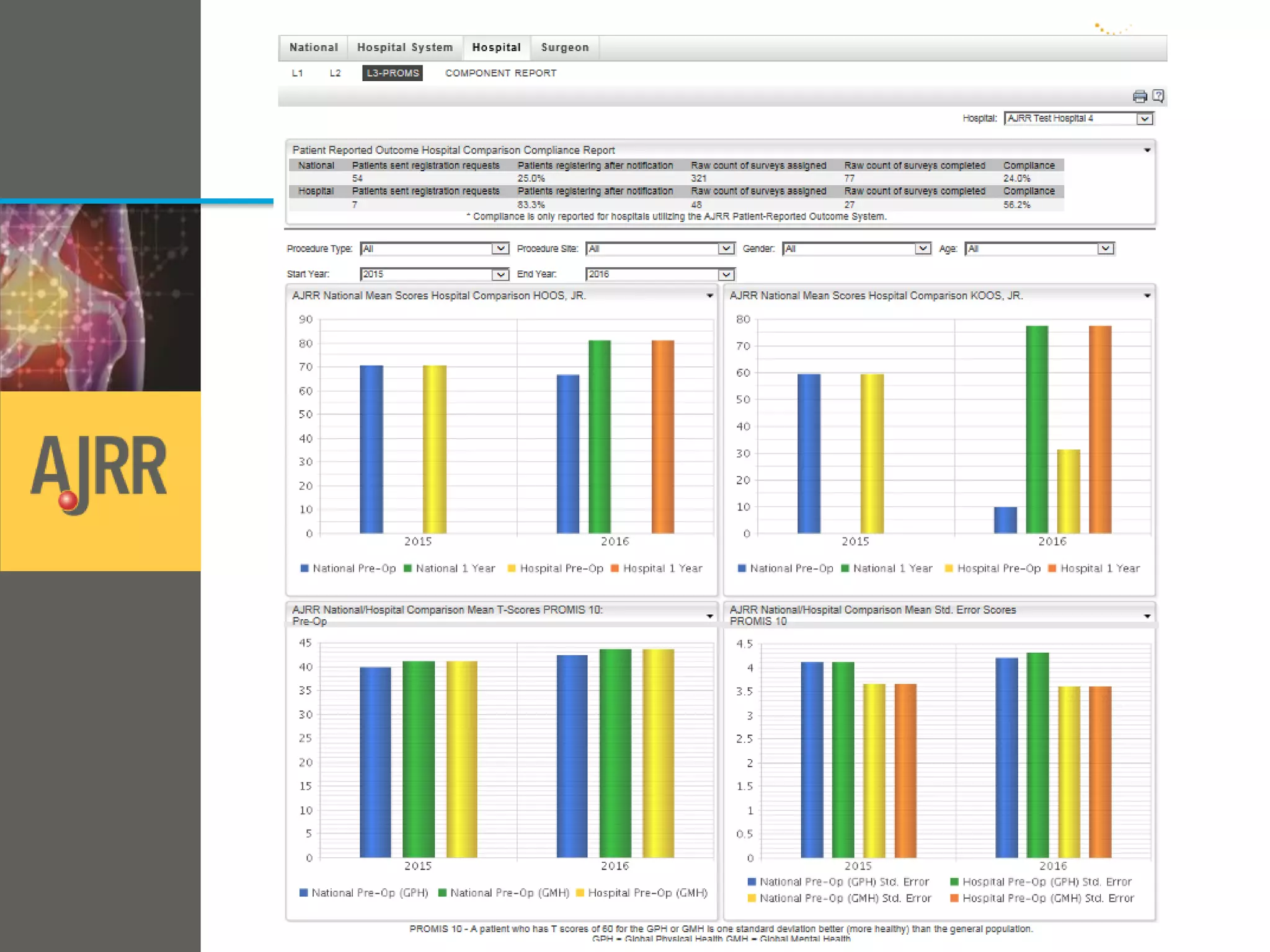
AJRR Dashboard
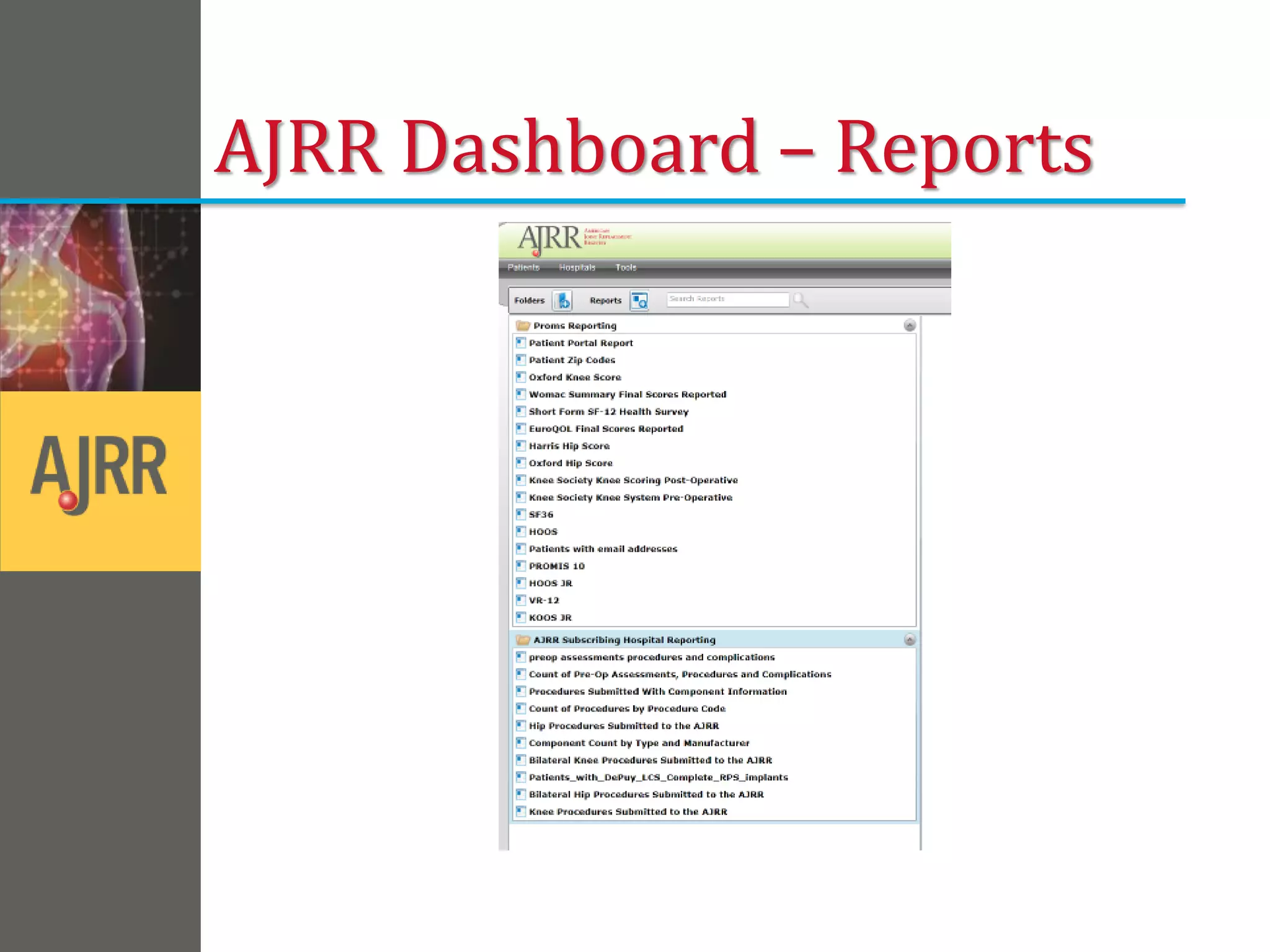
AJRR Dashboard – Reports
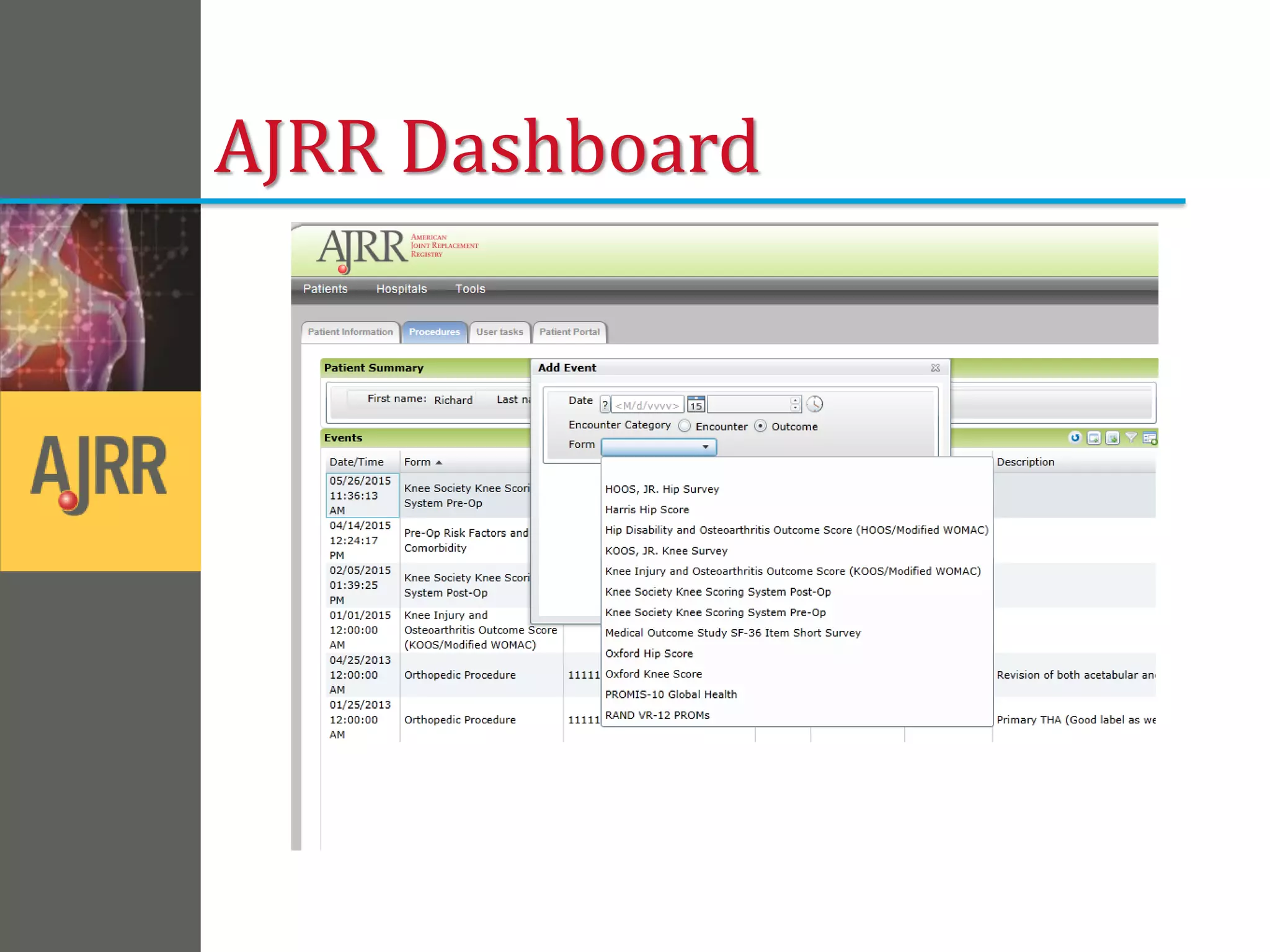
AJRR Dashboard
AJRR Dashboard
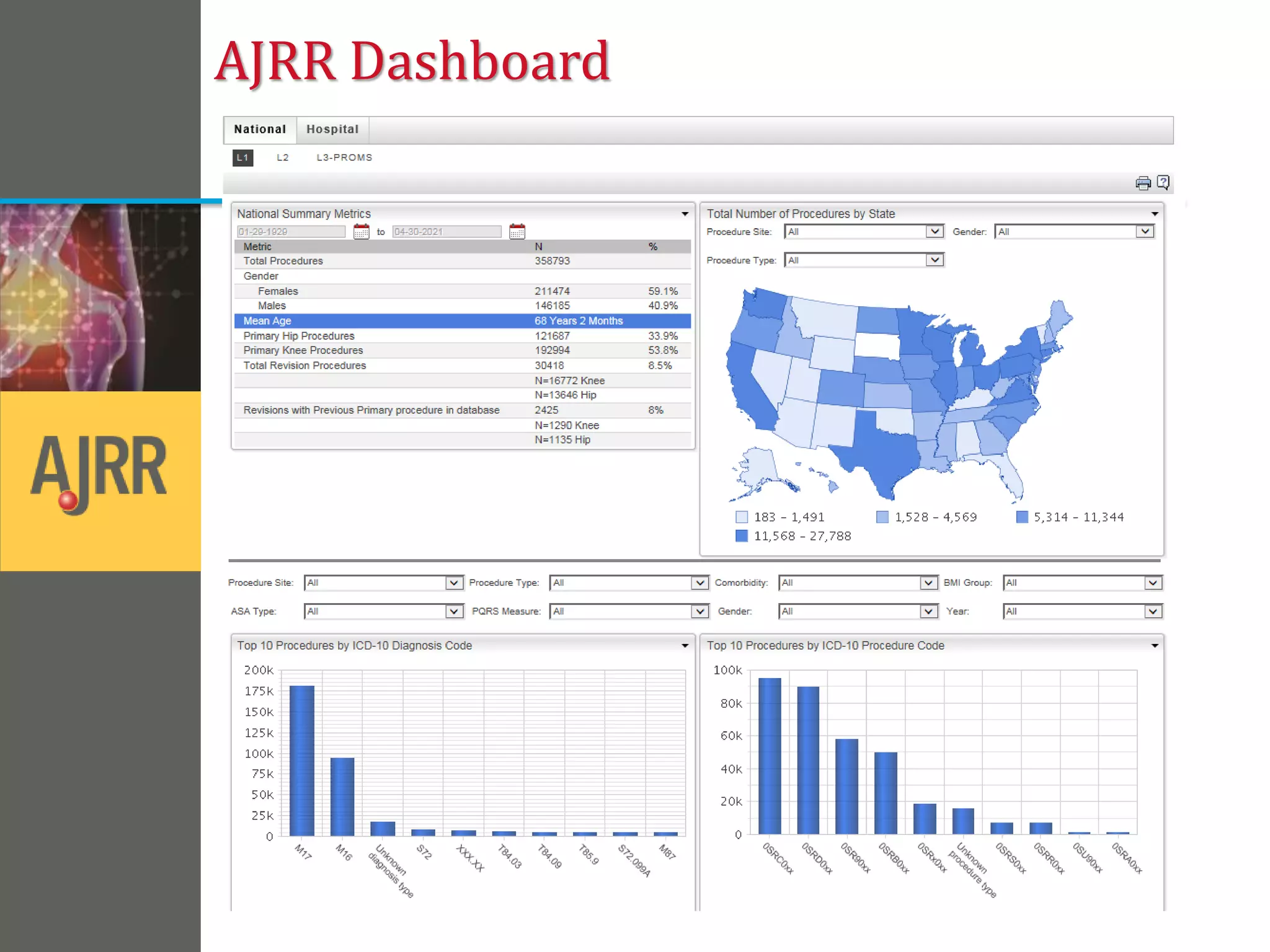
AJRR Dashboard
AJRR Dashboard
Joe Greene
University of Wisconsin
Department of Orthopedics
and Rehabilitation
Registry Participation 101
A Simple Step-by-Step Guide from AJRR
The Acquisition and Reporting of Patient
Reported Outcomes
Joe Greene
University of Wisconsin
Department of Orthopedics and
Rehabilitation
Objectives
 Outline the UW Health System approach to PRO
questionnaire deployment
 Define current AJRR reporting status and goals
 Describe Phase 1: The pilot collection of PRO
data in orthopedics
 Outline Phase 2: Full implementation of PRO
data collection and reporting
 Discuss lessons learned throughout
UW Health Orthopedics and
Rehabilitation
 UW Health Orthopedic Service Line
• 600+ employees
• Highly profitable service line with UW Health
• Highly comprehensive
 Department of Orthopedics and Rehabilitation
• 29 orthopedic surgeons and 16 rehabilitation providers
• 20+ PA’s and APNP’s
• 5 primary care sports medicine providers
 Research and Education
• 25 residents and 4 fellows
• 4 PhD Level Scientists and multiple post-doc’s
• Robust stem cell and regenerative medicine research
• Strong clinical research program
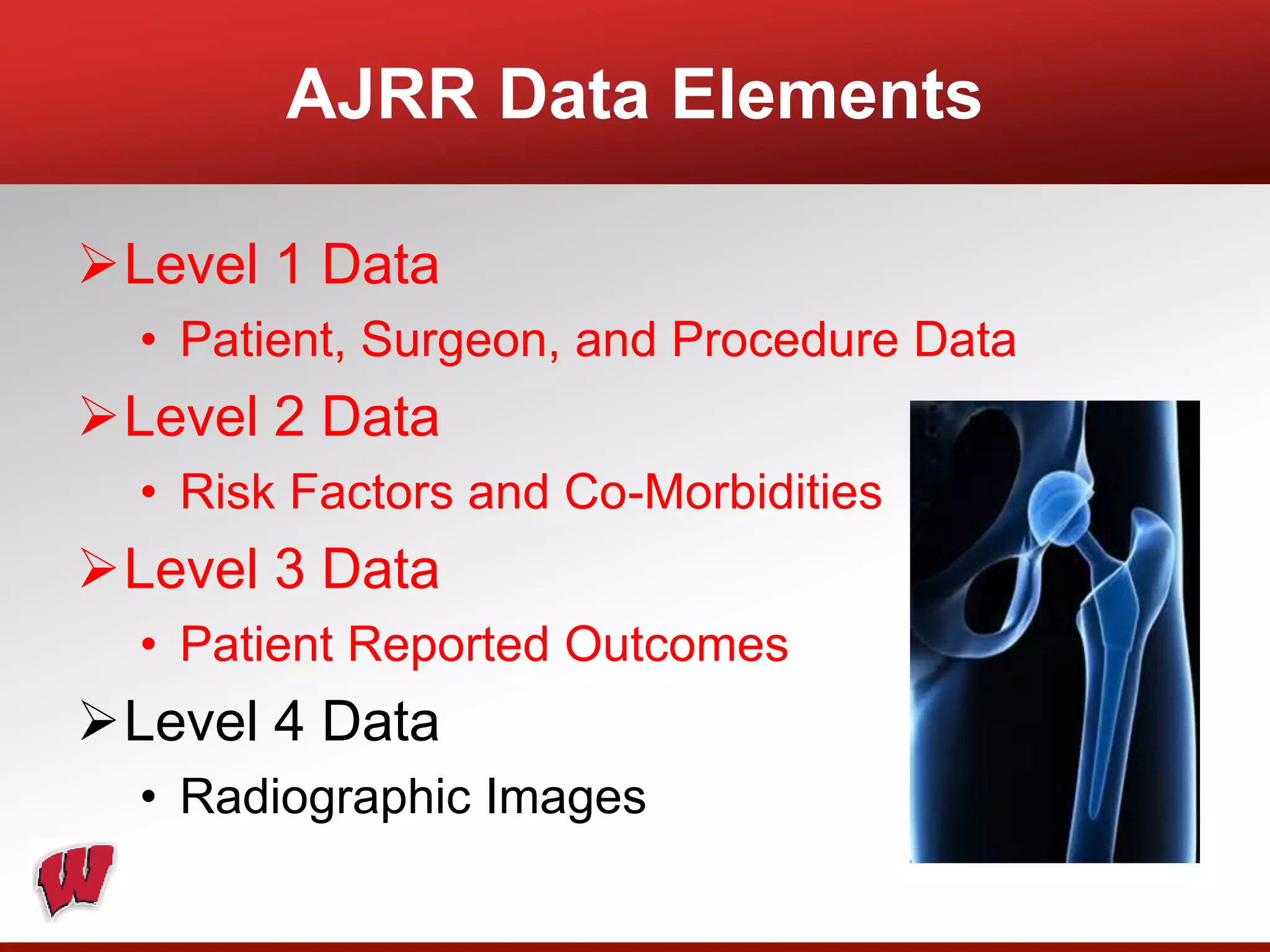
AJRR Data Elements
Level 1 Data
• Patient, Surgeon, and Procedure Data
Level 2 Data
• Risk Factors and Co-Morbidities
Level 3 Data
• Patient Reported Outcomes
Level 4 Data
• Radiographic Images
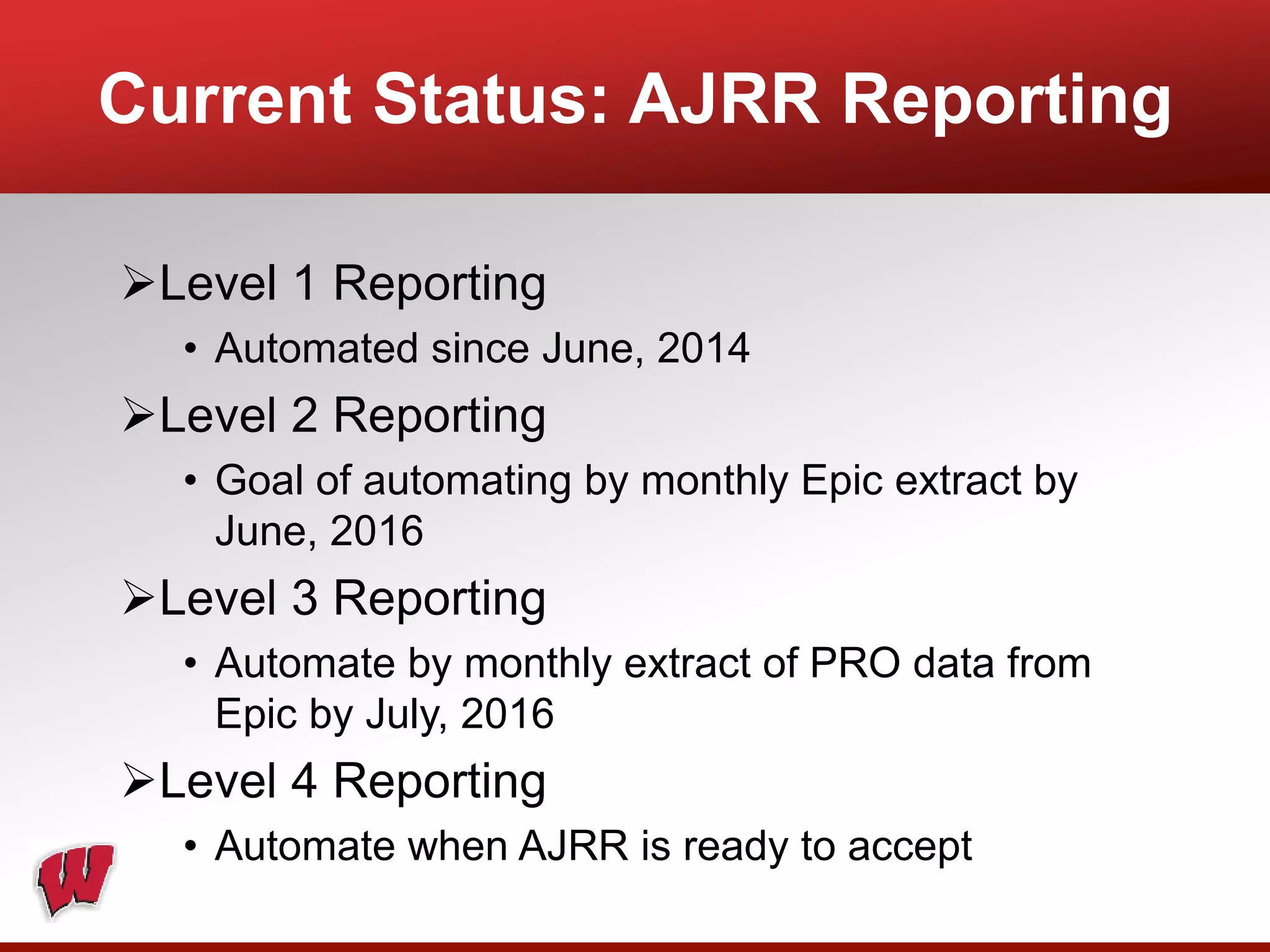
Current Status: AJRR Reporting
Level 1 Reporting
• Automated since June, 2014
Level 2 Reporting
• Goal of automating by monthly Epic extract by
June, 2016
Level 3 Reporting
• Automate by monthly extract of PRO data from
Epic by July, 2016
Level 4 Reporting
• Automate when AJRR is ready to accept
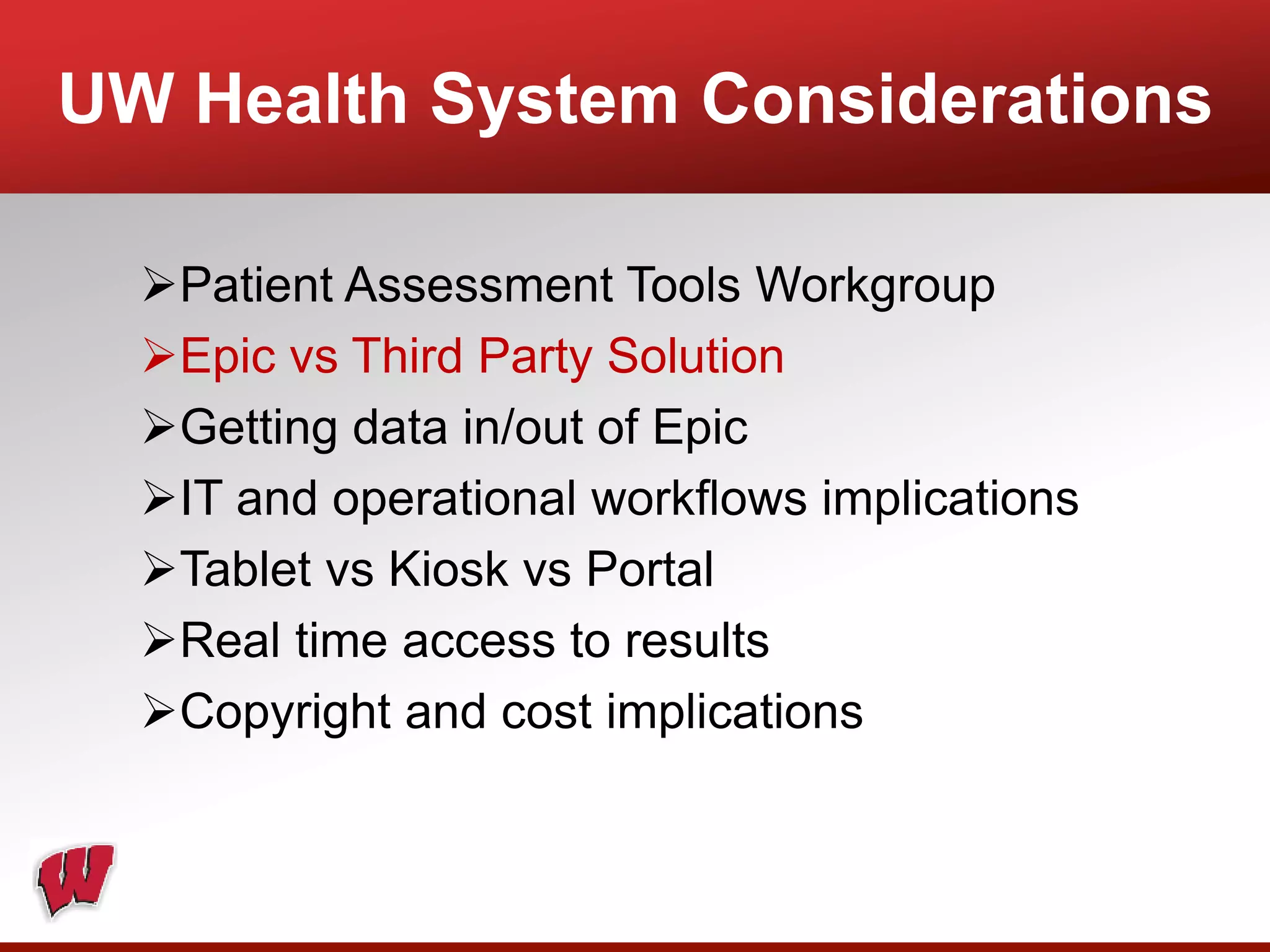
UW Health System Considerations
Patient Assessment Tools Workgroup
Epic vs Third Party Solution
Getting data in/out of Epic
IT and operational workflows implications
Tablet vs Kiosk vs Portal
Real time access to results
Copyright and cost implications
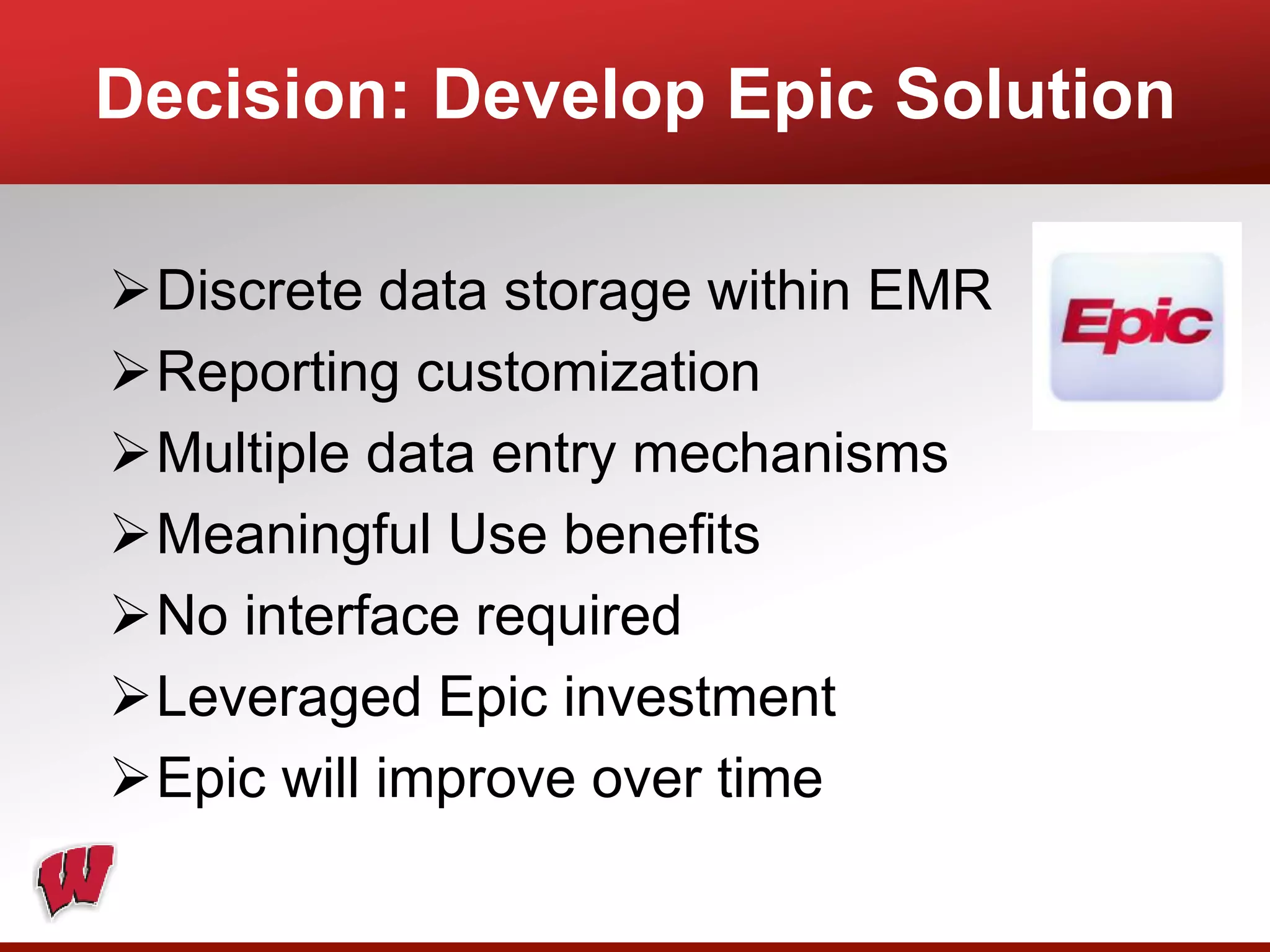
Discrete data storage within EMR
Reporting customization
Multiple data entry mechanisms
Meaningful Use benefits
No interface required
Leveraged Epic investment
Epic will improve over time
Decision: Develop Epic Solution
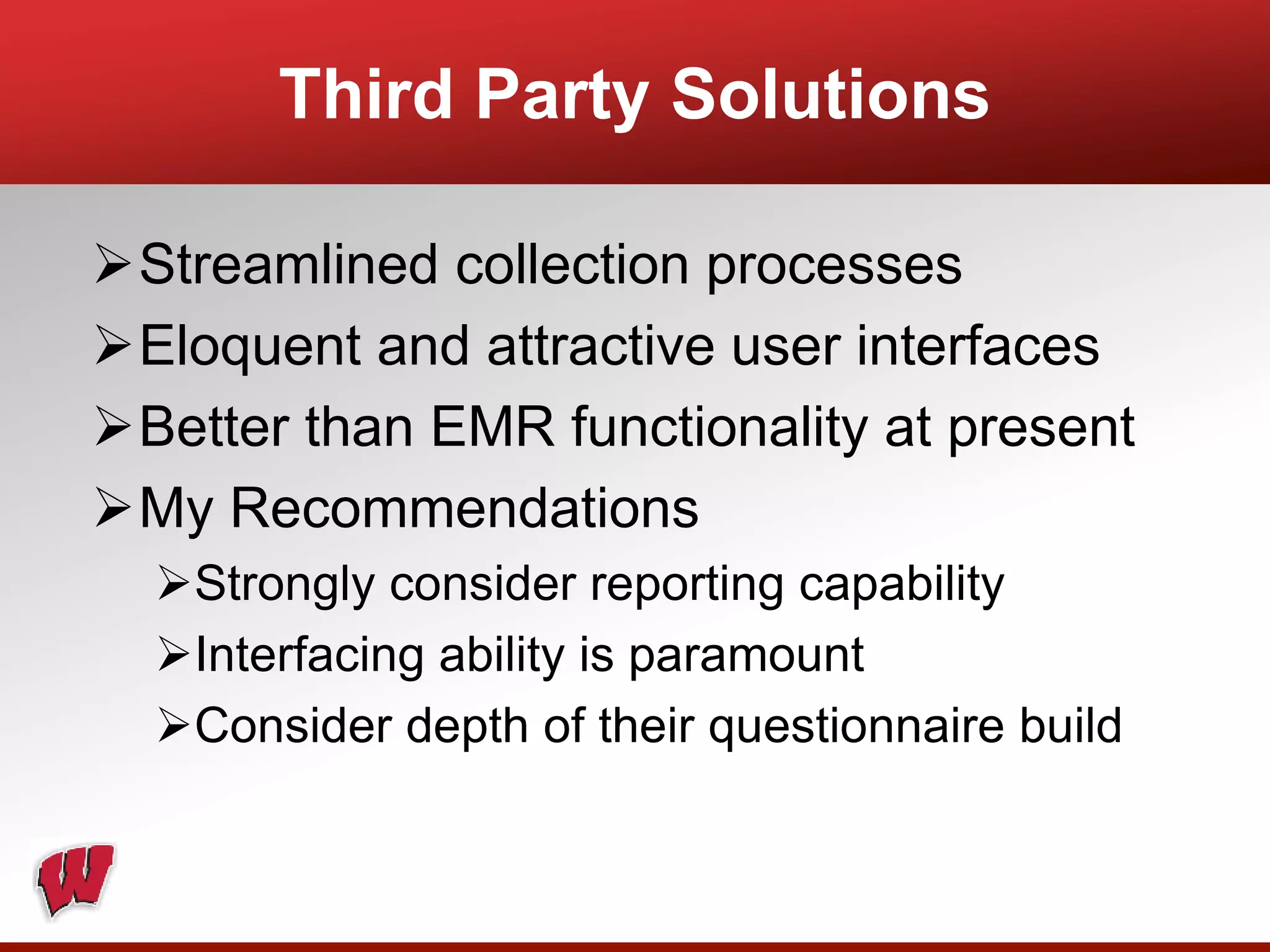
Streamlined collection processes
Eloquent and attractive user interfaces
Better than EMR functionality at present
My Recommendations
Strongly consider reporting capability
Interfacing ability is paramount
Consider depth of their questionnaire build
Third Party Solutions
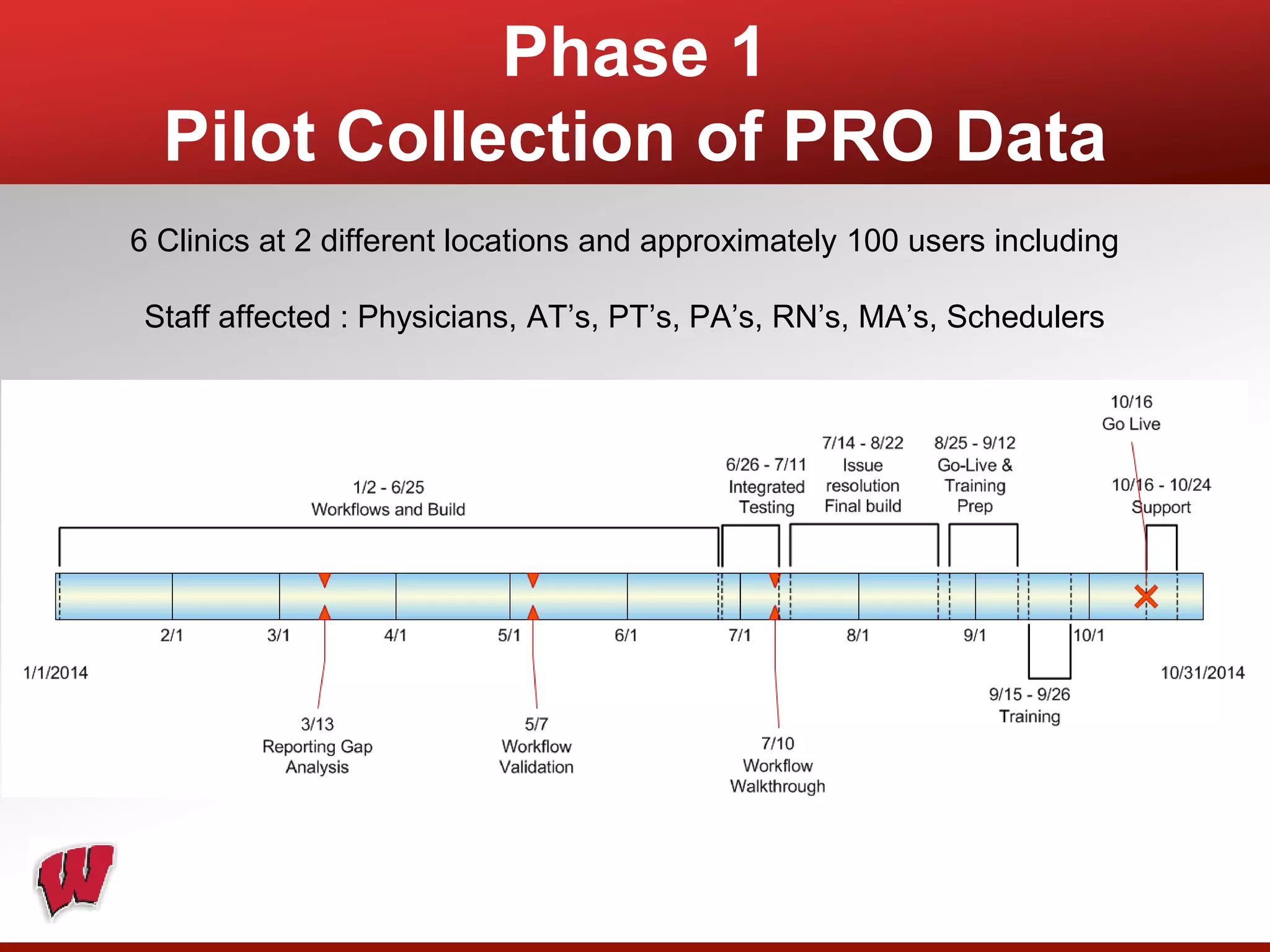
Phase 1
Pilot Collection of PRO Data
6 Clinics at 2 different locations and approximately 100 users including
Staff affected : Physicians, AT’s, PT’s, PA’s, RN’s, MA’s, Schedulers
Phase 1
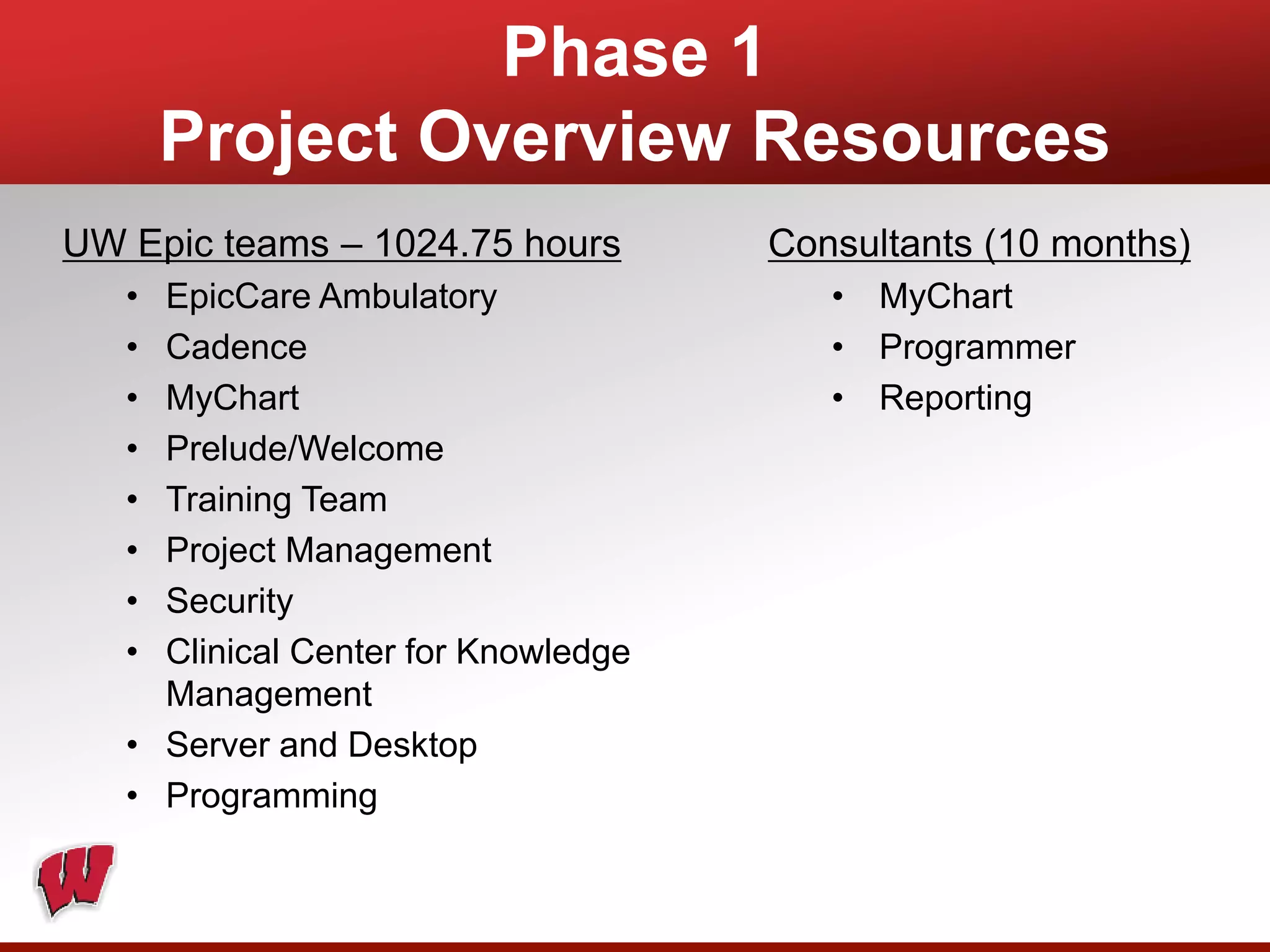
Project Overview Resources
UW Epic teams – 1024.75 hours
• EpicCare Ambulatory
• Cadence
• MyChart
• Prelude/Welcome
• Training Team
• Project Management
• Security
• Clinical Center for Knowledge
Management
• Server and Desktop
• Programming
Consultants (10 months)
• MyChart
• Programmer
• Reporting
Phase 1
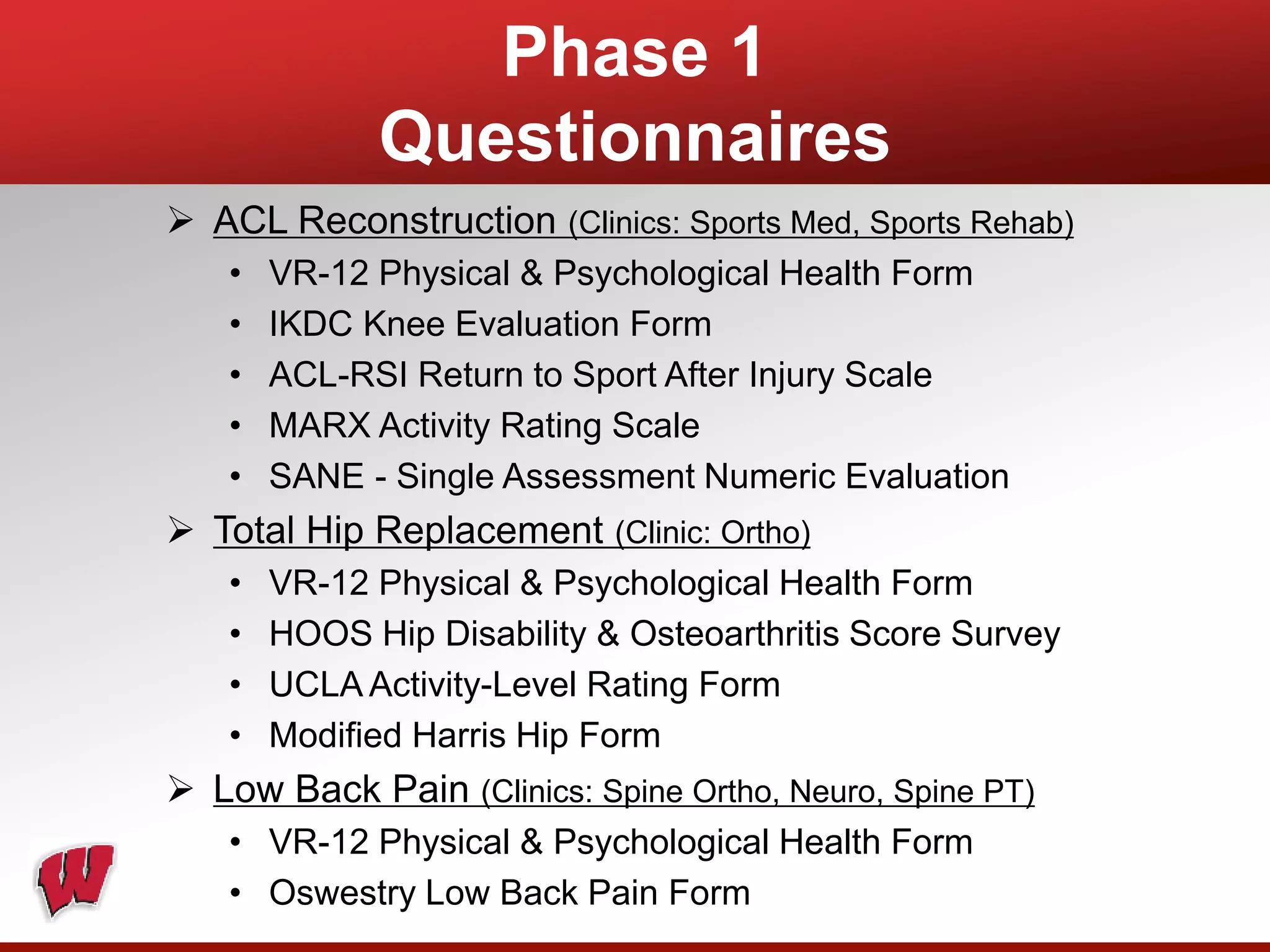
Questionnaires
 ACL Reconstruction (Clinics: Sports Med, Sports Rehab)
• VR-12 Physical & Psychological Health Form
• IKDC Knee Evaluation Form
• ACL-RSI Return to Sport After Injury Scale
• MARX Activity Rating Scale
• SANE - Single Assessment Numeric Evaluation
 Total Hip Replacement (Clinic: Ortho)
• VR-12 Physical & Psychological Health Form
• HOOS Hip Disability & Osteoarthritis Score Survey
• UCLA Activity-Level Rating Form
• Modified Harris Hip Form
 Low Back Pain (Clinics: Spine Ortho, Neuro, Spine PT)
• VR-12 Physical & Psychological Health Form
• Oswestry Low Back Pain Form
Phase 1
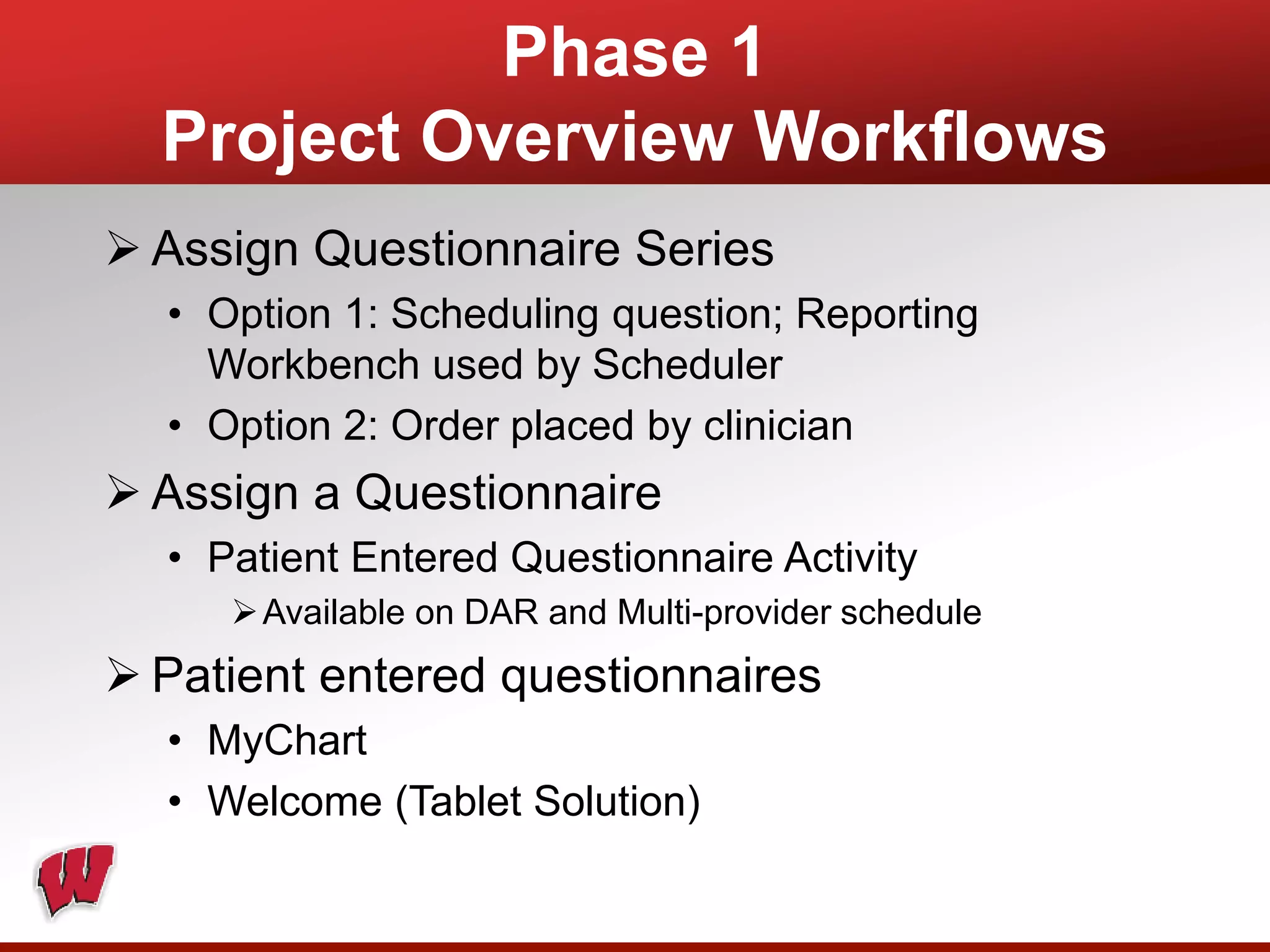
Project Overview Workflows
 Assign Questionnaire Series
• Option 1: Scheduling question; Reporting
Workbench used by Scheduler
• Option 2: Order placed by clinician
 Assign a Questionnaire
• Patient Entered Questionnaire Activity
Available on DAR and Multi-provider schedule
 Patient entered questionnaires
• MyChart
• Welcome (Tablet Solution)
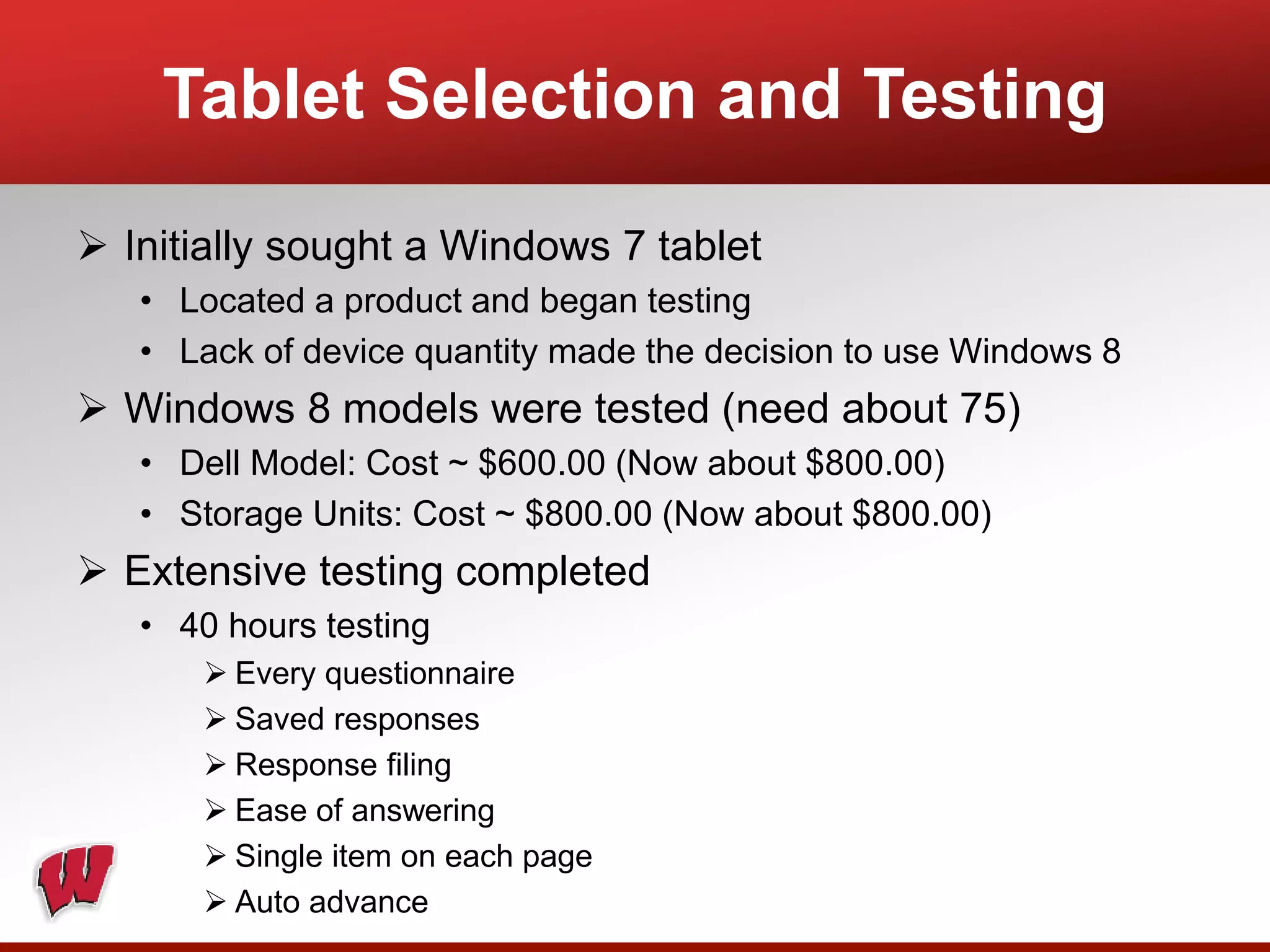
 Initially sought a Windows 7 tablet
• Located a product and began testing
• Lack of device quantity made the decision to use Windows 8
 Windows 8 models were tested (need about 75)
• Dell Model: Cost ~ $600.00 (Now about $800.00)
• Storage Units: Cost ~ $800.00 (Now about $800.00)
 Extensive testing completed
• 40 hours testing
 Every questionnaire
 Saved responses
 Response filing
 Ease of answering
 Single item on each page
 Auto advance
Tablet Selection and Testing
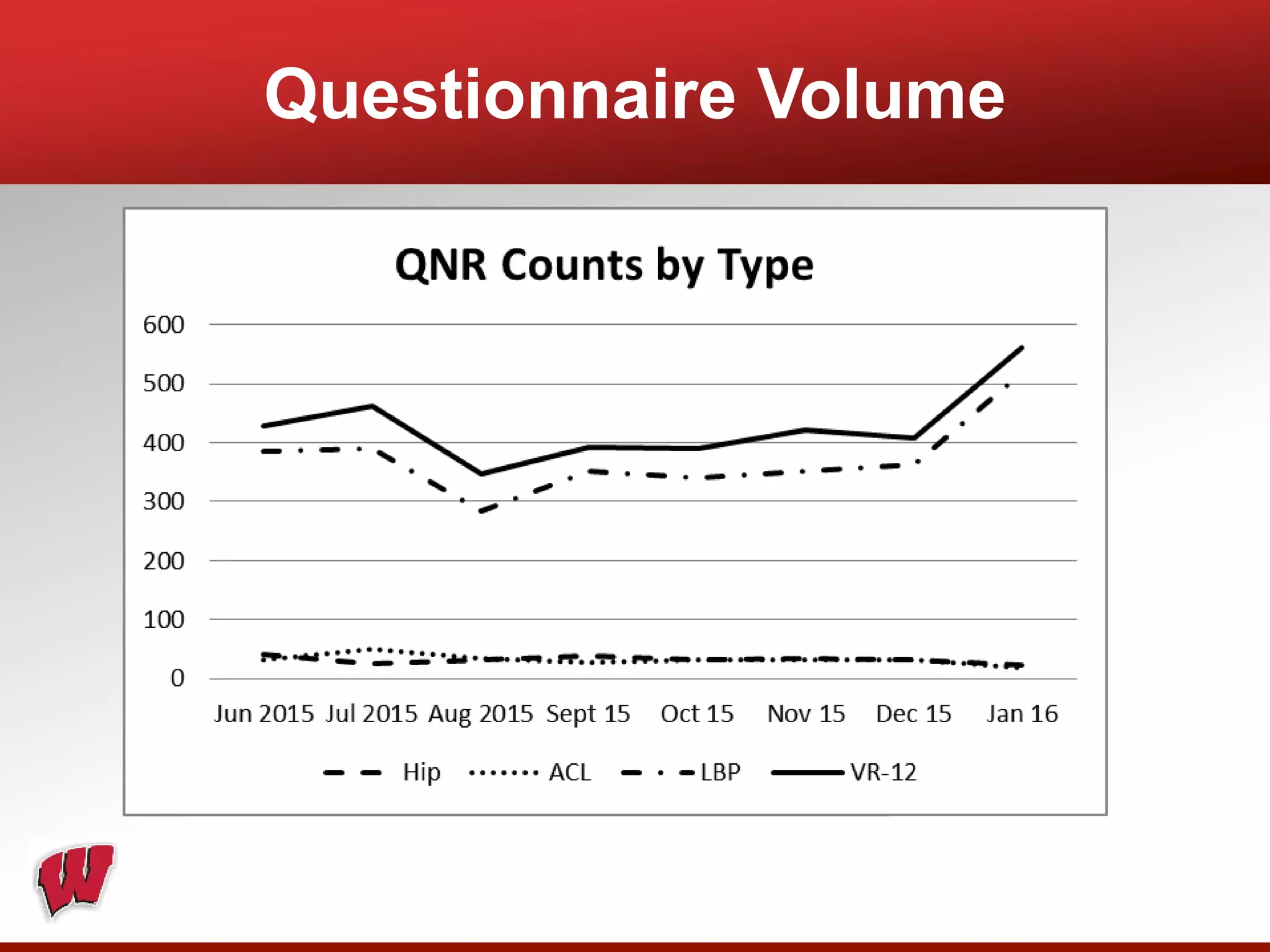
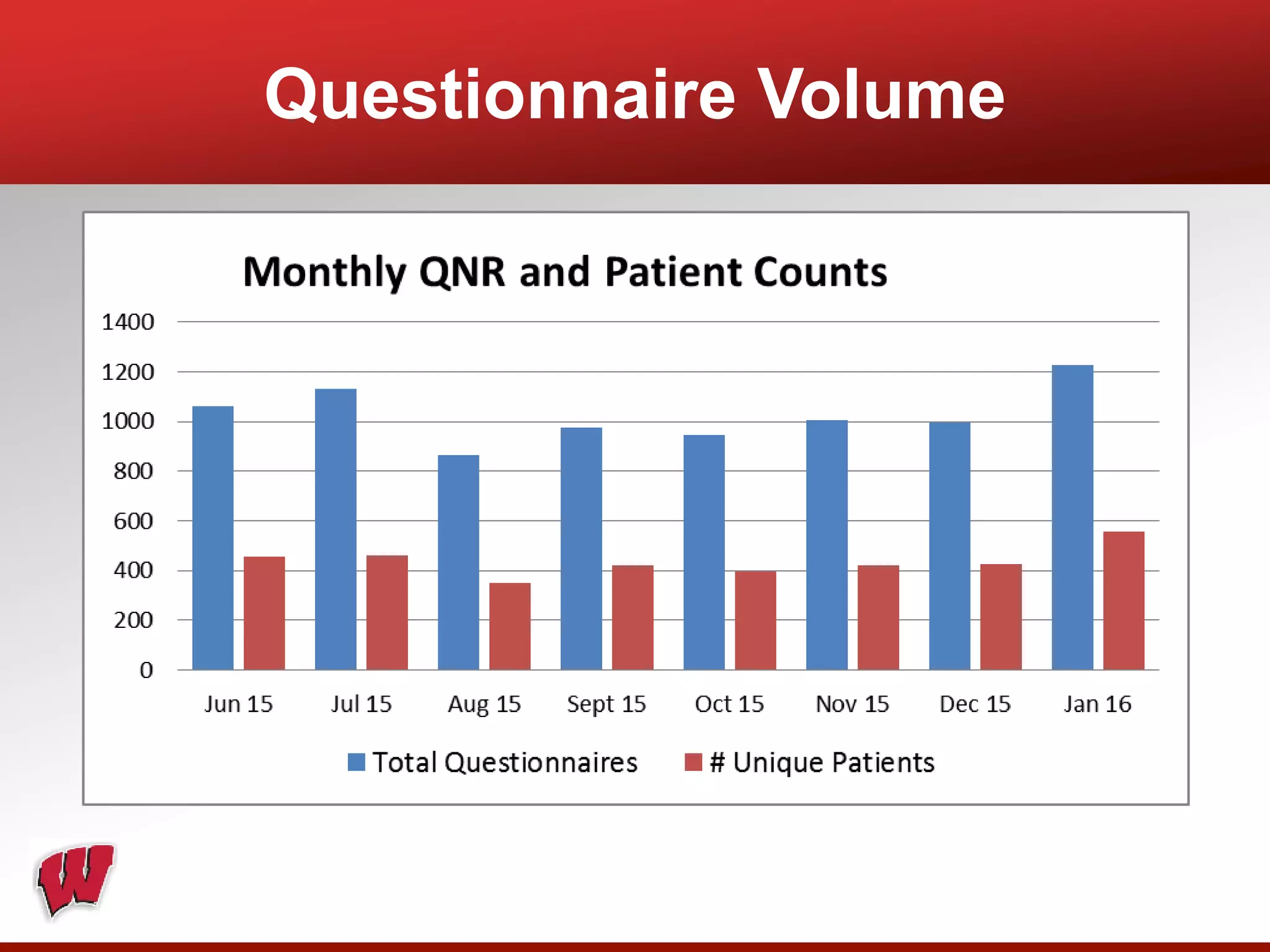
Questionnaire Volume
Pilot Go-Live
October 16th
Questionnaire Volume
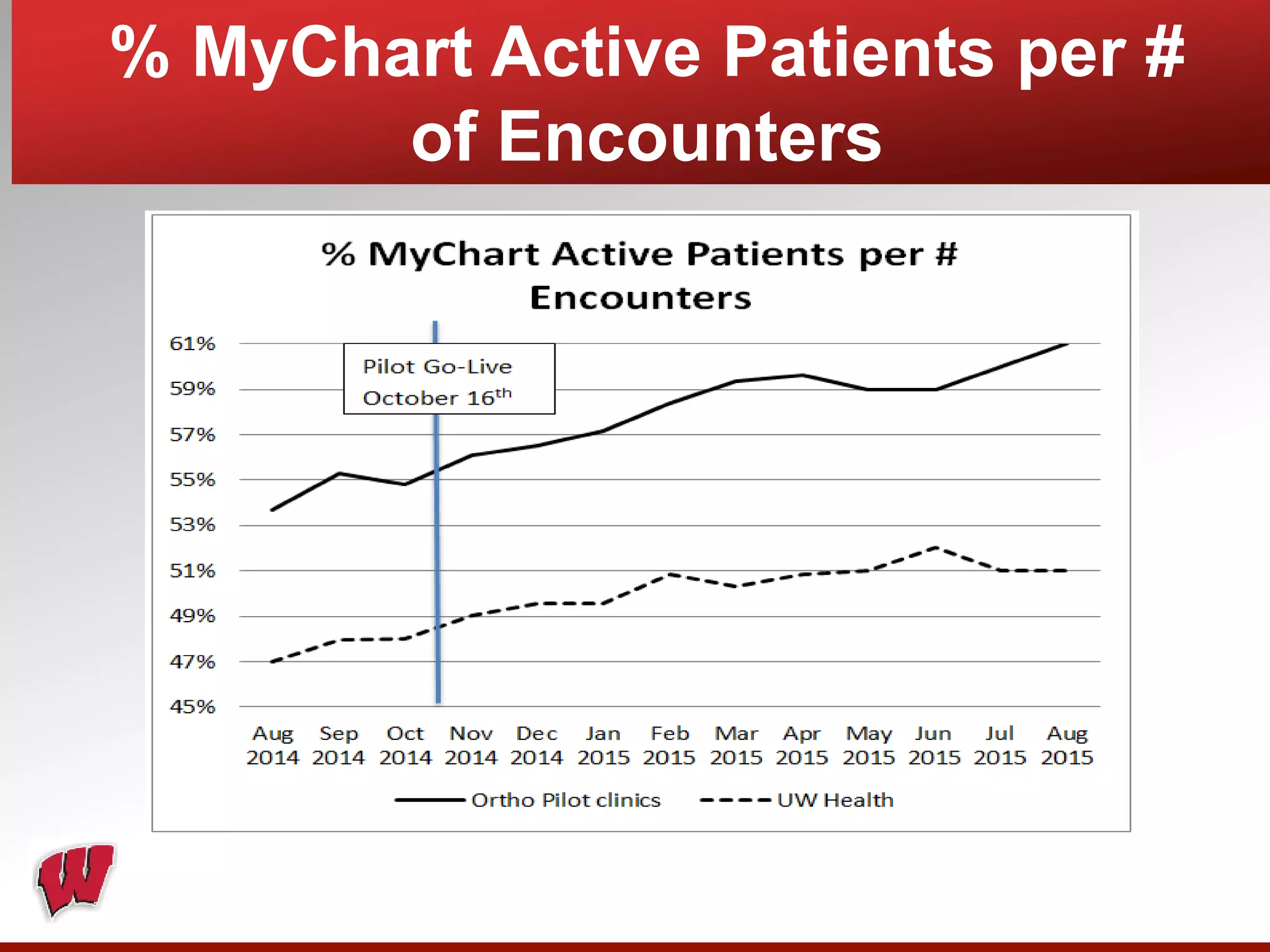
Pilot Go-Live
October 16th
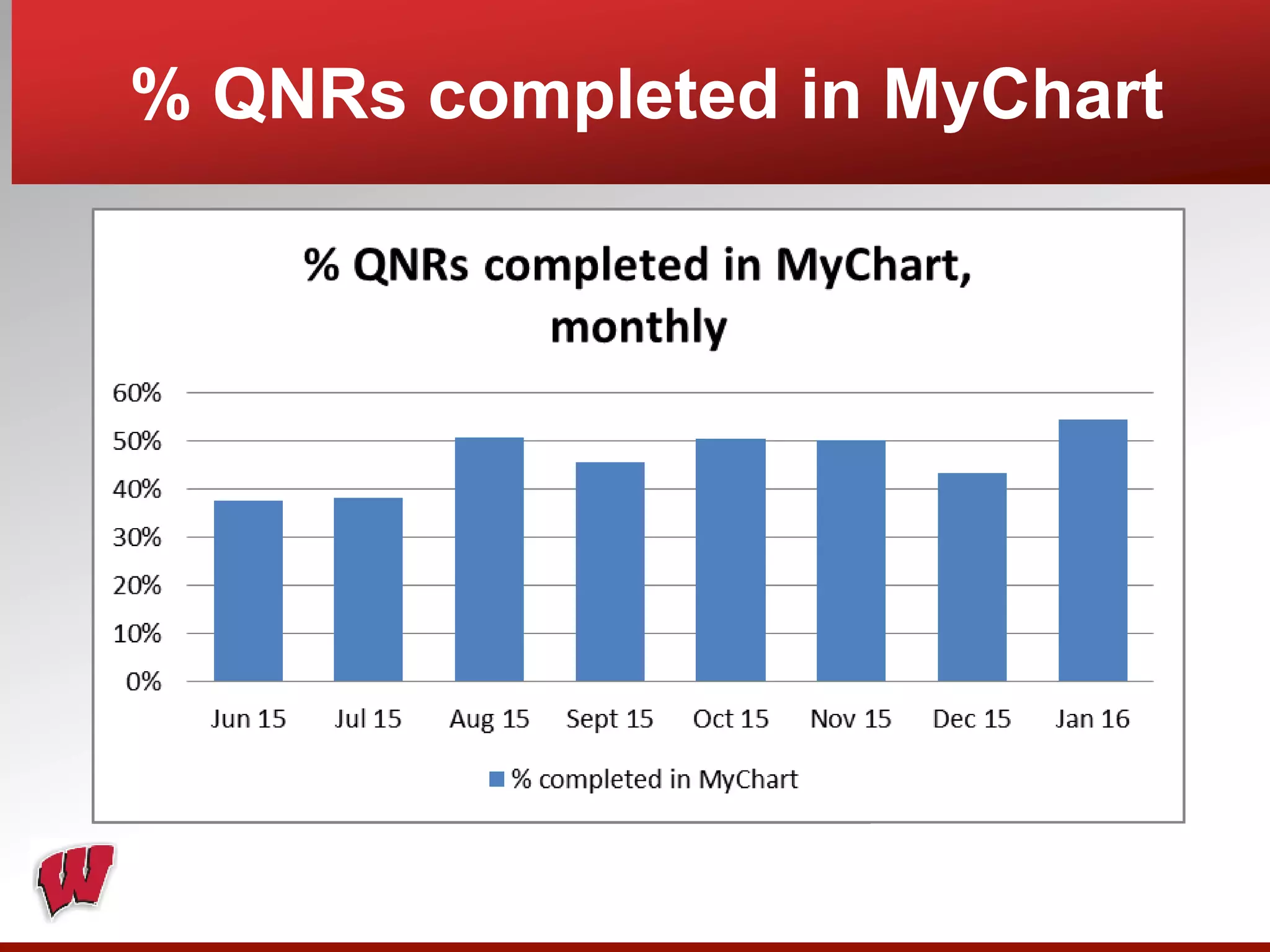
% QNRs completed in MyChart
% MyChart Active Patients per #
of Encounters
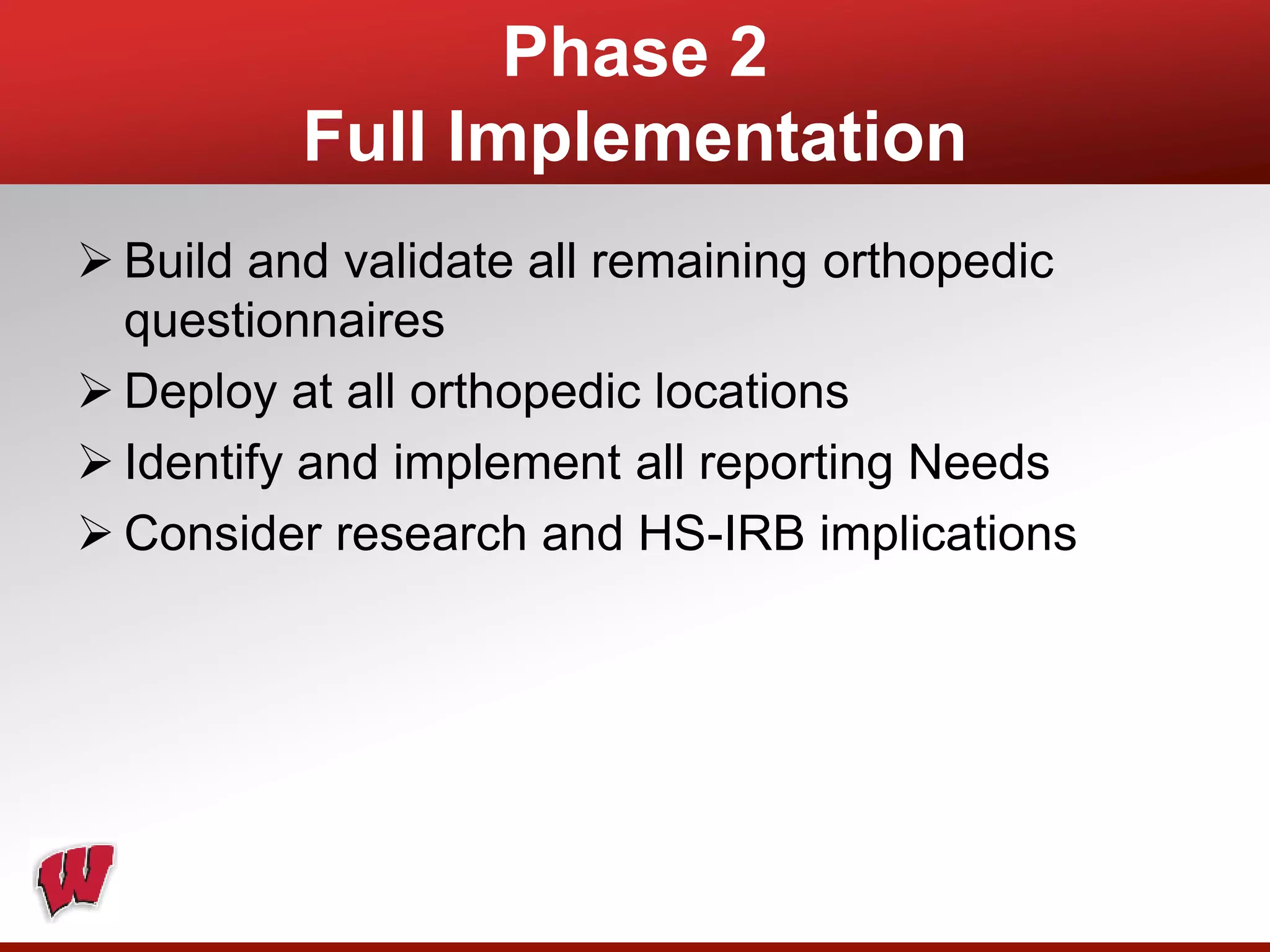
Phase 2
Full Implementation
 Build and validate all remaining orthopedic
questionnaires
 Deploy at all orthopedic locations
 Identify and implement all reporting Needs
 Consider research and HS-IRB implications
Phase 2 Considerations
Quality and Outcomes
Research
Clinical Reporting
Registry Reporting
Government and Reporting
Third Party Payors and Bundling
Marketing
Phase 2
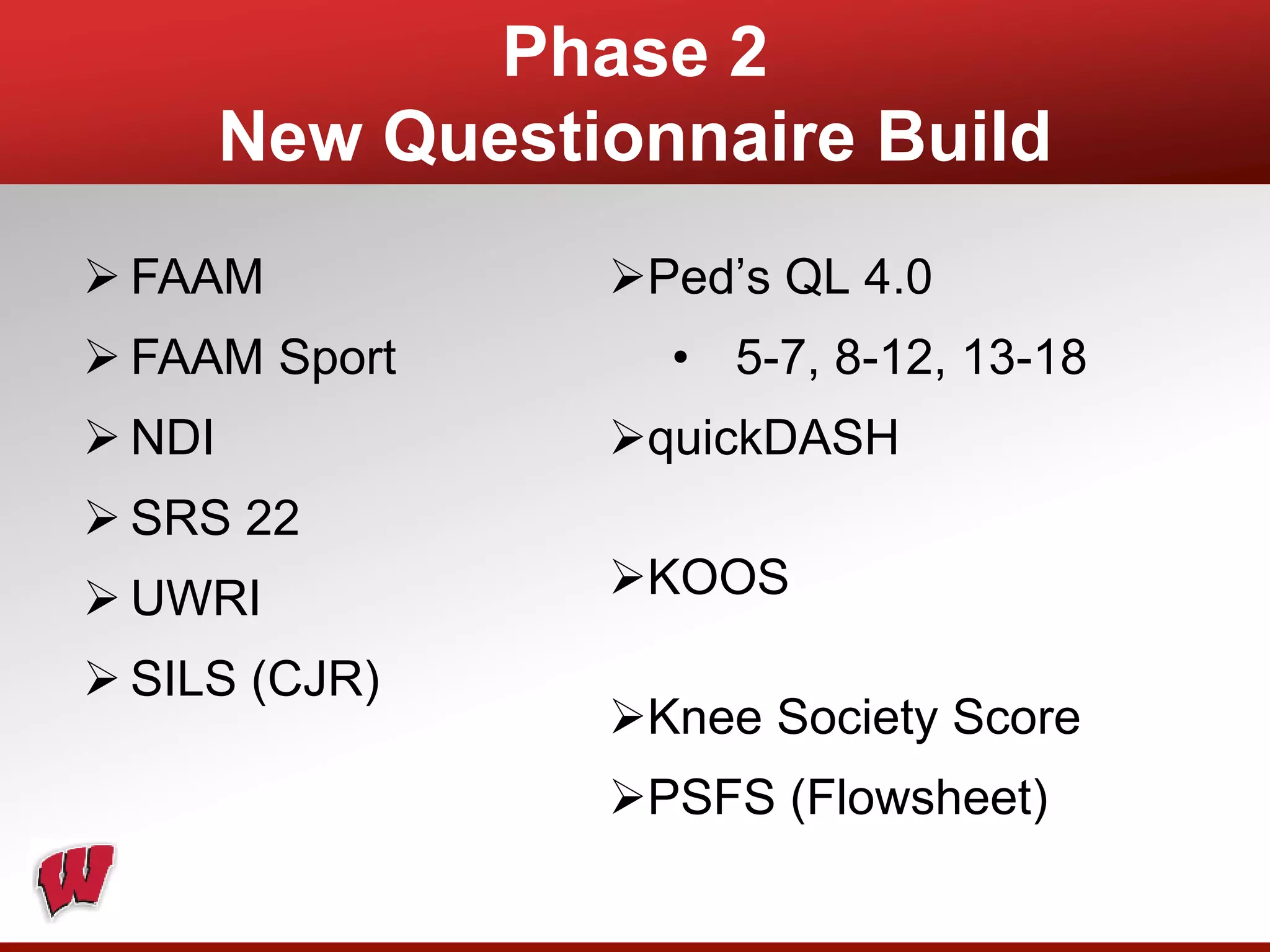
New Questionnaire Build
 FAAM
 FAAM Sport
 NDI
 SRS 22
 UWRI
 SILS (CJR)
Ped’s QL 4.0
• 5-7, 8-12, 13-18
quickDASH
KOOS
Knee Society Score
PSFS (Flowsheet)
Phase 2
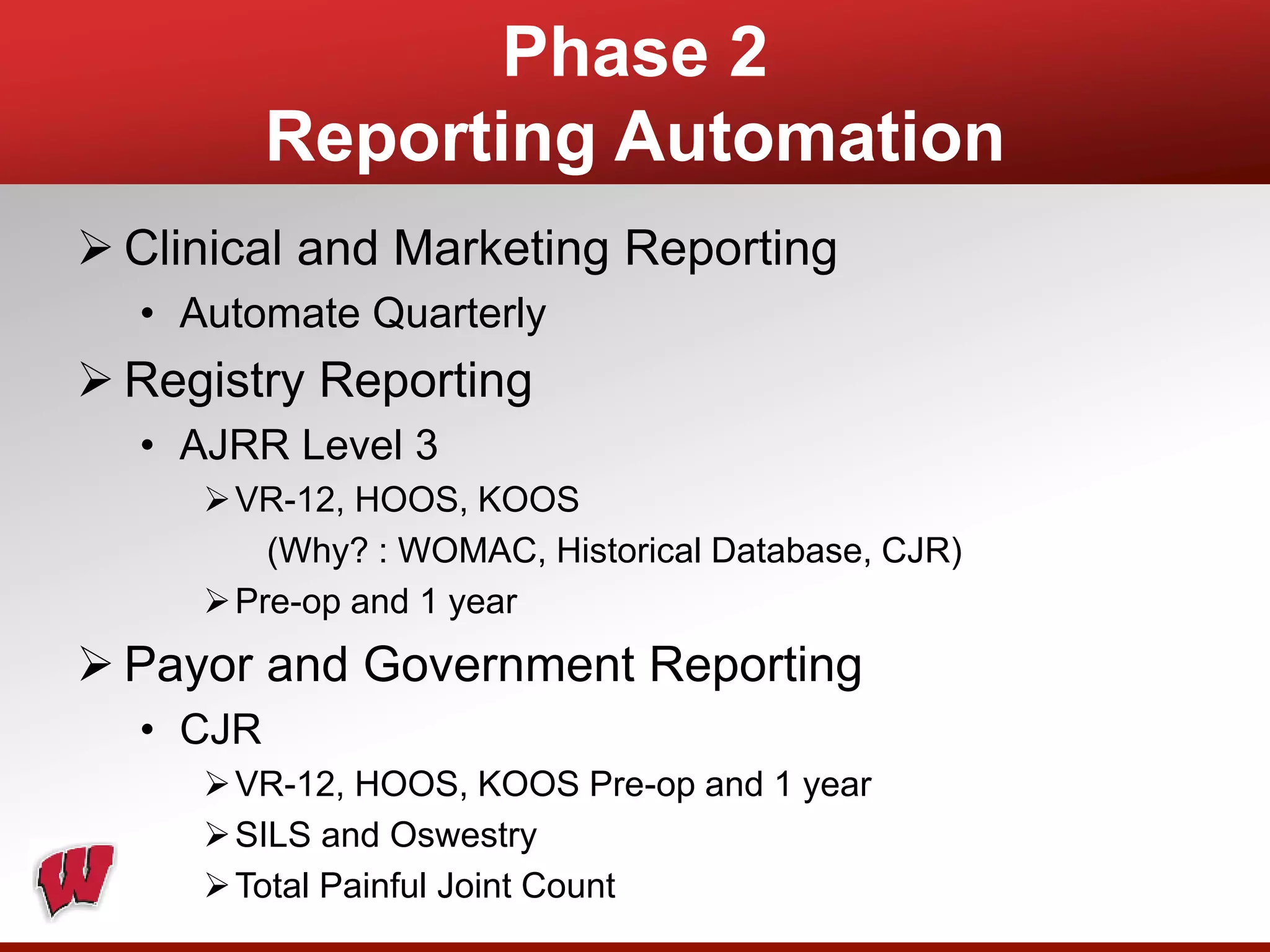
Reporting Automation
 Clinical and Marketing Reporting
• Automate Quarterly
 Registry Reporting
• AJRR Level 3
VR-12, HOOS, KOOS
(Why? : WOMAC, Historical Database, CJR)
Pre-op and 1 year
 Payor and Government Reporting
• CJR
VR-12, HOOS, KOOS Pre-op and 1 year
SILS and Oswestry
Total Painful Joint Count
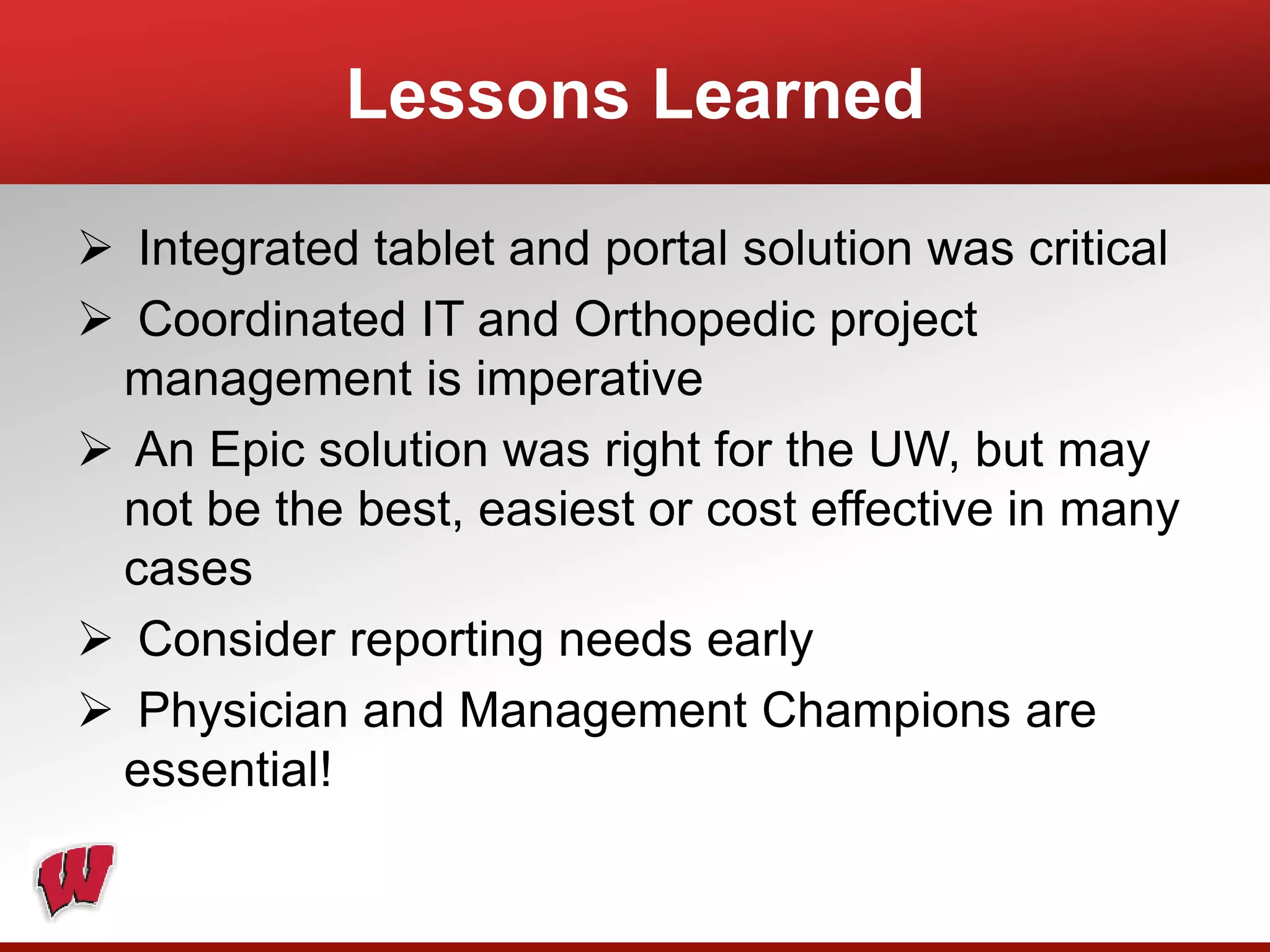
Lessons Learned
 Integrated tablet and portal solution was critical
 Coordinated IT and Orthopedic project
management is imperative
 An Epic solution was right for the UW, but may
not be the best, easiest or cost effective in many
cases
 Consider reporting needs early
 Physician and Management Champions are
essential!
Questions
Joe Greene (JGreene@uwhealth.org)
Orthopedics Project Manager
Ryley O’Brien (RO’Brien@uwhealth.org)
Patient Assessment Tools Workgroup Facilitator
Sara Balster and Johnna Bledsoe
(Sbalster@uwhealth.org)
(Jbledsoe@uwhealth.org)
IS Project Managers
Leandra Frank (Leandra.Frank@uwmf.wisc.edu)
IS Analyst, Hardware
Bret Wagner (bwagner@huronconsultinggroup.com)
Huron Consulting, Director of Portals and Population Health
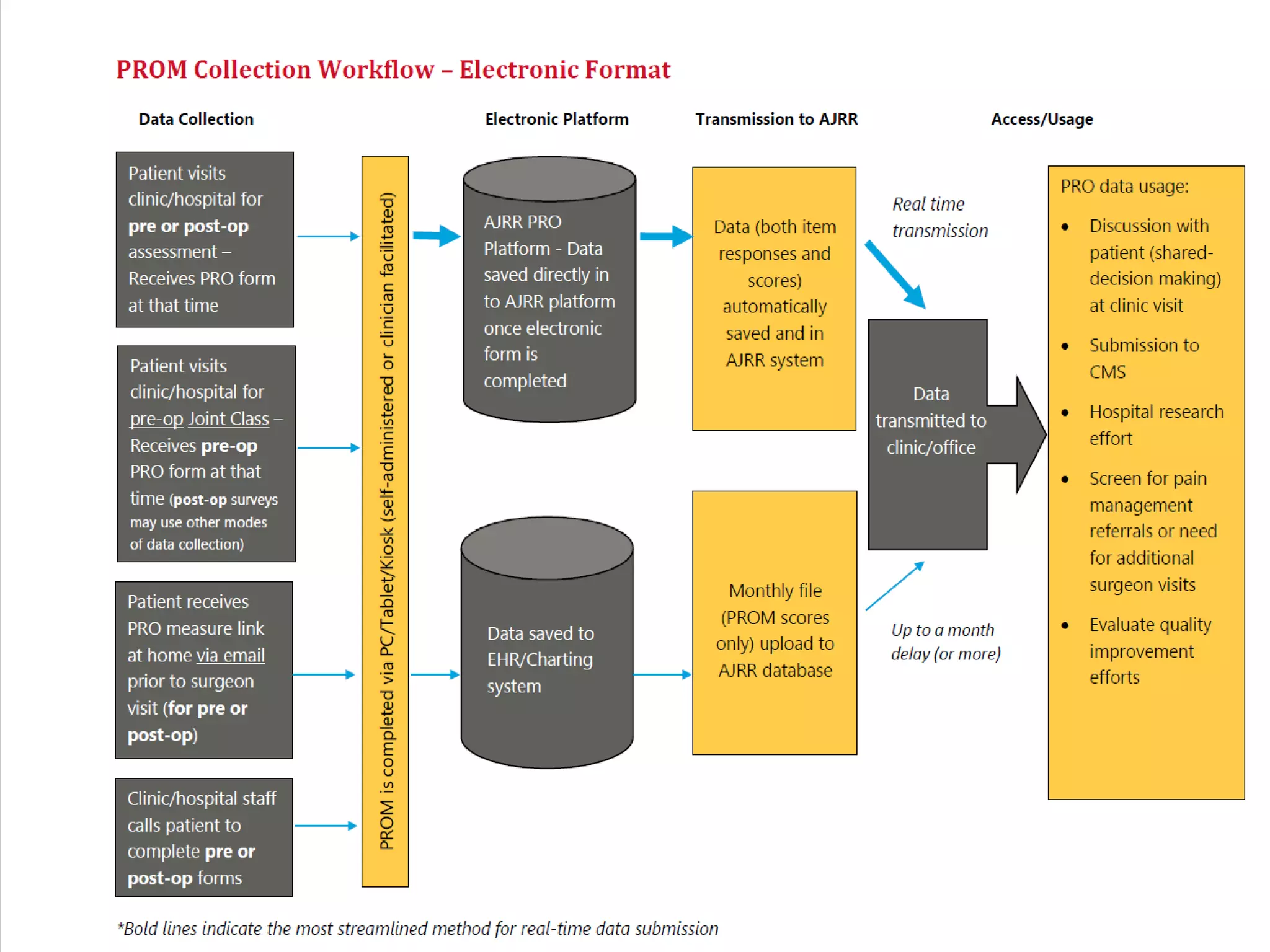
AJRR Patient Reported Outcome
Measures (Level III) Platform
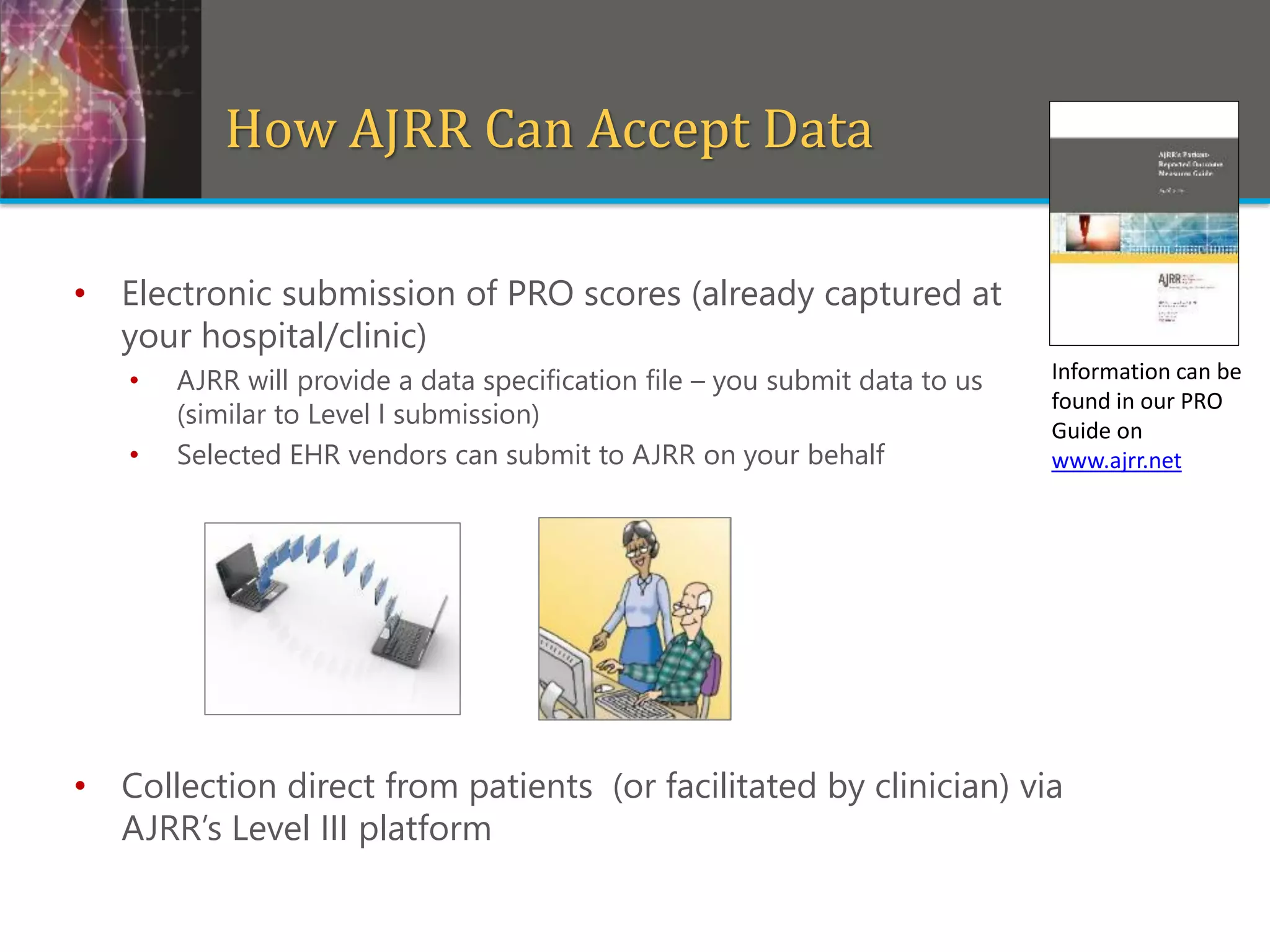
• Electronic submission of PRO scores (already captured at
your hospital/clinic)
• AJRR will provide a data specification file – you submit data to us
(similar to Level I submission)
• Selected EHR vendors can submit to AJRR on your behalf
• Collection direct from patients (or facilitated by clinician) via
AJRR’s Level III platform
How AJRR Can Accept Data
Information can be
found in our PRO
Guide on
www.ajrr.net
How to Start a PRO
Program
1. Define your PRO team
2. Define your PRO goals
3. Determine the PRO measure/s you
would like to use
4. Define the frequency for data collection
5. Develop workflow for data capture
• Most likely, a core group of colleagues have decided that
including PROs in your practice of care for TJA may provide
important information to improve patient outcomes. Beyond
this core group, it will be critical to involve stakeholders at
each level of patient care
• Some groups to be considered:
• Orthopaedic Department
• Orthopaedic practice groups and clinics
• Quality Department
• Information Technology
• Orthopaedic Service Line
• Research
• Rehabilitation
• Hospital Administration
• Patient Advocate/Patient Representative
• Institutional Review Board (guidance/review)
Define Your PRO team
Define Your PRO goals
• For those interested in a PRO program, you and your
colleagues will need to determine the reasons you would
like to launch a PRO program
• You may consider asking yourselves questions such as:
• Are we launching a research initiative with specific aims?
• Are we seeking comparative benchmarks to our peers?
• Are we wanting to quantify our outcomes from our patients’
perspective?
• Do we want to measure if patients have improved function or
reduced pain?
• Do we want to measure whether our patients’ overall health has
improved?
• What are the requirements of the payer-specific program for which
we are hoping to qualify?
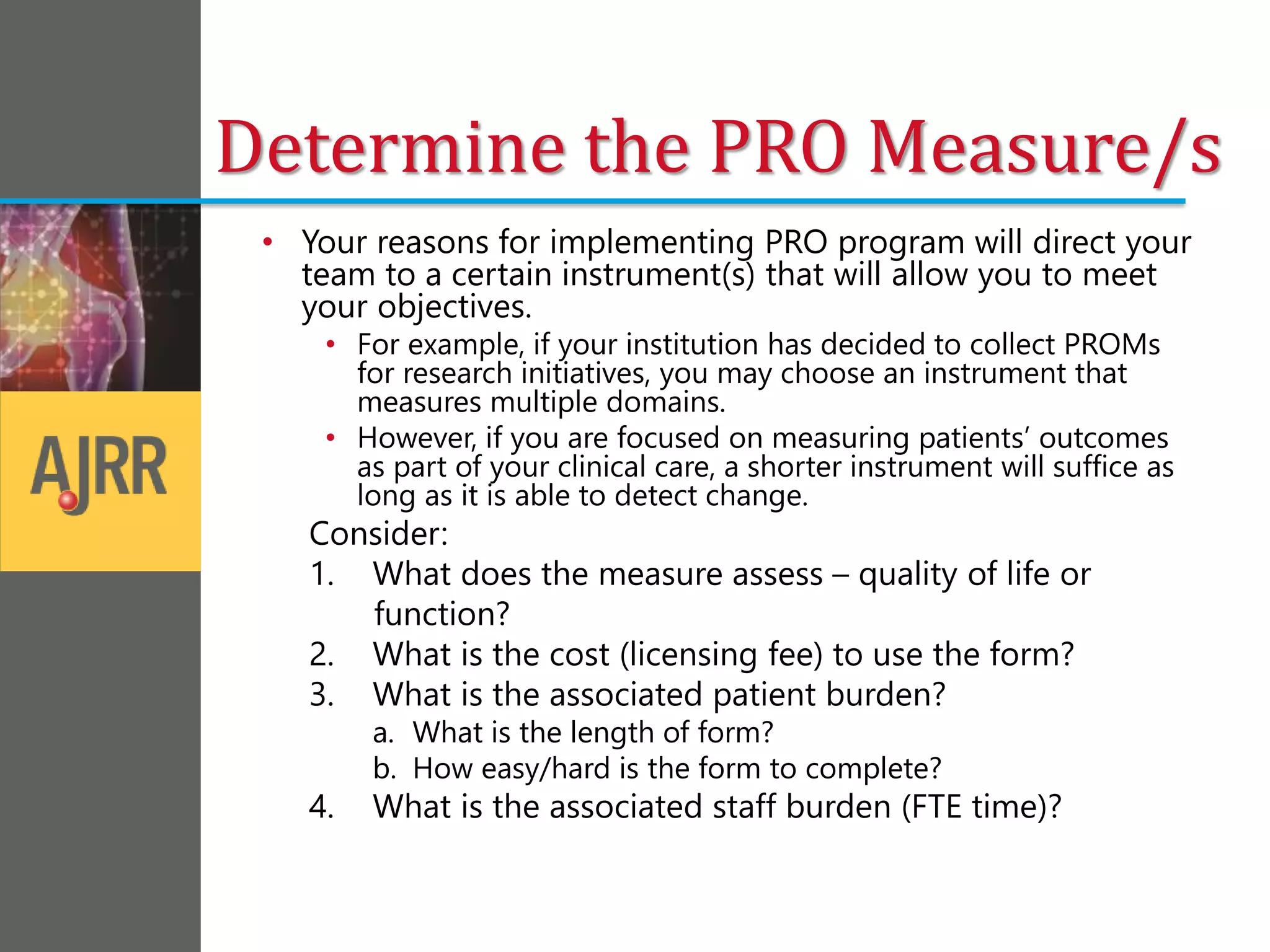
Determine the PRO Measure/s
• Your reasons for implementing PRO program will direct your
team to a certain instrument(s) that will allow you to meet
your objectives.
• For example, if your institution has decided to collect PROMs
for research initiatives, you may choose an instrument that
measures multiple domains.
• However, if you are focused on measuring patients’ outcomes
as part of your clinical care, a shorter instrument will suffice as
long as it is able to detect change.
Consider:
1. What does the measure assess – quality of life or
function?
2. What is the cost (licensing fee) to use the form?
3. What is the associated patient burden?
a. What is the length of form?
b. How easy/hard is the form to complete?
4. What is the associated staff burden (FTE time)?
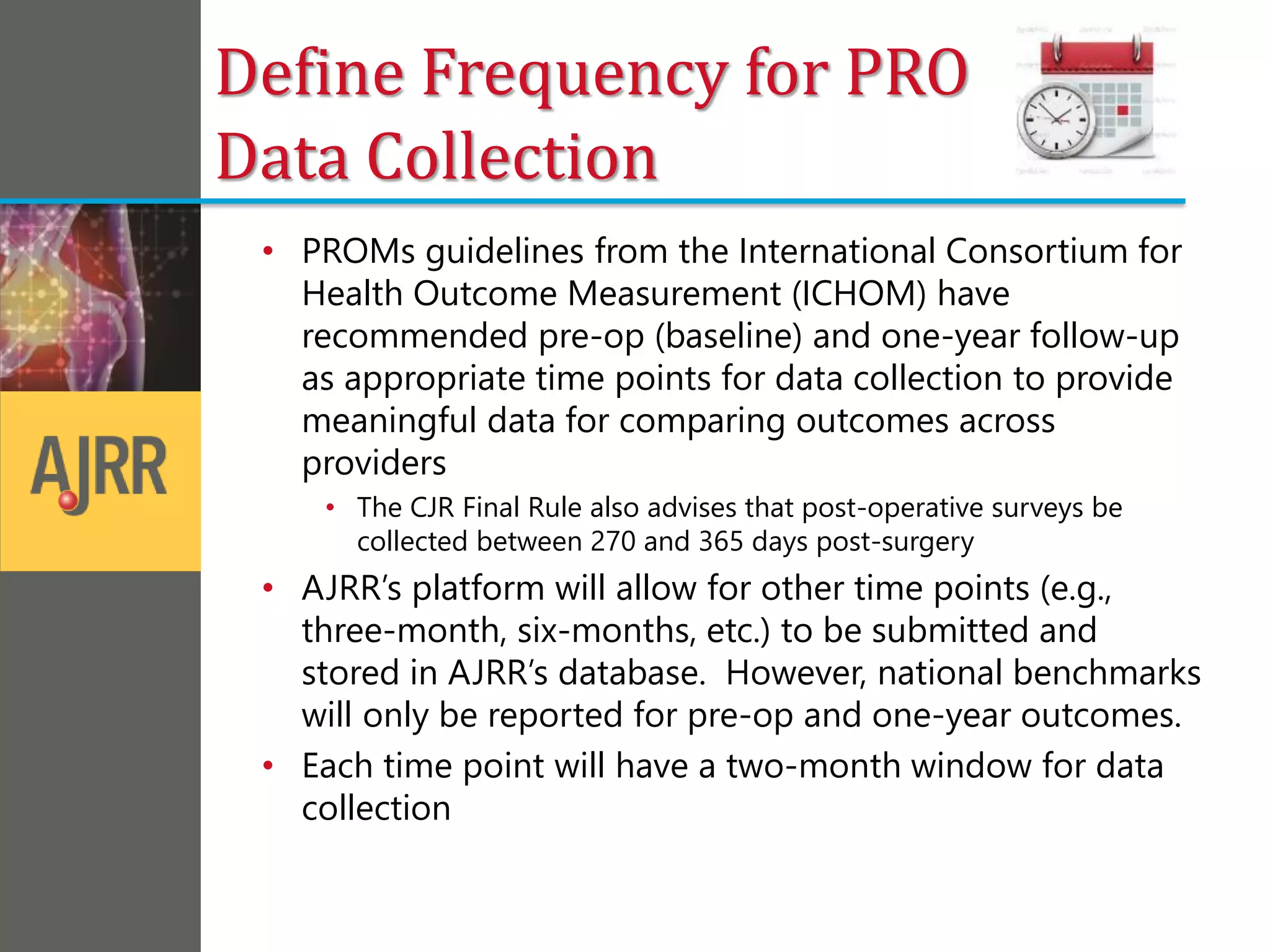
Define Frequency for PRO
Data Collection
• PROMs guidelines from the International Consortium for
Health Outcome Measurement (ICHOM) have
recommended pre-op (baseline) and one-year follow-up
as appropriate time points for data collection to provide
meaningful data for comparing outcomes across
providers
• The CJR Final Rule also advises that post-operative surveys be
collected between 270 and 365 days post-surgery
• AJRR’s platform will allow for other time points (e.g.,
three-month, six-months, etc.) to be submitted and
stored in AJRR’s database. However, national benchmarks
will only be reported for pre-op and one-year outcomes.
• Each time point will have a two-month window for data
collection
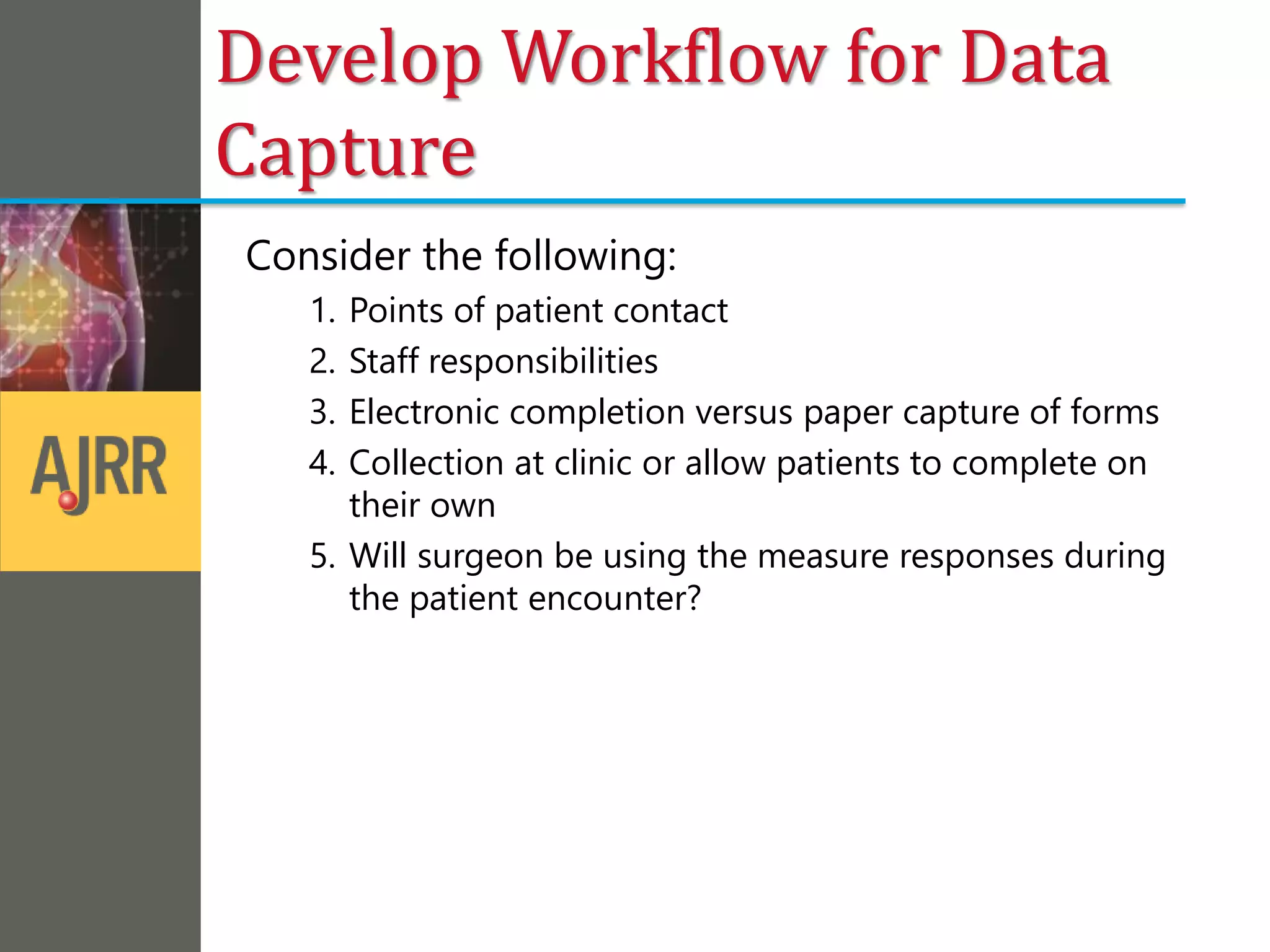
Develop Workflow for Data
Capture
Consider the following:
1. Points of patient contact
2. Staff responsibilities
3. Electronic completion versus paper capture of forms
4. Collection at clinic or allow patients to complete on
their own
5. Will surgeon be using the measure responses during
the patient encounter?
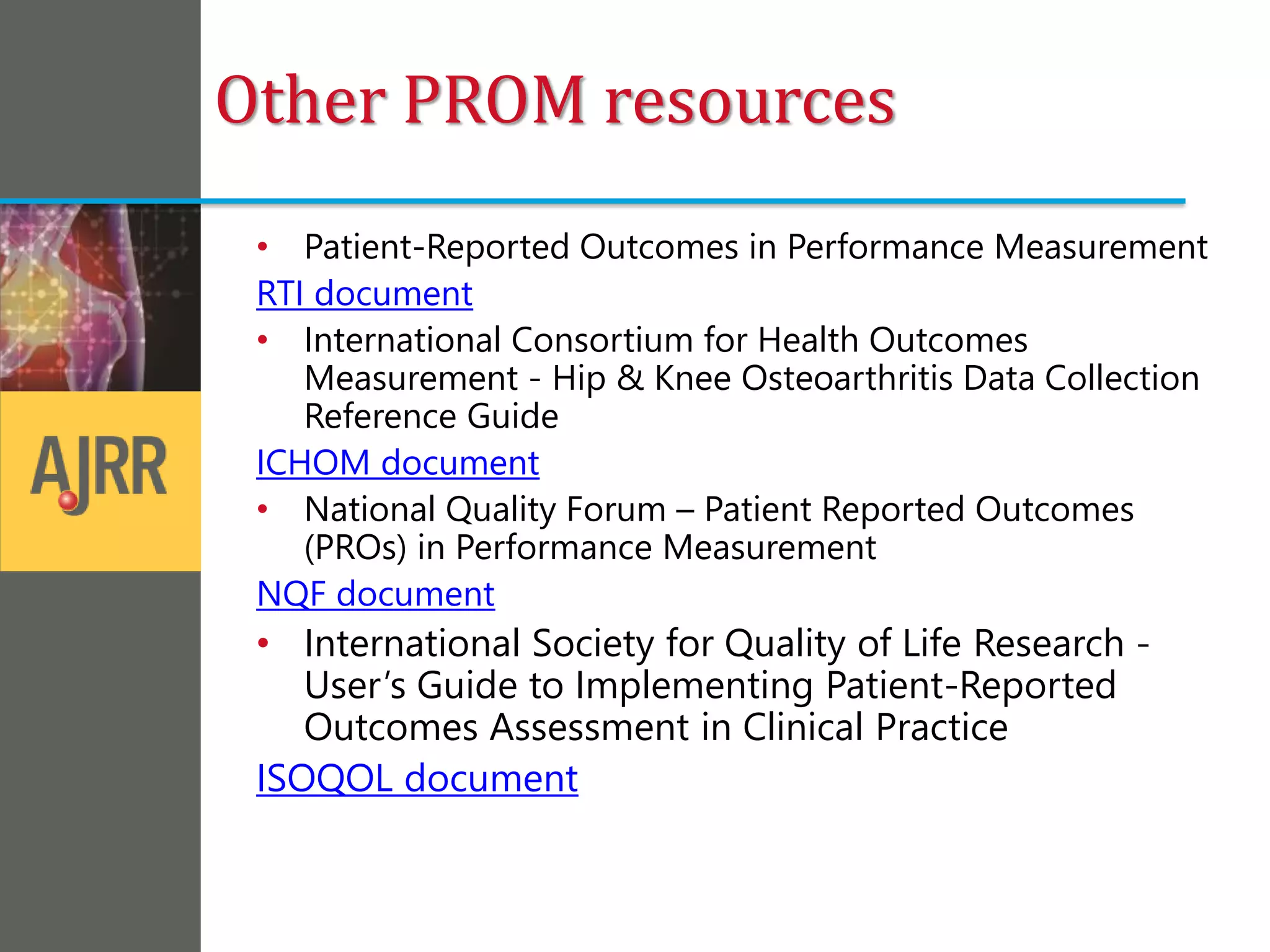
Other PROM resources
• Patient-Reported Outcomes in Performance Measurement
RTI document
• International Consortium for Health Outcomes
Measurement - Hip & Knee Osteoarthritis Data Collection
Reference Guide
ICHOM document
• National Quality Forum – Patient Reported Outcomes
(PROs) in Performance Measurement
NQF document
• International Society for Quality of Life Research -
User’s Guide to Implementing Patient-Reported
Outcomes Assessment in Clinical Practice
ISOQOL document
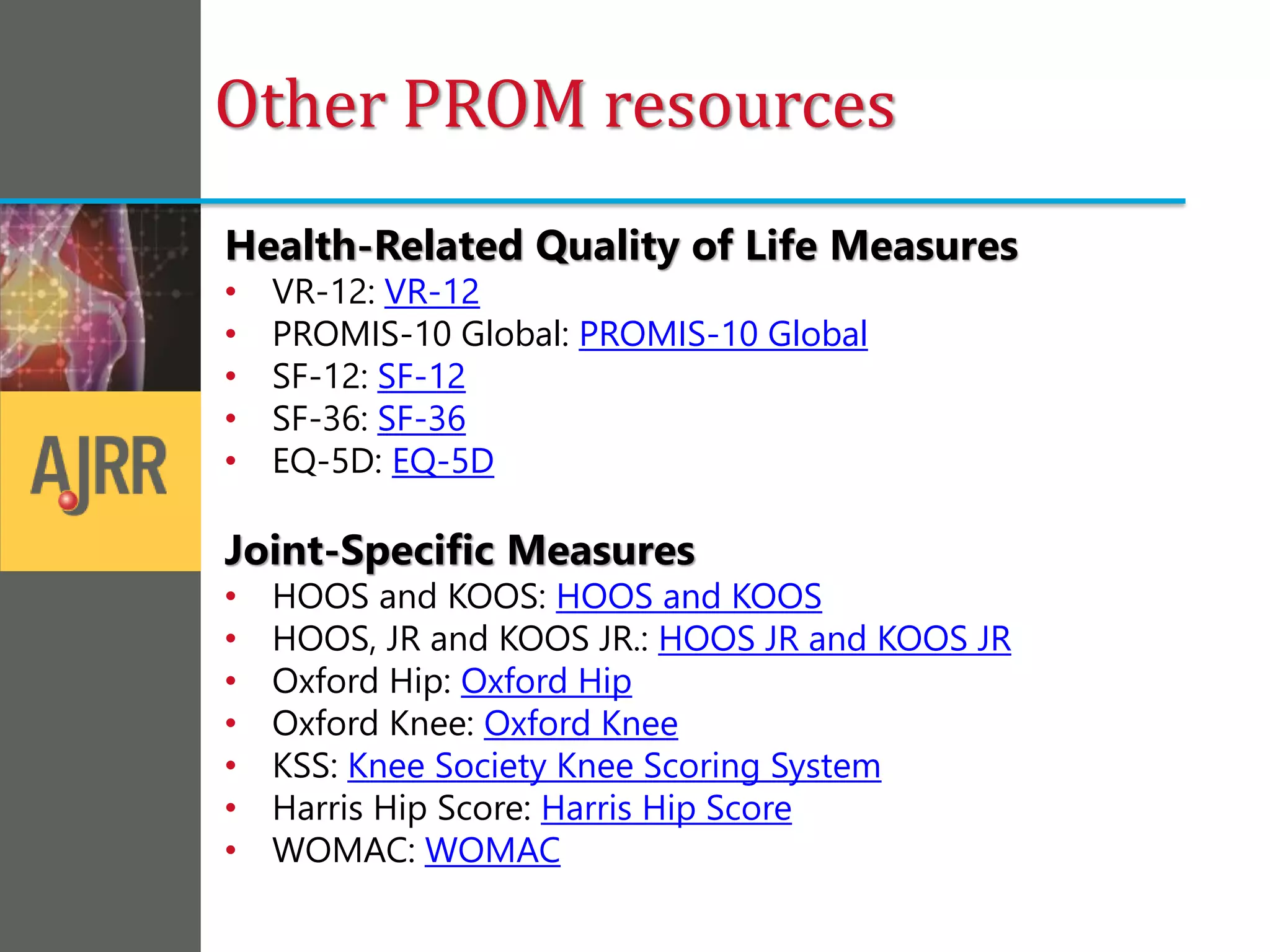
Health-Related Quality of Life Measures
• VR-12: VR-12
• PROMIS-10 Global: PROMIS-10 Global
• SF-12: SF-12
• SF-36: SF-36
• EQ-5D: EQ-5D
Joint-Specific Measures
• HOOS and KOOS: HOOS and KOOS
• HOOS, JR and KOOS JR.: HOOS JR and KOOS JR
• Oxford Hip: Oxford Hip
• Oxford Knee: Oxford Knee
• KSS: Knee Society Knee Scoring System
• Harris Hip Score: Harris Hip Score
• WOMAC: WOMAC
Other PROM resources
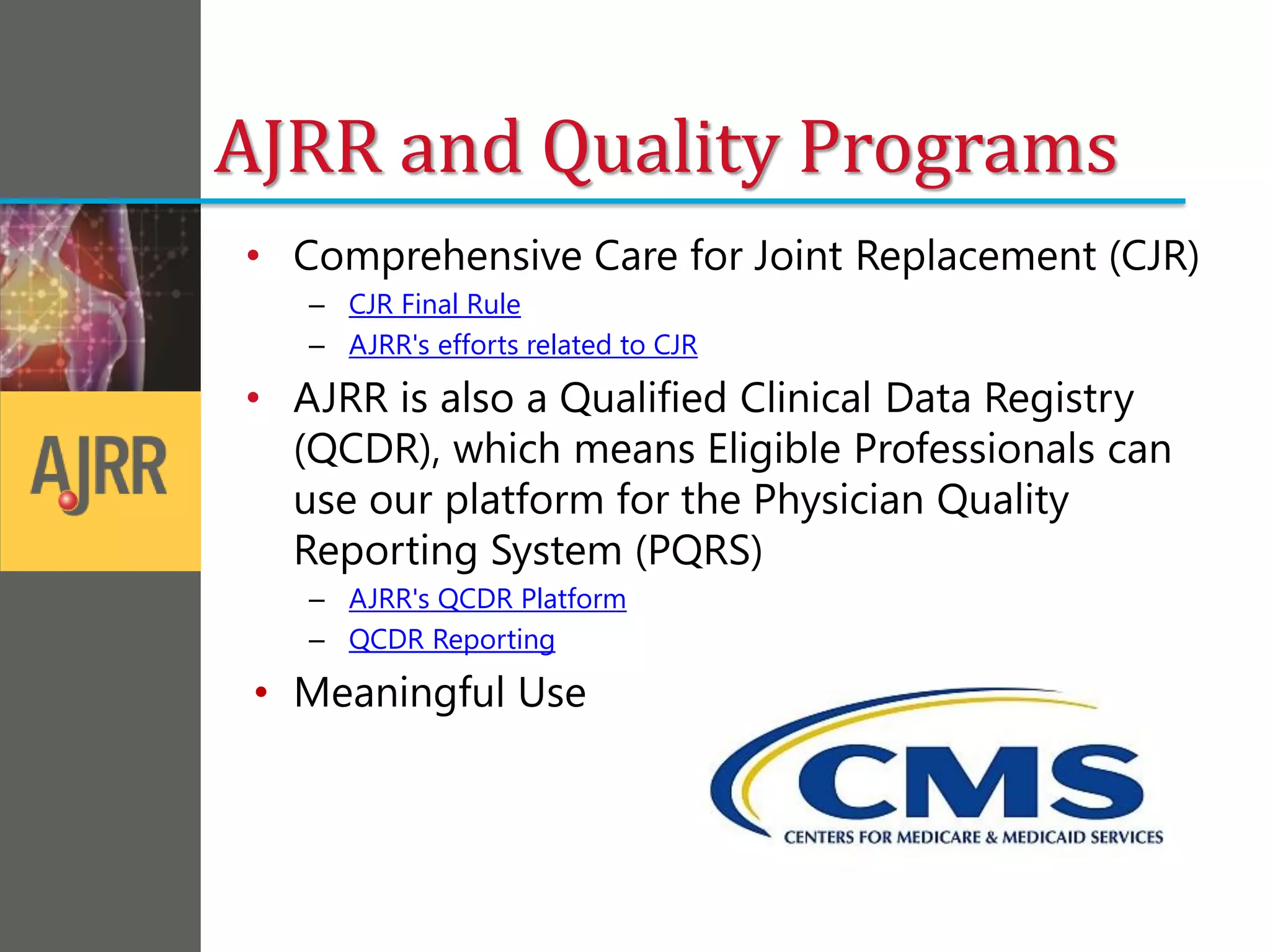
AJRR and Quality Programs
• Comprehensive Care for Joint Replacement (CJR)
– CJR Final Rule
– AJRR's efforts related to CJR
• AJRR is also a Qualified Clinical Data Registry
(QCDR), which means Eligible Professionals can
use our platform for the Physician Quality
Reporting System (PQRS)
– AJRR's QCDR Platform
– QCDR Reporting
• Meaningful Use
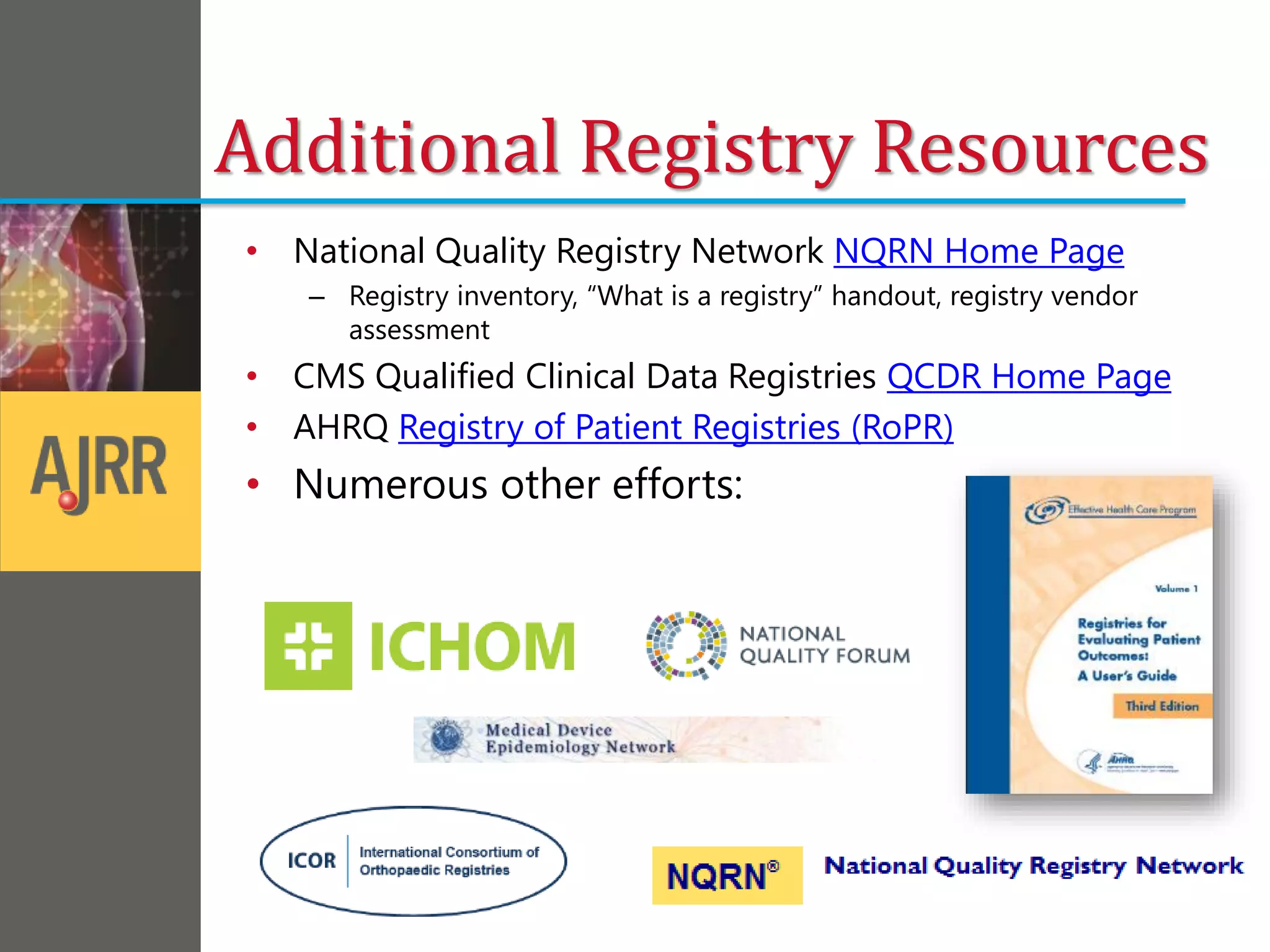
Additional Registry Resources
• National Quality Registry Network NQRN Home Page
– Registry inventory, “What is a registry” handout, registry vendor
assessment
• CMS Qualified Clinical Data Registries QCDR Home Page
• AHRQ Registry of Patient Registries (RoPR)
• Numerous other efforts:
Questions
American Joint Replacement Registry
info@ajrr.net
847.292.0530
http://www.ajrr.net
65
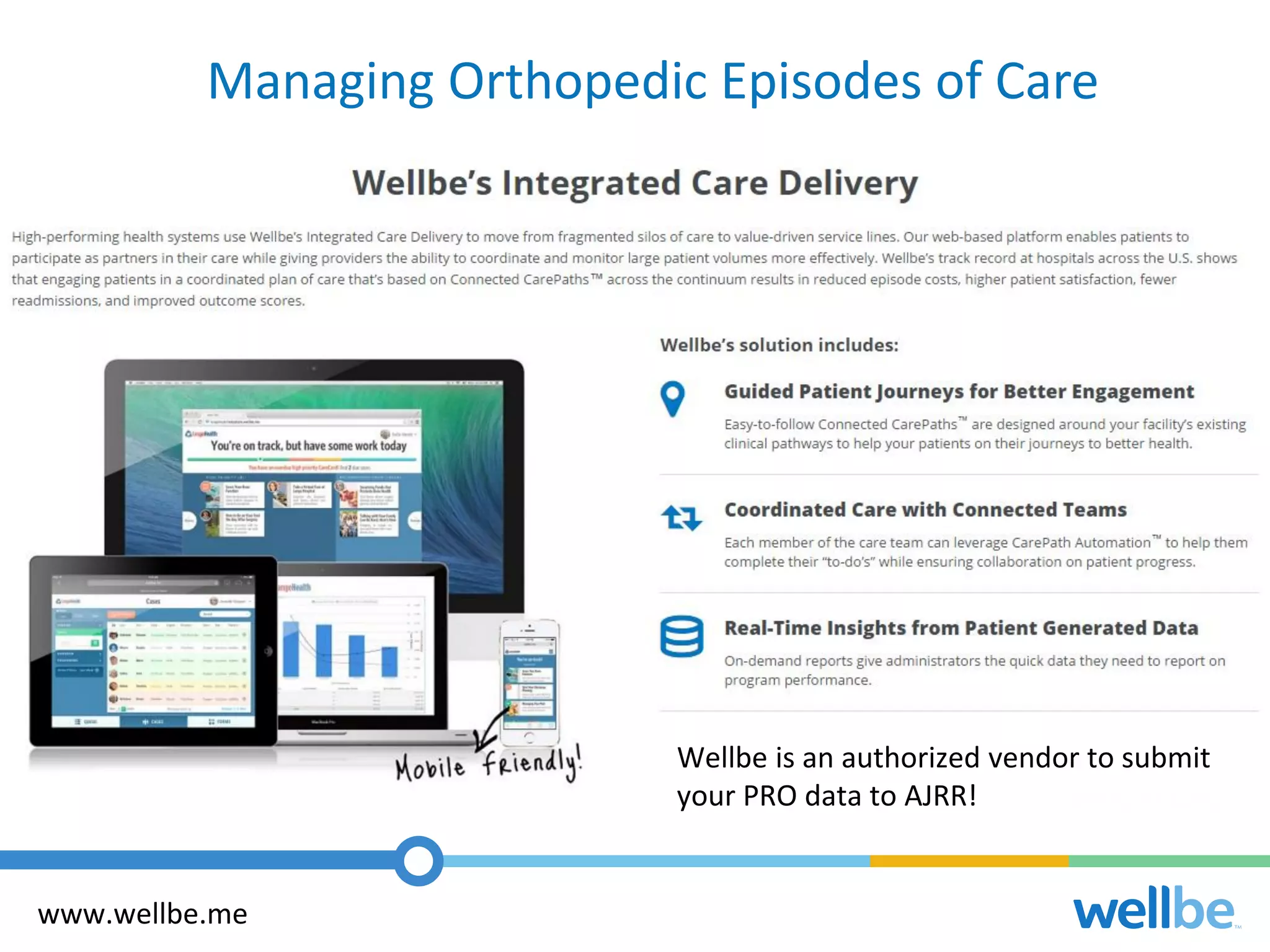
Managing Orthopedic Episodes of Care
www.wellbe.me
Wellbe is an authorized vendor to submit
your PRO data to AJRR!

Registry Participation 101: A Step-by-Step Guide to What You Really Need to Know from AJRR

  • 1.
    Registry Participation 101: ASimple Step-by-Step Guide to Understanding What You Really Need to Know from AJRR Joe Greene University of Wisconsin—Department of Orthopedics and Rehabilitation AJRR Staff: Phil Dwyer, Program Coordinator Caryn Etkin, PhD, MPH, Director of Analytics September Cahue, MPH, Senior Registry Analyst
  • 2.
    Topics and Agenda Agenda: •Introduction to clinical data registries Phil Dwyer • University of Wisconsin experience Joe Greene • Patient-Reported Outcome Measures September Cahue • Quality programs Caryn Etkin Topics: • What is a clinical data registry • Who is using registry information and why • Value of registry data • Additional information, resources
  • 3.
  • 4.
    What is aRegistry? • A clinical data registry records information about the health status of patients and the health care they receive over varying periods of time • Designed to capture clinical data of importance to health care practitioners, providers, and patient. Generally, registries focus on clinical data for specific populations based on: – A disease/condition (e.g. cystic fibrosis, spina bifida) – Procedure (e.g. coronary artery bypass graft) – Device or drug (e.g. total joint replacement) • More frequently are able to capture data from multiple EHRs • Designed for quality improvement efforts, payment, research, etc.
  • 5.
    Who Manages Registries? •Medical Specialty Societies • Health Plans • Patient Advocacy Organizations • Federal and State Governments • For-profit Companies and Non-profit Organizations
  • 6.
    Who is Interestedin Registries? • Hospitals, health systems • Private practice groups • Health plans and other payers • Researchers • Patient and consumer organizations • Federal, state, and local government
  • 7.
    Look at Someof the National Options!
  • 8.
    How Does aRegistry Collect Data?
  • 9.
    How Does aRegistry Collect Data? • Push • Pull • Certification model • Manual • Linking with different databases • Departmental systems • Direct from patients • From devices Electronic Health Records Other IT systems Patients
  • 10.
    Clinical Registry Information Flow Provider documents patientcare EHR Registry Provider performance report Provider reviews report Patients can enter their own data into some registries How can I improve my performance?
  • 11.
    More Patients, LessBurden Clinical registries Collecting structured data On more patient populations Data pull from EHRs Is becoming less dependent on chart abstraction Lowering barriers Source: https://download.ama-assn.org/resources/doc/cqi/x-pub/pcpi-richardson-102915.pdf
  • 12.
    AJRR is amulti-stakeholder, independent, not-for-profit with diverse national constituents led by top orthopaedists We optimize patient outcomes through collection of data on all primary and revision total joint replacement procedures in the US Our mission is to enhance patient safety, improve quality of care, and reduce the cost of care Our goal is to capture 90% of all total joint replacement procedures in the U.S. AJRR Mission and Vision
  • 13.
    AJRR is supportedby hospitals, health insurers, and the following groups: Supporters
  • 14.
    20 26 56 79 122 158 177 219 242 269 292 388 417 467 522 612 677 0 50 100 150 200 250 300 350 400 450 500 550 600 650 700 Jan JulyJan July Jan July Jan Jul Currently Total # of hospitals* 20152012 2013 NumberofHospitals 2014 N=24,971 procedures from 63 hospital ls N= 43,823 procedures from 123 hospitals AJRR 2012-2016 Progress N= 211,721 procedures from 252 hospitals N= 350,154 procedures from 464 hospitals
  • 15.
    Where Are WeNow? September 2014 The National Registry: All 50 States
  • 16.
    Participating Institution Types ParticipatingInstitution Types • Hospitals • Academic Medical Centers • Multiple Health Systems/Networks • Ambulatory Surgery Centers • Private Practice Groups • Solo Practitioners • Hospital bed count – Small = 1-99 beds – Medium = 100-399 beds – Large = 400+ beds Teaching 25% Rural 9% Univ/ Research 11% Major Teaching (21.0%) Minor Teaching (35.6%) Non- Teaching (43.3%) Small (21.1%) Medium (48.0%) Large (30.9%)
  • 17.
    Demand Reporting & ElectronicDashboard System TrainingAccessing and Comparing Your Data
  • 18.
  • 19.
  • 20.
  • 21.
  • 22.
  • 23.
  • 25.
    Joe Greene University ofWisconsin Department of Orthopedics and Rehabilitation
  • 26.
    Registry Participation 101 ASimple Step-by-Step Guide from AJRR The Acquisition and Reporting of Patient Reported Outcomes Joe Greene University of Wisconsin Department of Orthopedics and Rehabilitation
  • 27.
    Objectives  Outline theUW Health System approach to PRO questionnaire deployment  Define current AJRR reporting status and goals  Describe Phase 1: The pilot collection of PRO data in orthopedics  Outline Phase 2: Full implementation of PRO data collection and reporting  Discuss lessons learned throughout
  • 28.
    UW Health Orthopedicsand Rehabilitation  UW Health Orthopedic Service Line • 600+ employees • Highly profitable service line with UW Health • Highly comprehensive  Department of Orthopedics and Rehabilitation • 29 orthopedic surgeons and 16 rehabilitation providers • 20+ PA’s and APNP’s • 5 primary care sports medicine providers  Research and Education • 25 residents and 4 fellows • 4 PhD Level Scientists and multiple post-doc’s • Robust stem cell and regenerative medicine research • Strong clinical research program
  • 29.
    AJRR Data Elements Level1 Data • Patient, Surgeon, and Procedure Data Level 2 Data • Risk Factors and Co-Morbidities Level 3 Data • Patient Reported Outcomes Level 4 Data • Radiographic Images
  • 30.
    Current Status: AJRRReporting Level 1 Reporting • Automated since June, 2014 Level 2 Reporting • Goal of automating by monthly Epic extract by June, 2016 Level 3 Reporting • Automate by monthly extract of PRO data from Epic by July, 2016 Level 4 Reporting • Automate when AJRR is ready to accept
  • 31.
    UW Health SystemConsiderations Patient Assessment Tools Workgroup Epic vs Third Party Solution Getting data in/out of Epic IT and operational workflows implications Tablet vs Kiosk vs Portal Real time access to results Copyright and cost implications
  • 33.
    Discrete data storagewithin EMR Reporting customization Multiple data entry mechanisms Meaningful Use benefits No interface required Leveraged Epic investment Epic will improve over time Decision: Develop Epic Solution
  • 34.
    Streamlined collection processes Eloquentand attractive user interfaces Better than EMR functionality at present My Recommendations Strongly consider reporting capability Interfacing ability is paramount Consider depth of their questionnaire build Third Party Solutions
  • 35.
    Phase 1 Pilot Collectionof PRO Data 6 Clinics at 2 different locations and approximately 100 users including Staff affected : Physicians, AT’s, PT’s, PA’s, RN’s, MA’s, Schedulers
  • 36.
    Phase 1 Project OverviewResources UW Epic teams – 1024.75 hours • EpicCare Ambulatory • Cadence • MyChart • Prelude/Welcome • Training Team • Project Management • Security • Clinical Center for Knowledge Management • Server and Desktop • Programming Consultants (10 months) • MyChart • Programmer • Reporting
  • 37.
    Phase 1 Questionnaires  ACLReconstruction (Clinics: Sports Med, Sports Rehab) • VR-12 Physical & Psychological Health Form • IKDC Knee Evaluation Form • ACL-RSI Return to Sport After Injury Scale • MARX Activity Rating Scale • SANE - Single Assessment Numeric Evaluation  Total Hip Replacement (Clinic: Ortho) • VR-12 Physical & Psychological Health Form • HOOS Hip Disability & Osteoarthritis Score Survey • UCLA Activity-Level Rating Form • Modified Harris Hip Form  Low Back Pain (Clinics: Spine Ortho, Neuro, Spine PT) • VR-12 Physical & Psychological Health Form • Oswestry Low Back Pain Form
  • 38.
    Phase 1 Project OverviewWorkflows  Assign Questionnaire Series • Option 1: Scheduling question; Reporting Workbench used by Scheduler • Option 2: Order placed by clinician  Assign a Questionnaire • Patient Entered Questionnaire Activity Available on DAR and Multi-provider schedule  Patient entered questionnaires • MyChart • Welcome (Tablet Solution)
  • 39.
     Initially soughta Windows 7 tablet • Located a product and began testing • Lack of device quantity made the decision to use Windows 8  Windows 8 models were tested (need about 75) • Dell Model: Cost ~ $600.00 (Now about $800.00) • Storage Units: Cost ~ $800.00 (Now about $800.00)  Extensive testing completed • 40 hours testing  Every questionnaire  Saved responses  Response filing  Ease of answering  Single item on each page  Auto advance Tablet Selection and Testing
  • 40.
  • 41.
  • 42.
    % QNRs completedin MyChart
  • 43.
    % MyChart ActivePatients per # of Encounters
  • 44.
    Phase 2 Full Implementation Build and validate all remaining orthopedic questionnaires  Deploy at all orthopedic locations  Identify and implement all reporting Needs  Consider research and HS-IRB implications
  • 45.
    Phase 2 Considerations Qualityand Outcomes Research Clinical Reporting Registry Reporting Government and Reporting Third Party Payors and Bundling Marketing
  • 46.
    Phase 2 New QuestionnaireBuild  FAAM  FAAM Sport  NDI  SRS 22  UWRI  SILS (CJR) Ped’s QL 4.0 • 5-7, 8-12, 13-18 quickDASH KOOS Knee Society Score PSFS (Flowsheet)
  • 47.
    Phase 2 Reporting Automation Clinical and Marketing Reporting • Automate Quarterly  Registry Reporting • AJRR Level 3 VR-12, HOOS, KOOS (Why? : WOMAC, Historical Database, CJR) Pre-op and 1 year  Payor and Government Reporting • CJR VR-12, HOOS, KOOS Pre-op and 1 year SILS and Oswestry Total Painful Joint Count
  • 48.
    Lessons Learned  Integratedtablet and portal solution was critical  Coordinated IT and Orthopedic project management is imperative  An Epic solution was right for the UW, but may not be the best, easiest or cost effective in many cases  Consider reporting needs early  Physician and Management Champions are essential!
  • 49.
    Questions Joe Greene (JGreene@uwhealth.org) OrthopedicsProject Manager Ryley O’Brien (RO’Brien@uwhealth.org) Patient Assessment Tools Workgroup Facilitator Sara Balster and Johnna Bledsoe (Sbalster@uwhealth.org) (Jbledsoe@uwhealth.org) IS Project Managers Leandra Frank (Leandra.Frank@uwmf.wisc.edu) IS Analyst, Hardware Bret Wagner (bwagner@huronconsultinggroup.com) Huron Consulting, Director of Portals and Population Health
  • 50.
    AJRR Patient ReportedOutcome Measures (Level III) Platform
  • 51.
    • Electronic submissionof PRO scores (already captured at your hospital/clinic) • AJRR will provide a data specification file – you submit data to us (similar to Level I submission) • Selected EHR vendors can submit to AJRR on your behalf • Collection direct from patients (or facilitated by clinician) via AJRR’s Level III platform How AJRR Can Accept Data Information can be found in our PRO Guide on www.ajrr.net
  • 52.
    How to Starta PRO Program 1. Define your PRO team 2. Define your PRO goals 3. Determine the PRO measure/s you would like to use 4. Define the frequency for data collection 5. Develop workflow for data capture
  • 53.
    • Most likely,a core group of colleagues have decided that including PROs in your practice of care for TJA may provide important information to improve patient outcomes. Beyond this core group, it will be critical to involve stakeholders at each level of patient care • Some groups to be considered: • Orthopaedic Department • Orthopaedic practice groups and clinics • Quality Department • Information Technology • Orthopaedic Service Line • Research • Rehabilitation • Hospital Administration • Patient Advocate/Patient Representative • Institutional Review Board (guidance/review) Define Your PRO team
  • 54.
    Define Your PROgoals • For those interested in a PRO program, you and your colleagues will need to determine the reasons you would like to launch a PRO program • You may consider asking yourselves questions such as: • Are we launching a research initiative with specific aims? • Are we seeking comparative benchmarks to our peers? • Are we wanting to quantify our outcomes from our patients’ perspective? • Do we want to measure if patients have improved function or reduced pain? • Do we want to measure whether our patients’ overall health has improved? • What are the requirements of the payer-specific program for which we are hoping to qualify?
  • 55.
    Determine the PROMeasure/s • Your reasons for implementing PRO program will direct your team to a certain instrument(s) that will allow you to meet your objectives. • For example, if your institution has decided to collect PROMs for research initiatives, you may choose an instrument that measures multiple domains. • However, if you are focused on measuring patients’ outcomes as part of your clinical care, a shorter instrument will suffice as long as it is able to detect change. Consider: 1. What does the measure assess – quality of life or function? 2. What is the cost (licensing fee) to use the form? 3. What is the associated patient burden? a. What is the length of form? b. How easy/hard is the form to complete? 4. What is the associated staff burden (FTE time)?
  • 56.
    Define Frequency forPRO Data Collection • PROMs guidelines from the International Consortium for Health Outcome Measurement (ICHOM) have recommended pre-op (baseline) and one-year follow-up as appropriate time points for data collection to provide meaningful data for comparing outcomes across providers • The CJR Final Rule also advises that post-operative surveys be collected between 270 and 365 days post-surgery • AJRR’s platform will allow for other time points (e.g., three-month, six-months, etc.) to be submitted and stored in AJRR’s database. However, national benchmarks will only be reported for pre-op and one-year outcomes. • Each time point will have a two-month window for data collection
  • 57.
    Develop Workflow forData Capture Consider the following: 1. Points of patient contact 2. Staff responsibilities 3. Electronic completion versus paper capture of forms 4. Collection at clinic or allow patients to complete on their own 5. Will surgeon be using the measure responses during the patient encounter?
  • 60.
    Other PROM resources •Patient-Reported Outcomes in Performance Measurement RTI document • International Consortium for Health Outcomes Measurement - Hip & Knee Osteoarthritis Data Collection Reference Guide ICHOM document • National Quality Forum – Patient Reported Outcomes (PROs) in Performance Measurement NQF document • International Society for Quality of Life Research - User’s Guide to Implementing Patient-Reported Outcomes Assessment in Clinical Practice ISOQOL document
  • 61.
    Health-Related Quality ofLife Measures • VR-12: VR-12 • PROMIS-10 Global: PROMIS-10 Global • SF-12: SF-12 • SF-36: SF-36 • EQ-5D: EQ-5D Joint-Specific Measures • HOOS and KOOS: HOOS and KOOS • HOOS, JR and KOOS JR.: HOOS JR and KOOS JR • Oxford Hip: Oxford Hip • Oxford Knee: Oxford Knee • KSS: Knee Society Knee Scoring System • Harris Hip Score: Harris Hip Score • WOMAC: WOMAC Other PROM resources
  • 62.
    AJRR and QualityPrograms • Comprehensive Care for Joint Replacement (CJR) – CJR Final Rule – AJRR's efforts related to CJR • AJRR is also a Qualified Clinical Data Registry (QCDR), which means Eligible Professionals can use our platform for the Physician Quality Reporting System (PQRS) – AJRR's QCDR Platform – QCDR Reporting • Meaningful Use
  • 63.
    Additional Registry Resources •National Quality Registry Network NQRN Home Page – Registry inventory, “What is a registry” handout, registry vendor assessment • CMS Qualified Clinical Data Registries QCDR Home Page • AHRQ Registry of Patient Registries (RoPR) • Numerous other efforts:
  • 64.
    Questions American Joint ReplacementRegistry info@ajrr.net 847.292.0530 http://www.ajrr.net
  • 65.
    65 Managing Orthopedic Episodesof Care www.wellbe.me Wellbe is an authorized vendor to submit your PRO data to AJRR!