Aeronautical, Automotive and Mechanical
Engineering at the University of Brighton
Dr David J Mason, Course Leader
d.j.mason@brighton.ac.uk
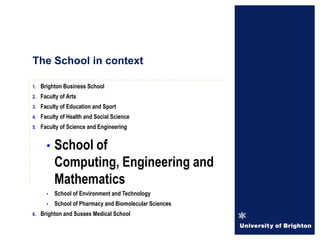
1. Brighton Business School
2. Faculty of Arts
3. Faculty of Education and Sport
4. Faculty of Health and Social Science
5. Faculty of Science and Engineering
• School of
Computing, Engineering and
Mathematics
• School of Environment and Technology
• School of Pharmacy and Biomolecular Sciences
6. Brighton and Sussex Medical School
The School in context
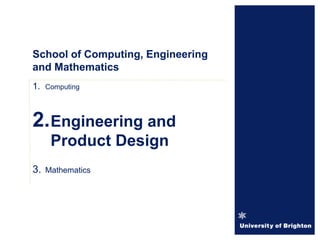
1. Computing
2.Engineering and
Product Design
3. Mathematics
School of Computing, Engineering
and Mathematics
About our courses
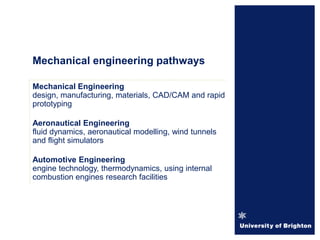
Mechanical Engineering
design, manufacturing, materials, CAD/CAM and rapid
prototyping
Aeronautical Engineering
fluid dynamics, aeronautical modelling, wind tunnels
and flight simulators
Automotive Engineering
engine technology, thermodynamics, using internal
combustion engines research facilities
Mechanical engineering pathways
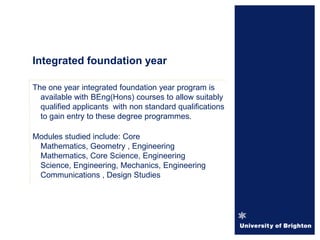
Integrated foundation year
The one year integrated foundation year program is
available with BEng(Hons) courses to allow suitably
qualified applicants with non standard qualifications
to gain entry to these degree programmes.
Modules studied include: Core
Mathematics, Geometry , Engineering
Mathematics, Core Science, Engineering
Science, Engineering, Mechanics, Engineering
Communications , Design Studies
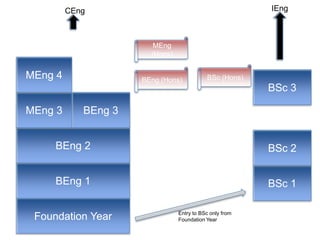
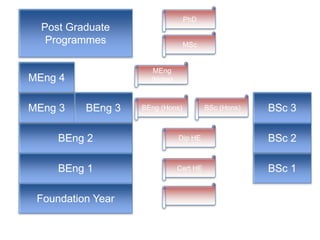
BEng 1
BEng 2
BEng 3MEng 3
MEng 4 BEng (Hons)
Foundation Year
MEng
(Hons)
CEng
BSc 3
BSc (Hons)
IEng
BSc 1
BSc 2
Entry to BSc only from
Foundation Year
BEng 2
MEng
(Hons)
BEng (Hons)
Dip HE
Cert HE
BSc (Hons)
BEng 1
BEng 3MEng 3
MEng 4
Foundation Year
BSc 3
BSc 1
BSc 2
MSc
PhD
Post Graduate
Programmes
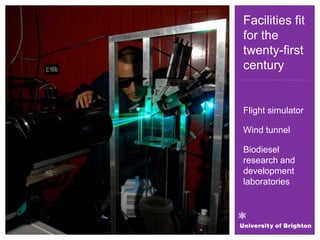
Facilities fit
for the
twenty-first
century
Flight simulator
Wind tunnel
Biodiesel
research and
development
laboratories
Aims of BEng(Hons) courses
• To provide a broad engineering educational base with an emphasis on
core mechanical engineering subjects (thermodynamics, fluid
mechanics, dynamics, control, manufacturing, electronics, electrical
machines, mechanics, materials, computing and design), which
graduates can use to build careers in industry, research, education or
the service sector.
• To integrate the use of analytical tools and the application of practical
skills through design exercises, case studies and projects.
• To develop students skills to utilise the latest technologies including
computer based tools for design, modelling and simulation.
Aims of MEng courses
All the aims of the BEng course
To provide a MEng programme that fulfils the educational requirement for
Chartered Engineer status.
To prepare graduates for high level careers in
industry, research, consultancy or the service sector by developing
student’s versatility and depth of understanding enabling them to deal
with new problems in different areas of engineering, provide technical
and managerial leadership and implement changes in technology.
Placement companies
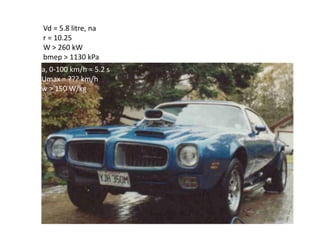
Vd = 5.8 litre, na
r = 10.25
W > 260 kW
bmep > 1130 kPa
a, 0-100 km/h = 5.2 s
Umax = ??? km/h
w > 150 W/kg
14
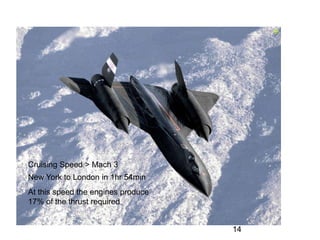
Cruising Speed > Mach 3
New York to London in 1hr 54min
At this speed the engines produce
17% of the thrust required
Tutoring scheme
• Designed to support you throughout the year in all aspects of the
course
• Main aim is to make sure you have someone to talk to if you have any
problems
• Your tutor may also be able to help you with technical aspects of the
course
• In Year 1 and 2 your tutor will organise regular individual meetings
• In year 3 your tutor is normally the project supervisor
StudentCentral: our virtual learning environment
• The student intranet. StudentCentral, is avaliable
anywhere, anytime, from any university site or over the internet.
• Gives you a personalised homepage to help you manage your studies.
Access to:
• Course material provided by teaching staff
• Administrative information such as timetables
• Personal course management data from our central database
• The online library
Development of personal skills
Courses place emphasis on
• Communication (oral and written)
• Working independently and within group
• ICT
• Applying technology
• Creativity in design
• Practical skills
Modules and assessment
• Modules mix of 10 and 20 credits
• 120 credits per year
• For BEng(Hons) you need 360 credits
• For MEng you need 480 credits
• Examinations and coursework in most modules
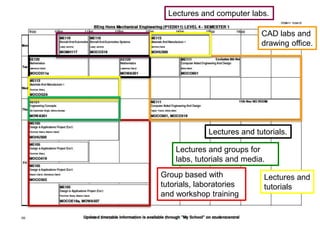
Group based with
tutorials, laboratories
and workshop training
Lectures and
tutorials
Lectures and computer labs.
CAD labs and
drawing office.
Lectures and groups for
labs, tutorials and media.
Lectures and tutorials.
Enjoy your visit
www.brighton.ac.uk/cem
cemadmissions@brighton.ac.uk
01273 642455

2014 entry mechanical engineering

  • 1.
    Aeronautical, Automotive andMechanical Engineering at the University of Brighton Dr David J Mason, Course Leader d.j.mason@brighton.ac.uk
  • 2.
    1. Brighton BusinessSchool 2. Faculty of Arts 3. Faculty of Education and Sport 4. Faculty of Health and Social Science 5. Faculty of Science and Engineering • School of Computing, Engineering and Mathematics • School of Environment and Technology • School of Pharmacy and Biomolecular Sciences 6. Brighton and Sussex Medical School The School in context
  • 3.
    1. Computing 2.Engineering and ProductDesign 3. Mathematics School of Computing, Engineering and Mathematics
  • 4.
  • 5.
    Mechanical Engineering design, manufacturing,materials, CAD/CAM and rapid prototyping Aeronautical Engineering fluid dynamics, aeronautical modelling, wind tunnels and flight simulators Automotive Engineering engine technology, thermodynamics, using internal combustion engines research facilities Mechanical engineering pathways
  • 6.
    Integrated foundation year Theone year integrated foundation year program is available with BEng(Hons) courses to allow suitably qualified applicants with non standard qualifications to gain entry to these degree programmes. Modules studied include: Core Mathematics, Geometry , Engineering Mathematics, Core Science, Engineering Science, Engineering, Mechanics, Engineering Communications , Design Studies
  • 7.
    BEng 1 BEng 2 BEng3MEng 3 MEng 4 BEng (Hons) Foundation Year MEng (Hons) CEng BSc 3 BSc (Hons) IEng BSc 1 BSc 2 Entry to BSc only from Foundation Year
  • 8.
    BEng 2 MEng (Hons) BEng (Hons) DipHE Cert HE BSc (Hons) BEng 1 BEng 3MEng 3 MEng 4 Foundation Year BSc 3 BSc 1 BSc 2 MSc PhD Post Graduate Programmes
  • 9.
    Facilities fit for the twenty-first century Flightsimulator Wind tunnel Biodiesel research and development laboratories
  • 10.
    Aims of BEng(Hons)courses • To provide a broad engineering educational base with an emphasis on core mechanical engineering subjects (thermodynamics, fluid mechanics, dynamics, control, manufacturing, electronics, electrical machines, mechanics, materials, computing and design), which graduates can use to build careers in industry, research, education or the service sector. • To integrate the use of analytical tools and the application of practical skills through design exercises, case studies and projects. • To develop students skills to utilise the latest technologies including computer based tools for design, modelling and simulation.
  • 11.
    Aims of MEngcourses All the aims of the BEng course To provide a MEng programme that fulfils the educational requirement for Chartered Engineer status. To prepare graduates for high level careers in industry, research, consultancy or the service sector by developing student’s versatility and depth of understanding enabling them to deal with new problems in different areas of engineering, provide technical and managerial leadership and implement changes in technology.
  • 12.
  • 13.
    Vd = 5.8litre, na r = 10.25 W > 260 kW bmep > 1130 kPa a, 0-100 km/h = 5.2 s Umax = ??? km/h w > 150 W/kg
  • 14.
    14 Cruising Speed >Mach 3 New York to London in 1hr 54min At this speed the engines produce 17% of the thrust required
  • 15.
    Tutoring scheme • Designedto support you throughout the year in all aspects of the course • Main aim is to make sure you have someone to talk to if you have any problems • Your tutor may also be able to help you with technical aspects of the course • In Year 1 and 2 your tutor will organise regular individual meetings • In year 3 your tutor is normally the project supervisor
  • 16.
    StudentCentral: our virtuallearning environment • The student intranet. StudentCentral, is avaliable anywhere, anytime, from any university site or over the internet. • Gives you a personalised homepage to help you manage your studies. Access to: • Course material provided by teaching staff • Administrative information such as timetables • Personal course management data from our central database • The online library
  • 17.
    Development of personalskills Courses place emphasis on • Communication (oral and written) • Working independently and within group • ICT • Applying technology • Creativity in design • Practical skills
  • 18.
    Modules and assessment •Modules mix of 10 and 20 credits • 120 credits per year • For BEng(Hons) you need 360 credits • For MEng you need 480 credits • Examinations and coursework in most modules
  • 19.
    Group based with tutorials,laboratories and workshop training Lectures and tutorials Lectures and computer labs. CAD labs and drawing office. Lectures and groups for labs, tutorials and media. Lectures and tutorials.
  • 20.

Editor's Notes

  • #3 The School is part of the Faculty of Science and Engineering.
  • #4 Engineering and Product Design is on of the Divisions from forms the School.
  • #8 Aims of BEngTo offer study pathways relevant to Aeronautical Engineering, Automotive Engineering and, Mechanical and Manufacturing Engineering, which draw upon the industrial and research expertise of the School.To provide students with a broad engineering educational base with an emphasis on core mechanical engineering subjects (thermodynamics, fluid mechanics, dynamics, control, manufacturing, electronics, electrical machines, mechanics, materials, computing and design), which graduates can use to build careers in industry, research, education or the service sector.To provide an engineering education in which the emphasis is placed on the integration of analytical tools and application of practical skills through design exercises, case studies, and projects.To develop students’ skills so that they are able to effectively utilise the latest technologies, including computer-based tools for design, modelling and simulation.Aims of MEngThe above andTo provide a MEng programme that fulfils the educational requirement for Chartered Engineer status. Preparing graduates for high level careers in industry, research, consultancy or the service sector by developing students’ versatility and depth of understanding enabling them to deal with new problems in different areas of engineering, provide technical and managerial leadership and implement changes in technology. Modules and Assessment6 modules x 20 credits 120 Credits per yearFor BEng(Hons) you need 360 CreditsFor MEng you need 480 CreditsExaminations and coursework in most modules
  • #9 Possibility of obtaining at least 1 to 8 awardsEFY to PhD = 7 years
  • #10 Mark Hindle - one that we kept for 7 years (EFY to PhD).
  • #11 To offer study pathways relevant to Aeronautical Engineering, Automotive Engineering and, Mechanical and Manufacturing Engineering, which draw upon the industrial and research expertise of the School.To provide students with a broad engineering educational base with an emphasis on core mechanical engineering subjects (thermodynamics, fluid mechanics, dynamics, control, manufacturing, electronics, electrical machines, mechanics, materials, computing and design), which graduates can use to build careers in industry, research, education or the service sector.To provide an engineering education in which the emphasis is placed on the integration of analytical tools and application of practical skills through design exercises, case studies, and projects.To develop students’ skills so that they are able to effectively utilise the latest technologies, including computer-based tools for design, modelling and simulation.
  • #13 Industrial Placements – Companies taking placements in the recent past.
  • #15 For the Aeronautical Engineers:Compressible fluid mechanics is the key to this helping to generate over half of the thrust due to management of the flow over the inlet spikes.This topic is covered in the 3rd year module Advanced Fluid Mechanics.Mechanical Engineers should be interested in both.