THOM GUERTIN 
Chief Digital Officer, 
State of Rhode Island 
@thomguertin 
JEFF MAHER 
2014 Fellow, 
Code for America 
@plusjeff 
E-MAIL US 
rhodeisland@codeforamerica.org 
THE 
FIRST 
IMPRESSION 
Creating warmer interactions 
between families and schools
That first impression 
stays with you. 
“ 
” 
Family Service Coordinator 
Newport Public Schools 
If you come in, and you feel like 
you're being mistreated 
right off the bat, you may 
carry that with you for a while.
K-12 Registration Pre-K Lottery 
P.S. RIDE = RI Dept. of Ed.
Click to edit Master subtitle style 
11
800+ hours
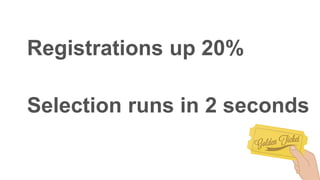
Registrations up 20% 
Selection runs in 2 seconds
http://codeforamerica.github.io/code-island 
THOM GUERTIN 
Chief Digital Officer 
State of Rhode Island 
@thomguertin 
JEFF MAHER 
2014 Fellow 
Code for America 
@plusjeff

Rhode Island Spotlight

Editor's Notes

  • #4 (Jeff) Raise your hand if the DMV looked like this last time you were there. (pause). This sucks, right? This is one of many cold, long government registration processes that probably left a foul taste in your mouth. And, it probably didn’t make you trust that part of the government very much. Now you’re a parent. How would you feel if this was the first experience with your kid’s school? Especially if they had a learning disability, like Jackie…
  • #5 (Jeff) Jackie has dyslexia and needs a tutor. For that to happen, Jackie’s parents need to come to the school for a meeting. Aside from the barriers of needing to take off from work and physically get to the school, Jackie’s mom doesn’t trust the school. Jackie’s mom felt disenfranchised when she was a student, and the interactions she’s had as a parent thus far, have only reinforced that.
  • #6 (Jeff) Speaking with two family service coordinators, it was clear that many parents have a series of bad interactions with schools that make them feel mistreated, under valued, and patronized. Often, this happened right off the bat during their first impression with schools. So we asked: What if we could make that first interaction warm? What if it could get that relationship off to a good start? Or, more to the point: what was the first interaction?
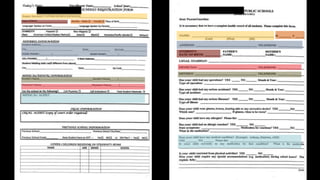
  • #7 (Jeff) It’s this (gesture towards slide): the paper-based student registration process. These two forms highlight where duplicate information is asked.
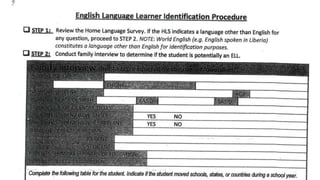
  • #8 (Jeff) Then, you have forms like this that have been photocopied for a decade and aren’t readable. How can parents provide information if they can’t even read the form? There are 7 to 15 forms just like these three in every registration packet. Can YOU see these pages creating goodwill and trust about your child’s future?
  • #9 (Thom) This is where our two apps come in, Ticket to RIDE and Golden Ticket.
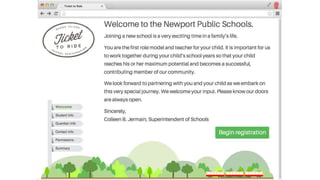
  • #10 (Thom) Ticket to RIDE is the K-12 registration process translated to the web, but using user-centered design, we also made it warmer and easier. Right from the get go, the first screen shows a welcoming letter from the superintendent emphasizing how *excited* they are to be a part of your child’s life and how important their relationship is with you - the parent.
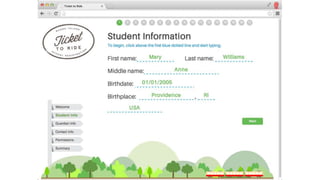
  • #11 (Thom) When we did our user research on the prototype, one parent *gasped* in delight when the form recognized that her address was the same as her kid’s. She had filled out the paper version a week earlier and was asked for her address over 8 times. We also noticed that parents were still smiling after the 10 minutes of filling it out.
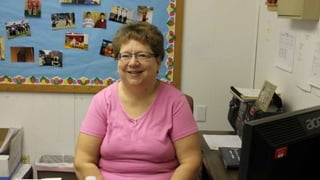
  • #12 (Thom) The current process is painful for schools too! We spoke with a secretary named Kathy who had to arrive at school AT 6AM during peak registration season. This was JUST get a start on the data entry and manage all the other tasks expected of her. Let’s gets tIt takes 15 minutes of data entry per student. If your school district has 400 kindergarteners, that‘s 100 hours of data entry by itself. Ticket to RIDE will link to the school’s current database to import registration applications. This saves time on data entry so that Kathy can have more human interactions with parents, students, and staff; such as with Jackie’s mom.
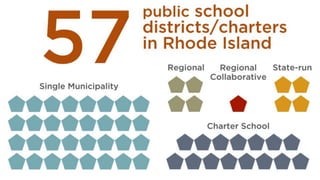
  • #13 (Thom) Ticket to RIDE is going to pilot with two school districts on the same student information system. But, as you can see, there are many more districts and each runs a different registration process that collects the same information. The Office of Digital Excellence will scale the app across multiple school districts, starting with over 20 districts using the same student information system as the pilot schools.
  • #14 (Jeff) Golden Ticket is a similar idea to Ticket to RIDE, but focuses on entering lotteries for State-sponsored pre-K programs. Previously, parents had to fill out multiple forms for each lottery and either mail or hand deliver to every school they’re applying to.
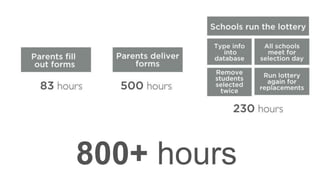
  • #15 (Jeff) All together, the registration process took parents and administrators combined 800+ hours. We chopped that down to 83. ------ Steps Parent fills out form (repeat for each school)  83 hours Drop off form at school (repeat for each school)  500 hours School enters information into database (repeat for each student) -> 167 hours All schools meet at RIDE to perform lottery selection -> 24 hours Schools remove students that were selected twice When a duplicate student is found, run lottery for replacement student Notify parents by phone or mail ->
  • #16 (Jeff) All together, the registration process took parents and administrators combined 800+ hours. We chopped that down to 83.
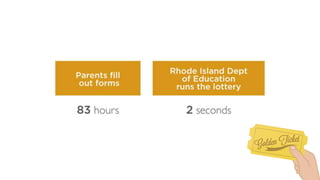
  • #17 (Jeff) It was used for this school year’s registration and applications went up 20%, probably because parents didn’t have to drive or bus anywhere to complete the process. *And* the lottery selection only took *2 seconds* to run. Most importantly, the paperwork process was an inhibiting factor towards growing the number of pre-K offerings. This means that more children will be able to get into pre-K programs in the future.
  • #18 (Jeff) These apps are a first step in improving the relationship between schools and parents by humanizing the first moment: registration. This increases trust, gets important information, and increases efficiency. We only had a few months to do this, but imagine what schools, or any part of the government, can do with more time and with stronger relationships.