Service-oriented Communities:
Models and Concepts towards
Fractal Social Organizations
Vincenzo De Florio, Antonio Coronato,
Mohamed Bakhouya, Giovanna Di Marzo

PATS / University of Antwerp & iMinds
Structure
• Urgent need: Rethinking organizations
• Conjecture: Three key aspects to be
addressed
• A design: Service-oriented communities
• Models
• Conclusions

26 November 2012

SITIS 2012

2
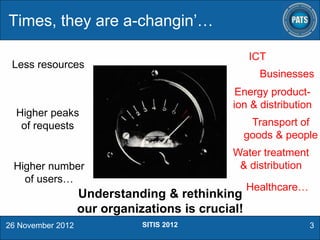
Times, they are a-changin’…
ICT

Less resources

Businesses
Energy production & distribution

Higher peaks
of requests

Transport of
goods & people
Water treatment
& distribution

Higher number
of users…

Understanding & rethinking
our organizations is crucial!
26 November 2012

SITIS 2012

Healthcare…

3
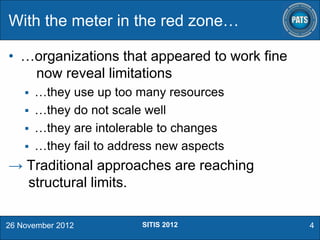
With the meter in the red zone…
• …organizations that appeared to work fine
now reveal limitations
…they use up too many resources
 …they do not scale well
 …they are intolerable to changes
 …they fail to address new aspects


→ Traditional approaches are reaching
structural limits.
26 November 2012

SITIS 2012

4
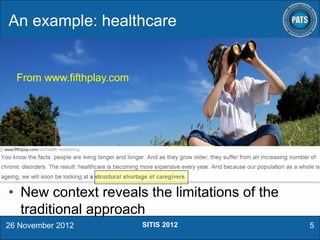
An example: healthcare

From www.fifthplay.com

• New context reveals the limitations of the
traditional approach
26 November 2012

SITIS 2012

5
The healthcare crisis
• Unmanageability is approaching


How should we rethink healthcare?

• Starting point: Three observations:
Society at large is not part of the solution 
Too many resources are wasted
 No complex behaviours are expected from the
vast majority of the components
 Organization (mostly hierarchical) is inflexible,
does not scale well, implies huge costs…
 Three key aspects: Society, organization, behaviour


26 November 2012

SITIS 2012

6
1) SOCIETY

Three key aspects...

• A purely technical solution simply does not
work


See e.g. Hardin’s “Tragedy of Commons”

• Society must be part of the solution
• Society  abundant, mobile “resources” able
to exercise complex action


In particular, collaboration.

26 November 2012

SITIS 2012

7
Three key aspects...

2) ORGANIZATION

• Organizational / architectural choices define
the features of our systems


Centralized, hierarchical, heterarchical,
distributed…

• Distributed: e.g. holarchies & fractal orgs


Biologically inspired
 Members are “simultaneously a part and a whole,
a container and a contained, a controller and a
controlled”
[Sou00]
26 November 2012

SITIS 2012

8
Three key aspects...

3) BEHAVIOUR

• I.e., “change w.r.t. surroundings” [RWB43]
• Ability to


introspect,
 analyze and locate limiting factors w.r.t.
environmental conditions
 learn how to reconfigure and reshape oneself

so as to match a “dynamically varying set of
environmental conditions”
[DeB10]:
• Complex, collective, adaptive behaviours.
26 November 2012

SITIS 2012

9
Service-oriented communities
• A social organization built by explicitly
addressing the mentioned aspects
Taps into “social energy”
 Makes use of a distributed organization
 Supports complex adaptive and autonomic
behaviours.


26 November 2012

SITIS 2012

10
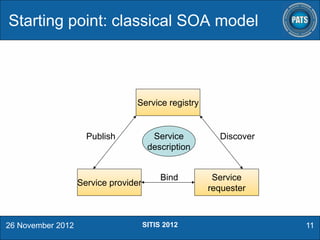
Starting point: classical SOA model

Service registry

Publish

Service provider

26 November 2012

Service
description
Bind

SITIS 2012

Discover

Service
requester

11
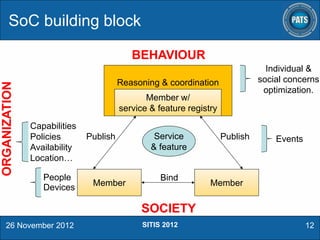
SoC building block

ORGANIZATION

BEHAVIOUR
Individual &
social concerns
optimization.

Reasoning & coordination
Member w/
service & feature registry

Capabilities
Policies
Availability
Location…
People
Devices

Publish

Member

Service
& feature

Bind

Publish

Events

Member

SOCIETY
26 November 2012

SITIS 2012

12
Example:
Mutual Assistance Community
Informal service
provider
Smart
devices

OSGI

ABC Shop

OWL-S service

bundle

publication
OSGI

bundle
OSGI
Gateway
bundle

Access

OWL-S service

publication

Coordination
center

OSGI

Create
OWL-S

Commercial vender

Service
Request

A smart house

OWL-S
Matcher

OWL-S service

publication

Doctor

(professional)

Community

More info: [DeB10]
26 November 2012

SITIS 2012

13
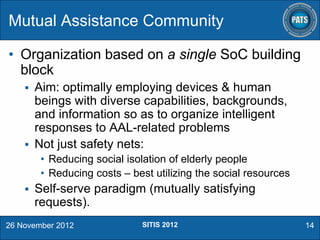
Mutual Assistance Community
• Organization based on a single SoC building
block


Aim: optimally employing devices & human
beings with diverse capabilities, backgrounds,
and information so as to organize intelligent
responses to AAL-related problems
 Not just safety nets:
• Reducing social isolation of elderly people
• Reducing costs – best utilizing the social resources


Self-serve paradigm (mutually satisfying
requests).

26 November 2012

SITIS 2012

14
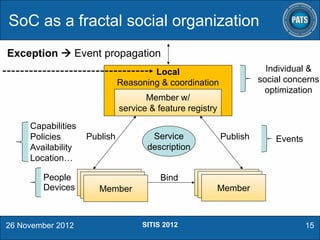
SoC as a fractal social organization
Exception  Event propagation
Individual &
social concerns
optimization

Local
Reasoning & coordination
Member w/
service & feature registry

Capabilities
Policies
Availability
Location…
People
Devices

26 November 2012

Publish

Member
Member
Member

Service
description

Bind

SITIS 2012

Publish

Events

Member
Member
Member

15
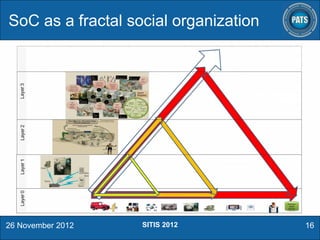
SoC as a fractal social organization

26 November 2012

SITIS 2012

16
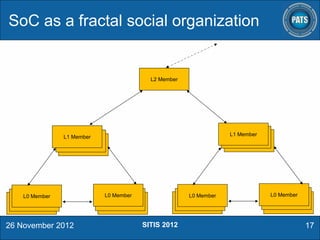
SoC as a fractal social organization

L2 Member

L1 Member
Member
Member

L1 Member
Member
Member

L0 Member
Member
Member

26 November 2012

L0 Member
Member
Member

L0 Member
Member
Member

SITIS 2012

L0 Member
Member
Member

17
Service-oriented Community
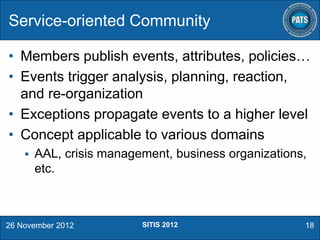
• Members publish events, attributes, policies…
• Events trigger analysis, planning, reaction,
and re-organization
• Exceptions propagate events to a higher level
• Concept applicable to various domains


AAL, crisis management, business organizations,
etc.

26 November 2012

SITIS 2012

18
Elements of formal model (1/2)
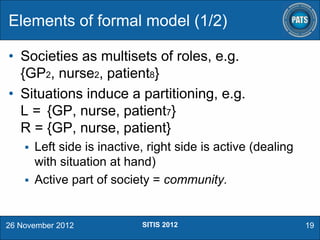
• Societies as multisets of roles, e.g.
{GP2, nurse2, patient8}
• Situations induce a partitioning, e.g.
L = {GP, nurse, patient7}
R = {GP, nurse, patient}


Left side is inactive, right side is active (dealing
with situation at hand)
 Active part of society = community.

26 November 2012

SITIS 2012

19
Elements of formal model (2/2)
• Evolution can be modelled as the dynamics of
sets L(t) and R(t):

(L(t),R(t)) t ≥ 0
• A way to represent this dynamics is through
permutations of the society multiset
• This reveals certain properties.

26 November 2012

SITIS 2012

20
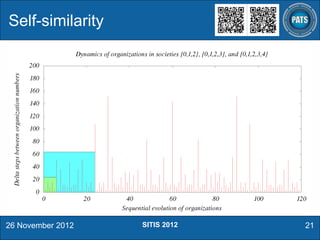
Self-similarity

26 November 2012

SITIS 2012

21
Elements of operational model
•
•
•
•

Activity: «situation : action»
Action:
( role → step )
E.g.
«fallen : (role-δ1 → alarm(fallen))»
A role-δ1 actor needs to be located


OK: new community
 KO: exception

• n actions  n communities / exceptions
• More information in the paper.
26 November 2012

SITIS 2012

22
Conclusions
• We introduced the main ideas of SoC, a
fractal social organization based on three key
“principles”:


Society, behaviour, organization

• Much is yet to be done


From principles to simulation & actual design
 From design to deployment & testing
 Formal models to guarantee resilience...
 Etc.
26 November 2012

SITIS 2012

23
References
•
•

•

•

•
•

[RWB43] Arturo Rosenblueth, Norbert Wiener and Julian Bigelow, "Behavior,
Purpose and Teleology". Philosophy of Science, 10(1943), S. 18–24
[DeB10] V. De Florio, C. Blondia, "Service-oriented Communities: Visions and
Contributions towards Social Organizations", Proc. of MONET 2010, LNCS Vol.
6428/2010
[Ha1968] Garrett Hardin, "The Tragedy of the Commons", Science, Vol. 162 (Dec.
1968)
[Sou00] P. Sousa, N. Silva, T. Heikkila, M. Kallingbaum and P. Valcknears, P.
“Aspects of Co-operation in Distributed Manufacturing Systems”. Studies in
Informatics and Control Journal, 9 (2), 2000
V. De Florio, "The HeartQuake Dynamic System", Complex Systems, Vol. 9, No.
2, April 1995, pp. 91-114. (Complex Systems Publications, Champaign, IL)
V. De Florio, "Permutation Numbers", Complex Systems, Vol. 15, No. 2, 2005
(Complex Systems Publications, Champaign, IL).

26 November 2012

SITIS 2012

24

Service-oriented Communities: Models and Concepts towards Fractal Social Organizations

  • 1.
    Service-oriented Communities: Models andConcepts towards Fractal Social Organizations Vincenzo De Florio, Antonio Coronato, Mohamed Bakhouya, Giovanna Di Marzo PATS / University of Antwerp & iMinds
  • 2.
    Structure • Urgent need:Rethinking organizations • Conjecture: Three key aspects to be addressed • A design: Service-oriented communities • Models • Conclusions 26 November 2012 SITIS 2012 2
  • 3.
    Times, they area-changin’… ICT Less resources Businesses Energy production & distribution Higher peaks of requests Transport of goods & people Water treatment & distribution Higher number of users… Understanding & rethinking our organizations is crucial! 26 November 2012 SITIS 2012 Healthcare… 3
  • 4.
    With the meterin the red zone… • …organizations that appeared to work fine now reveal limitations …they use up too many resources  …they do not scale well  …they are intolerable to changes  …they fail to address new aspects  → Traditional approaches are reaching structural limits. 26 November 2012 SITIS 2012 4
  • 5.
    An example: healthcare Fromwww.fifthplay.com • New context reveals the limitations of the traditional approach 26 November 2012 SITIS 2012 5
  • 6.
    The healthcare crisis •Unmanageability is approaching  How should we rethink healthcare? • Starting point: Three observations: Society at large is not part of the solution  Too many resources are wasted  No complex behaviours are expected from the vast majority of the components  Organization (mostly hierarchical) is inflexible, does not scale well, implies huge costs…  Three key aspects: Society, organization, behaviour  26 November 2012 SITIS 2012 6
  • 7.
    1) SOCIETY Three keyaspects... • A purely technical solution simply does not work  See e.g. Hardin’s “Tragedy of Commons” • Society must be part of the solution • Society  abundant, mobile “resources” able to exercise complex action  In particular, collaboration. 26 November 2012 SITIS 2012 7
  • 8.
    Three key aspects... 2)ORGANIZATION • Organizational / architectural choices define the features of our systems  Centralized, hierarchical, heterarchical, distributed… • Distributed: e.g. holarchies & fractal orgs  Biologically inspired  Members are “simultaneously a part and a whole, a container and a contained, a controller and a controlled” [Sou00] 26 November 2012 SITIS 2012 8
  • 9.
    Three key aspects... 3)BEHAVIOUR • I.e., “change w.r.t. surroundings” [RWB43] • Ability to  introspect,  analyze and locate limiting factors w.r.t. environmental conditions  learn how to reconfigure and reshape oneself so as to match a “dynamically varying set of environmental conditions” [DeB10]: • Complex, collective, adaptive behaviours. 26 November 2012 SITIS 2012 9
  • 10.
    Service-oriented communities • Asocial organization built by explicitly addressing the mentioned aspects Taps into “social energy”  Makes use of a distributed organization  Supports complex adaptive and autonomic behaviours.  26 November 2012 SITIS 2012 10
  • 11.
    Starting point: classicalSOA model Service registry Publish Service provider 26 November 2012 Service description Bind SITIS 2012 Discover Service requester 11
  • 12.
    SoC building block ORGANIZATION BEHAVIOUR Individual& social concerns optimization. Reasoning & coordination Member w/ service & feature registry Capabilities Policies Availability Location… People Devices Publish Member Service & feature Bind Publish Events Member SOCIETY 26 November 2012 SITIS 2012 12
  • 13.
    Example: Mutual Assistance Community Informalservice provider Smart devices OSGI ABC Shop OWL-S service bundle publication OSGI bundle OSGI Gateway bundle Access OWL-S service publication Coordination center OSGI Create OWL-S Commercial vender Service Request A smart house OWL-S Matcher OWL-S service publication Doctor (professional) Community More info: [DeB10] 26 November 2012 SITIS 2012 13
  • 14.
    Mutual Assistance Community •Organization based on a single SoC building block  Aim: optimally employing devices & human beings with diverse capabilities, backgrounds, and information so as to organize intelligent responses to AAL-related problems  Not just safety nets: • Reducing social isolation of elderly people • Reducing costs – best utilizing the social resources  Self-serve paradigm (mutually satisfying requests). 26 November 2012 SITIS 2012 14
  • 15.
    SoC as afractal social organization Exception  Event propagation Individual & social concerns optimization Local Reasoning & coordination Member w/ service & feature registry Capabilities Policies Availability Location… People Devices 26 November 2012 Publish Member Member Member Service description Bind SITIS 2012 Publish Events Member Member Member 15
  • 16.
    SoC as afractal social organization 26 November 2012 SITIS 2012 16
  • 17.
    SoC as afractal social organization L2 Member L1 Member Member Member L1 Member Member Member L0 Member Member Member 26 November 2012 L0 Member Member Member L0 Member Member Member SITIS 2012 L0 Member Member Member 17
  • 18.
    Service-oriented Community • Memberspublish events, attributes, policies… • Events trigger analysis, planning, reaction, and re-organization • Exceptions propagate events to a higher level • Concept applicable to various domains  AAL, crisis management, business organizations, etc. 26 November 2012 SITIS 2012 18
  • 19.
    Elements of formalmodel (1/2) • Societies as multisets of roles, e.g. {GP2, nurse2, patient8} • Situations induce a partitioning, e.g. L = {GP, nurse, patient7} R = {GP, nurse, patient}  Left side is inactive, right side is active (dealing with situation at hand)  Active part of society = community. 26 November 2012 SITIS 2012 19
  • 20.
    Elements of formalmodel (2/2) • Evolution can be modelled as the dynamics of sets L(t) and R(t): (L(t),R(t)) t ≥ 0 • A way to represent this dynamics is through permutations of the society multiset • This reveals certain properties. 26 November 2012 SITIS 2012 20
  • 21.
  • 22.
    Elements of operationalmodel • • • • Activity: «situation : action» Action: ( role → step ) E.g. «fallen : (role-δ1 → alarm(fallen))» A role-δ1 actor needs to be located  OK: new community  KO: exception • n actions  n communities / exceptions • More information in the paper. 26 November 2012 SITIS 2012 22
  • 23.
    Conclusions • We introducedthe main ideas of SoC, a fractal social organization based on three key “principles”:  Society, behaviour, organization • Much is yet to be done  From principles to simulation & actual design  From design to deployment & testing  Formal models to guarantee resilience...  Etc. 26 November 2012 SITIS 2012 23
  • 24.
    References • • • • • • [RWB43] Arturo Rosenblueth,Norbert Wiener and Julian Bigelow, "Behavior, Purpose and Teleology". Philosophy of Science, 10(1943), S. 18–24 [DeB10] V. De Florio, C. Blondia, "Service-oriented Communities: Visions and Contributions towards Social Organizations", Proc. of MONET 2010, LNCS Vol. 6428/2010 [Ha1968] Garrett Hardin, "The Tragedy of the Commons", Science, Vol. 162 (Dec. 1968) [Sou00] P. Sousa, N. Silva, T. Heikkila, M. Kallingbaum and P. Valcknears, P. “Aspects of Co-operation in Distributed Manufacturing Systems”. Studies in Informatics and Control Journal, 9 (2), 2000 V. De Florio, "The HeartQuake Dynamic System", Complex Systems, Vol. 9, No. 2, April 1995, pp. 91-114. (Complex Systems Publications, Champaign, IL) V. De Florio, "Permutation Numbers", Complex Systems, Vol. 15, No. 2, 2005 (Complex Systems Publications, Champaign, IL). 26 November 2012 SITIS 2012 24