SmartSociety – A Platform for
Collaborative People-Machine
Computation
Hong-Linh Truong
with
Ognjen Scekic, Daniele Miorandi, Tommaso Schiavinotto,
Dimitrios I. Diochnos, Alethia Hume, Ronald Chenu-Abente,
Michael Rovatsos, Iacopo Carreras, Schahram Dustdar, Fausto
Giunchiglia
Distributed Systems Group, TU Wien
truong@dsg.tuwien.ac.at
http://dsg.tuwien.ac.at/staff/truong/
8th IEEE SOCA, 20 Oct, 2015, Rome, Italy 1
Outline
 Background
 Motivation
 The SmartSociety service platform
 Prototype and Examples
 Conclusions and Future work
8th IEEE SOCA, 20 Oct, 2015, Rome, Italy 2
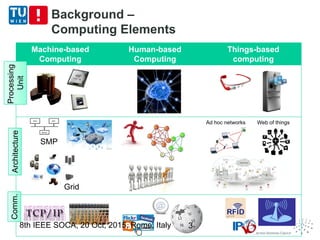
Background –
Computing Elements
Machine-based
Computing
Human-based
Computing
Things-based
computing
Grid
Processing
Unit
Processing
Unit
ArchitectureArchitectureComm.Comm.
SMP
Ad hoc networks Web of things
38th IEEE SOCA, 20 Oct, 2015, Rome, Italy
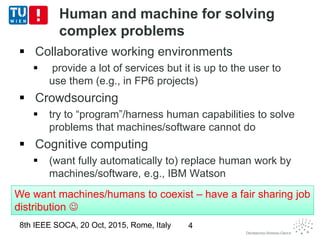
Human and machine for solving
complex problems
 Collaborative working environments
 provide a lot of services but it is up to the user to
use them (e.g., in FP6 projects)
 Crowdsourcing
 try to “program”/harness human capabilities to solve
problems that machines/software cannot do
 Cognitive computing
 (want fully automatically to) replace human work by
machines/software, e.g., IBM Watson
8th IEEE SOCA, 20 Oct, 2015, Rome, Italy 4
We want machines/humans to coexist – have a fair sharing job
distribution 
We want machines/humans to coexist – have a fair sharing job
distribution 
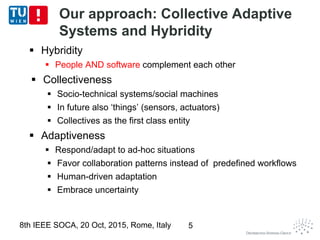
Our approach: Collective Adaptive
Systems and Hybridity
 Hybridity
 People AND software complement each other
 Collectiveness
 Socio-technical systems/social machines
 In future also ‘things’ (sensors, actuators)
 Collectives as the first class entity
 Adaptiveness
 Respond/adapt to ad-hoc situations
 Favor collaboration patterns instead of predefined workflows
 Human-driven adaptation
 Embrace uncertainty
8th IEEE SOCA, 20 Oct, 2015, Rome, Italy 5
Motivation (1)
 Users/Customers:
 need complex collaborative human-machine tasks
(e.g., in predictive maintenance and complex data
analytics)
 Peers
 software or human services, individually or
collectively providing solutions for solving complex
problems
 Human-machine intelligences but “collaboration” is
the main aspect to be supported
8th IEEE SOCA, 20 Oct, 2015, Rome, Italy 6
Motivation (2)
8th IEEE SOCA, 20 Oct, 2015, Rome, Italy 7
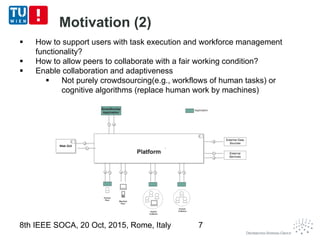
 How to support users with task execution and workforce management
functionality?
 How to allow peers to collaborate with a fair working condition?
 Enable collaboration and adaptiveness
 Not purely crowdsourcing(e.g., workflows of human tasks) or
cognitive algorithms (replace human work by machines)
peers& collectives
User-specfic
business logic
(arbitrary code)
get peers and
plans
Composition
Manager
collective-based
task
negotiate a plan
Negotiator
execute a plan&
monitor
Executor
Communication
aggregate results
User-specfic
arbitrary code
etc.
( . . Peer Manager )
. .
Incentive Manager
)
User Application
Task Request
peers& collectives
Application
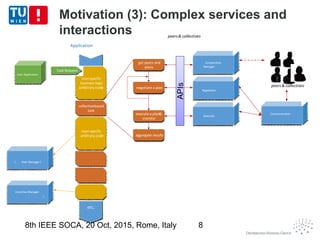
Motivation (3): Complex services and
interactions
8th IEEE SOCA, 20 Oct, 2015, Rome, Italy
APIsAPIs
8
SmartSociety Platform - core
functions
 Enabling platform services
 Collectives Management
 Information and Collective lifecycle management
 Communication
 Composition and Execution
 Monitoring, Incentive Management, and Provenance
 Supporting diverse types (and models) of
applications to be developed
8th IEEE SOCA, 20 Oct, 2015, Rome, Italy 9
Not a tightly coupled integrated system for a single purpose 
enable the development and programming of applications
Not a tightly coupled integrated system for a single purpose 
enable the development and programming of applications
SmartSociety Platform - Key
service engineering issues
 System scalability and extensibility
 Decouple functions with REST-based open APIs
 Loose couple and scalable communication among
services and humans
 Asynchronous interactions for humans
 Extensive connectors/plug-ins
 Human-machine diversity and hybridity
 Need many algorithms and protocols and interfaces
 Software platforms enable interactions among
people and software services (machines)
8th IEEE SOCA, 20 Oct, 2015, Rome, Italy 10
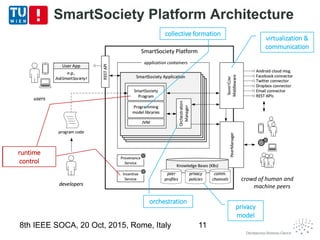
SmartSociety Platform Architecture
crowd of human and
machine peers
privacy
model
virtualization &
communication
orchestration
collective formation
virtualization &
communication
runtime
control
8th IEEE SOCA, 20 Oct, 2015, Rome, Italy 11
Peer Abstraction & Management
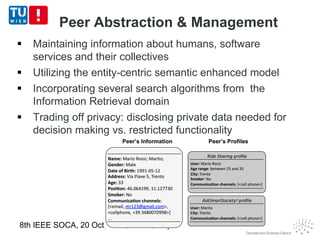
 Maintaining information about humans, software
services and their collectives
 Utilizing the entity-centric semantic enhanced model
 Incorporating several search algorithms from the
Information Retrieval domain
 Trading off privacy: disclosing private data needed for
decision making vs. restricted functionality
8th IEEE SOCA, 20 Oct, 2015, Rome, Italy 12
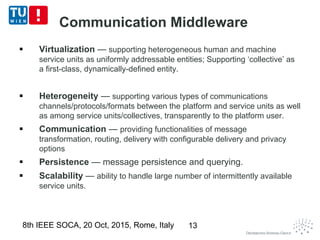
Communication Middleware
 Virtualization — supporting heterogeneous human and machine
service units as uniformly addressable entities; Supporting ‘collective’ as
a first-class, dynamically-defined entity.
 Heterogeneity — supporting various types of communications
channels/protocols/formats between the platform and service units as well
as among service units/collectives, transparently to the platform user.
 Communication — providing functionalities of message
transformation, routing, delivery with configurable delivery and privacy
options
 Persistence — message persistence and querying.
 Scalability — ability to handle large number of intermittently available
service units.
8th IEEE SOCA, 20 Oct, 2015, Rome, Italy 13
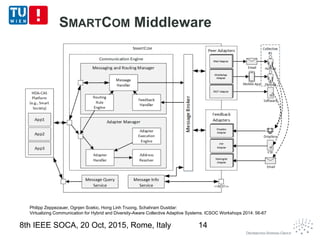
SMARTCOM Middleware
8th IEEE SOCA, 20 Oct, 2015, Rome, Italy
Philipp Zeppezauer, Ognjen Scekic, Hong Linh Truong, Schahram Dustdar:
Virtualizing Communication for Hybrid and Diversity-Aware Collective Adaptive Systems. ICSOC Workshops 2014: 56-67
Philipp Zeppezauer, Ognjen Scekic, Hong Linh Truong, Schahram Dustdar:
Virtualizing Communication for Hybrid and Diversity-Aware Collective Adaptive Systems. ICSOC Workshops 2014: 56-67
14
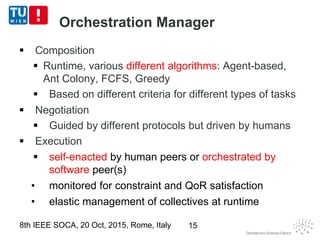
Orchestration Manager
 Composition
 Runtime, various different algorithms: Agent-based,
Ant Colony, FCFS, Greedy
 Based on different criteria for different types of tasks
 Negotiation
 Guided by different protocols but driven by humans
 Execution
 self-enacted by human peers or orchestrated by
software peer(s)
• monitored for constraint and QoR satisfaction
• elastic management of collectives at runtime
8th IEEE SOCA, 20 Oct, 2015, Rome, Italy 15
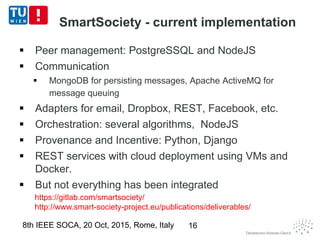
SmartSociety - current implementation
 Peer management: PostgreSSQL and NodeJS
 Communication
 MongoDB for persisting messages, Apache ActiveMQ for
message queuing
 Adapters for email, Dropbox, REST, Facebook, etc.
 Orchestration: several algorithms, NodeJS
 Provenance and Incentive: Python, Django
 REST services with cloud deployment using VMs and
Docker.
 But not everything has been integrated
8th IEEE SOCA, 20 Oct, 2015, Rome, Italy
https://gitlab.com/smartsociety/
http://www.smart-society-project.eu/publications/deliverables/
16
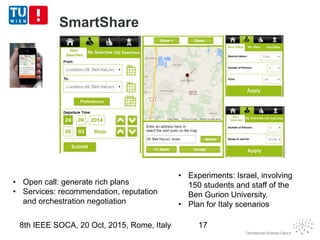
SmartShare
17
• Open call: generate rich plans
• Services: recommendation, reputation
and orchestration negotiation
8th IEEE SOCA, 20 Oct, 2015, Rome, Italy
• Experiments: Israel, involving
150 students and staff of the
Ben Gurion University.
• Plan for Italy scenarios
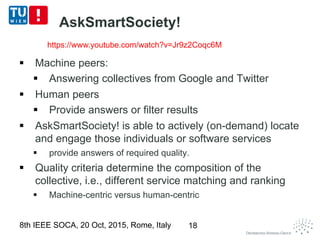
AskSmartSociety!
 Machine peers:
 Answering collectives from Google and Twitter
 Human peers
 Provide answers or filter results
 AskSmartSociety! is able to actively (on-demand) locate
and engage those individuals or software services
 provide answers of required quality.
 Quality criteria determine the composition of the
collective, i.e., different service matching and ranking
 Machine-centric versus human-centric
8th IEEE SOCA, 20 Oct, 2015, Rome, Italy 18
https://www.youtube.com/watch?v=Jr9z2Coqc6M
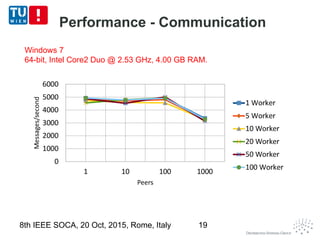
Performance - Communication
8th IEEE SOCA, 20 Oct, 2015, Rome, Italy 19
Windows 7
64-bit, Intel Core2 Duo @ 2.53 GHz, 4.00 GB RAM.
Conclusions and Future work
• Hybrid collective adaptive systems
• Need scalable service platforms to enable the development and
execution of human-machine collaborative complex tasks
• The SmartSociety platform
• Provide various services, protocols and algorithms to enable the
development of human-machine collaborative tasks
• But an open system requires an continuous design and
engineering plan
• Future work
• Orchestration and execution management algorithms and
external services integration
• Platform evaluation in large-scale settings
• Programming models
8th IEEE SOCA, 20 Oct, 2015, Rome, Italy 20
Thanks for your attention!
Hong-Linh Truong
Distributed Systems Group
TU Wien
truong@dsg.tuwien.ac.at
dsg.tuwien.ac.at/staff/truong
218th IEEE SOCA, 20 Oct, 2015, Rome, Italy

SmartSociety – A Platform for Collaborative People-Machine Computation

  • 1.
    SmartSociety – APlatform for Collaborative People-Machine Computation Hong-Linh Truong with Ognjen Scekic, Daniele Miorandi, Tommaso Schiavinotto, Dimitrios I. Diochnos, Alethia Hume, Ronald Chenu-Abente, Michael Rovatsos, Iacopo Carreras, Schahram Dustdar, Fausto Giunchiglia Distributed Systems Group, TU Wien truong@dsg.tuwien.ac.at http://dsg.tuwien.ac.at/staff/truong/ 8th IEEE SOCA, 20 Oct, 2015, Rome, Italy 1
  • 2.
    Outline  Background  Motivation The SmartSociety service platform  Prototype and Examples  Conclusions and Future work 8th IEEE SOCA, 20 Oct, 2015, Rome, Italy 2
  • 3.
  • 4.
    Human and machinefor solving complex problems  Collaborative working environments  provide a lot of services but it is up to the user to use them (e.g., in FP6 projects)  Crowdsourcing  try to “program”/harness human capabilities to solve problems that machines/software cannot do  Cognitive computing  (want fully automatically to) replace human work by machines/software, e.g., IBM Watson 8th IEEE SOCA, 20 Oct, 2015, Rome, Italy 4 We want machines/humans to coexist – have a fair sharing job distribution  We want machines/humans to coexist – have a fair sharing job distribution 
  • 5.
    Our approach: CollectiveAdaptive Systems and Hybridity  Hybridity  People AND software complement each other  Collectiveness  Socio-technical systems/social machines  In future also ‘things’ (sensors, actuators)  Collectives as the first class entity  Adaptiveness  Respond/adapt to ad-hoc situations  Favor collaboration patterns instead of predefined workflows  Human-driven adaptation  Embrace uncertainty 8th IEEE SOCA, 20 Oct, 2015, Rome, Italy 5
  • 6.
    Motivation (1)  Users/Customers: need complex collaborative human-machine tasks (e.g., in predictive maintenance and complex data analytics)  Peers  software or human services, individually or collectively providing solutions for solving complex problems  Human-machine intelligences but “collaboration” is the main aspect to be supported 8th IEEE SOCA, 20 Oct, 2015, Rome, Italy 6
  • 7.
    Motivation (2) 8th IEEESOCA, 20 Oct, 2015, Rome, Italy 7  How to support users with task execution and workforce management functionality?  How to allow peers to collaborate with a fair working condition?  Enable collaboration and adaptiveness  Not purely crowdsourcing(e.g., workflows of human tasks) or cognitive algorithms (replace human work by machines)
  • 8.
    peers& collectives User-specfic business logic (arbitrarycode) get peers and plans Composition Manager collective-based task negotiate a plan Negotiator execute a plan& monitor Executor Communication aggregate results User-specfic arbitrary code etc. ( . . Peer Manager ) . . Incentive Manager ) User Application Task Request peers& collectives Application Motivation (3): Complex services and interactions 8th IEEE SOCA, 20 Oct, 2015, Rome, Italy APIsAPIs 8
  • 9.
    SmartSociety Platform -core functions  Enabling platform services  Collectives Management  Information and Collective lifecycle management  Communication  Composition and Execution  Monitoring, Incentive Management, and Provenance  Supporting diverse types (and models) of applications to be developed 8th IEEE SOCA, 20 Oct, 2015, Rome, Italy 9 Not a tightly coupled integrated system for a single purpose  enable the development and programming of applications Not a tightly coupled integrated system for a single purpose  enable the development and programming of applications
  • 10.
    SmartSociety Platform -Key service engineering issues  System scalability and extensibility  Decouple functions with REST-based open APIs  Loose couple and scalable communication among services and humans  Asynchronous interactions for humans  Extensive connectors/plug-ins  Human-machine diversity and hybridity  Need many algorithms and protocols and interfaces  Software platforms enable interactions among people and software services (machines) 8th IEEE SOCA, 20 Oct, 2015, Rome, Italy 10
  • 11.
    SmartSociety Platform Architecture crowdof human and machine peers privacy model virtualization & communication orchestration collective formation virtualization & communication runtime control 8th IEEE SOCA, 20 Oct, 2015, Rome, Italy 11
  • 12.
    Peer Abstraction &Management  Maintaining information about humans, software services and their collectives  Utilizing the entity-centric semantic enhanced model  Incorporating several search algorithms from the Information Retrieval domain  Trading off privacy: disclosing private data needed for decision making vs. restricted functionality 8th IEEE SOCA, 20 Oct, 2015, Rome, Italy 12
  • 13.
    Communication Middleware  Virtualization— supporting heterogeneous human and machine service units as uniformly addressable entities; Supporting ‘collective’ as a first-class, dynamically-defined entity.  Heterogeneity — supporting various types of communications channels/protocols/formats between the platform and service units as well as among service units/collectives, transparently to the platform user.  Communication — providing functionalities of message transformation, routing, delivery with configurable delivery and privacy options  Persistence — message persistence and querying.  Scalability — ability to handle large number of intermittently available service units. 8th IEEE SOCA, 20 Oct, 2015, Rome, Italy 13
  • 14.
    SMARTCOM Middleware 8th IEEESOCA, 20 Oct, 2015, Rome, Italy Philipp Zeppezauer, Ognjen Scekic, Hong Linh Truong, Schahram Dustdar: Virtualizing Communication for Hybrid and Diversity-Aware Collective Adaptive Systems. ICSOC Workshops 2014: 56-67 Philipp Zeppezauer, Ognjen Scekic, Hong Linh Truong, Schahram Dustdar: Virtualizing Communication for Hybrid and Diversity-Aware Collective Adaptive Systems. ICSOC Workshops 2014: 56-67 14
  • 15.
    Orchestration Manager  Composition Runtime, various different algorithms: Agent-based, Ant Colony, FCFS, Greedy  Based on different criteria for different types of tasks  Negotiation  Guided by different protocols but driven by humans  Execution  self-enacted by human peers or orchestrated by software peer(s) • monitored for constraint and QoR satisfaction • elastic management of collectives at runtime 8th IEEE SOCA, 20 Oct, 2015, Rome, Italy 15
  • 16.
    SmartSociety - currentimplementation  Peer management: PostgreSSQL and NodeJS  Communication  MongoDB for persisting messages, Apache ActiveMQ for message queuing  Adapters for email, Dropbox, REST, Facebook, etc.  Orchestration: several algorithms, NodeJS  Provenance and Incentive: Python, Django  REST services with cloud deployment using VMs and Docker.  But not everything has been integrated 8th IEEE SOCA, 20 Oct, 2015, Rome, Italy https://gitlab.com/smartsociety/ http://www.smart-society-project.eu/publications/deliverables/ 16
  • 17.
    SmartShare 17 • Open call:generate rich plans • Services: recommendation, reputation and orchestration negotiation 8th IEEE SOCA, 20 Oct, 2015, Rome, Italy • Experiments: Israel, involving 150 students and staff of the Ben Gurion University. • Plan for Italy scenarios
  • 18.
    AskSmartSociety!  Machine peers: Answering collectives from Google and Twitter  Human peers  Provide answers or filter results  AskSmartSociety! is able to actively (on-demand) locate and engage those individuals or software services  provide answers of required quality.  Quality criteria determine the composition of the collective, i.e., different service matching and ranking  Machine-centric versus human-centric 8th IEEE SOCA, 20 Oct, 2015, Rome, Italy 18 https://www.youtube.com/watch?v=Jr9z2Coqc6M
  • 19.
    Performance - Communication 8thIEEE SOCA, 20 Oct, 2015, Rome, Italy 19 Windows 7 64-bit, Intel Core2 Duo @ 2.53 GHz, 4.00 GB RAM.
  • 20.
    Conclusions and Futurework • Hybrid collective adaptive systems • Need scalable service platforms to enable the development and execution of human-machine collaborative complex tasks • The SmartSociety platform • Provide various services, protocols and algorithms to enable the development of human-machine collaborative tasks • But an open system requires an continuous design and engineering plan • Future work • Orchestration and execution management algorithms and external services integration • Platform evaluation in large-scale settings • Programming models 8th IEEE SOCA, 20 Oct, 2015, Rome, Italy 20
  • 21.
    Thanks for yourattention! Hong-Linh Truong Distributed Systems Group TU Wien truong@dsg.tuwien.ac.at dsg.tuwien.ac.at/staff/truong 218th IEEE SOCA, 20 Oct, 2015, Rome, Italy