Prepared in collaboration with Mercer
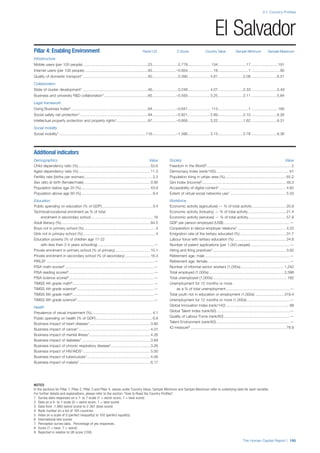
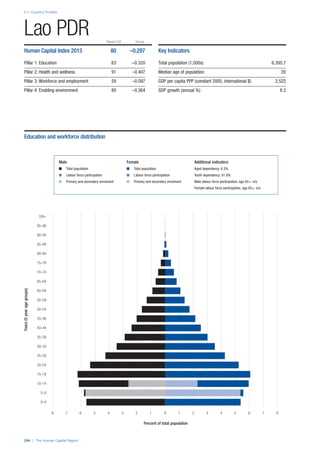
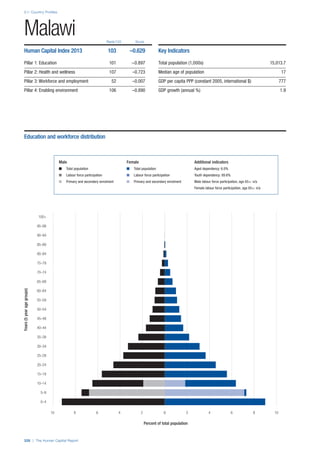
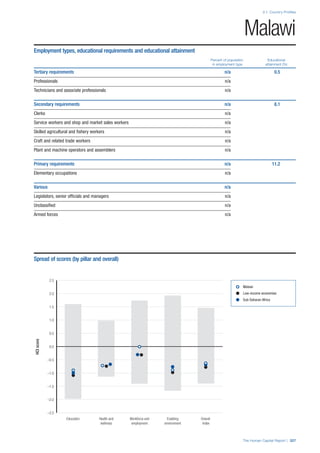
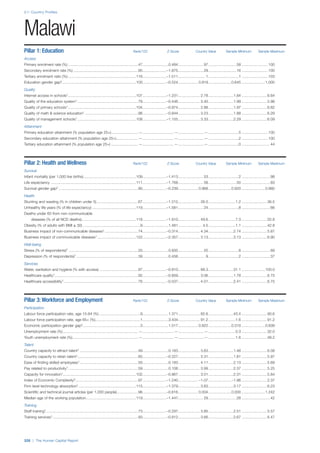
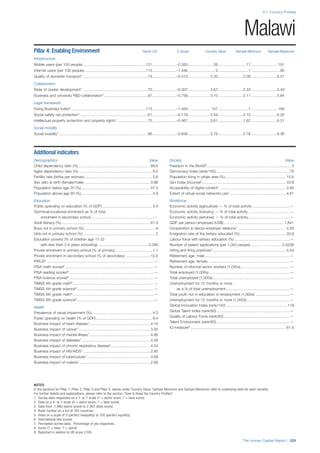
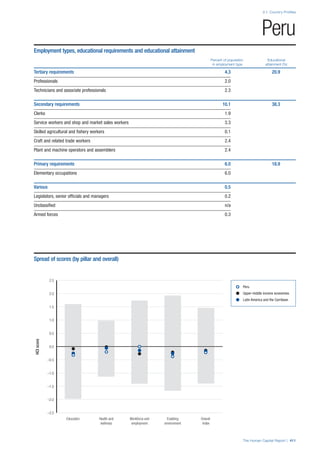
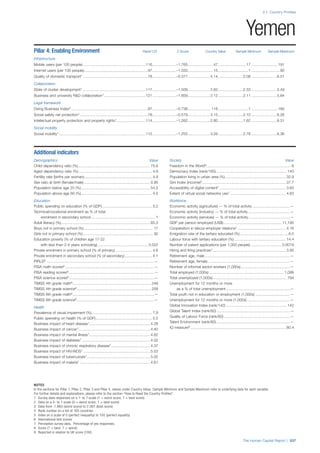
The Human
Capital Report
Insight Report
Insight Report
The Human
Capital Report
Prepared in collaboration with Mercer
World Economic Forum
91-93 route de la Capite
CH-1223 Cologny/Geneva
Switzerland
Tel.: +41 (0)22 869 1212
Fax: +41 (0)22 786 2744
E-mail: contact@weforum.org
www.weforum.org
© 2013 World Economic Forum
All rights reserved.
No part of this publication may be reproduced or
transmitted in any form or by any means, including
photocopying and recording, or by any information
storage and retrieval system.
ISBN 92-95044-52-5
ISBN 978-92-95044-52-4
The The Human Capital Report | iii
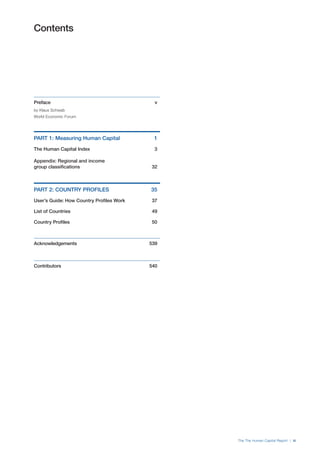
Preface 	 v
by Klaus Schwab
World Economic Forum
PART 1: Measuring Human Capital 	 1
The Human Capital Index	 3
Appendix: Regional and income
group classifications	 32
PART 2: COUNTRY PROFILES 	35
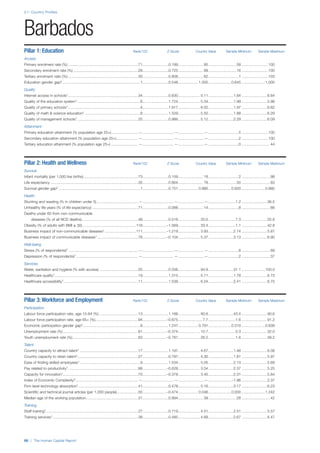
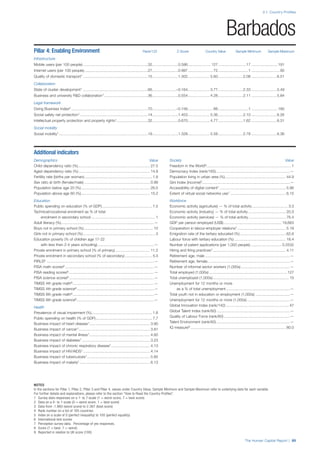
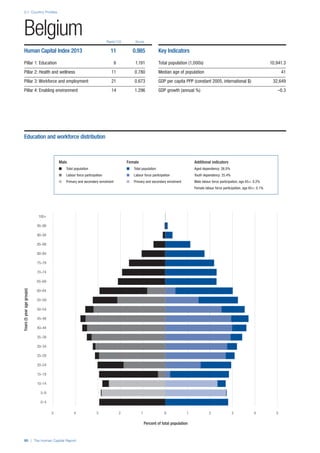
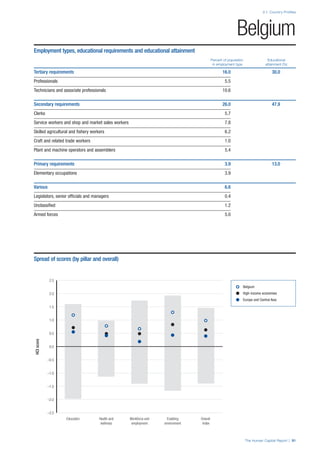
User’s Guide: How Country Profiles Work	 37
List of Countries	 49
Country Profiles	 50
Acknowledgements	539
Contributors	540
Contents
The The Human Capital Report | v
The key for the future of any country and any institution
lies in the talent, skills and capabilities of its people. With
talent shortages projected to become more severe in
much of the developed and developing world, it will be
imperative to turn our attention to how these shortages
can be met in the short term and prevented in the long
term. For the individual, as well as for societies and
economies as a whole, investing in human capital is
critical; even more so in the context of shifting population
dynamics and limited resources.
Through the Human Capital Report, the World
Economic Forum seeks to provide a holistic, long term
overview on how well countries are leveraging their
human capital and establishing workforces that are
prepared for the demands of competitive economies. By
providing a comprehensive framework for benchmarking
human capital, the Report highlights countries that are
role models in investing in the health, education and
talent of their people and providing an environment
where these investments translate into productivity for
the economy. In addition, through extensive additional
information on the 122 countries covered, the Report
seeks to provide a fuller picture of the context within
which human capital is operating in any particular
country.
We would like to express our deep appreciation to
Patricia A. Milligan, President, North America Region and
Richard A. Guzzo, Partner and Co-Leader, Workforce
Sciences Institute at Mercer, as well as David E. Bloom,
Clarence James Gamble Professor of Economics and
Demography, Harvard School of Public Health for
their invaluable contributions to this Report. We would
also like to thank Saadia Zahidi, Senior Director and
Charlotte Harding, Project Manager for leading this
project at the World Economic. We are also grateful for
the support of Amey Soo at the World Economic Forum
and Linda Chen and Allison Riggieri at Mercer. Finally,
we are thankful to the many business leaders, faculty,
international organization experts and government
leaders who have provided input on this project since
its inception, particularly through workshops held at our
Annual Meeting in Davos and summits in China and
India.
Using the Report as a basis, we aim to provide a
platform for a much-needed dialogue across multiple
sectors and stakeholder groups on how best to invest
in human capital—both in the short and long term. Over
the coming year, this discourse will take place through
regional summits, industry dialogues, Global Agenda
Councils and the activities of other World Economic
Forum communities. In particular, we hope to mobilize
key constituents from governments and the business
sector to address human capital gaps through public-
private collaboration. It is also our hope that this first
edition of the Human Capital Report will inspire further
research, policy changes and new projects by business,
governments, civil society and universities and serve as
a call to action to transform the pace of change on an
issue that is fundamental to the growth and stability of
the global economy and society.
Preface
KLAUS SCHWAB
Executive Chairman, World Economic Forum
Part 1
Measuring Human Capital
The Human Capital Report | 3
The Human Capital Index
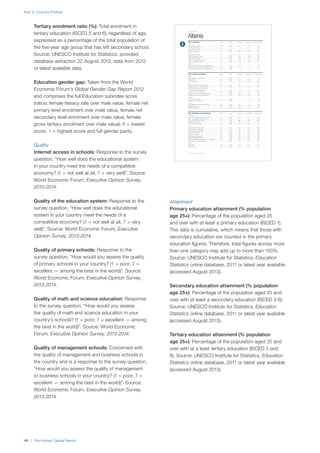
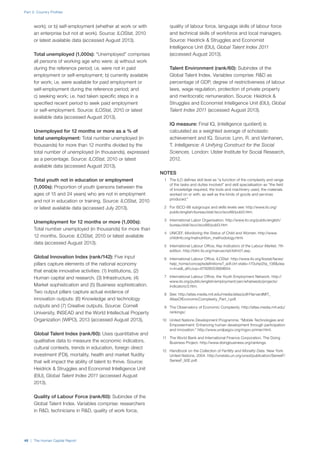
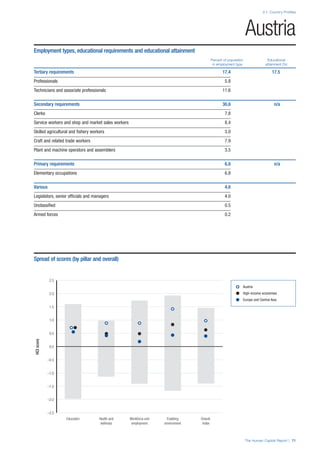
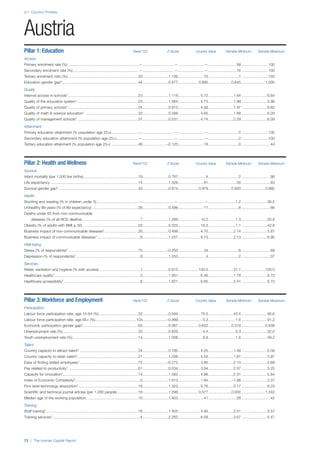
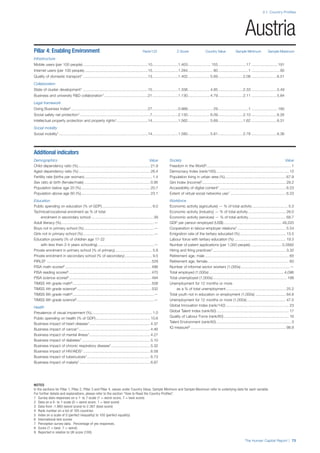
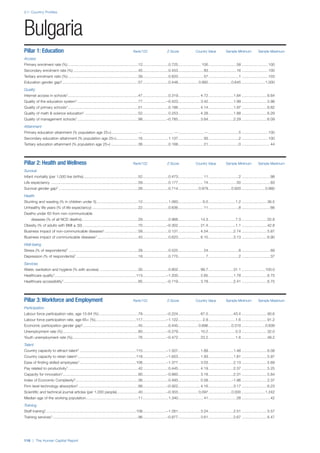
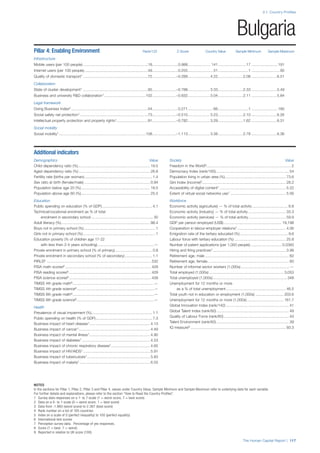
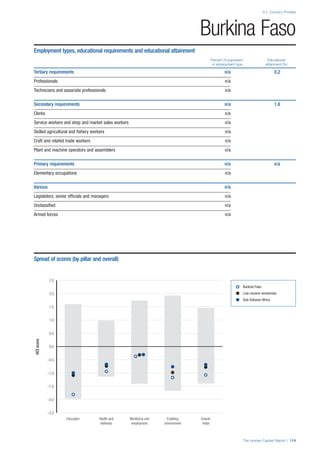
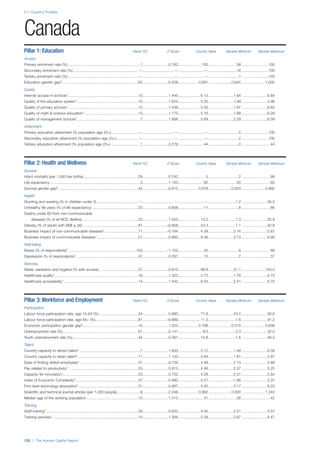
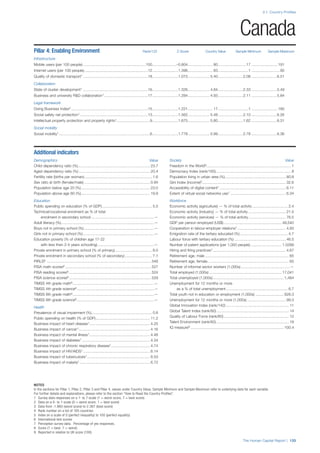
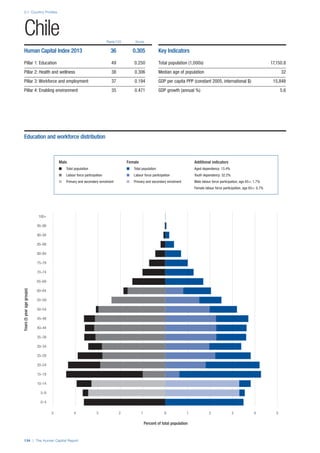
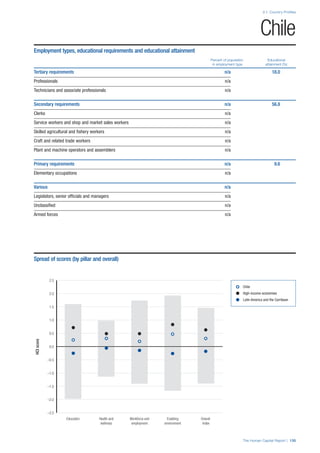
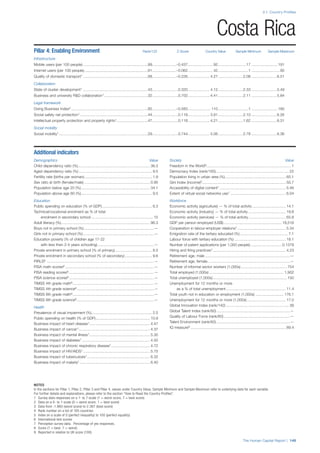
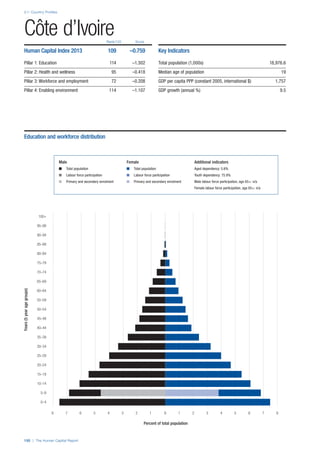
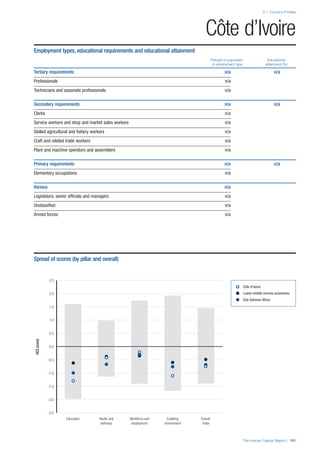
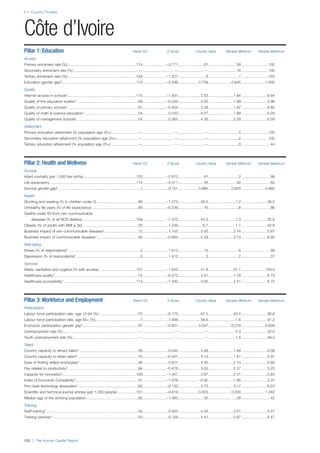
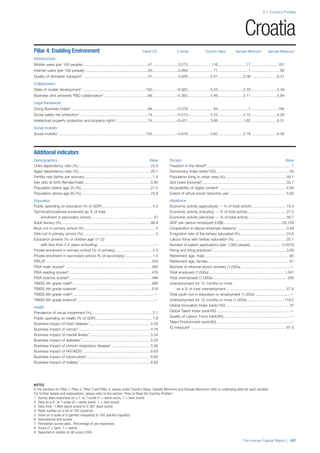
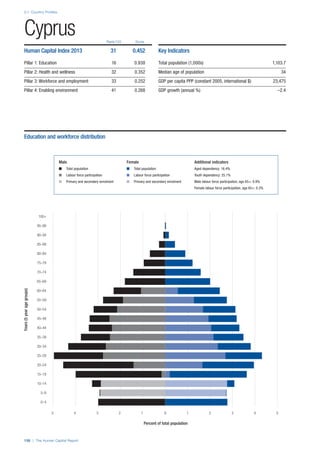
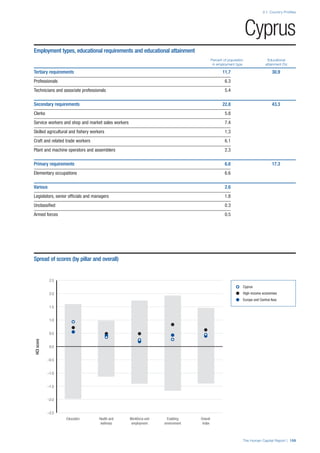
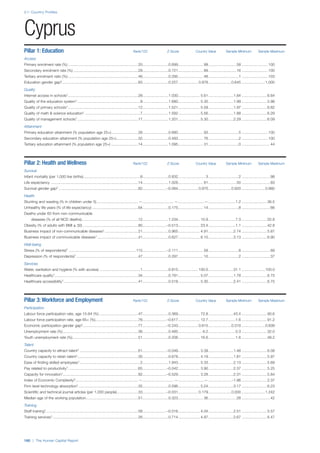
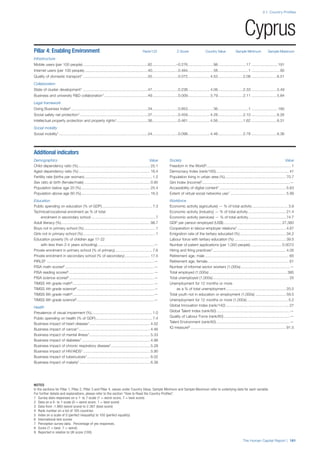
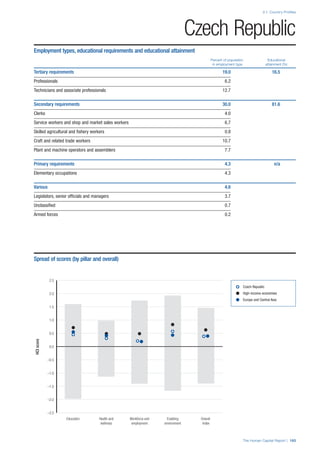
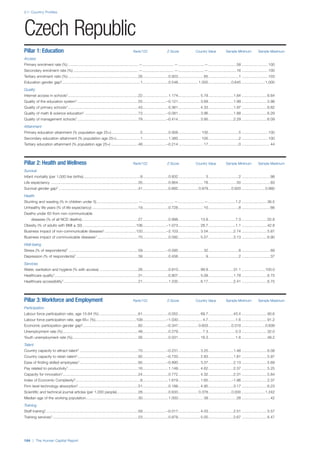
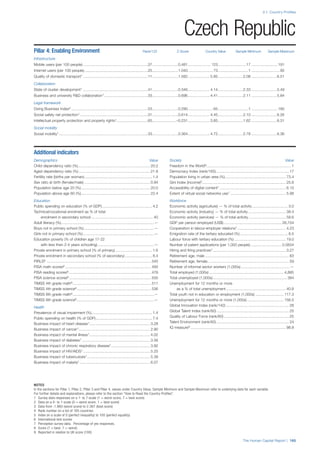
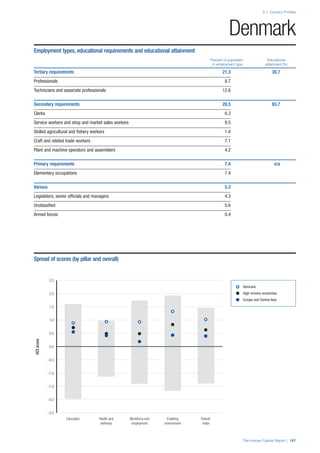
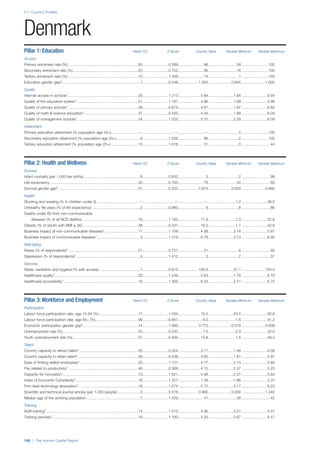
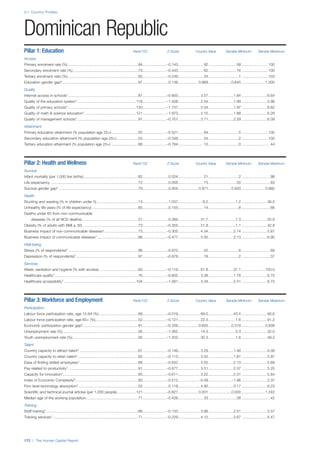
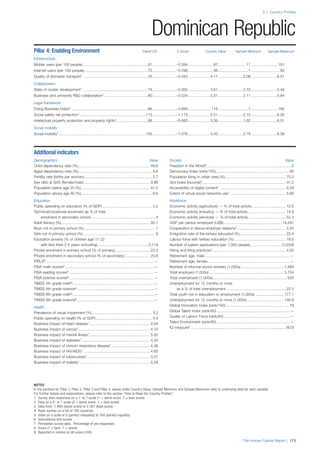
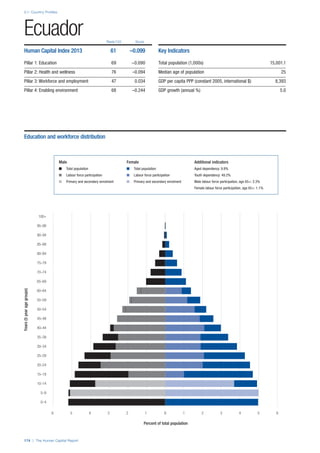
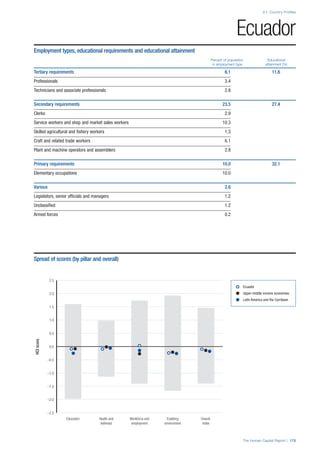
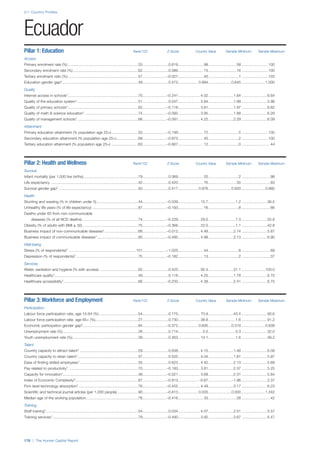
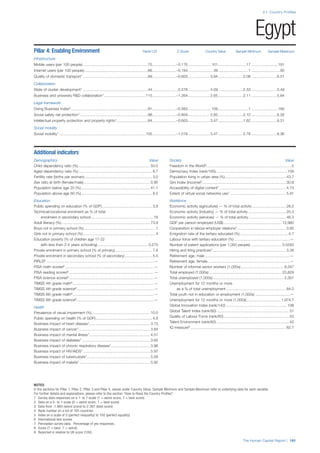
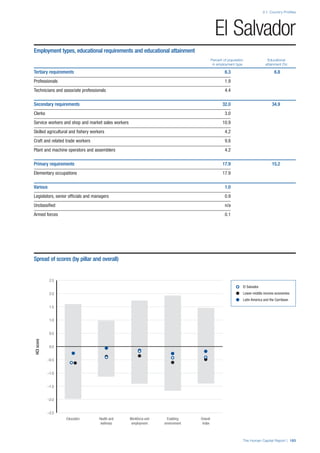
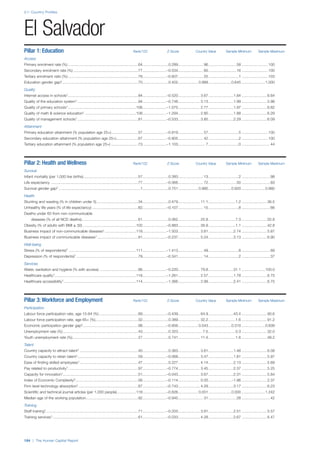
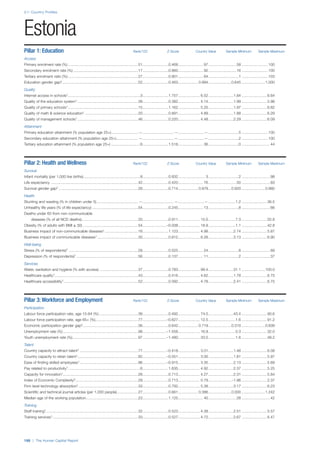
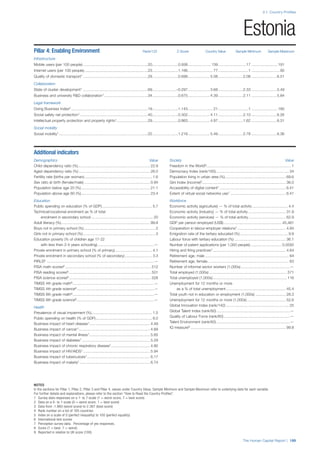
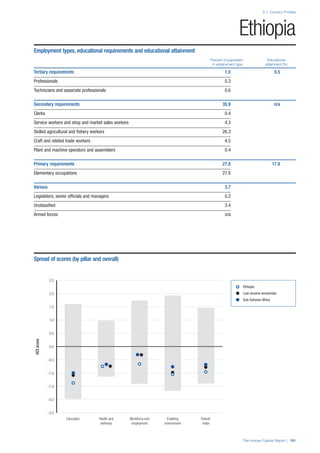
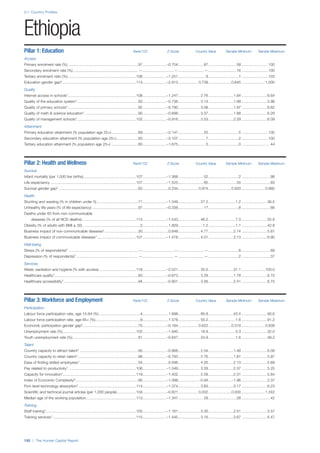
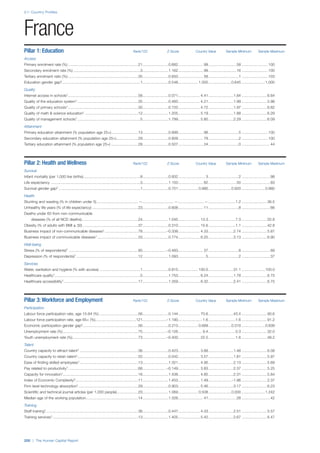
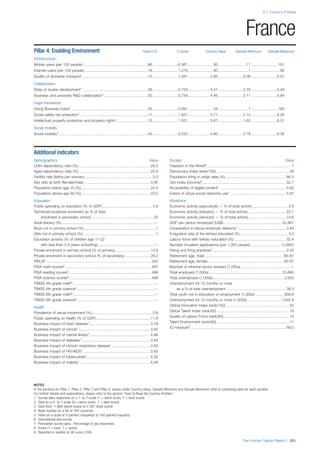
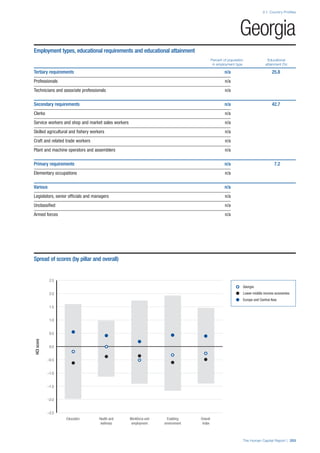
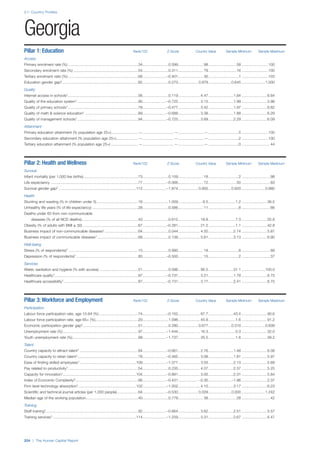
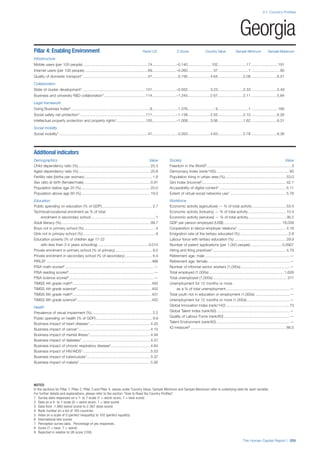
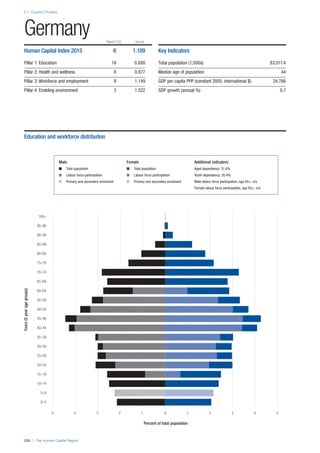
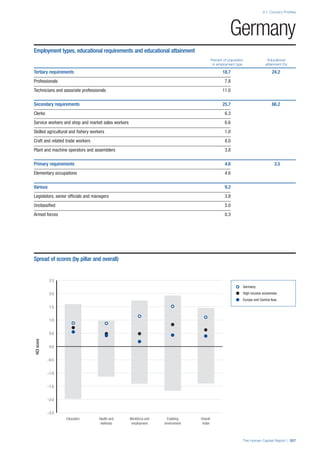
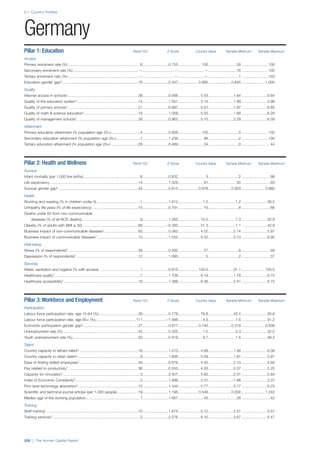
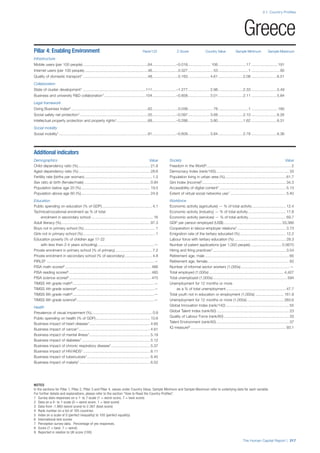
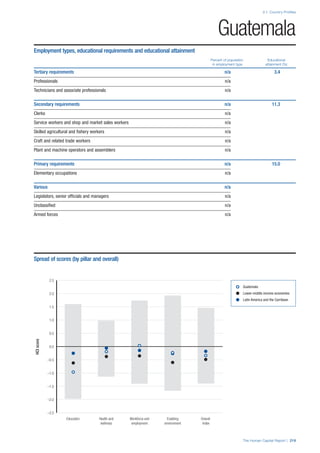
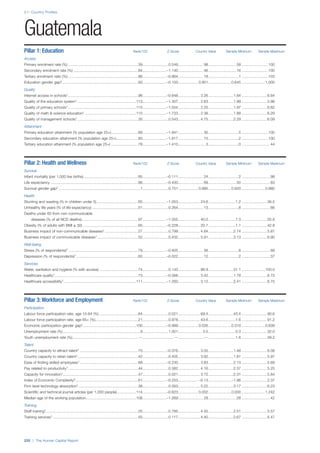
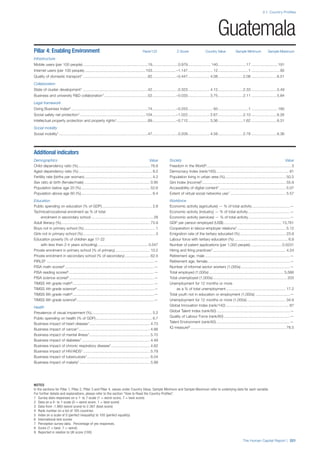
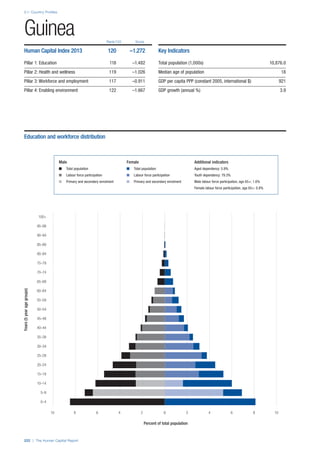
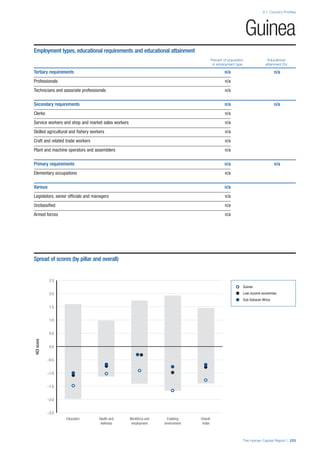
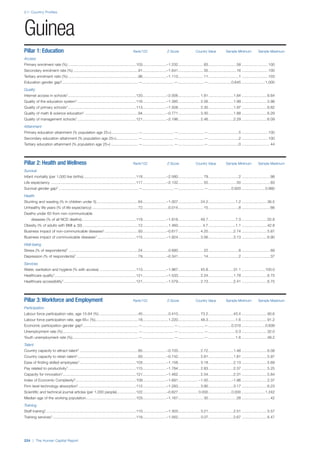
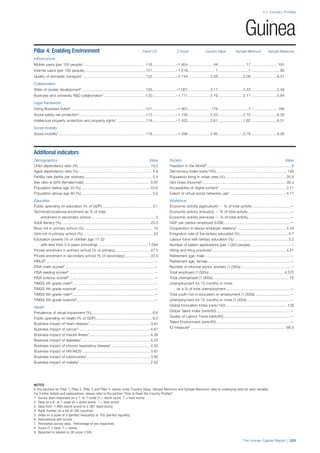
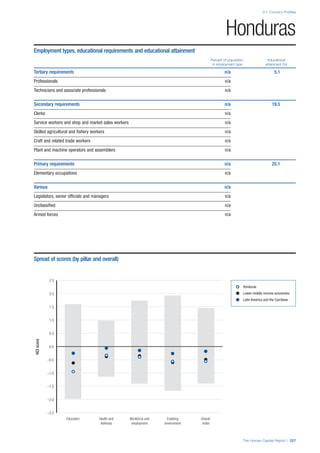
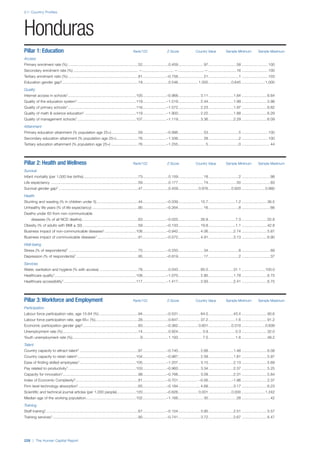
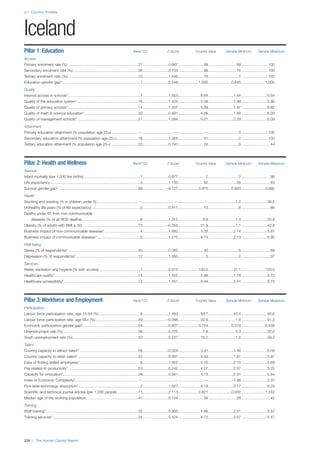
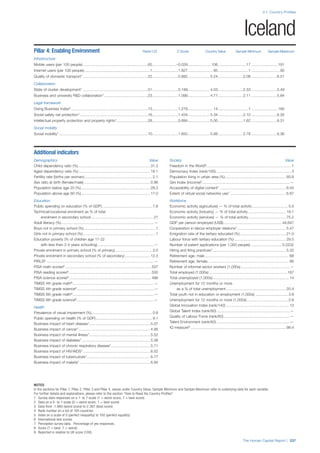
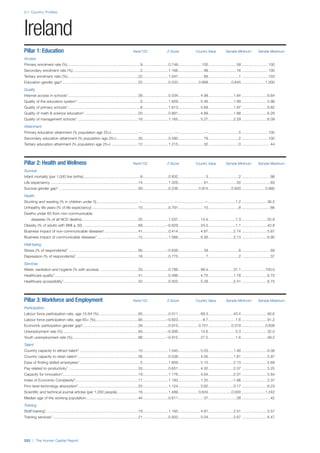
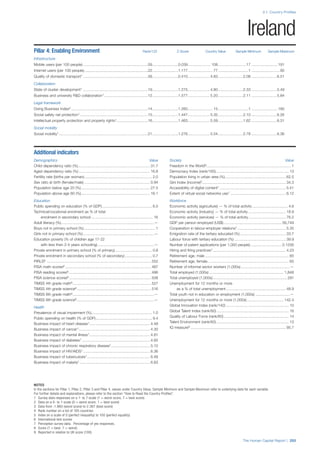
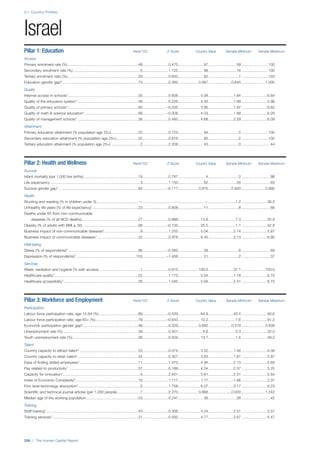
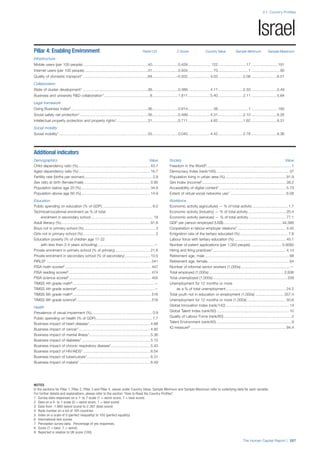
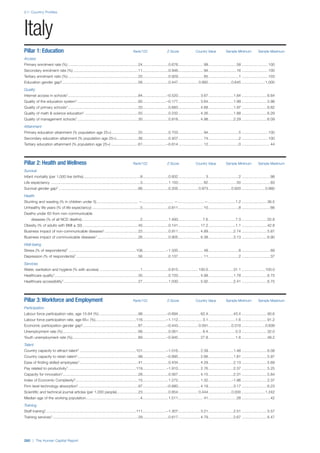
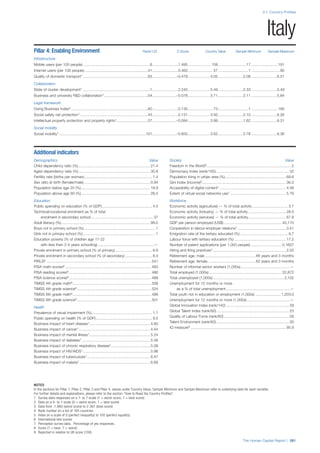
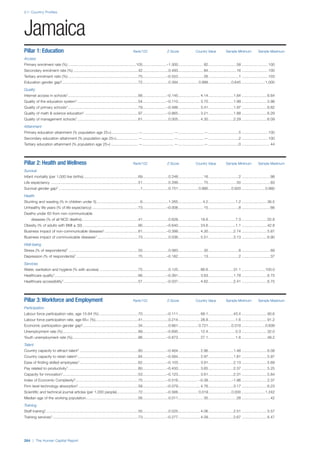
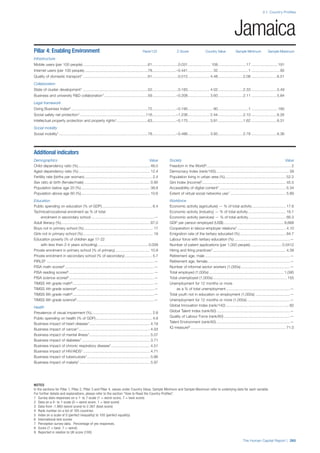
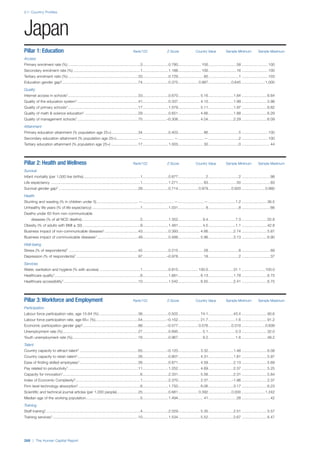
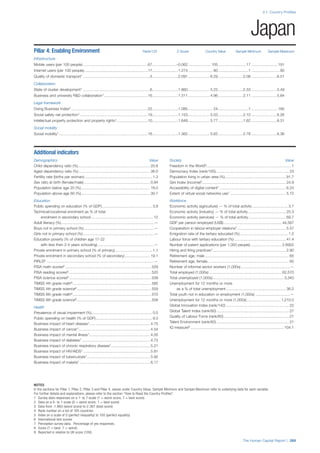
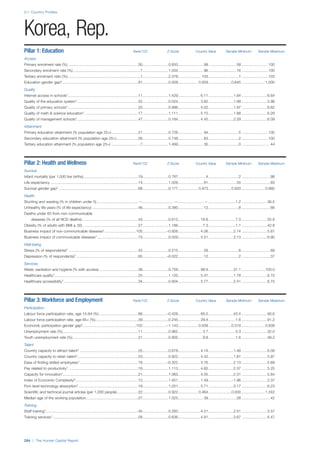
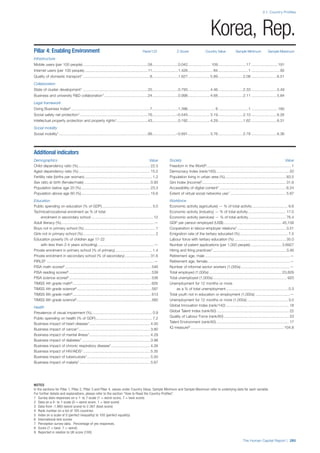
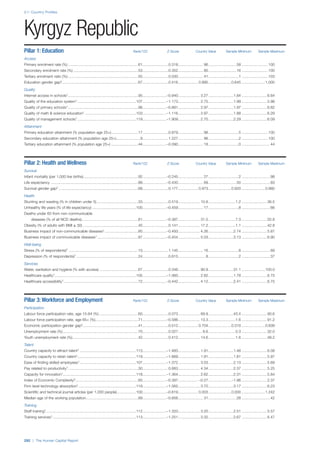
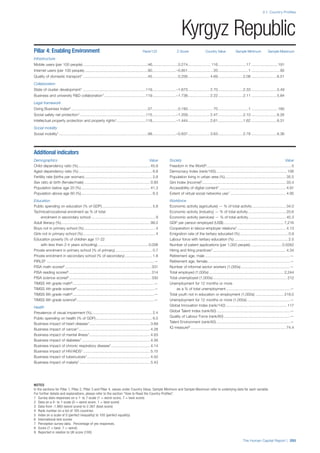
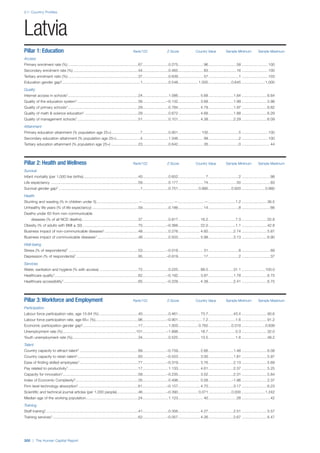
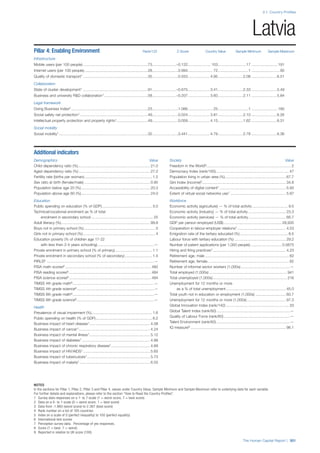
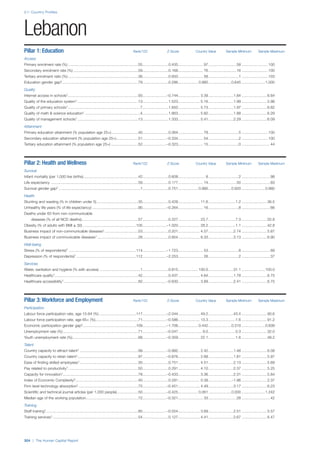
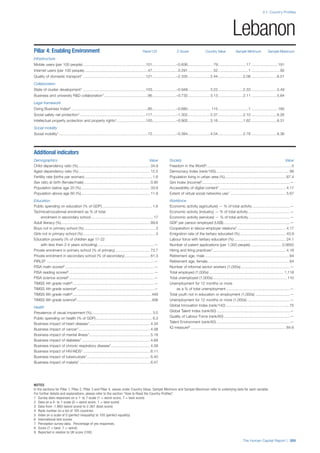
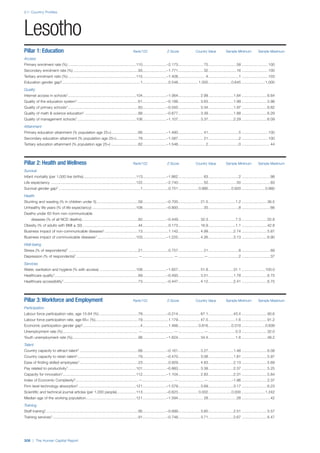
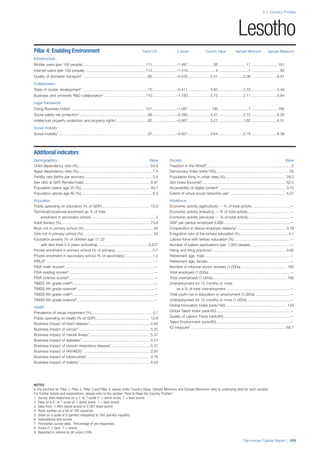
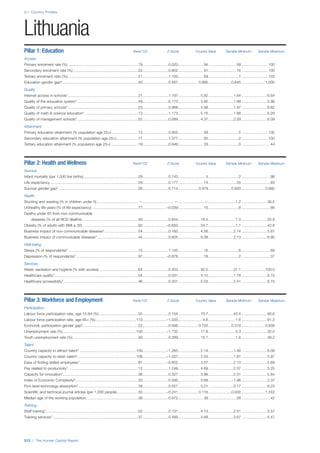
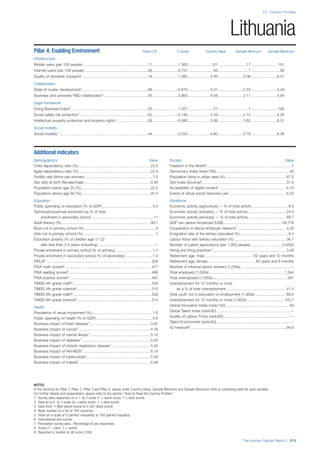
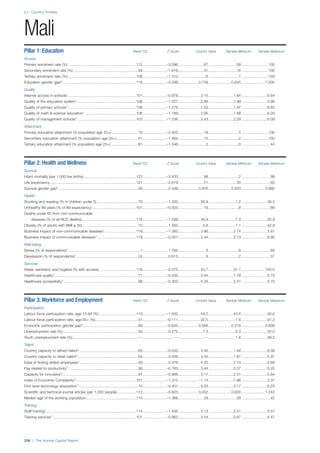
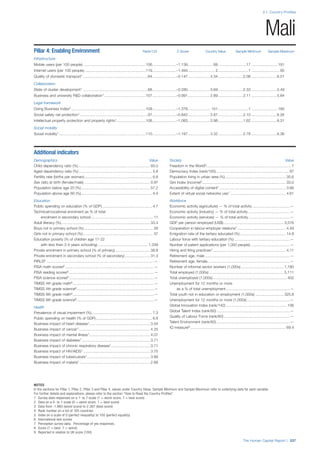
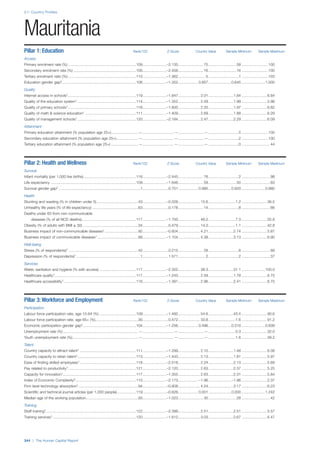
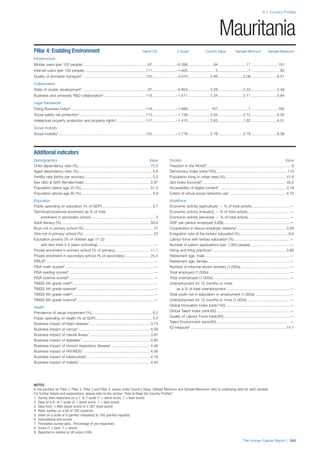
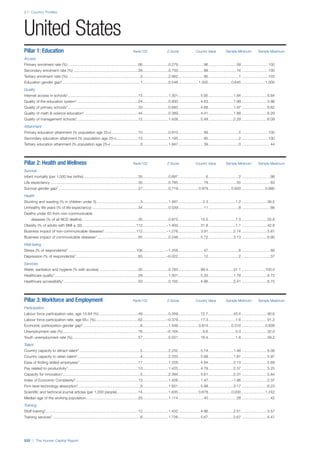
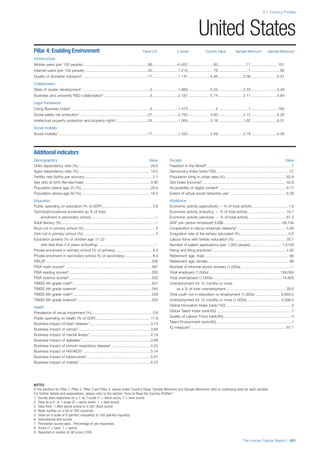
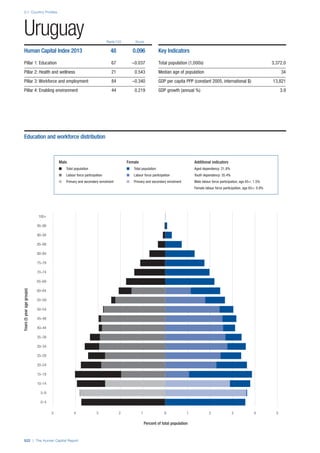
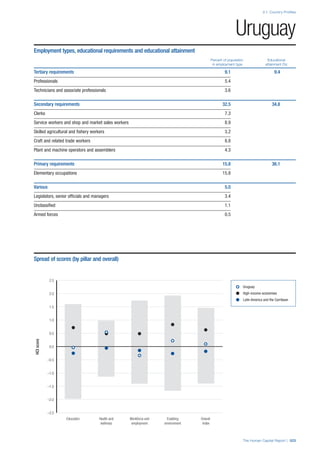
the trends in similar regional and income groups. The third
and fourth pages show detailed information on variables
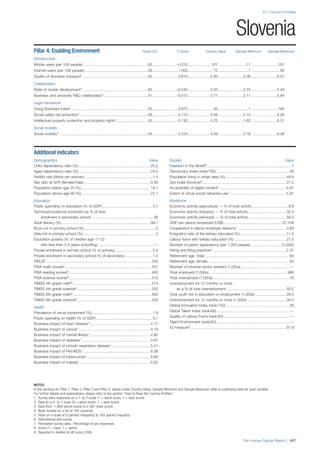
contained in the Index as well as over 60 contextual
variables on demographics, education, health, society and
the workforce.
MEASURING HUMAN CAPITAL
The Human Capital Index is a new measure for capturing
and tracking the state of human capital development
around the world. It has three key features.
First, the Index measures a broader set of indicators
than the traditional definitions of human capital. Human
capital is not a one–dimensional concept, but means
different things to different stakeholders. In the business
world, human capital is the economic value of an
employee’s set of skills. To the policy maker, human
capital is the capacity of the population to drive economic
growth. Traditionally, human capital has been viewed as a
function of education and experience, the latter reflecting
both training and learning by doing. But in recent years,
health (including physical capacities, cognitive function
and mental health) has come to be seen as a fundamental
component of human capital. Additionally, the value of
human capital is critically determined by the physical, social
and economic context of a society, because that context
determines how particular attributes a person possesses
may be rewarded. The Index is thus based on four pillars:
three core determinants of human capital (education,
health and employment) plus those factors that allow these
three core determinants to translate into greater returns.
Second, the Index takes a long–term approach to
human capital. In addition to providing a snapshot of
the state of a country’s human capital today through
measures that reflect the results of a country’s past
practices, it includes indicators resulting from practices
and policy decisions impacting the children of today and
which will shape the future workforce. Long–term thinking
around human capital often does not fit political cycles or
business investment horizons; but lack of such long term
planning can perpetuate continued wasted potential in
a country’s population and losses for a nation’s growth
and productivity. The Index seeks to develop a stronger
consciousness around the need for such planning.
Third, the Index aims to take into account the
individual life course. For example, the WHO states that
INTRODUCTION
A nation’s human capital endowment—the skills and
capacities that reside in people and that are put to
productive use—can be a more important determinant
of its long term economic success than virtually any
other resource. This resource must be invested in and
leveraged efficiently in order for it to generate returns,
for the individuals involved as well as an economy as a
whole. Additionally, despite high unemployment in many
countries, the global economy is entering an era of talent
scarcity that, if left unaddressed, will hinder economic
growth worldwide. Understanding and addressing
challenges related to human capital is thus fundamental
to short term stability as well as the long term growth,
prosperity and competitiveness of nations.
The Human Capital Index explores the contributors
and inhibitors to the development and deployment of a
healthy, educated and productive labour force, and has
generated the information contained in this Report. The
Index provides country rankings that allow for effective
comparisons across regions and income groups. The
methodology and quantitative analysis behind the rankings
are intended to serve as a basis for designing effective
measures for workforce planning. While the rankings are
designed to create greater awareness among a global
audience, the Index also seeks to serve as a basis for
dialogue and action by leaders at the World Economic
Forum to increase public–private collaboration on
developing human capital.
The first part of Part 1 reviews the underlying concepts
employed in creating the Human Capital Index and outlines
the methods used to calculate it. The second part presents
the 2013 rankings and regional performance, and calls
attention to notable country cases. The third part of Part 1
provides an overview of the links between human capital
and the economic performance of countries and points to
further areas of work.
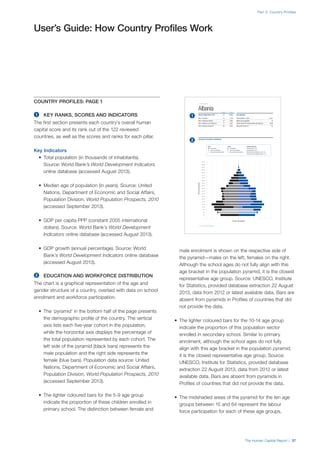
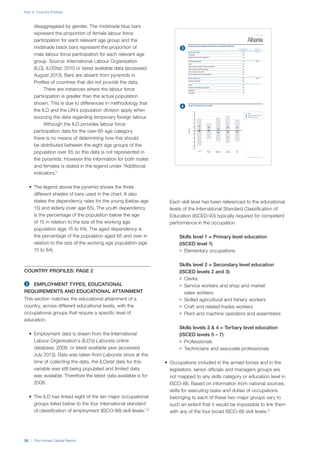
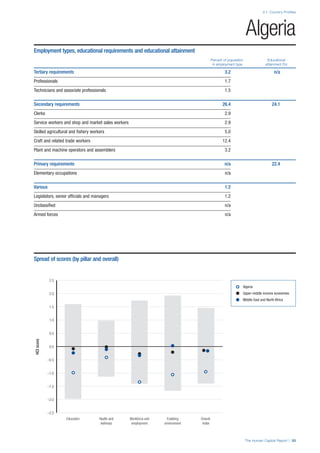
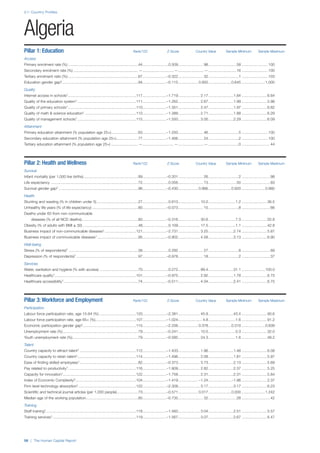
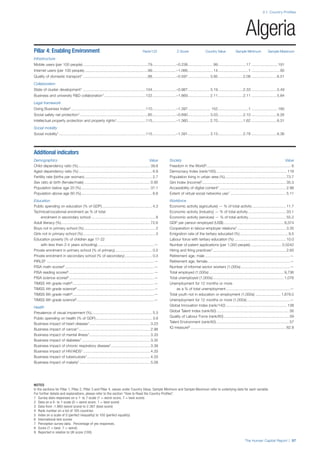
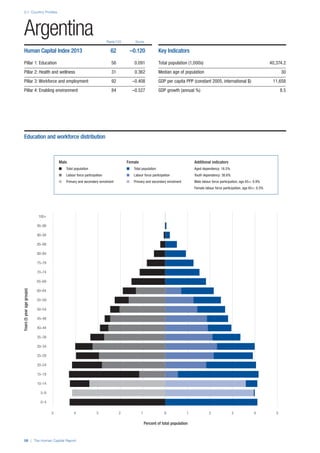
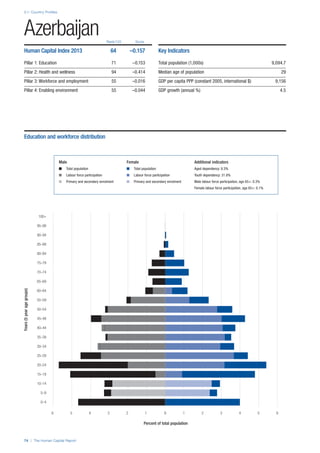
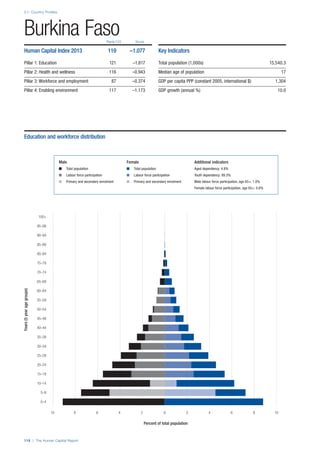
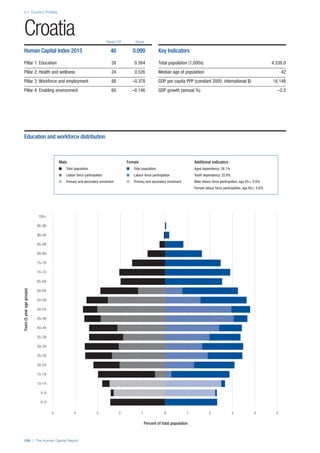
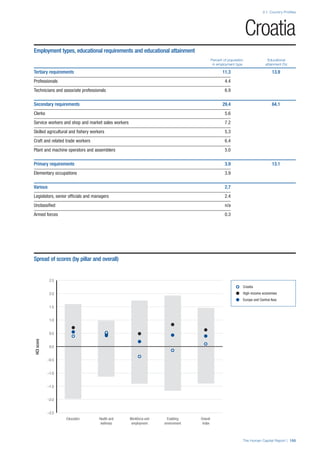
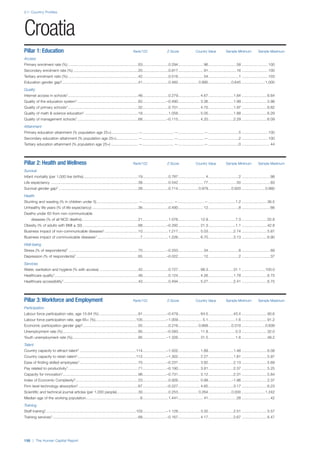
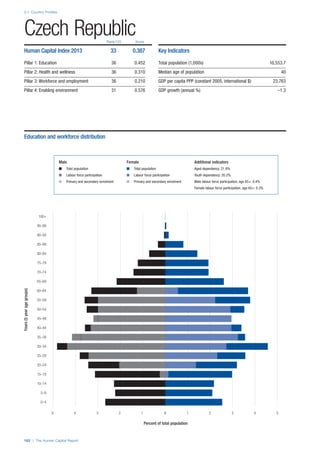
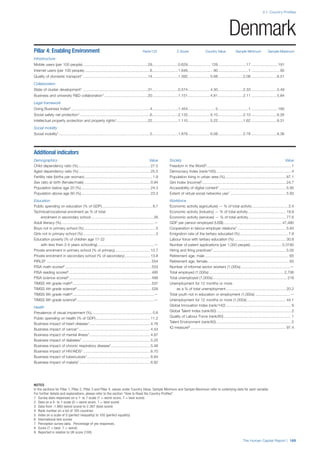
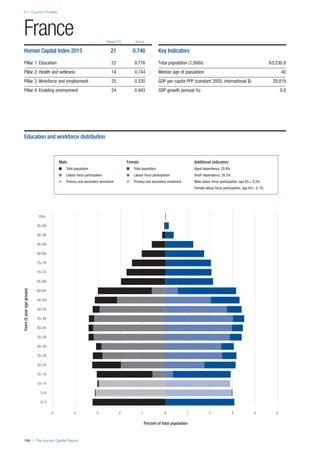
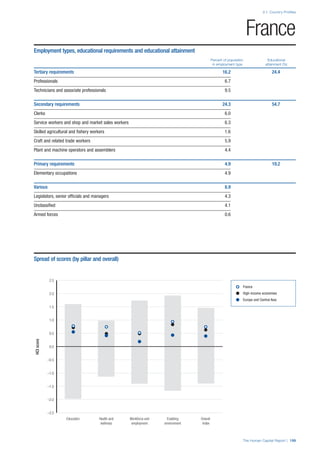
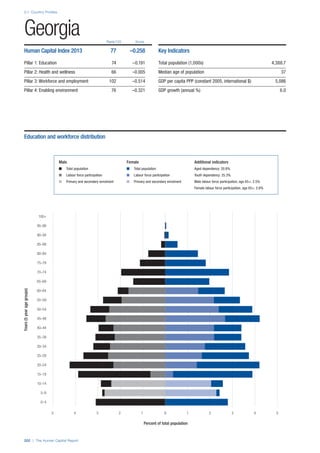
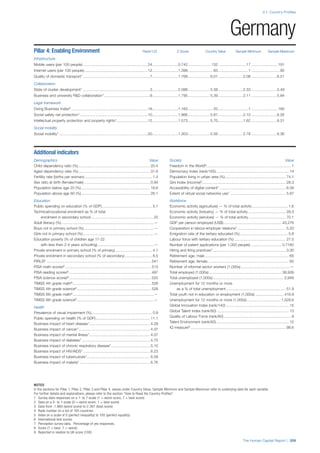
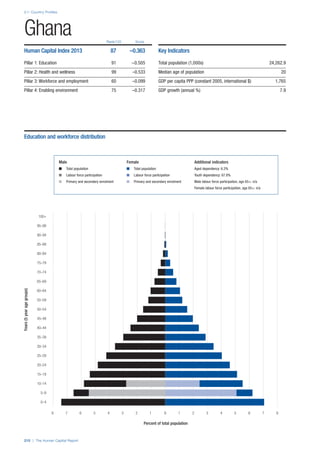
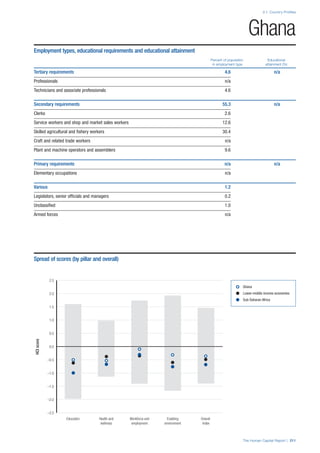
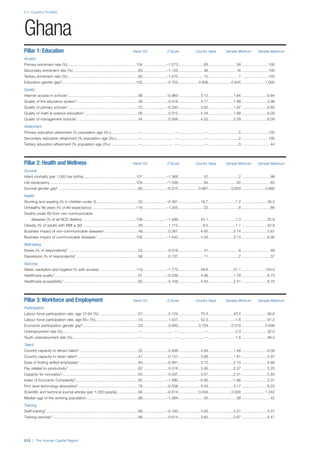
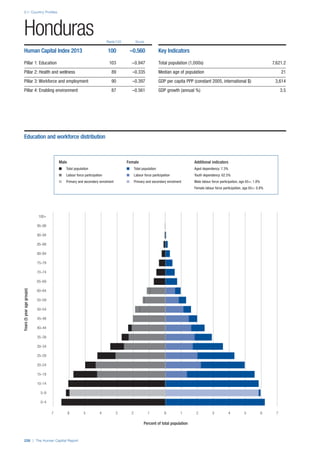
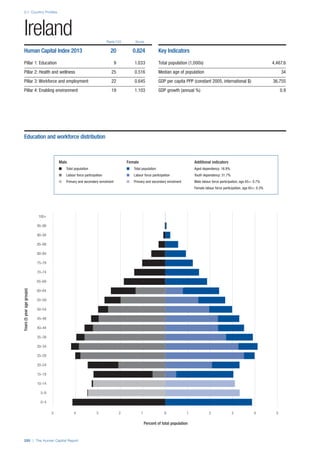
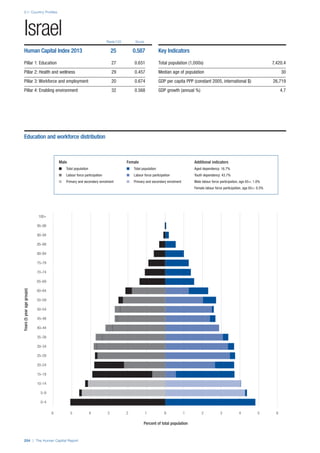
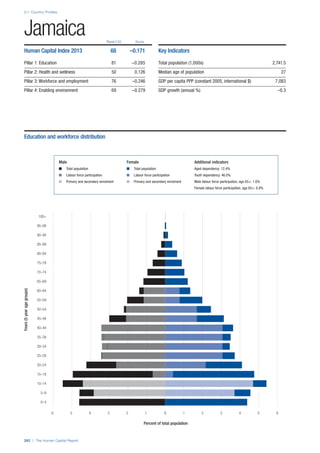
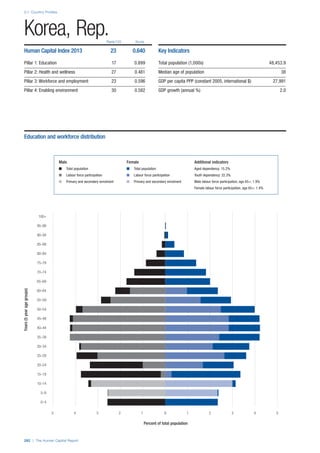
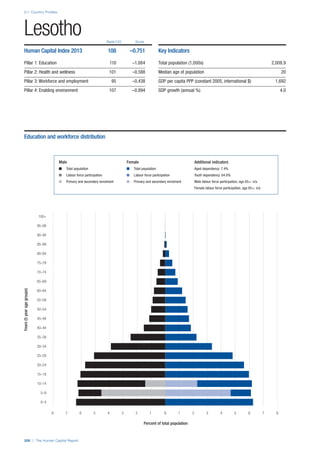
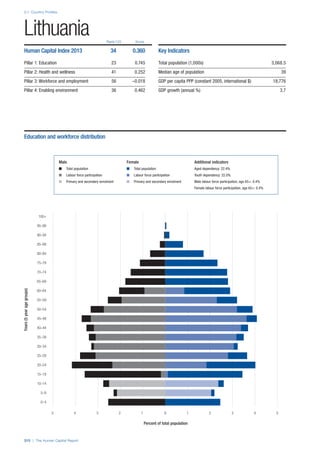
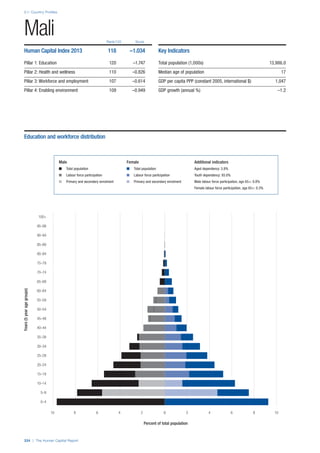
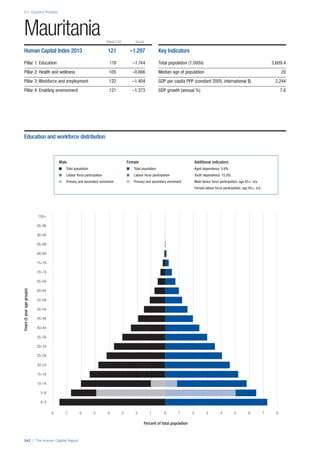
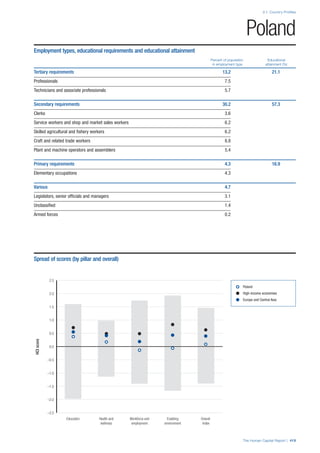
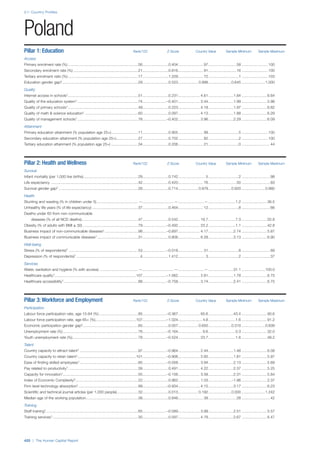
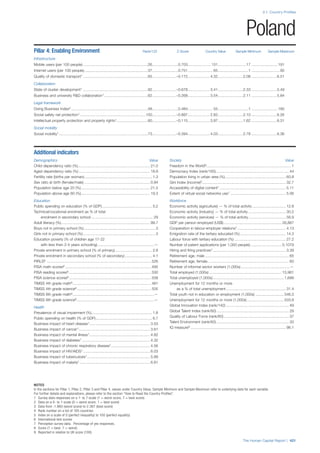
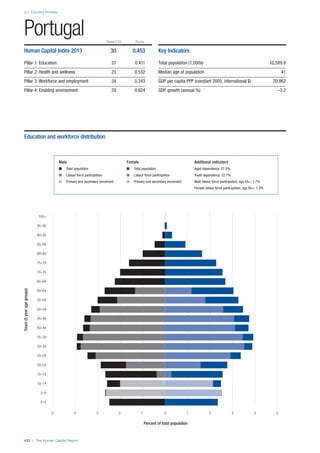
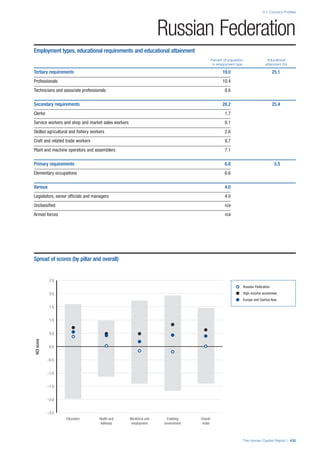
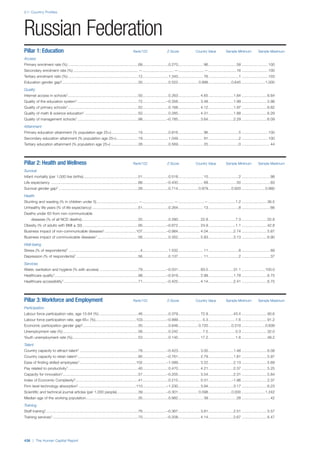
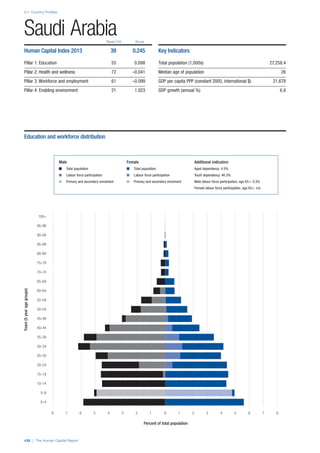
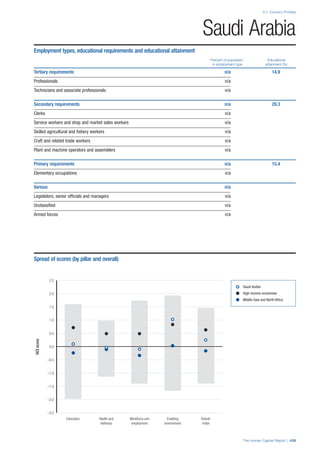
The Country Profiles contained in Part 2 of this Report
give a more detailed picture of the relative strengths and
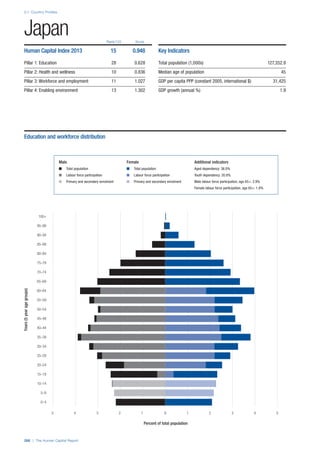
weaknesses of each country’s performance compared with
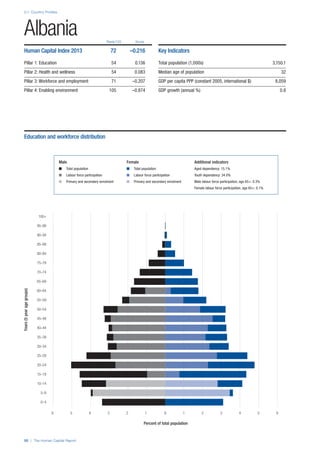
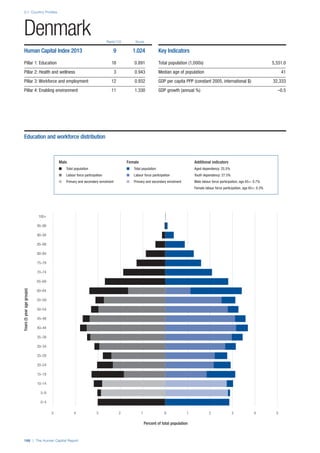
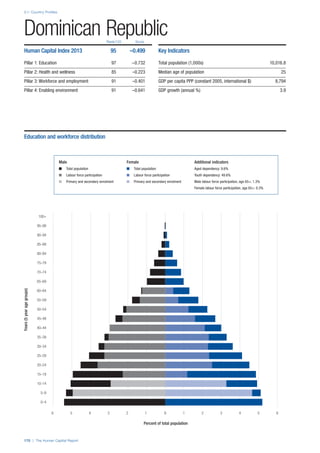
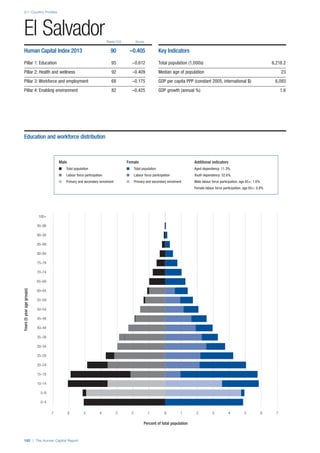
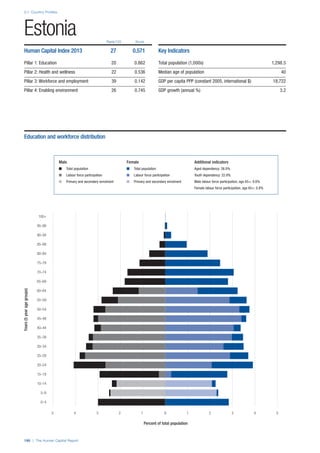
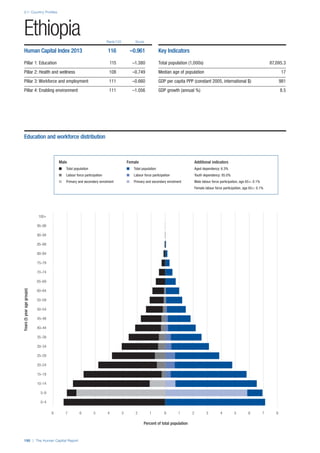
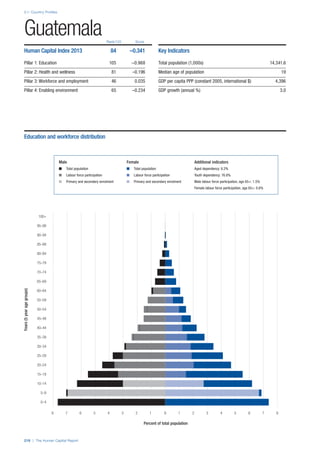
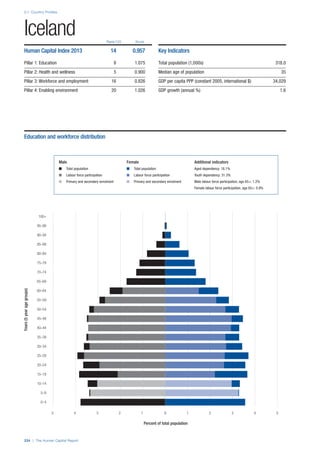
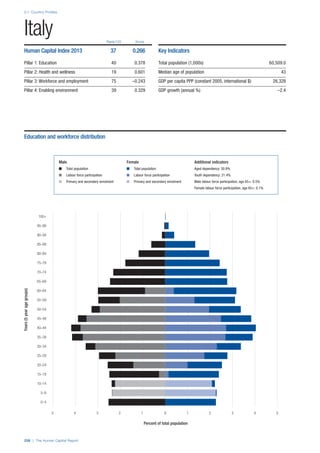
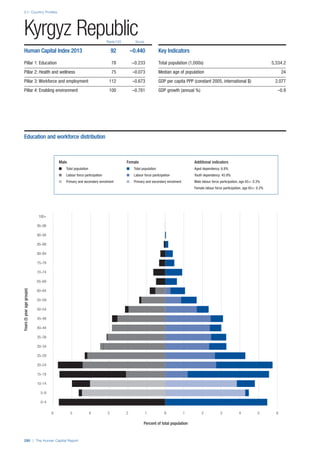
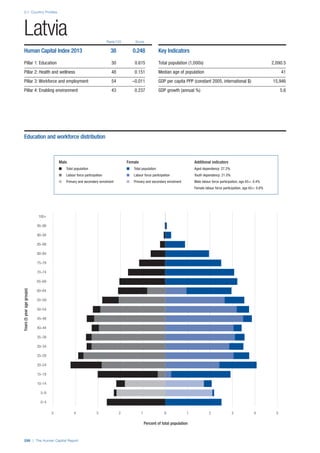
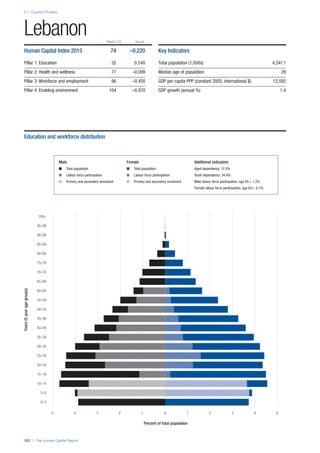
that of other nations. The first page of each profile contains
an overview of each country’s performance in 2013 as well
as a visual representation of the countries demographic
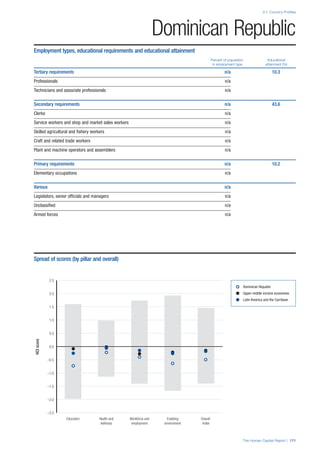
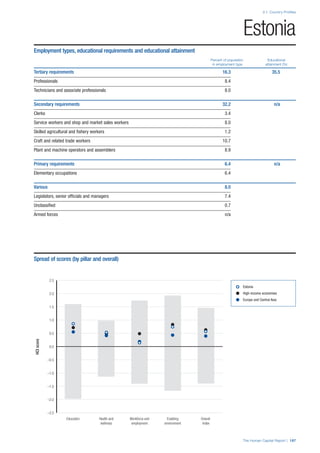
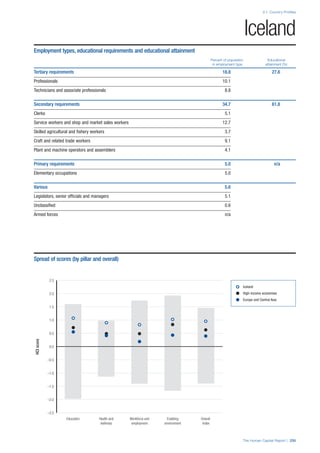
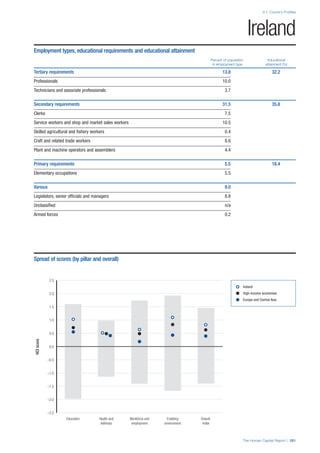
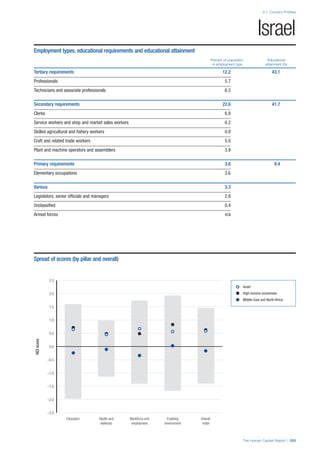
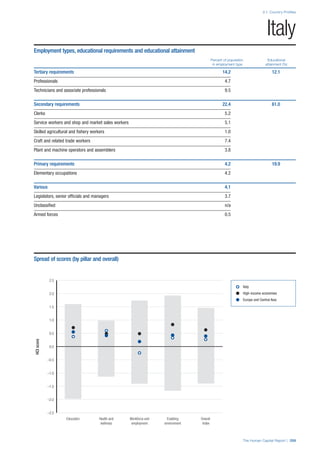
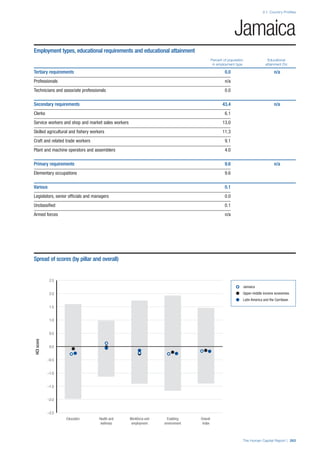
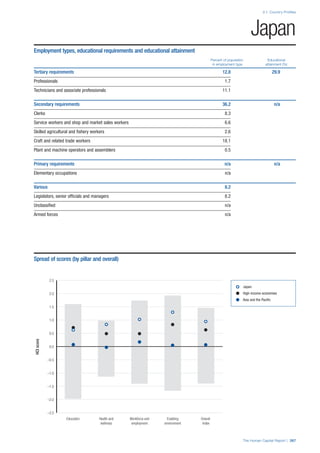
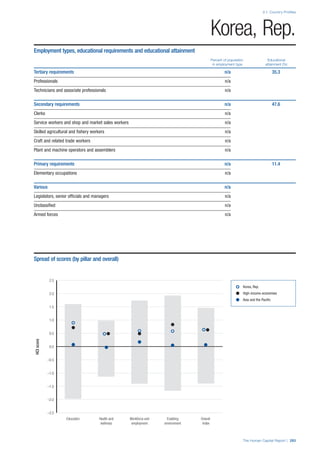
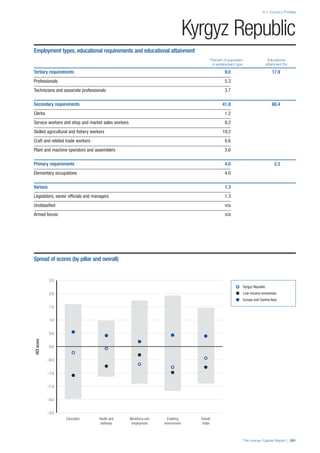
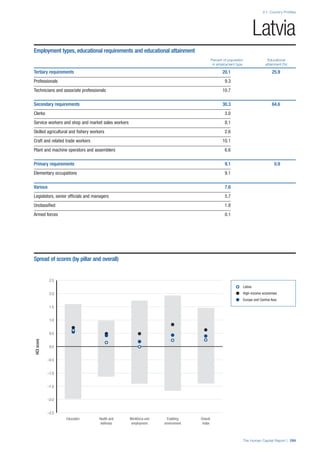
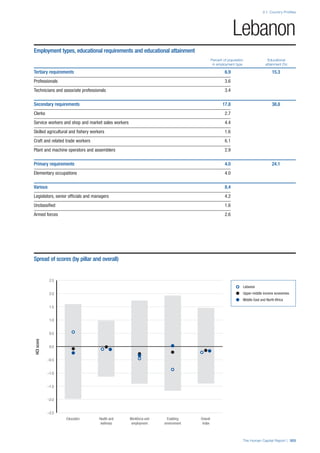
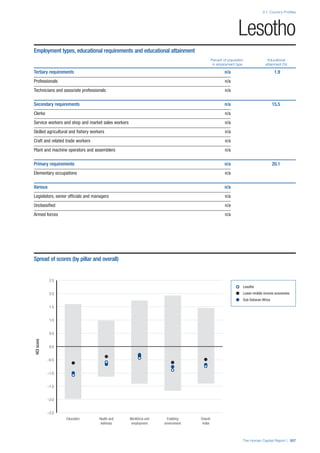
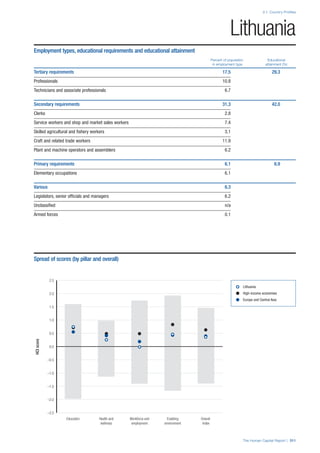
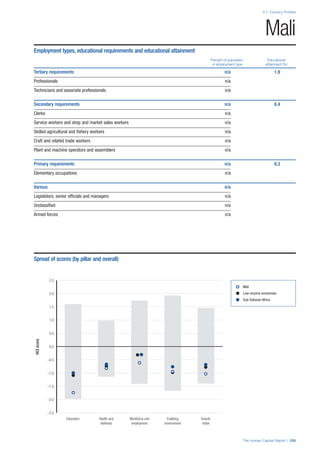
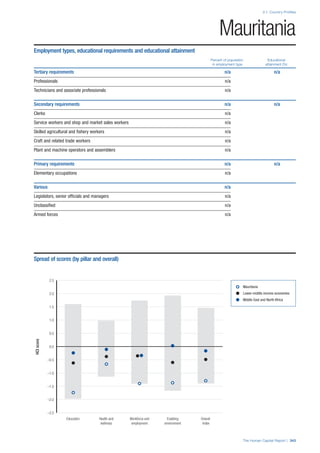
and labour force structure. The second page shows
information on occupation types and comparisons with
Part 1: Measuring Human Capital
4 | The Human Capital Report
“early childhood is the most important phase for overall
development throughout the lifespan,” elaborating that
“many challenges faced by adults, such as mental health
issues, obesity, heart disease, criminality, and poor literacy
and numeracy, can be traced back to early childhood.” 1
The Index thus includes measures indicating quality of
early childhood. Furthermore, the Index captures the extent
to which investments made in earlier years in health and
education are being realised in the working age population
through lifelong learning and training. Finally, at the other
end of the continuum, the Index takes into account the
health and productivity of the older population.
As a vital support to the Index, the Country Profiles
included in this Report contain a wide variety of contextual
factors. In particular, the Profiles call attention to population
dynamics, such as youth bulges, ageing populations
and shrinking workforces, which, in the context of limited
resources, point to critical areas for urgent– and longer–
term investments.
THE FOUR PILLARS
The four pillars of the Index are:
•	 The Health and Wellness pillar contains indicators
relating to a population’s physical and mental well–
being, from childhood to adulthood.
•	 The Education pillar contains indicators relating to
quantitative and qualitative aspects of education
across primary, secondary and tertiary levels and
contains information on both the present workforce as
well as the future workforce.
•	 The Workforce and Employment pillar is designed to
quantify the experience, talent, knowledge and training
in a country’s working–age population.
•	 The Enabling Environment pillar captures the legal
framework, infrastructure and other factors that enable
returns on human capital.
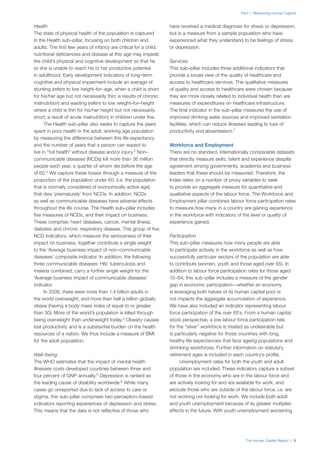
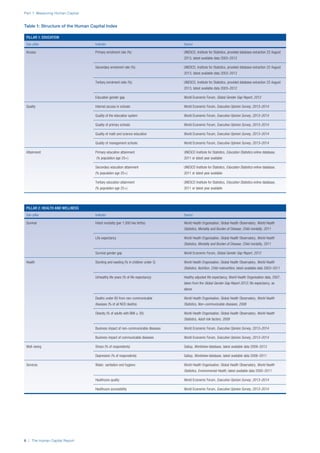
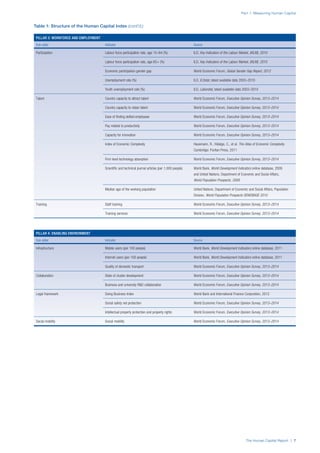
The Index contains 51 indicators in total, spread
across the four pillars, with 12 indicators in the Education
pillar, 14 in the Health and Wellness pillar, 16 in the
Workforce and Employment pillar and nine in the Enabling
Environment pillar. The values for each of the indicators
come from publicly available data produced by international
organizations such as the World Health Organization (WHO),
the United Nations Educational Scientific and Cultural
Organization (UNESCO) and the International Labour
Organization (ILO). In addition to hard data, the Index uses
qualitative survey data from the World Economic Forum’s
Executive Opinion Survey and Gallup’s wellness perception
survey data. A full overview of the Index indicators and
sources is included in Table 1 and detailed descriptions are
included in the section on How to Read the Country Profiles.
Education
The Education pillar captures several dimensions of
education—access to education and quality of education,
impacting the future labour force, and the educational
attainment of those already in the labour force.
Access to education
Access to education for today’s children and youth—the
future workforce—is captured using net adjusted enrolment
rates for primary and net enrolment rates for secondary
school, as well as through gross tertiary enrolment ratios
and a measure of the education gender gap. The net
enrolment ratios capture all children who are enrolling at
the right age for that school level. Social, in addition to
economic, marginalization still denies education to many.
The Education subindex from the World Economic Forum’s
Global Gender Gap Report, which measures the gap
between females’ and males’ access to the three selected
stages of education, is included in this pillar as an indicator
of educational inclusion.
Quality of education
Although access measures show exposure to learning, they
do not capture the quality of these learning environments.
A third of the Education pillar thus comprises qualitative
indicators, such as the quality of primary education, quality
of maths and science instruction, the quality of management
schools, the level of access to the Internet in schools and
the quality of the education system overall for meeting the
needs of a competitive economy.
Educational attainment
Included in this sub–pillar are three measures of
educational attainment to capture the percentage of the
population (aged 25 and over) who have achieved at least
primary, lower secondary or tertiary education.
Health and Wellness
The Health and Wellness pillar captures how various socio–
cultural, geographical, environmental and physiological
health factors impact human capital development. Based
on a life–course approach, it includes early development
indicators, that are predictive of the health of the future
workforce, and communicable and non–communicable
disease indicators that impact the productivity and
capacity of the current labour force.
Survival
A fundamental determinant of human capital is the survival
of its population. In the crudest terms, longer lives equal
more productive years per capita, but are also a strong
indicator of the overall health and living conditions of a
population. This sub–pillar includes a simple measure
of average life expectancy across the population, infant
mortality and the health parity sub–index from the World
Economic Forum’s Global Gender Gap Index.
The Human Capital Report | 5
Part 1: Measuring Human Capital
Health
The state of physical health of the population is captured
in the Health sub–pillar, focusing on both children and
adults. The first few years of infancy are critical for a child;
nutritional deficiencies and disease at this age may impede
the child’s physical and cognitive development so that he
or she is unable to reach his or her productive potential
in adulthood. Early development indicators of long–term
cognitive and physical impairment include an average of
stunting (refers to low height–for–age, when a child is short
for his/her age but not necessarily thin; a results of chronic
malnutrition) and wasting (refers to low weight–for–height
where a child is thin for his/her height but not necessarily
short; a result of acute malnutrition) in children under five.
The Health sub–pillar also seeks to capture the years
spent in poor health in the adult, working age population
by measuring the difference between this life expectancy
and the number of years that a person can expect to
live in “full health” without disease and/or injury.2
Non–
communicable diseases (NCDs) kill more than 36 million
people each year, a quarter of whom die before the age
of 60.3
We capture these losses through a measure of the
proportion of the population under 60, (i.e. the population
that is normally considered of economically active age),
that dies ‘prematurely’ from NCDs. In addition, NCDs
as well as communicable diseases have adverse effects
throughout the life course. The Health sub–pillar includes
five measures of NCDs, and their impact on business.
These comprise: heart diseases, cancer, mental illness,
diabetes and chronic respiratory disease. This group of five
NCD indicators, which measure the seriousness of their
impact on business, together contribute a single weight
to the ‘Average business impact of non–communicable
diseases’ composite indicator. In addition, the following
three communicable diseases: HIV, tuberculosis and
malaria combined, carry a further single weight for the
‘Average business impact of communicable diseases’
indicator.
In 2008, there were more than 1.4 billion adults in
the world overweight, and more than half a billion globally
obese (having a body mass index of equal to or greater
than 30). More of the world’s population is killed through
being overweight than underweight today.4
Obesity causes
lost productivity and is a substantial burden on the health
resources of a nation. We thus include a measure of BMI
for the adult population.
Well–being
The WHO estimates that the impact of mental health
illnesses costs developed countries between three and
four percent of GNP annually.5
Depression is ranked as
the leading cause of disability worldwide.6
While many
cases go unreported due to lack of access to care or
stigma, this sub–pillar comprises two perception–based
indicators reporting experiences of depression and stress.
This means that the data is not reflective of those who
have received a medical diagnosis for stress or depression,
but is a measure from a sample population who have
experienced what they understand to be feelings of stress
or depression.
Services
This sub–pillar includes three additional indicators that
provide a broad view of the quality of healthcare and
access to healthcare services. The qualitative measures
of quality and access to healthcare were chosen because
they are more closely related to individual health than are
measures of expenditures on healthcare infrastructure.
The final indicator in the sub–pillar measures the use of
improved drinking water sources and improved sanitation
facilities, which can reduce illnesses leading to loss of
productivity and absenteeism.7
Workforce and Employment
There are no standard, internationally comparable datasets
that directly measure skills, talent and experience despite
agreement among governments, academia and business
leaders that these should be measured. Therefore, the
Index relies on a number of proxy variables to seek
to provide an aggregate measure for quantitative and
qualitative aspects of the labour force. The Workforce and
Employment pillar combines labour force participation rates
to measure how many in a country are gaining experience
in the workforce with indicators of the level or quality of
experience gained.
Participation
This sub–pillar measures how many people are able
to participate actively in the workforce as well as how
successfully particular sectors of the population are able
to contribute (women, youth and those aged over 65). In
addition to labour force participation rates for those aged
15–64, this sub–pillar includes a measure of the gender
gap in economic participation—whether an economy
is leveraging both halves of its human capital pool or
not impacts the aggregate accumulation of experience.
We have also included an indicator representing labour
force participation of the over 65’s. From a human capital
stock perspective, a low labour force participation rate
for the “silver” workforce is treated as undesirable but
is particularly negative for those countries with long,
healthy life expectancies that face ageing populations and
shrinking workforces. Further information on statutory
retirement ages is included in each country’s profile.
Unemployment rates for both the youth and adult
population are included. These indicators capture a subset
of those in the economy who are in the labour force and
are actively looking for and are available for work, and
exclude those who are outside of the labour force, i.e. are
not working nor looking for work. We include both adult
and youth unemployment because of its greater multiplier
effects in the future. With youth unemployment worsening
Part 1: Measuring Human Capital
6 | The Human Capital Report
Table 1: Structure of the Human Capital Index
(cont’d.)
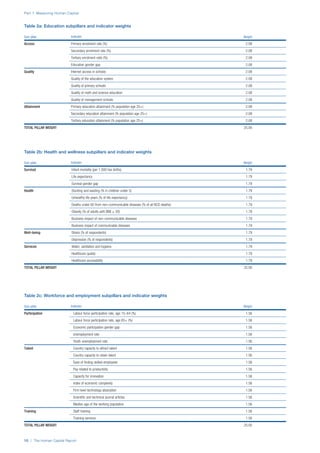
PILLAR 1: EDUCATION
Sub–pillar Indicator Source
Access Primary enrolment rate (%) UNESCO, Institute for Statistics, provided database extraction 22 August
2013, latest available data 2003–2012
Secondary enrolment rate (%) UNESCO, Institute for Statistics, provided database extraction 22 August
2013, latest available data 2003–2012
Tertiary enrolment ratio (%) UNESCO, Institute for Statistics, provided database extraction 22 August
2013, latest available data 2003–2012
Education gender gap World Economic Forum, Global Gender Gap Report, 2012
Quality Internet access in schools World Economic Forum, Executive Opinion Survey, 2013–2014
Quality of the education system World Economic Forum, Executive Opinion Survey, 2013–2014
Quality of primary schools World Economic Forum, Executive Opinion Survey, 2013–2014
Quality of math and science education World Economic Forum, Executive Opinion Survey, 2013–2014
Quality of management schools World Economic Forum, Executive Opinion Survey, 2013–2014
Attainment Primary education attainment
(% population age 25+)
UNESCO Institute for Statistics, Education Statistics online database,
2011 or latest year available
Secondary education attainment
(% population age 25+)
UNESCO Institute for Statistics, Education Statistics online database,
2011 or latest year available
Tertiary education attainment
(% population age 25+)
UNESCO Institute for Statistics, Education Statistics online database,
2011 or latest year available
PILLAR 2: HEALTH AND WELLNESS
Sub–pillar Indicator Source
Survival Infant mortality (per 1,000 live births) World Health Organisation, Global Health Observatory, World Health
Statistics, Mortality and Burden of Disease, Child mortality, 2011
Life expectancy World Health Organisation, Global Health Observatory, World Health
Statistics, Mortality and Burden of Disease, Child mortality, 2011
Survival gender gap World Economic Forum, Global Gender Gap Report, 2012
Health Stunting and wasting (% in children under 5) World Health Organisation, Global Health Observatory, World Health
Statistics, Nutrition, Child malnutrition, latest available data 2003–2011
Unhealthy life years (% of life expectancy) Healthy adjusted life expectancy, World Health Organisation data, 2007,
taken from the Global Gender Gap Report 2012; life expectancy, as
above
Deaths under 60 from non–communicable
diseases (% of all NCD deaths)
World Health Organisation, Global Health Observatory, World Health
Statistics, Non–communicable diseases, 2008
Obesity (% of adults with BMI ≥ 30) World Health Organisation, Global Health Observatory, World Health
Statistics, Adult risk factors, 2008
Business impact of non–communicable diseases World Economic Forum, Executive Opinion Survey, 2013–2014
Business impact of communicable diseases World Economic Forum, Executive Opinion Survey, 2013–2014
Well–being Stress (% of respondents) Gallup, Worldview database, latest available data 2009–2013
Depression (% of respondents) Gallup, Worldview database, latest available data 2006–2011
Services Water, sanitation and hygiene World Health Organisation, Global Health Observatory, World Health
Statistics, Environmental Health, latest available data 2005–2011
Healthcare quality World Economic Forum, Executive Opinion Survey, 2013–2014
Healthcare accessibility World Economic Forum, Executive Opinion Survey, 2013–2014
The Human Capital Report | 7
Part 1: Measuring Human Capital
Table 1: Structure of the Human Capital Index (cont’d.)
PILLAR 3: WORKFORCE AND EMPLOYMENT
Sub–pillar Indicator Source
Participation Labour force participation rate, age 15–64 (%) ILO, Key Indicators of the Labour Market, (KILM), 2010
Labour force participation rate, age 65+ (%) ILO, Key Indicators of the Labour Market, (KILM), 2010
Economic participation gender gap World Economic Forum, Global Gender Gap Report, 2012
Unemployment rate (%) ILO, ILOstat, latest available data 2003–2010
Youth unemployment rate (%) ILO, Laborstat, latest available data 2003–2010
Talent Country capacity to attract talent World Economic Forum, Executive Opinion Survey, 2013–2014
Country capacity to retain talent World Economic Forum, Executive Opinion Survey, 2013–2014
Ease of finding skilled employees World Economic Forum, Executive Opinion Survey, 2013–2014
Pay related to productivity World Economic Forum, Executive Opinion Survey, 2013–2014
Capacity for innovation World Economic Forum, Executive Opinion Survey, 2013–2014
Index of Economic Complexity Hausmann, R., Hidalgo, C., et al. The Atlas of Economic Complexity.
Cambridge: Puritan Press, 2011
Firm level technology absorption World Economic Forum, Executive Opinion Survey, 2013–2014
Scientific and technical journal articles (per 1,000 people) World Bank, World Development Indicators online database, 2009
and United Nations, Department of Economic and Social Affairs,
World Population Prospects, 2009
Median age of the working population United Nations, Department of Economic and Social Affairs, Population
Division, World Population Prospects DEMOBASE 2010
Training Staff training World Economic Forum, Executive Opinion Survey, 2013–2014
Training services World Economic Forum, Executive Opinion Survey, 2013–2014
PILLAR 4: ENABLING ENVIRONMENT
Sub–pillar Indicator Source
Infrastructure Mobile users (per 100 people) World Bank, World Development Indicators online database, 2011
Internet users (per 100 people) World Bank, World Development Indicators online database, 2011
Quality of domestic transport World Economic Forum, Executive Opinion Survey, 2013–2014
Collaboration State of cluster development World Economic Forum, Executive Opinion Survey, 2013–2014
Business and university R&D collaboration World Economic Forum, Executive Opinion Survey, 2013–2014
Legal framework Doing Business Index World Bank and International Finance Corporation, 2012
Social safety net protection World Economic Forum, Executive Opinion Survey, 2013–2014
Intellectual property protection and property rights World Economic Forum, Executive Opinion Survey, 2013–2014
Social mobility Social mobility World Economic Forum, Executive Opinion Survey, 2013–2014
Part 1: Measuring Human Capital
8 | The Human Capital Report
globally and with young people more than three times
more likely to be unemployed than adults, the ILO warns
of a “scarred generation” and that “youth unemployment
and underemployment impose heavy social and economic
costs, resulting in the loss of opportunities for economic
growth [...] and unutilized investment in education and
training.”8
Talent
This sub–pillar contains several concepts to capture a
broad, aggregate measure of talent. First, it contains a
high–level measure of the average level of experience in
an economy in the form of the median age of the working
age population (15–64). Second, it integrates business
leaders’ assessment of their countries ability to attract
and retain talent, of their companies’ ability to find skilled
employees and of the existence of merit–based rewards for
employees. Third, it assesses whether the talent available
in a country leads to economic results in the form of
production, learning within firms, innovation and knowledge
generation, captured through the Index of Economic
Complexity—countries that make sophisticated products
must possess the skills and expertise to do so—two
survey variables on firm level technology absorption and
capacity for innovation, and the prevalence of scientific and
technical journal articles.
Training
Two quantitative indicators serve as a proxy for continued
training and learning. The extent of staff training indicator
measures the extent to which companies invest in training
and employee development and the training services
indicator measures the extent to which high–quality
specialized training services are available.
Enabling Environment
The indicators included in this pillar capture whether
human capital is deployed effectively or whether barriers in
the environment are preventing the effective use of human
capital, thereby negating the investments made in human
capital development.
Infrastructure
This sub–pillar looks at three basic aspects of physical
and communication infrastructure as facilitators of human
capital. Physical transport, which facilitates access to
workplaces and is critical to connecting industry and
communities together, is measured through a survey
indicator on the quality of domestic transport. The use
of ICT, such as mobile phones and the Internet, can also
accelerate communication and exchange across the
complex networks that underpin human capital growth.
These are captured through prevalence indicators for
mobile phones and Internet use, respectively.
Collaboration
Cross–industry and cross–sector learning facilitate
innovation, information exchange and the development of
human capital. These concepts are captured through two
survey indicators from the Executive Opinion Survey. We
include a measure of the extent to which universities and
industry collaborate on R&D. We also include a measure of
how prevalent are well–developed and deep clusters.
Legal framework
This sub–pillar looks at the legal environment within which
people are employed self–employed. In particular, we
include the ease of doing business in a country, using
the World Bank’s Doing Business Index, which looks at
how conducive the legal and regulatory environment is to
starting and operating a local business. The protection
of both physical property and intellectual property is
important from a human capital perspective as it protects
the knowledge—the intangible assets—of an individual
as well as the assets connected with that knowledge.
This is measured through a combination of two survey
variables. We also include in this sub–pillar social safety
net protection for its role in preserving skills and knowledge
and reducing the attrition on human capital.
Social mobility
Finally, we include a measure of rigid socio–cultural
practices that may thwart progress in human capital
development despite investments through policy
instruments. The opportunity for an individual to transcend
social strata may be a significant motivational factor for
investment in their own and their offspring’s human capital
development. Therefore in countries where status is
ascribed rather than achieved, the incentive for investing in
human capital is reduced.
CONSTRUCTION OF THE INDEX
Standardizing data
The indicators used in the Index are measured on different
scales. To standardize the data, we used the z–score
statistic as it preserves the distribution of the data, a
feature most relevant for a comparative international
composite index.
Z–scores are expressed as standard deviations
from the mean. The mean is zero and has a standard
deviation of one. This means that all data points above
the mean are expressed as positive scores and all data
below the mean are expressed as negative scores. The
z–scores methodology is based on an assumption of the
normal distribution. A standard deviation of plus (minus) 1
represents the area 34.13% above (below) the mean (zero)
and a standard deviation of plus (minus) 2 represents the
area 47.72% above (below) the mean. The z–score of a
data point indicates the number of standard deviations
above or below the mean. So a z–score of –2 is exactly
two standard deviations, or 47.72%, below the mean.
The Human Capital Report | 9
Part 1: Measuring Human Capital
There are limitations to the z–score approach due
to the assumption that the underlying data is normally
distributed, which is not always the case and can thus
introduce uncertainty. Other data normalization options
were considered and rejected due to a greater degree
of distortion in the distribution of data. One common
approach in standard score methodology is to trim the
tails of the curve at plus or minus 2.5 standard deviations.
However, considering the further arbitrary distortions this
may create, a decision was made not to prune the data
at any point in order to represent the dataset in its purest
form.
Weights and missing data
Once all underlying data is converted to z–scores, a
country’s score on a given pillar is determined by an
unweighted average of all available scores within that pillar.
A country’s score on the overall index is an unweighted
average of the four pillar scores. Underlying weights are
reported in Tables 2a–2d.
Missing data is not imputed. The criterion for an
indicator to be included in the Index is that it must have
non–missing data for at least 50 percent of the countries.
The criterion for a country to be included in the Index is
that it must have non–missing data for at least 70 percent
of each of the pillar’s indicators. This means a country
must have data for at least:
•	 8 out of 12 indicators in the Education pillar
•	 10 out of 14 indicators in the Health and Wellness pillar
•	 11 out of 16 indicators in the Workforce and
Employment pillar
•	 6 out of 9 indicators in the Enabling Environment pillar
THE HUMAN CAPITAL INDEX: RANKINGS 2013
Country Coverage
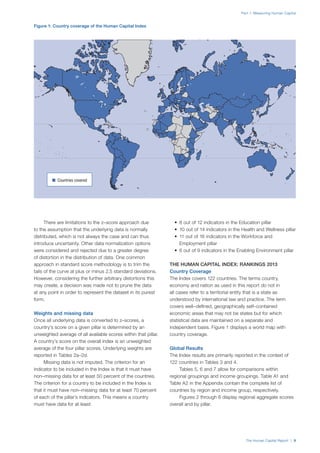
The Index covers 122 countries. The terms country,
economy and nation as used in this report do not in
all cases refer to a territorial entity that is a state as
understood by international law and practice. The term
covers well–defined, geographically self–contained
economic areas that may not be states but for which
statistical data are maintained on a separate and
independent basis. Figure 1 displays a world map with
country coverage.
Global Results
The Index results are primarily reported in the context of
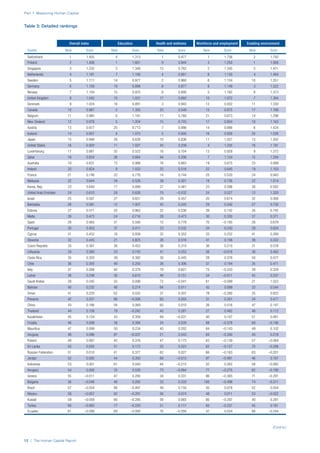
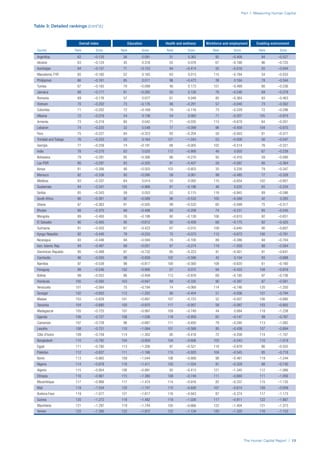
122 countries in Tables 3 and 4.
Tables 5, 6 and 7 allow for comparisons within
regional groupings and income groupings. Table A1 and
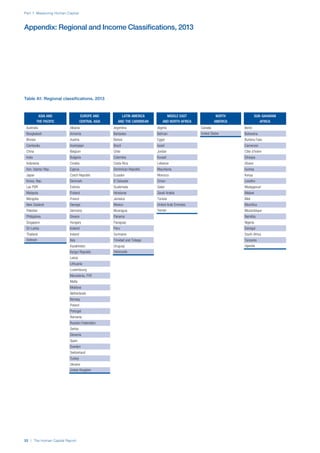
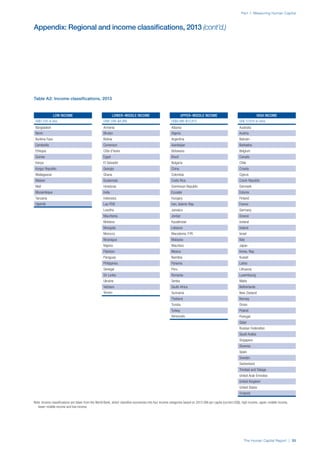
Table A2 in the Appendix contain the complete list of
countries by region and income group, respectively.
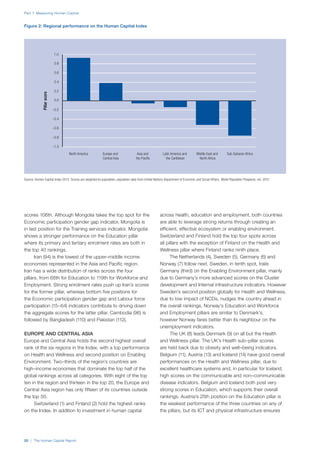
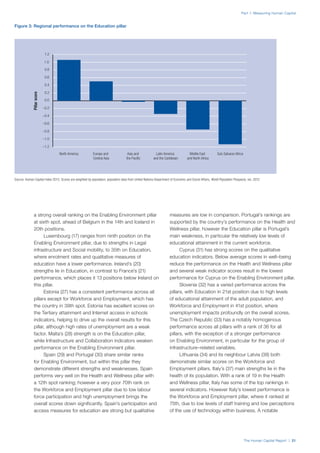
Figures 2 through 6 display regional aggregate scores
overall and by pillar.
Figure 1: Country coverage of the Human Capital Index
n  Countries covered
Part 1: Measuring Human Capital
10 | The Human Capital Report
Sub–pillar Indicator Weight
Participation Labour force participation rate, age 15–64 (%) 1.56
Labour force participation rate, age 65+ (%) 1.56
Economic participation gender gap 1.56
Unemployment rate 1.56
Youth unemployment rate 1.56
Talent Country capacity to attract talent 1.56
Country capacity to retain talent 1.56
Ease of finding skilled employees 1.56
Pay related to productivity 1.56
Capacity for innovation 1.56
Index of economic complexity 1.56
Firm level technology absorption 1.56
Scientific and technical journal articles 1.56
Median age of the working population 1.56
Training Staff training 1.56
Training services 1.56
TOTAL PILLAR WEIGHT 25.00
Table 2c: Workforce and employment subpillars and indicator weights
Sub–pillar Indicator Weight
Access Primary enrolment rate (%) 2.08
Secondary enrolment rate (%) 2.08
Tertiary enrolment ratio (%) 2.08
Education gender gap 2.08
Quality Internet access in schools 2.08
Quality of the education system 2.08
Quality of primary schools 2.08
Quality of math and science education 2.08
Quality of management schools 2.08
Attainment Primary education attainment (% population age 25+) 2.08
Secondary education attainment (% population age 25+) 2.08
Tertiary education attainment (% population age 25+) 2.08
TOTAL PILLAR WEIGHT 25.00
Table 2a: Education subpillars and indicator weights
Sub–pillar Indicator Weight
Survival Infant mortality (per 1,000 live births) 1.79
Life expectancy 1.79
Survival gender gap 1.79
Health Stunting and wasting (% in children under 5) 1.79
Unhealthy life years (% of life expectancy) 1.79
Deaths under 60 from non–communicable diseases (% of all NCD deaths). 1.79
Obesity (% of adults with BMI ≥ 30) 1.79
Business impact of non–communicable diseases 1.79
Business impact of communicable diseases 1.79
Well–being Stress (% of respondents) 1.79
Depression (% of respondents) 1.79
Services Water, sanitation and hygiene 1.79
Healthcare quality 1.79
Healthcare accessibility 1.79
TOTAL PILLAR WEIGHT 25.00
Table 2b: Health and wellness subpillars and indicator weights
The Human Capital Report | 11
Part 1: Measuring Human Capital
TOP TEN
The top ten countries are dominated by the European
countries, with eight of the top ten spots occupied by
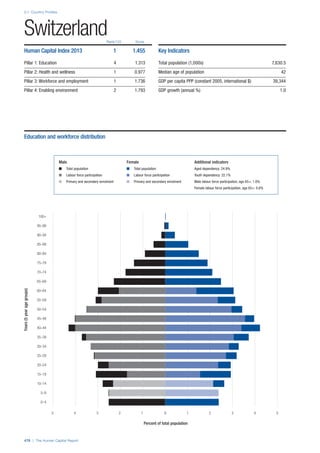
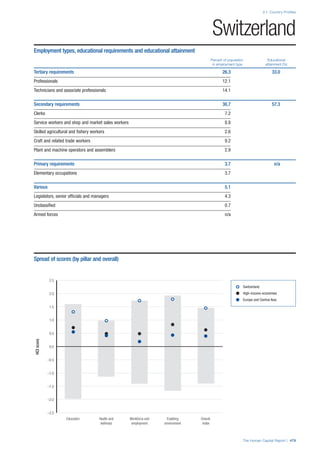
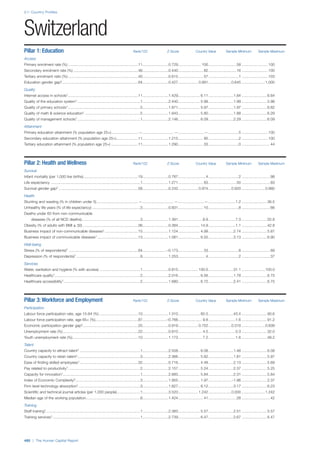
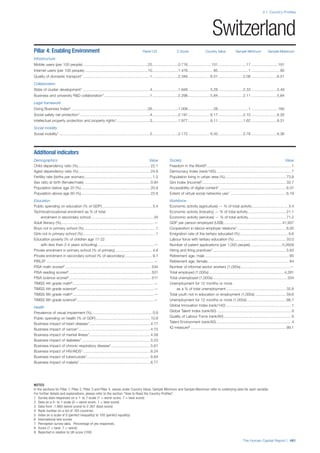
countries from this region. Switzerland (1) tops the rankings
for the Human Capital Index, demonstrating consistently
high scores across all four pillars, with top spots on Health
and Wellness and Workforce and Employment, second
place on Enabling Environment and fourth on Education.
Within the countries from Northern and Western
Europe in the top ten, four Nordic countries, Finland
(2), Sweden (5), Norway (7) and Denmark (9) dominate.
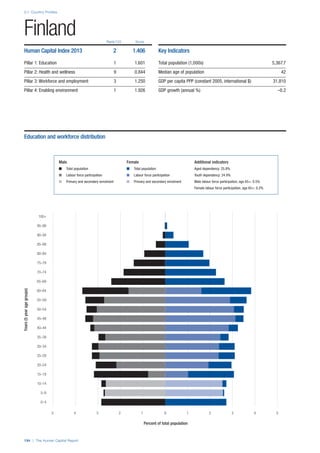
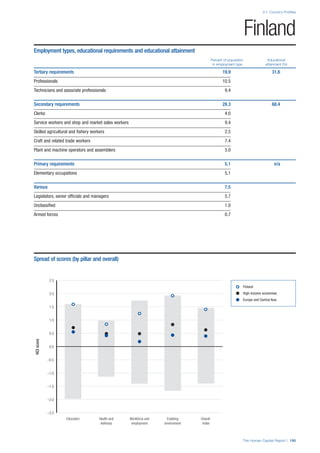
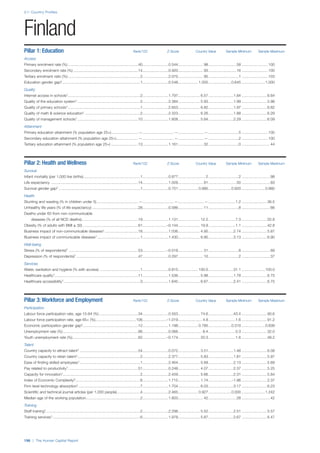
Finland’s exemplary Education and Enabling Environment
scores put it at the top of the rankings for these two pillars
and seven ranks ahead of the next highest–ranking Nordic
country. The overall strength of the Nordic region lies in the
Workforce and Employment pillar, with Finland, Norway
and Sweden occupying three of the top six ranks. Denmark
drops out of the top ten, to 12th position in this pillar and
down to 11th position for the Enabling Environment pillar.
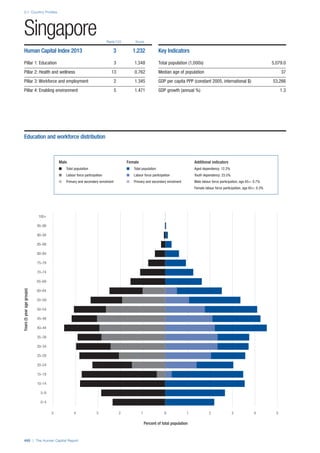
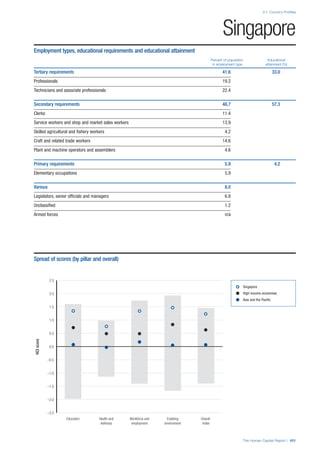
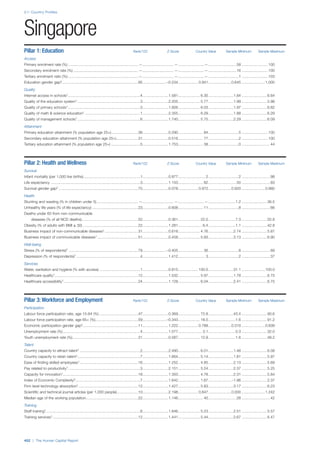
Singapore (3) is the only Asian country in the top
ten due to very strong scores on the Education pillar,
Workforce and Employment pillar and a strong fifth position
on the Enabling Environment pillar.
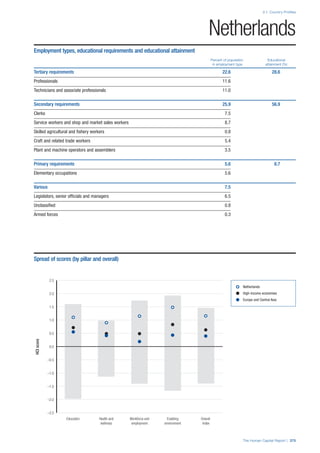
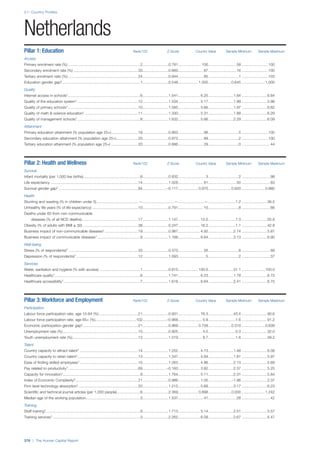
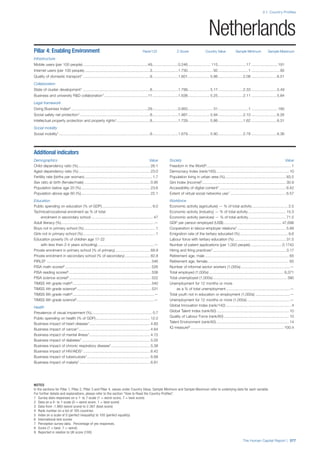
The Netherlands (4) is the third of the European
countries in the top ten due to strong performances
for Health and Wellness and for Enabling Environment.
Germany (6) just edges ahead of the Netherlands on the
Enabling Environment rankings in third place but holds
ninth position on the Workforce and Employment pillar.
Germany’s relatively low place on the Education pillar (19)
pulls down the country’s overall score in the Index.
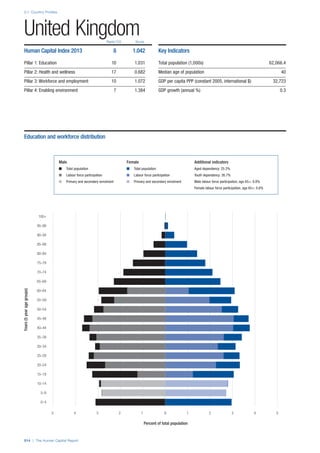
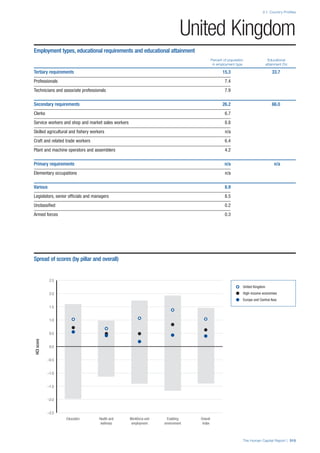
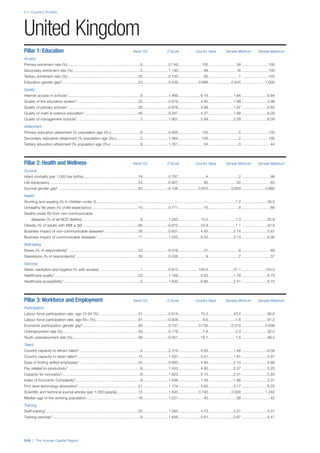
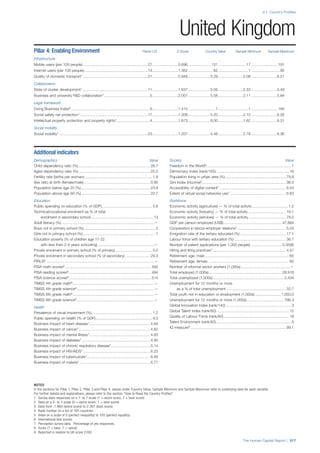
The United Kingdom (8) performs well on Enabling
Environment but has lower scores on Health and Wellness,
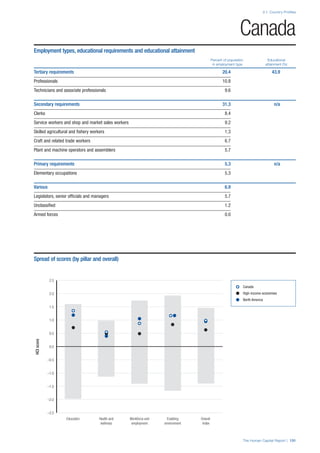
holding 17th position. Canada (10) is the first of the two
North American countries in the Index and the only one in
the top ten. Canada’s overall scores are greatly enhanced
by its second position on the Education pillar. Ranks for
the remaining three pillars vary between 15th and 20th
position.
ASIA AND THE PACIFIC
The region has a diverse spread of wealth, comprising
five of the sample’s high–income economies, four upper–
middle income, nine lower–middle economies as well as
Bangladesh and Cambodia, two low–income countries.
As a region, Asia ranks third overall, behind North America
and Europe and Central Asia.
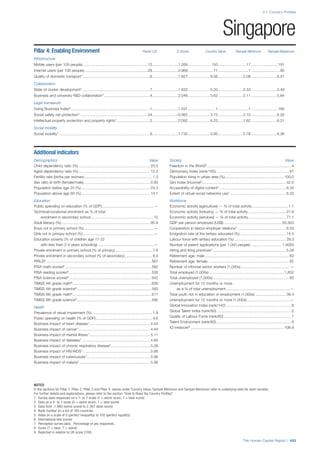
Singapore (3) is the highest ranked of the region’s
countries and the only country from the region in the top
ten. Singapore’s excellent rank is due to its very strong
scores on the Education and Workforce and Employment
pillars, and good scores on Enabling Environment.
Exceptionally strong scores across the qualitative
education indicators and the high level of tertiary education
among the adult population drive up its Education
pillar ranking. Strengths on the Enabling Environment’s
Collaboration and Legal framework sub–pillars include a
top rank on the Doing Business Index. The Health and
Wellness pillar is weakened mainly due to the burden of
disease in the country.
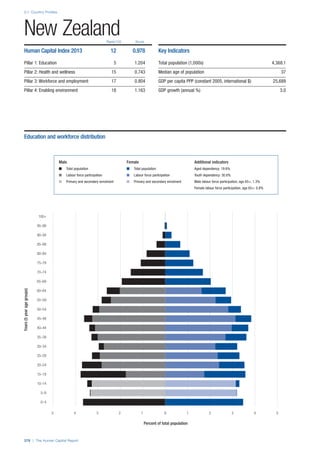
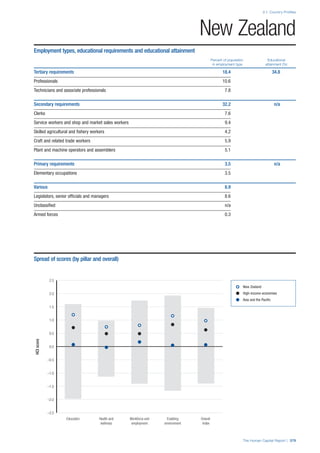
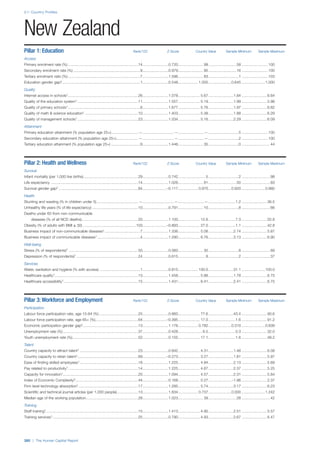
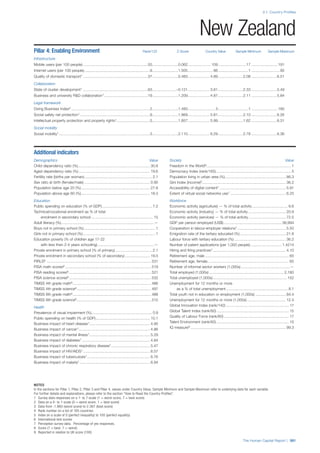
Despite the Enabling Environment being New
Zealand’s (12) weakest pillar at 18th, the country also
performs very well in some aspects, with top ten ranks
across the Legal framework sub–pillar and a rank of 3
in Social mobility. New Zealand’s strengths in Education
are similar to those of Singapore, but it ranks lower in
the qualitative talent indicators on the Workforce and
Employment pillar, including a particularly low rank (69) for
the ability of the country to retain talent, or the ‘brain drain’
indicator.
Japan’s (15) strong performance in Health and
Wellness is due to excellent scores in the Health and
the Survival sub–pillars. Top rankings for life expectancy
and years lived in good health help drive the strong
rankings. Japan’s training indicators on the Workforce and
Employment pillar are also strong, with top ten rankings.
Enrolment rates in secondary education rank at the top
while the Primary enrolment indicator gives Japan third
place. However Japan’s relatively weaker spots in the
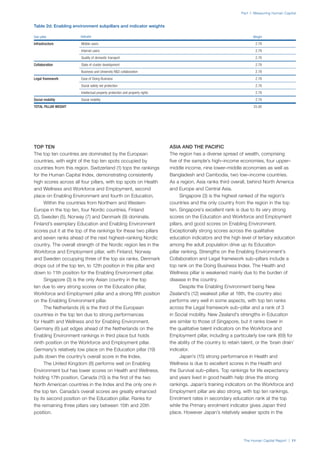
Sub–pillar Indicator Weight
Infrastructure Mobile users 2.78
Internet users 2.78
Quality of domestic transport 2.78
Collaboration State of cluster development 2.78
Business and University R&D collaboration 2.78
Legal framework Ease of Doing Business 2.78
Social safety net protection 2.78
Intellectual property protection and property rights 2.78
Social mobility Social mobility 2.78
TOTAL PILLAR WEIGHT 25.00
Table 2d: Enabling environment subpillars and indicator weights
Part 1: Measuring Human Capital
12 | The Human Capital Report
Overall index Education Health and wellness Workforce and employment Enabling environment
Country Rank Score Rank Score Rank Score Rank Score Rank Score
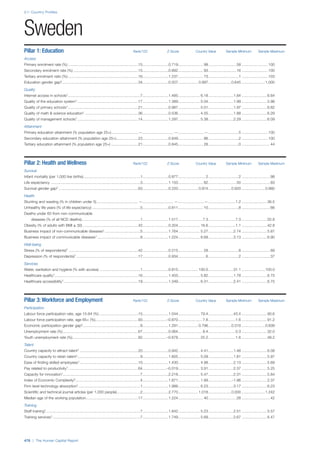
Switzerland 1 1.455 4 1.313 1 0.977 1 1.736 2 1.793
Finland 2 1.406 1 1.601 9 0.844 3 1.250 1 1.926
Singapore 3 1.232 3 1.348 13 0.762 2 1.345 5 1.471
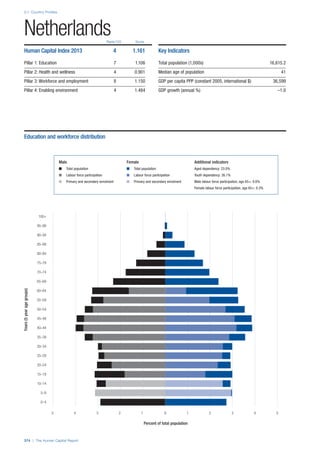
Netherlands 4 1.161 7 1.106 4 0.901 8 1.150 4 1.484
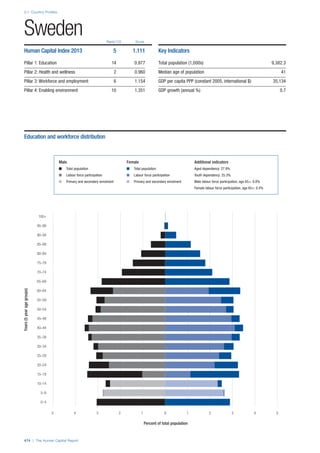
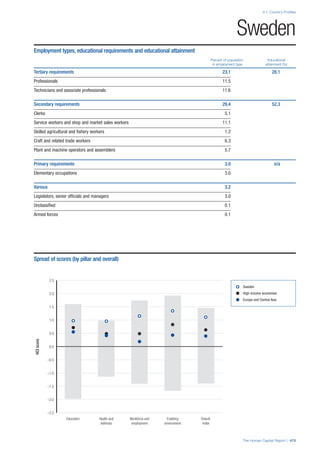
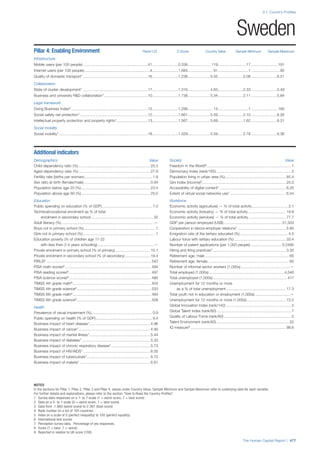
Sweden 5 1.111 14 0.977 2 0.960 6 1.154 10 1.351
Germany 6 1.109 19 0.888 8 0.877 9 1.149 3 1.522
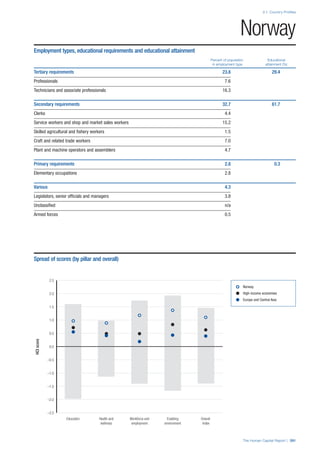
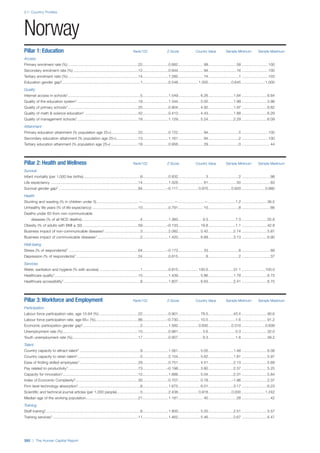
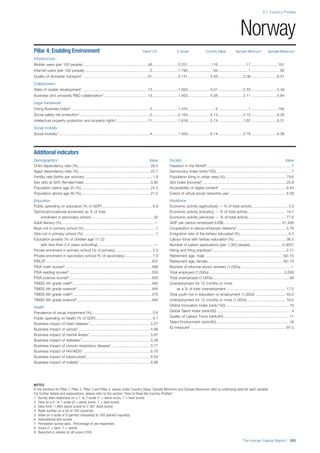
Norway 7 1.104 15 0.970 6 0.890 5 1.182 8 1.373
United Kingdom 8 1.042 10 1.031 17 0.682 10 1.072 7 1.384
Denmark 9 1.024 18 0.891 3 0.943 12 0.932 11 1.330
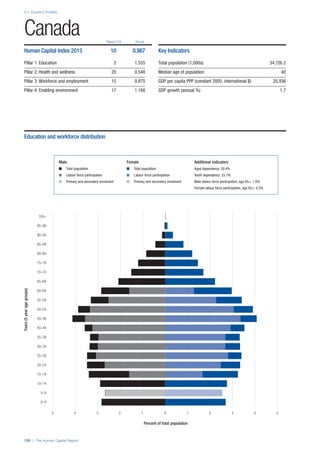
Canada 10 0.987 2 1.355 20 0.548 15 0.875 17 1.168
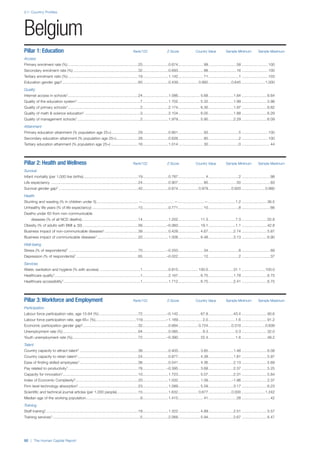
Belgium 11 0.985 6 1.191 11 0.780 21 0.673 14 1.296
New Zealand 12 0.978 5 1.204 15 0.743 17 0.804 18 1.163
Austria 13 0.977 25 0.713 7 0.886 14 0.886 6 1.424
Iceland 14 0.957 8 1.075 5 0.900 16 0.826 20 1.026
Japan 15 0.948 28 0.628 10 0.836 11 1.027 13 1.302
United States 16 0.920 11 1.027 43 0.239 4 1.235 16 1.181
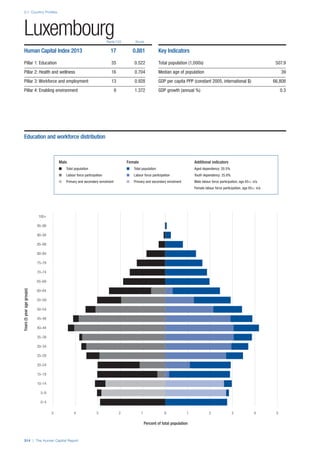
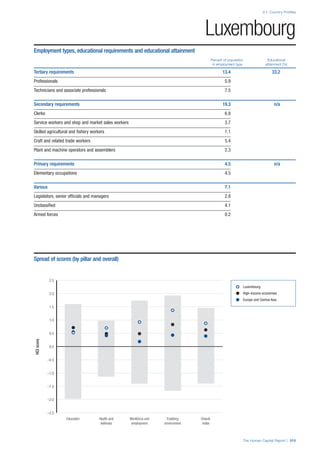
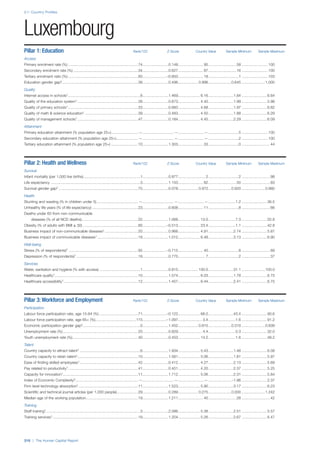
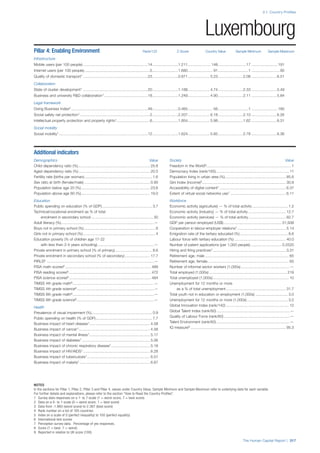
Luxembourg 17 0.881 35 0.522 16 0.704 13 0.928 9 1.372
Qatar 18 0.834 26 0.684 44 0.206 7 1.154 15 1.294
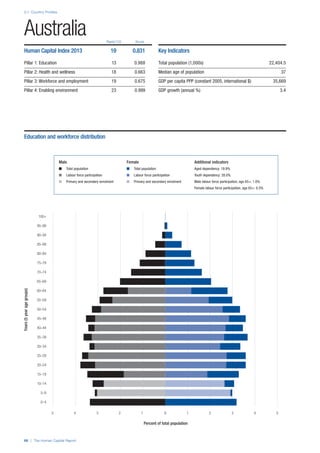
Australia 19 0.831 13 0.988 18 0.663 19 0.675 23 0.999
Ireland 20 0.824 9 1.033 25 0.516 22 0.645 19 1.103
France 21 0.746 22 0.776 14 0.744 25 0.520 24 0.943
Malaysia 22 0.644 34 0.526 39 0.301 18 0.736 22 1.014
Korea, Rep. 23 0.640 17 0.899 27 0.481 23 0.596 30 0.582
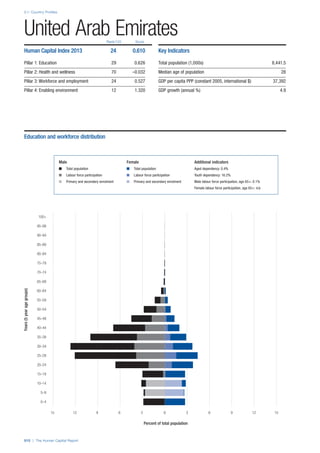
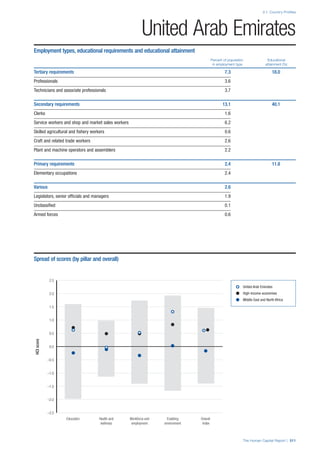
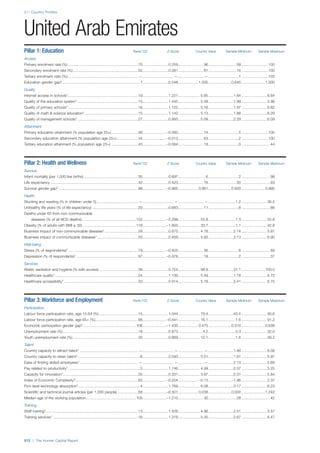
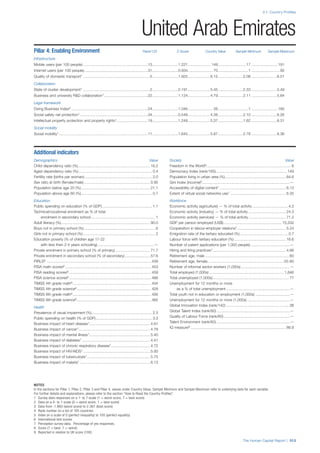
United Arab Emirates 24 0.610 29 0.626 70 –0.032 24 0.527 12 1.320
Israel 25 0.587 27 0.651 29 0.457 20 0.674 32 0.568
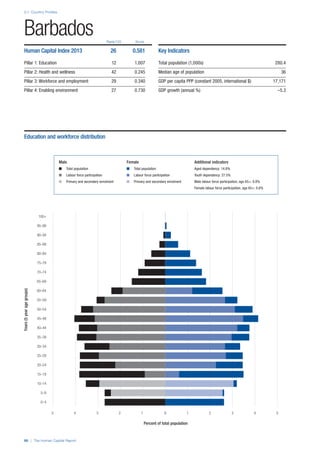
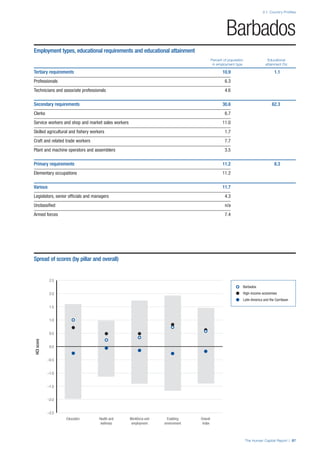
Barbados 26 0.581 12 1.007 42 0.245 29 0.340 27 0.730
Estonia 27 0.571 20 0.862 22 0.536 39 0.142 26 0.745
Malta 28 0.473 24 0.716 28 0.473 30 0.330 37 0.371
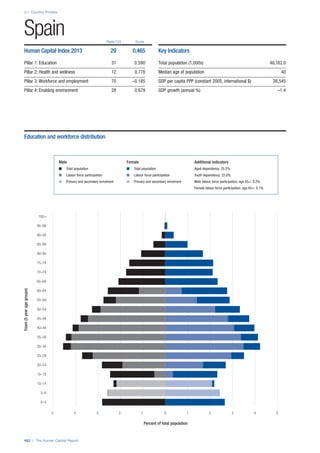
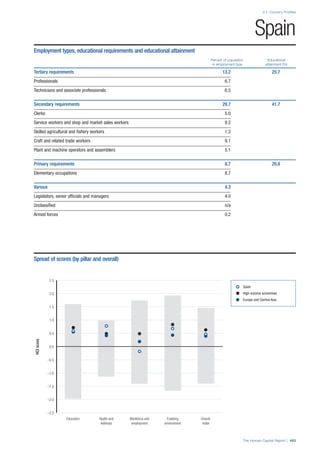
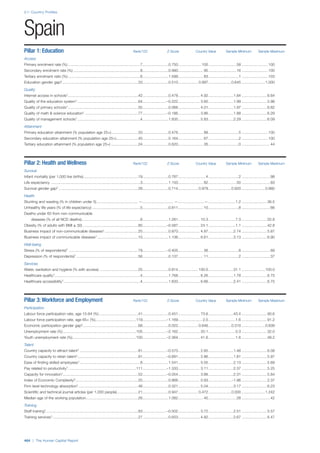
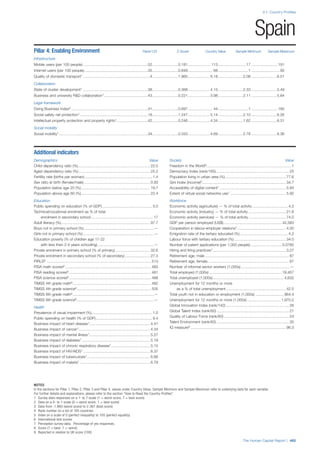
Spain 29 0.465 31 0.590 12 0.778 70 –0.185 28 0.679
Portugal 30 0.453 37 0.411 23 0.532 34 0.243 29 0.624
Cyprus 31 0.452 16 0.938 32 0.352 33 0.252 41 0.268
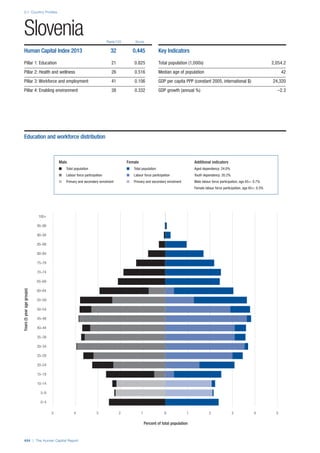
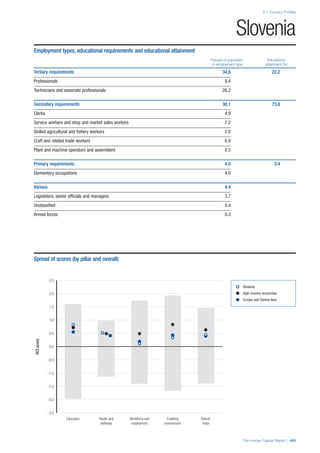
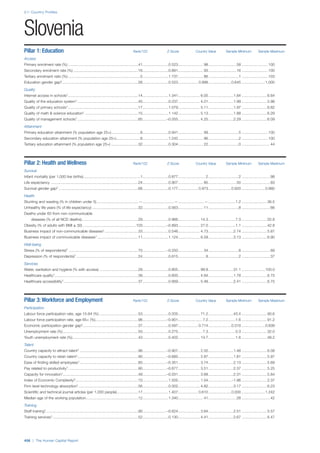
Slovenia 32 0.445 21 0.825 26 0.516 41 0.106 38 0.332
Czech Republic 33 0.387 36 0.452 36 0.310 36 0.210 31 0.576
Lithuania 34 0.360 23 0.745 41 0.252 56 –0.018 36 0.462
Costa Rica 35 0.320 39 0.382 30 0.445 28 0.378 50 0.077
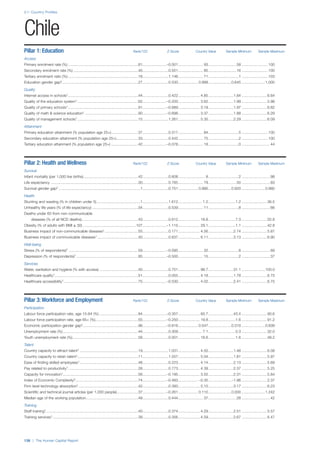
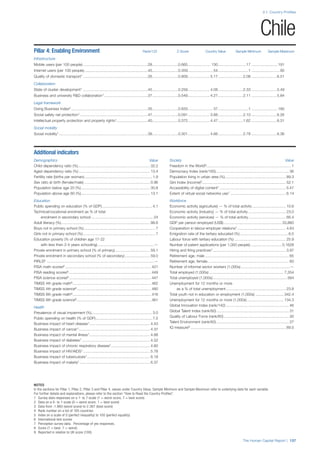
Chile 36 0.305 49 0.250 38 0.306 37 0.194 35 0.471
Italy 37 0.266 40 0.378 19 0.601 75 –0.243 39 0.329
Latvia 38 0.248 30 0.615 48 0.151 54 –0.011 43 0.237
Saudi Arabia 39 0.245 55 0.098 72 –0.041 61 –0.099 21 1.023
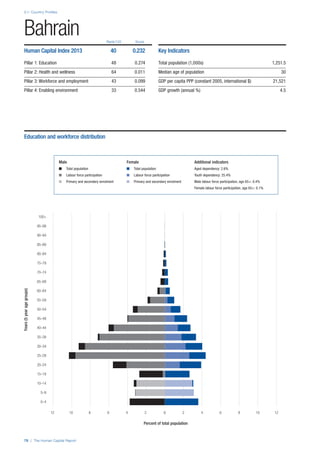
Bahrain 40 0.232 48 0.274 64 0.011 43 0.099 33 0.544
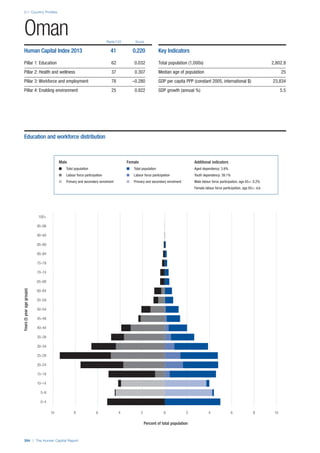
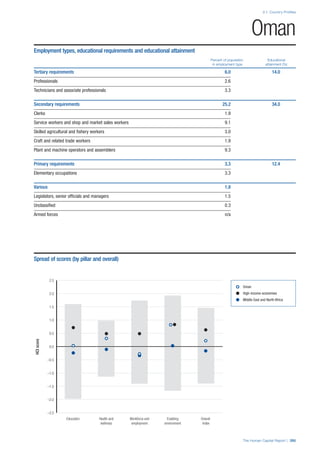
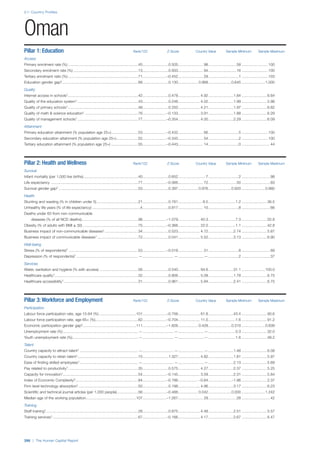
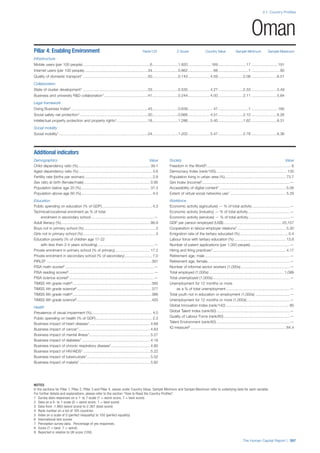
Oman 41 0.220 62 0.032 37 0.307 78 –0.280 25 0.822
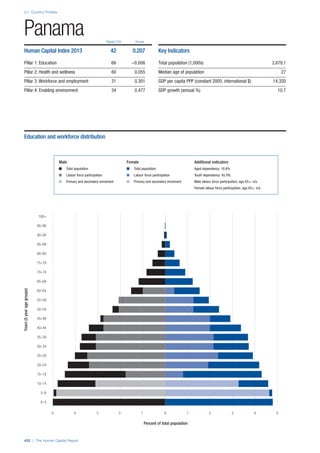
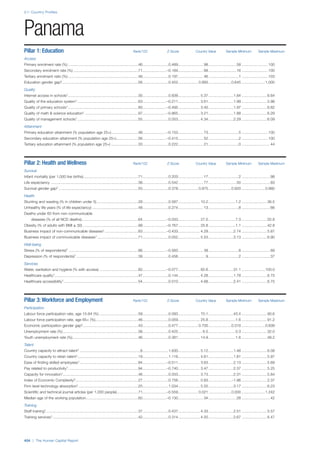
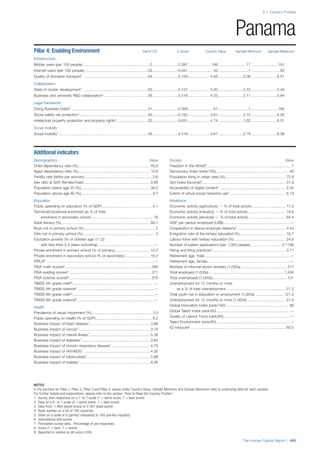
Panama 42 0.207 66 –0.006 60 0.055 31 0.301 34 0.477
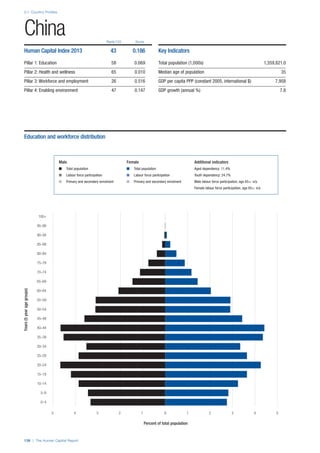
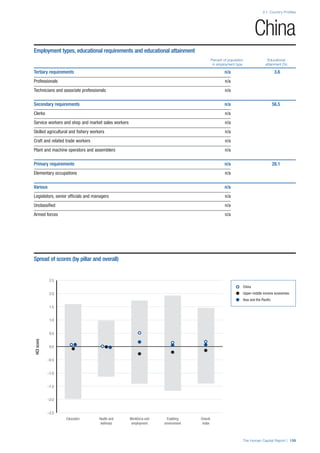
China 43 0.186 58 0.069 65 0.010 26 0.516 47 0.147
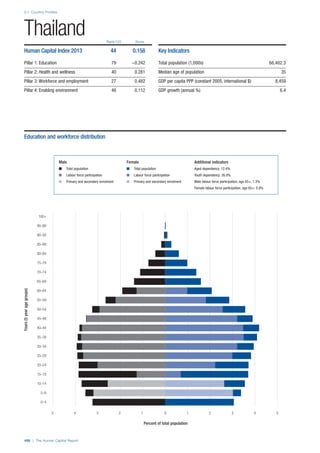
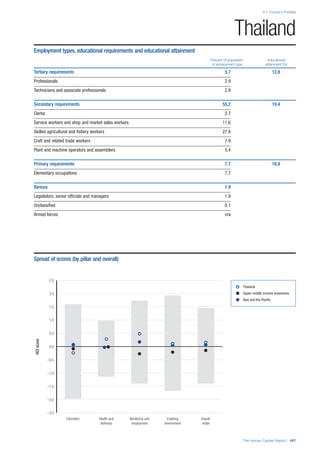
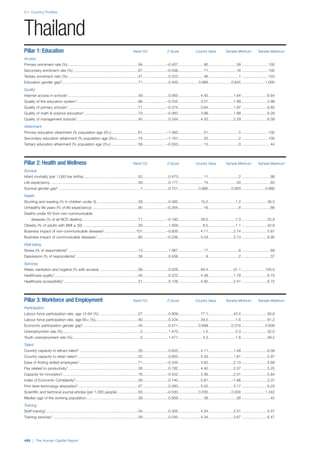
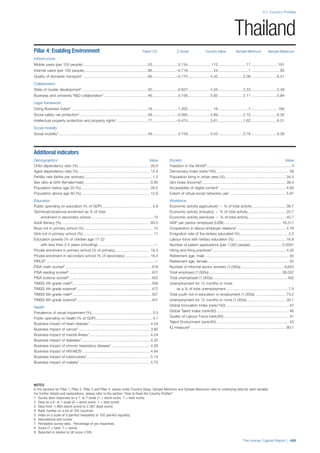
Thailand 44 0.158 79 –0.242 40 0.281 27 0.482 48 0.112
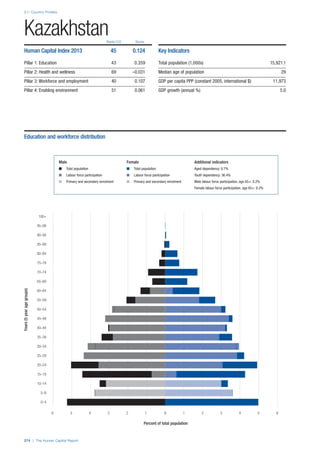
Kazakhstan 45 0.124 43 0.359 69 –0.031 40 0.107 51 0.061
Croatia 46 0.099 38 0.394 24 0.526 88 –0.378 60 –0.146
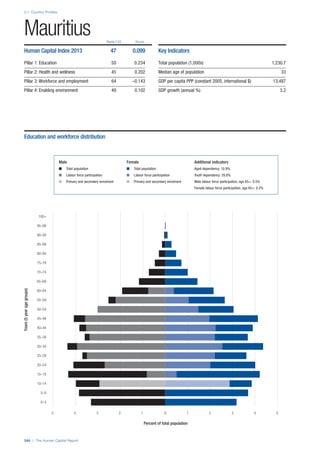
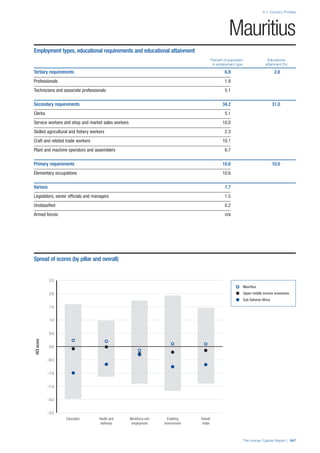
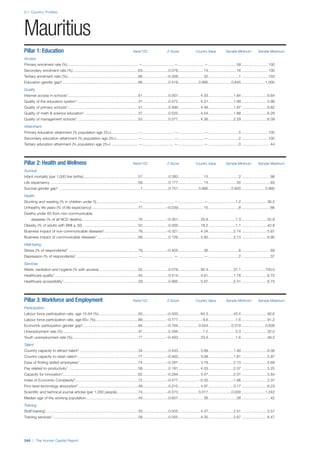
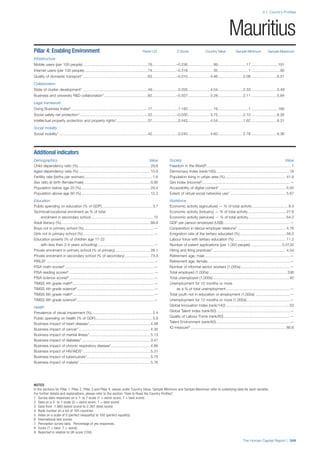
Mauritius 47 0.099 50 0.234 45 0.202 64 –0.143 49 0.102
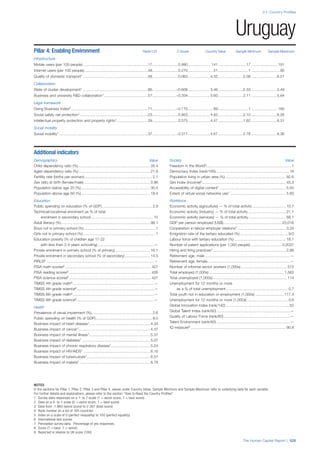
Uruguay 48 0.096 67 –0.037 21 0.543 84 –0.340 44 0.219
Poland 49 0.087 42 0.376 47 0.173 63 –0.139 57 –0.064
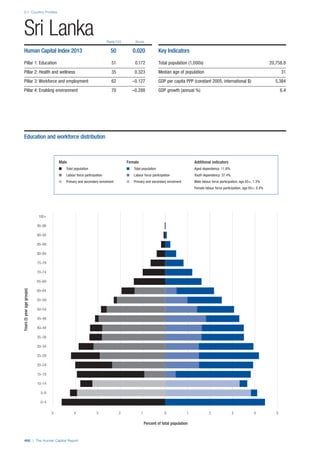
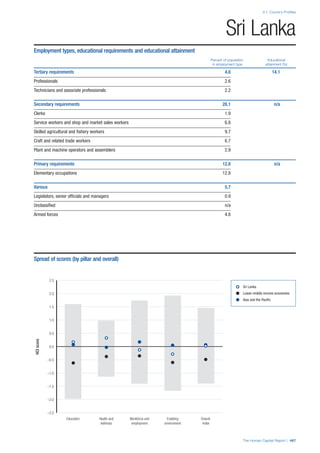
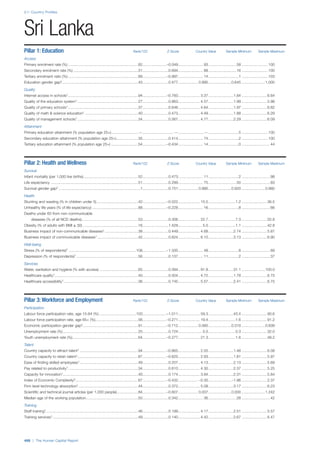
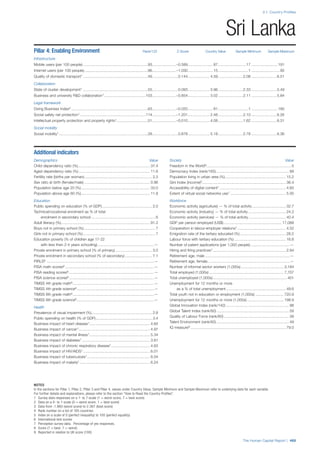
Sri Lanka 50 0.020 51 0.172 35 0.323 62 –0.127 70 –0.288
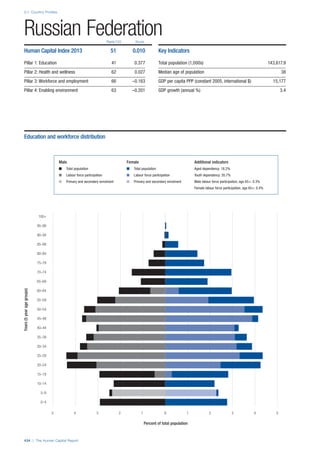
Russian Federation 51 0.010 41 0.377 62 0.027 66 –0.163 63 –0.201
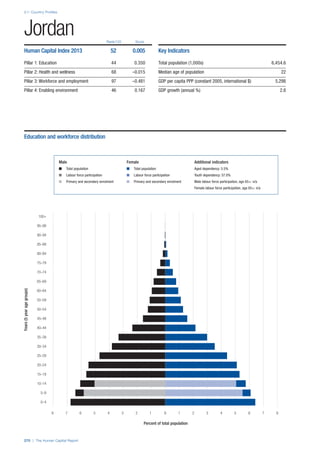
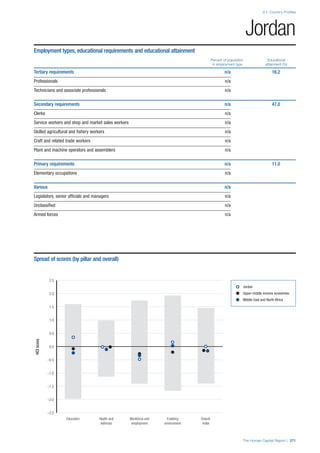
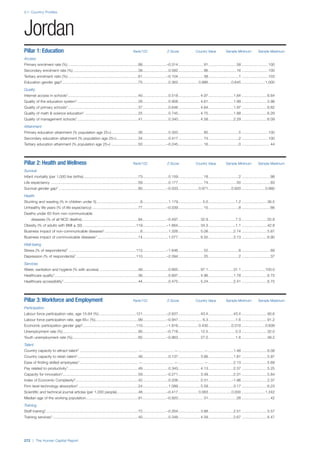
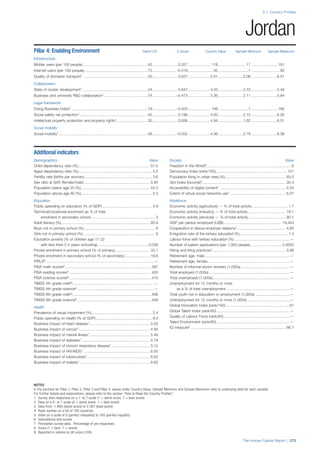
Jordan 52 0.005 44 0.350 68 –0.015 97 –0.481 46 0.167
Indonesia 53 0.001 61 0.040 84 –0.215 32 0.262 58 –0.082
Hungary 54 0.000 33 0.530 73 –0.064 77 –0.275 62 –0.190
Greece 55 –0.011 47 0.280 34 0.331 86 –0.365 71 –0.291
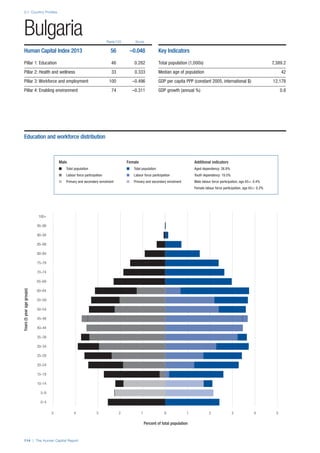
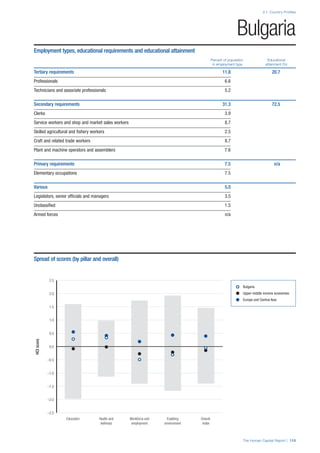
Bulgaria 56 –0.048 46 0.282 33 0.333 100 –0.496 74 –0.311
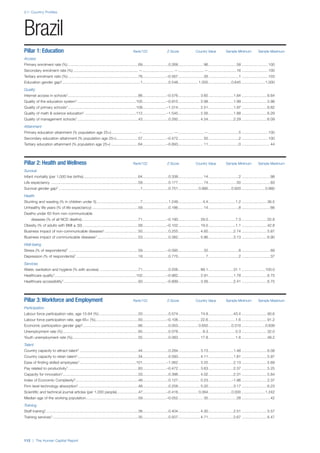
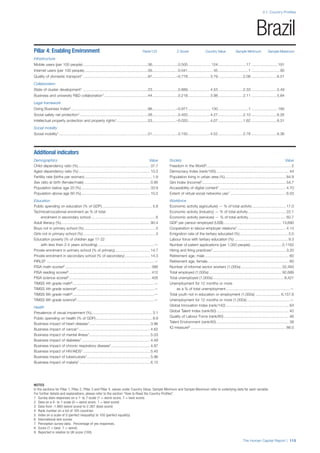
Brazil 57 –0.054 88 –0.497 49 0.150 45 0.078 52 0.054
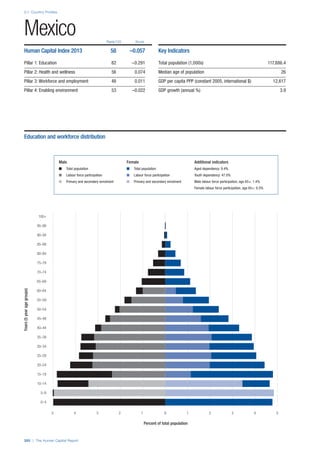
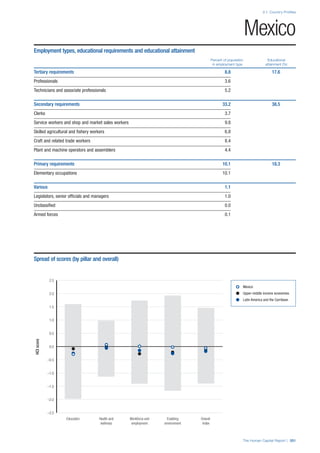
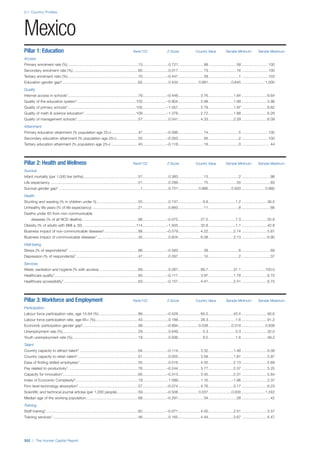
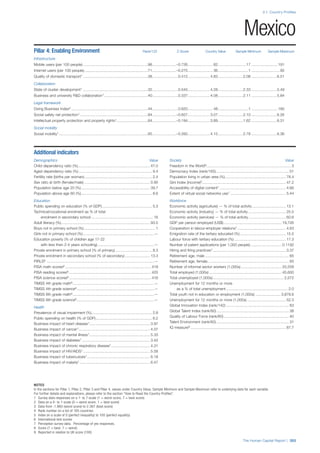
Mexico 58 –0.057 82 –0.291 56 0.074 48 0.011 53 –0.022
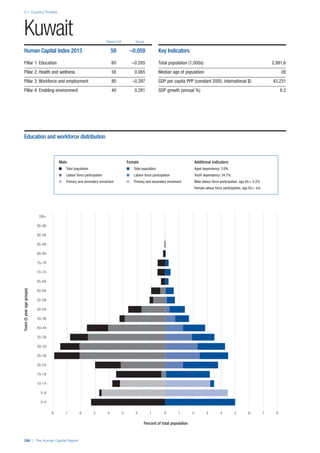
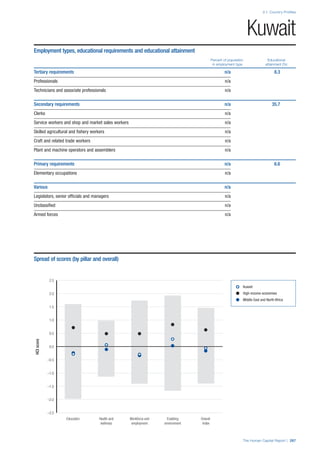
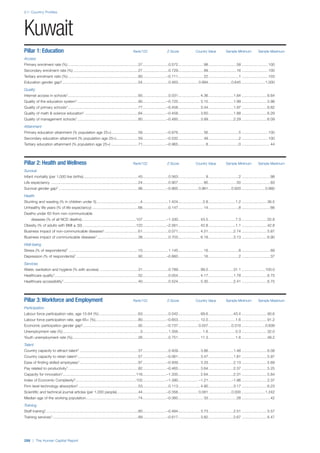
Kuwait 59 –0.059 80 –0.285 58 0.065 80 –0.297 40 0.281
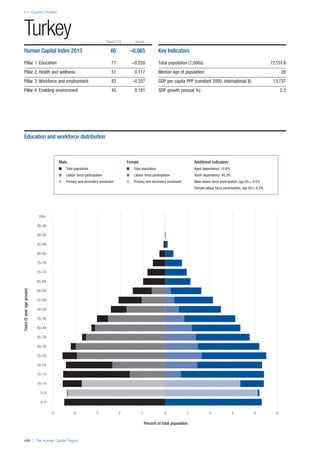
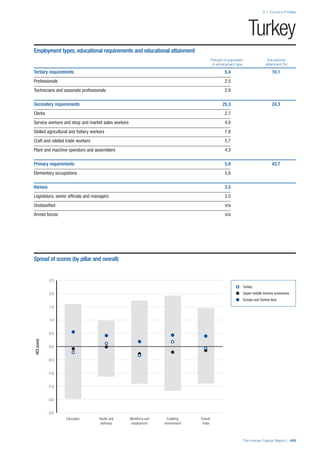
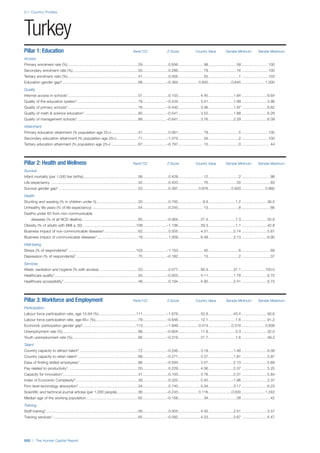
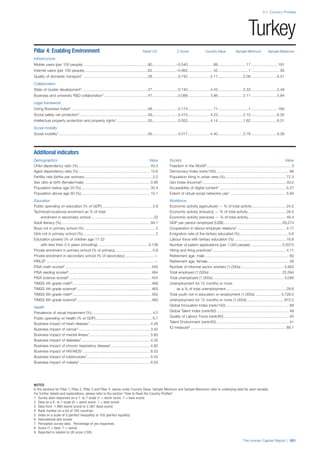
Turkey 60 –0.065 77 –0.220 51 0.117 83 –0.337 45 0.181
Ecuador 61 –0.099 69 –0.090 76 –0.094 47 0.034 68 –0.244
Table 3: Detailed rankings
(Cont’d.)
The Human Capital Report | 13
Part 1: Measuring Human Capital
Table 3: Detailed rankings (cont’d.)
Overall index Education Health and wellness Workforce and employment Enabling environment
Country Rank Score Rank Score Rank Score Rank Score Rank Score
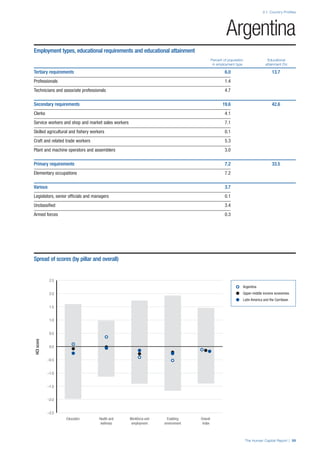
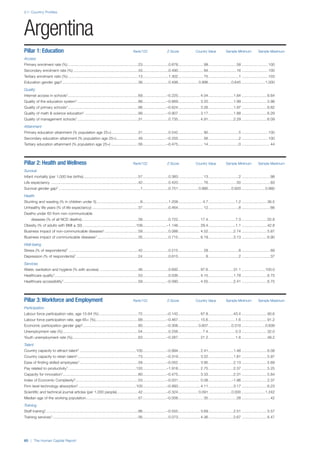
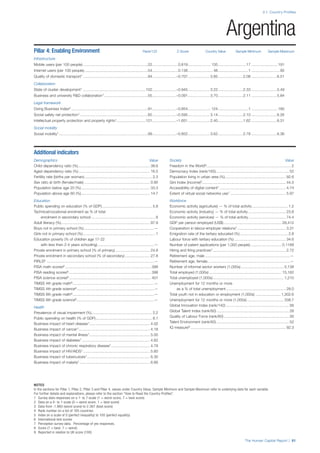
Argentina 62 –0.120 56 0.091 31 0.362 92 –0.408 84 –0.527
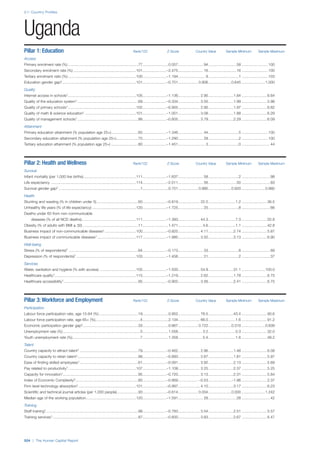
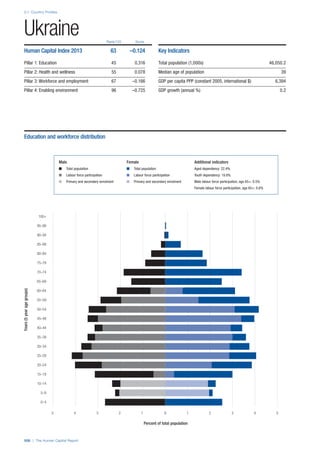
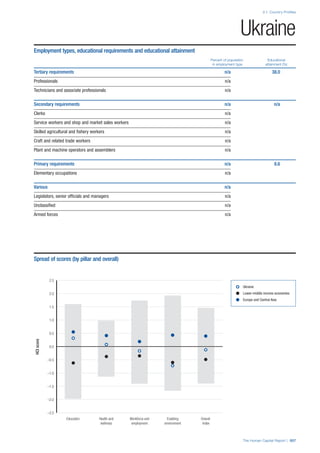
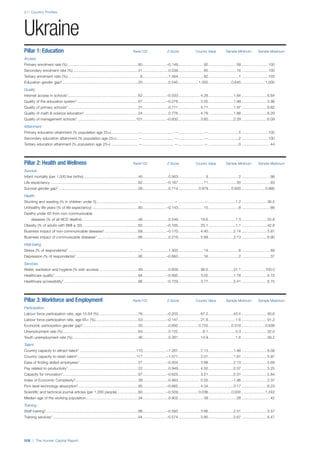
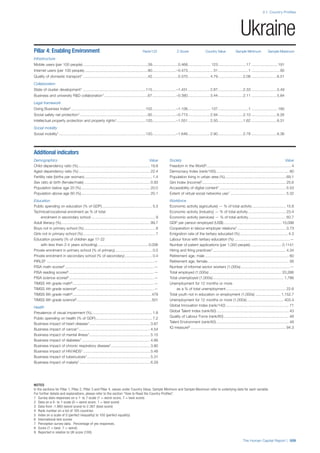
Ukraine 63 –0.124 45 0.316 55 0.078 67 –0.166 96 –0.725
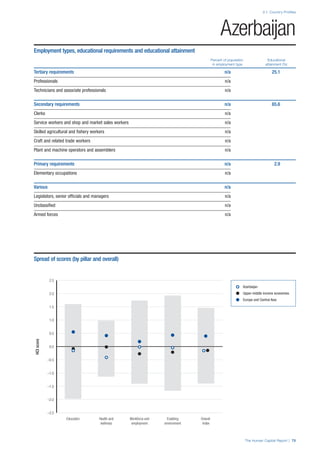
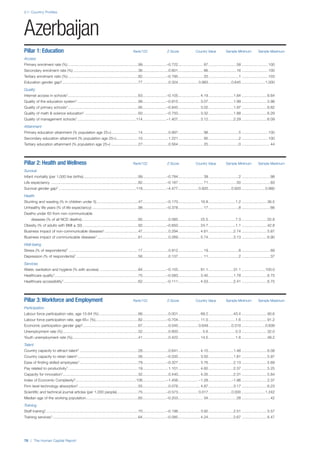
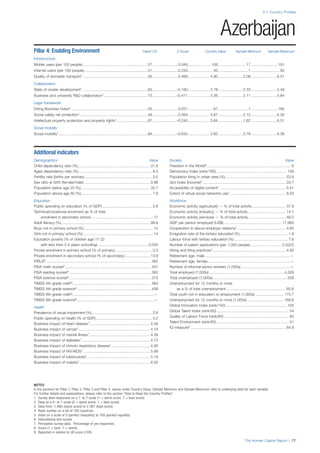
Azerbaijan 64 –0.157 71 –0.153 94 –0.414 55 –0.016 55 –0.044
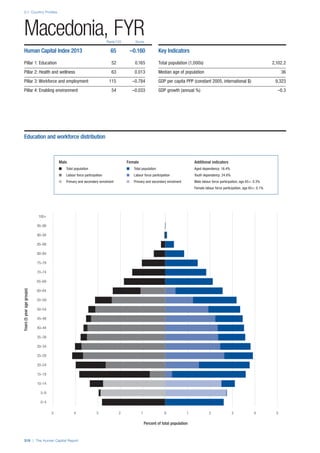
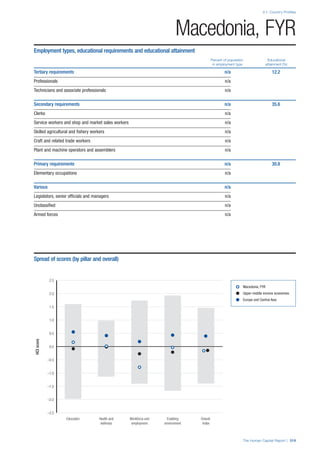
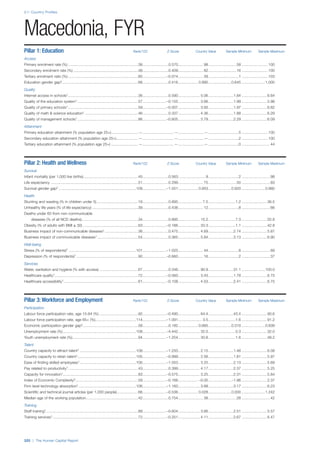
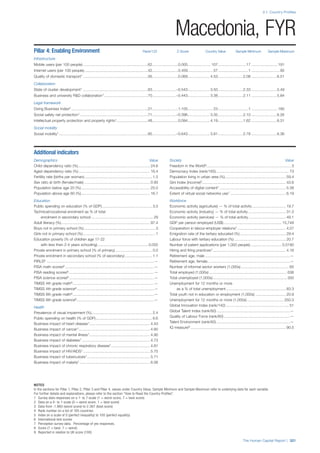
Macedonia, FYR 65 –0.160 52 0.165 63 0.013 115 –0.784 54 –0.033
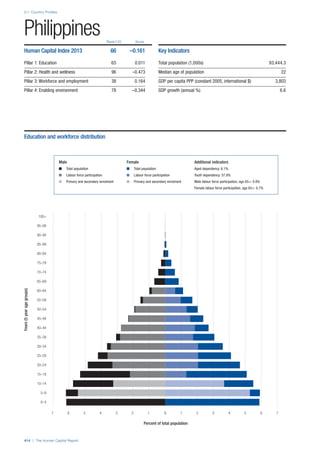
Philippines 66 –0.161 65 0.011 96 –0.473 38 0.164 78 –0.344
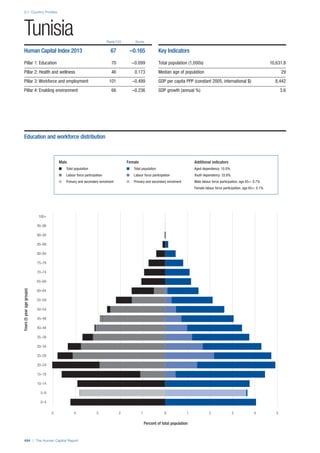
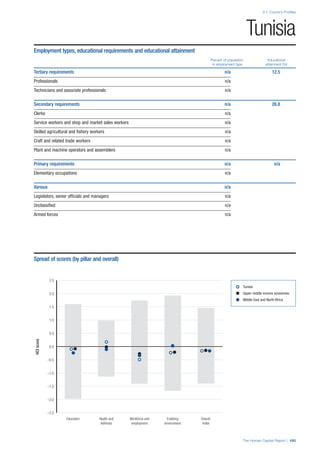
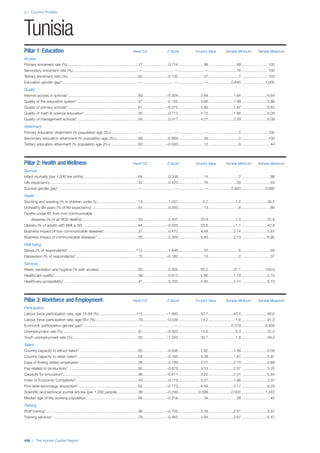
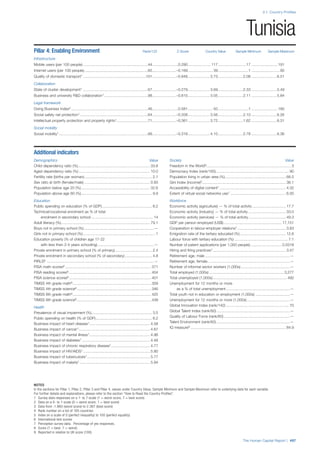
Tunisia 67 –0.165 70 –0.099 46 0.173 101 –0.499 66 –0.236
Jamaica 68 –0.171 81 –0.285 50 0.126 76 –0.246 69 –0.279
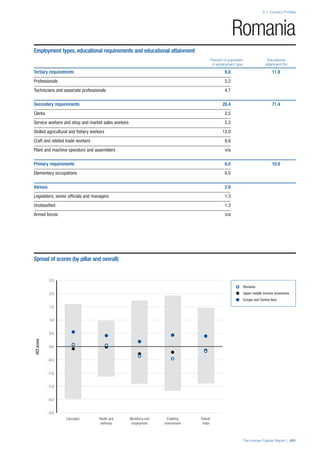
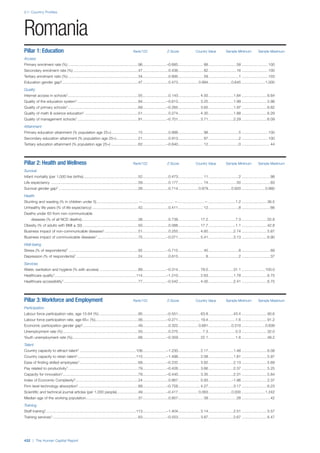
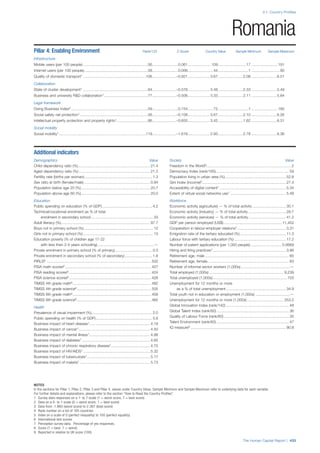
Romania 69 –0.176 57 0.077 61 0.048 85 –0.364 83 –0.463
Vietnam 70 –0.202 73 –0.176 88 –0.291 57 –0.040 73 –0.302
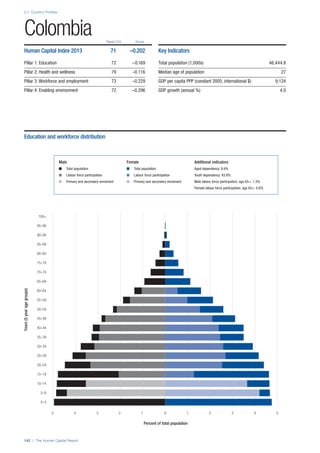
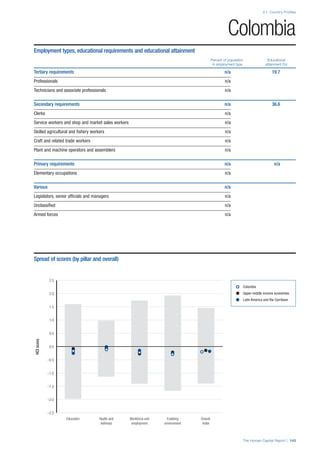
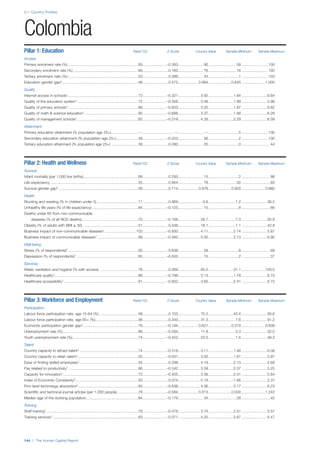
Colombia 71 –0.202 72 –0.169 79 –0.116 73 –0.229 72 –0.296
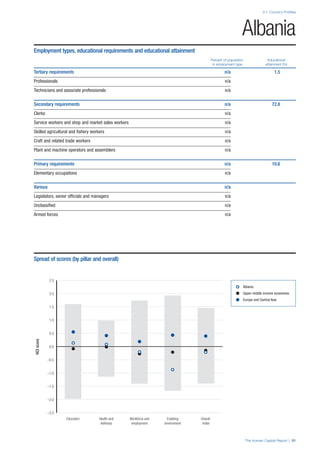
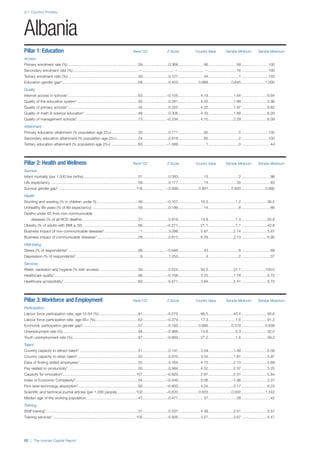
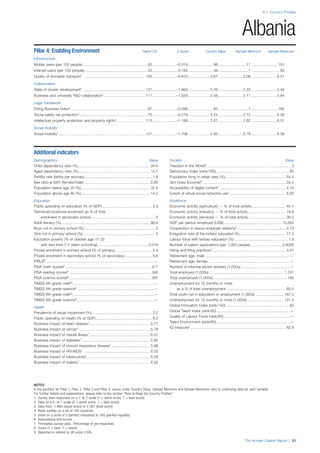
Albania 72 –0.216 54 0.136 54 0.083 71 –0.207 105 –0.874
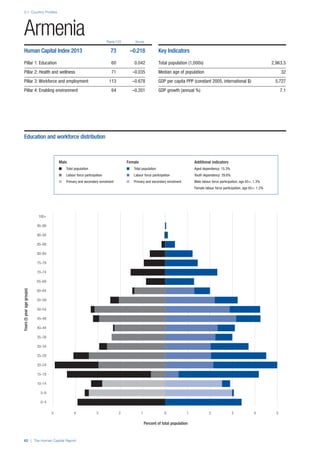
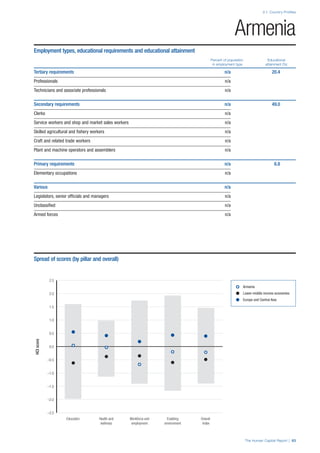
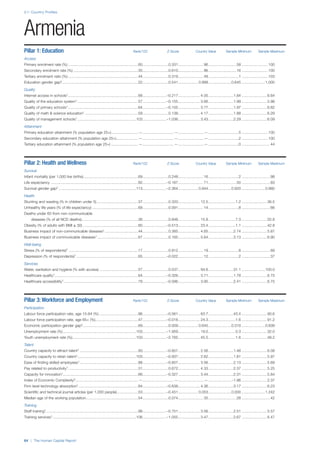
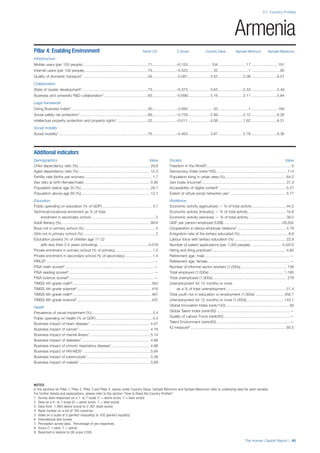
Armenia 73 –0.218 60 0.042 71 –0.035 113 –0.678 64 –0.201
Lebanon 74 –0.220 32 0.548 77 –0.099 96 –0.458 104 –0.870
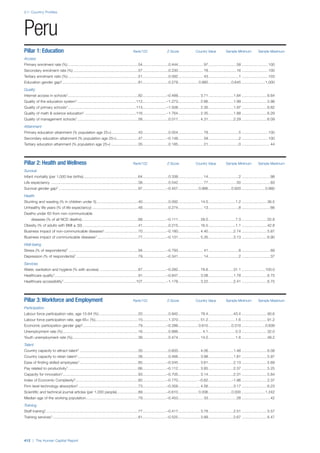
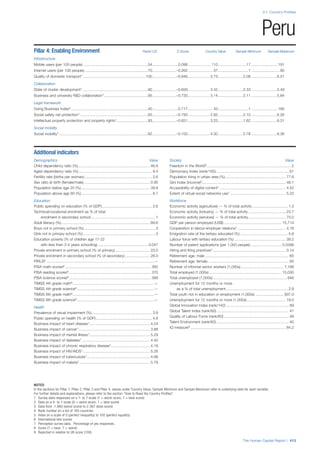
Peru 75 –0.227 84 –0.323 82 –0.204 50 –0.003 81 –0.377
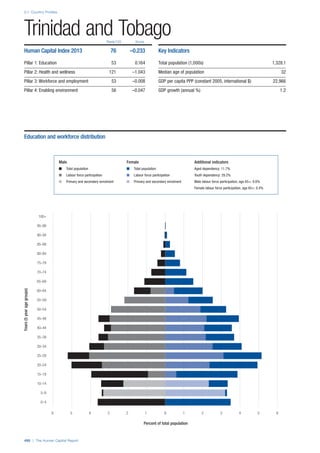
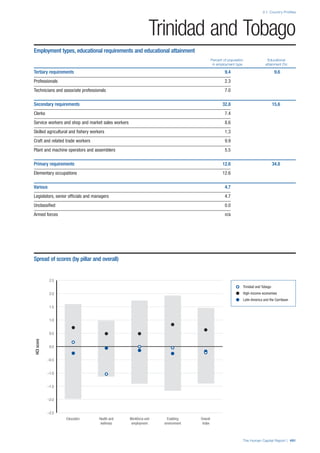
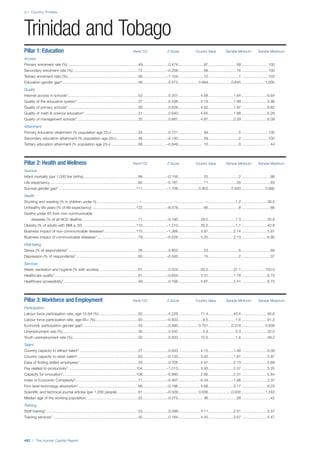
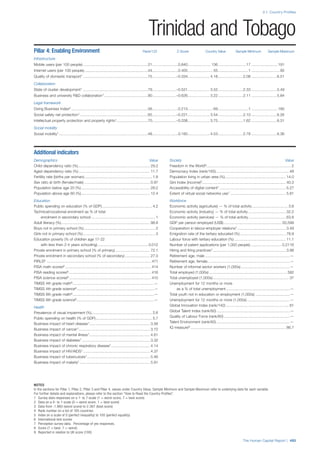
Trinidad and Tobago 76 –0.233 53 0.164 121 –1.043 53 –0.008 56 –0.047
Georgia 77 –0.258 74 –0.191 66 –0.005 102 –0.514 76 –0.321
India 78 –0.270 63 0.020 112 –0.868 49 0.005 67 –0.239
Botswana 79 –0.291 85 –0.386 86 –0.270 93 –0.416 59 –0.090
Lao PDR 80 –0.297 83 –0.320 91 –0.407 59 –0.097 80 –0.364
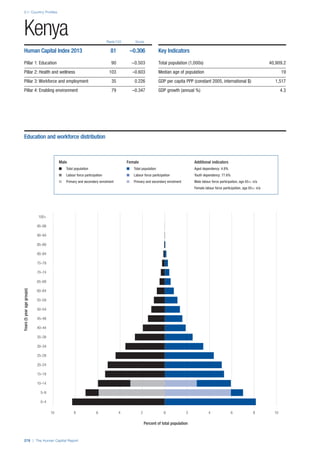
Kenya 81 –0.306 90 –0.503 103 –0.603 35 0.226 79 –0.347
Morocco 82 –0.336 93 –0.590 59 0.061 99 –0.485 77 –0.328
Moldova 83 –0.337 64 0.014 53 0.092 110 –0.654 102 –0.801
Guatemala 84 –0.341 105 –0.968 81 –0.196 46 0.035 65 –0.234
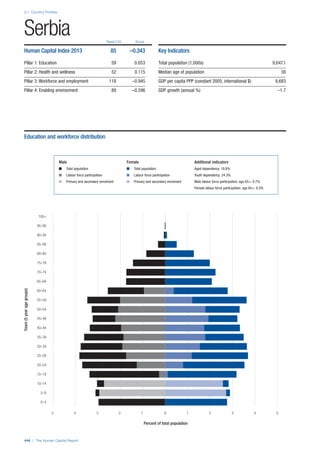
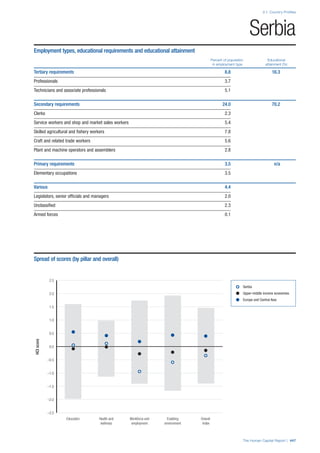
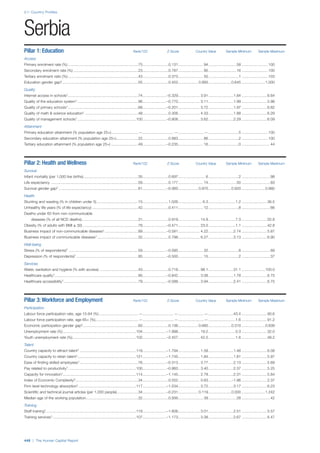
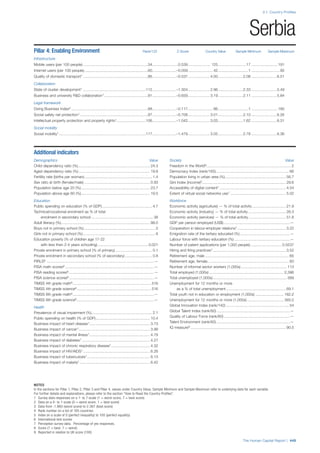
Serbia 85 –0.343 59 0.053 52 0.115 118 –0.945 89 –0.596
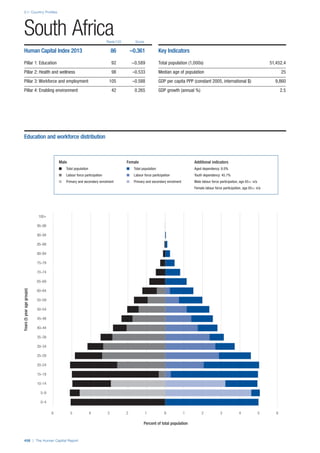
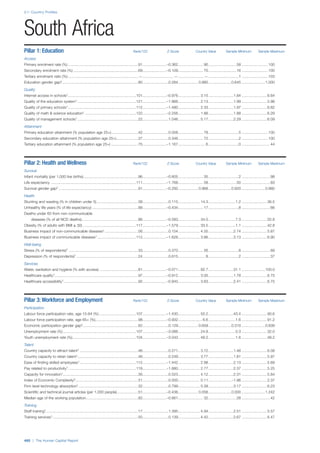
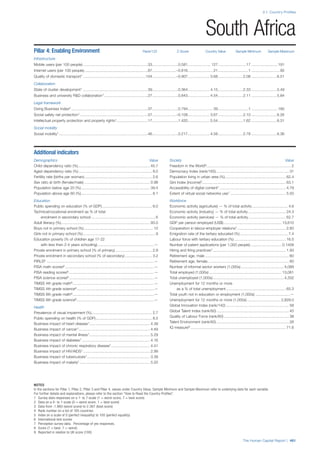
South Africa 86 –0.361 92 –0.589 98 –0.533 105 –0.588 42 0.265
Ghana 87 –0.363 91 –0.505 99 –0.533 60 –0.099 75 –0.317
Bhutan 88 –0.370 89 –0.498 83 –0.208 74 –0.231 85 –0.545
Mongolia 89 –0.400 76 –0.198 80 –0.139 106 –0.610 92 –0.651
El Salvador 90 –0.405 95 –0.612 92 –0.409 68 –0.175 82 –0.425
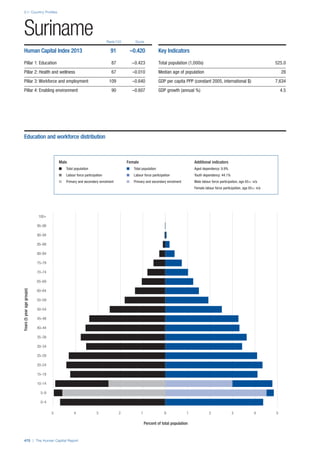
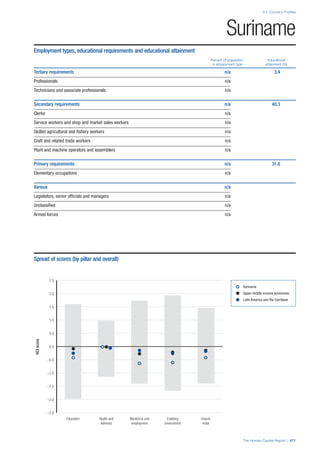
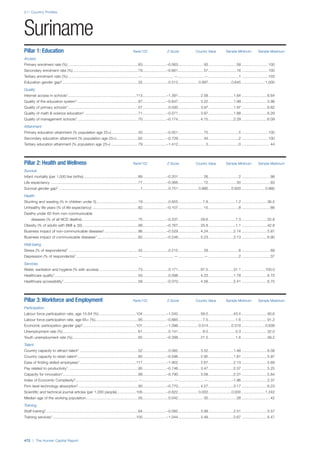
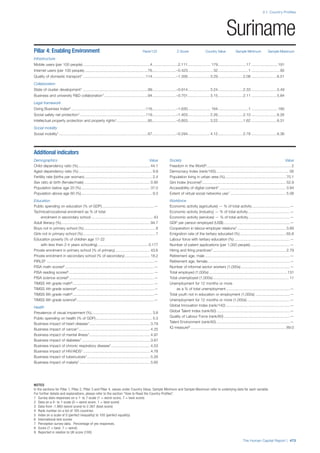
Suriname 91 –0.420 87 –0.423 67 –0.010 109 –0.640 90 –0.607
Kyrgyz Republic 92 –0.440 78 –0.233 75 –0.073 112 –0.673 100 –0.781
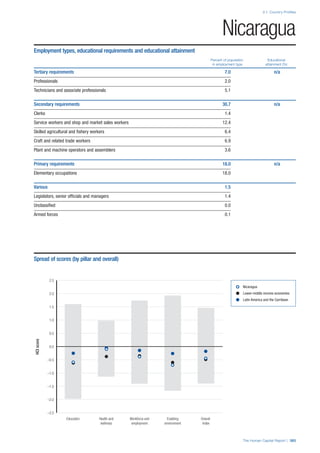
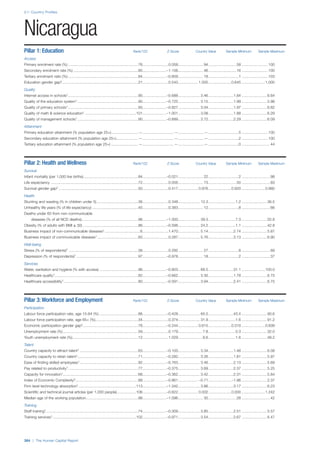
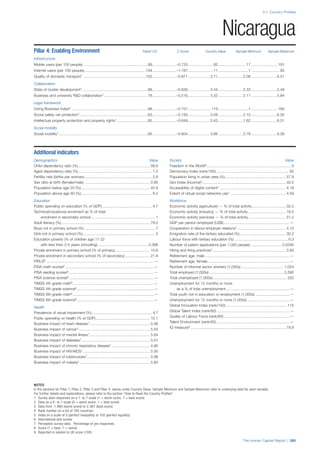
Nicaragua 93 –0.446 94 –0.594 78 –0.100 89 –0.386 94 –0.704
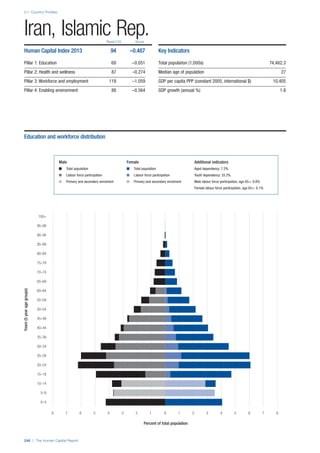
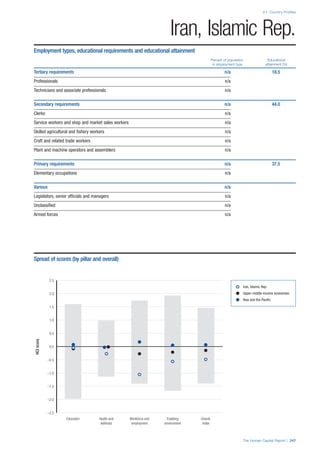
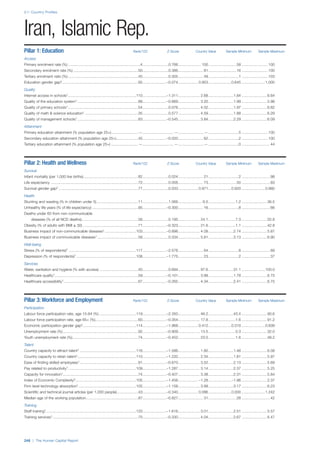
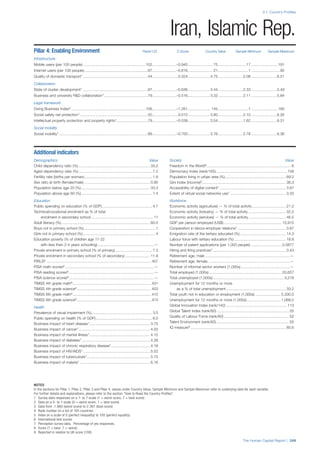
Iran, Islamic Rep. 94 –0.487 68 –0.051 87 –0.274 119 –1.059 88 –0.564
Dominican Republic 95 –0.499 97 –0.732 85 –0.223 91 –0.401 91 –0.641
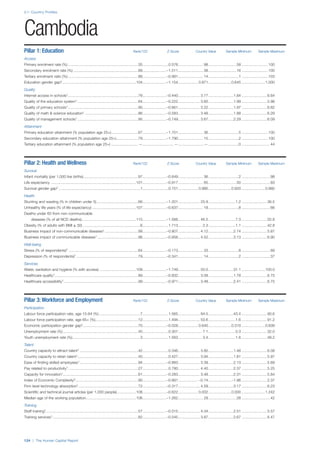
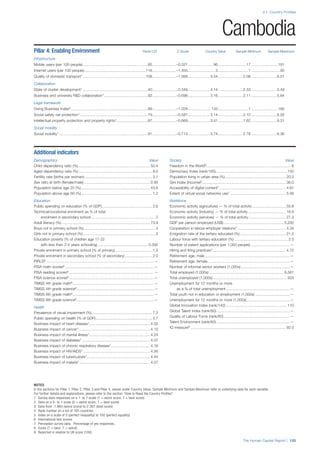
Cambodia 96 –0.505 99 –0.839 102 –0.596 42 0.104 93 –0.688
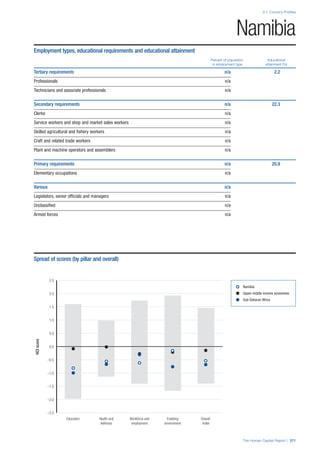
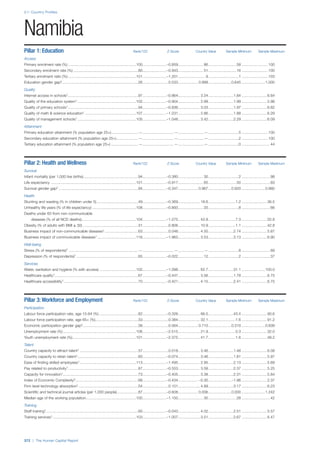
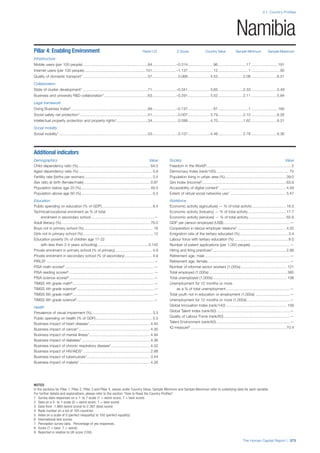
Namibia 97 –0.539 98 –0.817 100 –0.560 108 –0.620 61 –0.160
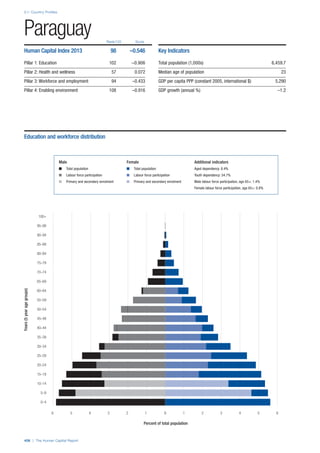
Paraguay 98 –0.546 102 –0.906 57 0.072 94 –0.433 108 –0.916
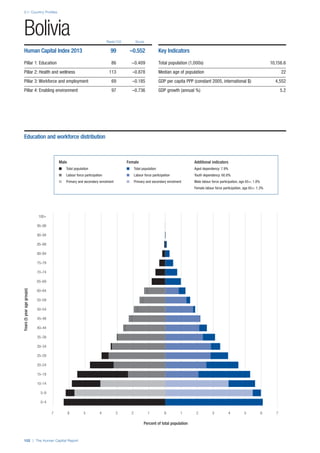
Bolivia 99 –0.552 86 –0.409 113 –0.878 69 –0.185 97 –0.736
Honduras 100 –0.560 103 –0.947 89 –0.335 90 –0.397 87 –0.561
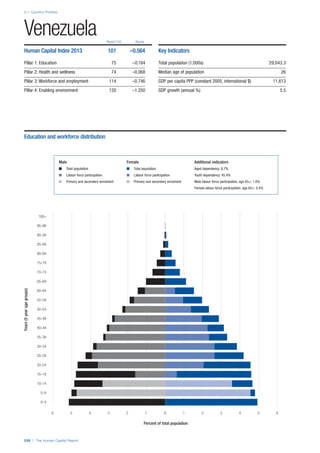
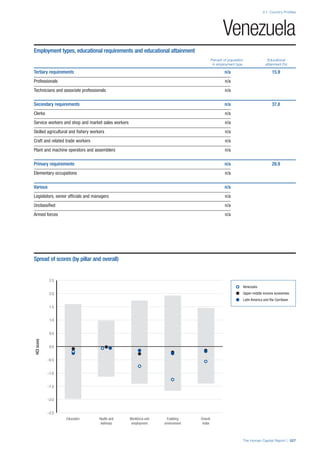
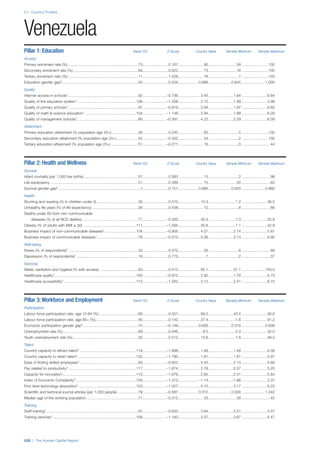
Venezuela 101 –0.564 75 –0.194 74 –0.068 114 –0.746 120 –1.250
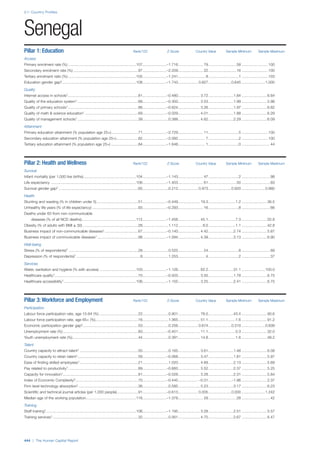
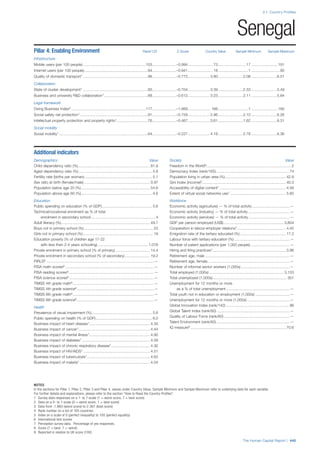
Senegal 102 –0.602 112 –1.202 90 –0.404 51 –0.006 101 –0.794
Malawi 103 –0.629 101 –0.897 107 –0.723 52 –0.007 106 –0.890
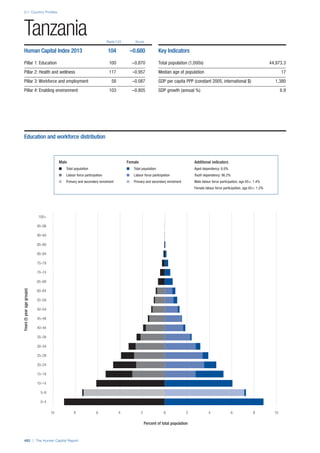
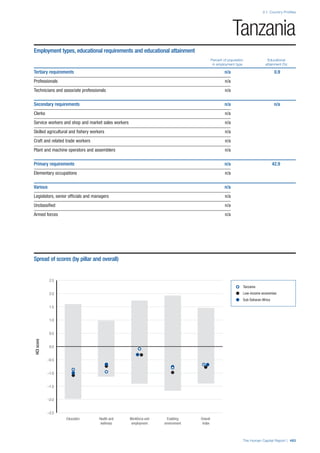
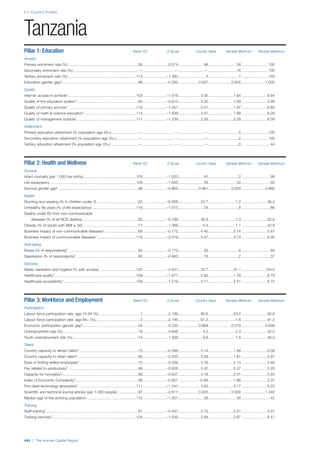
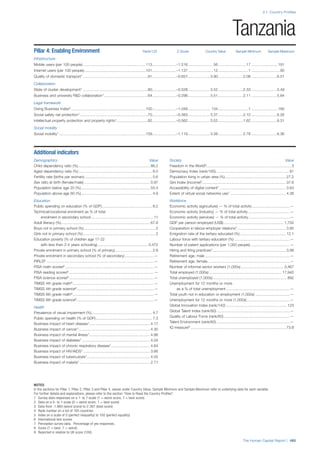
Tanzania 104 –0.680 100 –0.870 117 –0.957 58 –0.087 103 –0.805
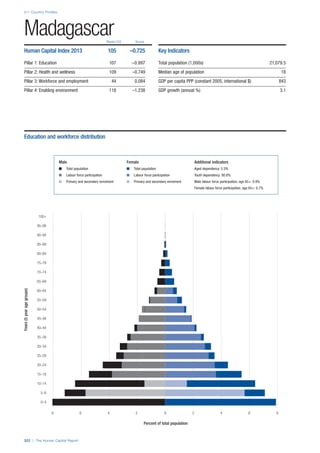
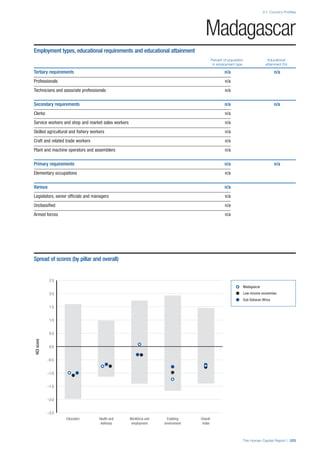
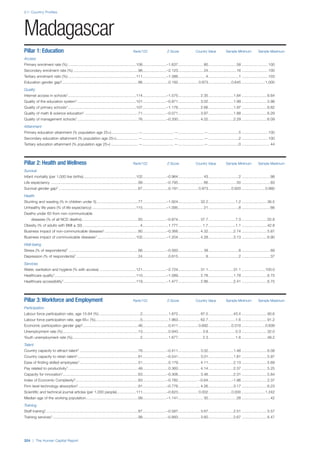
Madagascar 105 –0.725 107 –0.997 109 –0.749 44 0.084 118 –1.238
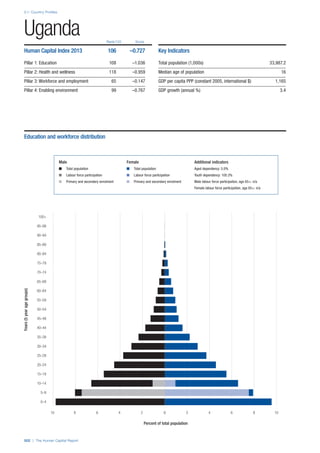
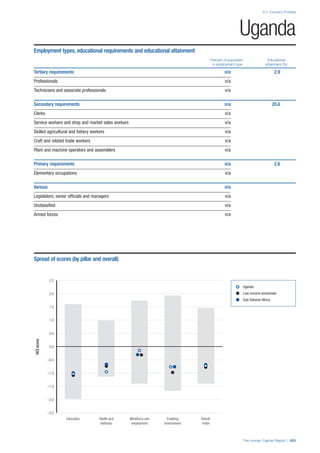
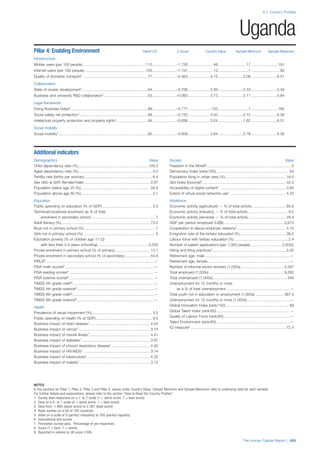
Uganda 106 –0.727 108 –1.036 118 –0.959 65 –0.147 99 –0.767
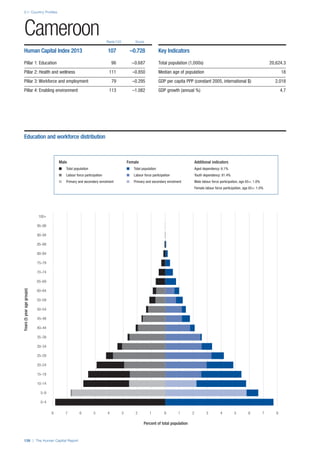
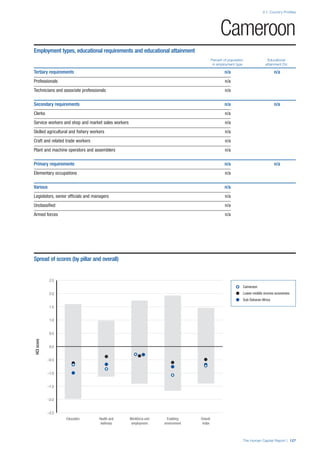
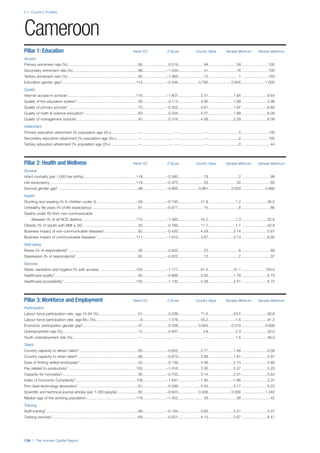
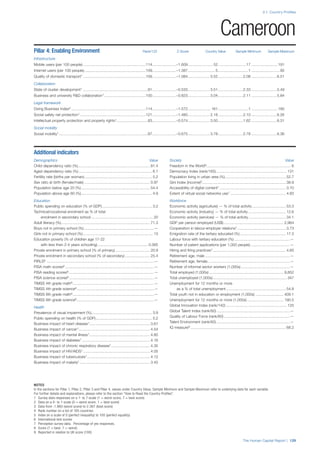
Cameroon 107 –0.728 96 –0.687 111 –0.850 79 –0.295 113 –1.082
Lesotho 108 –0.751 110 –1.084 101 –0.588 95 –0.438 107 –0.894
Côte d’Ivoire 109 –0.759 114 –1.302 95 –0.418 72 –0.208 114 –1.107
Bangladesh 110 –0.782 104 –0.959 104 –0.606 103 –0.543 110 –1.019
Egypt 111 –0.790 113 –1.206 97 –0.521 116 –0.878 86 –0.555
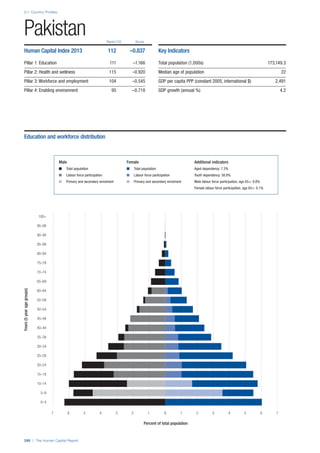
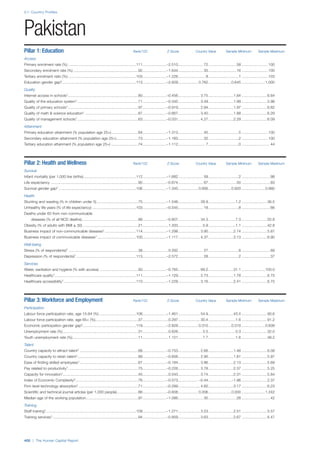
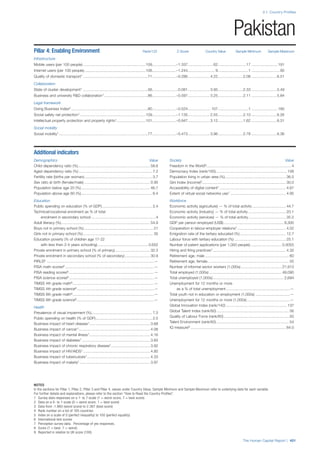
Pakistan 112 –0.837 111 –1.166 115 –0.920 104 –0.545 95 –0.718
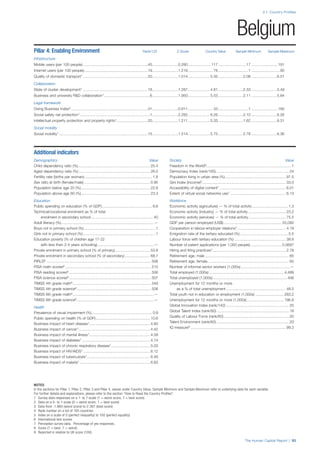
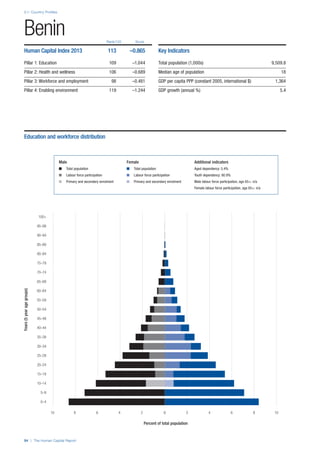
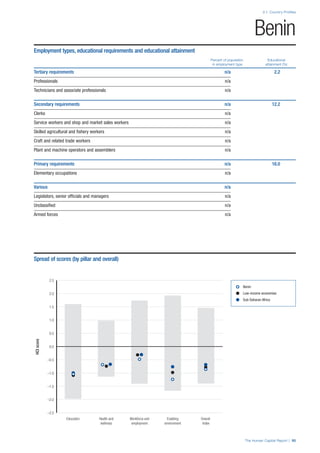
Benin 113 –0.865 109 –1.044 106 –0.689 98 –0.481 119 –1.244
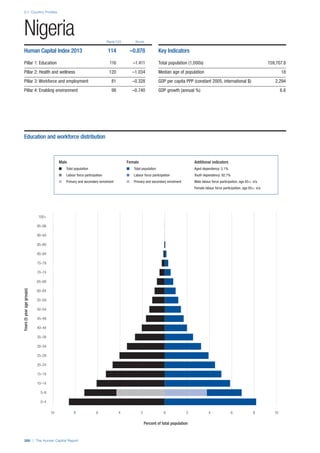
Nigeria 114 –0.878 116 –1.411 120 –1.034 81 –0.328 98 –0.740
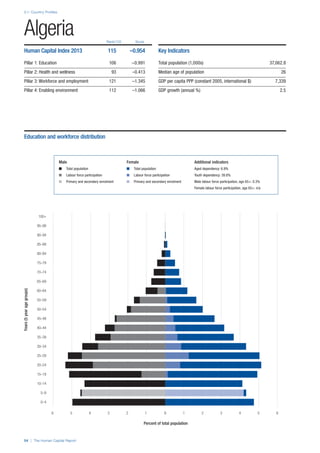
Algeria 115 –0.954 106 –0.991 93 –0.413 121 –1.345 112 –1.066
Ethiopia 116 –0.961 115 –1.380 108 –0.749 111 –0.660 111 –1.056
Mozambique 117 –0.966 117 –1.474 114 –0.916 82 –0.337 115 –1.135
Mali 118 –1.034 120 –1.747 110 –0.826 107 –0.614 109 –0.949
Burkina Faso 119 –1.077 121 –1.817 116 –0.943 87 –0.374 117 –1.173
Guinea 120 –1.272 118 –1.482 119 –1.026 117 –0.911 122 –1.667
Mauritania 121 –1.297 119 –1.744 105 –0.666 122 –1.404 121 –1.373
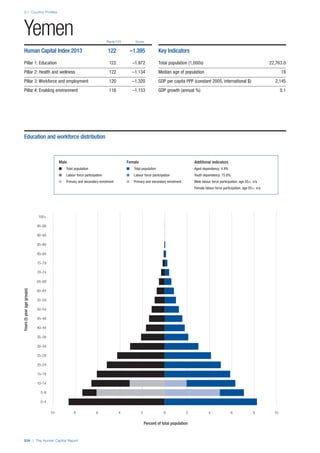
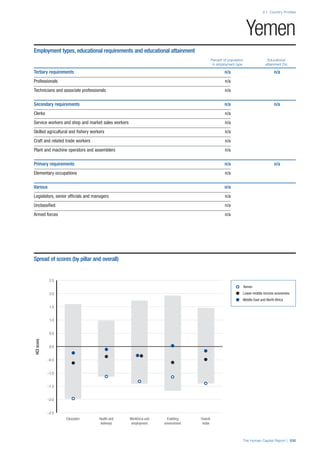
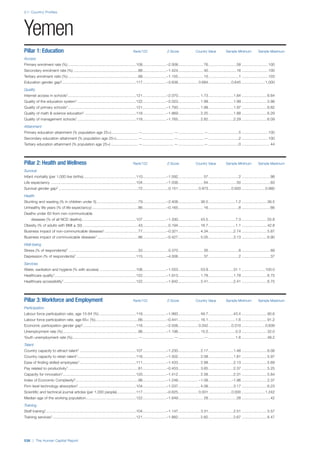
Yemen 122 –1.395 122 –1.972 122 –1.134 120 –1.320 116 –1.153
Part 1: Measuring Human Capital
14 | The Human Capital Report
Table 4: Rankings by pillar
Rank Country Score
1 Finland 1.601
2 Canada 1.355
3 Singapore 1.348
4 Switzerland 1.313
5 New Zealand 1.204
6 Belgium 1.191
7 Netherlands 1.106
8 Iceland 1.075
9 Ireland 1.033
10 United Kingdom 1.031
11 United States 1.027
12 Barbados 1.007
13 Australia 0.988
14 Sweden 0.977
15 Norway 0.970
16 Cyprus 0.938
17 Korea, Rep. 0.899
18 Denmark 0.891
19 Germany 0.888
20 Estonia 0.862
21 Slovenia 0.825
22 France 0.776
23 Lithuania 0.745
24 Malta 0.716
25 Austria 0.713
26 Qatar 0.684
27 Israel 0.651
28 Japan 0.628
29 United Arab Emirates 0.626
30 Latvia 0.615
31 Spain 0.590
32 Lebanon 0.548
33 Hungary 0.530
34 Malaysia 0.526
35 Luxembourg 0.522
36 Czech Republic 0.452
37 Portugal 0.411
38 Croatia 0.394
39 Costa Rica 0.382
40 Italy 0.378
41 Russian Federation 0.377
42 Poland 0.376
43 Kazakhstan 0.359
44 Jordan 0.350
45 Ukraine 0.316
46 Bulgaria 0.282
47 Greece 0.280
48 Bahrain 0.274
49 Chile 0.250
50 Mauritius 0.234
51 Sri Lanka 0.172
52 Macedonia, FYR 0.165
53 Trinidad and Tobago 0.164
54 Albania 0.136
55 Saudi Arabia 0.098
56 Argentina 0.091
57 Romania 0.077
58 China 0.069
59 Serbia 0.053
60 Armenia 0.042
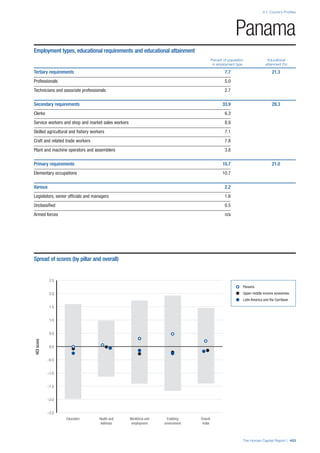
61 Indonesia 0.040
Rank Country Score
62 Oman 0.032
63 India 0.020
64 Moldova 0.014
65 Philippines 0.011
66 Panama –0.006
67 Uruguay –0.037
68 Iran, Islamic Rep. –0.051
69 Ecuador –0.090
70 Tunisia –0.099
71 Azerbaijan –0.153
72 Colombia –0.169
73 Vietnam –0.176
74 Georgia –0.191
75 Venezuela –0.194
76 Mongolia –0.198
77 Turkey –0.220
78 Kyrgyz Republic –0.233
79 Thailand –0.242
80 Kuwait –0.285
81 Jamaica –0.285
82 Mexico –0.291
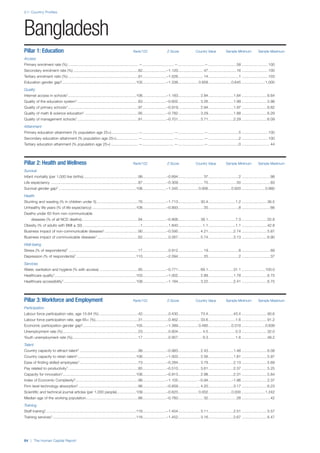
83 Lao PDR –0.320
84 Peru –0.323
85 Botswana –0.386
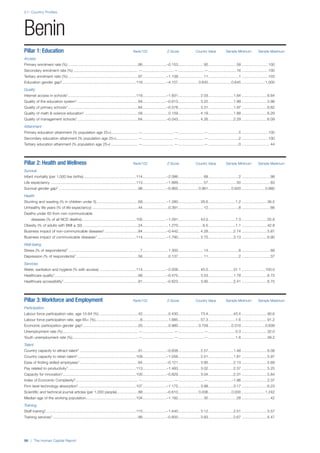
86 Bolivia –0.409
87 Suriname –0.423
88 Brazil –0.497
89 Bhutan –0.498
90 Kenya –0.503
91 Ghana –0.505
92 South Africa –0.589
93 Morocco –0.590
94 Nicaragua –0.594
95 El Salvador –0.612
96 Cameroon –0.687
97 Dominican Republic –0.732
98 Namibia –0.817
99 Cambodia –0.839
100 Tanzania –0.870
101 Malawi –0.897
102 Paraguay –0.906
103 Honduras –0.947
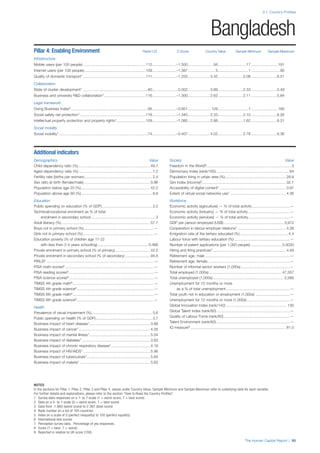
104 Bangladesh –0.959
105 Guatemala –0.968
106 Algeria –0.991
107 Madagascar –0.997
108 Uganda –1.036
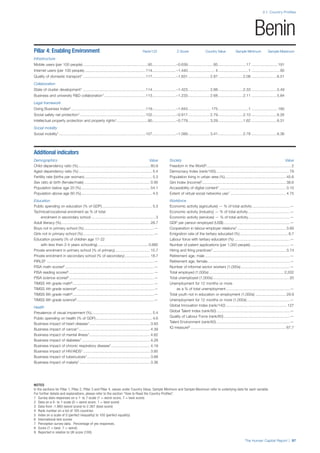
109 Benin –1.044
110 Lesotho –1.084
111 Pakistan –1.166
112 Senegal –1.202
113 Egypt –1.206
114 Côte d’Ivoire –1.302
115 Ethiopia –1.380
116 Nigeria –1.411
117 Mozambique –1.474
118 Guinea –1.482
119 Mauritania –1.744
120 Mali –1.747
121 Burkina Faso –1.817
122 Yemen –1.972
Rank Country Score
1 Switzerland 0.977
2 Sweden 0.960
3 Denmark 0.943
4 Netherlands 0.901
5 Iceland 0.900
6 Norway 0.890
7 Austria 0.886
8 Germany 0.877
9 Finland 0.844
10 Japan 0.836
11 Belgium 0.780
12 Spain 0.778
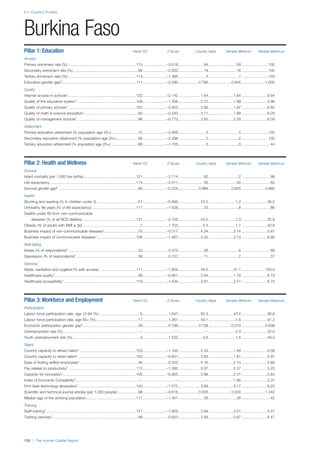
13 Singapore 0.762
14 France 0.744
15 New Zealand 0.743
16 Luxembourg 0.704
17 United Kingdom 0.682
18 Australia 0.663
19 Italy 0.601
20 Canada 0.548
21 Uruguay 0.543
22 Estonia 0.536
23 Portugal 0.532
24 Croatia 0.526
25 Ireland 0.516
26 Slovenia 0.516
27 Korea, Rep. 0.481
28 Malta 0.473
29 Israel 0.457
30 Costa Rica 0.445
31 Argentina 0.362
32 Cyprus 0.352
33 Bulgaria 0.333
34 Greece 0.331
35 Sri Lanka 0.323
36 Czech Republic 0.310
37 Oman 0.307
38 Chile 0.306
39 Malaysia 0.301
40 Thailand 0.281
41 Lithuania 0.252
42 Barbados 0.245
43 United States 0.239
44 Qatar 0.206
45 Mauritius 0.202
46 Tunisia 0.173
47 Poland 0.173
48 Latvia 0.151
49 Brazil 0.150
50 Jamaica 0.126
51 Turkey 0.117
52 Serbia 0.115
53 Moldova 0.092
54 Albania 0.083
55 Ukraine 0.078
56 Mexico 0.074
57 Paraguay 0.072
58 Kuwait 0.065
59 Morocco 0.061
60 Panama 0.055
61 Romania 0.048
Rank Country Score
62 Russian Federation 0.027
63 Macedonia, FYR 0.013
64 Bahrain 0.011
65 China 0.010
66 Georgia –0.005
67 Suriname –0.010
68 Jordan –0.015
69 Kazakhstan –0.031
70 United Arab Emirates –0.032
71 Armenia –0.035
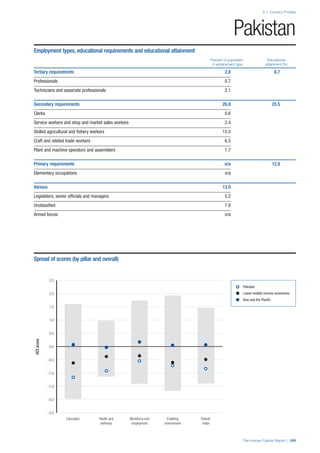
72 Saudi Arabia –0.041
73 Hungary –0.064
74 Venezuela –0.068
75 Kyrgyz Republic –0.073
76 Ecuador –0.094
77 Lebanon –0.099
78 Nicaragua –0.100
79 Colombia –0.116
80 Mongolia –0.139
81 Guatemala –0.196
82 Peru –0.204
83 Bhutan –0.208
84 Indonesia –0.215
85 Dominican Republic –0.223
86 Botswana –0.270
87 Iran, Islamic Rep. –0.274
88 Vietnam –0.291
89 Honduras –0.335
90 Senegal –0.404
91 Lao PDR –0.407
92 El Salvador –0.409
93 Algeria –0.413
94 Azerbaijan –0.414
95 Côte d’Ivoire –0.418
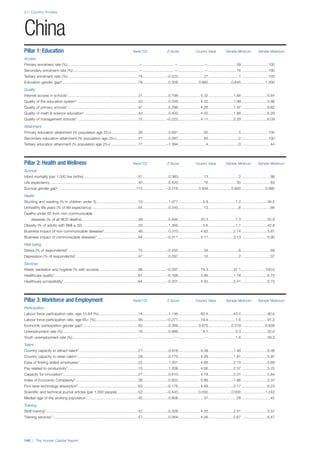
96 Philippines –0.473
97 Egypt –0.521
98 South Africa –0.533
99 Ghana –0.533
100 Namibia –0.560
101 Lesotho –0.588
102 Cambodia –0.596
103 Kenya –0.603
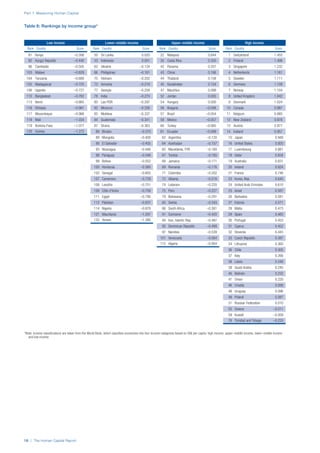
104 Bangladesh –0.606
105 Mauritania –0.666
106 Benin –0.689
107 Malawi –0.723
108 Ethiopia –0.749
109 Madagascar –0.749
110 Mali –0.826
111 Cameroon –0.850
112 India –0.868
113 Bolivia –0.878
114 Mozambique –0.916
115 Pakistan –0.920
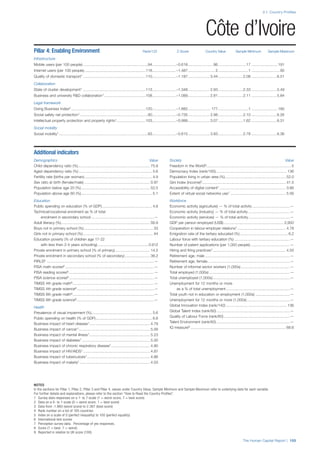
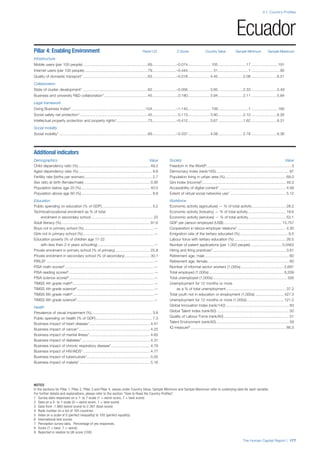
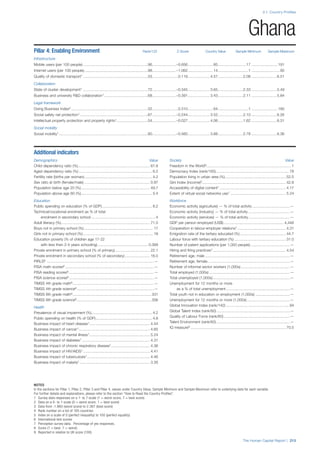
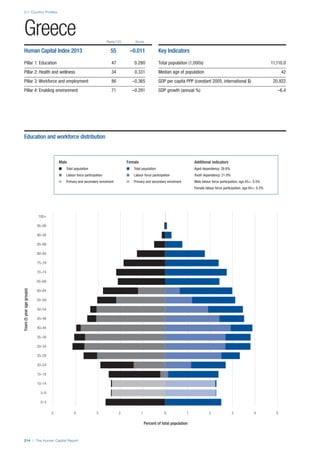
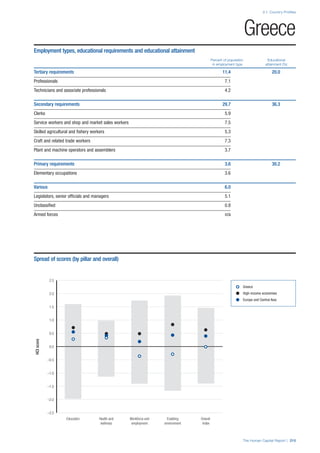
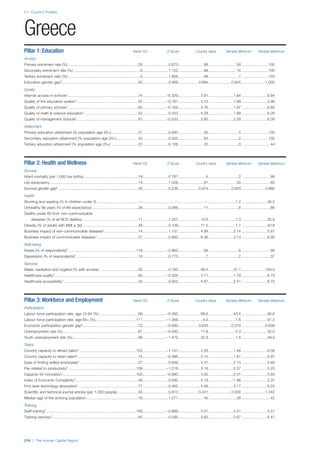
116 Burkina Faso –0.943
117 Tanzania –0.957
118 Uganda –0.959
119 Guinea –1.026
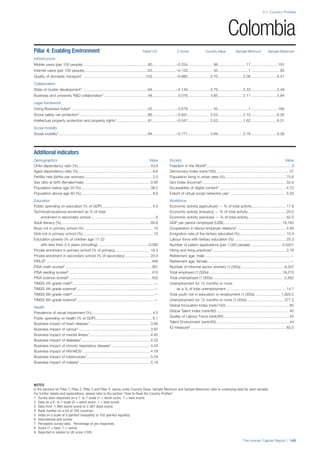
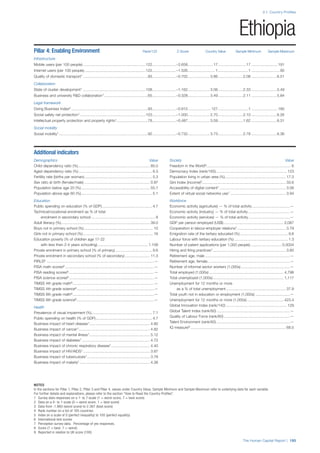
120 Nigeria –1.034
121 Trinidad and Tobago –1.043
122 Yemen –1.134
Education Health and wellness
The Human Capital Report | 15
Part 1: Measuring Human Capital
Rank Country Score
1 Switzerland 1.736
2 Singapore 1.345
3 Finland 1.250
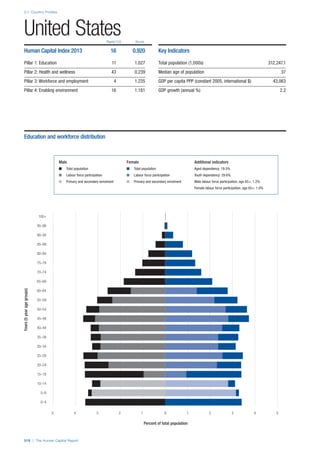
4 United States 1.235
5 Norway 1.182
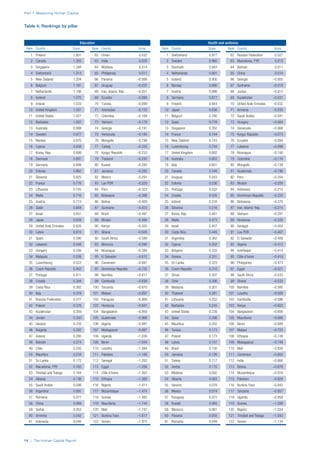
6 Sweden 1.154
7 Qatar 1.154
8 Netherlands 1.150
9 Germany 1.149
10 United Kingdom 1.072
11 Japan 1.027
12 Denmark 0.932
13 Luxembourg 0.928
14 Austria 0.886
15 Canada 0.875
16 Iceland 0.826
17 New Zealand 0.804
18 Malaysia 0.736
19 Australia 0.675
20 Israel 0.674
21 Belgium 0.673
22 Ireland 0.645
23 Korea, Rep. 0.596
24 United Arab Emirates 0.527
25 France 0.520
26 China 0.516
27 Thailand 0.482
28 Costa Rica 0.378
29 Barbados 0.340
30 Malta 0.330
31 Panama 0.301
32 Indonesia 0.262
33 Cyprus 0.252
34 Portugal 0.243
35 Kenya 0.226
36 Czech Republic 0.210
37 Chile 0.194
38 Philippines 0.164
39 Estonia 0.142
40 Kazakhstan 0.107
41 Slovenia 0.106
42 Cambodia 0.104
43 Bahrain 0.099
44 Madagascar 0.084
45 Brazil 0.078
46 Guatemala 0.035
47 Ecuador 0.034
48 Mexico 0.011
49 India 0.005
50 Peru –0.003
51 Senegal –0.006
52 Malawi –0.007
53 Trinidad and Tobago –0.008
54 Latvia –0.011
55 Azerbaijan –0.016
56 Lithuania –0.018
57 Vietnam –0.040
58 Tanzania –0.087
59 Lao PDR –0.097
60 Ghana –0.099
61 Saudi Arabia –0.099
Rank Country Score
62 Sri Lanka –0.127
63 Poland –0.139
64 Mauritius –0.143
65 Uganda –0.147
66 Russian Federation –0.163
67 Ukraine –0.166
68 El Salvador –0.175
69 Bolivia –0.185
70 Spain –0.185
71 Albania –0.207
72 Côte d’Ivoire –0.208
73 Colombia –0.229
74 Bhutan –0.231
75 Italy –0.243
76 Jamaica –0.246
77 Hungary –0.275
78 Oman –0.280
79 Cameroon –0.295
80 Kuwait –0.297
81 Nigeria –0.328
82 Mozambique –0.337
83 Turkey –0.337
84 Uruguay –0.340
85 Romania –0.364
86 Greece –0.365
87 Burkina Faso –0.374
88 Croatia –0.378
89 Nicaragua –0.386
90 Honduras –0.397
91 Dominican Republic –0.401
92 Argentina –0.408
93 Botswana –0.416
94 Paraguay –0.433
95 Lesotho –0.438
96 Lebanon –0.458
97 Jordan –0.481
98 Benin –0.481
99 Morocco –0.485
100 Bulgaria –0.496
101 Tunisia –0.499
102 Georgia –0.514
103 Bangladesh –0.543
104 Pakistan –0.545
105 South Africa –0.588
106 Mongolia –0.610
107 Mali –0.614
108 Namibia –0.620
109 Suriname –0.640
110 Moldova –0.654
111 Ethiopia –0.660
112 Kyrgyz Republic –0.673
113 Armenia –0.678
114 Venezuela –0.746
115 Macedonia, FYR –0.784
116 Egypt –0.878
117 Guinea –0.911
118 Serbia –0.945
119 Iran, Islamic Rep. –1.059
120 Yemen –1.320
121 Algeria –1.345
122 Mauritania –1.404
Rank Country Score
1 Finland 1.926
2 Switzerland 1.793
3 Germany 1.522
4 Netherlands 1.484
5 Singapore 1.471
6 Austria 1.424
7 United Kingdom 1.384
8 Norway 1.373
9 Luxembourg 1.372
10 Sweden 1.351
11 Denmark 1.330
12 United Arab Emirates 1.320
13 Japan 1.302
14 Belgium 1.296
15 Qatar 1.294
16 United States 1.181
17 Canada 1.168
18 New Zealand 1.163
19 Ireland 1.103
20 Iceland 1.026
21 Saudi Arabia 1.023
22 Malaysia 1.014
23 Australia 0.999
24 France 0.943
25 Oman 0.822
26 Estonia 0.745
27 Barbados 0.730
28 Spain 0.679
29 Portugal 0.624
30 Korea, Rep. 0.582
31 Czech Republic 0.576
32 Israel 0.568
33 Bahrain 0.544
34 Panama 0.477
35 Chile 0.471
36 Lithuania 0.462
37 Malta 0.371
38 Slovenia 0.332
39 Italy 0.329
40 Kuwait 0.281
41 Cyprus 0.268
42 South Africa 0.265
43 Latvia 0.237
44 Uruguay 0.219
45 Turkey 0.181
46 Jordan 0.167
47 China 0.147
48 Thailand 0.112
49 Mauritius 0.102
50 Costa Rica 0.077
51 Kazakhstan 0.061
52 Brazil 0.054
53 Mexico –0.022
54 Macedonia, FYR –0.033
55 Azerbaijan –0.044
56 Trinidad and Tobago –0.047
57 Poland –0.064
58 Indonesia –0.082
59 Botswana –0.090
60 Croatia –0.146
61 Namibia –0.160
Rank Country Score
62 Hungary –0.190
63 Russian Federation –0.201
64 Armenia –0.201
65 Guatemala –0.234
66 Tunisia –0.236
67 India –0.239
68 Ecuador –0.244
69 Jamaica –0.279
70 Sri Lanka –0.288
71 Greece –0.291
72 Colombia –0.296
73 Vietnam –0.302
74 Bulgaria –0.311
75 Ghana –0.317
76 Georgia –0.321
77 Morocco –0.328
78 Philippines –0.344
79 Kenya –0.347
80 Lao PDR –0.364
81 Peru –0.377
82 El Salvador –0.425
83 Romania –0.463
84 Argentina –0.527
85 Bhutan –0.545
86 Egypt –0.555
87 Honduras –0.561
88 Iran, Islamic Rep. –0.564
89 Serbia –0.596
90 Suriname –0.607
91 Dominican Republic –0.641
92 Mongolia –0.651
93 Cambodia –0.688
94 Nicaragua –0.704
95 Pakistan –0.718
96 Ukraine –0.725
97 Bolivia –0.736
98 Nigeria –0.740
99 Uganda –0.767
100 Kyrgyz Republic –0.781
101 Senegal –0.794
102 Moldova –0.801
103 Tanzania –0.805
104 Lebanon –0.870
105 Albania –0.874
106 Malawi –0.890
107 Lesotho –0.894
108 Paraguay –0.916
109 Mali –0.949
110 Bangladesh –1.019
111 Ethiopia –1.056
112 Algeria –1.066
113 Cameroon –1.082
114 Côte d’Ivoire –1.107
115 Mozambique –1.135
116 Yemen –1.153
117 Burkina Faso –1.173
118 Madagascar –1.238
119 Benin –1.244
120 Venezuela –1.250
121 Mauritania –1.373
122 Guinea –1.667
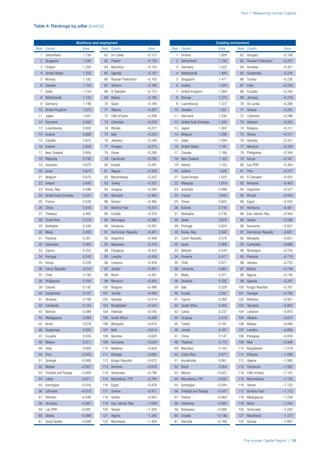
Table 4: Rankings by pillar (cont’d.)
Workforce and employment Enabling environment
Part 1: Measuring Human Capital
16 | The Human Capital Report
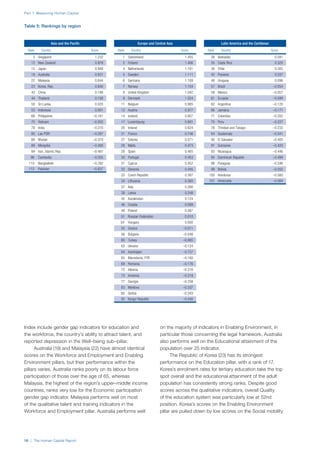
Table 5: Rankings by region
Asia and the Pacific
Rank Country Score
3 Singapore 1.232
12 New Zealand 0.978
15 Japan 0.948
19 Australia 0.831
22 Malaysia 0.644
23 Korea, Rep. 0.640
43 China 0.186
44 Thailand 0.158
50 Sri Lanka 0.020
53 Indonesia 0.001
66 Philippines –0.161
70 Vietnam –0.202
78 India –0.270
80 Lao PDR –0.297
88 Bhutan –0.370
89 Mongolia –0.400
94 Iran, Islamic Rep. –0.487
96 Cambodia –0.505
110 Bangladesh –0.782
112 Pakistan –0.837
Europe and Central Asia
Rank Country Score
1 Switzerland 1.455
2 Finland 1.406
4 Netherlands 1.161
5 Sweden 1.111
6 Germany 1.109
7 Norway 1.104
8 United Kingdom 1.042
9 Denmark 1.024
11 Belgium 0.985
13 Austria 0.977
14 Iceland 0.957
17 Luxembourg 0.881
20 Ireland 0.824
21 France 0.746
27 Estonia 0.571
28 Malta 0.473
29 Spain 0.465
30 Portugal 0.453
31 Cyprus 0.452
32 Slovenia 0.445
33 Czech Republic 0.387
34 Lithuania 0.360
37 Italy 0.266
38 Latvia 0.248
45 Kazakhstan 0.124
46 Croatia 0.099
49 Poland 0.087
51 Russian Federation 0.010
54 Hungary 0.000
55 Greece –0.011
56 Bulgaria –0.048
60 Turkey –0.065
63 Ukraine –0.124
64 Azerbaijan –0.157
65 Macedonia, FYR –0.160
69 Romania –0.176
72 Albania –0.216
73 Armenia –0.218
77 Georgia –0.258
83 Moldova –0.337
85 Serbia –0.343
92 Kyrgyz Republic –0.440
Latin America and the Caribbean
Rank Country Score
26 Barbados 0.581
35 Costa Rica 0.320
36 Chile 0.305
42 Panama 0.207
48 Uruguay 0.096
57 Brazil –0.054
58 Mexico –0.057
61 Ecuador –0.099
62 Argentina –0.120
68 Jamaica –0.171
71 Colombia –0.202
75 Peru –0.227
76 Trinidad and Tobago –0.233
84 Guatemala –0.341
90 El Salvador –0.405
91 Suriname –0.420
93 Nicaragua –0.446
95 Dominican Republic –0.499
98 Paraguay –0.546
99 Bolivia –0.552
100 Honduras –0.560
101 Venezuela –0.564
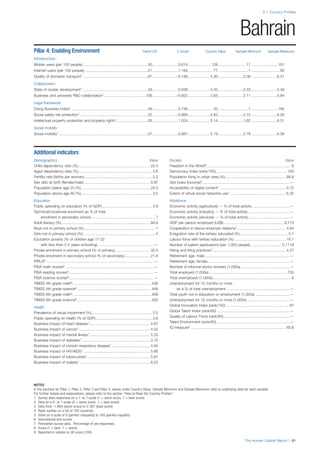
Index include gender gap indicators for education and
the workforce, the country’s ability to attract talent, and
reported depression in the Well–being sub–pillar.
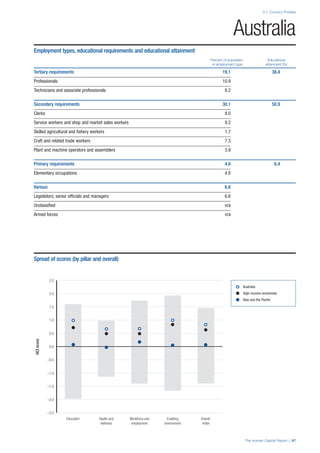
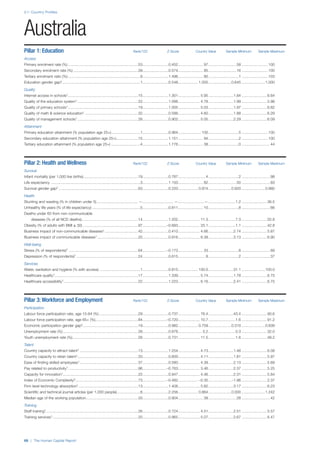
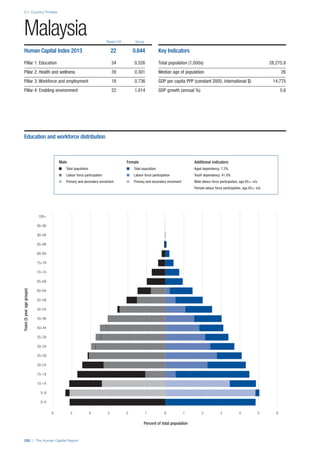
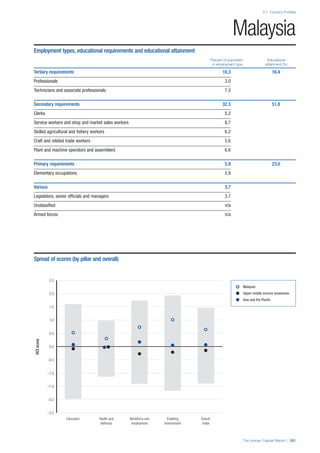
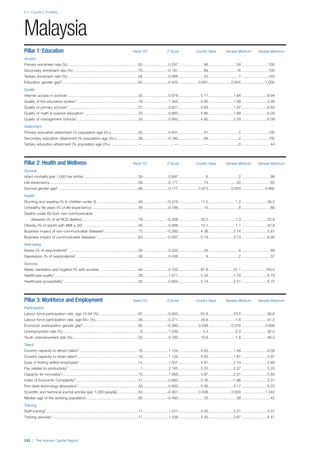
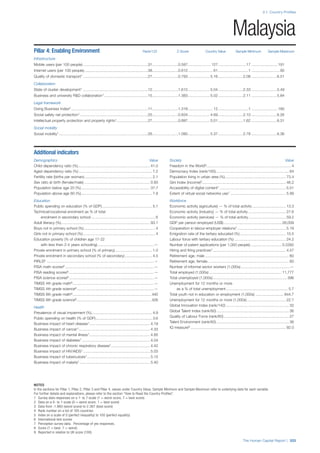
Australia (19) and Malaysia (22) have almost identical
scores on the Workforce and Employment and Enabling
Environment pillars, but their performance within the
pillars varies. Australia ranks poorly on its labour force
participation of those over the age of 65, whereas
Malaysia, the highest of the region’s upper–middle income
countries, ranks very low for the Economic participation
gender gap indicator. Malaysia performs well on most
of the qualitative talent and training indicators in the
Workforce and Employment pillar. Australia performs well
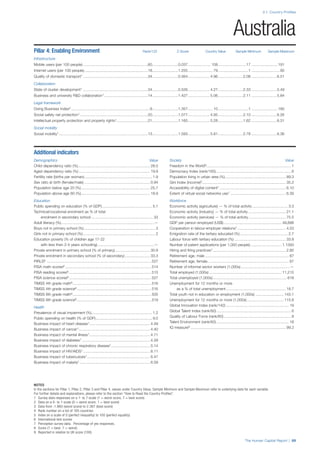
on the majority of indicators in Enabling Environment, in
particular those concerning the legal framework. Australia
also performs well on the Educational attainment of the
population over 25 indicator.
The Republic of Korea (23) has its strongest
performance on the Education pillar, with a rank of 17.
Korea’s enrolment rates for tertiary education take the top
spot overall and the educational attainment of the adult
population has consistently strong ranks. Despite good
scores across the qualitative indicators, overall Quality
of the education system was particularly low at 52nd
position. Korea’s scores on the Enabling Environment
pillar are pulled down by low scores on the Social mobility
The Human Capital Report | 17
Part 1: Measuring Human Capital
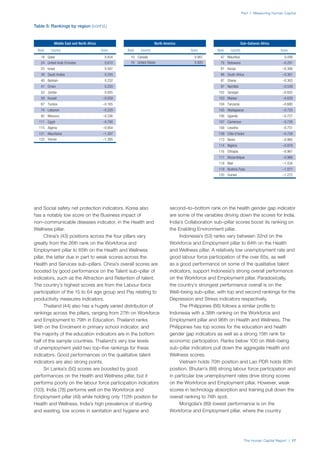
Table 5: Rankings by region (cont’d.)
Middle East and North Africa
Rank Country Score
18 Qatar 0.834
24 United Arab Emirates 0.610
25 Israel 0.587
39 Saudi Arabia 0.245
40 Bahrain 0.232
41 Oman 0.220
52 Jordan 0.005
59 Kuwait –0.059
67 Tunisia –0.165
74 Lebanon –0.220
82 Morocco –0.336
111 Egypt –0.790
115 Algeria –0.954
121 Mauritania –1.297
122 Yemen –1.395
North America
Rank Country Score
10 Canada 0.987
16 United States 0.920
Sub–Saharan Africa
Rank Country Score
47 Mauritius 0.099
79 Botswana –0.291
81 Kenya –0.306
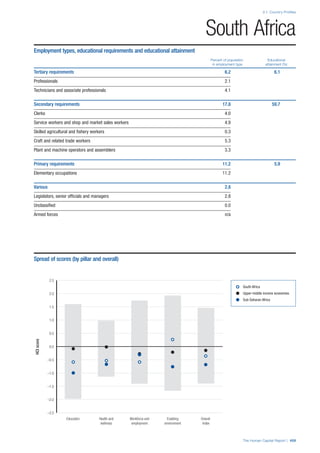
86 South Africa –0.361
87 Ghana –0.363
97 Namibia –0.539
102 Senegal –0.602
103 Malawi –0.629
104 Tanzania –0.680
105 Madagascar –0.725
106 Uganda –0.727
107 Cameroon –0.728
108 Lesotho –0.751
109 Côte d’Ivoire –0.759
113 Benin –0.865
114 Nigeria –0.878
116 Ethiopia –0.961
117 Mozambique –0.966
118 Mali –1.034
119 Burkina Faso –1.077
120 Guinea –1.272
and Social safety net protection indicators. Korea also
has a notably low score on the Business impact of
non–communicable diseases indicator, in the Health and
Wellness pillar.
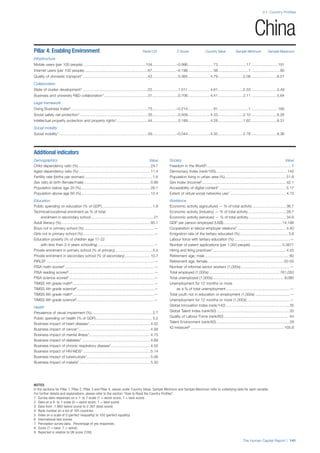
China’s (43) positions across the four pillars vary
greatly from the 26th rank on the Workforce and
Employment pillar to 65th on the Health and Wellness
pillar, the latter due in part to weak scores across the
Health and Services sub–pillars. China’s overall scores are
boosted by good performance on the Talent sub–pillar of
indicators, such as the Attraction and Retention of talent.
The country’s highest scores are from the Labour force
participation of the 15 to 64 age group and Pay relating to
productivity measures indicators.
Thailand (44) also has a hugely varied distribution of
rankings across the pillars, ranging from 27th on Workforce
and Employment to 79th in Education. Thailand ranks
94th on the Enrolment in primary school indicator, and
the majority of the education indicators are in the bottom
half of the sample countries. Thailand’s very low levels
of unemployment yield two top–five rankings for these
indicators. Good performances on the qualitative talent
indicators are also strong points.
Sri Lanka’s (50) scores are boosted by good
performances on the Health and Wellness pillar, but it
performs poorly on the labour force participation indicators
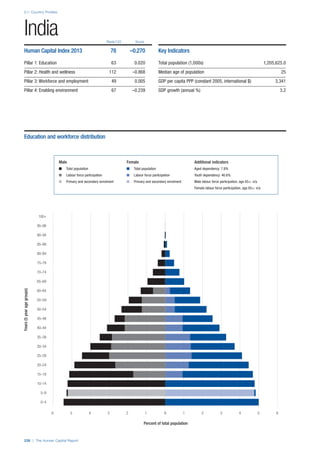
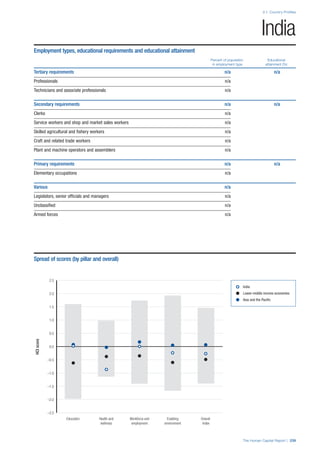
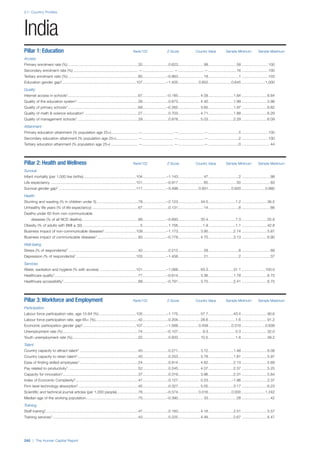
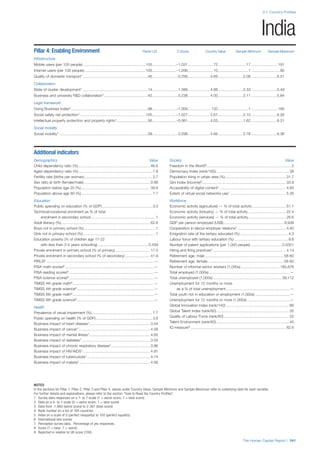
(103). India (78) performs well on the Workforce and
Employment pillar (49) while holding only 112th position for
Health and Wellness. India’s high prevalence of stunting
and wasting, low scores in sanitation and hygiene and
second–to–bottom rank on the health gender gap indicator
are some of the variables driving down the scores for India.
India’s Collaboration sub–pillar scores boost its ranking on
the Enabling Environment pillar.
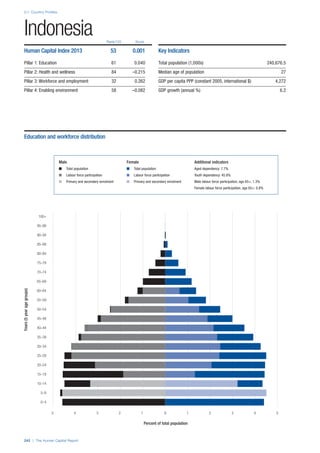
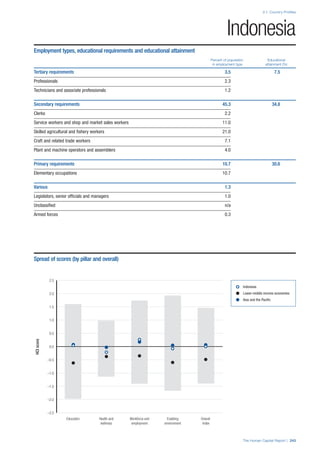
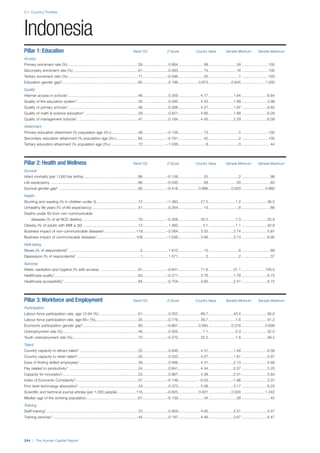
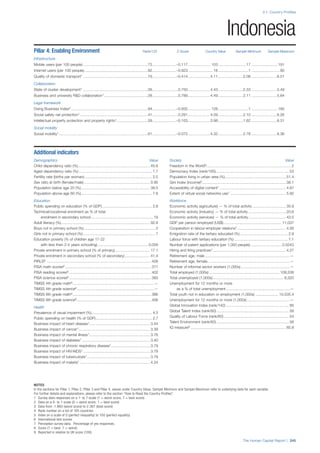
Indonesia’s (53) ranks vary between 32nd on the
Workforce and Employment pillar to 84th on the Health
and Wellness pillar. A relatively low unemployment rate and
good labour force participation of the over 65s, as well
as a good performance on some of the qualitative talent
indicators, support Indonesia’s strong overall performance
on the Workforce and Employment pillar. Paradoxically,
the country’s strongest performance overall is on the
Well–being sub–pillar, with top and second rankings for the
Depression and Stress indicators respectively.
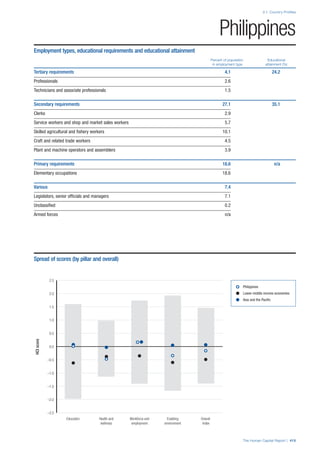
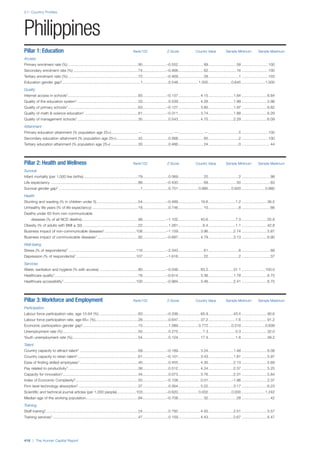
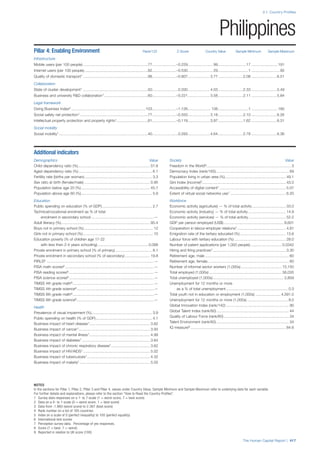
The Philippines (66) follows a similar profile to
Indonesia with a 38th ranking on the Workforce and
Employment pillar and 96th on Health and Wellness. The
Philippines has top scores for the education and health
gender gap indicators as well as a strong 15th rank for
economic participation. Ranks below 100 on Well–being
sub–pillar indicators pull down the aggregate Health and
Wellness scores.
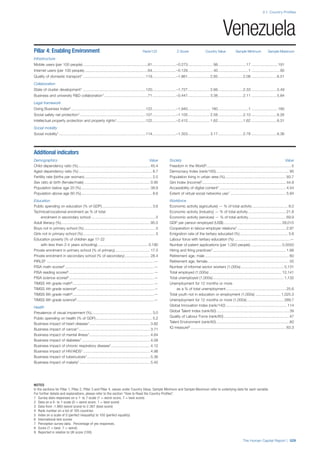
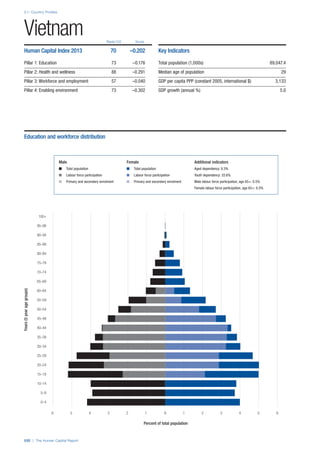
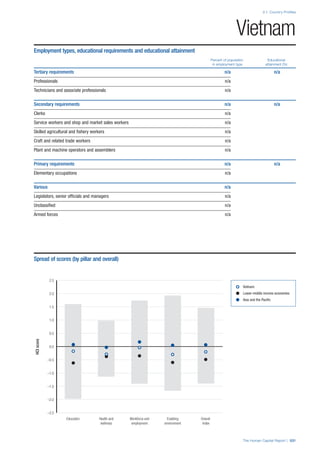
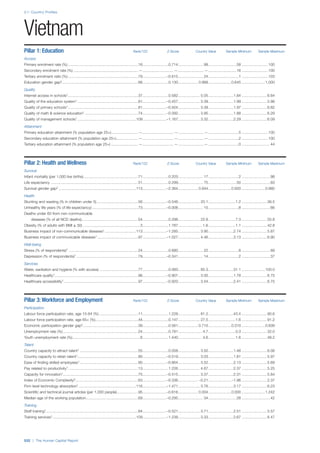
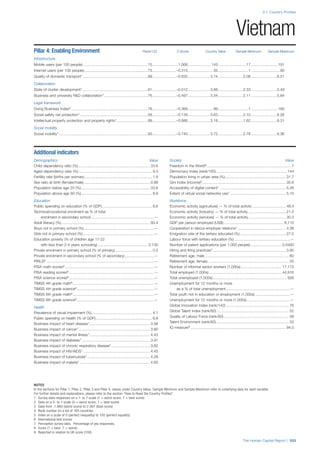
Vietnam holds 70th position and Lao PDR holds 80th
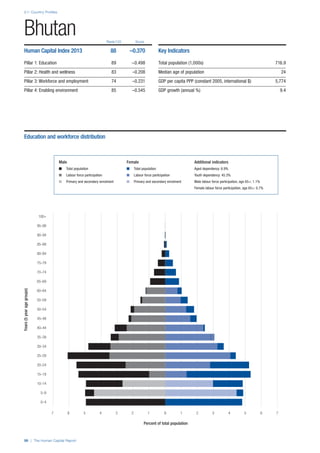
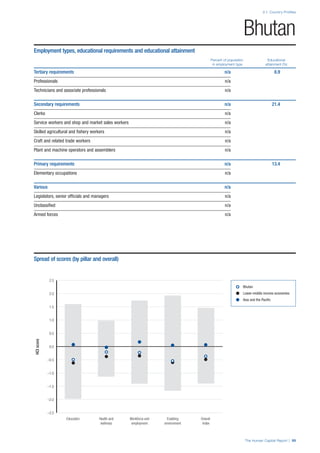
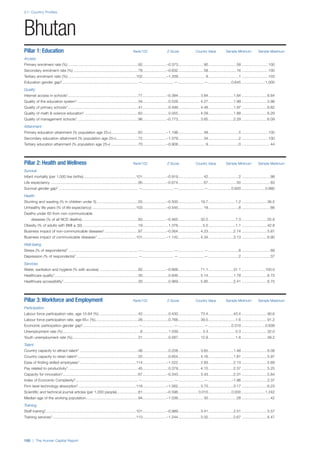
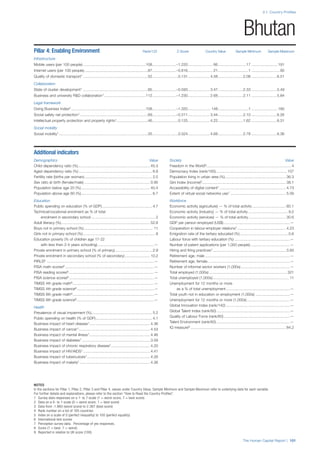
position. Bhutan’s (88) strong labour force participation and
in particular low unemployment rates drive strong scores
on the Workforce and Employment pillar. However, weak
scores in technology absorption and training pull down the
overall ranking to 74th spot.
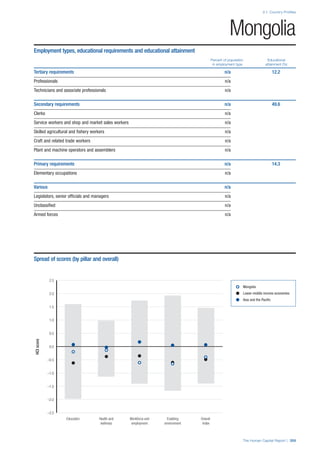
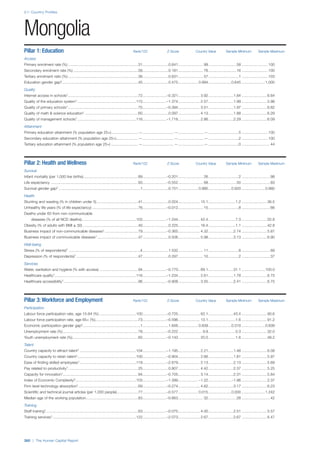
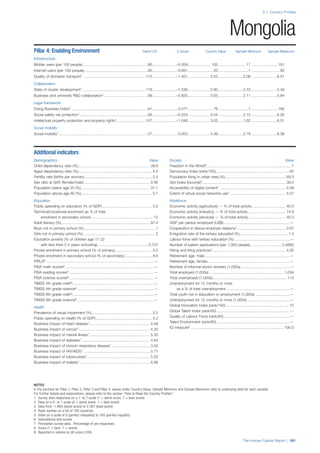
Mongolia’s (89) lowest performance is on the
Workforce and Employment pillar, where the country
Part 1: Measuring Human Capital
18 | The Human Capital Report
Low income
Rank Country Score
81 Kenya –0.306
92 Kyrgyz Republic –0.440
96 Cambodia –0.505
103 Malawi –0.629
104 Tanzania –0.680
105 Madagascar –0.725
106 Uganda –0.727
110 Bangladesh –0.782
113 Benin –0.865
116 Ethiopia –0.961
117 Mozambique –0.966
118 Mali –1.034
119 Burkina Faso –1.077
120 Guinea –1.272
Lower–middle income
Rank Country Score
50 Sri Lanka 0.020
53 Indonesia 0.001
63 Ukraine –0.124
66 Philippines –0.161
70 Vietnam –0.202
73 Armenia –0.218
77 Georgia –0.258
78 India –0.270
80 Lao PDR –0.297
82 Morocco –0.336
83 Moldova –0.337
84 Guatemala –0.341
87 Ghana –0.363
88 Bhutan –0.370
89 Mongolia –0.400
90 El Salvador –0.405
93 Nicaragua –0.446
98 Paraguay –0.546
99 Bolivia –0.552
100 Honduras –0.560
102 Senegal –0.602
107 Cameroon –0.728
108 Lesotho –0.751
109 Côte d’Ivoire –0.759
111 Egypt –0.790
112 Pakistan –0.837
114 Nigeria –0.878
121 Mauritania –1.297
122 Yemen –1.395
Upper–middle income
Rank Country Score
22 Malaysia 0.644
35 Costa Rica 0.320
42 Panama 0.207
43 China 0.186
44 Thailand 0.158
45 Kazakhstan 0.124
47 Mauritius 0.099
52 Jordan 0.005
54 Hungary 0.000
56 Bulgaria –0.048
57 Brazil –0.054
58 Mexico –0.057
60 Turkey –0.065
61 Ecuador –0.099
62 Argentina –0.120
64 Azerbaijan –0.157
65 Macedonia, FYR –0.160
67 Tunisia –0.165
68 Jamaica –0.171
69 Romania –0.176
71 Colombia –0.202
72 Albania –0.216
74 Lebanon –0.220
75 Peru –0.227
79 Botswana –0.291
85 Serbia –0.343
86 South Africa –0.361
91 Suriname –0.420
94 Iran, Islamic Rep. –0.487
95 Dominican Republic –0.499
97 Namibia –0.539
101 Venezuela –0.564
115 Algeria –0.954
High income
Rank Country Score
1 Switzerland 1.455
2 Finland 1.406
3 Singapore 1.232
4 Netherlands 1.161
5 Sweden 1.111
6 Germany 1.109
7 Norway 1.104
8 United Kingdom 1.042
9 Denmark 1.024
10 Canada 0.987
11 Belgium 0.985
12 New Zealand 0.978
13 Austria 0.977
14 Iceland 0.957
15 Japan 0.948
16 United States 0.920
17 Luxembourg 0.881
18 Qatar 0.834
19 Australia 0.831
20 Ireland 0.824
21 France 0.746
23 Korea, Rep. 0.640
24 United Arab Emirates 0.610
25 Israel 0.587
26 Barbados 0.581
27 Estonia 0.571
28 Malta 0.473
29 Spain 0.465
30 Portugal 0.453
31 Cyprus 0.452
32 Slovenia 0.445
33 Czech Republic 0.387
34 Lithuania 0.360
36 Chile 0.305
37 Italy 0.266
38 Latvia 0.248
39 Saudi Arabia 0.245
40 Bahrain 0.232
41 Oman 0.220
46 Croatia 0.099
48 Uruguay 0.096
49 Poland 0.087
51 Russian Federation 0.010
55 Greece –0.011
59 Kuwait –0.059
76 Trinidad and Tobago –0.233
Table 6: Rankings by income group*
*Note: Income classifications are taken from the World Bank, which classifies economies into four income categories based on GNI per capita: high income, upper–middle income, lower–middle income
and low income.
The Human Capital Report | 19
Part 1: Measuring Human Capital
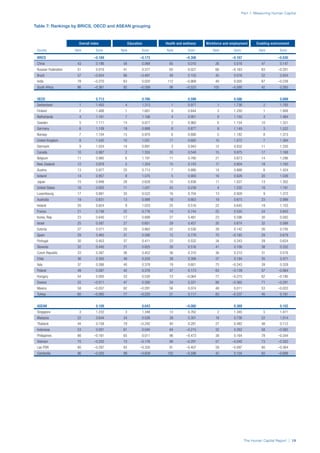
Overall index Education Health and wellness Workforce and employment Enabling environment
Country Rank Score Rank Score Rank Score Rank Score Rank Score
BRICS –0.169 –0.173 –0.306 –0.167 –0.030
China 43 0.186 58 0.069 65 0.010 26 0.516 47 0.147
Russian Federation 51 0.010 41 0.377 62 0.027 66 –0.163 63 –0.201
Brazil 57 –0.054 88 –0.497 49 0.150 45 0.078 52 0.054
India 78 –0.270 63 0.020 112 –0.868 49 0.005 67 –0.239
South Africa 86 –0.361 92 –0.589 98 –0.533 105 –0.588 42 0.265
OECD 0.713 0.766 0.599 0.586 0.899
Switzerland 1 1.455 4 1.313 1 0.977 1 1.736 2 1.793
Finland 2 1.406 1 1.601 9 0.844 3 1.250 1 1.926
Netherlands 4 1.161 7 1.106 4 0.901 8 1.150 4 1.484
Sweden 5 1.111 14 0.977 2 0.960 6 1.154 10 1.351
Germany 6 1.109 19 0.888 8 0.877 9 1.149 3 1.522
Norway 7 1.104 15 0.970 6 0.890 5 1.182 8 1.373
United Kingdom 8 1.042 10 1.031 17 0.682 10 1.072 7 1.384
Denmark 9 1.024 18 0.891 3 0.943 12 0.932 11 1.330
Canada 10 0.987 2 1.355 20 0.548 15 0.875 17 1.168
Belgium 11 0.985 6 1.191 11 0.780 21 0.673 14 1.296
New Zealand 12 0.978 5 1.204 15 0.743 17 0.804 18 1.163
Austria 13 0.977 25 0.713 7 0.886 14 0.886 6 1.424
Iceland 14 0.957 8 1.075 5 0.900 16 0.826 20 1.026
Japan 15 0.948 28 0.628 10 0.836 11 1.027 13 1.302
United States 16 0.920 11 1.027 43 0.239 4 1.235 16 1.181
Luxembourg 17 0.881 35 0.522 16 0.704 13 0.928 9 1.372
Australia 19 0.831 13 0.988 18 0.663 19 0.675 23 0.999
Ireland 20 0.824 9 1.033 25 0.516 22 0.645 19 1.103
France 21 0.746 22 0.776 14 0.744 25 0.520 24 0.943
Korea, Rep. 23 0.640 17 0.899 27 0.481 23 0.596 30 0.582
Israel 25 0.587 27 0.651 29 0.457 20 0.674 32 0.568
Estonia 27 0.571 20 0.862 22 0.536 39 0.142 26 0.745
Spain 29 0.465 31 0.590 12 0.778 70 –0.185 28 0.679
Portugal 30 0.453 37 0.411 23 0.532 34 0.243 29 0.624
Slovenia 32 0.445 21 0.825 26 0.516 41 0.106 38 0.332
Czech Republic 33 0.387 36 0.452 36 0.310 36 0.210 31 0.576
Chile 36 0.305 49 0.250 38 0.306 37 0.194 35 0.471
Italy 37 0.266 40 0.378 19 0.601 75 –0.243 39 0.329
Poland 49 0.087 42 0.376 47 0.173 63 –0.139 57 –0.064
Hungary 54 0.000 33 0.530 73 –0.064 77 –0.275 62 –0.190
Greece 55 –0.011 47 0.280 34 0.331 86 –0.365 71 –0.291
Mexico 58 –0.057 82 –0.291 56 0.074 48 0.011 53 –0.022
Turkey 60 –0.065 77 –0.220 51 0.117 83 –0.337 45 0.181
ASEAN 0.109 0.043 –0.080 0.369 0.102
Singapore 3 1.232 3 1.348 13 0.762 2 1.345 5 1.471
Malaysia 22 0.644 34 0.526 39 0.301 18 0.736 22 1.014
Thailand 44 0.158 79 –0.242 40 0.281 27 0.482 48 0.112
Indonesia 53 0.001 61 0.040 84 –0.215 32 0.262 58 –0.082
Philippines 66 –0.161 65 0.011 96 –0.473 38 0.164 78 –0.344
Vietnam 70 –0.202 73 –0.176 88 –0.291 57 –0.040 73 –0.302
Lao PDR 80 –0.297 83 –0.320 91 –0.407 59 –0.097 80 –0.364
Cambodia 96 –0.505 99 –0.839 102 –0.596 42 0.104 93 –0.688
Table 7: Rankings by BRICS, OECD and ASEAN grouping
Part 1: Measuring Human Capital
20 | The Human Capital Report
scores 106th. Although Mongolia takes the top spot for the
Economic participation gender gap indicator, Mongolia is
in last position for the Training services indicator. Mongolia
shows a stronger performance on the Education pillar
where its primary and tertiary enrolment rates are both in
the top 40 rankings.
Iran (94) is the lowest of the upper–middle income
economies represented in the Asia and Pacific region.
Iran has a wide distribution of ranks across the four
pillars, from 68th for Education to 119th for Workforce and
Employment. Strong enrolment rates push up Iran’s scores
for the former pillar, whereas bottom five positions for
the Economic participation gender gap and Labour force
participation (15–64) indicators contribute to driving down
the aggregate scores for the latter pillar. Cambodia (96) is
followed by Bangladesh (110) and Pakistan (112).
EUROPE AND CENTRAL ASIA
Europe and Central Asia holds the second highest overall
rank of the six regions in the Index, with a top performance
on Health and Wellness and second position on Enabling
Environment. Two–thirds of the region’s countries are
high–income economies that dominate the top half of the
global rankings across all categories. With eight of the top
ten in the region and thirteen in the top 20, the Europe and
Central Asia region has only fifteen of its countries outside
the top 50.
Switzerland (1) and Finland (2) hold the highest ranks
on the Index. In addition to investment in human capital
across health, education and employment, both countries
are able to leverage strong returns through creating an
efficient, effective ecosystem or enabling environment.
Switzerland and Finland hold the top four spots across
all pillars with the exception of Finland on the Health and
Wellness pillar where Finland ranks ninth place.
The Netherlands (4), Sweden (5), Germany (6) and
Norway (7) follow next. Sweden, in tenth spot, trails
Germany (third) on the Enabling Environment pillar, mainly
due to Germany’s more advanced scores on the Cluster
development and Internal infrastructure indicators. However
Sweden’s second position globally for Health and Wellness,
due to low impact of NCDs, nudges the country ahead in
the overall rankings. Norway’s Education and Workforce
and Employment pillars are similar to Denmark’s,
however Norway fares better than its neighbour on the
unemployment indicators.
The UK (8) leads Denmark (9) on all but the Health
and Wellness pillar. The UK’s Health sub–pillar scores
are held back due to obesity and well–being indicators.
Belgium (11), Austria (13) and Iceland (14) have good overall
performances on the Health and Wellness pillar, due to
excellent healthcare systems and, in particular for Iceland,
high scores on the communicable and non–communicable
disease indicators. Belgium and Iceland both post very
strong scores in Education, which supports their overall
rankings. Austria’s 25th position on the Education pillar is
the weakest performance of the three countries on any of
the pillars, but its ICT and physical infrastructure ensures
–1.0
–0.8
–0.6
–0.4
–0.2
0.0
0.2
0.4
0.6
0.8
1.0
Sub-Saharan AfricaMiddle East and
North Africa
Latin America and
the Caribbean
Asia and
the Pacific
Europe and
Central Asia
North America
Figure 2: Regional performance on the Human Capital Index
Source: Human Capital Index 2013. Scores are weighted by population; population data from United Nations Department of Economic and Social Affairs, World Population Prospects, rev. 2012.
Pillarscore
The Human Capital Report | 21
Part 1: Measuring Human Capital
a strong overall ranking on the Enabling Environment pillar
at sixth spot, ahead of Belgium in the 14th and Iceland in
20th positions.
Luxembourg (17) ranges from ninth position on the
Enabling Environment pillar, due to strengths in Legal
infrastructure and Social mobility, to 35th on Education,
where enrolment rates and qualitative measures of
education have a lower performance. Ireland’s (20)
strengths lie in Education, in contrast to France’s (21)
performance, which places it 13 positions below Ireland on
this pillar.
Estonia (27) has a consistent performance across all
pillars except for Workforce and Employment, which has
the country in 39th spot. Estonia has excellent scores on
the Tertiary attainment and Internet access in schools
indicators, helping to drive up the overall results for this
pillar, although high rates of unemployment are a weak
factor. Malta’s (28) strength is on the Education pillar,
while Infrastructure and Collaboration indicators weaken
performance on the Enabling Environment pillar.
Spain (29) and Portugal (30) share similar ranks
for Enabling Environment, but within this pillar they
demonstrate different strengths and weaknesses. Spain
performs very well on the Health and Wellness pillar with
a 12th spot ranking; however a very poor 70th rank on
the Workforce and Employment pillar due to low labour
force participation and high unemployment brings the
overall scores down significantly. Spain’s participation and
access measures for education are strong but qualitative
measures are low in comparison. Portugal’s rankings are
supported by the country’s performance on the Health and
Wellness pillar, however the Education pillar is Portugal’s
main weakness, in particular the relatively low levels of
educational attainment in the current workforce.
Cyprus (31) has strong scores on the qualitative
education indicators. Below average scores in well–being
reduce the performance on the Health and Wellness pillar
and several weak indicator scores result in the lowest
performance for Cyprus on the Enabling Environment pillar.
Slovenia (32) has a varied performance across the
pillars, with Education in 21st position due to high levels
of educational attainment of the adult population, and
Workforce and Employment in 41st position, where
unemployment impacts profoundly on the overall scores.
The Czech Republic (33) has a notably homogenous
performance across all pillars with a rank of 36 for all
pillars, with the exception of a stronger performance
on Enabling Environment, in particular for the group of
infrastructure–related variables.
Lithuania (34) and its neighbour Latvia (38) both
demonstrate similar scores on the Workforce and
Employment pillars. Italy’s (37) main strengths lie in the
health of its population. With a rank of 19 in the Health
and Wellness pillar, Italy has some of the top rankings in
several indicators. However Italy’s lowest performance is
the Workforce and Employment pillar, where it ranked at
75th, due to low levels of staff training and low perceptions
of the use of technology within business. A notable
–1.2
–1.0
–0.8
–0.6
–0.4
–0.2
0.0
0.2
0.4
0.6
0.8
1.0
1.2
Sub-Saharan AfricaMiddle East
and North Africa
Latin America
and the Caribbean
Asia and
the Pacific
Europe and
Central Asia
North America
Figure 3: Regional performance on the Education pillar
Source: Human Capital Index 2013. Scores are weighted by population; population data from United Nations Department of Economic and Social Affairs, World Population Prospects, rev. 2012.
Pillarscore
Part 1: Measuring Human Capital
22 | The Human Capital Report
strength for Italy is its perceived top position in the State of
cluster development indicator.
Croatia’s (46) performance in the legal and regulatory
environment, brain drain concerns, an inability to attract
talent and low scores on innovation contributed to its
ranking. Kazakhstan (45), Poland (49) and the Russian
Federation (51) have almost identical scores on the
Education pillar, despite varying scores on the current
access to education indicators. For the latter two countries
this was their strongest performing pillar. Poland also
leads the health rankings for the three countries with a
rank of 47th on the Health and Wellness pillar, however
Kazakhstan’s higher rankings on the remaining two pillars
have ensured its higher overall position on the Human
Capital Index. Excellent scores on the Participation sub–
pillar drive a higher overall rank on the Workforce and
Employment pillar. However, business leaders still indicate
an inability of the country to source the required talent.
Poland leads Russia in the Workforce and Employment
pillar, especially in indicators of the Talent and Training
sub–pillars. However, Russia has a stronger performance
on the Participation sub–pillar.
Hungary’s (54) overall scores are driven by excellent
results on the Education pillar, in particular rankings
of first and fifth for primary and secondary attainment
among the population over 25 years of age, while the
Well–being indicators and obesity and non–communicable
disease indicators supress performance on the Health
and Wellness pillar. Greece (55) and Bulgaria (56)
follow next. Both hold similar aggregate scores on the
Education and the Health and Wellness pillars, although
within these groups Greece outperforms Bulgaria on the
access to education indicators and Bulgaria leads Greece
significantly on the health gender gap and stress indicators.
Both countries have low scores across the Participation
sub–pillar in the Workforce and Employment pillar.
Turkey (60) is the last of the Europe and Central Asia
countries in the upper half of the overall Index rankings.
Strengths on the Collaboration and Legal framework sub–
pillars of the Enabling Environment pillar push this pillar to a
rank of 45, and generally sound performances across the
Health and Wellness pillar offset weaker performances on
the Education and Workforce and Employment pillars, the
latter being due to low levels of labour force participation
and a significant gender gap in economic participation.
Ukraine’s (63) performance is varied across the
categories with 45th position on the Education pillars in
contrast to its 96th rank on Enabling Environment. Tertiary
enrolment and gender parity in education support the 45th
ranking while very low Social mobility, Legal infrastructure
and Cluster development scores are behind the low
Enabling Environment pillar score.
Azerbaijan (64)’s weakest pillar is Health and Wellness,
especially the Survival and the Health sub–pillars, and
it has one of the world’s lowest scores in the gender
gap indicator. Macedonia, FYR (65), Romania (69) and
Albania (72) follow next. Armenia’s (73) overall rank is
reduced as a result of a very low score in the Workforce
–1.0
–0.8
–0.6
–0.4
–0.2
0.0
0.2
0.4
0.6
Sub-Saharan AfricaAsia and
the Pacific
Middle East
and North Africa
Latin America
and the Caribbean
North AmericaEurope and
Central Asia
Figure 4: Regional performance on the Health and Wellness pillar
Source: Human Capital Index 2013. Scores are weighted by population; population data from United Nations Department of Economic and Social Affairs, World Population Prospects, rev. 2012.
Pillarscore
The Human Capital Report | 23
Part 1: Measuring Human Capital
and Employment pillar at 113, where unemployment is
among the highest in the world and levels of employee
training are low. Georgia (77) also has a weak performance
on the Workforce and Employment pillar due to poor
rankings on both unemployment and training indicators.
A high proportion of years lived in good health and a low
prevalence of stunting and wasting in children support
stronger scores for the Health and Wellness pillar, where
the country ranks 66th overall.
Moldova (83) and Serbia (85) perform significantly
better on the Education and Health and Wellness pillars
than on the Workforce and Enabling pillar. The education
levels of the current workforce boost the pillar’s aggregate
scores although performance is weaker on the qualitative
measures. Moldova has one of the lowest labour force
participation rates in the world, despite above–average
rankings on the economic participation gender gap
indicators and the two unemployment indicators. Serbia’s
lowest scores are on the qualitative talent indicators,
while low scores for staff training and high unemployment
also bring down the overall score for the Workforce and
Employment pillar for the country.
The Kyrgyz Republic (92) is the lowest performing of
the Europe and Central Asia countries. Rankings of 78 and
75 for Education and Health and Wellness respectively are
offset by lower rankings on the other two pillars. Very weak
scores on the Enabling Environment’s Legal framework and
the Collaborative sub–pillars negate the top 50 rankings
achieved on some of the infrastructure indicators. The
Kyrgyz Republic scores its highest aggregate rankings
on the Well–being sub–pillar within the Health and
Wellness pillar.
MIDDLE EAST AND NORTH AFRICA
The Middle East and North Africa region has a very
diverse profile of countries in terms of wealth. The
region comprises 15 countries; of which, seven are high
income, four are upper–middle income and four are lower–
middle income. The region ranks fourth on Health and
Wellness, holds second to last place on the Education
and Enabling Environment pillars and is in last place on
Workforce and Employment.
Qatar (18) has a broad range of ranks across the
four pillars, from the seventh spot on the Workforce and
Employment pillar to 44th position on the Health and
Wellness pillar. Qatar’s high ranking on the Workforce
and Employment pillar is due to top rankings on both
unemployment indicators and Country capacity to retain
talent as well as top ten rankings on the Staff training,
Capacity to attract talent, Pay related to productivity and
Labour force participation (15–64) indicators. Other high
scores for education quality and collaboration on the
Enabling Environment pillar are also important contributing
factors.
The United Arab Emirates (24) also benefits from high
qualitative Education pillar rankings and Israel’s (25) high
educational attainment rates help drive its overall scores.
The UAE’s rankings are pulled down by shortfalls on the
-1.2
-1.0
-0.8
-0.6
-0.4
-0.2
0.0
0.2
0.4
0.6
0.8
1.0
1.2
Middle East
and North Africa
Sub-Saharan AfricaLatin America
and the Caribbean
Europe and
Central Asia
Asia and
the Pacific
North America
Figure 5: Regional performance on the Workforce and Employment pillar
Source: Human Capital Index 2013. Scores are weighted by population; population data from United Nations Department of Economic and Social Affairs, World Population Prospects, rev. 2012.
Pillarscore
Part 1: Measuring Human Capital
24 | The Human Capital Report
Health and Wellness pillar with a last place ranking for
Deaths under 60 from non–communicable diseases and
a weak performance for Obesity. The Collaboration
indicators of the Enabling Environment pillar are also
helping to push up the overall scores for the UAE. Israel’s
Life expectancy, Business impact of non–communicable
diseases and health services indicators are strong
performers for the country.
Saudi Arabia’s (39) pillar scores ranges from a 21st
rank on Enabling Environment to a weaker 72nd spot
on Health and Wellness. The country scores well on all
indicators of the former, with the exception of Internet
access, where usage rates are outside the top 50 rankings.
Conversely, Saudi Arabia achieves the top spot for mobile
phone use. Bahrain’s (40) strength is also on the Enabling
Environment pillar, with a strong performance on the Legal
framework and Social mobility sub–pillars. Deaths under
60 from NCDs and Obesity are weak points, both ranking
below 100.
In contrast to a number of other countries in the
region, Oman (41) has a relatively strong performance on
the Health and Wellness pillar, with a rank of 37. Despite
a relatively low life expectancy, Oman ranks highly in
healthy life years and healthcare services. Oman’s Enabling
Environment pillar is in a strong 25th position in part due to
good scores in ICT usage and Intellectual property rights
and property protection. Weaker scores in labour force
participation and the education gender gap measure pull
down the country’s overall scores.
Jordan (52) and Kuwait (59) both rank low on the
Workforce and Employment pillar. Although Kuwait has
good rankings for the unemployment indicators it has
significantly lower scores on the qualitative measures.
Jordan fares better, in this group, in particularly with
the country’s level of technology absorption, but the
country’s labour force participation rate among the 15–64
age group is the lowest in the sample and the economic
gender gap measure puts the country in the bottom ten
for this indicator.
A good overall performance (46th) on the Health and
Wellness pillar boosts Tunisia’s (67) overall rankings. High
rankings for the business impact of both communicable
and non–communicable disease indicators help push up
the scores on this pillar. Compared to a number of other
countries in the region, Tunisia has very low rankings in
labour force participation, economic gender gap and
unemployment rates, placing Tunisia in 101st place in the
Workforce and Employment pillar.
Lebanon (74) performs well on the Education pillar
with a rank of 32nd, significantly higher than its 96th rank
for Workforce and Employment and 104th rank for
Enabling Environment. With the exception of Internet
access in schools, the qualitative measures for Lebanon’s
education perform well, at a 13th spot or above. Poor
rankings on the Infrastructure, Legal frameworks and
Collaboration sub–pillars push down scores on the
Enabling Environment pillar.
-1.2
-1.0
-0.8
-0.6
-0.4
-0.2
0.0
0.2
0.4
0.6
0.8
1.0
1.2
Sub-Saharan AfricaMiddle East
and North Africa
Latin America
and the Caribbean
Asia and
the Pacific
Europe and
Central Asia
North America
Figure 6: Regional performance on the Enabling Environment pillar
Source: Human Capital Index 2013. Scores are weighted by population; population data from United Nations Department of Economic and Social Affairs, World Population Prospects, rev. 2012.
Pillarscore
The Human Capital Report | 25
Part 1: Measuring Human Capital
Morocco’s (82) Health and Wellness pillar is the
country’s strongest, ranking 59th, boosted by strong
performances on the Stunting and wasting in children,
Depression and Business impact of non–communicable
diseases indicators. Morocco is the highest ranked of the
North African countries, significantly ahead of its neighbour
Algeria (115) in all pillars, particularly Health and Wellness,
where very low scores on the business impact of disease
indicators distinctly separate the countries. Algeria’s
qualitative measures for education, talent and training
impact the overall results significantly and contribute to the
overall lower ranking.
The Enabling Environment and Health and Wellness
pillars help the low performance of Egypt (111). Stronger
results on the Survival gender gap and the Water,
sanitation and hygiene indicators are offset by poor
results on Obesity and the two qualitative healthcare
indicators. Likewise, the better ranking on the State of
cluster development indicator is pulled down by the other
Collaborative indicator, Business and university R&D
collaboration.
Mauritania (121) and Yemen (122) are the lowest
ranking countries in the region and in the Index overall,
occupying the bottom four pillar spots in all but two
instances. Mauritania has marginally better qualitative
education results. Yemen has slightly better scores on the
Enabling Environment pillar due to its domestic transport
and social safety net indicators, although the collaboration
variables reduce the overall pillar score to 116th. Mauritania
scores well on the Depression indicator, helping to boost
the country’s score to 105th on this pillar.
NORTH AMERICA
North America is the highest performing of the six regions
and is comprised of only two high–income economies.
Canada (10) ranks the highest of the North America region,
due to a very strong performance on the Education pillar.
The second overall rank raises the aggregate Human
Capital Index score from the other three pillars, which
rank between 15th for Workforce and Employment to 20th
for Health and Wellness. Canada has the highest tertiary
attainment levels of all the countries in the Index. Canada’s
qualitative measures are significantly higher than that of the
United States (16).
Within the Enabling Environment pillar, the United
States demonstrates superior collaboration, as it does
on the talent group of indicators in the Workforce
and Employment pillar. However it is on the Health
and Wellness pillar where the greatest difference in
performance lies, with Canada scoring higher than the
United States on the access and quality of its healthcare,
on well–being and on the impact of non–communicable
disease indicators.
SUB–SAHARAN AFRICA
Twenty–one countries are represented in the Sub–
Saharan Africa region, which scores at the bottom of
the six regions overall, with the lowest scores for each
pillar, except for the Workforce and Employment pillar
where it ranks fifth, ahead of the Middle East and North
Africa region. Mauritius, Botswana, South Africa and
Namibia are from the upper–middle income category of
economies. There are six countries from the lower–
middle income group and the remainder are all low–
income economies.
Mauritius (47) is the highest–ranking county in the
region and the only country from the region in the top
50. Good performances on Education and Enabling
Environment, and in particular Health and Wellness where
the country is ranked 45th, mean that the country is
significantly ahead of the region’s second and third placed
countries, Botswana (79) and Kenya (81). A lower 64th
position on the Workforce and Employment pillar is due to
low levels of labour force participation and a low ranking on
the youth unemployment indicator.
Botswana ranks well on the Enabling Environment
pillar with a 59th spot, in comparison with 85th to 93rd on
the other three pillars. Better scores in the Legal framework
sub–pillar help lift the lower scores in the Collaboration
sub–pillar. In contrast, Kenya does well in terms of
Collaboration but poorly on Legal framework. Botswana
shares the top spot in the education gender gap measure
and 40th in economic participation but has a much lower
rank for the Survival gender gap indicator. Kenya does well
overall on the talent indicators, with a globally high rank for
Ease of finding skilled employees.
South Africa (86) ranks 42nd on the Enabling
Environment pillar, its highest pillar score by a significant
margin, and has rankings of 92nd to 105th on the other
pillars. In particular, its Collaboration and Legal framework
sub–pillars have strong results but the Infrastructure scores
are pulled down by a 104th place rank for the Domestic
transport indicator. South Africa’s very poor scores for
unemployment, youth unemployment and labour force
participation drive down the rankings for the Workforce and
Employment pillar. Despite good scores for staff training,
South Africa has one of the lowest scores on the Ease of
finding skilled employees and Pay relating to productivity
indicators.
Ghana (87) has stronger scores across the Workforce
and Employment and Enabling Environment pillars
than it does on the Education and Health and Wellness
pillars. Strong labour force participation rates across the
population maintain its ranking despite some weaknesses
on the talent and training indicators. Ghana’s Domestic
transport indicator performs better than the ICT element
within the Infrastructure sub–pillar.
Namibia’s (97) ranking on the Enabling Environment
pillar (61) tops that of the other three pillars, where it ranks
between 98th and 108th, by a significant margin. Senegal
Part 1: Measuring Human Capital
26 | The Human Capital Report
(102) has a strong 51st spot on the Workforce
and Employment pillar that boosts its overall ranking,
despite being in 112th position on the Education pillar.
Senegal has some of the lowest educational attainment
rates within the adult population of any country in the
Index and enrolment levels among children today are
very low. Nevertheless, the qualitative measures on the
Workforce and Employment pillar are relatively strong,
and Senegal has a high 21st rank on the Ease of finding
skilled employees indicator.
Malawi (103), Tanzania (104) and Madagascar (105)
all have rankings lower than 100 on all four pillars, with
the exception of Workforce and Employment, due to high
labour force participation levels and very good scores on
the unemployment indicators. The qualitative measures are
in the bottom half of the rankings and technology–related
indicators show weak scores for these countries. The
Education pillar enrolment scores—particularly for higher
education—are very low for these three countries. Malawi
has some of the globally lowest scores in the Health and
Wellness pillar.
Uganda’s (106) overall scores are enhanced by its
high levels of labour force participation and low levels of
unemployment, as are the scores for Cameroon (107)
and Lesotho (108). Côte d’Ivoire (109) reflects a similar
picture. Benin (113) follows next, with the Infrastructure and
Collaboration sub–pillars and the Doing Business Index
indicator pulling down the overall scores on the Enabling
Environment pillar. Nigeria (114), the most populous nation
in the African continent, bucks the trend in high levels
of labour force participation, with a relatively weak rank
of 106th on the 15 to 64 age group, although it ranks
higher on the over 65 labour force participation age group
indicator. Nigeria’s qualitative measures on the Education
and Workforce and Employment pillars and technology–
related indicators are relative strengths, but the country has
the lowest rankings for primary education enrolment and is
just outside the bottom ten for tertiary enrolment.
Ethiopia (116), Mozambique (117) and Mali (118) follow
next. Ethiopia’s relatively stronger performing scores
on the Workforce and Employment pillar are derived
from participation rather than qualitative measures. ICT
infrastructure scores for Ethiopia are the lowest globally;
however, the Legal framework and Social mobility sub–
pillars lead to better scores on the Enabling Environment
pillar. Burkina Faso (119) has its overall scores greatly
boosted by high rates of labour force participation and low
levels of youth unemployment; it ranks fifth on labour force
participation of the 15 to 64 year olds and fourth on youth
unemployment indicators. However it has very low rankings
across the qualitative measures of the talent and training
indicators.
Both Burkina Faso and Guinea (120) have low
rankings on the technology indicators in the Workforce
and Employment and Enabling Environment pillar. Both
countries also have low levels of school enrolment, and
Guinea in particular has a number of bottom–10 ranking
qualitative indicators in the Education pillar. Guinea
is the lowest performing country in the Sub–Saharan
Africa region. Its highest rank is 117th on the Workforce
and Employment pillar and it is the lowest ranked of all
countries on the Enabling Environment pillar at 122nd,
with universally low scores on the Infrastructure and Legal
framework sub–pillars.
LATIN AMERICA AND THE CARIBBEAN
Latin America and the Caribbean ranks fourth on
the overall Index, ahead of the Middle East and the
Sub-Saharan Africa regions respectively. The region
comprises predominantly upper–middle income
economies, with four high–income economies and six
lower–middle income economies.
Barbados (26) is the highest–ranking country
in the region due to its strong scores on the Education
pillar, where it ranks in 12th place. The country has four
indicators in this pillar that rank in the top ten; these
are mainly in the Qualitative sub–pillar. The obesity and
non–communicable disease indicators in the Health
and Wellness pillar pull down the overall scores for this
pillar to 42nd place; otherwise, Barbados has good
results on the Survival gender gap and Healthcare
accessibility indicators.
Costa Rica (35) and Chile (36) are similarly ranked
across a number of pillars; however, Chile has particular
strengths on the Enabling Environment pillar. Conversely,
Costa Rica is substantially stronger than Chile in three
of the five qualitative measures of the Education pillar.
Costa Rica performs well on the training indicators and
better overall on the talent indicators than it does on the
participation indicators in the Workforce and Employment
pillar. Chile has stronger attainment and enrolment scores
except for higher education.
Panama’s (42) Workforce and Employment and
Enabling Environment pillars rank at 31st and 34th
respectively and are the country’s strongest. The country’s
high rankings on the capacity to attract and retain talent
indicators help drive the Workforce and Employment
pillar scores up, as does the mobile phone penetration
indicator within the Enabling Environment pillar. Weaker
scores on obesity, stress, and qualitative indicators of
math and science education contribute to a reduction in
the overall rankings.
Uruguay (48), the last of the region’s countries in the
top 50, has good enrolment rates for primary and tertiary
education, which help keep the overall Education pillar
scores buoyant, despite weaknesses in several of the
qualitative indicators. A top rank for the Survival gender
gap indicator is in contrast to the bottom rank on Pay
relating to productivity measure.
Brazil (57) and Mexico (58) are closely tied, with
almost identical scores on the Enabling Environment pillar.
Brazil ranks higher on the ICT infrastructure indicators and
The Human Capital Report | 27
Part 1: Measuring Human Capital
social mobility, but there is a distinct margin between the
two countries on the Doing Business Index indicator, with
Brazil (96th) trailing Mexico (44). Mexico and Brazil have
similar scores for the majority of the qualitative Education
indicators but Mexico leads in the attainment measures for
all three levels of education.
Ecuador (61) performs significantly better on the
Workforce and Employment pillar, contrasting with the
other three pillars, where it ranks between 68th and 76th.
Communicable diseases, stress and unhealthy life years
bring down the rankings of the Health and Wellness pillar,
while low levels of unemployment and good ranks for talent
attraction, retention and ease of finding skilled employees
raise the overall rankings of the stronger performing
Workforce and Employment pillar.
Argentina (62) and Jamaica (68) score well on
the Health and Wellness pillar, helping to drive up the
aggregate scores in the final index. Both countries have
top ranks on the Survival gender gap indicator, and
Argentina performs well on the Well–being and Services
sub–pillars. A strong performance on the Education pillar,
due to quality management schools and high levels of
tertiary enrolment, helps to mitigate the impact of low
scores on the Workforce and Employment pillar, where
three qualitative indicators rank 100 or lower. Pay relating
to productivity has a notably low rank at 120th position.
Jamaica’s State of cluster development, R&D collaboration
and Domestic transport indicators represent its main
strengths within the Enabling Environment pillar.
Colombia (71) has consistent scores across all four
pillars, with just a seven–rank difference between its
highest–ranked Education and Enabling Environment
in 72nd place and its lowest rank Health and Wellness
pillar, which sits in the 79th spot. The country’s highest
rank is 17th, for the Stunting and wasting in children
under 5 indicator, and its lowest rank is 103rd for the
Quality of domestic transport indicator. Peru (75) has
consistent ranks in the low 80s across three of the pillars.
However, the Workforce and Employment pillar, in 50th,
is a significant strength for the country. Guatemala (84),
comparably strong in this pillar, drops to 105th rank on the
Education pillar due to very low scores in four of the five
qualitative indicators. Low unemployment, high labour force
participation of the over 65s and staff training help boost
Guatemala’s ranks for the Workforce and Employment
pillar. Peru also has good rankings on both the 15–64
and the over 65s labour force participation indicators and
benefits from low unemployment rates. However, low
scores in innovation and number of scientific and technical
journal articles force down the aggregate scores for the
Workforce and Employment pillar.
Trinidad and Tobago (76) ranks between 53rd and
56th in three pillars, but a very poor rank of 121st on
Health and Wellness, which puts the country second
from bottom across all regions, drives down its overall
score substantially. Trinidad and Tobago scores the
lowest on the healthy life years indicator. Low rankings
for Survival gender gap, Obesity and Business impact
of non–communicable diseases also contribute to the
low scores for the Health and Wellness pillar. Low youth
unemployment and the capacity of the country to attract
talent are among the strengths of the Workforce and
Employment pillar.
El Salvador (90), Suriname (91) and Nicaragua (93)
follow next. Suriname has overall better qualitative and
attainment rankings on the Education pillar, and El Salvador
has a stronger performance on the educational access
indicators. Nicaragua’s strengths include the Workforce
and Employment talent indicators. Its principal weakness
lies in the Infrastructure sub–pillar of Enabling Environment.
Suriname has bottom–10 rankings on the Doing Business
Index, Quality of domestic transport and Social safety net
protection indicators. Healthcare access and quality, and
primary school and maths quality indicators are strengths
for Suriname.
The Dominican Republic (95) scores well on access
and attainment measures, but performs poorly on
qualitative measures in the Education pillar. Labour force
participation of the over 65s and Firm level technology
absorption are the stronger–performing indicators in
the Workforce and Employment pillar. In the Health and
Wellness pillar, where the country scores its highest pillar
rank of 85th, Stunting and wasting in children under 5 is
the only indicator in the top 50.
Paraguay’s (98) strongest performance is on the
Health and wellness pillar; notably, the Survival and Well–
being sub–pillars. Despite relatively stronger participation
scores on the Workforce and Employment pillar, the
majority of the talent and training indicators remain in the
bottom quartile. Bolivia (99), Honduras (100) and, last
placed in the Latin American region, Venezuela (101), follow
next. Honduras’ performance ranges from 87th position
on Enabling Environment to 103rd place on Education,
due to very low qualitative and attainment scores. Low
unemployment and relatively higher ranks for training help
raise the overall rankings for Honduras. Bolivia’s scores
for attracting and retaining talent and the ease of finding
skilled employees are among those indicator that help
drive up the country’s Workforce and Employment pillar
ranking. It is a similar picture with the qualitative indicators
in the Education pillar. Venezuela has good access and
attainment measures in education; however, very low
scores on the Legal framework, Social mobility and Talent
sub–pillar indicators push down the overall human Capital
Index ranking for the country.
Figures 7, 8, 9 and 10 display correlations between the
Human Capital Index, Human Development Index, Global
Competitiveness Index, GDP per capita and the Global
Gender Gap Index.
–1.5 –1.2 –0.9 –0.6 –0.3 0.0 0.3 0.6 0.9 1.2 1.5
0.2
0.4
0.6
0.8
1.0
KenyaYemen
India
Indonesia
China
Brazil Qatar
Switzerland
Singapore FinlandJapan
United States
Russian Federation
Figure 7: Relationship between the Human Development Index and the Human Capital Index
Source: Human Capital Index 2013 and the United Nation’s International Human Development Indicators 2012 online database, accessed September 2013.
HumanDevelopmentIndex2012score
Human Capital Index 2013 score
–1.5 –1.2 –0.9 –0.6 –0.3 0.0 0.3 0.6 0.9 1.2 1.5
1
2
3
4
5
6
7
Kenya
India
Yemen
Indonesia
China
Brazil Qatar
Switzerland
Japan
United States
Singapore
Finland
Russian Federation
Figure 8: Relationship between the Global Competitiveness Index and the Human Capital Index
Source: Human Capital Index 2013 and the World Economic Forum’s Global Competitiveness Index, accessed September 2013.
GlobalCompetitivenessIndex2012–2013score
(1–7scale)
Human Capital Index 2013 score
Part 1: Measuring Human Capital
28 | The Human Capital Report
Source: Source: Human Capital Index 2013 and Global Gender Gap Index 2012.
–1.5 –1.2 –0.9 –0.6 –0.3 0.0 0.3 0.6 0.9 1.2 1.5
0.5
0.6
0.7
0.8
0.9
Kenya
India
Indonesia China
Brazil
Qatar
Switzerland
Finland
Japan
United States
Singapore
Russian Federation
Yemen
–1.5 –1.2 –0.9 –0.6 –0.3 0.0 0.3 0.6 0.9 1.2 1.5
0
20
40
60
80
Qatar
Kenya India
Yemen
Indonesia
China
Brazil
Singapore
Switzerland
Japan Finland
United States
Russian Federation
Figure 9: Relationship between GDP per capita and the Human Capital Index
Figure 10: Relationship between the Global Gender Gap Index and the Human Capital Index
Source: Human Capital Index 2013 and the World Bank’s World DataBank: World Development Indicators & Global Development Finance online database 2012, accessed September 2013.
GDPpercapita(constantinternational$,1,000s)GlobalGenderGapIndex2012score
Human Capital Index 2013 score
The Human Capital Report | 29
Part 1: Measuring Human Capital
30 | The Human Capital Report
CONCLUSION
The Human Capital Index seeks to create greater
awareness among a global audience of human capital
as a fundamental pillar of the growth, stability and
competitiveness of nations. This Index is a first attempt at
measuring human capital holistically and across a large set
of countries. We hope to continue to improve methodology
in future years and hope that this Report will also foster
further research.
The Index seeks to serve as a tool for capturing
the complexity of workforce dynamics so that various
stakeholders are able to take better–informed decisions.
Because human capital is critical not only to the
productivity of society but also to the functioning of
its political, social and civil institutions, understanding
its current capacity is valuable to a wide variety of
stakeholders. We hope that this Report can help
governments, business, universities and civil society
institutions identify key areas for focus and investment.
All of these entities have a stake in human capital
development, whether their primary goal is to power their
businesses, strengthen their communities, or create a
population that is better able to contribute to and share in
the rewards of growth and prosperity. We thus hope that
this Report will also foster collaboration between sectors to
address human capital gaps.
NOTES
	 1	 See WHO, Fact sheet no 332: Early child development.
	 2	 See WHO, Health Status Statistics: Mortality.
	 3	 See WHO, Fact sheet: Noncommunicable diseases.
	 4	 See WHO, Fact sheet: Obesity and overweight.
	 5	 See WHO, Investing in Mental Health, page 5.
	 6	 See WHO, 10 Facts on Mental Health: Fact 2.
	 7	 See Sanctuary, M., Tropp, H., et al., “Making water a part of
economic development: The economic benefits of improved water
management and services”.
	 8	 See ILO, Resource Guide on youth employment.
REFERENCES
Access Economics Pty Limited. The Global Economic Cost of Visual
Impairment. 2010. Sydney: Access Economics Pty Limited.
ACT. A Better Measure of Skills Gaps. 2004. Iowa city: ACT, Inc.Agbor,
J.A. and Price, G.N. Does Famine Matter For Aggregate Adolescent
Human Capital Acquisition In Sub-Saharan Africa?. ERSA (Economic
Research Southern Africa), www.econrsa.org/publications/working-
papers/does-famine-matter-aggregate-adolescent-human-capital-
acquisition-sub, December 2012.
Aiyar, S. and Mody, A. The Demographic Dividend: Evidence from the
Indian States. International Monetary Fund, http://www.imf.org/
external/pubs/ft/wp/2011/wp1138.pdf, 2011.
Appleton, S. and Teal, F. Human Capital and Economic Development.
Working Paper Series 173. 2000. Abidjan: African Development
Bank.
Barclay, S. (2010) The Dubai Initiative Measuring Human Capital for
Investment. Student research, 2010. Cambridge: Harvard University,
John F. Kennedy School of Government.
Bernal-Verdugo, L.E., Furceri, D., and Guillaume, D. Labor Market Flexibility
and Unemployment: New Empirical Evidence of Static and Dynamic
Effects. International Monetary Fund, http://www.imf.org/external/
pubs/ft/wp/2012/wp1264.pdf, 2012.
Bleakley, H. “Health, Human Capital, and Development”. Annual Review
of Economics, 2010, 2(1): 283-310. www.annualreviews.org/doi/
abs/10.1146/annurev.economics.102308.124436.
Brown, Tim. “A creative future for education”. Forum Blog (blog), Feb
6, 2013, http://forumblog.org/2013/02/a-creative-future-for-
education/#disqus_thread.
Cairncross, F. and Pöysti, K. ICTs for education and building human capital.
International Telecommunications Union, www.itu.int/osg/spu/visions/
summaries/education.pdf, 2003.
Carneiro, P. and Heckman, J. Human Capital Policy. 2003. Working Paper
9495. Cambridge, MA: National Bureau of Economic Research.
Cisco. Equipping Every Learner for the 21st Century. www.cisco.com/web/
about/citizenship/socio-economic/docs/GlobalEdWP.pdf, 2008.
Coulombe, S.,Tremblay, J.F. and Marchand, S. International Adult Literacy
Survey Literacy scores, human capital and growth across fourteen
OECD countries. 2004. Ottawa: Statistics Canada.
Deaton, A. Income, Health, and Well-Being around the World: Evidence
from the Gallup World Poll. NBER Working Paper No. 13317. National
Bureau of Economic Research, http://www.nber.org/papers/w13317,
2007.
Donnelly, J. (2011) “How did Sierra Leone provide free health care?” In The
Lancet, 2011, 377.
The Economist. “Education and demography: Trimming the dividend”.
17:43, March 15, 2013.
Eidos Institute, The. The Australian Human Capital Project Prospectus.
The Human Capital Gateway, http://www.humancapitalgateway.org/
HCGProspectusFinal.pdf.
Ederer, P. Innovation at Work: The European Human Capital Index. 2006.
Brussels: Lisbon Council Policy Brief.
Gonzalez, G. Karoly, L.A., et al. Facing Human Capital Challenges of the
21st Century: education and labor market initiatives in Lebanon,
Oman, Qatar, and the United Arab Emirates. 2008. Doha: Rand-
Qatar Policy Institute.
Hausmann, R., Hidalgo, C., et al. The Atlas of Economic Complexity.
Cambridge: Puritan Press, 2011.
Hendricks, L. “How Important Is Human Capital for Development?
Evidence from Immigrant Earnings”. American Economic
Review, 2012, 92(1):198-219. www.aeaweb.org/articles.php?d
oi=10.1257/000282802760015676.
Institute for Health Metrics and Evaluation. The Global Burden of Disease:
Generating evidence, guiding policy. 2013. Seattle: Institute for Health
Metrics and Evaluation.
ILO (International Labour Organization). Global Employment Trends for
Youth 2012. 2012. Geneva: ILO.
———. International Standard Classification of Occupations: Structure,
group definitions and correspondence tables (ISCO-08). 2012.
Geneva: ILO.
———. Resource Guide on youth employment. ILO, http://www.ilo.org/
public/english/support/lib/resource/subject/youth.htm, August 2013.
Irmen, A. Cross-Country Income Differences and Technology Diffusion
in a Competitive World. Discussion Paper Series No. 480. 2008.
Heidelberg: University of Heidelberg Department of Economics.
Keeley, B. Human Capital: How what you know shapes your life. 2007.
Paris: OECD.
Li, H. Measuring Human Capital in China. Lisbon Council, http://www.
lisboncouncil.net/component/downloads/?id=420.
Malawi Ministry of Economic Planning and Development, National Statistics
Office, and the Centre for Social Research. Malawi Social Indicators
Survey 1995. Chapter 8: Child Malnutrition. http://www.childinfo.org/
files/Malintro.pdf, September 1996.
The Human Capital Report | 31
Part 1: Measuring Human Capital
Marope, M.T. Namibia Human Capital and Knowledge Development for
Economic Growth with Equity. World Bank, siteresources.worldbank.
org/INTAFRICA/Resources/No84.pdf, 2008.
Mourshed, M., Farrell, D., Barton, D. Education to Employment: Designing
and education system that works (Executive Summary). McKinsey
Centre for Government, http://www.mckinsey.com/client_service/
public_sector/mckinsey_center_for_government/education_to_
employment, 2010.
Murphy, S. Business and Philanthropy Partnerships for Human Capital
Development in the Middle East. Corporate Social Responsibility
Initiative Working Paper No. 52. 2009. Cambridge: John F. Kennedy
School of Government, Harvard University.
Nayar, R., Gottret, P., et al. More and Better Jobs in South Asia. 2012.
Washington, DC: World Bank.
Nkhwa, T. Building Africa’s Human Capital Opportunities and Challenges.
Presented at 27th African Association for Public Administration and
Management Annual Roundtable Conference. 5-9 December 2005.
http://unpan1.un.org/intradoc/groups/public/documents/aapam/
unpan025761.pdf.
OECD (Organisation for Economic Co-Operation and Development). OECD
Patent Statistics Manual. http://browse.oecdbookshop.org/oecd/
pdfs/free/9209021e.pdf.
———. The Creative Society of the 21st Century. http://www.oecd.org/
futures/35391171.pdf, 2010.
Oortwijn, W. and Mathijssen, J., et al. Evaluating the Uptake of the Healthy
Life Years Indicator. 2006. Santa Monica: RAND.
Riddell, W. C. Investing in Human Capital: Policy Priorities for Canada.
Canadian Priorities Agenda Brief No.5: Human Capital. 2008.
Montreal: Institute for Research on Public Policy.
Rinne, U. and Zhao, Z. Human Capital vs. Signaling, The German
Reunification as a Natural Experiment (preliminary draft, Germany
and China). 2010. http://www.iza.org/conference_files/TAM2010/
rinne_u1844.pdf.
Ross, J. Understanding the Demographic Dividend. 2004. Washington:
Policy Project.
Royal Society, The. Knowledge, networks and nations: Global scientific
collaboration in the 21st century. 2011. London: The Royal Society.
Sanctuary, M., Tropp, H., et al. Making water a part of economic
development: The economic benefits of improved water management
and services. WHO (World Health Organization), http://www.who.int/
features/factfiles/mental_health/mental_health_facts/en/index1.html,
August 2013.
Steinberg, C. Can Women Save Japan (and Asia too)? International
Monetary Fund, www.imf.org/external/pubs/ft/fandd/2012/09/
steinberg.htm, 2012.
Souter, D. Towards Inclusive Knowledge Societies: A review of UNESCO’s
action in implementing the WSIS outcomes. 2010. Paris: UNESCO.
Thylefors, B. and Négrel A-D, et al. “Global Data on Blindness”.
Reproduced from “Global Data on Blindness”, Thylefors B and
Négrel A-D., et al. Bulletin of the World Health Organization, 1995,
73(1):115–121.
UNDP (United Nations Development Program). Mobile Technologies and
Empowerment: Enhancing human development through participation
and innovation. http://www.undpegov.org/mgov-primer.html, 2012.
UNESCO (United Nations Educational, Scientific and Cultural Organization).
Education for all the Global Imperative. 2005. Paris: UNESCO.
UNESCO Institute for Statistics. Global Education Digest: Comparing
Education Statistics Across the World. 2011. Montreal: UNESCO.
Wail, B., Said, H et al. A New Data Set of Educational Inequality in the
World, 1950–2010: Gini Index of Education by Age Group. http://
papers.ssrn.com/sol3/papers.cfm?abstract_id=1895496, 2011.
Walpole, S. C., Prieto-Merino, D., et al. “The weight of nations: an
estimation of adult human biomass”. In BMC Public Health, 2012,
12:439.
Westervelt, E. The Secret To Germany’s Low Youth Unemployment
(National Public Radio podcast), April 04, 2012, http://www.npr.
org/2012/04/04/149927290/the-secret-to-germanys-low-youth-
unemployment.
WHO (World Health Organization). 10 Facts on Mental Health: Fact 2.
http://www.who.int/features/factfiles/mental_health/mental_health_
facts/en/index1.html, July 2013.
———. Fact sheet: Obesity and overweight. http://www.who.int/
mediacentre/factsheets/fs311/en/, March 2013.
———. Fact sheet no 332: Early child development. http://www.who.int/
mediacentre/factsheets/fs332/en/, August 2009.
———. Fact sheet: Noncommunicable diseases. http://www.who.int/
mediacentre/factsheets/fs355/en/, March 2013.
———. Global Data On Visual Impairments. 2012. WHO/NMH/PBD/12.01.
———. Health Status Statistics: Mortality. http://www.who.int/healthinfo/
statistics/indhale/en/, July 2013.
———. Investing in Mental Health. http://www.who.int/mental_health/media/
investing_mnh.pdf, 2003.
Part 1: Measuring Human Capital
32 | The Human Capital Report
Appendix: Regional and Income Classifications, 2013
Table A1: Regional classifications, 2013
ASIA AND
THE PACIFIC
EUROPE AND
CENTRAL ASIA
LATIN AMERICA
AND THE CARIBBEAN
MIDDLE EAST
AND NORTH AFRICA
NORTH
AMERICA
SUB–SAHARAN
AFRICA
Australia Albania Argentina Algeria Canada Benin
Bangladesh Armenia Barbados Bahrain United States Botswana
Bhutan Austria Bolivia Egypt Burkina Faso
Cambodia Azerbaijan Brazil Israel Cameroon
China Belgium Chile Jordan Côte d’Ivoire
India Bulgaria Colombia Kuwait Ethiopia
Indonesia Croatia Costa Rica Lebanon Ghana
Iran, Islamic Rep. Cyprus Dominican Republic Mauritania Guinea
Japan Czech Republic Ecuador Morocco Kenya
Korea, Rep. Denmark El Salvador Oman Lesotho
Lao PDR Estonia Guatemala Qatar Madagascar
Malaysia Finland Honduras Saudi Arabia Malawi
Mongolia France Jamaica Tunisia Mali
New Zealand Georgia Mexico United Arab Emirates Mauritius
Pakistan Germany Nicaragua Yemen Mozambique
Philippines Greece Panama Namibia
Singapore Hungary Paraguay Nigeria
Sri Lanka Iceland Peru Senegal
Thailand Ireland Suriname South Africa
Vietnam Italy Trinidad and Tobago Tanzania
Kazakhstan Uruguay Uganda
Kyrgyz Republic Venezuela
Latvia
Lithuania
Luxembourg
Macedonia, FYR
Malta
Moldova
Netherlands
Norway
Poland
Portugal
Romania
Russian Federation
Serbia
Slovenia
Spain
Sweden
Switzerland
Turkey
Ukraine
United Kingdom
The Human Capital Report | 33
Part 1: Measuring Human Capital
Appendix: Regional and income classifications, 2013 (cont’d.)
LOW INCOME
US$1,035 or less
Bangladesh
Benin
Burkina Faso
Cambodia
Ethiopia
Guinea
Kenya
Kyrgyz Republic
Madagascar
Malawi
Mali
Mozambique
Tanzania
Uganda
LOWER–MIDDLE INCOME
US$1,036–$4,085
Armenia
Bhutan
Bolivia
Cameroon
Côte d’Ivoire
Egypt
El Salvador
Georgia
Ghana
Guatemala
Honduras
India
Indonesia
Lao PDR
Lesotho
Mauritania
Moldova
Mongolia
Morocco
Nicaragua
Nigeria
Pakistan
Paraguay
Philippines
Senegal
Sri Lanka
Ukraine
Vietnam
Yemen
UPPER–MIDDLE INCOME
US$4,086–$12,615
Albania
Algeria
Argentina
Azerbaijan
Botswana
Brazil
Bulgaria
China
Colombia
Costa Rica
Dominican Republic
Ecuador
Hungary
Iran, Islamic Rep.
Jamaica
Jordan
Kazakhstan
Lebanon
Macedonia, FYR
Malaysia
Mauritius
Mexico
Namibia
Panama
Peru
Romania
Serbia
South Africa
Suriname
Thailand
Tunisia
Turkey
Venezuela
HIGH INCOME
US$ 12,616 or more
Australia
Austria
Bahrain
Barbados
Belgium
Canada
Chile
Croatia
Cyprus
Czech Republic
Denmark
Estonia
Finland
France
Germany
Greece
Iceland
Ireland
Israel
Italy
Japan
Korea, Rep.
Kuwait
Latvia
Lithuania
Luxembourg
Malta
Netherlands
New Zealand
Norway
Oman
Poland
Portugal
Qatar
Russian Federation
Saudi Arabia
Singapore
Slovenia
Spain
Sweden
Switzerland
Trinidad and Tobago
United Arab Emirates
United Kingdom
United States
Uruguay
Table A2: Income classifications, 2013
Note: Income classifications are taken from the World Bank, which classifies economies into four income categories based on 2013 GNI per capita (current US$), high income, upper–middle income,
lower–middle income and low income.
Part 2
Country Profiles
Part 2: Country Profiles
The Human Capital Report | 37
2.1: Country Profiles
1 | The Human Capital Index 2013
Rank/122 Score
Years(5yearagegroups)
Percent of total population
0–4
5–9
10–14
15–19
20–24
25–29
30–34
35–39
40–44
45–49
50–54
55–59
60–64
65–69
70–74
75–79
80–84
85–89
90–94
95–99
100+
0 1 2 3 4 5 66 5 4 3 2 1 0
Albania
Human Capital Index 2013 72 –0.216
Pillar 1: Education 54 0.136
Pillar 2: Health and wellness 54 0.083
Pillar 3: Workforce and employment 71 –0.207
Pillar 4: Enabling environment 105 –0.874
Key Indicators
Total population (1,000s) 3,150.1
Median age of population 32
GDP per capita PPP (constant 2005, international $) 8,059
GDP growth (annual %) 0.8
Male Female Additional indicators
■ Total population ■ Total population Aged dependency: 15.1%
■ Labour force participation ■ Labour force participation Youth dependency: 34.0%
■ Primary and secondary enrolment ■ Primary and secondary enrolment Male labour force participation, age 65+: 0.3%
Female labour force participation, age 65+: 0.1%
Education and workforce distribution
male enrolment is shown on the respective side of
the pyramid—males on the left, females on the right.
Although the school ages do not fully align with this
age bracket in the population pyramid, it is the closest
representative age group. Source: UNESCO, Institute
for Statistics, provided database extraction 22 August
2013, data from 2012 or latest available data. Bars are
absent from pyramids in Profiles of countries that did
not provide the data.
•	 The lighter coloured bars for the 10-14 age group
indicate the proportion of this population sector
enrolled in secondary school. Similar to primary
enrolment, although the school ages do not fully
align with this age bracket in the population pyramid,
it is the closest representative age group. Source:
UNESCO, Institute for Statistics, provided database
extraction 22 August 2013, data from 2012 or latest
available data. Bars are absent from pyramids in
Profiles of countries that did not provide the data.
•	 The midshaded areas of the pyramid for the ten age
groups between 15 and 64 represent the labour
force participation for each of these age groups,
User’s Guide: How Country Profiles Work
COUNTRY PROFILES: PAGE 1
	 KEY RANKS, SCORES AND INDICATORS
The first section presents each country’s overall human
capital score and its rank out of the 122 reviewed
countries, as well as the scores and ranks for each pillar.
Key Indicators
•	 Total population (in thousands of inhabitants).
Source: World Bank’s World Development Indicators
online database (accessed August 2013).
•	 Median age of population (in years). Source: United
Nations, Department of Economic and Social Affairs,
Population Division, World Population Prospects, 2010
(accessed September 2013).
•	 GDP per capita PPP (constant 2005 international
dollars). Source: World Bank’s World Development
Indicators online database (accessed August 2013).
•	 GDP growth (annual percentage). Source: World
Bank’s World Development Indicators online database
(accessed August 2013).
	 EDUCATION AND WORKFORCE DISTRIBUTION
The chart is a graphical representation of the age and
gender structure of a country, overlaid with data on school
enrolment and workforce participation.
•	 The ‘pyramid’ in the bottom half of the page presents
the demographic profile of the country. The vertical
axis lists each five-year cohort in the population,
while the horizontal axis displays the percentage of
the total population represented by each cohort. The
left side of the pyramid (black bars) represents the
male population and the right side represents the
female (blue bars). Population data source: United
Nations, Department of Economic and Social Affairs,
Population Division, World Population Prospects, 2010
(accessed September 2013).
•	 The lighter coloured bars for the 5-9 age group
indicate the proportion of these children enrolled in
primary school. The distinction between female and
Part 2: Country Profiles
38 | The Human Capital Report
The Human Capital Index 2013 | 2
2.1: Country Profiles
HCIscore
–2.5
–2.0
–1.5
–1.0
–0.5
0.0
0.5
1.0
1.5
2.0
2.5
Overall
Index
Enabling
environment
Workforce and
employment
Health and
wellness
Education
Albania
Employment types, educational requirements and educational attainment
Percent of population Educational
in employment type attainment (%)
Tertiary requirements n/a 1.5
Professionals n/a
Technicians and associate professionals n/a
Secondary requirements n/a 72.8
Clerks n/a
Service workers and shop and market sales workers n/a
Skilled agricultural and fishery workers n/a
Craft and related trade workers n/a
Plant and machine operators and assemblers n/a
Primary requirements n/a 10.6
Elementary occupations n/a
Various n/a
Legislators, senior officials and managers n/a
Unclassified n/a
Armed forces n/a
Spread of scores (by pillar and overall)
Albania
Upper-middle income economies
Europe and Central Asia
disaggregated by gender. The midshade blue bars
represent the proportion of female labour force
participation for each relevant age group and the
midshade black bars represent the proportion of
male labour force participation for each relevant age
group. Source: International Labour Organisation
(ILO), ILOStat, 2010 or latest available data (accessed
August 2013). Bars are absent from pyramids in
Profiles of countries that did not provide the data.
	 There are instances where the labour force
participation is greater than the actual population
shown. This is due to differences in methodology that
the ILO and the UN’s population division apply when
sourcing the data regarding temporary foreign labour.
	 Although the ILO provides labour force
participation data for the over-65 age category
there is no means of determining how this should
be distributed between the eight age groups of the
population over 65 so this data is not represented in
the pyramids. However this information for both males
and females is stated in the legend under “Additional
indicators.”
•	 The legend above the pyramid shows the three
different shades of bars used in the chart. It also
states the dependency rates for the young (below age
15) and elderly (over age 65). The youth dependency
is the percentage of the population below the age
of 15 in relation to the size of the working age
population (age 15 to 64). The aged dependency is
the percentage of the population aged 65 and over in
relation to the size of the working age population (age
15 to 64).
COUNTRY PROFILES: PAGE 2
 	EMPLOYMENT TYPES, EDUCATIONAL
REQUIREMENTS AND EDUCATIONAL ATTAINMENT
This section matches the educational attainment of a
country, across different educational levels, with the
occupational groups that require a specific level of
education.
•	 Employment data is drawn from the International
Labour Organisation’s (ILO’s) Laborsta online
database, 2008, or latest available year (accessed
July 2013). Data was taken from Laborsta since at the
time of collecting the data, the ILOstat data for this
variable was still being populated and limited data
was available. Therefore the latest data available is for
2008.
•	 The ILO has linked eight of the ten major occupational
groups listed below to the four international standard
of classification of employment (ISCO‑88) skill levels.1,2
Each skill level has been referenced to the educational
levels of the International Standard Classification of
Education (ISCED-93) typically required for competent
performance in the occupation.
Skills level 1 = Primary level education
(ISCED level 1)
Elementary occupations
Skills level 2 = Secondary level education
(ISCED levels 2 and 3)
Clerks
Service workers and shop and market
sales workers
Skilled agricultural and fishery workers
Craft and related trades workers
Plant and machine operators and assemblers
Skills levels 3 & 4 = Tertiary level education
(ISCED levels 5 – 7)
Professionals
Technicians and associate professionals
•	 Occupations included in the armed forces and in the
legislators, senior officials and managers groups are
not mapped to any skills category or education level in
ISCO-88. Based on information from national sources,
skills for executing tasks and duties of occupations
belonging to each of these two major groups vary to
such an extent that it would be impossible to link them
with any of the four broad ISCO-88 skill levels.3
Part 2: Country Profiles
The Human Capital Report | 39
•	 For the purpose of inclusion in the County Profiles, we
have grouped together skills groups 3 and 4. The ILO
presents skills categories 3 and 4 separately, aligning
with ISCED levels 5 and 6 & 7 respectively. Note
that for ISCO-88, level 4 is not aligned with any skills
category.
•	 Each employment type is listed under the relevant
education level, which is aligned with the skills
required to perform this type of job competently. Both
the Legislators, senior officials and managers and
the Armed forces groups, which cannot be aligned
with a specific education level, are reported under the
heading “Various”. Unclassified occupations, which
consist of those jobs that cannot be assigned to any
of the ten listed employment types, are also listed
under “Various”.
•	 Employment data is provided in thousands of jobs
and divided by the total population age 15 and over
(Source: United Nations, Department of Economic and
Social Affairs, Population Division, World Population
Prospects, 2010 [accessed September 2013] to
provide occupations held as a percentage of this
population. Numbers will not add up to 100 as the
data does not report the non-working population
and there are omissions in the data where the figures
straddle more than one category. Due to rounding,
some subtotals may not be the sum of the display.
•	 Data in the “Educational attainment (%)” column
is sourced from UNESCO, Institute for Statistics,
Education Statistics online database, latest year
available (accessed August 2013). The data states the
maximum level of education that has been reached
among the population aged 25 and over and provides
this as a percentage of the total population aged
25 and over. This data and the data in the “Percent
of population in employment type” column are not
completely aligned with the data on employment
types, which is predominantly concerning the
population aged 15 and over. Some countries report
data for age groups other than 15 and over.
•	 In some instances, a country has reported data that is
split across several occupational groups. For example
data for the Legislators, senior officials and managers
employment type may be provided as a single figure
combined with data for the Professionals employment
type. As only the Professionals type is aligned with
a recognised skills-education classification, and we
cannot estimate the number to be attributed to either
grouping, then the data has been omitted. Therefore
a number of countries may have reported data that is
not included in the table.
•	 N/A is listed when a country does not report data for
occupation or for educational attainment.
	 SPREAD OF SCORES BY PILLAR AND OVERALL
This section gives an overview of each country’s scores
for each of the four pillars and the overall Human Capital
Index, in relation to the scores of all other countries as well
as the geographic region and income sub-groups to which
the country belongs.
•	 The light grey bars represent the total spread of scores
across all 122 countries in the index. The top of the
grey bar indicates the pillar score of the top performing
country in that pillar from the entire sample. The
bottom limit of the grey bar indicates the pillar score of
the bottom performing country in that pillar.
•	 The vertical position of the white circle indicates where
the country lies in relation to all other countries in the
index. The higher the vertical position the better the
country’s performance in relation to other countries.
•	 The black circle represents the position of the average
of the country’s specific income group. Income
group classifications are detailed in Table A2 of the
Appendix.
•	 The blue circle represents the position of the average
of the country’s geographical group. Geographical
groups are detailed in Table A1 of the Appendix.
COUNTRY PROFILES: PAGE 3
The first three of the four pillars’ indicators are listed in
detail on this page. Each indicator lists the country’s rank
(out of 122 countries), the z-score, the original data for the
indicator, and the minimum and maximum values from the
entire sample of 122 countries.
  	PILLARS 1–3
Pillar 1: Education
Access
	 Primary enrolment rate (%): Net adjusted enrolment
rate, which refers to the percentage of children in the
official primary school age range who are enrolled
in either primary or secondary education. Source:
UNESCO, Institute for Statistics, provided database
extraction 22 August 2013, data from 2012 or latest
available data.
	 Secondary enrolment rate (%): Percentage of
children in the official age range for secondary school
who are enrolled in secondary education. Source:
UNESCO Institute for Statistics, provided database
extraction 22 August 2013, data from 2012 or latest
available data.
Part 2: Country Profiles
40 | The Human Capital Report
	 Tertiary enrolment ratio (%): Total enrolment in
tertiary education (ISCED 5 and 6), regardless of age,
expressed as a percentage of the total population of
the five-year age group that has left secondary school.
Source: UNESCO Institute for Statistics, provided
database extraction 22 August 2013, data from 2012
or latest available data.
	 Education gender gap: Taken from the World
Economic Forum’s Global Gender Gap Report 2012
and comprises the full Education subindex score
(ratios: female literacy rate over male value, female net
primary level enrolment over male value, female net
secondary level enrolment over male value, female
gross tertiary enrolment over male value); 0 = lowest
score, 1 = highest score and full gender parity.
Quality
	 Internet access in schools: Response to the survey
question, “How well does the educational system
in your country meet the needs of a competitive
economy? (1 = not well at all, 7 = very well)”. Source:
World Economic Forum, Executive Opinion Survey,
2013-2014.
	 Quality of the education system: Response to the
survey question, “How well does the educational
system in your country meet the needs of a
competitive economy? (1 = not well at all, 7 = very
well)”. Source: World Economic Forum, Executive
Opinion Survey, 2013-2014.
	 Quality of primary schools: Response to the
survey question, “How would you assess the quality
of primary schools in your country? (1 = poor, 7 =
excellent — among the best in the world)”. Source:
World Economic Forum, Executive Opinion Survey,
2013-2014.
	 Quality of math and science education: Response
to the survey question, “How would you assess
the quality of math and science education in your
country’s schools? (1 = poor, 7 = excellent — among
the best in the world)”. Source: World Economic
Forum, Executive Opinion Survey, 2013-2014.
	 Quality of management schools: Concerned with
the quality of management and business schools in
the country and is a response to the survey question,
“How would you assess the quality of management
or business schools in your country? (1 = poor, 7 =
excellent — among the best in the world)”. Source:
World Economic Forum, Executive Opinion Survey,
2013-2014.
Attainment
	 Primary education attainment (% population
age 25+): Percentage of the population aged 25
and over with at least a primary education (ISCED 1).
This data is cumulative, which means that those with
secondary education are counted in the primary
education figures. Therefore, total figures across more
than one category may add up to more than 100%.
Source: UNESCO Institute for Statistics, Education
Statistics online database, 2011 or latest year available
(accessed August 2013).
	 Secondary education attainment (% population
age 25+): Percentage of the population aged 25 and
over with at least a secondary education (ISCED 2-6).
Source: UNESCO Institute for Statistics, Education
Statistics online database, 2011 or latest year available
(accessed August 2013).
	 Tertiary education attainment (% population
age 25+): Percentage of the population aged 25 and
over with at a least tertiary education (ISCED 5 and
6). Source: UNESCO Institute for Statistics, Education
Statistics online database, 2011 or latest year available
(accessed August 2013).
2.1: Country Profiles
3 | The Human Capital Index 2013
Pillar 1: Education Rank/122 Z-Score Country Value Sample Minimum Sample Maximum
Access
Primary enrolment rate (%) ...................................................................59.........................0.368........................ 96...........................58 .........................100
Secondary enrolment rate (%) ..............................................................—..............................—.........................—...........................16 .........................100
Tertiary enrolment ratio (%) ...................................................................49.........................0.127........................ 44.............................1 .........................103
Education gender gap2.........................................................................69.........................0.403................... 0.989......................0.645 ......................1.000
Quality
Internet access in schools1...................................................................63.......................–0.105..................... 4.19........................1.64 ........................6.64
Quality of the education system1 ..........................................................42.........................0.281..................... 4.05........................1.99 ........................5.98
Quality of primary schools1...................................................................45.........................0.352..................... 4.32........................1.97 ........................6.82
Quality of math & science education1 ...................................................48.........................0.306..................... 4.33........................1.88 ........................6.29
Quality of management schools1 ..........................................................73.......................–0.234..................... 4.10........................2.29 ........................6.09
Attainment
Primary education attainment (% population age 25+)..........................20.........................0.771........................ 95.............................5 .........................100
Secondary education attainment (% population age 25+).....................24.........................0.818........................ 85.............................2 .........................100
Tertiary education attainment (% population age 25+) ..........................83.......................–1.588.......................... 1.............................0 ...........................44
Pillar 2: Health and Wellness Rank/122 Z-Score Country Value Sample Minimum Sample Maximum
Survival
Infant mortality (per 1,000 live births) ....................................................57.........................0.383........................ 13.............................2 ...........................98
Life expectancy ...................................................................................59.........................0.177........................ 74...........................50 ...........................83
Survival gender gap2 ..........................................................................116.......................–3.489................... 0.931......................0.920 ......................0.980
Health
Stunting and wasting (% in children under 5)........................................46.......................–0.107..................... 16.3..........................1.2 ........................36.5
Unhealthy life years (% of life expectancy) ............................................59.........................0.186........................ 14.............................8 ...........................66
Deaths under 60 from non-communicable
diseases (% of all NCD deaths)......................................................31.........................0.919..................... 14.9..........................7.3 ........................55.8
Obesity (% of adults with BMI ≥ 30) .....................................................66.......................–0.271..................... 21.1..........................1.1 ........................42.8
Business impact of non-communicable diseases1..................................1.........................3.098..................... 5.87........................2.74 ........................5.87
Business impact of communicable diseases1 .......................................29.........................0.813..................... 6.29........................3.13 ........................6.90
Well-being
Stress (% of respondents)7 ..................................................................99.......................–0.948........................ 43.............................8 ...........................69
Depression (% of respondents)7 .............................................................8.........................1.253.......................... 4.............................2 ...........................37
Services
Water, sanitation and hygiene (% with access) .....................................59.........................0.524..................... 94.3........................31.1 ......................100.0
Healthcare quality1................................................................................86.......................–0.708..................... 3.25........................1.78 ........................6.75
Healthcare accessibility1 .......................................................................83.......................–0.671..................... 3.84........................2.41 ........................6.75
Pillar 3: Workforce and Employment Rank/122 Z-Score Country Value Sample Minimum Sample Maximum
Participation
Labour force participation rate, age 15-64 (%) .....................................81.......................–0.275..................... 66.5........................43.4 ........................90.6
Labour force participation rate, age 65+ (%).........................................62.......................–0.379..................... 17.3..........................1.6 ........................91.2
Economic participation gender gap2.....................................................57.........................0.193................... 0.666......................0.310 ......................0.839
Unemployment rate (%)........................................................................94.......................–0.966..................... 13.8..........................0.3 ........................32.0
Youth unemployment rate (%)...............................................................87.......................–0.884..................... 27.2..........................1.6 ........................48.2
Talent
Country capacity to attract talent1 ........................................................51.........................0.147..................... 3.59........................1.48 ........................6.08
Country capacity to retain talent1..........................................................53.........................0.010..................... 3.54........................1.81 ........................5.97
Ease of finding skilled employees1........................................................52.........................0.164..................... 4.10........................2.13 ........................5.69
Pay related to productivity1...................................................................20.........................0.984..................... 4.52........................2.37 ........................5.25
Capacity for innovation1......................................................................107.......................–0.929..................... 2.97........................2.31 ........................5.84
Index of Economic Complexity3............................................................54.......................–0.049..................... 0.06......................–1.96 ........................2.37
Firm level technology absorption1.........................................................93.......................–0.800..................... 4.24........................3.17 ........................6.23
Scientific and technical journal articles (per 1,000 people)..................102.......................–0.620................... 0.003......................0.000 ......................1.242
Median age of the working population..................................................47.........................0.477........................ 37...........................28 ...........................42
Training
Staff training1........................................................................................31.........................0.537..................... 4.39........................2.51 ........................5.57
Training services1................................................................................100.......................–0.926..................... 3.57........................2.67 ........................6.47
Albania
Part 2: Country Profiles
The Human Capital Report | 41
Pillar 2: Health and Wellness
Survival
	 Infant mortality (per 1,000 live births): Probability of
dying between birth and age 1 per 1,000 live births.
Source: World Health Organisation, Global Health
Observatory, World Health Statistics, Mortality and
Burden of Disease, Child mortality, 2011 (accessed
July 2013).
	 Life expectancy: Life expectancy at birth (years).
Source: World Health Organisation, Global Health
Observatory, World Health Statistics, Mortality and
Global Health Estimates, 2011 (accessed August
2013).
	 Survival gender gap: Taken from the World Economic
Forum’s Global Gender Gap 2012 report and
comprises the full Health and Survival subindex (ratios:
sex ratio at birth [converted to female-over-male ratio],
Female healthy life expectancy over male value; 0 =
lowest score, 1 = highest score and full gender parity).
Health
	 Stunting and wasting (% in children under 5):
Average of the percentage of children under five years
of age who are stunted (height-for-age ratio is below
minus two standard deviations [moderate and severe]
and minus three standard deviations [severe] from the
median height-for-age ratio of the reference population)
and the percentage of children under five who are
wasted (weight-for-height ratio is below minus two
standard deviations [moderate and severe] and minus
three standard deviations [severe] from the median
weight-for-height of the reference population).4
Source:
World Health Organisation, Global Health Observatory,
World Health Statistics, Nutrition, Child malnutrition,
2011 or latest available data (accessed July 2013).
	 Unhealthy life years (% of life expectancy): Number
of years difference between healthy adjusted life
expectancy at birth (HALE) and life expectancy at
birth, as a percentage of life expectancy. Source:
Healthy adjusted life expectancy, World Health
Organisation data, 2007, taken from the Global Gender
Gap Report 2012. Life expectancy, as above.
	 Deaths under 60 from non-communicable
diseases (% of all NCD deaths): Number of deaths
under age 60 from non-communicable diseases (NCD)
expressed as a percentage of all NCD deaths. Source:
World Health Organisation, Global Health Observatory,
World Health Statistics, Non-communicable diseases,
2008 (accessed August 2013).
	 Obesity (% of adults with BMI ≥ 30): Percentage of
adults aged 20 and over with a body mass index of 30
or above. Source: World Health Organisation, Global
Health Observatory, World Health Statistics, Adult risk
factors, 2008 (accessed August 2013).
	 Business impact of non-communicable diseases is
the average of five variables contained in the response
to the survey question, “How serious an impact do
you consider the following diseases will have on your
company in the next five years (e.g. death, disability,
medical and funeral expenses, productivity and
absenteeism, recruitment and training expenses,
revenues)?
a.	 Heart disease and related cardio vascular
problems (1 = a serious impact, 7 = no
impact at all)
b.	 Cancer (1 = a serious impact, 7 = no impact
at all)
c.	 Mental illness (1 = a serious impact, 7 = no
impact at all)
d.	 Diabetes (1 = a serious impact, 7 = no
impact at all)
e.	 Chronic respiratory disease (1 = a serious
impact, 7 = no impact at all)
Source: World Economic Forum, Executive Opinion
Survey, 2013-2014.
	 Business impact of communicable diseases: The
average of three variables contained in the response
to the survey question, “How serious an impact do
you consider the following diseases will have on your
company in the next five years (e.g. death, disability,
medical and funeral expenses, productivity and
absenteeism, recruitment and training expenses,
revenues)?
f.	 HIV / AIDS (1 = a serious impact, 7 = no
impact at all)
g.	 Tuberculosis (1 = a serious impact, 7 = no
impact at all)
h.	 Malaria (1 = a serious impact, 7 = no impact
at all)
Source: World Economic Forum, Executive Opinion
Survey, 2013-2014.
Well-being
	 Stress (% of respondents): Percentage of sample
population with “yes” responses to the question, “Did
you experience the following feelings during a lot of the
day yesterday? How about stress?”. Source: Gallup,
Worldview database, 2013 or latest available data.
	 Depression (% of respondents): Percentage of
sample population with “yes” responses to the
question, “Did you experience the following feelings
during a lot of the day yesterday? How about
depression?”. Source: Gallup, Worldview database,
2011 or latest available data.
Part 2: Country Profiles
42 | The Human Capital Report
Services
	 Water, sanitation and hygiene: Average of
“population (as a % of total population) using improved
drinking water sources” and “population using
improved sanitation facilities”. Source: World Health
Organisation, Global Health Observatory, World
Health Statistics, Environmental Health, 2011 or latest
available data (accessed August 2013).
	 Healthcare quality: Response to the survey question,
“In your country, how would you assess the quality of
healthcare (public and private) provided to ordinary
citizens? (1 = extremely poor – among the worst in the
world, 7 = excellent - among the best in the world)”.
Source: World Economic Forum, Executive Opinion
Survey, 2013-2014.
	 Healthcare accessibility: Response to the survey
question, “How accessible is healthcare in your
country? (1 = limited — only the privileged have
access, 7 = universal— all citizens have access
to healthcare)”. Source: World Economic Forum,
Executive Opinion Survey, 2013-2014.
Pillar 3: Workforce and Employment
Participation
	 Labour force participation rate, age 15-64 (%):
The labour force participation rate is a measure of
the proportion of a country’s working-age population
that engages actively in the labour market, either
by working or looking for work.5
Source: ILO, Key
Indicators of the Labour Market, (KILM), 2010
(accessed September 2013).
	 Labour force participation rate, age 65+ (%):
Source: ILO, Key Indicators of the Labour Market,
(KILM), 2010 (accessed July 2013).
	 Economic participation gender gap: Taken from the
World Economic Forum’s Global Gender Gap Report
2012 and comprises the full Economic Participation
and Opportunity subindex score (ratios: female labour
force participation over male value, estimated female
earned income over male value, female legislators,
senior officials, and managers over male value, female
professional and technical workers over male value,
wage equality between women and men for similar
work [converted to male-over-female ratio]); 0 = lowest
score, 1 = highest score and full gender parity.
	 Unemployment rate: Number of persons who are
unemployed as a percentage of the total number of
employed and unemployed persons (i.e. the labour
force)6
Source: ILO, ILOstat, 2010 or latest available
data (accessed August 2013).
	 Youth unemployment rate: Number of unemployed
youth (typically 15-24 years) divided by the youth
labour force (employment + unemployment).7
Source:
ILO, Laborstat, 2010 or latest available data (accessed
August 2013).
Talent
	 Country capacity to attract talent: Response to the
survey question, “Does your country attract talented
people from abroad? (1 = not at all, 7 = attracts the
best and brightest from around the world)”. Source:
World Economic Forum, Executive Opinion Survey,
2013-2014.
	 Country capacity to retain talent: Response to
the survey question, “Does your country retain
talented people? (1 = the best and brightest leave to
pursue opportunities in other countries, 7 = the best
and brightest stay and pursue opportunities in the
country)”. Source: World Economic Forum, Executive
Opinion Survey, 2013-2014.
	 Ease of finding skilled employees: Response to the
survey question, “In your country, how easy is it for
companies to find employees with the required skills
for their business needs? (1 = extremely difficult, 7
= extremely easy)”. Source: World Economic Forum,
Executive Opinion Survey, 2013-2014.
	 Pay related to productivity: Response to the survey
question, “To what extent is pay in your country related
to productivity? (1 = not related to worker productivity,
7 = strongly related to worker productivity)”. Source:
World Economic Forum, Executive Opinion Survey,
2013-2014.
	 Capacity for innovation: Response to the survey
question, “In your country, how do companies
obtain technology? (1 = exclusively from licensing or
imitating foreign companies, 7 = by conducting formal
research and pioneering their own new products
and processes)”. Source: World Economic Forum,
Executive Opinion Survey, 2013-2014.
	 Index of economic complexity: The Atlas of
Economic Complexity attempts to measure the
amount of productive knowledge that each country
holds.8
Source: Hausmann, R., Hidalgo, C., et al. The
Atlas of Economic Complexity. Cambridge: Puritan
Press, 2011.9
	 Firm level technology absorption: Response to the
survey question, “To what extent do businesses in
your country absorb new technology? (1 = Not at all;
7 = Aggressively absorb)”. Source: World Economic
Forum, Executive Opinion Survey, 2013-2014.
Part 2: Country Profiles
The Human Capital Report | 43
	 Scientific and technical journal articles: Refers
to the number of scientific and engineering articles
published in the following fields: physics, biology,
chemistry, mathematics, clinical medicine, biomedical
research, engineering and technology and earth and
space sciences. The total number of journal articles is
divided by population to give a per 1,000 population
value. Sources: World Bank, World Development
Indicators online database, 2009, and United Nations,
Department of Economic and Social Affairs, World
Population Prospects, 2009.
	 Median age of the working population: Median
age of the population age 15-64. Source: United
Nations, Department of Economic and Social Affairs,
Population Division: World Population Prospects
DEMOBASE 2010 extract, 2013.
Training
	 Staff training: Response to the survey question, “To
what extent do companies in your country invest in
training and employee development? (1 = hardly at
all, 7 = to a great extent)”. Source: World Economic
Forum, Executive Opinion Survey, 2013-2014.
	 Training services: Response to the survey question,
“In your country, to what extent are high-quality,
specialized training services available? (1 = not at
all available, 7 = widely available )”. Source: World
Economic Forum, Executive Opinion Survey, 2013-2014.
COUNTRY PROFILES: PAGE 4
	 Pillar 4: Enabling Environment
Infrastructure
	 Mobile users: Number of mobile cellular telephone
subscriptions (per 100 people) to a public mobile
telephone service using cellular technology, which
provide access to the public switched telephone
network. Post-paid and prepaid subscriptions are
included. The number of subscriptions per 100 people
may exceed 100 because mobiles have relatively low
physical infrastructure requirements and can reach
remote areas in a more cost-effective way than other
ICTs such as the Internet or fixed phone lines. In some
places, mobile devices are the only option available
and mobile phones require only basic literacy, making
the barriers to entry much lower than with other ICTs.10
Source: World Bank’s World Development Indicators
online database, 2011 (accessed July 2013).
	 Internet users (per 100 people): Internet users
are people with access to the worldwide network.
Sources: World Bank’s World Development Indicators
online database, 2011 (accessed July 2013).
	 Quality of domestic transport: Response to the
survey question, “To what extent does your national
ground transport network (buses, trains, trucks, taxis,
etc.) offer efficient transportation within your country?
(1 = not at all, 7 = extremely well)”. Source: World
Economic Forum, Executive Opinion Survey, 2013-
2014.
Collaboration
	 State of cluster development: Response to the
survey question, “In your country, how prevalent
are well-developed and deep clusters (geographic
concentrations of firms, suppliers, producers of related
products and services, and specialized institutions in
a particular field)? (1 = non-existent, 7 = widespread
in many fields)”. Source: World Economic Forum,
Executive Opinion Survey, 2013-2014.
	 Business and University R&D collaboration:
Response to the survey question, “To what extent
do business and universities collaborate on research
and development (R&D) in your country? (1 = do not
collaborate at all, 7 = collaborate extensively)”. Source:
World Economic Forum, Executive Opinion Survey,
2013-2014.
Legal framework
	 Doing Business: Doing Business Index rankings,
2012. Source: World Bank and International Finance
Corporation11
, (accessed August 2013).
The Human Capital Index 2013 | 4
2.1: Country Profiles
NOTES
In the sections for Pillar 1, Pillar 2, Pillar 3 and Pillar 4, values under Country Value, Sample Minimum and Sample Maximum refer to underlying data for each variable.
For further details and explanations, please refer to the section “How to Read the Country Profiles”.
1 Survey data responses on a 1- to 7-scale (1 = worst score, 7 = best score)
2 Data on a 0- to 1-scale (0 = worst score, 1 = best score)
3 Data from -1.960 (worst score) to 2.367 (best score)
4 Rank number on a list of 185 countries
5 Index on a scale of 0 (perfect inequality) to 100 (perfect equality)
6 International test scores
7 Perception survey data. Percentage of yes responses.
8 Score (1 = best, 7 = worst)
9 Reported in relation to UK score (100)
Albania
Pillar 4: Enabling Environment Rank/122 Z-Score Country Value Sample Minimum Sample Maximum
Infrastructure
Mobile users (per 100 people) ..............................................................83.......................–0.314........................ 96...........................17 .........................191
Internet users (per 100 people).............................................................52.........................0.184........................ 49.............................1 ...........................95
Quality of domestic transport1 ............................................................105.......................–0.915..................... 3.67........................2.08 ........................6.51
Collaboration
State of cluster development1 ............................................................121.......................–1.964..................... 2.49........................2.33 ........................5.49
Business and university R&D collaboration1........................................117.......................–1.339..................... 2.58........................2.11 ........................5.84
Legal framework
Doing Business Index4 .........................................................................67.......................–0.098........................ 85.............................1 .........................180
Social safety net protection1.................................................................75.......................–0.519..................... 3.22........................2.10 ........................6.26
Intellectual property protection and property rights1............................113.......................–1.199..................... 2.87........................1.62 ........................6.31
Social mobility
Social mobility1...................................................................................121.......................–1.706..................... 2.85........................2.78 ........................6.36
Additional indicators
Demographics Value
Child dependency ratio (%)..................................................................... 34.0
Aged dependency ratio (%) .................................................................... 15.1
Fertility rate (births per woman)................................................................. 1.8
Sex ratio at birth (female/male) ............................................................... 0.90
Population below age 20 (%).................................................................. 32.5
Population above age 60 (%).................................................................. 14.2
Education
Public spending on education (% of GDP)................................................ 3.3
Technical/vocational enrolment as % of total
enrolment in secondary school ............................................................. 5
Adult literacy (%)..................................................................................... 96.8
Boys not in primary school (%).................................................................... 2
Girls not in primary school (%)..................................................................... 5
Education poverty (% of children age 17-22
with less than 2-4 years schooling)................................................ 0.019
Private enrolment in primary school (% of primary) ................................... 5.4
Private enrolment in secondary school (% of secondary).......................... 6.6
PIRLS6 .......................................................................................................—
PISA math scores6 .................................................................................. 377
PISA reading scores6............................................................................... 385
PISA science scores6 .............................................................................. 391
TIMSS 4th grade math6..............................................................................—
TIMSS 4th grade science6..........................................................................—
TIMSS 8th grade math6..............................................................................—
TIMSS 8th grade science6..........................................................................—
Health
Prevalence of visual impairment (%).......................................................... 2.2
Public spending on health (% of GDP)...................................................... 6.3
Business impact of heart disease1.......................................................... 5.77
Business impact of cancer1.................................................................... 5.78
Business impact of mental illness1.......................................................... 6.01
Business impact of diabetes1 ................................................................. 5.92
Business impact of chronic respiratory disease1..................................... 5.88
Business impact of HIV/AIDS1................................................................ 6.25
Business impact of tuberculosis1............................................................ 6.28
Business impact of malaria1 ................................................................... 6.32
Society Value
Freedom in the World8................................................................................. 3
Democracy Index (rank/165)...................................................................... 90
Population living in urban area (%).......................................................... 54.4
Gini Index (income)5................................................................................ 34.5
Accessibility of digital content1 ............................................................... 4.10
Extent of virtual social networks use1 ..................................................... 5.05
Workforce
Economic activity (agriculture) — % of total activity ................................ 44.1
Economic activity (industry) — % of total activity.................................... 19.9
Economic activity (services) — % of total activity.................................... 36.0
GDP per person employed (US$) ....................................................... 15,324
Cooperation in labour-employer relations1 .............................................. 4.73
Emigration rate of the tertiary educated (%)............................................ 17.5
Labour force with tertiary education (%) ................................................... 7.9
Number of patent applications (per 1,000 people).............................. 0.0035
Hiring and firing practices1...................................................................... 4.41
Retirement age, male .................................................................................—
Retirement age, female...............................................................................—
Number of informal sector workers (1,000s)...............................................—
Total employed (1,000s) ....................................................................... 1,161
Total unemployed (1,000s)....................................................................... 185
Unemployment for 12 months or more
as a % of total unemployment ......................................................... 65.5
Total youth not in education or employment (1,000s) ........................... 187.5
Unemployment for 12 months or more (1,000s) ................................... 121.3
Global Innovation Index (rank/142) ............................................................ 93
Global Talent Index (rank/60) ......................................................................—
Quality of Labour Force (rank/60) ...............................................................—
Talent Environment (rank/60) ......................................................................—
IQ measure9 ........................................................................................... 82.9
Part 2: Country Profiles
44 | The Human Capital Report
Social safety net protection: Response to the survey
question, “In your country, does a formal social safety
net provide protection from economic insecurity in the
event of job loss or disability? (1 = not at all, 7 = fully)”.
Source: World Economic Forum, Executive Opinion
Survey, 2013-2014.
Intellectual property protection and property
rights: Average of responses to the two survey
questions, “In your country, how strong is the
protection of intellectual property, including anti-
counterfeiting measures? (1 = extremely weak, 7 =
extremely strong)” and “In your country, how strong
is the protection of property rights, including financial
assets? (1 = extremely weak, 7 = extremely strong)”.
Source: World Economic Forum, Executive Opinion
Survey, 2013-2014.
Social mobility
Social mobility: Response to the survey question,
“In your country, to what extent do individuals have
the opportunity to improve their economic situation
through their personal efforts regardless of the socio-
economic status of their parents? (1 = little opportunity
exists to improve one’s economic situation, 7 =
significant opportunity exists to improve one’s
economic situation)”. Source: World Economic Forum,
Executive Opinion Survey, 2013-2014.
Additional indicators
Demographics
Child dependency ratio (%): Ratio of population
age 0 to 14 per 100 population age 15 to 64. Source:
United Nations, Department of Economic and
Social Affairs, Population Division, World Population
Prospects 2010 (accessed September 2013).
Aged dependency ratio (%): Ratio of population
age 65 and over per 100 population age 15 to 64.
Source: United Nations, Department of Economic and
Social Affairs, Population Division, World Population
Prospects 2010 (accessed September 2013).
Fertility rate (births per woman): Basic indicator
of the level of fertility, calculated by summing age-
specific birth rates over all reproductive ages (15 to
49). It may be interpreted as the expected number
of children a women who survives to the end of the
reproductive age span will have during her lifetime
if she experiences the given age-specific rates.12
Source: United Nations, Department of Economic and
Social Affairs, Population Division, World Population
Prospects 2010 (accessed September 2013).
Sex ratio at birth (female/male): Taken from the
World Economic Forum’s Global Gender Gap Report
2012. The sex ratio at birth is converted to female-
over-male ratio.
Population below age 20 (%): Population between
0 and 19 as a percentage of the total population.
Source: United Nations, Department of Economic and
Social Affairs, Population Division, World Population
Prospects 2010 (accessed September 2013).
Population above age 60 (%): Population 60 years
and over as a percentage of the total population.
Source: United Nations, Department of Economic and
Social Affairs, Population Division, World Population
Prospects 2010 (accessed September 2013).
Education
Public spending on education (% of GDP): Total
public expenditure (current and capital) on education
expressed as a percentage of the Gross Domestic
Product (GDP) in a given year. Source: World Bank’s
World Development Indicators online database, 2012
(accessed August 2013).
Technical/vocational enrolment as % of total
enrolment in secondary school: Technical/vocational
enrolment in ISCED 2 and 3 as a percentage of
total enrolment in ISCED 2 and 3. Source: UNESCO
Institute of Statistics, Education Statistics online
database, 2012 or latest available year (accessed
September 2013).
Adult literacy (%): Source: UNESCO Institute of
Statistics, Education Statistics online database, 2012
or latest available year (accessed August 2013).
Boys not in primary school (%): Out-of-school
rate for children of primary school age (%), male.
Source: UNESCO Institute of Statistics, Education
Statistics online database, 2012 or latest available year
(accessed August 2013).
Girls not in primary school (%): Out-of-school
rate for children of primary school age (%), female.
Source: UNESCO Institute of Statistics, Education
Statistics online database, 2012 or latest available year
(accessed August 2013).
Education poverty (% of children age 17-22
with less than 2-4 years schooling): Share of the
population aged 17 to 22 with less than 4 years in
school (the minimum needed to gain basic literacy
skills), and the share of the population aged 17 to
22 with less than 2 years in school. Source: UNESCO
Institute of Statistics, Education Statistics online
database, 2007 or latest available year (accessed
July 2013).
Part 2: Country Profiles
The Human Capital Report | 45
Private enrolment in primary school (% of primary):
Enrolment in private primary schools as a percentage
of total enrolment in primary school. Source: UNESCO
Institute of Statistics, Education Statistics online
database, 2012 or latest available year (accessed
August 2013).
Private enrolment in secondary school (% of
secondary): Enrolment in private secondary schools
as a percentage of total enrolment in secondary
school. Source: UNESCO Institute of Statistics,
Education Statistics online database, 2012 or latest
available year (accessed August 2013).
PIRLS (Progress in International Reading Literacy
Study): Average score for reading, grade 4. The
scores are reported on a scale from 0 to 1,000 with
the PIRLS scale average set at 500 (the 2001 mean)
and standard deviation set at 100. Source: National
Center for Education Statistics (NCES), Institute of
Education Sciences, PIRLS International Data Explorer
(data from International Association for the Evaluation
of Educational Achievement, 2011).
PISA (Program for International Student
Assessment) math scores: Average score for
mathematics, age 15. Scores are scaled so that
the mean is 500 and standard deviation 100.
Source: Organisation for Economic Cooperation
and Development (OECD) and National Center for
Education Statistics (NCES), Institute of Education
Sciences, PISA International Data Explorer. Data from
2009 (accessed July 2013).
PISA (Program for International Student
Assessment) reading scores: average score for
reading, age 15. Scores are scaled so that the mean
is 500 and standard deviation 100. Source:
Organisation for Economic Cooperation and
Development (OECD) and National Center for
Education Statistics (NCES), Institute of Education
Sciences, PISA International Data Explorer. Data from
2009 (accessed July 2013).
PISA (Program for International Student
Assessment) science scores: Average score for
science, age 15. Scores are scaled so that the mean
is 500 and standard deviation 100. Source:
Organisation for Economic Cooperation and
Development (OECD) and National Center for
Education Statistics (NCES), Institute of Education
Sciences, PISA International Data Explorer. Data from
2009 (accessed July 2013).
TIMSS (Trends in International Mathematics and
Science Study) 4th grade math: Average score for
mathematics, grade 4. Scores are reported on a scale
of 0 to 1,000 with the TIMSS scale average set at 500
and standard deviation set at 100. Source: National
Center for Education Statistics (NCES), Institute of
Education Sciences, TIMSS International Data Explorer
(data from International Association for the Evaluation
of Educational Achievement, 2011).
TIMSS (Trends in International Mathematics and
Science Study) 4th grade science: Average score
for science, grade 4. Scores are reported on a scale
of 0 to 1,000 with the TIMSS scale average set at 500
and standard deviation set at 100. Source: National
Center for Education Statistics (NCES), Institute of
Education Sciences, TIMSS International Data Explorer
(data from International Association for the Evaluation
of Educational Achievement, 2011).
TIMSS (Trends in International Mathematics and
Science Study) 8th grade math: Average score for
mathematics, grade 8. Scores are reported on a scale
of 0 to 1,000 with the TIMSS scale average set at 500
and standard deviation set at 100. Source: National
Center for Education Statistics (NCES), Institute of
Education Sciences, TIMSS International Data Explorer
(data from International Association for the Evaluation
of Educational Achievement, 2011).
TIMSS (Trends in International Mathematics and
Science Study) 8th grade science: Average score
for science, grade 8. Scores are reported on a scale
of 0 to 1,000 with the TIMSS scale average set at 500
and standard deviation set at 100. Source: National
Center for Education Statistics (NCES), Institute of
Education Sciences, TIMSS International Data Explorer
(data from International Association for the Evaluation
of Educational Achievement, 2011).
Health
Prevalence of visual impairment (%): impairment
is defined as presenting visual acuity prevalence of
moderate, severe vision impairment and blindness
(<6/18), all ages. Age-standardized (using the WHO
reference population). Source: Stevens, G., White,
R., et al. On behalf of the Vision Loss Expert Group.
Global Prevalence of Vision Impairment and Blindness:
Magnitude and Temporal Trends, 1990-2010. In
Ophthalmology, 2013, Jul 10.
Public spending on health (% of GDP): Total
health expenditure is the sum of public and private
health expenditure and covers the provision of health
services (preventive and curative), family planning
activities, nutrition activities and emergency aid
designated for health but does not include provision
of water and sanitation. Source: World Bank’s World
Part 2: Country Profiles
46 | The Human Capital Report
Development Indicators online database, 2012
(accessed August 2013).
Business impact of heart disease: Response to
the survey question, “How serious an impact do you
consider the following diseases will have on your
company in the next five years (e.g. death, disability,
medical and funeral expenses, productivity and
absenteeism, recruitment and training expenses,
revenues)? a. Heart disease and related cardio
vascular problems (1 = a serious impact, 7 = no
impact at all)”. Source: World Economic Forum,
Executive Opinion Survey, 2013-2014.
Business impact of cancer: Response to the survey
question, “How serious an impact do you consider
the following diseases will have on your company
in the next five years (e.g. death, disability, medical
and funeral expenses, productivity and absenteeism,
recruitment and training expenses, revenues)? b.
Cancer (1 = a serious impact, 7 = no impact at all)”.
Source: World Economic Forum, Executive Opinion
Survey, 2013-2014.
Business impact of mental illness: Response to
the survey question, “How serious an impact do you
consider the following diseases will have on your
company in the next five years (e.g. death, disability,
medical and funeral expenses, productivity and
absenteeism, recruitment and training expenses,
revenues)? c. Mental illness (1 = a serious impact, 7
= no impact at all)”. Source: World Economic Forum,
Executive Opinion Survey, 2013-2014.
Business impact of diabetes: Response to the
survey question, “How serious an impact do you
consider the following diseases will have on your
company in the next five years (e.g. death, disability,
medical and funeral expenses, productivity and
absenteeism, recruitment and training expenses,
revenues)? d. Diabetes (1 = a serious impact, 7 =
no impact at all)”. Source: World Economic Forum,
Executive Opinion Survey, 2013-2014.
Business impact of chronic respiratory disease:
Response to the survey question, “How serious an
impact do you consider the following diseases will
have on your company in the next five years (e.g.
death, disability, medical and funeral expenses,
productivity and absenteeism, recruitment and training
expenses, revenues)? e. Chronic respiratory disease
(1 = a serious impact, 7 = no impact at all)”. Source:
World Economic Forum, Executive Opinion Survey,
2013-2014.
Business impact of HIV/AIDS: Response to the
survey question, “How serious an impact do you
consider the following diseases will have on your
company in the next five years (e.g. death, disability,
medical and funeral expenses, productivity and
absenteeism, recruitment and training expenses,
revenues)? f. HIV / AIDS (1 = a serious impact, 7 =
no impact at all)”. Source: World Economic Forum,
Executive Opinion Survey, 2013-2014.
Business impact of tuberculosis: Response to
the survey question, “How serious an impact do you
consider the following diseases will have on your
company in the next five years (e.g. death, disability,
medical and funeral expenses, productivity and
absenteeism, recruitment and training expenses,
revenues)? g. Tuberculosis (1 = a serious impact, 7
= no impact at all)”. Source: World Economic Forum,
Executive Opinion Survey, 2013-2014.
Business impact of malaria: Response to the survey
question, “How serious an impact do you consider
the following diseases will have on your company
in the next five years (e.g. death, disability, medical
and funeral expenses, productivity and absenteeism,
recruitment and training expenses, revenues)? h.
Malaria (1 = a serious impact, 7 = no impact at all)”.
Source: World Economic Forum, Executive Opinion
Survey, 2013-2014.
Society
Freedom in the World: Political rights as measured on
a one-to-seven scale, with one representing the highest
degree of freedom and seven the lowest. Source:
Freedom House, Freedom in the World 2013 (accessed
August 2013).
Democracy Index (rank/165): Democracy ranking
of countries. Source: The Economist Intelligence Unit,
Democracy Index 2012 (accessed August 2013).
Population living in urban area (%): Urban population
refers to people living in urban areas as defined by
national statistical offices. It is calculated using World
Bank population estimates and urban ratios from the
United Nations World Urbanization Prospects. Source:
World Bank’s World Development Indicators online
database, 2012 (accessed August 2013).
Gini Index (income): Measures the extent to which
the distribution of income or consumption expenditure
among individuals or households within an economy
deviates from a perfectly equal distribution. A Gini
Index of 0 represents perfect equality, while an Index
of 100 implies perfect inequality. Source: World Bank’s
Part 2: Country Profiles
The Human Capital Report | 47
World Development Indicators online database, 2012
(accessed August 2013).
Accessibility of digital content: Response to the
survey question, “In your country, how available is
digital content via multiple platforms (e.g. fixed-line
Internet, wireless Internet, mobile network, satellite)?
(1 = not available at all, 7 = widely available)”. Source:
World Economic Forum, Executive Opinion Survey,
2013-2014.
Extent of virtual social networks use: Response to
the survey question, “In your country, how widely used
are virtual social networks (e.g. Facebook, Twitter,
LinkedIn)? (1 = not used at all, 7 = widely used)”.
Source: World Economic Forum, Executive Opinion
Survey, 2013-2014.
Workforce
Economic activity (agriculture) - % of total activity:
Percentage of total employment in agriculture. Source:
World Bank’s World Development Indicators online
database, 2011 or latest data (accessed July 2013).
Economic activity (industry) - % of total activity:
Percentage of total employment in industry. Source:
World Bank’s World Development Indicators online
database, 2011 or latest data (accessed July 2013).
Economic activity (services) - % of total activity:
Percentage of total employment in services. Source:
World Bank’s World Development Indicators online
database, 2011 or latest data (accessed July 2013).
GDP per person employed (US$): GDP per person
employed, in constant 1990 PPP $, is gross domestic
product (GDP) divided by total employment in the
economy. Purchasing power parity (PPP) GDP is
GDP converted to 1990 constant international dollars
using PPP rates. An international dollar has the same
purchasing power over GDP that a U.S. dollar has
in the United States. Source: World Bank’s World
Development Indicators online database, 2011 or
latest data (accessed August 2013).
Cooperation in labour-employer relations:
Response to the survey question, “In your country,
how would you characterize labour-employer
relations? (1 = generally confrontational, 7 = generally
cooperative)”. Source: World Economic Forum,
Executive Opinion Survey, 2013-2014.
Emigration rate of the tertiary educated (%):
Emigration rate of tertiary educated to OECD countries
as a percentage of total tertiary educated population.
This shows the stock of emigrants aged 25 and older,
residing in an OECD country other than that in which
they were born, with at least one year of tertiary
education as a percentage of the population age
25 and older with tertiary education. Source: World
Bank’s World Development Indicators online database,
2000 (accessed July 2013).
Labour force with tertiary education (%): Proportion
of labour force that has a tertiary education, as a
percentage of the total labour force. Source: World
Bank’s World Development Indicators online database,
2000 (accessed July 2013).
Number of patent applications (per 1,000 people):
Total patent applications (direct and PCT national
phase entries) divided by population (thousands).
Source: World Intellectual Property Organisation
(WIPO) statistics database 2011 (accessed February
2013) and United Nations, Department of Economic
and Social Affairs, Population Division, World
Population Prospects: The 2012 Revision (accessed
June 2013).
Hiring and firing practices: Response to the survey
question, “In your country, how would you characterize
the hiring and firing of workers? (1 = heavily impeded
by regulations, 7 = extremely flexible)”. Source: World
Economic Forum, Executive Opinion Survey, 2013-2014.
Retirement age, male. Source: Mercer’s Worldwide
Benefit and Employment Guidelines 2013. Where
not available data is sourced from Organisation for
Economic Cooperation and Development (OECD)
“Average effective age of retirement”, 2011 (accessed
August 2013).
Retirement age, female. Source: Mercer’s Worldwide
Benefit and Employment Guidelines 2013. Where
not available data is sourced from Organisation for
Economic Cooperation and Development (OECD)
“Average effective age of retirement”, 2011 (accessed
August 2013).
Number of informal sector workers (1,000s). The
data refers to non-agricultural employment; it excludes
employment in agriculture, hunting, forestry and fishing
activities. Source: International Labour Organisation
(ILO) and Women in Informal Employment: Globalizing
and Informing (WIEGO), “Women and men in the
informal economy – Statistical Picture”, Laborsta, 2010
(accessed July 2013).
Total employed (1,000s): “Employed” comprises all
persons of working age who, during a specified brief
period, were in one of the following categories: a) paid
employment (whether at work or with a job but not at
Part 2: Country Profiles
48 | The Human Capital Report
work); or b) self-employment (whether at work or with
an enterprise but not at work). Source: ILOStat, 2010
or latest available data (accessed August 2013).
Total unemployed (1,000s): “Unemployed” comprises
all persons of working age who were: a) without work
during the reference period; i.e. were not in paid
employment or self-employment; b) currently available
for work; i.e. were available for paid employment or
self-employment during the reference period; and
c) seeking work; i.e. had taken specific steps in a
specified recent period to seek paid employment
or self-employment. Source: ILOStat, 2010 or latest
available data (accessed August 2013).
Unemployed for 12 months or more as a % of
total unemployment: Total number unemployed (in
thousands) for more than 12 months divided by the
total number of unemployed (in thousands), expressed
as a percentage. Source: ILOStat, 2010 or latest
available data (accessed August 2013).
Total youth not in education or employment
(1,000s): Proportion of youth (persons between the
ages of 15 and 24 years) who are not in employment
and not in education or training. Source: ILOStat, 2010
or latest available data (accessed July 2013).
Unemployment for 12 months or more (1,000s):
Total number unemployed (in thousands) for more than
12 months. Source: ILOStat, 2010 or latest available
data (accessed August 2013).
Global Innovation Index (rank/142): Five input
pillars capture elements of the national economy
that enable innovative activities: (1) Institutions, (2)
Human capital and research, (3) Infrastructure, (4)
Market sophistication and (5) Business sophistication.
Two output pillars capture actual evidence of
innovation outputs: (6) Knowledge and technology
outputs and (7) Creative outputs. Source: Cornell
University, INSEAD and the World Intellectual Property
Organization (WIPO), 2013 (accessed August 2013),
Global Talent Index (rank/60): Uses quantitative and
qualitative data to measure the economic indicators,
cultural contexts, trends in education, foreign direct
investment (FDI), mortality, health and market fluidity
that will impact the ability of talent to thrive. Source:
Heidrick & Struggles and Economist Intelligence Unit
(EIU), Global Talent Index 2011 (accessed August
2013).
Quality of Labour Force (rank/60): Subindex of the
Global Talent Index. Variables comprise: researchers
in R&D, technicians in R&D, quality of work force,
quality of labour force, language skills of labour force
and technical skills of workforce and local managers.
Source: Heidrick & Struggles and Economist
Intelligence Unit (EIU), Global Talent Index 2011
(accessed August 2013).
Talent Environment (rank/60): Subindex of the
Global Talent Index. Variables comprise: R&D as
percentage of GDP, degree of restrictiveness of labour
laws, wage regulation, protection of private property
and meritocratic remuneration. Source: Heidrick &
Struggles and Economist Intelligence Unit (EIU), Global
Talent Index 2011 (accessed August 2013).
IQ measure: Final IQ, (intelligence quotient) is
calculated as a weighted average of scholastic
achievement and IQ. Source: Lynn, R. and Vanhanen,
T. Intelligence: A Unifying Construct for the Social
Sciences. London: Ulster Institute for Social Research,
2012.
NOTES
1 The ILO defines skill level as “a function of the complexity and range
of the tasks and duties involved” and skill specialisation as “the field
of knowledge required, the tools and machinery used, the materials
worked on or with, as well as the kinds of goods and services
produced.”
2 For ISCO-88 subgroups and skills levels see: http://www.ilo.org/
public/english/bureau/stat/isco/isco88/publ3.htm.
3 International Labor Organisation. http://www.ilo.org/public/english/
bureau/stat/isco/isco88/publ3.htm
4 UNICEF, Monitoring the Status of Child and Women. http://www.
childinfo.org/malnutrition_methodology.html.
5 International Labour Office, Key Indicators of the Labour Market, 7th
edition. http://kilm.ilo.org/manuscript/kilm01.asp.
6 International Labour Office, ILOStat. http://www.ilo.org/ilostat/faces/
help_home/conceptsdefinitions?_adf.ctrl-state=170uhpi2ta_138&clea
n=true&_afrLoop=67928553669604.
7 International Labour Office, the Youth Employment Network. http://
www.ilo.org/public/english/employment/yen/whatwedo/projects/
indicators/2.htm.
8 See: http://atlas.media.mit.edu/media/atlas/pdf/HarvardMIT_
AtlasOfEconomicComplexity_Part_I.pdf.
9 The Observatory of Economic Complexity. http://atlas.media.mit.edu/
rankings/.
10 United Nations Development Programme. “Mobile Technologies and
Empowerment: Enhancing human development through participation
and innovation.” http://www.undpegov.org/mgov-primer.html.
11 The World Bank and International Finance Corporation. The Doing
Business Project. http://www.doingbusiness.org/rankings.
12 Handbook on the Collection of Fertility and Morality Data. New York:
United Nations, 2004. http://unstats.un.org/unsd/publication/SeriesF/
SeriesF_92E.pdf.
Part 2: Country Profiles
The Human Capital Report | 49
List of Countries
Country/Economy Page
Albania 50
Algeria 54
Argentina 58
Armenia 62
Australia 66
Austria 70
Azerbaijan 74
Bahrain 78
Bangladesh 82
Barbados 86
Belgium 90
Benin 94
Bhutan 98
Bolivia 102
Botswana 106
Brazil 110
Bulgaria 114
Burkina Faso 118
Cambodia 122
Cameroon 126
Canada 130
Chile 134
China 138
Colombia 142
Costa Rica 146
Côte d’Ivoire 150
Croatia 154
Cyprus 158
Czech Republic 162
Denmark 166
Dominican Republic 170
Ecuador 174
Egypt 178
El Salvador 182
Estonia 186
Ethiopia 190
Finland 194
France 198
Georgia 202
Germany 206
Ghana 210
Country/Economy Page
Greece 214
Guatemala 218
Guinea 222
Honduras 226
Hungary 230
Iceland 234
India 238
Indonesia 242
Iran, Islamic Rep. 246
Ireland 250
Israel 254
Italy 258
Jamaica 262
Japan 266
Jordan 270
Kazakhstan 274
Kenya 278
Korea, Rep. 282
Kuwait 286
Kyrgyz Republic 290
Lao PDR 294
Latvia 298
Lebanon 302
Lesotho 306
Lithuania 310
Luxembourg 314
Macedonia, FYR 318
Madagascar 322
Malawi 326
Malaysia 330
Mali 334
Malta 338
Mauritania 342
Mauritius 346
Mexico 350
Moldova 354
Mongolia 358
Morocco 362
Mozambique 366
Namibia 370
Netherlands 374
Country/Economy Page
New Zealand 378
Nicaragua 382
Nigeria 386
Norway 390
Oman 394
Pakistan 398
Panama 402
Paraguay 406
Peru 410
Philippines 414
Poland 418
Portugal 422
Qatar 426
Romania 430
Russian Federation 434
Saudi Arabia 438
Senegal 442
Serbia 446
Singapore 450
Slovenia 454
South Africa 458
Spain 462
Sri Lanka 466
Suriname 470
Sweden 474
Switzerland 478
Tanzania 482
Thailand 486
Trinidad and Tobago 490
Tunisia 494
Turkey 498
Uganda 502
Ukraine 506
United Arab Emirates 510
United Kingdom 514
United States 518
Uruguay 522
Venezuela 526
Vietnam 530
Yemen 534
2.1: Country Profiles
50 | The Human Capital Report
Rank/122 Score
Years(5yearagegroups)
Percent of total population
0–4
5–9
10–14
15–19
20–24
25–29
30–34
35–39
40–44
45–49
50–54
55–59
60–64
65–69
70–74
75–79
80–84
85–89
90–94
95–99
100+
0 1 2 3 4 5 66 5 4 3 2 1 0
Albania
Human Capital Index 2013 72 –0.216
Pillar 1: Education 54 0.136
Pillar 2: Health and wellness 54 0.083
Pillar 3: Workforce and employment 71 –0.207
Pillar 4: Enabling environment 105 –0.874
Key Indicators
Total population (1,000s) 3,150.1
Median age of population 32
GDP per capita PPP (constant 2005, international $) 8,059
GDP growth (annual %) 0.8
Male Female Additional indicators
n Total population n Total population Aged dependency: 15.1%
n Labour force participation n Labour force participation Youth dependency: 34.0%
n Primary and secondary enrolment n Primary and secondary enrolment Male labour force participation, age 65+: 0.3%
Female labour force participation, age 65+: 0.1%
Education and workforce distribution
The Human Capital Report | 51
2.1: Country Profiles
HCIscore
–2.5
–2.0
–1.5
–1.0
–0.5
0.0
0.5
1.0
1.5
2.0
2.5
Overall
Index
Enabling
environment
Workforce and
employment
Health and
wellness
Education
Albania
Employment types, educational requirements and educational attainment
Percent of population Educational
in employment type attainment (%)
Tertiary requirements n/a 1.5
Professionals n/a
Technicians and associate professionals n/a
Secondary requirements n/a 72.8
Clerks n/a
Service workers and shop and market sales workers n/a
Skilled agricultural and fishery workers n/a
Craft and related trade workers n/a
Plant and machine operators and assemblers n/a
Primary requirements n/a 10.6
Elementary occupations n/a
Various n/a
Legislators, senior officials and managers n/a
Unclassified n/a
Armed forces n/a
Spread of scores (by pillar and overall)
Albania
Upper-middle income economies
Europe and Central Asia
2.1: Country Profiles
52 | The Human Capital Report
Pillar 1: Education Rank/122 Z-Score Country Value Sample Minimum Sample Maximum
Access
Primary enrolment rate (%) ...................................................................59.........................0.368........................ 96...........................58 .........................100
Secondary enrolment rate (%) ..............................................................—..............................—.........................—...........................16 .........................100
Tertiary enrolment ratio (%) ...................................................................49.........................0.127........................ 44.............................1 .........................103
Education gender gap2.........................................................................69.........................0.403................... 0.989......................0.645 ......................1.000
Quality
Internet access in schools1...................................................................63.......................–0.105..................... 4.19........................1.64 ........................6.64
Quality of the education system1 ..........................................................42.........................0.281..................... 4.05........................1.99 ........................5.98
Quality of primary schools1...................................................................45.........................0.352..................... 4.32........................1.97 ........................6.82
Quality of math & science education1 ...................................................48.........................0.306..................... 4.33........................1.88 ........................6.29
Quality of management schools1 ..........................................................73.......................–0.234..................... 4.10........................2.29 ........................6.09
Attainment
Primary education attainment (% population age 25+)..........................20.........................0.771........................ 95.............................5 .........................100
Secondary education attainment (% population age 25+).....................24.........................0.818........................ 85.............................2 .........................100
Tertiary education attainment (% population age 25+) ..........................83.......................–1.588.......................... 1.............................0 ...........................44
Pillar 2: Health and Wellness Rank/122 Z-Score Country Value Sample Minimum Sample Maximum
Survival
Infant mortality (per 1,000 live births) ....................................................57.........................0.383........................ 13.............................2 ...........................98
Life expectancy ...................................................................................59.........................0.177........................ 74...........................50 ...........................83
Survival gender gap2 ..........................................................................116.......................–3.489................... 0.931......................0.920 ......................0.980
Health
Stunting and wasting (% in children under 5)........................................46.......................–0.107..................... 16.3..........................1.2 ........................36.5
Unhealthy life years (% of life expectancy) ............................................59.........................0.186........................ 14.............................8 ...........................66
Deaths under 60 from non-communicable
diseases (% of all NCD deaths)......................................................31.........................0.919..................... 14.9..........................7.3 ........................55.8
Obesity (% of adults with BMI ≥ 30) .....................................................66.......................–0.271..................... 21.1..........................1.1 ........................42.8
Business impact of non-communicable diseases1..................................1.........................3.098..................... 5.87........................2.74 ........................5.87
Business impact of communicable diseases1 .......................................29.........................0.813..................... 6.29........................3.13 ........................6.90
Well-being
Stress (% of respondents)7 ..................................................................99.......................–0.948........................ 43.............................8 ...........................69
Depression (% of respondents)7 .............................................................8.........................1.253.......................... 4.............................2 ...........................37
Services
Water, sanitation and hygiene (% with access) .....................................59.........................0.524..................... 94.3........................31.1 ......................100.0
Healthcare quality1................................................................................86.......................–0.708..................... 3.25........................1.78 ........................6.75
Healthcare accessibility1 .......................................................................83.......................–0.671..................... 3.84........................2.41 ........................6.75
Pillar 3: Workforce and Employment Rank/122 Z-Score Country Value Sample Minimum Sample Maximum
Participation
Labour force participation rate, age 15-64 (%) .....................................81.......................–0.275..................... 66.5........................43.4 ........................90.6
Labour force participation rate, age 65+ (%).........................................62.......................–0.379..................... 17.3..........................1.6 ........................91.2
Economic participation gender gap2.....................................................57.........................0.193................... 0.666......................0.310 ......................0.839
Unemployment rate (%)........................................................................94.......................–0.966..................... 13.8..........................0.3 ........................32.0
Youth unemployment rate (%)...............................................................87.......................–0.884..................... 27.2..........................1.6 ........................48.2
Talent
Country capacity to attract talent1 ........................................................51.........................0.147..................... 3.59........................1.48 ........................6.08
Country capacity to retain talent1..........................................................53.........................0.010..................... 3.54........................1.81 ........................5.97
Ease of finding skilled employees1........................................................52.........................0.164..................... 4.10........................2.13 ........................5.69
Pay related to productivity1...................................................................20.........................0.984..................... 4.52........................2.37 ........................5.25
Capacity for innovation1......................................................................107.......................–0.929..................... 2.97........................2.31 ........................5.84
Index of Economic Complexity3............................................................54.......................–0.049..................... 0.06......................–1.96 ........................2.37
Firm level technology absorption1.........................................................93.......................–0.800..................... 4.24........................3.17 ........................6.23
Scientific and technical journal articles (per 1,000 people)..................102.......................–0.620................... 0.003......................0.000 ......................1.242
Median age of the working population..................................................47.........................0.477........................ 37...........................28 ...........................42
Training
Staff training1........................................................................................31.........................0.537..................... 4.39........................2.51 ........................5.57
Training services1................................................................................100.......................–0.926..................... 3.57........................2.67 ........................6.47
Albania
2.1: Country Profiles
NOTES
In the sections for Pillar 1, Pillar 2, Pillar 3 and Pillar 4, values under Country Value, Sample Minimum and Sample Maximum refer to underlying data for each variable.
For further details and explanations, please refer to the section “How to Read the Country Profiles”.
1 Survey data responses on a 1- to 7-scale (1 = worst score, 7 = best score)
2 Data on a 0- to 1-scale (0 = worst score, 1 = best score)
3 Data from -1.960 (worst score) to 2.367 (best score)
4 Rank number on a list of 185 countries
5 Index on a scale of 0 (perfect inequality) to 100 (perfect equality)
6 International test scores
7 Perception survey data. Percentage of yes responses.
8 Score (1 = best, 7 = worst)
9 Reported in relation to UK score (100)
The Human Capital Report | 53
Albania
Pillar 4: Enabling Environment Rank/122 Z-Score Country Value Sample Minimum Sample Maximum
Infrastructure
Mobile users (per 100 people) ..............................................................83.......................–0.314........................ 96...........................17 .........................191
Internet users (per 100 people).............................................................52.........................0.184........................ 49.............................1 ...........................95
Quality of domestic transport1 ............................................................105.......................–0.915..................... 3.67........................2.08 ........................6.51
Collaboration
State of cluster development1 ............................................................121.......................–1.964..................... 2.49........................2.33 ........................5.49
Business and university R&D collaboration1........................................117.......................–1.339..................... 2.58........................2.11 ........................5.84
Legal framework
Doing Business Index4 .........................................................................67.......................–0.098........................ 85.............................1 .........................180
Social safety net protection1.................................................................75.......................–0.519..................... 3.22........................2.10 ........................6.26
Intellectual property protection and property rights1............................113.......................–1.199..................... 2.87........................1.62 ........................6.31
Social mobility
Social mobility1...................................................................................121.......................–1.706..................... 2.85........................2.78 ........................6.36
Additional indicators
Demographics Value
Child dependency ratio (%)..................................................................... 34.0
Aged dependency ratio (%) .................................................................... 15.1
Fertility rate (births per woman)................................................................. 1.8
Sex ratio at birth (female/male) ............................................................... 0.90
Population below age 20 (%).................................................................. 32.5
Population above age 60 (%).................................................................. 14.2
Education
Public spending on education (% of GDP)................................................ 3.3
Technical/vocational enrolment as % of total
enrolment in secondary school ............................................................. 5
Adult literacy (%)..................................................................................... 96.8
Boys not in primary school (%).................................................................... 2
Girls not in primary school (%)..................................................................... 5
Education poverty (% of children age 17-22
with less than 2-4 years schooling)................................................ 0.019
Private enrolment in primary school (% of primary) ................................... 5.4
Private enrolment in secondary school (% of secondary).......................... 6.6
PIRLS6 .......................................................................................................—
PISA math scores6 .................................................................................. 377
PISA reading scores6............................................................................... 385
PISA science scores6 .............................................................................. 391
TIMSS 4th grade math6..............................................................................—
TIMSS 4th grade science6..........................................................................—
TIMSS 8th grade math6..............................................................................—
TIMSS 8th grade science6..........................................................................—
Health
Prevalence of visual impairment (%).......................................................... 2.2
Public spending on health (% of GDP)...................................................... 6.3
Business impact of heart disease1.......................................................... 5.77
Business impact of cancer1.................................................................... 5.78
Business impact of mental illness1.......................................................... 6.01
Business impact of diabetes1 ................................................................. 5.92
Business impact of chronic respiratory disease1..................................... 5.88
Business impact of HIV/AIDS1................................................................ 6.25
Business impact of tuberculosis1............................................................ 6.28
Business impact of malaria1 ................................................................... 6.32
Society Value
Freedom in the World8................................................................................. 3
Democracy Index (rank/165)...................................................................... 90
Population living in urban area (%).......................................................... 54.4
Gini Index (income)5................................................................................ 34.5
Accessibility of digital content1 ............................................................... 4.10
Extent of virtual social networks use1 ..................................................... 5.05
Workforce
Economic activity (agriculture) — % of total activity ................................ 44.1
Economic activity (industry) — % of total activity.................................... 19.9
Economic activity (services) — % of total activity.................................... 36.0
GDP per person employed (US$) ....................................................... 15,324
Cooperation in labour-employer relations1 .............................................. 4.73
Emigration rate of the tertiary educated (%)............................................ 17.5
Labour force with tertiary education (%) ................................................... 7.9
Number of patent applications (per 1,000 people).............................. 0.0035
Hiring and firing practices1...................................................................... 4.41
Retirement age, male .................................................................................—
Retirement age, female...............................................................................—
Number of informal sector workers (1,000s)...............................................—
Total employed (1,000s) ....................................................................... 1,161
Total unemployed (1,000s)....................................................................... 185
Unemployment for 12 months or more
as a % of total unemployment ......................................................... 65.5
Total youth not in education or employment (1,000s) ........................... 187.5
Unemployment for 12 months or more (1,000s) ................................... 121.3
Global Innovation Index (rank/142) ............................................................ 93
Global Talent Index (rank/60) ......................................................................—
Quality of Labour Force (rank/60) ...............................................................—
Talent Environment (rank/60) ......................................................................—
IQ measure9 ........................................................................................... 82.9
2.1: Country Profiles
54 | The Human Capital Report
Rank/122 Score
Years(5yearagegroups)
Percent of total population
0–4
5–9
10–14
15–19
20–24
25–29
30–34
35–39
40–44
45–49
50–54
55–59
60–64
65–69
70–74
75–79
80–84
85–89
90–94
95–99
100+
0 1 2 3 4 5 66 5 4 3 2 1 0
Algeria
Human Capital Index 2013 115 –0.954
Pillar 1: Education 106 –0.991
Pillar 2: Health and wellness 93 –0.413
Pillar 3: Workforce and employment 121 –1.345
Pillar 4: Enabling environment 112 –1.066
Key Indicators
Total population (1,000s) 37,062.8
Median age of population 26
GDP per capita PPP (constant 2005, international $) 7,339
GDP growth (annual %) 2.5
Male Female Additional indicators
n Total population n Total population Aged dependency: 6.9%
n Labour force participation n Labour force participation Youth dependency: 39.8%
n Primary and secondary enrolment n Primary and secondary enrolment Male labour force participation, age 65+: 0.3%
Female labour force participation, age 65+: n/a
Education and workforce distribution
The Human Capital Report | 55
2.1: Country Profiles
HCIscore
–2.5
–2.0
–1.5
–1.0
–0.5
0.0
0.5
1.0
1.5
2.0
2.5
Overall
Index
Enabling
environment
Workforce and
employment
Health and
wellness
Education
Algeria
Employment types, educational requirements and educational attainment
Percent of population Educational
in employment type attainment (%)
Tertiary requirements 3.2 n/a
Professionals 1.7
Technicians and associate professionals 1.5
Secondary requirements 26.4 24.1
Clerks 2.9
Service workers and shop and market sales workers 2.9
Skilled agricultural and fishery workers 5.0
Craft and related trade workers 12.4
Plant and machine operators and assemblers 3.2
Primary requirements n/a 22.4
Elementary occupations n/a
Various 1.2
Legislators, senior officials and managers 1.2
Unclassified n/a
Armed forces n/a
Spread of scores (by pillar and overall)
Algeria
Upper-middle income economies
Middle East and North Africa
2.1: Country Profiles
56 | The Human Capital Report
Pillar 1: Education Rank/122 Z-Score Country Value Sample Minimum Sample Maximum
Access
Primary enrolment rate (%) ...................................................................44.........................0.509........................ 98...........................58 .........................100
Secondary enrolment rate (%) ..............................................................—..............................—.........................—...........................16 .........................100
Tertiary enrolment ratio (%) ...................................................................67.......................–0.322........................ 32.............................1 .........................103
Education gender gap2.........................................................................94.......................–0.115................... 0.950......................0.645 ......................1.000
Quality
Internet access in schools1.................................................................117.......................–1.719..................... 2.17........................1.64 ........................6.64
Quality of the education system1 ........................................................111.......................–1.262..................... 2.67........................1.99 ........................5.98
Quality of primary schools1.................................................................110.......................–1.351..................... 2.47........................1.97 ........................6.82
Quality of math & science education1 .................................................110.......................–1.388..................... 2.71........................1.88 ........................6.29
Quality of management schools1 ........................................................115.......................–1.550..................... 3.00........................2.29 ........................6.09
Attainment
Primary education attainment (% population age 25+)..........................63.......................–1.250........................ 46.............................5 .........................100
Secondary education attainment (% population age 25+).....................77.......................–1.466........................ 24.............................2 .........................100
Tertiary education attainment (% population age 25+) ..........................—..............................—.........................—.............................0 ...........................44
Pillar 2: Health and Wellness Rank/122 Z-Score Country Value Sample Minimum Sample Maximum
Survival
Infant mortality (per 1,000 live births) ....................................................89.......................–0.201........................ 26.............................2 ...........................98
Life expectancy ...................................................................................72.........................0.056........................ 73...........................50 ...........................83
Survival gender gap2 ............................................................................96.......................–0.430................... 0.966......................0.920 ......................0.980
Health
Stunting and wasting (% in children under 5)........................................27.........................0.610..................... 10.0..........................1.2 ........................36.5
Unhealthy life years (% of life expectancy) ............................................80.......................–0.073........................ 15.............................8 ...........................66
Deaths under 60 from non-communicable
diseases (% of all NCD deaths)......................................................80.......................–0.316..................... 30.6..........................7.3 ........................55.8
Obesity (% of adults with BMI ≥ 30) .....................................................48.........................0.109..................... 17.5..........................1.1 ........................42.8
Business impact of non-communicable diseases1..............................121.......................–2.731..................... 3.25........................2.74 ........................5.87
Business impact of communicable diseases1 .......................................95.......................–0.902..................... 4.58........................3.13 ........................6.90
Well-being
Stress (% of respondents)7 ..................................................................38.........................0.292........................ 27.............................8 ...........................69
Depression (% of respondents)7 ...........................................................97.......................–0.978........................ 18.............................2 ...........................37
Services
Water, sanitation and hygiene (% with access) .....................................70.........................0.272..................... 89.4........................31.1 ......................100.0
Healthcare quality1..............................................................................101.......................–0.975..................... 2.92........................1.78 ........................6.75
Healthcare accessibility1 .......................................................................74.......................–0.511..................... 4.04........................2.41 ........................6.75
Pillar 3: Workforce and Employment Rank/122 Z-Score Country Value Sample Minimum Sample Maximum
Participation
Labour force participation rate, age 15-64 (%) ...................................120.......................–2.381..................... 45.9........................43.4 ........................90.6
Labour force participation rate, age 65+ (%).......................................107.......................–1.024....................... 4.8..........................1.6 ........................91.2
Economic participation gender gap2...................................................115.......................–2.256................... 0.378......................0.310 ......................0.839
Unemployment rate (%)........................................................................79.......................–0.241..................... 10.0..........................0.3 ........................32.0
Youth unemployment rate (%)...............................................................79.......................–0.585..................... 24.3..........................1.6 ........................48.2
Talent
Country capacity to attract talent1 ......................................................112.......................–1.433..................... 1.96........................1.48 ........................6.08
Country capacity to retain talent1........................................................114.......................–1.496..................... 2.08........................1.81 ........................5.97
Ease of finding skilled employees1........................................................82.......................–0.373..................... 3.73........................2.13 ........................5.69
Pay related to productivity1.................................................................116.......................–1.809..................... 2.82........................2.37 ........................5.25
Capacity for innovation1......................................................................122.......................–1.758..................... 2.31........................2.31 ........................5.84
Index of Economic Complexity3..........................................................104.......................–1.419................... –1.24......................–1.96 ........................2.37
Firm level technology absorption1.......................................................122.......................–2.308..................... 3.17........................3.17 ........................6.23
Scientific and technical journal articles (per 1,000 people)....................73.......................–0.571................... 0.017......................0.000 ......................1.242
Median age of the working population..................................................85.......................–0.735........................ 32...........................28 ...........................42
Training
Staff training1......................................................................................118.......................–1.560..................... 3.04........................2.51 ........................5.57
Training services1................................................................................119.......................–1.567..................... 3.07........................2.67 ........................6.47
Algeria
2.1: Country Profiles
NOTES
In the sections for Pillar 1, Pillar 2, Pillar 3 and Pillar 4, values under Country Value, Sample Minimum and Sample Maximum refer to underlying data for each variable.
For further details and explanations, please refer to the section “How to Read the Country Profiles”.
1 Survey data responses on a 1- to 7-scale (1 = worst score, 7 = best score)
2 Data on a 0- to 1-scale (0 = worst score, 1 = best score)
3 Data from -1.960 (worst score) to 2.367 (best score)
4 Rank number on a list of 185 countries
5 Index on a scale of 0 (perfect inequality) to 100 (perfect equality)
6 International test scores
7 Perception survey data. Percentage of yes responses.
8 Score (1 = best, 7 = worst)
9 Reported in relation to UK score (100)
The Human Capital Report | 57
Algeria
Pillar 4: Enabling Environment Rank/122 Z-Score Country Value Sample Minimum Sample Maximum
Infrastructure
Mobile users (per 100 people) ..............................................................79.......................–0.238........................ 99...........................17 .........................191
Internet users (per 100 people).............................................................99.......................–1.066........................ 14.............................1 ...........................95
Quality of domestic transport1 ..............................................................88.......................–0.597..................... 3.95........................2.08 ........................6.51
Collaboration
State of cluster development1 ............................................................104.......................–0.987..................... 3.19........................2.33 ........................5.49
Business and university R&D collaboration1........................................122.......................–1.869..................... 2.11........................2.11 ........................5.84
Legal framework
Doing Business Index4 .......................................................................110.......................–1.397...................... 152.............................1 .........................180
Social safety net protection1.................................................................85.......................–0.690..................... 3.03........................2.10 ........................6.26
Intellectual property protection and property rights1............................115.......................–1.360..................... 2.70........................1.62 ........................6.31
Social mobility
Social mobility1...................................................................................115.......................–1.391..................... 3.13........................2.78 ........................6.36
Additional indicators
Demographics Value
Child dependency ratio (%)..................................................................... 39.8
Aged dependency ratio (%) ...................................................................... 6.9
Fertility rate (births per woman)................................................................. 2.7
Sex ratio at birth (female/male) ............................................................... 0.95
Population below age 20 (%).................................................................. 37.1
Population above age 60 (%).................................................................... 6.8
Education
Public spending on education (% of GDP)................................................ 4.3
Technical/vocational enrolment as % of total
enrolment in secondary school ............................................................. 8
Adult literacy (%)..................................................................................... 72.6
Boys not in primary school (%).................................................................... 2
Girls not in primary school (%)..................................................................... 3
Education poverty (% of children age 17-22
with less than 2-4 years schooling)......................................................—
Private enrolment in primary school (% of primary) ................................... 0.5
Private enrolment in secondary school (% of secondary).......................... 0.3
PIRLS6 .......................................................................................................—
PISA math scores6 .....................................................................................—
PISA reading scores6..................................................................................—
PISA science scores6 .................................................................................—
TIMSS 4th grade math6..............................................................................—
TIMSS 4th grade science6..........................................................................—
TIMSS 8th grade math6..............................................................................—
TIMSS 8th grade science6..........................................................................—
Health
Prevalence of visual impairment (%).......................................................... 5.3
Public spending on health (% of GDP)...................................................... 3.9
Business impact of heart disease1.......................................................... 3.23
Business impact of cancer1.................................................................... 2.98
Business impact of mental illness1.......................................................... 3.33
Business impact of diabetes1 ................................................................. 3.35
Business impact of chronic respiratory disease1..................................... 3.39
Business impact of HIV/AIDS1................................................................ 4.33
Business impact of tuberculosis1............................................................ 4.33
Business impact of malaria1 ................................................................... 5.08
Society Value
Freedom in the World8................................................................................. 6
Democracy Index (rank/165).................................................................... 118
Population living in urban area (%).......................................................... 73.7
Gini Index (income)5................................................................................ 35.3
Accessibility of digital content1 ............................................................... 2.98
Extent of virtual social networks use1 ..................................................... 5.11
Workforce
Economic activity (agriculture) — % of total activity ................................ 11.7
Economic activity (industry) — % of total activity.................................... 33.1
Economic activity (services) — % of total activity.................................... 55.2
GDP per person employed (US$) ......................................................... 8,374
Cooperation in labour-employer relations1 .............................................. 3.35
Emigration rate of the tertiary educated (%).............................................. 9.5
Labour force with tertiary education (%) ................................................. 10.0
Number of patent applications (per 1,000 people).............................. 0.0242
Hiring and firing practices1...................................................................... 2.65
Retirement age, male .................................................................................—
Retirement age, female...............................................................................—
Number of informal sector workers (1,000s)...............................................—
Total employed (1,000s) ....................................................................... 9,736
Total unemployed (1,000s).................................................................... 1,076
Unemployment for 12 months or more
as a % of total unemployment .............................................................—
Total youth not in education or employment (1,000s) ........................ 1,878.0
Unemployment for 12 months or more (1,000s) .........................................—
Global Innovation Index (rank/142) .......................................................... 138
Global Talent Index (rank/60) ..................................................................... 56
Quality of Labour Force (rank/60) .............................................................. 59
Talent Environment (rank/60) ..................................................................... 57
IQ measure9 ........................................................................................... 82.8
2.1: Country Profiles
58 | The Human Capital Report
Rank/122 Score
Years(5yearagegroups)
Percent of total population
0–4
5–9
10–14
15–19
20–24
25–29
30–34
35–39
40–44
45–49
50–54
55–59
60–64
65–69
70–74
75–79
80–84
85–89
90–94
95–99
100+
0 1 2 3 4 55 4 3 2 1 0
Argentina
Human Capital Index 2013 62 –0.120
Pillar 1: Education 56 0.091
Pillar 2: Health and wellness 31 0.362
Pillar 3: Workforce and employment 92 –0.408
Pillar 4: Enabling environment 84 –0.527
Key Indicators
Total population (1,000s) 40,374.2
Median age of population 30
GDP per capita PPP (constant 2005, international $) 11,658
GDP growth (annual %) 8.5
Male Female Additional indicators
n Total population n Total population Aged dependency: 16.5%
n Labour force participation n Labour force participation Youth dependency: 38.6%
n Primary and secondary enrolment n Primary and secondary enrolment Male labour force participation, age 65+: 0.9%
Female labour force participation, age 65+: 0.5%
Education and workforce distribution
The Human Capital Report | 59
2.1: Country Profiles
HCIscore
–2.5
–2.0
–1.5
–1.0
–0.5
0.0
0.5
1.0
1.5
2.0
2.5
Overall
Index
Enabling
environment
Workforce and
employment
Health and
wellness
Education
Argentina
Employment types, educational requirements and educational attainment
Percent of population Educational
in employment type attainment (%)
Tertiary requirements 6.0 13.7
Professionals 1.4
Technicians and associate professionals 4.7
Secondary requirements 19.6 42.6
Clerks 4.1
Service workers and shop and market sales workers 7.1
Skilled agricultural and fishery workers 0.1
Craft and related trade workers 5.3
Plant and machine operators and assemblers 3.0
Primary requirements 7.2 33.5
Elementary occupations 7.2
Various 3.7
Legislators, senior officials and managers 0.1
Unclassified 3.4
Armed forces 0.3
Spread of scores (by pillar and overall)
Argentina
Upper-middle income economies
Latin America and the Carribean
2.1: Country Profiles
60 | The Human Capital Report
Pillar 1: Education Rank/122 Z-Score Country Value Sample Minimum Sample Maximum
Access
Primary enrolment rate (%) ...................................................................23.........................0.678........................ 99...........................58 .........................100
Secondary enrolment rate (%) ..............................................................43.........................0.490........................ 84...........................16 .........................100
Tertiary enrolment ratio (%) ...................................................................13.........................1.302........................ 75.............................1 .........................103
Education gender gap2.........................................................................36.........................0.498................... 0.996......................0.645 ......................1.000
Quality
Internet access in schools1...................................................................69.......................–0.225..................... 4.04........................1.64 ........................6.64
Quality of the education system1 ..........................................................88.......................–0.669..................... 3.20........................1.99 ........................5.98
Quality of primary schools1...................................................................86.......................–0.624..................... 3.26........................1.97 ........................6.82
Quality of math & science education1 ...................................................99.......................–0.907..................... 3.17........................1.88 ........................6.29
Quality of management schools1 ..........................................................31.........................0.735..................... 4.91........................2.29 ........................6.09
Attainment
Primary education attainment (% population age 25+)..........................31.........................0.542........................ 90.............................5 .........................100
Secondary education attainment (% population age 25+).....................49.......................–0.255........................ 56.............................2 .........................100
Tertiary education attainment (% population age 25+) ..........................56.......................–0.475........................ 14.............................0 ...........................44
Pillar 2: Health and Wellness Rank/122 Z-Score Country Value Sample Minimum Sample Maximum
Survival
Infant mortality (per 1,000 live births) ....................................................57.........................0.383........................ 13.............................2 ...........................98
Life expectancy ...................................................................................42.........................0.420........................ 76...........................50 ...........................83
Survival gender gap2 ..............................................................................1.........................0.751................... 0.980......................0.920 ......................0.980
Health
Stunting and wasting (% in children under 5)..........................................8.........................1.208....................... 4.7..........................1.2 ........................36.5
Unhealthy life years (% of life expectancy) ............................................37.........................0.464........................ 12.............................8 ...........................66
Deaths under 60 from non-communicable
diseases (% of all NCD deaths)......................................................39.........................0.722..................... 17.4..........................7.3 ........................55.8
Obesity (% of adults with BMI ≥ 30) ...................................................109.......................–1.146..................... 29.4..........................1.1 ........................42.8
Business impact of non-communicable diseases1................................59.........................0.088..................... 4.52........................2.74 ........................5.87
Business impact of communicable diseases1 .......................................35.........................0.715..................... 6.19........................3.13 ........................6.90
Well-being
Stress (% of respondents)7 ..................................................................42.........................0.215........................ 28.............................8 ...........................69
Depression (% of respondents)7 ...........................................................24.........................0.615.......................... 8.............................2 ...........................37
Services
Water, sanitation and hygiene (% with access) .....................................46.........................0.692..................... 97.6........................31.1 ......................100.0
Healthcare quality1................................................................................53.........................0.036..................... 4.15........................1.78 ........................6.75
Healthcare accessibility1 .......................................................................59.......................–0.090..................... 4.55........................2.41 ........................6.75
Pillar 3: Workforce and Employment Rank/122 Z-Score Country Value Sample Minimum Sample Maximum
Participation
Labour force participation rate, age 15-64 (%) .....................................72.......................–0.142..................... 67.8........................43.4 ........................90.6
Labour force participation rate, age 65+ (%).........................................68.......................–0.467..................... 15.6..........................1.6 ........................91.2
Economic participation gender gap2.....................................................80.......................–0.306................... 0.607......................0.310 ......................0.839
Unemployment rate (%)........................................................................54.........................0.256....................... 7.4..........................0.3 ........................32.0
Youth unemployment rate (%)...............................................................63.......................–0.267..................... 21.2..........................1.6 ........................48.2
Talent
Country capacity to attract talent1 ......................................................100.......................–0.994..................... 2.41........................1.48 ........................6.08
Country capacity to retain talent1..........................................................73.......................–0.319..................... 3.22........................1.81 ........................5.97
Ease of finding skilled employees1........................................................59.......................–0.052..................... 3.95........................2.13 ........................5.69
Pay related to productivity1.................................................................120.......................–1.918..................... 2.75........................2.37 ........................5.25
Capacity for innovation1........................................................................80.......................–0.475..................... 3.33........................2.31 ........................5.84
Index of Economic Complexity3............................................................53.......................–0.031..................... 0.08......................–1.96 ........................2.37
Firm level technology absorption1.......................................................100.......................–0.993..................... 4.11........................3.17 ........................6.23
Scientific and technical journal articles (per 1,000 people)....................42.......................–0.324................... 0.091......................0.000 ......................1.242
Median age of the working population..................................................57.......................–0.006........................ 35...........................28 ...........................42
Training
Staff training1........................................................................................86.......................–0.555..................... 3.69........................2.51 ........................5.57
Training services1..................................................................................56.........................0.073..................... 4.36........................2.67 ........................6.47
Argentina
2.1: Country Profiles
NOTES
In the sections for Pillar 1, Pillar 2, Pillar 3 and Pillar 4, values under Country Value, Sample Minimum and Sample Maximum refer to underlying data for each variable.
For further details and explanations, please refer to the section “How to Read the Country Profiles”.
1 Survey data responses on a 1- to 7-scale (1 = worst score, 7 = best score)
2 Data on a 0- to 1-scale (0 = worst score, 1 = best score)
3 Data from -1.960 (worst score) to 2.367 (best score)
4 Rank number on a list of 185 countries
5 Index on a scale of 0 (perfect inequality) to 100 (perfect equality)
6 International test scores
7 Perception survey data. Percentage of yes responses.
8 Score (1 = best, 7 = worst)
9 Reported in relation to UK score (100)
The Human Capital Report | 61
Argentina
Pillar 4: Enabling Environment Rank/122 Z-Score Country Value Sample Minimum Sample Maximum
Infrastructure
Mobile users (per 100 people) ..............................................................22.........................0.819...................... 135...........................17 .........................191
Internet users (per 100 people).............................................................54.........................0.138........................ 48.............................1 ...........................95
Quality of domestic transport1 ..............................................................94.......................–0.707..................... 3.85........................2.08 ........................6.51
Collaboration
State of cluster development1 ............................................................102.......................–0.945..................... 3.22........................2.33 ........................5.49
Business and university R&D collaboration1..........................................55.......................–0.091..................... 3.70........................2.11 ........................5.84
Legal framework
Doing Business Index4 .........................................................................91.......................–0.854...................... 124.............................1 .........................180
Social safety net protection1.................................................................82.......................–0.595..................... 3.14........................2.10 ........................6.26
Intellectual property protection and property rights1............................121.......................–1.651..................... 2.40........................1.62 ........................6.31
Social mobility
Social mobility1.....................................................................................99.......................–0.852..................... 3.62........................2.78 ........................6.36
Additional indicators
Demographics Value
Child dependency ratio (%)..................................................................... 38.6
Aged dependency ratio (%) .................................................................... 16.5
Fertility rate (births per woman)................................................................. 2.3
Sex ratio at birth (female/male) ............................................................... 0.95
Population below age 20 (%).................................................................. 33.3
Population above age 60 (%).................................................................. 14.7
Education
Public spending on education (% of GDP)................................................ 5.8
Technical/vocational enrolment as % of total
enrolment in secondary school ............................................................. 8
Adult literacy (%)..................................................................................... 97.9
Boys not in primary school (%)...................................................................—
Girls not in primary school (%)..................................................................... 1
Education poverty (% of children age 17-22
with less than 2-4 years schooling)......................................................—
Private enrolment in primary school (% of primary) ................................. 24.8
Private enrolment in secondary school (% of secondary)........................ 27.8
PIRLS6 .......................................................................................................—
PISA math scores6 .................................................................................. 388
PISA reading scores6............................................................................... 398
PISA science scores6 .............................................................................. 401
TIMSS 4th grade math6..............................................................................—
TIMSS 4th grade science6..........................................................................—
TIMSS 8th grade math6..............................................................................—
TIMSS 8th grade science6..........................................................................—
Health
Prevalence of visual impairment (%).......................................................... 2.2
Public spending on health (% of GDP)...................................................... 8.1
Business impact of heart disease1.......................................................... 4.02
Business impact of cancer1.................................................................... 4.18
Business impact of mental illness1.......................................................... 5.00
Business impact of diabetes1 ................................................................. 4.62
Business impact of chronic respiratory disease1..................................... 4.78
Business impact of HIV/AIDS1................................................................ 5.60
Business impact of tuberculosis1............................................................ 6.30
Business impact of malaria1 ................................................................... 6.66
Society Value
Freedom in the World8................................................................................. 2
Democracy Index (rank/165)...................................................................... 52
Population living in urban area (%).......................................................... 92.6
Gini Index (income)5................................................................................ 44.5
Accessibility of digital content1 ............................................................... 4.74
Extent of virtual social networks use1 ..................................................... 5.97
Workforce
Economic activity (agriculture) — % of total activity .................................. 1.2
Economic activity (industry) — % of total activity.................................... 23.8
Economic activity (services) — % of total activity.................................... 74.4
GDP per person employed (US$) ....................................................... 28,412
Cooperation in labour-employer relations1 .............................................. 3.31
Emigration rate of the tertiary educated (%).............................................. 2.8
Labour force with tertiary education (%) ................................................. 34.6
Number of patent applications (per 1,000 people).............................. 0.1168
Hiring and firing practices1...................................................................... 2.72
Retirement age, male .................................................................................—
Retirement age, female...............................................................................—
Number of informal sector workers (1,000s)......................................... 5,138
Total employed (1,000s) ..................................................................... 15,162
Total unemployed (1,000s).................................................................... 1,210
Unemployment for 12 months or more
as a % of total unemployment ......................................................... 28.0
Total youth not in education or employment (1,000s) ........................ 1,302.6
Unemployment for 12 months or more (1,000s) ................................... 338.7
Global Innovation Index (rank/142) ............................................................ 56
Global Talent Index (rank/60) ..................................................................... 28
Quality of Labour Force (rank/60) .............................................................. 26
Talent Environment (rank/60) ..................................................................... 52
IQ measure9 ........................................................................................... 92.3
2.1: Country Profiles
62 | The Human Capital Report
Rank/122 Score
Years(5yearagegroups)
Percent of total population
0–4
5–9
10–14
15–19
20–24
25–29
30–34
35–39
40–44
45–49
50–54
55–59
60–64
65–69
70–74
75–79
80–84
85–89
90–94
95–99
100+
0 1 2 3 4 55 4 3 2 1 0
Armenia
Human Capital Index 2013 73 –0.218
Pillar 1: Education 60 0.042
Pillar 2: Health and wellness 71 –0.035
Pillar 3: Workforce and employment 113 –0.678
Pillar 4: Enabling environment 64 –0.201
Key Indicators
Total population (1,000s) 2,963.5
Median age of population 32
GDP per capita PPP (constant 2005, international $) 5,727
GDP growth (annual %) 7.1
Male Female Additional indicators
n Total population n Total population Aged dependency: 15.3%
n Labour force participation n Labour force participation Youth dependency: 29.8%
n Primary and secondary enrolment n Primary and secondary enrolment Male labour force participation, age 65+: 1.3%
Female labour force participation, age 65+: 1.2%
Education and workforce distribution
The Human Capital Report | 63
2.1: Country Profiles
HCIscore
–2.5
–2.0
–1.5
–1.0
–0.5
0.0
0.5
1.0
1.5
2.0
2.5
Overall
Index
Enabling
environment
Workforce and
employment
Health and
wellness
Education
Armenia
Employment types, educational requirements and educational attainment
Percent of population Educational
in employment type attainment (%)
Tertiary requirements n/a 20.4
Professionals n/a
Technicians and associate professionals n/a
Secondary requirements n/a 49.0
Clerks n/a
Service workers and shop and market sales workers n/a
Skilled agricultural and fishery workers n/a
Craft and related trade workers n/a
Plant and machine operators and assemblers n/a
Primary requirements n/a 6.8
Elementary occupations n/a
Various n/a
Legislators, senior officials and managers n/a
Unclassified n/a
Armed forces n/a
Spread of scores (by pillar and overall)
Armenia
Lower-middle income economies
Europe and Central Asia
2.1: Country Profiles
64 | The Human Capital Report
Pillar 1: Education Rank/122 Z-Score Country Value Sample Minimum Sample Maximum
Access
Primary enrolment rate (%) ...................................................................60.........................0.331........................ 96...........................58 .........................100
Secondary enrolment rate (%) ..............................................................35.........................0.610........................ 86...........................16 .........................100
Tertiary enrolment ratio (%) ...................................................................44.........................0.319........................ 49.............................1 .........................103
Education gender gap2.........................................................................22.........................0.541................... 0.999......................0.645 ......................1.000
Quality
Internet access in schools1...................................................................68.......................–0.217..................... 4.05........................1.64 ........................6.64
Quality of the education system1 ..........................................................57.......................–0.155..................... 3.66........................1.99 ........................5.98
Quality of primary schools1...................................................................64.......................–0.155..................... 3.77........................1.97 ........................6.82
Quality of math & science education1 ...................................................59.........................0.138..................... 4.17........................1.88 ........................6.29
Quality of management schools1 ........................................................103.......................–1.036..................... 3.43........................2.29 ........................6.09
Attainment
Primary education attainment (% population age 25+)..........................—..............................—.........................—.............................5 .........................100
Secondary education attainment (% population age 25+).....................—..............................—.........................—.............................2 .........................100
Tertiary education attainment (% population age 25+) ..........................—..............................—.........................—.............................0 ...........................44
Pillar 2: Health and Wellness Rank/122 Z-Score Country Value Sample Minimum Sample Maximum
Survival
Infant mortality (per 1,000 live births) ....................................................69.........................0.248........................ 16.............................2 ...........................98
Life expectancy ...................................................................................82.......................–0.187........................ 71...........................50 ...........................83
Survival gender gap2 ..........................................................................113.......................–2.364................... 0.944......................0.920 ......................0.980
Health
Stunting and wasting (% in children under 5)........................................37.........................0.320..................... 12.5..........................1.2 ........................36.5
Unhealthy life years (% of life expectancy) ............................................69.........................0.091........................ 14.............................8 ...........................66
Deaths under 60 from non-communicable
diseases (% of all NCD deaths)......................................................36.........................0.848..................... 15.8..........................7.3 ........................55.8
Obesity (% of adults with BMI ≥ 30) .....................................................80.......................–0.513..................... 23.4..........................1.1 ........................42.8
Business impact of non-communicable diseases1................................44.........................0.385..................... 4.65........................2.74 ........................5.87
Business impact of communicable diseases1 .......................................67.........................0.165..................... 5.64........................3.13 ........................6.90
Well-being
Stress (% of respondents)7 ..................................................................17.........................0.912........................ 19.............................8 ...........................69
Depression (% of respondents)7 ...........................................................65.......................–0.022........................ 12.............................2 ...........................37
Services
Water, sanitation and hygiene (% with access) .....................................57.........................0.537..................... 94.6........................31.1 ......................100.0
Healthcare quality1................................................................................64.......................–0.326..................... 3.71........................1.78 ........................6.75
Healthcare accessibility1 .......................................................................78.......................–0.586..................... 3.95........................2.41 ........................6.75
Pillar 3: Workforce and Employment Rank/122 Z-Score Country Value Sample Minimum Sample Maximum
Participation
Labour force participation rate, age 15-64 (%) .....................................96.......................–0.561..................... 63.7........................43.4 ........................90.6
Labour force participation rate, age 65+ (%).........................................47.......................–0.018..................... 24.3..........................1.6 ........................91.2
Economic participation gender gap2.....................................................69.........................0.009................... 0.645......................0.310 ......................0.839
Unemployment rate (%)......................................................................103.......................–1.959..................... 19.0..........................0.3 ........................32.0
Youth unemployment rate (%).............................................................103.......................–2.765..................... 45.5..........................1.6 ........................48.2
Talent
Country capacity to attract talent1 ........................................................93.......................–0.857..................... 2.56........................1.48 ........................6.08
Country capacity to retain talent1........................................................103.......................–0.937..................... 2.62........................1.81 ........................5.97
Ease of finding skilled employees1........................................................88.......................–0.607..................... 3.56........................2.13 ........................5.69
Pay related to productivity1...................................................................31.........................0.672..................... 4.33........................2.37 ........................5.25
Capacity for innovation1........................................................................66.......................–0.327..................... 3.44........................2.31 ........................5.84
Index of Economic Complexity3............................................................—..............................—.........................—......................–1.96 ........................2.37
Firm level technology absorption1.........................................................84.......................–0.638..................... 4.36........................3.17 ........................6.23
Scientific and technical journal articles (per 1,000 people)....................53.......................–0.451................... 0.053......................0.000 ......................1.242
Median age of the working population..................................................54.........................0.074........................ 35...........................28 ...........................42
Training
Staff training1........................................................................................98.......................–0.751..................... 3.56........................2.51 ........................5.57
Training services1................................................................................106.......................–1.055..................... 3.47........................2.67 ........................6.47
Armenia
2.1: Country Profiles
NOTES
In the sections for Pillar 1, Pillar 2, Pillar 3 and Pillar 4, values under Country Value, Sample Minimum and Sample Maximum refer to underlying data for each variable.
For further details and explanations, please refer to the section “How to Read the Country Profiles”.
1 Survey data responses on a 1- to 7-scale (1 = worst score, 7 = best score)
2 Data on a 0- to 1-scale (0 = worst score, 1 = best score)
3 Data from -1.960 (worst score) to 2.367 (best score)
4 Rank number on a list of 185 countries
5 Index on a scale of 0 (perfect inequality) to 100 (perfect equality)
6 International test scores
7 Perception survey data. Percentage of yes responses.
8 Score (1 = best, 7 = worst)
9 Reported in relation to UK score (100)
The Human Capital Report | 65
Armenia
Pillar 4: Enabling Environment Rank/122 Z-Score Country Value Sample Minimum Sample Maximum
Infrastructure
Mobile users (per 100 people) ..............................................................71.......................–0.103...................... 104...........................17 .........................191
Internet users (per 100 people).............................................................76.......................–0.423........................ 32.............................1 ...........................95
Quality of domestic transport1 ..............................................................59.........................0.061..................... 4.52........................2.08 ........................6.51
Collaboration
State of cluster development1 ..............................................................73.......................–0.373..................... 3.63........................2.33 ........................5.49
Business and university R&D collaboration1..........................................93.......................–0.699..................... 3.16........................2.11 ........................5.84
Legal framework
Doing Business Index4 .........................................................................30.........................0.930........................ 32.............................1 .........................180
Social safety net protection1.................................................................89.......................–0.729..................... 2.99........................2.10 ........................6.26
Intellectual property protection and property rights1..............................52.......................–0.011..................... 4.08........................1.62 ........................6.31
Social mobility
Social mobility1.....................................................................................76.......................–0.463..................... 3.97........................2.78 ........................6.36
Additional indicators
Demographics Value
Child dependency ratio (%)..................................................................... 29.8
Aged dependency ratio (%) .................................................................... 15.3
Fertility rate (births per woman)................................................................. 1.7
Sex ratio at birth (female/male) ............................................................... 0.90
Population below age 20 (%).................................................................. 29.1
Population above age 60 (%).................................................................. 13.7
Education
Public spending on education (% of GDP)................................................ 3.1
Technical/vocational enrolment as % of total
enrolment in secondary school ............................................................. 2
Adult literacy (%)..................................................................................... 99.6
Boys not in primary school (%).................................................................... 5
Girls not in primary school (%)..................................................................... 2
Education poverty (% of children age 17-22
with less than 2-4 years schooling)................................................ 0.016
Private enrolment in primary school (% of primary) ................................... 1.5
Private enrolment in secondary school (% of secondary).......................... 1.4
PIRLS6 .......................................................................................................—
PISA math scores6 .....................................................................................—
PISA reading scores6..................................................................................—
PISA science scores6 .................................................................................—
TIMSS 4th grade math6........................................................................... 452
TIMSS 4th grade science6....................................................................... 416
TIMSS 8th grade math6........................................................................... 467
TIMSS 8th grade science6....................................................................... 437
Health
Prevalence of visual impairment (%).......................................................... 2.4
Public spending on health (% of GDP)...................................................... 4.3
Business impact of heart disease1.......................................................... 4.07
Business impact of cancer1.................................................................... 4.19
Business impact of mental illness1.......................................................... 5.14
Business impact of diabetes1 ................................................................. 4.88
Business impact of chronic respiratory disease1..................................... 4.98
Business impact of HIV/AIDS1................................................................ 5.84
Business impact of tuberculosis1............................................................ 5.39
Business impact of malaria1 ................................................................... 5.69
Society Value
Freedom in the World8................................................................................. 5
Democracy Index (rank/165).................................................................... 114
Population living in urban area (%).......................................................... 64.2
Gini Index (income)5................................................................................ 31.3
Accessibility of digital content1 ............................................................... 5.27
Extent of virtual social networks use1 ..................................................... 5.77
Workforce
Economic activity (agriculture) — % of total activity ................................ 44.2
Economic activity (industry) — % of total activity.................................... 16.8
Economic activity (services) — % of total activity.................................... 39.0
GDP per person employed (US$) ....................................................... 28,502
Cooperation in labour-employer relations1 .............................................. 4.79
Emigration rate of the tertiary educated (%).............................................. 8.9
Labour force with tertiary education (%) ................................................. 22.9
Number of patent applications (per 1,000 people).............................. 0.0472
Hiring and firing practices1...................................................................... 4.80
Retirement age, male .................................................................................—
Retirement age, female...............................................................................—
Number of informal sector workers (1,000s)............................................ 138
Total employed (1,000s) ....................................................................... 1,185
Total unemployed (1,000s)....................................................................... 278
Unemployment for 12 months or more
as a % of total unemployment ......................................................... 51.4
Total youth not in education or employment (1,000s) ........................... 456.1
Unemployment for 12 months or more (1,000s) ................................... 143.1
Global Innovation Index (rank/142) ............................................................ 59
Global Talent Index (rank/60) ......................................................................—
Quality of Labour Force (rank/60) ...............................................................—
Talent Environment (rank/60) ......................................................................—
IQ measure9 ........................................................................................... 93.5
2.1: Country Profiles
66 | The Human Capital Report
Rank/122 Score
Years(5yearagegroups)
Percent of total population
0–4
5–9
10–14
15–19
20–24
25–29
30–34
35–39
40–44
45–49
50–54
55–59
60–64
65–69
70–74
75–79
80–84
85–89
90–94
95–99
100+
0 1 2 3 4 55 4 3 2 1 0
Australia
Human Capital Index 2013 19 0.831
Pillar 1: Education 13 0.988
Pillar 2: Health and wellness 18 0.663
Pillar 3: Workforce and employment 19 0.675
Pillar 4: Enabling environment 23 0.999
Key Indicators
Total population (1,000s) 22,404.5
Median age of population 37
GDP per capita PPP (constant 2005, international $) 35,669
GDP growth (annual %) 3.4
Male Female Additional indicators
n Total population n Total population Aged dependency: 19.9%
n Labour force participation n Labour force participation Youth dependency: 28.0%
n Primary and secondary enrolment n Primary and secondary enrolment Male labour force participation, age 65+: 1.0%
Female labour force participation, age 65+: 0.5%
Education and workforce distribution
The Human Capital Report | 67
2.1: Country Profiles
HCIscore
–2.5
–2.0
–1.5
–1.0
–0.5
0.0
0.5
1.0
1.5
2.0
2.5
Overall
Index
Enabling
environment
Workforce and
employment
Health and
wellness
Education
Australia
Employment types, educational requirements and educational attainment
Percent of population Educational
in employment type attainment (%)
Tertiary requirements 19.1 38.4
Professionals 10.9
Technicians and associate professionals 8.2
Secondary requirements 30.1 50.9
Clerks 8.0
Service workers and shop and market sales workers 9.2
Skilled agricultural and fishery workers 1.7
Craft and related trade workers 7.3
Plant and machine operators and assemblers 3.9
Primary requirements 4.8 6.4
Elementary occupations 4.8
Various 6.6
Legislators, senior officials and managers 6.6
Unclassified n/a
Armed forces n/a
Spread of scores (by pillar and overall)
Australia
High-income economies
Asia and the Pacific
2.1: Country Profiles
68 | The Human Capital Report
Pillar 1: Education Rank/122 Z-Score Country Value Sample Minimum Sample Maximum
Access
Primary enrolment rate (%) ...................................................................53.........................0.452........................ 97...........................58 .........................100
Secondary enrolment rate (%) ..............................................................39.........................0.574........................ 85...........................16 .........................100
Tertiary enrolment ratio (%) .....................................................................9.........................1.496........................ 80.............................1 .........................103
Education gender gap2...........................................................................1.........................0.548................... 1.000......................0.645 ......................1.000
Quality
Internet access in schools1...................................................................15.........................1.301..................... 5.95........................1.64 ........................6.64
Quality of the education system1 ..........................................................22.........................1.098..................... 4.78........................1.99 ........................5.98
Quality of primary schools1...................................................................19.........................1.005..................... 5.03........................1.97 ........................6.82
Quality of math & science education1 ...................................................32.........................0.588..................... 4.60........................1.88 ........................6.29
Quality of management schools1 ..........................................................28.........................0.902..................... 5.05........................2.29 ........................6.09
Attainment
Primary education attainment (% population age 25+)............................1.........................0.964...................... 100.............................5 .........................100
Secondary education attainment (% population age 25+).....................15.........................1.151........................ 94.............................2 .........................100
Tertiary education attainment (% population age 25+) ............................4.........................1.776........................ 38.............................0 ...........................44
Pillar 2: Health and Wellness Rank/122 Z-Score Country Value Sample Minimum Sample Maximum
Survival
Infant mortality (per 1,000 live births) ....................................................19.........................0.787.......................... 4.............................2 ...........................98
Life expectancy .....................................................................................3.........................1.150........................ 82...........................50 ...........................83
Survival gender gap2 ............................................................................63.........................0.220................... 0.974......................0.920 ......................0.980
Health
Stunting and wasting (% in children under 5)........................................—..............................—.........................—..........................1.2 ........................36.5
Unhealthy life years (% of life expectancy) ..............................................5.........................0.811........................ 10.............................8 ...........................66
Deaths under 60 from non-communicable
diseases (% of all NCD deaths)......................................................14.........................1.202..................... 11.3..........................7.3 ........................55.8
Obesity (% of adults with BMI ≥ 30) .....................................................97.......................–0.693..................... 25.1..........................1.1 ........................42.8
Business impact of non-communicable diseases1................................42.........................0.410..................... 4.66........................2.74 ........................5.87
Business impact of communicable diseases1 .......................................25.........................0.916..................... 6.39........................3.13 ........................6.90
Well-being
Stress (% of respondents)7 ..................................................................64.......................–0.173........................ 33.............................8 ...........................69
Depression (% of respondents)7 ...........................................................24.........................0.615.......................... 8.............................2 ...........................37
Services
Water, sanitation and hygiene (% with access) .......................................1.........................0.815................... 100.0........................31.1 ......................100.0
Healthcare quality1................................................................................17.........................1.339..................... 5.74........................1.78 ........................6.75
Healthcare accessibility1 .......................................................................22.........................1.223..................... 6.16........................2.41 ........................6.75
Pillar 3: Workforce and Employment Rank/122 Z-Score Country Value Sample Minimum Sample Maximum
Participation
Labour force participation rate, age 15-64 (%) .....................................29.........................0.737..................... 76.4........................43.4 ........................90.6
Labour force participation rate, age 65+ (%).........................................84.......................–0.720..................... 10.7..........................1.6 ........................91.2
Economic participation gender gap2.....................................................19.........................0.982................... 0.759......................0.310 ......................0.839
Unemployment rate (%)........................................................................28.........................0.676....................... 5.2..........................0.3 ........................32.0
Youth unemployment rate (%)...............................................................28.........................0.731..................... 11.5..........................1.6 ........................48.2
Talent
Country capacity to attract talent1 ........................................................13.........................1.254..................... 4.73........................1.48 ........................6.08
Country capacity to retain talent1..........................................................33.........................0.600..................... 4.11........................1.81 ........................5.97
Ease of finding skilled employees1........................................................37.........................0.580..................... 4.39........................2.13 ........................5.69
Pay related to productivity1...................................................................96.......................–0.763..................... 3.46........................2.37 ........................5.25
Capacity for innovation1........................................................................22.........................0.947..................... 4.46........................2.31 ........................5.84
Index of Economic Complexity3............................................................73.......................–0.482................... –0.35......................–1.96 ........................2.37
Firm level technology absorption1.........................................................13.........................1.406..................... 5.82........................3.17 ........................6.23
Scientific and technical journal articles (per 1,000 people)......................8.........................2.256................... 0.864......................0.000 ......................1.242
Median age of the working population..................................................33.........................0.904........................ 39...........................28 ...........................42
Training
Staff training1........................................................................................26.........................0.724..................... 4.51........................2.51 ........................5.57
Training services1..................................................................................20.........................0.965..................... 5.07........................2.67 ........................6.47
Australia
2.1: Country Profiles
NOTES
In the sections for Pillar 1, Pillar 2, Pillar 3 and Pillar 4, values under Country Value, Sample Minimum and Sample Maximum refer to underlying data for each variable.
For further details and explanations, please refer to the section “How to Read the Country Profiles”.
1 Survey data responses on a 1- to 7-scale (1 = worst score, 7 = best score)
2 Data on a 0- to 1-scale (0 = worst score, 1 = best score)
3 Data from -1.960 (worst score) to 2.367 (best score)
4 Rank number on a list of 185 countries
5 Index on a scale of 0 (perfect inequality) to 100 (perfect equality)
6 International test scores
7 Perception survey data. Percentage of yes responses.
8 Score (1 = best, 7 = worst)
9 Reported in relation to UK score (100)
The Human Capital Report | 69
Australia
Pillar 4: Enabling Environment Rank/122 Z-Score Country Value Sample Minimum Sample Maximum
Infrastructure
Mobile users (per 100 people) ..............................................................60.........................0.037...................... 108...........................17 .........................191
Internet users (per 100 people).............................................................18.........................1.255........................ 79.............................1 ...........................95
Quality of domestic transport1 ..............................................................34.........................0.564..................... 4.96........................2.08 ........................6.51
Collaboration
State of cluster development1 ..............................................................34.........................0.526..................... 4.27........................2.33 ........................5.49
Business and university R&D collaboration1..........................................14.........................1.427..................... 5.06........................2.11 ........................5.84
Legal framework
Doing Business Index4 ...........................................................................9.........................1.357........................ 10.............................1 .........................180
Social safety net protection1.................................................................20.........................1.077..................... 4.95........................2.10 ........................6.26
Intellectual property protection and property rights1..............................21.........................1.165..................... 5.28........................1.62 ........................6.31
Social mobility
Social mobility1.....................................................................................13.........................1.583..................... 5.81........................2.78 ........................6.36
Additional indicators
Demographics Value
Child dependency ratio (%)..................................................................... 28.0
Aged dependency ratio (%) .................................................................... 19.9
Fertility rate (births per woman)................................................................. 1.9
Sex ratio at birth (female/male) ............................................................... 0.94
Population below age 20 (%).................................................................. 25.7
Population above age 60 (%).................................................................. 18.9
Education
Public spending on education (% of GDP)................................................ 5.1
Technical/vocational enrolment as % of total
enrolment in secondary school ........................................................... 33
Adult literacy (%).........................................................................................—
Boys not in primary school (%).................................................................... 3
Girls not in primary school (%)..................................................................... 2
Education poverty (% of children age 17-22
with less than 2-4 years schooling)......................................................—
Private enrolment in primary school (% of primary) ................................. 30.9
Private enrolment in secondary school (% of secondary)........................ 33.3
PIRLS6 .................................................................................................... 527
PISA math scores6 .................................................................................. 514
PISA reading scores6............................................................................... 515
PISA science scores6 .............................................................................. 527
TIMSS 4th grade math6........................................................................... 516
TIMSS 4th grade science6....................................................................... 516
TIMSS 8th grade math6........................................................................... 505
TIMSS 8th grade science6....................................................................... 519
Health
Prevalence of visual impairment (%).......................................................... 1.2
Public spending on health (% of GDP)...................................................... 9.0
Business impact of heart disease1.......................................................... 4.49
Business impact of cancer1.................................................................... 4.40
Business impact of mental illness1.......................................................... 4.71
Business impact of diabetes1 ................................................................. 4.59
Business impact of chronic respiratory disease1..................................... 5.14
Business impact of HIV/AIDS1................................................................ 6.11
Business impact of tuberculosis1............................................................ 6.47
Business impact of malaria1 ................................................................... 6.59
Society Value
Freedom in the World8................................................................................. 1
Democracy Index (rank/165)........................................................................ 6
Population living in urban area (%).......................................................... 89.3
Gini Index (income)5................................................................................ 35.2
Accessibility of digital content1 ............................................................... 6.10
Extent of virtual social networks use1 ..................................................... 6.39
Workforce
Economic activity (agriculture) — % of total activity .................................. 3.3
Economic activity (industry) — % of total activity.................................... 21.1
Economic activity (services) — % of total activity.................................... 75.5
GDP per person employed (US$) ....................................................... 49,898
Cooperation in labour-employer relations1 .............................................. 4.03
Emigration rate of the tertiary educated (%).............................................. 2.7
Labour force with tertiary education (%) ................................................. 33.8
Number of patent applications (per 1,000 people).............................. 1.1393
Hiring and firing practices1...................................................................... 2.85
Retirement age, male ................................................................................ 67
Retirement age, female.............................................................................. 67
Number of informal sector workers (1,000s)...............................................—
Total employed (1,000s) ..................................................................... 11,215
Total unemployed (1,000s)....................................................................... 618
Unemployment for 12 months or more
as a % of total unemployment ......................................................... 18.7
Total youth not in education or employment (1,000s) ........................... 143.1
Unemployment for 12 months or more (1,000s) ................................... 115.8
Global Innovation Index (rank/142) ............................................................ 19
Global Talent Index (rank/60) ....................................................................... 6
Quality of Labour Force (rank/60) ................................................................ 8
Talent Environment (rank/60) ..................................................................... 18
IQ measure9 ........................................................................................... 99.2
2.1: Country Profiles
70 | The Human Capital Report
Rank/122 Score
Years(5yearagegroups)
Percent of total population
0–4
5–9
10–14
15–19
20–24
25–29
30–34
35–39
40–44
45–49
50–54
55–59
60–64
65–69
70–74
75–79
80–84
85–89
90–94
95–99
100+
0 1 2 3 4 55 4 3 2 1 0
Austria
Human Capital Index 2013 13 0.977
Pillar 1: Education 25 0.713
Pillar 2: Health and wellness 7 0.886
Pillar 3: Workforce and employment 14 0.886
Pillar 4: Enabling environment 6 1.424
Key Indicators
Total population (1,000s) 8,401.9
Median age of population 42
GDP per capita PPP (constant 2005, international $) 36,259
GDP growth (annual %) 0.8
Male Female Additional indicators
n Total population n Total population Aged dependency: 26.4%
n Labour force participation n Labour force participation Youth dependency: 21.9%
n Primary and secondary enrolment n Primary and secondary enrolment Male labour force participation, age 65+: 0.6%
Female labour force participation, age 65+: 0.3%
Education and workforce distribution
The Human Capital Report | 71
2.1: Country Profiles
HCIscore
–2.5
–2.0
–1.5
–1.0
–0.5
0.0
0.5
1.0
1.5
2.0
2.5
Overall
Index
Enabling
environment
Workforce and
employment
Health and
wellness
Education
Austria
Employment types, educational requirements and educational attainment
Percent of population Educational
in employment type attainment (%)
Tertiary requirements 17.4 17.5
Professionals 5.8
Technicians and associate professionals 11.6
Secondary requirements 30.6 n/a
Clerks 7.8
Service workers and shop and market sales workers 8.4
Skilled agricultural and fishery workers 3.0
Craft and related trade workers 7.9
Plant and machine operators and assemblers 3.5
Primary requirements 6.8 n/a
Elementary occupations 6.8
Various 4.6
Legislators, senior officials and managers 4.0
Unclassified 0.5
Armed forces 0.2
Spread of scores (by pillar and overall)
Austria
High-income economies
Europe and Central Asia
2.1: Country Profiles
72 | The Human Capital Report
Pillar 1: Education Rank/122 Z-Score Country Value Sample Minimum Sample Maximum
Access
Primary enrolment rate (%) ...................................................................—..............................—.........................—...........................58 .........................100
Secondary enrolment rate (%) ..............................................................—..............................—.........................—...........................16 .........................100
Tertiary enrolment ratio (%) ...................................................................20.........................1.136........................ 70.............................1 .........................103
Education gender gap2.........................................................................44.........................0.477................... 0.995......................0.645 ......................1.000
Quality
Internet access in schools1...................................................................23.........................1.118..................... 5.72........................1.64 ........................6.64
Quality of the education system1 ..........................................................23.........................1.064..................... 4.75........................1.99 ........................5.98
Quality of primary schools1...................................................................24.........................0.913..................... 4.93........................1.97 ........................6.82
Quality of math & science education1 ...................................................32.........................0.588..................... 4.60........................1.88 ........................6.29
Quality of management schools1 ..........................................................37.........................0.531..................... 4.74........................2.29 ........................6.09
Attainment
Primary education attainment (% population age 25+)..........................—..............................—.........................—.............................5 .........................100
Secondary education attainment (% population age 25+).....................—..............................—.........................—.............................2 .........................100
Tertiary education attainment (% population age 25+) ..........................46.......................–0.123........................ 18.............................0 ...........................44
Pillar 2: Health and Wellness Rank/122 Z-Score Country Value Sample Minimum Sample Maximum
Survival
Infant mortality (per 1,000 live births) ....................................................19.........................0.787.......................... 4.............................2 ...........................98
Life expectancy ...................................................................................14.........................1.028........................ 81...........................50 ...........................83
Survival gender gap2 ............................................................................42.........................0.674................... 0.979......................0.920 ......................0.980
Health
Stunting and wasting (% in children under 5)........................................—..............................—.........................—..........................1.2 ........................36.5
Unhealthy life years (% of life expectancy) ............................................28.........................0.586........................ 11.............................8 ...........................66
Deaths under 60 from non-communicable
diseases (% of all NCD deaths)........................................................7.........................1.289..................... 10.2..........................7.3 ........................55.8
Obesity (% of adults with BMI ≥ 30) .....................................................53.........................0.025..................... 18.3..........................1.1 ........................42.8
Business impact of non-communicable diseases1................................35.........................0.498..................... 4.70........................2.74 ........................5.87
Business impact of communicable diseases1 .........................................6.........................1.257..................... 6.73........................3.13 ........................6.90
Well-being
Stress (% of respondents)7 ..................................................................70.......................–0.250........................ 34.............................8 ...........................69
Depression (% of respondents)7 .............................................................8.........................1.253.......................... 4.............................2 ...........................37
Services
Water, sanitation and hygiene (% with access) .......................................1.........................0.815................... 100.0........................31.1 ......................100.0
Healthcare quality1..................................................................................3.........................1.931..................... 6.46........................1.78 ........................6.75
Healthcare accessibility1 .........................................................................6.........................1.627..................... 6.65........................2.41 ........................6.75
Pillar 3: Workforce and Employment Rank/122 Z-Score Country Value Sample Minimum Sample Maximum
Participation
Labour force participation rate, age 15-64 (%) .....................................32.........................0.594..................... 75.0........................43.4 ........................90.6
Labour force participation rate, age 65+ (%).......................................103.......................–0.999....................... 5.3..........................1.6 ........................91.2
Economic participation gender gap2.....................................................63.........................0.067................... 0.652......................0.310 ......................0.839
Unemployment rate (%)........................................................................20.........................0.829....................... 4.4..........................0.3 ........................32.0
Youth unemployment rate (%)...............................................................14.........................1.008....................... 8.8..........................1.6 ........................48.2
Talent
Country capacity to attract talent1 ........................................................24.........................0.785..................... 4.25........................1.48 ........................6.08
Country capacity to retain talent1..........................................................21.........................1.038..................... 4.54........................1.81 ........................5.97
Ease of finding skilled employees1........................................................72.......................–0.272..................... 3.80........................2.13 ........................5.69
Pay related to productivity1...................................................................61.........................0.034..................... 3.94........................2.37 ........................5.25
Capacity for innovation1........................................................................14.........................1.582..................... 4.96........................2.31 ........................5.84
Index of Economic Complexity3..............................................................5.........................1.813..................... 1.84......................–1.96 ........................2.37
Firm level technology absorption1.........................................................16.........................1.322..................... 5.76........................3.17 ........................6.23
Scientific and technical journal articles (per 1,000 people)....................18.........................1.299................... 0.577......................0.000 ......................1.242
Median age of the working population..................................................10.........................1.403........................ 41...........................28 ...........................42
Training
Staff training1........................................................................................16.........................1.405..................... 4.95........................2.51 ........................5.57
Training services1....................................................................................4.........................2.262..................... 6.09........................2.67 ........................6.47
Austria
2.1: Country Profiles
NOTES
In the sections for Pillar 1, Pillar 2, Pillar 3 and Pillar 4, values under Country Value, Sample Minimum and Sample Maximum refer to underlying data for each variable.
For further details and explanations, please refer to the section “How to Read the Country Profiles”.
1 Survey data responses on a 1- to 7-scale (1 = worst score, 7 = best score)
2 Data on a 0- to 1-scale (0 = worst score, 1 = best score)
3 Data from -1.960 (worst score) to 2.367 (best score)
4 Rank number on a list of 185 countries
5 Index on a scale of 0 (perfect inequality) to 100 (perfect equality)
6 International test scores
7 Perception survey data. Percentage of yes responses.
8 Score (1 = best, 7 = worst)
9 Reported in relation to UK score (100)
The Human Capital Report | 73
Austria
Pillar 4: Enabling Environment Rank/122 Z-Score Country Value Sample Minimum Sample Maximum
Infrastructure
Mobile users (per 100 people) ..............................................................10.........................1.403...................... 155...........................17 .........................191
Internet users (per 100 people).............................................................15.........................1.284........................ 80.............................1 ...........................95
Quality of domestic transport1 ..............................................................13.........................1.402..................... 5.69........................2.08 ........................6.51
Collaboration
State of cluster development1 ..............................................................15.........................1.338..................... 4.85........................2.33 ........................5.49
Business and university R&D collaboration1..........................................21.........................1.130..................... 4.79........................2.11 ........................5.84
Legal framework
Doing Business Index4 .........................................................................27.........................0.988........................ 29.............................1 .........................180
Social safety net protection1...................................................................7.........................2.130..................... 6.09........................2.10 ........................6.26
Intellectual property protection and property rights1..............................14.........................1.562..................... 5.69........................1.62 ........................6.31
Social mobility
Social mobility1.....................................................................................14.........................1.580..................... 5.81........................2.78 ........................6.36
Additional indicators
Demographics Value
Child dependency ratio (%)..................................................................... 21.9
Aged dependency ratio (%) .................................................................... 26.4
Fertility rate (births per woman)................................................................. 1.4
Sex ratio at birth (female/male) ............................................................... 0.95
Population below age 20 (%).................................................................. 20.7
Population above age 60 (%).................................................................. 23.1
Education
Public spending on education (% of GDP)................................................ 6.0
Technical/vocational enrolment as % of total
enrolment in secondary school ........................................................... 39
Adult literacy (%).........................................................................................—
Boys not in primary school (%)...................................................................—
Girls not in primary school (%)....................................................................—
Education poverty (% of children age 17-22
with less than 2-4 years schooling)......................................................—
Private enrolment in primary school (% of primary) ................................... 5.8
Private enrolment in secondary school (% of secondary).......................... 9.5
PIRLS6 .................................................................................................... 529
PISA math scores6 .................................................................................. 496
PISA reading scores6............................................................................... 470
PISA science scores6 .............................................................................. 494
TIMSS 4th grade math6........................................................................... 508
TIMSS 4th grade science6....................................................................... 532
TIMSS 8th grade math6..............................................................................—
TIMSS 8th grade science6..........................................................................—
Health
Prevalence of visual impairment (%).......................................................... 1.0
Public spending on health (% of GDP).................................................... 10.6
Business impact of heart disease1.......................................................... 4.37
Business impact of cancer1.................................................................... 4.46
Business impact of mental illness1.......................................................... 4.27
Business impact of diabetes1 ................................................................. 5.10
Business impact of chronic respiratory disease1..................................... 5.32
Business impact of HIV/AIDS1................................................................ 6.58
Business impact of tuberculosis1............................................................ 6.73
Business impact of malaria1 ................................................................... 6.87
Society Value
Freedom in the World8................................................................................. 1
Democracy Index (rank/165)...................................................................... 12
Population living in urban area (%).......................................................... 67.9
Gini Index (income)5................................................................................ 29.2
Accessibility of digital content1 ............................................................... 6.23
Extent of virtual social networks use1 ..................................................... 6.23
Workforce
Economic activity (agriculture) — % of total activity .................................. 5.3
Economic activity (industry) — % of total activity.................................... 26.0
Economic activity (services) — % of total activity.................................... 68.7
GDP per person employed (US$) ....................................................... 49,220
Cooperation in labour-employer relations1 .............................................. 5.54
Emigration rate of the tertiary educated (%)............................................ 13.5
Labour force with tertiary education (%) ................................................. 19.3
Number of patent applications (per 1,000 people).............................. 0.2892
Hiring and firing practices1...................................................................... 3.32
Retirement age, male ................................................................................ 65
Retirement age, female.............................................................................. 60
Number of informal sector workers (1,000s)...............................................—
Total employed (1,000s) ....................................................................... 4,096
Total unemployed (1,000s)....................................................................... 188
Unemployment for 12 months or more
as a % of total unemployment ......................................................... 25.2
Total youth not in education or employment (1,000s) ............................. 84.8
Unemployment for 12 months or more (1,000s) ..................................... 47.5
Global Innovation Index (rank/142) ............................................................ 23
Global Talent Index (rank/60) ..................................................................... 17
Quality of Labour Force (rank/60) .............................................................. 16
Talent Environment (rank/60) ....................................................................... 3
IQ measure9 ........................................................................................... 98.8
2.1: Country Profiles
74 | The Human Capital Report
Rank/122 Score
Years(5yearagegroups)
Percent of total population
0–4
5–9
10–14
15–19
20–24
25–29
30–34
35–39
40–44
45–49
50–54
55–59
60–64
65–69
70–74
75–79
80–84
85–89
90–94
95–99
100+
0 1 2 3 4 5 66 5 4 3 2 1 0
Azerbaijan
Human Capital Index 2013 64 –0.157
Pillar 1: Education 71 –0.153
Pillar 2: Health and wellness 94 –0.414
Pillar 3: Workforce and employment 55 –0.016
Pillar 4: Enabling environment 55 –0.044
Key Indicators
Total population (1,000s) 9,094.7
Median age of population 29
GDP per capita PPP (constant 2005, international $) 9,156
GDP growth (annual %) 4.5
Male Female Additional indicators
n Total population n Total population Aged dependency: 8.3%
n Labour force participation n Labour force participation Youth dependency: 31.8%
n Primary and secondary enrolment n Primary and secondary enrolment Male labour force participation, age 65+: 0.3%
Female labour force participation, age 65+: 0.1%
Education and workforce distribution
The Human Capital Report | 75
2.1: Country Profiles
HCIscore
–2.5
–2.0
–1.5
–1.0
–0.5
0.0
0.5
1.0
1.5
2.0
2.5
Overall
Index
Enabling
environment
Workforce and
employment
Health and
wellness
Education
Azerbaijan
Employment types, educational requirements and educational attainment
Percent of population Educational
in employment type attainment (%)
Tertiary requirements n/a 25.1
Professionals n/a
Technicians and associate professionals n/a
Secondary requirements n/a 65.6
Clerks n/a
Service workers and shop and market sales workers n/a
Skilled agricultural and fishery workers n/a
Craft and related trade workers n/a
Plant and machine operators and assemblers n/a
Primary requirements n/a 2.9
Elementary occupations n/a
Various n/a
Legislators, senior officials and managers n/a
Unclassified n/a
Armed forces n/a
Spread of scores (by pillar and overall)
Azerbaijan
Upper-middle income economies
Europe and Central Asia
2.1: Country Profiles
76 | The Human Capital Report
Pillar 1: Education Rank/122 Z-Score Country Value Sample Minimum Sample Maximum
Access
Primary enrolment rate (%) ...................................................................99.......................–0.722........................ 87...........................58 .........................100
Secondary enrolment rate (%) ..............................................................36.........................0.601........................ 86...........................16 .........................100
Tertiary enrolment ratio (%) ...................................................................82.......................–0.795........................ 20.............................1 .........................103
Education gender gap2.........................................................................77.........................0.324................... 0.983......................0.645 ......................1.000
Quality
Internet access in schools1...................................................................63.......................–0.105..................... 4.19........................1.64 ........................6.64
Quality of the education system1 ..........................................................99.......................–0.815..................... 3.07........................1.99 ........................5.98
Quality of primary schools1...................................................................95.......................–0.845..................... 3.02........................1.97 ........................6.82
Quality of math & science education1 ...................................................93.......................–0.750..................... 3.32........................1.88 ........................6.29
Quality of management schools1 ........................................................114.......................–1.407..................... 3.12........................2.29 ........................6.09
Attainment
Primary education attainment (% population age 25+)..........................14.........................0.897........................ 98.............................5 .........................100
Secondary education attainment (% population age 25+).....................10.........................1.221........................ 95.............................2 .........................100
Tertiary education attainment (% population age 25+) ..........................27.........................0.564........................ 25.............................0 ...........................44
Pillar 2: Health and Wellness Rank/122 Z-Score Country Value Sample Minimum Sample Maximum
Survival
Infant mortality (per 1,000 live births) ....................................................99.......................–0.784........................ 39.............................2 ...........................98
Life expectancy ...................................................................................82.......................–0.187........................ 71...........................50 ...........................83
Survival gender gap2 ..........................................................................118.......................–4.477................... 0.920......................0.920 ......................0.980
Health
Stunting and wasting (% in children under 5)........................................47.......................–0.170..................... 16.8..........................1.2 ........................36.5
Unhealthy life years (% of life expectancy) ............................................98.......................–0.378........................ 17.............................8 ...........................66
Deaths under 60 from non-communicable
diseases (% of all NCD deaths)......................................................60.........................0.085..................... 25.5..........................7.3 ........................55.8
Obesity (% of adults with BMI ≥ 30) .....................................................92.......................–0.650..................... 24.7..........................1.1 ........................42.8
Business impact of non-communicable diseases1................................47.........................0.294..................... 4.61........................2.74 ........................5.87
Business impact of communicable diseases1 .......................................61.........................0.269..................... 5.74........................3.13 ........................6.90
Well-being
Stress (% of respondents)7 ..................................................................17.........................0.912........................ 19.............................8 ...........................69
Depression (% of respondents)7 ...........................................................56.........................0.137........................ 11.............................2 ...........................37
Services
Water, sanitation and hygiene (% with access) .....................................84.......................–0.155..................... 81.1........................31.1 ......................100.0
Healthcare quality1................................................................................75.......................–0.583..................... 3.40........................1.78 ........................6.75
Healthcare accessibility1 .......................................................................62.......................–0.111..................... 4.53........................2.41 ........................6.75
Pillar 3: Workforce and Employment Rank/122 Z-Score Country Value Sample Minimum Sample Maximum
Participation
Labour force participation rate, age 15-64 (%) .....................................66.........................0.001..................... 69.2........................43.4 ........................90.6
Labour force participation rate, age 65+ (%).........................................82.......................–0.704..................... 11.0..........................1.6 ........................91.2
Economic participation gender gap2.....................................................67.........................0.045................... 0.649......................0.310 ......................0.839
Unemployment rate (%)........................................................................32.........................0.600....................... 5.6..........................0.3 ........................32.0
Youth unemployment rate (%)...............................................................41.........................0.422..................... 14.5..........................1.6 ........................48.2
Talent
Country capacity to attract talent1 ........................................................28.........................0.641..................... 4.10........................1.48 ........................6.08
Country capacity to retain talent1..........................................................56.......................–0.035..................... 3.50........................1.81 ........................5.97
Ease of finding skilled employees1........................................................79.......................–0.327..................... 3.76........................2.13 ........................5.69
Pay related to productivity1...................................................................19.........................1.101..................... 4.60........................2.37 ........................5.25
Capacity for innovation1........................................................................32.........................0.440..................... 4.05........................2.31 ........................5.84
Index of Economic Complexity3..........................................................106.......................–1.456................... –1.28......................–1.96 ........................2.37
Firm level technology absorption1.........................................................55.........................0.076..................... 4.87........................3.17 ........................6.23
Scientific and technical journal articles (per 1,000 people)....................75.......................–0.573................... 0.017......................0.000 ......................1.242
Median age of the working population..................................................65.......................–0.203........................ 34...........................28 ...........................42
Training
Staff training1........................................................................................70.......................–0.198..................... 3.92........................2.51 ........................5.57
Training services1..................................................................................64.......................–0.085..................... 4.24........................2.67 ........................6.47
Azerbaijan
2.1: Country Profiles
NOTES
In the sections for Pillar 1, Pillar 2, Pillar 3 and Pillar 4, values under Country Value, Sample Minimum and Sample Maximum refer to underlying data for each variable.
For further details and explanations, please refer to the section “How to Read the Country Profiles”.
1 Survey data responses on a 1- to 7-scale (1 = worst score, 7 = best score)
2 Data on a 0- to 1-scale (0 = worst score, 1 = best score)
3 Data from -1.960 (worst score) to 2.367 (best score)
4 Rank number on a list of 185 countries
5 Index on a scale of 0 (perfect inequality) to 100 (perfect equality)
6 International test scores
7 Perception survey data. Percentage of yes responses.
8 Score (1 = best, 7 = worst)
9 Reported in relation to UK score (100)
The Human Capital Report | 77
Azerbaijan
Pillar 4: Enabling Environment Rank/122 Z-Score Country Value Sample Minimum Sample Maximum
Infrastructure
Mobile users (per 100 people) ..............................................................57.........................0.049...................... 109...........................17 .........................191
Internet users (per 100 people).............................................................51.........................0.220........................ 50.............................1 ...........................95
Quality of domestic transport1 ..............................................................36.........................0.499..................... 4.90........................2.08 ........................6.51
Collaboration
State of cluster development1 ..............................................................65.......................–0.160..................... 3.78........................2.33 ........................5.49
Business and university R&D collaboration1..........................................73.......................–0.471..................... 3.36........................2.11 ........................5.84
Legal framework
Doing Business Index4 .........................................................................55.........................0.251........................ 67.............................1 .........................180
Social safety net protection1.................................................................48.........................0.084..................... 3.87........................2.10 ........................6.26
Intellectual property protection and property rights1..............................67.......................–0.240..................... 3.84........................1.62 ........................6.31
Social mobility
Social mobility1.....................................................................................84.......................–0.630..................... 3.82........................2.78 ........................6.36
Additional indicators
Demographics Value
Child dependency ratio (%)..................................................................... 31.8
Aged dependency ratio (%) ...................................................................... 8.3
Fertility rate (births per woman)................................................................. 2.0
Sex ratio at birth (female/male) ............................................................... 0.88
Population below age 20 (%).................................................................. 32.7
Population above age 60 (%).................................................................... 7.9
Education
Public spending on education (% of GDP)................................................ 2.8
Technical/vocational enrolment as % of total
enrolment in secondary school ........................................................... 17
Adult literacy (%)..................................................................................... 99.8
Boys not in primary school (%).................................................................. 12
Girls not in primary school (%)................................................................... 14
Education poverty (% of children age 17-22
with less than 2-4 years schooling)................................................ 0.034
Private enrolment in primary school (% of primary) ................................... 0.3
Private enrolment in secondary school (% of secondary)........................ 13.9
PIRLS6 .................................................................................................... 462
PISA math scores6 .................................................................................. 431
PISA reading scores6............................................................................... 362
PISA science scores6 .............................................................................. 373
TIMSS 4th grade math6........................................................................... 463
TIMSS 4th grade science6....................................................................... 438
TIMSS 8th grade math6..............................................................................—
TIMSS 8th grade science6..........................................................................—
Health
Prevalence of visual impairment (%).......................................................... 2.8
Public spending on health (% of GDP)...................................................... 5.2
Business impact of heart disease1.......................................................... 4.26
Business impact of cancer1.................................................................... 4.74
Business impact of mental illness1.......................................................... 4.39
Business impact of diabetes1 ................................................................. 4.73
Business impact of chronic respiratory disease1..................................... 4.93
Business impact of HIV/AIDS1................................................................ 5.99
Business impact of tuberculosis1............................................................ 5.19
Business impact of malaria1 ................................................................... 6.05
Society Value
Freedom in the World8................................................................................. 6
Democracy Index (rank/165).................................................................... 139
Population living in urban area (%).......................................................... 53.9
Gini Index (income)5................................................................................ 33.7
Accessibility of digital content1 ............................................................... 5.41
Extent of virtual social networks use1 ..................................................... 6.03
Workforce
Economic activity (agriculture) — % of total activity ................................ 37.9
Economic activity (industry) — % of total activity.................................... 14.1
Economic activity (services) — % of total activity.................................... 48.0
GDP per person employed (US$) ....................................................... 17,983
Cooperation in labour-employer relations1 .............................................. 4.60
Emigration rate of the tertiary educated (%).............................................. 1.8
Labour force with tertiary education (%) ................................................... 7.6
Number of patent applications (per 1,000 people).............................. 0.0225
Hiring and firing practices1...................................................................... 4.92
Retirement age, male .................................................................................—
Retirement age, female...............................................................................—
Number of informal sector workers (1,000s)...............................................—
Total employed (1,000s) ....................................................................... 4,329
Total unemployed (1,000s)....................................................................... 258
Unemployment for 12 months or more
as a % of total unemployment ......................................................... 65.8
Total youth not in education or employment (1,000s) ........................... 175.7
Unemployment for 12 months or more (1,000s) ................................... 169.9
Global Innovation Index (rank/142) .......................................................... 105
Global Talent Index (rank/60) ..................................................................... 54
Quality of Labour Force (rank/60) .............................................................. 60
Talent Environment (rank/60) ..................................................................... 51
IQ measure9 ........................................................................................... 84.8
2.1: Country Profiles
78 | The Human Capital Report
Rank/122 Score
Years(5yearagegroups)
Percent of total population
0–4
5–9
10–14
15–19
20–24
25–29
30–34
35–39
40–44
45–49
50–54
55–59
60–64
65–69
70–74
75–79
80–84
85–89
90–94
95–99
100+
0 2 4 6 8 10 1212 10 8 6 4 2 0
Bahrain
Human Capital Index 2013 40 0.232
Pillar 1: Education 48 0.274
Pillar 2: Health and wellness 64 0.011
Pillar 3: Workforce and employment 43 0.099
Pillar 4: Enabling environment 33 0.544
Key Indicators
Total population (1,000s) 1,251.5
Median age of population 30
GDP per capita PPP (constant 2005, international $) 21,521
GDP growth (annual %) 4.5
Male Female Additional indicators
n Total population n Total population Aged dependency: 2.6%
n Labour force participation n Labour force participation Youth dependency: 25.4%
n Primary and secondary enrolment n Primary and secondary enrolment Male labour force participation, age 65+: 0.4%
Female labour force participation, age 65+: 0.1%
Education and workforce distribution
The Human Capital Report | 79
2.1: Country Profiles
HCIscore
–2.5
–2.0
–1.5
–1.0
–0.5
0.0
0.5
1.0
1.5
2.0
2.5
Overall
Index
Enabling
environment
Workforce and
employment
Health and
wellness
Education
Bahrain
Employment types, educational requirements and educational attainment
Percent of population Educational
in employment type attainment (%)
Tertiary requirements n/a 11.2
Professionals n/a
Technicians and associate professionals n/a
Secondary requirements n/a 57.1
Clerks n/a
Service workers and shop and market sales workers n/a
Skilled agricultural and fishery workers n/a
Craft and related trade workers n/a
Plant and machine operators and assemblers n/a
Primary requirements n/a 12.0
Elementary occupations n/a
Various n/a
Legislators, senior officials and managers n/a
Unclassified n/a
Armed forces n/a
Spread of scores (by pillar and overall)
Bahrain
High-income economies
Middle East and North Africa
2.1: Country Profiles
80 | The Human Capital Report
Pillar 1: Education Rank/122 Z-Score Country Value Sample Minimum Sample Maximum
Access
Primary enrolment rate (%) ...................................................................19.........................0.706........................ 99...........................58 .........................100
Secondary enrolment rate (%) ..............................................................10.........................0.958........................ 94...........................16 .........................100
Tertiary enrolment ratio (%) ...................................................................69.......................–0.409........................ 30.............................1 .........................103
Education gender gap2.........................................................................42.........................0.478................... 0.995......................0.645 ......................1.000
Quality
Internet access in schools1...................................................................40.........................0.518..................... 4.97........................1.64 ........................6.64
Quality of the education system1 ..........................................................40.........................0.360..................... 4.12........................1.99 ........................5.98
Quality of primary schools1...................................................................53.........................0.103..................... 4.05........................1.97 ........................6.82
Quality of math & science education1 ...................................................67.........................0.002..................... 4.04........................1.88 ........................6.29
Quality of management schools1 ..........................................................74.......................–0.246..................... 4.09........................2.29 ........................6.09
Attainment
Primary education attainment (% population age 25+)..........................—..............................—.........................—.............................5 .........................100
Secondary education attainment (% population age 25+).....................—..............................—.........................—.............................2 .........................100
Tertiary education attainment (% population age 25+) ..........................—..............................—.........................—.............................0 ...........................44
Pillar 2: Health and Wellness Rank/122 Z-Score Country Value Sample Minimum Sample Maximum
Survival
Infant mortality (per 1,000 live births) ....................................................45.........................0.563.......................... 9.............................2 ...........................98
Life expectancy ...................................................................................30.........................0.785........................ 79...........................50 ...........................83
Survival gender gap2 ............................................................................98.......................–0.865................... 0.961......................0.920 ......................0.980
Health
Stunting and wasting (% in children under 5)........................................—..............................—.........................—..........................1.2 ........................36.5
Unhealthy life years (% of life expectancy) ............................................96.......................–0.303........................ 16.............................8 ...........................66
Deaths under 60 from non-communicable
diseases (% of all NCD deaths)....................................................100.......................–1.126..................... 40.9..........................7.3 ........................55.8
Obesity (% of adults with BMI ≥ 30) ...................................................113.......................–1.484..................... 32.6..........................1.1 ........................42.8
Business impact of non-communicable diseases1................................45.........................0.320..................... 4.62........................2.74 ........................5.87
Business impact of communicable diseases1 .......................................46.........................0.517..................... 5.99........................3.13 ........................6.90
Well-being
Stress (% of respondents)7 ..................................................................76.......................–0.328........................ 35.............................8 ...........................69
Depression (% of respondents)7 ...........................................................90.......................–0.660........................ 16.............................2 ...........................37
Services
Water, sanitation and hygiene (% with access) .....................................31.........................0.789..................... 99.5........................31.1 ......................100.0
Healthcare quality1................................................................................37.........................0.620..................... 4.86........................1.78 ........................6.75
Healthcare accessibility1 .......................................................................20.........................1.311..................... 6.26........................2.41 ........................6.75
Pillar 3: Workforce and Employment Rank/122 Z-Score Country Value Sample Minimum Sample Maximum
Participation
Labour force participation rate, age 15-64 (%) .....................................50.........................0.287..................... 72.0........................43.4 ........................90.6
Labour force participation rate, age 65+ (%).........................................75.......................–0.601..................... 13.0..........................1.6 ........................91.2
Economic participation gender gap2...................................................103.......................–1.246................... 0.497......................0.310 ......................0.839
Unemployment rate (%)........................................................................—..............................—.........................—..........................0.3 ........................32.0
Youth unemployment rate (%)...............................................................91.......................–0.997..................... 28.3..........................1.6 ........................48.2
Talent
Country capacity to attract talent1 ........................................................11.........................1.539..................... 5.03........................1.48 ........................6.08
Country capacity to retain talent1..........................................................20.........................1.098..................... 4.59........................1.81 ........................5.97
Ease of finding skilled employees1........................................................44.........................0.333..................... 4.22........................2.13 ........................5.69
Pay related to productivity1...................................................................32.........................0.657..................... 4.32........................2.37 ........................5.25
Capacity for innovation1........................................................................71.......................–0.399..................... 3.39........................2.31 ........................5.84
Index of Economic Complexity3............................................................—..............................—.........................—......................–1.96 ........................2.37
Firm level technology absorption1.........................................................27.........................0.947..................... 5.49........................3.17 ........................6.23
Scientific and technical journal articles (per 1,000 people)....................62.......................–0.526................... 0.031......................0.000 ......................1.242
Median age of the working population..................................................70.......................–0.311........................ 33...........................28 ...........................42
Training
Staff training1........................................................................................35.........................0.453..................... 4.34........................2.51 ........................5.57
Training services1..................................................................................48.........................0.151..................... 4.42........................2.67 ........................6.47
Bahrain
2.1: Country Profiles
NOTES
In the sections for Pillar 1, Pillar 2, Pillar 3 and Pillar 4, values under Country Value, Sample Minimum and Sample Maximum refer to underlying data for each variable.
For further details and explanations, please refer to the section “How to Read the Country Profiles”.
1 Survey data responses on a 1- to 7-scale (1 = worst score, 7 = best score)
2 Data on a 0- to 1-scale (0 = worst score, 1 = best score)
3 Data from -1.960 (worst score) to 2.367 (best score)
4 Rank number on a list of 185 countries
5 Index on a scale of 0 (perfect inequality) to 100 (perfect equality)
6 International test scores
7 Perception survey data. Percentage of yes responses.
8 Score (1 = best, 7 = worst)
9 Reported in relation to UK score (100)
The Human Capital Report | 81
Bahrain
Pillar 4: Enabling Environment Rank/122 Z-Score Country Value Sample Minimum Sample Maximum
Infrastructure
Mobile users (per 100 people) ..............................................................30.........................0.614...................... 128...........................17 .........................191
Internet users (per 100 people).............................................................21.........................1.184........................ 77.............................1 ...........................95
Quality of domestic transport1 ..............................................................67.......................–0.198..................... 4.30........................2.08 ........................6.51
Collaboration
State of cluster development1 ..............................................................29.........................0.639..................... 4.35........................2.33 ........................5.49
Business and university R&D collaboration1........................................106.......................–0.952..................... 2.93........................2.11 ........................5.84
Legal framework
Doing Business Index4 .........................................................................39.........................0.736........................ 42.............................1 .........................180
Social safety net protection1.................................................................22.........................0.966..................... 4.83........................2.10 ........................6.26
Intellectual property protection and property rights1..............................26.........................1.024..................... 5.14........................1.62 ........................6.31
Social mobility
Social mobility1.....................................................................................27.........................0.887..................... 5.19........................2.78 ........................6.36
Additional indicators
Demographics Value
Child dependency ratio (%)..................................................................... 25.4
Aged dependency ratio (%) ...................................................................... 2.6
Fertility rate (births per woman)................................................................. 2.2
Sex ratio at birth (female/male) ............................................................... 0.97
Population below age 20 (%).................................................................. 25.3
Population above age 60 (%).................................................................... 3.5
Education
Public spending on education (% of GDP)................................................ 2.9
Technical/vocational enrolment as % of total
enrolment in secondary school ............................................................. 7
Adult literacy (%)..................................................................................... 94.6
Boys not in primary school (%).................................................................... 1
Girls not in primary school (%)..................................................................... 4
Education poverty (% of children age 17-22
with less than 2-4 years schooling)......................................................—
Private enrolment in primary school (% of primary) ................................. 32.5
Private enrolment in secondary school (% of secondary)........................ 21.8
PIRLS6 .......................................................................................................—
PISA math scores6 .....................................................................................—
PISA reading scores6..................................................................................—
PISA science scores6 .................................................................................—
TIMSS 4th grade math6........................................................................... 436
TIMSS 4th grade science6....................................................................... 449
TIMSS 8th grade math6........................................................................... 409
TIMSS 8th grade science6....................................................................... 452
Health
Prevalence of visual impairment (%).......................................................... 2.5
Public spending on health (% of GDP)...................................................... 3.8
Business impact of heart disease1.......................................................... 4.67
Business impact of cancer1.................................................................... 4.52
Business impact of mental illness1.......................................................... 5.33
Business impact of diabetes1 ................................................................. 3.75
Business impact of chronic respiratory disease1..................................... 4.84
Business impact of HIV/AIDS1................................................................ 5.86
Business impact of tuberculosis1............................................................ 5.87
Business impact of malaria1 ................................................................... 6.25
Society Value
Freedom in the World8................................................................................. 6
Democracy Index (rank/165).................................................................... 150
Population living in urban area (%).......................................................... 88.8
Gini Index (income)5....................................................................................—
Accessibility of digital content1 ............................................................... 5.72
Extent of virtual social networks use1 ..................................................... 6.35
Workforce
Economic activity (agriculture) — % of total activity ....................................—
Economic activity (industry) — % of total activity........................................—
Economic activity (services) — % of total activity........................................—
GDP per person employed (US$) ......................................................... 9,175
Cooperation in labour-employer relations1 .............................................. 4.94
Emigration rate of the tertiary educated (%).............................................. 5.1
Labour force with tertiary education (%) ................................................. 16.7
Number of patent applications (per 1,000 people).............................. 0.1119
Hiring and firing practices1...................................................................... 4.27
Retirement age, male .................................................................................—
Retirement age, female...............................................................................—
Number of informal sector workers (1,000s)...............................................—
Total employed (1,000s) .......................................................................... 703
Total unemployed (1,000s)........................................................................... 8
Unemployment for 12 months or more
as a % of total unemployment .............................................................—
Total youth not in education or employment (1,000s) .................................—
Unemployment for 12 months or more (1,000s) .........................................—
Global Innovation Index (rank/142) ............................................................ 67
Global Talent Index (rank/60) ......................................................................—
Quality of Labour Force (rank/60) ...............................................................—
Talent Environment (rank/60) ......................................................................—
IQ measure9 ........................................................................................... 85.6
2.1: Country Profiles
82 | The Human Capital Report
Rank/122 Score
Years(5yearagegroups)
Percent of total population
0–4
5–9
10–14
15–19
20–24
25–29
30–34
35–39
40–44
45–49
50–54
55–59
60–64
65–69
70–74
75–79
80–84
85–89
90–94
95–99
100+
0 1 2 3 4 5 66 5 4 3 2 1 0
Bangladesh
Human Capital Index 2013 110 –0.782
Pillar 1: Education 104 –0.959
Pillar 2: Health and wellness 104 –0.606
Pillar 3: Workforce and employment 103 –0.543
Pillar 4: Enabling environment 110 –1.019
Key Indicators
Total population (1,000s) 151,125.5
Median age of population 24
GDP per capita PPP (constant 2005, international $) 1,623
GDP growth (annual %) 6.3
Male Female Additional indicators
n Total population n Total population Aged dependency: 7.2%
n Labour force participation n Labour force participation Youth dependency: 49.7%
n Primary and secondary enrolment n Primary and secondary enrolment Male labour force participation, age 65+: 1.2%
Female labour force participation, age 65+: 0.2%
Education and workforce distribution
The Human Capital Report | 83
2.1: Country Profiles
HCIscore
–2.5
–2.0
–1.5
–1.0
–0.5
0.0
0.5
1.0
1.5
2.0
2.5
Overall
Index
Enabling
environment
Workforce and
employment
Health and
wellness
Education
Bangladesh
Employment types, educational requirements and educational attainment
Percent of population Educational
in employment type attainment (%)
Tertiary requirements 2.4 4.2
Professionals 2.2
Technicians and associate professionals 0.2
Secondary requirements 43.4 22.5
Clerks 1.0
Service workers and shop and market sales workers 6.5
Skilled agricultural and fishery workers 2.7
Craft and related trade workers 22.2
Plant and machine operators and assemblers 11.1
Primary requirements n/a 20.5
Elementary occupations n/a
Various 45.9
Legislators, senior officials and managers 45.9
Unclassified n/a
Armed forces n/a
Spread of scores (by pillar and overall)
Bangladesh
Low-income economies
Asia and the Pacific
2.1: Country Profiles
84 | The Human Capital Report
Pillar 1: Education Rank/122 Z-Score Country Value Sample Minimum Sample Maximum
Access
Primary enrolment rate (%) ...................................................................—..............................—.........................—...........................58 .........................100
Secondary enrolment rate (%) ..............................................................82.......................–1.120........................ 47...........................16 .........................100
Tertiary enrolment ratio (%) ...................................................................91.......................–1.026........................ 14.............................1 .........................103
Education gender gap2.......................................................................105.......................–1.338................... 0.858......................0.645 ......................1.000
Quality
Internet access in schools1.................................................................106.......................–1.183..................... 2.84........................1.64 ........................6.64
Quality of the education system1 ..........................................................83.......................–0.602..................... 3.26........................1.99 ........................5.98
Quality of primary schools1...................................................................97.......................–0.919..................... 2.94........................1.97 ........................6.82
Quality of math & science education1 ...................................................95.......................–0.782..................... 3.29........................1.88 ........................6.29
Quality of management schools1 ..........................................................91.......................–0.701..................... 3.71........................2.29 ........................6.09
Attainment
Primary education attainment (% population age 25+)..........................—..............................—.........................—.............................5 .........................100
Secondary education attainment (% population age 25+).....................—..............................—.........................—.............................2 .........................100
Tertiary education attainment (% population age 25+) ..........................—..............................—.........................—.............................0 ...........................44
Pillar 2: Health and Wellness Rank/122 Z-Score Country Value Sample Minimum Sample Maximum
Survival
Infant mortality (per 1,000 live births) ....................................................98.......................–0.694........................ 37.............................2 ...........................98
Life expectancy ...................................................................................87.......................–0.309........................ 70...........................50 ...........................83
Survival gender gap2 ..........................................................................106.......................–1.345................... 0.956......................0.920 ......................0.980
Health
Stunting and wasting (% in children under 5)........................................76.......................–1.713..................... 30.4..........................1.2 ........................36.5
Unhealthy life years (% of life expectancy) ..........................................108.......................–0.893........................ 20.............................8 ...........................66
Deaths under 60 from non-communicable
diseases (% of all NCD deaths)......................................................94.......................–0.906..................... 38.1..........................7.3 ........................55.8
Obesity (% of adults with BMI ≥ 30) .......................................................1.........................1.840....................... 1.1..........................1.1 ........................42.8
Business impact of non-communicable diseases1................................90.......................–0.595..................... 4.21........................2.74 ........................5.87
Business impact of communicable diseases1 .......................................62.........................0.267..................... 5.74........................3.13 ........................6.90
Well-being
Stress (% of respondents)7 ..................................................................17.........................0.912........................ 19.............................8 ...........................69
Depression (% of respondents)7 .........................................................110.......................–2.094........................ 25.............................2 ...........................37
Services
Water, sanitation and hygiene (% with access) .....................................95.......................–0.771..................... 69.1........................31.1 ......................100.0
Healthcare quality1..............................................................................103.......................–1.002..................... 2.89........................1.78 ........................6.75
Healthcare accessibility1 .....................................................................108.......................–1.184..................... 3.22........................2.41 ........................6.75
Pillar 3: Workforce and Employment Rank/122 Z-Score Country Value Sample Minimum Sample Maximum
Participation
Labour force participation rate, age 15-64 (%) .....................................42.........................0.430..................... 73.4........................43.4 ........................90.6
Labour force participation rate, age 65+ (%).........................................31.........................0.462..................... 33.6..........................1.6 ........................91.2
Economic participation gender gap2...................................................105.......................–1.389................... 0.480......................0.310 ......................0.839
Unemployment rate (%)........................................................................23.........................0.804....................... 4.5..........................0.3 ........................32.0
Youth unemployment rate (%)...............................................................17.........................0.957....................... 9.3..........................1.6 ........................48.2
Talent
Country capacity to attract talent1 ........................................................98.......................–0.983..................... 2.43........................1.48 ........................6.08
Country capacity to retain talent1........................................................106.......................–1.003..................... 2.56........................1.81 ........................5.97
Ease of finding skilled employees1........................................................73.......................–0.284..................... 3.79........................2.13 ........................5.69
Pay related to productivity1...................................................................85.......................–0.510..................... 3.61........................2.37 ........................5.25
Capacity for innovation1......................................................................106.......................–0.913..................... 2.98........................2.31 ........................5.84
Index of Economic Complexity3............................................................96.......................–1.105................... –0.94......................–1.96 ........................2.37
Firm level technology absorption1.........................................................96.......................–0.859..................... 4.20........................3.17 ........................6.23
Scientific and technical journal articles (per 1,000 people)..................109.......................–0.623................... 0.002......................0.000 ......................1.242
Median age of the working population..................................................86.......................–0.760........................ 32...........................28 ...........................42
Training
Staff training1......................................................................................116.......................–1.454..................... 3.11........................2.51 ........................5.57
Training services1................................................................................116.......................–1.452..................... 3.16........................2.67 ........................6.47
Bangladesh
2.1: Country Profiles
NOTES
In the sections for Pillar 1, Pillar 2, Pillar 3 and Pillar 4, values under Country Value, Sample Minimum and Sample Maximum refer to underlying data for each variable.
For further details and explanations, please refer to the section “How to Read the Country Profiles”.
1 Survey data responses on a 1- to 7-scale (1 = worst score, 7 = best score)
2 Data on a 0- to 1-scale (0 = worst score, 1 = best score)
3 Data from -1.960 (worst score) to 2.367 (best score)
4 Rank number on a list of 185 countries
5 Index on a scale of 0 (perfect inequality) to 100 (perfect equality)
6 International test scores
7 Perception survey data. Percentage of yes responses.
8 Score (1 = best, 7 = worst)
9 Reported in relation to UK score (100)
The Human Capital Report | 85
Bangladesh
Pillar 4: Enabling Environment Rank/122 Z-Score Country Value Sample Minimum Sample Maximum
Infrastructure
Mobile users (per 100 people) ............................................................112.......................–1.500........................ 56...........................17 .........................191
Internet users (per 100 people)...........................................................109.......................–1.387.......................... 5.............................1 ...........................95
Quality of domestic transport1 ............................................................111.......................–1.203..................... 3.42........................2.08 ........................6.51
Collaboration
State of cluster development1 ..............................................................60.........................0.002..................... 3.89........................2.33 ........................5.49
Business and university R&D collaboration1........................................116.......................–1.300..................... 2.62........................2.11 ........................5.84
Legal framework
Doing Business Index4 .........................................................................95.......................–0.951...................... 129.............................1 .........................180
Social safety net protection1...............................................................118.......................–1.340..................... 2.33........................2.10 ........................6.26
Intellectual property protection and property rights1............................109.......................–1.085..................... 2.98........................1.62 ........................6.31
Social mobility
Social mobility1.....................................................................................74.......................–0.407..................... 4.02........................2.78 ........................6.36
Additional indicators
Demographics Value
Child dependency ratio (%)..................................................................... 49.7
Aged dependency ratio (%) ...................................................................... 7.2
Fertility rate (births per woman)................................................................. 2.4
Sex ratio at birth (female/male) ............................................................... 0.96
Population below age 20 (%).................................................................. 42.2
Population above age 60 (%).................................................................... 6.8
Education
Public spending on education (% of GDP)................................................ 2.2
Technical/vocational enrolment as % of total
enrolment in secondary school ............................................................. 3
Adult literacy (%)..................................................................................... 57.7
Boys not in primary school (%)...................................................................—
Girls not in primary school (%)....................................................................—
Education poverty (% of children age 17-22
with less than 2-4 years schooling)................................................ 0.468
Private enrolment in primary school (% of primary) ................................. 42.0
Private enrolment in secondary school (% of secondary)........................ 94.8
PIRLS6 .......................................................................................................—
PISA math scores6 .....................................................................................—
PISA reading scores6..................................................................................—
PISA science scores6 .................................................................................—
TIMSS 4th grade math6..............................................................................—
TIMSS 4th grade science6..........................................................................—
TIMSS 8th grade math6..............................................................................—
TIMSS 8th grade science6..........................................................................—
Health
Prevalence of visual impairment (%).......................................................... 5.6
Public spending on health (% of GDP)...................................................... 3.7
Business impact of heart disease1.......................................................... 3.88
Business impact of cancer1.................................................................... 4.35
Business impact of mental illness1.......................................................... 5.04
Business impact of diabetes1 ................................................................. 3.62
Business impact of chronic respiratory disease1..................................... 4.19
Business impact of HIV/AIDS1................................................................ 5.96
Business impact of tuberculosis1............................................................ 5.64
Business impact of malaria1 ................................................................... 5.63
Society Value
Freedom in the World8................................................................................. 3
Democracy Index (rank/165)...................................................................... 84
Population living in urban area (%).......................................................... 28.9
Gini Index (income)5................................................................................ 32.1
Accessibility of digital content1 ............................................................... 3.97
Extent of virtual social networks use1 ..................................................... 4.36
Workforce
Economic activity (agriculture) — % of total activity ....................................—
Economic activity (industry) — % of total activity........................................—
Economic activity (services) — % of total activity........................................—
GDP per person employed (US$) ......................................................... 3,972
Cooperation in labour-employer relations1 .............................................. 4.08
Emigration rate of the tertiary educated (%).............................................. 4.4
Labour force with tertiary education (%) .....................................................—
Number of patent applications (per 1,000 people).............................. 0.0020
Hiring and firing practices1...................................................................... 4.49
Retirement age, male .................................................................................—
Retirement age, female...............................................................................—
Number of informal sector workers (1,000s)...............................................—
Total employed (1,000s) ..................................................................... 47,357
Total unemployed (1,000s).................................................................... 2,566
Unemployment for 12 months or more
as a % of total unemployment .............................................................—
Total youth not in education or employment (1,000s) .................................—
Unemployment for 12 months or more (1,000s) .........................................—
Global Innovation Index (rank/142) .......................................................... 130
Global Talent Index (rank/60) ......................................................................—
Quality of Labour Force (rank/60) ...............................................................—
Talent Environment (rank/60) ......................................................................—
IQ measure9 ........................................................................................... 81.0
2.1: Country Profiles
86 | The Human Capital Report
Rank/122 Score
Years(5yearagegroups)
Percent of total population
0–4
5–9
10–14
15–19
20–24
25–29
30–34
35–39
40–44
45–49
50–54
55–59
60–64
65–69
70–74
75–79
80–84
85–89
90–94
95–99
100+
0 1 2 3 4 55 4 3 2 1 0
Barbados
Human Capital Index 2013 26 0.581
Pillar 1: Education 12 1.007
Pillar 2: Health and wellness 42 0.245
Pillar 3: Workforce and employment 29 0.340
Pillar 4: Enabling environment 27 0.730
Key Indicators
Total population (1,000s) 280.4
Median age of population 36
GDP per capita PPP (constant 2005, international $) 17,171
GDP growth (annual %) –5.3
Male Female Additional indicators
n Total population n Total population Aged dependency: 14.8%
n Labour force participation n Labour force participation Youth dependency: 27.5%
n Primary and secondary enrolment n Primary and secondary enrolment Male labour force participation, age 65+: 0.8%
Female labour force participation, age 65+: 0.6%
Education and workforce distribution
The Human Capital Report | 87
2.1: Country Profiles
HCIscore
–2.5
–2.0
–1.5
–1.0
–0.5
0.0
0.5
1.0
1.5
2.0
2.5
Overall
Index
Enabling
environment
Workforce and
employment
Health and
wellness
Education
Barbados
Employment types, educational requirements and educational attainment
Percent of population Educational
in employment type attainment (%)
Tertiary requirements 10.9 1.1
Professionals 6.3
Technicians and associate professionals 4.6
Secondary requirements 30.6 62.3
Clerks 6.7
Service workers and shop and market sales workers 11.0
Skilled agricultural and fishery workers 1.7
Craft and related trade workers 7.7
Plant and machine operators and assemblers 3.5
Primary requirements 11.2 8.3
Elementary occupations 11.2
Various 11.7
Legislators, senior officials and managers 4.3
Unclassified n/a
Armed forces 7.4
Spread of scores (by pillar and overall)
Barbados
High-income economies
Latin America and the Carribean
2.1: Country Profiles
88 | The Human Capital Report
Pillar 1: Education Rank/122 Z-Score Country Value Sample Minimum Sample Maximum
Access
Primary enrolment rate (%) ...................................................................71.........................0.199........................ 95...........................58 .........................100
Secondary enrolment rate (%) ..............................................................28.........................0.725........................ 89...........................16 .........................100
Tertiary enrolment ratio (%) ...................................................................30.........................0.808........................ 62.............................1 .........................103
Education gender gap2...........................................................................1.........................0.548................... 1.000......................0.645 ......................1.000
Quality
Internet access in schools1...................................................................34.........................0.630..................... 5.11........................1.64 ........................6.64
Quality of the education system1 ............................................................6.........................1.724..................... 5.34........................1.99 ........................5.98
Quality of primary schools1.....................................................................4.........................1.917..................... 6.02........................1.97 ........................6.82
Quality of math & science education1 .....................................................9.........................1.529..................... 5.50........................1.88 ........................6.29
Quality of management schools1 ..........................................................25.........................0.986..................... 5.12........................2.29 ........................6.09
Attainment
Primary education attainment (% population age 25+)..........................—..............................—.........................—.............................5 .........................100
Secondary education attainment (% population age 25+).....................—..............................—.........................—.............................2 .........................100
Tertiary education attainment (% population age 25+) ..........................—..............................—.........................—.............................0 ...........................44
Pillar 2: Health and Wellness Rank/122 Z-Score Country Value Sample Minimum Sample Maximum
Survival
Infant mortality (per 1,000 live births) ....................................................73.........................0.159........................ 18.............................2 ...........................98
Life expectancy ...................................................................................35.........................0.664........................ 78...........................50 ...........................83
Survival gender gap2 ..............................................................................1.........................0.751................... 0.980......................0.920 ......................0.980
Health
Stunting and wasting (% in children under 5)........................................—..............................—.........................—..........................1.2 ........................36.5
Unhealthy life years (% of life expectancy) ............................................71.........................0.088........................ 14.............................8 ...........................66
Deaths under 60 from non-communicable
diseases (% of all NCD deaths)......................................................48.........................0.518..................... 20.0..........................7.3 ........................55.8
Obesity (% of adults with BMI ≥ 30) ...................................................116.......................–1.569..................... 33.4..........................1.1 ........................42.8
Business impact of non-communicable diseases1..............................111.......................–1.219..................... 3.93........................2.74 ........................5.87
Business impact of communicable diseases1 .......................................76.......................–0.104..................... 5.37........................3.13 ........................6.90
Well-being
Stress (% of respondents)7 ..................................................................—..............................—.........................—.............................8 ...........................69
Depression (% of respondents)7 ...........................................................—..............................—.........................—.............................2 ...........................37
Services
Water, sanitation and hygiene (% with access) .....................................55.........................0.556..................... 94.9........................31.1 ......................100.0
Healthcare quality1................................................................................19.........................1.315..................... 5.71........................1.78 ........................6.75
Healthcare accessibility1 .......................................................................11.........................1.538..................... 6.54........................2.41 ........................6.75
Pillar 3: Workforce and Employment Rank/122 Z-Score Country Value Sample Minimum Sample Maximum
Participation
Labour force participation rate, age 15-64 (%) .....................................13.........................1.166..................... 80.6........................43.4 ........................90.6
Labour force participation rate, age 65+ (%).........................................94.......................–0.875....................... 7.7..........................1.6 ........................91.2
Economic participation gender gap2.......................................................9.........................1.247................... 0.791......................0.310 ......................0.839
Unemployment rate (%)........................................................................81.......................–0.374..................... 10.7..........................0.3 ........................32.0
Youth unemployment rate (%)...............................................................83.......................–0.781..................... 26.2..........................1.6 ........................48.2
Talent
Country capacity to attract talent1 ........................................................17.........................1.197..................... 4.67........................1.48 ........................6.08
Country capacity to retain talent1..........................................................27.........................0.797..................... 4.30........................1.81 ........................5.97
Ease of finding skilled employees1..........................................................9.........................1.534..................... 5.05........................2.13 ........................5.69
Pay related to productivity1...................................................................88.......................–0.628..................... 3.54........................2.37 ........................5.25
Capacity for innovation1........................................................................70.......................–0.378..................... 3.40........................2.31 ........................5.84
Index of Economic Complexity3............................................................—..............................—.........................—......................–1.96 ........................2.37
Firm level technology absorption1.........................................................41.........................0.478..................... 5.16........................3.17 ........................6.23
Scientific and technical journal articles (per 1,000 people)....................55.......................–0.474................... 0.046......................0.000 ......................1.242
Median age of the working population..................................................31.........................0.994........................ 39...........................28 ...........................42
Training
Staff training1........................................................................................27.........................0.719..................... 4.51........................2.51 ........................5.57
Training services1..................................................................................38.........................0.485..................... 4.69........................2.67 ........................6.47
Barbados
2.1: Country Profiles
NOTES
In the sections for Pillar 1, Pillar 2, Pillar 3 and Pillar 4, values under Country Value, Sample Minimum and Sample Maximum refer to underlying data for each variable.
For further details and explanations, please refer to the section “How to Read the Country Profiles”.
1 Survey data responses on a 1- to 7-scale (1 = worst score, 7 = best score)
2 Data on a 0- to 1-scale (0 = worst score, 1 = best score)
3 Data from -1.960 (worst score) to 2.367 (best score)
4 Rank number on a list of 185 countries
5 Index on a scale of 0 (perfect inequality) to 100 (perfect equality)
6 International test scores
7 Perception survey data. Percentage of yes responses.
8 Score (1 = best, 7 = worst)
9 Reported in relation to UK score (100)
The Human Capital Report | 89
Barbados
Pillar 4: Enabling Environment Rank/122 Z-Score Country Value Sample Minimum Sample Maximum
Infrastructure
Mobile users (per 100 people) ..............................................................32.........................0.586...................... 127...........................17 .........................191
Internet users (per 100 people).............................................................27.........................0.997........................ 72.............................1 ...........................95
Quality of domestic transport1 ..............................................................15.........................1.302..................... 5.60........................2.08 ........................6.51
Collaboration
State of cluster development1 ..............................................................66.......................–0.164..................... 3.77........................2.33 ........................5.49
Business and university R&D collaboration1..........................................36.........................0.554..................... 4.28........................2.11 ........................5.84
Legal framework
Doing Business Index4 .........................................................................70.......................–0.156........................ 88.............................1 .........................180
Social safety net protection1.................................................................14.........................1.453..................... 5.36........................2.10 ........................6.26
Intellectual property protection and property rights1..............................32.........................0.670..................... 4.77........................1.62 ........................6.31
Social mobility
Social mobility1.....................................................................................19.........................1.328..................... 5.58........................2.78 ........................6.36
Additional indicators
Demographics Value
Child dependency ratio (%)..................................................................... 27.5
Aged dependency ratio (%) .................................................................... 14.8
Fertility rate (births per woman)................................................................. 1.8
Sex ratio at birth (female/male) ............................................................... 0.99
Population below age 20 (%).................................................................. 26.5
Population above age 60 (%).................................................................. 15.2
Education
Public spending on education (% of GDP)................................................ 7.5
Technical/vocational enrolment as % of total
enrolment in secondary school ............................................................. 1
Adult literacy (%).........................................................................................—
Boys not in primary school (%).................................................................. 10
Girls not in primary school (%)..................................................................... 3
Education poverty (% of children age 17-22
with less than 2-4 years schooling)......................................................—
Private enrolment in primary school (% of primary) ................................. 11.2
Private enrolment in secondary school (% of secondary).......................... 5.3
PIRLS6 .......................................................................................................—
PISA math scores6 .....................................................................................—
PISA reading scores6..................................................................................—
PISA science scores6 .................................................................................—
TIMSS 4th grade math6..............................................................................—
TIMSS 4th grade science6..........................................................................—
TIMSS 8th grade math6..............................................................................—
TIMSS 8th grade science6..........................................................................—
Health
Prevalence of visual impairment (%).......................................................... 1.8
Public spending on health (% of GDP)...................................................... 7.7
Business impact of heart disease1.......................................................... 3.90
Business impact of cancer1.................................................................... 3.81
Business impact of mental illness1.......................................................... 4.60
Business impact of diabetes1 ................................................................. 3.23
Business impact of chronic respiratory disease1..................................... 4.13
Business impact of HIV/AIDS1................................................................ 4.14
Business impact of tuberculosis1............................................................ 5.85
Business impact of malaria1 ................................................................... 6.13
Society Value
Freedom in the World8................................................................................. 1
Democracy Index (rank/165).......................................................................—
Population living in urban area (%).......................................................... 44.9
Gini Index (income)5....................................................................................—
Accessibility of digital content1 ............................................................... 5.96
Extent of virtual social networks use1 ..................................................... 6.15
Workforce
Economic activity (agriculture) — % of total activity .................................. 3.3
Economic activity (industry) — % of total activity.................................... 20.3
Economic activity (services) — % of total activity.................................... 76.4
GDP per person employed (US$) ....................................................... 19,663
Cooperation in labour-employer relations1 .............................................. 5.19
Emigration rate of the tertiary educated (%)............................................ 62.6
Labour force with tertiary education (%) ................................................. 18.4
Number of patent applications (per 1,000 people).............................. 0.2532
Hiring and firing practices1...................................................................... 4.11
Retirement age, male .................................................................................—
Retirement age, female...............................................................................—
Number of informal sector workers (1,000s)...............................................—
Total employed (1,000s) .......................................................................... 127
Total unemployed (1,000s)......................................................................... 15
Unemployment for 12 months or more
as a % of total unemployment .............................................................—
Total youth not in education or employment (1,000s) .................................—
Unemployment for 12 months or more (1,000s) .........................................—
Global Innovation Index (rank/142) ............................................................ 47
Global Talent Index (rank/60) ......................................................................—
Quality of Labour Force (rank/60) ...............................................................—
Talent Environment (rank/60) ......................................................................—
IQ measure9 ........................................................................................... 80.0
2.1: Country Profiles
90 | The Human Capital Report
Rank/122 Score
Years(5yearagegroups)
Percent of total population
0–4
5–9
10–14
15–19
20–24
25–29
30–34
35–39
40–44
45–49
50–54
55–59
60–64
65–69
70–74
75–79
80–84
85–89
90–94
95–99
100+
0 1 2 3 4 55 4 3 2 1 0
Belgium
Human Capital Index 2013 11 0.985
Pillar 1: Education 6 1.191
Pillar 2: Health and wellness 11 0.780
Pillar 3: Workforce and employment 21 0.673
Pillar 4: Enabling environment 14 1.296
Key Indicators
Total population (1,000s) 10,941.3
Median age of population 41
GDP per capita PPP (constant 2005, international $) 32,649
GDP growth (annual %) –0.3
Male Female Additional indicators
n Total population n Total population Aged dependency: 26.0%
n Labour force participation n Labour force participation Youth dependency: 25.4%
n Primary and secondary enrolment n Primary and secondary enrolment Male labour force participation, age 65+: 0.2%
Female labour force participation, age 65+: 0.1%
Education and workforce distribution
The Human Capital Report | 91
2.1: Country Profiles
HCIscore
–2.5
–2.0
–1.5
–1.0
–0.5
0.0
0.5
1.0
1.5
2.0
2.5
Overall
Index
Enabling
environment
Workforce and
employment
Health and
wellness
Education
Belgium
Employment types, educational requirements and educational attainment
Percent of population Educational
in employment type attainment (%)
Tertiary requirements 16.0 30.0
Professionals 5.5
Technicians and associate professionals 10.6
Secondary requirements 26.0 47.9
Clerks 5.7
Service workers and shop and market sales workers 7.8
Skilled agricultural and fishery workers 6.2
Craft and related trade workers 1.0
Plant and machine operators and assemblers 5.4
Primary requirements 3.9 13.0
Elementary occupations 3.9
Various 6.6
Legislators, senior officials and managers 0.4
Unclassified 1.2
Armed forces 5.0
Spread of scores (by pillar and overall)
Belgium
High-income economies
Europe and Central Asia
2.1: Country Profiles
92 | The Human Capital Report
Pillar 1: Education Rank/122 Z-Score Country Value Sample Minimum Sample Maximum
Access
Primary enrolment rate (%) ...................................................................25.........................0.674........................ 99...........................58 .........................100
Secondary enrolment rate (%) ..............................................................32.........................0.693........................ 88...........................16 .........................100
Tertiary enrolment ratio (%) ...................................................................19.........................1.142........................ 71.............................1 .........................103
Education gender gap2.........................................................................60.........................0.439................... 0.992......................0.645 ......................1.000
Quality
Internet access in schools1...................................................................24.........................1.086..................... 5.68........................1.64 ........................6.64
Quality of the education system1 ............................................................7.........................1.702..................... 5.32........................1.99 ........................5.98
Quality of primary schools1.....................................................................2.........................2.174..................... 6.30........................1.97 ........................6.82
Quality of math & science education1 .....................................................3.........................2.104..................... 6.05........................1.88 ........................6.29
Quality of management schools1 ............................................................2.........................1.979..................... 5.95........................2.29 ........................6.09
Attainment
Primary education attainment (% population age 25+)..........................29.........................0.661........................ 93.............................5 .........................100
Secondary education attainment (% population age 25+).....................28.........................0.626........................ 80.............................2 .........................100
Tertiary education attainment (% population age 25+) ..........................16.........................1.014........................ 30.............................0 ...........................44
Pillar 2: Health and Wellness Rank/122 Z-Score Country Value Sample Minimum Sample Maximum
Survival
Infant mortality (per 1,000 live births) ....................................................19.........................0.787.......................... 4.............................2 ...........................98
Life expectancy ...................................................................................24.........................0.907........................ 80...........................50 ...........................83
Survival gender gap2 ............................................................................42.........................0.674................... 0.979......................0.920 ......................0.980
Health
Stunting and wasting (% in children under 5)........................................—..............................—.........................—..........................1.2 ........................36.5
Unhealthy life years (% of life expectancy) ............................................15.........................0.771........................ 10.............................8 ...........................66
Deaths under 60 from non-communicable
diseases (% of all NCD deaths)......................................................14.........................1.202..................... 11.3..........................7.3 ........................55.8
Obesity (% of adults with BMI ≥ 30) .....................................................56.......................–0.060..................... 19.1..........................1.1 ........................42.8
Business impact of non-communicable diseases1................................39.........................0.428..................... 4.67........................2.74 ........................5.87
Business impact of communicable diseases1 .......................................20.........................1.008..................... 6.48........................3.13 ........................6.90
Well-being
Stress (% of respondents)7 ..................................................................70.......................–0.250........................ 34.............................8 ...........................69
Depression (% of respondents)7 ...........................................................65.......................–0.022........................ 12.............................2 ...........................37
Services
Water, sanitation and hygiene (% with access) .......................................1.........................0.815................... 100.0........................31.1 ......................100.0
Healthcare quality1..................................................................................1.........................2.167..................... 6.75........................1.78 ........................6.75
Healthcare accessibility1 .........................................................................1.........................1.712..................... 6.75........................2.41 ........................6.75
Pillar 3: Workforce and Employment Rank/122 Z-Score Country Value Sample Minimum Sample Maximum
Participation
Labour force participation rate, age 15-64 (%) .....................................72.......................–0.142..................... 67.8........................43.4 ........................90.6
Labour force participation rate, age 65+ (%).......................................119.......................–1.169....................... 2.0..........................1.6 ........................91.2
Economic participation gender gap2.....................................................32.........................0.684................... 0.724......................0.310 ......................0.839
Unemployment rate (%)........................................................................64.........................0.085....................... 8.3..........................0.3 ........................32.0
Youth unemployment rate (%)...............................................................72.......................–0.390..................... 22.4..........................1.6 ........................48.2
Talent
Country capacity to attract talent1 ........................................................38.........................0.400..................... 3.85........................1.48 ........................6.08
Country capacity to retain talent1..........................................................24.........................0.877..................... 4.38........................1.81 ........................5.97
Ease of finding skilled employees1........................................................38.........................0.541..................... 4.36........................2.13 ........................5.69
Pay related to productivity1...................................................................78.......................–0.395..................... 3.68........................2.37 ........................5.25
Capacity for innovation1........................................................................10.........................1.723..................... 5.07........................2.31 ........................5.84
Index of Economic Complexity3............................................................20.........................1.032..................... 1.09......................–1.96 ........................2.37
Firm level technology absorption1.........................................................23.........................1.089..................... 5.59........................3.17 ........................6.23
Scientific and technical journal articles (per 1,000 people)....................15.........................1.632................... 0.677......................0.000 ......................1.242
Median age of the working population....................................................9.........................1.415........................ 41...........................28 ...........................42
Training
Staff training1........................................................................................18.........................1.322..................... 4.89........................2.51 ........................5.57
Training services1....................................................................................5.........................2.068..................... 5.94........................2.67 ........................6.47
Belgium
2.1: Country Profiles
NOTES
In the sections for Pillar 1, Pillar 2, Pillar 3 and Pillar 4, values under Country Value, Sample Minimum and Sample Maximum refer to underlying data for each variable.
For further details and explanations, please refer to the section “How to Read the Country Profiles”.
1 Survey data responses on a 1- to 7-scale (1 = worst score, 7 = best score)
2 Data on a 0- to 1-scale (0 = worst score, 1 = best score)
3 Data from -1.960 (worst score) to 2.367 (best score)
4 Rank number on a list of 185 countries
5 Index on a scale of 0 (perfect inequality) to 100 (perfect equality)
6 International test scores
7 Perception survey data. Percentage of yes responses.
8 Score (1 = best, 7 = worst)
9 Reported in relation to UK score (100)
The Human Capital Report | 93
Belgium
Pillar 4: Enabling Environment Rank/122 Z-Score Country Value Sample Minimum Sample Maximum
Infrastructure
Mobile users (per 100 people) ..............................................................45.........................0.280...................... 117...........................17 .........................191
Internet users (per 100 people).............................................................19.........................1.219........................ 78.............................1 ...........................95
Quality of domestic transport1 ..............................................................20.........................1.014..................... 5.35........................2.08 ........................6.51
Collaboration
State of cluster development1 ..............................................................18.........................1.287..................... 4.81........................2.33 ........................5.49
Business and university R&D collaboration1............................................6.........................1.950..................... 5.53........................2.11 ........................5.84
Legal framework
Doing Business Index4 .........................................................................31.........................0.911........................ 33.............................1 .........................180
Social safety net protection1...................................................................1.........................2.282..................... 6.26........................2.10 ........................6.26
Intellectual property protection and property rights1..............................20.........................1.211..................... 5.33........................1.62 ........................6.31
Social mobility
Social mobility1.....................................................................................15.........................1.514..................... 5.75........................2.78 ........................6.36
Additional indicators
Demographics Value
Child dependency ratio (%)..................................................................... 25.4
Aged dependency ratio (%) .................................................................... 26.0
Fertility rate (births per woman)................................................................. 1.8
Sex ratio at birth (female/male) ............................................................... 0.95
Population below age 20 (%).................................................................. 22.8
Population above age 60 (%).................................................................. 23.3
Education
Public spending on education (% of GDP)................................................ 6.6
Technical/vocational enrolment as % of total
enrolment in secondary school ........................................................... 40
Adult literacy (%).........................................................................................—
Boys not in primary school (%).................................................................... 1
Girls not in primary school (%)..................................................................... 1
Education poverty (% of children age 17-22
with less than 2-4 years schooling)......................................................—
Private enrolment in primary school (% of primary) ................................. 53.8
Private enrolment in secondary school (% of secondary)........................ 68.7
PIRLS6 .................................................................................................... 506
PISA math scores6 .................................................................................. 515
PISA reading scores6............................................................................... 506
PISA science scores6 .............................................................................. 507
TIMSS 4th grade math6........................................................................... 549
TIMSS 4th grade science6....................................................................... 508
TIMSS 8th grade math6..............................................................................—
TIMSS 8th grade science6..........................................................................—
Health
Prevalence of visual impairment (%).......................................................... 0.9
Public spending on health (% of GDP).................................................... 10.6
Business impact of heart disease1.......................................................... 4.60
Business impact of cancer1.................................................................... 4.42
Business impact of mental illness1.......................................................... 4.58
Business impact of diabetes1 ................................................................. 4.74
Business impact of chronic respiratory disease1..................................... 5.03
Business impact of HIV/AIDS1................................................................ 6.12
Business impact of tuberculosis1............................................................ 6.49
Business impact of malaria1 ................................................................... 6.83
Society Value
Freedom in the World8................................................................................. 1
Democracy Index (rank/165)...................................................................... 24
Population living in urban area (%).......................................................... 97.5
Gini Index (income)5................................................................................ 33.0
Accessibility of digital content1 ............................................................... 6.01
Extent of virtual social networks use1 ..................................................... 6.13
Workforce
Economic activity (agriculture) — % of total activity .................................. 1.3
Economic activity (industry) — % of total activity.................................... 23.2
Economic activity (services) — % of total activity.................................... 75.5
GDP per person employed (US$) ....................................................... 55,092
Cooperation in labour-employer relations1 .............................................. 4.19
Emigration rate of the tertiary educated (%).............................................. 5.5
Labour force with tertiary education (%) ................................................. 38.8
Number of patent applications (per 1,000 people).............................. 0.0697
Hiring and firing practices1...................................................................... 2.78
Retirement age, male ................................................................................ 65
Retirement age, female.............................................................................. 65
Number of informal sector workers (1,000s)...............................................—
Total employed (1,000s) ....................................................................... 4,489
Total unemployed (1,000s)....................................................................... 406
Unemployment for 12 months or more
as a % of total unemployment ......................................................... 48.5
Total youth not in education or employment (1,000s) ........................... 283.2
Unemployment for 12 months or more (1,000s) ................................... 196.8
Global Innovation Index (rank/142) ............................................................ 20
Global Talent Index (rank/60) ..................................................................... 18
Quality of Labour Force (rank/60) .............................................................. 20
Talent Environment (rank/60) ..................................................................... 20
IQ measure9 ........................................................................................... 99.2
2.1: Country Profiles
94 | The Human Capital Report
Rank/122 Score
Years(5yearagegroups)
Percent of total population
0–4
5–9
10–14
15–19
20–24
25–29
30–34
35–39
40–44
45–49
50–54
55–59
60–64
65–69
70–74
75–79
80–84
85–89
90–94
95–99
100+
0 2 4 6 8 1010 8 6 4 2 0
Benin
Human Capital Index 2013 113 –0.865
Pillar 1: Education 109 –1.044
Pillar 2: Health and wellness 106 –0.689
Pillar 3: Workforce and employment 98 –0.481
Pillar 4: Enabling environment 119 –1.244
Key Indicators
Total population (1,000s) 9,509.8
Median age of population 18
GDP per capita PPP (constant 2005, international $) 1,364
GDP growth (annual %) 5.4
Male Female Additional indicators
n Total population n Total population Aged dependency: 5.4%
n Labour force participation n Labour force participation Youth dependency: 80.9%
n Primary and secondary enrolment n Primary and secondary enrolment Male labour force participation, age 65+: n/a
Female labour force participation, age 65+: n/a
Education and workforce distribution
The Human Capital Report | 95
2.1: Country Profiles
HCIscore
–2.5
–2.0
–1.5
–1.0
–0.5
0.0
0.5
1.0
1.5
2.0
2.5
Overall
Index
Enabling
environment
Workforce and
employment
Health and
wellness
Education
Benin
Employment types, educational requirements and educational attainment
Percent of population Educational
in employment type attainment (%)
Tertiary requirements n/a 2.2
Professionals n/a
Technicians and associate professionals n/a
Secondary requirements n/a 12.2
Clerks n/a
Service workers and shop and market sales workers n/a
Skilled agricultural and fishery workers n/a
Craft and related trade workers n/a
Plant and machine operators and assemblers n/a
Primary requirements n/a 16.0
Elementary occupations n/a
Various n/a
Legislators, senior officials and managers n/a
Unclassified n/a
Armed forces n/a
Spread of scores (by pillar and overall)
Benin
Low-income economies
Sub-Saharan Africa
2.1: Country Profiles
96 | The Human Capital Report
Pillar 1: Education Rank/122 Z-Score Country Value Sample Minimum Sample Maximum
Access
Primary enrolment rate (%) ...................................................................86.......................–0.153........................ 92...........................58 .........................100
Secondary enrolment rate (%) ..............................................................—..............................—.........................—...........................16 .........................100
Tertiary enrolment ratio (%) ...................................................................97.......................–1.138........................ 11.............................1 .........................103
Education gender gap2.......................................................................118.......................–4.157................... 0.645......................0.645 ......................1.000
Quality
Internet access in schools1.................................................................118.......................–1.831..................... 2.03........................1.64 ........................6.64
Quality of the education system1 ..........................................................84.......................–0.613..................... 3.25........................1.99 ........................5.98
Quality of primary schools1...................................................................84.......................–0.578..................... 3.31........................1.97 ........................6.82
Quality of math & science education1 ...................................................58.........................0.159..................... 4.19........................1.88 ........................6.29
Quality of management schools1 ..........................................................64.......................–0.043..................... 4.26........................2.29 ........................6.09
Attainment
Primary education attainment (% population age 25+)..........................—..............................—.........................—.............................5 .........................100
Secondary education attainment (% population age 25+).....................—..............................—.........................—.............................2 .........................100
Tertiary education attainment (% population age 25+) ..........................—..............................—.........................—.............................0 ...........................44
Pillar 2: Health and Wellness Rank/122 Z-Score Country Value Sample Minimum Sample Maximum
Survival
Infant mortality (per 1,000 live births) ..................................................114.......................–2.086........................ 68.............................2 ...........................98
Life expectancy .................................................................................113.......................–1.889........................ 57...........................50 ...........................83
Survival gender gap2 ............................................................................98.......................–0.865................... 0.961......................0.920 ......................0.980
Health
Stunting and wasting (% in children under 5)........................................69.......................–1.280..................... 26.6..........................1.2 ........................36.5
Unhealthy life years (% of life expectancy) ............................................44.........................0.391........................ 12.............................8 ...........................66
Deaths under 60 from non-communicable
diseases (% of all NCD deaths)....................................................105.......................–1.291..................... 43.0..........................7.3 ........................55.8
Obesity (% of adults with BMI ≥ 30) .....................................................24.........................1.270....................... 6.5..........................1.1 ........................42.8
Business impact of non-communicable diseases1................................84.......................–0.442..................... 4.28........................2.74 ........................5.87
Business impact of communicable diseases1 .....................................114.......................–1.790..................... 3.70........................3.13 ........................6.90
Well-being
Stress (% of respondents)7 ....................................................................7.........................1.300........................ 14.............................8 ...........................69
Depression (% of respondents)7 ...........................................................56.........................0.137........................ 11.............................2 ...........................37
Services
Water, sanitation and hygiene (% with access) ...................................114.......................–2.008..................... 45.0........................31.1 ......................100.0
Healthcare quality1................................................................................68.......................–0.475..................... 3.53........................1.78 ........................6.75
Healthcare accessibility1 .......................................................................81.......................–0.623..................... 3.90........................2.41 ........................6.75
Pillar 3: Workforce and Employment Rank/122 Z-Score Country Value Sample Minimum Sample Maximum
Participation
Labour force participation rate, age 15-64 (%) .....................................42.........................0.430..................... 73.4........................43.4 ........................90.6
Labour force participation rate, age 65+ (%)...........................................6.........................1.685..................... 57.3..........................1.6 ........................91.2
Economic participation gender gap2.....................................................20.........................0.980................... 0.759......................0.310 ......................0.839
Unemployment rate (%)........................................................................—..............................—.........................—..........................0.3 ........................32.0
Youth unemployment rate (%)...............................................................—..............................—.........................—..........................1.6 ........................48.2
Talent
Country capacity to attract talent1 ........................................................91.......................–0.838..................... 2.57........................1.48 ........................6.08
Country capacity to retain talent1........................................................109.......................–1.056..................... 2.51........................1.81 ........................5.97
Ease of finding skilled employees1........................................................64.......................–0.121..................... 3.90........................2.13 ........................5.69
Pay related to productivity1.................................................................113.......................–1.483..................... 3.02........................2.37 ........................5.25
Capacity for innovation1......................................................................100.......................–0.829..................... 3.04........................2.31 ........................5.84
Index of Economic Complexity3............................................................—..............................—.........................—......................–1.96 ........................2.37
Firm level technology absorption1.......................................................107.......................–1.175..................... 3.98........................3.17 ........................6.23
Scientific and technical journal articles (per 1,000 people)....................88.......................–0.610................... 0.006......................0.000 ......................1.242
Median age of the working population................................................104.......................–1.192........................ 30...........................28 ...........................42
Training
Staff training1......................................................................................115.......................–1.440..................... 3.12........................2.51 ........................5.57
Training services1..................................................................................86.......................–0.600..................... 3.83........................2.67 ........................6.47
Benin
2.1: Country Profiles
NOTES
In the sections for Pillar 1, Pillar 2, Pillar 3 and Pillar 4, values under Country Value, Sample Minimum and Sample Maximum refer to underlying data for each variable.
For further details and explanations, please refer to the section “How to Read the Country Profiles”.
1 Survey data responses on a 1- to 7-scale (1 = worst score, 7 = best score)
2 Data on a 0- to 1-scale (0 = worst score, 1 = best score)
3 Data from -1.960 (worst score) to 2.367 (best score)
4 Rank number on a list of 185 countries
5 Index on a scale of 0 (perfect inequality) to 100 (perfect equality)
6 International test scores
7 Perception survey data. Percentage of yes responses.
8 Score (1 = best, 7 = worst)
9 Reported in relation to UK score (100)
The Human Capital Report | 97
Benin
Pillar 4: Enabling Environment Rank/122 Z-Score Country Value Sample Minimum Sample Maximum
Infrastructure
Mobile users (per 100 people) ..............................................................95.......................–0.639........................ 85...........................17 .........................191
Internet users (per 100 people)...........................................................114.......................–1.440.......................... 4.............................1 ...........................95
Quality of domestic transport1 ............................................................117.......................–1.831..................... 2.87........................2.08 ........................6.51
Collaboration
State of cluster development1 ............................................................114.......................–1.423..................... 2.88........................2.33 ........................5.49
Business and university R&D collaboration1........................................113.......................–1.233..................... 2.68........................2.11 ........................5.84
Legal framework
Doing Business Index4 .......................................................................119.......................–1.843...................... 175.............................1 .........................180
Social safety net protection1...............................................................102.......................–0.917..................... 2.79........................2.10 ........................6.26
Intellectual property protection and property rights1..............................90.......................–0.779..................... 3.29........................1.62 ........................6.31
Social mobility
Social mobility1...................................................................................107.......................–1.089..................... 3.41........................2.78 ........................6.36
Additional indicators
Demographics Value
Child dependency ratio (%)..................................................................... 80.9
Aged dependency ratio (%) ...................................................................... 5.4
Fertility rate (births per woman)................................................................. 5.3
Sex ratio at birth (female/male) ............................................................... 0.95
Population below age 20 (%).................................................................. 54.1
Population above age 60 (%).................................................................... 4.5
Education
Public spending on education (% of GDP)................................................ 5.3
Technical/vocational enrolment as % of total
enrolment in secondary school ............................................................. 3
Adult literacy (%)..................................................................................... 28.7
Boys not in primary school (%)...................................................................—
Girls not in primary school (%)....................................................................—
Education poverty (% of children age 17-22
with less than 2-4 years schooling)................................................ 0.885
Private enrolment in primary school (% of primary) ................................. 15.7
Private enrolment in secondary school (% of secondary)........................ 18.7
PIRLS6 .......................................................................................................—
PISA math scores6 .....................................................................................—
PISA reading scores6..................................................................................—
PISA science scores6 .................................................................................—
TIMSS 4th grade math6..............................................................................—
TIMSS 4th grade science6..........................................................................—
TIMSS 8th grade math6..............................................................................—
TIMSS 8th grade science6..........................................................................—
Health
Prevalence of visual impairment (%).......................................................... 5.4
Public spending on health (% of GDP)...................................................... 4.6
Business impact of heart disease1.......................................................... 3.93
Business impact of cancer1.................................................................... 4.39
Business impact of mental illness1.......................................................... 4.62
Business impact of diabetes1 ................................................................. 4.28
Business impact of chronic respiratory disease1..................................... 4.19
Business impact of HIV/AIDS1................................................................ 3.85
Business impact of tuberculosis1............................................................ 3.88
Business impact of malaria1 ................................................................... 3.36
Society Value
Freedom in the World8................................................................................. 2
Democracy Index (rank/165)...................................................................... 79
Population living in urban area (%).......................................................... 45.6
Gini Index (income)5................................................................................ 38.6
Accessibility of digital content1 ............................................................... 3.15
Extent of virtual social networks use1 ..................................................... 4.75
Workforce
Economic activity (agriculture) — % of total activity ....................................—
Economic activity (industry) — % of total activity........................................—
Economic activity (services) — % of total activity........................................—
GDP per person employed (US$) ...............................................................—
Cooperation in labour-employer relations1 .............................................. 3.69
Emigration rate of the tertiary educated (%).............................................. 8.7
Labour force with tertiary education (%) .....................................................—
Number of patent applications (per 1,000 people)......................................—
Hiring and firing practices1...................................................................... 3.74
Retirement age, male .................................................................................—
Retirement age, female...............................................................................—
Number of informal sector workers (1,000s)...............................................—
Total employed (1,000s) ....................................................................... 2,202
Total unemployed (1,000s)......................................................................... 20
Unemployment for 12 months or more
as a % of total unemployment .............................................................—
Total youth not in education or employment (1,000s) ............................. 29.9
Unemployment for 12 months or more (1,000s) .........................................—
Global Innovation Index (rank/142) .......................................................... 127
Global Talent Index (rank/60) ......................................................................—
Quality of Labour Force (rank/60) ...............................................................—
Talent Environment (rank/60) ......................................................................—
IQ measure9 ........................................................................................... 67.7
2.1: Country Profiles
98 | The Human Capital Report
Rank/122 Score
Years(5yearagegroups)
Percent of total population
0–4
5–9
10–14
15–19
20–24
25–29
30–34
35–39
40–44
45–49
50–54
55–59
60–64
65–69
70–74
75–79
80–84
85–89
90–94
95–99
100+
0 1 2 3 4 5 6 77 6 5 4 3 2 1 0
Bhutan
Human Capital Index 2013 88 –0.370
Pillar 1: Education 89 –0.498
Pillar 2: Health and wellness 83 –0.208
Pillar 3: Workforce and employment 74 –0.231
Pillar 4: Enabling environment 85 –0.545
Key Indicators
Total population (1,000s) 716.9
Median age of population 24
GDP per capita PPP (constant 2005, international $) 5,774
GDP growth (annual %) 9.4
Male Female Additional indicators
n Total population n Total population Aged dependency: 6.9%
n Labour force participation n Labour force participation Youth dependency: 45.3%
n Primary and secondary enrolment n Primary and secondary enrolment Male labour force participation, age 65+: 1.1%
Female labour force participation, age 65+: 0.7%
Education and workforce distribution
The Human Capital Report | 99
2.1: Country Profiles
HCIscore
–2.5
–2.0
–1.5
–1.0
–0.5
0.0
0.5
1.0
1.5
2.0
2.5
Overall
Index
Enabling
environment
Workforce and
employment
Health and
wellness
Education
Bhutan
Employment types, educational requirements and educational attainment
Percent of population Educational
in employment type attainment (%)
Tertiary requirements n/a 8.9
Professionals n/a
Technicians and associate professionals n/a
Secondary requirements n/a 21.4
Clerks n/a
Service workers and shop and market sales workers n/a
Skilled agricultural and fishery workers n/a
Craft and related trade workers n/a
Plant and machine operators and assemblers n/a
Primary requirements n/a 13.4
Elementary occupations n/a
Various n/a
Legislators, senior officials and managers n/a
Unclassified n/a
Armed forces n/a
Spread of scores (by pillar and overall)
Bhutan
Lower-middle income economies
Asia and the Pacific
2.1: Country Profiles
100 | The Human Capital Report
Pillar 1: Education Rank/122 Z-Score Country Value Sample Minimum Sample Maximum
Access
Primary enrolment rate (%) ...................................................................92.......................–0.373........................ 90...........................58 .........................100
Secondary enrolment rate (%) ..............................................................78.......................–0.632........................ 58...........................16 .........................100
Tertiary enrolment ratio (%) .................................................................102.......................–1.209.......................... 9.............................1 .........................103
Education gender gap2.........................................................................—..............................—.........................—......................0.645 ......................1.000
Quality
Internet access in schools1...................................................................77.......................–0.384..................... 3.84........................1.64 ........................6.64
Quality of the education system1 ..........................................................34.........................0.528..................... 4.27........................1.99 ........................5.98
Quality of primary schools1...................................................................41.........................0.499..................... 4.48........................1.97 ........................6.82
Quality of math & science education1 ...................................................62.........................0.055..................... 4.09........................1.88 ........................6.29
Quality of management schools1 ..........................................................96.......................–0.773..................... 3.65........................2.29 ........................6.09
Attainment
Primary education attainment (% population age 25+)..........................62.......................–1.198........................ 48.............................5 .........................100
Secondary education attainment (% population age 25+).....................72.......................–1.079........................ 34.............................2 .........................100
Tertiary education attainment (% population age 25+) ..........................70.......................–0.908.......................... 9.............................0 ...........................44
Pillar 2: Health and Wellness Rank/122 Z-Score Country Value Sample Minimum Sample Maximum
Survival
Infant mortality (per 1,000 live births) ..................................................101.......................–0.919........................ 42.............................2 ...........................98
Life expectancy ...................................................................................95.......................–0.674........................ 67...........................50 ...........................83
Survival gender gap2 ............................................................................—..............................—.........................—......................0.920 ......................0.980
Health
Stunting and wasting (% in children under 5)........................................55.......................–0.500..................... 19.7..........................1.2 ........................36.5
Unhealthy life years (% of life expectancy) ..........................................103.......................–0.545........................ 18.............................8 ...........................66
Deaths under 60 from non-communicable
diseases (% of all NCD deaths)......................................................83.......................–0.465..................... 32.5..........................7.3 ........................55.8
Obesity (% of adults with BMI ≥ 30) .....................................................19.........................1.376....................... 5.5..........................1.1 ........................42.8
Business impact of non-communicable diseases1................................87.......................–0.564..................... 4.23........................2.74 ........................5.87
Business impact of communicable diseases1 .....................................101.......................–1.142..................... 4.34........................3.13 ........................6.90
Well-being
Stress (% of respondents)7 ..................................................................—..............................—.........................—.............................8 ...........................69
Depression (% of respondents)7 ...........................................................—..............................—.........................—.............................2 ...........................37
Services
Water, sanitation and hygiene (% with access) .....................................92.......................–0.668..................... 71.1........................31.1 ......................100.0
Healthcare quality1................................................................................30.........................0.846..................... 5.14........................1.78 ........................6.75
Healthcare accessibility1 .......................................................................30.........................0.969..................... 5.85........................2.41 ........................6.75
Pillar 3: Workforce and Employment Rank/122 Z-Score Country Value Sample Minimum Sample Maximum
Participation
Labour force participation rate, age 15-64 (%) .....................................42.........................0.430..................... 73.4........................43.4 ........................90.6
Labour force participation rate, age 65+ (%).........................................26.........................0.766..................... 39.5..........................1.6 ........................91.2
Economic participation gender gap2.....................................................—..............................—.........................—......................0.310 ......................0.839
Unemployment rate (%)..........................................................................6.........................1.039....................... 3.3..........................0.3 ........................32.0
Youth unemployment rate (%)...............................................................31.........................0.587..................... 12.9..........................1.6 ........................48.2
Talent
Country capacity to attract talent1 ........................................................48.........................0.208..................... 3.65........................1.48 ........................6.08
Country capacity to retain talent1..........................................................32.........................0.654..................... 4.16........................1.81 ........................5.97
Ease of finding skilled employees1......................................................114.......................–1.522..................... 2.93........................2.13 ........................5.69
Pay related to productivity1...................................................................45.........................0.379..................... 4.15........................2.37 ........................5.25
Capacity for innovation1........................................................................67.......................–0.343..................... 3.43........................2.31 ........................5.84
Index of Economic Complexity3............................................................—..............................—.........................—......................–1.96 ........................2.37
Firm level technology absorption1.......................................................118.......................–1.562..................... 3.70........................3.17 ........................6.23
Scientific and technical journal articles (per 1,000 people)....................81.......................–0.596................... 0.010......................0.000 ......................1.242
Median age of the working population..................................................94.......................–1.038........................ 30...........................28 ...........................42
Training
Staff training1......................................................................................101.......................–0.989..................... 3.41........................2.51 ........................5.57
Training services1................................................................................110.......................–1.244..................... 3.32........................2.67 ........................6.47
Bhutan
2.1: Country Profiles
NOTES
In the sections for Pillar 1, Pillar 2, Pillar 3 and Pillar 4, values under Country Value, Sample Minimum and Sample Maximum refer to underlying data for each variable.
For further details and explanations, please refer to the section “How to Read the Country Profiles”.
1 Survey data responses on a 1- to 7-scale (1 = worst score, 7 = best score)
2 Data on a 0- to 1-scale (0 = worst score, 1 = best score)
3 Data from -1.960 (worst score) to 2.367 (best score)
4 Rank number on a list of 185 countries
5 Index on a scale of 0 (perfect inequality) to 100 (perfect equality)
6 International test scores
7 Perception survey data. Percentage of yes responses.
8 Score (1 = best, 7 = worst)
9 Reported in relation to UK score (100)
The Human Capital Report | 101
Bhutan
Pillar 4: Enabling Environment Rank/122 Z-Score Country Value Sample Minimum Sample Maximum
Infrastructure
Mobile users (per 100 people) ............................................................108.......................–1.220........................ 66...........................17 .........................191
Internet users (per 100 people).............................................................87.......................–0.816........................ 21.............................1 ...........................95
Quality of domestic transport1 ..............................................................52.........................0.131..................... 4.58........................2.08 ........................6.51
Collaboration
State of cluster development1 ..............................................................85.......................–0.593..................... 3.47........................2.33 ........................5.49
Business and university R&D collaboration1........................................112.......................–1.230..................... 2.68........................2.11 ........................5.84
Legal framework
Doing Business Index4 .......................................................................108.......................–1.320...................... 148.............................1 .........................180
Social safety net protection1.................................................................69.......................–0.311..................... 3.44........................2.10 ........................6.26
Intellectual property protection and property rights1..............................46.........................0.125..................... 4.22........................1.62 ........................6.31
Social mobility
Social mobility1.....................................................................................35.........................0.324..................... 4.68........................2.78 ........................6.36
Additional indicators
Demographics Value
Child dependency ratio (%)..................................................................... 45.3
Aged dependency ratio (%) ...................................................................... 6.9
Fertility rate (births per woman)................................................................. 2.5
Sex ratio at birth (female/male) ............................................................... 0.95
Population below age 20 (%).................................................................. 40.4
Population above age 60 (%).................................................................... 6.7
Education
Public spending on education (% of GDP)................................................ 4.7
Technical/vocational enrolment as % of total
enrolment in secondary school ............................................................. 2
Adult literacy (%)..................................................................................... 52.8
Boys not in primary school (%).................................................................. 11
Girls not in primary school (%)..................................................................... 8
Education poverty (% of children age 17-22
with less than 2-4 years schooling)......................................................—
Private enrolment in primary school (% of primary) ................................... 2.9
Private enrolment in secondary school (% of secondary)........................ 10.2
PIRLS6 .......................................................................................................—
PISA math scores6 .....................................................................................—
PISA reading scores6..................................................................................—
PISA science scores6 .................................................................................—
TIMSS 4th grade math6..............................................................................—
TIMSS 4th grade science6..........................................................................—
TIMSS 8th grade math6..............................................................................—
TIMSS 8th grade science6..........................................................................—
Health
Prevalence of visual impairment (%).......................................................... 5.2
Public spending on health (% of GDP)...................................................... 4.1
Business impact of heart disease1.......................................................... 4.36
Business impact of cancer1.................................................................... 4.53
Business impact of mental illness1.......................................................... 4.46
Business impact of diabetes1 ................................................................. 3.59
Business impact of chronic respiratory disease1..................................... 4.20
Business impact of HIV/AIDS1................................................................ 4.41
Business impact of tuberculosis1............................................................ 4.26
Business impact of malaria1 ................................................................... 4.36
Society Value
Freedom in the World8................................................................................. 4
Democracy Index (rank/165).................................................................... 107
Population living in urban area (%).......................................................... 36.3
Gini Index (income)5................................................................................ 38.1
Accessibility of digital content1 ............................................................... 4.73
Extent of virtual social networks use1 ..................................................... 5.09
Workforce
Economic activity (agriculture) — % of total activity ................................ 60.1
Economic activity (industry) — % of total activity...................................... 9.2
Economic activity (services) — % of total activity.................................... 30.6
GDP per person employed (US$) ...............................................................—
Cooperation in labour-employer relations1 .............................................. 4.23
Emigration rate of the tertiary educated (%).............................................. 0.6
Labour force with tertiary education (%) .....................................................—
Number of patent applications (per 1,000 people)......................................—
Hiring and firing practices1...................................................................... 3.93
Retirement age, male .................................................................................—
Retirement age, female...............................................................................—
Number of informal sector workers (1,000s)...............................................—
Total employed (1,000s) .......................................................................... 321
Total unemployed (1,000s)......................................................................... 11
Unemployment for 12 months or more
as a % of total unemployment .............................................................—
Total youth not in education or employment (1,000s) .................................—
Unemployment for 12 months or more (1,000s) .........................................—
Global Innovation Index (rank/142) .............................................................—
Global Talent Index (rank/60) ......................................................................—
Quality of Labour Force (rank/60) ...............................................................—
Talent Environment (rank/60) ......................................................................—
IQ measure9 ........................................................................................... 84.2
2.1: Country Profiles
102 | The Human Capital Report
Rank/122 Score
Years(5yearagegroups)
Percent of total population
0–4
5–9
10–14
15–19
20–24
25–29
30–34
35–39
40–44
45–49
50–54
55–59
60–64
65–69
70–74
75–79
80–84
85–89
90–94
95–99
100+
0 1 2 3 4 5 6 77 6 5 4 3 2 1 0
Bolivia
Human Capital Index 2013 99 –0.552
Pillar 1: Education 86 –0.409
Pillar 2: Health and wellness 113 –0.878
Pillar 3: Workforce and employment 69 –0.185
Pillar 4: Enabling environment 97 –0.736
Key Indicators
Total population (1,000s) 10,156.6
Median age of population 22
GDP per capita PPP (constant 2005, international $) 4,552
GDP growth (annual %) 5.2
Male Female Additional indicators
n Total population n Total population Aged dependency: 7.9%
n Labour force participation n Labour force participation Youth dependency: 60.8%
n Primary and secondary enrolment n Primary and secondary enrolment Male labour force participation, age 65+: 1.8%
Female labour force participation, age 65+: 1.3%
Education and workforce distribution
The Human Capital Report | 103
2.1: Country Profiles
HCIscore
–2.5
–2.0
–1.5
–1.0
–0.5
0.0
0.5
1.0
1.5
2.0
2.5
Overall
Index
Enabling
environment
Workforce and
employment
Health and
wellness
Education
Bolivia
Employment types, educational requirements and educational attainment
Percent of population Educational
in employment type attainment (%)
Tertiary requirements 9.0 22.7
Professionals 4.8
Technicians and associate professionals 4.1
Secondary requirements 53.7 24.1
Clerks 2.5
Service workers and shop and market sales workers 10.7
Skilled agricultural and fishery workers 24.4
Craft and related trade workers 11.7
Plant and machine operators and assemblers 4.4
Primary requirements 7.8 4.7
Elementary occupations 7.8
Various 1.4
Legislators, senior officials and managers 1.3
Unclassified n/a
Armed forces 0.1
Spread of scores (by pillar and overall)
Bolivia
Lower-middle income economies
Latin America and the Carribean
2.1: Country Profiles
104 | The Human Capital Report
Pillar 1: Education Rank/122 Z-Score Country Value Sample Minimum Sample Maximum
Access
Primary enrolment rate (%) ...................................................................87.......................–0.239........................ 91...........................58 .........................100
Secondary enrolment rate (%) ..............................................................68.......................–0.099........................ 70...........................16 .........................100
Tertiary enrolment ratio (%) ...................................................................59.......................–0.073........................ 39.............................1 .........................103
Education gender gap2.........................................................................90.........................0.056................... 0.963......................0.645 ......................1.000
Quality
Internet access in schools1...................................................................88.......................–0.632..................... 3.53........................1.64 ........................6.64
Quality of the education system1 ..........................................................75.......................–0.412..................... 3.43........................1.99 ........................5.98
Quality of primary schools1...................................................................85.......................–0.587..................... 3.30........................1.97 ........................6.82
Quality of math & science education1 ...................................................83.......................–0.447..................... 3.61........................1.88 ........................6.29
Quality of management schools1 ........................................................110.......................–1.179..................... 3.31........................2.29 ........................6.09
Attainment
Primary education attainment (% population age 25+)..........................60.......................–1.041........................ 52.............................5 .........................100
Secondary education attainment (% population age 25+).....................61.......................–0.610........................ 47.............................2 .........................100
Tertiary education attainment (% population age 25+) ..........................31.........................0.350........................ 23.............................0 ...........................44
Pillar 2: Health and Wellness Rank/122 Z-Score Country Value Sample Minimum Sample Maximum
Survival
Infant mortality (per 1,000 live births) ....................................................99.......................–0.784........................ 39.............................2 ...........................98
Life expectancy ...................................................................................95.......................–0.674........................ 67...........................50 ...........................83
Survival gender gap2 ............................................................................74.........................0.080................... 0.972......................0.920 ......................0.980
Health
Stunting and wasting (% in children under 5)........................................38.........................0.115..................... 14.3..........................1.2 ........................36.5
Unhealthy life years (% of life expectancy) ............................................58.........................0.199........................ 13.............................8 ...........................66
Deaths under 60 from non-communicable
diseases (% of all NCD deaths)......................................................68.......................–0.111..................... 28.0..........................7.3 ........................55.8
Obesity (% of adults with BMI ≥ 30) .....................................................54.......................–0.038..................... 18.9..........................1.1 ........................42.8
Business impact of non-communicable diseases1..............................122.......................–3.868..................... 2.74........................2.74 ........................5.87
Business impact of communicable diseases1 .....................................120.......................–2.083..................... 3.41........................3.13 ........................6.90
Well-being
Stress (% of respondents)7 ................................................................103.......................–1.103........................ 45.............................8 ...........................69
Depression (% of respondents)7 .........................................................103.......................–1.456........................ 21.............................2 ...........................37
Services
Water, sanitation and hygiene (% with access) .....................................98.......................–0.878..................... 67.0........................31.1 ......................100.0
Healthcare quality1................................................................................79.......................–0.621..................... 3.35........................1.78 ........................6.75
Healthcare accessibility1 .....................................................................103.......................–1.075..................... 3.35........................2.41 ........................6.75
Pillar 3: Workforce and Employment Rank/122 Z-Score Country Value Sample Minimum Sample Maximum
Participation
Labour force participation rate, age 15-64 (%) .....................................39.........................0.482..................... 73.9........................43.4 ........................90.6
Labour force participation rate, age 65+ (%).........................................14.........................1.401..................... 51.8..........................1.6 ........................91.2
Economic participation gender gap2.....................................................71.......................–0.060................... 0.637......................0.310 ......................0.839
Unemployment rate (%)..........................................................................8.........................1.035....................... 3.3..........................0.3 ........................32.0
Youth unemployment rate (%)...............................................................—..............................—.........................—..........................1.6 ........................48.2
Talent
Country capacity to attract talent1 ........................................................66.......................–0.135..................... 3.30........................1.48 ........................6.08
Country capacity to retain talent1..........................................................41.........................0.415..................... 3.93........................1.81 ........................5.97
Ease of finding skilled employees1........................................................58.......................–0.031..................... 3.96........................2.13 ........................5.69
Pay related to productivity1...................................................................72.......................–0.193..................... 3.80........................2.37 ........................5.25
Capacity for innovation1........................................................................60.......................–0.281..................... 3.48........................2.31 ........................5.84
Index of Economic Complexity3............................................................94.......................–1.097................... –0.94......................–1.96 ........................2.37
Firm level technology absorption1.......................................................109.......................–1.223..................... 3.94........................3.17 ........................6.23
Scientific and technical journal articles (per 1,000 people)....................92.......................–0.613................... 0.005......................0.000 ......................1.242
Median age of the working population..................................................88.......................–0.837........................ 31...........................28 ...........................42
Training
Staff training1........................................................................................97.......................–0.739..................... 3.57........................2.51 ........................5.57
Training services1..................................................................................97.......................–0.892..................... 3.60........................2.67 ........................6.47
Bolivia
2.1: Country Profiles
NOTES
In the sections for Pillar 1, Pillar 2, Pillar 3 and Pillar 4, values under Country Value, Sample Minimum and Sample Maximum refer to underlying data for each variable.
For further details and explanations, please refer to the section “How to Read the Country Profiles”.
1 Survey data responses on a 1- to 7-scale (1 = worst score, 7 = best score)
2 Data on a 0- to 1-scale (0 = worst score, 1 = best score)
3 Data from -1.960 (worst score) to 2.367 (best score)
4 Rank number on a list of 185 countries
5 Index on a scale of 0 (perfect inequality) to 100 (perfect equality)
6 International test scores
7 Perception survey data. Percentage of yes responses.
8 Score (1 = best, 7 = worst)
9 Reported in relation to UK score (100)
The Human Capital Report | 105
Bolivia
Pillar 4: Enabling Environment Rank/122 Z-Score Country Value Sample Minimum Sample Maximum
Infrastructure
Mobile users (per 100 people) ..............................................................97.......................–0.713........................ 83...........................17 .........................191
Internet users (per 100 people).............................................................81.......................–0.494........................ 30.............................1 ...........................95
Quality of domestic transport1 ............................................................107.......................–1.067..................... 3.54........................2.08 ........................6.51
Collaboration
State of cluster development1 ..............................................................77.......................–0.484..................... 3.55........................2.33 ........................5.49
Business and university R&D collaboration1..........................................61.......................–0.260..................... 3.55........................2.11 ........................5.84
Legal framework
Doing Business Index4 .......................................................................112.......................–1.455...................... 155.............................1 .........................180
Social safety net protection1.................................................................72.......................–0.417..................... 3.33........................2.10 ........................6.26
Intellectual property protection and property rights1..............................98.......................–0.877..................... 3.19........................1.62 ........................6.31
Social mobility
Social mobility1...................................................................................100.......................–0.855..................... 3.62........................2.78 ........................6.36
Additional indicators
Demographics Value
Child dependency ratio (%)..................................................................... 60.8
Aged dependency ratio (%) ...................................................................... 7.9
Fertility rate (births per woman)................................................................. 3.5
Sex ratio at birth (female/male) ............................................................... 0.95
Population below age 20 (%).................................................................. 46.9
Population above age 60 (%).................................................................... 7.1
Education
Public spending on education (% of GDP)................................................ 7.6
Technical/vocational enrolment as % of total
enrolment in secondary school ............................................................. 5
Adult literacy (%)..................................................................................... 91.2
Boys not in primary school (%).................................................................... 9
Girls not in primary school (%)..................................................................... 9
Education poverty (% of children age 17-22
with less than 2-4 years schooling)................................................ 0.078
Private enrolment in primary school (% of primary) ................................... 8.3
Private enrolment in secondary school (% of secondary)........................ 13.5
PIRLS6 .......................................................................................................—
PISA math scores6 .....................................................................................—
PISA reading scores6..................................................................................—
PISA science scores6 .................................................................................—
TIMSS 4th grade math6..............................................................................—
TIMSS 4th grade science6..........................................................................—
TIMSS 8th grade math6..............................................................................—
TIMSS 8th grade science6..........................................................................—
Health
Prevalence of visual impairment (%).......................................................... 4.3
Public spending on health (% of GDP)...................................................... 4.9
Business impact of heart disease1.......................................................... 2.65
Business impact of cancer1.................................................................... 2.57
Business impact of mental illness1.......................................................... 2.88
Business impact of diabetes1 ................................................................. 2.82
Business impact of chronic respiratory disease1..................................... 2.80
Business impact of HIV/AIDS1................................................................ 3.13
Business impact of tuberculosis1............................................................ 3.16
Business impact of malaria1 ................................................................... 3.93
Society Value
Freedom in the World8................................................................................. 3
Democracy Index (rank/165)...................................................................... 85
Population living in urban area (%).......................................................... 67.2
Gini Index (income)5................................................................................ 56.3
Accessibility of digital content1 ............................................................... 3.70
Extent of virtual social networks use1 ..................................................... 3.78
Workforce
Economic activity (agriculture) — % of total activity ................................ 32.1
Economic activity (industry) — % of total activity.................................... 20.0
Economic activity (services) — % of total activity.................................... 47.9
GDP per person employed (US$) ......................................................... 8,244
Cooperation in labour-employer relations1 .............................................. 3.86
Emigration rate of the tertiary educated (%).............................................. 5.8
Labour force with tertiary education (%) ................................................. 15.2
Number of patent applications (per 1,000 people)......................................—
Hiring and firing practices1...................................................................... 3.59
Retirement age, male ................................................................................ 65
Retirement age, female.............................................................................. 65
Number of informal sector workers (1,000s)......................................... 2,069
Total employed (1,000s) ....................................................................... 5,011
Total unemployed (1,000s)....................................................................... 172
Unemployment for 12 months or more
as a % of total unemployment .............................................................—
Total youth not in education or employment (1,000s) .................................—
Unemployment for 12 months or more (1,000s) .........................................—
Global Innovation Index (rank/142) ............................................................ 95
Global Talent Index (rank/60) ......................................................................—
Quality of Labour Force (rank/60) ...............................................................—
Talent Environment (rank/60) ......................................................................—
IQ measure9 ........................................................................................... 87.0
2.1: Country Profiles
106 | The Human Capital Report
Rank/122 Score
Years(5yearagegroups)
Percent of total population
0–4
5–9
10–14
15–19
20–24
25–29
30–34
35–39
40–44
45–49
50–54
55–59
60–64
65–69
70–74
75–79
80–84
85–89
90–94
95–99
100+
0 1 2 3 4 5 66 5 4 3 2 1 0
Botswana
Human Capital Index 2013 79 –0.291
Pillar 1: Education 85 –0.386
Pillar 2: Health and wellness 86 –0.270
Pillar 3: Workforce and employment 93 –0.416
Pillar 4: Enabling environment 59 –0.090
Key Indicators
Total population (1,000s) 1,969.3
Median age of population 22
GDP per capita PPP (constant 2005, international $) 14,639
GDP growth (annual %) 6.1
Male Female Additional indicators
n Total population n Total population Aged dependency: 5.6%
n Labour force participation n Labour force participation Youth dependency: 55.0%
n Primary and secondary enrolment n Primary and secondary enrolment Male labour force participation, age 65+: 0.9%
Female labour force participation, age 65+: 0.7%
Education and workforce distribution
The Human Capital Report | 107
2.1: Country Profiles
HCIscore
–2.5
–2.0
–1.5
–1.0
–0.5
0.0
0.5
1.0
1.5
2.0
2.5
Overall
Index
Enabling
environment
Workforce and
employment
Health and
wellness
Education
Botswana
Employment types, educational requirements and educational attainment
Percent of population Educational
in employment type attainment (%)
Tertiary requirements 4.8 n/a
Professionals 2.1
Technicians and associate professionals 2.7
Secondary requirements 26.6 n/a
Clerks 3.1
Service workers and shop and market sales workers 7.0
Skilled agricultural and fishery workers 10.5
Craft and related trade workers 3.9
Plant and machine operators and assemblers 2.1
Primary requirements 7.9 n/a
Elementary occupations 7.9
Various 2.3
Legislators, senior officials and managers 2.3
Unclassified n/a
Armed forces n/a
Spread of scores (by pillar and overall)
Botswana
Upper-middle income economies
Sub-Saharan Africa
2.1: Country Profiles
108 | The Human Capital Report
Pillar 1: Education Rank/122 Z-Score Country Value Sample Minimum Sample Maximum
Access
Primary enrolment rate (%) ...................................................................98.......................–0.720........................ 87...........................58 .........................100
Secondary enrolment rate (%) ..............................................................75.......................–0.488........................ 61...........................16 .........................100
Tertiary enrolment ratio (%) .................................................................107.......................–1.259.......................... 7.............................1 .........................103
Education gender gap2...........................................................................1.........................0.548................... 1.000......................0.645 ......................1.000
Quality
Internet access in schools1...................................................................91.......................–0.712..................... 3.43........................1.64 ........................6.64
Quality of the education system1 ..........................................................53.......................–0.054..................... 3.75........................1.99 ........................5.98
Quality of primary schools1...................................................................56.........................0.057..................... 4.00........................1.97 ........................6.82
Quality of math & science education1 ...................................................79.......................–0.269..................... 3.78........................1.88 ........................6.29
Quality of management schools1 ..........................................................85.......................–0.581..................... 3.81........................2.29 ........................6.09
Attainment
Primary education attainment (% population age 25+)..........................—..............................—.........................—.............................5 .........................100
Secondary education attainment (% population age 25+).....................—..............................—.........................—.............................2 .........................100
Tertiary education attainment (% population age 25+) ..........................—..............................—.........................—.............................0 ...........................44
Pillar 2: Health and Wellness Rank/122 Z-Score Country Value Sample Minimum Sample Maximum
Survival
Infant mortality (per 1,000 live births) ....................................................79.........................0.069........................ 20.............................2 ...........................98
Life expectancy ...................................................................................99.......................–0.795........................ 66...........................50 ...........................83
Survival gender gap2 ..........................................................................108.......................–1.414................... 0.955......................0.920 ......................0.980
Health
Stunting and wasting (% in children under 5)........................................52.......................–0.455..................... 19.3..........................1.2 ........................36.5
Unhealthy life years (% of life expectancy) ..........................................121.......................–1.851........................ 26.............................8 ...........................66
Deaths under 60 from non-communicable
diseases (% of all NCD deaths)......................................................95.......................–0.984..................... 39.1..........................7.3 ........................55.8
Obesity (% of adults with BMI ≥ 30) .....................................................33.........................0.531..................... 13.5..........................1.1 ........................42.8
Business impact of non-communicable diseases1................................23.........................0.898..................... 4.88........................2.74 ........................5.87
Business impact of communicable diseases1 .....................................108.......................–1.507..................... 3.98........................3.13 ........................6.90
Well-being
Stress (% of respondents)7 ..................................................................28.........................0.525........................ 24.............................8 ...........................69
Depression (% of respondents)7 ...........................................................24.........................0.615.......................... 8.............................2 ...........................37
Services
Water, sanitation and hygiene (% with access) .....................................85.......................–0.191..................... 80.4........................31.1 ......................100.0
Healthcare quality1................................................................................46.........................0.161..................... 4.31........................1.78 ........................6.75
Healthcare accessibility1 .......................................................................39.........................0.611..................... 5.41........................2.41 ........................6.75
Pillar 3: Workforce and Employment Rank/122 Z-Score Country Value Sample Minimum Sample Maximum
Participation
Labour force participation rate, age 15-64 (%) .....................................18.........................0.993..................... 78.9........................43.4 ........................90.6
Labour force participation rate, age 65+ (%).........................................23.........................0.802..................... 40.2..........................1.6 ........................91.2
Economic participation gender gap2.....................................................40.........................0.543................... 0.708......................0.310 ......................0.839
Unemployment rate (%)........................................................................99.......................–1.730..................... 17.8..........................0.3 ........................32.0
Youth unemployment rate (%)...............................................................—..............................—.........................—..........................1.6 ........................48.2
Talent
Country capacity to attract talent1 ........................................................62.......................–0.099..................... 3.34........................1.48 ........................6.08
Country capacity to retain talent1..........................................................50.........................0.070..................... 3.60........................1.81 ........................5.97
Ease of finding skilled employees1......................................................115.......................–1.601..................... 2.87........................2.13 ........................5.69
Pay related to productivity1...................................................................63.......................–0.009..................... 3.92........................2.37 ........................5.25
Capacity for innovation1........................................................................89.......................–0.656..................... 3.18........................2.31 ........................5.84
Index of Economic Complexity3............................................................86.......................–0.812................... –0.66......................–1.96 ........................2.37
Firm level technology absorption1.........................................................86.......................–0.666..................... 4.34........................3.17 ........................6.23
Scientific and technical journal articles (per 1,000 people)....................68.......................–0.553................... 0.023......................0.000 ......................1.242
Median age of the working population................................................110.......................–1.321........................ 29...........................28 ...........................42
Training
Staff training1........................................................................................75.......................–0.333..................... 3.83........................2.51 ........................5.57
Training services1..................................................................................95.......................–0.864..................... 3.62........................2.67 ........................6.47
Botswana
2.1: Country Profiles
NOTES
In the sections for Pillar 1, Pillar 2, Pillar 3 and Pillar 4, values under Country Value, Sample Minimum and Sample Maximum refer to underlying data for each variable.
For further details and explanations, please refer to the section “How to Read the Country Profiles”.
1 Survey data responses on a 1- to 7-scale (1 = worst score, 7 = best score)
2 Data on a 0- to 1-scale (0 = worst score, 1 = best score)
3 Data from -1.960 (worst score) to 2.367 (best score)
4 Rank number on a list of 185 countries
5 Index on a scale of 0 (perfect inequality) to 100 (perfect equality)
6 International test scores
7 Perception survey data. Percentage of yes responses.
8 Score (1 = best, 7 = worst)
9 Reported in relation to UK score (100)
The Human Capital Report | 109
Botswana
Pillar 4: Enabling Environment Rank/122 Z-Score Country Value Sample Minimum Sample Maximum
Infrastructure
Mobile users (per 100 people) ..............................................................16.........................1.051...................... 143...........................17 .........................191
Internet users (per 100 people)...........................................................108.......................–1.315.......................... 7.............................1 ...........................95
Quality of domestic transport1 ..............................................................90.......................–0.624..................... 3.93........................2.08 ........................6.51
Collaboration
State of cluster development1 ..............................................................76.......................–0.442..................... 3.58........................2.33 ........................5.49
Business and university R&D collaboration1..........................................89.......................–0.618..................... 3.23........................2.11 ........................5.84
Legal framework
Doing Business Index4 .........................................................................50.........................0.406........................ 59.............................1 .........................180
Social safety net protection1.................................................................60.......................–0.176..................... 3.59........................2.10 ........................6.26
Intellectual property protection and property rights1..............................38.........................0.403..................... 4.50........................1.62 ........................6.31
Social mobility
Social mobility1.....................................................................................31.........................0.502..................... 4.84........................2.78 ........................6.36
Additional indicators
Demographics Value
Child dependency ratio (%)..................................................................... 55.0
Aged dependency ratio (%) ...................................................................... 5.6
Fertility rate (births per woman)................................................................. 2.9
Sex ratio at birth (female/male) ............................................................... 0.97
Population below age 20 (%).................................................................. 45.5
Population above age 60 (%).................................................................... 5.3
Education
Public spending on education (% of GDP)................................................ 7.8
Technical/vocational enrolment as % of total
enrolment in secondary school ............................................................. 5
Adult literacy (%)..................................................................................... 85.1
Boys not in primary school (%).................................................................. 13
Girls not in primary school (%)................................................................... 12
Education poverty (% of children age 17-22
with less than 2-4 years schooling)......................................................—
Private enrolment in primary school (% of primary) ................................... 5.8
Private enrolment in secondary school (% of secondary).......................... 3.0
PIRLS6 .......................................................................................................—
PISA math scores6 .....................................................................................—
PISA reading scores6..................................................................................—
PISA science scores6 .................................................................................—
TIMSS 4th grade math6..............................................................................—
TIMSS 4th grade science6..........................................................................—
TIMSS 8th grade math6..............................................................................—
TIMSS 8th grade science6..........................................................................—
Health
Prevalence of visual impairment (%).......................................................... 3.3
Public spending on health (% of GDP)...................................................... 5.1
Business impact of heart disease1.......................................................... 4.86
Business impact of cancer1.................................................................... 4.63
Business impact of mental illness1.......................................................... 5.26
Business impact of diabetes1 ................................................................. 4.75
Business impact of chronic respiratory disease1..................................... 4.91
Business impact of HIV/AIDS1................................................................ 3.03
Business impact of tuberculosis1............................................................ 3.73
Business impact of malaria1 ................................................................... 5.18
Society Value
Freedom in the World8................................................................................. 3
Democracy Index (rank/165)...................................................................... 30
Population living in urban area (%).......................................................... 62.3
Gini Index (income)5................................................................................ 61.0
Accessibility of digital content1 ............................................................... 4.52
Extent of virtual social networks use1 ..................................................... 5.43
Workforce
Economic activity (agriculture) — % of total activity ....................................—
Economic activity (industry) — % of total activity........................................—
Economic activity (services) — % of total activity........................................—
GDP per person employed (US$) ...............................................................—
Cooperation in labour-employer relations1 .............................................. 3.99
Emigration rate of the tertiary educated (%).............................................. 5.1
Labour force with tertiary education (%) ................................................... 0.0
Number of patent applications (per 1,000 people)......................................—
Hiring and firing practices1...................................................................... 3.46
Retirement age, male .................................................................................—
Retirement age, female...............................................................................—
Number of informal sector workers (1,000s)...............................................—
Total employed (1,000s) .......................................................................... 584
Total unemployed (1,000s)....................................................................... 126
Unemployment for 12 months or more
as a % of total unemployment .............................................................—
Total youth not in education or employment (1,000s) .................................—
Unemployment for 12 months or more (1,000s) .........................................—
Global Innovation Index (rank/142) ............................................................ 91
Global Talent Index (rank/60) ......................................................................—
Quality of Labour Force (rank/60) ...............................................................—
Talent Environment (rank/60) ......................................................................—
IQ measure9 ........................................................................................... 77.2
2.1: Country Profiles
110 | The Human Capital Report
Rank/122 Score
Years(5yearagegroups)
Percent of total population
0–4
5–9
10–14
15–19
20–24
25–29
30–34
35–39
40–44
45–49
50–54
55–59
60–64
65–69
70–74
75–79
80–84
85–89
90–94
95–99
100+
0 1 2 3 4 55 4 3 2 1 0
Brazil
Human Capital Index 2013 57 –0.054
Pillar 1: Education 88 –0.497
Pillar 2: Health and wellness 49 0.150
Pillar 3: Workforce and employment 45 0.078
Pillar 4: Enabling environment 52 0.054
Key Indicators
Total population (1,000s) 195,210.2
Median age of population 29
GDP per capita PPP (constant 2005, international $) 10,264
GDP growth (annual %) 0.9
Male Female Additional indicators
n Total population n Total population Aged dependency: 10.2%
n Labour force participation n Labour force participation Youth dependency: 37.7%
n Primary and secondary enrolment n Primary and secondary enrolment Male labour force participation, age 65+: 1.1%
Female labour force participation, age 65+: 0.6%
Education and workforce distribution
The Human Capital Report | 111
2.1: Country Profiles
HCIscore
–2.5
–2.0
–1.5
–1.0
–0.5
0.0
0.5
1.0
1.5
2.0
2.5
Overall
Index
Enabling
environment
Workforce and
employment
Health and
wellness
Education
Brazil
Employment types, educational requirements and educational attainment
Percent of population Educational
in employment type attainment (%)
Tertiary requirements 9.0 11.3
Professionals 4.2
Technicians and associate professionals 4.8
Secondary requirements 38.9 39.2
Clerks 5.1
Service workers and shop and market sales workers 9.3
Skilled agricultural and fishery workers 11.1
Craft and related trade workers 7.4
Plant and machine operators and assemblers 5.8
Primary requirements 11.1 n/a
Elementary occupations 11.1
Various 3.5
Legislators, senior officials and managers 3.1
Unclassified 0.0
Armed forces 0.4
Spread of scores (by pillar and overall)
Brazil
Upper-middle income economies
Latin America and the Carribean
2.1: Country Profiles
112 | The Human Capital Report
Pillar 1: Education Rank/122 Z-Score Country Value Sample Minimum Sample Maximum
Access
Primary enrolment rate (%) ...................................................................69.........................0.268........................ 96...........................58 .........................100
Secondary enrolment rate (%) ..............................................................—..............................—.........................—...........................16 .........................100
Tertiary enrolment ratio (%) ...................................................................76.......................–0.567........................ 26.............................1 .........................103
Education gender gap2...........................................................................1.........................0.548................... 1.000......................0.645 ......................1.000
Quality
Internet access in schools1...................................................................86.......................–0.576..................... 3.60........................1.64 ........................6.64
Quality of the education system1 ........................................................105.......................–0.915..................... 2.98........................1.99 ........................5.98
Quality of primary schools1.................................................................109.......................–1.314..................... 2.51........................1.97 ........................6.82
Quality of math & science education1 .................................................112.......................–1.545..................... 2.56........................1.88 ........................6.29
Quality of management schools1 ..........................................................43.........................0.292..................... 4.54........................2.29 ........................6.09
Attainment
Primary education attainment (% population age 25+)..........................—..............................—.........................—.............................5 .........................100
Secondary education attainment (% population age 25+).....................57.......................–0.472........................ 50.............................2 .........................100
Tertiary education attainment (% population age 25+) ..........................64.......................–0.693........................ 11.............................0 ...........................44
Pillar 2: Health and Wellness Rank/122 Z-Score Country Value Sample Minimum Sample Maximum
Survival
Infant mortality (per 1,000 live births) ....................................................64.........................0.338........................ 14.............................2 ...........................98
Life expectancy ...................................................................................59.........................0.177........................ 74...........................50 ...........................83
Survival gender gap2 ..............................................................................1.........................0.751................... 0.980......................0.920 ......................0.980
Health
Stunting and wasting (% in children under 5)..........................................7.........................1.248....................... 4.4..........................1.2 ........................36.5
Unhealthy life years (% of life expectancy) ............................................59.........................0.186........................ 14.............................8 ...........................66
Deaths under 60 from non-communicable
diseases (% of all NCD deaths)......................................................71.......................–0.190..................... 29.0..........................7.3 ........................55.8
Obesity (% of adults with BMI ≥ 30) .....................................................58.......................–0.102..................... 19.5..........................1.1 ........................42.8
Business impact of non-communicable diseases1................................50.........................0.255..................... 4.60........................2.74 ........................5.87
Business impact of communicable diseases1 .......................................53.........................0.382..................... 5.86........................3.13 ........................6.90
Well-being
Stress (% of respondents)7 ..................................................................59.......................–0.095........................ 32.............................8 ...........................69
Depression (% of respondents)7 ...........................................................18.........................0.775.......................... 7.............................2 ...........................37
Services
Water, sanitation and hygiene (% with access) .....................................71.........................0.256..................... 89.1........................31.1 ......................100.0
Healthcare quality1..............................................................................102.......................–0.982..................... 2.91........................1.78 ........................6.75
Healthcare accessibility1 .......................................................................93.......................–0.899..................... 3.56........................2.41 ........................6.75
Pillar 3: Workforce and Employment Rank/122 Z-Score Country Value Sample Minimum Sample Maximum
Participation
Labour force participation rate, age 15-64 (%) .....................................33.........................0.574..................... 74.8........................43.4 ........................90.6
Labour force participation rate, age 65+ (%).........................................50.......................–0.106..................... 22.6..........................1.6 ........................91.2
Economic participation gender gap2.....................................................66.........................0.053................... 0.650......................0.310 ......................0.839
Unemployment rate (%)........................................................................65.........................0.078....................... 8.3..........................0.3 ........................32.0
Youth unemployment rate (%)...............................................................55.........................0.083..................... 17.8..........................1.6 ........................48.2
Talent
Country capacity to attract talent1 ........................................................44.........................0.284..................... 3.73........................1.48 ........................6.08
Country capacity to retain talent1..........................................................34.........................0.593..................... 4.11........................1.81 ........................5.97
Ease of finding skilled employees1......................................................101.......................–1.062..................... 3.25........................2.13 ........................5.69
Pay related to productivity1...................................................................83.......................–0.472..................... 3.63........................2.37 ........................5.25
Capacity for innovation1........................................................................33.........................0.396..................... 4.02........................2.31 ........................5.84
Index of Economic Complexity3............................................................48.........................0.127..................... 0.23......................–1.96 ........................2.37
Firm level technology absorption1.........................................................48.........................0.258..................... 5.00........................3.17 ........................6.23
Scientific and technical journal articles (per 1,000 people)....................47.......................–0.416................... 0.064......................0.000 ......................1.242
Median age of the working population..................................................59.......................–0.052........................ 35...........................28 ...........................42
Training
Staff training1........................................................................................38.........................0.404..................... 4.30........................2.51 ........................5.57
Training services1..................................................................................35.........................0.507..................... 4.71........................2.67 ........................6.47
Brazil
2.1: Country Profiles
NOTES
In the sections for Pillar 1, Pillar 2, Pillar 3 and Pillar 4, values under Country Value, Sample Minimum and Sample Maximum refer to underlying data for each variable.
For further details and explanations, please refer to the section “How to Read the Country Profiles”.
1 Survey data responses on a 1- to 7-scale (1 = worst score, 7 = best score)
2 Data on a 0- to 1-scale (0 = worst score, 1 = best score)
3 Data from -1.960 (worst score) to 2.367 (best score)
4 Rank number on a list of 185 countries
5 Index on a scale of 0 (perfect inequality) to 100 (perfect equality)
6 International test scores
7 Perception survey data. Percentage of yes responses.
8 Score (1 = best, 7 = worst)
9 Reported in relation to UK score (100)
The Human Capital Report | 113
Brazil
Pillar 4: Enabling Environment Rank/122 Z-Score Country Value Sample Minimum Sample Maximum
Infrastructure
Mobile users (per 100 people) ..............................................................36.........................0.505...................... 124...........................17 .........................191
Internet users (per 100 people).............................................................56.........................0.041........................ 45.............................1 ...........................95
Quality of domestic transport1 ..............................................................97.......................–0.778..................... 3.79........................2.08 ........................6.51
Collaboration
State of cluster development1 ..............................................................23.........................0.889..................... 4.53........................2.33 ........................5.49
Business and university R&D collaboration1..........................................44.........................0.218..................... 3.98........................2.11 ........................5.84
Legal framework
Doing Business Index4 .........................................................................96.......................–0.971...................... 130.............................1 .........................180
Social safety net protection1.................................................................38.........................0.450..................... 4.27........................2.10 ........................6.26
Intellectual property protection and property rights1..............................53.......................–0.020..................... 4.07........................1.62 ........................6.31
Social mobility
Social mobility1.....................................................................................51.........................0.150..................... 4.52........................2.78 ........................6.36
Additional indicators
Demographics Value
Child dependency ratio (%)..................................................................... 37.7
Aged dependency ratio (%) .................................................................... 10.2
Fertility rate (births per woman)................................................................. 1.9
Sex ratio at birth (female/male) ............................................................... 0.95
Population below age 20 (%).................................................................. 33.9
Population above age 60 (%).................................................................. 10.2
Education
Public spending on education (% of GDP)................................................ 5.8
Technical/vocational enrolment as % of total
enrolment in secondary school ............................................................. 6
Adult literacy (%)..................................................................................... 90.4
Boys not in primary school (%).................................................................... 5
Girls not in primary school (%)..................................................................... 3
Education poverty (% of children age 17-22
with less than 2-4 years schooling)......................................................—
Private enrolment in primary school (% of primary) ................................. 14.7
Private enrolment in secondary school (% of secondary)........................ 14.3
PIRLS6 .......................................................................................................—
PISA math scores6 .................................................................................. 386
PISA reading scores6............................................................................... 412
PISA science scores6 .............................................................................. 405
TIMSS 4th grade math6..............................................................................—
TIMSS 4th grade science6..........................................................................—
TIMSS 8th grade math6..............................................................................—
TIMSS 8th grade science6..........................................................................—
Health
Prevalence of visual impairment (%).......................................................... 3.1
Public spending on health (% of GDP)...................................................... 8.9
Business impact of heart disease1.......................................................... 3.96
Business impact of cancer1.................................................................... 4.62
Business impact of mental illness1.......................................................... 5.03
Business impact of diabetes1 ................................................................. 4.49
Business impact of chronic respiratory disease1..................................... 4.87
Business impact of HIV/AIDS1................................................................ 5.45
Business impact of tuberculosis1............................................................ 5.96
Business impact of malaria1 ................................................................... 6.15
Society Value
Freedom in the World8................................................................................. 2
Democracy Index (rank/165)...................................................................... 44
Population living in urban area (%).......................................................... 84.9
Gini Index (income)5................................................................................ 54.7
Accessibility of digital content1 ............................................................... 4.70
Extent of virtual social networks use1 ..................................................... 6.03
Workforce
Economic activity (agriculture) — % of total activity ................................ 17.0
Economic activity (industry) — % of total activity.................................... 22.1
Economic activity (services) — % of total activity.................................... 60.7
GDP per person employed (US$) ....................................................... 13,690
Cooperation in labour-employer relations1 .............................................. 4.14
Emigration rate of the tertiary educated (%).............................................. 2.0
Labour force with tertiary education (%) ................................................... 9.3
Number of patent applications (per 1,000 people).............................. 0.1162
Hiring and firing practices1...................................................................... 3.20
Retirement age, male ................................................................................ 60
Retirement age, female.............................................................................. 60
Number of informal sector workers (1,000s)....................................... 32,493
Total employed (1,000s) ..................................................................... 92,689
Total unemployed (1,000s).................................................................... 8,421
Unemployment for 12 months or more
as a % of total unemployment .............................................................—
Total youth not in education or employment (1,000s) ........................ 6,157.8
Unemployment for 12 months or more (1,000s) .........................................—
Global Innovation Index (rank/142) ............................................................ 64
Global Talent Index (rank/60) ..................................................................... 42
Quality of Labour Force (rank/60) .............................................................. 46
Talent Environment (rank/60) ..................................................................... 38
IQ measure9 ........................................................................................... 86.0
2.1: Country Profiles
114 | The Human Capital Report
Rank/122 Score
Years(5yearagegroups)
Percent of total population
0–4
5–9
10–14
15–19
20–24
25–29
30–34
35–39
40–44
45–49
50–54
55–59
60–64
65–69
70–74
75–79
80–84
85–89
90–94
95–99
100+
0 1 2 3 4 55 4 3 2 1 0
Bulgaria
Human Capital Index 2013 56 –0.048
Pillar 1: Education 46 0.282
Pillar 2: Health and wellness 33 0.333
Pillar 3: Workforce and employment 100 –0.496
Pillar 4: Enabling environment 74 –0.311
Key Indicators
Total population (1,000s) 7,389.2
Median age of population 42
GDP per capita PPP (constant 2005, international $) 12,178
GDP growth (annual %) 0.8
Male Female Additional indicators
n Total population n Total population Aged dependency: 26.8%
n Labour force participation n Labour force participation Youth dependency: 19.5%
n Primary and secondary enrolment n Primary and secondary enrolment Male labour force participation, age 65+: 0.4%
Female labour force participation, age 65+: 0.2%
Education and workforce distribution
The Human Capital Report | 115
2.1: Country Profiles
HCIscore
–2.5
–2.0
–1.5
–1.0
–0.5
0.0
0.5
1.0
1.5
2.0
2.5
Overall
Index
Enabling
environment
Workforce and
employment
Health and
wellness
Education
Bulgaria
Employment types, educational requirements and educational attainment
Percent of population Educational
in employment type attainment (%)
Tertiary requirements 11.8 20.7
Professionals 6.6
Technicians and associate professionals 5.2
Secondary requirements 31.3 72.5
Clerks 3.9
Service workers and shop and market sales workers 8.7
Skilled agricultural and fishery workers 2.5
Craft and related trade workers 8.7
Plant and machine operators and assemblers 7.6
Primary requirements 7.5 n/a
Elementary occupations 7.5
Various 5.0
Legislators, senior officials and managers 3.5
Unclassified 1.5
Armed forces n/a
Spread of scores (by pillar and overall)
Bulgaria
Upper-middle income economies
Europe and Central Asia
2.1: Country Profiles
116 | The Human Capital Report
Pillar 1: Education Rank/122 Z-Score Country Value Sample Minimum Sample Maximum
Access
Primary enrolment rate (%) ...................................................................12.........................0.725...................... 100...........................58 .........................100
Secondary enrolment rate (%) ..............................................................45.........................0.453........................ 83...........................16 .........................100
Tertiary enrolment ratio (%) ...................................................................39.........................0.620........................ 57.............................1 .........................103
Education gender gap2.........................................................................57.........................0.448................... 0.992......................0.645 ......................1.000
Quality
Internet access in schools1...................................................................47.........................0.319..................... 4.72........................1.64 ........................6.64
Quality of the education system1 ..........................................................77.......................–0.423..................... 3.42........................1.99 ........................5.98
Quality of primary schools1...................................................................51.........................0.186..................... 4.14........................1.97 ........................6.82
Quality of math & science education1 ...................................................52.........................0.253..................... 4.28........................1.88 ........................6.29
Quality of management schools1 ..........................................................98.......................–0.785..................... 3.64........................2.29 ........................6.09
Attainment
Primary education attainment (% population age 25+)..........................—..............................—.........................—.............................5 .........................100
Secondary education attainment (% population age 25+).....................16.........................1.137........................ 93.............................2 .........................100
Tertiary education attainment (% population age 25+) ..........................36.........................0.168........................ 21.............................0 ...........................44
Pillar 2: Health and Wellness Rank/122 Z-Score Country Value Sample Minimum Sample Maximum
Survival
Infant mortality (per 1,000 live births) ....................................................52.........................0.473........................ 11.............................2 ...........................98
Life expectancy ...................................................................................59.........................0.177........................ 74...........................50 ...........................83
Survival gender gap2 ............................................................................28.........................0.714................... 0.979......................0.920 ......................0.980
Health
Stunting and wasting (% in children under 5)........................................12.........................1.060....................... 6.0..........................1.2 ........................36.5
Unhealthy life years (% of life expectancy) ............................................22.........................0.636........................ 11.............................8 ...........................66
Deaths under 60 from non-communicable
diseases (% of all NCD deaths)......................................................29.........................0.966..................... 14.3..........................7.3 ........................55.8
Obesity (% of adults with BMI ≥ 30) .....................................................70.......................–0.302..................... 21.4..........................1.1 ........................42.8
Business impact of non-communicable diseases1................................58.........................0.131..................... 4.54........................2.74 ........................5.87
Business impact of communicable diseases1 .......................................43.........................0.623..................... 6.10........................3.13 ........................6.90
Well-being
Stress (% of respondents)7 ..................................................................28.........................0.525........................ 24.............................8 ...........................69
Depression (% of respondents)7 ...........................................................18.........................0.775.......................... 7.............................2 ...........................37
Services
Water, sanitation and hygiene (% with access) .....................................30.........................0.802..................... 99.7........................31.1 ......................100.0
Healthcare quality1..............................................................................113.......................–1.200..................... 2.65........................1.78 ........................6.75
Healthcare accessibility1 .......................................................................85.......................–0.719..................... 3.78........................2.41 ........................6.75
Pillar 3: Workforce and Employment Rank/122 Z-Score Country Value Sample Minimum Sample Maximum
Participation
Labour force participation rate, age 15-64 (%) .....................................79.......................–0.224..................... 67.0........................43.4 ........................90.6
Labour force participation rate, age 65+ (%).......................................117.......................–1.122....................... 2.9..........................1.6 ........................91.2
Economic participation gender gap2.....................................................45.........................0.445................... 0.696......................0.310 ......................0.839
Unemployment rate (%)........................................................................80.......................–0.279..................... 10.2..........................0.3 ........................32.0
Youth unemployment rate (%)...............................................................76.......................–0.472..................... 23.2..........................1.6 ........................48.2
Talent
Country capacity to attract talent1 ......................................................115.......................–1.507..................... 1.89........................1.48 ........................6.08
Country capacity to retain talent1........................................................118.......................–1.653..................... 1.93........................1.81 ........................5.97
Ease of finding skilled employees1......................................................108.......................–1.377..................... 3.03........................2.13 ........................5.69
Pay related to productivity1...................................................................42.........................0.445..................... 4.19........................2.37 ........................5.25
Capacity for innovation1........................................................................90.......................–0.660..................... 3.18........................2.31 ........................5.84
Index of Economic Complexity3............................................................36.........................0.493..................... 0.58......................–1.96 ........................2.37
Firm level technology absorption1.........................................................98.......................–0.922..................... 4.16........................3.17 ........................6.23
Scientific and technical journal articles (per 1,000 people)....................40.......................–0.303................... 0.097......................0.000 ......................1.242
Median age of the working population..................................................11.........................1.340........................ 41...........................28 ...........................42
Training
Staff training1......................................................................................108.......................–1.261..................... 3.24........................2.51 ........................5.57
Training services1..................................................................................96.......................–0.877..................... 3.61........................2.67 ........................6.47
Bulgaria
2.1: Country Profiles
NOTES
In the sections for Pillar 1, Pillar 2, Pillar 3 and Pillar 4, values under Country Value, Sample Minimum and Sample Maximum refer to underlying data for each variable.
For further details and explanations, please refer to the section “How to Read the Country Profiles”.
1 Survey data responses on a 1- to 7-scale (1 = worst score, 7 = best score)
2 Data on a 0- to 1-scale (0 = worst score, 1 = best score)
3 Data from -1.960 (worst score) to 2.367 (best score)
4 Rank number on a list of 185 countries
5 Index on a scale of 0 (perfect inequality) to 100 (perfect equality)
6 International test scores
7 Perception survey data. Percentage of yes responses.
8 Score (1 = best, 7 = worst)
9 Reported in relation to UK score (100)
The Human Capital Report | 117
Bulgaria
Pillar 4: Enabling Environment Rank/122 Z-Score Country Value Sample Minimum Sample Maximum
Infrastructure
Mobile users (per 100 people) ..............................................................18.........................0.988...................... 141...........................17 .........................191
Internet users (per 100 people).............................................................49.........................0.255........................ 51.............................1 ...........................95
Quality of domestic transport1 ..............................................................72.......................–0.289..................... 4.22........................2.08 ........................6.51
Collaboration
State of cluster development1 ..............................................................95.......................–0.788..................... 3.33........................2.33 ........................5.49
Business and university R&D collaboration1........................................102.......................–0.832..................... 3.04........................2.11 ........................5.84
Legal framework
Doing Business Index4 .........................................................................54.........................0.271........................ 66.............................1 .........................180
Social safety net protection1.................................................................73.......................–0.510..................... 3.23........................2.10 ........................6.26
Intellectual property protection and property rights1..............................91.......................–0.782..................... 3.29........................1.62 ........................6.31
Social mobility
Social mobility1...................................................................................108.......................–1.113..................... 3.38........................2.78 ........................6.36
Additional indicators
Demographics Value
Child dependency ratio (%)..................................................................... 19.5
Aged dependency ratio (%) .................................................................... 26.8
Fertility rate (births per woman)................................................................. 1.4
Sex ratio at birth (female/male) ............................................................... 0.94
Population below age 20 (%).................................................................. 18.5
Population above age 60 (%).................................................................. 25.5
Education
Public spending on education (% of GDP)................................................ 4.1
Technical/vocational enrolment as % of total
enrolment in secondary school ........................................................... 30
Adult literacy (%)..................................................................................... 98.4
Boys not in primary school (%).................................................................... 1
Girls not in primary school (%)..................................................................... 1
Education poverty (% of children age 17-22
with less than 2-4 years schooling)......................................................—
Private enrolment in primary school (% of primary) ................................... 0.8
Private enrolment in secondary school (% of secondary).......................... 1.1
PIRLS6 .................................................................................................... 532
PISA math scores6 .................................................................................. 428
PISA reading scores6............................................................................... 429
PISA science scores6 .............................................................................. 439
TIMSS 4th grade math6..............................................................................—
TIMSS 4th grade science6..........................................................................—
TIMSS 8th grade math6..............................................................................—
TIMSS 8th grade science6..........................................................................—
Health
Prevalence of visual impairment (%).......................................................... 1.1
Public spending on health (% of GDP)...................................................... 7.3
Business impact of heart disease1.......................................................... 4.13
Business impact of cancer1.................................................................... 4.49
Business impact of mental illness1.......................................................... 4.90
Business impact of diabetes1 ................................................................. 4.53
Business impact of chronic respiratory disease1..................................... 4.65
Business impact of HIV/AIDS1................................................................ 5.91
Business impact of tuberculosis1............................................................ 5.83
Business impact of malaria1 ................................................................... 6.55
Society Value
Freedom in the World8................................................................................. 2
Democracy Index (rank/165)...................................................................... 54
Population living in urban area (%).......................................................... 73.6
Gini Index (income)5................................................................................ 28.2
Accessibility of digital content1 ............................................................... 5.22
Extent of virtual social networks use1 ..................................................... 5.56
Workforce
Economic activity (agriculture) — % of total activity .................................. 6.8
Economic activity (industry) — % of total activity.................................... 33.3
Economic activity (services) — % of total activity.................................... 59.9
GDP per person employed (US$) ....................................................... 19,198
Cooperation in labour-employer relations1 .............................................. 4.06
Emigration rate of the tertiary educated (%).............................................. 9.6
Labour force with tertiary education (%) ................................................. 25.8
Number of patent applications (per 1,000 people).............................. 0.0383
Hiring and firing practices1...................................................................... 3.99
Retirement age, male ................................................................................ 62
Retirement age, female.............................................................................. 60
Number of informal sector workers (1,000s)...............................................—
Total employed (1,000s) ....................................................................... 3,053
Total unemployed (1,000s)....................................................................... 348
Unemployment for 12 months or more
as a % of total unemployment ......................................................... 46.5
Total youth not in education or employment (1,000s) ........................... 203.6
Unemployment for 12 months or more (1,000s) ................................... 161.7
Global Innovation Index (rank/142) ............................................................ 41
Global Talent Index (rank/60) ..................................................................... 49
Quality of Labour Force (rank/60) .............................................................. 43
Talent Environment (rank/60) ..................................................................... 39
IQ measure9 ........................................................................................... 93.3
2.1: Country Profiles
118 | The Human Capital Report
Rank/122 Score
Years(5yearagegroups)
Percent of total population
0–4
5–9
10–14
15–19
20–24
25–29
30–34
35–39
40–44
45–49
50–54
55–59
60–64
65–69
70–74
75–79
80–84
85–89
90–94
95–99
100+
0 2 4 6 8 1010 8 6 4 2 0
Burkina Faso
Human Capital Index 2013 119 –1.077
Pillar 1: Education 121 –1.817
Pillar 2: Health and wellness 116 –0.943
Pillar 3: Workforce and employment 87 –0.374
Pillar 4: Enabling environment 117 –1.173
Key Indicators
Total population (1,000s) 15,540.3
Median age of population 17
GDP per capita PPP (constant 2005, international $) 1,304
GDP growth (annual %) 10.0
Male Female Additional indicators
n Total population n Total population Aged dependency: 4.8%
n Labour force participation n Labour force participation Youth dependency: 89.3%
n Primary and secondary enrolment n Primary and secondary enrolment Male labour force participation, age 65+: 1.0%
Female labour force participation, age 65+: 0.6%
Education and workforce distribution
The Human Capital Report | 119
2.1: Country Profiles
HCIscore
–2.5
–2.0
–1.5
–1.0
–0.5
0.0
0.5
1.0
1.5
2.0
2.5
Overall
Index
Enabling
environment
Workforce and
employment
Health and
wellness
Education
Burkina Faso
Employment types, educational requirements and educational attainment
Percent of population Educational
in employment type attainment (%)
Tertiary requirements n/a 0.2
Professionals n/a
Technicians and associate professionals n/a
Secondary requirements n/a 1.8
Clerks n/a
Service workers and shop and market sales workers n/a
Skilled agricultural and fishery workers n/a
Craft and related trade workers n/a
Plant and machine operators and assemblers n/a
Primary requirements n/a n/a
Elementary occupations n/a
Various n/a
Legislators, senior officials and managers n/a
Unclassified n/a
Armed forces n/a
Spread of scores (by pillar and overall)
Burkina Faso
Low-income economies
Sub-Saharan Africa
2.1: Country Profiles
120 | The Human Capital Report
Pillar 1: Education Rank/122 Z-Score Country Value Sample Minimum Sample Maximum
Access
Primary enrolment rate (%) .................................................................113.......................–3.418........................ 64...........................58 .........................100
Secondary enrolment rate (%) ..............................................................98.......................–2.332........................ 19...........................16 .........................100
Tertiary enrolment ratio (%) .................................................................114.......................–1.395.......................... 4.............................1 .........................103
Education gender gap2.......................................................................111.......................–2.280................... 0.786......................0.645 ......................1.000
Quality
Internet access in schools1.................................................................122.......................–2.142..................... 1.64........................1.64 ........................6.64
Quality of the education system1 ........................................................108.......................–1.206..................... 2.72........................1.99 ........................5.98
Quality of primary schools1.................................................................102.......................–0.955..................... 2.90........................1.97 ........................6.82
Quality of math & science education1 ...................................................82.......................–0.343..................... 3.71........................1.88 ........................6.29
Quality of management schools1 ..........................................................96.......................–0.773..................... 3.65........................2.29 ........................6.09
Attainment
Primary education attainment (% population age 25+)..........................72.......................–2.959.......................... 5.............................5 .........................100
Secondary education attainment (% population age 25+).....................84.......................–2.296.......................... 2.............................2 .........................100
Tertiary education attainment (% population age 25+) ..........................86.......................–1.705.......................... 0.............................0 ...........................44
Pillar 2: Health and Wellness Rank/122 Z-Score Country Value Sample Minimum Sample Maximum
Survival
Infant mortality (per 1,000 live births) ..................................................121.......................–2.714........................ 82.............................2 ...........................98
Life expectancy .................................................................................114.......................–2.011........................ 56...........................50 ...........................83
Survival gender gap2 ............................................................................89.......................–0.224................... 0.968......................0.920 ......................0.980
Health
Stunting and wasting (% in children under 5)........................................61.......................–0.899..................... 23.2..........................1.2 ........................36.5
Unhealthy life years (% of life expectancy) ..........................................117.......................–1.428........................ 23.............................8 ...........................66
Deaths under 60 from non-communicable
diseases (% of all NCD deaths)....................................................121.......................–2.156..................... 54.0..........................7.3 ........................55.8
Obesity (% of adults with BMI ≥ 30) .......................................................7.........................1.703....................... 2.4..........................1.1 ........................42.8
Business impact of non-communicable diseases1................................75.......................–0.317..................... 4.34........................2.74 ........................5.87
Business impact of communicable diseases1 .....................................106.......................–1.467..................... 4.02........................3.13 ........................6.90
Well-being
Stress (% of respondents)7 ..................................................................33.........................0.370........................ 26.............................8 ...........................69
Depression (% of respondents)7 ...........................................................56.........................0.137........................ 11.............................2 ...........................37
Services
Water, sanitation and hygiene (% with access) ...................................111.......................–1.804..................... 49.0........................31.1 ......................100.0
Healthcare quality1................................................................................99.......................–0.957..................... 2.94........................1.78 ........................6.75
Healthcare accessibility1 .....................................................................118.......................–1.434..................... 2.91........................2.41 ........................6.75
Pillar 3: Workforce and Employment Rank/122 Z-Score Country Value Sample Minimum Sample Maximum
Participation
Labour force participation rate, age 15-64 (%) .......................................5.........................1.647..................... 85.3........................43.4 ........................90.6
Labour force participation rate, age 65+ (%).........................................17.........................1.261..................... 49.1..........................1.6 ........................91.2
Economic participation gender gap2.....................................................28.........................0.798................... 0.738......................0.310 ......................0.839
Unemployment rate (%)........................................................................—..............................—.........................—..........................0.3 ........................32.0
Youth unemployment rate (%).................................................................4.........................1.522....................... 3.8..........................1.6 ........................48.2
Talent
Country capacity to attract talent1 ......................................................103.......................–1.163..................... 2.24........................1.48 ........................6.08
Country capacity to retain talent1........................................................102.......................–0.931..................... 2.63........................1.81 ........................5.97
Ease of finding skilled employees1........................................................46.........................0.252..................... 4.16........................2.13 ........................5.69
Pay related to productivity1.................................................................112.......................–1.392..................... 3.07........................2.37 ........................5.25
Capacity for innovation1......................................................................105.......................–0.905..................... 2.98........................2.31 ........................5.84
Index of Economic Complexity3............................................................—..............................—.........................—......................–1.96 ........................2.37
Firm level technology absorption1.......................................................120.......................–1.575..................... 3.69........................3.17 ........................6.23
Scientific and technical journal articles (per 1,000 people)....................98.......................–0.618................... 0.003......................0.000 ......................1.242
Median age of the working population................................................117.......................–1.401........................ 29...........................28 ...........................42
Training
Staff training1......................................................................................121.......................–1.805..................... 2.89........................2.51 ........................5.57
Training services1..................................................................................99.......................–0.923..................... 3.58........................2.67 ........................6.47
Burkina Faso
2.1: Country Profiles
NOTES
In the sections for Pillar 1, Pillar 2, Pillar 3 and Pillar 4, values under Country Value, Sample Minimum and Sample Maximum refer to underlying data for each variable.
For further details and explanations, please refer to the section “How to Read the Country Profiles”.
1 Survey data responses on a 1- to 7-scale (1 = worst score, 7 = best score)
2 Data on a 0- to 1-scale (0 = worst score, 1 = best score)
3 Data from -1.960 (worst score) to 2.367 (best score)
4 Rank number on a list of 185 countries
5 Index on a scale of 0 (perfect inequality) to 100 (perfect equality)
6 International test scores
7 Perception survey data. Percentage of yes responses.
8 Score (1 = best, 7 = worst)
9 Reported in relation to UK score (100)
The Human Capital Report | 121
Burkina Faso
Pillar 4: Enabling Environment Rank/122 Z-Score Country Value Sample Minimum Sample Maximum
Infrastructure
Mobile users (per 100 people) ............................................................117.......................–1.817........................ 45...........................17 .........................191
Internet users (per 100 people)...........................................................117.......................–1.458.......................... 3.............................1 ...........................95
Quality of domestic transport1 ............................................................118.......................–1.854..................... 2.85........................2.08 ........................6.51
Collaboration
State of cluster development1 ............................................................116.......................–1.454..................... 2.85........................2.33 ........................5.49
Business and university R&D collaboration1..........................................87.......................–0.600..................... 3.24........................2.11 ........................5.84
Legal framework
Doing Business Index4 .......................................................................111.......................–1.417...................... 153.............................1 .........................180
Social safety net protection1.................................................................80.......................–0.588..................... 3.14........................2.10 ........................6.26
Intellectual property protection and property rights1..............................80.......................–0.540..................... 3.54........................1.62 ........................6.31
Social mobility
Social mobility1.....................................................................................96.......................–0.827..................... 3.64........................2.78 ........................6.36
Additional indicators
Demographics Value
Child dependency ratio (%)..................................................................... 89.3
Aged dependency ratio (%) ...................................................................... 4.8
Fertility rate (births per woman)................................................................. 6.1
Sex ratio at birth (female/male) ............................................................... 0.97
Population below age 20 (%).................................................................. 56.9
Population above age 60 (%).................................................................... 3.9
Education
Public spending on education (% of GDP)................................................ 3.4
Technical/vocational enrolment as % of total
enrolment in secondary school ............................................................. 4
Adult literacy (%)..................................................................................... 28.7
Boys not in primary school (%).................................................................. 34
Girls not in primary school (%)................................................................... 37
Education poverty (% of children age 17-22
with less than 2-4 years schooling)................................................ 1.378
Private enrolment in primary school (% of primary) ................................. 15.6
Private enrolment in secondary school (% of secondary)........................ 41.1
PIRLS6 .......................................................................................................—
PISA math scores6 .....................................................................................—
PISA reading scores6..................................................................................—
PISA science scores6 .................................................................................—
TIMSS 4th grade math6..............................................................................—
TIMSS 4th grade science6..........................................................................—
TIMSS 8th grade math6..............................................................................—
TIMSS 8th grade science6..........................................................................—
Health
Prevalence of visual impairment (%).......................................................... 6.7
Public spending on health (% of GDP)...................................................... 6.5
Business impact of heart disease1.......................................................... 4.04
Business impact of cancer1.................................................................... 4.45
Business impact of mental illness1.......................................................... 4.66
Business impact of diabetes1 ................................................................. 4.37
Business impact of chronic respiratory disease1..................................... 4.18
Business impact of HIV/AIDS1................................................................ 4.46
Business impact of tuberculosis1............................................................ 4.48
Business impact of malaria1 ................................................................... 3.12
Society Value
Freedom in the World8................................................................................. 5
Democracy Index (rank/165).................................................................... 127
Population living in urban area (%).......................................................... 27.4
Gini Index (income)5................................................................................ 39.8
Accessibility of digital content1 ............................................................... 2.62
Extent of virtual social networks use1 ..................................................... 4.21
Workforce
Economic activity (agriculture) — % of total activity ....................................—
Economic activity (industry) — % of total activity........................................—
Economic activity (services) — % of total activity........................................—
GDP per person employed (US$) ......................................................... 2,625
Cooperation in labour-employer relations1 .............................................. 3.96
Emigration rate of the tertiary educated (%).............................................. 2.6
Labour force with tertiary education (%) .....................................................—
Number of patent applications (per 1,000 people)......................................—
Hiring and firing practices1...................................................................... 3.86
Retirement age, male .................................................................................—
Retirement age, female...............................................................................—
Number of informal sector workers (1,000s)...............................................—
Total employed (1,000s) .............................................................................—
Total unemployed (1,000s)..........................................................................—
Unemployment for 12 months or more
as a % of total unemployment .............................................................—
Total youth not in education or employment (1,000s) .................................—
Unemployment for 12 months or more (1,000s) .........................................—
Global Innovation Index (rank/142) .......................................................... 116
Global Talent Index (rank/60) ......................................................................—
Quality of Labour Force (rank/60) ...............................................................—
Talent Environment (rank/60) ......................................................................—
IQ measure9 ........................................................................................... 71.0
2.1: Country Profiles
122 | The Human Capital Report
Rank/122 Score
Years(5yearagegroups)
Percent of total population
0–4
5–9
10–14
15–19
20–24
25–29
30–34
35–39
40–44
45–49
50–54
55–59
60–64
65–69
70–74
75–79
80–84
85–89
90–94
95–99
100+
0 1 2 3 4 5 6 77 6 5 4 3 2 1 0
Cambodia
Human Capital Index 2013 96 –0.505
Pillar 1: Education 99 –0.839
Pillar 2: Health and wellness 102 –0.596
Pillar 3: Workforce and employment 42 0.104
Pillar 4: Enabling environment 93 –0.688
Key Indicators
Total population (1,000s) 14,364.9
Median age of population 23
GDP per capita PPP (constant 2005, international $) 2,150
GDP growth (annual %) 7.3
Male Female Additional indicators
n Total population n Total population Aged dependency: 8.0%
n Labour force participation n Labour force participation Youth dependency: 50.4%
n Primary and secondary enrolment n Primary and secondary enrolment Male labour force participation, age 65+: 0.7%
Female labour force participation, age 65+: 0.7%
Education and workforce distribution
The Human Capital Report | 123
2.1: Country Profiles
HCIscore
–2.5
–2.0
–1.5
–1.0
–0.5
0.0
0.5
1.0
1.5
2.0
2.5
Overall
Index
Enabling
environment
Workforce and
employment
Health and
wellness
Education
Cambodia
Employment types, educational requirements and educational attainment
Percent of population Educational
in employment type attainment (%)
Tertiary requirements n/a n/a
Professionals n/a
Technicians and associate professionals n/a
Secondary requirements n/a 13.4
Clerks n/a
Service workers and shop and market sales workers n/a
Skilled agricultural and fishery workers n/a
Craft and related trade workers n/a
Plant and machine operators and assemblers n/a
Primary requirements n/a 20.1
Elementary occupations n/a
Various n/a
Legislators, senior officials and managers n/a
Unclassified n/a
Armed forces n/a
Spread of scores (by pillar and overall)
Cambodia
Low-income economies
Asia and the Pacific
2.1: Country Profiles
124 | The Human Capital Report
Pillar 1: Education Rank/122 Z-Score Country Value Sample Minimum Sample Maximum
Access
Primary enrolment rate (%) ...................................................................35.........................0.576........................ 98...........................58 .........................100
Secondary enrolment rate (%) ..............................................................89.......................–1.511........................ 38...........................16 .........................100
Tertiary enrolment ratio (%) ...................................................................88.......................–0.991........................ 14.............................1 .........................103
Education gender gap2.......................................................................104.......................–1.154................... 0.871......................0.645 ......................1.000
Quality
Internet access in schools1...................................................................78.......................–0.440..................... 3.77........................1.64 ........................6.64
Quality of the education system1 ..........................................................64.......................–0.222..................... 3.60........................1.99 ........................5.98
Quality of primary schools1...................................................................90.......................–0.661..................... 3.22........................1.97 ........................6.82
Quality of math & science education1 ...................................................86.......................–0.583..................... 3.48........................1.88 ........................6.29
Quality of management schools1 ..........................................................95.......................–0.749..................... 3.67........................2.29 ........................6.09
Attainment
Primary education attainment (% population age 25+)..........................67.......................–1.701........................ 36.............................5 .........................100
Secondary education attainment (% population age 25+).....................79.......................–1.790........................ 15.............................2 .........................100
Tertiary education attainment (% population age 25+) ..........................—..............................—.........................—.............................0 ...........................44
Pillar 2: Health and Wellness Rank/122 Z-Score Country Value Sample Minimum Sample Maximum
Survival
Infant mortality (per 1,000 live births) ....................................................97.......................–0.649........................ 36.............................2 ...........................98
Life expectancy .................................................................................101.......................–0.917........................ 65...........................50 ...........................83
Survival gender gap2 ..............................................................................1.........................0.751................... 0.980......................0.920 ......................0.980
Health
Stunting and wasting (% in children under 5)........................................66.......................–1.201..................... 25.9..........................1.2 ........................36.5
Unhealthy life years (% of life expectancy) ..........................................107.......................–0.637........................ 18.............................8 ...........................66
Deaths under 60 from non-communicable
diseases (% of all NCD deaths)....................................................115.......................–1.566..................... 46.5..........................7.3 ........................55.8
Obesity (% of adults with BMI ≥ 30) .......................................................6.........................1.713....................... 2.3..........................1.1 ........................42.8
Business impact of non-communicable diseases1................................99.......................–0.807..................... 4.12........................2.74 ........................5.87
Business impact of communicable diseases1 .......................................96.......................–0.958..................... 4.52........................3.13 ........................6.90
Well-being
Stress (% of respondents)7 ..................................................................64.......................–0.173........................ 33.............................8 ...........................69
Depression (% of respondents)7 ...........................................................79.......................–0.341........................ 14.............................2 ...........................37
Services
Water, sanitation and hygiene (% with access) ...................................109.......................–1.749..................... 50.0........................31.1 ......................100.0
Healthcare quality1................................................................................89.......................–0.832..................... 3.09........................1.78 ........................6.75
Healthcare accessibility1 .......................................................................99.......................–0.971..................... 3.48........................2.41 ........................6.75
Pillar 3: Workforce and Employment Rank/122 Z-Score Country Value Sample Minimum Sample Maximum
Participation
Labour force participation rate, age 15-64 (%) .......................................7.........................1.565..................... 84.5........................43.4 ........................90.6
Labour force participation rate, age 65+ (%).........................................12.........................1.494..................... 53.6..........................1.6 ........................91.2
Economic participation gender gap2.....................................................70.......................–0.028................... 0.640......................0.310 ......................0.839
Unemployment rate (%)........................................................................45.........................0.307....................... 7.1..........................0.3 ........................32.0
Youth unemployment rate (%).................................................................3.........................1.563....................... 3.4..........................1.6 ........................48.2
Talent
Country capacity to attract talent1 ........................................................42.........................0.346..................... 3.80........................1.48 ........................6.08
Country capacity to retain talent1..........................................................40.........................0.427..................... 3.94........................1.81 ........................5.97
Ease of finding skilled employees1........................................................94.......................–0.860..................... 3.39........................2.13 ........................5.69
Pay related to productivity1...................................................................27.........................0.780..................... 4.40........................2.37 ........................5.25
Capacity for innovation1........................................................................61.......................–0.283..................... 3.48........................2.31 ........................5.84
Index of Economic Complexity3............................................................90.......................–0.891................... –0.74......................–1.96 ........................2.37
Firm level technology absorption1.........................................................72.......................–0.317..................... 4.59........................3.17 ........................6.23
Scientific and technical journal articles (per 1,000 people)..................108.......................–0.622................... 0.002......................0.000 ......................1.242
Median age of the working population................................................106.......................–1.262........................ 29...........................28 ...........................42
Training
Staff training1........................................................................................57.......................–0.015..................... 4.04........................2.51 ........................5.57
Training services1..................................................................................82.......................–0.545..................... 3.87........................2.67 ........................6.47
Cambodia
2.1: Country Profiles
NOTES
In the sections for Pillar 1, Pillar 2, Pillar 3 and Pillar 4, values under Country Value, Sample Minimum and Sample Maximum refer to underlying data for each variable.
For further details and explanations, please refer to the section “How to Read the Country Profiles”.
1 Survey data responses on a 1- to 7-scale (1 = worst score, 7 = best score)
2 Data on a 0- to 1-scale (0 = worst score, 1 = best score)
3 Data from -1.960 (worst score) to 2.367 (best score)
4 Rank number on a list of 185 countries
5 Index on a scale of 0 (perfect inequality) to 100 (perfect equality)
6 International test scores
7 Perception survey data. Percentage of yes responses.
8 Score (1 = best, 7 = worst)
9 Reported in relation to UK score (100)
The Human Capital Report | 125
Cambodia
Pillar 4: Enabling Environment Rank/122 Z-Score Country Value Sample Minimum Sample Maximum
Infrastructure
Mobile users (per 100 people) ..............................................................85.......................–0.321........................ 96...........................17 .........................191
Internet users (per 100 people)...........................................................116.......................–1.455.......................... 3.............................1 ...........................95
Quality of domestic transport1 ............................................................108.......................–1.069..................... 3.54........................2.08 ........................6.51
Collaboration
State of cluster development1 ..............................................................40.........................0.349..................... 4.14........................2.33 ........................5.49
Business and university R&D collaboration1..........................................92.......................–0.698..................... 3.16........................2.11 ........................5.84
Legal framework
Doing Business Index4 .........................................................................99.......................–1.029...................... 133.............................1 .........................180
Social safety net protection1.................................................................79.......................–0.587..................... 3.14........................2.10 ........................6.26
Intellectual property protection and property rights1..............................87.......................–0.669..................... 3.41........................1.62 ........................6.31
Social mobility
Social mobility1.....................................................................................91.......................–0.713..................... 3.74........................2.78 ........................6.36
Additional indicators
Demographics Value
Child dependency ratio (%)..................................................................... 50.4
Aged dependency ratio (%) ...................................................................... 8.0
Fertility rate (births per woman)................................................................. 3.1
Sex ratio at birth (female/male) ............................................................... 0.95
Population below age 20 (%).................................................................. 43.6
Population above age 60 (%).................................................................... 7.2
Education
Public spending on education (% of GDP)................................................ 2.6
Technical/vocational enrolment as % of total
enrolment in secondary school ............................................................. 2
Adult literacy (%)..................................................................................... 73.9
Boys not in primary school (%).................................................................... 4
Girls not in primary school (%)..................................................................... 5
Education poverty (% of children age 17-22
with less than 2-4 years schooling)................................................ 0.392
Private enrolment in primary school (% of primary) ................................... 1.5
Private enrolment in secondary school (% of secondary).......................... 2.0
PIRLS6 .......................................................................................................—
PISA math scores6 .....................................................................................—
PISA reading scores6..................................................................................—
PISA science scores6 .................................................................................—
TIMSS 4th grade math6..............................................................................—
TIMSS 4th grade science6..........................................................................—
TIMSS 8th grade math6..............................................................................—
TIMSS 8th grade science6..........................................................................—
Health
Prevalence of visual impairment (%).......................................................... 7.3
Public spending on health (% of GDP)...................................................... 5.7
Business impact of heart disease1.......................................................... 4.02
Business impact of cancer1.................................................................... 4.10
Business impact of mental illness1.......................................................... 4.24
Business impact of diabetes1 ................................................................. 4.07
Business impact of chronic respiratory disease1..................................... 4.16
Business impact of HIV/AIDS1................................................................ 4.56
Business impact of tuberculosis1............................................................ 4.44
Business impact of malaria1 ................................................................... 4.57
Society Value
Freedom in the World8................................................................................. 6
Democracy Index (rank/165).................................................................... 100
Population living in urban area (%).......................................................... 20.2
Gini Index (income)5................................................................................ 36.0
Accessibility of digital content1 ............................................................... 4.81
Extent of virtual social networks use1 ..................................................... 5.06
Workforce
Economic activity (agriculture) — % of total activity ................................ 55.8
Economic activity (industry) — % of total activity.................................... 16.9
Economic activity (services) — % of total activity.................................... 27.3
GDP per person employed (US$) ......................................................... 5,200
Cooperation in labour-employer relations1 .............................................. 4.34
Emigration rate of the tertiary educated (%)............................................ 21.5
Labour force with tertiary education (%) ................................................... 2.5
Number of patent applications (per 1,000 people)......................................—
Hiring and firing practices1...................................................................... 4.72
Retirement age, male .................................................................................—
Retirement age, female...............................................................................—
Number of informal sector workers (1,000s)...............................................—
Total employed (1,000s) ....................................................................... 6,561
Total unemployed (1,000s)....................................................................... 503
Unemployment for 12 months or more
as a % of total unemployment .............................................................—
Total youth not in education or employment (1,000s) .................................—
Unemployment for 12 months or more (1,000s) .........................................—
Global Innovation Index (rank/142) .......................................................... 110
Global Talent Index (rank/60) ......................................................................—
Quality of Labour Force (rank/60) ...............................................................—
Talent Environment (rank/60) ......................................................................—
IQ measure9 ........................................................................................... 92.0
2.1: Country Profiles
126 | The Human Capital Report
Rank/122 Score
Years(5yearagegroups)
Percent of total population
0–4
5–9
10–14
15–19
20–24
25–29
30–34
35–39
40–44
45–49
50–54
55–59
60–64
65–69
70–74
75–79
80–84
85–89
90–94
95–99
100+
0 1 2 3 4 5 6 7 88 7 6 5 4 3 2 1 0
Cameroon
Human Capital Index 2013 107 –0.728
Pillar 1: Education 96 –0.687
Pillar 2: Health and wellness 111 –0.850
Pillar 3: Workforce and employment 79 –0.295
Pillar 4: Enabling environment 113 –1.082
Key Indicators
Total population (1,000s) 20,624.3
Median age of population 18
GDP per capita PPP (constant 2005, international $) 2,018
GDP growth (annual %) 4.7
Male Female Additional indicators
n Total population n Total population Aged dependency: 6.1%
n Labour force participation n Labour force participation Youth dependency: 81.4%
n Primary and secondary enrolment n Primary and secondary enrolment Male labour force participation, age 65+: 1.0%
Female labour force participation, age 65+: 1.0%
Education and workforce distribution
The Human Capital Report | 127
2.1: Country Profiles
HCIscore
–2.5
–2.0
–1.5
–1.0
–0.5
0.0
0.5
1.0
1.5
2.0
2.5
Overall
Index
Enabling
environment
Workforce and
employment
Health and
wellness
Education
Cameroon
Employment types, educational requirements and educational attainment
Percent of population Educational
in employment type attainment (%)
Tertiary requirements n/a n/a
Professionals n/a
Technicians and associate professionals n/a
Secondary requirements n/a n/a
Clerks n/a
Service workers and shop and market sales workers n/a
Skilled agricultural and fishery workers n/a
Craft and related trade workers n/a
Plant and machine operators and assemblers n/a
Primary requirements n/a n/a
Elementary occupations n/a
Various n/a
Legislators, senior officials and managers n/a
Unclassified n/a
Armed forces n/a
Spread of scores (by pillar and overall)
Cameroon
Lower-middle income economies
Sub-Saharan Africa
2.1: Country Profiles
128 | The Human Capital Report
Pillar 1: Education Rank/122 Z-Score Country Value Sample Minimum Sample Maximum
Access
Primary enrolment rate (%) ...................................................................80.........................0.019........................ 94...........................58 .........................100
Secondary enrolment rate (%) ..............................................................86.......................–1.344........................ 41...........................16 .........................100
Tertiary enrolment ratio (%) ...................................................................92.......................–1.069........................ 12.............................1 .........................103
Education gender gap2.......................................................................112.......................–2.344................... 0.782......................0.645 ......................1.000
Quality
Internet access in schools1.................................................................116.......................–1.607..................... 2.31........................1.64 ........................6.64
Quality of the education system1 ..........................................................50.........................0.114..................... 3.90........................1.99 ........................5.98
Quality of primary schools1...................................................................73.......................–0.302..................... 3.61........................1.97 ........................6.82
Quality of math & science education1 ...................................................63.........................0.034..................... 4.07........................1.88 ........................6.29
Quality of management schools1 ..........................................................42.........................0.316..................... 4.56........................2.29 ........................6.09
Attainment
Primary education attainment (% population age 25+)..........................—..............................—.........................—.............................5 .........................100
Secondary education attainment (% population age 25+).....................—..............................—.........................—.............................2 .........................100
Tertiary education attainment (% population age 25+) ..........................—..............................—.........................—.............................0 ...........................44
Pillar 2: Health and Wellness Rank/122 Z-Score Country Value Sample Minimum Sample Maximum
Survival
Infant mortality (per 1,000 live births) ..................................................118.......................–2.580........................ 79.............................2 ...........................98
Life expectancy .................................................................................118.......................–2.375........................ 53...........................50 ...........................83
Survival gender gap2 ............................................................................98.......................–0.865................... 0.961......................0.920 ......................0.980
Health
Stunting and wasting (% in children under 5)........................................59.......................–0.745..................... 21.9..........................1.2 ........................36.5
Unhealthy life years (% of life expectancy) ............................................81.......................–0.077........................ 15.............................8 ...........................66
Deaths under 60 from non-communicable
diseases (% of all NCD deaths)....................................................110.......................–1.385..................... 44.2..........................7.3 ........................55.8
Obesity (% of adults with BMI ≥ 30) .....................................................32.........................0.785..................... 11.1..........................1.1 ........................42.8
Business impact of non-communicable diseases1................................82.......................–0.420..................... 4.29........................2.74 ........................5.87
Business impact of communicable diseases1 .....................................111.......................–1.615..................... 3.87........................3.13 ........................6.90
Well-being
Stress (% of respondents)7 ..................................................................26.........................0.602........................ 23.............................8 ...........................69
Depression (% of respondents)7 ...........................................................65.......................–0.022........................ 12.............................2 ...........................37
Services
Water, sanitation and hygiene (% with access) ...................................104.......................–1.177..................... 61.2........................31.1 ......................100.0
Healthcare quality1................................................................................93.......................–0.888..................... 3.03........................1.78 ........................6.75
Healthcare accessibility1 .....................................................................105.......................–1.132..................... 3.28........................2.41 ........................6.75
Pillar 3: Workforce and Employment Rank/122 Z-Score Country Value Sample Minimum Sample Maximum
Participation
Labour force participation rate, age 15-64 (%) .....................................51.........................0.236..................... 71.5........................43.4 ........................90.6
Labour force participation rate, age 65+ (%)...........................................9.........................1.576..................... 55.2..........................1.6 ........................91.2
Economic participation gender gap2.....................................................47.........................0.338................... 0.683......................0.310 ......................0.839
Unemployment rate (%)........................................................................12.........................0.947....................... 3.8..........................0.3 ........................32.0
Youth unemployment rate (%)...............................................................—..............................—.........................—..........................1.6 ........................48.2
Talent
Country capacity to attract talent1 ........................................................83.......................–0.652..................... 2.77........................1.48 ........................6.08
Country capacity to retain talent1..........................................................89.......................–0.673..................... 2.88........................1.81 ........................5.97
Ease of finding skilled employees1........................................................53.........................0.139..................... 4.08........................2.13 ........................5.69
Pay related to productivity1.................................................................105.......................–1.016..................... 3.30........................2.37 ........................5.25
Capacity for innovation1........................................................................92.......................–0.705..................... 3.14........................2.31 ........................5.84
Index of Economic Complexity3..........................................................108.......................–1.641................... –1.45......................–1.96 ........................2.37
Firm level technology absorption1.........................................................81.......................–0.589..................... 4.40........................3.17 ........................6.23
Scientific and technical journal articles (per 1,000 people)....................82.......................–0.603................... 0.008......................0.000 ......................1.242
Median age of the working population................................................118.......................–1.402........................ 29...........................28 ...........................42
Training
Staff training1........................................................................................68.......................–0.184..................... 3.93........................2.51 ........................5.57
Training services1..................................................................................69.......................–0.201..................... 4.15........................2.67 ........................6.47
Cameroon
2.1: Country Profiles
NOTES
In the sections for Pillar 1, Pillar 2, Pillar 3 and Pillar 4, values under Country Value, Sample Minimum and Sample Maximum refer to underlying data for each variable.
For further details and explanations, please refer to the section “How to Read the Country Profiles”.
1 Survey data responses on a 1- to 7-scale (1 = worst score, 7 = best score)
2 Data on a 0- to 1-scale (0 = worst score, 1 = best score)
3 Data from -1.960 (worst score) to 2.367 (best score)
4 Rank number on a list of 185 countries
5 Index on a scale of 0 (perfect inequality) to 100 (perfect equality)
6 International test scores
7 Perception survey data. Percentage of yes responses.
8 Score (1 = best, 7 = worst)
9 Reported in relation to UK score (100)
The Human Capital Report | 129
Cameroon
Pillar 4: Enabling Environment Rank/122 Z-Score Country Value Sample Minimum Sample Maximum
Infrastructure
Mobile users (per 100 people) ............................................................114.......................–1.609........................ 52...........................17 .........................191
Internet users (per 100 people)...........................................................109.......................–1.387.......................... 5.............................1 ...........................95
Quality of domestic transport1 ............................................................109.......................–1.084..................... 3.52........................2.08 ........................6.51
Collaboration
State of cluster development1 ..............................................................81.......................–0.533..................... 3.51........................2.33 ........................5.49
Business and university R&D collaboration1........................................100.......................–0.823..................... 3.04........................2.11 ........................5.84
Legal framework
Doing Business Index4 .......................................................................114.......................–1.572...................... 161.............................1 .........................180
Social safety net protection1...............................................................121.......................–1.480..................... 2.18........................2.10 ........................6.26
Intellectual property protection and property rights1..............................83.......................–0.574..................... 3.50........................1.62 ........................6.31
Social mobility
Social mobility1.....................................................................................87.......................–0.675..................... 3.78........................2.78 ........................6.36
Additional indicators
Demographics Value
Child dependency ratio (%)..................................................................... 81.4
Aged dependency ratio (%) ...................................................................... 6.1
Fertility rate (births per woman)................................................................. 5.2
Sex ratio at birth (female/male) ............................................................... 0.97
Population below age 20 (%).................................................................. 54.4
Population above age 60 (%).................................................................... 4.9
Education
Public spending on education (% of GDP)................................................ 3.2
Technical/vocational enrolment as % of total
enrolment in secondary school ........................................................... 20
Adult literacy (%)..................................................................................... 71.3
Boys not in primary school (%)...................................................................—
Girls not in primary school (%)................................................................... 13
Education poverty (% of children age 17-22
with less than 2-4 years schooling)................................................ 0.365
Private enrolment in primary school (% of primary) ................................. 20.9
Private enrolment in secondary school (% of secondary)........................ 25.4
PIRLS6 .......................................................................................................—
PISA math scores6 .....................................................................................—
PISA reading scores6..................................................................................—
PISA science scores6 .................................................................................—
TIMSS 4th grade math6..............................................................................—
TIMSS 4th grade science6..........................................................................—
TIMSS 8th grade math6..............................................................................—
TIMSS 8th grade science6..........................................................................—
Health
Prevalence of visual impairment (%).......................................................... 3.9
Public spending on health (% of GDP)...................................................... 5.2
Business impact of heart disease1.......................................................... 3.61
Business impact of cancer1.................................................................... 4.54
Business impact of mental illness1.......................................................... 4.80
Business impact of diabetes1 ................................................................. 4.16
Business impact of chronic respiratory disease1..................................... 4.35
Business impact of HIV/AIDS1................................................................ 4.05
Business impact of tuberculosis1............................................................ 4.12
Business impact of malaria1 ................................................................... 3.45
Society Value
Freedom in the World8................................................................................. 6
Democracy Index (rank/165).................................................................... 131
Population living in urban area (%).......................................................... 52.7
Gini Index (income)5................................................................................ 38.9
Accessibility of digital content1 ............................................................... 3.70
Extent of virtual social networks use1 ..................................................... 4.83
Workforce
Economic activity (agriculture) — % of total activity ................................ 53.3
Economic activity (industry) — % of total activity.................................... 12.6
Economic activity (services) — % of total activity.................................... 34.1
GDP per person employed (US$) ......................................................... 2,964
Cooperation in labour-employer relations1 .............................................. 3.73
Emigration rate of the tertiary educated (%)............................................ 17.3
Labour force with tertiary education (%) .....................................................—
Number of patent applications (per 1,000 people)......................................—
Hiring and firing practices1...................................................................... 4.65
Retirement age, male .................................................................................—
Retirement age, female...............................................................................—
Number of informal sector workers (1,000s)...............................................—
Total employed (1,000s) ....................................................................... 8,852
Total unemployed (1,000s)....................................................................... 347
Unemployment for 12 months or more
as a % of total unemployment ......................................................... 54.8
Total youth not in education or employment (1,000s) ........................... 409.1
Unemployment for 12 months or more (1,000s) ................................... 190.5
Global Innovation Index (rank/142) .......................................................... 125
Global Talent Index (rank/60) ......................................................................—
Quality of Labour Force (rank/60) ...............................................................—
Talent Environment (rank/60) ......................................................................—
IQ measure9 ........................................................................................... 68.2
2.1: Country Profiles
130 | The Human Capital Report
Rank/122 Score
Years(5yearagegroups)
Percent of total population
0–4
5–9
10–14
15–19
20–24
25–29
30–34
35–39
40–44
45–49
50–54
55–59
60–64
65–69
70–74
75–79
80–84
85–89
90–94
95–99
100+
0 1 2 3 4 55 4 3 2 1 0
Canada
Human Capital Index 2013 10 0.987
Pillar 1: Education 2 1.355
Pillar 2: Health and wellness 20 0.548
Pillar 3: Workforce and employment 15 0.875
Pillar 4: Enabling environment 17 1.168
Key Indicators
Total population (1,000s) 34,126.2
Median age of population 40
GDP per capita PPP (constant 2005, international $) 35,936
GDP growth (annual %) 1.7
Male Female Additional indicators
n Total population n Total population Aged dependency: 20.4%
n Labour force participation n Labour force participation Youth dependency: 23.7%
n Primary and secondary enrolment n Primary and secondary enrolment Male labour force participation, age 65+: 1.0%
Female labour force participation, age 65+: 0.5%
Education and workforce distribution
The Human Capital Report | 131
2.1: Country Profiles
HCIscore
–2.5
–2.0
–1.5
–1.0
–0.5
0.0
0.5
1.0
1.5
2.0
2.5
Overall
Index
Enabling
environment
Workforce and
employment
Health and
wellness
Education
Canada
Employment types, educational requirements and educational attainment
Percent of population Educational
in employment type attainment (%)
Tertiary requirements 20.4 43.9
Professionals 10.8
Technicians and associate professionals 9.6
Secondary requirements 31.3 n/a
Clerks 8.4
Service workers and shop and market sales workers 9.2
Skilled agricultural and fishery workers 1.3
Craft and related trade workers 6.7
Plant and machine operators and assemblers 5.7
Primary requirements 5.3 n/a
Elementary occupations 5.3
Various 6.9
Legislators, senior officials and managers 5.7
Unclassified 1.2
Armed forces 0.0
Spread of scores (by pillar and overall)
Canada
High-income economies
North America
2.1: Country Profiles
132 | The Human Capital Report
Pillar 1: Education Rank/122 Z-Score Country Value Sample Minimum Sample Maximum
Access
Primary enrolment rate (%) .....................................................................1.........................0.783...................... 100...........................58 .........................100
Secondary enrolment rate (%) ..............................................................—..............................—.........................—...........................16 .........................100
Tertiary enrolment ratio (%) ...................................................................—..............................—.........................—.............................1 .........................103
Education gender gap2.........................................................................63.........................0.428................... 0.991......................0.645 ......................1.000
Quality
Internet access in schools1...................................................................10.........................1.445..................... 6.13........................1.64 ........................6.64
Quality of the education system1 ..........................................................10.........................1.624..................... 5.25........................1.99 ........................5.98
Quality of primary schools1...................................................................13.........................1.438..................... 5.50........................1.97 ........................6.82
Quality of math & science education1 ...................................................13.........................1.173..................... 5.16........................1.88 ........................6.29
Quality of management schools1 ............................................................7.........................1.668..................... 5.69........................2.29 ........................6.09
Attainment
Primary education attainment (% population age 25+)..........................—..............................—.........................—.............................5 .........................100
Secondary education attainment (% population age 25+).....................—..............................—.........................—.............................2 .........................100
Tertiary education attainment (% population age 25+) ............................1.........................2.278........................ 44.............................0 ...........................44
Pillar 2: Health and Wellness Rank/122 Z-Score Country Value Sample Minimum Sample Maximum
Survival
Infant mortality (per 1,000 live births) ....................................................29.........................0.742.......................... 5.............................2 ...........................98
Life expectancy .....................................................................................3.........................1.150........................ 82...........................50 ...........................83
Survival gender gap2 ............................................................................44.........................0.615................... 0.978......................0.920 ......................0.980
Health
Stunting and wasting (% in children under 5)........................................—..............................—.........................—..........................1.2 ........................36.5
Unhealthy life years (% of life expectancy) ............................................23.........................0.608........................ 11.............................8 ...........................66
Deaths under 60 from non-communicable
diseases (% of all NCD deaths)......................................................23.........................1.053..................... 13.2..........................7.3 ........................55.8
Obesity (% of adults with BMI ≥ 30) .....................................................87.......................–0.608..................... 24.3..........................1.1 ........................42.8
Business impact of non-communicable diseases1................................71.......................–0.194..................... 4.39........................2.74 ........................5.87
Business impact of communicable diseases1 .......................................21.........................0.992..................... 6.46........................3.13 ........................6.90
Well-being
Stress (% of respondents)7 ................................................................103.......................–1.103........................ 45.............................8 ...........................69
Depression (% of respondents)7 ...........................................................47.........................0.297........................ 10.............................2 ...........................37
Services
Water, sanitation and hygiene (% with access) .....................................27.........................0.810..................... 99.9........................31.1 ......................100.0
Healthcare quality1................................................................................18.........................1.322..................... 5.72........................1.78 ........................6.75
Healthcare accessibility1 .......................................................................14.........................1.442..................... 6.42........................2.41 ........................6.75
Pillar 3: Workforce and Employment Rank/122 Z-Score Country Value Sample Minimum Sample Maximum
Participation
Labour force participation rate, age 15-64 (%) .....................................24.........................0.880..................... 77.8........................43.4 ........................90.6
Labour force participation rate, age 65+ (%).........................................81.......................–0.689..................... 11.3..........................1.6 ........................91.2
Economic participation gender gap2.....................................................10.........................1.223................... 0.788......................0.310 ......................0.839
Unemployment rate (%)........................................................................61.........................0.141....................... 8.0..........................0.3 ........................32.0
Youth unemployment rate (%)...............................................................44.........................0.391..................... 14.8..........................1.6 ........................48.2
Talent
Country capacity to attract talent1 ..........................................................7.........................1.633..................... 5.12........................1.48 ........................6.08
Country capacity to retain talent1..........................................................17.........................1.143..................... 4.64........................1.81 ........................5.97
Ease of finding skilled employees1........................................................31.........................0.729..................... 4.49........................2.13 ........................5.69
Pay related to productivity1...................................................................23.........................0.913..................... 4.48........................2.37 ........................5.25
Capacity for innovation1........................................................................25.........................0.722..................... 4.28........................2.31 ........................5.84
Index of Economic Complexity3............................................................37.........................0.480..................... 0.57......................–1.96 ........................2.37
Firm level technology absorption1.........................................................31.........................0.887..................... 5.45........................3.17 ........................6.23
Scientific and technical journal articles (per 1,000 people)......................9.........................2.248................... 0.862......................0.000 ......................1.242
Median age of the working population..................................................15.........................1.312........................ 41...........................28 ...........................42
Training
Staff training1........................................................................................29.........................0.633..................... 4.45........................2.51 ........................5.57
Training services1..................................................................................15.........................1.356..................... 5.38........................2.67 ........................6.47
Canada
2.1: Country Profiles
NOTES
In the sections for Pillar 1, Pillar 2, Pillar 3 and Pillar 4, values under Country Value, Sample Minimum and Sample Maximum refer to underlying data for each variable.
For further details and explanations, please refer to the section “How to Read the Country Profiles”.
1 Survey data responses on a 1- to 7-scale (1 = worst score, 7 = best score)
2 Data on a 0- to 1-scale (0 = worst score, 1 = best score)
3 Data from -1.960 (worst score) to 2.367 (best score)
4 Rank number on a list of 185 countries
5 Index on a scale of 0 (perfect inequality) to 100 (perfect equality)
6 International test scores
7 Perception survey data. Percentage of yes responses.
8 Score (1 = best, 7 = worst)
9 Reported in relation to UK score (100)
The Human Capital Report | 133
Canada
Pillar 4: Enabling Environment Rank/122 Z-Score Country Value Sample Minimum Sample Maximum
Infrastructure
Mobile users (per 100 people) ............................................................100.......................–0.804........................ 80...........................17 .........................191
Internet users (per 100 people).............................................................12.........................1.398........................ 83.............................1 ...........................95
Quality of domestic transport1 ..............................................................18.........................1.073..................... 5.40........................2.08 ........................6.51
Collaboration
State of cluster development1 ..............................................................16.........................1.326..................... 4.84........................2.33 ........................5.49
Business and university R&D collaboration1..........................................17.........................1.284..................... 4.93........................2.11 ........................5.84
Legal framework
Doing Business Index4 .........................................................................15.........................1.221........................ 17.............................1 .........................180
Social safety net protection1.................................................................13.........................1.562..................... 5.48........................2.10 ........................6.26
Intellectual property protection and property rights1................................9.........................1.675..................... 5.80........................1.62 ........................6.31
Social mobility
Social mobility1.......................................................................................6.........................1.778..................... 5.99........................2.78 ........................6.36
Additional indicators
Demographics Value
Child dependency ratio (%)..................................................................... 23.7
Aged dependency ratio (%) .................................................................... 20.4
Fertility rate (births per woman)................................................................. 1.6
Sex ratio at birth (female/male) ............................................................... 0.94
Population below age 20 (%).................................................................. 23.0
Population above age 60 (%).................................................................. 19.9
Education
Public spending on education (% of GDP)................................................ 5.5
Technical/vocational enrolment as % of total
enrolment in secondary school ............................................................—
Adult literacy (%).........................................................................................—
Boys not in primary school (%)...................................................................—
Girls not in primary school (%)....................................................................—
Education poverty (% of children age 17-22
with less than 2-4 years schooling)......................................................—
Private enrolment in primary school (% of primary) ................................... 6.0
Private enrolment in secondary school (% of secondary).......................... 7.1
PIRLS6 .................................................................................................... 548
PISA math scores6 .................................................................................. 527
PISA reading scores6............................................................................... 524
PISA science scores6 .............................................................................. 529
TIMSS 4th grade math6..............................................................................—
TIMSS 4th grade science6..........................................................................—
TIMSS 8th grade math6..............................................................................—
TIMSS 8th grade science6..........................................................................—
Health
Prevalence of visual impairment (%).......................................................... 0.8
Public spending on health (% of GDP).................................................... 11.2
Business impact of heart disease1.......................................................... 4.25
Business impact of cancer1.................................................................... 4.16
Business impact of mental illness1.......................................................... 4.48
Business impact of diabetes1 ................................................................. 4.34
Business impact of chronic respiratory disease1..................................... 4.74
Business impact of HIV/AIDS1................................................................ 6.14
Business impact of tuberculosis1............................................................ 6.53
Business impact of malaria1 ................................................................... 6.72
Society Value
Freedom in the World8................................................................................. 1
Democracy Index (rank/165)........................................................................ 8
Population living in urban area (%).......................................................... 80.8
Gini Index (income)5................................................................................ 32.6
Accessibility of digital content1 ............................................................... 6.11
Extent of virtual social networks use1 ..................................................... 6.34
Workforce
Economic activity (agriculture) — % of total activity .................................. 2.4
Economic activity (industry) — % of total activity.................................... 21.5
Economic activity (services) — % of total activity.................................... 76.5
GDP per person employed (US$) ....................................................... 49,540
Cooperation in labour-employer relations1 .............................................. 4.93
Emigration rate of the tertiary educated (%).............................................. 4.7
Labour force with tertiary education (%) ................................................. 46.5
Number of patent applications (per 1,000 people).............................. 1.0289
Hiring and firing practices1...................................................................... 4.67
Retirement age, male ................................................................................ 65
Retirement age, female.............................................................................. 65
Number of informal sector workers (1,000s)...............................................—
Total employed (1,000s) ..................................................................... 17,041
Total unemployed (1,000s).................................................................... 1,484
Unemployment for 12 months or more
as a % of total unemployment ........................................................... 6.7
Total youth not in education or employment (1,000s) ........................... 628.3
Unemployment for 12 months or more (1,000s) ..................................... 99.3
Global Innovation Index (rank/142) ............................................................ 11
Global Talent Index (rank/60) ..................................................................... 14
Quality of Labour Force (rank/60) .............................................................. 12
Talent Environment (rank/60) ..................................................................... 19
IQ measure9 ......................................................................................... 100.4
2.1: Country Profiles
134 | The Human Capital Report
Rank/122 Score
Years(5yearagegroups)
Percent of total population
0–4
5–9
10–14
15–19
20–24
25–29
30–34
35–39
40–44
45–49
50–54
55–59
60–64
65–69
70–74
75–79
80–84
85–89
90–94
95–99
100+
0 1 2 3 4 55 4 3 2 1 0
Chile
Human Capital Index 2013 36 0.305
Pillar 1: Education 49 0.250
Pillar 2: Health and wellness 38 0.306
Pillar 3: Workforce and employment 37 0.194
Pillar 4: Enabling environment 35 0.471
Key Indicators
Total population (1,000s) 17,150.8
Median age of population 32
GDP per capita PPP (constant 2005, international $) 15,848
GDP growth (annual %) 5.6
Male Female Additional indicators
n Total population n Total population Aged dependency: 13.4%
n Labour force participation n Labour force participation Youth dependency: 32.2%
n Primary and secondary enrolment n Primary and secondary enrolment Male labour force participation, age 65+: 1.7%
Female labour force participation, age 65+: 0.7%
Education and workforce distribution
The Human Capital Report | 135
2.1: Country Profiles
HCIscore
–2.5
–2.0
–1.5
–1.0
–0.5
0.0
0.5
1.0
1.5
2.0
2.5
Overall
Index
Enabling
environment
Workforce and
employment
Health and
wellness
Education
Chile
Employment types, educational requirements and educational attainment
Percent of population Educational
in employment type attainment (%)
Tertiary requirements n/a 18.0
Professionals n/a
Technicians and associate professionals n/a
Secondary requirements n/a 56.8
Clerks n/a
Service workers and shop and market sales workers n/a
Skilled agricultural and fishery workers n/a
Craft and related trade workers n/a
Plant and machine operators and assemblers n/a
Primary requirements n/a 9.6
Elementary occupations n/a
Various n/a
Legislators, senior officials and managers n/a
Unclassified n/a
Armed forces n/a
Spread of scores (by pillar and overall)
Chile
High-income economies
Latin America and the Carribean
2.1: Country Profiles
136 | The Human Capital Report
Pillar 1: Education Rank/122 Z-Score Country Value Sample Minimum Sample Maximum
Access
Primary enrolment rate (%) ...................................................................81.......................–0.001........................ 93...........................58 .........................100
Secondary enrolment rate (%) ..............................................................40.........................0.551........................ 85...........................16 .........................100
Tertiary enrolment ratio (%) ...................................................................18.........................1.146........................ 71.............................1 .........................103
Education gender gap2.........................................................................27.........................0.530................... 0.999......................0.645 ......................1.000
Quality
Internet access in schools1...................................................................44.........................0.422..................... 4.85........................1.64 ........................6.64
Quality of the education system1 ..........................................................62.......................–0.200..................... 3.62........................1.99 ........................5.98
Quality of primary schools1...................................................................91.......................–0.689..................... 3.19........................1.97 ........................6.82
Quality of math & science education1 ...................................................90.......................–0.698..................... 3.37........................1.88 ........................6.29
Quality of management schools1 ..........................................................15.........................1.261..................... 5.35........................2.29 ........................6.09
Attainment
Primary education attainment (% population age 25+)..........................37.........................0.317........................ 84.............................5 .........................100
Secondary education attainment (% population age 25+).....................33.........................0.442........................ 75.............................2 .........................100
Tertiary education attainment (% population age 25+) ..........................42.......................–0.078........................ 18.............................0 ...........................44
Pillar 2: Health and Wellness Rank/122 Z-Score Country Value Sample Minimum Sample Maximum
Survival
Infant mortality (per 1,000 live births) ....................................................42.........................0.608.......................... 8.............................2 ...........................98
Life expectancy ...................................................................................30.........................0.785........................ 79...........................50 ...........................83
Survival gender gap2 ..............................................................................1.........................0.751................... 0.980......................0.920 ......................0.980
Health
Stunting and wasting (% in children under 5)..........................................1.........................1.612....................... 1.2..........................1.2 ........................36.5
Unhealthy life years (% of life expectancy) ............................................34.........................0.539........................ 11.............................8 ...........................66
Deaths under 60 from non-communicable
diseases (% of all NCD deaths)......................................................43.........................0.612..................... 18.8..........................7.3 ........................55.8
Obesity (% of adults with BMI ≥ 30) ...................................................107.......................–1.115..................... 29.1..........................1.1 ........................42.8
Business impact of non-communicable diseases1................................55.........................0.171..................... 4.56........................2.74 ........................5.87
Business impact of communicable diseases1 .......................................40.........................0.637..................... 6.11........................3.13 ........................6.90
Well-being
Stress (% of respondents)7 ..................................................................59.......................–0.095........................ 32.............................8 ...........................69
Depression (% of respondents)7 ...........................................................85.......................–0.500........................ 15.............................2 ...........................37
Services
Water, sanitation and hygiene (% with access) .....................................40.........................0.751..................... 98.7........................31.1 ......................100.0
Healthcare quality1................................................................................51.........................0.055..................... 4.18........................1.78 ........................6.75
Healthcare accessibility1 .......................................................................75.......................–0.530..................... 4.02........................2.41 ........................6.75
Pillar 3: Workforce and Employment Rank/122 Z-Score Country Value Sample Minimum Sample Maximum
Participation
Labour force participation rate, age 15-64 (%) .....................................84.......................–0.357..................... 65.7........................43.4 ........................90.6
Labour force participation rate, age 65+ (%).........................................55.......................–0.250..................... 19.8..........................1.6 ........................91.2
Economic participation gender gap2.....................................................96.......................–0.816................... 0.547......................0.310 ......................0.839
Unemployment rate (%)........................................................................44.........................0.309....................... 7.1..........................0.3 ........................32.0
Youth unemployment rate (%)...............................................................58.........................0.001..................... 18.6..........................1.6 ........................48.2
Talent
Country capacity to attract talent1 ........................................................19.........................1.031..................... 4.50........................1.48 ........................6.08
Country capacity to retain talent1..........................................................11.........................1.557..................... 5.04........................1.81 ........................5.97
Ease of finding skilled employees1........................................................48.........................0.223..................... 4.14........................2.13 ........................5.69
Pay related to productivity1...................................................................28.........................0.773..................... 4.39........................2.37 ........................5.25
Capacity for innovation1........................................................................56.......................–0.195..................... 3.55........................2.31 ........................5.84
Index of Economic Complexity3............................................................74.......................–0.483................... –0.35......................–1.96 ........................2.37
Firm level technology absorption1.........................................................42.........................0.393..................... 5.10........................3.17 ........................6.23
Scientific and technical journal articles (per 1,000 people)....................37.......................–0.261................... 0.110......................0.000 ......................1.242
Median age of the working population..................................................49.........................0.444........................ 37...........................28 ...........................42
Training
Staff training1........................................................................................40.........................0.374..................... 4.29........................2.51 ........................5.57
Training services1..................................................................................39.........................0.356..................... 4.59........................2.67 ........................6.47
Chile
2.1: Country Profiles
NOTES
In the sections for Pillar 1, Pillar 2, Pillar 3 and Pillar 4, values under Country Value, Sample Minimum and Sample Maximum refer to underlying data for each variable.
For further details and explanations, please refer to the section “How to Read the Country Profiles”.
1 Survey data responses on a 1- to 7-scale (1 = worst score, 7 = best score)
2 Data on a 0- to 1-scale (0 = worst score, 1 = best score)
3 Data from -1.960 (worst score) to 2.367 (best score)
4 Rank number on a list of 185 countries
5 Index on a scale of 0 (perfect inequality) to 100 (perfect equality)
6 International test scores
7 Perception survey data. Percentage of yes responses.
8 Score (1 = best, 7 = worst)
9 Reported in relation to UK score (100)
The Human Capital Report | 137
Chile
Pillar 4: Enabling Environment Rank/122 Z-Score Country Value Sample Minimum Sample Maximum
Infrastructure
Mobile users (per 100 people) ..............................................................28.........................0.665...................... 130...........................17 .........................191
Internet users (per 100 people).............................................................45.........................0.359........................ 54.............................1 ...........................95
Quality of domestic transport1 ..............................................................26.........................0.809..................... 5.17........................2.08 ........................6.51
Collaboration
State of cluster development1 ..............................................................45.........................0.259..................... 4.08........................2.33 ........................5.49
Business and university R&D collaboration1..........................................37.........................0.549..................... 4.27........................2.11 ........................5.84
Legal framework
Doing Business Index4 .........................................................................35.........................0.833........................ 37.............................1 .........................180
Social safety net protection1.................................................................47.........................0.091..................... 3.88........................2.10 ........................6.26
Intellectual property protection and property rights1..............................40.........................0.372..................... 4.47........................1.62 ........................6.31
Social mobility
Social mobility1.....................................................................................38.........................0.301..................... 4.66........................2.78 ........................6.36
Additional indicators
Demographics Value
Child dependency ratio (%)..................................................................... 32.2
Aged dependency ratio (%) .................................................................... 13.4
Fertility rate (births per woman)................................................................. 1.9
Sex ratio at birth (female/male) ............................................................... 0.96
Population below age 20 (%).................................................................. 30.8
Population above age 60 (%).................................................................. 13.1
Education
Public spending on education (% of GDP)................................................ 4.1
Technical/vocational enrolment as % of total
enrolment in secondary school ........................................................... 24
Adult literacy (%)..................................................................................... 98.6
Boys not in primary school (%).................................................................... 7
Girls not in primary school (%)..................................................................... 7
Education poverty (% of children age 17-22
with less than 2-4 years schooling)......................................................—
Private enrolment in primary school (% of primary) ................................. 59.1
Private enrolment in secondary school (% of secondary)........................ 59.0
PIRLS6 .......................................................................................................—
PISA math scores6 .................................................................................. 421
PISA reading scores6............................................................................... 449
PISA science scores6 .............................................................................. 447
TIMSS 4th grade math6........................................................................... 462
TIMSS 4th grade science6....................................................................... 480
TIMSS 8th grade math6........................................................................... 416
TIMSS 8th grade science6....................................................................... 461
Health
Prevalence of visual impairment (%).......................................................... 3.0
Public spending on health (% of GDP)...................................................... 7.5
Business impact of heart disease1.......................................................... 4.43
Business impact of cancer1.................................................................... 4.37
Business impact of mental illness1.......................................................... 4.88
Business impact of diabetes1 ................................................................. 4.52
Business impact of chronic respiratory disease1..................................... 4.60
Business impact of HIV/AIDS1................................................................ 5.78
Business impact of tuberculosis1............................................................ 6.18
Business impact of malaria1 ................................................................... 6.37
Society Value
Freedom in the World8................................................................................. 1
Democracy Index (rank/165)...................................................................... 36
Population living in urban area (%).......................................................... 89.3
Gini Index (income)5................................................................................ 52.1
Accessibility of digital content1 ............................................................... 5.47
Extent of virtual social networks use1 ..................................................... 6.14
Workforce
Economic activity (agriculture) — % of total activity ................................ 10.6
Economic activity (industry) — % of total activity.................................... 23.0
Economic activity (services) — % of total activity.................................... 66.4
GDP per person employed (US$) ....................................................... 33,860
Cooperation in labour-employer relations1 .............................................. 4.64
Emigration rate of the tertiary educated (%).............................................. 6.0
Labour force with tertiary education (%) ................................................. 25.9
Number of patent applications (per 1,000 people).............................. 0.1628
Hiring and firing practices1...................................................................... 3.97
Retirement age, male ................................................................................ 65
Retirement age, female.............................................................................. 60
Number of informal sector workers (1,000s)...............................................—
Total employed (1,000s) ....................................................................... 7,354
Total unemployed (1,000s)....................................................................... 564
Unemployment for 12 months or more
as a % of total unemployment ......................................................... 23.8
Total youth not in education or employment (1,000s) ........................... 342.4
Unemployment for 12 months or more (1,000s) ................................... 134.3
Global Innovation Index (rank/142) ............................................................ 46
Global Talent Index (rank/60) ..................................................................... 31
Quality of Labour Force (rank/60) .............................................................. 30
Talent Environment (rank/60) ..................................................................... 27
IQ measure9 ........................................................................................... 89.5
2.1: Country Profiles
138 | The Human Capital Report
Rank/122 Score
Years(5yearagegroups)
Percent of total population
0–4
5–9
10–14
15–19
20–24
25–29
30–34
35–39
40–44
45–49
50–54
55–59
60–64
65–69
70–74
75–79
80–84
85–89
90–94
95–99
100+
0 1 2 3 4 55 4 3 2 1 0
China
Human Capital Index 2013 43 0.186
Pillar 1: Education 58 0.069
Pillar 2: Health and wellness 65 0.010
Pillar 3: Workforce and employment 26 0.516
Pillar 4: Enabling environment 47 0.147
Key Indicators
Total population (1,000s) 1,359,821.0
Median age of population 35
GDP per capita PPP (constant 2005, international $) 7,958
GDP growth (annual %) 7.8
Male Female Additional indicators
n Total population n Total population Aged dependency: 11.4%
n Labour force participation n Labour force participation Youth dependency: 24.7%
n Primary and secondary enrolment n Primary and secondary enrolment Male labour force participation, age 65+: n/a
Female labour force participation, age 65+: n/a
Education and workforce distribution
The Human Capital Report | 139
2.1: Country Profiles
HCIscore
–2.5
–2.0
–1.5
–1.0
–0.5
0.0
0.5
1.0
1.5
2.0
2.5
Overall
Index
Enabling
environment
Workforce and
employment
Health and
wellness
Education
China
Employment types, educational requirements and educational attainment
Percent of population Educational
in employment type attainment (%)
Tertiary requirements n/a 3.6
Professionals n/a
Technicians and associate professionals n/a
Secondary requirements n/a 56.5
Clerks n/a
Service workers and shop and market sales workers n/a
Skilled agricultural and fishery workers n/a
Craft and related trade workers n/a
Plant and machine operators and assemblers n/a
Primary requirements n/a 28.1
Elementary occupations n/a
Various n/a
Legislators, senior officials and managers n/a
Unclassified n/a
Armed forces n/a
Spread of scores (by pillar and overall)
China
Upper-middle income economies
Asia and the Pacific
2.1: Country Profiles
140 | The Human Capital Report
Pillar 1: Education Rank/122 Z-Score Country Value Sample Minimum Sample Maximum
Access
Primary enrolment rate (%) ...................................................................—..............................—.........................—...........................58 .........................100
Secondary enrolment rate (%) ..............................................................—..............................—.........................—...........................16 .........................100
Tertiary enrolment ratio (%) ...................................................................74.......................–0.523........................ 27.............................1 .........................103
Education gender gap2.........................................................................78.........................0.309................... 0.982......................0.645 ......................1.000
Quality
Internet access in schools1...................................................................31.........................0.798..................... 5.32........................1.64 ........................6.64
Quality of the education system1 ..........................................................43.........................0.248..................... 4.02........................1.99 ........................5.98
Quality of primary schools1...................................................................47.........................0.296..................... 4.26........................1.97 ........................6.82
Quality of math & science education1 ...................................................43.........................0.400..................... 4.42........................1.88 ........................6.29
Quality of management schools1 ..........................................................72.......................–0.222..................... 4.11........................2.29 ........................6.09
Attainment
Primary education attainment (% population age 25+)..........................26.........................0.691........................ 93.............................5 .........................100
Secondary education attainment (% population age 25+).....................41.........................0.087........................ 65.............................2 .........................100
Tertiary education attainment (% population age 25+) ..........................77.......................–1.394.......................... 4.............................0 ...........................44
Pillar 2: Health and Wellness Rank/122 Z-Score Country Value Sample Minimum Sample Maximum
Survival
Infant mortality (per 1,000 live births) ....................................................57.........................0.383........................ 13.............................2 ...........................98
Life expectancy ...................................................................................42.........................0.420........................ 76...........................50 ...........................83
Survival gender gap2 ..........................................................................115.......................–3.218................... 0.934......................0.920 ......................0.980
Health
Stunting and wasting (% in children under 5)........................................10.........................1.077....................... 5.9..........................1.2 ........................36.5
Unhealthy life years (% of life expectancy) ............................................54.........................0.245........................ 13.............................8 ...........................66
Deaths under 60 from non-communicable
diseases (% of all NCD deaths)......................................................49.........................0.494..................... 20.3..........................7.3 ........................55.8
Obesity (% of adults with BMI ≥ 30) .....................................................20.........................1.365....................... 5.6..........................1.1 ........................42.8
Business impact of non-communicable diseases1................................46.........................0.310..................... 4.62........................2.74 ........................5.87
Business impact of communicable diseases1 .......................................84.......................–0.311..................... 5.17........................3.13 ........................6.90
Well-being
Stress (% of respondents)7 ..................................................................70.......................–0.250........................ 34.............................8 ...........................69
Depression (% of respondents)7 ...........................................................47.........................0.297........................ 10.............................2 ...........................37
Services
Water, sanitation and hygiene (% with access) .....................................88.......................–0.297..................... 78.3........................31.1 ......................100.0
Healthcare quality1................................................................................61.......................–0.168..................... 3.90........................1.78 ........................6.75
Healthcare accessibility1 .......................................................................64.......................–0.201..................... 4.42........................2.41 ........................6.75
Pillar 3: Workforce and Employment Rank/122 Z-Score Country Value Sample Minimum Sample Maximum
Participation
Labour force participation rate, age 15-64 (%) .....................................14.........................1.146..................... 80.4........................43.4 ........................90.6
Labour force participation rate, age 65+ (%).........................................56.......................–0.271..................... 19.4..........................1.6 ........................91.2
Economic participation gender gap2.....................................................52.........................0.269................... 0.675......................0.310 ......................0.839
Unemployment rate (%)........................................................................16.........................0.886....................... 4.1..........................0.3 ........................32.0
Youth unemployment rate (%)...............................................................—..............................—.........................—..........................1.6 ........................48.2
Talent
Country capacity to attract talent1 ........................................................21.........................0.918..................... 4.39........................1.48 ........................6.08
Country capacity to retain talent1..........................................................28.........................0.770..................... 4.28........................1.81 ........................5.97
Ease of finding skilled employees1........................................................22.........................1.001..................... 4.68........................2.13 ........................5.69
Pay related to productivity1...................................................................15.........................1.208..................... 4.66........................2.37 ........................5.25
Capacity for innovation1........................................................................27.........................0.610..................... 4.19........................2.31 ........................5.84
Index of Economic Complexity3............................................................26.........................0.822..................... 0.89......................–1.96 ........................2.37
Firm level technology absorption1.........................................................63.......................–0.176..................... 4.69........................3.17 ........................6.23
Scientific and technical journal articles (per 1,000 people)....................52.......................–0.443................... 0.055......................0.000 ......................1.242
Median age of the working population..................................................45.........................0.608........................ 37...........................28 ...........................42
Training
Staff training1........................................................................................42.........................0.328..................... 4.26........................2.51 ........................5.57
Training services1..................................................................................57.........................0.064..................... 4.36........................2.67 ........................6.47
China
2.1: Country Profiles
NOTES
In the sections for Pillar 1, Pillar 2, Pillar 3 and Pillar 4, values under Country Value, Sample Minimum and Sample Maximum refer to underlying data for each variable.
For further details and explanations, please refer to the section “How to Read the Country Profiles”.
1 Survey data responses on a 1- to 7-scale (1 = worst score, 7 = best score)
2 Data on a 0- to 1-scale (0 = worst score, 1 = best score)
3 Data from -1.960 (worst score) to 2.367 (best score)
4 Rank number on a list of 185 countries
5 Index on a scale of 0 (perfect inequality) to 100 (perfect equality)
6 International test scores
7 Perception survey data. Percentage of yes responses.
8 Score (1 = best, 7 = worst)
9 Reported in relation to UK score (100)
The Human Capital Report | 141
China
Pillar 4: Enabling Environment Rank/122 Z-Score Country Value Sample Minimum Sample Maximum
Infrastructure
Mobile users (per 100 people) ............................................................104.......................–0.996........................ 73...........................17 .........................191
Internet users (per 100 people).............................................................67.......................–0.198........................ 38.............................1 ...........................95
Quality of domestic transport1 ..............................................................43.........................0.365..................... 4.79........................2.08 ........................6.51
Collaboration
State of cluster development1 ..............................................................22.........................1.011..................... 4.61........................2.33 ........................5.49
Business and university R&D collaboration1..........................................31.........................0.706..................... 4.41........................2.11 ........................5.84
Legal framework
Doing Business Index4 .........................................................................73.......................–0.214........................ 91.............................1 .........................180
Social safety net protection1.................................................................35.........................0.509..................... 4.33........................2.10 ........................6.26
Intellectual property protection and property rights1..............................44.........................0.189..................... 4.28........................1.62 ........................6.31
Social mobility
Social mobility1.....................................................................................59.......................–0.044..................... 4.35........................2.78 ........................6.36
Additional indicators
Demographics Value
Child dependency ratio (%)..................................................................... 24.7
Aged dependency ratio (%) .................................................................... 11.4
Fertility rate (births per woman)................................................................. 1.6
Sex ratio at birth (female/male) ............................................................... 0.89
Population below age 20 (%).................................................................. 26.1
Population above age 60 (%).................................................................. 12.4
Education
Public spending on education (% of GDP)................................................ 1.9
Technical/vocational enrolment as % of total
enrolment in secondary school ........................................................... 21
Adult literacy (%)..................................................................................... 95.1
Boys not in primary school (%)...................................................................—
Girls not in primary school (%)....................................................................—
Education poverty (% of children age 17-22
with less than 2-4 years schooling)......................................................—
Private enrolment in primary school (% of primary) ................................... 5.4
Private enrolment in secondary school (% of secondary)........................ 10.7
PIRLS6 .......................................................................................................—
PISA math scores6 .....................................................................................—
PISA reading scores6..................................................................................—
PISA science scores6 .................................................................................—
TIMSS 4th grade math6..............................................................................—
TIMSS 4th grade science6..........................................................................—
TIMSS 8th grade math6..............................................................................—
TIMSS 8th grade science6..........................................................................—
Health
Prevalence of visual impairment (%).......................................................... 2.7
Public spending on health (% of GDP)...................................................... 5.2
Business impact of heart disease1.......................................................... 4.52
Business impact of cancer1.................................................................... 4.58
Business impact of mental illness1.......................................................... 4.75
Business impact of diabetes1 ................................................................. 4.69
Business impact of chronic respiratory disease1..................................... 4.55
Business impact of HIV/AIDS1................................................................ 5.14
Business impact of tuberculosis1............................................................ 5.06
Business impact of malaria1 ................................................................... 5.30
Society Value
Freedom in the World8................................................................................. 7
Democracy Index (rank/165).................................................................... 142
Population living in urban area (%).......................................................... 51.8
Gini Index (income)5................................................................................ 42.1
Accessibility of digital content1 ............................................................... 5.17
Extent of virtual social networks use1 ..................................................... 4.73
Workforce
Economic activity (agriculture) — % of total activity ................................ 36.7
Economic activity (industry) — % of total activity.................................... 28.7
Economic activity (services) — % of total activity.................................... 34.6
GDP per person employed (US$) ....................................................... 14,196
Cooperation in labour-employer relations1 .............................................. 4.40
Emigration rate of the tertiary educated (%).............................................. 3.8
Labour force with tertiary education (%) .....................................................—
Number of patent applications (per 1,000 people).............................. 0.3871
Hiring and firing practices1...................................................................... 4.42
Retirement age, male ................................................................................ 60
Retirement age, female.........................................................................50-55
Number of informal sector workers (1,000s)...............................................—
Total employed (1,000s) ................................................................... 761,050
Total unemployed (1,000s).................................................................... 9,080
Unemployment for 12 months or more
as a % of total unemployment .............................................................—
Total youth not in education or employment (1,000s) .................................—
Unemployment for 12 months or more (1,000s) .........................................—
Global Innovation Index (rank/142) ............................................................ 35
Global Talent Index (rank/60) ..................................................................... 33
Quality of Labour Force (rank/60) .............................................................. 44
Talent Environment (rank/60) ..................................................................... 29
IQ measure9 ......................................................................................... 105.9
2.1: Country Profiles
142 | The Human Capital Report
Rank/122 Score
Years(5yearagegroups)
Percent of total population
0–4
5–9
10–14
15–19
20–24
25–29
30–34
35–39
40–44
45–49
50–54
55–59
60–64
65–69
70–74
75–79
80–84
85–89
90–94
95–99
100+
0 1 2 3 4 55 4 3 2 1 0
Colombia
Human Capital Index 2013 71 –0.202
Pillar 1: Education 72 –0.169
Pillar 2: Health and wellness 79 –0.116
Pillar 3: Workforce and employment 73 –0.229
Pillar 4: Enabling environment 72 –0.296
Key Indicators
Total population (1,000s) 46,444.8
Median age of population 27
GDP per capita PPP (constant 2005, international $) 9,124
GDP growth (annual %) 4.0
Male Female Additional indicators
n Total population n Total population Aged dependency: 8.6%
n Labour force participation n Labour force participation Youth dependency: 43.8%
n Primary and secondary enrolment n Primary and secondary enrolment Male labour force participation, age 65+: 1.3%
Female labour force participation, age 65+: 0.6%
Education and workforce distribution
The Human Capital Report | 143
2.1: Country Profiles
HCIscore
–2.5
–2.0
–1.5
–1.0
–0.5
0.0
0.5
1.0
1.5
2.0
2.5
Overall
Index
Enabling
environment
Workforce and
employment
Health and
wellness
Education
Colombia
Employment types, educational requirements and educational attainment
Percent of population Educational
in employment type attainment (%)
Tertiary requirements n/a 19.7
Professionals n/a
Technicians and associate professionals n/a
Secondary requirements n/a 36.6
Clerks n/a
Service workers and shop and market sales workers n/a
Skilled agricultural and fishery workers n/a
Craft and related trade workers n/a
Plant and machine operators and assemblers n/a
Primary requirements n/a n/a
Elementary occupations n/a
Various n/a
Legislators, senior officials and managers n/a
Unclassified n/a
Armed forces n/a
Spread of scores (by pillar and overall)
Colombia
Upper-middle income economies
Latin America and the Carribean
2.1: Country Profiles
144 | The Human Capital Report
Pillar 1: Education Rank/122 Z-Score Country Value Sample Minimum Sample Maximum
Access
Primary enrolment rate (%) ...................................................................93.......................–0.383........................ 90...........................58 .........................100
Secondary enrolment rate (%) ..............................................................60.........................0.160........................ 76...........................16 .........................100
Tertiary enrolment ratio (%) ...................................................................53.........................0.089........................ 43.............................1 .........................103
Education gender gap2.........................................................................46.........................0.475................... 0.994......................0.645 ......................1.000
Quality
Internet access in schools1...................................................................72.......................–0.321..................... 3.92........................1.64 ........................6.64
Quality of the education system1 ..........................................................72.......................–0.356..................... 3.48........................1.99 ........................5.98
Quality of primary schools1...................................................................88.......................–0.633..................... 3.25........................1.97 ........................6.82
Quality of math & science education1 ...................................................90.......................–0.698..................... 3.37........................1.88 ........................6.29
Quality of management schools1 ..........................................................62.......................–0.019..................... 4.28........................2.29 ........................6.09
Attainment
Primary education attainment (% population age 25+)..........................—..............................—.........................—.............................5 .........................100
Secondary education attainment (% population age 25+).....................48.......................–0.253........................ 56.............................2 .........................100
Tertiary education attainment (% population age 25+) ..........................39.........................0.080........................ 20.............................0 ...........................44
Pillar 2: Health and Wellness Rank/122 Z-Score Country Value Sample Minimum Sample Maximum
Survival
Infant mortality (per 1,000 live births) ....................................................68.........................0.293........................ 15.............................2 ...........................98
Life expectancy ...................................................................................35.........................0.664........................ 78...........................50 ...........................83
Survival gender gap2 ............................................................................28.........................0.714................... 0.979......................0.920 ......................0.980
Health
Stunting and wasting (% in children under 5)........................................17.........................0.969....................... 6.8..........................1.2 ........................36.5
Unhealthy life years (% of life expectancy) ............................................84.......................–0.125........................ 15.............................8 ...........................66
Deaths under 60 from non-communicable
diseases (% of all NCD deaths)......................................................70.......................–0.166..................... 28.7..........................7.3 ........................55.8
Obesity (% of adults with BMI ≥ 30) .....................................................51.........................0.046..................... 18.1..........................1.1 ........................42.8
Business impact of non-communicable diseases1..............................102.......................–0.830..................... 4.11........................2.74 ........................5.87
Business impact of communicable diseases1 .......................................89.......................–0.483..................... 5.00........................3.13 ........................6.90
Well-being
Stress (% of respondents)7 ..................................................................90.......................–0.638........................ 39.............................8 ...........................69
Depression (% of respondents)7 ...........................................................85.......................–0.500........................ 15.............................2 ...........................37
Services
Water, sanitation and hygiene (% with access) .....................................76.........................0.069..................... 85.5........................31.1 ......................100.0
Healthcare quality1................................................................................88.......................–0.799..................... 3.13........................1.78 ........................6.75
Healthcare accessibility1 .......................................................................91.......................–0.832..................... 3.65........................2.41 ........................6.75
Pillar 3: Workforce and Employment Rank/122 Z-Score Country Value Sample Minimum Sample Maximum
Participation
Labour force participation rate, age 15-64 (%) .....................................58.........................0.103..................... 70.2........................43.4 ........................90.6
Labour force participation rate, age 65+ (%).........................................36.........................0.343..................... 31.3..........................1.6 ........................91.2
Economic participation gender gap2.....................................................76.......................–0.194................... 0.621......................0.310 ......................0.839
Unemployment rate (%)........................................................................86.......................–0.584..................... 11.8..........................0.3 ........................32.0
Youth unemployment rate (%)...............................................................74.......................–0.452..................... 23.0..........................1.6 ........................48.2
Talent
Country capacity to attract talent1 ........................................................74.......................–0.318..................... 3.11........................1.48 ........................6.08
Country capacity to retain talent1..........................................................55.......................–0.031..................... 3.50........................1.81 ........................5.97
Ease of finding skilled employees1........................................................45.........................0.298..................... 4.19........................2.13 ........................5.69
Pay related to productivity1...................................................................86.......................–0.542..................... 3.59........................2.37 ........................5.25
Capacity for innovation1........................................................................72.......................–0.405..................... 3.38........................2.31 ........................5.84
Index of Economic Complexity3............................................................50.........................0.074..................... 0.18......................–1.96 ........................2.37
Firm level technology absorption1.........................................................83.......................–0.638..................... 4.36........................3.17 ........................6.23
Scientific and technical journal articles (per 1,000 people)....................78.......................–0.584................... 0.013......................0.000 ......................1.242
Median age of the working population..................................................64.......................–0.179........................ 34...........................28 ...........................42
Training
Staff training1........................................................................................79.......................–0.478..................... 3.74........................2.51 ........................5.57
Training services1..................................................................................63.......................–0.071..................... 4.25........................2.67 ........................6.47
Colombia
2.1: Country Profiles
NOTES
In the sections for Pillar 1, Pillar 2, Pillar 3 and Pillar 4, values under Country Value, Sample Minimum and Sample Maximum refer to underlying data for each variable.
For further details and explanations, please refer to the section “How to Read the Country Profiles”.
1 Survey data responses on a 1- to 7-scale (1 = worst score, 7 = best score)
2 Data on a 0- to 1-scale (0 = worst score, 1 = best score)
3 Data from -1.960 (worst score) to 2.367 (best score)
4 Rank number on a list of 185 countries
5 Index on a scale of 0 (perfect inequality) to 100 (perfect equality)
6 International test scores
7 Perception survey data. Percentage of yes responses.
8 Score (1 = best, 7 = worst)
9 Reported in relation to UK score (100)
The Human Capital Report | 145
Colombia
Pillar 4: Enabling Environment Rank/122 Z-Score Country Value Sample Minimum Sample Maximum
Infrastructure
Mobile users (per 100 people) ..............................................................80.......................–0.254........................ 98...........................17 .........................191
Internet users (per 100 people).............................................................63.......................–0.123........................ 40.............................1 ...........................95
Quality of domestic transport1 ............................................................103.......................–0.880..................... 3.70........................2.08 ........................6.51
Collaboration
State of cluster development1 ..............................................................64.......................–0.149..................... 3.79........................2.33 ........................5.49
Business and university R&D collaboration1..........................................48.........................0.076..................... 3.85........................2.11 ........................5.84
Legal framework
Doing Business Index4 .........................................................................42.........................0.678........................ 45.............................1 .........................180
Social safety net protection1.................................................................86.......................–0.691..................... 3.03........................2.10 ........................6.26
Intellectual property protection and property rights1..............................81.......................–0.547..................... 3.53........................1.62 ........................6.31
Social mobility
Social mobility1.....................................................................................94.......................–0.771..................... 3.69........................2.78 ........................6.36
Additional indicators
Demographics Value
Child dependency ratio (%)..................................................................... 43.8
Aged dependency ratio (%) ...................................................................... 8.6
Fertility rate (births per woman)................................................................. 2.5
Sex ratio at birth (female/male) ............................................................... 0.94
Population below age 20 (%).................................................................. 38.2
Population above age 60 (%).................................................................... 8.6
Education
Public spending on education (% of GDP)................................................ 4.5
Technical/vocational enrolment as % of total
enrolment in secondary school ............................................................. 6
Adult literacy (%)..................................................................................... 93.6
Boys not in primary school (%).................................................................. 10
Girls not in primary school (%)................................................................... 10
Education poverty (% of children age 17-22
with less than 2-4 years schooling)................................................ 0.095
Private enrolment in primary school (% of primary) ................................. 18.5
Private enrolment in secondary school (% of secondary)........................ 20.4
PIRLS6 .................................................................................................... 448
PISA math scores6 .................................................................................. 381
PISA reading scores6............................................................................... 413
PISA science scores6 .............................................................................. 402
TIMSS 4th grade math6..............................................................................—
TIMSS 4th grade science6..........................................................................—
TIMSS 8th grade math6..............................................................................—
TIMSS 8th grade science6..........................................................................—
Health
Prevalence of visual impairment (%).......................................................... 4.0
Public spending on health (% of GDP)...................................................... 6.1
Business impact of heart disease1.......................................................... 3.92
Business impact of cancer1.................................................................... 3.97
Business impact of mental illness1.......................................................... 4.40
Business impact of diabetes1 ................................................................. 4.22
Business impact of chronic respiratory disease1..................................... 4.04
Business impact of HIV/AIDS1................................................................ 4.78
Business impact of tuberculosis1............................................................ 5.04
Business impact of malaria1 ................................................................... 5.18
Society Value
Freedom in the World8................................................................................. 3
Democracy Index (rank/165)...................................................................... 57
Population living in urban area (%).......................................................... 75.6
Gini Index (income)5................................................................................ 55.9
Accessibility of digital content1 ............................................................... 4.72
Extent of virtual social networks use1 ..................................................... 5.55
Workforce
Economic activity (agriculture) — % of total activity ................................ 17.9
Economic activity (industry) — % of total activity.................................... 20.0
Economic activity (services) — % of total activity.................................... 62.0
GDP per person employed (US$) ....................................................... 18,163
Cooperation in labour-employer relations1 .............................................. 4.46
Emigration rate of the tertiary educated (%)............................................ 10.4
Labour force with tertiary education (%) ................................................. 25.3
Number of patent applications (per 1,000 people).............................. 0.0421
Hiring and firing practices1...................................................................... 3.76
Retirement age, male .................................................................................—
Retirement age, female...............................................................................—
Number of informal sector workers (1,000s)......................................... 9,307
Total employed (1,000s) ..................................................................... 19,215
Total unemployed (1,000s).................................................................... 2,562
Unemployment for 12 months or more
as a % of total unemployment ......................................................... 14.7
Total youth not in education or employment (1,000s) ........................ 1,920.0
Unemployment for 12 months or more (1,000s) ................................... 377.3
Global Innovation Index (rank/142) ............................................................ 60
Global Talent Index (rank/60) ..................................................................... 40
Quality of Labour Force (rank/60) .............................................................. 42
Talent Environment (rank/60) ..................................................................... 44
IQ measure9 ........................................................................................... 83.5
2.1: Country Profiles
146 | The Human Capital Report
Rank/122 Score
Years(5yearagegroups)
Percent of total population
0–4
5–9
10–14
15–19
20–24
25–29
30–34
35–39
40–44
45–49
50–54
55–59
60–64
65–69
70–74
75–79
80–84
85–89
90–94
95–99
100+
0 1 2 3 4 55 4 3 2 1 0
Costa Rica
Human Capital Index 2013 35 0.320
Pillar 1: Education 39 0.382
Pillar 2: Health and wellness 30 0.445
Pillar 3: Workforce and employment 28 0.378
Pillar 4: Enabling environment 50 0.077
Key Indicators
Total population (1,000s) 4,669.7
Median age of population 28
GDP per capita PPP (constant 2005, international $) 11,156
GDP growth (annual %) 5.1
Male Female Additional indicators
n Total population n Total population Aged dependency: 9.5%
n Labour force participation n Labour force participation Youth dependency: 36.3%
n Primary and secondary enrolment n Primary and secondary enrolment Male labour force participation, age 65+: 0.9%
Female labour force participation, age 65+: 0.2%
Education and workforce distribution
The Human Capital Report | 147
2.1: Country Profiles
HCIscore
–2.5
–2.0
–1.5
–1.0
–0.5
0.0
0.5
1.0
1.5
2.0
2.5
Overall
Index
Enabling
environment
Workforce and
employment
Health and
wellness
Education
Costa Rica
Employment types, educational requirements and educational attainment
Percent of population Educational
in employment type attainment (%)
Tertiary requirements 13.8 18.8
Professionals 6.1
Technicians and associate professionals 7.7
Secondary requirements 28.0 23.5
Clerks 4.9
Service workers and shop and market sales workers 9.1
Skilled agricultural and fishery workers 2.3
Craft and related trade workers 6.6
Plant and machine operators and assemblers 5.1
Primary requirements 14.5 34.5
Elementary occupations 14.5
Various 2.1
Legislators, senior officials and managers 1.9
Unclassified 0.2
Armed forces n/a
Spread of scores (by pillar and overall)
Costa Rica
Upper-middle income economies
Latin America and the Carribean
2.1: Country Profiles
148 | The Human Capital Report
Pillar 1: Education Rank/122 Z-Score Country Value Sample Minimum Sample Maximum
Access
Primary enrolment rate (%) ...................................................................—..............................—.........................—...........................58 .........................100
Secondary enrolment rate (%) ..............................................................—..............................—.........................—...........................16 .........................100
Tertiary enrolment ratio (%) ...................................................................52.........................0.092........................ 43.............................1 .........................103
Education gender gap2...........................................................................1.........................0.548................... 1.000......................0.645 ......................1.000
Quality
Internet access in schools1...................................................................52.........................0.207..................... 4.58........................1.64 ........................6.64
Quality of the education system1 ..........................................................20.........................1.199..................... 4.87........................1.99 ........................5.98
Quality of primary schools1...................................................................27.........................0.821..................... 4.83........................1.97 ........................6.82
Quality of math & science education1 ...................................................40.........................0.473..................... 4.49........................1.88 ........................6.29
Quality of management schools1 ..........................................................15.........................1.261..................... 5.35........................2.29 ........................6.09
Attainment
Primary education attainment (% population age 25+)..........................44.........................0.005........................ 77.............................5 .........................100
Secondary education attainment (% population age 25+).....................63.......................–0.780........................ 42.............................2 .........................100
Tertiary education attainment (% population age 25+) ..........................41.......................–0.007........................ 19.............................0 ...........................44
Pillar 2: Health and Wellness Rank/122 Z-Score Country Value Sample Minimum Sample Maximum
Survival
Infant mortality (per 1,000 live births) ....................................................45.........................0.563.......................... 9.............................2 ...........................98
Life expectancy ...................................................................................30.........................0.785........................ 79...........................50 ...........................83
Survival gender gap2 ............................................................................56.........................0.323................... 0.975......................0.920 ......................0.980
Health
Stunting and wasting (% in children under 5)..........................................5.........................1.367....................... 3.3..........................1.2 ........................36.5
Unhealthy life years (% of life expectancy) ............................................47.........................0.328........................ 13.............................8 ...........................66
Deaths under 60 from non-communicable
diseases (% of all NCD deaths)......................................................56.........................0.258..................... 23.3..........................7.3 ........................55.8
Obesity (% of adults with BMI ≥ 30) .....................................................90.......................–0.640..................... 24.6..........................1.1 ........................42.8
Business impact of non-communicable diseases1................................40.........................0.420..................... 4.67........................2.74 ........................5.87
Business impact of communicable diseases1 .......................................39.........................0.683..................... 6.16........................3.13 ........................6.90
Well-being
Stress (% of respondents)7 ..................................................................96.......................–0.870........................ 42.............................8 ...........................69
Depression (% of respondents)7 ...........................................................47.........................0.297........................ 10.............................2 ...........................37
Services
Water, sanitation and hygiene (% with access) .....................................54.........................0.570..................... 95.2........................31.1 ......................100.0
Healthcare quality1................................................................................27.........................1.036..................... 5.37........................1.78 ........................6.75
Healthcare accessibility1 .......................................................................25.........................1.107..................... 6.02........................2.41 ........................6.75
Pillar 3: Workforce and Employment Rank/122 Z-Score Country Value Sample Minimum Sample Maximum
Participation
Labour force participation rate, age 15-64 (%) .....................................76.......................–0.203..................... 67.2........................43.4 ........................90.6
Labour force participation rate, age 65+ (%).........................................69.......................–0.498..................... 15.0..........................1.6 ........................91.2
Economic participation gender gap2.....................................................86.......................–0.380................... 0.599......................0.310 ......................0.839
Unemployment rate (%)........................................................................49.........................0.277....................... 7.3..........................0.3 ........................32.0
Youth unemployment rate (%)...............................................................25.........................0.782..................... 11.0..........................1.6 ........................48.2
Talent
Country capacity to attract talent1 ........................................................31.........................0.526..................... 3.98........................1.48 ........................6.08
Country capacity to retain talent1..........................................................14.........................1.328..................... 4.82........................1.81 ........................5.97
Ease of finding skilled employees1..........................................................7.........................1.589..................... 5.09........................2.13 ........................5.69
Pay related to productivity1...................................................................47.........................0.366..................... 4.15........................2.37 ........................5.25
Capacity for innovation1........................................................................34.........................0.387..................... 4.01........................2.31 ........................5.84
Index of Economic Complexity3............................................................45.........................0.155..................... 0.26......................–1.96 ........................2.37
Firm level technology absorption1.........................................................40.........................0.529..................... 5.19........................3.17 ........................6.23
Scientific and technical journal articles (per 1,000 people)....................70.......................–0.557................... 0.021......................0.000 ......................1.242
Median age of the working population..................................................63.......................–0.168........................ 34...........................28 ...........................42
Training
Staff training1........................................................................................21.........................1.017..................... 4.70........................2.51 ........................5.57
Training services1..................................................................................22.........................0.900..................... 5.02........................2.67 ........................6.47
Costa Rica
2.1: Country Profiles
NOTES
In the sections for Pillar 1, Pillar 2, Pillar 3 and Pillar 4, values under Country Value, Sample Minimum and Sample Maximum refer to underlying data for each variable.
For further details and explanations, please refer to the section “How to Read the Country Profiles”.
1 Survey data responses on a 1- to 7-scale (1 = worst score, 7 = best score)
2 Data on a 0- to 1-scale (0 = worst score, 1 = best score)
3 Data from -1.960 (worst score) to 2.367 (best score)
4 Rank number on a list of 185 countries
5 Index on a scale of 0 (perfect inequality) to 100 (perfect equality)
6 International test scores
7 Perception survey data. Percentage of yes responses.
8 Score (1 = best, 7 = worst)
9 Reported in relation to UK score (100)
The Human Capital Report | 149
Costa Rica
Pillar 4: Enabling Environment Rank/122 Z-Score Country Value Sample Minimum Sample Maximum
Infrastructure
Mobile users (per 100 people) ..............................................................89.......................–0.437........................ 92...........................17 .........................191
Internet users (per 100 people).............................................................61.......................–0.062........................ 42.............................1 ...........................95
Quality of domestic transport1 ..............................................................68.......................–0.226..................... 4.27........................2.08 ........................6.51
Collaboration
State of cluster development1 ..............................................................43.........................0.320..................... 4.12........................2.33 ........................5.49
Business and university R&D collaboration1..........................................32.........................0.702..................... 4.41........................2.11 ........................5.84
Legal framework
Doing Business Index4 .........................................................................82.......................–0.583...................... 110.............................1 .........................180
Social safety net protection1.................................................................44.........................0.119..................... 3.91........................2.10 ........................6.26
Intellectual property protection and property rights1..............................47.........................0.118..................... 4.21........................1.62 ........................6.31
Social mobility
Social mobility1.....................................................................................29.........................0.744..................... 5.06........................2.78 ........................6.36
Additional indicators
Demographics Value
Child dependency ratio (%)..................................................................... 36.3
Aged dependency ratio (%) ...................................................................... 9.5
Fertility rate (births per woman)................................................................. 1.9
Sex ratio at birth (female/male) ............................................................... 0.95
Population below age 20 (%).................................................................. 34.1
Population above age 60 (%).................................................................... 9.5
Education
Public spending on education (% of GDP)................................................ 6.3
Technical/vocational enrolment as % of total
enrolment in secondary school ........................................................... 15
Adult literacy (%)..................................................................................... 96.3
Boys not in primary school (%)...................................................................—
Girls not in primary school (%)....................................................................—
Education poverty (% of children age 17-22
with less than 2-4 years schooling)......................................................—
Private enrolment in primary school (% of primary) ................................... 8.5
Private enrolment in secondary school (% of secondary).......................... 9.6
PIRLS6 .......................................................................................................—
PISA math scores6 .....................................................................................—
PISA reading scores6..................................................................................—
PISA science scores6 .................................................................................—
TIMSS 4th grade math6..............................................................................—
TIMSS 4th grade science6..........................................................................—
TIMSS 8th grade math6..............................................................................—
TIMSS 8th grade science6..........................................................................—
Health
Prevalence of visual impairment (%).......................................................... 2.5
Public spending on health (% of GDP).................................................... 10.9
Business impact of heart disease1.......................................................... 4.47
Business impact of cancer1.................................................................... 4.37
Business impact of mental illness1.......................................................... 5.30
Business impact of diabetes1 ................................................................. 4.50
Business impact of chronic respiratory disease1..................................... 4.72
Business impact of HIV/AIDS1................................................................ 5.75
Business impact of tuberculosis1............................................................ 6.32
Business impact of malaria1 ................................................................... 6.40
Society Value
Freedom in the World8................................................................................. 1
Democracy Index (rank/165)...................................................................... 22
Population living in urban area (%).......................................................... 65.1
Gini Index (income)5................................................................................ 50.7
Accessibility of digital content1 ............................................................... 5.46
Extent of virtual social networks use1 ..................................................... 6.04
Workforce
Economic activity (agriculture) — % of total activity ................................ 14.1
Economic activity (industry) — % of total activity.................................... 19.8
Economic activity (services) — % of total activity.................................... 65.8
GDP per person employed (US$) ....................................................... 18,518
Cooperation in labour-employer relations1 .............................................. 5.34
Emigration rate of the tertiary educated (%).............................................. 7.1
Labour force with tertiary education (%) ................................................. 18.1
Number of patent applications (per 1,000 people).............................. 0.1379
Hiring and firing practices1...................................................................... 4.23
Retirement age, male .................................................................................—
Retirement age, female...............................................................................—
Number of informal sector workers (1,000s)............................................ 754
Total employed (1,000s) ....................................................................... 1,902
Total unemployed (1,000s)....................................................................... 150
Unemployment for 12 months or more
as a % of total unemployment ......................................................... 11.4
Total youth not in education or employment (1,000s) ........................... 176.1
Unemployment for 12 months or more (1,000s) ..................................... 17.0
Global Innovation Index (rank/142) ............................................................ 39
Global Talent Index (rank/60) ......................................................................—
Quality of Labour Force (rank/60) ...............................................................—
Talent Environment (rank/60) ......................................................................—
IQ measure9 ........................................................................................... 89.4
2.1: Country Profiles
150 | The Human Capital Report
Rank/122 Score
Years(5yearagegroups)
Percent of total population
0–4
5–9
10–14
15–19
20–24
25–29
30–34
35–39
40–44
45–49
50–54
55–59
60–64
65–69
70–74
75–79
80–84
85–89
90–94
95–99
100+
0 1 2 3 4 5 6 7 88 7 6 5 4 3 2 1 0
Côte d’Ivoire
Human Capital Index 2013 109 –0.759
Pillar 1: Education 114 –1.302
Pillar 2: Health and wellness 95 –0.418
Pillar 3: Workforce and employment 72 –0.208
Pillar 4: Enabling environment 114 –1.107
Key Indicators
Total population (1,000s) 18,976.6
Median age of population 19
GDP per capita PPP (constant 2005, international $) 1,757
GDP growth (annual %) 9.5
Male Female Additional indicators
n Total population n Total population Aged dependency: 5.6%
n Labour force participation n Labour force participation Youth dependency: 75.9%
n Primary and secondary enrolment n Primary and secondary enrolment Male labour force participation, age 65+: n/a
Female labour force participation, age 65+: n/a
Education and workforce distribution
The Human Capital Report | 151
2.1: Country Profiles
HCIscore
–2.5
–2.0
–1.5
–1.0
–0.5
0.0
0.5
1.0
1.5
2.0
2.5
Overall
Index
Enabling
environment
Workforce and
employment
Health and
wellness
Education
Côte d’Ivoire
Employment types, educational requirements and educational attainment
Percent of population Educational
in employment type attainment (%)
Tertiary requirements n/a n/a
Professionals n/a
Technicians and associate professionals n/a
Secondary requirements n/a n/a
Clerks n/a
Service workers and shop and market sales workers n/a
Skilled agricultural and fishery workers n/a
Craft and related trade workers n/a
Plant and machine operators and assemblers n/a
Primary requirements n/a n/a
Elementary occupations n/a
Various n/a
Legislators, senior officials and managers n/a
Unclassified n/a
Armed forces n/a
Spread of scores (by pillar and overall)
Côte d’Ivoire
Lower-middle income economies
Sub-Saharan Africa
2.1: Country Profiles
152 | The Human Capital Report
Pillar 1: Education Rank/122 Z-Score Country Value Sample Minimum Sample Maximum
Access
Primary enrolment rate (%) .................................................................114.......................–3.771........................ 61...........................58 .........................100
Secondary enrolment rate (%) ..............................................................—..............................—.........................—...........................16 .........................100
Tertiary enrolment ratio (%) .................................................................104.......................–1.227.......................... 8.............................1 .........................103
Education gender gap2.......................................................................115.......................–3.299................... 0.709......................0.645 ......................1.000
Quality
Internet access in schools1.................................................................115.......................–1.591..................... 2.33........................1.64 ........................6.64
Quality of the education system1 ..........................................................69.......................–0.334..................... 3.50........................1.99 ........................5.98
Quality of primary schools1...................................................................81.......................–0.504..................... 3.39........................1.97 ........................6.82
Quality of math & science education1 ...................................................54.........................0.243..................... 4.27........................1.88 ........................6.29
Quality of management schools1 ..........................................................54.........................0.065..................... 4.35........................2.29 ........................6.09
Attainment
Primary education attainment (% population age 25+)..........................—..............................—.........................—.............................5 .........................100
Secondary education attainment (% population age 25+).....................—..............................—.........................—.............................2 .........................100
Tertiary education attainment (% population age 25+) ..........................—..............................—.........................—.............................0 ...........................44
Pillar 2: Health and Wellness Rank/122 Z-Score Country Value Sample Minimum Sample Maximum
Survival
Infant mortality (per 1,000 live births) ..................................................120.......................–2.670........................ 81.............................2 ...........................98
Life expectancy .................................................................................114.......................–2.011........................ 56...........................50 ...........................83
Survival gender gap2 ..............................................................................1.........................0.751................... 0.980......................0.920 ......................0.980
Health
Stunting and wasting (% in children under 5)........................................68.......................–1.275..................... 26.5..........................1.2 ........................36.5
Unhealthy life years (% of life expectancy) ............................................89.......................–0.239........................ 16.............................8 ...........................66
Deaths under 60 from non-communicable
diseases (% of all NCD deaths)....................................................109.......................–1.370..................... 44.0..........................7.3 ........................55.8
Obesity (% of adults with BMI ≥ 30) .....................................................25.........................1.249....................... 6.7..........................1.1 ........................42.8
Business impact of non-communicable diseases1................................12.........................1.155..................... 5.00........................2.74 ........................5.87
Business impact of communicable diseases1 .......................................94.......................–0.894..................... 4.59........................3.13 ........................6.90
Well-being
Stress (% of respondents)7 ....................................................................2.........................1.610........................ 10.............................8 ...........................69
Depression (% of respondents)7 .............................................................4.........................1.412.......................... 3.............................2 ...........................37
Services
Water, sanitation and hygiene (% with access) ...................................107.......................–1.653..................... 51.9........................31.1 ......................100.0
Healthcare quality1................................................................................74.......................–0.573..................... 3.41........................1.78 ........................6.75
Healthcare accessibility1 .....................................................................113.......................–1.342..................... 3.02........................2.41 ........................6.75
Pillar 3: Workforce and Employment Rank/122 Z-Score Country Value Sample Minimum Sample Maximum
Participation
Labour force participation rate, age 15-64 (%) .....................................75.......................–0.173..................... 67.5........................43.4 ........................90.6
Labour force participation rate, age 65+ (%)...........................................7.........................1.648..................... 56.6..........................1.6 ........................91.2
Economic participation gender gap2.....................................................97.......................–0.821................... 0.547......................0.310 ......................0.839
Unemployment rate (%)........................................................................—..............................—.........................—..........................0.3 ........................32.0
Youth unemployment rate (%)...............................................................—..............................—.........................—..........................1.6 ........................48.2
Talent
Country capacity to attract talent1 ........................................................56.........................0.042..................... 3.48........................1.48 ........................6.08
Country capacity to retain talent1..........................................................75.......................–0.401..................... 3.14........................1.81 ........................5.97
Ease of finding skilled employees1........................................................36.........................0.621..................... 4.42........................2.13 ........................5.69
Pay related to productivity1...................................................................84.......................–0.476..................... 3.63........................2.37 ........................5.25
Capacity for innovation1......................................................................109.......................–1.047..................... 2.87........................2.31 ........................5.84
Index of Economic Complexity3............................................................91.......................–1.076................... –0.92......................–1.96 ........................2.37
Firm level technology absorption1.........................................................60.......................–0.133..................... 4.72........................3.17 ........................6.23
Scientific and technical journal articles (per 1,000 people)..................101.......................–0.619................... 0.003......................0.000 ......................1.242
Median age of the working population..................................................95.......................–1.063........................ 30...........................28 ...........................42
Training
Staff training1........................................................................................34.........................0.455..................... 4.34........................2.51 ........................5.57
Training services1..................................................................................53.........................0.128..................... 4.41........................2.67 ........................6.47
Côte d’Ivoire
2.1: Country Profiles
NOTES
In the sections for Pillar 1, Pillar 2, Pillar 3 and Pillar 4, values under Country Value, Sample Minimum and Sample Maximum refer to underlying data for each variable.
For further details and explanations, please refer to the section “How to Read the Country Profiles”.
1 Survey data responses on a 1- to 7-scale (1 = worst score, 7 = best score)
2 Data on a 0- to 1-scale (0 = worst score, 1 = best score)
3 Data from -1.960 (worst score) to 2.367 (best score)
4 Rank number on a list of 185 countries
5 Index on a scale of 0 (perfect inequality) to 100 (perfect equality)
6 International test scores
7 Perception survey data. Percentage of yes responses.
8 Score (1 = best, 7 = worst)
9 Reported in relation to UK score (100)
The Human Capital Report | 153
Côte d’Ivoire
Pillar 4: Enabling Environment Rank/122 Z-Score Country Value Sample Minimum Sample Maximum
Infrastructure
Mobile users (per 100 people) ..............................................................94.......................–0.618........................ 86...........................17 .........................191
Internet users (per 100 people)...........................................................118.......................–1.487.......................... 2.............................1 ...........................95
Quality of domestic transport1 ............................................................110.......................–1.187..................... 3.44........................2.08 ........................6.51
Collaboration
State of cluster development1 ............................................................113.......................–1.348..................... 2.93........................2.33 ........................5.49
Business and university R&D collaboration1........................................108.......................–1.089..................... 2.81........................2.11 ........................5.84
Legal framework
Doing Business Index4 .......................................................................120.......................–1.882...................... 177.............................1 .........................180
Social safety net protection1.................................................................90.......................–0.735..................... 2.98........................2.10 ........................6.26
Intellectual property protection and property rights1............................103.......................–0.999..................... 3.07........................1.62 ........................6.31
Social mobility
Social mobility1.....................................................................................83.......................–0.615..................... 3.83........................2.78 ........................6.36
Additional indicators
Demographics Value
Child dependency ratio (%)..................................................................... 75.9
Aged dependency ratio (%) ...................................................................... 5.6
Fertility rate (births per woman)................................................................. 4.9
Sex ratio at birth (female/male) ............................................................... 0.97
Population below age 20 (%).................................................................. 52.5
Population above age 60 (%).................................................................... 5.1
Education
Public spending on education (% of GDP)................................................ 4.6
Technical/vocational enrolment as % of total
enrolment in secondary school ............................................................—
Adult literacy (%)..................................................................................... 56.9
Boys not in primary school (%).................................................................. 33
Girls not in primary school (%)................................................................... 44
Education poverty (% of children age 17-22
with less than 2-4 years schooling)................................................ 0.912
Private enrolment in primary school (% of primary) ................................. 14.2
Private enrolment in secondary school (% of secondary)........................ 36.2
PIRLS6 .......................................................................................................—
PISA math scores6 .....................................................................................—
PISA reading scores6..................................................................................—
PISA science scores6 .................................................................................—
TIMSS 4th grade math6..............................................................................—
TIMSS 4th grade science6..........................................................................—
TIMSS 8th grade math6..............................................................................—
TIMSS 8th grade science6..........................................................................—
Health
Prevalence of visual impairment (%).......................................................... 5.6
Public spending on health (% of GDP)...................................................... 6.8
Business impact of heart disease1.......................................................... 4.79
Business impact of cancer1.................................................................... 5.09
Business impact of mental illness1.......................................................... 5.23
Business impact of diabetes1 ................................................................. 5.00
Business impact of chronic respiratory disease1..................................... 4.90
Business impact of HIV/AIDS1................................................................ 4.87
Business impact of tuberculosis1............................................................ 4.86
Business impact of malaria1 ................................................................... 4.03
Society Value
Freedom in the World8................................................................................. 5
Democracy Index (rank/165).................................................................... 136
Population living in urban area (%).......................................................... 52.0
Gini Index (income)5................................................................................ 41.5
Accessibility of digital content1 ............................................................... 3.66
Extent of virtual social networks use1 ..................................................... 5.56
Workforce
Economic activity (agriculture) — % of total activity ....................................—
Economic activity (industry) — % of total activity........................................—
Economic activity (services) — % of total activity........................................—
GDP per person employed (US$) ......................................................... 2,950
Cooperation in labour-employer relations1 .............................................. 4.78
Emigration rate of the tertiary educated (%).............................................. 6.2
Labour force with tertiary education (%) .....................................................—
Number of patent applications (per 1,000 people)......................................—
Hiring and firing practices1...................................................................... 4.55
Retirement age, male .................................................................................—
Retirement age, female...............................................................................—
Number of informal sector workers (1,000s)...............................................—
Total employed (1,000s) .............................................................................—
Total unemployed (1,000s)..........................................................................—
Unemployment for 12 months or more
as a % of total unemployment .............................................................—
Total youth not in education or employment (1,000s) .................................—
Unemployment for 12 months or more (1,000s) .........................................—
Global Innovation Index (rank/142) .......................................................... 136
Global Talent Index (rank/60) ......................................................................—
Quality of Labour Force (rank/60) ...............................................................—
Talent Environment (rank/60) ......................................................................—
IQ measure9 ........................................................................................... 68.6
2.1: Country Profiles
154 | The Human Capital Report
Rank/122 Score
Years(5yearagegroups)
Percent of total population
0–4
5–9
10–14
15–19
20–24
25–29
30–34
35–39
40–44
45–49
50–54
55–59
60–64
65–69
70–74
75–79
80–84
85–89
90–94
95–99
100+
0 1 2 3 4 55 4 3 2 1 0
Croatia
Human Capital Index 2013 46 0.099
Pillar 1: Education 38 0.394
Pillar 2: Health and wellness 24 0.526
Pillar 3: Workforce and employment 88 –0.378
Pillar 4: Enabling environment 60 –0.146
Key Indicators
Total population (1,000s) 4,338.0
Median age of population 42
GDP per capita PPP (constant 2005, international $) 16,148
GDP growth (annual %) –2.0
Male Female Additional indicators
n Total population n Total population Aged dependency: 26.1%
n Labour force participation n Labour force participation Youth dependency: 22.8%
n Primary and secondary enrolment n Primary and secondary enrolment Male labour force participation, age 65+: 0.6%
Female labour force participation, age 65+: 0.6%
Education and workforce distribution
The Human Capital Report | 155
2.1: Country Profiles
HCIscore
–2.5
–2.0
–1.5
–1.0
–0.5
0.0
0.5
1.0
1.5
2.0
2.5
Overall
Index
Enabling
environment
Workforce and
employment
Health and
wellness
Education
Croatia
Employment types, educational requirements and educational attainment
Percent of population Educational
in employment type attainment (%)
Tertiary requirements 11.3 13.9
Professionals 4.4
Technicians and associate professionals 6.9
Secondary requirements 29.4 64.1
Clerks 5.6
Service workers and shop and market sales workers 7.2
Skilled agricultural and fishery workers 5.3
Craft and related trade workers 6.4
Plant and machine operators and assemblers 5.0
Primary requirements 3.9 13.1
Elementary occupations 3.9
Various 2.7
Legislators, senior officials and managers 2.4
Unclassified n/a
Armed forces 0.3
Spread of scores (by pillar and overall)
Croatia
High-income economies
Europe and Central Asia
2.1: Country Profiles
156 | The Human Capital Report
Pillar 1: Education Rank/122 Z-Score Country Value Sample Minimum Sample Maximum
Access
Primary enrolment rate (%) ...................................................................63.........................0.294........................ 96...........................58 .........................100
Secondary enrolment rate (%) ..............................................................20.........................0.817........................ 91...........................16 .........................100
Tertiary enrolment ratio (%) ...................................................................42.........................0.516........................ 54.............................1 .........................103
Education gender gap2.........................................................................41.........................0.482................... 0.995......................0.645 ......................1.000
Quality
Internet access in schools1...................................................................48.........................0.279..................... 4.67........................1.64 ........................6.64
Quality of the education system1 ..........................................................82.......................–0.490..................... 3.36........................1.99 ........................5.98
Quality of primary schools1...................................................................32.........................0.701..................... 4.70........................1.97 ........................6.82
Quality of math & science education1 ...................................................18.........................1.058..................... 5.05........................1.88 ........................6.29
Quality of management schools1 ..........................................................68.......................–0.115..................... 4.20........................2.29 ........................6.09
Attainment
Primary education attainment (% population age 25+)..........................—..............................—.........................—.............................5 .........................100
Secondary education attainment (% population age 25+).....................—..............................—.........................—.............................2 .........................100
Tertiary education attainment (% population age 25+) ..........................—..............................—.........................—.............................0 ...........................44
Pillar 2: Health and Wellness Rank/122 Z-Score Country Value Sample Minimum Sample Maximum
Survival
Infant mortality (per 1,000 live births) ....................................................19.........................0.787.......................... 4.............................2 ...........................98
Life expectancy ...................................................................................38.........................0.542........................ 77...........................50 ...........................83
Survival gender gap2 ............................................................................28.........................0.714................... 0.979......................0.920 ......................0.980
Health
Stunting and wasting (% in children under 5)........................................—..............................—.........................—..........................1.2 ........................36.5
Unhealthy life years (% of life expectancy) ............................................36.........................0.490........................ 12.............................8 ...........................66
Deaths under 60 from non-communicable
diseases (% of all NCD deaths)......................................................21.........................1.076..................... 12.9..........................7.3 ........................55.8
Obesity (% of adults with BMI ≥ 30) .....................................................68.......................–0.292..................... 21.3..........................1.1 ........................42.8
Business impact of non-communicable diseases1................................10.........................1.217..................... 5.03........................2.74 ........................5.87
Business impact of communicable diseases1 .........................................7.........................1.226..................... 6.70........................3.13 ........................6.90
Well-being
Stress (% of respondents)7 ..................................................................70.......................–0.250........................ 34.............................8 ...........................69
Depression (% of respondents)7 ...........................................................65.......................–0.022........................ 12.............................2 ...........................37
Services
Water, sanitation and hygiene (% with access) .....................................42.........................0.727..................... 98.3........................31.1 ......................100.0
Healthcare quality1................................................................................48.........................0.124..................... 4.26........................1.78 ........................6.75
Healthcare accessibility1 .......................................................................43.........................0.494..................... 5.27........................2.41 ........................6.75
Pillar 3: Workforce and Employment Rank/122 Z-Score Country Value Sample Minimum Sample Maximum
Participation
Labour force participation rate, age 15-64 (%) .....................................91.......................–0.479..................... 64.5........................43.4 ........................90.6
Labour force participation rate, age 65+ (%).......................................105.......................–1.009....................... 5.1..........................1.6 ........................91.2
Economic participation gender gap2.....................................................55.........................0.216................... 0.669......................0.310 ......................0.839
Unemployment rate (%)........................................................................85.......................–0.583..................... 11.8..........................0.3 ........................32.0
Youth unemployment rate (%)...............................................................95.......................–1.326..................... 31.5..........................1.6 ........................48.2
Talent
Country capacity to attract talent1 ......................................................114.......................–1.502..................... 1.89........................1.48 ........................6.08
Country capacity to retain talent1........................................................112.......................–1.302..................... 2.27........................1.81 ........................5.97
Ease of finding skilled employees1........................................................70.......................–0.237..................... 3.82........................2.13 ........................5.69
Pay related to productivity1...................................................................71.......................–0.190..................... 3.81........................2.37 ........................5.25
Capacity for innovation1........................................................................96.......................–0.731..................... 3.12........................2.31 ........................5.84
Index of Economic Complexity3............................................................23.........................0.926..................... 0.99......................–1.96 ........................2.37
Firm level technology absorption1.........................................................67.......................–0.227..................... 4.65........................3.17 ........................6.23
Scientific and technical journal articles (per 1,000 people)....................30.........................0.253................... 0.264......................0.000 ......................1.242
Median age of the working population....................................................6.........................1.441........................ 41...........................28 ...........................42
Training
Staff training1......................................................................................103.......................–1.128..................... 3.32........................2.51 ........................5.57
Training services1..................................................................................68.......................–0.167..................... 4.17........................2.67 ........................6.47
Croatia
2.1: Country Profiles
NOTES
In the sections for Pillar 1, Pillar 2, Pillar 3 and Pillar 4, values under Country Value, Sample Minimum and Sample Maximum refer to underlying data for each variable.
For further details and explanations, please refer to the section “How to Read the Country Profiles”.
1 Survey data responses on a 1- to 7-scale (1 = worst score, 7 = best score)
2 Data on a 0- to 1-scale (0 = worst score, 1 = best score)
3 Data from -1.960 (worst score) to 2.367 (best score)
4 Rank number on a list of 185 countries
5 Index on a scale of 0 (perfect inequality) to 100 (perfect equality)
6 International test scores
7 Perception survey data. Percentage of yes responses.
8 Score (1 = best, 7 = worst)
9 Reported in relation to UK score (100)
The Human Capital Report | 157
Croatia
Pillar 4: Enabling Environment Rank/122 Z-Score Country Value Sample Minimum Sample Maximum
Infrastructure
Mobile users (per 100 people) ..............................................................47.........................0.273...................... 116...........................17 .........................191
Internet users (per 100 people).............................................................30.........................0.959........................ 71.............................1 ...........................95
Quality of domestic transport1 ..............................................................31.........................0.626..................... 5.01........................2.08 ........................6.51
Collaboration
State of cluster development1 ............................................................100.......................–0.922..................... 3.23........................2.33 ........................5.49
Business and university R&D collaboration1..........................................66.......................–0.362..................... 3.46........................2.11 ........................5.84
Legal framework
Doing Business Index4 .........................................................................66.......................–0.078........................ 84.............................1 .........................180
Social safety net protection1.................................................................74.......................–0.513..................... 3.23........................2.10 ........................6.26
Intellectual property protection and property rights1..............................74.......................–0.421..................... 3.66........................1.62 ........................6.31
Social mobility
Social mobility1...................................................................................102.......................–0.878..................... 3.60........................2.78 ........................6.36
Additional indicators
Demographics Value
Child dependency ratio (%)..................................................................... 22.8
Aged dependency ratio (%) .................................................................... 26.1
Fertility rate (births per woman)................................................................. 1.4
Sex ratio at birth (female/male) ............................................................... 0.94
Population below age 20 (%).................................................................. 21.0
Population above age 60 (%).................................................................. 23.8
Education
Public spending on education (% of GDP)................................................ 4.3
Technical/vocational enrolment as % of total
enrolment in secondary school ........................................................... 37
Adult literacy (%)..................................................................................... 98.9
Boys not in primary school (%).................................................................... 5
Girls not in primary school (%)..................................................................... 3
Education poverty (% of children age 17-22
with less than 2-4 years schooling)......................................................—
Private enrolment in primary school (% of primary) ................................... 0.3
Private enrolment in secondary school (% of secondary).......................... 1.5
PIRLS6 .................................................................................................... 553
PISA math scores6 .................................................................................. 460
PISA reading scores6............................................................................... 476
PISA science scores6 .............................................................................. 486
TIMSS 4th grade math6........................................................................... 490
TIMSS 4th grade science6....................................................................... 516
TIMSS 8th grade math6..............................................................................—
TIMSS 8th grade science6..........................................................................—
Health
Prevalence of visual impairment (%).......................................................... 2.1
Public spending on health (% of GDP)...................................................... 7.8
Business impact of heart disease1.......................................................... 4.55
Business impact of cancer1.................................................................... 4.76
Business impact of mental illness1.......................................................... 5.54
Business impact of diabetes1 ................................................................. 5.02
Business impact of chronic respiratory disease1..................................... 5.26
Business impact of HIV/AIDS1................................................................ 6.63
Business impact of tuberculosis1............................................................ 6.63
Business impact of malaria1 ................................................................... 6.83
Society Value
Freedom in the World8................................................................................. 1
Democracy Index (rank/165)...................................................................... 50
Population living in urban area (%).......................................................... 58.1
Gini Index (income)5................................................................................ 33.7
Accessibility of digital content1 ............................................................... 5.56
Extent of virtual social networks use1 ..................................................... 5.62
Workforce
Economic activity (agriculture) — % of total activity ................................ 15.4
Economic activity (industry) — % of total activity.................................... 27.5
Economic activity (services) — % of total activity.................................... 56.7
GDP per person employed (US$) ....................................................... 25,129
Cooperation in labour-employer relations1 .............................................. 3.49
Emigration rate of the tertiary educated (%)............................................ 24.6
Labour force with tertiary education (%) ................................................. 20.7
Number of patent applications (per 1,000 people).............................. 0.0579
Hiring and firing practices1...................................................................... 3.00
Retirement age, male ................................................................................ 65
Retirement age, female.............................................................................. 61
Number of informal sector workers (1,000s)...............................................—
Total employed (1,000s) ....................................................................... 1,541
Total unemployed (1,000s)....................................................................... 206
Unemployment for 12 months or more
as a % of total unemployment ......................................................... 57.8
Total youth not in education or employment (1,000s) .................................—
Unemployment for 12 months or more (1,000s) ................................... 119.0
Global Innovation Index (rank/142) ............................................................ 37
Global Talent Index (rank/60) ......................................................................—
Quality of Labour Force (rank/60) ...............................................................—
Talent Environment (rank/60) ......................................................................—
IQ measure9 ........................................................................................... 97.5
2.1: Country Profiles
158 | The Human Capital Report
Rank/122 Score
Years(5yearagegroups)
Percent of total population
0–4
5–9
10–14
15–19
20–24
25–29
30–34
35–39
40–44
45–49
50–54
55–59
60–64
65–69
70–74
75–79
80–84
85–89
90–94
95–99
100+
0 1 2 3 4 55 4 3 2 1 0
Cyprus
Human Capital Index 2013 31 0.452
Pillar 1: Education 16 0.938
Pillar 2: Health and wellness 32 0.352
Pillar 3: Workforce and employment 33 0.252
Pillar 4: Enabling environment 41 0.268
Key Indicators
Total population (1,000s) 1,103.7
Median age of population 34
GDP per capita PPP (constant 2005, international $) 23,475
GDP growth (annual %) –2.4
Male Female Additional indicators
n Total population n Total population Aged dependency: 16.4%
n Labour force participation n Labour force participation Youth dependency: 25.1%
n Primary and secondary enrolment n Primary and secondary enrolment Male labour force participation, age 65+: 0.9%
Female labour force participation, age 65+: 0.3%
Education and workforce distribution
The Human Capital Report | 159
2.1: Country Profiles
HCIscore
–2.5
–2.0
–1.5
–1.0
–0.5
0.0
0.5
1.0
1.5
2.0
2.5
Overall
Index
Enabling
environment
Workforce and
employment
Health and
wellness
Education
Cyprus
Employment types, educational requirements and educational attainment
Percent of population Educational
in employment type attainment (%)
Tertiary requirements 11.7 30.9
Professionals 6.3
Technicians and associate professionals 5.4
Secondary requirements 22.8 43.3
Clerks 5.8
Service workers and shop and market sales workers 7.4
Skilled agricultural and fishery workers 1.3
Craft and related trade workers 6.1
Plant and machine operators and assemblers 2.3
Primary requirements 6.6 17.3
Elementary occupations 6.6
Various 2.6
Legislators, senior officials and managers 1.8
Unclassified 0.3
Armed forces 0.5
Spread of scores (by pillar and overall)
Cyprus
High-income economies
Europe and Central Asia
2.1: Country Profiles
160 | The Human Capital Report
Pillar 1: Education Rank/122 Z-Score Country Value Sample Minimum Sample Maximum
Access
Primary enrolment rate (%) ...................................................................20.........................0.699........................ 99...........................58 .........................100
Secondary enrolment rate (%) ..............................................................29.........................0.721........................ 89...........................16 .........................100
Tertiary enrolment ratio (%) ...................................................................46.........................0.295........................ 48.............................1 .........................103
Education gender gap2.........................................................................83.........................0.257................... 0.978......................0.645 ......................1.000
Quality
Internet access in schools1...................................................................28.........................1.030..................... 5.61........................1.64 ........................6.64
Quality of the education system1 ............................................................9.........................1.680..................... 5.30........................1.99 ........................5.98
Quality of primary schools1...................................................................12.........................1.521..................... 5.59........................1.97 ........................6.82
Quality of math & science education1 .....................................................7.........................1.592..................... 5.56........................1.88 ........................6.29
Quality of management schools1 ..........................................................17.........................1.201..................... 5.30........................2.29 ........................6.09
Attainment
Primary education attainment (% population age 25+)..........................28.........................0.680........................ 93.............................5 .........................100
Secondary education attainment (% population age 25+).....................32.........................0.483........................ 76.............................2 .........................100
Tertiary education attainment (% population age 25+) ..........................14.........................1.095........................ 31.............................0 ...........................44
Pillar 2: Health and Wellness Rank/122 Z-Score Country Value Sample Minimum Sample Maximum
Survival
Infant mortality (per 1,000 live births) ......................................................8.........................0.832.......................... 3.............................2 ...........................98
Life expectancy ...................................................................................14.........................1.028........................ 81...........................50 ...........................83
Survival gender gap2 ............................................................................82.......................–0.084................... 0.970......................0.920 ......................0.980
Health
Stunting and wasting (% in children under 5)........................................—..............................—.........................—..........................1.2 ........................36.5
Unhealthy life years (% of life expectancy) ............................................64.........................0.175........................ 14.............................8 ...........................66
Deaths under 60 from non-communicable
diseases (% of all NCD deaths)......................................................12.........................1.234..................... 10.9..........................7.3 ........................55.8
Obesity (% of adults with BMI ≥ 30) .....................................................80.......................–0.513..................... 23.4..........................1.1 ........................42.8
Business impact of non-communicable diseases1................................21.........................0.965..................... 4.91........................2.74 ........................5.87
Business impact of communicable diseases1 .......................................41.........................0.627..................... 6.10........................3.13 ........................6.90
Well-being
Stress (% of respondents)7 ................................................................115.......................–2.111........................ 58.............................8 ...........................69
Depression (% of respondents)7 ...........................................................47.........................0.297........................ 10.............................2 ...........................37
Services
Water, sanitation and hygiene (% with access) .......................................1.........................0.815................... 100.0........................31.1 ......................100.0
Healthcare quality1................................................................................34.........................0.791..................... 5.07........................1.78 ........................6.75
Healthcare accessibility1 .......................................................................41.........................0.518..................... 5.30........................2.41 ........................6.75
Pillar 3: Workforce and Employment Rank/122 Z-Score Country Value Sample Minimum Sample Maximum
Participation
Labour force participation rate, age 15-64 (%) .....................................47.........................0.369..................... 72.8........................43.4 ........................90.6
Labour force participation rate, age 65+ (%).........................................76.......................–0.617..................... 12.7..........................1.6 ........................91.2
Economic participation gender gap2.....................................................77.......................–0.243................... 0.615......................0.310 ......................0.839
Unemployment rate (%)........................................................................36.........................0.485....................... 6.2..........................0.3 ........................32.0
Youth unemployment rate (%)...............................................................51.........................0.206..................... 16.6..........................1.6 ........................48.2
Talent
Country capacity to attract talent1 ........................................................61.......................–0.049..................... 3.39........................1.48 ........................6.08
Country capacity to retain talent1..........................................................30.........................0.678..................... 4.19........................1.81 ........................5.97
Ease of finding skilled employees1..........................................................2.........................1.943..................... 5.33........................2.13 ........................5.69
Pay related to productivity1...................................................................65.......................–0.042..................... 3.90........................2.37 ........................5.25
Capacity for innovation1........................................................................82.......................–0.529..................... 3.28........................2.31 ........................5.84
Index of Economic Complexity3............................................................—..............................—.........................—......................–1.96 ........................2.37
Firm level technology absorption1.........................................................35.........................0.596..................... 5.24........................3.17 ........................6.23
Scientific and technical journal articles (per 1,000 people)....................33.......................–0.031................... 0.179......................0.000 ......................1.242
Median age of the working population..................................................51.........................0.323........................ 36...........................28 ...........................42
Training
Staff training1........................................................................................58.......................–0.016..................... 4.04........................2.51 ........................5.57
Training services1..................................................................................26.........................0.714..................... 4.87........................2.67 ........................6.47
Cyprus
2.1: Country Profiles
NOTES
In the sections for Pillar 1, Pillar 2, Pillar 3 and Pillar 4, values under Country Value, Sample Minimum and Sample Maximum refer to underlying data for each variable.
For further details and explanations, please refer to the section “How to Read the Country Profiles”.
1 Survey data responses on a 1- to 7-scale (1 = worst score, 7 = best score)
2 Data on a 0- to 1-scale (0 = worst score, 1 = best score)
3 Data from -1.960 (worst score) to 2.367 (best score)
4 Rank number on a list of 185 countries
5 Index on a scale of 0 (perfect inequality) to 100 (perfect equality)
6 International test scores
7 Perception survey data. Percentage of yes responses.
8 Score (1 = best, 7 = worst)
9 Reported in relation to UK score (100)
The Human Capital Report | 161
Cyprus
Pillar 4: Enabling Environment Rank/122 Z-Score Country Value Sample Minimum Sample Maximum
Infrastructure
Mobile users (per 100 people) ..............................................................82.......................–0.276........................ 98...........................17 .........................191
Internet users (per 100 people).............................................................40.........................0.494........................ 58.............................1 ...........................95
Quality of domestic transport1 ..............................................................55.........................0.072..................... 4.53........................2.08 ........................6.51
Collaboration
State of cluster development1 ..............................................................47.........................0.238..................... 4.06........................2.33 ........................5.49
Business and university R&D collaboration1..........................................49.........................0.009..................... 3.79........................2.11 ........................5.84
Legal framework
Doing Business Index4 .........................................................................34.........................0.853........................ 36.............................1 .........................180
Social safety net protection1.................................................................37.........................0.459..................... 4.28........................2.10 ........................6.26
Intellectual property protection and property rights1..............................36.........................0.461..................... 4.56........................1.62 ........................6.31
Social mobility
Social mobility1.....................................................................................54.........................0.098..................... 4.48........................2.78 ........................6.36
Additional indicators
Demographics Value
Child dependency ratio (%)..................................................................... 25.1
Aged dependency ratio (%) .................................................................... 16.4
Fertility rate (births per woman)................................................................. 1.5
Sex ratio at birth (female/male) ............................................................... 0.95
Population below age 20 (%).................................................................. 25.4
Population above age 60 (%).................................................................. 16.3
Education
Public spending on education (% of GDP)................................................ 7.3
Technical/vocational enrolment as % of total
enrolment in secondary school ............................................................. 7
Adult literacy (%)..................................................................................... 98.7
Boys not in primary school (%).................................................................... 1
Girls not in primary school (%)..................................................................... 1
Education poverty (% of children age 17-22
with less than 2-4 years schooling)......................................................—
Private enrolment in primary school (% of primary) ................................... 7.6
Private enrolment in secondary school (% of secondary)........................ 17.5
PIRLS6 .......................................................................................................—
PISA math scores6 .....................................................................................—
PISA reading scores6..................................................................................—
PISA science scores6 .................................................................................—
TIMSS 4th grade math6..............................................................................—
TIMSS 4th grade science6..........................................................................—
TIMSS 8th grade math6..............................................................................—
TIMSS 8th grade science6..........................................................................—
Health
Prevalence of visual impairment (%).......................................................... 1.0
Public spending on health (% of GDP)...................................................... 7.4
Business impact of heart disease1.......................................................... 4.52
Business impact of cancer1.................................................................... 4.46
Business impact of mental illness1.......................................................... 5.33
Business impact of diabetes1 ................................................................. 4.98
Business impact of chronic respiratory disease1..................................... 5.28
Business impact of HIV/AIDS1................................................................ 5.90
Business impact of tuberculosis1............................................................ 6.02
Business impact of malaria1 ................................................................... 6.38
Society Value
Freedom in the World8................................................................................. 1
Democracy Index (rank/165)...................................................................... 41
Population living in urban area (%).......................................................... 70.7
Gini Index (income)5....................................................................................—
Accessibility of digital content1 ............................................................... 5.63
Extent of virtual social networks use1 ..................................................... 5.99
Workforce
Economic activity (agriculture) — % of total activity .................................. 3.9
Economic activity (industry) — % of total activity.................................... 21.4
Economic activity (services) — % of total activity.................................... 74.7
GDP per person employed (US$) ....................................................... 27,360
Cooperation in labour-employer relations1 .............................................. 4.67
Emigration rate of the tertiary educated (%)............................................ 34.2
Labour force with tertiary education (%) ................................................. 39.5
Number of patent applications (per 1,000 people).............................. 0.0072
Hiring and firing practices1...................................................................... 4.05
Retirement age, male ................................................................................ 65
Retirement age, female.............................................................................. 61
Number of informal sector workers (1,000s)...............................................—
Total employed (1,000s) .......................................................................... 385
Total unemployed (1,000s)......................................................................... 25
Unemployment for 12 months or more
as a % of total unemployment ......................................................... 20.5
Total youth not in education or employment (1,000s) ............................. 59.5
Unemployment for 12 months or more (1,000s) ....................................... 5.2
Global Innovation Index (rank/142) ............................................................ 27
Global Talent Index (rank/60) ......................................................................—
Quality of Labour Force (rank/60) ...............................................................—
Talent Environment (rank/60) ......................................................................—
IQ measure9 ........................................................................................... 91.5
2.1: Country Profiles
162 | The Human Capital Report
Rank/122 Score
Years(5yearagegroups)
Percent of total population
0–4
5–9
10–14
15–19
20–24
25–29
30–34
35–39
40–44
45–49
50–54
55–59
60–64
65–69
70–74
75–79
80–84
85–89
90–94
95–99
100+
0 1 2 3 4 55 4 3 2 1 05 0
Czech Republic
Human Capital Index 2013 33 0.387
Pillar 1: Education 36 0.452
Pillar 2: Health and wellness 36 0.310
Pillar 3: Workforce and employment 36 0.210
Pillar 4: Enabling environment 31 0.576
Key Indicators
Total population (1,000s) 10,553.7
Median age of population 40
GDP per capita PPP (constant 2005, international $) 23,763
GDP growth (annual %) –1.3
Male Female Additional indicators
n Total population n Total population Aged dependency: 21.8%
n Labour force participation n Labour force participation Youth dependency: 20.2%
n Primary and secondary enrolment n Primary and secondary enrolment Male labour force participation, age 65+: 0.4%
Female labour force participation, age 65+: 0.3%
Education and workforce distribution
The Human Capital Report | 163
2.1: Country Profiles
HCIscore
–2.5
–2.0
–1.5
–1.0
–0.5
0.0
0.5
1.0
1.5
2.0
2.5
Overall
Index
Enabling
environment
Workforce and
employment
Health and
wellness
Education
Czech Republic
Employment types, educational requirements and educational attainment
Percent of population Educational
in employment type attainment (%)
Tertiary requirements 19.0 16.5
Professionals 6.2
Technicians and associate professionals 12.7
Secondary requirements 30.0 81.6
Clerks 4.0
Service workers and shop and market sales workers 6.7
Skilled agricultural and fishery workers 0.8
Craft and related trade workers 10.7
Plant and machine operators and assemblers 7.7
Primary requirements 4.3 n/a
Elementary occupations 4.3
Various 4.6
Legislators, senior officials and managers 3.7
Unclassified 0.7
Armed forces 0.2
Spread of scores (by pillar and overall)
Czech Republic
High-income economies
Europe and Central Asia
2.1: Country Profiles
164 | The Human Capital Report
Pillar 1: Education Rank/122 Z-Score Country Value Sample Minimum Sample Maximum
Access
Primary enrolment rate (%) ...................................................................—..............................—.........................—...........................58 .........................100
Secondary enrolment rate (%) ..............................................................—..............................—.........................—...........................16 .........................100
Tertiary enrolment ratio (%) ...................................................................26.........................0.923........................ 65.............................1 .........................103
Education gender gap2...........................................................................1.........................0.548................... 1.000......................0.645 ......................1.000
Quality
Internet access in schools1...................................................................22.........................1.174..................... 5.79........................1.64 ........................6.64
Quality of the education system1 ..........................................................55.......................–0.121..................... 3.69........................1.99 ........................5.98
Quality of primary schools1...................................................................43.........................0.361..................... 4.33........................1.97 ........................6.82
Quality of math & science education1 ...................................................73.......................–0.081..................... 3.96........................1.88 ........................6.29
Quality of management schools1 ..........................................................79.......................–0.414..................... 3.95........................2.29 ........................6.09
Attainment
Primary education attainment (% population age 25+)............................5.........................0.958...................... 100.............................5 .........................100
Secondary education attainment (% population age 25+).......................1.........................1.385...................... 100.............................2 .........................100
Tertiary education attainment (% population age 25+) ..........................48.......................–0.214........................ 17.............................0 ...........................44
Pillar 2: Health and Wellness Rank/122 Z-Score Country Value Sample Minimum Sample Maximum
Survival
Infant mortality (per 1,000 live births) ......................................................8.........................0.832.......................... 3.............................2 ...........................98
Life expectancy ...................................................................................35.........................0.664........................ 78...........................50 ...........................83
Survival gender gap2 ............................................................................41.........................0.682................... 0.979......................0.920 ......................0.980
Health
Stunting and wasting (% in children under 5)........................................—..............................—.........................—..........................1.2 ........................36.5
Unhealthy life years (% of life expectancy) ............................................19.........................0.728........................ 10.............................8 ...........................66
Deaths under 60 from non-communicable
diseases (% of all NCD deaths)......................................................27.........................0.998..................... 13.9..........................7.3 ........................55.8
Obesity (% of adults with BMI ≥ 30) ...................................................106.......................–1.073..................... 28.7..........................1.1 ........................42.8
Business impact of non-communicable diseases1..............................120.......................–2.103..................... 3.54........................2.74 ........................5.87
Business impact of communicable diseases1 .......................................70.........................0.092..................... 5.57........................3.13 ........................6.90
Well-being
Stress (% of respondents)7 ..................................................................59.......................–0.095........................ 32.............................8 ...........................69
Depression (% of respondents)7 ...........................................................39.........................0.456.......................... 9.............................2 ...........................37
Services
Water, sanitation and hygiene (% with access) .....................................26.........................0.810..................... 99.9........................31.1 ......................100.0
Healthcare quality1................................................................................31.........................0.807..................... 5.09........................1.78 ........................6.75
Healthcare accessibility1 .......................................................................21.........................1.235..................... 6.17........................2.41 ........................6.75
Pillar 3: Workforce and Employment Rank/122 Z-Score Country Value Sample Minimum Sample Maximum
Participation
Labour force participation rate, age 15-64 (%) .....................................61.........................0.052..................... 69.7........................43.4 ........................90.6
Labour force participation rate, age 65+ (%).......................................109.......................–1.030....................... 4.7..........................1.6 ........................91.2
Economic participation gender gap2.....................................................82.......................–0.347................... 0.603......................0.310 ......................0.839
Unemployment rate (%)........................................................................48.........................0.279....................... 7.3..........................0.3 ........................32.0
Youth unemployment rate (%)...............................................................56.........................0.031..................... 18.3..........................1.6 ........................48.2
Talent
Country capacity to attract talent1 ........................................................70.......................–0.231..................... 3.20........................1.48 ........................6.08
Country capacity to retain talent1..........................................................92.......................–0.720..................... 2.83........................1.81 ........................5.97
Ease of finding skilled employees1........................................................95.......................–0.890..................... 3.37........................2.13 ........................5.69
Pay related to productivity1...................................................................16.........................1.148..................... 4.62........................2.37 ........................5.25
Capacity for innovation1........................................................................24.........................0.772..................... 4.32........................2.31 ........................5.84
Index of Economic Complexity3..............................................................8.........................1.619..................... 1.65......................–1.96 ........................2.37
Firm level technology absorption1.........................................................51.........................0.188..................... 4.95........................3.17 ........................6.23
Scientific and technical journal articles (per 1,000 people)....................28.........................0.633................... 0.378......................0.000 ......................1.242
Median age of the working population..................................................30.........................1.000........................ 39...........................28 ...........................42
Training
Staff training1........................................................................................59.......................–0.017..................... 4.03........................2.51 ........................5.57
Training services1..................................................................................23.........................0.878..................... 5.00........................2.67 ........................6.47
Czech Republic
2.1: Country Profiles
NOTES
In the sections for Pillar 1, Pillar 2, Pillar 3 and Pillar 4, values under Country Value, Sample Minimum and Sample Maximum refer to underlying data for each variable.
For further details and explanations, please refer to the section “How to Read the Country Profiles”.
1 Survey data responses on a 1- to 7-scale (1 = worst score, 7 = best score)
2 Data on a 0- to 1-scale (0 = worst score, 1 = best score)
3 Data from -1.960 (worst score) to 2.367 (best score)
4 Rank number on a list of 185 countries
5 Index on a scale of 0 (perfect inequality) to 100 (perfect equality)
6 International test scores
7 Perception survey data. Percentage of yes responses.
8 Score (1 = best, 7 = worst)
9 Reported in relation to UK score (100)
The Human Capital Report | 165
Czech Republic
Pillar 4: Enabling Environment Rank/122 Z-Score Country Value Sample Minimum Sample Maximum
Infrastructure
Mobile users (per 100 people) ..............................................................37.........................0.481...................... 123...........................17 .........................191
Internet users (per 100 people).............................................................25.........................1.040........................ 73.............................1 ...........................95
Quality of domestic transport1 ..............................................................11.........................1.582..................... 5.85........................2.08 ........................6.51
Collaboration
State of cluster development1 ..............................................................41.........................0.346..................... 4.14........................2.33 ........................5.49
Business and university R&D collaboration1..........................................33.........................0.696..................... 4.41........................2.11 ........................5.84
Legal framework
Doing Business Index4 .........................................................................53.........................0.290........................ 65.............................1 .........................180
Social safety net protection1.................................................................31.........................0.614..................... 4.45........................2.10 ........................6.26
Intellectual property protection and property rights1..............................65.......................–0.231..................... 3.85........................1.62 ........................6.31
Social mobility
Social mobility1.....................................................................................33.........................0.364..................... 4.72........................2.78 ........................6.36
Additional indicators
Demographics Value
Child dependency ratio (%)..................................................................... 20.2
Aged dependency ratio (%) .................................................................... 21.8
Fertility rate (births per woman)................................................................. 1.4
Sex ratio at birth (female/male) ............................................................... 0.94
Population below age 20 (%).................................................................. 20.0
Population above age 60 (%).................................................................. 22.4
Education
Public spending on education (% of GDP)................................................ 4.2
Technical/vocational enrolment as % of total
enrolment in secondary school ........................................................... 40
Adult literacy (%).........................................................................................—
Boys not in primary school (%)...................................................................—
Girls not in primary school (%)....................................................................—
Education poverty (% of children age 17-22
with less than 2-4 years schooling)......................................................—
Private enrolment in primary school (% of primary) ................................... 1.6
Private enrolment in secondary school (% of secondary).......................... 8.4
PIRLS6 .................................................................................................... 545
PISA math scores6 .................................................................................. 493
PISA reading scores6............................................................................... 478
PISA science scores6 .............................................................................. 500
TIMSS 4th grade math6........................................................................... 511
TIMSS 4th grade science6....................................................................... 536
TIMSS 8th grade math6..............................................................................—
TIMSS 8th grade science6..........................................................................—
Health
Prevalence of visual impairment (%).......................................................... 1.4
Public spending on health (% of GDP)...................................................... 7.4
Business impact of heart disease1.......................................................... 3.28
Business impact of cancer1.................................................................... 2.90
Business impact of mental illness1.......................................................... 4.02
Business impact of diabetes1 ................................................................. 3.56
Business impact of chronic respiratory disease1..................................... 3.92
Business impact of HIV/AIDS1................................................................ 5.25
Business impact of tuberculosis1............................................................ 5.39
Business impact of malaria1 ................................................................... 6.07
Society Value
Freedom in the World8................................................................................. 1
Democracy Index (rank/165)...................................................................... 17
Population living in urban area (%).......................................................... 73.4
Gini Index (income)5................................................................................ 25.8
Accessibility of digital content1 ............................................................... 6.15
Extent of virtual social networks use1 ..................................................... 5.98
Workforce
Economic activity (agriculture) — % of total activity .................................. 3.0
Economic activity (industry) — % of total activity.................................... 38.4
Economic activity (services) — % of total activity.................................... 58.6
GDP per person employed (US$) ....................................................... 26,704
Cooperation in labour-employer relations1 .............................................. 4.23
Emigration rate of the tertiary educated (%).............................................. 8.5
Labour force with tertiary education (%) ................................................. 19.0
Number of patent applications (per 1,000 people).............................. 0.0834
Hiring and firing practices1...................................................................... 3.27
Retirement age, male ................................................................................ 63
Retirement age, female.............................................................................. 59
Number of informal sector workers (1,000s)...............................................—
Total employed (1,000s) ....................................................................... 4,885
Total unemployed (1,000s)....................................................................... 384
Unemployment for 12 months or more
as a % of total unemployment ......................................................... 40.8
Total youth not in education or employment (1,000s) ........................... 117.3
Unemployment for 12 months or more (1,000s) ................................... 156.5
Global Innovation Index (rank/142) ............................................................ 28
Global Talent Index (rank/60) ..................................................................... 25
Quality of Labour Force (rank/60) .............................................................. 25
Talent Environment (rank/60) ..................................................................... 24
IQ measure9 ........................................................................................... 98.8
2.1: Country Profiles
166 | The Human Capital Report
Rank/122 Score
Years(5yearagegroups)
Percent of total population
0–4
5–9
10–14
15–19
20–24
25–29
30–34
35–39
40–44
45–49
50–54
55–59
60–64
65–69
70–74
75–79
80–84
85–89
90–94
95–99
100+
0 1 2 3 4 55 4 3 2 1 0
Denmark
Human Capital Index 2013 9 1.024
Pillar 1: Education 18 0.891
Pillar 2: Health and wellness 3 0.943
Pillar 3: Workforce and employment 12 0.932
Pillar 4: Enabling environment 11 1.330
Key Indicators
Total population (1,000s) 5,551.0
Median age of population 41
GDP per capita PPP (constant 2005, international $) 32,333
GDP growth (annual %) –0.5
Male Female Additional indicators
n Total population n Total population Aged dependency: 25.5%
n Labour force participation n Labour force participation Youth dependency: 27.5%
n Primary and secondary enrolment n Primary and secondary enrolment Male labour force participation, age 65+: 0.7%
Female labour force participation, age 65+: 0.3%
Education and workforce distribution
The Human Capital Report | 167
2.1: Country Profiles
HCIscore
–2.5
–2.0
–1.5
–1.0
–0.5
0.0
0.5
1.0
1.5
2.0
2.5
Overall
Index
Enabling
environment
Workforce and
employment
Health and
wellness
Education
Denmark
Employment types, educational requirements and educational attainment
Percent of population Educational
in employment type attainment (%)
Tertiary requirements 21.3 30.7
Professionals 8.7
Technicians and associate professionals 12.6
Secondary requirements 28.5 65.7
Clerks 6.3
Service workers and shop and market sales workers 9.5
Skilled agricultural and fishery workers 1.4
Craft and related trade workers 7.1
Plant and machine operators and assemblers 4.2
Primary requirements 7.4 n/a
Elementary occupations 7.4
Various 5.3
Legislators, senior officials and managers 4.3
Unclassified 0.6
Armed forces 0.4
Spread of scores (by pillar and overall)
Denmark
High-income economies
Europe and Central Asia
2.1: Country Profiles
168 | The Human Capital Report
Pillar 1: Education Rank/122 Z-Score Country Value Sample Minimum Sample Maximum
Access
Primary enrolment rate (%) ...................................................................65.........................0.289........................ 96...........................58 .........................100
Secondary enrolment rate (%) ..............................................................25.........................0.752........................ 90...........................16 .........................100
Tertiary enrolment ratio (%) ...................................................................15.........................1.259........................ 74.............................1 .........................103
Education gender gap2...........................................................................1.........................0.548................... 1.000......................0.645 ......................1.000
Quality
Internet access in schools1...................................................................20.........................1.213..................... 5.84........................1.64 ........................6.64
Quality of the education system1 ..........................................................21.........................1.187..................... 4.86........................1.99 ........................5.98
Quality of primary schools1...................................................................36.........................0.674..................... 4.67........................1.97 ........................6.82
Quality of math & science education1 ...................................................37.........................0.525..................... 4.54........................1.88 ........................6.29
Quality of management schools1 ..........................................................24.........................1.022..................... 5.15........................2.29 ........................6.09
Attainment
Primary education attainment (% population age 25+)..........................—..............................—.........................—.............................5 .........................100
Secondary education attainment (% population age 25+).......................6.........................1.256........................ 96.............................2 .........................100
Tertiary education attainment (% population age 25+) ..........................15.........................1.078........................ 31.............................0 ...........................44
Pillar 2: Health and Wellness Rank/122 Z-Score Country Value Sample Minimum Sample Maximum
Survival
Infant mortality (per 1,000 live births) ......................................................8.........................0.832.......................... 3.............................2 ...........................98
Life expectancy ...................................................................................30.........................0.785........................ 79...........................50 ...........................83
Survival gender gap2 ............................................................................57.........................0.252................... 0.974......................0.920 ......................0.980
Health
Stunting and wasting (% in children under 5)........................................—..............................—.........................—..........................1.2 ........................36.5
Unhealthy life years (% of life expectancy) ..............................................2.........................0.960.......................... 9.............................8 ...........................66
Deaths under 60 from non-communicable
diseases (% of all NCD deaths)......................................................16.........................1.163..................... 11.8..........................7.3 ........................55.8
Obesity (% of adults with BMI ≥ 30) .....................................................38.........................0.247..................... 16.2..........................1.1 ........................42.8
Business impact of non-communicable diseases1................................17.........................1.108..................... 4.98........................2.74 ........................5.87
Business impact of communicable diseases1 .........................................3.........................1.319..................... 6.79........................3.13 ........................6.90
Well-being
Stress (% of respondents)7 ..................................................................21.........................0.757........................ 21.............................8 ...........................69
Depression (% of respondents)7 .............................................................4.........................1.412.......................... 3.............................2 ...........................37
Services
Water, sanitation and hygiene (% with access) .......................................1.........................0.815................... 100.0........................31.1 ......................100.0
Healthcare quality1................................................................................20.........................1.249..................... 5.63........................1.78 ........................6.75
Healthcare accessibility1 .......................................................................18.........................1.356..................... 6.32........................2.41 ........................6.75
Pillar 3: Workforce and Employment Rank/122 Z-Score Country Value Sample Minimum Sample Maximum
Participation
Labour force participation rate, age 15-64 (%) .....................................17.........................1.034..................... 79.3........................43.4 ........................90.6
Labour force participation rate, age 65+ (%).........................................99.......................–0.947....................... 6.3..........................1.6 ........................91.2
Economic participation gender gap2.....................................................14.........................1.093................... 0.772......................0.310 ......................0.839
Unemployment rate (%)........................................................................55.........................0.243....................... 7.5..........................0.3 ........................32.0
Youth unemployment rate (%)...............................................................37.........................0.494..................... 13.8..........................1.6 ........................48.2
Talent
Country capacity to attract talent1 ........................................................43.........................0.324..................... 3.77........................1.48 ........................6.08
Country capacity to retain talent1..........................................................39.........................0.438..................... 3.95........................1.81 ........................5.97
Ease of finding skilled employees1........................................................20.........................1.137..................... 4.77........................2.13 ........................5.69
Pay related to productivity1...................................................................46.........................0.368..................... 4.15........................2.37 ........................5.25
Capacity for innovation1........................................................................13.........................1.621..................... 4.99........................2.31 ........................5.84
Index of Economic Complexity3............................................................16.........................1.227..................... 1.28......................–1.96 ........................2.37
Firm level technology absorption1.........................................................18.........................1.274..................... 5.72........................3.17 ........................6.23
Scientific and technical journal articles (per 1,000 people)......................3.........................2.578................... 0.960......................0.000 ......................1.242
Median age of the working population....................................................7.........................1.429........................ 41...........................28 ...........................42
Training
Staff training1........................................................................................14.........................1.413..................... 4.95........................2.51 ........................5.57
Training services1..................................................................................19.........................1.193..................... 5.25........................2.67 ........................6.47
Denmark
2.1: Country Profiles
NOTES
In the sections for Pillar 1, Pillar 2, Pillar 3 and Pillar 4, values under Country Value, Sample Minimum and Sample Maximum refer to underlying data for each variable.
For further details and explanations, please refer to the section “How to Read the Country Profiles”.
1 Survey data responses on a 1- to 7-scale (1 = worst score, 7 = best score)
2 Data on a 0- to 1-scale (0 = worst score, 1 = best score)
3 Data from -1.960 (worst score) to 2.367 (best score)
4 Rank number on a list of 185 countries
5 Index on a scale of 0 (perfect inequality) to 100 (perfect equality)
6 International test scores
7 Perception survey data. Percentage of yes responses.
8 Score (1 = best, 7 = worst)
9 Reported in relation to UK score (100)
The Human Capital Report | 169
Denmark
Pillar 4: Enabling Environment Rank/122 Z-Score Country Value Sample Minimum Sample Maximum
Infrastructure
Mobile users (per 100 people) ..............................................................29.........................0.629...................... 128...........................17 .........................191
Internet users (per 100 people)...............................................................6.........................1.648........................ 90.............................1 ...........................95
Quality of domestic transport1 ..............................................................14.........................1.392..................... 5.68........................2.08 ........................6.51
Collaboration
State of cluster development1 ..............................................................31.........................0.574..................... 4.30........................2.33 ........................5.49
Business and university R&D collaboration1..........................................20.........................1.151..................... 4.81........................2.11 ........................5.84
Legal framework
Doing Business Index4 ...........................................................................4.........................1.454.......................... 5.............................1 .........................180
Social safety net protection1...................................................................6.........................2.133..................... 6.10........................2.10 ........................6.26
Intellectual property protection and property rights1..............................22.........................1.110..................... 5.22........................1.62 ........................6.31
Social mobility
Social mobility1.......................................................................................5.........................1.876..................... 6.08........................2.78 ........................6.36
Additional indicators
Demographics Value
Child dependency ratio (%)..................................................................... 27.5
Aged dependency ratio (%) .................................................................... 25.5
Fertility rate (births per woman)................................................................. 1.9
Sex ratio at birth (female/male) ............................................................... 0.94
Population below age 20 (%).................................................................. 24.3
Population above age 60 (%).................................................................. 23.3
Education
Public spending on education (% of GDP)................................................ 8.7
Technical/vocational enrolment as % of total
enrolment in secondary school ........................................................... 26
Adult literacy (%).........................................................................................—
Boys not in primary school (%).................................................................... 5
Girls not in primary school (%)..................................................................... 3
Education poverty (% of children age 17-22
with less than 2-4 years schooling)......................................................—
Private enrolment in primary school (% of primary) ................................. 13.7
Private enrolment in secondary school (% of secondary)........................ 13.8
PIRLS6 .................................................................................................... 554
PISA math scores6 .................................................................................. 503
PISA reading scores6............................................................................... 495
PISA science scores6 .............................................................................. 499
TIMSS 4th grade math6........................................................................... 537
TIMSS 4th grade science6....................................................................... 528
TIMSS 8th grade math6..............................................................................—
TIMSS 8th grade science6..........................................................................—
Health
Prevalence of visual impairment (%).......................................................... 0.8
Public spending on health (% of GDP).................................................... 11.2
Business impact of heart disease1.......................................................... 4.76
Business impact of cancer1.................................................................... 4.53
Business impact of mental illness1.......................................................... 4.87
Business impact of diabetes1 ................................................................. 5.25
Business impact of chronic respiratory disease1..................................... 5.48
Business impact of HIV/AIDS1................................................................ 6.70
Business impact of tuberculosis1............................................................ 6.84
Business impact of malaria1 ................................................................... 6.82
Society Value
Freedom in the World8................................................................................. 1
Democracy Index (rank/165)........................................................................ 4
Population living in urban area (%).......................................................... 87.1
Gini Index (income)5................................................................................ 24.7
Accessibility of digital content1 ............................................................... 5.95
Extent of virtual social networks use1 ..................................................... 5.93
Workforce
Economic activity (agriculture) — % of total activity .................................. 2.4
Economic activity (industry) — % of total activity.................................... 19.9
Economic activity (services) — % of total activity.................................... 77.6
GDP per person employed (US$) ....................................................... 47,490
Cooperation in labour-employer relations1 .............................................. 5.84
Emigration rate of the tertiary educated (%).............................................. 7.8
Labour force with tertiary education (%) ................................................. 30.8
Number of patent applications (per 1,000 people).............................. 0.3190
Hiring and firing practices1...................................................................... 5.05
Retirement age, male ................................................................................ 65
Retirement age, female.............................................................................. 65
Number of informal sector workers (1,000s)...............................................—
Total employed (1,000s) ....................................................................... 2,706
Total unemployed (1,000s)....................................................................... 218
Unemployment for 12 months or more
as a % of total unemployment ......................................................... 20.2
Total youth not in education or employment (1,000s) .................................—
Unemployment for 12 months or more (1,000s) ..................................... 44.1
Global Innovation Index (rank/142) .............................................................. 9
Global Talent Index (rank/60) ....................................................................... 2
Quality of Labour Force (rank/60) ................................................................ 1
Talent Environment (rank/60) ....................................................................... 2
IQ measure9 ........................................................................................... 97.4
2.1: Country Profiles
170 | The Human Capital Report
Rank/122 Score
Years(5yearagegroups)
Percent of total population
0–4
5–9
10–14
15–19
20–24
25–29
30–34
35–39
40–44
45–49
50–54
55–59
60–64
65–69
70–74
75–79
80–84
85–89
90–94
95–99
100+
0 1 2 3 4 5 66 5 4 3 2 1 0
Dominican Republic
Human Capital Index 2013 95 –0.499
Pillar 1: Education 97 –0.732
Pillar 2: Health and wellness 85 –0.223
Pillar 3: Workforce and employment 91 –0.401
Pillar 4: Enabling environment 91 –0.641
Key Indicators
Total population (1,000s) 10,016.8
Median age of population 25
GDP per capita PPP (constant 2005, international $) 8,794
GDP growth (annual %) 3.9
Male Female Additional indicators
n Total population n Total population Aged dependency: 9.6%
n Labour force participation n Labour force participation Youth dependency: 49.6%
n Primary and secondary enrolment n Primary and secondary enrolment Male labour force participation, age 65+: 1.3%
Female labour force participation, age 65+: 0.3%
Education and workforce distribution
The Human Capital Report | 171
2.1: Country Profiles
HCIscore
–2.5
–2.0
–1.5
–1.0
–0.5
0.0
0.5
1.0
1.5
2.0
2.5
Overall
Index
Enabling
environment
Workforce and
employment
Health and
wellness
Education
Dominican Republic
Employment types, educational requirements and educational attainment
Percent of population Educational
in employment type attainment (%)
Tertiary requirements n/a 10.3
Professionals n/a
Technicians and associate professionals n/a
Secondary requirements n/a 43.6
Clerks n/a
Service workers and shop and market sales workers n/a
Skilled agricultural and fishery workers n/a
Craft and related trade workers n/a
Plant and machine operators and assemblers n/a
Primary requirements n/a 10.2
Elementary occupations n/a
Various n/a
Legislators, senior officials and managers n/a
Unclassified n/a
Armed forces n/a
Spread of scores (by pillar and overall)
Dominican Republic
Upper-middle income economies
Latin America and the Carribean
2.1: Country Profiles
172 | The Human Capital Report
Pillar 1: Education Rank/122 Z-Score Country Value Sample Minimum Sample Maximum
Access
Primary enrolment rate (%) ...................................................................84.......................–0.143........................ 92...........................58 .........................100
Secondary enrolment rate (%) ..............................................................73.......................–0.445........................ 62...........................16 .........................100
Tertiary enrolment ratio (%) ...................................................................65.......................–0.249........................ 34.............................1 .........................103
Education gender gap2.........................................................................87.........................0.136................... 0.969......................0.645 ......................1.000
Quality
Internet access in schools1...................................................................87.......................–0.600..................... 3.57........................1.64 ........................6.64
Quality of the education system1 ........................................................118.......................–1.408..................... 2.54........................1.99 ........................5.98
Quality of primary schools1.................................................................120.......................–1.747..................... 2.04........................1.97 ........................6.82
Quality of math & science education1 .................................................121.......................–1.973..................... 2.15........................1.88 ........................6.29
Quality of management schools1 ..........................................................91.......................–0.701..................... 3.71........................2.29 ........................6.09
Attainment
Primary education attainment (% population age 25+)..........................55.......................–0.521........................ 64.............................5 .........................100
Secondary education attainment (% population age 25+).....................53.......................–0.346........................ 54.............................2 .........................100
Tertiary education attainment (% population age 25+) ..........................66.......................–0.784........................ 10.............................0 ...........................44
Pillar 2: Health and Wellness Rank/122 Z-Score Country Value Sample Minimum Sample Maximum
Survival
Infant mortality (per 1,000 live births) ....................................................82.........................0.024........................ 21.............................2 ...........................98
Life expectancy ...................................................................................72.........................0.056........................ 73...........................50 ...........................83
Survival gender gap2 ............................................................................79.........................0.004................... 0.971......................0.920 ......................0.980
Health
Stunting and wasting (% in children under 5)........................................13.........................1.037....................... 6.2..........................1.2 ........................36.5
Unhealthy life years (% of life expectancy) ............................................65.........................0.155........................ 14.............................8 ...........................66
Deaths under 60 from non-communicable
diseases (% of all NCD deaths)......................................................51.........................0.384..................... 21.7..........................7.3 ........................55.8
Obesity (% of adults with BMI ≥ 30) .....................................................73.......................–0.355..................... 21.9..........................1.1 ........................42.8
Business impact of non-communicable diseases1................................73.......................–0.305..................... 4.34........................2.74 ........................5.87
Business impact of communicable diseases1 .......................................88.......................–0.477..................... 5.00........................3.13 ........................6.90
Well-being
Stress (% of respondents)7 ..................................................................96.......................–0.870........................ 42.............................8 ...........................69
Depression (% of respondents)7 ...........................................................97.......................–0.978........................ 18.............................2 ...........................37
Services
Water, sanitation and hygiene (% with access) .....................................83.......................–0.119..................... 81.8........................31.1 ......................100.0
Healthcare quality1................................................................................76.......................–0.602..................... 3.38........................1.78 ........................6.75
Healthcare accessibility1 .....................................................................104.......................–1.081..................... 3.34........................2.41 ........................6.75
Pillar 3: Workforce and Employment Rank/122 Z-Score Country Value Sample Minimum Sample Maximum
Participation
Labour force participation rate, age 15-64 (%) .....................................68.......................–0.019..................... 69.0........................43.4 ........................90.6
Labour force participation rate, age 65+ (%).........................................52.......................–0.121..................... 22.3..........................1.6 ........................91.2
Economic participation gender gap2.....................................................81.......................–0.326................... 0.605......................0.310 ......................0.839
Unemployment rate (%)........................................................................95.......................–1.062..................... 14.3..........................0.3 ........................32.0
Youth unemployment rate (%)...............................................................92.......................–1.202..................... 30.3..........................1.6 ........................48.2
Talent
Country capacity to attract talent1 ........................................................67.......................–0.149..................... 3.29........................1.48 ........................6.08
Country capacity to retain talent1..........................................................62.......................–0.113..................... 3.42........................1.81 ........................5.97
Ease of finding skilled employees1........................................................89.......................–0.632..................... 3.55........................2.13 ........................5.69
Pay related to productivity1...................................................................91.......................–0.677..................... 3.51........................2.37 ........................5.25
Capacity for innovation1........................................................................85.......................–0.611..................... 3.22........................2.31 ........................5.84
Index of Economic Complexity3............................................................60.......................–0.212................... –0.09......................–1.96 ........................2.37
Firm level technology absorption1.........................................................52.........................0.118..................... 4.90........................3.17 ........................6.23
Scientific and technical journal articles (per 1,000 people)..................121.......................–0.627................... 0.001......................0.000 ......................1.242
Median age of the working population..................................................77.......................–0.426........................ 33...........................28 ...........................42
Training
Staff training1........................................................................................66.......................–0.133..................... 3.96........................2.51 ........................5.57
Training services1..................................................................................71.......................–0.229..................... 4.12........................2.67 ........................6.47
Dominican Republic
2.1: Country Profiles
NOTES
In the sections for Pillar 1, Pillar 2, Pillar 3 and Pillar 4, values under Country Value, Sample Minimum and Sample Maximum refer to underlying data for each variable.
For further details and explanations, please refer to the section “How to Read the Country Profiles”.
1 Survey data responses on a 1- to 7-scale (1 = worst score, 7 = best score)
2 Data on a 0- to 1-scale (0 = worst score, 1 = best score)
3 Data from -1.960 (worst score) to 2.367 (best score)
4 Rank number on a list of 185 countries
5 Index on a scale of 0 (perfect inequality) to 100 (perfect equality)
6 International test scores
7 Perception survey data. Percentage of yes responses.
8 Score (1 = best, 7 = worst)
9 Reported in relation to UK score (100)
The Human Capital Report | 173
Dominican Republic
Pillar 4: Enabling Environment Rank/122 Z-Score Country Value Sample Minimum Sample Maximum
Infrastructure
Mobile users (per 100 people) ..............................................................91.......................–0.584........................ 87...........................17 .........................191
Internet users (per 100 people).............................................................72.......................–0.298........................ 36.............................1 ...........................95
Quality of domestic transport1 ..............................................................76.......................–0.342..................... 4.17........................2.08 ........................6.51
Collaboration
State of cluster development1 ..............................................................74.......................–0.392..................... 3.61........................2.33 ........................5.49
Business and university R&D collaboration1..........................................80.......................–0.524..................... 3.31........................2.11 ........................5.84
Legal framework
Doing Business Index4 .........................................................................86.......................–0.699...................... 116.............................1 .........................180
Social safety net protection1...............................................................113.......................–1.173..................... 2.51........................2.10 ........................6.26
Intellectual property protection and property rights1..............................88.......................–0.683..................... 3.39........................1.62 ........................6.31
Social mobility
Social mobility1...................................................................................106.......................–1.078..................... 3.42........................2.78 ........................6.36
Additional indicators
Demographics Value
Child dependency ratio (%)..................................................................... 49.6
Aged dependency ratio (%) ...................................................................... 9.6
Fertility rate (births per woman)................................................................. 2.7
Sex ratio at birth (female/male) ............................................................... 0.96
Population below age 20 (%).................................................................. 41.0
Population above age 60 (%).................................................................... 8.6
Education
Public spending on education (% of GDP)................................................ 2.2
Technical/vocational enrolment as % of total
enrolment in secondary school ............................................................. 4
Adult literacy (%)..................................................................................... 90.1
Boys not in primary school (%).................................................................... 7
Girls not in primary school (%)..................................................................... 9
Education poverty (% of children age 17-22
with less than 2-4 years schooling)................................................ 0.119
Private enrolment in primary school (% of primary) ................................. 23.3
Private enrolment in secondary school (% of secondary)........................ 20.8
PIRLS6 .......................................................................................................—
PISA math scores6 .....................................................................................—
PISA reading scores6..................................................................................—
PISA science scores6 .................................................................................—
TIMSS 4th grade math6..............................................................................—
TIMSS 4th grade science6..........................................................................—
TIMSS 8th grade math6..............................................................................—
TIMSS 8th grade science6..........................................................................—
Health
Prevalence of visual impairment (%).......................................................... 3.2
Public spending on health (% of GDP)...................................................... 5.4
Business impact of heart disease1.......................................................... 4.04
Business impact of cancer1.................................................................... 4.10
Business impact of mental illness1.......................................................... 5.02
Business impact of diabetes1 ................................................................. 4.20
Business impact of chronic respiratory disease1..................................... 4.36
Business impact of HIV/AIDS1................................................................ 4.65
Business impact of tuberculosis1............................................................ 5.07
Business impact of malaria1 ................................................................... 5.28
Society Value
Freedom in the World8................................................................................. 2
Democracy Index (rank/165)...................................................................... 60
Population living in urban area (%).......................................................... 70.2
Gini Index (income)5................................................................................ 47.2
Accessibility of digital content1 ............................................................... 5.29
Extent of virtual social networks use1 ..................................................... 5.90
Workforce
Economic activity (agriculture) — % of total activity ................................ 12.0
Economic activity (industry) — % of total activity.................................... 14.9
Economic activity (services) — % of total activity.................................... 52.4
GDP per person employed (US$) ....................................................... 14,291
Cooperation in labour-employer relations1 .............................................. 4.55
Emigration rate of the tertiary educated (%)............................................ 22.4
Labour force with tertiary education (%) ................................................. 18.5
Number of patent applications (per 1,000 people).............................. 0.0338
Hiring and firing practices1...................................................................... 4.00
Retirement age, male .................................................................................—
Retirement age, female...............................................................................—
Number of informal sector workers (1,000s)......................................... 1,484
Total employed (1,000s) ....................................................................... 3,754
Total unemployed (1,000s)....................................................................... 625
Unemployment for 12 months or more
as a % of total unemployment ......................................................... 22.5
Total youth not in education or employment (1,000s) ........................... 177.1
Unemployment for 12 months or more (1,000s) ................................... 140.9
Global Innovation Index (rank/142) ............................................................ 79
Global Talent Index (rank/60) ......................................................................—
Quality of Labour Force (rank/60) ...............................................................—
Talent Environment (rank/60) ......................................................................—
IQ measure9 ........................................................................................... 80.8
2.1: Country Profiles
174 | The Human Capital Report
Rank/122 Score
Years(5yearagegroups)
Percent of total population
0–4
5–9
10–14
15–19
20–24
25–29
30–34
35–39
40–44
45–49
50–54
55–59
60–64
65–69
70–74
75–79
80–84
85–89
90–94
95–99
100+
0 1 2 3 4 5 66 5 4 3 2 1 0
Ecuador
Human Capital Index 2013 61 –0.099
Pillar 1: Education 69 –0.090
Pillar 2: Health and wellness 76 –0.094
Pillar 3: Workforce and employment 47 0.034
Pillar 4: Enabling environment 68 –0.244
Key Indicators
Total population (1,000s) 15,001.1
Median age of population 25
GDP per capita PPP (constant 2005, international $) 8,393
GDP growth (annual %) 5.0
Male Female Additional indicators
n Total population n Total population Aged dependency: 9.8%
n Labour force participation n Labour force participation Youth dependency: 49.2%
n Primary and secondary enrolment n Primary and secondary enrolment Male labour force participation, age 65+: 2.3%
Female labour force participation, age 65+: 1.1%
Education and workforce distribution
The Human Capital Report | 175
2.1: Country Profiles
HCIscore
–2.5
–2.0
–1.5
–1.0
–0.5
0.0
0.5
1.0
1.5
2.0
2.5
Overall
Index
Enabling
environment
Workforce and
employment
Health and
wellness
Education
Ecuador
Employment types, educational requirements and educational attainment
Percent of population Educational
in employment type attainment (%)
Tertiary requirements 6.1 11.6
Professionals 3.4
Technicians and associate professionals 2.8
Secondary requirements 23.5 27.4
Clerks 2.9
Service workers and shop and market sales workers 10.3
Skilled agricultural and fishery workers 1.3
Craft and related trade workers 6.1
Plant and machine operators and assemblers 2.8
Primary requirements 10.0 32.1
Elementary occupations 10.0
Various 2.6
Legislators, senior officials and managers 1.2
Unclassified 1.2
Armed forces 0.2
Spread of scores (by pillar and overall)
Ecuador
Upper-middle income economies
Latin America and the Carribean
2.1: Country Profiles
176 | The Human Capital Report
Pillar 1: Education Rank/122 Z-Score Country Value Sample Minimum Sample Maximum
Access
Primary enrolment rate (%) ...................................................................33.........................0.619........................ 99...........................58 .........................100
Secondary enrolment rate (%) ..............................................................62.........................0.086........................ 74...........................16 .........................100
Tertiary enrolment ratio (%) ...................................................................57.......................–0.027........................ 40.............................1 .........................103
Education gender gap2.........................................................................49.........................0.472................... 0.994......................0.645 ......................1.000
Quality
Internet access in schools1...................................................................70.......................–0.241..................... 4.02........................1.64 ........................6.64
Quality of the education system1 ..........................................................51.........................0.047..................... 3.84........................1.99 ........................5.98
Quality of primary schools1...................................................................62.......................–0.118..................... 3.81........................1.97 ........................6.82
Quality of math & science education1 ...................................................74.......................–0.092..................... 3.95........................1.88 ........................6.29
Quality of management schools1 ..........................................................66.......................–0.091..................... 4.22........................2.29 ........................6.09
Attainment
Primary education attainment (% population age 25+)..........................50.......................–0.199........................ 72.............................5 .........................100
Secondary education attainment (% population age 25+).....................68.......................–0.875........................ 40.............................2 .........................100
Tertiary education attainment (% population age 25+) ..........................63.......................–0.667........................ 12.............................0 ...........................44
Pillar 2: Health and Wellness Rank/122 Z-Score Country Value Sample Minimum Sample Maximum
Survival
Infant mortality (per 1,000 live births) ....................................................79.........................0.069........................ 20.............................2 ...........................98
Life expectancy ...................................................................................42.........................0.420........................ 76...........................50 ...........................83
Survival gender gap2 ............................................................................50.........................0.417................... 0.976......................0.920 ......................0.980
Health
Stunting and wasting (% in children under 5)........................................44.......................–0.039..................... 15.7..........................1.2 ........................36.5
Unhealthy life years (% of life expectancy) ............................................87.......................–0.193........................ 16.............................8 ...........................66
Deaths under 60 from non-communicable
diseases (% of all NCD deaths)......................................................74.......................–0.229..................... 29.5..........................7.3 ........................55.8
Obesity (% of adults with BMI ≥ 30) .....................................................75.......................–0.366..................... 22.0..........................1.1 ........................42.8
Business impact of non-communicable diseases1................................66.......................–0.012..................... 4.48........................2.74 ........................5.87
Business impact of communicable diseases1 .......................................90.......................–0.485..................... 4.99........................3.13 ........................6.90
Well-being
Stress (% of respondents)7 ................................................................101.......................–1.025........................ 44.............................8 ...........................69
Depression (% of respondents)7 ...........................................................75.......................–0.182........................ 13.............................2 ...........................37
Services
Water, sanitation and hygiene (% with access) .....................................62.........................0.425..................... 92.4........................31.1 ......................100.0
Healthcare quality1................................................................................49.........................0.118..................... 4.25........................1.78 ........................6.75
Healthcare accessibility1 .......................................................................66.......................–0.233..................... 4.38........................2.41 ........................6.75
Pillar 3: Workforce and Employment Rank/122 Z-Score Country Value Sample Minimum Sample Maximum
Participation
Labour force participation rate, age 15-64 (%) .....................................54.........................0.175..................... 70.9........................43.4 ........................90.6
Labour force participation rate, age 65+ (%).........................................27.........................0.730..................... 38.8..........................1.6 ........................91.2
Economic participation gender gap2.....................................................84.......................–0.372................... 0.600......................0.310 ......................0.839
Unemployment rate (%)........................................................................26.........................0.714....................... 5.0..........................0.3 ........................32.0
Youth unemployment rate (%)...............................................................39.........................0.463..................... 14.1..........................1.6 ........................48.2
Talent
Country capacity to attract talent1 ........................................................29.........................0.638..................... 4.10........................1.48 ........................6.08
Country capacity to retain talent1..........................................................37.........................0.525..................... 4.04........................1.81 ........................5.97
Ease of finding skilled employees1........................................................35.........................0.623..................... 4.42........................2.13 ........................5.69
Pay related to productivity1...................................................................70.......................–0.183..................... 3.81........................2.37 ........................5.25
Capacity for innovation1........................................................................48.......................–0.021..................... 3.69........................2.31 ........................5.84
Index of Economic Complexity3............................................................87.......................–0.813................... –0.67......................–1.96 ........................2.37
Firm level technology absorption1.........................................................76.......................–0.455..................... 4.49........................3.17 ........................6.23
Scientific and technical journal articles (per 1,000 people)....................90.......................–0.613................... 0.005......................0.000 ......................1.242
Median age of the working population..................................................76.......................–0.416........................ 33...........................28 ...........................42
Training
Staff training1........................................................................................54.........................0.034..................... 4.07........................2.51 ........................5.57
Training services1..................................................................................79.......................–0.490..................... 3.92........................2.67 ........................6.47
Ecuador
2.1: Country Profiles
NOTES
In the sections for Pillar 1, Pillar 2, Pillar 3 and Pillar 4, values under Country Value, Sample Minimum and Sample Maximum refer to underlying data for each variable.
For further details and explanations, please refer to the section “How to Read the Country Profiles”.
1 Survey data responses on a 1- to 7-scale (1 = worst score, 7 = best score)
2 Data on a 0- to 1-scale (0 = worst score, 1 = best score)
3 Data from -1.960 (worst score) to 2.367 (best score)
4 Rank number on a list of 185 countries
5 Index on a scale of 0 (perfect inequality) to 100 (perfect equality)
6 International test scores
7 Perception survey data. Percentage of yes responses.
8 Score (1 = best, 7 = worst)
9 Reported in relation to UK score (100)
The Human Capital Report | 177
Ecuador
Pillar 4: Enabling Environment Rank/122 Z-Score Country Value Sample Minimum Sample Maximum
Infrastructure
Mobile users (per 100 people) ..............................................................69.......................–0.074...................... 105...........................17 .........................191
Internet users (per 100 people).............................................................79.......................–0.444........................ 31.............................1 ...........................95
Quality of domestic transport1 ..............................................................63.......................–0.018..................... 4.45........................2.08 ........................6.51
Collaboration
State of cluster development1 ..............................................................62.......................–0.056..................... 3.85........................2.33 ........................5.49
Business and university R&D collaboration1..........................................45.........................0.180..................... 3.94........................2.11 ........................5.84
Legal framework
Doing Business Index4 .......................................................................104.......................–1.145...................... 139.............................1 .........................180
Social safety net protection1.................................................................45.........................0.113..................... 3.90........................2.10 ........................6.26
Intellectual property protection and property rights1..............................73.......................–0.412..................... 3.67........................1.62 ........................6.31
Social mobility
Social mobility1.....................................................................................69.......................–0.337..................... 4.08........................2.78 ........................6.36
Additional indicators
Demographics Value
Child dependency ratio (%)..................................................................... 49.2
Aged dependency ratio (%) ...................................................................... 9.8
Fertility rate (births per woman)................................................................. 2.7
Sex ratio at birth (female/male) ............................................................... 0.95
Population below age 20 (%).................................................................. 40.5
Population above age 60 (%).................................................................... 8.8
Education
Public spending on education (% of GDP)................................................ 5.2
Technical/vocational enrolment as % of total
enrolment in secondary school ........................................................... 22
Adult literacy (%)..................................................................................... 91.6
Boys not in primary school (%)...................................................................—
Girls not in primary school (%)....................................................................—
Education poverty (% of children age 17-22
with less than 2-4 years schooling)......................................................—
Private enrolment in primary school (% of primary) ................................. 25.8
Private enrolment in secondary school (% of secondary)........................ 30.1
PIRLS6 .......................................................................................................—
PISA math scores6 .....................................................................................—
PISA reading scores6..................................................................................—
PISA science scores6 .................................................................................—
TIMSS 4th grade math6..............................................................................—
TIMSS 4th grade science6..........................................................................—
TIMSS 8th grade math6..............................................................................—
TIMSS 8th grade science6..........................................................................—
Health
Prevalence of visual impairment (%).......................................................... 3.8
Public spending on health (% of GDP)...................................................... 7.3
Business impact of heart disease1.......................................................... 4.41
Business impact of cancer1.................................................................... 4.22
Business impact of mental illness1.......................................................... 4.65
Business impact of diabetes1 ................................................................. 4.31
Business impact of chronic respiratory disease1..................................... 4.79
Business impact of HIV/AIDS1................................................................ 4.77
Business impact of tuberculosis1............................................................ 5.05
Business impact of malaria1 ................................................................... 5.16
Society Value
Freedom in the World8................................................................................. 3
Democracy Index (rank/165)...................................................................... 87
Population living in urban area (%).......................................................... 68.0
Gini Index (income)5................................................................................ 49.3
Accessibility of digital content1 ............................................................... 4.58
Extent of virtual social networks use1 ..................................................... 5.12
Workforce
Economic activity (agriculture) — % of total activity ................................ 28.2
Economic activity (industry) — % of total activity.................................... 18.6
Economic activity (services) — % of total activity.................................... 53.1
GDP per person employed (US$) ....................................................... 13,757
Cooperation in labour-employer relations1 .............................................. 4.30
Emigration rate of the tertiary educated (%).............................................. 9.5
Labour force with tertiary education (%) ................................................. 26.5
Number of patent applications (per 1,000 people).............................. 0.0463
Hiring and firing practices1...................................................................... 3.61
Retirement age, male ................................................................................ 60
Retirement age, female.............................................................................. 60
Number of informal sector workers (1,000s)......................................... 2,691
Total employed (1,000s) ....................................................................... 6,209
Total unemployed (1,000s)....................................................................... 326
Unemployment for 12 months or more
as a % of total unemployment ......................................................... 37.2
Total youth not in education or employment (1,000s) ........................... 427.3
Unemployment for 12 months or more (1,000s) ................................... 121.2
Global Innovation Index (rank/142) ............................................................ 83
Global Talent Index (rank/60) ..................................................................... 50
Quality of Labour Force (rank/60) .............................................................. 51
Talent Environment (rank/60) ..................................................................... 59
IQ measure9 ........................................................................................... 86.3
2.1: Country Profiles
178 | The Human Capital Report
Rank/122 Score
Years(5yearagegroups)
Percent of total population
0–4
5–9
10–14
15–19
20–24
25–29
30–34
35–39
40–44
45–49
50–54
55–59
60–64
65–69
70–74
75–79
80–84
85–89
90–94
95–99
100+
0 1 2 3 4 5 66 5 4 3 2 1 0
Egypt
Human Capital Index 2013 111 –0.790
Pillar 1: Education 113 –1.206
Pillar 2: Health and wellness 97 –0.521
Pillar 3: Workforce and employment 116 –0.878
Pillar 4: Enabling environment 86 –0.555
Key Indicators
Total population (1,000s) 78,075.7
Median age of population 24
GDP per capita PPP (constant 2005, international $) 5,795
GDP growth (annual %) 2.2
Male Female Additional indicators
n Total population n Total population Aged dependency: 8.7%
n Labour force participation n Labour force participation Youth dependency: 50.0%
n Primary and secondary enrolment n Primary and secondary enrolment Male labour force participation, age 65+: 0.5%
Female labour force participation, age 65+: 0.1%
Education and workforce distribution
The Human Capital Report | 179
2.1: Country Profiles
HCIscore
–2.5
–2.0
–1.5
–1.0
–0.5
0.0
0.5
1.0
1.5
2.0
2.5
Overall
Index
Enabling
environment
Workforce and
employment
Health and
wellness
Education
Egypt
Employment types, educational requirements and educational attainment
Percent of population Educational
in employment type attainment (%)
Tertiary requirements 9.0 n/a
Professionals 5.3
Technicians and associate professionals 3.7
Secondary requirements 26.9 n/a
Clerks 1.3
Service workers and shop and market sales workers 3.9
Skilled agricultural and fishery workers 12.6
Craft and related trade workers 6.2
Plant and machine operators and assemblers 2.9
Primary requirements 1.4 n/a
Elementary occupations 1.4
Various 3.4
Legislators, senior officials and managers 3.3
Unclassified 0.0
Armed forces n/a
Spread of scores (by pillar and overall)
Egypt
Lower-middle income economies
Middle East and North Africa
2.1: Country Profiles
180 | The Human Capital Report
Pillar 1: Education Rank/122 Z-Score Country Value Sample Minimum Sample Maximum
Access
Primary enrolment rate (%) ...................................................................42.........................0.522........................ 98...........................58 .........................100
Secondary enrolment rate (%) ..............................................................—..............................—.........................—...........................16 .........................100
Tertiary enrolment ratio (%) ...................................................................73.......................–0.487........................ 28.............................1 .........................103
Education gender gap2.........................................................................99.......................–0.448................... 0.925......................0.645 ......................1.000
Quality
Internet access in schools1.................................................................109.......................–1.295..................... 2.70........................1.64 ........................6.64
Quality of the education system1 ........................................................120.......................–1.765..................... 2.22........................1.99 ........................5.98
Quality of primary schools1.................................................................122.......................–1.812..................... 1.97........................1.97 ........................6.82
Quality of math & science education1 .................................................120.......................–1.963..................... 2.16........................1.88 ........................6.29
Quality of management schools1 ........................................................122.......................–2.399..................... 2.29........................2.29 ........................6.09
Attainment
Primary education attainment (% population age 25+)..........................—..............................—.........................—.............................5 .........................100
Secondary education attainment (% population age 25+).....................—..............................—.........................—.............................2 .........................100
Tertiary education attainment (% population age 25+) ..........................—..............................—.........................—.............................0 ...........................44
Pillar 2: Health and Wellness Rank/122 Z-Score Country Value Sample Minimum Sample Maximum
Survival
Infant mortality (per 1,000 live births) ....................................................73.........................0.159........................ 18.............................2 ...........................98
Life expectancy ...................................................................................72.........................0.056........................ 73...........................50 ...........................83
Survival gender gap2 ............................................................................46.........................0.504................... 0.977......................0.920 ......................0.980
Health
Stunting and wasting (% in children under 5)........................................52.......................–0.455..................... 19.3..........................1.2 ........................36.5
Unhealthy life years (% of life expectancy) ..........................................102.......................–0.528........................ 18.............................8 ...........................66
Deaths under 60 from non-communicable
diseases (% of all NCD deaths)......................................................85.......................–0.528..................... 33.3..........................7.3 ........................55.8
Obesity (% of adults with BMI ≥ 30) ...................................................120.......................–1.695..................... 34.6..........................1.1 ........................42.8
Business impact of non-communicable diseases1..............................110.......................–1.211..................... 3.94........................2.74 ........................5.87
Business impact of communicable diseases1 .......................................57.........................0.346..................... 5.82........................3.13 ........................6.90
Well-being
Stress (% of respondents)7 ................................................................106.......................–1.258........................ 47.............................8 ...........................69
Depression (% of respondents)7 ...........................................................79.......................–0.341........................ 14.............................2 ...........................37
Services
Water, sanitation and hygiene (% with access) .....................................47.........................0.669..................... 97.2........................31.1 ......................100.0
Healthcare quality1..............................................................................120.......................–1.495..................... 2.29........................1.78 ........................6.75
Healthcare accessibility1 .....................................................................120.......................–1.512..................... 2.81........................2.41 ........................6.75
Pillar 3: Workforce and Employment Rank/122 Z-Score Country Value Sample Minimum Sample Maximum
Participation
Labour force participation rate, age 15-64 (%) ...................................112.......................–1.778..................... 51.8........................43.4 ........................90.6
Labour force participation rate, age 65+ (%).........................................85.......................–0.725..................... 10.6..........................1.6 ........................91.2
Economic participation gender gap2...................................................108.......................–1.612................... 0.454......................0.310 ......................0.839
Unemployment rate (%)........................................................................72.......................–0.050....................... 9.0..........................0.3 ........................32.0
Youth unemployment rate (%)...............................................................80.......................–0.637..................... 24.8..........................1.6 ........................48.2
Talent
Country capacity to attract talent1 ......................................................105.......................–1.224..................... 2.18........................1.48 ........................6.08
Country capacity to retain talent1........................................................111.......................–1.276..................... 2.30........................1.81 ........................5.97
Ease of finding skilled employees1........................................................66.......................–0.179..................... 3.86........................2.13 ........................5.69
Pay related to productivity1.................................................................110.......................–1.300..................... 3.13........................2.37 ........................5.25
Capacity for innovation1........................................................................97.......................–0.750..................... 3.11........................2.31 ........................5.84
Index of Economic Complexity3............................................................58.......................–0.163................... –0.05......................–1.96 ........................2.37
Firm level technology absorption1.........................................................95.......................–0.856..................... 4.20........................3.17 ........................6.23
Scientific and technical journal articles (per 1,000 people)....................65.......................–0.534................... 0.028......................0.000 ......................1.242
Median age of the working population..................................................81.......................–0.646........................ 32...........................28 ...........................42
Training
Staff training1......................................................................................117.......................–1.503..................... 3.08........................2.51 ........................5.57
Training services1..................................................................................92.......................–0.810..................... 3.67........................2.67 ........................6.47
Egypt
2.1: Country Profiles
NOTES
In the sections for Pillar 1, Pillar 2, Pillar 3 and Pillar 4, values under Country Value, Sample Minimum and Sample Maximum refer to underlying data for each variable.
For further details and explanations, please refer to the section “How to Read the Country Profiles”.
1 Survey data responses on a 1- to 7-scale (1 = worst score, 7 = best score)
2 Data on a 0- to 1-scale (0 = worst score, 1 = best score)
3 Data from -1.960 (worst score) to 2.367 (best score)
4 Rank number on a list of 185 countries
5 Index on a scale of 0 (perfect inequality) to 100 (perfect equality)
6 International test scores
7 Perception survey data. Percentage of yes responses.
8 Score (1 = best, 7 = worst)
9 Reported in relation to UK score (100)
The Human Capital Report | 181
Egypt
Pillar 4: Enabling Environment Rank/122 Z-Score Country Value Sample Minimum Sample Maximum
Infrastructure
Mobile users (per 100 people) ..............................................................75.......................–0.176...................... 101...........................17 .........................191
Internet users (per 100 people).............................................................66.......................–0.184........................ 39.............................1 ...........................95
Quality of domestic transport1 ..............................................................89.......................–0.603..................... 3.94........................2.08 ........................6.51
Collaboration
State of cluster development1 ..............................................................44.........................0.278..................... 4.09........................2.33 ........................5.49
Business and university R&D collaboration1........................................115.......................–1.264..................... 2.65........................2.11 ........................5.84
Legal framework
Doing Business Index4 .........................................................................81.......................–0.563...................... 109.............................1 .........................180
Social safety net protection1.................................................................98.......................–0.859..................... 2.85........................2.10 ........................6.26
Intellectual property protection and property rights1..............................84.......................–0.603..................... 3.47........................1.62 ........................6.31
Social mobility
Social mobility1...................................................................................105.......................–1.018..................... 3.47........................2.78 ........................6.36
Additional indicators
Demographics Value
Child dependency ratio (%)..................................................................... 50.0
Aged dependency ratio (%) ...................................................................... 8.7
Fertility rate (births per woman)................................................................. 3.0
Sex ratio at birth (female/male) ............................................................... 0.95
Population below age 20 (%).................................................................. 41.1
Population above age 60 (%).................................................................... 8.5
Education
Public spending on education (% of GDP)................................................ 3.8
Technical/vocational enrolment as % of total
enrolment in secondary school ........................................................... 18
Adult literacy (%)..................................................................................... 73.9
Boys not in primary school (%).................................................................... 1
Girls not in primary school (%)..................................................................... 4
Education poverty (% of children age 17-22
with less than 2-4 years schooling)................................................ 0.275
Private enrolment in primary school (% of primary) ................................... 7.8
Private enrolment in secondary school (% of secondary).......................... 5.5
PIRLS6 .......................................................................................................—
PISA math scores6 .....................................................................................—
PISA reading scores6..................................................................................—
PISA science scores6 .................................................................................—
TIMSS 4th grade math6..............................................................................—
TIMSS 4th grade science6..........................................................................—
TIMSS 8th grade math6..............................................................................—
TIMSS 8th grade science6..........................................................................—
Health
Prevalence of visual impairment (%)........................................................ 10.5
Public spending on health (% of GDP)...................................................... 4.9
Business impact of heart disease1.......................................................... 3.73
Business impact of cancer1.................................................................... 3.84
Business impact of mental illness1.......................................................... 4.51
Business impact of diabetes1 ................................................................. 3.65
Business impact of chronic respiratory disease1..................................... 3.96
Business impact of HIV/AIDS1................................................................ 5.97
Business impact of tuberculosis1............................................................ 5.58
Business impact of malaria1 ................................................................... 5.92
Society Value
Freedom in the World8................................................................................. 5
Democracy Index (rank/165).................................................................... 109
Population living in urban area (%).......................................................... 43.7
Gini Index (income)5................................................................................ 30.8
Accessibility of digital content1 ............................................................... 4.73
Extent of virtual social networks use1 ..................................................... 5.91
Workforce
Economic activity (agriculture) — % of total activity ................................ 28.2
Economic activity (industry) — % of total activity.................................... 25.3
Economic activity (services) — % of total activity.................................... 46.3
GDP per person employed (US$) ....................................................... 12,980
Cooperation in labour-employer relations1 .............................................. 3.85
Emigration rate of the tertiary educated (%).............................................. 4.7
Labour force with tertiary education (%) .....................................................—
Number of patent applications (per 1,000 people).............................. 0.0283
Hiring and firing practices1...................................................................... 3.28
Retirement age, male .................................................................................—
Retirement age, female...............................................................................—
Number of informal sector workers (1,000s)......................................... 8,247
Total employed (1,000s) ..................................................................... 23,829
Total unemployed (1,000s).................................................................... 2,351
Unemployment for 12 months or more
as a % of total unemployment ......................................................... 84.0
Total youth not in education or employment (1,000s) .................................—
Unemployment for 12 months or more (1,000s) ................................ 1,974.7
Global Innovation Index (rank/142) .......................................................... 108
Global Talent Index (rank/60) ..................................................................... 51
Quality of Labour Force (rank/60) .............................................................. 53
Talent Environment (rank/60) ..................................................................... 42
IQ measure9 ........................................................................................... 82.7
2.1: Country Profiles
182 | The Human Capital Report
Rank/122 Score
Years(5yearagegroups)
Percent of total population
0–4
5–9
10–14
15–19
20–24
25–29
30–34
35–39
40–44
45–49
50–54
55–59
60–64
65–69
70–74
75–79
80–84
85–89
90–94
95–99
100+
0 1 2 3 4 5 6 77 6 5 4 3 2 1 0
El Salvador
Human Capital Index 2013 90 –0.405
Pillar 1: Education 95 –0.612
Pillar 2: Health and wellness 92 –0.409
Pillar 3: Workforce and employment 68 –0.175
Pillar 4: Enabling environment 82 –0.425
Key Indicators
Total population (1,000s) 6,218.2
Median age of population 23
GDP per capita PPP (constant 2005, international $) 6,093
GDP growth (annual %) 1.6
Male Female Additional indicators
n Total population n Total population Aged dependency: 11.3%
n Labour force participation n Labour force participation Youth dependency: 52.6%
n Primary and secondary enrolment n Primary and secondary enrolment Male labour force participation, age 65+: 1.6%
Female labour force participation, age 65+: 0.8%
Education and workforce distribution
The Human Capital Report | 183
2.1: Country Profiles
HCIscore
–2.5
–2.0
–1.5
–1.0
–0.5
0.0
0.5
1.0
1.5
2.0
2.5
Overall
Index
Enabling
environment
Workforce and
employment
Health and
wellness
Education
El Salvador
Employment types, educational requirements and educational attainment
Percent of population Educational
in employment type attainment (%)
Tertiary requirements 6.3 6.8
Professionals 1.9
Technicians and associate professionals 4.4
Secondary requirements 32.0 34.9
Clerks 3.0
Service workers and shop and market sales workers 10.9
Skilled agricultural and fishery workers 4.2
Craft and related trade workers 9.8
Plant and machine operators and assemblers 4.2
Primary requirements 17.9 15.2
Elementary occupations 17.9
Various 1.0
Legislators, senior officials and managers 0.9
Unclassified n/a
Armed forces 0.1
Spread of scores (by pillar and overall)
El Salvador
Lower-middle income economies
Latin America and the Carribean
2.1: Country Profiles
184 | The Human Capital Report
Pillar 1: Education Rank/122 Z-Score Country Value Sample Minimum Sample Maximum
Access
Primary enrolment rate (%) ...................................................................64.........................0.289........................ 96...........................58 .........................100
Secondary enrolment rate (%) ..............................................................77.......................–0.534........................ 60...........................16 .........................100
Tertiary enrolment ratio (%) ...................................................................78.......................–0.607........................ 25.............................1 .........................103
Education gender gap2.........................................................................70.........................0.402................... 0.989......................0.645 ......................1.000
Quality
Internet access in schools1...................................................................84.......................–0.520..................... 3.67........................1.64 ........................6.64
Quality of the education system1 ..........................................................94.......................–0.748..................... 3.13........................1.99 ........................5.98
Quality of primary schools1.................................................................106.......................–1.075..................... 2.77........................1.97 ........................6.82
Quality of math & science education1 .................................................108.......................–1.294..................... 2.80........................1.88 ........................6.29
Quality of management schools1 ..........................................................81.......................–0.533..................... 3.85........................2.29 ........................6.09
Attainment
Primary education attainment (% population age 25+)..........................57.......................–0.819........................ 57.............................5 .........................100
Secondary education attainment (% population age 25+).....................67.......................–0.805........................ 42.............................2 .........................100
Tertiary education attainment (% population age 25+) ..........................73.......................–1.103.......................... 7.............................0 ...........................44
Pillar 2: Health and Wellness Rank/122 Z-Score Country Value Sample Minimum Sample Maximum
Survival
Infant mortality (per 1,000 live births) ....................................................57.........................0.383........................ 13.............................2 ...........................98
Life expectancy ...................................................................................77.......................–0.066........................ 72...........................50 ...........................83
Survival gender gap2 ..............................................................................1.........................0.751................... 0.980......................0.920 ......................0.980
Health
Stunting and wasting (% in children under 5)........................................34.........................0.479..................... 11.1..........................1.2 ........................36.5
Unhealthy life years (% of life expectancy) ............................................82.......................–0.107........................ 15.............................8 ...........................66
Deaths under 60 from non-communicable
diseases (% of all NCD deaths)......................................................61.........................0.062..................... 25.8..........................7.3 ........................55.8
Obesity (% of adults with BMI ≥ 30) ...................................................102.......................–0.883..................... 26.9..........................1.1 ........................42.8
Business impact of non-communicable diseases1..............................118.......................–1.503..................... 3.81........................2.74 ........................5.87
Business impact of communicable diseases1 .......................................81.......................–0.237..................... 5.24........................3.13 ........................6.90
Well-being
Stress (% of respondents)7 ................................................................111.......................–1.413........................ 49.............................8 ...........................69
Depression (% of respondents)7 ...........................................................79.......................–0.341........................ 14.............................2 ...........................37
Services
Water, sanitation and hygiene (% with access) .....................................86.......................–0.220..................... 79.8........................31.1 ......................100.0
Healthcare quality1..............................................................................118.......................–1.261..................... 2.57........................1.78 ........................6.75
Healthcare accessibility1 .....................................................................114.......................–1.366..................... 2.99........................2.41 ........................6.75
Pillar 3: Workforce and Employment Rank/122 Z-Score Country Value Sample Minimum Sample Maximum
Participation
Labour force participation rate, age 15-64 (%) .....................................89.......................–0.439..................... 64.9........................43.4 ........................90.6
Labour force participation rate, age 65+ (%).........................................32.........................0.389..................... 32.2..........................1.6 ........................91.2
Economic participation gender gap2.....................................................98.......................–0.856................... 0.543......................0.310 ......................0.839
Unemployment rate (%)........................................................................43.........................0.323....................... 7.0..........................0.3 ........................32.0
Youth unemployment rate (%)...............................................................27.........................0.741..................... 11.4..........................1.6 ........................48.2
Talent
Country capacity to attract talent1 ........................................................40.........................0.363..................... 3.81........................1.48 ........................6.08
Country capacity to retain talent1..........................................................59.......................–0.068..................... 3.47........................1.81 ........................5.97
Ease of finding skilled employees1........................................................47.........................0.227..................... 4.14........................2.13 ........................5.69
Pay related to productivity1...................................................................97.......................–0.774..................... 3.45........................2.37 ........................5.25
Capacity for innovation1........................................................................51.......................–0.043..................... 3.67........................2.31 ........................5.84
Index of Economic Complexity3............................................................56.......................–0.114..................... 0.00......................–1.96 ........................2.37
Firm level technology absorption1.........................................................87.......................–0.743..................... 4.29........................3.17 ........................6.23
Scientific and technical journal articles (per 1,000 people)..................118.......................–0.626................... 0.001......................0.000 ......................1.242
Median age of the working population..................................................92.......................–0.945........................ 31...........................28 ...........................42
Training
Staff training1........................................................................................71.......................–0.203..................... 3.91........................2.51 ........................5.57
Training services1..................................................................................61.......................–0.033..................... 4.28........................2.67 ........................6.47
El Salvador
2.1: Country Profiles
NOTES
In the sections for Pillar 1, Pillar 2, Pillar 3 and Pillar 4, values under Country Value, Sample Minimum and Sample Maximum refer to underlying data for each variable.
For further details and explanations, please refer to the section “How to Read the Country Profiles”.
1 Survey data responses on a 1- to 7-scale (1 = worst score, 7 = best score)
2 Data on a 0- to 1-scale (0 = worst score, 1 = best score)
3 Data from -1.960 (worst score) to 2.367 (best score)
4 Rank number on a list of 185 countries
5 Index on a scale of 0 (perfect inequality) to 100 (perfect equality)
6 International test scores
7 Perception survey data. Percentage of yes responses.
8 Score (1 = best, 7 = worst)
9 Reported in relation to UK score (100)
The Human Capital Report | 185
El Salvador
Pillar 4: Enabling Environment Rank/122 Z-Score Country Value Sample Minimum Sample Maximum
Infrastructure
Mobile users (per 100 people) ..............................................................23.........................0.778...................... 134...........................17 .........................191
Internet users (per 100 people).............................................................93.......................–0.934........................ 18.............................1 ...........................95
Quality of domestic transport1 ..............................................................40.........................0.390..................... 4.81........................2.08 ........................6.51
Collaboration
State of cluster development1 ..............................................................46.........................0.248..................... 4.07........................2.33 ........................5.49
Business and university R&D collaboration1..........................................85.......................–0.593..................... 3.25........................2.11 ........................5.84
Legal framework
Doing Business Index4 .........................................................................84.......................–0.641...................... 113.............................1 .........................180
Social safety net protection1.................................................................94.......................–0.821..................... 2.89........................2.10 ........................6.26
Intellectual property protection and property rights1..............................97.......................–0.856..................... 3.22........................1.62 ........................6.31
Social mobility
Social mobility1...................................................................................116.......................–1.396..................... 3.13........................2.78 ........................6.36
Additional indicators
Demographics Value
Child dependency ratio (%)..................................................................... 52.6
Aged dependency ratio (%) .................................................................... 11.3
Fertility rate (births per woman)................................................................. 2.3
Sex ratio at birth (female/male) ............................................................... 0.95
Population below age 20 (%).................................................................. 43.8
Population above age 60 (%).................................................................... 9.4
Education
Public spending on education (% of GDP)................................................ 3.4
Technical/vocational enrolment as % of total
enrolment in secondary school ........................................................... 16
Adult literacy (%)..................................................................................... 84.5
Boys not in primary school (%).................................................................... 4
Girls not in primary school (%)..................................................................... 4
Education poverty (% of children age 17-22
with less than 2-4 years schooling)......................................................—
Private enrolment in primary school (% of primary) ................................. 10.1
Private enrolment in secondary school (% of secondary)........................ 16.3
PIRLS6 .......................................................................................................—
PISA math scores6 .....................................................................................—
PISA reading scores6..................................................................................—
PISA science scores6 .................................................................................—
TIMSS 4th grade math6..............................................................................—
TIMSS 4th grade science6..........................................................................—
TIMSS 8th grade math6..............................................................................—
TIMSS 8th grade science6..........................................................................—
Health
Prevalence of visual impairment (%).......................................................... 4.1
Public spending on health (% of GDP)...................................................... 6.8
Business impact of heart disease1.......................................................... 3.80
Business impact of cancer1.................................................................... 4.01
Business impact of mental illness1.......................................................... 4.26
Business impact of diabetes1 ................................................................. 3.69
Business impact of chronic respiratory disease1..................................... 3.26
Business impact of HIV/AIDS1................................................................ 5.00
Business impact of tuberculosis1............................................................ 4.56
Business impact of malaria1 ................................................................... 6.17
Society Value
Freedom in the World8................................................................................. 2
Democracy Index (rank/165)...................................................................... 61
Population living in urban area (%).......................................................... 65.2
Gini Index (income)5................................................................................ 48.3
Accessibility of digital content1 ............................................................... 4.82
Extent of virtual social networks use1 ..................................................... 5.03
Workforce
Economic activity (agriculture) — % of total activity ................................ 20.8
Economic activity (industry) — % of total activity.................................... 21.4
Economic activity (services) — % of total activity.................................... 57.8
GDP per person employed (US$) ...............................................................—
Cooperation in labour-employer relations1 .............................................. 4.22
Emigration rate of the tertiary educated (%)............................................ 31.7
Labour force with tertiary education (%) ................................................. 24.8
Number of patent applications (per 1,000 people)......................................—
Hiring and firing practices1...................................................................... 3.62
Retirement age, male .................................................................................—
Retirement age, female...............................................................................—
Number of informal sector workers (1,000s)......................................... 1,242
Total employed (1,000s) ....................................................................... 2,398
Total unemployed (1,000s)....................................................................... 182
Unemployment for 12 months or more
as a % of total unemployment .............................................................—
Total youth not in education or employment (1,000s) ........................... 319.4
Unemployment for 12 months or more (1,000s) .........................................—
Global Innovation Index (rank/142) ............................................................ 88
Global Talent Index (rank/60) ......................................................................—
Quality of Labour Force (rank/60) ...............................................................—
Talent Environment (rank/60) ......................................................................—
IQ measure9 ........................................................................................... 78.9
2.1: Country Profiles
186 | The Human Capital Report
Rank/122 Score
Years(5yearagegroups)
Percent of total population
0–4
5–9
10–14
15–19
20–24
25–29
30–34
35–39
40–44
45–49
50–54
55–59
60–64
65–69
70–74
75–79
80–84
85–89
90–94
95–99
100+
0 1 2 3 4 55 4 3 2 1 0
Estonia
Human Capital Index 2013 27 0.571
Pillar 1: Education 20 0.862
Pillar 2: Health and wellness 22 0.536
Pillar 3: Workforce and employment 39 0.142
Pillar 4: Enabling environment 26 0.745
Key Indicators
Total population (1,000s) 1,298.5
Median age of population 40
GDP per capita PPP (constant 2005, international $) 18,722
GDP growth (annual %) 3.2
Male Female Additional indicators
n Total population n Total population Aged dependency: 26.0%
n Labour force participation n Labour force participation Youth dependency: 22.9%
n Primary and secondary enrolment n Primary and secondary enrolment Male labour force participation, age 65+: 0.6%
Female labour force participation, age 65+: 0.8%
Education and workforce distribution
The Human Capital Report | 187
2.1: Country Profiles
HCIscore
–2.5
–2.0
–1.5
–1.0
–0.5
0.0
0.5
1.0
1.5
2.0
2.5
Overall
Index
Enabling
environment
Workforce and
employment
Health and
wellness
Education
Estonia
Employment types, educational requirements and educational attainment
Percent of population Educational
in employment type attainment (%)
Tertiary requirements 16.3 35.5
Professionals 8.4
Technicians and associate professionals 8.0
Secondary requirements 32.2 n/a
Clerks 3.4
Service workers and shop and market sales workers 8.0
Skilled agricultural and fishery workers 1.2
Craft and related trade workers 10.7
Plant and machine operators and assemblers 8.9
Primary requirements 6.4 n/a
Elementary occupations 6.4
Various 8.0
Legislators, senior officials and managers 7.4
Unclassified 0.7
Armed forces n/a
Spread of scores (by pillar and overall)
Estonia
High-income economies
Europe and Central Asia
2.1: Country Profiles
188 | The Human Capital Report
Pillar 1: Education Rank/122 Z-Score Country Value Sample Minimum Sample Maximum
Access
Primary enrolment rate (%) ...................................................................51.........................0.468........................ 97...........................58 .........................100
Secondary enrolment rate (%) ..............................................................17.........................0.860........................ 92...........................16 .........................100
Tertiary enrolment ratio (%) ...................................................................27.........................0.901........................ 64.............................1 .........................103
Education gender gap2.........................................................................52.........................0.463................... 0.994......................0.645 ......................1.000
Quality
Internet access in schools1.....................................................................3.........................1.757..................... 6.52........................1.64 ........................6.64
Quality of the education system1 ..........................................................39.........................0.382..................... 4.14........................1.99 ........................5.98
Quality of primary schools1...................................................................15.........................1.162..................... 5.20........................1.97 ........................6.82
Quality of math & science education1 ...................................................20.........................0.891..................... 4.89........................1.88 ........................6.29
Quality of management schools1 ..........................................................46.........................0.220..................... 4.48........................2.29 ........................6.09
Attainment
Primary education attainment (% population age 25+)..........................—..............................—.........................—.............................5 .........................100
Secondary education attainment (% population age 25+).....................—..............................—.........................—.............................2 .........................100
Tertiary education attainment (% population age 25+) ............................6.........................1.518........................ 36.............................0 ...........................44
Pillar 2: Health and Wellness Rank/122 Z-Score Country Value Sample Minimum Sample Maximum
Survival
Infant mortality (per 1,000 live births) ......................................................8.........................0.832.......................... 3.............................2 ...........................98
Life expectancy ...................................................................................42.........................0.420........................ 76...........................50 ...........................83
Survival gender gap2 ............................................................................28.........................0.714................... 0.979......................0.920 ......................0.980
Health
Stunting and wasting (% in children under 5)........................................—..............................—.........................—..........................1.2 ........................36.5
Unhealthy life years (% of life expectancy) ............................................54.........................0.245........................ 13.............................8 ...........................66
Deaths under 60 from non-communicable
diseases (% of all NCD deaths)......................................................33.........................0.911..................... 15.0..........................7.3 ........................55.8
Obesity (% of adults with BMI ≥ 30) .....................................................54.......................–0.038..................... 18.9..........................1.1 ........................42.8
Business impact of non-communicable diseases1................................16.........................1.123..................... 4.98........................2.74 ........................5.87
Business impact of communicable diseases1 .......................................30.........................0.812..................... 6.28........................3.13 ........................6.90
Well-being
Stress (% of respondents)7 ..................................................................28.........................0.525........................ 24.............................8 ...........................69
Depression (% of respondents)7 ...........................................................56.........................0.137........................ 11.............................2 ...........................37
Services
Water, sanitation and hygiene (% with access) .....................................37.........................0.783..................... 99.4........................31.1 ......................100.0
Healthcare quality1................................................................................43.........................0.416..................... 4.62........................1.78 ........................6.75
Healthcare accessibility1 .......................................................................52.........................0.092..................... 4.78........................2.41 ........................6.75
Pillar 3: Workforce and Employment Rank/122 Z-Score Country Value Sample Minimum Sample Maximum
Participation
Labour force participation rate, age 15-64 (%) .....................................38.........................0.492..................... 74.0........................43.4 ........................90.6
Labour force participation rate, age 65+ (%).........................................77.......................–0.627..................... 12.5..........................1.6 ........................91.2
Economic participation gender gap2.....................................................36.........................0.642................... 0.719......................0.310 ......................0.839
Unemployment rate (%)........................................................................98.......................–1.558..................... 16.9..........................0.3 ........................32.0
Youth unemployment rate (%)...............................................................97.......................–1.480..................... 33.0..........................1.6 ........................48.2
Talent
Country capacity to attract talent1 ........................................................77.......................–0.418..................... 3.01........................1.48 ........................6.08
Country capacity to retain talent1..........................................................82.......................–0.551..................... 3.00........................1.81 ........................5.97
Ease of finding skilled employees1........................................................96.......................–0.915..................... 3.35........................2.13 ........................5.69
Pay related to productivity1.....................................................................6.........................1.635..................... 4.92........................2.37 ........................5.25
Capacity for innovation1........................................................................26.........................0.713..................... 4.27........................2.31 ........................5.84
Index of Economic Complexity3............................................................29.........................0.713..................... 0.79......................–1.96 ........................2.37
Firm level technology absorption1.........................................................33.........................0.792..................... 5.38........................3.17 ........................6.23
Scientific and technical journal articles (per 1,000 people)....................27.........................0.661................... 0.386......................0.000 ......................1.242
Median age of the working population..................................................23.........................1.125........................ 40...........................28 ...........................42
Training
Staff training1........................................................................................32.........................0.523..................... 4.38........................2.51 ........................5.57
Training services1..................................................................................33.........................0.527..................... 4.72........................2.67 ........................6.47
Estonia
2.1: Country Profiles
NOTES
In the sections for Pillar 1, Pillar 2, Pillar 3 and Pillar 4, values under Country Value, Sample Minimum and Sample Maximum refer to underlying data for each variable.
For further details and explanations, please refer to the section “How to Read the Country Profiles”.
1 Survey data responses on a 1- to 7-scale (1 = worst score, 7 = best score)
2 Data on a 0- to 1-scale (0 = worst score, 1 = best score)
3 Data from -1.960 (worst score) to 2.367 (best score)
4 Rank number on a list of 185 countries
5 Index on a scale of 0 (perfect inequality) to 100 (perfect equality)
6 International test scores
7 Perception survey data. Percentage of yes responses.
8 Score (1 = best, 7 = worst)
9 Reported in relation to UK score (100)
The Human Capital Report | 189
Estonia
Pillar 4: Enabling Environment Rank/122 Z-Score Country Value Sample Minimum Sample Maximum
Infrastructure
Mobile users (per 100 people) ..............................................................20.........................0.938...................... 139...........................17 .........................191
Internet users (per 100 people).............................................................23.........................1.166........................ 77.............................1 ...........................95
Quality of domestic transport1 ..............................................................29.........................0.699..................... 5.08........................2.08 ........................6.51
Collaboration
State of cluster development1 ..............................................................69.......................–0.297..................... 3.68........................2.33 ........................5.49
Business and university R&D collaboration1..........................................34.........................0.675..................... 4.39........................2.11 ........................5.84
Legal framework
Doing Business Index4 .........................................................................19.........................1.143........................ 21.............................1 .........................180
Social safety net protection1.................................................................40.........................0.302..................... 4.11........................2.10 ........................6.26
Intellectual property protection and property rights1..............................29.........................0.863..................... 4.97........................1.62 ........................6.31
Social mobility
Social mobility1.....................................................................................22.........................1.218..................... 5.49........................2.78 ........................6.36
Additional indicators
Demographics Value
Child dependency ratio (%)..................................................................... 22.9
Aged dependency ratio (%) .................................................................... 26.0
Fertility rate (births per woman)................................................................. 1.6
Sex ratio at birth (female/male) ............................................................... 0.94
Population below age 20 (%).................................................................. 21.1
Population above age 60 (%).................................................................. 23.4
Education
Public spending on education (% of GDP)................................................ 5.7
Technical/vocational enrolment as % of total
enrolment in secondary school ........................................................... 20
Adult literacy (%)..................................................................................... 99.8
Boys not in primary school (%).................................................................... 2
Girls not in primary school (%)..................................................................... 3
Education poverty (% of children age 17-22
with less than 2-4 years schooling)......................................................—
Private enrolment in primary school (% of primary) ................................... 4.1
Private enrolment in secondary school (% of secondary).......................... 3.3
PIRLS6 .......................................................................................................—
PISA math scores6 .................................................................................. 512
PISA reading scores6............................................................................... 501
PISA science scores6 .............................................................................. 528
TIMSS 4th grade math6..............................................................................—
TIMSS 4th grade science6..........................................................................—
TIMSS 8th grade math6..............................................................................—
TIMSS 8th grade science6..........................................................................—
Health
Prevalence of visual impairment (%).......................................................... 1.5
Public spending on health (% of GDP)...................................................... 6.0
Business impact of heart disease1.......................................................... 4.49
Business impact of cancer1.................................................................... 4.69
Business impact of mental illness1.......................................................... 5.65
Business impact of diabetes1 ................................................................. 5.29
Business impact of chronic respiratory disease1..................................... 4.80
Business impact of HIV/AIDS1................................................................ 5.94
Business impact of tuberculosis1............................................................ 6.17
Business impact of malaria1 ................................................................... 6.74
Society Value
Freedom in the World8................................................................................. 1
Democracy Index (rank/165)...................................................................... 34
Population living in urban area (%).......................................................... 69.6
Gini Index (income)5................................................................................ 36.0
Accessibility of digital content1 ............................................................... 6.41
Extent of virtual social networks use1 ..................................................... 6.41
Workforce
Economic activity (agriculture) — % of total activity .................................. 4.4
Economic activity (industry) — % of total activity.................................... 31.9
Economic activity (services) — % of total activity.................................... 62.9
GDP per person employed (US$) ....................................................... 45,481
Cooperation in labour-employer relations1 .............................................. 4.94
Emigration rate of the tertiary educated (%).............................................. 9.9
Labour force with tertiary education (%) ................................................. 36.1
Number of patent applications (per 1,000 people).............................. 0.0593
Hiring and firing practices1...................................................................... 4.64
Retirement age, male ................................................................................ 64
Retirement age, female.............................................................................. 63
Number of informal sector workers (1,000s)...............................................—
Total employed (1,000s) .......................................................................... 571
Total unemployed (1,000s)....................................................................... 116
Unemployment for 12 months or more
as a % of total unemployment ......................................................... 45.4
Total youth not in education or employment (1,000s) ............................. 28.3
Unemployment for 12 months or more (1,000s) ..................................... 52.6
Global Innovation Index (rank/142) ............................................................ 25
Global Talent Index (rank/60) ......................................................................—
Quality of Labour Force (rank/60) ...............................................................—
Talent Environment (rank/60) ......................................................................—
IQ measure9 ........................................................................................... 99.8
2.1: Country Profiles
190 | The Human Capital Report
Rank/122 Score
Years(5yearagegroups)
Percent of total population
0–4
5–9
10–14
15–19
20–24
25–29
30–34
35–39
40–44
45–49
50–54
55–59
60–64
65–69
70–74
75–79
80–84
85–89
90–94
95–99
100+
0 1 2 3 4 5 6 7 88 7 6 5 4 3 2 1 0
Ethiopia
Human Capital Index 2013 116 –0.961
Pillar 1: Education 115 –1.380
Pillar 2: Health and wellness 108 –0.749
Pillar 3: Workforce and employment 111 –0.660
Pillar 4: Enabling environment 111 –1.056
Key Indicators
Total population (1,000s) 87,095.3
Median age of population 17
GDP per capita PPP (constant 2005, international $) 981
GDP growth (annual %) 8.5
Male Female Additional indicators
n Total population n Total population Aged dependency: 6.3%
n Labour force participation n Labour force participation Youth dependency: 85.0%
n Primary and secondary enrolment n Primary and secondary enrolment Male labour force participation, age 65+: 0.1%
Female labour force participation, age 65+: 0.1%
Education and workforce distribution
The Human Capital Report | 191
2.1: Country Profiles
HCIscore
–2.5
–2.0
–1.5
–1.0
–0.5
0.0
0.5
1.0
1.5
2.0
2.5
Overall
Index
Enabling
environment
Workforce and
employment
Health and
wellness
Education
Ethiopia
Employment types, educational requirements and educational attainment
Percent of population Educational
in employment type attainment (%)
Tertiary requirements 1.0 0.5
Professionals 0.3
Technicians and associate professionals 0.6
Secondary requirements 35.9 n/a
Clerks 0.4
Service workers and shop and market sales workers 4.3
Skilled agricultural and fishery workers 26.3
Craft and related trade workers 4.5
Plant and machine operators and assemblers 0.4
Primary requirements 27.8 17.8
Elementary occupations 27.8
Various 3.7
Legislators, senior officials and managers 0.2
Unclassified 3.4
Armed forces n/a
Spread of scores (by pillar and overall)
Ethiopia
Low-income economies
Sub-Saharan Africa
2.1: Country Profiles
192 | The Human Capital Report
Pillar 1: Education Rank/122 Z-Score Country Value Sample Minimum Sample Maximum
Access
Primary enrolment rate (%) ...................................................................97.......................–0.704........................ 87...........................58 .........................100
Secondary enrolment rate (%) ..............................................................—..............................—.........................—...........................16 .........................100
Tertiary enrolment ratio (%) .................................................................106.......................–1.251.......................... 8.............................1 .........................103
Education gender gap2.......................................................................114.......................–2.913................... 0.739......................0.645 ......................1.000
Quality
Internet access in schools1.................................................................108.......................–1.247..................... 2.76........................1.64 ........................6.64
Quality of the education system1 ..........................................................93.......................–0.736..................... 3.14........................1.99 ........................5.98
Quality of primary schools1...................................................................92.......................–0.790..................... 3.08........................1.97 ........................6.82
Quality of math & science education1 ...................................................90.......................–0.698..................... 3.37........................1.88 ........................6.29
Quality of management schools1 ........................................................102.......................–0.916..................... 3.53........................2.29 ........................6.09
Attainment
Primary education attainment (% population age 25+)..........................69.......................–2.147........................ 25.............................5 .........................100
Secondary education attainment (% population age 25+).....................83.......................–2.107.......................... 7.............................2 .........................100
Tertiary education attainment (% population age 25+) ..........................85.......................–1.675.......................... 0.............................0 ...........................44
Pillar 2: Health and Wellness Rank/122 Z-Score Country Value Sample Minimum Sample Maximum
Survival
Infant mortality (per 1,000 live births) ..................................................107.......................–1.368........................ 52.............................2 ...........................98
Life expectancy .................................................................................107.......................–1.525........................ 60...........................50 ...........................83
Survival gender gap2 ............................................................................62.........................0.234................... 0.974......................0.920 ......................0.980
Health
Stunting and wasting (% in children under 5)........................................71.......................–1.349..................... 27.2..........................1.2 ........................36.5
Unhealthy life years (% of life expectancy) ............................................97.......................–0.338........................ 17.............................8 ...........................66
Deaths under 60 from non-communicable
diseases (% of all NCD deaths)....................................................114.......................–1.543..................... 46.2..........................7.3 ........................55.8
Obesity (% of adults with BMI ≥ 30) .......................................................2.........................1.829....................... 1.2..........................1.1 ........................42.8
Business impact of non-communicable diseases1................................30.........................0.648..................... 4.77........................2.74 ........................5.87
Business impact of communicable diseases1 .....................................107.......................–1.478..................... 4.01........................3.13 ........................6.90
Well-being
Stress (% of respondents)7 ..................................................................—..............................—.........................—.............................8 ...........................69
Depression (% of respondents)7 ...........................................................—..............................—.........................—.............................2 ...........................37
Services
Water, sanitation and hygiene (% with access) ...................................118.......................–2.521..................... 35.0........................31.1 ......................100.0
Healthcare quality1................................................................................83.......................–0.673..................... 3.29........................1.78 ........................6.75
Healthcare accessibility1 .......................................................................94.......................–0.901..................... 3.56........................2.41 ........................6.75
Pillar 3: Workforce and Employment Rank/122 Z-Score Country Value Sample Minimum Sample Maximum
Participation
Labour force participation rate, age 15-64 (%) .......................................4.........................1.698..................... 85.8........................43.4 ........................90.6
Labour force participation rate, age 65+ (%)...........................................9.........................1.576..................... 55.2..........................1.6 ........................91.2
Economic participation gender gap2.....................................................75.......................–0.184................... 0.622......................0.310 ......................0.839
Unemployment rate (%)......................................................................102.......................–1.940..................... 18.9..........................0.3 ........................32.0
Youth unemployment rate (%)...............................................................81.......................–0.647..................... 24.9..........................1.6 ........................48.2
Talent
Country capacity to attract talent1 ........................................................95.......................–0.868..................... 2.54........................1.48 ........................6.08
Country capacity to retain talent1..........................................................96.......................–0.793..................... 2.76........................1.81 ........................5.97
Ease of finding skilled employees1........................................................54.........................0.096..................... 4.05........................2.13 ........................5.69
Pay related to productivity1.................................................................106.......................–1.049..................... 3.28........................2.37 ........................5.25
Capacity for innovation1......................................................................119.......................–1.402..................... 2.59........................2.31 ........................5.84
Index of Economic Complexity3............................................................95.......................–1.098................... –0.94......................–1.96 ........................2.37
Firm level technology absorption1.......................................................114.......................–1.374..................... 3.83........................3.17 ........................6.23
Scientific and technical journal articles (per 1,000 people)..................104.......................–0.621................... 0.002......................0.000 ......................1.242
Median age of the working population................................................113.......................–1.347........................ 29...........................28 ...........................42
Training
Staff training1......................................................................................105.......................–1.161..................... 3.30........................2.51 ........................5.57
Training services1................................................................................115.......................–1.445..................... 3.16........................2.67 ........................6.47
Ethiopia
2.1: Country Profiles
NOTES
In the sections for Pillar 1, Pillar 2, Pillar 3 and Pillar 4, values under Country Value, Sample Minimum and Sample Maximum refer to underlying data for each variable.
For further details and explanations, please refer to the section “How to Read the Country Profiles”.
1 Survey data responses on a 1- to 7-scale (1 = worst score, 7 = best score)
2 Data on a 0- to 1-scale (0 = worst score, 1 = best score)
3 Data from -1.960 (worst score) to 2.367 (best score)
4 Rank number on a list of 185 countries
5 Index on a scale of 0 (perfect inequality) to 100 (perfect equality)
6 International test scores
7 Perception survey data. Percentage of yes responses.
8 Score (1 = best, 7 = worst)
9 Reported in relation to UK score (100)
The Human Capital Report | 193
Ethiopia
Pillar 4: Enabling Environment Rank/122 Z-Score Country Value Sample Minimum Sample Maximum
Infrastructure
Mobile users (per 100 people) ............................................................122.......................–2.658........................ 17...........................17 .........................191
Internet users (per 100 people)...........................................................122.......................–1.526.......................... 1.............................1 ...........................95
Quality of domestic transport1 ..............................................................93.......................–0.702..................... 3.86........................2.08 ........................6.51
Collaboration
State of cluster development1 ............................................................108.......................–1.162..................... 3.06........................2.33 ........................5.49
Business and university R&D collaboration1..........................................65.......................–0.328..................... 3.49........................2.11 ........................5.84
Legal framework
Doing Business Index4 .........................................................................93.......................–0.912...................... 127.............................1 .........................180
Social safety net protection1...............................................................103.......................–1.000..................... 2.70........................2.10 ........................6.26
Intellectual property protection and property rights1..............................78.......................–0.487..................... 3.59........................1.62 ........................6.31
Social mobility
Social mobility1.....................................................................................92.......................–0.732..................... 3.73........................2.78 ........................6.36
Additional indicators
Demographics Value
Child dependency ratio (%)..................................................................... 85.0
Aged dependency ratio (%) ...................................................................... 6.3
Fertility rate (births per woman)................................................................. 5.3
Sex ratio at birth (female/male) ............................................................... 0.97
Population below age 20 (%).................................................................. 55.7
Population above age 60 (%).................................................................... 5.1
Education
Public spending on education (% of GDP)................................................ 4.7
Technical/vocational enrolment as % of total
enrolment in secondary school ............................................................. 8
Adult literacy (%)..................................................................................... 39.0
Boys not in primary school (%).................................................................. 10
Girls not in primary school (%)................................................................... 16
Education poverty (% of children age 17-22
with less than 2-4 years schooling)................................................ 1.109
Private enrolment in primary school (% of primary) ................................... 9.6
Private enrolment in secondary school (% of secondary)........................ 11.3
PIRLS6 .......................................................................................................—
PISA math scores6 .....................................................................................—
PISA reading scores6..................................................................................—
PISA science scores6 .................................................................................—
TIMSS 4th grade math6..............................................................................—
TIMSS 4th grade science6..........................................................................—
TIMSS 8th grade math6..............................................................................—
TIMSS 8th grade science6..........................................................................—
Health
Prevalence of visual impairment (%).......................................................... 7.1
Public spending on health (% of GDP)...................................................... 4.7
Business impact of heart disease1.......................................................... 4.80
Business impact of cancer1.................................................................... 4.82
Business impact of mental illness1.......................................................... 5.12
Business impact of diabetes1 ................................................................. 4.72
Business impact of chronic respiratory disease1..................................... 4.40
Business impact of HIV/AIDS1................................................................ 3.87
Business impact of tuberculosis1............................................................ 3.78
Business impact of malaria1 ................................................................... 4.38
Society Value
Freedom in the World8................................................................................. 6
Democracy Index (rank/165).................................................................... 123
Population living in urban area (%).......................................................... 17.3
Gini Index (income)5................................................................................ 33.6
Accessibility of digital content1 ............................................................... 3.08
Extent of virtual social networks use1 ..................................................... 3.94
Workforce
Economic activity (agriculture) — % of total activity ....................................—
Economic activity (industry) — % of total activity........................................—
Economic activity (services) — % of total activity........................................—
GDP per person employed (US$) ......................................................... 2,087
Cooperation in labour-employer relations1 .............................................. 3.79
Emigration rate of the tertiary educated (%).............................................. 9.8
Labour force with tertiary education (%) ................................................... 1.3
Number of patent applications (per 1,000 people).............................. 0.0004
Hiring and firing practices1...................................................................... 3.60
Retirement age, male .................................................................................—
Retirement age, female...............................................................................—
Number of informal sector workers (1,000s)...............................................—
Total employed (1,000s) ....................................................................... 4,798
Total unemployed (1,000s).................................................................... 1,117
Unemployment for 12 months or more
as a % of total unemployment ......................................................... 37.9
Total youth not in education or employment (1,000s) .................................—
Unemployment for 12 months or more (1,000s) ................................... 423.4
Global Innovation Index (rank/142) .......................................................... 129
Global Talent Index (rank/60) ......................................................................—
Quality of Labour Force (rank/60) ...............................................................—
Talent Environment (rank/60) ......................................................................—
IQ measure9 ........................................................................................... 68.5
2.1: Country Profiles
194 | The Human Capital Report
Rank/122 Score
Years(5yearagegroups)
Percent of total population
0–4
5–9
10–14
15–19
20–24
25–29
30–34
35–39
40–44
45–49
50–54
55–59
60–64
65–69
70–74
75–79
80–84
85–89
90–94
95–99
100+
0 1 2 3 4 55 4 3 2 1 0
Finland
Human Capital Index 2013 2 1.406
Pillar 1: Education 1 1.601
Pillar 2: Health and wellness 9 0.844
Pillar 3: Workforce and employment 3 1.250
Pillar 4: Enabling environment 1 1.926
Key Indicators
Total population (1,000s) 5,367.7
Median age of population 42
GDP per capita PPP (constant 2005, international $) 31,810
GDP growth (annual %) –0.2
Male Female Additional indicators
n Total population n Total population Aged dependency: 25.8%
n Labour force participation n Labour force participation Youth dependency: 24.9%
n Primary and secondary enrolment n Primary and secondary enrolment Male labour force participation, age 65+: 0.5%
Female labour force participation, age 65+: 0.2%
Education and workforce distribution
The Human Capital Report | 195
2.1: Country Profiles
HCIscore
–2.5
–2.0
–1.5
–1.0
–0.5
0.0
0.5
1.0
1.5
2.0
2.5
Overall
Index
Enabling
environment
Workforce and
employment
Health and
wellness
Education
Finland
Employment types, educational requirements and educational attainment
Percent of population Educational
in employment type attainment (%)
Tertiary requirements 19.9 31.6
Professionals 10.5
Technicians and associate professionals 9.4
Secondary requirements 28.3 68.4
Clerks 4.0
Service workers and shop and market sales workers 9.4
Skilled agricultural and fishery workers 2.5
Craft and related trade workers 7.4
Plant and machine operators and assemblers 5.0
Primary requirements 5.1 n/a
Elementary occupations 5.1
Various 7.5
Legislators, senior officials and managers 5.7
Unclassified 1.0
Armed forces 0.7
Spread of scores (by pillar and overall)
Finland
High-income economies
Europe and Central Asia
2.1: Country Profiles
196 | The Human Capital Report
Pillar 1: Education Rank/122 Z-Score Country Value Sample Minimum Sample Maximum
Access
Primary enrolment rate (%) ...................................................................40.........................0.544........................ 98...........................58 .........................100
Secondary enrolment rate (%) ..............................................................14.........................0.920........................ 93...........................16 .........................100
Tertiary enrolment ratio (%) .....................................................................2.........................2.075........................ 95.............................1 .........................103
Education gender gap2...........................................................................1.........................0.548................... 1.000......................0.645 ......................1.000
Quality
Internet access in schools1.....................................................................2.........................1.797..................... 6.57........................1.64 ........................6.64
Quality of the education system1 ............................................................2.........................2.384..................... 5.93........................1.99 ........................5.98
Quality of primary schools1.....................................................................1.........................2.653..................... 6.82........................1.97 ........................6.82
Quality of math & science education1 .....................................................2.........................2.323..................... 6.26........................1.88 ........................6.29
Quality of management schools1 ..........................................................10.........................1.608..................... 5.64........................2.29 ........................6.09
Attainment
Primary education attainment (% population age 25+)..........................—..............................—.........................—.............................5 .........................100
Secondary education attainment (% population age 25+).....................—..............................—.........................—.............................2 .........................100
Tertiary education attainment (% population age 25+) ..........................13.........................1.161........................ 32.............................0 ...........................44
Pillar 2: Health and Wellness Rank/122 Z-Score Country Value Sample Minimum Sample Maximum
Survival
Infant mortality (per 1,000 live births) ......................................................1.........................0.877.......................... 2.............................2 ...........................98
Life expectancy ...................................................................................14.........................1.028........................ 81...........................50 ...........................83
Survival gender gap2 ..............................................................................1.........................0.751................... 0.980......................0.920 ......................0.980
Health
Stunting and wasting (% in children under 5)........................................—..............................—.........................—..........................1.2 ........................36.5
Unhealthy life years (% of life expectancy) ............................................28.........................0.586........................ 11.............................8 ...........................66
Deaths under 60 from non-communicable
diseases (% of all NCD deaths)......................................................19.........................1.131..................... 12.2..........................7.3 ........................55.8
Obesity (% of adults with BMI ≥ 30) .....................................................61.......................–0.144..................... 19.9..........................1.1 ........................42.8
Business impact of non-communicable diseases1................................18.........................1.036..................... 4.95........................2.74 ........................5.87
Business impact of communicable diseases1 .........................................1.........................1.430..................... 6.90........................3.13 ........................6.90
Well-being
Stress (% of respondents)7 ..................................................................53.......................–0.018........................ 31.............................8 ...........................69
Depression (% of respondents)7 ...........................................................47.........................0.297........................ 10.............................2 ...........................37
Services
Water, sanitation and hygiene (% with access) .......................................1.........................0.815................... 100.0........................31.1 ......................100.0
Healthcare quality1................................................................................11.........................1.536..................... 5.98........................1.78 ........................6.75
Healthcare accessibility1 .........................................................................3.........................1.645..................... 6.67........................2.41 ........................6.75
Pillar 3: Workforce and Employment Rank/122 Z-Score Country Value Sample Minimum Sample Maximum
Participation
Labour force participation rate, age 15-64 (%) .....................................34.........................0.553..................... 74.6........................43.4 ........................90.6
Labour force participation rate, age 65+ (%).......................................106.......................–1.019....................... 4.9..........................1.6 ........................91.2
Economic participation gender gap2.....................................................12.........................1.198................... 0.785......................0.310 ......................0.839
Unemployment rate (%)........................................................................66.........................0.066....................... 8.4..........................0.3 ........................32.0
Youth unemployment rate (%)...............................................................62.......................–0.174..................... 20.3..........................1.6 ........................48.2
Talent
Country capacity to attract talent1 ........................................................54.........................0.072..................... 3.51........................1.48 ........................6.08
Country capacity to retain talent1............................................................2.........................2.377..................... 5.83........................1.81 ........................5.97
Ease of finding skilled employees1..........................................................1.........................2.464..................... 5.69........................2.13 ........................5.69
Pay related to productivity1...................................................................51.........................0.248..................... 4.07........................2.37 ........................5.25
Capacity for innovation1..........................................................................2.........................2.459..................... 5.66........................2.31 ........................5.84
Index of Economic Complexity3..............................................................6.........................1.715..................... 1.74......................–1.96 ........................2.37
Firm level technology absorption1...........................................................7.........................1.704..................... 6.03........................3.17 ........................6.23
Scientific and technical journal articles (per 1,000 people)......................4.........................2.465................... 0.927......................0.000 ......................1.242
Median age of the working population....................................................2.........................1.603........................ 42...........................28 ...........................42
Training
Staff training1..........................................................................................2.........................2.298..................... 5.52........................2.51 ........................5.57
Training services1....................................................................................6.........................1.978..................... 5.87........................2.67 ........................6.47
Finland
2.1: Country Profiles
NOTES
In the sections for Pillar 1, Pillar 2, Pillar 3 and Pillar 4, values under Country Value, Sample Minimum and Sample Maximum refer to underlying data for each variable.
For further details and explanations, please refer to the section “How to Read the Country Profiles”.
1 Survey data responses on a 1- to 7-scale (1 = worst score, 7 = best score)
2 Data on a 0- to 1-scale (0 = worst score, 1 = best score)
3 Data from -1.960 (worst score) to 2.367 (best score)
4 Rank number on a list of 185 countries
5 Index on a scale of 0 (perfect inequality) to 100 (perfect equality)
6 International test scores
7 Perception survey data. Percentage of yes responses.
8 Score (1 = best, 7 = worst)
9 Reported in relation to UK score (100)
The Human Capital Report | 197
Finland
Pillar 4: Enabling Environment Rank/122 Z-Score Country Value Sample Minimum Sample Maximum
Infrastructure
Mobile users (per 100 people) ................................................................7.........................1.733...................... 166...........................17 .........................191
Internet users (per 100 people)...............................................................7.........................1.625........................ 89.............................1 ...........................95
Quality of domestic transport1 ................................................................2.........................2.138..................... 6.33........................2.08 ........................6.51
Collaboration
State of cluster development1 ..............................................................10.........................1.671..................... 5.08........................2.33 ........................5.49
Business and university R&D collaboration1............................................2.........................2.270..................... 5.82........................2.11 ........................5.84
Legal framework
Doing Business Index4 .........................................................................10.........................1.337........................ 11.............................1 .........................180
Social safety net protection1...................................................................3.........................2.206..................... 6.18........................2.10 ........................6.26
Intellectual property protection and property rights1................................1.........................2.172..................... 6.31........................1.62 ........................6.31
Social mobility
Social mobility1.......................................................................................1.........................2.185..................... 6.36........................2.78 ........................6.36
Additional indicators
Demographics Value
Child dependency ratio (%)..................................................................... 24.9
Aged dependency ratio (%) .................................................................... 25.8
Fertility rate (births per woman)................................................................. 1.8
Sex ratio at birth (female/male) ............................................................... 0.96
Population below age 20 (%).................................................................. 22.8
Population above age 60 (%).................................................................. 24.8
Education
Public spending on education (% of GDP)................................................ 6.8
Technical/vocational enrolment as % of total
enrolment in secondary school ........................................................... 32
Adult literacy (%).........................................................................................—
Boys not in primary school (%).................................................................... 2
Girls not in primary school (%)..................................................................... 2
Education poverty (% of children age 17-22
with less than 2-4 years schooling)......................................................—
Private enrolment in primary school (% of primary) ................................... 1.6
Private enrolment in secondary school (% of secondary).......................... 9.4
PIRLS6 .................................................................................................... 568
PISA math scores6 .................................................................................. 541
PISA reading scores6............................................................................... 536
PISA science scores6 .............................................................................. 554
TIMSS 4th grade math6........................................................................... 545
TIMSS 4th grade science6....................................................................... 570
TIMSS 8th grade math6........................................................................... 514
TIMSS 8th grade science6....................................................................... 552
Health
Prevalence of visual impairment (%).......................................................... 0.9
Public spending on health (% of GDP)...................................................... 8.9
Business impact of heart disease1.......................................................... 4.85
Business impact of cancer1.................................................................... 4.78
Business impact of mental illness1.......................................................... 4.77
Business impact of diabetes1 ................................................................. 4.65
Business impact of chronic respiratory disease1..................................... 5.68
Business impact of HIV/AIDS1................................................................ 6.81
Business impact of tuberculosis1............................................................ 6.88
Business impact of malaria1 ................................................................... 7.00
Society Value
Freedom in the World8................................................................................. 1
Democracy Index (rank/165)........................................................................ 9
Population living in urban area (%).......................................................... 83.8
Gini Index (income)5................................................................................ 26.9
Accessibility of digital content1 ............................................................... 6.49
Extent of virtual social networks use1 ..................................................... 6.43
Workforce
Economic activity (agriculture) — % of total activity .................................. 4.2
Economic activity (industry) — % of total activity.................................... 22.9
Economic activity (services) — % of total activity.................................... 72.4
GDP per person employed (US$) ....................................................... 52,159
Cooperation in labour-employer relations1 .............................................. 5.15
Emigration rate of the tertiary educated (%).............................................. 7.2
Labour force with tertiary education (%) ................................................. 38.1
Number of patent applications (per 1,000 people).............................. 0.3305
Hiring and firing practices1...................................................................... 3.70
Retirement age, male ................................................................................ 65
Retirement age, female.............................................................................. 65
Number of informal sector workers (1,000s)...............................................—
Total employed (1,000s) ....................................................................... 2,448
Total unemployed (1,000s)....................................................................... 224
Unemployment for 12 months or more
as a % of total unemployment ......................................................... 23.8
Total youth not in education or employment (1,000s) .................................—
Unemployment for 12 months or more (1,000s) ..................................... 53.4
Global Innovation Index (rank/142) .............................................................. 6
Global Talent Index (rank/60) ....................................................................... 3
Quality of Labour Force (rank/60) ................................................................ 3
Talent Environment (rank/60) ....................................................................... 7
IQ measure9 ......................................................................................... 100.8
2.1: Country Profiles
198 | The Human Capital Report
Rank/122 Score
Years(5yearagegroups)
Percent of total population
0–4
5–9
10–14
15–19
20–24
25–29
30–34
35–39
40–44
45–49
50–54
55–59
60–64
65–69
70–74
75–79
80–84
85–89
90–94
95–99
100+
0 1 2 3 4 55 4 3 2 1 0
France
Human Capital Index 2013 21 0.746
Pillar 1: Education 22 0.776
Pillar 2: Health and wellness 14 0.744
Pillar 3: Workforce and employment 25 0.520
Pillar 4: Enabling environment 24 0.943
Key Indicators
Total population (1,000s) 63,230.9
Median age of population 40
GDP per capita PPP (constant 2005, international $) 29,819
GDP growth (annual %) 0.0
Male Female Additional indicators
n Total population n Total population Aged dependency: 25.9%
n Labour force participation n Labour force participation Youth dependency: 28.3%
n Primary and secondary enrolment n Primary and secondary enrolment Male labour force participation, age 65+: 0.2%
Female labour force participation, age 65+: 0.1%
Education and workforce distribution
The Human Capital Report | 199
2.1: Country Profiles
HCIscore
–2.5
–2.0
–1.5
–1.0
–0.5
0.0
0.5
1.0
1.5
2.0
2.5
Overall
Index
Enabling
environment
Workforce and
employment
Health and
wellness
Education
France
Employment types, educational requirements and educational attainment
Percent of population Educational
in employment type attainment (%)
Tertiary requirements 16.2 24.4
Professionals 6.7
Technicians and associate professionals 9.5
Secondary requirements 24.3 54.7
Clerks 6.0
Service workers and shop and market sales workers 6.3
Skilled agricultural and fishery workers 1.6
Craft and related trade workers 5.9
Plant and machine operators and assemblers 4.4
Primary requirements 4.9 19.2
Elementary occupations 4.9
Various 8.9
Legislators, senior officials and managers 4.3
Unclassified 4.1
Armed forces 0.6
Spread of scores (by pillar and overall)
France
High-income economies
Europe and Central Asia
2.1: Country Profiles
200 | The Human Capital Report
Pillar 1: Education Rank/122 Z-Score Country Value Sample Minimum Sample Maximum
Access
Primary enrolment rate (%) ...................................................................21.........................0.682........................ 99...........................58 .........................100
Secondary enrolment rate (%) ................................................................3.........................1.162........................ 99...........................16 .........................100
Tertiary enrolment ratio (%) ...................................................................35.........................0.650........................ 58.............................1 .........................103
Education gender gap2...........................................................................1.........................0.548................... 1.000......................0.645 ......................1.000
Quality
Internet access in schools1...................................................................58.........................0.071..................... 4.41........................1.64 ........................6.64
Quality of the education system1 ..........................................................35.........................0.460..................... 4.21........................1.99 ........................5.98
Quality of primary schools1...................................................................30.........................0.720..................... 4.72........................1.97 ........................6.82
Quality of math & science education1 ...................................................12.........................1.205..................... 5.19........................1.88 ........................6.29
Quality of management schools1 ............................................................5.........................1.799..................... 5.80........................2.29 ........................6.09
Attainment
Primary education attainment (% population age 25+)..........................13.........................0.899........................ 98.............................5 .........................100
Secondary education attainment (% population age 25+).....................29.........................0.609........................ 79.............................2 .........................100
Tertiary education attainment (% population age 25+) ..........................28.........................0.507........................ 24.............................0 ...........................44
Pillar 2: Health and Wellness Rank/122 Z-Score Country Value Sample Minimum Sample Maximum
Survival
Infant mortality (per 1,000 live births) ......................................................8.........................0.832.......................... 3.............................2 ...........................98
Life expectancy .....................................................................................3.........................1.150........................ 82...........................50 ...........................83
Survival gender gap2 ..............................................................................1.........................0.751................... 0.980......................0.920 ......................0.980
Health
Stunting and wasting (% in children under 5)........................................—..............................—.........................—..........................1.2 ........................36.5
Unhealthy life years (% of life expectancy) ............................................23.........................0.608........................ 11.............................8 ...........................66
Deaths under 60 from non-communicable
diseases (% of all NCD deaths)......................................................24.........................1.045..................... 13.3..........................7.3 ........................55.8
Obesity (% of adults with BMI ≥ 30) .....................................................37.........................0.310..................... 15.6..........................1.1 ........................42.8
Business impact of non-communicable diseases1................................78.......................–0.338..................... 4.33........................2.74 ........................5.87
Business impact of communicable diseases1 .......................................33.........................0.774..................... 6.25........................3.13 ........................6.90
Well-being
Stress (% of respondents)7 ..................................................................85.......................–0.483........................ 37.............................8 ...........................69
Depression (% of respondents)7 ...........................................................12.........................1.093.......................... 5.............................2 ...........................37
Services
Water, sanitation and hygiene (% with access) .......................................1.........................0.815................... 100.0........................31.1 ......................100.0
Healthcare quality1..................................................................................5.........................1.753..................... 6.24........................1.78 ........................6.75
Healthcare accessibility1 .......................................................................17.........................1.359..................... 6.32........................2.41 ........................6.75
Pillar 3: Workforce and Employment Rank/122 Z-Score Country Value Sample Minimum Sample Maximum
Participation
Labour force participation rate, age 15-64 (%) .....................................56.........................0.144..................... 70.6........................43.4 ........................90.6
Labour force participation rate, age 65+ (%).......................................121.......................–1.190....................... 1.6..........................1.6 ........................91.2
Economic participation gender gap2.....................................................56.........................0.213................... 0.669......................0.310 ......................0.839
Unemployment rate (%)........................................................................75.......................–0.126....................... 9.4..........................0.3 ........................32.0
Youth unemployment rate (%)...............................................................73.......................–0.400..................... 22.5..........................1.6 ........................48.2
Talent
Country capacity to attract talent1 ........................................................36.........................0.423..................... 3.88........................1.48 ........................6.08
Country capacity to retain talent1..........................................................52.........................0.042..................... 3.57........................1.81 ........................5.97
Ease of finding skilled employees1........................................................13.........................1.321..................... 4.90........................2.13 ........................5.69
Pay related to productivity1...................................................................68.......................–0.149..................... 3.83........................2.37 ........................5.25
Capacity for innovation1........................................................................16.........................1.438..................... 4.85........................2.31 ........................5.84
Index of Economic Complexity3............................................................11.........................1.453..................... 1.49......................–1.96 ........................2.37
Firm level technology absorption1.........................................................29.........................0.903..................... 5.46........................3.17 ........................6.23
Scientific and technical journal articles (per 1,000 people)....................20.........................1.069................... 0.508......................0.000 ......................1.242
Median age of the working population..................................................14.........................1.326........................ 41...........................28 ...........................42
Training
Staff training1........................................................................................36.........................0.447..................... 4.33........................2.51 ........................5.57
Training services1..................................................................................13.........................1.405..................... 5.42........................2.67 ........................6.47
France
2.1: Country Profiles
NOTES
In the sections for Pillar 1, Pillar 2, Pillar 3 and Pillar 4, values under Country Value, Sample Minimum and Sample Maximum refer to underlying data for each variable.
For further details and explanations, please refer to the section “How to Read the Country Profiles”.
1 Survey data responses on a 1- to 7-scale (1 = worst score, 7 = best score)
2 Data on a 0- to 1-scale (0 = worst score, 1 = best score)
3 Data from -1.960 (worst score) to 2.367 (best score)
4 Rank number on a list of 185 countries
5 Index on a scale of 0 (perfect inequality) to 100 (perfect equality)
6 International test scores
7 Perception survey data. Percentage of yes responses.
8 Score (1 = best, 7 = worst)
9 Reported in relation to UK score (100)
The Human Capital Report | 201
France
Pillar 4: Enabling Environment Rank/122 Z-Score Country Value Sample Minimum Sample Maximum
Infrastructure
Mobile users (per 100 people) ..............................................................86.......................–0.361........................ 95...........................17 .........................191
Internet users (per 100 people).............................................................16.........................1.276........................ 80.............................1 ...........................95
Quality of domestic transport1 ..............................................................10.........................1.587..................... 5.85........................2.08 ........................6.51
Collaboration
State of cluster development1 ..............................................................28.........................0.723..................... 4.41........................2.33 ........................5.49
Business and university R&D collaboration1..........................................30.........................0.754..................... 4.46........................2.11 ........................5.84
Legal framework
Doing Business Index4 .........................................................................32.........................0.891........................ 34.............................1 .........................180
Social safety net protection1.................................................................11.........................1.827..................... 5.77........................2.10 ........................6.26
Intellectual property protection and property rights1..............................15.........................1.551..................... 5.67........................1.62 ........................6.31
Social mobility
Social mobility1.....................................................................................43.........................0.235..................... 4.60........................2.78 ........................6.36
Additional indicators
Demographics Value
Child dependency ratio (%)..................................................................... 28.3
Aged dependency ratio (%) .................................................................... 25.9
Fertility rate (births per woman)................................................................. 2.0
Sex ratio at birth (female/male) ............................................................... 0.95
Population below age 20 (%).................................................................. 24.4
Population above age 60 (%).................................................................. 23.0
Education
Public spending on education (% of GDP)................................................ 5.9
Technical/vocational enrolment as % of total
enrolment in secondary school ........................................................... 20
Adult literacy (%).........................................................................................—
Boys not in primary school (%).................................................................... 1
Girls not in primary school (%)..................................................................... 1
Education poverty (% of children age 17-22
with less than 2-4 years schooling)......................................................—
Private enrolment in primary school (% of primary) ................................. 14.8
Private enrolment in secondary school (% of secondary)........................ 26.2
PIRLS6 .................................................................................................... 520
PISA math scores6 .................................................................................. 497
PISA reading scores6............................................................................... 496
PISA science scores6 .............................................................................. 498
TIMSS 4th grade math6..............................................................................—
TIMSS 4th grade science6..........................................................................—
TIMSS 8th grade math6..............................................................................—
TIMSS 8th grade science6..........................................................................—
Health
Prevalence of visual impairment (%).......................................................... 0.9
Public spending on health (% of GDP).................................................... 11.6
Business impact of heart disease1.......................................................... 3.78
Business impact of cancer1.................................................................... 3.62
Business impact of mental illness1.......................................................... 4.98
Business impact of diabetes1 ................................................................. 4.63
Business impact of chronic respiratory disease1..................................... 4.63
Business impact of HIV/AIDS1................................................................ 5.83
Business impact of tuberculosis1............................................................ 6.35
Business impact of malaria1 ................................................................... 6.56
Society Value
Freedom in the World8................................................................................. 1
Democracy Index (rank/165)...................................................................... 28
Population living in urban area (%).......................................................... 86.3
Gini Index (income)5................................................................................ 32.7
Accessibility of digital content1 ............................................................... 5.62
Extent of virtual social networks use1 ..................................................... 5.87
Workforce
Economic activity (agriculture) — % of total activity .................................. 2.9
Economic activity (industry) — % of total activity.................................... 22.1
Economic activity (services) — % of total activity.................................... 74.6
GDP per person employed (US$) ....................................................... 52,861
Cooperation in labour-employer relations1 .............................................. 3.44
Emigration rate of the tertiary educated (%).............................................. 3.5
Labour force with tertiary education (%) ................................................. 32.4
Number of patent applications (per 1,000 people).............................. 0.2650
Hiring and firing practices1...................................................................... 2.55
Retirement age, male ...........................................................................65-67
Retirement age, female.........................................................................65-67
Number of informal sector workers (1,000s)...............................................—
Total employed (1,000s) ..................................................................... 25,692
Total unemployed (1,000s).................................................................... 2,653
Unemployment for 12 months or more
as a % of total unemployment ......................................................... 39.3
Total youth not in education or employment (1,000s) ........................... 908.8
Unemployment for 12 months or more (1,000s) ................................ 1,042.8
Global Innovation Index (rank/142) ............................................................ 20
Global Talent Index (rank/60) ..................................................................... 19
Quality of Labour Force (rank/60) .............................................................. 13
Talent Environment (rank/60) ..................................................................... 11
IQ measure9 ........................................................................................... 98.0
2.1: Country Profiles
202 | The Human Capital Report
Rank/122 Score
Years(5yearagegroups)
Percent of total population
0–4
5–9
10–14
15–19
20–24
25–29
30–34
35–39
40–44
45–49
50–54
55–59
60–64
65–69
70–74
75–79
80–84
85–89
90–94
95–99
100+
0 1 2 3 4 55 4 3 2 1 0
Georgia
Human Capital Index 2013 77 –0.258
Pillar 1: Education 74 –0.191
Pillar 2: Health and wellness 66 –0.005
Pillar 3: Workforce and employment 102 –0.514
Pillar 4: Enabling environment 76 –0.321
Key Indicators
Total population (1,000s) 4,388.7
Median age of population 37
GDP per capita PPP (constant 2005, international $) 5,086
GDP growth (annual %) 6.0
Male Female Additional indicators
n Total population n Total population Aged dependency: 20.8%
n Labour force participation n Labour force participation Youth dependency: 25.3%
n Primary and secondary enrolment n Primary and secondary enrolment Male labour force participation, age 65+: 2.5%
Female labour force participation, age 65+: 2.6%
Education and workforce distribution
The Human Capital Report | 203
2.1: Country Profiles
HCIscore
–2.5
–2.0
–1.5
–1.0
–0.5
0.0
0.5
1.0
1.5
2.0
2.5
Overall
Index
Enabling
environment
Workforce and
employment
Health and
wellness
Education
Georgia
Employment types, educational requirements and educational attainment
Percent of population Educational
in employment type attainment (%)
Tertiary requirements n/a 25.8
Professionals n/a
Technicians and associate professionals n/a
Secondary requirements n/a 42.7
Clerks n/a
Service workers and shop and market sales workers n/a
Skilled agricultural and fishery workers n/a
Craft and related trade workers n/a
Plant and machine operators and assemblers n/a
Primary requirements n/a 7.2
Elementary occupations n/a
Various n/a
Legislators, senior officials and managers n/a
Unclassified n/a
Armed forces n/a
Spread of scores (by pillar and overall)
Georgia
Lower-middle income economies
Europe and Central Asia
2.1: Country Profiles
204 | The Human Capital Report
Pillar 1: Education Rank/122 Z-Score Country Value Sample Minimum Sample Maximum
Access
Primary enrolment rate (%) ...................................................................34.........................0.599........................ 98...........................58 .........................100
Secondary enrolment rate (%) ..............................................................54.........................0.311........................ 79...........................16 .........................100
Tertiary enrolment ratio (%) ...................................................................68.......................–0.401........................ 30.............................1 .........................103
Education gender gap2.........................................................................82.........................0.270................... 0.979......................0.645 ......................1.000
Quality
Internet access in schools1...................................................................56.........................0.119..................... 4.47........................1.64 ........................6.64
Quality of the education system1 ..........................................................90.......................–0.725..................... 3.15........................1.99 ........................5.98
Quality of primary schools1...................................................................78.......................–0.477..................... 3.42........................1.97 ........................6.82
Quality of math & science education1 ...................................................89.......................–0.688..................... 3.38........................1.88 ........................6.29
Quality of management schools1 ..........................................................94.......................–0.725..................... 3.69........................2.29 ........................6.09
Attainment
Primary education attainment (% population age 25+)..........................—..............................—.........................—.............................5 .........................100
Secondary education attainment (% population age 25+).....................—..............................—.........................—.............................2 .........................100
Tertiary education attainment (% population age 25+) ..........................—..............................—.........................—.............................0 ...........................44
Pillar 2: Health and Wellness Rank/122 Z-Score Country Value Sample Minimum Sample Maximum
Survival
Infant mortality (per 1,000 live births) ....................................................73.........................0.159........................ 18.............................2 ...........................98
Life expectancy ...................................................................................77.......................–0.066........................ 72...........................50 ...........................83
Survival gender gap2 ..........................................................................112.......................–1.874................... 0.950......................0.920 ......................0.980
Health
Stunting and wasting (% in children under 5)........................................16.........................1.009....................... 6.5..........................1.2 ........................36.5
Unhealthy life years (% of life expectancy) ............................................28.........................0.586........................ 11.............................8 ...........................66
Deaths under 60 from non-communicable
diseases (% of all NCD deaths)......................................................43.........................0.612..................... 18.8..........................7.3 ........................55.8
Obesity (% of adults with BMI ≥ 30) .....................................................67.......................–0.281..................... 21.2..........................1.1 ........................42.8
Business impact of non-communicable diseases1................................64.........................0.044..................... 4.50........................2.74 ........................5.87
Business impact of communicable diseases1 .......................................68.........................0.138..................... 5.61........................3.13 ........................6.90
Well-being
Stress (% of respondents)7 ..................................................................15.........................0.990........................ 18.............................8 ...........................69
Depression (% of respondents)7 ...........................................................85.......................–0.500........................ 15.............................2 ...........................37
Services
Water, sanitation and hygiene (% with access) .....................................51.........................0.586..................... 95.5........................31.1 ......................100.0
Healthcare quality1................................................................................87.......................–0.737..................... 3.21........................1.78 ........................6.75
Healthcare accessibility1 .......................................................................87.......................–0.731..................... 3.77........................2.41 ........................6.75
Pillar 3: Workforce and Employment Rank/122 Z-Score Country Value Sample Minimum Sample Maximum
Participation
Labour force participation rate, age 15-64 (%) .....................................74.......................–0.152..................... 67.7........................43.4 ........................90.6
Labour force participation rate, age 65+ (%).........................................20.........................1.096..................... 45.9..........................1.6 ........................91.2
Economic participation gender gap2.....................................................51.........................0.280................... 0.677......................0.310 ......................0.839
Unemployment rate (%)........................................................................97.......................–1.444..................... 16.3..........................0.3 ........................32.0
Youth unemployment rate (%)...............................................................99.......................–1.737..................... 35.5..........................1.6 ........................48.2
Talent
Country capacity to attract talent1 ........................................................84.......................–0.661..................... 2.76........................1.48 ........................6.08
Country capacity to retain talent1..........................................................78.......................–0.465..................... 3.08........................1.81 ........................5.97
Ease of finding skilled employees1......................................................109.......................–1.377..................... 3.03........................2.13 ........................5.69
Pay related to productivity1...................................................................54.........................0.235..................... 4.07........................2.37 ........................5.25
Capacity for innovation1......................................................................104.......................–0.891..................... 3.00........................2.31 ........................5.84
Index of Economic Complexity3............................................................66.......................–0.431................... –0.30......................–1.96 ........................2.37
Firm level technology absorption1.......................................................102.......................–1.002..................... 4.10........................3.17 ........................6.23
Scientific and technical journal articles (per 1,000 people)....................64.......................–0.530................... 0.029......................0.000 ......................1.242
Median age of the working population..................................................40.........................0.779........................ 38...........................28 ...........................42
Training
Staff training1........................................................................................92.......................–0.664..................... 3.62........................2.51 ........................5.57
Training services1................................................................................114.......................–1.259..................... 3.31........................2.67 ........................6.47
Georgia
2.1: Country Profiles
NOTES
In the sections for Pillar 1, Pillar 2, Pillar 3 and Pillar 4, values under Country Value, Sample Minimum and Sample Maximum refer to underlying data for each variable.
For further details and explanations, please refer to the section “How to Read the Country Profiles”.
1 Survey data responses on a 1- to 7-scale (1 = worst score, 7 = best score)
2 Data on a 0- to 1-scale (0 = worst score, 1 = best score)
3 Data from -1.960 (worst score) to 2.367 (best score)
4 Rank number on a list of 185 countries
5 Index on a scale of 0 (perfect inequality) to 100 (perfect equality)
6 International test scores
7 Perception survey data. Percentage of yes responses.
8 Score (1 = best, 7 = worst)
9 Reported in relation to UK score (100)
The Human Capital Report | 205
Georgia
Pillar 4: Enabling Environment Rank/122 Z-Score Country Value Sample Minimum Sample Maximum
Infrastructure
Mobile users (per 100 people) ..............................................................74.......................–0.140...................... 102...........................17 .........................191
Internet users (per 100 people).............................................................69.......................–0.260........................ 37.............................1 ...........................95
Quality of domestic transport1 ..............................................................47.........................0.195..................... 4.64........................2.08 ........................6.51
Collaboration
State of cluster development1 ............................................................101.......................–0.932..................... 3.23........................2.33 ........................5.49
Business and university R&D collaboration1........................................114.......................–1.245..................... 2.67........................2.11 ........................5.84
Legal framework
Doing Business Index4 ...........................................................................8.........................1.376.......................... 9.............................1 .........................180
Social safety net protection1...............................................................111.......................–1.138..................... 2.55........................2.10 ........................6.26
Intellectual property protection and property rights1............................105.......................–1.008..................... 3.06........................1.62 ........................6.31
Social mobility
Social mobility1.....................................................................................41.........................0.263..................... 4.63........................2.78 ........................6.36
Additional indicators
Demographics Value
Child dependency ratio (%)..................................................................... 25.3
Aged dependency ratio (%) .................................................................... 20.8
Fertility rate (births per woman)................................................................. 1.8
Sex ratio at birth (female/male) ............................................................... 0.91
Population below age 20 (%).................................................................. 25.0
Population above age 60 (%).................................................................. 19.0
Education
Public spending on education (% of GDP)................................................ 2.7
Technical/vocational enrolment as % of total
enrolment in secondary school ............................................................. 1
Adult literacy (%)..................................................................................... 99.7
Boys not in primary school (%).................................................................... 4
Girls not in primary school (%)..................................................................... 6
Education poverty (% of children age 17-22
with less than 2-4 years schooling)................................................ 0.014
Private enrolment in primary school (% of primary) ................................... 9.5
Private enrolment in secondary school (% of secondary).......................... 6.4
PIRLS6 .................................................................................................... 488
PISA math scores6 .....................................................................................—
PISA reading scores6..................................................................................—
PISA science scores6 .................................................................................—
TIMSS 4th grade math6........................................................................... 450
TIMSS 4th grade science6....................................................................... 455
TIMSS 8th grade math6........................................................................... 431
TIMSS 8th grade science6....................................................................... 420
Health
Prevalence of visual impairment (%).......................................................... 2.2
Public spending on health (% of GDP)...................................................... 9.9
Business impact of heart disease1.......................................................... 4.20
Business impact of cancer1.................................................................... 4.15
Business impact of mental illness1.......................................................... 4.94
Business impact of diabetes1 ................................................................. 4.57
Business impact of chronic respiratory disease1..................................... 4.64
Business impact of HIV/AIDS1................................................................ 5.53
Business impact of tuberculosis1............................................................ 5.37
Business impact of malaria1 ................................................................... 5.95
Society Value
Freedom in the World8................................................................................. 3
Democracy Index (rank/165)...................................................................... 93
Population living in urban area (%).......................................................... 53.0
Gini Index (income)5................................................................................ 42.1
Accessibility of digital content1 ............................................................... 5.11
Extent of virtual social networks use1 ..................................................... 5.78
Workforce
Economic activity (agriculture) — % of total activity ................................ 53.4
Economic activity (industry) — % of total activity.................................... 10.4
Economic activity (services) — % of total activity.................................... 36.2
GDP per person employed (US$) ....................................................... 18,039
Cooperation in labour-employer relations1 .............................................. 4.18
Emigration rate of the tertiary educated (%).............................................. 2.8
Labour force with tertiary education (%) ................................................. 29.9
Number of patent applications (per 1,000 people).............................. 0.0907
Hiring and firing practices1...................................................................... 4.79
Retirement age, male .................................................................................—
Retirement age, female...............................................................................—
Number of informal sector workers (1,000s)...............................................—
Total employed (1,000s) ....................................................................... 1,628
Total unemployed (1,000s)....................................................................... 317
Unemployment for 12 months or more
as a % of total unemployment .............................................................—
Total youth not in education or employment (1,000s) .................................—
Unemployment for 12 months or more (1,000s) .........................................—
Global Innovation Index (rank/142) ............................................................ 73
Global Talent Index (rank/60) ......................................................................—
Quality of Labour Force (rank/60) ...............................................................—
Talent Environment (rank/60) ......................................................................—
IQ measure9 ........................................................................................... 86.5
2.1: Country Profiles
206 | The Human Capital Report
Rank/122 Score
Years(5yearagegroups)
Percent of total population
0–4
5–9
10–14
15–19
20–24
25–29
30–34
35–39
40–44
45–49
50–54
55–59
60–64
65–69
70–74
75–79
80–84
85–89
90–94
95–99
100+
0 1 2 3 4 55 4 3 2 1 0
Germany
Human Capital Index 2013 6 1.109
Pillar 1: Education 19 0.888
Pillar 2: Health and wellness 8 0.877
Pillar 3: Workforce and employment 9 1.149
Pillar 4: Enabling environment 3 1.522
Key Indicators
Total population (1,000s) 83,017.4
Median age of population 44
GDP per capita PPP (constant 2005, international $) 34,766
GDP growth (annual %) 0.7
Male Female Additional indicators
n Total population n Total population Aged dependency: 31.6%
n Labour force participation n Labour force participation Youth dependency: 20.4%
n Primary and secondary enrolment n Primary and secondary enrolment Male labour force participation, age 65+: n/a
Female labour force participation, age 65+: n/a
Education and workforce distribution
The Human Capital Report | 207
2.1: Country Profiles
HCIscore
–2.5
–2.0
–1.5
–1.0
–0.5
0.0
0.5
1.0
1.5
2.0
2.5
Overall
Index
Enabling
environment
Workforce and
employment
Health and
wellness
Education
Germany
Employment types, educational requirements and educational attainment
Percent of population Educational
in employment type attainment (%)
Tertiary requirements 18.7 24.2
Professionals 7.8
Technicians and associate professionals 11.0
Secondary requirements 25.7 66.2
Clerks 6.3
Service workers and shop and market sales workers 6.6
Skilled agricultural and fishery workers 1.0
Craft and related trade workers 8.0
Plant and machine operators and assemblers 3.8
Primary requirements 4.6 3.5
Elementary occupations 4.6
Various 9.2
Legislators, senior officials and managers 3.8
Unclassified 5.0
Armed forces 0.3
Spread of scores (by pillar and overall)
Germany
High-income economies
Europe and Central Asia
2.1: Country Profiles
208 | The Human Capital Report
Pillar 1: Education Rank/122 Z-Score Country Value Sample Minimum Sample Maximum
Access
Primary enrolment rate (%) .....................................................................6.........................0.755...................... 100...........................58 .........................100
Secondary enrolment rate (%) ..............................................................—..............................—.........................—...........................16 .........................100
Tertiary enrolment ratio (%) ...................................................................—..............................—.........................—.............................1 .........................103
Education gender gap2.........................................................................76.........................0.347................... 0.985......................0.645 ......................1.000
Quality
Internet access in schools1...................................................................38.........................0.566..................... 5.03........................1.64 ........................6.64
Quality of the education system1 ..........................................................14.........................1.501..................... 5.14........................1.99 ........................5.98
Quality of primary schools1...................................................................21.........................0.987..................... 5.01........................1.97 ........................6.82
Quality of math & science education1 ...................................................18.........................1.058..................... 5.05........................1.88 ........................6.29
Quality of management schools1 ..........................................................26.........................0.962..................... 5.10........................2.29 ........................6.09
Attainment
Primary education attainment (% population age 25+)............................4.........................0.958...................... 100.............................5 .........................100
Secondary education attainment (% population age 25+).......................7.........................1.256........................ 96.............................2 .........................100
Tertiary education attainment (% population age 25+) ..........................29.........................0.489........................ 24.............................0 ...........................44
Pillar 2: Health and Wellness Rank/122 Z-Score Country Value Sample Minimum Sample Maximum
Survival
Infant mortality (per 1,000 live births) ......................................................8.........................0.832.......................... 3.............................2 ...........................98
Life expectancy ...................................................................................14.........................1.028........................ 81...........................50 ...........................83
Survival gender gap2 ............................................................................44.........................0.615................... 0.978......................0.920 ......................0.980
Health
Stunting and wasting (% in children under 5)..........................................1.........................1.612....................... 1.2..........................1.2 ........................36.5
Unhealthy life years (% of life expectancy) ............................................10.........................0.791........................ 10.............................8 ...........................66
Deaths under 60 from non-communicable
diseases (% of all NCD deaths)........................................................9.........................1.265..................... 10.5..........................7.3 ........................55.8
Obesity (% of adults with BMI ≥ 30) .....................................................68.......................–0.292..................... 21.3..........................1.1 ........................42.8
Business impact of non-communicable diseases1................................60.........................0.082..................... 4.52........................2.74 ........................5.87
Business impact of communicable diseases1 .......................................15.........................1.052..................... 6.52........................3.13 ........................6.90
Well-being
Stress (% of respondents)7 ..................................................................38.........................0.292........................ 27.............................8 ...........................69
Depression (% of respondents)7 ...........................................................12.........................1.093.......................... 5.............................2 ...........................37
Services
Water, sanitation and hygiene (% with access) .......................................1.........................0.815................... 100.0........................31.1 ......................100.0
Healthcare quality1..................................................................................7.........................1.709..................... 6.19........................1.78 ........................6.75
Healthcare accessibility1 .......................................................................16.........................1.388..................... 6.36........................2.41 ........................6.75
Pillar 3: Workforce and Employment Rank/122 Z-Score Country Value Sample Minimum Sample Maximum
Participation
Labour force participation rate, age 15-64 (%) .....................................28.........................0.778..................... 76.8........................43.4 ........................90.6
Labour force participation rate, age 65+ (%).......................................111.......................–1.066....................... 4.0..........................1.6 ........................91.2
Economic participation gender gap2.....................................................27.........................0.817................... 0.740......................0.310 ......................0.839
Unemployment rate (%)........................................................................42.........................0.325....................... 7.0..........................0.3 ........................32.0
Youth unemployment rate (%)...............................................................20.........................0.916....................... 9.7..........................1.6 ........................48.2
Talent
Country capacity to attract talent1 ........................................................16.........................1.213..................... 4.69........................1.48 ........................6.08
Country capacity to retain talent1............................................................8.........................1.606..................... 5.09........................1.81 ........................5.97
Ease of finding skilled employees1........................................................34.........................0.676..................... 4.45........................2.13 ........................5.69
Pay related to productivity1...................................................................36.........................0.553..................... 4.26........................2.37 ........................5.25
Capacity for innovation1..........................................................................3.........................2.407..................... 5.62........................2.31 ........................5.84
Index of Economic Complexity3..............................................................2.........................1.998..................... 2.01......................–1.96 ........................2.37
Firm level technology absorption1.........................................................15.........................1.344..................... 5.77........................3.17 ........................6.23
Scientific and technical journal articles (per 1,000 people)....................19.........................1.195................... 0.546......................0.000 ......................1.242
Median age of the working population....................................................1.........................1.667........................ 42...........................28 ...........................42
Training
Staff training1........................................................................................10.........................1.674..................... 5.12........................2.51 ........................5.57
Training services1....................................................................................2.........................2.276..................... 6.10........................2.67 ........................6.47
Germany
2.1: Country Profiles
NOTES
In the sections for Pillar 1, Pillar 2, Pillar 3 and Pillar 4, values under Country Value, Sample Minimum and Sample Maximum refer to underlying data for each variable.
For further details and explanations, please refer to the section “How to Read the Country Profiles”.
1 Survey data responses on a 1- to 7-scale (1 = worst score, 7 = best score)
2 Data on a 0- to 1-scale (0 = worst score, 1 = best score)
3 Data from -1.960 (worst score) to 2.367 (best score)
4 Rank number on a list of 185 countries
5 Index on a scale of 0 (perfect inequality) to 100 (perfect equality)
6 International test scores
7 Perception survey data. Percentage of yes responses.
8 Score (1 = best, 7 = worst)
9 Reported in relation to UK score (100)
The Human Capital Report | 209
Germany
Pillar 4: Enabling Environment Rank/122 Z-Score Country Value Sample Minimum Sample Maximum
Infrastructure
Mobile users (per 100 people) ..............................................................24.........................0.742...................... 132...........................17 .........................191
Internet users (per 100 people).............................................................12.........................1.398........................ 83.............................1 ...........................95
Quality of domestic transport1 ................................................................7.........................1.768..................... 6.01........................2.08 ........................6.51
Collaboration
State of cluster development1 ................................................................3.........................2.088..................... 5.38........................2.33 ........................5.49
Business and university R&D collaboration1............................................9.........................1.795..................... 5.39........................2.11 ........................5.84
Legal framework
Doing Business Index4 .........................................................................18.........................1.163........................ 20.............................1 .........................180
Social safety net protection1.................................................................10.........................1.866..................... 5.81........................2.10 ........................6.26
Intellectual property protection and property rights1..............................12.........................1.573..................... 5.70........................1.62 ........................6.31
Social mobility
Social mobility1.....................................................................................20.........................1.303..................... 5.56........................2.78 ........................6.36
Additional indicators
Demographics Value
Child dependency ratio (%)..................................................................... 20.4
Aged dependency ratio (%) .................................................................... 31.6
Fertility rate (births per woman)................................................................. 1.4
Sex ratio at birth (female/male) ............................................................... 0.94
Population below age 20 (%).................................................................. 18.6
Population above age 60 (%).................................................................. 26.1
Education
Public spending on education (% of GDP)................................................ 5.1
Technical/vocational enrolment as % of total
enrolment in secondary school ........................................................... 20
Adult literacy (%).........................................................................................—
Boys not in primary school (%)...................................................................—
Girls not in primary school (%)....................................................................—
Education poverty (% of children age 17-22
with less than 2-4 years schooling)......................................................—
Private enrolment in primary school (% of primary) ................................... 4.1
Private enrolment in secondary school (% of secondary).......................... 8.5
PIRLS6 .................................................................................................... 541
PISA math scores6 .................................................................................. 513
PISA reading scores6............................................................................... 497
PISA science scores6 .............................................................................. 520
TIMSS 4th grade math6........................................................................... 528
TIMSS 4th grade science6....................................................................... 528
TIMSS 8th grade math6..............................................................................—
TIMSS 8th grade science6..........................................................................—
Health
Prevalence of visual impairment (%).......................................................... 0.9
Public spending on health (% of GDP).................................................... 11.1
Business impact of heart disease1.......................................................... 4.29
Business impact of cancer1.................................................................... 4.37
Business impact of mental illness1.......................................................... 4.07
Business impact of diabetes1 ................................................................. 4.75
Business impact of chronic respiratory disease1..................................... 5.10
Business impact of HIV/AIDS1................................................................ 6.23
Business impact of tuberculosis1............................................................ 6.58
Business impact of malaria1 ................................................................... 6.76
Society Value
Freedom in the World8................................................................................. 1
Democracy Index (rank/165)...................................................................... 14
Population living in urban area (%).......................................................... 74.1
Gini Index (income)5................................................................................ 28.3
Accessibility of digital content1 ............................................................... 6.08
Extent of virtual social networks use1 ..................................................... 5.87
Workforce
Economic activity (agriculture) — % of total activity .................................. 1.6
Economic activity (industry) — % of total activity.................................... 28.3
Economic activity (services) — % of total activity.................................... 70.1
GDP per person employed (US$) ....................................................... 43,276
Cooperation in labour-employer relations1 .............................................. 5.20
Emigration rate of the tertiary educated (%).............................................. 5.8
Labour force with tertiary education (%) ................................................. 27.5
Number of patent applications (per 1,000 people).............................. 0.7160
Hiring and firing practices1...................................................................... 3.30
Retirement age, male ................................................................................ 65
Retirement age, female.............................................................................. 65
Number of informal sector workers (1,000s)...............................................—
Total employed (1,000s) ..................................................................... 38,939
Total unemployed (1,000s).................................................................... 2,948
Unemployment for 12 months or more
as a % of total unemployment ......................................................... 51.9
Total youth not in education or employment (1,000s) ........................... 416.9
Unemployment for 12 months or more (1,000s) ................................ 1,529.6
Global Innovation Index (rank/142) ............................................................ 15
Global Talent Index (rank/60) ..................................................................... 13
Quality of Labour Force (rank/60) ................................................................ 9
Talent Environment (rank/60) ..................................................................... 12
IQ measure9 ........................................................................................... 98.6
2.1: Country Profiles
210 | The Human Capital Report
Rank/122 Score
Years(5yearagegroups)
Percent of total population
0–4
5–9
10–14
15–19
20–24
25–29
30–34
35–39
40–44
45–49
50–54
55–59
60–64
65–69
70–74
75–79
80–84
85–89
90–94
95–99
100+
0 1 2 3 4 5 6 7 88 7 6 5 4 3 2 1 0
Ghana
Human Capital Index 2013 87 –0.363
Pillar 1: Education 91 –0.505
Pillar 2: Health and wellness 99 –0.533
Pillar 3: Workforce and employment 60 –0.099
Pillar 4: Enabling environment 75 –0.317
Key Indicators
Total population (1,000s) 24,262.9
Median age of population 20
GDP per capita PPP (constant 2005, international $) 1,765
GDP growth (annual %) 7.9
Male Female Additional indicators
n Total population n Total population Aged dependency: 6.2%
n Labour force participation n Labour force participation Youth dependency: 67.8%
n Primary and secondary enrolment n Primary and secondary enrolment Male labour force participation, age 65+: n/a
Female labour force participation, age 65+: n/a
Education and workforce distribution
The Human Capital Report | 211
2.1: Country Profiles
HCIscore
–2.5
–2.0
–1.5
–1.0
–0.5
0.0
0.5
1.0
1.5
2.0
2.5
Overall
Index
Enabling
environment
Workforce and
employment
Health and
wellness
Education
Ghana
Employment types, educational requirements and educational attainment
Percent of population Educational
in employment type attainment (%)
Tertiary requirements 4.6 n/a
Professionals n/a
Technicians and associate professionals 4.6
Secondary requirements 55.3 n/a
Clerks 2.6
Service workers and shop and market sales workers 12.6
Skilled agricultural and fishery workers 30.4
Craft and related trade workers n/a
Plant and machine operators and assemblers 9.6
Primary requirements n/a n/a
Elementary occupations n/a
Various 1.2
Legislators, senior officials and managers 0.2
Unclassified 1.0
Armed forces n/a
Spread of scores (by pillar and overall)
Ghana
Lower-middle income economies
Sub-Saharan Africa
2.1: Country Profiles
212 | The Human Capital Report
Pillar 1: Education Rank/122 Z-Score Country Value Sample Minimum Sample Maximum
Access
Primary enrolment rate (%) .................................................................104.......................–1.273........................ 83...........................58 .........................100
Secondary enrolment rate (%) ..............................................................83.......................–1.134........................ 46...........................16 .........................100
Tertiary enrolment ratio (%) ...................................................................93.......................–1.075........................ 12.............................1 .........................103
Education gender gap2.......................................................................102.......................–0.702................... 0.906......................0.645 ......................1.000
Quality
Internet access in schools1...................................................................99.......................–0.960..................... 3.12........................1.64 ........................6.64
Quality of the education system1 ..........................................................38.........................0.416..................... 4.17........................1.99 ........................5.98
Quality of primary schools1...................................................................72.......................–0.293..................... 3.62........................1.97 ........................6.82
Quality of math & science education1 ...................................................56.........................0.212..................... 4.24........................1.88 ........................6.29
Quality of management schools1 ..........................................................44.........................0.268..................... 4.52........................2.29 ........................6.09
Attainment
Primary education attainment (% population age 25+)..........................—..............................—.........................—.............................5 .........................100
Secondary education attainment (% population age 25+).....................—..............................—.........................—.............................2 .........................100
Tertiary education attainment (% population age 25+) ..........................—..............................—.........................—.............................0 ...........................44
Pillar 2: Health and Wellness Rank/122 Z-Score Country Value Sample Minimum Sample Maximum
Survival
Infant mortality (per 1,000 live births) ..................................................107.......................–1.368........................ 52.............................2 ...........................98
Life expectancy .................................................................................104.......................–1.038........................ 64...........................50 ...........................83
Survival gender gap2 ............................................................................93.......................–0.315................... 0.967......................0.920 ......................0.980
Health
Stunting and wasting (% in children under 5)........................................50.......................–0.381..................... 18.7..........................1.2 ........................36.5
Unhealthy life years (% of life expectancy) ..........................................116.......................–1.205........................ 22.............................8 ...........................66
Deaths under 60 from non-communicable
diseases (% of all NCD deaths)....................................................106.......................–1.299..................... 43.1..........................7.3 ........................55.8
Obesity (% of adults with BMI ≥ 30) .....................................................28.........................1.112....................... 8.0..........................1.1 ........................42.8
Business impact of non-communicable diseases1................................49.........................0.267..................... 4.60........................2.74 ........................5.87
Business impact of communicable diseases1 .....................................105.......................–1.443..................... 4.04........................3.13 ........................6.90
Well-being
Stress (% of respondents)7 ..................................................................53.......................–0.018........................ 31.............................8 ...........................69
Depression (% of respondents)7 ...........................................................56.........................0.137........................ 11.............................2 ...........................37
Services
Water, sanitation and hygiene (% with access) ...................................110.......................–1.770..................... 49.6........................31.1 ......................100.0
Healthcare quality1................................................................................57.......................–0.038..................... 4.06........................1.78 ........................6.75
Healthcare accessibility1 .......................................................................60.......................–0.106..................... 4.53........................2.41 ........................6.75
Pillar 3: Workforce and Employment Rank/122 Z-Score Country Value Sample Minimum Sample Maximum
Participation
Labour force participation rate, age 15-64 (%) .....................................57.........................0.124..................... 70.4........................43.4 ........................90.6
Labour force participation rate, age 65+ (%).........................................13.........................1.427..................... 52.3..........................1.6 ........................91.2
Economic participation gender gap2.....................................................23.........................0.940................... 0.754......................0.310 ......................0.839
Unemployment rate (%)........................................................................—..............................—.........................—..........................0.3 ........................32.0
Youth unemployment rate (%)...............................................................—..............................—.........................—..........................1.6 ........................48.2
Talent
Country capacity to attract talent1 ........................................................32.........................0.488..................... 3.94........................1.48 ........................6.08
Country capacity to retain talent1..........................................................47.........................0.157..................... 3.68........................1.81 ........................5.97
Ease of finding skilled employees1........................................................83.......................–0.381..................... 3.72........................2.13 ........................5.69
Pay related to productivity1...................................................................62.........................0.016..................... 3.93........................2.37 ........................5.25
Capacity for innovation1........................................................................50.......................–0.037..................... 3.67........................2.31 ........................5.84
Index of Economic Complexity3............................................................92.......................–1.080................... –0.92......................–1.96 ........................2.37
Firm level technology absorption1.........................................................79.......................–0.538..................... 4.43........................3.17 ........................6.23
Scientific and technical journal articles (per 1,000 people)....................94.......................–0.614................... 0.004......................0.000 ......................1.242
Median age of the working population..................................................96.......................–1.084........................ 30...........................28 ...........................42
Training
Staff training1........................................................................................69.......................–0.185..................... 3.93........................2.51 ........................5.57
Training services1..................................................................................88.......................–0.614..................... 3.82........................2.67 ........................6.47
Ghana
2.1: Country Profiles
NOTES
In the sections for Pillar 1, Pillar 2, Pillar 3 and Pillar 4, values under Country Value, Sample Minimum and Sample Maximum refer to underlying data for each variable.
For further details and explanations, please refer to the section “How to Read the Country Profiles”.
1 Survey data responses on a 1- to 7-scale (1 = worst score, 7 = best score)
2 Data on a 0- to 1-scale (0 = worst score, 1 = best score)
3 Data from -1.960 (worst score) to 2.367 (best score)
4 Rank number on a list of 185 countries
5 Index on a scale of 0 (perfect inequality) to 100 (perfect equality)
6 International test scores
7 Perception survey data. Percentage of yes responses.
8 Score (1 = best, 7 = worst)
9 Reported in relation to UK score (100)
The Human Capital Report | 213
Ghana
Pillar 4: Enabling Environment Rank/122 Z-Score Country Value Sample Minimum Sample Maximum
Infrastructure
Mobile users (per 100 people) ..............................................................96.......................–0.656........................ 85...........................17 .........................191
Internet users (per 100 people).............................................................98.......................–1.062........................ 14.............................1 ...........................95
Quality of domestic transport1 ..............................................................53.........................0.119..................... 4.57........................2.08 ........................6.51
Collaboration
State of cluster development1 ..............................................................72.......................–0.345..................... 3.65........................2.33 ........................5.49
Business and university R&D collaboration1..........................................68.......................–0.391..................... 3.43........................2.11 ........................5.84
Legal framework
Doing Business Index4 .........................................................................52.........................0.310........................ 64.............................1 .........................180
Social safety net protection1.................................................................67.......................–0.244..................... 3.52........................2.10 ........................6.26
Intellectual property protection and property rights1..............................54.......................–0.027..................... 4.06........................1.62 ........................6.31
Social mobility
Social mobility1.....................................................................................80.......................–0.560..................... 3.88........................2.78 ........................6.36
Additional indicators
Demographics Value
Child dependency ratio (%)..................................................................... 67.8
Aged dependency ratio (%) ...................................................................... 6.2
Fertility rate (births per woman)................................................................. 4.2
Sex ratio at birth (female/male) ............................................................... 0.97
Population below age 20 (%).................................................................. 49.7
Population above age 60 (%).................................................................... 5.4
Education
Public spending on education (% of GDP)................................................ 8.2
Technical/vocational enrolment as % of total
enrolment in secondary school ............................................................. 4
Adult literacy (%)..................................................................................... 71.5
Boys not in primary school (%).................................................................. 17
Girls not in primary school (%)................................................................... 18
Education poverty (% of children age 17-22
with less than 2-4 years schooling)................................................ 0.369
Private enrolment in primary school (% of primary) ................................. 22.1
Private enrolment in secondary school (% of secondary)........................ 16.0
PIRLS6 .......................................................................................................—
PISA math scores6 .....................................................................................—
PISA reading scores6..................................................................................—
PISA science scores6 .................................................................................—
TIMSS 4th grade math6..............................................................................—
TIMSS 4th grade science6..........................................................................—
TIMSS 8th grade math6........................................................................... 331
TIMSS 8th grade science6....................................................................... 306
Health
Prevalence of visual impairment (%).......................................................... 4.2
Public spending on health (% of GDP)...................................................... 4.8
Business impact of heart disease1.......................................................... 4.44
Business impact of cancer1.................................................................... 4.65
Business impact of mental illness1.......................................................... 5.24
Business impact of diabetes1 ................................................................. 4.31
Business impact of chronic respiratory disease1..................................... 4.36
Business impact of HIV/AIDS1................................................................ 4.41
Business impact of tuberculosis1............................................................ 4.46
Business impact of malaria1 ................................................................... 3.26
Society Value
Freedom in the World8................................................................................. 1
Democracy Index (rank/165)...................................................................... 78
Population living in urban area (%).......................................................... 52.5
Gini Index (income)5................................................................................ 42.8
Accessibility of digital content1 ............................................................... 4.17
Extent of virtual social networks use1 ..................................................... 5.24
Workforce
Economic activity (agriculture) — % of total activity ....................................—
Economic activity (industry) — % of total activity........................................—
Economic activity (services) — % of total activity........................................—
GDP per person employed (US$) ......................................................... 4,448
Cooperation in labour-employer relations1 .............................................. 4.31
Emigration rate of the tertiary educated (%)............................................ 44.7
Labour force with tertiary education (%) ................................................. 31.0
Number of patent applications (per 1,000 people)......................................—
Hiring and firing practices1...................................................................... 4.54
Retirement age, male .................................................................................—
Retirement age, female...............................................................................—
Number of informal sector workers (1,000s)...............................................—
Total employed (1,000s) .............................................................................—
Total unemployed (1,000s)..........................................................................—
Unemployment for 12 months or more
as a % of total unemployment .............................................................—
Total youth not in education or employment (1,000s) .................................—
Unemployment for 12 months or more (1,000s) .........................................—
Global Innovation Index (rank/142) ............................................................ 94
Global Talent Index (rank/60) ......................................................................—
Quality of Labour Force (rank/60) ...............................................................—
Talent Environment (rank/60) ......................................................................—
IQ measure9 ........................................................................................... 70.5
2.1: Country Profiles
214 | The Human Capital Report
Rank/122 Score
Years(5yearagegroups)
Percent of total population
0–4
5–9
10–14
15–19
20–24
25–29
30–34
35–39
40–44
45–49
50–54
55–59
60–64
65–69
70–74
75–79
80–84
85–89
90–94
95–99
100+
0 1 2 3 4 55 4 3 2 1 0
Greece
Human Capital Index 2013 55 –0.011
Pillar 1: Education 47 0.280
Pillar 2: Health and wellness 34 0.331
Pillar 3: Workforce and employment 86 –0.365
Pillar 4: Enabling environment 71 –0.291
Key Indicators
Total population (1,000s) 11,110.0
Median age of population 42
GDP per capita PPP (constant 2005, international $) 20,922
GDP growth (annual %) –6.4
Male Female Additional indicators
n Total population n Total population Aged dependency: 28.6%
n Labour force participation n Labour force participation Youth dependency: 21.8%
n Primary and secondary enrolment n Primary and secondary enrolment Male labour force participation, age 65+: 0.5%
Female labour force participation, age 65+: 0.2%
Education and workforce distribution
The Human Capital Report | 215
2.1: Country Profiles
HCIscore
–2.5
–2.0
–1.5
–1.0
–0.5
0.0
0.5
1.0
1.5
2.0
2.5
Overall
Index
Enabling
environment
Workforce and
employment
Health and
wellness
Education
Greece
Employment types, educational requirements and educational attainment
Percent of population Educational
in employment type attainment (%)
Tertiary requirements 11.4 20.0
Professionals 7.1
Technicians and associate professionals 4.2
Secondary requirements 29.7 36.3
Clerks 5.9
Service workers and shop and market sales workers 7.5
Skilled agricultural and fishery workers 5.3
Craft and related trade workers 7.3
Plant and machine operators and assemblers 3.7
Primary requirements 3.6 30.2
Elementary occupations 3.6
Various 6.0
Legislators, senior officials and managers 5.1
Unclassified 0.8
Armed forces n/a
Spread of scores (by pillar and overall)
Greece
High-income economies
Europe and Central Asia
2.1: Country Profiles
216 | The Human Capital Report
Pillar 1: Education Rank/122 Z-Score Country Value Sample Minimum Sample Maximum
Access
Primary enrolment rate (%) ...................................................................26.........................0.670........................ 99...........................58 .........................100
Secondary enrolment rate (%) ................................................................6.........................1.122........................ 98...........................16 .........................100
Tertiary enrolment ratio (%) .....................................................................4.........................1.856........................ 89.............................1 .........................103
Education gender gap2.........................................................................50.........................0.469................... 0.994......................0.645 ......................1.000
Quality
Internet access in schools1...................................................................74.......................–0.329..................... 3.91........................1.64 ........................6.64
Quality of the education system1 ..........................................................97.......................–0.781..................... 3.10........................1.99 ........................5.98
Quality of primary schools1...................................................................65.......................–0.164..................... 3.76........................1.97 ........................6.82
Quality of math & science education1 ...................................................52.........................0.253..................... 4.28........................1.88 ........................6.29
Quality of management schools1 ..........................................................81.......................–0.533..................... 3.85........................2.29 ........................6.09
Attainment
Primary education attainment (% population age 25+)..........................27.........................0.690........................ 93.............................5 .........................100
Secondary education attainment (% population age 25+).....................43.........................0.005........................ 63.............................2 .........................100
Tertiary education attainment (% population age 25+) ..........................37.........................0.106........................ 20.............................0 ...........................44
Pillar 2: Health and Wellness Rank/122 Z-Score Country Value Sample Minimum Sample Maximum
Survival
Infant mortality (per 1,000 live births) ....................................................19.........................0.787.......................... 4.............................2 ...........................98
Life expectancy ...................................................................................14.........................1.028........................ 81...........................50 ...........................83
Survival gender gap2 ............................................................................59.........................0.236................... 0.974......................0.920 ......................0.980
Health
Stunting and wasting (% in children under 5)........................................—..............................—.........................—..........................1.2 ........................36.5
Unhealthy life years (% of life expectancy) ............................................28.........................0.586........................ 11.............................8 ...........................66
Deaths under 60 from non-communicable
diseases (% of all NCD deaths)......................................................11.........................1.257..................... 10.6..........................7.3 ........................55.8
Obesity (% of adults with BMI ≥ 30) .....................................................48.........................0.109..................... 17.5..........................1.1 ........................42.8
Business impact of non-communicable diseases1................................14.........................1.131..................... 4.99........................2.74 ........................5.87
Business impact of communicable diseases1 .......................................27.........................0.892..................... 6.36........................3.13 ........................6.90
Well-being
Stress (% of respondents)7 ................................................................118.......................–2.963........................ 69.............................8 ...........................69
Depression (% of respondents)7 ...........................................................18.........................0.775.......................... 7.............................2 ...........................37
Services
Water, sanitation and hygiene (% with access) .....................................35.........................0.783..................... 99.4........................31.1 ......................100.0
Healthcare quality1................................................................................65.......................–0.326..................... 3.71........................1.78 ........................6.75
Healthcare accessibility1 .......................................................................55.........................0.003..................... 4.67........................2.41 ........................6.75
Pillar 3: Workforce and Employment Rank/122 Z-Score Country Value Sample Minimum Sample Maximum
Participation
Labour force participation rate, age 15-64 (%) .....................................69.......................–0.060..................... 68.6........................43.4 ........................90.6
Labour force participation rate, age 65+ (%).......................................111.......................–1.066....................... 4.0..........................1.6 ........................91.2
Economic participation gender gap2.....................................................72.......................–0.090................... 0.633......................0.310 ......................0.839
Unemployment rate (%)........................................................................87.......................–0.590..................... 11.8..........................0.3 ........................32.0
Youth unemployment rate (%)...............................................................96.......................–1.470..................... 32.9..........................1.6 ........................48.2
Talent
Country capacity to attract talent1 ......................................................102.......................–1.141..................... 2.26........................1.48 ........................6.08
Country capacity to retain talent1..........................................................74.......................–0.396..................... 3.15........................1.81 ........................5.97
Ease of finding skilled employees1........................................................27.........................0.849..................... 4.57........................2.13 ........................5.69
Pay related to productivity1.................................................................108.......................–1.216..................... 3.18........................2.37 ........................5.25
Capacity for innovation1......................................................................103.......................–0.880..................... 3.00........................2.31 ........................5.84
Index of Economic Complexity3............................................................49.........................0.090..................... 0.19......................–1.96 ........................2.37
Firm level technology absorption1.........................................................77.......................–0.465..................... 4.48........................3.17 ........................6.23
Scientific and technical journal articles (per 1,000 people)....................24.........................0.810................... 0.431......................0.000 ......................1.242
Median age of the working population..................................................16.........................1.271........................ 40...........................28 ...........................42
Training
Staff training1......................................................................................100.......................–0.889..................... 3.47........................2.51 ........................5.57
Training services1..................................................................................85.......................–0.595..................... 3.83........................2.67 ........................6.47
Greece
2.1: Country Profiles
NOTES
In the sections for Pillar 1, Pillar 2, Pillar 3 and Pillar 4, values under Country Value, Sample Minimum and Sample Maximum refer to underlying data for each variable.
For further details and explanations, please refer to the section “How to Read the Country Profiles”.
1 Survey data responses on a 1- to 7-scale (1 = worst score, 7 = best score)
2 Data on a 0- to 1-scale (0 = worst score, 1 = best score)
3 Data from -1.960 (worst score) to 2.367 (best score)
4 Rank number on a list of 185 countries
5 Index on a scale of 0 (perfect inequality) to 100 (perfect equality)
6 International test scores
7 Perception survey data. Percentage of yes responses.
8 Score (1 = best, 7 = worst)
9 Reported in relation to UK score (100)
The Human Capital Report | 217
Greece
Pillar 4: Enabling Environment Rank/122 Z-Score Country Value Sample Minimum Sample Maximum
Infrastructure
Mobile users (per 100 people) ..............................................................64.......................–0.018...................... 106...........................17 .........................191
Internet users (per 100 people).............................................................46.........................0.327........................ 53.............................1 ...........................95
Quality of domestic transport1 ..............................................................48.........................0.163..................... 4.61........................2.08 ........................6.51
Collaboration
State of cluster development1 ............................................................111.......................–1.277..................... 2.98........................2.33 ........................5.49
Business and university R&D collaboration1........................................104.......................–0.858..................... 3.01........................2.11 ........................5.84
Legal framework
Doing Business Index4 .........................................................................62.........................0.038........................ 78.............................1 .........................180
Social safety net protection1.................................................................55.......................–0.097..................... 3.68........................2.10 ........................6.26
Intellectual property protection and property rights1..............................68.......................–0.288..................... 3.80........................1.62 ........................6.31
Social mobility
Social mobility1.....................................................................................81.......................–0.609..................... 3.84........................2.78 ........................6.36
Additional indicators
Demographics Value
Child dependency ratio (%)..................................................................... 21.8
Aged dependency ratio (%) .................................................................... 28.6
Fertility rate (births per woman)................................................................. 1.5
Sex ratio at birth (female/male) ............................................................... 0.94
Population below age 20 (%).................................................................. 19.5
Population above age 60 (%).................................................................. 24.9
Education
Public spending on education (% of GDP)................................................ 4.1
Technical/vocational enrolment as % of total
enrolment in secondary school ........................................................... 16
Adult literacy (%)..................................................................................... 97.3
Boys not in primary school (%).................................................................... 1
Girls not in primary school (%)..................................................................... 1
Education poverty (% of children age 17-22
with less than 2-4 years schooling)......................................................—
Private enrolment in primary school (% of primary) ................................... 7.2
Private enrolment in secondary school (% of secondary).......................... 4.8
PIRLS6 .......................................................................................................—
PISA math scores6 .................................................................................. 466
PISA reading scores6............................................................................... 483
PISA science scores6 .............................................................................. 470
TIMSS 4th grade math6..............................................................................—
TIMSS 4th grade science6..........................................................................—
TIMSS 8th grade math6..............................................................................—
TIMSS 8th grade science6..........................................................................—
Health
Prevalence of visual impairment (%).......................................................... 0.9
Public spending on health (% of GDP).................................................... 10.8
Business impact of heart disease1.......................................................... 4.65
Business impact of cancer1.................................................................... 4.61
Business impact of mental illness1.......................................................... 5.19
Business impact of diabetes1 ................................................................. 5.12
Business impact of chronic respiratory disease1..................................... 5.37
Business impact of HIV/AIDS1................................................................ 6.11
Business impact of tuberculosis1............................................................ 6.45
Business impact of malaria1 ................................................................... 6.52
Society Value
Freedom in the World8................................................................................. 2
Democracy Index (rank/165)...................................................................... 33
Population living in urban area (%).......................................................... 61.7
Gini Index (income)5................................................................................ 34.3
Accessibility of digital content1 ............................................................... 5.13
Extent of virtual social networks use1 ..................................................... 5.40
Workforce
Economic activity (agriculture) — % of total activity ................................ 12.4
Economic activity (industry) — % of total activity.................................... 17.8
Economic activity (services) — % of total activity.................................... 69.7
GDP per person employed (US$) ....................................................... 33,366
Cooperation in labour-employer relations1 .............................................. 3.73
Emigration rate of the tertiary educated (%)............................................ 12.2
Labour force with tertiary education (%) ................................................. 28.3
Number of patent applications (per 1,000 people).............................. 0.0670
Hiring and firing practices1...................................................................... 3.54
Retirement age, male ................................................................................ 65
Retirement age, female.............................................................................. 62
Number of informal sector workers (1,000s)...............................................—
Total employed (1,000s) ....................................................................... 4,427
Total unemployed (1,000s)....................................................................... 594
Unemployment for 12 months or more
as a % of total unemployment ......................................................... 47.7
Total youth not in education or employment (1,000s) ........................... 161.9
Unemployment for 12 months or more (1,000s) ................................... 283.6
Global Innovation Index (rank/142) ............................................................ 55
Global Talent Index (rank/60) ..................................................................... 23
Quality of Labour Force (rank/60) .............................................................. 33
Talent Environment (rank/60) ..................................................................... 37
IQ measure9 ........................................................................................... 93.1
2.1: Country Profiles
218 | The Human Capital Report
Rank/122 Score
Years(5yearagegroups)
Percent of total population
0–4
5–9
10–14
15–19
20–24
25–29
30–34
35–39
40–44
45–49
50–54
55–59
60–64
65–69
70–74
75–79
80–84
85–89
90–94
95–99
100+
0 1 2 3 4 5 6 7 88 7 6 5 4 3 2 1 0
Guatemala
Human Capital Index 2013 84 –0.341
Pillar 1: Education 105 –0.968
Pillar 2: Health and wellness 81 –0.196
Pillar 3: Workforce and employment 46 0.035
Pillar 4: Enabling environment 65 –0.234
Key Indicators
Total population (1,000s) 14,341.6
Median age of population 19
GDP per capita PPP (constant 2005, international $) 4,396
GDP growth (annual %) 3.0
Male Female Additional indicators
n Total population n Total population Aged dependency: 8.2%
n Labour force participation n Labour force participation Youth dependency: 76.8%
n Primary and secondary enrolment n Primary and secondary enrolment Male labour force participation, age 65+: 1.5%
Female labour force participation, age 65+: 0.6%
Education and workforce distribution
The Human Capital Report | 219
2.1: Country Profiles
HCIscore
–2.5
–2.0
–1.5
–1.0
–0.5
0.0
0.5
1.0
1.5
2.0
2.5
Overall
Index
Enabling
environment
Workforce and
employment
Health and
wellness
Education
Guatemala
Employment types, educational requirements and educational attainment
Percent of population Educational
in employment type attainment (%)
Tertiary requirements n/a 3.4
Professionals n/a
Technicians and associate professionals n/a
Secondary requirements n/a 11.3
Clerks n/a
Service workers and shop and market sales workers n/a
Skilled agricultural and fishery workers n/a
Craft and related trade workers n/a
Plant and machine operators and assemblers n/a
Primary requirements n/a 15.0
Elementary occupations n/a
Various n/a
Legislators, senior officials and managers n/a
Unclassified n/a
Armed forces n/a
Spread of scores (by pillar and overall)
Guatemala
Lower-middle income economies
Latin America and the Carribean
2.1: Country Profiles
220 | The Human Capital Report
Pillar 1: Education Rank/122 Z-Score Country Value Sample Minimum Sample Maximum
Access
Primary enrolment rate (%) ...................................................................39.........................0.549........................ 98...........................58 .........................100
Secondary enrolment rate (%) ..............................................................84.......................–1.140........................ 46...........................16 .........................100
Tertiary enrolment ratio (%) ...................................................................86.......................–0.864........................ 18.............................1 .........................103
Education gender gap2.........................................................................93.......................–0.100................... 0.951......................0.645 ......................1.000
Quality
Internet access in schools1...................................................................96.......................–0.848..................... 3.26........................1.64 ........................6.64
Quality of the education system1 ........................................................113.......................–1.307..................... 2.63........................1.99 ........................5.98
Quality of primary schools1.................................................................115.......................–1.554..................... 2.25........................1.97 ........................6.82
Quality of math & science education1 .................................................115.......................–1.733..................... 2.38........................1.88 ........................6.29
Quality of management schools1 ..........................................................35.........................0.543..................... 4.75........................2.29 ........................6.09
Attainment
Primary education attainment (% population age 25+)..........................68.......................–1.941........................ 30.............................5 .........................100
Secondary education attainment (% population age 25+).....................80.......................–1.817........................ 15.............................2 .........................100
Tertiary education attainment (% population age 25+) ..........................78.......................–1.410.......................... 3.............................0 ...........................44
Pillar 2: Health and Wellness Rank/122 Z-Score Country Value Sample Minimum Sample Maximum
Survival
Infant mortality (per 1,000 live births) ....................................................85.......................–0.111.........
201312 WEF Human Capital Report 2013

201312 WEF Human Capital Report 2013

  • 1.
    Prepared in collaborationwith Mercer The Human Capital Report Insight Report
  • 3.
    Insight Report The Human CapitalReport Prepared in collaboration with Mercer
  • 4.
    World Economic Forum 91-93route de la Capite CH-1223 Cologny/Geneva Switzerland Tel.: +41 (0)22 869 1212 Fax: +41 (0)22 786 2744 E-mail: contact@weforum.org www.weforum.org © 2013 World Economic Forum All rights reserved. No part of this publication may be reproduced or transmitted in any form or by any means, including photocopying and recording, or by any information storage and retrieval system. ISBN 92-95044-52-5 ISBN 978-92-95044-52-4
  • 5.
    The The HumanCapital Report | iii Preface v by Klaus Schwab World Economic Forum PART 1: Measuring Human Capital 1 The Human Capital Index 3 Appendix: Regional and income group classifications 32 PART 2: COUNTRY PROFILES 35 User’s Guide: How Country Profiles Work 37 List of Countries 49 Country Profiles 50 Acknowledgements 539 Contributors 540 Contents
  • 7.
    The The HumanCapital Report | v The key for the future of any country and any institution lies in the talent, skills and capabilities of its people. With talent shortages projected to become more severe in much of the developed and developing world, it will be imperative to turn our attention to how these shortages can be met in the short term and prevented in the long term. For the individual, as well as for societies and economies as a whole, investing in human capital is critical; even more so in the context of shifting population dynamics and limited resources. Through the Human Capital Report, the World Economic Forum seeks to provide a holistic, long term overview on how well countries are leveraging their human capital and establishing workforces that are prepared for the demands of competitive economies. By providing a comprehensive framework for benchmarking human capital, the Report highlights countries that are role models in investing in the health, education and talent of their people and providing an environment where these investments translate into productivity for the economy. In addition, through extensive additional information on the 122 countries covered, the Report seeks to provide a fuller picture of the context within which human capital is operating in any particular country. We would like to express our deep appreciation to Patricia A. Milligan, President, North America Region and Richard A. Guzzo, Partner and Co-Leader, Workforce Sciences Institute at Mercer, as well as David E. Bloom, Clarence James Gamble Professor of Economics and Demography, Harvard School of Public Health for their invaluable contributions to this Report. We would also like to thank Saadia Zahidi, Senior Director and Charlotte Harding, Project Manager for leading this project at the World Economic. We are also grateful for the support of Amey Soo at the World Economic Forum and Linda Chen and Allison Riggieri at Mercer. Finally, we are thankful to the many business leaders, faculty, international organization experts and government leaders who have provided input on this project since its inception, particularly through workshops held at our Annual Meeting in Davos and summits in China and India. Using the Report as a basis, we aim to provide a platform for a much-needed dialogue across multiple sectors and stakeholder groups on how best to invest in human capital—both in the short and long term. Over the coming year, this discourse will take place through regional summits, industry dialogues, Global Agenda Councils and the activities of other World Economic Forum communities. In particular, we hope to mobilize key constituents from governments and the business sector to address human capital gaps through public- private collaboration. It is also our hope that this first edition of the Human Capital Report will inspire further research, policy changes and new projects by business, governments, civil society and universities and serve as a call to action to transform the pace of change on an issue that is fundamental to the growth and stability of the global economy and society. Preface KLAUS SCHWAB Executive Chairman, World Economic Forum
  • 9.
  • 11.
    The Human CapitalReport | 3 The Human Capital Index the trends in similar regional and income groups. The third and fourth pages show detailed information on variables contained in the Index as well as over 60 contextual variables on demographics, education, health, society and the workforce. MEASURING HUMAN CAPITAL The Human Capital Index is a new measure for capturing and tracking the state of human capital development around the world. It has three key features. First, the Index measures a broader set of indicators than the traditional definitions of human capital. Human capital is not a one–dimensional concept, but means different things to different stakeholders. In the business world, human capital is the economic value of an employee’s set of skills. To the policy maker, human capital is the capacity of the population to drive economic growth. Traditionally, human capital has been viewed as a function of education and experience, the latter reflecting both training and learning by doing. But in recent years, health (including physical capacities, cognitive function and mental health) has come to be seen as a fundamental component of human capital. Additionally, the value of human capital is critically determined by the physical, social and economic context of a society, because that context determines how particular attributes a person possesses may be rewarded. The Index is thus based on four pillars: three core determinants of human capital (education, health and employment) plus those factors that allow these three core determinants to translate into greater returns. Second, the Index takes a long–term approach to human capital. In addition to providing a snapshot of the state of a country’s human capital today through measures that reflect the results of a country’s past practices, it includes indicators resulting from practices and policy decisions impacting the children of today and which will shape the future workforce. Long–term thinking around human capital often does not fit political cycles or business investment horizons; but lack of such long term planning can perpetuate continued wasted potential in a country’s population and losses for a nation’s growth and productivity. The Index seeks to develop a stronger consciousness around the need for such planning. Third, the Index aims to take into account the individual life course. For example, the WHO states that INTRODUCTION A nation’s human capital endowment—the skills and capacities that reside in people and that are put to productive use—can be a more important determinant of its long term economic success than virtually any other resource. This resource must be invested in and leveraged efficiently in order for it to generate returns, for the individuals involved as well as an economy as a whole. Additionally, despite high unemployment in many countries, the global economy is entering an era of talent scarcity that, if left unaddressed, will hinder economic growth worldwide. Understanding and addressing challenges related to human capital is thus fundamental to short term stability as well as the long term growth, prosperity and competitiveness of nations. The Human Capital Index explores the contributors and inhibitors to the development and deployment of a healthy, educated and productive labour force, and has generated the information contained in this Report. The Index provides country rankings that allow for effective comparisons across regions and income groups. The methodology and quantitative analysis behind the rankings are intended to serve as a basis for designing effective measures for workforce planning. While the rankings are designed to create greater awareness among a global audience, the Index also seeks to serve as a basis for dialogue and action by leaders at the World Economic Forum to increase public–private collaboration on developing human capital. The first part of Part 1 reviews the underlying concepts employed in creating the Human Capital Index and outlines the methods used to calculate it. The second part presents the 2013 rankings and regional performance, and calls attention to notable country cases. The third part of Part 1 provides an overview of the links between human capital and the economic performance of countries and points to further areas of work. The Country Profiles contained in Part 2 of this Report give a more detailed picture of the relative strengths and weaknesses of each country’s performance compared with that of other nations. The first page of each profile contains an overview of each country’s performance in 2013 as well as a visual representation of the countries demographic and labour force structure. The second page shows information on occupation types and comparisons with
  • 12.
    Part 1: MeasuringHuman Capital 4 | The Human Capital Report “early childhood is the most important phase for overall development throughout the lifespan,” elaborating that “many challenges faced by adults, such as mental health issues, obesity, heart disease, criminality, and poor literacy and numeracy, can be traced back to early childhood.” 1 The Index thus includes measures indicating quality of early childhood. Furthermore, the Index captures the extent to which investments made in earlier years in health and education are being realised in the working age population through lifelong learning and training. Finally, at the other end of the continuum, the Index takes into account the health and productivity of the older population. As a vital support to the Index, the Country Profiles included in this Report contain a wide variety of contextual factors. In particular, the Profiles call attention to population dynamics, such as youth bulges, ageing populations and shrinking workforces, which, in the context of limited resources, point to critical areas for urgent– and longer– term investments. THE FOUR PILLARS The four pillars of the Index are: • The Health and Wellness pillar contains indicators relating to a population’s physical and mental well– being, from childhood to adulthood. • The Education pillar contains indicators relating to quantitative and qualitative aspects of education across primary, secondary and tertiary levels and contains information on both the present workforce as well as the future workforce. • The Workforce and Employment pillar is designed to quantify the experience, talent, knowledge and training in a country’s working–age population. • The Enabling Environment pillar captures the legal framework, infrastructure and other factors that enable returns on human capital. The Index contains 51 indicators in total, spread across the four pillars, with 12 indicators in the Education pillar, 14 in the Health and Wellness pillar, 16 in the Workforce and Employment pillar and nine in the Enabling Environment pillar. The values for each of the indicators come from publicly available data produced by international organizations such as the World Health Organization (WHO), the United Nations Educational Scientific and Cultural Organization (UNESCO) and the International Labour Organization (ILO). In addition to hard data, the Index uses qualitative survey data from the World Economic Forum’s Executive Opinion Survey and Gallup’s wellness perception survey data. A full overview of the Index indicators and sources is included in Table 1 and detailed descriptions are included in the section on How to Read the Country Profiles. Education The Education pillar captures several dimensions of education—access to education and quality of education, impacting the future labour force, and the educational attainment of those already in the labour force. Access to education Access to education for today’s children and youth—the future workforce—is captured using net adjusted enrolment rates for primary and net enrolment rates for secondary school, as well as through gross tertiary enrolment ratios and a measure of the education gender gap. The net enrolment ratios capture all children who are enrolling at the right age for that school level. Social, in addition to economic, marginalization still denies education to many. The Education subindex from the World Economic Forum’s Global Gender Gap Report, which measures the gap between females’ and males’ access to the three selected stages of education, is included in this pillar as an indicator of educational inclusion. Quality of education Although access measures show exposure to learning, they do not capture the quality of these learning environments. A third of the Education pillar thus comprises qualitative indicators, such as the quality of primary education, quality of maths and science instruction, the quality of management schools, the level of access to the Internet in schools and the quality of the education system overall for meeting the needs of a competitive economy. Educational attainment Included in this sub–pillar are three measures of educational attainment to capture the percentage of the population (aged 25 and over) who have achieved at least primary, lower secondary or tertiary education. Health and Wellness The Health and Wellness pillar captures how various socio– cultural, geographical, environmental and physiological health factors impact human capital development. Based on a life–course approach, it includes early development indicators, that are predictive of the health of the future workforce, and communicable and non–communicable disease indicators that impact the productivity and capacity of the current labour force. Survival A fundamental determinant of human capital is the survival of its population. In the crudest terms, longer lives equal more productive years per capita, but are also a strong indicator of the overall health and living conditions of a population. This sub–pillar includes a simple measure of average life expectancy across the population, infant mortality and the health parity sub–index from the World Economic Forum’s Global Gender Gap Index.
  • 13.
    The Human CapitalReport | 5 Part 1: Measuring Human Capital Health The state of physical health of the population is captured in the Health sub–pillar, focusing on both children and adults. The first few years of infancy are critical for a child; nutritional deficiencies and disease at this age may impede the child’s physical and cognitive development so that he or she is unable to reach his or her productive potential in adulthood. Early development indicators of long–term cognitive and physical impairment include an average of stunting (refers to low height–for–age, when a child is short for his/her age but not necessarily thin; a results of chronic malnutrition) and wasting (refers to low weight–for–height where a child is thin for his/her height but not necessarily short; a result of acute malnutrition) in children under five. The Health sub–pillar also seeks to capture the years spent in poor health in the adult, working age population by measuring the difference between this life expectancy and the number of years that a person can expect to live in “full health” without disease and/or injury.2 Non– communicable diseases (NCDs) kill more than 36 million people each year, a quarter of whom die before the age of 60.3 We capture these losses through a measure of the proportion of the population under 60, (i.e. the population that is normally considered of economically active age), that dies ‘prematurely’ from NCDs. In addition, NCDs as well as communicable diseases have adverse effects throughout the life course. The Health sub–pillar includes five measures of NCDs, and their impact on business. These comprise: heart diseases, cancer, mental illness, diabetes and chronic respiratory disease. This group of five NCD indicators, which measure the seriousness of their impact on business, together contribute a single weight to the ‘Average business impact of non–communicable diseases’ composite indicator. In addition, the following three communicable diseases: HIV, tuberculosis and malaria combined, carry a further single weight for the ‘Average business impact of communicable diseases’ indicator. In 2008, there were more than 1.4 billion adults in the world overweight, and more than half a billion globally obese (having a body mass index of equal to or greater than 30). More of the world’s population is killed through being overweight than underweight today.4 Obesity causes lost productivity and is a substantial burden on the health resources of a nation. We thus include a measure of BMI for the adult population. Well–being The WHO estimates that the impact of mental health illnesses costs developed countries between three and four percent of GNP annually.5 Depression is ranked as the leading cause of disability worldwide.6 While many cases go unreported due to lack of access to care or stigma, this sub–pillar comprises two perception–based indicators reporting experiences of depression and stress. This means that the data is not reflective of those who have received a medical diagnosis for stress or depression, but is a measure from a sample population who have experienced what they understand to be feelings of stress or depression. Services This sub–pillar includes three additional indicators that provide a broad view of the quality of healthcare and access to healthcare services. The qualitative measures of quality and access to healthcare were chosen because they are more closely related to individual health than are measures of expenditures on healthcare infrastructure. The final indicator in the sub–pillar measures the use of improved drinking water sources and improved sanitation facilities, which can reduce illnesses leading to loss of productivity and absenteeism.7 Workforce and Employment There are no standard, internationally comparable datasets that directly measure skills, talent and experience despite agreement among governments, academia and business leaders that these should be measured. Therefore, the Index relies on a number of proxy variables to seek to provide an aggregate measure for quantitative and qualitative aspects of the labour force. The Workforce and Employment pillar combines labour force participation rates to measure how many in a country are gaining experience in the workforce with indicators of the level or quality of experience gained. Participation This sub–pillar measures how many people are able to participate actively in the workforce as well as how successfully particular sectors of the population are able to contribute (women, youth and those aged over 65). In addition to labour force participation rates for those aged 15–64, this sub–pillar includes a measure of the gender gap in economic participation—whether an economy is leveraging both halves of its human capital pool or not impacts the aggregate accumulation of experience. We have also included an indicator representing labour force participation of the over 65’s. From a human capital stock perspective, a low labour force participation rate for the “silver” workforce is treated as undesirable but is particularly negative for those countries with long, healthy life expectancies that face ageing populations and shrinking workforces. Further information on statutory retirement ages is included in each country’s profile. Unemployment rates for both the youth and adult population are included. These indicators capture a subset of those in the economy who are in the labour force and are actively looking for and are available for work, and exclude those who are outside of the labour force, i.e. are not working nor looking for work. We include both adult and youth unemployment because of its greater multiplier effects in the future. With youth unemployment worsening
  • 14.
    Part 1: MeasuringHuman Capital 6 | The Human Capital Report Table 1: Structure of the Human Capital Index (cont’d.) PILLAR 1: EDUCATION Sub–pillar Indicator Source Access Primary enrolment rate (%) UNESCO, Institute for Statistics, provided database extraction 22 August 2013, latest available data 2003–2012 Secondary enrolment rate (%) UNESCO, Institute for Statistics, provided database extraction 22 August 2013, latest available data 2003–2012 Tertiary enrolment ratio (%) UNESCO, Institute for Statistics, provided database extraction 22 August 2013, latest available data 2003–2012 Education gender gap World Economic Forum, Global Gender Gap Report, 2012 Quality Internet access in schools World Economic Forum, Executive Opinion Survey, 2013–2014 Quality of the education system World Economic Forum, Executive Opinion Survey, 2013–2014 Quality of primary schools World Economic Forum, Executive Opinion Survey, 2013–2014 Quality of math and science education World Economic Forum, Executive Opinion Survey, 2013–2014 Quality of management schools World Economic Forum, Executive Opinion Survey, 2013–2014 Attainment Primary education attainment (% population age 25+) UNESCO Institute for Statistics, Education Statistics online database, 2011 or latest year available Secondary education attainment (% population age 25+) UNESCO Institute for Statistics, Education Statistics online database, 2011 or latest year available Tertiary education attainment (% population age 25+) UNESCO Institute for Statistics, Education Statistics online database, 2011 or latest year available PILLAR 2: HEALTH AND WELLNESS Sub–pillar Indicator Source Survival Infant mortality (per 1,000 live births) World Health Organisation, Global Health Observatory, World Health Statistics, Mortality and Burden of Disease, Child mortality, 2011 Life expectancy World Health Organisation, Global Health Observatory, World Health Statistics, Mortality and Burden of Disease, Child mortality, 2011 Survival gender gap World Economic Forum, Global Gender Gap Report, 2012 Health Stunting and wasting (% in children under 5) World Health Organisation, Global Health Observatory, World Health Statistics, Nutrition, Child malnutrition, latest available data 2003–2011 Unhealthy life years (% of life expectancy) Healthy adjusted life expectancy, World Health Organisation data, 2007, taken from the Global Gender Gap Report 2012; life expectancy, as above Deaths under 60 from non–communicable diseases (% of all NCD deaths) World Health Organisation, Global Health Observatory, World Health Statistics, Non–communicable diseases, 2008 Obesity (% of adults with BMI ≥ 30) World Health Organisation, Global Health Observatory, World Health Statistics, Adult risk factors, 2008 Business impact of non–communicable diseases World Economic Forum, Executive Opinion Survey, 2013–2014 Business impact of communicable diseases World Economic Forum, Executive Opinion Survey, 2013–2014 Well–being Stress (% of respondents) Gallup, Worldview database, latest available data 2009–2013 Depression (% of respondents) Gallup, Worldview database, latest available data 2006–2011 Services Water, sanitation and hygiene World Health Organisation, Global Health Observatory, World Health Statistics, Environmental Health, latest available data 2005–2011 Healthcare quality World Economic Forum, Executive Opinion Survey, 2013–2014 Healthcare accessibility World Economic Forum, Executive Opinion Survey, 2013–2014
  • 15.
    The Human CapitalReport | 7 Part 1: Measuring Human Capital Table 1: Structure of the Human Capital Index (cont’d.) PILLAR 3: WORKFORCE AND EMPLOYMENT Sub–pillar Indicator Source Participation Labour force participation rate, age 15–64 (%) ILO, Key Indicators of the Labour Market, (KILM), 2010 Labour force participation rate, age 65+ (%) ILO, Key Indicators of the Labour Market, (KILM), 2010 Economic participation gender gap World Economic Forum, Global Gender Gap Report, 2012 Unemployment rate (%) ILO, ILOstat, latest available data 2003–2010 Youth unemployment rate (%) ILO, Laborstat, latest available data 2003–2010 Talent Country capacity to attract talent World Economic Forum, Executive Opinion Survey, 2013–2014 Country capacity to retain talent World Economic Forum, Executive Opinion Survey, 2013–2014 Ease of finding skilled employees World Economic Forum, Executive Opinion Survey, 2013–2014 Pay related to productivity World Economic Forum, Executive Opinion Survey, 2013–2014 Capacity for innovation World Economic Forum, Executive Opinion Survey, 2013–2014 Index of Economic Complexity Hausmann, R., Hidalgo, C., et al. The Atlas of Economic Complexity. Cambridge: Puritan Press, 2011 Firm level technology absorption World Economic Forum, Executive Opinion Survey, 2013–2014 Scientific and technical journal articles (per 1,000 people) World Bank, World Development Indicators online database, 2009 and United Nations, Department of Economic and Social Affairs, World Population Prospects, 2009 Median age of the working population United Nations, Department of Economic and Social Affairs, Population Division, World Population Prospects DEMOBASE 2010 Training Staff training World Economic Forum, Executive Opinion Survey, 2013–2014 Training services World Economic Forum, Executive Opinion Survey, 2013–2014 PILLAR 4: ENABLING ENVIRONMENT Sub–pillar Indicator Source Infrastructure Mobile users (per 100 people) World Bank, World Development Indicators online database, 2011 Internet users (per 100 people) World Bank, World Development Indicators online database, 2011 Quality of domestic transport World Economic Forum, Executive Opinion Survey, 2013–2014 Collaboration State of cluster development World Economic Forum, Executive Opinion Survey, 2013–2014 Business and university R&D collaboration World Economic Forum, Executive Opinion Survey, 2013–2014 Legal framework Doing Business Index World Bank and International Finance Corporation, 2012 Social safety net protection World Economic Forum, Executive Opinion Survey, 2013–2014 Intellectual property protection and property rights World Economic Forum, Executive Opinion Survey, 2013–2014 Social mobility Social mobility World Economic Forum, Executive Opinion Survey, 2013–2014
  • 16.
    Part 1: MeasuringHuman Capital 8 | The Human Capital Report globally and with young people more than three times more likely to be unemployed than adults, the ILO warns of a “scarred generation” and that “youth unemployment and underemployment impose heavy social and economic costs, resulting in the loss of opportunities for economic growth [...] and unutilized investment in education and training.”8 Talent This sub–pillar contains several concepts to capture a broad, aggregate measure of talent. First, it contains a high–level measure of the average level of experience in an economy in the form of the median age of the working age population (15–64). Second, it integrates business leaders’ assessment of their countries ability to attract and retain talent, of their companies’ ability to find skilled employees and of the existence of merit–based rewards for employees. Third, it assesses whether the talent available in a country leads to economic results in the form of production, learning within firms, innovation and knowledge generation, captured through the Index of Economic Complexity—countries that make sophisticated products must possess the skills and expertise to do so—two survey variables on firm level technology absorption and capacity for innovation, and the prevalence of scientific and technical journal articles. Training Two quantitative indicators serve as a proxy for continued training and learning. The extent of staff training indicator measures the extent to which companies invest in training and employee development and the training services indicator measures the extent to which high–quality specialized training services are available. Enabling Environment The indicators included in this pillar capture whether human capital is deployed effectively or whether barriers in the environment are preventing the effective use of human capital, thereby negating the investments made in human capital development. Infrastructure This sub–pillar looks at three basic aspects of physical and communication infrastructure as facilitators of human capital. Physical transport, which facilitates access to workplaces and is critical to connecting industry and communities together, is measured through a survey indicator on the quality of domestic transport. The use of ICT, such as mobile phones and the Internet, can also accelerate communication and exchange across the complex networks that underpin human capital growth. These are captured through prevalence indicators for mobile phones and Internet use, respectively. Collaboration Cross–industry and cross–sector learning facilitate innovation, information exchange and the development of human capital. These concepts are captured through two survey indicators from the Executive Opinion Survey. We include a measure of the extent to which universities and industry collaborate on R&D. We also include a measure of how prevalent are well–developed and deep clusters. Legal framework This sub–pillar looks at the legal environment within which people are employed self–employed. In particular, we include the ease of doing business in a country, using the World Bank’s Doing Business Index, which looks at how conducive the legal and regulatory environment is to starting and operating a local business. The protection of both physical property and intellectual property is important from a human capital perspective as it protects the knowledge—the intangible assets—of an individual as well as the assets connected with that knowledge. This is measured through a combination of two survey variables. We also include in this sub–pillar social safety net protection for its role in preserving skills and knowledge and reducing the attrition on human capital. Social mobility Finally, we include a measure of rigid socio–cultural practices that may thwart progress in human capital development despite investments through policy instruments. The opportunity for an individual to transcend social strata may be a significant motivational factor for investment in their own and their offspring’s human capital development. Therefore in countries where status is ascribed rather than achieved, the incentive for investing in human capital is reduced. CONSTRUCTION OF THE INDEX Standardizing data The indicators used in the Index are measured on different scales. To standardize the data, we used the z–score statistic as it preserves the distribution of the data, a feature most relevant for a comparative international composite index. Z–scores are expressed as standard deviations from the mean. The mean is zero and has a standard deviation of one. This means that all data points above the mean are expressed as positive scores and all data below the mean are expressed as negative scores. The z–scores methodology is based on an assumption of the normal distribution. A standard deviation of plus (minus) 1 represents the area 34.13% above (below) the mean (zero) and a standard deviation of plus (minus) 2 represents the area 47.72% above (below) the mean. The z–score of a data point indicates the number of standard deviations above or below the mean. So a z–score of –2 is exactly two standard deviations, or 47.72%, below the mean.
  • 17.
    The Human CapitalReport | 9 Part 1: Measuring Human Capital There are limitations to the z–score approach due to the assumption that the underlying data is normally distributed, which is not always the case and can thus introduce uncertainty. Other data normalization options were considered and rejected due to a greater degree of distortion in the distribution of data. One common approach in standard score methodology is to trim the tails of the curve at plus or minus 2.5 standard deviations. However, considering the further arbitrary distortions this may create, a decision was made not to prune the data at any point in order to represent the dataset in its purest form. Weights and missing data Once all underlying data is converted to z–scores, a country’s score on a given pillar is determined by an unweighted average of all available scores within that pillar. A country’s score on the overall index is an unweighted average of the four pillar scores. Underlying weights are reported in Tables 2a–2d. Missing data is not imputed. The criterion for an indicator to be included in the Index is that it must have non–missing data for at least 50 percent of the countries. The criterion for a country to be included in the Index is that it must have non–missing data for at least 70 percent of each of the pillar’s indicators. This means a country must have data for at least: • 8 out of 12 indicators in the Education pillar • 10 out of 14 indicators in the Health and Wellness pillar • 11 out of 16 indicators in the Workforce and Employment pillar • 6 out of 9 indicators in the Enabling Environment pillar THE HUMAN CAPITAL INDEX: RANKINGS 2013 Country Coverage The Index covers 122 countries. The terms country, economy and nation as used in this report do not in all cases refer to a territorial entity that is a state as understood by international law and practice. The term covers well–defined, geographically self–contained economic areas that may not be states but for which statistical data are maintained on a separate and independent basis. Figure 1 displays a world map with country coverage. Global Results The Index results are primarily reported in the context of 122 countries in Tables 3 and 4. Tables 5, 6 and 7 allow for comparisons within regional groupings and income groupings. Table A1 and Table A2 in the Appendix contain the complete list of countries by region and income group, respectively. Figures 2 through 6 display regional aggregate scores overall and by pillar. Figure 1: Country coverage of the Human Capital Index n  Countries covered
  • 18.
    Part 1: MeasuringHuman Capital 10 | The Human Capital Report Sub–pillar Indicator Weight Participation Labour force participation rate, age 15–64 (%) 1.56 Labour force participation rate, age 65+ (%) 1.56 Economic participation gender gap 1.56 Unemployment rate 1.56 Youth unemployment rate 1.56 Talent Country capacity to attract talent 1.56 Country capacity to retain talent 1.56 Ease of finding skilled employees 1.56 Pay related to productivity 1.56 Capacity for innovation 1.56 Index of economic complexity 1.56 Firm level technology absorption 1.56 Scientific and technical journal articles 1.56 Median age of the working population 1.56 Training Staff training 1.56 Training services 1.56 TOTAL PILLAR WEIGHT 25.00 Table 2c: Workforce and employment subpillars and indicator weights Sub–pillar Indicator Weight Access Primary enrolment rate (%) 2.08 Secondary enrolment rate (%) 2.08 Tertiary enrolment ratio (%) 2.08 Education gender gap 2.08 Quality Internet access in schools 2.08 Quality of the education system 2.08 Quality of primary schools 2.08 Quality of math and science education 2.08 Quality of management schools 2.08 Attainment Primary education attainment (% population age 25+) 2.08 Secondary education attainment (% population age 25+) 2.08 Tertiary education attainment (% population age 25+) 2.08 TOTAL PILLAR WEIGHT 25.00 Table 2a: Education subpillars and indicator weights Sub–pillar Indicator Weight Survival Infant mortality (per 1,000 live births) 1.79 Life expectancy 1.79 Survival gender gap 1.79 Health Stunting and wasting (% in children under 5) 1.79 Unhealthy life years (% of life expectancy) 1.79 Deaths under 60 from non–communicable diseases (% of all NCD deaths). 1.79 Obesity (% of adults with BMI ≥ 30) 1.79 Business impact of non–communicable diseases 1.79 Business impact of communicable diseases 1.79 Well–being Stress (% of respondents) 1.79 Depression (% of respondents) 1.79 Services Water, sanitation and hygiene 1.79 Healthcare quality 1.79 Healthcare accessibility 1.79 TOTAL PILLAR WEIGHT 25.00 Table 2b: Health and wellness subpillars and indicator weights
  • 19.
    The Human CapitalReport | 11 Part 1: Measuring Human Capital TOP TEN The top ten countries are dominated by the European countries, with eight of the top ten spots occupied by countries from this region. Switzerland (1) tops the rankings for the Human Capital Index, demonstrating consistently high scores across all four pillars, with top spots on Health and Wellness and Workforce and Employment, second place on Enabling Environment and fourth on Education. Within the countries from Northern and Western Europe in the top ten, four Nordic countries, Finland (2), Sweden (5), Norway (7) and Denmark (9) dominate. Finland’s exemplary Education and Enabling Environment scores put it at the top of the rankings for these two pillars and seven ranks ahead of the next highest–ranking Nordic country. The overall strength of the Nordic region lies in the Workforce and Employment pillar, with Finland, Norway and Sweden occupying three of the top six ranks. Denmark drops out of the top ten, to 12th position in this pillar and down to 11th position for the Enabling Environment pillar. Singapore (3) is the only Asian country in the top ten due to very strong scores on the Education pillar, Workforce and Employment pillar and a strong fifth position on the Enabling Environment pillar. The Netherlands (4) is the third of the European countries in the top ten due to strong performances for Health and Wellness and for Enabling Environment. Germany (6) just edges ahead of the Netherlands on the Enabling Environment rankings in third place but holds ninth position on the Workforce and Employment pillar. Germany’s relatively low place on the Education pillar (19) pulls down the country’s overall score in the Index. The United Kingdom (8) performs well on Enabling Environment but has lower scores on Health and Wellness, holding 17th position. Canada (10) is the first of the two North American countries in the Index and the only one in the top ten. Canada’s overall scores are greatly enhanced by its second position on the Education pillar. Ranks for the remaining three pillars vary between 15th and 20th position. ASIA AND THE PACIFIC The region has a diverse spread of wealth, comprising five of the sample’s high–income economies, four upper– middle income, nine lower–middle economies as well as Bangladesh and Cambodia, two low–income countries. As a region, Asia ranks third overall, behind North America and Europe and Central Asia. Singapore (3) is the highest ranked of the region’s countries and the only country from the region in the top ten. Singapore’s excellent rank is due to its very strong scores on the Education and Workforce and Employment pillars, and good scores on Enabling Environment. Exceptionally strong scores across the qualitative education indicators and the high level of tertiary education among the adult population drive up its Education pillar ranking. Strengths on the Enabling Environment’s Collaboration and Legal framework sub–pillars include a top rank on the Doing Business Index. The Health and Wellness pillar is weakened mainly due to the burden of disease in the country. Despite the Enabling Environment being New Zealand’s (12) weakest pillar at 18th, the country also performs very well in some aspects, with top ten ranks across the Legal framework sub–pillar and a rank of 3 in Social mobility. New Zealand’s strengths in Education are similar to those of Singapore, but it ranks lower in the qualitative talent indicators on the Workforce and Employment pillar, including a particularly low rank (69) for the ability of the country to retain talent, or the ‘brain drain’ indicator. Japan’s (15) strong performance in Health and Wellness is due to excellent scores in the Health and the Survival sub–pillars. Top rankings for life expectancy and years lived in good health help drive the strong rankings. Japan’s training indicators on the Workforce and Employment pillar are also strong, with top ten rankings. Enrolment rates in secondary education rank at the top while the Primary enrolment indicator gives Japan third place. However Japan’s relatively weaker spots in the Sub–pillar Indicator Weight Infrastructure Mobile users 2.78 Internet users 2.78 Quality of domestic transport 2.78 Collaboration State of cluster development 2.78 Business and University R&D collaboration 2.78 Legal framework Ease of Doing Business 2.78 Social safety net protection 2.78 Intellectual property protection and property rights 2.78 Social mobility Social mobility 2.78 TOTAL PILLAR WEIGHT 25.00 Table 2d: Enabling environment subpillars and indicator weights
  • 20.
    Part 1: MeasuringHuman Capital 12 | The Human Capital Report Overall index Education Health and wellness Workforce and employment Enabling environment Country Rank Score Rank Score Rank Score Rank Score Rank Score Switzerland 1 1.455 4 1.313 1 0.977 1 1.736 2 1.793 Finland 2 1.406 1 1.601 9 0.844 3 1.250 1 1.926 Singapore 3 1.232 3 1.348 13 0.762 2 1.345 5 1.471 Netherlands 4 1.161 7 1.106 4 0.901 8 1.150 4 1.484 Sweden 5 1.111 14 0.977 2 0.960 6 1.154 10 1.351 Germany 6 1.109 19 0.888 8 0.877 9 1.149 3 1.522 Norway 7 1.104 15 0.970 6 0.890 5 1.182 8 1.373 United Kingdom 8 1.042 10 1.031 17 0.682 10 1.072 7 1.384 Denmark 9 1.024 18 0.891 3 0.943 12 0.932 11 1.330 Canada 10 0.987 2 1.355 20 0.548 15 0.875 17 1.168 Belgium 11 0.985 6 1.191 11 0.780 21 0.673 14 1.296 New Zealand 12 0.978 5 1.204 15 0.743 17 0.804 18 1.163 Austria 13 0.977 25 0.713 7 0.886 14 0.886 6 1.424 Iceland 14 0.957 8 1.075 5 0.900 16 0.826 20 1.026 Japan 15 0.948 28 0.628 10 0.836 11 1.027 13 1.302 United States 16 0.920 11 1.027 43 0.239 4 1.235 16 1.181 Luxembourg 17 0.881 35 0.522 16 0.704 13 0.928 9 1.372 Qatar 18 0.834 26 0.684 44 0.206 7 1.154 15 1.294 Australia 19 0.831 13 0.988 18 0.663 19 0.675 23 0.999 Ireland 20 0.824 9 1.033 25 0.516 22 0.645 19 1.103 France 21 0.746 22 0.776 14 0.744 25 0.520 24 0.943 Malaysia 22 0.644 34 0.526 39 0.301 18 0.736 22 1.014 Korea, Rep. 23 0.640 17 0.899 27 0.481 23 0.596 30 0.582 United Arab Emirates 24 0.610 29 0.626 70 –0.032 24 0.527 12 1.320 Israel 25 0.587 27 0.651 29 0.457 20 0.674 32 0.568 Barbados 26 0.581 12 1.007 42 0.245 29 0.340 27 0.730 Estonia 27 0.571 20 0.862 22 0.536 39 0.142 26 0.745 Malta 28 0.473 24 0.716 28 0.473 30 0.330 37 0.371 Spain 29 0.465 31 0.590 12 0.778 70 –0.185 28 0.679 Portugal 30 0.453 37 0.411 23 0.532 34 0.243 29 0.624 Cyprus 31 0.452 16 0.938 32 0.352 33 0.252 41 0.268 Slovenia 32 0.445 21 0.825 26 0.516 41 0.106 38 0.332 Czech Republic 33 0.387 36 0.452 36 0.310 36 0.210 31 0.576 Lithuania 34 0.360 23 0.745 41 0.252 56 –0.018 36 0.462 Costa Rica 35 0.320 39 0.382 30 0.445 28 0.378 50 0.077 Chile 36 0.305 49 0.250 38 0.306 37 0.194 35 0.471 Italy 37 0.266 40 0.378 19 0.601 75 –0.243 39 0.329 Latvia 38 0.248 30 0.615 48 0.151 54 –0.011 43 0.237 Saudi Arabia 39 0.245 55 0.098 72 –0.041 61 –0.099 21 1.023 Bahrain 40 0.232 48 0.274 64 0.011 43 0.099 33 0.544 Oman 41 0.220 62 0.032 37 0.307 78 –0.280 25 0.822 Panama 42 0.207 66 –0.006 60 0.055 31 0.301 34 0.477 China 43 0.186 58 0.069 65 0.010 26 0.516 47 0.147 Thailand 44 0.158 79 –0.242 40 0.281 27 0.482 48 0.112 Kazakhstan 45 0.124 43 0.359 69 –0.031 40 0.107 51 0.061 Croatia 46 0.099 38 0.394 24 0.526 88 –0.378 60 –0.146 Mauritius 47 0.099 50 0.234 45 0.202 64 –0.143 49 0.102 Uruguay 48 0.096 67 –0.037 21 0.543 84 –0.340 44 0.219 Poland 49 0.087 42 0.376 47 0.173 63 –0.139 57 –0.064 Sri Lanka 50 0.020 51 0.172 35 0.323 62 –0.127 70 –0.288 Russian Federation 51 0.010 41 0.377 62 0.027 66 –0.163 63 –0.201 Jordan 52 0.005 44 0.350 68 –0.015 97 –0.481 46 0.167 Indonesia 53 0.001 61 0.040 84 –0.215 32 0.262 58 –0.082 Hungary 54 0.000 33 0.530 73 –0.064 77 –0.275 62 –0.190 Greece 55 –0.011 47 0.280 34 0.331 86 –0.365 71 –0.291 Bulgaria 56 –0.048 46 0.282 33 0.333 100 –0.496 74 –0.311 Brazil 57 –0.054 88 –0.497 49 0.150 45 0.078 52 0.054 Mexico 58 –0.057 82 –0.291 56 0.074 48 0.011 53 –0.022 Kuwait 59 –0.059 80 –0.285 58 0.065 80 –0.297 40 0.281 Turkey 60 –0.065 77 –0.220 51 0.117 83 –0.337 45 0.181 Ecuador 61 –0.099 69 –0.090 76 –0.094 47 0.034 68 –0.244 Table 3: Detailed rankings (Cont’d.)
  • 21.
    The Human CapitalReport | 13 Part 1: Measuring Human Capital Table 3: Detailed rankings (cont’d.) Overall index Education Health and wellness Workforce and employment Enabling environment Country Rank Score Rank Score Rank Score Rank Score Rank Score Argentina 62 –0.120 56 0.091 31 0.362 92 –0.408 84 –0.527 Ukraine 63 –0.124 45 0.316 55 0.078 67 –0.166 96 –0.725 Azerbaijan 64 –0.157 71 –0.153 94 –0.414 55 –0.016 55 –0.044 Macedonia, FYR 65 –0.160 52 0.165 63 0.013 115 –0.784 54 –0.033 Philippines 66 –0.161 65 0.011 96 –0.473 38 0.164 78 –0.344 Tunisia 67 –0.165 70 –0.099 46 0.173 101 –0.499 66 –0.236 Jamaica 68 –0.171 81 –0.285 50 0.126 76 –0.246 69 –0.279 Romania 69 –0.176 57 0.077 61 0.048 85 –0.364 83 –0.463 Vietnam 70 –0.202 73 –0.176 88 –0.291 57 –0.040 73 –0.302 Colombia 71 –0.202 72 –0.169 79 –0.116 73 –0.229 72 –0.296 Albania 72 –0.216 54 0.136 54 0.083 71 –0.207 105 –0.874 Armenia 73 –0.218 60 0.042 71 –0.035 113 –0.678 64 –0.201 Lebanon 74 –0.220 32 0.548 77 –0.099 96 –0.458 104 –0.870 Peru 75 –0.227 84 –0.323 82 –0.204 50 –0.003 81 –0.377 Trinidad and Tobago 76 –0.233 53 0.164 121 –1.043 53 –0.008 56 –0.047 Georgia 77 –0.258 74 –0.191 66 –0.005 102 –0.514 76 –0.321 India 78 –0.270 63 0.020 112 –0.868 49 0.005 67 –0.239 Botswana 79 –0.291 85 –0.386 86 –0.270 93 –0.416 59 –0.090 Lao PDR 80 –0.297 83 –0.320 91 –0.407 59 –0.097 80 –0.364 Kenya 81 –0.306 90 –0.503 103 –0.603 35 0.226 79 –0.347 Morocco 82 –0.336 93 –0.590 59 0.061 99 –0.485 77 –0.328 Moldova 83 –0.337 64 0.014 53 0.092 110 –0.654 102 –0.801 Guatemala 84 –0.341 105 –0.968 81 –0.196 46 0.035 65 –0.234 Serbia 85 –0.343 59 0.053 52 0.115 118 –0.945 89 –0.596 South Africa 86 –0.361 92 –0.589 98 –0.533 105 –0.588 42 0.265 Ghana 87 –0.363 91 –0.505 99 –0.533 60 –0.099 75 –0.317 Bhutan 88 –0.370 89 –0.498 83 –0.208 74 –0.231 85 –0.545 Mongolia 89 –0.400 76 –0.198 80 –0.139 106 –0.610 92 –0.651 El Salvador 90 –0.405 95 –0.612 92 –0.409 68 –0.175 82 –0.425 Suriname 91 –0.420 87 –0.423 67 –0.010 109 –0.640 90 –0.607 Kyrgyz Republic 92 –0.440 78 –0.233 75 –0.073 112 –0.673 100 –0.781 Nicaragua 93 –0.446 94 –0.594 78 –0.100 89 –0.386 94 –0.704 Iran, Islamic Rep. 94 –0.487 68 –0.051 87 –0.274 119 –1.059 88 –0.564 Dominican Republic 95 –0.499 97 –0.732 85 –0.223 91 –0.401 91 –0.641 Cambodia 96 –0.505 99 –0.839 102 –0.596 42 0.104 93 –0.688 Namibia 97 –0.539 98 –0.817 100 –0.560 108 –0.620 61 –0.160 Paraguay 98 –0.546 102 –0.906 57 0.072 94 –0.433 108 –0.916 Bolivia 99 –0.552 86 –0.409 113 –0.878 69 –0.185 97 –0.736 Honduras 100 –0.560 103 –0.947 89 –0.335 90 –0.397 87 –0.561 Venezuela 101 –0.564 75 –0.194 74 –0.068 114 –0.746 120 –1.250 Senegal 102 –0.602 112 –1.202 90 –0.404 51 –0.006 101 –0.794 Malawi 103 –0.629 101 –0.897 107 –0.723 52 –0.007 106 –0.890 Tanzania 104 –0.680 100 –0.870 117 –0.957 58 –0.087 103 –0.805 Madagascar 105 –0.725 107 –0.997 109 –0.749 44 0.084 118 –1.238 Uganda 106 –0.727 108 –1.036 118 –0.959 65 –0.147 99 –0.767 Cameroon 107 –0.728 96 –0.687 111 –0.850 79 –0.295 113 –1.082 Lesotho 108 –0.751 110 –1.084 101 –0.588 95 –0.438 107 –0.894 Côte d’Ivoire 109 –0.759 114 –1.302 95 –0.418 72 –0.208 114 –1.107 Bangladesh 110 –0.782 104 –0.959 104 –0.606 103 –0.543 110 –1.019 Egypt 111 –0.790 113 –1.206 97 –0.521 116 –0.878 86 –0.555 Pakistan 112 –0.837 111 –1.166 115 –0.920 104 –0.545 95 –0.718 Benin 113 –0.865 109 –1.044 106 –0.689 98 –0.481 119 –1.244 Nigeria 114 –0.878 116 –1.411 120 –1.034 81 –0.328 98 –0.740 Algeria 115 –0.954 106 –0.991 93 –0.413 121 –1.345 112 –1.066 Ethiopia 116 –0.961 115 –1.380 108 –0.749 111 –0.660 111 –1.056 Mozambique 117 –0.966 117 –1.474 114 –0.916 82 –0.337 115 –1.135 Mali 118 –1.034 120 –1.747 110 –0.826 107 –0.614 109 –0.949 Burkina Faso 119 –1.077 121 –1.817 116 –0.943 87 –0.374 117 –1.173 Guinea 120 –1.272 118 –1.482 119 –1.026 117 –0.911 122 –1.667 Mauritania 121 –1.297 119 –1.744 105 –0.666 122 –1.404 121 –1.373 Yemen 122 –1.395 122 –1.972 122 –1.134 120 –1.320 116 –1.153
  • 22.
    Part 1: MeasuringHuman Capital 14 | The Human Capital Report Table 4: Rankings by pillar Rank Country Score 1 Finland 1.601 2 Canada 1.355 3 Singapore 1.348 4 Switzerland 1.313 5 New Zealand 1.204 6 Belgium 1.191 7 Netherlands 1.106 8 Iceland 1.075 9 Ireland 1.033 10 United Kingdom 1.031 11 United States 1.027 12 Barbados 1.007 13 Australia 0.988 14 Sweden 0.977 15 Norway 0.970 16 Cyprus 0.938 17 Korea, Rep. 0.899 18 Denmark 0.891 19 Germany 0.888 20 Estonia 0.862 21 Slovenia 0.825 22 France 0.776 23 Lithuania 0.745 24 Malta 0.716 25 Austria 0.713 26 Qatar 0.684 27 Israel 0.651 28 Japan 0.628 29 United Arab Emirates 0.626 30 Latvia 0.615 31 Spain 0.590 32 Lebanon 0.548 33 Hungary 0.530 34 Malaysia 0.526 35 Luxembourg 0.522 36 Czech Republic 0.452 37 Portugal 0.411 38 Croatia 0.394 39 Costa Rica 0.382 40 Italy 0.378 41 Russian Federation 0.377 42 Poland 0.376 43 Kazakhstan 0.359 44 Jordan 0.350 45 Ukraine 0.316 46 Bulgaria 0.282 47 Greece 0.280 48 Bahrain 0.274 49 Chile 0.250 50 Mauritius 0.234 51 Sri Lanka 0.172 52 Macedonia, FYR 0.165 53 Trinidad and Tobago 0.164 54 Albania 0.136 55 Saudi Arabia 0.098 56 Argentina 0.091 57 Romania 0.077 58 China 0.069 59 Serbia 0.053 60 Armenia 0.042 61 Indonesia 0.040 Rank Country Score 62 Oman 0.032 63 India 0.020 64 Moldova 0.014 65 Philippines 0.011 66 Panama –0.006 67 Uruguay –0.037 68 Iran, Islamic Rep. –0.051 69 Ecuador –0.090 70 Tunisia –0.099 71 Azerbaijan –0.153 72 Colombia –0.169 73 Vietnam –0.176 74 Georgia –0.191 75 Venezuela –0.194 76 Mongolia –0.198 77 Turkey –0.220 78 Kyrgyz Republic –0.233 79 Thailand –0.242 80 Kuwait –0.285 81 Jamaica –0.285 82 Mexico –0.291 83 Lao PDR –0.320 84 Peru –0.323 85 Botswana –0.386 86 Bolivia –0.409 87 Suriname –0.423 88 Brazil –0.497 89 Bhutan –0.498 90 Kenya –0.503 91 Ghana –0.505 92 South Africa –0.589 93 Morocco –0.590 94 Nicaragua –0.594 95 El Salvador –0.612 96 Cameroon –0.687 97 Dominican Republic –0.732 98 Namibia –0.817 99 Cambodia –0.839 100 Tanzania –0.870 101 Malawi –0.897 102 Paraguay –0.906 103 Honduras –0.947 104 Bangladesh –0.959 105 Guatemala –0.968 106 Algeria –0.991 107 Madagascar –0.997 108 Uganda –1.036 109 Benin –1.044 110 Lesotho –1.084 111 Pakistan –1.166 112 Senegal –1.202 113 Egypt –1.206 114 Côte d’Ivoire –1.302 115 Ethiopia –1.380 116 Nigeria –1.411 117 Mozambique –1.474 118 Guinea –1.482 119 Mauritania –1.744 120 Mali –1.747 121 Burkina Faso –1.817 122 Yemen –1.972 Rank Country Score 1 Switzerland 0.977 2 Sweden 0.960 3 Denmark 0.943 4 Netherlands 0.901 5 Iceland 0.900 6 Norway 0.890 7 Austria 0.886 8 Germany 0.877 9 Finland 0.844 10 Japan 0.836 11 Belgium 0.780 12 Spain 0.778 13 Singapore 0.762 14 France 0.744 15 New Zealand 0.743 16 Luxembourg 0.704 17 United Kingdom 0.682 18 Australia 0.663 19 Italy 0.601 20 Canada 0.548 21 Uruguay 0.543 22 Estonia 0.536 23 Portugal 0.532 24 Croatia 0.526 25 Ireland 0.516 26 Slovenia 0.516 27 Korea, Rep. 0.481 28 Malta 0.473 29 Israel 0.457 30 Costa Rica 0.445 31 Argentina 0.362 32 Cyprus 0.352 33 Bulgaria 0.333 34 Greece 0.331 35 Sri Lanka 0.323 36 Czech Republic 0.310 37 Oman 0.307 38 Chile 0.306 39 Malaysia 0.301 40 Thailand 0.281 41 Lithuania 0.252 42 Barbados 0.245 43 United States 0.239 44 Qatar 0.206 45 Mauritius 0.202 46 Tunisia 0.173 47 Poland 0.173 48 Latvia 0.151 49 Brazil 0.150 50 Jamaica 0.126 51 Turkey 0.117 52 Serbia 0.115 53 Moldova 0.092 54 Albania 0.083 55 Ukraine 0.078 56 Mexico 0.074 57 Paraguay 0.072 58 Kuwait 0.065 59 Morocco 0.061 60 Panama 0.055 61 Romania 0.048 Rank Country Score 62 Russian Federation 0.027 63 Macedonia, FYR 0.013 64 Bahrain 0.011 65 China 0.010 66 Georgia –0.005 67 Suriname –0.010 68 Jordan –0.015 69 Kazakhstan –0.031 70 United Arab Emirates –0.032 71 Armenia –0.035 72 Saudi Arabia –0.041 73 Hungary –0.064 74 Venezuela –0.068 75 Kyrgyz Republic –0.073 76 Ecuador –0.094 77 Lebanon –0.099 78 Nicaragua –0.100 79 Colombia –0.116 80 Mongolia –0.139 81 Guatemala –0.196 82 Peru –0.204 83 Bhutan –0.208 84 Indonesia –0.215 85 Dominican Republic –0.223 86 Botswana –0.270 87 Iran, Islamic Rep. –0.274 88 Vietnam –0.291 89 Honduras –0.335 90 Senegal –0.404 91 Lao PDR –0.407 92 El Salvador –0.409 93 Algeria –0.413 94 Azerbaijan –0.414 95 Côte d’Ivoire –0.418 96 Philippines –0.473 97 Egypt –0.521 98 South Africa –0.533 99 Ghana –0.533 100 Namibia –0.560 101 Lesotho –0.588 102 Cambodia –0.596 103 Kenya –0.603 104 Bangladesh –0.606 105 Mauritania –0.666 106 Benin –0.689 107 Malawi –0.723 108 Ethiopia –0.749 109 Madagascar –0.749 110 Mali –0.826 111 Cameroon –0.850 112 India –0.868 113 Bolivia –0.878 114 Mozambique –0.916 115 Pakistan –0.920 116 Burkina Faso –0.943 117 Tanzania –0.957 118 Uganda –0.959 119 Guinea –1.026 120 Nigeria –1.034 121 Trinidad and Tobago –1.043 122 Yemen –1.134 Education Health and wellness
  • 23.
    The Human CapitalReport | 15 Part 1: Measuring Human Capital Rank Country Score 1 Switzerland 1.736 2 Singapore 1.345 3 Finland 1.250 4 United States 1.235 5 Norway 1.182 6 Sweden 1.154 7 Qatar 1.154 8 Netherlands 1.150 9 Germany 1.149 10 United Kingdom 1.072 11 Japan 1.027 12 Denmark 0.932 13 Luxembourg 0.928 14 Austria 0.886 15 Canada 0.875 16 Iceland 0.826 17 New Zealand 0.804 18 Malaysia 0.736 19 Australia 0.675 20 Israel 0.674 21 Belgium 0.673 22 Ireland 0.645 23 Korea, Rep. 0.596 24 United Arab Emirates 0.527 25 France 0.520 26 China 0.516 27 Thailand 0.482 28 Costa Rica 0.378 29 Barbados 0.340 30 Malta 0.330 31 Panama 0.301 32 Indonesia 0.262 33 Cyprus 0.252 34 Portugal 0.243 35 Kenya 0.226 36 Czech Republic 0.210 37 Chile 0.194 38 Philippines 0.164 39 Estonia 0.142 40 Kazakhstan 0.107 41 Slovenia 0.106 42 Cambodia 0.104 43 Bahrain 0.099 44 Madagascar 0.084 45 Brazil 0.078 46 Guatemala 0.035 47 Ecuador 0.034 48 Mexico 0.011 49 India 0.005 50 Peru –0.003 51 Senegal –0.006 52 Malawi –0.007 53 Trinidad and Tobago –0.008 54 Latvia –0.011 55 Azerbaijan –0.016 56 Lithuania –0.018 57 Vietnam –0.040 58 Tanzania –0.087 59 Lao PDR –0.097 60 Ghana –0.099 61 Saudi Arabia –0.099 Rank Country Score 62 Sri Lanka –0.127 63 Poland –0.139 64 Mauritius –0.143 65 Uganda –0.147 66 Russian Federation –0.163 67 Ukraine –0.166 68 El Salvador –0.175 69 Bolivia –0.185 70 Spain –0.185 71 Albania –0.207 72 Côte d’Ivoire –0.208 73 Colombia –0.229 74 Bhutan –0.231 75 Italy –0.243 76 Jamaica –0.246 77 Hungary –0.275 78 Oman –0.280 79 Cameroon –0.295 80 Kuwait –0.297 81 Nigeria –0.328 82 Mozambique –0.337 83 Turkey –0.337 84 Uruguay –0.340 85 Romania –0.364 86 Greece –0.365 87 Burkina Faso –0.374 88 Croatia –0.378 89 Nicaragua –0.386 90 Honduras –0.397 91 Dominican Republic –0.401 92 Argentina –0.408 93 Botswana –0.416 94 Paraguay –0.433 95 Lesotho –0.438 96 Lebanon –0.458 97 Jordan –0.481 98 Benin –0.481 99 Morocco –0.485 100 Bulgaria –0.496 101 Tunisia –0.499 102 Georgia –0.514 103 Bangladesh –0.543 104 Pakistan –0.545 105 South Africa –0.588 106 Mongolia –0.610 107 Mali –0.614 108 Namibia –0.620 109 Suriname –0.640 110 Moldova –0.654 111 Ethiopia –0.660 112 Kyrgyz Republic –0.673 113 Armenia –0.678 114 Venezuela –0.746 115 Macedonia, FYR –0.784 116 Egypt –0.878 117 Guinea –0.911 118 Serbia –0.945 119 Iran, Islamic Rep. –1.059 120 Yemen –1.320 121 Algeria –1.345 122 Mauritania –1.404 Rank Country Score 1 Finland 1.926 2 Switzerland 1.793 3 Germany 1.522 4 Netherlands 1.484 5 Singapore 1.471 6 Austria 1.424 7 United Kingdom 1.384 8 Norway 1.373 9 Luxembourg 1.372 10 Sweden 1.351 11 Denmark 1.330 12 United Arab Emirates 1.320 13 Japan 1.302 14 Belgium 1.296 15 Qatar 1.294 16 United States 1.181 17 Canada 1.168 18 New Zealand 1.163 19 Ireland 1.103 20 Iceland 1.026 21 Saudi Arabia 1.023 22 Malaysia 1.014 23 Australia 0.999 24 France 0.943 25 Oman 0.822 26 Estonia 0.745 27 Barbados 0.730 28 Spain 0.679 29 Portugal 0.624 30 Korea, Rep. 0.582 31 Czech Republic 0.576 32 Israel 0.568 33 Bahrain 0.544 34 Panama 0.477 35 Chile 0.471 36 Lithuania 0.462 37 Malta 0.371 38 Slovenia 0.332 39 Italy 0.329 40 Kuwait 0.281 41 Cyprus 0.268 42 South Africa 0.265 43 Latvia 0.237 44 Uruguay 0.219 45 Turkey 0.181 46 Jordan 0.167 47 China 0.147 48 Thailand 0.112 49 Mauritius 0.102 50 Costa Rica 0.077 51 Kazakhstan 0.061 52 Brazil 0.054 53 Mexico –0.022 54 Macedonia, FYR –0.033 55 Azerbaijan –0.044 56 Trinidad and Tobago –0.047 57 Poland –0.064 58 Indonesia –0.082 59 Botswana –0.090 60 Croatia –0.146 61 Namibia –0.160 Rank Country Score 62 Hungary –0.190 63 Russian Federation –0.201 64 Armenia –0.201 65 Guatemala –0.234 66 Tunisia –0.236 67 India –0.239 68 Ecuador –0.244 69 Jamaica –0.279 70 Sri Lanka –0.288 71 Greece –0.291 72 Colombia –0.296 73 Vietnam –0.302 74 Bulgaria –0.311 75 Ghana –0.317 76 Georgia –0.321 77 Morocco –0.328 78 Philippines –0.344 79 Kenya –0.347 80 Lao PDR –0.364 81 Peru –0.377 82 El Salvador –0.425 83 Romania –0.463 84 Argentina –0.527 85 Bhutan –0.545 86 Egypt –0.555 87 Honduras –0.561 88 Iran, Islamic Rep. –0.564 89 Serbia –0.596 90 Suriname –0.607 91 Dominican Republic –0.641 92 Mongolia –0.651 93 Cambodia –0.688 94 Nicaragua –0.704 95 Pakistan –0.718 96 Ukraine –0.725 97 Bolivia –0.736 98 Nigeria –0.740 99 Uganda –0.767 100 Kyrgyz Republic –0.781 101 Senegal –0.794 102 Moldova –0.801 103 Tanzania –0.805 104 Lebanon –0.870 105 Albania –0.874 106 Malawi –0.890 107 Lesotho –0.894 108 Paraguay –0.916 109 Mali –0.949 110 Bangladesh –1.019 111 Ethiopia –1.056 112 Algeria –1.066 113 Cameroon –1.082 114 Côte d’Ivoire –1.107 115 Mozambique –1.135 116 Yemen –1.153 117 Burkina Faso –1.173 118 Madagascar –1.238 119 Benin –1.244 120 Venezuela –1.250 121 Mauritania –1.373 122 Guinea –1.667 Table 4: Rankings by pillar (cont’d.) Workforce and employment Enabling environment
  • 24.
    Part 1: MeasuringHuman Capital 16 | The Human Capital Report Table 5: Rankings by region Asia and the Pacific Rank Country Score 3 Singapore 1.232 12 New Zealand 0.978 15 Japan 0.948 19 Australia 0.831 22 Malaysia 0.644 23 Korea, Rep. 0.640 43 China 0.186 44 Thailand 0.158 50 Sri Lanka 0.020 53 Indonesia 0.001 66 Philippines –0.161 70 Vietnam –0.202 78 India –0.270 80 Lao PDR –0.297 88 Bhutan –0.370 89 Mongolia –0.400 94 Iran, Islamic Rep. –0.487 96 Cambodia –0.505 110 Bangladesh –0.782 112 Pakistan –0.837 Europe and Central Asia Rank Country Score 1 Switzerland 1.455 2 Finland 1.406 4 Netherlands 1.161 5 Sweden 1.111 6 Germany 1.109 7 Norway 1.104 8 United Kingdom 1.042 9 Denmark 1.024 11 Belgium 0.985 13 Austria 0.977 14 Iceland 0.957 17 Luxembourg 0.881 20 Ireland 0.824 21 France 0.746 27 Estonia 0.571 28 Malta 0.473 29 Spain 0.465 30 Portugal 0.453 31 Cyprus 0.452 32 Slovenia 0.445 33 Czech Republic 0.387 34 Lithuania 0.360 37 Italy 0.266 38 Latvia 0.248 45 Kazakhstan 0.124 46 Croatia 0.099 49 Poland 0.087 51 Russian Federation 0.010 54 Hungary 0.000 55 Greece –0.011 56 Bulgaria –0.048 60 Turkey –0.065 63 Ukraine –0.124 64 Azerbaijan –0.157 65 Macedonia, FYR –0.160 69 Romania –0.176 72 Albania –0.216 73 Armenia –0.218 77 Georgia –0.258 83 Moldova –0.337 85 Serbia –0.343 92 Kyrgyz Republic –0.440 Latin America and the Caribbean Rank Country Score 26 Barbados 0.581 35 Costa Rica 0.320 36 Chile 0.305 42 Panama 0.207 48 Uruguay 0.096 57 Brazil –0.054 58 Mexico –0.057 61 Ecuador –0.099 62 Argentina –0.120 68 Jamaica –0.171 71 Colombia –0.202 75 Peru –0.227 76 Trinidad and Tobago –0.233 84 Guatemala –0.341 90 El Salvador –0.405 91 Suriname –0.420 93 Nicaragua –0.446 95 Dominican Republic –0.499 98 Paraguay –0.546 99 Bolivia –0.552 100 Honduras –0.560 101 Venezuela –0.564 Index include gender gap indicators for education and the workforce, the country’s ability to attract talent, and reported depression in the Well–being sub–pillar. Australia (19) and Malaysia (22) have almost identical scores on the Workforce and Employment and Enabling Environment pillars, but their performance within the pillars varies. Australia ranks poorly on its labour force participation of those over the age of 65, whereas Malaysia, the highest of the region’s upper–middle income countries, ranks very low for the Economic participation gender gap indicator. Malaysia performs well on most of the qualitative talent and training indicators in the Workforce and Employment pillar. Australia performs well on the majority of indicators in Enabling Environment, in particular those concerning the legal framework. Australia also performs well on the Educational attainment of the population over 25 indicator. The Republic of Korea (23) has its strongest performance on the Education pillar, with a rank of 17. Korea’s enrolment rates for tertiary education take the top spot overall and the educational attainment of the adult population has consistently strong ranks. Despite good scores across the qualitative indicators, overall Quality of the education system was particularly low at 52nd position. Korea’s scores on the Enabling Environment pillar are pulled down by low scores on the Social mobility
  • 25.
    The Human CapitalReport | 17 Part 1: Measuring Human Capital Table 5: Rankings by region (cont’d.) Middle East and North Africa Rank Country Score 18 Qatar 0.834 24 United Arab Emirates 0.610 25 Israel 0.587 39 Saudi Arabia 0.245 40 Bahrain 0.232 41 Oman 0.220 52 Jordan 0.005 59 Kuwait –0.059 67 Tunisia –0.165 74 Lebanon –0.220 82 Morocco –0.336 111 Egypt –0.790 115 Algeria –0.954 121 Mauritania –1.297 122 Yemen –1.395 North America Rank Country Score 10 Canada 0.987 16 United States 0.920 Sub–Saharan Africa Rank Country Score 47 Mauritius 0.099 79 Botswana –0.291 81 Kenya –0.306 86 South Africa –0.361 87 Ghana –0.363 97 Namibia –0.539 102 Senegal –0.602 103 Malawi –0.629 104 Tanzania –0.680 105 Madagascar –0.725 106 Uganda –0.727 107 Cameroon –0.728 108 Lesotho –0.751 109 Côte d’Ivoire –0.759 113 Benin –0.865 114 Nigeria –0.878 116 Ethiopia –0.961 117 Mozambique –0.966 118 Mali –1.034 119 Burkina Faso –1.077 120 Guinea –1.272 and Social safety net protection indicators. Korea also has a notably low score on the Business impact of non–communicable diseases indicator, in the Health and Wellness pillar. China’s (43) positions across the four pillars vary greatly from the 26th rank on the Workforce and Employment pillar to 65th on the Health and Wellness pillar, the latter due in part to weak scores across the Health and Services sub–pillars. China’s overall scores are boosted by good performance on the Talent sub–pillar of indicators, such as the Attraction and Retention of talent. The country’s highest scores are from the Labour force participation of the 15 to 64 age group and Pay relating to productivity measures indicators. Thailand (44) also has a hugely varied distribution of rankings across the pillars, ranging from 27th on Workforce and Employment to 79th in Education. Thailand ranks 94th on the Enrolment in primary school indicator, and the majority of the education indicators are in the bottom half of the sample countries. Thailand’s very low levels of unemployment yield two top–five rankings for these indicators. Good performances on the qualitative talent indicators are also strong points. Sri Lanka’s (50) scores are boosted by good performances on the Health and Wellness pillar, but it performs poorly on the labour force participation indicators (103). India (78) performs well on the Workforce and Employment pillar (49) while holding only 112th position for Health and Wellness. India’s high prevalence of stunting and wasting, low scores in sanitation and hygiene and second–to–bottom rank on the health gender gap indicator are some of the variables driving down the scores for India. India’s Collaboration sub–pillar scores boost its ranking on the Enabling Environment pillar. Indonesia’s (53) ranks vary between 32nd on the Workforce and Employment pillar to 84th on the Health and Wellness pillar. A relatively low unemployment rate and good labour force participation of the over 65s, as well as a good performance on some of the qualitative talent indicators, support Indonesia’s strong overall performance on the Workforce and Employment pillar. Paradoxically, the country’s strongest performance overall is on the Well–being sub–pillar, with top and second rankings for the Depression and Stress indicators respectively. The Philippines (66) follows a similar profile to Indonesia with a 38th ranking on the Workforce and Employment pillar and 96th on Health and Wellness. The Philippines has top scores for the education and health gender gap indicators as well as a strong 15th rank for economic participation. Ranks below 100 on Well–being sub–pillar indicators pull down the aggregate Health and Wellness scores. Vietnam holds 70th position and Lao PDR holds 80th position. Bhutan’s (88) strong labour force participation and in particular low unemployment rates drive strong scores on the Workforce and Employment pillar. However, weak scores in technology absorption and training pull down the overall ranking to 74th spot. Mongolia’s (89) lowest performance is on the Workforce and Employment pillar, where the country
  • 26.
    Part 1: MeasuringHuman Capital 18 | The Human Capital Report Low income Rank Country Score 81 Kenya –0.306 92 Kyrgyz Republic –0.440 96 Cambodia –0.505 103 Malawi –0.629 104 Tanzania –0.680 105 Madagascar –0.725 106 Uganda –0.727 110 Bangladesh –0.782 113 Benin –0.865 116 Ethiopia –0.961 117 Mozambique –0.966 118 Mali –1.034 119 Burkina Faso –1.077 120 Guinea –1.272 Lower–middle income Rank Country Score 50 Sri Lanka 0.020 53 Indonesia 0.001 63 Ukraine –0.124 66 Philippines –0.161 70 Vietnam –0.202 73 Armenia –0.218 77 Georgia –0.258 78 India –0.270 80 Lao PDR –0.297 82 Morocco –0.336 83 Moldova –0.337 84 Guatemala –0.341 87 Ghana –0.363 88 Bhutan –0.370 89 Mongolia –0.400 90 El Salvador –0.405 93 Nicaragua –0.446 98 Paraguay –0.546 99 Bolivia –0.552 100 Honduras –0.560 102 Senegal –0.602 107 Cameroon –0.728 108 Lesotho –0.751 109 Côte d’Ivoire –0.759 111 Egypt –0.790 112 Pakistan –0.837 114 Nigeria –0.878 121 Mauritania –1.297 122 Yemen –1.395 Upper–middle income Rank Country Score 22 Malaysia 0.644 35 Costa Rica 0.320 42 Panama 0.207 43 China 0.186 44 Thailand 0.158 45 Kazakhstan 0.124 47 Mauritius 0.099 52 Jordan 0.005 54 Hungary 0.000 56 Bulgaria –0.048 57 Brazil –0.054 58 Mexico –0.057 60 Turkey –0.065 61 Ecuador –0.099 62 Argentina –0.120 64 Azerbaijan –0.157 65 Macedonia, FYR –0.160 67 Tunisia –0.165 68 Jamaica –0.171 69 Romania –0.176 71 Colombia –0.202 72 Albania –0.216 74 Lebanon –0.220 75 Peru –0.227 79 Botswana –0.291 85 Serbia –0.343 86 South Africa –0.361 91 Suriname –0.420 94 Iran, Islamic Rep. –0.487 95 Dominican Republic –0.499 97 Namibia –0.539 101 Venezuela –0.564 115 Algeria –0.954 High income Rank Country Score 1 Switzerland 1.455 2 Finland 1.406 3 Singapore 1.232 4 Netherlands 1.161 5 Sweden 1.111 6 Germany 1.109 7 Norway 1.104 8 United Kingdom 1.042 9 Denmark 1.024 10 Canada 0.987 11 Belgium 0.985 12 New Zealand 0.978 13 Austria 0.977 14 Iceland 0.957 15 Japan 0.948 16 United States 0.920 17 Luxembourg 0.881 18 Qatar 0.834 19 Australia 0.831 20 Ireland 0.824 21 France 0.746 23 Korea, Rep. 0.640 24 United Arab Emirates 0.610 25 Israel 0.587 26 Barbados 0.581 27 Estonia 0.571 28 Malta 0.473 29 Spain 0.465 30 Portugal 0.453 31 Cyprus 0.452 32 Slovenia 0.445 33 Czech Republic 0.387 34 Lithuania 0.360 36 Chile 0.305 37 Italy 0.266 38 Latvia 0.248 39 Saudi Arabia 0.245 40 Bahrain 0.232 41 Oman 0.220 46 Croatia 0.099 48 Uruguay 0.096 49 Poland 0.087 51 Russian Federation 0.010 55 Greece –0.011 59 Kuwait –0.059 76 Trinidad and Tobago –0.233 Table 6: Rankings by income group* *Note: Income classifications are taken from the World Bank, which classifies economies into four income categories based on GNI per capita: high income, upper–middle income, lower–middle income and low income.
  • 27.
    The Human CapitalReport | 19 Part 1: Measuring Human Capital Overall index Education Health and wellness Workforce and employment Enabling environment Country Rank Score Rank Score Rank Score Rank Score Rank Score BRICS –0.169 –0.173 –0.306 –0.167 –0.030 China 43 0.186 58 0.069 65 0.010 26 0.516 47 0.147 Russian Federation 51 0.010 41 0.377 62 0.027 66 –0.163 63 –0.201 Brazil 57 –0.054 88 –0.497 49 0.150 45 0.078 52 0.054 India 78 –0.270 63 0.020 112 –0.868 49 0.005 67 –0.239 South Africa 86 –0.361 92 –0.589 98 –0.533 105 –0.588 42 0.265 OECD 0.713 0.766 0.599 0.586 0.899 Switzerland 1 1.455 4 1.313 1 0.977 1 1.736 2 1.793 Finland 2 1.406 1 1.601 9 0.844 3 1.250 1 1.926 Netherlands 4 1.161 7 1.106 4 0.901 8 1.150 4 1.484 Sweden 5 1.111 14 0.977 2 0.960 6 1.154 10 1.351 Germany 6 1.109 19 0.888 8 0.877 9 1.149 3 1.522 Norway 7 1.104 15 0.970 6 0.890 5 1.182 8 1.373 United Kingdom 8 1.042 10 1.031 17 0.682 10 1.072 7 1.384 Denmark 9 1.024 18 0.891 3 0.943 12 0.932 11 1.330 Canada 10 0.987 2 1.355 20 0.548 15 0.875 17 1.168 Belgium 11 0.985 6 1.191 11 0.780 21 0.673 14 1.296 New Zealand 12 0.978 5 1.204 15 0.743 17 0.804 18 1.163 Austria 13 0.977 25 0.713 7 0.886 14 0.886 6 1.424 Iceland 14 0.957 8 1.075 5 0.900 16 0.826 20 1.026 Japan 15 0.948 28 0.628 10 0.836 11 1.027 13 1.302 United States 16 0.920 11 1.027 43 0.239 4 1.235 16 1.181 Luxembourg 17 0.881 35 0.522 16 0.704 13 0.928 9 1.372 Australia 19 0.831 13 0.988 18 0.663 19 0.675 23 0.999 Ireland 20 0.824 9 1.033 25 0.516 22 0.645 19 1.103 France 21 0.746 22 0.776 14 0.744 25 0.520 24 0.943 Korea, Rep. 23 0.640 17 0.899 27 0.481 23 0.596 30 0.582 Israel 25 0.587 27 0.651 29 0.457 20 0.674 32 0.568 Estonia 27 0.571 20 0.862 22 0.536 39 0.142 26 0.745 Spain 29 0.465 31 0.590 12 0.778 70 –0.185 28 0.679 Portugal 30 0.453 37 0.411 23 0.532 34 0.243 29 0.624 Slovenia 32 0.445 21 0.825 26 0.516 41 0.106 38 0.332 Czech Republic 33 0.387 36 0.452 36 0.310 36 0.210 31 0.576 Chile 36 0.305 49 0.250 38 0.306 37 0.194 35 0.471 Italy 37 0.266 40 0.378 19 0.601 75 –0.243 39 0.329 Poland 49 0.087 42 0.376 47 0.173 63 –0.139 57 –0.064 Hungary 54 0.000 33 0.530 73 –0.064 77 –0.275 62 –0.190 Greece 55 –0.011 47 0.280 34 0.331 86 –0.365 71 –0.291 Mexico 58 –0.057 82 –0.291 56 0.074 48 0.011 53 –0.022 Turkey 60 –0.065 77 –0.220 51 0.117 83 –0.337 45 0.181 ASEAN 0.109 0.043 –0.080 0.369 0.102 Singapore 3 1.232 3 1.348 13 0.762 2 1.345 5 1.471 Malaysia 22 0.644 34 0.526 39 0.301 18 0.736 22 1.014 Thailand 44 0.158 79 –0.242 40 0.281 27 0.482 48 0.112 Indonesia 53 0.001 61 0.040 84 –0.215 32 0.262 58 –0.082 Philippines 66 –0.161 65 0.011 96 –0.473 38 0.164 78 –0.344 Vietnam 70 –0.202 73 –0.176 88 –0.291 57 –0.040 73 –0.302 Lao PDR 80 –0.297 83 –0.320 91 –0.407 59 –0.097 80 –0.364 Cambodia 96 –0.505 99 –0.839 102 –0.596 42 0.104 93 –0.688 Table 7: Rankings by BRICS, OECD and ASEAN grouping
  • 28.
    Part 1: MeasuringHuman Capital 20 | The Human Capital Report scores 106th. Although Mongolia takes the top spot for the Economic participation gender gap indicator, Mongolia is in last position for the Training services indicator. Mongolia shows a stronger performance on the Education pillar where its primary and tertiary enrolment rates are both in the top 40 rankings. Iran (94) is the lowest of the upper–middle income economies represented in the Asia and Pacific region. Iran has a wide distribution of ranks across the four pillars, from 68th for Education to 119th for Workforce and Employment. Strong enrolment rates push up Iran’s scores for the former pillar, whereas bottom five positions for the Economic participation gender gap and Labour force participation (15–64) indicators contribute to driving down the aggregate scores for the latter pillar. Cambodia (96) is followed by Bangladesh (110) and Pakistan (112). EUROPE AND CENTRAL ASIA Europe and Central Asia holds the second highest overall rank of the six regions in the Index, with a top performance on Health and Wellness and second position on Enabling Environment. Two–thirds of the region’s countries are high–income economies that dominate the top half of the global rankings across all categories. With eight of the top ten in the region and thirteen in the top 20, the Europe and Central Asia region has only fifteen of its countries outside the top 50. Switzerland (1) and Finland (2) hold the highest ranks on the Index. In addition to investment in human capital across health, education and employment, both countries are able to leverage strong returns through creating an efficient, effective ecosystem or enabling environment. Switzerland and Finland hold the top four spots across all pillars with the exception of Finland on the Health and Wellness pillar where Finland ranks ninth place. The Netherlands (4), Sweden (5), Germany (6) and Norway (7) follow next. Sweden, in tenth spot, trails Germany (third) on the Enabling Environment pillar, mainly due to Germany’s more advanced scores on the Cluster development and Internal infrastructure indicators. However Sweden’s second position globally for Health and Wellness, due to low impact of NCDs, nudges the country ahead in the overall rankings. Norway’s Education and Workforce and Employment pillars are similar to Denmark’s, however Norway fares better than its neighbour on the unemployment indicators. The UK (8) leads Denmark (9) on all but the Health and Wellness pillar. The UK’s Health sub–pillar scores are held back due to obesity and well–being indicators. Belgium (11), Austria (13) and Iceland (14) have good overall performances on the Health and Wellness pillar, due to excellent healthcare systems and, in particular for Iceland, high scores on the communicable and non–communicable disease indicators. Belgium and Iceland both post very strong scores in Education, which supports their overall rankings. Austria’s 25th position on the Education pillar is the weakest performance of the three countries on any of the pillars, but its ICT and physical infrastructure ensures –1.0 –0.8 –0.6 –0.4 –0.2 0.0 0.2 0.4 0.6 0.8 1.0 Sub-Saharan AfricaMiddle East and North Africa Latin America and the Caribbean Asia and the Pacific Europe and Central Asia North America Figure 2: Regional performance on the Human Capital Index Source: Human Capital Index 2013. Scores are weighted by population; population data from United Nations Department of Economic and Social Affairs, World Population Prospects, rev. 2012. Pillarscore
  • 29.
    The Human CapitalReport | 21 Part 1: Measuring Human Capital a strong overall ranking on the Enabling Environment pillar at sixth spot, ahead of Belgium in the 14th and Iceland in 20th positions. Luxembourg (17) ranges from ninth position on the Enabling Environment pillar, due to strengths in Legal infrastructure and Social mobility, to 35th on Education, where enrolment rates and qualitative measures of education have a lower performance. Ireland’s (20) strengths lie in Education, in contrast to France’s (21) performance, which places it 13 positions below Ireland on this pillar. Estonia (27) has a consistent performance across all pillars except for Workforce and Employment, which has the country in 39th spot. Estonia has excellent scores on the Tertiary attainment and Internet access in schools indicators, helping to drive up the overall results for this pillar, although high rates of unemployment are a weak factor. Malta’s (28) strength is on the Education pillar, while Infrastructure and Collaboration indicators weaken performance on the Enabling Environment pillar. Spain (29) and Portugal (30) share similar ranks for Enabling Environment, but within this pillar they demonstrate different strengths and weaknesses. Spain performs very well on the Health and Wellness pillar with a 12th spot ranking; however a very poor 70th rank on the Workforce and Employment pillar due to low labour force participation and high unemployment brings the overall scores down significantly. Spain’s participation and access measures for education are strong but qualitative measures are low in comparison. Portugal’s rankings are supported by the country’s performance on the Health and Wellness pillar, however the Education pillar is Portugal’s main weakness, in particular the relatively low levels of educational attainment in the current workforce. Cyprus (31) has strong scores on the qualitative education indicators. Below average scores in well–being reduce the performance on the Health and Wellness pillar and several weak indicator scores result in the lowest performance for Cyprus on the Enabling Environment pillar. Slovenia (32) has a varied performance across the pillars, with Education in 21st position due to high levels of educational attainment of the adult population, and Workforce and Employment in 41st position, where unemployment impacts profoundly on the overall scores. The Czech Republic (33) has a notably homogenous performance across all pillars with a rank of 36 for all pillars, with the exception of a stronger performance on Enabling Environment, in particular for the group of infrastructure–related variables. Lithuania (34) and its neighbour Latvia (38) both demonstrate similar scores on the Workforce and Employment pillars. Italy’s (37) main strengths lie in the health of its population. With a rank of 19 in the Health and Wellness pillar, Italy has some of the top rankings in several indicators. However Italy’s lowest performance is the Workforce and Employment pillar, where it ranked at 75th, due to low levels of staff training and low perceptions of the use of technology within business. A notable –1.2 –1.0 –0.8 –0.6 –0.4 –0.2 0.0 0.2 0.4 0.6 0.8 1.0 1.2 Sub-Saharan AfricaMiddle East and North Africa Latin America and the Caribbean Asia and the Pacific Europe and Central Asia North America Figure 3: Regional performance on the Education pillar Source: Human Capital Index 2013. Scores are weighted by population; population data from United Nations Department of Economic and Social Affairs, World Population Prospects, rev. 2012. Pillarscore
  • 30.
    Part 1: MeasuringHuman Capital 22 | The Human Capital Report strength for Italy is its perceived top position in the State of cluster development indicator. Croatia’s (46) performance in the legal and regulatory environment, brain drain concerns, an inability to attract talent and low scores on innovation contributed to its ranking. Kazakhstan (45), Poland (49) and the Russian Federation (51) have almost identical scores on the Education pillar, despite varying scores on the current access to education indicators. For the latter two countries this was their strongest performing pillar. Poland also leads the health rankings for the three countries with a rank of 47th on the Health and Wellness pillar, however Kazakhstan’s higher rankings on the remaining two pillars have ensured its higher overall position on the Human Capital Index. Excellent scores on the Participation sub– pillar drive a higher overall rank on the Workforce and Employment pillar. However, business leaders still indicate an inability of the country to source the required talent. Poland leads Russia in the Workforce and Employment pillar, especially in indicators of the Talent and Training sub–pillars. However, Russia has a stronger performance on the Participation sub–pillar. Hungary’s (54) overall scores are driven by excellent results on the Education pillar, in particular rankings of first and fifth for primary and secondary attainment among the population over 25 years of age, while the Well–being indicators and obesity and non–communicable disease indicators supress performance on the Health and Wellness pillar. Greece (55) and Bulgaria (56) follow next. Both hold similar aggregate scores on the Education and the Health and Wellness pillars, although within these groups Greece outperforms Bulgaria on the access to education indicators and Bulgaria leads Greece significantly on the health gender gap and stress indicators. Both countries have low scores across the Participation sub–pillar in the Workforce and Employment pillar. Turkey (60) is the last of the Europe and Central Asia countries in the upper half of the overall Index rankings. Strengths on the Collaboration and Legal framework sub– pillars of the Enabling Environment pillar push this pillar to a rank of 45, and generally sound performances across the Health and Wellness pillar offset weaker performances on the Education and Workforce and Employment pillars, the latter being due to low levels of labour force participation and a significant gender gap in economic participation. Ukraine’s (63) performance is varied across the categories with 45th position on the Education pillars in contrast to its 96th rank on Enabling Environment. Tertiary enrolment and gender parity in education support the 45th ranking while very low Social mobility, Legal infrastructure and Cluster development scores are behind the low Enabling Environment pillar score. Azerbaijan (64)’s weakest pillar is Health and Wellness, especially the Survival and the Health sub–pillars, and it has one of the world’s lowest scores in the gender gap indicator. Macedonia, FYR (65), Romania (69) and Albania (72) follow next. Armenia’s (73) overall rank is reduced as a result of a very low score in the Workforce –1.0 –0.8 –0.6 –0.4 –0.2 0.0 0.2 0.4 0.6 Sub-Saharan AfricaAsia and the Pacific Middle East and North Africa Latin America and the Caribbean North AmericaEurope and Central Asia Figure 4: Regional performance on the Health and Wellness pillar Source: Human Capital Index 2013. Scores are weighted by population; population data from United Nations Department of Economic and Social Affairs, World Population Prospects, rev. 2012. Pillarscore
  • 31.
    The Human CapitalReport | 23 Part 1: Measuring Human Capital and Employment pillar at 113, where unemployment is among the highest in the world and levels of employee training are low. Georgia (77) also has a weak performance on the Workforce and Employment pillar due to poor rankings on both unemployment and training indicators. A high proportion of years lived in good health and a low prevalence of stunting and wasting in children support stronger scores for the Health and Wellness pillar, where the country ranks 66th overall. Moldova (83) and Serbia (85) perform significantly better on the Education and Health and Wellness pillars than on the Workforce and Enabling pillar. The education levels of the current workforce boost the pillar’s aggregate scores although performance is weaker on the qualitative measures. Moldova has one of the lowest labour force participation rates in the world, despite above–average rankings on the economic participation gender gap indicators and the two unemployment indicators. Serbia’s lowest scores are on the qualitative talent indicators, while low scores for staff training and high unemployment also bring down the overall score for the Workforce and Employment pillar for the country. The Kyrgyz Republic (92) is the lowest performing of the Europe and Central Asia countries. Rankings of 78 and 75 for Education and Health and Wellness respectively are offset by lower rankings on the other two pillars. Very weak scores on the Enabling Environment’s Legal framework and the Collaborative sub–pillars negate the top 50 rankings achieved on some of the infrastructure indicators. The Kyrgyz Republic scores its highest aggregate rankings on the Well–being sub–pillar within the Health and Wellness pillar. MIDDLE EAST AND NORTH AFRICA The Middle East and North Africa region has a very diverse profile of countries in terms of wealth. The region comprises 15 countries; of which, seven are high income, four are upper–middle income and four are lower– middle income. The region ranks fourth on Health and Wellness, holds second to last place on the Education and Enabling Environment pillars and is in last place on Workforce and Employment. Qatar (18) has a broad range of ranks across the four pillars, from the seventh spot on the Workforce and Employment pillar to 44th position on the Health and Wellness pillar. Qatar’s high ranking on the Workforce and Employment pillar is due to top rankings on both unemployment indicators and Country capacity to retain talent as well as top ten rankings on the Staff training, Capacity to attract talent, Pay related to productivity and Labour force participation (15–64) indicators. Other high scores for education quality and collaboration on the Enabling Environment pillar are also important contributing factors. The United Arab Emirates (24) also benefits from high qualitative Education pillar rankings and Israel’s (25) high educational attainment rates help drive its overall scores. The UAE’s rankings are pulled down by shortfalls on the -1.2 -1.0 -0.8 -0.6 -0.4 -0.2 0.0 0.2 0.4 0.6 0.8 1.0 1.2 Middle East and North Africa Sub-Saharan AfricaLatin America and the Caribbean Europe and Central Asia Asia and the Pacific North America Figure 5: Regional performance on the Workforce and Employment pillar Source: Human Capital Index 2013. Scores are weighted by population; population data from United Nations Department of Economic and Social Affairs, World Population Prospects, rev. 2012. Pillarscore
  • 32.
    Part 1: MeasuringHuman Capital 24 | The Human Capital Report Health and Wellness pillar with a last place ranking for Deaths under 60 from non–communicable diseases and a weak performance for Obesity. The Collaboration indicators of the Enabling Environment pillar are also helping to push up the overall scores for the UAE. Israel’s Life expectancy, Business impact of non–communicable diseases and health services indicators are strong performers for the country. Saudi Arabia’s (39) pillar scores ranges from a 21st rank on Enabling Environment to a weaker 72nd spot on Health and Wellness. The country scores well on all indicators of the former, with the exception of Internet access, where usage rates are outside the top 50 rankings. Conversely, Saudi Arabia achieves the top spot for mobile phone use. Bahrain’s (40) strength is also on the Enabling Environment pillar, with a strong performance on the Legal framework and Social mobility sub–pillars. Deaths under 60 from NCDs and Obesity are weak points, both ranking below 100. In contrast to a number of other countries in the region, Oman (41) has a relatively strong performance on the Health and Wellness pillar, with a rank of 37. Despite a relatively low life expectancy, Oman ranks highly in healthy life years and healthcare services. Oman’s Enabling Environment pillar is in a strong 25th position in part due to good scores in ICT usage and Intellectual property rights and property protection. Weaker scores in labour force participation and the education gender gap measure pull down the country’s overall scores. Jordan (52) and Kuwait (59) both rank low on the Workforce and Employment pillar. Although Kuwait has good rankings for the unemployment indicators it has significantly lower scores on the qualitative measures. Jordan fares better, in this group, in particularly with the country’s level of technology absorption, but the country’s labour force participation rate among the 15–64 age group is the lowest in the sample and the economic gender gap measure puts the country in the bottom ten for this indicator. A good overall performance (46th) on the Health and Wellness pillar boosts Tunisia’s (67) overall rankings. High rankings for the business impact of both communicable and non–communicable disease indicators help push up the scores on this pillar. Compared to a number of other countries in the region, Tunisia has very low rankings in labour force participation, economic gender gap and unemployment rates, placing Tunisia in 101st place in the Workforce and Employment pillar. Lebanon (74) performs well on the Education pillar with a rank of 32nd, significantly higher than its 96th rank for Workforce and Employment and 104th rank for Enabling Environment. With the exception of Internet access in schools, the qualitative measures for Lebanon’s education perform well, at a 13th spot or above. Poor rankings on the Infrastructure, Legal frameworks and Collaboration sub–pillars push down scores on the Enabling Environment pillar. -1.2 -1.0 -0.8 -0.6 -0.4 -0.2 0.0 0.2 0.4 0.6 0.8 1.0 1.2 Sub-Saharan AfricaMiddle East and North Africa Latin America and the Caribbean Asia and the Pacific Europe and Central Asia North America Figure 6: Regional performance on the Enabling Environment pillar Source: Human Capital Index 2013. Scores are weighted by population; population data from United Nations Department of Economic and Social Affairs, World Population Prospects, rev. 2012. Pillarscore
  • 33.
    The Human CapitalReport | 25 Part 1: Measuring Human Capital Morocco’s (82) Health and Wellness pillar is the country’s strongest, ranking 59th, boosted by strong performances on the Stunting and wasting in children, Depression and Business impact of non–communicable diseases indicators. Morocco is the highest ranked of the North African countries, significantly ahead of its neighbour Algeria (115) in all pillars, particularly Health and Wellness, where very low scores on the business impact of disease indicators distinctly separate the countries. Algeria’s qualitative measures for education, talent and training impact the overall results significantly and contribute to the overall lower ranking. The Enabling Environment and Health and Wellness pillars help the low performance of Egypt (111). Stronger results on the Survival gender gap and the Water, sanitation and hygiene indicators are offset by poor results on Obesity and the two qualitative healthcare indicators. Likewise, the better ranking on the State of cluster development indicator is pulled down by the other Collaborative indicator, Business and university R&D collaboration. Mauritania (121) and Yemen (122) are the lowest ranking countries in the region and in the Index overall, occupying the bottom four pillar spots in all but two instances. Mauritania has marginally better qualitative education results. Yemen has slightly better scores on the Enabling Environment pillar due to its domestic transport and social safety net indicators, although the collaboration variables reduce the overall pillar score to 116th. Mauritania scores well on the Depression indicator, helping to boost the country’s score to 105th on this pillar. NORTH AMERICA North America is the highest performing of the six regions and is comprised of only two high–income economies. Canada (10) ranks the highest of the North America region, due to a very strong performance on the Education pillar. The second overall rank raises the aggregate Human Capital Index score from the other three pillars, which rank between 15th for Workforce and Employment to 20th for Health and Wellness. Canada has the highest tertiary attainment levels of all the countries in the Index. Canada’s qualitative measures are significantly higher than that of the United States (16). Within the Enabling Environment pillar, the United States demonstrates superior collaboration, as it does on the talent group of indicators in the Workforce and Employment pillar. However it is on the Health and Wellness pillar where the greatest difference in performance lies, with Canada scoring higher than the United States on the access and quality of its healthcare, on well–being and on the impact of non–communicable disease indicators. SUB–SAHARAN AFRICA Twenty–one countries are represented in the Sub– Saharan Africa region, which scores at the bottom of the six regions overall, with the lowest scores for each pillar, except for the Workforce and Employment pillar where it ranks fifth, ahead of the Middle East and North Africa region. Mauritius, Botswana, South Africa and Namibia are from the upper–middle income category of economies. There are six countries from the lower– middle income group and the remainder are all low– income economies. Mauritius (47) is the highest–ranking county in the region and the only country from the region in the top 50. Good performances on Education and Enabling Environment, and in particular Health and Wellness where the country is ranked 45th, mean that the country is significantly ahead of the region’s second and third placed countries, Botswana (79) and Kenya (81). A lower 64th position on the Workforce and Employment pillar is due to low levels of labour force participation and a low ranking on the youth unemployment indicator. Botswana ranks well on the Enabling Environment pillar with a 59th spot, in comparison with 85th to 93rd on the other three pillars. Better scores in the Legal framework sub–pillar help lift the lower scores in the Collaboration sub–pillar. In contrast, Kenya does well in terms of Collaboration but poorly on Legal framework. Botswana shares the top spot in the education gender gap measure and 40th in economic participation but has a much lower rank for the Survival gender gap indicator. Kenya does well overall on the talent indicators, with a globally high rank for Ease of finding skilled employees. South Africa (86) ranks 42nd on the Enabling Environment pillar, its highest pillar score by a significant margin, and has rankings of 92nd to 105th on the other pillars. In particular, its Collaboration and Legal framework sub–pillars have strong results but the Infrastructure scores are pulled down by a 104th place rank for the Domestic transport indicator. South Africa’s very poor scores for unemployment, youth unemployment and labour force participation drive down the rankings for the Workforce and Employment pillar. Despite good scores for staff training, South Africa has one of the lowest scores on the Ease of finding skilled employees and Pay relating to productivity indicators. Ghana (87) has stronger scores across the Workforce and Employment and Enabling Environment pillars than it does on the Education and Health and Wellness pillars. Strong labour force participation rates across the population maintain its ranking despite some weaknesses on the talent and training indicators. Ghana’s Domestic transport indicator performs better than the ICT element within the Infrastructure sub–pillar. Namibia’s (97) ranking on the Enabling Environment pillar (61) tops that of the other three pillars, where it ranks between 98th and 108th, by a significant margin. Senegal
  • 34.
    Part 1: MeasuringHuman Capital 26 | The Human Capital Report (102) has a strong 51st spot on the Workforce and Employment pillar that boosts its overall ranking, despite being in 112th position on the Education pillar. Senegal has some of the lowest educational attainment rates within the adult population of any country in the Index and enrolment levels among children today are very low. Nevertheless, the qualitative measures on the Workforce and Employment pillar are relatively strong, and Senegal has a high 21st rank on the Ease of finding skilled employees indicator. Malawi (103), Tanzania (104) and Madagascar (105) all have rankings lower than 100 on all four pillars, with the exception of Workforce and Employment, due to high labour force participation levels and very good scores on the unemployment indicators. The qualitative measures are in the bottom half of the rankings and technology–related indicators show weak scores for these countries. The Education pillar enrolment scores—particularly for higher education—are very low for these three countries. Malawi has some of the globally lowest scores in the Health and Wellness pillar. Uganda’s (106) overall scores are enhanced by its high levels of labour force participation and low levels of unemployment, as are the scores for Cameroon (107) and Lesotho (108). Côte d’Ivoire (109) reflects a similar picture. Benin (113) follows next, with the Infrastructure and Collaboration sub–pillars and the Doing Business Index indicator pulling down the overall scores on the Enabling Environment pillar. Nigeria (114), the most populous nation in the African continent, bucks the trend in high levels of labour force participation, with a relatively weak rank of 106th on the 15 to 64 age group, although it ranks higher on the over 65 labour force participation age group indicator. Nigeria’s qualitative measures on the Education and Workforce and Employment pillars and technology– related indicators are relative strengths, but the country has the lowest rankings for primary education enrolment and is just outside the bottom ten for tertiary enrolment. Ethiopia (116), Mozambique (117) and Mali (118) follow next. Ethiopia’s relatively stronger performing scores on the Workforce and Employment pillar are derived from participation rather than qualitative measures. ICT infrastructure scores for Ethiopia are the lowest globally; however, the Legal framework and Social mobility sub– pillars lead to better scores on the Enabling Environment pillar. Burkina Faso (119) has its overall scores greatly boosted by high rates of labour force participation and low levels of youth unemployment; it ranks fifth on labour force participation of the 15 to 64 year olds and fourth on youth unemployment indicators. However it has very low rankings across the qualitative measures of the talent and training indicators. Both Burkina Faso and Guinea (120) have low rankings on the technology indicators in the Workforce and Employment and Enabling Environment pillar. Both countries also have low levels of school enrolment, and Guinea in particular has a number of bottom–10 ranking qualitative indicators in the Education pillar. Guinea is the lowest performing country in the Sub–Saharan Africa region. Its highest rank is 117th on the Workforce and Employment pillar and it is the lowest ranked of all countries on the Enabling Environment pillar at 122nd, with universally low scores on the Infrastructure and Legal framework sub–pillars. LATIN AMERICA AND THE CARIBBEAN Latin America and the Caribbean ranks fourth on the overall Index, ahead of the Middle East and the Sub-Saharan Africa regions respectively. The region comprises predominantly upper–middle income economies, with four high–income economies and six lower–middle income economies. Barbados (26) is the highest–ranking country in the region due to its strong scores on the Education pillar, where it ranks in 12th place. The country has four indicators in this pillar that rank in the top ten; these are mainly in the Qualitative sub–pillar. The obesity and non–communicable disease indicators in the Health and Wellness pillar pull down the overall scores for this pillar to 42nd place; otherwise, Barbados has good results on the Survival gender gap and Healthcare accessibility indicators. Costa Rica (35) and Chile (36) are similarly ranked across a number of pillars; however, Chile has particular strengths on the Enabling Environment pillar. Conversely, Costa Rica is substantially stronger than Chile in three of the five qualitative measures of the Education pillar. Costa Rica performs well on the training indicators and better overall on the talent indicators than it does on the participation indicators in the Workforce and Employment pillar. Chile has stronger attainment and enrolment scores except for higher education. Panama’s (42) Workforce and Employment and Enabling Environment pillars rank at 31st and 34th respectively and are the country’s strongest. The country’s high rankings on the capacity to attract and retain talent indicators help drive the Workforce and Employment pillar scores up, as does the mobile phone penetration indicator within the Enabling Environment pillar. Weaker scores on obesity, stress, and qualitative indicators of math and science education contribute to a reduction in the overall rankings. Uruguay (48), the last of the region’s countries in the top 50, has good enrolment rates for primary and tertiary education, which help keep the overall Education pillar scores buoyant, despite weaknesses in several of the qualitative indicators. A top rank for the Survival gender gap indicator is in contrast to the bottom rank on Pay relating to productivity measure. Brazil (57) and Mexico (58) are closely tied, with almost identical scores on the Enabling Environment pillar. Brazil ranks higher on the ICT infrastructure indicators and
  • 35.
    The Human CapitalReport | 27 Part 1: Measuring Human Capital social mobility, but there is a distinct margin between the two countries on the Doing Business Index indicator, with Brazil (96th) trailing Mexico (44). Mexico and Brazil have similar scores for the majority of the qualitative Education indicators but Mexico leads in the attainment measures for all three levels of education. Ecuador (61) performs significantly better on the Workforce and Employment pillar, contrasting with the other three pillars, where it ranks between 68th and 76th. Communicable diseases, stress and unhealthy life years bring down the rankings of the Health and Wellness pillar, while low levels of unemployment and good ranks for talent attraction, retention and ease of finding skilled employees raise the overall rankings of the stronger performing Workforce and Employment pillar. Argentina (62) and Jamaica (68) score well on the Health and Wellness pillar, helping to drive up the aggregate scores in the final index. Both countries have top ranks on the Survival gender gap indicator, and Argentina performs well on the Well–being and Services sub–pillars. A strong performance on the Education pillar, due to quality management schools and high levels of tertiary enrolment, helps to mitigate the impact of low scores on the Workforce and Employment pillar, where three qualitative indicators rank 100 or lower. Pay relating to productivity has a notably low rank at 120th position. Jamaica’s State of cluster development, R&D collaboration and Domestic transport indicators represent its main strengths within the Enabling Environment pillar. Colombia (71) has consistent scores across all four pillars, with just a seven–rank difference between its highest–ranked Education and Enabling Environment in 72nd place and its lowest rank Health and Wellness pillar, which sits in the 79th spot. The country’s highest rank is 17th, for the Stunting and wasting in children under 5 indicator, and its lowest rank is 103rd for the Quality of domestic transport indicator. Peru (75) has consistent ranks in the low 80s across three of the pillars. However, the Workforce and Employment pillar, in 50th, is a significant strength for the country. Guatemala (84), comparably strong in this pillar, drops to 105th rank on the Education pillar due to very low scores in four of the five qualitative indicators. Low unemployment, high labour force participation of the over 65s and staff training help boost Guatemala’s ranks for the Workforce and Employment pillar. Peru also has good rankings on both the 15–64 and the over 65s labour force participation indicators and benefits from low unemployment rates. However, low scores in innovation and number of scientific and technical journal articles force down the aggregate scores for the Workforce and Employment pillar. Trinidad and Tobago (76) ranks between 53rd and 56th in three pillars, but a very poor rank of 121st on Health and Wellness, which puts the country second from bottom across all regions, drives down its overall score substantially. Trinidad and Tobago scores the lowest on the healthy life years indicator. Low rankings for Survival gender gap, Obesity and Business impact of non–communicable diseases also contribute to the low scores for the Health and Wellness pillar. Low youth unemployment and the capacity of the country to attract talent are among the strengths of the Workforce and Employment pillar. El Salvador (90), Suriname (91) and Nicaragua (93) follow next. Suriname has overall better qualitative and attainment rankings on the Education pillar, and El Salvador has a stronger performance on the educational access indicators. Nicaragua’s strengths include the Workforce and Employment talent indicators. Its principal weakness lies in the Infrastructure sub–pillar of Enabling Environment. Suriname has bottom–10 rankings on the Doing Business Index, Quality of domestic transport and Social safety net protection indicators. Healthcare access and quality, and primary school and maths quality indicators are strengths for Suriname. The Dominican Republic (95) scores well on access and attainment measures, but performs poorly on qualitative measures in the Education pillar. Labour force participation of the over 65s and Firm level technology absorption are the stronger–performing indicators in the Workforce and Employment pillar. In the Health and Wellness pillar, where the country scores its highest pillar rank of 85th, Stunting and wasting in children under 5 is the only indicator in the top 50. Paraguay’s (98) strongest performance is on the Health and wellness pillar; notably, the Survival and Well– being sub–pillars. Despite relatively stronger participation scores on the Workforce and Employment pillar, the majority of the talent and training indicators remain in the bottom quartile. Bolivia (99), Honduras (100) and, last placed in the Latin American region, Venezuela (101), follow next. Honduras’ performance ranges from 87th position on Enabling Environment to 103rd place on Education, due to very low qualitative and attainment scores. Low unemployment and relatively higher ranks for training help raise the overall rankings for Honduras. Bolivia’s scores for attracting and retaining talent and the ease of finding skilled employees are among those indicator that help drive up the country’s Workforce and Employment pillar ranking. It is a similar picture with the qualitative indicators in the Education pillar. Venezuela has good access and attainment measures in education; however, very low scores on the Legal framework, Social mobility and Talent sub–pillar indicators push down the overall human Capital Index ranking for the country. Figures 7, 8, 9 and 10 display correlations between the Human Capital Index, Human Development Index, Global Competitiveness Index, GDP per capita and the Global Gender Gap Index.
  • 36.
    –1.5 –1.2 –0.9–0.6 –0.3 0.0 0.3 0.6 0.9 1.2 1.5 0.2 0.4 0.6 0.8 1.0 KenyaYemen India Indonesia China Brazil Qatar Switzerland Singapore FinlandJapan United States Russian Federation Figure 7: Relationship between the Human Development Index and the Human Capital Index Source: Human Capital Index 2013 and the United Nation’s International Human Development Indicators 2012 online database, accessed September 2013. HumanDevelopmentIndex2012score Human Capital Index 2013 score –1.5 –1.2 –0.9 –0.6 –0.3 0.0 0.3 0.6 0.9 1.2 1.5 1 2 3 4 5 6 7 Kenya India Yemen Indonesia China Brazil Qatar Switzerland Japan United States Singapore Finland Russian Federation Figure 8: Relationship between the Global Competitiveness Index and the Human Capital Index Source: Human Capital Index 2013 and the World Economic Forum’s Global Competitiveness Index, accessed September 2013. GlobalCompetitivenessIndex2012–2013score (1–7scale) Human Capital Index 2013 score Part 1: Measuring Human Capital 28 | The Human Capital Report
  • 37.
    Source: Source: HumanCapital Index 2013 and Global Gender Gap Index 2012. –1.5 –1.2 –0.9 –0.6 –0.3 0.0 0.3 0.6 0.9 1.2 1.5 0.5 0.6 0.7 0.8 0.9 Kenya India Indonesia China Brazil Qatar Switzerland Finland Japan United States Singapore Russian Federation Yemen –1.5 –1.2 –0.9 –0.6 –0.3 0.0 0.3 0.6 0.9 1.2 1.5 0 20 40 60 80 Qatar Kenya India Yemen Indonesia China Brazil Singapore Switzerland Japan Finland United States Russian Federation Figure 9: Relationship between GDP per capita and the Human Capital Index Figure 10: Relationship between the Global Gender Gap Index and the Human Capital Index Source: Human Capital Index 2013 and the World Bank’s World DataBank: World Development Indicators & Global Development Finance online database 2012, accessed September 2013. GDPpercapita(constantinternational$,1,000s)GlobalGenderGapIndex2012score Human Capital Index 2013 score Human Capital Index 2013 score The Human Capital Report | 29 Part 1: Measuring Human Capital
  • 38.
    Part 1: MeasuringHuman Capital 30 | The Human Capital Report CONCLUSION The Human Capital Index seeks to create greater awareness among a global audience of human capital as a fundamental pillar of the growth, stability and competitiveness of nations. This Index is a first attempt at measuring human capital holistically and across a large set of countries. We hope to continue to improve methodology in future years and hope that this Report will also foster further research. The Index seeks to serve as a tool for capturing the complexity of workforce dynamics so that various stakeholders are able to take better–informed decisions. Because human capital is critical not only to the productivity of society but also to the functioning of its political, social and civil institutions, understanding its current capacity is valuable to a wide variety of stakeholders. We hope that this Report can help governments, business, universities and civil society institutions identify key areas for focus and investment. All of these entities have a stake in human capital development, whether their primary goal is to power their businesses, strengthen their communities, or create a population that is better able to contribute to and share in the rewards of growth and prosperity. We thus hope that this Report will also foster collaboration between sectors to address human capital gaps. NOTES 1 See WHO, Fact sheet no 332: Early child development. 2 See WHO, Health Status Statistics: Mortality. 3 See WHO, Fact sheet: Noncommunicable diseases. 4 See WHO, Fact sheet: Obesity and overweight. 5 See WHO, Investing in Mental Health, page 5. 6 See WHO, 10 Facts on Mental Health: Fact 2. 7 See Sanctuary, M., Tropp, H., et al., “Making water a part of economic development: The economic benefits of improved water management and services”. 8 See ILO, Resource Guide on youth employment. REFERENCES Access Economics Pty Limited. The Global Economic Cost of Visual Impairment. 2010. Sydney: Access Economics Pty Limited. ACT. A Better Measure of Skills Gaps. 2004. Iowa city: ACT, Inc.Agbor, J.A. and Price, G.N. Does Famine Matter For Aggregate Adolescent Human Capital Acquisition In Sub-Saharan Africa?. ERSA (Economic Research Southern Africa), www.econrsa.org/publications/working- papers/does-famine-matter-aggregate-adolescent-human-capital- acquisition-sub, December 2012. Aiyar, S. and Mody, A. The Demographic Dividend: Evidence from the Indian States. International Monetary Fund, http://www.imf.org/ external/pubs/ft/wp/2011/wp1138.pdf, 2011. Appleton, S. and Teal, F. Human Capital and Economic Development. Working Paper Series 173. 2000. Abidjan: African Development Bank. Barclay, S. (2010) The Dubai Initiative Measuring Human Capital for Investment. Student research, 2010. Cambridge: Harvard University, John F. Kennedy School of Government. Bernal-Verdugo, L.E., Furceri, D., and Guillaume, D. Labor Market Flexibility and Unemployment: New Empirical Evidence of Static and Dynamic Effects. International Monetary Fund, http://www.imf.org/external/ pubs/ft/wp/2012/wp1264.pdf, 2012. Bleakley, H. “Health, Human Capital, and Development”. Annual Review of Economics, 2010, 2(1): 283-310. www.annualreviews.org/doi/ abs/10.1146/annurev.economics.102308.124436. Brown, Tim. “A creative future for education”. Forum Blog (blog), Feb 6, 2013, http://forumblog.org/2013/02/a-creative-future-for- education/#disqus_thread. Cairncross, F. and Pöysti, K. ICTs for education and building human capital. International Telecommunications Union, www.itu.int/osg/spu/visions/ summaries/education.pdf, 2003. Carneiro, P. and Heckman, J. Human Capital Policy. 2003. Working Paper 9495. Cambridge, MA: National Bureau of Economic Research. Cisco. Equipping Every Learner for the 21st Century. www.cisco.com/web/ about/citizenship/socio-economic/docs/GlobalEdWP.pdf, 2008. Coulombe, S.,Tremblay, J.F. and Marchand, S. International Adult Literacy Survey Literacy scores, human capital and growth across fourteen OECD countries. 2004. Ottawa: Statistics Canada. Deaton, A. Income, Health, and Well-Being around the World: Evidence from the Gallup World Poll. NBER Working Paper No. 13317. National Bureau of Economic Research, http://www.nber.org/papers/w13317, 2007. Donnelly, J. (2011) “How did Sierra Leone provide free health care?” In The Lancet, 2011, 377. The Economist. “Education and demography: Trimming the dividend”. 17:43, March 15, 2013. Eidos Institute, The. The Australian Human Capital Project Prospectus. The Human Capital Gateway, http://www.humancapitalgateway.org/ HCGProspectusFinal.pdf. Ederer, P. Innovation at Work: The European Human Capital Index. 2006. Brussels: Lisbon Council Policy Brief. Gonzalez, G. Karoly, L.A., et al. Facing Human Capital Challenges of the 21st Century: education and labor market initiatives in Lebanon, Oman, Qatar, and the United Arab Emirates. 2008. Doha: Rand- Qatar Policy Institute. Hausmann, R., Hidalgo, C., et al. The Atlas of Economic Complexity. Cambridge: Puritan Press, 2011. Hendricks, L. “How Important Is Human Capital for Development? Evidence from Immigrant Earnings”. American Economic Review, 2012, 92(1):198-219. www.aeaweb.org/articles.php?d oi=10.1257/000282802760015676. Institute for Health Metrics and Evaluation. The Global Burden of Disease: Generating evidence, guiding policy. 2013. Seattle: Institute for Health Metrics and Evaluation. ILO (International Labour Organization). Global Employment Trends for Youth 2012. 2012. Geneva: ILO. ———. International Standard Classification of Occupations: Structure, group definitions and correspondence tables (ISCO-08). 2012. Geneva: ILO. ———. Resource Guide on youth employment. ILO, http://www.ilo.org/ public/english/support/lib/resource/subject/youth.htm, August 2013. Irmen, A. Cross-Country Income Differences and Technology Diffusion in a Competitive World. Discussion Paper Series No. 480. 2008. Heidelberg: University of Heidelberg Department of Economics. Keeley, B. Human Capital: How what you know shapes your life. 2007. Paris: OECD. Li, H. Measuring Human Capital in China. Lisbon Council, http://www. lisboncouncil.net/component/downloads/?id=420. Malawi Ministry of Economic Planning and Development, National Statistics Office, and the Centre for Social Research. Malawi Social Indicators Survey 1995. Chapter 8: Child Malnutrition. http://www.childinfo.org/ files/Malintro.pdf, September 1996.
  • 39.
    The Human CapitalReport | 31 Part 1: Measuring Human Capital Marope, M.T. Namibia Human Capital and Knowledge Development for Economic Growth with Equity. World Bank, siteresources.worldbank. org/INTAFRICA/Resources/No84.pdf, 2008. Mourshed, M., Farrell, D., Barton, D. Education to Employment: Designing and education system that works (Executive Summary). McKinsey Centre for Government, http://www.mckinsey.com/client_service/ public_sector/mckinsey_center_for_government/education_to_ employment, 2010. Murphy, S. Business and Philanthropy Partnerships for Human Capital Development in the Middle East. Corporate Social Responsibility Initiative Working Paper No. 52. 2009. Cambridge: John F. Kennedy School of Government, Harvard University. Nayar, R., Gottret, P., et al. More and Better Jobs in South Asia. 2012. Washington, DC: World Bank. Nkhwa, T. Building Africa’s Human Capital Opportunities and Challenges. Presented at 27th African Association for Public Administration and Management Annual Roundtable Conference. 5-9 December 2005. http://unpan1.un.org/intradoc/groups/public/documents/aapam/ unpan025761.pdf. OECD (Organisation for Economic Co-Operation and Development). OECD Patent Statistics Manual. http://browse.oecdbookshop.org/oecd/ pdfs/free/9209021e.pdf. ———. The Creative Society of the 21st Century. http://www.oecd.org/ futures/35391171.pdf, 2010. Oortwijn, W. and Mathijssen, J., et al. Evaluating the Uptake of the Healthy Life Years Indicator. 2006. Santa Monica: RAND. Riddell, W. C. Investing in Human Capital: Policy Priorities for Canada. Canadian Priorities Agenda Brief No.5: Human Capital. 2008. Montreal: Institute for Research on Public Policy. Rinne, U. and Zhao, Z. Human Capital vs. Signaling, The German Reunification as a Natural Experiment (preliminary draft, Germany and China). 2010. http://www.iza.org/conference_files/TAM2010/ rinne_u1844.pdf. Ross, J. Understanding the Demographic Dividend. 2004. Washington: Policy Project. Royal Society, The. Knowledge, networks and nations: Global scientific collaboration in the 21st century. 2011. London: The Royal Society. Sanctuary, M., Tropp, H., et al. Making water a part of economic development: The economic benefits of improved water management and services. WHO (World Health Organization), http://www.who.int/ features/factfiles/mental_health/mental_health_facts/en/index1.html, August 2013. Steinberg, C. Can Women Save Japan (and Asia too)? International Monetary Fund, www.imf.org/external/pubs/ft/fandd/2012/09/ steinberg.htm, 2012. Souter, D. Towards Inclusive Knowledge Societies: A review of UNESCO’s action in implementing the WSIS outcomes. 2010. Paris: UNESCO. Thylefors, B. and Négrel A-D, et al. “Global Data on Blindness”. Reproduced from “Global Data on Blindness”, Thylefors B and Négrel A-D., et al. Bulletin of the World Health Organization, 1995, 73(1):115–121. UNDP (United Nations Development Program). Mobile Technologies and Empowerment: Enhancing human development through participation and innovation. http://www.undpegov.org/mgov-primer.html, 2012. UNESCO (United Nations Educational, Scientific and Cultural Organization). Education for all the Global Imperative. 2005. Paris: UNESCO. UNESCO Institute for Statistics. Global Education Digest: Comparing Education Statistics Across the World. 2011. Montreal: UNESCO. Wail, B., Said, H et al. A New Data Set of Educational Inequality in the World, 1950–2010: Gini Index of Education by Age Group. http:// papers.ssrn.com/sol3/papers.cfm?abstract_id=1895496, 2011. Walpole, S. C., Prieto-Merino, D., et al. “The weight of nations: an estimation of adult human biomass”. In BMC Public Health, 2012, 12:439. Westervelt, E. The Secret To Germany’s Low Youth Unemployment (National Public Radio podcast), April 04, 2012, http://www.npr. org/2012/04/04/149927290/the-secret-to-germanys-low-youth- unemployment. WHO (World Health Organization). 10 Facts on Mental Health: Fact 2. http://www.who.int/features/factfiles/mental_health/mental_health_ facts/en/index1.html, July 2013. ———. Fact sheet: Obesity and overweight. http://www.who.int/ mediacentre/factsheets/fs311/en/, March 2013. ———. Fact sheet no 332: Early child development. http://www.who.int/ mediacentre/factsheets/fs332/en/, August 2009. ———. Fact sheet: Noncommunicable diseases. http://www.who.int/ mediacentre/factsheets/fs355/en/, March 2013. ———. Global Data On Visual Impairments. 2012. WHO/NMH/PBD/12.01. ———. Health Status Statistics: Mortality. http://www.who.int/healthinfo/ statistics/indhale/en/, July 2013. ———. Investing in Mental Health. http://www.who.int/mental_health/media/ investing_mnh.pdf, 2003.
  • 40.
    Part 1: MeasuringHuman Capital 32 | The Human Capital Report Appendix: Regional and Income Classifications, 2013 Table A1: Regional classifications, 2013 ASIA AND THE PACIFIC EUROPE AND CENTRAL ASIA LATIN AMERICA AND THE CARIBBEAN MIDDLE EAST AND NORTH AFRICA NORTH AMERICA SUB–SAHARAN AFRICA Australia Albania Argentina Algeria Canada Benin Bangladesh Armenia Barbados Bahrain United States Botswana Bhutan Austria Bolivia Egypt Burkina Faso Cambodia Azerbaijan Brazil Israel Cameroon China Belgium Chile Jordan Côte d’Ivoire India Bulgaria Colombia Kuwait Ethiopia Indonesia Croatia Costa Rica Lebanon Ghana Iran, Islamic Rep. Cyprus Dominican Republic Mauritania Guinea Japan Czech Republic Ecuador Morocco Kenya Korea, Rep. Denmark El Salvador Oman Lesotho Lao PDR Estonia Guatemala Qatar Madagascar Malaysia Finland Honduras Saudi Arabia Malawi Mongolia France Jamaica Tunisia Mali New Zealand Georgia Mexico United Arab Emirates Mauritius Pakistan Germany Nicaragua Yemen Mozambique Philippines Greece Panama Namibia Singapore Hungary Paraguay Nigeria Sri Lanka Iceland Peru Senegal Thailand Ireland Suriname South Africa Vietnam Italy Trinidad and Tobago Tanzania Kazakhstan Uruguay Uganda Kyrgyz Republic Venezuela Latvia Lithuania Luxembourg Macedonia, FYR Malta Moldova Netherlands Norway Poland Portugal Romania Russian Federation Serbia Slovenia Spain Sweden Switzerland Turkey Ukraine United Kingdom
  • 41.
    The Human CapitalReport | 33 Part 1: Measuring Human Capital Appendix: Regional and income classifications, 2013 (cont’d.) LOW INCOME US$1,035 or less Bangladesh Benin Burkina Faso Cambodia Ethiopia Guinea Kenya Kyrgyz Republic Madagascar Malawi Mali Mozambique Tanzania Uganda LOWER–MIDDLE INCOME US$1,036–$4,085 Armenia Bhutan Bolivia Cameroon Côte d’Ivoire Egypt El Salvador Georgia Ghana Guatemala Honduras India Indonesia Lao PDR Lesotho Mauritania Moldova Mongolia Morocco Nicaragua Nigeria Pakistan Paraguay Philippines Senegal Sri Lanka Ukraine Vietnam Yemen UPPER–MIDDLE INCOME US$4,086–$12,615 Albania Algeria Argentina Azerbaijan Botswana Brazil Bulgaria China Colombia Costa Rica Dominican Republic Ecuador Hungary Iran, Islamic Rep. Jamaica Jordan Kazakhstan Lebanon Macedonia, FYR Malaysia Mauritius Mexico Namibia Panama Peru Romania Serbia South Africa Suriname Thailand Tunisia Turkey Venezuela HIGH INCOME US$ 12,616 or more Australia Austria Bahrain Barbados Belgium Canada Chile Croatia Cyprus Czech Republic Denmark Estonia Finland France Germany Greece Iceland Ireland Israel Italy Japan Korea, Rep. Kuwait Latvia Lithuania Luxembourg Malta Netherlands New Zealand Norway Oman Poland Portugal Qatar Russian Federation Saudi Arabia Singapore Slovenia Spain Sweden Switzerland Trinidad and Tobago United Arab Emirates United Kingdom United States Uruguay Table A2: Income classifications, 2013 Note: Income classifications are taken from the World Bank, which classifies economies into four income categories based on 2013 GNI per capita (current US$), high income, upper–middle income, lower–middle income and low income.
  • 43.
  • 45.
    Part 2: CountryProfiles The Human Capital Report | 37 2.1: Country Profiles 1 | The Human Capital Index 2013 Rank/122 Score Years(5yearagegroups) Percent of total population 0–4 5–9 10–14 15–19 20–24 25–29 30–34 35–39 40–44 45–49 50–54 55–59 60–64 65–69 70–74 75–79 80–84 85–89 90–94 95–99 100+ 0 1 2 3 4 5 66 5 4 3 2 1 0 Albania Human Capital Index 2013 72 –0.216 Pillar 1: Education 54 0.136 Pillar 2: Health and wellness 54 0.083 Pillar 3: Workforce and employment 71 –0.207 Pillar 4: Enabling environment 105 –0.874 Key Indicators Total population (1,000s) 3,150.1 Median age of population 32 GDP per capita PPP (constant 2005, international $) 8,059 GDP growth (annual %) 0.8 Male Female Additional indicators ■ Total population ■ Total population Aged dependency: 15.1% ■ Labour force participation ■ Labour force participation Youth dependency: 34.0% ■ Primary and secondary enrolment ■ Primary and secondary enrolment Male labour force participation, age 65+: 0.3% Female labour force participation, age 65+: 0.1% Education and workforce distribution male enrolment is shown on the respective side of the pyramid—males on the left, females on the right. Although the school ages do not fully align with this age bracket in the population pyramid, it is the closest representative age group. Source: UNESCO, Institute for Statistics, provided database extraction 22 August 2013, data from 2012 or latest available data. Bars are absent from pyramids in Profiles of countries that did not provide the data. • The lighter coloured bars for the 10-14 age group indicate the proportion of this population sector enrolled in secondary school. Similar to primary enrolment, although the school ages do not fully align with this age bracket in the population pyramid, it is the closest representative age group. Source: UNESCO, Institute for Statistics, provided database extraction 22 August 2013, data from 2012 or latest available data. Bars are absent from pyramids in Profiles of countries that did not provide the data. • The midshaded areas of the pyramid for the ten age groups between 15 and 64 represent the labour force participation for each of these age groups, User’s Guide: How Country Profiles Work COUNTRY PROFILES: PAGE 1 KEY RANKS, SCORES AND INDICATORS The first section presents each country’s overall human capital score and its rank out of the 122 reviewed countries, as well as the scores and ranks for each pillar. Key Indicators • Total population (in thousands of inhabitants). Source: World Bank’s World Development Indicators online database (accessed August 2013). • Median age of population (in years). Source: United Nations, Department of Economic and Social Affairs, Population Division, World Population Prospects, 2010 (accessed September 2013). • GDP per capita PPP (constant 2005 international dollars). Source: World Bank’s World Development Indicators online database (accessed August 2013). • GDP growth (annual percentage). Source: World Bank’s World Development Indicators online database (accessed August 2013). EDUCATION AND WORKFORCE DISTRIBUTION The chart is a graphical representation of the age and gender structure of a country, overlaid with data on school enrolment and workforce participation. • The ‘pyramid’ in the bottom half of the page presents the demographic profile of the country. The vertical axis lists each five-year cohort in the population, while the horizontal axis displays the percentage of the total population represented by each cohort. The left side of the pyramid (black bars) represents the male population and the right side represents the female (blue bars). Population data source: United Nations, Department of Economic and Social Affairs, Population Division, World Population Prospects, 2010 (accessed September 2013). • The lighter coloured bars for the 5-9 age group indicate the proportion of these children enrolled in primary school. The distinction between female and
  • 46.
    Part 2: CountryProfiles 38 | The Human Capital Report The Human Capital Index 2013 | 2 2.1: Country Profiles HCIscore –2.5 –2.0 –1.5 –1.0 –0.5 0.0 0.5 1.0 1.5 2.0 2.5 Overall Index Enabling environment Workforce and employment Health and wellness Education Albania Employment types, educational requirements and educational attainment Percent of population Educational in employment type attainment (%) Tertiary requirements n/a 1.5 Professionals n/a Technicians and associate professionals n/a Secondary requirements n/a 72.8 Clerks n/a Service workers and shop and market sales workers n/a Skilled agricultural and fishery workers n/a Craft and related trade workers n/a Plant and machine operators and assemblers n/a Primary requirements n/a 10.6 Elementary occupations n/a Various n/a Legislators, senior officials and managers n/a Unclassified n/a Armed forces n/a Spread of scores (by pillar and overall) Albania Upper-middle income economies Europe and Central Asia disaggregated by gender. The midshade blue bars represent the proportion of female labour force participation for each relevant age group and the midshade black bars represent the proportion of male labour force participation for each relevant age group. Source: International Labour Organisation (ILO), ILOStat, 2010 or latest available data (accessed August 2013). Bars are absent from pyramids in Profiles of countries that did not provide the data. There are instances where the labour force participation is greater than the actual population shown. This is due to differences in methodology that the ILO and the UN’s population division apply when sourcing the data regarding temporary foreign labour. Although the ILO provides labour force participation data for the over-65 age category there is no means of determining how this should be distributed between the eight age groups of the population over 65 so this data is not represented in the pyramids. However this information for both males and females is stated in the legend under “Additional indicators.” • The legend above the pyramid shows the three different shades of bars used in the chart. It also states the dependency rates for the young (below age 15) and elderly (over age 65). The youth dependency is the percentage of the population below the age of 15 in relation to the size of the working age population (age 15 to 64). The aged dependency is the percentage of the population aged 65 and over in relation to the size of the working age population (age 15 to 64). COUNTRY PROFILES: PAGE 2   EMPLOYMENT TYPES, EDUCATIONAL REQUIREMENTS AND EDUCATIONAL ATTAINMENT This section matches the educational attainment of a country, across different educational levels, with the occupational groups that require a specific level of education. • Employment data is drawn from the International Labour Organisation’s (ILO’s) Laborsta online database, 2008, or latest available year (accessed July 2013). Data was taken from Laborsta since at the time of collecting the data, the ILOstat data for this variable was still being populated and limited data was available. Therefore the latest data available is for 2008. • The ILO has linked eight of the ten major occupational groups listed below to the four international standard of classification of employment (ISCO‑88) skill levels.1,2 Each skill level has been referenced to the educational levels of the International Standard Classification of Education (ISCED-93) typically required for competent performance in the occupation. Skills level 1 = Primary level education (ISCED level 1) Elementary occupations Skills level 2 = Secondary level education (ISCED levels 2 and 3) Clerks Service workers and shop and market sales workers Skilled agricultural and fishery workers Craft and related trades workers Plant and machine operators and assemblers Skills levels 3 & 4 = Tertiary level education (ISCED levels 5 – 7) Professionals Technicians and associate professionals • Occupations included in the armed forces and in the legislators, senior officials and managers groups are not mapped to any skills category or education level in ISCO-88. Based on information from national sources, skills for executing tasks and duties of occupations belonging to each of these two major groups vary to such an extent that it would be impossible to link them with any of the four broad ISCO-88 skill levels.3
  • 47.
    Part 2: CountryProfiles The Human Capital Report | 39 • For the purpose of inclusion in the County Profiles, we have grouped together skills groups 3 and 4. The ILO presents skills categories 3 and 4 separately, aligning with ISCED levels 5 and 6 & 7 respectively. Note that for ISCO-88, level 4 is not aligned with any skills category. • Each employment type is listed under the relevant education level, which is aligned with the skills required to perform this type of job competently. Both the Legislators, senior officials and managers and the Armed forces groups, which cannot be aligned with a specific education level, are reported under the heading “Various”. Unclassified occupations, which consist of those jobs that cannot be assigned to any of the ten listed employment types, are also listed under “Various”. • Employment data is provided in thousands of jobs and divided by the total population age 15 and over (Source: United Nations, Department of Economic and Social Affairs, Population Division, World Population Prospects, 2010 [accessed September 2013] to provide occupations held as a percentage of this population. Numbers will not add up to 100 as the data does not report the non-working population and there are omissions in the data where the figures straddle more than one category. Due to rounding, some subtotals may not be the sum of the display. • Data in the “Educational attainment (%)” column is sourced from UNESCO, Institute for Statistics, Education Statistics online database, latest year available (accessed August 2013). The data states the maximum level of education that has been reached among the population aged 25 and over and provides this as a percentage of the total population aged 25 and over. This data and the data in the “Percent of population in employment type” column are not completely aligned with the data on employment types, which is predominantly concerning the population aged 15 and over. Some countries report data for age groups other than 15 and over. • In some instances, a country has reported data that is split across several occupational groups. For example data for the Legislators, senior officials and managers employment type may be provided as a single figure combined with data for the Professionals employment type. As only the Professionals type is aligned with a recognised skills-education classification, and we cannot estimate the number to be attributed to either grouping, then the data has been omitted. Therefore a number of countries may have reported data that is not included in the table. • N/A is listed when a country does not report data for occupation or for educational attainment. SPREAD OF SCORES BY PILLAR AND OVERALL This section gives an overview of each country’s scores for each of the four pillars and the overall Human Capital Index, in relation to the scores of all other countries as well as the geographic region and income sub-groups to which the country belongs. • The light grey bars represent the total spread of scores across all 122 countries in the index. The top of the grey bar indicates the pillar score of the top performing country in that pillar from the entire sample. The bottom limit of the grey bar indicates the pillar score of the bottom performing country in that pillar. • The vertical position of the white circle indicates where the country lies in relation to all other countries in the index. The higher the vertical position the better the country’s performance in relation to other countries. • The black circle represents the position of the average of the country’s specific income group. Income group classifications are detailed in Table A2 of the Appendix. • The blue circle represents the position of the average of the country’s geographical group. Geographical groups are detailed in Table A1 of the Appendix. COUNTRY PROFILES: PAGE 3 The first three of the four pillars’ indicators are listed in detail on this page. Each indicator lists the country’s rank (out of 122 countries), the z-score, the original data for the indicator, and the minimum and maximum values from the entire sample of 122 countries.   PILLARS 1–3 Pillar 1: Education Access Primary enrolment rate (%): Net adjusted enrolment rate, which refers to the percentage of children in the official primary school age range who are enrolled in either primary or secondary education. Source: UNESCO, Institute for Statistics, provided database extraction 22 August 2013, data from 2012 or latest available data. Secondary enrolment rate (%): Percentage of children in the official age range for secondary school who are enrolled in secondary education. Source: UNESCO Institute for Statistics, provided database extraction 22 August 2013, data from 2012 or latest available data.
  • 48.
    Part 2: CountryProfiles 40 | The Human Capital Report Tertiary enrolment ratio (%): Total enrolment in tertiary education (ISCED 5 and 6), regardless of age, expressed as a percentage of the total population of the five-year age group that has left secondary school. Source: UNESCO Institute for Statistics, provided database extraction 22 August 2013, data from 2012 or latest available data. Education gender gap: Taken from the World Economic Forum’s Global Gender Gap Report 2012 and comprises the full Education subindex score (ratios: female literacy rate over male value, female net primary level enrolment over male value, female net secondary level enrolment over male value, female gross tertiary enrolment over male value); 0 = lowest score, 1 = highest score and full gender parity. Quality Internet access in schools: Response to the survey question, “How well does the educational system in your country meet the needs of a competitive economy? (1 = not well at all, 7 = very well)”. Source: World Economic Forum, Executive Opinion Survey, 2013-2014. Quality of the education system: Response to the survey question, “How well does the educational system in your country meet the needs of a competitive economy? (1 = not well at all, 7 = very well)”. Source: World Economic Forum, Executive Opinion Survey, 2013-2014. Quality of primary schools: Response to the survey question, “How would you assess the quality of primary schools in your country? (1 = poor, 7 = excellent — among the best in the world)”. Source: World Economic Forum, Executive Opinion Survey, 2013-2014. Quality of math and science education: Response to the survey question, “How would you assess the quality of math and science education in your country’s schools? (1 = poor, 7 = excellent — among the best in the world)”. Source: World Economic Forum, Executive Opinion Survey, 2013-2014. Quality of management schools: Concerned with the quality of management and business schools in the country and is a response to the survey question, “How would you assess the quality of management or business schools in your country? (1 = poor, 7 = excellent — among the best in the world)”. Source: World Economic Forum, Executive Opinion Survey, 2013-2014. Attainment Primary education attainment (% population age 25+): Percentage of the population aged 25 and over with at least a primary education (ISCED 1). This data is cumulative, which means that those with secondary education are counted in the primary education figures. Therefore, total figures across more than one category may add up to more than 100%. Source: UNESCO Institute for Statistics, Education Statistics online database, 2011 or latest year available (accessed August 2013). Secondary education attainment (% population age 25+): Percentage of the population aged 25 and over with at least a secondary education (ISCED 2-6). Source: UNESCO Institute for Statistics, Education Statistics online database, 2011 or latest year available (accessed August 2013). Tertiary education attainment (% population age 25+): Percentage of the population aged 25 and over with at a least tertiary education (ISCED 5 and 6). Source: UNESCO Institute for Statistics, Education Statistics online database, 2011 or latest year available (accessed August 2013). 2.1: Country Profiles 3 | The Human Capital Index 2013 Pillar 1: Education Rank/122 Z-Score Country Value Sample Minimum Sample Maximum Access Primary enrolment rate (%) ...................................................................59.........................0.368........................ 96...........................58 .........................100 Secondary enrolment rate (%) ..............................................................—..............................—.........................—...........................16 .........................100 Tertiary enrolment ratio (%) ...................................................................49.........................0.127........................ 44.............................1 .........................103 Education gender gap2.........................................................................69.........................0.403................... 0.989......................0.645 ......................1.000 Quality Internet access in schools1...................................................................63.......................–0.105..................... 4.19........................1.64 ........................6.64 Quality of the education system1 ..........................................................42.........................0.281..................... 4.05........................1.99 ........................5.98 Quality of primary schools1...................................................................45.........................0.352..................... 4.32........................1.97 ........................6.82 Quality of math & science education1 ...................................................48.........................0.306..................... 4.33........................1.88 ........................6.29 Quality of management schools1 ..........................................................73.......................–0.234..................... 4.10........................2.29 ........................6.09 Attainment Primary education attainment (% population age 25+)..........................20.........................0.771........................ 95.............................5 .........................100 Secondary education attainment (% population age 25+).....................24.........................0.818........................ 85.............................2 .........................100 Tertiary education attainment (% population age 25+) ..........................83.......................–1.588.......................... 1.............................0 ...........................44 Pillar 2: Health and Wellness Rank/122 Z-Score Country Value Sample Minimum Sample Maximum Survival Infant mortality (per 1,000 live births) ....................................................57.........................0.383........................ 13.............................2 ...........................98 Life expectancy ...................................................................................59.........................0.177........................ 74...........................50 ...........................83 Survival gender gap2 ..........................................................................116.......................–3.489................... 0.931......................0.920 ......................0.980 Health Stunting and wasting (% in children under 5)........................................46.......................–0.107..................... 16.3..........................1.2 ........................36.5 Unhealthy life years (% of life expectancy) ............................................59.........................0.186........................ 14.............................8 ...........................66 Deaths under 60 from non-communicable diseases (% of all NCD deaths)......................................................31.........................0.919..................... 14.9..........................7.3 ........................55.8 Obesity (% of adults with BMI ≥ 30) .....................................................66.......................–0.271..................... 21.1..........................1.1 ........................42.8 Business impact of non-communicable diseases1..................................1.........................3.098..................... 5.87........................2.74 ........................5.87 Business impact of communicable diseases1 .......................................29.........................0.813..................... 6.29........................3.13 ........................6.90 Well-being Stress (% of respondents)7 ..................................................................99.......................–0.948........................ 43.............................8 ...........................69 Depression (% of respondents)7 .............................................................8.........................1.253.......................... 4.............................2 ...........................37 Services Water, sanitation and hygiene (% with access) .....................................59.........................0.524..................... 94.3........................31.1 ......................100.0 Healthcare quality1................................................................................86.......................–0.708..................... 3.25........................1.78 ........................6.75 Healthcare accessibility1 .......................................................................83.......................–0.671..................... 3.84........................2.41 ........................6.75 Pillar 3: Workforce and Employment Rank/122 Z-Score Country Value Sample Minimum Sample Maximum Participation Labour force participation rate, age 15-64 (%) .....................................81.......................–0.275..................... 66.5........................43.4 ........................90.6 Labour force participation rate, age 65+ (%).........................................62.......................–0.379..................... 17.3..........................1.6 ........................91.2 Economic participation gender gap2.....................................................57.........................0.193................... 0.666......................0.310 ......................0.839 Unemployment rate (%)........................................................................94.......................–0.966..................... 13.8..........................0.3 ........................32.0 Youth unemployment rate (%)...............................................................87.......................–0.884..................... 27.2..........................1.6 ........................48.2 Talent Country capacity to attract talent1 ........................................................51.........................0.147..................... 3.59........................1.48 ........................6.08 Country capacity to retain talent1..........................................................53.........................0.010..................... 3.54........................1.81 ........................5.97 Ease of finding skilled employees1........................................................52.........................0.164..................... 4.10........................2.13 ........................5.69 Pay related to productivity1...................................................................20.........................0.984..................... 4.52........................2.37 ........................5.25 Capacity for innovation1......................................................................107.......................–0.929..................... 2.97........................2.31 ........................5.84 Index of Economic Complexity3............................................................54.......................–0.049..................... 0.06......................–1.96 ........................2.37 Firm level technology absorption1.........................................................93.......................–0.800..................... 4.24........................3.17 ........................6.23 Scientific and technical journal articles (per 1,000 people)..................102.......................–0.620................... 0.003......................0.000 ......................1.242 Median age of the working population..................................................47.........................0.477........................ 37...........................28 ...........................42 Training Staff training1........................................................................................31.........................0.537..................... 4.39........................2.51 ........................5.57 Training services1................................................................................100.......................–0.926..................... 3.57........................2.67 ........................6.47 Albania
  • 49.
    Part 2: CountryProfiles The Human Capital Report | 41 Pillar 2: Health and Wellness Survival Infant mortality (per 1,000 live births): Probability of dying between birth and age 1 per 1,000 live births. Source: World Health Organisation, Global Health Observatory, World Health Statistics, Mortality and Burden of Disease, Child mortality, 2011 (accessed July 2013). Life expectancy: Life expectancy at birth (years). Source: World Health Organisation, Global Health Observatory, World Health Statistics, Mortality and Global Health Estimates, 2011 (accessed August 2013). Survival gender gap: Taken from the World Economic Forum’s Global Gender Gap 2012 report and comprises the full Health and Survival subindex (ratios: sex ratio at birth [converted to female-over-male ratio], Female healthy life expectancy over male value; 0 = lowest score, 1 = highest score and full gender parity). Health Stunting and wasting (% in children under 5): Average of the percentage of children under five years of age who are stunted (height-for-age ratio is below minus two standard deviations [moderate and severe] and minus three standard deviations [severe] from the median height-for-age ratio of the reference population) and the percentage of children under five who are wasted (weight-for-height ratio is below minus two standard deviations [moderate and severe] and minus three standard deviations [severe] from the median weight-for-height of the reference population).4 Source: World Health Organisation, Global Health Observatory, World Health Statistics, Nutrition, Child malnutrition, 2011 or latest available data (accessed July 2013). Unhealthy life years (% of life expectancy): Number of years difference between healthy adjusted life expectancy at birth (HALE) and life expectancy at birth, as a percentage of life expectancy. Source: Healthy adjusted life expectancy, World Health Organisation data, 2007, taken from the Global Gender Gap Report 2012. Life expectancy, as above. Deaths under 60 from non-communicable diseases (% of all NCD deaths): Number of deaths under age 60 from non-communicable diseases (NCD) expressed as a percentage of all NCD deaths. Source: World Health Organisation, Global Health Observatory, World Health Statistics, Non-communicable diseases, 2008 (accessed August 2013). Obesity (% of adults with BMI ≥ 30): Percentage of adults aged 20 and over with a body mass index of 30 or above. Source: World Health Organisation, Global Health Observatory, World Health Statistics, Adult risk factors, 2008 (accessed August 2013). Business impact of non-communicable diseases is the average of five variables contained in the response to the survey question, “How serious an impact do you consider the following diseases will have on your company in the next five years (e.g. death, disability, medical and funeral expenses, productivity and absenteeism, recruitment and training expenses, revenues)? a. Heart disease and related cardio vascular problems (1 = a serious impact, 7 = no impact at all) b. Cancer (1 = a serious impact, 7 = no impact at all) c. Mental illness (1 = a serious impact, 7 = no impact at all) d. Diabetes (1 = a serious impact, 7 = no impact at all) e. Chronic respiratory disease (1 = a serious impact, 7 = no impact at all) Source: World Economic Forum, Executive Opinion Survey, 2013-2014. Business impact of communicable diseases: The average of three variables contained in the response to the survey question, “How serious an impact do you consider the following diseases will have on your company in the next five years (e.g. death, disability, medical and funeral expenses, productivity and absenteeism, recruitment and training expenses, revenues)? f. HIV / AIDS (1 = a serious impact, 7 = no impact at all) g. Tuberculosis (1 = a serious impact, 7 = no impact at all) h. Malaria (1 = a serious impact, 7 = no impact at all) Source: World Economic Forum, Executive Opinion Survey, 2013-2014. Well-being Stress (% of respondents): Percentage of sample population with “yes” responses to the question, “Did you experience the following feelings during a lot of the day yesterday? How about stress?”. Source: Gallup, Worldview database, 2013 or latest available data. Depression (% of respondents): Percentage of sample population with “yes” responses to the question, “Did you experience the following feelings during a lot of the day yesterday? How about depression?”. Source: Gallup, Worldview database, 2011 or latest available data.
  • 50.
    Part 2: CountryProfiles 42 | The Human Capital Report Services Water, sanitation and hygiene: Average of “population (as a % of total population) using improved drinking water sources” and “population using improved sanitation facilities”. Source: World Health Organisation, Global Health Observatory, World Health Statistics, Environmental Health, 2011 or latest available data (accessed August 2013). Healthcare quality: Response to the survey question, “In your country, how would you assess the quality of healthcare (public and private) provided to ordinary citizens? (1 = extremely poor – among the worst in the world, 7 = excellent - among the best in the world)”. Source: World Economic Forum, Executive Opinion Survey, 2013-2014. Healthcare accessibility: Response to the survey question, “How accessible is healthcare in your country? (1 = limited — only the privileged have access, 7 = universal— all citizens have access to healthcare)”. Source: World Economic Forum, Executive Opinion Survey, 2013-2014. Pillar 3: Workforce and Employment Participation Labour force participation rate, age 15-64 (%): The labour force participation rate is a measure of the proportion of a country’s working-age population that engages actively in the labour market, either by working or looking for work.5 Source: ILO, Key Indicators of the Labour Market, (KILM), 2010 (accessed September 2013). Labour force participation rate, age 65+ (%): Source: ILO, Key Indicators of the Labour Market, (KILM), 2010 (accessed July 2013). Economic participation gender gap: Taken from the World Economic Forum’s Global Gender Gap Report 2012 and comprises the full Economic Participation and Opportunity subindex score (ratios: female labour force participation over male value, estimated female earned income over male value, female legislators, senior officials, and managers over male value, female professional and technical workers over male value, wage equality between women and men for similar work [converted to male-over-female ratio]); 0 = lowest score, 1 = highest score and full gender parity. Unemployment rate: Number of persons who are unemployed as a percentage of the total number of employed and unemployed persons (i.e. the labour force)6 Source: ILO, ILOstat, 2010 or latest available data (accessed August 2013). Youth unemployment rate: Number of unemployed youth (typically 15-24 years) divided by the youth labour force (employment + unemployment).7 Source: ILO, Laborstat, 2010 or latest available data (accessed August 2013). Talent Country capacity to attract talent: Response to the survey question, “Does your country attract talented people from abroad? (1 = not at all, 7 = attracts the best and brightest from around the world)”. Source: World Economic Forum, Executive Opinion Survey, 2013-2014. Country capacity to retain talent: Response to the survey question, “Does your country retain talented people? (1 = the best and brightest leave to pursue opportunities in other countries, 7 = the best and brightest stay and pursue opportunities in the country)”. Source: World Economic Forum, Executive Opinion Survey, 2013-2014. Ease of finding skilled employees: Response to the survey question, “In your country, how easy is it for companies to find employees with the required skills for their business needs? (1 = extremely difficult, 7 = extremely easy)”. Source: World Economic Forum, Executive Opinion Survey, 2013-2014. Pay related to productivity: Response to the survey question, “To what extent is pay in your country related to productivity? (1 = not related to worker productivity, 7 = strongly related to worker productivity)”. Source: World Economic Forum, Executive Opinion Survey, 2013-2014. Capacity for innovation: Response to the survey question, “In your country, how do companies obtain technology? (1 = exclusively from licensing or imitating foreign companies, 7 = by conducting formal research and pioneering their own new products and processes)”. Source: World Economic Forum, Executive Opinion Survey, 2013-2014. Index of economic complexity: The Atlas of Economic Complexity attempts to measure the amount of productive knowledge that each country holds.8 Source: Hausmann, R., Hidalgo, C., et al. The Atlas of Economic Complexity. Cambridge: Puritan Press, 2011.9 Firm level technology absorption: Response to the survey question, “To what extent do businesses in your country absorb new technology? (1 = Not at all; 7 = Aggressively absorb)”. Source: World Economic Forum, Executive Opinion Survey, 2013-2014.
  • 51.
    Part 2: CountryProfiles The Human Capital Report | 43 Scientific and technical journal articles: Refers to the number of scientific and engineering articles published in the following fields: physics, biology, chemistry, mathematics, clinical medicine, biomedical research, engineering and technology and earth and space sciences. The total number of journal articles is divided by population to give a per 1,000 population value. Sources: World Bank, World Development Indicators online database, 2009, and United Nations, Department of Economic and Social Affairs, World Population Prospects, 2009. Median age of the working population: Median age of the population age 15-64. Source: United Nations, Department of Economic and Social Affairs, Population Division: World Population Prospects DEMOBASE 2010 extract, 2013. Training Staff training: Response to the survey question, “To what extent do companies in your country invest in training and employee development? (1 = hardly at all, 7 = to a great extent)”. Source: World Economic Forum, Executive Opinion Survey, 2013-2014. Training services: Response to the survey question, “In your country, to what extent are high-quality, specialized training services available? (1 = not at all available, 7 = widely available )”. Source: World Economic Forum, Executive Opinion Survey, 2013-2014. COUNTRY PROFILES: PAGE 4 Pillar 4: Enabling Environment Infrastructure Mobile users: Number of mobile cellular telephone subscriptions (per 100 people) to a public mobile telephone service using cellular technology, which provide access to the public switched telephone network. Post-paid and prepaid subscriptions are included. The number of subscriptions per 100 people may exceed 100 because mobiles have relatively low physical infrastructure requirements and can reach remote areas in a more cost-effective way than other ICTs such as the Internet or fixed phone lines. In some places, mobile devices are the only option available and mobile phones require only basic literacy, making the barriers to entry much lower than with other ICTs.10 Source: World Bank’s World Development Indicators online database, 2011 (accessed July 2013). Internet users (per 100 people): Internet users are people with access to the worldwide network. Sources: World Bank’s World Development Indicators online database, 2011 (accessed July 2013). Quality of domestic transport: Response to the survey question, “To what extent does your national ground transport network (buses, trains, trucks, taxis, etc.) offer efficient transportation within your country? (1 = not at all, 7 = extremely well)”. Source: World Economic Forum, Executive Opinion Survey, 2013- 2014. Collaboration State of cluster development: Response to the survey question, “In your country, how prevalent are well-developed and deep clusters (geographic concentrations of firms, suppliers, producers of related products and services, and specialized institutions in a particular field)? (1 = non-existent, 7 = widespread in many fields)”. Source: World Economic Forum, Executive Opinion Survey, 2013-2014. Business and University R&D collaboration: Response to the survey question, “To what extent do business and universities collaborate on research and development (R&D) in your country? (1 = do not collaborate at all, 7 = collaborate extensively)”. Source: World Economic Forum, Executive Opinion Survey, 2013-2014. Legal framework Doing Business: Doing Business Index rankings, 2012. Source: World Bank and International Finance Corporation11 , (accessed August 2013). The Human Capital Index 2013 | 4 2.1: Country Profiles NOTES In the sections for Pillar 1, Pillar 2, Pillar 3 and Pillar 4, values under Country Value, Sample Minimum and Sample Maximum refer to underlying data for each variable. For further details and explanations, please refer to the section “How to Read the Country Profiles”. 1 Survey data responses on a 1- to 7-scale (1 = worst score, 7 = best score) 2 Data on a 0- to 1-scale (0 = worst score, 1 = best score) 3 Data from -1.960 (worst score) to 2.367 (best score) 4 Rank number on a list of 185 countries 5 Index on a scale of 0 (perfect inequality) to 100 (perfect equality) 6 International test scores 7 Perception survey data. Percentage of yes responses. 8 Score (1 = best, 7 = worst) 9 Reported in relation to UK score (100) Albania Pillar 4: Enabling Environment Rank/122 Z-Score Country Value Sample Minimum Sample Maximum Infrastructure Mobile users (per 100 people) ..............................................................83.......................–0.314........................ 96...........................17 .........................191 Internet users (per 100 people).............................................................52.........................0.184........................ 49.............................1 ...........................95 Quality of domestic transport1 ............................................................105.......................–0.915..................... 3.67........................2.08 ........................6.51 Collaboration State of cluster development1 ............................................................121.......................–1.964..................... 2.49........................2.33 ........................5.49 Business and university R&D collaboration1........................................117.......................–1.339..................... 2.58........................2.11 ........................5.84 Legal framework Doing Business Index4 .........................................................................67.......................–0.098........................ 85.............................1 .........................180 Social safety net protection1.................................................................75.......................–0.519..................... 3.22........................2.10 ........................6.26 Intellectual property protection and property rights1............................113.......................–1.199..................... 2.87........................1.62 ........................6.31 Social mobility Social mobility1...................................................................................121.......................–1.706..................... 2.85........................2.78 ........................6.36 Additional indicators Demographics Value Child dependency ratio (%)..................................................................... 34.0 Aged dependency ratio (%) .................................................................... 15.1 Fertility rate (births per woman)................................................................. 1.8 Sex ratio at birth (female/male) ............................................................... 0.90 Population below age 20 (%).................................................................. 32.5 Population above age 60 (%).................................................................. 14.2 Education Public spending on education (% of GDP)................................................ 3.3 Technical/vocational enrolment as % of total enrolment in secondary school ............................................................. 5 Adult literacy (%)..................................................................................... 96.8 Boys not in primary school (%).................................................................... 2 Girls not in primary school (%)..................................................................... 5 Education poverty (% of children age 17-22 with less than 2-4 years schooling)................................................ 0.019 Private enrolment in primary school (% of primary) ................................... 5.4 Private enrolment in secondary school (% of secondary).......................... 6.6 PIRLS6 .......................................................................................................— PISA math scores6 .................................................................................. 377 PISA reading scores6............................................................................... 385 PISA science scores6 .............................................................................. 391 TIMSS 4th grade math6..............................................................................— TIMSS 4th grade science6..........................................................................— TIMSS 8th grade math6..............................................................................— TIMSS 8th grade science6..........................................................................— Health Prevalence of visual impairment (%).......................................................... 2.2 Public spending on health (% of GDP)...................................................... 6.3 Business impact of heart disease1.......................................................... 5.77 Business impact of cancer1.................................................................... 5.78 Business impact of mental illness1.......................................................... 6.01 Business impact of diabetes1 ................................................................. 5.92 Business impact of chronic respiratory disease1..................................... 5.88 Business impact of HIV/AIDS1................................................................ 6.25 Business impact of tuberculosis1............................................................ 6.28 Business impact of malaria1 ................................................................... 6.32 Society Value Freedom in the World8................................................................................. 3 Democracy Index (rank/165)...................................................................... 90 Population living in urban area (%).......................................................... 54.4 Gini Index (income)5................................................................................ 34.5 Accessibility of digital content1 ............................................................... 4.10 Extent of virtual social networks use1 ..................................................... 5.05 Workforce Economic activity (agriculture) — % of total activity ................................ 44.1 Economic activity (industry) — % of total activity.................................... 19.9 Economic activity (services) — % of total activity.................................... 36.0 GDP per person employed (US$) ....................................................... 15,324 Cooperation in labour-employer relations1 .............................................. 4.73 Emigration rate of the tertiary educated (%)............................................ 17.5 Labour force with tertiary education (%) ................................................... 7.9 Number of patent applications (per 1,000 people).............................. 0.0035 Hiring and firing practices1...................................................................... 4.41 Retirement age, male .................................................................................— Retirement age, female...............................................................................— Number of informal sector workers (1,000s)...............................................— Total employed (1,000s) ....................................................................... 1,161 Total unemployed (1,000s)....................................................................... 185 Unemployment for 12 months or more as a % of total unemployment ......................................................... 65.5 Total youth not in education or employment (1,000s) ........................... 187.5 Unemployment for 12 months or more (1,000s) ................................... 121.3 Global Innovation Index (rank/142) ............................................................ 93 Global Talent Index (rank/60) ......................................................................— Quality of Labour Force (rank/60) ...............................................................— Talent Environment (rank/60) ......................................................................— IQ measure9 ........................................................................................... 82.9
  • 52.
    Part 2: CountryProfiles 44 | The Human Capital Report Social safety net protection: Response to the survey question, “In your country, does a formal social safety net provide protection from economic insecurity in the event of job loss or disability? (1 = not at all, 7 = fully)”. Source: World Economic Forum, Executive Opinion Survey, 2013-2014. Intellectual property protection and property rights: Average of responses to the two survey questions, “In your country, how strong is the protection of intellectual property, including anti- counterfeiting measures? (1 = extremely weak, 7 = extremely strong)” and “In your country, how strong is the protection of property rights, including financial assets? (1 = extremely weak, 7 = extremely strong)”. Source: World Economic Forum, Executive Opinion Survey, 2013-2014. Social mobility Social mobility: Response to the survey question, “In your country, to what extent do individuals have the opportunity to improve their economic situation through their personal efforts regardless of the socio- economic status of their parents? (1 = little opportunity exists to improve one’s economic situation, 7 = significant opportunity exists to improve one’s economic situation)”. Source: World Economic Forum, Executive Opinion Survey, 2013-2014. Additional indicators Demographics Child dependency ratio (%): Ratio of population age 0 to 14 per 100 population age 15 to 64. Source: United Nations, Department of Economic and Social Affairs, Population Division, World Population Prospects 2010 (accessed September 2013). Aged dependency ratio (%): Ratio of population age 65 and over per 100 population age 15 to 64. Source: United Nations, Department of Economic and Social Affairs, Population Division, World Population Prospects 2010 (accessed September 2013). Fertility rate (births per woman): Basic indicator of the level of fertility, calculated by summing age- specific birth rates over all reproductive ages (15 to 49). It may be interpreted as the expected number of children a women who survives to the end of the reproductive age span will have during her lifetime if she experiences the given age-specific rates.12 Source: United Nations, Department of Economic and Social Affairs, Population Division, World Population Prospects 2010 (accessed September 2013). Sex ratio at birth (female/male): Taken from the World Economic Forum’s Global Gender Gap Report 2012. The sex ratio at birth is converted to female- over-male ratio. Population below age 20 (%): Population between 0 and 19 as a percentage of the total population. Source: United Nations, Department of Economic and Social Affairs, Population Division, World Population Prospects 2010 (accessed September 2013). Population above age 60 (%): Population 60 years and over as a percentage of the total population. Source: United Nations, Department of Economic and Social Affairs, Population Division, World Population Prospects 2010 (accessed September 2013). Education Public spending on education (% of GDP): Total public expenditure (current and capital) on education expressed as a percentage of the Gross Domestic Product (GDP) in a given year. Source: World Bank’s World Development Indicators online database, 2012 (accessed August 2013). Technical/vocational enrolment as % of total enrolment in secondary school: Technical/vocational enrolment in ISCED 2 and 3 as a percentage of total enrolment in ISCED 2 and 3. Source: UNESCO Institute of Statistics, Education Statistics online database, 2012 or latest available year (accessed September 2013). Adult literacy (%): Source: UNESCO Institute of Statistics, Education Statistics online database, 2012 or latest available year (accessed August 2013). Boys not in primary school (%): Out-of-school rate for children of primary school age (%), male. Source: UNESCO Institute of Statistics, Education Statistics online database, 2012 or latest available year (accessed August 2013). Girls not in primary school (%): Out-of-school rate for children of primary school age (%), female. Source: UNESCO Institute of Statistics, Education Statistics online database, 2012 or latest available year (accessed August 2013). Education poverty (% of children age 17-22 with less than 2-4 years schooling): Share of the population aged 17 to 22 with less than 4 years in school (the minimum needed to gain basic literacy skills), and the share of the population aged 17 to 22 with less than 2 years in school. Source: UNESCO Institute of Statistics, Education Statistics online database, 2007 or latest available year (accessed July 2013).
  • 53.
    Part 2: CountryProfiles The Human Capital Report | 45 Private enrolment in primary school (% of primary): Enrolment in private primary schools as a percentage of total enrolment in primary school. Source: UNESCO Institute of Statistics, Education Statistics online database, 2012 or latest available year (accessed August 2013). Private enrolment in secondary school (% of secondary): Enrolment in private secondary schools as a percentage of total enrolment in secondary school. Source: UNESCO Institute of Statistics, Education Statistics online database, 2012 or latest available year (accessed August 2013). PIRLS (Progress in International Reading Literacy Study): Average score for reading, grade 4. The scores are reported on a scale from 0 to 1,000 with the PIRLS scale average set at 500 (the 2001 mean) and standard deviation set at 100. Source: National Center for Education Statistics (NCES), Institute of Education Sciences, PIRLS International Data Explorer (data from International Association for the Evaluation of Educational Achievement, 2011). PISA (Program for International Student Assessment) math scores: Average score for mathematics, age 15. Scores are scaled so that the mean is 500 and standard deviation 100. Source: Organisation for Economic Cooperation and Development (OECD) and National Center for Education Statistics (NCES), Institute of Education Sciences, PISA International Data Explorer. Data from 2009 (accessed July 2013). PISA (Program for International Student Assessment) reading scores: average score for reading, age 15. Scores are scaled so that the mean is 500 and standard deviation 100. Source: Organisation for Economic Cooperation and Development (OECD) and National Center for Education Statistics (NCES), Institute of Education Sciences, PISA International Data Explorer. Data from 2009 (accessed July 2013). PISA (Program for International Student Assessment) science scores: Average score for science, age 15. Scores are scaled so that the mean is 500 and standard deviation 100. Source: Organisation for Economic Cooperation and Development (OECD) and National Center for Education Statistics (NCES), Institute of Education Sciences, PISA International Data Explorer. Data from 2009 (accessed July 2013). TIMSS (Trends in International Mathematics and Science Study) 4th grade math: Average score for mathematics, grade 4. Scores are reported on a scale of 0 to 1,000 with the TIMSS scale average set at 500 and standard deviation set at 100. Source: National Center for Education Statistics (NCES), Institute of Education Sciences, TIMSS International Data Explorer (data from International Association for the Evaluation of Educational Achievement, 2011). TIMSS (Trends in International Mathematics and Science Study) 4th grade science: Average score for science, grade 4. Scores are reported on a scale of 0 to 1,000 with the TIMSS scale average set at 500 and standard deviation set at 100. Source: National Center for Education Statistics (NCES), Institute of Education Sciences, TIMSS International Data Explorer (data from International Association for the Evaluation of Educational Achievement, 2011). TIMSS (Trends in International Mathematics and Science Study) 8th grade math: Average score for mathematics, grade 8. Scores are reported on a scale of 0 to 1,000 with the TIMSS scale average set at 500 and standard deviation set at 100. Source: National Center for Education Statistics (NCES), Institute of Education Sciences, TIMSS International Data Explorer (data from International Association for the Evaluation of Educational Achievement, 2011). TIMSS (Trends in International Mathematics and Science Study) 8th grade science: Average score for science, grade 8. Scores are reported on a scale of 0 to 1,000 with the TIMSS scale average set at 500 and standard deviation set at 100. Source: National Center for Education Statistics (NCES), Institute of Education Sciences, TIMSS International Data Explorer (data from International Association for the Evaluation of Educational Achievement, 2011). Health Prevalence of visual impairment (%): impairment is defined as presenting visual acuity prevalence of moderate, severe vision impairment and blindness (<6/18), all ages. Age-standardized (using the WHO reference population). Source: Stevens, G., White, R., et al. On behalf of the Vision Loss Expert Group. Global Prevalence of Vision Impairment and Blindness: Magnitude and Temporal Trends, 1990-2010. In Ophthalmology, 2013, Jul 10. Public spending on health (% of GDP): Total health expenditure is the sum of public and private health expenditure and covers the provision of health services (preventive and curative), family planning activities, nutrition activities and emergency aid designated for health but does not include provision of water and sanitation. Source: World Bank’s World
  • 54.
    Part 2: CountryProfiles 46 | The Human Capital Report Development Indicators online database, 2012 (accessed August 2013). Business impact of heart disease: Response to the survey question, “How serious an impact do you consider the following diseases will have on your company in the next five years (e.g. death, disability, medical and funeral expenses, productivity and absenteeism, recruitment and training expenses, revenues)? a. Heart disease and related cardio vascular problems (1 = a serious impact, 7 = no impact at all)”. Source: World Economic Forum, Executive Opinion Survey, 2013-2014. Business impact of cancer: Response to the survey question, “How serious an impact do you consider the following diseases will have on your company in the next five years (e.g. death, disability, medical and funeral expenses, productivity and absenteeism, recruitment and training expenses, revenues)? b. Cancer (1 = a serious impact, 7 = no impact at all)”. Source: World Economic Forum, Executive Opinion Survey, 2013-2014. Business impact of mental illness: Response to the survey question, “How serious an impact do you consider the following diseases will have on your company in the next five years (e.g. death, disability, medical and funeral expenses, productivity and absenteeism, recruitment and training expenses, revenues)? c. Mental illness (1 = a serious impact, 7 = no impact at all)”. Source: World Economic Forum, Executive Opinion Survey, 2013-2014. Business impact of diabetes: Response to the survey question, “How serious an impact do you consider the following diseases will have on your company in the next five years (e.g. death, disability, medical and funeral expenses, productivity and absenteeism, recruitment and training expenses, revenues)? d. Diabetes (1 = a serious impact, 7 = no impact at all)”. Source: World Economic Forum, Executive Opinion Survey, 2013-2014. Business impact of chronic respiratory disease: Response to the survey question, “How serious an impact do you consider the following diseases will have on your company in the next five years (e.g. death, disability, medical and funeral expenses, productivity and absenteeism, recruitment and training expenses, revenues)? e. Chronic respiratory disease (1 = a serious impact, 7 = no impact at all)”. Source: World Economic Forum, Executive Opinion Survey, 2013-2014. Business impact of HIV/AIDS: Response to the survey question, “How serious an impact do you consider the following diseases will have on your company in the next five years (e.g. death, disability, medical and funeral expenses, productivity and absenteeism, recruitment and training expenses, revenues)? f. HIV / AIDS (1 = a serious impact, 7 = no impact at all)”. Source: World Economic Forum, Executive Opinion Survey, 2013-2014. Business impact of tuberculosis: Response to the survey question, “How serious an impact do you consider the following diseases will have on your company in the next five years (e.g. death, disability, medical and funeral expenses, productivity and absenteeism, recruitment and training expenses, revenues)? g. Tuberculosis (1 = a serious impact, 7 = no impact at all)”. Source: World Economic Forum, Executive Opinion Survey, 2013-2014. Business impact of malaria: Response to the survey question, “How serious an impact do you consider the following diseases will have on your company in the next five years (e.g. death, disability, medical and funeral expenses, productivity and absenteeism, recruitment and training expenses, revenues)? h. Malaria (1 = a serious impact, 7 = no impact at all)”. Source: World Economic Forum, Executive Opinion Survey, 2013-2014. Society Freedom in the World: Political rights as measured on a one-to-seven scale, with one representing the highest degree of freedom and seven the lowest. Source: Freedom House, Freedom in the World 2013 (accessed August 2013). Democracy Index (rank/165): Democracy ranking of countries. Source: The Economist Intelligence Unit, Democracy Index 2012 (accessed August 2013). Population living in urban area (%): Urban population refers to people living in urban areas as defined by national statistical offices. It is calculated using World Bank population estimates and urban ratios from the United Nations World Urbanization Prospects. Source: World Bank’s World Development Indicators online database, 2012 (accessed August 2013). Gini Index (income): Measures the extent to which the distribution of income or consumption expenditure among individuals or households within an economy deviates from a perfectly equal distribution. A Gini Index of 0 represents perfect equality, while an Index of 100 implies perfect inequality. Source: World Bank’s
  • 55.
    Part 2: CountryProfiles The Human Capital Report | 47 World Development Indicators online database, 2012 (accessed August 2013). Accessibility of digital content: Response to the survey question, “In your country, how available is digital content via multiple platforms (e.g. fixed-line Internet, wireless Internet, mobile network, satellite)? (1 = not available at all, 7 = widely available)”. Source: World Economic Forum, Executive Opinion Survey, 2013-2014. Extent of virtual social networks use: Response to the survey question, “In your country, how widely used are virtual social networks (e.g. Facebook, Twitter, LinkedIn)? (1 = not used at all, 7 = widely used)”. Source: World Economic Forum, Executive Opinion Survey, 2013-2014. Workforce Economic activity (agriculture) - % of total activity: Percentage of total employment in agriculture. Source: World Bank’s World Development Indicators online database, 2011 or latest data (accessed July 2013). Economic activity (industry) - % of total activity: Percentage of total employment in industry. Source: World Bank’s World Development Indicators online database, 2011 or latest data (accessed July 2013). Economic activity (services) - % of total activity: Percentage of total employment in services. Source: World Bank’s World Development Indicators online database, 2011 or latest data (accessed July 2013). GDP per person employed (US$): GDP per person employed, in constant 1990 PPP $, is gross domestic product (GDP) divided by total employment in the economy. Purchasing power parity (PPP) GDP is GDP converted to 1990 constant international dollars using PPP rates. An international dollar has the same purchasing power over GDP that a U.S. dollar has in the United States. Source: World Bank’s World Development Indicators online database, 2011 or latest data (accessed August 2013). Cooperation in labour-employer relations: Response to the survey question, “In your country, how would you characterize labour-employer relations? (1 = generally confrontational, 7 = generally cooperative)”. Source: World Economic Forum, Executive Opinion Survey, 2013-2014. Emigration rate of the tertiary educated (%): Emigration rate of tertiary educated to OECD countries as a percentage of total tertiary educated population. This shows the stock of emigrants aged 25 and older, residing in an OECD country other than that in which they were born, with at least one year of tertiary education as a percentage of the population age 25 and older with tertiary education. Source: World Bank’s World Development Indicators online database, 2000 (accessed July 2013). Labour force with tertiary education (%): Proportion of labour force that has a tertiary education, as a percentage of the total labour force. Source: World Bank’s World Development Indicators online database, 2000 (accessed July 2013). Number of patent applications (per 1,000 people): Total patent applications (direct and PCT national phase entries) divided by population (thousands). Source: World Intellectual Property Organisation (WIPO) statistics database 2011 (accessed February 2013) and United Nations, Department of Economic and Social Affairs, Population Division, World Population Prospects: The 2012 Revision (accessed June 2013). Hiring and firing practices: Response to the survey question, “In your country, how would you characterize the hiring and firing of workers? (1 = heavily impeded by regulations, 7 = extremely flexible)”. Source: World Economic Forum, Executive Opinion Survey, 2013-2014. Retirement age, male. Source: Mercer’s Worldwide Benefit and Employment Guidelines 2013. Where not available data is sourced from Organisation for Economic Cooperation and Development (OECD) “Average effective age of retirement”, 2011 (accessed August 2013). Retirement age, female. Source: Mercer’s Worldwide Benefit and Employment Guidelines 2013. Where not available data is sourced from Organisation for Economic Cooperation and Development (OECD) “Average effective age of retirement”, 2011 (accessed August 2013). Number of informal sector workers (1,000s). The data refers to non-agricultural employment; it excludes employment in agriculture, hunting, forestry and fishing activities. Source: International Labour Organisation (ILO) and Women in Informal Employment: Globalizing and Informing (WIEGO), “Women and men in the informal economy – Statistical Picture”, Laborsta, 2010 (accessed July 2013). Total employed (1,000s): “Employed” comprises all persons of working age who, during a specified brief period, were in one of the following categories: a) paid employment (whether at work or with a job but not at
  • 56.
    Part 2: CountryProfiles 48 | The Human Capital Report work); or b) self-employment (whether at work or with an enterprise but not at work). Source: ILOStat, 2010 or latest available data (accessed August 2013). Total unemployed (1,000s): “Unemployed” comprises all persons of working age who were: a) without work during the reference period; i.e. were not in paid employment or self-employment; b) currently available for work; i.e. were available for paid employment or self-employment during the reference period; and c) seeking work; i.e. had taken specific steps in a specified recent period to seek paid employment or self-employment. Source: ILOStat, 2010 or latest available data (accessed August 2013). Unemployed for 12 months or more as a % of total unemployment: Total number unemployed (in thousands) for more than 12 months divided by the total number of unemployed (in thousands), expressed as a percentage. Source: ILOStat, 2010 or latest available data (accessed August 2013). Total youth not in education or employment (1,000s): Proportion of youth (persons between the ages of 15 and 24 years) who are not in employment and not in education or training. Source: ILOStat, 2010 or latest available data (accessed July 2013). Unemployment for 12 months or more (1,000s): Total number unemployed (in thousands) for more than 12 months. Source: ILOStat, 2010 or latest available data (accessed August 2013). Global Innovation Index (rank/142): Five input pillars capture elements of the national economy that enable innovative activities: (1) Institutions, (2) Human capital and research, (3) Infrastructure, (4) Market sophistication and (5) Business sophistication. Two output pillars capture actual evidence of innovation outputs: (6) Knowledge and technology outputs and (7) Creative outputs. Source: Cornell University, INSEAD and the World Intellectual Property Organization (WIPO), 2013 (accessed August 2013), Global Talent Index (rank/60): Uses quantitative and qualitative data to measure the economic indicators, cultural contexts, trends in education, foreign direct investment (FDI), mortality, health and market fluidity that will impact the ability of talent to thrive. Source: Heidrick & Struggles and Economist Intelligence Unit (EIU), Global Talent Index 2011 (accessed August 2013). Quality of Labour Force (rank/60): Subindex of the Global Talent Index. Variables comprise: researchers in R&D, technicians in R&D, quality of work force, quality of labour force, language skills of labour force and technical skills of workforce and local managers. Source: Heidrick & Struggles and Economist Intelligence Unit (EIU), Global Talent Index 2011 (accessed August 2013). Talent Environment (rank/60): Subindex of the Global Talent Index. Variables comprise: R&D as percentage of GDP, degree of restrictiveness of labour laws, wage regulation, protection of private property and meritocratic remuneration. Source: Heidrick & Struggles and Economist Intelligence Unit (EIU), Global Talent Index 2011 (accessed August 2013). IQ measure: Final IQ, (intelligence quotient) is calculated as a weighted average of scholastic achievement and IQ. Source: Lynn, R. and Vanhanen, T. Intelligence: A Unifying Construct for the Social Sciences. London: Ulster Institute for Social Research, 2012. NOTES 1 The ILO defines skill level as “a function of the complexity and range of the tasks and duties involved” and skill specialisation as “the field of knowledge required, the tools and machinery used, the materials worked on or with, as well as the kinds of goods and services produced.” 2 For ISCO-88 subgroups and skills levels see: http://www.ilo.org/ public/english/bureau/stat/isco/isco88/publ3.htm. 3 International Labor Organisation. http://www.ilo.org/public/english/ bureau/stat/isco/isco88/publ3.htm 4 UNICEF, Monitoring the Status of Child and Women. http://www. childinfo.org/malnutrition_methodology.html. 5 International Labour Office, Key Indicators of the Labour Market, 7th edition. http://kilm.ilo.org/manuscript/kilm01.asp. 6 International Labour Office, ILOStat. http://www.ilo.org/ilostat/faces/ help_home/conceptsdefinitions?_adf.ctrl-state=170uhpi2ta_138&clea n=true&_afrLoop=67928553669604. 7 International Labour Office, the Youth Employment Network. http:// www.ilo.org/public/english/employment/yen/whatwedo/projects/ indicators/2.htm. 8 See: http://atlas.media.mit.edu/media/atlas/pdf/HarvardMIT_ AtlasOfEconomicComplexity_Part_I.pdf. 9 The Observatory of Economic Complexity. http://atlas.media.mit.edu/ rankings/. 10 United Nations Development Programme. “Mobile Technologies and Empowerment: Enhancing human development through participation and innovation.” http://www.undpegov.org/mgov-primer.html. 11 The World Bank and International Finance Corporation. The Doing Business Project. http://www.doingbusiness.org/rankings. 12 Handbook on the Collection of Fertility and Morality Data. New York: United Nations, 2004. http://unstats.un.org/unsd/publication/SeriesF/ SeriesF_92E.pdf.
  • 57.
    Part 2: CountryProfiles The Human Capital Report | 49 List of Countries Country/Economy Page Albania 50 Algeria 54 Argentina 58 Armenia 62 Australia 66 Austria 70 Azerbaijan 74 Bahrain 78 Bangladesh 82 Barbados 86 Belgium 90 Benin 94 Bhutan 98 Bolivia 102 Botswana 106 Brazil 110 Bulgaria 114 Burkina Faso 118 Cambodia 122 Cameroon 126 Canada 130 Chile 134 China 138 Colombia 142 Costa Rica 146 Côte d’Ivoire 150 Croatia 154 Cyprus 158 Czech Republic 162 Denmark 166 Dominican Republic 170 Ecuador 174 Egypt 178 El Salvador 182 Estonia 186 Ethiopia 190 Finland 194 France 198 Georgia 202 Germany 206 Ghana 210 Country/Economy Page Greece 214 Guatemala 218 Guinea 222 Honduras 226 Hungary 230 Iceland 234 India 238 Indonesia 242 Iran, Islamic Rep. 246 Ireland 250 Israel 254 Italy 258 Jamaica 262 Japan 266 Jordan 270 Kazakhstan 274 Kenya 278 Korea, Rep. 282 Kuwait 286 Kyrgyz Republic 290 Lao PDR 294 Latvia 298 Lebanon 302 Lesotho 306 Lithuania 310 Luxembourg 314 Macedonia, FYR 318 Madagascar 322 Malawi 326 Malaysia 330 Mali 334 Malta 338 Mauritania 342 Mauritius 346 Mexico 350 Moldova 354 Mongolia 358 Morocco 362 Mozambique 366 Namibia 370 Netherlands 374 Country/Economy Page New Zealand 378 Nicaragua 382 Nigeria 386 Norway 390 Oman 394 Pakistan 398 Panama 402 Paraguay 406 Peru 410 Philippines 414 Poland 418 Portugal 422 Qatar 426 Romania 430 Russian Federation 434 Saudi Arabia 438 Senegal 442 Serbia 446 Singapore 450 Slovenia 454 South Africa 458 Spain 462 Sri Lanka 466 Suriname 470 Sweden 474 Switzerland 478 Tanzania 482 Thailand 486 Trinidad and Tobago 490 Tunisia 494 Turkey 498 Uganda 502 Ukraine 506 United Arab Emirates 510 United Kingdom 514 United States 518 Uruguay 522 Venezuela 526 Vietnam 530 Yemen 534
  • 58.
    2.1: Country Profiles 50| The Human Capital Report Rank/122 Score Years(5yearagegroups) Percent of total population 0–4 5–9 10–14 15–19 20–24 25–29 30–34 35–39 40–44 45–49 50–54 55–59 60–64 65–69 70–74 75–79 80–84 85–89 90–94 95–99 100+ 0 1 2 3 4 5 66 5 4 3 2 1 0 Albania Human Capital Index 2013 72 –0.216 Pillar 1: Education 54 0.136 Pillar 2: Health and wellness 54 0.083 Pillar 3: Workforce and employment 71 –0.207 Pillar 4: Enabling environment 105 –0.874 Key Indicators Total population (1,000s) 3,150.1 Median age of population 32 GDP per capita PPP (constant 2005, international $) 8,059 GDP growth (annual %) 0.8 Male Female Additional indicators n Total population n Total population Aged dependency: 15.1% n Labour force participation n Labour force participation Youth dependency: 34.0% n Primary and secondary enrolment n Primary and secondary enrolment Male labour force participation, age 65+: 0.3% Female labour force participation, age 65+: 0.1% Education and workforce distribution
  • 59.
    The Human CapitalReport | 51 2.1: Country Profiles HCIscore –2.5 –2.0 –1.5 –1.0 –0.5 0.0 0.5 1.0 1.5 2.0 2.5 Overall Index Enabling environment Workforce and employment Health and wellness Education Albania Employment types, educational requirements and educational attainment Percent of population Educational in employment type attainment (%) Tertiary requirements n/a 1.5 Professionals n/a Technicians and associate professionals n/a Secondary requirements n/a 72.8 Clerks n/a Service workers and shop and market sales workers n/a Skilled agricultural and fishery workers n/a Craft and related trade workers n/a Plant and machine operators and assemblers n/a Primary requirements n/a 10.6 Elementary occupations n/a Various n/a Legislators, senior officials and managers n/a Unclassified n/a Armed forces n/a Spread of scores (by pillar and overall) Albania Upper-middle income economies Europe and Central Asia
  • 60.
    2.1: Country Profiles 52| The Human Capital Report Pillar 1: Education Rank/122 Z-Score Country Value Sample Minimum Sample Maximum Access Primary enrolment rate (%) ...................................................................59.........................0.368........................ 96...........................58 .........................100 Secondary enrolment rate (%) ..............................................................—..............................—.........................—...........................16 .........................100 Tertiary enrolment ratio (%) ...................................................................49.........................0.127........................ 44.............................1 .........................103 Education gender gap2.........................................................................69.........................0.403................... 0.989......................0.645 ......................1.000 Quality Internet access in schools1...................................................................63.......................–0.105..................... 4.19........................1.64 ........................6.64 Quality of the education system1 ..........................................................42.........................0.281..................... 4.05........................1.99 ........................5.98 Quality of primary schools1...................................................................45.........................0.352..................... 4.32........................1.97 ........................6.82 Quality of math & science education1 ...................................................48.........................0.306..................... 4.33........................1.88 ........................6.29 Quality of management schools1 ..........................................................73.......................–0.234..................... 4.10........................2.29 ........................6.09 Attainment Primary education attainment (% population age 25+)..........................20.........................0.771........................ 95.............................5 .........................100 Secondary education attainment (% population age 25+).....................24.........................0.818........................ 85.............................2 .........................100 Tertiary education attainment (% population age 25+) ..........................83.......................–1.588.......................... 1.............................0 ...........................44 Pillar 2: Health and Wellness Rank/122 Z-Score Country Value Sample Minimum Sample Maximum Survival Infant mortality (per 1,000 live births) ....................................................57.........................0.383........................ 13.............................2 ...........................98 Life expectancy ...................................................................................59.........................0.177........................ 74...........................50 ...........................83 Survival gender gap2 ..........................................................................116.......................–3.489................... 0.931......................0.920 ......................0.980 Health Stunting and wasting (% in children under 5)........................................46.......................–0.107..................... 16.3..........................1.2 ........................36.5 Unhealthy life years (% of life expectancy) ............................................59.........................0.186........................ 14.............................8 ...........................66 Deaths under 60 from non-communicable diseases (% of all NCD deaths)......................................................31.........................0.919..................... 14.9..........................7.3 ........................55.8 Obesity (% of adults with BMI ≥ 30) .....................................................66.......................–0.271..................... 21.1..........................1.1 ........................42.8 Business impact of non-communicable diseases1..................................1.........................3.098..................... 5.87........................2.74 ........................5.87 Business impact of communicable diseases1 .......................................29.........................0.813..................... 6.29........................3.13 ........................6.90 Well-being Stress (% of respondents)7 ..................................................................99.......................–0.948........................ 43.............................8 ...........................69 Depression (% of respondents)7 .............................................................8.........................1.253.......................... 4.............................2 ...........................37 Services Water, sanitation and hygiene (% with access) .....................................59.........................0.524..................... 94.3........................31.1 ......................100.0 Healthcare quality1................................................................................86.......................–0.708..................... 3.25........................1.78 ........................6.75 Healthcare accessibility1 .......................................................................83.......................–0.671..................... 3.84........................2.41 ........................6.75 Pillar 3: Workforce and Employment Rank/122 Z-Score Country Value Sample Minimum Sample Maximum Participation Labour force participation rate, age 15-64 (%) .....................................81.......................–0.275..................... 66.5........................43.4 ........................90.6 Labour force participation rate, age 65+ (%).........................................62.......................–0.379..................... 17.3..........................1.6 ........................91.2 Economic participation gender gap2.....................................................57.........................0.193................... 0.666......................0.310 ......................0.839 Unemployment rate (%)........................................................................94.......................–0.966..................... 13.8..........................0.3 ........................32.0 Youth unemployment rate (%)...............................................................87.......................–0.884..................... 27.2..........................1.6 ........................48.2 Talent Country capacity to attract talent1 ........................................................51.........................0.147..................... 3.59........................1.48 ........................6.08 Country capacity to retain talent1..........................................................53.........................0.010..................... 3.54........................1.81 ........................5.97 Ease of finding skilled employees1........................................................52.........................0.164..................... 4.10........................2.13 ........................5.69 Pay related to productivity1...................................................................20.........................0.984..................... 4.52........................2.37 ........................5.25 Capacity for innovation1......................................................................107.......................–0.929..................... 2.97........................2.31 ........................5.84 Index of Economic Complexity3............................................................54.......................–0.049..................... 0.06......................–1.96 ........................2.37 Firm level technology absorption1.........................................................93.......................–0.800..................... 4.24........................3.17 ........................6.23 Scientific and technical journal articles (per 1,000 people)..................102.......................–0.620................... 0.003......................0.000 ......................1.242 Median age of the working population..................................................47.........................0.477........................ 37...........................28 ...........................42 Training Staff training1........................................................................................31.........................0.537..................... 4.39........................2.51 ........................5.57 Training services1................................................................................100.......................–0.926..................... 3.57........................2.67 ........................6.47 Albania
  • 61.
    2.1: Country Profiles NOTES Inthe sections for Pillar 1, Pillar 2, Pillar 3 and Pillar 4, values under Country Value, Sample Minimum and Sample Maximum refer to underlying data for each variable. For further details and explanations, please refer to the section “How to Read the Country Profiles”. 1 Survey data responses on a 1- to 7-scale (1 = worst score, 7 = best score) 2 Data on a 0- to 1-scale (0 = worst score, 1 = best score) 3 Data from -1.960 (worst score) to 2.367 (best score) 4 Rank number on a list of 185 countries 5 Index on a scale of 0 (perfect inequality) to 100 (perfect equality) 6 International test scores 7 Perception survey data. Percentage of yes responses. 8 Score (1 = best, 7 = worst) 9 Reported in relation to UK score (100) The Human Capital Report | 53 Albania Pillar 4: Enabling Environment Rank/122 Z-Score Country Value Sample Minimum Sample Maximum Infrastructure Mobile users (per 100 people) ..............................................................83.......................–0.314........................ 96...........................17 .........................191 Internet users (per 100 people).............................................................52.........................0.184........................ 49.............................1 ...........................95 Quality of domestic transport1 ............................................................105.......................–0.915..................... 3.67........................2.08 ........................6.51 Collaboration State of cluster development1 ............................................................121.......................–1.964..................... 2.49........................2.33 ........................5.49 Business and university R&D collaboration1........................................117.......................–1.339..................... 2.58........................2.11 ........................5.84 Legal framework Doing Business Index4 .........................................................................67.......................–0.098........................ 85.............................1 .........................180 Social safety net protection1.................................................................75.......................–0.519..................... 3.22........................2.10 ........................6.26 Intellectual property protection and property rights1............................113.......................–1.199..................... 2.87........................1.62 ........................6.31 Social mobility Social mobility1...................................................................................121.......................–1.706..................... 2.85........................2.78 ........................6.36 Additional indicators Demographics Value Child dependency ratio (%)..................................................................... 34.0 Aged dependency ratio (%) .................................................................... 15.1 Fertility rate (births per woman)................................................................. 1.8 Sex ratio at birth (female/male) ............................................................... 0.90 Population below age 20 (%).................................................................. 32.5 Population above age 60 (%).................................................................. 14.2 Education Public spending on education (% of GDP)................................................ 3.3 Technical/vocational enrolment as % of total enrolment in secondary school ............................................................. 5 Adult literacy (%)..................................................................................... 96.8 Boys not in primary school (%).................................................................... 2 Girls not in primary school (%)..................................................................... 5 Education poverty (% of children age 17-22 with less than 2-4 years schooling)................................................ 0.019 Private enrolment in primary school (% of primary) ................................... 5.4 Private enrolment in secondary school (% of secondary).......................... 6.6 PIRLS6 .......................................................................................................— PISA math scores6 .................................................................................. 377 PISA reading scores6............................................................................... 385 PISA science scores6 .............................................................................. 391 TIMSS 4th grade math6..............................................................................— TIMSS 4th grade science6..........................................................................— TIMSS 8th grade math6..............................................................................— TIMSS 8th grade science6..........................................................................— Health Prevalence of visual impairment (%).......................................................... 2.2 Public spending on health (% of GDP)...................................................... 6.3 Business impact of heart disease1.......................................................... 5.77 Business impact of cancer1.................................................................... 5.78 Business impact of mental illness1.......................................................... 6.01 Business impact of diabetes1 ................................................................. 5.92 Business impact of chronic respiratory disease1..................................... 5.88 Business impact of HIV/AIDS1................................................................ 6.25 Business impact of tuberculosis1............................................................ 6.28 Business impact of malaria1 ................................................................... 6.32 Society Value Freedom in the World8................................................................................. 3 Democracy Index (rank/165)...................................................................... 90 Population living in urban area (%).......................................................... 54.4 Gini Index (income)5................................................................................ 34.5 Accessibility of digital content1 ............................................................... 4.10 Extent of virtual social networks use1 ..................................................... 5.05 Workforce Economic activity (agriculture) — % of total activity ................................ 44.1 Economic activity (industry) — % of total activity.................................... 19.9 Economic activity (services) — % of total activity.................................... 36.0 GDP per person employed (US$) ....................................................... 15,324 Cooperation in labour-employer relations1 .............................................. 4.73 Emigration rate of the tertiary educated (%)............................................ 17.5 Labour force with tertiary education (%) ................................................... 7.9 Number of patent applications (per 1,000 people).............................. 0.0035 Hiring and firing practices1...................................................................... 4.41 Retirement age, male .................................................................................— Retirement age, female...............................................................................— Number of informal sector workers (1,000s)...............................................— Total employed (1,000s) ....................................................................... 1,161 Total unemployed (1,000s)....................................................................... 185 Unemployment for 12 months or more as a % of total unemployment ......................................................... 65.5 Total youth not in education or employment (1,000s) ........................... 187.5 Unemployment for 12 months or more (1,000s) ................................... 121.3 Global Innovation Index (rank/142) ............................................................ 93 Global Talent Index (rank/60) ......................................................................— Quality of Labour Force (rank/60) ...............................................................— Talent Environment (rank/60) ......................................................................— IQ measure9 ........................................................................................... 82.9
  • 62.
    2.1: Country Profiles 54| The Human Capital Report Rank/122 Score Years(5yearagegroups) Percent of total population 0–4 5–9 10–14 15–19 20–24 25–29 30–34 35–39 40–44 45–49 50–54 55–59 60–64 65–69 70–74 75–79 80–84 85–89 90–94 95–99 100+ 0 1 2 3 4 5 66 5 4 3 2 1 0 Algeria Human Capital Index 2013 115 –0.954 Pillar 1: Education 106 –0.991 Pillar 2: Health and wellness 93 –0.413 Pillar 3: Workforce and employment 121 –1.345 Pillar 4: Enabling environment 112 –1.066 Key Indicators Total population (1,000s) 37,062.8 Median age of population 26 GDP per capita PPP (constant 2005, international $) 7,339 GDP growth (annual %) 2.5 Male Female Additional indicators n Total population n Total population Aged dependency: 6.9% n Labour force participation n Labour force participation Youth dependency: 39.8% n Primary and secondary enrolment n Primary and secondary enrolment Male labour force participation, age 65+: 0.3% Female labour force participation, age 65+: n/a Education and workforce distribution
  • 63.
    The Human CapitalReport | 55 2.1: Country Profiles HCIscore –2.5 –2.0 –1.5 –1.0 –0.5 0.0 0.5 1.0 1.5 2.0 2.5 Overall Index Enabling environment Workforce and employment Health and wellness Education Algeria Employment types, educational requirements and educational attainment Percent of population Educational in employment type attainment (%) Tertiary requirements 3.2 n/a Professionals 1.7 Technicians and associate professionals 1.5 Secondary requirements 26.4 24.1 Clerks 2.9 Service workers and shop and market sales workers 2.9 Skilled agricultural and fishery workers 5.0 Craft and related trade workers 12.4 Plant and machine operators and assemblers 3.2 Primary requirements n/a 22.4 Elementary occupations n/a Various 1.2 Legislators, senior officials and managers 1.2 Unclassified n/a Armed forces n/a Spread of scores (by pillar and overall) Algeria Upper-middle income economies Middle East and North Africa
  • 64.
    2.1: Country Profiles 56| The Human Capital Report Pillar 1: Education Rank/122 Z-Score Country Value Sample Minimum Sample Maximum Access Primary enrolment rate (%) ...................................................................44.........................0.509........................ 98...........................58 .........................100 Secondary enrolment rate (%) ..............................................................—..............................—.........................—...........................16 .........................100 Tertiary enrolment ratio (%) ...................................................................67.......................–0.322........................ 32.............................1 .........................103 Education gender gap2.........................................................................94.......................–0.115................... 0.950......................0.645 ......................1.000 Quality Internet access in schools1.................................................................117.......................–1.719..................... 2.17........................1.64 ........................6.64 Quality of the education system1 ........................................................111.......................–1.262..................... 2.67........................1.99 ........................5.98 Quality of primary schools1.................................................................110.......................–1.351..................... 2.47........................1.97 ........................6.82 Quality of math & science education1 .................................................110.......................–1.388..................... 2.71........................1.88 ........................6.29 Quality of management schools1 ........................................................115.......................–1.550..................... 3.00........................2.29 ........................6.09 Attainment Primary education attainment (% population age 25+)..........................63.......................–1.250........................ 46.............................5 .........................100 Secondary education attainment (% population age 25+).....................77.......................–1.466........................ 24.............................2 .........................100 Tertiary education attainment (% population age 25+) ..........................—..............................—.........................—.............................0 ...........................44 Pillar 2: Health and Wellness Rank/122 Z-Score Country Value Sample Minimum Sample Maximum Survival Infant mortality (per 1,000 live births) ....................................................89.......................–0.201........................ 26.............................2 ...........................98 Life expectancy ...................................................................................72.........................0.056........................ 73...........................50 ...........................83 Survival gender gap2 ............................................................................96.......................–0.430................... 0.966......................0.920 ......................0.980 Health Stunting and wasting (% in children under 5)........................................27.........................0.610..................... 10.0..........................1.2 ........................36.5 Unhealthy life years (% of life expectancy) ............................................80.......................–0.073........................ 15.............................8 ...........................66 Deaths under 60 from non-communicable diseases (% of all NCD deaths)......................................................80.......................–0.316..................... 30.6..........................7.3 ........................55.8 Obesity (% of adults with BMI ≥ 30) .....................................................48.........................0.109..................... 17.5..........................1.1 ........................42.8 Business impact of non-communicable diseases1..............................121.......................–2.731..................... 3.25........................2.74 ........................5.87 Business impact of communicable diseases1 .......................................95.......................–0.902..................... 4.58........................3.13 ........................6.90 Well-being Stress (% of respondents)7 ..................................................................38.........................0.292........................ 27.............................8 ...........................69 Depression (% of respondents)7 ...........................................................97.......................–0.978........................ 18.............................2 ...........................37 Services Water, sanitation and hygiene (% with access) .....................................70.........................0.272..................... 89.4........................31.1 ......................100.0 Healthcare quality1..............................................................................101.......................–0.975..................... 2.92........................1.78 ........................6.75 Healthcare accessibility1 .......................................................................74.......................–0.511..................... 4.04........................2.41 ........................6.75 Pillar 3: Workforce and Employment Rank/122 Z-Score Country Value Sample Minimum Sample Maximum Participation Labour force participation rate, age 15-64 (%) ...................................120.......................–2.381..................... 45.9........................43.4 ........................90.6 Labour force participation rate, age 65+ (%).......................................107.......................–1.024....................... 4.8..........................1.6 ........................91.2 Economic participation gender gap2...................................................115.......................–2.256................... 0.378......................0.310 ......................0.839 Unemployment rate (%)........................................................................79.......................–0.241..................... 10.0..........................0.3 ........................32.0 Youth unemployment rate (%)...............................................................79.......................–0.585..................... 24.3..........................1.6 ........................48.2 Talent Country capacity to attract talent1 ......................................................112.......................–1.433..................... 1.96........................1.48 ........................6.08 Country capacity to retain talent1........................................................114.......................–1.496..................... 2.08........................1.81 ........................5.97 Ease of finding skilled employees1........................................................82.......................–0.373..................... 3.73........................2.13 ........................5.69 Pay related to productivity1.................................................................116.......................–1.809..................... 2.82........................2.37 ........................5.25 Capacity for innovation1......................................................................122.......................–1.758..................... 2.31........................2.31 ........................5.84 Index of Economic Complexity3..........................................................104.......................–1.419................... –1.24......................–1.96 ........................2.37 Firm level technology absorption1.......................................................122.......................–2.308..................... 3.17........................3.17 ........................6.23 Scientific and technical journal articles (per 1,000 people)....................73.......................–0.571................... 0.017......................0.000 ......................1.242 Median age of the working population..................................................85.......................–0.735........................ 32...........................28 ...........................42 Training Staff training1......................................................................................118.......................–1.560..................... 3.04........................2.51 ........................5.57 Training services1................................................................................119.......................–1.567..................... 3.07........................2.67 ........................6.47 Algeria
  • 65.
    2.1: Country Profiles NOTES Inthe sections for Pillar 1, Pillar 2, Pillar 3 and Pillar 4, values under Country Value, Sample Minimum and Sample Maximum refer to underlying data for each variable. For further details and explanations, please refer to the section “How to Read the Country Profiles”. 1 Survey data responses on a 1- to 7-scale (1 = worst score, 7 = best score) 2 Data on a 0- to 1-scale (0 = worst score, 1 = best score) 3 Data from -1.960 (worst score) to 2.367 (best score) 4 Rank number on a list of 185 countries 5 Index on a scale of 0 (perfect inequality) to 100 (perfect equality) 6 International test scores 7 Perception survey data. Percentage of yes responses. 8 Score (1 = best, 7 = worst) 9 Reported in relation to UK score (100) The Human Capital Report | 57 Algeria Pillar 4: Enabling Environment Rank/122 Z-Score Country Value Sample Minimum Sample Maximum Infrastructure Mobile users (per 100 people) ..............................................................79.......................–0.238........................ 99...........................17 .........................191 Internet users (per 100 people).............................................................99.......................–1.066........................ 14.............................1 ...........................95 Quality of domestic transport1 ..............................................................88.......................–0.597..................... 3.95........................2.08 ........................6.51 Collaboration State of cluster development1 ............................................................104.......................–0.987..................... 3.19........................2.33 ........................5.49 Business and university R&D collaboration1........................................122.......................–1.869..................... 2.11........................2.11 ........................5.84 Legal framework Doing Business Index4 .......................................................................110.......................–1.397...................... 152.............................1 .........................180 Social safety net protection1.................................................................85.......................–0.690..................... 3.03........................2.10 ........................6.26 Intellectual property protection and property rights1............................115.......................–1.360..................... 2.70........................1.62 ........................6.31 Social mobility Social mobility1...................................................................................115.......................–1.391..................... 3.13........................2.78 ........................6.36 Additional indicators Demographics Value Child dependency ratio (%)..................................................................... 39.8 Aged dependency ratio (%) ...................................................................... 6.9 Fertility rate (births per woman)................................................................. 2.7 Sex ratio at birth (female/male) ............................................................... 0.95 Population below age 20 (%).................................................................. 37.1 Population above age 60 (%).................................................................... 6.8 Education Public spending on education (% of GDP)................................................ 4.3 Technical/vocational enrolment as % of total enrolment in secondary school ............................................................. 8 Adult literacy (%)..................................................................................... 72.6 Boys not in primary school (%).................................................................... 2 Girls not in primary school (%)..................................................................... 3 Education poverty (% of children age 17-22 with less than 2-4 years schooling)......................................................— Private enrolment in primary school (% of primary) ................................... 0.5 Private enrolment in secondary school (% of secondary).......................... 0.3 PIRLS6 .......................................................................................................— PISA math scores6 .....................................................................................— PISA reading scores6..................................................................................— PISA science scores6 .................................................................................— TIMSS 4th grade math6..............................................................................— TIMSS 4th grade science6..........................................................................— TIMSS 8th grade math6..............................................................................— TIMSS 8th grade science6..........................................................................— Health Prevalence of visual impairment (%).......................................................... 5.3 Public spending on health (% of GDP)...................................................... 3.9 Business impact of heart disease1.......................................................... 3.23 Business impact of cancer1.................................................................... 2.98 Business impact of mental illness1.......................................................... 3.33 Business impact of diabetes1 ................................................................. 3.35 Business impact of chronic respiratory disease1..................................... 3.39 Business impact of HIV/AIDS1................................................................ 4.33 Business impact of tuberculosis1............................................................ 4.33 Business impact of malaria1 ................................................................... 5.08 Society Value Freedom in the World8................................................................................. 6 Democracy Index (rank/165).................................................................... 118 Population living in urban area (%).......................................................... 73.7 Gini Index (income)5................................................................................ 35.3 Accessibility of digital content1 ............................................................... 2.98 Extent of virtual social networks use1 ..................................................... 5.11 Workforce Economic activity (agriculture) — % of total activity ................................ 11.7 Economic activity (industry) — % of total activity.................................... 33.1 Economic activity (services) — % of total activity.................................... 55.2 GDP per person employed (US$) ......................................................... 8,374 Cooperation in labour-employer relations1 .............................................. 3.35 Emigration rate of the tertiary educated (%).............................................. 9.5 Labour force with tertiary education (%) ................................................. 10.0 Number of patent applications (per 1,000 people).............................. 0.0242 Hiring and firing practices1...................................................................... 2.65 Retirement age, male .................................................................................— Retirement age, female...............................................................................— Number of informal sector workers (1,000s)...............................................— Total employed (1,000s) ....................................................................... 9,736 Total unemployed (1,000s).................................................................... 1,076 Unemployment for 12 months or more as a % of total unemployment .............................................................— Total youth not in education or employment (1,000s) ........................ 1,878.0 Unemployment for 12 months or more (1,000s) .........................................— Global Innovation Index (rank/142) .......................................................... 138 Global Talent Index (rank/60) ..................................................................... 56 Quality of Labour Force (rank/60) .............................................................. 59 Talent Environment (rank/60) ..................................................................... 57 IQ measure9 ........................................................................................... 82.8
  • 66.
    2.1: Country Profiles 58| The Human Capital Report Rank/122 Score Years(5yearagegroups) Percent of total population 0–4 5–9 10–14 15–19 20–24 25–29 30–34 35–39 40–44 45–49 50–54 55–59 60–64 65–69 70–74 75–79 80–84 85–89 90–94 95–99 100+ 0 1 2 3 4 55 4 3 2 1 0 Argentina Human Capital Index 2013 62 –0.120 Pillar 1: Education 56 0.091 Pillar 2: Health and wellness 31 0.362 Pillar 3: Workforce and employment 92 –0.408 Pillar 4: Enabling environment 84 –0.527 Key Indicators Total population (1,000s) 40,374.2 Median age of population 30 GDP per capita PPP (constant 2005, international $) 11,658 GDP growth (annual %) 8.5 Male Female Additional indicators n Total population n Total population Aged dependency: 16.5% n Labour force participation n Labour force participation Youth dependency: 38.6% n Primary and secondary enrolment n Primary and secondary enrolment Male labour force participation, age 65+: 0.9% Female labour force participation, age 65+: 0.5% Education and workforce distribution
  • 67.
    The Human CapitalReport | 59 2.1: Country Profiles HCIscore –2.5 –2.0 –1.5 –1.0 –0.5 0.0 0.5 1.0 1.5 2.0 2.5 Overall Index Enabling environment Workforce and employment Health and wellness Education Argentina Employment types, educational requirements and educational attainment Percent of population Educational in employment type attainment (%) Tertiary requirements 6.0 13.7 Professionals 1.4 Technicians and associate professionals 4.7 Secondary requirements 19.6 42.6 Clerks 4.1 Service workers and shop and market sales workers 7.1 Skilled agricultural and fishery workers 0.1 Craft and related trade workers 5.3 Plant and machine operators and assemblers 3.0 Primary requirements 7.2 33.5 Elementary occupations 7.2 Various 3.7 Legislators, senior officials and managers 0.1 Unclassified 3.4 Armed forces 0.3 Spread of scores (by pillar and overall) Argentina Upper-middle income economies Latin America and the Carribean
  • 68.
    2.1: Country Profiles 60| The Human Capital Report Pillar 1: Education Rank/122 Z-Score Country Value Sample Minimum Sample Maximum Access Primary enrolment rate (%) ...................................................................23.........................0.678........................ 99...........................58 .........................100 Secondary enrolment rate (%) ..............................................................43.........................0.490........................ 84...........................16 .........................100 Tertiary enrolment ratio (%) ...................................................................13.........................1.302........................ 75.............................1 .........................103 Education gender gap2.........................................................................36.........................0.498................... 0.996......................0.645 ......................1.000 Quality Internet access in schools1...................................................................69.......................–0.225..................... 4.04........................1.64 ........................6.64 Quality of the education system1 ..........................................................88.......................–0.669..................... 3.20........................1.99 ........................5.98 Quality of primary schools1...................................................................86.......................–0.624..................... 3.26........................1.97 ........................6.82 Quality of math & science education1 ...................................................99.......................–0.907..................... 3.17........................1.88 ........................6.29 Quality of management schools1 ..........................................................31.........................0.735..................... 4.91........................2.29 ........................6.09 Attainment Primary education attainment (% population age 25+)..........................31.........................0.542........................ 90.............................5 .........................100 Secondary education attainment (% population age 25+).....................49.......................–0.255........................ 56.............................2 .........................100 Tertiary education attainment (% population age 25+) ..........................56.......................–0.475........................ 14.............................0 ...........................44 Pillar 2: Health and Wellness Rank/122 Z-Score Country Value Sample Minimum Sample Maximum Survival Infant mortality (per 1,000 live births) ....................................................57.........................0.383........................ 13.............................2 ...........................98 Life expectancy ...................................................................................42.........................0.420........................ 76...........................50 ...........................83 Survival gender gap2 ..............................................................................1.........................0.751................... 0.980......................0.920 ......................0.980 Health Stunting and wasting (% in children under 5)..........................................8.........................1.208....................... 4.7..........................1.2 ........................36.5 Unhealthy life years (% of life expectancy) ............................................37.........................0.464........................ 12.............................8 ...........................66 Deaths under 60 from non-communicable diseases (% of all NCD deaths)......................................................39.........................0.722..................... 17.4..........................7.3 ........................55.8 Obesity (% of adults with BMI ≥ 30) ...................................................109.......................–1.146..................... 29.4..........................1.1 ........................42.8 Business impact of non-communicable diseases1................................59.........................0.088..................... 4.52........................2.74 ........................5.87 Business impact of communicable diseases1 .......................................35.........................0.715..................... 6.19........................3.13 ........................6.90 Well-being Stress (% of respondents)7 ..................................................................42.........................0.215........................ 28.............................8 ...........................69 Depression (% of respondents)7 ...........................................................24.........................0.615.......................... 8.............................2 ...........................37 Services Water, sanitation and hygiene (% with access) .....................................46.........................0.692..................... 97.6........................31.1 ......................100.0 Healthcare quality1................................................................................53.........................0.036..................... 4.15........................1.78 ........................6.75 Healthcare accessibility1 .......................................................................59.......................–0.090..................... 4.55........................2.41 ........................6.75 Pillar 3: Workforce and Employment Rank/122 Z-Score Country Value Sample Minimum Sample Maximum Participation Labour force participation rate, age 15-64 (%) .....................................72.......................–0.142..................... 67.8........................43.4 ........................90.6 Labour force participation rate, age 65+ (%).........................................68.......................–0.467..................... 15.6..........................1.6 ........................91.2 Economic participation gender gap2.....................................................80.......................–0.306................... 0.607......................0.310 ......................0.839 Unemployment rate (%)........................................................................54.........................0.256....................... 7.4..........................0.3 ........................32.0 Youth unemployment rate (%)...............................................................63.......................–0.267..................... 21.2..........................1.6 ........................48.2 Talent Country capacity to attract talent1 ......................................................100.......................–0.994..................... 2.41........................1.48 ........................6.08 Country capacity to retain talent1..........................................................73.......................–0.319..................... 3.22........................1.81 ........................5.97 Ease of finding skilled employees1........................................................59.......................–0.052..................... 3.95........................2.13 ........................5.69 Pay related to productivity1.................................................................120.......................–1.918..................... 2.75........................2.37 ........................5.25 Capacity for innovation1........................................................................80.......................–0.475..................... 3.33........................2.31 ........................5.84 Index of Economic Complexity3............................................................53.......................–0.031..................... 0.08......................–1.96 ........................2.37 Firm level technology absorption1.......................................................100.......................–0.993..................... 4.11........................3.17 ........................6.23 Scientific and technical journal articles (per 1,000 people)....................42.......................–0.324................... 0.091......................0.000 ......................1.242 Median age of the working population..................................................57.......................–0.006........................ 35...........................28 ...........................42 Training Staff training1........................................................................................86.......................–0.555..................... 3.69........................2.51 ........................5.57 Training services1..................................................................................56.........................0.073..................... 4.36........................2.67 ........................6.47 Argentina
  • 69.
    2.1: Country Profiles NOTES Inthe sections for Pillar 1, Pillar 2, Pillar 3 and Pillar 4, values under Country Value, Sample Minimum and Sample Maximum refer to underlying data for each variable. For further details and explanations, please refer to the section “How to Read the Country Profiles”. 1 Survey data responses on a 1- to 7-scale (1 = worst score, 7 = best score) 2 Data on a 0- to 1-scale (0 = worst score, 1 = best score) 3 Data from -1.960 (worst score) to 2.367 (best score) 4 Rank number on a list of 185 countries 5 Index on a scale of 0 (perfect inequality) to 100 (perfect equality) 6 International test scores 7 Perception survey data. Percentage of yes responses. 8 Score (1 = best, 7 = worst) 9 Reported in relation to UK score (100) The Human Capital Report | 61 Argentina Pillar 4: Enabling Environment Rank/122 Z-Score Country Value Sample Minimum Sample Maximum Infrastructure Mobile users (per 100 people) ..............................................................22.........................0.819...................... 135...........................17 .........................191 Internet users (per 100 people).............................................................54.........................0.138........................ 48.............................1 ...........................95 Quality of domestic transport1 ..............................................................94.......................–0.707..................... 3.85........................2.08 ........................6.51 Collaboration State of cluster development1 ............................................................102.......................–0.945..................... 3.22........................2.33 ........................5.49 Business and university R&D collaboration1..........................................55.......................–0.091..................... 3.70........................2.11 ........................5.84 Legal framework Doing Business Index4 .........................................................................91.......................–0.854...................... 124.............................1 .........................180 Social safety net protection1.................................................................82.......................–0.595..................... 3.14........................2.10 ........................6.26 Intellectual property protection and property rights1............................121.......................–1.651..................... 2.40........................1.62 ........................6.31 Social mobility Social mobility1.....................................................................................99.......................–0.852..................... 3.62........................2.78 ........................6.36 Additional indicators Demographics Value Child dependency ratio (%)..................................................................... 38.6 Aged dependency ratio (%) .................................................................... 16.5 Fertility rate (births per woman)................................................................. 2.3 Sex ratio at birth (female/male) ............................................................... 0.95 Population below age 20 (%).................................................................. 33.3 Population above age 60 (%).................................................................. 14.7 Education Public spending on education (% of GDP)................................................ 5.8 Technical/vocational enrolment as % of total enrolment in secondary school ............................................................. 8 Adult literacy (%)..................................................................................... 97.9 Boys not in primary school (%)...................................................................— Girls not in primary school (%)..................................................................... 1 Education poverty (% of children age 17-22 with less than 2-4 years schooling)......................................................— Private enrolment in primary school (% of primary) ................................. 24.8 Private enrolment in secondary school (% of secondary)........................ 27.8 PIRLS6 .......................................................................................................— PISA math scores6 .................................................................................. 388 PISA reading scores6............................................................................... 398 PISA science scores6 .............................................................................. 401 TIMSS 4th grade math6..............................................................................— TIMSS 4th grade science6..........................................................................— TIMSS 8th grade math6..............................................................................— TIMSS 8th grade science6..........................................................................— Health Prevalence of visual impairment (%).......................................................... 2.2 Public spending on health (% of GDP)...................................................... 8.1 Business impact of heart disease1.......................................................... 4.02 Business impact of cancer1.................................................................... 4.18 Business impact of mental illness1.......................................................... 5.00 Business impact of diabetes1 ................................................................. 4.62 Business impact of chronic respiratory disease1..................................... 4.78 Business impact of HIV/AIDS1................................................................ 5.60 Business impact of tuberculosis1............................................................ 6.30 Business impact of malaria1 ................................................................... 6.66 Society Value Freedom in the World8................................................................................. 2 Democracy Index (rank/165)...................................................................... 52 Population living in urban area (%).......................................................... 92.6 Gini Index (income)5................................................................................ 44.5 Accessibility of digital content1 ............................................................... 4.74 Extent of virtual social networks use1 ..................................................... 5.97 Workforce Economic activity (agriculture) — % of total activity .................................. 1.2 Economic activity (industry) — % of total activity.................................... 23.8 Economic activity (services) — % of total activity.................................... 74.4 GDP per person employed (US$) ....................................................... 28,412 Cooperation in labour-employer relations1 .............................................. 3.31 Emigration rate of the tertiary educated (%).............................................. 2.8 Labour force with tertiary education (%) ................................................. 34.6 Number of patent applications (per 1,000 people).............................. 0.1168 Hiring and firing practices1...................................................................... 2.72 Retirement age, male .................................................................................— Retirement age, female...............................................................................— Number of informal sector workers (1,000s)......................................... 5,138 Total employed (1,000s) ..................................................................... 15,162 Total unemployed (1,000s).................................................................... 1,210 Unemployment for 12 months or more as a % of total unemployment ......................................................... 28.0 Total youth not in education or employment (1,000s) ........................ 1,302.6 Unemployment for 12 months or more (1,000s) ................................... 338.7 Global Innovation Index (rank/142) ............................................................ 56 Global Talent Index (rank/60) ..................................................................... 28 Quality of Labour Force (rank/60) .............................................................. 26 Talent Environment (rank/60) ..................................................................... 52 IQ measure9 ........................................................................................... 92.3
  • 70.
    2.1: Country Profiles 62| The Human Capital Report Rank/122 Score Years(5yearagegroups) Percent of total population 0–4 5–9 10–14 15–19 20–24 25–29 30–34 35–39 40–44 45–49 50–54 55–59 60–64 65–69 70–74 75–79 80–84 85–89 90–94 95–99 100+ 0 1 2 3 4 55 4 3 2 1 0 Armenia Human Capital Index 2013 73 –0.218 Pillar 1: Education 60 0.042 Pillar 2: Health and wellness 71 –0.035 Pillar 3: Workforce and employment 113 –0.678 Pillar 4: Enabling environment 64 –0.201 Key Indicators Total population (1,000s) 2,963.5 Median age of population 32 GDP per capita PPP (constant 2005, international $) 5,727 GDP growth (annual %) 7.1 Male Female Additional indicators n Total population n Total population Aged dependency: 15.3% n Labour force participation n Labour force participation Youth dependency: 29.8% n Primary and secondary enrolment n Primary and secondary enrolment Male labour force participation, age 65+: 1.3% Female labour force participation, age 65+: 1.2% Education and workforce distribution
  • 71.
    The Human CapitalReport | 63 2.1: Country Profiles HCIscore –2.5 –2.0 –1.5 –1.0 –0.5 0.0 0.5 1.0 1.5 2.0 2.5 Overall Index Enabling environment Workforce and employment Health and wellness Education Armenia Employment types, educational requirements and educational attainment Percent of population Educational in employment type attainment (%) Tertiary requirements n/a 20.4 Professionals n/a Technicians and associate professionals n/a Secondary requirements n/a 49.0 Clerks n/a Service workers and shop and market sales workers n/a Skilled agricultural and fishery workers n/a Craft and related trade workers n/a Plant and machine operators and assemblers n/a Primary requirements n/a 6.8 Elementary occupations n/a Various n/a Legislators, senior officials and managers n/a Unclassified n/a Armed forces n/a Spread of scores (by pillar and overall) Armenia Lower-middle income economies Europe and Central Asia
  • 72.
    2.1: Country Profiles 64| The Human Capital Report Pillar 1: Education Rank/122 Z-Score Country Value Sample Minimum Sample Maximum Access Primary enrolment rate (%) ...................................................................60.........................0.331........................ 96...........................58 .........................100 Secondary enrolment rate (%) ..............................................................35.........................0.610........................ 86...........................16 .........................100 Tertiary enrolment ratio (%) ...................................................................44.........................0.319........................ 49.............................1 .........................103 Education gender gap2.........................................................................22.........................0.541................... 0.999......................0.645 ......................1.000 Quality Internet access in schools1...................................................................68.......................–0.217..................... 4.05........................1.64 ........................6.64 Quality of the education system1 ..........................................................57.......................–0.155..................... 3.66........................1.99 ........................5.98 Quality of primary schools1...................................................................64.......................–0.155..................... 3.77........................1.97 ........................6.82 Quality of math & science education1 ...................................................59.........................0.138..................... 4.17........................1.88 ........................6.29 Quality of management schools1 ........................................................103.......................–1.036..................... 3.43........................2.29 ........................6.09 Attainment Primary education attainment (% population age 25+)..........................—..............................—.........................—.............................5 .........................100 Secondary education attainment (% population age 25+).....................—..............................—.........................—.............................2 .........................100 Tertiary education attainment (% population age 25+) ..........................—..............................—.........................—.............................0 ...........................44 Pillar 2: Health and Wellness Rank/122 Z-Score Country Value Sample Minimum Sample Maximum Survival Infant mortality (per 1,000 live births) ....................................................69.........................0.248........................ 16.............................2 ...........................98 Life expectancy ...................................................................................82.......................–0.187........................ 71...........................50 ...........................83 Survival gender gap2 ..........................................................................113.......................–2.364................... 0.944......................0.920 ......................0.980 Health Stunting and wasting (% in children under 5)........................................37.........................0.320..................... 12.5..........................1.2 ........................36.5 Unhealthy life years (% of life expectancy) ............................................69.........................0.091........................ 14.............................8 ...........................66 Deaths under 60 from non-communicable diseases (% of all NCD deaths)......................................................36.........................0.848..................... 15.8..........................7.3 ........................55.8 Obesity (% of adults with BMI ≥ 30) .....................................................80.......................–0.513..................... 23.4..........................1.1 ........................42.8 Business impact of non-communicable diseases1................................44.........................0.385..................... 4.65........................2.74 ........................5.87 Business impact of communicable diseases1 .......................................67.........................0.165..................... 5.64........................3.13 ........................6.90 Well-being Stress (% of respondents)7 ..................................................................17.........................0.912........................ 19.............................8 ...........................69 Depression (% of respondents)7 ...........................................................65.......................–0.022........................ 12.............................2 ...........................37 Services Water, sanitation and hygiene (% with access) .....................................57.........................0.537..................... 94.6........................31.1 ......................100.0 Healthcare quality1................................................................................64.......................–0.326..................... 3.71........................1.78 ........................6.75 Healthcare accessibility1 .......................................................................78.......................–0.586..................... 3.95........................2.41 ........................6.75 Pillar 3: Workforce and Employment Rank/122 Z-Score Country Value Sample Minimum Sample Maximum Participation Labour force participation rate, age 15-64 (%) .....................................96.......................–0.561..................... 63.7........................43.4 ........................90.6 Labour force participation rate, age 65+ (%).........................................47.......................–0.018..................... 24.3..........................1.6 ........................91.2 Economic participation gender gap2.....................................................69.........................0.009................... 0.645......................0.310 ......................0.839 Unemployment rate (%)......................................................................103.......................–1.959..................... 19.0..........................0.3 ........................32.0 Youth unemployment rate (%).............................................................103.......................–2.765..................... 45.5..........................1.6 ........................48.2 Talent Country capacity to attract talent1 ........................................................93.......................–0.857..................... 2.56........................1.48 ........................6.08 Country capacity to retain talent1........................................................103.......................–0.937..................... 2.62........................1.81 ........................5.97 Ease of finding skilled employees1........................................................88.......................–0.607..................... 3.56........................2.13 ........................5.69 Pay related to productivity1...................................................................31.........................0.672..................... 4.33........................2.37 ........................5.25 Capacity for innovation1........................................................................66.......................–0.327..................... 3.44........................2.31 ........................5.84 Index of Economic Complexity3............................................................—..............................—.........................—......................–1.96 ........................2.37 Firm level technology absorption1.........................................................84.......................–0.638..................... 4.36........................3.17 ........................6.23 Scientific and technical journal articles (per 1,000 people)....................53.......................–0.451................... 0.053......................0.000 ......................1.242 Median age of the working population..................................................54.........................0.074........................ 35...........................28 ...........................42 Training Staff training1........................................................................................98.......................–0.751..................... 3.56........................2.51 ........................5.57 Training services1................................................................................106.......................–1.055..................... 3.47........................2.67 ........................6.47 Armenia
  • 73.
    2.1: Country Profiles NOTES Inthe sections for Pillar 1, Pillar 2, Pillar 3 and Pillar 4, values under Country Value, Sample Minimum and Sample Maximum refer to underlying data for each variable. For further details and explanations, please refer to the section “How to Read the Country Profiles”. 1 Survey data responses on a 1- to 7-scale (1 = worst score, 7 = best score) 2 Data on a 0- to 1-scale (0 = worst score, 1 = best score) 3 Data from -1.960 (worst score) to 2.367 (best score) 4 Rank number on a list of 185 countries 5 Index on a scale of 0 (perfect inequality) to 100 (perfect equality) 6 International test scores 7 Perception survey data. Percentage of yes responses. 8 Score (1 = best, 7 = worst) 9 Reported in relation to UK score (100) The Human Capital Report | 65 Armenia Pillar 4: Enabling Environment Rank/122 Z-Score Country Value Sample Minimum Sample Maximum Infrastructure Mobile users (per 100 people) ..............................................................71.......................–0.103...................... 104...........................17 .........................191 Internet users (per 100 people).............................................................76.......................–0.423........................ 32.............................1 ...........................95 Quality of domestic transport1 ..............................................................59.........................0.061..................... 4.52........................2.08 ........................6.51 Collaboration State of cluster development1 ..............................................................73.......................–0.373..................... 3.63........................2.33 ........................5.49 Business and university R&D collaboration1..........................................93.......................–0.699..................... 3.16........................2.11 ........................5.84 Legal framework Doing Business Index4 .........................................................................30.........................0.930........................ 32.............................1 .........................180 Social safety net protection1.................................................................89.......................–0.729..................... 2.99........................2.10 ........................6.26 Intellectual property protection and property rights1..............................52.......................–0.011..................... 4.08........................1.62 ........................6.31 Social mobility Social mobility1.....................................................................................76.......................–0.463..................... 3.97........................2.78 ........................6.36 Additional indicators Demographics Value Child dependency ratio (%)..................................................................... 29.8 Aged dependency ratio (%) .................................................................... 15.3 Fertility rate (births per woman)................................................................. 1.7 Sex ratio at birth (female/male) ............................................................... 0.90 Population below age 20 (%).................................................................. 29.1 Population above age 60 (%).................................................................. 13.7 Education Public spending on education (% of GDP)................................................ 3.1 Technical/vocational enrolment as % of total enrolment in secondary school ............................................................. 2 Adult literacy (%)..................................................................................... 99.6 Boys not in primary school (%).................................................................... 5 Girls not in primary school (%)..................................................................... 2 Education poverty (% of children age 17-22 with less than 2-4 years schooling)................................................ 0.016 Private enrolment in primary school (% of primary) ................................... 1.5 Private enrolment in secondary school (% of secondary).......................... 1.4 PIRLS6 .......................................................................................................— PISA math scores6 .....................................................................................— PISA reading scores6..................................................................................— PISA science scores6 .................................................................................— TIMSS 4th grade math6........................................................................... 452 TIMSS 4th grade science6....................................................................... 416 TIMSS 8th grade math6........................................................................... 467 TIMSS 8th grade science6....................................................................... 437 Health Prevalence of visual impairment (%).......................................................... 2.4 Public spending on health (% of GDP)...................................................... 4.3 Business impact of heart disease1.......................................................... 4.07 Business impact of cancer1.................................................................... 4.19 Business impact of mental illness1.......................................................... 5.14 Business impact of diabetes1 ................................................................. 4.88 Business impact of chronic respiratory disease1..................................... 4.98 Business impact of HIV/AIDS1................................................................ 5.84 Business impact of tuberculosis1............................................................ 5.39 Business impact of malaria1 ................................................................... 5.69 Society Value Freedom in the World8................................................................................. 5 Democracy Index (rank/165).................................................................... 114 Population living in urban area (%).......................................................... 64.2 Gini Index (income)5................................................................................ 31.3 Accessibility of digital content1 ............................................................... 5.27 Extent of virtual social networks use1 ..................................................... 5.77 Workforce Economic activity (agriculture) — % of total activity ................................ 44.2 Economic activity (industry) — % of total activity.................................... 16.8 Economic activity (services) — % of total activity.................................... 39.0 GDP per person employed (US$) ....................................................... 28,502 Cooperation in labour-employer relations1 .............................................. 4.79 Emigration rate of the tertiary educated (%).............................................. 8.9 Labour force with tertiary education (%) ................................................. 22.9 Number of patent applications (per 1,000 people).............................. 0.0472 Hiring and firing practices1...................................................................... 4.80 Retirement age, male .................................................................................— Retirement age, female...............................................................................— Number of informal sector workers (1,000s)............................................ 138 Total employed (1,000s) ....................................................................... 1,185 Total unemployed (1,000s)....................................................................... 278 Unemployment for 12 months or more as a % of total unemployment ......................................................... 51.4 Total youth not in education or employment (1,000s) ........................... 456.1 Unemployment for 12 months or more (1,000s) ................................... 143.1 Global Innovation Index (rank/142) ............................................................ 59 Global Talent Index (rank/60) ......................................................................— Quality of Labour Force (rank/60) ...............................................................— Talent Environment (rank/60) ......................................................................— IQ measure9 ........................................................................................... 93.5
  • 74.
    2.1: Country Profiles 66| The Human Capital Report Rank/122 Score Years(5yearagegroups) Percent of total population 0–4 5–9 10–14 15–19 20–24 25–29 30–34 35–39 40–44 45–49 50–54 55–59 60–64 65–69 70–74 75–79 80–84 85–89 90–94 95–99 100+ 0 1 2 3 4 55 4 3 2 1 0 Australia Human Capital Index 2013 19 0.831 Pillar 1: Education 13 0.988 Pillar 2: Health and wellness 18 0.663 Pillar 3: Workforce and employment 19 0.675 Pillar 4: Enabling environment 23 0.999 Key Indicators Total population (1,000s) 22,404.5 Median age of population 37 GDP per capita PPP (constant 2005, international $) 35,669 GDP growth (annual %) 3.4 Male Female Additional indicators n Total population n Total population Aged dependency: 19.9% n Labour force participation n Labour force participation Youth dependency: 28.0% n Primary and secondary enrolment n Primary and secondary enrolment Male labour force participation, age 65+: 1.0% Female labour force participation, age 65+: 0.5% Education and workforce distribution
  • 75.
    The Human CapitalReport | 67 2.1: Country Profiles HCIscore –2.5 –2.0 –1.5 –1.0 –0.5 0.0 0.5 1.0 1.5 2.0 2.5 Overall Index Enabling environment Workforce and employment Health and wellness Education Australia Employment types, educational requirements and educational attainment Percent of population Educational in employment type attainment (%) Tertiary requirements 19.1 38.4 Professionals 10.9 Technicians and associate professionals 8.2 Secondary requirements 30.1 50.9 Clerks 8.0 Service workers and shop and market sales workers 9.2 Skilled agricultural and fishery workers 1.7 Craft and related trade workers 7.3 Plant and machine operators and assemblers 3.9 Primary requirements 4.8 6.4 Elementary occupations 4.8 Various 6.6 Legislators, senior officials and managers 6.6 Unclassified n/a Armed forces n/a Spread of scores (by pillar and overall) Australia High-income economies Asia and the Pacific
  • 76.
    2.1: Country Profiles 68| The Human Capital Report Pillar 1: Education Rank/122 Z-Score Country Value Sample Minimum Sample Maximum Access Primary enrolment rate (%) ...................................................................53.........................0.452........................ 97...........................58 .........................100 Secondary enrolment rate (%) ..............................................................39.........................0.574........................ 85...........................16 .........................100 Tertiary enrolment ratio (%) .....................................................................9.........................1.496........................ 80.............................1 .........................103 Education gender gap2...........................................................................1.........................0.548................... 1.000......................0.645 ......................1.000 Quality Internet access in schools1...................................................................15.........................1.301..................... 5.95........................1.64 ........................6.64 Quality of the education system1 ..........................................................22.........................1.098..................... 4.78........................1.99 ........................5.98 Quality of primary schools1...................................................................19.........................1.005..................... 5.03........................1.97 ........................6.82 Quality of math & science education1 ...................................................32.........................0.588..................... 4.60........................1.88 ........................6.29 Quality of management schools1 ..........................................................28.........................0.902..................... 5.05........................2.29 ........................6.09 Attainment Primary education attainment (% population age 25+)............................1.........................0.964...................... 100.............................5 .........................100 Secondary education attainment (% population age 25+).....................15.........................1.151........................ 94.............................2 .........................100 Tertiary education attainment (% population age 25+) ............................4.........................1.776........................ 38.............................0 ...........................44 Pillar 2: Health and Wellness Rank/122 Z-Score Country Value Sample Minimum Sample Maximum Survival Infant mortality (per 1,000 live births) ....................................................19.........................0.787.......................... 4.............................2 ...........................98 Life expectancy .....................................................................................3.........................1.150........................ 82...........................50 ...........................83 Survival gender gap2 ............................................................................63.........................0.220................... 0.974......................0.920 ......................0.980 Health Stunting and wasting (% in children under 5)........................................—..............................—.........................—..........................1.2 ........................36.5 Unhealthy life years (% of life expectancy) ..............................................5.........................0.811........................ 10.............................8 ...........................66 Deaths under 60 from non-communicable diseases (% of all NCD deaths)......................................................14.........................1.202..................... 11.3..........................7.3 ........................55.8 Obesity (% of adults with BMI ≥ 30) .....................................................97.......................–0.693..................... 25.1..........................1.1 ........................42.8 Business impact of non-communicable diseases1................................42.........................0.410..................... 4.66........................2.74 ........................5.87 Business impact of communicable diseases1 .......................................25.........................0.916..................... 6.39........................3.13 ........................6.90 Well-being Stress (% of respondents)7 ..................................................................64.......................–0.173........................ 33.............................8 ...........................69 Depression (% of respondents)7 ...........................................................24.........................0.615.......................... 8.............................2 ...........................37 Services Water, sanitation and hygiene (% with access) .......................................1.........................0.815................... 100.0........................31.1 ......................100.0 Healthcare quality1................................................................................17.........................1.339..................... 5.74........................1.78 ........................6.75 Healthcare accessibility1 .......................................................................22.........................1.223..................... 6.16........................2.41 ........................6.75 Pillar 3: Workforce and Employment Rank/122 Z-Score Country Value Sample Minimum Sample Maximum Participation Labour force participation rate, age 15-64 (%) .....................................29.........................0.737..................... 76.4........................43.4 ........................90.6 Labour force participation rate, age 65+ (%).........................................84.......................–0.720..................... 10.7..........................1.6 ........................91.2 Economic participation gender gap2.....................................................19.........................0.982................... 0.759......................0.310 ......................0.839 Unemployment rate (%)........................................................................28.........................0.676....................... 5.2..........................0.3 ........................32.0 Youth unemployment rate (%)...............................................................28.........................0.731..................... 11.5..........................1.6 ........................48.2 Talent Country capacity to attract talent1 ........................................................13.........................1.254..................... 4.73........................1.48 ........................6.08 Country capacity to retain talent1..........................................................33.........................0.600..................... 4.11........................1.81 ........................5.97 Ease of finding skilled employees1........................................................37.........................0.580..................... 4.39........................2.13 ........................5.69 Pay related to productivity1...................................................................96.......................–0.763..................... 3.46........................2.37 ........................5.25 Capacity for innovation1........................................................................22.........................0.947..................... 4.46........................2.31 ........................5.84 Index of Economic Complexity3............................................................73.......................–0.482................... –0.35......................–1.96 ........................2.37 Firm level technology absorption1.........................................................13.........................1.406..................... 5.82........................3.17 ........................6.23 Scientific and technical journal articles (per 1,000 people)......................8.........................2.256................... 0.864......................0.000 ......................1.242 Median age of the working population..................................................33.........................0.904........................ 39...........................28 ...........................42 Training Staff training1........................................................................................26.........................0.724..................... 4.51........................2.51 ........................5.57 Training services1..................................................................................20.........................0.965..................... 5.07........................2.67 ........................6.47 Australia
  • 77.
    2.1: Country Profiles NOTES Inthe sections for Pillar 1, Pillar 2, Pillar 3 and Pillar 4, values under Country Value, Sample Minimum and Sample Maximum refer to underlying data for each variable. For further details and explanations, please refer to the section “How to Read the Country Profiles”. 1 Survey data responses on a 1- to 7-scale (1 = worst score, 7 = best score) 2 Data on a 0- to 1-scale (0 = worst score, 1 = best score) 3 Data from -1.960 (worst score) to 2.367 (best score) 4 Rank number on a list of 185 countries 5 Index on a scale of 0 (perfect inequality) to 100 (perfect equality) 6 International test scores 7 Perception survey data. Percentage of yes responses. 8 Score (1 = best, 7 = worst) 9 Reported in relation to UK score (100) The Human Capital Report | 69 Australia Pillar 4: Enabling Environment Rank/122 Z-Score Country Value Sample Minimum Sample Maximum Infrastructure Mobile users (per 100 people) ..............................................................60.........................0.037...................... 108...........................17 .........................191 Internet users (per 100 people).............................................................18.........................1.255........................ 79.............................1 ...........................95 Quality of domestic transport1 ..............................................................34.........................0.564..................... 4.96........................2.08 ........................6.51 Collaboration State of cluster development1 ..............................................................34.........................0.526..................... 4.27........................2.33 ........................5.49 Business and university R&D collaboration1..........................................14.........................1.427..................... 5.06........................2.11 ........................5.84 Legal framework Doing Business Index4 ...........................................................................9.........................1.357........................ 10.............................1 .........................180 Social safety net protection1.................................................................20.........................1.077..................... 4.95........................2.10 ........................6.26 Intellectual property protection and property rights1..............................21.........................1.165..................... 5.28........................1.62 ........................6.31 Social mobility Social mobility1.....................................................................................13.........................1.583..................... 5.81........................2.78 ........................6.36 Additional indicators Demographics Value Child dependency ratio (%)..................................................................... 28.0 Aged dependency ratio (%) .................................................................... 19.9 Fertility rate (births per woman)................................................................. 1.9 Sex ratio at birth (female/male) ............................................................... 0.94 Population below age 20 (%).................................................................. 25.7 Population above age 60 (%).................................................................. 18.9 Education Public spending on education (% of GDP)................................................ 5.1 Technical/vocational enrolment as % of total enrolment in secondary school ........................................................... 33 Adult literacy (%).........................................................................................— Boys not in primary school (%).................................................................... 3 Girls not in primary school (%)..................................................................... 2 Education poverty (% of children age 17-22 with less than 2-4 years schooling)......................................................— Private enrolment in primary school (% of primary) ................................. 30.9 Private enrolment in secondary school (% of secondary)........................ 33.3 PIRLS6 .................................................................................................... 527 PISA math scores6 .................................................................................. 514 PISA reading scores6............................................................................... 515 PISA science scores6 .............................................................................. 527 TIMSS 4th grade math6........................................................................... 516 TIMSS 4th grade science6....................................................................... 516 TIMSS 8th grade math6........................................................................... 505 TIMSS 8th grade science6....................................................................... 519 Health Prevalence of visual impairment (%).......................................................... 1.2 Public spending on health (% of GDP)...................................................... 9.0 Business impact of heart disease1.......................................................... 4.49 Business impact of cancer1.................................................................... 4.40 Business impact of mental illness1.......................................................... 4.71 Business impact of diabetes1 ................................................................. 4.59 Business impact of chronic respiratory disease1..................................... 5.14 Business impact of HIV/AIDS1................................................................ 6.11 Business impact of tuberculosis1............................................................ 6.47 Business impact of malaria1 ................................................................... 6.59 Society Value Freedom in the World8................................................................................. 1 Democracy Index (rank/165)........................................................................ 6 Population living in urban area (%).......................................................... 89.3 Gini Index (income)5................................................................................ 35.2 Accessibility of digital content1 ............................................................... 6.10 Extent of virtual social networks use1 ..................................................... 6.39 Workforce Economic activity (agriculture) — % of total activity .................................. 3.3 Economic activity (industry) — % of total activity.................................... 21.1 Economic activity (services) — % of total activity.................................... 75.5 GDP per person employed (US$) ....................................................... 49,898 Cooperation in labour-employer relations1 .............................................. 4.03 Emigration rate of the tertiary educated (%).............................................. 2.7 Labour force with tertiary education (%) ................................................. 33.8 Number of patent applications (per 1,000 people).............................. 1.1393 Hiring and firing practices1...................................................................... 2.85 Retirement age, male ................................................................................ 67 Retirement age, female.............................................................................. 67 Number of informal sector workers (1,000s)...............................................— Total employed (1,000s) ..................................................................... 11,215 Total unemployed (1,000s)....................................................................... 618 Unemployment for 12 months or more as a % of total unemployment ......................................................... 18.7 Total youth not in education or employment (1,000s) ........................... 143.1 Unemployment for 12 months or more (1,000s) ................................... 115.8 Global Innovation Index (rank/142) ............................................................ 19 Global Talent Index (rank/60) ....................................................................... 6 Quality of Labour Force (rank/60) ................................................................ 8 Talent Environment (rank/60) ..................................................................... 18 IQ measure9 ........................................................................................... 99.2
  • 78.
    2.1: Country Profiles 70| The Human Capital Report Rank/122 Score Years(5yearagegroups) Percent of total population 0–4 5–9 10–14 15–19 20–24 25–29 30–34 35–39 40–44 45–49 50–54 55–59 60–64 65–69 70–74 75–79 80–84 85–89 90–94 95–99 100+ 0 1 2 3 4 55 4 3 2 1 0 Austria Human Capital Index 2013 13 0.977 Pillar 1: Education 25 0.713 Pillar 2: Health and wellness 7 0.886 Pillar 3: Workforce and employment 14 0.886 Pillar 4: Enabling environment 6 1.424 Key Indicators Total population (1,000s) 8,401.9 Median age of population 42 GDP per capita PPP (constant 2005, international $) 36,259 GDP growth (annual %) 0.8 Male Female Additional indicators n Total population n Total population Aged dependency: 26.4% n Labour force participation n Labour force participation Youth dependency: 21.9% n Primary and secondary enrolment n Primary and secondary enrolment Male labour force participation, age 65+: 0.6% Female labour force participation, age 65+: 0.3% Education and workforce distribution
  • 79.
    The Human CapitalReport | 71 2.1: Country Profiles HCIscore –2.5 –2.0 –1.5 –1.0 –0.5 0.0 0.5 1.0 1.5 2.0 2.5 Overall Index Enabling environment Workforce and employment Health and wellness Education Austria Employment types, educational requirements and educational attainment Percent of population Educational in employment type attainment (%) Tertiary requirements 17.4 17.5 Professionals 5.8 Technicians and associate professionals 11.6 Secondary requirements 30.6 n/a Clerks 7.8 Service workers and shop and market sales workers 8.4 Skilled agricultural and fishery workers 3.0 Craft and related trade workers 7.9 Plant and machine operators and assemblers 3.5 Primary requirements 6.8 n/a Elementary occupations 6.8 Various 4.6 Legislators, senior officials and managers 4.0 Unclassified 0.5 Armed forces 0.2 Spread of scores (by pillar and overall) Austria High-income economies Europe and Central Asia
  • 80.
    2.1: Country Profiles 72| The Human Capital Report Pillar 1: Education Rank/122 Z-Score Country Value Sample Minimum Sample Maximum Access Primary enrolment rate (%) ...................................................................—..............................—.........................—...........................58 .........................100 Secondary enrolment rate (%) ..............................................................—..............................—.........................—...........................16 .........................100 Tertiary enrolment ratio (%) ...................................................................20.........................1.136........................ 70.............................1 .........................103 Education gender gap2.........................................................................44.........................0.477................... 0.995......................0.645 ......................1.000 Quality Internet access in schools1...................................................................23.........................1.118..................... 5.72........................1.64 ........................6.64 Quality of the education system1 ..........................................................23.........................1.064..................... 4.75........................1.99 ........................5.98 Quality of primary schools1...................................................................24.........................0.913..................... 4.93........................1.97 ........................6.82 Quality of math & science education1 ...................................................32.........................0.588..................... 4.60........................1.88 ........................6.29 Quality of management schools1 ..........................................................37.........................0.531..................... 4.74........................2.29 ........................6.09 Attainment Primary education attainment (% population age 25+)..........................—..............................—.........................—.............................5 .........................100 Secondary education attainment (% population age 25+).....................—..............................—.........................—.............................2 .........................100 Tertiary education attainment (% population age 25+) ..........................46.......................–0.123........................ 18.............................0 ...........................44 Pillar 2: Health and Wellness Rank/122 Z-Score Country Value Sample Minimum Sample Maximum Survival Infant mortality (per 1,000 live births) ....................................................19.........................0.787.......................... 4.............................2 ...........................98 Life expectancy ...................................................................................14.........................1.028........................ 81...........................50 ...........................83 Survival gender gap2 ............................................................................42.........................0.674................... 0.979......................0.920 ......................0.980 Health Stunting and wasting (% in children under 5)........................................—..............................—.........................—..........................1.2 ........................36.5 Unhealthy life years (% of life expectancy) ............................................28.........................0.586........................ 11.............................8 ...........................66 Deaths under 60 from non-communicable diseases (% of all NCD deaths)........................................................7.........................1.289..................... 10.2..........................7.3 ........................55.8 Obesity (% of adults with BMI ≥ 30) .....................................................53.........................0.025..................... 18.3..........................1.1 ........................42.8 Business impact of non-communicable diseases1................................35.........................0.498..................... 4.70........................2.74 ........................5.87 Business impact of communicable diseases1 .........................................6.........................1.257..................... 6.73........................3.13 ........................6.90 Well-being Stress (% of respondents)7 ..................................................................70.......................–0.250........................ 34.............................8 ...........................69 Depression (% of respondents)7 .............................................................8.........................1.253.......................... 4.............................2 ...........................37 Services Water, sanitation and hygiene (% with access) .......................................1.........................0.815................... 100.0........................31.1 ......................100.0 Healthcare quality1..................................................................................3.........................1.931..................... 6.46........................1.78 ........................6.75 Healthcare accessibility1 .........................................................................6.........................1.627..................... 6.65........................2.41 ........................6.75 Pillar 3: Workforce and Employment Rank/122 Z-Score Country Value Sample Minimum Sample Maximum Participation Labour force participation rate, age 15-64 (%) .....................................32.........................0.594..................... 75.0........................43.4 ........................90.6 Labour force participation rate, age 65+ (%).......................................103.......................–0.999....................... 5.3..........................1.6 ........................91.2 Economic participation gender gap2.....................................................63.........................0.067................... 0.652......................0.310 ......................0.839 Unemployment rate (%)........................................................................20.........................0.829....................... 4.4..........................0.3 ........................32.0 Youth unemployment rate (%)...............................................................14.........................1.008....................... 8.8..........................1.6 ........................48.2 Talent Country capacity to attract talent1 ........................................................24.........................0.785..................... 4.25........................1.48 ........................6.08 Country capacity to retain talent1..........................................................21.........................1.038..................... 4.54........................1.81 ........................5.97 Ease of finding skilled employees1........................................................72.......................–0.272..................... 3.80........................2.13 ........................5.69 Pay related to productivity1...................................................................61.........................0.034..................... 3.94........................2.37 ........................5.25 Capacity for innovation1........................................................................14.........................1.582..................... 4.96........................2.31 ........................5.84 Index of Economic Complexity3..............................................................5.........................1.813..................... 1.84......................–1.96 ........................2.37 Firm level technology absorption1.........................................................16.........................1.322..................... 5.76........................3.17 ........................6.23 Scientific and technical journal articles (per 1,000 people)....................18.........................1.299................... 0.577......................0.000 ......................1.242 Median age of the working population..................................................10.........................1.403........................ 41...........................28 ...........................42 Training Staff training1........................................................................................16.........................1.405..................... 4.95........................2.51 ........................5.57 Training services1....................................................................................4.........................2.262..................... 6.09........................2.67 ........................6.47 Austria
  • 81.
    2.1: Country Profiles NOTES Inthe sections for Pillar 1, Pillar 2, Pillar 3 and Pillar 4, values under Country Value, Sample Minimum and Sample Maximum refer to underlying data for each variable. For further details and explanations, please refer to the section “How to Read the Country Profiles”. 1 Survey data responses on a 1- to 7-scale (1 = worst score, 7 = best score) 2 Data on a 0- to 1-scale (0 = worst score, 1 = best score) 3 Data from -1.960 (worst score) to 2.367 (best score) 4 Rank number on a list of 185 countries 5 Index on a scale of 0 (perfect inequality) to 100 (perfect equality) 6 International test scores 7 Perception survey data. Percentage of yes responses. 8 Score (1 = best, 7 = worst) 9 Reported in relation to UK score (100) The Human Capital Report | 73 Austria Pillar 4: Enabling Environment Rank/122 Z-Score Country Value Sample Minimum Sample Maximum Infrastructure Mobile users (per 100 people) ..............................................................10.........................1.403...................... 155...........................17 .........................191 Internet users (per 100 people).............................................................15.........................1.284........................ 80.............................1 ...........................95 Quality of domestic transport1 ..............................................................13.........................1.402..................... 5.69........................2.08 ........................6.51 Collaboration State of cluster development1 ..............................................................15.........................1.338..................... 4.85........................2.33 ........................5.49 Business and university R&D collaboration1..........................................21.........................1.130..................... 4.79........................2.11 ........................5.84 Legal framework Doing Business Index4 .........................................................................27.........................0.988........................ 29.............................1 .........................180 Social safety net protection1...................................................................7.........................2.130..................... 6.09........................2.10 ........................6.26 Intellectual property protection and property rights1..............................14.........................1.562..................... 5.69........................1.62 ........................6.31 Social mobility Social mobility1.....................................................................................14.........................1.580..................... 5.81........................2.78 ........................6.36 Additional indicators Demographics Value Child dependency ratio (%)..................................................................... 21.9 Aged dependency ratio (%) .................................................................... 26.4 Fertility rate (births per woman)................................................................. 1.4 Sex ratio at birth (female/male) ............................................................... 0.95 Population below age 20 (%).................................................................. 20.7 Population above age 60 (%).................................................................. 23.1 Education Public spending on education (% of GDP)................................................ 6.0 Technical/vocational enrolment as % of total enrolment in secondary school ........................................................... 39 Adult literacy (%).........................................................................................— Boys not in primary school (%)...................................................................— Girls not in primary school (%)....................................................................— Education poverty (% of children age 17-22 with less than 2-4 years schooling)......................................................— Private enrolment in primary school (% of primary) ................................... 5.8 Private enrolment in secondary school (% of secondary).......................... 9.5 PIRLS6 .................................................................................................... 529 PISA math scores6 .................................................................................. 496 PISA reading scores6............................................................................... 470 PISA science scores6 .............................................................................. 494 TIMSS 4th grade math6........................................................................... 508 TIMSS 4th grade science6....................................................................... 532 TIMSS 8th grade math6..............................................................................— TIMSS 8th grade science6..........................................................................— Health Prevalence of visual impairment (%).......................................................... 1.0 Public spending on health (% of GDP).................................................... 10.6 Business impact of heart disease1.......................................................... 4.37 Business impact of cancer1.................................................................... 4.46 Business impact of mental illness1.......................................................... 4.27 Business impact of diabetes1 ................................................................. 5.10 Business impact of chronic respiratory disease1..................................... 5.32 Business impact of HIV/AIDS1................................................................ 6.58 Business impact of tuberculosis1............................................................ 6.73 Business impact of malaria1 ................................................................... 6.87 Society Value Freedom in the World8................................................................................. 1 Democracy Index (rank/165)...................................................................... 12 Population living in urban area (%).......................................................... 67.9 Gini Index (income)5................................................................................ 29.2 Accessibility of digital content1 ............................................................... 6.23 Extent of virtual social networks use1 ..................................................... 6.23 Workforce Economic activity (agriculture) — % of total activity .................................. 5.3 Economic activity (industry) — % of total activity.................................... 26.0 Economic activity (services) — % of total activity.................................... 68.7 GDP per person employed (US$) ....................................................... 49,220 Cooperation in labour-employer relations1 .............................................. 5.54 Emigration rate of the tertiary educated (%)............................................ 13.5 Labour force with tertiary education (%) ................................................. 19.3 Number of patent applications (per 1,000 people).............................. 0.2892 Hiring and firing practices1...................................................................... 3.32 Retirement age, male ................................................................................ 65 Retirement age, female.............................................................................. 60 Number of informal sector workers (1,000s)...............................................— Total employed (1,000s) ....................................................................... 4,096 Total unemployed (1,000s)....................................................................... 188 Unemployment for 12 months or more as a % of total unemployment ......................................................... 25.2 Total youth not in education or employment (1,000s) ............................. 84.8 Unemployment for 12 months or more (1,000s) ..................................... 47.5 Global Innovation Index (rank/142) ............................................................ 23 Global Talent Index (rank/60) ..................................................................... 17 Quality of Labour Force (rank/60) .............................................................. 16 Talent Environment (rank/60) ....................................................................... 3 IQ measure9 ........................................................................................... 98.8
  • 82.
    2.1: Country Profiles 74| The Human Capital Report Rank/122 Score Years(5yearagegroups) Percent of total population 0–4 5–9 10–14 15–19 20–24 25–29 30–34 35–39 40–44 45–49 50–54 55–59 60–64 65–69 70–74 75–79 80–84 85–89 90–94 95–99 100+ 0 1 2 3 4 5 66 5 4 3 2 1 0 Azerbaijan Human Capital Index 2013 64 –0.157 Pillar 1: Education 71 –0.153 Pillar 2: Health and wellness 94 –0.414 Pillar 3: Workforce and employment 55 –0.016 Pillar 4: Enabling environment 55 –0.044 Key Indicators Total population (1,000s) 9,094.7 Median age of population 29 GDP per capita PPP (constant 2005, international $) 9,156 GDP growth (annual %) 4.5 Male Female Additional indicators n Total population n Total population Aged dependency: 8.3% n Labour force participation n Labour force participation Youth dependency: 31.8% n Primary and secondary enrolment n Primary and secondary enrolment Male labour force participation, age 65+: 0.3% Female labour force participation, age 65+: 0.1% Education and workforce distribution
  • 83.
    The Human CapitalReport | 75 2.1: Country Profiles HCIscore –2.5 –2.0 –1.5 –1.0 –0.5 0.0 0.5 1.0 1.5 2.0 2.5 Overall Index Enabling environment Workforce and employment Health and wellness Education Azerbaijan Employment types, educational requirements and educational attainment Percent of population Educational in employment type attainment (%) Tertiary requirements n/a 25.1 Professionals n/a Technicians and associate professionals n/a Secondary requirements n/a 65.6 Clerks n/a Service workers and shop and market sales workers n/a Skilled agricultural and fishery workers n/a Craft and related trade workers n/a Plant and machine operators and assemblers n/a Primary requirements n/a 2.9 Elementary occupations n/a Various n/a Legislators, senior officials and managers n/a Unclassified n/a Armed forces n/a Spread of scores (by pillar and overall) Azerbaijan Upper-middle income economies Europe and Central Asia
  • 84.
    2.1: Country Profiles 76| The Human Capital Report Pillar 1: Education Rank/122 Z-Score Country Value Sample Minimum Sample Maximum Access Primary enrolment rate (%) ...................................................................99.......................–0.722........................ 87...........................58 .........................100 Secondary enrolment rate (%) ..............................................................36.........................0.601........................ 86...........................16 .........................100 Tertiary enrolment ratio (%) ...................................................................82.......................–0.795........................ 20.............................1 .........................103 Education gender gap2.........................................................................77.........................0.324................... 0.983......................0.645 ......................1.000 Quality Internet access in schools1...................................................................63.......................–0.105..................... 4.19........................1.64 ........................6.64 Quality of the education system1 ..........................................................99.......................–0.815..................... 3.07........................1.99 ........................5.98 Quality of primary schools1...................................................................95.......................–0.845..................... 3.02........................1.97 ........................6.82 Quality of math & science education1 ...................................................93.......................–0.750..................... 3.32........................1.88 ........................6.29 Quality of management schools1 ........................................................114.......................–1.407..................... 3.12........................2.29 ........................6.09 Attainment Primary education attainment (% population age 25+)..........................14.........................0.897........................ 98.............................5 .........................100 Secondary education attainment (% population age 25+).....................10.........................1.221........................ 95.............................2 .........................100 Tertiary education attainment (% population age 25+) ..........................27.........................0.564........................ 25.............................0 ...........................44 Pillar 2: Health and Wellness Rank/122 Z-Score Country Value Sample Minimum Sample Maximum Survival Infant mortality (per 1,000 live births) ....................................................99.......................–0.784........................ 39.............................2 ...........................98 Life expectancy ...................................................................................82.......................–0.187........................ 71...........................50 ...........................83 Survival gender gap2 ..........................................................................118.......................–4.477................... 0.920......................0.920 ......................0.980 Health Stunting and wasting (% in children under 5)........................................47.......................–0.170..................... 16.8..........................1.2 ........................36.5 Unhealthy life years (% of life expectancy) ............................................98.......................–0.378........................ 17.............................8 ...........................66 Deaths under 60 from non-communicable diseases (% of all NCD deaths)......................................................60.........................0.085..................... 25.5..........................7.3 ........................55.8 Obesity (% of adults with BMI ≥ 30) .....................................................92.......................–0.650..................... 24.7..........................1.1 ........................42.8 Business impact of non-communicable diseases1................................47.........................0.294..................... 4.61........................2.74 ........................5.87 Business impact of communicable diseases1 .......................................61.........................0.269..................... 5.74........................3.13 ........................6.90 Well-being Stress (% of respondents)7 ..................................................................17.........................0.912........................ 19.............................8 ...........................69 Depression (% of respondents)7 ...........................................................56.........................0.137........................ 11.............................2 ...........................37 Services Water, sanitation and hygiene (% with access) .....................................84.......................–0.155..................... 81.1........................31.1 ......................100.0 Healthcare quality1................................................................................75.......................–0.583..................... 3.40........................1.78 ........................6.75 Healthcare accessibility1 .......................................................................62.......................–0.111..................... 4.53........................2.41 ........................6.75 Pillar 3: Workforce and Employment Rank/122 Z-Score Country Value Sample Minimum Sample Maximum Participation Labour force participation rate, age 15-64 (%) .....................................66.........................0.001..................... 69.2........................43.4 ........................90.6 Labour force participation rate, age 65+ (%).........................................82.......................–0.704..................... 11.0..........................1.6 ........................91.2 Economic participation gender gap2.....................................................67.........................0.045................... 0.649......................0.310 ......................0.839 Unemployment rate (%)........................................................................32.........................0.600....................... 5.6..........................0.3 ........................32.0 Youth unemployment rate (%)...............................................................41.........................0.422..................... 14.5..........................1.6 ........................48.2 Talent Country capacity to attract talent1 ........................................................28.........................0.641..................... 4.10........................1.48 ........................6.08 Country capacity to retain talent1..........................................................56.......................–0.035..................... 3.50........................1.81 ........................5.97 Ease of finding skilled employees1........................................................79.......................–0.327..................... 3.76........................2.13 ........................5.69 Pay related to productivity1...................................................................19.........................1.101..................... 4.60........................2.37 ........................5.25 Capacity for innovation1........................................................................32.........................0.440..................... 4.05........................2.31 ........................5.84 Index of Economic Complexity3..........................................................106.......................–1.456................... –1.28......................–1.96 ........................2.37 Firm level technology absorption1.........................................................55.........................0.076..................... 4.87........................3.17 ........................6.23 Scientific and technical journal articles (per 1,000 people)....................75.......................–0.573................... 0.017......................0.000 ......................1.242 Median age of the working population..................................................65.......................–0.203........................ 34...........................28 ...........................42 Training Staff training1........................................................................................70.......................–0.198..................... 3.92........................2.51 ........................5.57 Training services1..................................................................................64.......................–0.085..................... 4.24........................2.67 ........................6.47 Azerbaijan
  • 85.
    2.1: Country Profiles NOTES Inthe sections for Pillar 1, Pillar 2, Pillar 3 and Pillar 4, values under Country Value, Sample Minimum and Sample Maximum refer to underlying data for each variable. For further details and explanations, please refer to the section “How to Read the Country Profiles”. 1 Survey data responses on a 1- to 7-scale (1 = worst score, 7 = best score) 2 Data on a 0- to 1-scale (0 = worst score, 1 = best score) 3 Data from -1.960 (worst score) to 2.367 (best score) 4 Rank number on a list of 185 countries 5 Index on a scale of 0 (perfect inequality) to 100 (perfect equality) 6 International test scores 7 Perception survey data. Percentage of yes responses. 8 Score (1 = best, 7 = worst) 9 Reported in relation to UK score (100) The Human Capital Report | 77 Azerbaijan Pillar 4: Enabling Environment Rank/122 Z-Score Country Value Sample Minimum Sample Maximum Infrastructure Mobile users (per 100 people) ..............................................................57.........................0.049...................... 109...........................17 .........................191 Internet users (per 100 people).............................................................51.........................0.220........................ 50.............................1 ...........................95 Quality of domestic transport1 ..............................................................36.........................0.499..................... 4.90........................2.08 ........................6.51 Collaboration State of cluster development1 ..............................................................65.......................–0.160..................... 3.78........................2.33 ........................5.49 Business and university R&D collaboration1..........................................73.......................–0.471..................... 3.36........................2.11 ........................5.84 Legal framework Doing Business Index4 .........................................................................55.........................0.251........................ 67.............................1 .........................180 Social safety net protection1.................................................................48.........................0.084..................... 3.87........................2.10 ........................6.26 Intellectual property protection and property rights1..............................67.......................–0.240..................... 3.84........................1.62 ........................6.31 Social mobility Social mobility1.....................................................................................84.......................–0.630..................... 3.82........................2.78 ........................6.36 Additional indicators Demographics Value Child dependency ratio (%)..................................................................... 31.8 Aged dependency ratio (%) ...................................................................... 8.3 Fertility rate (births per woman)................................................................. 2.0 Sex ratio at birth (female/male) ............................................................... 0.88 Population below age 20 (%).................................................................. 32.7 Population above age 60 (%).................................................................... 7.9 Education Public spending on education (% of GDP)................................................ 2.8 Technical/vocational enrolment as % of total enrolment in secondary school ........................................................... 17 Adult literacy (%)..................................................................................... 99.8 Boys not in primary school (%).................................................................. 12 Girls not in primary school (%)................................................................... 14 Education poverty (% of children age 17-22 with less than 2-4 years schooling)................................................ 0.034 Private enrolment in primary school (% of primary) ................................... 0.3 Private enrolment in secondary school (% of secondary)........................ 13.9 PIRLS6 .................................................................................................... 462 PISA math scores6 .................................................................................. 431 PISA reading scores6............................................................................... 362 PISA science scores6 .............................................................................. 373 TIMSS 4th grade math6........................................................................... 463 TIMSS 4th grade science6....................................................................... 438 TIMSS 8th grade math6..............................................................................— TIMSS 8th grade science6..........................................................................— Health Prevalence of visual impairment (%).......................................................... 2.8 Public spending on health (% of GDP)...................................................... 5.2 Business impact of heart disease1.......................................................... 4.26 Business impact of cancer1.................................................................... 4.74 Business impact of mental illness1.......................................................... 4.39 Business impact of diabetes1 ................................................................. 4.73 Business impact of chronic respiratory disease1..................................... 4.93 Business impact of HIV/AIDS1................................................................ 5.99 Business impact of tuberculosis1............................................................ 5.19 Business impact of malaria1 ................................................................... 6.05 Society Value Freedom in the World8................................................................................. 6 Democracy Index (rank/165).................................................................... 139 Population living in urban area (%).......................................................... 53.9 Gini Index (income)5................................................................................ 33.7 Accessibility of digital content1 ............................................................... 5.41 Extent of virtual social networks use1 ..................................................... 6.03 Workforce Economic activity (agriculture) — % of total activity ................................ 37.9 Economic activity (industry) — % of total activity.................................... 14.1 Economic activity (services) — % of total activity.................................... 48.0 GDP per person employed (US$) ....................................................... 17,983 Cooperation in labour-employer relations1 .............................................. 4.60 Emigration rate of the tertiary educated (%).............................................. 1.8 Labour force with tertiary education (%) ................................................... 7.6 Number of patent applications (per 1,000 people).............................. 0.0225 Hiring and firing practices1...................................................................... 4.92 Retirement age, male .................................................................................— Retirement age, female...............................................................................— Number of informal sector workers (1,000s)...............................................— Total employed (1,000s) ....................................................................... 4,329 Total unemployed (1,000s)....................................................................... 258 Unemployment for 12 months or more as a % of total unemployment ......................................................... 65.8 Total youth not in education or employment (1,000s) ........................... 175.7 Unemployment for 12 months or more (1,000s) ................................... 169.9 Global Innovation Index (rank/142) .......................................................... 105 Global Talent Index (rank/60) ..................................................................... 54 Quality of Labour Force (rank/60) .............................................................. 60 Talent Environment (rank/60) ..................................................................... 51 IQ measure9 ........................................................................................... 84.8
  • 86.
    2.1: Country Profiles 78| The Human Capital Report Rank/122 Score Years(5yearagegroups) Percent of total population 0–4 5–9 10–14 15–19 20–24 25–29 30–34 35–39 40–44 45–49 50–54 55–59 60–64 65–69 70–74 75–79 80–84 85–89 90–94 95–99 100+ 0 2 4 6 8 10 1212 10 8 6 4 2 0 Bahrain Human Capital Index 2013 40 0.232 Pillar 1: Education 48 0.274 Pillar 2: Health and wellness 64 0.011 Pillar 3: Workforce and employment 43 0.099 Pillar 4: Enabling environment 33 0.544 Key Indicators Total population (1,000s) 1,251.5 Median age of population 30 GDP per capita PPP (constant 2005, international $) 21,521 GDP growth (annual %) 4.5 Male Female Additional indicators n Total population n Total population Aged dependency: 2.6% n Labour force participation n Labour force participation Youth dependency: 25.4% n Primary and secondary enrolment n Primary and secondary enrolment Male labour force participation, age 65+: 0.4% Female labour force participation, age 65+: 0.1% Education and workforce distribution
  • 87.
    The Human CapitalReport | 79 2.1: Country Profiles HCIscore –2.5 –2.0 –1.5 –1.0 –0.5 0.0 0.5 1.0 1.5 2.0 2.5 Overall Index Enabling environment Workforce and employment Health and wellness Education Bahrain Employment types, educational requirements and educational attainment Percent of population Educational in employment type attainment (%) Tertiary requirements n/a 11.2 Professionals n/a Technicians and associate professionals n/a Secondary requirements n/a 57.1 Clerks n/a Service workers and shop and market sales workers n/a Skilled agricultural and fishery workers n/a Craft and related trade workers n/a Plant and machine operators and assemblers n/a Primary requirements n/a 12.0 Elementary occupations n/a Various n/a Legislators, senior officials and managers n/a Unclassified n/a Armed forces n/a Spread of scores (by pillar and overall) Bahrain High-income economies Middle East and North Africa
  • 88.
    2.1: Country Profiles 80| The Human Capital Report Pillar 1: Education Rank/122 Z-Score Country Value Sample Minimum Sample Maximum Access Primary enrolment rate (%) ...................................................................19.........................0.706........................ 99...........................58 .........................100 Secondary enrolment rate (%) ..............................................................10.........................0.958........................ 94...........................16 .........................100 Tertiary enrolment ratio (%) ...................................................................69.......................–0.409........................ 30.............................1 .........................103 Education gender gap2.........................................................................42.........................0.478................... 0.995......................0.645 ......................1.000 Quality Internet access in schools1...................................................................40.........................0.518..................... 4.97........................1.64 ........................6.64 Quality of the education system1 ..........................................................40.........................0.360..................... 4.12........................1.99 ........................5.98 Quality of primary schools1...................................................................53.........................0.103..................... 4.05........................1.97 ........................6.82 Quality of math & science education1 ...................................................67.........................0.002..................... 4.04........................1.88 ........................6.29 Quality of management schools1 ..........................................................74.......................–0.246..................... 4.09........................2.29 ........................6.09 Attainment Primary education attainment (% population age 25+)..........................—..............................—.........................—.............................5 .........................100 Secondary education attainment (% population age 25+).....................—..............................—.........................—.............................2 .........................100 Tertiary education attainment (% population age 25+) ..........................—..............................—.........................—.............................0 ...........................44 Pillar 2: Health and Wellness Rank/122 Z-Score Country Value Sample Minimum Sample Maximum Survival Infant mortality (per 1,000 live births) ....................................................45.........................0.563.......................... 9.............................2 ...........................98 Life expectancy ...................................................................................30.........................0.785........................ 79...........................50 ...........................83 Survival gender gap2 ............................................................................98.......................–0.865................... 0.961......................0.920 ......................0.980 Health Stunting and wasting (% in children under 5)........................................—..............................—.........................—..........................1.2 ........................36.5 Unhealthy life years (% of life expectancy) ............................................96.......................–0.303........................ 16.............................8 ...........................66 Deaths under 60 from non-communicable diseases (% of all NCD deaths)....................................................100.......................–1.126..................... 40.9..........................7.3 ........................55.8 Obesity (% of adults with BMI ≥ 30) ...................................................113.......................–1.484..................... 32.6..........................1.1 ........................42.8 Business impact of non-communicable diseases1................................45.........................0.320..................... 4.62........................2.74 ........................5.87 Business impact of communicable diseases1 .......................................46.........................0.517..................... 5.99........................3.13 ........................6.90 Well-being Stress (% of respondents)7 ..................................................................76.......................–0.328........................ 35.............................8 ...........................69 Depression (% of respondents)7 ...........................................................90.......................–0.660........................ 16.............................2 ...........................37 Services Water, sanitation and hygiene (% with access) .....................................31.........................0.789..................... 99.5........................31.1 ......................100.0 Healthcare quality1................................................................................37.........................0.620..................... 4.86........................1.78 ........................6.75 Healthcare accessibility1 .......................................................................20.........................1.311..................... 6.26........................2.41 ........................6.75 Pillar 3: Workforce and Employment Rank/122 Z-Score Country Value Sample Minimum Sample Maximum Participation Labour force participation rate, age 15-64 (%) .....................................50.........................0.287..................... 72.0........................43.4 ........................90.6 Labour force participation rate, age 65+ (%).........................................75.......................–0.601..................... 13.0..........................1.6 ........................91.2 Economic participation gender gap2...................................................103.......................–1.246................... 0.497......................0.310 ......................0.839 Unemployment rate (%)........................................................................—..............................—.........................—..........................0.3 ........................32.0 Youth unemployment rate (%)...............................................................91.......................–0.997..................... 28.3..........................1.6 ........................48.2 Talent Country capacity to attract talent1 ........................................................11.........................1.539..................... 5.03........................1.48 ........................6.08 Country capacity to retain talent1..........................................................20.........................1.098..................... 4.59........................1.81 ........................5.97 Ease of finding skilled employees1........................................................44.........................0.333..................... 4.22........................2.13 ........................5.69 Pay related to productivity1...................................................................32.........................0.657..................... 4.32........................2.37 ........................5.25 Capacity for innovation1........................................................................71.......................–0.399..................... 3.39........................2.31 ........................5.84 Index of Economic Complexity3............................................................—..............................—.........................—......................–1.96 ........................2.37 Firm level technology absorption1.........................................................27.........................0.947..................... 5.49........................3.17 ........................6.23 Scientific and technical journal articles (per 1,000 people)....................62.......................–0.526................... 0.031......................0.000 ......................1.242 Median age of the working population..................................................70.......................–0.311........................ 33...........................28 ...........................42 Training Staff training1........................................................................................35.........................0.453..................... 4.34........................2.51 ........................5.57 Training services1..................................................................................48.........................0.151..................... 4.42........................2.67 ........................6.47 Bahrain
  • 89.
    2.1: Country Profiles NOTES Inthe sections for Pillar 1, Pillar 2, Pillar 3 and Pillar 4, values under Country Value, Sample Minimum and Sample Maximum refer to underlying data for each variable. For further details and explanations, please refer to the section “How to Read the Country Profiles”. 1 Survey data responses on a 1- to 7-scale (1 = worst score, 7 = best score) 2 Data on a 0- to 1-scale (0 = worst score, 1 = best score) 3 Data from -1.960 (worst score) to 2.367 (best score) 4 Rank number on a list of 185 countries 5 Index on a scale of 0 (perfect inequality) to 100 (perfect equality) 6 International test scores 7 Perception survey data. Percentage of yes responses. 8 Score (1 = best, 7 = worst) 9 Reported in relation to UK score (100) The Human Capital Report | 81 Bahrain Pillar 4: Enabling Environment Rank/122 Z-Score Country Value Sample Minimum Sample Maximum Infrastructure Mobile users (per 100 people) ..............................................................30.........................0.614...................... 128...........................17 .........................191 Internet users (per 100 people).............................................................21.........................1.184........................ 77.............................1 ...........................95 Quality of domestic transport1 ..............................................................67.......................–0.198..................... 4.30........................2.08 ........................6.51 Collaboration State of cluster development1 ..............................................................29.........................0.639..................... 4.35........................2.33 ........................5.49 Business and university R&D collaboration1........................................106.......................–0.952..................... 2.93........................2.11 ........................5.84 Legal framework Doing Business Index4 .........................................................................39.........................0.736........................ 42.............................1 .........................180 Social safety net protection1.................................................................22.........................0.966..................... 4.83........................2.10 ........................6.26 Intellectual property protection and property rights1..............................26.........................1.024..................... 5.14........................1.62 ........................6.31 Social mobility Social mobility1.....................................................................................27.........................0.887..................... 5.19........................2.78 ........................6.36 Additional indicators Demographics Value Child dependency ratio (%)..................................................................... 25.4 Aged dependency ratio (%) ...................................................................... 2.6 Fertility rate (births per woman)................................................................. 2.2 Sex ratio at birth (female/male) ............................................................... 0.97 Population below age 20 (%).................................................................. 25.3 Population above age 60 (%).................................................................... 3.5 Education Public spending on education (% of GDP)................................................ 2.9 Technical/vocational enrolment as % of total enrolment in secondary school ............................................................. 7 Adult literacy (%)..................................................................................... 94.6 Boys not in primary school (%).................................................................... 1 Girls not in primary school (%)..................................................................... 4 Education poverty (% of children age 17-22 with less than 2-4 years schooling)......................................................— Private enrolment in primary school (% of primary) ................................. 32.5 Private enrolment in secondary school (% of secondary)........................ 21.8 PIRLS6 .......................................................................................................— PISA math scores6 .....................................................................................— PISA reading scores6..................................................................................— PISA science scores6 .................................................................................— TIMSS 4th grade math6........................................................................... 436 TIMSS 4th grade science6....................................................................... 449 TIMSS 8th grade math6........................................................................... 409 TIMSS 8th grade science6....................................................................... 452 Health Prevalence of visual impairment (%).......................................................... 2.5 Public spending on health (% of GDP)...................................................... 3.8 Business impact of heart disease1.......................................................... 4.67 Business impact of cancer1.................................................................... 4.52 Business impact of mental illness1.......................................................... 5.33 Business impact of diabetes1 ................................................................. 3.75 Business impact of chronic respiratory disease1..................................... 4.84 Business impact of HIV/AIDS1................................................................ 5.86 Business impact of tuberculosis1............................................................ 5.87 Business impact of malaria1 ................................................................... 6.25 Society Value Freedom in the World8................................................................................. 6 Democracy Index (rank/165).................................................................... 150 Population living in urban area (%).......................................................... 88.8 Gini Index (income)5....................................................................................— Accessibility of digital content1 ............................................................... 5.72 Extent of virtual social networks use1 ..................................................... 6.35 Workforce Economic activity (agriculture) — % of total activity ....................................— Economic activity (industry) — % of total activity........................................— Economic activity (services) — % of total activity........................................— GDP per person employed (US$) ......................................................... 9,175 Cooperation in labour-employer relations1 .............................................. 4.94 Emigration rate of the tertiary educated (%).............................................. 5.1 Labour force with tertiary education (%) ................................................. 16.7 Number of patent applications (per 1,000 people).............................. 0.1119 Hiring and firing practices1...................................................................... 4.27 Retirement age, male .................................................................................— Retirement age, female...............................................................................— Number of informal sector workers (1,000s)...............................................— Total employed (1,000s) .......................................................................... 703 Total unemployed (1,000s)........................................................................... 8 Unemployment for 12 months or more as a % of total unemployment .............................................................— Total youth not in education or employment (1,000s) .................................— Unemployment for 12 months or more (1,000s) .........................................— Global Innovation Index (rank/142) ............................................................ 67 Global Talent Index (rank/60) ......................................................................— Quality of Labour Force (rank/60) ...............................................................— Talent Environment (rank/60) ......................................................................— IQ measure9 ........................................................................................... 85.6
  • 90.
    2.1: Country Profiles 82| The Human Capital Report Rank/122 Score Years(5yearagegroups) Percent of total population 0–4 5–9 10–14 15–19 20–24 25–29 30–34 35–39 40–44 45–49 50–54 55–59 60–64 65–69 70–74 75–79 80–84 85–89 90–94 95–99 100+ 0 1 2 3 4 5 66 5 4 3 2 1 0 Bangladesh Human Capital Index 2013 110 –0.782 Pillar 1: Education 104 –0.959 Pillar 2: Health and wellness 104 –0.606 Pillar 3: Workforce and employment 103 –0.543 Pillar 4: Enabling environment 110 –1.019 Key Indicators Total population (1,000s) 151,125.5 Median age of population 24 GDP per capita PPP (constant 2005, international $) 1,623 GDP growth (annual %) 6.3 Male Female Additional indicators n Total population n Total population Aged dependency: 7.2% n Labour force participation n Labour force participation Youth dependency: 49.7% n Primary and secondary enrolment n Primary and secondary enrolment Male labour force participation, age 65+: 1.2% Female labour force participation, age 65+: 0.2% Education and workforce distribution
  • 91.
    The Human CapitalReport | 83 2.1: Country Profiles HCIscore –2.5 –2.0 –1.5 –1.0 –0.5 0.0 0.5 1.0 1.5 2.0 2.5 Overall Index Enabling environment Workforce and employment Health and wellness Education Bangladesh Employment types, educational requirements and educational attainment Percent of population Educational in employment type attainment (%) Tertiary requirements 2.4 4.2 Professionals 2.2 Technicians and associate professionals 0.2 Secondary requirements 43.4 22.5 Clerks 1.0 Service workers and shop and market sales workers 6.5 Skilled agricultural and fishery workers 2.7 Craft and related trade workers 22.2 Plant and machine operators and assemblers 11.1 Primary requirements n/a 20.5 Elementary occupations n/a Various 45.9 Legislators, senior officials and managers 45.9 Unclassified n/a Armed forces n/a Spread of scores (by pillar and overall) Bangladesh Low-income economies Asia and the Pacific
  • 92.
    2.1: Country Profiles 84| The Human Capital Report Pillar 1: Education Rank/122 Z-Score Country Value Sample Minimum Sample Maximum Access Primary enrolment rate (%) ...................................................................—..............................—.........................—...........................58 .........................100 Secondary enrolment rate (%) ..............................................................82.......................–1.120........................ 47...........................16 .........................100 Tertiary enrolment ratio (%) ...................................................................91.......................–1.026........................ 14.............................1 .........................103 Education gender gap2.......................................................................105.......................–1.338................... 0.858......................0.645 ......................1.000 Quality Internet access in schools1.................................................................106.......................–1.183..................... 2.84........................1.64 ........................6.64 Quality of the education system1 ..........................................................83.......................–0.602..................... 3.26........................1.99 ........................5.98 Quality of primary schools1...................................................................97.......................–0.919..................... 2.94........................1.97 ........................6.82 Quality of math & science education1 ...................................................95.......................–0.782..................... 3.29........................1.88 ........................6.29 Quality of management schools1 ..........................................................91.......................–0.701..................... 3.71........................2.29 ........................6.09 Attainment Primary education attainment (% population age 25+)..........................—..............................—.........................—.............................5 .........................100 Secondary education attainment (% population age 25+).....................—..............................—.........................—.............................2 .........................100 Tertiary education attainment (% population age 25+) ..........................—..............................—.........................—.............................0 ...........................44 Pillar 2: Health and Wellness Rank/122 Z-Score Country Value Sample Minimum Sample Maximum Survival Infant mortality (per 1,000 live births) ....................................................98.......................–0.694........................ 37.............................2 ...........................98 Life expectancy ...................................................................................87.......................–0.309........................ 70...........................50 ...........................83 Survival gender gap2 ..........................................................................106.......................–1.345................... 0.956......................0.920 ......................0.980 Health Stunting and wasting (% in children under 5)........................................76.......................–1.713..................... 30.4..........................1.2 ........................36.5 Unhealthy life years (% of life expectancy) ..........................................108.......................–0.893........................ 20.............................8 ...........................66 Deaths under 60 from non-communicable diseases (% of all NCD deaths)......................................................94.......................–0.906..................... 38.1..........................7.3 ........................55.8 Obesity (% of adults with BMI ≥ 30) .......................................................1.........................1.840....................... 1.1..........................1.1 ........................42.8 Business impact of non-communicable diseases1................................90.......................–0.595..................... 4.21........................2.74 ........................5.87 Business impact of communicable diseases1 .......................................62.........................0.267..................... 5.74........................3.13 ........................6.90 Well-being Stress (% of respondents)7 ..................................................................17.........................0.912........................ 19.............................8 ...........................69 Depression (% of respondents)7 .........................................................110.......................–2.094........................ 25.............................2 ...........................37 Services Water, sanitation and hygiene (% with access) .....................................95.......................–0.771..................... 69.1........................31.1 ......................100.0 Healthcare quality1..............................................................................103.......................–1.002..................... 2.89........................1.78 ........................6.75 Healthcare accessibility1 .....................................................................108.......................–1.184..................... 3.22........................2.41 ........................6.75 Pillar 3: Workforce and Employment Rank/122 Z-Score Country Value Sample Minimum Sample Maximum Participation Labour force participation rate, age 15-64 (%) .....................................42.........................0.430..................... 73.4........................43.4 ........................90.6 Labour force participation rate, age 65+ (%).........................................31.........................0.462..................... 33.6..........................1.6 ........................91.2 Economic participation gender gap2...................................................105.......................–1.389................... 0.480......................0.310 ......................0.839 Unemployment rate (%)........................................................................23.........................0.804....................... 4.5..........................0.3 ........................32.0 Youth unemployment rate (%)...............................................................17.........................0.957....................... 9.3..........................1.6 ........................48.2 Talent Country capacity to attract talent1 ........................................................98.......................–0.983..................... 2.43........................1.48 ........................6.08 Country capacity to retain talent1........................................................106.......................–1.003..................... 2.56........................1.81 ........................5.97 Ease of finding skilled employees1........................................................73.......................–0.284..................... 3.79........................2.13 ........................5.69 Pay related to productivity1...................................................................85.......................–0.510..................... 3.61........................2.37 ........................5.25 Capacity for innovation1......................................................................106.......................–0.913..................... 2.98........................2.31 ........................5.84 Index of Economic Complexity3............................................................96.......................–1.105................... –0.94......................–1.96 ........................2.37 Firm level technology absorption1.........................................................96.......................–0.859..................... 4.20........................3.17 ........................6.23 Scientific and technical journal articles (per 1,000 people)..................109.......................–0.623................... 0.002......................0.000 ......................1.242 Median age of the working population..................................................86.......................–0.760........................ 32...........................28 ...........................42 Training Staff training1......................................................................................116.......................–1.454..................... 3.11........................2.51 ........................5.57 Training services1................................................................................116.......................–1.452..................... 3.16........................2.67 ........................6.47 Bangladesh
  • 93.
    2.1: Country Profiles NOTES Inthe sections for Pillar 1, Pillar 2, Pillar 3 and Pillar 4, values under Country Value, Sample Minimum and Sample Maximum refer to underlying data for each variable. For further details and explanations, please refer to the section “How to Read the Country Profiles”. 1 Survey data responses on a 1- to 7-scale (1 = worst score, 7 = best score) 2 Data on a 0- to 1-scale (0 = worst score, 1 = best score) 3 Data from -1.960 (worst score) to 2.367 (best score) 4 Rank number on a list of 185 countries 5 Index on a scale of 0 (perfect inequality) to 100 (perfect equality) 6 International test scores 7 Perception survey data. Percentage of yes responses. 8 Score (1 = best, 7 = worst) 9 Reported in relation to UK score (100) The Human Capital Report | 85 Bangladesh Pillar 4: Enabling Environment Rank/122 Z-Score Country Value Sample Minimum Sample Maximum Infrastructure Mobile users (per 100 people) ............................................................112.......................–1.500........................ 56...........................17 .........................191 Internet users (per 100 people)...........................................................109.......................–1.387.......................... 5.............................1 ...........................95 Quality of domestic transport1 ............................................................111.......................–1.203..................... 3.42........................2.08 ........................6.51 Collaboration State of cluster development1 ..............................................................60.........................0.002..................... 3.89........................2.33 ........................5.49 Business and university R&D collaboration1........................................116.......................–1.300..................... 2.62........................2.11 ........................5.84 Legal framework Doing Business Index4 .........................................................................95.......................–0.951...................... 129.............................1 .........................180 Social safety net protection1...............................................................118.......................–1.340..................... 2.33........................2.10 ........................6.26 Intellectual property protection and property rights1............................109.......................–1.085..................... 2.98........................1.62 ........................6.31 Social mobility Social mobility1.....................................................................................74.......................–0.407..................... 4.02........................2.78 ........................6.36 Additional indicators Demographics Value Child dependency ratio (%)..................................................................... 49.7 Aged dependency ratio (%) ...................................................................... 7.2 Fertility rate (births per woman)................................................................. 2.4 Sex ratio at birth (female/male) ............................................................... 0.96 Population below age 20 (%).................................................................. 42.2 Population above age 60 (%).................................................................... 6.8 Education Public spending on education (% of GDP)................................................ 2.2 Technical/vocational enrolment as % of total enrolment in secondary school ............................................................. 3 Adult literacy (%)..................................................................................... 57.7 Boys not in primary school (%)...................................................................— Girls not in primary school (%)....................................................................— Education poverty (% of children age 17-22 with less than 2-4 years schooling)................................................ 0.468 Private enrolment in primary school (% of primary) ................................. 42.0 Private enrolment in secondary school (% of secondary)........................ 94.8 PIRLS6 .......................................................................................................— PISA math scores6 .....................................................................................— PISA reading scores6..................................................................................— PISA science scores6 .................................................................................— TIMSS 4th grade math6..............................................................................— TIMSS 4th grade science6..........................................................................— TIMSS 8th grade math6..............................................................................— TIMSS 8th grade science6..........................................................................— Health Prevalence of visual impairment (%).......................................................... 5.6 Public spending on health (% of GDP)...................................................... 3.7 Business impact of heart disease1.......................................................... 3.88 Business impact of cancer1.................................................................... 4.35 Business impact of mental illness1.......................................................... 5.04 Business impact of diabetes1 ................................................................. 3.62 Business impact of chronic respiratory disease1..................................... 4.19 Business impact of HIV/AIDS1................................................................ 5.96 Business impact of tuberculosis1............................................................ 5.64 Business impact of malaria1 ................................................................... 5.63 Society Value Freedom in the World8................................................................................. 3 Democracy Index (rank/165)...................................................................... 84 Population living in urban area (%).......................................................... 28.9 Gini Index (income)5................................................................................ 32.1 Accessibility of digital content1 ............................................................... 3.97 Extent of virtual social networks use1 ..................................................... 4.36 Workforce Economic activity (agriculture) — % of total activity ....................................— Economic activity (industry) — % of total activity........................................— Economic activity (services) — % of total activity........................................— GDP per person employed (US$) ......................................................... 3,972 Cooperation in labour-employer relations1 .............................................. 4.08 Emigration rate of the tertiary educated (%).............................................. 4.4 Labour force with tertiary education (%) .....................................................— Number of patent applications (per 1,000 people).............................. 0.0020 Hiring and firing practices1...................................................................... 4.49 Retirement age, male .................................................................................— Retirement age, female...............................................................................— Number of informal sector workers (1,000s)...............................................— Total employed (1,000s) ..................................................................... 47,357 Total unemployed (1,000s).................................................................... 2,566 Unemployment for 12 months or more as a % of total unemployment .............................................................— Total youth not in education or employment (1,000s) .................................— Unemployment for 12 months or more (1,000s) .........................................— Global Innovation Index (rank/142) .......................................................... 130 Global Talent Index (rank/60) ......................................................................— Quality of Labour Force (rank/60) ...............................................................— Talent Environment (rank/60) ......................................................................— IQ measure9 ........................................................................................... 81.0
  • 94.
    2.1: Country Profiles 86| The Human Capital Report Rank/122 Score Years(5yearagegroups) Percent of total population 0–4 5–9 10–14 15–19 20–24 25–29 30–34 35–39 40–44 45–49 50–54 55–59 60–64 65–69 70–74 75–79 80–84 85–89 90–94 95–99 100+ 0 1 2 3 4 55 4 3 2 1 0 Barbados Human Capital Index 2013 26 0.581 Pillar 1: Education 12 1.007 Pillar 2: Health and wellness 42 0.245 Pillar 3: Workforce and employment 29 0.340 Pillar 4: Enabling environment 27 0.730 Key Indicators Total population (1,000s) 280.4 Median age of population 36 GDP per capita PPP (constant 2005, international $) 17,171 GDP growth (annual %) –5.3 Male Female Additional indicators n Total population n Total population Aged dependency: 14.8% n Labour force participation n Labour force participation Youth dependency: 27.5% n Primary and secondary enrolment n Primary and secondary enrolment Male labour force participation, age 65+: 0.8% Female labour force participation, age 65+: 0.6% Education and workforce distribution
  • 95.
    The Human CapitalReport | 87 2.1: Country Profiles HCIscore –2.5 –2.0 –1.5 –1.0 –0.5 0.0 0.5 1.0 1.5 2.0 2.5 Overall Index Enabling environment Workforce and employment Health and wellness Education Barbados Employment types, educational requirements and educational attainment Percent of population Educational in employment type attainment (%) Tertiary requirements 10.9 1.1 Professionals 6.3 Technicians and associate professionals 4.6 Secondary requirements 30.6 62.3 Clerks 6.7 Service workers and shop and market sales workers 11.0 Skilled agricultural and fishery workers 1.7 Craft and related trade workers 7.7 Plant and machine operators and assemblers 3.5 Primary requirements 11.2 8.3 Elementary occupations 11.2 Various 11.7 Legislators, senior officials and managers 4.3 Unclassified n/a Armed forces 7.4 Spread of scores (by pillar and overall) Barbados High-income economies Latin America and the Carribean
  • 96.
    2.1: Country Profiles 88| The Human Capital Report Pillar 1: Education Rank/122 Z-Score Country Value Sample Minimum Sample Maximum Access Primary enrolment rate (%) ...................................................................71.........................0.199........................ 95...........................58 .........................100 Secondary enrolment rate (%) ..............................................................28.........................0.725........................ 89...........................16 .........................100 Tertiary enrolment ratio (%) ...................................................................30.........................0.808........................ 62.............................1 .........................103 Education gender gap2...........................................................................1.........................0.548................... 1.000......................0.645 ......................1.000 Quality Internet access in schools1...................................................................34.........................0.630..................... 5.11........................1.64 ........................6.64 Quality of the education system1 ............................................................6.........................1.724..................... 5.34........................1.99 ........................5.98 Quality of primary schools1.....................................................................4.........................1.917..................... 6.02........................1.97 ........................6.82 Quality of math & science education1 .....................................................9.........................1.529..................... 5.50........................1.88 ........................6.29 Quality of management schools1 ..........................................................25.........................0.986..................... 5.12........................2.29 ........................6.09 Attainment Primary education attainment (% population age 25+)..........................—..............................—.........................—.............................5 .........................100 Secondary education attainment (% population age 25+).....................—..............................—.........................—.............................2 .........................100 Tertiary education attainment (% population age 25+) ..........................—..............................—.........................—.............................0 ...........................44 Pillar 2: Health and Wellness Rank/122 Z-Score Country Value Sample Minimum Sample Maximum Survival Infant mortality (per 1,000 live births) ....................................................73.........................0.159........................ 18.............................2 ...........................98 Life expectancy ...................................................................................35.........................0.664........................ 78...........................50 ...........................83 Survival gender gap2 ..............................................................................1.........................0.751................... 0.980......................0.920 ......................0.980 Health Stunting and wasting (% in children under 5)........................................—..............................—.........................—..........................1.2 ........................36.5 Unhealthy life years (% of life expectancy) ............................................71.........................0.088........................ 14.............................8 ...........................66 Deaths under 60 from non-communicable diseases (% of all NCD deaths)......................................................48.........................0.518..................... 20.0..........................7.3 ........................55.8 Obesity (% of adults with BMI ≥ 30) ...................................................116.......................–1.569..................... 33.4..........................1.1 ........................42.8 Business impact of non-communicable diseases1..............................111.......................–1.219..................... 3.93........................2.74 ........................5.87 Business impact of communicable diseases1 .......................................76.......................–0.104..................... 5.37........................3.13 ........................6.90 Well-being Stress (% of respondents)7 ..................................................................—..............................—.........................—.............................8 ...........................69 Depression (% of respondents)7 ...........................................................—..............................—.........................—.............................2 ...........................37 Services Water, sanitation and hygiene (% with access) .....................................55.........................0.556..................... 94.9........................31.1 ......................100.0 Healthcare quality1................................................................................19.........................1.315..................... 5.71........................1.78 ........................6.75 Healthcare accessibility1 .......................................................................11.........................1.538..................... 6.54........................2.41 ........................6.75 Pillar 3: Workforce and Employment Rank/122 Z-Score Country Value Sample Minimum Sample Maximum Participation Labour force participation rate, age 15-64 (%) .....................................13.........................1.166..................... 80.6........................43.4 ........................90.6 Labour force participation rate, age 65+ (%).........................................94.......................–0.875....................... 7.7..........................1.6 ........................91.2 Economic participation gender gap2.......................................................9.........................1.247................... 0.791......................0.310 ......................0.839 Unemployment rate (%)........................................................................81.......................–0.374..................... 10.7..........................0.3 ........................32.0 Youth unemployment rate (%)...............................................................83.......................–0.781..................... 26.2..........................1.6 ........................48.2 Talent Country capacity to attract talent1 ........................................................17.........................1.197..................... 4.67........................1.48 ........................6.08 Country capacity to retain talent1..........................................................27.........................0.797..................... 4.30........................1.81 ........................5.97 Ease of finding skilled employees1..........................................................9.........................1.534..................... 5.05........................2.13 ........................5.69 Pay related to productivity1...................................................................88.......................–0.628..................... 3.54........................2.37 ........................5.25 Capacity for innovation1........................................................................70.......................–0.378..................... 3.40........................2.31 ........................5.84 Index of Economic Complexity3............................................................—..............................—.........................—......................–1.96 ........................2.37 Firm level technology absorption1.........................................................41.........................0.478..................... 5.16........................3.17 ........................6.23 Scientific and technical journal articles (per 1,000 people)....................55.......................–0.474................... 0.046......................0.000 ......................1.242 Median age of the working population..................................................31.........................0.994........................ 39...........................28 ...........................42 Training Staff training1........................................................................................27.........................0.719..................... 4.51........................2.51 ........................5.57 Training services1..................................................................................38.........................0.485..................... 4.69........................2.67 ........................6.47 Barbados
  • 97.
    2.1: Country Profiles NOTES Inthe sections for Pillar 1, Pillar 2, Pillar 3 and Pillar 4, values under Country Value, Sample Minimum and Sample Maximum refer to underlying data for each variable. For further details and explanations, please refer to the section “How to Read the Country Profiles”. 1 Survey data responses on a 1- to 7-scale (1 = worst score, 7 = best score) 2 Data on a 0- to 1-scale (0 = worst score, 1 = best score) 3 Data from -1.960 (worst score) to 2.367 (best score) 4 Rank number on a list of 185 countries 5 Index on a scale of 0 (perfect inequality) to 100 (perfect equality) 6 International test scores 7 Perception survey data. Percentage of yes responses. 8 Score (1 = best, 7 = worst) 9 Reported in relation to UK score (100) The Human Capital Report | 89 Barbados Pillar 4: Enabling Environment Rank/122 Z-Score Country Value Sample Minimum Sample Maximum Infrastructure Mobile users (per 100 people) ..............................................................32.........................0.586...................... 127...........................17 .........................191 Internet users (per 100 people).............................................................27.........................0.997........................ 72.............................1 ...........................95 Quality of domestic transport1 ..............................................................15.........................1.302..................... 5.60........................2.08 ........................6.51 Collaboration State of cluster development1 ..............................................................66.......................–0.164..................... 3.77........................2.33 ........................5.49 Business and university R&D collaboration1..........................................36.........................0.554..................... 4.28........................2.11 ........................5.84 Legal framework Doing Business Index4 .........................................................................70.......................–0.156........................ 88.............................1 .........................180 Social safety net protection1.................................................................14.........................1.453..................... 5.36........................2.10 ........................6.26 Intellectual property protection and property rights1..............................32.........................0.670..................... 4.77........................1.62 ........................6.31 Social mobility Social mobility1.....................................................................................19.........................1.328..................... 5.58........................2.78 ........................6.36 Additional indicators Demographics Value Child dependency ratio (%)..................................................................... 27.5 Aged dependency ratio (%) .................................................................... 14.8 Fertility rate (births per woman)................................................................. 1.8 Sex ratio at birth (female/male) ............................................................... 0.99 Population below age 20 (%).................................................................. 26.5 Population above age 60 (%).................................................................. 15.2 Education Public spending on education (% of GDP)................................................ 7.5 Technical/vocational enrolment as % of total enrolment in secondary school ............................................................. 1 Adult literacy (%).........................................................................................— Boys not in primary school (%).................................................................. 10 Girls not in primary school (%)..................................................................... 3 Education poverty (% of children age 17-22 with less than 2-4 years schooling)......................................................— Private enrolment in primary school (% of primary) ................................. 11.2 Private enrolment in secondary school (% of secondary).......................... 5.3 PIRLS6 .......................................................................................................— PISA math scores6 .....................................................................................— PISA reading scores6..................................................................................— PISA science scores6 .................................................................................— TIMSS 4th grade math6..............................................................................— TIMSS 4th grade science6..........................................................................— TIMSS 8th grade math6..............................................................................— TIMSS 8th grade science6..........................................................................— Health Prevalence of visual impairment (%).......................................................... 1.8 Public spending on health (% of GDP)...................................................... 7.7 Business impact of heart disease1.......................................................... 3.90 Business impact of cancer1.................................................................... 3.81 Business impact of mental illness1.......................................................... 4.60 Business impact of diabetes1 ................................................................. 3.23 Business impact of chronic respiratory disease1..................................... 4.13 Business impact of HIV/AIDS1................................................................ 4.14 Business impact of tuberculosis1............................................................ 5.85 Business impact of malaria1 ................................................................... 6.13 Society Value Freedom in the World8................................................................................. 1 Democracy Index (rank/165).......................................................................— Population living in urban area (%).......................................................... 44.9 Gini Index (income)5....................................................................................— Accessibility of digital content1 ............................................................... 5.96 Extent of virtual social networks use1 ..................................................... 6.15 Workforce Economic activity (agriculture) — % of total activity .................................. 3.3 Economic activity (industry) — % of total activity.................................... 20.3 Economic activity (services) — % of total activity.................................... 76.4 GDP per person employed (US$) ....................................................... 19,663 Cooperation in labour-employer relations1 .............................................. 5.19 Emigration rate of the tertiary educated (%)............................................ 62.6 Labour force with tertiary education (%) ................................................. 18.4 Number of patent applications (per 1,000 people).............................. 0.2532 Hiring and firing practices1...................................................................... 4.11 Retirement age, male .................................................................................— Retirement age, female...............................................................................— Number of informal sector workers (1,000s)...............................................— Total employed (1,000s) .......................................................................... 127 Total unemployed (1,000s)......................................................................... 15 Unemployment for 12 months or more as a % of total unemployment .............................................................— Total youth not in education or employment (1,000s) .................................— Unemployment for 12 months or more (1,000s) .........................................— Global Innovation Index (rank/142) ............................................................ 47 Global Talent Index (rank/60) ......................................................................— Quality of Labour Force (rank/60) ...............................................................— Talent Environment (rank/60) ......................................................................— IQ measure9 ........................................................................................... 80.0
  • 98.
    2.1: Country Profiles 90| The Human Capital Report Rank/122 Score Years(5yearagegroups) Percent of total population 0–4 5–9 10–14 15–19 20–24 25–29 30–34 35–39 40–44 45–49 50–54 55–59 60–64 65–69 70–74 75–79 80–84 85–89 90–94 95–99 100+ 0 1 2 3 4 55 4 3 2 1 0 Belgium Human Capital Index 2013 11 0.985 Pillar 1: Education 6 1.191 Pillar 2: Health and wellness 11 0.780 Pillar 3: Workforce and employment 21 0.673 Pillar 4: Enabling environment 14 1.296 Key Indicators Total population (1,000s) 10,941.3 Median age of population 41 GDP per capita PPP (constant 2005, international $) 32,649 GDP growth (annual %) –0.3 Male Female Additional indicators n Total population n Total population Aged dependency: 26.0% n Labour force participation n Labour force participation Youth dependency: 25.4% n Primary and secondary enrolment n Primary and secondary enrolment Male labour force participation, age 65+: 0.2% Female labour force participation, age 65+: 0.1% Education and workforce distribution
  • 99.
    The Human CapitalReport | 91 2.1: Country Profiles HCIscore –2.5 –2.0 –1.5 –1.0 –0.5 0.0 0.5 1.0 1.5 2.0 2.5 Overall Index Enabling environment Workforce and employment Health and wellness Education Belgium Employment types, educational requirements and educational attainment Percent of population Educational in employment type attainment (%) Tertiary requirements 16.0 30.0 Professionals 5.5 Technicians and associate professionals 10.6 Secondary requirements 26.0 47.9 Clerks 5.7 Service workers and shop and market sales workers 7.8 Skilled agricultural and fishery workers 6.2 Craft and related trade workers 1.0 Plant and machine operators and assemblers 5.4 Primary requirements 3.9 13.0 Elementary occupations 3.9 Various 6.6 Legislators, senior officials and managers 0.4 Unclassified 1.2 Armed forces 5.0 Spread of scores (by pillar and overall) Belgium High-income economies Europe and Central Asia
  • 100.
    2.1: Country Profiles 92| The Human Capital Report Pillar 1: Education Rank/122 Z-Score Country Value Sample Minimum Sample Maximum Access Primary enrolment rate (%) ...................................................................25.........................0.674........................ 99...........................58 .........................100 Secondary enrolment rate (%) ..............................................................32.........................0.693........................ 88...........................16 .........................100 Tertiary enrolment ratio (%) ...................................................................19.........................1.142........................ 71.............................1 .........................103 Education gender gap2.........................................................................60.........................0.439................... 0.992......................0.645 ......................1.000 Quality Internet access in schools1...................................................................24.........................1.086..................... 5.68........................1.64 ........................6.64 Quality of the education system1 ............................................................7.........................1.702..................... 5.32........................1.99 ........................5.98 Quality of primary schools1.....................................................................2.........................2.174..................... 6.30........................1.97 ........................6.82 Quality of math & science education1 .....................................................3.........................2.104..................... 6.05........................1.88 ........................6.29 Quality of management schools1 ............................................................2.........................1.979..................... 5.95........................2.29 ........................6.09 Attainment Primary education attainment (% population age 25+)..........................29.........................0.661........................ 93.............................5 .........................100 Secondary education attainment (% population age 25+).....................28.........................0.626........................ 80.............................2 .........................100 Tertiary education attainment (% population age 25+) ..........................16.........................1.014........................ 30.............................0 ...........................44 Pillar 2: Health and Wellness Rank/122 Z-Score Country Value Sample Minimum Sample Maximum Survival Infant mortality (per 1,000 live births) ....................................................19.........................0.787.......................... 4.............................2 ...........................98 Life expectancy ...................................................................................24.........................0.907........................ 80...........................50 ...........................83 Survival gender gap2 ............................................................................42.........................0.674................... 0.979......................0.920 ......................0.980 Health Stunting and wasting (% in children under 5)........................................—..............................—.........................—..........................1.2 ........................36.5 Unhealthy life years (% of life expectancy) ............................................15.........................0.771........................ 10.............................8 ...........................66 Deaths under 60 from non-communicable diseases (% of all NCD deaths)......................................................14.........................1.202..................... 11.3..........................7.3 ........................55.8 Obesity (% of adults with BMI ≥ 30) .....................................................56.......................–0.060..................... 19.1..........................1.1 ........................42.8 Business impact of non-communicable diseases1................................39.........................0.428..................... 4.67........................2.74 ........................5.87 Business impact of communicable diseases1 .......................................20.........................1.008..................... 6.48........................3.13 ........................6.90 Well-being Stress (% of respondents)7 ..................................................................70.......................–0.250........................ 34.............................8 ...........................69 Depression (% of respondents)7 ...........................................................65.......................–0.022........................ 12.............................2 ...........................37 Services Water, sanitation and hygiene (% with access) .......................................1.........................0.815................... 100.0........................31.1 ......................100.0 Healthcare quality1..................................................................................1.........................2.167..................... 6.75........................1.78 ........................6.75 Healthcare accessibility1 .........................................................................1.........................1.712..................... 6.75........................2.41 ........................6.75 Pillar 3: Workforce and Employment Rank/122 Z-Score Country Value Sample Minimum Sample Maximum Participation Labour force participation rate, age 15-64 (%) .....................................72.......................–0.142..................... 67.8........................43.4 ........................90.6 Labour force participation rate, age 65+ (%).......................................119.......................–1.169....................... 2.0..........................1.6 ........................91.2 Economic participation gender gap2.....................................................32.........................0.684................... 0.724......................0.310 ......................0.839 Unemployment rate (%)........................................................................64.........................0.085....................... 8.3..........................0.3 ........................32.0 Youth unemployment rate (%)...............................................................72.......................–0.390..................... 22.4..........................1.6 ........................48.2 Talent Country capacity to attract talent1 ........................................................38.........................0.400..................... 3.85........................1.48 ........................6.08 Country capacity to retain talent1..........................................................24.........................0.877..................... 4.38........................1.81 ........................5.97 Ease of finding skilled employees1........................................................38.........................0.541..................... 4.36........................2.13 ........................5.69 Pay related to productivity1...................................................................78.......................–0.395..................... 3.68........................2.37 ........................5.25 Capacity for innovation1........................................................................10.........................1.723..................... 5.07........................2.31 ........................5.84 Index of Economic Complexity3............................................................20.........................1.032..................... 1.09......................–1.96 ........................2.37 Firm level technology absorption1.........................................................23.........................1.089..................... 5.59........................3.17 ........................6.23 Scientific and technical journal articles (per 1,000 people)....................15.........................1.632................... 0.677......................0.000 ......................1.242 Median age of the working population....................................................9.........................1.415........................ 41...........................28 ...........................42 Training Staff training1........................................................................................18.........................1.322..................... 4.89........................2.51 ........................5.57 Training services1....................................................................................5.........................2.068..................... 5.94........................2.67 ........................6.47 Belgium
  • 101.
    2.1: Country Profiles NOTES Inthe sections for Pillar 1, Pillar 2, Pillar 3 and Pillar 4, values under Country Value, Sample Minimum and Sample Maximum refer to underlying data for each variable. For further details and explanations, please refer to the section “How to Read the Country Profiles”. 1 Survey data responses on a 1- to 7-scale (1 = worst score, 7 = best score) 2 Data on a 0- to 1-scale (0 = worst score, 1 = best score) 3 Data from -1.960 (worst score) to 2.367 (best score) 4 Rank number on a list of 185 countries 5 Index on a scale of 0 (perfect inequality) to 100 (perfect equality) 6 International test scores 7 Perception survey data. Percentage of yes responses. 8 Score (1 = best, 7 = worst) 9 Reported in relation to UK score (100) The Human Capital Report | 93 Belgium Pillar 4: Enabling Environment Rank/122 Z-Score Country Value Sample Minimum Sample Maximum Infrastructure Mobile users (per 100 people) ..............................................................45.........................0.280...................... 117...........................17 .........................191 Internet users (per 100 people).............................................................19.........................1.219........................ 78.............................1 ...........................95 Quality of domestic transport1 ..............................................................20.........................1.014..................... 5.35........................2.08 ........................6.51 Collaboration State of cluster development1 ..............................................................18.........................1.287..................... 4.81........................2.33 ........................5.49 Business and university R&D collaboration1............................................6.........................1.950..................... 5.53........................2.11 ........................5.84 Legal framework Doing Business Index4 .........................................................................31.........................0.911........................ 33.............................1 .........................180 Social safety net protection1...................................................................1.........................2.282..................... 6.26........................2.10 ........................6.26 Intellectual property protection and property rights1..............................20.........................1.211..................... 5.33........................1.62 ........................6.31 Social mobility Social mobility1.....................................................................................15.........................1.514..................... 5.75........................2.78 ........................6.36 Additional indicators Demographics Value Child dependency ratio (%)..................................................................... 25.4 Aged dependency ratio (%) .................................................................... 26.0 Fertility rate (births per woman)................................................................. 1.8 Sex ratio at birth (female/male) ............................................................... 0.95 Population below age 20 (%).................................................................. 22.8 Population above age 60 (%).................................................................. 23.3 Education Public spending on education (% of GDP)................................................ 6.6 Technical/vocational enrolment as % of total enrolment in secondary school ........................................................... 40 Adult literacy (%).........................................................................................— Boys not in primary school (%).................................................................... 1 Girls not in primary school (%)..................................................................... 1 Education poverty (% of children age 17-22 with less than 2-4 years schooling)......................................................— Private enrolment in primary school (% of primary) ................................. 53.8 Private enrolment in secondary school (% of secondary)........................ 68.7 PIRLS6 .................................................................................................... 506 PISA math scores6 .................................................................................. 515 PISA reading scores6............................................................................... 506 PISA science scores6 .............................................................................. 507 TIMSS 4th grade math6........................................................................... 549 TIMSS 4th grade science6....................................................................... 508 TIMSS 8th grade math6..............................................................................— TIMSS 8th grade science6..........................................................................— Health Prevalence of visual impairment (%).......................................................... 0.9 Public spending on health (% of GDP).................................................... 10.6 Business impact of heart disease1.......................................................... 4.60 Business impact of cancer1.................................................................... 4.42 Business impact of mental illness1.......................................................... 4.58 Business impact of diabetes1 ................................................................. 4.74 Business impact of chronic respiratory disease1..................................... 5.03 Business impact of HIV/AIDS1................................................................ 6.12 Business impact of tuberculosis1............................................................ 6.49 Business impact of malaria1 ................................................................... 6.83 Society Value Freedom in the World8................................................................................. 1 Democracy Index (rank/165)...................................................................... 24 Population living in urban area (%).......................................................... 97.5 Gini Index (income)5................................................................................ 33.0 Accessibility of digital content1 ............................................................... 6.01 Extent of virtual social networks use1 ..................................................... 6.13 Workforce Economic activity (agriculture) — % of total activity .................................. 1.3 Economic activity (industry) — % of total activity.................................... 23.2 Economic activity (services) — % of total activity.................................... 75.5 GDP per person employed (US$) ....................................................... 55,092 Cooperation in labour-employer relations1 .............................................. 4.19 Emigration rate of the tertiary educated (%).............................................. 5.5 Labour force with tertiary education (%) ................................................. 38.8 Number of patent applications (per 1,000 people).............................. 0.0697 Hiring and firing practices1...................................................................... 2.78 Retirement age, male ................................................................................ 65 Retirement age, female.............................................................................. 65 Number of informal sector workers (1,000s)...............................................— Total employed (1,000s) ....................................................................... 4,489 Total unemployed (1,000s)....................................................................... 406 Unemployment for 12 months or more as a % of total unemployment ......................................................... 48.5 Total youth not in education or employment (1,000s) ........................... 283.2 Unemployment for 12 months or more (1,000s) ................................... 196.8 Global Innovation Index (rank/142) ............................................................ 20 Global Talent Index (rank/60) ..................................................................... 18 Quality of Labour Force (rank/60) .............................................................. 20 Talent Environment (rank/60) ..................................................................... 20 IQ measure9 ........................................................................................... 99.2
  • 102.
    2.1: Country Profiles 94| The Human Capital Report Rank/122 Score Years(5yearagegroups) Percent of total population 0–4 5–9 10–14 15–19 20–24 25–29 30–34 35–39 40–44 45–49 50–54 55–59 60–64 65–69 70–74 75–79 80–84 85–89 90–94 95–99 100+ 0 2 4 6 8 1010 8 6 4 2 0 Benin Human Capital Index 2013 113 –0.865 Pillar 1: Education 109 –1.044 Pillar 2: Health and wellness 106 –0.689 Pillar 3: Workforce and employment 98 –0.481 Pillar 4: Enabling environment 119 –1.244 Key Indicators Total population (1,000s) 9,509.8 Median age of population 18 GDP per capita PPP (constant 2005, international $) 1,364 GDP growth (annual %) 5.4 Male Female Additional indicators n Total population n Total population Aged dependency: 5.4% n Labour force participation n Labour force participation Youth dependency: 80.9% n Primary and secondary enrolment n Primary and secondary enrolment Male labour force participation, age 65+: n/a Female labour force participation, age 65+: n/a Education and workforce distribution
  • 103.
    The Human CapitalReport | 95 2.1: Country Profiles HCIscore –2.5 –2.0 –1.5 –1.0 –0.5 0.0 0.5 1.0 1.5 2.0 2.5 Overall Index Enabling environment Workforce and employment Health and wellness Education Benin Employment types, educational requirements and educational attainment Percent of population Educational in employment type attainment (%) Tertiary requirements n/a 2.2 Professionals n/a Technicians and associate professionals n/a Secondary requirements n/a 12.2 Clerks n/a Service workers and shop and market sales workers n/a Skilled agricultural and fishery workers n/a Craft and related trade workers n/a Plant and machine operators and assemblers n/a Primary requirements n/a 16.0 Elementary occupations n/a Various n/a Legislators, senior officials and managers n/a Unclassified n/a Armed forces n/a Spread of scores (by pillar and overall) Benin Low-income economies Sub-Saharan Africa
  • 104.
    2.1: Country Profiles 96| The Human Capital Report Pillar 1: Education Rank/122 Z-Score Country Value Sample Minimum Sample Maximum Access Primary enrolment rate (%) ...................................................................86.......................–0.153........................ 92...........................58 .........................100 Secondary enrolment rate (%) ..............................................................—..............................—.........................—...........................16 .........................100 Tertiary enrolment ratio (%) ...................................................................97.......................–1.138........................ 11.............................1 .........................103 Education gender gap2.......................................................................118.......................–4.157................... 0.645......................0.645 ......................1.000 Quality Internet access in schools1.................................................................118.......................–1.831..................... 2.03........................1.64 ........................6.64 Quality of the education system1 ..........................................................84.......................–0.613..................... 3.25........................1.99 ........................5.98 Quality of primary schools1...................................................................84.......................–0.578..................... 3.31........................1.97 ........................6.82 Quality of math & science education1 ...................................................58.........................0.159..................... 4.19........................1.88 ........................6.29 Quality of management schools1 ..........................................................64.......................–0.043..................... 4.26........................2.29 ........................6.09 Attainment Primary education attainment (% population age 25+)..........................—..............................—.........................—.............................5 .........................100 Secondary education attainment (% population age 25+).....................—..............................—.........................—.............................2 .........................100 Tertiary education attainment (% population age 25+) ..........................—..............................—.........................—.............................0 ...........................44 Pillar 2: Health and Wellness Rank/122 Z-Score Country Value Sample Minimum Sample Maximum Survival Infant mortality (per 1,000 live births) ..................................................114.......................–2.086........................ 68.............................2 ...........................98 Life expectancy .................................................................................113.......................–1.889........................ 57...........................50 ...........................83 Survival gender gap2 ............................................................................98.......................–0.865................... 0.961......................0.920 ......................0.980 Health Stunting and wasting (% in children under 5)........................................69.......................–1.280..................... 26.6..........................1.2 ........................36.5 Unhealthy life years (% of life expectancy) ............................................44.........................0.391........................ 12.............................8 ...........................66 Deaths under 60 from non-communicable diseases (% of all NCD deaths)....................................................105.......................–1.291..................... 43.0..........................7.3 ........................55.8 Obesity (% of adults with BMI ≥ 30) .....................................................24.........................1.270....................... 6.5..........................1.1 ........................42.8 Business impact of non-communicable diseases1................................84.......................–0.442..................... 4.28........................2.74 ........................5.87 Business impact of communicable diseases1 .....................................114.......................–1.790..................... 3.70........................3.13 ........................6.90 Well-being Stress (% of respondents)7 ....................................................................7.........................1.300........................ 14.............................8 ...........................69 Depression (% of respondents)7 ...........................................................56.........................0.137........................ 11.............................2 ...........................37 Services Water, sanitation and hygiene (% with access) ...................................114.......................–2.008..................... 45.0........................31.1 ......................100.0 Healthcare quality1................................................................................68.......................–0.475..................... 3.53........................1.78 ........................6.75 Healthcare accessibility1 .......................................................................81.......................–0.623..................... 3.90........................2.41 ........................6.75 Pillar 3: Workforce and Employment Rank/122 Z-Score Country Value Sample Minimum Sample Maximum Participation Labour force participation rate, age 15-64 (%) .....................................42.........................0.430..................... 73.4........................43.4 ........................90.6 Labour force participation rate, age 65+ (%)...........................................6.........................1.685..................... 57.3..........................1.6 ........................91.2 Economic participation gender gap2.....................................................20.........................0.980................... 0.759......................0.310 ......................0.839 Unemployment rate (%)........................................................................—..............................—.........................—..........................0.3 ........................32.0 Youth unemployment rate (%)...............................................................—..............................—.........................—..........................1.6 ........................48.2 Talent Country capacity to attract talent1 ........................................................91.......................–0.838..................... 2.57........................1.48 ........................6.08 Country capacity to retain talent1........................................................109.......................–1.056..................... 2.51........................1.81 ........................5.97 Ease of finding skilled employees1........................................................64.......................–0.121..................... 3.90........................2.13 ........................5.69 Pay related to productivity1.................................................................113.......................–1.483..................... 3.02........................2.37 ........................5.25 Capacity for innovation1......................................................................100.......................–0.829..................... 3.04........................2.31 ........................5.84 Index of Economic Complexity3............................................................—..............................—.........................—......................–1.96 ........................2.37 Firm level technology absorption1.......................................................107.......................–1.175..................... 3.98........................3.17 ........................6.23 Scientific and technical journal articles (per 1,000 people)....................88.......................–0.610................... 0.006......................0.000 ......................1.242 Median age of the working population................................................104.......................–1.192........................ 30...........................28 ...........................42 Training Staff training1......................................................................................115.......................–1.440..................... 3.12........................2.51 ........................5.57 Training services1..................................................................................86.......................–0.600..................... 3.83........................2.67 ........................6.47 Benin
  • 105.
    2.1: Country Profiles NOTES Inthe sections for Pillar 1, Pillar 2, Pillar 3 and Pillar 4, values under Country Value, Sample Minimum and Sample Maximum refer to underlying data for each variable. For further details and explanations, please refer to the section “How to Read the Country Profiles”. 1 Survey data responses on a 1- to 7-scale (1 = worst score, 7 = best score) 2 Data on a 0- to 1-scale (0 = worst score, 1 = best score) 3 Data from -1.960 (worst score) to 2.367 (best score) 4 Rank number on a list of 185 countries 5 Index on a scale of 0 (perfect inequality) to 100 (perfect equality) 6 International test scores 7 Perception survey data. Percentage of yes responses. 8 Score (1 = best, 7 = worst) 9 Reported in relation to UK score (100) The Human Capital Report | 97 Benin Pillar 4: Enabling Environment Rank/122 Z-Score Country Value Sample Minimum Sample Maximum Infrastructure Mobile users (per 100 people) ..............................................................95.......................–0.639........................ 85...........................17 .........................191 Internet users (per 100 people)...........................................................114.......................–1.440.......................... 4.............................1 ...........................95 Quality of domestic transport1 ............................................................117.......................–1.831..................... 2.87........................2.08 ........................6.51 Collaboration State of cluster development1 ............................................................114.......................–1.423..................... 2.88........................2.33 ........................5.49 Business and university R&D collaboration1........................................113.......................–1.233..................... 2.68........................2.11 ........................5.84 Legal framework Doing Business Index4 .......................................................................119.......................–1.843...................... 175.............................1 .........................180 Social safety net protection1...............................................................102.......................–0.917..................... 2.79........................2.10 ........................6.26 Intellectual property protection and property rights1..............................90.......................–0.779..................... 3.29........................1.62 ........................6.31 Social mobility Social mobility1...................................................................................107.......................–1.089..................... 3.41........................2.78 ........................6.36 Additional indicators Demographics Value Child dependency ratio (%)..................................................................... 80.9 Aged dependency ratio (%) ...................................................................... 5.4 Fertility rate (births per woman)................................................................. 5.3 Sex ratio at birth (female/male) ............................................................... 0.95 Population below age 20 (%).................................................................. 54.1 Population above age 60 (%).................................................................... 4.5 Education Public spending on education (% of GDP)................................................ 5.3 Technical/vocational enrolment as % of total enrolment in secondary school ............................................................. 3 Adult literacy (%)..................................................................................... 28.7 Boys not in primary school (%)...................................................................— Girls not in primary school (%)....................................................................— Education poverty (% of children age 17-22 with less than 2-4 years schooling)................................................ 0.885 Private enrolment in primary school (% of primary) ................................. 15.7 Private enrolment in secondary school (% of secondary)........................ 18.7 PIRLS6 .......................................................................................................— PISA math scores6 .....................................................................................— PISA reading scores6..................................................................................— PISA science scores6 .................................................................................— TIMSS 4th grade math6..............................................................................— TIMSS 4th grade science6..........................................................................— TIMSS 8th grade math6..............................................................................— TIMSS 8th grade science6..........................................................................— Health Prevalence of visual impairment (%).......................................................... 5.4 Public spending on health (% of GDP)...................................................... 4.6 Business impact of heart disease1.......................................................... 3.93 Business impact of cancer1.................................................................... 4.39 Business impact of mental illness1.......................................................... 4.62 Business impact of diabetes1 ................................................................. 4.28 Business impact of chronic respiratory disease1..................................... 4.19 Business impact of HIV/AIDS1................................................................ 3.85 Business impact of tuberculosis1............................................................ 3.88 Business impact of malaria1 ................................................................... 3.36 Society Value Freedom in the World8................................................................................. 2 Democracy Index (rank/165)...................................................................... 79 Population living in urban area (%).......................................................... 45.6 Gini Index (income)5................................................................................ 38.6 Accessibility of digital content1 ............................................................... 3.15 Extent of virtual social networks use1 ..................................................... 4.75 Workforce Economic activity (agriculture) — % of total activity ....................................— Economic activity (industry) — % of total activity........................................— Economic activity (services) — % of total activity........................................— GDP per person employed (US$) ...............................................................— Cooperation in labour-employer relations1 .............................................. 3.69 Emigration rate of the tertiary educated (%).............................................. 8.7 Labour force with tertiary education (%) .....................................................— Number of patent applications (per 1,000 people)......................................— Hiring and firing practices1...................................................................... 3.74 Retirement age, male .................................................................................— Retirement age, female...............................................................................— Number of informal sector workers (1,000s)...............................................— Total employed (1,000s) ....................................................................... 2,202 Total unemployed (1,000s)......................................................................... 20 Unemployment for 12 months or more as a % of total unemployment .............................................................— Total youth not in education or employment (1,000s) ............................. 29.9 Unemployment for 12 months or more (1,000s) .........................................— Global Innovation Index (rank/142) .......................................................... 127 Global Talent Index (rank/60) ......................................................................— Quality of Labour Force (rank/60) ...............................................................— Talent Environment (rank/60) ......................................................................— IQ measure9 ........................................................................................... 67.7
  • 106.
    2.1: Country Profiles 98| The Human Capital Report Rank/122 Score Years(5yearagegroups) Percent of total population 0–4 5–9 10–14 15–19 20–24 25–29 30–34 35–39 40–44 45–49 50–54 55–59 60–64 65–69 70–74 75–79 80–84 85–89 90–94 95–99 100+ 0 1 2 3 4 5 6 77 6 5 4 3 2 1 0 Bhutan Human Capital Index 2013 88 –0.370 Pillar 1: Education 89 –0.498 Pillar 2: Health and wellness 83 –0.208 Pillar 3: Workforce and employment 74 –0.231 Pillar 4: Enabling environment 85 –0.545 Key Indicators Total population (1,000s) 716.9 Median age of population 24 GDP per capita PPP (constant 2005, international $) 5,774 GDP growth (annual %) 9.4 Male Female Additional indicators n Total population n Total population Aged dependency: 6.9% n Labour force participation n Labour force participation Youth dependency: 45.3% n Primary and secondary enrolment n Primary and secondary enrolment Male labour force participation, age 65+: 1.1% Female labour force participation, age 65+: 0.7% Education and workforce distribution
  • 107.
    The Human CapitalReport | 99 2.1: Country Profiles HCIscore –2.5 –2.0 –1.5 –1.0 –0.5 0.0 0.5 1.0 1.5 2.0 2.5 Overall Index Enabling environment Workforce and employment Health and wellness Education Bhutan Employment types, educational requirements and educational attainment Percent of population Educational in employment type attainment (%) Tertiary requirements n/a 8.9 Professionals n/a Technicians and associate professionals n/a Secondary requirements n/a 21.4 Clerks n/a Service workers and shop and market sales workers n/a Skilled agricultural and fishery workers n/a Craft and related trade workers n/a Plant and machine operators and assemblers n/a Primary requirements n/a 13.4 Elementary occupations n/a Various n/a Legislators, senior officials and managers n/a Unclassified n/a Armed forces n/a Spread of scores (by pillar and overall) Bhutan Lower-middle income economies Asia and the Pacific
  • 108.
    2.1: Country Profiles 100| The Human Capital Report Pillar 1: Education Rank/122 Z-Score Country Value Sample Minimum Sample Maximum Access Primary enrolment rate (%) ...................................................................92.......................–0.373........................ 90...........................58 .........................100 Secondary enrolment rate (%) ..............................................................78.......................–0.632........................ 58...........................16 .........................100 Tertiary enrolment ratio (%) .................................................................102.......................–1.209.......................... 9.............................1 .........................103 Education gender gap2.........................................................................—..............................—.........................—......................0.645 ......................1.000 Quality Internet access in schools1...................................................................77.......................–0.384..................... 3.84........................1.64 ........................6.64 Quality of the education system1 ..........................................................34.........................0.528..................... 4.27........................1.99 ........................5.98 Quality of primary schools1...................................................................41.........................0.499..................... 4.48........................1.97 ........................6.82 Quality of math & science education1 ...................................................62.........................0.055..................... 4.09........................1.88 ........................6.29 Quality of management schools1 ..........................................................96.......................–0.773..................... 3.65........................2.29 ........................6.09 Attainment Primary education attainment (% population age 25+)..........................62.......................–1.198........................ 48.............................5 .........................100 Secondary education attainment (% population age 25+).....................72.......................–1.079........................ 34.............................2 .........................100 Tertiary education attainment (% population age 25+) ..........................70.......................–0.908.......................... 9.............................0 ...........................44 Pillar 2: Health and Wellness Rank/122 Z-Score Country Value Sample Minimum Sample Maximum Survival Infant mortality (per 1,000 live births) ..................................................101.......................–0.919........................ 42.............................2 ...........................98 Life expectancy ...................................................................................95.......................–0.674........................ 67...........................50 ...........................83 Survival gender gap2 ............................................................................—..............................—.........................—......................0.920 ......................0.980 Health Stunting and wasting (% in children under 5)........................................55.......................–0.500..................... 19.7..........................1.2 ........................36.5 Unhealthy life years (% of life expectancy) ..........................................103.......................–0.545........................ 18.............................8 ...........................66 Deaths under 60 from non-communicable diseases (% of all NCD deaths)......................................................83.......................–0.465..................... 32.5..........................7.3 ........................55.8 Obesity (% of adults with BMI ≥ 30) .....................................................19.........................1.376....................... 5.5..........................1.1 ........................42.8 Business impact of non-communicable diseases1................................87.......................–0.564..................... 4.23........................2.74 ........................5.87 Business impact of communicable diseases1 .....................................101.......................–1.142..................... 4.34........................3.13 ........................6.90 Well-being Stress (% of respondents)7 ..................................................................—..............................—.........................—.............................8 ...........................69 Depression (% of respondents)7 ...........................................................—..............................—.........................—.............................2 ...........................37 Services Water, sanitation and hygiene (% with access) .....................................92.......................–0.668..................... 71.1........................31.1 ......................100.0 Healthcare quality1................................................................................30.........................0.846..................... 5.14........................1.78 ........................6.75 Healthcare accessibility1 .......................................................................30.........................0.969..................... 5.85........................2.41 ........................6.75 Pillar 3: Workforce and Employment Rank/122 Z-Score Country Value Sample Minimum Sample Maximum Participation Labour force participation rate, age 15-64 (%) .....................................42.........................0.430..................... 73.4........................43.4 ........................90.6 Labour force participation rate, age 65+ (%).........................................26.........................0.766..................... 39.5..........................1.6 ........................91.2 Economic participation gender gap2.....................................................—..............................—.........................—......................0.310 ......................0.839 Unemployment rate (%)..........................................................................6.........................1.039....................... 3.3..........................0.3 ........................32.0 Youth unemployment rate (%)...............................................................31.........................0.587..................... 12.9..........................1.6 ........................48.2 Talent Country capacity to attract talent1 ........................................................48.........................0.208..................... 3.65........................1.48 ........................6.08 Country capacity to retain talent1..........................................................32.........................0.654..................... 4.16........................1.81 ........................5.97 Ease of finding skilled employees1......................................................114.......................–1.522..................... 2.93........................2.13 ........................5.69 Pay related to productivity1...................................................................45.........................0.379..................... 4.15........................2.37 ........................5.25 Capacity for innovation1........................................................................67.......................–0.343..................... 3.43........................2.31 ........................5.84 Index of Economic Complexity3............................................................—..............................—.........................—......................–1.96 ........................2.37 Firm level technology absorption1.......................................................118.......................–1.562..................... 3.70........................3.17 ........................6.23 Scientific and technical journal articles (per 1,000 people)....................81.......................–0.596................... 0.010......................0.000 ......................1.242 Median age of the working population..................................................94.......................–1.038........................ 30...........................28 ...........................42 Training Staff training1......................................................................................101.......................–0.989..................... 3.41........................2.51 ........................5.57 Training services1................................................................................110.......................–1.244..................... 3.32........................2.67 ........................6.47 Bhutan
  • 109.
    2.1: Country Profiles NOTES Inthe sections for Pillar 1, Pillar 2, Pillar 3 and Pillar 4, values under Country Value, Sample Minimum and Sample Maximum refer to underlying data for each variable. For further details and explanations, please refer to the section “How to Read the Country Profiles”. 1 Survey data responses on a 1- to 7-scale (1 = worst score, 7 = best score) 2 Data on a 0- to 1-scale (0 = worst score, 1 = best score) 3 Data from -1.960 (worst score) to 2.367 (best score) 4 Rank number on a list of 185 countries 5 Index on a scale of 0 (perfect inequality) to 100 (perfect equality) 6 International test scores 7 Perception survey data. Percentage of yes responses. 8 Score (1 = best, 7 = worst) 9 Reported in relation to UK score (100) The Human Capital Report | 101 Bhutan Pillar 4: Enabling Environment Rank/122 Z-Score Country Value Sample Minimum Sample Maximum Infrastructure Mobile users (per 100 people) ............................................................108.......................–1.220........................ 66...........................17 .........................191 Internet users (per 100 people).............................................................87.......................–0.816........................ 21.............................1 ...........................95 Quality of domestic transport1 ..............................................................52.........................0.131..................... 4.58........................2.08 ........................6.51 Collaboration State of cluster development1 ..............................................................85.......................–0.593..................... 3.47........................2.33 ........................5.49 Business and university R&D collaboration1........................................112.......................–1.230..................... 2.68........................2.11 ........................5.84 Legal framework Doing Business Index4 .......................................................................108.......................–1.320...................... 148.............................1 .........................180 Social safety net protection1.................................................................69.......................–0.311..................... 3.44........................2.10 ........................6.26 Intellectual property protection and property rights1..............................46.........................0.125..................... 4.22........................1.62 ........................6.31 Social mobility Social mobility1.....................................................................................35.........................0.324..................... 4.68........................2.78 ........................6.36 Additional indicators Demographics Value Child dependency ratio (%)..................................................................... 45.3 Aged dependency ratio (%) ...................................................................... 6.9 Fertility rate (births per woman)................................................................. 2.5 Sex ratio at birth (female/male) ............................................................... 0.95 Population below age 20 (%).................................................................. 40.4 Population above age 60 (%).................................................................... 6.7 Education Public spending on education (% of GDP)................................................ 4.7 Technical/vocational enrolment as % of total enrolment in secondary school ............................................................. 2 Adult literacy (%)..................................................................................... 52.8 Boys not in primary school (%).................................................................. 11 Girls not in primary school (%)..................................................................... 8 Education poverty (% of children age 17-22 with less than 2-4 years schooling)......................................................— Private enrolment in primary school (% of primary) ................................... 2.9 Private enrolment in secondary school (% of secondary)........................ 10.2 PIRLS6 .......................................................................................................— PISA math scores6 .....................................................................................— PISA reading scores6..................................................................................— PISA science scores6 .................................................................................— TIMSS 4th grade math6..............................................................................— TIMSS 4th grade science6..........................................................................— TIMSS 8th grade math6..............................................................................— TIMSS 8th grade science6..........................................................................— Health Prevalence of visual impairment (%).......................................................... 5.2 Public spending on health (% of GDP)...................................................... 4.1 Business impact of heart disease1.......................................................... 4.36 Business impact of cancer1.................................................................... 4.53 Business impact of mental illness1.......................................................... 4.46 Business impact of diabetes1 ................................................................. 3.59 Business impact of chronic respiratory disease1..................................... 4.20 Business impact of HIV/AIDS1................................................................ 4.41 Business impact of tuberculosis1............................................................ 4.26 Business impact of malaria1 ................................................................... 4.36 Society Value Freedom in the World8................................................................................. 4 Democracy Index (rank/165).................................................................... 107 Population living in urban area (%).......................................................... 36.3 Gini Index (income)5................................................................................ 38.1 Accessibility of digital content1 ............................................................... 4.73 Extent of virtual social networks use1 ..................................................... 5.09 Workforce Economic activity (agriculture) — % of total activity ................................ 60.1 Economic activity (industry) — % of total activity...................................... 9.2 Economic activity (services) — % of total activity.................................... 30.6 GDP per person employed (US$) ...............................................................— Cooperation in labour-employer relations1 .............................................. 4.23 Emigration rate of the tertiary educated (%).............................................. 0.6 Labour force with tertiary education (%) .....................................................— Number of patent applications (per 1,000 people)......................................— Hiring and firing practices1...................................................................... 3.93 Retirement age, male .................................................................................— Retirement age, female...............................................................................— Number of informal sector workers (1,000s)...............................................— Total employed (1,000s) .......................................................................... 321 Total unemployed (1,000s)......................................................................... 11 Unemployment for 12 months or more as a % of total unemployment .............................................................— Total youth not in education or employment (1,000s) .................................— Unemployment for 12 months or more (1,000s) .........................................— Global Innovation Index (rank/142) .............................................................— Global Talent Index (rank/60) ......................................................................— Quality of Labour Force (rank/60) ...............................................................— Talent Environment (rank/60) ......................................................................— IQ measure9 ........................................................................................... 84.2
  • 110.
    2.1: Country Profiles 102| The Human Capital Report Rank/122 Score Years(5yearagegroups) Percent of total population 0–4 5–9 10–14 15–19 20–24 25–29 30–34 35–39 40–44 45–49 50–54 55–59 60–64 65–69 70–74 75–79 80–84 85–89 90–94 95–99 100+ 0 1 2 3 4 5 6 77 6 5 4 3 2 1 0 Bolivia Human Capital Index 2013 99 –0.552 Pillar 1: Education 86 –0.409 Pillar 2: Health and wellness 113 –0.878 Pillar 3: Workforce and employment 69 –0.185 Pillar 4: Enabling environment 97 –0.736 Key Indicators Total population (1,000s) 10,156.6 Median age of population 22 GDP per capita PPP (constant 2005, international $) 4,552 GDP growth (annual %) 5.2 Male Female Additional indicators n Total population n Total population Aged dependency: 7.9% n Labour force participation n Labour force participation Youth dependency: 60.8% n Primary and secondary enrolment n Primary and secondary enrolment Male labour force participation, age 65+: 1.8% Female labour force participation, age 65+: 1.3% Education and workforce distribution
  • 111.
    The Human CapitalReport | 103 2.1: Country Profiles HCIscore –2.5 –2.0 –1.5 –1.0 –0.5 0.0 0.5 1.0 1.5 2.0 2.5 Overall Index Enabling environment Workforce and employment Health and wellness Education Bolivia Employment types, educational requirements and educational attainment Percent of population Educational in employment type attainment (%) Tertiary requirements 9.0 22.7 Professionals 4.8 Technicians and associate professionals 4.1 Secondary requirements 53.7 24.1 Clerks 2.5 Service workers and shop and market sales workers 10.7 Skilled agricultural and fishery workers 24.4 Craft and related trade workers 11.7 Plant and machine operators and assemblers 4.4 Primary requirements 7.8 4.7 Elementary occupations 7.8 Various 1.4 Legislators, senior officials and managers 1.3 Unclassified n/a Armed forces 0.1 Spread of scores (by pillar and overall) Bolivia Lower-middle income economies Latin America and the Carribean
  • 112.
    2.1: Country Profiles 104| The Human Capital Report Pillar 1: Education Rank/122 Z-Score Country Value Sample Minimum Sample Maximum Access Primary enrolment rate (%) ...................................................................87.......................–0.239........................ 91...........................58 .........................100 Secondary enrolment rate (%) ..............................................................68.......................–0.099........................ 70...........................16 .........................100 Tertiary enrolment ratio (%) ...................................................................59.......................–0.073........................ 39.............................1 .........................103 Education gender gap2.........................................................................90.........................0.056................... 0.963......................0.645 ......................1.000 Quality Internet access in schools1...................................................................88.......................–0.632..................... 3.53........................1.64 ........................6.64 Quality of the education system1 ..........................................................75.......................–0.412..................... 3.43........................1.99 ........................5.98 Quality of primary schools1...................................................................85.......................–0.587..................... 3.30........................1.97 ........................6.82 Quality of math & science education1 ...................................................83.......................–0.447..................... 3.61........................1.88 ........................6.29 Quality of management schools1 ........................................................110.......................–1.179..................... 3.31........................2.29 ........................6.09 Attainment Primary education attainment (% population age 25+)..........................60.......................–1.041........................ 52.............................5 .........................100 Secondary education attainment (% population age 25+).....................61.......................–0.610........................ 47.............................2 .........................100 Tertiary education attainment (% population age 25+) ..........................31.........................0.350........................ 23.............................0 ...........................44 Pillar 2: Health and Wellness Rank/122 Z-Score Country Value Sample Minimum Sample Maximum Survival Infant mortality (per 1,000 live births) ....................................................99.......................–0.784........................ 39.............................2 ...........................98 Life expectancy ...................................................................................95.......................–0.674........................ 67...........................50 ...........................83 Survival gender gap2 ............................................................................74.........................0.080................... 0.972......................0.920 ......................0.980 Health Stunting and wasting (% in children under 5)........................................38.........................0.115..................... 14.3..........................1.2 ........................36.5 Unhealthy life years (% of life expectancy) ............................................58.........................0.199........................ 13.............................8 ...........................66 Deaths under 60 from non-communicable diseases (% of all NCD deaths)......................................................68.......................–0.111..................... 28.0..........................7.3 ........................55.8 Obesity (% of adults with BMI ≥ 30) .....................................................54.......................–0.038..................... 18.9..........................1.1 ........................42.8 Business impact of non-communicable diseases1..............................122.......................–3.868..................... 2.74........................2.74 ........................5.87 Business impact of communicable diseases1 .....................................120.......................–2.083..................... 3.41........................3.13 ........................6.90 Well-being Stress (% of respondents)7 ................................................................103.......................–1.103........................ 45.............................8 ...........................69 Depression (% of respondents)7 .........................................................103.......................–1.456........................ 21.............................2 ...........................37 Services Water, sanitation and hygiene (% with access) .....................................98.......................–0.878..................... 67.0........................31.1 ......................100.0 Healthcare quality1................................................................................79.......................–0.621..................... 3.35........................1.78 ........................6.75 Healthcare accessibility1 .....................................................................103.......................–1.075..................... 3.35........................2.41 ........................6.75 Pillar 3: Workforce and Employment Rank/122 Z-Score Country Value Sample Minimum Sample Maximum Participation Labour force participation rate, age 15-64 (%) .....................................39.........................0.482..................... 73.9........................43.4 ........................90.6 Labour force participation rate, age 65+ (%).........................................14.........................1.401..................... 51.8..........................1.6 ........................91.2 Economic participation gender gap2.....................................................71.......................–0.060................... 0.637......................0.310 ......................0.839 Unemployment rate (%)..........................................................................8.........................1.035....................... 3.3..........................0.3 ........................32.0 Youth unemployment rate (%)...............................................................—..............................—.........................—..........................1.6 ........................48.2 Talent Country capacity to attract talent1 ........................................................66.......................–0.135..................... 3.30........................1.48 ........................6.08 Country capacity to retain talent1..........................................................41.........................0.415..................... 3.93........................1.81 ........................5.97 Ease of finding skilled employees1........................................................58.......................–0.031..................... 3.96........................2.13 ........................5.69 Pay related to productivity1...................................................................72.......................–0.193..................... 3.80........................2.37 ........................5.25 Capacity for innovation1........................................................................60.......................–0.281..................... 3.48........................2.31 ........................5.84 Index of Economic Complexity3............................................................94.......................–1.097................... –0.94......................–1.96 ........................2.37 Firm level technology absorption1.......................................................109.......................–1.223..................... 3.94........................3.17 ........................6.23 Scientific and technical journal articles (per 1,000 people)....................92.......................–0.613................... 0.005......................0.000 ......................1.242 Median age of the working population..................................................88.......................–0.837........................ 31...........................28 ...........................42 Training Staff training1........................................................................................97.......................–0.739..................... 3.57........................2.51 ........................5.57 Training services1..................................................................................97.......................–0.892..................... 3.60........................2.67 ........................6.47 Bolivia
  • 113.
    2.1: Country Profiles NOTES Inthe sections for Pillar 1, Pillar 2, Pillar 3 and Pillar 4, values under Country Value, Sample Minimum and Sample Maximum refer to underlying data for each variable. For further details and explanations, please refer to the section “How to Read the Country Profiles”. 1 Survey data responses on a 1- to 7-scale (1 = worst score, 7 = best score) 2 Data on a 0- to 1-scale (0 = worst score, 1 = best score) 3 Data from -1.960 (worst score) to 2.367 (best score) 4 Rank number on a list of 185 countries 5 Index on a scale of 0 (perfect inequality) to 100 (perfect equality) 6 International test scores 7 Perception survey data. Percentage of yes responses. 8 Score (1 = best, 7 = worst) 9 Reported in relation to UK score (100) The Human Capital Report | 105 Bolivia Pillar 4: Enabling Environment Rank/122 Z-Score Country Value Sample Minimum Sample Maximum Infrastructure Mobile users (per 100 people) ..............................................................97.......................–0.713........................ 83...........................17 .........................191 Internet users (per 100 people).............................................................81.......................–0.494........................ 30.............................1 ...........................95 Quality of domestic transport1 ............................................................107.......................–1.067..................... 3.54........................2.08 ........................6.51 Collaboration State of cluster development1 ..............................................................77.......................–0.484..................... 3.55........................2.33 ........................5.49 Business and university R&D collaboration1..........................................61.......................–0.260..................... 3.55........................2.11 ........................5.84 Legal framework Doing Business Index4 .......................................................................112.......................–1.455...................... 155.............................1 .........................180 Social safety net protection1.................................................................72.......................–0.417..................... 3.33........................2.10 ........................6.26 Intellectual property protection and property rights1..............................98.......................–0.877..................... 3.19........................1.62 ........................6.31 Social mobility Social mobility1...................................................................................100.......................–0.855..................... 3.62........................2.78 ........................6.36 Additional indicators Demographics Value Child dependency ratio (%)..................................................................... 60.8 Aged dependency ratio (%) ...................................................................... 7.9 Fertility rate (births per woman)................................................................. 3.5 Sex ratio at birth (female/male) ............................................................... 0.95 Population below age 20 (%).................................................................. 46.9 Population above age 60 (%).................................................................... 7.1 Education Public spending on education (% of GDP)................................................ 7.6 Technical/vocational enrolment as % of total enrolment in secondary school ............................................................. 5 Adult literacy (%)..................................................................................... 91.2 Boys not in primary school (%).................................................................... 9 Girls not in primary school (%)..................................................................... 9 Education poverty (% of children age 17-22 with less than 2-4 years schooling)................................................ 0.078 Private enrolment in primary school (% of primary) ................................... 8.3 Private enrolment in secondary school (% of secondary)........................ 13.5 PIRLS6 .......................................................................................................— PISA math scores6 .....................................................................................— PISA reading scores6..................................................................................— PISA science scores6 .................................................................................— TIMSS 4th grade math6..............................................................................— TIMSS 4th grade science6..........................................................................— TIMSS 8th grade math6..............................................................................— TIMSS 8th grade science6..........................................................................— Health Prevalence of visual impairment (%).......................................................... 4.3 Public spending on health (% of GDP)...................................................... 4.9 Business impact of heart disease1.......................................................... 2.65 Business impact of cancer1.................................................................... 2.57 Business impact of mental illness1.......................................................... 2.88 Business impact of diabetes1 ................................................................. 2.82 Business impact of chronic respiratory disease1..................................... 2.80 Business impact of HIV/AIDS1................................................................ 3.13 Business impact of tuberculosis1............................................................ 3.16 Business impact of malaria1 ................................................................... 3.93 Society Value Freedom in the World8................................................................................. 3 Democracy Index (rank/165)...................................................................... 85 Population living in urban area (%).......................................................... 67.2 Gini Index (income)5................................................................................ 56.3 Accessibility of digital content1 ............................................................... 3.70 Extent of virtual social networks use1 ..................................................... 3.78 Workforce Economic activity (agriculture) — % of total activity ................................ 32.1 Economic activity (industry) — % of total activity.................................... 20.0 Economic activity (services) — % of total activity.................................... 47.9 GDP per person employed (US$) ......................................................... 8,244 Cooperation in labour-employer relations1 .............................................. 3.86 Emigration rate of the tertiary educated (%).............................................. 5.8 Labour force with tertiary education (%) ................................................. 15.2 Number of patent applications (per 1,000 people)......................................— Hiring and firing practices1...................................................................... 3.59 Retirement age, male ................................................................................ 65 Retirement age, female.............................................................................. 65 Number of informal sector workers (1,000s)......................................... 2,069 Total employed (1,000s) ....................................................................... 5,011 Total unemployed (1,000s)....................................................................... 172 Unemployment for 12 months or more as a % of total unemployment .............................................................— Total youth not in education or employment (1,000s) .................................— Unemployment for 12 months or more (1,000s) .........................................— Global Innovation Index (rank/142) ............................................................ 95 Global Talent Index (rank/60) ......................................................................— Quality of Labour Force (rank/60) ...............................................................— Talent Environment (rank/60) ......................................................................— IQ measure9 ........................................................................................... 87.0
  • 114.
    2.1: Country Profiles 106| The Human Capital Report Rank/122 Score Years(5yearagegroups) Percent of total population 0–4 5–9 10–14 15–19 20–24 25–29 30–34 35–39 40–44 45–49 50–54 55–59 60–64 65–69 70–74 75–79 80–84 85–89 90–94 95–99 100+ 0 1 2 3 4 5 66 5 4 3 2 1 0 Botswana Human Capital Index 2013 79 –0.291 Pillar 1: Education 85 –0.386 Pillar 2: Health and wellness 86 –0.270 Pillar 3: Workforce and employment 93 –0.416 Pillar 4: Enabling environment 59 –0.090 Key Indicators Total population (1,000s) 1,969.3 Median age of population 22 GDP per capita PPP (constant 2005, international $) 14,639 GDP growth (annual %) 6.1 Male Female Additional indicators n Total population n Total population Aged dependency: 5.6% n Labour force participation n Labour force participation Youth dependency: 55.0% n Primary and secondary enrolment n Primary and secondary enrolment Male labour force participation, age 65+: 0.9% Female labour force participation, age 65+: 0.7% Education and workforce distribution
  • 115.
    The Human CapitalReport | 107 2.1: Country Profiles HCIscore –2.5 –2.0 –1.5 –1.0 –0.5 0.0 0.5 1.0 1.5 2.0 2.5 Overall Index Enabling environment Workforce and employment Health and wellness Education Botswana Employment types, educational requirements and educational attainment Percent of population Educational in employment type attainment (%) Tertiary requirements 4.8 n/a Professionals 2.1 Technicians and associate professionals 2.7 Secondary requirements 26.6 n/a Clerks 3.1 Service workers and shop and market sales workers 7.0 Skilled agricultural and fishery workers 10.5 Craft and related trade workers 3.9 Plant and machine operators and assemblers 2.1 Primary requirements 7.9 n/a Elementary occupations 7.9 Various 2.3 Legislators, senior officials and managers 2.3 Unclassified n/a Armed forces n/a Spread of scores (by pillar and overall) Botswana Upper-middle income economies Sub-Saharan Africa
  • 116.
    2.1: Country Profiles 108| The Human Capital Report Pillar 1: Education Rank/122 Z-Score Country Value Sample Minimum Sample Maximum Access Primary enrolment rate (%) ...................................................................98.......................–0.720........................ 87...........................58 .........................100 Secondary enrolment rate (%) ..............................................................75.......................–0.488........................ 61...........................16 .........................100 Tertiary enrolment ratio (%) .................................................................107.......................–1.259.......................... 7.............................1 .........................103 Education gender gap2...........................................................................1.........................0.548................... 1.000......................0.645 ......................1.000 Quality Internet access in schools1...................................................................91.......................–0.712..................... 3.43........................1.64 ........................6.64 Quality of the education system1 ..........................................................53.......................–0.054..................... 3.75........................1.99 ........................5.98 Quality of primary schools1...................................................................56.........................0.057..................... 4.00........................1.97 ........................6.82 Quality of math & science education1 ...................................................79.......................–0.269..................... 3.78........................1.88 ........................6.29 Quality of management schools1 ..........................................................85.......................–0.581..................... 3.81........................2.29 ........................6.09 Attainment Primary education attainment (% population age 25+)..........................—..............................—.........................—.............................5 .........................100 Secondary education attainment (% population age 25+).....................—..............................—.........................—.............................2 .........................100 Tertiary education attainment (% population age 25+) ..........................—..............................—.........................—.............................0 ...........................44 Pillar 2: Health and Wellness Rank/122 Z-Score Country Value Sample Minimum Sample Maximum Survival Infant mortality (per 1,000 live births) ....................................................79.........................0.069........................ 20.............................2 ...........................98 Life expectancy ...................................................................................99.......................–0.795........................ 66...........................50 ...........................83 Survival gender gap2 ..........................................................................108.......................–1.414................... 0.955......................0.920 ......................0.980 Health Stunting and wasting (% in children under 5)........................................52.......................–0.455..................... 19.3..........................1.2 ........................36.5 Unhealthy life years (% of life expectancy) ..........................................121.......................–1.851........................ 26.............................8 ...........................66 Deaths under 60 from non-communicable diseases (% of all NCD deaths)......................................................95.......................–0.984..................... 39.1..........................7.3 ........................55.8 Obesity (% of adults with BMI ≥ 30) .....................................................33.........................0.531..................... 13.5..........................1.1 ........................42.8 Business impact of non-communicable diseases1................................23.........................0.898..................... 4.88........................2.74 ........................5.87 Business impact of communicable diseases1 .....................................108.......................–1.507..................... 3.98........................3.13 ........................6.90 Well-being Stress (% of respondents)7 ..................................................................28.........................0.525........................ 24.............................8 ...........................69 Depression (% of respondents)7 ...........................................................24.........................0.615.......................... 8.............................2 ...........................37 Services Water, sanitation and hygiene (% with access) .....................................85.......................–0.191..................... 80.4........................31.1 ......................100.0 Healthcare quality1................................................................................46.........................0.161..................... 4.31........................1.78 ........................6.75 Healthcare accessibility1 .......................................................................39.........................0.611..................... 5.41........................2.41 ........................6.75 Pillar 3: Workforce and Employment Rank/122 Z-Score Country Value Sample Minimum Sample Maximum Participation Labour force participation rate, age 15-64 (%) .....................................18.........................0.993..................... 78.9........................43.4 ........................90.6 Labour force participation rate, age 65+ (%).........................................23.........................0.802..................... 40.2..........................1.6 ........................91.2 Economic participation gender gap2.....................................................40.........................0.543................... 0.708......................0.310 ......................0.839 Unemployment rate (%)........................................................................99.......................–1.730..................... 17.8..........................0.3 ........................32.0 Youth unemployment rate (%)...............................................................—..............................—.........................—..........................1.6 ........................48.2 Talent Country capacity to attract talent1 ........................................................62.......................–0.099..................... 3.34........................1.48 ........................6.08 Country capacity to retain talent1..........................................................50.........................0.070..................... 3.60........................1.81 ........................5.97 Ease of finding skilled employees1......................................................115.......................–1.601..................... 2.87........................2.13 ........................5.69 Pay related to productivity1...................................................................63.......................–0.009..................... 3.92........................2.37 ........................5.25 Capacity for innovation1........................................................................89.......................–0.656..................... 3.18........................2.31 ........................5.84 Index of Economic Complexity3............................................................86.......................–0.812................... –0.66......................–1.96 ........................2.37 Firm level technology absorption1.........................................................86.......................–0.666..................... 4.34........................3.17 ........................6.23 Scientific and technical journal articles (per 1,000 people)....................68.......................–0.553................... 0.023......................0.000 ......................1.242 Median age of the working population................................................110.......................–1.321........................ 29...........................28 ...........................42 Training Staff training1........................................................................................75.......................–0.333..................... 3.83........................2.51 ........................5.57 Training services1..................................................................................95.......................–0.864..................... 3.62........................2.67 ........................6.47 Botswana
  • 117.
    2.1: Country Profiles NOTES Inthe sections for Pillar 1, Pillar 2, Pillar 3 and Pillar 4, values under Country Value, Sample Minimum and Sample Maximum refer to underlying data for each variable. For further details and explanations, please refer to the section “How to Read the Country Profiles”. 1 Survey data responses on a 1- to 7-scale (1 = worst score, 7 = best score) 2 Data on a 0- to 1-scale (0 = worst score, 1 = best score) 3 Data from -1.960 (worst score) to 2.367 (best score) 4 Rank number on a list of 185 countries 5 Index on a scale of 0 (perfect inequality) to 100 (perfect equality) 6 International test scores 7 Perception survey data. Percentage of yes responses. 8 Score (1 = best, 7 = worst) 9 Reported in relation to UK score (100) The Human Capital Report | 109 Botswana Pillar 4: Enabling Environment Rank/122 Z-Score Country Value Sample Minimum Sample Maximum Infrastructure Mobile users (per 100 people) ..............................................................16.........................1.051...................... 143...........................17 .........................191 Internet users (per 100 people)...........................................................108.......................–1.315.......................... 7.............................1 ...........................95 Quality of domestic transport1 ..............................................................90.......................–0.624..................... 3.93........................2.08 ........................6.51 Collaboration State of cluster development1 ..............................................................76.......................–0.442..................... 3.58........................2.33 ........................5.49 Business and university R&D collaboration1..........................................89.......................–0.618..................... 3.23........................2.11 ........................5.84 Legal framework Doing Business Index4 .........................................................................50.........................0.406........................ 59.............................1 .........................180 Social safety net protection1.................................................................60.......................–0.176..................... 3.59........................2.10 ........................6.26 Intellectual property protection and property rights1..............................38.........................0.403..................... 4.50........................1.62 ........................6.31 Social mobility Social mobility1.....................................................................................31.........................0.502..................... 4.84........................2.78 ........................6.36 Additional indicators Demographics Value Child dependency ratio (%)..................................................................... 55.0 Aged dependency ratio (%) ...................................................................... 5.6 Fertility rate (births per woman)................................................................. 2.9 Sex ratio at birth (female/male) ............................................................... 0.97 Population below age 20 (%).................................................................. 45.5 Population above age 60 (%).................................................................... 5.3 Education Public spending on education (% of GDP)................................................ 7.8 Technical/vocational enrolment as % of total enrolment in secondary school ............................................................. 5 Adult literacy (%)..................................................................................... 85.1 Boys not in primary school (%).................................................................. 13 Girls not in primary school (%)................................................................... 12 Education poverty (% of children age 17-22 with less than 2-4 years schooling)......................................................— Private enrolment in primary school (% of primary) ................................... 5.8 Private enrolment in secondary school (% of secondary).......................... 3.0 PIRLS6 .......................................................................................................— PISA math scores6 .....................................................................................— PISA reading scores6..................................................................................— PISA science scores6 .................................................................................— TIMSS 4th grade math6..............................................................................— TIMSS 4th grade science6..........................................................................— TIMSS 8th grade math6..............................................................................— TIMSS 8th grade science6..........................................................................— Health Prevalence of visual impairment (%).......................................................... 3.3 Public spending on health (% of GDP)...................................................... 5.1 Business impact of heart disease1.......................................................... 4.86 Business impact of cancer1.................................................................... 4.63 Business impact of mental illness1.......................................................... 5.26 Business impact of diabetes1 ................................................................. 4.75 Business impact of chronic respiratory disease1..................................... 4.91 Business impact of HIV/AIDS1................................................................ 3.03 Business impact of tuberculosis1............................................................ 3.73 Business impact of malaria1 ................................................................... 5.18 Society Value Freedom in the World8................................................................................. 3 Democracy Index (rank/165)...................................................................... 30 Population living in urban area (%).......................................................... 62.3 Gini Index (income)5................................................................................ 61.0 Accessibility of digital content1 ............................................................... 4.52 Extent of virtual social networks use1 ..................................................... 5.43 Workforce Economic activity (agriculture) — % of total activity ....................................— Economic activity (industry) — % of total activity........................................— Economic activity (services) — % of total activity........................................— GDP per person employed (US$) ...............................................................— Cooperation in labour-employer relations1 .............................................. 3.99 Emigration rate of the tertiary educated (%).............................................. 5.1 Labour force with tertiary education (%) ................................................... 0.0 Number of patent applications (per 1,000 people)......................................— Hiring and firing practices1...................................................................... 3.46 Retirement age, male .................................................................................— Retirement age, female...............................................................................— Number of informal sector workers (1,000s)...............................................— Total employed (1,000s) .......................................................................... 584 Total unemployed (1,000s)....................................................................... 126 Unemployment for 12 months or more as a % of total unemployment .............................................................— Total youth not in education or employment (1,000s) .................................— Unemployment for 12 months or more (1,000s) .........................................— Global Innovation Index (rank/142) ............................................................ 91 Global Talent Index (rank/60) ......................................................................— Quality of Labour Force (rank/60) ...............................................................— Talent Environment (rank/60) ......................................................................— IQ measure9 ........................................................................................... 77.2
  • 118.
    2.1: Country Profiles 110| The Human Capital Report Rank/122 Score Years(5yearagegroups) Percent of total population 0–4 5–9 10–14 15–19 20–24 25–29 30–34 35–39 40–44 45–49 50–54 55–59 60–64 65–69 70–74 75–79 80–84 85–89 90–94 95–99 100+ 0 1 2 3 4 55 4 3 2 1 0 Brazil Human Capital Index 2013 57 –0.054 Pillar 1: Education 88 –0.497 Pillar 2: Health and wellness 49 0.150 Pillar 3: Workforce and employment 45 0.078 Pillar 4: Enabling environment 52 0.054 Key Indicators Total population (1,000s) 195,210.2 Median age of population 29 GDP per capita PPP (constant 2005, international $) 10,264 GDP growth (annual %) 0.9 Male Female Additional indicators n Total population n Total population Aged dependency: 10.2% n Labour force participation n Labour force participation Youth dependency: 37.7% n Primary and secondary enrolment n Primary and secondary enrolment Male labour force participation, age 65+: 1.1% Female labour force participation, age 65+: 0.6% Education and workforce distribution
  • 119.
    The Human CapitalReport | 111 2.1: Country Profiles HCIscore –2.5 –2.0 –1.5 –1.0 –0.5 0.0 0.5 1.0 1.5 2.0 2.5 Overall Index Enabling environment Workforce and employment Health and wellness Education Brazil Employment types, educational requirements and educational attainment Percent of population Educational in employment type attainment (%) Tertiary requirements 9.0 11.3 Professionals 4.2 Technicians and associate professionals 4.8 Secondary requirements 38.9 39.2 Clerks 5.1 Service workers and shop and market sales workers 9.3 Skilled agricultural and fishery workers 11.1 Craft and related trade workers 7.4 Plant and machine operators and assemblers 5.8 Primary requirements 11.1 n/a Elementary occupations 11.1 Various 3.5 Legislators, senior officials and managers 3.1 Unclassified 0.0 Armed forces 0.4 Spread of scores (by pillar and overall) Brazil Upper-middle income economies Latin America and the Carribean
  • 120.
    2.1: Country Profiles 112| The Human Capital Report Pillar 1: Education Rank/122 Z-Score Country Value Sample Minimum Sample Maximum Access Primary enrolment rate (%) ...................................................................69.........................0.268........................ 96...........................58 .........................100 Secondary enrolment rate (%) ..............................................................—..............................—.........................—...........................16 .........................100 Tertiary enrolment ratio (%) ...................................................................76.......................–0.567........................ 26.............................1 .........................103 Education gender gap2...........................................................................1.........................0.548................... 1.000......................0.645 ......................1.000 Quality Internet access in schools1...................................................................86.......................–0.576..................... 3.60........................1.64 ........................6.64 Quality of the education system1 ........................................................105.......................–0.915..................... 2.98........................1.99 ........................5.98 Quality of primary schools1.................................................................109.......................–1.314..................... 2.51........................1.97 ........................6.82 Quality of math & science education1 .................................................112.......................–1.545..................... 2.56........................1.88 ........................6.29 Quality of management schools1 ..........................................................43.........................0.292..................... 4.54........................2.29 ........................6.09 Attainment Primary education attainment (% population age 25+)..........................—..............................—.........................—.............................5 .........................100 Secondary education attainment (% population age 25+).....................57.......................–0.472........................ 50.............................2 .........................100 Tertiary education attainment (% population age 25+) ..........................64.......................–0.693........................ 11.............................0 ...........................44 Pillar 2: Health and Wellness Rank/122 Z-Score Country Value Sample Minimum Sample Maximum Survival Infant mortality (per 1,000 live births) ....................................................64.........................0.338........................ 14.............................2 ...........................98 Life expectancy ...................................................................................59.........................0.177........................ 74...........................50 ...........................83 Survival gender gap2 ..............................................................................1.........................0.751................... 0.980......................0.920 ......................0.980 Health Stunting and wasting (% in children under 5)..........................................7.........................1.248....................... 4.4..........................1.2 ........................36.5 Unhealthy life years (% of life expectancy) ............................................59.........................0.186........................ 14.............................8 ...........................66 Deaths under 60 from non-communicable diseases (% of all NCD deaths)......................................................71.......................–0.190..................... 29.0..........................7.3 ........................55.8 Obesity (% of adults with BMI ≥ 30) .....................................................58.......................–0.102..................... 19.5..........................1.1 ........................42.8 Business impact of non-communicable diseases1................................50.........................0.255..................... 4.60........................2.74 ........................5.87 Business impact of communicable diseases1 .......................................53.........................0.382..................... 5.86........................3.13 ........................6.90 Well-being Stress (% of respondents)7 ..................................................................59.......................–0.095........................ 32.............................8 ...........................69 Depression (% of respondents)7 ...........................................................18.........................0.775.......................... 7.............................2 ...........................37 Services Water, sanitation and hygiene (% with access) .....................................71.........................0.256..................... 89.1........................31.1 ......................100.0 Healthcare quality1..............................................................................102.......................–0.982..................... 2.91........................1.78 ........................6.75 Healthcare accessibility1 .......................................................................93.......................–0.899..................... 3.56........................2.41 ........................6.75 Pillar 3: Workforce and Employment Rank/122 Z-Score Country Value Sample Minimum Sample Maximum Participation Labour force participation rate, age 15-64 (%) .....................................33.........................0.574..................... 74.8........................43.4 ........................90.6 Labour force participation rate, age 65+ (%).........................................50.......................–0.106..................... 22.6..........................1.6 ........................91.2 Economic participation gender gap2.....................................................66.........................0.053................... 0.650......................0.310 ......................0.839 Unemployment rate (%)........................................................................65.........................0.078....................... 8.3..........................0.3 ........................32.0 Youth unemployment rate (%)...............................................................55.........................0.083..................... 17.8..........................1.6 ........................48.2 Talent Country capacity to attract talent1 ........................................................44.........................0.284..................... 3.73........................1.48 ........................6.08 Country capacity to retain talent1..........................................................34.........................0.593..................... 4.11........................1.81 ........................5.97 Ease of finding skilled employees1......................................................101.......................–1.062..................... 3.25........................2.13 ........................5.69 Pay related to productivity1...................................................................83.......................–0.472..................... 3.63........................2.37 ........................5.25 Capacity for innovation1........................................................................33.........................0.396..................... 4.02........................2.31 ........................5.84 Index of Economic Complexity3............................................................48.........................0.127..................... 0.23......................–1.96 ........................2.37 Firm level technology absorption1.........................................................48.........................0.258..................... 5.00........................3.17 ........................6.23 Scientific and technical journal articles (per 1,000 people)....................47.......................–0.416................... 0.064......................0.000 ......................1.242 Median age of the working population..................................................59.......................–0.052........................ 35...........................28 ...........................42 Training Staff training1........................................................................................38.........................0.404..................... 4.30........................2.51 ........................5.57 Training services1..................................................................................35.........................0.507..................... 4.71........................2.67 ........................6.47 Brazil
  • 121.
    2.1: Country Profiles NOTES Inthe sections for Pillar 1, Pillar 2, Pillar 3 and Pillar 4, values under Country Value, Sample Minimum and Sample Maximum refer to underlying data for each variable. For further details and explanations, please refer to the section “How to Read the Country Profiles”. 1 Survey data responses on a 1- to 7-scale (1 = worst score, 7 = best score) 2 Data on a 0- to 1-scale (0 = worst score, 1 = best score) 3 Data from -1.960 (worst score) to 2.367 (best score) 4 Rank number on a list of 185 countries 5 Index on a scale of 0 (perfect inequality) to 100 (perfect equality) 6 International test scores 7 Perception survey data. Percentage of yes responses. 8 Score (1 = best, 7 = worst) 9 Reported in relation to UK score (100) The Human Capital Report | 113 Brazil Pillar 4: Enabling Environment Rank/122 Z-Score Country Value Sample Minimum Sample Maximum Infrastructure Mobile users (per 100 people) ..............................................................36.........................0.505...................... 124...........................17 .........................191 Internet users (per 100 people).............................................................56.........................0.041........................ 45.............................1 ...........................95 Quality of domestic transport1 ..............................................................97.......................–0.778..................... 3.79........................2.08 ........................6.51 Collaboration State of cluster development1 ..............................................................23.........................0.889..................... 4.53........................2.33 ........................5.49 Business and university R&D collaboration1..........................................44.........................0.218..................... 3.98........................2.11 ........................5.84 Legal framework Doing Business Index4 .........................................................................96.......................–0.971...................... 130.............................1 .........................180 Social safety net protection1.................................................................38.........................0.450..................... 4.27........................2.10 ........................6.26 Intellectual property protection and property rights1..............................53.......................–0.020..................... 4.07........................1.62 ........................6.31 Social mobility Social mobility1.....................................................................................51.........................0.150..................... 4.52........................2.78 ........................6.36 Additional indicators Demographics Value Child dependency ratio (%)..................................................................... 37.7 Aged dependency ratio (%) .................................................................... 10.2 Fertility rate (births per woman)................................................................. 1.9 Sex ratio at birth (female/male) ............................................................... 0.95 Population below age 20 (%).................................................................. 33.9 Population above age 60 (%).................................................................. 10.2 Education Public spending on education (% of GDP)................................................ 5.8 Technical/vocational enrolment as % of total enrolment in secondary school ............................................................. 6 Adult literacy (%)..................................................................................... 90.4 Boys not in primary school (%).................................................................... 5 Girls not in primary school (%)..................................................................... 3 Education poverty (% of children age 17-22 with less than 2-4 years schooling)......................................................— Private enrolment in primary school (% of primary) ................................. 14.7 Private enrolment in secondary school (% of secondary)........................ 14.3 PIRLS6 .......................................................................................................— PISA math scores6 .................................................................................. 386 PISA reading scores6............................................................................... 412 PISA science scores6 .............................................................................. 405 TIMSS 4th grade math6..............................................................................— TIMSS 4th grade science6..........................................................................— TIMSS 8th grade math6..............................................................................— TIMSS 8th grade science6..........................................................................— Health Prevalence of visual impairment (%).......................................................... 3.1 Public spending on health (% of GDP)...................................................... 8.9 Business impact of heart disease1.......................................................... 3.96 Business impact of cancer1.................................................................... 4.62 Business impact of mental illness1.......................................................... 5.03 Business impact of diabetes1 ................................................................. 4.49 Business impact of chronic respiratory disease1..................................... 4.87 Business impact of HIV/AIDS1................................................................ 5.45 Business impact of tuberculosis1............................................................ 5.96 Business impact of malaria1 ................................................................... 6.15 Society Value Freedom in the World8................................................................................. 2 Democracy Index (rank/165)...................................................................... 44 Population living in urban area (%).......................................................... 84.9 Gini Index (income)5................................................................................ 54.7 Accessibility of digital content1 ............................................................... 4.70 Extent of virtual social networks use1 ..................................................... 6.03 Workforce Economic activity (agriculture) — % of total activity ................................ 17.0 Economic activity (industry) — % of total activity.................................... 22.1 Economic activity (services) — % of total activity.................................... 60.7 GDP per person employed (US$) ....................................................... 13,690 Cooperation in labour-employer relations1 .............................................. 4.14 Emigration rate of the tertiary educated (%).............................................. 2.0 Labour force with tertiary education (%) ................................................... 9.3 Number of patent applications (per 1,000 people).............................. 0.1162 Hiring and firing practices1...................................................................... 3.20 Retirement age, male ................................................................................ 60 Retirement age, female.............................................................................. 60 Number of informal sector workers (1,000s)....................................... 32,493 Total employed (1,000s) ..................................................................... 92,689 Total unemployed (1,000s).................................................................... 8,421 Unemployment for 12 months or more as a % of total unemployment .............................................................— Total youth not in education or employment (1,000s) ........................ 6,157.8 Unemployment for 12 months or more (1,000s) .........................................— Global Innovation Index (rank/142) ............................................................ 64 Global Talent Index (rank/60) ..................................................................... 42 Quality of Labour Force (rank/60) .............................................................. 46 Talent Environment (rank/60) ..................................................................... 38 IQ measure9 ........................................................................................... 86.0
  • 122.
    2.1: Country Profiles 114| The Human Capital Report Rank/122 Score Years(5yearagegroups) Percent of total population 0–4 5–9 10–14 15–19 20–24 25–29 30–34 35–39 40–44 45–49 50–54 55–59 60–64 65–69 70–74 75–79 80–84 85–89 90–94 95–99 100+ 0 1 2 3 4 55 4 3 2 1 0 Bulgaria Human Capital Index 2013 56 –0.048 Pillar 1: Education 46 0.282 Pillar 2: Health and wellness 33 0.333 Pillar 3: Workforce and employment 100 –0.496 Pillar 4: Enabling environment 74 –0.311 Key Indicators Total population (1,000s) 7,389.2 Median age of population 42 GDP per capita PPP (constant 2005, international $) 12,178 GDP growth (annual %) 0.8 Male Female Additional indicators n Total population n Total population Aged dependency: 26.8% n Labour force participation n Labour force participation Youth dependency: 19.5% n Primary and secondary enrolment n Primary and secondary enrolment Male labour force participation, age 65+: 0.4% Female labour force participation, age 65+: 0.2% Education and workforce distribution
  • 123.
    The Human CapitalReport | 115 2.1: Country Profiles HCIscore –2.5 –2.0 –1.5 –1.0 –0.5 0.0 0.5 1.0 1.5 2.0 2.5 Overall Index Enabling environment Workforce and employment Health and wellness Education Bulgaria Employment types, educational requirements and educational attainment Percent of population Educational in employment type attainment (%) Tertiary requirements 11.8 20.7 Professionals 6.6 Technicians and associate professionals 5.2 Secondary requirements 31.3 72.5 Clerks 3.9 Service workers and shop and market sales workers 8.7 Skilled agricultural and fishery workers 2.5 Craft and related trade workers 8.7 Plant and machine operators and assemblers 7.6 Primary requirements 7.5 n/a Elementary occupations 7.5 Various 5.0 Legislators, senior officials and managers 3.5 Unclassified 1.5 Armed forces n/a Spread of scores (by pillar and overall) Bulgaria Upper-middle income economies Europe and Central Asia
  • 124.
    2.1: Country Profiles 116| The Human Capital Report Pillar 1: Education Rank/122 Z-Score Country Value Sample Minimum Sample Maximum Access Primary enrolment rate (%) ...................................................................12.........................0.725...................... 100...........................58 .........................100 Secondary enrolment rate (%) ..............................................................45.........................0.453........................ 83...........................16 .........................100 Tertiary enrolment ratio (%) ...................................................................39.........................0.620........................ 57.............................1 .........................103 Education gender gap2.........................................................................57.........................0.448................... 0.992......................0.645 ......................1.000 Quality Internet access in schools1...................................................................47.........................0.319..................... 4.72........................1.64 ........................6.64 Quality of the education system1 ..........................................................77.......................–0.423..................... 3.42........................1.99 ........................5.98 Quality of primary schools1...................................................................51.........................0.186..................... 4.14........................1.97 ........................6.82 Quality of math & science education1 ...................................................52.........................0.253..................... 4.28........................1.88 ........................6.29 Quality of management schools1 ..........................................................98.......................–0.785..................... 3.64........................2.29 ........................6.09 Attainment Primary education attainment (% population age 25+)..........................—..............................—.........................—.............................5 .........................100 Secondary education attainment (% population age 25+).....................16.........................1.137........................ 93.............................2 .........................100 Tertiary education attainment (% population age 25+) ..........................36.........................0.168........................ 21.............................0 ...........................44 Pillar 2: Health and Wellness Rank/122 Z-Score Country Value Sample Minimum Sample Maximum Survival Infant mortality (per 1,000 live births) ....................................................52.........................0.473........................ 11.............................2 ...........................98 Life expectancy ...................................................................................59.........................0.177........................ 74...........................50 ...........................83 Survival gender gap2 ............................................................................28.........................0.714................... 0.979......................0.920 ......................0.980 Health Stunting and wasting (% in children under 5)........................................12.........................1.060....................... 6.0..........................1.2 ........................36.5 Unhealthy life years (% of life expectancy) ............................................22.........................0.636........................ 11.............................8 ...........................66 Deaths under 60 from non-communicable diseases (% of all NCD deaths)......................................................29.........................0.966..................... 14.3..........................7.3 ........................55.8 Obesity (% of adults with BMI ≥ 30) .....................................................70.......................–0.302..................... 21.4..........................1.1 ........................42.8 Business impact of non-communicable diseases1................................58.........................0.131..................... 4.54........................2.74 ........................5.87 Business impact of communicable diseases1 .......................................43.........................0.623..................... 6.10........................3.13 ........................6.90 Well-being Stress (% of respondents)7 ..................................................................28.........................0.525........................ 24.............................8 ...........................69 Depression (% of respondents)7 ...........................................................18.........................0.775.......................... 7.............................2 ...........................37 Services Water, sanitation and hygiene (% with access) .....................................30.........................0.802..................... 99.7........................31.1 ......................100.0 Healthcare quality1..............................................................................113.......................–1.200..................... 2.65........................1.78 ........................6.75 Healthcare accessibility1 .......................................................................85.......................–0.719..................... 3.78........................2.41 ........................6.75 Pillar 3: Workforce and Employment Rank/122 Z-Score Country Value Sample Minimum Sample Maximum Participation Labour force participation rate, age 15-64 (%) .....................................79.......................–0.224..................... 67.0........................43.4 ........................90.6 Labour force participation rate, age 65+ (%).......................................117.......................–1.122....................... 2.9..........................1.6 ........................91.2 Economic participation gender gap2.....................................................45.........................0.445................... 0.696......................0.310 ......................0.839 Unemployment rate (%)........................................................................80.......................–0.279..................... 10.2..........................0.3 ........................32.0 Youth unemployment rate (%)...............................................................76.......................–0.472..................... 23.2..........................1.6 ........................48.2 Talent Country capacity to attract talent1 ......................................................115.......................–1.507..................... 1.89........................1.48 ........................6.08 Country capacity to retain talent1........................................................118.......................–1.653..................... 1.93........................1.81 ........................5.97 Ease of finding skilled employees1......................................................108.......................–1.377..................... 3.03........................2.13 ........................5.69 Pay related to productivity1...................................................................42.........................0.445..................... 4.19........................2.37 ........................5.25 Capacity for innovation1........................................................................90.......................–0.660..................... 3.18........................2.31 ........................5.84 Index of Economic Complexity3............................................................36.........................0.493..................... 0.58......................–1.96 ........................2.37 Firm level technology absorption1.........................................................98.......................–0.922..................... 4.16........................3.17 ........................6.23 Scientific and technical journal articles (per 1,000 people)....................40.......................–0.303................... 0.097......................0.000 ......................1.242 Median age of the working population..................................................11.........................1.340........................ 41...........................28 ...........................42 Training Staff training1......................................................................................108.......................–1.261..................... 3.24........................2.51 ........................5.57 Training services1..................................................................................96.......................–0.877..................... 3.61........................2.67 ........................6.47 Bulgaria
  • 125.
    2.1: Country Profiles NOTES Inthe sections for Pillar 1, Pillar 2, Pillar 3 and Pillar 4, values under Country Value, Sample Minimum and Sample Maximum refer to underlying data for each variable. For further details and explanations, please refer to the section “How to Read the Country Profiles”. 1 Survey data responses on a 1- to 7-scale (1 = worst score, 7 = best score) 2 Data on a 0- to 1-scale (0 = worst score, 1 = best score) 3 Data from -1.960 (worst score) to 2.367 (best score) 4 Rank number on a list of 185 countries 5 Index on a scale of 0 (perfect inequality) to 100 (perfect equality) 6 International test scores 7 Perception survey data. Percentage of yes responses. 8 Score (1 = best, 7 = worst) 9 Reported in relation to UK score (100) The Human Capital Report | 117 Bulgaria Pillar 4: Enabling Environment Rank/122 Z-Score Country Value Sample Minimum Sample Maximum Infrastructure Mobile users (per 100 people) ..............................................................18.........................0.988...................... 141...........................17 .........................191 Internet users (per 100 people).............................................................49.........................0.255........................ 51.............................1 ...........................95 Quality of domestic transport1 ..............................................................72.......................–0.289..................... 4.22........................2.08 ........................6.51 Collaboration State of cluster development1 ..............................................................95.......................–0.788..................... 3.33........................2.33 ........................5.49 Business and university R&D collaboration1........................................102.......................–0.832..................... 3.04........................2.11 ........................5.84 Legal framework Doing Business Index4 .........................................................................54.........................0.271........................ 66.............................1 .........................180 Social safety net protection1.................................................................73.......................–0.510..................... 3.23........................2.10 ........................6.26 Intellectual property protection and property rights1..............................91.......................–0.782..................... 3.29........................1.62 ........................6.31 Social mobility Social mobility1...................................................................................108.......................–1.113..................... 3.38........................2.78 ........................6.36 Additional indicators Demographics Value Child dependency ratio (%)..................................................................... 19.5 Aged dependency ratio (%) .................................................................... 26.8 Fertility rate (births per woman)................................................................. 1.4 Sex ratio at birth (female/male) ............................................................... 0.94 Population below age 20 (%).................................................................. 18.5 Population above age 60 (%).................................................................. 25.5 Education Public spending on education (% of GDP)................................................ 4.1 Technical/vocational enrolment as % of total enrolment in secondary school ........................................................... 30 Adult literacy (%)..................................................................................... 98.4 Boys not in primary school (%).................................................................... 1 Girls not in primary school (%)..................................................................... 1 Education poverty (% of children age 17-22 with less than 2-4 years schooling)......................................................— Private enrolment in primary school (% of primary) ................................... 0.8 Private enrolment in secondary school (% of secondary).......................... 1.1 PIRLS6 .................................................................................................... 532 PISA math scores6 .................................................................................. 428 PISA reading scores6............................................................................... 429 PISA science scores6 .............................................................................. 439 TIMSS 4th grade math6..............................................................................— TIMSS 4th grade science6..........................................................................— TIMSS 8th grade math6..............................................................................— TIMSS 8th grade science6..........................................................................— Health Prevalence of visual impairment (%).......................................................... 1.1 Public spending on health (% of GDP)...................................................... 7.3 Business impact of heart disease1.......................................................... 4.13 Business impact of cancer1.................................................................... 4.49 Business impact of mental illness1.......................................................... 4.90 Business impact of diabetes1 ................................................................. 4.53 Business impact of chronic respiratory disease1..................................... 4.65 Business impact of HIV/AIDS1................................................................ 5.91 Business impact of tuberculosis1............................................................ 5.83 Business impact of malaria1 ................................................................... 6.55 Society Value Freedom in the World8................................................................................. 2 Democracy Index (rank/165)...................................................................... 54 Population living in urban area (%).......................................................... 73.6 Gini Index (income)5................................................................................ 28.2 Accessibility of digital content1 ............................................................... 5.22 Extent of virtual social networks use1 ..................................................... 5.56 Workforce Economic activity (agriculture) — % of total activity .................................. 6.8 Economic activity (industry) — % of total activity.................................... 33.3 Economic activity (services) — % of total activity.................................... 59.9 GDP per person employed (US$) ....................................................... 19,198 Cooperation in labour-employer relations1 .............................................. 4.06 Emigration rate of the tertiary educated (%).............................................. 9.6 Labour force with tertiary education (%) ................................................. 25.8 Number of patent applications (per 1,000 people).............................. 0.0383 Hiring and firing practices1...................................................................... 3.99 Retirement age, male ................................................................................ 62 Retirement age, female.............................................................................. 60 Number of informal sector workers (1,000s)...............................................— Total employed (1,000s) ....................................................................... 3,053 Total unemployed (1,000s)....................................................................... 348 Unemployment for 12 months or more as a % of total unemployment ......................................................... 46.5 Total youth not in education or employment (1,000s) ........................... 203.6 Unemployment for 12 months or more (1,000s) ................................... 161.7 Global Innovation Index (rank/142) ............................................................ 41 Global Talent Index (rank/60) ..................................................................... 49 Quality of Labour Force (rank/60) .............................................................. 43 Talent Environment (rank/60) ..................................................................... 39 IQ measure9 ........................................................................................... 93.3
  • 126.
    2.1: Country Profiles 118| The Human Capital Report Rank/122 Score Years(5yearagegroups) Percent of total population 0–4 5–9 10–14 15–19 20–24 25–29 30–34 35–39 40–44 45–49 50–54 55–59 60–64 65–69 70–74 75–79 80–84 85–89 90–94 95–99 100+ 0 2 4 6 8 1010 8 6 4 2 0 Burkina Faso Human Capital Index 2013 119 –1.077 Pillar 1: Education 121 –1.817 Pillar 2: Health and wellness 116 –0.943 Pillar 3: Workforce and employment 87 –0.374 Pillar 4: Enabling environment 117 –1.173 Key Indicators Total population (1,000s) 15,540.3 Median age of population 17 GDP per capita PPP (constant 2005, international $) 1,304 GDP growth (annual %) 10.0 Male Female Additional indicators n Total population n Total population Aged dependency: 4.8% n Labour force participation n Labour force participation Youth dependency: 89.3% n Primary and secondary enrolment n Primary and secondary enrolment Male labour force participation, age 65+: 1.0% Female labour force participation, age 65+: 0.6% Education and workforce distribution
  • 127.
    The Human CapitalReport | 119 2.1: Country Profiles HCIscore –2.5 –2.0 –1.5 –1.0 –0.5 0.0 0.5 1.0 1.5 2.0 2.5 Overall Index Enabling environment Workforce and employment Health and wellness Education Burkina Faso Employment types, educational requirements and educational attainment Percent of population Educational in employment type attainment (%) Tertiary requirements n/a 0.2 Professionals n/a Technicians and associate professionals n/a Secondary requirements n/a 1.8 Clerks n/a Service workers and shop and market sales workers n/a Skilled agricultural and fishery workers n/a Craft and related trade workers n/a Plant and machine operators and assemblers n/a Primary requirements n/a n/a Elementary occupations n/a Various n/a Legislators, senior officials and managers n/a Unclassified n/a Armed forces n/a Spread of scores (by pillar and overall) Burkina Faso Low-income economies Sub-Saharan Africa
  • 128.
    2.1: Country Profiles 120| The Human Capital Report Pillar 1: Education Rank/122 Z-Score Country Value Sample Minimum Sample Maximum Access Primary enrolment rate (%) .................................................................113.......................–3.418........................ 64...........................58 .........................100 Secondary enrolment rate (%) ..............................................................98.......................–2.332........................ 19...........................16 .........................100 Tertiary enrolment ratio (%) .................................................................114.......................–1.395.......................... 4.............................1 .........................103 Education gender gap2.......................................................................111.......................–2.280................... 0.786......................0.645 ......................1.000 Quality Internet access in schools1.................................................................122.......................–2.142..................... 1.64........................1.64 ........................6.64 Quality of the education system1 ........................................................108.......................–1.206..................... 2.72........................1.99 ........................5.98 Quality of primary schools1.................................................................102.......................–0.955..................... 2.90........................1.97 ........................6.82 Quality of math & science education1 ...................................................82.......................–0.343..................... 3.71........................1.88 ........................6.29 Quality of management schools1 ..........................................................96.......................–0.773..................... 3.65........................2.29 ........................6.09 Attainment Primary education attainment (% population age 25+)..........................72.......................–2.959.......................... 5.............................5 .........................100 Secondary education attainment (% population age 25+).....................84.......................–2.296.......................... 2.............................2 .........................100 Tertiary education attainment (% population age 25+) ..........................86.......................–1.705.......................... 0.............................0 ...........................44 Pillar 2: Health and Wellness Rank/122 Z-Score Country Value Sample Minimum Sample Maximum Survival Infant mortality (per 1,000 live births) ..................................................121.......................–2.714........................ 82.............................2 ...........................98 Life expectancy .................................................................................114.......................–2.011........................ 56...........................50 ...........................83 Survival gender gap2 ............................................................................89.......................–0.224................... 0.968......................0.920 ......................0.980 Health Stunting and wasting (% in children under 5)........................................61.......................–0.899..................... 23.2..........................1.2 ........................36.5 Unhealthy life years (% of life expectancy) ..........................................117.......................–1.428........................ 23.............................8 ...........................66 Deaths under 60 from non-communicable diseases (% of all NCD deaths)....................................................121.......................–2.156..................... 54.0..........................7.3 ........................55.8 Obesity (% of adults with BMI ≥ 30) .......................................................7.........................1.703....................... 2.4..........................1.1 ........................42.8 Business impact of non-communicable diseases1................................75.......................–0.317..................... 4.34........................2.74 ........................5.87 Business impact of communicable diseases1 .....................................106.......................–1.467..................... 4.02........................3.13 ........................6.90 Well-being Stress (% of respondents)7 ..................................................................33.........................0.370........................ 26.............................8 ...........................69 Depression (% of respondents)7 ...........................................................56.........................0.137........................ 11.............................2 ...........................37 Services Water, sanitation and hygiene (% with access) ...................................111.......................–1.804..................... 49.0........................31.1 ......................100.0 Healthcare quality1................................................................................99.......................–0.957..................... 2.94........................1.78 ........................6.75 Healthcare accessibility1 .....................................................................118.......................–1.434..................... 2.91........................2.41 ........................6.75 Pillar 3: Workforce and Employment Rank/122 Z-Score Country Value Sample Minimum Sample Maximum Participation Labour force participation rate, age 15-64 (%) .......................................5.........................1.647..................... 85.3........................43.4 ........................90.6 Labour force participation rate, age 65+ (%).........................................17.........................1.261..................... 49.1..........................1.6 ........................91.2 Economic participation gender gap2.....................................................28.........................0.798................... 0.738......................0.310 ......................0.839 Unemployment rate (%)........................................................................—..............................—.........................—..........................0.3 ........................32.0 Youth unemployment rate (%).................................................................4.........................1.522....................... 3.8..........................1.6 ........................48.2 Talent Country capacity to attract talent1 ......................................................103.......................–1.163..................... 2.24........................1.48 ........................6.08 Country capacity to retain talent1........................................................102.......................–0.931..................... 2.63........................1.81 ........................5.97 Ease of finding skilled employees1........................................................46.........................0.252..................... 4.16........................2.13 ........................5.69 Pay related to productivity1.................................................................112.......................–1.392..................... 3.07........................2.37 ........................5.25 Capacity for innovation1......................................................................105.......................–0.905..................... 2.98........................2.31 ........................5.84 Index of Economic Complexity3............................................................—..............................—.........................—......................–1.96 ........................2.37 Firm level technology absorption1.......................................................120.......................–1.575..................... 3.69........................3.17 ........................6.23 Scientific and technical journal articles (per 1,000 people)....................98.......................–0.618................... 0.003......................0.000 ......................1.242 Median age of the working population................................................117.......................–1.401........................ 29...........................28 ...........................42 Training Staff training1......................................................................................121.......................–1.805..................... 2.89........................2.51 ........................5.57 Training services1..................................................................................99.......................–0.923..................... 3.58........................2.67 ........................6.47 Burkina Faso
  • 129.
    2.1: Country Profiles NOTES Inthe sections for Pillar 1, Pillar 2, Pillar 3 and Pillar 4, values under Country Value, Sample Minimum and Sample Maximum refer to underlying data for each variable. For further details and explanations, please refer to the section “How to Read the Country Profiles”. 1 Survey data responses on a 1- to 7-scale (1 = worst score, 7 = best score) 2 Data on a 0- to 1-scale (0 = worst score, 1 = best score) 3 Data from -1.960 (worst score) to 2.367 (best score) 4 Rank number on a list of 185 countries 5 Index on a scale of 0 (perfect inequality) to 100 (perfect equality) 6 International test scores 7 Perception survey data. Percentage of yes responses. 8 Score (1 = best, 7 = worst) 9 Reported in relation to UK score (100) The Human Capital Report | 121 Burkina Faso Pillar 4: Enabling Environment Rank/122 Z-Score Country Value Sample Minimum Sample Maximum Infrastructure Mobile users (per 100 people) ............................................................117.......................–1.817........................ 45...........................17 .........................191 Internet users (per 100 people)...........................................................117.......................–1.458.......................... 3.............................1 ...........................95 Quality of domestic transport1 ............................................................118.......................–1.854..................... 2.85........................2.08 ........................6.51 Collaboration State of cluster development1 ............................................................116.......................–1.454..................... 2.85........................2.33 ........................5.49 Business and university R&D collaboration1..........................................87.......................–0.600..................... 3.24........................2.11 ........................5.84 Legal framework Doing Business Index4 .......................................................................111.......................–1.417...................... 153.............................1 .........................180 Social safety net protection1.................................................................80.......................–0.588..................... 3.14........................2.10 ........................6.26 Intellectual property protection and property rights1..............................80.......................–0.540..................... 3.54........................1.62 ........................6.31 Social mobility Social mobility1.....................................................................................96.......................–0.827..................... 3.64........................2.78 ........................6.36 Additional indicators Demographics Value Child dependency ratio (%)..................................................................... 89.3 Aged dependency ratio (%) ...................................................................... 4.8 Fertility rate (births per woman)................................................................. 6.1 Sex ratio at birth (female/male) ............................................................... 0.97 Population below age 20 (%).................................................................. 56.9 Population above age 60 (%).................................................................... 3.9 Education Public spending on education (% of GDP)................................................ 3.4 Technical/vocational enrolment as % of total enrolment in secondary school ............................................................. 4 Adult literacy (%)..................................................................................... 28.7 Boys not in primary school (%).................................................................. 34 Girls not in primary school (%)................................................................... 37 Education poverty (% of children age 17-22 with less than 2-4 years schooling)................................................ 1.378 Private enrolment in primary school (% of primary) ................................. 15.6 Private enrolment in secondary school (% of secondary)........................ 41.1 PIRLS6 .......................................................................................................— PISA math scores6 .....................................................................................— PISA reading scores6..................................................................................— PISA science scores6 .................................................................................— TIMSS 4th grade math6..............................................................................— TIMSS 4th grade science6..........................................................................— TIMSS 8th grade math6..............................................................................— TIMSS 8th grade science6..........................................................................— Health Prevalence of visual impairment (%).......................................................... 6.7 Public spending on health (% of GDP)...................................................... 6.5 Business impact of heart disease1.......................................................... 4.04 Business impact of cancer1.................................................................... 4.45 Business impact of mental illness1.......................................................... 4.66 Business impact of diabetes1 ................................................................. 4.37 Business impact of chronic respiratory disease1..................................... 4.18 Business impact of HIV/AIDS1................................................................ 4.46 Business impact of tuberculosis1............................................................ 4.48 Business impact of malaria1 ................................................................... 3.12 Society Value Freedom in the World8................................................................................. 5 Democracy Index (rank/165).................................................................... 127 Population living in urban area (%).......................................................... 27.4 Gini Index (income)5................................................................................ 39.8 Accessibility of digital content1 ............................................................... 2.62 Extent of virtual social networks use1 ..................................................... 4.21 Workforce Economic activity (agriculture) — % of total activity ....................................— Economic activity (industry) — % of total activity........................................— Economic activity (services) — % of total activity........................................— GDP per person employed (US$) ......................................................... 2,625 Cooperation in labour-employer relations1 .............................................. 3.96 Emigration rate of the tertiary educated (%).............................................. 2.6 Labour force with tertiary education (%) .....................................................— Number of patent applications (per 1,000 people)......................................— Hiring and firing practices1...................................................................... 3.86 Retirement age, male .................................................................................— Retirement age, female...............................................................................— Number of informal sector workers (1,000s)...............................................— Total employed (1,000s) .............................................................................— Total unemployed (1,000s)..........................................................................— Unemployment for 12 months or more as a % of total unemployment .............................................................— Total youth not in education or employment (1,000s) .................................— Unemployment for 12 months or more (1,000s) .........................................— Global Innovation Index (rank/142) .......................................................... 116 Global Talent Index (rank/60) ......................................................................— Quality of Labour Force (rank/60) ...............................................................— Talent Environment (rank/60) ......................................................................— IQ measure9 ........................................................................................... 71.0
  • 130.
    2.1: Country Profiles 122| The Human Capital Report Rank/122 Score Years(5yearagegroups) Percent of total population 0–4 5–9 10–14 15–19 20–24 25–29 30–34 35–39 40–44 45–49 50–54 55–59 60–64 65–69 70–74 75–79 80–84 85–89 90–94 95–99 100+ 0 1 2 3 4 5 6 77 6 5 4 3 2 1 0 Cambodia Human Capital Index 2013 96 –0.505 Pillar 1: Education 99 –0.839 Pillar 2: Health and wellness 102 –0.596 Pillar 3: Workforce and employment 42 0.104 Pillar 4: Enabling environment 93 –0.688 Key Indicators Total population (1,000s) 14,364.9 Median age of population 23 GDP per capita PPP (constant 2005, international $) 2,150 GDP growth (annual %) 7.3 Male Female Additional indicators n Total population n Total population Aged dependency: 8.0% n Labour force participation n Labour force participation Youth dependency: 50.4% n Primary and secondary enrolment n Primary and secondary enrolment Male labour force participation, age 65+: 0.7% Female labour force participation, age 65+: 0.7% Education and workforce distribution
  • 131.
    The Human CapitalReport | 123 2.1: Country Profiles HCIscore –2.5 –2.0 –1.5 –1.0 –0.5 0.0 0.5 1.0 1.5 2.0 2.5 Overall Index Enabling environment Workforce and employment Health and wellness Education Cambodia Employment types, educational requirements and educational attainment Percent of population Educational in employment type attainment (%) Tertiary requirements n/a n/a Professionals n/a Technicians and associate professionals n/a Secondary requirements n/a 13.4 Clerks n/a Service workers and shop and market sales workers n/a Skilled agricultural and fishery workers n/a Craft and related trade workers n/a Plant and machine operators and assemblers n/a Primary requirements n/a 20.1 Elementary occupations n/a Various n/a Legislators, senior officials and managers n/a Unclassified n/a Armed forces n/a Spread of scores (by pillar and overall) Cambodia Low-income economies Asia and the Pacific
  • 132.
    2.1: Country Profiles 124| The Human Capital Report Pillar 1: Education Rank/122 Z-Score Country Value Sample Minimum Sample Maximum Access Primary enrolment rate (%) ...................................................................35.........................0.576........................ 98...........................58 .........................100 Secondary enrolment rate (%) ..............................................................89.......................–1.511........................ 38...........................16 .........................100 Tertiary enrolment ratio (%) ...................................................................88.......................–0.991........................ 14.............................1 .........................103 Education gender gap2.......................................................................104.......................–1.154................... 0.871......................0.645 ......................1.000 Quality Internet access in schools1...................................................................78.......................–0.440..................... 3.77........................1.64 ........................6.64 Quality of the education system1 ..........................................................64.......................–0.222..................... 3.60........................1.99 ........................5.98 Quality of primary schools1...................................................................90.......................–0.661..................... 3.22........................1.97 ........................6.82 Quality of math & science education1 ...................................................86.......................–0.583..................... 3.48........................1.88 ........................6.29 Quality of management schools1 ..........................................................95.......................–0.749..................... 3.67........................2.29 ........................6.09 Attainment Primary education attainment (% population age 25+)..........................67.......................–1.701........................ 36.............................5 .........................100 Secondary education attainment (% population age 25+).....................79.......................–1.790........................ 15.............................2 .........................100 Tertiary education attainment (% population age 25+) ..........................—..............................—.........................—.............................0 ...........................44 Pillar 2: Health and Wellness Rank/122 Z-Score Country Value Sample Minimum Sample Maximum Survival Infant mortality (per 1,000 live births) ....................................................97.......................–0.649........................ 36.............................2 ...........................98 Life expectancy .................................................................................101.......................–0.917........................ 65...........................50 ...........................83 Survival gender gap2 ..............................................................................1.........................0.751................... 0.980......................0.920 ......................0.980 Health Stunting and wasting (% in children under 5)........................................66.......................–1.201..................... 25.9..........................1.2 ........................36.5 Unhealthy life years (% of life expectancy) ..........................................107.......................–0.637........................ 18.............................8 ...........................66 Deaths under 60 from non-communicable diseases (% of all NCD deaths)....................................................115.......................–1.566..................... 46.5..........................7.3 ........................55.8 Obesity (% of adults with BMI ≥ 30) .......................................................6.........................1.713....................... 2.3..........................1.1 ........................42.8 Business impact of non-communicable diseases1................................99.......................–0.807..................... 4.12........................2.74 ........................5.87 Business impact of communicable diseases1 .......................................96.......................–0.958..................... 4.52........................3.13 ........................6.90 Well-being Stress (% of respondents)7 ..................................................................64.......................–0.173........................ 33.............................8 ...........................69 Depression (% of respondents)7 ...........................................................79.......................–0.341........................ 14.............................2 ...........................37 Services Water, sanitation and hygiene (% with access) ...................................109.......................–1.749..................... 50.0........................31.1 ......................100.0 Healthcare quality1................................................................................89.......................–0.832..................... 3.09........................1.78 ........................6.75 Healthcare accessibility1 .......................................................................99.......................–0.971..................... 3.48........................2.41 ........................6.75 Pillar 3: Workforce and Employment Rank/122 Z-Score Country Value Sample Minimum Sample Maximum Participation Labour force participation rate, age 15-64 (%) .......................................7.........................1.565..................... 84.5........................43.4 ........................90.6 Labour force participation rate, age 65+ (%).........................................12.........................1.494..................... 53.6..........................1.6 ........................91.2 Economic participation gender gap2.....................................................70.......................–0.028................... 0.640......................0.310 ......................0.839 Unemployment rate (%)........................................................................45.........................0.307....................... 7.1..........................0.3 ........................32.0 Youth unemployment rate (%).................................................................3.........................1.563....................... 3.4..........................1.6 ........................48.2 Talent Country capacity to attract talent1 ........................................................42.........................0.346..................... 3.80........................1.48 ........................6.08 Country capacity to retain talent1..........................................................40.........................0.427..................... 3.94........................1.81 ........................5.97 Ease of finding skilled employees1........................................................94.......................–0.860..................... 3.39........................2.13 ........................5.69 Pay related to productivity1...................................................................27.........................0.780..................... 4.40........................2.37 ........................5.25 Capacity for innovation1........................................................................61.......................–0.283..................... 3.48........................2.31 ........................5.84 Index of Economic Complexity3............................................................90.......................–0.891................... –0.74......................–1.96 ........................2.37 Firm level technology absorption1.........................................................72.......................–0.317..................... 4.59........................3.17 ........................6.23 Scientific and technical journal articles (per 1,000 people)..................108.......................–0.622................... 0.002......................0.000 ......................1.242 Median age of the working population................................................106.......................–1.262........................ 29...........................28 ...........................42 Training Staff training1........................................................................................57.......................–0.015..................... 4.04........................2.51 ........................5.57 Training services1..................................................................................82.......................–0.545..................... 3.87........................2.67 ........................6.47 Cambodia
  • 133.
    2.1: Country Profiles NOTES Inthe sections for Pillar 1, Pillar 2, Pillar 3 and Pillar 4, values under Country Value, Sample Minimum and Sample Maximum refer to underlying data for each variable. For further details and explanations, please refer to the section “How to Read the Country Profiles”. 1 Survey data responses on a 1- to 7-scale (1 = worst score, 7 = best score) 2 Data on a 0- to 1-scale (0 = worst score, 1 = best score) 3 Data from -1.960 (worst score) to 2.367 (best score) 4 Rank number on a list of 185 countries 5 Index on a scale of 0 (perfect inequality) to 100 (perfect equality) 6 International test scores 7 Perception survey data. Percentage of yes responses. 8 Score (1 = best, 7 = worst) 9 Reported in relation to UK score (100) The Human Capital Report | 125 Cambodia Pillar 4: Enabling Environment Rank/122 Z-Score Country Value Sample Minimum Sample Maximum Infrastructure Mobile users (per 100 people) ..............................................................85.......................–0.321........................ 96...........................17 .........................191 Internet users (per 100 people)...........................................................116.......................–1.455.......................... 3.............................1 ...........................95 Quality of domestic transport1 ............................................................108.......................–1.069..................... 3.54........................2.08 ........................6.51 Collaboration State of cluster development1 ..............................................................40.........................0.349..................... 4.14........................2.33 ........................5.49 Business and university R&D collaboration1..........................................92.......................–0.698..................... 3.16........................2.11 ........................5.84 Legal framework Doing Business Index4 .........................................................................99.......................–1.029...................... 133.............................1 .........................180 Social safety net protection1.................................................................79.......................–0.587..................... 3.14........................2.10 ........................6.26 Intellectual property protection and property rights1..............................87.......................–0.669..................... 3.41........................1.62 ........................6.31 Social mobility Social mobility1.....................................................................................91.......................–0.713..................... 3.74........................2.78 ........................6.36 Additional indicators Demographics Value Child dependency ratio (%)..................................................................... 50.4 Aged dependency ratio (%) ...................................................................... 8.0 Fertility rate (births per woman)................................................................. 3.1 Sex ratio at birth (female/male) ............................................................... 0.95 Population below age 20 (%).................................................................. 43.6 Population above age 60 (%).................................................................... 7.2 Education Public spending on education (% of GDP)................................................ 2.6 Technical/vocational enrolment as % of total enrolment in secondary school ............................................................. 2 Adult literacy (%)..................................................................................... 73.9 Boys not in primary school (%).................................................................... 4 Girls not in primary school (%)..................................................................... 5 Education poverty (% of children age 17-22 with less than 2-4 years schooling)................................................ 0.392 Private enrolment in primary school (% of primary) ................................... 1.5 Private enrolment in secondary school (% of secondary).......................... 2.0 PIRLS6 .......................................................................................................— PISA math scores6 .....................................................................................— PISA reading scores6..................................................................................— PISA science scores6 .................................................................................— TIMSS 4th grade math6..............................................................................— TIMSS 4th grade science6..........................................................................— TIMSS 8th grade math6..............................................................................— TIMSS 8th grade science6..........................................................................— Health Prevalence of visual impairment (%).......................................................... 7.3 Public spending on health (% of GDP)...................................................... 5.7 Business impact of heart disease1.......................................................... 4.02 Business impact of cancer1.................................................................... 4.10 Business impact of mental illness1.......................................................... 4.24 Business impact of diabetes1 ................................................................. 4.07 Business impact of chronic respiratory disease1..................................... 4.16 Business impact of HIV/AIDS1................................................................ 4.56 Business impact of tuberculosis1............................................................ 4.44 Business impact of malaria1 ................................................................... 4.57 Society Value Freedom in the World8................................................................................. 6 Democracy Index (rank/165).................................................................... 100 Population living in urban area (%).......................................................... 20.2 Gini Index (income)5................................................................................ 36.0 Accessibility of digital content1 ............................................................... 4.81 Extent of virtual social networks use1 ..................................................... 5.06 Workforce Economic activity (agriculture) — % of total activity ................................ 55.8 Economic activity (industry) — % of total activity.................................... 16.9 Economic activity (services) — % of total activity.................................... 27.3 GDP per person employed (US$) ......................................................... 5,200 Cooperation in labour-employer relations1 .............................................. 4.34 Emigration rate of the tertiary educated (%)............................................ 21.5 Labour force with tertiary education (%) ................................................... 2.5 Number of patent applications (per 1,000 people)......................................— Hiring and firing practices1...................................................................... 4.72 Retirement age, male .................................................................................— Retirement age, female...............................................................................— Number of informal sector workers (1,000s)...............................................— Total employed (1,000s) ....................................................................... 6,561 Total unemployed (1,000s)....................................................................... 503 Unemployment for 12 months or more as a % of total unemployment .............................................................— Total youth not in education or employment (1,000s) .................................— Unemployment for 12 months or more (1,000s) .........................................— Global Innovation Index (rank/142) .......................................................... 110 Global Talent Index (rank/60) ......................................................................— Quality of Labour Force (rank/60) ...............................................................— Talent Environment (rank/60) ......................................................................— IQ measure9 ........................................................................................... 92.0
  • 134.
    2.1: Country Profiles 126| The Human Capital Report Rank/122 Score Years(5yearagegroups) Percent of total population 0–4 5–9 10–14 15–19 20–24 25–29 30–34 35–39 40–44 45–49 50–54 55–59 60–64 65–69 70–74 75–79 80–84 85–89 90–94 95–99 100+ 0 1 2 3 4 5 6 7 88 7 6 5 4 3 2 1 0 Cameroon Human Capital Index 2013 107 –0.728 Pillar 1: Education 96 –0.687 Pillar 2: Health and wellness 111 –0.850 Pillar 3: Workforce and employment 79 –0.295 Pillar 4: Enabling environment 113 –1.082 Key Indicators Total population (1,000s) 20,624.3 Median age of population 18 GDP per capita PPP (constant 2005, international $) 2,018 GDP growth (annual %) 4.7 Male Female Additional indicators n Total population n Total population Aged dependency: 6.1% n Labour force participation n Labour force participation Youth dependency: 81.4% n Primary and secondary enrolment n Primary and secondary enrolment Male labour force participation, age 65+: 1.0% Female labour force participation, age 65+: 1.0% Education and workforce distribution
  • 135.
    The Human CapitalReport | 127 2.1: Country Profiles HCIscore –2.5 –2.0 –1.5 –1.0 –0.5 0.0 0.5 1.0 1.5 2.0 2.5 Overall Index Enabling environment Workforce and employment Health and wellness Education Cameroon Employment types, educational requirements and educational attainment Percent of population Educational in employment type attainment (%) Tertiary requirements n/a n/a Professionals n/a Technicians and associate professionals n/a Secondary requirements n/a n/a Clerks n/a Service workers and shop and market sales workers n/a Skilled agricultural and fishery workers n/a Craft and related trade workers n/a Plant and machine operators and assemblers n/a Primary requirements n/a n/a Elementary occupations n/a Various n/a Legislators, senior officials and managers n/a Unclassified n/a Armed forces n/a Spread of scores (by pillar and overall) Cameroon Lower-middle income economies Sub-Saharan Africa
  • 136.
    2.1: Country Profiles 128| The Human Capital Report Pillar 1: Education Rank/122 Z-Score Country Value Sample Minimum Sample Maximum Access Primary enrolment rate (%) ...................................................................80.........................0.019........................ 94...........................58 .........................100 Secondary enrolment rate (%) ..............................................................86.......................–1.344........................ 41...........................16 .........................100 Tertiary enrolment ratio (%) ...................................................................92.......................–1.069........................ 12.............................1 .........................103 Education gender gap2.......................................................................112.......................–2.344................... 0.782......................0.645 ......................1.000 Quality Internet access in schools1.................................................................116.......................–1.607..................... 2.31........................1.64 ........................6.64 Quality of the education system1 ..........................................................50.........................0.114..................... 3.90........................1.99 ........................5.98 Quality of primary schools1...................................................................73.......................–0.302..................... 3.61........................1.97 ........................6.82 Quality of math & science education1 ...................................................63.........................0.034..................... 4.07........................1.88 ........................6.29 Quality of management schools1 ..........................................................42.........................0.316..................... 4.56........................2.29 ........................6.09 Attainment Primary education attainment (% population age 25+)..........................—..............................—.........................—.............................5 .........................100 Secondary education attainment (% population age 25+).....................—..............................—.........................—.............................2 .........................100 Tertiary education attainment (% population age 25+) ..........................—..............................—.........................—.............................0 ...........................44 Pillar 2: Health and Wellness Rank/122 Z-Score Country Value Sample Minimum Sample Maximum Survival Infant mortality (per 1,000 live births) ..................................................118.......................–2.580........................ 79.............................2 ...........................98 Life expectancy .................................................................................118.......................–2.375........................ 53...........................50 ...........................83 Survival gender gap2 ............................................................................98.......................–0.865................... 0.961......................0.920 ......................0.980 Health Stunting and wasting (% in children under 5)........................................59.......................–0.745..................... 21.9..........................1.2 ........................36.5 Unhealthy life years (% of life expectancy) ............................................81.......................–0.077........................ 15.............................8 ...........................66 Deaths under 60 from non-communicable diseases (% of all NCD deaths)....................................................110.......................–1.385..................... 44.2..........................7.3 ........................55.8 Obesity (% of adults with BMI ≥ 30) .....................................................32.........................0.785..................... 11.1..........................1.1 ........................42.8 Business impact of non-communicable diseases1................................82.......................–0.420..................... 4.29........................2.74 ........................5.87 Business impact of communicable diseases1 .....................................111.......................–1.615..................... 3.87........................3.13 ........................6.90 Well-being Stress (% of respondents)7 ..................................................................26.........................0.602........................ 23.............................8 ...........................69 Depression (% of respondents)7 ...........................................................65.......................–0.022........................ 12.............................2 ...........................37 Services Water, sanitation and hygiene (% with access) ...................................104.......................–1.177..................... 61.2........................31.1 ......................100.0 Healthcare quality1................................................................................93.......................–0.888..................... 3.03........................1.78 ........................6.75 Healthcare accessibility1 .....................................................................105.......................–1.132..................... 3.28........................2.41 ........................6.75 Pillar 3: Workforce and Employment Rank/122 Z-Score Country Value Sample Minimum Sample Maximum Participation Labour force participation rate, age 15-64 (%) .....................................51.........................0.236..................... 71.5........................43.4 ........................90.6 Labour force participation rate, age 65+ (%)...........................................9.........................1.576..................... 55.2..........................1.6 ........................91.2 Economic participation gender gap2.....................................................47.........................0.338................... 0.683......................0.310 ......................0.839 Unemployment rate (%)........................................................................12.........................0.947....................... 3.8..........................0.3 ........................32.0 Youth unemployment rate (%)...............................................................—..............................—.........................—..........................1.6 ........................48.2 Talent Country capacity to attract talent1 ........................................................83.......................–0.652..................... 2.77........................1.48 ........................6.08 Country capacity to retain talent1..........................................................89.......................–0.673..................... 2.88........................1.81 ........................5.97 Ease of finding skilled employees1........................................................53.........................0.139..................... 4.08........................2.13 ........................5.69 Pay related to productivity1.................................................................105.......................–1.016..................... 3.30........................2.37 ........................5.25 Capacity for innovation1........................................................................92.......................–0.705..................... 3.14........................2.31 ........................5.84 Index of Economic Complexity3..........................................................108.......................–1.641................... –1.45......................–1.96 ........................2.37 Firm level technology absorption1.........................................................81.......................–0.589..................... 4.40........................3.17 ........................6.23 Scientific and technical journal articles (per 1,000 people)....................82.......................–0.603................... 0.008......................0.000 ......................1.242 Median age of the working population................................................118.......................–1.402........................ 29...........................28 ...........................42 Training Staff training1........................................................................................68.......................–0.184..................... 3.93........................2.51 ........................5.57 Training services1..................................................................................69.......................–0.201..................... 4.15........................2.67 ........................6.47 Cameroon
  • 137.
    2.1: Country Profiles NOTES Inthe sections for Pillar 1, Pillar 2, Pillar 3 and Pillar 4, values under Country Value, Sample Minimum and Sample Maximum refer to underlying data for each variable. For further details and explanations, please refer to the section “How to Read the Country Profiles”. 1 Survey data responses on a 1- to 7-scale (1 = worst score, 7 = best score) 2 Data on a 0- to 1-scale (0 = worst score, 1 = best score) 3 Data from -1.960 (worst score) to 2.367 (best score) 4 Rank number on a list of 185 countries 5 Index on a scale of 0 (perfect inequality) to 100 (perfect equality) 6 International test scores 7 Perception survey data. Percentage of yes responses. 8 Score (1 = best, 7 = worst) 9 Reported in relation to UK score (100) The Human Capital Report | 129 Cameroon Pillar 4: Enabling Environment Rank/122 Z-Score Country Value Sample Minimum Sample Maximum Infrastructure Mobile users (per 100 people) ............................................................114.......................–1.609........................ 52...........................17 .........................191 Internet users (per 100 people)...........................................................109.......................–1.387.......................... 5.............................1 ...........................95 Quality of domestic transport1 ............................................................109.......................–1.084..................... 3.52........................2.08 ........................6.51 Collaboration State of cluster development1 ..............................................................81.......................–0.533..................... 3.51........................2.33 ........................5.49 Business and university R&D collaboration1........................................100.......................–0.823..................... 3.04........................2.11 ........................5.84 Legal framework Doing Business Index4 .......................................................................114.......................–1.572...................... 161.............................1 .........................180 Social safety net protection1...............................................................121.......................–1.480..................... 2.18........................2.10 ........................6.26 Intellectual property protection and property rights1..............................83.......................–0.574..................... 3.50........................1.62 ........................6.31 Social mobility Social mobility1.....................................................................................87.......................–0.675..................... 3.78........................2.78 ........................6.36 Additional indicators Demographics Value Child dependency ratio (%)..................................................................... 81.4 Aged dependency ratio (%) ...................................................................... 6.1 Fertility rate (births per woman)................................................................. 5.2 Sex ratio at birth (female/male) ............................................................... 0.97 Population below age 20 (%).................................................................. 54.4 Population above age 60 (%).................................................................... 4.9 Education Public spending on education (% of GDP)................................................ 3.2 Technical/vocational enrolment as % of total enrolment in secondary school ........................................................... 20 Adult literacy (%)..................................................................................... 71.3 Boys not in primary school (%)...................................................................— Girls not in primary school (%)................................................................... 13 Education poverty (% of children age 17-22 with less than 2-4 years schooling)................................................ 0.365 Private enrolment in primary school (% of primary) ................................. 20.9 Private enrolment in secondary school (% of secondary)........................ 25.4 PIRLS6 .......................................................................................................— PISA math scores6 .....................................................................................— PISA reading scores6..................................................................................— PISA science scores6 .................................................................................— TIMSS 4th grade math6..............................................................................— TIMSS 4th grade science6..........................................................................— TIMSS 8th grade math6..............................................................................— TIMSS 8th grade science6..........................................................................— Health Prevalence of visual impairment (%).......................................................... 3.9 Public spending on health (% of GDP)...................................................... 5.2 Business impact of heart disease1.......................................................... 3.61 Business impact of cancer1.................................................................... 4.54 Business impact of mental illness1.......................................................... 4.80 Business impact of diabetes1 ................................................................. 4.16 Business impact of chronic respiratory disease1..................................... 4.35 Business impact of HIV/AIDS1................................................................ 4.05 Business impact of tuberculosis1............................................................ 4.12 Business impact of malaria1 ................................................................... 3.45 Society Value Freedom in the World8................................................................................. 6 Democracy Index (rank/165).................................................................... 131 Population living in urban area (%).......................................................... 52.7 Gini Index (income)5................................................................................ 38.9 Accessibility of digital content1 ............................................................... 3.70 Extent of virtual social networks use1 ..................................................... 4.83 Workforce Economic activity (agriculture) — % of total activity ................................ 53.3 Economic activity (industry) — % of total activity.................................... 12.6 Economic activity (services) — % of total activity.................................... 34.1 GDP per person employed (US$) ......................................................... 2,964 Cooperation in labour-employer relations1 .............................................. 3.73 Emigration rate of the tertiary educated (%)............................................ 17.3 Labour force with tertiary education (%) .....................................................— Number of patent applications (per 1,000 people)......................................— Hiring and firing practices1...................................................................... 4.65 Retirement age, male .................................................................................— Retirement age, female...............................................................................— Number of informal sector workers (1,000s)...............................................— Total employed (1,000s) ....................................................................... 8,852 Total unemployed (1,000s)....................................................................... 347 Unemployment for 12 months or more as a % of total unemployment ......................................................... 54.8 Total youth not in education or employment (1,000s) ........................... 409.1 Unemployment for 12 months or more (1,000s) ................................... 190.5 Global Innovation Index (rank/142) .......................................................... 125 Global Talent Index (rank/60) ......................................................................— Quality of Labour Force (rank/60) ...............................................................— Talent Environment (rank/60) ......................................................................— IQ measure9 ........................................................................................... 68.2
  • 138.
    2.1: Country Profiles 130| The Human Capital Report Rank/122 Score Years(5yearagegroups) Percent of total population 0–4 5–9 10–14 15–19 20–24 25–29 30–34 35–39 40–44 45–49 50–54 55–59 60–64 65–69 70–74 75–79 80–84 85–89 90–94 95–99 100+ 0 1 2 3 4 55 4 3 2 1 0 Canada Human Capital Index 2013 10 0.987 Pillar 1: Education 2 1.355 Pillar 2: Health and wellness 20 0.548 Pillar 3: Workforce and employment 15 0.875 Pillar 4: Enabling environment 17 1.168 Key Indicators Total population (1,000s) 34,126.2 Median age of population 40 GDP per capita PPP (constant 2005, international $) 35,936 GDP growth (annual %) 1.7 Male Female Additional indicators n Total population n Total population Aged dependency: 20.4% n Labour force participation n Labour force participation Youth dependency: 23.7% n Primary and secondary enrolment n Primary and secondary enrolment Male labour force participation, age 65+: 1.0% Female labour force participation, age 65+: 0.5% Education and workforce distribution
  • 139.
    The Human CapitalReport | 131 2.1: Country Profiles HCIscore –2.5 –2.0 –1.5 –1.0 –0.5 0.0 0.5 1.0 1.5 2.0 2.5 Overall Index Enabling environment Workforce and employment Health and wellness Education Canada Employment types, educational requirements and educational attainment Percent of population Educational in employment type attainment (%) Tertiary requirements 20.4 43.9 Professionals 10.8 Technicians and associate professionals 9.6 Secondary requirements 31.3 n/a Clerks 8.4 Service workers and shop and market sales workers 9.2 Skilled agricultural and fishery workers 1.3 Craft and related trade workers 6.7 Plant and machine operators and assemblers 5.7 Primary requirements 5.3 n/a Elementary occupations 5.3 Various 6.9 Legislators, senior officials and managers 5.7 Unclassified 1.2 Armed forces 0.0 Spread of scores (by pillar and overall) Canada High-income economies North America
  • 140.
    2.1: Country Profiles 132| The Human Capital Report Pillar 1: Education Rank/122 Z-Score Country Value Sample Minimum Sample Maximum Access Primary enrolment rate (%) .....................................................................1.........................0.783...................... 100...........................58 .........................100 Secondary enrolment rate (%) ..............................................................—..............................—.........................—...........................16 .........................100 Tertiary enrolment ratio (%) ...................................................................—..............................—.........................—.............................1 .........................103 Education gender gap2.........................................................................63.........................0.428................... 0.991......................0.645 ......................1.000 Quality Internet access in schools1...................................................................10.........................1.445..................... 6.13........................1.64 ........................6.64 Quality of the education system1 ..........................................................10.........................1.624..................... 5.25........................1.99 ........................5.98 Quality of primary schools1...................................................................13.........................1.438..................... 5.50........................1.97 ........................6.82 Quality of math & science education1 ...................................................13.........................1.173..................... 5.16........................1.88 ........................6.29 Quality of management schools1 ............................................................7.........................1.668..................... 5.69........................2.29 ........................6.09 Attainment Primary education attainment (% population age 25+)..........................—..............................—.........................—.............................5 .........................100 Secondary education attainment (% population age 25+).....................—..............................—.........................—.............................2 .........................100 Tertiary education attainment (% population age 25+) ............................1.........................2.278........................ 44.............................0 ...........................44 Pillar 2: Health and Wellness Rank/122 Z-Score Country Value Sample Minimum Sample Maximum Survival Infant mortality (per 1,000 live births) ....................................................29.........................0.742.......................... 5.............................2 ...........................98 Life expectancy .....................................................................................3.........................1.150........................ 82...........................50 ...........................83 Survival gender gap2 ............................................................................44.........................0.615................... 0.978......................0.920 ......................0.980 Health Stunting and wasting (% in children under 5)........................................—..............................—.........................—..........................1.2 ........................36.5 Unhealthy life years (% of life expectancy) ............................................23.........................0.608........................ 11.............................8 ...........................66 Deaths under 60 from non-communicable diseases (% of all NCD deaths)......................................................23.........................1.053..................... 13.2..........................7.3 ........................55.8 Obesity (% of adults with BMI ≥ 30) .....................................................87.......................–0.608..................... 24.3..........................1.1 ........................42.8 Business impact of non-communicable diseases1................................71.......................–0.194..................... 4.39........................2.74 ........................5.87 Business impact of communicable diseases1 .......................................21.........................0.992..................... 6.46........................3.13 ........................6.90 Well-being Stress (% of respondents)7 ................................................................103.......................–1.103........................ 45.............................8 ...........................69 Depression (% of respondents)7 ...........................................................47.........................0.297........................ 10.............................2 ...........................37 Services Water, sanitation and hygiene (% with access) .....................................27.........................0.810..................... 99.9........................31.1 ......................100.0 Healthcare quality1................................................................................18.........................1.322..................... 5.72........................1.78 ........................6.75 Healthcare accessibility1 .......................................................................14.........................1.442..................... 6.42........................2.41 ........................6.75 Pillar 3: Workforce and Employment Rank/122 Z-Score Country Value Sample Minimum Sample Maximum Participation Labour force participation rate, age 15-64 (%) .....................................24.........................0.880..................... 77.8........................43.4 ........................90.6 Labour force participation rate, age 65+ (%).........................................81.......................–0.689..................... 11.3..........................1.6 ........................91.2 Economic participation gender gap2.....................................................10.........................1.223................... 0.788......................0.310 ......................0.839 Unemployment rate (%)........................................................................61.........................0.141....................... 8.0..........................0.3 ........................32.0 Youth unemployment rate (%)...............................................................44.........................0.391..................... 14.8..........................1.6 ........................48.2 Talent Country capacity to attract talent1 ..........................................................7.........................1.633..................... 5.12........................1.48 ........................6.08 Country capacity to retain talent1..........................................................17.........................1.143..................... 4.64........................1.81 ........................5.97 Ease of finding skilled employees1........................................................31.........................0.729..................... 4.49........................2.13 ........................5.69 Pay related to productivity1...................................................................23.........................0.913..................... 4.48........................2.37 ........................5.25 Capacity for innovation1........................................................................25.........................0.722..................... 4.28........................2.31 ........................5.84 Index of Economic Complexity3............................................................37.........................0.480..................... 0.57......................–1.96 ........................2.37 Firm level technology absorption1.........................................................31.........................0.887..................... 5.45........................3.17 ........................6.23 Scientific and technical journal articles (per 1,000 people)......................9.........................2.248................... 0.862......................0.000 ......................1.242 Median age of the working population..................................................15.........................1.312........................ 41...........................28 ...........................42 Training Staff training1........................................................................................29.........................0.633..................... 4.45........................2.51 ........................5.57 Training services1..................................................................................15.........................1.356..................... 5.38........................2.67 ........................6.47 Canada
  • 141.
    2.1: Country Profiles NOTES Inthe sections for Pillar 1, Pillar 2, Pillar 3 and Pillar 4, values under Country Value, Sample Minimum and Sample Maximum refer to underlying data for each variable. For further details and explanations, please refer to the section “How to Read the Country Profiles”. 1 Survey data responses on a 1- to 7-scale (1 = worst score, 7 = best score) 2 Data on a 0- to 1-scale (0 = worst score, 1 = best score) 3 Data from -1.960 (worst score) to 2.367 (best score) 4 Rank number on a list of 185 countries 5 Index on a scale of 0 (perfect inequality) to 100 (perfect equality) 6 International test scores 7 Perception survey data. Percentage of yes responses. 8 Score (1 = best, 7 = worst) 9 Reported in relation to UK score (100) The Human Capital Report | 133 Canada Pillar 4: Enabling Environment Rank/122 Z-Score Country Value Sample Minimum Sample Maximum Infrastructure Mobile users (per 100 people) ............................................................100.......................–0.804........................ 80...........................17 .........................191 Internet users (per 100 people).............................................................12.........................1.398........................ 83.............................1 ...........................95 Quality of domestic transport1 ..............................................................18.........................1.073..................... 5.40........................2.08 ........................6.51 Collaboration State of cluster development1 ..............................................................16.........................1.326..................... 4.84........................2.33 ........................5.49 Business and university R&D collaboration1..........................................17.........................1.284..................... 4.93........................2.11 ........................5.84 Legal framework Doing Business Index4 .........................................................................15.........................1.221........................ 17.............................1 .........................180 Social safety net protection1.................................................................13.........................1.562..................... 5.48........................2.10 ........................6.26 Intellectual property protection and property rights1................................9.........................1.675..................... 5.80........................1.62 ........................6.31 Social mobility Social mobility1.......................................................................................6.........................1.778..................... 5.99........................2.78 ........................6.36 Additional indicators Demographics Value Child dependency ratio (%)..................................................................... 23.7 Aged dependency ratio (%) .................................................................... 20.4 Fertility rate (births per woman)................................................................. 1.6 Sex ratio at birth (female/male) ............................................................... 0.94 Population below age 20 (%).................................................................. 23.0 Population above age 60 (%).................................................................. 19.9 Education Public spending on education (% of GDP)................................................ 5.5 Technical/vocational enrolment as % of total enrolment in secondary school ............................................................— Adult literacy (%).........................................................................................— Boys not in primary school (%)...................................................................— Girls not in primary school (%)....................................................................— Education poverty (% of children age 17-22 with less than 2-4 years schooling)......................................................— Private enrolment in primary school (% of primary) ................................... 6.0 Private enrolment in secondary school (% of secondary).......................... 7.1 PIRLS6 .................................................................................................... 548 PISA math scores6 .................................................................................. 527 PISA reading scores6............................................................................... 524 PISA science scores6 .............................................................................. 529 TIMSS 4th grade math6..............................................................................— TIMSS 4th grade science6..........................................................................— TIMSS 8th grade math6..............................................................................— TIMSS 8th grade science6..........................................................................— Health Prevalence of visual impairment (%).......................................................... 0.8 Public spending on health (% of GDP).................................................... 11.2 Business impact of heart disease1.......................................................... 4.25 Business impact of cancer1.................................................................... 4.16 Business impact of mental illness1.......................................................... 4.48 Business impact of diabetes1 ................................................................. 4.34 Business impact of chronic respiratory disease1..................................... 4.74 Business impact of HIV/AIDS1................................................................ 6.14 Business impact of tuberculosis1............................................................ 6.53 Business impact of malaria1 ................................................................... 6.72 Society Value Freedom in the World8................................................................................. 1 Democracy Index (rank/165)........................................................................ 8 Population living in urban area (%).......................................................... 80.8 Gini Index (income)5................................................................................ 32.6 Accessibility of digital content1 ............................................................... 6.11 Extent of virtual social networks use1 ..................................................... 6.34 Workforce Economic activity (agriculture) — % of total activity .................................. 2.4 Economic activity (industry) — % of total activity.................................... 21.5 Economic activity (services) — % of total activity.................................... 76.5 GDP per person employed (US$) ....................................................... 49,540 Cooperation in labour-employer relations1 .............................................. 4.93 Emigration rate of the tertiary educated (%).............................................. 4.7 Labour force with tertiary education (%) ................................................. 46.5 Number of patent applications (per 1,000 people).............................. 1.0289 Hiring and firing practices1...................................................................... 4.67 Retirement age, male ................................................................................ 65 Retirement age, female.............................................................................. 65 Number of informal sector workers (1,000s)...............................................— Total employed (1,000s) ..................................................................... 17,041 Total unemployed (1,000s).................................................................... 1,484 Unemployment for 12 months or more as a % of total unemployment ........................................................... 6.7 Total youth not in education or employment (1,000s) ........................... 628.3 Unemployment for 12 months or more (1,000s) ..................................... 99.3 Global Innovation Index (rank/142) ............................................................ 11 Global Talent Index (rank/60) ..................................................................... 14 Quality of Labour Force (rank/60) .............................................................. 12 Talent Environment (rank/60) ..................................................................... 19 IQ measure9 ......................................................................................... 100.4
  • 142.
    2.1: Country Profiles 134| The Human Capital Report Rank/122 Score Years(5yearagegroups) Percent of total population 0–4 5–9 10–14 15–19 20–24 25–29 30–34 35–39 40–44 45–49 50–54 55–59 60–64 65–69 70–74 75–79 80–84 85–89 90–94 95–99 100+ 0 1 2 3 4 55 4 3 2 1 0 Chile Human Capital Index 2013 36 0.305 Pillar 1: Education 49 0.250 Pillar 2: Health and wellness 38 0.306 Pillar 3: Workforce and employment 37 0.194 Pillar 4: Enabling environment 35 0.471 Key Indicators Total population (1,000s) 17,150.8 Median age of population 32 GDP per capita PPP (constant 2005, international $) 15,848 GDP growth (annual %) 5.6 Male Female Additional indicators n Total population n Total population Aged dependency: 13.4% n Labour force participation n Labour force participation Youth dependency: 32.2% n Primary and secondary enrolment n Primary and secondary enrolment Male labour force participation, age 65+: 1.7% Female labour force participation, age 65+: 0.7% Education and workforce distribution
  • 143.
    The Human CapitalReport | 135 2.1: Country Profiles HCIscore –2.5 –2.0 –1.5 –1.0 –0.5 0.0 0.5 1.0 1.5 2.0 2.5 Overall Index Enabling environment Workforce and employment Health and wellness Education Chile Employment types, educational requirements and educational attainment Percent of population Educational in employment type attainment (%) Tertiary requirements n/a 18.0 Professionals n/a Technicians and associate professionals n/a Secondary requirements n/a 56.8 Clerks n/a Service workers and shop and market sales workers n/a Skilled agricultural and fishery workers n/a Craft and related trade workers n/a Plant and machine operators and assemblers n/a Primary requirements n/a 9.6 Elementary occupations n/a Various n/a Legislators, senior officials and managers n/a Unclassified n/a Armed forces n/a Spread of scores (by pillar and overall) Chile High-income economies Latin America and the Carribean
  • 144.
    2.1: Country Profiles 136| The Human Capital Report Pillar 1: Education Rank/122 Z-Score Country Value Sample Minimum Sample Maximum Access Primary enrolment rate (%) ...................................................................81.......................–0.001........................ 93...........................58 .........................100 Secondary enrolment rate (%) ..............................................................40.........................0.551........................ 85...........................16 .........................100 Tertiary enrolment ratio (%) ...................................................................18.........................1.146........................ 71.............................1 .........................103 Education gender gap2.........................................................................27.........................0.530................... 0.999......................0.645 ......................1.000 Quality Internet access in schools1...................................................................44.........................0.422..................... 4.85........................1.64 ........................6.64 Quality of the education system1 ..........................................................62.......................–0.200..................... 3.62........................1.99 ........................5.98 Quality of primary schools1...................................................................91.......................–0.689..................... 3.19........................1.97 ........................6.82 Quality of math & science education1 ...................................................90.......................–0.698..................... 3.37........................1.88 ........................6.29 Quality of management schools1 ..........................................................15.........................1.261..................... 5.35........................2.29 ........................6.09 Attainment Primary education attainment (% population age 25+)..........................37.........................0.317........................ 84.............................5 .........................100 Secondary education attainment (% population age 25+).....................33.........................0.442........................ 75.............................2 .........................100 Tertiary education attainment (% population age 25+) ..........................42.......................–0.078........................ 18.............................0 ...........................44 Pillar 2: Health and Wellness Rank/122 Z-Score Country Value Sample Minimum Sample Maximum Survival Infant mortality (per 1,000 live births) ....................................................42.........................0.608.......................... 8.............................2 ...........................98 Life expectancy ...................................................................................30.........................0.785........................ 79...........................50 ...........................83 Survival gender gap2 ..............................................................................1.........................0.751................... 0.980......................0.920 ......................0.980 Health Stunting and wasting (% in children under 5)..........................................1.........................1.612....................... 1.2..........................1.2 ........................36.5 Unhealthy life years (% of life expectancy) ............................................34.........................0.539........................ 11.............................8 ...........................66 Deaths under 60 from non-communicable diseases (% of all NCD deaths)......................................................43.........................0.612..................... 18.8..........................7.3 ........................55.8 Obesity (% of adults with BMI ≥ 30) ...................................................107.......................–1.115..................... 29.1..........................1.1 ........................42.8 Business impact of non-communicable diseases1................................55.........................0.171..................... 4.56........................2.74 ........................5.87 Business impact of communicable diseases1 .......................................40.........................0.637..................... 6.11........................3.13 ........................6.90 Well-being Stress (% of respondents)7 ..................................................................59.......................–0.095........................ 32.............................8 ...........................69 Depression (% of respondents)7 ...........................................................85.......................–0.500........................ 15.............................2 ...........................37 Services Water, sanitation and hygiene (% with access) .....................................40.........................0.751..................... 98.7........................31.1 ......................100.0 Healthcare quality1................................................................................51.........................0.055..................... 4.18........................1.78 ........................6.75 Healthcare accessibility1 .......................................................................75.......................–0.530..................... 4.02........................2.41 ........................6.75 Pillar 3: Workforce and Employment Rank/122 Z-Score Country Value Sample Minimum Sample Maximum Participation Labour force participation rate, age 15-64 (%) .....................................84.......................–0.357..................... 65.7........................43.4 ........................90.6 Labour force participation rate, age 65+ (%).........................................55.......................–0.250..................... 19.8..........................1.6 ........................91.2 Economic participation gender gap2.....................................................96.......................–0.816................... 0.547......................0.310 ......................0.839 Unemployment rate (%)........................................................................44.........................0.309....................... 7.1..........................0.3 ........................32.0 Youth unemployment rate (%)...............................................................58.........................0.001..................... 18.6..........................1.6 ........................48.2 Talent Country capacity to attract talent1 ........................................................19.........................1.031..................... 4.50........................1.48 ........................6.08 Country capacity to retain talent1..........................................................11.........................1.557..................... 5.04........................1.81 ........................5.97 Ease of finding skilled employees1........................................................48.........................0.223..................... 4.14........................2.13 ........................5.69 Pay related to productivity1...................................................................28.........................0.773..................... 4.39........................2.37 ........................5.25 Capacity for innovation1........................................................................56.......................–0.195..................... 3.55........................2.31 ........................5.84 Index of Economic Complexity3............................................................74.......................–0.483................... –0.35......................–1.96 ........................2.37 Firm level technology absorption1.........................................................42.........................0.393..................... 5.10........................3.17 ........................6.23 Scientific and technical journal articles (per 1,000 people)....................37.......................–0.261................... 0.110......................0.000 ......................1.242 Median age of the working population..................................................49.........................0.444........................ 37...........................28 ...........................42 Training Staff training1........................................................................................40.........................0.374..................... 4.29........................2.51 ........................5.57 Training services1..................................................................................39.........................0.356..................... 4.59........................2.67 ........................6.47 Chile
  • 145.
    2.1: Country Profiles NOTES Inthe sections for Pillar 1, Pillar 2, Pillar 3 and Pillar 4, values under Country Value, Sample Minimum and Sample Maximum refer to underlying data for each variable. For further details and explanations, please refer to the section “How to Read the Country Profiles”. 1 Survey data responses on a 1- to 7-scale (1 = worst score, 7 = best score) 2 Data on a 0- to 1-scale (0 = worst score, 1 = best score) 3 Data from -1.960 (worst score) to 2.367 (best score) 4 Rank number on a list of 185 countries 5 Index on a scale of 0 (perfect inequality) to 100 (perfect equality) 6 International test scores 7 Perception survey data. Percentage of yes responses. 8 Score (1 = best, 7 = worst) 9 Reported in relation to UK score (100) The Human Capital Report | 137 Chile Pillar 4: Enabling Environment Rank/122 Z-Score Country Value Sample Minimum Sample Maximum Infrastructure Mobile users (per 100 people) ..............................................................28.........................0.665...................... 130...........................17 .........................191 Internet users (per 100 people).............................................................45.........................0.359........................ 54.............................1 ...........................95 Quality of domestic transport1 ..............................................................26.........................0.809..................... 5.17........................2.08 ........................6.51 Collaboration State of cluster development1 ..............................................................45.........................0.259..................... 4.08........................2.33 ........................5.49 Business and university R&D collaboration1..........................................37.........................0.549..................... 4.27........................2.11 ........................5.84 Legal framework Doing Business Index4 .........................................................................35.........................0.833........................ 37.............................1 .........................180 Social safety net protection1.................................................................47.........................0.091..................... 3.88........................2.10 ........................6.26 Intellectual property protection and property rights1..............................40.........................0.372..................... 4.47........................1.62 ........................6.31 Social mobility Social mobility1.....................................................................................38.........................0.301..................... 4.66........................2.78 ........................6.36 Additional indicators Demographics Value Child dependency ratio (%)..................................................................... 32.2 Aged dependency ratio (%) .................................................................... 13.4 Fertility rate (births per woman)................................................................. 1.9 Sex ratio at birth (female/male) ............................................................... 0.96 Population below age 20 (%).................................................................. 30.8 Population above age 60 (%).................................................................. 13.1 Education Public spending on education (% of GDP)................................................ 4.1 Technical/vocational enrolment as % of total enrolment in secondary school ........................................................... 24 Adult literacy (%)..................................................................................... 98.6 Boys not in primary school (%).................................................................... 7 Girls not in primary school (%)..................................................................... 7 Education poverty (% of children age 17-22 with less than 2-4 years schooling)......................................................— Private enrolment in primary school (% of primary) ................................. 59.1 Private enrolment in secondary school (% of secondary)........................ 59.0 PIRLS6 .......................................................................................................— PISA math scores6 .................................................................................. 421 PISA reading scores6............................................................................... 449 PISA science scores6 .............................................................................. 447 TIMSS 4th grade math6........................................................................... 462 TIMSS 4th grade science6....................................................................... 480 TIMSS 8th grade math6........................................................................... 416 TIMSS 8th grade science6....................................................................... 461 Health Prevalence of visual impairment (%).......................................................... 3.0 Public spending on health (% of GDP)...................................................... 7.5 Business impact of heart disease1.......................................................... 4.43 Business impact of cancer1.................................................................... 4.37 Business impact of mental illness1.......................................................... 4.88 Business impact of diabetes1 ................................................................. 4.52 Business impact of chronic respiratory disease1..................................... 4.60 Business impact of HIV/AIDS1................................................................ 5.78 Business impact of tuberculosis1............................................................ 6.18 Business impact of malaria1 ................................................................... 6.37 Society Value Freedom in the World8................................................................................. 1 Democracy Index (rank/165)...................................................................... 36 Population living in urban area (%).......................................................... 89.3 Gini Index (income)5................................................................................ 52.1 Accessibility of digital content1 ............................................................... 5.47 Extent of virtual social networks use1 ..................................................... 6.14 Workforce Economic activity (agriculture) — % of total activity ................................ 10.6 Economic activity (industry) — % of total activity.................................... 23.0 Economic activity (services) — % of total activity.................................... 66.4 GDP per person employed (US$) ....................................................... 33,860 Cooperation in labour-employer relations1 .............................................. 4.64 Emigration rate of the tertiary educated (%).............................................. 6.0 Labour force with tertiary education (%) ................................................. 25.9 Number of patent applications (per 1,000 people).............................. 0.1628 Hiring and firing practices1...................................................................... 3.97 Retirement age, male ................................................................................ 65 Retirement age, female.............................................................................. 60 Number of informal sector workers (1,000s)...............................................— Total employed (1,000s) ....................................................................... 7,354 Total unemployed (1,000s)....................................................................... 564 Unemployment for 12 months or more as a % of total unemployment ......................................................... 23.8 Total youth not in education or employment (1,000s) ........................... 342.4 Unemployment for 12 months or more (1,000s) ................................... 134.3 Global Innovation Index (rank/142) ............................................................ 46 Global Talent Index (rank/60) ..................................................................... 31 Quality of Labour Force (rank/60) .............................................................. 30 Talent Environment (rank/60) ..................................................................... 27 IQ measure9 ........................................................................................... 89.5
  • 146.
    2.1: Country Profiles 138| The Human Capital Report Rank/122 Score Years(5yearagegroups) Percent of total population 0–4 5–9 10–14 15–19 20–24 25–29 30–34 35–39 40–44 45–49 50–54 55–59 60–64 65–69 70–74 75–79 80–84 85–89 90–94 95–99 100+ 0 1 2 3 4 55 4 3 2 1 0 China Human Capital Index 2013 43 0.186 Pillar 1: Education 58 0.069 Pillar 2: Health and wellness 65 0.010 Pillar 3: Workforce and employment 26 0.516 Pillar 4: Enabling environment 47 0.147 Key Indicators Total population (1,000s) 1,359,821.0 Median age of population 35 GDP per capita PPP (constant 2005, international $) 7,958 GDP growth (annual %) 7.8 Male Female Additional indicators n Total population n Total population Aged dependency: 11.4% n Labour force participation n Labour force participation Youth dependency: 24.7% n Primary and secondary enrolment n Primary and secondary enrolment Male labour force participation, age 65+: n/a Female labour force participation, age 65+: n/a Education and workforce distribution
  • 147.
    The Human CapitalReport | 139 2.1: Country Profiles HCIscore –2.5 –2.0 –1.5 –1.0 –0.5 0.0 0.5 1.0 1.5 2.0 2.5 Overall Index Enabling environment Workforce and employment Health and wellness Education China Employment types, educational requirements and educational attainment Percent of population Educational in employment type attainment (%) Tertiary requirements n/a 3.6 Professionals n/a Technicians and associate professionals n/a Secondary requirements n/a 56.5 Clerks n/a Service workers and shop and market sales workers n/a Skilled agricultural and fishery workers n/a Craft and related trade workers n/a Plant and machine operators and assemblers n/a Primary requirements n/a 28.1 Elementary occupations n/a Various n/a Legislators, senior officials and managers n/a Unclassified n/a Armed forces n/a Spread of scores (by pillar and overall) China Upper-middle income economies Asia and the Pacific
  • 148.
    2.1: Country Profiles 140| The Human Capital Report Pillar 1: Education Rank/122 Z-Score Country Value Sample Minimum Sample Maximum Access Primary enrolment rate (%) ...................................................................—..............................—.........................—...........................58 .........................100 Secondary enrolment rate (%) ..............................................................—..............................—.........................—...........................16 .........................100 Tertiary enrolment ratio (%) ...................................................................74.......................–0.523........................ 27.............................1 .........................103 Education gender gap2.........................................................................78.........................0.309................... 0.982......................0.645 ......................1.000 Quality Internet access in schools1...................................................................31.........................0.798..................... 5.32........................1.64 ........................6.64 Quality of the education system1 ..........................................................43.........................0.248..................... 4.02........................1.99 ........................5.98 Quality of primary schools1...................................................................47.........................0.296..................... 4.26........................1.97 ........................6.82 Quality of math & science education1 ...................................................43.........................0.400..................... 4.42........................1.88 ........................6.29 Quality of management schools1 ..........................................................72.......................–0.222..................... 4.11........................2.29 ........................6.09 Attainment Primary education attainment (% population age 25+)..........................26.........................0.691........................ 93.............................5 .........................100 Secondary education attainment (% population age 25+).....................41.........................0.087........................ 65.............................2 .........................100 Tertiary education attainment (% population age 25+) ..........................77.......................–1.394.......................... 4.............................0 ...........................44 Pillar 2: Health and Wellness Rank/122 Z-Score Country Value Sample Minimum Sample Maximum Survival Infant mortality (per 1,000 live births) ....................................................57.........................0.383........................ 13.............................2 ...........................98 Life expectancy ...................................................................................42.........................0.420........................ 76...........................50 ...........................83 Survival gender gap2 ..........................................................................115.......................–3.218................... 0.934......................0.920 ......................0.980 Health Stunting and wasting (% in children under 5)........................................10.........................1.077....................... 5.9..........................1.2 ........................36.5 Unhealthy life years (% of life expectancy) ............................................54.........................0.245........................ 13.............................8 ...........................66 Deaths under 60 from non-communicable diseases (% of all NCD deaths)......................................................49.........................0.494..................... 20.3..........................7.3 ........................55.8 Obesity (% of adults with BMI ≥ 30) .....................................................20.........................1.365....................... 5.6..........................1.1 ........................42.8 Business impact of non-communicable diseases1................................46.........................0.310..................... 4.62........................2.74 ........................5.87 Business impact of communicable diseases1 .......................................84.......................–0.311..................... 5.17........................3.13 ........................6.90 Well-being Stress (% of respondents)7 ..................................................................70.......................–0.250........................ 34.............................8 ...........................69 Depression (% of respondents)7 ...........................................................47.........................0.297........................ 10.............................2 ...........................37 Services Water, sanitation and hygiene (% with access) .....................................88.......................–0.297..................... 78.3........................31.1 ......................100.0 Healthcare quality1................................................................................61.......................–0.168..................... 3.90........................1.78 ........................6.75 Healthcare accessibility1 .......................................................................64.......................–0.201..................... 4.42........................2.41 ........................6.75 Pillar 3: Workforce and Employment Rank/122 Z-Score Country Value Sample Minimum Sample Maximum Participation Labour force participation rate, age 15-64 (%) .....................................14.........................1.146..................... 80.4........................43.4 ........................90.6 Labour force participation rate, age 65+ (%).........................................56.......................–0.271..................... 19.4..........................1.6 ........................91.2 Economic participation gender gap2.....................................................52.........................0.269................... 0.675......................0.310 ......................0.839 Unemployment rate (%)........................................................................16.........................0.886....................... 4.1..........................0.3 ........................32.0 Youth unemployment rate (%)...............................................................—..............................—.........................—..........................1.6 ........................48.2 Talent Country capacity to attract talent1 ........................................................21.........................0.918..................... 4.39........................1.48 ........................6.08 Country capacity to retain talent1..........................................................28.........................0.770..................... 4.28........................1.81 ........................5.97 Ease of finding skilled employees1........................................................22.........................1.001..................... 4.68........................2.13 ........................5.69 Pay related to productivity1...................................................................15.........................1.208..................... 4.66........................2.37 ........................5.25 Capacity for innovation1........................................................................27.........................0.610..................... 4.19........................2.31 ........................5.84 Index of Economic Complexity3............................................................26.........................0.822..................... 0.89......................–1.96 ........................2.37 Firm level technology absorption1.........................................................63.......................–0.176..................... 4.69........................3.17 ........................6.23 Scientific and technical journal articles (per 1,000 people)....................52.......................–0.443................... 0.055......................0.000 ......................1.242 Median age of the working population..................................................45.........................0.608........................ 37...........................28 ...........................42 Training Staff training1........................................................................................42.........................0.328..................... 4.26........................2.51 ........................5.57 Training services1..................................................................................57.........................0.064..................... 4.36........................2.67 ........................6.47 China
  • 149.
    2.1: Country Profiles NOTES Inthe sections for Pillar 1, Pillar 2, Pillar 3 and Pillar 4, values under Country Value, Sample Minimum and Sample Maximum refer to underlying data for each variable. For further details and explanations, please refer to the section “How to Read the Country Profiles”. 1 Survey data responses on a 1- to 7-scale (1 = worst score, 7 = best score) 2 Data on a 0- to 1-scale (0 = worst score, 1 = best score) 3 Data from -1.960 (worst score) to 2.367 (best score) 4 Rank number on a list of 185 countries 5 Index on a scale of 0 (perfect inequality) to 100 (perfect equality) 6 International test scores 7 Perception survey data. Percentage of yes responses. 8 Score (1 = best, 7 = worst) 9 Reported in relation to UK score (100) The Human Capital Report | 141 China Pillar 4: Enabling Environment Rank/122 Z-Score Country Value Sample Minimum Sample Maximum Infrastructure Mobile users (per 100 people) ............................................................104.......................–0.996........................ 73...........................17 .........................191 Internet users (per 100 people).............................................................67.......................–0.198........................ 38.............................1 ...........................95 Quality of domestic transport1 ..............................................................43.........................0.365..................... 4.79........................2.08 ........................6.51 Collaboration State of cluster development1 ..............................................................22.........................1.011..................... 4.61........................2.33 ........................5.49 Business and university R&D collaboration1..........................................31.........................0.706..................... 4.41........................2.11 ........................5.84 Legal framework Doing Business Index4 .........................................................................73.......................–0.214........................ 91.............................1 .........................180 Social safety net protection1.................................................................35.........................0.509..................... 4.33........................2.10 ........................6.26 Intellectual property protection and property rights1..............................44.........................0.189..................... 4.28........................1.62 ........................6.31 Social mobility Social mobility1.....................................................................................59.......................–0.044..................... 4.35........................2.78 ........................6.36 Additional indicators Demographics Value Child dependency ratio (%)..................................................................... 24.7 Aged dependency ratio (%) .................................................................... 11.4 Fertility rate (births per woman)................................................................. 1.6 Sex ratio at birth (female/male) ............................................................... 0.89 Population below age 20 (%).................................................................. 26.1 Population above age 60 (%).................................................................. 12.4 Education Public spending on education (% of GDP)................................................ 1.9 Technical/vocational enrolment as % of total enrolment in secondary school ........................................................... 21 Adult literacy (%)..................................................................................... 95.1 Boys not in primary school (%)...................................................................— Girls not in primary school (%)....................................................................— Education poverty (% of children age 17-22 with less than 2-4 years schooling)......................................................— Private enrolment in primary school (% of primary) ................................... 5.4 Private enrolment in secondary school (% of secondary)........................ 10.7 PIRLS6 .......................................................................................................— PISA math scores6 .....................................................................................— PISA reading scores6..................................................................................— PISA science scores6 .................................................................................— TIMSS 4th grade math6..............................................................................— TIMSS 4th grade science6..........................................................................— TIMSS 8th grade math6..............................................................................— TIMSS 8th grade science6..........................................................................— Health Prevalence of visual impairment (%).......................................................... 2.7 Public spending on health (% of GDP)...................................................... 5.2 Business impact of heart disease1.......................................................... 4.52 Business impact of cancer1.................................................................... 4.58 Business impact of mental illness1.......................................................... 4.75 Business impact of diabetes1 ................................................................. 4.69 Business impact of chronic respiratory disease1..................................... 4.55 Business impact of HIV/AIDS1................................................................ 5.14 Business impact of tuberculosis1............................................................ 5.06 Business impact of malaria1 ................................................................... 5.30 Society Value Freedom in the World8................................................................................. 7 Democracy Index (rank/165).................................................................... 142 Population living in urban area (%).......................................................... 51.8 Gini Index (income)5................................................................................ 42.1 Accessibility of digital content1 ............................................................... 5.17 Extent of virtual social networks use1 ..................................................... 4.73 Workforce Economic activity (agriculture) — % of total activity ................................ 36.7 Economic activity (industry) — % of total activity.................................... 28.7 Economic activity (services) — % of total activity.................................... 34.6 GDP per person employed (US$) ....................................................... 14,196 Cooperation in labour-employer relations1 .............................................. 4.40 Emigration rate of the tertiary educated (%).............................................. 3.8 Labour force with tertiary education (%) .....................................................— Number of patent applications (per 1,000 people).............................. 0.3871 Hiring and firing practices1...................................................................... 4.42 Retirement age, male ................................................................................ 60 Retirement age, female.........................................................................50-55 Number of informal sector workers (1,000s)...............................................— Total employed (1,000s) ................................................................... 761,050 Total unemployed (1,000s).................................................................... 9,080 Unemployment for 12 months or more as a % of total unemployment .............................................................— Total youth not in education or employment (1,000s) .................................— Unemployment for 12 months or more (1,000s) .........................................— Global Innovation Index (rank/142) ............................................................ 35 Global Talent Index (rank/60) ..................................................................... 33 Quality of Labour Force (rank/60) .............................................................. 44 Talent Environment (rank/60) ..................................................................... 29 IQ measure9 ......................................................................................... 105.9
  • 150.
    2.1: Country Profiles 142| The Human Capital Report Rank/122 Score Years(5yearagegroups) Percent of total population 0–4 5–9 10–14 15–19 20–24 25–29 30–34 35–39 40–44 45–49 50–54 55–59 60–64 65–69 70–74 75–79 80–84 85–89 90–94 95–99 100+ 0 1 2 3 4 55 4 3 2 1 0 Colombia Human Capital Index 2013 71 –0.202 Pillar 1: Education 72 –0.169 Pillar 2: Health and wellness 79 –0.116 Pillar 3: Workforce and employment 73 –0.229 Pillar 4: Enabling environment 72 –0.296 Key Indicators Total population (1,000s) 46,444.8 Median age of population 27 GDP per capita PPP (constant 2005, international $) 9,124 GDP growth (annual %) 4.0 Male Female Additional indicators n Total population n Total population Aged dependency: 8.6% n Labour force participation n Labour force participation Youth dependency: 43.8% n Primary and secondary enrolment n Primary and secondary enrolment Male labour force participation, age 65+: 1.3% Female labour force participation, age 65+: 0.6% Education and workforce distribution
  • 151.
    The Human CapitalReport | 143 2.1: Country Profiles HCIscore –2.5 –2.0 –1.5 –1.0 –0.5 0.0 0.5 1.0 1.5 2.0 2.5 Overall Index Enabling environment Workforce and employment Health and wellness Education Colombia Employment types, educational requirements and educational attainment Percent of population Educational in employment type attainment (%) Tertiary requirements n/a 19.7 Professionals n/a Technicians and associate professionals n/a Secondary requirements n/a 36.6 Clerks n/a Service workers and shop and market sales workers n/a Skilled agricultural and fishery workers n/a Craft and related trade workers n/a Plant and machine operators and assemblers n/a Primary requirements n/a n/a Elementary occupations n/a Various n/a Legislators, senior officials and managers n/a Unclassified n/a Armed forces n/a Spread of scores (by pillar and overall) Colombia Upper-middle income economies Latin America and the Carribean
  • 152.
    2.1: Country Profiles 144| The Human Capital Report Pillar 1: Education Rank/122 Z-Score Country Value Sample Minimum Sample Maximum Access Primary enrolment rate (%) ...................................................................93.......................–0.383........................ 90...........................58 .........................100 Secondary enrolment rate (%) ..............................................................60.........................0.160........................ 76...........................16 .........................100 Tertiary enrolment ratio (%) ...................................................................53.........................0.089........................ 43.............................1 .........................103 Education gender gap2.........................................................................46.........................0.475................... 0.994......................0.645 ......................1.000 Quality Internet access in schools1...................................................................72.......................–0.321..................... 3.92........................1.64 ........................6.64 Quality of the education system1 ..........................................................72.......................–0.356..................... 3.48........................1.99 ........................5.98 Quality of primary schools1...................................................................88.......................–0.633..................... 3.25........................1.97 ........................6.82 Quality of math & science education1 ...................................................90.......................–0.698..................... 3.37........................1.88 ........................6.29 Quality of management schools1 ..........................................................62.......................–0.019..................... 4.28........................2.29 ........................6.09 Attainment Primary education attainment (% population age 25+)..........................—..............................—.........................—.............................5 .........................100 Secondary education attainment (% population age 25+).....................48.......................–0.253........................ 56.............................2 .........................100 Tertiary education attainment (% population age 25+) ..........................39.........................0.080........................ 20.............................0 ...........................44 Pillar 2: Health and Wellness Rank/122 Z-Score Country Value Sample Minimum Sample Maximum Survival Infant mortality (per 1,000 live births) ....................................................68.........................0.293........................ 15.............................2 ...........................98 Life expectancy ...................................................................................35.........................0.664........................ 78...........................50 ...........................83 Survival gender gap2 ............................................................................28.........................0.714................... 0.979......................0.920 ......................0.980 Health Stunting and wasting (% in children under 5)........................................17.........................0.969....................... 6.8..........................1.2 ........................36.5 Unhealthy life years (% of life expectancy) ............................................84.......................–0.125........................ 15.............................8 ...........................66 Deaths under 60 from non-communicable diseases (% of all NCD deaths)......................................................70.......................–0.166..................... 28.7..........................7.3 ........................55.8 Obesity (% of adults with BMI ≥ 30) .....................................................51.........................0.046..................... 18.1..........................1.1 ........................42.8 Business impact of non-communicable diseases1..............................102.......................–0.830..................... 4.11........................2.74 ........................5.87 Business impact of communicable diseases1 .......................................89.......................–0.483..................... 5.00........................3.13 ........................6.90 Well-being Stress (% of respondents)7 ..................................................................90.......................–0.638........................ 39.............................8 ...........................69 Depression (% of respondents)7 ...........................................................85.......................–0.500........................ 15.............................2 ...........................37 Services Water, sanitation and hygiene (% with access) .....................................76.........................0.069..................... 85.5........................31.1 ......................100.0 Healthcare quality1................................................................................88.......................–0.799..................... 3.13........................1.78 ........................6.75 Healthcare accessibility1 .......................................................................91.......................–0.832..................... 3.65........................2.41 ........................6.75 Pillar 3: Workforce and Employment Rank/122 Z-Score Country Value Sample Minimum Sample Maximum Participation Labour force participation rate, age 15-64 (%) .....................................58.........................0.103..................... 70.2........................43.4 ........................90.6 Labour force participation rate, age 65+ (%).........................................36.........................0.343..................... 31.3..........................1.6 ........................91.2 Economic participation gender gap2.....................................................76.......................–0.194................... 0.621......................0.310 ......................0.839 Unemployment rate (%)........................................................................86.......................–0.584..................... 11.8..........................0.3 ........................32.0 Youth unemployment rate (%)...............................................................74.......................–0.452..................... 23.0..........................1.6 ........................48.2 Talent Country capacity to attract talent1 ........................................................74.......................–0.318..................... 3.11........................1.48 ........................6.08 Country capacity to retain talent1..........................................................55.......................–0.031..................... 3.50........................1.81 ........................5.97 Ease of finding skilled employees1........................................................45.........................0.298..................... 4.19........................2.13 ........................5.69 Pay related to productivity1...................................................................86.......................–0.542..................... 3.59........................2.37 ........................5.25 Capacity for innovation1........................................................................72.......................–0.405..................... 3.38........................2.31 ........................5.84 Index of Economic Complexity3............................................................50.........................0.074..................... 0.18......................–1.96 ........................2.37 Firm level technology absorption1.........................................................83.......................–0.638..................... 4.36........................3.17 ........................6.23 Scientific and technical journal articles (per 1,000 people)....................78.......................–0.584................... 0.013......................0.000 ......................1.242 Median age of the working population..................................................64.......................–0.179........................ 34...........................28 ...........................42 Training Staff training1........................................................................................79.......................–0.478..................... 3.74........................2.51 ........................5.57 Training services1..................................................................................63.......................–0.071..................... 4.25........................2.67 ........................6.47 Colombia
  • 153.
    2.1: Country Profiles NOTES Inthe sections for Pillar 1, Pillar 2, Pillar 3 and Pillar 4, values under Country Value, Sample Minimum and Sample Maximum refer to underlying data for each variable. For further details and explanations, please refer to the section “How to Read the Country Profiles”. 1 Survey data responses on a 1- to 7-scale (1 = worst score, 7 = best score) 2 Data on a 0- to 1-scale (0 = worst score, 1 = best score) 3 Data from -1.960 (worst score) to 2.367 (best score) 4 Rank number on a list of 185 countries 5 Index on a scale of 0 (perfect inequality) to 100 (perfect equality) 6 International test scores 7 Perception survey data. Percentage of yes responses. 8 Score (1 = best, 7 = worst) 9 Reported in relation to UK score (100) The Human Capital Report | 145 Colombia Pillar 4: Enabling Environment Rank/122 Z-Score Country Value Sample Minimum Sample Maximum Infrastructure Mobile users (per 100 people) ..............................................................80.......................–0.254........................ 98...........................17 .........................191 Internet users (per 100 people).............................................................63.......................–0.123........................ 40.............................1 ...........................95 Quality of domestic transport1 ............................................................103.......................–0.880..................... 3.70........................2.08 ........................6.51 Collaboration State of cluster development1 ..............................................................64.......................–0.149..................... 3.79........................2.33 ........................5.49 Business and university R&D collaboration1..........................................48.........................0.076..................... 3.85........................2.11 ........................5.84 Legal framework Doing Business Index4 .........................................................................42.........................0.678........................ 45.............................1 .........................180 Social safety net protection1.................................................................86.......................–0.691..................... 3.03........................2.10 ........................6.26 Intellectual property protection and property rights1..............................81.......................–0.547..................... 3.53........................1.62 ........................6.31 Social mobility Social mobility1.....................................................................................94.......................–0.771..................... 3.69........................2.78 ........................6.36 Additional indicators Demographics Value Child dependency ratio (%)..................................................................... 43.8 Aged dependency ratio (%) ...................................................................... 8.6 Fertility rate (births per woman)................................................................. 2.5 Sex ratio at birth (female/male) ............................................................... 0.94 Population below age 20 (%).................................................................. 38.2 Population above age 60 (%).................................................................... 8.6 Education Public spending on education (% of GDP)................................................ 4.5 Technical/vocational enrolment as % of total enrolment in secondary school ............................................................. 6 Adult literacy (%)..................................................................................... 93.6 Boys not in primary school (%).................................................................. 10 Girls not in primary school (%)................................................................... 10 Education poverty (% of children age 17-22 with less than 2-4 years schooling)................................................ 0.095 Private enrolment in primary school (% of primary) ................................. 18.5 Private enrolment in secondary school (% of secondary)........................ 20.4 PIRLS6 .................................................................................................... 448 PISA math scores6 .................................................................................. 381 PISA reading scores6............................................................................... 413 PISA science scores6 .............................................................................. 402 TIMSS 4th grade math6..............................................................................— TIMSS 4th grade science6..........................................................................— TIMSS 8th grade math6..............................................................................— TIMSS 8th grade science6..........................................................................— Health Prevalence of visual impairment (%).......................................................... 4.0 Public spending on health (% of GDP)...................................................... 6.1 Business impact of heart disease1.......................................................... 3.92 Business impact of cancer1.................................................................... 3.97 Business impact of mental illness1.......................................................... 4.40 Business impact of diabetes1 ................................................................. 4.22 Business impact of chronic respiratory disease1..................................... 4.04 Business impact of HIV/AIDS1................................................................ 4.78 Business impact of tuberculosis1............................................................ 5.04 Business impact of malaria1 ................................................................... 5.18 Society Value Freedom in the World8................................................................................. 3 Democracy Index (rank/165)...................................................................... 57 Population living in urban area (%).......................................................... 75.6 Gini Index (income)5................................................................................ 55.9 Accessibility of digital content1 ............................................................... 4.72 Extent of virtual social networks use1 ..................................................... 5.55 Workforce Economic activity (agriculture) — % of total activity ................................ 17.9 Economic activity (industry) — % of total activity.................................... 20.0 Economic activity (services) — % of total activity.................................... 62.0 GDP per person employed (US$) ....................................................... 18,163 Cooperation in labour-employer relations1 .............................................. 4.46 Emigration rate of the tertiary educated (%)............................................ 10.4 Labour force with tertiary education (%) ................................................. 25.3 Number of patent applications (per 1,000 people).............................. 0.0421 Hiring and firing practices1...................................................................... 3.76 Retirement age, male .................................................................................— Retirement age, female...............................................................................— Number of informal sector workers (1,000s)......................................... 9,307 Total employed (1,000s) ..................................................................... 19,215 Total unemployed (1,000s).................................................................... 2,562 Unemployment for 12 months or more as a % of total unemployment ......................................................... 14.7 Total youth not in education or employment (1,000s) ........................ 1,920.0 Unemployment for 12 months or more (1,000s) ................................... 377.3 Global Innovation Index (rank/142) ............................................................ 60 Global Talent Index (rank/60) ..................................................................... 40 Quality of Labour Force (rank/60) .............................................................. 42 Talent Environment (rank/60) ..................................................................... 44 IQ measure9 ........................................................................................... 83.5
  • 154.
    2.1: Country Profiles 146| The Human Capital Report Rank/122 Score Years(5yearagegroups) Percent of total population 0–4 5–9 10–14 15–19 20–24 25–29 30–34 35–39 40–44 45–49 50–54 55–59 60–64 65–69 70–74 75–79 80–84 85–89 90–94 95–99 100+ 0 1 2 3 4 55 4 3 2 1 0 Costa Rica Human Capital Index 2013 35 0.320 Pillar 1: Education 39 0.382 Pillar 2: Health and wellness 30 0.445 Pillar 3: Workforce and employment 28 0.378 Pillar 4: Enabling environment 50 0.077 Key Indicators Total population (1,000s) 4,669.7 Median age of population 28 GDP per capita PPP (constant 2005, international $) 11,156 GDP growth (annual %) 5.1 Male Female Additional indicators n Total population n Total population Aged dependency: 9.5% n Labour force participation n Labour force participation Youth dependency: 36.3% n Primary and secondary enrolment n Primary and secondary enrolment Male labour force participation, age 65+: 0.9% Female labour force participation, age 65+: 0.2% Education and workforce distribution
  • 155.
    The Human CapitalReport | 147 2.1: Country Profiles HCIscore –2.5 –2.0 –1.5 –1.0 –0.5 0.0 0.5 1.0 1.5 2.0 2.5 Overall Index Enabling environment Workforce and employment Health and wellness Education Costa Rica Employment types, educational requirements and educational attainment Percent of population Educational in employment type attainment (%) Tertiary requirements 13.8 18.8 Professionals 6.1 Technicians and associate professionals 7.7 Secondary requirements 28.0 23.5 Clerks 4.9 Service workers and shop and market sales workers 9.1 Skilled agricultural and fishery workers 2.3 Craft and related trade workers 6.6 Plant and machine operators and assemblers 5.1 Primary requirements 14.5 34.5 Elementary occupations 14.5 Various 2.1 Legislators, senior officials and managers 1.9 Unclassified 0.2 Armed forces n/a Spread of scores (by pillar and overall) Costa Rica Upper-middle income economies Latin America and the Carribean
  • 156.
    2.1: Country Profiles 148| The Human Capital Report Pillar 1: Education Rank/122 Z-Score Country Value Sample Minimum Sample Maximum Access Primary enrolment rate (%) ...................................................................—..............................—.........................—...........................58 .........................100 Secondary enrolment rate (%) ..............................................................—..............................—.........................—...........................16 .........................100 Tertiary enrolment ratio (%) ...................................................................52.........................0.092........................ 43.............................1 .........................103 Education gender gap2...........................................................................1.........................0.548................... 1.000......................0.645 ......................1.000 Quality Internet access in schools1...................................................................52.........................0.207..................... 4.58........................1.64 ........................6.64 Quality of the education system1 ..........................................................20.........................1.199..................... 4.87........................1.99 ........................5.98 Quality of primary schools1...................................................................27.........................0.821..................... 4.83........................1.97 ........................6.82 Quality of math & science education1 ...................................................40.........................0.473..................... 4.49........................1.88 ........................6.29 Quality of management schools1 ..........................................................15.........................1.261..................... 5.35........................2.29 ........................6.09 Attainment Primary education attainment (% population age 25+)..........................44.........................0.005........................ 77.............................5 .........................100 Secondary education attainment (% population age 25+).....................63.......................–0.780........................ 42.............................2 .........................100 Tertiary education attainment (% population age 25+) ..........................41.......................–0.007........................ 19.............................0 ...........................44 Pillar 2: Health and Wellness Rank/122 Z-Score Country Value Sample Minimum Sample Maximum Survival Infant mortality (per 1,000 live births) ....................................................45.........................0.563.......................... 9.............................2 ...........................98 Life expectancy ...................................................................................30.........................0.785........................ 79...........................50 ...........................83 Survival gender gap2 ............................................................................56.........................0.323................... 0.975......................0.920 ......................0.980 Health Stunting and wasting (% in children under 5)..........................................5.........................1.367....................... 3.3..........................1.2 ........................36.5 Unhealthy life years (% of life expectancy) ............................................47.........................0.328........................ 13.............................8 ...........................66 Deaths under 60 from non-communicable diseases (% of all NCD deaths)......................................................56.........................0.258..................... 23.3..........................7.3 ........................55.8 Obesity (% of adults with BMI ≥ 30) .....................................................90.......................–0.640..................... 24.6..........................1.1 ........................42.8 Business impact of non-communicable diseases1................................40.........................0.420..................... 4.67........................2.74 ........................5.87 Business impact of communicable diseases1 .......................................39.........................0.683..................... 6.16........................3.13 ........................6.90 Well-being Stress (% of respondents)7 ..................................................................96.......................–0.870........................ 42.............................8 ...........................69 Depression (% of respondents)7 ...........................................................47.........................0.297........................ 10.............................2 ...........................37 Services Water, sanitation and hygiene (% with access) .....................................54.........................0.570..................... 95.2........................31.1 ......................100.0 Healthcare quality1................................................................................27.........................1.036..................... 5.37........................1.78 ........................6.75 Healthcare accessibility1 .......................................................................25.........................1.107..................... 6.02........................2.41 ........................6.75 Pillar 3: Workforce and Employment Rank/122 Z-Score Country Value Sample Minimum Sample Maximum Participation Labour force participation rate, age 15-64 (%) .....................................76.......................–0.203..................... 67.2........................43.4 ........................90.6 Labour force participation rate, age 65+ (%).........................................69.......................–0.498..................... 15.0..........................1.6 ........................91.2 Economic participation gender gap2.....................................................86.......................–0.380................... 0.599......................0.310 ......................0.839 Unemployment rate (%)........................................................................49.........................0.277....................... 7.3..........................0.3 ........................32.0 Youth unemployment rate (%)...............................................................25.........................0.782..................... 11.0..........................1.6 ........................48.2 Talent Country capacity to attract talent1 ........................................................31.........................0.526..................... 3.98........................1.48 ........................6.08 Country capacity to retain talent1..........................................................14.........................1.328..................... 4.82........................1.81 ........................5.97 Ease of finding skilled employees1..........................................................7.........................1.589..................... 5.09........................2.13 ........................5.69 Pay related to productivity1...................................................................47.........................0.366..................... 4.15........................2.37 ........................5.25 Capacity for innovation1........................................................................34.........................0.387..................... 4.01........................2.31 ........................5.84 Index of Economic Complexity3............................................................45.........................0.155..................... 0.26......................–1.96 ........................2.37 Firm level technology absorption1.........................................................40.........................0.529..................... 5.19........................3.17 ........................6.23 Scientific and technical journal articles (per 1,000 people)....................70.......................–0.557................... 0.021......................0.000 ......................1.242 Median age of the working population..................................................63.......................–0.168........................ 34...........................28 ...........................42 Training Staff training1........................................................................................21.........................1.017..................... 4.70........................2.51 ........................5.57 Training services1..................................................................................22.........................0.900..................... 5.02........................2.67 ........................6.47 Costa Rica
  • 157.
    2.1: Country Profiles NOTES Inthe sections for Pillar 1, Pillar 2, Pillar 3 and Pillar 4, values under Country Value, Sample Minimum and Sample Maximum refer to underlying data for each variable. For further details and explanations, please refer to the section “How to Read the Country Profiles”. 1 Survey data responses on a 1- to 7-scale (1 = worst score, 7 = best score) 2 Data on a 0- to 1-scale (0 = worst score, 1 = best score) 3 Data from -1.960 (worst score) to 2.367 (best score) 4 Rank number on a list of 185 countries 5 Index on a scale of 0 (perfect inequality) to 100 (perfect equality) 6 International test scores 7 Perception survey data. Percentage of yes responses. 8 Score (1 = best, 7 = worst) 9 Reported in relation to UK score (100) The Human Capital Report | 149 Costa Rica Pillar 4: Enabling Environment Rank/122 Z-Score Country Value Sample Minimum Sample Maximum Infrastructure Mobile users (per 100 people) ..............................................................89.......................–0.437........................ 92...........................17 .........................191 Internet users (per 100 people).............................................................61.......................–0.062........................ 42.............................1 ...........................95 Quality of domestic transport1 ..............................................................68.......................–0.226..................... 4.27........................2.08 ........................6.51 Collaboration State of cluster development1 ..............................................................43.........................0.320..................... 4.12........................2.33 ........................5.49 Business and university R&D collaboration1..........................................32.........................0.702..................... 4.41........................2.11 ........................5.84 Legal framework Doing Business Index4 .........................................................................82.......................–0.583...................... 110.............................1 .........................180 Social safety net protection1.................................................................44.........................0.119..................... 3.91........................2.10 ........................6.26 Intellectual property protection and property rights1..............................47.........................0.118..................... 4.21........................1.62 ........................6.31 Social mobility Social mobility1.....................................................................................29.........................0.744..................... 5.06........................2.78 ........................6.36 Additional indicators Demographics Value Child dependency ratio (%)..................................................................... 36.3 Aged dependency ratio (%) ...................................................................... 9.5 Fertility rate (births per woman)................................................................. 1.9 Sex ratio at birth (female/male) ............................................................... 0.95 Population below age 20 (%).................................................................. 34.1 Population above age 60 (%).................................................................... 9.5 Education Public spending on education (% of GDP)................................................ 6.3 Technical/vocational enrolment as % of total enrolment in secondary school ........................................................... 15 Adult literacy (%)..................................................................................... 96.3 Boys not in primary school (%)...................................................................— Girls not in primary school (%)....................................................................— Education poverty (% of children age 17-22 with less than 2-4 years schooling)......................................................— Private enrolment in primary school (% of primary) ................................... 8.5 Private enrolment in secondary school (% of secondary).......................... 9.6 PIRLS6 .......................................................................................................— PISA math scores6 .....................................................................................— PISA reading scores6..................................................................................— PISA science scores6 .................................................................................— TIMSS 4th grade math6..............................................................................— TIMSS 4th grade science6..........................................................................— TIMSS 8th grade math6..............................................................................— TIMSS 8th grade science6..........................................................................— Health Prevalence of visual impairment (%).......................................................... 2.5 Public spending on health (% of GDP).................................................... 10.9 Business impact of heart disease1.......................................................... 4.47 Business impact of cancer1.................................................................... 4.37 Business impact of mental illness1.......................................................... 5.30 Business impact of diabetes1 ................................................................. 4.50 Business impact of chronic respiratory disease1..................................... 4.72 Business impact of HIV/AIDS1................................................................ 5.75 Business impact of tuberculosis1............................................................ 6.32 Business impact of malaria1 ................................................................... 6.40 Society Value Freedom in the World8................................................................................. 1 Democracy Index (rank/165)...................................................................... 22 Population living in urban area (%).......................................................... 65.1 Gini Index (income)5................................................................................ 50.7 Accessibility of digital content1 ............................................................... 5.46 Extent of virtual social networks use1 ..................................................... 6.04 Workforce Economic activity (agriculture) — % of total activity ................................ 14.1 Economic activity (industry) — % of total activity.................................... 19.8 Economic activity (services) — % of total activity.................................... 65.8 GDP per person employed (US$) ....................................................... 18,518 Cooperation in labour-employer relations1 .............................................. 5.34 Emigration rate of the tertiary educated (%).............................................. 7.1 Labour force with tertiary education (%) ................................................. 18.1 Number of patent applications (per 1,000 people).............................. 0.1379 Hiring and firing practices1...................................................................... 4.23 Retirement age, male .................................................................................— Retirement age, female...............................................................................— Number of informal sector workers (1,000s)............................................ 754 Total employed (1,000s) ....................................................................... 1,902 Total unemployed (1,000s)....................................................................... 150 Unemployment for 12 months or more as a % of total unemployment ......................................................... 11.4 Total youth not in education or employment (1,000s) ........................... 176.1 Unemployment for 12 months or more (1,000s) ..................................... 17.0 Global Innovation Index (rank/142) ............................................................ 39 Global Talent Index (rank/60) ......................................................................— Quality of Labour Force (rank/60) ...............................................................— Talent Environment (rank/60) ......................................................................— IQ measure9 ........................................................................................... 89.4
  • 158.
    2.1: Country Profiles 150| The Human Capital Report Rank/122 Score Years(5yearagegroups) Percent of total population 0–4 5–9 10–14 15–19 20–24 25–29 30–34 35–39 40–44 45–49 50–54 55–59 60–64 65–69 70–74 75–79 80–84 85–89 90–94 95–99 100+ 0 1 2 3 4 5 6 7 88 7 6 5 4 3 2 1 0 Côte d’Ivoire Human Capital Index 2013 109 –0.759 Pillar 1: Education 114 –1.302 Pillar 2: Health and wellness 95 –0.418 Pillar 3: Workforce and employment 72 –0.208 Pillar 4: Enabling environment 114 –1.107 Key Indicators Total population (1,000s) 18,976.6 Median age of population 19 GDP per capita PPP (constant 2005, international $) 1,757 GDP growth (annual %) 9.5 Male Female Additional indicators n Total population n Total population Aged dependency: 5.6% n Labour force participation n Labour force participation Youth dependency: 75.9% n Primary and secondary enrolment n Primary and secondary enrolment Male labour force participation, age 65+: n/a Female labour force participation, age 65+: n/a Education and workforce distribution
  • 159.
    The Human CapitalReport | 151 2.1: Country Profiles HCIscore –2.5 –2.0 –1.5 –1.0 –0.5 0.0 0.5 1.0 1.5 2.0 2.5 Overall Index Enabling environment Workforce and employment Health and wellness Education Côte d’Ivoire Employment types, educational requirements and educational attainment Percent of population Educational in employment type attainment (%) Tertiary requirements n/a n/a Professionals n/a Technicians and associate professionals n/a Secondary requirements n/a n/a Clerks n/a Service workers and shop and market sales workers n/a Skilled agricultural and fishery workers n/a Craft and related trade workers n/a Plant and machine operators and assemblers n/a Primary requirements n/a n/a Elementary occupations n/a Various n/a Legislators, senior officials and managers n/a Unclassified n/a Armed forces n/a Spread of scores (by pillar and overall) Côte d’Ivoire Lower-middle income economies Sub-Saharan Africa
  • 160.
    2.1: Country Profiles 152| The Human Capital Report Pillar 1: Education Rank/122 Z-Score Country Value Sample Minimum Sample Maximum Access Primary enrolment rate (%) .................................................................114.......................–3.771........................ 61...........................58 .........................100 Secondary enrolment rate (%) ..............................................................—..............................—.........................—...........................16 .........................100 Tertiary enrolment ratio (%) .................................................................104.......................–1.227.......................... 8.............................1 .........................103 Education gender gap2.......................................................................115.......................–3.299................... 0.709......................0.645 ......................1.000 Quality Internet access in schools1.................................................................115.......................–1.591..................... 2.33........................1.64 ........................6.64 Quality of the education system1 ..........................................................69.......................–0.334..................... 3.50........................1.99 ........................5.98 Quality of primary schools1...................................................................81.......................–0.504..................... 3.39........................1.97 ........................6.82 Quality of math & science education1 ...................................................54.........................0.243..................... 4.27........................1.88 ........................6.29 Quality of management schools1 ..........................................................54.........................0.065..................... 4.35........................2.29 ........................6.09 Attainment Primary education attainment (% population age 25+)..........................—..............................—.........................—.............................5 .........................100 Secondary education attainment (% population age 25+).....................—..............................—.........................—.............................2 .........................100 Tertiary education attainment (% population age 25+) ..........................—..............................—.........................—.............................0 ...........................44 Pillar 2: Health and Wellness Rank/122 Z-Score Country Value Sample Minimum Sample Maximum Survival Infant mortality (per 1,000 live births) ..................................................120.......................–2.670........................ 81.............................2 ...........................98 Life expectancy .................................................................................114.......................–2.011........................ 56...........................50 ...........................83 Survival gender gap2 ..............................................................................1.........................0.751................... 0.980......................0.920 ......................0.980 Health Stunting and wasting (% in children under 5)........................................68.......................–1.275..................... 26.5..........................1.2 ........................36.5 Unhealthy life years (% of life expectancy) ............................................89.......................–0.239........................ 16.............................8 ...........................66 Deaths under 60 from non-communicable diseases (% of all NCD deaths)....................................................109.......................–1.370..................... 44.0..........................7.3 ........................55.8 Obesity (% of adults with BMI ≥ 30) .....................................................25.........................1.249....................... 6.7..........................1.1 ........................42.8 Business impact of non-communicable diseases1................................12.........................1.155..................... 5.00........................2.74 ........................5.87 Business impact of communicable diseases1 .......................................94.......................–0.894..................... 4.59........................3.13 ........................6.90 Well-being Stress (% of respondents)7 ....................................................................2.........................1.610........................ 10.............................8 ...........................69 Depression (% of respondents)7 .............................................................4.........................1.412.......................... 3.............................2 ...........................37 Services Water, sanitation and hygiene (% with access) ...................................107.......................–1.653..................... 51.9........................31.1 ......................100.0 Healthcare quality1................................................................................74.......................–0.573..................... 3.41........................1.78 ........................6.75 Healthcare accessibility1 .....................................................................113.......................–1.342..................... 3.02........................2.41 ........................6.75 Pillar 3: Workforce and Employment Rank/122 Z-Score Country Value Sample Minimum Sample Maximum Participation Labour force participation rate, age 15-64 (%) .....................................75.......................–0.173..................... 67.5........................43.4 ........................90.6 Labour force participation rate, age 65+ (%)...........................................7.........................1.648..................... 56.6..........................1.6 ........................91.2 Economic participation gender gap2.....................................................97.......................–0.821................... 0.547......................0.310 ......................0.839 Unemployment rate (%)........................................................................—..............................—.........................—..........................0.3 ........................32.0 Youth unemployment rate (%)...............................................................—..............................—.........................—..........................1.6 ........................48.2 Talent Country capacity to attract talent1 ........................................................56.........................0.042..................... 3.48........................1.48 ........................6.08 Country capacity to retain talent1..........................................................75.......................–0.401..................... 3.14........................1.81 ........................5.97 Ease of finding skilled employees1........................................................36.........................0.621..................... 4.42........................2.13 ........................5.69 Pay related to productivity1...................................................................84.......................–0.476..................... 3.63........................2.37 ........................5.25 Capacity for innovation1......................................................................109.......................–1.047..................... 2.87........................2.31 ........................5.84 Index of Economic Complexity3............................................................91.......................–1.076................... –0.92......................–1.96 ........................2.37 Firm level technology absorption1.........................................................60.......................–0.133..................... 4.72........................3.17 ........................6.23 Scientific and technical journal articles (per 1,000 people)..................101.......................–0.619................... 0.003......................0.000 ......................1.242 Median age of the working population..................................................95.......................–1.063........................ 30...........................28 ...........................42 Training Staff training1........................................................................................34.........................0.455..................... 4.34........................2.51 ........................5.57 Training services1..................................................................................53.........................0.128..................... 4.41........................2.67 ........................6.47 Côte d’Ivoire
  • 161.
    2.1: Country Profiles NOTES Inthe sections for Pillar 1, Pillar 2, Pillar 3 and Pillar 4, values under Country Value, Sample Minimum and Sample Maximum refer to underlying data for each variable. For further details and explanations, please refer to the section “How to Read the Country Profiles”. 1 Survey data responses on a 1- to 7-scale (1 = worst score, 7 = best score) 2 Data on a 0- to 1-scale (0 = worst score, 1 = best score) 3 Data from -1.960 (worst score) to 2.367 (best score) 4 Rank number on a list of 185 countries 5 Index on a scale of 0 (perfect inequality) to 100 (perfect equality) 6 International test scores 7 Perception survey data. Percentage of yes responses. 8 Score (1 = best, 7 = worst) 9 Reported in relation to UK score (100) The Human Capital Report | 153 Côte d’Ivoire Pillar 4: Enabling Environment Rank/122 Z-Score Country Value Sample Minimum Sample Maximum Infrastructure Mobile users (per 100 people) ..............................................................94.......................–0.618........................ 86...........................17 .........................191 Internet users (per 100 people)...........................................................118.......................–1.487.......................... 2.............................1 ...........................95 Quality of domestic transport1 ............................................................110.......................–1.187..................... 3.44........................2.08 ........................6.51 Collaboration State of cluster development1 ............................................................113.......................–1.348..................... 2.93........................2.33 ........................5.49 Business and university R&D collaboration1........................................108.......................–1.089..................... 2.81........................2.11 ........................5.84 Legal framework Doing Business Index4 .......................................................................120.......................–1.882...................... 177.............................1 .........................180 Social safety net protection1.................................................................90.......................–0.735..................... 2.98........................2.10 ........................6.26 Intellectual property protection and property rights1............................103.......................–0.999..................... 3.07........................1.62 ........................6.31 Social mobility Social mobility1.....................................................................................83.......................–0.615..................... 3.83........................2.78 ........................6.36 Additional indicators Demographics Value Child dependency ratio (%)..................................................................... 75.9 Aged dependency ratio (%) ...................................................................... 5.6 Fertility rate (births per woman)................................................................. 4.9 Sex ratio at birth (female/male) ............................................................... 0.97 Population below age 20 (%).................................................................. 52.5 Population above age 60 (%).................................................................... 5.1 Education Public spending on education (% of GDP)................................................ 4.6 Technical/vocational enrolment as % of total enrolment in secondary school ............................................................— Adult literacy (%)..................................................................................... 56.9 Boys not in primary school (%).................................................................. 33 Girls not in primary school (%)................................................................... 44 Education poverty (% of children age 17-22 with less than 2-4 years schooling)................................................ 0.912 Private enrolment in primary school (% of primary) ................................. 14.2 Private enrolment in secondary school (% of secondary)........................ 36.2 PIRLS6 .......................................................................................................— PISA math scores6 .....................................................................................— PISA reading scores6..................................................................................— PISA science scores6 .................................................................................— TIMSS 4th grade math6..............................................................................— TIMSS 4th grade science6..........................................................................— TIMSS 8th grade math6..............................................................................— TIMSS 8th grade science6..........................................................................— Health Prevalence of visual impairment (%).......................................................... 5.6 Public spending on health (% of GDP)...................................................... 6.8 Business impact of heart disease1.......................................................... 4.79 Business impact of cancer1.................................................................... 5.09 Business impact of mental illness1.......................................................... 5.23 Business impact of diabetes1 ................................................................. 5.00 Business impact of chronic respiratory disease1..................................... 4.90 Business impact of HIV/AIDS1................................................................ 4.87 Business impact of tuberculosis1............................................................ 4.86 Business impact of malaria1 ................................................................... 4.03 Society Value Freedom in the World8................................................................................. 5 Democracy Index (rank/165).................................................................... 136 Population living in urban area (%).......................................................... 52.0 Gini Index (income)5................................................................................ 41.5 Accessibility of digital content1 ............................................................... 3.66 Extent of virtual social networks use1 ..................................................... 5.56 Workforce Economic activity (agriculture) — % of total activity ....................................— Economic activity (industry) — % of total activity........................................— Economic activity (services) — % of total activity........................................— GDP per person employed (US$) ......................................................... 2,950 Cooperation in labour-employer relations1 .............................................. 4.78 Emigration rate of the tertiary educated (%).............................................. 6.2 Labour force with tertiary education (%) .....................................................— Number of patent applications (per 1,000 people)......................................— Hiring and firing practices1...................................................................... 4.55 Retirement age, male .................................................................................— Retirement age, female...............................................................................— Number of informal sector workers (1,000s)...............................................— Total employed (1,000s) .............................................................................— Total unemployed (1,000s)..........................................................................— Unemployment for 12 months or more as a % of total unemployment .............................................................— Total youth not in education or employment (1,000s) .................................— Unemployment for 12 months or more (1,000s) .........................................— Global Innovation Index (rank/142) .......................................................... 136 Global Talent Index (rank/60) ......................................................................— Quality of Labour Force (rank/60) ...............................................................— Talent Environment (rank/60) ......................................................................— IQ measure9 ........................................................................................... 68.6
  • 162.
    2.1: Country Profiles 154| The Human Capital Report Rank/122 Score Years(5yearagegroups) Percent of total population 0–4 5–9 10–14 15–19 20–24 25–29 30–34 35–39 40–44 45–49 50–54 55–59 60–64 65–69 70–74 75–79 80–84 85–89 90–94 95–99 100+ 0 1 2 3 4 55 4 3 2 1 0 Croatia Human Capital Index 2013 46 0.099 Pillar 1: Education 38 0.394 Pillar 2: Health and wellness 24 0.526 Pillar 3: Workforce and employment 88 –0.378 Pillar 4: Enabling environment 60 –0.146 Key Indicators Total population (1,000s) 4,338.0 Median age of population 42 GDP per capita PPP (constant 2005, international $) 16,148 GDP growth (annual %) –2.0 Male Female Additional indicators n Total population n Total population Aged dependency: 26.1% n Labour force participation n Labour force participation Youth dependency: 22.8% n Primary and secondary enrolment n Primary and secondary enrolment Male labour force participation, age 65+: 0.6% Female labour force participation, age 65+: 0.6% Education and workforce distribution
  • 163.
    The Human CapitalReport | 155 2.1: Country Profiles HCIscore –2.5 –2.0 –1.5 –1.0 –0.5 0.0 0.5 1.0 1.5 2.0 2.5 Overall Index Enabling environment Workforce and employment Health and wellness Education Croatia Employment types, educational requirements and educational attainment Percent of population Educational in employment type attainment (%) Tertiary requirements 11.3 13.9 Professionals 4.4 Technicians and associate professionals 6.9 Secondary requirements 29.4 64.1 Clerks 5.6 Service workers and shop and market sales workers 7.2 Skilled agricultural and fishery workers 5.3 Craft and related trade workers 6.4 Plant and machine operators and assemblers 5.0 Primary requirements 3.9 13.1 Elementary occupations 3.9 Various 2.7 Legislators, senior officials and managers 2.4 Unclassified n/a Armed forces 0.3 Spread of scores (by pillar and overall) Croatia High-income economies Europe and Central Asia
  • 164.
    2.1: Country Profiles 156| The Human Capital Report Pillar 1: Education Rank/122 Z-Score Country Value Sample Minimum Sample Maximum Access Primary enrolment rate (%) ...................................................................63.........................0.294........................ 96...........................58 .........................100 Secondary enrolment rate (%) ..............................................................20.........................0.817........................ 91...........................16 .........................100 Tertiary enrolment ratio (%) ...................................................................42.........................0.516........................ 54.............................1 .........................103 Education gender gap2.........................................................................41.........................0.482................... 0.995......................0.645 ......................1.000 Quality Internet access in schools1...................................................................48.........................0.279..................... 4.67........................1.64 ........................6.64 Quality of the education system1 ..........................................................82.......................–0.490..................... 3.36........................1.99 ........................5.98 Quality of primary schools1...................................................................32.........................0.701..................... 4.70........................1.97 ........................6.82 Quality of math & science education1 ...................................................18.........................1.058..................... 5.05........................1.88 ........................6.29 Quality of management schools1 ..........................................................68.......................–0.115..................... 4.20........................2.29 ........................6.09 Attainment Primary education attainment (% population age 25+)..........................—..............................—.........................—.............................5 .........................100 Secondary education attainment (% population age 25+).....................—..............................—.........................—.............................2 .........................100 Tertiary education attainment (% population age 25+) ..........................—..............................—.........................—.............................0 ...........................44 Pillar 2: Health and Wellness Rank/122 Z-Score Country Value Sample Minimum Sample Maximum Survival Infant mortality (per 1,000 live births) ....................................................19.........................0.787.......................... 4.............................2 ...........................98 Life expectancy ...................................................................................38.........................0.542........................ 77...........................50 ...........................83 Survival gender gap2 ............................................................................28.........................0.714................... 0.979......................0.920 ......................0.980 Health Stunting and wasting (% in children under 5)........................................—..............................—.........................—..........................1.2 ........................36.5 Unhealthy life years (% of life expectancy) ............................................36.........................0.490........................ 12.............................8 ...........................66 Deaths under 60 from non-communicable diseases (% of all NCD deaths)......................................................21.........................1.076..................... 12.9..........................7.3 ........................55.8 Obesity (% of adults with BMI ≥ 30) .....................................................68.......................–0.292..................... 21.3..........................1.1 ........................42.8 Business impact of non-communicable diseases1................................10.........................1.217..................... 5.03........................2.74 ........................5.87 Business impact of communicable diseases1 .........................................7.........................1.226..................... 6.70........................3.13 ........................6.90 Well-being Stress (% of respondents)7 ..................................................................70.......................–0.250........................ 34.............................8 ...........................69 Depression (% of respondents)7 ...........................................................65.......................–0.022........................ 12.............................2 ...........................37 Services Water, sanitation and hygiene (% with access) .....................................42.........................0.727..................... 98.3........................31.1 ......................100.0 Healthcare quality1................................................................................48.........................0.124..................... 4.26........................1.78 ........................6.75 Healthcare accessibility1 .......................................................................43.........................0.494..................... 5.27........................2.41 ........................6.75 Pillar 3: Workforce and Employment Rank/122 Z-Score Country Value Sample Minimum Sample Maximum Participation Labour force participation rate, age 15-64 (%) .....................................91.......................–0.479..................... 64.5........................43.4 ........................90.6 Labour force participation rate, age 65+ (%).......................................105.......................–1.009....................... 5.1..........................1.6 ........................91.2 Economic participation gender gap2.....................................................55.........................0.216................... 0.669......................0.310 ......................0.839 Unemployment rate (%)........................................................................85.......................–0.583..................... 11.8..........................0.3 ........................32.0 Youth unemployment rate (%)...............................................................95.......................–1.326..................... 31.5..........................1.6 ........................48.2 Talent Country capacity to attract talent1 ......................................................114.......................–1.502..................... 1.89........................1.48 ........................6.08 Country capacity to retain talent1........................................................112.......................–1.302..................... 2.27........................1.81 ........................5.97 Ease of finding skilled employees1........................................................70.......................–0.237..................... 3.82........................2.13 ........................5.69 Pay related to productivity1...................................................................71.......................–0.190..................... 3.81........................2.37 ........................5.25 Capacity for innovation1........................................................................96.......................–0.731..................... 3.12........................2.31 ........................5.84 Index of Economic Complexity3............................................................23.........................0.926..................... 0.99......................–1.96 ........................2.37 Firm level technology absorption1.........................................................67.......................–0.227..................... 4.65........................3.17 ........................6.23 Scientific and technical journal articles (per 1,000 people)....................30.........................0.253................... 0.264......................0.000 ......................1.242 Median age of the working population....................................................6.........................1.441........................ 41...........................28 ...........................42 Training Staff training1......................................................................................103.......................–1.128..................... 3.32........................2.51 ........................5.57 Training services1..................................................................................68.......................–0.167..................... 4.17........................2.67 ........................6.47 Croatia
  • 165.
    2.1: Country Profiles NOTES Inthe sections for Pillar 1, Pillar 2, Pillar 3 and Pillar 4, values under Country Value, Sample Minimum and Sample Maximum refer to underlying data for each variable. For further details and explanations, please refer to the section “How to Read the Country Profiles”. 1 Survey data responses on a 1- to 7-scale (1 = worst score, 7 = best score) 2 Data on a 0- to 1-scale (0 = worst score, 1 = best score) 3 Data from -1.960 (worst score) to 2.367 (best score) 4 Rank number on a list of 185 countries 5 Index on a scale of 0 (perfect inequality) to 100 (perfect equality) 6 International test scores 7 Perception survey data. Percentage of yes responses. 8 Score (1 = best, 7 = worst) 9 Reported in relation to UK score (100) The Human Capital Report | 157 Croatia Pillar 4: Enabling Environment Rank/122 Z-Score Country Value Sample Minimum Sample Maximum Infrastructure Mobile users (per 100 people) ..............................................................47.........................0.273...................... 116...........................17 .........................191 Internet users (per 100 people).............................................................30.........................0.959........................ 71.............................1 ...........................95 Quality of domestic transport1 ..............................................................31.........................0.626..................... 5.01........................2.08 ........................6.51 Collaboration State of cluster development1 ............................................................100.......................–0.922..................... 3.23........................2.33 ........................5.49 Business and university R&D collaboration1..........................................66.......................–0.362..................... 3.46........................2.11 ........................5.84 Legal framework Doing Business Index4 .........................................................................66.......................–0.078........................ 84.............................1 .........................180 Social safety net protection1.................................................................74.......................–0.513..................... 3.23........................2.10 ........................6.26 Intellectual property protection and property rights1..............................74.......................–0.421..................... 3.66........................1.62 ........................6.31 Social mobility Social mobility1...................................................................................102.......................–0.878..................... 3.60........................2.78 ........................6.36 Additional indicators Demographics Value Child dependency ratio (%)..................................................................... 22.8 Aged dependency ratio (%) .................................................................... 26.1 Fertility rate (births per woman)................................................................. 1.4 Sex ratio at birth (female/male) ............................................................... 0.94 Population below age 20 (%).................................................................. 21.0 Population above age 60 (%).................................................................. 23.8 Education Public spending on education (% of GDP)................................................ 4.3 Technical/vocational enrolment as % of total enrolment in secondary school ........................................................... 37 Adult literacy (%)..................................................................................... 98.9 Boys not in primary school (%).................................................................... 5 Girls not in primary school (%)..................................................................... 3 Education poverty (% of children age 17-22 with less than 2-4 years schooling)......................................................— Private enrolment in primary school (% of primary) ................................... 0.3 Private enrolment in secondary school (% of secondary).......................... 1.5 PIRLS6 .................................................................................................... 553 PISA math scores6 .................................................................................. 460 PISA reading scores6............................................................................... 476 PISA science scores6 .............................................................................. 486 TIMSS 4th grade math6........................................................................... 490 TIMSS 4th grade science6....................................................................... 516 TIMSS 8th grade math6..............................................................................— TIMSS 8th grade science6..........................................................................— Health Prevalence of visual impairment (%).......................................................... 2.1 Public spending on health (% of GDP)...................................................... 7.8 Business impact of heart disease1.......................................................... 4.55 Business impact of cancer1.................................................................... 4.76 Business impact of mental illness1.......................................................... 5.54 Business impact of diabetes1 ................................................................. 5.02 Business impact of chronic respiratory disease1..................................... 5.26 Business impact of HIV/AIDS1................................................................ 6.63 Business impact of tuberculosis1............................................................ 6.63 Business impact of malaria1 ................................................................... 6.83 Society Value Freedom in the World8................................................................................. 1 Democracy Index (rank/165)...................................................................... 50 Population living in urban area (%).......................................................... 58.1 Gini Index (income)5................................................................................ 33.7 Accessibility of digital content1 ............................................................... 5.56 Extent of virtual social networks use1 ..................................................... 5.62 Workforce Economic activity (agriculture) — % of total activity ................................ 15.4 Economic activity (industry) — % of total activity.................................... 27.5 Economic activity (services) — % of total activity.................................... 56.7 GDP per person employed (US$) ....................................................... 25,129 Cooperation in labour-employer relations1 .............................................. 3.49 Emigration rate of the tertiary educated (%)............................................ 24.6 Labour force with tertiary education (%) ................................................. 20.7 Number of patent applications (per 1,000 people).............................. 0.0579 Hiring and firing practices1...................................................................... 3.00 Retirement age, male ................................................................................ 65 Retirement age, female.............................................................................. 61 Number of informal sector workers (1,000s)...............................................— Total employed (1,000s) ....................................................................... 1,541 Total unemployed (1,000s)....................................................................... 206 Unemployment for 12 months or more as a % of total unemployment ......................................................... 57.8 Total youth not in education or employment (1,000s) .................................— Unemployment for 12 months or more (1,000s) ................................... 119.0 Global Innovation Index (rank/142) ............................................................ 37 Global Talent Index (rank/60) ......................................................................— Quality of Labour Force (rank/60) ...............................................................— Talent Environment (rank/60) ......................................................................— IQ measure9 ........................................................................................... 97.5
  • 166.
    2.1: Country Profiles 158| The Human Capital Report Rank/122 Score Years(5yearagegroups) Percent of total population 0–4 5–9 10–14 15–19 20–24 25–29 30–34 35–39 40–44 45–49 50–54 55–59 60–64 65–69 70–74 75–79 80–84 85–89 90–94 95–99 100+ 0 1 2 3 4 55 4 3 2 1 0 Cyprus Human Capital Index 2013 31 0.452 Pillar 1: Education 16 0.938 Pillar 2: Health and wellness 32 0.352 Pillar 3: Workforce and employment 33 0.252 Pillar 4: Enabling environment 41 0.268 Key Indicators Total population (1,000s) 1,103.7 Median age of population 34 GDP per capita PPP (constant 2005, international $) 23,475 GDP growth (annual %) –2.4 Male Female Additional indicators n Total population n Total population Aged dependency: 16.4% n Labour force participation n Labour force participation Youth dependency: 25.1% n Primary and secondary enrolment n Primary and secondary enrolment Male labour force participation, age 65+: 0.9% Female labour force participation, age 65+: 0.3% Education and workforce distribution
  • 167.
    The Human CapitalReport | 159 2.1: Country Profiles HCIscore –2.5 –2.0 –1.5 –1.0 –0.5 0.0 0.5 1.0 1.5 2.0 2.5 Overall Index Enabling environment Workforce and employment Health and wellness Education Cyprus Employment types, educational requirements and educational attainment Percent of population Educational in employment type attainment (%) Tertiary requirements 11.7 30.9 Professionals 6.3 Technicians and associate professionals 5.4 Secondary requirements 22.8 43.3 Clerks 5.8 Service workers and shop and market sales workers 7.4 Skilled agricultural and fishery workers 1.3 Craft and related trade workers 6.1 Plant and machine operators and assemblers 2.3 Primary requirements 6.6 17.3 Elementary occupations 6.6 Various 2.6 Legislators, senior officials and managers 1.8 Unclassified 0.3 Armed forces 0.5 Spread of scores (by pillar and overall) Cyprus High-income economies Europe and Central Asia
  • 168.
    2.1: Country Profiles 160| The Human Capital Report Pillar 1: Education Rank/122 Z-Score Country Value Sample Minimum Sample Maximum Access Primary enrolment rate (%) ...................................................................20.........................0.699........................ 99...........................58 .........................100 Secondary enrolment rate (%) ..............................................................29.........................0.721........................ 89...........................16 .........................100 Tertiary enrolment ratio (%) ...................................................................46.........................0.295........................ 48.............................1 .........................103 Education gender gap2.........................................................................83.........................0.257................... 0.978......................0.645 ......................1.000 Quality Internet access in schools1...................................................................28.........................1.030..................... 5.61........................1.64 ........................6.64 Quality of the education system1 ............................................................9.........................1.680..................... 5.30........................1.99 ........................5.98 Quality of primary schools1...................................................................12.........................1.521..................... 5.59........................1.97 ........................6.82 Quality of math & science education1 .....................................................7.........................1.592..................... 5.56........................1.88 ........................6.29 Quality of management schools1 ..........................................................17.........................1.201..................... 5.30........................2.29 ........................6.09 Attainment Primary education attainment (% population age 25+)..........................28.........................0.680........................ 93.............................5 .........................100 Secondary education attainment (% population age 25+).....................32.........................0.483........................ 76.............................2 .........................100 Tertiary education attainment (% population age 25+) ..........................14.........................1.095........................ 31.............................0 ...........................44 Pillar 2: Health and Wellness Rank/122 Z-Score Country Value Sample Minimum Sample Maximum Survival Infant mortality (per 1,000 live births) ......................................................8.........................0.832.......................... 3.............................2 ...........................98 Life expectancy ...................................................................................14.........................1.028........................ 81...........................50 ...........................83 Survival gender gap2 ............................................................................82.......................–0.084................... 0.970......................0.920 ......................0.980 Health Stunting and wasting (% in children under 5)........................................—..............................—.........................—..........................1.2 ........................36.5 Unhealthy life years (% of life expectancy) ............................................64.........................0.175........................ 14.............................8 ...........................66 Deaths under 60 from non-communicable diseases (% of all NCD deaths)......................................................12.........................1.234..................... 10.9..........................7.3 ........................55.8 Obesity (% of adults with BMI ≥ 30) .....................................................80.......................–0.513..................... 23.4..........................1.1 ........................42.8 Business impact of non-communicable diseases1................................21.........................0.965..................... 4.91........................2.74 ........................5.87 Business impact of communicable diseases1 .......................................41.........................0.627..................... 6.10........................3.13 ........................6.90 Well-being Stress (% of respondents)7 ................................................................115.......................–2.111........................ 58.............................8 ...........................69 Depression (% of respondents)7 ...........................................................47.........................0.297........................ 10.............................2 ...........................37 Services Water, sanitation and hygiene (% with access) .......................................1.........................0.815................... 100.0........................31.1 ......................100.0 Healthcare quality1................................................................................34.........................0.791..................... 5.07........................1.78 ........................6.75 Healthcare accessibility1 .......................................................................41.........................0.518..................... 5.30........................2.41 ........................6.75 Pillar 3: Workforce and Employment Rank/122 Z-Score Country Value Sample Minimum Sample Maximum Participation Labour force participation rate, age 15-64 (%) .....................................47.........................0.369..................... 72.8........................43.4 ........................90.6 Labour force participation rate, age 65+ (%).........................................76.......................–0.617..................... 12.7..........................1.6 ........................91.2 Economic participation gender gap2.....................................................77.......................–0.243................... 0.615......................0.310 ......................0.839 Unemployment rate (%)........................................................................36.........................0.485....................... 6.2..........................0.3 ........................32.0 Youth unemployment rate (%)...............................................................51.........................0.206..................... 16.6..........................1.6 ........................48.2 Talent Country capacity to attract talent1 ........................................................61.......................–0.049..................... 3.39........................1.48 ........................6.08 Country capacity to retain talent1..........................................................30.........................0.678..................... 4.19........................1.81 ........................5.97 Ease of finding skilled employees1..........................................................2.........................1.943..................... 5.33........................2.13 ........................5.69 Pay related to productivity1...................................................................65.......................–0.042..................... 3.90........................2.37 ........................5.25 Capacity for innovation1........................................................................82.......................–0.529..................... 3.28........................2.31 ........................5.84 Index of Economic Complexity3............................................................—..............................—.........................—......................–1.96 ........................2.37 Firm level technology absorption1.........................................................35.........................0.596..................... 5.24........................3.17 ........................6.23 Scientific and technical journal articles (per 1,000 people)....................33.......................–0.031................... 0.179......................0.000 ......................1.242 Median age of the working population..................................................51.........................0.323........................ 36...........................28 ...........................42 Training Staff training1........................................................................................58.......................–0.016..................... 4.04........................2.51 ........................5.57 Training services1..................................................................................26.........................0.714..................... 4.87........................2.67 ........................6.47 Cyprus
  • 169.
    2.1: Country Profiles NOTES Inthe sections for Pillar 1, Pillar 2, Pillar 3 and Pillar 4, values under Country Value, Sample Minimum and Sample Maximum refer to underlying data for each variable. For further details and explanations, please refer to the section “How to Read the Country Profiles”. 1 Survey data responses on a 1- to 7-scale (1 = worst score, 7 = best score) 2 Data on a 0- to 1-scale (0 = worst score, 1 = best score) 3 Data from -1.960 (worst score) to 2.367 (best score) 4 Rank number on a list of 185 countries 5 Index on a scale of 0 (perfect inequality) to 100 (perfect equality) 6 International test scores 7 Perception survey data. Percentage of yes responses. 8 Score (1 = best, 7 = worst) 9 Reported in relation to UK score (100) The Human Capital Report | 161 Cyprus Pillar 4: Enabling Environment Rank/122 Z-Score Country Value Sample Minimum Sample Maximum Infrastructure Mobile users (per 100 people) ..............................................................82.......................–0.276........................ 98...........................17 .........................191 Internet users (per 100 people).............................................................40.........................0.494........................ 58.............................1 ...........................95 Quality of domestic transport1 ..............................................................55.........................0.072..................... 4.53........................2.08 ........................6.51 Collaboration State of cluster development1 ..............................................................47.........................0.238..................... 4.06........................2.33 ........................5.49 Business and university R&D collaboration1..........................................49.........................0.009..................... 3.79........................2.11 ........................5.84 Legal framework Doing Business Index4 .........................................................................34.........................0.853........................ 36.............................1 .........................180 Social safety net protection1.................................................................37.........................0.459..................... 4.28........................2.10 ........................6.26 Intellectual property protection and property rights1..............................36.........................0.461..................... 4.56........................1.62 ........................6.31 Social mobility Social mobility1.....................................................................................54.........................0.098..................... 4.48........................2.78 ........................6.36 Additional indicators Demographics Value Child dependency ratio (%)..................................................................... 25.1 Aged dependency ratio (%) .................................................................... 16.4 Fertility rate (births per woman)................................................................. 1.5 Sex ratio at birth (female/male) ............................................................... 0.95 Population below age 20 (%).................................................................. 25.4 Population above age 60 (%).................................................................. 16.3 Education Public spending on education (% of GDP)................................................ 7.3 Technical/vocational enrolment as % of total enrolment in secondary school ............................................................. 7 Adult literacy (%)..................................................................................... 98.7 Boys not in primary school (%).................................................................... 1 Girls not in primary school (%)..................................................................... 1 Education poverty (% of children age 17-22 with less than 2-4 years schooling)......................................................— Private enrolment in primary school (% of primary) ................................... 7.6 Private enrolment in secondary school (% of secondary)........................ 17.5 PIRLS6 .......................................................................................................— PISA math scores6 .....................................................................................— PISA reading scores6..................................................................................— PISA science scores6 .................................................................................— TIMSS 4th grade math6..............................................................................— TIMSS 4th grade science6..........................................................................— TIMSS 8th grade math6..............................................................................— TIMSS 8th grade science6..........................................................................— Health Prevalence of visual impairment (%).......................................................... 1.0 Public spending on health (% of GDP)...................................................... 7.4 Business impact of heart disease1.......................................................... 4.52 Business impact of cancer1.................................................................... 4.46 Business impact of mental illness1.......................................................... 5.33 Business impact of diabetes1 ................................................................. 4.98 Business impact of chronic respiratory disease1..................................... 5.28 Business impact of HIV/AIDS1................................................................ 5.90 Business impact of tuberculosis1............................................................ 6.02 Business impact of malaria1 ................................................................... 6.38 Society Value Freedom in the World8................................................................................. 1 Democracy Index (rank/165)...................................................................... 41 Population living in urban area (%).......................................................... 70.7 Gini Index (income)5....................................................................................— Accessibility of digital content1 ............................................................... 5.63 Extent of virtual social networks use1 ..................................................... 5.99 Workforce Economic activity (agriculture) — % of total activity .................................. 3.9 Economic activity (industry) — % of total activity.................................... 21.4 Economic activity (services) — % of total activity.................................... 74.7 GDP per person employed (US$) ....................................................... 27,360 Cooperation in labour-employer relations1 .............................................. 4.67 Emigration rate of the tertiary educated (%)............................................ 34.2 Labour force with tertiary education (%) ................................................. 39.5 Number of patent applications (per 1,000 people).............................. 0.0072 Hiring and firing practices1...................................................................... 4.05 Retirement age, male ................................................................................ 65 Retirement age, female.............................................................................. 61 Number of informal sector workers (1,000s)...............................................— Total employed (1,000s) .......................................................................... 385 Total unemployed (1,000s)......................................................................... 25 Unemployment for 12 months or more as a % of total unemployment ......................................................... 20.5 Total youth not in education or employment (1,000s) ............................. 59.5 Unemployment for 12 months or more (1,000s) ....................................... 5.2 Global Innovation Index (rank/142) ............................................................ 27 Global Talent Index (rank/60) ......................................................................— Quality of Labour Force (rank/60) ...............................................................— Talent Environment (rank/60) ......................................................................— IQ measure9 ........................................................................................... 91.5
  • 170.
    2.1: Country Profiles 162| The Human Capital Report Rank/122 Score Years(5yearagegroups) Percent of total population 0–4 5–9 10–14 15–19 20–24 25–29 30–34 35–39 40–44 45–49 50–54 55–59 60–64 65–69 70–74 75–79 80–84 85–89 90–94 95–99 100+ 0 1 2 3 4 55 4 3 2 1 05 0 Czech Republic Human Capital Index 2013 33 0.387 Pillar 1: Education 36 0.452 Pillar 2: Health and wellness 36 0.310 Pillar 3: Workforce and employment 36 0.210 Pillar 4: Enabling environment 31 0.576 Key Indicators Total population (1,000s) 10,553.7 Median age of population 40 GDP per capita PPP (constant 2005, international $) 23,763 GDP growth (annual %) –1.3 Male Female Additional indicators n Total population n Total population Aged dependency: 21.8% n Labour force participation n Labour force participation Youth dependency: 20.2% n Primary and secondary enrolment n Primary and secondary enrolment Male labour force participation, age 65+: 0.4% Female labour force participation, age 65+: 0.3% Education and workforce distribution
  • 171.
    The Human CapitalReport | 163 2.1: Country Profiles HCIscore –2.5 –2.0 –1.5 –1.0 –0.5 0.0 0.5 1.0 1.5 2.0 2.5 Overall Index Enabling environment Workforce and employment Health and wellness Education Czech Republic Employment types, educational requirements and educational attainment Percent of population Educational in employment type attainment (%) Tertiary requirements 19.0 16.5 Professionals 6.2 Technicians and associate professionals 12.7 Secondary requirements 30.0 81.6 Clerks 4.0 Service workers and shop and market sales workers 6.7 Skilled agricultural and fishery workers 0.8 Craft and related trade workers 10.7 Plant and machine operators and assemblers 7.7 Primary requirements 4.3 n/a Elementary occupations 4.3 Various 4.6 Legislators, senior officials and managers 3.7 Unclassified 0.7 Armed forces 0.2 Spread of scores (by pillar and overall) Czech Republic High-income economies Europe and Central Asia
  • 172.
    2.1: Country Profiles 164| The Human Capital Report Pillar 1: Education Rank/122 Z-Score Country Value Sample Minimum Sample Maximum Access Primary enrolment rate (%) ...................................................................—..............................—.........................—...........................58 .........................100 Secondary enrolment rate (%) ..............................................................—..............................—.........................—...........................16 .........................100 Tertiary enrolment ratio (%) ...................................................................26.........................0.923........................ 65.............................1 .........................103 Education gender gap2...........................................................................1.........................0.548................... 1.000......................0.645 ......................1.000 Quality Internet access in schools1...................................................................22.........................1.174..................... 5.79........................1.64 ........................6.64 Quality of the education system1 ..........................................................55.......................–0.121..................... 3.69........................1.99 ........................5.98 Quality of primary schools1...................................................................43.........................0.361..................... 4.33........................1.97 ........................6.82 Quality of math & science education1 ...................................................73.......................–0.081..................... 3.96........................1.88 ........................6.29 Quality of management schools1 ..........................................................79.......................–0.414..................... 3.95........................2.29 ........................6.09 Attainment Primary education attainment (% population age 25+)............................5.........................0.958...................... 100.............................5 .........................100 Secondary education attainment (% population age 25+).......................1.........................1.385...................... 100.............................2 .........................100 Tertiary education attainment (% population age 25+) ..........................48.......................–0.214........................ 17.............................0 ...........................44 Pillar 2: Health and Wellness Rank/122 Z-Score Country Value Sample Minimum Sample Maximum Survival Infant mortality (per 1,000 live births) ......................................................8.........................0.832.......................... 3.............................2 ...........................98 Life expectancy ...................................................................................35.........................0.664........................ 78...........................50 ...........................83 Survival gender gap2 ............................................................................41.........................0.682................... 0.979......................0.920 ......................0.980 Health Stunting and wasting (% in children under 5)........................................—..............................—.........................—..........................1.2 ........................36.5 Unhealthy life years (% of life expectancy) ............................................19.........................0.728........................ 10.............................8 ...........................66 Deaths under 60 from non-communicable diseases (% of all NCD deaths)......................................................27.........................0.998..................... 13.9..........................7.3 ........................55.8 Obesity (% of adults with BMI ≥ 30) ...................................................106.......................–1.073..................... 28.7..........................1.1 ........................42.8 Business impact of non-communicable diseases1..............................120.......................–2.103..................... 3.54........................2.74 ........................5.87 Business impact of communicable diseases1 .......................................70.........................0.092..................... 5.57........................3.13 ........................6.90 Well-being Stress (% of respondents)7 ..................................................................59.......................–0.095........................ 32.............................8 ...........................69 Depression (% of respondents)7 ...........................................................39.........................0.456.......................... 9.............................2 ...........................37 Services Water, sanitation and hygiene (% with access) .....................................26.........................0.810..................... 99.9........................31.1 ......................100.0 Healthcare quality1................................................................................31.........................0.807..................... 5.09........................1.78 ........................6.75 Healthcare accessibility1 .......................................................................21.........................1.235..................... 6.17........................2.41 ........................6.75 Pillar 3: Workforce and Employment Rank/122 Z-Score Country Value Sample Minimum Sample Maximum Participation Labour force participation rate, age 15-64 (%) .....................................61.........................0.052..................... 69.7........................43.4 ........................90.6 Labour force participation rate, age 65+ (%).......................................109.......................–1.030....................... 4.7..........................1.6 ........................91.2 Economic participation gender gap2.....................................................82.......................–0.347................... 0.603......................0.310 ......................0.839 Unemployment rate (%)........................................................................48.........................0.279....................... 7.3..........................0.3 ........................32.0 Youth unemployment rate (%)...............................................................56.........................0.031..................... 18.3..........................1.6 ........................48.2 Talent Country capacity to attract talent1 ........................................................70.......................–0.231..................... 3.20........................1.48 ........................6.08 Country capacity to retain talent1..........................................................92.......................–0.720..................... 2.83........................1.81 ........................5.97 Ease of finding skilled employees1........................................................95.......................–0.890..................... 3.37........................2.13 ........................5.69 Pay related to productivity1...................................................................16.........................1.148..................... 4.62........................2.37 ........................5.25 Capacity for innovation1........................................................................24.........................0.772..................... 4.32........................2.31 ........................5.84 Index of Economic Complexity3..............................................................8.........................1.619..................... 1.65......................–1.96 ........................2.37 Firm level technology absorption1.........................................................51.........................0.188..................... 4.95........................3.17 ........................6.23 Scientific and technical journal articles (per 1,000 people)....................28.........................0.633................... 0.378......................0.000 ......................1.242 Median age of the working population..................................................30.........................1.000........................ 39...........................28 ...........................42 Training Staff training1........................................................................................59.......................–0.017..................... 4.03........................2.51 ........................5.57 Training services1..................................................................................23.........................0.878..................... 5.00........................2.67 ........................6.47 Czech Republic
  • 173.
    2.1: Country Profiles NOTES Inthe sections for Pillar 1, Pillar 2, Pillar 3 and Pillar 4, values under Country Value, Sample Minimum and Sample Maximum refer to underlying data for each variable. For further details and explanations, please refer to the section “How to Read the Country Profiles”. 1 Survey data responses on a 1- to 7-scale (1 = worst score, 7 = best score) 2 Data on a 0- to 1-scale (0 = worst score, 1 = best score) 3 Data from -1.960 (worst score) to 2.367 (best score) 4 Rank number on a list of 185 countries 5 Index on a scale of 0 (perfect inequality) to 100 (perfect equality) 6 International test scores 7 Perception survey data. Percentage of yes responses. 8 Score (1 = best, 7 = worst) 9 Reported in relation to UK score (100) The Human Capital Report | 165 Czech Republic Pillar 4: Enabling Environment Rank/122 Z-Score Country Value Sample Minimum Sample Maximum Infrastructure Mobile users (per 100 people) ..............................................................37.........................0.481...................... 123...........................17 .........................191 Internet users (per 100 people).............................................................25.........................1.040........................ 73.............................1 ...........................95 Quality of domestic transport1 ..............................................................11.........................1.582..................... 5.85........................2.08 ........................6.51 Collaboration State of cluster development1 ..............................................................41.........................0.346..................... 4.14........................2.33 ........................5.49 Business and university R&D collaboration1..........................................33.........................0.696..................... 4.41........................2.11 ........................5.84 Legal framework Doing Business Index4 .........................................................................53.........................0.290........................ 65.............................1 .........................180 Social safety net protection1.................................................................31.........................0.614..................... 4.45........................2.10 ........................6.26 Intellectual property protection and property rights1..............................65.......................–0.231..................... 3.85........................1.62 ........................6.31 Social mobility Social mobility1.....................................................................................33.........................0.364..................... 4.72........................2.78 ........................6.36 Additional indicators Demographics Value Child dependency ratio (%)..................................................................... 20.2 Aged dependency ratio (%) .................................................................... 21.8 Fertility rate (births per woman)................................................................. 1.4 Sex ratio at birth (female/male) ............................................................... 0.94 Population below age 20 (%).................................................................. 20.0 Population above age 60 (%).................................................................. 22.4 Education Public spending on education (% of GDP)................................................ 4.2 Technical/vocational enrolment as % of total enrolment in secondary school ........................................................... 40 Adult literacy (%).........................................................................................— Boys not in primary school (%)...................................................................— Girls not in primary school (%)....................................................................— Education poverty (% of children age 17-22 with less than 2-4 years schooling)......................................................— Private enrolment in primary school (% of primary) ................................... 1.6 Private enrolment in secondary school (% of secondary).......................... 8.4 PIRLS6 .................................................................................................... 545 PISA math scores6 .................................................................................. 493 PISA reading scores6............................................................................... 478 PISA science scores6 .............................................................................. 500 TIMSS 4th grade math6........................................................................... 511 TIMSS 4th grade science6....................................................................... 536 TIMSS 8th grade math6..............................................................................— TIMSS 8th grade science6..........................................................................— Health Prevalence of visual impairment (%).......................................................... 1.4 Public spending on health (% of GDP)...................................................... 7.4 Business impact of heart disease1.......................................................... 3.28 Business impact of cancer1.................................................................... 2.90 Business impact of mental illness1.......................................................... 4.02 Business impact of diabetes1 ................................................................. 3.56 Business impact of chronic respiratory disease1..................................... 3.92 Business impact of HIV/AIDS1................................................................ 5.25 Business impact of tuberculosis1............................................................ 5.39 Business impact of malaria1 ................................................................... 6.07 Society Value Freedom in the World8................................................................................. 1 Democracy Index (rank/165)...................................................................... 17 Population living in urban area (%).......................................................... 73.4 Gini Index (income)5................................................................................ 25.8 Accessibility of digital content1 ............................................................... 6.15 Extent of virtual social networks use1 ..................................................... 5.98 Workforce Economic activity (agriculture) — % of total activity .................................. 3.0 Economic activity (industry) — % of total activity.................................... 38.4 Economic activity (services) — % of total activity.................................... 58.6 GDP per person employed (US$) ....................................................... 26,704 Cooperation in labour-employer relations1 .............................................. 4.23 Emigration rate of the tertiary educated (%).............................................. 8.5 Labour force with tertiary education (%) ................................................. 19.0 Number of patent applications (per 1,000 people).............................. 0.0834 Hiring and firing practices1...................................................................... 3.27 Retirement age, male ................................................................................ 63 Retirement age, female.............................................................................. 59 Number of informal sector workers (1,000s)...............................................— Total employed (1,000s) ....................................................................... 4,885 Total unemployed (1,000s)....................................................................... 384 Unemployment for 12 months or more as a % of total unemployment ......................................................... 40.8 Total youth not in education or employment (1,000s) ........................... 117.3 Unemployment for 12 months or more (1,000s) ................................... 156.5 Global Innovation Index (rank/142) ............................................................ 28 Global Talent Index (rank/60) ..................................................................... 25 Quality of Labour Force (rank/60) .............................................................. 25 Talent Environment (rank/60) ..................................................................... 24 IQ measure9 ........................................................................................... 98.8
  • 174.
    2.1: Country Profiles 166| The Human Capital Report Rank/122 Score Years(5yearagegroups) Percent of total population 0–4 5–9 10–14 15–19 20–24 25–29 30–34 35–39 40–44 45–49 50–54 55–59 60–64 65–69 70–74 75–79 80–84 85–89 90–94 95–99 100+ 0 1 2 3 4 55 4 3 2 1 0 Denmark Human Capital Index 2013 9 1.024 Pillar 1: Education 18 0.891 Pillar 2: Health and wellness 3 0.943 Pillar 3: Workforce and employment 12 0.932 Pillar 4: Enabling environment 11 1.330 Key Indicators Total population (1,000s) 5,551.0 Median age of population 41 GDP per capita PPP (constant 2005, international $) 32,333 GDP growth (annual %) –0.5 Male Female Additional indicators n Total population n Total population Aged dependency: 25.5% n Labour force participation n Labour force participation Youth dependency: 27.5% n Primary and secondary enrolment n Primary and secondary enrolment Male labour force participation, age 65+: 0.7% Female labour force participation, age 65+: 0.3% Education and workforce distribution
  • 175.
    The Human CapitalReport | 167 2.1: Country Profiles HCIscore –2.5 –2.0 –1.5 –1.0 –0.5 0.0 0.5 1.0 1.5 2.0 2.5 Overall Index Enabling environment Workforce and employment Health and wellness Education Denmark Employment types, educational requirements and educational attainment Percent of population Educational in employment type attainment (%) Tertiary requirements 21.3 30.7 Professionals 8.7 Technicians and associate professionals 12.6 Secondary requirements 28.5 65.7 Clerks 6.3 Service workers and shop and market sales workers 9.5 Skilled agricultural and fishery workers 1.4 Craft and related trade workers 7.1 Plant and machine operators and assemblers 4.2 Primary requirements 7.4 n/a Elementary occupations 7.4 Various 5.3 Legislators, senior officials and managers 4.3 Unclassified 0.6 Armed forces 0.4 Spread of scores (by pillar and overall) Denmark High-income economies Europe and Central Asia
  • 176.
    2.1: Country Profiles 168| The Human Capital Report Pillar 1: Education Rank/122 Z-Score Country Value Sample Minimum Sample Maximum Access Primary enrolment rate (%) ...................................................................65.........................0.289........................ 96...........................58 .........................100 Secondary enrolment rate (%) ..............................................................25.........................0.752........................ 90...........................16 .........................100 Tertiary enrolment ratio (%) ...................................................................15.........................1.259........................ 74.............................1 .........................103 Education gender gap2...........................................................................1.........................0.548................... 1.000......................0.645 ......................1.000 Quality Internet access in schools1...................................................................20.........................1.213..................... 5.84........................1.64 ........................6.64 Quality of the education system1 ..........................................................21.........................1.187..................... 4.86........................1.99 ........................5.98 Quality of primary schools1...................................................................36.........................0.674..................... 4.67........................1.97 ........................6.82 Quality of math & science education1 ...................................................37.........................0.525..................... 4.54........................1.88 ........................6.29 Quality of management schools1 ..........................................................24.........................1.022..................... 5.15........................2.29 ........................6.09 Attainment Primary education attainment (% population age 25+)..........................—..............................—.........................—.............................5 .........................100 Secondary education attainment (% population age 25+).......................6.........................1.256........................ 96.............................2 .........................100 Tertiary education attainment (% population age 25+) ..........................15.........................1.078........................ 31.............................0 ...........................44 Pillar 2: Health and Wellness Rank/122 Z-Score Country Value Sample Minimum Sample Maximum Survival Infant mortality (per 1,000 live births) ......................................................8.........................0.832.......................... 3.............................2 ...........................98 Life expectancy ...................................................................................30.........................0.785........................ 79...........................50 ...........................83 Survival gender gap2 ............................................................................57.........................0.252................... 0.974......................0.920 ......................0.980 Health Stunting and wasting (% in children under 5)........................................—..............................—.........................—..........................1.2 ........................36.5 Unhealthy life years (% of life expectancy) ..............................................2.........................0.960.......................... 9.............................8 ...........................66 Deaths under 60 from non-communicable diseases (% of all NCD deaths)......................................................16.........................1.163..................... 11.8..........................7.3 ........................55.8 Obesity (% of adults with BMI ≥ 30) .....................................................38.........................0.247..................... 16.2..........................1.1 ........................42.8 Business impact of non-communicable diseases1................................17.........................1.108..................... 4.98........................2.74 ........................5.87 Business impact of communicable diseases1 .........................................3.........................1.319..................... 6.79........................3.13 ........................6.90 Well-being Stress (% of respondents)7 ..................................................................21.........................0.757........................ 21.............................8 ...........................69 Depression (% of respondents)7 .............................................................4.........................1.412.......................... 3.............................2 ...........................37 Services Water, sanitation and hygiene (% with access) .......................................1.........................0.815................... 100.0........................31.1 ......................100.0 Healthcare quality1................................................................................20.........................1.249..................... 5.63........................1.78 ........................6.75 Healthcare accessibility1 .......................................................................18.........................1.356..................... 6.32........................2.41 ........................6.75 Pillar 3: Workforce and Employment Rank/122 Z-Score Country Value Sample Minimum Sample Maximum Participation Labour force participation rate, age 15-64 (%) .....................................17.........................1.034..................... 79.3........................43.4 ........................90.6 Labour force participation rate, age 65+ (%).........................................99.......................–0.947....................... 6.3..........................1.6 ........................91.2 Economic participation gender gap2.....................................................14.........................1.093................... 0.772......................0.310 ......................0.839 Unemployment rate (%)........................................................................55.........................0.243....................... 7.5..........................0.3 ........................32.0 Youth unemployment rate (%)...............................................................37.........................0.494..................... 13.8..........................1.6 ........................48.2 Talent Country capacity to attract talent1 ........................................................43.........................0.324..................... 3.77........................1.48 ........................6.08 Country capacity to retain talent1..........................................................39.........................0.438..................... 3.95........................1.81 ........................5.97 Ease of finding skilled employees1........................................................20.........................1.137..................... 4.77........................2.13 ........................5.69 Pay related to productivity1...................................................................46.........................0.368..................... 4.15........................2.37 ........................5.25 Capacity for innovation1........................................................................13.........................1.621..................... 4.99........................2.31 ........................5.84 Index of Economic Complexity3............................................................16.........................1.227..................... 1.28......................–1.96 ........................2.37 Firm level technology absorption1.........................................................18.........................1.274..................... 5.72........................3.17 ........................6.23 Scientific and technical journal articles (per 1,000 people)......................3.........................2.578................... 0.960......................0.000 ......................1.242 Median age of the working population....................................................7.........................1.429........................ 41...........................28 ...........................42 Training Staff training1........................................................................................14.........................1.413..................... 4.95........................2.51 ........................5.57 Training services1..................................................................................19.........................1.193..................... 5.25........................2.67 ........................6.47 Denmark
  • 177.
    2.1: Country Profiles NOTES Inthe sections for Pillar 1, Pillar 2, Pillar 3 and Pillar 4, values under Country Value, Sample Minimum and Sample Maximum refer to underlying data for each variable. For further details and explanations, please refer to the section “How to Read the Country Profiles”. 1 Survey data responses on a 1- to 7-scale (1 = worst score, 7 = best score) 2 Data on a 0- to 1-scale (0 = worst score, 1 = best score) 3 Data from -1.960 (worst score) to 2.367 (best score) 4 Rank number on a list of 185 countries 5 Index on a scale of 0 (perfect inequality) to 100 (perfect equality) 6 International test scores 7 Perception survey data. Percentage of yes responses. 8 Score (1 = best, 7 = worst) 9 Reported in relation to UK score (100) The Human Capital Report | 169 Denmark Pillar 4: Enabling Environment Rank/122 Z-Score Country Value Sample Minimum Sample Maximum Infrastructure Mobile users (per 100 people) ..............................................................29.........................0.629...................... 128...........................17 .........................191 Internet users (per 100 people)...............................................................6.........................1.648........................ 90.............................1 ...........................95 Quality of domestic transport1 ..............................................................14.........................1.392..................... 5.68........................2.08 ........................6.51 Collaboration State of cluster development1 ..............................................................31.........................0.574..................... 4.30........................2.33 ........................5.49 Business and university R&D collaboration1..........................................20.........................1.151..................... 4.81........................2.11 ........................5.84 Legal framework Doing Business Index4 ...........................................................................4.........................1.454.......................... 5.............................1 .........................180 Social safety net protection1...................................................................6.........................2.133..................... 6.10........................2.10 ........................6.26 Intellectual property protection and property rights1..............................22.........................1.110..................... 5.22........................1.62 ........................6.31 Social mobility Social mobility1.......................................................................................5.........................1.876..................... 6.08........................2.78 ........................6.36 Additional indicators Demographics Value Child dependency ratio (%)..................................................................... 27.5 Aged dependency ratio (%) .................................................................... 25.5 Fertility rate (births per woman)................................................................. 1.9 Sex ratio at birth (female/male) ............................................................... 0.94 Population below age 20 (%).................................................................. 24.3 Population above age 60 (%).................................................................. 23.3 Education Public spending on education (% of GDP)................................................ 8.7 Technical/vocational enrolment as % of total enrolment in secondary school ........................................................... 26 Adult literacy (%).........................................................................................— Boys not in primary school (%).................................................................... 5 Girls not in primary school (%)..................................................................... 3 Education poverty (% of children age 17-22 with less than 2-4 years schooling)......................................................— Private enrolment in primary school (% of primary) ................................. 13.7 Private enrolment in secondary school (% of secondary)........................ 13.8 PIRLS6 .................................................................................................... 554 PISA math scores6 .................................................................................. 503 PISA reading scores6............................................................................... 495 PISA science scores6 .............................................................................. 499 TIMSS 4th grade math6........................................................................... 537 TIMSS 4th grade science6....................................................................... 528 TIMSS 8th grade math6..............................................................................— TIMSS 8th grade science6..........................................................................— Health Prevalence of visual impairment (%).......................................................... 0.8 Public spending on health (% of GDP).................................................... 11.2 Business impact of heart disease1.......................................................... 4.76 Business impact of cancer1.................................................................... 4.53 Business impact of mental illness1.......................................................... 4.87 Business impact of diabetes1 ................................................................. 5.25 Business impact of chronic respiratory disease1..................................... 5.48 Business impact of HIV/AIDS1................................................................ 6.70 Business impact of tuberculosis1............................................................ 6.84 Business impact of malaria1 ................................................................... 6.82 Society Value Freedom in the World8................................................................................. 1 Democracy Index (rank/165)........................................................................ 4 Population living in urban area (%).......................................................... 87.1 Gini Index (income)5................................................................................ 24.7 Accessibility of digital content1 ............................................................... 5.95 Extent of virtual social networks use1 ..................................................... 5.93 Workforce Economic activity (agriculture) — % of total activity .................................. 2.4 Economic activity (industry) — % of total activity.................................... 19.9 Economic activity (services) — % of total activity.................................... 77.6 GDP per person employed (US$) ....................................................... 47,490 Cooperation in labour-employer relations1 .............................................. 5.84 Emigration rate of the tertiary educated (%).............................................. 7.8 Labour force with tertiary education (%) ................................................. 30.8 Number of patent applications (per 1,000 people).............................. 0.3190 Hiring and firing practices1...................................................................... 5.05 Retirement age, male ................................................................................ 65 Retirement age, female.............................................................................. 65 Number of informal sector workers (1,000s)...............................................— Total employed (1,000s) ....................................................................... 2,706 Total unemployed (1,000s)....................................................................... 218 Unemployment for 12 months or more as a % of total unemployment ......................................................... 20.2 Total youth not in education or employment (1,000s) .................................— Unemployment for 12 months or more (1,000s) ..................................... 44.1 Global Innovation Index (rank/142) .............................................................. 9 Global Talent Index (rank/60) ....................................................................... 2 Quality of Labour Force (rank/60) ................................................................ 1 Talent Environment (rank/60) ....................................................................... 2 IQ measure9 ........................................................................................... 97.4
  • 178.
    2.1: Country Profiles 170| The Human Capital Report Rank/122 Score Years(5yearagegroups) Percent of total population 0–4 5–9 10–14 15–19 20–24 25–29 30–34 35–39 40–44 45–49 50–54 55–59 60–64 65–69 70–74 75–79 80–84 85–89 90–94 95–99 100+ 0 1 2 3 4 5 66 5 4 3 2 1 0 Dominican Republic Human Capital Index 2013 95 –0.499 Pillar 1: Education 97 –0.732 Pillar 2: Health and wellness 85 –0.223 Pillar 3: Workforce and employment 91 –0.401 Pillar 4: Enabling environment 91 –0.641 Key Indicators Total population (1,000s) 10,016.8 Median age of population 25 GDP per capita PPP (constant 2005, international $) 8,794 GDP growth (annual %) 3.9 Male Female Additional indicators n Total population n Total population Aged dependency: 9.6% n Labour force participation n Labour force participation Youth dependency: 49.6% n Primary and secondary enrolment n Primary and secondary enrolment Male labour force participation, age 65+: 1.3% Female labour force participation, age 65+: 0.3% Education and workforce distribution
  • 179.
    The Human CapitalReport | 171 2.1: Country Profiles HCIscore –2.5 –2.0 –1.5 –1.0 –0.5 0.0 0.5 1.0 1.5 2.0 2.5 Overall Index Enabling environment Workforce and employment Health and wellness Education Dominican Republic Employment types, educational requirements and educational attainment Percent of population Educational in employment type attainment (%) Tertiary requirements n/a 10.3 Professionals n/a Technicians and associate professionals n/a Secondary requirements n/a 43.6 Clerks n/a Service workers and shop and market sales workers n/a Skilled agricultural and fishery workers n/a Craft and related trade workers n/a Plant and machine operators and assemblers n/a Primary requirements n/a 10.2 Elementary occupations n/a Various n/a Legislators, senior officials and managers n/a Unclassified n/a Armed forces n/a Spread of scores (by pillar and overall) Dominican Republic Upper-middle income economies Latin America and the Carribean
  • 180.
    2.1: Country Profiles 172| The Human Capital Report Pillar 1: Education Rank/122 Z-Score Country Value Sample Minimum Sample Maximum Access Primary enrolment rate (%) ...................................................................84.......................–0.143........................ 92...........................58 .........................100 Secondary enrolment rate (%) ..............................................................73.......................–0.445........................ 62...........................16 .........................100 Tertiary enrolment ratio (%) ...................................................................65.......................–0.249........................ 34.............................1 .........................103 Education gender gap2.........................................................................87.........................0.136................... 0.969......................0.645 ......................1.000 Quality Internet access in schools1...................................................................87.......................–0.600..................... 3.57........................1.64 ........................6.64 Quality of the education system1 ........................................................118.......................–1.408..................... 2.54........................1.99 ........................5.98 Quality of primary schools1.................................................................120.......................–1.747..................... 2.04........................1.97 ........................6.82 Quality of math & science education1 .................................................121.......................–1.973..................... 2.15........................1.88 ........................6.29 Quality of management schools1 ..........................................................91.......................–0.701..................... 3.71........................2.29 ........................6.09 Attainment Primary education attainment (% population age 25+)..........................55.......................–0.521........................ 64.............................5 .........................100 Secondary education attainment (% population age 25+).....................53.......................–0.346........................ 54.............................2 .........................100 Tertiary education attainment (% population age 25+) ..........................66.......................–0.784........................ 10.............................0 ...........................44 Pillar 2: Health and Wellness Rank/122 Z-Score Country Value Sample Minimum Sample Maximum Survival Infant mortality (per 1,000 live births) ....................................................82.........................0.024........................ 21.............................2 ...........................98 Life expectancy ...................................................................................72.........................0.056........................ 73...........................50 ...........................83 Survival gender gap2 ............................................................................79.........................0.004................... 0.971......................0.920 ......................0.980 Health Stunting and wasting (% in children under 5)........................................13.........................1.037....................... 6.2..........................1.2 ........................36.5 Unhealthy life years (% of life expectancy) ............................................65.........................0.155........................ 14.............................8 ...........................66 Deaths under 60 from non-communicable diseases (% of all NCD deaths)......................................................51.........................0.384..................... 21.7..........................7.3 ........................55.8 Obesity (% of adults with BMI ≥ 30) .....................................................73.......................–0.355..................... 21.9..........................1.1 ........................42.8 Business impact of non-communicable diseases1................................73.......................–0.305..................... 4.34........................2.74 ........................5.87 Business impact of communicable diseases1 .......................................88.......................–0.477..................... 5.00........................3.13 ........................6.90 Well-being Stress (% of respondents)7 ..................................................................96.......................–0.870........................ 42.............................8 ...........................69 Depression (% of respondents)7 ...........................................................97.......................–0.978........................ 18.............................2 ...........................37 Services Water, sanitation and hygiene (% with access) .....................................83.......................–0.119..................... 81.8........................31.1 ......................100.0 Healthcare quality1................................................................................76.......................–0.602..................... 3.38........................1.78 ........................6.75 Healthcare accessibility1 .....................................................................104.......................–1.081..................... 3.34........................2.41 ........................6.75 Pillar 3: Workforce and Employment Rank/122 Z-Score Country Value Sample Minimum Sample Maximum Participation Labour force participation rate, age 15-64 (%) .....................................68.......................–0.019..................... 69.0........................43.4 ........................90.6 Labour force participation rate, age 65+ (%).........................................52.......................–0.121..................... 22.3..........................1.6 ........................91.2 Economic participation gender gap2.....................................................81.......................–0.326................... 0.605......................0.310 ......................0.839 Unemployment rate (%)........................................................................95.......................–1.062..................... 14.3..........................0.3 ........................32.0 Youth unemployment rate (%)...............................................................92.......................–1.202..................... 30.3..........................1.6 ........................48.2 Talent Country capacity to attract talent1 ........................................................67.......................–0.149..................... 3.29........................1.48 ........................6.08 Country capacity to retain talent1..........................................................62.......................–0.113..................... 3.42........................1.81 ........................5.97 Ease of finding skilled employees1........................................................89.......................–0.632..................... 3.55........................2.13 ........................5.69 Pay related to productivity1...................................................................91.......................–0.677..................... 3.51........................2.37 ........................5.25 Capacity for innovation1........................................................................85.......................–0.611..................... 3.22........................2.31 ........................5.84 Index of Economic Complexity3............................................................60.......................–0.212................... –0.09......................–1.96 ........................2.37 Firm level technology absorption1.........................................................52.........................0.118..................... 4.90........................3.17 ........................6.23 Scientific and technical journal articles (per 1,000 people)..................121.......................–0.627................... 0.001......................0.000 ......................1.242 Median age of the working population..................................................77.......................–0.426........................ 33...........................28 ...........................42 Training Staff training1........................................................................................66.......................–0.133..................... 3.96........................2.51 ........................5.57 Training services1..................................................................................71.......................–0.229..................... 4.12........................2.67 ........................6.47 Dominican Republic
  • 181.
    2.1: Country Profiles NOTES Inthe sections for Pillar 1, Pillar 2, Pillar 3 and Pillar 4, values under Country Value, Sample Minimum and Sample Maximum refer to underlying data for each variable. For further details and explanations, please refer to the section “How to Read the Country Profiles”. 1 Survey data responses on a 1- to 7-scale (1 = worst score, 7 = best score) 2 Data on a 0- to 1-scale (0 = worst score, 1 = best score) 3 Data from -1.960 (worst score) to 2.367 (best score) 4 Rank number on a list of 185 countries 5 Index on a scale of 0 (perfect inequality) to 100 (perfect equality) 6 International test scores 7 Perception survey data. Percentage of yes responses. 8 Score (1 = best, 7 = worst) 9 Reported in relation to UK score (100) The Human Capital Report | 173 Dominican Republic Pillar 4: Enabling Environment Rank/122 Z-Score Country Value Sample Minimum Sample Maximum Infrastructure Mobile users (per 100 people) ..............................................................91.......................–0.584........................ 87...........................17 .........................191 Internet users (per 100 people).............................................................72.......................–0.298........................ 36.............................1 ...........................95 Quality of domestic transport1 ..............................................................76.......................–0.342..................... 4.17........................2.08 ........................6.51 Collaboration State of cluster development1 ..............................................................74.......................–0.392..................... 3.61........................2.33 ........................5.49 Business and university R&D collaboration1..........................................80.......................–0.524..................... 3.31........................2.11 ........................5.84 Legal framework Doing Business Index4 .........................................................................86.......................–0.699...................... 116.............................1 .........................180 Social safety net protection1...............................................................113.......................–1.173..................... 2.51........................2.10 ........................6.26 Intellectual property protection and property rights1..............................88.......................–0.683..................... 3.39........................1.62 ........................6.31 Social mobility Social mobility1...................................................................................106.......................–1.078..................... 3.42........................2.78 ........................6.36 Additional indicators Demographics Value Child dependency ratio (%)..................................................................... 49.6 Aged dependency ratio (%) ...................................................................... 9.6 Fertility rate (births per woman)................................................................. 2.7 Sex ratio at birth (female/male) ............................................................... 0.96 Population below age 20 (%).................................................................. 41.0 Population above age 60 (%).................................................................... 8.6 Education Public spending on education (% of GDP)................................................ 2.2 Technical/vocational enrolment as % of total enrolment in secondary school ............................................................. 4 Adult literacy (%)..................................................................................... 90.1 Boys not in primary school (%).................................................................... 7 Girls not in primary school (%)..................................................................... 9 Education poverty (% of children age 17-22 with less than 2-4 years schooling)................................................ 0.119 Private enrolment in primary school (% of primary) ................................. 23.3 Private enrolment in secondary school (% of secondary)........................ 20.8 PIRLS6 .......................................................................................................— PISA math scores6 .....................................................................................— PISA reading scores6..................................................................................— PISA science scores6 .................................................................................— TIMSS 4th grade math6..............................................................................— TIMSS 4th grade science6..........................................................................— TIMSS 8th grade math6..............................................................................— TIMSS 8th grade science6..........................................................................— Health Prevalence of visual impairment (%).......................................................... 3.2 Public spending on health (% of GDP)...................................................... 5.4 Business impact of heart disease1.......................................................... 4.04 Business impact of cancer1.................................................................... 4.10 Business impact of mental illness1.......................................................... 5.02 Business impact of diabetes1 ................................................................. 4.20 Business impact of chronic respiratory disease1..................................... 4.36 Business impact of HIV/AIDS1................................................................ 4.65 Business impact of tuberculosis1............................................................ 5.07 Business impact of malaria1 ................................................................... 5.28 Society Value Freedom in the World8................................................................................. 2 Democracy Index (rank/165)...................................................................... 60 Population living in urban area (%).......................................................... 70.2 Gini Index (income)5................................................................................ 47.2 Accessibility of digital content1 ............................................................... 5.29 Extent of virtual social networks use1 ..................................................... 5.90 Workforce Economic activity (agriculture) — % of total activity ................................ 12.0 Economic activity (industry) — % of total activity.................................... 14.9 Economic activity (services) — % of total activity.................................... 52.4 GDP per person employed (US$) ....................................................... 14,291 Cooperation in labour-employer relations1 .............................................. 4.55 Emigration rate of the tertiary educated (%)............................................ 22.4 Labour force with tertiary education (%) ................................................. 18.5 Number of patent applications (per 1,000 people).............................. 0.0338 Hiring and firing practices1...................................................................... 4.00 Retirement age, male .................................................................................— Retirement age, female...............................................................................— Number of informal sector workers (1,000s)......................................... 1,484 Total employed (1,000s) ....................................................................... 3,754 Total unemployed (1,000s)....................................................................... 625 Unemployment for 12 months or more as a % of total unemployment ......................................................... 22.5 Total youth not in education or employment (1,000s) ........................... 177.1 Unemployment for 12 months or more (1,000s) ................................... 140.9 Global Innovation Index (rank/142) ............................................................ 79 Global Talent Index (rank/60) ......................................................................— Quality of Labour Force (rank/60) ...............................................................— Talent Environment (rank/60) ......................................................................— IQ measure9 ........................................................................................... 80.8
  • 182.
    2.1: Country Profiles 174| The Human Capital Report Rank/122 Score Years(5yearagegroups) Percent of total population 0–4 5–9 10–14 15–19 20–24 25–29 30–34 35–39 40–44 45–49 50–54 55–59 60–64 65–69 70–74 75–79 80–84 85–89 90–94 95–99 100+ 0 1 2 3 4 5 66 5 4 3 2 1 0 Ecuador Human Capital Index 2013 61 –0.099 Pillar 1: Education 69 –0.090 Pillar 2: Health and wellness 76 –0.094 Pillar 3: Workforce and employment 47 0.034 Pillar 4: Enabling environment 68 –0.244 Key Indicators Total population (1,000s) 15,001.1 Median age of population 25 GDP per capita PPP (constant 2005, international $) 8,393 GDP growth (annual %) 5.0 Male Female Additional indicators n Total population n Total population Aged dependency: 9.8% n Labour force participation n Labour force participation Youth dependency: 49.2% n Primary and secondary enrolment n Primary and secondary enrolment Male labour force participation, age 65+: 2.3% Female labour force participation, age 65+: 1.1% Education and workforce distribution
  • 183.
    The Human CapitalReport | 175 2.1: Country Profiles HCIscore –2.5 –2.0 –1.5 –1.0 –0.5 0.0 0.5 1.0 1.5 2.0 2.5 Overall Index Enabling environment Workforce and employment Health and wellness Education Ecuador Employment types, educational requirements and educational attainment Percent of population Educational in employment type attainment (%) Tertiary requirements 6.1 11.6 Professionals 3.4 Technicians and associate professionals 2.8 Secondary requirements 23.5 27.4 Clerks 2.9 Service workers and shop and market sales workers 10.3 Skilled agricultural and fishery workers 1.3 Craft and related trade workers 6.1 Plant and machine operators and assemblers 2.8 Primary requirements 10.0 32.1 Elementary occupations 10.0 Various 2.6 Legislators, senior officials and managers 1.2 Unclassified 1.2 Armed forces 0.2 Spread of scores (by pillar and overall) Ecuador Upper-middle income economies Latin America and the Carribean
  • 184.
    2.1: Country Profiles 176| The Human Capital Report Pillar 1: Education Rank/122 Z-Score Country Value Sample Minimum Sample Maximum Access Primary enrolment rate (%) ...................................................................33.........................0.619........................ 99...........................58 .........................100 Secondary enrolment rate (%) ..............................................................62.........................0.086........................ 74...........................16 .........................100 Tertiary enrolment ratio (%) ...................................................................57.......................–0.027........................ 40.............................1 .........................103 Education gender gap2.........................................................................49.........................0.472................... 0.994......................0.645 ......................1.000 Quality Internet access in schools1...................................................................70.......................–0.241..................... 4.02........................1.64 ........................6.64 Quality of the education system1 ..........................................................51.........................0.047..................... 3.84........................1.99 ........................5.98 Quality of primary schools1...................................................................62.......................–0.118..................... 3.81........................1.97 ........................6.82 Quality of math & science education1 ...................................................74.......................–0.092..................... 3.95........................1.88 ........................6.29 Quality of management schools1 ..........................................................66.......................–0.091..................... 4.22........................2.29 ........................6.09 Attainment Primary education attainment (% population age 25+)..........................50.......................–0.199........................ 72.............................5 .........................100 Secondary education attainment (% population age 25+).....................68.......................–0.875........................ 40.............................2 .........................100 Tertiary education attainment (% population age 25+) ..........................63.......................–0.667........................ 12.............................0 ...........................44 Pillar 2: Health and Wellness Rank/122 Z-Score Country Value Sample Minimum Sample Maximum Survival Infant mortality (per 1,000 live births) ....................................................79.........................0.069........................ 20.............................2 ...........................98 Life expectancy ...................................................................................42.........................0.420........................ 76...........................50 ...........................83 Survival gender gap2 ............................................................................50.........................0.417................... 0.976......................0.920 ......................0.980 Health Stunting and wasting (% in children under 5)........................................44.......................–0.039..................... 15.7..........................1.2 ........................36.5 Unhealthy life years (% of life expectancy) ............................................87.......................–0.193........................ 16.............................8 ...........................66 Deaths under 60 from non-communicable diseases (% of all NCD deaths)......................................................74.......................–0.229..................... 29.5..........................7.3 ........................55.8 Obesity (% of adults with BMI ≥ 30) .....................................................75.......................–0.366..................... 22.0..........................1.1 ........................42.8 Business impact of non-communicable diseases1................................66.......................–0.012..................... 4.48........................2.74 ........................5.87 Business impact of communicable diseases1 .......................................90.......................–0.485..................... 4.99........................3.13 ........................6.90 Well-being Stress (% of respondents)7 ................................................................101.......................–1.025........................ 44.............................8 ...........................69 Depression (% of respondents)7 ...........................................................75.......................–0.182........................ 13.............................2 ...........................37 Services Water, sanitation and hygiene (% with access) .....................................62.........................0.425..................... 92.4........................31.1 ......................100.0 Healthcare quality1................................................................................49.........................0.118..................... 4.25........................1.78 ........................6.75 Healthcare accessibility1 .......................................................................66.......................–0.233..................... 4.38........................2.41 ........................6.75 Pillar 3: Workforce and Employment Rank/122 Z-Score Country Value Sample Minimum Sample Maximum Participation Labour force participation rate, age 15-64 (%) .....................................54.........................0.175..................... 70.9........................43.4 ........................90.6 Labour force participation rate, age 65+ (%).........................................27.........................0.730..................... 38.8..........................1.6 ........................91.2 Economic participation gender gap2.....................................................84.......................–0.372................... 0.600......................0.310 ......................0.839 Unemployment rate (%)........................................................................26.........................0.714....................... 5.0..........................0.3 ........................32.0 Youth unemployment rate (%)...............................................................39.........................0.463..................... 14.1..........................1.6 ........................48.2 Talent Country capacity to attract talent1 ........................................................29.........................0.638..................... 4.10........................1.48 ........................6.08 Country capacity to retain talent1..........................................................37.........................0.525..................... 4.04........................1.81 ........................5.97 Ease of finding skilled employees1........................................................35.........................0.623..................... 4.42........................2.13 ........................5.69 Pay related to productivity1...................................................................70.......................–0.183..................... 3.81........................2.37 ........................5.25 Capacity for innovation1........................................................................48.......................–0.021..................... 3.69........................2.31 ........................5.84 Index of Economic Complexity3............................................................87.......................–0.813................... –0.67......................–1.96 ........................2.37 Firm level technology absorption1.........................................................76.......................–0.455..................... 4.49........................3.17 ........................6.23 Scientific and technical journal articles (per 1,000 people)....................90.......................–0.613................... 0.005......................0.000 ......................1.242 Median age of the working population..................................................76.......................–0.416........................ 33...........................28 ...........................42 Training Staff training1........................................................................................54.........................0.034..................... 4.07........................2.51 ........................5.57 Training services1..................................................................................79.......................–0.490..................... 3.92........................2.67 ........................6.47 Ecuador
  • 185.
    2.1: Country Profiles NOTES Inthe sections for Pillar 1, Pillar 2, Pillar 3 and Pillar 4, values under Country Value, Sample Minimum and Sample Maximum refer to underlying data for each variable. For further details and explanations, please refer to the section “How to Read the Country Profiles”. 1 Survey data responses on a 1- to 7-scale (1 = worst score, 7 = best score) 2 Data on a 0- to 1-scale (0 = worst score, 1 = best score) 3 Data from -1.960 (worst score) to 2.367 (best score) 4 Rank number on a list of 185 countries 5 Index on a scale of 0 (perfect inequality) to 100 (perfect equality) 6 International test scores 7 Perception survey data. Percentage of yes responses. 8 Score (1 = best, 7 = worst) 9 Reported in relation to UK score (100) The Human Capital Report | 177 Ecuador Pillar 4: Enabling Environment Rank/122 Z-Score Country Value Sample Minimum Sample Maximum Infrastructure Mobile users (per 100 people) ..............................................................69.......................–0.074...................... 105...........................17 .........................191 Internet users (per 100 people).............................................................79.......................–0.444........................ 31.............................1 ...........................95 Quality of domestic transport1 ..............................................................63.......................–0.018..................... 4.45........................2.08 ........................6.51 Collaboration State of cluster development1 ..............................................................62.......................–0.056..................... 3.85........................2.33 ........................5.49 Business and university R&D collaboration1..........................................45.........................0.180..................... 3.94........................2.11 ........................5.84 Legal framework Doing Business Index4 .......................................................................104.......................–1.145...................... 139.............................1 .........................180 Social safety net protection1.................................................................45.........................0.113..................... 3.90........................2.10 ........................6.26 Intellectual property protection and property rights1..............................73.......................–0.412..................... 3.67........................1.62 ........................6.31 Social mobility Social mobility1.....................................................................................69.......................–0.337..................... 4.08........................2.78 ........................6.36 Additional indicators Demographics Value Child dependency ratio (%)..................................................................... 49.2 Aged dependency ratio (%) ...................................................................... 9.8 Fertility rate (births per woman)................................................................. 2.7 Sex ratio at birth (female/male) ............................................................... 0.95 Population below age 20 (%).................................................................. 40.5 Population above age 60 (%).................................................................... 8.8 Education Public spending on education (% of GDP)................................................ 5.2 Technical/vocational enrolment as % of total enrolment in secondary school ........................................................... 22 Adult literacy (%)..................................................................................... 91.6 Boys not in primary school (%)...................................................................— Girls not in primary school (%)....................................................................— Education poverty (% of children age 17-22 with less than 2-4 years schooling)......................................................— Private enrolment in primary school (% of primary) ................................. 25.8 Private enrolment in secondary school (% of secondary)........................ 30.1 PIRLS6 .......................................................................................................— PISA math scores6 .....................................................................................— PISA reading scores6..................................................................................— PISA science scores6 .................................................................................— TIMSS 4th grade math6..............................................................................— TIMSS 4th grade science6..........................................................................— TIMSS 8th grade math6..............................................................................— TIMSS 8th grade science6..........................................................................— Health Prevalence of visual impairment (%).......................................................... 3.8 Public spending on health (% of GDP)...................................................... 7.3 Business impact of heart disease1.......................................................... 4.41 Business impact of cancer1.................................................................... 4.22 Business impact of mental illness1.......................................................... 4.65 Business impact of diabetes1 ................................................................. 4.31 Business impact of chronic respiratory disease1..................................... 4.79 Business impact of HIV/AIDS1................................................................ 4.77 Business impact of tuberculosis1............................................................ 5.05 Business impact of malaria1 ................................................................... 5.16 Society Value Freedom in the World8................................................................................. 3 Democracy Index (rank/165)...................................................................... 87 Population living in urban area (%).......................................................... 68.0 Gini Index (income)5................................................................................ 49.3 Accessibility of digital content1 ............................................................... 4.58 Extent of virtual social networks use1 ..................................................... 5.12 Workforce Economic activity (agriculture) — % of total activity ................................ 28.2 Economic activity (industry) — % of total activity.................................... 18.6 Economic activity (services) — % of total activity.................................... 53.1 GDP per person employed (US$) ....................................................... 13,757 Cooperation in labour-employer relations1 .............................................. 4.30 Emigration rate of the tertiary educated (%).............................................. 9.5 Labour force with tertiary education (%) ................................................. 26.5 Number of patent applications (per 1,000 people).............................. 0.0463 Hiring and firing practices1...................................................................... 3.61 Retirement age, male ................................................................................ 60 Retirement age, female.............................................................................. 60 Number of informal sector workers (1,000s)......................................... 2,691 Total employed (1,000s) ....................................................................... 6,209 Total unemployed (1,000s)....................................................................... 326 Unemployment for 12 months or more as a % of total unemployment ......................................................... 37.2 Total youth not in education or employment (1,000s) ........................... 427.3 Unemployment for 12 months or more (1,000s) ................................... 121.2 Global Innovation Index (rank/142) ............................................................ 83 Global Talent Index (rank/60) ..................................................................... 50 Quality of Labour Force (rank/60) .............................................................. 51 Talent Environment (rank/60) ..................................................................... 59 IQ measure9 ........................................................................................... 86.3
  • 186.
    2.1: Country Profiles 178| The Human Capital Report Rank/122 Score Years(5yearagegroups) Percent of total population 0–4 5–9 10–14 15–19 20–24 25–29 30–34 35–39 40–44 45–49 50–54 55–59 60–64 65–69 70–74 75–79 80–84 85–89 90–94 95–99 100+ 0 1 2 3 4 5 66 5 4 3 2 1 0 Egypt Human Capital Index 2013 111 –0.790 Pillar 1: Education 113 –1.206 Pillar 2: Health and wellness 97 –0.521 Pillar 3: Workforce and employment 116 –0.878 Pillar 4: Enabling environment 86 –0.555 Key Indicators Total population (1,000s) 78,075.7 Median age of population 24 GDP per capita PPP (constant 2005, international $) 5,795 GDP growth (annual %) 2.2 Male Female Additional indicators n Total population n Total population Aged dependency: 8.7% n Labour force participation n Labour force participation Youth dependency: 50.0% n Primary and secondary enrolment n Primary and secondary enrolment Male labour force participation, age 65+: 0.5% Female labour force participation, age 65+: 0.1% Education and workforce distribution
  • 187.
    The Human CapitalReport | 179 2.1: Country Profiles HCIscore –2.5 –2.0 –1.5 –1.0 –0.5 0.0 0.5 1.0 1.5 2.0 2.5 Overall Index Enabling environment Workforce and employment Health and wellness Education Egypt Employment types, educational requirements and educational attainment Percent of population Educational in employment type attainment (%) Tertiary requirements 9.0 n/a Professionals 5.3 Technicians and associate professionals 3.7 Secondary requirements 26.9 n/a Clerks 1.3 Service workers and shop and market sales workers 3.9 Skilled agricultural and fishery workers 12.6 Craft and related trade workers 6.2 Plant and machine operators and assemblers 2.9 Primary requirements 1.4 n/a Elementary occupations 1.4 Various 3.4 Legislators, senior officials and managers 3.3 Unclassified 0.0 Armed forces n/a Spread of scores (by pillar and overall) Egypt Lower-middle income economies Middle East and North Africa
  • 188.
    2.1: Country Profiles 180| The Human Capital Report Pillar 1: Education Rank/122 Z-Score Country Value Sample Minimum Sample Maximum Access Primary enrolment rate (%) ...................................................................42.........................0.522........................ 98...........................58 .........................100 Secondary enrolment rate (%) ..............................................................—..............................—.........................—...........................16 .........................100 Tertiary enrolment ratio (%) ...................................................................73.......................–0.487........................ 28.............................1 .........................103 Education gender gap2.........................................................................99.......................–0.448................... 0.925......................0.645 ......................1.000 Quality Internet access in schools1.................................................................109.......................–1.295..................... 2.70........................1.64 ........................6.64 Quality of the education system1 ........................................................120.......................–1.765..................... 2.22........................1.99 ........................5.98 Quality of primary schools1.................................................................122.......................–1.812..................... 1.97........................1.97 ........................6.82 Quality of math & science education1 .................................................120.......................–1.963..................... 2.16........................1.88 ........................6.29 Quality of management schools1 ........................................................122.......................–2.399..................... 2.29........................2.29 ........................6.09 Attainment Primary education attainment (% population age 25+)..........................—..............................—.........................—.............................5 .........................100 Secondary education attainment (% population age 25+).....................—..............................—.........................—.............................2 .........................100 Tertiary education attainment (% population age 25+) ..........................—..............................—.........................—.............................0 ...........................44 Pillar 2: Health and Wellness Rank/122 Z-Score Country Value Sample Minimum Sample Maximum Survival Infant mortality (per 1,000 live births) ....................................................73.........................0.159........................ 18.............................2 ...........................98 Life expectancy ...................................................................................72.........................0.056........................ 73...........................50 ...........................83 Survival gender gap2 ............................................................................46.........................0.504................... 0.977......................0.920 ......................0.980 Health Stunting and wasting (% in children under 5)........................................52.......................–0.455..................... 19.3..........................1.2 ........................36.5 Unhealthy life years (% of life expectancy) ..........................................102.......................–0.528........................ 18.............................8 ...........................66 Deaths under 60 from non-communicable diseases (% of all NCD deaths)......................................................85.......................–0.528..................... 33.3..........................7.3 ........................55.8 Obesity (% of adults with BMI ≥ 30) ...................................................120.......................–1.695..................... 34.6..........................1.1 ........................42.8 Business impact of non-communicable diseases1..............................110.......................–1.211..................... 3.94........................2.74 ........................5.87 Business impact of communicable diseases1 .......................................57.........................0.346..................... 5.82........................3.13 ........................6.90 Well-being Stress (% of respondents)7 ................................................................106.......................–1.258........................ 47.............................8 ...........................69 Depression (% of respondents)7 ...........................................................79.......................–0.341........................ 14.............................2 ...........................37 Services Water, sanitation and hygiene (% with access) .....................................47.........................0.669..................... 97.2........................31.1 ......................100.0 Healthcare quality1..............................................................................120.......................–1.495..................... 2.29........................1.78 ........................6.75 Healthcare accessibility1 .....................................................................120.......................–1.512..................... 2.81........................2.41 ........................6.75 Pillar 3: Workforce and Employment Rank/122 Z-Score Country Value Sample Minimum Sample Maximum Participation Labour force participation rate, age 15-64 (%) ...................................112.......................–1.778..................... 51.8........................43.4 ........................90.6 Labour force participation rate, age 65+ (%).........................................85.......................–0.725..................... 10.6..........................1.6 ........................91.2 Economic participation gender gap2...................................................108.......................–1.612................... 0.454......................0.310 ......................0.839 Unemployment rate (%)........................................................................72.......................–0.050....................... 9.0..........................0.3 ........................32.0 Youth unemployment rate (%)...............................................................80.......................–0.637..................... 24.8..........................1.6 ........................48.2 Talent Country capacity to attract talent1 ......................................................105.......................–1.224..................... 2.18........................1.48 ........................6.08 Country capacity to retain talent1........................................................111.......................–1.276..................... 2.30........................1.81 ........................5.97 Ease of finding skilled employees1........................................................66.......................–0.179..................... 3.86........................2.13 ........................5.69 Pay related to productivity1.................................................................110.......................–1.300..................... 3.13........................2.37 ........................5.25 Capacity for innovation1........................................................................97.......................–0.750..................... 3.11........................2.31 ........................5.84 Index of Economic Complexity3............................................................58.......................–0.163................... –0.05......................–1.96 ........................2.37 Firm level technology absorption1.........................................................95.......................–0.856..................... 4.20........................3.17 ........................6.23 Scientific and technical journal articles (per 1,000 people)....................65.......................–0.534................... 0.028......................0.000 ......................1.242 Median age of the working population..................................................81.......................–0.646........................ 32...........................28 ...........................42 Training Staff training1......................................................................................117.......................–1.503..................... 3.08........................2.51 ........................5.57 Training services1..................................................................................92.......................–0.810..................... 3.67........................2.67 ........................6.47 Egypt
  • 189.
    2.1: Country Profiles NOTES Inthe sections for Pillar 1, Pillar 2, Pillar 3 and Pillar 4, values under Country Value, Sample Minimum and Sample Maximum refer to underlying data for each variable. For further details and explanations, please refer to the section “How to Read the Country Profiles”. 1 Survey data responses on a 1- to 7-scale (1 = worst score, 7 = best score) 2 Data on a 0- to 1-scale (0 = worst score, 1 = best score) 3 Data from -1.960 (worst score) to 2.367 (best score) 4 Rank number on a list of 185 countries 5 Index on a scale of 0 (perfect inequality) to 100 (perfect equality) 6 International test scores 7 Perception survey data. Percentage of yes responses. 8 Score (1 = best, 7 = worst) 9 Reported in relation to UK score (100) The Human Capital Report | 181 Egypt Pillar 4: Enabling Environment Rank/122 Z-Score Country Value Sample Minimum Sample Maximum Infrastructure Mobile users (per 100 people) ..............................................................75.......................–0.176...................... 101...........................17 .........................191 Internet users (per 100 people).............................................................66.......................–0.184........................ 39.............................1 ...........................95 Quality of domestic transport1 ..............................................................89.......................–0.603..................... 3.94........................2.08 ........................6.51 Collaboration State of cluster development1 ..............................................................44.........................0.278..................... 4.09........................2.33 ........................5.49 Business and university R&D collaboration1........................................115.......................–1.264..................... 2.65........................2.11 ........................5.84 Legal framework Doing Business Index4 .........................................................................81.......................–0.563...................... 109.............................1 .........................180 Social safety net protection1.................................................................98.......................–0.859..................... 2.85........................2.10 ........................6.26 Intellectual property protection and property rights1..............................84.......................–0.603..................... 3.47........................1.62 ........................6.31 Social mobility Social mobility1...................................................................................105.......................–1.018..................... 3.47........................2.78 ........................6.36 Additional indicators Demographics Value Child dependency ratio (%)..................................................................... 50.0 Aged dependency ratio (%) ...................................................................... 8.7 Fertility rate (births per woman)................................................................. 3.0 Sex ratio at birth (female/male) ............................................................... 0.95 Population below age 20 (%).................................................................. 41.1 Population above age 60 (%).................................................................... 8.5 Education Public spending on education (% of GDP)................................................ 3.8 Technical/vocational enrolment as % of total enrolment in secondary school ........................................................... 18 Adult literacy (%)..................................................................................... 73.9 Boys not in primary school (%).................................................................... 1 Girls not in primary school (%)..................................................................... 4 Education poverty (% of children age 17-22 with less than 2-4 years schooling)................................................ 0.275 Private enrolment in primary school (% of primary) ................................... 7.8 Private enrolment in secondary school (% of secondary).......................... 5.5 PIRLS6 .......................................................................................................— PISA math scores6 .....................................................................................— PISA reading scores6..................................................................................— PISA science scores6 .................................................................................— TIMSS 4th grade math6..............................................................................— TIMSS 4th grade science6..........................................................................— TIMSS 8th grade math6..............................................................................— TIMSS 8th grade science6..........................................................................— Health Prevalence of visual impairment (%)........................................................ 10.5 Public spending on health (% of GDP)...................................................... 4.9 Business impact of heart disease1.......................................................... 3.73 Business impact of cancer1.................................................................... 3.84 Business impact of mental illness1.......................................................... 4.51 Business impact of diabetes1 ................................................................. 3.65 Business impact of chronic respiratory disease1..................................... 3.96 Business impact of HIV/AIDS1................................................................ 5.97 Business impact of tuberculosis1............................................................ 5.58 Business impact of malaria1 ................................................................... 5.92 Society Value Freedom in the World8................................................................................. 5 Democracy Index (rank/165).................................................................... 109 Population living in urban area (%).......................................................... 43.7 Gini Index (income)5................................................................................ 30.8 Accessibility of digital content1 ............................................................... 4.73 Extent of virtual social networks use1 ..................................................... 5.91 Workforce Economic activity (agriculture) — % of total activity ................................ 28.2 Economic activity (industry) — % of total activity.................................... 25.3 Economic activity (services) — % of total activity.................................... 46.3 GDP per person employed (US$) ....................................................... 12,980 Cooperation in labour-employer relations1 .............................................. 3.85 Emigration rate of the tertiary educated (%).............................................. 4.7 Labour force with tertiary education (%) .....................................................— Number of patent applications (per 1,000 people).............................. 0.0283 Hiring and firing practices1...................................................................... 3.28 Retirement age, male .................................................................................— Retirement age, female...............................................................................— Number of informal sector workers (1,000s)......................................... 8,247 Total employed (1,000s) ..................................................................... 23,829 Total unemployed (1,000s).................................................................... 2,351 Unemployment for 12 months or more as a % of total unemployment ......................................................... 84.0 Total youth not in education or employment (1,000s) .................................— Unemployment for 12 months or more (1,000s) ................................ 1,974.7 Global Innovation Index (rank/142) .......................................................... 108 Global Talent Index (rank/60) ..................................................................... 51 Quality of Labour Force (rank/60) .............................................................. 53 Talent Environment (rank/60) ..................................................................... 42 IQ measure9 ........................................................................................... 82.7
  • 190.
    2.1: Country Profiles 182| The Human Capital Report Rank/122 Score Years(5yearagegroups) Percent of total population 0–4 5–9 10–14 15–19 20–24 25–29 30–34 35–39 40–44 45–49 50–54 55–59 60–64 65–69 70–74 75–79 80–84 85–89 90–94 95–99 100+ 0 1 2 3 4 5 6 77 6 5 4 3 2 1 0 El Salvador Human Capital Index 2013 90 –0.405 Pillar 1: Education 95 –0.612 Pillar 2: Health and wellness 92 –0.409 Pillar 3: Workforce and employment 68 –0.175 Pillar 4: Enabling environment 82 –0.425 Key Indicators Total population (1,000s) 6,218.2 Median age of population 23 GDP per capita PPP (constant 2005, international $) 6,093 GDP growth (annual %) 1.6 Male Female Additional indicators n Total population n Total population Aged dependency: 11.3% n Labour force participation n Labour force participation Youth dependency: 52.6% n Primary and secondary enrolment n Primary and secondary enrolment Male labour force participation, age 65+: 1.6% Female labour force participation, age 65+: 0.8% Education and workforce distribution
  • 191.
    The Human CapitalReport | 183 2.1: Country Profiles HCIscore –2.5 –2.0 –1.5 –1.0 –0.5 0.0 0.5 1.0 1.5 2.0 2.5 Overall Index Enabling environment Workforce and employment Health and wellness Education El Salvador Employment types, educational requirements and educational attainment Percent of population Educational in employment type attainment (%) Tertiary requirements 6.3 6.8 Professionals 1.9 Technicians and associate professionals 4.4 Secondary requirements 32.0 34.9 Clerks 3.0 Service workers and shop and market sales workers 10.9 Skilled agricultural and fishery workers 4.2 Craft and related trade workers 9.8 Plant and machine operators and assemblers 4.2 Primary requirements 17.9 15.2 Elementary occupations 17.9 Various 1.0 Legislators, senior officials and managers 0.9 Unclassified n/a Armed forces 0.1 Spread of scores (by pillar and overall) El Salvador Lower-middle income economies Latin America and the Carribean
  • 192.
    2.1: Country Profiles 184| The Human Capital Report Pillar 1: Education Rank/122 Z-Score Country Value Sample Minimum Sample Maximum Access Primary enrolment rate (%) ...................................................................64.........................0.289........................ 96...........................58 .........................100 Secondary enrolment rate (%) ..............................................................77.......................–0.534........................ 60...........................16 .........................100 Tertiary enrolment ratio (%) ...................................................................78.......................–0.607........................ 25.............................1 .........................103 Education gender gap2.........................................................................70.........................0.402................... 0.989......................0.645 ......................1.000 Quality Internet access in schools1...................................................................84.......................–0.520..................... 3.67........................1.64 ........................6.64 Quality of the education system1 ..........................................................94.......................–0.748..................... 3.13........................1.99 ........................5.98 Quality of primary schools1.................................................................106.......................–1.075..................... 2.77........................1.97 ........................6.82 Quality of math & science education1 .................................................108.......................–1.294..................... 2.80........................1.88 ........................6.29 Quality of management schools1 ..........................................................81.......................–0.533..................... 3.85........................2.29 ........................6.09 Attainment Primary education attainment (% population age 25+)..........................57.......................–0.819........................ 57.............................5 .........................100 Secondary education attainment (% population age 25+).....................67.......................–0.805........................ 42.............................2 .........................100 Tertiary education attainment (% population age 25+) ..........................73.......................–1.103.......................... 7.............................0 ...........................44 Pillar 2: Health and Wellness Rank/122 Z-Score Country Value Sample Minimum Sample Maximum Survival Infant mortality (per 1,000 live births) ....................................................57.........................0.383........................ 13.............................2 ...........................98 Life expectancy ...................................................................................77.......................–0.066........................ 72...........................50 ...........................83 Survival gender gap2 ..............................................................................1.........................0.751................... 0.980......................0.920 ......................0.980 Health Stunting and wasting (% in children under 5)........................................34.........................0.479..................... 11.1..........................1.2 ........................36.5 Unhealthy life years (% of life expectancy) ............................................82.......................–0.107........................ 15.............................8 ...........................66 Deaths under 60 from non-communicable diseases (% of all NCD deaths)......................................................61.........................0.062..................... 25.8..........................7.3 ........................55.8 Obesity (% of adults with BMI ≥ 30) ...................................................102.......................–0.883..................... 26.9..........................1.1 ........................42.8 Business impact of non-communicable diseases1..............................118.......................–1.503..................... 3.81........................2.74 ........................5.87 Business impact of communicable diseases1 .......................................81.......................–0.237..................... 5.24........................3.13 ........................6.90 Well-being Stress (% of respondents)7 ................................................................111.......................–1.413........................ 49.............................8 ...........................69 Depression (% of respondents)7 ...........................................................79.......................–0.341........................ 14.............................2 ...........................37 Services Water, sanitation and hygiene (% with access) .....................................86.......................–0.220..................... 79.8........................31.1 ......................100.0 Healthcare quality1..............................................................................118.......................–1.261..................... 2.57........................1.78 ........................6.75 Healthcare accessibility1 .....................................................................114.......................–1.366..................... 2.99........................2.41 ........................6.75 Pillar 3: Workforce and Employment Rank/122 Z-Score Country Value Sample Minimum Sample Maximum Participation Labour force participation rate, age 15-64 (%) .....................................89.......................–0.439..................... 64.9........................43.4 ........................90.6 Labour force participation rate, age 65+ (%).........................................32.........................0.389..................... 32.2..........................1.6 ........................91.2 Economic participation gender gap2.....................................................98.......................–0.856................... 0.543......................0.310 ......................0.839 Unemployment rate (%)........................................................................43.........................0.323....................... 7.0..........................0.3 ........................32.0 Youth unemployment rate (%)...............................................................27.........................0.741..................... 11.4..........................1.6 ........................48.2 Talent Country capacity to attract talent1 ........................................................40.........................0.363..................... 3.81........................1.48 ........................6.08 Country capacity to retain talent1..........................................................59.......................–0.068..................... 3.47........................1.81 ........................5.97 Ease of finding skilled employees1........................................................47.........................0.227..................... 4.14........................2.13 ........................5.69 Pay related to productivity1...................................................................97.......................–0.774..................... 3.45........................2.37 ........................5.25 Capacity for innovation1........................................................................51.......................–0.043..................... 3.67........................2.31 ........................5.84 Index of Economic Complexity3............................................................56.......................–0.114..................... 0.00......................–1.96 ........................2.37 Firm level technology absorption1.........................................................87.......................–0.743..................... 4.29........................3.17 ........................6.23 Scientific and technical journal articles (per 1,000 people)..................118.......................–0.626................... 0.001......................0.000 ......................1.242 Median age of the working population..................................................92.......................–0.945........................ 31...........................28 ...........................42 Training Staff training1........................................................................................71.......................–0.203..................... 3.91........................2.51 ........................5.57 Training services1..................................................................................61.......................–0.033..................... 4.28........................2.67 ........................6.47 El Salvador
  • 193.
    2.1: Country Profiles NOTES Inthe sections for Pillar 1, Pillar 2, Pillar 3 and Pillar 4, values under Country Value, Sample Minimum and Sample Maximum refer to underlying data for each variable. For further details and explanations, please refer to the section “How to Read the Country Profiles”. 1 Survey data responses on a 1- to 7-scale (1 = worst score, 7 = best score) 2 Data on a 0- to 1-scale (0 = worst score, 1 = best score) 3 Data from -1.960 (worst score) to 2.367 (best score) 4 Rank number on a list of 185 countries 5 Index on a scale of 0 (perfect inequality) to 100 (perfect equality) 6 International test scores 7 Perception survey data. Percentage of yes responses. 8 Score (1 = best, 7 = worst) 9 Reported in relation to UK score (100) The Human Capital Report | 185 El Salvador Pillar 4: Enabling Environment Rank/122 Z-Score Country Value Sample Minimum Sample Maximum Infrastructure Mobile users (per 100 people) ..............................................................23.........................0.778...................... 134...........................17 .........................191 Internet users (per 100 people).............................................................93.......................–0.934........................ 18.............................1 ...........................95 Quality of domestic transport1 ..............................................................40.........................0.390..................... 4.81........................2.08 ........................6.51 Collaboration State of cluster development1 ..............................................................46.........................0.248..................... 4.07........................2.33 ........................5.49 Business and university R&D collaboration1..........................................85.......................–0.593..................... 3.25........................2.11 ........................5.84 Legal framework Doing Business Index4 .........................................................................84.......................–0.641...................... 113.............................1 .........................180 Social safety net protection1.................................................................94.......................–0.821..................... 2.89........................2.10 ........................6.26 Intellectual property protection and property rights1..............................97.......................–0.856..................... 3.22........................1.62 ........................6.31 Social mobility Social mobility1...................................................................................116.......................–1.396..................... 3.13........................2.78 ........................6.36 Additional indicators Demographics Value Child dependency ratio (%)..................................................................... 52.6 Aged dependency ratio (%) .................................................................... 11.3 Fertility rate (births per woman)................................................................. 2.3 Sex ratio at birth (female/male) ............................................................... 0.95 Population below age 20 (%).................................................................. 43.8 Population above age 60 (%).................................................................... 9.4 Education Public spending on education (% of GDP)................................................ 3.4 Technical/vocational enrolment as % of total enrolment in secondary school ........................................................... 16 Adult literacy (%)..................................................................................... 84.5 Boys not in primary school (%).................................................................... 4 Girls not in primary school (%)..................................................................... 4 Education poverty (% of children age 17-22 with less than 2-4 years schooling)......................................................— Private enrolment in primary school (% of primary) ................................. 10.1 Private enrolment in secondary school (% of secondary)........................ 16.3 PIRLS6 .......................................................................................................— PISA math scores6 .....................................................................................— PISA reading scores6..................................................................................— PISA science scores6 .................................................................................— TIMSS 4th grade math6..............................................................................— TIMSS 4th grade science6..........................................................................— TIMSS 8th grade math6..............................................................................— TIMSS 8th grade science6..........................................................................— Health Prevalence of visual impairment (%).......................................................... 4.1 Public spending on health (% of GDP)...................................................... 6.8 Business impact of heart disease1.......................................................... 3.80 Business impact of cancer1.................................................................... 4.01 Business impact of mental illness1.......................................................... 4.26 Business impact of diabetes1 ................................................................. 3.69 Business impact of chronic respiratory disease1..................................... 3.26 Business impact of HIV/AIDS1................................................................ 5.00 Business impact of tuberculosis1............................................................ 4.56 Business impact of malaria1 ................................................................... 6.17 Society Value Freedom in the World8................................................................................. 2 Democracy Index (rank/165)...................................................................... 61 Population living in urban area (%).......................................................... 65.2 Gini Index (income)5................................................................................ 48.3 Accessibility of digital content1 ............................................................... 4.82 Extent of virtual social networks use1 ..................................................... 5.03 Workforce Economic activity (agriculture) — % of total activity ................................ 20.8 Economic activity (industry) — % of total activity.................................... 21.4 Economic activity (services) — % of total activity.................................... 57.8 GDP per person employed (US$) ...............................................................— Cooperation in labour-employer relations1 .............................................. 4.22 Emigration rate of the tertiary educated (%)............................................ 31.7 Labour force with tertiary education (%) ................................................. 24.8 Number of patent applications (per 1,000 people)......................................— Hiring and firing practices1...................................................................... 3.62 Retirement age, male .................................................................................— Retirement age, female...............................................................................— Number of informal sector workers (1,000s)......................................... 1,242 Total employed (1,000s) ....................................................................... 2,398 Total unemployed (1,000s)....................................................................... 182 Unemployment for 12 months or more as a % of total unemployment .............................................................— Total youth not in education or employment (1,000s) ........................... 319.4 Unemployment for 12 months or more (1,000s) .........................................— Global Innovation Index (rank/142) ............................................................ 88 Global Talent Index (rank/60) ......................................................................— Quality of Labour Force (rank/60) ...............................................................— Talent Environment (rank/60) ......................................................................— IQ measure9 ........................................................................................... 78.9
  • 194.
    2.1: Country Profiles 186| The Human Capital Report Rank/122 Score Years(5yearagegroups) Percent of total population 0–4 5–9 10–14 15–19 20–24 25–29 30–34 35–39 40–44 45–49 50–54 55–59 60–64 65–69 70–74 75–79 80–84 85–89 90–94 95–99 100+ 0 1 2 3 4 55 4 3 2 1 0 Estonia Human Capital Index 2013 27 0.571 Pillar 1: Education 20 0.862 Pillar 2: Health and wellness 22 0.536 Pillar 3: Workforce and employment 39 0.142 Pillar 4: Enabling environment 26 0.745 Key Indicators Total population (1,000s) 1,298.5 Median age of population 40 GDP per capita PPP (constant 2005, international $) 18,722 GDP growth (annual %) 3.2 Male Female Additional indicators n Total population n Total population Aged dependency: 26.0% n Labour force participation n Labour force participation Youth dependency: 22.9% n Primary and secondary enrolment n Primary and secondary enrolment Male labour force participation, age 65+: 0.6% Female labour force participation, age 65+: 0.8% Education and workforce distribution
  • 195.
    The Human CapitalReport | 187 2.1: Country Profiles HCIscore –2.5 –2.0 –1.5 –1.0 –0.5 0.0 0.5 1.0 1.5 2.0 2.5 Overall Index Enabling environment Workforce and employment Health and wellness Education Estonia Employment types, educational requirements and educational attainment Percent of population Educational in employment type attainment (%) Tertiary requirements 16.3 35.5 Professionals 8.4 Technicians and associate professionals 8.0 Secondary requirements 32.2 n/a Clerks 3.4 Service workers and shop and market sales workers 8.0 Skilled agricultural and fishery workers 1.2 Craft and related trade workers 10.7 Plant and machine operators and assemblers 8.9 Primary requirements 6.4 n/a Elementary occupations 6.4 Various 8.0 Legislators, senior officials and managers 7.4 Unclassified 0.7 Armed forces n/a Spread of scores (by pillar and overall) Estonia High-income economies Europe and Central Asia
  • 196.
    2.1: Country Profiles 188| The Human Capital Report Pillar 1: Education Rank/122 Z-Score Country Value Sample Minimum Sample Maximum Access Primary enrolment rate (%) ...................................................................51.........................0.468........................ 97...........................58 .........................100 Secondary enrolment rate (%) ..............................................................17.........................0.860........................ 92...........................16 .........................100 Tertiary enrolment ratio (%) ...................................................................27.........................0.901........................ 64.............................1 .........................103 Education gender gap2.........................................................................52.........................0.463................... 0.994......................0.645 ......................1.000 Quality Internet access in schools1.....................................................................3.........................1.757..................... 6.52........................1.64 ........................6.64 Quality of the education system1 ..........................................................39.........................0.382..................... 4.14........................1.99 ........................5.98 Quality of primary schools1...................................................................15.........................1.162..................... 5.20........................1.97 ........................6.82 Quality of math & science education1 ...................................................20.........................0.891..................... 4.89........................1.88 ........................6.29 Quality of management schools1 ..........................................................46.........................0.220..................... 4.48........................2.29 ........................6.09 Attainment Primary education attainment (% population age 25+)..........................—..............................—.........................—.............................5 .........................100 Secondary education attainment (% population age 25+).....................—..............................—.........................—.............................2 .........................100 Tertiary education attainment (% population age 25+) ............................6.........................1.518........................ 36.............................0 ...........................44 Pillar 2: Health and Wellness Rank/122 Z-Score Country Value Sample Minimum Sample Maximum Survival Infant mortality (per 1,000 live births) ......................................................8.........................0.832.......................... 3.............................2 ...........................98 Life expectancy ...................................................................................42.........................0.420........................ 76...........................50 ...........................83 Survival gender gap2 ............................................................................28.........................0.714................... 0.979......................0.920 ......................0.980 Health Stunting and wasting (% in children under 5)........................................—..............................—.........................—..........................1.2 ........................36.5 Unhealthy life years (% of life expectancy) ............................................54.........................0.245........................ 13.............................8 ...........................66 Deaths under 60 from non-communicable diseases (% of all NCD deaths)......................................................33.........................0.911..................... 15.0..........................7.3 ........................55.8 Obesity (% of adults with BMI ≥ 30) .....................................................54.......................–0.038..................... 18.9..........................1.1 ........................42.8 Business impact of non-communicable diseases1................................16.........................1.123..................... 4.98........................2.74 ........................5.87 Business impact of communicable diseases1 .......................................30.........................0.812..................... 6.28........................3.13 ........................6.90 Well-being Stress (% of respondents)7 ..................................................................28.........................0.525........................ 24.............................8 ...........................69 Depression (% of respondents)7 ...........................................................56.........................0.137........................ 11.............................2 ...........................37 Services Water, sanitation and hygiene (% with access) .....................................37.........................0.783..................... 99.4........................31.1 ......................100.0 Healthcare quality1................................................................................43.........................0.416..................... 4.62........................1.78 ........................6.75 Healthcare accessibility1 .......................................................................52.........................0.092..................... 4.78........................2.41 ........................6.75 Pillar 3: Workforce and Employment Rank/122 Z-Score Country Value Sample Minimum Sample Maximum Participation Labour force participation rate, age 15-64 (%) .....................................38.........................0.492..................... 74.0........................43.4 ........................90.6 Labour force participation rate, age 65+ (%).........................................77.......................–0.627..................... 12.5..........................1.6 ........................91.2 Economic participation gender gap2.....................................................36.........................0.642................... 0.719......................0.310 ......................0.839 Unemployment rate (%)........................................................................98.......................–1.558..................... 16.9..........................0.3 ........................32.0 Youth unemployment rate (%)...............................................................97.......................–1.480..................... 33.0..........................1.6 ........................48.2 Talent Country capacity to attract talent1 ........................................................77.......................–0.418..................... 3.01........................1.48 ........................6.08 Country capacity to retain talent1..........................................................82.......................–0.551..................... 3.00........................1.81 ........................5.97 Ease of finding skilled employees1........................................................96.......................–0.915..................... 3.35........................2.13 ........................5.69 Pay related to productivity1.....................................................................6.........................1.635..................... 4.92........................2.37 ........................5.25 Capacity for innovation1........................................................................26.........................0.713..................... 4.27........................2.31 ........................5.84 Index of Economic Complexity3............................................................29.........................0.713..................... 0.79......................–1.96 ........................2.37 Firm level technology absorption1.........................................................33.........................0.792..................... 5.38........................3.17 ........................6.23 Scientific and technical journal articles (per 1,000 people)....................27.........................0.661................... 0.386......................0.000 ......................1.242 Median age of the working population..................................................23.........................1.125........................ 40...........................28 ...........................42 Training Staff training1........................................................................................32.........................0.523..................... 4.38........................2.51 ........................5.57 Training services1..................................................................................33.........................0.527..................... 4.72........................2.67 ........................6.47 Estonia
  • 197.
    2.1: Country Profiles NOTES Inthe sections for Pillar 1, Pillar 2, Pillar 3 and Pillar 4, values under Country Value, Sample Minimum and Sample Maximum refer to underlying data for each variable. For further details and explanations, please refer to the section “How to Read the Country Profiles”. 1 Survey data responses on a 1- to 7-scale (1 = worst score, 7 = best score) 2 Data on a 0- to 1-scale (0 = worst score, 1 = best score) 3 Data from -1.960 (worst score) to 2.367 (best score) 4 Rank number on a list of 185 countries 5 Index on a scale of 0 (perfect inequality) to 100 (perfect equality) 6 International test scores 7 Perception survey data. Percentage of yes responses. 8 Score (1 = best, 7 = worst) 9 Reported in relation to UK score (100) The Human Capital Report | 189 Estonia Pillar 4: Enabling Environment Rank/122 Z-Score Country Value Sample Minimum Sample Maximum Infrastructure Mobile users (per 100 people) ..............................................................20.........................0.938...................... 139...........................17 .........................191 Internet users (per 100 people).............................................................23.........................1.166........................ 77.............................1 ...........................95 Quality of domestic transport1 ..............................................................29.........................0.699..................... 5.08........................2.08 ........................6.51 Collaboration State of cluster development1 ..............................................................69.......................–0.297..................... 3.68........................2.33 ........................5.49 Business and university R&D collaboration1..........................................34.........................0.675..................... 4.39........................2.11 ........................5.84 Legal framework Doing Business Index4 .........................................................................19.........................1.143........................ 21.............................1 .........................180 Social safety net protection1.................................................................40.........................0.302..................... 4.11........................2.10 ........................6.26 Intellectual property protection and property rights1..............................29.........................0.863..................... 4.97........................1.62 ........................6.31 Social mobility Social mobility1.....................................................................................22.........................1.218..................... 5.49........................2.78 ........................6.36 Additional indicators Demographics Value Child dependency ratio (%)..................................................................... 22.9 Aged dependency ratio (%) .................................................................... 26.0 Fertility rate (births per woman)................................................................. 1.6 Sex ratio at birth (female/male) ............................................................... 0.94 Population below age 20 (%).................................................................. 21.1 Population above age 60 (%).................................................................. 23.4 Education Public spending on education (% of GDP)................................................ 5.7 Technical/vocational enrolment as % of total enrolment in secondary school ........................................................... 20 Adult literacy (%)..................................................................................... 99.8 Boys not in primary school (%).................................................................... 2 Girls not in primary school (%)..................................................................... 3 Education poverty (% of children age 17-22 with less than 2-4 years schooling)......................................................— Private enrolment in primary school (% of primary) ................................... 4.1 Private enrolment in secondary school (% of secondary).......................... 3.3 PIRLS6 .......................................................................................................— PISA math scores6 .................................................................................. 512 PISA reading scores6............................................................................... 501 PISA science scores6 .............................................................................. 528 TIMSS 4th grade math6..............................................................................— TIMSS 4th grade science6..........................................................................— TIMSS 8th grade math6..............................................................................— TIMSS 8th grade science6..........................................................................— Health Prevalence of visual impairment (%).......................................................... 1.5 Public spending on health (% of GDP)...................................................... 6.0 Business impact of heart disease1.......................................................... 4.49 Business impact of cancer1.................................................................... 4.69 Business impact of mental illness1.......................................................... 5.65 Business impact of diabetes1 ................................................................. 5.29 Business impact of chronic respiratory disease1..................................... 4.80 Business impact of HIV/AIDS1................................................................ 5.94 Business impact of tuberculosis1............................................................ 6.17 Business impact of malaria1 ................................................................... 6.74 Society Value Freedom in the World8................................................................................. 1 Democracy Index (rank/165)...................................................................... 34 Population living in urban area (%).......................................................... 69.6 Gini Index (income)5................................................................................ 36.0 Accessibility of digital content1 ............................................................... 6.41 Extent of virtual social networks use1 ..................................................... 6.41 Workforce Economic activity (agriculture) — % of total activity .................................. 4.4 Economic activity (industry) — % of total activity.................................... 31.9 Economic activity (services) — % of total activity.................................... 62.9 GDP per person employed (US$) ....................................................... 45,481 Cooperation in labour-employer relations1 .............................................. 4.94 Emigration rate of the tertiary educated (%).............................................. 9.9 Labour force with tertiary education (%) ................................................. 36.1 Number of patent applications (per 1,000 people).............................. 0.0593 Hiring and firing practices1...................................................................... 4.64 Retirement age, male ................................................................................ 64 Retirement age, female.............................................................................. 63 Number of informal sector workers (1,000s)...............................................— Total employed (1,000s) .......................................................................... 571 Total unemployed (1,000s)....................................................................... 116 Unemployment for 12 months or more as a % of total unemployment ......................................................... 45.4 Total youth not in education or employment (1,000s) ............................. 28.3 Unemployment for 12 months or more (1,000s) ..................................... 52.6 Global Innovation Index (rank/142) ............................................................ 25 Global Talent Index (rank/60) ......................................................................— Quality of Labour Force (rank/60) ...............................................................— Talent Environment (rank/60) ......................................................................— IQ measure9 ........................................................................................... 99.8
  • 198.
    2.1: Country Profiles 190| The Human Capital Report Rank/122 Score Years(5yearagegroups) Percent of total population 0–4 5–9 10–14 15–19 20–24 25–29 30–34 35–39 40–44 45–49 50–54 55–59 60–64 65–69 70–74 75–79 80–84 85–89 90–94 95–99 100+ 0 1 2 3 4 5 6 7 88 7 6 5 4 3 2 1 0 Ethiopia Human Capital Index 2013 116 –0.961 Pillar 1: Education 115 –1.380 Pillar 2: Health and wellness 108 –0.749 Pillar 3: Workforce and employment 111 –0.660 Pillar 4: Enabling environment 111 –1.056 Key Indicators Total population (1,000s) 87,095.3 Median age of population 17 GDP per capita PPP (constant 2005, international $) 981 GDP growth (annual %) 8.5 Male Female Additional indicators n Total population n Total population Aged dependency: 6.3% n Labour force participation n Labour force participation Youth dependency: 85.0% n Primary and secondary enrolment n Primary and secondary enrolment Male labour force participation, age 65+: 0.1% Female labour force participation, age 65+: 0.1% Education and workforce distribution
  • 199.
    The Human CapitalReport | 191 2.1: Country Profiles HCIscore –2.5 –2.0 –1.5 –1.0 –0.5 0.0 0.5 1.0 1.5 2.0 2.5 Overall Index Enabling environment Workforce and employment Health and wellness Education Ethiopia Employment types, educational requirements and educational attainment Percent of population Educational in employment type attainment (%) Tertiary requirements 1.0 0.5 Professionals 0.3 Technicians and associate professionals 0.6 Secondary requirements 35.9 n/a Clerks 0.4 Service workers and shop and market sales workers 4.3 Skilled agricultural and fishery workers 26.3 Craft and related trade workers 4.5 Plant and machine operators and assemblers 0.4 Primary requirements 27.8 17.8 Elementary occupations 27.8 Various 3.7 Legislators, senior officials and managers 0.2 Unclassified 3.4 Armed forces n/a Spread of scores (by pillar and overall) Ethiopia Low-income economies Sub-Saharan Africa
  • 200.
    2.1: Country Profiles 192| The Human Capital Report Pillar 1: Education Rank/122 Z-Score Country Value Sample Minimum Sample Maximum Access Primary enrolment rate (%) ...................................................................97.......................–0.704........................ 87...........................58 .........................100 Secondary enrolment rate (%) ..............................................................—..............................—.........................—...........................16 .........................100 Tertiary enrolment ratio (%) .................................................................106.......................–1.251.......................... 8.............................1 .........................103 Education gender gap2.......................................................................114.......................–2.913................... 0.739......................0.645 ......................1.000 Quality Internet access in schools1.................................................................108.......................–1.247..................... 2.76........................1.64 ........................6.64 Quality of the education system1 ..........................................................93.......................–0.736..................... 3.14........................1.99 ........................5.98 Quality of primary schools1...................................................................92.......................–0.790..................... 3.08........................1.97 ........................6.82 Quality of math & science education1 ...................................................90.......................–0.698..................... 3.37........................1.88 ........................6.29 Quality of management schools1 ........................................................102.......................–0.916..................... 3.53........................2.29 ........................6.09 Attainment Primary education attainment (% population age 25+)..........................69.......................–2.147........................ 25.............................5 .........................100 Secondary education attainment (% population age 25+).....................83.......................–2.107.......................... 7.............................2 .........................100 Tertiary education attainment (% population age 25+) ..........................85.......................–1.675.......................... 0.............................0 ...........................44 Pillar 2: Health and Wellness Rank/122 Z-Score Country Value Sample Minimum Sample Maximum Survival Infant mortality (per 1,000 live births) ..................................................107.......................–1.368........................ 52.............................2 ...........................98 Life expectancy .................................................................................107.......................–1.525........................ 60...........................50 ...........................83 Survival gender gap2 ............................................................................62.........................0.234................... 0.974......................0.920 ......................0.980 Health Stunting and wasting (% in children under 5)........................................71.......................–1.349..................... 27.2..........................1.2 ........................36.5 Unhealthy life years (% of life expectancy) ............................................97.......................–0.338........................ 17.............................8 ...........................66 Deaths under 60 from non-communicable diseases (% of all NCD deaths)....................................................114.......................–1.543..................... 46.2..........................7.3 ........................55.8 Obesity (% of adults with BMI ≥ 30) .......................................................2.........................1.829....................... 1.2..........................1.1 ........................42.8 Business impact of non-communicable diseases1................................30.........................0.648..................... 4.77........................2.74 ........................5.87 Business impact of communicable diseases1 .....................................107.......................–1.478..................... 4.01........................3.13 ........................6.90 Well-being Stress (% of respondents)7 ..................................................................—..............................—.........................—.............................8 ...........................69 Depression (% of respondents)7 ...........................................................—..............................—.........................—.............................2 ...........................37 Services Water, sanitation and hygiene (% with access) ...................................118.......................–2.521..................... 35.0........................31.1 ......................100.0 Healthcare quality1................................................................................83.......................–0.673..................... 3.29........................1.78 ........................6.75 Healthcare accessibility1 .......................................................................94.......................–0.901..................... 3.56........................2.41 ........................6.75 Pillar 3: Workforce and Employment Rank/122 Z-Score Country Value Sample Minimum Sample Maximum Participation Labour force participation rate, age 15-64 (%) .......................................4.........................1.698..................... 85.8........................43.4 ........................90.6 Labour force participation rate, age 65+ (%)...........................................9.........................1.576..................... 55.2..........................1.6 ........................91.2 Economic participation gender gap2.....................................................75.......................–0.184................... 0.622......................0.310 ......................0.839 Unemployment rate (%)......................................................................102.......................–1.940..................... 18.9..........................0.3 ........................32.0 Youth unemployment rate (%)...............................................................81.......................–0.647..................... 24.9..........................1.6 ........................48.2 Talent Country capacity to attract talent1 ........................................................95.......................–0.868..................... 2.54........................1.48 ........................6.08 Country capacity to retain talent1..........................................................96.......................–0.793..................... 2.76........................1.81 ........................5.97 Ease of finding skilled employees1........................................................54.........................0.096..................... 4.05........................2.13 ........................5.69 Pay related to productivity1.................................................................106.......................–1.049..................... 3.28........................2.37 ........................5.25 Capacity for innovation1......................................................................119.......................–1.402..................... 2.59........................2.31 ........................5.84 Index of Economic Complexity3............................................................95.......................–1.098................... –0.94......................–1.96 ........................2.37 Firm level technology absorption1.......................................................114.......................–1.374..................... 3.83........................3.17 ........................6.23 Scientific and technical journal articles (per 1,000 people)..................104.......................–0.621................... 0.002......................0.000 ......................1.242 Median age of the working population................................................113.......................–1.347........................ 29...........................28 ...........................42 Training Staff training1......................................................................................105.......................–1.161..................... 3.30........................2.51 ........................5.57 Training services1................................................................................115.......................–1.445..................... 3.16........................2.67 ........................6.47 Ethiopia
  • 201.
    2.1: Country Profiles NOTES Inthe sections for Pillar 1, Pillar 2, Pillar 3 and Pillar 4, values under Country Value, Sample Minimum and Sample Maximum refer to underlying data for each variable. For further details and explanations, please refer to the section “How to Read the Country Profiles”. 1 Survey data responses on a 1- to 7-scale (1 = worst score, 7 = best score) 2 Data on a 0- to 1-scale (0 = worst score, 1 = best score) 3 Data from -1.960 (worst score) to 2.367 (best score) 4 Rank number on a list of 185 countries 5 Index on a scale of 0 (perfect inequality) to 100 (perfect equality) 6 International test scores 7 Perception survey data. Percentage of yes responses. 8 Score (1 = best, 7 = worst) 9 Reported in relation to UK score (100) The Human Capital Report | 193 Ethiopia Pillar 4: Enabling Environment Rank/122 Z-Score Country Value Sample Minimum Sample Maximum Infrastructure Mobile users (per 100 people) ............................................................122.......................–2.658........................ 17...........................17 .........................191 Internet users (per 100 people)...........................................................122.......................–1.526.......................... 1.............................1 ...........................95 Quality of domestic transport1 ..............................................................93.......................–0.702..................... 3.86........................2.08 ........................6.51 Collaboration State of cluster development1 ............................................................108.......................–1.162..................... 3.06........................2.33 ........................5.49 Business and university R&D collaboration1..........................................65.......................–0.328..................... 3.49........................2.11 ........................5.84 Legal framework Doing Business Index4 .........................................................................93.......................–0.912...................... 127.............................1 .........................180 Social safety net protection1...............................................................103.......................–1.000..................... 2.70........................2.10 ........................6.26 Intellectual property protection and property rights1..............................78.......................–0.487..................... 3.59........................1.62 ........................6.31 Social mobility Social mobility1.....................................................................................92.......................–0.732..................... 3.73........................2.78 ........................6.36 Additional indicators Demographics Value Child dependency ratio (%)..................................................................... 85.0 Aged dependency ratio (%) ...................................................................... 6.3 Fertility rate (births per woman)................................................................. 5.3 Sex ratio at birth (female/male) ............................................................... 0.97 Population below age 20 (%).................................................................. 55.7 Population above age 60 (%).................................................................... 5.1 Education Public spending on education (% of GDP)................................................ 4.7 Technical/vocational enrolment as % of total enrolment in secondary school ............................................................. 8 Adult literacy (%)..................................................................................... 39.0 Boys not in primary school (%).................................................................. 10 Girls not in primary school (%)................................................................... 16 Education poverty (% of children age 17-22 with less than 2-4 years schooling)................................................ 1.109 Private enrolment in primary school (% of primary) ................................... 9.6 Private enrolment in secondary school (% of secondary)........................ 11.3 PIRLS6 .......................................................................................................— PISA math scores6 .....................................................................................— PISA reading scores6..................................................................................— PISA science scores6 .................................................................................— TIMSS 4th grade math6..............................................................................— TIMSS 4th grade science6..........................................................................— TIMSS 8th grade math6..............................................................................— TIMSS 8th grade science6..........................................................................— Health Prevalence of visual impairment (%).......................................................... 7.1 Public spending on health (% of GDP)...................................................... 4.7 Business impact of heart disease1.......................................................... 4.80 Business impact of cancer1.................................................................... 4.82 Business impact of mental illness1.......................................................... 5.12 Business impact of diabetes1 ................................................................. 4.72 Business impact of chronic respiratory disease1..................................... 4.40 Business impact of HIV/AIDS1................................................................ 3.87 Business impact of tuberculosis1............................................................ 3.78 Business impact of malaria1 ................................................................... 4.38 Society Value Freedom in the World8................................................................................. 6 Democracy Index (rank/165).................................................................... 123 Population living in urban area (%).......................................................... 17.3 Gini Index (income)5................................................................................ 33.6 Accessibility of digital content1 ............................................................... 3.08 Extent of virtual social networks use1 ..................................................... 3.94 Workforce Economic activity (agriculture) — % of total activity ....................................— Economic activity (industry) — % of total activity........................................— Economic activity (services) — % of total activity........................................— GDP per person employed (US$) ......................................................... 2,087 Cooperation in labour-employer relations1 .............................................. 3.79 Emigration rate of the tertiary educated (%).............................................. 9.8 Labour force with tertiary education (%) ................................................... 1.3 Number of patent applications (per 1,000 people).............................. 0.0004 Hiring and firing practices1...................................................................... 3.60 Retirement age, male .................................................................................— Retirement age, female...............................................................................— Number of informal sector workers (1,000s)...............................................— Total employed (1,000s) ....................................................................... 4,798 Total unemployed (1,000s).................................................................... 1,117 Unemployment for 12 months or more as a % of total unemployment ......................................................... 37.9 Total youth not in education or employment (1,000s) .................................— Unemployment for 12 months or more (1,000s) ................................... 423.4 Global Innovation Index (rank/142) .......................................................... 129 Global Talent Index (rank/60) ......................................................................— Quality of Labour Force (rank/60) ...............................................................— Talent Environment (rank/60) ......................................................................— IQ measure9 ........................................................................................... 68.5
  • 202.
    2.1: Country Profiles 194| The Human Capital Report Rank/122 Score Years(5yearagegroups) Percent of total population 0–4 5–9 10–14 15–19 20–24 25–29 30–34 35–39 40–44 45–49 50–54 55–59 60–64 65–69 70–74 75–79 80–84 85–89 90–94 95–99 100+ 0 1 2 3 4 55 4 3 2 1 0 Finland Human Capital Index 2013 2 1.406 Pillar 1: Education 1 1.601 Pillar 2: Health and wellness 9 0.844 Pillar 3: Workforce and employment 3 1.250 Pillar 4: Enabling environment 1 1.926 Key Indicators Total population (1,000s) 5,367.7 Median age of population 42 GDP per capita PPP (constant 2005, international $) 31,810 GDP growth (annual %) –0.2 Male Female Additional indicators n Total population n Total population Aged dependency: 25.8% n Labour force participation n Labour force participation Youth dependency: 24.9% n Primary and secondary enrolment n Primary and secondary enrolment Male labour force participation, age 65+: 0.5% Female labour force participation, age 65+: 0.2% Education and workforce distribution
  • 203.
    The Human CapitalReport | 195 2.1: Country Profiles HCIscore –2.5 –2.0 –1.5 –1.0 –0.5 0.0 0.5 1.0 1.5 2.0 2.5 Overall Index Enabling environment Workforce and employment Health and wellness Education Finland Employment types, educational requirements and educational attainment Percent of population Educational in employment type attainment (%) Tertiary requirements 19.9 31.6 Professionals 10.5 Technicians and associate professionals 9.4 Secondary requirements 28.3 68.4 Clerks 4.0 Service workers and shop and market sales workers 9.4 Skilled agricultural and fishery workers 2.5 Craft and related trade workers 7.4 Plant and machine operators and assemblers 5.0 Primary requirements 5.1 n/a Elementary occupations 5.1 Various 7.5 Legislators, senior officials and managers 5.7 Unclassified 1.0 Armed forces 0.7 Spread of scores (by pillar and overall) Finland High-income economies Europe and Central Asia
  • 204.
    2.1: Country Profiles 196| The Human Capital Report Pillar 1: Education Rank/122 Z-Score Country Value Sample Minimum Sample Maximum Access Primary enrolment rate (%) ...................................................................40.........................0.544........................ 98...........................58 .........................100 Secondary enrolment rate (%) ..............................................................14.........................0.920........................ 93...........................16 .........................100 Tertiary enrolment ratio (%) .....................................................................2.........................2.075........................ 95.............................1 .........................103 Education gender gap2...........................................................................1.........................0.548................... 1.000......................0.645 ......................1.000 Quality Internet access in schools1.....................................................................2.........................1.797..................... 6.57........................1.64 ........................6.64 Quality of the education system1 ............................................................2.........................2.384..................... 5.93........................1.99 ........................5.98 Quality of primary schools1.....................................................................1.........................2.653..................... 6.82........................1.97 ........................6.82 Quality of math & science education1 .....................................................2.........................2.323..................... 6.26........................1.88 ........................6.29 Quality of management schools1 ..........................................................10.........................1.608..................... 5.64........................2.29 ........................6.09 Attainment Primary education attainment (% population age 25+)..........................—..............................—.........................—.............................5 .........................100 Secondary education attainment (% population age 25+).....................—..............................—.........................—.............................2 .........................100 Tertiary education attainment (% population age 25+) ..........................13.........................1.161........................ 32.............................0 ...........................44 Pillar 2: Health and Wellness Rank/122 Z-Score Country Value Sample Minimum Sample Maximum Survival Infant mortality (per 1,000 live births) ......................................................1.........................0.877.......................... 2.............................2 ...........................98 Life expectancy ...................................................................................14.........................1.028........................ 81...........................50 ...........................83 Survival gender gap2 ..............................................................................1.........................0.751................... 0.980......................0.920 ......................0.980 Health Stunting and wasting (% in children under 5)........................................—..............................—.........................—..........................1.2 ........................36.5 Unhealthy life years (% of life expectancy) ............................................28.........................0.586........................ 11.............................8 ...........................66 Deaths under 60 from non-communicable diseases (% of all NCD deaths)......................................................19.........................1.131..................... 12.2..........................7.3 ........................55.8 Obesity (% of adults with BMI ≥ 30) .....................................................61.......................–0.144..................... 19.9..........................1.1 ........................42.8 Business impact of non-communicable diseases1................................18.........................1.036..................... 4.95........................2.74 ........................5.87 Business impact of communicable diseases1 .........................................1.........................1.430..................... 6.90........................3.13 ........................6.90 Well-being Stress (% of respondents)7 ..................................................................53.......................–0.018........................ 31.............................8 ...........................69 Depression (% of respondents)7 ...........................................................47.........................0.297........................ 10.............................2 ...........................37 Services Water, sanitation and hygiene (% with access) .......................................1.........................0.815................... 100.0........................31.1 ......................100.0 Healthcare quality1................................................................................11.........................1.536..................... 5.98........................1.78 ........................6.75 Healthcare accessibility1 .........................................................................3.........................1.645..................... 6.67........................2.41 ........................6.75 Pillar 3: Workforce and Employment Rank/122 Z-Score Country Value Sample Minimum Sample Maximum Participation Labour force participation rate, age 15-64 (%) .....................................34.........................0.553..................... 74.6........................43.4 ........................90.6 Labour force participation rate, age 65+ (%).......................................106.......................–1.019....................... 4.9..........................1.6 ........................91.2 Economic participation gender gap2.....................................................12.........................1.198................... 0.785......................0.310 ......................0.839 Unemployment rate (%)........................................................................66.........................0.066....................... 8.4..........................0.3 ........................32.0 Youth unemployment rate (%)...............................................................62.......................–0.174..................... 20.3..........................1.6 ........................48.2 Talent Country capacity to attract talent1 ........................................................54.........................0.072..................... 3.51........................1.48 ........................6.08 Country capacity to retain talent1............................................................2.........................2.377..................... 5.83........................1.81 ........................5.97 Ease of finding skilled employees1..........................................................1.........................2.464..................... 5.69........................2.13 ........................5.69 Pay related to productivity1...................................................................51.........................0.248..................... 4.07........................2.37 ........................5.25 Capacity for innovation1..........................................................................2.........................2.459..................... 5.66........................2.31 ........................5.84 Index of Economic Complexity3..............................................................6.........................1.715..................... 1.74......................–1.96 ........................2.37 Firm level technology absorption1...........................................................7.........................1.704..................... 6.03........................3.17 ........................6.23 Scientific and technical journal articles (per 1,000 people)......................4.........................2.465................... 0.927......................0.000 ......................1.242 Median age of the working population....................................................2.........................1.603........................ 42...........................28 ...........................42 Training Staff training1..........................................................................................2.........................2.298..................... 5.52........................2.51 ........................5.57 Training services1....................................................................................6.........................1.978..................... 5.87........................2.67 ........................6.47 Finland
  • 205.
    2.1: Country Profiles NOTES Inthe sections for Pillar 1, Pillar 2, Pillar 3 and Pillar 4, values under Country Value, Sample Minimum and Sample Maximum refer to underlying data for each variable. For further details and explanations, please refer to the section “How to Read the Country Profiles”. 1 Survey data responses on a 1- to 7-scale (1 = worst score, 7 = best score) 2 Data on a 0- to 1-scale (0 = worst score, 1 = best score) 3 Data from -1.960 (worst score) to 2.367 (best score) 4 Rank number on a list of 185 countries 5 Index on a scale of 0 (perfect inequality) to 100 (perfect equality) 6 International test scores 7 Perception survey data. Percentage of yes responses. 8 Score (1 = best, 7 = worst) 9 Reported in relation to UK score (100) The Human Capital Report | 197 Finland Pillar 4: Enabling Environment Rank/122 Z-Score Country Value Sample Minimum Sample Maximum Infrastructure Mobile users (per 100 people) ................................................................7.........................1.733...................... 166...........................17 .........................191 Internet users (per 100 people)...............................................................7.........................1.625........................ 89.............................1 ...........................95 Quality of domestic transport1 ................................................................2.........................2.138..................... 6.33........................2.08 ........................6.51 Collaboration State of cluster development1 ..............................................................10.........................1.671..................... 5.08........................2.33 ........................5.49 Business and university R&D collaboration1............................................2.........................2.270..................... 5.82........................2.11 ........................5.84 Legal framework Doing Business Index4 .........................................................................10.........................1.337........................ 11.............................1 .........................180 Social safety net protection1...................................................................3.........................2.206..................... 6.18........................2.10 ........................6.26 Intellectual property protection and property rights1................................1.........................2.172..................... 6.31........................1.62 ........................6.31 Social mobility Social mobility1.......................................................................................1.........................2.185..................... 6.36........................2.78 ........................6.36 Additional indicators Demographics Value Child dependency ratio (%)..................................................................... 24.9 Aged dependency ratio (%) .................................................................... 25.8 Fertility rate (births per woman)................................................................. 1.8 Sex ratio at birth (female/male) ............................................................... 0.96 Population below age 20 (%).................................................................. 22.8 Population above age 60 (%).................................................................. 24.8 Education Public spending on education (% of GDP)................................................ 6.8 Technical/vocational enrolment as % of total enrolment in secondary school ........................................................... 32 Adult literacy (%).........................................................................................— Boys not in primary school (%).................................................................... 2 Girls not in primary school (%)..................................................................... 2 Education poverty (% of children age 17-22 with less than 2-4 years schooling)......................................................— Private enrolment in primary school (% of primary) ................................... 1.6 Private enrolment in secondary school (% of secondary).......................... 9.4 PIRLS6 .................................................................................................... 568 PISA math scores6 .................................................................................. 541 PISA reading scores6............................................................................... 536 PISA science scores6 .............................................................................. 554 TIMSS 4th grade math6........................................................................... 545 TIMSS 4th grade science6....................................................................... 570 TIMSS 8th grade math6........................................................................... 514 TIMSS 8th grade science6....................................................................... 552 Health Prevalence of visual impairment (%).......................................................... 0.9 Public spending on health (% of GDP)...................................................... 8.9 Business impact of heart disease1.......................................................... 4.85 Business impact of cancer1.................................................................... 4.78 Business impact of mental illness1.......................................................... 4.77 Business impact of diabetes1 ................................................................. 4.65 Business impact of chronic respiratory disease1..................................... 5.68 Business impact of HIV/AIDS1................................................................ 6.81 Business impact of tuberculosis1............................................................ 6.88 Business impact of malaria1 ................................................................... 7.00 Society Value Freedom in the World8................................................................................. 1 Democracy Index (rank/165)........................................................................ 9 Population living in urban area (%).......................................................... 83.8 Gini Index (income)5................................................................................ 26.9 Accessibility of digital content1 ............................................................... 6.49 Extent of virtual social networks use1 ..................................................... 6.43 Workforce Economic activity (agriculture) — % of total activity .................................. 4.2 Economic activity (industry) — % of total activity.................................... 22.9 Economic activity (services) — % of total activity.................................... 72.4 GDP per person employed (US$) ....................................................... 52,159 Cooperation in labour-employer relations1 .............................................. 5.15 Emigration rate of the tertiary educated (%).............................................. 7.2 Labour force with tertiary education (%) ................................................. 38.1 Number of patent applications (per 1,000 people).............................. 0.3305 Hiring and firing practices1...................................................................... 3.70 Retirement age, male ................................................................................ 65 Retirement age, female.............................................................................. 65 Number of informal sector workers (1,000s)...............................................— Total employed (1,000s) ....................................................................... 2,448 Total unemployed (1,000s)....................................................................... 224 Unemployment for 12 months or more as a % of total unemployment ......................................................... 23.8 Total youth not in education or employment (1,000s) .................................— Unemployment for 12 months or more (1,000s) ..................................... 53.4 Global Innovation Index (rank/142) .............................................................. 6 Global Talent Index (rank/60) ....................................................................... 3 Quality of Labour Force (rank/60) ................................................................ 3 Talent Environment (rank/60) ....................................................................... 7 IQ measure9 ......................................................................................... 100.8
  • 206.
    2.1: Country Profiles 198| The Human Capital Report Rank/122 Score Years(5yearagegroups) Percent of total population 0–4 5–9 10–14 15–19 20–24 25–29 30–34 35–39 40–44 45–49 50–54 55–59 60–64 65–69 70–74 75–79 80–84 85–89 90–94 95–99 100+ 0 1 2 3 4 55 4 3 2 1 0 France Human Capital Index 2013 21 0.746 Pillar 1: Education 22 0.776 Pillar 2: Health and wellness 14 0.744 Pillar 3: Workforce and employment 25 0.520 Pillar 4: Enabling environment 24 0.943 Key Indicators Total population (1,000s) 63,230.9 Median age of population 40 GDP per capita PPP (constant 2005, international $) 29,819 GDP growth (annual %) 0.0 Male Female Additional indicators n Total population n Total population Aged dependency: 25.9% n Labour force participation n Labour force participation Youth dependency: 28.3% n Primary and secondary enrolment n Primary and secondary enrolment Male labour force participation, age 65+: 0.2% Female labour force participation, age 65+: 0.1% Education and workforce distribution
  • 207.
    The Human CapitalReport | 199 2.1: Country Profiles HCIscore –2.5 –2.0 –1.5 –1.0 –0.5 0.0 0.5 1.0 1.5 2.0 2.5 Overall Index Enabling environment Workforce and employment Health and wellness Education France Employment types, educational requirements and educational attainment Percent of population Educational in employment type attainment (%) Tertiary requirements 16.2 24.4 Professionals 6.7 Technicians and associate professionals 9.5 Secondary requirements 24.3 54.7 Clerks 6.0 Service workers and shop and market sales workers 6.3 Skilled agricultural and fishery workers 1.6 Craft and related trade workers 5.9 Plant and machine operators and assemblers 4.4 Primary requirements 4.9 19.2 Elementary occupations 4.9 Various 8.9 Legislators, senior officials and managers 4.3 Unclassified 4.1 Armed forces 0.6 Spread of scores (by pillar and overall) France High-income economies Europe and Central Asia
  • 208.
    2.1: Country Profiles 200| The Human Capital Report Pillar 1: Education Rank/122 Z-Score Country Value Sample Minimum Sample Maximum Access Primary enrolment rate (%) ...................................................................21.........................0.682........................ 99...........................58 .........................100 Secondary enrolment rate (%) ................................................................3.........................1.162........................ 99...........................16 .........................100 Tertiary enrolment ratio (%) ...................................................................35.........................0.650........................ 58.............................1 .........................103 Education gender gap2...........................................................................1.........................0.548................... 1.000......................0.645 ......................1.000 Quality Internet access in schools1...................................................................58.........................0.071..................... 4.41........................1.64 ........................6.64 Quality of the education system1 ..........................................................35.........................0.460..................... 4.21........................1.99 ........................5.98 Quality of primary schools1...................................................................30.........................0.720..................... 4.72........................1.97 ........................6.82 Quality of math & science education1 ...................................................12.........................1.205..................... 5.19........................1.88 ........................6.29 Quality of management schools1 ............................................................5.........................1.799..................... 5.80........................2.29 ........................6.09 Attainment Primary education attainment (% population age 25+)..........................13.........................0.899........................ 98.............................5 .........................100 Secondary education attainment (% population age 25+).....................29.........................0.609........................ 79.............................2 .........................100 Tertiary education attainment (% population age 25+) ..........................28.........................0.507........................ 24.............................0 ...........................44 Pillar 2: Health and Wellness Rank/122 Z-Score Country Value Sample Minimum Sample Maximum Survival Infant mortality (per 1,000 live births) ......................................................8.........................0.832.......................... 3.............................2 ...........................98 Life expectancy .....................................................................................3.........................1.150........................ 82...........................50 ...........................83 Survival gender gap2 ..............................................................................1.........................0.751................... 0.980......................0.920 ......................0.980 Health Stunting and wasting (% in children under 5)........................................—..............................—.........................—..........................1.2 ........................36.5 Unhealthy life years (% of life expectancy) ............................................23.........................0.608........................ 11.............................8 ...........................66 Deaths under 60 from non-communicable diseases (% of all NCD deaths)......................................................24.........................1.045..................... 13.3..........................7.3 ........................55.8 Obesity (% of adults with BMI ≥ 30) .....................................................37.........................0.310..................... 15.6..........................1.1 ........................42.8 Business impact of non-communicable diseases1................................78.......................–0.338..................... 4.33........................2.74 ........................5.87 Business impact of communicable diseases1 .......................................33.........................0.774..................... 6.25........................3.13 ........................6.90 Well-being Stress (% of respondents)7 ..................................................................85.......................–0.483........................ 37.............................8 ...........................69 Depression (% of respondents)7 ...........................................................12.........................1.093.......................... 5.............................2 ...........................37 Services Water, sanitation and hygiene (% with access) .......................................1.........................0.815................... 100.0........................31.1 ......................100.0 Healthcare quality1..................................................................................5.........................1.753..................... 6.24........................1.78 ........................6.75 Healthcare accessibility1 .......................................................................17.........................1.359..................... 6.32........................2.41 ........................6.75 Pillar 3: Workforce and Employment Rank/122 Z-Score Country Value Sample Minimum Sample Maximum Participation Labour force participation rate, age 15-64 (%) .....................................56.........................0.144..................... 70.6........................43.4 ........................90.6 Labour force participation rate, age 65+ (%).......................................121.......................–1.190....................... 1.6..........................1.6 ........................91.2 Economic participation gender gap2.....................................................56.........................0.213................... 0.669......................0.310 ......................0.839 Unemployment rate (%)........................................................................75.......................–0.126....................... 9.4..........................0.3 ........................32.0 Youth unemployment rate (%)...............................................................73.......................–0.400..................... 22.5..........................1.6 ........................48.2 Talent Country capacity to attract talent1 ........................................................36.........................0.423..................... 3.88........................1.48 ........................6.08 Country capacity to retain talent1..........................................................52.........................0.042..................... 3.57........................1.81 ........................5.97 Ease of finding skilled employees1........................................................13.........................1.321..................... 4.90........................2.13 ........................5.69 Pay related to productivity1...................................................................68.......................–0.149..................... 3.83........................2.37 ........................5.25 Capacity for innovation1........................................................................16.........................1.438..................... 4.85........................2.31 ........................5.84 Index of Economic Complexity3............................................................11.........................1.453..................... 1.49......................–1.96 ........................2.37 Firm level technology absorption1.........................................................29.........................0.903..................... 5.46........................3.17 ........................6.23 Scientific and technical journal articles (per 1,000 people)....................20.........................1.069................... 0.508......................0.000 ......................1.242 Median age of the working population..................................................14.........................1.326........................ 41...........................28 ...........................42 Training Staff training1........................................................................................36.........................0.447..................... 4.33........................2.51 ........................5.57 Training services1..................................................................................13.........................1.405..................... 5.42........................2.67 ........................6.47 France
  • 209.
    2.1: Country Profiles NOTES Inthe sections for Pillar 1, Pillar 2, Pillar 3 and Pillar 4, values under Country Value, Sample Minimum and Sample Maximum refer to underlying data for each variable. For further details and explanations, please refer to the section “How to Read the Country Profiles”. 1 Survey data responses on a 1- to 7-scale (1 = worst score, 7 = best score) 2 Data on a 0- to 1-scale (0 = worst score, 1 = best score) 3 Data from -1.960 (worst score) to 2.367 (best score) 4 Rank number on a list of 185 countries 5 Index on a scale of 0 (perfect inequality) to 100 (perfect equality) 6 International test scores 7 Perception survey data. Percentage of yes responses. 8 Score (1 = best, 7 = worst) 9 Reported in relation to UK score (100) The Human Capital Report | 201 France Pillar 4: Enabling Environment Rank/122 Z-Score Country Value Sample Minimum Sample Maximum Infrastructure Mobile users (per 100 people) ..............................................................86.......................–0.361........................ 95...........................17 .........................191 Internet users (per 100 people).............................................................16.........................1.276........................ 80.............................1 ...........................95 Quality of domestic transport1 ..............................................................10.........................1.587..................... 5.85........................2.08 ........................6.51 Collaboration State of cluster development1 ..............................................................28.........................0.723..................... 4.41........................2.33 ........................5.49 Business and university R&D collaboration1..........................................30.........................0.754..................... 4.46........................2.11 ........................5.84 Legal framework Doing Business Index4 .........................................................................32.........................0.891........................ 34.............................1 .........................180 Social safety net protection1.................................................................11.........................1.827..................... 5.77........................2.10 ........................6.26 Intellectual property protection and property rights1..............................15.........................1.551..................... 5.67........................1.62 ........................6.31 Social mobility Social mobility1.....................................................................................43.........................0.235..................... 4.60........................2.78 ........................6.36 Additional indicators Demographics Value Child dependency ratio (%)..................................................................... 28.3 Aged dependency ratio (%) .................................................................... 25.9 Fertility rate (births per woman)................................................................. 2.0 Sex ratio at birth (female/male) ............................................................... 0.95 Population below age 20 (%).................................................................. 24.4 Population above age 60 (%).................................................................. 23.0 Education Public spending on education (% of GDP)................................................ 5.9 Technical/vocational enrolment as % of total enrolment in secondary school ........................................................... 20 Adult literacy (%).........................................................................................— Boys not in primary school (%).................................................................... 1 Girls not in primary school (%)..................................................................... 1 Education poverty (% of children age 17-22 with less than 2-4 years schooling)......................................................— Private enrolment in primary school (% of primary) ................................. 14.8 Private enrolment in secondary school (% of secondary)........................ 26.2 PIRLS6 .................................................................................................... 520 PISA math scores6 .................................................................................. 497 PISA reading scores6............................................................................... 496 PISA science scores6 .............................................................................. 498 TIMSS 4th grade math6..............................................................................— TIMSS 4th grade science6..........................................................................— TIMSS 8th grade math6..............................................................................— TIMSS 8th grade science6..........................................................................— Health Prevalence of visual impairment (%).......................................................... 0.9 Public spending on health (% of GDP).................................................... 11.6 Business impact of heart disease1.......................................................... 3.78 Business impact of cancer1.................................................................... 3.62 Business impact of mental illness1.......................................................... 4.98 Business impact of diabetes1 ................................................................. 4.63 Business impact of chronic respiratory disease1..................................... 4.63 Business impact of HIV/AIDS1................................................................ 5.83 Business impact of tuberculosis1............................................................ 6.35 Business impact of malaria1 ................................................................... 6.56 Society Value Freedom in the World8................................................................................. 1 Democracy Index (rank/165)...................................................................... 28 Population living in urban area (%).......................................................... 86.3 Gini Index (income)5................................................................................ 32.7 Accessibility of digital content1 ............................................................... 5.62 Extent of virtual social networks use1 ..................................................... 5.87 Workforce Economic activity (agriculture) — % of total activity .................................. 2.9 Economic activity (industry) — % of total activity.................................... 22.1 Economic activity (services) — % of total activity.................................... 74.6 GDP per person employed (US$) ....................................................... 52,861 Cooperation in labour-employer relations1 .............................................. 3.44 Emigration rate of the tertiary educated (%).............................................. 3.5 Labour force with tertiary education (%) ................................................. 32.4 Number of patent applications (per 1,000 people).............................. 0.2650 Hiring and firing practices1...................................................................... 2.55 Retirement age, male ...........................................................................65-67 Retirement age, female.........................................................................65-67 Number of informal sector workers (1,000s)...............................................— Total employed (1,000s) ..................................................................... 25,692 Total unemployed (1,000s).................................................................... 2,653 Unemployment for 12 months or more as a % of total unemployment ......................................................... 39.3 Total youth not in education or employment (1,000s) ........................... 908.8 Unemployment for 12 months or more (1,000s) ................................ 1,042.8 Global Innovation Index (rank/142) ............................................................ 20 Global Talent Index (rank/60) ..................................................................... 19 Quality of Labour Force (rank/60) .............................................................. 13 Talent Environment (rank/60) ..................................................................... 11 IQ measure9 ........................................................................................... 98.0
  • 210.
    2.1: Country Profiles 202| The Human Capital Report Rank/122 Score Years(5yearagegroups) Percent of total population 0–4 5–9 10–14 15–19 20–24 25–29 30–34 35–39 40–44 45–49 50–54 55–59 60–64 65–69 70–74 75–79 80–84 85–89 90–94 95–99 100+ 0 1 2 3 4 55 4 3 2 1 0 Georgia Human Capital Index 2013 77 –0.258 Pillar 1: Education 74 –0.191 Pillar 2: Health and wellness 66 –0.005 Pillar 3: Workforce and employment 102 –0.514 Pillar 4: Enabling environment 76 –0.321 Key Indicators Total population (1,000s) 4,388.7 Median age of population 37 GDP per capita PPP (constant 2005, international $) 5,086 GDP growth (annual %) 6.0 Male Female Additional indicators n Total population n Total population Aged dependency: 20.8% n Labour force participation n Labour force participation Youth dependency: 25.3% n Primary and secondary enrolment n Primary and secondary enrolment Male labour force participation, age 65+: 2.5% Female labour force participation, age 65+: 2.6% Education and workforce distribution
  • 211.
    The Human CapitalReport | 203 2.1: Country Profiles HCIscore –2.5 –2.0 –1.5 –1.0 –0.5 0.0 0.5 1.0 1.5 2.0 2.5 Overall Index Enabling environment Workforce and employment Health and wellness Education Georgia Employment types, educational requirements and educational attainment Percent of population Educational in employment type attainment (%) Tertiary requirements n/a 25.8 Professionals n/a Technicians and associate professionals n/a Secondary requirements n/a 42.7 Clerks n/a Service workers and shop and market sales workers n/a Skilled agricultural and fishery workers n/a Craft and related trade workers n/a Plant and machine operators and assemblers n/a Primary requirements n/a 7.2 Elementary occupations n/a Various n/a Legislators, senior officials and managers n/a Unclassified n/a Armed forces n/a Spread of scores (by pillar and overall) Georgia Lower-middle income economies Europe and Central Asia
  • 212.
    2.1: Country Profiles 204| The Human Capital Report Pillar 1: Education Rank/122 Z-Score Country Value Sample Minimum Sample Maximum Access Primary enrolment rate (%) ...................................................................34.........................0.599........................ 98...........................58 .........................100 Secondary enrolment rate (%) ..............................................................54.........................0.311........................ 79...........................16 .........................100 Tertiary enrolment ratio (%) ...................................................................68.......................–0.401........................ 30.............................1 .........................103 Education gender gap2.........................................................................82.........................0.270................... 0.979......................0.645 ......................1.000 Quality Internet access in schools1...................................................................56.........................0.119..................... 4.47........................1.64 ........................6.64 Quality of the education system1 ..........................................................90.......................–0.725..................... 3.15........................1.99 ........................5.98 Quality of primary schools1...................................................................78.......................–0.477..................... 3.42........................1.97 ........................6.82 Quality of math & science education1 ...................................................89.......................–0.688..................... 3.38........................1.88 ........................6.29 Quality of management schools1 ..........................................................94.......................–0.725..................... 3.69........................2.29 ........................6.09 Attainment Primary education attainment (% population age 25+)..........................—..............................—.........................—.............................5 .........................100 Secondary education attainment (% population age 25+).....................—..............................—.........................—.............................2 .........................100 Tertiary education attainment (% population age 25+) ..........................—..............................—.........................—.............................0 ...........................44 Pillar 2: Health and Wellness Rank/122 Z-Score Country Value Sample Minimum Sample Maximum Survival Infant mortality (per 1,000 live births) ....................................................73.........................0.159........................ 18.............................2 ...........................98 Life expectancy ...................................................................................77.......................–0.066........................ 72...........................50 ...........................83 Survival gender gap2 ..........................................................................112.......................–1.874................... 0.950......................0.920 ......................0.980 Health Stunting and wasting (% in children under 5)........................................16.........................1.009....................... 6.5..........................1.2 ........................36.5 Unhealthy life years (% of life expectancy) ............................................28.........................0.586........................ 11.............................8 ...........................66 Deaths under 60 from non-communicable diseases (% of all NCD deaths)......................................................43.........................0.612..................... 18.8..........................7.3 ........................55.8 Obesity (% of adults with BMI ≥ 30) .....................................................67.......................–0.281..................... 21.2..........................1.1 ........................42.8 Business impact of non-communicable diseases1................................64.........................0.044..................... 4.50........................2.74 ........................5.87 Business impact of communicable diseases1 .......................................68.........................0.138..................... 5.61........................3.13 ........................6.90 Well-being Stress (% of respondents)7 ..................................................................15.........................0.990........................ 18.............................8 ...........................69 Depression (% of respondents)7 ...........................................................85.......................–0.500........................ 15.............................2 ...........................37 Services Water, sanitation and hygiene (% with access) .....................................51.........................0.586..................... 95.5........................31.1 ......................100.0 Healthcare quality1................................................................................87.......................–0.737..................... 3.21........................1.78 ........................6.75 Healthcare accessibility1 .......................................................................87.......................–0.731..................... 3.77........................2.41 ........................6.75 Pillar 3: Workforce and Employment Rank/122 Z-Score Country Value Sample Minimum Sample Maximum Participation Labour force participation rate, age 15-64 (%) .....................................74.......................–0.152..................... 67.7........................43.4 ........................90.6 Labour force participation rate, age 65+ (%).........................................20.........................1.096..................... 45.9..........................1.6 ........................91.2 Economic participation gender gap2.....................................................51.........................0.280................... 0.677......................0.310 ......................0.839 Unemployment rate (%)........................................................................97.......................–1.444..................... 16.3..........................0.3 ........................32.0 Youth unemployment rate (%)...............................................................99.......................–1.737..................... 35.5..........................1.6 ........................48.2 Talent Country capacity to attract talent1 ........................................................84.......................–0.661..................... 2.76........................1.48 ........................6.08 Country capacity to retain talent1..........................................................78.......................–0.465..................... 3.08........................1.81 ........................5.97 Ease of finding skilled employees1......................................................109.......................–1.377..................... 3.03........................2.13 ........................5.69 Pay related to productivity1...................................................................54.........................0.235..................... 4.07........................2.37 ........................5.25 Capacity for innovation1......................................................................104.......................–0.891..................... 3.00........................2.31 ........................5.84 Index of Economic Complexity3............................................................66.......................–0.431................... –0.30......................–1.96 ........................2.37 Firm level technology absorption1.......................................................102.......................–1.002..................... 4.10........................3.17 ........................6.23 Scientific and technical journal articles (per 1,000 people)....................64.......................–0.530................... 0.029......................0.000 ......................1.242 Median age of the working population..................................................40.........................0.779........................ 38...........................28 ...........................42 Training Staff training1........................................................................................92.......................–0.664..................... 3.62........................2.51 ........................5.57 Training services1................................................................................114.......................–1.259..................... 3.31........................2.67 ........................6.47 Georgia
  • 213.
    2.1: Country Profiles NOTES Inthe sections for Pillar 1, Pillar 2, Pillar 3 and Pillar 4, values under Country Value, Sample Minimum and Sample Maximum refer to underlying data for each variable. For further details and explanations, please refer to the section “How to Read the Country Profiles”. 1 Survey data responses on a 1- to 7-scale (1 = worst score, 7 = best score) 2 Data on a 0- to 1-scale (0 = worst score, 1 = best score) 3 Data from -1.960 (worst score) to 2.367 (best score) 4 Rank number on a list of 185 countries 5 Index on a scale of 0 (perfect inequality) to 100 (perfect equality) 6 International test scores 7 Perception survey data. Percentage of yes responses. 8 Score (1 = best, 7 = worst) 9 Reported in relation to UK score (100) The Human Capital Report | 205 Georgia Pillar 4: Enabling Environment Rank/122 Z-Score Country Value Sample Minimum Sample Maximum Infrastructure Mobile users (per 100 people) ..............................................................74.......................–0.140...................... 102...........................17 .........................191 Internet users (per 100 people).............................................................69.......................–0.260........................ 37.............................1 ...........................95 Quality of domestic transport1 ..............................................................47.........................0.195..................... 4.64........................2.08 ........................6.51 Collaboration State of cluster development1 ............................................................101.......................–0.932..................... 3.23........................2.33 ........................5.49 Business and university R&D collaboration1........................................114.......................–1.245..................... 2.67........................2.11 ........................5.84 Legal framework Doing Business Index4 ...........................................................................8.........................1.376.......................... 9.............................1 .........................180 Social safety net protection1...............................................................111.......................–1.138..................... 2.55........................2.10 ........................6.26 Intellectual property protection and property rights1............................105.......................–1.008..................... 3.06........................1.62 ........................6.31 Social mobility Social mobility1.....................................................................................41.........................0.263..................... 4.63........................2.78 ........................6.36 Additional indicators Demographics Value Child dependency ratio (%)..................................................................... 25.3 Aged dependency ratio (%) .................................................................... 20.8 Fertility rate (births per woman)................................................................. 1.8 Sex ratio at birth (female/male) ............................................................... 0.91 Population below age 20 (%).................................................................. 25.0 Population above age 60 (%).................................................................. 19.0 Education Public spending on education (% of GDP)................................................ 2.7 Technical/vocational enrolment as % of total enrolment in secondary school ............................................................. 1 Adult literacy (%)..................................................................................... 99.7 Boys not in primary school (%).................................................................... 4 Girls not in primary school (%)..................................................................... 6 Education poverty (% of children age 17-22 with less than 2-4 years schooling)................................................ 0.014 Private enrolment in primary school (% of primary) ................................... 9.5 Private enrolment in secondary school (% of secondary).......................... 6.4 PIRLS6 .................................................................................................... 488 PISA math scores6 .....................................................................................— PISA reading scores6..................................................................................— PISA science scores6 .................................................................................— TIMSS 4th grade math6........................................................................... 450 TIMSS 4th grade science6....................................................................... 455 TIMSS 8th grade math6........................................................................... 431 TIMSS 8th grade science6....................................................................... 420 Health Prevalence of visual impairment (%).......................................................... 2.2 Public spending on health (% of GDP)...................................................... 9.9 Business impact of heart disease1.......................................................... 4.20 Business impact of cancer1.................................................................... 4.15 Business impact of mental illness1.......................................................... 4.94 Business impact of diabetes1 ................................................................. 4.57 Business impact of chronic respiratory disease1..................................... 4.64 Business impact of HIV/AIDS1................................................................ 5.53 Business impact of tuberculosis1............................................................ 5.37 Business impact of malaria1 ................................................................... 5.95 Society Value Freedom in the World8................................................................................. 3 Democracy Index (rank/165)...................................................................... 93 Population living in urban area (%).......................................................... 53.0 Gini Index (income)5................................................................................ 42.1 Accessibility of digital content1 ............................................................... 5.11 Extent of virtual social networks use1 ..................................................... 5.78 Workforce Economic activity (agriculture) — % of total activity ................................ 53.4 Economic activity (industry) — % of total activity.................................... 10.4 Economic activity (services) — % of total activity.................................... 36.2 GDP per person employed (US$) ....................................................... 18,039 Cooperation in labour-employer relations1 .............................................. 4.18 Emigration rate of the tertiary educated (%).............................................. 2.8 Labour force with tertiary education (%) ................................................. 29.9 Number of patent applications (per 1,000 people).............................. 0.0907 Hiring and firing practices1...................................................................... 4.79 Retirement age, male .................................................................................— Retirement age, female...............................................................................— Number of informal sector workers (1,000s)...............................................— Total employed (1,000s) ....................................................................... 1,628 Total unemployed (1,000s)....................................................................... 317 Unemployment for 12 months or more as a % of total unemployment .............................................................— Total youth not in education or employment (1,000s) .................................— Unemployment for 12 months or more (1,000s) .........................................— Global Innovation Index (rank/142) ............................................................ 73 Global Talent Index (rank/60) ......................................................................— Quality of Labour Force (rank/60) ...............................................................— Talent Environment (rank/60) ......................................................................— IQ measure9 ........................................................................................... 86.5
  • 214.
    2.1: Country Profiles 206| The Human Capital Report Rank/122 Score Years(5yearagegroups) Percent of total population 0–4 5–9 10–14 15–19 20–24 25–29 30–34 35–39 40–44 45–49 50–54 55–59 60–64 65–69 70–74 75–79 80–84 85–89 90–94 95–99 100+ 0 1 2 3 4 55 4 3 2 1 0 Germany Human Capital Index 2013 6 1.109 Pillar 1: Education 19 0.888 Pillar 2: Health and wellness 8 0.877 Pillar 3: Workforce and employment 9 1.149 Pillar 4: Enabling environment 3 1.522 Key Indicators Total population (1,000s) 83,017.4 Median age of population 44 GDP per capita PPP (constant 2005, international $) 34,766 GDP growth (annual %) 0.7 Male Female Additional indicators n Total population n Total population Aged dependency: 31.6% n Labour force participation n Labour force participation Youth dependency: 20.4% n Primary and secondary enrolment n Primary and secondary enrolment Male labour force participation, age 65+: n/a Female labour force participation, age 65+: n/a Education and workforce distribution
  • 215.
    The Human CapitalReport | 207 2.1: Country Profiles HCIscore –2.5 –2.0 –1.5 –1.0 –0.5 0.0 0.5 1.0 1.5 2.0 2.5 Overall Index Enabling environment Workforce and employment Health and wellness Education Germany Employment types, educational requirements and educational attainment Percent of population Educational in employment type attainment (%) Tertiary requirements 18.7 24.2 Professionals 7.8 Technicians and associate professionals 11.0 Secondary requirements 25.7 66.2 Clerks 6.3 Service workers and shop and market sales workers 6.6 Skilled agricultural and fishery workers 1.0 Craft and related trade workers 8.0 Plant and machine operators and assemblers 3.8 Primary requirements 4.6 3.5 Elementary occupations 4.6 Various 9.2 Legislators, senior officials and managers 3.8 Unclassified 5.0 Armed forces 0.3 Spread of scores (by pillar and overall) Germany High-income economies Europe and Central Asia
  • 216.
    2.1: Country Profiles 208| The Human Capital Report Pillar 1: Education Rank/122 Z-Score Country Value Sample Minimum Sample Maximum Access Primary enrolment rate (%) .....................................................................6.........................0.755...................... 100...........................58 .........................100 Secondary enrolment rate (%) ..............................................................—..............................—.........................—...........................16 .........................100 Tertiary enrolment ratio (%) ...................................................................—..............................—.........................—.............................1 .........................103 Education gender gap2.........................................................................76.........................0.347................... 0.985......................0.645 ......................1.000 Quality Internet access in schools1...................................................................38.........................0.566..................... 5.03........................1.64 ........................6.64 Quality of the education system1 ..........................................................14.........................1.501..................... 5.14........................1.99 ........................5.98 Quality of primary schools1...................................................................21.........................0.987..................... 5.01........................1.97 ........................6.82 Quality of math & science education1 ...................................................18.........................1.058..................... 5.05........................1.88 ........................6.29 Quality of management schools1 ..........................................................26.........................0.962..................... 5.10........................2.29 ........................6.09 Attainment Primary education attainment (% population age 25+)............................4.........................0.958...................... 100.............................5 .........................100 Secondary education attainment (% population age 25+).......................7.........................1.256........................ 96.............................2 .........................100 Tertiary education attainment (% population age 25+) ..........................29.........................0.489........................ 24.............................0 ...........................44 Pillar 2: Health and Wellness Rank/122 Z-Score Country Value Sample Minimum Sample Maximum Survival Infant mortality (per 1,000 live births) ......................................................8.........................0.832.......................... 3.............................2 ...........................98 Life expectancy ...................................................................................14.........................1.028........................ 81...........................50 ...........................83 Survival gender gap2 ............................................................................44.........................0.615................... 0.978......................0.920 ......................0.980 Health Stunting and wasting (% in children under 5)..........................................1.........................1.612....................... 1.2..........................1.2 ........................36.5 Unhealthy life years (% of life expectancy) ............................................10.........................0.791........................ 10.............................8 ...........................66 Deaths under 60 from non-communicable diseases (% of all NCD deaths)........................................................9.........................1.265..................... 10.5..........................7.3 ........................55.8 Obesity (% of adults with BMI ≥ 30) .....................................................68.......................–0.292..................... 21.3..........................1.1 ........................42.8 Business impact of non-communicable diseases1................................60.........................0.082..................... 4.52........................2.74 ........................5.87 Business impact of communicable diseases1 .......................................15.........................1.052..................... 6.52........................3.13 ........................6.90 Well-being Stress (% of respondents)7 ..................................................................38.........................0.292........................ 27.............................8 ...........................69 Depression (% of respondents)7 ...........................................................12.........................1.093.......................... 5.............................2 ...........................37 Services Water, sanitation and hygiene (% with access) .......................................1.........................0.815................... 100.0........................31.1 ......................100.0 Healthcare quality1..................................................................................7.........................1.709..................... 6.19........................1.78 ........................6.75 Healthcare accessibility1 .......................................................................16.........................1.388..................... 6.36........................2.41 ........................6.75 Pillar 3: Workforce and Employment Rank/122 Z-Score Country Value Sample Minimum Sample Maximum Participation Labour force participation rate, age 15-64 (%) .....................................28.........................0.778..................... 76.8........................43.4 ........................90.6 Labour force participation rate, age 65+ (%).......................................111.......................–1.066....................... 4.0..........................1.6 ........................91.2 Economic participation gender gap2.....................................................27.........................0.817................... 0.740......................0.310 ......................0.839 Unemployment rate (%)........................................................................42.........................0.325....................... 7.0..........................0.3 ........................32.0 Youth unemployment rate (%)...............................................................20.........................0.916....................... 9.7..........................1.6 ........................48.2 Talent Country capacity to attract talent1 ........................................................16.........................1.213..................... 4.69........................1.48 ........................6.08 Country capacity to retain talent1............................................................8.........................1.606..................... 5.09........................1.81 ........................5.97 Ease of finding skilled employees1........................................................34.........................0.676..................... 4.45........................2.13 ........................5.69 Pay related to productivity1...................................................................36.........................0.553..................... 4.26........................2.37 ........................5.25 Capacity for innovation1..........................................................................3.........................2.407..................... 5.62........................2.31 ........................5.84 Index of Economic Complexity3..............................................................2.........................1.998..................... 2.01......................–1.96 ........................2.37 Firm level technology absorption1.........................................................15.........................1.344..................... 5.77........................3.17 ........................6.23 Scientific and technical journal articles (per 1,000 people)....................19.........................1.195................... 0.546......................0.000 ......................1.242 Median age of the working population....................................................1.........................1.667........................ 42...........................28 ...........................42 Training Staff training1........................................................................................10.........................1.674..................... 5.12........................2.51 ........................5.57 Training services1....................................................................................2.........................2.276..................... 6.10........................2.67 ........................6.47 Germany
  • 217.
    2.1: Country Profiles NOTES Inthe sections for Pillar 1, Pillar 2, Pillar 3 and Pillar 4, values under Country Value, Sample Minimum and Sample Maximum refer to underlying data for each variable. For further details and explanations, please refer to the section “How to Read the Country Profiles”. 1 Survey data responses on a 1- to 7-scale (1 = worst score, 7 = best score) 2 Data on a 0- to 1-scale (0 = worst score, 1 = best score) 3 Data from -1.960 (worst score) to 2.367 (best score) 4 Rank number on a list of 185 countries 5 Index on a scale of 0 (perfect inequality) to 100 (perfect equality) 6 International test scores 7 Perception survey data. Percentage of yes responses. 8 Score (1 = best, 7 = worst) 9 Reported in relation to UK score (100) The Human Capital Report | 209 Germany Pillar 4: Enabling Environment Rank/122 Z-Score Country Value Sample Minimum Sample Maximum Infrastructure Mobile users (per 100 people) ..............................................................24.........................0.742...................... 132...........................17 .........................191 Internet users (per 100 people).............................................................12.........................1.398........................ 83.............................1 ...........................95 Quality of domestic transport1 ................................................................7.........................1.768..................... 6.01........................2.08 ........................6.51 Collaboration State of cluster development1 ................................................................3.........................2.088..................... 5.38........................2.33 ........................5.49 Business and university R&D collaboration1............................................9.........................1.795..................... 5.39........................2.11 ........................5.84 Legal framework Doing Business Index4 .........................................................................18.........................1.163........................ 20.............................1 .........................180 Social safety net protection1.................................................................10.........................1.866..................... 5.81........................2.10 ........................6.26 Intellectual property protection and property rights1..............................12.........................1.573..................... 5.70........................1.62 ........................6.31 Social mobility Social mobility1.....................................................................................20.........................1.303..................... 5.56........................2.78 ........................6.36 Additional indicators Demographics Value Child dependency ratio (%)..................................................................... 20.4 Aged dependency ratio (%) .................................................................... 31.6 Fertility rate (births per woman)................................................................. 1.4 Sex ratio at birth (female/male) ............................................................... 0.94 Population below age 20 (%).................................................................. 18.6 Population above age 60 (%).................................................................. 26.1 Education Public spending on education (% of GDP)................................................ 5.1 Technical/vocational enrolment as % of total enrolment in secondary school ........................................................... 20 Adult literacy (%).........................................................................................— Boys not in primary school (%)...................................................................— Girls not in primary school (%)....................................................................— Education poverty (% of children age 17-22 with less than 2-4 years schooling)......................................................— Private enrolment in primary school (% of primary) ................................... 4.1 Private enrolment in secondary school (% of secondary).......................... 8.5 PIRLS6 .................................................................................................... 541 PISA math scores6 .................................................................................. 513 PISA reading scores6............................................................................... 497 PISA science scores6 .............................................................................. 520 TIMSS 4th grade math6........................................................................... 528 TIMSS 4th grade science6....................................................................... 528 TIMSS 8th grade math6..............................................................................— TIMSS 8th grade science6..........................................................................— Health Prevalence of visual impairment (%).......................................................... 0.9 Public spending on health (% of GDP).................................................... 11.1 Business impact of heart disease1.......................................................... 4.29 Business impact of cancer1.................................................................... 4.37 Business impact of mental illness1.......................................................... 4.07 Business impact of diabetes1 ................................................................. 4.75 Business impact of chronic respiratory disease1..................................... 5.10 Business impact of HIV/AIDS1................................................................ 6.23 Business impact of tuberculosis1............................................................ 6.58 Business impact of malaria1 ................................................................... 6.76 Society Value Freedom in the World8................................................................................. 1 Democracy Index (rank/165)...................................................................... 14 Population living in urban area (%).......................................................... 74.1 Gini Index (income)5................................................................................ 28.3 Accessibility of digital content1 ............................................................... 6.08 Extent of virtual social networks use1 ..................................................... 5.87 Workforce Economic activity (agriculture) — % of total activity .................................. 1.6 Economic activity (industry) — % of total activity.................................... 28.3 Economic activity (services) — % of total activity.................................... 70.1 GDP per person employed (US$) ....................................................... 43,276 Cooperation in labour-employer relations1 .............................................. 5.20 Emigration rate of the tertiary educated (%).............................................. 5.8 Labour force with tertiary education (%) ................................................. 27.5 Number of patent applications (per 1,000 people).............................. 0.7160 Hiring and firing practices1...................................................................... 3.30 Retirement age, male ................................................................................ 65 Retirement age, female.............................................................................. 65 Number of informal sector workers (1,000s)...............................................— Total employed (1,000s) ..................................................................... 38,939 Total unemployed (1,000s).................................................................... 2,948 Unemployment for 12 months or more as a % of total unemployment ......................................................... 51.9 Total youth not in education or employment (1,000s) ........................... 416.9 Unemployment for 12 months or more (1,000s) ................................ 1,529.6 Global Innovation Index (rank/142) ............................................................ 15 Global Talent Index (rank/60) ..................................................................... 13 Quality of Labour Force (rank/60) ................................................................ 9 Talent Environment (rank/60) ..................................................................... 12 IQ measure9 ........................................................................................... 98.6
  • 218.
    2.1: Country Profiles 210| The Human Capital Report Rank/122 Score Years(5yearagegroups) Percent of total population 0–4 5–9 10–14 15–19 20–24 25–29 30–34 35–39 40–44 45–49 50–54 55–59 60–64 65–69 70–74 75–79 80–84 85–89 90–94 95–99 100+ 0 1 2 3 4 5 6 7 88 7 6 5 4 3 2 1 0 Ghana Human Capital Index 2013 87 –0.363 Pillar 1: Education 91 –0.505 Pillar 2: Health and wellness 99 –0.533 Pillar 3: Workforce and employment 60 –0.099 Pillar 4: Enabling environment 75 –0.317 Key Indicators Total population (1,000s) 24,262.9 Median age of population 20 GDP per capita PPP (constant 2005, international $) 1,765 GDP growth (annual %) 7.9 Male Female Additional indicators n Total population n Total population Aged dependency: 6.2% n Labour force participation n Labour force participation Youth dependency: 67.8% n Primary and secondary enrolment n Primary and secondary enrolment Male labour force participation, age 65+: n/a Female labour force participation, age 65+: n/a Education and workforce distribution
  • 219.
    The Human CapitalReport | 211 2.1: Country Profiles HCIscore –2.5 –2.0 –1.5 –1.0 –0.5 0.0 0.5 1.0 1.5 2.0 2.5 Overall Index Enabling environment Workforce and employment Health and wellness Education Ghana Employment types, educational requirements and educational attainment Percent of population Educational in employment type attainment (%) Tertiary requirements 4.6 n/a Professionals n/a Technicians and associate professionals 4.6 Secondary requirements 55.3 n/a Clerks 2.6 Service workers and shop and market sales workers 12.6 Skilled agricultural and fishery workers 30.4 Craft and related trade workers n/a Plant and machine operators and assemblers 9.6 Primary requirements n/a n/a Elementary occupations n/a Various 1.2 Legislators, senior officials and managers 0.2 Unclassified 1.0 Armed forces n/a Spread of scores (by pillar and overall) Ghana Lower-middle income economies Sub-Saharan Africa
  • 220.
    2.1: Country Profiles 212| The Human Capital Report Pillar 1: Education Rank/122 Z-Score Country Value Sample Minimum Sample Maximum Access Primary enrolment rate (%) .................................................................104.......................–1.273........................ 83...........................58 .........................100 Secondary enrolment rate (%) ..............................................................83.......................–1.134........................ 46...........................16 .........................100 Tertiary enrolment ratio (%) ...................................................................93.......................–1.075........................ 12.............................1 .........................103 Education gender gap2.......................................................................102.......................–0.702................... 0.906......................0.645 ......................1.000 Quality Internet access in schools1...................................................................99.......................–0.960..................... 3.12........................1.64 ........................6.64 Quality of the education system1 ..........................................................38.........................0.416..................... 4.17........................1.99 ........................5.98 Quality of primary schools1...................................................................72.......................–0.293..................... 3.62........................1.97 ........................6.82 Quality of math & science education1 ...................................................56.........................0.212..................... 4.24........................1.88 ........................6.29 Quality of management schools1 ..........................................................44.........................0.268..................... 4.52........................2.29 ........................6.09 Attainment Primary education attainment (% population age 25+)..........................—..............................—.........................—.............................5 .........................100 Secondary education attainment (% population age 25+).....................—..............................—.........................—.............................2 .........................100 Tertiary education attainment (% population age 25+) ..........................—..............................—.........................—.............................0 ...........................44 Pillar 2: Health and Wellness Rank/122 Z-Score Country Value Sample Minimum Sample Maximum Survival Infant mortality (per 1,000 live births) ..................................................107.......................–1.368........................ 52.............................2 ...........................98 Life expectancy .................................................................................104.......................–1.038........................ 64...........................50 ...........................83 Survival gender gap2 ............................................................................93.......................–0.315................... 0.967......................0.920 ......................0.980 Health Stunting and wasting (% in children under 5)........................................50.......................–0.381..................... 18.7..........................1.2 ........................36.5 Unhealthy life years (% of life expectancy) ..........................................116.......................–1.205........................ 22.............................8 ...........................66 Deaths under 60 from non-communicable diseases (% of all NCD deaths)....................................................106.......................–1.299..................... 43.1..........................7.3 ........................55.8 Obesity (% of adults with BMI ≥ 30) .....................................................28.........................1.112....................... 8.0..........................1.1 ........................42.8 Business impact of non-communicable diseases1................................49.........................0.267..................... 4.60........................2.74 ........................5.87 Business impact of communicable diseases1 .....................................105.......................–1.443..................... 4.04........................3.13 ........................6.90 Well-being Stress (% of respondents)7 ..................................................................53.......................–0.018........................ 31.............................8 ...........................69 Depression (% of respondents)7 ...........................................................56.........................0.137........................ 11.............................2 ...........................37 Services Water, sanitation and hygiene (% with access) ...................................110.......................–1.770..................... 49.6........................31.1 ......................100.0 Healthcare quality1................................................................................57.......................–0.038..................... 4.06........................1.78 ........................6.75 Healthcare accessibility1 .......................................................................60.......................–0.106..................... 4.53........................2.41 ........................6.75 Pillar 3: Workforce and Employment Rank/122 Z-Score Country Value Sample Minimum Sample Maximum Participation Labour force participation rate, age 15-64 (%) .....................................57.........................0.124..................... 70.4........................43.4 ........................90.6 Labour force participation rate, age 65+ (%).........................................13.........................1.427..................... 52.3..........................1.6 ........................91.2 Economic participation gender gap2.....................................................23.........................0.940................... 0.754......................0.310 ......................0.839 Unemployment rate (%)........................................................................—..............................—.........................—..........................0.3 ........................32.0 Youth unemployment rate (%)...............................................................—..............................—.........................—..........................1.6 ........................48.2 Talent Country capacity to attract talent1 ........................................................32.........................0.488..................... 3.94........................1.48 ........................6.08 Country capacity to retain talent1..........................................................47.........................0.157..................... 3.68........................1.81 ........................5.97 Ease of finding skilled employees1........................................................83.......................–0.381..................... 3.72........................2.13 ........................5.69 Pay related to productivity1...................................................................62.........................0.016..................... 3.93........................2.37 ........................5.25 Capacity for innovation1........................................................................50.......................–0.037..................... 3.67........................2.31 ........................5.84 Index of Economic Complexity3............................................................92.......................–1.080................... –0.92......................–1.96 ........................2.37 Firm level technology absorption1.........................................................79.......................–0.538..................... 4.43........................3.17 ........................6.23 Scientific and technical journal articles (per 1,000 people)....................94.......................–0.614................... 0.004......................0.000 ......................1.242 Median age of the working population..................................................96.......................–1.084........................ 30...........................28 ...........................42 Training Staff training1........................................................................................69.......................–0.185..................... 3.93........................2.51 ........................5.57 Training services1..................................................................................88.......................–0.614..................... 3.82........................2.67 ........................6.47 Ghana
  • 221.
    2.1: Country Profiles NOTES Inthe sections for Pillar 1, Pillar 2, Pillar 3 and Pillar 4, values under Country Value, Sample Minimum and Sample Maximum refer to underlying data for each variable. For further details and explanations, please refer to the section “How to Read the Country Profiles”. 1 Survey data responses on a 1- to 7-scale (1 = worst score, 7 = best score) 2 Data on a 0- to 1-scale (0 = worst score, 1 = best score) 3 Data from -1.960 (worst score) to 2.367 (best score) 4 Rank number on a list of 185 countries 5 Index on a scale of 0 (perfect inequality) to 100 (perfect equality) 6 International test scores 7 Perception survey data. Percentage of yes responses. 8 Score (1 = best, 7 = worst) 9 Reported in relation to UK score (100) The Human Capital Report | 213 Ghana Pillar 4: Enabling Environment Rank/122 Z-Score Country Value Sample Minimum Sample Maximum Infrastructure Mobile users (per 100 people) ..............................................................96.......................–0.656........................ 85...........................17 .........................191 Internet users (per 100 people).............................................................98.......................–1.062........................ 14.............................1 ...........................95 Quality of domestic transport1 ..............................................................53.........................0.119..................... 4.57........................2.08 ........................6.51 Collaboration State of cluster development1 ..............................................................72.......................–0.345..................... 3.65........................2.33 ........................5.49 Business and university R&D collaboration1..........................................68.......................–0.391..................... 3.43........................2.11 ........................5.84 Legal framework Doing Business Index4 .........................................................................52.........................0.310........................ 64.............................1 .........................180 Social safety net protection1.................................................................67.......................–0.244..................... 3.52........................2.10 ........................6.26 Intellectual property protection and property rights1..............................54.......................–0.027..................... 4.06........................1.62 ........................6.31 Social mobility Social mobility1.....................................................................................80.......................–0.560..................... 3.88........................2.78 ........................6.36 Additional indicators Demographics Value Child dependency ratio (%)..................................................................... 67.8 Aged dependency ratio (%) ...................................................................... 6.2 Fertility rate (births per woman)................................................................. 4.2 Sex ratio at birth (female/male) ............................................................... 0.97 Population below age 20 (%).................................................................. 49.7 Population above age 60 (%).................................................................... 5.4 Education Public spending on education (% of GDP)................................................ 8.2 Technical/vocational enrolment as % of total enrolment in secondary school ............................................................. 4 Adult literacy (%)..................................................................................... 71.5 Boys not in primary school (%).................................................................. 17 Girls not in primary school (%)................................................................... 18 Education poverty (% of children age 17-22 with less than 2-4 years schooling)................................................ 0.369 Private enrolment in primary school (% of primary) ................................. 22.1 Private enrolment in secondary school (% of secondary)........................ 16.0 PIRLS6 .......................................................................................................— PISA math scores6 .....................................................................................— PISA reading scores6..................................................................................— PISA science scores6 .................................................................................— TIMSS 4th grade math6..............................................................................— TIMSS 4th grade science6..........................................................................— TIMSS 8th grade math6........................................................................... 331 TIMSS 8th grade science6....................................................................... 306 Health Prevalence of visual impairment (%).......................................................... 4.2 Public spending on health (% of GDP)...................................................... 4.8 Business impact of heart disease1.......................................................... 4.44 Business impact of cancer1.................................................................... 4.65 Business impact of mental illness1.......................................................... 5.24 Business impact of diabetes1 ................................................................. 4.31 Business impact of chronic respiratory disease1..................................... 4.36 Business impact of HIV/AIDS1................................................................ 4.41 Business impact of tuberculosis1............................................................ 4.46 Business impact of malaria1 ................................................................... 3.26 Society Value Freedom in the World8................................................................................. 1 Democracy Index (rank/165)...................................................................... 78 Population living in urban area (%).......................................................... 52.5 Gini Index (income)5................................................................................ 42.8 Accessibility of digital content1 ............................................................... 4.17 Extent of virtual social networks use1 ..................................................... 5.24 Workforce Economic activity (agriculture) — % of total activity ....................................— Economic activity (industry) — % of total activity........................................— Economic activity (services) — % of total activity........................................— GDP per person employed (US$) ......................................................... 4,448 Cooperation in labour-employer relations1 .............................................. 4.31 Emigration rate of the tertiary educated (%)............................................ 44.7 Labour force with tertiary education (%) ................................................. 31.0 Number of patent applications (per 1,000 people)......................................— Hiring and firing practices1...................................................................... 4.54 Retirement age, male .................................................................................— Retirement age, female...............................................................................— Number of informal sector workers (1,000s)...............................................— Total employed (1,000s) .............................................................................— Total unemployed (1,000s)..........................................................................— Unemployment for 12 months or more as a % of total unemployment .............................................................— Total youth not in education or employment (1,000s) .................................— Unemployment for 12 months or more (1,000s) .........................................— Global Innovation Index (rank/142) ............................................................ 94 Global Talent Index (rank/60) ......................................................................— Quality of Labour Force (rank/60) ...............................................................— Talent Environment (rank/60) ......................................................................— IQ measure9 ........................................................................................... 70.5
  • 222.
    2.1: Country Profiles 214| The Human Capital Report Rank/122 Score Years(5yearagegroups) Percent of total population 0–4 5–9 10–14 15–19 20–24 25–29 30–34 35–39 40–44 45–49 50–54 55–59 60–64 65–69 70–74 75–79 80–84 85–89 90–94 95–99 100+ 0 1 2 3 4 55 4 3 2 1 0 Greece Human Capital Index 2013 55 –0.011 Pillar 1: Education 47 0.280 Pillar 2: Health and wellness 34 0.331 Pillar 3: Workforce and employment 86 –0.365 Pillar 4: Enabling environment 71 –0.291 Key Indicators Total population (1,000s) 11,110.0 Median age of population 42 GDP per capita PPP (constant 2005, international $) 20,922 GDP growth (annual %) –6.4 Male Female Additional indicators n Total population n Total population Aged dependency: 28.6% n Labour force participation n Labour force participation Youth dependency: 21.8% n Primary and secondary enrolment n Primary and secondary enrolment Male labour force participation, age 65+: 0.5% Female labour force participation, age 65+: 0.2% Education and workforce distribution
  • 223.
    The Human CapitalReport | 215 2.1: Country Profiles HCIscore –2.5 –2.0 –1.5 –1.0 –0.5 0.0 0.5 1.0 1.5 2.0 2.5 Overall Index Enabling environment Workforce and employment Health and wellness Education Greece Employment types, educational requirements and educational attainment Percent of population Educational in employment type attainment (%) Tertiary requirements 11.4 20.0 Professionals 7.1 Technicians and associate professionals 4.2 Secondary requirements 29.7 36.3 Clerks 5.9 Service workers and shop and market sales workers 7.5 Skilled agricultural and fishery workers 5.3 Craft and related trade workers 7.3 Plant and machine operators and assemblers 3.7 Primary requirements 3.6 30.2 Elementary occupations 3.6 Various 6.0 Legislators, senior officials and managers 5.1 Unclassified 0.8 Armed forces n/a Spread of scores (by pillar and overall) Greece High-income economies Europe and Central Asia
  • 224.
    2.1: Country Profiles 216| The Human Capital Report Pillar 1: Education Rank/122 Z-Score Country Value Sample Minimum Sample Maximum Access Primary enrolment rate (%) ...................................................................26.........................0.670........................ 99...........................58 .........................100 Secondary enrolment rate (%) ................................................................6.........................1.122........................ 98...........................16 .........................100 Tertiary enrolment ratio (%) .....................................................................4.........................1.856........................ 89.............................1 .........................103 Education gender gap2.........................................................................50.........................0.469................... 0.994......................0.645 ......................1.000 Quality Internet access in schools1...................................................................74.......................–0.329..................... 3.91........................1.64 ........................6.64 Quality of the education system1 ..........................................................97.......................–0.781..................... 3.10........................1.99 ........................5.98 Quality of primary schools1...................................................................65.......................–0.164..................... 3.76........................1.97 ........................6.82 Quality of math & science education1 ...................................................52.........................0.253..................... 4.28........................1.88 ........................6.29 Quality of management schools1 ..........................................................81.......................–0.533..................... 3.85........................2.29 ........................6.09 Attainment Primary education attainment (% population age 25+)..........................27.........................0.690........................ 93.............................5 .........................100 Secondary education attainment (% population age 25+).....................43.........................0.005........................ 63.............................2 .........................100 Tertiary education attainment (% population age 25+) ..........................37.........................0.106........................ 20.............................0 ...........................44 Pillar 2: Health and Wellness Rank/122 Z-Score Country Value Sample Minimum Sample Maximum Survival Infant mortality (per 1,000 live births) ....................................................19.........................0.787.......................... 4.............................2 ...........................98 Life expectancy ...................................................................................14.........................1.028........................ 81...........................50 ...........................83 Survival gender gap2 ............................................................................59.........................0.236................... 0.974......................0.920 ......................0.980 Health Stunting and wasting (% in children under 5)........................................—..............................—.........................—..........................1.2 ........................36.5 Unhealthy life years (% of life expectancy) ............................................28.........................0.586........................ 11.............................8 ...........................66 Deaths under 60 from non-communicable diseases (% of all NCD deaths)......................................................11.........................1.257..................... 10.6..........................7.3 ........................55.8 Obesity (% of adults with BMI ≥ 30) .....................................................48.........................0.109..................... 17.5..........................1.1 ........................42.8 Business impact of non-communicable diseases1................................14.........................1.131..................... 4.99........................2.74 ........................5.87 Business impact of communicable diseases1 .......................................27.........................0.892..................... 6.36........................3.13 ........................6.90 Well-being Stress (% of respondents)7 ................................................................118.......................–2.963........................ 69.............................8 ...........................69 Depression (% of respondents)7 ...........................................................18.........................0.775.......................... 7.............................2 ...........................37 Services Water, sanitation and hygiene (% with access) .....................................35.........................0.783..................... 99.4........................31.1 ......................100.0 Healthcare quality1................................................................................65.......................–0.326..................... 3.71........................1.78 ........................6.75 Healthcare accessibility1 .......................................................................55.........................0.003..................... 4.67........................2.41 ........................6.75 Pillar 3: Workforce and Employment Rank/122 Z-Score Country Value Sample Minimum Sample Maximum Participation Labour force participation rate, age 15-64 (%) .....................................69.......................–0.060..................... 68.6........................43.4 ........................90.6 Labour force participation rate, age 65+ (%).......................................111.......................–1.066....................... 4.0..........................1.6 ........................91.2 Economic participation gender gap2.....................................................72.......................–0.090................... 0.633......................0.310 ......................0.839 Unemployment rate (%)........................................................................87.......................–0.590..................... 11.8..........................0.3 ........................32.0 Youth unemployment rate (%)...............................................................96.......................–1.470..................... 32.9..........................1.6 ........................48.2 Talent Country capacity to attract talent1 ......................................................102.......................–1.141..................... 2.26........................1.48 ........................6.08 Country capacity to retain talent1..........................................................74.......................–0.396..................... 3.15........................1.81 ........................5.97 Ease of finding skilled employees1........................................................27.........................0.849..................... 4.57........................2.13 ........................5.69 Pay related to productivity1.................................................................108.......................–1.216..................... 3.18........................2.37 ........................5.25 Capacity for innovation1......................................................................103.......................–0.880..................... 3.00........................2.31 ........................5.84 Index of Economic Complexity3............................................................49.........................0.090..................... 0.19......................–1.96 ........................2.37 Firm level technology absorption1.........................................................77.......................–0.465..................... 4.48........................3.17 ........................6.23 Scientific and technical journal articles (per 1,000 people)....................24.........................0.810................... 0.431......................0.000 ......................1.242 Median age of the working population..................................................16.........................1.271........................ 40...........................28 ...........................42 Training Staff training1......................................................................................100.......................–0.889..................... 3.47........................2.51 ........................5.57 Training services1..................................................................................85.......................–0.595..................... 3.83........................2.67 ........................6.47 Greece
  • 225.
    2.1: Country Profiles NOTES Inthe sections for Pillar 1, Pillar 2, Pillar 3 and Pillar 4, values under Country Value, Sample Minimum and Sample Maximum refer to underlying data for each variable. For further details and explanations, please refer to the section “How to Read the Country Profiles”. 1 Survey data responses on a 1- to 7-scale (1 = worst score, 7 = best score) 2 Data on a 0- to 1-scale (0 = worst score, 1 = best score) 3 Data from -1.960 (worst score) to 2.367 (best score) 4 Rank number on a list of 185 countries 5 Index on a scale of 0 (perfect inequality) to 100 (perfect equality) 6 International test scores 7 Perception survey data. Percentage of yes responses. 8 Score (1 = best, 7 = worst) 9 Reported in relation to UK score (100) The Human Capital Report | 217 Greece Pillar 4: Enabling Environment Rank/122 Z-Score Country Value Sample Minimum Sample Maximum Infrastructure Mobile users (per 100 people) ..............................................................64.......................–0.018...................... 106...........................17 .........................191 Internet users (per 100 people).............................................................46.........................0.327........................ 53.............................1 ...........................95 Quality of domestic transport1 ..............................................................48.........................0.163..................... 4.61........................2.08 ........................6.51 Collaboration State of cluster development1 ............................................................111.......................–1.277..................... 2.98........................2.33 ........................5.49 Business and university R&D collaboration1........................................104.......................–0.858..................... 3.01........................2.11 ........................5.84 Legal framework Doing Business Index4 .........................................................................62.........................0.038........................ 78.............................1 .........................180 Social safety net protection1.................................................................55.......................–0.097..................... 3.68........................2.10 ........................6.26 Intellectual property protection and property rights1..............................68.......................–0.288..................... 3.80........................1.62 ........................6.31 Social mobility Social mobility1.....................................................................................81.......................–0.609..................... 3.84........................2.78 ........................6.36 Additional indicators Demographics Value Child dependency ratio (%)..................................................................... 21.8 Aged dependency ratio (%) .................................................................... 28.6 Fertility rate (births per woman)................................................................. 1.5 Sex ratio at birth (female/male) ............................................................... 0.94 Population below age 20 (%).................................................................. 19.5 Population above age 60 (%).................................................................. 24.9 Education Public spending on education (% of GDP)................................................ 4.1 Technical/vocational enrolment as % of total enrolment in secondary school ........................................................... 16 Adult literacy (%)..................................................................................... 97.3 Boys not in primary school (%).................................................................... 1 Girls not in primary school (%)..................................................................... 1 Education poverty (% of children age 17-22 with less than 2-4 years schooling)......................................................— Private enrolment in primary school (% of primary) ................................... 7.2 Private enrolment in secondary school (% of secondary).......................... 4.8 PIRLS6 .......................................................................................................— PISA math scores6 .................................................................................. 466 PISA reading scores6............................................................................... 483 PISA science scores6 .............................................................................. 470 TIMSS 4th grade math6..............................................................................— TIMSS 4th grade science6..........................................................................— TIMSS 8th grade math6..............................................................................— TIMSS 8th grade science6..........................................................................— Health Prevalence of visual impairment (%).......................................................... 0.9 Public spending on health (% of GDP).................................................... 10.8 Business impact of heart disease1.......................................................... 4.65 Business impact of cancer1.................................................................... 4.61 Business impact of mental illness1.......................................................... 5.19 Business impact of diabetes1 ................................................................. 5.12 Business impact of chronic respiratory disease1..................................... 5.37 Business impact of HIV/AIDS1................................................................ 6.11 Business impact of tuberculosis1............................................................ 6.45 Business impact of malaria1 ................................................................... 6.52 Society Value Freedom in the World8................................................................................. 2 Democracy Index (rank/165)...................................................................... 33 Population living in urban area (%).......................................................... 61.7 Gini Index (income)5................................................................................ 34.3 Accessibility of digital content1 ............................................................... 5.13 Extent of virtual social networks use1 ..................................................... 5.40 Workforce Economic activity (agriculture) — % of total activity ................................ 12.4 Economic activity (industry) — % of total activity.................................... 17.8 Economic activity (services) — % of total activity.................................... 69.7 GDP per person employed (US$) ....................................................... 33,366 Cooperation in labour-employer relations1 .............................................. 3.73 Emigration rate of the tertiary educated (%)............................................ 12.2 Labour force with tertiary education (%) ................................................. 28.3 Number of patent applications (per 1,000 people).............................. 0.0670 Hiring and firing practices1...................................................................... 3.54 Retirement age, male ................................................................................ 65 Retirement age, female.............................................................................. 62 Number of informal sector workers (1,000s)...............................................— Total employed (1,000s) ....................................................................... 4,427 Total unemployed (1,000s)....................................................................... 594 Unemployment for 12 months or more as a % of total unemployment ......................................................... 47.7 Total youth not in education or employment (1,000s) ........................... 161.9 Unemployment for 12 months or more (1,000s) ................................... 283.6 Global Innovation Index (rank/142) ............................................................ 55 Global Talent Index (rank/60) ..................................................................... 23 Quality of Labour Force (rank/60) .............................................................. 33 Talent Environment (rank/60) ..................................................................... 37 IQ measure9 ........................................................................................... 93.1
  • 226.
    2.1: Country Profiles 218| The Human Capital Report Rank/122 Score Years(5yearagegroups) Percent of total population 0–4 5–9 10–14 15–19 20–24 25–29 30–34 35–39 40–44 45–49 50–54 55–59 60–64 65–69 70–74 75–79 80–84 85–89 90–94 95–99 100+ 0 1 2 3 4 5 6 7 88 7 6 5 4 3 2 1 0 Guatemala Human Capital Index 2013 84 –0.341 Pillar 1: Education 105 –0.968 Pillar 2: Health and wellness 81 –0.196 Pillar 3: Workforce and employment 46 0.035 Pillar 4: Enabling environment 65 –0.234 Key Indicators Total population (1,000s) 14,341.6 Median age of population 19 GDP per capita PPP (constant 2005, international $) 4,396 GDP growth (annual %) 3.0 Male Female Additional indicators n Total population n Total population Aged dependency: 8.2% n Labour force participation n Labour force participation Youth dependency: 76.8% n Primary and secondary enrolment n Primary and secondary enrolment Male labour force participation, age 65+: 1.5% Female labour force participation, age 65+: 0.6% Education and workforce distribution
  • 227.
    The Human CapitalReport | 219 2.1: Country Profiles HCIscore –2.5 –2.0 –1.5 –1.0 –0.5 0.0 0.5 1.0 1.5 2.0 2.5 Overall Index Enabling environment Workforce and employment Health and wellness Education Guatemala Employment types, educational requirements and educational attainment Percent of population Educational in employment type attainment (%) Tertiary requirements n/a 3.4 Professionals n/a Technicians and associate professionals n/a Secondary requirements n/a 11.3 Clerks n/a Service workers and shop and market sales workers n/a Skilled agricultural and fishery workers n/a Craft and related trade workers n/a Plant and machine operators and assemblers n/a Primary requirements n/a 15.0 Elementary occupations n/a Various n/a Legislators, senior officials and managers n/a Unclassified n/a Armed forces n/a Spread of scores (by pillar and overall) Guatemala Lower-middle income economies Latin America and the Carribean
  • 228.
    2.1: Country Profiles 220| The Human Capital Report Pillar 1: Education Rank/122 Z-Score Country Value Sample Minimum Sample Maximum Access Primary enrolment rate (%) ...................................................................39.........................0.549........................ 98...........................58 .........................100 Secondary enrolment rate (%) ..............................................................84.......................–1.140........................ 46...........................16 .........................100 Tertiary enrolment ratio (%) ...................................................................86.......................–0.864........................ 18.............................1 .........................103 Education gender gap2.........................................................................93.......................–0.100................... 0.951......................0.645 ......................1.000 Quality Internet access in schools1...................................................................96.......................–0.848..................... 3.26........................1.64 ........................6.64 Quality of the education system1 ........................................................113.......................–1.307..................... 2.63........................1.99 ........................5.98 Quality of primary schools1.................................................................115.......................–1.554..................... 2.25........................1.97 ........................6.82 Quality of math & science education1 .................................................115.......................–1.733..................... 2.38........................1.88 ........................6.29 Quality of management schools1 ..........................................................35.........................0.543..................... 4.75........................2.29 ........................6.09 Attainment Primary education attainment (% population age 25+)..........................68.......................–1.941........................ 30.............................5 .........................100 Secondary education attainment (% population age 25+).....................80.......................–1.817........................ 15.............................2 .........................100 Tertiary education attainment (% population age 25+) ..........................78.......................–1.410.......................... 3.............................0 ...........................44 Pillar 2: Health and Wellness Rank/122 Z-Score Country Value Sample Minimum Sample Maximum Survival Infant mortality (per 1,000 live births) ....................................................85.......................–0.111.........