FINANCIAL SERVICES
Investing
in the future
How megatrends are reshaping the future
of the investment management industry
kpmg.com/investmentmanagement
KPMG INTERNATIONAL
2 investing in the future
Nobody can predict
the future. However,
one thing is clear, it
will be very different
to today.We believe
that a number of
deeply-rooted forces -
megatrends - are driving
fundamental changes
within the investment
management industry.
© 2014 KPMG International Cooperative (“KPMG International”). KPMG International provides no client services and is a Swiss entity with which the independent member firms of the KPMG network are affiliated.
Introduction and headlines
What could an investor look like in 2030?
Megatrends - the drivers of change
Demographics
Technology
Environment
Social values, behavior & ethics
Implications for investment management
		Value chain
		Clients
		Products and brands
		Markets
		Technology
		Governance
		People
Is there potential for more radical disruption?
Conclusion: key questions for top management teams
……
3 investing in the future
04
10
12
36
16
20
24
28
42
48
56
60
64
68
31
72
76
Contents
© 2014 KPMG International Cooperative (“KPMG International”). KPMG International provides no client services and is a Swiss entity with which the independent member firms of the KPMG network are affiliated.
4 investing in the future
Introduction
© 2014 KPMG International Cooperative (“KPMG International”). KPMG International provides no client services and is a Swiss entity with which the independent member firms of the KPMG network are affiliated.
5 investing in the future
Have you ever considered what the investment
management industry will look like in 2030? Nobody
can predict the future…but one thing is clear, it will
be very different to today. The pace and complexity
of change is overwhelming and it will only increase.
The world in which we live and work is changing
rapidly, driven by a number of deeply-rooted forces –
megatrends.We have been tracking these trends and
considering the potential implications for the industry.
The industry has grown considerably over the past 30
years.This has been driven primarily by the industry’s
focus on the Baby Boomers through three decades
of strong market growth. It has also been underpinned
by rapid globalization and an exponential increase in
international capital flows.
However, the Baby Boom generation is now approaching
retirement and drawing down on its savings. At the
same time, deleveraging in the world’s major economies
is putting a cap on growth rates, which only exacerbates
the tensions stemming from generational and economic
differences.When these lower growth rates are
considered in the context of waning trust between
financial services firms and investors in the aftermath
of the financial crisis, it is clear that the industry faces
significant challenges.
Against this backdrop we believe that the industry
needs to consider how megatrends are driving change.
However, in our experience, not enough attention
is being paid to them.We believe that demographic
changes, technological advancement, changes in the
environment and evolving social values and behaviors
will reshape the industry of the future.
An aging population, combined with low birth rates,
low savings rates and high levels of fiscal debt are
creating a growing retirement burden which is shifting
increasingly to the individual.The growing middle class
in many developing countries is increasing demand for
savings solutions.The digital revolution continues to
impact on almost every aspect of our lives, creating new
opportunities and disrupting existing business models.
The increasing speed of technological change, growing
ubiquity of technology and explosive growth of data are
perhaps the most pervasive examples.
Resource insecurities are changing the nature,
structure and timeline of investment opportunities and
generational shifts are driving demand for immediacy,
transparency and personalization. Social networks and
communities are developing and expanding and peers
will become as important as providers for many.
We believe that the confluence of these trends will
change the needs, requirements and behaviors of
investors of the future; the clients of tomorrow are
likely to be very different from the clients of today.
This presents significant opportunities for the industry,
but also unprecedented challenges and raises a number
of key questions for executives.
This paper does not attempt to predict the future,
present forecasts based on historical data or attempt
to second guess government policy or regulation. Our
intention is simply to stimulate debate and encourage
the industry to think more laterally about how clients’
needs will evolve and the implications for investment
managers’ – their proposition and how they structure,
organize and manage their businesses. As you read the
paper, we ask you to consider which trends will impact
you most? Do you need to take action now?Which do
you need to monitor and track going forward? How
might the rules of the game change and what
would you do?
We are excited by the industry prospects and we
hope that you find this paper thought-provoking.We
encourage you to consider and reflect on the themes
covered and contact us or reach out to your local KPMG
member firm to discuss how these megatrends will play
out in your jurisdiction.
Throughout this document, “KPMG” [“we”, “or” and “us”] refers to KPMG International, a Swiss entity that serves as a coordinating entity for a network of
independent member firms operating under the KPMG name, and / or to anyone of such firms. KPMG International provides no client services.
Tom Brown
Global Head
of Investment
Management
Ian Smith
Partner,
The Strategy Group
in the UK
Lucy Luscombe
Associate Director,
The Strategy Group
in the UK
KPMG in the UK
At KPMG, we believe that the future for the investment management industry
is very positive and yet to capture the opportunities presented, it will have to
overcome unprecedented challenges.
© 2014 KPMG International Cooperative (“KPMG International”). KPMG International provides no client services and is a Swiss entity with which the independent member firms of the KPMG network are affiliated.
6 investing in the future
Headlines
© 2014 KPMG International Cooperative (“KPMG International”). KPMG International provides no client services and is a Swiss entity with which the independent member firms of the KPMG network are affiliated.
7 investing in the future
We believe that over the next 15 years:
Demographic transformation, combined with
technological advancement and social shifts,
will significantly change the profile, needs
and requirements of investors. Clients will be
considerably more diverse in terms of who they are,
where they are located and what they need, want
and expect from the industry. In order to effectively
target and service this increasingly diverse client
base, we believe client profiling, data analytics and
operational flexibility will play increasingly important
roles going forward.
There will be opportunities for investment
managers to play a broader role in the industry’s
value chain as client demands of investment
providers continue to change.We recognize that
alpha generation and return delivery will remain
key to the overall value proposition, particularly
as investors seek to provide for what could be
an increasingly uncertain financial future given
current savings rates. Interestingly for investment
managers, delivering the level of return sought may
be increasingly challenging in an environment in
which these megatrends are present, as we have
very limited historical precedent on how to achieve
this. However, as investor engagement improves
(more out of necessity than desire), we believe
they are likely to value broader or newer aspects of
the proposition set, outside the core investment
management process.
This could include:
}} the level of advice, support, information and
education a provider offers its investor base.
}} the ease of use and simplicity of the up-front
asset allocation process.
}} the access provided both in terms of breath of
proposition set, asset classes available and ability
to aggregate solutions and financial positions
across a range of financial providers.
}} the depth of understanding of a client’s individual
needs, risk-return appetite and the readiness to
tailor a personalized financial solution and service
model accordingly.
}} the degree of certainty and protection offered that
intended outcomes will be delivered.
Asset managers will have to make strategic choices
in terms of where they want to position themselves
to capture opportunities and what value they bring.
Furthermore, in addition to the potential for
significant value chain shifts, we believe a number of
aspects of investment theory are being called into
question which will challenge core elements of the
investment process and approach.
1
2
The megatrends referenced in this paper have the potential to significantly impact
the investment management industry of 2030. However, the highly interconnected
and interrelated nature of these trends is likely to magnify the
overall ramifications for the industry.
© 2014 KPMG International Cooperative (“KPMG International”). KPMG International provides no client services and is a Swiss entity with which the independent member firms of the KPMG network are affiliated.
8 investing in the future
Operational flexibility and agility will become
key competitive advantages. While asset
managers have been working diligently to improve
operational efficiency, cost flexibility and to
incorporate new technologies and new media
into their existing infrastructure, we believe much
of this work has been focused on addressing the
legacy of yesterday and issues of today rather
than preparing for the future. Going forward, some
tough decisions may need to be made.We believe
as asset managers look to take advantage of the
opportunities presented by some of the longer-term
shifts and respond to the subsequent challenges
posed by an increasingly fast-paced world, it is likely
to necessitate:
}} a robust core platform which can be customized
and tailored to address increasingly diverse client
needs, differing expectations of service and
deliver a personalized offering.
}} a more rigorous focus on harnessing and
leveraging a wider pool of data to drive investor
insights, enhance the investment process and
direct internal effort and investment.
}} a more effective organizational structure, capable
of managing the challenges created by further
geographic expansion, withstanding the ongoing
scrutiny of risk management frameworks by
regulators and clients alike and providing better
connectivity with other organizations in the asset
manager’s broader network or value chain.
}} a review of HR policies and practices to ensure
they accurately reflect the evolving nature of
the global talent pool, employees’ changing
expectations of working models and potential
shifts in the core competencies for which asset
managers are searching.
}} Finally, there is the potential for the industry
to see more radical disruption.With retirement
systems under considerable strain in many global
economies, existing savings and investments
models will need to change, providing opportunities
for more radical shifts.This could either be as a
result of new entrants (perhaps with established
brands) looking to move into what remains
a relatively high-margin industry or for more
innovative product solutions to challenge the
existing proposition set by increasing outcome
certainty.Would investors be more prepared
to save if they were able to ‘lock down’ value in
physical goods or services earlier in the product
lifecycle? Could this create a paradigm shift?
3
4
© 2014 KPMG International Cooperative (“KPMG International”). KPMG International provides no client services and is a Swiss entity with which the independent member firms of the KPMG network are affiliated.
9 investing in the future
“The future belongs
to people who see
possibilities before
they become obvious.”
	 Ted Levitt
	 American economist and professor
	 at Harvard Business School
© 2014 KPMG International Cooperative (“KPMG International”). KPMG International provides no client services and is a Swiss entity with which the independent member firms of the KPMG network are affiliated.
What could an investor
look like in 2030?
Profile:
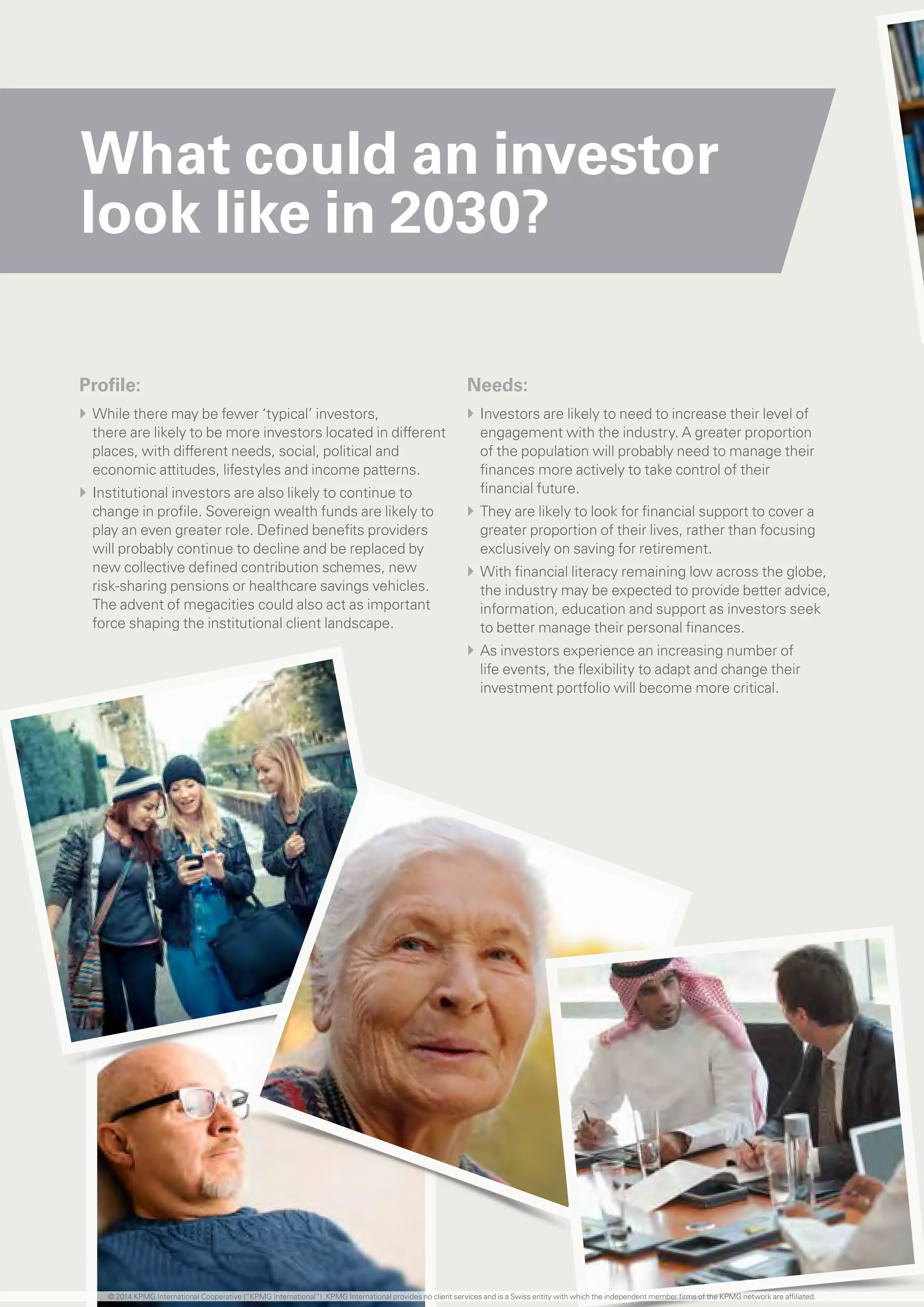
}} While there may be fewer ‘typical’ investors,
there are likely to be more investors located in different
places, with different needs, social, political and
economic attitudes, lifestyles and income patterns.
}} Institutional investors are also likely to continue to
change in profile. Sovereign wealth funds are likely to
play an even greater role. Defined benefits providers
will probably continue to decline and be replaced by
new collective defined contribution schemes, new
risk-sharing pensions or healthcare savings vehicles.
The advent of megacities could also act as important
force shaping the institutional client landscape.
Needs:
}} Investors are likely to need to increase their level of
engagement with the industry. A greater proportion
of the population will probably need to manage their
finances more actively to take control of their
financial future.
}} They are likely to look for financial support to cover a
greater proportion of their lives, rather than focusing
exclusively on saving for retirement.
}} With financial literacy remaining low across the globe,
the industry may be expected to provide better advice,
information, education and support as investors seek
to better manage their personal finances.
}} As investors experience an increasing number of
life events, the flexibility to adapt and change their
investment portfolio will become more critical.
© 2014 KPMG International Cooperative (“KPMG International”). KPMG International provides no client services and is a Swiss entity with which the independent member firms of the KPMG network are affiliated.
11 investing in the future
Wants and expectations:
}} Investors are likely to expect organizations to
understand them, treat them as individuals and
customize and tailor service models to suit their
specific requirements.
}} Investors will increasingly look for brands they can
trust. In an industry currently suffering from high
levels of consumer mistrust, investors are likely to
assign increased value to trusted brands, particularly
as awareness of issues such as data security,
confidentiality and privacy increases.
}} In tomorrow’s world, simplicity, transparency, honesty
and integrity, are likely to be regarded as more
important buying criteria.
}} Investors will probably want less risk and more
certainty so they can be confident that the products
in which they are invested will deliver the intended
outcomes. As a result, they are likely to expect better
solutions to their individual needs and may also want to
‘lock down’ value earlier in a product lifecycle.
}} Interactive service models, 24/7 connectivity and
access to relevant and timely information via a wide
variety of media types will increasingly be expected as
the norm.
Behaviors:
}} Investors may increasingly trust and value advice
from alternative sources. Decisions are likely to
be influenced not only by their peers, friends and
colleagues, but also the opinions of online groups and
social media communities, which may span countries,
cultures and which will almost certainly be comprised
of strangers.
}} Investors are likely to be more willing to consider
non-traditional alternatives to ‘traditional’ savings and
retirement products, either as a result of increased
availability and investor awareness, social and peer
pressures or ongoing mistrust in the traditional
financial services industry.
}} As the pace of technological advancement continues
to increase, investors’ willingness to adopt new
products and technologies is also likely to grow.Their
dependency on such technologies will almost certainly
increase at the same time.
}} Multitasking and time scarcity is likely to continue
to escalate, prompting more investors to look for
time-saving solutions, single point of access and
aggregation across a range of providers.
© 2014 KPMG International Cooperative (“KPMG International”). KPMG International provides no client services and is a Swiss entity with which the independent member firms of the KPMG network are affiliated.
12 investing in the future
……
© 2014 KPMG International Cooperative (“KPMG International”). KPMG International provides no client services and is a Swiss entity with which the independent member firms of the KPMG network are affiliated.
Demographics
Demographic trends will not only magnify the
need for effective investment management,
but over time, they will radically change the
nature of the challenge and an investment
manager’s potential client base.
Environment
Resource insecurities are changing the nature
of investment opportunities and demand
for risk protection, as well as increasing the
importance of socially responsible corporate
behaviors and investment strategies.
Technology
Technological developments continue to
act as major drivers of social, economic
and environmental change, creating new
opportunities and disrupting existing
business models.
Social values, behavior
and ethics
Technology and the internet have combined
to revolutionize how a large proportion of the
world’s population interacts, communicates
and behaves.
13 investing in the future
Megatrends
The drivers of change
Seismic shifts in demographics,
technology, the environment and
social values and behaviors are
set to re-draw the investment
management landscape.
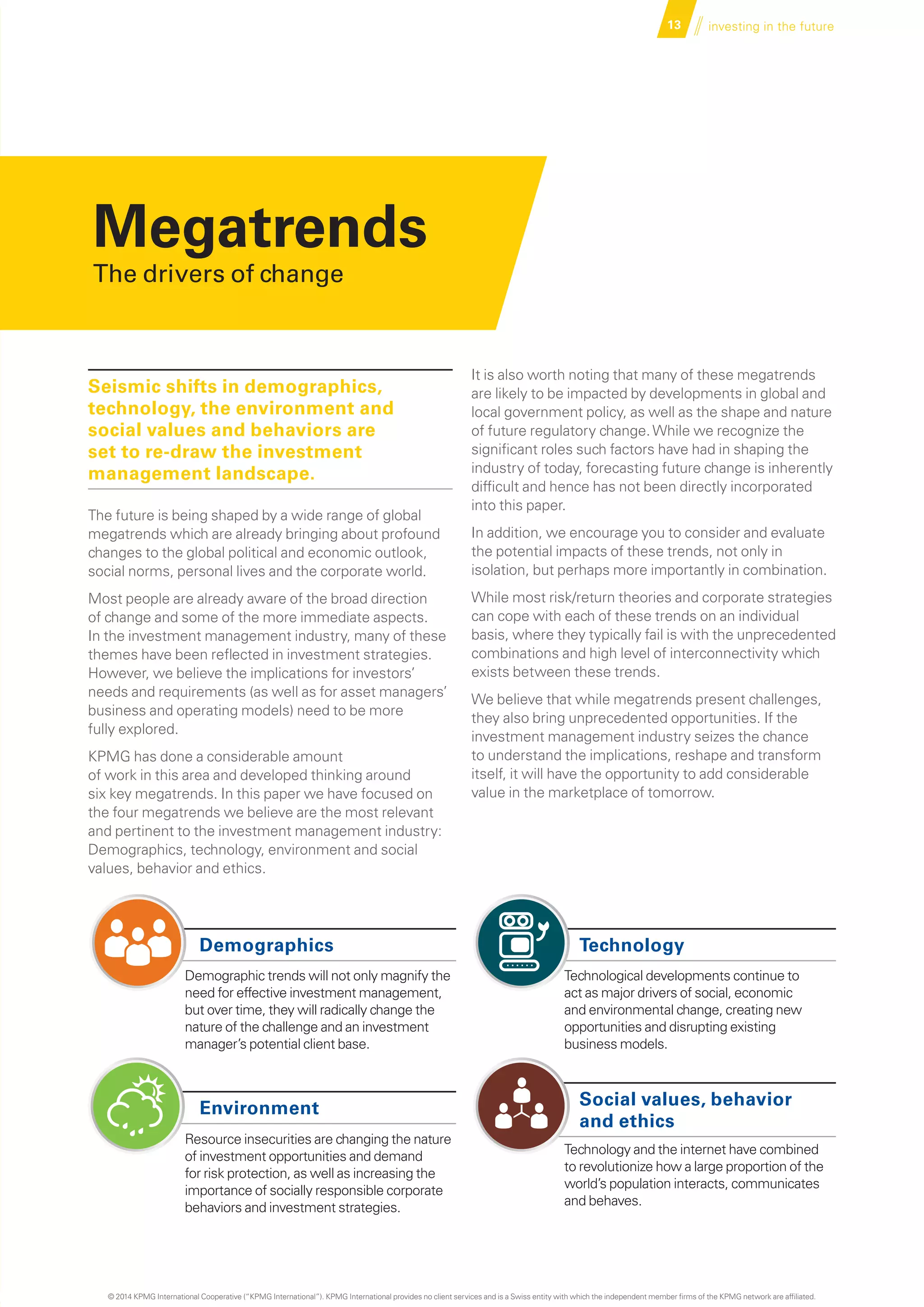
The future is being shaped by a wide range of global
megatrends which are already bringing about profound
changes to the global political and economic outlook,
social norms, personal lives and the corporate world.
Most people are already aware of the broad direction
of change and some of the more immediate aspects.
In the investment management industry, many of these
themes have been reflected in investment strategies.
However, we believe the implications for investors’
needs and requirements (as well as for asset managers’
business and operating models) need to be more
fully explored.
KPMG has done a considerable amount
of work in this area and developed thinking around
six key megatrends. In this paper we have focused on
the four megatrends we believe are the most relevant
and pertinent to the investment management industry:
Demographics, technology, environment and social
values, behavior and ethics.
It is also worth noting that many of these megatrends
are likely to be impacted by developments in global and
local government policy, as well as the shape and nature
of future regulatory change.While we recognize the
significant roles such factors have had in shaping the
industry of today, forecasting future change is inherently
difficult and hence has not been directly incorporated
into this paper.
In addition, we encourage you to consider and evaluate
the potential impacts of these trends, not only in
isolation, but perhaps more importantly in combination.
While most risk/return theories and corporate strategies
can cope with each of these trends on an individual
basis, where they typically fail is with the unprecedented
combinations and high level of interconnectivity which
exists between these trends.
We believe that while megatrends present challenges,
they also bring unprecedented opportunities. If the
investment management industry seizes the chance
to understand the implications, reshape and transform
itself, it will have the opportunity to add considerable
value in the marketplace of tomorrow.
……
© 2014 KPMG International Cooperative (“KPMG International”). KPMG International provides no client services and is a Swiss entity with which the independent member firms of the KPMG network are affiliated.
14 investing in the future
Environment
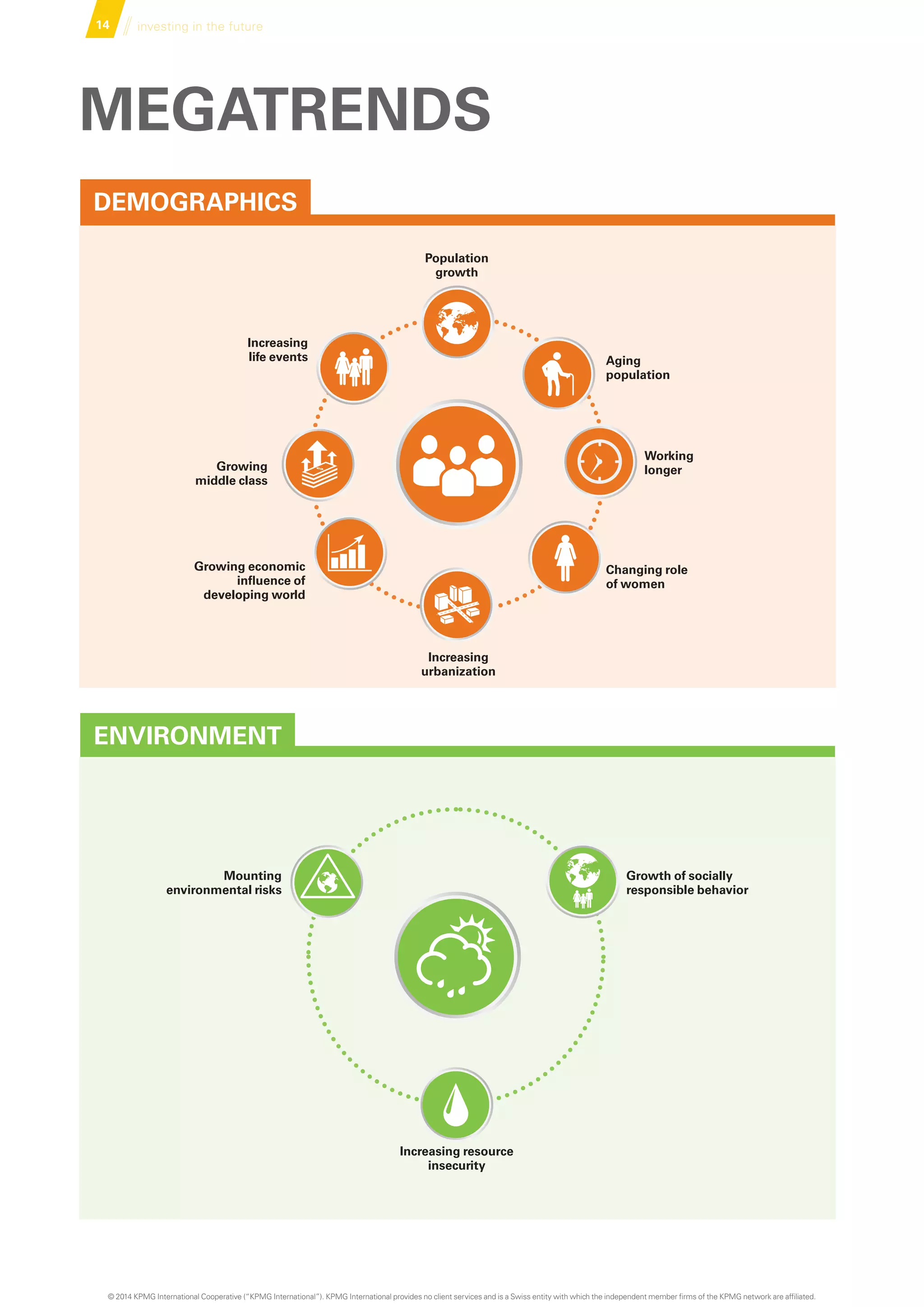
MEGATRENDS
Demographics
Population
growth
Changing role
of women
Increasing
urbanization
Growing
middle class
Increasing
life events
Growing economic
influence of
developing world
Working
longer
Aging
population
Mounting
environmental risks
Growth of socially
responsible behavior
Increasing resource
insecurity
© 2014 KPMG International Cooperative (“KPMG International”). KPMG International provides no client services and is a Swiss entity with which the independent member firms of the KPMG network are affiliated.
15 investing in the future
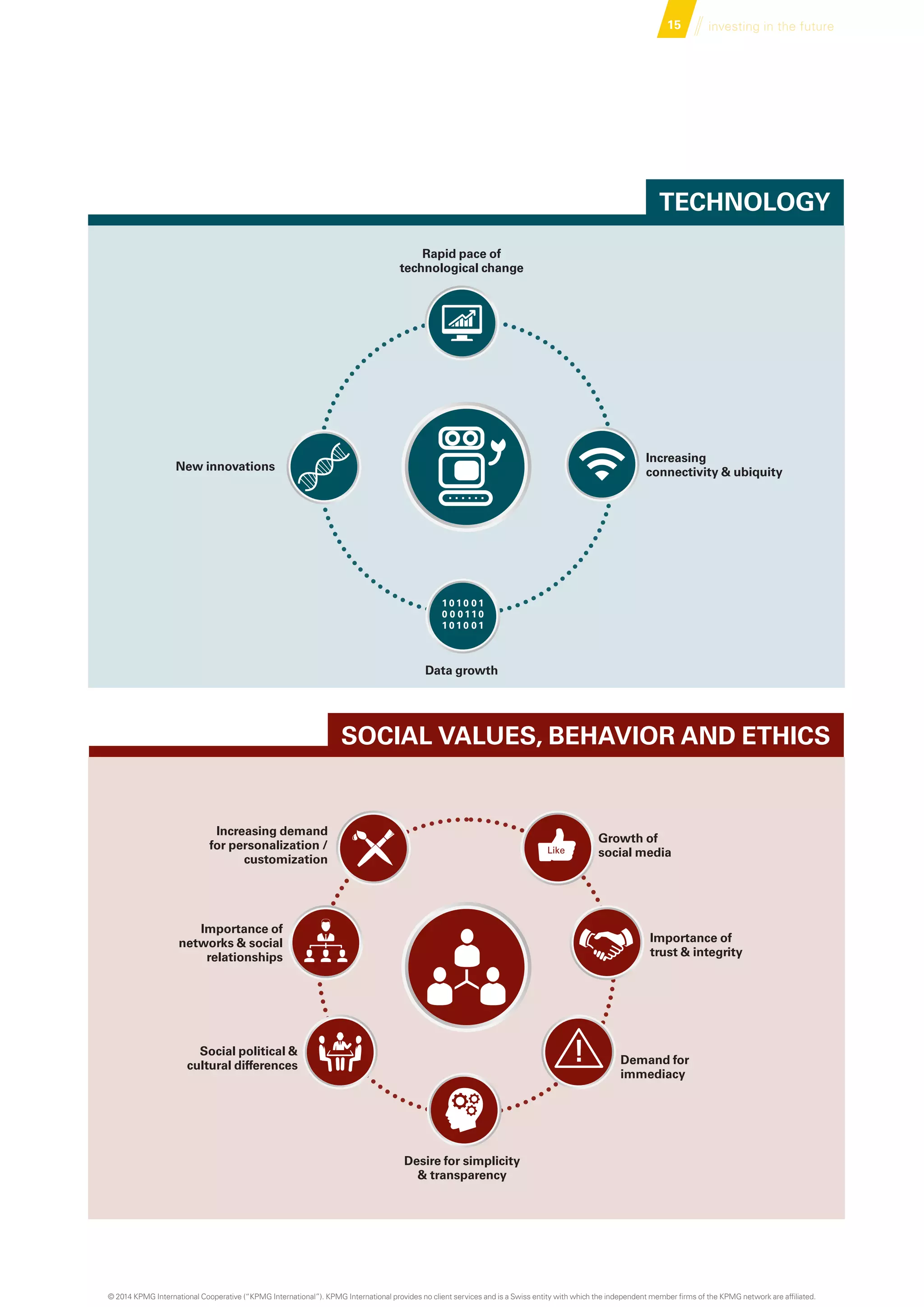
Social values, behavior and ethics
Increasing demand
for personalization /
customization
Demand for
immediacy
Importance of
trust  integrity
Growth of
social media
Social political 
cultural differences
Desire for simplicity
 transparency
Importance of
networks  social
relationships
Like
Technology
Rapid pace of
technological change
New innovations
Increasing
connectivity  ubiquity
Data growth
1 0 1 0 0 1
0 0 0 11 0
1 0 1 0 0 1
……
© 2014 KPMG International Cooperative (“KPMG International”). KPMG International provides no client services and is a Swiss entity with which the independent member firms of the KPMG network are affiliated.
16 investing in the future
MEGATrENDS:
DEMOGrAPHICS
The opportunity and the challenges
© 2014 KPMG International Cooperative (“KPMG International”). KPMG International provides no client services and is a Swiss entity with which the independent member firms of the KPMG network are affiliated.
Medical advancements and the need to fund longer
lives will inevitably mean longer working careers
for most people.
	 For employers, this is likely to mean a greater
number of generations in the workplace at the
same time, each with different requirements and
expectations of working culture, style and location.
	 Women are playing an increasing role in global
boardrooms and controlling a greater proportion
of financial assets and decision making.
	 In the United States, it is reported that women
control about 60 percent of all household wealth and
drive approximately 80 percent of all consumption.3
17 investing in the future
	 The world population continues to grow, although
the rate of increase is now slowing.
	 The global population is predicted to peak at
approximately 9 billion before declining slightly
by 2100.
	 Developing regions are expected to account for 99
percent of population growth until 20501
although
some of these regions will no longer be classified as
developing by this point.
	 Increased life expectancy and falling birth rates are
creating unhealthy population pyramids in most
developed countries.
	 While Asia, Africa and Latin America are enjoying
a ‘youth dividend’, sub-Saharan Africa could be the
only population not to be aging by 2030.
	 With responsibility shifting increasingly to the
individual from governments and corporates,
this is creating a considerable healthcare and
retirement burden.
	 While an opportunity, this also represents a sizable
challenge for the investment management industry
in terms of how to provide these individuals with
the retirement lifestyles they expect.
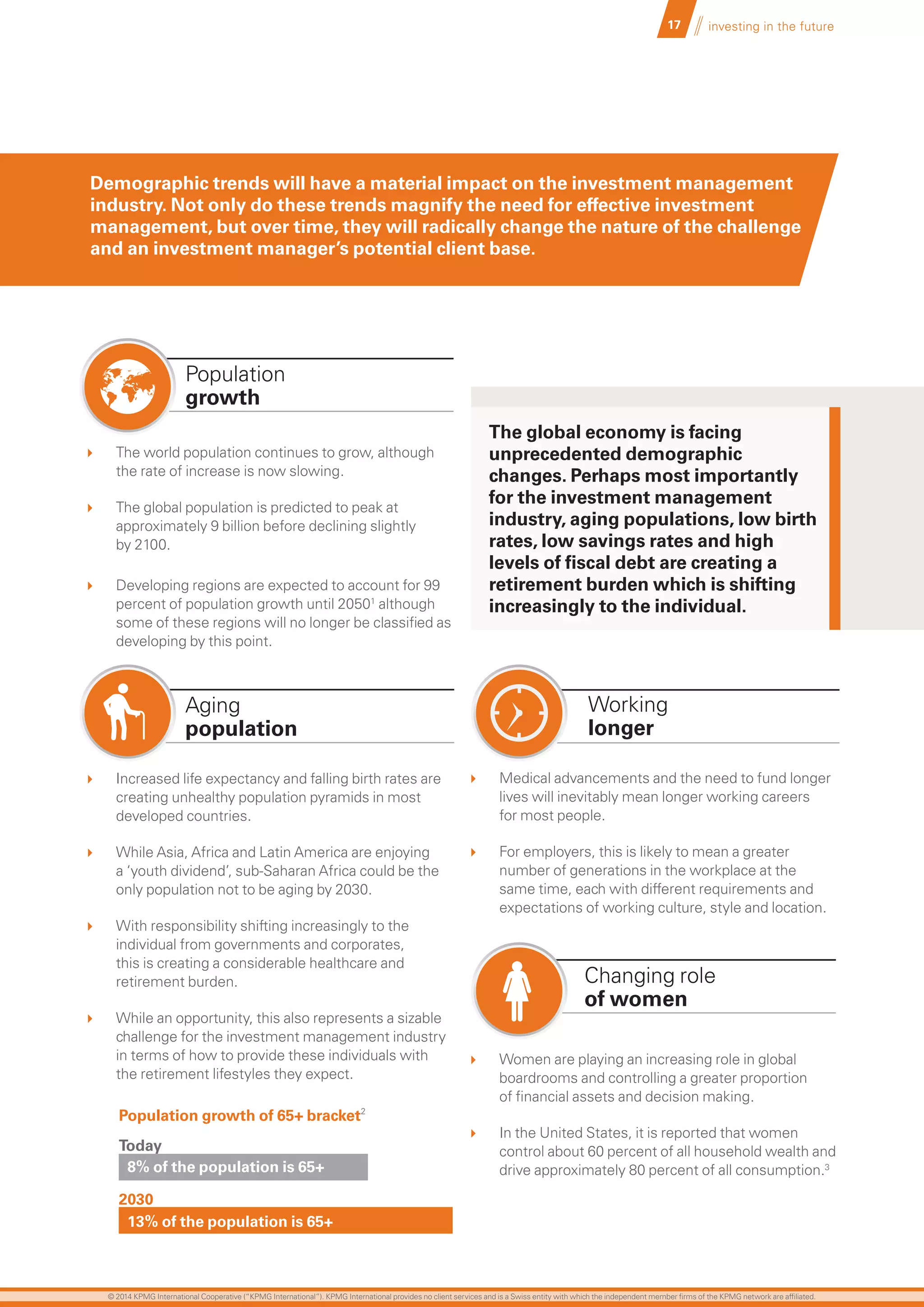
Demographic trends will have a material impact on the investment management
industry. Not only do these trends magnify the need for effective investment
management, but over time, they will radically change the nature of the challenge
and an investment manager’s potential client base.
The global economy is facing
unprecedented demographic
changes. Perhaps most importantly
for the investment management
industry, aging populations, low birth
rates, low savings rates and high
levels of fiscal debt are creating a
retirement burden which is shifting
increasingly to the individual.
Population
growth
Working
longer
Changing role
of women
Aging
population
Population growth of 65+ bracket2
Today
8% of the population is 65+
13% of the population is 65+
2030
© 2014 KPMG International Cooperative (“KPMG International”). KPMG International provides no client services and is a Swiss entity with which the independent member firms of the KPMG network are affiliated.
18 investing in the future
	 More than 60 percent of the world’s population is
predicted to live in cities by 20305
with the majority
of this urban growth taking place in Africa and Asia.6
	 This brings with it the potential for large-scale
infrastructure investment to upgrade legacy cities
or develop new Greenfield sites and could present
some of the highest growth opportunities for
investment managers in the future.
	 The emerging and developing economies in the
East and South are growing in power, influence
and potential.
	 By 2030, some experts predict that Asia will
have surpassed North America and Europe
combined in terms of global power, with China
projected to overtake the United States as the
largest economy a few years before this.7
Others
challenge such statistics, commenting that
while China is projected to overtake the United
States economically on the basis of purchasing
power parity, forecasts do not take into account
the declining working age population in China or
China’s high debt to GDP ratios.
	 Regardless of the economic specifics and timings,
the increasing economic influence of eastern and
southern economies will bring with it significant
religious and cultural shifts.
	 The middle class is projected to grow considerably,
especially in emerging markets, with more people
expected to be middle class than poor by 2022.8
	 This trend is changing the production and
consumption dynamics of the world economy and,
combined with an appropriate political environment,
will help open up investment management
opportunities globally.
	 People are experiencing more complex and multi-
faceted histories, with multiple life-events and more
varied investment requirements.
	 We are having our children later, providing
financial assistance to them for longer periods and
increasingly providing for elderly parents at the
same time. For example, 49 percent of babies born
in England andWales in 2012 had a mother who
was aged 30+.9
	 There is a shift toward more frequent employment
breaks, changes of career and growth in
international assignments. In the United States, the
average employee tenure is 4.4 years, but for the
youngest employees, it is about half of that.10
Increasing
urbanization
Growing
middle class
Increasing
life events
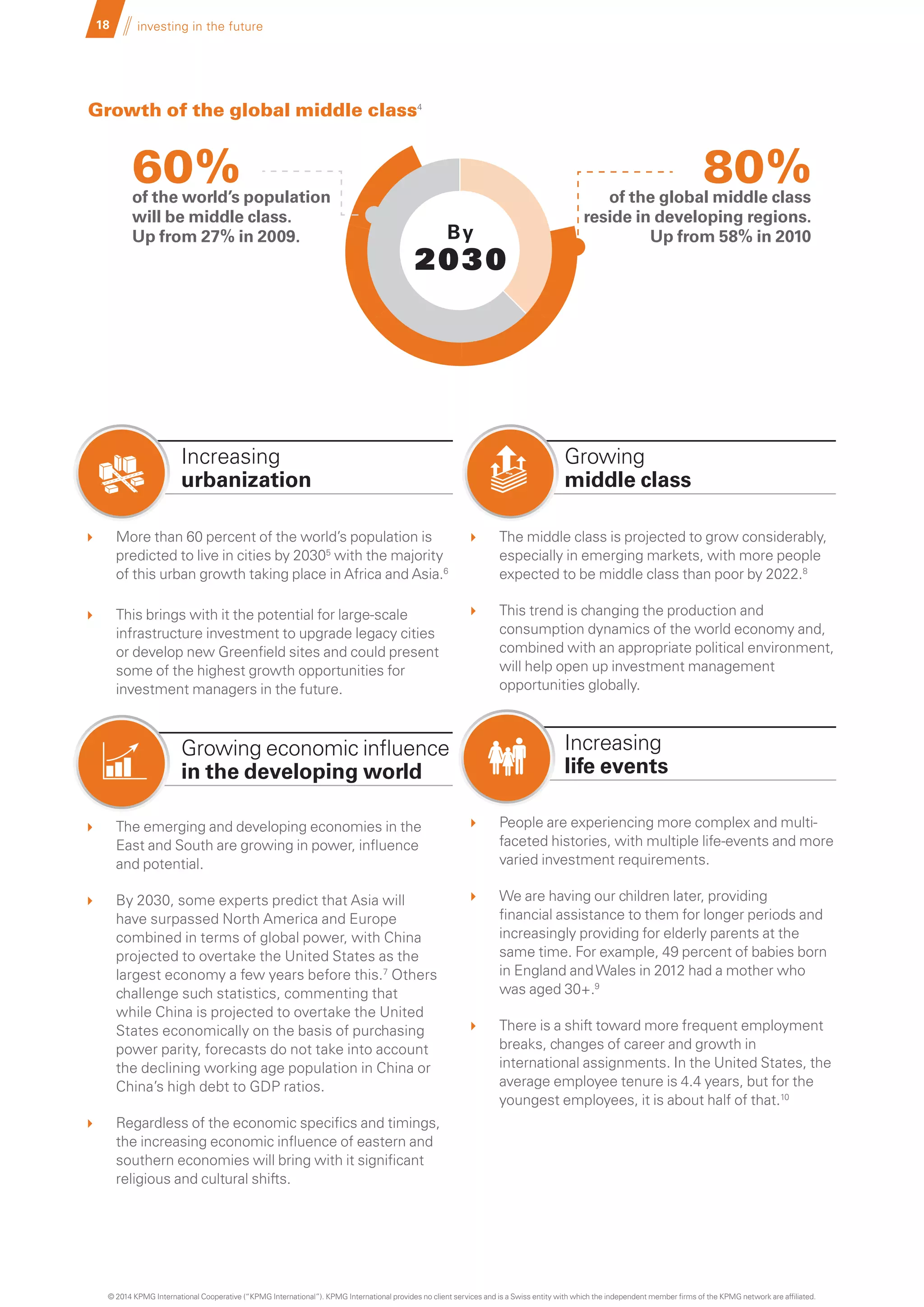
60%of the world’s population
will be middle class.
Up from 27% in 2009.
80%of the global middle class
reside in developing regions.
Up from 58% in 2010By
2030
Growing economic influence
in the developing world
Growth of the global middle class4
© 2014 KPMG International Cooperative (“KPMG International”). KPMG International provides no client services and is a Swiss entity with which the independent member firms of the KPMG network are affiliated.
“We are continually
faced with a series of
great opportunities
brilliantly disguised as
insoluble problems.”
JohnW Gardner
Former US Secretary of Health,
Education andWelfare
© 2014 KPMG International Cooperative (“KPMG International”). KPMG International provides no client services and is a Swiss entity with which the independent member firms of the KPMG network are affiliated.
TECHNOLOGY
A revolutionary force disrupting business models
MEGATRENDS:
……
© 2014 KPMG International Cooperative (“KPMG International”). KPMG International provides no client services and is a Swiss entity with which the independent member firms of the KPMG network are affiliated.
The digital revolution continues to
change every aspect of our personal
and business lives, creating new
opportunities and disrupting existing
business models.
	 Technology has become ubiquitous, with digital and
mobile devices embedded into every aspect of our
personal and business lives.
	 Seventy five percent of the global population
now has access to a mobile phone and, in some
countries, more people have access to a mobile
phone than to a bank account, electricity or
clean water.11
By 2030, 50 percent of the world’s
population will have access to the internet.12
	 This constant connectivity has changed our working
behaviors, daily routines and social values, both for
better and for worse.
21 investing in the future
Increasing
connectivity  ubiquity
	 The increasing speed of technology adoption is
one of the most obvious and pervasive examples
of the information technology revolution.
	 New technologies are being adopted faster,
innovation cycles are shortening and diffusion
rates are increasing throughout the developed
and developing worlds.
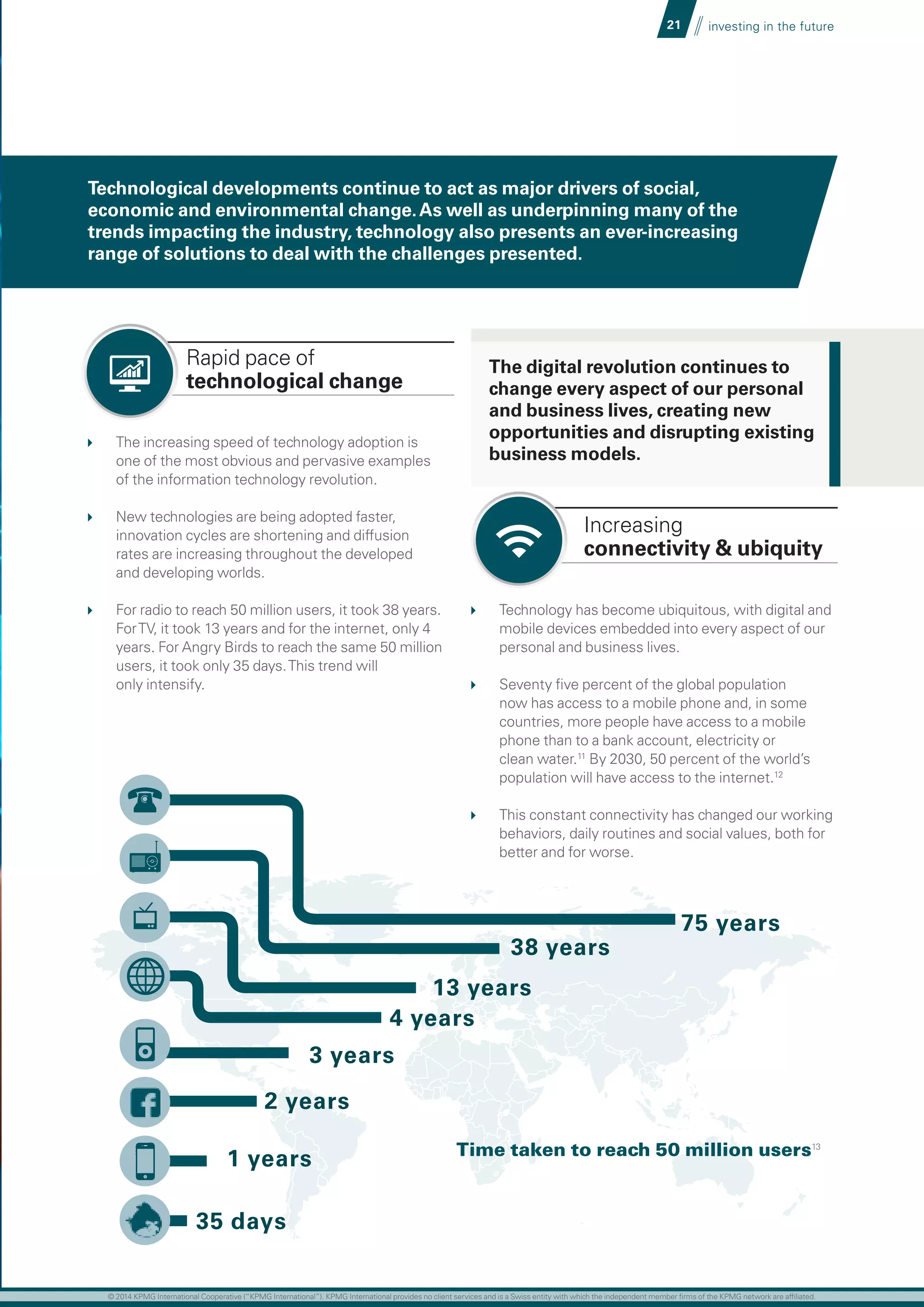
	 For radio to reach 50 million users, it took 38 years.
ForTV, it took 13 years and for the internet, only 4
years. For Angry Birds to reach the same 50 million
users, it took only 35 days.This trend will
only intensify.
Rapid pace of
technological change
Technological developments continue to act as major drivers of social,
economic and environmental change.As well as underpinning many of the
trends impacting the industry, technology also presents an ever-increasing
range of solutions to deal with the challenges presented.
75 years
38 years
13 years
4 years
3 years
2 years
1 years
35 days
Time taken to reach 50 million users13
© 2014 KPMG International Cooperative (“KPMG International”). KPMG International provides no client services and is a Swiss entity with which the independent member firms of the KPMG network are affiliated.
New
innovations
	 Technological breakthroughs in fields such as
robotics, nanotechnology, natural resources and
healthcare and life sciences continue to transform
all aspects of both our private and business lives.
Furthermore, concepts such as virtual reality and the
internet of things are not as distant a possibility as
they may sound.
	 Robotic usage is anticipated to increase
considerably, particularly in the domestic setting,
with the Japanese aiming to have a robot in every
home by 2015 and South Korea to achieve this goal
by 2020.
	 Nanotechnology continues to make the
miniaturization of products possible, with 15 percent
per annum growth forecast from 2003-2015.16
	 Advances in areas such as alternative energy, micro-
irrigation technology or precision farming will be
key to increasing the security of natural resources
and meeting the increased demand created by
population growth and economic advances.
	 Medical technology, pharmaceuticals and
biotechnology will be key areas of life science
research over the next two decades.
22 investing in the future
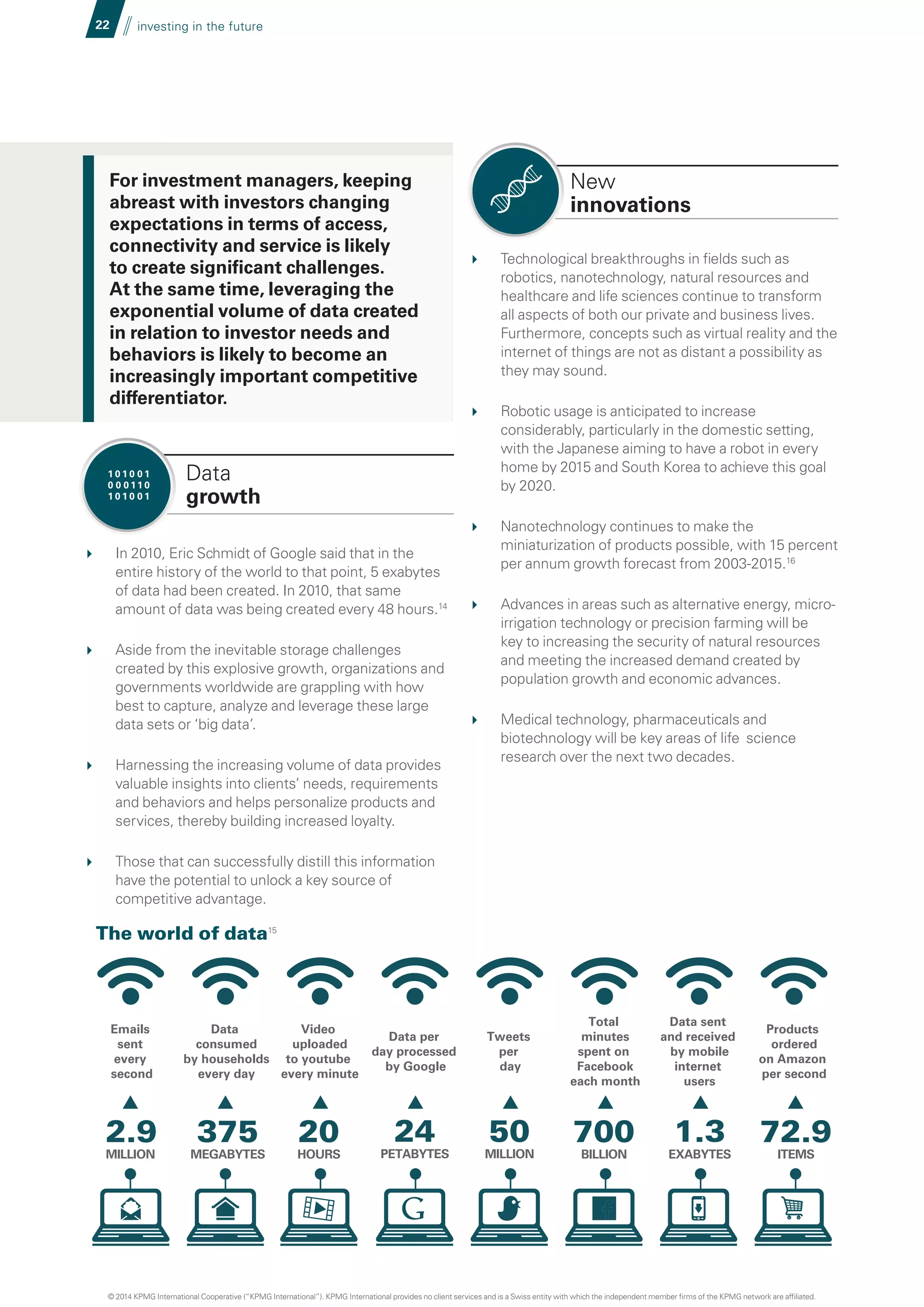
	 In 2010, Eric Schmidt of Google said that in the
entire history of the world to that point, 5 exabytes
of data had been created. In 2010, that same
amount of data was being created every 48 hours.14
	 Aside from the inevitable storage challenges
created by this explosive growth, organizations and
governments worldwide are grappling with how
best to capture, analyze and leverage these large
data sets or ‘big data’.
	 Harnessing the increasing volume of data provides
valuable insights into clients’ needs, requirements
and behaviors and helps personalize products and
services, thereby building increased loyalty.
	 Those that can successfully distill this information
have the potential to unlock a key source of
competitive advantage.
Data
growth
For investment managers, keeping
abreast with investors changing
expectations in terms of access,
connectivity and service is likely
to create significant challenges.
At the same time, leveraging the
exponential volume of data created
in relation to investor needs and
behaviors is likely to become an
increasingly important competitive
differentiator.
2.9
MILLION
375
MEGABYTES
20
HOURS
24
PETABYTES
50
MILLION
700
BILLION
1.3
EXABYTES
72.9
ITEMS
Emails
sent
every
second
Data
consumed
by households
every day
Video
uploaded
to youtube
every minute
Total
minutes
spent on
Facebook
each month
Data sent
and received
by mobile
internet
users
Products
ordered
on Amazon
per second
Data per
day processed
by Google
Tweets
per
day
The world of data15
© 2014 KPMG International Cooperative (“KPMG International”). KPMG International provides no client services and is a Swiss entity with which the independent member firms of the KPMG network are affiliated.
The world population continues to grow, although
the rate of increase is now slowing
	 The global population is predicted to peak at
approximately 9B before declining slightly by 2100
	 Developing regions are expected to account for 99
percent of population growth until 2050, although
some of these regions will no longer be classified as
developing by this point
The global economy is facing unprecedented
demographic changes. Perhaps most importantly
for the investment management industry, aging
populations, combined with low birth rates, low
savings rates and high levels of fiscal debt is creating
a retirement burden which is shifting increasingly to
the individual.
	 Increased life expectancy and falling birth rates are
creating unhealthy population pyramids in most
developed countries.
	 While Asia, Africa and Latin America are enjoying
a ‘youth dividend’, sub-Saharan Africa could be the
only population not to be aging by 2030
	 With responsibility shifting increasingly to the
individual from governments and corporates, this is
creating a considerable healthcare and retirement
burden
	 While an opportunity, this also represents a sizable
challenge for the investment management industry
in terms of how to provide these individuals with
the retirement lifestyles they expect.
	 Medical advancements and the need to fund longer
lives will inevitably mean longer working careers for
most people
	 For employers, this is likely to mean a greater
number of generations in the workplace at the
same time, each with different requirements and
expectations of working culture, style and location
	 Women are playing an increasing role in global
boardrooms and controlling a greater proportion of
financial assets and decision making
	 In the United States, it is reported that women
control more than 60 percent of all personal wealth
and 47 percent of women earn more than their
husbands
The profile of an investment manager’s ‘typical’
client in 2030 could look very different from today
“To a one year old, a
magazine is an iPad
that’s broken”
Kevin Kelly
Editor ofWired magazine
© 2014 KPMG International Cooperative (“KPMG International”). KPMG International provides no client services and is a Swiss entity with which the independent member firms of the KPMG network are affiliated.
24 investing in the future
ENVIRONMENT
Risks and the more socially conscious
MEGATRENDS:
© 2014 KPMG International Cooperative (“KPMG International”). KPMG International provides no client services and is a Swiss entity with which the independent member firms of the KPMG network are affiliated.
With younger generations being
increasingly critical of unethical
behavior, investors will expect
social and ethical responsibility in
all aspects of corporate operating
practices.
Projected resource stress in 203019
	 Economic expansion is driving more resource-
intensive consumption and greater resource
insecurity in areas such as water, food and energy.
	 By 2030, a 50 percent increase in food production
is anticipated to be required to feed a wealthier
and more demanding population17
and the world
is projected to face a 40 percent global shortfall
between forecast water demand and available
supply.18
	 The economic and social risks associated
with scarcity are creating a range of interesting
investment opportunities which many organizations
have already incorporated into investment strategies.
Increasing resource
insecurity
Growth in socially
responsible behavior
25 investing in the future
	 Environmental awareness has continued to
grow and is becoming an increasingly important
purchasing criteria.
	 The younger generations have been born into
an environmentally conscious world and are
increasingly critical of environmentally unfriendly or
unethical behavior.
	 Being ‘visibly’ green and ‘ethical’ will no longer be
a ‘nice to have’ for asset managers. Investors will
expect ethical and socially responsible behavior to
be baked into operating practices.
	 The growing acceptance among fund managers and
investors about the importance of environmental,
social and governance factors to investment
returns is anticipated to fuel growth in socially
responsible investment strategies.
40% 50%shortfall between water
supply  demand by 2030
increase in food production
will be needed by 2030 to feed
a more demanding population
Resource insecurities are changing the nature of investment opportunities and
demand for risk protection.At the same time, with consumers increasingly
incorporating sustainability into purchasing decisions, the importance of
socially responsible behavior is rising up the investment management agenda.
Environmental consciousness is
increasing globally as demographic
changes and economic expansion fuel
more resource-intensive lifestyles.
© 2014 KPMG International Cooperative (“KPMG International”). KPMG International provides no client services and is a Swiss entity with which the independent member firms of the KPMG network are affiliated.
26 investing in the future
	 Accelerating environmental degradation, combined
with the need to meet the world’s demand for
fundamental commodities, such as energy, water,
food and rare metals is presenting issues such
as the risk of supply disruption, volatile pricing
and growing potential for conflict.The search for
alternatives presents not only an environmental
priority, but also offers a range of new
investment opportunities.
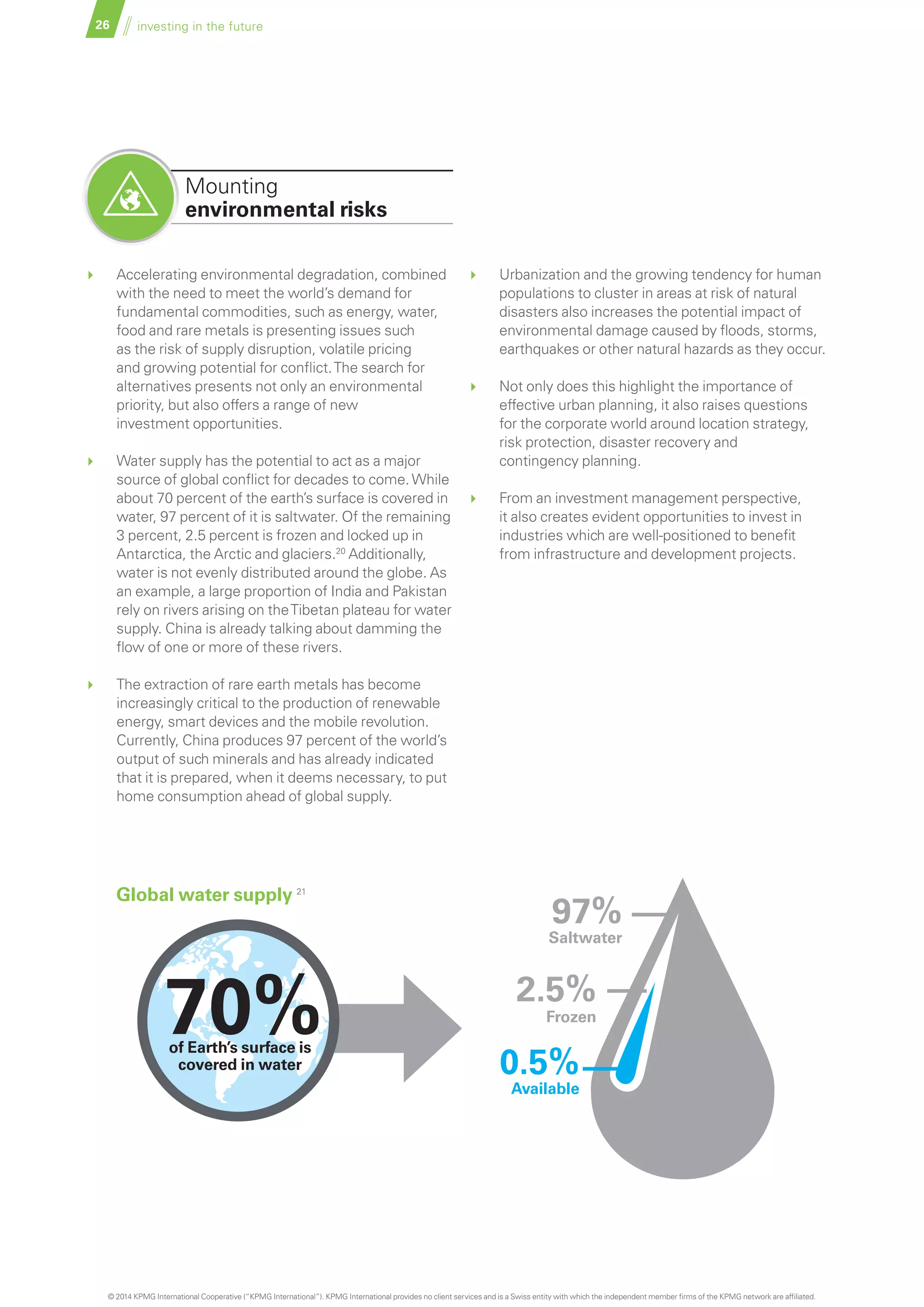
	 Water supply has the potential to act as a major
source of global conflict for decades to come.While
about 70 percent of the earth’s surface is covered in
water, 97 percent of it is saltwater. Of the remaining
3 percent, 2.5 percent is frozen and locked up in
Antarctica, the Arctic and glaciers.20
Additionally,
water is not evenly distributed around the globe. As
an example, a large proportion of India and Pakistan
rely on rivers arising on theTibetan plateau for water
supply. China is already talking about damming the
flow of one or more of these rivers.
	 The extraction of rare earth metals has become
increasingly critical to the production of renewable
energy, smart devices and the mobile revolution.
Currently, China produces 97 percent of the world’s
output of such minerals and has already indicated
that it is prepared, when it deems necessary, to put
home consumption ahead of global supply.
Mounting
environmental risks
70%of Earth’s surface is
covered in water
Available
Frozen
Saltwater
0.5%
2.5%
97%
	 Urbanization and the growing tendency for human
populations to cluster in areas at risk of natural
disasters also increases the potential impact of
environmental damage caused by floods, storms,
earthquakes or other natural hazards as they occur.
	 Not only does this highlight the importance of
effective urban planning, it also raises questions
for the corporate world around location strategy,
risk protection, disaster recovery and
contingency planning.
	 From an investment management perspective,
it also creates evident opportunities to invest in
industries which are well-positioned to benefit
from infrastructure and development projects.
Global water supply 21
© 2014 KPMG International Cooperative (“KPMG International”). KPMG International provides no client services and is a Swiss entity with which the independent member firms of the KPMG network are affiliated.
The world population continues to grow, although
the rate of increase is now slowing
	 The global population is predicted to peak at
approximately 9B before declining slightly by 2100
	 Developing regions are expected to account for 99
percent of population growth until 2050, although
some of these regions will no longer be classified as
developing by this point
The global economy is facing unprecedented
demographic changes. Perhaps most importantly
for the investment management industry, aging
populations, combined with low birth rates, low
savings rates and high levels of fiscal debt is creating
a retirement burden which is shifting increasingly to
the individual.
	 Increased life expectancy and falling birth rates are
creating unhealthy population pyramids in most
developed countries.
	 While Asia, Africa and Latin America are enjoying
a ‘youth dividend’, sub-Saharan Africa could be the
only population not to be aging by 2030
	 With responsibility shifting increasingly to the
individual from governments and corporates, this is
creating a considerable healthcare and retirement
burden
	 While an opportunity, this also represents a sizable
challenge for the investment management industry
in terms of how to provide these individuals with
the retirement lifestyles they expect.
	 Medical advancements and the need to fund longer
lives will inevitably mean longer working careers for
most people
	 For employers, this is likely to mean a greater
number of generations in the workplace at the
same time, each with different requirements and
expectations of working culture, style and location
	 Women are playing an increasing role in global
boardrooms and controlling a greater proportion of
financial assets and decision making
	 In the United States, it is reported that women
control more than 60 percent of all personal wealth
and 47 percent of women earn more than their
husbands
The profile of an investment manager’s ‘typical’
client in 2030 could look very different from today
“We are seeing the birth
of a new perspective
of the world, where
ecology and economics
are two sides of the
same coin.”
Leif Johansson
President and CEO of theVolvo Group from 1997 to 2011.
Chairman of Ericsson since 2011 and of AstraZeneca since 2012.
© 2014 KPMG International Cooperative (“KPMG International”). KPMG International provides no client services and is a Swiss entity with which the independent member firms of the KPMG network are affiliated.
SOCIALVALUES,
BEHAVIOR  ETHICS
A changing way of life
MEGATRENDS:
© 2014 KPMG International Cooperative (“KPMG International”). KPMG International provides no client services and is a Swiss entity with which the independent member firms of the KPMG network are affiliated.
A number of trends have come together to create
an entirely new trust paradigm.
	 Increasingly, people are trusting ‘people like
me’ rather than corporations or professionals and,
as such, word of mouth and viral messages
are becoming more powerful than traditional
advertising.
	 Trust is increasingly binary in nature. It is given
instinctively but can be removed immediately
if abused.
	 This poses a particular challenge for the financial
services industry, in which trust remains at an all
time low. It will inevitably take time to rebuild.
29 investing in the future
	 In 2013, it is estimated that nearly one in four
people worldwide will use social online
communities, networks or platforms.22
	 The rapid rise in social media is transforming not
only contemporary behavior and the way in which
individuals interact and socialize with each other, but
its implications are considerably more widespread.
	 It has revolutionized the way information is
disseminated, transformed the way consumers
interact with businesses and governments and
underpinned the rapid creation of mass
movements.
	 By 2030, social media could replace many of the
more traditional types of media and information
sharing mechanisms, with some expecting it to
be deeply integrated into corporate IT platforms.
	 For investment managers, this creates not only
an ability to better connect and interact with its
client base, it could also create new investment
opportunities in industries that will benefit from
these technologies.
Growth of
social media
Importance of
trust  integrity
Technology and the internet have combined to revolutionize how a
large proportion of the world’s population interacts, communicates and
behaves.While this presents considerable opportunities, it also presents
deep challenges to business models in an age when trust in financial
services has been severely damaged.
Generational shifts combined with
technological advancements have
transformed the way the world’s
population communicates, behaves,
who they trust and what they expect
from businesses.
Tomorrow’s investor is likely to be
even more demanding, characterized
by a desire for immediacy, valuing
simplicity and transparency and
expecting a more personalized service.
Time spent on social
media per hour23
Minutes
US
16
Minutes
Australia
14 Minutes
UK
13
© 2014 KPMG International Cooperative (“KPMG International”). KPMG International provides no client services and is a Swiss entity with which the independent member firms of the KPMG network are affiliated.
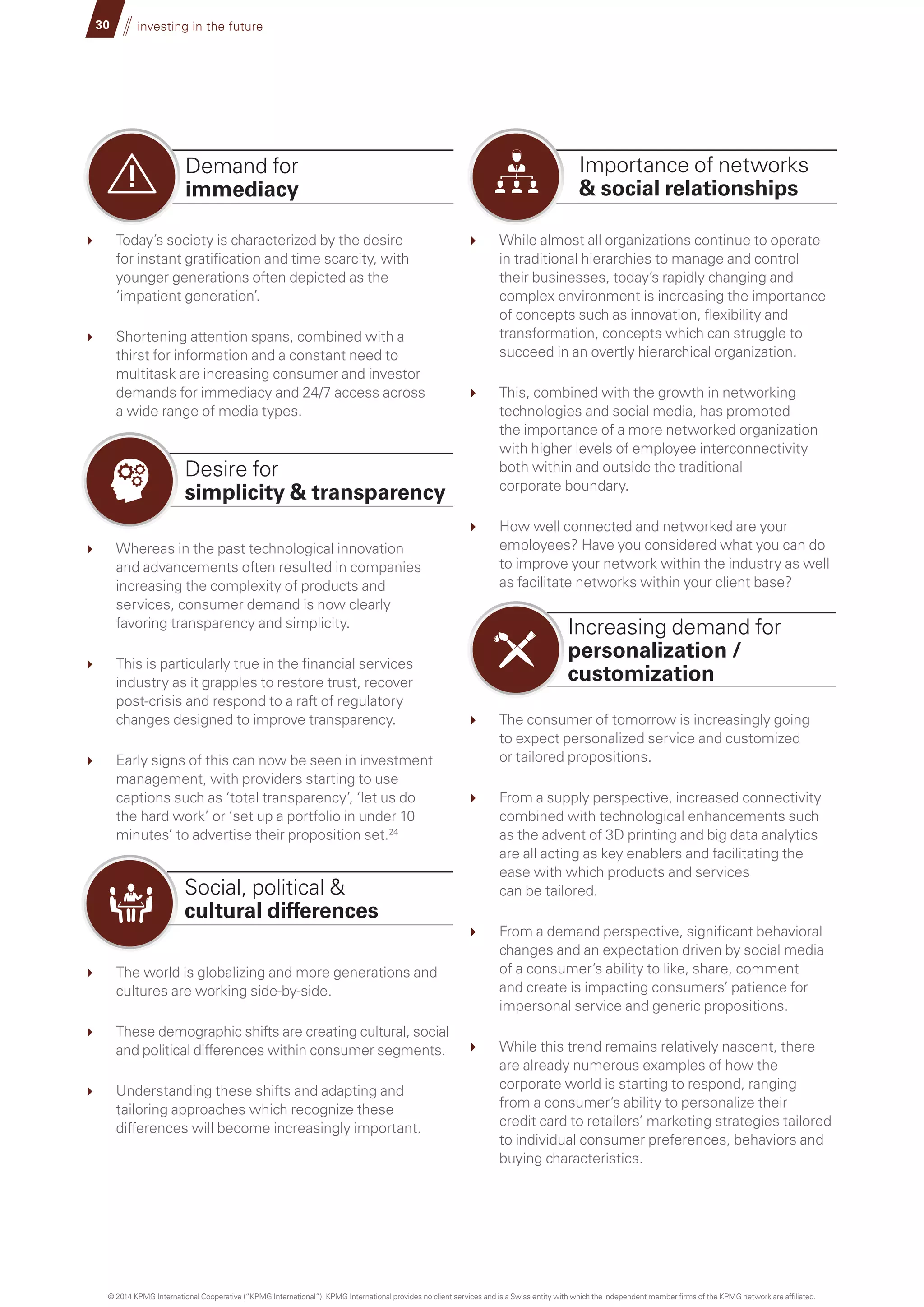
While almost all organizations continue to operate
in traditional hierarchies to manage and control
their businesses, today’s rapidly changing and
complex environment is increasing the importance
of concepts such as innovation, flexibility and
transformation, concepts which can struggle to
succeed in an overtly hierarchical organization.
	 This, combined with the growth in networking
technologies and social media, has promoted
the importance of a more networked organization
with higher levels of employee interconnectivity
both within and outside the traditional
corporate boundary.
	 How well connected and networked are your
employees? Have you considered what you can do
to improve your network within the industry as well
as facilitate networks within your client base?
	 The consumer of tomorrow is increasingly going
to expect personalized service and customized
or tailored propositions.
	 From a supply perspective, increased connectivity
combined with technological enhancements such
as the advent of 3D printing and big data analytics
are all acting as key enablers and facilitating the
ease with which products and services
can be tailored.
	 From a demand perspective, significant behavioral
changes and an expectation driven by social media
of a consumer’s ability to like, share, comment
and create is impacting consumers’ patience for
impersonal service and generic propositions.
	 While this trend remains relatively nascent, there
are already numerous examples of how the
corporate world is starting to respond, ranging
from a consumer’s ability to personalize their
credit card to retailers’ marketing strategies tailored
to individual consumer preferences, behaviors and
buying characteristics.
Importance of networks
 social relationships
Demand for
immediacy
30 investing in the future
	 Today’s society is characterized by the desire
for instant gratification and time scarcity, with
younger generations often depicted as the
‘impatient generation’.
	 Shortening attention spans, combined with a
thirst for information and a constant need to
multitask are increasing consumer and investor
demands for immediacy and 24/7 access across
a wide range of media types.
	 Whereas in the past technological innovation
and advancements often resulted in companies
increasing the complexity of products and
services, consumer demand is now clearly
favoring transparency and simplicity.
	 This is particularly true in the financial services
industry as it grapples to restore trust, recover
post-crisis and respond to a raft of regulatory
changes designed to improve transparency.
	 Early signs of this can now be seen in investment
management, with providers starting to use
captions such as ‘total transparency’, ‘let us do
the hard work’ or ‘set up a portfolio in under 10
minutes’ to advertise their proposition set.24
	 The world is globalizing and more generations and
cultures are working side-by-side.
	 These demographic shifts are creating cultural, social
and political differences within consumer segments.
	 Understanding these shifts and adapting and
tailoring approaches which recognize these
differences will become increasingly important.
Desire for
simplicity  transparency
Social, political 
cultural differences
Increasing demand for
personalization /
customization
© 2014 KPMG International Cooperative (“KPMG International”). KPMG International provides no client services and is a Swiss entity with which the independent member firms of the KPMG network are affiliated.
“If you can’t explain
it simply, you don’t
understand it well
enough.”
Albert Einstein
Theoretical physicist
© 2014 KPMG International Cooperative (“KPMG International”). KPMG International provides no client services and is a Swiss entity with which the independent member firms of the KPMG network are affiliated.
32 investing in the future
$
£
€
© 2014 KPMG International Cooperative (“KPMG International”). KPMG International provides no client services and is a Swiss entity with which the independent member firms of the KPMG network are affiliated.
33 investing in the future
Value chain:
Clients:
Products and brands:
Traditional products will increasingly
become components of outcome-
orientated solutions, niches will
become more mainstream and aspects
of investment theory may be called into
question.
Market:
Technology:
Governance:
People:
Implications for
investment management
We believe the confluence of megatrends has the potential to have a profound impact
on the investment management industry and that it will look very different in 20
years time. With clients needs, requirements and behaviors expected to change
considerably and the industry trying to capture long term, sustainable and profitable
growth, it has a unique opportunity to reposition itself.
We believe that:
$
£
€
As the pace of change increases, asset
managers will need to transform their
operating models to create more flexible,
efficient and agile platforms.
There are significant opportunities for
investment managers to play a more
important role in clients’ lives and the
industry’s value chain.
Asset managers need to create an
organizational structure which can adapt
and handle the complexities created by
further geographic expansion.
The clients of tomorrow are likely to be
very different from the clients of today,
both in terms of who they are, where
they live and what they expect from the
industry.
Globalization will continue to open up
new opportunities for the industry and
may necessitate a fundamental review
of asset managers’ market footprints
and market entry strategies.
The challenges associated with the
search for and retention of talent will
intensify.
We believe the industry will be
significantly larger and have a more
important role to play in society than
today. However, in order to be part of
this, many investment managers will
need to drastically change their value
proposition to remain relevant.
© 2014 KPMG International Cooperative (“KPMG International”). KPMG International provides no client services and is a Swiss entity with which the independent member firms of the KPMG network are affiliated.
VALUE CHAIN
CLIENTS
34 investing in the future
PRODUCTS  BRANDS
Outcome-orientated
propositions will
continue to gain in
popularity
Core aspects of the
investment process
could be called into
question
Pensions innovation
is required to help
address the retirement
challenges
Retail product sets
will need to extend
beyond pensions
Client engagement
strategies will need to
be tailored to reflect
the diversity of the
investor base
Advice and financial
education will be
increasingly important
Engagement levels
will vary significantly,
albeit in the main,
are anticipated to
increase
Outcome,
aggregation,
education and access
may be valued as highly
as the underlying
investment
performance
Power will continue
to shift towards those
who control the client
relationship
Investment
managers have
choices to make
1
2
3
Investors’
expectations of and
interactions with the
industry will change
considerably
Client profiling and
a flexible operating
model which can
accommodate diverse
client needs will be
key
Mainstreaming of
current investment
niches
Pricing is likely to be
under a more intense
spotlight
Product flexibility
will become
increasingly
important
IMPLICATIONS
$
£
€
Effective brand
management will be
key to success
© 2014 KPMG International Cooperative (“KPMG International”). KPMG International provides no client services and is a Swiss entity with which the independent member firms of the KPMG network are affiliated.
35 investing in the future
MARKETS
4
Market strategies may
benefit from a
multi-level approach
Market entry
strategies will need to
be much more robust
Emerging and
developed markets
will increasingly
converge.
TECHNOLOGY
5
A core platform
and simple user
interface will be
critical
Delivering the
service promise
will highlight the
importance of
process efficiency
and organizational
agility
Client profiling
and effective data
analytics will
increasingly act as a
differentiator
Value-added
outsourcing,
if executed
successfully, will
offer numerous
advantages
GOVERNANCE
6
Increasing
complexity of
international
organizational
structures and
governance
Intensifying scrutiny
of risk management
frameworks
Growing
importance
of third party
relationships
PEOPLE
7
The profile of the
talent pool will
change considerably
Employees
expectations and
work patterns are
being redefined
Different skill sets
will become
more critical.
© 2014 KPMG International Cooperative (“KPMG International”). KPMG International provides no client services and is a Swiss entity with which the independent member firms of the KPMG network are affiliated.
36 investing in the future
VALUE CHAIN
The new investment
management value chain
IMPLICATIONS:
© 2014 KPMG International Cooperative (“KPMG International”). KPMG International provides no client services and is a Swiss entity with which the independent member firms of the KPMG network are affiliated.
37 investing in the future
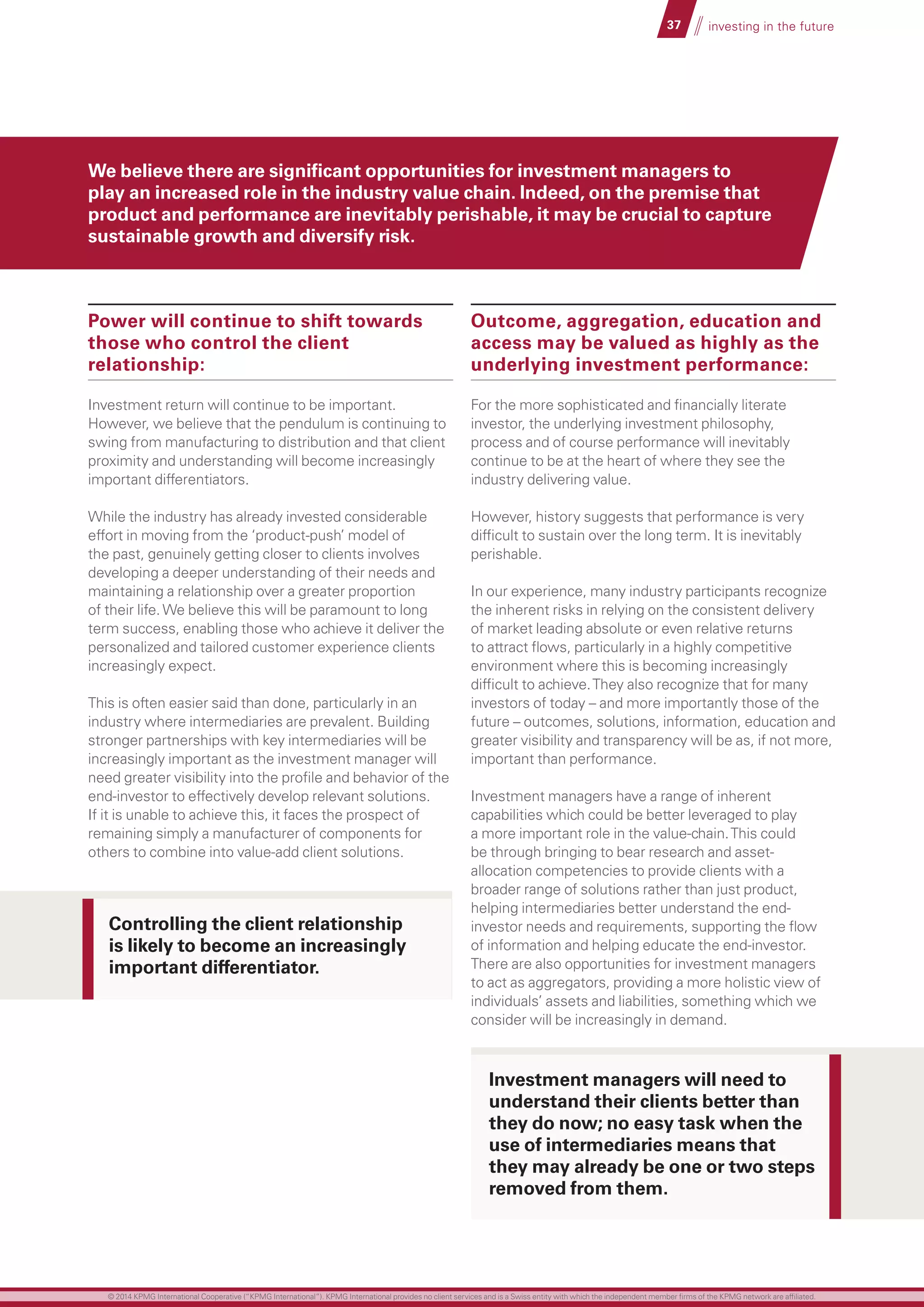
Power will continue to shift towards
those who control the client
relationship:
Investment return will continue to be important.
However, we believe that the pendulum is continuing to
swing from manufacturing to distribution and that client
proximity and understanding will become increasingly
important differentiators.
While the industry has already invested considerable
effort in moving from the ‘product-push’ model of
the past, genuinely getting closer to clients involves
developing a deeper understanding of their needs and
maintaining a relationship over a greater proportion
of their life.We believe this will be paramount to long
term success, enabling those who achieve it deliver the
personalized and tailored customer experience clients
increasingly expect.
This is often easier said than done, particularly in an
industry where intermediaries are prevalent. Building
stronger partnerships with key intermediaries will be
increasingly important as the investment manager will
need greater visibility into the profile and behavior of the
end-investor to effectively develop relevant solutions.
If it is unable to achieve this, it faces the prospect of
remaining simply a manufacturer of components for
others to combine into value-add client solutions.
Outcome, aggregation, education and
access may be valued as highly as the
underlying investment performance:
For the more sophisticated and financially literate
investor, the underlying investment philosophy,
process and of course performance will inevitably
continue to be at the heart of where they see the
industry delivering value.
However, history suggests that performance is very
difficult to sustain over the long term. It is inevitably
perishable.
In our experience, many industry participants recognize
the inherent risks in relying on the consistent delivery
of market leading absolute or even relative returns
to attract flows, particularly in a highly competitive
environment where this is becoming increasingly
difficult to achieve.They also recognize that for many
investors of today – and more importantly those of the
future – outcomes, solutions, information, education and
greater visibility and transparency will be as, if not more,
important than performance.
Investment managers have a range of inherent
capabilities which could be better leveraged to play
a more important role in the value-chain.This could
be through bringing to bear research and asset-
allocation competencies to provide clients with a
broader range of solutions rather than just product,
helping intermediaries better understand the end-
investor needs and requirements, supporting the flow
of information and helping educate the end-investor.
There are also opportunities for investment managers
to act as aggregators, providing a more holistic view of
individuals’ assets and liabilities, something which we
consider will be increasingly in demand.
We believe there are significant opportunities for investment managers to
play an increased role in the industry value chain. Indeed, on the premise that
product and performance are inevitably perishable, it may be crucial to capture
sustainable growth and diversify risk.
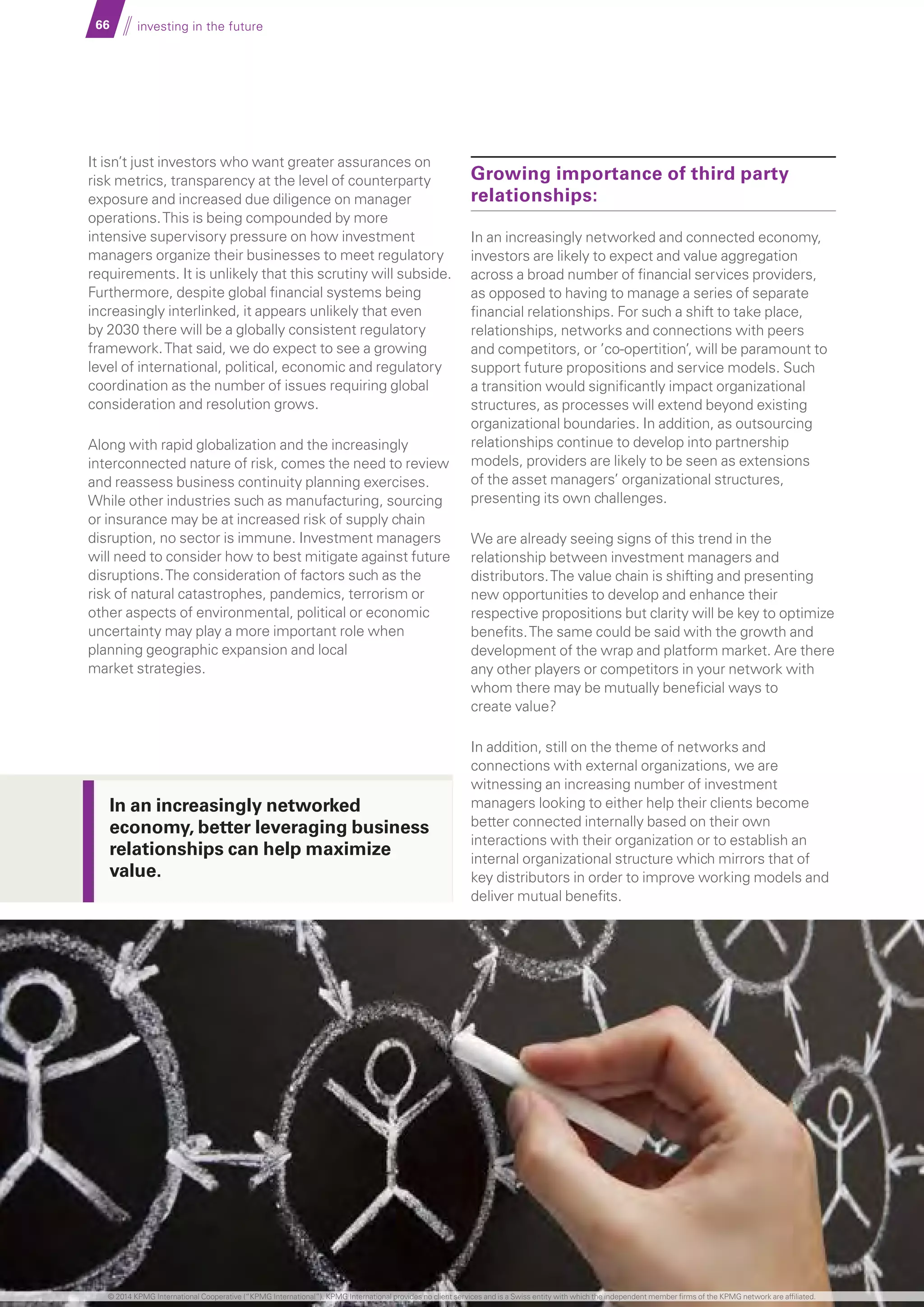
Investment managers will need to
understand their clients better than
they do now; no easy task when the
use of intermediaries means that
they may already be one or two steps
removed from them.
Controlling the client relationship
is likely to become an increasingly
important differentiator.
© 2014 KPMG International Cooperative (“KPMG International”). KPMG International provides no client services and is a Swiss entity with which the independent member firms of the KPMG network are affiliated.
38 investing in the future
“Tell me and I forget.
Teach me and I
remember. Involve me
and I learn.”
Benjamin Franklin
American inventor, journalist, diplomat and statesman
© 2014 KPMG International Cooperative (“KPMG International”). KPMG International provides no client services and is a Swiss entity with which the independent member firms of the KPMG network are affiliated.
39 investing in the future
This is not to suggest that investment managers will
dis-intermediate intermediaries although vertically
integrated D2C models will in our view increase.
However, we can see an opportunity for the relationship
between the two to develop and change such that
it is far more cohesive and more effectively brings
together the combined strengths and resources of
both organizations to support a more diverse client
demographic with significantly different expectations.
The industry also has a key role to play in helping
to demystify the world of investment and savings.
Education will be critical to help improve trust and
engagement with the industry. From a product
perspective, simplicity and transparency will help to
deliver propositions in a more relevant and
engaging way.
There are numerous options and we are already starting
to see signs of this transition within the investment
management sector.This supports our view that for
many players, future success will not be solely driven
by investment product and performance as it has often
been in the past.
User-friendly access and up-front asset allocation:
Newly emerging business models are seeking to
demystify some of the complexities of investing and to
provide simple user-friendly access to a broader range of
investors. Such propositions aspire to provide investors
with input and control over key inputs such as risk, time
horizon and investment objectives, but take away the
complexities of the investment decision and underlying
investment management. Instead, investors are offered
a discretionary service underpinned by a series of ready-
made, yet customized investment portfolios and an
asset allocation engine. A few examples of organizations
adopting this approach include Nutmeg, rplan
and FutureAdvisor.
Aggregation and packaging:
From a product perspective, since the launch of multi-
manager funds several decades ago, there has been
considerable growth in asset allocation solutions as
a means of achieving diversification through a single
investment vehicle. More recently, in today’s low return
and volatile investment environment, multi-asset and
diversified growth funds have seen rapid inflows as a
means to invest and easily reallocate across several
asset classes and fund managers. Such funds have
also benefited from the ramifications of the Retail
Distribution Review (RDR) in the United Kingdom, as
Independent Financial Advisors (IFAs) increasingly
choose to focus on core skills of life and inheritance
planning and consequently outsource the asset
allocation decisions. In addition, target date funds are
taking a growing proportion of average retirement plan
asset allocations, both as a result of growing availability
and changes to product features which encourage target
date investing. In the future, we anticipate this trend
for aggregated solutions to continue to increase
in popularity.
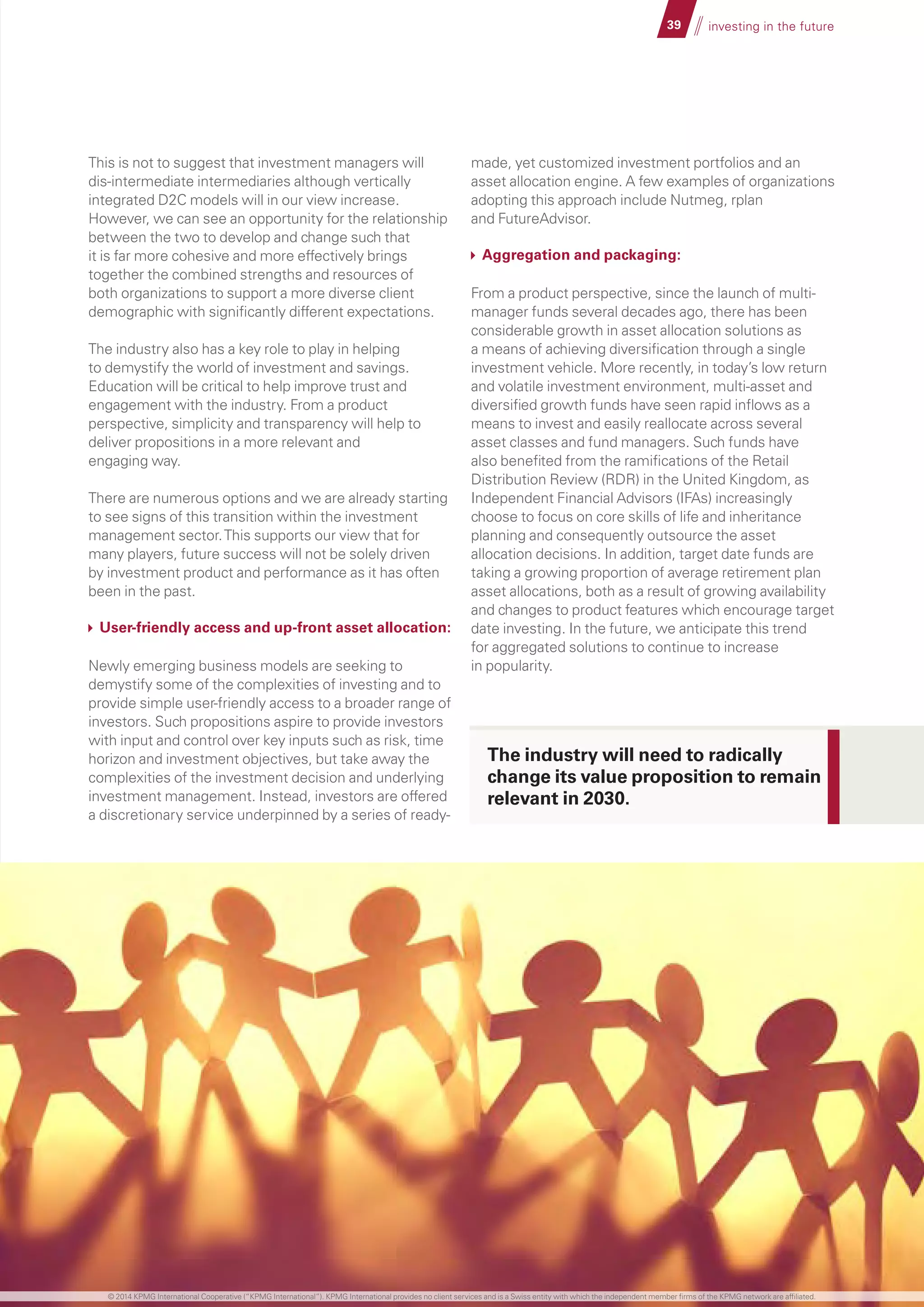
The industry will need to radically
change its value proposition to remain
relevant in 2030.
© 2014 KPMG International Cooperative (“KPMG International”). KPMG International provides no client services and is a Swiss entity with which the independent member firms of the KPMG network are affiliated.
40 investing in the future
Investment managers have choices to
make:
With investors increasingly demanding a more
customized service proposition, a generalist ‘one-stop
shop approach’ is likely to be less successful, unless
all components are provided to the same level or
better than specialist providers and the solution can be
personalized to meet individual needs.
We believe this is likely to be the preserve of the larger
managers with a combination of financial strength,
brand, global footprint, depth of client relationship and
breadth of product access. For the rest of the market,
we believe they will need to be much clearer in terms of
the value they add and the markets in which they want
to play and focus their respective strategies accordingly.
The decisions are not easy to make especially given
the significant opportunities available. Choices will
have inevitable implications on the size of addressable
asset pools and margins, with the latter already under
pressure given increasing competition and regulatory
and investor scrutiny.This pressure is only anticipated
to increase as potential hardships felt by many in
retirement lead to increasing questions being asked of
an industry which has generated healthy returns during
accumulation,
yet not necessarily delivered in line with
investor expectations.
We believe that the highest operating margins are
likely to be the preserve of the more specialist boutique
managers. However, while global waterfront players
are likely to be achieving significantly lower operating
margins, with higher asset bases and a broader service
proposition extending beyond alpha provision, we
believe there will be opportunities to maintain
attractive margins.
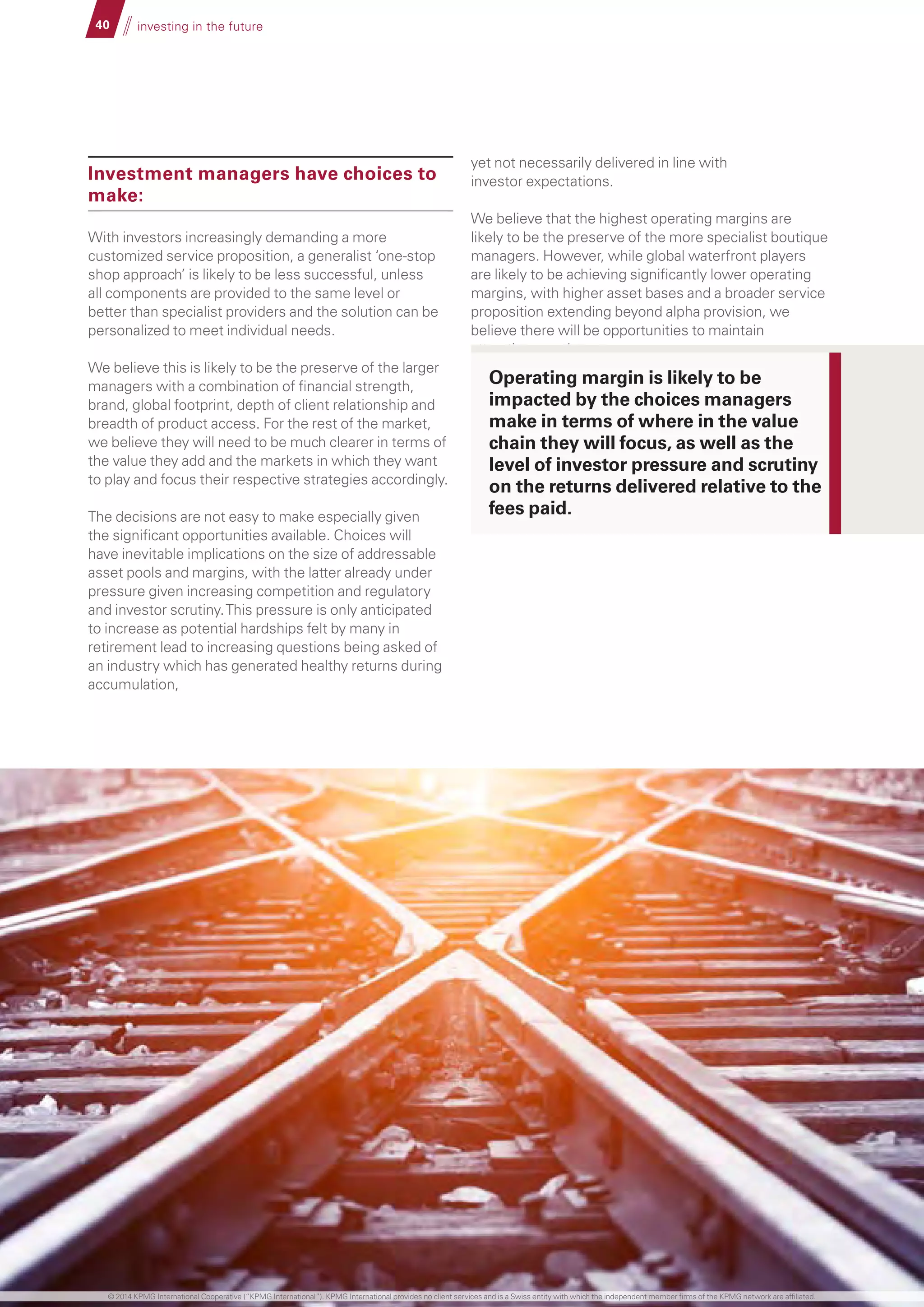
Operating margin is likely to be
impacted by the choices managers
make in terms of where in the value
chain they will focus, as well as the
level of investor pressure and scrutiny
on the returns delivered relative to the
fees paid.
© 2014 KPMG International Cooperative (“KPMG International”). KPMG International provides no client services and is a Swiss entity with which the independent member firms of the KPMG network are affiliated.
41 investing in the future
“If you don’t know where
you’re going, you
will probably end up
somewhere else.”
Lewis Carroll
English writer
© 2014 KPMG International Cooperative (“KPMG International”). KPMG International provides no client services and is a Swiss entity with which the independent member firms of the KPMG network are affiliated.
42 investing in the future
CLIENTS
Radical changes to client
demographics  expectations
IMPLICATIONS:
© 2014 KPMG International Cooperative (“KPMG International”). KPMG International provides no client services and is a Swiss entity with which the independent member firms of the KPMG network are affiliated.
43 investing in the future
Client engagement strategies will need
to be tailored to reflect the diversity of
the investor base:
We believe the profile of the investor base is likely
to change materially and become considerably more
diverse.
	 Generational shifts: To date, much of the
industry has focused on the management of
wealth accumulated by Baby Boomers preparing
for retirement. As these Baby Boomers move
into retirement, can the industry confine itself
to managing their assets in the decumulation
stage? What engagement strategies does your
organization already have in place for Generations
X andY and how will this need to change for
the Millennial, Digital Natives or Generation
Z? Does your business understand their
different engagement styles, preferences and
expectations? How will you establish a dialogue
with the younger generations?This theme has
already received considerable media coverage,
with a recent report by a company called Hearts
 Wallets concluding that if acquiring new clients
is the industry’s top priority, it is overlooking
considerable opportunities by focusing on older
investors with ‘big pockets’. In fact, it estimates
that firms are currently only spending 16% of
resources on marketing strategies tailored to
younger investors.25
	 Gender shifts: It is fair to say that the financial
services industry has for too long focused on
engaging the male investor. With wealth shifting
to new demographic groups and women typically
outliving men by five to six years26
, investment
managers needs to re-evaluate how to engage the
female investor and whether or not they will be
looking for a different investment philosophy or
risk / return equation.The benefits of getting it right
could be sizable not least in terms of the potential
to attract new assets. Numerous studies have
demonstrated that the behavioral characteristics
evidenced by women are exactly what the industry
is looking to attract. As clients, they demonstrate
greater loyalty, assign a higher value to the advice
they receive and have a preference for a planning-
based approach versus an investment performance
based approach.27
We are starting to see a shift
in client marketing strategies, with a greater
proportion seeking to engage a more
female audience.
	 Wealth shifts: Similarly with economic
developments in eastern and southern economies,
investment managers need to consider how
distribution and client engagement strategies need
to vary to accommodate what can be significantly
different philosophical, cultural and religious
differences.There are very few brands currently
that recognize and make a play on the need for a
global / local approach.
Demographic transformation,
combined with technological
advancement and social shifts will
significantly change the profile,
needs and requirements of investors
by 2030.
Baby Boomers 1945 - 1965
Generation X 1960s - 1980s
GenerationY
Millenial generation
1980s - 2000s
Generation Z
Digital Natives
1995 - 2010
GenerationAlpha
Google kids
2010 onwards
The clients of tomorrow are likely to be very different from the clients of today,
both in terms of who they are, where they live and what they need and expect
from the industry. How will the industry respond to evolving investor needs?
194528
2030
© 2014 KPMG International Cooperative (“KPMG International”). KPMG International provides no client services and is a Swiss entity with which the independent member firms of the KPMG network are affiliated.
44 investing in the future
Advice and financial education will be
increasingly important:
Financial illiteracy is prevalent globally and with
individuals being asked to assume more responsibility
for their financial well being, education and advice
will continue to gain importance.This issue is being
compounded by:
	 the increasingly complex range of products,
services and financial instruments available.
	 the need for investors to engage earlier in their life
when financial literacy rates are typically at
the lowest.29
	 the financial crisis, which both dented trust in the
industry and created an even greater need for
investor information. A recentTIAA-Cref survey of
1,000 American adults found that 46 percent say
they need a trusted place to go for financial advice
now more than ever.30
But where will people turn to for advice?
We are already starting to see the industry respond to
the growing need for financial education. For example,
a number of asset managers have recently introduced
personal financial advice sections on their websites,
featuring written guidance or videos which cover a wide
variety of individual life stage events, such as financial
considerations when starting your first full-time job,
moving to part-time work or starting a family. At the
same time, we are also seeing an increasing number of
organizations establishing ‘content-only’ websites with
the intention of helping educate investors take greater
control of their financial affairs.
However, is this sufficient?With consumers placing
increased value on advice from peers and social
networks, how will this influence the advice spectrum?
Will they look outside the core of the industry for
support?We believe that while there will remain a
place for professional investment advice, investors
are increasingly likely to be influenced by peers, social
media, investment clubs and may even be prepared to
crowd source investment ideas. As such perhaps asset
managers should ask themselves what more could they
do to help connect and create networks of like-minded
individuals?There are early signs of asset managers
picking up on this trend, with a number of new providers
looking to incorporate the concepts of social media into
the investment arena, allowing investors to learn from,
interact with and copy other members’ investment
decisions.
Finally, perhaps the industry needs to think about the
issue differently.While certain organizations have
started to invest resources in this area, it is worth
contemplating whether financial education should
start earlier and whether the industry has a social
responsibility to help the government in its quest to
improve financial education in schools.
Engagement levels will vary
significantly, albeit in the main, are
anticipated to increase:
As with financial literacy levels, consumer engagement
levels with the financial services industry remains
considerably lower than the industry and global
governments would like.With regulatory changes and
government intervention continuing to amplify the need
for individual engagement, how to do this remains a
key challenge.We believe that by 2030, engagement
levels will have increased markedly, both as a result of
increased auto enrollment and individuals becoming
increasingly aware of their savings shortfalls.This is
likely to be also driven by experiential learning.Younger
generations may see their parents struggle in retirement
and face the prospect of actually having to take care of
them.This is likely to increase the focus on their own
retirement planning.
Early signs of this trend are already starting to emerge.
Research from BlackRock in the United Kingdom
suggests that people are taking financial planning
more seriously and starting to save at a younger age,
with those aged 24-35 now saving 18 percent of what
they earn in contrast to only 12 percent for those aged
45-54.31
Research from Merrill Edge supports these
findings. In the spring of 2013, it released a report
that noted young investors are starting to save much
earlier, at an average age of 22, whereas Baby Boomers
started saving on average 13 years later at the age of
35.32
In its same report in the fall of 2013, Merrill Edge
went even further, suggesting that within the mass
affluent segment, financial priorities have shifted
considerably from the start of the recession, with
‘saving for retirement’ cited as a number one priority
for Generations X,Y and Baby Boomers, beating other
priorities such as paying off debts or securing a job.
Investors are likely to increasingly
look outside the industry to peers
or like-minded individuals for
investment advice.
© 2014 KPMG International Cooperative (“KPMG International”). KPMG International provides no client services and is a Swiss entity with which the independent member firms of the KPMG network are affiliated.
45 investing in the future
Despite what appears to be nascent signs of increased
engagement, we do recognize that there will remain
those who are either time-poor or simply uninterested
and who see financial planning as a nuisance. Such
individuals are likely to be happy to either avoid the issue
(which is going to become increasingly difficult) or to
look for someone to ‘take the problem away’.We are
already starting to see this theme play out in marketing
strategies, with one asset manager’s advertising tag
line being, “Let us do the hard work.”33
The challenge
for the industry will be how to address the needs of this
segment of the market while also providing a service
model which suits the more empowered and engaged
investor.
As a result perhaps we will see three types of retail
investor emerge:
	 those who are highly engaged in their personal
finances, likely to be quite self directed and
active on the investment front as well as heavy
technology users expecting a customized, highly
interactive service.
	 those who are interested and do engage from a
planning perspective, using technology to keep
an eye on the aggregate position of their assets
and liabilities but happy to also seek professional
expertise and discretionary management.
	 those who remain relatively disengaged or only
engaged to the extent they need to be for the
‘problem to be taken away’ and as such likely to
invest via a standardized, simple, almost fiduciary
savings system - if at all.
Investors’ expectations of and
interactions with the industry will
change considerably:
We foresee client service models undergoing significant
change in response to the evolving client profile.We
are already seeing consumers’ increasing thirst for
information, demands for multiple touch points and
growing acceptance of digital solutions. Such trends
are anticipated to accelerate, particularly for the more
empowered or engaged investors. Gone are the
days when investors will be satisfied with quarterly
meetings or statements.Tomorrow’s investor will
expect 24/7 access, full transparency and the ability
to self-report, review and re-balance investments via
a range of channels, including extensive use of mobile
technologies.We are not suggesting that all investors
will use this functionality and we are not advocating that
a standard retail investor re-balances his / her portfolio
on an overly regular basis. However, we do foresee
that successful investment managers will need to be
equipped to service a more demanding client type,
while continuing to satisfy the expectations of more
conventional clients, who remain satisfied with more
limited interaction.
We have witnessed similar shifts in other segments of
the financial services sector as well as other industries.
Limited opening hours, basic branch networks and
telephone or limited internet banking facilities have
been replaced by significantly upgraded retail stores,
satellite branches with extended opening hours and
comprehensive online and mobile services.The
investment management industry is already making
similar shifts, with certain players more advanced
than others. As an example, one large global manager
recently announced it is analyzing the times of day when
people use different computer devices in order to better
tailor its marketing and client service approach.34
1
2
3
We believe investor engagement
will have to increase, simply because
falling state provision, issues around
corporate pensions and the prospect
of reduced inter-generational wealth
transfer mean that they will have to
take greater responsibility for their
own retirement planning. No-one
else will do it for them.
The industry will have to capture new
customers far earlier and keep them
longer, by offering products tailored
to a younger, less affluent
and potentially less financially
literate market.
© 2014 KPMG International Cooperative (“KPMG International”). KPMG International provides no client services and is a Swiss entity with which the independent member firms of the KPMG network are affiliated.
46 investing in the future
Client profiling and a flexible operating
model which can accommodate diverse
client needs will be key:
Finally, but perhaps most importantly, client profiling
and data-driven analytics will become an increasingly
important source of competitive advantage. Not only
will this enable investment managers to more accurately
anticipate client needs and buying behaviors and hence
customize product, marketing and service strategies
and service models, it will also help improve internal
efficiency and productivity.
Similar disruptive, yet highly positive, changes are being
seen in virtually every industry. For example, in the
medical sector, doctors used to ask questions about
family histories in order to determine the likelihood
of prognosis based on current symptoms.With
modern genome analysis, individual DNA testing has
revolutionized diagnostic capabilities so that an individual
patient’s DNA can be analyzed to determine his or her
potential for contracting a particular disease or disorder.
What would such predictive analysis and profiling look
like in investment management?
It is highly likely that the ‘one size fits all’ solution or
service model will disappear, with investors instead
insisting on individually designed solutions to meet their
specific needs, requirements, profiles and situations.
Please refer to the ‘operating model’ section for more
information on this topic.
To prosper in such a radically
redesigned investment landscape,
investment managers will need to
understand and profile their clients
better than they do now.
© 2014 KPMG International Cooperative (“KPMG International”). KPMG International provides no client services and is a Swiss entity with which the independent member firms of the KPMG network are affiliated.
47 investing in the future
“The first step in
exceeding your
customers’ expectations
is to know those
expectations.”
Roy H Williams
Author and marketing consultant
© 2014 KPMG International Cooperative (“KPMG International”). KPMG International provides no client services and is a Swiss entity with which the independent member firms of the KPMG network are affiliated.
PRODUCT
Evolving product requirements and
the importance of brand
IMPLICATIONS:
$
£
€
© 2014 KPMG International Cooperative (“KPMG International”). KPMG International provides no client services and is a Swiss entity with which the independent member firms of the KPMG network are affiliated.
49 investing in the future
Outcome-orientated propositions will
continue to gain in popularity:
In a low-return, low-trust and potentially more-volatile
environment and with the investor base undergoing
significant demographic changes, clients will
increasingly focus on target-driven results as opposed
to individual investment strategies or asset classes.We
are already seeing this with the growth of investment
solutions, multi-asset products and lifestyle funds.
While there are certain segments of the market that
question whether the multi-asset trend is sustainable
or merely a result of the current market environment,
we believe the broader ‘solutions’ trend is here to stay
and likely to trigger significant changes to product sets
and the way they are marketed to investors.While the
more engaged investor may continue to be interested in
the specifics of the underlying investment, the majority
of the client base are likely to assign greater value to
products which deliver against specific, quantified
outcomes and pre-determined time horizons and risk
objectives. For some, particularly the less engaged or
sophisticated investor, we believe these individuals may
be willing to sacrifice some of the upside potential in
exchange for increased certainty that a stated outcome
will, in fact, be delivered. How will this be achieved?
Dynamic asset allocation will be at the core, combined
with access to all of the necessary components to
deliver the solution, or ‘componentry’ as the Global
CIO of Russell Investments describes it,35
along with
appropriate risk overlays.
Together, the ability to package this solution within a
simple, clear proposition that demystifies some of the
industry’s complexities and focuses on how it delivers
against investor needs will be key.
Pensions innovation is required to help
address the retirement challenges:
Aging populations, low birth rates and high levels
of fiscal debt are creating a well-publicized global
pensions ‘time bomb’. In countries with well-developed
pension systems, the issue is one of increasing
dependency ratios, low savings rates, a low interest
rate environment and high levels of consumer mistrust
and disengagement. For less developed economies,
the challenges are compounded by even lower levels
of pension provision. It is estimated that less than 5
percent of the current African workforce is building up
any pension provision.36
While the industry is well aware of the problem, very
little has fundamentally changed over the last 30 years.
For example, in the United Kingdom, while there has
been a shift from Defined Benefit (DB) to Defined
Contribution (DC), the introduction of concepts such as
the workplace pension and recent changes to annuity
rules, is this sufficient?We believe further product
innovation is required. How will the industry innovate
sufficiently to encourage saving and to help investors
live the kinds of retirement lifestyle they expect?Will it
even be possible for individuals to live the lifestyle they
envision?Will it be the design and launch of a radically
different pension proposition in the accumulation or,
perhaps more importantly, decumulation space? Or will
it be more subtle innovations which make the current
product set more effective, less costly and which
increase the breadth of appeal?
We believe investors will be looking
for increased certainty and protection
that the outcomes intended will
actually be delivered, even if this
involves an element of performance
sacrifice.
The core investment product will remain key as the industry continues to
strive for greater client centricity. However, we believe traditional products will
increasingly become components of outcome-orientated solutions, niches will
become more mainstream and aspects of investment theory may be
called into question.
© 2014 KPMG International Cooperative (“KPMG International”). KPMG International provides no client services and is a Swiss entity with which the independent member firms of the KPMG network are affiliated.
50 investing in the future
“Never innovate to
compete, innovate to
change the rules of the
game.”
David O.Adeife
Innovation author
© 2014 KPMG International Cooperative (“KPMG International”). KPMG International provides no client services and is a Swiss entity with which the independent member firms of the KPMG network are affiliated.
51 investing in the future
We believe pension innovation is particularly
important in the following two areas:
improving the levels of advice individuals receive
when entering into a pension arrangement and
when making choices throughout the life of the
scheme.
improving risk management within the product to
increase the certainty of outcomes.
enhancing the current decumulation product
offering to improve the simplicity and transparency
of current annuity offerings.
If we take the first point and use the United Kingdom
pension system as an example, the shift from DB to DC
transfers the risk and responsibility almost entirely to the
individual.While the financial motivations are clear, we
believe the majority of the population is not sufficiently
investment-savvy or engaged to make appropriate
and informed choices. As such, we believe investor
education, protection and support in the pensions arena
needs to increase.There is financial services regulation
to protect investors in all other forms of investment.
However, in one of the most important financial
decisions an individual will make, they are left almost
entirely without support. Is it right or even efficient and
appropriate that each member of a DC scheme needs
to seek independent investment advice or could the
industry provide better support and education to inform
decision making?
In terms of the second point, we believe there is a need
for improved risk management and potentially greater
risk sharing to improve participation and investment
certainty. In the current DC system, individuals bear
all the investment risk, yet the majority invest via a
standardized asset allocation model which moves to
fixed income as an investor nears retirement age.Very
few individuals pro-actively change their asset allocation
dynamically through the life of the product or as their
personal circumstances change. In today’s low interest
rate environment, the absence of interest rate hedging
can often result in annuity levels which are significantly
below expectations.We believe there could be
opportunities for a more fiduciary solution in the pension
arena, with asset managers taking on a greater oversight
role.This role could include more active management of
the assets against a defined target and even potentially
the inclusion of some form of embedded guarantee or
a guaranteed floor to help improve confidence that the
intended outcomes will be delivered.
Finally, when turning to decumulation, in addition
to improving the simplicity and transparency of the
annuity purchase process and enhancing the way
liquidity is provided, we believe that with healthcare
improving, careful consideration should be given to
how to extend beyond the traditional ‘at retirement’
product marketplace to help the older generations fund
healthcare and the more active retirement lifestyles they
are likely to expect.
Retail product sets will need to extend
beyond pensions:
In many countries, the investment management
industry remains highly pension-orientated.With a
need to engage investors younger in their lives and to
help them prepare for a wider range of life events, the
industry needs to think about how to broaden its product
focus to enable it to be more relevant from ‘cradle to
grave’. Unfortunately, while providers already offer a
range of general savings propositions and are looking to
increase the prominence of such product offerings, the
emphasis remains on pensions.
More needs to be done to devise and market products
which are tailored and designed to help individuals
with broader savings and investment requirements
throughout their lives - ranging from supporting them
as they get their first job, buy their first house, get
married, start a family through to considering healthcare
options.We are already seeing signs of this shift with an
increasing number of providers tailoring product sets to
meet investors’ different life stages.
Retirement systems are under strain
globally. Pensions innovation will be
critical to increase investor protection
and improve savings rates.
The industry needs to broaden its
proposition set to be more relevant
from ‘cradle to grave’.
1
2
3
© 2014 KPMG International Cooperative (“KPMG International”). KPMG International provides no client services and is a Swiss entity with which the independent member firms of the KPMG network are affiliated.
52 investing in the future
Core aspects of the investment process
could be called into question:
The confluence of these megatrends could also bring
into question certain aspects of modern portfolio theory.
Algorithmic and computer trading is on the increase.
Opportunities for arbitrage are decelerating.The
boundaries of diversification are being retested and so
too are previously held assumptions about correlation.
These are fundamental issues, striking at the core of
investment management and which have the potential
to significantly disrupt the investment process.
If we look at investment theory, traditionally
sophisticated mathematics have been applied to past
data and combined with subjective qualitative analysis to
help portfolio managers devise investment strategies for
the future. Going forward, this could need to change due
to three material factors:
1 the aftermath of the financial crisis and the resulting
monetary and fiscal intervention, combined with
the advent of each of these megatrends, is resulting
in a future which is shaping up to be very different
from the past.The sophisticated models which
underpin quant or algorithmic hedge funds have
made limited allowances for this and for the extent
to which these trends are shaping the future.
With trend following ‘quant’ funds having lost
money in 4 out of the last 5 years37
and automated
or algorithmic funds have underperformed the
broader hedge fund universe by between 2.07
percent to 3.7 percent in 2013,38
there appears to be
appropriate evidence that the impact of megatrends
and the manner in which they are affecting markets
needs to be better reflected in investment models
and process.
2 continuing improvements in computer technology
could create a situation in which computers take
on more aspects of the qualitative investment
process. Standard Life recently claimed that many
jobs performed by fund managers could be replaced
by machines.The primary rationale being that while
man “has to deal with fear and greed, intellectual
constraint and fatigue”, a machine is “agnostic,
tireless and has no bias in decision-making.”39
3 with the advent of social media and big data,
what data should be analyzed in order to inform
successful investment decisions? Could big data
or social media feeds, if properly analyzed, be
a better alternative to traditional practices and
analysis? We are already seeing new business
models emerge in the industry which claim to
be able to identify signals from millions of social
media messages, which could subsequently be
reflected into investment strategies, trades and
hedging arrangements. Similarly, other sectors are
beginning to be disrupted by new data sources. For
example, in the insurance sector, the analysis of
policyholders’ spending habits is starting to displace
traditional actuarial data as a more appropriate
predictor of individuals’ risk (and therefore pricing)
profiles. Can this happen in investment markets
in an analogous manner? What would investment
analysis look like in the face of big data going
forward and what could it mean for alternative
investment strategies?
Mainstreaming of current
investment niches:
While the search for return is likely to further increase
the diversity of the underlying investment base, we
also believe we will see many of the current investment
niches become more embedded in standard industry
practices:
Socially responsible investing (SrI): SRI or
environmental, social and governance (ESG)
investment strategies are expected to experience
a further revival and become an increasingly
mainstream component of the industry, as
environmental and social awareness levels and
concepts such as responsible capitalism continue
to grow. Despite the exponential growth that
SRI has witnessed in many global economies, it
remains a small proportion of the industry’s total
assets under management (AuM), given concerns
regarding a perceived performance trade-off.40
While in other industries, consumers may be
prepared to pay a premium to support sustainable
and/or ethical behavior, fiduciary responsibilities
within the investment management industry
could pose a more significant barrier. Similarly,
many of the qualifications required within the
industry do not currently fully embrace the ethical
imperative of socially responsible investment.
However, the industry has taken a proactive
approach in attempting to change this perception.
Research published by Bank of NewYork Mellon
in 2012 based on a survey of 1,100 of its clients
suggests that 80 percent of firms believe there
is no performance trade-off between SRI/ESG
strategies and traditional investments.41
Similarly,
a study by Harvard Business School, which
analyzed the share price of 180 companies over
18 years, found that the 90 companies at the
forefront of implementing sustainability programs
were significantly outperforming their peers.42
© 2014 KPMG International Cooperative (“KPMG International”). KPMG International provides no client services and is a Swiss entity with which the independent member firms of the KPMG network are affiliated.
53 investing in the future
These factors, combined with increasing investor
demand and increasing international coordination
on responsible investment, are raising it up the
corporate agenda.The United Nations-supported
Principles for Responsible Investment Initiative
(UNPRI), an international network of investors
working together to put the six Principles for
Responsible Investment into practice in the sector,
now represents over 1,200 of the world’s leading
investors and accounts for approximately US$35
trillion in investment assets.43
	 Increasing awareness of environmental and social
issues also raises important questions for the
industry in terms of its investment approach. Is
the industry going to genuinely embrace longer-
term investments? Is it willing to accept that
investment is no longer just about the optimization
of a single metric (shareholder returns and its
interplay with risk) and that there are other broader
considerations which need to be taken
into account?
	 Alternatives: We have already seen a significant
blurring between traditional and alternative
investments in the institutional marketplace.This
trend is only likely to intensify as alternatives
and hedge funds in particular become increasing
important components of retail portfolios. While
hedge funds are the first of the ‘alternative’
segment to be increasingly adopted by retail
investors, the continuing demand for absolute
and non-correlated returns, combined with the
transparency, liquidity and regulatory oversight
that new regulated investment vehicles deliver, is
likely to lead to asset classes such as Real Estate,
Private Equity, Infrastructure as well as even
more esoteric investments becoming part of the
mainstream retail industry by 2030.
	 Sharia compliant investing: The economic
shift from West to East is also bringing with it an
important religious shift and prompting significant
growth in Islamic banking and finance. However,
with Muslims representing nearly a quarter of the
world’s population, it is estimated that currently
less than 1 percent of financial assets are Sharia
compliant.44
This fact can be attributed to a range
of factors, including a lack of credible propositions,
a reputation for a lack of diversity, a perception of
poor performance and high fees and the timing of
the financial crisis, which damaged confidence in
the heavily equity-skewed Sharia funds industry.
We foresee this position changing quickly over
the period to 2030, both as result of supply and
demand. From a demand perspective, the Muslim
population is expected to grow at about twice the
rate of the non-Muslim population over the next
two decades, such that Muslims make up more
than a quarter of the global population by 2030.45
In addition, we anticipate a growing demand for
Sharia offerings from non-Muslim groups. Supply
is expected to follow suit, with the availability of
Sharia compliant funds and Sukuks increasing
considerably as more non-Islamic markets show
heightened interest in Islamic finance and such
propositions become more integral components of
an investment manager’s proposition set.
Current investment niches are likely
to become increasingly mainstream
as the pool of available alpha
reduces.
© 2014 KPMG International Cooperative (“KPMG International”). KPMG International provides no client services and is a Swiss entity with which the independent member firms of the KPMG network are affiliated.
54 investing in the future
Product flexibility will become
increasingly important:
We believe that the product and portfolio of the future
will need to be considerably more adaptable in the
sense it:
	 can be flexed quickly, efficiently and at a low cost
to cope with changes in personal circumstances
or the market environment. With the pace of
change increasing, the ability to respond quickly to
events and triggers, including those which could
be outside of the portfolio manager’s initial control,
will become more important for both the investor
and the investment manager.
	 offers the flexibility to pull together individual
components into a range of wrappers. As
discussed, the value assigned to aggregation and
packaging is increasing, both within investment
management and other industries. While we
have already seen this with the growth in open
architecture and wrap platforms, we anticipate
this trend will accelerate, necessitating more
comprehensive links and working relationships
with other investment management providers to
enable better financial aggregation. Over time,
the blurring of boundaries between providers
in the investment management and financial
services industry more broadly is likely to increase
considerably as investors look to create a more
complete and single view of their assets and
liabilities.This trend will inevitably raise questions
for providers in terms of their areas of focus and
appetite for ‘co-opertition’ - a combination of
cooperation and competition.
	 is portable. Pre-crisis investor and wealth mobility
increased considerably. While many experts expect
migration and mobility to remain relatively static or
to fall in the period to 2030, the flexibility to transfer
products, vehicles and assets across borders and
to invest in multi-currency products will continue to
be an important feature.
Pricing is likely to be under a more
intense spotlight:
With the growing trend for transparency, both in the
investment management industry and beyond, we
expect to see a growing focus on product pricing and fee
levels. Such a trend is only likely to increase in light of
additional regulatory and client scrutiny.We are already
starting to see visible impacts of this trend in the retail
marketplace, with a range of new online providers
actively marketing their proposition sets on the basis
of simple, flat fee structures or using tag lines such as
“now quality investment management does not have to
cost thousands.”46
This trend is only likely to be intensified by the changing
risk return expectation, with investors potentially
becoming increasingly reluctant to pay hefty fees for
limited investment return while still bearing considerable
investment risk.
Effective brand management will be
key to success:
The trust issue within the financial services industry will
need to be resolved. Not only will this be critical in order
to drive improved investor engagement, but other issues
such as data security, confidentiality and data privacy
are likely to heighten the need for a trusted brand.
While it will take time and considerable effort to regain
lost ground, we believe a trusted brand will become an
increasingly important differentiator or, conversely, could
act as a potential threat to incumbent players. Could
there be an opportunity for an established investment
manager to partner with a more trusted, higher-profile
retail brand?
Effective brand management needs to extend beyond
a new logo, Facebook page or simple tweet. A trusted
brand and corporate identity needs to be built on
action and performance. Furthermore, with younger
consumers increasingly trusting ‘people like me’ rather
than corporations or professions, branding strategies
need to extend beyond traditional corporate advertising
campaigns.We are already seeing growing recognition
of this across the industry, with digital campaigns
complementing more traditional media in order to reach
a younger, more tech-savvy audience. However, there
are downsides and risks inherent in operating in a more
interactive social media world, the most notable of
which being that it allows everyone to have an opinion,
including a disgruntled customer or investor.This, in turn,
increases the importance of brand protection strategies
relevant to the new social media environment.With a
rapid and appropriate response, a bad client experience
can be turned around.
In a rapidly changing world, product
flexibility and the ability to respond
quickly to outside events will be
increasingly critical.
© 2014 KPMG International Cooperative (“KPMG International”). KPMG International provides no client services and is a Swiss entity with which the independent member firms of the KPMG network are affiliated.
55 investing in the future
“Products are made in
the factory but brands
are created in the mind.”
Walter Landor
Brand designer
© 2014 KPMG International Cooperative (“KPMG International”). KPMG International provides no client services and is a Swiss entity with which the independent member firms of the KPMG network are affiliated.
56 investing in the future
MARKETS
New market opportunities
IMPLICATIONS:
© 2014 KPMG International Cooperative (“KPMG International”). KPMG International provides no client services and is a Swiss entity with which the independent member firms of the KPMG network are affiliated.
57 investing in the future
Emerging and developed markets will
increasingly converge:
This convergence is likely to create significant growth
opportunities for investment managers, as wealth
increases and retirement and savings markets grow and
develop.To achieve this, technology will be particularly
critical to gain ground and shape markets.Without the
legacy and cumbersome systems that often hinder
rapid technological adoption in developed economies,
emerging markets can often be faster adopters and,
hence, further ahead in certain areas of technology
usage, such as micro payments.
Market entry strategies will need to be
much more robust:
The growing potential in current emerging markets and
developing economies resulting from demographic
shifts in the South, East and Africa is much-publicized.
While most players have already diversified beyond
national boundaries, some into more developing or
emerging economies, many have failed to gain the
intended levels of traction in new markets, often having
created a disparate collection of models. Successful
market entry requires considerably more than just
positive macroeconomic indicators.
These new markets, particularly the less-developed, will
not suit the culture and risk profiles of every established
investment manager in theWest.They are much more
susceptible to political and social upheaval, are governed
by considerably different regulatory regimes, cultural
and religious belief systems and need to be assessed
against a range of qualitative criteria to determine
genuine attractiveness and entry strategies. Even those
markets that may appear attractive may not necessitate
a full service model to be established. Certain markets
may be more attractive from an asset gathering
perspective, while others may have opportunities
which warrant the establishment of a local investment
expertise.While the risks may be higher and some of the
choices may be difficult to make, the rewards associated
with getting it right can be high.
In most instances, while players will strive for global
consistency, local cultural, market and regulatory
differences are likely to require a tailored business and
operating model. Furthermore, the means of market
entry will need to be flexed not only by organizational
preferences, but heavily influenced by regulatory
requirements and local market practices. In some
markets, an organic market entry strategy, driven by the
relocation of trusted personnel from overseas offices,
may be successful. In others, a joint venture (JV) with
an incumbent player or acquisition may be the only
entry option.
When considering new market entry, a range of factors
should be considered.While the following list is by no
means exhaustive, it does provide a high level overview
of some of the key areas for consideration:
	 Local regulatory frameworks, tax environments
and licensing arrangements: Does the local
regulator environment actively encourage or
hamper new market entry? What are the key
regulatory differences from your existing market
footprint? How will the legal entity be taxed locally
and upon repatriation of profits to the head office
country? What are the licensing arrangements?
Are new licenses available or would an existing
license need to be acquired?
	 Financial stability: How stable is the local
financial market? Can investors readily access
local stock exchanges or are there investment
restrictions or legal risks that need to
be considered?
A wealth of new opportunities
exist in many of the less developed
markets but such countries will not
suit the culture and risk profile of
every established western manager
and will require a carefully defined
and executed market entry strategy.
Globalization has been a critical driver underpinning the scale and significance
of many of these megatrends.We believe this trend will continue and that
investment managers have an opportunity to extend their footprints to
capture new and emerging opportunities.
© 2014 KPMG International Cooperative (“KPMG International”). KPMG International provides no client services and is a Swiss entity with which the independent member firms of the KPMG network are affiliated.
58 investing in the future
	 Target investor base: How financially literate
or sophisticated is the target population? Which
segments of the population offer the greatest
potential? What would local investors expect
from an investment management provider? What
are the potential and available asset and revenue
pools? What do international financial flows tell you
about where local investors are currently investing
(e.g. domestically or internationally)?
	 Competitive environment and channels:
How well-served is the local market by incumbent
financial and investment management providers?
What are the key channels to market and how
accessible are these? How well-developed are
local distribution networks?
	 Foreign competitor activity: Have foreign
investment managers already entered the region?
How successful have they been and how have they
entered (e.g. via JV, acquisition or organically)?
Are there any restrictions on market entry
arrangements, particularly for foreign players?
	 Operating model: What organizational structure
would be necessary to meet local requirements?
What are the rules around the need for local
management structures? Do data and systems
need to be hosted and managed locally? What are
the restrictions on transferring data cross-border?
How well do you understand local business culture
and operating practices?
Regardless of market, successful market entry will
require a well defined strategy that is tailored to local
market specifics, aligns with and leverages existing
capabilities and is agile enough to withstand what could
be considerable flux as markets develop.
Market strategies may benefit from a
multi-level approach:
Over the last few years, many global asset managers
have devoted considerable focus to refining and
managing the complexities of a global business. A matrix
structure has been commonly adopted as the most
appropriate means to leverage and share capabilities
more effectively on a global basis, while maintaining
sufficient proximity to local market nuances.
As local markets develop and evolve driven by the
implications of these megatrends, it is likely to raise
questions as to how best to target and penetrate
individual markets.While previously strategies were
developed at a regional or a country level, we question
whether market strategies and groupings should be
created primarily on the basis of geographic location
or whether local market and investor characteristics
and dynamics should play a greater role in strategy
development. Market maturity, investor sophistication
and behaviors may be more appropriate criteria to
consider than simply geography when considering the
optimum organizational structure.
Urbanization could also present opportunities.
With megacities increasingly becoming powerful
communities and markets in their own right, we believe
a situation could arise in which individual city-level
strategies are required to complement a broader market
based approach. Such changes are likely to further
increase the complexity of the matrix.
Kinshasa18
Lagos17
Cairo15
NewYork -
Newark 22
Dhaka 24
Beijing16
Delhi 32
Kolkata 23
Rio de
Janero
13
Sao
Paulo
Slow growing Rapid growing
22
Buenos
Aires 1980
2010
2030
14
Mexico
City22
Mumbai29
Karachi22
Lahore12
Shanghai 21
Istanbul13
Los Angeles -
Long Beach -
Santa - Ana
14
Manila 17
Tokyo 37
The 20 largest cities in 203047
Urbanization from 1980 to 2030 (population in millions)
© 2014 KPMG International Cooperative (“KPMG International”). KPMG International provides no client services and is a Swiss entity with which the independent member firms of the KPMG network are affiliated.
59 investing in the future
“Think globally,
act locally.”
Akio Morita
Co-founder of Sony
© 2014 KPMG International Cooperative (“KPMG International”). KPMG International provides no client services and is a Swiss entity with which the independent member firms of the KPMG network are affiliated.
60 investing in the future
TECHNOLOGY
A focus on operating
infrastructure and technology
IMPLICATIONS:
© 2014 KPMG International Cooperative (“KPMG International”). KPMG International provides no client services and is a Swiss entity with which the independent member firms of the KPMG network are affiliated.
61 investing in the future
A core platform and simple user
interface will be critical:
Many investment managers are characterized by
a myriad of legacy systems.While work has been
ongoing for some time to improve the connectivity
and integration of these systems, it is questionable
whether many have gone far enough. In fact, many
clients recognize that a large proportion of technological
development has focused on resolving the problems
of yesterday.
We believe that a robust core platform which can
support customized and tailored propositions to
address clients’ increasingly diverse needs and
service expectations will be crucial. As we have seen,
generational differences alone will necessitate a
platform capable of dealing with clients who will want
to interact in different ways, through different types of
media and who expect information to be provided in a
wide variety of formats.
In addition, the ability to allow others to ‘plug and play’
on the platform may also be increasing important as
open architecture becomes more prevalent. Finally, with
a growing number of consumers valuing the concepts of
transparency and simplicity, anything that can be done
to simplify client portals and web applications is likely
to pay dividends in customer acquisition, retention and
satisfaction levels.
Case in point is Apple’s iTunes platform.The real power
of iTunes is in its simplicity.While it acts as the backbone
to the operating platform, it can be easily flexed and
tailored to an individual’s requirements and others can
add to it via the creation of Apps.The manner in which
any two users interact with the iTunes platform can vary
greatly.Yet, each user can be accommodated via the
one simple platform. Could the same be said for many
asset managers’ platforms? How easily can they be
customized and tailored to suit different investor needs?
Do asset managers’ platforms enable the organization to
respond rapidly to a quickly changing world?
Delivering the service promise will
increase the importance of process
efficiency and organizational agility:
Process efficiency and organizational agility will also
become more important to delivering the service
promise and reinforcing the brand values. For many
organizations, this will present major technology and
people challenges, particularly given that current
structures are typically built for constant and well-
defined demands, something that could well be
increasingly rare in the fast-paced world of the future.
Building an organization which can more easily support
change is likely to require innovation, imagination and
creative problem solving. In addition, in the post-crisis
world, where the focus for many asset managers has
been on cost optimization and downsizing, there is
the potential risk that these strategies could impair
an organization’s ability to respond to an increasingly
volatile world. Commentators are starting to consider
whether the industry has the capacity and capability
to create inbuilt organizational agility and corporate
resilience for use in times of unforeseen stress
and change.
While asset managers have already
been working hard to improve
operating platforms, we believe
much of this work has been
focused on addressing the legacy
of yesterday and problems of today,
rather than preparing for the future.
As the pace of external change increases, so does the need for flexibility and
agility in the core operating model.Technology will need to move far higher up
the agenda and more radical options will need to be considered to drive the step
change required to support sustainable growth.
Asset managers will need to invest
for the future to design and create
new platforms with the flexibility and
scalability to support a much more
diverse client profile expecting a
personalized and customized service.
© 2014 KPMG International Cooperative (“KPMG International”). KPMG International provides no client services and is a Swiss entity with which the independent member firms of the KPMG network are affiliated.
62 investing in the future
Client profiling and effective data
analytics will increasingly act as a
differentiator:
The amount of data available about investors (e.g. their
needs and lifestyles) and about markets (e.g. their
profiles and dynamics) is increasing exponentially and is
typically disparate, inconsistent and difficult to interpret.
Sources range from internal customer relationship
management (CRM) data to information from
distribution partners, advisors and other external market
data feeds. Over time, this is only likely to increase as
feeds from other sources, such as social media, are
integrated into corporate systems.
There are further challenges in managing data quality
issues, ensuring that insights are relayed effectively to
the relevant functions and that the business remains
compliant with regulatory requirements, particularly
around data privacy. Making sense of this efficiently,
creatively and using it to predict behaviors will be one
of the core sources of competitive advantage.The
opportunities presented by efficient data analytics are
recognized across the industry.
We are seeing an increasing number of clients investing
heavily to harvest, scrub and leverage data to improve
operational effectiveness and, more importantly, help
inform and shape the relevance of client engagement
strategies.There has also been considerable media
coverage about how firms are looking to make data
useful to their sales teams.48
As an example, one global
asset manager has focused heavily on the cleaning
up and definition of data and recently announced it
was even moving an IT function into the distribution
organization to align the technology to work better with
the needs of the sales teams. Others are focusing on
how to use data to identify which distribution partners
they should be targeting, which are likely to be most
receptive to the managers’ offering, what topics they
should be talking to them about and how often they
should call on them.
The sophistication of consumer profiling techniques can
be clearly seen in other industries, particularly retailing,
where marketing and spend-based promotions are
increasingly tailored to individual buying behaviors.
While there are evident regulatory considerations
within the financial services industry associated with
recommending products or predicting services required
based on the profile of a particular investor or of similar
investors, rather than an individual’s specific needs and
requirements, the potential presented by getting this
right cannot be underestimated.
Finally, it is not all about the information and data that
investment managers have available about their clients.
Let’s not forget that investors can now access significant
quantities of data in real time, meaning this is no longer
the exclusive domain of the professional investment
manager. How will you handle a potentially better-
informed investor?
Value-added outsourcing, if executed
successfully, will offer numerous
advantages:
IT systems are no longer simply about transaction
processing and number crunching.Those functions
can and, in many cases, have already been outsourced.
Increasingly, we are seeing a trend towards more
managers outsourcing more middle- and back-office
functions in an effort to focus technology on delivering
genuine differentiation, to move the cost base to a more
variable model and to enable business resources to
focus on their core competency of managing money and
client relationships.There are also potential advantages
in using outsourcing as a means to keep up-to-date
with the rapid pace of technological advancement and
support more rapid proposition development.
If executed successfully, outsourcing can significantly
improve cost flexibility and agility and could better equip
an organization to capitalize on the opportunities and
respond effectively to the challenges created by the
marketplace of 2030. However, many have focused too
much on the cost agenda and have found a subsequent
lack of flexibility.The trend is moving towards broader
and deeper strategic partnerships.The importance
of this trend is only going to increase as businesses
move towards a more networked model, increasingly
incorporating relationships with businesses outside the
traditional corporate boundaries into the organization’s
core structure and governance model.
To effectively target and service an
increasingly diverse client base, we
believe that client profiling, data
analytics and operational flexibility
will be increasingly critical.
© 2014 KPMG International Cooperative (“KPMG International”). KPMG International provides no client services and is a Swiss entity with which the independent member firms of the KPMG network are affiliated.
63 investing in the future
“It’s not information
overload. It’s filter
failure.”
Clay Shirky
American writer and new media professor
© 2014 KPMG International Cooperative (“KPMG International”). KPMG International provides no client services and is a Swiss entity with which the independent member firms of the KPMG network are affiliated.
64 investing in the future
GOVERNANCE
Revised organizational structure
and governance models
IMPLICATIONS:
© 2014 KPMG International Cooperative (“KPMG International”). KPMG International provides no client services and is a Swiss entity with which the independent member firms of the KPMG network are affiliated.
65 investing in the future
Increasing complexity of international
organizational structures and
governance:
Global investment managers are already finding it
challenging to manage an organizational matrix on three
continents.This will become even more challenging
as organizations continue to diversify internationally
and consider how to manage the business across five
continents and an increasing array of time zones. Add
to this the need for rapid decision making processes
in what is likely to remain a largely uncertain world
and it is not surprising that we believe optimizing the
effectiveness of organizational structure will become an
increasingly pressing management issue.
For those seeking geographic diversification, we expect
management teams to focus on how to build and
manage a cross-border investment business.This is
perhaps most effective when structured as a federated
matrix to enable it to harness the economies of scale
and knowledge-sharing opportunities, but at the same
time can be suitably adaptive to accommodate local
variances. Many global investment managers have
already implemented such models and for them, the
focus is on how to optimize the model by reducing
inherent tensions and removing any resulting silos.
For example, many organizations have structures which
constrain local input into key decisions, are structured
around key people rather than to meet business needs
and are overly influenced by head office cultures and
time zones. Addressing some of these imbalances can
deliver significant benefits, creating better equilibrium
between global and local requirements.
There is also the potential for technological
advancements to simplify aspects of the challenge.
While there is often no replacement for face-to-face
contact and it is unlikely that even by 2030, technology
will have completely replaced the need for local physical
presence, the rapid pace of advancement in the field
of communications and connectivity is only likely to aid
collaborative cross-border working.
Intensifying scrutiny of risk
management frameworks:
With trust in financial services organizations remaining
significantly below most other industry sectors and
having been further damaged as a result of a range of
recent scandals, we know investors are already looking
very closely at risk management frameworks, controls
environments and fund governance arrangements.
We believe this scrutiny is only likely to intensify, both
in direct correlation to increasing investor awareness,
engagement and financial literacy, but also a result of the
amplification of the potential risks in a more connected,
mobile and globalized world. For asset managers, it will
be critical to ensure that a risk focus is embedded within
the organization, but in such a way that it does not
stifle innovation.
Organizational structures and risk
management frameworks will
continue to be under the microscope
with pressure coming from internal
and external stakeholders.
Investment managers need to create an organizational structure which can
manage the challenges created by further geographic expansion, withstand
ongoing regulatory and client scrutiny and connect more effectively with other
organizations in its broader network.
Globalization, digital connectivity
and resource scarcity are forcing
businesses to operate in an
increasingly complex world.
© 2014 KPMG International Cooperative (“KPMG International”). KPMG International provides no client services and is a Swiss entity with which the independent member firms of the KPMG network are affiliated.
66 investing in the future
It isn’t just investors who want greater assurances on
risk metrics, transparency at the level of counterparty
exposure and increased due diligence on manager
operations.This is being compounded by more
intensive supervisory pressure on how investment
managers organize their businesses to meet regulatory
requirements. It is unlikely that this scrutiny will subside.
Furthermore, despite global financial systems being
increasingly interlinked, it appears unlikely that even
by 2030 there will be a globally consistent regulatory
framework.That said, we do expect to see a growing
level of international, political, economic and regulatory
coordination as the number of issues requiring global
consideration and resolution grows.
Along with rapid globalization and the increasingly
interconnected nature of risk, comes the need to review
and reassess business continuity planning exercises.
While other industries such as manufacturing, sourcing
or insurance may be at increased risk of supply chain
disruption, no sector is immune. Investment managers
will need to consider how to best mitigate against future
disruptions.The consideration of factors such as the
risk of natural catastrophes, pandemics, terrorism or
other aspects of environmental, political or economic
uncertainty may play a more important role when
planning geographic expansion and local
market strategies.
Growing importance of third party
relationships:
In an increasingly networked and connected economy,
investors are likely to expect and value aggregation
across a broad number of financial services providers,
as opposed to having to manage a series of separate
financial relationships. For such a shift to take place,
relationships, networks and connections with peers
and competitors, or ’co-opertition’, will be paramount to
support future propositions and service models. Such
a transition would significantly impact organizational
structures, as processes will extend beyond existing
organizational boundaries. In addition, as outsourcing
relationships continue to develop into partnership
models, providers are likely to be seen as extensions
of the asset managers’ organizational structures,
presenting its own challenges.
We are already seeing signs of this trend in the
relationship between investment managers and
distributors.The value chain is shifting and presenting
new opportunities to develop and enhance their
respective propositions but clarity will be key to optimize
benefits.The same could be said with the growth and
development of the wrap and platform market. Are there
any other players or competitors in your network with
whom there may be mutually beneficial ways to
create value?
In addition, still on the theme of networks and
connections with external organizations, we are
witnessing an increasing number of investment
managers looking to either help their clients become
better connected internally based on their own
interactions with their organization or to establish an
internal organizational structure which mirrors that of
key distributors in order to improve working models and
deliver mutual benefits.
In an increasingly networked
economy, better leveraging business
relationships can help maximize
value.
© 2014 KPMG International Cooperative (“KPMG International”). KPMG International provides no client services and is a Swiss entity with which the independent member firms of the KPMG network are affiliated.
67 investing in the future
“If you want to be
incrementally better:
Be competitive. If you
want to be exponentially
better: Be cooperative.”
Unknown
© 2014 KPMG International Cooperative (“KPMG International”). KPMG International provides no client services and is a Swiss entity with which the independent member firms of the KPMG network are affiliated.
68 investing in the future
PEOPLE
The people challenge
IMPLICATIONS:
© 2014 KPMG International Cooperative (“KPMG International”). KPMG International provides no client services and is a Swiss entity with which the independent member firms of the KPMG network are affiliated.
69 investing in the future
The profile of the talent pool will
change considerably:
Employees share many of the same characteristics,
motivations and attitudes as clients. Employees are
equally impacted by demographic shifts, technological
developments and changes in social attitudes and
expectations.They will expect to communicate in
the same ways and will be quite prepared to share
judgments, both positive and negative, not only about
their experiences with different organizations but also
their employers.This will have considerable implications
for investment managers’ HR strategies.
In the workplace of 2030, talent will be in different
places, with different religious and cultural beliefs.What
are your strategies for appealing to and engaging with
a more diverse talent pool?With women controlling a
greater proportion of financial decision making, how
will the industry increase the equality balance within
its workforce? According to BestInvest, only 5 percent
of United Kingdom retail funds are run by female
managers, suggesting the industry has significant
improvements to make to attract more women into the
profession.49
The same can probably be said for other
aspects of the diversity agenda.
Many commentators also believe that the war for talent
will intensify.Western Europe, the United States and
China are all expected to suffer a serious shortage of
qualified employees as the proportion of working age
people continues to decrease along with decreasing
employer loyalty.This trend will increase the importance
of a compelling employee value proposition to attract
and retain talent.There will also be opportunities to
better leverage HR data, enabling employers to create
the working conditions and environments in which the
best people will thrive and develop.
Employees expectations and work
patterns are being redefined:
As a consequence of the considerable demographic
and social shifts, employers are likely to find that by
2030 they could have four or five different generations
of employees in the workplace.While there are
considerable upsides to having such a breadth of
experience in the workforce, each generation is likely to
have very different expectations.
	 Employee expectations: We believe that
understanding generational differences will
be fundamental to building a successful multi-
generational workplace. While generational
groupings are seen by some as nothing more than
stereotyping, these groupings can help to provide
an overview of expectations and demonstrate how
working styles have changed over time. What are
your strategies to fit an increasing non-traditional
workforce in a largely traditional workplace? How
will you manage the potential for conflict which
could arise from Millenials or Digital Natives
expecting autonomy and responsibility early in
their working lives at the same time that Baby
Boomers are firmly established in and accustomed
to management roles?
In the workplace of 2030, talent
will be in different places, with
different beliefs, social attitudes and
expectations. Identifying, attracting
and retaining this talent is only likely
to become more difficult.
We believe the challenges associated with the search for and retention of talent
will intensify as the profile of the talent pool changes, employee’s expectations
and work patterns evolve and the industry seeks different skill sets.
Asset managers may need to review
HR policies and practices to ensure
they accurately reflect both the talent
requirements of 2030 and changing
employee expectations.
© 2014 KPMG International Cooperative (“KPMG International”). KPMG International provides no client services and is a Swiss entity with which the independent member firms of the KPMG network are affiliated.
70 investing in the future
	 Working patterns: Societal pressures and
technological advancements are redefining
tradition patterns of work, including what
percentage of the population works in a
traditional ‘job’, adheres to ‘core hours’ (9:00
a.m. to 5:00 p.m. Monday to Friday), is part-
time versus full-time or works independently
versus being associated with a centralized office.
These changing employment models, as well as
improvements in remote working technology, will
lead to the creation of new and more innovative
employment models which, if designed and
implemented correctly, should establish a ‘win-
win’ for employers and employees alike. For
employers, increasingly flexible resourcing models
and working patterns should better help them
retain highly skilled employees, improve morale,
enable their organizations to better meet client
requirements which are likely to be subject to
similar flux and, at the same time, increase the
flexibility of their cost base. From an employee
perspective, flexibility is likely to better meet
generational differences in expectations and
should contribute to greater loyalty and
talent acquisition.
Different skill sets will become
more critical:
As investment processes and transactions become
increasingly automated and as technology increasingly
replaces roles and value shifts towards effective
client management, the core competencies asset
managers are searching for are likely to also change.
Investment leadership will remain sought-after.
However, other skills, such as client relationship
management, communications skills and, in technical
areas, data analytics and technological know-how,
will be increasingly sought after skills. Networks, joint
ventures and outsourcing could offer new channels
to access these skills. Again, we are seeing early
signs of this trend, with a number of asset managers
having announced partnership models with games
manufacturers in order to access the technological
capabilities required to keep pace in today’s
marketplace. Such partnerships will only be possible
once investment managers have determined the skills
they will need in the future. By allocating some time to
think about these trends today, you can pave the way for
more strategic workforce planning to occur in the future.
Traditional work patterns are being
redefined. Flexible resourcing
models and revised competency
frameworks will be critical to best
capture, leverage and motivate the
talent of tomorrow.
© 2014 KPMG International Cooperative (“KPMG International”). KPMG International provides no client services and is a Swiss entity with which the independent member firms of the KPMG network are affiliated.
71 investing in the future
“Leaders must
encourage their
organizations to dance
to forms of music yet
to be heard.”
Warren G Bennis
American scholar
© 2014 KPMG International Cooperative (“KPMG International”). KPMG International provides no client services and is a Swiss entity with which the independent member firms of the KPMG network are affiliated.
Is there potential for
more radical disruption?
© 2014 KPMG International Cooperative (“KPMG International”). KPMG International provides no client services and is a Swiss entity with which the independent member firms of the KPMG network are affiliated.
73 investing in the future
New entrants:
Clayton Christensen, Professor of Business
Administration at the Harvard Business School argues
that most established firms fail because they are
focused solely on sustaining innovation, in other words,
innovating from the existing base.They are, therefore,
vulnerable to disruptive innovation, which can create
completely new products, services, markets and value
networks. Based on our experience, the investment
management industry may be similarly vulnerable.
We are seeing some signs of new entrants challenging
the status quo.While relatively small at this stage,
there are a number of emerging models leveraging a
combination of technology, data, social networks and
communities to bring fresh propositions to market which
play to the evolving megatrends and could have the
potential to cause some waves in the industry. A few
examples include:
	 Wealthfront: An SEC-registered online financial
advisor catering to the young and tech-savvy Silicon
Valley community.The company, which only offers
investments in ETFs and index funds, is already
thought to have millions of customers using its
services.The company has adopted a ‘freemium’
model, in which the first US$25,000 is managed free
of charge and the next US$10,000 is managed free if
the user introduces a friend to the service.
	 Dataminr:This real-time social media analytics
company picks up more than 340 million tweets each
day, which it then uses to predict events on behalf
of clients in the financial and government sectors.
The company represents an entirely new category of
social media analysis and has the potential to provide
one of the ‘earliest-warning systems’ on the market.
	 SNTMNT: Along the same lines as Dataminr,
SNTMNT describes itself as the first Application
Program Interface (API) in the world that gives
predictions based onTwitter sentiment for all SP
500 stocks.The company says its algorithm provides
an extra indicator on top of fundamentals and
technical analysis. SNTMNT’s ‘machine learning’
algorithms generate an indicator capable of
predicting share price movements between 1 and
7 days into the future with an accuracy rate of 56
percent.The company employs a two-step process
as part of its offering.The first is natural language
processing that is sourced fromTwitter, Facebook,
blogs and news sites to identify what it calls ‘mood
states’.They then employ machine learning and
predictive analysis to make its predictions.
	 Nutmeg:The United Kingdom’s first online
discretionary investment management company
which seeks to demystify the wealth management
industry by removing the jargon, opaque benchmarks
and fee structures and creating a proposition for all
levels of wealth. It builds and manages diversified
portfolios underpinned by an asset allocation engine
and since its launch in 2011, has apparently seen
aspects of its model replicated in both the United
States and in continental Europe by organizations like
FutureAdvisor and rplan.
	 Motifinvesting: An ideas-based stock investing
business which gained the backing of Goldman
Sachs as part of a US$25 million financing round in
April 2013.The company allows customers to invest
online in theme-based portfolios, ‘Motifs’ and offers
a social platform which allows customers to tap into
and share ideas with other investors, claiming to
have made investing ‘social’.
	 eToro: A marketplace to trade currencies,
commodities, indices and stocks online in a ‘simple,
transparent and more enjoyable way’.50
Its key
differentiator is its online investment platform and
active trading community, which enable investors to
learn from, interact with and even automatically copy
the investment styles of other network members in
real time.
Given the combination of positive market prospects, the current lack of
innovation and the speed of technological development, we believe there is
potential for more radical disruption from new entrants and new propositions.
We believe there is the potential for
new entrants with established brands
or more innovative product solutions
to cause more radical disruption.
© 2014 KPMG International Cooperative (“KPMG International”). KPMG International provides no client services and is a Swiss entity with which the independent member firms of the KPMG network are affiliated.
74 investing in the future
One of the key challenges many new entrants will have
is creating a brand and building an appropriate profile and
distribution footprint.This has been a perennial issue for
many players, including existing incumbents seeking to
extend beyond existing markets and clients segments.
A trusted brand which resonates and appeals to a more
diverse client demographic and a new generation of
investors with widely different values and behaviors will
be increasingly crucial to build scale. Financial services
brands are struggling to achieve this having been
hammered in the aftermath of the crisis.
The only financial services organizations to be ranked in
the top 20 of Fortune Magazine’s 2013 list of the world’s
most admired companies are Berkshire Hathaway at
number 8 and American Express at number 13.The
highest-ranked firm with investment management
operations is JPMorgan at number 28.51
While the
survey and ranking methodologies may be open to
question, such results capture an important truth: these
judgments drive behavior.
It will take time to rebuild trust and polish brands
tarnished as a result of the crisis. Indeed, many have
questioned whether this is indeed possible, especially in
the eyes of the younger generations who are apathetic
about the traditional financial services sector.This
potentially provides opportunities for non-traditional
new entrants.
The top three companies in Fortune’s list are Apple,
Google and Amazon. It may seem a little clichéd but
could these be the next powerhouses in investment
management? Instinctively they have the attributes and
capabilities: brand ubiquity which is increasingly trusted
by younger generations; propositions that engage and
are relevant; business models which put them at the
center of extensive networks designed to make clients
lives easier, solve problems and change behaviors;
enviable distribution footprints; huge client bases spread
across all demographic groupings and an ability to
capture and leverage data to understand their clients and
infrastructure which can deliver personalized and
tailored services.
We are not suggesting that these players will enter the
fray with full investment management models although
that cannot be discounted. It is more likely that they will
look to partner with established providers. However, it
is in our view very pertinent to consider what a Google,
Amazon or Apple proposition may look like. How would
they look at and address the challenges the industry is
facing? How would they address the opportunities?
How would you respond?
It is certainly not far-fetched.The industry cannot rely
on its history – as it says itself, the past is no indication
of the future!We have seen many other industries
which have been radically disrupted by the sudden
emergence of new entrants from traditionally non-
competing industries.Why could the same not be true
for investment management?
Indeed, some of these consumer giants have already
started to diversify into aspects of the broader financial
services industry. Recognizing the potential for
regulatory hurdles and constraints, would it be such a
dramatic shift for these entities to move into investment
management in some way?
	 Apple has more than 400 million iTunes accounts,
each attached to a valid credit card holder.That is a
sizable and loyal client base from which to build a
potential banking entity.
	 Facebook:With more than one billion registered
users who already use the site as their ‘virtual ID’,
Facebook has access to more personal data and
information on users’ behaviors than any other
company on the planet. And in 2011, 15 percent of
the company’s revenue was generated by processing
payments (primarily by users making purchases
within social games). Having already succeeded in
the difficult task of convincing nearly a billion people
to use their site as a virtual ID online, the road to
becoming a virtual wallet could prove simple
in comparison. In fact, in April 2014 Facebook
announced plans to enter financial services in the
form of remittances and electronic money.
	 Google has already challenged the telecoms,
Global Positioning System (GPS), new media and
advertising industries. It has made early moves into
the banking sector with the launch of GoogleWallet
and, more recently, its late-stage investment fund,
Google Capital, invested in a peer-to-peer lending
marketplace called Lending Club, suggesting further
interest in financial services.Why would Google not
be looking at an industry characterized by high levels
of customer loyalty and high margins?
There are plenty of technology
driven organizations outside of the
investment management industry
which can deliver the customer
service, personalization and brand
ubiquity that clients are looking for.
© 2014 KPMG International Cooperative (“KPMG International”). KPMG International provides no client services and is a Swiss entity with which the independent member firms of the KPMG network are affiliated.
75 investing in the future
New propositions:
Given the lack of genuine product innovation in
the sector and the likely impact of a number of the
megatrends, we also believe that there may be the
potential for more radical propositions to shake up the
industry and perhaps even present new solutions to the
pension’s time-bomb.
It is clear that retirement systems are under intense
pressure. It is also clear that while investment
performance is likely to continue to be important for
many, outcome certainty is an increasingly important
criteria driving savings and investment decisions.
Demand for this is also likely to heighten as an
increasing number of individuals realize, possibly
through experiential learning gained from observing the
struggles of their parents, that they need to take greater
responsibility for their future retirement.
According to a survey conducted by Allianz Life, 61
percent of employees in retirement plans fear outliving
their money more than death, with that percentage
rising to 82 percent among respondents in their 40s,
married and with dependents.52
Similarly, 69 percent of
those surveyed said they would prefer a product that
was ‘guaranteed not to lose value’ than one providing a
‘higher return’.53
The direction of travel seems set.The issue is how to
solve the problem?
Solutions, outcome orientated products, protection and
target date funds are increasingly prominent but to a
large extent these are incremental developments based
on the existing product set.
Typically we find incumbent players can struggle to
think of genuinely new and innovative propositions, as
their ideas can be limited by the restrictions of today.
Similarly, as Henry Ford once said, “If I had asked what
my clients wanted, they would have said a faster horse.”
However, could we not look at the problem through a
different lens? Cash at retirement is a means to an end
rather than an end itself. People need the cash to buy
products and services which they aspire to in retirement;
holidays, cars, healthcare etc.The amount reflects to a
large extent their expectations of retirement and what
these will cost. However, it is increasingly difficult to
anticipate what the world may look like and what things
will costs given the difficulty in predicting the future.
One potential solution is to take away the risk around
cash or transfer the risk from an industry which is
perceived to have underperformed against its original
promise.
This could potentially be achieved by locking-down
value earlier at regular points during your working life. It
could also be achieved by taking away the ‘means’ and
moving directly to the ‘end’ itself; contributing during
your working life to guarantee a new car every three
years, regular holidays, health checks and care etc. It
could be feasible that individuals would be willing to
build relationships directly with the product or service
providers and make regular payments during their
working life to guarantee these in retirement.While
potentially fraught with regulatory challenges and does
not necessarily obviate risk, it is feasible in our view.
Indeed, we are already familiar with time-shares which
is a similar concept.We believe that such a concept, if
appropriately worked through could have the potential to
improve investor engagement and individuals’ readiness
to save.
Modern day consumerism is a
tough addiction to break.We believe
investors will increasingly look
for alternative options to secure a
comfortable retirement, potentially
looking to lock down future access
to products and services to provide
greater certainty.
© 2014 KPMG International Cooperative (“KPMG International”). KPMG International provides no client services and is a Swiss entity with which the independent member firms of the KPMG network are affiliated.
Conclusion:
Key questions for top management teams
……
We are not attempting to predict the future.We are
simply looking to better understand the megatrends
at work and how the confluence could impact the
investment management industry – the profile of
the future client base, their needs, requirements and
behaviors, the industry value chain and business and
operating models.
We believe that while these trends present a range of
challenges, there are also significant opportunities for
the industry.
We also recognize that the spectrum of potential
outcomes is broad and the pace of change could differ
substantially in a number of areas. However, we are
firmly of the opinion that industry participants should
consider these trends and agree:
Which trends will impact you most?Where do you
need to act today?What do you need to do?
What do you need to monitor and track going
forward?
What will you need to keep an eye out for and act
upon if it occurs?
What could happen which could change the rules of
the game and what will you do about it if it does?
Clearly, investment managers are likely to be impacted
in different ways by a different combination of trends.
There is also no ‘one-size fits all’ response or strategy.
Each should consider the impact of the trends taking
into consideration the:
Current market and competitive position
Vision and strategic and financial ambition
Core capabilities
Willingness and ability to change
Appetite for investment and risk
We hope that this paper stimulates debate within your
organization.We also encourage you to think carefully
about how your business may be impacted and more
importantly how you should respond.
$
£
€
© 2014 KPMG International Cooperative (“KPMG International”). KPMG International provides no client services and is a Swiss entity with which the independent member firms of the KPMG network are affiliated.
We have set out what we regard as the top ten
questions to help you consider how you and
your business may need to respond:
1 What will your clients of the future look like?
How will their needs, requirements and
behaviors change? What will they expect and
value in 2030? How will their expectations
differ from those of today’s clients and how
well equipped are you to respond?
Where will they be?
What strategies do you need to engage with
the Millenials, Digital natives and Google kids
as opposed to the Baby Boomers?
2 How will the industry value chain be impacted and
what role do you want to play?
How will this impact your relationships with
other industry participants?
3 How will your proposition and service model need
to change to meet evolving client needs?
How will you offer a product suite that better
meets clients’ broader savings and investment
objectives?
4 What are the implications for your brand and
market profile?
How can this be strengthened and improved?
5 What opportunities are available to extend or
reshape your existing geographical footprint to take
advantage of emerging market developments?
What could be done to help create and manage
a truly global organization?
6 How well positioned is your operating model to
support the propositions required and satisfy
investors increasing demand for information,
education, personalization and immediacy of
access across a range of media?
How can greater efficiency and effectiveness
be embedded in the operating model?
Does the model have the agility to enable you
to respond to effectively to opportunities
and threats?
7 How are you capturing and leveraging internal
and external data to help you better engage with
clients and remain relevant?
8 How are you ensuring that a risk focus is
embedded within your organization to meet the
increasing scrutiny demanded by regulators and
investors alike but in such a way that it does not
stifle innovation?
How do you anticipate the regulatory
environment to change and how well will you
be prepared?
9 What people skills and capabilities will you require
in the future?
How will they differ from today and where will
they be located?
How will you position yourselves to attract and
retain talent moving forward?
10 Where do you see the key risk of market
discontinuity coming from?
What could this look like?
How would you respond?
How could you change the rules of the game?
© 2014 KPMG International Cooperative (“KPMG International”). KPMG International provides no client services and is a Swiss entity with which the independent member firms of the KPMG network are affiliated.
78 investing in the future
		
Endnotes
Pg17 1 United Nations Population Fund (UNFPA), “Population
Trends:The Numbers and Beyond.”
Pg17 2 National Institute on Aging, “Why Population Aging
Matters: A Global Perspective”, March 2007
Pg 17 3 Goldman Sachs, “Equity Research - Fortnightly
Thoughts”, 25 Apr 2013
Pg 18 4 United Nations Development Program, “Human
Development Report:The Rise of the South - Human
Progress in a DiverseWorld”, 2013
Pg 18 5 United Nations Population Division 2012,
“World Urbanization Prospect”, 2011
Pg 18 6 United Nations Population Division 2006,
“World Urbanization Prospects”, 2005
Pg 18 7 National Intelligence Council, GlobalTrends 2030,
Dec 2012 - based upon GDP, population size, military
spending and technological investment
Pg 18 8 European Union Institute for Security Studies,
“Citizens in an Interconnected and PolycentricWorld”,
2011
Pg 18 9 Office for National Statistics, “Live Births in England
andWales by Characteristics of mother”, 15 Oct 2013
Pg 18 10 FutureWorkplace “Multiple Generations @Work”
survey, 14 Aug 2012
Pg 21 11 World Bank , “Information and Communications
for Development”, 2012
Pg 21 12 European Union Institute for Security Studies, 2011
Pg 21 13 G.Koli Annan, quoted on visual.ly/reaching-50-million-
users`
Pg 22 14 1 exabyte is about the amount of data which can be
stored on 1.5 billion CDs
Pg 22 15 A collaboration between Good, Oliver Munday and
IBM, “TheWorld of Data”
Pg 22 16 Roland Berger, “Trend Compendium 2030”, 2011
Pg 25 17 United Nations Food and Agriculture
Organization, 2012
Pg 25 18 World Economic Forum,
(http://www.weforum.org/issues/water)
Pg 25 19 2030Water Resources Group, “Charting our
Water Future”, 2009 and United Nations Food
and Agriculture organization, 2012
Pg 26 20 UNWater, “Water - facts and trends”,
August 2005
Pg 26 21 UNWater, “Water - facts and trends”,
August 2005
Pg 29 22 eMarketer, “Social Networking Reaches Nearly One
in Four Around theWorld”, 18 June 2013
Pg 29 23 Search Engine Journal, “The Growth of Social Media”,
Nov 2013.
Pg 30 24 Nutmeg website (www.nutmeg.com)
Pg 43 25 Hearts andWallets, “Inside Retirement Advice –
Accumulator focus”, Aug 2013
Pg 43 26 Financial Planning, “Engaging women it’s a business
issue not a gender issue”, 18 March 2013
Pg 43 27 Financial Planning, “Engaging women it’s a business
issue not a gender issue”, 18 March 2013
Pg 43 28 Grail research, consumers of tomorrow, Nov 2011
Pg 44 29 Findings from the Finra Investor Education
Foundation’s study into Financial literacy around
© 2014 KPMG International Cooperative (“KPMG International”). KPMG International provides no client services and is a Swiss entity with which the independent member firms of the KPMG network are affiliated.
the world (April 2013) concluded that financial literacy
follows an inverted U pattern – lowest for younger and
older consumers and peaking in the middle of the
life cycle
Pg 44 30 Ignites, “Personal Finance in a HotTub: FirmsWoo
Investors”, 17 Oct 2013
Pg 44 31 Tony Stennig, BlackRock quoted on BBC News,
“Financial fears for the future for those aged 45-54”,
28 Oct 2013
Pg 44 32 Bank ofAmerica,“Merrill Edge Report: Spring 2013”, 2013
Pg 45 33 Nutmeg website (www.nutmeg.com)
Pg 45 34 Ignites, “Fidelity’s LatestTech Quest: Device-
Hopping”, 6 Nov 2013
Pg 49 35 Investment Magazine, “Outcome-oriented
investment solutions”, 26 Feb 2013
Pg 49 36 BBC News, “Aging populations and fewer workers
strain pensions”, 14 Sept 2010
Pg 52 37 The Economist, “Computer says no - Hedge funds
looking to spot and ride market trends are hoping for a
fresh start”, 30 Nov 2013
Pg 52 38 Euromoney, “Quant funds struggle through Summer
sell-off”, Aug 2013
Pg 52 39 TheTelegraph, “‘Artificial intelligence’ can help fund
managers”, 11 Sept 2013
Pg 52 40 US Social Investment Forum estimate SRI accounts
for $3.74 trillion of AuM in the US in 2012 quoted in
Bank of NewYork Mellon, “Trends in Environmental,
Social and Governance Investing”, Oct 2012
Pg 52 41 Bank of NewYork Mellon, “Trends in Environmental,
Social, and Governance Investing”, Oct 2012
Pg 52 42 Harvard Business School, “The Impact of Corporate
Sustainability on Organizational Processes and
Performance”, 29 July 2013
Pg 53 43 PRI Association website (www.unpri.org)
Pg 53 44 PWC, “Sharia compliant funds: A whole new world
of investment”, 2009 (Calculation is based on total
global financial assets of $140 trillion (McKinsey
 Company, “Mapping Global Capital Markets”,
2009) and $729 billion total assets in the Islamic
finance industry (International Financial Services
London, “Islamic Finance 2009”, Feb 2009))
Pg 53 45 Pew Research, “The Future of the Global Muslim
Population”, 27 Jan 2011
Pg 54 46 Future Advisor website (www.futureadvisor.com)
Pg 58 47 European Union Institute for Security Studies, 2011
Pg 62 48 Ignites, “How Firms Make Data Useful to Sales
Teams”, 14 Oct 2013
Pg 69 49 Ignites, “Why employing more women, makes more
sense: Morrissey”, 25 June 2013
Pg 73 50 eToro website (www.etoro.com)
Pg 74 51 CNN Money, “Fortune:Worlds Most Admired
Companies”, 2013
Pg 75 52 Allianz Life, “Reclaiming the future study”, 2010
Pg 75 53 Allianz Life, “Reclaiming the future study”, 2010
“Changing the answer
is evolution. Changing
the question is
revolution.”
Pep Guardiola
Spanish football manager and manager of Bayern Munich
© 2014 KPMG International Cooperative (“KPMG International”). KPMG International provides no client services and is a Swiss entity with which the independent member firms of the KPMG network are affiliated.
kpmg.com/socialmedia kpmg.com/app
Tom Brown
Global Head of
Investment Management
EMA Region
Partner, KPMG in the UK
T: +44 20 7694 2011
E: tom.brown@kpmg.co.uk
Jim Suglia
Americas region
Partner, KPMG in the US
T: +1 617 988 5607
E: jsuglia@kpmg.com
Bonn Liu
ASPAC region
Partner, KPMG in China
T: +852 2826 7241
E: bonn.liu@kpmg.com
Ian Smith
The Strategy Group
Partner, KPMG in the UK
T: +44 20 7311 1496
E: ian.r.smith@kpmg.co.uk
Constance Hunter
Chief Economist, Alternative
Investments
KPMG in the US
T: +1 212 954 3396
E: constancehunter@kpmg.com
Alexander Koriath
Director, KPMG in the UK
T: +44 20 7694 1902
E: alexander.koriath@kpmg.co.uk
Lucy Luscombe
The Strategy Group
Associate Director, KPMG in the UK
T: +44 20 7311 1409
E: lucy.luscombe@kpmg.co.uk
AndriesTerblanche
Partner, KPMG in Australia
T: +61 2 9335 7570
E: aterblanche@kpmg.com.au
Jacinta Munro
Partner, KPMG in Australia
T: +61 3 9288 5877
E: jacintamunro@kpmg.com.au
Alain Picquet
Partner, KPMG in Luxembourg
T: +35 222 5151 7910
E: alain.picquet@kpmg.lu
ChuckWalker
Alternative Investments
Partner, KPMG in the US
T: +1 212 872 6403
E: crwalker@kpmg.com
AndrewWeir
Real Estate
Partner, KPMG in China
T: +852 2826 7243
E: andrew.weir@kpmg.com
Tony Rocker
Infrastructure Funds
Partner, KPMG in the UK
T: +44 20 7311 6369
E: antony.rocker@kpmg.co.uk
Robert Ohrenstein
Private Equity
SovereignWealth Funds
Partner, KPMG in the UK
T: +44 20 7311 8849
E:robert.ohrenstein@kpmg.co.uk
Robert Mirsky
Hedge Funds
Partner, KPMG in the US
T: +1 212 954 6162
E: robertmirsky@kpmg.com
John Hubbe
Pensions
Partner, KPMG in the US
T: +1 212 872 5515
E: jhubbe@kpmg.com
Jon Mills
Audit
Partner, KPMG in the UK
T: +44 20 7311 6079
E: jon.mills@kpmg.co.uk
Hans-Jürgen Feyerabend
Tax
Partner, KPMG in Germany
T: +49 59 9587 2348
E: hfeyerabend@kpmg.com
Charles Muller
Risk and Regulatory
Partner, KPMG in Luxembourg
T: +35 222 5151 7950
E: charles.muller@kpmg.com
MireilleVoysest
Global Sector Executive
KPMG in the UK
T: +44 20 7311 1892
E: mireille.voysest@kpmg.co.uk
Editorial Board
Contact us
Sector Heads
The information contained herein is of a general nature and is not intended to address the circumstances of any
particular individual or entity. Although we endeavor to provide accurate and timely information, there can be
no guarantee that such information is accurate as of the date it is received or that it will continue to be accurate
in the future. No one should act on such information without appropriate professional advice after a thorough
examination of the particular situation.
© 2014 KPMG International Cooperative (“KPMG International”), a Swiss entity. Member firms of the KPMG
network of independent firms are affiliated with KPMG International. KPMG International provides no client
services. No member firm has any authority to obligate or bind KPMG International or any other member firm
vis-à-vis third parties, nor does KPMG International have any such authority to obligate or bind any member
firm. All rights reserved.The KPMG name, logo and “cutting through complexity” are registered trademarks or
trademarks of KPMG International.
Oliver Marketing for KPMG | OM015033 | May 2014 | Printed on recycled material.www.kpmg.com/investmentmanagement

201407 Investing in the Future

  • 1.
    FINANCIAL SERVICES Investing in thefuture How megatrends are reshaping the future of the investment management industry kpmg.com/investmentmanagement KPMG INTERNATIONAL
  • 2.
    2 investing inthe future Nobody can predict the future. However, one thing is clear, it will be very different to today.We believe that a number of deeply-rooted forces - megatrends - are driving fundamental changes within the investment management industry. © 2014 KPMG International Cooperative (“KPMG International”). KPMG International provides no client services and is a Swiss entity with which the independent member firms of the KPMG network are affiliated.
  • 3.
    Introduction and headlines Whatcould an investor look like in 2030? Megatrends - the drivers of change Demographics Technology Environment Social values, behavior & ethics Implications for investment management Value chain Clients Products and brands Markets Technology Governance People Is there potential for more radical disruption? Conclusion: key questions for top management teams …… 3 investing in the future 04 10 12 36 16 20 24 28 42 48 56 60 64 68 31 72 76 Contents © 2014 KPMG International Cooperative (“KPMG International”). KPMG International provides no client services and is a Swiss entity with which the independent member firms of the KPMG network are affiliated.
  • 4.
    4 investing inthe future Introduction © 2014 KPMG International Cooperative (“KPMG International”). KPMG International provides no client services and is a Swiss entity with which the independent member firms of the KPMG network are affiliated.
  • 5.
    5 investing inthe future Have you ever considered what the investment management industry will look like in 2030? Nobody can predict the future…but one thing is clear, it will be very different to today. The pace and complexity of change is overwhelming and it will only increase. The world in which we live and work is changing rapidly, driven by a number of deeply-rooted forces – megatrends.We have been tracking these trends and considering the potential implications for the industry. The industry has grown considerably over the past 30 years.This has been driven primarily by the industry’s focus on the Baby Boomers through three decades of strong market growth. It has also been underpinned by rapid globalization and an exponential increase in international capital flows. However, the Baby Boom generation is now approaching retirement and drawing down on its savings. At the same time, deleveraging in the world’s major economies is putting a cap on growth rates, which only exacerbates the tensions stemming from generational and economic differences.When these lower growth rates are considered in the context of waning trust between financial services firms and investors in the aftermath of the financial crisis, it is clear that the industry faces significant challenges. Against this backdrop we believe that the industry needs to consider how megatrends are driving change. However, in our experience, not enough attention is being paid to them.We believe that demographic changes, technological advancement, changes in the environment and evolving social values and behaviors will reshape the industry of the future. An aging population, combined with low birth rates, low savings rates and high levels of fiscal debt are creating a growing retirement burden which is shifting increasingly to the individual.The growing middle class in many developing countries is increasing demand for savings solutions.The digital revolution continues to impact on almost every aspect of our lives, creating new opportunities and disrupting existing business models. The increasing speed of technological change, growing ubiquity of technology and explosive growth of data are perhaps the most pervasive examples. Resource insecurities are changing the nature, structure and timeline of investment opportunities and generational shifts are driving demand for immediacy, transparency and personalization. Social networks and communities are developing and expanding and peers will become as important as providers for many. We believe that the confluence of these trends will change the needs, requirements and behaviors of investors of the future; the clients of tomorrow are likely to be very different from the clients of today. This presents significant opportunities for the industry, but also unprecedented challenges and raises a number of key questions for executives. This paper does not attempt to predict the future, present forecasts based on historical data or attempt to second guess government policy or regulation. Our intention is simply to stimulate debate and encourage the industry to think more laterally about how clients’ needs will evolve and the implications for investment managers’ – their proposition and how they structure, organize and manage their businesses. As you read the paper, we ask you to consider which trends will impact you most? Do you need to take action now?Which do you need to monitor and track going forward? How might the rules of the game change and what would you do? We are excited by the industry prospects and we hope that you find this paper thought-provoking.We encourage you to consider and reflect on the themes covered and contact us or reach out to your local KPMG member firm to discuss how these megatrends will play out in your jurisdiction. Throughout this document, “KPMG” [“we”, “or” and “us”] refers to KPMG International, a Swiss entity that serves as a coordinating entity for a network of independent member firms operating under the KPMG name, and / or to anyone of such firms. KPMG International provides no client services. Tom Brown Global Head of Investment Management Ian Smith Partner, The Strategy Group in the UK Lucy Luscombe Associate Director, The Strategy Group in the UK KPMG in the UK At KPMG, we believe that the future for the investment management industry is very positive and yet to capture the opportunities presented, it will have to overcome unprecedented challenges. © 2014 KPMG International Cooperative (“KPMG International”). KPMG International provides no client services and is a Swiss entity with which the independent member firms of the KPMG network are affiliated.
  • 6.
    6 investing inthe future Headlines © 2014 KPMG International Cooperative (“KPMG International”). KPMG International provides no client services and is a Swiss entity with which the independent member firms of the KPMG network are affiliated.
  • 7.
    7 investing inthe future We believe that over the next 15 years: Demographic transformation, combined with technological advancement and social shifts, will significantly change the profile, needs and requirements of investors. Clients will be considerably more diverse in terms of who they are, where they are located and what they need, want and expect from the industry. In order to effectively target and service this increasingly diverse client base, we believe client profiling, data analytics and operational flexibility will play increasingly important roles going forward. There will be opportunities for investment managers to play a broader role in the industry’s value chain as client demands of investment providers continue to change.We recognize that alpha generation and return delivery will remain key to the overall value proposition, particularly as investors seek to provide for what could be an increasingly uncertain financial future given current savings rates. Interestingly for investment managers, delivering the level of return sought may be increasingly challenging in an environment in which these megatrends are present, as we have very limited historical precedent on how to achieve this. However, as investor engagement improves (more out of necessity than desire), we believe they are likely to value broader or newer aspects of the proposition set, outside the core investment management process. This could include: }} the level of advice, support, information and education a provider offers its investor base. }} the ease of use and simplicity of the up-front asset allocation process. }} the access provided both in terms of breath of proposition set, asset classes available and ability to aggregate solutions and financial positions across a range of financial providers. }} the depth of understanding of a client’s individual needs, risk-return appetite and the readiness to tailor a personalized financial solution and service model accordingly. }} the degree of certainty and protection offered that intended outcomes will be delivered. Asset managers will have to make strategic choices in terms of where they want to position themselves to capture opportunities and what value they bring. Furthermore, in addition to the potential for significant value chain shifts, we believe a number of aspects of investment theory are being called into question which will challenge core elements of the investment process and approach. 1 2 The megatrends referenced in this paper have the potential to significantly impact the investment management industry of 2030. However, the highly interconnected and interrelated nature of these trends is likely to magnify the overall ramifications for the industry. © 2014 KPMG International Cooperative (“KPMG International”). KPMG International provides no client services and is a Swiss entity with which the independent member firms of the KPMG network are affiliated.
  • 8.
    8 investing inthe future Operational flexibility and agility will become key competitive advantages. While asset managers have been working diligently to improve operational efficiency, cost flexibility and to incorporate new technologies and new media into their existing infrastructure, we believe much of this work has been focused on addressing the legacy of yesterday and issues of today rather than preparing for the future. Going forward, some tough decisions may need to be made.We believe as asset managers look to take advantage of the opportunities presented by some of the longer-term shifts and respond to the subsequent challenges posed by an increasingly fast-paced world, it is likely to necessitate: }} a robust core platform which can be customized and tailored to address increasingly diverse client needs, differing expectations of service and deliver a personalized offering. }} a more rigorous focus on harnessing and leveraging a wider pool of data to drive investor insights, enhance the investment process and direct internal effort and investment. }} a more effective organizational structure, capable of managing the challenges created by further geographic expansion, withstanding the ongoing scrutiny of risk management frameworks by regulators and clients alike and providing better connectivity with other organizations in the asset manager’s broader network or value chain. }} a review of HR policies and practices to ensure they accurately reflect the evolving nature of the global talent pool, employees’ changing expectations of working models and potential shifts in the core competencies for which asset managers are searching. }} Finally, there is the potential for the industry to see more radical disruption.With retirement systems under considerable strain in many global economies, existing savings and investments models will need to change, providing opportunities for more radical shifts.This could either be as a result of new entrants (perhaps with established brands) looking to move into what remains a relatively high-margin industry or for more innovative product solutions to challenge the existing proposition set by increasing outcome certainty.Would investors be more prepared to save if they were able to ‘lock down’ value in physical goods or services earlier in the product lifecycle? Could this create a paradigm shift? 3 4 © 2014 KPMG International Cooperative (“KPMG International”). KPMG International provides no client services and is a Swiss entity with which the independent member firms of the KPMG network are affiliated.
  • 9.
    9 investing inthe future “The future belongs to people who see possibilities before they become obvious.” Ted Levitt American economist and professor at Harvard Business School © 2014 KPMG International Cooperative (“KPMG International”). KPMG International provides no client services and is a Swiss entity with which the independent member firms of the KPMG network are affiliated.
  • 10.
    What could aninvestor look like in 2030? Profile: }} While there may be fewer ‘typical’ investors, there are likely to be more investors located in different places, with different needs, social, political and economic attitudes, lifestyles and income patterns. }} Institutional investors are also likely to continue to change in profile. Sovereign wealth funds are likely to play an even greater role. Defined benefits providers will probably continue to decline and be replaced by new collective defined contribution schemes, new risk-sharing pensions or healthcare savings vehicles. The advent of megacities could also act as important force shaping the institutional client landscape. Needs: }} Investors are likely to need to increase their level of engagement with the industry. A greater proportion of the population will probably need to manage their finances more actively to take control of their financial future. }} They are likely to look for financial support to cover a greater proportion of their lives, rather than focusing exclusively on saving for retirement. }} With financial literacy remaining low across the globe, the industry may be expected to provide better advice, information, education and support as investors seek to better manage their personal finances. }} As investors experience an increasing number of life events, the flexibility to adapt and change their investment portfolio will become more critical. © 2014 KPMG International Cooperative (“KPMG International”). KPMG International provides no client services and is a Swiss entity with which the independent member firms of the KPMG network are affiliated.
  • 11.
    11 investing inthe future Wants and expectations: }} Investors are likely to expect organizations to understand them, treat them as individuals and customize and tailor service models to suit their specific requirements. }} Investors will increasingly look for brands they can trust. In an industry currently suffering from high levels of consumer mistrust, investors are likely to assign increased value to trusted brands, particularly as awareness of issues such as data security, confidentiality and privacy increases. }} In tomorrow’s world, simplicity, transparency, honesty and integrity, are likely to be regarded as more important buying criteria. }} Investors will probably want less risk and more certainty so they can be confident that the products in which they are invested will deliver the intended outcomes. As a result, they are likely to expect better solutions to their individual needs and may also want to ‘lock down’ value earlier in a product lifecycle. }} Interactive service models, 24/7 connectivity and access to relevant and timely information via a wide variety of media types will increasingly be expected as the norm. Behaviors: }} Investors may increasingly trust and value advice from alternative sources. Decisions are likely to be influenced not only by their peers, friends and colleagues, but also the opinions of online groups and social media communities, which may span countries, cultures and which will almost certainly be comprised of strangers. }} Investors are likely to be more willing to consider non-traditional alternatives to ‘traditional’ savings and retirement products, either as a result of increased availability and investor awareness, social and peer pressures or ongoing mistrust in the traditional financial services industry. }} As the pace of technological advancement continues to increase, investors’ willingness to adopt new products and technologies is also likely to grow.Their dependency on such technologies will almost certainly increase at the same time. }} Multitasking and time scarcity is likely to continue to escalate, prompting more investors to look for time-saving solutions, single point of access and aggregation across a range of providers. © 2014 KPMG International Cooperative (“KPMG International”). KPMG International provides no client services and is a Swiss entity with which the independent member firms of the KPMG network are affiliated.
  • 12.
    12 investing inthe future …… © 2014 KPMG International Cooperative (“KPMG International”). KPMG International provides no client services and is a Swiss entity with which the independent member firms of the KPMG network are affiliated.
  • 13.
    Demographics Demographic trends willnot only magnify the need for effective investment management, but over time, they will radically change the nature of the challenge and an investment manager’s potential client base. Environment Resource insecurities are changing the nature of investment opportunities and demand for risk protection, as well as increasing the importance of socially responsible corporate behaviors and investment strategies. Technology Technological developments continue to act as major drivers of social, economic and environmental change, creating new opportunities and disrupting existing business models. Social values, behavior and ethics Technology and the internet have combined to revolutionize how a large proportion of the world’s population interacts, communicates and behaves. 13 investing in the future Megatrends The drivers of change Seismic shifts in demographics, technology, the environment and social values and behaviors are set to re-draw the investment management landscape. The future is being shaped by a wide range of global megatrends which are already bringing about profound changes to the global political and economic outlook, social norms, personal lives and the corporate world. Most people are already aware of the broad direction of change and some of the more immediate aspects. In the investment management industry, many of these themes have been reflected in investment strategies. However, we believe the implications for investors’ needs and requirements (as well as for asset managers’ business and operating models) need to be more fully explored. KPMG has done a considerable amount of work in this area and developed thinking around six key megatrends. In this paper we have focused on the four megatrends we believe are the most relevant and pertinent to the investment management industry: Demographics, technology, environment and social values, behavior and ethics. It is also worth noting that many of these megatrends are likely to be impacted by developments in global and local government policy, as well as the shape and nature of future regulatory change.While we recognize the significant roles such factors have had in shaping the industry of today, forecasting future change is inherently difficult and hence has not been directly incorporated into this paper. In addition, we encourage you to consider and evaluate the potential impacts of these trends, not only in isolation, but perhaps more importantly in combination. While most risk/return theories and corporate strategies can cope with each of these trends on an individual basis, where they typically fail is with the unprecedented combinations and high level of interconnectivity which exists between these trends. We believe that while megatrends present challenges, they also bring unprecedented opportunities. If the investment management industry seizes the chance to understand the implications, reshape and transform itself, it will have the opportunity to add considerable value in the marketplace of tomorrow. …… © 2014 KPMG International Cooperative (“KPMG International”). KPMG International provides no client services and is a Swiss entity with which the independent member firms of the KPMG network are affiliated.
  • 14.
    14 investing inthe future Environment MEGATRENDS Demographics Population growth Changing role of women Increasing urbanization Growing middle class Increasing life events Growing economic influence of developing world Working longer Aging population Mounting environmental risks Growth of socially responsible behavior Increasing resource insecurity © 2014 KPMG International Cooperative (“KPMG International”). KPMG International provides no client services and is a Swiss entity with which the independent member firms of the KPMG network are affiliated.
  • 15.
    15 investing inthe future Social values, behavior and ethics Increasing demand for personalization / customization Demand for immediacy Importance of trust integrity Growth of social media Social political cultural differences Desire for simplicity transparency Importance of networks social relationships Like Technology Rapid pace of technological change New innovations Increasing connectivity ubiquity Data growth 1 0 1 0 0 1 0 0 0 11 0 1 0 1 0 0 1 …… © 2014 KPMG International Cooperative (“KPMG International”). KPMG International provides no client services and is a Swiss entity with which the independent member firms of the KPMG network are affiliated.
  • 16.
    16 investing inthe future MEGATrENDS: DEMOGrAPHICS The opportunity and the challenges © 2014 KPMG International Cooperative (“KPMG International”). KPMG International provides no client services and is a Swiss entity with which the independent member firms of the KPMG network are affiliated.
  • 17.
    Medical advancements andthe need to fund longer lives will inevitably mean longer working careers for most people. For employers, this is likely to mean a greater number of generations in the workplace at the same time, each with different requirements and expectations of working culture, style and location. Women are playing an increasing role in global boardrooms and controlling a greater proportion of financial assets and decision making. In the United States, it is reported that women control about 60 percent of all household wealth and drive approximately 80 percent of all consumption.3 17 investing in the future The world population continues to grow, although the rate of increase is now slowing. The global population is predicted to peak at approximately 9 billion before declining slightly by 2100. Developing regions are expected to account for 99 percent of population growth until 20501 although some of these regions will no longer be classified as developing by this point. Increased life expectancy and falling birth rates are creating unhealthy population pyramids in most developed countries. While Asia, Africa and Latin America are enjoying a ‘youth dividend’, sub-Saharan Africa could be the only population not to be aging by 2030. With responsibility shifting increasingly to the individual from governments and corporates, this is creating a considerable healthcare and retirement burden. While an opportunity, this also represents a sizable challenge for the investment management industry in terms of how to provide these individuals with the retirement lifestyles they expect. Demographic trends will have a material impact on the investment management industry. Not only do these trends magnify the need for effective investment management, but over time, they will radically change the nature of the challenge and an investment manager’s potential client base. The global economy is facing unprecedented demographic changes. Perhaps most importantly for the investment management industry, aging populations, low birth rates, low savings rates and high levels of fiscal debt are creating a retirement burden which is shifting increasingly to the individual. Population growth Working longer Changing role of women Aging population Population growth of 65+ bracket2 Today 8% of the population is 65+ 13% of the population is 65+ 2030 © 2014 KPMG International Cooperative (“KPMG International”). KPMG International provides no client services and is a Swiss entity with which the independent member firms of the KPMG network are affiliated.
  • 18.
    18 investing inthe future More than 60 percent of the world’s population is predicted to live in cities by 20305 with the majority of this urban growth taking place in Africa and Asia.6 This brings with it the potential for large-scale infrastructure investment to upgrade legacy cities or develop new Greenfield sites and could present some of the highest growth opportunities for investment managers in the future. The emerging and developing economies in the East and South are growing in power, influence and potential. By 2030, some experts predict that Asia will have surpassed North America and Europe combined in terms of global power, with China projected to overtake the United States as the largest economy a few years before this.7 Others challenge such statistics, commenting that while China is projected to overtake the United States economically on the basis of purchasing power parity, forecasts do not take into account the declining working age population in China or China’s high debt to GDP ratios. Regardless of the economic specifics and timings, the increasing economic influence of eastern and southern economies will bring with it significant religious and cultural shifts. The middle class is projected to grow considerably, especially in emerging markets, with more people expected to be middle class than poor by 2022.8 This trend is changing the production and consumption dynamics of the world economy and, combined with an appropriate political environment, will help open up investment management opportunities globally. People are experiencing more complex and multi- faceted histories, with multiple life-events and more varied investment requirements. We are having our children later, providing financial assistance to them for longer periods and increasingly providing for elderly parents at the same time. For example, 49 percent of babies born in England andWales in 2012 had a mother who was aged 30+.9 There is a shift toward more frequent employment breaks, changes of career and growth in international assignments. In the United States, the average employee tenure is 4.4 years, but for the youngest employees, it is about half of that.10 Increasing urbanization Growing middle class Increasing life events 60%of the world’s population will be middle class. Up from 27% in 2009. 80%of the global middle class reside in developing regions. Up from 58% in 2010By 2030 Growing economic influence in the developing world Growth of the global middle class4 © 2014 KPMG International Cooperative (“KPMG International”). KPMG International provides no client services and is a Swiss entity with which the independent member firms of the KPMG network are affiliated.
  • 19.
    “We are continually facedwith a series of great opportunities brilliantly disguised as insoluble problems.” JohnW Gardner Former US Secretary of Health, Education andWelfare © 2014 KPMG International Cooperative (“KPMG International”). KPMG International provides no client services and is a Swiss entity with which the independent member firms of the KPMG network are affiliated.
  • 20.
    TECHNOLOGY A revolutionary forcedisrupting business models MEGATRENDS: …… © 2014 KPMG International Cooperative (“KPMG International”). KPMG International provides no client services and is a Swiss entity with which the independent member firms of the KPMG network are affiliated.
  • 21.
    The digital revolutioncontinues to change every aspect of our personal and business lives, creating new opportunities and disrupting existing business models. Technology has become ubiquitous, with digital and mobile devices embedded into every aspect of our personal and business lives. Seventy five percent of the global population now has access to a mobile phone and, in some countries, more people have access to a mobile phone than to a bank account, electricity or clean water.11 By 2030, 50 percent of the world’s population will have access to the internet.12 This constant connectivity has changed our working behaviors, daily routines and social values, both for better and for worse. 21 investing in the future Increasing connectivity ubiquity The increasing speed of technology adoption is one of the most obvious and pervasive examples of the information technology revolution. New technologies are being adopted faster, innovation cycles are shortening and diffusion rates are increasing throughout the developed and developing worlds. For radio to reach 50 million users, it took 38 years. ForTV, it took 13 years and for the internet, only 4 years. For Angry Birds to reach the same 50 million users, it took only 35 days.This trend will only intensify. Rapid pace of technological change Technological developments continue to act as major drivers of social, economic and environmental change.As well as underpinning many of the trends impacting the industry, technology also presents an ever-increasing range of solutions to deal with the challenges presented. 75 years 38 years 13 years 4 years 3 years 2 years 1 years 35 days Time taken to reach 50 million users13 © 2014 KPMG International Cooperative (“KPMG International”). KPMG International provides no client services and is a Swiss entity with which the independent member firms of the KPMG network are affiliated.
  • 22.
    New innovations Technological breakthroughsin fields such as robotics, nanotechnology, natural resources and healthcare and life sciences continue to transform all aspects of both our private and business lives. Furthermore, concepts such as virtual reality and the internet of things are not as distant a possibility as they may sound. Robotic usage is anticipated to increase considerably, particularly in the domestic setting, with the Japanese aiming to have a robot in every home by 2015 and South Korea to achieve this goal by 2020. Nanotechnology continues to make the miniaturization of products possible, with 15 percent per annum growth forecast from 2003-2015.16 Advances in areas such as alternative energy, micro- irrigation technology or precision farming will be key to increasing the security of natural resources and meeting the increased demand created by population growth and economic advances. Medical technology, pharmaceuticals and biotechnology will be key areas of life science research over the next two decades. 22 investing in the future In 2010, Eric Schmidt of Google said that in the entire history of the world to that point, 5 exabytes of data had been created. In 2010, that same amount of data was being created every 48 hours.14 Aside from the inevitable storage challenges created by this explosive growth, organizations and governments worldwide are grappling with how best to capture, analyze and leverage these large data sets or ‘big data’. Harnessing the increasing volume of data provides valuable insights into clients’ needs, requirements and behaviors and helps personalize products and services, thereby building increased loyalty. Those that can successfully distill this information have the potential to unlock a key source of competitive advantage. Data growth For investment managers, keeping abreast with investors changing expectations in terms of access, connectivity and service is likely to create significant challenges. At the same time, leveraging the exponential volume of data created in relation to investor needs and behaviors is likely to become an increasingly important competitive differentiator. 2.9 MILLION 375 MEGABYTES 20 HOURS 24 PETABYTES 50 MILLION 700 BILLION 1.3 EXABYTES 72.9 ITEMS Emails sent every second Data consumed by households every day Video uploaded to youtube every minute Total minutes spent on Facebook each month Data sent and received by mobile internet users Products ordered on Amazon per second Data per day processed by Google Tweets per day The world of data15 © 2014 KPMG International Cooperative (“KPMG International”). KPMG International provides no client services and is a Swiss entity with which the independent member firms of the KPMG network are affiliated.
  • 23.
    The world populationcontinues to grow, although the rate of increase is now slowing The global population is predicted to peak at approximately 9B before declining slightly by 2100 Developing regions are expected to account for 99 percent of population growth until 2050, although some of these regions will no longer be classified as developing by this point The global economy is facing unprecedented demographic changes. Perhaps most importantly for the investment management industry, aging populations, combined with low birth rates, low savings rates and high levels of fiscal debt is creating a retirement burden which is shifting increasingly to the individual. Increased life expectancy and falling birth rates are creating unhealthy population pyramids in most developed countries. While Asia, Africa and Latin America are enjoying a ‘youth dividend’, sub-Saharan Africa could be the only population not to be aging by 2030 With responsibility shifting increasingly to the individual from governments and corporates, this is creating a considerable healthcare and retirement burden While an opportunity, this also represents a sizable challenge for the investment management industry in terms of how to provide these individuals with the retirement lifestyles they expect. Medical advancements and the need to fund longer lives will inevitably mean longer working careers for most people For employers, this is likely to mean a greater number of generations in the workplace at the same time, each with different requirements and expectations of working culture, style and location Women are playing an increasing role in global boardrooms and controlling a greater proportion of financial assets and decision making In the United States, it is reported that women control more than 60 percent of all personal wealth and 47 percent of women earn more than their husbands The profile of an investment manager’s ‘typical’ client in 2030 could look very different from today “To a one year old, a magazine is an iPad that’s broken” Kevin Kelly Editor ofWired magazine © 2014 KPMG International Cooperative (“KPMG International”). KPMG International provides no client services and is a Swiss entity with which the independent member firms of the KPMG network are affiliated.
  • 24.
    24 investing inthe future ENVIRONMENT Risks and the more socially conscious MEGATRENDS: © 2014 KPMG International Cooperative (“KPMG International”). KPMG International provides no client services and is a Swiss entity with which the independent member firms of the KPMG network are affiliated.
  • 25.
    With younger generationsbeing increasingly critical of unethical behavior, investors will expect social and ethical responsibility in all aspects of corporate operating practices. Projected resource stress in 203019 Economic expansion is driving more resource- intensive consumption and greater resource insecurity in areas such as water, food and energy. By 2030, a 50 percent increase in food production is anticipated to be required to feed a wealthier and more demanding population17 and the world is projected to face a 40 percent global shortfall between forecast water demand and available supply.18 The economic and social risks associated with scarcity are creating a range of interesting investment opportunities which many organizations have already incorporated into investment strategies. Increasing resource insecurity Growth in socially responsible behavior 25 investing in the future Environmental awareness has continued to grow and is becoming an increasingly important purchasing criteria. The younger generations have been born into an environmentally conscious world and are increasingly critical of environmentally unfriendly or unethical behavior. Being ‘visibly’ green and ‘ethical’ will no longer be a ‘nice to have’ for asset managers. Investors will expect ethical and socially responsible behavior to be baked into operating practices. The growing acceptance among fund managers and investors about the importance of environmental, social and governance factors to investment returns is anticipated to fuel growth in socially responsible investment strategies. 40% 50%shortfall between water supply demand by 2030 increase in food production will be needed by 2030 to feed a more demanding population Resource insecurities are changing the nature of investment opportunities and demand for risk protection.At the same time, with consumers increasingly incorporating sustainability into purchasing decisions, the importance of socially responsible behavior is rising up the investment management agenda. Environmental consciousness is increasing globally as demographic changes and economic expansion fuel more resource-intensive lifestyles. © 2014 KPMG International Cooperative (“KPMG International”). KPMG International provides no client services and is a Swiss entity with which the independent member firms of the KPMG network are affiliated.
  • 26.
    26 investing inthe future Accelerating environmental degradation, combined with the need to meet the world’s demand for fundamental commodities, such as energy, water, food and rare metals is presenting issues such as the risk of supply disruption, volatile pricing and growing potential for conflict.The search for alternatives presents not only an environmental priority, but also offers a range of new investment opportunities. Water supply has the potential to act as a major source of global conflict for decades to come.While about 70 percent of the earth’s surface is covered in water, 97 percent of it is saltwater. Of the remaining 3 percent, 2.5 percent is frozen and locked up in Antarctica, the Arctic and glaciers.20 Additionally, water is not evenly distributed around the globe. As an example, a large proportion of India and Pakistan rely on rivers arising on theTibetan plateau for water supply. China is already talking about damming the flow of one or more of these rivers. The extraction of rare earth metals has become increasingly critical to the production of renewable energy, smart devices and the mobile revolution. Currently, China produces 97 percent of the world’s output of such minerals and has already indicated that it is prepared, when it deems necessary, to put home consumption ahead of global supply. Mounting environmental risks 70%of Earth’s surface is covered in water Available Frozen Saltwater 0.5% 2.5% 97% Urbanization and the growing tendency for human populations to cluster in areas at risk of natural disasters also increases the potential impact of environmental damage caused by floods, storms, earthquakes or other natural hazards as they occur. Not only does this highlight the importance of effective urban planning, it also raises questions for the corporate world around location strategy, risk protection, disaster recovery and contingency planning. From an investment management perspective, it also creates evident opportunities to invest in industries which are well-positioned to benefit from infrastructure and development projects. Global water supply 21 © 2014 KPMG International Cooperative (“KPMG International”). KPMG International provides no client services and is a Swiss entity with which the independent member firms of the KPMG network are affiliated.
  • 27.
    The world populationcontinues to grow, although the rate of increase is now slowing The global population is predicted to peak at approximately 9B before declining slightly by 2100 Developing regions are expected to account for 99 percent of population growth until 2050, although some of these regions will no longer be classified as developing by this point The global economy is facing unprecedented demographic changes. Perhaps most importantly for the investment management industry, aging populations, combined with low birth rates, low savings rates and high levels of fiscal debt is creating a retirement burden which is shifting increasingly to the individual. Increased life expectancy and falling birth rates are creating unhealthy population pyramids in most developed countries. While Asia, Africa and Latin America are enjoying a ‘youth dividend’, sub-Saharan Africa could be the only population not to be aging by 2030 With responsibility shifting increasingly to the individual from governments and corporates, this is creating a considerable healthcare and retirement burden While an opportunity, this also represents a sizable challenge for the investment management industry in terms of how to provide these individuals with the retirement lifestyles they expect. Medical advancements and the need to fund longer lives will inevitably mean longer working careers for most people For employers, this is likely to mean a greater number of generations in the workplace at the same time, each with different requirements and expectations of working culture, style and location Women are playing an increasing role in global boardrooms and controlling a greater proportion of financial assets and decision making In the United States, it is reported that women control more than 60 percent of all personal wealth and 47 percent of women earn more than their husbands The profile of an investment manager’s ‘typical’ client in 2030 could look very different from today “We are seeing the birth of a new perspective of the world, where ecology and economics are two sides of the same coin.” Leif Johansson President and CEO of theVolvo Group from 1997 to 2011. Chairman of Ericsson since 2011 and of AstraZeneca since 2012. © 2014 KPMG International Cooperative (“KPMG International”). KPMG International provides no client services and is a Swiss entity with which the independent member firms of the KPMG network are affiliated.
  • 28.
    SOCIALVALUES, BEHAVIOR ETHICS Achanging way of life MEGATRENDS: © 2014 KPMG International Cooperative (“KPMG International”). KPMG International provides no client services and is a Swiss entity with which the independent member firms of the KPMG network are affiliated.
  • 29.
    A number oftrends have come together to create an entirely new trust paradigm. Increasingly, people are trusting ‘people like me’ rather than corporations or professionals and, as such, word of mouth and viral messages are becoming more powerful than traditional advertising. Trust is increasingly binary in nature. It is given instinctively but can be removed immediately if abused. This poses a particular challenge for the financial services industry, in which trust remains at an all time low. It will inevitably take time to rebuild. 29 investing in the future In 2013, it is estimated that nearly one in four people worldwide will use social online communities, networks or platforms.22 The rapid rise in social media is transforming not only contemporary behavior and the way in which individuals interact and socialize with each other, but its implications are considerably more widespread. It has revolutionized the way information is disseminated, transformed the way consumers interact with businesses and governments and underpinned the rapid creation of mass movements. By 2030, social media could replace many of the more traditional types of media and information sharing mechanisms, with some expecting it to be deeply integrated into corporate IT platforms. For investment managers, this creates not only an ability to better connect and interact with its client base, it could also create new investment opportunities in industries that will benefit from these technologies. Growth of social media Importance of trust integrity Technology and the internet have combined to revolutionize how a large proportion of the world’s population interacts, communicates and behaves.While this presents considerable opportunities, it also presents deep challenges to business models in an age when trust in financial services has been severely damaged. Generational shifts combined with technological advancements have transformed the way the world’s population communicates, behaves, who they trust and what they expect from businesses. Tomorrow’s investor is likely to be even more demanding, characterized by a desire for immediacy, valuing simplicity and transparency and expecting a more personalized service. Time spent on social media per hour23 Minutes US 16 Minutes Australia 14 Minutes UK 13 © 2014 KPMG International Cooperative (“KPMG International”). KPMG International provides no client services and is a Swiss entity with which the independent member firms of the KPMG network are affiliated.
  • 30.
    While almost allorganizations continue to operate in traditional hierarchies to manage and control their businesses, today’s rapidly changing and complex environment is increasing the importance of concepts such as innovation, flexibility and transformation, concepts which can struggle to succeed in an overtly hierarchical organization. This, combined with the growth in networking technologies and social media, has promoted the importance of a more networked organization with higher levels of employee interconnectivity both within and outside the traditional corporate boundary. How well connected and networked are your employees? Have you considered what you can do to improve your network within the industry as well as facilitate networks within your client base? The consumer of tomorrow is increasingly going to expect personalized service and customized or tailored propositions. From a supply perspective, increased connectivity combined with technological enhancements such as the advent of 3D printing and big data analytics are all acting as key enablers and facilitating the ease with which products and services can be tailored. From a demand perspective, significant behavioral changes and an expectation driven by social media of a consumer’s ability to like, share, comment and create is impacting consumers’ patience for impersonal service and generic propositions. While this trend remains relatively nascent, there are already numerous examples of how the corporate world is starting to respond, ranging from a consumer’s ability to personalize their credit card to retailers’ marketing strategies tailored to individual consumer preferences, behaviors and buying characteristics. Importance of networks social relationships Demand for immediacy 30 investing in the future Today’s society is characterized by the desire for instant gratification and time scarcity, with younger generations often depicted as the ‘impatient generation’. Shortening attention spans, combined with a thirst for information and a constant need to multitask are increasing consumer and investor demands for immediacy and 24/7 access across a wide range of media types. Whereas in the past technological innovation and advancements often resulted in companies increasing the complexity of products and services, consumer demand is now clearly favoring transparency and simplicity. This is particularly true in the financial services industry as it grapples to restore trust, recover post-crisis and respond to a raft of regulatory changes designed to improve transparency. Early signs of this can now be seen in investment management, with providers starting to use captions such as ‘total transparency’, ‘let us do the hard work’ or ‘set up a portfolio in under 10 minutes’ to advertise their proposition set.24 The world is globalizing and more generations and cultures are working side-by-side. These demographic shifts are creating cultural, social and political differences within consumer segments. Understanding these shifts and adapting and tailoring approaches which recognize these differences will become increasingly important. Desire for simplicity transparency Social, political cultural differences Increasing demand for personalization / customization © 2014 KPMG International Cooperative (“KPMG International”). KPMG International provides no client services and is a Swiss entity with which the independent member firms of the KPMG network are affiliated.
  • 31.
    “If you can’texplain it simply, you don’t understand it well enough.” Albert Einstein Theoretical physicist © 2014 KPMG International Cooperative (“KPMG International”). KPMG International provides no client services and is a Swiss entity with which the independent member firms of the KPMG network are affiliated.
  • 32.
    32 investing inthe future $ £ € © 2014 KPMG International Cooperative (“KPMG International”). KPMG International provides no client services and is a Swiss entity with which the independent member firms of the KPMG network are affiliated.
  • 33.
    33 investing inthe future Value chain: Clients: Products and brands: Traditional products will increasingly become components of outcome- orientated solutions, niches will become more mainstream and aspects of investment theory may be called into question. Market: Technology: Governance: People: Implications for investment management We believe the confluence of megatrends has the potential to have a profound impact on the investment management industry and that it will look very different in 20 years time. With clients needs, requirements and behaviors expected to change considerably and the industry trying to capture long term, sustainable and profitable growth, it has a unique opportunity to reposition itself. We believe that: $ £ € As the pace of change increases, asset managers will need to transform their operating models to create more flexible, efficient and agile platforms. There are significant opportunities for investment managers to play a more important role in clients’ lives and the industry’s value chain. Asset managers need to create an organizational structure which can adapt and handle the complexities created by further geographic expansion. The clients of tomorrow are likely to be very different from the clients of today, both in terms of who they are, where they live and what they expect from the industry. Globalization will continue to open up new opportunities for the industry and may necessitate a fundamental review of asset managers’ market footprints and market entry strategies. The challenges associated with the search for and retention of talent will intensify. We believe the industry will be significantly larger and have a more important role to play in society than today. However, in order to be part of this, many investment managers will need to drastically change their value proposition to remain relevant. © 2014 KPMG International Cooperative (“KPMG International”). KPMG International provides no client services and is a Swiss entity with which the independent member firms of the KPMG network are affiliated.
  • 34.
    VALUE CHAIN CLIENTS 34 investingin the future PRODUCTS BRANDS Outcome-orientated propositions will continue to gain in popularity Core aspects of the investment process could be called into question Pensions innovation is required to help address the retirement challenges Retail product sets will need to extend beyond pensions Client engagement strategies will need to be tailored to reflect the diversity of the investor base Advice and financial education will be increasingly important Engagement levels will vary significantly, albeit in the main, are anticipated to increase Outcome, aggregation, education and access may be valued as highly as the underlying investment performance Power will continue to shift towards those who control the client relationship Investment managers have choices to make 1 2 3 Investors’ expectations of and interactions with the industry will change considerably Client profiling and a flexible operating model which can accommodate diverse client needs will be key Mainstreaming of current investment niches Pricing is likely to be under a more intense spotlight Product flexibility will become increasingly important IMPLICATIONS $ £ € Effective brand management will be key to success © 2014 KPMG International Cooperative (“KPMG International”). KPMG International provides no client services and is a Swiss entity with which the independent member firms of the KPMG network are affiliated.
  • 35.
    35 investing inthe future MARKETS 4 Market strategies may benefit from a multi-level approach Market entry strategies will need to be much more robust Emerging and developed markets will increasingly converge. TECHNOLOGY 5 A core platform and simple user interface will be critical Delivering the service promise will highlight the importance of process efficiency and organizational agility Client profiling and effective data analytics will increasingly act as a differentiator Value-added outsourcing, if executed successfully, will offer numerous advantages GOVERNANCE 6 Increasing complexity of international organizational structures and governance Intensifying scrutiny of risk management frameworks Growing importance of third party relationships PEOPLE 7 The profile of the talent pool will change considerably Employees expectations and work patterns are being redefined Different skill sets will become more critical. © 2014 KPMG International Cooperative (“KPMG International”). KPMG International provides no client services and is a Swiss entity with which the independent member firms of the KPMG network are affiliated.
  • 36.
    36 investing inthe future VALUE CHAIN The new investment management value chain IMPLICATIONS: © 2014 KPMG International Cooperative (“KPMG International”). KPMG International provides no client services and is a Swiss entity with which the independent member firms of the KPMG network are affiliated.
  • 37.
    37 investing inthe future Power will continue to shift towards those who control the client relationship: Investment return will continue to be important. However, we believe that the pendulum is continuing to swing from manufacturing to distribution and that client proximity and understanding will become increasingly important differentiators. While the industry has already invested considerable effort in moving from the ‘product-push’ model of the past, genuinely getting closer to clients involves developing a deeper understanding of their needs and maintaining a relationship over a greater proportion of their life.We believe this will be paramount to long term success, enabling those who achieve it deliver the personalized and tailored customer experience clients increasingly expect. This is often easier said than done, particularly in an industry where intermediaries are prevalent. Building stronger partnerships with key intermediaries will be increasingly important as the investment manager will need greater visibility into the profile and behavior of the end-investor to effectively develop relevant solutions. If it is unable to achieve this, it faces the prospect of remaining simply a manufacturer of components for others to combine into value-add client solutions. Outcome, aggregation, education and access may be valued as highly as the underlying investment performance: For the more sophisticated and financially literate investor, the underlying investment philosophy, process and of course performance will inevitably continue to be at the heart of where they see the industry delivering value. However, history suggests that performance is very difficult to sustain over the long term. It is inevitably perishable. In our experience, many industry participants recognize the inherent risks in relying on the consistent delivery of market leading absolute or even relative returns to attract flows, particularly in a highly competitive environment where this is becoming increasingly difficult to achieve.They also recognize that for many investors of today – and more importantly those of the future – outcomes, solutions, information, education and greater visibility and transparency will be as, if not more, important than performance. Investment managers have a range of inherent capabilities which could be better leveraged to play a more important role in the value-chain.This could be through bringing to bear research and asset- allocation competencies to provide clients with a broader range of solutions rather than just product, helping intermediaries better understand the end- investor needs and requirements, supporting the flow of information and helping educate the end-investor. There are also opportunities for investment managers to act as aggregators, providing a more holistic view of individuals’ assets and liabilities, something which we consider will be increasingly in demand. We believe there are significant opportunities for investment managers to play an increased role in the industry value chain. Indeed, on the premise that product and performance are inevitably perishable, it may be crucial to capture sustainable growth and diversify risk. Investment managers will need to understand their clients better than they do now; no easy task when the use of intermediaries means that they may already be one or two steps removed from them. Controlling the client relationship is likely to become an increasingly important differentiator. © 2014 KPMG International Cooperative (“KPMG International”). KPMG International provides no client services and is a Swiss entity with which the independent member firms of the KPMG network are affiliated.
  • 38.
    38 investing inthe future “Tell me and I forget. Teach me and I remember. Involve me and I learn.” Benjamin Franklin American inventor, journalist, diplomat and statesman © 2014 KPMG International Cooperative (“KPMG International”). KPMG International provides no client services and is a Swiss entity with which the independent member firms of the KPMG network are affiliated.
  • 39.
    39 investing inthe future This is not to suggest that investment managers will dis-intermediate intermediaries although vertically integrated D2C models will in our view increase. However, we can see an opportunity for the relationship between the two to develop and change such that it is far more cohesive and more effectively brings together the combined strengths and resources of both organizations to support a more diverse client demographic with significantly different expectations. The industry also has a key role to play in helping to demystify the world of investment and savings. Education will be critical to help improve trust and engagement with the industry. From a product perspective, simplicity and transparency will help to deliver propositions in a more relevant and engaging way. There are numerous options and we are already starting to see signs of this transition within the investment management sector.This supports our view that for many players, future success will not be solely driven by investment product and performance as it has often been in the past. User-friendly access and up-front asset allocation: Newly emerging business models are seeking to demystify some of the complexities of investing and to provide simple user-friendly access to a broader range of investors. Such propositions aspire to provide investors with input and control over key inputs such as risk, time horizon and investment objectives, but take away the complexities of the investment decision and underlying investment management. Instead, investors are offered a discretionary service underpinned by a series of ready- made, yet customized investment portfolios and an asset allocation engine. A few examples of organizations adopting this approach include Nutmeg, rplan and FutureAdvisor. Aggregation and packaging: From a product perspective, since the launch of multi- manager funds several decades ago, there has been considerable growth in asset allocation solutions as a means of achieving diversification through a single investment vehicle. More recently, in today’s low return and volatile investment environment, multi-asset and diversified growth funds have seen rapid inflows as a means to invest and easily reallocate across several asset classes and fund managers. Such funds have also benefited from the ramifications of the Retail Distribution Review (RDR) in the United Kingdom, as Independent Financial Advisors (IFAs) increasingly choose to focus on core skills of life and inheritance planning and consequently outsource the asset allocation decisions. In addition, target date funds are taking a growing proportion of average retirement plan asset allocations, both as a result of growing availability and changes to product features which encourage target date investing. In the future, we anticipate this trend for aggregated solutions to continue to increase in popularity. The industry will need to radically change its value proposition to remain relevant in 2030. © 2014 KPMG International Cooperative (“KPMG International”). KPMG International provides no client services and is a Swiss entity with which the independent member firms of the KPMG network are affiliated.
  • 40.
    40 investing inthe future Investment managers have choices to make: With investors increasingly demanding a more customized service proposition, a generalist ‘one-stop shop approach’ is likely to be less successful, unless all components are provided to the same level or better than specialist providers and the solution can be personalized to meet individual needs. We believe this is likely to be the preserve of the larger managers with a combination of financial strength, brand, global footprint, depth of client relationship and breadth of product access. For the rest of the market, we believe they will need to be much clearer in terms of the value they add and the markets in which they want to play and focus their respective strategies accordingly. The decisions are not easy to make especially given the significant opportunities available. Choices will have inevitable implications on the size of addressable asset pools and margins, with the latter already under pressure given increasing competition and regulatory and investor scrutiny.This pressure is only anticipated to increase as potential hardships felt by many in retirement lead to increasing questions being asked of an industry which has generated healthy returns during accumulation, yet not necessarily delivered in line with investor expectations. We believe that the highest operating margins are likely to be the preserve of the more specialist boutique managers. However, while global waterfront players are likely to be achieving significantly lower operating margins, with higher asset bases and a broader service proposition extending beyond alpha provision, we believe there will be opportunities to maintain attractive margins. Operating margin is likely to be impacted by the choices managers make in terms of where in the value chain they will focus, as well as the level of investor pressure and scrutiny on the returns delivered relative to the fees paid. © 2014 KPMG International Cooperative (“KPMG International”). KPMG International provides no client services and is a Swiss entity with which the independent member firms of the KPMG network are affiliated.
  • 41.
    41 investing inthe future “If you don’t know where you’re going, you will probably end up somewhere else.” Lewis Carroll English writer © 2014 KPMG International Cooperative (“KPMG International”). KPMG International provides no client services and is a Swiss entity with which the independent member firms of the KPMG network are affiliated.
  • 42.
    42 investing inthe future CLIENTS Radical changes to client demographics expectations IMPLICATIONS: © 2014 KPMG International Cooperative (“KPMG International”). KPMG International provides no client services and is a Swiss entity with which the independent member firms of the KPMG network are affiliated.
  • 43.
    43 investing inthe future Client engagement strategies will need to be tailored to reflect the diversity of the investor base: We believe the profile of the investor base is likely to change materially and become considerably more diverse. Generational shifts: To date, much of the industry has focused on the management of wealth accumulated by Baby Boomers preparing for retirement. As these Baby Boomers move into retirement, can the industry confine itself to managing their assets in the decumulation stage? What engagement strategies does your organization already have in place for Generations X andY and how will this need to change for the Millennial, Digital Natives or Generation Z? Does your business understand their different engagement styles, preferences and expectations? How will you establish a dialogue with the younger generations?This theme has already received considerable media coverage, with a recent report by a company called Hearts Wallets concluding that if acquiring new clients is the industry’s top priority, it is overlooking considerable opportunities by focusing on older investors with ‘big pockets’. In fact, it estimates that firms are currently only spending 16% of resources on marketing strategies tailored to younger investors.25 Gender shifts: It is fair to say that the financial services industry has for too long focused on engaging the male investor. With wealth shifting to new demographic groups and women typically outliving men by five to six years26 , investment managers needs to re-evaluate how to engage the female investor and whether or not they will be looking for a different investment philosophy or risk / return equation.The benefits of getting it right could be sizable not least in terms of the potential to attract new assets. Numerous studies have demonstrated that the behavioral characteristics evidenced by women are exactly what the industry is looking to attract. As clients, they demonstrate greater loyalty, assign a higher value to the advice they receive and have a preference for a planning- based approach versus an investment performance based approach.27 We are starting to see a shift in client marketing strategies, with a greater proportion seeking to engage a more female audience. Wealth shifts: Similarly with economic developments in eastern and southern economies, investment managers need to consider how distribution and client engagement strategies need to vary to accommodate what can be significantly different philosophical, cultural and religious differences.There are very few brands currently that recognize and make a play on the need for a global / local approach. Demographic transformation, combined with technological advancement and social shifts will significantly change the profile, needs and requirements of investors by 2030. Baby Boomers 1945 - 1965 Generation X 1960s - 1980s GenerationY Millenial generation 1980s - 2000s Generation Z Digital Natives 1995 - 2010 GenerationAlpha Google kids 2010 onwards The clients of tomorrow are likely to be very different from the clients of today, both in terms of who they are, where they live and what they need and expect from the industry. How will the industry respond to evolving investor needs? 194528 2030 © 2014 KPMG International Cooperative (“KPMG International”). KPMG International provides no client services and is a Swiss entity with which the independent member firms of the KPMG network are affiliated.
  • 44.
    44 investing inthe future Advice and financial education will be increasingly important: Financial illiteracy is prevalent globally and with individuals being asked to assume more responsibility for their financial well being, education and advice will continue to gain importance.This issue is being compounded by: the increasingly complex range of products, services and financial instruments available. the need for investors to engage earlier in their life when financial literacy rates are typically at the lowest.29 the financial crisis, which both dented trust in the industry and created an even greater need for investor information. A recentTIAA-Cref survey of 1,000 American adults found that 46 percent say they need a trusted place to go for financial advice now more than ever.30 But where will people turn to for advice? We are already starting to see the industry respond to the growing need for financial education. For example, a number of asset managers have recently introduced personal financial advice sections on their websites, featuring written guidance or videos which cover a wide variety of individual life stage events, such as financial considerations when starting your first full-time job, moving to part-time work or starting a family. At the same time, we are also seeing an increasing number of organizations establishing ‘content-only’ websites with the intention of helping educate investors take greater control of their financial affairs. However, is this sufficient?With consumers placing increased value on advice from peers and social networks, how will this influence the advice spectrum? Will they look outside the core of the industry for support?We believe that while there will remain a place for professional investment advice, investors are increasingly likely to be influenced by peers, social media, investment clubs and may even be prepared to crowd source investment ideas. As such perhaps asset managers should ask themselves what more could they do to help connect and create networks of like-minded individuals?There are early signs of asset managers picking up on this trend, with a number of new providers looking to incorporate the concepts of social media into the investment arena, allowing investors to learn from, interact with and copy other members’ investment decisions. Finally, perhaps the industry needs to think about the issue differently.While certain organizations have started to invest resources in this area, it is worth contemplating whether financial education should start earlier and whether the industry has a social responsibility to help the government in its quest to improve financial education in schools. Engagement levels will vary significantly, albeit in the main, are anticipated to increase: As with financial literacy levels, consumer engagement levels with the financial services industry remains considerably lower than the industry and global governments would like.With regulatory changes and government intervention continuing to amplify the need for individual engagement, how to do this remains a key challenge.We believe that by 2030, engagement levels will have increased markedly, both as a result of increased auto enrollment and individuals becoming increasingly aware of their savings shortfalls.This is likely to be also driven by experiential learning.Younger generations may see their parents struggle in retirement and face the prospect of actually having to take care of them.This is likely to increase the focus on their own retirement planning. Early signs of this trend are already starting to emerge. Research from BlackRock in the United Kingdom suggests that people are taking financial planning more seriously and starting to save at a younger age, with those aged 24-35 now saving 18 percent of what they earn in contrast to only 12 percent for those aged 45-54.31 Research from Merrill Edge supports these findings. In the spring of 2013, it released a report that noted young investors are starting to save much earlier, at an average age of 22, whereas Baby Boomers started saving on average 13 years later at the age of 35.32 In its same report in the fall of 2013, Merrill Edge went even further, suggesting that within the mass affluent segment, financial priorities have shifted considerably from the start of the recession, with ‘saving for retirement’ cited as a number one priority for Generations X,Y and Baby Boomers, beating other priorities such as paying off debts or securing a job. Investors are likely to increasingly look outside the industry to peers or like-minded individuals for investment advice. © 2014 KPMG International Cooperative (“KPMG International”). KPMG International provides no client services and is a Swiss entity with which the independent member firms of the KPMG network are affiliated.
  • 45.
    45 investing inthe future Despite what appears to be nascent signs of increased engagement, we do recognize that there will remain those who are either time-poor or simply uninterested and who see financial planning as a nuisance. Such individuals are likely to be happy to either avoid the issue (which is going to become increasingly difficult) or to look for someone to ‘take the problem away’.We are already starting to see this theme play out in marketing strategies, with one asset manager’s advertising tag line being, “Let us do the hard work.”33 The challenge for the industry will be how to address the needs of this segment of the market while also providing a service model which suits the more empowered and engaged investor. As a result perhaps we will see three types of retail investor emerge: those who are highly engaged in their personal finances, likely to be quite self directed and active on the investment front as well as heavy technology users expecting a customized, highly interactive service. those who are interested and do engage from a planning perspective, using technology to keep an eye on the aggregate position of their assets and liabilities but happy to also seek professional expertise and discretionary management. those who remain relatively disengaged or only engaged to the extent they need to be for the ‘problem to be taken away’ and as such likely to invest via a standardized, simple, almost fiduciary savings system - if at all. Investors’ expectations of and interactions with the industry will change considerably: We foresee client service models undergoing significant change in response to the evolving client profile.We are already seeing consumers’ increasing thirst for information, demands for multiple touch points and growing acceptance of digital solutions. Such trends are anticipated to accelerate, particularly for the more empowered or engaged investors. Gone are the days when investors will be satisfied with quarterly meetings or statements.Tomorrow’s investor will expect 24/7 access, full transparency and the ability to self-report, review and re-balance investments via a range of channels, including extensive use of mobile technologies.We are not suggesting that all investors will use this functionality and we are not advocating that a standard retail investor re-balances his / her portfolio on an overly regular basis. However, we do foresee that successful investment managers will need to be equipped to service a more demanding client type, while continuing to satisfy the expectations of more conventional clients, who remain satisfied with more limited interaction. We have witnessed similar shifts in other segments of the financial services sector as well as other industries. Limited opening hours, basic branch networks and telephone or limited internet banking facilities have been replaced by significantly upgraded retail stores, satellite branches with extended opening hours and comprehensive online and mobile services.The investment management industry is already making similar shifts, with certain players more advanced than others. As an example, one large global manager recently announced it is analyzing the times of day when people use different computer devices in order to better tailor its marketing and client service approach.34 1 2 3 We believe investor engagement will have to increase, simply because falling state provision, issues around corporate pensions and the prospect of reduced inter-generational wealth transfer mean that they will have to take greater responsibility for their own retirement planning. No-one else will do it for them. The industry will have to capture new customers far earlier and keep them longer, by offering products tailored to a younger, less affluent and potentially less financially literate market. © 2014 KPMG International Cooperative (“KPMG International”). KPMG International provides no client services and is a Swiss entity with which the independent member firms of the KPMG network are affiliated.
  • 46.
    46 investing inthe future Client profiling and a flexible operating model which can accommodate diverse client needs will be key: Finally, but perhaps most importantly, client profiling and data-driven analytics will become an increasingly important source of competitive advantage. Not only will this enable investment managers to more accurately anticipate client needs and buying behaviors and hence customize product, marketing and service strategies and service models, it will also help improve internal efficiency and productivity. Similar disruptive, yet highly positive, changes are being seen in virtually every industry. For example, in the medical sector, doctors used to ask questions about family histories in order to determine the likelihood of prognosis based on current symptoms.With modern genome analysis, individual DNA testing has revolutionized diagnostic capabilities so that an individual patient’s DNA can be analyzed to determine his or her potential for contracting a particular disease or disorder. What would such predictive analysis and profiling look like in investment management? It is highly likely that the ‘one size fits all’ solution or service model will disappear, with investors instead insisting on individually designed solutions to meet their specific needs, requirements, profiles and situations. Please refer to the ‘operating model’ section for more information on this topic. To prosper in such a radically redesigned investment landscape, investment managers will need to understand and profile their clients better than they do now. © 2014 KPMG International Cooperative (“KPMG International”). KPMG International provides no client services and is a Swiss entity with which the independent member firms of the KPMG network are affiliated.
  • 47.
    47 investing inthe future “The first step in exceeding your customers’ expectations is to know those expectations.” Roy H Williams Author and marketing consultant © 2014 KPMG International Cooperative (“KPMG International”). KPMG International provides no client services and is a Swiss entity with which the independent member firms of the KPMG network are affiliated.
  • 48.
    PRODUCT Evolving product requirementsand the importance of brand IMPLICATIONS: $ £ € © 2014 KPMG International Cooperative (“KPMG International”). KPMG International provides no client services and is a Swiss entity with which the independent member firms of the KPMG network are affiliated.
  • 49.
    49 investing inthe future Outcome-orientated propositions will continue to gain in popularity: In a low-return, low-trust and potentially more-volatile environment and with the investor base undergoing significant demographic changes, clients will increasingly focus on target-driven results as opposed to individual investment strategies or asset classes.We are already seeing this with the growth of investment solutions, multi-asset products and lifestyle funds. While there are certain segments of the market that question whether the multi-asset trend is sustainable or merely a result of the current market environment, we believe the broader ‘solutions’ trend is here to stay and likely to trigger significant changes to product sets and the way they are marketed to investors.While the more engaged investor may continue to be interested in the specifics of the underlying investment, the majority of the client base are likely to assign greater value to products which deliver against specific, quantified outcomes and pre-determined time horizons and risk objectives. For some, particularly the less engaged or sophisticated investor, we believe these individuals may be willing to sacrifice some of the upside potential in exchange for increased certainty that a stated outcome will, in fact, be delivered. How will this be achieved? Dynamic asset allocation will be at the core, combined with access to all of the necessary components to deliver the solution, or ‘componentry’ as the Global CIO of Russell Investments describes it,35 along with appropriate risk overlays. Together, the ability to package this solution within a simple, clear proposition that demystifies some of the industry’s complexities and focuses on how it delivers against investor needs will be key. Pensions innovation is required to help address the retirement challenges: Aging populations, low birth rates and high levels of fiscal debt are creating a well-publicized global pensions ‘time bomb’. In countries with well-developed pension systems, the issue is one of increasing dependency ratios, low savings rates, a low interest rate environment and high levels of consumer mistrust and disengagement. For less developed economies, the challenges are compounded by even lower levels of pension provision. It is estimated that less than 5 percent of the current African workforce is building up any pension provision.36 While the industry is well aware of the problem, very little has fundamentally changed over the last 30 years. For example, in the United Kingdom, while there has been a shift from Defined Benefit (DB) to Defined Contribution (DC), the introduction of concepts such as the workplace pension and recent changes to annuity rules, is this sufficient?We believe further product innovation is required. How will the industry innovate sufficiently to encourage saving and to help investors live the kinds of retirement lifestyle they expect?Will it even be possible for individuals to live the lifestyle they envision?Will it be the design and launch of a radically different pension proposition in the accumulation or, perhaps more importantly, decumulation space? Or will it be more subtle innovations which make the current product set more effective, less costly and which increase the breadth of appeal? We believe investors will be looking for increased certainty and protection that the outcomes intended will actually be delivered, even if this involves an element of performance sacrifice. The core investment product will remain key as the industry continues to strive for greater client centricity. However, we believe traditional products will increasingly become components of outcome-orientated solutions, niches will become more mainstream and aspects of investment theory may be called into question. © 2014 KPMG International Cooperative (“KPMG International”). KPMG International provides no client services and is a Swiss entity with which the independent member firms of the KPMG network are affiliated.
  • 50.
    50 investing inthe future “Never innovate to compete, innovate to change the rules of the game.” David O.Adeife Innovation author © 2014 KPMG International Cooperative (“KPMG International”). KPMG International provides no client services and is a Swiss entity with which the independent member firms of the KPMG network are affiliated.
  • 51.
    51 investing inthe future We believe pension innovation is particularly important in the following two areas: improving the levels of advice individuals receive when entering into a pension arrangement and when making choices throughout the life of the scheme. improving risk management within the product to increase the certainty of outcomes. enhancing the current decumulation product offering to improve the simplicity and transparency of current annuity offerings. If we take the first point and use the United Kingdom pension system as an example, the shift from DB to DC transfers the risk and responsibility almost entirely to the individual.While the financial motivations are clear, we believe the majority of the population is not sufficiently investment-savvy or engaged to make appropriate and informed choices. As such, we believe investor education, protection and support in the pensions arena needs to increase.There is financial services regulation to protect investors in all other forms of investment. However, in one of the most important financial decisions an individual will make, they are left almost entirely without support. Is it right or even efficient and appropriate that each member of a DC scheme needs to seek independent investment advice or could the industry provide better support and education to inform decision making? In terms of the second point, we believe there is a need for improved risk management and potentially greater risk sharing to improve participation and investment certainty. In the current DC system, individuals bear all the investment risk, yet the majority invest via a standardized asset allocation model which moves to fixed income as an investor nears retirement age.Very few individuals pro-actively change their asset allocation dynamically through the life of the product or as their personal circumstances change. In today’s low interest rate environment, the absence of interest rate hedging can often result in annuity levels which are significantly below expectations.We believe there could be opportunities for a more fiduciary solution in the pension arena, with asset managers taking on a greater oversight role.This role could include more active management of the assets against a defined target and even potentially the inclusion of some form of embedded guarantee or a guaranteed floor to help improve confidence that the intended outcomes will be delivered. Finally, when turning to decumulation, in addition to improving the simplicity and transparency of the annuity purchase process and enhancing the way liquidity is provided, we believe that with healthcare improving, careful consideration should be given to how to extend beyond the traditional ‘at retirement’ product marketplace to help the older generations fund healthcare and the more active retirement lifestyles they are likely to expect. Retail product sets will need to extend beyond pensions: In many countries, the investment management industry remains highly pension-orientated.With a need to engage investors younger in their lives and to help them prepare for a wider range of life events, the industry needs to think about how to broaden its product focus to enable it to be more relevant from ‘cradle to grave’. Unfortunately, while providers already offer a range of general savings propositions and are looking to increase the prominence of such product offerings, the emphasis remains on pensions. More needs to be done to devise and market products which are tailored and designed to help individuals with broader savings and investment requirements throughout their lives - ranging from supporting them as they get their first job, buy their first house, get married, start a family through to considering healthcare options.We are already seeing signs of this shift with an increasing number of providers tailoring product sets to meet investors’ different life stages. Retirement systems are under strain globally. Pensions innovation will be critical to increase investor protection and improve savings rates. The industry needs to broaden its proposition set to be more relevant from ‘cradle to grave’. 1 2 3 © 2014 KPMG International Cooperative (“KPMG International”). KPMG International provides no client services and is a Swiss entity with which the independent member firms of the KPMG network are affiliated.
  • 52.
    52 investing inthe future Core aspects of the investment process could be called into question: The confluence of these megatrends could also bring into question certain aspects of modern portfolio theory. Algorithmic and computer trading is on the increase. Opportunities for arbitrage are decelerating.The boundaries of diversification are being retested and so too are previously held assumptions about correlation. These are fundamental issues, striking at the core of investment management and which have the potential to significantly disrupt the investment process. If we look at investment theory, traditionally sophisticated mathematics have been applied to past data and combined with subjective qualitative analysis to help portfolio managers devise investment strategies for the future. Going forward, this could need to change due to three material factors: 1 the aftermath of the financial crisis and the resulting monetary and fiscal intervention, combined with the advent of each of these megatrends, is resulting in a future which is shaping up to be very different from the past.The sophisticated models which underpin quant or algorithmic hedge funds have made limited allowances for this and for the extent to which these trends are shaping the future. With trend following ‘quant’ funds having lost money in 4 out of the last 5 years37 and automated or algorithmic funds have underperformed the broader hedge fund universe by between 2.07 percent to 3.7 percent in 2013,38 there appears to be appropriate evidence that the impact of megatrends and the manner in which they are affecting markets needs to be better reflected in investment models and process. 2 continuing improvements in computer technology could create a situation in which computers take on more aspects of the qualitative investment process. Standard Life recently claimed that many jobs performed by fund managers could be replaced by machines.The primary rationale being that while man “has to deal with fear and greed, intellectual constraint and fatigue”, a machine is “agnostic, tireless and has no bias in decision-making.”39 3 with the advent of social media and big data, what data should be analyzed in order to inform successful investment decisions? Could big data or social media feeds, if properly analyzed, be a better alternative to traditional practices and analysis? We are already seeing new business models emerge in the industry which claim to be able to identify signals from millions of social media messages, which could subsequently be reflected into investment strategies, trades and hedging arrangements. Similarly, other sectors are beginning to be disrupted by new data sources. For example, in the insurance sector, the analysis of policyholders’ spending habits is starting to displace traditional actuarial data as a more appropriate predictor of individuals’ risk (and therefore pricing) profiles. Can this happen in investment markets in an analogous manner? What would investment analysis look like in the face of big data going forward and what could it mean for alternative investment strategies? Mainstreaming of current investment niches: While the search for return is likely to further increase the diversity of the underlying investment base, we also believe we will see many of the current investment niches become more embedded in standard industry practices: Socially responsible investing (SrI): SRI or environmental, social and governance (ESG) investment strategies are expected to experience a further revival and become an increasingly mainstream component of the industry, as environmental and social awareness levels and concepts such as responsible capitalism continue to grow. Despite the exponential growth that SRI has witnessed in many global economies, it remains a small proportion of the industry’s total assets under management (AuM), given concerns regarding a perceived performance trade-off.40 While in other industries, consumers may be prepared to pay a premium to support sustainable and/or ethical behavior, fiduciary responsibilities within the investment management industry could pose a more significant barrier. Similarly, many of the qualifications required within the industry do not currently fully embrace the ethical imperative of socially responsible investment. However, the industry has taken a proactive approach in attempting to change this perception. Research published by Bank of NewYork Mellon in 2012 based on a survey of 1,100 of its clients suggests that 80 percent of firms believe there is no performance trade-off between SRI/ESG strategies and traditional investments.41 Similarly, a study by Harvard Business School, which analyzed the share price of 180 companies over 18 years, found that the 90 companies at the forefront of implementing sustainability programs were significantly outperforming their peers.42 © 2014 KPMG International Cooperative (“KPMG International”). KPMG International provides no client services and is a Swiss entity with which the independent member firms of the KPMG network are affiliated.
  • 53.
    53 investing inthe future These factors, combined with increasing investor demand and increasing international coordination on responsible investment, are raising it up the corporate agenda.The United Nations-supported Principles for Responsible Investment Initiative (UNPRI), an international network of investors working together to put the six Principles for Responsible Investment into practice in the sector, now represents over 1,200 of the world’s leading investors and accounts for approximately US$35 trillion in investment assets.43 Increasing awareness of environmental and social issues also raises important questions for the industry in terms of its investment approach. Is the industry going to genuinely embrace longer- term investments? Is it willing to accept that investment is no longer just about the optimization of a single metric (shareholder returns and its interplay with risk) and that there are other broader considerations which need to be taken into account? Alternatives: We have already seen a significant blurring between traditional and alternative investments in the institutional marketplace.This trend is only likely to intensify as alternatives and hedge funds in particular become increasing important components of retail portfolios. While hedge funds are the first of the ‘alternative’ segment to be increasingly adopted by retail investors, the continuing demand for absolute and non-correlated returns, combined with the transparency, liquidity and regulatory oversight that new regulated investment vehicles deliver, is likely to lead to asset classes such as Real Estate, Private Equity, Infrastructure as well as even more esoteric investments becoming part of the mainstream retail industry by 2030. Sharia compliant investing: The economic shift from West to East is also bringing with it an important religious shift and prompting significant growth in Islamic banking and finance. However, with Muslims representing nearly a quarter of the world’s population, it is estimated that currently less than 1 percent of financial assets are Sharia compliant.44 This fact can be attributed to a range of factors, including a lack of credible propositions, a reputation for a lack of diversity, a perception of poor performance and high fees and the timing of the financial crisis, which damaged confidence in the heavily equity-skewed Sharia funds industry. We foresee this position changing quickly over the period to 2030, both as result of supply and demand. From a demand perspective, the Muslim population is expected to grow at about twice the rate of the non-Muslim population over the next two decades, such that Muslims make up more than a quarter of the global population by 2030.45 In addition, we anticipate a growing demand for Sharia offerings from non-Muslim groups. Supply is expected to follow suit, with the availability of Sharia compliant funds and Sukuks increasing considerably as more non-Islamic markets show heightened interest in Islamic finance and such propositions become more integral components of an investment manager’s proposition set. Current investment niches are likely to become increasingly mainstream as the pool of available alpha reduces. © 2014 KPMG International Cooperative (“KPMG International”). KPMG International provides no client services and is a Swiss entity with which the independent member firms of the KPMG network are affiliated.
  • 54.
    54 investing inthe future Product flexibility will become increasingly important: We believe that the product and portfolio of the future will need to be considerably more adaptable in the sense it: can be flexed quickly, efficiently and at a low cost to cope with changes in personal circumstances or the market environment. With the pace of change increasing, the ability to respond quickly to events and triggers, including those which could be outside of the portfolio manager’s initial control, will become more important for both the investor and the investment manager. offers the flexibility to pull together individual components into a range of wrappers. As discussed, the value assigned to aggregation and packaging is increasing, both within investment management and other industries. While we have already seen this with the growth in open architecture and wrap platforms, we anticipate this trend will accelerate, necessitating more comprehensive links and working relationships with other investment management providers to enable better financial aggregation. Over time, the blurring of boundaries between providers in the investment management and financial services industry more broadly is likely to increase considerably as investors look to create a more complete and single view of their assets and liabilities.This trend will inevitably raise questions for providers in terms of their areas of focus and appetite for ‘co-opertition’ - a combination of cooperation and competition. is portable. Pre-crisis investor and wealth mobility increased considerably. While many experts expect migration and mobility to remain relatively static or to fall in the period to 2030, the flexibility to transfer products, vehicles and assets across borders and to invest in multi-currency products will continue to be an important feature. Pricing is likely to be under a more intense spotlight: With the growing trend for transparency, both in the investment management industry and beyond, we expect to see a growing focus on product pricing and fee levels. Such a trend is only likely to increase in light of additional regulatory and client scrutiny.We are already starting to see visible impacts of this trend in the retail marketplace, with a range of new online providers actively marketing their proposition sets on the basis of simple, flat fee structures or using tag lines such as “now quality investment management does not have to cost thousands.”46 This trend is only likely to be intensified by the changing risk return expectation, with investors potentially becoming increasingly reluctant to pay hefty fees for limited investment return while still bearing considerable investment risk. Effective brand management will be key to success: The trust issue within the financial services industry will need to be resolved. Not only will this be critical in order to drive improved investor engagement, but other issues such as data security, confidentiality and data privacy are likely to heighten the need for a trusted brand. While it will take time and considerable effort to regain lost ground, we believe a trusted brand will become an increasingly important differentiator or, conversely, could act as a potential threat to incumbent players. Could there be an opportunity for an established investment manager to partner with a more trusted, higher-profile retail brand? Effective brand management needs to extend beyond a new logo, Facebook page or simple tweet. A trusted brand and corporate identity needs to be built on action and performance. Furthermore, with younger consumers increasingly trusting ‘people like me’ rather than corporations or professions, branding strategies need to extend beyond traditional corporate advertising campaigns.We are already seeing growing recognition of this across the industry, with digital campaigns complementing more traditional media in order to reach a younger, more tech-savvy audience. However, there are downsides and risks inherent in operating in a more interactive social media world, the most notable of which being that it allows everyone to have an opinion, including a disgruntled customer or investor.This, in turn, increases the importance of brand protection strategies relevant to the new social media environment.With a rapid and appropriate response, a bad client experience can be turned around. In a rapidly changing world, product flexibility and the ability to respond quickly to outside events will be increasingly critical. © 2014 KPMG International Cooperative (“KPMG International”). KPMG International provides no client services and is a Swiss entity with which the independent member firms of the KPMG network are affiliated.
  • 55.
    55 investing inthe future “Products are made in the factory but brands are created in the mind.” Walter Landor Brand designer © 2014 KPMG International Cooperative (“KPMG International”). KPMG International provides no client services and is a Swiss entity with which the independent member firms of the KPMG network are affiliated.
  • 56.
    56 investing inthe future MARKETS New market opportunities IMPLICATIONS: © 2014 KPMG International Cooperative (“KPMG International”). KPMG International provides no client services and is a Swiss entity with which the independent member firms of the KPMG network are affiliated.
  • 57.
    57 investing inthe future Emerging and developed markets will increasingly converge: This convergence is likely to create significant growth opportunities for investment managers, as wealth increases and retirement and savings markets grow and develop.To achieve this, technology will be particularly critical to gain ground and shape markets.Without the legacy and cumbersome systems that often hinder rapid technological adoption in developed economies, emerging markets can often be faster adopters and, hence, further ahead in certain areas of technology usage, such as micro payments. Market entry strategies will need to be much more robust: The growing potential in current emerging markets and developing economies resulting from demographic shifts in the South, East and Africa is much-publicized. While most players have already diversified beyond national boundaries, some into more developing or emerging economies, many have failed to gain the intended levels of traction in new markets, often having created a disparate collection of models. Successful market entry requires considerably more than just positive macroeconomic indicators. These new markets, particularly the less-developed, will not suit the culture and risk profiles of every established investment manager in theWest.They are much more susceptible to political and social upheaval, are governed by considerably different regulatory regimes, cultural and religious belief systems and need to be assessed against a range of qualitative criteria to determine genuine attractiveness and entry strategies. Even those markets that may appear attractive may not necessitate a full service model to be established. Certain markets may be more attractive from an asset gathering perspective, while others may have opportunities which warrant the establishment of a local investment expertise.While the risks may be higher and some of the choices may be difficult to make, the rewards associated with getting it right can be high. In most instances, while players will strive for global consistency, local cultural, market and regulatory differences are likely to require a tailored business and operating model. Furthermore, the means of market entry will need to be flexed not only by organizational preferences, but heavily influenced by regulatory requirements and local market practices. In some markets, an organic market entry strategy, driven by the relocation of trusted personnel from overseas offices, may be successful. In others, a joint venture (JV) with an incumbent player or acquisition may be the only entry option. When considering new market entry, a range of factors should be considered.While the following list is by no means exhaustive, it does provide a high level overview of some of the key areas for consideration: Local regulatory frameworks, tax environments and licensing arrangements: Does the local regulator environment actively encourage or hamper new market entry? What are the key regulatory differences from your existing market footprint? How will the legal entity be taxed locally and upon repatriation of profits to the head office country? What are the licensing arrangements? Are new licenses available or would an existing license need to be acquired? Financial stability: How stable is the local financial market? Can investors readily access local stock exchanges or are there investment restrictions or legal risks that need to be considered? A wealth of new opportunities exist in many of the less developed markets but such countries will not suit the culture and risk profile of every established western manager and will require a carefully defined and executed market entry strategy. Globalization has been a critical driver underpinning the scale and significance of many of these megatrends.We believe this trend will continue and that investment managers have an opportunity to extend their footprints to capture new and emerging opportunities. © 2014 KPMG International Cooperative (“KPMG International”). KPMG International provides no client services and is a Swiss entity with which the independent member firms of the KPMG network are affiliated.
  • 58.
    58 investing inthe future Target investor base: How financially literate or sophisticated is the target population? Which segments of the population offer the greatest potential? What would local investors expect from an investment management provider? What are the potential and available asset and revenue pools? What do international financial flows tell you about where local investors are currently investing (e.g. domestically or internationally)? Competitive environment and channels: How well-served is the local market by incumbent financial and investment management providers? What are the key channels to market and how accessible are these? How well-developed are local distribution networks? Foreign competitor activity: Have foreign investment managers already entered the region? How successful have they been and how have they entered (e.g. via JV, acquisition or organically)? Are there any restrictions on market entry arrangements, particularly for foreign players? Operating model: What organizational structure would be necessary to meet local requirements? What are the rules around the need for local management structures? Do data and systems need to be hosted and managed locally? What are the restrictions on transferring data cross-border? How well do you understand local business culture and operating practices? Regardless of market, successful market entry will require a well defined strategy that is tailored to local market specifics, aligns with and leverages existing capabilities and is agile enough to withstand what could be considerable flux as markets develop. Market strategies may benefit from a multi-level approach: Over the last few years, many global asset managers have devoted considerable focus to refining and managing the complexities of a global business. A matrix structure has been commonly adopted as the most appropriate means to leverage and share capabilities more effectively on a global basis, while maintaining sufficient proximity to local market nuances. As local markets develop and evolve driven by the implications of these megatrends, it is likely to raise questions as to how best to target and penetrate individual markets.While previously strategies were developed at a regional or a country level, we question whether market strategies and groupings should be created primarily on the basis of geographic location or whether local market and investor characteristics and dynamics should play a greater role in strategy development. Market maturity, investor sophistication and behaviors may be more appropriate criteria to consider than simply geography when considering the optimum organizational structure. Urbanization could also present opportunities. With megacities increasingly becoming powerful communities and markets in their own right, we believe a situation could arise in which individual city-level strategies are required to complement a broader market based approach. Such changes are likely to further increase the complexity of the matrix. Kinshasa18 Lagos17 Cairo15 NewYork - Newark 22 Dhaka 24 Beijing16 Delhi 32 Kolkata 23 Rio de Janero 13 Sao Paulo Slow growing Rapid growing 22 Buenos Aires 1980 2010 2030 14 Mexico City22 Mumbai29 Karachi22 Lahore12 Shanghai 21 Istanbul13 Los Angeles - Long Beach - Santa - Ana 14 Manila 17 Tokyo 37 The 20 largest cities in 203047 Urbanization from 1980 to 2030 (population in millions) © 2014 KPMG International Cooperative (“KPMG International”). KPMG International provides no client services and is a Swiss entity with which the independent member firms of the KPMG network are affiliated.
  • 59.
    59 investing inthe future “Think globally, act locally.” Akio Morita Co-founder of Sony © 2014 KPMG International Cooperative (“KPMG International”). KPMG International provides no client services and is a Swiss entity with which the independent member firms of the KPMG network are affiliated.
  • 60.
    60 investing inthe future TECHNOLOGY A focus on operating infrastructure and technology IMPLICATIONS: © 2014 KPMG International Cooperative (“KPMG International”). KPMG International provides no client services and is a Swiss entity with which the independent member firms of the KPMG network are affiliated.
  • 61.
    61 investing inthe future A core platform and simple user interface will be critical: Many investment managers are characterized by a myriad of legacy systems.While work has been ongoing for some time to improve the connectivity and integration of these systems, it is questionable whether many have gone far enough. In fact, many clients recognize that a large proportion of technological development has focused on resolving the problems of yesterday. We believe that a robust core platform which can support customized and tailored propositions to address clients’ increasingly diverse needs and service expectations will be crucial. As we have seen, generational differences alone will necessitate a platform capable of dealing with clients who will want to interact in different ways, through different types of media and who expect information to be provided in a wide variety of formats. In addition, the ability to allow others to ‘plug and play’ on the platform may also be increasing important as open architecture becomes more prevalent. Finally, with a growing number of consumers valuing the concepts of transparency and simplicity, anything that can be done to simplify client portals and web applications is likely to pay dividends in customer acquisition, retention and satisfaction levels. Case in point is Apple’s iTunes platform.The real power of iTunes is in its simplicity.While it acts as the backbone to the operating platform, it can be easily flexed and tailored to an individual’s requirements and others can add to it via the creation of Apps.The manner in which any two users interact with the iTunes platform can vary greatly.Yet, each user can be accommodated via the one simple platform. Could the same be said for many asset managers’ platforms? How easily can they be customized and tailored to suit different investor needs? Do asset managers’ platforms enable the organization to respond rapidly to a quickly changing world? Delivering the service promise will increase the importance of process efficiency and organizational agility: Process efficiency and organizational agility will also become more important to delivering the service promise and reinforcing the brand values. For many organizations, this will present major technology and people challenges, particularly given that current structures are typically built for constant and well- defined demands, something that could well be increasingly rare in the fast-paced world of the future. Building an organization which can more easily support change is likely to require innovation, imagination and creative problem solving. In addition, in the post-crisis world, where the focus for many asset managers has been on cost optimization and downsizing, there is the potential risk that these strategies could impair an organization’s ability to respond to an increasingly volatile world. Commentators are starting to consider whether the industry has the capacity and capability to create inbuilt organizational agility and corporate resilience for use in times of unforeseen stress and change. While asset managers have already been working hard to improve operating platforms, we believe much of this work has been focused on addressing the legacy of yesterday and problems of today, rather than preparing for the future. As the pace of external change increases, so does the need for flexibility and agility in the core operating model.Technology will need to move far higher up the agenda and more radical options will need to be considered to drive the step change required to support sustainable growth. Asset managers will need to invest for the future to design and create new platforms with the flexibility and scalability to support a much more diverse client profile expecting a personalized and customized service. © 2014 KPMG International Cooperative (“KPMG International”). KPMG International provides no client services and is a Swiss entity with which the independent member firms of the KPMG network are affiliated.
  • 62.
    62 investing inthe future Client profiling and effective data analytics will increasingly act as a differentiator: The amount of data available about investors (e.g. their needs and lifestyles) and about markets (e.g. their profiles and dynamics) is increasing exponentially and is typically disparate, inconsistent and difficult to interpret. Sources range from internal customer relationship management (CRM) data to information from distribution partners, advisors and other external market data feeds. Over time, this is only likely to increase as feeds from other sources, such as social media, are integrated into corporate systems. There are further challenges in managing data quality issues, ensuring that insights are relayed effectively to the relevant functions and that the business remains compliant with regulatory requirements, particularly around data privacy. Making sense of this efficiently, creatively and using it to predict behaviors will be one of the core sources of competitive advantage.The opportunities presented by efficient data analytics are recognized across the industry. We are seeing an increasing number of clients investing heavily to harvest, scrub and leverage data to improve operational effectiveness and, more importantly, help inform and shape the relevance of client engagement strategies.There has also been considerable media coverage about how firms are looking to make data useful to their sales teams.48 As an example, one global asset manager has focused heavily on the cleaning up and definition of data and recently announced it was even moving an IT function into the distribution organization to align the technology to work better with the needs of the sales teams. Others are focusing on how to use data to identify which distribution partners they should be targeting, which are likely to be most receptive to the managers’ offering, what topics they should be talking to them about and how often they should call on them. The sophistication of consumer profiling techniques can be clearly seen in other industries, particularly retailing, where marketing and spend-based promotions are increasingly tailored to individual buying behaviors. While there are evident regulatory considerations within the financial services industry associated with recommending products or predicting services required based on the profile of a particular investor or of similar investors, rather than an individual’s specific needs and requirements, the potential presented by getting this right cannot be underestimated. Finally, it is not all about the information and data that investment managers have available about their clients. Let’s not forget that investors can now access significant quantities of data in real time, meaning this is no longer the exclusive domain of the professional investment manager. How will you handle a potentially better- informed investor? Value-added outsourcing, if executed successfully, will offer numerous advantages: IT systems are no longer simply about transaction processing and number crunching.Those functions can and, in many cases, have already been outsourced. Increasingly, we are seeing a trend towards more managers outsourcing more middle- and back-office functions in an effort to focus technology on delivering genuine differentiation, to move the cost base to a more variable model and to enable business resources to focus on their core competency of managing money and client relationships.There are also potential advantages in using outsourcing as a means to keep up-to-date with the rapid pace of technological advancement and support more rapid proposition development. If executed successfully, outsourcing can significantly improve cost flexibility and agility and could better equip an organization to capitalize on the opportunities and respond effectively to the challenges created by the marketplace of 2030. However, many have focused too much on the cost agenda and have found a subsequent lack of flexibility.The trend is moving towards broader and deeper strategic partnerships.The importance of this trend is only going to increase as businesses move towards a more networked model, increasingly incorporating relationships with businesses outside the traditional corporate boundaries into the organization’s core structure and governance model. To effectively target and service an increasingly diverse client base, we believe that client profiling, data analytics and operational flexibility will be increasingly critical. © 2014 KPMG International Cooperative (“KPMG International”). KPMG International provides no client services and is a Swiss entity with which the independent member firms of the KPMG network are affiliated.
  • 63.
    63 investing inthe future “It’s not information overload. It’s filter failure.” Clay Shirky American writer and new media professor © 2014 KPMG International Cooperative (“KPMG International”). KPMG International provides no client services and is a Swiss entity with which the independent member firms of the KPMG network are affiliated.
  • 64.
    64 investing inthe future GOVERNANCE Revised organizational structure and governance models IMPLICATIONS: © 2014 KPMG International Cooperative (“KPMG International”). KPMG International provides no client services and is a Swiss entity with which the independent member firms of the KPMG network are affiliated.
  • 65.
    65 investing inthe future Increasing complexity of international organizational structures and governance: Global investment managers are already finding it challenging to manage an organizational matrix on three continents.This will become even more challenging as organizations continue to diversify internationally and consider how to manage the business across five continents and an increasing array of time zones. Add to this the need for rapid decision making processes in what is likely to remain a largely uncertain world and it is not surprising that we believe optimizing the effectiveness of organizational structure will become an increasingly pressing management issue. For those seeking geographic diversification, we expect management teams to focus on how to build and manage a cross-border investment business.This is perhaps most effective when structured as a federated matrix to enable it to harness the economies of scale and knowledge-sharing opportunities, but at the same time can be suitably adaptive to accommodate local variances. Many global investment managers have already implemented such models and for them, the focus is on how to optimize the model by reducing inherent tensions and removing any resulting silos. For example, many organizations have structures which constrain local input into key decisions, are structured around key people rather than to meet business needs and are overly influenced by head office cultures and time zones. Addressing some of these imbalances can deliver significant benefits, creating better equilibrium between global and local requirements. There is also the potential for technological advancements to simplify aspects of the challenge. While there is often no replacement for face-to-face contact and it is unlikely that even by 2030, technology will have completely replaced the need for local physical presence, the rapid pace of advancement in the field of communications and connectivity is only likely to aid collaborative cross-border working. Intensifying scrutiny of risk management frameworks: With trust in financial services organizations remaining significantly below most other industry sectors and having been further damaged as a result of a range of recent scandals, we know investors are already looking very closely at risk management frameworks, controls environments and fund governance arrangements. We believe this scrutiny is only likely to intensify, both in direct correlation to increasing investor awareness, engagement and financial literacy, but also a result of the amplification of the potential risks in a more connected, mobile and globalized world. For asset managers, it will be critical to ensure that a risk focus is embedded within the organization, but in such a way that it does not stifle innovation. Organizational structures and risk management frameworks will continue to be under the microscope with pressure coming from internal and external stakeholders. Investment managers need to create an organizational structure which can manage the challenges created by further geographic expansion, withstand ongoing regulatory and client scrutiny and connect more effectively with other organizations in its broader network. Globalization, digital connectivity and resource scarcity are forcing businesses to operate in an increasingly complex world. © 2014 KPMG International Cooperative (“KPMG International”). KPMG International provides no client services and is a Swiss entity with which the independent member firms of the KPMG network are affiliated.
  • 66.
    66 investing inthe future It isn’t just investors who want greater assurances on risk metrics, transparency at the level of counterparty exposure and increased due diligence on manager operations.This is being compounded by more intensive supervisory pressure on how investment managers organize their businesses to meet regulatory requirements. It is unlikely that this scrutiny will subside. Furthermore, despite global financial systems being increasingly interlinked, it appears unlikely that even by 2030 there will be a globally consistent regulatory framework.That said, we do expect to see a growing level of international, political, economic and regulatory coordination as the number of issues requiring global consideration and resolution grows. Along with rapid globalization and the increasingly interconnected nature of risk, comes the need to review and reassess business continuity planning exercises. While other industries such as manufacturing, sourcing or insurance may be at increased risk of supply chain disruption, no sector is immune. Investment managers will need to consider how to best mitigate against future disruptions.The consideration of factors such as the risk of natural catastrophes, pandemics, terrorism or other aspects of environmental, political or economic uncertainty may play a more important role when planning geographic expansion and local market strategies. Growing importance of third party relationships: In an increasingly networked and connected economy, investors are likely to expect and value aggregation across a broad number of financial services providers, as opposed to having to manage a series of separate financial relationships. For such a shift to take place, relationships, networks and connections with peers and competitors, or ’co-opertition’, will be paramount to support future propositions and service models. Such a transition would significantly impact organizational structures, as processes will extend beyond existing organizational boundaries. In addition, as outsourcing relationships continue to develop into partnership models, providers are likely to be seen as extensions of the asset managers’ organizational structures, presenting its own challenges. We are already seeing signs of this trend in the relationship between investment managers and distributors.The value chain is shifting and presenting new opportunities to develop and enhance their respective propositions but clarity will be key to optimize benefits.The same could be said with the growth and development of the wrap and platform market. Are there any other players or competitors in your network with whom there may be mutually beneficial ways to create value? In addition, still on the theme of networks and connections with external organizations, we are witnessing an increasing number of investment managers looking to either help their clients become better connected internally based on their own interactions with their organization or to establish an internal organizational structure which mirrors that of key distributors in order to improve working models and deliver mutual benefits. In an increasingly networked economy, better leveraging business relationships can help maximize value. © 2014 KPMG International Cooperative (“KPMG International”). KPMG International provides no client services and is a Swiss entity with which the independent member firms of the KPMG network are affiliated.
  • 67.
    67 investing inthe future “If you want to be incrementally better: Be competitive. If you want to be exponentially better: Be cooperative.” Unknown © 2014 KPMG International Cooperative (“KPMG International”). KPMG International provides no client services and is a Swiss entity with which the independent member firms of the KPMG network are affiliated.
  • 68.
    68 investing inthe future PEOPLE The people challenge IMPLICATIONS: © 2014 KPMG International Cooperative (“KPMG International”). KPMG International provides no client services and is a Swiss entity with which the independent member firms of the KPMG network are affiliated.
  • 69.
    69 investing inthe future The profile of the talent pool will change considerably: Employees share many of the same characteristics, motivations and attitudes as clients. Employees are equally impacted by demographic shifts, technological developments and changes in social attitudes and expectations.They will expect to communicate in the same ways and will be quite prepared to share judgments, both positive and negative, not only about their experiences with different organizations but also their employers.This will have considerable implications for investment managers’ HR strategies. In the workplace of 2030, talent will be in different places, with different religious and cultural beliefs.What are your strategies for appealing to and engaging with a more diverse talent pool?With women controlling a greater proportion of financial decision making, how will the industry increase the equality balance within its workforce? According to BestInvest, only 5 percent of United Kingdom retail funds are run by female managers, suggesting the industry has significant improvements to make to attract more women into the profession.49 The same can probably be said for other aspects of the diversity agenda. Many commentators also believe that the war for talent will intensify.Western Europe, the United States and China are all expected to suffer a serious shortage of qualified employees as the proportion of working age people continues to decrease along with decreasing employer loyalty.This trend will increase the importance of a compelling employee value proposition to attract and retain talent.There will also be opportunities to better leverage HR data, enabling employers to create the working conditions and environments in which the best people will thrive and develop. Employees expectations and work patterns are being redefined: As a consequence of the considerable demographic and social shifts, employers are likely to find that by 2030 they could have four or five different generations of employees in the workplace.While there are considerable upsides to having such a breadth of experience in the workforce, each generation is likely to have very different expectations. Employee expectations: We believe that understanding generational differences will be fundamental to building a successful multi- generational workplace. While generational groupings are seen by some as nothing more than stereotyping, these groupings can help to provide an overview of expectations and demonstrate how working styles have changed over time. What are your strategies to fit an increasing non-traditional workforce in a largely traditional workplace? How will you manage the potential for conflict which could arise from Millenials or Digital Natives expecting autonomy and responsibility early in their working lives at the same time that Baby Boomers are firmly established in and accustomed to management roles? In the workplace of 2030, talent will be in different places, with different beliefs, social attitudes and expectations. Identifying, attracting and retaining this talent is only likely to become more difficult. We believe the challenges associated with the search for and retention of talent will intensify as the profile of the talent pool changes, employee’s expectations and work patterns evolve and the industry seeks different skill sets. Asset managers may need to review HR policies and practices to ensure they accurately reflect both the talent requirements of 2030 and changing employee expectations. © 2014 KPMG International Cooperative (“KPMG International”). KPMG International provides no client services and is a Swiss entity with which the independent member firms of the KPMG network are affiliated.
  • 70.
    70 investing inthe future Working patterns: Societal pressures and technological advancements are redefining tradition patterns of work, including what percentage of the population works in a traditional ‘job’, adheres to ‘core hours’ (9:00 a.m. to 5:00 p.m. Monday to Friday), is part- time versus full-time or works independently versus being associated with a centralized office. These changing employment models, as well as improvements in remote working technology, will lead to the creation of new and more innovative employment models which, if designed and implemented correctly, should establish a ‘win- win’ for employers and employees alike. For employers, increasingly flexible resourcing models and working patterns should better help them retain highly skilled employees, improve morale, enable their organizations to better meet client requirements which are likely to be subject to similar flux and, at the same time, increase the flexibility of their cost base. From an employee perspective, flexibility is likely to better meet generational differences in expectations and should contribute to greater loyalty and talent acquisition. Different skill sets will become more critical: As investment processes and transactions become increasingly automated and as technology increasingly replaces roles and value shifts towards effective client management, the core competencies asset managers are searching for are likely to also change. Investment leadership will remain sought-after. However, other skills, such as client relationship management, communications skills and, in technical areas, data analytics and technological know-how, will be increasingly sought after skills. Networks, joint ventures and outsourcing could offer new channels to access these skills. Again, we are seeing early signs of this trend, with a number of asset managers having announced partnership models with games manufacturers in order to access the technological capabilities required to keep pace in today’s marketplace. Such partnerships will only be possible once investment managers have determined the skills they will need in the future. By allocating some time to think about these trends today, you can pave the way for more strategic workforce planning to occur in the future. Traditional work patterns are being redefined. Flexible resourcing models and revised competency frameworks will be critical to best capture, leverage and motivate the talent of tomorrow. © 2014 KPMG International Cooperative (“KPMG International”). KPMG International provides no client services and is a Swiss entity with which the independent member firms of the KPMG network are affiliated.
  • 71.
    71 investing inthe future “Leaders must encourage their organizations to dance to forms of music yet to be heard.” Warren G Bennis American scholar © 2014 KPMG International Cooperative (“KPMG International”). KPMG International provides no client services and is a Swiss entity with which the independent member firms of the KPMG network are affiliated.
  • 72.
    Is there potentialfor more radical disruption? © 2014 KPMG International Cooperative (“KPMG International”). KPMG International provides no client services and is a Swiss entity with which the independent member firms of the KPMG network are affiliated.
  • 73.
    73 investing inthe future New entrants: Clayton Christensen, Professor of Business Administration at the Harvard Business School argues that most established firms fail because they are focused solely on sustaining innovation, in other words, innovating from the existing base.They are, therefore, vulnerable to disruptive innovation, which can create completely new products, services, markets and value networks. Based on our experience, the investment management industry may be similarly vulnerable. We are seeing some signs of new entrants challenging the status quo.While relatively small at this stage, there are a number of emerging models leveraging a combination of technology, data, social networks and communities to bring fresh propositions to market which play to the evolving megatrends and could have the potential to cause some waves in the industry. A few examples include: Wealthfront: An SEC-registered online financial advisor catering to the young and tech-savvy Silicon Valley community.The company, which only offers investments in ETFs and index funds, is already thought to have millions of customers using its services.The company has adopted a ‘freemium’ model, in which the first US$25,000 is managed free of charge and the next US$10,000 is managed free if the user introduces a friend to the service. Dataminr:This real-time social media analytics company picks up more than 340 million tweets each day, which it then uses to predict events on behalf of clients in the financial and government sectors. The company represents an entirely new category of social media analysis and has the potential to provide one of the ‘earliest-warning systems’ on the market. SNTMNT: Along the same lines as Dataminr, SNTMNT describes itself as the first Application Program Interface (API) in the world that gives predictions based onTwitter sentiment for all SP 500 stocks.The company says its algorithm provides an extra indicator on top of fundamentals and technical analysis. SNTMNT’s ‘machine learning’ algorithms generate an indicator capable of predicting share price movements between 1 and 7 days into the future with an accuracy rate of 56 percent.The company employs a two-step process as part of its offering.The first is natural language processing that is sourced fromTwitter, Facebook, blogs and news sites to identify what it calls ‘mood states’.They then employ machine learning and predictive analysis to make its predictions. Nutmeg:The United Kingdom’s first online discretionary investment management company which seeks to demystify the wealth management industry by removing the jargon, opaque benchmarks and fee structures and creating a proposition for all levels of wealth. It builds and manages diversified portfolios underpinned by an asset allocation engine and since its launch in 2011, has apparently seen aspects of its model replicated in both the United States and in continental Europe by organizations like FutureAdvisor and rplan. Motifinvesting: An ideas-based stock investing business which gained the backing of Goldman Sachs as part of a US$25 million financing round in April 2013.The company allows customers to invest online in theme-based portfolios, ‘Motifs’ and offers a social platform which allows customers to tap into and share ideas with other investors, claiming to have made investing ‘social’. eToro: A marketplace to trade currencies, commodities, indices and stocks online in a ‘simple, transparent and more enjoyable way’.50 Its key differentiator is its online investment platform and active trading community, which enable investors to learn from, interact with and even automatically copy the investment styles of other network members in real time. Given the combination of positive market prospects, the current lack of innovation and the speed of technological development, we believe there is potential for more radical disruption from new entrants and new propositions. We believe there is the potential for new entrants with established brands or more innovative product solutions to cause more radical disruption. © 2014 KPMG International Cooperative (“KPMG International”). KPMG International provides no client services and is a Swiss entity with which the independent member firms of the KPMG network are affiliated.
  • 74.
    74 investing inthe future One of the key challenges many new entrants will have is creating a brand and building an appropriate profile and distribution footprint.This has been a perennial issue for many players, including existing incumbents seeking to extend beyond existing markets and clients segments. A trusted brand which resonates and appeals to a more diverse client demographic and a new generation of investors with widely different values and behaviors will be increasingly crucial to build scale. Financial services brands are struggling to achieve this having been hammered in the aftermath of the crisis. The only financial services organizations to be ranked in the top 20 of Fortune Magazine’s 2013 list of the world’s most admired companies are Berkshire Hathaway at number 8 and American Express at number 13.The highest-ranked firm with investment management operations is JPMorgan at number 28.51 While the survey and ranking methodologies may be open to question, such results capture an important truth: these judgments drive behavior. It will take time to rebuild trust and polish brands tarnished as a result of the crisis. Indeed, many have questioned whether this is indeed possible, especially in the eyes of the younger generations who are apathetic about the traditional financial services sector.This potentially provides opportunities for non-traditional new entrants. The top three companies in Fortune’s list are Apple, Google and Amazon. It may seem a little clichéd but could these be the next powerhouses in investment management? Instinctively they have the attributes and capabilities: brand ubiquity which is increasingly trusted by younger generations; propositions that engage and are relevant; business models which put them at the center of extensive networks designed to make clients lives easier, solve problems and change behaviors; enviable distribution footprints; huge client bases spread across all demographic groupings and an ability to capture and leverage data to understand their clients and infrastructure which can deliver personalized and tailored services. We are not suggesting that these players will enter the fray with full investment management models although that cannot be discounted. It is more likely that they will look to partner with established providers. However, it is in our view very pertinent to consider what a Google, Amazon or Apple proposition may look like. How would they look at and address the challenges the industry is facing? How would they address the opportunities? How would you respond? It is certainly not far-fetched.The industry cannot rely on its history – as it says itself, the past is no indication of the future!We have seen many other industries which have been radically disrupted by the sudden emergence of new entrants from traditionally non- competing industries.Why could the same not be true for investment management? Indeed, some of these consumer giants have already started to diversify into aspects of the broader financial services industry. Recognizing the potential for regulatory hurdles and constraints, would it be such a dramatic shift for these entities to move into investment management in some way? Apple has more than 400 million iTunes accounts, each attached to a valid credit card holder.That is a sizable and loyal client base from which to build a potential banking entity. Facebook:With more than one billion registered users who already use the site as their ‘virtual ID’, Facebook has access to more personal data and information on users’ behaviors than any other company on the planet. And in 2011, 15 percent of the company’s revenue was generated by processing payments (primarily by users making purchases within social games). Having already succeeded in the difficult task of convincing nearly a billion people to use their site as a virtual ID online, the road to becoming a virtual wallet could prove simple in comparison. In fact, in April 2014 Facebook announced plans to enter financial services in the form of remittances and electronic money. Google has already challenged the telecoms, Global Positioning System (GPS), new media and advertising industries. It has made early moves into the banking sector with the launch of GoogleWallet and, more recently, its late-stage investment fund, Google Capital, invested in a peer-to-peer lending marketplace called Lending Club, suggesting further interest in financial services.Why would Google not be looking at an industry characterized by high levels of customer loyalty and high margins? There are plenty of technology driven organizations outside of the investment management industry which can deliver the customer service, personalization and brand ubiquity that clients are looking for. © 2014 KPMG International Cooperative (“KPMG International”). KPMG International provides no client services and is a Swiss entity with which the independent member firms of the KPMG network are affiliated.
  • 75.
    75 investing inthe future New propositions: Given the lack of genuine product innovation in the sector and the likely impact of a number of the megatrends, we also believe that there may be the potential for more radical propositions to shake up the industry and perhaps even present new solutions to the pension’s time-bomb. It is clear that retirement systems are under intense pressure. It is also clear that while investment performance is likely to continue to be important for many, outcome certainty is an increasingly important criteria driving savings and investment decisions. Demand for this is also likely to heighten as an increasing number of individuals realize, possibly through experiential learning gained from observing the struggles of their parents, that they need to take greater responsibility for their future retirement. According to a survey conducted by Allianz Life, 61 percent of employees in retirement plans fear outliving their money more than death, with that percentage rising to 82 percent among respondents in their 40s, married and with dependents.52 Similarly, 69 percent of those surveyed said they would prefer a product that was ‘guaranteed not to lose value’ than one providing a ‘higher return’.53 The direction of travel seems set.The issue is how to solve the problem? Solutions, outcome orientated products, protection and target date funds are increasingly prominent but to a large extent these are incremental developments based on the existing product set. Typically we find incumbent players can struggle to think of genuinely new and innovative propositions, as their ideas can be limited by the restrictions of today. Similarly, as Henry Ford once said, “If I had asked what my clients wanted, they would have said a faster horse.” However, could we not look at the problem through a different lens? Cash at retirement is a means to an end rather than an end itself. People need the cash to buy products and services which they aspire to in retirement; holidays, cars, healthcare etc.The amount reflects to a large extent their expectations of retirement and what these will cost. However, it is increasingly difficult to anticipate what the world may look like and what things will costs given the difficulty in predicting the future. One potential solution is to take away the risk around cash or transfer the risk from an industry which is perceived to have underperformed against its original promise. This could potentially be achieved by locking-down value earlier at regular points during your working life. It could also be achieved by taking away the ‘means’ and moving directly to the ‘end’ itself; contributing during your working life to guarantee a new car every three years, regular holidays, health checks and care etc. It could be feasible that individuals would be willing to build relationships directly with the product or service providers and make regular payments during their working life to guarantee these in retirement.While potentially fraught with regulatory challenges and does not necessarily obviate risk, it is feasible in our view. Indeed, we are already familiar with time-shares which is a similar concept.We believe that such a concept, if appropriately worked through could have the potential to improve investor engagement and individuals’ readiness to save. Modern day consumerism is a tough addiction to break.We believe investors will increasingly look for alternative options to secure a comfortable retirement, potentially looking to lock down future access to products and services to provide greater certainty. © 2014 KPMG International Cooperative (“KPMG International”). KPMG International provides no client services and is a Swiss entity with which the independent member firms of the KPMG network are affiliated.
  • 76.
    Conclusion: Key questions fortop management teams …… We are not attempting to predict the future.We are simply looking to better understand the megatrends at work and how the confluence could impact the investment management industry – the profile of the future client base, their needs, requirements and behaviors, the industry value chain and business and operating models. We believe that while these trends present a range of challenges, there are also significant opportunities for the industry. We also recognize that the spectrum of potential outcomes is broad and the pace of change could differ substantially in a number of areas. However, we are firmly of the opinion that industry participants should consider these trends and agree: Which trends will impact you most?Where do you need to act today?What do you need to do? What do you need to monitor and track going forward? What will you need to keep an eye out for and act upon if it occurs? What could happen which could change the rules of the game and what will you do about it if it does? Clearly, investment managers are likely to be impacted in different ways by a different combination of trends. There is also no ‘one-size fits all’ response or strategy. Each should consider the impact of the trends taking into consideration the: Current market and competitive position Vision and strategic and financial ambition Core capabilities Willingness and ability to change Appetite for investment and risk We hope that this paper stimulates debate within your organization.We also encourage you to think carefully about how your business may be impacted and more importantly how you should respond. $ £ € © 2014 KPMG International Cooperative (“KPMG International”). KPMG International provides no client services and is a Swiss entity with which the independent member firms of the KPMG network are affiliated.
  • 77.
    We have setout what we regard as the top ten questions to help you consider how you and your business may need to respond: 1 What will your clients of the future look like? How will their needs, requirements and behaviors change? What will they expect and value in 2030? How will their expectations differ from those of today’s clients and how well equipped are you to respond? Where will they be? What strategies do you need to engage with the Millenials, Digital natives and Google kids as opposed to the Baby Boomers? 2 How will the industry value chain be impacted and what role do you want to play? How will this impact your relationships with other industry participants? 3 How will your proposition and service model need to change to meet evolving client needs? How will you offer a product suite that better meets clients’ broader savings and investment objectives? 4 What are the implications for your brand and market profile? How can this be strengthened and improved? 5 What opportunities are available to extend or reshape your existing geographical footprint to take advantage of emerging market developments? What could be done to help create and manage a truly global organization? 6 How well positioned is your operating model to support the propositions required and satisfy investors increasing demand for information, education, personalization and immediacy of access across a range of media? How can greater efficiency and effectiveness be embedded in the operating model? Does the model have the agility to enable you to respond to effectively to opportunities and threats? 7 How are you capturing and leveraging internal and external data to help you better engage with clients and remain relevant? 8 How are you ensuring that a risk focus is embedded within your organization to meet the increasing scrutiny demanded by regulators and investors alike but in such a way that it does not stifle innovation? How do you anticipate the regulatory environment to change and how well will you be prepared? 9 What people skills and capabilities will you require in the future? How will they differ from today and where will they be located? How will you position yourselves to attract and retain talent moving forward? 10 Where do you see the key risk of market discontinuity coming from? What could this look like? How would you respond? How could you change the rules of the game? © 2014 KPMG International Cooperative (“KPMG International”). KPMG International provides no client services and is a Swiss entity with which the independent member firms of the KPMG network are affiliated.
  • 78.
    78 investing inthe future Endnotes Pg17 1 United Nations Population Fund (UNFPA), “Population Trends:The Numbers and Beyond.” Pg17 2 National Institute on Aging, “Why Population Aging Matters: A Global Perspective”, March 2007 Pg 17 3 Goldman Sachs, “Equity Research - Fortnightly Thoughts”, 25 Apr 2013 Pg 18 4 United Nations Development Program, “Human Development Report:The Rise of the South - Human Progress in a DiverseWorld”, 2013 Pg 18 5 United Nations Population Division 2012, “World Urbanization Prospect”, 2011 Pg 18 6 United Nations Population Division 2006, “World Urbanization Prospects”, 2005 Pg 18 7 National Intelligence Council, GlobalTrends 2030, Dec 2012 - based upon GDP, population size, military spending and technological investment Pg 18 8 European Union Institute for Security Studies, “Citizens in an Interconnected and PolycentricWorld”, 2011 Pg 18 9 Office for National Statistics, “Live Births in England andWales by Characteristics of mother”, 15 Oct 2013 Pg 18 10 FutureWorkplace “Multiple Generations @Work” survey, 14 Aug 2012 Pg 21 11 World Bank , “Information and Communications for Development”, 2012 Pg 21 12 European Union Institute for Security Studies, 2011 Pg 21 13 G.Koli Annan, quoted on visual.ly/reaching-50-million- users` Pg 22 14 1 exabyte is about the amount of data which can be stored on 1.5 billion CDs Pg 22 15 A collaboration between Good, Oliver Munday and IBM, “TheWorld of Data” Pg 22 16 Roland Berger, “Trend Compendium 2030”, 2011 Pg 25 17 United Nations Food and Agriculture Organization, 2012 Pg 25 18 World Economic Forum, (http://www.weforum.org/issues/water) Pg 25 19 2030Water Resources Group, “Charting our Water Future”, 2009 and United Nations Food and Agriculture organization, 2012 Pg 26 20 UNWater, “Water - facts and trends”, August 2005 Pg 26 21 UNWater, “Water - facts and trends”, August 2005 Pg 29 22 eMarketer, “Social Networking Reaches Nearly One in Four Around theWorld”, 18 June 2013 Pg 29 23 Search Engine Journal, “The Growth of Social Media”, Nov 2013. Pg 30 24 Nutmeg website (www.nutmeg.com) Pg 43 25 Hearts andWallets, “Inside Retirement Advice – Accumulator focus”, Aug 2013 Pg 43 26 Financial Planning, “Engaging women it’s a business issue not a gender issue”, 18 March 2013 Pg 43 27 Financial Planning, “Engaging women it’s a business issue not a gender issue”, 18 March 2013 Pg 43 28 Grail research, consumers of tomorrow, Nov 2011 Pg 44 29 Findings from the Finra Investor Education Foundation’s study into Financial literacy around © 2014 KPMG International Cooperative (“KPMG International”). KPMG International provides no client services and is a Swiss entity with which the independent member firms of the KPMG network are affiliated. the world (April 2013) concluded that financial literacy follows an inverted U pattern – lowest for younger and older consumers and peaking in the middle of the life cycle Pg 44 30 Ignites, “Personal Finance in a HotTub: FirmsWoo Investors”, 17 Oct 2013 Pg 44 31 Tony Stennig, BlackRock quoted on BBC News, “Financial fears for the future for those aged 45-54”, 28 Oct 2013 Pg 44 32 Bank ofAmerica,“Merrill Edge Report: Spring 2013”, 2013 Pg 45 33 Nutmeg website (www.nutmeg.com) Pg 45 34 Ignites, “Fidelity’s LatestTech Quest: Device- Hopping”, 6 Nov 2013 Pg 49 35 Investment Magazine, “Outcome-oriented investment solutions”, 26 Feb 2013 Pg 49 36 BBC News, “Aging populations and fewer workers strain pensions”, 14 Sept 2010 Pg 52 37 The Economist, “Computer says no - Hedge funds looking to spot and ride market trends are hoping for a fresh start”, 30 Nov 2013 Pg 52 38 Euromoney, “Quant funds struggle through Summer sell-off”, Aug 2013 Pg 52 39 TheTelegraph, “‘Artificial intelligence’ can help fund managers”, 11 Sept 2013 Pg 52 40 US Social Investment Forum estimate SRI accounts for $3.74 trillion of AuM in the US in 2012 quoted in Bank of NewYork Mellon, “Trends in Environmental, Social and Governance Investing”, Oct 2012 Pg 52 41 Bank of NewYork Mellon, “Trends in Environmental, Social, and Governance Investing”, Oct 2012 Pg 52 42 Harvard Business School, “The Impact of Corporate Sustainability on Organizational Processes and Performance”, 29 July 2013 Pg 53 43 PRI Association website (www.unpri.org) Pg 53 44 PWC, “Sharia compliant funds: A whole new world of investment”, 2009 (Calculation is based on total global financial assets of $140 trillion (McKinsey Company, “Mapping Global Capital Markets”, 2009) and $729 billion total assets in the Islamic finance industry (International Financial Services London, “Islamic Finance 2009”, Feb 2009)) Pg 53 45 Pew Research, “The Future of the Global Muslim Population”, 27 Jan 2011 Pg 54 46 Future Advisor website (www.futureadvisor.com) Pg 58 47 European Union Institute for Security Studies, 2011 Pg 62 48 Ignites, “How Firms Make Data Useful to Sales Teams”, 14 Oct 2013 Pg 69 49 Ignites, “Why employing more women, makes more sense: Morrissey”, 25 June 2013 Pg 73 50 eToro website (www.etoro.com) Pg 74 51 CNN Money, “Fortune:Worlds Most Admired Companies”, 2013 Pg 75 52 Allianz Life, “Reclaiming the future study”, 2010 Pg 75 53 Allianz Life, “Reclaiming the future study”, 2010
  • 79.
    “Changing the answer isevolution. Changing the question is revolution.” Pep Guardiola Spanish football manager and manager of Bayern Munich © 2014 KPMG International Cooperative (“KPMG International”). KPMG International provides no client services and is a Swiss entity with which the independent member firms of the KPMG network are affiliated.
  • 80.
    kpmg.com/socialmedia kpmg.com/app Tom Brown GlobalHead of Investment Management EMA Region Partner, KPMG in the UK T: +44 20 7694 2011 E: tom.brown@kpmg.co.uk Jim Suglia Americas region Partner, KPMG in the US T: +1 617 988 5607 E: jsuglia@kpmg.com Bonn Liu ASPAC region Partner, KPMG in China T: +852 2826 7241 E: bonn.liu@kpmg.com Ian Smith The Strategy Group Partner, KPMG in the UK T: +44 20 7311 1496 E: ian.r.smith@kpmg.co.uk Constance Hunter Chief Economist, Alternative Investments KPMG in the US T: +1 212 954 3396 E: constancehunter@kpmg.com Alexander Koriath Director, KPMG in the UK T: +44 20 7694 1902 E: alexander.koriath@kpmg.co.uk Lucy Luscombe The Strategy Group Associate Director, KPMG in the UK T: +44 20 7311 1409 E: lucy.luscombe@kpmg.co.uk AndriesTerblanche Partner, KPMG in Australia T: +61 2 9335 7570 E: aterblanche@kpmg.com.au Jacinta Munro Partner, KPMG in Australia T: +61 3 9288 5877 E: jacintamunro@kpmg.com.au Alain Picquet Partner, KPMG in Luxembourg T: +35 222 5151 7910 E: alain.picquet@kpmg.lu ChuckWalker Alternative Investments Partner, KPMG in the US T: +1 212 872 6403 E: crwalker@kpmg.com AndrewWeir Real Estate Partner, KPMG in China T: +852 2826 7243 E: andrew.weir@kpmg.com Tony Rocker Infrastructure Funds Partner, KPMG in the UK T: +44 20 7311 6369 E: antony.rocker@kpmg.co.uk Robert Ohrenstein Private Equity SovereignWealth Funds Partner, KPMG in the UK T: +44 20 7311 8849 E:robert.ohrenstein@kpmg.co.uk Robert Mirsky Hedge Funds Partner, KPMG in the US T: +1 212 954 6162 E: robertmirsky@kpmg.com John Hubbe Pensions Partner, KPMG in the US T: +1 212 872 5515 E: jhubbe@kpmg.com Jon Mills Audit Partner, KPMG in the UK T: +44 20 7311 6079 E: jon.mills@kpmg.co.uk Hans-Jürgen Feyerabend Tax Partner, KPMG in Germany T: +49 59 9587 2348 E: hfeyerabend@kpmg.com Charles Muller Risk and Regulatory Partner, KPMG in Luxembourg T: +35 222 5151 7950 E: charles.muller@kpmg.com MireilleVoysest Global Sector Executive KPMG in the UK T: +44 20 7311 1892 E: mireille.voysest@kpmg.co.uk Editorial Board Contact us Sector Heads The information contained herein is of a general nature and is not intended to address the circumstances of any particular individual or entity. Although we endeavor to provide accurate and timely information, there can be no guarantee that such information is accurate as of the date it is received or that it will continue to be accurate in the future. No one should act on such information without appropriate professional advice after a thorough examination of the particular situation. © 2014 KPMG International Cooperative (“KPMG International”), a Swiss entity. Member firms of the KPMG network of independent firms are affiliated with KPMG International. KPMG International provides no client services. No member firm has any authority to obligate or bind KPMG International or any other member firm vis-à-vis third parties, nor does KPMG International have any such authority to obligate or bind any member firm. All rights reserved.The KPMG name, logo and “cutting through complexity” are registered trademarks or trademarks of KPMG International. Oliver Marketing for KPMG | OM015033 | May 2014 | Printed on recycled material.www.kpmg.com/investmentmanagement