LABOUR MARKETS
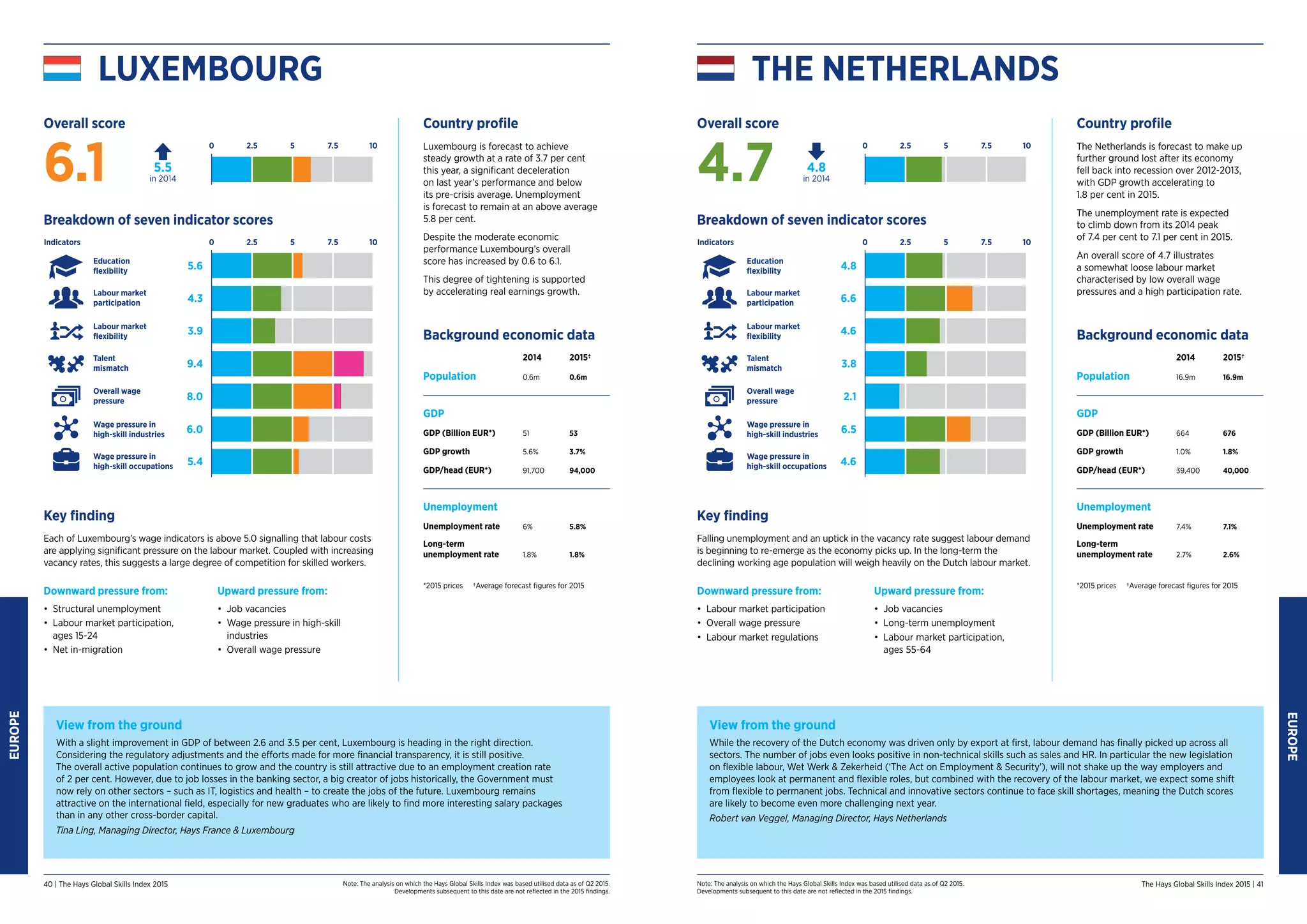
IN A WORLD OF
CONTINUOUS CHANGE
The Hays Global Skills Index 2015
In partnership with:
hays-index.com
2 | The Hays Global Skills Index 2015 The Hays Global Skills Index 2015 | 1
LABOUR MARKETS
IN A WORLD OF
CONTINUOUS CHANGE
The Hays Global Skills Index 2015
Contents
Introduction	3
Executive summary	 4
Which countries fared well in 2014/15?	 5
Understanding the Index	 6
A complex skills landscape	 7
The regional picture 	 16
The Americas	 18
Asia Pacific	 24
Europe	31
Contributors	49
Sources	49
2 | The Hays Global Skills Index 2015 The Hays Global Skills Index 2015 | 3
INTRODUCTION
Alistair Cox, Chief Executive, Hays plc
As companies look to hire more
people, the global skills shortage
shows no sign of easing – labour
markets are still under strain in
a world of continuous change.
Welcome to the 2015 edition of the Hays Global Skills Index. As a global recruiter we understand
the challenges that face organisations as they look to build and grow their businesses. One key
challenge that has become even more apparent in recent years is the struggle to find the skilled
workers they need to operate and ultimately, succeed. In order to better understand the skills
landscape and the issues facing the world of work, we developed the Hays Global Skills Index.
Now in its fourth year, the Hays Global Skills Index, in collaboration
with Oxford Economics, shows how labour markets around the
world have been affected by the financial crisis and the ongoing
recovery. Looking at 31 countries, it examines a range of pressure
points including education policy, wage pressure, labour market
participation and talent mismatch.
Throwing a spotlight on these issues is vital. Thanks to such
analysis, all players in the labour markets – employers,
policymakers, regulators and the workers themselves – will be
better equipped to build great careers and great businesses now
and in the future. Failing to address them will curtail economic
potential and restrict opportunity.
The global economy is generally in better health today than
it has been for many years. Strong economic growth, led by
developed markets in Europe and the US, has boosted
employment and wage growth to new heights.
Certain countries have fared particularly well over the last year.
In the US, the growth in earnings relative to the cost of living has
risen significantly, particularly in skilled industries. We are seeing
a similar story in Australia and parts of Europe. In the UK alone,
almost 2 million new jobs have been created and unemployment
has fallen steadily.
However, there are still worrying signs of the lasting impact of
the financial crisis. The ‘employment gap’ – the jobs lost since
the start of the crisis – is significant. Although employment
levels are rising, there are still 11 million fewer people in work
today than would be if unemployment and participation
had remained at pre-crisis levels. This is equivalent to one
in 20 workers across all markets. Meanwhile many countries
are struggling with employee productivity, with people working
longer hours but not necessarily getting more done.
There is no room for complacency. As companies look to hire
more people, the global skills shortage shows no sign of easing –
labour markets are still under strain in a world of continuous
change. Economic slowdown in China; high unemployment in
continental Europe; an ageing workforce in Germany and Japan;
and the UK’s low productivity. These macroeconomic
developments have ramped up the pressure on labour markets
across the world.
At Hays we feel that more needs to be done by governments
and businesses to address the issues that are still prevalent
in labour markets. Based on the findings of the Index and
insight from our team of experts across the globe we have
developed recommendations that outline some practical
solutions to address the global skills deficit.
1.	 Enable more and easier skilled migration to allow
businesses access to workers with key skills
	 Each country needs to look beyond its own borders
to allow businesses to access the talent they need.
While self-sufficiency in skills is a worthwhile goal for any
economy, it is wrong to restrict a business’s ability to grow
by restricting its access to talent globally if the necessary
skills are not available locally. Skilled migration is a vital
short-term solution to filling specific skills shortages
where suitably qualified local workers are not available.
Governments must therefore make a clear distinction
between general immigration and the movement of skilled
workers across borders. This should include fast-tracking
visas for roles that can’t be filled by local workers
and showing clear public support for the mobility
of skilled labour.
2.	 Ensure better training for employees and closer
collaboration with schools, universities and technical
colleges to deliver the skills pipeline of the future
	 Structured training is essential at all levels, from graduates
and apprentices through to the oldest workers. There are
huge economic gains at stake for countries that raise their
standards of education and training to better prepare young
people for the workplace. It is clear that in the long term,
education, training and apprenticeship schemes to upskill
employees is the best way of boosting productivity and
the pool of ‘home-grown’ talent.
3.	 Encourage businesses to embrace technology and
maximise the skills at their disposal
	 Finally, governments and business leaders should consider
how investment in new and advanced technologies can
help employees work more efficiently and thereby boost
productivity. People being able to work smarter, rather than
longer, will make the most of the skills a business has at
its disposal. People must feel empowered to invest in and
embrace new technologies to make this happen.
I firmly believe that investment in these three areas will have
a dramatic impact in easing the skills shortage, boosting the
competitiveness of firms worldwide and securing an even
stronger recovery for 2016 and sustainable growth beyond.
We hope that the insight contained in the Hays Global Skills
Index 2015 provides a clear picture of the dynamics of the global
labour markets, and also provides detailed local colour to help
you understand the skills challenges your business may be
facing and help you to develop the skills pipeline you need to
ensure you have the best workforce for today, and tomorrow.
4 | The Hays Global Skills Index 2015 The Hays Global Skills Index 2015 | 5
EXECUTIVE SUMMARY
By looking at a comprehensive set of macroeconomic and labour market indicators across
31 countries, the Hays Global Skills Index puts into context the complex dynamics of the global
skilled labour market.
The Hays Global Skills Index (‘the Index’), combined with the
unique insights of Hays executives operating on the ground,
highlights the specific pressures faced by employers and policy
makers as they adapt to the rapidly changing demands of
today’s labour markets. It is a world of continuous change and
employers around the world must have robust talent policies
in place to ensure they have access to the skills they need.
Movements in the overall Index
•	 The Hays Global Skills Index shows that global labour markets
are tightening. There are some regional variations but on
the whole it is getting harder for businesses to find the talent
they need.
•	 North America and Europe are mainly behind this annual
increase. After six years of growth, the United States
labour market is showing increasing signs of skills shortages.
The United Kingdom is also demonstrating that the supply of
talent has not kept pace with growing demand. In Continental
Europe there has been positive economic news and the Index
has recorded moderate pressures in the demand for skills.
•	 Offsetting this, in many emerging economies the demand
pressures on skilled labour markets have eased. China’s
economy is slowing down, and as it does commodity prices
have fallen and international trade has further slackened,
impacting the economies of some countries in Asia Pacific
and Latin America.
Talent pools and skills gaps
•	 A fall in the number of people in work or actively looking
for work – a worrying development that emerged in
the wake of the global financial crisis – continues to impact
labour markets. In some countries this has come about
through a sharp rise in unemployment, while in others
a fall in labour market participation is to blame.
•	 High rates of unemployment are a major problem for many
European countries, with the young being particularly badly
hit. Here, long-term unemployment often exists alongside
unfilled job vacancies. The combination of people unable
to find work, and firms unable to find suitable people
to fill vacancies, is clear evidence of a mismatch between
the skills that job seekers possess and those employers are
looking for.
•	 Unemployment in the US, which spiked early on during
the recession, has now fallen back to pre-recession levels.
Yet the talent pool has suffered as many people dropped
out of the workforce entirely. The participation rate which
continued its downward track until quite recently, remains
at an unusually low level.
Wage pressures and a premium for skills
•	 After a period when the growth in earnings has not kept
pace with inflation, wage pressures have returned and this
development appears to be a global phenomenon with
21 of the 31 countries registering an increase in the overall
wage pressure indicator.
•	 Wage pressures reflect the strength in demand for skilled
workers in countries such as Australia, New Zealand,
the US and the UK, that have achieved sustained economic
growth. In Europe, where there has been positive news
over the year, there are also signs of a pick up in earnings,
although the economic situation in Europe remains fragile.
With the exception of India, wage pressures among
the largest emerging economies have eased as their
economies have either slowed (China) or entered
recession (Brazil and Russia).
•	 The difference in the wages between those in high- and
low-skill occupations – one measure of the wage premium
that is paid for greater skills – remains compressed compared
to their pre-crisis levels. However, the impact of the
rebalancing in economic growth is apparent in how pay
differentials have changed over the year. In Latin America
and the BRICs differentials have narrowed, whereas in
North America and Europe they have widened.
Regulation and Education
•	 Labour markets do not operate in a vacuum, instead they
need supportive governments and educational institutions
for their smooth operation. Having the right regulatory
framework has helped countries through the recession years,
with Germany as the outstanding example, following the
overhaul of its unemployment insurance system prior to
the recession.
•	 Education also plays a crucial role in equipping people
with the skills they need when they enter the workforce.
It is perhaps not surprising that countries such as Singapore
and Japan do well in international studies of educational
achievement. But progress is not confined to East Asia,
with some countries in Europe, such as Ireland and
Luxembourg, also doing well.
Ever since the global financial crisis struck, global labour markets
have been buffeted by one shock after another. The financial
crisis was followed by a collapse in world trade and recessions
in North America, Europe and Japan. Even the big emerging
economies – Brazil, China and Russia – are no longer the
powerhouses they once were. Since 2012, the Index has measured
how the labour markets have fared over this turbulent period.
While some markets have weathered the storm well, others show
the scars. This year we continue to track labour markets in a
world of continuous change, aiming to provide valuable insights
and analysis on the ongoing challenge of aligning skills with
the needs of business.
WHICH COUNTRIES FARED
WELL IN 2014/15?
Since the publication of the 2014 edition of the Hays Global Skills Index, four countries in particular
have witnessed positive changes in their labour markets, brought about by improvements to labour
market regulations and enhanced educational standards.
In the majority of cases, governments have made these changes
in a bid to improve their country’s future economic prospects
by creating a robust future skills pipeline that will help to
alleviate long-term skills shortages and allow the creation
of a stronger economy.
Australia has an enviable economic track record. It avoided
recession during the financial crisis and this year will celebrate
its 24th year of unbroken economic growth. In the past,
Australia has done well in exporting commodities, notably
to China, and as China’s economy has moved down a gear,
Australia’s economy has had to adjust away from export-driven
growth and towards domestic demand. Australia appears
to be making the transition successfully, with an overall
Hays Global Skills Index score of 5.0 (down 0.3 from 2014).
It is hard to believe that this achievement would have been
possible without Australia’s flexible labour market. For instance,
Australian regulations are particularly favorable towards
temporary employment.
Portugal has had a very difficult period over the past eight
years, due to the eurozone crisis. The economy remains
around six per cent smaller than what it was before the financial
crisis. Moreover, unemployment remains around 13 per cent –
having peaked at over 16 per cent in 2013 – and well over
twice the typical pre-crisis rate. However, there are signs
that the corner may have been turned. The economy grew
last year (the first time since 2010) and is forecast to grow
this year and next, with unemployment also expected to
inch down. While the recovery is likely to be modest, it is
a clear improvement on the recent past.
The Index indicators also suggest that things may be
changing for the better. The labour supply indicators –
education flexibility, labour market participation and
labour market flexibility – are all moving in the right
direction. But problems remain, especially a stubbornly
high score for talent mismatch (score of 10) and an
uptick in wage pressures (overall wage pressures,
increased 0.1 year-on-year). These headwinds have
caused the overall Index score to remain unchanged
at 5.9. Yet, there are reasons to be cautiously optimistic
about the direction in which Portugal’s labour market
is heading.
Mexico has benefited from the continued strength in the US
economy, with its own economy growing by a fifth compared
to its level in the recession of 2009. Despite this robust growth,
one might have expected Mexico’s overall Index score to be
higher than 5.6 – a level that indicates fairly modest pressures
in the labour market. More surprising still is that the overall
Index score has tracked down over the year by 0.2. This success
is down to structural/supply factors that have offset higher
demand for skills. These positive developments are picking up
in the labour market participation, labour market flexibility
and talent mismatch indicators.
Chile’s economy stalled in 2014, having performed well since
the mild recession it experienced in 2009. The labour market
was not immune to this setback with unemployment ticking
up (over six per cent), having tracked down for four years.
Yet the labour market has bounced back despite global
headwinds of weakening demand for commodities.
This achievement is particularly evident in the talent mismatch
indicator that fell by 2.2 year-on-year, reflecting a reduction
in structural unemployment and unfilled job vacancies.
Although long-term issues
such as talent mismatch and wage
pressure in high-skill industries
remain a threat, the Portuguese
labour market seems to have finally
recovered some dynamism.
Paula Baptista, Managing Director, Hays Portugal
6 | The Hays Global Skills Index 2015 The Hays Global Skills Index 2015 | 7
A COMPLEX SKILLS LANDSCAPE
UNDERSTANDING THE INDEX
No current analysis of the global economy is complete without a discussion on the labour market.
Ever since the financial crisis broke, global labour markets have been centre stage. High youth
unemployment in Europe; a precipitous fall in labour market participation in the US; ageing
workforces in Germany and Japan; low productivity in the UK; rising skills gaps in Asia Pacific;
and the need for structural reforms in India and Latin America.
The Hays Global Skills Index is a complex, statistically-based report designed to assess the dynamics
of skilled labour markets across 31 countries.
Seven indicators make up the Hays Global Skills Index
The following seven indicators are given equal weight when calculating the overall Index score for each country. Each indicator measures
how much pressure different factors are exerting on the local labour market. Higher scores mean that a country is experiencing more pressure
than has historically been the case. Lower scores mean that a country is experiencing less pressure than has historically been the case.
Education flexibility
In today’s global and technology-driven economies, raising
educational standards is crucial to bridging skills gaps.
This indicator provides a comprehensive view of the state
of education. The lower the score, the better the chance that
the education system is flexible enough to meet labour market
needs. The higher the score, the less likely an education system
is equipped to build a solid talent pipeline.
Labour market participation
Bringing more people into the workforce is a powerful way
to improve economic and labour market performance. Countries
that can raise the employee participation rate can gain an edge
over countries with less scope to do so. The lower the score,
the larger the untapped pool of workers. The higher the score,
the lower number of workers there are available to join the
workforce, giving less scope to boost overall participation rates.
Labour market flexibility
Governments play an important part in determining how well
labour markets function. For instance, they can cut red tape,
avoid laws that discourage hiring and adapt policies that welcome
talented people from abroad. The lower the score, the better
aligned governmental policies are with labour market dynamics.
A higher score means there are more barriers restricting the local
labour market.
Talent mismatch
This indicator measures the gap between the skills that businesses
are looking for and the skills available in the labour market. A higher
score indicates that businesses are facing a serious problem in
matching available candidates with unfilled jobs. A lower score
suggests employers are having an easier time finding workers with
the skills they need.
Overall wage pressure
Skills shortages are likely to be an important issue when wages
are growing faster than the overall cost of living. A high score
indicates the presence of overall wage pressures that are higher
than the historic norm for that country. A low score tells us wages
are not rising quickly and those pressures aren’t present.
Wage pressure in high-skill industries
Some industries require higher-skilled staff than others. As it takes
time to undertake the training necessary to work in those industries,
it potentially makes them more vulnerable to skill shortages as
the number of people qualified to start work cannot be changed
quickly. A higher score indicates that wages in high-skill industries
are growing faster than in low-skill industries relative to the past,
which is indicative of the emergence of sector-specific skills
shortages (such as in engineering or technology). A lower score
tells us wages for those in high-skill industries are rising more
slowly or with wages in low-skill industries.
Wage pressure in high-skill occupations
Some occupations require a higher than average amount of
training, education and experience. These are called high-skill
occupations. Rising wage pressure in this category signals that
these occupations are experiencing shortages of employees
with the necessary skills. The higher the score, the greater
the presence of skills shortages affecting high-skill occupations.
A lower score tells us wages for those in high-skill occupations
are rising more slowly than those in low-skill occupations.
Each country’s overall Index score is accompanied by a visual
indicating the score range for each indicator (see below).
5.9
9.2
5.5
5.7
3.9
4.3
0.7
0 2.5 5 7.5 10
Breakdown of seven indicator scores
0 2.5 5 7.5 10
Overall score
5.3
in 2014
5.4
The analysis on which the Hays Global Skills Index was based
utilised data as of Q2 2015. Developments subsequent to this
date are not reflected in the 2015 findings.
Figure 1: Regional summary – changes year-on-year (2014 vs 2015)
Rising
Falling
Europe
Global
BRICs
Asia Pacific
Latin America
North America
0.09
0.15
0.16
0.06
-0.26
-0.06
Europe comprises: Austria, Belgium, Czech Republic, Denmark, France, Germany, Hungary, Ireland, Italy, Luxembourg, the Netherlands, Poland, Portugal, Spain, Sweden, Switzerland
and the UK North America comprises: Canada, Mexico and the US Latin America comprises: Brazil, Chile, Colombia and Mexico Asia Pacific comprises: Australia, China, Hong Kong,
Japan, New Zealand and Singapore The BRICs comprise: Brazil, China, Russia and India
The 31 countries have been grouped into five blocs: Europe, North America, Latin America, Asia Pacific, and the BRICs. These groups were chosen to bring out the underlying stories
described in the report.
The wider macro picture
Now in its fourth year, the Hays Global Skills Index has
been recording the evolution of the labour market
through this unprecedented period of continuous change.
Covering 31 countries, the Index tracks developments
in Europe, the Americas and Asia Pacific.
Figure 1 provides a global and regional snapshot of how labour
markets have fared over the past 12 months. The average
overall Index score for all 31 countries included in the Hays Global
Skills Index, increased by just under 0.1 to 5.4, indicating that
skills shortages continue to worsen across the globe.
8 | The Hays Global Skills Index 2015 The Hays Global Skills Index 2015 | 9
Figure 2: Hays Global Skills Index scores (by country)
Sweden
Spain
Germany
Russia
Portugal
Ireland
Canada
Brazil
Australia
Chile
Austria
China
Poland
New Zealand
India
Hong Kong
Switzerland
Singapore
Italy
Belgium
3.0 3.5 4.0 5.0
4.5 5.5 6.0 6.5 7.0
2015 score
2014 score
Japan
France
United States
Mexico
Colombia
United Kingdom
Denmark
Year-on-year
difference
Hungary
Luxembourg
Czech Republic
The Netherlands
+0.6
+0.1
+0.1
+0.2
n/c
+1.0
+0.1
+0.6
–0.1
–0.1
n/c
–0.1
+0.1
–0.2
+0.1
+0.2
+0.1
–0.3
+0.5
–0.4
+0.5
–0.1
+0.1
–0.4
–0.3
–0.1
+0.6
+0.1
n/c
+0.1
–0.1
Macro perspective
The global economy has yet to fully recover from the slump in
world trade that followed the financial crisis. High levels of public
and private debt remain a serious problem, especially in Europe.
For those countries most affected, bold government action early
on appears to have paid off to date. Both the US and the UK
have put the recession behind them, albeit the UK is still
struggling to contain its high level of public debt. Europe,
on the other hand has seemed, until recently, to be on the brink
of deflation and stagnation, however, signs of recovery have
recently appeared. This favourable turn of events is due,
in part, to the recent strength of the dollar and falling energy
prices, with the European Central Bank also helping with its
quantitative easing.
At first, the crisis appeared to confirm the shift of economic
power away from the developed economies of North America
and Europe towards emerging economies, especially the four
giants – Brazil, Russia, India and China (BRICs). Yet, even this
commonplace view now seems less certain than it once did.
While expected to grow by over 6 per cent, for China, the
remarkable growth rates achieved over the past two decades
appear a thing of the past. Much now depends on whether its
economy can move down a gear, without stalling. Brazil and
Russia are in recession and of the four giants, only India has
maintained its growth momentum.
Smaller economies are also having to adjust to these shifting
sands. For Hong Kong and Singapore, the slowdown in China
and in world trade more generally presents a serious challenge.
Although both commodity exporters, Australia and New Zealand
have so far managed well, however both are vulnerable should
their overheated property markets crash. Latin America also
looks increasingly fragile. Chile and Colombia are expected to
slow down this year. Bucking the trend, Mexico is faring well
on the back of the strength in the US economy.
In line with softening economic
activity, the pressures facing China’s
labour market also continue to ease,
providing some welcome relief for
employers in this highly competitive
talent market.
Simon Lance, Managing Director, Hays China
Regional perspective
Underneath this global trend, there are important
regional variations.
Conditions have tightened across Europe and North America,
as they have also done in some parts of Asia Pacific.
Australasia (represented by Australia and New Zealand)
has continued to power ahead with strong demand,
with a shift away from commodities in Australia contributing
to skills gaps. Conditions remain tight in Japan. Labour markets
have eased in China however, and both Hong Kong and
Singapore have been adversely affected by the weakness
in international trade.
But the most striking change has been in Latin America,
where the average overall Hays Global Skills Index score fell
by 0.26, indicating a marked easing in conditions; this is
partly explained by Brazil entering recession along with signs
of slack that are appearing both in Chile and Colombia,
both of which rely on commodity exports. Even in Mexico,
where one might expect conditions to tighten on the back
of strong US demand, the Index has fallen as higher
participation has boosted labour supply.
Figure 2 opposite shows the overall scores for each of
the 31 countries, together with their scores from last year.
The countries are shown in descending order of their
2015 scores.
The five countries with the highest overall Hays Global Skills
Index scores - where labour markets are the most pressured –
are the US (6.9), Sweden (6.7), Spain (6.4), Germany (6.4)
and Hungary (6.3). At the other end of the scale, the five
countries with the lowest scores – markets where labour markets
are the least pressured – are Singapore (4.7), Switzerland (4.6),
Hong Kong (4.5), Italy (4.0) and Belgium (3.7). While these
ten are the same as in 2014, a tightening in conditions is evident
at both ends of the Index scale. It is important to remember
that while the overall Index score gives an indication of how
a labour market is performing generally, the seven individual
indicators provide greater scope in understanding the full story.
The pace of change in global labour markets is reflected in
the changes to the overall Hays Global Skills Index scores,
with the overall score rising in 17 countries, falling in 11,
while remaining unchanged in only three countries
(Hungary, Hong Kong and Portugal).
Among the largest moves, strong demand drove increases
in the UK (+1.0), the US (+0.6), Luxembourg (+0.6) and
Denmark (+0.5). Whereas ‘supply factors’ explain pressures
in Singapore (talent mismatch) and India (education flexibility).
Weak demand drove falls in Brazil (-0.4), and Chile (-0.4), as it
was in China (-0.3) where the pace of growth is decelerating.
10 | The Hays Global Skills Index 2015 The Hays Global Skills Index 2015 | 11
Taken together, high unemployment and low participation
rates mean that there are far fewer people in employment
today than would have been the case had the rates of
participation and unemployment remained at pre-crisis levels.
The key insight on page 10 explains this ‘employment gap’
and its long-term implications for the skill-base.
Figure 3: Participation and mismatch
Labour market participation
Talent mismatch
Europe
Global
BRICs
Asia Pacific
Latin America
North America
6.2
6.4
7.2
5.2
5.8
5.3
5.3
5.3
4.5
5.9
5.2
4.2
Talent pools and skills gaps
Two worrying developments emerged in the wake of the
global financial crisis and ensuing slump in activity and trade.
First, many people who formerly worked, or were actively
looking for work, stopped doing so. As this happened,
labour market participation rates (the number of people
in a workforce that are in employment) fell, most dramatically
in the US. Second, as others looked for work without success,
long-term unemployment rose, especially among the young.
While not confined to Europe, high youth unemployment is
particularly acute in some EU member states, most notably
in Italy and Spain.
Yet, as participation rates fell and long-term unemployment
increased, businesses have still found it difficult to fill job
vacancies. This apparent contradiction – unfilled jobs and
high unemployment – is a clear indicator of a mismatch between
the skills employers are looking for and the skills possessed
by job seekers.
These issues are tracked by the Index indicators labour market
participation and talent mismatch. Figure 3 shows the average
global and regional score for each of these indicators, shown
side by side to give an overall score for the supply of talent.
This shows that low participation rates and talent mismatch
(high rates of long-term unemployment and job vacancies)
both contribute to the pressures present in global labour
markets, with average scores of 5.3 and 6.2 respectively.
Of the two, the Index scores point to talent mismatch as
the more acute problem in all but Latin America.
Key insight: The ‘employment gap’
Global labour markets have been rocked by shocks unleashed
by the global financial crisis and the slump in activity and trade
that followed in its wake. The scale of the disruption is clearly
illustrated by the ‘employment gap’, the difference between
the number of people in work and the number that would have
been employed had participation and unemployment remained
at their pre-crisis rates.1
In Europe, high unemployment has proved a stubborn feature
of the post-crisis landscape. In Ireland, Italy and Spain, among
the worst hit countries, unemployment rates exceed 10 per cent,
more than double their 2007 rates. In Spain, the unemployment
rate has remained above 20 per cent since 2011 and it is expected
to remain at this level for some time to come, despite signs of
an economic recovery. And while unemployment in Europe is
showing signs of falling, in recession-hit Brazil and Russia it is
on the rise.
In the US, unemployment initially rose sharply, but then fell back
quite quickly as the economy picked up. Participation rates
continued to fall until 2013 and have not recovered since.
Participation rates have also fallen in China, India and the UK,
albeit to a far less extent than in the US.
Had unemployment and participation rates remained at their
average levels over 2000-2007, over 11 million more people
would have been in employment during 2014 than was the case.
This ‘missing workforce’ is equivalent to 1 in 20 of the total
workforce across the 31 Hays Global Skills Index countries.
While the situation is improving, the employment gap is forecast
to remain at over 6 million this year. A shocking testimony of
the lasting impact that the global financial crisis has had on
people’s lives.
1. For a discussion of the employment gap, see ‘World Employment
Social Outlook: Trends 2015’, 2015, International Labour Organisation.
Talent mismatch will be the
main challenge for Italian employers,
as Italy’s high and growing rate
of long-term unemployment will
increase the difficulty of recruiting
highly skilled professionals.
Carlos Soave, Managing Director, Hays Italy
12 | The Hays Global Skills Index 2015 The Hays Global Skills Index 2015 | 13
Wage pressures and a premium for skills
Wage pressures loom large in this year’s Hays Global Skills
Index. After a period when the growth in earnings has not
kept pace with inflation, wage pressures have returned and
this development appears to be a global phenomenon with
21 of the 31 countries registering a pickup in the overall wage
pressure indicator.
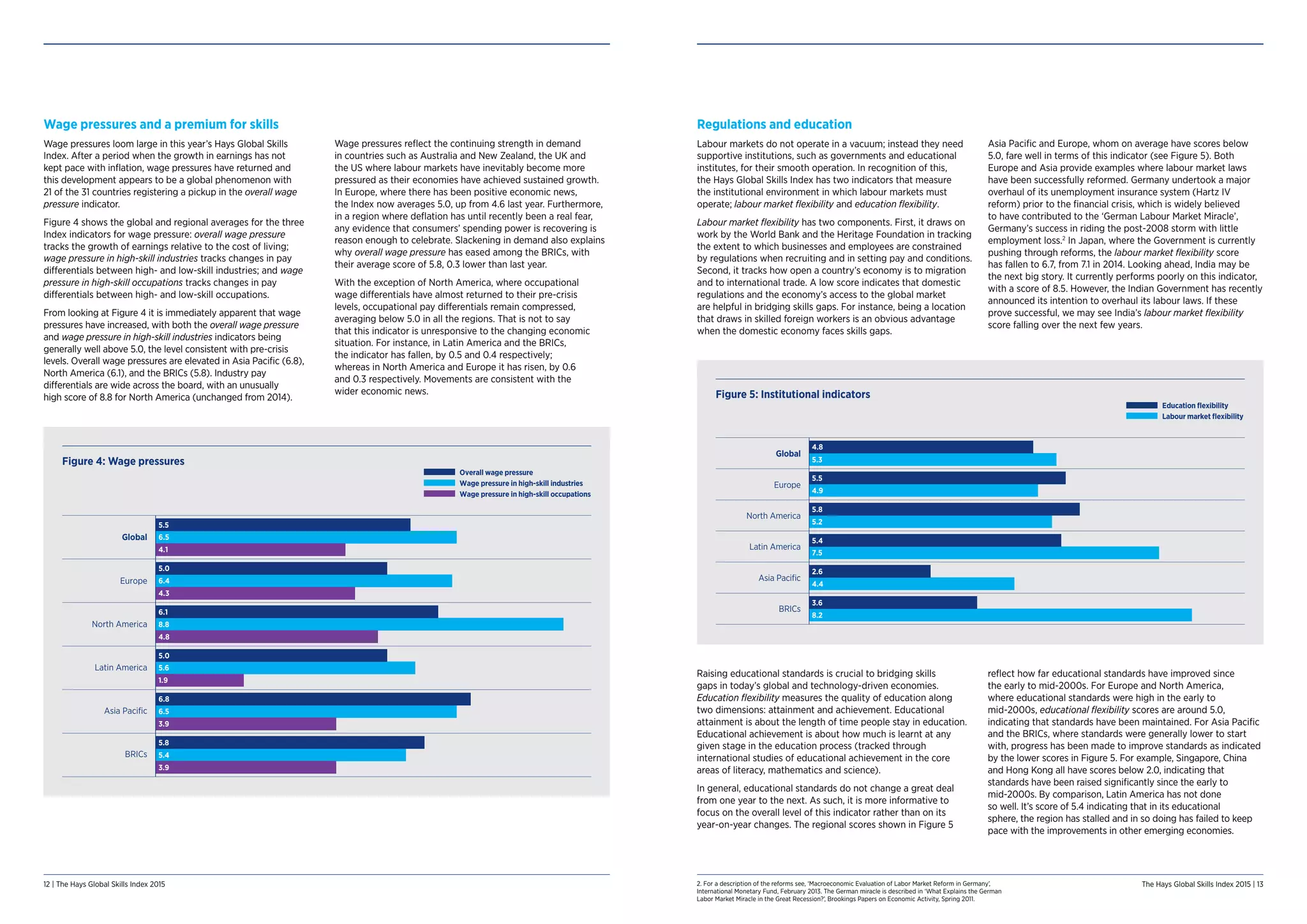
Figure 4 shows the global and regional averages for the three
Index indicators for wage pressure: overall wage pressure
tracks the growth of earnings relative to the cost of living;
wage pressure in high-skill industries tracks changes in pay
differentials between high- and low-skill industries; and wage
pressure in high-skill occupations tracks changes in pay
differentials between high- and low-skill occupations.
From looking at Figure 4 it is immediately apparent that wage
pressures have increased, with both the overall wage pressure
and wage pressure in high-skill industries indicators being
generally well above 5.0, the level consistent with pre-crisis
levels. Overall wage pressures are elevated in Asia Pacific (6.8),
North America (6.1), and the BRICs (5.8). Industry pay
differentials are wide across the board, with an unusually
high score of 8.8 for North America (unchanged from 2014).
Wage pressures reflect the continuing strength in demand
in countries such as Australia and New Zealand, the UK and
the US where labour markets have inevitably become more
pressured as their economies have achieved sustained growth.
In Europe, where there has been positive economic news,
the Index now averages 5.0, up from 4.6 last year. Furthermore,
in a region where deflation has until recently been a real fear,
any evidence that consumers’ spending power is recovering is
reason enough to celebrate. Slackening in demand also explains
why overall wage pressure has eased among the BRICs, with
their average score of 5.8, 0.3 lower than last year.
With the exception of North America, where occupational
wage differentials have almost returned to their pre-crisis
levels, occupational pay differentials remain compressed,
averaging below 5.0 in all the regions. That is not to say
that this indicator is unresponsive to the changing economic
situation. For instance, in Latin America and the BRICs,
the indicator has fallen, by 0.5 and 0.4 respectively;
whereas in North America and Europe it has risen, by 0.6
and 0.3 respectively. Movements are consistent with the
wider economic news.
Regulations and education
Labour markets do not operate in a vacuum; instead they need
supportive institutions, such as governments and educational
institutes, for their smooth operation. In recognition of this,
the Hays Global Skills Index has two indicators that measure
the institutional environment in which labour markets must
operate; labour market flexibility and education flexibility.
Labour market flexibility has two components. First, it draws on
work by the World Bank and the Heritage Foundation in tracking
the extent to which businesses and employees are constrained
by regulations when recruiting and in setting pay and conditions.
Second, it tracks how open a country’s economy is to migration
and to international trade. A low score indicates that domestic
regulations and the economy’s access to the global market
are helpful in bridging skills gaps. For instance, being a location
that draws in skilled foreign workers is an obvious advantage
when the domestic economy faces skills gaps.
Asia Pacific and Europe, whom on average have scores below
5.0, fare well in terms of this indicator (see Figure 5). Both
Europe and Asia provide examples where labour market laws
have been successfully reformed. Germany undertook a major
overhaul of its unemployment insurance system (Hartz IV
reform) prior to the financial crisis, which is widely believed
to have contributed to the ‘German Labour Market Miracle’,
Germany’s success in riding the post-2008 storm with little
employment loss.2
In Japan, where the Government is currently
pushing through reforms, the labour market flexibility score
has fallen to 6.7, from 7.1 in 2014. Looking ahead, India may be
the next big story. It currently performs poorly on this indicator,
with a score of 8.5. However, the Indian Government has recently
announced its intention to overhaul its labour laws. If these
prove successful, we may see India’s labour market flexibility
score falling over the next few years.
Figure 4: Wage pressures
Overall wage pressure
Wage pressure in high-skill industries
Wage pressure in high-skill occupations
Europe
Global
BRICs
Asia Pacific
Latin America
North America
6.5
4.1
5.5
6.4
4.3
5.0
8.8
4.8
6.1
5.6
1.9
5.0
6.5
3.9
6.8
5.4
3.9
5.8
Figure 5: Institutional indicators
Education flexibility
Labour market flexibility
Europe
Global
BRICs
Asia Pacific
Latin America
North America
5.3
4.9
5.2
7.5
4.4
8.2
4.8
5.5
5.8
5.4
2.6
3.6
2. For a description of the reforms see, ‘Macroeconomic Evaluation of Labor Market Reform in Germany’,
International Monetary Fund, February 2013. The German miracle is described in ‘What Explains the German
Labor Market Miracle in the Great Recession?’, Brookings Papers on Economic Activity, Spring 2011.
Raising educational standards is crucial to bridging skills
gaps in today’s global and technology-driven economies.
Education flexibility measures the quality of education along
two dimensions: attainment and achievement. Educational
attainment is about the length of time people stay in education.
Educational achievement is about how much is learnt at any
given stage in the education process (tracked through
international studies of educational achievement in the core
areas of literacy, mathematics and science).
In general, educational standards do not change a great deal
from one year to the next. As such, it is more informative to
focus on the overall level of this indicator rather than on its
year-on-year changes. The regional scores shown in Figure 5
reflect how far educational standards have improved since
the early to mid-2000s. For Europe and North America,
where educational standards were high in the early to
mid‑2000s, educational flexibility scores are around 5.0,
indicating that standards have been maintained. For Asia Pacific
and the BRICs, where standards were generally lower to start
with, progress has been made to improve standards as indicated
by the lower scores in Figure 5. For example, Singapore, China
and Hong Kong all have scores below 2.0, indicating that
standards have been raised significantly since the early to
mid‑2000s. By comparison, Latin America has not done
so well. It’s score of 5.4 indicating that in its educational
sphere, the region has stalled and in so doing has failed to keep
pace with the improvements in other emerging economies.
14 | The Hays Global Skills Index 2015 The Hays Global Skills Index 2015 | 15
Conclusions
Overall, labour markets among the 31 Hays Global Skills Index
countries have become more pressured over the past 12 months.
In North America and Europe this reflects positive economic
news, although many economies in Continental Europe remain
in pretty poor shape.
But while the developed economies have achieved modest
improvement, for many emerging economies the past
12 months have been difficult. The situation has deteriorated
in Latin America and this set back is not confined to Brazil,
its biggest economy, which entered recession. Asia Pacific
has had to adjust to China’s slowing economy, and this has
had a profound impact both for Hong Kong and Singapore that
depend on international trade, and for commodity exporters,
such as Australia. Some economies have fared better than
others, but the global economy has to undergo a further series
of adjustments and – as has become the norm over the past
eight years – labour markets are at the forefront of these
momentous developments.
Back in 2012, the first year we published the Hays Global Skills
Index, the labour market situation seemed in many ways easier
to comprehend. The financial crisis and its aftershocks had
severely impacted many economies. Among the casualties –
which included much of Western Europe – unemployment
was very high while pay stagnated. While the symptoms
were unusually severe, the explanation – a deep recession –
was obvious. Elsewhere, other economies powered through
the turbulence – most notably the BRICs. For these
powerhouses, the labour markets were also barometers for
their heated economies, with mounting wage pressures,
low unemployment and low vacancy rates early indicators
of approaching supply constraints.
Three years on, the situation no longer seems so straightforward.
In Europe, where many economies remain fragile, the labour
markets have for seven years remained in intensive care, with
severe unemployment, weak pay, and high rates of unfilled job
vacancies. With the passage of time – with the damage that
such a long period of high unemployment inevitably has on
skills, especially among the young – the state of the labour
market seems an increasingly impediment to recovery, rather
than simply a casualty of recession.
Those countries fortunate enough to have pulled themselves
out of recession have experienced recoveries marred by serious
problems emanating from their labour markets. For the US,
skills shortages/mismatch were evident early in the recovery.
Moreover, labour market participation has not recovered to
anywhere near its pre-crisis rate. Turning to the UK, weak
productivity is threatening both the future pace of growth
and living standards, after an unprecedented period where
average incomes have failed to keep up with the cost of living.
In a world of continuous change, labour markets have proved
accurate barometers of changing economic fortunes.
Increasingly, they are centre stage in governments’ economic
policies and companies’ strategic planning.
Key insight: Mismatch, labour market flexibility and productivity
Recent research by the OECD highlights the harm that skills
mismatch can have both on firms’ competitiveness and countries
overall productivity growth. In one study, researchers established
a clear link between talent mismatch within jobs (both over- and
under-skilling) and productivity.4
Interestingly, the affect works
at two levels. First, firms with high numbers of poorly matched
workers were less productive than their competitors. Second,
through competition between firms employment shifts towards the
firms that are better at matching their workers to appropriate jobs.
A second study found that poorly designed labour regulations
can prevent good jobs matches, and that this can impose heavy
and unpredictable costs on both firms and workers.5
For example,
a competitive and open business environment helped job matches,
while the quality of job matches were harmed by stringent
employment protection legislation, and limited the scope for
flexible wage bargaining.
3. For a discussion of the diversity of labour institutions see ‘Labour Market Institutions Around the World’, 2008,
Richard Freeman, CEP Discussion Paper No 844.
4. ‘Labour Market Mismatch and Labour Productivity: Evidence from PIAAC Data’, April 2015, OECD, Economics Department Working
Paper No 1209. 5. ‘Skill Mismatch and Public Policy in OECD Countries’, April 2015, OECD, Economics Department Working Paper No 1210.
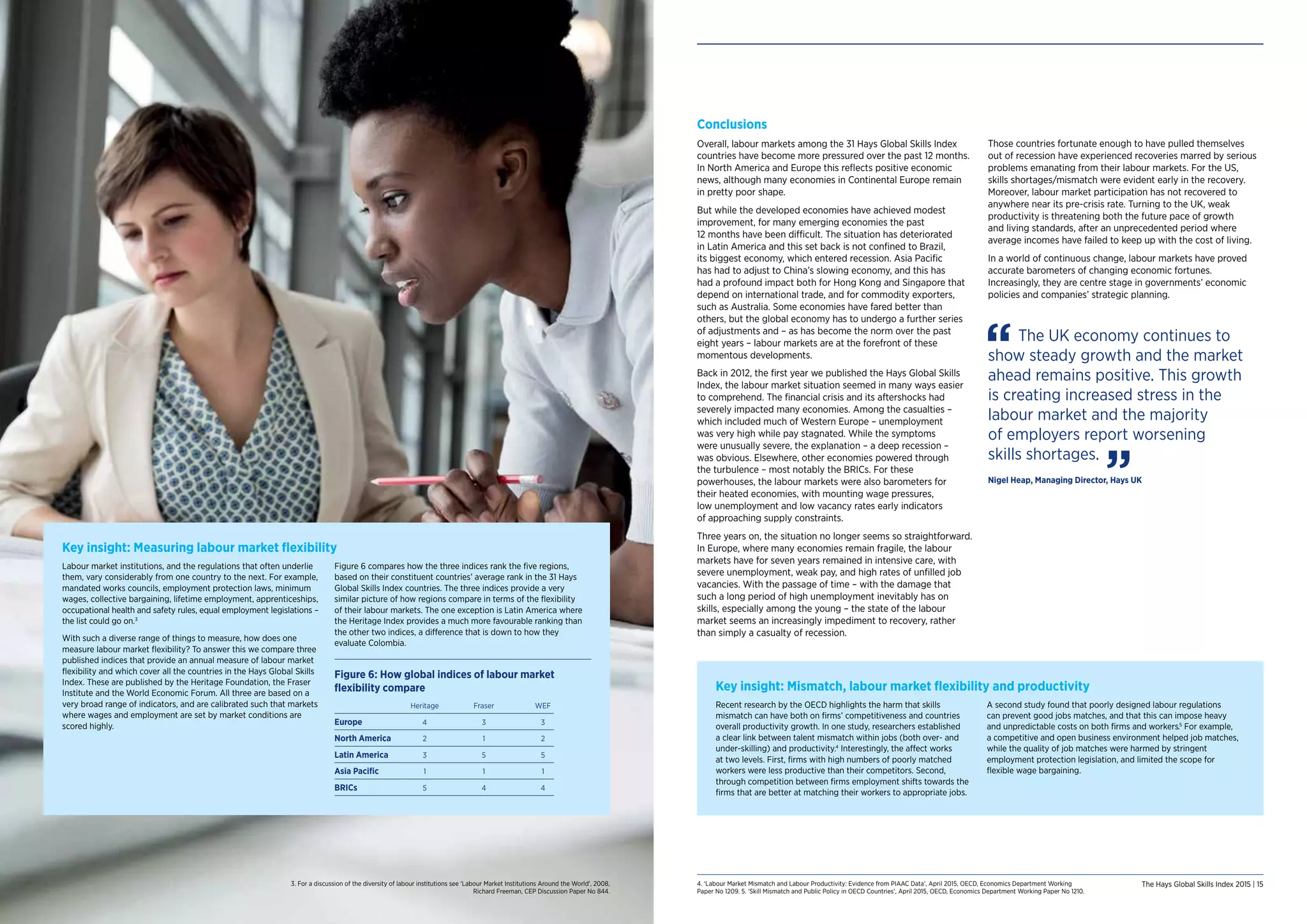
Key insight: Measuring labour market flexibility
Labour market institutions, and the regulations that often underlie
them, vary considerably from one country to the next. For example,
mandated works councils, employment protection laws, minimum
wages, collective bargaining, lifetime employment, apprenticeships,
occupational health and safety rules, equal employment legislations –
the list could go on.3
With such a diverse range of things to measure, how does one
measure labour market flexibility? To answer this we compare three
published indices that provide an annual measure of labour market
flexibility and which cover all the countries in the Hays Global Skills
Index. These are published by the Heritage Foundation, the Fraser
Institute and the World Economic Forum. All three are based on a
very broad range of indicators, and are calibrated such that markets
where wages and employment are set by market conditions are
scored highly.
Figure 6 compares how the three indices rank the five regions,
based on their constituent countries’ average rank in the 31 Hays
Global Skills Index countries. The three indices provide a very
similar picture of how regions compare in terms of the flexibility
of their labour markets. The one exception is Latin America where
the Heritage Index provides a much more favourable ranking than
the other two indices, a difference that is down to how they
evaluate Colombia.
Figure 6: How global indices of labour market
flexibility compare
	 Heritage	Fraser	 WEF
Europe	 4	3	3
North America	
2	1	2
Latin America	3	 5	 5
Asia Pacific	
1	1	1
BRICs	 5	4	4
The UK economy continues to
show steady growth and the market
ahead remains positive. This growth
is creating increased stress in the
labour market and the majority
of employers report worsening
skills shortages.
Nigel Heap, Managing Director, Hays UK
16 | The Hays Global Skills Index 2015 The Hays Global Skills Index 2015 | 17
THE REGIONAL PICTURE
The country dashboards present a detailed breakdown of labour market
pressures for each of the 31 countries featured in the Hays Global Skills
Index. Seven indicators contribute equally to the overall Index score
for each country,*
providing insights into the state of the economy,
the makeup of the labour market, education and wage pressures by
industry and occupation.
* 
Due to the lack of availability of Colombian occupational wage data,
the overall Index score was calculated using six indicators.
Note: The analysis on which the Hays Global Skills Index was based utilised data as of Q2 2015.
Developments subsequent to this date are not reflected in the 2015 findings.
Note: The analysis on which the Hays Global Skills Index was based utilised data as of Q2 2015.
Developments subsequent to this date are not reflected in the 2015 findings.
THE
AMERICAS
THE
AMERICAS
18 | The Hays Global Skills Index 2015 The Hays Global Skills Index 2015 | 19
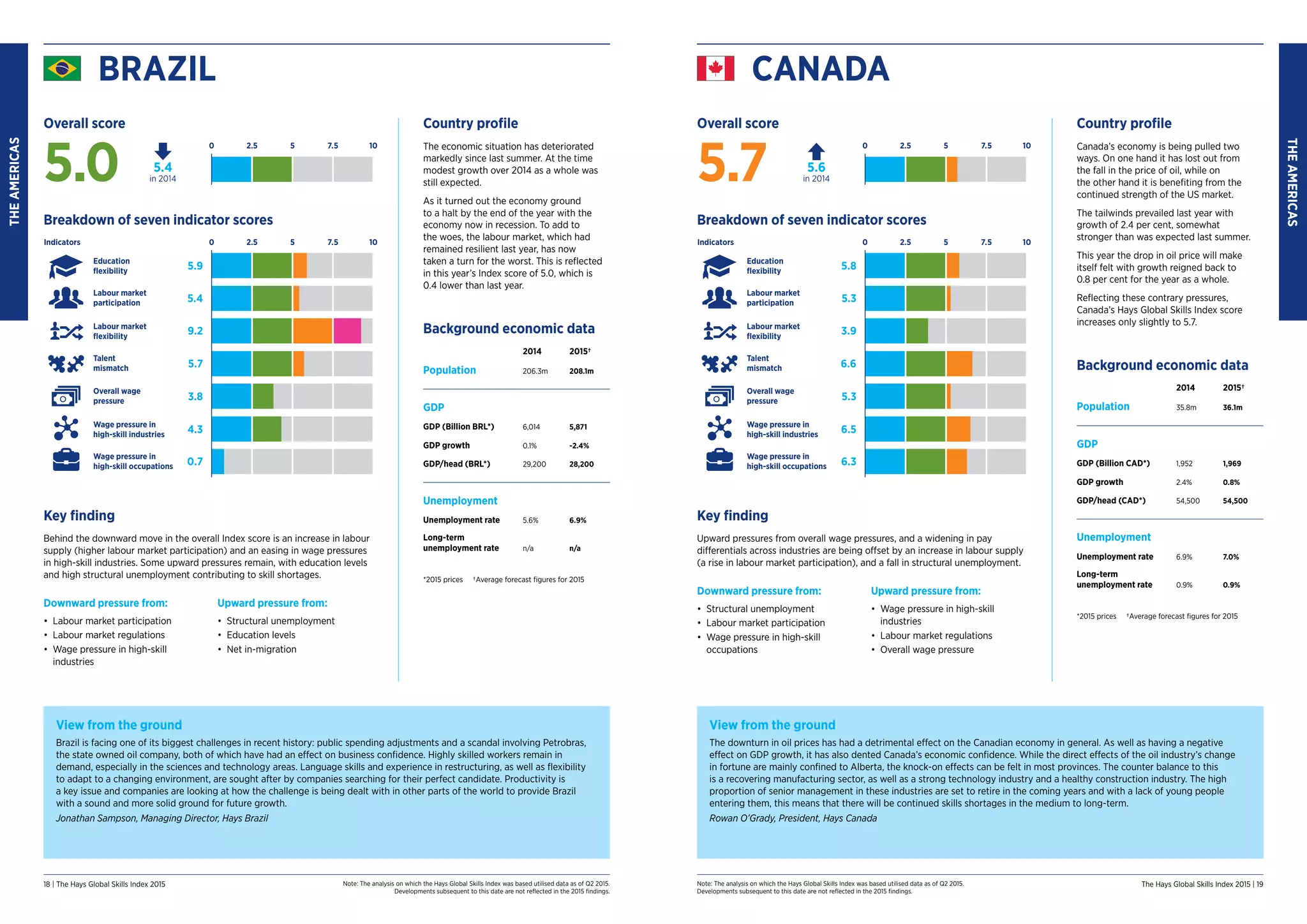
CANADA
Country profile
Canada’s economy is being pulled two
ways. On one hand it has lost out from
the fall in the price of oil, while on
the other hand it is benefiting from the
continued strength of the US market.
The tailwinds prevailed last year with
growth of 2.4 per cent, somewhat
stronger than was expected last summer.
This year the drop in oil price will make
itself felt with growth reigned back to
0.8 per cent for the year as a whole.
Reflecting these contrary pressures,
Canada’s Hays Global Skills Index score
increases only slightly to 5.7.
Background economic data
2014 2015†
Population 35.8m 36.1m
GDP
GDP (Billion CAD*) 1,952 1,969
GDP growth 2.4% 0.8%
GDP/head (CAD*) 54,500 54,500
Unemployment
Unemployment rate 6.9% 7.0%
Long-term
unemployment rate 0.9% 0.9%
*2015 prices	 †Average forecast figures for 2015
View from the ground
The downturn in oil prices has had a detrimental effect on the Canadian economy in general. As well as having a negative
effect on GDP growth, it has also dented Canada’s economic confidence. While the direct effects of the oil industry’s change
in fortune are mainly confined to Alberta, the knock-on effects can be felt in most provinces. The counter balance to this
is a recovering manufacturing sector, as well as a strong technology industry and a healthy construction industry. The high
proportion of senior management in these industries are set to retire in the coming years and with a lack of young people
entering them, this means that there will be continued skills shortages in the medium to long-term.
Rowan O’Grady, President, Hays Canada
Key finding
Upward pressures from overall wage pressures, and a widening in pay
differentials across industries are being offset by an increase in labour supply
(a rise in labour market participation), and a fall in structural unemployment.
Downward pressure from:
•	 Structural unemployment
•	 Labour market participation
•	 Wage pressure in high-skill
occupations
Upward pressure from:
•	 Wage pressure in high-skill
industries
•	 Labour market regulations
•	 Overall wage pressure
Breakdown of seven indicator scores
5.8
3.9
5.3
6.6
5.3
6.5
6.3
0
Indicators 2.5 5 7.5 10
Wage pressure in
high-skill occupations
Education
flexibility
Labour market
participation
Labour market
flexibility
Talent
mismatch
Overall wage
pressure
Wage pressure in
high-skill industries
Overall score
5.6
in 2014
5.7
0 2.5 5 7.5 10
View from the ground
Brazil is facing one of its biggest challenges in recent history: public spending adjustments and a scandal involving Petrobras,
the state owned oil company, both of which have had an effect on business confidence. Highly skilled workers remain in
demand, especially in the sciences and technology areas. Language skills and experience in restructuring, as well as flexibility
to adapt to a changing environment, are sought after by companies searching for their perfect candidate. Productivity is
a key issue and companies are looking at how the challenge is being dealt with in other parts of the world to provide Brazil
with a sound and more solid ground for future growth.
Jonathan Sampson, Managing Director, Hays Brazil
Country profile
The economic situation has deteriorated
markedly since last summer. At the time
modest growth over 2014 as a whole was
still expected.
As it turned out the economy ground
to a halt by the end of the year with the
economy now in recession. To add to
the woes, the labour market, which had
remained resilient last year, has now
taken a turn for the worst. This is reflected
in this year’s Index score of 5.0, which is
0.4 lower than last year.
Background economic data
2014 2015†
Population 206.3m 208.1m
GDP
GDP (Billion BRL*) 6,014 5,871
GDP growth 0.1% -2.4%
GDP/head (BRL*) 29,200 28,200
Unemployment
Unemployment rate 5.6% 6.9%
Long-term
unemployment rate n/a n/a
*2015 prices	 †Average forecast figures for 2015
Key finding
Behind the downward move in the overall Index score is an increase in labour
supply (higher labour market participation) and an easing in wage pressures
in high-skill industries. Some upward pressures remain, with education levels
and high structural unemployment contributing to skill shortages.
Downward pressure from:
•	 	
Labour market participation
•	 	
Labour market regulations
•	 	
Wage pressure in high-skill
industries
Upward pressure from:
•	 	Structural unemployment
•	 	Education levels
•	 	Net in-migration
Breakdown of seven indicator scores
5.9
9.2
5.4
5.7
3.8
4.3
0.7
0
Indicators 2.5 5 7.5 10
Wage pressure in
high-skill occupations
Education
flexibility
Labour market
participation
Labour market
flexibility
Talent
mismatch
Overall wage
pressure
Wage pressure in
high-skill industries
Overall score
5.4
in 2014
5.0
0 2.5 5 7.5 10
BRAZIL
Note: The analysis on which the Hays Global Skills Index was based utilised data as of Q2 2015.
Developments subsequent to this date are not reflected in the 2015 findings.
Note: The analysis on which the Hays Global Skills Index was based utilised data as of Q2 2015.
Developments subsequent to this date are not reflected in the 2015 findings.
THE
AMERICAS
THE
AMERICAS
20 | The Hays Global Skills Index 2015 The Hays Global Skills Index 2015 | 21
COLOMBIA
Country profile
The fall in the price of oil has taken the
steam out of Colombia’s economy.
The economy, which grew by 4.6 per cent
in 2014 – a bit weaker than expected last
summer – will slow to 3.0 per cent this year.
Having remained resilient during the
second half of last year, the labour market
is showing evidence of slack.
This softening is picked up in the Hays
Global Skills Index with this year’s score
of 5.9, a reduction of 0.1 from last year.
Due to the lack of availability of Colombian occupational
wage data, the overall Index score was calculated using
six indicators.
Background economic data
2014 2015†
Population 48.9m 49.5m
GDP
GDP (Billion COP*) 787,910 811,547
GDP growth 4.6% 3.0%
GDP/head (COP*) 16,108,700 16,385,300
Unemployment
Unemployment rate 9.1% 9.9%
Long-term
unemployment rate n/a n/a
*2015 prices	 †Average forecast figures for 2015
View from the ground
The sustainability of the Colombian economy is currently under a considerable amount of stress. The main source of tax
income, oil production and exports, has seen its price falling sharply by around 50 per cent between late 2014 and early 2015.
The Government has had to reform its fiscal policy and tighten public expenditure while maintaining growth areas such as
construction, infrastructure and internal consumption, which drive GDP growth. Overall, Colombia is forecast to grow around
3 per cent, well above the average for Latin America, although the country’s growth potential and employability are under
stress which could harm long-term prospects if not dealt with.
Axel Dono, Managing Director, Hays Colombia
Key finding
Colombia’s overall score is roughly unchanged on the year. Downward
pressure from the industry wage differential and an increase in the
participation rate are offset by higher structural unemployment and
an uptick in overall wage pressures.
Downward pressure from:
•	 	
Wage pressure in high-skill
industries
•	 	
Labour market regulations
•	 	
Labour market participation,
ages 55-64
Upward pressure from:
•	 Structural unemployment
•	 Overall wage pressure
•	 Labour market participation,
ages 15-24
Breakdown of seven indicator scores
5.1
7.3
8.2
6.5
4.9
3.3
n/a
0
Indicators 2.5 5 7.5 10
Wage pressure in
high-skill occupations
Education
flexibility
Labour market
participation
Labour market
flexibility
Talent
mismatch
Overall wage
pressure
Wage pressure in
high-skill industries
Overall score
6.0
in 2014
5.9
0 2.5 5 7.5 10
View from the ground
The end of a mining boom prompted Chile’s economy to slow down last year, while solid consumption propelled growth
in Q1 2015. Unfortunately the economy didn’t keep pace in Q2 and mining investment is not expected to recover strongly.
In mid-2015, economic activity registered the smallest expansion in nine months and industrial production contracted.
Prices for copper have continued their downward trajectory. Unemployment is low at 6.4 per cent; however, youth
unemployment remains high at 14.9 per cent, which is one of the highest among OECD countries. Investments in training,
foreign investments and reforms to education and the labour market are necessary to tackle these issues and to grow
the economy above 3.5-4 per cent.
Pedro Lacerda, Managing Director, Hays Chile
Country profile
Chile has not proved immune to the
deteriorating economic climate across
South America.
The fall in copper, especially during
H2 2014, contributed to the economy
ending the year on a weak note.
Growth turned out at 1.8 per cent (2014),
down from the 2.4 per cent expected
last summer. Unemployment also
ticked up.
Although the slowdown is expected to
be temporary, the softening is picked up
in the Hays Global Skills Index with the
overall score now at 4.8, a 0.4 reduction
from last year.
Background economic data
2014 2015†
Population 17.8m 17.9m
GDP
GDP (Billion CLP*) 153,579 157,257
GDP growth 1.8% 2.4%
GDP/head (CLP*) 8,631,800 8,764,400
Unemployment
Unemployment rate 6.4% 6.4%
Long-term
unemployment rate n/a n/a
*2015 prices	 †Average forecast figures for 2015
Key finding
Behind the fall in the overall score is an easing in wage pressures in high-skill
industries and a reduction in structural unemployment. Upward pressure
is coming from a reduction in the supply of labour (lower labour market
participation) and relatively poor educational attainment.
Downward pressure from:
•	 Vacancy rates
•	 Wage pressure in high-skill
occupations
•	 Structural unemployment
Upward pressure from:
•	 Labour market participation
•	 Overall wage pressure
•	 Education levels
Breakdown of seven indicator scores
5.9
6.3
5.6
3.3
6.0
4.9
1.9
0
Indicators 2.5 5 7.5 10
Wage pressure in
high-skill occupations
Education
flexibility
Labour market
participation
Labour market
flexibility
Talent
mismatch
Overall wage
pressure
Wage pressure in
high-skill industries
Overall score
5.2
in 2014
4.8
0 2.5 5 7.5 10
CHILE
Note: The analysis on which the Hays Global Skills Index was based utilised data as of Q2 2015.
Developments subsequent to this date are not reflected in the 2015 findings.
Note: The analysis on which the Hays Global Skills Index was based utilised data as of Q2 2015.
Developments subsequent to this date are not reflected in the 2015 findings.
THE
AMERICAS
THE
AMERICAS
22 | The Hays Global Skills Index 2015 The Hays Global Skills Index 2015 | 23
UNITED STATES
Country profile
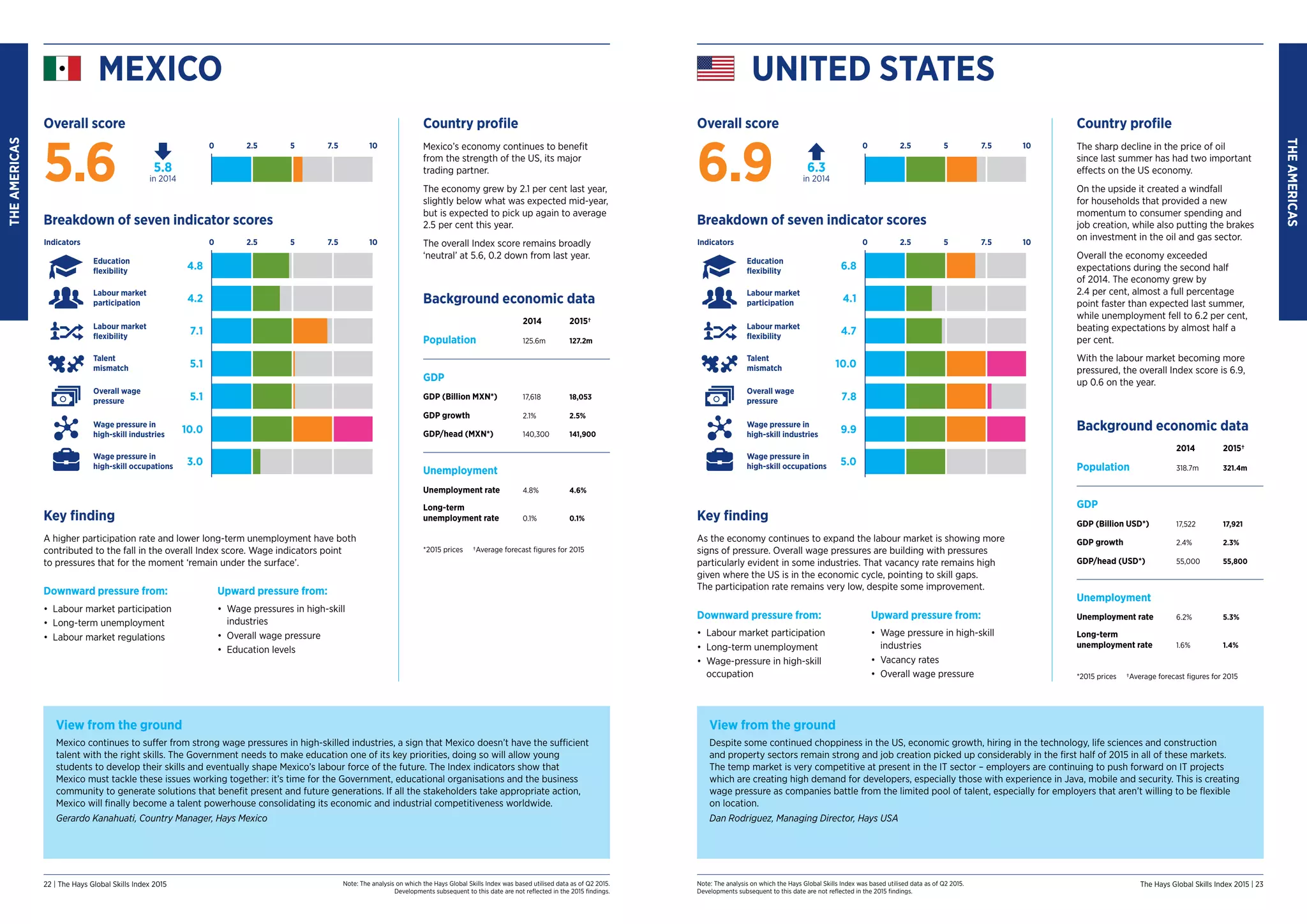
The sharp decline in the price of oil
since last summer has had two important
effects on the US economy.
On the upside it created a windfall
for households that provided a new
momentum to consumer spending and
job creation, while also putting the brakes
on investment in the oil and gas sector.
Overall the economy exceeded
expectations during the second half
of 2014. The economy grew by
2.4 per cent, almost a full percentage
point faster than expected last summer,
while unemployment fell to 6.2 per cent,
beating expectations by almost half a
per cent.
With the labour market becoming more
pressured, the overall Index score is 6.9,
up 0.6 on the year.
Background economic data
2014 2015†
Population 318.7m 321.4m
GDP
GDP (Billion USD*) 17,522 17,921
GDP growth 2.4% 2.3%
GDP/head (USD*) 55,000 55,800
Unemployment
Unemployment rate 6.2% 5.3%
Long-term
unemployment rate 1.6% 1.4%
*2015 prices	 †Average forecast figures for 2015
View from the ground
Despite some continued choppiness in the US, economic growth, hiring in the technology, life sciences and construction
and property sectors remain strong and job creation picked up considerably in the first half of 2015 in all of these markets.
The temp market is very competitive at present in the IT sector – employers are continuing to push forward on IT projects
which are creating high demand for developers, especially those with experience in Java, mobile and security. This is creating
wage pressure as companies battle from the limited pool of talent, especially for employers that aren’t willing to be flexible
on location.
Dan Rodriguez, Managing Director, Hays USA
Key finding
As the economy continues to expand the labour market is showing more
signs of pressure. Overall wage pressures are building with pressures
particularly evident in some industries. That vacancy rate remains high
given where the US is in the economic cycle, pointing to skill gaps.
The participation rate remains very low, despite some improvement.
Downward pressure from:
•	 Labour market participation
•	 Long-term unemployment
•	 Wage-pressure in high-skill
occupation
Upward pressure from:
•	 Wage pressure in high-skill
industries
•	 Vacancy rates
•	 Overall wage pressure
Breakdown of seven indicator scores
6.8
4.7
4.1
10.0
7.8
9.9
5.0
0
Indicators 2.5 5 7.5 10
Wage pressure in
high-skill occupations
Education
flexibility
Labour market
participation
Labour market
flexibility
Talent
mismatch
Overall wage
pressure
Wage pressure in
high-skill industries
Overall score
6.3
in 2014
6.9
0 2.5 5 7.5 10
View from the ground
Mexico continues to suffer from strong wage pressures in high-skilled industries, a sign that Mexico doesn’t have the sufficient
talent with the right skills. The Government needs to make education one of its key priorities, doing so will allow young
students to develop their skills and eventually shape Mexico’s labour force of the future. The Index indicators show that
Mexico must tackle these issues working together: it’s time for the Government, educational organisations and the business
community to generate solutions that benefit present and future generations. If all the stakeholders take appropriate action,
Mexico will finally become a talent powerhouse consolidating its economic and industrial competitiveness worldwide.
Gerardo Kanahuati, Country Manager, Hays Mexico
Country profile
Mexico’s economy continues to benefit
from the strength of the US, its major
trading partner.
The economy grew by 2.1 per cent last year,
slightly below what was expected mid-year,
but is expected to pick up again to average
2.5 per cent this year.
The overall Index score remains broadly
‘neutral’ at 5.6, 0.2 down from last year.
Background economic data
2014 2015†
Population 125.6m 127.2m
GDP
GDP (Billion MXN*) 17,618 18,053
GDP growth 2.1% 2.5%
GDP/head (MXN*) 140,300 141,900
Unemployment
Unemployment rate 4.8% 4.6%
Long-term
unemployment rate 0.1% 0.1%
*2015 prices	 †Average forecast figures for 2015
Key finding
A higher participation rate and lower long-term unemployment have both
contributed to the fall in the overall Index score. Wage indicators point
to pressures that for the moment ‘remain under the surface’.
Downward pressure from:
•	 Labour market participation
•	 Long-term unemployment
•	 Labour market regulations
Upward pressure from:
•	 Wage pressures in high-skill
industries
•	 Overall wage pressure
•	 Education levels
Breakdown of seven indicator scores
4.8
7.1
4.2
5.1
5.1
10.0
3.0
0
Indicators 2.5 5 7.5 10
Wage pressure in
high-skill occupations
Education
flexibility
Labour market
participation
Labour market
flexibility
Talent
mismatch
Overall wage
pressure
Wage pressure in
high-skill industries
Overall score
5.8
in 2014
5.6
0 2.5 5 7.5 10
MEXICO
Note: The analysis on which the Hays Global Skills Index was based utilised data as of Q2 2015.
Developments subsequent to this date are not reflected in the 2015 findings.
Note: The analysis on which the Hays Global Skills Index was based utilised data as of Q2 2015.
Developments subsequent to this date are not reflected in the 2015 findings.
24 | The Hays Global Skills Index 2015 The Hays Global Skills Index 2015 | 25
ASIA
PACIFIC
ASIA
PACIFIC
CHINA
Country profile
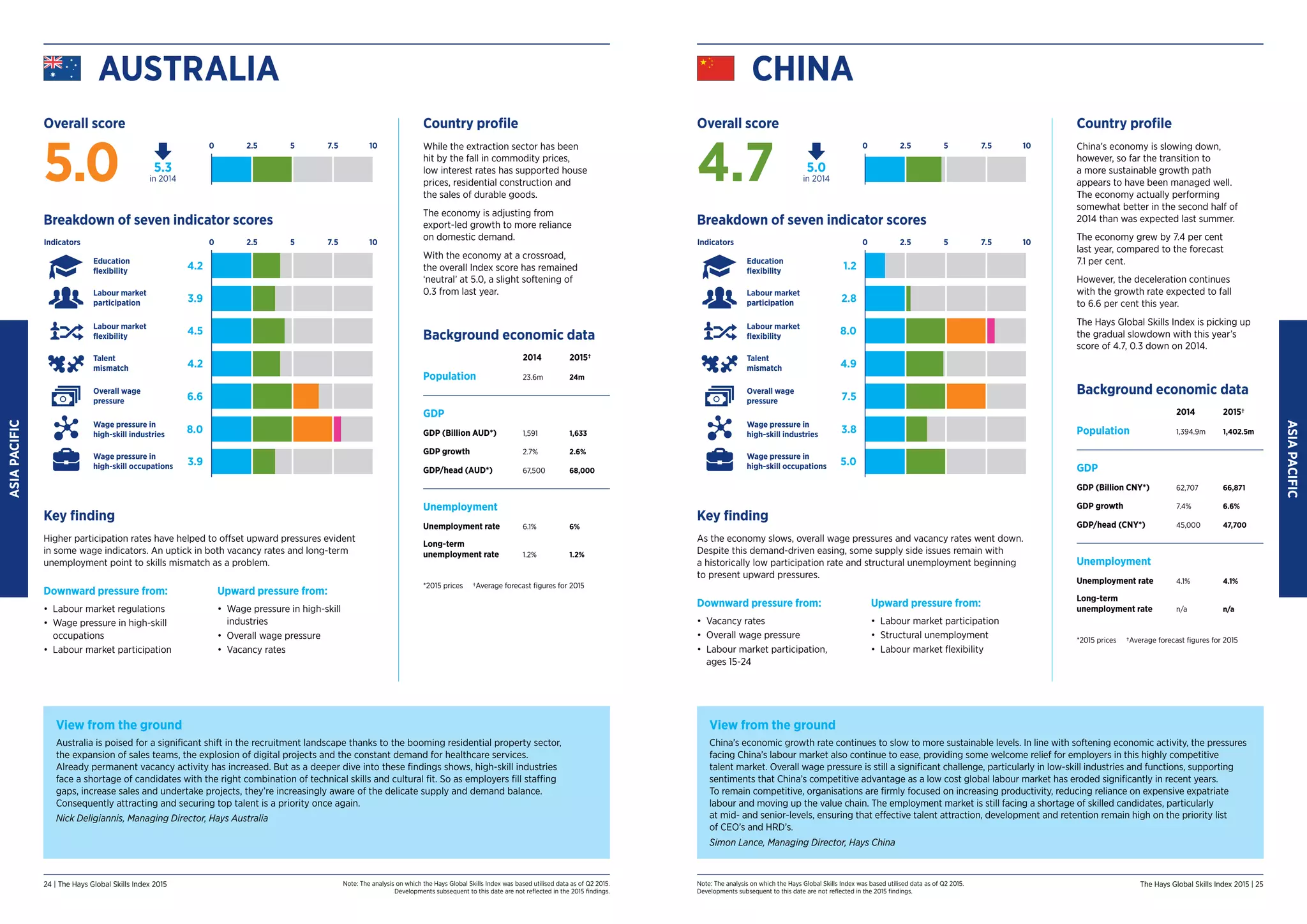
China’s economy is slowing down,
however, so far the transition to
a more sustainable growth path
appears to have been managed well.
The economy actually performing
somewhat better in the second half of
2014 than was expected last summer.
The economy grew by 7.4 per cent
last year, compared to the forecast
7.1 per cent.
However, the deceleration continues
with the growth rate expected to fall
to 6.6 per cent this year.
The Hays Global Skills Index is picking up
the gradual slowdown with this year’s
score of 4.7, 0.3 down on 2014.
Background economic data
2014 2015†
Population 1,394.9m 1,402.5m
GDP
GDP (Billion CNY*) 62,707 66,871
GDP growth 7.4% 6.6%
GDP/head (CNY*) 45,000 47,700
Unemployment
Unemployment rate 4.1% 4.1%
Long-term
unemployment rate n/a n/a
*2015 prices	 †Average forecast figures for 2015
View from the ground
China’s economic growth rate continues to slow to more sustainable levels. In line with softening economic activity, the pressures
facing China’s labour market also continue to ease, providing some welcome relief for employers in this highly competitive
talent market. Overall wage pressure is still a significant challenge, particularly in low-skill industries and functions, supporting
sentiments that China’s competitive advantage as a low cost global labour market has eroded significantly in recent years.
To remain competitive, organisations are firmly focused on increasing productivity, reducing reliance on expensive expatriate
labour and moving up the value chain. The employment market is still facing a shortage of skilled candidates, particularly
at mid- and senior-levels, ensuring that effective talent attraction, development and retention remain high on the priority list
of CEO’s and HRD’s.
Simon Lance, Managing Director, Hays China
Key finding
As the economy slows, overall wage pressures and vacancy rates went down.
Despite this demand-driven easing, some supply side issues remain with
a historically low participation rate and structural unemployment beginning
to present upward pressures.
Downward pressure from:
•	 Vacancy rates
•	 Overall wage pressure
•	 Labour market participation,
ages 15-24
Upward pressure from:
•	 Labour market participation
•	 Structural unemployment
•	 Labour market flexibility
Breakdown of seven indicator scores
1.2
8.0
2.8
4.9
7.5
3.8
5.0
0
Indicators 2.5 5 7.5 10
Wage pressure in
high-skill occupations
Education
flexibility
Labour market
participation
Labour market
flexibility
Talent
mismatch
Overall wage
pressure
Wage pressure in
high-skill industries
Overall score
5.0
in 2014
4.7
0 2.5 5 7.5 10
View from the ground
Australia is poised for a significant shift in the recruitment landscape thanks to the booming residential property sector,
the expansion of sales teams, the explosion of digital projects and the constant demand for healthcare services.
Already permanent vacancy activity has increased. But as a deeper dive into these findings shows, high-skill industries
face a shortage of candidates with the right combination of technical skills and cultural fit. So as employers fill staffing
gaps, increase sales and undertake projects, they’re increasingly aware of the delicate supply and demand balance.
Consequently attracting and securing top talent is a priority once again.
Nick Deligiannis, Managing Director, Hays Australia
Country profile
While the extraction sector has been
hit by the fall in commodity prices,
low interest rates has supported house
prices, residential construction and
the sales of durable goods.
The economy is adjusting from
export-led growth to more reliance
on domestic demand.
With the economy at a crossroad,
the overall Index score has remained
‘neutral’ at 5.0, a slight softening of
0.3 from last year.
Background economic data
2014 2015†
Population 23.6m 24m
GDP
GDP (Billion AUD*) 1,591 1,633
GDP growth 2.7% 2.6%
GDP/head (AUD*) 67,500 68,000
Unemployment
Unemployment rate 6.1% 6%
Long-term
unemployment rate 1.2% 1.2%
*2015 prices	 †Average forecast figures for 2015
AUSTRALIA
Key finding
Higher participation rates have helped to offset upward pressures evident
in some wage indicators. An uptick in both vacancy rates and long-term
unemployment point to skills mismatch as a problem.
Downward pressure from:
•	 Labour market regulations
•	 Wage pressure in high-skill
occupations
•	 Labour market participation
Upward pressure from:
•	 Wage pressure in high-skill
industries
•	 Overall wage pressure
•	 Vacancy rates
Breakdown of seven indicator scores
4.2
4.5
3.9
4.2
6.6
8.0
3.9
0
Indicators 2.5 5 7.5 10
Wage pressure in
high-skill occupations
Education
flexibility
Labour market
participation
Labour market
flexibility
Talent
mismatch
Overall wage
pressure
Wage pressure in
high-skill industries
Overall score
5.3
in 2014
5.0
0 2.5 5 7.5 10
Note: The analysis on which the Hays Global Skills Index was based utilised data as of Q2 2015.
Developments subsequent to this date are not reflected in the 2015 findings.
Note: The analysis on which the Hays Global Skills Index was based utilised data as of Q2 2015.
Developments subsequent to this date are not reflected in the 2015 findings.
26 | The Hays Global Skills Index 2015 The Hays Global Skills Index 2015 | 27
ASIA
PACIFIC
ASIA
PACIFIC
INDIA
Country profile
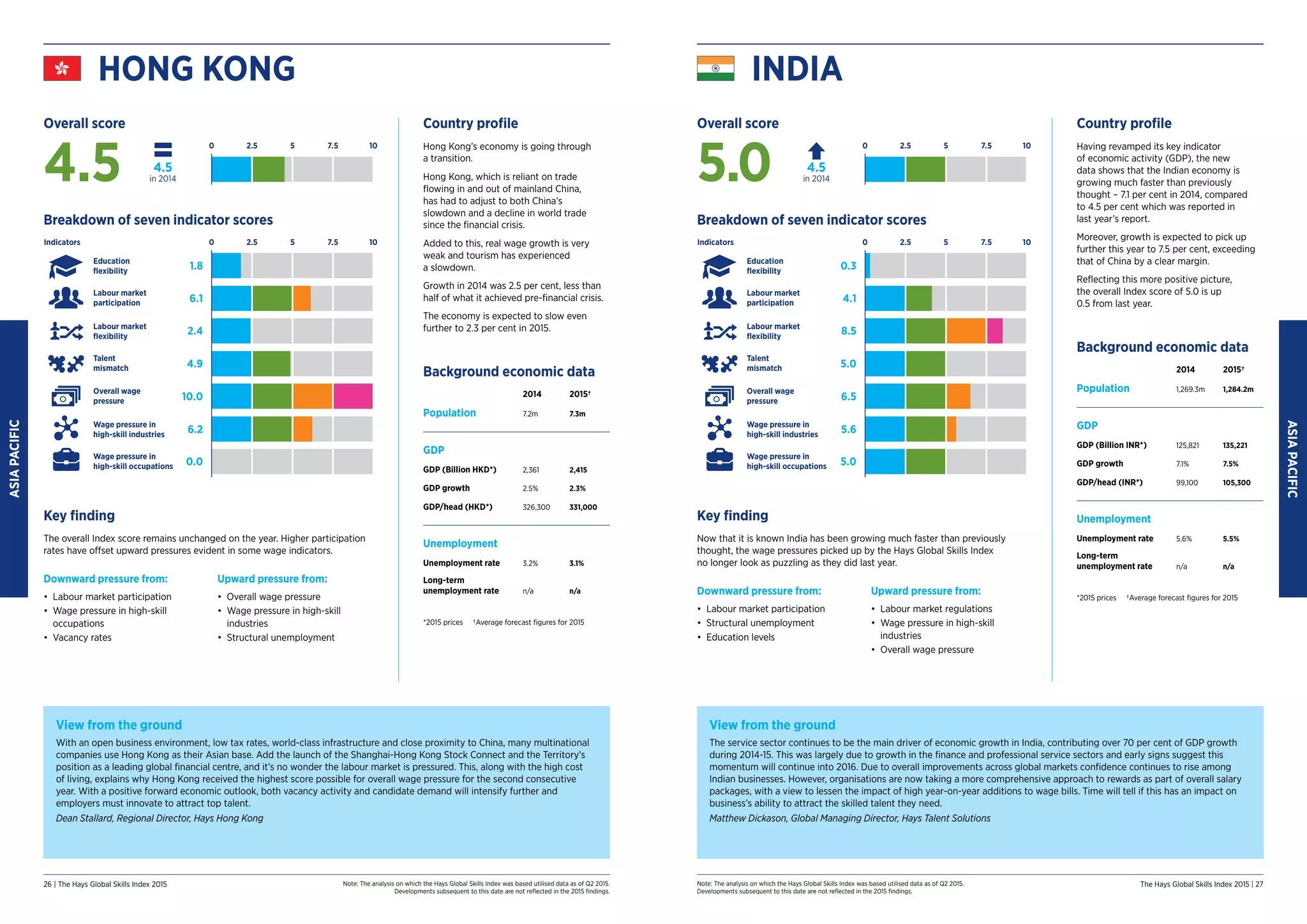
Having revamped its key indicator
of economic activity (GDP), the new
data shows that the Indian economy is
growing much faster than previously
thought – 7.1 per cent in 2014, compared
to 4.5 per cent which was reported in
last year’s report.
Moreover, growth is expected to pick up
further this year to 7.5 per cent, exceeding
that of China by a clear margin.
Reflecting this more positive picture,
the overall Index score of 5.0 is up
0.5 from last year.
Background economic data
2014 2015†
Population 1,269.3m 1,284.2m
GDP
GDP (Billion INR*) 125,821 135,221
GDP growth 7.1% 7.5%
GDP/head (INR*) 99,100 105,300
Unemployment
Unemployment rate 5.6% 5.5%
Long-term
unemployment rate n/a n/a
*2015 prices	 †Average forecast figures for 2015
View from the ground
The service sector continues to be the main driver of economic growth in India, contributing over 70 per cent of GDP growth
during 2014-15. This was largely due to growth in the finance and professional service sectors and early signs suggest this
momentum will continue into 2016. Due to overall improvements across global markets confidence continues to rise among
Indian businesses. However, organisations are now taking a more comprehensive approach to rewards as part of overall salary
packages, with a view to lessen the impact of high year-on-year additions to wage bills. Time will tell if this has an impact on
business’s ability to attract the skilled talent they need.
Matthew Dickason, Global Managing Director, Hays Talent Solutions
Key finding
Now that it is known India has been growing much faster than previously
thought, the wage pressures picked up by the Hays Global Skills Index
no longer look as puzzling as they did last year.
Downward pressure from:
•	 Labour market participation
•	 Structural unemployment
•	 Education levels
Upward pressure from:
•	 Labour market regulations
•	 Wage pressure in high-skill
industries
•	 Overall wage pressure
Breakdown of seven indicator scores
0.3
8.5
4.1
5.0
6.5
5.6
5.0
0
Indicators 2.5 5 7.5 10
Wage pressure in
high-skill occupations
Education
flexibility
Labour market
participation
Labour market
flexibility
Talent
mismatch
Overall wage
pressure
Wage pressure in
high-skill industries
Overall score
4.5
in 2014
5.0
0 2.5 5 7.5 10
View from the ground
With an open business environment, low tax rates, world-class infrastructure and close proximity to China, many multinational
companies use Hong Kong as their Asian base. Add the launch of the Shanghai-Hong Kong Stock Connect and the Territory’s
position as a leading global financial centre, and it’s no wonder the labour market is pressured. This, along with the high cost
of living, explains why Hong Kong received the highest score possible for overall wage pressure for the second consecutive
year. With a positive forward economic outlook, both vacancy activity and candidate demand will intensify further and
employers must innovate to attract top talent.
Dean Stallard, Regional Director, Hays Hong Kong
Country profile
Hong Kong’s economy is going through
a transition.
Hong Kong, which is reliant on trade
flowing in and out of mainland China,
has had to adjust to both China’s
slowdown and a decline in world trade
since the financial crisis.
Added to this, real wage growth is very
weak and tourism has experienced
a slowdown.
Growth in 2014 was 2.5 per cent, less than
half of what it achieved pre-financial crisis.
The economy is expected to slow even
further to 2.3 per cent in 2015.
Background economic data
2014 2015†
Population 7.2m 7.3m
GDP
GDP (Billion HKD*) 2,361 2,415
GDP growth 2.5% 2.3%
GDP/head (HKD*) 326,300 331,000
Unemployment
Unemployment rate 3.2% 3.1%
Long-term
unemployment rate n/a n/a
*2015 prices	 †Average forecast figures for 2015
HONG KONG
Key finding
The overall Index score remains unchanged on the year. Higher participation
rates have offset upward pressures evident in some wage indicators.
Downward pressure from:
•	 Labour market participation
•	 Wage pressure in high-skill
occupations
•	 Vacancy rates
Upward pressure from:
•	 Overall wage pressure
•	 Wage pressure in high-skill
industries
•	 Structural unemployment
Breakdown of seven indicator scores
1.8
2.4
6.1
4.9
10.0
6.2
0.0
0
Indicators 2.5 5 7.5 10
Wage pressure in
high-skill occupations
Education
flexibility
Labour market
participation
Labour market
flexibility
Talent
mismatch
Overall wage
pressure
Wage pressure in
high-skill industries
Overall score
4.5
in 2014
4.5
0 2.5 5 7.5 10
Note: The analysis on which the Hays Global Skills Index was based utilised data as of Q2 2015.
Developments subsequent to this date are not reflected in the 2015 findings.
Note: The analysis on which the Hays Global Skills Index was based utilised data as of Q2 2015.
Developments subsequent to this date are not reflected in the 2015 findings.
28 | The Hays Global Skills Index 2015 The Hays Global Skills Index 2015 | 29
ASIA
PACIFIC
ASIA
PACIFIC
NEW ZEALAND
Country profile
New Zealand’s economy continues
to register strong growth.
Underlying this strength is a strong
upswing in residential construction
in Auckland together with rebuilding
following the Canterbury earthquake.
Moreover New Zealand has experienced
a favourable shift in the terms of trade,
as the price of oil has fallen while prices
for dairy products have risen.
The economy is expected to continue
to grow at around 2.9 per cent.
With the economy doing well, the labour
market is showing signs of pressure with
the overall Index score up 0.2 to 5.1.
Background economic data
2014 2015†
Population 4.6m 4.6m
GDP
GDP (Billion NZD*) 235 242
GDP growth 3.0% 2.9%
GDP/head (NZD*) 51,600 52,600
Unemployment
Unemployment rate 5.6% 5.4%
Long-term
unemployment rate 0.7% 0.7%
*2015 prices	 †Average forecast figures for 2015
View from the ground
New Zealand’s domestic economy has moved from ‘expansive’ to ‘neutral’ over the past 12 months motivating the Reserve
Bank to take action by reducing the base interest rates. The resulting weakening of the NZ dollar has boosted the export sector,
and with continued residential building activity, the next phase of the Christchurch rebuild, major government infrastructure
investment and pending large scale commercial developments across NZ organisations are still experiencing skills shortages
in many sectors and industries. Although the unemployment rate has plateaued, labour force participation is at record levels
and with more people in work, talent pipelines are stretched across the breadth of highly skilled professions. For the second
consecutive year New Zealand received the highest score possible for wage pressure in high-skilled industries.
Jason Walker, Managing Director, Hays New Zealand
Key finding
With the economy growing strongly, wage pressures are evident at the industry
level and an increase in the score for wage pressures in high-skill occupations
points to a widening pay gap between low- and high-skill roles. On the positive side,
the buoyant economy has reduced both long-term and structural unemployment.
Downward pressure from:
•	 Overall wage pressure
•	 Long-term unemployment
•	 Labour market participation
Upward pressure from:
•	 Wage pressure in high-skill
industries
•	 Wage pressure in high-skill
occupations
•	 Vacancy rates
Breakdown of seven indicator scores
4.7
4.3
6.7
4.7
2.8
10.0
2.5
0
Indicators 2.5 5 7.5 10
Wage pressure in
high-skill occupations
Education
flexibility
Labour market
participation
Labour market
flexibility
Talent
mismatch
Overall wage
pressure
Wage pressure in
high-skill industries
Overall score
4.9
in 2014
5.1
0 2.5 5 7.5 10
View from the ground
Japan’s talent mismatch remains one of the biggest challenges this year, increasing from 9.5 last year to the highest score
possible of 10. The significant gap between the skills employers need and those available continues to severely affect the labour
market, with barriers restricting labour market flexibility and rising wages adding to the pressure. Though talent mismatch
remains a huge obstacle for Japan’s continued momentum, positivity around labour market reform, together with some
improvement in participation rates, will support a continued positive outlook.
Marc Burrage, Managing Director, Hays Japan
Country profile
2014 was a difficult year for Japan’s
economy. Following an increase in
the sales tax, the economy contracted
by -0.1 per cent, much weaker than
the 1.1 per cent growth expected mid-year.
A further tax hike has been delayed
and instead government spending
increased to boost the economy.
The strong dollar is also helping to revive
exports adding further support to the
economy this year.
Against these positive developments
is the protracted slump in household
incomes and spending. Growth is
expected to recover to 0.8% this year,
with unemployment edging down to
3.4 per cent, from 3.6 per cent last year.
The overall Index score has ticked up
0.1 to 6.1.
Background economic data
2014 2015†
Population 126.8m 126.5m
GDP
GDP (Billion JPY*) 492,076 495,902
GDP growth -0.1% 0.8%
GDP/head (JPY*) 3,881,800 3,918,800
Unemployment
Unemployment rate 3.6% 3.4%
Long-term
unemployment rate 1.5% 1.4%
*2015 prices	 †Average forecast figures for 2015
JAPAN
Key finding
While mismatch remains a concern (vacancies and long-term unemployment),
the Government is pushing ahead with labour market reforms together with
some improvement in participation rates.
Downward pressure from:
•	 Labour market regulations
•	 Labour market participation,
ages 15-24
•	 Wage pressure in high-skill
industries
Upward pressure from:
•	 Overall wage pressure
•	 Vacancy rates
•	 Long-term unemployment
Breakdown of seven indicator scores
3.0
6.7
6.1
10.0
8.1
2.5
6.2
0
Indicators 2.5 5 7.5 10
Wage pressure in
high-skill occupations
Education
flexibility
Labour market
participation
Labour market
flexibility
Talent
mismatch
Overall wage
pressure
Wage pressure in
high-skill industries
Overall score
6.0
in 2014
6.1
0 2.5 5 7.5 10
Note: The analysis on which the Hays Global Skills Index was based utilised data as of Q2 2015.
Developments subsequent to this date are not reflected in the 2015 findings.
The Hays Global Skills Index 2015 | 31
EUROPE
Note: The analysis on which the Hays Global Skills Index was based utilised data as of Q2 2015.
Developments subsequent to this date are not reflected in the 2015 findings.
30 | The Hays Global Skills Index 2015
ASIA
PACIFIC
Country profile
Expectations of a recovery during
2014 was dashed by its poor
performance in the second half,
with growth of 0.5 per cent, much
lower than 1.5 per cent expected
mid-year.
2015 is not much better with sluggish
rate of growth of 0.7 per cent expected
for the year as a whole.
Against this disappointing backdrop
the overall Index score has increased
to 5.1, up 0.1 from last year.
Background economic data
2014 2015†
Population 8.5m 8.6m
GDP
GDP (Billion EUR*) 335 337
GDP growth 0.5% 0.7%
GDP/head (EUR*) 39,200 39,400
Unemployment
Unemployment rate 5.6% 5.7%
Long-term
unemployment rate 1.4% 1.4%
*2015 prices	 †Average forecast figures for 2015
AUSTRIA
View from the ground
The current situation in Austria is difficult. With very low GDP growth, combined with the highest unemployment rate since
the 1950s, companies seem to be holding back on major hiring as well as large scale investments. At the same time specialists
are not re-entering the job market as frequently as in the past, this is due to insecurity which has led people to think twice
before changing jobs. Generally the troubles in the banking sector, as well as uncertainty regarding the economy, combined
with inactivity on the side of the Government, have led to stagnation. As far as specialist recruitment is concerned there is
less demand for specialists but at the same time fewer candidates are willing to leave their current jobs.
Mark Frost, Managing Director, Hays Austria
Key finding
Behind the tick up in the overall Index score was a fall in labour market
participation and a pick-up in overall wage pressures. On a more positive
note, skills mismatch appeared to ease with a reduction in both vacancies
and long-term unemployment.
Downward pressure from:
•	 Vacancy rates
•	 Long-term unemployment
•	 Wage pressure in high-skill
industries
Upward pressure from:
•	 Overall wage pressure
•	 Labour market participation
•	 Education levels
Breakdown of seven indicator scores
5.1
4.0
5.6
2.9
7.1
7.2
3.6
0
Indicators 2.5 5 7.5 10
Wage pressure in
high-skill occupations
Education
flexibility
Labour market
participation
Labour market
flexibility
Talent
mismatch
Overall wage
pressure
Wage pressure in
high-skill industries
Overall score
5.0
in 2014
5.1
0 2.5 5 7.5 10
View from the ground
Singapore’s standing as a regional hub for multinational corporations and its sheer number of construction and infrastructure
projects bolsters a highly active recruitment market. But Singapore faces a significant talent gap thanks to growing technical
skill shortages. Government initiatives that endorse local Singaporean hires for middle income jobs have further exacerbated
the shortage of talented locals. As evidence of this, overall wage pressure rose significantly year-on-year (from 1.3 to 5.8)
as employers attempted to remain competitive in the race for highly skilled talent. Our advice to employers therefore is to
use a range of innovative attraction strategies to keep recruitment plans intact.
Lynne Roeder, Managing Director, Hays Singapore
Country profile
Badly hit by the weakness in world trade,
Singapore – as with Hong Kong and
mainland China – is having to adjust to
diminished growth expectations.
The economy grew by 2.9 per cent
last year, around half what it had achieved
before the financial crisis when world
trade was flourishing.
Faced with weak external demand
and deflation (headline CPI is falling),
the Government, through both monetary
and fiscal levers, is trying to revive
the economy.
The overall Index score now stands
at 4.7, a 0.6 increase on the year.
Background economic data
2014 2015†
Population 5.5m 5.5m
GDP
GDP (Billion SGD*) 388 397
GDP growth 2.9% 2.4%
GDP/head (SGD*) 70,900 71,700
Unemployment
Unemployment rate 2% 2%
Long-term
unemployment rate 0.6% 0.6%
*2015 prices	 †Average forecast figures for 2015
SINGAPORE
Key finding
Behind the significant pressure in the overall Index score is a pick-up in
overall wage pressures, a deterioration in mismatch (higher rates of vacancies
and unemployment) and a reduction in participation rates. The latest PISA
results show Singapore still having among the highest educational standards.
Downward pressure from:
•	 Wage pressure in high-skill
industries
•	 Wage pressure in high-skill
occupations
•	 Education levels
Upward pressure from:
•	 Overall wage pressure
•	 Vacancy rates
•	 Labour market participation
Breakdown of seven indicator scores
0.7
0.6
5.5
6.0
5.8
8.4
5.9
0
Indicators 2.5 5 7.5 10
Wage pressure in
high-skill occupations
Education
flexibility
Labour market
participation
Labour market
flexibility
Talent
mismatch
Overall wage
pressure
Wage pressure in
high-skill industries
Overall score
4.1
in 2014
4.7
0 2.5 5 7.5 10
Note: The analysis on which the Hays Global Skills Index was based utilised data as of Q2 2015.
Developments subsequent to this date are not reflected in the 2015 findings.
Note: The analysis on which the Hays Global Skills Index was based utilised data as of Q2 2015.
Developments subsequent to this date are not reflected in the 2015 findings.
32 | The Hays Global Skills Index 2015 The Hays Global Skills Index 2015 | 33
EUROPE
Country profile
The Czech economy is heavily orientated
towards the eurozone markets.
Growth last year averaged 2 per cent
and is expected to pick up to 3.2 per cent
this year, as conditions across the eurozone
improve on the back of a weak Euro and
the ECB’s increasingly bold efforts to
support growth.
With the Czech economy reviving,
the overall Index score has increased
0.1 to 4.9.
Background economic data
2014 2015†
Population 10.5m 10.5m
GDP
GDP (Billion CZK*) 4,321 4,459
GDP growth 2.0% 3.2%
GDP/head (CZK*) 410,700 423,200
Unemployment
Unemployment rate 6.1% 5.4%
Long-term
unemployment rate 2.8% 2.4%
*2015 prices	 †Average forecast figures for 2015
CZECH REPUBLIC
View from the ground
The Czech Republic is currently experiencing an economic recovery with a very positive outlook. Being predominantly
an export driven economy, as well as consistently receiving the highest credit ratings in CEE, the country has once again
reinstated itself as the ideal place for investors. Technology, especially automotive, is still the main driver of the overall
GDP. With a recognised skilled talent pool, there are growing investments in the field of shared service centres, providing
competences in servicing finance and IT. While the mismatch of talent is prevalent in certain fields, schools are beginning
to align with businesses in order to respond to future needs of the labour market.
Ladislav Kučera, Managing Director, Hays Czech Republic
Key finding
Improving economic conditions are reflected in an improved labour market.
Participation rates are up as long-term unemployment has fallen. Despite these
demand-side improvements, some structural weaknesses remain: education
levels and participation rates among younger workers remain a concern.
Downward pressure from:
•	 Structural unemployment
•	 Labour market participation,
ages 55-64
•	 Education levels
Upward pressure from:
•	 Labour market participation,
ages 15-24
•	 Vacancy rate
•	 Long-term unemployment
Breakdown of seven indicator scores
7.6
3.2
4.3
2.4
3.5
7.1
6.3
0
Indicators 2.5 5 7.5 10
Wage pressure in
high-skill occupations
Education
flexibility
Labour market
participation
Labour market
flexibility
Talent
mismatch
Overall wage
pressure
Wage pressure in
high-skill industries
Overall score
4.8
in 2014
4.9
0 2.5 5 7.5 10
Country profile
Belgium’s economy achieved growth
of 1.1 per cent in 2014 – inline with
what had been expected last summer –
and is expected to sustain this rate
this year.
While modest, this growth performance
looks more impressive given the challenges
eurozone countries face.
Background economic data
2014 2015†
Population 11.2m 11.3m
GDP
GDP (Billion EUR*) 407 412
GDP growth 1.1% 1.3%
GDP/head (EUR*) 36,200 36,500
Unemployment
Unemployment rate 8.5% 8.5%
Long-term
unemployment rate 3.9% 3.9%
*2015 prices	 †Average forecast figures for 2015
BELGIUM
View from the ground
Belgium’s economy achieved growth between 0.9 and 1.1 per cent in 2014, which was forecast last year. This growth rate is
impressive when you take into account the economic challenges that Europe continues to face. Moreover, growth between
1.1 and 1.3 per cent is expected to continue for 2015/2016, which is very positive, however the ongoing brain drain and high
demand for scientific and technical profiles remains an issue for businesses. Recently the Belgian Government announced
reforms, the goal of which is job creation, and this will include decreasing employer’s social security contributions and
encourage RD investment.
Robby Vanuxem, Managing Director, Hays Belgium
Key finding
Upward pressures come from high long-term unemployment rates and weak
labour supply (participation rates). Offsetting these are lower vacancy rates
and overall wage moderation.
Downward pressure from:
•	 Vacancy rates
•	 Structural unemployment
•	 Overall wage pressure
Upward pressure from:
•	 Long-term unemployment
•	 Wage pressure in high-skill
industries
•	 Labour market participation
Breakdown of seven indicator scores
6.1
5.0
5.7
0.1
4.4
0.0
4.3
0
Indicators 2.5 5 7.5 10
Wage pressure in
high-skill occupations
Education
flexibility
Labour market
participation
Labour market
flexibility
Talent
mismatch
Overall wage
pressure
Wage pressure in
high-skill industries
Overall score
3.8
in 2014
3.7
0 2.5 5 7.5 10
EUROPE
Note: The analysis on which the Hays Global Skills Index was based utilised data as of Q2 2015.
Developments subsequent to this date are not reflected in the 2015 findings.
Note: The analysis on which the Hays Global Skills Index was based utilised data as of Q2 2015.
Developments subsequent to this date are not reflected in the 2015 findings.
34 | The Hays Global Skills Index 2015 The Hays Global Skills Index 2015 | 35
EUROPE
Country profile
France’s GDP growth is expected to
accelerate significantly this year and
this is reflected in the modest increase
in the country’s overall Index score.
The Hays Global Skills Index scores
indicate economic headwinds as wage
pressures rise alongside a persistently
high unemployment rate.
Sub-five scores for education flexibility
and wage dispersion indicators coupled
with a high labour market flexibility
indicator suggest any serious labour
market issues are regulatory rather than
skills related.
Background economic data
2014 2015†
Population 66.0m 66.3m
GDP
GDP (Billion EUR*) 2,155 2,183
GDP growth 0.2% 1.3%
GDP/head (EUR*) 32,600 32,900
Unemployment
Unemployment rate 10.3% 10.2%
Long-term
unemployment rate 4.2% 4.1%
*2015 prices	 †Average forecast figures for 2015
FRANCE
View from the ground
The overall economic environment is expected to be more favourable for France in 2016. This is due to a combination of various
external factors – such as the decrease in oil price, lower interest rates and eurozone GDP returning to growth – as well as
internal factors – including Government initiatives encouraging French companies to employ more staff and the new liberal
economic laws put in place to boost the economy. All of these measures will stimulate the labour market, especially in helping
to stabilise the unemployment rate which is forecast at 10.2 per cent for 2015. However, this overall improvement may not yet
bear fruits for the construction industry which is still facing some uncertainty.
Tina Ling, Managing Director, Hays France  Luxembourg
Key finding
France continues to compare less favourably to other countries in that its
labour market regulations are among some of the least employment-friendly
among the 31 countries covered by the Hays Global Skills Index.
Downward pressure from:
•	 Wage pressure in high-skill
occupations
•	 Education levels
•	 Labour market participation,
ages 15-24
Upward pressure from:
•	 Overall wage pressure
•	 Wage pressure in high-skill
industries
•	 Labour market regulations
Breakdown of seven indicator scores
3.6
8.1
5.3
5.9
5.4
4.9
3.9
0
Indicators 2.5 5 7.5 10
Wage pressure in
high-skill occupations
Education
flexibility
Labour market
participation
Labour market
flexibility
Talent
mismatch
Overall wage
pressure
Wage pressure in
high-skill industries
Overall score
5.2
in 2014
5.3
0 2.5 5 7.5 10
Country profile
Denmark is expected to return to
pre‑crisis growth rates this year after
only just recovering from a double-dip
recession in 2014.
Unemployment is also expected to
further edge down from historically
high levels.
The overall score has increased slightly
on last year from 4.5 to 5.0 indicating
that, while the economic conditions
are improving, there is still a great deal
of slack in the labour market.
Background economic data
2014 2015†
Population 5.6m 5.7m
GDP
GDP (Billion DKK*) 1,957 1,992
GDP growth 1.1% 1.8%
GDP/head (DKK*) 347,100 352,300
Unemployment
Unemployment rate 6.5% 6.1%
Long-term
unemployment rate 1.7% 1.6%
*2015 prices	 †Average forecast figures for 2015
DENMARK
View from the ground
The employment rate is expected to increase this year, along with an improvement in the overall economic condition
of the country. Talent mismatch remains the biggest issue for businesses, which results in companies looking at
international talent pools, especially within highly technical industries. The lack of a workforce with the right skillset,
coupled with a generally low unemployment ratio, has also led to an increase in salaries as companies try and attract
professionals with the right skills. As Denmark moves towards a more digitalised society the expectation is for an improved
productivity across the country.
Morten Andersen, Business Director, Hays Denmark
Key finding
Despite the improving economic outlook, increasing rates of economic
participation are limiting the extent to which growth in overall wages
can return.
Downward pressure from:
•	 Labour market participation
•	 Long-term unemployment
•	 Structural unemployment
Upward pressure from:
•	 Job vacancies
•	 Education flexibility
•	 Labour market participation,
ages 55-64
Breakdown of seven indicator scores
6.4
3.0
3.5
7.6
3.8
5.0
5.8
0
Indicators 2.5 5 7.5 10
Wage pressure in
high-skill occupations
Education
flexibility
Labour market
participation
Labour market
flexibility
Talent
mismatch
Overall wage
pressure
Wage pressure in
high-skill industries
Overall score
4.5
in 2014
5.0
0 2.5 5 7.5 10
EUROPE
Note: The analysis on which the Hays Global Skills Index was based utilised data as of Q2 2015.
Developments subsequent to this date are not reflected in the 2015 findings.
Note: The analysis on which the Hays Global Skills Index was based utilised data as of Q2 2015.
Developments subsequent to this date are not reflected in the 2015 findings.
36 | The Hays Global Skills Index 2015 The Hays Global Skills Index 2015 | 37
EUROPE
Country profile
Economic indicators suggest a positive
economic outlook for Hungary with
unemployment falling and GDP expected
to grow by 3 per cent in 2015.
However, much of the recent improvement
has been contributed by the state and the
Government’s ongoing austerity drive has
been a drag on private investment.
Hungary’s unchanged score of 6.3 suggests
continued stress in the labour markets.
Background economic data
2014 2015†
Population 9.9m 9.8m
GDP
GDP (Billion HUF*) 32,245 33,215
GDP growth 3.5% 3.0%
GDP/head (HUF*) 3,268,000 3,374,400
Unemployment
Unemployment rate 7.7% 7.0%
Long-term
unemployment rate 3.8% 3.5%
*2015 prices	 †Average forecast figures for 2015
HUNGARY
View from the ground
The trends in the Hungarian labour market haven’t changed significantly in the past few years. The technical industries,
mainly IT and engineering, continue to be candidate driven. We are witnessing more and more IT companies being established
and automotive continues to be a key sector. The constant growth in these areas not only provides demand for IT and
engineering candidates, it also creates demand for other areas such as finance and logistics professionals. Hungary continues
to welcome newly established shared service centres and the existing ones continue to bring further business functions to
the country. Trilingual candidates are becoming more sought after; therefore newly qualified graduates with language skills
continue to find work easily.
Tammy Nagy-Stellini, Managing Director, Hays Hungary
Key finding
Increasing job vacancy rates and rising real wages are indicative of improving
economic conditions and represent tightening in the labour market. Relief is
provided by an improvement in Hungary’s regulatory environment.
Downward pressure from:
•	 Structural unemployment
•	 Labour market regulations
•	 Labour market participation,
ages 55-64
Upward pressure from:
•	 Job vacancies
•	 Long-term unemployment
•	 International PISA ranking
Breakdown of seven indicator scores
8.0
4.4
5.0
9.6
4.0
8.5
4.8
0
Indicators 2.5 5 7.5 10
Wage pressure in
high-skill occupations
Education
flexibility
Labour market
participation
Labour market
flexibility
Talent
mismatch
Overall wage
pressure
Wage pressure in
high-skill industries
Overall score
6.3
in 2014
6.3
0 2.5 5 7.5 10
Country profile
The German labour market tightens
further this year amid close to trend GDP
growth and decreasing unemployment.
Wage pressures contribute significantly
to Germany’s overall score of 6.4 and
are indicative of the high level of demand
for highly skilled personnel.
A rise in the job vacancy rate also suggests
that businesses are still searching for skills
These demand-led pressures push
Germany’s overall score upwards to 6.4.
Background economic data
2014 2015†
Population 81m 81m
GDP
GDP (Billion EUR*) 2,958 3,006
GDP growth 1.6% 1.6%
GDP/head (EUR*) 36,500 37,100
Unemployment
Unemployment rate 5% 4.8%
Long-term
unemployment rate 2.2% 2.1%
*2015 prices	 †Average forecast figures for 2015
GERMANY
View from the ground
There are many indications that the stability of the German labour market will continue in the coming years. This view
corresponds with an overall satisfactory economic development that is still based on a high level of exports. The downside
to this stability: wages in booming industries with a high percentage of knowledge workers will rise significantly, all the more
so because the scarcity of available experts will be exacerbated by this demographic development. In Germany in particular
there is a great demand for Industry 4.0 experts, however, only a limited number are available. This clearly demonstrates
that there is a need for an education system that is able to adjust to the needs of business and address trends more quickly.
The same applies to the still heavily regulated labour market, which massively restricts flexible forms of employment,
such as the use of freelancers for upcoming project work.
Klaus Breitschopf, Managing Director, Hays Germany
Key finding
Industrial wage pressures continue to be an issue for the German labour
market. The top-end score for industrial wage pressures can be traced
back to strong remuneration growth in highly skilled sectors such as
finance and IT.
Downward pressure from:
•	 Labour market regulations
•	 Long-term unemployment
•	 Labour market participation,
ages 55-64
Upward pressure from:
•	 Wage pressure in high-skill
industries
•	 Job vacancies
•	 Overall wage pressure
Breakdown of seven indicator scores
6.2
6.8
5.6
3.3
6.0
10.0
6.6
0
Indicators 2.5 5 7.5 10
Wage pressure in
high-skill occupations
Education
flexibility
Labour market
participation
Labour market
flexibility
Talent
mismatch
Overall wage
pressure
Wage pressure in
high-skill industries
Overall score
6.2
in 2014
6.4
0 2.5 5 7.5 10
EUROPE
Note: The analysis on which the Hays Global Skills Index was based utilised data as of Q2 2015.
Developments subsequent to this date are not reflected in the 2015 findings.
Note: The analysis on which the Hays Global Skills Index was based utilised data as of Q2 2015.
Developments subsequent to this date are not reflected in the 2015 findings.
38 | The Hays Global Skills Index 2015 The Hays Global Skills Index 2015 | 39
EUROPE
Country profile
Italy’s economy fell back into recession
in 2014 but is forecast to make modest
gains in 2015.
Despite the return to growth, overall
unemployment and long-term
unemployment are expected to remain
high at 12.4 per cent and 7.1 per cent
respectively.
New labour market reforms affecting
new hires are expected to boost
employment activity but may take time
before their impacts are fully realised.
Italy’s low overall score of 4.0 reflects
current weaknesses in the labour market.
Background economic data
2014 2015†
Population 60.9m 61.1m
GDP
GDP (Billion EUR*) 1,627 1,638
GDP growth -0.4% 0.6%
GDP/head (EUR*) 26,700 26,800
Unemployment
Unemployment rate 12.7% 12.4%
Long-term
unemployment rate 7.2% 7.1%
*2015 prices	 †Average forecast figures for 2015
ITALY
View from the ground
After a three-year-long recession, and despite the very high public debt, Italy’s economy is showing slight signs of recovery.
New labour market reforms should relaunch employment activity but may take time before their effects are measured.
In the months ahead, a rise in unemployment and long-term unemployment is forecast. Talent mismatch will be the main
challenge for Italian employers, as Italy’s high and growing rate of long-term unemployment will increase the difficulty
of recruiting highly skilled professionals.
Carlos Soave, Managing Director, Hays Italy
Key finding
Talent mismatch will continue to be the main issue for Italian employers
as Italy’s high rate of long-term unemployment will increase the difficulty
of recruiting the skilled workers firms require.
Downward pressure from:
•	 Wage pressure in high-skill
occupations
•	 Labour market regulations
•	 Education levels
Upward pressure from:
•	 Long-term unemployment
•	 Job vacancies
•	 Overall wage pressure
Breakdown of seven indicator scores
5.9
5.7
2.9
8.1
3.4
0.0
1.7
0
Indicators 2.5 5 7.5 10
Wage pressure in
high-skill occupations
Education
flexibility
Labour market
participation
Labour market
flexibility
Talent
mismatch
Overall wage
pressure
Wage pressure in
high-skill industries
Overall score
3.9
in 2014
4.0
0 2.5 5 7.5 10
Country profile
Ireland’s recovery continues to impress
and its economy is expected to achieve
the third fastest growth rate among
the 31 countries included in the Index
(behind China and India).
However, the high, albeit falling, rates
of overall and long-term unemployment
continue to be a source of pressure
within the labour market.
The overall score declines slightly to 5.7.
Background economic data
2014 2015†
Population 4.6m 4.7m
GDP
GDP (Billion EUR*) 194 204
GDP growth 5.2% 4.9%
GDP/head (EUR*) 42,000 43,700
Unemployment
Unemployment rate 11.3% 9.3%
Long-term
unemployment rate 6.9% 5.6%
*2015 prices	 †Average forecast figures for 2015
IRELAND
View from the ground
There are many promising signs that the Irish economy is starting to turn around. Growth rates are higher than in the rest
of Europe and have far outpaced expectations. Ireland’s improving economy has triggered a significant change in employers’
attitudes towards hiring. Companies in high-growth sectors such as construction and property, IT and engineering face
increasing skills shortages, along with a necessity to review their attraction strategies to secure talent in a rapidly evolving
employment market. Particular stress is seen in those sectors and professions which experienced both an exodus of
established skills during the recession and a dearth of new talent coming through the education system.
Richard Eardley, Managing Director, Hays Ireland
Key finding
Skills shortages may become increasingly apparent if the overall participation
rate continues to sit well below pre-crisis levels and the long-term unemployed
continue to be at risk of skills erosion.
Downward pressure from:
•	 Education flexibility
•	 Overall wage pressure
•	 Wage pressure in high-skill
industries
Upward pressure from:
•	 Labour market participation
•	 Long-term unemployment
•	 Talent mismatch
Breakdown of seven indicator scores
3.2
2.7
7.7
10.0
4.2
5.7
6.4
0
Indicators 2.5 5 7.5 10
Wage pressure in
high-skill occupations
Education
flexibility
Labour market
participation
Labour market
flexibility
Talent
mismatch
Overall wage
pressure
Wage pressure in
high-skill industries
Overall score
5.8
in 2014
5.7
0 2.5 5 7.5 10
EUROPE
Note: The analysis on which the Hays Global Skills Index was based utilised data as of Q2 2015.
Developments subsequent to this date are not reflected in the 2015 findings.
Note: The analysis on which the Hays Global Skills Index was based utilised data as of Q2 2015.
Developments subsequent to this date are not reflected in the 2015 findings.
40 | The Hays Global Skills Index 2015 The Hays Global Skills Index 2015 | 41
EUROPE
Country profile
The Netherlands is forecast to make up
further ground lost after its economy
fell back into recession over 2012-2013,
with GDP growth accelerating to
1.8 per cent in 2015.
The unemployment rate is expected
to climb down from its 2014 peak
of 7.4 per cent to 7.1 per cent in 2015.
An overall score of 4.7 illustrates
a somewhat loose labour market
characterised by low overall wage
pressures and a high participation rate.
Background economic data
2014 2015†
Population 16.9m 16.9m
GDP
GDP (Billion EUR*) 664 676
GDP growth 1.0% 1.8%
GDP/head (EUR*) 39,400 40,000
Unemployment
Unemployment rate 7.4% 7.1%
Long-term
unemployment rate 2.7% 2.6%
*2015 prices	 †Average forecast figures for 2015
THE NETHERLANDS
View from the ground
While the recovery of the Dutch economy was driven only by export at first, labour demand has finally picked up across all
sectors. The number of jobs even looks positive in non-technical skills such as sales and HR. In particular the new legislation
on flexible labour, Wet Werk  Zekerheid (‘The Act on Employment  Security’), will not shake up the way employers and
employees look at permanent and flexible roles, but combined with the recovery of the labour market, we expect some shift
from flexible to permanent jobs. Technical and innovative sectors continue to face skill shortages, meaning the Dutch scores
are likely to become even more challenging next year.
Robert van Veggel, Managing Director, Hays Netherlands
Key finding
Falling unemployment and an uptick in the vacancy rate suggest labour demand
is beginning to re-emerge as the economy picks up. In the long-term the
declining working age population will weigh heavily on the Dutch labour market.
Downward pressure from:
•	 Labour market participation
•	 Overall wage pressure
•	 Labour market regulations
Upward pressure from:
•	 Job vacancies
•	 Long-term unemployment
•	 Labour market participation,
ages 55-64
Breakdown of seven indicator scores
4.8
4.6
6.6
3.8
2.1
6.5
4.6
0
Indicators 2.5 5 7.5 10
Wage pressure in
high-skill occupations
Education
flexibility
Labour market
participation
Labour market
flexibility
Talent
mismatch
Overall wage
pressure
Wage pressure in
high-skill industries
Overall score
4.8
in 2014
4.7
0 2.5 5 7.5 10
Country profile
Luxembourg is forecast to achieve
steady growth at a rate of 3.7 per cent
this year, a significant deceleration
on last year’s performance and below
its pre-crisis average. Unemployment
is forecast to remain at an above average
5.8 per cent.
Despite the moderate economic
performance Luxembourg’s overall
score has increased by 0.6 to 6.1.
This degree of tightening is supported
by accelerating real earnings growth.
Background economic data
2014 2015†
Population 0.6m 0.6m
GDP
GDP (Billion EUR*) 51 53
GDP growth 5.6% 3.7%
GDP/head (EUR*) 91,700 94,000
Unemployment
Unemployment rate 6% 5.8%
Long-term
unemployment rate 1.8% 1.8%
*2015 prices	 †Average forecast figures for 2015
LUXEMBOURG
View from the ground
With a slight improvement in GDP of between 2.6 and 3.5 per cent, Luxembourg is heading in the right direction.
Considering the regulatory adjustments and the efforts made for more financial transparency, it is still positive.
The overall active population continues to grow and the country is still attractive due to an employment creation rate
of 2 per cent. However, due to job losses in the banking sector, a big creator of jobs historically, the Government must
now rely on other sectors – such as IT, logistics and health – to create the jobs of the future. Luxembourg remains
attractive on the international field, especially for new graduates who are likely to find more interesting salary packages
than in any other cross-border capital.
Tina Ling, Managing Director, Hays France  Luxembourg
Key finding
Each of Luxembourg’s wage indicators is above 5.0 signalling that labour costs
are applying significant pressure on the labour market. Coupled with increasing
vacancy rates, this suggests a large degree of competition for skilled workers.
Downward pressure from:
•	 Structural unemployment
•	 Labour market participation,
ages 15-24
•	 Net in-migration
Upward pressure from:
•	 Job vacancies
•	 Wage pressure in high-skill
industries
•	 Overall wage pressure
Breakdown of seven indicator scores
5.6
3.9
4.3
9.4
8.0
6.0
5.4
0
Indicators 2.5 5 7.5 10
Wage pressure in
high-skill occupations
Education
flexibility
Labour market
participation
Labour market
flexibility
Talent
mismatch
Overall wage
pressure
Wage pressure in
high-skill industries
Overall score
5.5
in 2014
6.1
0 2.5 5 7.5 10
EUROPE
Note: The analysis on which the Hays Global Skills Index was based utilised data as of Q2 2015.
Developments subsequent to this date are not reflected in the 2015 findings.
Note: The analysis on which the Hays Global Skills Index was based utilised data as of Q2 2015.
Developments subsequent to this date are not reflected in the 2015 findings.
42 | The Hays Global Skills Index 2015 The Hays Global Skills Index 2015 | 43
EUROPE
Country profile
Portugal is projected to achieve a GDP
growth of 1.7 per cent this year, a rate
above the 2000-2008 average.
The unemployment rate is also expected
to improve significantly, declining from
14.1 per cent to 13.1 per cent. However,
the most recent data suggests the
incidence of long-term unemployment
has increased.
The relatively high overall score of 5.9
suggests Portugal’s labour market remains
fragile despite some of the positive
economic news.
Background economic data
2014 2015†
Population 10.4m 10.4m
GDP
GDP (Billion EUR*) 174 177
GDP growth 0.9% 1.7%
GDP/head (EUR*) 16,700 17,100
Unemployment
Unemployment rate 14.1% 13.1%
Long-term
unemployment rate 8% 7.4%
*2015 prices	 †Average forecast figures for 2015
PORTUGAL
View from the ground
Although long-term issues such as talent mismatch and wage pressure in high-skill industries remain a threat, the Portuguese
labour market seems to have finally recovered some dynamism. There is still much work to be done, but we’re confident that
a much needed discussion about the skills gap is starting to take place in Portuguese society. This is a golden opportunity
for universities, employers and national authorities to agree on how best to create and develop the basis for a stronger,
more resilient labour market that provides the skills for the future.
Paula Baptista, Managing Director, Hays Portugal
Key finding
Top-end scores for talent mismatch and wage pressure in high-skill industries
highlight the major frictions present in the Portuguese labour market.
Sustained periods of high long-term unemployment can exacerbate the skills
shortage issues intimated by the wage premium in high-skill industries.
Downward pressure from:
•	 Labour market regulations
•	 Labour market participation
•	 Wage pressure in high-skill
occupations
Upward pressure from:
•	 Long-term unemployment
•	 Wage pressure in high-skill
industries
•	 Job vacancies
Breakdown of seven indicator scores
4.7
6.0
5.6
10.0
4.7
10.0
0.0
0
Indicators 2.5 5 7.5 10
Wage pressure in
high-skill occupations
Education
flexibility
Labour market
participation
Labour market
flexibility
Talent
mismatch
Overall wage
pressure
Wage pressure in
high-skill industries
Overall score
5.9
in 2014
5.9
0 2.5 5 7.5 10
Country profile
With GDP growth forecast at 3.7 per cent
this year Poland will be the fourth fastest
growing economy of the 31 countries
included in the Hays Global Skills Index.
2015 will be characterised by an active
labour market as the unemployment rate
is projected to sink further below its
pre-crisis average to 7.7 per cent and real
earnings forecast to grow by 4 per cent.
Poland’s overall score of 4.9 reflects
balanced labour market conditions.
Background economic data
2014 2015†
Population 38.0m 38.0m
GDP
GDP (Billion PLN*) 1,736 1,800
GDP growth 3.4% 3.7%
GDP/head (PLN*) 45,600 47,300
Unemployment
Unemployment rate 9.0% 7.7%
Long-term
unemployment rate 3.3% 2.8%
*2015 prices	 †Average forecast figures for 2015
POLAND
View from the ground
The flexibility and the competitiveness of the Polish labour market have served the economy well and so far enabled
the progress in catching up with the rest of the EU. It was helpful in achieving and assuring cost arbitrage, which allowed
exporters to gain market share, created jobs in IT and business services, and supported sustained economic growth.
While there is growing political pressure to reduce non-employment contracts, the current set up promotes the use of
temporary contracts and contracting assignments, which is fuelling the economy. On the other hand, the main challenge
facing the Polish labour market is reform of the economy from the current low-end production towards innovation
and high-technology products and services.
Michał Młynarczyk, Managing Director, Hays Poland
Key finding
The narrowing of the high-skill industry wage premium can be traced to
strong growth in compensation in the manufacturing sector which has
lately benefitted from favourable export conditions.
Downward pressure from:
•	 Wage pressure in high-skill
industries
•	 Structural unemployment
•	 Labour market participation
Upward pressure from:
•	 Job Vacancies
•	 Long-term unemployment
•	 Overall wage pressure
Breakdown of seven indicator scores
4.7
6.7
5.2
4.7
4.2
6.0
3.1
0
Indicators 2.5 5 7.5 10
Wage pressure in
high-skill occupations
Education
flexibility
Labour market
participation
Labour market
flexibility
Talent
mismatch
Overall wage
pressure
Wage pressure in
high-skill industries
Overall score
5.0
in 2014
4.9
0 2.5 5 7.5 10
EUROPE
Note: The analysis on which the Hays Global Skills Index was based utilised data as of Q2 2015.
Developments subsequent to this date are not reflected in the 2015 findings.
Note: The analysis on which the Hays Global Skills Index was based utilised data as of Q2 2015.
Developments subsequent to this date are not reflected in the 2015 findings.
44 | The Hays Global Skills Index 2015 The Hays Global Skills Index 2015 | 45
EUROPE
Country profile
Spain’s economy continues to recover
robustly. GDP growth is forecast to increase
by 3.2 per cent and is approaching its
pre-crisis average.
However, Spain still suffers with a severely
high rate of unemployment, the highest
among the 31 Hays Global Skills Index
countries. Labour market reforms in 2012
aimed at easing employment protection
have since boosted employment activity
but structural issues stemming from high
long-term unemployment and declining
youth labour participation will act as
barriers against further improvements.
An overall score of 6.4 reflects the
persistent stresses present in the Spanish
labour market.
Background economic data
2014 2015†
Population 46.5m 46.4m
GDP
GDP (Billion EUR*) 1,061 1,095
GDP growth 1.4% 3.2%
GDP/head (EUR*) 22,800 23,600
Unemployment
Unemployment rate 24.4% 22.3%
Long-term
unemployment rate 12.1% 11.1%
*2015 prices	 †Average forecast figures for 2015
SPAIN
View from the ground
Increased economic activity, which has led to investment and growth for the majority of companies, means 2015 has been
a positive year for the world of work in Spain. Levels of confidence amongst professionals are also higher, so we are seeing
a more ambitious workforce moving jobs with greater frequency. Unfortunately the fundamental problems underlined by
the Index in recent years have not yet been resolved, principally the talent mismatch and inflexible working environment,
as a result salary pressure is very high in certain sectors despite persistently severe levels of long-term unemployment
and joblessness among the young. We hope to see all actors in the Spanish labour market work together to achieve further
improvements, while enjoying the comparative successes that this year has brought.
Chris Dottie, Managing Director, Hays Spain
Key finding
Talent premiums in high-skill industries will persist and propagate should
the size of the labour supply continue to trend downwards as a result
of negative net migration and increasing youth inactivity.
Downward pressure from:
•	 Job vacancies
•	 Labour market participation
•	 Labour market regulation
Upward pressure from:
•	 Long-term unemployment
•	 Overall wage pressure
•	 Labour market participation,
ages 15-24
Breakdown of seven indicator scores
4.2
5.2
7.1
10.0
4.5
10.0
4.0
0
Indicators 2.5 5 7.5 10
Wage pressure in
high-skill occupations
Education
flexibility
Labour market
participation
Labour market
flexibility
Talent
mismatch
Overall wage
pressure
Wage pressure in
high-skill industries
Overall score
6.3
in 2014
6.4
0 2.5 5 7.5 10
Country profile
Falling oil prices, economic sanctions
and a weak currency have dragged
Russia’s economy into a severe
recession. Economic activity is forecast
to contract by 3.6 per cent in 2015.
Real wages are expected to decline
by over 12 per cent.
Meanwhile, the unemployment rate
is forecast to rise by a comparatively
modest degree from 5.2 per cent to
5.8 per cent.
Russia’s overall score remains at
a high 6.0, reflecting continued
labour market pressures.
Background economic data
2014 2015†
Population 143.4m 143.5m
GDP
GDP (Billion RUB*) 82,226 79,279
GDP growth 0.6% -3.6%
GDP/head (RUB*) 573,200 552,600
Unemployment
Unemployment rate 5.2% 5.8%
Long-term
unemployment rate 1.6% 1.8%
*2015 prices	 †Average forecast figures for 2015
RUSSIA
View from the ground
Throughout 2014 Russia was struggling against economic woes caused by the ongoing geopolitical crisis. However, Russia’s
overall Index score remains more or less stable and flat when compared year-on-year. Improvements in Russian education
have been reflected in the availability of various levels of educational programmes. Nevertheless, talent mismatch still exists
in high-skill industries and professions. This demonstrates that Russia has a long way to go before the education system is
able to provide the skilled labour of the future. The labour market overall remains increasingly inflexible, especially in terms
of outstaffing and temporary staffing legislation, which is shown by the high ‘Labour market flexibility’ score.
Alexey Shteingardt, Managing Director, Hays Russia
Key finding
Increases in Russia’s labour market participation and talent mismatch indicators
are offset by decreases in the overall and industrial wage pressures.
Downward pressure from:
•	 Labour market regulations
•	 Overall wage pressure
•	 Labour market participation,
ages 55-64
Upward pressure from:
•	 Structural unemployment
•	 International PISA ranking
•	 Wage pressure in high-skill
industries
Breakdown of seven indicator scores
6.9
7.2
4.5
5.5
5.3
7.9
4.8
0
Indicators 2.5 5 7.5 10
Wage pressure in
high-skill occupations
Education
flexibility
Labour market
participation
Labour market
flexibility
Talent
mismatch
Overall wage
pressure
Wage pressure in
high-skill industries
Overall score
6.1
in 2014
6.0
0 2.5 5 7.5 10
EUROPE
Note: The analysis on which the Hays Global Skills Index was based utilised data as of Q2 2015.
Developments subsequent to this date are not reflected in the 2015 findings.
Note: The analysis on which the Hays Global Skills Index was based utilised data as of Q2 2015.
Developments subsequent to this date are not reflected in the 2015 findings.
46 | The Hays Global Skills Index 2015 The Hays Global Skills Index 2015 | 47
EUROPE
Country profile
The Swiss Central Bank’s decision to
abandon its exchange controls has led
to a serious loss of export competitiveness
and as a result GDP growth is projected
to fall to from 2 per cent in 2014 to
0.4 per cent in 2015. Unemployment is
forecast to increase to 3.6 per cent and
may increase further.
Recent immigration reforms designed
to cap the influx of foreign nationals
and give Swiss nationals priority in job
applications may constrain the labour
market’s ability to fill skill gaps.
Mixed signals from the seven indicators
result in a steady overall score of 4.6.
Background economic data
2014 2015†
Population 8.2m 8.3m
GDP
GDP (Billion CHF*) 639 642
GDP growth 2.0% 0.4%
GDP/head (CHF*) 77,600 77,200
Unemployment
Unemployment rate 3.2% 3.6%
Long-term
unemployment rate 1.1% 1.2%
*2015 prices	 †Average forecast figures for 2015
SWITZERLAND
View from the ground
Future economic development in Switzerland will depend strongly on the Swiss Government’s practical translation and
implementation of the recently ratified immigration reforms, corresponding negotiations with the EU as well as Switzerland
based firms’ ability to cope with the consequences of the abandoned fixed CHF-EUR exchange rate. Currently a large share
of the highly skilled specialists needed in Switzerland are recruited from EU countries as Switzerland itself cannot provide
the number of required workers. If the actual implementation of the immigration reforms too strongly limits the ability
of firms to recruit from abroad – combined with Switzerland’s low long-term unemployment rate – a substantial number
of assets, investments and projects may be transferred outside of Switzerland.
Marc Lutz, Managing Director, Hays Switzerland
Key finding
Increasing labour market pressures from reduced labour market flexibility
and increasing overall and occupational wage pressures are offset by
loosening in the talent mismatch and industrial wage pressure indicators.
Downward pressure from:
•	 Job vacancies
•	 Long-term unemployment
•	 Wage pressure in high-skill
industries
Upward pressure from:
•	 Labour market participation
•	 Labour market regulations
•	 Overall wage pressure
Breakdown of seven indicator scores
4.2
3.7
5.2
3.6
7.1
5.1
3.0
0
Indicators 2.5 5 7.5 10
Wage pressure in
high-skill occupations
Education
flexibility
Labour market
participation
Labour market
flexibility
Talent
mismatch
Overall wage
pressure
Wage pressure in
high-skill industries
Overall score
4.5
in 2014
4.6
0 2.5 5 7.5 10
Country profile
Sweden’s overall Index score has increased
slightly to 6.7 this year, one of the highest
scores among the 31 countries included
in the Index.
With GDP growth accelerating slightly
to 2.7 per cent and unemployment only
marginally reducing to 7.6 per cent the
high score is a signal of labour market
dysfunction rather than a side effect of
an over-active economy.
Education and youth employment
are growing concerns for Swedish
policy makers.
Background economic data
2014 2015†
Population 9.7m 9.8m
GDP
GDP (Billion SEK*) 3,995 4,104
GDP growth 2.4% 2.7%
GDP/head (SEK*) 412,200 420,600
Unemployment
Unemployment rate 7.9% 7.6%
Long-term
unemployment rate 1.3% 1.3%
*2015 prices	 †Average forecast figures for 2015
SWEDEN
View from the ground
Sweden’s overall Index score has increased slightly to 6.8 this year. There is not much change from last year, although
confidence has improved significantly among the business community who now have higher expectations for the future
than in previous years. We are seeing a rather healthy labour market but structural unemployment still exists, highlighting
the mismatch in the labour market. Companies still have to search for the talent they need and so the war for talent is
ongoing. As there are currently no convincing signs that the educational system will change rapidly to meet the needs
of industry, we anticipate continued high wage pressure for the foreseeable future.
Johan Alsen, Managing Director, Hays Sweden
Key finding
Education is growing in importance after the latest PISA scores revealed
the country underperformed against the OECD average in all three of
the tested subjects. The country’s openness to immigration affords flexibility
to the labour market.
Downward pressure from:
•	 Structural unemployment
•	 Labour market regulations
•	 Long-term unemployment
Upward pressure from:
•	 Job vacancies
•	 Overall wage pressure
•	 International PISA ranking
Breakdown of seven indicator scores
8.6
4.8
4.0
7.6
7.5
9.6
4.8
0
Indicators 2.5 5 7.5 10
Wage pressure in
high-skill occupations
Education
flexibility
Labour market
participation
Labour market
flexibility
Talent
mismatch
Overall wage
pressure
Wage pressure in
high-skill industries
Overall score
6.6
in 2014
6.7
0 2.5 5 7.5 10
EUROPE
The Hays Global Skills Index 2015 | 49
Note: The analysis on which the Hays Global Skills Index was based utilised data as of Q2 2015.
Developments subsequent to this date are not reflected in the 2015 findings.
48 | The Hays Global Skills Index 2015
EUROPE
Country profile
UK GDP growth is forecast to moderate
slightly in 2015 to 2.6 per cent.
The unemployment rate is expected
to average 5.6 per cent this year, down
from 6.1 per cent in 2014.
The UK’s overall score moves further
beyond the balanced score of 5.0 signalling
increasing tightness in the labour market.
Growing recruitment difficulties appear
to be feeding through to a pick-up in
wage growth. Factoring this together
with recent deflationary pressures and
planned increases in the minimum wage,
real wages are forecast to increase for
the first time since 2007.
Background economic data
2014 2015†
Population 64.7m 65.2m
GDP
GDP (Billion GBP*) 1,815 1,863
GDP growth 3.0% 2.6%
GDP/head (GBP*) 28,100 28,600
Unemployment
Unemployment rate 6.1% 5.6%
Long-term
unemployment rate 2.2% 2.0%
*2015 prices	 †Average forecast figures for 2015
View from the ground
The UK economy continues to show steady growth and the market ahead remains positive. This growth is creating increased
stress in the labour market and the majority of employers report worsening skill shortages. Where these skill shortages
are most acute, particularly in engineering and technology, salaries are rising more sharply as employers compete for hard
to find skills. This wage pressure in high-skill occupations is reflected in the increase in the overall score for the UK this year,
and is likely to continue unless measures are taken to address both short- and long-term skill shortages in the UK.
Nigel Heap, Managing Director, Hays UK
Key finding
Increasing vacancy rates coupled with persistently high rates of long-term
unemployment result in a top-end talent mismatch score. Wage pressures
will rise further should recruiters continue to find difficulties hiring the
skilled workers they need.
Downward pressure from:
•	 Education levels
•	 Labour market regulations
•	 Wage pressures in high-skill
industries
Upward pressure from:
•	 Labour market participation
•	 Overall wage pressure
•	 Job vacancies
UNITED KINGDOM
Breakdown of seven indicator scores
4.3
4.9
6.7
9.7
4.8
7.6
5.0
0
Indicators 2.5 5 7.5 10
Wage pressure in
high-skill occupations
Education
flexibility
Labour market
participation
Labour market
flexibility
Talent
mismatch
Overall wage
pressure
Wage pressure in
high-skill industries
Overall score
5.1
in 2014
6.1
0 2.5 5 7.5 10
CONTRIBUTORS
Hays
Hays has been helping organisations and businesses
fill permanent positions, contract roles and temporary
assignments, across the private and public sectors
for more than 40 years. As the world’s largest specialist
recruitment agency, last year alone Hays helped over
a quarter of a million professional people worldwide find
their next career role. With over 9,000 staff operating
from 240 offices across 33 countries, Hays is a market
leader in the UK and Asia Pacific and one of the market
leaders in Continental Europe and Latin America and
has a growing presence in North America.
Hays works across 20 specialist areas, from healthcare
to energy, finance to construction and education to IT.
Its recruiting experts deal with 10 million CVs a year
and conduct nearly 45,000 interviews per month.
Last year Hays worked with clients, large and small,
across the globe to find over 60,000 permanent
employees and to fill 200,000 temporary assignments.
Every day Hays helps clients simultaneously dealing
with talent shortages in certain markets, while having
to reshape workforces in others. The nature of employment
is also changing fast, with technological advances driving
evolutions in the way people work. Hays understands
these complexities and is uniquely positioned across
its markets to solve them.
The depth and breadth of Hays’ expertise ensures that
it understands the impact the right individual can have
on an organisation and how the right job can transform
a person’s life.
To find out more about Hays, visit haysplc.com
Oxford Economics
Oxford Economics was founded in 1981 as a commercial venture
with Oxford University’s business college to provide economic
forecasting and modelling to UK companies and financial
institutions expanding abroad. Since then, Oxford Economics
has become one of the world’s foremost independent global
advisory firms, providing reports, forecasts and analytical tools
on 200 countries, 100 industrial sectors and over 3,000 cities
and an unparalleled ability to forecast external market trends
and assess their economic, social and business impact.
Headquartered in Oxford, England, with regional centres in
London, New York, and Singapore, Oxford Economics has
offices across the globe in Belfast, Chicago, Dubai, Miami,
Milan, Paris, Philadelphia, San Francisco, and Washington DC.
Oxford Economics employs over 130 full-time people,
including more than 120 professional economists, together
with a contributor network of over 500 economists, analysts,
journalists and academics around the world.
Oxford Economics is a key adviser to corporate, financial and
government decision-makers and thought leader with a global
client base of over 850 international organisations, including
leading multinational companies and financial institutions; key
government bodies and trade associations; and top universities,
consultancies, and think tanks.
For more information, visit www.oxfordeconomics.com
Data sources for indicator scores
The analysis on which the Hays Global Skills Index was based utilised data as of Q2 2015. Developments subsequent to this date
are not reflected in the 2015 findings.
Labour freedom
Heritage Foundation, 2014 Index of Economic Freedom
Improvements in education levels
Barro, Robert and Jong-Wha Lee, April 2010, “A New Data Set of Educational
Attainment in the World, 1950-2010.” Journal of Development Economics,
vol 104, pp.184-198.
Change in economic participation rate (overall)
Oxford Economics Global Macro Model
Change in economic participation (15-24 year olds)
International Labour Organizaton (ILO)
Change in economic participation (55-64 year olds)
International Labour Organizaton (ILO)
Economic participation rate rank
International Labour Organizaton (ILO)
Output gap (% GDP)
International Monetary Fund (IMF)
Long-term unemployment rate
Organization for Economic Cooperation and Development (OECD),
National statistical agencies
Vacancies (000s)
Organization for Economic Cooperation and Development (OECD),
Eurostat, National statistical agencies
GDP (LC, real, billion)
Oxford Economics Global Macro Model
GDP growth (real)
Oxford Economics Global Macro Model
Population (mn)
Oxford Economics Global Macro Model
Unemployment rate
Oxford Economics Global Macro Model
GDP/head (LC, real)
Oxford Economics Global Macro Model
Government balance
Oxford Economics Global Macro Model
Current account
Oxford Economics Global Macro Model
Non-Accelerating Inflation Rate of Unemployment (NAIRU)
Oxford Economics Global Macro Model
CPI inflation
Oxford Economics Global Macro Model
PPI inflation
Oxford Economics Global Macro Model
Imports + Exports (%GDP)
Oxford Economics Global Macro Model
Net migration
US Government
International Surveys of Educational Attainment in reading, mathematics and science
PISA: Programme for International Student Assessment (OECD)
TIMSS: Trends in International Mathematics and Science Study (Boston College,
TIMSS  PIRLS International Study Center)
PIRLS: Progress in International Reading Literacy Study (IEA)
PIAAC: Programme for the International Assessment of Adult Competencies (OECD)
LLECE: Latin American Laboratory for Assessment of the Quality of Education (UNESCO)
50 | The Hays Global Skills Index 2015
THE BREADTH OF HAYS’ EXPERTISE
WORLDWIDE
haysplc.com
© Copyright Hays plc 2015. HAYS, the Corporate and Sector H devices, Recruiting experts worldwide,
the HAYS Recruiting experts worldwide logo and Powering the World of Work are trade marks of
Hays plc. The Corporate and Sector H devices are original designs protected by registration in many
countries. All rights are reserved. The reproduction or transmission of all or part of this work, whether
by photocopying or storing in any medium by electronic means or otherwise, without the written
permission of the owner, is restricted. The commission of any unauthorised act in relation to the work
may result in civil and/or criminal action. PLC-13051
Hays plc
250 Euston Road
London
NW1 2AF
Listed below are the main offices for each of our countries of operation.
To find your local office, please visit hays.com
Australia
T: +61 (0)2 8226 9600
F: +61 (0)2 9233 1110
Level 11, Chifley Tower
2 Chifley Square
Sydney NSW 2000
info@hays.com.au
hays.com.au
Austria
T: +43 1 535 34 43 0
F: +43 1 535 34 43 299
Europaplatz 3/5
1150 Vienna
info@hays.at
hays.at
Belgium
T: +32 (0)56 653600
F: +32 (0)56 228761
Harelbeeksestraat 81
B-8520 Kuurne
info@hays.be
hays.be
Brazil
T: +55 11 3046 9800
F: +55 11 3046 9820
Rua Pequetita
215 – 13° andar
Sao Paulo, SP
04552-060
comunicacao@hays.com
hays.com.br
Canada
T: +1 416 367 4297
F: +1 416 203 1923
6 Adelaide Street East
Suite 600, Toronto, Ontario
M5C 1H6
recruit@hays.com
hays.ca
Chile
T: +56 (2) 449 1340
F: +56 (2) 449 1340
Cerro El Plomo 5630
Of. 1701
P.O. 7560742, Las Condes
Santiago
chile@hays.cl
hays.cl
China
T: +86 (0)21 2322 9600
F: +86 (0)21 5382 4947
Unit 3001
Wheelock Square
No. 1717 West Nan Jing Road
Shanghai 200040
shanghai@hays.cn
hays.cn
Colombia
T: +57 (1) 742 25 02
F: +57 (1) 742 00 28
Paralelo 108
Autopista Norte # 108-27
Torre 2 – Oficina 1105
Bogotá D.C.
colombia@hays.com.co
hays.com.co
Czech Republic
T: +420 225 001 711
F: +420 225 001 723
Olivova 4/2096
110 00 Praha 1
prague@hays.cz
hays.cz
Denmark
T: +45 33 38 32 00
F: +45 33 38 32 99
Kongens Nytorv 8
DK-1050 København K
info@hays.dk
hays.dk
France
T: +33 (0)1 42 99 16 99
F: +33 (0)1 42 99 16 93
Building Gaveau
11, avenue Delcassé
75008 Paris
paris@hays.fr
hays.fr
Germany
T: +49 (0)621 1788 0
F: +49 (0)621 1788 1299
Willy-Brandt-Platz 1-3
68161 Mannheim
info@hays.de
hays.de
Hong Kong
T: +852 2521 8884
F: +852 2521 8499
Unit 5803-07, 58th Floor
The Center
99 Queen’s Road Central
hongkong@hays.com.hk
hays.com.hk
Hungary
T: +36 1 501 2400
F: +36 1 501 2402
Bank Center
1054 Budapest
Szabadság tér 7.
Gránit torony 10. emelet
hungary@hays.hu
hays.hu
India
T: +91 124 475 2500
11th Floor, Building 9b
DLF Cyber City
Gurgaon 122002
hays.com
Ireland
T: +353 (0)1 897 2481
F: +353 (0)1 670 4738
2 Dawson Street
Dublin 2
info@hays.ie
hays.ie
Italy
T: +39 (0)2 888 931
F: +39 (0)2 888 93 41
Corso Italia, 13
20122 Milano
milano@hays.it
hays.it
Japan
T: +81 (0)3 3560 1188
F: +81 (0)3 3560 1189
Izumi Garden Tower 28F
1-6-1 Roppongi
Minato-ku
Tokyo, 106-6028
info@hays.co.jp
hays.co.jp
Luxembourg
T: +352 268 654
F: +352 268 654 10
65 Avenue de la Gare
L-1611 Luxembourg
luxembourg@hays.com
hays.lu
Malaysia
T: +603 2786 8600
F: +603 2786 8601
Level 23
Menara 3 Petronas
KLCC 50088
Kuala Lumpur
kualalumpur@hays.com.my
hays.com.my
Mexico
T: +52 (55) 52 49 25 00
F: +52 (55) 52 02 76 07
Torre Optima 1
Paseo de las Palmas 405
Piso 10
Col. Lomas de Chapultepec
C.P. 11 000 Mexico DF
mexico@hays.com.mx
hays.com.mx
The Netherlands
T: +31 (0)20 3630 310
F: +31 (0)20 3630 316
H.J.E. Wenckebachweg 210
1096 AS Amsterdam
marcom@hays.nl
hays.nl
New Zealand
T: +64 (0)9 377 4774
F: +64 (0)9 377 5855
Level 12, PWC Tower
188 Quay Street
Auckland 1010
info@hays.net.nz
hays.net.nz
Poland
T: +48 (0)22 584 56 50
F: +48 (0)22 584 56 51
Ul. Złota 59
00-120 Warszawa
info@hays.pl
hays.pl
Portugal
T: +351 21 782 6560
F: +351 21 782 6566
Avenida da República
90 – 1º
Fracção 4, 1600-206
Lisboa
lisboa@hays.pt
hays.pt
Russia
T: +7 495 228 2208
F: +7 495 228 2500
Citydel Business Center
9, Zemlyanoy Val
105 064 Moscow
moscow@hays.ru
hays.ru
Singapore
T: +65 (0) 6223 4535
F: +65 (0) 6223 6235
80 Raffles Place
#27-20 UOB Plaza 2
Singapore 048624
singapore@hays.com.sg
hays.com.sg
Spain
T: +34 91 456 6998
F: +34 91 443 0770
Plaza de Colón 2
Torre 2, Planta 3
28046 Madrid
madrid@hays.es
hays.es
Sweden
T: +46 (0)8 588 043 00
F: +46 (0)8 588 043 99
Stureplan 4C
11435 Stockholm
stockholm@hays.com
hays.se
Switzerland
T: +41 (0)44 2255 000
F: +41 (0)44 2255 299
Nüschelerstr. 32
8001 Zürich
info@hays.ch
hays.ch
United Arab Emirates
T: +971 (0)4 559 5800
F: +971 (0)4 368 6794
Block 19, 1st Floor
Office F-02
Knowledge Village
P.O. Box 500340, Dubai
clientmiddleeast@hays.com
hays.ae
United Kingdom
T: +44 (0)20 3465 0021
4th Floor
107 Cheapside
London
EC2V 6DB
customerservice@hays.com
hays.co.uk
USA
T: +1 (212) 548 4500
F: +1 (212) 967 0785
555 Eighth Avenue
Suite 2301
New York
NY, 10018-4378
USA
recruit-us@hays.com
hays-us.com

Hays Global Skills Index 2015

  • 1.
    LABOUR MARKETS IN AWORLD OF CONTINUOUS CHANGE The Hays Global Skills Index 2015 In partnership with: hays-index.com
  • 2.
    2 | TheHays Global Skills Index 2015 The Hays Global Skills Index 2015 | 1 LABOUR MARKETS IN A WORLD OF CONTINUOUS CHANGE The Hays Global Skills Index 2015 Contents Introduction 3 Executive summary 4 Which countries fared well in 2014/15? 5 Understanding the Index 6 A complex skills landscape 7 The regional picture 16 The Americas 18 Asia Pacific 24 Europe 31 Contributors 49 Sources 49
  • 3.
    2 | TheHays Global Skills Index 2015 The Hays Global Skills Index 2015 | 3 INTRODUCTION Alistair Cox, Chief Executive, Hays plc As companies look to hire more people, the global skills shortage shows no sign of easing – labour markets are still under strain in a world of continuous change. Welcome to the 2015 edition of the Hays Global Skills Index. As a global recruiter we understand the challenges that face organisations as they look to build and grow their businesses. One key challenge that has become even more apparent in recent years is the struggle to find the skilled workers they need to operate and ultimately, succeed. In order to better understand the skills landscape and the issues facing the world of work, we developed the Hays Global Skills Index. Now in its fourth year, the Hays Global Skills Index, in collaboration with Oxford Economics, shows how labour markets around the world have been affected by the financial crisis and the ongoing recovery. Looking at 31 countries, it examines a range of pressure points including education policy, wage pressure, labour market participation and talent mismatch. Throwing a spotlight on these issues is vital. Thanks to such analysis, all players in the labour markets – employers, policymakers, regulators and the workers themselves – will be better equipped to build great careers and great businesses now and in the future. Failing to address them will curtail economic potential and restrict opportunity. The global economy is generally in better health today than it has been for many years. Strong economic growth, led by developed markets in Europe and the US, has boosted employment and wage growth to new heights. Certain countries have fared particularly well over the last year. In the US, the growth in earnings relative to the cost of living has risen significantly, particularly in skilled industries. We are seeing a similar story in Australia and parts of Europe. In the UK alone, almost 2 million new jobs have been created and unemployment has fallen steadily. However, there are still worrying signs of the lasting impact of the financial crisis. The ‘employment gap’ – the jobs lost since the start of the crisis – is significant. Although employment levels are rising, there are still 11 million fewer people in work today than would be if unemployment and participation had remained at pre-crisis levels. This is equivalent to one in 20 workers across all markets. Meanwhile many countries are struggling with employee productivity, with people working longer hours but not necessarily getting more done. There is no room for complacency. As companies look to hire more people, the global skills shortage shows no sign of easing – labour markets are still under strain in a world of continuous change. Economic slowdown in China; high unemployment in continental Europe; an ageing workforce in Germany and Japan; and the UK’s low productivity. These macroeconomic developments have ramped up the pressure on labour markets across the world. At Hays we feel that more needs to be done by governments and businesses to address the issues that are still prevalent in labour markets. Based on the findings of the Index and insight from our team of experts across the globe we have developed recommendations that outline some practical solutions to address the global skills deficit. 1. Enable more and easier skilled migration to allow businesses access to workers with key skills Each country needs to look beyond its own borders to allow businesses to access the talent they need. While self-sufficiency in skills is a worthwhile goal for any economy, it is wrong to restrict a business’s ability to grow by restricting its access to talent globally if the necessary skills are not available locally. Skilled migration is a vital short-term solution to filling specific skills shortages where suitably qualified local workers are not available. Governments must therefore make a clear distinction between general immigration and the movement of skilled workers across borders. This should include fast-tracking visas for roles that can’t be filled by local workers and showing clear public support for the mobility of skilled labour. 2. Ensure better training for employees and closer collaboration with schools, universities and technical colleges to deliver the skills pipeline of the future Structured training is essential at all levels, from graduates and apprentices through to the oldest workers. There are huge economic gains at stake for countries that raise their standards of education and training to better prepare young people for the workplace. It is clear that in the long term, education, training and apprenticeship schemes to upskill employees is the best way of boosting productivity and the pool of ‘home-grown’ talent. 3. Encourage businesses to embrace technology and maximise the skills at their disposal Finally, governments and business leaders should consider how investment in new and advanced technologies can help employees work more efficiently and thereby boost productivity. People being able to work smarter, rather than longer, will make the most of the skills a business has at its disposal. People must feel empowered to invest in and embrace new technologies to make this happen. I firmly believe that investment in these three areas will have a dramatic impact in easing the skills shortage, boosting the competitiveness of firms worldwide and securing an even stronger recovery for 2016 and sustainable growth beyond. We hope that the insight contained in the Hays Global Skills Index 2015 provides a clear picture of the dynamics of the global labour markets, and also provides detailed local colour to help you understand the skills challenges your business may be facing and help you to develop the skills pipeline you need to ensure you have the best workforce for today, and tomorrow.
  • 4.
    4 | TheHays Global Skills Index 2015 The Hays Global Skills Index 2015 | 5 EXECUTIVE SUMMARY By looking at a comprehensive set of macroeconomic and labour market indicators across 31 countries, the Hays Global Skills Index puts into context the complex dynamics of the global skilled labour market. The Hays Global Skills Index (‘the Index’), combined with the unique insights of Hays executives operating on the ground, highlights the specific pressures faced by employers and policy makers as they adapt to the rapidly changing demands of today’s labour markets. It is a world of continuous change and employers around the world must have robust talent policies in place to ensure they have access to the skills they need. Movements in the overall Index • The Hays Global Skills Index shows that global labour markets are tightening. There are some regional variations but on the whole it is getting harder for businesses to find the talent they need. • North America and Europe are mainly behind this annual increase. After six years of growth, the United States labour market is showing increasing signs of skills shortages. The United Kingdom is also demonstrating that the supply of talent has not kept pace with growing demand. In Continental Europe there has been positive economic news and the Index has recorded moderate pressures in the demand for skills. • Offsetting this, in many emerging economies the demand pressures on skilled labour markets have eased. China’s economy is slowing down, and as it does commodity prices have fallen and international trade has further slackened, impacting the economies of some countries in Asia Pacific and Latin America. Talent pools and skills gaps • A fall in the number of people in work or actively looking for work – a worrying development that emerged in the wake of the global financial crisis – continues to impact labour markets. In some countries this has come about through a sharp rise in unemployment, while in others a fall in labour market participation is to blame. • High rates of unemployment are a major problem for many European countries, with the young being particularly badly hit. Here, long-term unemployment often exists alongside unfilled job vacancies. The combination of people unable to find work, and firms unable to find suitable people to fill vacancies, is clear evidence of a mismatch between the skills that job seekers possess and those employers are looking for. • Unemployment in the US, which spiked early on during the recession, has now fallen back to pre-recession levels. Yet the talent pool has suffered as many people dropped out of the workforce entirely. The participation rate which continued its downward track until quite recently, remains at an unusually low level. Wage pressures and a premium for skills • After a period when the growth in earnings has not kept pace with inflation, wage pressures have returned and this development appears to be a global phenomenon with 21 of the 31 countries registering an increase in the overall wage pressure indicator. • Wage pressures reflect the strength in demand for skilled workers in countries such as Australia, New Zealand, the US and the UK, that have achieved sustained economic growth. In Europe, where there has been positive news over the year, there are also signs of a pick up in earnings, although the economic situation in Europe remains fragile. With the exception of India, wage pressures among the largest emerging economies have eased as their economies have either slowed (China) or entered recession (Brazil and Russia). • The difference in the wages between those in high- and low-skill occupations – one measure of the wage premium that is paid for greater skills – remains compressed compared to their pre-crisis levels. However, the impact of the rebalancing in economic growth is apparent in how pay differentials have changed over the year. In Latin America and the BRICs differentials have narrowed, whereas in North America and Europe they have widened. Regulation and Education • Labour markets do not operate in a vacuum, instead they need supportive governments and educational institutions for their smooth operation. Having the right regulatory framework has helped countries through the recession years, with Germany as the outstanding example, following the overhaul of its unemployment insurance system prior to the recession. • Education also plays a crucial role in equipping people with the skills they need when they enter the workforce. It is perhaps not surprising that countries such as Singapore and Japan do well in international studies of educational achievement. But progress is not confined to East Asia, with some countries in Europe, such as Ireland and Luxembourg, also doing well. Ever since the global financial crisis struck, global labour markets have been buffeted by one shock after another. The financial crisis was followed by a collapse in world trade and recessions in North America, Europe and Japan. Even the big emerging economies – Brazil, China and Russia – are no longer the powerhouses they once were. Since 2012, the Index has measured how the labour markets have fared over this turbulent period. While some markets have weathered the storm well, others show the scars. This year we continue to track labour markets in a world of continuous change, aiming to provide valuable insights and analysis on the ongoing challenge of aligning skills with the needs of business. WHICH COUNTRIES FARED WELL IN 2014/15? Since the publication of the 2014 edition of the Hays Global Skills Index, four countries in particular have witnessed positive changes in their labour markets, brought about by improvements to labour market regulations and enhanced educational standards. In the majority of cases, governments have made these changes in a bid to improve their country’s future economic prospects by creating a robust future skills pipeline that will help to alleviate long-term skills shortages and allow the creation of a stronger economy. Australia has an enviable economic track record. It avoided recession during the financial crisis and this year will celebrate its 24th year of unbroken economic growth. In the past, Australia has done well in exporting commodities, notably to China, and as China’s economy has moved down a gear, Australia’s economy has had to adjust away from export-driven growth and towards domestic demand. Australia appears to be making the transition successfully, with an overall Hays Global Skills Index score of 5.0 (down 0.3 from 2014). It is hard to believe that this achievement would have been possible without Australia’s flexible labour market. For instance, Australian regulations are particularly favorable towards temporary employment. Portugal has had a very difficult period over the past eight years, due to the eurozone crisis. The economy remains around six per cent smaller than what it was before the financial crisis. Moreover, unemployment remains around 13 per cent – having peaked at over 16 per cent in 2013 – and well over twice the typical pre-crisis rate. However, there are signs that the corner may have been turned. The economy grew last year (the first time since 2010) and is forecast to grow this year and next, with unemployment also expected to inch down. While the recovery is likely to be modest, it is a clear improvement on the recent past. The Index indicators also suggest that things may be changing for the better. The labour supply indicators – education flexibility, labour market participation and labour market flexibility – are all moving in the right direction. But problems remain, especially a stubbornly high score for talent mismatch (score of 10) and an uptick in wage pressures (overall wage pressures, increased 0.1 year-on-year). These headwinds have caused the overall Index score to remain unchanged at 5.9. Yet, there are reasons to be cautiously optimistic about the direction in which Portugal’s labour market is heading. Mexico has benefited from the continued strength in the US economy, with its own economy growing by a fifth compared to its level in the recession of 2009. Despite this robust growth, one might have expected Mexico’s overall Index score to be higher than 5.6 – a level that indicates fairly modest pressures in the labour market. More surprising still is that the overall Index score has tracked down over the year by 0.2. This success is down to structural/supply factors that have offset higher demand for skills. These positive developments are picking up in the labour market participation, labour market flexibility and talent mismatch indicators. Chile’s economy stalled in 2014, having performed well since the mild recession it experienced in 2009. The labour market was not immune to this setback with unemployment ticking up (over six per cent), having tracked down for four years. Yet the labour market has bounced back despite global headwinds of weakening demand for commodities. This achievement is particularly evident in the talent mismatch indicator that fell by 2.2 year-on-year, reflecting a reduction in structural unemployment and unfilled job vacancies. Although long-term issues such as talent mismatch and wage pressure in high-skill industries remain a threat, the Portuguese labour market seems to have finally recovered some dynamism. Paula Baptista, Managing Director, Hays Portugal
  • 5.
    6 | TheHays Global Skills Index 2015 The Hays Global Skills Index 2015 | 7 A COMPLEX SKILLS LANDSCAPE UNDERSTANDING THE INDEX No current analysis of the global economy is complete without a discussion on the labour market. Ever since the financial crisis broke, global labour markets have been centre stage. High youth unemployment in Europe; a precipitous fall in labour market participation in the US; ageing workforces in Germany and Japan; low productivity in the UK; rising skills gaps in Asia Pacific; and the need for structural reforms in India and Latin America. The Hays Global Skills Index is a complex, statistically-based report designed to assess the dynamics of skilled labour markets across 31 countries. Seven indicators make up the Hays Global Skills Index The following seven indicators are given equal weight when calculating the overall Index score for each country. Each indicator measures how much pressure different factors are exerting on the local labour market. Higher scores mean that a country is experiencing more pressure than has historically been the case. Lower scores mean that a country is experiencing less pressure than has historically been the case. Education flexibility In today’s global and technology-driven economies, raising educational standards is crucial to bridging skills gaps. This indicator provides a comprehensive view of the state of education. The lower the score, the better the chance that the education system is flexible enough to meet labour market needs. The higher the score, the less likely an education system is equipped to build a solid talent pipeline. Labour market participation Bringing more people into the workforce is a powerful way to improve economic and labour market performance. Countries that can raise the employee participation rate can gain an edge over countries with less scope to do so. The lower the score, the larger the untapped pool of workers. The higher the score, the lower number of workers there are available to join the workforce, giving less scope to boost overall participation rates. Labour market flexibility Governments play an important part in determining how well labour markets function. For instance, they can cut red tape, avoid laws that discourage hiring and adapt policies that welcome talented people from abroad. The lower the score, the better aligned governmental policies are with labour market dynamics. A higher score means there are more barriers restricting the local labour market. Talent mismatch This indicator measures the gap between the skills that businesses are looking for and the skills available in the labour market. A higher score indicates that businesses are facing a serious problem in matching available candidates with unfilled jobs. A lower score suggests employers are having an easier time finding workers with the skills they need. Overall wage pressure Skills shortages are likely to be an important issue when wages are growing faster than the overall cost of living. A high score indicates the presence of overall wage pressures that are higher than the historic norm for that country. A low score tells us wages are not rising quickly and those pressures aren’t present. Wage pressure in high-skill industries Some industries require higher-skilled staff than others. As it takes time to undertake the training necessary to work in those industries, it potentially makes them more vulnerable to skill shortages as the number of people qualified to start work cannot be changed quickly. A higher score indicates that wages in high-skill industries are growing faster than in low-skill industries relative to the past, which is indicative of the emergence of sector-specific skills shortages (such as in engineering or technology). A lower score tells us wages for those in high-skill industries are rising more slowly or with wages in low-skill industries. Wage pressure in high-skill occupations Some occupations require a higher than average amount of training, education and experience. These are called high-skill occupations. Rising wage pressure in this category signals that these occupations are experiencing shortages of employees with the necessary skills. The higher the score, the greater the presence of skills shortages affecting high-skill occupations. A lower score tells us wages for those in high-skill occupations are rising more slowly than those in low-skill occupations. Each country’s overall Index score is accompanied by a visual indicating the score range for each indicator (see below). 5.9 9.2 5.5 5.7 3.9 4.3 0.7 0 2.5 5 7.5 10 Breakdown of seven indicator scores 0 2.5 5 7.5 10 Overall score 5.3 in 2014 5.4 The analysis on which the Hays Global Skills Index was based utilised data as of Q2 2015. Developments subsequent to this date are not reflected in the 2015 findings. Figure 1: Regional summary – changes year-on-year (2014 vs 2015) Rising Falling Europe Global BRICs Asia Pacific Latin America North America 0.09 0.15 0.16 0.06 -0.26 -0.06 Europe comprises: Austria, Belgium, Czech Republic, Denmark, France, Germany, Hungary, Ireland, Italy, Luxembourg, the Netherlands, Poland, Portugal, Spain, Sweden, Switzerland and the UK North America comprises: Canada, Mexico and the US Latin America comprises: Brazil, Chile, Colombia and Mexico Asia Pacific comprises: Australia, China, Hong Kong, Japan, New Zealand and Singapore The BRICs comprise: Brazil, China, Russia and India The 31 countries have been grouped into five blocs: Europe, North America, Latin America, Asia Pacific, and the BRICs. These groups were chosen to bring out the underlying stories described in the report. The wider macro picture Now in its fourth year, the Hays Global Skills Index has been recording the evolution of the labour market through this unprecedented period of continuous change. Covering 31 countries, the Index tracks developments in Europe, the Americas and Asia Pacific. Figure 1 provides a global and regional snapshot of how labour markets have fared over the past 12 months. The average overall Index score for all 31 countries included in the Hays Global Skills Index, increased by just under 0.1 to 5.4, indicating that skills shortages continue to worsen across the globe.
  • 6.
    8 | TheHays Global Skills Index 2015 The Hays Global Skills Index 2015 | 9 Figure 2: Hays Global Skills Index scores (by country) Sweden Spain Germany Russia Portugal Ireland Canada Brazil Australia Chile Austria China Poland New Zealand India Hong Kong Switzerland Singapore Italy Belgium 3.0 3.5 4.0 5.0 4.5 5.5 6.0 6.5 7.0 2015 score 2014 score Japan France United States Mexico Colombia United Kingdom Denmark Year-on-year difference Hungary Luxembourg Czech Republic The Netherlands +0.6 +0.1 +0.1 +0.2 n/c +1.0 +0.1 +0.6 –0.1 –0.1 n/c –0.1 +0.1 –0.2 +0.1 +0.2 +0.1 –0.3 +0.5 –0.4 +0.5 –0.1 +0.1 –0.4 –0.3 –0.1 +0.6 +0.1 n/c +0.1 –0.1 Macro perspective The global economy has yet to fully recover from the slump in world trade that followed the financial crisis. High levels of public and private debt remain a serious problem, especially in Europe. For those countries most affected, bold government action early on appears to have paid off to date. Both the US and the UK have put the recession behind them, albeit the UK is still struggling to contain its high level of public debt. Europe, on the other hand has seemed, until recently, to be on the brink of deflation and stagnation, however, signs of recovery have recently appeared. This favourable turn of events is due, in part, to the recent strength of the dollar and falling energy prices, with the European Central Bank also helping with its quantitative easing. At first, the crisis appeared to confirm the shift of economic power away from the developed economies of North America and Europe towards emerging economies, especially the four giants – Brazil, Russia, India and China (BRICs). Yet, even this commonplace view now seems less certain than it once did. While expected to grow by over 6 per cent, for China, the remarkable growth rates achieved over the past two decades appear a thing of the past. Much now depends on whether its economy can move down a gear, without stalling. Brazil and Russia are in recession and of the four giants, only India has maintained its growth momentum. Smaller economies are also having to adjust to these shifting sands. For Hong Kong and Singapore, the slowdown in China and in world trade more generally presents a serious challenge. Although both commodity exporters, Australia and New Zealand have so far managed well, however both are vulnerable should their overheated property markets crash. Latin America also looks increasingly fragile. Chile and Colombia are expected to slow down this year. Bucking the trend, Mexico is faring well on the back of the strength in the US economy. In line with softening economic activity, the pressures facing China’s labour market also continue to ease, providing some welcome relief for employers in this highly competitive talent market. Simon Lance, Managing Director, Hays China Regional perspective Underneath this global trend, there are important regional variations. Conditions have tightened across Europe and North America, as they have also done in some parts of Asia Pacific. Australasia (represented by Australia and New Zealand) has continued to power ahead with strong demand, with a shift away from commodities in Australia contributing to skills gaps. Conditions remain tight in Japan. Labour markets have eased in China however, and both Hong Kong and Singapore have been adversely affected by the weakness in international trade. But the most striking change has been in Latin America, where the average overall Hays Global Skills Index score fell by 0.26, indicating a marked easing in conditions; this is partly explained by Brazil entering recession along with signs of slack that are appearing both in Chile and Colombia, both of which rely on commodity exports. Even in Mexico, where one might expect conditions to tighten on the back of strong US demand, the Index has fallen as higher participation has boosted labour supply. Figure 2 opposite shows the overall scores for each of the 31 countries, together with their scores from last year. The countries are shown in descending order of their 2015 scores. The five countries with the highest overall Hays Global Skills Index scores - where labour markets are the most pressured – are the US (6.9), Sweden (6.7), Spain (6.4), Germany (6.4) and Hungary (6.3). At the other end of the scale, the five countries with the lowest scores – markets where labour markets are the least pressured – are Singapore (4.7), Switzerland (4.6), Hong Kong (4.5), Italy (4.0) and Belgium (3.7). While these ten are the same as in 2014, a tightening in conditions is evident at both ends of the Index scale. It is important to remember that while the overall Index score gives an indication of how a labour market is performing generally, the seven individual indicators provide greater scope in understanding the full story. The pace of change in global labour markets is reflected in the changes to the overall Hays Global Skills Index scores, with the overall score rising in 17 countries, falling in 11, while remaining unchanged in only three countries (Hungary, Hong Kong and Portugal). Among the largest moves, strong demand drove increases in the UK (+1.0), the US (+0.6), Luxembourg (+0.6) and Denmark (+0.5). Whereas ‘supply factors’ explain pressures in Singapore (talent mismatch) and India (education flexibility). Weak demand drove falls in Brazil (-0.4), and Chile (-0.4), as it was in China (-0.3) where the pace of growth is decelerating.
  • 7.
    10 | TheHays Global Skills Index 2015 The Hays Global Skills Index 2015 | 11 Taken together, high unemployment and low participation rates mean that there are far fewer people in employment today than would have been the case had the rates of participation and unemployment remained at pre-crisis levels. The key insight on page 10 explains this ‘employment gap’ and its long-term implications for the skill-base. Figure 3: Participation and mismatch Labour market participation Talent mismatch Europe Global BRICs Asia Pacific Latin America North America 6.2 6.4 7.2 5.2 5.8 5.3 5.3 5.3 4.5 5.9 5.2 4.2 Talent pools and skills gaps Two worrying developments emerged in the wake of the global financial crisis and ensuing slump in activity and trade. First, many people who formerly worked, or were actively looking for work, stopped doing so. As this happened, labour market participation rates (the number of people in a workforce that are in employment) fell, most dramatically in the US. Second, as others looked for work without success, long-term unemployment rose, especially among the young. While not confined to Europe, high youth unemployment is particularly acute in some EU member states, most notably in Italy and Spain. Yet, as participation rates fell and long-term unemployment increased, businesses have still found it difficult to fill job vacancies. This apparent contradiction – unfilled jobs and high unemployment – is a clear indicator of a mismatch between the skills employers are looking for and the skills possessed by job seekers. These issues are tracked by the Index indicators labour market participation and talent mismatch. Figure 3 shows the average global and regional score for each of these indicators, shown side by side to give an overall score for the supply of talent. This shows that low participation rates and talent mismatch (high rates of long-term unemployment and job vacancies) both contribute to the pressures present in global labour markets, with average scores of 5.3 and 6.2 respectively. Of the two, the Index scores point to talent mismatch as the more acute problem in all but Latin America. Key insight: The ‘employment gap’ Global labour markets have been rocked by shocks unleashed by the global financial crisis and the slump in activity and trade that followed in its wake. The scale of the disruption is clearly illustrated by the ‘employment gap’, the difference between the number of people in work and the number that would have been employed had participation and unemployment remained at their pre-crisis rates.1 In Europe, high unemployment has proved a stubborn feature of the post-crisis landscape. In Ireland, Italy and Spain, among the worst hit countries, unemployment rates exceed 10 per cent, more than double their 2007 rates. In Spain, the unemployment rate has remained above 20 per cent since 2011 and it is expected to remain at this level for some time to come, despite signs of an economic recovery. And while unemployment in Europe is showing signs of falling, in recession-hit Brazil and Russia it is on the rise. In the US, unemployment initially rose sharply, but then fell back quite quickly as the economy picked up. Participation rates continued to fall until 2013 and have not recovered since. Participation rates have also fallen in China, India and the UK, albeit to a far less extent than in the US. Had unemployment and participation rates remained at their average levels over 2000-2007, over 11 million more people would have been in employment during 2014 than was the case. This ‘missing workforce’ is equivalent to 1 in 20 of the total workforce across the 31 Hays Global Skills Index countries. While the situation is improving, the employment gap is forecast to remain at over 6 million this year. A shocking testimony of the lasting impact that the global financial crisis has had on people’s lives. 1. For a discussion of the employment gap, see ‘World Employment Social Outlook: Trends 2015’, 2015, International Labour Organisation. Talent mismatch will be the main challenge for Italian employers, as Italy’s high and growing rate of long-term unemployment will increase the difficulty of recruiting highly skilled professionals. Carlos Soave, Managing Director, Hays Italy
  • 8.
    12 | TheHays Global Skills Index 2015 The Hays Global Skills Index 2015 | 13 Wage pressures and a premium for skills Wage pressures loom large in this year’s Hays Global Skills Index. After a period when the growth in earnings has not kept pace with inflation, wage pressures have returned and this development appears to be a global phenomenon with 21 of the 31 countries registering a pickup in the overall wage pressure indicator. Figure 4 shows the global and regional averages for the three Index indicators for wage pressure: overall wage pressure tracks the growth of earnings relative to the cost of living; wage pressure in high-skill industries tracks changes in pay differentials between high- and low-skill industries; and wage pressure in high-skill occupations tracks changes in pay differentials between high- and low-skill occupations. From looking at Figure 4 it is immediately apparent that wage pressures have increased, with both the overall wage pressure and wage pressure in high-skill industries indicators being generally well above 5.0, the level consistent with pre-crisis levels. Overall wage pressures are elevated in Asia Pacific (6.8), North America (6.1), and the BRICs (5.8). Industry pay differentials are wide across the board, with an unusually high score of 8.8 for North America (unchanged from 2014). Wage pressures reflect the continuing strength in demand in countries such as Australia and New Zealand, the UK and the US where labour markets have inevitably become more pressured as their economies have achieved sustained growth. In Europe, where there has been positive economic news, the Index now averages 5.0, up from 4.6 last year. Furthermore, in a region where deflation has until recently been a real fear, any evidence that consumers’ spending power is recovering is reason enough to celebrate. Slackening in demand also explains why overall wage pressure has eased among the BRICs, with their average score of 5.8, 0.3 lower than last year. With the exception of North America, where occupational wage differentials have almost returned to their pre-crisis levels, occupational pay differentials remain compressed, averaging below 5.0 in all the regions. That is not to say that this indicator is unresponsive to the changing economic situation. For instance, in Latin America and the BRICs, the indicator has fallen, by 0.5 and 0.4 respectively; whereas in North America and Europe it has risen, by 0.6 and 0.3 respectively. Movements are consistent with the wider economic news. Regulations and education Labour markets do not operate in a vacuum; instead they need supportive institutions, such as governments and educational institutes, for their smooth operation. In recognition of this, the Hays Global Skills Index has two indicators that measure the institutional environment in which labour markets must operate; labour market flexibility and education flexibility. Labour market flexibility has two components. First, it draws on work by the World Bank and the Heritage Foundation in tracking the extent to which businesses and employees are constrained by regulations when recruiting and in setting pay and conditions. Second, it tracks how open a country’s economy is to migration and to international trade. A low score indicates that domestic regulations and the economy’s access to the global market are helpful in bridging skills gaps. For instance, being a location that draws in skilled foreign workers is an obvious advantage when the domestic economy faces skills gaps. Asia Pacific and Europe, whom on average have scores below 5.0, fare well in terms of this indicator (see Figure 5). Both Europe and Asia provide examples where labour market laws have been successfully reformed. Germany undertook a major overhaul of its unemployment insurance system (Hartz IV reform) prior to the financial crisis, which is widely believed to have contributed to the ‘German Labour Market Miracle’, Germany’s success in riding the post-2008 storm with little employment loss.2 In Japan, where the Government is currently pushing through reforms, the labour market flexibility score has fallen to 6.7, from 7.1 in 2014. Looking ahead, India may be the next big story. It currently performs poorly on this indicator, with a score of 8.5. However, the Indian Government has recently announced its intention to overhaul its labour laws. If these prove successful, we may see India’s labour market flexibility score falling over the next few years. Figure 4: Wage pressures Overall wage pressure Wage pressure in high-skill industries Wage pressure in high-skill occupations Europe Global BRICs Asia Pacific Latin America North America 6.5 4.1 5.5 6.4 4.3 5.0 8.8 4.8 6.1 5.6 1.9 5.0 6.5 3.9 6.8 5.4 3.9 5.8 Figure 5: Institutional indicators Education flexibility Labour market flexibility Europe Global BRICs Asia Pacific Latin America North America 5.3 4.9 5.2 7.5 4.4 8.2 4.8 5.5 5.8 5.4 2.6 3.6 2. For a description of the reforms see, ‘Macroeconomic Evaluation of Labor Market Reform in Germany’, International Monetary Fund, February 2013. The German miracle is described in ‘What Explains the German Labor Market Miracle in the Great Recession?’, Brookings Papers on Economic Activity, Spring 2011. Raising educational standards is crucial to bridging skills gaps in today’s global and technology-driven economies. Education flexibility measures the quality of education along two dimensions: attainment and achievement. Educational attainment is about the length of time people stay in education. Educational achievement is about how much is learnt at any given stage in the education process (tracked through international studies of educational achievement in the core areas of literacy, mathematics and science). In general, educational standards do not change a great deal from one year to the next. As such, it is more informative to focus on the overall level of this indicator rather than on its year-on-year changes. The regional scores shown in Figure 5 reflect how far educational standards have improved since the early to mid-2000s. For Europe and North America, where educational standards were high in the early to mid‑2000s, educational flexibility scores are around 5.0, indicating that standards have been maintained. For Asia Pacific and the BRICs, where standards were generally lower to start with, progress has been made to improve standards as indicated by the lower scores in Figure 5. For example, Singapore, China and Hong Kong all have scores below 2.0, indicating that standards have been raised significantly since the early to mid‑2000s. By comparison, Latin America has not done so well. It’s score of 5.4 indicating that in its educational sphere, the region has stalled and in so doing has failed to keep pace with the improvements in other emerging economies.
  • 9.
    14 | TheHays Global Skills Index 2015 The Hays Global Skills Index 2015 | 15 Conclusions Overall, labour markets among the 31 Hays Global Skills Index countries have become more pressured over the past 12 months. In North America and Europe this reflects positive economic news, although many economies in Continental Europe remain in pretty poor shape. But while the developed economies have achieved modest improvement, for many emerging economies the past 12 months have been difficult. The situation has deteriorated in Latin America and this set back is not confined to Brazil, its biggest economy, which entered recession. Asia Pacific has had to adjust to China’s slowing economy, and this has had a profound impact both for Hong Kong and Singapore that depend on international trade, and for commodity exporters, such as Australia. Some economies have fared better than others, but the global economy has to undergo a further series of adjustments and – as has become the norm over the past eight years – labour markets are at the forefront of these momentous developments. Back in 2012, the first year we published the Hays Global Skills Index, the labour market situation seemed in many ways easier to comprehend. The financial crisis and its aftershocks had severely impacted many economies. Among the casualties – which included much of Western Europe – unemployment was very high while pay stagnated. While the symptoms were unusually severe, the explanation – a deep recession – was obvious. Elsewhere, other economies powered through the turbulence – most notably the BRICs. For these powerhouses, the labour markets were also barometers for their heated economies, with mounting wage pressures, low unemployment and low vacancy rates early indicators of approaching supply constraints. Three years on, the situation no longer seems so straightforward. In Europe, where many economies remain fragile, the labour markets have for seven years remained in intensive care, with severe unemployment, weak pay, and high rates of unfilled job vacancies. With the passage of time – with the damage that such a long period of high unemployment inevitably has on skills, especially among the young – the state of the labour market seems an increasingly impediment to recovery, rather than simply a casualty of recession. Those countries fortunate enough to have pulled themselves out of recession have experienced recoveries marred by serious problems emanating from their labour markets. For the US, skills shortages/mismatch were evident early in the recovery. Moreover, labour market participation has not recovered to anywhere near its pre-crisis rate. Turning to the UK, weak productivity is threatening both the future pace of growth and living standards, after an unprecedented period where average incomes have failed to keep up with the cost of living. In a world of continuous change, labour markets have proved accurate barometers of changing economic fortunes. Increasingly, they are centre stage in governments’ economic policies and companies’ strategic planning. Key insight: Mismatch, labour market flexibility and productivity Recent research by the OECD highlights the harm that skills mismatch can have both on firms’ competitiveness and countries overall productivity growth. In one study, researchers established a clear link between talent mismatch within jobs (both over- and under-skilling) and productivity.4 Interestingly, the affect works at two levels. First, firms with high numbers of poorly matched workers were less productive than their competitors. Second, through competition between firms employment shifts towards the firms that are better at matching their workers to appropriate jobs. A second study found that poorly designed labour regulations can prevent good jobs matches, and that this can impose heavy and unpredictable costs on both firms and workers.5 For example, a competitive and open business environment helped job matches, while the quality of job matches were harmed by stringent employment protection legislation, and limited the scope for flexible wage bargaining. 3. For a discussion of the diversity of labour institutions see ‘Labour Market Institutions Around the World’, 2008, Richard Freeman, CEP Discussion Paper No 844. 4. ‘Labour Market Mismatch and Labour Productivity: Evidence from PIAAC Data’, April 2015, OECD, Economics Department Working Paper No 1209. 5. ‘Skill Mismatch and Public Policy in OECD Countries’, April 2015, OECD, Economics Department Working Paper No 1210. Key insight: Measuring labour market flexibility Labour market institutions, and the regulations that often underlie them, vary considerably from one country to the next. For example, mandated works councils, employment protection laws, minimum wages, collective bargaining, lifetime employment, apprenticeships, occupational health and safety rules, equal employment legislations – the list could go on.3 With such a diverse range of things to measure, how does one measure labour market flexibility? To answer this we compare three published indices that provide an annual measure of labour market flexibility and which cover all the countries in the Hays Global Skills Index. These are published by the Heritage Foundation, the Fraser Institute and the World Economic Forum. All three are based on a very broad range of indicators, and are calibrated such that markets where wages and employment are set by market conditions are scored highly. Figure 6 compares how the three indices rank the five regions, based on their constituent countries’ average rank in the 31 Hays Global Skills Index countries. The three indices provide a very similar picture of how regions compare in terms of the flexibility of their labour markets. The one exception is Latin America where the Heritage Index provides a much more favourable ranking than the other two indices, a difference that is down to how they evaluate Colombia. Figure 6: How global indices of labour market flexibility compare Heritage Fraser WEF Europe 4 3 3 North America 2 1 2 Latin America 3 5 5 Asia Pacific 1 1 1 BRICs 5 4 4 The UK economy continues to show steady growth and the market ahead remains positive. This growth is creating increased stress in the labour market and the majority of employers report worsening skills shortages. Nigel Heap, Managing Director, Hays UK
  • 10.
    16 | TheHays Global Skills Index 2015 The Hays Global Skills Index 2015 | 17 THE REGIONAL PICTURE The country dashboards present a detailed breakdown of labour market pressures for each of the 31 countries featured in the Hays Global Skills Index. Seven indicators contribute equally to the overall Index score for each country,* providing insights into the state of the economy, the makeup of the labour market, education and wage pressures by industry and occupation. * Due to the lack of availability of Colombian occupational wage data, the overall Index score was calculated using six indicators.
  • 11.
    Note: The analysison which the Hays Global Skills Index was based utilised data as of Q2 2015. Developments subsequent to this date are not reflected in the 2015 findings. Note: The analysis on which the Hays Global Skills Index was based utilised data as of Q2 2015. Developments subsequent to this date are not reflected in the 2015 findings. THE AMERICAS THE AMERICAS 18 | The Hays Global Skills Index 2015 The Hays Global Skills Index 2015 | 19 CANADA Country profile Canada’s economy is being pulled two ways. On one hand it has lost out from the fall in the price of oil, while on the other hand it is benefiting from the continued strength of the US market. The tailwinds prevailed last year with growth of 2.4 per cent, somewhat stronger than was expected last summer. This year the drop in oil price will make itself felt with growth reigned back to 0.8 per cent for the year as a whole. Reflecting these contrary pressures, Canada’s Hays Global Skills Index score increases only slightly to 5.7. Background economic data 2014 2015† Population 35.8m 36.1m GDP GDP (Billion CAD*) 1,952 1,969 GDP growth 2.4% 0.8% GDP/head (CAD*) 54,500 54,500 Unemployment Unemployment rate 6.9% 7.0% Long-term unemployment rate 0.9% 0.9% *2015 prices †Average forecast figures for 2015 View from the ground The downturn in oil prices has had a detrimental effect on the Canadian economy in general. As well as having a negative effect on GDP growth, it has also dented Canada’s economic confidence. While the direct effects of the oil industry’s change in fortune are mainly confined to Alberta, the knock-on effects can be felt in most provinces. The counter balance to this is a recovering manufacturing sector, as well as a strong technology industry and a healthy construction industry. The high proportion of senior management in these industries are set to retire in the coming years and with a lack of young people entering them, this means that there will be continued skills shortages in the medium to long-term. Rowan O’Grady, President, Hays Canada Key finding Upward pressures from overall wage pressures, and a widening in pay differentials across industries are being offset by an increase in labour supply (a rise in labour market participation), and a fall in structural unemployment. Downward pressure from: • Structural unemployment • Labour market participation • Wage pressure in high-skill occupations Upward pressure from: • Wage pressure in high-skill industries • Labour market regulations • Overall wage pressure Breakdown of seven indicator scores 5.8 3.9 5.3 6.6 5.3 6.5 6.3 0 Indicators 2.5 5 7.5 10 Wage pressure in high-skill occupations Education flexibility Labour market participation Labour market flexibility Talent mismatch Overall wage pressure Wage pressure in high-skill industries Overall score 5.6 in 2014 5.7 0 2.5 5 7.5 10 View from the ground Brazil is facing one of its biggest challenges in recent history: public spending adjustments and a scandal involving Petrobras, the state owned oil company, both of which have had an effect on business confidence. Highly skilled workers remain in demand, especially in the sciences and technology areas. Language skills and experience in restructuring, as well as flexibility to adapt to a changing environment, are sought after by companies searching for their perfect candidate. Productivity is a key issue and companies are looking at how the challenge is being dealt with in other parts of the world to provide Brazil with a sound and more solid ground for future growth. Jonathan Sampson, Managing Director, Hays Brazil Country profile The economic situation has deteriorated markedly since last summer. At the time modest growth over 2014 as a whole was still expected. As it turned out the economy ground to a halt by the end of the year with the economy now in recession. To add to the woes, the labour market, which had remained resilient last year, has now taken a turn for the worst. This is reflected in this year’s Index score of 5.0, which is 0.4 lower than last year. Background economic data 2014 2015† Population 206.3m 208.1m GDP GDP (Billion BRL*) 6,014 5,871 GDP growth 0.1% -2.4% GDP/head (BRL*) 29,200 28,200 Unemployment Unemployment rate 5.6% 6.9% Long-term unemployment rate n/a n/a *2015 prices †Average forecast figures for 2015 Key finding Behind the downward move in the overall Index score is an increase in labour supply (higher labour market participation) and an easing in wage pressures in high-skill industries. Some upward pressures remain, with education levels and high structural unemployment contributing to skill shortages. Downward pressure from: • Labour market participation • Labour market regulations • Wage pressure in high-skill industries Upward pressure from: • Structural unemployment • Education levels • Net in-migration Breakdown of seven indicator scores 5.9 9.2 5.4 5.7 3.8 4.3 0.7 0 Indicators 2.5 5 7.5 10 Wage pressure in high-skill occupations Education flexibility Labour market participation Labour market flexibility Talent mismatch Overall wage pressure Wage pressure in high-skill industries Overall score 5.4 in 2014 5.0 0 2.5 5 7.5 10 BRAZIL
  • 12.
    Note: The analysison which the Hays Global Skills Index was based utilised data as of Q2 2015. Developments subsequent to this date are not reflected in the 2015 findings. Note: The analysis on which the Hays Global Skills Index was based utilised data as of Q2 2015. Developments subsequent to this date are not reflected in the 2015 findings. THE AMERICAS THE AMERICAS 20 | The Hays Global Skills Index 2015 The Hays Global Skills Index 2015 | 21 COLOMBIA Country profile The fall in the price of oil has taken the steam out of Colombia’s economy. The economy, which grew by 4.6 per cent in 2014 – a bit weaker than expected last summer – will slow to 3.0 per cent this year. Having remained resilient during the second half of last year, the labour market is showing evidence of slack. This softening is picked up in the Hays Global Skills Index with this year’s score of 5.9, a reduction of 0.1 from last year. Due to the lack of availability of Colombian occupational wage data, the overall Index score was calculated using six indicators. Background economic data 2014 2015† Population 48.9m 49.5m GDP GDP (Billion COP*) 787,910 811,547 GDP growth 4.6% 3.0% GDP/head (COP*) 16,108,700 16,385,300 Unemployment Unemployment rate 9.1% 9.9% Long-term unemployment rate n/a n/a *2015 prices †Average forecast figures for 2015 View from the ground The sustainability of the Colombian economy is currently under a considerable amount of stress. The main source of tax income, oil production and exports, has seen its price falling sharply by around 50 per cent between late 2014 and early 2015. The Government has had to reform its fiscal policy and tighten public expenditure while maintaining growth areas such as construction, infrastructure and internal consumption, which drive GDP growth. Overall, Colombia is forecast to grow around 3 per cent, well above the average for Latin America, although the country’s growth potential and employability are under stress which could harm long-term prospects if not dealt with. Axel Dono, Managing Director, Hays Colombia Key finding Colombia’s overall score is roughly unchanged on the year. Downward pressure from the industry wage differential and an increase in the participation rate are offset by higher structural unemployment and an uptick in overall wage pressures. Downward pressure from: • Wage pressure in high-skill industries • Labour market regulations • Labour market participation, ages 55-64 Upward pressure from: • Structural unemployment • Overall wage pressure • Labour market participation, ages 15-24 Breakdown of seven indicator scores 5.1 7.3 8.2 6.5 4.9 3.3 n/a 0 Indicators 2.5 5 7.5 10 Wage pressure in high-skill occupations Education flexibility Labour market participation Labour market flexibility Talent mismatch Overall wage pressure Wage pressure in high-skill industries Overall score 6.0 in 2014 5.9 0 2.5 5 7.5 10 View from the ground The end of a mining boom prompted Chile’s economy to slow down last year, while solid consumption propelled growth in Q1 2015. Unfortunately the economy didn’t keep pace in Q2 and mining investment is not expected to recover strongly. In mid-2015, economic activity registered the smallest expansion in nine months and industrial production contracted. Prices for copper have continued their downward trajectory. Unemployment is low at 6.4 per cent; however, youth unemployment remains high at 14.9 per cent, which is one of the highest among OECD countries. Investments in training, foreign investments and reforms to education and the labour market are necessary to tackle these issues and to grow the economy above 3.5-4 per cent. Pedro Lacerda, Managing Director, Hays Chile Country profile Chile has not proved immune to the deteriorating economic climate across South America. The fall in copper, especially during H2 2014, contributed to the economy ending the year on a weak note. Growth turned out at 1.8 per cent (2014), down from the 2.4 per cent expected last summer. Unemployment also ticked up. Although the slowdown is expected to be temporary, the softening is picked up in the Hays Global Skills Index with the overall score now at 4.8, a 0.4 reduction from last year. Background economic data 2014 2015† Population 17.8m 17.9m GDP GDP (Billion CLP*) 153,579 157,257 GDP growth 1.8% 2.4% GDP/head (CLP*) 8,631,800 8,764,400 Unemployment Unemployment rate 6.4% 6.4% Long-term unemployment rate n/a n/a *2015 prices †Average forecast figures for 2015 Key finding Behind the fall in the overall score is an easing in wage pressures in high-skill industries and a reduction in structural unemployment. Upward pressure is coming from a reduction in the supply of labour (lower labour market participation) and relatively poor educational attainment. Downward pressure from: • Vacancy rates • Wage pressure in high-skill occupations • Structural unemployment Upward pressure from: • Labour market participation • Overall wage pressure • Education levels Breakdown of seven indicator scores 5.9 6.3 5.6 3.3 6.0 4.9 1.9 0 Indicators 2.5 5 7.5 10 Wage pressure in high-skill occupations Education flexibility Labour market participation Labour market flexibility Talent mismatch Overall wage pressure Wage pressure in high-skill industries Overall score 5.2 in 2014 4.8 0 2.5 5 7.5 10 CHILE
  • 13.
    Note: The analysison which the Hays Global Skills Index was based utilised data as of Q2 2015. Developments subsequent to this date are not reflected in the 2015 findings. Note: The analysis on which the Hays Global Skills Index was based utilised data as of Q2 2015. Developments subsequent to this date are not reflected in the 2015 findings. THE AMERICAS THE AMERICAS 22 | The Hays Global Skills Index 2015 The Hays Global Skills Index 2015 | 23 UNITED STATES Country profile The sharp decline in the price of oil since last summer has had two important effects on the US economy. On the upside it created a windfall for households that provided a new momentum to consumer spending and job creation, while also putting the brakes on investment in the oil and gas sector. Overall the economy exceeded expectations during the second half of 2014. The economy grew by 2.4 per cent, almost a full percentage point faster than expected last summer, while unemployment fell to 6.2 per cent, beating expectations by almost half a per cent. With the labour market becoming more pressured, the overall Index score is 6.9, up 0.6 on the year. Background economic data 2014 2015† Population 318.7m 321.4m GDP GDP (Billion USD*) 17,522 17,921 GDP growth 2.4% 2.3% GDP/head (USD*) 55,000 55,800 Unemployment Unemployment rate 6.2% 5.3% Long-term unemployment rate 1.6% 1.4% *2015 prices †Average forecast figures for 2015 View from the ground Despite some continued choppiness in the US, economic growth, hiring in the technology, life sciences and construction and property sectors remain strong and job creation picked up considerably in the first half of 2015 in all of these markets. The temp market is very competitive at present in the IT sector – employers are continuing to push forward on IT projects which are creating high demand for developers, especially those with experience in Java, mobile and security. This is creating wage pressure as companies battle from the limited pool of talent, especially for employers that aren’t willing to be flexible on location. Dan Rodriguez, Managing Director, Hays USA Key finding As the economy continues to expand the labour market is showing more signs of pressure. Overall wage pressures are building with pressures particularly evident in some industries. That vacancy rate remains high given where the US is in the economic cycle, pointing to skill gaps. The participation rate remains very low, despite some improvement. Downward pressure from: • Labour market participation • Long-term unemployment • Wage-pressure in high-skill occupation Upward pressure from: • Wage pressure in high-skill industries • Vacancy rates • Overall wage pressure Breakdown of seven indicator scores 6.8 4.7 4.1 10.0 7.8 9.9 5.0 0 Indicators 2.5 5 7.5 10 Wage pressure in high-skill occupations Education flexibility Labour market participation Labour market flexibility Talent mismatch Overall wage pressure Wage pressure in high-skill industries Overall score 6.3 in 2014 6.9 0 2.5 5 7.5 10 View from the ground Mexico continues to suffer from strong wage pressures in high-skilled industries, a sign that Mexico doesn’t have the sufficient talent with the right skills. The Government needs to make education one of its key priorities, doing so will allow young students to develop their skills and eventually shape Mexico’s labour force of the future. The Index indicators show that Mexico must tackle these issues working together: it’s time for the Government, educational organisations and the business community to generate solutions that benefit present and future generations. If all the stakeholders take appropriate action, Mexico will finally become a talent powerhouse consolidating its economic and industrial competitiveness worldwide. Gerardo Kanahuati, Country Manager, Hays Mexico Country profile Mexico’s economy continues to benefit from the strength of the US, its major trading partner. The economy grew by 2.1 per cent last year, slightly below what was expected mid-year, but is expected to pick up again to average 2.5 per cent this year. The overall Index score remains broadly ‘neutral’ at 5.6, 0.2 down from last year. Background economic data 2014 2015† Population 125.6m 127.2m GDP GDP (Billion MXN*) 17,618 18,053 GDP growth 2.1% 2.5% GDP/head (MXN*) 140,300 141,900 Unemployment Unemployment rate 4.8% 4.6% Long-term unemployment rate 0.1% 0.1% *2015 prices †Average forecast figures for 2015 Key finding A higher participation rate and lower long-term unemployment have both contributed to the fall in the overall Index score. Wage indicators point to pressures that for the moment ‘remain under the surface’. Downward pressure from: • Labour market participation • Long-term unemployment • Labour market regulations Upward pressure from: • Wage pressures in high-skill industries • Overall wage pressure • Education levels Breakdown of seven indicator scores 4.8 7.1 4.2 5.1 5.1 10.0 3.0 0 Indicators 2.5 5 7.5 10 Wage pressure in high-skill occupations Education flexibility Labour market participation Labour market flexibility Talent mismatch Overall wage pressure Wage pressure in high-skill industries Overall score 5.8 in 2014 5.6 0 2.5 5 7.5 10 MEXICO
  • 14.
    Note: The analysison which the Hays Global Skills Index was based utilised data as of Q2 2015. Developments subsequent to this date are not reflected in the 2015 findings. Note: The analysis on which the Hays Global Skills Index was based utilised data as of Q2 2015. Developments subsequent to this date are not reflected in the 2015 findings. 24 | The Hays Global Skills Index 2015 The Hays Global Skills Index 2015 | 25 ASIA PACIFIC ASIA PACIFIC CHINA Country profile China’s economy is slowing down, however, so far the transition to a more sustainable growth path appears to have been managed well. The economy actually performing somewhat better in the second half of 2014 than was expected last summer. The economy grew by 7.4 per cent last year, compared to the forecast 7.1 per cent. However, the deceleration continues with the growth rate expected to fall to 6.6 per cent this year. The Hays Global Skills Index is picking up the gradual slowdown with this year’s score of 4.7, 0.3 down on 2014. Background economic data 2014 2015† Population 1,394.9m 1,402.5m GDP GDP (Billion CNY*) 62,707 66,871 GDP growth 7.4% 6.6% GDP/head (CNY*) 45,000 47,700 Unemployment Unemployment rate 4.1% 4.1% Long-term unemployment rate n/a n/a *2015 prices †Average forecast figures for 2015 View from the ground China’s economic growth rate continues to slow to more sustainable levels. In line with softening economic activity, the pressures facing China’s labour market also continue to ease, providing some welcome relief for employers in this highly competitive talent market. Overall wage pressure is still a significant challenge, particularly in low-skill industries and functions, supporting sentiments that China’s competitive advantage as a low cost global labour market has eroded significantly in recent years. To remain competitive, organisations are firmly focused on increasing productivity, reducing reliance on expensive expatriate labour and moving up the value chain. The employment market is still facing a shortage of skilled candidates, particularly at mid- and senior-levels, ensuring that effective talent attraction, development and retention remain high on the priority list of CEO’s and HRD’s. Simon Lance, Managing Director, Hays China Key finding As the economy slows, overall wage pressures and vacancy rates went down. Despite this demand-driven easing, some supply side issues remain with a historically low participation rate and structural unemployment beginning to present upward pressures. Downward pressure from: • Vacancy rates • Overall wage pressure • Labour market participation, ages 15-24 Upward pressure from: • Labour market participation • Structural unemployment • Labour market flexibility Breakdown of seven indicator scores 1.2 8.0 2.8 4.9 7.5 3.8 5.0 0 Indicators 2.5 5 7.5 10 Wage pressure in high-skill occupations Education flexibility Labour market participation Labour market flexibility Talent mismatch Overall wage pressure Wage pressure in high-skill industries Overall score 5.0 in 2014 4.7 0 2.5 5 7.5 10 View from the ground Australia is poised for a significant shift in the recruitment landscape thanks to the booming residential property sector, the expansion of sales teams, the explosion of digital projects and the constant demand for healthcare services. Already permanent vacancy activity has increased. But as a deeper dive into these findings shows, high-skill industries face a shortage of candidates with the right combination of technical skills and cultural fit. So as employers fill staffing gaps, increase sales and undertake projects, they’re increasingly aware of the delicate supply and demand balance. Consequently attracting and securing top talent is a priority once again. Nick Deligiannis, Managing Director, Hays Australia Country profile While the extraction sector has been hit by the fall in commodity prices, low interest rates has supported house prices, residential construction and the sales of durable goods. The economy is adjusting from export-led growth to more reliance on domestic demand. With the economy at a crossroad, the overall Index score has remained ‘neutral’ at 5.0, a slight softening of 0.3 from last year. Background economic data 2014 2015† Population 23.6m 24m GDP GDP (Billion AUD*) 1,591 1,633 GDP growth 2.7% 2.6% GDP/head (AUD*) 67,500 68,000 Unemployment Unemployment rate 6.1% 6% Long-term unemployment rate 1.2% 1.2% *2015 prices †Average forecast figures for 2015 AUSTRALIA Key finding Higher participation rates have helped to offset upward pressures evident in some wage indicators. An uptick in both vacancy rates and long-term unemployment point to skills mismatch as a problem. Downward pressure from: • Labour market regulations • Wage pressure in high-skill occupations • Labour market participation Upward pressure from: • Wage pressure in high-skill industries • Overall wage pressure • Vacancy rates Breakdown of seven indicator scores 4.2 4.5 3.9 4.2 6.6 8.0 3.9 0 Indicators 2.5 5 7.5 10 Wage pressure in high-skill occupations Education flexibility Labour market participation Labour market flexibility Talent mismatch Overall wage pressure Wage pressure in high-skill industries Overall score 5.3 in 2014 5.0 0 2.5 5 7.5 10
  • 15.
    Note: The analysison which the Hays Global Skills Index was based utilised data as of Q2 2015. Developments subsequent to this date are not reflected in the 2015 findings. Note: The analysis on which the Hays Global Skills Index was based utilised data as of Q2 2015. Developments subsequent to this date are not reflected in the 2015 findings. 26 | The Hays Global Skills Index 2015 The Hays Global Skills Index 2015 | 27 ASIA PACIFIC ASIA PACIFIC INDIA Country profile Having revamped its key indicator of economic activity (GDP), the new data shows that the Indian economy is growing much faster than previously thought – 7.1 per cent in 2014, compared to 4.5 per cent which was reported in last year’s report. Moreover, growth is expected to pick up further this year to 7.5 per cent, exceeding that of China by a clear margin. Reflecting this more positive picture, the overall Index score of 5.0 is up 0.5 from last year. Background economic data 2014 2015† Population 1,269.3m 1,284.2m GDP GDP (Billion INR*) 125,821 135,221 GDP growth 7.1% 7.5% GDP/head (INR*) 99,100 105,300 Unemployment Unemployment rate 5.6% 5.5% Long-term unemployment rate n/a n/a *2015 prices †Average forecast figures for 2015 View from the ground The service sector continues to be the main driver of economic growth in India, contributing over 70 per cent of GDP growth during 2014-15. This was largely due to growth in the finance and professional service sectors and early signs suggest this momentum will continue into 2016. Due to overall improvements across global markets confidence continues to rise among Indian businesses. However, organisations are now taking a more comprehensive approach to rewards as part of overall salary packages, with a view to lessen the impact of high year-on-year additions to wage bills. Time will tell if this has an impact on business’s ability to attract the skilled talent they need. Matthew Dickason, Global Managing Director, Hays Talent Solutions Key finding Now that it is known India has been growing much faster than previously thought, the wage pressures picked up by the Hays Global Skills Index no longer look as puzzling as they did last year. Downward pressure from: • Labour market participation • Structural unemployment • Education levels Upward pressure from: • Labour market regulations • Wage pressure in high-skill industries • Overall wage pressure Breakdown of seven indicator scores 0.3 8.5 4.1 5.0 6.5 5.6 5.0 0 Indicators 2.5 5 7.5 10 Wage pressure in high-skill occupations Education flexibility Labour market participation Labour market flexibility Talent mismatch Overall wage pressure Wage pressure in high-skill industries Overall score 4.5 in 2014 5.0 0 2.5 5 7.5 10 View from the ground With an open business environment, low tax rates, world-class infrastructure and close proximity to China, many multinational companies use Hong Kong as their Asian base. Add the launch of the Shanghai-Hong Kong Stock Connect and the Territory’s position as a leading global financial centre, and it’s no wonder the labour market is pressured. This, along with the high cost of living, explains why Hong Kong received the highest score possible for overall wage pressure for the second consecutive year. With a positive forward economic outlook, both vacancy activity and candidate demand will intensify further and employers must innovate to attract top talent. Dean Stallard, Regional Director, Hays Hong Kong Country profile Hong Kong’s economy is going through a transition. Hong Kong, which is reliant on trade flowing in and out of mainland China, has had to adjust to both China’s slowdown and a decline in world trade since the financial crisis. Added to this, real wage growth is very weak and tourism has experienced a slowdown. Growth in 2014 was 2.5 per cent, less than half of what it achieved pre-financial crisis. The economy is expected to slow even further to 2.3 per cent in 2015. Background economic data 2014 2015† Population 7.2m 7.3m GDP GDP (Billion HKD*) 2,361 2,415 GDP growth 2.5% 2.3% GDP/head (HKD*) 326,300 331,000 Unemployment Unemployment rate 3.2% 3.1% Long-term unemployment rate n/a n/a *2015 prices †Average forecast figures for 2015 HONG KONG Key finding The overall Index score remains unchanged on the year. Higher participation rates have offset upward pressures evident in some wage indicators. Downward pressure from: • Labour market participation • Wage pressure in high-skill occupations • Vacancy rates Upward pressure from: • Overall wage pressure • Wage pressure in high-skill industries • Structural unemployment Breakdown of seven indicator scores 1.8 2.4 6.1 4.9 10.0 6.2 0.0 0 Indicators 2.5 5 7.5 10 Wage pressure in high-skill occupations Education flexibility Labour market participation Labour market flexibility Talent mismatch Overall wage pressure Wage pressure in high-skill industries Overall score 4.5 in 2014 4.5 0 2.5 5 7.5 10
  • 16.
    Note: The analysison which the Hays Global Skills Index was based utilised data as of Q2 2015. Developments subsequent to this date are not reflected in the 2015 findings. Note: The analysis on which the Hays Global Skills Index was based utilised data as of Q2 2015. Developments subsequent to this date are not reflected in the 2015 findings. 28 | The Hays Global Skills Index 2015 The Hays Global Skills Index 2015 | 29 ASIA PACIFIC ASIA PACIFIC NEW ZEALAND Country profile New Zealand’s economy continues to register strong growth. Underlying this strength is a strong upswing in residential construction in Auckland together with rebuilding following the Canterbury earthquake. Moreover New Zealand has experienced a favourable shift in the terms of trade, as the price of oil has fallen while prices for dairy products have risen. The economy is expected to continue to grow at around 2.9 per cent. With the economy doing well, the labour market is showing signs of pressure with the overall Index score up 0.2 to 5.1. Background economic data 2014 2015† Population 4.6m 4.6m GDP GDP (Billion NZD*) 235 242 GDP growth 3.0% 2.9% GDP/head (NZD*) 51,600 52,600 Unemployment Unemployment rate 5.6% 5.4% Long-term unemployment rate 0.7% 0.7% *2015 prices †Average forecast figures for 2015 View from the ground New Zealand’s domestic economy has moved from ‘expansive’ to ‘neutral’ over the past 12 months motivating the Reserve Bank to take action by reducing the base interest rates. The resulting weakening of the NZ dollar has boosted the export sector, and with continued residential building activity, the next phase of the Christchurch rebuild, major government infrastructure investment and pending large scale commercial developments across NZ organisations are still experiencing skills shortages in many sectors and industries. Although the unemployment rate has plateaued, labour force participation is at record levels and with more people in work, talent pipelines are stretched across the breadth of highly skilled professions. For the second consecutive year New Zealand received the highest score possible for wage pressure in high-skilled industries. Jason Walker, Managing Director, Hays New Zealand Key finding With the economy growing strongly, wage pressures are evident at the industry level and an increase in the score for wage pressures in high-skill occupations points to a widening pay gap between low- and high-skill roles. On the positive side, the buoyant economy has reduced both long-term and structural unemployment. Downward pressure from: • Overall wage pressure • Long-term unemployment • Labour market participation Upward pressure from: • Wage pressure in high-skill industries • Wage pressure in high-skill occupations • Vacancy rates Breakdown of seven indicator scores 4.7 4.3 6.7 4.7 2.8 10.0 2.5 0 Indicators 2.5 5 7.5 10 Wage pressure in high-skill occupations Education flexibility Labour market participation Labour market flexibility Talent mismatch Overall wage pressure Wage pressure in high-skill industries Overall score 4.9 in 2014 5.1 0 2.5 5 7.5 10 View from the ground Japan’s talent mismatch remains one of the biggest challenges this year, increasing from 9.5 last year to the highest score possible of 10. The significant gap between the skills employers need and those available continues to severely affect the labour market, with barriers restricting labour market flexibility and rising wages adding to the pressure. Though talent mismatch remains a huge obstacle for Japan’s continued momentum, positivity around labour market reform, together with some improvement in participation rates, will support a continued positive outlook. Marc Burrage, Managing Director, Hays Japan Country profile 2014 was a difficult year for Japan’s economy. Following an increase in the sales tax, the economy contracted by -0.1 per cent, much weaker than the 1.1 per cent growth expected mid-year. A further tax hike has been delayed and instead government spending increased to boost the economy. The strong dollar is also helping to revive exports adding further support to the economy this year. Against these positive developments is the protracted slump in household incomes and spending. Growth is expected to recover to 0.8% this year, with unemployment edging down to 3.4 per cent, from 3.6 per cent last year. The overall Index score has ticked up 0.1 to 6.1. Background economic data 2014 2015† Population 126.8m 126.5m GDP GDP (Billion JPY*) 492,076 495,902 GDP growth -0.1% 0.8% GDP/head (JPY*) 3,881,800 3,918,800 Unemployment Unemployment rate 3.6% 3.4% Long-term unemployment rate 1.5% 1.4% *2015 prices †Average forecast figures for 2015 JAPAN Key finding While mismatch remains a concern (vacancies and long-term unemployment), the Government is pushing ahead with labour market reforms together with some improvement in participation rates. Downward pressure from: • Labour market regulations • Labour market participation, ages 15-24 • Wage pressure in high-skill industries Upward pressure from: • Overall wage pressure • Vacancy rates • Long-term unemployment Breakdown of seven indicator scores 3.0 6.7 6.1 10.0 8.1 2.5 6.2 0 Indicators 2.5 5 7.5 10 Wage pressure in high-skill occupations Education flexibility Labour market participation Labour market flexibility Talent mismatch Overall wage pressure Wage pressure in high-skill industries Overall score 6.0 in 2014 6.1 0 2.5 5 7.5 10
  • 17.
    Note: The analysison which the Hays Global Skills Index was based utilised data as of Q2 2015. Developments subsequent to this date are not reflected in the 2015 findings. The Hays Global Skills Index 2015 | 31 EUROPE Note: The analysis on which the Hays Global Skills Index was based utilised data as of Q2 2015. Developments subsequent to this date are not reflected in the 2015 findings. 30 | The Hays Global Skills Index 2015 ASIA PACIFIC Country profile Expectations of a recovery during 2014 was dashed by its poor performance in the second half, with growth of 0.5 per cent, much lower than 1.5 per cent expected mid-year. 2015 is not much better with sluggish rate of growth of 0.7 per cent expected for the year as a whole. Against this disappointing backdrop the overall Index score has increased to 5.1, up 0.1 from last year. Background economic data 2014 2015† Population 8.5m 8.6m GDP GDP (Billion EUR*) 335 337 GDP growth 0.5% 0.7% GDP/head (EUR*) 39,200 39,400 Unemployment Unemployment rate 5.6% 5.7% Long-term unemployment rate 1.4% 1.4% *2015 prices †Average forecast figures for 2015 AUSTRIA View from the ground The current situation in Austria is difficult. With very low GDP growth, combined with the highest unemployment rate since the 1950s, companies seem to be holding back on major hiring as well as large scale investments. At the same time specialists are not re-entering the job market as frequently as in the past, this is due to insecurity which has led people to think twice before changing jobs. Generally the troubles in the banking sector, as well as uncertainty regarding the economy, combined with inactivity on the side of the Government, have led to stagnation. As far as specialist recruitment is concerned there is less demand for specialists but at the same time fewer candidates are willing to leave their current jobs. Mark Frost, Managing Director, Hays Austria Key finding Behind the tick up in the overall Index score was a fall in labour market participation and a pick-up in overall wage pressures. On a more positive note, skills mismatch appeared to ease with a reduction in both vacancies and long-term unemployment. Downward pressure from: • Vacancy rates • Long-term unemployment • Wage pressure in high-skill industries Upward pressure from: • Overall wage pressure • Labour market participation • Education levels Breakdown of seven indicator scores 5.1 4.0 5.6 2.9 7.1 7.2 3.6 0 Indicators 2.5 5 7.5 10 Wage pressure in high-skill occupations Education flexibility Labour market participation Labour market flexibility Talent mismatch Overall wage pressure Wage pressure in high-skill industries Overall score 5.0 in 2014 5.1 0 2.5 5 7.5 10 View from the ground Singapore’s standing as a regional hub for multinational corporations and its sheer number of construction and infrastructure projects bolsters a highly active recruitment market. But Singapore faces a significant talent gap thanks to growing technical skill shortages. Government initiatives that endorse local Singaporean hires for middle income jobs have further exacerbated the shortage of talented locals. As evidence of this, overall wage pressure rose significantly year-on-year (from 1.3 to 5.8) as employers attempted to remain competitive in the race for highly skilled talent. Our advice to employers therefore is to use a range of innovative attraction strategies to keep recruitment plans intact. Lynne Roeder, Managing Director, Hays Singapore Country profile Badly hit by the weakness in world trade, Singapore – as with Hong Kong and mainland China – is having to adjust to diminished growth expectations. The economy grew by 2.9 per cent last year, around half what it had achieved before the financial crisis when world trade was flourishing. Faced with weak external demand and deflation (headline CPI is falling), the Government, through both monetary and fiscal levers, is trying to revive the economy. The overall Index score now stands at 4.7, a 0.6 increase on the year. Background economic data 2014 2015† Population 5.5m 5.5m GDP GDP (Billion SGD*) 388 397 GDP growth 2.9% 2.4% GDP/head (SGD*) 70,900 71,700 Unemployment Unemployment rate 2% 2% Long-term unemployment rate 0.6% 0.6% *2015 prices †Average forecast figures for 2015 SINGAPORE Key finding Behind the significant pressure in the overall Index score is a pick-up in overall wage pressures, a deterioration in mismatch (higher rates of vacancies and unemployment) and a reduction in participation rates. The latest PISA results show Singapore still having among the highest educational standards. Downward pressure from: • Wage pressure in high-skill industries • Wage pressure in high-skill occupations • Education levels Upward pressure from: • Overall wage pressure • Vacancy rates • Labour market participation Breakdown of seven indicator scores 0.7 0.6 5.5 6.0 5.8 8.4 5.9 0 Indicators 2.5 5 7.5 10 Wage pressure in high-skill occupations Education flexibility Labour market participation Labour market flexibility Talent mismatch Overall wage pressure Wage pressure in high-skill industries Overall score 4.1 in 2014 4.7 0 2.5 5 7.5 10
  • 18.
    Note: The analysison which the Hays Global Skills Index was based utilised data as of Q2 2015. Developments subsequent to this date are not reflected in the 2015 findings. Note: The analysis on which the Hays Global Skills Index was based utilised data as of Q2 2015. Developments subsequent to this date are not reflected in the 2015 findings. 32 | The Hays Global Skills Index 2015 The Hays Global Skills Index 2015 | 33 EUROPE Country profile The Czech economy is heavily orientated towards the eurozone markets. Growth last year averaged 2 per cent and is expected to pick up to 3.2 per cent this year, as conditions across the eurozone improve on the back of a weak Euro and the ECB’s increasingly bold efforts to support growth. With the Czech economy reviving, the overall Index score has increased 0.1 to 4.9. Background economic data 2014 2015† Population 10.5m 10.5m GDP GDP (Billion CZK*) 4,321 4,459 GDP growth 2.0% 3.2% GDP/head (CZK*) 410,700 423,200 Unemployment Unemployment rate 6.1% 5.4% Long-term unemployment rate 2.8% 2.4% *2015 prices †Average forecast figures for 2015 CZECH REPUBLIC View from the ground The Czech Republic is currently experiencing an economic recovery with a very positive outlook. Being predominantly an export driven economy, as well as consistently receiving the highest credit ratings in CEE, the country has once again reinstated itself as the ideal place for investors. Technology, especially automotive, is still the main driver of the overall GDP. With a recognised skilled talent pool, there are growing investments in the field of shared service centres, providing competences in servicing finance and IT. While the mismatch of talent is prevalent in certain fields, schools are beginning to align with businesses in order to respond to future needs of the labour market. Ladislav Kučera, Managing Director, Hays Czech Republic Key finding Improving economic conditions are reflected in an improved labour market. Participation rates are up as long-term unemployment has fallen. Despite these demand-side improvements, some structural weaknesses remain: education levels and participation rates among younger workers remain a concern. Downward pressure from: • Structural unemployment • Labour market participation, ages 55-64 • Education levels Upward pressure from: • Labour market participation, ages 15-24 • Vacancy rate • Long-term unemployment Breakdown of seven indicator scores 7.6 3.2 4.3 2.4 3.5 7.1 6.3 0 Indicators 2.5 5 7.5 10 Wage pressure in high-skill occupations Education flexibility Labour market participation Labour market flexibility Talent mismatch Overall wage pressure Wage pressure in high-skill industries Overall score 4.8 in 2014 4.9 0 2.5 5 7.5 10 Country profile Belgium’s economy achieved growth of 1.1 per cent in 2014 – inline with what had been expected last summer – and is expected to sustain this rate this year. While modest, this growth performance looks more impressive given the challenges eurozone countries face. Background economic data 2014 2015† Population 11.2m 11.3m GDP GDP (Billion EUR*) 407 412 GDP growth 1.1% 1.3% GDP/head (EUR*) 36,200 36,500 Unemployment Unemployment rate 8.5% 8.5% Long-term unemployment rate 3.9% 3.9% *2015 prices †Average forecast figures for 2015 BELGIUM View from the ground Belgium’s economy achieved growth between 0.9 and 1.1 per cent in 2014, which was forecast last year. This growth rate is impressive when you take into account the economic challenges that Europe continues to face. Moreover, growth between 1.1 and 1.3 per cent is expected to continue for 2015/2016, which is very positive, however the ongoing brain drain and high demand for scientific and technical profiles remains an issue for businesses. Recently the Belgian Government announced reforms, the goal of which is job creation, and this will include decreasing employer’s social security contributions and encourage RD investment. Robby Vanuxem, Managing Director, Hays Belgium Key finding Upward pressures come from high long-term unemployment rates and weak labour supply (participation rates). Offsetting these are lower vacancy rates and overall wage moderation. Downward pressure from: • Vacancy rates • Structural unemployment • Overall wage pressure Upward pressure from: • Long-term unemployment • Wage pressure in high-skill industries • Labour market participation Breakdown of seven indicator scores 6.1 5.0 5.7 0.1 4.4 0.0 4.3 0 Indicators 2.5 5 7.5 10 Wage pressure in high-skill occupations Education flexibility Labour market participation Labour market flexibility Talent mismatch Overall wage pressure Wage pressure in high-skill industries Overall score 3.8 in 2014 3.7 0 2.5 5 7.5 10 EUROPE
  • 19.
    Note: The analysison which the Hays Global Skills Index was based utilised data as of Q2 2015. Developments subsequent to this date are not reflected in the 2015 findings. Note: The analysis on which the Hays Global Skills Index was based utilised data as of Q2 2015. Developments subsequent to this date are not reflected in the 2015 findings. 34 | The Hays Global Skills Index 2015 The Hays Global Skills Index 2015 | 35 EUROPE Country profile France’s GDP growth is expected to accelerate significantly this year and this is reflected in the modest increase in the country’s overall Index score. The Hays Global Skills Index scores indicate economic headwinds as wage pressures rise alongside a persistently high unemployment rate. Sub-five scores for education flexibility and wage dispersion indicators coupled with a high labour market flexibility indicator suggest any serious labour market issues are regulatory rather than skills related. Background economic data 2014 2015† Population 66.0m 66.3m GDP GDP (Billion EUR*) 2,155 2,183 GDP growth 0.2% 1.3% GDP/head (EUR*) 32,600 32,900 Unemployment Unemployment rate 10.3% 10.2% Long-term unemployment rate 4.2% 4.1% *2015 prices †Average forecast figures for 2015 FRANCE View from the ground The overall economic environment is expected to be more favourable for France in 2016. This is due to a combination of various external factors – such as the decrease in oil price, lower interest rates and eurozone GDP returning to growth – as well as internal factors – including Government initiatives encouraging French companies to employ more staff and the new liberal economic laws put in place to boost the economy. All of these measures will stimulate the labour market, especially in helping to stabilise the unemployment rate which is forecast at 10.2 per cent for 2015. However, this overall improvement may not yet bear fruits for the construction industry which is still facing some uncertainty. Tina Ling, Managing Director, Hays France Luxembourg Key finding France continues to compare less favourably to other countries in that its labour market regulations are among some of the least employment-friendly among the 31 countries covered by the Hays Global Skills Index. Downward pressure from: • Wage pressure in high-skill occupations • Education levels • Labour market participation, ages 15-24 Upward pressure from: • Overall wage pressure • Wage pressure in high-skill industries • Labour market regulations Breakdown of seven indicator scores 3.6 8.1 5.3 5.9 5.4 4.9 3.9 0 Indicators 2.5 5 7.5 10 Wage pressure in high-skill occupations Education flexibility Labour market participation Labour market flexibility Talent mismatch Overall wage pressure Wage pressure in high-skill industries Overall score 5.2 in 2014 5.3 0 2.5 5 7.5 10 Country profile Denmark is expected to return to pre‑crisis growth rates this year after only just recovering from a double-dip recession in 2014. Unemployment is also expected to further edge down from historically high levels. The overall score has increased slightly on last year from 4.5 to 5.0 indicating that, while the economic conditions are improving, there is still a great deal of slack in the labour market. Background economic data 2014 2015† Population 5.6m 5.7m GDP GDP (Billion DKK*) 1,957 1,992 GDP growth 1.1% 1.8% GDP/head (DKK*) 347,100 352,300 Unemployment Unemployment rate 6.5% 6.1% Long-term unemployment rate 1.7% 1.6% *2015 prices †Average forecast figures for 2015 DENMARK View from the ground The employment rate is expected to increase this year, along with an improvement in the overall economic condition of the country. Talent mismatch remains the biggest issue for businesses, which results in companies looking at international talent pools, especially within highly technical industries. The lack of a workforce with the right skillset, coupled with a generally low unemployment ratio, has also led to an increase in salaries as companies try and attract professionals with the right skills. As Denmark moves towards a more digitalised society the expectation is for an improved productivity across the country. Morten Andersen, Business Director, Hays Denmark Key finding Despite the improving economic outlook, increasing rates of economic participation are limiting the extent to which growth in overall wages can return. Downward pressure from: • Labour market participation • Long-term unemployment • Structural unemployment Upward pressure from: • Job vacancies • Education flexibility • Labour market participation, ages 55-64 Breakdown of seven indicator scores 6.4 3.0 3.5 7.6 3.8 5.0 5.8 0 Indicators 2.5 5 7.5 10 Wage pressure in high-skill occupations Education flexibility Labour market participation Labour market flexibility Talent mismatch Overall wage pressure Wage pressure in high-skill industries Overall score 4.5 in 2014 5.0 0 2.5 5 7.5 10 EUROPE
  • 20.
    Note: The analysison which the Hays Global Skills Index was based utilised data as of Q2 2015. Developments subsequent to this date are not reflected in the 2015 findings. Note: The analysis on which the Hays Global Skills Index was based utilised data as of Q2 2015. Developments subsequent to this date are not reflected in the 2015 findings. 36 | The Hays Global Skills Index 2015 The Hays Global Skills Index 2015 | 37 EUROPE Country profile Economic indicators suggest a positive economic outlook for Hungary with unemployment falling and GDP expected to grow by 3 per cent in 2015. However, much of the recent improvement has been contributed by the state and the Government’s ongoing austerity drive has been a drag on private investment. Hungary’s unchanged score of 6.3 suggests continued stress in the labour markets. Background economic data 2014 2015† Population 9.9m 9.8m GDP GDP (Billion HUF*) 32,245 33,215 GDP growth 3.5% 3.0% GDP/head (HUF*) 3,268,000 3,374,400 Unemployment Unemployment rate 7.7% 7.0% Long-term unemployment rate 3.8% 3.5% *2015 prices †Average forecast figures for 2015 HUNGARY View from the ground The trends in the Hungarian labour market haven’t changed significantly in the past few years. The technical industries, mainly IT and engineering, continue to be candidate driven. We are witnessing more and more IT companies being established and automotive continues to be a key sector. The constant growth in these areas not only provides demand for IT and engineering candidates, it also creates demand for other areas such as finance and logistics professionals. Hungary continues to welcome newly established shared service centres and the existing ones continue to bring further business functions to the country. Trilingual candidates are becoming more sought after; therefore newly qualified graduates with language skills continue to find work easily. Tammy Nagy-Stellini, Managing Director, Hays Hungary Key finding Increasing job vacancy rates and rising real wages are indicative of improving economic conditions and represent tightening in the labour market. Relief is provided by an improvement in Hungary’s regulatory environment. Downward pressure from: • Structural unemployment • Labour market regulations • Labour market participation, ages 55-64 Upward pressure from: • Job vacancies • Long-term unemployment • International PISA ranking Breakdown of seven indicator scores 8.0 4.4 5.0 9.6 4.0 8.5 4.8 0 Indicators 2.5 5 7.5 10 Wage pressure in high-skill occupations Education flexibility Labour market participation Labour market flexibility Talent mismatch Overall wage pressure Wage pressure in high-skill industries Overall score 6.3 in 2014 6.3 0 2.5 5 7.5 10 Country profile The German labour market tightens further this year amid close to trend GDP growth and decreasing unemployment. Wage pressures contribute significantly to Germany’s overall score of 6.4 and are indicative of the high level of demand for highly skilled personnel. A rise in the job vacancy rate also suggests that businesses are still searching for skills These demand-led pressures push Germany’s overall score upwards to 6.4. Background economic data 2014 2015† Population 81m 81m GDP GDP (Billion EUR*) 2,958 3,006 GDP growth 1.6% 1.6% GDP/head (EUR*) 36,500 37,100 Unemployment Unemployment rate 5% 4.8% Long-term unemployment rate 2.2% 2.1% *2015 prices †Average forecast figures for 2015 GERMANY View from the ground There are many indications that the stability of the German labour market will continue in the coming years. This view corresponds with an overall satisfactory economic development that is still based on a high level of exports. The downside to this stability: wages in booming industries with a high percentage of knowledge workers will rise significantly, all the more so because the scarcity of available experts will be exacerbated by this demographic development. In Germany in particular there is a great demand for Industry 4.0 experts, however, only a limited number are available. This clearly demonstrates that there is a need for an education system that is able to adjust to the needs of business and address trends more quickly. The same applies to the still heavily regulated labour market, which massively restricts flexible forms of employment, such as the use of freelancers for upcoming project work. Klaus Breitschopf, Managing Director, Hays Germany Key finding Industrial wage pressures continue to be an issue for the German labour market. The top-end score for industrial wage pressures can be traced back to strong remuneration growth in highly skilled sectors such as finance and IT. Downward pressure from: • Labour market regulations • Long-term unemployment • Labour market participation, ages 55-64 Upward pressure from: • Wage pressure in high-skill industries • Job vacancies • Overall wage pressure Breakdown of seven indicator scores 6.2 6.8 5.6 3.3 6.0 10.0 6.6 0 Indicators 2.5 5 7.5 10 Wage pressure in high-skill occupations Education flexibility Labour market participation Labour market flexibility Talent mismatch Overall wage pressure Wage pressure in high-skill industries Overall score 6.2 in 2014 6.4 0 2.5 5 7.5 10 EUROPE
  • 21.
    Note: The analysison which the Hays Global Skills Index was based utilised data as of Q2 2015. Developments subsequent to this date are not reflected in the 2015 findings. Note: The analysis on which the Hays Global Skills Index was based utilised data as of Q2 2015. Developments subsequent to this date are not reflected in the 2015 findings. 38 | The Hays Global Skills Index 2015 The Hays Global Skills Index 2015 | 39 EUROPE Country profile Italy’s economy fell back into recession in 2014 but is forecast to make modest gains in 2015. Despite the return to growth, overall unemployment and long-term unemployment are expected to remain high at 12.4 per cent and 7.1 per cent respectively. New labour market reforms affecting new hires are expected to boost employment activity but may take time before their impacts are fully realised. Italy’s low overall score of 4.0 reflects current weaknesses in the labour market. Background economic data 2014 2015† Population 60.9m 61.1m GDP GDP (Billion EUR*) 1,627 1,638 GDP growth -0.4% 0.6% GDP/head (EUR*) 26,700 26,800 Unemployment Unemployment rate 12.7% 12.4% Long-term unemployment rate 7.2% 7.1% *2015 prices †Average forecast figures for 2015 ITALY View from the ground After a three-year-long recession, and despite the very high public debt, Italy’s economy is showing slight signs of recovery. New labour market reforms should relaunch employment activity but may take time before their effects are measured. In the months ahead, a rise in unemployment and long-term unemployment is forecast. Talent mismatch will be the main challenge for Italian employers, as Italy’s high and growing rate of long-term unemployment will increase the difficulty of recruiting highly skilled professionals. Carlos Soave, Managing Director, Hays Italy Key finding Talent mismatch will continue to be the main issue for Italian employers as Italy’s high rate of long-term unemployment will increase the difficulty of recruiting the skilled workers firms require. Downward pressure from: • Wage pressure in high-skill occupations • Labour market regulations • Education levels Upward pressure from: • Long-term unemployment • Job vacancies • Overall wage pressure Breakdown of seven indicator scores 5.9 5.7 2.9 8.1 3.4 0.0 1.7 0 Indicators 2.5 5 7.5 10 Wage pressure in high-skill occupations Education flexibility Labour market participation Labour market flexibility Talent mismatch Overall wage pressure Wage pressure in high-skill industries Overall score 3.9 in 2014 4.0 0 2.5 5 7.5 10 Country profile Ireland’s recovery continues to impress and its economy is expected to achieve the third fastest growth rate among the 31 countries included in the Index (behind China and India). However, the high, albeit falling, rates of overall and long-term unemployment continue to be a source of pressure within the labour market. The overall score declines slightly to 5.7. Background economic data 2014 2015† Population 4.6m 4.7m GDP GDP (Billion EUR*) 194 204 GDP growth 5.2% 4.9% GDP/head (EUR*) 42,000 43,700 Unemployment Unemployment rate 11.3% 9.3% Long-term unemployment rate 6.9% 5.6% *2015 prices †Average forecast figures for 2015 IRELAND View from the ground There are many promising signs that the Irish economy is starting to turn around. Growth rates are higher than in the rest of Europe and have far outpaced expectations. Ireland’s improving economy has triggered a significant change in employers’ attitudes towards hiring. Companies in high-growth sectors such as construction and property, IT and engineering face increasing skills shortages, along with a necessity to review their attraction strategies to secure talent in a rapidly evolving employment market. Particular stress is seen in those sectors and professions which experienced both an exodus of established skills during the recession and a dearth of new talent coming through the education system. Richard Eardley, Managing Director, Hays Ireland Key finding Skills shortages may become increasingly apparent if the overall participation rate continues to sit well below pre-crisis levels and the long-term unemployed continue to be at risk of skills erosion. Downward pressure from: • Education flexibility • Overall wage pressure • Wage pressure in high-skill industries Upward pressure from: • Labour market participation • Long-term unemployment • Talent mismatch Breakdown of seven indicator scores 3.2 2.7 7.7 10.0 4.2 5.7 6.4 0 Indicators 2.5 5 7.5 10 Wage pressure in high-skill occupations Education flexibility Labour market participation Labour market flexibility Talent mismatch Overall wage pressure Wage pressure in high-skill industries Overall score 5.8 in 2014 5.7 0 2.5 5 7.5 10 EUROPE
  • 22.
    Note: The analysison which the Hays Global Skills Index was based utilised data as of Q2 2015. Developments subsequent to this date are not reflected in the 2015 findings. Note: The analysis on which the Hays Global Skills Index was based utilised data as of Q2 2015. Developments subsequent to this date are not reflected in the 2015 findings. 40 | The Hays Global Skills Index 2015 The Hays Global Skills Index 2015 | 41 EUROPE Country profile The Netherlands is forecast to make up further ground lost after its economy fell back into recession over 2012-2013, with GDP growth accelerating to 1.8 per cent in 2015. The unemployment rate is expected to climb down from its 2014 peak of 7.4 per cent to 7.1 per cent in 2015. An overall score of 4.7 illustrates a somewhat loose labour market characterised by low overall wage pressures and a high participation rate. Background economic data 2014 2015† Population 16.9m 16.9m GDP GDP (Billion EUR*) 664 676 GDP growth 1.0% 1.8% GDP/head (EUR*) 39,400 40,000 Unemployment Unemployment rate 7.4% 7.1% Long-term unemployment rate 2.7% 2.6% *2015 prices †Average forecast figures for 2015 THE NETHERLANDS View from the ground While the recovery of the Dutch economy was driven only by export at first, labour demand has finally picked up across all sectors. The number of jobs even looks positive in non-technical skills such as sales and HR. In particular the new legislation on flexible labour, Wet Werk Zekerheid (‘The Act on Employment Security’), will not shake up the way employers and employees look at permanent and flexible roles, but combined with the recovery of the labour market, we expect some shift from flexible to permanent jobs. Technical and innovative sectors continue to face skill shortages, meaning the Dutch scores are likely to become even more challenging next year. Robert van Veggel, Managing Director, Hays Netherlands Key finding Falling unemployment and an uptick in the vacancy rate suggest labour demand is beginning to re-emerge as the economy picks up. In the long-term the declining working age population will weigh heavily on the Dutch labour market. Downward pressure from: • Labour market participation • Overall wage pressure • Labour market regulations Upward pressure from: • Job vacancies • Long-term unemployment • Labour market participation, ages 55-64 Breakdown of seven indicator scores 4.8 4.6 6.6 3.8 2.1 6.5 4.6 0 Indicators 2.5 5 7.5 10 Wage pressure in high-skill occupations Education flexibility Labour market participation Labour market flexibility Talent mismatch Overall wage pressure Wage pressure in high-skill industries Overall score 4.8 in 2014 4.7 0 2.5 5 7.5 10 Country profile Luxembourg is forecast to achieve steady growth at a rate of 3.7 per cent this year, a significant deceleration on last year’s performance and below its pre-crisis average. Unemployment is forecast to remain at an above average 5.8 per cent. Despite the moderate economic performance Luxembourg’s overall score has increased by 0.6 to 6.1. This degree of tightening is supported by accelerating real earnings growth. Background economic data 2014 2015† Population 0.6m 0.6m GDP GDP (Billion EUR*) 51 53 GDP growth 5.6% 3.7% GDP/head (EUR*) 91,700 94,000 Unemployment Unemployment rate 6% 5.8% Long-term unemployment rate 1.8% 1.8% *2015 prices †Average forecast figures for 2015 LUXEMBOURG View from the ground With a slight improvement in GDP of between 2.6 and 3.5 per cent, Luxembourg is heading in the right direction. Considering the regulatory adjustments and the efforts made for more financial transparency, it is still positive. The overall active population continues to grow and the country is still attractive due to an employment creation rate of 2 per cent. However, due to job losses in the banking sector, a big creator of jobs historically, the Government must now rely on other sectors – such as IT, logistics and health – to create the jobs of the future. Luxembourg remains attractive on the international field, especially for new graduates who are likely to find more interesting salary packages than in any other cross-border capital. Tina Ling, Managing Director, Hays France Luxembourg Key finding Each of Luxembourg’s wage indicators is above 5.0 signalling that labour costs are applying significant pressure on the labour market. Coupled with increasing vacancy rates, this suggests a large degree of competition for skilled workers. Downward pressure from: • Structural unemployment • Labour market participation, ages 15-24 • Net in-migration Upward pressure from: • Job vacancies • Wage pressure in high-skill industries • Overall wage pressure Breakdown of seven indicator scores 5.6 3.9 4.3 9.4 8.0 6.0 5.4 0 Indicators 2.5 5 7.5 10 Wage pressure in high-skill occupations Education flexibility Labour market participation Labour market flexibility Talent mismatch Overall wage pressure Wage pressure in high-skill industries Overall score 5.5 in 2014 6.1 0 2.5 5 7.5 10 EUROPE
  • 23.
    Note: The analysison which the Hays Global Skills Index was based utilised data as of Q2 2015. Developments subsequent to this date are not reflected in the 2015 findings. Note: The analysis on which the Hays Global Skills Index was based utilised data as of Q2 2015. Developments subsequent to this date are not reflected in the 2015 findings. 42 | The Hays Global Skills Index 2015 The Hays Global Skills Index 2015 | 43 EUROPE Country profile Portugal is projected to achieve a GDP growth of 1.7 per cent this year, a rate above the 2000-2008 average. The unemployment rate is also expected to improve significantly, declining from 14.1 per cent to 13.1 per cent. However, the most recent data suggests the incidence of long-term unemployment has increased. The relatively high overall score of 5.9 suggests Portugal’s labour market remains fragile despite some of the positive economic news. Background economic data 2014 2015† Population 10.4m 10.4m GDP GDP (Billion EUR*) 174 177 GDP growth 0.9% 1.7% GDP/head (EUR*) 16,700 17,100 Unemployment Unemployment rate 14.1% 13.1% Long-term unemployment rate 8% 7.4% *2015 prices †Average forecast figures for 2015 PORTUGAL View from the ground Although long-term issues such as talent mismatch and wage pressure in high-skill industries remain a threat, the Portuguese labour market seems to have finally recovered some dynamism. There is still much work to be done, but we’re confident that a much needed discussion about the skills gap is starting to take place in Portuguese society. This is a golden opportunity for universities, employers and national authorities to agree on how best to create and develop the basis for a stronger, more resilient labour market that provides the skills for the future. Paula Baptista, Managing Director, Hays Portugal Key finding Top-end scores for talent mismatch and wage pressure in high-skill industries highlight the major frictions present in the Portuguese labour market. Sustained periods of high long-term unemployment can exacerbate the skills shortage issues intimated by the wage premium in high-skill industries. Downward pressure from: • Labour market regulations • Labour market participation • Wage pressure in high-skill occupations Upward pressure from: • Long-term unemployment • Wage pressure in high-skill industries • Job vacancies Breakdown of seven indicator scores 4.7 6.0 5.6 10.0 4.7 10.0 0.0 0 Indicators 2.5 5 7.5 10 Wage pressure in high-skill occupations Education flexibility Labour market participation Labour market flexibility Talent mismatch Overall wage pressure Wage pressure in high-skill industries Overall score 5.9 in 2014 5.9 0 2.5 5 7.5 10 Country profile With GDP growth forecast at 3.7 per cent this year Poland will be the fourth fastest growing economy of the 31 countries included in the Hays Global Skills Index. 2015 will be characterised by an active labour market as the unemployment rate is projected to sink further below its pre-crisis average to 7.7 per cent and real earnings forecast to grow by 4 per cent. Poland’s overall score of 4.9 reflects balanced labour market conditions. Background economic data 2014 2015† Population 38.0m 38.0m GDP GDP (Billion PLN*) 1,736 1,800 GDP growth 3.4% 3.7% GDP/head (PLN*) 45,600 47,300 Unemployment Unemployment rate 9.0% 7.7% Long-term unemployment rate 3.3% 2.8% *2015 prices †Average forecast figures for 2015 POLAND View from the ground The flexibility and the competitiveness of the Polish labour market have served the economy well and so far enabled the progress in catching up with the rest of the EU. It was helpful in achieving and assuring cost arbitrage, which allowed exporters to gain market share, created jobs in IT and business services, and supported sustained economic growth. While there is growing political pressure to reduce non-employment contracts, the current set up promotes the use of temporary contracts and contracting assignments, which is fuelling the economy. On the other hand, the main challenge facing the Polish labour market is reform of the economy from the current low-end production towards innovation and high-technology products and services. Michał Młynarczyk, Managing Director, Hays Poland Key finding The narrowing of the high-skill industry wage premium can be traced to strong growth in compensation in the manufacturing sector which has lately benefitted from favourable export conditions. Downward pressure from: • Wage pressure in high-skill industries • Structural unemployment • Labour market participation Upward pressure from: • Job Vacancies • Long-term unemployment • Overall wage pressure Breakdown of seven indicator scores 4.7 6.7 5.2 4.7 4.2 6.0 3.1 0 Indicators 2.5 5 7.5 10 Wage pressure in high-skill occupations Education flexibility Labour market participation Labour market flexibility Talent mismatch Overall wage pressure Wage pressure in high-skill industries Overall score 5.0 in 2014 4.9 0 2.5 5 7.5 10 EUROPE
  • 24.
    Note: The analysison which the Hays Global Skills Index was based utilised data as of Q2 2015. Developments subsequent to this date are not reflected in the 2015 findings. Note: The analysis on which the Hays Global Skills Index was based utilised data as of Q2 2015. Developments subsequent to this date are not reflected in the 2015 findings. 44 | The Hays Global Skills Index 2015 The Hays Global Skills Index 2015 | 45 EUROPE Country profile Spain’s economy continues to recover robustly. GDP growth is forecast to increase by 3.2 per cent and is approaching its pre-crisis average. However, Spain still suffers with a severely high rate of unemployment, the highest among the 31 Hays Global Skills Index countries. Labour market reforms in 2012 aimed at easing employment protection have since boosted employment activity but structural issues stemming from high long-term unemployment and declining youth labour participation will act as barriers against further improvements. An overall score of 6.4 reflects the persistent stresses present in the Spanish labour market. Background economic data 2014 2015† Population 46.5m 46.4m GDP GDP (Billion EUR*) 1,061 1,095 GDP growth 1.4% 3.2% GDP/head (EUR*) 22,800 23,600 Unemployment Unemployment rate 24.4% 22.3% Long-term unemployment rate 12.1% 11.1% *2015 prices †Average forecast figures for 2015 SPAIN View from the ground Increased economic activity, which has led to investment and growth for the majority of companies, means 2015 has been a positive year for the world of work in Spain. Levels of confidence amongst professionals are also higher, so we are seeing a more ambitious workforce moving jobs with greater frequency. Unfortunately the fundamental problems underlined by the Index in recent years have not yet been resolved, principally the talent mismatch and inflexible working environment, as a result salary pressure is very high in certain sectors despite persistently severe levels of long-term unemployment and joblessness among the young. We hope to see all actors in the Spanish labour market work together to achieve further improvements, while enjoying the comparative successes that this year has brought. Chris Dottie, Managing Director, Hays Spain Key finding Talent premiums in high-skill industries will persist and propagate should the size of the labour supply continue to trend downwards as a result of negative net migration and increasing youth inactivity. Downward pressure from: • Job vacancies • Labour market participation • Labour market regulation Upward pressure from: • Long-term unemployment • Overall wage pressure • Labour market participation, ages 15-24 Breakdown of seven indicator scores 4.2 5.2 7.1 10.0 4.5 10.0 4.0 0 Indicators 2.5 5 7.5 10 Wage pressure in high-skill occupations Education flexibility Labour market participation Labour market flexibility Talent mismatch Overall wage pressure Wage pressure in high-skill industries Overall score 6.3 in 2014 6.4 0 2.5 5 7.5 10 Country profile Falling oil prices, economic sanctions and a weak currency have dragged Russia’s economy into a severe recession. Economic activity is forecast to contract by 3.6 per cent in 2015. Real wages are expected to decline by over 12 per cent. Meanwhile, the unemployment rate is forecast to rise by a comparatively modest degree from 5.2 per cent to 5.8 per cent. Russia’s overall score remains at a high 6.0, reflecting continued labour market pressures. Background economic data 2014 2015† Population 143.4m 143.5m GDP GDP (Billion RUB*) 82,226 79,279 GDP growth 0.6% -3.6% GDP/head (RUB*) 573,200 552,600 Unemployment Unemployment rate 5.2% 5.8% Long-term unemployment rate 1.6% 1.8% *2015 prices †Average forecast figures for 2015 RUSSIA View from the ground Throughout 2014 Russia was struggling against economic woes caused by the ongoing geopolitical crisis. However, Russia’s overall Index score remains more or less stable and flat when compared year-on-year. Improvements in Russian education have been reflected in the availability of various levels of educational programmes. Nevertheless, talent mismatch still exists in high-skill industries and professions. This demonstrates that Russia has a long way to go before the education system is able to provide the skilled labour of the future. The labour market overall remains increasingly inflexible, especially in terms of outstaffing and temporary staffing legislation, which is shown by the high ‘Labour market flexibility’ score. Alexey Shteingardt, Managing Director, Hays Russia Key finding Increases in Russia’s labour market participation and talent mismatch indicators are offset by decreases in the overall and industrial wage pressures. Downward pressure from: • Labour market regulations • Overall wage pressure • Labour market participation, ages 55-64 Upward pressure from: • Structural unemployment • International PISA ranking • Wage pressure in high-skill industries Breakdown of seven indicator scores 6.9 7.2 4.5 5.5 5.3 7.9 4.8 0 Indicators 2.5 5 7.5 10 Wage pressure in high-skill occupations Education flexibility Labour market participation Labour market flexibility Talent mismatch Overall wage pressure Wage pressure in high-skill industries Overall score 6.1 in 2014 6.0 0 2.5 5 7.5 10 EUROPE
  • 25.
    Note: The analysison which the Hays Global Skills Index was based utilised data as of Q2 2015. Developments subsequent to this date are not reflected in the 2015 findings. Note: The analysis on which the Hays Global Skills Index was based utilised data as of Q2 2015. Developments subsequent to this date are not reflected in the 2015 findings. 46 | The Hays Global Skills Index 2015 The Hays Global Skills Index 2015 | 47 EUROPE Country profile The Swiss Central Bank’s decision to abandon its exchange controls has led to a serious loss of export competitiveness and as a result GDP growth is projected to fall to from 2 per cent in 2014 to 0.4 per cent in 2015. Unemployment is forecast to increase to 3.6 per cent and may increase further. Recent immigration reforms designed to cap the influx of foreign nationals and give Swiss nationals priority in job applications may constrain the labour market’s ability to fill skill gaps. Mixed signals from the seven indicators result in a steady overall score of 4.6. Background economic data 2014 2015† Population 8.2m 8.3m GDP GDP (Billion CHF*) 639 642 GDP growth 2.0% 0.4% GDP/head (CHF*) 77,600 77,200 Unemployment Unemployment rate 3.2% 3.6% Long-term unemployment rate 1.1% 1.2% *2015 prices †Average forecast figures for 2015 SWITZERLAND View from the ground Future economic development in Switzerland will depend strongly on the Swiss Government’s practical translation and implementation of the recently ratified immigration reforms, corresponding negotiations with the EU as well as Switzerland based firms’ ability to cope with the consequences of the abandoned fixed CHF-EUR exchange rate. Currently a large share of the highly skilled specialists needed in Switzerland are recruited from EU countries as Switzerland itself cannot provide the number of required workers. If the actual implementation of the immigration reforms too strongly limits the ability of firms to recruit from abroad – combined with Switzerland’s low long-term unemployment rate – a substantial number of assets, investments and projects may be transferred outside of Switzerland. Marc Lutz, Managing Director, Hays Switzerland Key finding Increasing labour market pressures from reduced labour market flexibility and increasing overall and occupational wage pressures are offset by loosening in the talent mismatch and industrial wage pressure indicators. Downward pressure from: • Job vacancies • Long-term unemployment • Wage pressure in high-skill industries Upward pressure from: • Labour market participation • Labour market regulations • Overall wage pressure Breakdown of seven indicator scores 4.2 3.7 5.2 3.6 7.1 5.1 3.0 0 Indicators 2.5 5 7.5 10 Wage pressure in high-skill occupations Education flexibility Labour market participation Labour market flexibility Talent mismatch Overall wage pressure Wage pressure in high-skill industries Overall score 4.5 in 2014 4.6 0 2.5 5 7.5 10 Country profile Sweden’s overall Index score has increased slightly to 6.7 this year, one of the highest scores among the 31 countries included in the Index. With GDP growth accelerating slightly to 2.7 per cent and unemployment only marginally reducing to 7.6 per cent the high score is a signal of labour market dysfunction rather than a side effect of an over-active economy. Education and youth employment are growing concerns for Swedish policy makers. Background economic data 2014 2015† Population 9.7m 9.8m GDP GDP (Billion SEK*) 3,995 4,104 GDP growth 2.4% 2.7% GDP/head (SEK*) 412,200 420,600 Unemployment Unemployment rate 7.9% 7.6% Long-term unemployment rate 1.3% 1.3% *2015 prices †Average forecast figures for 2015 SWEDEN View from the ground Sweden’s overall Index score has increased slightly to 6.8 this year. There is not much change from last year, although confidence has improved significantly among the business community who now have higher expectations for the future than in previous years. We are seeing a rather healthy labour market but structural unemployment still exists, highlighting the mismatch in the labour market. Companies still have to search for the talent they need and so the war for talent is ongoing. As there are currently no convincing signs that the educational system will change rapidly to meet the needs of industry, we anticipate continued high wage pressure for the foreseeable future. Johan Alsen, Managing Director, Hays Sweden Key finding Education is growing in importance after the latest PISA scores revealed the country underperformed against the OECD average in all three of the tested subjects. The country’s openness to immigration affords flexibility to the labour market. Downward pressure from: • Structural unemployment • Labour market regulations • Long-term unemployment Upward pressure from: • Job vacancies • Overall wage pressure • International PISA ranking Breakdown of seven indicator scores 8.6 4.8 4.0 7.6 7.5 9.6 4.8 0 Indicators 2.5 5 7.5 10 Wage pressure in high-skill occupations Education flexibility Labour market participation Labour market flexibility Talent mismatch Overall wage pressure Wage pressure in high-skill industries Overall score 6.6 in 2014 6.7 0 2.5 5 7.5 10 EUROPE
  • 26.
    The Hays GlobalSkills Index 2015 | 49 Note: The analysis on which the Hays Global Skills Index was based utilised data as of Q2 2015. Developments subsequent to this date are not reflected in the 2015 findings. 48 | The Hays Global Skills Index 2015 EUROPE Country profile UK GDP growth is forecast to moderate slightly in 2015 to 2.6 per cent. The unemployment rate is expected to average 5.6 per cent this year, down from 6.1 per cent in 2014. The UK’s overall score moves further beyond the balanced score of 5.0 signalling increasing tightness in the labour market. Growing recruitment difficulties appear to be feeding through to a pick-up in wage growth. Factoring this together with recent deflationary pressures and planned increases in the minimum wage, real wages are forecast to increase for the first time since 2007. Background economic data 2014 2015† Population 64.7m 65.2m GDP GDP (Billion GBP*) 1,815 1,863 GDP growth 3.0% 2.6% GDP/head (GBP*) 28,100 28,600 Unemployment Unemployment rate 6.1% 5.6% Long-term unemployment rate 2.2% 2.0% *2015 prices †Average forecast figures for 2015 View from the ground The UK economy continues to show steady growth and the market ahead remains positive. This growth is creating increased stress in the labour market and the majority of employers report worsening skill shortages. Where these skill shortages are most acute, particularly in engineering and technology, salaries are rising more sharply as employers compete for hard to find skills. This wage pressure in high-skill occupations is reflected in the increase in the overall score for the UK this year, and is likely to continue unless measures are taken to address both short- and long-term skill shortages in the UK. Nigel Heap, Managing Director, Hays UK Key finding Increasing vacancy rates coupled with persistently high rates of long-term unemployment result in a top-end talent mismatch score. Wage pressures will rise further should recruiters continue to find difficulties hiring the skilled workers they need. Downward pressure from: • Education levels • Labour market regulations • Wage pressures in high-skill industries Upward pressure from: • Labour market participation • Overall wage pressure • Job vacancies UNITED KINGDOM Breakdown of seven indicator scores 4.3 4.9 6.7 9.7 4.8 7.6 5.0 0 Indicators 2.5 5 7.5 10 Wage pressure in high-skill occupations Education flexibility Labour market participation Labour market flexibility Talent mismatch Overall wage pressure Wage pressure in high-skill industries Overall score 5.1 in 2014 6.1 0 2.5 5 7.5 10 CONTRIBUTORS Hays Hays has been helping organisations and businesses fill permanent positions, contract roles and temporary assignments, across the private and public sectors for more than 40 years. As the world’s largest specialist recruitment agency, last year alone Hays helped over a quarter of a million professional people worldwide find their next career role. With over 9,000 staff operating from 240 offices across 33 countries, Hays is a market leader in the UK and Asia Pacific and one of the market leaders in Continental Europe and Latin America and has a growing presence in North America. Hays works across 20 specialist areas, from healthcare to energy, finance to construction and education to IT. Its recruiting experts deal with 10 million CVs a year and conduct nearly 45,000 interviews per month. Last year Hays worked with clients, large and small, across the globe to find over 60,000 permanent employees and to fill 200,000 temporary assignments. Every day Hays helps clients simultaneously dealing with talent shortages in certain markets, while having to reshape workforces in others. The nature of employment is also changing fast, with technological advances driving evolutions in the way people work. Hays understands these complexities and is uniquely positioned across its markets to solve them. The depth and breadth of Hays’ expertise ensures that it understands the impact the right individual can have on an organisation and how the right job can transform a person’s life. To find out more about Hays, visit haysplc.com Oxford Economics Oxford Economics was founded in 1981 as a commercial venture with Oxford University’s business college to provide economic forecasting and modelling to UK companies and financial institutions expanding abroad. Since then, Oxford Economics has become one of the world’s foremost independent global advisory firms, providing reports, forecasts and analytical tools on 200 countries, 100 industrial sectors and over 3,000 cities and an unparalleled ability to forecast external market trends and assess their economic, social and business impact. Headquartered in Oxford, England, with regional centres in London, New York, and Singapore, Oxford Economics has offices across the globe in Belfast, Chicago, Dubai, Miami, Milan, Paris, Philadelphia, San Francisco, and Washington DC. Oxford Economics employs over 130 full-time people, including more than 120 professional economists, together with a contributor network of over 500 economists, analysts, journalists and academics around the world. Oxford Economics is a key adviser to corporate, financial and government decision-makers and thought leader with a global client base of over 850 international organisations, including leading multinational companies and financial institutions; key government bodies and trade associations; and top universities, consultancies, and think tanks. For more information, visit www.oxfordeconomics.com Data sources for indicator scores The analysis on which the Hays Global Skills Index was based utilised data as of Q2 2015. Developments subsequent to this date are not reflected in the 2015 findings. Labour freedom Heritage Foundation, 2014 Index of Economic Freedom Improvements in education levels Barro, Robert and Jong-Wha Lee, April 2010, “A New Data Set of Educational Attainment in the World, 1950-2010.” Journal of Development Economics, vol 104, pp.184-198. Change in economic participation rate (overall) Oxford Economics Global Macro Model Change in economic participation (15-24 year olds) International Labour Organizaton (ILO) Change in economic participation (55-64 year olds) International Labour Organizaton (ILO) Economic participation rate rank International Labour Organizaton (ILO) Output gap (% GDP) International Monetary Fund (IMF) Long-term unemployment rate Organization for Economic Cooperation and Development (OECD), National statistical agencies Vacancies (000s) Organization for Economic Cooperation and Development (OECD), Eurostat, National statistical agencies GDP (LC, real, billion) Oxford Economics Global Macro Model GDP growth (real) Oxford Economics Global Macro Model Population (mn) Oxford Economics Global Macro Model Unemployment rate Oxford Economics Global Macro Model GDP/head (LC, real) Oxford Economics Global Macro Model Government balance Oxford Economics Global Macro Model Current account Oxford Economics Global Macro Model Non-Accelerating Inflation Rate of Unemployment (NAIRU) Oxford Economics Global Macro Model CPI inflation Oxford Economics Global Macro Model PPI inflation Oxford Economics Global Macro Model Imports + Exports (%GDP) Oxford Economics Global Macro Model Net migration US Government International Surveys of Educational Attainment in reading, mathematics and science PISA: Programme for International Student Assessment (OECD) TIMSS: Trends in International Mathematics and Science Study (Boston College, TIMSS PIRLS International Study Center) PIRLS: Progress in International Reading Literacy Study (IEA) PIAAC: Programme for the International Assessment of Adult Competencies (OECD) LLECE: Latin American Laboratory for Assessment of the Quality of Education (UNESCO)
  • 27.
    50 | TheHays Global Skills Index 2015 THE BREADTH OF HAYS’ EXPERTISE WORLDWIDE haysplc.com © Copyright Hays plc 2015. HAYS, the Corporate and Sector H devices, Recruiting experts worldwide, the HAYS Recruiting experts worldwide logo and Powering the World of Work are trade marks of Hays plc. The Corporate and Sector H devices are original designs protected by registration in many countries. All rights are reserved. The reproduction or transmission of all or part of this work, whether by photocopying or storing in any medium by electronic means or otherwise, without the written permission of the owner, is restricted. The commission of any unauthorised act in relation to the work may result in civil and/or criminal action. PLC-13051 Hays plc 250 Euston Road London NW1 2AF Listed below are the main offices for each of our countries of operation. To find your local office, please visit hays.com Australia T: +61 (0)2 8226 9600 F: +61 (0)2 9233 1110 Level 11, Chifley Tower 2 Chifley Square Sydney NSW 2000 info@hays.com.au hays.com.au Austria T: +43 1 535 34 43 0 F: +43 1 535 34 43 299 Europaplatz 3/5 1150 Vienna info@hays.at hays.at Belgium T: +32 (0)56 653600 F: +32 (0)56 228761 Harelbeeksestraat 81 B-8520 Kuurne info@hays.be hays.be Brazil T: +55 11 3046 9800 F: +55 11 3046 9820 Rua Pequetita 215 – 13° andar Sao Paulo, SP 04552-060 comunicacao@hays.com hays.com.br Canada T: +1 416 367 4297 F: +1 416 203 1923 6 Adelaide Street East Suite 600, Toronto, Ontario M5C 1H6 recruit@hays.com hays.ca Chile T: +56 (2) 449 1340 F: +56 (2) 449 1340 Cerro El Plomo 5630 Of. 1701 P.O. 7560742, Las Condes Santiago chile@hays.cl hays.cl China T: +86 (0)21 2322 9600 F: +86 (0)21 5382 4947 Unit 3001 Wheelock Square No. 1717 West Nan Jing Road Shanghai 200040 shanghai@hays.cn hays.cn Colombia T: +57 (1) 742 25 02 F: +57 (1) 742 00 28 Paralelo 108 Autopista Norte # 108-27 Torre 2 – Oficina 1105 Bogotá D.C. colombia@hays.com.co hays.com.co Czech Republic T: +420 225 001 711 F: +420 225 001 723 Olivova 4/2096 110 00 Praha 1 prague@hays.cz hays.cz Denmark T: +45 33 38 32 00 F: +45 33 38 32 99 Kongens Nytorv 8 DK-1050 København K info@hays.dk hays.dk France T: +33 (0)1 42 99 16 99 F: +33 (0)1 42 99 16 93 Building Gaveau 11, avenue Delcassé 75008 Paris paris@hays.fr hays.fr Germany T: +49 (0)621 1788 0 F: +49 (0)621 1788 1299 Willy-Brandt-Platz 1-3 68161 Mannheim info@hays.de hays.de Hong Kong T: +852 2521 8884 F: +852 2521 8499 Unit 5803-07, 58th Floor The Center 99 Queen’s Road Central hongkong@hays.com.hk hays.com.hk Hungary T: +36 1 501 2400 F: +36 1 501 2402 Bank Center 1054 Budapest Szabadság tér 7. Gránit torony 10. emelet hungary@hays.hu hays.hu India T: +91 124 475 2500 11th Floor, Building 9b DLF Cyber City Gurgaon 122002 hays.com Ireland T: +353 (0)1 897 2481 F: +353 (0)1 670 4738 2 Dawson Street Dublin 2 info@hays.ie hays.ie Italy T: +39 (0)2 888 931 F: +39 (0)2 888 93 41 Corso Italia, 13 20122 Milano milano@hays.it hays.it Japan T: +81 (0)3 3560 1188 F: +81 (0)3 3560 1189 Izumi Garden Tower 28F 1-6-1 Roppongi Minato-ku Tokyo, 106-6028 info@hays.co.jp hays.co.jp Luxembourg T: +352 268 654 F: +352 268 654 10 65 Avenue de la Gare L-1611 Luxembourg luxembourg@hays.com hays.lu Malaysia T: +603 2786 8600 F: +603 2786 8601 Level 23 Menara 3 Petronas KLCC 50088 Kuala Lumpur kualalumpur@hays.com.my hays.com.my Mexico T: +52 (55) 52 49 25 00 F: +52 (55) 52 02 76 07 Torre Optima 1 Paseo de las Palmas 405 Piso 10 Col. Lomas de Chapultepec C.P. 11 000 Mexico DF mexico@hays.com.mx hays.com.mx The Netherlands T: +31 (0)20 3630 310 F: +31 (0)20 3630 316 H.J.E. Wenckebachweg 210 1096 AS Amsterdam marcom@hays.nl hays.nl New Zealand T: +64 (0)9 377 4774 F: +64 (0)9 377 5855 Level 12, PWC Tower 188 Quay Street Auckland 1010 info@hays.net.nz hays.net.nz Poland T: +48 (0)22 584 56 50 F: +48 (0)22 584 56 51 Ul. Złota 59 00-120 Warszawa info@hays.pl hays.pl Portugal T: +351 21 782 6560 F: +351 21 782 6566 Avenida da República 90 – 1º Fracção 4, 1600-206 Lisboa lisboa@hays.pt hays.pt Russia T: +7 495 228 2208 F: +7 495 228 2500 Citydel Business Center 9, Zemlyanoy Val 105 064 Moscow moscow@hays.ru hays.ru Singapore T: +65 (0) 6223 4535 F: +65 (0) 6223 6235 80 Raffles Place #27-20 UOB Plaza 2 Singapore 048624 singapore@hays.com.sg hays.com.sg Spain T: +34 91 456 6998 F: +34 91 443 0770 Plaza de Colón 2 Torre 2, Planta 3 28046 Madrid madrid@hays.es hays.es Sweden T: +46 (0)8 588 043 00 F: +46 (0)8 588 043 99 Stureplan 4C 11435 Stockholm stockholm@hays.com hays.se Switzerland T: +41 (0)44 2255 000 F: +41 (0)44 2255 299 Nüschelerstr. 32 8001 Zürich info@hays.ch hays.ch United Arab Emirates T: +971 (0)4 559 5800 F: +971 (0)4 368 6794 Block 19, 1st Floor Office F-02 Knowledge Village P.O. Box 500340, Dubai clientmiddleeast@hays.com hays.ae United Kingdom T: +44 (0)20 3465 0021 4th Floor 107 Cheapside London EC2V 6DB customerservice@hays.com hays.co.uk USA T: +1 (212) 548 4500 F: +1 (212) 967 0785 555 Eighth Avenue Suite 2301 New York NY, 10018-4378 USA recruit-us@hays.com hays-us.com