

2013 ictc toha_slide
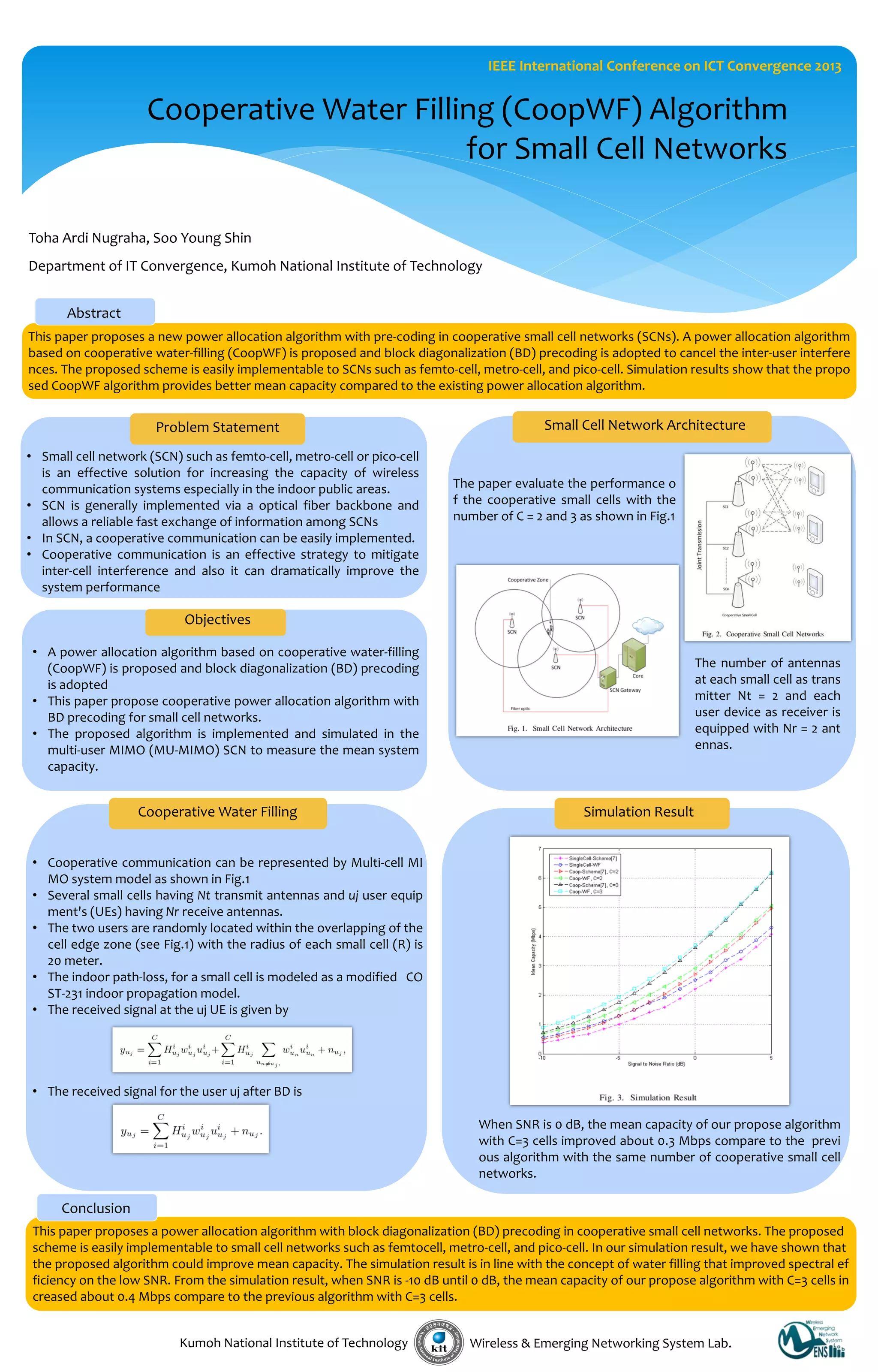
- 1. IEEE International Conferenceon ICT Convergence 2013 Cooperative Water Filling (CoopWF) Algorithm for Small Cell Networks Toha Ardi Nugraha, Soo Young Shin Department of IT Convergence, Kumoh National Institute of Technology Abstract This paper proposes a new power allocation algorithm with pre-coding in cooperative small cell networks (SCNs). A power allocation algorithm based on cooperative water-filling (CoopWF) is proposed and block diagonalization (BD) precoding is adopted to cancel the inter-user interfere nces. The proposed scheme is easily implementable to SCNs such as femto-cell, metro-cell, and pico-cell. Simulation results show that the propo sed CoopWF algorithm provides better mean capacity compared to the existing power allocation algorithm. Problem Statement • Small cell network (SCN) such as femto-cell, metro-cell or pico-cell is an effective solution for increasing the capacity of wireless communication systems especially in the indoor public areas. • SCN is generally implemented via a optical fiber backbone and allows a reliable fast exchange of information among SCNs • In SCN, a cooperative communication can be easily implemented. • Cooperative communication is an effective strategy to mitigate inter-cell interference and also it can dramatically improve the system performance Small Cell Network Architecture The paper evaluate the performance o f the cooperative small cells with the number of C = 2 and 3 as shown in Fig.1 Objectives • A power allocation algorithm based on cooperative water-filling (CoopWF) is proposed and block diagonalization (BD) precoding is adopted • This paper propose cooperative power allocation algorithm with BD precoding for small cell networks. • The proposed algorithm is implemented and simulated in the multi-user MIMO (MU-MIMO) SCN to measure the mean system capacity. Cooperative Water Filling The number of antennas at each small cell as trans mitter Nt = 2 and each user device as receiver is equipped with Nr = 2 ant ennas. Simulation Result • Cooperative communication can be represented by Multi-cell MI MO system model as shown in Fig.1 • Several small cells having Nt transmit antennas and uj user equip ment's (UEs) having Nr receive antennas. • The two users are randomly located within the overlapping of the cell edge zone (see Fig.1) with the radius of each small cell (R) is 20 meter. • The indoor path-loss, for a small cell is modeled as a modified CO ST-231 indoor propagation model. • The received signal at the uj UE is given by • The received signal for the user uj after BD is When SNR is 0 dB, the mean capacity of our propose algorithm with C=3 cells improved about 0.3 Mbps compare to the previ ous algorithm with the same number of cooperative small cell networks. Conclusion This paper proposes a power allocation algorithm with block diagonalization (BD) precoding in cooperative small cell networks. The proposed scheme is easily implementable to small cell networks such as femtocell, metro-cell, and pico-cell. In our simulation result, we have shown that the proposed algorithm could improve mean capacity. The simulation result is in line with the concept of water filling that improved spectral ef ficiency on the low SNR. From the simulation result, when SNR is -10 dB until 0 dB, the mean capacity of our propose algorithm with C=3 cells in creased about 0.4 Mbps compare to the previous algorithm with C=3 cells. Kumoh National Institute of Technology Wireless & Emerging Networking System Lab.